EP3633559B1 - Information processing apparatus, information processing method, non-transitory computer-readable storage medium - Google Patents
Information processing apparatus, information processing method, non-transitory computer-readable storage medium Download PDFInfo
- Publication number
- EP3633559B1 EP3633559B1 EP19197809.7A EP19197809A EP3633559B1 EP 3633559 B1 EP3633559 B1 EP 3633559B1 EP 19197809 A EP19197809 A EP 19197809A EP 3633559 B1 EP3633559 B1 EP 3633559B1
- Authority
- EP
- European Patent Office
- Prior art keywords
- data
- mac
- shift
- bit width
- layer
- Prior art date
- Legal status (The legal status is an assumption and is not a legal conclusion. Google has not performed a legal analysis and makes no representation as to the accuracy of the status listed.)
- Active
Links
Images




Classifications
-
- G—PHYSICS
- G06—COMPUTING OR CALCULATING; COUNTING
- G06T—IMAGE DATA PROCESSING OR GENERATION, IN GENERAL
- G06T7/00—Image analysis
- G06T7/97—Determining parameters from multiple pictures
-
- G—PHYSICS
- G06—COMPUTING OR CALCULATING; COUNTING
- G06F—ELECTRIC DIGITAL DATA PROCESSING
- G06F5/00—Methods or arrangements for data conversion without changing the order or content of the data handled
- G06F5/01—Methods or arrangements for data conversion without changing the order or content of the data handled for shifting, e.g. justifying, scaling, normalising
-
- G—PHYSICS
- G06—COMPUTING OR CALCULATING; COUNTING
- G06F—ELECTRIC DIGITAL DATA PROCESSING
- G06F7/00—Methods or arrangements for processing data by operating upon the order or content of the data handled
- G06F7/38—Methods or arrangements for performing computations using exclusively denominational number representation, e.g. using binary, ternary, decimal representation
- G06F7/48—Methods or arrangements for performing computations using exclusively denominational number representation, e.g. using binary, ternary, decimal representation using non-contact-making devices, e.g. tube, solid state device; using unspecified devices
- G06F7/544—Methods or arrangements for performing computations using exclusively denominational number representation, e.g. using binary, ternary, decimal representation using non-contact-making devices, e.g. tube, solid state device; using unspecified devices for evaluating functions by calculation
- G06F7/5443—Sum of products
-
- G—PHYSICS
- G06—COMPUTING OR CALCULATING; COUNTING
- G06N—COMPUTING ARRANGEMENTS BASED ON SPECIFIC COMPUTATIONAL MODELS
- G06N3/00—Computing arrangements based on biological models
- G06N3/02—Neural networks
- G06N3/04—Architecture, e.g. interconnection topology
-
- G—PHYSICS
- G06—COMPUTING OR CALCULATING; COUNTING
- G06N—COMPUTING ARRANGEMENTS BASED ON SPECIFIC COMPUTATIONAL MODELS
- G06N3/00—Computing arrangements based on biological models
- G06N3/02—Neural networks
- G06N3/04—Architecture, e.g. interconnection topology
- G06N3/045—Combinations of networks
-
- G—PHYSICS
- G06—COMPUTING OR CALCULATING; COUNTING
- G06N—COMPUTING ARRANGEMENTS BASED ON SPECIFIC COMPUTATIONAL MODELS
- G06N3/00—Computing arrangements based on biological models
- G06N3/02—Neural networks
- G06N3/04—Architecture, e.g. interconnection topology
- G06N3/0464—Convolutional networks [CNN, ConvNet]
-
- G—PHYSICS
- G06—COMPUTING OR CALCULATING; COUNTING
- G06N—COMPUTING ARRANGEMENTS BASED ON SPECIFIC COMPUTATIONAL MODELS
- G06N3/00—Computing arrangements based on biological models
- G06N3/02—Neural networks
- G06N3/04—Architecture, e.g. interconnection topology
- G06N3/0495—Quantised networks; Sparse networks; Compressed networks
-
- G—PHYSICS
- G06—COMPUTING OR CALCULATING; COUNTING
- G06N—COMPUTING ARRANGEMENTS BASED ON SPECIFIC COMPUTATIONAL MODELS
- G06N3/00—Computing arrangements based on biological models
- G06N3/02—Neural networks
- G06N3/06—Physical realisation, i.e. hardware implementation of neural networks, neurons or parts of neurons
- G06N3/063—Physical realisation, i.e. hardware implementation of neural networks, neurons or parts of neurons using electronic means
-
- G—PHYSICS
- G06—COMPUTING OR CALCULATING; COUNTING
- G06N—COMPUTING ARRANGEMENTS BASED ON SPECIFIC COMPUTATIONAL MODELS
- G06N3/00—Computing arrangements based on biological models
- G06N3/02—Neural networks
- G06N3/08—Learning methods
-
- G—PHYSICS
- G06—COMPUTING OR CALCULATING; COUNTING
- G06T—IMAGE DATA PROCESSING OR GENERATION, IN GENERAL
- G06T2207/00—Indexing scheme for image analysis or image enhancement
- G06T2207/10—Image acquisition modality
- G06T2207/10016—Video; Image sequence
-
- G—PHYSICS
- G06—COMPUTING OR CALCULATING; COUNTING
- G06T—IMAGE DATA PROCESSING OR GENERATION, IN GENERAL
- G06T2207/00—Indexing scheme for image analysis or image enhancement
- G06T2207/20—Special algorithmic details
- G06T2207/20084—Artificial neural networks [ANN]
Definitions
- the present invention relates to an arithmetic technique in a network which has a plurality of layers.
- CNN convolutional neural network
- a plurality of layers are hierarchically connected, and a plurality of feature images are included in each layer.
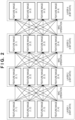
- Fig. 2 shows an example of a network in which there are four layers (layers 1 to 4) and four feature images in each layer.
- a feature image (i, j) represents a j-th feature image in a layer i.
- a filter processing result is calculated by using learned filter coefficients and feature image pixels (feature data).
- the filter processing is a multiply-accumulate (MAC) operation and includes a plurality of multiplications and a cumulative sum.
- MAC multiply-accumulate
- Feature images of a current layer are calculated by using feature images of a preceding layer and filter coefficients corresponding to the preceding layer. To calculate one feature image of the current layer, the information of a plurality of feature images of the preceding layer is required.
- the equation of the convolution operation for calculating each feature image of the current layer is as follows.
- O i,j (n) is a variable representing a MAC operation result corresponding to a position (i, j) in an n-th feature image in the current layer.
- I i,j (m) represents feature data at the position (i, j) in an m-th feature image.
- MAC operations for calculating the n-th feature image in the current layer are performed M ⁇ X ⁇ Y times.
- the feature images of the current layer are calculated by executing processing such as activation and pooling by using the MAC operation result O i,j (n).
- CNN Since CNN requires a large number of MAC operations, an efficient data parallel processing apparatus is needed when CNN is to be applied to an embedded system such as a mobile terminal, an onboard device, or the like. Since reducing the bit width of the processing date will reduce the cost of an arithmetic operation unit which calculates the convolution operation result, the degree of parallelism (DOP) of the arithmetic operation unit can be increased.
- DOP degree of parallelism
- the 8-bit data layer and the 2-bit data layer can be processed by pipelining to process data in parallel, the hardware use efficiency is reduced when the calculation amount of the convolution processing differs for each layer.
- the efficiency will degrade because the convolution operation unit dedicated to 8-bit data will have to be used since there is no convolution operation unit for this bit width.
- 8-bit data, 16-bit data, and 32-bit data can be processed by using the same hardware, this will increase the processing time when the total sum of data output in parallel is to be calculated because an SIMD command will need to be executed once again after the data has been temporarily held in a memory.
- the present invention provides a technique for implementing efficient processing even if there are data sets having a plurality of bit widths in a multi-layer network.
- the present invention in an aspect provides an information processing apparatus as specified in claims 1 to 21.
- the present invention in another aspect provides a non-transitory computer-readable storage medium as specified in claim 22. Further features of the present invention will become apparent from the following description of exemplary embodiments (with reference to the attached drawings).
- a computer apparatus such as a PC (personal computer), a tablet terminal device, a smartphone, or the like is applicable as the information processing apparatus.
- this information processing apparatus may be an embedded device which is to be embedded in such devices.
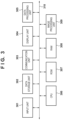
- An input unit 301 is formed by a user interface such as a keyboard, a mouse, a touch panel, or the like, and can input various kinds of instructions to a CPU 306 when operated by a user.
- a data storage unit 302 is a large-capacity information storage device such as a hard disk drive device or the like.
- the data storage unit 302 stores various kinds of information to be used in the information processing apparatus such as an OS (Operating System), various kinds of computer programs executed by the CPU 306, data to be used when the CPU 306 executes various kinds of processing, and the like.
- the data stored in the data storage unit 302 include images to be processed by an image processing unit 309. Note that information to be described below as "known information" is also stored in the data storage unit 302.
- the computer programs and data stored in the data storage unit 302 are loaded to a RAM 308 or the like by the CPU 306, a data processing unit 305, and the image processing unit 309 and become processing targets of the CPU 306, a data processing unit 305, and the image processing unit 309.
- the data storage unit 302 may be a storage medium (for example, a flexible disk, a CD-ROM, a CD-R, a DVD, a memory card, a CF card, a smart media, an SD card, a memory stick, an xD picture card, a USB memory, or the like).
- the information processing apparatus needs to include a device to read out and write the information from/to such a storage medium.
- a communication unit 303 functions as a communication interface for performing data communication with an external device. It may be set so that the communication unit 303 will obtain information necessary for executing processing in the information processing apparatus from an external device. The communication unit 303 may transmit the result of the processing performed by the information processing apparatus to an external device.
- a display unit 304 is formed by a liquid-crystal screen or a touch panel screen, and can display images, characters, and the like to display a processing result obtained by the CPU 306, the data processing unit 305, or the image processing unit 309.
- the display unit 304 may be a projection device such as a projector.
- the input unit 301 and the display unit 304 may be integrated and form a device, such as a touch screen device, which has both an instruction input accepting function and a display function.
- the data processing unit 305 executes CNN calculation by executing processing in accordance with the flowchart of Fig. 1 by using an image written into the RAM 308 by the image processing unit 309, and outputs the obtained calculation result to the data storage unit 302, the RAM 308, or the like.
- an image which is to be a processing target of the data processing unit 305 is not limited to an image written into the RAM 308 by the image processing unit 309 and may be, for example, an image input by another apparatus.
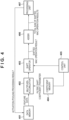
- the data processing unit 305 will be described later with reference to Fig. 4 .
- the CPU 306 executes various kinds of processing by using computer programs and data stored in a ROM 307 or the RAM 308. This allows the CPU 306 to control the overall operation of the information processing apparatus.
- the ROM 307 stores information that need not be rewritten such as setting data, an activation program, and the like of the information processing apparatus.
- the RAM 308 includes an area for storing computer programs and data loaded from the data storage unit 302 and the ROM 307, information received by the communication unit 303 from an external device, and the like.
- the RAM 308 includes a work area used by the CPU 306, the data processing unit 305, and the image processing unit 309 to execute various kinds of processing.
- the RAM 308 can appropriately provide various kinds of areas in this manner.
- the image processing unit 309 reads out an image stored in the data storage unit 302 and writes the image in the RAM 308 after executing pixel value range adjustment on each pixel of the image under the instruction from the CPU 306.
- the input unit 301, the data storage unit 302, the communication unit 303, the display unit 304, the data processing unit 305, the CPU 306, the ROM 307, the RAM 308, and the image processing unit 309 described above are all connected to a bus 310.
- the hardware arrangement of the information processing apparatus is not limited the arrangement shown in Fig. 3 .
- the arrangement of Fig. 3 may be implemented by a plurality of apparatuses.
- the information processing apparatus need not always include devices such as the input unit 301, the data storage unit 302, and the display unit 304, and it may be set so that these devices will be connected to the information processing apparatus via a communication path.
- the pieces of information described as being stored in the RAM 308 may be stored in the data storage unit 302, and some or all of the pieces of information described as being stored in the data storage unit 302 may be stored in the RAM 308.
- it may be set so that a part of the RAM 308 will be used as the data storage unit 302 or it may be virtually arranged so that storage device of a communication partner device of the communication unit 303 will be used as the data storage unit via the communication unit 303.
- the number of CPU 306 included in the information processing apparatus is not limited to one, and a plurality of CPUs may be included in the information processing apparatus.
- the data processing unit 305 and the image processing unit 309 may be implemented as hardware or may be implemented as computer programs. In the case of the latter, these computer programs will be stored in the data storage unit 302, and the functions of the data processing unit 305 and the image processing unit 309 will be executed by the CPU 306 executing the corresponding computer programs.
- the CPU 306 will perform image processing and/or image recognition on each frame of a moving image obtained from the communication unit 303 or the data storage unit 302.
- the result of the image processing or image recognition by the CPU 306 is stored in the RAM 308 or the data storage unit 302 or output to an external device via the communication unit 303.
- the result of the image processing or image recognition by the CPU 306 may be displayed as an image or characters on the display unit 304 or output as audio if the information processing apparatus has an audio output function.
- FIG. 2 shows an example of the arrangement of the processing target network.
- the details of the processing target network of Fig. 2 are as described above. Note that pieces of information such as the calculation amount of each MAC operation, the size of each feature image, the number of feature images, the number of bits of each feature image, and the like of the processing target network are stored in the data storage unit 302 or the like.
- the number of layers in the processing target layer network shown in Fig. 2 is four (layers 1 to 4), and there are four feature images in each layer.
- a feature image (i, j) represents a j-th feature image of a layer i.
- the bit width of each feature image of a layer changes depending on the layer.
- the bit width of each feature image of the layer 1 is 8 bits
- the bit width of each feature image of the layer 2 is 2 bits
- the bit width of each feature image of the layer 3 is 4 bits
- the bit width of each feature image of the layer 4 is 8 bits.
- Each feature image is formed by a plurality of pixels (feature data).
- MAC operations according to equation (1) described above are executed by using filter coefficients and 8-bit feature images (1, 1), (1, 2), (1, 3), and (1, 4) of the layer 1. Subsequently, 2-bit feature images (2, 1), (2, 2), (2, 3), and (2, 4) of the layer 2 are generated as a result of the MAC operations.
- the 2-bit feature images (2, 1), (2, 2), (2, 3), and (2, 4) of the layer 2 and the filter coefficients are used to perform MAC operations in accordance with equation (1) described above.
- 4-bit feature images (3, 1), (3, 2), (3, 3), and (3, 4) of the layer 3 are generated as a result of the MAC operations.
- the 4-bit feature images (3, 1), (3, 2), (3, 3), and (3, 4) of the layer 3 and the filter coefficients are used to perform MAC operations in accordance with equation (1) described above.
- 8-bit feature images (4, 1), (4, 2), (4, 3), and (4, 4) of the layer 4 are generated as a result of the MAC operations.
- a data memory 401 holds the feature data of each feature image of each layer, and a coefficient memory 404 holds the filter coefficients.
- a multiplier-accumulator 402 calculates each MAC operation result by executing a MAC operation by using the filter coefficients held in the coefficient memory 404 and the feature data held in the data memory 401.
- a shift operator 403 shifts each MAC operation result obtained by the multiplier-accumulator 402, and an adder 406 obtains "a total sum of the shifted MAC operation results" by adding the plurality of shifted MAC operation results.
- a processing unit 407 calculates an activation/pooling processing result and stores the calculated activation/pooling processing result in the data memory 401.
- a control unit 405 controls the overall operation of the data processing unit 305.
- step S101 the control unit 405 reads out feature data of a plurality of input feature images and the filter coefficients from the RAM 308, stores the read-out feature data in the data memory 401, and stores the read-out feature coefficients in the coefficient memory 404.
- step S102 the control unit 405 starts the loop of the layers and sets one of the unprocessed layers as the processing target layer. Since the layers 1 to 4 will be set sequentially as a processing target in this example, the layer 1 will be the processing target layer first.
- step S103 the control unit 405 sets the shift parameters, defining shift amounts, of the shift operator 403 in accordance with the layer information.
- step S104 the control unit 405 starts the loop of the output feature images and sequentially calculates the output feature data.
- step S105 the control unit 405 initializes the MAC operation result stored in the adder 406 to set the MAC operation result to zero.
- the adder 406 has a total sum calculation function.
- step S106 the control unit 405 starts the loop of input feature images and sequentially processes the input feature data.
- step S107 under the control of the control unit 405, the multiplier-accumulator 402 and the shift operator 403 perform the MAC operation and the shift operation, respectively, described above. The details (step S115 to step S117) of the process of step S107 will be described later.
- step S108 the adder 406 adds the plurality of MAC operation results to obtain "the total sum of the shifted MAC operation results".
- step S109 the control unit 405 determines the completion of the input feature image loop. If the processing of all of the input feature images has been completed, the process advances to step S110. Otherwise, the process returns to step S107, and the processing of the next unprocessed input feature image is started.
- f( ⁇ ) is an activation function
- x is input data.
- ReLU Rectified Linear Unit
- the present invention is not limited to ReLU, and the activation function may be implemented by another non-linear function or a quantization function. Note that the bit width of the activation processing result will be adjusted as needed.
- step S111 the processing unit 407 calculates the activation/pooling processing result by executing pooling processing based on the activation processing result in accordance with the layer information.
- step S112 the processing unit 407 stores the activation/pooling processing result calculated in step S111 as a feature image of the next layer in the data memory 401.
- step S113 the control unit 405 determines the completion of the loop of the output feature images. If the processing of all of the output feature images has been completed, the process advances to step S114. Otherwise, the process returns to step S105 to start the processing of an unprocessed output feature image.
- step S114 the control unit 405 determines the completion of the loop of the layers. If the processing of all of the layers has been completed, the processing according to the flowchart of Fig. 1 ends. Otherwise, the process returns to step S103, and the processing of an unprocessed layer is started.
- step S115 in addition to reading out the feature data from the data memory 401 and transferring the read-out feature data to the multiplier-accumulator 402, the control unit 405 reads out the filter coefficients from the coefficient memory 404 and transfers the read-out filter coefficients to the multiplier-accumulator 402.
- the number of the filter coefficients and the transfer count will vary depending on the bit widths of the feature data.
- step S116 the multiplier-accumulator 402 calculates the MAC operation results based on the feature data and the filter coefficients.
- step S117 the shift operator 403 shifts the MAC operation results obtained in step S116 based on the shift amounts indicated by the shift parameters set in step S103.
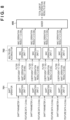
- FIG. 10A shows the operations of the multiplier-accumulator 402, the shift operator 403, and adder 406 in a case in which 8-bit feature data is to be processed.
- Fig. 10B shows the operations of the multiplier-accumulator 402, the shift operator 403, and adder 406 in a case in which 2-bit feature data is to be processed.
- the multiplier-accumulator 402 divides the 8-bit feature data 1001 (value: 234) into sets of data of 2 bits (2-bit data) as shown in Fig. 10A .
- the multiplier-accumulator 402 uses the four sets of 2-bit data (values: 2, 2, 2, 3) obtained from the division and a shared filter coefficient to calculate four MAC operation results, and the shift operator 403 shifts the four MAC operation results based on four shift parameters.
- the adder 406 adds the four shifted MAC operation results to calculate one set of feature data (the MAC operation results of 8-bit input feature data).
- the data processing unit 305 can process one set of 8-bit input feature data in this manner.
- the multiplier-accumulator 402 uses the four sets of 2-bit data 1002 (values: 2, 2, 2, 3) and four filter coefficients to calculate four MAC operation results as shown in Fig. 10B .
- the shift operator 403 shifts the four MAC operation results based on one shift parameter. Since the shift parameter is zero, the states of the MAC operation results are the same before and after the shift operation.
- the adder 406 calculates one set of feature data (the total sum of the MAC operation results of the four 2-bit input feature data sets) by adding the four MAC operation results.
- the data processing unit 305 can process the four sets of 2-bit input feature data in parallel in this manner.
- the multiplier-accumulator 402 will calculate each convolution result of the filter coefficients and the input feature data in a case in which the filter size is more than 1 ⁇ 1, the multiplier-accumulator 402 will calculate the product of I(m) and C(m, n) in a case in which the filter size is equal to 1 ⁇ 1.
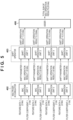
- the multiplier-accumulator 402 shown in Fig. 4 includes P ⁇ -bit data MAC operation units for calculating the MAC operation results, and the shift operator 403 includes P ⁇ -bit data shift operation units for calculating the shift operation results.
- the shift operation is expressed by processing by the power of 2.
- the filter coefficient C p (m, n) is, as shown in equation (6), a filter coefficient C'(m, n) corresponding to an m-th ⁇ -bit feature image. Since a shared filter coefficient is used for the ⁇ -bit input feature image group, the variable p can be omitted.
- the number of filter coefficients to be supplied in parallel to the P MAC operation units is 1, and the transfer count is 1.
- C p m n C ⁇ m n
- the input data I' ( ⁇ ) is divided into P sets of ⁇ -bit data I ( ⁇ ) , P (m).
- the output of the adder 406 is represented as equation (10) below based on the premise of equations (11), (12), and (13).
- I ( ⁇ ) , P (m) is the input data of the ⁇ -bit data MAC operation unit
- C p (m, n) is the filter coefficient
- S(p) is the shift parameter.
- the shift operation is expressed by processing by the power of 2.
- the filter coefficient C p (m, n) is a filter coefficient C'((m-1) ⁇ P + p, n) corresponding to an ⁇ (m-1) ⁇ P + p ⁇ -th ⁇ -bit feature image. Since the filter coefficient differs depending on the MAC operation unit number p, the number of filter coefficients to be supplied in parallel to the P MAC operation units is P, and the transfer count is P.
- C p m n C m ⁇ 1 ⁇ P + p , n
- the P sets of the ⁇ -bit input feature data I' ( ⁇ ) are directly input to the MAC operation units, the P sets of input data are feature data of different feature images.
- the feature image number is expressed as shown in equation (13) below by the MAC operation unit number p, the number P of shift operation units, and the processing number m of the multiplier-accumulator 402.
- I ⁇ , p m I ⁇ m ⁇ 1 ⁇ P + p
- the feature data I' ( ⁇ ) whose bit width is ⁇ bits and the feature data I' ( ⁇ ) whose bit width is ⁇ bits can be processed by using the same operators (the multiplier-accumulator 402, the shift operator 403, and the adder 406).
- the bit width of input data for the multiplier-accumulator 402 is 2 bits
- the bit width of the input data for the shift operator 403 is 6 bits
- the bit width of the input data for the adder 406 is 12 bits.
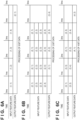
- Figs. 6A to 6C show an example of the processing time of a case in which the processing target network shown in Fig. 2 is processed by using the hardware arrangement shown in Fig. 5 .
- Feature data I' (8) (1) of the feature image (1, 1) is 8 bits, and four sets of data I (2), 1 (1) to I (2), 4 (1) obtained by dividing the feature data by four based on equation (8) are input to the multiplier-accumulator 402.
- Shift operation results are calculated by using the input feature data sets, the shift parameters, and the filter coefficient C(m, n), the calculated shift operation results are input to the adder 406, and an initial value of zero is added to the obtained result.
- the calculation result is set as the shift operation result and held by the adder 406.
- the duration of this process is 1 ms.
- Feature data I' (8) (2) of the feature image (1, 2) is 8 bits, and four sets of data I (2), 1 (2) to I (2), 4 (2) obtained by dividing the feature data by four based on equation (8) are input to the multiplier-accumulator 402. Shift operation results are calculated by using the input feature data sets, the shift parameters, and the filter coefficient C(m, n), and the calculated shift operation results are input to the adder 406 and added to the previous result. The duration of this process is 1 ms.
- the feature images (1, 3) and (1, 4) are sequentially processed in a manner similar to the feature image (1, 2), the shift operation results are accumulated, and the addition result is calculated.
- the duration of the process is 2 ms.
- the feature data of the feature image (2, 1) is output via the processing unit 407.
- the processing time of the four feature images is 4 ms.
- Each set of feature data I' (2) (1) to 1' (2) (4) of the feature images (2, 1) to (2,4) is 2 bits, and the four sets of data I (2), 1 (1) to I (2), 4 (1) are input in parallel to the multiplier-accumulator 402 based on equation (13).
- the shift operation results are calculated by using the input feature data, the shift parameter, and the filter coefficient Cp (m, n), the obtained results are input to the adder 406 and added with the initial value of zero, and the calculation result becomes the shift operation result.
- the feature data of the feature image (3, 1) is output via the processing unit 407.
- the processing time of the four feature images is 1 ms.
- the processing time per output data is 4 ms when the input feature data is 8 bits, and the processing time per output data is 1 ms when the input feature data is 2 bits. Data of different bit widths can be processed efficiently by the common data processing unit 305.
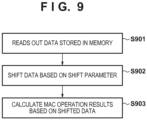
- the first embodiment described an example in which the shift operation is performed after the MAC operation. However, the same processing result can be obtained even if the order of the MAC operation and the shift operation is switched. A part of the flowchart of Fig. 1 will change when the order of the MAC operation and the shift operation is switched. Step S107 changes to steps S901 to S903 in Fig. 9 .
- Fig. 7 shows an example of the arrangement of a data processing unit 305 according to this embodiment.
- a shift operator 701 shifts the feature data stored in a data memory 401 based on a shift parameter, and the multiplier-accumulator 702 calculates the MAC operation results based on the shifted feature data and the filter coefficient.
- step S901 a control unit 704 reads out feature data from the data memory 401 and reads out a filter coefficient from a coefficient memory 703.
- step S902 the shift operator 701 shifts the feature data based on the shift parameter set in step S103.
- step S903 the multiplier-accumulator 702 calculates the MAC operation results based on the shifted feature data and the filter coefficient.
- the shift operator 701 includes P ⁇ -bit data shift operation units for calculating shift operation results
- the multiplier-accumulator 702 includes P MAC operation units for calculating MAC operation results.
- the output of the multiplier-accumulator 702 is represented by equation (15) below and is equivalent to the output of a shift operator 403 shown in equation (5).
- the bit width of the input data for the shift operator 701 is 2 bits
- the bit width of the input data for the multiplier-accumulator 702 is 8 bits
- the bit width of the input data for an adder 406 is 12 bits. Since the circuit scale of the shift operator 701 and the circuit scale of the multiplier-accumulator 702 are different due to the difference in the bit widths, it is possible to reduce the overall circuit scale by switching the order of the shift operator 701 (shift operator 403) and the multiplier-accumulator 702 (multiplier-accumulator 402).
- bit widths of input feature data are ⁇ bits (the bit width of each MAC operation unit) and ⁇ bits (the product of the bit width of each MAC operation unit and the number of MAC operation units).
- bit widths other than ⁇ and ⁇ may be used.
- FIG. 10C shows an example in which the feature data is 4 bits.
- a multiplier-accumulator 402 divides each of two sets of 4-bit feature data 1003 (values: 10, 14) by 2 bits as shown in Fig. 10C .
- the multiplier-accumulator 402 uses the four sets of 2-bit data (values: 2, 2, 2, 3) obtained by the division and two filter coefficients to calculate four MAC operation results.
- a shift operator 403 shifts the four MAC operation results based on two shift parameters.
- An adder 406 adds the four shifted MAC operation results to calculate one set of feature data (the total sum of the MAC operation results of two sets of 4-bit input feature data). In this manner, a data processing unit 305 can process two sets of 4-bit input feature data in parallel.
- ⁇ is the bit width of the input feature data, and the value of ⁇ differs from the value of ⁇ .
- output data O(n) of the adder 406 is expressed as equation (17) below based on the premise of equations (18), (19), and (20).
- I ( ⁇ ) , p (m) is the input data of the ⁇ -bit data MAC operation unit
- C p (m, n) is a filter coefficient
- S(p) is a shift parameter.
- the MAC operation units are divided into P/P' sets and the shift operation units are divided into P/P' sets, and a variable q is a set number of the MAC operation unit.
- a variable p is the MAC operation unit number and the shift operation unit number in the set, and a variable n is the output feature image number.
- the shift operation is expressed by processing by the power of 2.
- a filter coefficient C p, q (m, n) is a filter coefficient C'((m-1) ⁇ P/P' + q, n) corresponding to an ⁇ (m-1) ⁇ P/P' + q ⁇ -th ⁇ -bit feature image.
- the filter coefficient is calculated based on the set number q of the MAC operation unit. Since a part of the filter coefficient is shared, the number of filter coefficients to be supplied in parallel to the P MAC operation units is P/P' and the transfer count is P/P'.
- C p , q m n C m ⁇ 1 ⁇ P P + q , n
- the input feature data I' ( ⁇ ) is divided into P' sets of ⁇ -bit data I ( ⁇ ), p (m).
- a shift parameter S(.) is calculated based on the bit width ⁇ of the MAC operation unit and the MAC operation unit number p.
- S p q ⁇ ⁇ p ⁇ 1
- the ⁇ -bit input feature data I' ( ⁇ ) is expressed by the divided P' sets of ⁇ -bit data I ( ⁇ ), p, q (m).
- ⁇ p 1 P I ⁇ , p , q m ⁇ 2
- S p q I ⁇ m ⁇ 1 ⁇ P P + q
- the feature data I' ( ⁇ ) whose bit width is ⁇ bits can be processed by using the same operators (the multiplier-accumulator 402, the shift operator 403, and the adder 406) as in the first embodiment.
- Each of feature data I' (4) , (1) and I' (4) , (2) of feature images (3, 1) and (3, 2) is 4 bits, and four sets of data I (2), 1 (1) to I (2), 4 (1) divided based on equation (20) are input to the multiplier-accumulator 402.
- the shift operation results are calculated by using the input feature data, the shift parameter, and a filter coefficient C(m, n), the calculated shift operation results are input to the adder 406, and an initial value of zero is added to the calculated results.
- the calculation result becomes the shift operation result and is held by the adder 406.
- the duration of the process is 1 ms.
- Each of feature data I' (4), (3) and I' (4), (4) of feature images (3, 3) and (3, 4) is 4 bits, and four sets of data I (2), 1 (2) to I (2), 4 (2) divided based on equation (20) are input to the multiplier-accumulator 402.
- the shift operation results are calculated by using the input feature data, the shift parameter, and a filter coefficient C(m, n), the calculated shift operation results are input to the adder 406, and the results are added to the preceding result.
- the duration of the operation is 1 ms.
- the feature data of a feature image (4, 1) is output via the processing unit 407.
- the processing time of four feature images is 2 ms.
- the embodiment is advantageous in that it is highly flexible since feature data other than data whose bit width is ⁇ bits (the bit width of each MAC operation unit) or ⁇ bits (the product of the bit width ⁇ of each MAC operation unit and the number P of MAC operation units) can be processed.
- the execution of the activation processing is not limited to the processing unit 407, and it may be set so that another device, for example, a CPU 306 will execute the activation processing.
- a CPU 306 will execute the activation processing.
- This is also similarly applicable to other processing operations, and the above embodiments have shown merely an example of the main body of various kinds of processing, and a main body different from the main body described in the above embodiments may be used.
- activation/pooling processing was executed in accordance with the layer information in the first embodiment. However, the activation/pooling processing may be omitted depending on the case.
- the filter size (the height and the width of each filter) is 1 ⁇ 1
- the filter size is not limited to 1 ⁇ 1 and may be another size.
- the numerical values used in the description of the above embodiments are merely examples used to make a more specific explanation and are not intended to limit the numerical values to be used to those described in the above embodiments.
- the filter size is small, there is an advantage in that the capacity of a memory (a coefficient memory 404 or 703) for holding filter coefficients can be made smaller.
- the minimum value to be set as the filter width and the filter height is 1.
- the first to third embodiments set the number of input feature images to be M and the number of output feature images to be N.
- numerical values applicable to M and N are not limited to specific numerical values. In this manner, the numerical values applicable to various kinds of variables described above are not limited to specific numerical values.
- the filters were held in the coefficient memory 404 or 703 and the feature data were held in a data memory 401 in the first to third embodiments
- the memories for holding the filter coefficients and the feature data are not limited to specific memories.
- the filter coefficients and the feature data may be held in a memory included in a multiplier-accumulator 402 or 702 or may be held in a RAM 308.
- each filter coefficient is not limited to a specific bit width.
- CNN has been used as the processing target network in the first to third embodiments
- the processing target network is not limited to CNN and may be a network to which a plurality of other kinds of layers are hierarchically connected such as RNN, MLP (multilayer perceptron), or the like.
- Embodiment(s) of the present invention can also be realized by a computer of a system or apparatus that reads out and executes computer executable instructions (e.g., one or more programs) recorded on a storage medium (which may also be referred to more fully as a 'non-transitory computer-readable storage medium') to perform the functions of one or more of the above-described embodiment(s) and/or that includes one or more circuits (e.g., application specific integrated circuit (ASIC)) for performing the functions of one or more of the above-described embodiments).
- a computer executable instructions e.g., one or more programs
- a storage medium which may also be referred to more fully as a 'non-transitory computer-readable storage medium'
- ASIC application specific integrated circuit
- the computer may comprise one or more processors (e.g., central processing unit (CPU), micro processing unit (MPU)) and may include a network of separate computers or separate processors to read out and execute the computer executable instructions.
- the computer executable instructions may be provided to the computer, for example, from a network or the storage medium.
- the storage medium may include, for example, one or more of a hard disk, a random-access memory (RAM), a read only memory (ROM), a storage of distributed computing systems, an optical disk (such as a compact disc (CD), digital versatile disc (DVD), or Blu-ray Disc (BD) TM ), a flash memory device, a memory card, and the like.
Landscapes
- Engineering & Computer Science (AREA)
- Physics & Mathematics (AREA)
- Theoretical Computer Science (AREA)
- General Physics & Mathematics (AREA)
- Health & Medical Sciences (AREA)
- Life Sciences & Earth Sciences (AREA)
- Biomedical Technology (AREA)
- Biophysics (AREA)
- General Engineering & Computer Science (AREA)
- Computing Systems (AREA)
- General Health & Medical Sciences (AREA)
- Molecular Biology (AREA)
- Evolutionary Computation (AREA)
- Data Mining & Analysis (AREA)
- Computational Linguistics (AREA)
- Mathematical Physics (AREA)
- Software Systems (AREA)
- Artificial Intelligence (AREA)
- Neurology (AREA)
- Computational Mathematics (AREA)
- Mathematical Analysis (AREA)
- Mathematical Optimization (AREA)
- Pure & Applied Mathematics (AREA)
- Computer Vision & Pattern Recognition (AREA)
- Image Processing (AREA)
- Complex Calculations (AREA)
Applications Claiming Priority (1)
| Application Number | Priority Date | Filing Date | Title |
|---|---|---|---|
| JP2018188612A JP7165018B2 (ja) | 2018-10-03 | 2018-10-03 | 情報処理装置、情報処理方法 |
Publications (2)
| Publication Number | Publication Date |
|---|---|
| EP3633559A1 EP3633559A1 (en) | 2020-04-08 |
| EP3633559B1 true EP3633559B1 (en) | 2025-05-21 |
Family
ID=67997368
Family Applications (1)
| Application Number | Title | Priority Date | Filing Date |
|---|---|---|---|
| EP19197809.7A Active EP3633559B1 (en) | 2018-10-03 | 2019-09-17 | Information processing apparatus, information processing method, non-transitory computer-readable storage medium |
Country Status (5)
| Country | Link |
|---|---|
| US (2) | US11468600B2 (enExample) |
| EP (1) | EP3633559B1 (enExample) |
| JP (2) | JP7165018B2 (enExample) |
| KR (2) | KR102574307B1 (enExample) |
| CN (1) | CN110991627B (enExample) |
Families Citing this family (7)
| Publication number | Priority date | Publication date | Assignee | Title |
|---|---|---|---|---|
| JP7165018B2 (ja) * | 2018-10-03 | 2022-11-02 | キヤノン株式会社 | 情報処理装置、情報処理方法 |
| US12039430B2 (en) * | 2019-11-15 | 2024-07-16 | Samsung Electronics Co., Ltd. | Electronic device and method for inference binary and ternary neural networks |
| CN114201129B (zh) * | 2020-09-18 | 2024-11-15 | 比亚迪股份有限公司 | 智能设备的屏幕投影方法、装置、存储介质及终端 |
| CN112346703B (zh) * | 2020-11-24 | 2021-10-22 | 华中科技大学 | 一种用于卷积神经网络计算的全局平均池化电路 |
| JP7719617B2 (ja) * | 2021-03-19 | 2025-08-06 | キヤノン株式会社 | 画像処理装置、画像処理方法 |
| CN114565501B (zh) * | 2022-02-21 | 2024-03-22 | 格兰菲智能科技有限公司 | 用于卷积运算的数据加载方法及其装置 |
| JP2024026993A (ja) * | 2022-08-16 | 2024-02-29 | キヤノン株式会社 | 情報処理装置、情報処理方法 |
Family Cites Families (23)
| Publication number | Priority date | Publication date | Assignee | Title |
|---|---|---|---|---|
| EP1058185A1 (en) * | 1999-05-31 | 2000-12-06 | Motorola, Inc. | A multiply and accumulate apparatus and a method thereof |
| JP4630056B2 (ja) | 2004-12-24 | 2011-02-09 | 株式会社アドバンテスト | 畳み込み演算回路 |
| JP4571903B2 (ja) | 2005-12-02 | 2010-10-27 | 富士通株式会社 | 演算処理装置,情報処理装置,及び演算処理方法 |
| US9031006B2 (en) * | 2008-03-13 | 2015-05-12 | Samsung Electronics Co., Ltd | Apparatus and method for using guard band as data subcarrier in communication system supporting frequency overlay |
| JP5376920B2 (ja) * | 2008-12-04 | 2013-12-25 | キヤノン株式会社 | コンボリューション演算回路、階層的コンボリューション演算回路及び物体認識装置 |
| US8706791B2 (en) * | 2009-07-30 | 2014-04-22 | Ceva D.S.P. Ltd. | Low power fir filter in multi-MAC architecture |
| JP5589628B2 (ja) | 2010-07-12 | 2014-09-17 | 株式会社リコー | 内積演算装置および内積演算方法 |
| JP2013152454A (ja) | 2011-12-27 | 2013-08-08 | Canon Inc | 画像処理装置、画像処理システム、画像処理方法および画像処理プログラム |
| US10623752B2 (en) | 2013-12-27 | 2020-04-14 | Sony Corporation | Image processing apparatus and method |
| US20160328645A1 (en) * | 2015-05-08 | 2016-11-10 | Qualcomm Incorporated | Reduced computational complexity for fixed point neural network |
| JP6700712B2 (ja) | 2015-10-21 | 2020-05-27 | キヤノン株式会社 | 畳み込み演算装置 |
| US10546211B2 (en) * | 2016-07-01 | 2020-01-28 | Google Llc | Convolutional neural network on programmable two dimensional image processor |
| CN106528046B (zh) * | 2016-11-02 | 2019-06-07 | 上海集成电路研发中心有限公司 | 长位宽时序累加乘法器 |
| WO2018103736A1 (en) * | 2016-12-09 | 2018-06-14 | Beijing Horizon Information Technology Co., Ltd. | Systems and methods for data management |
| US11775313B2 (en) * | 2017-05-26 | 2023-10-03 | Purdue Research Foundation | Hardware accelerator for convolutional neural networks and method of operation thereof |
| CN108475188A (zh) * | 2017-07-31 | 2018-08-31 | 深圳市大疆创新科技有限公司 | 数据处理方法和设备 |
| JP2019074967A (ja) * | 2017-10-17 | 2019-05-16 | キヤノン株式会社 | フィルタ処理装置およびその制御方法 |
| CN107844826B (zh) * | 2017-10-30 | 2020-07-31 | 中国科学院计算技术研究所 | 神经网络处理单元及包含该处理单元的处理系统 |
| US10929746B2 (en) * | 2017-11-27 | 2021-02-23 | Samsung Electronics Co., Ltd. | Low-power hardware acceleration method and system for convolution neural network computation |
| JP6540841B1 (ja) * | 2018-02-27 | 2019-07-10 | 富士通株式会社 | 演算処理装置、情報処理装置、情報処理方法、およびプログラム |
| JP7165018B2 (ja) * | 2018-10-03 | 2022-11-02 | キヤノン株式会社 | 情報処理装置、情報処理方法 |
| JP7402623B2 (ja) * | 2019-06-17 | 2023-12-21 | キヤノン株式会社 | フィルタ処理装置及びその制御方法 |
| JP7659373B2 (ja) * | 2020-07-09 | 2025-04-09 | キヤノン株式会社 | 畳み込みニューラルネットワーク処理装置 |
-
2018
- 2018-10-03 JP JP2018188612A patent/JP7165018B2/ja active Active
-
2019
- 2019-09-17 EP EP19197809.7A patent/EP3633559B1/en active Active
- 2019-09-26 KR KR1020190118500A patent/KR102574307B1/ko active Active
- 2019-09-29 CN CN201910933454.7A patent/CN110991627B/zh active Active
- 2019-10-01 US US16/589,483 patent/US11468600B2/en active Active
-
2022
- 2022-08-29 US US17/897,353 patent/US11810330B2/en active Active
- 2022-10-21 JP JP2022169395A patent/JP7414930B2/ja active Active
-
2023
- 2023-08-30 KR KR1020230114588A patent/KR102585470B1/ko active Active
Also Published As
| Publication number | Publication date |
|---|---|
| US20200111235A1 (en) | 2020-04-09 |
| JP7165018B2 (ja) | 2022-11-02 |
| CN110991627A (zh) | 2020-04-10 |
| US20220414938A1 (en) | 2022-12-29 |
| CN110991627B (zh) | 2025-01-07 |
| US11468600B2 (en) | 2022-10-11 |
| US11810330B2 (en) | 2023-11-07 |
| KR102585470B1 (ko) | 2023-10-06 |
| KR20230130591A (ko) | 2023-09-12 |
| EP3633559A1 (en) | 2020-04-08 |
| KR102574307B1 (ko) | 2023-09-05 |
| JP7414930B2 (ja) | 2024-01-16 |
| JP2022188301A (ja) | 2022-12-20 |
| JP2020057286A (ja) | 2020-04-09 |
| KR20200038414A (ko) | 2020-04-13 |
Similar Documents
| Publication | Publication Date | Title |
|---|---|---|
| EP3633559B1 (en) | Information processing apparatus, information processing method, non-transitory computer-readable storage medium | |
| US20190095212A1 (en) | Neural network system and operating method of neural network system | |
| US11822900B2 (en) | Filter processing device and method of performing convolution operation at filter processing device | |
| US20220083857A1 (en) | Convolutional neural network operation method and device | |
| KR102744307B1 (ko) | 뉴럴 네트워크에서의 부하 균형을 위한 장치 및 방법 | |
| JP2022512211A (ja) | 画像処理方法、装置、車載演算プラットフォーム、電子機器及びシステム | |
| US11900577B2 (en) | Processing apparatus for performing processing using a convolutional neural network | |
| KR102810918B1 (ko) | 뉴럴 네트워크 프로세서에서의 3차원 콘볼루션 | |
| CN114792387A (zh) | 图像恢复方法和设备 | |
| US20210287070A1 (en) | Data processing apparatus, data processing method, and non-transitory computer-readable storage medium | |
| US20190114542A1 (en) | Electronic apparatus and control method thereof | |
| US20250130773A1 (en) | Inference processing apparatus | |
| US20230129845A1 (en) | Method and electronic device for performing deep neural network operation | |
| US20220309778A1 (en) | Image processing apparatus, image processing method, and non-transitory computer-readable storage medium | |
| US11636321B2 (en) | Data processing apparatus and control method | |
| KR20230059726A (ko) | 심층 신경망 연산을 수행하는 방법 및 전자 장치 | |
| JP7114321B2 (ja) | データ処理装置及びその方法 | |
| EP4325397A1 (en) | Information processing apparatus, information processing method, and computer-readable storage medium | |
| US20240256901A1 (en) | Information processing apparatus, information processing method and non-transitory computer-readable storage medium | |
| KR102424538B1 (ko) | 영상 복원 방법 및 장치 | |
| CN114820313B (zh) | 基于数据流架构的图像缩放装置、方法、设备及存储介质 | |
| KR20230059718A (ko) | 심층 신경망 연산을 수행하는 방법 및 전자 장치 | |
| JP2024004400A (ja) | データ処理装置及びその方法 |
Legal Events
| Date | Code | Title | Description |
|---|---|---|---|
| PUAI | Public reference made under article 153(3) epc to a published international application that has entered the european phase |
Free format text: ORIGINAL CODE: 0009012 |
|
| STAA | Information on the status of an ep patent application or granted ep patent |
Free format text: STATUS: THE APPLICATION HAS BEEN PUBLISHED |
|
| AK | Designated contracting states |
Kind code of ref document: A1 Designated state(s): AL AT BE BG CH CY CZ DE DK EE ES FI FR GB GR HR HU IE IS IT LI LT LU LV MC MK MT NL NO PL PT RO RS SE SI SK SM TR |
|
| AX | Request for extension of the european patent |
Extension state: BA ME |
|
| STAA | Information on the status of an ep patent application or granted ep patent |
Free format text: STATUS: REQUEST FOR EXAMINATION WAS MADE |
|
| 17P | Request for examination filed |
Effective date: 20201008 |
|
| RBV | Designated contracting states (corrected) |
Designated state(s): AL AT BE BG CH CY CZ DE DK EE ES FI FR GB GR HR HU IE IS IT LI LT LU LV MC MK MT NL NO PL PT RO RS SE SI SK SM TR |
|
| STAA | Information on the status of an ep patent application or granted ep patent |
Free format text: STATUS: EXAMINATION IS IN PROGRESS |
|
| 17Q | First examination report despatched |
Effective date: 20211208 |
|
| GRAP | Despatch of communication of intention to grant a patent |
Free format text: ORIGINAL CODE: EPIDOSNIGR1 |
|
| STAA | Information on the status of an ep patent application or granted ep patent |
Free format text: STATUS: GRANT OF PATENT IS INTENDED |
|
| RIC1 | Information provided on ipc code assigned before grant |
Ipc: G06N 3/045 20230101ALI20241011BHEP Ipc: G06N 3/063 20060101AFI20241011BHEP |
|
| INTG | Intention to grant announced |
Effective date: 20241120 |
|
| GRAJ | Information related to disapproval of communication of intention to grant by the applicant or resumption of examination proceedings by the epo deleted |
Free format text: ORIGINAL CODE: EPIDOSDIGR1 |
|
| STAA | Information on the status of an ep patent application or granted ep patent |
Free format text: STATUS: EXAMINATION IS IN PROGRESS |
|
| GRAP | Despatch of communication of intention to grant a patent |
Free format text: ORIGINAL CODE: EPIDOSNIGR1 |
|
| STAA | Information on the status of an ep patent application or granted ep patent |
Free format text: STATUS: GRANT OF PATENT IS INTENDED |
|
| GRAS | Grant fee paid |
Free format text: ORIGINAL CODE: EPIDOSNIGR3 |
|
| INTC | Intention to grant announced (deleted) | ||
| GRAA | (expected) grant |
Free format text: ORIGINAL CODE: 0009210 |
|
| STAA | Information on the status of an ep patent application or granted ep patent |
Free format text: STATUS: THE PATENT HAS BEEN GRANTED |
|
| INTG | Intention to grant announced |
Effective date: 20250331 |
|
| AK | Designated contracting states |
Kind code of ref document: B1 Designated state(s): AL AT BE BG CH CY CZ DE DK EE ES FI FR GB GR HR HU IE IS IT LI LT LU LV MC MK MT NL NO PL PT RO RS SE SI SK SM TR |
|
| REG | Reference to a national code |
Ref country code: GB Ref legal event code: FG4D |
|
| REG | Reference to a national code |
Ref country code: CH Ref legal event code: EP |
|
| REG | Reference to a national code |
Ref country code: DE Ref legal event code: R096 Ref document number: 602019070176 Country of ref document: DE |
|
| REG | Reference to a national code |
Ref country code: IE Ref legal event code: FG4D |
|
| REG | Reference to a national code |
Ref country code: NL Ref legal event code: MP Effective date: 20250521 |
|
| PG25 | Lapsed in a contracting state [announced via postgrant information from national office to epo] |
Ref country code: FI Free format text: LAPSE BECAUSE OF FAILURE TO SUBMIT A TRANSLATION OF THE DESCRIPTION OR TO PAY THE FEE WITHIN THE PRESCRIBED TIME-LIMIT Effective date: 20250521 Ref country code: ES Free format text: LAPSE BECAUSE OF FAILURE TO SUBMIT A TRANSLATION OF THE DESCRIPTION OR TO PAY THE FEE WITHIN THE PRESCRIBED TIME-LIMIT Effective date: 20250521 Ref country code: PT Free format text: LAPSE BECAUSE OF FAILURE TO SUBMIT A TRANSLATION OF THE DESCRIPTION OR TO PAY THE FEE WITHIN THE PRESCRIBED TIME-LIMIT Effective date: 20250922 |
|
| PGFP | Annual fee paid to national office [announced via postgrant information from national office to epo] |
Ref country code: DE Payment date: 20250820 Year of fee payment: 7 |
|
| REG | Reference to a national code |
Ref country code: LT Ref legal event code: MG9D |
|
| PG25 | Lapsed in a contracting state [announced via postgrant information from national office to epo] |
Ref country code: NO Free format text: LAPSE BECAUSE OF FAILURE TO SUBMIT A TRANSLATION OF THE DESCRIPTION OR TO PAY THE FEE WITHIN THE PRESCRIBED TIME-LIMIT Effective date: 20250821 Ref country code: GR Free format text: LAPSE BECAUSE OF FAILURE TO SUBMIT A TRANSLATION OF THE DESCRIPTION OR TO PAY THE FEE WITHIN THE PRESCRIBED TIME-LIMIT Effective date: 20250822 |
|
| PG25 | Lapsed in a contracting state [announced via postgrant information from national office to epo] |
Ref country code: PL Free format text: LAPSE BECAUSE OF FAILURE TO SUBMIT A TRANSLATION OF THE DESCRIPTION OR TO PAY THE FEE WITHIN THE PRESCRIBED TIME-LIMIT Effective date: 20250521 Ref country code: NL Free format text: LAPSE BECAUSE OF FAILURE TO SUBMIT A TRANSLATION OF THE DESCRIPTION OR TO PAY THE FEE WITHIN THE PRESCRIBED TIME-LIMIT Effective date: 20250521 |
|
| PG25 | Lapsed in a contracting state [announced via postgrant information from national office to epo] |
Ref country code: BG Free format text: LAPSE BECAUSE OF FAILURE TO SUBMIT A TRANSLATION OF THE DESCRIPTION OR TO PAY THE FEE WITHIN THE PRESCRIBED TIME-LIMIT Effective date: 20250521 |
|
| PGFP | Annual fee paid to national office [announced via postgrant information from national office to epo] |
Ref country code: GB Payment date: 20250820 Year of fee payment: 7 |
|
| PG25 | Lapsed in a contracting state [announced via postgrant information from national office to epo] |
Ref country code: HR Free format text: LAPSE BECAUSE OF FAILURE TO SUBMIT A TRANSLATION OF THE DESCRIPTION OR TO PAY THE FEE WITHIN THE PRESCRIBED TIME-LIMIT Effective date: 20250521 |
|
| PGFP | Annual fee paid to national office [announced via postgrant information from national office to epo] |
Ref country code: FR Payment date: 20250820 Year of fee payment: 7 |
|
| PG25 | Lapsed in a contracting state [announced via postgrant information from national office to epo] |
Ref country code: RS Free format text: LAPSE BECAUSE OF FAILURE TO SUBMIT A TRANSLATION OF THE DESCRIPTION OR TO PAY THE FEE WITHIN THE PRESCRIBED TIME-LIMIT Effective date: 20250821 |
|
| PG25 | Lapsed in a contracting state [announced via postgrant information from national office to epo] |
Ref country code: IS Free format text: LAPSE BECAUSE OF FAILURE TO SUBMIT A TRANSLATION OF THE DESCRIPTION OR TO PAY THE FEE WITHIN THE PRESCRIBED TIME-LIMIT Effective date: 20250921 |
|
| PG25 | Lapsed in a contracting state [announced via postgrant information from national office to epo] |
Ref country code: LV Free format text: LAPSE BECAUSE OF FAILURE TO SUBMIT A TRANSLATION OF THE DESCRIPTION OR TO PAY THE FEE WITHIN THE PRESCRIBED TIME-LIMIT Effective date: 20250521 |
|
| REG | Reference to a national code |
Ref country code: AT Ref legal event code: MK05 Ref document number: 1797399 Country of ref document: AT Kind code of ref document: T Effective date: 20250521 |