EP3632425A1 - Methods to mobilize progenitor/stem cells - Google Patents
Methods to mobilize progenitor/stem cells Download PDFInfo
- Publication number
- EP3632425A1 EP3632425A1 EP19179517.8A EP19179517A EP3632425A1 EP 3632425 A1 EP3632425 A1 EP 3632425A1 EP 19179517 A EP19179517 A EP 19179517A EP 3632425 A1 EP3632425 A1 EP 3632425A1
- Authority
- EP
- European Patent Office
- Prior art keywords
- pyridinylmethyl
- benzenedimethanamine
- bis
- tetrahydro
- methylene
- Prior art date
- Legal status (The legal status is an assumption and is not a legal conclusion. Google has not performed a legal analysis and makes no representation as to the accuracy of the status listed.)
- Withdrawn
Links
Images
Classifications
-
- A—HUMAN NECESSITIES
- A61—MEDICAL OR VETERINARY SCIENCE; HYGIENE
- A61K—PREPARATIONS FOR MEDICAL, DENTAL OR TOILETRY PURPOSES
- A61K31/00—Medicinal preparations containing organic active ingredients
- A61K31/33—Heterocyclic compounds
- A61K31/395—Heterocyclic compounds having nitrogen as a ring hetero atom, e.g. guanethidine or rifamycins
-
- A—HUMAN NECESSITIES
- A61—MEDICAL OR VETERINARY SCIENCE; HYGIENE
- A61K—PREPARATIONS FOR MEDICAL, DENTAL OR TOILETRY PURPOSES
- A61K31/00—Medicinal preparations containing organic active ingredients
- A61K31/33—Heterocyclic compounds
-
- A—HUMAN NECESSITIES
- A61—MEDICAL OR VETERINARY SCIENCE; HYGIENE
- A61K—PREPARATIONS FOR MEDICAL, DENTAL OR TOILETRY PURPOSES
- A61K31/00—Medicinal preparations containing organic active ingredients
- A61K31/33—Heterocyclic compounds
- A61K31/395—Heterocyclic compounds having nitrogen as a ring hetero atom, e.g. guanethidine or rifamycins
- A61K31/435—Heterocyclic compounds having nitrogen as a ring hetero atom, e.g. guanethidine or rifamycins having six-membered rings with one nitrogen as the only ring hetero atom
- A61K31/44—Non condensed pyridines; Hydrogenated derivatives thereof
- A61K31/4427—Non condensed pyridines; Hydrogenated derivatives thereof containing further heterocyclic ring systems
-
- A—HUMAN NECESSITIES
- A61—MEDICAL OR VETERINARY SCIENCE; HYGIENE
- A61K—PREPARATIONS FOR MEDICAL, DENTAL OR TOILETRY PURPOSES
- A61K31/00—Medicinal preparations containing organic active ingredients
- A61K31/33—Heterocyclic compounds
- A61K31/395—Heterocyclic compounds having nitrogen as a ring hetero atom, e.g. guanethidine or rifamycins
- A61K31/495—Heterocyclic compounds having nitrogen as a ring hetero atom, e.g. guanethidine or rifamycins having six-membered rings with two or more nitrogen atoms as the only ring heteroatoms, e.g. piperazine or tetrazines
- A61K31/496—Non-condensed piperazines containing further heterocyclic rings, e.g. rifampin, thiothixene or sparfloxacin
-
- A—HUMAN NECESSITIES
- A61—MEDICAL OR VETERINARY SCIENCE; HYGIENE
- A61K—PREPARATIONS FOR MEDICAL, DENTAL OR TOILETRY PURPOSES
- A61K31/00—Medicinal preparations containing organic active ingredients
- A61K31/33—Heterocyclic compounds
- A61K31/395—Heterocyclic compounds having nitrogen as a ring hetero atom, e.g. guanethidine or rifamycins
- A61K31/55—Heterocyclic compounds having nitrogen as a ring hetero atom, e.g. guanethidine or rifamycins having seven-membered rings, e.g. azelastine, pentylenetetrazole
-
- A—HUMAN NECESSITIES
- A61—MEDICAL OR VETERINARY SCIENCE; HYGIENE
- A61K—PREPARATIONS FOR MEDICAL, DENTAL OR TOILETRY PURPOSES
- A61K31/00—Medicinal preparations containing organic active ingredients
- A61K31/33—Heterocyclic compounds
- A61K31/395—Heterocyclic compounds having nitrogen as a ring hetero atom, e.g. guanethidine or rifamycins
- A61K31/55—Heterocyclic compounds having nitrogen as a ring hetero atom, e.g. guanethidine or rifamycins having seven-membered rings, e.g. azelastine, pentylenetetrazole
- A61K31/551—Heterocyclic compounds having nitrogen as a ring hetero atom, e.g. guanethidine or rifamycins having seven-membered rings, e.g. azelastine, pentylenetetrazole having two nitrogen atoms, e.g. dilazep
-
- A—HUMAN NECESSITIES
- A61—MEDICAL OR VETERINARY SCIENCE; HYGIENE
- A61K—PREPARATIONS FOR MEDICAL, DENTAL OR TOILETRY PURPOSES
- A61K31/00—Medicinal preparations containing organic active ingredients
- A61K31/33—Heterocyclic compounds
- A61K31/555—Heterocyclic compounds containing heavy metals, e.g. hemin, hematin, melarsoprol
-
- A—HUMAN NECESSITIES
- A61—MEDICAL OR VETERINARY SCIENCE; HYGIENE
- A61K—PREPARATIONS FOR MEDICAL, DENTAL OR TOILETRY PURPOSES
- A61K35/00—Medicinal preparations containing materials or reaction products thereof with undetermined constitution
- A61K35/12—Materials from mammals; Compositions comprising non-specified tissues or cells; Compositions comprising non-embryonic stem cells; Genetically modified cells
- A61K35/28—Bone marrow; Haematopoietic stem cells; Mesenchymal stem cells of any origin, e.g. adipose-derived stem cells
-
- A—HUMAN NECESSITIES
- A61—MEDICAL OR VETERINARY SCIENCE; HYGIENE
- A61K—PREPARATIONS FOR MEDICAL, DENTAL OR TOILETRY PURPOSES
- A61K38/00—Medicinal preparations containing peptides
- A61K38/16—Peptides having more than 20 amino acids; Gastrins; Somatostatins; Melanotropins; Derivatives thereof
- A61K38/17—Peptides having more than 20 amino acids; Gastrins; Somatostatins; Melanotropins; Derivatives thereof from animals; from humans
- A61K38/19—Cytokines; Lymphokines; Interferons
- A61K38/193—Colony stimulating factors [CSF]
-
- A—HUMAN NECESSITIES
- A61—MEDICAL OR VETERINARY SCIENCE; HYGIENE
- A61K—PREPARATIONS FOR MEDICAL, DENTAL OR TOILETRY PURPOSES
- A61K38/00—Medicinal preparations containing peptides
- A61K38/16—Peptides having more than 20 amino acids; Gastrins; Somatostatins; Melanotropins; Derivatives thereof
- A61K38/17—Peptides having more than 20 amino acids; Gastrins; Somatostatins; Melanotropins; Derivatives thereof from animals; from humans
- A61K38/19—Cytokines; Lymphokines; Interferons
- A61K38/195—Chemokines, e.g. RANTES
-
- A—HUMAN NECESSITIES
- A61—MEDICAL OR VETERINARY SCIENCE; HYGIENE
- A61P—SPECIFIC THERAPEUTIC ACTIVITY OF CHEMICAL COMPOUNDS OR MEDICINAL PREPARATIONS
- A61P17/00—Drugs for dermatological disorders
- A61P17/02—Drugs for dermatological disorders for treating wounds, ulcers, burns, scars, keloids, or the like
-
- A—HUMAN NECESSITIES
- A61—MEDICAL OR VETERINARY SCIENCE; HYGIENE
- A61P—SPECIFIC THERAPEUTIC ACTIVITY OF CHEMICAL COMPOUNDS OR MEDICINAL PREPARATIONS
- A61P31/00—Antiinfectives, i.e. antibiotics, antiseptics, chemotherapeutics
- A61P31/04—Antibacterial agents
-
- A—HUMAN NECESSITIES
- A61—MEDICAL OR VETERINARY SCIENCE; HYGIENE
- A61P—SPECIFIC THERAPEUTIC ACTIVITY OF CHEMICAL COMPOUNDS OR MEDICINAL PREPARATIONS
- A61P31/00—Antiinfectives, i.e. antibiotics, antiseptics, chemotherapeutics
- A61P31/12—Antivirals
-
- A—HUMAN NECESSITIES
- A61—MEDICAL OR VETERINARY SCIENCE; HYGIENE
- A61P—SPECIFIC THERAPEUTIC ACTIVITY OF CHEMICAL COMPOUNDS OR MEDICINAL PREPARATIONS
- A61P35/00—Antineoplastic agents
- A61P35/02—Antineoplastic agents specific for leukemia
-
- A—HUMAN NECESSITIES
- A61—MEDICAL OR VETERINARY SCIENCE; HYGIENE
- A61P—SPECIFIC THERAPEUTIC ACTIVITY OF CHEMICAL COMPOUNDS OR MEDICINAL PREPARATIONS
- A61P37/00—Drugs for immunological or allergic disorders
-
- A—HUMAN NECESSITIES
- A61—MEDICAL OR VETERINARY SCIENCE; HYGIENE
- A61P—SPECIFIC THERAPEUTIC ACTIVITY OF CHEMICAL COMPOUNDS OR MEDICINAL PREPARATIONS
- A61P37/00—Drugs for immunological or allergic disorders
- A61P37/02—Immunomodulators
- A61P37/04—Immunostimulants
-
- A—HUMAN NECESSITIES
- A61—MEDICAL OR VETERINARY SCIENCE; HYGIENE
- A61P—SPECIFIC THERAPEUTIC ACTIVITY OF CHEMICAL COMPOUNDS OR MEDICINAL PREPARATIONS
- A61P43/00—Drugs for specific purposes, not provided for in groups A61P1/00-A61P41/00
-
- A—HUMAN NECESSITIES
- A61—MEDICAL OR VETERINARY SCIENCE; HYGIENE
- A61P—SPECIFIC THERAPEUTIC ACTIVITY OF CHEMICAL COMPOUNDS OR MEDICINAL PREPARATIONS
- A61P7/00—Drugs for disorders of the blood or the extracellular fluid
-
- A—HUMAN NECESSITIES
- A61—MEDICAL OR VETERINARY SCIENCE; HYGIENE
- A61P—SPECIFIC THERAPEUTIC ACTIVITY OF CHEMICAL COMPOUNDS OR MEDICINAL PREPARATIONS
- A61P7/00—Drugs for disorders of the blood or the extracellular fluid
- A61P7/06—Antianaemics
-
- A—HUMAN NECESSITIES
- A61—MEDICAL OR VETERINARY SCIENCE; HYGIENE
- A61P—SPECIFIC THERAPEUTIC ACTIVITY OF CHEMICAL COMPOUNDS OR MEDICINAL PREPARATIONS
- A61P9/00—Drugs for disorders of the cardiovascular system
-
- C—CHEMISTRY; METALLURGY
- C12—BIOCHEMISTRY; BEER; SPIRITS; WINE; VINEGAR; MICROBIOLOGY; ENZYMOLOGY; MUTATION OR GENETIC ENGINEERING
- C12N—MICROORGANISMS OR ENZYMES; COMPOSITIONS THEREOF; PROPAGATING, PRESERVING, OR MAINTAINING MICROORGANISMS; MUTATION OR GENETIC ENGINEERING; CULTURE MEDIA
- C12N5/00—Undifferentiated human, animal or plant cells, e.g. cell lines; Tissues; Cultivation or maintenance thereof; Culture media therefor
- C12N5/06—Animal cells or tissues; Human cells or tissues
- C12N5/0602—Vertebrate cells
- C12N5/0634—Cells from the blood or the immune system
- C12N5/0647—Haematopoietic stem cells; Uncommitted or multipotent progenitors
-
- A—HUMAN NECESSITIES
- A61—MEDICAL OR VETERINARY SCIENCE; HYGIENE
- A61K—PREPARATIONS FOR MEDICAL, DENTAL OR TOILETRY PURPOSES
- A61K35/00—Medicinal preparations containing materials or reaction products thereof with undetermined constitution
- A61K35/12—Materials from mammals; Compositions comprising non-specified tissues or cells; Compositions comprising non-embryonic stem cells; Genetically modified cells
- A61K2035/124—Materials from mammals; Compositions comprising non-specified tissues or cells; Compositions comprising non-embryonic stem cells; Genetically modified cells the cells being hematopoietic, bone marrow derived or blood cells
Definitions
- the invention is in the field of therapeutics and medicinal chemistry. More particularly, the invention concerns methods to mobilize progenitor/stem cells in subjects by administering certain polyamines.
- White blood cells play a crucial part in maintaining the health and viability of animals, including humans.
- White blood cells include neutrophils, macrophage, eosinophils and basophils/mast cells as well the B and T cells of the immune system.
- White blood cells are continuously replaced via the hematopoietic system, by the action of colony stimulating factors (CSF) and various cytokines on stem cells and progenitor cells in hematopoietic tissues.
- CSF colony stimulating factors
- cytokines various cytokines on stem cells and progenitor cells in hematopoietic tissues.
- the nucleotide sequences encoding a number of these growth factors have been cloned and sequenced.
- G-CSF granulocyte colony stimulating factor
- GM-CSF granulocyte-macrophage colony stimulating factor
- IL-1 Interleukin-1
- IL-3 Interleukin-3
- IL-8 Interleukin-8
- PIXY-321 GM-CSF/IL-3 fusion protein
- macrophage inflammatory protein stem cell factor
- thrombopoietin growth related oncogene
- Mature blood cells are derived from hematopoietic precursor cells (progenitor) cells and stem cells present in specific hematopoietic tissues including bone marrow. Within these environments hematopoietic cells proliferate and differentiate prior to entering the circulation.
- the chemokine receptor CXCR4 and its natural ligand stromal cell derived factor-1 (SDF-1) appear to be important in this process (for reviews see Maekawa, T., et al., Internal Med. (2000) 39:90-100 ; Nagasawa, T., et a/., Int. J. Hematol. (2000) 72:408-411 ).
- CXCR4 or SDF-1 knock-out mice exhibit hematopoietic defects ( Ma, Q., et al., Proc. Natl. Acad. Sci USA (1998) 95:9448-9453 ; Tachibana, K., et al., Nature (1998) 393:591-594 ; Zou, Y-R., et al., Nature (1998) 393:595-599 ).
- CD34+ progenitor cells express CXCR4 and require SDF-1 produced by bone marrow stromal cells for chemoattraction and engraftment ( Peled, A., et ⁇ l., Science (1999) 283:845-848 ) and that in vitro, SDF-1 is chemotactic for both CD34+ cells ( Aiuti, A., et al., J. Exp. Med. (1997) 185:111-120 ; Viardot, A., et al., Ann. Hematol. (1998) 77:194-197 ) and for progenitor/stem cells ( Jo, D-Y., et al., J. Clin. Invest.
- SDF-1 is also an important chemoattractant, signaling via the CXCR4 receptor, for several other more committed progenitors and mature blood cells including T-lymphocytes and monocytes ( Bleul, C., et al., J. Exp. Med. (1996) 184:1101-1109 ), pro-and pre-B lymphocytes ( Fedyk, E. R., et al., J. Leukoc. Biol.
- SDF-1 is able to control the positioning and differentiation of cells bearing CXCR4 receptors whether these cells are stem cells (i.e ., cells which are CD34+) and/or progenitor cells (which result in formation of specified types of colonies in response to particular stimuli; that can be CD34 + or CD34 - ) or cells that are somewhat more differentiated.
- CD34+ cells mobilized in the pool of peripheral blood progenitor cells used for autologous stem cell transplantation.
- the CD34+ population is the component thought to be primarily responsible for the improved recovery time after chemotherapy and the cells most likely responsible for long-term engraftment and restoration of hematopoiesis ( Croop, J. M., et al., Bone Marrow Transplantation (2000) 26:1271-1279 ).
- the mechanism by which CD34+ cells re-engraft may be due to the chemotactic effects of SDF-1 on CXCR4 expressing cells ( Voermans, C. Blood, 2001, 97, 799-804 ; Ponomaryov, T., et al., J.
- the invention is directed to methods of treating animal subjects, in particular, veterinary and human subjects, to enhance the number of progenitor cells and/or stem cells.
- the progenitor and/or stem cells may be harvested and used in cell transplantation.
- the methods of the invention employ polyamines including those described in the patents and publications incorporated hereinabove by reference.
- the invention is directed to a method to elevate the progenitor cells and/or stem cells, in a subject, which method comprises administering to said subject an amount of a compound of formula (1) or of a pharmaceutical composition thereof effective to elevate progenitor cell and/or stem cell levels.
- a compound of formula (1) or of a pharmaceutical composition thereof effective to elevate progenitor cell and/or stem cell levels.
- bone marrow progenitor and/or stem cells are mobilized for myocardial repair.
- the methods of the invention also include treatment of cell populations ex vivo with the compounds of formula (1) and introducing the treated populations into a compatible subject.
- the compounds of formula (1) may be used alone or in combination with other compounds and compositions to enhance the population of stem cells and/or progenitor cells in the peripheral blood. An enhanced production of white blood cells in the bone marrow may result as well.
- the invention is directed to pharmaceutical compositions containing the compound of formula (1) for use in effecting an elevation of progenitor cells and/or stem cells in animal subjects.
- the compounds of formula (1) are of the formula: Z-linker-Z' (1) wherein Z is a cyclic polyamine containing 9-32 ring members of which 2-8 are nitrogen atoms, said nitrogen atoms separated from each other by at least 2 carbon atoms, and wherein said heterocycle may optionally contain additional heteroatoms besides nitrogen and/or may be fused to an additional ring system; or Z is of the formula
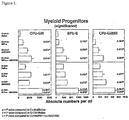
- Figure 1 shows a graph of obtaining myeloid progenitors in response to treatment with 1,1'-[1,4-phenylene-bis(methylene)]-bis-1,4,8,11-tetraazacyclotetradecane (AMD3100) in combination with macrophage inflammatory protein after administration of G-CSF.
- AMD3100 1,1'-[1,4-phenylene-bis(methylene)]-bis-1,4,8,11-tetraazacyclotetradecane
- the compounds useful in the invention are of the general formula set forth as formula (1) above. Certain embodiments are preferred; included among these are the compounds set forth in the above-incorporated U.S. patents and other patent documents.
- the cyclic polyamine and non-cyclic amine antiviral agents described in the above-mentioned documents inhibit HIV replication via inhibition of CXCR4, the co-receptor required for fusion and entry of T-tropic HIV strains, and also inhibit the binding and signaling induced by the natural ligand, the chemokine SDF-1.
- the compounds of formula (1) which inhibit the binding of SDF-1 to CXCR4 effect an increase in stem and/or progenitor cells by virtue of such inhibition. Enhancing the stem and/or progenitor cells in blood is helpful in treatments to alleviate the effects of protocols that adversely affect the bone marrow, such as those that result in leukopenia. These are known side-effects of chemotherapy and radiotherapy.
- the compounds of formula (1) also enhance the success of bone marrow transplantation, enhance wound healing and burn treatment, and aid in restoration of damaged organ tissue. They also combat bacterial infections that are prevalent in leukemia.
- the compounds of formula (1) are used to mobilize and harvest CD34+ cells via apheresis with and without combinations with other mobilizing factors. The harvested cells are used in treatments requiring stem cell transplantations.
- progenitor cells refers to cells that, in response to certain stimuli, can form differentiated hematopoietic or myeloid cells.
- the presence of progenitor cells can be assessed by the ability of the cells in a sample to form colony-forming units of various types, including, for example, CFU-GM (colony-forming units, granulocyte-macrophage); CFU-GEMM (colony-forming units, multipotential); BFU-E (burst-forming units, erythroid); HPP-CFC (high proliferative potential colony-forming cells); or other types of differentiated colonies which can be obtained in culture using known protocols.
- CFU-GM colony-forming units, granulocyte-macrophage
- CFU-GEMM colony-forming units, multipotential
- BFU-E burst-forming units, erythroid
- HPP-CFC high proliferative potential colony-forming cells
- stem cells are less differentiated forms of progenitor cells. Typically, such cells are often positive for CD34. Some stem cells do not contain this marker, however. These CD34+ cells can be assayed using fluorescence activated cell sorting (FACS) and thus their presence can be assessed in a sample using this technique.
- FACS fluorescence activated cell sorting
- CD34+ cells are present only in low levels in the blood, but are present in large numbers in bone marrow. While other types of cells such as endothelial cells and mast cells also may exhibit this marker, CD34 is considered an index of stem cell presence.
- preferred embodiments of Z and Z' are cyclic polyamine moieties having from 9-24C that include 3-5 nitrogen atoms. Particularly preferred are 1,5,9,13-tetraazacyclohexadecane; 1,5,8,11,14-pentaazacyclohexadecane; 1,4,8,11-tetraazacylotetradecane; 1,5,9-triazacyclododecane; 1,4,7,10-tetraazacyclododecane; and the like, including such cyclic polyamines which are fused to an additional aromatic or heteroaromatic rings and/or containing a heteroatom other than nitrogen incorporated in the ring.
- Embodiments wherein the cyclic polyamine contains a fused additional cyclic system or one or more additional heteroatoms are described in U.S. Patent No. 5,698,546 and WO 01/44229 incorporated hereinabove by reference. Also preferred are 3,7,11,17-tetraazabicylo(13.3.1)heptadeca-1(17),13,15-triene; 4,7,10,17-tetraazabicyclo(13.3.1)heptadeca-1(17),13,15-triene; 1,4,7,10-tetraazacyclotetradecane; 1,4,7-triazacyclotetradecane; and 4,7,10-triazabicyclo(13.3.1)heptadeca-1(17),13,15-triene.
- Z' is other than a cyclic polyamine as defined in Z
- its preferred embodiments are set forth in U.S. Patent No. 5,817,807 , also incorporated herein by reference.
- linker moiety examples include those wherein the linker is a bond, or wherein the linker includes an aromatic moiety flanked by alkylene, preferably methylene moieties.
- Preferred linking groups include the methylene bracketed forms of 1,3-phenylene, 2,6-pyridine, 3,5-pyridine, 2,5-thiophene, 4,4'-(2,2'-bipyrimidine); 2,9-(1,10-phenanthroline) and the like.
- a particularly preferred linker is 1,4-phenylene-bis-(methylene).
- Particularly preferred embodiments of the compound of the formula (1) include 2,2'-bicyclam; 6,6'-bicyclam; the embodiments set forth in U.S. Patent Nos. 5,021,409 , and 6,001,826 , and in particular 1,1'-[1,4-phenylene-bis(methylene)]-bis-.1,4,8,11-tetraazacyclotctradecane, set forth in U.S. Patent No. 5,583,131 , and designated herein AMD3100.
- AMD3100 is an antagonist with the CXCR4 chemokine receptor ( Gerlach et al., J.Biol. Chem. (2001) 276:14153-14160 ). This compound interferes with the binding of bone marrow stromal cell derived SDF-1 with CXCR4 on stem cells which leads to the release of hematopoietic stem cells from bone marrow into the circulation ( Broxmeyer et al., Blood (2001) 98:811a (Abstract )).
- mice were injected with rhG-CSF and recombinant rat Stem Cell Factor (rrSCF) in order to mobilize large numbers of bone marrow stem cells into the circulation and then we induced a heart attack.
- rrSCF rat Stem Cell Factor
- the compounds of the invention may be prepared in the form of prodrugs, i . e ., protected forms which release the compounds of the invention after administration to the subject.
- the protecting groups are hydrolyzed in body fluids such as in the bloodstream thus releasing the active compound or are oxidized or reduced in vivo to release the active compound.
- a discussion of prodrugs is found in Smith and Williams Introduction to the Principles of Drug Design, Smith, H.J.; Wright, 2nd ed., London (1988 ).
- the compounds of the invention may be administered prepared in the forms of their acid addition salts or metal complexes thereof.
- Suitable acid addition salts include salts of inorganic acids that are biocompatible, including HCl, HBr, sulfuric, phosphoric and the like, as well as organic acids such as acetic, propionic, butyric and the like, as well as acids containing more than one carboxyl group, such as oxalic, glutaric, adipic and the like.
- the compounds of the invention will be in the forms of the acid addition salts. Particularly preferred are the hydrochlorides.
- the compounds when prepared as purified forms, the compounds may also be crystallized as the hydrates.
- the compounds of the invention may be administered as sole active ingredients, as mixtures of various compounds of formula (1), and/or in admixture with additional active ingredients that are therapeutically or nutritionally useful, such as antibiotics, vitamins, herbal extracts, anti-inflammatories, glucose, antipyretics, analgesics, granulocyte-macrophage colony stimulating factor (GM-CSF), Interleukin-1 (IL-1), Interleukin-3 (IL-3), Interleukin-8 (IL-8), PIXY-321 (GM-CSF/IL-3 fusion protein), macrophage inflammatory protein, stem cell factor, thrombopoietin, growth related oncogene or chemotherapy and the like.
- additional active ingredients that are therapeutically or nutritionally useful, such as antibiotics, vitamins, herbal extracts, anti-inflammatories, glucose, antipyretics, analgesics, granulocyte-macrophage colony stimulating factor (GM-CSF), Interleukin-1 (IL-1), Interleukin-3 (IL
- the compounds of the invention may be formulated for administration to animal subject using commonly understood formulation techniques well known in the art.
- Formulations which are suitable for particular modes of administration and for compounds of the type represented by those of formula (1) may be found in Remington's Pharmaceutical Sciences, latest edition, Mack Publishing Company, Easton, PA .
- the compounds are administered by injection, most preferably by intravenous injection, but also by subcutaneous or intraperitoneal injection, and the like. Additional parenteral routes of administration include intramuscular and intraarticular injection.
- the compounds are formulated in suitable liquid form with excipients as required.
- the compositions may contain liposomes or other suitable carriers.
- the solution is made isotonic using standard preparations such as Hank's solution.
- the compounds may be formulated into tablets, capsules, syrups, powders, or other suitable forms for administration orally. By using suitable excipients, these compounds may also be administered through the mucosa using suppositories or intranasal sprays. Transdermal administration can also be effected by using suitable penetrants and controlling the rate of release.
- formulation and route of administration chosen will be tailored to the individual subject, the nature of the condition to be treated in the subject, and generally, the judgment of the attending practitioner.
- Suitable dosage ranges for the compounds of formula (1) vary according to these considerations, but in general, the compounds are administered in the range of about 0.1 ⁇ g/kg-5 mg/kg of body weight; preferably the range is about 1 ⁇ g/kg-300 ⁇ g/kg of body weight; more preferably about 10 ⁇ g/kg-100 ⁇ g/kg of body weight.
- the dosage range is from about 0.7 ⁇ g-350 mg; preferably about 700 ⁇ g-21 mg; most preferably about 700 ⁇ g-7 mg. Dosages may be higher when the compounds are administered orally or transdermally as compared to, for example, i.v. administration.
- the compounds may be administered as a single bolus dose, a dose over time, as in i.v. or transdermal administration, or in multiple dosages.
- the compounds of formula (1) can be used in ex vivo treatment protocols to prepare cell cultures which are then used to replenish the blood cells of the subject.
- Ex vivo treatment can be conducted on autologous cells harvested from the peripheral blood or bone marrow or from allografts from matched donors.
- concentration of the compound or compounds of formula (1) alone or in combination with other agents, such as macrophage inflammatory protein is a matter of routine optimization.
- Subjects that will respond favorably to the method of the invention include medical and veterinary subjects generally, including human patients. Among other subjects for whom the methods of the invention is useful are cats, dogs, large animals, avians such as chickens, and the like. In general, any subject who would benefit from an elevation of progenitor cells and/or stem cells, or whose progenitor cells and/or stem cells are desirable for stem cell transplantation are appropriate for administration of the invention method.
- Typical conditions which may be ameliorated or otherwise benefited by the method of the invention include hematopoietic disorders, such as aplastic anemia, leukemias, drug-induced anemias, and hematopoietic deficits from chemotherapy or radiation therapy.
- the method of the invention is also useful in enhancing the success of transplantation during and following immunosuppressive treatments as well as in effecting more efficient wound healing and treatment of bacterial inflammation.
- the method of the present invention is further useful for treating subjects who are immunocompromised or whose immune system is otherwise impaired.
- Typical conditions which are ameliorated or otherwise benefited by the method of the present invention include those subjects who are infected with a retrovirus and more specifically who are infected with human immunodeficiency virus (HIV).
- HIV human immunodeficiency virus
- the invention compounds are also administered to regenerate myocardium by mobilizing bone marrow stem cells.
- AMD3100 was administered at 1, 2.5, 5 and 10 mg/Kg via a single s.c. injection and the number of progenitors per mL of blood was measured at 1 hour post administration, and the results are shown in Table 2.
- MIP-1 ⁇ mouse macrophage inflammatory protein
- mice were randomized to receive control diluent (saline) or G-CSF at a dose of 2.5 ⁇ g per mouse, twice a day, for two days via s.c. injection. Eleven hours after the final injection of saline or G-CSF, the mice were divided into groups to receive MIP-1 ⁇ administered I.V. at a total dose of 5 ⁇ g, AMD3100 administered s.c. at a dose of 5 mg/Kg, or a combination of both MIP-1 ⁇ and AMD3100 at the same doses. One hour later, the mice were sacrificed and the number of progenitor cells per mL of blood were measured. These data are summarized in Figure 1 .
- AMD3100 acts in an additive to greater than additive manner for mobilization of progenitor cells when used in combination with mouse (mu) macrophage inflammatory protein (MIP)-1 ⁇ , each given 11 hours after the addition of rhu G-CSF or control diluent (saline) and 1 hour prior to assessing the blood.
- mouse macrophage inflammatory protein
- the blood samples were evaluated for total white blood cells, CD34 positive progenitor cells (via FACS analysis) as a percentage of total white blood cells, as well as the absolute numbers per mL and cycling status of granulocyte macrophage (CFU-GM), erythroid (BFU-E), and multipotential (CFU-GEMM) progenitor cells.
- CD34 positive progenitor cells via FACS analysis as a percentage of total white blood cells, as well as the absolute numbers per mL and cycling status of granulocyte macrophage (CFU-GM), erythroid (BFU-E), and multipotential (CFU-GEMM) progenitor cells.
- the blood was also analyzed for AMD3100 mobilized these progenitors.
- Absolute numbers of unseparated and low density (Fico-hypaque separated) nucleated cells per ml of blood, as well as the absolute numbers per ml and cycling status of granulocyte macrophage (CFU-GM), erythroid (BFU-E), and multipotential (CFU-GEMM) progenitor cells were measured in normal donors injected s.c. with AMD3100. The above parameters were assessed prior to injection and at 1, 3, 6, 9 and 24 hours after injection of AMD3100. All progenitor cell results are based on the scoring of 3 culture plates per assay per point.
- the numbers of CFU-GM, BFU-E and CFU-GEMM in methylcellulose cultures by stimulation of the cells with 1 Unit (U)/ml recombinant human (rhu) erythropoietin, 100 U/ml rhu granulocyte-macrophage colony stimulating factor (GM-CSF), 100 U/ml rhu interleukin-3 (IL-3) and 50 ng/ml rhu steel factor (SLF stem cell factor (SCF)).
- the CFU-GM were also evaluated in agar cultures stimulated with 100 U/ml rhu GM-CSF and 50 ng/ml rhu SLF.
- Rats are anesthetized and a thoracotomy is performed.
- the descending branch of the left coronary artery is ligated and not reperfused.
- the animals are injected with limit dilution AMD-3100 or AMD-3100 plus rhG-CSF.
- Control rats are not treated with the reagents.
- the animals are monitored at one-week intervals by echocardiography and MRI. The experiment is terminated at 2, 6 to 12 weeks post-surgery.
- the hemodynamic functions are analyzed for left ventricle-end diastolic pressure, left ventricle-developed pressure and the rate of rise and fall of left ventricle pressure.
- the heart is then arrested in diastole and perfused via the abdominal aorta to flush residual blood from the vascular network of the myocardium. This is followed by perfusion of the heart with 10% formalin.
- Several slices are made through the fixed heart and these are embedded in paraffin and sections. The sections are stained and analyzed by light microscopy to determine the size of the infarct in the treated and control animals.
- Tissue sections from hearts taken at 2 weeks after surgery are stained with antibodies specific for immature, developing myocyte and blood vessel proteins and analyzed by confocal microscopy.
- the immunohistochemical analysis involves the identification of transcription factors and surface markers expressed in early stages of myocyte development.
Landscapes
- Health & Medical Sciences (AREA)
- Life Sciences & Earth Sciences (AREA)
- Chemical & Material Sciences (AREA)
- General Health & Medical Sciences (AREA)
- Medicinal Chemistry (AREA)
- Public Health (AREA)
- Veterinary Medicine (AREA)
- Pharmacology & Pharmacy (AREA)
- Animal Behavior & Ethology (AREA)
- Epidemiology (AREA)
- Engineering & Computer Science (AREA)
- Bioinformatics & Cheminformatics (AREA)
- Organic Chemistry (AREA)
- Immunology (AREA)
- Nuclear Medicine, Radiotherapy & Molecular Imaging (AREA)
- General Chemical & Material Sciences (AREA)
- Chemical Kinetics & Catalysis (AREA)
- Zoology (AREA)
- Hematology (AREA)
- Biomedical Technology (AREA)
- Gastroenterology & Hepatology (AREA)
- Proteomics, Peptides & Aminoacids (AREA)
- Cell Biology (AREA)
- Developmental Biology & Embryology (AREA)
- Biotechnology (AREA)
- Oncology (AREA)
- Diabetes (AREA)
- Wood Science & Technology (AREA)
- Genetics & Genomics (AREA)
- Virology (AREA)
- Communicable Diseases (AREA)
- Biochemistry (AREA)
- Microbiology (AREA)
- General Engineering & Computer Science (AREA)
- Dermatology (AREA)
- Heart & Thoracic Surgery (AREA)
- Cardiology (AREA)
- Pharmaceuticals Containing Other Organic And Inorganic Compounds (AREA)
- Medicines Containing Material From Animals Or Micro-Organisms (AREA)
- Micro-Organisms Or Cultivation Processes Thereof (AREA)
Abstract
Description
- This application claims priority under 35 U.S.C. § 119 (e) to
U.S. provisional application Serial No. 60/309,196 filed 31 July 2001 U.S. provisional application Serial No. 60/382,155 filed 20 May 2002 - The invention is in the field of therapeutics and medicinal chemistry. More particularly, the invention concerns methods to mobilize progenitor/stem cells in subjects by administering certain polyamines.
- Blood cells play a crucial part in maintaining the health and viability of animals, including humans. White blood cells include neutrophils, macrophage, eosinophils and basophils/mast cells as well the B and T cells of the immune system. White blood cells are continuously replaced via the hematopoietic system, by the action of colony stimulating factors (CSF) and various cytokines on stem cells and progenitor cells in hematopoietic tissues. The nucleotide sequences encoding a number of these growth factors have been cloned and sequenced. Perhaps the most widely known of these is granulocyte colony stimulating factor (G-CSF) which has been approved for use in counteracting the negative effects of chemotherapy by stimulating the production of white blood cells and progenitor cells (peripheral blood stem cell mobilization). A discussion of the hematopoietic effects of this factor can be found, for example, in
U.S. Patent No. 5,582,823 , incorporated herein by reference. - Several other factors have been reported to increase white blood cells and progenitor cells in both human and animal subjects. These agents include granulocyte-macrophage colony stimulating factor (GM-CSF), Interleukin-1 (IL-1), Interleukin-3 (IL-3), Interleukin-8 (IL-8), PIXY-321 (GM-CSF/IL-3 fusion protein), macrophage inflammatory protein, stem cell factor, thrombopoietin and growth related oncogene, as single agents or in combination (Dale, D., et al., Am. J. of Hematol. (1998) 57:7-15; Rosenfeld, C., et al., Bone Marrow Transplantation (1997) 17:179-183; Pruijt, J., et al., Cur. Op. in Hematol. (1999) 6:152-158; Bxoxineyer, H., et al., Exp. Hematol. (1995) 23:335-340; Broxmeyer, et al., Blood Cells, Molecules and Diseases (1998) 24:14-30; Glaspy, J., et al., Cancer Chemother. Pharmacol. (1996) 38 (suppl): S53-S57; Vadhan-Raj, S., et al., Ann. Intern. Med. (1997) 126:673-81; King, A., et al., Blood (2001) 97:1534-1542; Glaspy, J., et al., Blood (1997) 90:2939-2951).
- While endogenous growth factors are pharmacologically effective, the well known disadvantages of employing proteins and peptides as pharmaceuticals underlies the need to add to the repertoire of such growth factors with agents that are small molecules. In another aspect, such small molecules are advantageous over proteins and peptides where production in large quantities are desired.
- A number of cyclic polyamine antiviral agents have been described in a series of U.S. patents and applications over the last several years. These patents,
U.S. Patent Nos. 5,021,409 ;6,001,826 ;5,583,131 ;5,698,546 ; and5,817,807 are incorporated herein by reference. Also incorporated by reference arePCT publications WO 00/02870 WO 01/44229 - The structural characteristics of a number of non-cyclic amine antiviral agents have also been described in a series of U.S. applications, now published as PCT publications. These publications,
WO 00/56729 WO 02/22600 WO 02/22599 WO 02/34745 published 2 May 2002 - In addition, improved methods for preparation of some of the cyclic polyamine compounds are described in
U.S. Patent Nos. 5,612,478 ;5,756,728 ;5,801,281 ; and5,606,053 andPCT publication WO 02/26721 - We have previously found, and have disclosed in
PCT publication WO 02/58653 - The development and maturation of blood cells is a complex process. Mature blood cells are derived from hematopoietic precursor cells (progenitor) cells and stem cells present in specific hematopoietic tissues including bone marrow. Within these environments hematopoietic cells proliferate and differentiate prior to entering the circulation. The chemokine receptor CXCR4 and its natural ligand stromal cell derived factor-1 (SDF-1) appear to be important in this process (for reviews see Maekawa, T., et al., Internal Med. (2000) 39:90-100; Nagasawa, T., et a/., Int. J. Hematol. (2000) 72:408-411). This is demonstrated by reports that CXCR4 or SDF-1 knock-out mice exhibit hematopoietic defects (Ma, Q., et al., Proc. Natl. Acad. Sci USA (1998) 95:9448-9453; Tachibana, K., et al., Nature (1998) 393:591-594; Zou, Y-R., et al., Nature (1998) 393:595-599). It is also known that CD34+ progenitor cells express CXCR4 and require SDF-1 produced by bone marrow stromal cells for chemoattraction and engraftment (Peled, A., et αl., Science (1999) 283:845-848) and that in vitro, SDF-1 is chemotactic for both CD34+ cells (Aiuti, A., et al., J. Exp. Med. (1997) 185:111-120; Viardot, A., et al., Ann. Hematol. (1998) 77:194-197) and for progenitor/stem cells (Jo, D-Y., et al., J. Clin. Invest. (2000) 105:101-111). SDF-1 is also an important chemoattractant, signaling via the CXCR4 receptor, for several other more committed progenitors and mature blood cells including T-lymphocytes and monocytes (Bleul, C., et al., J. Exp. Med. (1996) 184:1101-1109), pro-and pre-B lymphocytes (Fedyk, E. R., et al., J. Leukoc. Biol. (1999) 66:667-673; Ma, Q., et al., Immunity (1999) 10:463-471) and megakaryocytes (Hodohara, K., et al., Blood (2000) 95:769-775; Riviere, C., et al., Blood (1999) 95:1511-1523; Majka, M., et al., Blood (2000) 96:4142-4151; Gear, A., et al., Blood (2001) 97:937-945; Abi-Younes, S., et al., Circ. Res. (2000) 86:131-138).
- Thus, in summary, it appears that SDF-1 is able to control the positioning and differentiation of cells bearing CXCR4 receptors whether these cells are stem cells (i.e., cells which are CD34+) and/or progenitor cells (which result in formation of specified types of colonies in response to particular stimuli; that can be CD34+ or CD34-) or cells that are somewhat more differentiated.
- Recently, considerable attention has been focused on the number of CD34+ cells mobilized in the pool of peripheral blood progenitor cells used for autologous stem cell transplantation. The CD34+ population is the component thought to be primarily responsible for the improved recovery time after chemotherapy and the cells most likely responsible for long-term engraftment and restoration of hematopoiesis (Croop, J. M., et al., Bone Marrow Transplantation (2000) 26:1271-1279). The mechanism by which CD34+ cells re-engraft may be due to the chemotactic effects of SDF-1 on CXCR4 expressing cells (Voermans, C. Blood, 2001, 97, 799-804; Ponomaryov, T., et al., J. Clin. Invest. (2000) 106:1331-1339). More recently, adult hematopoietic stem cells were shown to be capable of restoring damaged cardiac tissue in mice (Jackson, K., et al., J. Clin. Invest. (2001) 107:1395-1402; Kocher, A., et al., Nature Med. (2001) 7:430-436).
- Thus, the role of the CXCR4 receptor in managing cell positioning and differentiation has assumed considerable significance.
- Citation of the above documents is not intended as an admission that any of the foregoing is pertinent prior art. All statements as to the date or representation as to the contents of these documents is based on the information available to the applicants and does not constitute any admission as to the correctness of the dates or contents of these documents. Further, all documents referred to throughout this application are incorporated in their entirety by reference herein.
- The invention is directed to methods of treating animal subjects, in particular, veterinary and human subjects, to enhance the number of progenitor cells and/or stem cells. The progenitor and/or stem cells may be harvested and used in cell transplantation. The methods of the invention employ polyamines including those described in the patents and publications incorporated hereinabove by reference.
- In one aspect, therefore, the invention is directed to a method to elevate the progenitor cells and/or stem cells, in a subject, which method comprises administering to said subject an amount of a compound of formula (1) or of a pharmaceutical composition thereof effective to elevate progenitor cell and/or stem cell levels. In one embodiment, bone marrow progenitor and/or stem cells are mobilized for myocardial repair.
- The methods of the invention also include treatment of cell populations ex vivo with the compounds of formula (1) and introducing the treated populations into a compatible subject. The compounds of formula (1) may be used alone or in combination with other compounds and compositions to enhance the population of stem cells and/or progenitor cells in the peripheral blood. An enhanced production of white blood cells in the bone marrow may result as well.
- In additional aspects, the invention is directed to pharmaceutical compositions containing the compound of formula (1) for use in effecting an elevation of progenitor cells and/or stem cells in animal subjects.
- The compounds of formula (1) are of the formula:
Z-linker-Z' (1)
wherein Z is a cyclic polyamine containing 9-32 ring members of which 2-8 are nitrogen atoms, said nitrogen atoms separated from each other by at least 2 carbon atoms, and wherein said heterocycle may optionally contain additional heteroatoms besides nitrogen and/or may be fused to an additional ring system;
or Z is of the formula
- wherein A comprises a monocyclic or bicyclic fused ring system containing at least one N and B is H or an organic moiety of 1-20 atoms;
- Z' may be embodied in a form as defined by Z above, or alternatively may be of the formula
- wherein each R is independently H or straight, branched or cyclic alkyl (1-6C),
- n is 1 or 2, and
- X is an aromatic ring, including heteroaromatic rings, or is a mercaptan;
- "linker" represents a bond, alkylene (1-6C) or may comprise aryl, fused aryl, oxygen atoms contained in an alkylene chain, or may contain keto groups or nitrogen or sulfur atoms.
- The preferred forms of the compounds of the invention are discussed below.
-
Figure 1 shows a graph of obtaining myeloid progenitors in response to treatment with 1,1'-[1,4-phenylene-bis(methylene)]-bis-1,4,8,11-tetraazacyclotetradecane (AMD3100) in combination with macrophage inflammatory protein after administration of G-CSF. - The compounds useful in the invention are of the general formula set forth as formula (1) above. Certain embodiments are preferred; included among these are the compounds set forth in the above-incorporated U.S. patents and other patent documents.
- The cyclic polyamine and non-cyclic amine antiviral agents described in the above-mentioned documents inhibit HIV replication via inhibition of CXCR4, the co-receptor required for fusion and entry of T-tropic HIV strains, and also inhibit the binding and signaling induced by the natural ligand, the chemokine SDF-1. While not wishing to be bound by any theory, the compounds of formula (1) which inhibit the binding of SDF-1 to CXCR4 effect an increase in stem and/or progenitor cells by virtue of such inhibition. Enhancing the stem and/or progenitor cells in blood is helpful in treatments to alleviate the effects of protocols that adversely affect the bone marrow, such as those that result in leukopenia. These are known side-effects of chemotherapy and radiotherapy. The compounds of formula (1) also enhance the success of bone marrow transplantation, enhance wound healing and burn treatment, and aid in restoration of damaged organ tissue. They also combat bacterial infections that are prevalent in leukemia. The compounds of formula (1) are used to mobilize and harvest CD34+ cells via apheresis with and without combinations with other mobilizing factors. The harvested cells are used in treatments requiring stem cell transplantations.
- As used herein, the term "progenitor cells" refers to cells that, in response to certain stimuli, can form differentiated hematopoietic or myeloid cells. The presence of progenitor cells can be assessed by the ability of the cells in a sample to form colony-forming units of various types, including, for example, CFU-GM (colony-forming units, granulocyte-macrophage); CFU-GEMM (colony-forming units, multipotential); BFU-E (burst-forming units, erythroid); HPP-CFC (high proliferative potential colony-forming cells); or other types of differentiated colonies which can be obtained in culture using known protocols.
- As used herein, "stem" cells are less differentiated forms of progenitor cells. Typically, such cells are often positive for CD34. Some stem cells do not contain this marker, however. These CD34+ cells can be assayed using fluorescence activated cell sorting (FACS) and thus their presence can be assessed in a sample using this technique.
- In general, CD34+ cells are present only in low levels in the blood, but are present in large numbers in bone marrow. While other types of cells such as endothelial cells and mast cells also may exhibit this marker, CD34 is considered an index of stem cell presence.
- In general, in compounds of formula (1), preferred embodiments of Z and Z' are cyclic polyamine moieties having from 9-24C that include 3-5 nitrogen atoms. Particularly preferred are 1,5,9,13-tetraazacyclohexadecane; 1,5,8,11,14-pentaazacyclohexadecane; 1,4,8,11-tetraazacylotetradecane; 1,5,9-triazacyclododecane; 1,4,7,10-tetraazacyclododecane; and the like, including such cyclic polyamines which are fused to an additional aromatic or heteroaromatic rings and/or containing a heteroatom other than nitrogen incorporated in the ring. Embodiments wherein the cyclic polyamine contains a fused additional cyclic system or one or more additional heteroatoms are described in
U.S. Patent No. 5,698,546 andWO 01/44229 - When Z' is other than a cyclic polyamine as defined in Z, its preferred embodiments are set forth in
U.S. Patent No. 5,817,807 , also incorporated herein by reference. - Preferred forms where
- Z is of the formula

- wherein A comprises a monocyclic or bicyclic fused ring system containing at least one N and B is H or an organic moiety of 1-20 atoms are disclosed in
WO 00/56729 WO 02/22600 WO 02/34745 WO 02/22599 - Preferred forms of the linker moiety include those wherein the linker is a bond, or wherein the linker includes an aromatic moiety flanked by alkylene, preferably methylene moieties. Preferred linking groups include the methylene bracketed forms of 1,3-phenylene, 2,6-pyridine, 3,5-pyridine, 2,5-thiophene, 4,4'-(2,2'-bipyrimidine); 2,9-(1,10-phenanthroline) and the like. A particularly preferred linker is 1,4-phenylene-bis-(methylene).
- Particularly preferred embodiments of the compound of the formula (1) include 2,2'-bicyclam; 6,6'-bicyclam; the embodiments set forth in
U.S. Patent Nos. 5,021,409 , and6,001,826 , and in particular 1,1'-[1,4-phenylene-bis(methylene)]-bis-.1,4,8,11-tetraazacyclotctradecane, set forth inU.S. Patent No. 5,583,131 , and designated herein AMD3100. - Other preferred embodiments include
- N-[1,4,8,11-tetraazacyclotetradecanyl-1,4-phenylenebis(methylene)]-2-aminomethyl)pyridine;
- 7,7'-[1,4-phenylenebis(methylene)]bis-4,7,10,17-tetraazabicyclo-[13.3.1] heptadeca-1(17),13,15-triene;
- 7,7'-[1,4-phenylenebis(methylene)]bis-3,7,11,17-tetraazabicyclo [13.3.1] heptadeca-1(17),13,15-triene;
- 1,1'-[1,3-phenylenebis(methylene)]-bis-1,4,8,11-tetra-azacyclotetradecane;
- 1,1'-[1,4-phenylenebis(methylene)]-bis-1,4,8,11-tetra-azacyclotetradecane;
- 1,1'-[1,4-phenylene-bis-(methylene)]-bis-1,4,7,10-tetraazacyclotetradecane;
- 1,1'-[1,3-phenylene-bis-(methylene)]-bis-1,4,7,10-tetraazacyclotetradecane;
- 11,11'-(1,2-propanediyl)bis-1,4,8,11-tetraazacyclotetradecane;
- N-[4-(1,4,7-triazacyclotetra-decane)-1,4-phenylenebis(mothylene)]-2-(aminomethyl)pyridine;
- N-[7-(4,7,10-triazabicyclo[13.3.1]heptadeca-1(17),13,15-triene)-1,4-phenylenebis(methylene)]-2-(aminomethyl)pyridine;
- N-[7-(4,7,10,17-tetraazabicyclo[13.3.1]heptadeca-1(17),13,15-trieno)-1,4-phenylenebis(methylene)]-2-(aminomethyl)pyridine;
- N-[4-[4,7,10,17-tetraazabicyclo[13,3.1]heptadeca-1(17),13,15-triene]-1,4-phenylenebis(methylene)]-2-(aminomethyl)pyridine;
- 3,3'-(bis-1,5,9,13-tetraazacyclohexadecane);
- 3,3'-(bis-1,5,8,11,14-pentaazacyclohexadecane), methylene (or polymethylene) di-1-N-1,4,8,11-tetraazacyclotetradecane;
- 3,3'-bis-1,5,9,13,-tetraazacyclohexadecane;
- 3,3'-bis-1,5,8,11,14-pentaazacyclohexadecane;
- 5,5'-bis-1,4,8,11-tetraazacyclotetradecane;
- 2,5'-bis-1,4,8,11-tetraazacyclotetradecane;
- 2,6'-bis-1,4,8,11-tetraazacyclotetradecane;
- 11,11'-(1,2-ethanediyl)bis-1,4,8,11-tetraazacyclotetradecane;
- 11,11'-(1,2-propanediyl)bis-1,4,8,11-tetraazacyclotetradecane;
- 11,11'-(1,2-butanediyl)bis-1,4,8,11-tetraazacyclotetradecane;
- 11,11'-(1,2-pentanediyl)bis-1,4,8,11-tetraazacyclotetradecane;
- 11,11'-(1,2hexanediyl)bis-1,4,8,11-tetraazacyclotetradecane;
- 3,3'-bis-1,5,9,13-tetraazacyclohexadecane;
- 3,3-bis-1,5,8,11,14-pentaazacyclohexadecane;
- 5,5'-bis-1,4,8,11-tetraazacyclotetradecane;
- 2,5'-bis-1,4,8,11-tetraazacyclotetradecane;
- 2,6'-bis-1,4,8,11-tetraazacyclotetradecane;
- 11,11'-(1,2-ethanediyl)bis-1,4,8,11-tetraazacyclotetradecane;
- 11,11'-(1,2-propanediyl)bis-1,4,8,11-tetraazacyclotetradecane;
- 11,11'-(1,2-butanediyl)bis-1,4,8,11-tetraazacyclotetradecane;
- 11,11'-(1,2-pentanediyl)bis-1,4,8,11-tetraazacyclotetradecane;
- 11,11'-(1,2-hexanediyl)bis-1,4,8,11-tetraazacyclotetradecane;
- 1,1'-[1,3-phenylenebis(methylene)]-bis-1,4,8,11-tetra-azacyclotetradecane;
- 1,1'-[1,4-phenylenebis(methylene)]-bis-1,4,8,11-tetra-azacyclotetradecane;
- 1,1'-[3,3'-biphenylene-bis-(methylene)]-bis-1,4,8,11-tetraazacyclotetradecane;
- 11,11'-[1,4-phonylene-bis-(methylene)]-bis-1,4,7,11-tetraazacyclotetradecane;
- 1,11'-[1,4-phenylene-bis(methylene)]-1,4,8,11-tetraazacyclotetradecane;
- 1,1'-[2,6-pyridine-bis-(methylene)]-bis-1,4,8,11-tetraazacyclotetradecane;
- 1,1-[3,5-pyridine-bis-(methylene)]-bis-1,4,8,11-tetraazacyclotetradecane;
- 1,1'-[2,5-thiophene-bis-(methylene)]-bis-1,4,8,11-tetraazacyclotetradecane;
- 1,1'-[4,4'-(2,2'-bipyridine)-bis-(methylene)]-bis-1,4,8,11-tetraazacyclotetradecane;
- 1,1'-[2,9-(1,10-phenanthroline)-bis-(methylene)]-bis-1,4,8,1-tetraazacyclotetradecane;
- 1,1'-[1,3-phenylene-bis-(methylene)]-bis-1,4,7,10-tetraazacyclotetradecane;
- 1,1'-[1,4-phenylene-bis-(methylene)]-bis-1,4,7,10-tetraazacyclotetradecane;
- 1,1'-[5-nitro-1,3-phenylenebis(methylene)]bis-1,4,8,11-tetraazacyclotetradecane;
- 1,1'-[2,4,5,6-tetrachloro-1,3-phenyleneis(methylene)]bis-1,4,8,11-tetraazacyclotetradecane;
- 1,1'-[2,3,5,6-tetrafluoro-1,4-phenylenebis(methylene)]bis-1,4,8,11-tetraazacyclotetradecane;
- 1,1'-[1,4-naphthylene-bis-(methylene)]bis-1,4,8,11-tetraazacyclotetradecane;
- 1,1'-[1,3-phenylenebis-(methylene)]bis-1,5,9-triazacyclododecane;
- 1,1'-[1,4-phenylene-bis-(methylene)]-1,5,9-triazacyclododecane;
- 1,1'-[2,5-dimethyl-1,4-phenylenebis-(methylene)]-bis-1,4,8,11-tetraazacyclotetradecane;
- 1,1'-[2,5-dichloro-1,4-phenylenebis-(methylene)]-bis-1,4,8,11-tetraazacyclotetradecane;
- 1,1'-[2-bromo-1,4-phenylenebis-(methylene)]-bis-1,4,8,11-tetraazacyclotetradecane;
- 1,1'-[6-phenyl-2,4-pyridinebis-(methylene)]-bis-1,4,8,11-tetraazacyclotetradecane;
- 7,7'-[1,4-phcnylene-bis(methylene)]bis-3,7,11,17-tetraazabicyclo[13.3.1]heptadeca-1(17),13,15-triene;
- 7,7'-[1,4-phenylene-bis(methylen)]bis[15-chloro-3,7,11,17-tetraazabicyclo[13.3.1]heptadeca-1(17),13,15-triene];
- 7,7'-[1,4-phenylene-bis(methylene)]bis[15-methoxy-3,7,11,17-tetraazabicyclo[13.3.1]heptadeca-1(17),13,15-triene];
- 7,7'-[1,4-phenylene-bis(methylene)]bis-3,7,11,17-tetraazabicyclo[13.3.1]-heptadeca-13,16-triene-15-one;
- 7,7'-[1,4-phenylene-bis(methylene)]bis-4,7,10,17-tetraazabicyclo[13.3.1]-heptadeca-1(17),13,15-triene;
- 8,8'-[1,4-phenylene-bis(methylene)]bis-4,8,12,19-tetraazabicyclo[15.3.1]nonadeca-1(19),15,17-triene;
- 6,6'-[1,4-phenylene-bis(methylene)]bis-3,6,9,15-tetraazabicyclo[11.3.1]pentadeca-1(15),11,13-triene;
- 6,6'-[1,3-phenylene-bis(methylene)]bis-3,6,9,15-tetraazabicydo[11.3.1]pentadeca-1(15),11,13-triene;
- 17,17'-[1,4-phenylene-bis(methylene)]bis-3,6,14,17,23,24-hexaazatricyclo[17.3.1.18,12]tetracosa-1(23),8,10,12(24),19,21-hexaene;
- N-[1,4,8,11-Tetraazacyclotetradecanyl-1,4-phenylenebis(methylene)]-2-(amino-methyl)pyridine;
- N-[1,4,8,11-Tetraazacyclotetradecanyl-1,4-phenylenebis(methylene)]-N-methyl-2-(aminomethyl)pyridine;
- N-[1,4,8,11-Tetraazacyclotetradecanyl-1,4-phenylenebis(methylene)]-4-)amino-methyl)pyridine;
- N-[1,4,8,11-Tetraazacyclotetradecanyl-1,4-phenylenebis(methylene)]-3-(amino-methyl)pyridine;
- N-[1,4,8,11-Tetraazacyclotetradecanyl-1,4-phenylenebis(methylene)]-(2-amino-methyl-5-methyl)pyrazine;
- N-[1,4,8,11-Tetraazacyclotetradecanyl-1,4-phenylenebis(methylene)]-2-(amino-ethyl)pyridine;
- N-[1,4,8,11-Tetraazacyclotetradecanyl-1,4-phenylenebis(methylene)]-2-(amino-methyl)thiophene;
- N-[1,4,8,11-Tetraazacyclotetradecanyl-1,4-phenylenebis(methylene)]-2-(amino-ethyl)mercaptan;
- N-[1,4,8,11-Tetraazacyclotetradecanyl-1,4-phenylenebis(methylene)]-2-amino-benzylamine;
- N-[1,4,8,11-Tetraazacyclotetradecanyl-1,4-phenylenebis(methylene )]-4-amino-benzylamme;
- N-[1,4,8,11-Tetraazacyclotetradecanyl-1,4-phenylenebis(methylene)]-4-(amino-ethyl)imidazole;
- N-[1,4,8,11-Tetraazacyclotetraderanyl-1,4-phenylenebis(methylene)]-benzylamine;
- N-[1,4,8,11-Tetraazacyclotetradecanyl-1,4-phenylenebis(methylene)]-purine;
- N-[1,4,8,11-Tetraazacyclotetradecanyl-1,4-phenylenebis(methylene)]-4-phenylpiperazine;
- N-[4-(1,4,7-Triazacyclotetra-decanyl)-1,4-phenylenebis(methylene)]-2-(aminomethyl)pyridine;
- N-[7-(4,7,10,17-Tetraazabicyclo[13.3.1]heptadeca-1(17),13,15-trienyl)-1,4-phenylenebis(methylene)]-2-(aminomethyl)pyridine;
- N-[7-(4,7,10-Triazabicyclo[13.3.1]heptadeca-1(17),13,15-trienyl)-1,4-phenylenebis(methylene)]-2-(aminomethyl)pyridine;
- N-[4-[4,7,10-Triazabicyclo[13.3.1]heptadeca-1(17),13,15-trienyl]-1,4-phenylenebis(methylene)]-2-(aminomethyl)pyridine;
- N-[1-(1,4,7-Triazacyclotetra-decanyl)-1,4-phenylenebis(methylene)]-2-(aminomethyl)pyridine;
- N-[4-[4,7,10,17-Tetraazabicyclo[13.3.1]heptadeca-1(17),13,15-trienyl]1-4-phenylenebis(methylene)]-2-(aminomethyl)pyridine;
- N-[3-(3,6,17-Triazabicyclo[13.3.1]heptadeca-1(17),13,15-trienyl)-1,4-phenylenebis(methylene)]-2-(aminomethyl)pyridine;
- N-[3-(3,6,17-Triazabicyclo[13.3.1]heptadeca-1(17),13,15-trienyl)-1,3-phenylenebis(methylene)]-2-(aminomethyl)pyridine;
- N-[4-(4,7,17-Triazabicyclo[13.3.1]heptadeca-1(17),13,15-trienyl)-1,4-phenylenebis(methylene)]-2-(aminomethyl)pyridine;
- N-[7-(4,7,17-Triazabicyclo[13.3.1]heptadeca-1(17),13,15-trienyl)-1,4-phenylenebis(methylene)]-2-(aminomethyl)pyridine;
- N-[6-(3,6,9-Triazabicyclo[11.3.1]pentadeca-1(15),11,13-trienyl)-1,3-phenylenebis(methylene)]-2-(aminomethyl)pyridine;
- N-[7-(4,10,17-Triazabicyclo[13.3.1]heptadeca-1(17),13,15-trienyl)-1,4-phenylenebis(methylene)]-2-(aminomethyl)pyridine;
- N-[4-(1,7- Diazacyclotetradecanyl)-1,4-phenylenebis(methylene)]-2-(aminomethyl)pyridine;
- N-[7-(4,10-Diazabicyclo[13.3.1]heptadeca-1(17),13,15-trienyl)-1,4-phenylenebis(methylene)]-2-(aminomethyl)pyridine;
- N-[4-(11-Fluoro-1,4,7-triazacyclotetradecanyl)-1,4-phenylenebis(methylene)]-2-(aminomethyl)pyridine;
- N-[4-(11,11-difluoro-1,4,7-triazacyclotetradecanyl)-1,4-phenylenebis(methylene)]-2-(aminomethyl)pyridine;
- N-[4-(1,4,7-triazacyclotetradecan-2-one)-yl))-1,4-phenylenebis(methylene)]-2-(aminomethyl)pyridine;
- N-[12-(5-oxa-1,9-diazacyclotetradecanyl)-1,4-phenylenebis(methylene)]-2-(aminomethyl)pyridine;
- N-[4-(11-oxa-1,7-diazacyclotetradecanyl)-1,4-phenylenebis(methylene)]-2-(aminomethyl)pyridine;
- N-[4-(11-thia-1,7-diazacyclotetradecanyl)-1,4-phenylenebis(methylene)]-2-(aminomethyl)pyridine;
- N-[4-(11-sulfoxo-1,7-diazacyclotetradecanyl)-1,4-phenylenebis(methylene)]-2-(aminomethyl)pyridine;
- N-[4-(11-sulfono-1,7-diazacyclotetradecanyl)-1,4-phenylenebis(methylene)]-2-(aminomethyl)pyridine;
- N-[4-(1,4,7-triazacyclotetradecan-3-one)-yl))-1,4-phenylenebis(methylene)]-2-(aminomethyl)pyridine;
- N-(2-pyridinylmethyl)-N'-(6,7,8,9-tetrahydro-5H-cyclohepta[b]pyridin-9-yl)-1,4-benzenedimethanamine;
- N-(2-pyridinylmethyl)-N'-(5,6,7,8-tetrahydro-8-quinolinyl)-1,4-benzenedimethanamine;
- N-(2-pyridinylmethyl)-N'-(6,7-dihydro-5H-cyclopenta[b]pyridin-7-yl)-1,4-benzenedimethanamine;
- N-(2-pyridinylmethyl)-N'-(1,2,3,4-tetrahydro-1-naphthalenyl)-1,4-benzenedimethanamine;
- N-(2-pyridinyhnethyl)-N'-(1-naphthalenyl)-1,4-benzenedimethanamine;
- N-(2-pyridinylmethyl)-N'-(8-quinolinyl)-1,4-benzenedimethanamine;
- N-(2-pyridinylmethyl)-N'-[2-[(2-pyridinylmethyl)amino]ethyl]-N'-(1-methyl-1,2,3,4-tetrahydro-8-quinolinyl)-1,4-benzenedimethanamine;
- N-(2-pyridinylmethyl)-N'-[2-[(1H-imidazol-2-ylmethyl)amino]ethyl]-N'-(1-methyl-1,2,3,4-tetrahydro-8-quinolinyl)-1,4-benzene dimethanamine;
- N-(2-pyridinylmethyl)-N'-(1,2,3,4-tetrahydro-8-qumolmyl)-1,4-benzenedimethanamine;
- N-(2-pyridinylmethyl)-N'-[2-[(1H-imidazol-2-ylmethyl)amino]ethyl]-N'-(1,2,3,4-tetrahydro-1-naphthalenyl)-1,4-benzene dimethanamine;
- N-(2-pyridinylmethyl)-N'-(2-phenyl-5,6,7,8-tetrahydro-8-qunolinyl)-1,4-benzenedimethanamine;
- N,N'-bis(2-pyridinylmethyl)-N'-(2-phenyl-5,6,7,8-tetrahydro-8-quinolinyl)-1,4-benzenedimethanamine;
- N-(2-pyridinylmethyl)-N'-(5,6,7,8-tetrahydro-5-quinolinyl)-1,4-benzenedimethanamine;
- N-(2-pyridinylmethyl)-N'-(1H-imidazol-2-ylmethyl)-N'-(5,6,7,8-tetrahydro-5-quinolinyl)-1,4-benzenedimethanamine;
- N-(2-pyridinylmethyl)-N'-(1H-imidazol-2-ylmethyl)-N'-(5,6,7,8-tetrahydro-8-quinolinyl)-1,4-benzenedimethanamine;
- N-(2-pyridinylmethyl)-N'-[(2-amino-3-phenyl)propyl]-N'-(5,6,7,8-tetrahydro-8-quinolinyl)-1,4-benzenedimethanamine;
- N-(2-pyridinylmethyl)-N'-(1H-imidazol-4-ylmethyl)-N'-(5,6,7,8-tetrahydro-8-quinolinyl)-1,4-benzenedimethanamine;
- N-(2-pyridinylmethyl)-N'-(2-quinolinylmethyl)-N'-(5,6,7,8-tetrahydro-8-quinolinyl)-1,4-benzenedimethanamine;
- N-(2-pyridinylmethyl)-N'-(2-(2-naphthoyl)aminoethyl)-N'-(5,6,7,8-tetrahydro-8-quinolinyl)-1,4-benzenedimethanamine;
- N-(2-pyridinylmethyl)-N'-[(S)-(2-acetylamino-3-phenyl)propyl)-N'-(5,6,7,8-tetrahydro-8-quinolinyl)-1,4-benzenedimethanamine;
- N-(2-pyridinylmethyl)-N'-[(S)-(2-acetylamino-3-phenyl)propyl]-N'-(5,6,7,8-tetrahydro-8-quinolinyl)-1,4-benzenedimethanamine;
- N-(2-pyridinylmethyl)-N'-[3-((2-naphthalenylmethyl)amino)propyl]-N'-(5,6,7,8-tetrahydro-8-quinolinyl)-1,4-benzenedimethanamine;
- N-(2-pyridinylmethyl)-N'-[2-(S)-pyrolidinylmethyl]-N'-(5,6,7,8-tetrahydro-8-quinolinyl)-1,4-benzenedimethanamine;
- N-(2-pyridinylmethyl)-N'-[2-(R)-pyrollidinylmethyl]-N'-(5,6,7,8-tetrahydro-8-quinolinyl)-1,4-benzenedimethanamine;
- N-(2-pyridinylmethyl)-N'-[3-pyrazolylmethyl]-N'-(5,6,7,8-tetrahydro-8-quinolinyl)-1,4-benzenedimethanamine;
- N-(2-pyridinylmethyl)-N'-[2-pyrrolylmethyl]-N'-(5,6,7,8-tetrahydro-8-quinolinyl)-1,4-benzenedimethanamine;
- N-(2-pyridinylmethyl)-N'-[2-thiopheneylnethyl]-N'-(5,6,7,8-tetrahydro-8-quinolinyl)-1,4-benzenedimethanamine
- N-(2-pyridinylmethyl)-N'-[2-thiazolylmethyl]-N'-(5,6,7,8-tetrahydro-8-quinolinyl)-1,4-benzenedimethanamine;
- N-(2-pyridinylmethyl)-N'-[2-furanylmethyl]-N'-(5,6,7,8-tetrahydro-8-quinolinyl)-1,4-banzenedimethanamine;
- N-(2-pyridinylmethyl)-N'-[2-[(phenylmethyl)amino]ethyl]-N'-(5,6,7,8-tetrahydro-8-quinolinyl)-1,4-benzenedimethanamine;
- N-(2-pyridinylmethyl)-N'-(2-aminoethyl)-N'-(5,6,7,8-tetrahydro-8-quinolinyl)-1,4-benzenedimethanamine;
- N-(2-pyridinylmethyl)-N'-3-pyrrolidinyl-N'-(5,6,7,8-tetrahydro-8-quinolinyl)-1,4-benzenedimethanamine
- N-(2-pyridinyhnethyl)-N'-piperidinyl-N'-(5,6,7,8-tetrahydro-8-quinolinyl)-1,4-benzenedimethanamine;
- N-(2-pyridinylmethyl)-N'-[2-[(phenyl)amino]ethyl]-N'-(5,6,7,8-tetrahydro-8-quinolinyl)-1,4-benzenedimethanamine;
- N-(2-pyridinylmethyl)-N'-(7-methoxy-1,2,3,4-tetrahydro-2-naphthalenyl)-1,4-benzenedimethanamine;
- N-(2-pyridinylmethyl)-N'-(6-methoxy-1,2,3,4-tetrahydro-2-naphthalenyl)-1,4-benzenedimethanamine;
- N-(2-pyridinylmethyl)-N'-(1-methyl-1,2,3,4-tetrahydro-2-naphthalenyl)-1,4-benzenedimethanamine;
- N-(2-pyridinylmethyl)-N'-(7-methoxy-3,4-dihydronaphthalenyl)-1-(aminomethyl)-4-benzamide;
- N-(2-pyridinylmethyl)-N'-(6-methoxy-3,4-dihydronaphthalonyl)-1-(aminomethyl)-4-benzamide;
- N-(2-pyridinylmethyl)-N'-(1H-imidazol-2-ylmethyl)-N'-(7-methoxy-1,2,3,4-tetrahydro-2-naphthalenyl)-1,4-benzenedimethanamine;
- N-(2-pyridinylmethyl)-N'-(8-hydroxy-1,2,3,4-tetrahydro-2-naphthalenyl)-1,4-benzenedimethanamine;
- N-(2-pyridinylmethyl)-N'-(1H-imidazol-2-ylmethyl)-N'-(8-hydroxy-1,2,3,4-tetrahydro-2-naphthalenyl)-1,4-benzenedimethanamine;
- N-(2-pyridinylmethyl)-N'-(8-Fluoro-1,2,3,4-tetrahydro-2-naphthalenyl)-1,4-benzenedimethanamine;
- N-(2-pyridinylmethyl)-N'-(1H-imidazol-2-ylmethyl)-N'-(8-Fluoro-1,2,3,4-tetrahydro-2-naphthalenyl)-1,4-benzenedimethanamine;
- N-(2-pyridinylmethyl)-N'-(5,6,7,8-tetrahydro-7-quinolinyl)-1,4-benzenedimethanamine;
- N-(2-pyridinylmethyl)-N'-(1H-imidazol-2-ylmethyl)-N'-(5,6,7,8-tetrahydro-7-quinolinyl)-1,4-benzenedimethanamine;
- N-(2-pyridinylmethyl)-N'-[2-[(2-naphthalenylmethyl)amino]ethyl]-N'-(5,6,7,8-tetrahydro-8-quinolinyl)-1,4-benzenedimethanamine;
- N-(2-pyridinylmethyl)-N'-[2-(isobutylamino)ethyl]-N'-(5,6,7,8-tetrahydro-8-quinolinyl)-1,4-benzenedimethanamine;
- N-(2-pyridinylmethyl)-N'-[2-[(2-pyridinylmethyl)amino]ethyl]-N'-(5,6,7,8-tetrahydro-8-quinolinyl)-1,4-benzenedimethanamine;
- N-(2-pyridinylmethyl)-N'-[2-[(2-furanylmethyl)amino]ethyl]-N'-(5,6,7,8-tetrahydro-8-quinolinyl)-1,4-benzenedimethanamine;
- N-(2-pyridinylmethyl)-N'-(2-guanidinoethyl)-N'-(5,6,7,8-tetrahydro-8-quinolinyl)-1,4-benzenedimethanamine;
- N-(2-pyridinylmethyl)-N'-[2-[bis-[(2-methoxy)phenylmethyl]amino]ethyl]-N'-(5,6,7,8-tetrahydro-8-quinolinyl)-1,4-benzene dimethanamine;
- N-(2-pyridinylmethyl)-N'-[2-[(1H-imidazol-4-ylmethyl)amino]ethyl]-N'-(5,6,7,8-tetrahydro-8-quinolinyl)-1,4-benzene dimethanamine;
- N-(2-pyridinylmethyl)-N'-[2-[(1H-imidazol-2-ylmethyl)amino]ethyl]-N'-(5,6,7,8-tetrahydro-8-quinolinyl)-1,4-benzenedimethanamine;
- N-(2-pyridinylmethyl)-N'-[2-(phenylureido)ethyl]-N'-(5,6,7,8-tetrahydro-8-quinolinyl)-1,4-benzenedimethanamine;
- N-(2-pyridinylmethyl)-N'-[[N"-(n-butyl)carboxamido]methyl]-N'-(5,6,7,8-tetrahydro-8-quinolinyl)-1,4-benzenedimethanamine;
- N-(2-pyridinylmethyl)-N'-(carboxamidomethyl)-N'-(5,6,7,8-tetrahydro-8-quinolinyl)-1,4-benzenedimethanamine;
- N-(2-pyridinylmethyl)-N'-[(N"-phenyl)carboxamidomethyl]-N'-(5,6,7,8-tetrahydro-8-quinolinyl)-1,4-benzenedimethanamine;
- N-(2-pyridinylmethyl)-N'-(carboxymethyl)-N'-(5,6,7,8-tetrahydro-8-quinolinyl)-1,4-benzenedimethanamine;
- N-(2-pyridinylmethyl)-N'-(phenylmethyl)-N'-(5,6,7,8-tetrahydro-8-quinolinyl)-1,4-benzenedimethananmie;
- N-(2-pyridinylmethyl)-N'-(1H-benzimidazol-2-ylmethyl)-N'-(5,6,7,8-tetrahydro-8-quinolinyl)-1,4-benzenedimethanamine;
- N-(2-pyridinylmethyl)-N'-(5,6-dimethyl-1H-benzimidazol-2-ylmethyl)-N'-(5,6,7,8-tetrahydro-8-quinolinyl)-1,4-benzenedimethanamine (hydrobromide salt);
- N-(2-pyridinylmethyl)-N'-(5-nitro-1H-benzimidazol-2-ylmethyl)-N'-(5,6,7,8-tetrahydro-8-quinolinyl)-1,4-benzenedimethanamine;
- N-(2-pyridinylmethyl)-N'-[(1H)-5-azabenzimidazol-2-ylmethyl]-N'-(5,6,7,8-tetrahydro-8-quinolinyl)-1,4-benzenedimethanamine;
- N-(2-pyridinylmethyl)-N-(4-phenyl-1H-imidazol-2-ylmethyl)-N'-(5,6,7,8-tetrahydro-8-quinolinyl)-1,4-benzenedimethanamine;
- N-(2-pyridinylmethyl)-N'-[2-(2-pyridinyl)ethyl]-N'-(5,6,7,8-tetrahydro-8-quinolinyl)-1,4-benzenedimethanamine;
- N-(2-pyridinylmethyl)-N'-(2-benzoxazolyl)-N'-(5,6,7,8-tetrahydro-8-quinolinyl)-1,4-benzenedimethanamine;
- N-(2-pyridinylmethyl)-N'-(trans-2-aminocyclohexyl)-N'-(5,6,7,8-tetrahydro-8-quinolinyl)-1,4-benzenedimethanamine;
- N-(2-pyridinylmethyl)-N'-(2-phenylethyl)-N'-(5,6,7,8-tetrahydro-8-quinolinyl)-1,4-benzenedimethanamine;
- N-(2-pyridinylmethyl)-N'-(3-phenylpropyl)-N'-(5,6,7,8-tetrahydro-8-quinolinyl)-1,4-benzenedimethanamine;
- N-(2-pyridinylmethyl)-N'-(trans-2-aminocyclopentyl)-N'-(5,6,7,8-totrahydro-8-quinolinyl)-1,4-benzenedimethanamine;
- N-[[4-[[(2-pyridinylmethyl)amino]methyl]phenyl]methyl]-N-(5,6,7,8-tetrahydro-8-quinolinyl)-glycinamide;
- N-[[4-[[(2-pyridinylmethyl)amino]methyl]phenyl]methyl]-N-(5,6,7,8-tetrahydro-8-quinolinyl)-(L)-alaninamide,
- N-[[4-[[(2-pyridinylmethyl)amino]methyl]phenyl]methyl]-N-(5,6,7,8-tetrahydro-8-quinolinyl)-(L)-aspartamide;
- N-[[4-[[(2-pyridinylmethyl)amino]methyl]phenyl]methyl]-N-(5,6,7,8-tetrahydro-8-quinolinyl)-pyrazinamide;
- N-[[4-[[(2-pyridinylmethyl)amino]methyl]phenyl]methyl]-N-(5,6,7,8-tetrahydro-8-quinolinyl)-(L)-prolinamide;
- N-[[4-[[(2-pyridinylmethyl)amino]methyl]phenyl]methyl]-N-(5,6,7,8-tetrahydro-8-quinolinyl)-(L)-lysinamide;
- N-[[4-[[(2-pyridinylmethyl)amino]methyl]phenyl]methyl]-N-(5,6,7,8-totrahydro-8-quinolinyl)-benzamide;
- N-[[4-[[(2-pyridinylmethyl)amino]methyl]phenyl]methyl]-N-(5,6,7,8-tetrahydro-8-quinolinyl)-picolinamide;
- N'-Benzyl-N-[[4-[[(2-pyridinylmethyl)amino]methyl]phenyl]methyl]-N-(5,6,7,8-tetrahydro-8-quinolinyl)-urea;
- N'-phenyl-N-[[4-[[(2-pyridinylmethyl)amino]methyl]phenyl]methyl]-N-(5,6,7,8-tetrahydro-8-quinolinyl)-urea;
- N-(6,7,8,9-tetrahydro-5H-cyclohepta[bacteriapyridin-9-yl)-4-[[(2-pyridinylmethyl)amino]methyl]benzamide;
- N-(5,6,7,8-tetrahydro-8-quinolinyl)-4-[[(2-pyridinylmethyl)amino]methyl]benzamide;
- N,N'-bis(2-pyridinylmethyl)-N'-(5,6,7,8-tetrahydro-8-quinolinyl)-1,4-benzenedimethanamine;
- N,N'-bis(2-pyridinylmethyl)-N'-(6,7,8,9-tetrahydro-5H-cyclohepta[bacteriapyridin-9-yl)-1,4-benzenedimethanamine;
- N,N'-bis(2-pyridinylmethyl)-N'-(6,7-dihydro-5H-cyclopenta[bacteriapyridin-7-yl)-1,4-benzenedimethanamine;
- N,N'-bis(2-pyridinylmethyl)-N'-(1,2,3,4-tetrahydro-1-naphthalenyl)-1,4-benzenedimethanamine;
- N,N'-bis(2-pyridinylmethyl)-N'-[(5,6,7,8-tetrahydro-8-quinolinyl)methyl]-1,4-benzenedimethanamine;
- N,N'-bis(2-pyridinylmethyl)-N'[(6,7-dihydro-5H-cyclopenta[bacteriapyridin-7-yl)methyl]-1,4-benzenedimethanamine;
- N-(2-pyridinylmethyl)-N-(2-methoxyethyl)-N'-(5,6,7,8-tetrahydro-8-quinolinyl)-1,4-benzenedimethanamine;
- N-(2-pyridinylmethyl)-N-[2-(4-methoxyphenyl)ethyl]-N'-(5,6,7,8-tetrahydro-8-quinolinyl)-1,4-benzenedimethanamine;
- N,N'-bis(2-pyridinylmethyl)-1,4-(5,6,7,8-tetrahydro-8-quinolinyl)benzenedimethanamine;
- N-[(2,3-dimethoxyphenyl)methyl]-N'-(2-pyridinylmethyl)-N-(5,6,7,8-tetrahydro-8-quinolinyl)-1,4-benzenedimethanamine;
- N,N'bis(2pyridinylmethyl)-N-[1-(N"-phenyl-N"-methylureido)-4-piperidinyl]-1,3-benzenedimethanamine;
- N,N'-bis(2-pyridinylmethyl)-N-[N"-p-toluenesulfonylphenylalanyl)-4-piperidinyl]-1,3-benzenedimethanamine;
- N,N'-bis(2-pyridinylmethyl)-N-[1-[3-(2-chlorophenyl)-5-methyl-isoxazol-4-oyl]-4-piperidinyl]-1,3-benzenedimethanamine;
- N-[(2-hydroxyphenyl)methyl]-N'-(2-pyridinylmethyl)-N-(6,7,8,9-tetrahydro-5H-cyclohepta[bacteriapyridin-9-yl)-1,4-benzenedimethanamine;
- N-[(4-cyanophenyl)methyl]-N'-(2-pyridinylmethyl)-N-(6,7,8,9-tetrahydro-5H-cyclohepta[bacteriapyridin-9-yl)-1,4-benzenedimethanamine;
- N-[(4-cyanophenyl)methyl]-N'-(2-pyridinylmethyl)-N-(5,6,7,8-tetrahydro-8-quinolinyl)-1,4-benzenedimethanamine;
- N-[(4-acetamidophenyl)methyl]-N'-(2-pyridinylmethyl)-N-(5,6,7,8-tetrahydro-8-quinolinyl)-1,4-benzenedimethanamine;
- N-[(4-phenoxyphenyl)methyl]-N'-(2-pyridinylmethyl)-N-(6,7,8,9-tetrahydro-5H-cyclohepta[bacteriapyridin-9-yl)-1,4-benzenedimethanamine;
- N-[(1-methyl-2-carboxamido)ethyl]-N,N'-bis(2-pyridinylmethyl)-1,3-benzenedimethanamine;
- N-[(4-benzyloxyphenyl)methyl]-N'-(2-pyridinylmethyl)-N-(6,7,8,9-tetrahydro-5H-cyclohepta[bacteriapyridin-9-yl)-1,4-benzenedimethanamine;
- N-[(thiophene-2-yl)methyl]-N'-(2-pyridinylmethyl)-N-(6,7,8,9-tetrahydro-5H-cyclohepta[bacteriapyridin-9-yl)-1,4-benzenedimethanamine;
- N-[1-(benzyl)-3-pyrrolidinyl]-N,N'-bis(2-pyridinylmethyl)-1,3-benzenedimethanamine;
- N-[[1-methyl-3-(pyrazol-3-yl)]propyl]-N,N'-bis(2-pyridinylmethyl)-1,3-benzenedimethanamine;
- N-[1-(phenyl)ethyl]-N,N'-bis(2-pyridinylmethyl)-1,3-benzenedimethanamine;
- N-[(3,4-methylenedioxyphenyl)methyl]-N'-(2-pyridinylmethyl)-N-(6,7,8,9-tetrahydro-5H-cyclohepta[b]pyridin-9-yl)-1,4-benzenedimethanamine;
- N-[1-benzyl-3-carboxymethyl-4-piperidinyl]-N,N'-bis(2-pyridinylmethyl)-1,3-benzenedimethanamine;
- N-[(3,4-methylenedioxyphenyl)methyl]-N'-(2-pyridinylmethyl)-N-(5,6,7,8-tetrahydro-8-quinolinyl)-1,4-benzenedimethanamine;
- N-(3-pyridinylmethyl)-N'-(2-pyridinylmethyl)-N-(6,7,8,9-tetrahydro-5H-cyclohepta[b]pyridin-9-yl)-1,4-benzenedimethanamine;
- N-[[1-methyl-2-(2-tolyl)carboxamido]ethyl]-N,N'-bis(2-pyridinylmethyl)-1,3-benzenedimethanamine;
- N-[(1,5-dimethyl-2-phenyl-3-pyrazolinone-4-yl)methyl]-N'-(2-pyridinylmethyl)-N-(5,6,7,8-tetrahydro-8-quinolinyl)-1,4-benzenedimethanamine;
- N-[(4-propoxyphenyl)methyl]-N'-(2-pyridinylmethyl)-N-(6,7,8,9-tetrahydro-5H-cyclohepta[b]pyridin-9-yl)-1,4-benzenedimethanamine;
- N-(1-phenyl-3,5-dimethylpyrazolin-4-ylmethyl)-N'-(2-pyridinylmethyl)-N-(5,6,7,8-tetrahydro-8-quinolinyl)-1,4-benzenedimethanamine;
- N-[1H-imidazol-4-ylmethyl]-N,N'-bis(2-pyridinylmethyl)-1,3-benzenedimethanamine;
- N-[(3-methoxy-4,5-methylenedioxyphenyl)methyl]-N'-(2-pyridinylmethyl)-N-(6,7,8,9-tetrahydro-5H-cyclohepta[b]pyridin-9-yl)-1,4-benzenedimethanamine;
- N-[(3-cyanophenyl)methyl]-N'-(2-pyridinylmethyl)-N-(6,7,8,9-tetrahydro-5H-cyclohepta[b]pyridin-9-yl)-1,4-benzenedimethananime;
- N-[(3-cyanophenyl)methyl]-N'-(2-pyridinylmethyl)-N-(5,6,7,8-tetrahydro-8-quinolinyl)-1,4-benzenedimethanamine;
- N-(5-ethylthiophene-2-ylmethyl)-N'-(2-pyridinylmethyl)-N-(6,7,8,9-tetrahydro-5H-cyclohepta[b]pyridin-9-yl)-1,4-benzenedimethanamine;
- N-(5-ethylthiophene-2-ylmethyl)-N'-(2-pyridinylmethyl)-N-(5,6,7,8-tetrahydro-8-quinolinyl)-1,4-benzenedimethanamine;
- N-[(2,6-difluorophenyl)methyl]-N'-(2-pyridinylmethyl)-N-(6,7,8,9-tetrahydro-5H-cyclohepta[b]pyridin-9-yl)-1,4-benzenedimethanamine;
- N-[(2,6-difluorophenyl)methyl]-N'-(2-pyridinylmethyl)-N-(5,6,7,8-tetrahydro-8-quinolinyl)-1,4-benzenedimethanamine;
- N-[(2-difluoromethoxyphenyl)methyl]-N'-(2-pyridinylmethyl)-N-(6,7,8,9-tetrahydro-5H-cyclohepta[b]pyridin-9-yl)-1,4-benzenedimethanamine;
- N-(2-difluoromethoxyphenylmethyl)-N'-(2-pyridinyhnethyl)-N-(5,6,7,8-tetrahydro-8-quinolinyl)-1,4-benzenedimethanamine;
- N-(1,4-benzodioxan-6-ylmethyl)-N'-(2-pyridinylmethyl)-N-(6,7,8,9-tetrahydro-5H-cyclohepta[b]pyridin-9-yl)-1,4-benzenedimethanamine;
- N,N'-bis(2-pyridinylmethyl)-N-[1-(N"-phenyl-N"-methylureido)-4-piperidinyl]-1,4-benzenedimethanamine;
- N,N'-bis(2-pyridinylmethyl)-N-[N"-p-toluenesulfonylphenylalanyl)-4-piperidinyl]-1,4-benzenedimethanamine;
- N-[1-(3-pyridinecarboxamido)-4-piperidinyl]-N,N'-bis(2-pyridinylmethyl)-1,4-benzenedimethanamine;
- N-[1-(cyclopropylcarboxamido)-4-piperidinyl]-N,N'-bis(2-pyridinylmethyl)-1,4-benzeneditmethanamine;
- N-[1-(1phenylcyclopropylcarboxamido)-4-piperidinyl]N,N'-bis(2-pyridinylmetbyl)-1,4-benzenedimethanamine;
- N-(1,4-benzodioxan-6-ylmethyl)-N'-(2-pyridinylmethyl)-N-(5,6,7,8-tetrahydro-8-quinolinyl)-1,4-benzenedimethanamine;
- N-[1-[3-(2-chlorophenyl)-5-methyl-isoxazol-4-carboxamido]-4-piperidinyl]-N,N'-bis(2-pyridinylmethyl)-1,4-benzenedimethanamine;
- N-[1-(2-thiomethylpyridine-3-carboxamido)-4-piperidinyl]-N,N'-bis(2-pyridinylmethyl)-1,4-benzenedimethanamine;
- N-[(2,4-difluorophenyl)methyl]-N'-(2-pyridinylmethyl)-N-(5,6,7,8-tetrahydro-8-quinolinyl)-1,4-benzenedimethanamine;
- N-(1-methylpyrrol-2-ylmethyl)-N'-(2-pyridinyhnethyl)-N-(5,6,7,8-tetrahydro-8-quinolinyl)-1,4-benzenedimethanamine;
- N-[(2-hydroxyphenyl)methyl]-N'-(2-pyridinylmethyl)-N-(5,6,7,8-tetrahydro-8-quinolinyl)-1,4-benzenedimethanamine;
- N-[(3-methoxy-4,5-methylenedioxypheny)methyl]-N'-(2-pyridinylmethyl)-N-(5,6,7,8-tetrahydro-8-quinolinyl)-1-,4-benzenedimethanamine;
- N-(3-pyridinylmethyl)-N'-(2-pyridinylmethyl)-N-(5,6,7,8-tetrahydro-8-quinolinyl)-1,4-benzenedimethanamine;
- N-[2-(N"-morpholinomethyl)-1-cyclopentyl]-N,N'-bis(2-pyridinylmethyl)-1,4-benzenedimethanamine;
- N-[(1-methyl-3-piperidinyl)propyl]-N,N'-bis(2-pyridinylmethyl)-1,4-benzenedimethanamine;
- N-(1-methylbenzimidazol-2-ylmethyl)-N'-(2-pyridinylmethyl)-N-(5,6,7,8-tetrahydro-8-quinolinyl)-1,4-benzenedimethanamine;
- N-[1-(benzyl)-3-pyrrolidinyl]-N,N'-bis(2-pyridinylmethyl)-1,4-benzenedimethanamine;
- N-[[(1-phenyl-3-(N"-morpholino)]propyl]-N,N'-bis(2-pyridinylmethyl)-1,4-benzenedimethanamine;
- N-[1-(iso-propyl)-4-piperidinyl]-'N,N'-bis(2-pyridinylmethyl)-1,4-benzenedimethanamine;
- N-[1-(ethoxycarbonyl)-4-piperidinyl]-N'-(2-pyridinylmethyl)-N-(5,6,7,8-tetrahydro-8-quinolinyl)-1,4-benzenedimethanamine;
- N-[(1-methyl-3-pyrazolyl)propyl]-N'-(2-pyridinylmethyl)-N-(5,6,7,8-tetrahydro-8-quinolinyl)-1,4-benzenedimethanamine;
- N-[1-methyl-2-(N",N"-diethylcarboxamido)ethyl]-N,N'-bis(2-pyridinylmethyl)-1,4-benzenedimethanamine;
- N-[(1-methyl-2-phenylsulfonyl)ethyl]-N'-(2-pyridinylmethyl)-N-(5,6,7,8-tetrahydro-8-quinolinyl)-1,4-benzenedimethanamine;
- N-[(2-chloro-4,5-methylenedioxyphenyl)methyl]-N'-(2-pyridinylmethyl)-N-(5,6,7,8-tetrahydro-8-quinolinyl)-1,4-benzenedimethanamine;
- N-[1-methyl-2-[N"-(4-chlorophenyl)carboxamido]ethyl]-N'-(2-pyridinylmethyl)-N-(5,6,7,8-tetrahydro-8-quinolinyl)-1,4-benzenedimethanamine;
- N-(1-acetoxyindol-3-ylmethyl)-N'-(2-pyridinylmethyl)-N-(6,7,8,9-tetrahyd-ro-5H-cyclohepta[b]pyridin-9-yl)-1,4-benzenedimethanamine;
- N-[(3-benzyloxy-4-methoxyphenyl)methyl]-N'-(2-pyridinylmethyl)-N-(6,7,8,9-tetrahydro-5H-cyclohepta[b]pyridin-9-yl)-1,4-benzenedimethanamine;
- N-(3-quinolylmethyl)-N'-(2-pyridinylmethyl)-N-(5,6,7,8-tetrahydro-8-quinolinyl)-1,4-benzenedimethanamine;
- N-[(8-hydroxy)-2-quinolylmethyl]-N'-(2-pyridinylmethyl)-N-(6,7,8,9-tetrahydro-5H-cyclohepta[b]pyridin-9-yl)-1,4-benzenedimethanamine;
- N-(2-quinolylmethyl)-N'-(2-pyridinylmethyl)-N-(6,7,8,9-tetrahydro-5H-cyclohepta[b]pyridin-9-yl)-1,4-benzenedimethanamine;
- N-[(4-acetamidophenyl)methyl]-N'-(2-pyridinylmethyl)-N-(6,7,8,9-tetrahydro-5H-cyclohepta[b]pyridin-9-yl)-1,4-benzenedimethanamine;
- N-[1H-imidazol-2-ylmethyl]-N,N'-bis(2-pyridinyhnethyl)-1,4-benzenedimethanamine;
- N-(3-quinolylmethyl)-N'-(2-pyridinylmethyl)-N-(6,7,8,9-tetrahydro-5H-cyclohepta[b]pyridin-9-yl)-1,4-benzenedimethanamine;
- N-(2-thiazolylmethyl)-N'-(2-pyridinylmethyl)-N-(6,7,8,9-tetrahydro-5H-cyclohepta[b]pyridin-9-yl)-1,4-benzenedimethanamine;
- N-(4-pyiridinylmethyl)-N'-(2-pyridinylmethyl)-N-(6,7,8,9-tetrahydro-5H-cyclohepta[b]pyridin-9-yl)-1,4-benzenedimethanamine;
- N-[(5-benzyloxy)benzo[b]pyrrol-3-ylmethyl]-N,N'-bis(2-pyridinylmethyl)-1,4-benzenedimethanamine;
- N-(1-methylpyrazol-2-ylmethyl)-N'-(2-pyridinylmethyl)-N-(6,7,8,9-tetrahydro-5H-cyclohepta[b]pyridin-9-yl)-1,4-benzenedimethanamine;
- N-[(4-methyl)-1H-imidazol-5-ylmethyl]-N,N'-bis(2-pyridinylmethyl)-1,4-benzenedimethanamine;
- N-[[(4-dimethylamino)-1-napthalenyl]methyl]-N,N'-bis(2-pyridinylmethyl)-1,4-benzenedimethanamine;
- N-[1,5-dimethyl-2-phenyl-3-pyrazolinone-4-ylmethyl]-N,N'-bis(2-pyridinylmethyl)-1,4-benzenedimethanamine;
- N-[1-[(1-acetyl-2-(R)-prolinyl]-4-piperidinyl]-N-[2-(2-pyridinyl)ethyl]-N'-(2-pyridinylmethyl)-1,3-benzenedimethanamine;
- N-[1-[2-acetamidobenzoyl-4-piperidinyl]-4-piperidinyl]-N-[2-(2-pyridinyl)ethyl]-N'-(2-pyridinylmethyl)-1,3-benzenedimethanamine;
- N-[(2-cyano-2-phenyl)ethyl]-N'-(2-pyridinylmethyl)-N-(6,7,8,9-tetrahydro-5H-cyclohepta[b]pyridin-9-yl)-1,4-benzenedimethanamine;
- N-[(N"-acetyltryptophanyl)-4-piperidinyl]-N-[2-(2-pyridinyl)ethyl]-N'-(2-pyridinylmethyl)-1,3-benzenedimethanamine;
- N-[(N"-benzoylvalinyl)-4-piperidinyl]-N-[2-(2-pyridinyl)ethyl]-N'-(2-pyridinylmethyl)-1,3-benzenedimethanamine;
- N-[(4-dimethylaminophenyl)methyl]-N'-(2-pyridinylmethyl)-N-(6,7,8,9-tetrahydro-5H-cyclohepta[b]pyridin-9-yl)-1,4-benzenedimethanamine;
- N-(4-pyridinylmethyl)-N'-(2-pyridinylmethyl)-N-(5,6,7,8-tetrahydro-8-quinolinyl)-1,4-benzenedimethanamine;
- N-(1-methylbenzimadazol-2-ylmethyl)-N'-(2-pyridinyhnethyl)-N-(6,7,8,9-tetrahydro-5H-cyclohepta[b]pyridin-9-yl)-1,4-benzenedimethanamine;
- N-[1-butyl-4-piperidinyl]-N-[2-(2-pyridinyl)ethyl]-N'-(2-pyridinylmethyl)-1,3-benzenedimethanamine;
- N-[1-benzoyl-4-piperidinyl]-N-[2-(2-pyridinyl)ethyl]-N'-(2-pyridinylmethyl)-1,3-benzenedimethanamine;
- N-[1-(benzyl)-3-pyrrolidinyl]-N-[2-(2-pyridinyl)ethyl]-N'-(2-pyridinylmethyl)-1,3-benzenedimethanamine;
- N-[(1-methyl)benzo[b]pyrrol-3-ylmethyl]-N-[2-(2-pyridinyl)ethyl]-N'-(2-pyridinylmethyl)-1,3-benzenedimethanamine;
- N-[1H-imidazol-4-ylmethyl]-N-[2-(2-pyridinyl)ethyl]-N'-(2-pyridinylmethyl)-1,3-benzenedimethanamine;
- N-[1-(benzyl)-4-piperidinyl]-N-[2-(2-pyridinyl)ethyl]-N'-(2-pyridinylmethyl)-1,4-benzenedimethanamine;
- N-[1-methylbenzimidazol-2-ylmethyl]-N-[2-(2-pyridinyl)ethyl]-N'-(2-pyridinylmethyl)-1,4-benzenedimethanamine;
- N-[(2-phenyl)benzo[b]pyrrol-3-ylmethyl]-N-[2-(2-pyridinyl)ethyl]-N'-(2-pyridinylmethyl)-1,4-benzenedimethanamine;
- N-[(6-methylpyridin-2-yl)methyl]-N'-(2-pyridinylmethyl)-N-(5,6,7,8-tetrahydro-8-quinolinyl)-1,4-benzenedimethanamine;
- N-(3-methyl-1H-pyrazol-5-ylmethyl)-N'-(2-pyridinylmethyl)-N-(5,6,7,8-tetrahydro-8-quinolinyl)-1,3-benzenedimethanamine;
- N-[(2-methoxyphenyl)methyl]-N'-(2-pyridinylmethyl)-N-(5,6,7,8-tetrahydro-8-quinolinyl)-1,3-benzenedimethanamine;
- N-[(2-ethoxyphenyl)methyl]-N'-(2-pyridinylmethyl)-N-(6,7,8,9-tetrahydro-5H-cyclohepta[b]pyridin-9-yl)-1,3-benzenedimethanamine;
- N-(benzyloxyethyl)-N'-(2-pyridinylmethyl)-N-(5,6,7,8-tetrahydro-8-quinolinyl)-1,3-benzenedimethanamine;
- N-[(2-ethoxy-1-naphthalenyl)methyl]-N'-(2-pyridinylmethyl)-N-(5,6,7,8-tetrahydro-8-quinolinyl)-1,3-benzenedimethanamine;
- N-[(6-methylpyridin-2-yl)methyl]-N'-(2-pyridinylmethyl)-N-(5,6,7,8-tetrahydro-8-quinolinyl)-1,3-benzenedimethanamine;
- 1-[[4-[[(2-pyridinylmethyl)amino]methyl]phenyl]methyl]guanidine;
- N-(2-pyridinylmethyl)-N-(8-methyl-8-azabicyclo[3.2.1]octan-3-yl)-1,4-benzenedimethanamine;
- 1-[[4-[[(2-pyridinylmethyl)amino]methyl]phenyl]methyl]homopiperazine;
- 1-[[3-[[(2-pyridinylmethyl)amino]methyl]phenyl]methyl]homopiperazine;
- trans and cis-1-[[4-[[(2-pyridinylmethyl)amino]methyl]phenyl]methyl]-3,5-piperidinediamine;
- N,N'-[1,4-Phenylenebis(methylene)]bis-4-(2-pyrimidyl)piperazine;
- 1-[[4-[[(2-pyridinylmethyl)amino]methyl]phenyl]methyl]-1-(2-pyridinyl)methylamine;
- 2-(2-pyridinyl)-5-[[(2-pyridinylmethyl)amino]methyl]-1,2,3,4-tetrahydroisoquinoline;
- 1-[[4-[[(2-pyridinylmethyl)amino]methyl]phenyl]methyl]-3,4-diaminopyrrolidine;
- 1-[[4-[[(2-pyridinylmethyl)amino]methyl]phenyl]methyl]-3,4-diacetylaminopyrrolidine;
- 8-[[4-[[(2-pyridinylmethyl)amino]methyl]phenyl]methyl]-2,5,8-triaza-3-oxabicyclo[4.3.0]nonane; and
- 8-[[4-[[(2-pyridinylmethyl)amino]methyl]phenyl]methyl]-2,5,8-triazabicyclo[4.3.0]nonane.
- Methods to synthesize the compounds useful in the method of the invention are set forth in the U.S. patents and application incorporated hereinabove by reference.
- As provided above, AMD3100 is an antagonist with the CXCR4 chemokine receptor (Gerlach et al., J.Biol. Chem. (2001) 276:14153-14160). This compound interferes with the binding of bone marrow stromal cell derived SDF-1 with CXCR4 on stem cells which leads to the release of hematopoietic stem cells from bone marrow into the circulation (Broxmeyer et al., Blood (2001) 98:811a (Abstract)). In a Phase 1 study at the University of Washington, Seattle, a single dose of 80 µg/kg of AMD-3100 resulted in a WBC count of 17,000/µl and a peak 6-fold increase in circulating CD34+ progenitor/stem cells at the 6 hour time point (Liles et al., Blood 2001 98:737a (Abstract)). In another recent study mice were injected with rhG-CSF and recombinant rat Stem Cell Factor (rrSCF) in order to mobilize large numbers of bone marrow stem cells into the circulation and then we induced a heart attack. The combination of rrSCF and rhG-CSF provides a peak number of circulating stem cells after 5 daily injections. At 27 days post surgery there was a 68% improvement in survival in the treated group versus the controls. At this time the dead tissue was replaced with regenerating myocardium and all functional parameters tested were improved compared with controls (Orlic et al., PNAS (2001) 98:10344-10349).
- The compounds of the invention may be prepared in the form of prodrugs, i.e., protected forms which release the compounds of the invention after administration to the subject. Typically, the protecting groups are hydrolyzed in body fluids such as in the bloodstream thus releasing the active compound or are oxidized or reduced in vivo to release the active compound. A discussion of prodrugs is found in Smith and Williams Introduction to the Principles of Drug Design, Smith, H.J.; Wright, 2nd ed., London (1988).
- The compounds of the invention, as they are polyamines, may be administered prepared in the forms of their acid addition salts or metal complexes thereof. Suitable acid addition salts include salts of inorganic acids that are biocompatible, including HCl, HBr, sulfuric, phosphoric and the like, as well as organic acids such as acetic, propionic, butyric and the like, as well as acids containing more than one carboxyl group, such as oxalic, glutaric, adipic and the like. Typically, at physiological pH, the compounds of the invention will be in the forms of the acid addition salts. Particularly preferred are the hydrochlorides. In addition, when prepared as purified forms, the compounds may also be crystallized as the hydrates.
- The compounds of the invention may be administered as sole active ingredients, as mixtures of various compounds of formula (1), and/or in admixture with additional active ingredients that are therapeutically or nutritionally useful, such as antibiotics, vitamins, herbal extracts, anti-inflammatories, glucose, antipyretics, analgesics, granulocyte-macrophage colony stimulating factor (GM-CSF), Interleukin-1 (IL-1), Interleukin-3 (IL-3), Interleukin-8 (IL-8), PIXY-321 (GM-CSF/IL-3 fusion protein), macrophage inflammatory protein, stem cell factor, thrombopoietin, growth related oncogene or chemotherapy and the like.
- The compounds of the invention may be formulated for administration to animal subject using commonly understood formulation techniques well known in the art. Formulations which are suitable for particular modes of administration and for compounds of the type represented by those of formula (1) may be found in Remington's Pharmaceutical Sciences, latest edition, Mack Publishing Company, Easton, PA.
- Preferably, the compounds are administered by injection, most preferably by intravenous injection, but also by subcutaneous or intraperitoneal injection, and the like. Additional parenteral routes of administration include intramuscular and intraarticular injection. For intravenous or parenteral administration, the compounds are formulated in suitable liquid form with excipients as required. The compositions may contain liposomes or other suitable carriers. For injection intravenously, the solution is made isotonic using standard preparations such as Hank's solution.
- Besides injection, other routes of administration may also be used. The compounds may be formulated into tablets, capsules, syrups, powders, or other suitable forms for administration orally. By using suitable excipients, these compounds may also be administered through the mucosa using suppositories or intranasal sprays. Transdermal administration can also be effected by using suitable penetrants and controlling the rate of release.
- The formulation and route of administration chosen will be tailored to the individual subject, the nature of the condition to be treated in the subject, and generally, the judgment of the attending practitioner.
- Suitable dosage ranges for the compounds of formula (1) vary according to these considerations, but in general, the compounds are administered in the range of about 0.1 µg/kg-5 mg/kg of body weight; preferably the range is about 1 µg/kg-300 µg/kg of body weight; more preferably about 10 µg/kg-100 µg/kg of body weight. For a typical 70-kg human subject, thus, the dosage range is from about 0.7 µg-350 mg; preferably about 700 µg-21 mg; most preferably about 700 µg-7 mg. Dosages may be higher when the compounds are administered orally or transdermally as compared to, for example, i.v. administration.
- The compounds may be administered as a single bolus dose, a dose over time, as in i.v. or transdermal administration, or in multiple dosages.
- In addition to direct administration to the subject, the compounds of formula (1) can be used in ex vivo treatment protocols to prepare cell cultures which are then used to replenish the blood cells of the subject. Ex vivo treatment can be conducted on autologous cells harvested from the peripheral blood or bone marrow or from allografts from matched donors. The concentration of the compound or compounds of formula (1) alone or in combination with other agents, such as macrophage inflammatory protein is a matter of routine optimization.
- Subjects that will respond favorably to the method of the invention include medical and veterinary subjects generally, including human patients. Among other subjects for whom the methods of the invention is useful are cats, dogs, large animals, avians such as chickens, and the like. In general, any subject who would benefit from an elevation of progenitor cells and/or stem cells, or whose progenitor cells and/or stem cells are desirable for stem cell transplantation are appropriate for administration of the invention method.
- Typical conditions which may be ameliorated or otherwise benefited by the method of the invention include hematopoietic disorders, such as aplastic anemia, leukemias, drug-induced anemias, and hematopoietic deficits from chemotherapy or radiation therapy. The method of the invention is also useful in enhancing the success of transplantation during and following immunosuppressive treatments as well as in effecting more efficient wound healing and treatment of bacterial inflammation. The method of the present invention is further useful for treating subjects who are immunocompromised or whose immune system is otherwise impaired. Typical conditions which are ameliorated or otherwise benefited by the method of the present invention, include those subjects who are infected with a retrovirus and more specifically who are infected with human immunodeficiency virus (HIV). The method of the invention thus targets a broad spectrum of conditions for which elevation of progenitor cells and/or stem cells in a subject would be beneficial or, where harvesting of progenitor cells and/or stem cell for subsequent stem cell transplantation would be beneficial.
- The invention compounds are also administered to regenerate myocardium by mobilizing bone marrow stem cells.
- Having now generally described the invention, the same will be more readily understood through reference to the following examples which are provided by way of illustration, and are not intended to be limiting of the present invention, unless specified.
- The effects of subcutaneous (s.c.) administration of 1,1'-[1,4-phenylene-bis(methylene)]-bis-1,4,8,11-tetraazacyclotetradecane (AMD3100) to C3H/H3 J mice on numbers of granulocyte macrophage (CFU-GM), erythroid (BFU-E), and multipotential (CFU-GEMM) progenitor cells per mL of blood were measured. Progenitors were stimulated to form colonies in vitro with the combination of 1U/ml rhu Epo, 50 ng/ml rhu SLF, 5% Vol/Vol pokeweed mitogen mouse spleen cell conditioned medium (PWMSCM), and 0.1 mM hemin. Plates were scored 7 days after incubation.
- The time dependent effects on the number of progenitors mobilized with AMD3100 are for a single s.c. injection of 5 mg/Kg and are shown in Table 1.
Table 1 Absolute Progenitors Per ML Blood Methylcellulose Culture CFU-GM BFU-E CFU-GEMM Control 289.8 49.4 25.8 AMD3100: 15" 791.6 134.5 90.4 AMD3100: 30" 1805.5 209.3 113.5 AMD3100: 120" 828.7 102.3 47.6 - To measure the dose-dependent effects, AMD3100 was administered at 1, 2.5, 5 and 10 mg/Kg via a single s.c. injection and the number of progenitors per mL of blood was measured at 1 hour post administration, and the results are shown in Table 2.
Table 2 Absolute Number Progenitors Per ML Blood Methylcellulose Culture CFU-GM BFU-E CFU-GEMM Saline 188.1 16 19 AMD3100: 10mg/kg 825.6 120.5 79.8 AMD3100: 5mg/kg 608.4 92.8 69.5 AMD3100: 2.5mg/kg 687.6 98.9 70.6 AMD3100: 1mg/kg 424 62 27.1 Fold Change Compared to Time 0Progenitors Methylcellulose Culture Time GM BFU-E CFU-GEMM 15" 2.73 2.72 3.51 30" 6.23 4.24 4.41 2' 2.86 2.07 1.85 - Maximum mobilization of mouse progenitors is achieved at a dose of 2.5 to 10 mg/kg AMD3100, approximately 0.5 to 1 hour after injection, as shown in Table 3.
- The progenitor cell mobilization capacity of AMD3100 in combination with mouse (mu) macrophage inflammatory protein (MIP-1α) was tested with or without prior administration of rhu G-CSF. MIP-1α has been previously shown to mobilize progenitor cells in mice and humans (Broxmeyer, H. E., et al., Blood Cells, Molecules, and Diseases (1998) 24(2):14-30).
- Groups of mice were randomized to receive control diluent (saline) or G-CSF at a dose of 2.5 µg per mouse, twice a day, for two days via s.c. injection. Eleven hours after the final injection of saline or G-CSF, the mice were divided into groups to receive MIP-1α administered I.V. at a total dose of 5 µg, AMD3100 administered s.c. at a dose of 5 mg/Kg, or a combination of both MIP-1α and AMD3100 at the same doses. One hour later, the mice were sacrificed and the number of progenitor cells per mL of blood were measured. These data are summarized in
Figure 1 . - AMD3100 acts in an additive to greater than additive manner for mobilization of progenitor cells when used in combination with mouse (mu) macrophage inflammatory protein (MIP)-1α, each given 11 hours after the addition of rhu G-CSF or control diluent (saline) and 1 hour prior to assessing the blood.
- Five healthy human volunteers having initial white blood cell counts of 4,500-7,500 cells/mm3 were used in the study. Each patient was given a single subcutaneous (s.c.) injection of 80 µg/kg AMD3100 (i.e., 1,1'-[1,4-phenylene-bis(methylene)]-bis-1,4,8,11-tetraazacyclotetradecane) in 0.9% saline, from a stock solution of 10 mg/mL AMD3100 in saline, under sterile conditions. Blood samples were obtained via catheter prior to the dose, and at various times up to 24 hours after dosing.
- The blood samples were evaluated for total white blood cells, CD34 positive progenitor cells (via FACS analysis) as a percentage of total white blood cells, as well as the absolute numbers per mL and cycling status of granulocyte macrophage (CFU-GM), erythroid (BFU-E), and multipotential (CFU-GEMM) progenitor cells.
- As shown in Tables 3 and 4, administration of AMD3100 caused an elevation of the white blood cell count and of CD34 positive progenitor cells in human volunteers which maximized at 6 hours post-administration.
Table 3 AMD3100 induced mobilization of white blood cells in individual volunteers (x 10 3 WBC's). ID Screen Baseline TREATMENT 30 Min 1 Hr 2 Hr 4 Hr 6 Hr 9 Hr Day 2 P1 7.4 6.41 8.02 14.8 21.4 23.2 26.2 22.3 7.07 P2 6.04 5.45 6.53 8.93 13.5 18.00 19.2 19.6 8.03 P3 4.38 5.8 7.14 9.28 ND 18.10 17.9 18.4 4.98 P4 5.08 5.31 4.37 7.38 12.4 14.6 15.8 13.9 4.98 P5 4.53 5.02 6.08 8.43 ND 16.90 19.3 19.00 4.57 Table 4 AMD3100 induced mobilization of CD34 positive cells, expressed as the percentage of the total WBC's in individual volunteers. ID Baseline TREATMENT 1 Hr 3 Hr 6 Hr 9 Hr Day 2 P1 .07 .04 .07 .11 .11 .08 P2 .08 .06 .08 .13 .11 .12 P3 .07 .16 .06 ND .11 .07 P4 .05 .07 .09 .09 .1 .1 P5 .12 .12 .13 .2 .2 .16 - The blood was also analyzed for AMD3100 mobilized these progenitors.
- Absolute numbers of unseparated and low density (Fico-hypaque separated) nucleated cells per ml of blood, as well as the absolute numbers per ml and cycling status of granulocyte macrophage (CFU-GM), erythroid (BFU-E), and multipotential (CFU-GEMM) progenitor cells were measured in normal donors injected s.c. with AMD3100. The above parameters were assessed prior to injection and at 1, 3, 6, 9 and 24 hours after injection of AMD3100. All progenitor cell results are based on the scoring of 3 culture plates per assay per point.
- For the progenitor cell numbers and cycling status, the numbers of CFU-GM, BFU-E and CFU-GEMM in methylcellulose cultures by stimulation of the cells with 1 Unit (U)/ml recombinant human (rhu) erythropoietin, 100 U/ml rhu granulocyte-macrophage colony stimulating factor (GM-CSF), 100 U/ml rhu interleukin-3 (IL-3) and 50 ng/ml rhu steel factor (SLF = stem cell factor (SCF)). The CFU-GM were also evaluated in agar cultures stimulated with 100 U/ml rhu GM-CSF and 50 ng/ml rhu SLF. For both types of assays, colonies were scored after 14 day incubation in a humidified atmosphere with 5% CO2 and lowered (5%) O2 tension. Cell cycling status of progenitors was measured using a high specific activity tritiated thymidine kill technique as previously described (Broxmeyer, H. E., et al, Exp. Hematol. (1989) 17:455-459).
- The results are given first, as the mean fold change in absolute numbers of nucleated cells and progenitors at 1, 3, 6, 9 and 24 hours compared to the preinjection (=Time (T) 0) counts for all five donors, as seen in Tables 5-7.
- In the tables below,
- STD - Standard deviation
- STE - Standard error
- PBL-US - peripheral blood-unseparated
- PBL-LD - peripheral blood-low density (Ficoll Separated)
- P - Significance using a 2 tailed t test
- The results are then shown as a fold change from T=0 levels for each individual donor, as shown in Tables 8-10.
Table 8 FOLD CHANGE COMPARED TO TIME=Of or each individual patient [P] NUCLEATED CELLULARITY PBL-US PBL-LD P1 P2 P3 P4 P5 P1 P2 P3 P4 P5 T=0 1.00 1.00 1.00 1.00 1.00 1.00 1.00 1.00 1.00 1.00 T=1 2.54 1.38 1.38 1.36 1.76 2.07 1.99 1.43 1.66 2.10 T=3 3.55 2.74 2.02 2.46 3.23 2.83 3.25 2.17 2.82 3.20 T=6 3.97 2.94 2.74 2.60 4.04 4.07 3.90 2.21 2.78 5.30 T=9 3.27 3.30 2.69 2.24 3.98 3.65 4.43 2.47 2.48 5.17 T=24 1.21 1.43 0.96 0.77 0.99 1.01 1.71 0.79 0.60 1.12 Table 9 PROGENITORS METHYL CELLULOSE CULTURE CFU-GM BFU-E CFU-GEMM P1 P2 P3 P4 P5 P1 P2 P3 P4 P5 P1 P2 P3 P4 P5 T=0 1.00 1.00 1.00 1.00 1.00 1.00 1.00 1.00 1.00 1.00 1.00 1.00 1.00 1.00 1.00 T=1 5.09 5.33 3.70 6.87 2.84 2.58 1.48 2.30 1.43 2.13 2.07 2.26 2.22 1.96 3.07 T=3 7.12 17.02 15.07 20.72 8.40 5.13 1.98 2.61 2.60 3.75 4.25 3.47 4.34 5.14 4.43 T=6 14.66 23.96 20.99 28.54 20.39 9.14 3.67 4.54 3.34 9.35 7.47 9.35 6.52 9.10 17.92 T=9 6.26 12.51 9.42 14.08 10.09 5.43 4.61 3.71 2.93 5.05 2.64 7.09 2.47 4.52 9.55. T=24 1.10 1.91 1.43 1.51 1.83 1.06 1.88 1.14 0.79 1.44 1.12 2.82 0.69 0.98 2.25 Table 10 AGAR CULTURE CFU-GM P1 P2 P3 P4 P5 T=0 1.00 1.00 1.00 1.00 1.00 T=1 3.05 3.74 1.67 2.71 2.87 T=3 8.88 9.49 7.41 10.46 6.40 T=6 17.77 24.01 14.04 13.07 20.76 T=9 10.28 7.72 10.22 12.78 T=24 3.69 1.13 1.30 2.20 - The actual nucleated cell and progenitor cell numbers per ml of blood and the cycling status (= % progenitors in DNA synthesis (S) phase of the cell cycle) of progenitors for each of the five donors (#'s P1, P2, P3, P4, and P5) is shown in Tables 11 and 12.

Table 12 AGAR Culture CFU-GM AGAR Culture CFU-GM AGAR Culture GFU-GM AGAR Culture CFU-GM AGARCulture CFU-GM P1 P2 P3 P4 P5 Absolute # of Progenitors per ML Cycling Status of Progenitors Absolute # of Progenitors per ML Cycling Status of Progenitors Absolute # of Progenitors per ML Cycling Status of Progenitors Absolute # of Progenitors per ML Cycling Status of Progenitors Absolut e # of Progenitors per ML Cycling Status of Progenitors T=0 233 6% 100 0% 140 0% 124 0% 104 0% T=1 710 0% 376 0% 234 0% 336 0% 298 3% T=3 2070 0% 953 1% 1049 0% 1299 0% 664 0% T=6 4142 0% 2409 3% 1972 3%. 1623 0% 2153 1% T=9 1032 0% 1085 0% 1268 0% 1326 0% =-24 371 0% 159 0% 162 0% 229 0% - The results for all five donors were very consistent with maximal fold increases in circulating levels of progenitor cells seen 6 hours after injection of AMD3100 into the human donor subjects. Progenitors were in a slow or non-cycling state prior to and 1, 3, 6, 9 and 24 hours after injection of AMD3100.
- Adult rats are anesthetized and a thoracotomy is performed. The descending branch of the left coronary artery is ligated and not reperfused. Within 4 to 6 hours after ligation the animals are injected with limit dilution AMD-3100 or AMD-3100 plus rhG-CSF. Control rats are not treated with the reagents. The animals are monitored at one-week intervals by echocardiography and MRI. The experiment is terminated at 2, 6 to 12 weeks post-surgery. On the day of sacrifice, the hemodynamic functions are analyzed for left ventricle-end diastolic pressure, left ventricle-developed pressure and the rate of rise and fall of left ventricle pressure. The heart is then arrested in diastole and perfused via the abdominal aorta to flush residual blood from the vascular network of the myocardium. This is followed by perfusion of the heart with 10% formalin. Several slices are made through the fixed heart and these are embedded in paraffin and sections. The sections are stained and analyzed by light microscopy to determine the size of the infarct in the treated and control animals. Tissue sections from hearts taken at 2 weeks after surgery are stained with antibodies specific for immature, developing myocyte and blood vessel proteins and analyzed by confocal microscopy. The immunohistochemical analysis involves the identification of transcription factors and surface markers expressed in early stages of myocyte development. The results of this experiment will show that when the reagent AMD-3100 is administered within hours after induction of cardiac ischemia, together with or without rhG-CSF, this reagent mobilizes bone marrow stem cells rapidly, and will result in a block to cardiac remodeling and scar formation and will lead to regeneration of the dead myocardium.
-
- 1. A method to enhance the population of progenitor and/or stem cells, in a subject, which method comprises administering to said subject a compound of the formula Z-linker-Z' (1) or pharmaceutically acceptable salt or prodrug form thereof wherein Z is a cyclic polyamine containing 9-32 ring members of which 2-8 are nitrogen atoms, said nitrogen atoms separated from each other by at least 2 carbon atoms, and wherein said heterocycle may optionally contain additional heteroatoms besides nitrogen and/or may be fused to an additional ring system;
or Z is of the formula
- wherein A comprises a monocyclic or bicyclic fused ring system containing at least one N and B is H or an organic moiety of 1-20 atoms,
- Z'may be embodied in a form as defined by Z above, or alternatively may be of the formula
-N (R) (CR2) n-X
- wherein each R is independently H or straight, branched or cyclic alkyl (1-6C), n is 1 or 2, and X is an aromatic ring, including heteroaromatic rings, or is a mercaptan;
- "linker" represents a bond, alkylene (1-6C) or may comprise aryl, fused aryl, oxygen atoms contained in an alkylene chain, or may contain keto groups or nitrogen or sulfur atoms;
- in an amount effective to elevate said progenitor and/or stem cell population in said subject.
- 2. The method of statement 1 wherein Z and Z' are both cyclic polyamines.
- 3. The method of statement 1 wherein Z and Z' are identical.
- 4. The method of statement 1 wherein Z contains 10-24 members and contains 4 nitrogen atoms.
- 5. The method of statement 1 wherein Z and Z' are both 1,4, 8,11-tetraazocyclotetradecane.
- 6. The method of statement 1 wherein the linker comprises an aromatic ring bracketed by two methylene moieties.
- 7. The method of statement 6 wherein the linker is 1,4-phenylene-bis-methylene.
- 8. The method of statement 7 wherein the compound of formula (1) is 1,1'-[1,4-phenylene-bis-(methylene)-bis-1,4,8,11-tetraazacyclotetradecane.
- 9. The method of claim 1 wherein
Z is of the formula
- 10. The method of statement 1 wherein formula (1) is in the form of its acid addition salt.
- 11. The method of statement 10 wherein the acid addition salt is the hydrochloride.
- 12. The method of statement 1 wherein the subject exhibits a hematopoietic deficit from chemotherapy or radiation therapy.
- 13. The method of statement 1 wherein the subject has a condition selected from the group consisting of aplastic anemia, leukemia and drug-induced anemia.
- 14. The method of statement 1 wherein the subject is a transplantation recipient.
- 15. The method of statement 1 wherein the subject is a healthy stem cell donor.
- 16. The method of statement 1 wherein said progenitor and/or stem cells enhance wound healing.
- 17. The method of statement 1 wherein said progenitor and/or stem cells ameliorate bacterial inflammation.
- 18. The method of statement 1 wherein said progenitor and/or stem cells restore damaged organ tissue.
- 19. The method of statement 1 wherein the compound is administered to said subject by an intravenous or subcutaneous route.
- 20. The method of statement 1 wherein the compound of formula (1) is administered to said subject in the dosage range of about 0.1 ug/kg-5 mg/kg of body weight.
- 21. A method to enhance the population of progenitor and/or stem cells in peripheral blood or bone marrow which method comprises treating said peripheral blood or bone marrow with a compound of the formula
Z-linker-Z' (1)
or pharmaceutically acceptable salt or prodrug form thereof
wherein Z is a cyclic polyamine containing 9-32 ring members of which 2-8 are nitrogen atoms, said nitrogen atoms separated from each other by at least 2 carbon atoms, and wherein said heterocycle may optionally contain additional heteroatoms besides nitrogen and/or may be fused to an additional ring system;
or Z is of the formula
- wherein A comprises a monocyclic or bicyclic fused ring system containing at least one N and B is H or an organic moiety of 1-20 atoms,
- Z'may be embodied in a form as defined by Z above, or alternatively may be of the formula
-N (R) ∼ (CR2) n∼X
- wherein each R is independently H or straight, branched or cyclic alkyl (1-6C), n is 1 or 2, and X is an aromatic ring, including heteroaromatic rings, or is a mercaptan;
- "linker"represents a bond, alkylene (1-6C) or may comprise aryl, fused aryl, oxygen atoms contained in an alkylene chain, or may contain keto groups or nitrogen or sulfur atoms;
- in an amount effective to elevate said progenitor and/or stem cell population in said peripheral blood or bone marrow.
- 22. The method of statement 21 which further comprises treating said peripheral blood or bone marrow with macrophage inflammatory protein.
- 23. The method of statement 21 wherein said treating is ex vivo.
- 24. The method of statement 21 wherein said peripheral blood or bone marrow is derived from a subject who has been treated with G-CSF.
- 25. A pharmaceutical composition comprising an effective amount of the compound of formula (1) as set forth in statement 1 in unit dosage form for elevating progenitor and/or stem cell population in a subject.
- 26. A pharmaceutical composition comprising an effective amount of the compound of formula (1) as set forth in statement 1 in unit dosage form for elevating progenitor and/or stem cell population in a subject, used in single or multiple combinations with granulocyte-macrophage colony stimulating factor (GM-CSF), Interleukin-1 (IL-1), Interleukin-3 (IL-3), Interleukin-8 (IL-8), PIXY-321 (GM-CSF/IL-3 fusion protein), macrophage inflammatory protein, stem cell factor, thrombopoietin, and/or growth related oncogene.
- 27. A method to elevate progenitor and/or stem cell population in a subject which method comprises administering to said subject an amount of a compound that binds to the chemokine receptor CXCR4 sufficient to elevate said progenitor and/or stem cell population.
- 28. A method to elevate progenitor and/or stem cell population in peripheral blood or bone marrow which method comprises treating said peripheral blood or bone marrow with an amount of a compound that binds to the chemokine receptor CXCR4 sufficient to elevate the progenitor and/or stem cell population in said peripheral blood or bone marrow.
- 29. A method to effect regeneration of cardiac tissue in a subject which method comprises administering to a subject in need of such regeneration an amount of a compound that binds to the chemokine receptor CXCR4 sufficient to regenerate said tissue.
-N(R)-(CR2)n-X
| Fold Change Compared to TIME =0 (Average of 5 donors) | ||||||||||
| NUCLEATED CELLULARITY | ||||||||||
| PBL-US | PBL-LD | |||||||||
| MEAN | STD | STE | %CHG | P | MEAN | STD | STE | %CHG | P | |
| T=0 | 1.00 | 0.00 | 0.00 | 0.0% | 1.00 | 0.00 | 0.00 | 0.0% | ||
| T=1 | 1.69 | 0.00 | 0.00 | 68.6% | 0.017 | 1.86 | 0.00 | 0.00 | 86.2% | 0.000 |
| T=3 | 2.80 | 0.51 | 0.23 | 180.2% | 0.000 | 2.86 | 0.28 | 0.12 | 185.6% | 0.000 |
| T=6 | 3.26 | 0.81 | 0.27 | 225.8% | 0.000 | 3.66 | 0.43 | 0.19 | 266.3% | 0.001 |
| T=9 | 3.09 | 0.89 | 0.31 | 209.4% | 0.000 | 3.64 | 1.18 | 0.53 | 264.3% | 0.001 |
| T=24 | 1.07 | 0.65 | 0.29 | 7.0% | 0.553 | 1.05 | 1.19 | 0.53 | 4.6% | 0.815 |
| METHYLCELLULOSE CULTURE | |||||||||||||||
| CFU-GM | BFU-E | CFU-GEMM | |||||||||||||
| MEAN | STD | STE | %CHG | P | MEAN | STD | STE | %CHG | P | MEAN | STD | STE | %CHG | P | |
| T=0 | 1.00 | 0.00 | 0.00 | 0.0 % | 1.00 | 0.00 | 0.00 | 0.0% | 1.00 | 0.00 | 0.00 | 0.0% | |||
| T=1 | 4.77 | 0.00 | 0.00 | 376.7% | 0.001 | 1.99 | 0.00 | 0.00 | 98.9% | 0.002 | 2.32 | 0.00 | 0.00 | 131.8% | 0.000 |
| T=3 | 13.66 | 1.56 | 0.70 | 1266.5% | 0.001 | 3.21 | 0.50 | 0.22 | 221.3% | 0.004% | 4.33 | 0.44 | 0.20 | 332.5% | 0.000 |
| T=6 | 21.71 | 5.78 | 2.58 | 2070.6% | 0.000 | 6.01 | 1.25 | 0.56 | 500.5% | 0.006 | 10.07 | 0.59 | 0.27 | 907.2% | 0.002 |
| T=9 | 10.47 | 5.09 | 2.28 | 947.3% | 0.000 | 4.34 | 2.99 | 1.34 | 334.4% | 0.000 | 5.25 | 4.54 | 2.03 | 425.4% | 0.014 |
| T=24 | 1.58 | 3.01 | 1.34 | 55.56% | 0.005 | 1.26 | 1.02 | 0.45 | 26.3% | 0.194 | 1.53 | 3.04 | 1.36 | 53.2% | 0.199 |
| AGAR CULTURE CFU-GM | |||||
| MEAN | STD | STE | %CHG | P | |
| T=0 | 1.00 | 0.00 | 0.00 | 0.0% | |
| T=1 | 2.81 | 0.00 | 0.00 | 180.8% | 0.001 |
| T=3 | 8.54 | 0.75 | 0.34 | 754.1% | 0.000 |
| T=6 | 17.93 | 1.62 | 0.72 | 1692.8% | 0.000 |
| T=9 | 10.25 | 4.57 | 2.04 | 924.9% | 0.000 |
| T=24 | 2.08 | 2.06 | 1.03 | 108.3% | 0.073 |
Claims (15)
- A population of progenitor and/or stem cells which is obtainable by:(a) administering a compound which is 1,1'-[1,4-phenylene-bis-(methylene)]-bis-1,4,8,11-tetraazacyclotetradecane or a pharmaceutically acceptable salt or metal complex thereof to a subject, to mobilize said progenitor and/or stem cells in said subject; and(b) harvesting said progenitor and/or stem cells.
- The population according to claim 1, wherein said progenitor and/or stem cells are CD34+ cells.
- The population according to claim 2, wherein said harvesting is done via apheresis.
- The population according to any one of the preceding claims, wherein said progenitor and/or stem cells are suitable for use in cell transplantation.
- The population according to claim 4, wherein said progenitor and/or stem cells are suitable for use in autologous stem cell transplantation.
- The population according to claim 4, wherein the subject is a healthy stem cell donor.
- The population according to any one of claims 4 to 6, wherein said progenitor and/or stem cells are suitable for treating a hematopoietic deficit from chemotherapy or radiation therapy.
- The population according to any one of the preceding claims, wherein the compound administered in step (a) is 1,1'-[1,4-phenylene-bis-(methylene)]-bis-1,4,8,11-tetraazacyclotetradecane.
- The population according to any one of the preceding claims, wherein the compound is administered in step (a) by injection.
- The population according to claim 9, wherein the compound is administered in step (a) by intravenous injection.
- The population according to claim 9, wherein the compound is administered in step (a) by subcutaneous injection.
- The population according to any one of the preceding claims, wherein in step (a) the compound which is 1,1'-[1,4-phenylene-bis-(methylene)]-bis-1,4,8,11-tetraazacyclotetradecane or a pharmaceutically acceptable salt or metal complex thereof is administered to the subject in combination with another compound.
- The population of progenitor and/or stem cells according to claim 12, wherein said other compound is G-CSF.
- The population according to any one of the preceding claims, for use in a method of treatment of a human patient requiring stem cell transplantation.
- The population of progenitor and/or stem cells for use according to claim 14, wherein said method is a method for treating a hematopoietic disorder, preferably wherein the hematopoietic disorder is a hematopoietic deficit from chemotherapy or radiation therapy.
Applications Claiming Priority (5)
| Application Number | Priority Date | Filing Date | Title |
|---|---|---|---|
| US30919601P | 2001-07-31 | 2001-07-31 | |
| US38215502P | 2002-05-20 | 2002-05-20 | |
| PCT/US2002/024212 WO2003011277A2 (en) | 2001-07-31 | 2002-07-30 | Methods to mobilize progenitor/stem cells |
| EP02750370A EP1411918B1 (en) | 2001-07-31 | 2002-07-30 | Methods to mobilize progenitor/stem cells |
| EP10184509.7A EP2371361B1 (en) | 2001-07-31 | 2002-07-30 | Methods to mobilize progenitor/stem cells |
Related Parent Applications (3)
| Application Number | Title | Priority Date | Filing Date |
|---|---|---|---|
| EP10184509.7A Division EP2371361B1 (en) | 2001-07-31 | 2002-07-30 | Methods to mobilize progenitor/stem cells |
| EP10184509.7A Division-Into EP2371361B1 (en) | 2001-07-31 | 2002-07-30 | Methods to mobilize progenitor/stem cells |
| EP02750370A Division EP1411918B1 (en) | 2001-07-31 | 2002-07-30 | Methods to mobilize progenitor/stem cells |
Publications (1)
| Publication Number | Publication Date |
|---|---|
| EP3632425A1 true EP3632425A1 (en) | 2020-04-08 |
Family
ID=26976666
Family Applications (3)
| Application Number | Title | Priority Date | Filing Date |
|---|---|---|---|
| EP10184509.7A Revoked EP2371361B1 (en) | 2001-07-31 | 2002-07-30 | Methods to mobilize progenitor/stem cells |
| EP02750370A Revoked EP1411918B1 (en) | 2001-07-31 | 2002-07-30 | Methods to mobilize progenitor/stem cells |
| EP19179517.8A Withdrawn EP3632425A1 (en) | 2001-07-31 | 2002-07-30 | Methods to mobilize progenitor/stem cells |
Family Applications Before (2)
| Application Number | Title | Priority Date | Filing Date |
|---|---|---|---|
| EP10184509.7A Revoked EP2371361B1 (en) | 2001-07-31 | 2002-07-30 | Methods to mobilize progenitor/stem cells |
| EP02750370A Revoked EP1411918B1 (en) | 2001-07-31 | 2002-07-30 | Methods to mobilize progenitor/stem cells |
Country Status (28)
| Country | Link |
|---|---|
| US (9) | US6987102B2 (en) |
| EP (3) | EP2371361B1 (en) |
| JP (2) | JP5137288B2 (en) |
| KR (2) | KR100996378B1 (en) |
| CN (2) | CN102302493B (en) |
| AT (1) | ATE538785T1 (en) |
| AU (1) | AU2002318927B2 (en) |
| BE (1) | BE2019C544I2 (en) |
| BR (1) | BRPI0211570B8 (en) |
| CA (1) | CA2455559C (en) |
| CY (4) | CY1112633T1 (en) |
| DK (2) | DK2371361T3 (en) |
| ES (2) | ES2742730T3 (en) |
| FR (2) | FR12C0042I1 (en) |
| HU (1) | HUP0402360A2 (en) |
| IL (2) | IL159312A0 (en) |
| LT (2) | LT2371361T (en) |
| LU (2) | LU92033I2 (en) |
| MX (1) | MXPA04000982A (en) |
| NL (2) | NL300537I2 (en) |
| NO (4) | NO336989B1 (en) |
| NZ (1) | NZ530169A (en) |
| PL (1) | PL364673A1 (en) |
| PT (2) | PT2371361T (en) |
| RU (1) | RU2309741C2 (en) |
| SI (2) | SI2371361T1 (en) |
| WO (1) | WO2003011277A2 (en) |
| ZA (1) | ZA200400658B (en) |
Families Citing this family (56)
| Publication number | Priority date | Publication date | Assignee | Title |
|---|---|---|---|---|
| US7169750B2 (en) * | 2001-07-31 | 2007-01-30 | Anormed, Inc. | Methods to mobilize progenitor/stem cells |
| JP5137288B2 (en) * | 2001-07-31 | 2013-02-06 | アノーメッド インコーポレイティド | How to mobilize progenitor / stem cells |
| US7354932B2 (en) * | 2001-12-21 | 2008-04-08 | Anormed, Inc. | Chemokine receptor binding heterocyclic compounds with enhanced efficacy |
| CN1596255A (en) | 2001-12-21 | 2005-03-16 | 阿诺麦德股份有限公司 | Heterocyclic compounds with potent chemokine receptor binding |
| JP4667241B2 (en) * | 2003-06-27 | 2011-04-06 | 旭化成株式会社 | Cell differentiation inhibitor, cell culture method using the same, culture solution and cultured cell line |
| WO2005002522A2 (en) * | 2003-06-30 | 2005-01-13 | Caritas St. Elizabeth's Medical Center Of Boston, Inc. | Compositions and methods for treating tissue ischemia |
| US7417026B2 (en) | 2003-08-13 | 2008-08-26 | Children's Hospital Medical Center | Mobilization of hematopoietic cells |
| JP2007535479A (en) | 2003-08-13 | 2007-12-06 | チルドレンズ ホスピタル メディカル センター | Chimeric peptide for regulating GTPase |
| IL158868A0 (en) * | 2003-11-13 | 2004-05-12 | Yeda Res & Dev | Methods of generating and using stem cells enriched with immature primitive progenitor |
| WO2005103721A1 (en) * | 2004-04-20 | 2005-11-03 | Bayer Healthcare Ag | Diagnostics and therapeutics for diseases associated with cxc chemokine receptor 4 (cxcr4) |
| EP1796716A4 (en) * | 2004-08-13 | 2010-09-08 | Anormed Inc | Chemokine combinations to mobilize progenitor/stem cells |
| US7785582B2 (en) * | 2004-09-07 | 2010-08-31 | Johnson Lanny L | Use of synovium and omentum for tissue engineering |
| US8182806B2 (en) * | 2004-09-07 | 2012-05-22 | Johnson Lanny L | Synovial villi for use with tissue engineering |
| US9789171B2 (en) * | 2004-11-05 | 2017-10-17 | The General Hospital Corporation | Anti-fugetactic agents for the treatment of ovarian cancer |
| AU2006259630B2 (en) | 2005-06-13 | 2011-10-27 | Cleveland Biolabs, Inc. | Methods of protecting against apoptosis using lipopeptides |
| CA2619828A1 (en) * | 2005-08-19 | 2007-02-22 | Genzyme Corporation | Methods to enhance chemotherapy |
| WO2007025166A2 (en) * | 2005-08-25 | 2007-03-01 | Repair Technologies, Inc. | Devices, compositions and methods for the protection and repair of cells and tissues |
| US7927630B2 (en) * | 2005-09-12 | 2011-04-19 | Johnson Lanny L | Use of autologous sediment from fluid aspirates as vehicles for drug delivery |
| US8518349B2 (en) | 2005-09-12 | 2013-08-27 | Lanny Johnson | Use of autologous sediment from fluid aspirates as vehicles for drug delivery |
| US20070116680A1 (en) * | 2005-11-18 | 2007-05-24 | Rensselaer Polytechnic Institute | Stem cells within gel microenvironments |
| AU2006340074A1 (en) * | 2006-02-24 | 2007-09-20 | Genzyme Corporation | Methods for increasing blood flow and/or promoting tissue regeneration |
| WO2007108689A2 (en) * | 2006-03-21 | 2007-09-27 | Stichting Skeletal Tissue Engineering | Method for induction of differentiation of stem and progenitor cells |
| MX2009001445A (en) * | 2006-08-07 | 2009-02-18 | Genzyme Corp | Combination therapy. |
| US7883698B2 (en) * | 2007-01-17 | 2011-02-08 | Maria Michejda | Isolation and preservation of fetal hematopoietic and mesencymal system cells from non-controversial materials and/or tissues resulting from miscarriages and methods of therapeutic use |
| US20110245265A1 (en) * | 2008-08-29 | 2011-10-06 | Genzyme Corporation | Cxcr4 antagonists for kidney injury |
| US20130039882A1 (en) * | 2009-10-28 | 2013-02-14 | Henry Ford Health System | Method to mitigate injury from radiation exposure |
| CN101716167B (en) * | 2009-12-08 | 2011-12-28 | 中国人民解放军军事医学科学院野战输血研究所 | Use of saturated amine compound in preparation of medicaments for mobilizing peripheral blood hematopoietic stem cells |
| CA2807552A1 (en) | 2010-08-06 | 2012-02-09 | Moderna Therapeutics, Inc. | Engineered nucleic acids and methods of use thereof |
| US20150030561A1 (en) | 2011-05-16 | 2015-01-29 | Genzyme Corp. | Use of CXCR4 Antagonists |
| EP2968563A4 (en) * | 2013-03-15 | 2016-11-30 | Leonard B Miller | Combination therapy to improve soft tissue healing, fat graft healing, endochondral bone healing and osteointegration |
| US9988973B2 (en) | 2015-01-06 | 2018-06-05 | Hamilton Sundstrand Corporation | Water injector for aviation cooling system |
| HK1259026A1 (en) | 2015-09-18 | 2019-11-22 | 综合医院公司以麻省总医院名义经营 | Localized delivery of anti-fugetactic agent for treatment of cancer |
| ES2907489T3 (en) | 2015-12-14 | 2022-04-25 | X4 Pharmaceuticals Inc | Cancer treatment methods |
| WO2017106332A1 (en) | 2015-12-14 | 2017-06-22 | X4 Pharmaceuticals, Inc. | Methods for treating cancer |
| WO2017106630A1 (en) | 2015-12-18 | 2017-06-22 | The General Hospital Corporation | Polyacetal polymers, conjugates, particles and uses thereof |
| HUE060517T2 (en) | 2015-12-22 | 2023-03-28 | X4 Pharmaceuticals Inc | Procedures for the treatment of immunodeficiency disease |
| WO2017177230A1 (en) | 2016-04-08 | 2017-10-12 | X4 Pharmaceuticals, Inc. | Methods for treating cancer |
| WO2017216373A1 (en) * | 2016-06-16 | 2017-12-21 | Centre National De La Recherche Scientifique | Cxcr4 receptor-binding compounds useful for increasing interferon level |
| CA3027500A1 (en) | 2016-06-21 | 2017-12-28 | X4 Pharmaceuticals, Inc. | Cxcr4 inhibitors and uses thereof |
| WO2017223229A1 (en) | 2016-06-21 | 2017-12-28 | X4 Pharmaceuticals, Inc. | Cxcr4 inhibitors and uses thereof |
| JP7054529B2 (en) | 2016-06-21 | 2022-04-14 | エックス4 ファーマシューティカルズ, インコーポレイテッド | CXCR4 inhibitor and its use |
| US11453706B2 (en) | 2016-09-09 | 2022-09-27 | The General Hospital Corporation | HSP fusion protein with anti-chemorepellant agent for treatment of infectious disease |
| EP3509609A4 (en) | 2016-09-09 | 2021-01-20 | The General Hospital Corporation | HYBRID HSP PROTEIN WITH ANTI-CHEMIO-REPELLENT AGENT FOR CANCER TREATMENT |
| WO2018049120A1 (en) | 2016-09-09 | 2018-03-15 | The General Hospital Corporation | Ex vivo antigen-presenting cells or activated cd-positive t cells for treatment of cancer |
| WO2018106738A1 (en) | 2016-12-05 | 2018-06-14 | Massachusetts Institute Of Technology | Brush-arm star polymers, conjugates and particles, and uses thereof |
| CN111712262A (en) * | 2017-12-06 | 2020-09-25 | 美真达治疗公司 | Dosing regimen for mobilization of hematopoietic stem and progenitor cells |
| US10058573B1 (en) | 2017-12-06 | 2018-08-28 | Magenta Therapeutics, Inc. | Dosing regimens for the mobilization of hematopoietic stem cells |
| US11260079B2 (en) | 2017-12-06 | 2022-03-01 | Magenta Therapeutics, Inc. | Dosing regimens for the mobilization of hematopoietic stem and progenitor cells |
| US10709763B2 (en) * | 2017-12-19 | 2020-07-14 | Gpcr Therapeutics, Inc. | GPCR heteromer inhibitors and uses thereof |
| US10548889B1 (en) | 2018-08-31 | 2020-02-04 | X4 Pharmaceuticals, Inc. | Compositions of CXCR4 inhibitors and methods of preparation and use |
| US12059437B2 (en) | 2019-10-08 | 2024-08-13 | The Regents Of The University Of California | Methods and compositions for hematopoietic stem cell mobilization |
| JP2023517956A (en) | 2020-03-10 | 2023-04-27 | エックス4 ファーマシューティカルズ, インコーポレイテッド | Methods of treating neutropenia |
| EP4146797A1 (en) | 2020-05-06 | 2023-03-15 | Orchard Therapeutics (Europe) Limited | Treatment for neurodegenerative diseases |
| JP2024536246A (en) | 2021-10-01 | 2024-10-04 | ヤンセン ファーマシューティカ エヌ.ベー. | Methods for increasing progenitor cell production |
| WO2025224720A1 (en) | 2024-04-24 | 2025-10-30 | Biolinerx Ltd. | Methods of selecting treatment regimen against solid tumors |
| CN118987175A (en) * | 2024-08-13 | 2024-11-22 | 广东壹加再生医学研究院有限公司 | Application of plexafet and granulocyte colony stimulating factor in preparation of medicine for treating cerebral infarction |
Citations (24)
| Publication number | Priority date | Publication date | Assignee | Title |
|---|---|---|---|---|
| US5021409A (en) | 1989-12-21 | 1991-06-04 | Johnson Matthey Plc | Antiviral cyclic polyamines |
| US5582823A (en) | 1985-08-23 | 1996-12-10 | Amgen Inc. | Methods of treating bacterial inflammation and granulocytopoiesis by administering human pluripotent granulocyte colony-stimulating factor |
| US5583131A (en) | 1991-12-16 | 1996-12-10 | Johnson Matthey Public Limited Company | Aromatic-linked polyamine macrocyclic compounds with anti-HIV activity |
| US5606053A (en) | 1995-05-02 | 1997-02-25 | Johnson Matthey Plc | Process for preparing 1,1'-[1,4-phenylenebis-(methylene)]-bis-1,4,8,11-tetraazacyclotetradecane |
| US5612478A (en) | 1995-03-30 | 1997-03-18 | Johnson Matthey Plc | Process for preparing 1,1'-[1,4-phenylenebis-(methylene)]-bis-1,4,8,11-tetraazacyclotetradecane |
| US5698546A (en) | 1994-01-11 | 1997-12-16 | Johnson Matthey Public Limted Company | Cyclic polyamines |
| US5817807A (en) | 1995-06-06 | 1998-10-06 | Anormed Inc. | Antiviral compounds |
| WO1999050461A1 (en) * | 1998-03-30 | 1999-10-07 | Northwest Biotherapeutics, Inc. | Therapeutic and diagnostic applications based on the role of the cxcr-4 gene in tumorigenesis |
| US6001826A (en) | 1989-12-21 | 1999-12-14 | Anormed, Inc. | Chemical compounds |
| WO1999065507A1 (en) * | 1998-06-19 | 1999-12-23 | The General Hospital Corporation | Modulating platelet function |
| WO2000002870A1 (en) | 1998-07-08 | 2000-01-20 | Anormed Inc. | Antiviral macrocyclic compounds |
| WO2000018885A1 (en) * | 1998-09-29 | 2000-04-06 | Gamida Cell Ltd. | Methods of controlling proliferation and differentiation of stem and progenitor cells |
| WO2000028987A1 (en) * | 1998-11-17 | 2000-05-25 | Smithkline Beecham Corporation | Methods of treating thrombocytopenia |
| EP1016413A1 (en) * | 1998-12-30 | 2000-07-05 | Applied Research Systems ARS Holding N.V. | Human growth hormone to stimulate mobilization of pluripotent hematopoietic stem cells |
| WO2000045814A1 (en) * | 1999-02-02 | 2000-08-10 | Anormed Inc. | Methods and compositions to enhance white blood cell count |
| WO2000056729A1 (en) | 1999-03-24 | 2000-09-28 | Anormed Inc. | Chemokine recpetor binding heterocyclic compounds |
| WO2000066112A1 (en) * | 1999-05-03 | 2000-11-09 | Smithkline Beecham Corporation | Cxcr-4 receptor antagonists - thrombopoietin mimetics |
| WO2001044229A1 (en) | 1999-12-17 | 2001-06-21 | Anormed Inc. | Chemokine receptor binding heterocyclic compounds |
| WO2001094420A1 (en) * | 2000-06-05 | 2001-12-13 | The Trustees Of Columbia University In The City Of New York | Identification and use of human bone marrow-derived endothelial progenitor cells to improve myocardial function after ischemic injury |
| WO2002022600A2 (en) | 2000-09-15 | 2002-03-21 | Anormed Inc. | Chemokine receptor binding heterocyclic compounds |
| WO2002022599A2 (en) | 2000-09-15 | 2002-03-21 | Anormed Inc. | Chemokine receptor binding heterocyclic compounds |
| WO2002026721A1 (en) | 2000-09-29 | 2002-04-04 | Anormed Inc. | Process for preparation of n-1 protected n ring nitrogen containing cyclic polyamines and products thereof |
| WO2002034745A1 (en) | 2000-09-15 | 2002-05-02 | Anormed Inc. | Chemokine receptor binding heterocyclic compounds |
| WO2002058653A1 (en) | 2001-01-23 | 2002-08-01 | P&G Clairol, Inc. | Primary intermediates for oxidative coloration of hair |
Family Cites Families (20)
| Publication number | Priority date | Publication date | Assignee | Title |
|---|---|---|---|---|
| US562476A (en) * | 1896-06-23 | Combined fence-wire reel and straightener | ||
| US4111199A (en) * | 1977-03-31 | 1978-09-05 | Isaac Djerassi | Method of collecting transfusable granulocytes by gravity leukopheresis |
| US4994560A (en) | 1987-06-24 | 1991-02-19 | The Dow Chemical Company | Functionalized polyamine chelants and radioactive rhodium complexes thereof for conjugation to antibodies |
| DE3728525A1 (en) | 1987-08-24 | 1989-03-16 | Schering Ag | MULTI-CORE SUBSTITUTED COMPLEX ILLUMINATORS, COMPLEX AND COMPLEX SALTS, METHOD FOR THE PRODUCTION THEREOF AND PHARMACEUTICAL AGENTS CONTAINING THEM |
| FR2644453A1 (en) | 1989-03-20 | 1990-09-21 | Centre Nat Rech Scient | PROCESS FOR THE PREPARATION OF MONOFUNCTIONALIZED CYCLIC TETRAMINES |
| ES2116291T3 (en) | 1989-10-23 | 1998-07-16 | Nycomed Salutar Inc | CHELATING AGENTS OF METALS IN MULTIPLE SITES. |
| FR2672051B1 (en) | 1991-01-24 | 1993-05-21 | Guerbet Sa | NOVEL NITROGEN MACROCYCLIC LIGANDS, PREPARATION METHOD, POLYMETALLIC COMPLEXES, DIAGNOSTIC AND THERAPEUTIC COMPOSITION. |
| GB9105489D0 (en) | 1991-03-15 | 1991-05-01 | Johnson Matthey Plc | Improvements in chemical compounds |
| EP0670735B1 (en) | 1992-11-13 | 1997-04-02 | Board Of Regents Of The University Of Washington | Peripheralization of hematopoietic stem cells |
| JPH08127539A (en) * | 1994-10-31 | 1996-05-21 | Ajinomoto Co Inc | Human il-11-containing peripheral blood stem cell proliferator |
| GB9502022D0 (en) * | 1995-02-02 | 1995-03-22 | Abuljadayel Ilham M S | A method for preparing lymphohaematopoietic progenitor cells |
| JPH0952824A (en) * | 1995-06-05 | 1997-02-25 | Nippon Kayaku Co Ltd | Medicine for increasing number of hematopoietic stem cells in peripheral blood |
| US5811544A (en) * | 1995-08-28 | 1998-09-22 | Johnson Matthey Plc | Process for preparing 1,4,8,11-tetraazacyclotetradecane |
| CA2305787A1 (en) * | 2000-05-09 | 2001-11-09 | The University Of British Columbia | Cxcr4 antagonist treatment of hematopoietic cells |
| CA2244554A1 (en) * | 1998-07-30 | 2000-01-30 | Vasogen Inc. | Inhibition of graft versus host disease |
| DE60103052T2 (en) | 2000-05-09 | 2005-03-03 | The University Of British Columbia, Vancouver | USE OF CXCR4 ANTAGONISTS FOR THE TREATMENT OF CANCER AND AUTOIMMUNE DISEASES |
| US7169750B2 (en) * | 2001-07-31 | 2007-01-30 | Anormed, Inc. | Methods to mobilize progenitor/stem cells |
| JP5137288B2 (en) | 2001-07-31 | 2013-02-06 | アノーメッド インコーポレイティド | How to mobilize progenitor / stem cells |
| CN1596255A (en) | 2001-12-21 | 2005-03-16 | 阿诺麦德股份有限公司 | Heterocyclic compounds with potent chemokine receptor binding |
| DE102014206089B4 (en) | 2014-03-31 | 2018-01-18 | BSH Hausgeräte GmbH | Domestic refrigerating appliance with a dispenser unit with two closure elements on a delivery channel |
-
2002
- 2002-07-30 JP JP2003516507A patent/JP5137288B2/en not_active Expired - Lifetime
- 2002-07-30 ES ES10184509T patent/ES2742730T3/en not_active Expired - Lifetime
- 2002-07-30 PT PT10184509T patent/PT2371361T/en unknown
- 2002-07-30 PT PT02750370T patent/PT1411918E/en unknown
- 2002-07-30 KR KR1020097024731A patent/KR100996378B1/en not_active Expired - Lifetime
- 2002-07-30 CA CA2455559A patent/CA2455559C/en not_active Expired - Lifetime
- 2002-07-30 PL PL02364673A patent/PL364673A1/en unknown
- 2002-07-30 HU HU0402360A patent/HUP0402360A2/en unknown
- 2002-07-30 CN CN201010282230.3A patent/CN102302493B/en not_active Expired - Lifetime
- 2002-07-30 DK DK10184509.7T patent/DK2371361T3/en active
- 2002-07-30 SI SI200231096T patent/SI2371361T1/en unknown
- 2002-07-30 LT LTEP10184509.7T patent/LT2371361T/en unknown
- 2002-07-30 BR BRPI0211570 patent/BRPI0211570B8/en not_active IP Right Cessation
- 2002-07-30 SI SI200230976T patent/SI1411918T1/en unknown
- 2002-07-30 AU AU2002318927A patent/AU2002318927B2/en not_active Expired
- 2002-07-30 EP EP10184509.7A patent/EP2371361B1/en not_active Revoked
- 2002-07-30 WO PCT/US2002/024212 patent/WO2003011277A2/en not_active Ceased
- 2002-07-30 IL IL15931202A patent/IL159312A0/en unknown
- 2002-07-30 DK DK02750370.5T patent/DK1411918T3/en active
- 2002-07-30 CN CN028149955A patent/CN1561208B/en not_active Expired - Lifetime
- 2002-07-30 MX MXPA04000982A patent/MXPA04000982A/en active IP Right Grant
- 2002-07-30 NZ NZ530169A patent/NZ530169A/en not_active IP Right Cessation
- 2002-07-30 US US10/209,001 patent/US6987102B2/en not_active Expired - Lifetime
- 2002-07-30 RU RU2004105961/15A patent/RU2309741C2/en active Protection Beyond IP Right Term
- 2002-07-30 EP EP02750370A patent/EP1411918B1/en not_active Revoked
- 2002-07-30 KR KR10-2004-7001333A patent/KR20040020075A/en not_active Ceased
- 2002-07-30 AT AT02750370T patent/ATE538785T1/en active
- 2002-07-30 ES ES02750370T patent/ES2380009T3/en not_active Expired - Lifetime
- 2002-07-30 EP EP19179517.8A patent/EP3632425A1/en not_active Withdrawn
-
2003
- 2003-12-11 IL IL159312A patent/IL159312A/en active IP Right Grant
-
2004
- 2004-01-27 ZA ZA2004/00658A patent/ZA200400658B/en unknown
- 2004-01-29 NO NO20040407A patent/NO336989B1/en active Protection Beyond IP Right Term
-
2005
- 2005-11-08 US US11/269,773 patent/US7935692B2/en not_active Expired - Lifetime
-
2006
- 2006-06-02 US US11/446,390 patent/US20060223180A1/en not_active Abandoned
-
2007
- 2007-08-20 US US11/841,837 patent/US7897590B2/en not_active Expired - Lifetime
-
2008
- 2008-04-11 JP JP2008104148A patent/JP2008195730A/en not_active Withdrawn
-
2011
- 2011-02-08 US US13/023,381 patent/US20110129448A1/en not_active Abandoned
-
2012
- 2012-03-07 CY CY20121100223T patent/CY1112633T1/en unknown
- 2012-06-27 CY CY2012017C patent/CY2012017I2/en unknown
- 2012-06-27 LU LU92033C patent/LU92033I2/en unknown
- 2012-06-28 FR FR12C0042C patent/FR12C0042I1/en active Active
- 2012-06-28 NL NL300537C patent/NL300537I2/nl unknown
-
2013
- 2013-03-14 US US13/826,913 patent/US20130273009A1/en not_active Abandoned
-
2014
- 2014-10-03 US US14/506,297 patent/US20150246019A1/en not_active Abandoned
-
2015
- 2015-05-27 NO NO20150674A patent/NO344632B1/en not_active IP Right Cessation
-
2016
- 2016-03-18 US US15/074,836 patent/US20170049747A1/en not_active Abandoned
- 2016-06-10 NO NO2016011C patent/NO2016011I1/en unknown
-
2018
- 2018-08-21 US US16/107,761 patent/US20190216773A1/en not_active Abandoned
-
2019
- 2019-08-20 CY CY20191100889T patent/CY1122199T1/en unknown
- 2019-10-10 FR FR19C1058C patent/FR19C1058I2/en active Active
- 2019-10-14 CY CY2019038C patent/CY2019038I2/en unknown
- 2019-10-23 BE BE2019C544C patent/BE2019C544I2/fr unknown
- 2019-11-19 LT LTPA2019018C patent/LTC2371361I2/en unknown
- 2019-11-26 LU LU00139C patent/LUC00139I2/fr unknown
-
2020
- 2020-01-22 NL NL301031C patent/NL301031I2/en unknown
- 2020-03-05 NO NO2020003C patent/NO2020003I1/en unknown
Patent Citations (26)
| Publication number | Priority date | Publication date | Assignee | Title |
|---|---|---|---|---|
| US5582823A (en) | 1985-08-23 | 1996-12-10 | Amgen Inc. | Methods of treating bacterial inflammation and granulocytopoiesis by administering human pluripotent granulocyte colony-stimulating factor |
| US5021409A (en) | 1989-12-21 | 1991-06-04 | Johnson Matthey Plc | Antiviral cyclic polyamines |
| US6001826A (en) | 1989-12-21 | 1999-12-14 | Anormed, Inc. | Chemical compounds |
| US5583131A (en) | 1991-12-16 | 1996-12-10 | Johnson Matthey Public Limited Company | Aromatic-linked polyamine macrocyclic compounds with anti-HIV activity |
| US5698546A (en) | 1994-01-11 | 1997-12-16 | Johnson Matthey Public Limted Company | Cyclic polyamines |
| US5612478A (en) | 1995-03-30 | 1997-03-18 | Johnson Matthey Plc | Process for preparing 1,1'-[1,4-phenylenebis-(methylene)]-bis-1,4,8,11-tetraazacyclotetradecane |
| US5756728A (en) | 1995-03-30 | 1998-05-26 | Johnson Matthey Public Limited Company | Process for preparing 1,1'- 1,4-phenylenebis-(methylene)!-bis-1,4,8,11-tetraazacyclotetradecane |
| US5801281A (en) | 1995-03-30 | 1998-09-01 | Johnson Matthey Plc | Process for preparing 1,1'- (1,4- phenylenebis (methlene)-Bis 1,4,8,11-tetraazacyclotetradecane |
| US5606053A (en) | 1995-05-02 | 1997-02-25 | Johnson Matthey Plc | Process for preparing 1,1'-[1,4-phenylenebis-(methylene)]-bis-1,4,8,11-tetraazacyclotetradecane |
| US5817807A (en) | 1995-06-06 | 1998-10-06 | Anormed Inc. | Antiviral compounds |
| WO1999050461A1 (en) * | 1998-03-30 | 1999-10-07 | Northwest Biotherapeutics, Inc. | Therapeutic and diagnostic applications based on the role of the cxcr-4 gene in tumorigenesis |
| WO1999065507A1 (en) * | 1998-06-19 | 1999-12-23 | The General Hospital Corporation | Modulating platelet function |
| WO2000002870A1 (en) | 1998-07-08 | 2000-01-20 | Anormed Inc. | Antiviral macrocyclic compounds |
| WO2000018885A1 (en) * | 1998-09-29 | 2000-04-06 | Gamida Cell Ltd. | Methods of controlling proliferation and differentiation of stem and progenitor cells |
| WO2000028987A1 (en) * | 1998-11-17 | 2000-05-25 | Smithkline Beecham Corporation | Methods of treating thrombocytopenia |
| EP1016413A1 (en) * | 1998-12-30 | 2000-07-05 | Applied Research Systems ARS Holding N.V. | Human growth hormone to stimulate mobilization of pluripotent hematopoietic stem cells |
| WO2000045814A1 (en) * | 1999-02-02 | 2000-08-10 | Anormed Inc. | Methods and compositions to enhance white blood cell count |
| WO2000056729A1 (en) | 1999-03-24 | 2000-09-28 | Anormed Inc. | Chemokine recpetor binding heterocyclic compounds |
| WO2000066112A1 (en) * | 1999-05-03 | 2000-11-09 | Smithkline Beecham Corporation | Cxcr-4 receptor antagonists - thrombopoietin mimetics |
| WO2001044229A1 (en) | 1999-12-17 | 2001-06-21 | Anormed Inc. | Chemokine receptor binding heterocyclic compounds |
| WO2001094420A1 (en) * | 2000-06-05 | 2001-12-13 | The Trustees Of Columbia University In The City Of New York | Identification and use of human bone marrow-derived endothelial progenitor cells to improve myocardial function after ischemic injury |
| WO2002022600A2 (en) | 2000-09-15 | 2002-03-21 | Anormed Inc. | Chemokine receptor binding heterocyclic compounds |
| WO2002022599A2 (en) | 2000-09-15 | 2002-03-21 | Anormed Inc. | Chemokine receptor binding heterocyclic compounds |
| WO2002034745A1 (en) | 2000-09-15 | 2002-05-02 | Anormed Inc. | Chemokine receptor binding heterocyclic compounds |
| WO2002026721A1 (en) | 2000-09-29 | 2002-04-04 | Anormed Inc. | Process for preparation of n-1 protected n ring nitrogen containing cyclic polyamines and products thereof |
| WO2002058653A1 (en) | 2001-01-23 | 2002-08-01 | P&G Clairol, Inc. | Primary intermediates for oxidative coloration of hair |
Non-Patent Citations (50)
| Title |
|---|
| ABI-YOUNES, S. ET AL., CIRC. RES., vol. 86, 2000, pages 131 - 138 |
| AIUTI A ET AL: "THE CHEMOKINE SDF-1 IS A CHEMOATTRACTANT FOR HUMAN CD34+ HEMATOPOIETIC PROGENITOR CELLS AND PROVIDES A NEW MECHANISM TO EXPLAIN THE MOBILIZATION OF CD34+ PROGENITORS TO PERIPHERAL BLOOD", JOURNAL OF EXPERIMENTAL MEDICINE, TOKYO, JP, vol. 185, no. 1, 1997, pages 111 - 120, XP000866066, ISSN: 0022-1007 * |
| AIUTI, A. ET AL., J. EXP. MED., vol. 185, 1997, pages 111 - 120 |
| ANONYM: "Clinical Results", BIOCENTURY, vol. 10, no. 31(PT2), 15 July 2002 (2002-07-15), pages B9 * |
| BLEUL, C. ET AL., J. EXP. MED., vol. 184, 1996, pages 1101 - 1109 |
| BLOOD, vol. 98, no. 11 Part 1, 16 November 2001 (2001-11-16), 43RD ANNUAL MEETING OF THE AMERICAN SOCIETY OF HEMATOLOGY, PART 1; ORLANDO, FLORIDA, USA; DECEMBER 07-11, 2001, pages 737a, ISSN: 0006-4971 * |
| BLOOD, vol. 98, no. 11 Part 1, 16 November 2001 (2001-11-16), 43RD ANNUAL MEETING OF THE AMERICAN SOCIETY OF HEMATOLOGY, PART 1; ORLANDO, FLORIDA, USA; DECEMBER 07-11, 2001, pages 811a, ISSN: 0006-4971 * |
| BROXMEYER ET AL., BLOOD CELLS, MOLECULES AND DISEASES, vol. 24, 1998, pages 14 - 30 |
| BROXMEYER ET AL., BLOOD, vol. 98, 2001, pages 737a - 1542 |
| BROXMEYER H E ET AL: "RAPID MOBILIZATION OF MURINE AND HUMAN HEMATOPOIETIC STEM AND PROGENITOR CELLS WITH AMD3100, A CXCR4 ANTAGONIST", THE JOURNAL OF EXPERIMENTAL MEDICINE, ROCKEFELLER UNIVERSITY PRESS, US, vol. 201, no. 8, 18 April 2005 (2005-04-18), pages 1307 - 1318, XP009076434, ISSN: 0022-1007, DOI: 10.1084/JEM.20041385 * |
| BROXMEYER H ET AL: "AMD-3100, an antagonist of CXCR4, is a potent myeloid progenitor cell mobilizing agent in mouse strains differing in response to G-CSF-induced mobilization, and synergizes with G-CSF in these mice to enhance mobilization", EXPERIMENTAL HEMATOLOGY (CHARLOTTESVILLE), vol. 30, no. 6 Supplement 1, June 2002 (2002-06-01), & 31ST ANNUAL MEETING OF THE INTERNATIONAL SOCIETY FOR EXPERIMENTAL HEMATOLOGY; MONTREAL, QUEBEC, CANADA; JULY 05-09, 2002, pages 45, XP002442327, ISSN: 0301-472X * |
| BROXMEYER, H. E. ET AL., BLOOD CELLS, MOLECULES, AND DISEASES, vol. 24, no. 2, 1998, pages 14 - 30 |
| BROXMEYER, H. E. ET AL., EXP. HEMATOL., vol. 17, 1989, pages 455 - 459 |
| BROXMEYER, H. ET AL., EXP. HEMATOL., vol. 23, 1995, pages 335 - 340 |
| CROOP, J. M. ET AL., BONE MARROW TRANSPLANTATION, vol. 26, 2000, pages 1271 - 1279 |
| DALE, D., AM. J. OF HEMATOL., vol. 57, 1998, pages 7 - 15 |
| DATABASE BIOSIS [online] BIOSCIENCES INFORMATION SERVICE, PHILADELPHIA, PA, US; 16 November 2001 (2001-11-16), BROXMEYER HAL E ET AL: "Interference of the SDF-1/CXCR4 axis in mice with AMD3100 induces rapid high level mobilization of hematopoietic progenitor cells, and AMD3100 acts synergistically with G-CSF and MIP-1alpha to mobilize progenitors", XP002442331, Database accession no. PREV200200261505 * |
| DATABASE BIOSIS [online] BIOSCIENCES INFORMATION SERVICE, PHILADELPHIA, PA, US; 16 November 2001 (2001-11-16), LILES W CONRAD ET AL: "Leukocytosis and mobilization of pluripotent hematopoietic progenitor cells in healthy volunteers induced by single dose administration of AMD-3100, a CXCR4 antagonist", XP002442332, Database accession no. PREV200200250113 * |
| DATABASE CIN [online] XP002442333, retrieved from STN accession no. 31(31):31132P * |
| FEDYK, E. R ET AL., J. LEUKOC. BIOI., vol. 66, 1999, pages 667 - 673 |
| FRUEHAUF ET AL: "A combination of granulocyte-colony-stimulating factor (G-CSF) and plerixafor mobilizes more primitive peripheral blood progenitor cells than G-CSF alone: results of a European phase II study", CYTOTHERAPY, vol. 11, no. 8, 1 January 2009 (2009-01-01), pages 992 - 1001, XP055699737 * |
| GERLACH ET AL., J.BIOL. CHERN., vol. 276, 2001, pages 14153 - 14160 |
| GLASPY, J., BLOOD, vol. 90, 1997, pages 2939 - 2951 |
| GLASPY, J., CANCER CHEMOTHER. PHARMACOL., vol. 38, 1996, pages S53 - S57 |
| HODOHARA, K. ET AL., BLOOD, vol. 96, 2000, pages 4142 - 4151 |
| JACKSON K A ET AL: "Regeneration of ischemic cardiac muscle and vascular endothelium by adult stem cells", JOURNAL OF CLINICAL INVESTIGATION, NEW YORK, NY, US, vol. 107, no. 11, June 2001 (2001-06-01), pages 1395 - 1402, XP002976368, ISSN: 0021-9738 * |
| JACKSON, K. ET AL., J. CLIN. INVEST., vol. 107, 2001, pages 1395 - 1402 |
| KOCHER, A. ET AL., NATURE MED., vol. 7, 2001, pages 430 - 436 |
| LARS OLE GERLACH: "Molecular interactions of cyclam and bicyclam non-peptide antagonists with the CXCR4 chemokine receptor", JOURNAL OF BIOLOGICAL CHEMISTRY, AMERICAN SOCIETY OF BIOLOCHEMICAL BIOLOGISTS, BIRMINGHAM,, US, vol. 276, no. 17, 27 April 2001 (2001-04-27), pages 14153 - 14160, XP002357019, ISSN: 0021-9258 * |
| MA, Q. ET AL., IMMUNITY, vol. 10, 1999, pages 463 - 471 |
| MA, Q. ET AL., PROC. NATL. ACAD. SCI USA, vol. 95, 1998, pages 9448 - 9453 |
| MAEKAWA, T. ET AL., INTERNAL MED., vol. 39, 2000, pages 90 - 100 |
| NAGASAWA T: "A chemokine, SDF-1/PBSF, and its receptor, CXC chemokine receptor 4, as mediators of hematopoiesis", INTERNATIONAL JOURNAL OF HEMATOLOGY, ELSEVIER SCIENCE PUBLISHERS, NL, vol. 72, no. 4, December 2000 (2000-12-01), pages 408 - 411, XP008081178, ISSN: 0925-5710 * |
| NAGASAWA, T. ET AL., INT. J. HEMATOL., vol. 72, 2000, pages 408 - 411 |
| ORLIC, PNAS, vol. 98, 2001, pages 10344 - 10349 |
| PELED, A. ET AL., SCIENCE, vol. 283, 1999, pages 845 - 848 |
| PONOMARYOV, T. ET AL., J. CLIN. INVEST., vol. 106, 2000, pages 1331 - 1339 |
| PRUIJT, J. ET AL., CUR. OP. IN HEMATOL., vol. 6, 1999, pages 152 - 158 |
| QING MA ET AL: "The chemokine receptor CXCR4 is required for the retention of B lineage and granulocytic precursors within the bone marrow microenvironment", IMMUNITY 1999 UNITED STATES, vol. 10, no. 4, 1999, pages 463 - 471, XP002453198, ISSN: 1074-7613 * |
| R F DUARTE ET AL: "Plerixafor plus granulocyte CSF can mobilize hematopoietic stem cells from multiple myeloma and lymphoma patients failing previous mobilization attempts: EU compassionate use data", BONE MARROW TRANSPLANTATION, vol. 46, no. 1, 1 January 2011 (2011-01-01), GB, pages 52 - 58, XP055699701, ISSN: 0268-3369, DOI: 10.1038/bmt.2010.54 * |
| RIVIERE, C. ET AL., BLOOD, vol. 95, 1999, pages 1511 - 1523 |
| ROSENFELD, C. ET AL., BONE MARROW TRANSPLANTATION, vol. 17, 1997, pages 179 - 183 |
| SMITH, H.J.WRIGHT: "Smith and Williams Introduction to the Principles of Drug Design", 1988 |
| TERSTAPPEN L W M M ET AL: "SEQUENTIAL GENERATIONS OF HEMATOPOIETIC COLONIES DERIVED FROM SINGLE NONLINEAGE-COMMITTED CD34 POSITIVE CD38 NEGATIVE PROGENITOR CELLS", BLOOD, THE AMERICAN SOCIETY OF HEMATOLOGY, US, vol. 77, no. 6, 1 January 1991 (1991-01-01), pages 1218 - 1227, XP002347193, ISSN: 0006-4971 * |
| VADHAN-RAJ, S. ET AL., ANN. INTERN. MED., vol. 126, 1997, pages 673 - 81 |
| VAN OS RONALD ET AL: "The CXCR4 receptor antagonist AMD3100 does not prevent homing and engraftment of murine syngeneic bone marrow stem cells", BLOOD, vol. 96, no. 11 Part 2, 16 November 2000 (2000-11-16), & 42ND ANNUAL MEETING OF THE AMERICAN SOCIETY OF HEMATOLOGY; SAN FRANCISCO, CALIFORNIA, USA; DECEMBER 01-05, 2000, pages 308B, XP008081153, ISSN: 0006-4971 * |
| VIARDOT, A. ET AL., NN. HEMATOL., vol. 77, 1998, pages 194 - 197 |
| VOERMANS C ET AL: "In vitro migratory capacity of CD34+ cells is related to hematopoietic recovery after autologous stem cell transplantation.", BLOOD 1 FEB 2001, vol. 97, no. 3, 1 February 2001 (2001-02-01), pages 799 - 804, XP002442326, ISSN: 0006-4971 * |
| YU J. ET AL: "The predictive value of white cell or CD34+ cell count in the peripheral blood for timing apheresis and maximizing yield", TRANSFUSION, vol. 39, no. 5, 1 May 1999 (1999-05-01), pages 442 - 450, XP055699706, DOI: 10.1046/j.1537-2995.1999.39050442.x * |
| ZOU, Y-R. ET AL., NATURE, vol. 393, 1998, pages 595 - 599 |
Also Published As
Similar Documents
| Publication | Publication Date | Title |
|---|---|---|
| US7935692B2 (en) | Methods to mobilize progenitor/stem cells | |
| AU2002318927A1 (en) | Methods to mobilize progenitor/stem cells | |
| US7169750B2 (en) | Methods to mobilize progenitor/stem cells | |
| US20130095076A1 (en) | Methods For Increasing Blood Flow And/Or Promoting Tissue Regeneration | |
| HK40026817A (en) | Methods to mobilize progenitor/stem cells | |
| HK1063005B (en) | Methods to mobilize progenitor/stem cells |
Legal Events
| Date | Code | Title | Description |
|---|---|---|---|
| PUAI | Public reference made under article 153(3) epc to a published international application that has entered the european phase |
Free format text: ORIGINAL CODE: 0009012 |
|
| STAA | Information on the status of an ep patent application or granted ep patent |
Free format text: STATUS: THE APPLICATION HAS BEEN PUBLISHED |
|
| AC | Divisional application: reference to earlier application |
Ref document number: 2371361 Country of ref document: EP Kind code of ref document: P Ref document number: 1411918 Country of ref document: EP Kind code of ref document: P |
|
| AK | Designated contracting states |
Kind code of ref document: A1 Designated state(s): AT BE BG CH CY CZ DE DK EE ES FI FR GB GR IE IT LI LU MC NL PT SE SK TR |
|
| AX | Request for extension of the european patent |
Extension state: AL LT LV MK RO SI |
|
| STAA | Information on the status of an ep patent application or granted ep patent |
Free format text: STATUS: REQUEST FOR EXAMINATION WAS MADE |
|
| 17P | Request for examination filed |
Effective date: 20201006 |
|
| RBV | Designated contracting states (corrected) |
Designated state(s): AT BE BG CH CY CZ DE DK EE ES FI FR GB GR IE IT LI LU MC NL PT SE SK TR |
|
| STAA | Information on the status of an ep patent application or granted ep patent |
Free format text: STATUS: EXAMINATION IS IN PROGRESS |
|
| 17Q | First examination report despatched |
Effective date: 20201215 |
|
| REG | Reference to a national code |
Ref country code: HK Ref legal event code: DE Ref document number: 40026817 Country of ref document: HK |
|
| RBV | Designated contracting states (corrected) |
Designated state(s): GB |
|
| REG | Reference to a national code |
Ref country code: DE Ref legal event code: R108 |
|
| TPAC | Observations filed by third parties |
Free format text: ORIGINAL CODE: EPIDOSNTIPA |
|
| RAP1 | Party data changed (applicant data changed or rights of an application transferred) |
Owner name: GENZYME CORPORATION |
|
| STAA | Information on the status of an ep patent application or granted ep patent |
Free format text: STATUS: THE APPLICATION IS DEEMED TO BE WITHDRAWN |
|
| 18D | Application deemed to be withdrawn |
Effective date: 20220503 |