EP3630331B1 - Flüssigkeitsbehandlung - Google Patents
Flüssigkeitsbehandlung Download PDFInfo
- Publication number
- EP3630331B1 EP3630331B1 EP18730035.5A EP18730035A EP3630331B1 EP 3630331 B1 EP3630331 B1 EP 3630331B1 EP 18730035 A EP18730035 A EP 18730035A EP 3630331 B1 EP3630331 B1 EP 3630331B1
- Authority
- EP
- European Patent Office
- Prior art keywords
- collector
- strainer
- cap
- fluid
- permanent magnet
- Prior art date
- Legal status (The legal status is an assumption and is not a legal conclusion. Google has not performed a legal analysis and makes no representation as to the accuracy of the status listed.)
- Active
Links
Images

Classifications
-
- B—PERFORMING OPERATIONS; TRANSPORTING
- B01—PHYSICAL OR CHEMICAL PROCESSES OR APPARATUS IN GENERAL
- B01D—SEPARATION
- B01D29/00—Filters with filtering elements stationary during filtration, e.g. pressure or suction filters, not covered by groups B01D24/00 - B01D27/00; Filtering elements therefor
- B01D29/11—Filters with filtering elements stationary during filtration, e.g. pressure or suction filters, not covered by groups B01D24/00 - B01D27/00; Filtering elements therefor with bag, cage, hose, tube, sleeve or like filtering elements
- B01D29/31—Self-supporting filtering elements
- B01D29/33—Self-supporting filtering elements arranged for inward flow filtration
-
- B—PERFORMING OPERATIONS; TRANSPORTING
- B01—PHYSICAL OR CHEMICAL PROCESSES OR APPARATUS IN GENERAL
- B01D—SEPARATION
- B01D29/00—Filters with filtering elements stationary during filtration, e.g. pressure or suction filters, not covered by groups B01D24/00 - B01D27/00; Filtering elements therefor
- B01D29/11—Filters with filtering elements stationary during filtration, e.g. pressure or suction filters, not covered by groups B01D24/00 - B01D27/00; Filtering elements therefor with bag, cage, hose, tube, sleeve or like filtering elements
- B01D29/31—Self-supporting filtering elements
- B01D29/35—Self-supporting filtering elements arranged for outward flow filtration
-
- B—PERFORMING OPERATIONS; TRANSPORTING
- B01—PHYSICAL OR CHEMICAL PROCESSES OR APPARATUS IN GENERAL
- B01D—SEPARATION
- B01D35/00—Filtering devices having features not specifically covered by groups B01D24/00 - B01D33/00, or for applications not specifically covered by groups B01D24/00 - B01D33/00; Auxiliary devices for filtration; Filter housing constructions
- B01D35/02—Filters adapted for location in special places, e.g. pipe-lines, pumps, stop-cocks
-
- B—PERFORMING OPERATIONS; TRANSPORTING
- B01—PHYSICAL OR CHEMICAL PROCESSES OR APPARATUS IN GENERAL
- B01D—SEPARATION
- B01D35/00—Filtering devices having features not specifically covered by groups B01D24/00 - B01D33/00, or for applications not specifically covered by groups B01D24/00 - B01D33/00; Auxiliary devices for filtration; Filter housing constructions
- B01D35/06—Filters making use of electricity or magnetism
-
- B—PERFORMING OPERATIONS; TRANSPORTING
- B01—PHYSICAL OR CHEMICAL PROCESSES OR APPARATUS IN GENERAL
- B01D—SEPARATION
- B01D39/00—Filtering material for liquid or gaseous fluids
- B01D39/10—Filter screens essentially made of metal
-
- B—PERFORMING OPERATIONS; TRANSPORTING
- B03—SEPARATION OF SOLID MATERIALS USING LIQUIDS OR USING PNEUMATIC TABLES OR JIGS; MAGNETIC OR ELECTROSTATIC SEPARATION OF SOLID MATERIALS FROM SOLID MATERIALS OR FLUIDS; SEPARATION BY HIGH-VOLTAGE ELECTRIC FIELDS
- B03C—MAGNETIC OR ELECTROSTATIC SEPARATION OF SOLID MATERIALS FROM SOLID MATERIALS OR FLUIDS; SEPARATION BY HIGH-VOLTAGE ELECTRIC FIELDS
- B03C1/00—Magnetic separation
- B03C1/02—Magnetic separation acting directly on the substance being separated
- B03C1/025—High gradient magnetic separators
- B03C1/031—Component parts; Auxiliary operations
- B03C1/033—Component parts; Auxiliary operations characterised by the magnetic circuit
- B03C1/0332—Component parts; Auxiliary operations characterised by the magnetic circuit using permanent magnets
-
- B—PERFORMING OPERATIONS; TRANSPORTING
- B03—SEPARATION OF SOLID MATERIALS USING LIQUIDS OR USING PNEUMATIC TABLES OR JIGS; MAGNETIC OR ELECTROSTATIC SEPARATION OF SOLID MATERIALS FROM SOLID MATERIALS OR FLUIDS; SEPARATION BY HIGH-VOLTAGE ELECTRIC FIELDS
- B03C—MAGNETIC OR ELECTROSTATIC SEPARATION OF SOLID MATERIALS FROM SOLID MATERIALS OR FLUIDS; SEPARATION BY HIGH-VOLTAGE ELECTRIC FIELDS
- B03C1/00—Magnetic separation
- B03C1/02—Magnetic separation acting directly on the substance being separated
- B03C1/28—Magnetic plugs and dipsticks
- B03C1/286—Magnetic plugs and dipsticks disposed at the inner circumference of a recipient, e.g. magnetic drain bolt
-
- B—PERFORMING OPERATIONS; TRANSPORTING
- B03—SEPARATION OF SOLID MATERIALS USING LIQUIDS OR USING PNEUMATIC TABLES OR JIGS; MAGNETIC OR ELECTROSTATIC SEPARATION OF SOLID MATERIALS FROM SOLID MATERIALS OR FLUIDS; SEPARATION BY HIGH-VOLTAGE ELECTRIC FIELDS
- B03C—MAGNETIC OR ELECTROSTATIC SEPARATION OF SOLID MATERIALS FROM SOLID MATERIALS OR FLUIDS; SEPARATION BY HIGH-VOLTAGE ELECTRIC FIELDS
- B03C1/00—Magnetic separation
- B03C1/02—Magnetic separation acting directly on the substance being separated
- B03C1/30—Combinations with other devices, not otherwise provided for
-
- C—CHEMISTRY; METALLURGY
- C02—TREATMENT OF WATER, WASTE WATER, SEWAGE, OR SLUDGE
- C02F—TREATMENT OF WATER, WASTE WATER, SEWAGE, OR SLUDGE
- C02F1/00—Treatment of water, waste water, or sewage
- C02F1/001—Processes for the treatment of water whereby the filtration technique is of importance
-
- C—CHEMISTRY; METALLURGY
- C02—TREATMENT OF WATER, WASTE WATER, SEWAGE, OR SLUDGE
- C02F—TREATMENT OF WATER, WASTE WATER, SEWAGE, OR SLUDGE
- C02F1/00—Treatment of water, waste water, or sewage
- C02F1/48—Treatment of water, waste water, or sewage with magnetic or electric fields
- C02F1/481—Treatment of water, waste water, or sewage with magnetic or electric fields using permanent magnets
-
- F—MECHANICAL ENGINEERING; LIGHTING; HEATING; WEAPONS; BLASTING
- F02—COMBUSTION ENGINES; HOT-GAS OR COMBUSTION-PRODUCT ENGINE PLANTS
- F02M—SUPPLYING COMBUSTION ENGINES IN GENERAL WITH COMBUSTIBLE MIXTURES OR CONSTITUENTS THEREOF
- F02M37/00—Apparatus or systems for feeding liquid fuel from storage containers to carburettors or fuel-injection apparatus; Arrangements for purifying liquid fuel specially adapted for, or arranged on, internal-combustion engines
- F02M37/22—Arrangements for purifying liquid fuel specially adapted for, or arranged on, internal-combustion engines, e.g. arrangements in the feeding system
-
- F—MECHANICAL ENGINEERING; LIGHTING; HEATING; WEAPONS; BLASTING
- F16—ENGINEERING ELEMENTS AND UNITS; GENERAL MEASURES FOR PRODUCING AND MAINTAINING EFFECTIVE FUNCTIONING OF MACHINES OR INSTALLATIONS; THERMAL INSULATION IN GENERAL
- F16L—PIPES; JOINTS OR FITTINGS FOR PIPES; SUPPORTS FOR PIPES, CABLES OR PROTECTIVE TUBING; MEANS FOR THERMAL INSULATION IN GENERAL
- F16L55/00—Devices or appurtenances for use in, or in connection with, pipes or pipe systems
- F16L55/24—Preventing accumulation of dirt or other matter in pipes, e.g. by traps, by strainers
-
- F—MECHANICAL ENGINEERING; LIGHTING; HEATING; WEAPONS; BLASTING
- F24—HEATING; RANGES; VENTILATING
- F24D—DOMESTIC- OR SPACE-HEATING SYSTEMS, e.g. CENTRAL HEATING SYSTEMS; DOMESTIC HOT-WATER SUPPLY SYSTEMS; ELEMENTS OR COMPONENTS THEREFOR
- F24D19/00—Details
- F24D19/0092—Devices for preventing or removing corrosion, slime or scale
-
- B—PERFORMING OPERATIONS; TRANSPORTING
- B03—SEPARATION OF SOLID MATERIALS USING LIQUIDS OR USING PNEUMATIC TABLES OR JIGS; MAGNETIC OR ELECTROSTATIC SEPARATION OF SOLID MATERIALS FROM SOLID MATERIALS OR FLUIDS; SEPARATION BY HIGH-VOLTAGE ELECTRIC FIELDS
- B03C—MAGNETIC OR ELECTROSTATIC SEPARATION OF SOLID MATERIALS FROM SOLID MATERIALS OR FLUIDS; SEPARATION BY HIGH-VOLTAGE ELECTRIC FIELDS
- B03C2201/00—Details of magnetic or electrostatic separation
- B03C2201/18—Magnetic separation whereby the particles are suspended in a liquid
-
- B—PERFORMING OPERATIONS; TRANSPORTING
- B03—SEPARATION OF SOLID MATERIALS USING LIQUIDS OR USING PNEUMATIC TABLES OR JIGS; MAGNETIC OR ELECTROSTATIC SEPARATION OF SOLID MATERIALS FROM SOLID MATERIALS OR FLUIDS; SEPARATION BY HIGH-VOLTAGE ELECTRIC FIELDS
- B03C—MAGNETIC OR ELECTROSTATIC SEPARATION OF SOLID MATERIALS FROM SOLID MATERIALS OR FLUIDS; SEPARATION BY HIGH-VOLTAGE ELECTRIC FIELDS
- B03C2201/00—Details of magnetic or electrostatic separation
- B03C2201/28—Parts being designed to be removed for cleaning purposes
-
- C—CHEMISTRY; METALLURGY
- C02—TREATMENT OF WATER, WASTE WATER, SEWAGE, OR SLUDGE
- C02F—TREATMENT OF WATER, WASTE WATER, SEWAGE, OR SLUDGE
- C02F2103/00—Nature of the water, waste water, sewage or sludge to be treated
- C02F2103/02—Non-contaminated water, e.g. for industrial water supply
- C02F2103/023—Water in cooling circuits
-
- C—CHEMISTRY; METALLURGY
- C02—TREATMENT OF WATER, WASTE WATER, SEWAGE, OR SLUDGE
- C02F—TREATMENT OF WATER, WASTE WATER, SEWAGE, OR SLUDGE
- C02F2303/00—Specific treatment goals
- C02F2303/24—Separation of coarse particles, e.g. by using sieves or screens
Definitions
- the present invention relates to fluid treatment, in particular to a strainer for use in fluid piping, for example fluid circuit piping of a heating or cooling system.
- Known heating and cooling systems comprise a fluid circuit through which a fluid circulates under pressure.
- An example of this type of system is a closed circuit central heating system, in which system water flows in a loop from a boiler, through a series of radiators or heat emitters, and then back to the boiler.
- Systems of this type are typically manufactured from steel and other common metals. In such systems, material surfaces are exposed to the circulated fluid. A problem that is commonly associated that these systems is the corrosion of metal that is in contact with the system fluid.
- a known device for use in removing corrosion particles from the circulating fluid is a strainer (also termed a pipeline strainer).
- the strainer is connected to the fluid circuit piping, directly in-line with the fluid flow, and functions to mechanically remove unwanted solids from the system fluid.
- fluid flows through a screen within the strainer, which acts as a physical filter. Particles in the system fluid that are over a certain size are trapped by the screen, and captured particles are retained within the strainer for subsequent removal.
- Strainers are typically installed upstream of equipment to be protected.
- a strainer may be installed upstream of a pump to prevent larger pieces of debris from fouling the impeller, which could result in a blockage or damage.
- a strainer may be used upstream of a boiler, a heat exchanger, or a large and/or expensive item in a system.
- a first type of prior art strainer is known as a Y-type strainer.
- the body of a Y-type strainer has first and second branches providing an inlet and an outlet, and a third intermediate branch providing a pocket for a screen that intersects the fluid flow path between the inlet and outlet, such that fluid flowing through the body passes through the screen.
- the screen is typically cylindrical and made from a metal perforated sheet or mesh. In use, fluid flows into an open end of the cylindrical screen and any particles that are too big to flow through the openings, such as rust and detritus particles, are trapped inside for subsequent removal. In this way, contaminant particles over a certain size are separated from the circulating fluid as it flows through the strainer.
- the particles captured within the cylindrical screen build up and inhibit throughflow.
- routine maintenance is required to remove the collected detritus from within the strainer.
- the screen can be cleaned and reused.
- a typical screen has openings dimensioned to prevent passage therethrough of particles having a particle size equal to or greater than 80 microns. Therefore, particles having a particle size less than 80 microns are not prevented from flowing through the strainer and back into circulation. It is known for these smaller particles to settle in 'low flow' areas, for example at the bottom of radiators and pipes of a heating system. Further, it is known for rust particles, which are relatively very small, to combine with scale deposits to form a sludge-like substance (generally termed sludge). This is particularly prevalent in areas of particle settlement. Sludge is a common problem within heating systems, and can block pipework and develop into large clumps in the bottom of radiators. Sludge deposits or clumps at the lower end of a radiator cause a localised reduction in heat transmission (known in the industry as a cold spot). The presence of such cold spots increases energy usage and places the system under operational strain.
- Japanese Patent Publication No. JP 2010 279886 A discloses a strainer including a housing which is equipped with a mounting opening in a flow passage connecting to an inflow port and an outflow port and which is equipped with a cap detachably mounted in the mounting opening, a screen detachably equipped at the mounting opening in the flow passage, a cover member made of a non-magnetic body that closes an opening of the mounting opening side of the screen and seals the mounting opening in the housing, and a cylindrical permanent magnet arranged in a magnet housing chamber formed between the cover member and the cap.
- a strainer for use in fluid piping, said strainer comprising: a body for connection to a fluid piping inflow conduit and to a fluid piping outflow conduit, the body defining an interior chamber, a fluid inlet port and a fluid outlet port, and the body defining a fluid flow path between the fluid inlet port and the fluid outlet port that extends through the interior chamber; a screen collector removably locatable in the body, within the fluid flow path; and a permanent magnet collector removably locatable in the body; said body defining a collector port open to the interior chamber through which the screen collector and the permanent magnet collector can be removably inserted into the body; and the strainer comprises a first cap releasably engageable with the body to selectively seal the collector port, the first cap made from a non-magnetic material and defining a permanent magnet collector housing chamber into which the permanent magnet collector is removably locatable; characterised in that: the strainer further comprises a second cap
- the screen collector may comprise a substantially tubular body having an open fluid inflow end, the substantially tubular body locatable within the fluid flow path such that fluid flowing from the fluid inlet port towards the fluid outlet port enters the substantially tubular body through the open fluid inflow end.
- the permanent magnet collector may be removably positionable within the substantially tubular body of the screen collector.
- the screen collector may define a plurality of openings dimensioned to capture particles having a particle size equal to or greater than 80 microns.
- the body may have a Y-shape, and in which a first branch of the Y-shape comprises the fluid inlet port, a second branch of the Y-shape comprises the fluid outlet port and a third branch of the Y-shape comprises the collector port.
- a fixing element may be provided for releasably securing the permanent magnet collector to the second cap.
- the second cap may extend into the permanent magnet collector housing chamber of the first cap when the second cap is engaged with the first cap.
- the permanent magnet may have a first end, a second end and a side wall extending between the first end and the second end, and the permanent magnet may be removably locatable within the permanent magnet collector housing chamber such that that the first end and the second end are positioned within the interior chamber of the body.
- the body may be provided with first and second connection screw threads, or with first and second connection flanges, for use in connecting the body to a fluid piping inflow conduit and to a fluid piping outflow conduit.
- a strainer according to the first aspect is used in fluid circuit piping of a heating or cooling system.
- fluid piping provided with a strainer according to the first aspect.
- the invention advantageously provides a pipe line strainer with both a mechanical and a magnetic collector.
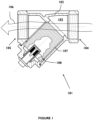
- a strainer 101 is shown in Figures 1 to 4 .
- the strainer 101 is suitable for use in fluid piping, for example fluid circuit piping of a heating or cooling system.
- strainer 101 comprises a body 102 for connection to connection to a fluid piping inflow conduit and to a fluid piping outflow conduit, as will be described in further detail below with reference to Figure 2 .
- the body 102 defines an interior chamber 103, a fluid inlet port 104 and a fluid outlet port 105.
- the body 102 defines a fluid flow path, indicated by arrow 106, between the fluid inlet port 104 and the fluid outlet port 105 that extends through the interior chamber 103.
- the body 102 is arranged such that fluid, such as circulating liquid of a heating or cooling system, flowing therethrough from the fluid inlet port 104 to the fluid outlet port 105 passes through the interior chamber 103.
- the strainer 101 comprises a screen collector 107.
- the screen collector 107 allows fluid to flow therethrough.
- the screen collector 107 is removably locatable in the body 102. More specifically, and as shown in Figures 1 and 2 , the screen collector 107 is locatable in the interior chamber 103, within the fluid flow path 106.
- the screen collector 107 is locatable within the body 102 such that fluid flowing through the strainer 101 from the fluid inlet port 104 to the fluid outlet port 105 passes through the screen collector 107.
- the screen collector 107 is described in detail below.
- the strainer 101 further comprises a permanent magnet collector 108.
- the permanent magnet collector 108 is removably locatable in the body 102. As shown in Figures 1 and 2 , the permanent magnet collector 108 is positionable to collect magnetic particles from fluid flowing through the interior chamber 103.
- the permanent magnet collector 108 is described in detail below.
- the strainer 101 is arranged to mechanically capture particles having a particle size equal or greater than a predetermined size and to magnetically capture magnetic particles having a particle size less than the predetermined size.
- the predetermined size is 80 microns and particles having a particle size equal or greater than 80 microns are captured by the screen collector 107 and particles having a particle size less than 80 microns are captured by the permanent magnet collector 108. It is to be appreciated that the predetermined size may vary between applications.
- the screen collector 107 is not limited to screening particles that are 80 microns or greater in size.
- the screen collector 107 can be selected to screen particles of a different particle size, for example depending on the particular intended application of the strainer 101.
- the permanent magnet collector thus provides an additional straining effect to that provided by the screen collector.
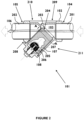
- Strainer 101 is shown installed for use in Figure 2 .
- the body 102 is connected to a fluid piping inflow conduit 201 and to a fluid piping outflow conduit 202. Fluid flowing from the fluid piping inflow conduit 201 to the fluid piping outflow conduit 202 flows through the interior chamber 103 of the body 102.
- the body 102 is made from a non-magnetic material.
- the body 102 is made from a non-magnetic metal, for example stainless steel or brass.
- the body 102 may however be made from any suitable non-magnetic material or combination of non-magnetic materials.
- the screen collector 107 comprises a substantially tubular body 203 having an open fluid inflow end 204.
- the screen collector 107 may take the form of a basket.
- the substantially tubular body 203 is locatable within the fluid flow path 106 such that fluid flowing from the fluid inlet port 104 towards the fluid outlet port 105 enters the substantially tubular body 203 through the open fluid inflow end 204.
- the substantially tubular body 203 is substantially cylindrical.
- the substantially tubular body 203 has a substantially circular shaped cross section, in the direction A-A. It is to be appreciated that in alternative examples the substantially tubular body 203 may have any suitable alternative cross-sectional shape.
- the screen collector 107 defines a plurality of openings 205 dimensioned to capture particles having a particle size equal to or greater than 80 microns.
- the screen collector 107 may however be arranged to capture particles of any suitable alternative size.
- the screen collector 107 is arranged to separate particles of a certain size from fluid flowing through the strainer 101.
- the screen collector 107 comprises a perforated metal sheet screen. It is to be appreciated that the screen collector could comprise any suitable alternative type of screen, for example an expanded metal sheet screen, a welded wire mesh screen, or a woven wire mesh screen. Further, the screen may be made from any suitable material or combination of materials, and is not limited to being made from metal.
- circulating fluid flowing in the fluid piping flows from the fluid piping inflow conduit 201, through the fluid inlet port 104 into the interior chamber 103, through the screen collector 107 and through the fluid outlet port 105 to exit the interior chamber 103 into the fluid piping outflow conduit 202.
- Particles having a particle size that is equal to or greater than a predetermined particle size are collected by the screen collector 107.
- Magnetic particles having a particle size less than the predetermined particle size are collected by the permanent magnet collector 108. It is to be appreciated however that the permanent magnet collector 108 may also collect particles having a particle size that is equal to or greater than the predetermined particle size, as will know be described.
- the substantially tubular body 203 is locatable within the fluid flow path 106 such that fluid flowing from the fluid inlet port 104 towards the fluid outlet port 105 enters the substantially tubular body 203 through the open fluid inflow end 204. It can be seen that the substantially tubular body 203 and the body 102, in particular the internal profile of the body 102, are arranged such that all the fluid entering the strainer 101 must enter the substantially tubular body 203 of the screen collector 107. Any particles in the fluid that are too big to pass through the openings 205 are mechanically captured and retained within the substantially tubular body 203 of the screen collector 107.
- the permanent magnet collector 108 is removably positionable within the substantially tubular body 203 of the screen collector 107. With this arrangement, magnetic particles attracted to the permanent magnet collector 108 are retained within the substantially tubular body 203 of the screen collector 107, along with the particles mechanically captured by the screen collector 107. It is to be appreciated that any suitable alternative relative positioning of the permanent magnet collector 108 and the screen collector 107 may be utilised.
- the screen collector 107 and permanent magnet collector 108 function to remove particles, such as corrosion particles, from contaminated fluid flowing through the strainer 101, such that fluid exits the interior chamber 103 cleaner than when it entered the interior chamber 103.
- using the strainer 101 upstream of an item of equipment functions to prevent contaminant particles from flowing to that item of equipment.
- the strainer 101 further comprises a permanent magnet collector housing 206 made from a non-magnetic material in which the permanent magnet collector 108 is located.
- the permanent magnet collector 108 is removably located in the permanent magnet collector housing 206.
- the permanent magnet collector housing 206 advantageously maintains the permanent magnet collector 108 in a dry condition.
- the permanent magnet collector housing 206 beneficially protects the permanent magnet collector 108 from detrimental effects of exposure to system fluid flowing through the interior chamber 103.
- the permanent magnet collector housing may be made from any suitable non-magnetic material or combination of non-magnetic materials.
- the body 102 defines a collector port 208 open to the interior chamber 103 through which the screen collector 107 and the permanent magnet collector 108 can be removably inserted into the body 102.
- the body 102 has a Y-shape.
- a first branch 209 of the Y-shape comprises the fluid inlet port 104
- a second branch 210 of the Y-shape comprises the fluid outlet port 105
- a third branch 21 I of the Y-shape comprises the collector port 208.
- the fluid inlet port 104 and the fluid outlet port 105 are aligned, with the first and second branches 209, 210 of the Y-shape being arranged linearly
- the third branch 211 extends outwardly from a position intermediate the fluid inlet and outlet ports 104, 105.
- the body 102 comprises an internal annular shoulder 211 against which the substantially tubular body 203 of the screen collector 107 abuts.
- the interior chamber 103 is, in effect, divided into three zones - a first zone upstream of the screen collector 107, a second zone occupied by the substantially tubular body 203 of the screen collector 107 and a third zone downstream of the screen collector 107.
- the strainer 101 is shown installed between the fluid piping inflow and outflow conduits 201, 202 such that the first and second branches 209, 210 of the Y-shaped body 102 are in a generally orientation along a virtual horizontal line and the third branch 211 of the Y-shaped body 102 points downwardly from the virtual horizontal line. With this orientation, gravity assists with the retention of collected particles within the substantially tubular body 203 of the screen collector 107.
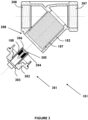
- the strainer 101 comprises a collector port cap assembly 301.
- the collector port cap assembly 301 comprises a first cap 302 and a second cap 303.
- the first cap 302 is releasably engageable with the body 102 to selectively seal the collector port 208.
- the first cap 302 is made from a non-magnetic material and comprises a permanent magnet collector housing chamber 304 into which the permanent magnet collector 108 is removably locatable.
- the second cap 303 is releasably engageable with the first cap 302 to selectively seal the permanent magnet collector housing chamber 304 and is made from a non-magnetic material.
- the first cap 302 may be releasably engageable with the body 102 by any suitable engagement arrangement, for example a co-operating screw thread arrangement or a snap-fit arrangement.
- the second cap 303 may be releasably engageable with the first cap 302 by any suitable engagement arrangement, for example a co-operating screw thread arrangement or a snap-fit arrangement.
- the first cap 302 and the second cap 303 may each be made from any suitable non-magnetic material or combination of non-magnetic materials. Each of the first cap 302 and the second cap 303 may be made from a plastics material. The first cap 302 and the second cap 303 may be made from the same, or different, plastics material.
- the permanent magnet collector housing chamber 304 is positioned centrally of the first cap 302.
- the permanent magnet collector housing chamber 304 may be positioned at any suitable alternative site.
- the permanent magnet collector housing chamber 304 has an external surface 305.
- a fixing element 306 for releasably securing the permanent magnet collector 108 to the second cap 303 is provided.
- the fixing element 306 is a screw. Any suitable alternative fixing element, elements or arrangement may be utilised.
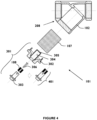
- the second cap 303 with permanent magnet collector 108 secured thereto forms a cap and magnet assembly 401.
- the cap and magnet assembly 401 is removable from the first cap 302.
- the first cap 302 can be disengaged from the second cap 303 and then moved away from the second cap 303 to withdraw the permanent magnet collector 108 from the permanent magnet collector housing chamber 304 of the first cap 302.
- the cap and magnet assembly 401 can beneficially be detached from the first cap 302 while the first cap 302 is secured to the body 102 of the strainer 101.
- the permanent magnet collector housing chamber 304 being integral to the first cap 302, which, in use, seals the collector port 208 of the body 102, the permanent magnet collector 108 can thus be withdrawn from the body 102 without unsealing the collector port 208.
- Figure 5 shows a cap and magnet assembly 501.
- a strainer 601 is shown in Figure 6 .
- Strainer 601 of Figure 6 is similar to strainer 101 of Figure 1 but comprises the cap and magnet assembly 501 of Figure 5 instead of the cap and magnet assembly 401 of Figure 4 .
- the cap and magnet assembly 501 of Figure 5 is similar to the cap and magnet assembly 401 of Figure 4 and will now be described with reference to Figure 5 and Figure 6 .
- Cap and magnet assembly 501 comprises a second cap 502 and a permanent magnet collector 503.
- the first cap 502 is made from non-magnetic material.
- the permanent magnet collector 503 is releasably securable to the second cap 502.
- the cap and magnet assembly 501 comprises a reusable fixing 504 for releasably securing the permanent magnet collector 503 to the second cap 502.
- the second cap 502 comprises an engagement portion for use in releasably engaging the second cap 502 with the first cap 302 of the strainer 601.
- the second cap 502 comprises an external screw thread 505 for co-operating with an internal screw thread 602 of the first cap 302.
- the second cap 502 comprises a collar 506. When the second cap 502 of the cap and magnet assembly 501 is engaged with the first cap 302, as shown in Figure 6 , the collar 506 is positioned up towards the exterior of the first cap 302.
- the second cap 502 comprises an internal extension portion 508, which extends to the side of the collar 506 that is presented to the first cap 302 when the second cap 502 is being engaged therewith.
- the internal extension portion 508 is dimensioned to extend into the permanent magnet collector housing chamber 304 of the first cap 302 when the second cap 502 is secured therewith.
- the second cap 502 extends into the permanent magnet collector housing chamber 304 when engaged with the first cap 302.
- Permanent magnet collector 503 has a first end 509, a second end 510, and a side wall 511 extending between the first and second ends 509, 510.
- the permanent magnet collector 503 is removably locatable within the permanent magnet collector housing chamber 304 such that both the first end 509 and the second end 510 are positioned within the interior chamber 103 of the body 102.
- the magnetic field present all around the permanent magnet collector 503 is exerted within the interior chamber 103. More specifically, with the illustrated arrangement of strainer 601, the magnetic field applied by the permanent magnet collector 503 within the screen collector 107 is optimised. In addition, the size of the permanent magnet collector 108 can be effectively minimised.
- the permanent magnet collector 503 is detachably attachable to free end 512 of the internal extension portion 508 of the second cap 502.
- the permanent magnet collector 503 is displaced from the underside of the collar 506 of the second cap 502 a distance 603 by the non-magnetic internal extension portion 508.
- the internal extension portion 508 ensures that the permanent magnet collector 503 is inserted to the desired position within the permanent magnet collector housing chamber 304 when the second cap 502 is engaged with the first cap 302.
- the use of the internal extension portion 508 ensures that magnetic material is not utilised within the strainer 601 at a position in which the effect of the associated magnetic field on magnetic particles within fluid flowing the internal chamber 103 thereof is relatively insignificant.
- the second cap 502 further comprises an external extension portion 507, which extends to the opposite side of the collar 506 and that remains outside of the first cap 302 when the second cap 502 is engaged therewith.
- the external extension portion 507 is profiled to allow a tool to be used thereon to facilitate engagement of the second cap 502 with the first cap 302.
- the external extension portion 507 may be profiled as a hexagonal head, with which a suitable socket can be used to effect rotation of the second cap 502.
- the strainer 101 may be provided with any suitable arrangement for use in connecting the body 102 to a fluid piping inflow conduit and to a fluid piping outflow conduit.
- the body 102 is provided with first and second connection screw threads 307, 308 for use in connecting the body 102 to a fluid piping inflow conduit and to a fluid piping outflow conduit.
- the body 102 is provided with first and second connection flanges for use in connecting the body 102 to a fluid piping inflow conduit and to a fluid piping outflow conduit
- a strainer as described herein may have an alternative arrangement to that illustrated.
- the body may define a collector port that is selectively sealable with a cap that does not form or comprise a permanent magnet collector housing chamber, in which case a separate permanent magnet collector housing may be provided.
- Fluid piping may be provided with one or more of strainers as described herein.
- strainers as described herein are usable in fluid circuit piping of a heating or cooling system, to protect one or more items of equipment, such as a pump, from contaminant particles in the circulating system water.
- the method involves the steps of receiving strainer 101, connecting the body 102 of the strainer 101 to a fluid piping inflow conduit of the fluid piping and connecting the body 102 of the strainer 101 to a fluid piping outflow conduit of the fluid piping.
- the method also involves the steps of locating the screen collector 107 within the body 102 of the strainer 101 and locating the permanent magnet collector 108 within the body of the strainer 101. It is to be appreciated that as the screen collector 107 and permanent magnet collector 108 are removably locatable within the body 102 of the strainer 101, the above-mentioned steps may be performed in any suitable order.
- the screen collector 107 and permanent magnet collector 108 may be located within the body 102 of the strainer 101 before or after the body 102 of the strainer 101 is connected between fluid piping inflow and outflow conduits.
- a method of treating fluid of fluid piping involves the steps of identifying a strainer 101 that is installed within fluid piping following the method of installing fluid treatment apparatus in fluid piping described above, stopping fluid flow into the body 102, removing, cleaning and replacing the screen collector 107, removing, cleaning and replacing the permanent magnet collector 108, and restarting a fluid flow into the body 102.
- the method of treatment provided by the strainer 101 is that of particle capturing and regular cleaning of the screen and permanent magnet collectors 107,108 ensures operational efficiency of the strainer 101 in capturing particles from the fluid flow and improves operational efficiency of the system.
- particles having a particle size equal to or greater than a predetermined size that enter into the strainer 101 with the circulating fluid are captured by the screen collector 107. These mechanically captured particles are retained in the interior chamber 103 until subsequently removed. Further, during normal operation of the strainer 101, magnetic particles are attracted by the permanent magnet collector 108 and collect on the external surface 305 of the permanent magnet collector housing chamber 304 that is exposed to the circulating fluid (wet side of first cap 302). These magnetically captured particles are retained in the interior chamber 103 until subsequently removed.
- the strainer 101 is isolated from fluid flow. Thus, the circulation of the system fluid into the strainer 101 is stopped.
- the first cap 302 is then removed from the body 102. Any magnetic detritus collected will be present on the external surface 305 of the permanent magnet collector housing chamber 304.
- the second cap 303 is then removed from the first cap 302, which has the effect of withdrawing the permanent magnet collector 108 from the permanent magnetic collector housing chamber 304. This removes the magnetic field previously applied by permanent magnet collector 108 to hold the collected magnetic particles on the external surface 305 of the permanent magnetic collector housing chamber 304. With the magnetic field now absent, the collected magnetic particles fall away from the first cap 302.
- the first cap 302 can be rinsed to ensure proper cleanliness, and the second cap 303 can then be replaced to seal the permanent magnet collector 108 within the permanent magnetic collector housing chamber 304.
- the screen collector 107 can be withdrawn through the collector port 208 and rinsed clean.
- the cleaned screen collector 107 can then be replaced in the interior chamber 103.
- the collector port cap assembly 301 can be reconnected to the body 102 to seal the collector port 208.
- the strainer 101 may then be opened back to the system flow. It is to be appreciated that the screen and permanent magnet collectors 107, 108 may be cleaned in any chronological order.
- the screen and permanent magnet collectors 107, 108 of the strainer 101 may be substituted, for example to change the size of the openings of the screen collector or the magnetic field applied by the permanent magnet collector.
- the strainer of the present invention is thus environmentally advantageous.
- a strainer as described herein may have any suitable dimensions, any suitable appearance, may be made from any suitable materials or combination of materials and may be made using any suitable method, process or technique or any suitable combination of methods, processes or techniques. It is thus to be understood that any suitable material fabrication, construction and method of manufacture may be used. A strainer as described herein may be used in any suitable application.
Landscapes
- Engineering & Computer Science (AREA)
- Chemical & Material Sciences (AREA)
- Chemical Kinetics & Catalysis (AREA)
- General Engineering & Computer Science (AREA)
- Water Supply & Treatment (AREA)
- Mechanical Engineering (AREA)
- Life Sciences & Earth Sciences (AREA)
- Hydrology & Water Resources (AREA)
- Environmental & Geological Engineering (AREA)
- Organic Chemistry (AREA)
- Combustion & Propulsion (AREA)
- Physics & Mathematics (AREA)
- Thermal Sciences (AREA)
- Filtration Of Liquid (AREA)
- Water Treatment By Electricity Or Magnetism (AREA)
Claims (15)
- Schmutzfänger (101) zur Verwendung in einer Fluidleitung, wobei der Schmutzfänger (101) Folgendes umfasst:einen Körper (102) zur Verbindung mit einem Fluidleitungszuflusskanal (201) und mit einem Fluidleitungsabflusskanal (202), wobei der Körper (102) eine Innenkammer (103), einen Fluideinlassanschluss (104) und einen Fluidauslassanschluss (105) definiert, und der Körper (102) einen Fluidströmungsweg (106) zwischen dem Fluideinlassanschluss (104) und dem Fluidauslassanschluss (105) definiert, der sich durch die Innenkammer (103) erstreckt;einen Siebkollektor, der entfernbar (107) in dem Körper (102) innerhalb des Fluidströmungswegs (106) anordenbar ist; undeinen Permanentmagnetkollektor (108), der entfernbar in dem Körper (102) anordenbar ist;wobei der Körper (102) einen zur Innenkammer (103) offenen Kollektoranschluss (208) definiert, durch den der Siebkollektor (107) und der Permanentmagnetkollektor (108) entfernbar in den Körper (102) eingesetzt werden können; undwobei der Schmutzfänger (101) eine erste Kappe (302) umfasst, die lösbar mit dem Körper (102) in Eingriff bringbar ist, um den Kollektoranschluss (208) gezielt abzudichten, wobei die erste Kappe (302) aus einem nicht-magnetischen Material besteht und eine Permanentmagnetkollektorgehäusekammer (304) definiert, in der der Permanentmagnetkollektor (108) entfernbar anordenbar ist; dadurch gekennzeichnet, dass:der Schmutzfänger (101) ferner eine zweite Kappe (303) umfasst, die lösbar mit der ersten Kappe (302) in Eingriff bringbar ist, um die Permanentmagnetkollektorgehäusekammer (304) gezielt abzudichten und eine Kollektoranschlusskappenanordnung (301) auszubilden, die lösbar mit dem Körper (102) des Schmutzfängers (101) in Eingriff bringbar ist, indem die erste Kappe (302) lösbar mit dem Körper (102) in Eingriff gebracht wird, um den Kollektoranschluss (208) abzudichten, wobei die zweite Kappe (303) aus einem nicht-magnetischen Material besteht; undder Permanentmagnetkollektor (108) lösbar an der zweiten Kappe (303) befestigbar ist, um eine Kappen- und Magnetanordnung (401) auszubilden, die von der ersten Kappe (302) abnehmbar ist, während die erste Kappe (302) an dem Körper (102) des Schmutzfängers befestigt ist.
- Schmutzfänger (101) nach Anspruch 1, ferner umfassend ein Fixierungselement (306) zum lösbaren Befestigen des Permanentmagnetkollektors (108) an der zweiten Kappe (303).
- Schmutzfänger (101) nach Anspruch 1 oder Anspruch 2, wobei der Permanentmagnetkollektor (503) ein erstes Ende (509), ein zweites Ende (510) und eine Seitenwand (511) aufweist, die sich zwischen dem ersten Ende (509) und dem zweiten Ende (510) erstreckt, und
wobei der Permanentmagnetkollektor (503) derart entfernbar innerhalb der Permanentmagnetkollektorgehäusekammer (304) anordenbar ist, dass das erste Ende (509) und das zweite Ende (510) innerhalb der Innenkammer (103) des Körpers (101) positioniert sind. - Schmutzfänger (101) nach einem der Ansprüche 1 bis 3, wobei der Siebkollektor (107) einen im Wesentlichen rohrförmigen Körper (203) umfasst, der ein offenes Fluidzuflussende (204) aufweist, wobei der im Wesentlichen rohrförmige Körper (203) innerhalb des Fluidströmungswegs (106) derart anordenbar ist, dass von dem Fluideinlassanschluss (104) hin zu dem Fluidauslassanschluss (105) strömendes Fluid durch das offene Fluidzuflussende (204) in den im Wesentlichen rohrförmigen Körper (203) eintritt.
- Schmutzfänger (101) nach Anspruch 4, wobei der im Wesentlichen rohrförmige Körper (204) im Wesentlichen zylindrisch ist.
- Schmutzfänger (101) nach Anspruch 5, wobei der Permanentmagnetkollektor (108) entfernbar innerhalb des im Wesentlichen rohrförmigen Körpers (203) des Siebkollektors (107) positionierbar ist.
- Schmutzfänger (101) nach einem der Ansprüche 1 bis 6, wobei der Siebkollektor (107) eine Mehrzahl von Öffnungen (205) definiert, die derart dimensioniert sind, dass sie Partikel mit einer Partikelgröße gleich oder größer als 80 Mikrometer auffangen.
- Schmutzfänger (101) nach einem der Ansprüche 1 bis 7, wobei der Körper (102) eine Y-Form aufweist, und wobei ein erster Zweig (209) der Y-Form den Fluideinlassanschluss (104) umfasst, ein zweiter Zweig (210) der Y-Form den Fluidauslassanschluss (105) umfasst und ein dritter Zweig (211) der Y-Form den Kollektoranschluss (208) umfasst.
- Schmutzfänger (101) nach einem der Ansprüche 1 bis 8, wobei der Permanentmagnetkollektor einen Seltene-Erden-Magnet umfasst.
- Schmutzfänger (101) nach einem der Ansprüche 1 bis 9, wobei der Siebkollektor (107) ein perforiertes Metallblechsieb umfasst.
- Schmutzfänger (101) nach einem der Ansprüche 1 bis 10, wobei der Körper (102) mit einem von Folgendem zur Verwendung beim Verbinden des Körpers (102) mit einem Fluidleitungszuflusskanal (201) und mit einem Fluidleitungsabflusskanal (202) versehen ist: ersten und zweiten Verbindungsschraubengewinden, ersten und zweiten Verbindungsflanschen.
- Schmutzfänger (101) nach einem der Ansprüche 1 bis 11, wobei die erste Kappe (302) durch eines von Folgendem lösbar mit dem Körper (102) in Eingriff bringbar ist: einer zusammenwirkenden Schraubengewindeanordnung, einer Schnappverschlussanordnung.
- Schmutzfänger (101) nach einem der Ansprüche 1 bis 12, wobei die zweite Kappe (303) durch eines von Folgendem lösbar mit der ersten Kappe (302) in Eingriff bringbar ist: einer zusammenwirkenden Schraubengewindeanordnung, einer Schnappverschlussanordnung.
- Verwendung eines Schmutzfängers (101) nach einem der Ansprüche 1 bis 13 in einer Fluidkreisleitung eines Heizungs- oder Kühlsystems.
- Fluidleitung, die mit einem Schmutzfänger (101) versehen ist, wobei der Schmutzfänger (101) nach einem der Ansprüche 1 bis 13 ausgestaltet ist.
Applications Claiming Priority (2)
| Application Number | Priority Date | Filing Date | Title |
|---|---|---|---|
| GB1708380.9A GB2562772B (en) | 2017-05-25 | 2017-05-25 | Fluid treatment |
| PCT/GB2018/051429 WO2018215788A1 (en) | 2017-05-25 | 2018-05-25 | Fluid treatment |
Publications (3)
| Publication Number | Publication Date |
|---|---|
| EP3630331A1 EP3630331A1 (de) | 2020-04-08 |
| EP3630331B1 true EP3630331B1 (de) | 2025-02-26 |
| EP3630331C0 EP3630331C0 (de) | 2025-02-26 |
Family
ID=59271009
Family Applications (1)
| Application Number | Title | Priority Date | Filing Date |
|---|---|---|---|
| EP18730035.5A Active EP3630331B1 (de) | 2017-05-25 | 2018-05-25 | Flüssigkeitsbehandlung |
Country Status (7)
| Country | Link |
|---|---|
| US (1) | US11426684B2 (de) |
| EP (1) | EP3630331B1 (de) |
| AU (1) | AU2018274715B2 (de) |
| CA (1) | CA3064680C (de) |
| GB (1) | GB2562772B (de) |
| MY (1) | MY194820A (de) |
| WO (1) | WO2018215788A1 (de) |
Families Citing this family (8)
| Publication number | Priority date | Publication date | Assignee | Title |
|---|---|---|---|---|
| JP2020046167A (ja) * | 2018-09-21 | 2020-03-26 | パナソニックIpマネジメント株式会社 | 温水循環装置 |
| US11529574B2 (en) * | 2018-12-21 | 2022-12-20 | Strahman Valves, Inc. | Pipeline strainer |
| US11369900B2 (en) * | 2019-01-16 | 2022-06-28 | The Metraflex Company | Pipeline strainer with magnetic insert and baffle |
| CH716778B1 (de) * | 2019-11-08 | 2023-04-28 | Gea Aseptomag Ag | Magnetabscheider. |
| US11786849B2 (en) * | 2019-11-27 | 2023-10-17 | Agco Corporation | Sprayer filtering system |
| US11707705B2 (en) * | 2021-05-05 | 2023-07-25 | Nibco Inc. | Multi-function hydraulic separator |
| US20250161847A1 (en) * | 2023-11-20 | 2025-05-22 | Robert Bosch Gmbh | Filter for a Fluid Passageway |
| FR3159215B1 (fr) * | 2024-02-13 | 2026-03-06 | Airbus Helicopters | Système mécanique muni d’éléments mécaniques mobiles, d’un bouchon magnétique ainsi que d’un système de lubrification muni de filtres mécanique et magnétique. |
Family Cites Families (24)
| Publication number | Priority date | Publication date | Assignee | Title |
|---|---|---|---|---|
| US2603353A (en) * | 1952-07-15 | Magnetic -filter fob fluid lines | ||
| US2800230A (en) * | 1953-07-15 | 1957-07-23 | Jean Thoma | Magnetic separators |
| NL6411743A (de) * | 1964-10-09 | 1966-04-12 | ||
| US3372807A (en) * | 1966-12-19 | 1968-03-12 | Charles A. Barnard | Filter |
| US3834539A (en) * | 1972-12-26 | 1974-09-10 | C Thompson | Trap for removing solid particles from a liquid circulating system |
| US4183812A (en) * | 1979-01-22 | 1980-01-15 | Fosdick Dale P | Fluid filtering device |
| US5089129A (en) * | 1990-05-04 | 1992-02-18 | Brigman Bernard B | Fluid contaminate filtration system including a filter, a contaminate particle trap, and a cold start fluid circulation system |
| JPH08117517A (ja) * | 1994-10-19 | 1996-05-14 | Miyawaki Inc | 流体通路のストレーナ |
| JP2010279887A (ja) * | 2009-06-03 | 2010-12-16 | Keihin Hi-Flo Sales Co Ltd | ストレーナ装置 |
| JP2010279886A (ja) * | 2009-06-03 | 2010-12-16 | Keihin Hi-Flo Sales Co Ltd | ストレーナ装置 |
| CN202061466U (zh) | 2011-05-10 | 2011-12-07 | 魏成和 | 磁性过滤器 |
| CN202315523U (zh) * | 2011-10-27 | 2012-07-11 | 郝晓峰 | 一种y型防铁锈热量表过滤器 |
| FR2982502B1 (fr) * | 2011-11-14 | 2014-04-25 | Aqua Tech | Filtre desemboueur/clarificateur pour circuit ferme de fluide et procede associe de desembouage de circuit ferme de fluide |
| CN202605871U (zh) * | 2012-04-10 | 2012-12-19 | 天津市华顺通阀门有限公司 | 法兰过滤器 |
| JP2014138912A (ja) * | 2013-01-21 | 2014-07-31 | Mitsubishi Electric Corp | 濾過装置 |
| GB2503762B (en) * | 2013-03-06 | 2014-07-02 | Vexo Internat Uk Ltd | Fluid treatment apparatus & method |
| CN203878668U (zh) * | 2014-04-25 | 2014-10-15 | 泰州金川泵业有限公司 | 一种新型智能供水系统 |
| US10016707B2 (en) * | 2015-01-15 | 2018-07-10 | The Metraflex Company | Pipeline strainer |
| US10016708B2 (en) * | 2015-01-15 | 2018-07-10 | The Metraflex Company | Pipeline strainer |
| US9675979B2 (en) * | 2015-06-08 | 2017-06-13 | Saudi Arabian Oil Company | Controlling flow of black powder in hydrocarbon pipelines |
| US20170299107A1 (en) * | 2016-04-15 | 2017-10-19 | The Metraflex Company | Pipeline strainer for reducing entrained gas and debris |
| US10967312B2 (en) * | 2018-04-17 | 2021-04-06 | The Metraflex Company | Pipeline strainer with magnetic insert |
| KR20200046288A (ko) * | 2018-10-24 | 2020-05-07 | 이상무 | 자석결합형 스트레이너 |
| US11369900B2 (en) * | 2019-01-16 | 2022-06-28 | The Metraflex Company | Pipeline strainer with magnetic insert and baffle |
-
2017
- 2017-05-25 GB GB1708380.9A patent/GB2562772B/en active Active
-
2018
- 2018-05-25 EP EP18730035.5A patent/EP3630331B1/de active Active
- 2018-05-25 MY MYPI2019006849A patent/MY194820A/en unknown
- 2018-05-25 WO PCT/GB2018/051429 patent/WO2018215788A1/en not_active Ceased
- 2018-05-25 CA CA3064680A patent/CA3064680C/en active Active
- 2018-05-25 AU AU2018274715A patent/AU2018274715B2/en active Active
- 2018-05-25 US US16/616,048 patent/US11426684B2/en active Active
Also Published As
| Publication number | Publication date |
|---|---|
| US20200139275A1 (en) | 2020-05-07 |
| WO2018215788A1 (en) | 2018-11-29 |
| MY194820A (en) | 2022-12-17 |
| CA3064680C (en) | 2024-04-16 |
| GB2562772A (en) | 2018-11-28 |
| GB2562772B (en) | 2019-10-30 |
| AU2018274715A1 (en) | 2019-12-12 |
| CA3064680A1 (en) | 2018-11-29 |
| EP3630331A1 (de) | 2020-04-08 |
| AU2018274715B2 (en) | 2022-04-14 |
| US11426684B2 (en) | 2022-08-30 |
| EP3630331C0 (de) | 2025-02-26 |
| GB201708380D0 (en) | 2017-07-12 |
Similar Documents
| Publication | Publication Date | Title |
|---|---|---|
| CA3064680C (en) | Fluid treatment | |
| EP2758178B1 (de) | Magnetpartikelabscheider für wärmesysteme | |
| EP3683486B1 (de) | Rohrleitungssieb mit magnetischem einsatz und prallblech | |
| US3834539A (en) | Trap for removing solid particles from a liquid circulating system | |
| EP2829811B1 (de) | Ventil für heizungsanlage | |
| US4783266A (en) | Filter for removing particles from a fluid, and method therefore | |
| US20050121401A1 (en) | Backwash flushing filter | |
| US10001305B2 (en) | Fluid treatment apparatus and method | |
| GB2491361A (en) | Magnetic filter apparatus | |
| US20200129990A1 (en) | Magnetic strainer | |
| JP2010236819A (ja) | 熱交換器伝熱管洗浄装置 | |
| WO2009001142A1 (en) | Filtering system with means for purging the system | |
| EP3150266B1 (de) | Festpartikel-fluid-abscheider | |
| KR20130051693A (ko) | 자동 역세척이 가능한 세척수의 칩 여과장치 | |
| US11148079B2 (en) | Liquid treatment device | |
| EP3992156B1 (de) | Ventil für leistungssysteme, verfahren zur fluidbehandlung unter verwendung des besagten ventils und verfahren zum spülen des besagten ventils | |
| WO2019102206A1 (en) | Apparatus for and method of fluid treatment | |
| JP6378592B2 (ja) | ストレーナ | |
| CA3027198A1 (en) | Air and particle separators | |
| CN114870486A (zh) | 用于集中供暖系统的磁性筛网过滤器 | |
| KR200333645Y1 (ko) | 여과망을 설치한 자력 수처리기 | |
| KR20130015524A (ko) | 수처리용 이온필터 | |
| KR200210977Y1 (ko) | 이물질제거장치가 구비된 관연결구 | |
| JP7596827B2 (ja) | ストレーナ設備 | |
| EP4558456A1 (de) | System und verfahren zur kesselsteinverwaltung in einem wasserheizsystem |
Legal Events
| Date | Code | Title | Description |
|---|---|---|---|
| STAA | Information on the status of an ep patent application or granted ep patent |
Free format text: STATUS: UNKNOWN |
|
| STAA | Information on the status of an ep patent application or granted ep patent |
Free format text: STATUS: THE INTERNATIONAL PUBLICATION HAS BEEN MADE |
|
| PUAI | Public reference made under article 153(3) epc to a published international application that has entered the european phase |
Free format text: ORIGINAL CODE: 0009012 |
|
| STAA | Information on the status of an ep patent application or granted ep patent |
Free format text: STATUS: REQUEST FOR EXAMINATION WAS MADE |
|
| 17P | Request for examination filed |
Effective date: 20191210 |
|
| AK | Designated contracting states |
Kind code of ref document: A1 Designated state(s): AL AT BE BG CH CY CZ DE DK EE ES FI FR GB GR HR HU IE IS IT LI LT LU LV MC MK MT NL NO PL PT RO RS SE SI SK SM TR |
|
| AX | Request for extension of the european patent |
Extension state: BA ME |
|
| DAV | Request for validation of the european patent (deleted) | ||
| DAX | Request for extension of the european patent (deleted) | ||
| STAA | Information on the status of an ep patent application or granted ep patent |
Free format text: STATUS: EXAMINATION IS IN PROGRESS |
|
| 17Q | First examination report despatched |
Effective date: 20201216 |
|
| REG | Reference to a national code |
Ref country code: DE Ref legal event code: R079 Free format text: PREVIOUS MAIN CLASS: B01D0035020000 Ipc: B03C0001033000 Ref document number: 602018079566 Country of ref document: DE |
|
| GRAP | Despatch of communication of intention to grant a patent |
Free format text: ORIGINAL CODE: EPIDOSNIGR1 |
|
| STAA | Information on the status of an ep patent application or granted ep patent |
Free format text: STATUS: GRANT OF PATENT IS INTENDED |
|
| RIC1 | Information provided on ipc code assigned before grant |
Ipc: F16L 55/24 20060101ALI20240917BHEP Ipc: C02F 1/48 20060101ALI20240917BHEP Ipc: B01D 29/33 20060101ALI20240917BHEP Ipc: B01D 35/06 20060101ALI20240917BHEP Ipc: B01D 35/02 20060101ALI20240917BHEP Ipc: C02F 103/02 20060101ALI20240917BHEP Ipc: C02F 1/00 20060101ALI20240917BHEP Ipc: B03C 1/28 20060101ALI20240917BHEP Ipc: B03C 1/033 20060101AFI20240917BHEP |
|
| INTG | Intention to grant announced |
Effective date: 20240927 |
|
| GRAS | Grant fee paid |
Free format text: ORIGINAL CODE: EPIDOSNIGR3 |
|
| RAP3 | Party data changed (applicant data changed or rights of an application transferred) |
Owner name: VEXO INTERNATIONAL (UK) LIMITED |
|
| GRAA | (expected) grant |
Free format text: ORIGINAL CODE: 0009210 |
|
| STAA | Information on the status of an ep patent application or granted ep patent |
Free format text: STATUS: THE PATENT HAS BEEN GRANTED |
|
| AK | Designated contracting states |
Kind code of ref document: B1 Designated state(s): AL AT BE BG CH CY CZ DE DK EE ES FI FR GB GR HR HU IE IS IT LI LT LU LV MC MK MT NL NO PL PT RO RS SE SI SK SM TR |
|
| REG | Reference to a national code |
Ref country code: GB Ref legal event code: FG4D |
|
| REG | Reference to a national code |
Ref country code: CH Ref legal event code: EP |
|
| REG | Reference to a national code |
Ref country code: DE Ref legal event code: R096 Ref document number: 602018079566 Country of ref document: DE |
|
| REG | Reference to a national code |
Ref country code: IE Ref legal event code: FG4D |
|
| U01 | Request for unitary effect filed |
Effective date: 20250321 |
|
| U07 | Unitary effect registered |
Designated state(s): AT BE BG DE DK EE FI FR IT LT LU LV MT NL PT RO SE SI Effective date: 20250327 |
|
| PG25 | Lapsed in a contracting state [announced via postgrant information from national office to epo] |
Ref country code: RS Free format text: LAPSE BECAUSE OF FAILURE TO SUBMIT A TRANSLATION OF THE DESCRIPTION OR TO PAY THE FEE WITHIN THE PRESCRIBED TIME-LIMIT Effective date: 20250526 |
|
| PG25 | Lapsed in a contracting state [announced via postgrant information from national office to epo] |
Ref country code: PL Free format text: LAPSE BECAUSE OF FAILURE TO SUBMIT A TRANSLATION OF THE DESCRIPTION OR TO PAY THE FEE WITHIN THE PRESCRIBED TIME-LIMIT Effective date: 20250226 |
|
| PG25 | Lapsed in a contracting state [announced via postgrant information from national office to epo] |
Ref country code: ES Free format text: LAPSE BECAUSE OF FAILURE TO SUBMIT A TRANSLATION OF THE DESCRIPTION OR TO PAY THE FEE WITHIN THE PRESCRIBED TIME-LIMIT Effective date: 20250226 |
|
| PG25 | Lapsed in a contracting state [announced via postgrant information from national office to epo] |
Ref country code: IS Free format text: LAPSE BECAUSE OF FAILURE TO SUBMIT A TRANSLATION OF THE DESCRIPTION OR TO PAY THE FEE WITHIN THE PRESCRIBED TIME-LIMIT Effective date: 20250626 Ref country code: NO Free format text: LAPSE BECAUSE OF FAILURE TO SUBMIT A TRANSLATION OF THE DESCRIPTION OR TO PAY THE FEE WITHIN THE PRESCRIBED TIME-LIMIT Effective date: 20250526 |
|
| PG25 | Lapsed in a contracting state [announced via postgrant information from national office to epo] |
Ref country code: HR Free format text: LAPSE BECAUSE OF FAILURE TO SUBMIT A TRANSLATION OF THE DESCRIPTION OR TO PAY THE FEE WITHIN THE PRESCRIBED TIME-LIMIT Effective date: 20250226 |
|
| U20 | Renewal fee for the european patent with unitary effect paid |
Year of fee payment: 8 Effective date: 20250611 |
|
| PG25 | Lapsed in a contracting state [announced via postgrant information from national office to epo] |
Ref country code: GR Free format text: LAPSE BECAUSE OF FAILURE TO SUBMIT A TRANSLATION OF THE DESCRIPTION OR TO PAY THE FEE WITHIN THE PRESCRIBED TIME-LIMIT Effective date: 20250527 |
|
| PG25 | Lapsed in a contracting state [announced via postgrant information from national office to epo] |
Ref country code: SM Free format text: LAPSE BECAUSE OF FAILURE TO SUBMIT A TRANSLATION OF THE DESCRIPTION OR TO PAY THE FEE WITHIN THE PRESCRIBED TIME-LIMIT Effective date: 20250226 |
|
| PG25 | Lapsed in a contracting state [announced via postgrant information from national office to epo] |
Ref country code: CZ Free format text: LAPSE BECAUSE OF FAILURE TO SUBMIT A TRANSLATION OF THE DESCRIPTION OR TO PAY THE FEE WITHIN THE PRESCRIBED TIME-LIMIT Effective date: 20250226 |
|
| PG25 | Lapsed in a contracting state [announced via postgrant information from national office to epo] |
Ref country code: SK Free format text: LAPSE BECAUSE OF FAILURE TO SUBMIT A TRANSLATION OF THE DESCRIPTION OR TO PAY THE FEE WITHIN THE PRESCRIBED TIME-LIMIT Effective date: 20250226 |
|
| REG | Reference to a national code |
Ref country code: CH Ref legal event code: H13 Free format text: ST27 STATUS EVENT CODE: U-0-0-H10-H13 (AS PROVIDED BY THE NATIONAL OFFICE) Effective date: 20251223 |
|
| PLBE | No opposition filed within time limit |
Free format text: ORIGINAL CODE: 0009261 |
|
| STAA | Information on the status of an ep patent application or granted ep patent |
Free format text: STATUS: NO OPPOSITION FILED WITHIN TIME LIMIT |
|
| PG25 | Lapsed in a contracting state [announced via postgrant information from national office to epo] |
Ref country code: CH Free format text: LAPSE BECAUSE OF NON-PAYMENT OF DUE FEES Effective date: 20250531 |
|
| PG25 | Lapsed in a contracting state [announced via postgrant information from national office to epo] |
Ref country code: MC Free format text: LAPSE BECAUSE OF FAILURE TO SUBMIT A TRANSLATION OF THE DESCRIPTION OR TO PAY THE FEE WITHIN THE PRESCRIBED TIME-LIMIT Effective date: 20250226 |
|
| 26N | No opposition filed |
Effective date: 20251127 |
|
| PGFP | Annual fee paid to national office [announced via postgrant information from national office to epo] |
Ref country code: GB Payment date: 20260319 Year of fee payment: 9 |
|
| U20 | Renewal fee for the european patent with unitary effect paid |
Year of fee payment: 9 Effective date: 20260528 |
|
| PGFP | Annual fee paid to national office [announced via postgrant information from national office to epo] |
Ref country code: IE Payment date: 20260529 Year of fee payment: 9 |
|
| PG25 | Lapsed in a contracting state [announced via postgrant information from national office to epo] |
Ref country code: CY Free format text: LAPSE BECAUSE OF FAILURE TO SUBMIT A TRANSLATION OF THE DESCRIPTION OR TO PAY THE FEE WITHIN THE PRESCRIBED TIME-LIMIT Effective date: 20250226 |