EP3628016B1 - System zur dosierung und ausgabe von medikamenten - Google Patents
System zur dosierung und ausgabe von medikamenten Download PDFInfo
- Publication number
- EP3628016B1 EP3628016B1 EP18726286.0A EP18726286A EP3628016B1 EP 3628016 B1 EP3628016 B1 EP 3628016B1 EP 18726286 A EP18726286 A EP 18726286A EP 3628016 B1 EP3628016 B1 EP 3628016B1
- Authority
- EP
- European Patent Office
- Prior art keywords
- bottle
- barrel
- valve
- plunger
- syringe
- Prior art date
- Legal status (The legal status is an assumption and is not a legal conclusion. Google has not performed a legal analysis and makes no representation as to the accuracy of the status listed.)
- Active
Links
Images




Classifications
-
- A—HUMAN NECESSITIES
- A61—MEDICAL OR VETERINARY SCIENCE; HYGIENE
- A61J—CONTAINERS SPECIALLY ADAPTED FOR MEDICAL OR PHARMACEUTICAL PURPOSES; DEVICES OR METHODS SPECIALLY ADAPTED FOR BRINGING PHARMACEUTICAL PRODUCTS INTO PARTICULAR PHYSICAL OR ADMINISTERING FORMS; DEVICES FOR ADMINISTERING FOOD OR MEDICINES ORALLY; BABY COMFORTERS; DEVICES FOR RECEIVING SPITTLE
- A61J7/00—Devices for administering medicines orally, e.g. spoons; Pill counting devices; Arrangements for time indication or reminder for taking medicine
- A61J7/0015—Devices specially adapted for taking medicines
- A61J7/0053—Syringes, pipettes or oral dispensers
-
- A—HUMAN NECESSITIES
- A47—FURNITURE; DOMESTIC ARTICLES OR APPLIANCES; COFFEE MILLS; SPICE MILLS; SUCTION CLEANERS IN GENERAL
- A47G—HOUSEHOLD OR TABLE EQUIPMENT
- A47G19/00—Table service
- A47G19/30—Other containers or devices used as table equipment
- A47G19/32—Food containers with dispensing devices for bread, rolls, sugar, or the like; Food containers with movable covers
- A47G19/34—Food containers with dispensing devices for bread, rolls, sugar, or the like; Food containers with movable covers dispensing a certain quantity of powdered or granulated foodstuffs, e.g. sugar
-
- A—HUMAN NECESSITIES
- A61—MEDICAL OR VETERINARY SCIENCE; HYGIENE
- A61J—CONTAINERS SPECIALLY ADAPTED FOR MEDICAL OR PHARMACEUTICAL PURPOSES; DEVICES OR METHODS SPECIALLY ADAPTED FOR BRINGING PHARMACEUTICAL PRODUCTS INTO PARTICULAR PHYSICAL OR ADMINISTERING FORMS; DEVICES FOR ADMINISTERING FOOD OR MEDICINES ORALLY; BABY COMFORTERS; DEVICES FOR RECEIVING SPITTLE
- A61J1/00—Containers specially adapted for medical or pharmaceutical purposes
-
- A—HUMAN NECESSITIES
- A61—MEDICAL OR VETERINARY SCIENCE; HYGIENE
- A61J—CONTAINERS SPECIALLY ADAPTED FOR MEDICAL OR PHARMACEUTICAL PURPOSES; DEVICES OR METHODS SPECIALLY ADAPTED FOR BRINGING PHARMACEUTICAL PRODUCTS INTO PARTICULAR PHYSICAL OR ADMINISTERING FORMS; DEVICES FOR ADMINISTERING FOOD OR MEDICINES ORALLY; BABY COMFORTERS; DEVICES FOR RECEIVING SPITTLE
- A61J1/00—Containers specially adapted for medical or pharmaceutical purposes
- A61J1/14—Details; Accessories therefor
- A61J1/20—Arrangements for transferring or mixing fluids, e.g. from vial to syringe
- A61J1/2096—Combination of a vial and a syringe for transferring or mixing their contents
-
- A—HUMAN NECESSITIES
- A61—MEDICAL OR VETERINARY SCIENCE; HYGIENE
- A61J—CONTAINERS SPECIALLY ADAPTED FOR MEDICAL OR PHARMACEUTICAL PURPOSES; DEVICES OR METHODS SPECIALLY ADAPTED FOR BRINGING PHARMACEUTICAL PRODUCTS INTO PARTICULAR PHYSICAL OR ADMINISTERING FORMS; DEVICES FOR ADMINISTERING FOOD OR MEDICINES ORALLY; BABY COMFORTERS; DEVICES FOR RECEIVING SPITTLE
- A61J7/00—Devices for administering medicines orally, e.g. spoons; Pill counting devices; Arrangements for time indication or reminder for taking medicine
- A61J7/0076—Medicament distribution means
-
- A—HUMAN NECESSITIES
- A61—MEDICAL OR VETERINARY SCIENCE; HYGIENE
- A61M—DEVICES FOR INTRODUCING MEDIA INTO, OR ONTO, THE BODY; DEVICES FOR TRANSDUCING BODY MEDIA OR FOR TAKING MEDIA FROM THE BODY; DEVICES FOR PRODUCING OR ENDING SLEEP OR STUPOR
- A61M39/00—Tubes, tube connectors, tube couplings, valves, access sites or the like, specially adapted for medical use
- A61M39/22—Valves or arrangement of valves
- A61M39/26—Valves closing automatically on disconnecting the line and opening on reconnection thereof
-
- A—HUMAN NECESSITIES
- A61—MEDICAL OR VETERINARY SCIENCE; HYGIENE
- A61M—DEVICES FOR INTRODUCING MEDIA INTO, OR ONTO, THE BODY; DEVICES FOR TRANSDUCING BODY MEDIA OR FOR TAKING MEDIA FROM THE BODY; DEVICES FOR PRODUCING OR ENDING SLEEP OR STUPOR
- A61M5/00—Devices for bringing media into the body in a subcutaneous, intra-vascular or intramuscular way; Accessories therefor, e.g. filling or cleaning devices, arm-rests
- A61M5/178—Syringes
- A61M5/31—Details
- A61M5/315—Pistons; Piston-rods; Guiding, blocking or restricting the movement of the rod or piston; Appliances on the rod for facilitating dosing ; Dosing mechanisms
- A61M5/31501—Means for blocking or restricting the movement of the rod or piston
-
- A—HUMAN NECESSITIES
- A61—MEDICAL OR VETERINARY SCIENCE; HYGIENE
- A61M—DEVICES FOR INTRODUCING MEDIA INTO, OR ONTO, THE BODY; DEVICES FOR TRANSDUCING BODY MEDIA OR FOR TAKING MEDIA FROM THE BODY; DEVICES FOR PRODUCING OR ENDING SLEEP OR STUPOR
- A61M5/00—Devices for bringing media into the body in a subcutaneous, intra-vascular or intramuscular way; Accessories therefor, e.g. filling or cleaning devices, arm-rests
- A61M5/178—Syringes
- A61M5/31—Details
- A61M5/315—Pistons; Piston-rods; Guiding, blocking or restricting the movement of the rod or piston; Appliances on the rod for facilitating dosing ; Dosing mechanisms
- A61M5/31533—Dosing mechanisms, i.e. setting a dose
- A61M5/31545—Setting modes for dosing
- A61M5/31548—Mechanically operated dose setting member
- A61M5/3156—Mechanically operated dose setting member using volume steps only adjustable in discrete intervals, i.e. individually distinct intervals
-
- A—HUMAN NECESSITIES
- A61—MEDICAL OR VETERINARY SCIENCE; HYGIENE
- A61M—DEVICES FOR INTRODUCING MEDIA INTO, OR ONTO, THE BODY; DEVICES FOR TRANSDUCING BODY MEDIA OR FOR TAKING MEDIA FROM THE BODY; DEVICES FOR PRODUCING OR ENDING SLEEP OR STUPOR
- A61M5/00—Devices for bringing media into the body in a subcutaneous, intra-vascular or intramuscular way; Accessories therefor, e.g. filling or cleaning devices, arm-rests
- A61M5/178—Syringes
- A61M5/31—Details
- A61M5/315—Pistons; Piston-rods; Guiding, blocking or restricting the movement of the rod or piston; Appliances on the rod for facilitating dosing ; Dosing mechanisms
- A61M5/31533—Dosing mechanisms, i.e. setting a dose
- A61M5/31545—Setting modes for dosing
- A61M5/31548—Mechanically operated dose setting member
- A61M5/31563—Mechanically operated dose setting member interacting with a displaceable stop member
-
- B—PERFORMING OPERATIONS; TRANSPORTING
- B65—CONVEYING; PACKING; STORING; HANDLING THIN OR FILAMENTARY MATERIAL
- B65D—CONTAINERS FOR STORAGE OR TRANSPORT OF ARTICLES OR MATERIALS, e.g. BAGS, BARRELS, BOTTLES, BOXES, CANS, CARTONS, CRATES, DRUMS, JARS, TANKS, HOPPERS, FORWARDING CONTAINERS; ACCESSORIES, CLOSURES, OR FITTINGS THEREFOR; PACKAGING ELEMENTS; PACKAGES
- B65D83/00—Containers or packages with special means for dispensing contents
- B65D83/06—Containers or packages with special means for dispensing contents for dispensing powdered or granular material
-
- G—PHYSICS
- G01—MEASURING; TESTING
- G01F—MEASURING VOLUME, VOLUME FLOW, MASS FLOW OR LIQUID LEVEL; METERING BY VOLUME
- G01F11/00—Apparatus requiring external operation adapted at each repeated and identical operation to measure and separate a predetermined volume of fluid or fluent solid material from a supply or container, without regard to weight, and to deliver it
- G01F11/02—Apparatus requiring external operation adapted at each repeated and identical operation to measure and separate a predetermined volume of fluid or fluent solid material from a supply or container, without regard to weight, and to deliver it with measuring chambers which expand or contract during measurement
- G01F11/021—Apparatus requiring external operation adapted at each repeated and identical operation to measure and separate a predetermined volume of fluid or fluent solid material from a supply or container, without regard to weight, and to deliver it with measuring chambers which expand or contract during measurement of the piston type
- G01F11/025—Apparatus requiring external operation adapted at each repeated and identical operation to measure and separate a predetermined volume of fluid or fluent solid material from a supply or container, without regard to weight, and to deliver it with measuring chambers which expand or contract during measurement of the piston type with manually operated pistons
- G01F11/027—Apparatus requiring external operation adapted at each repeated and identical operation to measure and separate a predetermined volume of fluid or fluent solid material from a supply or container, without regard to weight, and to deliver it with measuring chambers which expand or contract during measurement of the piston type with manually operated pistons of the syringe type
-
- A—HUMAN NECESSITIES
- A61—MEDICAL OR VETERINARY SCIENCE; HYGIENE
- A61J—CONTAINERS SPECIALLY ADAPTED FOR MEDICAL OR PHARMACEUTICAL PURPOSES; DEVICES OR METHODS SPECIALLY ADAPTED FOR BRINGING PHARMACEUTICAL PRODUCTS INTO PARTICULAR PHYSICAL OR ADMINISTERING FORMS; DEVICES FOR ADMINISTERING FOOD OR MEDICINES ORALLY; BABY COMFORTERS; DEVICES FOR RECEIVING SPITTLE
- A61J2200/00—General characteristics or adaptations
- A61J2200/70—Device provided with specific sensor or indicating means
- A61J2200/76—Device provided with specific sensor or indicating means for fluid level
-
- A—HUMAN NECESSITIES
- A61—MEDICAL OR VETERINARY SCIENCE; HYGIENE
- A61M—DEVICES FOR INTRODUCING MEDIA INTO, OR ONTO, THE BODY; DEVICES FOR TRANSDUCING BODY MEDIA OR FOR TAKING MEDIA FROM THE BODY; DEVICES FOR PRODUCING OR ENDING SLEEP OR STUPOR
- A61M5/00—Devices for bringing media into the body in a subcutaneous, intra-vascular or intramuscular way; Accessories therefor, e.g. filling or cleaning devices, arm-rests
- A61M5/178—Syringes
- A61M5/31—Details
- A61M5/315—Pistons; Piston-rods; Guiding, blocking or restricting the movement of the rod or piston; Appliances on the rod for facilitating dosing ; Dosing mechanisms
- A61M5/31501—Means for blocking or restricting the movement of the rod or piston
- A61M2005/31508—Means for blocking or restricting the movement of the rod or piston provided on the piston-rod
-
- A—HUMAN NECESSITIES
- A61—MEDICAL OR VETERINARY SCIENCE; HYGIENE
- A61M—DEVICES FOR INTRODUCING MEDIA INTO, OR ONTO, THE BODY; DEVICES FOR TRANSDUCING BODY MEDIA OR FOR TAKING MEDIA FROM THE BODY; DEVICES FOR PRODUCING OR ENDING SLEEP OR STUPOR
- A61M5/00—Devices for bringing media into the body in a subcutaneous, intra-vascular or intramuscular way; Accessories therefor, e.g. filling or cleaning devices, arm-rests
- A61M5/178—Syringes
- A61M5/31—Details
- A61M5/315—Pistons; Piston-rods; Guiding, blocking or restricting the movement of the rod or piston; Appliances on the rod for facilitating dosing ; Dosing mechanisms
- A61M5/31533—Dosing mechanisms, i.e. setting a dose
- A61M5/31535—Means improving security or handling thereof, e.g. blocking means, means preventing insufficient dosing, means allowing correction of overset dose
- A61M5/31536—Blocking means to immobilize a selected dose, e.g. to administer equal doses
- A61M2005/3154—Blocking means to immobilize a selected dose, e.g. to administer equal doses limiting maximum permissible dose
-
- A—HUMAN NECESSITIES
- A61—MEDICAL OR VETERINARY SCIENCE; HYGIENE
- A61M—DEVICES FOR INTRODUCING MEDIA INTO, OR ONTO, THE BODY; DEVICES FOR TRANSDUCING BODY MEDIA OR FOR TAKING MEDIA FROM THE BODY; DEVICES FOR PRODUCING OR ENDING SLEEP OR STUPOR
- A61M5/00—Devices for bringing media into the body in a subcutaneous, intra-vascular or intramuscular way; Accessories therefor, e.g. filling or cleaning devices, arm-rests
- A61M5/50—Devices for bringing media into the body in a subcutaneous, intra-vascular or intramuscular way; Accessories therefor, e.g. filling or cleaning devices, arm-rests having means for preventing re-use, or for indicating if defective, used, tampered with or unsterile
- A61M5/5013—Means for blocking the piston or the fluid passageway to prevent illegal refilling of a syringe
- A61M5/502—Means for blocking the piston or the fluid passageway to prevent illegal refilling of a syringe for blocking the piston
- A61M2005/5033—Means for blocking the piston or the fluid passageway to prevent illegal refilling of a syringe for blocking the piston by use of an intermediate blocking member positioned between the syringe barrel and the piston rod to prevent retraction of the latter, e.g. toothed clip placed on the piston rod
-
- A—HUMAN NECESSITIES
- A61—MEDICAL OR VETERINARY SCIENCE; HYGIENE
- A61M—DEVICES FOR INTRODUCING MEDIA INTO, OR ONTO, THE BODY; DEVICES FOR TRANSDUCING BODY MEDIA OR FOR TAKING MEDIA FROM THE BODY; DEVICES FOR PRODUCING OR ENDING SLEEP OR STUPOR
- A61M39/00—Tubes, tube connectors, tube couplings, valves, access sites or the like, specially adapted for medical use
- A61M39/22—Valves or arrangement of valves
- A61M39/26—Valves closing automatically on disconnecting the line and opening on reconnection thereof
- A61M2039/267—Valves closing automatically on disconnecting the line and opening on reconnection thereof having a sealing sleeve around a tubular or solid stem portion of the connector
Definitions
- Embodiments of the present invention relate to syringes and drug bottles, more specifically, to a system for measuring and dispensing drugs to a patient.
- Drug formulations can include drugs formulated as multiparticulate, microspheres or powders for oral administration, and liquid drugs for administration orally or other administration routes.
- Liquid formulations are commonly used for the pediatric population for their ease of administration and ease of modifying the dose volume, but are limited by their need for large dosing volumes, bad taste that requires taste masking with sweeteners, and often the requirement for refrigeration during storage and transportation (cold chain storage and transportation). Solid oral doses have better dosing volumes, but can be difficult for children to swallow, and dose volumes are not easily changed by the user.
- MP Multi-Particulate
- the Multi-Particulate (MP) formulation brings together the advantages of both liquid and solid formulations - high dose flexibility and ease of administration - to facilitate the effective and safe administration of drugs for children and adults.
- MP drugs are microspheres of dry drug that can contain a coating that masks the flavor of the drug and can be designed to remain intact in water or saliva and only dissolve in mild acid, such as in a patient's stomach.
- MP drugs offer a solution to the difficulties of liquid oral medications and solid pills, they offer unique challenges to measuring a precise dose and administering that dose.
- MP drugs are shaped like tiny spheres, generally ranging from 100 to 400 microns in diameter. They have no surface tension to each other and so they flow more easily than water, but when put under compression they can lock against each other and not move at all. MP drugs are also sensitive to moisture and can clump if they get too moist.
- Filter straws are another method of dispensing MP drugs. They are a single-use disposable drinking straw with a filter at one end. The MP is contained within the straw and a child drinks through the straw, pulling the MP up with the diluent, generally water, and into the mouth. This avoids the spilling potential but it is only suitable for children old enough to use drinking straws. It is a fixed dose system and uses a disposable device for each dose that is more expensive than a capsule or packet.
- the system should be usable by parents and/or other care givers with little to no training.
- the system should be suitable for use in most environments, including low resource environments.
- the system should also be suitable for use by geriatric patients who have swallowing problems or related difficulties, as well as people of other ages who have similar medical problems, such as, for example only, the result of an accident or injury.
- the liquid is prevented from spilling out of the syringe and bottle only by means of surface tension of the liquid and the size of the openings, along with the user keeping the opening upright; however, none of these methods are absolute and leaking often occurs. Furthermore, the dose volume is selected visually by the user. What is desirable is a means to prevent leaking from the bottle and the syringe, especially with expensive drugs or those which skin contact is undesirable. What is also desirable is a means to set a dose that is more accurate and repeatable than by visual alignment of the plunger rod to a printed marking on the syringe barrel.
- WO 2009/061480 A1 is directed to a syringe with a mixing chamber, comprising a plunger with recesses that interact with a stop collar.
- GB 2 187 388 A relates to an injection device which may be used to inject a specific amount of liquid without the necessity to read a scale, comprising a plunger with spaced apart grooves.
- Embodiments of the present invention include a system for medication (drug) delivery that comprises two separate assemblies: a Package that will contain a drug and a Dosing mechanism (or device) for delivering a dose of the medication.
- the system is suited for drugs formulated as multiparticulate, microspheres, or powder, and could also be used for liquid drugs.
- the term drug will be referred to as MP drug and is intended to include multiparticulates, microspheres and powder.
- the Package is a container, such as a bottle, that could contain a full course of therapy of an MP drug.
- a full course of therapy could range from as few as 1-2 days to a couple of months supply, the maximum quantity often limited by health insurance restrictions.
- This Package can either be filled by a pharmaceutical company or filled at a local pharmacy.
- the Package comprises a bottle, a bottle insert that covers the opening of the bottle and which contains a dispense nozzle.
- the dispense nozzle is sealed using a valve.
- the valve can be a split septum rubber valve. The valve will only open when the Dosing device is engaged with the bottle during extraction of a dose.
- the bottle assembly is closed with a closure, such as a child resistant cap (commonly a push-and-turn screw cap), that covers the bottle insert. When necessary, a non-child resistant cap can be utilized in place of the child-resistant cap.
- the Dosing device is similar in form to an oral syringe and comprises a barrel with a valve at its distal end, a plunger which seals against the inside of the barrel, and a dose control mechanism (clip) on the outside diameter of the plunger.
- the plunger contains one or more grooves around its circumference into which the dose control clip can be placed. The placement of the dose control clip into one of the grooves creates a larger diameter ring around the plunger that will be bigger than an internal ring at the rear of the barrel.
- the dose control clip When the plunger is pulled rearward the dose control clip will create a positive stop against the barrel and provide a precise location of the plunger rod inside the barrel and in turn a precise volume into which MP drug can flow.
- the user When dispensing an MP drug from the Dosing Device ("Device"), the user pushes against the proximal end of the plunger. The force of the plunger pushes the MP drug, which in turn pushes open the valve at the distal end of the Device. The MP drug is pushed through the valve and into the patient's mouth. When force is removed from the plunger the valve closes, preventing spills of any MP drug remaining in the Device.
- a method of measuring and dispensing a Multiparticulate drug (MP) to a patient comprises several steps.
- the person performing these steps may be a caregiver to a patient, the patient themself, or another person.
- the steps include uncapping a Package containing the MP drug, then connecting the Device to the fill nozzle of the uncapped package. Connecting the Device to the fill nozzle automatically opens both the bottle valve and the barrel valve, creating a flow path between the bottle and the inside of the Device barrel.
- Another step is inverting the bottle and allowing the MP drug to flow by gravity into the barrel.
- the amount of MP drug that enters into the barrel is determined by pulling back on the plunger to a specified position. The specified position is selected by placing a clip onto the plunger rod, or by visually lining up the plunger rod end to printed dose markings on the Device barrel.
- the method further includes the step of removing the Device from the bottle fill nozzle.
- the valves in both the Package and Device automatically close and prevent the MP drug from spilling out of the Package or Device.
- the method further includes the step of placing the Device distal end within a patient's mouth or a secondary device. Depressing the Device plunger from the proximal end toward the distal end causes the MP drug to be dispensed from the Device.
- the device can also be used to deliver MP drug indirectly to a patient by dispensing the measured amount of drug to a secondary device such as a spoon, another container, or onto and/or mixed in with food or into a beverage.
- Another embodiment of the present invention includes a dose metering chamber within the bottle.
- This embodiment gives the user the ability to meter a dose using the bottle and then dispense the dose into a container, syringe, or into a patient's mouth, food, etc.... without the need to use a syringe with precise dose control.
- the user rotates the proximal end of the bottle relative to the distal end until the desired dose will be displayed in the dosing window on the side of the bottle.
- the user then holds the bottle with the dispense port facing downward and positioned over the container or food that the multiparticulate is to be dispensed into. Once positioned the user depresses the dispense button on the side of the bottle and the MP drug will flow out of the bottle in the precise dose selected.
- the bottle includes a primary chamber for storing a quantity of the MP drug and an intermediate chamber that is sized to contain a single dose volume.
- the intermediate chamber size can be changed by rotating the insert.
- the chamber is a cylinder containing two dividing walls radiating out from the center. Rotating the insert rotates one of these dividing walls to create a semicircular volume within the cylinder. The more degrees it rotates through, the smaller the trapped volume in the cylinder becomes.
- the chamber size could be adjusted by means of a screw mechanism that would translate the rotation of the insert to a linear movement of the chamber floor.
- the dispense button controls movement of the MP drug from the primary chamber to the intermediate chamber.
- the dispense button can also control the movement of the MP drug from the intermediate chamber into the dispense port and ultimately out of the bottle.
- the dispense button is linked to two sliding gates: one between the primary chamber and the intermediate chamber (gate 1) and the other between the intermediate chamber and the dispense port (gate 2). While the dispense button is in its non-depressed state, gate 1 is open, allowing the MP drug to flow from the primary chamber into the intermediate chamber and gate 2 is closed, preventing the MP drug from flowing out of the dispense port. When the dispense button is pressed gate 1 first closes the intermediate chamber from the primary chamber and gate 2 then opens the intermediate chamber to the dispense port.
- Embodiments of the present invention include a system for drug delivery, and more particularly to formulations such as multiparticulate, microsphere, or powdered drug ("MP drug") delivery that comprises two separate assemblies: a Package for storage of the MP drug and a Dosing device for delivering a dose of the MP drug.
- MP drug powdered drug
- MP drugs have their own physical properties that make traditional oral syringes unsuitable for use.
- the MP drug is formulated as a plurality of micro spheres which do not stick together and allow air to pass through them. This makes drawing them into a syringe using suction created by the plunger rod difficult. It also means they will pour out of very small openings such as the tip of a syringe even if the syringe plunger is not being advanced.
- MP drugs require a reliable and intuitive way to measure a dose and deliver it to the patient.
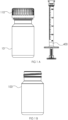
- a device embodiment of the present invention includes the package 10 ( Fig. 1a ) which contains a specified quantity of the drug and a dosing device 400 in the form of a syringe ( Fig. 3a ).
- the package comprises a bottle 100, a bottle cap 110 used to seal and protect the contents of the package.
- the bottle cap 110 may be of a child-resistant design, or it may be a non-child-resistant cap, or low resistant cap such as for arthritic persons.
- the bottle 100 includes an insert 200 ( Fig. 2a ) that covers the opening of the bottle 100 when the cap is off, and a valve body 300 (also referred to as a split septum valve).
- the bottle insert seals against the bottle inner wall 140 by an interference fit of the sealing ribs 210 ( Fig. 2b ).
- the bottle cap 110 seals against the bottle insert 200 by contact with the insert's cap seal ring 250.
- the bottle valve 300 seals against the bottle insert 200 by interference fit of the bottle valve seal ring 330.
- the seals 210, 250 and 330 ensure that the drug can be protected from moisture in the air which might cause the drug to clump and not be able to flow out of the bottle when needed.
- the bottle 100 has room for a desiccant 130, contained in a capsule or bag, to be packaged and shipped with the drug.
- the desiccant maintains a humidity level in the bottle 100 that is optimal for the MP drug 120.
- the back of the bottle insert 200 includes one or more anti-clog ribs 240 that prevent the desiccant 130 from clogging the dispense nozzle 220 ( Fig. 2b ).
- the dispense nozzle 220 is where the MP drug will flow through once a dosing device 400 (syringe) is connected to the bottle.
- the nozzle 220 is normally closed by means of the valve body 300.
- This valve body 300 includes a slit 310 through which the dispense nozzle 220 can be inserted, a spring bellows 320 for biasing the valve into a closed position, and a seal ring 250 for securing the valve to the bottle insert 200.
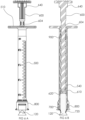
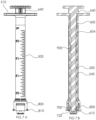
- the dosing device (syringe) 400 ( Fig. 3a ) comprises a barrel 500 with a valve 700 at its distal end ( Fig. 3b ), a plunger 600 having a plunger head 610 which seals against the inside 540 of the barrel by means of a sealing edge 620, and dose control clip 900 for mounting on the outside diameter of the plunger ( Fig. 3b ).
- Plunger 600 comprises a plunger rod 604, a forward stroke stop component 640 and a plunger thumb press 630.
- the plunger rod 604 terminates at plunger head 610.
- a plurality of grooves 650 are positioned at specified intervals along the length of plunger rod 604, and Fig.
- FIG. 4B shows the dose markings 660 around plunger rod 604 into which the dose control clip 900 ( Fig. 4A ) can be placed.
- the dose control clip 900 is placed into one of the grooves 650 by snapping the clip slot 910 over one of the grooves 650.
- the placement of the dose control clip 900 into one of the grooves 650 creates a larger diameter ring around the plunger 600 that is bigger than the internal barrel retaining ring 520 at the proximal end of the barrel 500 ( Fig. 3B ).
- the dose control clip 900 creates a positive stop against the barrel retaining ring 520 and provides a precise location for the plunger head 610 inside the barrel 500 and in turn a precise volume into which the MP drug 120 can flow.
- the syringe valve 700 which covers the end of the barrel and a valve retaining ring 800 to hold the valve 700 in place and protect it from damage ( Figs. 3A and 3B ).
- Both the plunger 600 and the dose control clip 900 are made of a flexible material, such that both the plunger 600, either with or without the dose control clip 900, can be withdrawn through the proximal end of the syringe, enabling the plunger 600, either with or without the dose control clip 900 attached, to be removed, for example, for cleaning.
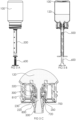
- the syringe 400 is filled for a single dose by connecting it to the package 10 and transferring a quantity of the MP drug 120 from the package 10 into the syringe 400 ( Fig. 5a ). This transfer is achieved by a series of steps. Depending upon the capacity of the syringe included with the device, and the dosage to be delivered, it may or may not be necessary to attach the dose control clip 900 to the plunger rod 604 before opening the bottle 100. A first step is removing the bottle cap 110. Using the syringe 400, the syringe valve retaining ring 800 is pressed into the bottle insert guide ring 260.
- the syringe valve retaining ring 800 to force the bottle valve 300 in a distal direction and around the dispense nozzle 220 ( Fig. 5C ).
- the dispense nozzle 220 pushes open the slit 310 of the bottle valve 300 and also the slits 710 in the syringe valve 700.
- the valve retaining ring 800 locks into place once the retaining ring lugs 810 snap into the bottle insert snap locks 230, providing tactile and audible feedback that the syringe is properly attached.
- the syringe plunger 600 is then pulled in a proximal direction until the dose control clip 900 comes in contact with the barrel retaining ring 520.
- the combined system of syringe 400 and package 10 are inverted such that the syringe 400 is below the package 10 (See Figs. 5A and 5B , the bottom of the bottle 100 should be towards the ceiling.) and the MP drug 120 can then flow by means of gravity through the dispense nozzle 220 and into the syringe barrel 500. Once the barrel 500 is filled with the required amount of the drug the syringe 400 is disconnected from the bottle 100.
- the bottle and syringe valves close instantly upon disconnection.
- the valve spring bellows 320 push the valve 300 to a closed position around the dispense nozzle 220.
- the syringe valve 700 closes simultaneously as the valve flaps 720 spring back to a neutral position.
- the user pushes against the proximal end of the plunger 600 using the plunger thumb press 630 ( Fig. 6A ).
- the force exerted on the plunger 600 pushes the MP drug 120, which in turn pushes open the valve 700 at the distal end of the Device.
- the valve 700 comprises flaps 720 created by slits 710 in the top of the valve ( Figs. 6B and 6C).
- the flaps 720 pivot outward by the force of the MP drug 120. If no force is being applied to the plunger 600, the flaps 720 remain in a neutral position across the top of the barrel 500 to prevent the MP drug 120 from spilling out of the syringe 400.
- the plunger 600 is pushed distally until the forward stroke stops 640 come into contact with the barrel flanges 510 ( Fig. 7B ), pushing the sealing edge 620 past the end of the barrel 500 and past the valve flaps 720, ensuring all the MP drug is expelled from the syringe.
- the inside of the valve flaps 720 become exposed, and any residual medication can be removed to prevent contamination, for example, by wiping the flaps 720 with a towel.
- a method of measuring and dispensing a Multiparticulate drug (MP) to a patient comprises several steps.
- the person performing these steps may be a caregiver to a patient, the patient themself, or another person.
- the steps include uncapping a Package containing the MP drug, then connecting the Device to the fill nozzle of the uncapped package. Connecting the Device to the fill nozzle automatically opens both the bottle valve and the barrel valve, creating a flow path between the bottle and the inside of the Device barrel.
- Another step is inverting the bottle and allowing the MP drug to flow by gravity into the barrel.
- the amount of MP drug that enters into the barrel is determined by pulling back on the plunger to a specified position. The specified position is selected by placing a clip onto the plunger rod, or by visually lining up the plunger rod end to printed dose markings on the Device barrel.
- the Device is removed from the bottle fill nozzle.
- the valves in both the Package and Device automatically close and prevent MP from spilling out of the Package or Device.
- the Device distal end is then placed inside a patient's mouth.
- MP drug is dispensed from the Device by depressing the plunger from the proximal end toward the distal end.
- the device can also be used to deliver MP drug indirectly to a patient by dispensing the measured amount of drug to a secondary device such as spoon or other container, or onto food or into a beverage.
- a secondary device such as spoon or other container
- Another embodiment of the present invention includes a dose metering chamber within the bottle.
- This embodiment gives the user the ability to meter a dose using the bottle and then dispense the dose into a container, syringe, or into a patient's mouth, food, etc. ... without the need to use a syringe with precise dose control.
- This alternate embodiment ( Fig. 8 ) comprises a bottle 100 with a dispensing mechanism 270 attached thereto.
- the user would rotate the proximal end of the bottle relative to the distal end until the desired dose was displayed in the dosing window 274 on the side of the bottle. The user would then hold the bottle 100 with the dispense port 220 facing downward and positioned over the container or food that the multiparticulate is to be dispensed into. Once positioned the user depresses the dispense button 272 on the side of the bottle 100 and the MP drug (not shown) will flow out of the bottle in the precise dose selected.
- the bottle 100 includes a primary chamber 279 to contain the MP drug and an intermediate chamber 280 sized to contain a single dose volume.
- the size of the intermediate chamber can be changed by rotating the bottle insert 270.
- the intermediate chamber 280 is a cylinder containing two dividing walls 281, 282 radiating out from the center. Rotating the bottle insert 270 rotates one of these dividing walls 281, 282 to create a semicircular volume within the cylinder. The more degrees the bottle insert 270 rotates through, the smaller the trapped volume in the cylinder becomes.
- passage 275 connects the primary 279 and intermediate 280 chambers, and gates 1, 276 and gate 2, 277 cooperate in the dispensing of the drug as will be described further below.
- the chamber 280's size could be adjusted by means of a screw mechanism that would translate the rotation of the insert 270 to a linear movement of the chamber roof 290 as shown in Fig 9a-c .
- the Intermediate chamber roof 290 would have thread elements 291 that interact with threads 292 in the bottle.
- the chamber roof would be rotationally locked to the bottle insert 270 so that rotation of the bottle 100 vs the bottle insert 270 will result in translational movement of the chamber roof 290, thereby changing the volume contained in the chamber 280.
- the dispense button 272 controls movement of the MP drug from the primary chamber to the intermediate chamber.
- the dispense button 272 can also control the movement of the MP drug from the intermediate chamber 280 into the dispense nozzle 220 and ultimately out of the bottle.
- a spring (not shown) is positioned between the dispense button 272 and the intermediate chamber 280, the spring biasing the dispense button 272 into a non-depressed state.
- the dispense button 272 is linked to two sliding gates: one between the primary chamber and the intermediate chamber (gate 1, 276 ) and the other between the intermediate chamber and the dispense port (gate 2, 277 ).
- Gate 2 277 includes a hole 278 therethough ( Figs. 8B-8C ).
- gaten 1 276 is open, allowing the MP drug to flow from the primary chamber 279 into the intermediate chamber 280 and gate 2 is closed, preventing the MP drug from flowing out of the dispense port ( Fig. 8B ).
- gate 1 first closes the intermediate chamber 280 from the primary chamber 279 and gate 2 277 then positions hole 278 to open the intermediate chamber 280 to the dispense nozzle 220 ( Fig. 8C ).
- Reference Numerals NUMBER DESCRIPTION 10 Package 100 Bottle 110 Bottle cap 120 Multiparticulate Drug 130 Desiccant capsule 140 Bottle Inner Wall 200 Bottle Insert 210 Bottle Insert sealing rib 220 Bottle Insert dispense nozzle 230 Bottle Insert snap locks 240 Bottle Insert anti-clog ribs 250 Bottle Insert cap seal ring 260 Bottle insert guide ring 270 Dose Control Bottle Insert 272 Dispense button 274 Dose indicator window 275 Passage between primary and intermediate chambers 276 Gate 1 277 Gate 2 278 hole in Gate 2 279 Primary chamber 280 Intermediate chamber 281 Intermediate chamber dividing wall 1 282 Intermediate chamber dividing wall 2 290 Intermediate chamber roof 291 Interior chamber roof thread elements 292 Bottle thread elements 300 Bottle Valve Body 310 Bottle Valve slit 320 Bottle Valve spring bellows 330 Bottle valve seal ring 400 Syringe 500 Barrel 510 Barrel flanges 520 Barrel retaining ring 530 Barrel dose markings 540 Barrel Inner Wall 600 Plunger 604 Plunger rod 610 P
Landscapes
- Health & Medical Sciences (AREA)
- Veterinary Medicine (AREA)
- Public Health (AREA)
- General Health & Medical Sciences (AREA)
- Animal Behavior & Ethology (AREA)
- Life Sciences & Earth Sciences (AREA)
- Engineering & Computer Science (AREA)
- Heart & Thoracic Surgery (AREA)
- Hematology (AREA)
- Anesthesiology (AREA)
- Biomedical Technology (AREA)
- Vascular Medicine (AREA)
- Food Science & Technology (AREA)
- Pharmacology & Pharmacy (AREA)
- Mechanical Engineering (AREA)
- Pulmonology (AREA)
- Physics & Mathematics (AREA)
- General Physics & Mathematics (AREA)
- Fluid Mechanics (AREA)
- Medical Preparation Storing Or Oral Administration Devices (AREA)
Claims (8)
- Ein System zum Ausgeben eines multipartikulären Medikaments (120), das System umfassend:- eine Spritze (400), die Spritze umfassend:- einen Zylinder (500) zum Halten des Medikaments, der Zylinder umfassend ein Inneres, ein proximales Ende und ein distales Ende, das proximale Ende umfassend einen Haltering (520); und- einen Kolben (600), der innerhalb des Zylinders beweglich ist, der Kolben dichtet den Zylinder zwischen dem proximalen Ende und dem distalen Ende ab; der Kolben umfassend:- eine oder mehrere Dosiseinstellrillen (650), einen Dosissteuerclip (900) mit einer röhrenförmigen Konstruktion und einer länglichen Trennung, der Dosissteuerclip konfiguriert, um abnehmbar in eine der Dosiseinstellrillen zu passen, wodurch ein größerer Durchmesserring um den Kolben geschaffen wird als der Durchmesser des Halterings, wobei der Haltering dazu angeordnet ist, die proximale Kolbenbewegung durch Kontakt mit dem Dosissteuerclip zu begrenzen;
gekennzeichnet dadurch, dass entweder der Haltering oder der Dosissteuerclip oder eine Kombination davon aus einem flexiblen Material gefertigt sind, sodass der Kolben mit oder ohne den Dosissteuerclip durch Zurückziehen durch das proximale Ende des Zylinders vom Zylinder entfernt werden kann. - System nach Anspruch 1, wobei die Spritze (400) ferner ein Zylinderventil (700) umfasst, das am distalen Ende des Zylinders (500) angebracht ist und dieses verschließt, wobei das Zylinderventil eine oder mehrere Schlitze (710) hindurch und eine oder mehrere Klappen (720) umfasst, wobei die eine oder mehrere Klappen an den einen oder mehreren Schlitzen zusammentreffen, die eine oder mehreren Klappen das Ventil schließen.
- System nach Anspruch 2, wobei die Bewegung des Kolbens (600) in Richtung des distalen Endes des Zylinders das Zylinderventil (700) öffnet, wobei die eine oder mehrere Klappen (720) so angeordnet sind, dass sie sich relativ zum Zylinder nach außen schwenken, wenn das Medikament abgegeben wird.
- System nach Anspruch 2 oder 3, wobei das distale Ende des Zylinders (500) und der Kolben (600) so angeordnet sind, dass der Kolben (600) über das distale Ende des Zylinders hinaus und in zumindest einen Teil des Zylinderventils (700) bewegt werden kann, wobei das Zylinderventil (700) ferner einen Ventilhaltering (800) umfasst, um das Zylinderventil am distalen Ende des Zylinders zu befestigen.
- System nach Anspruch 4, ferner umfassend eine Flasche (100) zur Aufbewahrung des Medikaments (120), die Flasche umfassend einen Boden, eine Flaschenwand, eine obere Flaschenwand und ein Flaschenventil (300), wobei das Flaschenventil einen Ventilkörper und eine Ausgabedüse (220) zum Ausgeben des Medikaments umfasst, der Ventilkörper eine oder mehrere Schlitze (310) darin aufweist und ein Federelement (320), das den Schlitzbereich des Ventilkörpers in eine Position distal zur Öffnung der Ausgabedüse vorspannt, sodass die Schlitze geschlossen sind und verhindern, dass das Medikament durch die Ausgabedüse fließt.
- System nach Anspruch 5, wobei das Flaschenventil (300) weiter einen Führungsring (260) und eine oder mehrere Halteschnapper (230) umfasst, die um den Ventilkörper positioniert sind, und wobei der Ventilhaltering (800) so angeordnet ist, dass er sich bei derVerbindung der Spritze (400) und der Flasche (100) in Gebrauch mit dem Führungsring (260) einrastet, wobei die Halteschnapper so angeordnet sind, dass sie die Spritze und die Flasche miteinander verriegeln, um die Vorspannung des Federelements zu überwinden, wodurch das Flaschenventil in eine distale Richtung um die Abgabedüse herum erzwungen wird, um sowohl das Zylinderventil als auch das Flaschenventil automatisch zu öffnen, indem die Schlitze (710) des Zylinderventils und des Flaschenventils (310) aufgedrückt werden, wodurch das Medikament (120) durch die Abgabedüse (220) zur Spritze fließen kann.
- System nach Anspruch 5 oder 6, wobei die Abgabedüse (220) weiter eine Vielzahl von Antiverstopfungsrippen (240) umfasst, die sich vom proximalen Ende der Düse aus in die Flasche (100) hinein erstrecken.
- System nach einem der Ansprüche 5 bis 7, wobei die Flasche (100) weiter einen Behälter (130) umfasst, das ein Trockenmittel darin enthält.
Applications Claiming Priority (2)
| Application Number | Priority Date | Filing Date | Title |
|---|---|---|---|
| US201762492868P | 2017-05-01 | 2017-05-01 | |
| PCT/US2018/030544 WO2018204426A1 (en) | 2017-05-01 | 2018-05-01 | System for dosing and dispensing medication |
Publications (3)
| Publication Number | Publication Date |
|---|---|
| EP3628016A1 EP3628016A1 (de) | 2020-04-01 |
| EP3628016B1 true EP3628016B1 (de) | 2025-01-01 |
| EP3628016C0 EP3628016C0 (de) | 2025-01-01 |
Family
ID=63916317
Family Applications (1)
| Application Number | Title | Priority Date | Filing Date |
|---|---|---|---|
| EP18726286.0A Active EP3628016B1 (de) | 2017-05-01 | 2018-05-01 | System zur dosierung und ausgabe von medikamenten |
Country Status (5)
| Country | Link |
|---|---|
| US (1) | US11266573B2 (de) |
| EP (1) | EP3628016B1 (de) |
| CN (1) | CN110603071A (de) |
| CA (1) | CA3061917C (de) |
| WO (1) | WO2018204426A1 (de) |
Families Citing this family (7)
| Publication number | Priority date | Publication date | Assignee | Title |
|---|---|---|---|---|
| BR112022013614A2 (pt) * | 2020-01-09 | 2022-09-13 | Becton Dickinson Co | Dispositivo de transferência de fármacos |
| IT202000002170A1 (it) * | 2020-02-04 | 2021-08-04 | Platinum Pharma Service S R L S | Siringa dosatrice e relativo adattatore |
| US20230072017A1 (en) * | 2020-01-24 | 2023-03-09 | Platinum Pharma Service S.r.l.s. | Dosing syringe and relative adapter |
| USD936218S1 (en) * | 2020-06-04 | 2021-11-16 | Ultradent Products, Inc. | Unit dose container |
| DE102021204338A1 (de) * | 2021-04-30 | 2022-11-03 | Raumedic Ag | Dosiersystem zur Einstellung eines Dosiervolumens eines fließfähigen Mediums sowie Spritzenadapter als Bestandteil eines derartigen Dosiersystems |
| CN113576293B (zh) * | 2021-07-15 | 2022-07-29 | 覃桂兰 | 一种便于控制调味的调料瓶 |
| TWI869306B (zh) * | 2024-06-25 | 2025-01-01 | 長庚學校財團法人長庚科技大學 | 灌食控制裝置 |
Family Cites Families (14)
| Publication number | Priority date | Publication date | Assignee | Title |
|---|---|---|---|---|
| JPS62119944U (de) | 1986-01-20 | 1987-07-30 | ||
| US5702019A (en) * | 1995-09-27 | 1997-12-30 | Becton Dickinson France S.A. | Vial having resealable membrane assembly activated by a medical delivery device |
| BR0108730A (pt) * | 2000-02-28 | 2002-11-05 | Vectura Ltd | Sistema, dispositivo e método para administração de uma droga, bocal de um dispositivo de administração de droga, dispositivo para administração de doses unitárias múltiplas de uma droga, métodos para preparação de um sistema de administração de droga e de uma formulação de droga e para tratamento de um paciente que necessita de doses múltiplas de uma droga, formulação de droga e multiparticulados |
| US20040143224A1 (en) * | 2002-01-07 | 2004-07-22 | Jeffrey Field | Method and apparatus for inhibiting fluid loss from a syringe |
| US7950550B2 (en) * | 2004-05-06 | 2011-05-31 | Diversey, Inc. | Metering and dispensing closure |
| WO2006124756A2 (en) * | 2005-05-13 | 2006-11-23 | Bob Rogers | Medical substance transfer system |
| US7451901B2 (en) * | 2005-07-01 | 2008-11-18 | Ranney Fredrik J | Metering and dispensing device |
| US20070078119A1 (en) * | 2005-09-30 | 2007-04-05 | Pharmacyclics, Inc. | Storage system for texaphyrin pharmaceutical formulations |
| ES2437868T3 (es) | 2007-08-09 | 2014-01-14 | Nestec S.A. | Dispositivo de pieza única para almacenar, dosificar y mezclar una materia en polvo con un diluyente |
| KR101562199B1 (ko) | 2007-11-08 | 2015-10-21 | 넥스메드 홀딩스 인코포레이티드 | 서로 개별적으로 저장된 성분을 혼합하고 분배하기 위한 디바이스 및 시스템 |
| US8864725B2 (en) * | 2009-03-17 | 2014-10-21 | Baxter Corporation Englewood | Hazardous drug handling system, apparatus and method |
| CA2862241C (en) * | 2012-01-17 | 2018-12-04 | Dr. Py Institute Llc | Multiple dose vial and method |
| DE102013208390A1 (de) * | 2013-05-07 | 2014-11-13 | Raumedic Ag | Dosiersystem |
| US9625470B2 (en) | 2013-05-07 | 2017-04-18 | Wisconsin Alumni Research Foundation | Identification of related peptides for mass spectrometry processing |
-
2018
- 2018-05-01 CN CN201880029343.7A patent/CN110603071A/zh active Pending
- 2018-05-01 CA CA3061917A patent/CA3061917C/en active Active
- 2018-05-01 WO PCT/US2018/030544 patent/WO2018204426A1/en not_active Ceased
- 2018-05-01 US US15/968,515 patent/US11266573B2/en not_active Expired - Fee Related
- 2018-05-01 EP EP18726286.0A patent/EP3628016B1/de active Active
Also Published As
| Publication number | Publication date |
|---|---|
| WO2018204426A1 (en) | 2018-11-08 |
| US11266573B2 (en) | 2022-03-08 |
| CA3061917C (en) | 2023-02-07 |
| CA3061917A1 (en) | 2018-11-08 |
| CN110603071A (zh) | 2019-12-20 |
| EP3628016A1 (de) | 2020-04-01 |
| US20180311110A1 (en) | 2018-11-01 |
| EP3628016C0 (de) | 2025-01-01 |
Similar Documents
| Publication | Publication Date | Title |
|---|---|---|
| CA3061917C (en) | System for dosing and dispensing medication | |
| US5718681A (en) | Medication delivery straw | |
| US11766547B2 (en) | Delivery systems and method thereof | |
| US20120103468A1 (en) | Fluid safety dispenser system | |
| US4581013A (en) | Doser for orally administering medicine | |
| WO2012052853A2 (en) | Oral dosing device for administration of medication | |
| US20110224648A1 (en) | Syringe Filter Cap and Method of Using the Same for Administration of Medication Dosage | |
| EP1165011B1 (de) | Applikationsdüse für dosierungsvorrichtung mit verbindungsmitteln | |
| CN110582260B (zh) | 药物制备套件和制备药物的方法 | |
| JP7477243B2 (ja) | 患者への内服物の経口投与のためのアプリケータ | |
| JP2000177761A (ja) | 保持部材付容器 | |
| CN114072638B (zh) | 分配器 | |
| US20190380910A1 (en) | Device for packaging two products to be mixed and for dispensing the mixture of these products | |
| CA2616392A1 (en) | Pharmaceutical delivery device | |
| WO2013091882A1 (en) | A pharmaceutical package | |
| US20220088357A1 (en) | Delivery systems and method thereof | |
| KR101373476B1 (ko) | 유아용 투약주사기 | |
| US20040006303A1 (en) | Oral medicine delivery apparatus | |
| US20230076203A1 (en) | Device for the delivery of a liquid pharmaceutical and/or nutraceutical gelatin speciality to persons having difficulty in swallowing | |
| US20140350525A1 (en) | E-Z Dose-Pensing | |
| KR200244825Y1 (ko) | 의료용 용기 | |
| US20050040054A1 (en) | Dispensing aid for administering medications to infants. | |
| US20170189272A1 (en) | Device for delivering a soluble product with a straw, in particular for children and/or the elderly, adapted cartridge | |
| RU2803517C2 (ru) | Диспенсер с запирающим механизмом с защитой от детей и запирающий механизм с защитой от детей | |
| CN111801085A (zh) | 用于给容器计量地填充填料的装置 |
Legal Events
| Date | Code | Title | Description |
|---|---|---|---|
| STAA | Information on the status of an ep patent application or granted ep patent |
Free format text: STATUS: UNKNOWN |
|
| STAA | Information on the status of an ep patent application or granted ep patent |
Free format text: STATUS: THE INTERNATIONAL PUBLICATION HAS BEEN MADE |
|
| PUAI | Public reference made under article 153(3) epc to a published international application that has entered the european phase |
Free format text: ORIGINAL CODE: 0009012 |
|
| STAA | Information on the status of an ep patent application or granted ep patent |
Free format text: STATUS: REQUEST FOR EXAMINATION WAS MADE |
|
| 17P | Request for examination filed |
Effective date: 20191129 |
|
| AK | Designated contracting states |
Kind code of ref document: A1 Designated state(s): AL AT BE BG CH CY CZ DE DK EE ES FI FR GB GR HR HU IE IS IT LI LT LU LV MC MK MT NL NO PL PT RO RS SE SI SK SM TR |
|
| AX | Request for extension of the european patent |
Extension state: BA ME |
|
| DAV | Request for validation of the european patent (deleted) | ||
| DAX | Request for extension of the european patent (deleted) | ||
| STAA | Information on the status of an ep patent application or granted ep patent |
Free format text: STATUS: EXAMINATION IS IN PROGRESS |
|
| 17Q | First examination report despatched |
Effective date: 20230127 |
|
| REG | Reference to a national code |
Ref country code: DE Ref legal event code: R079 Free format text: PREVIOUS MAIN CLASS: A61M0039260000 Ipc: G01F0011020000 Ref country code: DE Ref legal event code: R079 Ref document number: 602018078093 Country of ref document: DE Free format text: PREVIOUS MAIN CLASS: A61M0039260000 Ipc: G01F0011020000 |
|
| GRAP | Despatch of communication of intention to grant a patent |
Free format text: ORIGINAL CODE: EPIDOSNIGR1 |
|
| STAA | Information on the status of an ep patent application or granted ep patent |
Free format text: STATUS: GRANT OF PATENT IS INTENDED |
|
| RIC1 | Information provided on ipc code assigned before grant |
Ipc: A61J 1/20 20060101ALI20240711BHEP Ipc: A61J 7/00 20060101ALI20240711BHEP Ipc: B65D 83/06 20060101ALI20240711BHEP Ipc: A61M 39/26 20060101ALI20240711BHEP Ipc: G01F 11/46 20060101ALI20240711BHEP Ipc: A47J 31/40 20060101ALI20240711BHEP Ipc: A47G 19/34 20060101ALI20240711BHEP Ipc: A61M 5/315 20060101ALI20240711BHEP Ipc: A61M 5/50 20060101ALI20240711BHEP Ipc: G01F 11/02 20060101AFI20240711BHEP |
|
| INTG | Intention to grant announced |
Effective date: 20240806 |
|
| GRAS | Grant fee paid |
Free format text: ORIGINAL CODE: EPIDOSNIGR3 |
|
| GRAA | (expected) grant |
Free format text: ORIGINAL CODE: 0009210 |
|
| STAA | Information on the status of an ep patent application or granted ep patent |
Free format text: STATUS: THE PATENT HAS BEEN GRANTED |
|
| AK | Designated contracting states |
Kind code of ref document: B1 Designated state(s): AL AT BE BG CH CY CZ DE DK EE ES FI FR GB GR HR HU IE IS IT LI LT LU LV MC MK MT NL NO PL PT RO RS SE SI SK SM TR |
|
| REG | Reference to a national code |
Ref country code: GB Ref legal event code: FG4D |
|
| REG | Reference to a national code |
Ref country code: CH Ref legal event code: EP |
|
| REG | Reference to a national code |
Ref country code: DE Ref legal event code: R096 Ref document number: 602018078093 Country of ref document: DE |
|
| REG | Reference to a national code |
Ref country code: IE Ref legal event code: FG4D |
|
| U01 | Request for unitary effect filed |
Effective date: 20250130 |
|
| U07 | Unitary effect registered |
Designated state(s): AT BE BG DE DK EE FI FR IT LT LU LV MT NL PT RO SE SI Effective date: 20250205 |
|
| U20 | Renewal fee for the european patent with unitary effect paid |
Year of fee payment: 8 Effective date: 20250415 |
|
| PG25 | Lapsed in a contracting state [announced via postgrant information from national office to epo] |
Ref country code: PL Free format text: LAPSE BECAUSE OF FAILURE TO SUBMIT A TRANSLATION OF THE DESCRIPTION OR TO PAY THE FEE WITHIN THE PRESCRIBED TIME-LIMIT Effective date: 20250101 |
|
| PG25 | Lapsed in a contracting state [announced via postgrant information from national office to epo] |
Ref country code: ES Free format text: LAPSE BECAUSE OF FAILURE TO SUBMIT A TRANSLATION OF THE DESCRIPTION OR TO PAY THE FEE WITHIN THE PRESCRIBED TIME-LIMIT Effective date: 20250101 |
|
| PG25 | Lapsed in a contracting state [announced via postgrant information from national office to epo] |
Ref country code: NO Free format text: LAPSE BECAUSE OF FAILURE TO SUBMIT A TRANSLATION OF THE DESCRIPTION OR TO PAY THE FEE WITHIN THE PRESCRIBED TIME-LIMIT Effective date: 20250401 Ref country code: IS Free format text: LAPSE BECAUSE OF FAILURE TO SUBMIT A TRANSLATION OF THE DESCRIPTION OR TO PAY THE FEE WITHIN THE PRESCRIBED TIME-LIMIT Effective date: 20250501 |
|
| PG25 | Lapsed in a contracting state [announced via postgrant information from national office to epo] |
Ref country code: HR Free format text: LAPSE BECAUSE OF FAILURE TO SUBMIT A TRANSLATION OF THE DESCRIPTION OR TO PAY THE FEE WITHIN THE PRESCRIBED TIME-LIMIT Effective date: 20250101 |
|
| PG25 | Lapsed in a contracting state [announced via postgrant information from national office to epo] |
Ref country code: GR Free format text: LAPSE BECAUSE OF FAILURE TO SUBMIT A TRANSLATION OF THE DESCRIPTION OR TO PAY THE FEE WITHIN THE PRESCRIBED TIME-LIMIT Effective date: 20250402 |
|
| PG25 | Lapsed in a contracting state [announced via postgrant information from national office to epo] |
Ref country code: CZ Free format text: LAPSE BECAUSE OF FAILURE TO SUBMIT A TRANSLATION OF THE DESCRIPTION OR TO PAY THE FEE WITHIN THE PRESCRIBED TIME-LIMIT Effective date: 20250101 |
|
| PG25 | Lapsed in a contracting state [announced via postgrant information from national office to epo] |
Ref country code: SM Free format text: LAPSE BECAUSE OF FAILURE TO SUBMIT A TRANSLATION OF THE DESCRIPTION OR TO PAY THE FEE WITHIN THE PRESCRIBED TIME-LIMIT Effective date: 20250101 |
|
| PG25 | Lapsed in a contracting state [announced via postgrant information from national office to epo] |
Ref country code: SK Free format text: LAPSE BECAUSE OF FAILURE TO SUBMIT A TRANSLATION OF THE DESCRIPTION OR TO PAY THE FEE WITHIN THE PRESCRIBED TIME-LIMIT Effective date: 20250101 |
|
| PLBE | No opposition filed within time limit |
Free format text: ORIGINAL CODE: 0009261 |
|
| STAA | Information on the status of an ep patent application or granted ep patent |
Free format text: STATUS: NO OPPOSITION FILED WITHIN TIME LIMIT |
|
| REG | Reference to a national code |
Ref country code: CH Ref legal event code: L10 Free format text: ST27 STATUS EVENT CODE: U-0-0-L10-L00 (AS PROVIDED BY THE NATIONAL OFFICE) Effective date: 20251112 |
|
| 26N | No opposition filed |
Effective date: 20251002 |
|
| REG | Reference to a national code |
Ref country code: CH Ref legal event code: H13 Free format text: ST27 STATUS EVENT CODE: U-0-0-H10-H13 (AS PROVIDED BY THE NATIONAL OFFICE) Effective date: 20251223 |
|
| PG25 | Lapsed in a contracting state [announced via postgrant information from national office to epo] |
Ref country code: CH Free format text: LAPSE BECAUSE OF NON-PAYMENT OF DUE FEES Effective date: 20250531 |
|
| PG25 | Lapsed in a contracting state [announced via postgrant information from national office to epo] |
Ref country code: MC Free format text: LAPSE BECAUSE OF FAILURE TO SUBMIT A TRANSLATION OF THE DESCRIPTION OR TO PAY THE FEE WITHIN THE PRESCRIBED TIME-LIMIT Effective date: 20250101 |
|
| PGFP | Annual fee paid to national office [announced via postgrant information from national office to epo] |
Ref country code: GB Payment date: 20260330 Year of fee payment: 9 |
|
| PG25 | Lapsed in a contracting state [announced via postgrant information from national office to epo] |
Ref country code: IE Free format text: LAPSE BECAUSE OF NON-PAYMENT OF DUE FEES Effective date: 20250501 |
|
| U20 | Renewal fee for the european patent with unitary effect paid |
Year of fee payment: 9 Effective date: 20260331 |