EP3623473A1 - Process for production of polypeptide by regulation of assembly - Google Patents
Process for production of polypeptide by regulation of assembly Download PDFInfo
- Publication number
- EP3623473A1 EP3623473A1 EP19197546.5A EP19197546A EP3623473A1 EP 3623473 A1 EP3623473 A1 EP 3623473A1 EP 19197546 A EP19197546 A EP 19197546A EP 3623473 A1 EP3623473 A1 EP 3623473A1
- Authority
- EP
- European Patent Office
- Prior art keywords
- amino acid
- antibody
- chain variable
- heavy chain
- variable region
- Prior art date
- Legal status (The legal status is an assumption and is not a legal conclusion. Google has not performed a legal analysis and makes no representation as to the accuracy of the status listed.)
- Pending
Links
Images


Classifications
-
- C—CHEMISTRY; METALLURGY
- C07—ORGANIC CHEMISTRY
- C07K—PEPTIDES
- C07K1/00—General methods for the preparation of peptides, i.e. processes for the organic chemical preparation of peptides or proteins of any length
-
- C—CHEMISTRY; METALLURGY
- C12—BIOCHEMISTRY; BEER; SPIRITS; WINE; VINEGAR; MICROBIOLOGY; ENZYMOLOGY; MUTATION OR GENETIC ENGINEERING
- C12P—FERMENTATION OR ENZYME-USING PROCESSES TO SYNTHESISE A DESIRED CHEMICAL COMPOUND OR COMPOSITION OR TO SEPARATE OPTICAL ISOMERS FROM A RACEMIC MIXTURE
- C12P21/00—Preparation of peptides or proteins
- C12P21/02—Preparation of peptides or proteins having a known sequence of two or more amino acids, e.g. glutathione
-
- A—HUMAN NECESSITIES
- A61—MEDICAL OR VETERINARY SCIENCE; HYGIENE
- A61P—SPECIFIC THERAPEUTIC ACTIVITY OF CHEMICAL COMPOUNDS OR MEDICINAL PREPARATIONS
- A61P35/00—Antineoplastic agents
-
- C—CHEMISTRY; METALLURGY
- C07—ORGANIC CHEMISTRY
- C07K—PEPTIDES
- C07K16/00—Immunoglobulins [IG], e.g. monoclonal or polyclonal antibodies
- C07K16/18—Immunoglobulins [IG], e.g. monoclonal or polyclonal antibodies against material from animals or humans
-
- A—HUMAN NECESSITIES
- A61—MEDICAL OR VETERINARY SCIENCE; HYGIENE
- A61K—PREPARATIONS FOR MEDICAL, DENTAL OR TOILETRY PURPOSES
- A61K39/00—Medicinal preparations containing antigens or antibodies
- A61K2039/505—Medicinal preparations containing antigens or antibodies comprising antibodies
-
- C—CHEMISTRY; METALLURGY
- C07—ORGANIC CHEMISTRY
- C07K—PEPTIDES
- C07K2317/00—Immunoglobulins specific features
- C07K2317/30—Immunoglobulins specific features characterized by aspects of specificity or valency
- C07K2317/31—Immunoglobulins specific features characterized by aspects of specificity or valency multispecific
Definitions
- the present invention relates to methods for producing polypeptides by regulating the intramolecular or intermolecular association of each molecule, polypeptides whose intramolecular or intermolecular association is regulated, and pharmaceutical compositions and the like containing such polypeptides as an active ingredient.
- MDX-210 which is currently under clinical trial investigation, is an IgG-type bispecific antibody that retargets FcyRI-expressing monocytes and such to HER-2/neu-expressing cancer cells (see Non-Patent Document 1).
- IgG-type bispecific antibody that retargets FcyRI-expressing monocytes and such to HER-2/neu-expressing cancer cells (see Non-Patent Document 1).
- antibodies are produced using genetic recombination techniques.
- One specific technique involves the cloning of a DNA encoding an antibody protein from antibody-producing cells, such as hybridomas or sensitized lymphocytes that produce antibodies or a phage library presenting antibody genes, and the insertion of such into a suitable vector, which is then transfected into host cells for antibody production.
- Production of IgG type bispecific antibodies using genetic recombination techniques involves the introduction of a total of four types of genes into cells, in which these genes of H chains and L chains constitute two types of IgGs of interest, and the secretion of the antibodies by coexpression.
- VH H chain variable region
- VL L chain variable region
- An objective of the present invention is to provide a method for regulating polypeptide association, polypeptides whose association is regulated, and methods for producing such polypeptides.
- Another objective is to provide methods for efficiently producing one of the conformational isomers of sc(Fv)2.
- the present inventors selected VH and VL of the antibodies as peptides to be subjected for the regulation of association, and carried out dedicated research on methods that allow the association between these VH and VL to be regulated.
- the inventors discovered that the association between VH and VL can be regulated by substituting amino acids present at the VH-VL interface with charged amino acids. This, in turn, leads to a more efficient formation of the heterologous molecules than the above-mentioned methods that utilize the knob and hole techniques.
- substitution with only one type of amino acid present at each side of the VH-VL interface allows for the efficient production of a heterologous molecule. From the viewpoint of antigenicity, fewer amino acid substitutions are preferred. In an embodiment of the present invention, a mere substitution of one amino acid present at the VH-VL interface enables the efficient formation of heterologous molecules.
- associations between VH and VL can be regulated by the findings discovered by the present inventors.
- the present invention can be applied not only to the regulation of association between VH and VL, but can also be applied to the regulation of associations among arbitrary polypeptides.
- the present inventors confirmed that function is actually retained in bispecific antibodies obtained by the methods for regulating association of the present invention.
- the present inventors succeeded in developing methods that can regulate the association between arbitrary polypeptides, and thus completed the present invention.
- the present invention relates to methods for regulating polypeptide association, polypeptides whose association is regulated, and methods for producing such polypeptides, and more specifically the invention provides:
- the present invention relates to methods for regulating the association of polypeptides or association of heteromultimers composed of polypeptides.
- the present invention provides methods for regulating polypeptide association, such methods including the step of modifying amino acid residues in an original peptide forming an interface so as to inhibit the association within the polypeptide.
- polypeptides ordinarily refers to peptides and proteins whose length is about ten amino acids or longer.
- Polypeptides are ordinarily derived from organisms but are not particularly limited thereto, and for example, they may be composed of an artificially designed sequence. They may also be any of naturally derived polypeptides, synthetic polypeptides, recombinant polypeptides, or such. Additionally, fragments of the above-mentioned polypeptides are also included in the polypeptides of the present invention.
- polypeptide association refers to, for example, a condition in which two or more polypeptide regions interact.
- regulating association refers to regulating to achieve a desired association condition, and more specifically refers to regulating so that undesirable associations are not formed in the polypeptides.
- the term "interface” ordinarily refers to the association surface that results from association (interaction), and amino acid residues that form the interface are ordinarily one or more amino acid residues included in the polypeptide regions which participate in the association, and are more preferably amino acid residues that approach each other during association and are involved in the interaction. More specifically, this interaction includes, for example, instances where the amino acid residues come close during the association to form hydrogen bonds, electrostatic interactions, or salt bridges with each other.
- amino acid residues forming an interface more specifically refers to amino acid residues included in the polypeptide region that constitutes the interface.
- polypeptide regions constituting the interface refer to polypeptide regions responsible for selective binding within or between molecules such as in antibodies, ligands, receptors, or substrates. More specifically, in antibodies, such examples include heavy chain variable regions and light chain variable regions.
- Modification of amino acid residues in the methods of the present invention specifically refers to substituting original amino acid residue(s) for other amino acid residue(s), deleting original amino acid residue(s), adding new amino acid residue(s), and such, but preferably refers to substituting one or more original amino acid residues for other amino acid residues.
- polypeptides preferably refers to polypeptides that form two or more types of conformational isomers.
- Conformational isomers are proteins whose amino acid sequences are identical but their three-dimensional (tertiary) structures are different. Ordinarily, among conformational isomers, at least either one of chemical or physical properties is also different.
- a preferred embodiment of the present invention relates to methods for preferentially (efficiently) obtaining desirable conformational isomers from among two or more types of potential conformational isomers. More specifically, an embodiment relates to methods for modifying the one or more amino acid residues that form an interface between the polypeptides so as to inhibit an association between polypeptides forming one or more types of conformational isomers from among those polypeptides that may form two or more types of conformational isomers.
- first to fourth peptide regions exist in a polypeptide, and any two of these regions can associate
- the following cases are conceivable where mainly three types of conformational isomers can exist: (1) the first and second polypeptide regions associate and the third and fourth polypeptide regions associate, (2) the first and third polypeptide regions associate, and the second and fourth polypeptide regions associate, and (3) the first and fourth polypeptide regions associate, and the second and third polypeptide regions associate.
- polypeptide formational isomer
- amino acid residues forming the interfaces present in the first, third, or fourth polypeptide regions are modified so that association of the first polypeptide region with the third and fourth polypeptide regions is inhibited.
- the methods of the present invention also relates to methods for regulating heteromultimer association, such methods including the step of modifying amino acid residues that form the interface between the original polypeptides, such that the association between the polypeptides is inhibited.
- heteromultimer refers to a protein multimer composed of more than one type of polypeptide, in which the polypeptides can associate with each other. More specifically, a “heteromultimer” includes at least a first polypeptide and a second polypeptide; in this context, the second polypeptide is a molecule which differs from the first polypeptide by at least one amino acid residue. Furthermore, without particular limitation, the heteromultimers preferably have binding specificity toward at least two different types of ligands, antigens, receptors, substrates, or such. In addition to a “heterodimer” formed by a first and second polypeptide, another different type of polypeptide may exist in the heteromultimer. More specifically, "heteromultimers" of the present invention are not limited to heterodimers and include for example heterotrimers and heterotetramers.
- Preferred embodiments of the above-mentioned methods are methods of modifying amino acid residues that form the interface between polypeptides in heteromultimers that may form two or more types of multimers, such that association between polypeptides forming one or more types of multimers is inhibited.
- the following multimers can mainly exist: (1) multimers in which the first and second polypeptides are associated and the third and fourth polypeptides are associated, (2) multimers in which the first and third polypeptides are associated and the second and fourth polypeptides are associated, or (3) multimers in which the first and fourth polypeptides are associated and the second and third polypeptides are associated.
- amino acid residues included in the first, third, or fourth polypeptide can be modified so that association of the first polypeptide with the third and fourth polypeptides is inhibited.
- Preferred embodiments of the methods of the present invention for regulating polypeptide association include, for example, methods in which modification of amino acid residues forming the interface of polypeptides include introducing amino acid residue mutations to the interface so that two or more amino acid residues forming an interface will have the same type of charge.
- the amino acid residues that are to be modified are preferably two or more amino acid residues that come close to each other during association in the region between the polypeptide regions that form the interface.
- Amino acid residues that come close to each other during association can be identified, for example, by analyzing the three dimensional structures of the polypeptides, and investigating the amino acid sequences of the polypeptide regions forming the interface when these polypeptides associate. Amino acid residues that come close to each other at the interface will be preferred targets for "modifications" in the methods of the present invention.
- amino acids are known to be charged amino acids.
- lysine (K), arginine (R), and histidine (H) are known as positively charged amino acids (cationic amino acids) whereas aspartate (D), glutamate (E), and such are known as negatively charged amino acids (anionic amino acids). Therefore, in the context of the present invention, amino acids carrying the same type of charge preferably refer to amino acids that are either positively charged or negatively charged.
- all of the mutated amino acid residues are preferably modified to have the same type of charges, but the methods are not necessarily limited to such cases.
- the methods are not necessarily limited to such cases.
- a number of amino acid residues are introduced by the modification, there may be a few uncharged amino acid residues among these amino acid residues.
- the number of amino acid residues that undergo modification in the methods of the present invention is not particularly limited. However, when modifying the variable region(s) of an antibody, it is preferable that only a few amino acid residues are modified so as not to decrease the antigen binding activity or increase the antigenicity of the resulting antibody.
- the methods of the present invention can regulate association by modifying one or both of the two amino acid residues that come close to each other at the interface, as indicated in the Examples described below.
- the term "few" as used in the above-mentioned context refers to about one to ten for example, preferably about one to five, more preferably about one to three, and even more preferably about one to two.
- amino acid residues that are introduced by modification are preferably all selected from among the above-mentioned positively charged amino acids, or, alternatively, are all selected from among the above-mentioned negatively charged amino acids.
- preferred amino acid residues to be introduced include glutamic acid (E), aspartic acid (D), lysine (K), arginine (R), or histidine (H).
- an interface-forming amino acid residue (X) in an original polypeptide (before modification) when an interface-forming amino acid residue (X) in an original polypeptide (before modification) is already charged, it is preferable that the amino acid residue that comes close to and faces this amino acid residue (X) during association is modified to be the same amino acid residue (or an amino acid residue with the same type of charge) as the amino acid residue (X). In this embodiment, it is only necessary to modify one of the amino acid residues that form the interface.
- Preferred embodiments of the methods of the present invention for regulating association include methods in which modification of amino acid residues forming the interface of the polypeptides that feature the introduction of amino acid residue mutations to the interface such that the amino acid residues forming a hydrophobic core present at the interface are transformed into charged amino acid residues.
- hydrophobic core refers to a part of a polypeptide that is formed by an assembly of hydrophobic amino acid side chains at the interior of the associated polypeptides.
- hydrophobic amino acids include alanine, isoleucine, leucine, methionine, phenylalanine, proline, tryptophan, and valine.
- amino acid residues other than hydrophobic amino acids for example tyrosine
- This hydrophobic core together with a hydrophilic surface, in which hydrophilic amino acid side chains are exposed to the exterior, becomes a driving force for promoting association of water-soluble polypeptides.
- hydrophobic amino acids of two different domains When hydrophobic amino acids of two different domains are present on a molecular surface and are exposed to water molecules, the entropy will increase and the free energy will increase. Accordingly, the two domains will associate with each other to decrease the free energy and become stable, and hydrophobic amino acids at the interface will be buried into the interior of the molecule to form a hydrophobic core.
- the present invention relates to methods for regulating association that feature the step of modifying amino acid residues involved with the formation of the hydrophobic core at the interface into charged amino acid residues.
- Examples of charged amino acid residues suitable for use in the methods described above preferably include glutamic acid (E), aspartic acid (D), lysine (K), arginine (R), and histidine (H).
- the methods of the present invention for regulating association can be used as methods for preferentially obtaining (producing) antibodies (polypeptides) of interest and in the production of antibodies, antibody fragments, polypeptides having antibody-like activity, and the like.
- the term “antibody” is used in the broadest sense, and includes monoclonal antibodies, polyclonal antibodies, and mutant antibodies (chimeric antibodies, humanized antibodies, minibodies (including antibody fragments), and multispecific antibodies), so long as they exhibit a desired biological activity.
- the "antibody” can be a polypeptide or heteromultimer.
- Preferred antibodies include monoclonal antibodies, chimeric antibodies, humanized antibodies, and minibodies, such as antibody fragments.
- multispecific antibody refers to an antibody that may bind specifically to different types of epitopes. More specifically, multispecific antibodies are antibodies having specificity to at least two different types of epitopes, and, in addition to antibodies recognizing different antigens, antibodies recognizing different epitopes on the same antigen are also included. For example, when the antigens are heterologous receptors, multispecific antibodies can recognize different domains constituting the heterologous receptors; alternatively, when the antigens are monomers, multispecific antibodies recognize multiple sites on the monomer antigens. Ordinarily, such molecules bind to two antigens (bispecific antibodies; used in the present description to have the same meaning as “dual-specific antibodies”), but they may even have specificity toward more antigens (for example three types).
- the antibodies of the present invention include antibodies whose amino acid sequences have been modified by amino acid substitutions, deletions, additions, and/or insertions, or chimerization, humanization, and such.
- amino acid sequence modifications such as amino acid substitutions, deletions, additions, and/or insertions, and humanization and chimerization, can be achieved by methods known to those skilled in the art.
- the amino acid sequences of the antibody variable and constant regions may also be modified by amino acid substitutions, deletions, additions, and/or insertions, or chimerization, humanization and the like.
- the antibodies of the present invention may be derived from any animal, such as a mouse, human, rat, rabbit, goat, or camel. Furthermore, the antibodies may be modified, for example, chimeric antibodies, and in particular, modified antibodies that include amino acid substitutions in their sequence, such as humanized antibodies.
- the antibodies may be any type of antibody, such as antibody modification products linked with various molecules, antibody fragments, and minibodies.
- Chimeric antibodies are antibodies prepared by combining sequences derived from different animals.
- An example is an antibody having heavy and light chain variable (V) regions from a mouse antibody and heavy and light chain constant (C) regions from a human antibody.
- Chimeric antibodies can be prepared by known methods. To obtain such chimeric antibodies, for example, a DNA encoding an antibody V region may be ligated with a DNA encoding a human antibody C region; the resulting ligation product can be inserted into an expression vector; and the construct can be introduced into a host to produce the chimeric antibody.
- Humanized antibodies are also referred to as reshaped human antibodies, and can be obtained by substituting the complementarity determining region (CDR) of a human antibody for the CDR of an antibody derived from a nonhuman mammal, for example, a mouse.
- CDR complementarity determining region
- Methods for identifying CDRs are known in the art ( Kabat et al., Sequence of Proteins of Immunological Interest (1987), National Institute of Health, Bethesda, Md .; Chothia et al., Nature (1989) 342:877 ).
- General genetic recombination techniques suitable for this purpose are also known (see European Patent Application EP 125023 ; and WO 96/02576 ).
- the CDR of a mouse antibody can be determined by known methods, and a DNA can be prepared such that it encodes an antibody in which the CDR is ligated with the framework region (FR) of a human antibody.
- a humanized antibody can then be produced using a system that uses conventional expression vectors.
- DNAs can be synthesized by PCR, using as primers several oligonucleotides designed to include portions that overlap the ends of both the CDR and FR regions (see the method described in WO 98/13388 ).
- Human antibody FRs linked via CDRs are selected such that the CDRs form a suitable antigen binding site.
- amino acids in the FRs of an antibody variable region may be substituted so that the CDRs of the reshaped human antibody can form a suitable antigen binding site ( Sato, K. et al., Cancer Res. (1993) 53:851-856 ).
- Modifiable amino acid residues in the FRs include portions that directly bind to an antigen via non-covalent bonds ( Amit et al., Science (1986) 233: 747-53 ), portions that have some impact or effect on the CDR structure ( Chothia et al., J. Mol. Biol. (1987) 196: 901-17 ), and portions involved in the interaction between VH and VL ( EP 239400 ).
- the C regions of these antibodies are preferably derived from human antibodies.
- C ⁇ 1, C ⁇ 2, C ⁇ 3, and C ⁇ 4 can be used for the H chain, while C ⁇ and C ⁇ can be used for the L chain.
- the human antibody C region may be modified as required to improve antibody or production stability.
- a chimeric antibody of the present invention preferably includes a variable region of an antibody derived from a nonhuman mammal and a constant region of a human antibody.
- a humanized antibody preferably includes CDRs of an antibody derived from a nonhuman mammal and FRs and C regions of a human antibody. The variable regions are described in detail in (3)-3.
- the constant regions of the human antibodies include specific amino acid sequences, which vary depending on the isotype of the antibody, for example, IgG (IgG1, IgG2, IgG3, and IgG4), IgM, IgA, IgD, and IgE.
- the constant regions used to prepare the humanized antibodies of the present invention may be the constant regions of antibodies of any isotype.
- a constant region of human IgG is preferably used, though the invention is not limited thereto.
- the FRs derived from a human antibody, which are used to prepare the humanized antibodies, are not particularly limited, and thus may be derived from an antibody of any isotype.
- variable and constant regions of chimeric or humanized antibodies of the present invention may be modified by deletion, substitution, insertion, and/or addition, so long as the antibodies exhibit the same binding specificity as that of the original antibodies.
- minibodies are useful as the antibodies because of their in vivo kinetic characteristics and low-cost production using E . coli, plant cells, or such.
- Antibody fragments are one type of minibody.
- minibodies includes antibodies that include an antibody fragment as a partial structural unit.
- the minibodies of the present invention are not particularly limited by their structure nor their method of production, so long as they have antigen binding activity. Some minibodies have an activity greater than that of a whole antibody ( Orita et al., Blood (2005) 105:562-566 ).
- the "antibody fragments” are not particularly limited, so long as they are a portion of a whole antibody (for example, whole IgG).
- the antibody fragments preferably include a heavy chain variable region (VH) or a light chain variable region (VL).
- Examples of preferred antibody fragments are: Fab, F(ab') 2 , Fab', and Fv.
- the amino acid sequence of a VH or VL in an antibody fragment may be modified by substitution, deletion, addition, and/or insertion. Furthermore, some portions of a VH and VL may be deleted, so long as the resulting fragments retain their antigen binding ability.
- Fv is a minimal antibody fragment composed the complete antigen recognition and binding sites.
- “Fv” is a dimer (VH-VL dimer) composed of one unit of VH and one unit of VL bound very strongly by non-covalent bonding.
- variable region An antigen binding site is formed on the surface of the VH-VL dimer by the three complementarity determining regions (CDRs) of each variable region.
- CDRs complementarity determining regions
- Six CDRs confer an antigen binding site to the antibody.
- one variable region or half of an Fv composed of only three antigen-specific CDRs
- molecules smaller than Fv are also included in the context of antibody fragments of the present invention.
- the variable regions of an antibody fragment may also be chimerized or humanized.
- the minibodies preferably include both VH and VL.
- suitable minibodies include antibody fragments such as Fab, Fab', F(ab')2, and Fv, and scFv (single-chain Fv), which can be prepared using antibody fragments, ( Huston et al., Proc. Natl. Acad. Sci. USA (1988) 85: 5879-83 ; Plickthun "The Pharmacology of Monoclonal Antibodies” Vol. 113, Resenburg and Moore (eds.), Springer Verlag, New York, pp. 269-315, (1994 )); diabodies ( Holliger et al., Proc. Natl. Acad. Sci.
- An antibody fragment can be prepared by treating an antibody with an enzyme, for example, a protease such as papain or pepsin (see Morimoto et al., J. Biochem. Biophys. Methods (1992) 24: 107-17 ; Brennan et al., Science (1985) 229:81 ).
- an enzyme for example, a protease such as papain or pepsin (see Morimoto et al., J. Biochem. Biophys. Methods (1992) 24: 107-17 ; Brennan et al., Science (1985) 229:81 ).
- antibody fragments can also be produced by genetic recombination based on its amino acid sequence.
- a minibody having a structure that results from modification of an antibody fragment can be prepared using antibody fragments obtained by enzyme treatment or genetic recombination.
- the minibody may be expressed in appropriate host cells (see, for example, Co et al., J. Immunol. (1994) 152: 2968-76 ; Better and Horwitz, Methods Enzymol. (1989) 178: 476-96 ; Pluckthun and Skerra, Methods Enzymol. (1989) 178: 497-515 ; Lamoyi, Methods Enzymol. (1986) 121: 652-63 ; Rousseaux et al., Methods Enzymol. (1986) 121: 663-9 ; Bird and Walker, Trends Biotechnol. (1991) 9: 132-7 ).
- scFVs are single-chain polypeptides that include two variable regions linked together via a linker or such, as required.
- the two variable regions in an scFv are typically one VH and one VL, but an scFv may include two VH or two VL.
- scFv polypeptides include a linker between the VH and VL domains, thereby forming a paired portion of VH and VL required for antigen binding.
- a peptide linker composed of ten or more amino acids is typically used as the linker between VH and VL when forming an intramolecular paired portion between VH and VL.
- linkers of the scFv of the present invention are not limited to such peptide linkers, so long as they do not inhibit the formation of an scFv.
- diabodies refers to bivalent antibody fragments constructed by gene fusion ( P. Holliger et al., Proc. Natl. Acad. Sci. USA 90: 6444-6448 (1993 ); EP 404,097 ; WO93/11161 and such).
- Diabodies are dimers composed of two polypeptide chains, wherein each polypeptide chain includes within the same chain a light chain variable region (VL) and a heavy chain variable region (VH) connected with a linker short enough to disable interaction of these two regions, for example a linker of about five amino acid residues.
- VL and VH encoded on the same polypeptide chain will form a dimer because the linker between VL and VH is too short to form a single chain V region fragment. Therefore, the resulting diabody has two antigen-binding sites.
- VL and VH directed against two different epitopes (a and b) are expressed simultaneously as combinations of VLa-VHb and VLb-VHa connected with a linker of about five residues, they are secreted as bispecific Db.
- the two different epitopes may be epitopes at two different sites on the same antigen, or epitopes at two different sites, each on two different antigens.
- diabodies include two molecules of scFvs, they thus composed of four variable regions, and as a result have two antigen binding sites.
- linkers forming a connection between VH and VL in each scFv molecules are linkers of about five amino acids when used as peptide linkers.
- scFv linkers for diabody formation are not limited to such peptide linkers so long as they do not interfere with scFv expression and diabody formation.
- polypeptides or heteromultimers subjected to the methods of the present invention include polypeptides or heteromultimers composed of antibody heavy chain variable regions and light chain variable regions. More preferably, preferred embodiments of the present invention are methods for regulating association when polypeptides or heteromultimers of the present invention include two or more types of heavy chain variable regions and two or more types of light chain variable regions. Such polypeptides or heteromultimers are preferably those that recognize two or more types of epitopes, and examples include multispecific antibodies.
- examples of multispecific antibodies in the present invention include bispecific antibodies.
- preferred embodiments of the present invention relate to, for example, methods for regulating association of bispecific antibodies composed of two types of heavy chain variable regions (first heavy chain and second heavy chain) and two types of light chain variable regions (first light chain and second light chain).
- first heavy chain refers to one of the two H chains forming the antibody
- second H chain refers to the other H chain that is different from the first H chain. That is, of the two H chains, one of them can be arbitrarily defined as the first H chain and the other can be defined as the second H chain.
- first light chain refers to one of the two L chains forming the bispecific antibody
- second L chain refers to the other L chain that is different from the first L chain. Of the two L chains, one of them can be arbitrarily defined as the first L chain and the other can be defined as the second L chain.
- the first L chain and the first H chain are derived from the same antibody that recognizes a certain antigen (or epitope), and the second L chain and the second H chain are also derived from the same antibody that recognizes a certain antigen (or epitope).
- the L chain-H chain pair formed by the first H chain and L chain is called as the first pair
- the L chain-H chain pair formed by the second H chain and L chain is called as the second pair.
- An antigen (or epitope) used to produce the antibody from which the second pair derives is preferably different from the antigen used to produce the antibody from which the first pair is derives.
- antigens recognized by the first pair and the second pair may be the same but different antigens (or epitopes) are preferred to be recognized.
- the H chains and L chains of the first pair and second pair preferably have amino acid sequences that differ from each other.
- the first and the second pair may recognize a completely different antigen, or they may recognize different sites (different epitopes) on the same antigen.
- one of them may recognize an antigen such as a protein, peptide, gene, or sugar, and the other may recognize cytotoxic substances such as radioactive substances, chemotherapeutic agents, or cell-derived toxins.
- those specific H chains and L chains may be arbitrary determined to be the first pair and second pair.
- bispecific antibodies are not necessarily limited to antibodies composed of two types of heavy chains and two types of light chains, and for example, they may be antibodies (for example, sc(Fv)2) having a structure in which two types of heavy chain variable regions and two types of light chain variable regions are linked to form a single chain.
- an antibody of the present invention known sequences can be used, or they can be obtained by methods known to those skilled in the art. For example, they may be obtained from an antibody library, or they may be obtained by cloning genes encoding the antibody from hybridomas producing monoclonal antibodies.
- antibody libraries many antibody libraries are already well known, and since methods for producing antibody libraries are known, those skilled in the art can appropriately obtain antibody libraries.
- antibody phage libraries one can refer to the literature such as Clackson et al., Nature 1991, 352: 624-8 ; Marks et al., J. Mol. Biol. 1991, 222: 581-97 ; Waterhouses et al., Nucleic Acids Res. 1993, 21: 2265-6 ; Griffiths et al., EMBO J. 1994, 13: 3245-60 ; Vaughan et al., Nature Biotechnology 1996, 14: 309-14 ; and Japanese Patent Kohyo Publication No.
- variable regions of human antibodies can be expressed on the surface of phages as single chain antibodies (scFvs) using phage display methods, and phages that bind to antigens can be selected. Genetic analysis of the selected phages can determine the DNA sequences encoding the variable regions of human antibodies that bind to the antigens.
- suitable expression vectors can be produced based on these sequences to obtain human antibodies. These methods are already well known, and one can refer to WO92/01047 , WO92/20791 , WO93/06213 , WO93/11236 , WO93/19172 , WO95/01438 , and WO95/15388 .
- known techniques may be used, involving the use of desired antigens or cells expressing the desired antigens as sensitizing antigens, using these to perform immunizations according to conventional immunization methods, fusing the immune cells thus obtained with known parent cells by ordinary cell fusion methods, screening monoclonal antibody producing cells (hybridomas) by ordinary screening methods, synthesizing cDNAs of antibody variable regions (V regions) from mRNAs of the obtained hybridomas using reverse transcriptase, and linking them with DNAs encoding the desired antibody constant regions (C regions).
- V regions antibody variable regions
- C regions desired antibody constant regions
- sensitizing antigens for obtaining the above-mentioned antibody genes encoding the H chains and L chains include both complete antigens with immunogenicity and incomplete antigens composed of haptens and such that do not show antigenicity.
- full length proteins and partial peptides of proteins of interest can be used.
- substances composed of polysaccharides, nucleic acids, lipids, and such may become antigens.
- Antigens can be prepared by methods known to those skilled in the art, and they can be prepared, for example, by the following methods using baculoviruses (for example, WO98/46777 ).
- Hybridomas can be produced, for example, the following methods of Milstein et al. ( G Kohler and C. Milstein, Methods Enzymol. 1981, 73: 3-46 ), and such.
- the immunogenicity of an antigen When the immunogenicity of an antigen is low, it can be linked to a macromolecule that has immunogenicity, such as albumin, and then used for immunization.
- antigens with other molecules if necessary, they can be converted into soluble antigens.
- transmembrane molecules such as receptors are used as antigens, portions of the extracellular regions of the receptors can be used as a fragment, or cells expressing transmembrane molecules on their cell surface may be used as immunogens.
- Antibody-producing cells can be obtained by immunizing animals using suitable sensitizing antigens described above. Alternatively, antibody-producing cells can be prepared by in vitro immunization of lymphocytes that can produce antibodies. Various mammals can be used as the animals for immunization, where rodents, lagomorphas and primates are generally used. Examples of such animals include mice, rats, and hamsters for rodents, rabbits for lagomorphas, and monkeys including the cynomolgus monkey, rhesus monkey, hamadryas, and chimpanzees for primates.
- transgenic animals carrying human antibody gene repertoires are also known, and human antibodies can be obtained by using these animals (see WO96/34096 ; Mendez et al., Nat. Genet. 1997, 15: 146-56 ).
- desired human antibodies having binding activity against antigens can be obtained by in vitro sensitization of human lymphocytes with desired antigens or cells expressing the desired antigens, and then fusing the sensitized lymphocytes with human myeloma cells such as U266 (see Japanese Patent Application Kokoku Publication No. ( JP-B) H1-59878 (examined, approved Japanese patent application published for opposition)).
- desired human antibodies can be obtained by immunizing transgenic animals carrying a complete repertoire of human antibody genes, with desired antigens (see WO93/12227 , WO92/03918 , WO94/02602 , WO96/34096 , and WO96/33735 ).
- Animal immunization can be carried out by appropriately diluting and suspending a sensitizing antigen in Phosphate-Buffered Saline (PBS), physiological saline, or such, and forming an emulsion by mixing an adjuvant if necessary, followed by an intraperitoneal or subcutaneous injection into animals. After that, the sensitizing antigen mixed with Freund's incomplete adjuvant is preferably administered several times every four to 21 days. Antibody production can be confirmed by measuring the target antibody titer in animal sera using conventional methods.
- PBS Phosphate-Buffered Saline
- physiological saline physiological saline
- Antibody production can be confirmed by measuring the target antibody titer in animal sera using conventional methods.
- Antibody-producing cells obtained from lymphocytes or animals immunized with a desired antigen can be fused with myeloma cells to generate hybridomas using conventional fusing agents (for example, polyethylene glycol) ( Goding, Monoclonal Antibodies: Principles and Practice, Academic Press, 1986, 59-103 ).
- fusing agents for example, polyethylene glycol
- hybridoma cells can be cultured and grown, and the binding specificity of the antibody produced from these hybridomas can be measured using known analysis methods, such as immunoprecipitation, radioimmunoassay (RIA), and enzyme-linked immunosorbent assay (ELISA). Thereafter, hybridomas that produce antibodies of interest whose specificity, affinity, or activity has been determined can be subcloned by methods such as limiting dilution.
- genes encoding the selected antibodies can be cloned from hybridomas or antibody-producing cells (sensitized lymphocytes, and such) using probes that may specifically bind to the antibodies (for example, oligonucleotides complementary to sequences encoding the antibody constant regions). Cloning from mRNA using RT-PCR is also possible.
- Immunoglobulins are classified into five different classes, IgA, IgD, IgE, IgG, and IgM. These classes are further divided into several subclasses (isotypes) (for example, IgG-1, IgG-2, IgG-3, and IgG-4; IgA-1 and IgA-2; and such).
- H chains and L chains used in the present invention to produce antibodies are not particularly limited and may derive from antibodies belonging to any of these classes or subclasses; however, IgG is particularly preferred.
- H-chain-encoding genes and L-chain-encoding genes using genetic engineering techniques.
- Genetically modified antibodies such as chimeric antibodies, humanized antibodies that have been artificially modified for the purpose of decreasing heterologous antigenicity and such against humans, can be appropriately produced if necessary for antibodies such as mouse antibodies, rat antibodies, rabbit antibodies, hamster antibodies, sheep antibodies, and camel antibodies.
- Chimeric antibodies are antibodies composed of a nonhuman mammal antibody H chain and L chain variable regions, such as mouse antibody, and the H chain and L chain constant regions of human antibody.
- a humanized antibody which is also called a reshaped human antibody, can be synthesized by PCR from a number of oligonucleotides produced so that they have overlapping portions at the ends of DNA sequences designed to link the complementarity determining regions (CDRs) of an antibody of a nonhuman mammal such as a mouse.
- the obtained DNA can be ligated to a DNA encoding a human antibody constant region.
- the ligated DNA can be incorporated into an expression vector, and the vector can be introduced into a host to produce the antibody (see EP239400 and WO96/02576 ).
- Human antibody FRs that are ligated via the CDR are selected when the CDR forms a favorable antigen-binding site. If necessary, amino acids in the framework region of an antibody variable region may be substituted such that the CDR of the reshaped human antibody forms an appropriate antigen-binding site ( K. Sato et al., Cancer Res. 1993, 53: 851-856 ).
- antibodies may be modified to improve their biological properties, for example, antigenic affinity. Such modifications can be carried out using methods such as site-directed mutagenesis (see for example, Kunkel (1985) Proc. Natl. Acad. Sci. USA 82: 488 ), PCR mutagenesis, and cassette mutagenesis.
- mutant antibodies whose biological properties have been improved show amino acid sequence homology and/or similarity of 70% or higher, more preferably 80% or higher, and even more preferably 90% or higher (for example, 95% or higher, 97%, 98%, 99%, etc.), when compared to the amino acid sequence of the original antibody variable region.
- sequence homology and/or similarity is defined as the ratio of amino acid residues that are homologous (same residue) or similar (amino acid residues classified into the same group based on the general properties of amino acid side chains) to the original antibody residues, after the sequence homology value has been maximized by sequence alignment and gap introduction, if necessary.
- amino acid residues are classified into groups based on the characteristics of their side chains: (1) hydrophobic: alanine, isoleucine, norleucine, valine, methionine, and leucine; (2) neutral hydrophilic: asparagine, glutamine, cysteine, threonine, and serine; (3) acidic: aspartic acid, and glutamic acid; (4) basic: arginine, histidine, and lysine; (5) residues that affect the orientation of the chain: glycine, and proline; and (6) aromatic: tyrosine, tryptophan, and phenylalanine.
- CDRs complementarity determining regions
- H chain and L chain variable regions interact to form the antigen binding site(s) of an antibody.
- CDRs complementarity determining regions
- one of these variable regions is known to have the ability to recognize and bind to the antigen, although the affinity will be lower than when all binding sites are included. Therefore, antibody genes of the present invention encoding the H chain and L chain only have to encode fragment portions having each of the antigen binding sites of H chain and L chain, and polypeptides encoded by these genes only have to maintain affinity with the desired antigens.
- the methods of the present invention for regulating association allow one to preferentially (efficiently) obtain, for example, the desired bispecific antibodies as described above. More specifically, desired bispecific antibodies which are heteromultimers can be efficiently formed from a mixture of monomers.
- IgG-type bispecific antibodies composed of two types of heavy chain variable regions (VH1 and VH2) and two types of light chain variable regions (VL1 and VL2) are described in detail; however, the methods of the present invention can be applied similarly to other heteromultimers.
- VH1 first heavy chain variable region
- VL1 first light chain variable region
- VH2 second heavy chain variable region
- VL2 second light chain variable region
- the desired antibody molecule can be preferentially obtained if the regulation is carried out in a manner to inhibit the association between polypeptides, for example, VH1 and VL2 and/or VH2 and VL1.
- An example includes modifying amino acid residues forming the interfaces between the polypeptide of VH1 and the polypeptide of VL2, and/or the polypeptide of VH2 and the polypeptide of VL1 as described above so as to inhibit the associations between these polypeptides.
- associations between the heavy chains (VH1 and VH2) or between the light chains (VL1 and VL2) can also be suppressed using the methods of the present invention for regulating association.
- Heavy chain variable regions are ordinarily composed of three CDR regions and FR regions as described above.
- amino acid residues subjected to "modification” can be appropriately selected from among amino acid residues positioned in the CDR regions or FR regions.
- modification of the amino acid residues in the CDR regions can decrease affinity towards antigens. Therefore, in the present invention, amino acid residues subjected to "modification” are not particularly limited but are preferred to be appropriately selected from among amino acid residues positioned in the FR regions.
- variable region FRs of the antibodies of organisms can be appropriately obtained by those skilled in the art using public databases. More specifically, amino acid sequence information of the FR regions can be obtained by means described later in the Examples.
- amino acid residues that come close to each other at the interface of FRs during association in the bispecific antibodies indicated in the following Examples include glutamine (Q) at position 39 in the heavy chain variable region (FR2 region) (for example, at position 39 in the amino acid sequence of SEQ ID NO: 6), and the opposing (contacting) glutamine (Q) at position 38 on the light chain variable region (FR2 region) (for example, at position 44 in the amino acid sequence of SEQ ID NO: 8).
- favorable examples include leucine (L) at position 45 in the heavy chain variable region (FR2) (for example, at position 45 in the amino acid sequence of SEQ ID NO: 6), and the opposing proline (P) at position 44 in the light chain variable region (FR2) (for example, at position 50 in the amino acid sequence of SEQ ID NO: 8).
- L leucine
- P proline
- desired antibodies can be preferentially obtained by modifying these amino acid residues and performing the methods of the present invention.
- association of antibody variable regions can be regulated for VH-VL association of antibodies other than those indicated in the Examples by modifying amino acid residues corresponding to the above-mentioned amino acid residues.
- the present invention provides antibodies (polypeptides (for example, sc(Fv)2), heteromultimers (for example IgG-type antibodies or such) composed of heavy chain variable regions and light chain variable regions, which are antibodies whose amino acid residues of (1) and (2), or (3) and (4) described below carry the same kind of charges:
- amino acid sequences of SEQ ID NOs: 6 and 8 are mentioned above to exemplify a more specific example of the positions of the amino acid residues that are subjected to modification in the present invention. Accordingly, the present invention is not limited to cases where the heavy chain variable regions or light chain variable regions have these amino acid sequences.
- amino acid residues of (1) and (2), and (3) and (4) mentioned above come close to each other during association as indicated in Fig. 1 and in the following Examples.
- Those skilled in the art can identify the positions corresponding to the above-mentioned amino acid residues of (1) to (4) in the desired heavy chain variable regions or light chain variable regions using homology modeling and such, using commercially available softwares. Once identified, the amino acid residues of these positions can be appropriately subjected to modification.
- charged amino acid residues are preferably selected, for example, from amino acid residues included in either one of the following groups:
- antibodies polypeptides, heteromultimers, and such having heavy chain variable regions and light chain variable regions, in which either one of the amino acid residues of the following (3) or (4) is a charged amino acid residue.
- the side chains of the amino acid residues indicated in (3) and (4) shown below may come close to each other to form a hydrophobic core:
- charged amino acid residues are preferably, for example, glutamic acid (E), aspartic acid (D), lysine (K), arginine (R), or histidine (H).
- the above-mentioned amino acid residues of (1) to (4) are (1) glutamine (Q), (2) glutamine (Q), (3) leucine (L), and (4) proline (P), respectively, in humans and mice. Therefore, in preferred embodiments of the present invention, these amino acid residues are subjected to modification (for example, substitution to charged amino acids).
- the types of the above-mentioned amino acid residues of (1) to (4) are not necessarily limited to the above-mentioned amino acid residues, and may be other amino acids that correspond to these amino acids.
- an amino acid on the light chain variable region corresponding to position 44 in the amino acid sequence of SEQ ID NO: 8 may be, for example, histidine (H).
- the present invention provides methods for suppressing association between heavy chains or between a heavy chain and a light chain by introducing electrostatic repulsion to the interface of the heavy chain or light chain constant region.
- amino acid residues contacting each other at the interface of heavy chain constant regions include regions corresponding to positions 377 (356) and 470 (439), positions 378 (357) and 393 (370), and positions 427 (399) and 440 (409) in the CH3 region.
- amino acid residues that contact each other at the interface between a heavy chain constant region and a light chain constant region include regions corresponding to position 221 (position 213) of the CH1 region and position 123 of the CL region. Numbering in the antibody constant regions is based on the document by Kabat et al. (Kabat EA et al. 1991. Sequences of Proteins of Immunological Interest. NIH), and the EU numbering is shown in parenthesis for the heavy chain constant regions.
- association of antibody heavy chains will be regulated and desired antibodies can be preferentially obtained by modifying these amino acid residues and performing the methods of the present invention.
- the present invention provides antibodies having two or more types of heavy chain CH3 regions and Fc region-binding proteins (for example, IgG-type antibodies, minibodies ( Alt M et al. FEBS Letters 1999; 454: 90-94 ), immunoadhesin (Non-Patent Document 2), and such), in which one to three pairs of amino acid residues in the first heavy chain CH3 region, selected from the pairs of amino acid residues indicated in (1) to (3) below, carry the same type of charge:
- the present invention provides an antibody in which one to three pairs of the amino acid residues in the second heavy chain CH3 region are (i) selected from the pairs of amino acid residues of (1) to (3) mentioned above, and (iii) carries a charge opposite to the corresponding amino acid residues in the first heavy chain CH3 region.
- Each of the amino acid residues indicated above in (1) to (3) come close to each other during association, as shown in Fig. 27 and in the Examples described below.
- Those skilled in the art can find out the positions corresponding to the above-mentioned amino acid residues of (1) to (3) in a desired heavy chain CH3 region or heavy chain constant region by homology modeling and such using commercially available software, and amino acid residues of these positions can be appropriately subjected to modification.
- charged amino acid residues are preferably selected, for example, from amino acid residues included in either one of the following groups:
- the phrase “carrying the same charge” means, for example, that all of the two or more amino acid residues composed of the amino acid residues included in either one of (a) or (b) mentioned above.
- the phrase “carrying opposite charges” means, for example, that when at least one of the amino acid residues among two or more amino acid residues is composed of amino acid residues included in either one of the above-mentioned groups of (a) or (b), and the remaining amino acid residues are composed of the amino acid residues included in the other group.
- the antibodies mentioned above may have their first heavy chain CH3 region and second heavy chain CH3 region crosslinked by disulfide bonds.
- amino acid residues subjected to "modification” are not limited to the above-mentioned amino acid residues of the antibody variable regions or the antibody constant regions.
- Those skilled in the art can identify the amino acid residues that form the interface in mutant polypeptides or heteromultimers using homology modeling and such, using commercially available software; amino acid residues of these positions can then be subjected to modification so as to regulate the association.
- substitution of an amino acid side chain present in one of the H chain variable regions to a larger side chain (knob) and substitution of the opposing amino acid side chain present in the variable region of the other H chain to a smaller side chain (hole) promotes association between VH1 and VL1, and/or VH2 and VL2 such that the knob is placed into the hole.
- the association between polypeptides VH1 and VL2, and/or VH2 and VL1 can be further suppressed.
- sc(Fv)2 composed of two types of heavy chain variable regions (H1 and H2) and two types of light chain variable regions (L1 and L2) will be described more precisely as an example.
- sc(Fv)2 is a single chain polypeptide in which two heavy chain variable regions (VH1 and VH2) and two light chain variable regions (VL1 and VL2) are linked by linkers. More specifically, sc(Fv)2 is a minibody in which four antibody variable regions are linked with a linker and such to produce a single chain. Ordinarily, sc(Fv)2 is an antibody in which four variable regions, two light chain variable regions and two heavy chain variable regions, are linked by linkers to produce a single chain ( Hudson et al., J. Immunol. Methods 1999; 231:177-189 ).
- sc(Fv)2 can be produced by methods known to those skilled in the art, for example, by linking scFvs with linkers.
- scFv includes antibody VH and VL, and these regions are present in a single polypeptide chain (for a review on scFv, see Pluckthun "The Pharmacology of Monoclonal Antibodies” Vol. 113 (Rosenburg and Moore ed. (Springer Verlag, New York) pp.269-315, 1994 ).
- the order of the two VHs and the two VLs is not particularly limited to the above-mentioned arrangement and may be in any order, including for example, the following arrangements.
- sc(Fv)2 may also include amino acid sequences other than those of the antibody variable regions and linkers.
- variable regions of the above-mentioned antibodies may be full-length variable regions or partial sequences of the variable regions, so long as the affinity to antigens is maintained.
- amino acid sequences in the variable regions may contain substitutions, deletions, additions, insertions, or such.
- they may be converted to chimeric or humanized antibodies to decrease antigenicity.
- Arbitrary peptide linkers or synthetic linker compounds that can be introduced by genetic engineering (for example, see disclosed in Protein Engineering, 9(3), 299-305, 1996 ) can be used as linkers that link the variable regions of an antibody, but peptide linkers are preferred in the present invention.
- the length of the peptide linkers is not particularly limited, and can be suitably selected according to the purpose by those skilled in the art. The length is preferably twelve amino acids or more (with no particular upper limit, normally 30 amino acids or less, and preferably 20 amino acids or less), and particularly preferably 15 amino acids. When three peptide linkers are included in sc(Fv)2, all of the peptide linkers used may have the same length, or peptide linkers of different lengths may be used.
- peptide linkers examples include:
- sc(Fv)2 include for example the following sc(Fv)2: [VH] peptide linker (15 amino acids) [VL] peptide linkers (15 amino acids) [VH] peptide linkers (15 amino acids) [VL].
- Synthetic linkers that can be used include crosslinking agents that are routinely used to crosslink peptides, for example, N-hydroxy succinimide (NHS), disuccinimidyl suberate (DSS), bis(succinimidyl) suberate (BS 3 ), dithiobis(succinimidyl propionate) (DSP), dithiobis(succinimidyl propionate) (DTSSP), ethylene glycol bis(succinimidyl succinate) (EGS), ethylene glycol bis(sulfosuccinimidyl succinate) (sulfo-EGS), disuccinimidyl tartrate (DST), disulfosuccinimidyl tartrate (sulfo-DST), bis[2-(succinimidoxycarbonyloxy)ethyl] sulfone (BSOCOES), and bis[2-(succinimidoxycarbonyloxy)ethyl] sulfone
- linkers to be used may all be of the same type or different types.
- single chain diabody-type and bivalent scFv-type exist as conformational isomers of sc(Fv)2.
- bivalent scFv-type in the present invention refers to sc(Fv)2 having a structure in which variable region 1 and variable region 2 are associated, as well as variable region 3 and variable region 4 are associated.
- single chain diabody-type refers to sc(Fv)2 having a structure in which variable region 1 and variable region 4 are associated, as well as variable region 2 and variable region 3 are associated.
- An example of a single chain diabody-type is an sc(Fv)2 having the structure shown on the right in Fig. 12(b)
- an example of a bivalent scFv-type is an sc(Fv)2 having the structure shown on the left in Fig. 12(b) .
- Whether an sc(Fv)2 has a single chain diabody-type structure or a bivalent scFv-type structure can be analyzed, for example, by protease-limited proteolysis.
- the analysis can be carried out by a method such as the following.
- subtilisin A a type of protease that can partially and restrictively degrade the linker portions of an sc(Fv)2.
- the bivalent scFv-type and single chain diabody-type can be differentiated by analyzing the reaction products.
- reaction products can be analyzed, for example, by gel filtration chromatography. Furthermore, using chromatography, the proportions of bivalent sc(Fv)2 and single chain diabody conformations present in sc(Fv)2 can be evaluated quantitatively based on peak areas.
- the methods of the present invention for regulating association can be suitably used for the above-mentioned sc(Fv)2 when one wishes to preferentially obtain the desired form, that is either one the single chain diabody-form or bivalent scFv-form.
- sc(Fv)2 has the structure VH1-(linker)-VL1-(linker)-VH2-(linker)-VL2, and one wishes to preferentially obtain bivalent scFv-type sc(Fv)2 using the methods of the present invention for regulating association, it is necessary to only suppress the association, for example, between VH1 and VL2, and/or VH2 and VL1 (For example, mutations are introduced so that amino acid residues forming the interface between VH1 and VL2 will carry the same type of charge).
- the present invention can also be carried out similarly when sc(Fv)2 is a monospecific antibody.
- each of the VH and VL domains can be cross linked by disulfide bonds ( Clin. Cancer Res. 1996 Feb; 2(2):245-52 ).
- the methods of the present invention for regulating association allow, for example, for the efficient production of antibodies or polypeptides that are active.
- activities include binding activity, neutralizing activity, cytotoxic activity, agonist activity, antagonist activity, and enzyme activity and such.
- Agonist activity is an activity that induces some kind of changes in physiological activity through binding of an antibody to an antigen, such as a receptor, which causes signal transduction or such in cells.
- physiological activity examples include growth activity, survival activity, differentiation activity, transcriptional activity, membrane transport activity, binding activity, proteolytic activity, phosphorylation/dephosphorylation activity, redox activity, transfer activity, nucleolytic activity, dehydration activity, cell death-inducing activity, and apoptosis-inducing activity and such, but are not limited thereto.
- Antibodies or polypeptides that recognize the desired antigens or bind to the desired receptors can be produced efficiently by the methods of the present invention.
- antigens are not particularly limited, and any type of antigen can be used.
- antigens include receptors or their fragments, cancer antigens, MHC antigens, and differentiation antigens and the like, but are not particularly limited thereto.
- the receptors include receptors belonging to the hematopoietic factor receptor family, cytokine receptor family, tyrosine kinase-type receptor family, serine/threonine kinase-type receptor family, TNF receptor family, G protein-coupled receptor family, GPI-anchored receptor family, tyrosine phosphatase-type receptor family, adhesion factor family, hormone receptor family, and such. Reports on the receptors belonging to these receptor families and their characteristics can be found in various sources of documents, for example, in Cooke BA., King RJB., van der Molen HJ. ed. New Comprehensive Biochemistry Vol. 18B "Hormones and their Actions Part II" pp.
- Examples of specific receptors belonging to the above-mentioned receptor families include human or mouse erythropoietin (EPO) receptor, human or mouse granulocyte-colony stimulating factor (G-CSF) receptor, human or mouse thrombopoietin (TPO) receptor, human or mouse insulin receptor, human or mouse Flt-3 ligand receptor, human or mouse platelet-derived growth factor (PDGF) receptor, human or mouse interferon (IFN)- ⁇ or - ⁇ receptor, human or mouse leptin receptor, human or mouse growth hormone (GH) receptor, human or mouse interleukin (IL)-10 receptor, human or mouse insulin-like growth factor (IGF)-I receptor, human or mouse leukemia inhibitory factor (LIF) receptor, and human or mouse ciliary neurotrophic factor (CNTF) receptor (hEPOR: Simon, S.
- EPO erythropoietin
- G-CSF granulocyte-colony stimulating factor
- TPO thrombopoietin
- hFlt-3 Small, D. et al. (1994) Proc. Natl. Acad. Sci. USA. 91, 459-463 ; hPDGFR: Gronwald, RGK. et al. (1988) Proc. Natl. Acad. Sci. USA. 85, 3435-3439 ; hIFN ⁇ / ⁇ R: Uze, G. et al. (1990) Cell 60, 225-234 ; and Novick, D. et al. (1994) Cell 77, 391-400 ).
- Cancer antigens are antigens that are expressed as cells become malignant, and are also called tumor-specific antigens. Furthermore, abnormal sugar chains that appear on cell surfaces and protein molecules when the cells become cancerous are also cancer antigens and are specifically called as carcinoma associated carbohydrate antigen. Examples of cancer antigens include CA19-9, CA15-3, and sialyl SSEA-1 (SLX).
- MHC antigens can be classified broadly into MHC class I antigens and MHC class II antigens: MHC class I antigens include HLA-A, -B, -C, -E, -F, -G, and -H; and MHC class II antigens include HLA-DR, -DQ, and -DP.
- Differentiation antigens include CD1, CD2, CD3, CD4, CD5, CD6, CD7, CD8, CD10, CD11a, CD11b, CD11c, CD13, CD14, CD15s, CD16, CD18, CD19, CD20, CD21, CD23, CD25, CD28, CD29, CD30, CD32, CD33, CD34, CD35, CD38, CD40, CD41a, CD41b, CD42a, CD42b, CD43, CD44, CD45, CD45RO, CD48, CD49a, CD49b, CD49c, CD49d, CD49e, CD49f, CD51, CD54, CD55, CD56, CD57, CD58, CD61, CD62E, CD62L, CD62P, CD64, CD69, CD71, CD73, CD95, CD102, CD106, CD122, CD126, and CDw130.
- the present invention also provides for mutant polypeptides or heteromultimers whose association is regulated by the methods of the present invention. More specifically, the present invention relates to polypeptides or heteromultimers that are obtained by methods of the present invention for regulating associations.
- Preferred embodiments of the present invention provide mutant polypeptides that have modifications made to the amino acid residues that form the interface in the original polypeptides so as to inhibit the association within the polypeptides.
- inventions of the present invention provide heteromultimers that have modifications made to amino acid residues forming the interface between the original polypeptides such that the association between the polypeptides is inhibited.
- original polypeptides refer to polypeptides in the condition before modification by the methods of the present invention where association is regulated.
- mutant polypeptides of the present invention is a mutant in which the original polypeptide can form two types of conformational isomers.
- heteromultimers is a multimer in which the original polypeptide can form two or more types of multimers.
- Mutant polypeptides or heteromultimers whose association is regulated by the above-mentioned methods of the present invention for regulating association are also included in the present invention. More specifically, in preferred embodiments of the above-described methods for regulating association, a polypeptide or heteromultimer whose association is regulated is also a preferred embodiment of the present invention.
- the present invention also provides methods for producing polypeptides or heteromultimers in which association of polypeptides or heteromultimers is regulated.
- Preferred embodiments of the production methods of the present invention provides methods for producing polypeptides having mutations in the amino acid residues forming the interface in the polypeptides so that polypeptide association is regulated, wherein the methods for producing the mutant polypeptides include the steps of:
- the present invention provides methods for producing heteromultimers whose amino acid residues that form the interface between polypeptides have mutations that allow for the regulation of the heteromultimer association, wherein the methods for producing heteromultimers include the steps of:
- a method including the step of using the above-described methods of the present invention for regulating association to modify nucleic acids encoding amino acid residues forming the interface in (between) polypeptides from the original nucleic acids so that polypeptide association will be inhibited is also a preferred embodiment of the above-mentioned production methods of the present invention.
- modify nucleic acids in the above-mentioned methods of the present invention refers to modifying nucleic acids so that they correspond to amino acid residues introduced by the "modifications" of the present invention. More specifically, it refers to modifying the nucleic acids encoding the original (pre-modified) amino acid residues to the nucleic acids encoding the amino acid residues that are to be introduced by the modification. Ordinarily, it means performing gene manipulations or mutation treatment that would result in at least one nucleotide insertion, deletion, or substitution to the original nucleic acid so that codons encoding amino acid residues of interest is formed.
- codons encoding the original amino acid residues are substituted with codons encoding the amino acid residues that are to be introduced by the modification.
- Such nucleic acid modification can be performed suitably by those skilled in the art using known techniques such as site-specific mutagenesis and PCR mutagenesis.
- nucleic acids of the present invention are ordinarily carried by (inserted into) suitable vectors and then introduced into host cells.
- vectors are not particularly limited so long as the inserted nucleic acid is stably maintained.
- the cloning vector is preferably a pBluescript vector (Stratagene) and such, but various commercially available vectors may be used.
- Expression vectors are particularly useful as vectors for producing the polypeptides of the present invention. Expression vectors are not particularly limited so long as they can express polypeptides in test tubes, E. coli, cultured cells, or individual organisms.
- preferred vectors include pBEST vector (Promega) for expression in test tubes, pET vector (Invitrogen) for E. coli, pME18S-FL3 vector (GenBank Accession No. AB009864) for cultured cells, and pME18S vector ( Mol. Cell Biol. 8:466-472(1998 )) for individual organisms. Insertion of a DNA of the present invention into vectors can be performed by standard methods such as ligase reactions using restriction enzyme sites ( Current protocols in Molecular Biology edit. Ausubel et al. (1987) Publish. John Wiley & Sons. Section 11.4-11.11 ).
- the above-mentioned host cells are not particularly limited, and various host cells can be used, depending on the purpose.
- Cells used for expressing the polypeptides include bacterial cells (for example, Streptococcus, Staphylococcus, E. coli, Streptomyces, and Bacillus subtilis ), fungal cells (for example, yeast and Aspergillus ), insect cells (for example, Drosophila S2 and Spodoptera SF9), animal cells (for example, CHO, COS, HeLa, C127, 3T3, BHK, HEK293, Bowes melanoma cell), and plant cells.
- bacterial cells for example, Streptococcus, Staphylococcus, E. coli, Streptomyces, and Bacillus subtilis
- fungal cells for example, yeast and Aspergillus
- insect cells for example, Drosophila S2 and Spodoptera SF9
- animal cells for example, CHO, COS, HeLa, C127
- Vectors can be introduced into host cells using known methods, such as the calcium phosphate precipitation method, electroporation method ( Current protocols in Molecular Biology edit. Ausubel et al. (1987) Publish. John Wiley & Sons. Section 9.1-9.9 ), lipofectamine method (GIBCO-BRL), and microinjection method.
- suitable secretion signals can be incorporated into the polypeptides of interest. These signals may be intrinsic or foreign to the polypeptides of interest.
- the polypeptides of the present invention When the polypeptides of the present invention are secreted into the culture media, the polypeptides produced by the above-mentioned method can be harvested by collecting the media. When the polypeptides of the present invention are produced inside cells, first, the cells are lysed, and then these polypeptides are collected.
- polypeptides of the present invention can be collected and purified from recombinant cell cultures by using known methods, including ammonium sulfate or ethanol precipitation, acidic extraction, anion or cation exchange chromatography, phosphocellulose chromatography, hydrophobic interaction chromatography, affinity chromatography, hydroxyapatite chromatography, and lectin chromatography.
- the present invention relates to compositions (pharmaceutical agents) composed of a mutant polypeptide or heteromultimer of the present invention and a pharmaceutically acceptable carrier.
- compositions ordinarily refer to pharmaceutical agents for treating or preventing, or testing and diagnosing diseases.
- compositions of the present invention can be formulated by methods known to those skilled in the art.
- such pharmaceutical compositions can be used parenterally, as injections which are sterile solutions or suspensions including an antibody along with water or another pharmaceutically acceptable liquid.
- such compositions may be formulated as unit doses that meet the requirements for the preparation of pharmaceuticals by appropriately combining the antibody with pharmaceutically acceptable carriers or media, specifically with sterile water, physiological saline, a vegetable oil, emulsifier, suspension, detergent, stabilizer, flavoring agent, excipient, vehicle, preservative, binder, or such.
- the amount of active ingredient is adjusted such that the dose falls within an appropriately pre-determined range.
- Sterile compositions for injection can be formulated using vehicles such as distilled water for injection, according to standard protocols for formulation.
- Aqueous solutions for injection include, for example, physiological saline and isotonic solutions containing dextrose or other adjuvants (for example, D-sorbitol, D-mannose, D-mannitol, and sodium chloride).
- dextrose or other adjuvants for example, D-sorbitol, D-mannose, D-mannitol, and sodium chloride.
- solubilizers for example, alcohols (ethanol and such), polyalcohols (propylene glycol, polyethylene glycol, and such), non-ionic detergents (polysorbate 80TM, HCO-50, and such), may be used in combination.
- Oils include sesame and soybean oils.
- Benzyl benzoate and/or benzyl alcohol can be used in combination as solubilizers.
- Buffers for example, phosphate buffer and sodium acetate buffer
- soothing agents for example, procaine hydrochloride
- stabilizers for example, benzyl alcohol and phenol
- antioxidants can also be combined.
- Prepared injectables are generally filled into appropriate ampules.
- compositions of the present invention are preferably administered parenterally.
- the compositions may be injections, transnasal compositions, transpulmonary compositions or transdermal compositions.
- such compositions can be administered systemically or locally by intravenous injection, intramuscular injection, intraperitoneal injection, subcutaneous injection, or such.
- the administration methods can be appropriately selected in consideration of a patient's age and symptoms.
- the dose of a pharmaceutical composition composed of an antibody or a polynucleotide encoding an antibody may be, for example, from 0.0001 to 1000 mg/kg for each administration. Alternatively, the dose may be, for example, from 0.001 to 100,000 mg per patient. However, the doses are not limited to the ranges described above.
- the doses and administration methods vary depending on a patient's weight, age, symptoms, and such. Those skilled in the art can select appropriate doses and administration methods in consideration of the factors described above.
- polypeptides or heteromultimers of the present invention can be formulated by combining with other pharmaceutical components as necessary.
- the present invention also provides nucleic acids that encode the mutant polypeptides of the present invention or the heteromultimers of the present invention. Further, vectors that carry these nucleic acids are also included in the present invention.
- the present invention provides host cells carrying the above described nucleic acids.
- the host cells are not particularly limited and include, for example, E. coli and various animal cells.
- the host cells may be used, for example, as a production system to produce and express the antibodies or the polypeptides of the present invention.
- In vitro and in vivo production systems are available for polypeptide production systems. Production systems that use eukaryotic cells or prokaryotic cells are examples of in vitro production systems.
- Eukaryotic cells that can be used as a host cell include, for example, animal cells, plant cells, and fungal cells.
- Animal cells include: mammalian cells, for example, CHO ( J. Exp. Med. (1995)108, 945 ), COS, 3T3, myeloma, BHK. (baby hamster kidney), HeLa, and Vero; amphibian cells such as Xenopus laevis oocytes ( Valle, et al. (1981) Nature 291, 338-340 ); and insect cells (e.g., Sf9, Sf21, and Tn5).
- mammalian cells for example, CHO ( J. Exp. Med. (1995)108, 945 ), COS, 3T3, myeloma, BHK. (baby hamster kidney), HeLa, and Vero
- amphibian cells such as Xenopus laevis oocytes ( Valle, et al. (1981) Nature 291, 338-340
- CHO-DG44, CHO-DX11B, COS7 cells, and BHK cells can be suitably used.
- animal cells CHO cells are particularly preferable for large-scale expression.
- Vectors can be introduced into a host cell by, for example, calcium phosphate methods, the DEAE-dextran methods, methods using cationic liposome DOTAP (Boehringer-Mannheim), electroporation methods, or lipofection methods.
- Plant cells include, for example, Nicotiana tabacum-derived cells known as a protein production system. Calluses can be cultured from these cells to produce the antibodies of the present invention.
- Known protein production systems are those using fungal cells including yeast cells, for example, cells of genus Saccharomyces such as Saccharomyces cerevisiae and Saccharomyces pombe; and cells of filamentous fungi, for example, genus Aspergillus such as Aspergillus niger. These cells can be used as a host to produce the antibodies of the present invention.
- Bacterial cells can be used in the prokaryotic production systems. Examples of bacterial cells include Bacillus subtilis as well as E. coli described above. Such cells can be used to produce the antibodies of the present invention.
- the polynucleotide encoding an antibody of the present invention may be expressed by culturing the host cells transformed with the expression vector containing the polynucleotide.
- the culture can be performed using known methods. For example, when using animal cells as a host, DMEM, MEM, RPMI 1640, or IMDM may be used as the culture medium, and may be used with or without serum supplements such as FBS or fetal calf serum (FCS). Serum-free cultures are also acceptable.
- the preferred pH is about 6 to 8 during the course of culturing. Incubation is carried out typically at a temperature of about 30 to 40°C for about 15 to 200 hours. Medium is exchanged, aerated, or agitated, as necessary.
- production systems using animal or plant hosts may be used as systems for producing polypeptides in vivo.
- a polynucleotide of interest is introduced into an animal or plant and the polypeptide is produced in the body of the animal or plant and then collected.
- the "hosts" of the present invention includes such animals and plants.
- Animals to be used for the production system include mammals or insects. Mammals such as goats, pigs, sheep, mice, and cattle may be used ( Vicki Glaser SPECTRUM Biotechnology Applications (1993 )). Alternatively, the mammals may be transgenic animals.
- a polynucleotide encoding an antibody of the present invention may be prepared as a fusion gene with a gene encoding a polypeptide specifically produced in milk, such as the goat ⁇ -casein gene.
- Polynucleotide fragments containing the fusion gene are injected into goat embryos, which are then introduced back to female goats.
- the desired antibody can be obtained from milk produced by the transgenic goats, which are born from the goats that received the embryos, or from their offspring.
- Appropriate hormones may be administered to increase the volume of milk containing the antibody produced by the transgenic goats ( Ebert et al., Bio/Technology 12: 699-702 (1994 )).
- Insects such as silkworms, may also be used for producing the antibodies of the present invention.
- Baculoviruses carrying a polynucleotide encoding an antibody of interest can be used to infect silkworms, and the antibody of interest can be obtained from the body fluids ( Susumu et al., Nature 315: 592-594 (1985 )).
- Plants used for producing the antibodies of the present invention include, for example, tobacco.
- a polynucleotide encoding an antibody of interest is inserted into a plant expression vector, for example, pMON 530, and then the vector is introduced into a bacterium, such as Agrobacterium tumefaciens.
- the bacteria are then used to infect tobacco such as Nicotiana tabacum, and the desired antibodies can be recovered from the leaves ( Ma et al., Eur. J. Immunol. 24: 131-138 (1994 )).
- the resulting antibody may be isolated from the inside or outside (such as the medium and milk) of host cells, and purified as a substantially pure and homogenous antibody. Methods are not limited to any specific method and any standard method for isolating and purifying antibodies may be used. Antibodies may be isolated and purified, by selecting an appropriate combination of, for example, chromatographic columns, filtration, ultrafiltration, salting out, solvent precipitation, solvent extraction, distillation, immunoprecipitation, SDS-polyacrylamide gel electrophoresis, isoelectric focusing, dialysis, recrystallization, and others.
- Chromatographies include, for example, affinity chromatographies, ion exchange chromatographies, hydrophobic chromatographies, gel filtrations, reverse-phase chromatographies, and adsorption chromatographies ( Strategies for Protein Purification and Characterization: A Laboratory Course Manual. Ed Daniel R. Marshak et al., Cold Spring Harbor Laboratory Press, 1996 ). These chromatographies can be carried out using liquid phase chromatographies such as HPLC and FPLC.
- affinity chromatography columns include protein A columns and protein G columns.
- proteins A columns include Hyper D, POROS, and Sepharose F. F. (Pharmacia).
- An antibody can be modified freely and peptide portions can be deleted from it by treating the antibody with an appropriate protein modifying enzyme before or after antibody purification,as necessary.
- protein modifying enzymes include, for example, trypsins, chymotrypsins, lysyl endopeptidases, protein kinases, and glucosidases.
- the present invention also includes methods for producing the mutant polypeptides or heteromultimers of the present invention, such methods including the steps of culturing the host cells of the present invention as described above and recovering the polypeptides from such cell culture.
- Hybridomas having a binding activity to Factor IXa were selected using the culture supernatant collected on day 8 or day 9 after fusion, and measuring binding activity against Factor IXa by ELISA shown in 1-2.
- hybridomas that did not have neutralizing activity against Factor IXa were selected by measuring the ability of hybridomato neutralize the enzyme activity of Factor IXa, according to the method shown in 5-3.
- Hybridomas were cloned with two rounds of limiting dilution by plating cells into a 96-well culture plate at one cell per well to establish hybridoma XB12 that produced anti-Factor IXa antibodies.
- Factor IXa ⁇ diluted to 1 ⁇ g/mL with coating buffer 100 mM sodium bicarbonate, pH9.6, 0.02% sodium azide
- coating buffer 100 mM sodium bicarbonate, pH9.6, 0.02% sodium azide
- diluent buffer 50 mM Tris-HCl, pH8.1, 1% bovine serum albumin, 1 mM MgCl 2 , 0.15 M NaCl, 0.05% Tween® 20, 0.02% sodium azide
- mouse anti-serum or hybridoma culture supernatant diluted in the diluent buffer was added to the plate at 100 ⁇ L/well and incubated at room temperature for one hour.
- the plate was washed three times, then alkaline phosphatase-labeled goat anti-mouse IgG (H+L) (Zymed Laboratories) diluted at 1/2000 with the diluent buffer was added at 100 ⁇ L/well. This was incubated at room temperature for one hour. The plate was washed six times, chromogenic substrate Blue-PhosTM Phosphate Substrate (Kirkegaard & Perry Laboratories) was added at 100 ⁇ L/well, and was then incubated at room temperature for 20 minutes. After adding Blue-PhosTM Stop Solution (Kirkegaard & Perry Laboratories) at 100 ⁇ L/well, the absorbance at 595 nm was measured with a Microplate Reader Model 3550 (Bio-Rad Laboratories).
- Phospholipid (Sigma-Aldrich) was dissolved in distilled water for injection, and then sonicated to prepare a 400 ⁇ g/mL phospholipid solution.
- TBSB tris buffer saline solution containing 0.1% bovine serum albumin
- Factor IXa ⁇ Enzyme Research Laboratories
- 5 ⁇ L of 400 ⁇ g/mL phospholipid solution 5 ⁇ L of TBSB
- Factor X diluted in PBS(-) was administered intravenously at 20 or 40 ⁇ g/head as a final immunization.
- mouse spleen cells were fused with mouse myeloma P3U1 cells according to a standard method using PEG1500.
- Fused cells suspended in 10% FBS/RPMI1640 medium were seeded in a 96-well culture plate, and hybridomas were selectively cultured by replacing the medium with a HAT selection medium at 1, 2, 3, and 5 days after the fusion.
- Binding activity against Factor X was measured by ELISA described in 2-2, using the culture supernatant collected on the eighth day after fusion. Hybridomas having Factor X-binding activity were selected, and their activities to neutralize Factor Xa enzymatic activity were measured according to the method described in 2-3. Hybridomas that were incapable of neutralizing the enzyme activity of Factor Xa were cloned using two rounds of limiting dilution to establish hybridoma SB04 that produced anti-Factor X antibodies.
- Factor X diluted to 1 ⁇ g/mL with a coating buffer was dispensed into Nunc-Immuno plate at 100 ⁇ L/well, and then incubated overnight at 4°C. After three washes with PBS(-) containing Tween® 20, the plate was blocked with the diluent buffer at room temperature for 2 hours. After removal of the buffer, mouse antiserum or hybridoma culture supernatant diluted with the diluent buffer was added to the plate, and incubated at room temperature for 1 hour.
- the plate was washed three times, then alkaline phosphatase-labeled goat anti-mouse IgG (H+L) diluted to 1/2000 with the diluent buffer was added, and incubated at room temperature for 1 hour.
- the plate was washed six times, after which a colorimetric substrate Blue-PhosTM Phosphate Substrate (Kirkegaard & Perry Laboratories) was added at 100 ⁇ L/well.
- the plate was then incubated at room temperature for 20 minutes. After adding Blue-PhosTM Stop Solution (Kirkegaard & Perry Laboratories) at 100 ⁇ L/well, the absorbance at 595 nm was measured on a Microplate Reader Model 3550 (Bio-Rad Laboratories).
- RNA was extracted from hybridoma XB12 that produced anti-F.IXa antibody or hybridoma SB04 that produced anti-F.X antibody using QIAGEN® RNeasy® Mini Kit (QIAGEN) according to the method described in the instruction manual.
- the total RNA was dissolved in 40 ⁇ L of sterile water.
- Single-stranded cDNA was synthesized by RT-PCR using the SuperScript cDNA synthesis system (Invitrogen) with 1-2 ⁇ g of the purified RNA as template according to the method described in the instruction manual.
- HB primer mixture and HF primer mixture described in the report by Krebber et al. were prepared as amplification primers for the mouse antibody H chain variable region (VH) cDNA.
- VH mouse antibody H chain variable region
- PCR was performed using a thermal cycler GeneAmp PCR system 9700 (Perkin Elmer) under either with condition A (heating at 98°C for 3 minutes, followed by 32 cycles of reacting at 98°C for 20 seconds, 58°C for 20 seconds, and 72°C for 30 seconds per cycle) or condition B (heating at 94°C for 3 minutes, followed by 5 cycles of reacting at 94°C for 20 seconds, 46°C for 20 seconds, and 68°C for 30 seconds per cycle, and 30 cycles of reacting at 94°C for 20 seconds, 58°C for 20 seconds, and 72°C for 30 seconds per cycle), depending on the amplification efficiency of the cDNA fragment.
- condition A heating at 98°C for 3 minutes, followed by 32 cycles of reacting at 98°C for 20 seconds, 58°C for 20 seconds, and 72°C for 30 seconds per cycle
- condition B heating at 94°C for 3 minutes, followed by 5 cycles of reacting at 94°C for 20 seconds, 46°C for 20
- a primer (primer VH-5' end) in which the (Gly4Ser)2-linker sequence of primer HB was modified to a sequence having Sfi I cleavage sites was prepared.
- a primer (primer VH-5' end) in which the (Gly4Ser)2-linker sequence of primer HB was modified to a sequence having Sfi I cleavage sites was prepared.
- PCR was performed either with condition A (heating at 98°C for 3 minutes, followed by 32 cycles of reacting at 98°C for 20 seconds, 58°C for 20 seconds, and 72°C for 30 seconds per cycle) or condition B (heating at 94°C for 3 min followed by 5 cycles of reacting at 94°C for 20 seconds, 46°C for 20 seconds, and 68°C for 30 seconds per cycle, and 30 cycles of reacting at 94°C for 20 seconds, 58°C for 20 seconds, and 72°C for 30 seconds per cycle), depending on the amplification efficiency for the fragments.
- the reaction solution was subjected to 1% agarose gel electrophoresis. Amplified fragments of the desired size (about 400 bp) were purified using QIAquick Gel Extraction Kit (QIAGEN) according to the method described in the instruction manual, and eluted with 30 ⁇ L of sterile water.
- VL mouse antibody L chain variable region
- PCR was performed according to the amplification efficiency of the fragments, under conditions of heating at 94°C for 3 min followed by 5 cycles of reaction (reacting at 94°C for 20 seconds, 46°C for 20 seconds, and 68°C for 30 seconds per cycle, and 30 cycles of reacting at 94°C for 20 seconds, 58°C for 20 seconds, and 72°C for 30 seconds per cycle.
- the reaction solution was subjected to 1% agarose gel electrophoresis.
- Amplified fragments of the desired size (about 400 bp) were purified using the QIAquick Gel Extraction Kit (QLAGEN) according to the method described in the instruction manual, and were eluted with 30 ⁇ L of sterile water.
- the fragments are in a state in which the primer LF-derived (Gly4Ser)3-linker sequence is added to their C termini.
- a primer (primer VL-3' end) where the primer LF (Gly4Ser)3-linker sequence was modified to a sequence having Sfi I cleavage site was prepared.
- PCR was performed using a thermal cycler GeneAmp PCR system 9700 (Perkin Elmer) under conditions of heating at 94°C for 3 min followed by 5 cycles of reaction (reacting at 94°C for 20 seconds, 46°C for 20 seconds, and 68°C for 30 seconds per cycle, and 30 cycles of reacting at 94°C for 20 seconds, 58°C for 20 seconds, and 72°C for 30 seconds per cycle.
- the reaction solution was subjected to 1% agarose gel electrophoresis.
- Amplified fragments of the desired size (about 400 bp) were purified using the QIAquick Gel Extraction Kit (QIAGEN) according to the method described in the instruction manual, and were eluted with 30 ⁇ L of sterile water.
- the knobs-into-holes technique of IgG1 (Non-Patent Document 3) was utilized to produce the bispecific IgG antibody of interest, to allow heteromolecule formation in each H chain, and an amino acid substituent in which the CH3 portion of the IgG4 is substituted was prepared.
- Type a (IgG4ya) is an IgG4 substituted at Y349C and T366W
- type b (IgG4yb) is an IgG4 substituted at E356C, T366S, L368A, and Y407V.
- a substitution (-ppcpScp-->-ppcpPcp-) was also introduced at the hinge regions of both substituted IgG4s.
- a respective H chain or L chain region incorporated to a tetracycline-induced type vector pcDNA4 (Invitrogen) (pcDNA4-g4H or pcDNA4-g4L) was prepared, i.e. a suitable mouse antibody variable region (VH or VL) and a human IgG4ya constant region (SEQ ID NO: 9) or ⁇ constant region (SEQ ID NO: 10) incorporated into the downstream of the signal sequence (IL3ss) used for animal cells ( Proc. Natl. Acad. Sci. USA. 1984; 81: 1075 ).
- Eco RV and Not I were used to digest pcDNA4 at the restriction enzyme cleavage sites that are present in the multi-cloning site.
- the right arm H chain- or L chain-expression unit (about 1.6 kb or about 1.0 kb respectively) of a chimeric bispecific antibody having suitable antibody variable regions was digested with Xho I (Takara Bio).
- the antibody was then purified with the QIAquick PCR Purification Kit (QIAGEN) according to the method described in the instruction manual, and reacted with DNA polymerase KOD (TOYOBO) at 72°C for 10 minutes in a reaction solution composition described in the instruction manual to blunt the ends.
- the blunt-ended fragments were purified with QIAquick PCR Purification Kit(QIAGEN) according to the method described in the instruction manual, and digested with Not I (Takara Bio).
- the Not I/blunt ended fragments (about 1.6 kb or 1.0 kb respectively) and the Eco RV/Not I-digested pcDNA4 were subjected to ligation reaction using Ligation High (TOYOBO), according to the method described in the instruction manual.
- An E. coli DH5 ⁇ strain (Competent high DH5 ⁇ (TOYOBO)) was transformed with the above-described reaction solution. >From the ampicillin-resistant clones thus obtained, respective plasmid DNAs were isolated using QIAprep Spin Miniprep Kit (QIAGEN).
- the respective H chain or L chain region incorporated to the ecdysone analogue inducible type vector pIND (Invitrogen) (pIND-g4H or pIND-g4L) was prepared, i.e. a suitable mouse antibody variable region (VH or VL) and a human IgG4 ⁇ b constant region (SEQ ID NO: 11) or ⁇ constant region incorporated into the downstream of the signal sequence (IL3ss) used for animal cells ( EMBO. J. 1987; 6: 2939 ). Respective plasmid DNAs were then isolated.
- the tetracycline-induced type expression plasmid prepared in 3-4 (pcDNA4-g4H or pcDNA4-g4L) was digested with Sfi I, and the reaction solution was subjected to 1% agarose gel electrophoresis. Fragments (approximately 5 kb) lacking the original antibody variable region part (VH or VL) were purified using the QIAquick Gel Extraction Kit (QIAGEN) according to the method described in the instruction manual, and eluted with 30 ⁇ L of sterile water.
- QIAquick Gel Extraction Kit QIAquick Gel Extraction Kit
- An E. coli DH5 ⁇ strain (Competent high DH5 ⁇ (TOYOBO)) was transformed with the above-described reaction solution.
- Nucleotide sequences for each DNA fragment were determined using a BigDye Terminator Cycle Sequencing Kit (Applied Biosystems) and DNA sequencer ABI PRISM 3100 Genetic Analyzer (Applied Biosystems), according to the method described in the instruction manual. A group of sequences determined by the present method were analyzed using an analysis software, GENETYX-SV/RC Version 6.1 (Genetyx).
- Anti-F.IXa antibody chimeric H chain expression vector, anti-F.IXa antibody chimeric L chain expression vector, anti-F.X antibody chimeric H chain expression vector, and anti-F.X antibody chimeric L chain expression vector were named pcDNA4-g4 XB12H, pcDNA4-g4 XB12L, pIND-g4 SB04H, and pIND-g4 SB04L, respectively.
- Expression of the right arm antibody HL molecule expression vectors (pcDNA4-g4 XB12H and pcDNA4-g4 XB12L) is induced by tetracycline. In the absence of tetracycline, Tet repressor-encoding plasmid pcDNA6/TR (Invitrogen) is required to completely suppress their expressions. Furthermore, expression of the left arm antibody HL molecule expression vectors (pINE-g4 SB04H and pIND-g4 SB04L) was induced by an insect hormone ecdysone analogue (ponasterone A).
- plasmid pVgRXR (Invitrogen), which encodes the ecdysone receptor and retinoid X receptor that react with ponasterone A, was required to induce expression. Therefore, for the transfection of animal cells, a mixture of six types of plasmid DNAs in total was prepared. For 10 mL of cell culture, 3 ⁇ g each of pcDNA4-g4 XB12H, pcDNA4-g4 XB12L, pIND-g4 SB04H and pIND-g4 SB04L, as well as 18 ⁇ g each of pcDNA6/TR and pVgRXR were used.
- Human fetal renal carcinoma cell-derived HEK293H strain (Invitrogen) was suspended in a DMEM medium (Invitrogen) containing 10% FCS (MOREGATE), and 10 mL of this was seeded at a cell density of 5 x 10 5 cells/mL in each dish used for adhesive cells (10-cm diameter, CORNING) and cultured for a day and night in a CO 2 incubator (37°C, 5% CO 2 ).
- the plasmid DNA mixture prepared in 4-1 was added to a mixture of transfection reagents, 75.8 ⁇ L of Lipofectaine 2000 (Invitrogen) and 2708 ⁇ L of Opti-MEM I medium (Invitrogen), and left to stand at room temperature for 20 minutes. The resulting mixture was added to the cells in each well and incubated for 4 to 5 hours in a CO 2 incubator (37°C, 5% CO 2 ).
- Culture medium was removed by suction from the transfected cell culture as described above, and then 10 mL of a CHO-S-SFM-II (Invitrogen) medium containing 1 ⁇ g/mL tetracycline (Wako Pure Chemical Industries) was added. This mixture was incubated for one day in a CO 2 incubator (37°C, 5% CO 2 ) to induce primary expression of the right arm antibody HL molecule.
- a CO 2 incubator 37°C, 5% CO 2
- the culture supernatant was recovered and centrifuged (approximately 2000 g for 5 min at room temperature) to remove the cells, and then sterilized by passing through a 0.22 ⁇ m filter MILLEX®-GV (Millipore). The sample was stored at 4°C until use.
- rProtein A SepharoseTM Fast Flow (Amersham Biosciences) was added to 10 mL of the culture supernatant obtained according to the method described in Example 4-3, and the solution was mixed by overturning at 4°C for 4 hours. The solution was transferred to an Ultrafree®.-MC 0.22 ⁇ m filter cup (Millipore) and after washing 3 times with 500 ⁇ L of TBS containing 0.01% Tween® 20, the rProtein A SepharoseTM resin was suspended in 100 ⁇ L of 10 mM HCl containing 0.01 % Tween® 20 at pH 2.0 and left to stand for 2 minutes. Then, the antibody was eluted, and the eluate was immediately neutralized by adding 5 ⁇ L of 1 M Tris-HCl, pH 8.0.
- Goat anti-human IgG (Biosource International) was adjusted to 1 ⁇ g/mL with a coating buffer, and immobilized to a Nunc-Immuno plate (Nunc). After blocking with a diluent buffer (D.B.), a sample of the culture supernatant suitably diluted with D.B. was added. Furthermore, as a standard for calculating the antibody concentration, human IgG4 (humanized anti-TF antibody, see WO 99/51743 ) diluted with D.B. in a three-fold dilution series up to eleven stages starting from 2000 ng/mL was added similarly. After 3 washes, goat anti-human IgG, alkaline phosphatase (Biosource International) was reacted.
- D.B. diluent buffer
- human IgG4 humanized anti-TF antibody, see WO 99/51743
- Anti-factor IXa antibody XB12 and anti-factor X antibody SB04 which were the most effective in shortening blood coagulation time, were subjected to humanization as follows.
- CDR complementarity determining regions
- the web homology search site publicly disclosed by NCBI http://www.ncbi.nln.nih.gov/BLAST/ was used to search for secretory signal sequences of human antibodies that are highly homologous to the human antibodies of (1)-(4).
- the following secretory signal sequences obtained by the search were used.
- Twelve synthetic oligoDNAs of about 50 bases were prepared from a nucleotide sequence encoding the amino acid sequence from the secretory signal sequence to the antibody variable region, such that about 20 bases of their 3'-end anneal with each other. Furthermore, a primer annealing to the 5'-end of an antibody variable region gene and having the XhoI cleavage sequence, and a primer annealing to the 3'-end of an antibody variable region gene and having the SfiI cleavage sequence were prepared.
- each of a primer annealing to the 5'-end and a primer annealing to the 3'-end of the antibody gene were added at 10 ⁇ M, and the antibody variable region genes were amplified by 35 cycles of reacting at 94°C for 30 seconds, 55°C for 30seconds, and 72°C for 1 min and then reacting at 72°C for 5 minutes.
- the entire reaction solution was subjected to 1% agarose gel electrophoresis.
- Amplified fragments having the size of interest (approximately 400 bp) were purified using QIAquick Gel Extraction Kit (QIAGEN) according to the method described in the instruction manual, and eluted with 30 ⁇ L of sterile water.
- a plasmid confirmed to have the correct humanized antibody variable region gene sequence was then digested with EcoRI and SfiI and the reaction solution was subjected to 1% agarose gel electrophoresis.
- DNA fragments having the size of interest (approximately 400 bp) were purified using QIAquick Gel Extraction Kit (QIAGEN) according to the method described in the instruction manual, and eluted with 30 ⁇ L of sterile water.
- the humanized XB12 antibody gene fragment (H chain variable region or L chain variable region) digested with EcoRI and SfiI, and the tetracycline-induced type expression plasmid (pcDNA4-g4H, pcDNA4-g4L) digested with EcoRI and SfiI were subjected to ligation reaction using Rapid DNA Ligation Kit (Roche Diagnostics) according to the method described in the instruction manual.
- the humanized SB04 antibody gene fragment digested with EcoRI and SfiI H chain variable region or L chain variable region
- the ecdysone analogue induced type expression plasmid (pIND-g4H, pIND-g4L) digested with EcoRI and SfiI were subjected to ligation reaction using the Rapid DNA Ligation Kit (Roche Diagnostics) according to the method described in the instruction manual. A portion of each of the reaction mixture was used to transform DH5 ⁇ strain E . coli (TOYOBO).
- an expression vector was prepared as follows for expression as an ordinary humanized antibody, but not as a bispecific antibody. Plasmids (pCAG-g4H, pCAG-g ⁇ ) with an insert of wild type antibody constant regions to pCAGGS having a chicken ⁇ -actin promoter ( Niwa et al. 1991 Gene, 108: 193-199 ) were digested with XhoI and SfiI to prepare expression plasmids that carry humanized XB12 antibody gene fragment (H chain variable region or L chain variable region) or humanized SB04 antibody gene fragment (H chain variable region or L chain variable region) collected after digesting the bispecific antibody expression vector mentioned above with XhoI and SfiI. DNA ligation reaction was performed using the Rapid DNA Ligation Kit (Roche Diagnostics), and E. coli DH5 ⁇ strain (TOYOBO) was transformed.
- the genes were transfected and expression was induced in HEK293H according to the methods described in Examples 4-2 and 4-3, using 4 types of humanized bispecific antibody expression vectors as well as pcDNA6/TR and pVgRXR. Further, antibody purification and quantification of antibody concentration were conducted according to the methods shown in Examples 4-4 and 4-5.
- Example 6-3 Expression of an ordinary humanized antibody, which is not a bispecific antibody, was accomplished by transfecting genes to HEK293H according to the method shown in Example 4-2, using humanized H chain antibody expression vector and humanized L chain antibody expression vector prepared in Example 6-3. After gene transfection, cells were washed by addition and removal of 10 mL of CHO-S-SFM-II medium (Invitrogen), then 10 mL of CHO-S-SFM-II was added, and then the cells were cultured for 3 days in a CO 2 incubator (37°C, 5% CO 2 ) for secretion of the humanized antibodies.
- CHO-S-SFM-II medium Invitrogen
- a humanized bispecific antibody (humanized XB12 antibody (VH:hXB12f-A, VL:hXBVL)/humanized SB04 antibody (VH:hSB04e, VL:hSBVL-F3f)) having the same activity as XB12/SB04 was obtained.
- Each antibody variable regions sequences is shown in the following SEQ ID NOs.
- An antibody Fv region model was prepared by homology modeling using MOE software (Chemical Computing Group Inc.) to confirm the amino acid residues at the VH-VL interface of the humanized SB04 antibody.
- the amino acids of H39 and L38 at the VH-VL interface are both glutamine (Gln) and formation of hydrogen bonds by the side chains of both residues was confirmed ( Fig. 1A ).
- the amino acids of H45 and L44 were leucine (Leu) and proline (Pro), respectively, the side chains of both residues were very close to each other and were found to form a hydrophobic core ( Fig. 1B ).
- the amino acid residues at these two positions have been reported to be highly conserved in human antibodies ( Vargas-Madrazo E et al. J.
- H39 glutamine of humanized XB12H chain and L38 glutamine of humanized SB04 L chain were substituted based on the findings in Example 7. Specifically, to inhibit hydrogen bonding of the glutamine side chains and to allow electrostatic repulsion, both amino acids (H39 and L38) were substituted with lysine (Lys) or arginine (Arg) carrying a positive charge on their side chain, or to glutamic acid (Glu) or aspartic acid (Asp) which carry a negative charge on their side chain.
- Example 4-2 To assess the regulation of H chain and L chain association, gene transfection into HEK293H was performed according to the method shown in Example 4-2 using 3 types of prepared antibody expression vectors: humanized XB12H chain (H39-modified), humanized SB04 L chain (L38-modified), and wild-type humanized XB12 L chain. The antibodies were then secreted into the culture supernatant. Next, antibody purification and quantification of antibody concentration were carried out according to the methods of Examples 4-4 and 4-5.
- Two-hundred ng of purified antibodies were reduced in a sample buffer (TEFCO), applied to a 14% SDS-PAGE mini gel (TEFCO), and then subjected to electrophoresis. After electrophoresis, the gels were subjected to immobilization treatment by soaking in 7% acetic acid solution containing 10% methanol for 30 minutes, and then stained by soaking in SYPRO® Ruby protein gel stain solution (BIO-RAD) for one day and night.
- TEZO® Ruby protein gel stain solution BIO-RAD
- the gels were subjected to decolorization treatment by soaking in 7% acetic acid solution containing 10% methanol for 1 hour and the image was analyzed using a fluorescence imager FluorImager SI (Amersham Biosciences) and the image was obtained. The obtained image was used to calculate the fluorescence intensities of the H chain and L chain bands using ImageQuant ver. 4.2 (Amersham Biosciences).
- the results are shown in Fig. 2 .
- the proportion (%) of the XB12-L chain of interest was calculated according to the formula "XB12-L chain/total amount of L chain (XB12-L chain + SB04-L chain) x 100" using the calculated fluorescence intensity values.
- the proportion was 50% when the amino acids of the humanized XB12 H chain (H39) and humanized SB04 L chain (L38) were glutamine (Gln) as in the wild type, whereas the proportion of the humanized XB12L chain increased when H39 and L38 were substituted. In the case of substitution to glutamic acid (Glu), this proportion was found to increase 1.6 times to 82%.
- Example 4-2 To assess the binding activity to Factor IXa and Factor X, gene transfection into HEK293H and secretion of antibodies into the culture supernatant was performed according to the method described in Example 4-2, using humanized XB12 H chain (H39-modified) and wild-type humanized XB12L chain antibody expression vector, or wild-type humanized SB04 H chain and humanized SB04 L chain (L38-modified) antibody expression vector. Furthermore, antibody purification and quantification of antibody concentration were carried out according to the methods of Examples 4-4 and 4-5.
- proline of humanized SB04 L chain was substituted to an amino acid carrying a charge on its side chain.
- proline present in the hydrophobic core of the VH-VL interface was substituted to lysine (Lys) or arginine (Arg) carrying positive charge on their side chain, and glutamic acid (Glu) carrying a negative charge on its side chain was substituted to aspartic acid (Asp).
- Substitution of the humanized antibody gene was performed using QuickChange Site-Directed Mutagenesis Kit (Stratagene), and mutations were introduced according to the method described in the instruction manual. Each humanized antibody gene fragment having amino acid substitutions were inserted into a bispecific antibody expression vector used in Example 6-2 or into an ordinary antibody expression vector.
- Example 4-2 To assess the regulation of H chain and L chain association, gene transfection into HEK293H was performed according to the method of Example 4-2, using 3 types of prepared antibody expression vectors, humanized SB04 L chain (L44-modified), wild-type humanized XB12H chain, and wild-type humanized XB12 L chain, and the antibodies were secreted into the culture supernatant. Furthermore, antibody purification and quantification of antibody concentration were carried out according to the methods of Examples 4-4 and 4-5.
- Two-hundred ng of purified antibodies were reduced in a sample buffer (TEFCO), applied to a 14% SDS-PAGE mini gel (TEFCO), and then subjected to electrophoresis. After electrophoresis, the gels were subjected to immobilization treatment by soaking in 7% acetic acid solution containing 10% methanol for 30 minutes, and then stained by soaking in SYPRO® Ruby protein gel stain solution (BIO-RAD) for one day and night.
- TEZO® Ruby protein gel stain solution BIO-RAD
- the gels were subjected to decolorization treatment by soaking in 7% acetic acid solution containing 10% methanol for 1 hour and the image was analyzed using a fluorescence imager FluorImager SI (Amersham Biosciences) and the images were obtained. The obtained images were used to calculate the fluorescence intensities of the H chain and L chain bands using ImageQuant ver. 4.2 (Amersham Biosciences).
- the results are shown in Fig. 6 .
- the proportion (%) of the XB12-L chain of interest was calculated according to the formula "XB12-L chain/total amount of L chain (XB12-L chain + SB04-L chain) x 100" using the calculated fluorescence intensity values.
- the proportion was 47% when the amino acid of the humanized SB04 L chain (L44) was proline (Pro) as in the wild type, whereas the proportion of the humanized XB12L chain increased when L44 was substituted, and this proportion was found to increase 1.8-1.9 times to 86-90%.
- Example 4 To assess the binding activity against Factor X, gene transfection into HEK293H and secretion of antibodies into the culture supernatant was performed according to the method described in Example 4-2, using wild-type humanized SB04 H chain and humanized SB04 L chain (L44-modified) antibody expression vector. Furthermore, quantification of antibody concentration in the culture supernatant was carried out according to the method of Example 4-5.
- H39 of humanized XB12 H chain and L38 and L44 of humanized SB04 L chain were substituted with amino acids carrying a charge on their side chain based on the findings of Examples 8 and 9.
- both amino acids at H39 of humanized XB12 H chain and L38 of humanized SB04 L chain were substituted with glutamic acid (Glu), which was found to be most effective in Example 8, and proline present at L44 of humanized SB04 L chain was substituted to lysine (Lys) or arginine (Arg) carrying a positive charge in their side chain, or to glutamic acid (Glu) or aspartic acid (Asp) carrying a negative charge in their side chain.
- Glu glutamic acid
- Example 4-2 To assess the regulation of H chain and L chain association, gene transfection into HEK293H was performed according to the method of Example 4-2, using 3 types of antibody expression vectors: modified humanized SB04 L chain, modified humanized XB12 H chain, and wild-type humanized XB12 L chain. The antibodies were then secreted into the culture supernatant. Furthermore, antibody purification and quantification of antibody concentration were carried out according to the methods of Examples 4-4 and 4-5.
- Two-hundred ng of purified antibodies were reduced in a sample buffer (TEFCO), applied to a 14% SDS-PAGE mini gel (TEFCO), and then subjected to electrophoresis. After electrophoresis, the gels were subjected to immobilization treatment by soaking in 7% acetic acid solution containing 10% methanol for 30 minutes, and then stained by soaking in SYPRO® Ruby protein gel stain solution (BIO-RAD) for one day and night.
- TEZO® Ruby protein gel stain solution BIO-RAD
- the gels were subjected to decolorization treatment by soaking in 7% acetic acid solution containing 10% methanol for one hour and the image was analyzed using a fluorescence imager FluorImager SI (Amersham Biosciences) and the images were obtained. The obtained images were used to calculate the fluorescence intensities of the H chain and L chain bands using ImageQuant ver. 4.2 (Amersham Biosciences).
- the results are shown in Fig. 9 .
- the proportion (%) of the XB12-L chain of interest was calculated according to the formula "XB12-L chain/total amount of L chain (XB12-L chain + SB04-L chain) x 100" using the calculated fluorescence intensity values.
- the proportion was 82% when both amino acids of the humanized XB12 H chain (H39) and humanized SB04 L chain (L38) was modified to glutamic acid (Glu) and the humanized SB04 L chain (L44) was proline (Pro) as in the wild type, whereas the proportion of the humanized XB12L chain increased to 94-96% when L44 was substituted in addition to the substitution of both amino acids of the humanized XB12 H chain (H39) and humanized SB04 L chain (L38) to glutamic acid (Glu). This increase in proportion was greater than the 86-90% observed when L44 alone was substituted in Example 9.
- Example 4-2 To assess the binding activity against Factor X, gene transfection into HEK293H and secretion of antibodies into the culture supernatant was performed according to the method described in Example 4-2 using wild-type humanized SB04 H chain and modified humanized SB04 L chain antibody expression vector. Furthermore, quantification of antibody concentration in the culture supernatant was carried out according to the method of Example 4-5.
- u2-wz4 hVB22B u2-wz4 sc(Fv)2
- u2-wz4 a humanized anti-MpI antibody
- This gene was prepared by PCR using a nucleotide sequence encoding the linker sequence (GlyGlyGlyGlySer) x 3 so that it will comprise a nucleotide sequence composed of VH - linker sequence - VL - linker sequence - VH - linker sequence - VL (see SEQ ID NO: 12; and SEQ ID NO: 286 of WO2005/56604 ).
- cell lines with stable expression was prepared by constructing an expression vector by cloning a DNA fragment into expression vector pCXND3, and introducing the gene into CHO-DG44 cells. More specifically, 0.75 mL of a mixture of the expression vector (20 ⁇ g) and CHO-DG44 cells (1 x 10 7 cells/mL) suspended in PBS was placed on ice for 10 minutes and transferred to a cuvette, and then a pulse was applied at 1.5 kV and 25 ⁇ FD using a Gene Pulser Xcell (BioRad).
- cells subjected to electroporation treatment were selected by placing them into CHO-S-SFMII medium (Invitrogen) containing 500 ⁇ g/mL Geneticin (Invitrogen), and an u2-wz4-producing CHO cell line was established.
- CHO-S-SFMII medium Invitrogen
- Geneticin Invitrogen
- the purification from the culture supernatant was carried out using a fusion protein of GST and MG10 (Gln213 to Ala231 in the amino acid sequence of human MpI) which is an epitope recognized by the antibody.
- the MG10-GST fusion protein was purified using Glutathione Sepharose 4B (Amersham Biosciences) according to the supplier's protocol. Then, the purified MG10-GST fusion protein was immobilized onto HiTrap NHS-activated HP (Amersham Biosciences) to prepare an affinity column, according to the supplier's protocol.
- hVB22B u2-wz4 sc(Fv)2 is an sc(Fv)2 composed of the sequence VH 1 - linker - VL 2 - linker - VH 3 - linker - VL 4 , as shown in Fig.
- VB22B sc(Fv)2 which are the bivalent scFv-type in which each pairs of VH 1 and VL 2 , and VH 3 and VL 4 forms a Fv
- VB22B sc(Fv)2 which are the bivalent scFv-type in which each pairs of VH 1 and VL 2 , and VH 3 and VL 4 forms a Fv
- single chain diabody-type in which each pairs of VH 1 and VL 4 , and VH 2 and VL 3 form a Fv .
- hVB22B u2-wz4 sc(Fv)2 was separated into two peaks.
- the chromatogram shown in Fig. 13 was obtained, and starting from the shorter retention time, the peaks were named peak 1 and peak 2.
- the molecular weight of peak 1 and peak 2 were measured using a Q-TOF-type mass spectrometer (Q T of Ultima, Micro Mass). Sample solutions were infused into Q-TOF, and deconvolution of the obtained polyvalent ion spectra (+) using the included software (MassLynx) gave results showing that the molecular weight of peak 1 and peak 2 are 53768 Da and 53769 Da, respectively. This showed that peak 1 and peak 2 have the same molecular weight.
- Peptide mapping was performed on peak 1 and peak 2. After reductive denaturation and carboxymethylation, peptide fragments were obtained by digestion using trypsin, and peptide maps were obtained by reverse-phase chromatography (YMC-Pack-ODS). Comparing the peptide maps of peak 1 and peak 2, the mapping patterns of peak 1 and peak 2 were the same as shown in Fig. 14 , therefore, the amino acid primary structure was found to be the same.
- peak 1 and peak 2 have the same molecular weight according to TOF-MASS measurements, and peak 1 and peak2 have the same mapping patterns, peak 1 and peak 2 were found to be conformational isomers having different three dimensional structures.
- hVB22B u2-wz4 sc(Fv)2 is an sc(Fv)2 comprising the sequence, VH 1 - linker - VL 2 - linker - VH 3 - linker - VL 4 , as shown in Fig. 12 , depending on the combination of Fvs (molecules comprising non-covalent bonds between VH and VL), 2 kinds of conformational isomers can exist.
- the isomers are the bivalent scFv-type in which each pairs of VH 1 and VL 2 , and VH 3 and VL 4 forms a Fv, and the single chain diabody-type in which each pairs of VH 1 and VL 4 , and VH 2 and VL 3 forms a Fv. Peak 1 and peak 2 were considered to have either one of the conformations; the bivalent scFv-type or the single chain diabody-type.
- Protease-limited proteolysis was developed as an analysis method for identifying the two types of conformational isomers. Since the linker portion of sc(Fv)2 has a relatively free structure, it is considered to have low resistance to proteases, and peak 1 , peak 2, and hVB22B u2-wz4 sc(Fv)2 (The ratio of peak 1 :peak 2 is approximately 1:4) were reacted with subtilisin A, a type of protease, under the following conditions:
- minibody peaks was not observed at all in peak 2, whereas, minibody peaks (approximately half the molecular weight) were observed for peak 1.
- hVB22B u2-wz4 sc(Fv)2 bulk which is a mixture of peak 1 and peak 2 showed low-molecular weight peaks whose amount correspond to the abundance ratio of peak 1. Therefore, these results identified peak 1 as a bivalent scFv-type and peak 2 as a single chain diabody-type.
- VH/VL interface-modified sc(Fv)2 was prepared by the following method to confirm whether the formation of conformational isomers of sc(Fv)2 could be regulated through regulation of the association by the VH/VL interface modification to sc(Fv)2, which is a minibody.
- VH position 39 in the amino acid sequence of SEQ ID NO: 13; see SEQ ID NO: 289 of WO2005/56604
- Gin at position 38 of VL position 43 in the amino acid sequence of SEQ ID NO: 14; see SEQ ID NO: 289 of WO2005/56604
- amino acids that form the VH/VL interface of u2-wz4 were modified as follows.
- v1 the hVB22B u2-wz4(vl) sc(Fv)2 gene
- the nucleotide sequence is shown in SEQ ID NO: 15
- the amino acid sequence encoded by the nucleotide sequence is shown in SEQ ID NO: 16
- v3 the hVB22B u2-wz4(v3) sc(Fv)2 gene
- the nucleotide sequence is shown in SEQ ID NO: 17
- the amino acid sequence encoded by the nucleotide sequence is shown in SEQ ID NO: 18
- Gln at position 39 of VH1 (genetic codon: CAG) was modified to Glu
- Gln at position 38 of VL2 (genetic codon: CAG) was modified to Lys (genetic codon: AAG)
- Gin at position 39 of VH3 (genetic codon: CAG) was modified to Lys (genetic codon: AAG)
- Gln at position 38 of VL4 was modified to Glu (genetic codon: GAG) was produced.
- Gene modification was carried out by introducing point mutations using QuikChange Site-Directed Mutagenesis Kit (STRATAGENE) according to the manufacturer's protocol. After confirming the nucleotide sequences of each genes, stable cell lines were prepared by constructing expression vectors by cloning DNA fragments into expression vector pCXND3, and introducing the gene into CHO-DG44 cells. The v1-producing CHO cell line and v3-producing CHO cell line were established according to the method shown in Example 11.
- STRATAGENE QuikChange Site-Directed Mutagenesis Kit
- Monomeric molecules of variants v1 and v3 were purified according to the method of Example 11 using the MG10-GST fusion protein immobilized column.
- the results of gel filtration chromatography shown in Fig. 18 showed that for variants v1 and v3, the dimers and larger aggregates decreased in the culture supernatant and the proportion of monomers increased from 59% (u2-wz4 before modification) to 89% for v1 and 77% for v3. It seems that modification of amino acids at the VH/VL interface inhibits unfavorable associations by charge repulsion and promotes favorable association in variants v1 and v3. Accordingly, efficient expression of the monomeric molecules was successfully accomplished by this regulation of the association.
- the ratios of conformational isomers present in the obtained VH/VL interface-modified v1 and v3, and in the unmodified u2-wz4 were analyzed by cation exchange chromatography and isoelectric focusing. The conformations were identified by the protease-limited proteolysis method.
- PhastGel Dry IEF gel (Amersham Biosciences) was swollen for 30 minutes in the gel swelling solution described below. First, the samples were applied to the swollen gel, and subjected to electrophoresis using the PhastSystem under the following conditions. After electrophoresis, the gel was soaked for 30 minutes in a 20% TCA solution, then subjected to a five-minute wash for three times or more in milliQ water, and then to Coomassie stained or silver stained depending on the protein concentration of the samples.
- Coomassie staining 0.02% CBB containing 0.1% CuSO 4 (w/v) was used as the solution for staining, and 30% methanol containing 10% acetic acid was used for decolorization.
- Silver staining Silver stain kit, Protein (Amersham Biosciences) was used and staining was performed according to the standard protocol attached to the kit.
- reaction solution was analyzed by gel filtration chromatography under the following conditions:
- u2-wz4 was found to be expressed as a mixture of both conformational isomers in which 24% is the bivalent scFv-type and 76% is the single chain diabody-type, whereas 100% of variant v1 was expressed as the single chain diabody-type conformational isomer, and 100% of variant v3 was expressed as the bivalent scFv-type conformational isomer. Furthermore, as shown in Fig.
- Example 13 Activity assessment and stability assessment of VH/VL interface-modified sc(Fv)2 13-1. Assessment of biological activity of VH/VL interface-modified sc(Fv)2
- Each cell was washed twice with RPMI1640 (Invitrogen) containing 1% Fetal Bovine Serum (Invitrogen), then suspended in RPMI1640 containing 10% Fetal Bovine Serum to 4 x 10 5 cells/mL, and then dispensed into a 96-well plate at 60 ⁇ L/well. 40 ⁇ L of rhTPO (R&D) or the conformational isomer sample was added to each well at various concentrations and, and the cells were cultured at 37°C under 5% CO 2 for 24 hours.
- agonist activity of VH/VL interface-modified v1 and v3 were evaluated.
- Agonist activity differs greatly between the conformational isomers, and as shown in Fig. 12 , peak 2 having a single chain diabody conformation showed a very high agonist activity, whereas the activity of peak 1 having a bivalent scFv conformation was decreased significantly.
- variant v1 showed the same activity as peak 2, and variant v3 showed nearly the same activity as peak 1. Accordingly, biological activities also confirmed that variant v1 formed a single chain diabody conformation, and variant v3 forms a bivalent scFv conformation.
- Tm value the denaturation transition temperature
- the accelerated samples were analyzed by gel filtration chromatography and cation exchange chromatography under the following conditions.
- the results of gel filtration chromatography analysis confirmed that the monomer recovery rate is nearly the same for peak 2 purified from u2-wz4 and variant v1, and the stability of association was nearly the same.
- the monomer recovery rate was also nearly the same for peak 1 purified from u2-wz4 and variant v3, and the stability of association was nearly the same in both conformational isomers.
- the present Example demonstrated that one of the two types of conformational isomers alone can be expressed at 100% by using the VH/VL interface modifications applied to v1 and v3.
- a known method for VH/VL-interface regulation for obtaining a single chain antibody having the conformation of interest is a method of regulating the conformations of bispecific diabodies using the knobs-into-holes technique ( Protein Sci. 1997 Apr; 6(4):781-8 , Remodeling domain interfaces to enhance heterodimer formation., Zhu Z, Presta LG, Zapata G, Carter P). It is reported that this method increases the percentage of formation of the heterodimer conformation of interest from 72% to 92% by modifying amino acids at a total of four positions per VH/VL interface.
- the present invention succeeded in obtaining the conformation of interest at 100% and without decreasing the thermal stability and the stability of the conformational isomer by modifying amino acids at four positions.
- the bispecific antibody (Japanese Patent Application No. 2005-112514 ) composed of a combination of anti-Factor IXa antibody A69-VH, anti-Factor X antibody B26-VH, and hybrid L chain (BBA), which was the most effective in shortening blood coagulation time, was subjected to humanization as follows.
- the web homology search site publicly disclosed by NCBI http://www.ncbi.nlm.nih.gov/BLAST/ was used to search secretory signal sequences of human antibodies that are highly homologous to the human antibodies of (1)-(3). The following secretory signal sequences obtained by the search were used.
- Twelve synthetic oligoDNAs of about 50 bases were prepared from a nucleotide sequence encoding the amino acid sequence from the secretory signal sequence to the antibody variable region, such that about 20 bases of their 3'-end anneal with each other. Furthermore, a primer annealing to the 5'-end of an antibody variable region gene and having the XhoI cleavage sequence, and a primer annealing to the 3'-end of an antibody variable region gene, having the SfiI cleavage sequence and also encoding the 5'-end sequence of the intron sequence were prepared.
- each of the synthetic oligoDNAs prepared at 2.5 ⁇ M were mixed, and 1x TaKaRa Ex Taq Buffer, 0.4 mM dNTPs, and 0.5 units TaKaRa Ex Taq (all from Takara Shuzo) were added to prepare 48 ⁇ L of a reaction solution. After heating this at 94°C for 5 minutes, 2 cycles of reacting at 94°C for 2 minutes, 55°C for 2 minutes, and 72°C for 2 minutes were performed to assemble and elongate each of the synthetic oligoDNAs.
- the H-chain variable region fragment-inserted plasmid and the L-chain variable region fragment-inserted plasmid, each of which were confirmed to have the correct humanized antibody variable region gene sequence, were digested with XhoI and SfiI, and EcoRI respectively. Then, the reaction solution was subjected to 1% agarose gel electrophoresis. DNA fragments having the size of interest (approximately 400 bp) were purified using QIAquick Gel Extraction Kit (QIAGEN) according to the method described in the instruction manual, and eluted with 30 ⁇ L of sterile water. Then, expression vectors for animal cells were prepared as follows.
- a CH3 portion amino acid-substituted IgG4 was used by referring to the knobs-into-holes technique of IgG1 (Non-Patent Document 3). Furthermore, to promote H chain dimer formation, amino acid substitution (-ppcpScp- -> -ppcpPcp-) was also introduced to the hinge.
- Humanized A69 H chain expression vector was prepared by inserting humanized A69 H chain variable region antibody gene fragment into an expression vector prepared by inserting Y349C and T366W-substituted constant region gene to pCAGGS comprising a chicken ⁇ -actin promoter ( Niwa et al.
- Humanized B26 H chain expression vector was prepared by inserting humanized B26 H chain variable region antibody gene fragment into an expression vector prepared by inserting E356C, T366S, L368A, and Y407V-substituted constant region gene to pCAGGS.
- Plasmid (pCAG-g ⁇ DNA) prepared by inserting a wild type antibody L chain constant region to pCAGGS was digested with EcoRI to prepare expression vectors inserted with humanized BBA L chain variable region antibody gene fragment. Ligation reaction was performed using Rapid DNA Ligation Kit (Roche Diagnostics), and DH5 ⁇ strain E. coli (TOYOBO) was transformed.
- Humanized bispecific antibodies were expressed according to the method described in Example 4-2 or according to the following method.
- Human fetal renal carcinoma cell-derived EMK293H strain (Invitrogen) was suspended in a DMEM medium (Invitrogen) containing 10% FCS (Invitrogen), and 10 mL of this was seeded at a cell density of 5-6 x 10 5 cells/mL in each dish used for adhesive cells (10-cm diameter, CORNING) and cultured for one day and night in a CO 2 incubator (37°C, 5% CO 2 ). Then, the medium was removed by suction, and 6.9 mL of CHO-S-SFM-II (Invitrogen) medium was added.
- the plasmid DNA mixture solution prepared in 14-2 (total of 13.8 ⁇ g) was mixed with 20.7 ⁇ L of 1 ⁇ g/mL Polyethylenimine (Polysciences Inc.) and 690 ⁇ L of CHO-S-SFMII medium, left to stand at room temperature for 10 minutes, then the cells were seeded into each dish and incubated in a CO 2 incubator (37°C, 5% CO 2 ) for 4-5 hours. Thereafter, 6.9 mL of CHO-S-SFM-II medium was added and then the cells were incubated in a CO 2 incubator for 3 days.
- the culture supernatant was recovered, then cells were removed by centrifugation (at approximately 2000 g for 5 minutes at room temperature), and the solution was sterilized by passing it through a 0.22 ⁇ m filter MILLEX® -GV (Millipore). The sample was stored at 4°C until use.
- Protein A was immobilized on Sensor Chip CM5 (BIACORE) using BIAcore3000 (BIACORE). More specifically, Protein A-immobilized sensor chip was prepared according to the manufacturer's protocol by reacting an activated sensor chip with a Protein A solution diluted to 50 ⁇ g/mL with 10 mM aqueous sodium acetate solution (pH 4.0, BIACORE) at 5 ⁇ L/min for 30 minutes, and then performing a blocking operation. This sensor chip was used to measure the concentration of the culture supernatant and the purified product using BIAcore Q.
- HBS-EP Buffer (BIACORE) was used for the immobilization of the sensor chip and for the measurements of concentration.
- human IgG4 humanized anti-TF antibody, see WO 99/51743
- HBS-EP Buffer in a two-fold dilution series up to six stages beginning at 2000 ng/mL was used.
- humanized A69/humanized BBA antibody, humanized B26/humanized BBA antibody, and humanized A69/humanized B26/humanized BBA bispecific antibody were expressed, these 3 types of antibodies were separated, and amino acid modifications that decrease the isoelectric point of the humanized A69 H chain variable region and increase the isoelectric point of the humanized B26 H chain variable region were carried out in order to purify the bispecific antibody alone.
- mutations were introduced to the humanized antibody variable region using a QuikChange Site-Directed Mutagenesis Kit (Stratagene) according to the method described in the instruction manual.
- the H-chain variable region fragment-inserted plasmid and L-chain variable region fragment-inserted plasmid were confirmed to have the humanized antibody variable region gene sequence of interest were digested with XhoI and SfiI, and EcoRI respectively.
- the reaction solution was subjected to 1% agarose gel electrophoresis.
- DNA fragments having the size of interest (approximately 400 bp) were purified using QIAquick Gel Extraction Kit (QIAGEN) according to the method described in the instruction manual, and eluted with 30 ⁇ L of sterile water.
- expression vectors for animal cells were prepared according to the method described in Example 14-2.
- Humanized bispecific antibody was prepared according to the method described in Example 14-3, and blood coagulation activity was evaluated according to the method described in Example 5.
- humanized bispecific antibody humanized A69 (hA69-PFL)/humanized B26 (hB26-PF)/humanized BBA (hAL-AQ)
- hA69-PFL humanized A69
- hB26-PF humanized B26
- hAL-AQ humanized BBA
- Each H-chain constant region was amplified by PCR using the human IgG1 and human IgG4 H-chain constant region genes as templates and using a 5'-end primer designed so that the nucleotide sequence encoding two amino acids (Ala-Ser) in the N-terminal side of the H-chain constant region will be an NheI recognition sequence (GCTAGC) and a primer that anneals to the 3'-end and that carries a NotI recognizing site.
- GCTAGC NheI recognition sequence
- pBCH comprising an IgG1 constant region gene
- pBCH4 IgG4 comprising a constant region gene linked to a vector prepared by digesting pBluescriptKS+ vector (TOYOBO) with NheI and Not I (both from TaKaRa) were prepared.
- PCR was performed using a primer that is complementary to the 5'-end nucleotide sequence of the H-chain variable region of the humanized A69 antibody and humanized B26 antibody and that has a Kozak sequence (CCACC) and an EcoRI recognition sequence, and a primer on the 3'-end nucleotide sequence having an NheI recognition sequence, and the obtained PCR products were inserted into pBCH or pBCH4 digested with EcoRI and NheI (both from TaKaRa) and the variable regions and the constant regions were linked.
- CCACC Kozak sequence
- NheI both from TaKaRa
- H-chain constant region CH3 interface mutations were introduced to the H-chain constant regions using QuikChange Site-Directed Mutagenesis Kit (Stratagene) according to the method described in the instruction manual.
- the H-chain gene fragment-inserted plasmid was confirmed to have the H-chain constant region gene sequence of interest and then was digested with EcoRI and NotI (both from TaKaRa). The reaction solution was subjected to 1% agarose gel electrophoresis.
- H-chain gene fragments having the size of interest were purified using QIAquick Gel Extraction Kit (QIAGEN) according to the method described in the instruction manual, and eluted with 30 ⁇ L of sterile water. Then, the fragments were inserted into pCAGGS digested with EcoRI and NotI to prepare expression plasmids. Preparation of humanized bispecific antibodies was performed following the method described in Example 14-3.
- the positions of modified amino acids are summarized in Table 1.
- the EU numbering system Kabat EA et al. 1991. Sequences of Proteins of Immunological Interest. NIH ) was employed for the numbers of the modified positions shown in Table 1.
- the alphabet in front of the number of the modified position is the one-letter code representation for the amino acid before modification, and the alphabet after the number indicates the one letter code representation of the amino acid after modification.
- KiH indicates the variant described in Non-Patent Document 3 prepared using the Knobs-into-holes technique.
- IgG4-type wild type, KiH, s1, s2, s3, w1, w2, w3, s1C, s2C, s3C, w3C, and w3C2 were analyzed by cation exchange chromatography (IEX), and the formation efficiency of bispecific antibody (hereinafter referred to as BiAb) was evaluated.
- IEX cation exchange chromatography
- the conditions for the cation exchange chromatographic analysis were as follows, and the ratio of the peak areas of A-Homo, a homodimer of humanized A69 antibody, BiAb, a heterodimer of humanized A69 antibody and humanized B26 antibody, and B-Homo, a homodimer of humanized B26 antibody were calculated.
- BiAbs were purified by collecting BiAb peak fractions from the IEX analyses described above.
- the BiAb fractions were concentrated using Amicon Ultra, MWCO 10000 (Millipore), then dialyzed overnight against 20 mM sodium acetate, 150 mM NaCl, pH6.0 while cooling, and then recovered.
- BiAb concentrations were made uniform at 0.1 mg/mL, initial samples and samples at 60°C for one week (60°C-1 week) were individually dispensed into vials in duplicates, and stability tests were performed on the 60°C-1 week samples.
- Gel filtration chromatographic (SEC) analysis was performed, and the rate of recovery of the monomer peak was calculated (60°C-1 week sample monomer peak area / initial sample monomer peak area x 100).
- SEC Gel filtration chromatographic
- the IEX chromatograms of the IgG4-type wild type, s1, s2, s3, and w1 are shown in Fig. 28 , and the percentages of formation of A-Homo, BiAb, and B-Homo by the wild type, KiH, s1, s2, s3, w1, w2, w3, s1C, s2C, s3C, w3C, and w3C2 are shown in Fig. 29 .
- the monomer recovery rates after 60°C for one week are shown in Fig. 30 .
- every one of the CH3 interface-modified variants found in the present Example was successful in greatly improving the efficiency of the intended BiAb formation as compared to the wild type.
- high BiAb formation efficiency of 90% or more was achieved by modification of s2, s3, w1, w2, w3, and s1C at a total of two or four positions which is fewer compared to KiH (six modified positions), which the risk of antigenicity is considered to be low.
- KiH sixteen modified positions
- s2, s3, w3, w3C, and w3C2 have high BiAb formation efficiency of 90% or more and also have higher thermal stability (higher percentage of monomer recovery) than KiH, and s3, s2c, s3C, w3C, and w3C2 have much higher thermal stability than the wild type, and they will be useful for developing stable pharmaceutical formulations.
- the present Example demonstrated that by modifying the amino acids at H-chain positions 356, 357, 370, 399, 409, and 439 in the CH3 interface to introduce charge-induced molecular repulsion, efficiency of the intended BiAb formation could be greatly improved. It also showed that by introducing disulfide bonds and such modifications individually or in combination, BiAb formation efficiency could be greatly improved with fewer modifications than in KiH, and that BiAb formation efficiency could be greatly improved with higher stability than in KiH, and even more with a higher thermal stability than in the wild type.
- Coagulation activity was assessed according to the method described in Example 5, using CH3 interface-modified IgG4-type bispecific antibodies (s1, s2, s3, w1, w2, and w3) purified in Example 16. As shown in Fig. 31 , since coagulation activity did not change even when the amino acids at the constant region CH3 interface was modified, modification of CH3 interface amino acids were shown not to affect the structure of the variable regions involved in reacting with the antigens.
- IgG1-type wild type, KiH, w1, w2, and w3 were analyzed by cation exchange chromatography (IEX), and BiAb formation efficiency was evaluated.
- the conditions of the cation exchange chromatographic analysis are as follows, and the ratio of the peak areas of A-Homo, a homodimer of humanized A69 antibody, BiAb, a heterodimer of humanized A69 antibody and humanized B26 antibody, and B-Homo, a homodimer of humanized B26 antibody were calculated.
- the percentages of formation of A-Homo, BiAb, and B-Homo by the IgG1-type wild type, KiH, w1, w2, and w3 are shown in Fig. 32 .
- Alike IgG4-type the efficiency of the intended BiAb formation greatly improved in every one of them as compared to the wild type.
- high BiAb formation efficiency of 90% or more was achieved by modification at four positions, which is less than that of KiH, and the risk of antigenicity is considered to be small.
- the present Example showed that the method of modifying the amino acids at H-chain positions 356, 357, 370, 399, 409, and 439 in the CH3 interface can be applied not only to antibody constant region subclass IgG4, but also to the IgG1, and is applicable to IgG antibodies in general.
- the methods of the present invention find exceptional utility in regulating association without changing the structure and function (activity) of the original polypeptides. Thus, there is little effect on antigenicity. Accordingly, bispecific antibodies that actually maintain activity can be obtained efficiently by following the methods of the present invention.
- the invention comprises the following items.
Landscapes
- Chemical & Material Sciences (AREA)
- Organic Chemistry (AREA)
- Life Sciences & Earth Sciences (AREA)
- Health & Medical Sciences (AREA)
- General Health & Medical Sciences (AREA)
- Genetics & Genomics (AREA)
- Proteomics, Peptides & Aminoacids (AREA)
- Molecular Biology (AREA)
- Biochemistry (AREA)
- Zoology (AREA)
- Wood Science & Technology (AREA)
- Engineering & Computer Science (AREA)
- Medicinal Chemistry (AREA)
- Chemical Kinetics & Catalysis (AREA)
- General Chemical & Material Sciences (AREA)
- Biophysics (AREA)
- Bioinformatics & Cheminformatics (AREA)
- Microbiology (AREA)
- General Engineering & Computer Science (AREA)
- Biotechnology (AREA)
- Immunology (AREA)
- Pharmacology & Pharmacy (AREA)
- Animal Behavior & Ethology (AREA)
- Public Health (AREA)
- Nuclear Medicine, Radiotherapy & Molecular Imaging (AREA)
- Veterinary Medicine (AREA)
- Analytical Chemistry (AREA)
- Preparation Of Compounds By Using Micro-Organisms (AREA)
- Peptides Or Proteins (AREA)
- Micro-Organisms Or Cultivation Processes Thereof (AREA)
- Medicines That Contain Protein Lipid Enzymes And Other Medicines (AREA)
- Medicines Containing Antibodies Or Antigens For Use As Internal Diagnostic Agents (AREA)
Abstract
Description
- The present invention relates to methods for producing polypeptides by regulating the intramolecular or intermolecular association of each molecule, polypeptides whose intramolecular or intermolecular association is regulated, and pharmaceutical compositions and the like containing such polypeptides as an active ingredient.
- Due to their highly stable nature in blood and relatively few side effects, antibodies have been receiving much attention as pharmaceuticals. Of particular note are bispecific antibodies that can simultaneously recognize two types of antigens. MDX-210, which is currently under clinical trial investigation, is an IgG-type bispecific antibody that retargets FcyRI-expressing monocytes and such to HER-2/neu-expressing cancer cells (see Non-Patent Document 1). In general, antibodies are produced using genetic recombination techniques. One specific technique involves the cloning of a DNA encoding an antibody protein from antibody-producing cells, such as hybridomas or sensitized lymphocytes that produce antibodies or a phage library presenting antibody genes, and the insertion of such into a suitable vector, which is then transfected into host cells for antibody production. Production of IgG type bispecific antibodies using genetic recombination techniques involves the introduction of a total of four types of genes into cells, in which these genes of H chains and L chains constitute two types of IgGs of interest, and the secretion of the antibodies by coexpression. In this type of system, expression of the wild type H chains and L chains constituting genes leads to random covalent bonding between two types of H chains and non-covalent bonding between H and L chains, and thus, the proportion of the bispecific antibody of interest becomes very small. More particularly, only one out of ten types produced is the bispecific antibody of interest, rendering the production efficiency quite low. Decreased efficiency in the production of the antibody of interest is not only an obstacle for purifying the antibody of interest, but also increases the nonuniformity, such as the lot-to-lot differences, which, in turn, leads to swelling production costs.
- Preferential secretion of IgGs with a heterologous combination of H chains by introducing amino acid substitutions into the IgG H chain CH3 region has been reported as a means to improve the efficiency of bispecific antibody production (see
Patent Document 1 andNon-Patent Documents 2 and 3). This method involves induction of promotion of heterologous H chain formation and inhibition of homogeneous H chain formation by substituting an amino acid side chain present in the CH3 region of one of the H chains to a larger side chain (knob), and substituting the amino acid side chain present in the CH3 region of the other H chain to a smaller side chain (hole), such that the knob is placed into the hole. A finding that uses a similar "knob" and "hole" at the interface where the H chain variable region (hereinafter referred to as VH) associates with the L chain variable region (hereinafter referred to as VL) has also been reported (see Non-Patent Document 4). According to the report by Zhe et al., substitution of two types of amino acids present at the VH-VL interface (four types for both chains) promotes the formation of the heterologous molecule 1.28 times more efficiently (wild type: 72%, and modified type: 92%). Meanwhile, substitution of one type of amino acid (two types for both chains) results in the same level of efficiency as the wild type. However, the method of setting a knob and a hole in VH and VL does not sufficiently promote the formation of heterologous molecules. - [Patent Document 1]
International publication WO 96/27011 - [Non-Patent Document 1] Segal DM et al., Current Opinion in Immunology, 1999, Vol. 11, p. 558-562.
- [Non-Patent Document 2] Ridgway JB et al., Protein Engineering, 1996, Vol. 9, p.617-621.
- [Non-Patent Document 3] Merchant AM et al., Nature Biotechnology, 1998, Vol. 16, p. 677-681.
- [Non-Patent Document 4] Zhe Z et al., Protein Science, 1997, Vol. 6, p.781-788.
- The present invention was achieved in view of the above circumstances. An objective of the present invention is to provide a method for regulating polypeptide association, polypeptides whose association is regulated, and methods for producing such polypeptides. In one embodiment, it is an objective of the present invention to provide methods for efficiently producing bispecific antibodies by regulating association at the VH-VL interface. Another objective is to provide methods for efficiently producing one of the conformational isomers of sc(Fv)2.
- The present inventors selected VH and VL of the antibodies as peptides to be subjected for the regulation of association, and carried out dedicated research on methods that allow the association between these VH and VL to be regulated.
- As a result, the inventors discovered that the association between VH and VL can be regulated by substituting amino acids present at the VH-VL interface with charged amino acids. This, in turn, leads to a more efficient formation of the heterologous molecules than the above-mentioned methods that utilize the knob and hole techniques.
- Surprisingly, according to the methods of the present invention, substitution with only one type of amino acid present at each side of the VH-VL interface (a total of two amino acids for VH and VL) allows for the efficient production of a heterologous molecule. From the viewpoint of antigenicity, fewer amino acid substitutions are preferred. In an embodiment of the present invention, a mere substitution of one amino acid present at the VH-VL interface enables the efficient formation of heterologous molecules.
- Accordingly, associations between VH and VL can be regulated by the findings discovered by the present inventors. The present invention can be applied not only to the regulation of association between VH and VL, but can also be applied to the regulation of associations among arbitrary polypeptides.
- Furthermore, the present inventors confirmed that function is actually retained in bispecific antibodies obtained by the methods for regulating association of the present invention.
- As described above, the present inventors succeeded in developing methods that can regulate the association between arbitrary polypeptides, and thus completed the present invention.
- The present invention relates to methods for regulating polypeptide association, polypeptides whose association is regulated, and methods for producing such polypeptides, and more specifically the invention provides:
- [1] a method for producing a polypeptide comprising a mutation in an amino acid residue forming a polypeptide interface such that polypeptide association will be regulated, wherein the method comprises:
- (a) modifying a nucleic acid encoding an amino acid residue forming the polypeptide interface from the original nucleic acid, such that polypeptide association will be inhibited;
- (b) culturing host cells such that said nucleic acid is expressed; and
- (c) recovering said polypeptide from the host cell culture;
- [2] a method for producing a heteromultimer comprising a mutation in an amino acid residue forming an interface between polypeptides such that heteromultimer association will be regulated, wherein the method comprises:
- (a) modifying a nucleic acid encoding an amino acid residue forming the interface between polypeptides from the original nucleic acid, such that the association between polypeptides will be inhibited;
- (b) culturing host cells such that said nucleic acid is expressed; and
- (c) recovering said heteromultimer from the host cell culture;
- [3] the method of [1], wherein a nucleic acid encoding an amino acid residue forming a polypeptide interface is modified from the original nucleic acid, so that the polypeptide association forming one or more types of conformational isomers will be inhibited in a polypeptide that may form two or more types of conformational isomers;
- [4] the method of [2], wherein a nucleic acid encoding an amino acid residue forming an interface between polypeptides is modified from the original nucleic acid, so that the association between polypeptides forming one or more types of multimers will be inhibited in a heteromultimer that may form two or more types of multimers;
- [5] the method of [1] or [2], wherein the modification of step (a) is modifying the original nucleic acid so that an amino acid residue mutation is introduced to the interface such that two or more amino acid residues forming the interface will carry the same type of charge;
- [6] the method of [5], wherein the introduced amino acid residue is glutamic acid (E);
- [7] the method of [5], wherein the introduced amino acid residue is aspartic acid (D);
- [8] the method of [5], wherein the introduced amino acid residue is lysine (K);
- [9] the method of [5], wherein the introduced amino acid residue is arginine (R);
- [10] the method of [5], wherein the introduced amino acid residue is histidine (H);
- [11] the method of [1] or [2], wherein the modification of step (a) is modifying the original nucleic acid so that an amino acid residue mutation is introduced to the interface such that an amino acid residue forming a hydrophobic core present in the interface will become charged amino acid residues;
- [12] the method of [11], wherein the introduced amino acid residue is glutamic acid (E);
- [13] the method of [11], wherein the introduced amino acid residue is aspartic acid (D);
- [14] the method of [11], wherein the introduced amino acid residue is lysine (K);
- [15] the method of [11], wherein the introduced amino acid residue is arginine (R);
- [16] the method of [11], wherein the introduced amino acid residue is histidine (H);
- [17] the method of [1] or [2], wherein the interface of the polypeptide is formed by an antibody heavy chain variable region and light chain variable region;
- [18] the method of [1] or [2], wherein the polypeptide interface is formed by two or more types of heavy chain variable regions;
- [19] the method of [1] or [2], wherein the polypeptide interface is formed by an antibody heavy chain constant region and light chain constant region;
- [20] the method of [1] or [2], wherein the polypeptide interface is formed by two or more types of heavy chain constant regions;
- [21] the method of [1] wherein the polypeptide is a single chain polypeptide in which two or more heavy chain variable regions and two or more light chain variable regions are linked by linkers;
- [22] the method of [2], wherein the heteromultimer is a multi-specific antibody comprising two or more types of heavy chain variable regions and two or more types of light chain variable regions;
- [23] the method of [22], wherein the heteromultimer is a bispecific antibody;
- [24] a mutant polypeptide or heteromultimer produced by the method of [1] or [2];
- [25] a mutant polypeptide, comprising a modification made to an amino acid residue forming an interface in the original polypeptide such that the association within said polypeptide is inhibited;
- [26] a heteromultimer, comprising a modification made to an amino acid residue forming an interface between the original polypeptides such that the association between said polypeptides is inhibited;
- [27] the mutant polypeptide of [25], wherein the original polypeptide may form two or more types of conformational isomers;
- [28] the heteromultimer of [26], wherein the original polypeptides may form two or more types of multimers;
- [29] the mutant polypeptide of [25] or the heteromultimer of [26], wherein said modification of the amino acid residues forming a polypeptide interface is introducing an amino acid residue mutation to the interface such that two or more amino acid residues forming the interface will carry the same type of charge;
- [30] the mutant polypeptide or heteromultimer of [29], wherein the introduced amino acid residue is glutamic acid (E);
- [31] the mutant polypeptide or heteromultimer of [29], wherein the introduced amino acid residue is aspartic acid (D);
- [32] the mutant polypeptide or heteromultimer of [29], wherein the introduced amino acid residue is lysine (K);
- [33] the mutant polypeptide or heteromultimer of [29], wherein the introduced amino acid residue is arginine (R);
- [34] the mutant polypeptide or heteromultimer of [29], wherein the introduced amino acid residue is histidine (H);
- [35] the mutant polypeptide of [25] or the heteromultimer of [26], wherein the modification of amino acid residues forming the polypeptide interface is introducing an amino acid residue mutation to the interface such that an amino acid residue forming a hydrophobic core present in the interface will become charged amino acid residues;
- [36] the mutant polypeptide or heteromultimer of [35], wherein the introduced amino acid residue is glutamic acid (E);
- [37] the mutant polypeptide or heteromultimer of [35], wherein the introduced amino acid residue is aspartic acid (D);
- [38] the mutant polypeptide or heteromultimer of [35], wherein the introduced amino acid residue is lysine (K);
- [39] the mutant polypeptide or heteromultimer of [35], wherein the introduced amino acid residue is arginine (R);
- [40] the mutant polypeptide or heteromultimer of [35], wherein the introduced amino acid residue is histidine (H);
- [41] the mutant polypeptide of [25] or the heteromultimer of [26], wherein the polypeptide interface is formed by an antibody heavy chain variable region and light chain variable region;
- [42] the mutant polypeptide of [25] or the heteromultimer of [26], wherein the polypeptide interface is formed by two or more types of heavy chain variable regions;
- [43] the mutant polypeptide of [25] or the heteromultimer of [26], wherein the polypeptide interface is formed by an antibody heavy chain constant region and light chain constant region;
- [44] the mutant polypeptide of [25] or the heteromultimer of [26], wherein the polypeptide interface is formed by two of more types of heavy chain constant regions;
- [45] the mutant polypeptide of [25], wherein the polypeptide is a single chain polypeptide in which two or more heavy chain variable regions and two or more light chain variable regions are linked by linkers;
- [46] the heteromultimer of [26], wherein the heteromultimer is a multispecific antibody comprising two or more types of heavy chain variable regions and two or more types of light chain variable regions;
- [47] the heteromultimer of [46], wherein the heteromultimer is a bispecific antibody;
- [48] a composition comprising the mutant polypeptide of [25] or the heteromultimer of [26], and a pharmaceutically acceptable carrier;
- [49] a nucleic acid encoding the mutant polypeptide of [25] or the heteromultimer of [26];
- [50] a host cell comprising the nucleic acid of [49];
- [51] a method for producing the mutant polypeptide of [25] or the heteromultimer of [26], which comprises the steps of culturing the host cell of [50], and recovering the polypeptide from the cell culture;
- [52] a method for regulating polypeptide association, which comprises modifying an amino acid residue forming an interface in the original polypeptide such that the association within the polypeptide is inhibited;
- [53] a method for regulating heteromultimer association, which comprises modifying amino acid residues forming an interface between the original polypeptides such that the association between the polypeptides is inhibited;
- [54] the method of [52], which comprises modifying an amino acid residue forming an interface in a polypeptide, such that the association of a polypeptide forming one or more types of conformational isomers will be inhibited in a polypeptide that may form two or more types of conformational isomers;
- [55] the method of [53], which comprises modifying amino acid residues forming an interface between polypeptides, such that the association between polypeptides that form one or more types of conformational isomers will be inhibited in a heteromultimer that may form two or more types of multimers;
- [56] the method of [52] or [53], wherein said modification of an amino acid residue forming a polypeptide interface is introducing an amino acid residue mutation to the interface such that two or more amino acid residues forming the interface will have the same type of charge;
- [57] the method of [56], wherein the introduced amino acid residue is glutamic acid (E);
- [58] the method of [56], wherein the introduced amino acid residue is aspartic acid (D);
- [59] the method of [56], wherein the introduced amino acid residue is lysine (K);
- [60] the method of [56], wherein the introduced amino acid residue is arginine (R);
- [61] the method of [56], wherein the introduced amino acid residue is histidine (H);
- [62] the method of [52] or [53], wherein said modification of amino acid residues forming a polypeptide interface is introducing an amino acid residue mutation to the interface such that an amino acid residue forming a hydrophobic core present in the interface will become charged amino acid residues;
- [63] the method of [62], wherein the introduced amino acid residue is glutamic acid (E);
- [64] the method of [62], wherein the introduced amino acid residue is aspartic acid (D);
- [65] the method of [62], wherein the introduced amino acid residue is lysine (K);
- [66] the method of [62], wherein the introduced amino acid residue is arginine (R;
- [67] the method of [62], wherein the introduced amino acid residue is histidine (H);
- [68] the method of [52] or [53], wherein the polypeptide interface is formed by an antibody heavy chain variable region and light chain variable region;
- [69] the method of [52] or [53], wherein the polypeptide interface is formed by two or more types of heavy chain variable regions;
- [70] the method of [52] or [53], wherein the polypeptide interface is formed by an antibody heavy chain constant region and light chain constant region;
- [71] the method of [52] or [53], wherein the polypeptide interface is formed by two or more types of heavy chain constant regions;
- [72] the method of [52], wherein the polypeptide is a single chain polypeptide in which two or more heavy chain variable regions and two or more light chain variable regions are linked by linkers;
- [73] the method of [53], wherein the heteromultimer is a multispecific antibody comprising two types or more of heavy chain variable regions and two types or more of light chain variable regions;
- [74] the method of [73], wherein the heteromultimer is a bispecific antibody;
- [75] an antibody comprising a heavy chain variable region and a light chain variable region, wherein the following amino acid residues of (1) and (2) carry the same type of charge:
- (1) an amino acid residue which is included in the heavy chain variable region and corresponds to position 39 (glutamine) in the amino acid sequence of SEQ ID NO: 6; and
- (2) an amino acid residue which is included in the light chain variable region and corresponds to position 44 (glutamine) in the amino acid sequence of SEQ ID NO: 8;
- [76] an antibody comprising a heavy chain variable region and a light chain variable region, wherein the following amino acid residues of (1) and (2) carry the same type of charge:
- (1) an amino acid residue which is included in the heavy chain variable region and corresponds to position 45 (leucine) in the amino acid sequence of SEQ ID NO: 6; and
- (2) an amino acid residue which is included in the light chain variable region and corresponds to position 50 (proline) in the amino acid sequence of SEQ ID NO: 8;
- [77] an antibody comprising a heavy chain variable region and a light chain variable region, wherein either one of the following amino acid residues of (1) or (2) is a charged amino acid residue:
- (1) an amino acid residue which is included in the heavy chain variable region and corresponds to position 45 (leucine) in the amino acid sequence of SEQ ID NO: 6; and
- (2) an amino acid residue which is included in the light chain variable region and corresponds to position 50 (proline) in the amino acid sequence of SEQ ID NO: 8;
- [78] the antibody of [75] or [76], wherein amino acid residues carrying the same type of charge are selected from amino acid residues included in the group of either (a) or (b):
- (a) glutamic acid (E) and aspartic acid (D); or
- (b) lysine (K), arginine (R), and histidine (H);
- [79] the antibody of [77], wherein said charged amino acid residue is glutamic acid (E), aspartic acid (D), lysine (K), arginine (R), or histidine (H);
- [80] the antibody of any one of [75] to [77], wherein the polypeptide is a single chain polypeptide in which two or more heavy chain variable regions and two or more light chain variable regions are linked by linkers;
- [81] the antibody of any one of [75] to [77], wherein the polypeptide is a multispecific antibody comprising two or more types of heavy chain variable regions and two or more types of light chain variable regions;
- [82] the antibody of [81], wherein the polypeptide is a bispecific antibody;
- [83] a composition comprising the antibody of any one of [75] to [77] and a pharmaceutically acceptable carrier;
- [84] a nucleic acid encoding a polypeptide constituting the antibody of any one of [75] to [77];
- [85] a host cell comprising the nucleic acid of [84];
- [86] the method for producing the antibodies of any one of [75] to [77], which comprises the steps of culturing the host cell of [85] and recovering the polypeptides from the cell culture;
- [87] an antibody comprising two or more types of heavy chain CH3 regions, wherein one to three pair(s) of amino acid residues in the first heavy chain CH3 region is/are selected from the pair(s) of amino acid residues indicated in (1) to (3) that carry the same type of charge:
- (1) amino acid residues included in the heavy chain CH3 region at
positions - (2) amino acid residues included in the heavy chain CH3 region at
positions - (3) amino acid residues included in the heavy chain CH3 region at
positions
- (1) amino acid residues included in the heavy chain CH3 region at
- [88] the antibody of [87], in which one of three pairs of the amino acid residues in the second heavy chain CH3 region are (i) selected from the pairs of amino acid residues of (1) to (3) of [87], (ii) corresponds to the pairs of amino acid residues of (1) to (3) of [87], and (iii) carries a charge opposite to the corresponding amino acid residues in the first heavy chain CH3 region;
- [89] the antibody of [87], wherein said amino acid residues carrying the same type of charge are selected from the amino acid residues included in the group of either (a) or (b):
- (a) glutamic acid (E) and aspartic acid (D); or
- (b) lysine (K), arginine (R), and histidine (H);
- [90] the antibody of [87], wherein said first heavy chain CH3 region and the second heavy chain CH3 region are crosslinked by a disulfide bond;
- [91] the antibody of [87], wherein the antibody comprises two or more types of heavy chain constant regions;
- [92] the antibody of [87], wherein the multispecific antibody comprises two or more types of heavy chain variable regions and two or more types of light chain variable regions;
- [93] the antibody of [92], which is a bispecific antibody;
- [94] a composition comprising the antibody of [87] and a pharmaceutically acceptable carrier;
- [95] a nucleic acid encoding a polypeptide constituting the antibody of [87];
- [96] a host cell comprising the nucleic acid of [95]; and
- [97] a method for producing the antibody of [87], which comprises the steps of culturing the host cell of [96], and recovering the polypeptides from the cell culture.
-
-
Fig. 1 depicts models of the Fv region of humanized SB04. Part (A) depicts H39 and L38, which are amino acid residues at the VH-VL interface, and part (B) depicts H45 and L44, which are amino acid residues at the VH-VL interface. -
Fig. 2 is a photograph depicting the results of an assay evaluating the associations between H and L chains in H39 and L38-modified antibodies. These results demonstrate that for all modified antibodies, the associated proportion of the antibody of interest is increased when compared to the wild type. -
- M: molecular marker;
- 1: humanized XB12 H chain (Q) + humanized XB12 L chain (Q);
- 2: humanized XB12 H chain (Q) + humanized SB04 L chain (Q);
- 3: wild type: humanized XB12 H chain (Q) + humanized XB12 L chain (Q) + humanized SB04 L chain (Q);
- 4: D variant: humanized XB 12 H chain (D) + humanized XB12 L chain (Q) + humanized SB04 L chain (D);
- 5: E variant: humanized XB12 H chain (E) + humanized XB12 L chain (Q) + humanized SB04 L chain (E);
- 6: R variant: humanized XB12 H chain (R) + humanized XB12 L chain (Q) + humanized SB04 L chain (R); and
- 7: K variant: humanized XB12 H chain (K) + humanized XB12 L chain (Q) + humanized SB04 L chain (K)
-
Fig. 3 depicts the results of an assay evaluating coagulation activity in H39 and L38-modified antibodies. The results demonstrate that the bispecific antibody whose XB12 H chain (H39) and SB04 L chain (L38) have been modified to Glu has a coagulation activity equal to or greater than that of the wild-type. -
Fig. 4 depicts the results of an assay evaluating Factor IXa binding activity in H39 and L38-modified antibodies. The results demonstrate that all modified antibodies have a binding activity equivalent to that of the wild-type. -
Fig. 5 shows the results of an assay evaluating Factor X binding activity in H39 and L38-modified antibodies. The results show that all modified antibodies have a binding activity equivalent to that of the wild-type. -
Fig. 6 is a photograph depicting the results of an assay evaluating the association between the H and L chains in the L44-modified antibodies. The results demonstrate that for all modified antibodies, the associated proportion of the antibody of interest is increased when compared to that of the wild type. -
- 1: wild type: humanized XB12 H chain + humanized XB12 L chain (P) + humanized SB04 L chain (P);
- 2: D variant: humanized XB12 H chain + humanized XB12 L chain (P) + humanized SB04 L chain (D);
- 3: E variant: humanized XB12 H chain + humanized XB12 L chain (P) + humanized SB04 L chain (E);
- 4: R variant: humanized XB12 H chain + humanized XB12 L chain (P) + humanized SB04 L chain (R); and
- 5: K variant: humanized XB12 H chain + humanized XB12 L chain (P) + humanized SB04 L chain (K)
-
Fig. 7 depicts the results of an assay evaluating coagulation activity in L44-modified antibodies. The results demonstrate that all modified antibodies have coagulation activity greater than that of the wild-type. -
Fig. 8 depicts the results of an assay evaluating Factor X binding activity in L44-modified antibodies. The results demonstrate that all modified antibodies have a binding activity equivalent to that of the wild type. -
Fig. 9 is a photograph depicting the results of an assay evaluating the association between the H and L chains in H39, L38, and L44-modified antibodies. The results demonstrate that for all modified antibodies, associated proportion of the antibody of interest is increased when compared to that of the wild type. -
- 1: wild type: humanized XB12 H chain (H39: Q) + humanized XB12 L chain (L38: Q) + humanized SB04 L chain (L38: Q, L44: P);
- 2: E + D variant: humanized XB12 H chain (H39: E) + humanized XB12 L chain (L38: Q) + humanized SB04 L chain (L38: E, L44: D);
- 3: E + E variant: humanized XB12 H chain (H39: E) + humanized XB12 L chain (L38: Q) + humanized SB04 L chain (L38: E, L44: E);
- 4: E + R variant: humanized XB12 H chain (H39: E) + humanized XB12 L chain (L38: Q) + humanized SB04 L chain (L38: E, L44: R);
- 5: E + K variant: humanized XB12 H chain (H39: E) + humanized XB12 L chain (L38: Q) + humanized SB04 L chain (L38: E, L44: K); and
- M: molecular marker
-
Fig. 10 depicts the results of an assay evaluating coagulation activity in H39, L38, and L44- modified antibodies. The results demonstrate that bispecific antibodies whose XB12 H chain (H39) and SB04 L chain (L38, L44) have been modified have a coagulation activity equal to or greater than that of the wild type. -
Fig. 11 depicts the results of an assay evaluating Factor IXa binding activity in H39, L38, and L44-modified antibodies. The results demonstrate that all modified antibodies have a binding activity equivalent to that of the wild type. -
Fig. 12 presents a schematic diagram of examples of the conformations of an sc(Fv)2 having two types of heavy chain variable regions (VH1 and VH2) and two types of light chain variable regions (VL1 and VL2). An sc(Fv)2 having the structure of (a) is mainly present as two types of conformational isomers shown in (b). -
Fig. 13 depicts the results of separatingpeak 1 andpeak 2 corresponding to the conformational isomers of u2-wz4, by cation exchange chromatography. -
Fig. 14 depicts the results of peptide mapping ofpeak 1 andpeak 2 separated by cation exchange chromatography. -
Fig. 15 is a photograph depicting the results of a reduced SDS-PAGE assay performed after subtilisin treatment of u2-wz4 before separation ofpeak 1 andpeak 2, which are conformational isomers of u2-wz4. The conformations corresponding to the obtained bands are shown on the right. -
Fig. 16 depicts the difference in degradation patterns after limited proteolysis by subtilisin, which is caused by differences in the conformation of a bivalent scFv and single chain antibody. In the case of the bivalent ScFv structure, the minibody fragment in the dotted frame is formed. -
Fig. 17 depicts the results of a gel filtration chromatography assay after limited proteolysis by subtilisin on u2-wz4 before separation and onpeak 1 andpeak 2, which are conformational isomers of u2-wz4. The elution positions of the minibody peaks are shown by arrows. -
Fig. 18 depicts the results of a gel filtration chromatography assay on u2-wz4, variant v1, and variant v3 after purification through an MG10-GST fusion protein-immobilized column. -
Fig. 19 depicts the results of a cation exchange chromatography assay on u2-wz4, variant v1, and variant v3. -
Fig. 20 is a photograph depicting the results of isoelectric focusing of u2-wz4,peak 1 purified from u2-wz4,peak 2 purified from u2-wz4, variant v1, and variant v3. -
Fig. 21 depicts the results of gel filtration analyses performed after protease-limited proteolysis ofpeak 1 purified from u2-wz4,peak 2 purified from u2-wz4, variant v1, and variant v3. -
Fig. 22 depicts the results of an assay evaluating the TPO-like agonist activity ofpeak 1 purified from u2-wz4,peak 2 purified from u2-wz4, variant v1, and variant v3. -
Fig. 23 depicts the results of DSC analyses ofpeak 1 purified from u2-wz4,peak 2 purified from u2-wz4, variant v1, and variant v3. -
Fig. 24 depicts the percentage of monomers recovered by gel filtration chromatographic analysis in thermal acceleration tests ofpeak 1 purified from u2-wz4,peak 2 purified from u2-wz4, variant v1, and variant v3. -
Fig. 25 depicts the conformational isomer content percentage obtained by cation exchange chromatographic analysis in thermal acceleration tests ofpeak 1 purified from u2-wz4,peak 2 purified from u2-wz4, variant v1, and variant v3. -
Fig. 26 depicts the results of an assay evaluating the coagulation activities of humanized bispecific antibodies (humanized A69 (hA69-PFL)/humanized B26 (hB26-PF)/humanized BBA (hAL-AQ)). The results demonstrate that the coagulation activities are equivalent to or greater than those of chimeric bispecific antibodies. -
Fig. 27 presents a schematic diagram describing the method for improving the efficiency of the formation of bispecific antibody by modifying the H-chain constant region. The numbers indicating the positions of modification are based on the EU numbering system (Kabat EA et al. 1991. Sequences of Proteins of Immunological Interest. NIH). -
Fig. 28 depicts chromatograms of IEX analysis of humanized bispecific antibodies (IgG4-type) whose CH3 interface has been modified. -
Fig. 29 depicts the formation ratio of A-Homo, BiAb, and B-Homo obtained by IEX analysis of humanized bispecific antibodies (IgG4-type) whose CH3 interface has been modified. -
Fig. 30 depicts the percentage of monomer recovered after thermal acceleration tests at 60°C-1W on BiAb purified from humanized bispecific antibodies (IgG4-type) whose CH3 interface has been modified. -
Fig. 31 depicts the results of an assay evaluating coagulation activity of humanized bispecific antibodies (IgG4-type) whose CH3 interface has been modified. The results demonstrate that the coagulation activities are equivalent to that of the unmodified bispecific antibody. -
Fig. 32 depicts the formation ratio obtained through IEX analysis for A-Homo, BiAb, and B-Homo, which are humanized bispecific antibodies (IgG1-type) whose CH3 interface has been modified. - The present invention relates to methods for regulating the association of polypeptides or association of heteromultimers composed of polypeptides.
- First, the present invention provides methods for regulating polypeptide association, such methods including the step of modifying amino acid residues in an original peptide forming an interface so as to inhibit the association within the polypeptide.
- In the present invention, the term "polypeptides" ordinarily refers to peptides and proteins whose length is about ten amino acids or longer. Polypeptides are ordinarily derived from organisms but are not particularly limited thereto, and for example, they may be composed of an artificially designed sequence. They may also be any of naturally derived polypeptides, synthetic polypeptides, recombinant polypeptides, or such. Additionally, fragments of the above-mentioned polypeptides are also included in the polypeptides of the present invention.
- In the present invention, the phrase "polypeptide association" refers to, for example, a condition in which two or more polypeptide regions interact.
- In the present invention, the phrase "regulating association" refers to regulating to achieve a desired association condition, and more specifically refers to regulating so that undesirable associations are not formed in the polypeptides.
- In the present invention, the term "interface" ordinarily refers to the association surface that results from association (interaction), and amino acid residues that form the interface are ordinarily one or more amino acid residues included in the polypeptide regions which participate in the association, and are more preferably amino acid residues that approach each other during association and are involved in the interaction. More specifically, this interaction includes, for example, instances where the amino acid residues come close during the association to form hydrogen bonds, electrostatic interactions, or salt bridges with each other.
- In the present invention, the phrase, "amino acid residues forming an interface" more specifically refers to amino acid residues included in the polypeptide region that constitutes the interface. For example, polypeptide regions constituting the interface refer to polypeptide regions responsible for selective binding within or between molecules such as in antibodies, ligands, receptors, or substrates. More specifically, in antibodies, such examples include heavy chain variable regions and light chain variable regions.
- "Modification" of amino acid residues in the methods of the present invention specifically refers to substituting original amino acid residue(s) for other amino acid residue(s), deleting original amino acid residue(s), adding new amino acid residue(s), and such, but preferably refers to substituting one or more original amino acid residues for other amino acid residues.
- In the present invention, the term "polypeptides" preferably refers to polypeptides that form two or more types of conformational isomers. Conformational isomers are proteins whose amino acid sequences are identical but their three-dimensional (tertiary) structures are different. Ordinarily, among conformational isomers, at least either one of chemical or physical properties is also different.
- A preferred embodiment of the present invention relates to methods for preferentially (efficiently) obtaining desirable conformational isomers from among two or more types of potential conformational isomers. More specifically, an embodiment relates to methods for modifying the one or more amino acid residues that form an interface between the polypeptides so as to inhibit an association between polypeptides forming one or more types of conformational isomers from among those polypeptides that may form two or more types of conformational isomers.
- For example, when the first to fourth peptide regions exist in a polypeptide, and any two of these regions can associate, the following cases are conceivable where mainly three types of conformational isomers can exist: (1) the first and second polypeptide regions associate and the third and fourth polypeptide regions associate, (2) the first and third polypeptide regions associate, and the second and fourth polypeptide regions associate, and (3) the first and fourth polypeptide regions associate, and the second and third polypeptide regions associate.
- Under the above-mentioned circumstance, when one wishes to preferentially obtain a polypeptide (conformational isomer) associated with the interaction of (1), for example, amino acid residues forming the interfaces present in the first, third, or fourth polypeptide regions are modified so that association of the first polypeptide region with the third and fourth polypeptide regions is inhibited.
- The methods of the present invention also relates to methods for regulating heteromultimer association, such methods including the step of modifying amino acid residues that form the interface between the original polypeptides, such that the association between the polypeptides is inhibited.
- In the present invention, the term "heteromultimer" refers to a protein multimer composed of more than one type of polypeptide, in which the polypeptides can associate with each other. More specifically, a "heteromultimer" includes at least a first polypeptide and a second polypeptide; in this context, the second polypeptide is a molecule which differs from the first polypeptide by at least one amino acid residue. Furthermore, without particular limitation, the heteromultimers preferably have binding specificity toward at least two different types of ligands, antigens, receptors, substrates, or such. In addition to a "heterodimer" formed by a first and second polypeptide, another different type of polypeptide may exist in the heteromultimer. More specifically, "heteromultimers" of the present invention are not limited to heterodimers and include for example heterotrimers and heterotetramers.
- Preferred embodiments of the above-mentioned methods are methods of modifying amino acid residues that form the interface between polypeptides in heteromultimers that may form two or more types of multimers, such that association between polypeptides forming one or more types of multimers is inhibited.
- For example, when any two of the polypeptides can associate in the protein multimers composed of the first to fourth polypeptides, the following multimers can mainly exist: (1) multimers in which the first and second polypeptides are associated and the third and fourth polypeptides are associated, (2) multimers in which the first and third polypeptides are associated and the second and fourth polypeptides are associated, or (3) multimers in which the first and fourth polypeptides are associated and the second and third polypeptides are associated.
- Under the above-mentioned circumstance, when one wishes to preferentially obtain multimers associated with the interaction of (1), for example, amino acid residues included in the first, third, or fourth polypeptide can be modified so that association of the first polypeptide with the third and fourth polypeptides is inhibited.
- Preferred embodiments of the methods of the present invention for regulating polypeptide association include, for example, methods in which modification of amino acid residues forming the interface of polypeptides include introducing amino acid residue mutations to the interface so that two or more amino acid residues forming an interface will have the same type of charge.
- In the methods mentioned above, by modifying two or more amino acid residues involved in an association at the interface such that they carry the same kind of charge, repulsive forces among those charges will inhibit association among these amino acid residues.
- Therefore, in the method mentioned above, the amino acid residues that are to be modified are preferably two or more amino acid residues that come close to each other during association in the region between the polypeptide regions that form the interface.
- Amino acid residues that come close to each other during association can be identified, for example, by analyzing the three dimensional structures of the polypeptides, and investigating the amino acid sequences of the polypeptide regions forming the interface when these polypeptides associate. Amino acid residues that come close to each other at the interface will be preferred targets for "modifications" in the methods of the present invention.
- Some amino acids are known to be charged amino acids. Generally, lysine (K), arginine (R), and histidine (H) are known as positively charged amino acids (cationic amino acids) whereas aspartate (D), glutamate (E), and such are known as negatively charged amino acids (anionic amino acids). Therefore, in the context of the present invention, amino acids carrying the same type of charge preferably refer to amino acids that are either positively charged or negatively charged.
- In the methods of the present invention, all of the mutated amino acid residues are preferably modified to have the same type of charges, but the methods are not necessarily limited to such cases. For example, when a number of amino acid residues are introduced by the modification, there may be a few uncharged amino acid residues among these amino acid residues.
- The number of amino acid residues that undergo modification in the methods of the present invention is not particularly limited. However, when modifying the variable region(s) of an antibody, it is preferable that only a few amino acid residues are modified so as not to decrease the antigen binding activity or increase the antigenicity of the resulting antibody. The methods of the present invention can regulate association by modifying one or both of the two amino acid residues that come close to each other at the interface, as indicated in the Examples described below. The term "few" as used in the above-mentioned context refers to about one to ten for example, preferably about one to five, more preferably about one to three, and even more preferably about one to two.
- In a preferred embodiment, the amino acid residues that are introduced by modification (i.e., subjected to modification) are preferably all selected from among the above-mentioned positively charged amino acids, or, alternatively, are all selected from among the above-mentioned negatively charged amino acids.
- Furthermore, in the present invention, preferred amino acid residues to be introduced include glutamic acid (E), aspartic acid (D), lysine (K), arginine (R), or histidine (H).
- In another preferred embodiment of the present invention, when an interface-forming amino acid residue (X) in an original polypeptide (before modification) is already charged, it is preferable that the amino acid residue that comes close to and faces this amino acid residue (X) during association is modified to be the same amino acid residue (or an amino acid residue with the same type of charge) as the amino acid residue (X). In this embodiment, it is only necessary to modify one of the amino acid residues that form the interface.
- Preferred embodiments of the methods of the present invention for regulating association include methods in which modification of amino acid residues forming the interface of the polypeptides that feature the introduction of amino acid residue mutations to the interface such that the amino acid residues forming a hydrophobic core present at the interface are transformed into charged amino acid residues.
- In general, the term "hydrophobic core" refers to a part of a polypeptide that is formed by an assembly of hydrophobic amino acid side chains at the interior of the associated polypeptides. Examples of hydrophobic amino acids include alanine, isoleucine, leucine, methionine, phenylalanine, proline, tryptophan, and valine. Furthermore, amino acid residues other than hydrophobic amino acids (for example tyrosine) may be involved in the formation of a hydrophobic core. This hydrophobic core together with a hydrophilic surface, in which hydrophilic amino acid side chains are exposed to the exterior, becomes a driving force for promoting association of water-soluble polypeptides. When hydrophobic amino acids of two different domains are present on a molecular surface and are exposed to water molecules, the entropy will increase and the free energy will increase. Accordingly, the two domains will associate with each other to decrease the free energy and become stable, and hydrophobic amino acids at the interface will be buried into the interior of the molecule to form a hydrophobic core.
- When polypeptide associations take place, modification of hydrophobic amino acids forming the hydrophobic core to charged polar amino acids inhibits the formation of the hydrophobic core, and as a result, inhibits the polypeptide association.
- Those skilled in the art can identify the organized sites (regions) and such, as well as the presence of the hydrophobic core, by analyzing the amino acid sequence of the desired polypeptides. Thus, the present invention relates to methods for regulating association that feature the step of modifying amino acid residues involved with the formation of the hydrophobic core at the interface into charged amino acid residues.
- Examples of charged amino acid residues suitable for use in the methods described above preferably include glutamic acid (E), aspartic acid (D), lysine (K), arginine (R), and histidine (H).
- The methods of the present invention for regulating association can be used as methods for preferentially obtaining (producing) antibodies (polypeptides) of interest and in the production of antibodies, antibody fragments, polypeptides having antibody-like activity, and the like.
- Herein, the term "antibody" is used in the broadest sense, and includes monoclonal antibodies, polyclonal antibodies, and mutant antibodies (chimeric antibodies, humanized antibodies, minibodies (including antibody fragments), and multispecific antibodies), so long as they exhibit a desired biological activity. Furthermore, in the context of the present invention, the "antibody" can be a polypeptide or heteromultimer. Preferred antibodies include monoclonal antibodies, chimeric antibodies, humanized antibodies, and minibodies, such as antibody fragments.
- In the context of the present invention, the term "multispecific antibody" (used in the present description to have the same meaning as "polyspecific antibody") refers to an antibody that may bind specifically to different types of epitopes. More specifically, multispecific antibodies are antibodies having specificity to at least two different types of epitopes, and, in addition to antibodies recognizing different antigens, antibodies recognizing different epitopes on the same antigen are also included. For example, when the antigens are heterologous receptors, multispecific antibodies can recognize different domains constituting the heterologous receptors; alternatively, when the antigens are monomers, multispecific antibodies recognize multiple sites on the monomer antigens. Ordinarily, such molecules bind to two antigens (bispecific antibodies; used in the present description to have the same meaning as "dual-specific antibodies"), but they may even have specificity toward more antigens (for example three types).
- In addition to the antibodies described above, the antibodies of the present invention include antibodies whose amino acid sequences have been modified by amino acid substitutions, deletions, additions, and/or insertions, or chimerization, humanization, and such. Such amino acid sequence modifications, such as amino acid substitutions, deletions, additions, and/or insertions, and humanization and chimerization, can be achieved by methods known to those skilled in the art. When the antibodies of the present invention are prepared as recombinant antibodies, likewise, the amino acid sequences of the antibody variable and constant regions may also be modified by amino acid substitutions, deletions, additions, and/or insertions, or chimerization, humanization and the like.
- The antibodies of the present invention may be derived from any animal, such as a mouse, human, rat, rabbit, goat, or camel. Furthermore, the antibodies may be modified, for example, chimeric antibodies, and in particular, modified antibodies that include amino acid substitutions in their sequence, such as humanized antibodies. The antibodies may be any type of antibody, such as antibody modification products linked with various molecules, antibody fragments, and minibodies.
- "Chimeric antibodies" are antibodies prepared by combining sequences derived from different animals. An example is an antibody having heavy and light chain variable (V) regions from a mouse antibody and heavy and light chain constant (C) regions from a human antibody. Chimeric antibodies can be prepared by known methods. To obtain such chimeric antibodies, for example, a DNA encoding an antibody V region may be ligated with a DNA encoding a human antibody C region; the resulting ligation product can be inserted into an expression vector; and the construct can be introduced into a host to produce the chimeric antibody.
- "Humanized antibodies" are also referred to as reshaped human antibodies, and can be obtained by substituting the complementarity determining region (CDR) of a human antibody for the CDR of an antibody derived from a nonhuman mammal, for example, a mouse. Methods for identifying CDRs are known in the art (Kabat et al., Sequence of Proteins of Immunological Interest (1987), National Institute of Health, Bethesda, Md.; Chothia et al., Nature (1989) 342:877). General genetic recombination techniques suitable for this purpose are also known (see European Patent Application
EP 125023 WO 96/02576 WO 98/13388 EP 239400 - When the antibodies of the present invention are chimeric antibodies or humanized antibodies, the C regions of these antibodies are preferably derived from human antibodies. For example, Cγ1, Cγ2, Cγ3, and Cγ4 can be used for the H chain, while Cκ and Cλ can be used for the L chain. Meanwhile, the human antibody C region may be modified as required to improve antibody or production stability. A chimeric antibody of the present invention preferably includes a variable region of an antibody derived from a nonhuman mammal and a constant region of a human antibody. A humanized antibody preferably includes CDRs of an antibody derived from a nonhuman mammal and FRs and C regions of a human antibody. The variable regions are described in detail in (3)-3. The constant regions of the human antibodies include specific amino acid sequences, which vary depending on the isotype of the antibody, for example, IgG (IgG1, IgG2, IgG3, and IgG4), IgM, IgA, IgD, and IgE. The constant regions used to prepare the humanized antibodies of the present invention may be the constant regions of antibodies of any isotype. A constant region of human IgG is preferably used, though the invention is not limited thereto. The FRs derived from a human antibody, which are used to prepare the humanized antibodies, are not particularly limited, and thus may be derived from an antibody of any isotype.
- The variable and constant regions of chimeric or humanized antibodies of the present invention may be modified by deletion, substitution, insertion, and/or addition, so long as the antibodies exhibit the same binding specificity as that of the original antibodies.
- Since their antigenicity in the human body has been attenuated, chimeric and humanized antibodies using human-derived sequences are expected to find utility when administered to humans for therapeutic purposes or such.
- In addition, minibodies are useful as the antibodies because of their in vivo kinetic characteristics and low-cost production using E. coli, plant cells, or such.
- Antibody fragments are one type of minibody. The term "minibodies" includes antibodies that include an antibody fragment as a partial structural unit. The minibodies of the present invention are not particularly limited by their structure nor their method of production, so long as they have antigen binding activity. Some minibodies have an activity greater than that of a whole antibody (Orita et al., Blood (2005) 105:562-566). Herein, the "antibody fragments" are not particularly limited, so long as they are a portion of a whole antibody (for example, whole IgG). However, the antibody fragments preferably include a heavy chain variable region (VH) or a light chain variable region (VL). Examples of preferred antibody fragments are: Fab, F(ab')2, Fab', and Fv. The amino acid sequence of a VH or VL in an antibody fragment may be modified by substitution, deletion, addition, and/or insertion. Furthermore, some portions of a VH and VL may be deleted, so long as the resulting fragments retain their antigen binding ability. For example, of the antibody fragments described above, "Fv" is a minimal antibody fragment composed the complete antigen recognition and binding sites. "Fv" is a dimer (VH-VL dimer) composed of one unit of VH and one unit of VL bound very strongly by non-covalent bonding. An antigen binding site is formed on the surface of the VH-VL dimer by the three complementarity determining regions (CDRs) of each variable region. Six CDRs confer an antigen binding site to the antibody. However, even one variable region (or half of an Fv composed of only three antigen-specific CDRs) has the ability to recognize and bind to an antigen, although its affinity is lower than that of the complete binding site. Thus, molecules smaller than Fv are also included in the context of antibody fragments of the present invention. The variable regions of an antibody fragment may also be chimerized or humanized.
- The minibodies preferably include both VH and VL. Examples of suitable minibodies include antibody fragments such as Fab, Fab', F(ab')2, and Fv, and scFv (single-chain Fv), which can be prepared using antibody fragments, (Huston et al., Proc. Natl. Acad. Sci. USA (1988) 85: 5879-83; Plickthun "The Pharmacology of Monoclonal Antibodies" Vol. 113, Resenburg and Moore (eds.), Springer Verlag, New York, pp. 269-315, (1994)); diabodies (Holliger et al., Proc. Natl. Acad. Sci. USA (1993) 90:6444-8;
EP 404097 WO93/11161 - An antibody fragment can be prepared by treating an antibody with an enzyme, for example, a protease such as papain or pepsin (see Morimoto et al., J. Biochem. Biophys. Methods (1992) 24: 107-17; Brennan et al., Science (1985) 229:81). Alternatively, antibody fragments can also be produced by genetic recombination based on its amino acid sequence.
- A minibody having a structure that results from modification of an antibody fragment can be prepared using antibody fragments obtained by enzyme treatment or genetic recombination. Alternatively, after constructing a gene which encodes a whole minibody, and introducing the construct into an expression vector, the minibody may be expressed in appropriate host cells (see, for example, Co et al., J. Immunol. (1994) 152: 2968-76; Better and Horwitz, Methods Enzymol. (1989) 178: 476-96; Pluckthun and Skerra, Methods Enzymol. (1989) 178: 497-515; Lamoyi, Methods Enzymol. (1986) 121: 652-63; Rousseaux et al., Methods Enzymol. (1986) 121: 663-9; Bird and Walker, Trends Biotechnol. (1991) 9: 132-7).
- The above described scFVs are single-chain polypeptides that include two variable regions linked together via a linker or such, as required. The two variable regions in an scFv are typically one VH and one VL, but an scFv may include two VH or two VL. In general, scFv polypeptides include a linker between the VH and VL domains, thereby forming a paired portion of VH and VL required for antigen binding. A peptide linker composed of ten or more amino acids is typically used as the linker between VH and VL when forming an intramolecular paired portion between VH and VL. However, the linkers of the scFv of the present invention are not limited to such peptide linkers, so long as they do not inhibit the formation of an scFv. To review scFv, see Pluckthun "The Pharmacology of Monoclonal Antibody", Vol. 113 (Rosenburg and Moore ed., Springer Verlag, NY, pp.269-315 (1994)).
- The term, "diabodies (Db)" refers to bivalent antibody fragments constructed by gene fusion (P. Holliger et al., Proc. Natl. Acad. Sci. USA 90: 6444-6448 (1993);
EP 404,097 WO93/11161 - Since diabodies include two molecules of scFvs, they thus composed of four variable regions, and as a result have two antigen binding sites. When the objective is to form a diabody, unlike as in the case with scFvs that do not form dimers, ordinarily, linkers forming a connection between VH and VL in each scFv molecules are linkers of about five amino acids when used as peptide linkers. However, scFv linkers for diabody formation are not limited to such peptide linkers so long as they do not interfere with scFv expression and diabody formation.
- Examples of preferred polypeptides or heteromultimers subjected to the methods of the present invention include polypeptides or heteromultimers composed of antibody heavy chain variable regions and light chain variable regions. More preferably, preferred embodiments of the present invention are methods for regulating association when polypeptides or heteromultimers of the present invention include two or more types of heavy chain variable regions and two or more types of light chain variable regions. Such polypeptides or heteromultimers are preferably those that recognize two or more types of epitopes, and examples include multispecific antibodies.
- More preferably, examples of multispecific antibodies in the present invention include bispecific antibodies.
- More specifically, preferred embodiments of the present invention relate to, for example, methods for regulating association of bispecific antibodies composed of two types of heavy chain variable regions (first heavy chain and second heavy chain) and two types of light chain variable regions (first light chain and second light chain).
- Describing the "bispecific antibodies" of the preferred embodiments of the present invention more precisely, the above-mentioned "first heavy chain" refers to one of the two H chains forming the antibody, and the second H chain refers to the other H chain that is different from the first H chain. That is, of the two H chains, one of them can be arbitrarily defined as the first H chain and the other can be defined as the second H chain. Similarly, the "first light chain" refers to one of the two L chains forming the bispecific antibody, and the "second L chain" refers to the other L chain that is different from the first L chain. Of the two L chains, one of them can be arbitrarily defined as the first L chain and the other can be defined as the second L chain. Ordinarily, the first L chain and the first H chain are derived from the same antibody that recognizes a certain antigen (or epitope), and the second L chain and the second H chain are also derived from the same antibody that recognizes a certain antigen (or epitope). Herein, the L chain-H chain pair formed by the first H chain and L chain is called as the first pair, and the L chain-H chain pair formed by the second H chain and L chain is called as the second pair. An antigen (or epitope) used to produce the antibody from which the second pair derives is preferably different from the antigen used to produce the antibody from which the first pair is derives. More specifically, antigens recognized by the first pair and the second pair may be the same but different antigens (or epitopes) are preferred to be recognized. Herein, the H chains and L chains of the first pair and second pair preferably have amino acid sequences that differ from each other. When the first pair and the second pair recognize different epitopes, the first and the second pair may recognize a completely different antigen, or they may recognize different sites (different epitopes) on the same antigen. Furthermore, one of them may recognize an antigen such as a protein, peptide, gene, or sugar, and the other may recognize cytotoxic substances such as radioactive substances, chemotherapeutic agents, or cell-derived toxins. However, when one wishes to produce an antibody having pairs formed by specific combinations of H chains and L chains, those specific H chains and L chains may be arbitrary determined to be the first pair and second pair.
- The above-mentioned "bispecific antibodies" are not necessarily limited to antibodies composed of two types of heavy chains and two types of light chains, and for example, they may be antibodies (for example, sc(Fv)2) having a structure in which two types of heavy chain variable regions and two types of light chain variable regions are linked to form a single chain.
- As for the genes encoding the H chain or L chain of antibodies before introduction of mutations by methods of the present invention (herein, it may be simply referred to as "an antibody of the present invention"), known sequences can be used, or they can be obtained by methods known to those skilled in the art. For example, they may be obtained from an antibody library, or they may be obtained by cloning genes encoding the antibody from hybridomas producing monoclonal antibodies.
- Regarding antibody libraries, many antibody libraries are already well known, and since methods for producing antibody libraries are known, those skilled in the art can appropriately obtain antibody libraries. For example, regarding antibody phage libraries, one can refer to the literature such as Clackson et al., Nature 1991, 352: 624-8; Marks et al., J. Mol. Biol. 1991, 222: 581-97; Waterhouses et al., Nucleic Acids Res. 1993, 21: 2265-6; Griffiths et al., EMBO J. 1994, 13: 3245-60; Vaughan et al., Nature Biotechnology 1996, 14: 309-14; and Japanese Patent Kohyo Publication No. (
JP-A) H10-504970 WO95/15393 WO92/01047 WO92/20791 WO93/06213 WO93/11236 WO93/19172 WO95/01438 WO95/15388 - As for methods for obtaining genes encoding antibodies from hybridomas, known techniques may be used, involving the use of desired antigens or cells expressing the desired antigens as sensitizing antigens, using these to perform immunizations according to conventional immunization methods, fusing the immune cells thus obtained with known parent cells by ordinary cell fusion methods, screening monoclonal antibody producing cells (hybridomas) by ordinary screening methods, synthesizing cDNAs of antibody variable regions (V regions) from mRNAs of the obtained hybridomas using reverse transcriptase, and linking them with DNAs encoding the desired antibody constant regions (C regions).
- More specifically, without being particular limited to the following examples, sensitizing antigens for obtaining the above-mentioned antibody genes encoding the H chains and L chains include both complete antigens with immunogenicity and incomplete antigens composed of haptens and such that do not show antigenicity. For example, full length proteins and partial peptides of proteins of interest can be used. In addition, it is known that substances composed of polysaccharides, nucleic acids, lipids, and such may become antigens. Thus, there are no particular limitations on antigens of the antibodies of the present invention. Antigens can be prepared by methods known to those skilled in the art, and they can be prepared, for example, by the following methods using baculoviruses (for example,
WO98/46777 - Antibody-producing cells can be obtained by immunizing animals using suitable sensitizing antigens described above. Alternatively, antibody-producing cells can be prepared by in vitro immunization of lymphocytes that can produce antibodies. Various mammals can be used as the animals for immunization, where rodents, lagomorphas and primates are generally used. Examples of such animals include mice, rats, and hamsters for rodents, rabbits for lagomorphas, and monkeys including the cynomolgus monkey, rhesus monkey, hamadryas, and chimpanzees for primates. In addition, transgenic animals carrying human antibody gene repertoires are also known, and human antibodies can be obtained by using these animals (see
WO96/34096 JP-B) H1-59878 WO93/12227 WO92/03918 WO94/02602 WO96/34096 WO96/33735 - Animal immunization can be carried out by appropriately diluting and suspending a sensitizing antigen in Phosphate-Buffered Saline (PBS), physiological saline, or such, and forming an emulsion by mixing an adjuvant if necessary, followed by an intraperitoneal or subcutaneous injection into animals. After that, the sensitizing antigen mixed with Freund's incomplete adjuvant is preferably administered several times every four to 21 days. Antibody production can be confirmed by measuring the target antibody titer in animal sera using conventional methods.
- Antibody-producing cells obtained from lymphocytes or animals immunized with a desired antigen can be fused with myeloma cells to generate hybridomas using conventional fusing agents (for example, polyethylene glycol) (Goding, Monoclonal Antibodies: Principles and Practice, Academic Press, 1986, 59-103). When required, hybridoma cells can be cultured and grown, and the binding specificity of the antibody produced from these hybridomas can be measured using known analysis methods, such as immunoprecipitation, radioimmunoassay (RIA), and enzyme-linked immunosorbent assay (ELISA). Thereafter, hybridomas that produce antibodies of interest whose specificity, affinity, or activity has been determined can be subcloned by methods such as limiting dilution.
- Next, genes encoding the selected antibodies can be cloned from hybridomas or antibody-producing cells (sensitized lymphocytes, and such) using probes that may specifically bind to the antibodies (for example, oligonucleotides complementary to sequences encoding the antibody constant regions). Cloning from mRNA using RT-PCR is also possible. Immunoglobulins are classified into five different classes, IgA, IgD, IgE, IgG, and IgM. These classes are further divided into several subclasses (isotypes) (for example, IgG-1, IgG-2, IgG-3, and IgG-4; IgA-1 and IgA-2; and such). H chains and L chains used in the present invention to produce antibodies are not particularly limited and may derive from antibodies belonging to any of these classes or subclasses; however, IgG is particularly preferred.
- Herein, it is possible to modify H-chain-encoding genes and L-chain-encoding genes using genetic engineering techniques. Genetically modified antibodies, such as chimeric antibodies, humanized antibodies that have been artificially modified for the purpose of decreasing heterologous antigenicity and such against humans, can be appropriately produced if necessary for antibodies such as mouse antibodies, rat antibodies, rabbit antibodies, hamster antibodies, sheep antibodies, and camel antibodies. Chimeric antibodies are antibodies composed of a nonhuman mammal antibody H chain and L chain variable regions, such as mouse antibody, and the H chain and L chain constant regions of human antibody. They can be obtained by ligating the DNA encoding a variable region of a mouse antibody to the DNA encoding a constant region of a human antibody, incorporating them into an expression vector, and introducing the vector into a host for production of the antibody. A humanized antibody, which is also called a reshaped human antibody, can be synthesized by PCR from a number of oligonucleotides produced so that they have overlapping portions at the ends of DNA sequences designed to link the complementarity determining regions (CDRs) of an antibody of a nonhuman mammal such as a mouse. The obtained DNA can be ligated to a DNA encoding a human antibody constant region. The ligated DNA can be incorporated into an expression vector, and the vector can be introduced into a host to produce the antibody (see
EP239400 WO96/02576 - In addition to the humanization techniques described above, antibodies may be modified to improve their biological properties, for example, antigenic affinity. Such modifications can be carried out using methods such as site-directed mutagenesis (see for example, Kunkel (1985) Proc. Natl. Acad. Sci. USA 82: 488), PCR mutagenesis, and cassette mutagenesis. In general, mutant antibodies whose biological properties have been improved show amino acid sequence homology and/or similarity of 70% or higher, more preferably 80% or higher, and even more preferably 90% or higher (for example, 95% or higher, 97%, 98%, 99%, etc.), when compared to the amino acid sequence of the original antibody variable region. Herein, sequence homology and/or similarity is defined as the ratio of amino acid residues that are homologous (same residue) or similar (amino acid residues classified into the same group based on the general properties of amino acid side chains) to the original antibody residues, after the sequence homology value has been maximized by sequence alignment and gap introduction, if necessary. Generally, naturally-occurring amino acid residues are classified into groups based on the characteristics of their side chains: (1) hydrophobic: alanine, isoleucine, norleucine, valine, methionine, and leucine; (2) neutral hydrophilic: asparagine, glutamine, cysteine, threonine, and serine; (3) acidic: aspartic acid, and glutamic acid; (4) basic: arginine, histidine, and lysine; (5) residues that affect the orientation of the chain: glycine, and proline; and (6) aromatic: tyrosine, tryptophan, and phenylalanine.
- Ordinarily, a total of six complementarity determining regions (CDRs; hypervariable regions) present in the H chain and L chain variable regions interact to form the antigen binding site(s) of an antibody. Even one of these variable regions is known to have the ability to recognize and bind to the antigen, although the affinity will be lower than when all binding sites are included. Therefore, antibody genes of the present invention encoding the H chain and L chain only have to encode fragment portions having each of the antigen binding sites of H chain and L chain, and polypeptides encoded by these genes only have to maintain affinity with the desired antigens.
- The methods of the present invention for regulating association, allow one to preferentially (efficiently) obtain, for example, the desired bispecific antibodies as described above. More specifically, desired bispecific antibodies which are heteromultimers can be efficiently formed from a mixture of monomers.
- Herein below, the case of IgG-type bispecific antibodies composed of two types of heavy chain variable regions (VH1 and VH2) and two types of light chain variable regions (VL1 and VL2) are described in detail; however, the methods of the present invention can be applied similarly to other heteromultimers.
- When one wishes to obtain a bispecific antibody that recognizes one of the epitopes with a first heavy chain variable region (VH1) and a first light chain variable region (VL1) and the other epitope with a second heavy chain variable region (VH2) and a second light chain variable region (VL2), expressing each of the four types of chains to produce this antibody may theoretically produce 10 types of antibody molecules.
- In this case, the desired antibody molecule can be preferentially obtained if the regulation is carried out in a manner to inhibit the association between polypeptides, for example, VH1 and VL2 and/or VH2 and VL1.
- An example includes modifying amino acid residues forming the interfaces between the polypeptide of VH1 and the polypeptide of VL2, and/or the polypeptide of VH2 and the polypeptide of VL1 as described above so as to inhibit the associations between these polypeptides.
- Furthermore, associations between the heavy chains (VH1 and VH2) or between the light chains (VL1 and VL2) can also be suppressed using the methods of the present invention for regulating association.
- Heavy chain variable regions are ordinarily composed of three CDR regions and FR regions as described above. In a preferred embodiment of the present invention, amino acid residues subjected to "modification" can be appropriately selected from among amino acid residues positioned in the CDR regions or FR regions. Generally, modification of the amino acid residues in the CDR regions can decrease affinity towards antigens. Therefore, in the present invention, amino acid residues subjected to "modification" are not particularly limited but are preferred to be appropriately selected from among amino acid residues positioned in the FR regions.
- As for the desired polypeptides whose association is to be regulated by the methods of the present invention, those skilled in the art can appropriately find out the types of amino acid residues that come close to each other at the interface of FRs during association.
- Furthermore, sequences that can be used as variable region FRs of the antibodies of organisms, such as humans or mice, can be appropriately obtained by those skilled in the art using public databases. More specifically, amino acid sequence information of the FR regions can be obtained by means described later in the Examples.
- Specific examples of amino acid residues that come close to each other at the interface of FRs during association in the bispecific antibodies indicated in the following Examples include glutamine (Q) at
position 39 in the heavy chain variable region (FR2 region) (for example, atposition 39 in the amino acid sequence of SEQ ID NO: 6), and the opposing (contacting) glutamine (Q) at position 38 on the light chain variable region (FR2 region) (for example, at position 44 in the amino acid sequence of SEQ ID NO: 8). Furthermore, favorable examples include leucine (L) atposition 45 in the heavy chain variable region (FR2) (for example, atposition 45 in the amino acid sequence of SEQ ID NO: 6), and the opposing proline (P) at position 44 in the light chain variable region (FR2) (for example, atposition 50 in the amino acid sequence of SEQ ID NO: 8). These positions are numbered according to the document by Kabat et al. (Kabat EA et al. 1991. Sequence of Proteins of Immunological Interest. NIH). - As indicated in the following Examples, desired antibodies can be preferentially obtained by modifying these amino acid residues and performing the methods of the present invention.
- Since these amino acid residues are known to be highly conserved in humans and mice (J. Mol. Recognit. 2003; 16: 113-120), association of antibody variable regions can be regulated for VH-VL association of antibodies other than those indicated in the Examples by modifying amino acid residues corresponding to the above-mentioned amino acid residues.
- More specifically, in a preferred embodiment, the present invention provides antibodies (polypeptides (for example, sc(Fv)2), heteromultimers (for example IgG-type antibodies or such) composed of heavy chain variable regions and light chain variable regions, which are antibodies whose amino acid residues of (1) and (2), or (3) and (4) described below carry the same kind of charges:
- (1) an amino acid residue which is included in the heavy chain variable region and corresponds to position 39 in the amino acid sequence of SEQ ID NO: 6;
- (2) an amino acid residue which is included in the light chain variable region and corresponds to position 44 in the amino acid sequence of SEQ ID NO: 8;
- (3) an amino acid residue which is included in the heavy chain variable region and corresponds to position 45 in the amino acid sequence of SEQ ID NO: 6; and
- (4) an amino acid residue which is included in the light chain variable region and corresponds to position 50 in the amino acid sequence of SEQ ID NO: 8.
- The amino acid sequences of SEQ ID NOs: 6 and 8 are mentioned above to exemplify a more specific example of the positions of the amino acid residues that are subjected to modification in the present invention. Accordingly, the present invention is not limited to cases where the heavy chain variable regions or light chain variable regions have these amino acid sequences.
- Each of the amino acid residues of (1) and (2), and (3) and (4) mentioned above come close to each other during association as indicated in
Fig. 1 and in the following Examples. Those skilled in the art can identify the positions corresponding to the above-mentioned amino acid residues of (1) to (4) in the desired heavy chain variable regions or light chain variable regions using homology modeling and such, using commercially available softwares. Once identified, the amino acid residues of these positions can be appropriately subjected to modification. - In the antibodies mentioned above, "charged amino acid residues" are preferably selected, for example, from amino acid residues included in either one of the following groups:
- (a) glutamic acid (E) and aspartic acid (D); and
- (b) lysine (K), arginine (R), and histidine (H).
- Furthermore the present invention provides antibodies (polypeptides, heteromultimers, and such) having heavy chain variable regions and light chain variable regions, in which either one of the amino acid residues of the following (3) or (4) is a charged amino acid residue. The side chains of the amino acid residues indicated in (3) and (4) shown below may come close to each other to form a hydrophobic core:
- (3) an amino acid residue which is included in the heavy chain variable region and corresponds to position 45 in the amino acid sequence of SEQ ID NO: 6; and
- (4) an amino acid residue which is included in the light chain variable region and corresponds to position 50 in the amino acid sequence of SEQ ID NO: 8.
- In the above-mentioned antibodies, "charged amino acid residues" are preferably, for example, glutamic acid (E), aspartic acid (D), lysine (K), arginine (R), or histidine (H).
- Ordinarily, the above-mentioned amino acid residues of (1) to (4) are (1) glutamine (Q), (2) glutamine (Q), (3) leucine (L), and (4) proline (P), respectively, in humans and mice. Therefore, in preferred embodiments of the present invention, these amino acid residues are subjected to modification (for example, substitution to charged amino acids). The types of the above-mentioned amino acid residues of (1) to (4) are not necessarily limited to the above-mentioned amino acid residues, and may be other amino acids that correspond to these amino acids. For example, in the case of humans, an amino acid on the light chain variable region corresponding to position 44 in the amino acid sequence of SEQ ID NO: 8 may be, for example, histidine (H). Those skilled in the art can find out the type of amino acid residue corresponding to any position on SEQ ID NO: 8 by referring to disclosed publications and such (for example, J. Mol. Recognit. 2003; 16:113-120), and can appropriately modify these amino acid residues (for example, substitution to charged amino acids).
- Methods for producing the above-mentioned antibodies, and methods of the present invention for regulating association which feature modifying the amino acid residues of (1) to (4) mentioned above are also preferred embodiments of the present invention.
- In another embodiment, the present invention provides methods for suppressing association between heavy chains or between a heavy chain and a light chain by introducing electrostatic repulsion to the interface of the heavy chain or light chain constant region. Examples of amino acid residues contacting each other at the interface of heavy chain constant regions include regions corresponding to positions 377 (356) and 470 (439), positions 378 (357) and 393 (370), and positions 427 (399) and 440 (409) in the CH3 region. Examples of amino acid residues that contact each other at the interface between a heavy chain constant region and a light chain constant region include regions corresponding to position 221 (position 213) of the CH1 region and position 123 of the CL region. Numbering in the antibody constant regions is based on the document by Kabat et al. (Kabat EA et al. 1991. Sequences of Proteins of Immunological Interest. NIH), and the EU numbering is shown in parenthesis for the heavy chain constant regions.
- As indicated in the following Examples, association of antibody heavy chains will be regulated and desired antibodies can be preferentially obtained by modifying these amino acid residues and performing the methods of the present invention.
- More specifically, in a preferred embodiment, the present invention provides antibodies having two or more types of heavy chain CH3 regions and Fc region-binding proteins (for example, IgG-type antibodies, minibodies (Alt M et al. FEBS Letters 1999; 454: 90-94), immunoadhesin (Non-Patent Document 2), and such), in which one to three pairs of amino acid residues in the first heavy chain CH3 region, selected from the pairs of amino acid residues indicated in (1) to (3) below, carry the same type of charge:
- (1) amino acid residues included in the heavy chain CH3 region at
positions - (2) amino acid residues included in the heavy chain CH3 region at
positions - (3) amino acid residues included in the heavy chain CH3 region at
positions - In a more preferred embodiment, the present invention provides an antibody in which one to three pairs of the amino acid residues in the second heavy chain CH3 region are (i) selected from the pairs of amino acid residues of (1) to (3) mentioned above, and (iii) carries a charge opposite to the corresponding amino acid residues in the first heavy chain CH3 region.
- Each of the amino acid residues indicated above in (1) to (3) come close to each other during association, as shown in
Fig. 27 and in the Examples described below. Those skilled in the art can find out the positions corresponding to the above-mentioned amino acid residues of (1) to (3) in a desired heavy chain CH3 region or heavy chain constant region by homology modeling and such using commercially available software, and amino acid residues of these positions can be appropriately subjected to modification. - In the antibodies mentioned above, "charged amino acid residues" are preferably selected, for example, from amino acid residues included in either one of the following groups:
- (a) glutamic acid (E) and aspartic acid (D); and
- (b) lysine (K), arginine (R), and histidine (H).
- In the above-mentioned antibodies, the phrase "carrying the same charge" means, for example, that all of the two or more amino acid residues composed of the amino acid residues included in either one of (a) or (b) mentioned above. The phrase "carrying opposite charges" means, for example, that when at least one of the amino acid residues among two or more amino acid residues is composed of amino acid residues included in either one of the above-mentioned groups of (a) or (b), and the remaining amino acid residues are composed of the amino acid residues included in the other group.
- In a preferred embodiment, the antibodies mentioned above may have their first heavy chain CH3 region and second heavy chain CH3 region crosslinked by disulfide bonds.
- In the present invention, amino acid residues subjected to "modification" are not limited to the above-mentioned amino acid residues of the antibody variable regions or the antibody constant regions. Those skilled in the art can identify the amino acid residues that form the interface in mutant polypeptides or heteromultimers using homology modeling and such, using commercially available software; amino acid residues of these positions can then be subjected to modification so as to regulate the association.
- The methods of the present invention, although not mandatory, can be carried out in combination with known techniques. For example, in addition to "modifications" of the present invention to promote association between VH1 and VL1, and/or VH2 and VL2, substitution of an amino acid side chain present in one of the H chain variable regions to a larger side chain (knob) and substitution of the opposing amino acid side chain present in the variable region of the other H chain to a smaller side chain (hole) promotes association between VH1 and VL1, and/or VH2 and VL2 such that the knob is placed into the hole. As a result, the association between polypeptides VH1 and VL2, and/or VH2 and VL1 can be further suppressed.
- The methods of the present invention for regulating association can be carried out suitably when preferentially (efficiently) obtaining desired sc(Fv)2s. Hereinafter, the case of sc(Fv)2 composed of two types of heavy chain variable regions (H1 and H2) and two types of light chain variable regions (L1 and L2) will be described more precisely as an example.
- Generally, sc(Fv)2 is a single chain polypeptide in which two heavy chain variable regions (VH1 and VH2) and two light chain variable regions (VL1 and VL2) are linked by linkers. More specifically, sc(Fv)2 is a minibody in which four antibody variable regions are linked with a linker and such to produce a single chain. Ordinarily, sc(Fv)2 is an antibody in which four variable regions, two light chain variable regions and two heavy chain variable regions, are linked by linkers to produce a single chain (Hudson et al., J. Immunol. Methods 1999; 231:177-189).
- sc(Fv)2 can be produced by methods known to those skilled in the art, for example, by linking scFvs with linkers. scFv includes antibody VH and VL, and these regions are present in a single polypeptide chain (for a review on scFv, see Pluckthun "The Pharmacology of Monoclonal Antibodies" Vol. 113 (Rosenburg and Moore ed. (Springer Verlag, New York) pp.269-315, 1994).
- An antibody in which two VHs and two VLs are arranged in the order of VH, VL, VH, VL ([VH] linker [VL] linker [VH] linker [VL]) starting from the N-terminal side of a single chain polypeptide is preferred.
- The order of the two VHs and the two VLs is not particularly limited to the above-mentioned arrangement and may be in any order, including for example, the following arrangements.
- [VL] linker [VH] linker [VH] linker [VL]
- [VH] linker [VL] linker [VL] linker [VH]
- [VH] linker [VH] linker [VL] linker [VL]
- [VL] linker [VL] linker [VH] linker [VH]
- [VL] linker [VH] linker [VL] linker [VH]
- sc(Fv)2 may also include amino acid sequences other than those of the antibody variable regions and linkers.
- The variable regions of the above-mentioned antibodies may be full-length variable regions or partial sequences of the variable regions, so long as the affinity to antigens is maintained. Furthermore, the amino acid sequences in the variable regions may contain substitutions, deletions, additions, insertions, or such. For example, they may be converted to chimeric or humanized antibodies to decrease antigenicity.
- Arbitrary peptide linkers or synthetic linker compounds that can be introduced by genetic engineering (for example, see disclosed in Protein Engineering, 9(3), 299-305, 1996) can be used as linkers that link the variable regions of an antibody, but peptide linkers are preferred in the present invention. The length of the peptide linkers is not particularly limited, and can be suitably selected according to the purpose by those skilled in the art. The length is preferably twelve amino acids or more (with no particular upper limit, normally 30 amino acids or less, and preferably 20 amino acids or less), and particularly preferably 15 amino acids. When three peptide linkers are included in sc(Fv)2, all of the peptide linkers used may have the same length, or peptide linkers of different lengths may be used.
- Examples of peptide linkers include:
- Ser
- Gly·Ser
- Gly·Gly·Ser
- Ser·Gly·Gly
- Gly·Gly·Gly·Ser
- Ser·Gly·Gly·Gly
- Gly·Gly·Gly·Gly·Ser
- Ser·Gly·Gly·Gly·Gly
- Gly·Gly·Gly·Gly·Gly·Ser
- Ser·Gly·Gly·Gly·Gly·Gly
- Gly·Gly·Gly·Gly·Gly·Gly·Ser
- Ser·Gly·Gly·Gly·Gly·Gly·Gly
- (Gly·Gly·Gly·Gly·Ser)n
- (Ser·Gly·Gly·Gly·Gly)n
- Preferred embodiments of sc(Fv)2 include for example the following sc(Fv)2: [VH] peptide linker (15 amino acids) [VL] peptide linkers (15 amino acids) [VH] peptide linkers (15 amino acids) [VL].
- Synthetic linkers (chemical crosslinking agents) that can be used include crosslinking agents that are routinely used to crosslink peptides, for example, N-hydroxy succinimide (NHS), disuccinimidyl suberate (DSS), bis(succinimidyl) suberate (BS3), dithiobis(succinimidyl propionate) (DSP), dithiobis(succinimidyl propionate) (DTSSP), ethylene glycol bis(succinimidyl succinate) (EGS), ethylene glycol bis(sulfosuccinimidyl succinate) (sulfo-EGS), disuccinimidyl tartrate (DST), disulfosuccinimidyl tartrate (sulfo-DST), bis[2-(succinimidoxycarbonyloxy)ethyl] sulfone (BSOCOES), and bis[2-(succinimidoxycarbonyloxy)ethyl] sulfone (sulfo-BSOCOES). These crosslinking agents are commercially available.
- Ordinarily, three linkers are required to link four antibody variable regions together and the linkers to be used may all be of the same type or different types.
- Furthermore, for example, single chain diabody-type and bivalent scFv-type exist as conformational isomers of sc(Fv)2.
- When the arrangement in sc(Fv)2 is in the order [variable region 1] (linker 1) [variable region 2] (linker 2) [variable region 3] (linker 3) [variable region 4], bivalent scFv-type in the present invention refers to sc(Fv)2 having a structure in which
variable region 1 andvariable region 2 are associated, as well asvariable region 3 andvariable region 4 are associated. In the present invention, single chain diabody-type refers to sc(Fv)2 having a structure in whichvariable region 1 andvariable region 4 are associated, as well asvariable region 2 andvariable region 3 are associated. - An example of a single chain diabody-type is an sc(Fv)2 having the structure shown on the right in
Fig. 12(b) , and an example of a bivalent scFv-type is an sc(Fv)2 having the structure shown on the left inFig. 12(b) . - Whether an sc(Fv)2 has a single chain diabody-type structure or a bivalent scFv-type structure can be analyzed, for example, by protease-limited proteolysis. For example, the analysis can be carried out by a method such as the following.
- Limited proteolysis of a test sc(Fv)2 is carried out using subtilisin A, a type of protease that can partially and restrictively degrade the linker portions of an sc(Fv)2.
- When the sc(Fv)2 is the single chain diabody-type, no matter which linker among the three linkers possessed by the sc(Fv)2 is cleaved, the apparent molecular weight will not change due to interaction between the VH and VL.
- On the other hand, when the sc(Fv)2 is a bivalent scFv-type, molecular species having half of the original molecular weight will be produced when the central linker is cleaved.
- Therefore, the bivalent scFv-type and single chain diabody-type can be differentiated by analyzing the reaction products.
- The reaction products can be analyzed, for example, by gel filtration chromatography. Furthermore, using chromatography, the proportions of bivalent sc(Fv)2 and single chain diabody conformations present in sc(Fv)2 can be evaluated quantitatively based on peak areas.
- The methods of the present invention for regulating association can be suitably used for the above-mentioned sc(Fv)2 when one wishes to preferentially obtain the desired form, that is either one the single chain diabody-form or bivalent scFv-form.
- More specifically, when sc(Fv)2 has the structure VH1-(linker)-VL1-(linker)-VH2-(linker)-VL2, and one wishes to preferentially obtain bivalent scFv-type sc(Fv)2 using the methods of the present invention for regulating association, it is necessary to only suppress the association, for example, between VH1 and VL2, and/or VH2 and VL1 (For example, mutations are introduced so that amino acid residues forming the interface between VH1 and VL2 will carry the same type of charge).
- Alternatively, when one wishes to preferentially obtain single-chain diabody type sc(Fv)2, it is necessary to only inhibit the association, for example, between VH1 and VL1, and/or VH2 and VL2 (For example, mutations are introduced so that amino acid residues forming the interface between VH1 and VL1 will carry the same type of charges).
- The present invention can also be carried out similarly when sc(Fv)2 is a monospecific antibody.
- In addition to these techniques, each of the VH and VL domains can be cross linked by disulfide bonds (Clin. Cancer Res. 1996 Feb; 2(2):245-52).
- The methods of the present invention for regulating association allow, for example, for the efficient production of antibodies or polypeptides that are active. Examples of such activities include binding activity, neutralizing activity, cytotoxic activity, agonist activity, antagonist activity, and enzyme activity and such. Agonist activity is an activity that induces some kind of changes in physiological activity through binding of an antibody to an antigen, such as a receptor, which causes signal transduction or such in cells. Examples of the physiological activity include growth activity, survival activity, differentiation activity, transcriptional activity, membrane transport activity, binding activity, proteolytic activity, phosphorylation/dephosphorylation activity, redox activity, transfer activity, nucleolytic activity, dehydration activity, cell death-inducing activity, and apoptosis-inducing activity and such, but are not limited thereto.
- Antibodies or polypeptides that recognize the desired antigens or bind to the desired receptors can be produced efficiently by the methods of the present invention.
- The antigens are not particularly limited, and any type of antigen can be used. Examples of antigens include receptors or their fragments, cancer antigens, MHC antigens, and differentiation antigens and the like, but are not particularly limited thereto.
- Examples of the receptors include receptors belonging to the hematopoietic factor receptor family, cytokine receptor family, tyrosine kinase-type receptor family, serine/threonine kinase-type receptor family, TNF receptor family, G protein-coupled receptor family, GPI-anchored receptor family, tyrosine phosphatase-type receptor family, adhesion factor family, hormone receptor family, and such. Reports on the receptors belonging to these receptor families and their characteristics can be found in various sources of documents, for example, in Cooke BA., King RJB., van der Molen HJ. ed. New Comprehensive Biochemistry Vol. 18B "Hormones and their Actions Part II" pp. 1-46 (1988) Elsevier Science Publishers BV., New York, USA; Patthy L. (1990) Cell, 61: 13-14; Ullrich A., et al. (1990) Cell, 61: 203-212; Massagul J. (1992) Cell, 69: 1067-1070; Miyajima A., et al. (1992) Annu. Rev. Immunol., 10: 295-331; Taga T. and Kishimoto T. (1992) FASEB J., 7: 3387-3396; Fantl WI., et al. (1993) Annu. Rev. Biochem., 62: 453-481; Smith CA., et al. (1994) Cell, 76: 959-962; Flower DR. (1999) Biochim. Biophys. Acta, 1422: 207-234; Miyasaka M. ed. Cell Technology, Handbook Series "Handbook for adhesion factors" (1994) Shujunsha, Tokyo, Japan; and such. Examples of specific receptors belonging to the above-mentioned receptor families include human or mouse erythropoietin (EPO) receptor, human or mouse granulocyte-colony stimulating factor (G-CSF) receptor, human or mouse thrombopoietin (TPO) receptor, human or mouse insulin receptor, human or mouse Flt-3 ligand receptor, human or mouse platelet-derived growth factor (PDGF) receptor, human or mouse interferon (IFN)-α or -β receptor, human or mouse leptin receptor, human or mouse growth hormone (GH) receptor, human or mouse interleukin (IL)-10 receptor, human or mouse insulin-like growth factor (IGF)-I receptor, human or mouse leukemia inhibitory factor (LIF) receptor, and human or mouse ciliary neurotrophic factor (CNTF) receptor (hEPOR: Simon, S. et al. (1990) ; mEPOR: D'Andrea, AD. et al. (1989) Cell 57, 277-285; hG-CSFR: Fukunaga, R. et al. (1990) Proc. Natl. Acad. Sci. USA. 87, 8702-8706; mG-CSFR: Fukunaga, R. et al. (1990) ; hTPOR: Vigon, 1. et al. (1992) 89, 5640-5644.; mTPOR: Skoda, RC. et al. (1993) 12, 2645-2653; hInsR: Ullrich, A. et al. (1985) Nature 313, 756-761; hFlt-3: Small, D. et al. (1994) Proc. Natl. Acad. Sci. USA. 91, 459-463; hPDGFR: Gronwald, RGK. et al. (1988) Proc. Natl. Acad. Sci. USA. 85, 3435-3439; hIFN α/β R: Uze, G. et al. (1990) ; and Novick, D. et al. (1994) ).
- Cancer antigens are antigens that are expressed as cells become malignant, and are also called tumor-specific antigens. Furthermore, abnormal sugar chains that appear on cell surfaces and protein molecules when the cells become cancerous are also cancer antigens and are specifically called as carcinoma associated carbohydrate antigen. Examples of cancer antigens include CA19-9, CA15-3, and sialyl SSEA-1 (SLX).
- MHC antigens can be classified broadly into MHC class I antigens and MHC class II antigens: MHC class I antigens include HLA-A, -B, -C, -E, -F, -G, and -H; and MHC class II antigens include HLA-DR, -DQ, and -DP.
- Differentiation antigens include CD1, CD2, CD3, CD4, CD5, CD6, CD7, CD8, CD10, CD11a, CD11b, CD11c, CD13, CD14, CD15s, CD16, CD18, CD19, CD20, CD21, CD23, CD25, CD28, CD29, CD30, CD32, CD33, CD34, CD35, CD38, CD40, CD41a, CD41b, CD42a, CD42b, CD43, CD44, CD45, CD45RO, CD48, CD49a, CD49b, CD49c, CD49d, CD49e, CD49f, CD51, CD54, CD55, CD56, CD57, CD58, CD61, CD62E, CD62L, CD62P, CD64, CD69, CD71, CD73, CD95, CD102, CD106, CD122, CD126, and CDw130.
- The present invention also provides for mutant polypeptides or heteromultimers whose association is regulated by the methods of the present invention. More specifically, the present invention relates to polypeptides or heteromultimers that are obtained by methods of the present invention for regulating associations.
- Preferred embodiments of the present invention provide mutant polypeptides that have modifications made to the amino acid residues that form the interface in the original polypeptides so as to inhibit the association within the polypeptides.
- Other embodiments of the present invention provide heteromultimers that have modifications made to amino acid residues forming the interface between the original polypeptides such that the association between the polypeptides is inhibited.
- In the present invention, the phrase "original polypeptides" refer to polypeptides in the condition before modification by the methods of the present invention where association is regulated.
- An example of the above-mentioned mutant polypeptides of the present invention is a mutant in which the original polypeptide can form two types of conformational isomers. Furthermore, an example of the above-mentioned heteromultimers is a multimer in which the original polypeptide can form two or more types of multimers.
- Mutant polypeptides or heteromultimers whose association is regulated by the above-mentioned methods of the present invention for regulating association are also included in the present invention. More specifically, in preferred embodiments of the above-described methods for regulating association, a polypeptide or heteromultimer whose association is regulated is also a preferred embodiment of the present invention.
- The present invention also provides methods for producing polypeptides or heteromultimers in which association of polypeptides or heteromultimers is regulated.
- Preferred embodiments of the production methods of the present invention provides methods for producing polypeptides having mutations in the amino acid residues forming the interface in the polypeptides so that polypeptide association is regulated, wherein the methods for producing the mutant polypeptides include the steps of:
- (a) modifying nucleic acids encoding the amino acid residues that form an interface in the polypeptides from the original nucleic acids, so as to inhibit the association in the polypeptides;
- (b) culturing host cells so that these nucleic acids are expressed; and
- (c) recovering the polypeptides from the host cell culture.
- In other embodiments, the present invention provides methods for producing heteromultimers whose amino acid residues that form the interface between polypeptides have mutations that allow for the regulation of the heteromultimer association, wherein the methods for producing heteromultimers include the steps of:
- (a) modifying nucleic acids encoding the amino acid residues forming an interface between polypeptides from the original nucleic acids, so as to inhibit the association between the polypeptides;
- (b) culturing host cells so that these nucleic acids are expressed; and
- (c) recovering the heteromultimers from the host cell culture.
- A method including the step of using the above-described methods of the present invention for regulating association to modify nucleic acids encoding amino acid residues forming the interface in (between) polypeptides from the original nucleic acids so that polypeptide association will be inhibited is also a preferred embodiment of the above-mentioned production methods of the present invention.
- The phrase "modify nucleic acids" in the above-mentioned methods of the present invention refers to modifying nucleic acids so that they correspond to amino acid residues introduced by the "modifications" of the present invention. More specifically, it refers to modifying the nucleic acids encoding the original (pre-modified) amino acid residues to the nucleic acids encoding the amino acid residues that are to be introduced by the modification. Ordinarily, it means performing gene manipulations or mutation treatment that would result in at least one nucleotide insertion, deletion, or substitution to the original nucleic acid so that codons encoding amino acid residues of interest is formed. More specifically, codons encoding the original amino acid residues are substituted with codons encoding the amino acid residues that are to be introduced by the modification. Such nucleic acid modification can be performed suitably by those skilled in the art using known techniques such as site-specific mutagenesis and PCR mutagenesis.
- Furthermore, nucleic acids of the present invention are ordinarily carried by (inserted into) suitable vectors and then introduced into host cells. These vectors are not particularly limited so long as the inserted nucleic acid is stably maintained. For example, when using E. coli as the host, the cloning vector is preferably a pBluescript vector (Stratagene) and such, but various commercially available vectors may be used. Expression vectors are particularly useful as vectors for producing the polypeptides of the present invention. Expression vectors are not particularly limited so long as they can express polypeptides in test tubes, E. coli, cultured cells, or individual organisms. For example, preferred vectors include pBEST vector (Promega) for expression in test tubes, pET vector (Invitrogen) for E. coli, pME18S-FL3 vector (GenBank Accession No. AB009864) for cultured cells, and pME18S vector (Mol. Cell Biol. 8:466-472(1998)) for individual organisms. Insertion of a DNA of the present invention into vectors can be performed by standard methods such as ligase reactions using restriction enzyme sites (Current protocols in Molecular Biology edit. Ausubel et al. (1987) Publish. John Wiley & Sons. Section 11.4-11.11).
- The above-mentioned host cells are not particularly limited, and various host cells can be used, depending on the purpose. Cells used for expressing the polypeptides include bacterial cells (for example, Streptococcus, Staphylococcus, E. coli, Streptomyces, and Bacillus subtilis), fungal cells (for example, yeast and Aspergillus), insect cells (for example, Drosophila S2 and Spodoptera SF9), animal cells (for example, CHO, COS, HeLa, C127, 3T3, BHK, HEK293, Bowes melanoma cell), and plant cells. Vectors can be introduced into host cells using known methods, such as the calcium phosphate precipitation method, electroporation method (Current protocols in Molecular Biology edit. Ausubel et al. (1987) Publish. John Wiley & Sons. Section 9.1-9.9), lipofectamine method (GIBCO-BRL), and microinjection method.
- For secreting host cell-expressed polypeptides into the lumen of the endoplasmic reticulum, periplasmic space, or extracellular environment, suitable secretion signals can be incorporated into the polypeptides of interest. These signals may be intrinsic or foreign to the polypeptides of interest.
- When the polypeptides of the present invention are secreted into the culture media, the polypeptides produced by the above-mentioned method can be harvested by collecting the media. When the polypeptides of the present invention are produced inside cells, first, the cells are lysed, and then these polypeptides are collected.
- The polypeptides of the present invention can be collected and purified from recombinant cell cultures by using known methods, including ammonium sulfate or ethanol precipitation, acidic extraction, anion or cation exchange chromatography, phosphocellulose chromatography, hydrophobic interaction chromatography, affinity chromatography, hydroxyapatite chromatography, and lectin chromatography.
- The present invention relates to compositions (pharmaceutical agents) composed of a mutant polypeptide or heteromultimer of the present invention and a pharmaceutically acceptable carrier.
- In the present invention, pharmaceutical compositions ordinarily refer to pharmaceutical agents for treating or preventing, or testing and diagnosing diseases.
- The pharmaceutical compositions of the present invention can be formulated by methods known to those skilled in the art. For example, such pharmaceutical compositions can be used parenterally, as injections which are sterile solutions or suspensions including an antibody along with water or another pharmaceutically acceptable liquid. For example, such compositions may be formulated as unit doses that meet the requirements for the preparation of pharmaceuticals by appropriately combining the antibody with pharmaceutically acceptable carriers or media, specifically with sterile water, physiological saline, a vegetable oil, emulsifier, suspension, detergent, stabilizer, flavoring agent, excipient, vehicle, preservative, binder, or such. In such preparations, the amount of active ingredient is adjusted such that the dose falls within an appropriately pre-determined range.
- Sterile compositions for injection can be formulated using vehicles such as distilled water for injection, according to standard protocols for formulation.
- Aqueous solutions for injection include, for example, physiological saline and isotonic solutions containing dextrose or other adjuvants (for example, D-sorbitol, D-mannose, D-mannitol, and sodium chloride). Appropriate solubilizers, for example, alcohols (ethanol and such), polyalcohols (propylene glycol, polyethylene glycol, and such), non-ionic detergents (
polysorbate 80™, HCO-50, and such), may be used in combination. - Oils include sesame and soybean oils. Benzyl benzoate and/or benzyl alcohol can be used in combination as solubilizers. Buffers (for example, phosphate buffer and sodium acetate buffer), soothing agents (for example, procaine hydrochloride), stabilizers (for example, benzyl alcohol and phenol), and/or antioxidants can also be combined. Prepared injectables are generally filled into appropriate ampules.
- The pharmaceutical compositions of the present invention are preferably administered parenterally. For example, the compositions may be injections, transnasal compositions, transpulmonary compositions or transdermal compositions. For example, such compositions can be administered systemically or locally by intravenous injection, intramuscular injection, intraperitoneal injection, subcutaneous injection, or such.
- The administration methods can be appropriately selected in consideration of a patient's age and symptoms. The dose of a pharmaceutical composition composed of an antibody or a polynucleotide encoding an antibody may be, for example, from 0.0001 to 1000 mg/kg for each administration. Alternatively, the dose may be, for example, from 0.001 to 100,000 mg per patient. However, the doses are not limited to the ranges described above. The doses and administration methods vary depending on a patient's weight, age, symptoms, and such. Those skilled in the art can select appropriate doses and administration methods in consideration of the factors described above.
- The polypeptides or heteromultimers of the present invention can be formulated by combining with other pharmaceutical components as necessary.
- The present invention also provides nucleic acids that encode the mutant polypeptides of the present invention or the heteromultimers of the present invention. Further, vectors that carry these nucleic acids are also included in the present invention.
- The present invention provides host cells carrying the above described nucleic acids. The host cells are not particularly limited and include, for example, E. coli and various animal cells. The host cells may be used, for example, as a production system to produce and express the antibodies or the polypeptides of the present invention. In vitro and in vivo production systems are available for polypeptide production systems. Production systems that use eukaryotic cells or prokaryotic cells are examples of in vitro production systems.
- Eukaryotic cells that can be used as a host cell include, for example, animal cells, plant cells, and fungal cells. Animal cells include: mammalian cells, for example, CHO (J. Exp. Med. (1995)108, 945), COS, 3T3, myeloma, BHK. (baby hamster kidney), HeLa, and Vero; amphibian cells such as Xenopus laevis oocytes (Valle, et al. (1981) Nature 291, 338-340); and insect cells (e.g., Sf9, Sf21, and Tn5). In the expression of the antibodies of the present invention, CHO-DG44, CHO-DX11B, COS7 cells, and BHK cells can be suitably used. Among animal cells, CHO cells are particularly preferable for large-scale expression. Vectors can be introduced into a host cell by, for example, calcium phosphate methods, the DEAE-dextran methods, methods using cationic liposome DOTAP (Boehringer-Mannheim), electroporation methods, or lipofection methods.
- Plant cells include, for example, Nicotiana tabacum-derived cells known as a protein production system. Calluses can be cultured from these cells to produce the antibodies of the present invention. Known protein production systems are those using fungal cells including yeast cells, for example, cells of genus Saccharomyces such as Saccharomyces cerevisiae and Saccharomyces pombe; and cells of filamentous fungi, for example, genus Aspergillus such as Aspergillus niger. These cells can be used as a host to produce the antibodies of the present invention.
- Bacterial cells can be used in the prokaryotic production systems. Examples of bacterial cells include Bacillus subtilis as well as E. coli described above. Such cells can be used to produce the antibodies of the present invention.
- When producing an antibody using a host cell of the present invention, the polynucleotide encoding an antibody of the present invention may be expressed by culturing the host cells transformed with the expression vector containing the polynucleotide. The culture can be performed using known methods. For example, when using animal cells as a host, DMEM, MEM, RPMI 1640, or IMDM may be used as the culture medium, and may be used with or without serum supplements such as FBS or fetal calf serum (FCS). Serum-free cultures are also acceptable. The preferred pH is about 6 to 8 during the course of culturing. Incubation is carried out typically at a temperature of about 30 to 40°C for about 15 to 200 hours. Medium is exchanged, aerated, or agitated, as necessary.
- On the other hand, production systems using animal or plant hosts may be used as systems for producing polypeptides in vivo. For example, a polynucleotide of interest is introduced into an animal or plant and the polypeptide is produced in the body of the animal or plant and then collected. The "hosts" of the present invention includes such animals and plants.
- Animals to be used for the production system include mammals or insects. Mammals such as goats, pigs, sheep, mice, and cattle may be used (Vicki Glaser SPECTRUM Biotechnology Applications (1993)). Alternatively, the mammals may be transgenic animals.
- For example, a polynucleotide encoding an antibody of the present invention may be prepared as a fusion gene with a gene encoding a polypeptide specifically produced in milk, such as the goat β-casein gene. Polynucleotide fragments containing the fusion gene are injected into goat embryos, which are then introduced back to female goats. The desired antibody can be obtained from milk produced by the transgenic goats, which are born from the goats that received the embryos, or from their offspring. Appropriate hormones may be administered to increase the volume of milk containing the antibody produced by the transgenic goats (Ebert et al., Bio/Technology 12: 699-702 (1994)).
- Insects such as silkworms, may also be used for producing the antibodies of the present invention. Baculoviruses carrying a polynucleotide encoding an antibody of interest can be used to infect silkworms, and the antibody of interest can be obtained from the body fluids (Susumu et al., Nature 315: 592-594 (1985)).
- Plants used for producing the antibodies of the present invention include, for example, tobacco. When tobacco is used, a polynucleotide encoding an antibody of interest is inserted into a plant expression vector, for example, pMON 530, and then the vector is introduced into a bacterium, such as Agrobacterium tumefaciens. The bacteria are then used to infect tobacco such as Nicotiana tabacum, and the desired antibodies can be recovered from the leaves (Ma et al., Eur. J. Immunol. 24: 131-138 (1994)).
- The resulting antibody may be isolated from the inside or outside (such as the medium and milk) of host cells, and purified as a substantially pure and homogenous antibody. Methods are not limited to any specific method and any standard method for isolating and purifying antibodies may be used. Antibodies may be isolated and purified, by selecting an appropriate combination of, for example, chromatographic columns, filtration, ultrafiltration, salting out, solvent precipitation, solvent extraction, distillation, immunoprecipitation, SDS-polyacrylamide gel electrophoresis, isoelectric focusing, dialysis, recrystallization, and others.
- Chromatographies include, for example, affinity chromatographies, ion exchange chromatographies, hydrophobic chromatographies, gel filtrations, reverse-phase chromatographies, and adsorption chromatographies (Strategies for Protein Purification and Characterization: A Laboratory Course Manual. Ed Daniel R. Marshak et al., Cold Spring Harbor Laboratory Press, 1996). These chromatographies can be carried out using liquid phase chromatographies such as HPLC and FPLC. Examples of the affinity chromatography columns include protein A columns and protein G columns. Examples of the proteins A columns include Hyper D, POROS, and Sepharose F. F. (Pharmacia).
- An antibody can be modified freely and peptide portions can be deleted from it by treating the antibody with an appropriate protein modifying enzyme before or after antibody purification,as necessary. Such protein modifying enzymes include, for example, trypsins, chymotrypsins, lysyl endopeptidases, protein kinases, and glucosidases.
- In another preferred embodiment, the present invention also includes methods for producing the mutant polypeptides or heteromultimers of the present invention, such methods including the steps of culturing the host cells of the present invention as described above and recovering the polypeptides from such cell culture.
- All prior art references cited herein are incorporated by reference into the present specification.
- Herein below, the present invention will be specifically described with reference to Examples; however, the invention should not be construed as being limited thereto.
- Eight BALB/c mice (male, starting immunization at 6 weeks of age, Japan Charles River) and 5 MRL/lpr mice (male, starting immunization at 6 weeks of age, Japan Charles River) were immunized as described below with Factor IXaβ (Enzyme Research Laboratories, Inc.). Factor IXaβ emulsified in FCA (Freund's complete adjuvant H37 Ra (Difco laboratories)) was administered subcutaneously at 40 µg/head as primary immunization. Two weeks later, Factor IXaβ emulsified in FIA (Freund's incomplete adjuvant (Difco laboratories)) was administered subcutaneously at 40 µg/head. Thereafter, boosters were given at one week intervals, a total of 3 to 7 times. After the elevation in serum antibody titer against factor IXaβ was confirmed by ELISA (enzyme linked immunosorbent assay) shown in 1-2, factor IXaβ diluted in PBS(-) (phosphate buffered saline that does not contain calcium ions and magnesium ions) was administered intravenously at 40 µg/head. Three days after the final immunization, mouse spleen cells and mouse myeloma cells P3X63Ag8U.1 (referred to as P3U1, ATCC CRL-1597) were fused, following conventional procedures using PEG1500 (Roche Diagnostics). Selective culturing of hybridomas was performed by plating fused cells suspended in RPMI1640 medium (Invitrogen) containing 10% FBS (Invitrogen) (hereinafter referred to as 10% FBS/RPMI1640) onto a 96-well culture plate and substituting the medium with HAT selection medium (10% FBS/RPMI1640/2% HAT 50x concentrate (Dainippon Pharmaceutical)/5% BM-Condimed HI (Roche Diagnostics)) at 1, 2, 3, and 5 days after fusion. Hybridomas having a binding activity to Factor IXa were selected using the culture supernatant collected on
day 8 or day 9 after fusion, and measuring binding activity against Factor IXa by ELISA shown in 1-2. Then hybridomas that did not have neutralizing activity against Factor IXa were selected by measuring the ability of hybridomato neutralize the enzyme activity of Factor IXa, according to the method shown in 5-3. Hybridomas were cloned with two rounds of limiting dilution by plating cells into a 96-well culture plate at one cell per well to establish hybridoma XB12 that produced anti-Factor IXa antibodies. - Factor IXaβ diluted to 1 µg/mL with coating buffer (100 mM sodium bicarbonate, pH9.6, 0.02% sodium azide) was dispensed into Nunc-Immuno plate (Nunc-
Immuno™ 96 Micro Well™ plates MaxiSorp™ (Nalge Nunc International)) at 100 µL/well, and then incubated overnight at 4°C. After three washes with PBS(-) containingTween® 20, the plate was blocked with diluent buffer (50 mM Tris-HCl, pH8.1, 1% bovine serum albumin, 1 mM MgCl2, 0.15 M NaCl, 0.05% Tween® 20, 0.02% sodium azide) at room temperature for two hours. After buffer removal, mouse anti-serum or hybridoma culture supernatant diluted in the diluent buffer was added to the plate at 100 µL/well and incubated at room temperature for one hour. The plate was washed three times, then alkaline phosphatase-labeled goat anti-mouse IgG (H+L) (Zymed Laboratories) diluted at 1/2000 with the diluent buffer was added at 100 µL/well. This was incubated at room temperature for one hour. The plate was washed six times, chromogenic substrate Blue-Phos™ Phosphate Substrate (Kirkegaard & Perry Laboratories) was added at 100 µL/well, and was then incubated at room temperature for 20 minutes. After adding Blue-Phos™ Stop Solution (Kirkegaard & Perry Laboratories) at 100 µL/well, the absorbance at 595 nm was measured with a Microplate Reader Model 3550 (Bio-Rad Laboratories). - Phospholipid (Sigma-Aldrich) was dissolved in distilled water for injection, and then sonicated to prepare a 400 µg/mL phospholipid solution. 40 µL of tris buffer saline solution containing 0.1% bovine serum albumin (herein after referred to as TBSB), 10 µL of 30 ng/mL Factor IXaβ (Enzyme Research Laboratories), 5 µL of 400 µg/mL phospholipid solution, 5 µL of TBSB containing 100 mM CaCl2 and 20 mM MgCl2, and 10 µL of hybridoma culture supernatant were mixed in a 96-well plate, and then incubated at room temperature for one hour. 20 µL of 50 mg/mL Factor X (Enzyme Research Laboratories) and 10 µL of 3U/mL Factor VIIIa (American diagnostica) were added to this mixed solution, and then were reacted at room temperature for 30 minutes. 10 µL of 0.5 M EDTA was added to stop the reaction. Fifty µL of S-2222 solution (Chromogenix) was added to the reaction solution, which was then incubated at room temperature for 30 minutes, followed by measuring the absorbance at measurement wavelength of 405 nm and control wavelength of 655 nm on a Microplate Reader Model 3550 (Bio-Rad Laboratories, Inc.).
- Eight BALB/c mice (male, starting immunization at 6 weeks of age, Japan Charles River) and 5 MRL/lpr mice (male, starting immunization at 6 weeks of age, Japan Charles River) were immunized with factor X (Enzyme Research Laboratories) as described below. For the initial immunization, factor X emulsified with FCA was subcutaneously administered at 40 µg/head. Two weeks later, factor X emulsified with FIA was subcutaneously administered at 20 or 40 µg/head. Thereafter, a total of 3 to 6 boosters were given at one week intervals. After the elevation of the titer of a serum antibody against Factor X was confirmed by ELISA as described in 2-2, Factor X diluted in PBS(-) was administered intravenously at 20 or 40 µg/head as a final immunization. Three days after the final immunization, mouse spleen cells were fused with mouse myeloma P3U1 cells according to a standard method using PEG1500. Fused cells suspended in 10% FBS/RPMI1640 medium were seeded in a 96-well culture plate, and hybridomas were selectively cultured by replacing the medium with a HAT selection medium at 1, 2, 3, and 5 days after the fusion. Binding activity against Factor X was measured by ELISA described in 2-2, using the culture supernatant collected on the eighth day after fusion. Hybridomas having Factor X-binding activity were selected, and their activities to neutralize Factor Xa enzymatic activity were measured according to the method described in 2-3. Hybridomas that were incapable of neutralizing the enzyme activity of Factor Xa were cloned using two rounds of limiting dilution to establish hybridoma SB04 that produced anti-Factor X antibodies.
- Factor X diluted to 1 µg/mL with a coating buffer was dispensed into Nunc-Immuno plate at 100 µL/well, and then incubated overnight at 4°C. After three washes with PBS(-) containing
Tween® 20, the plate was blocked with the diluent buffer at room temperature for 2 hours. After removal of the buffer, mouse antiserum or hybridoma culture supernatant diluted with the diluent buffer was added to the plate, and incubated at room temperature for 1 hour. The plate was washed three times, then alkaline phosphatase-labeled goat anti-mouse IgG (H+L) diluted to 1/2000 with the diluent buffer was added, and incubated at room temperature for 1 hour. The plate was washed six times, after which a colorimetric substrate Blue-Phos™ Phosphate Substrate (Kirkegaard & Perry Laboratories) was added at 100 µL/well. The plate was then incubated at room temperature for 20 minutes. After adding Blue-Phos™ Stop Solution (Kirkegaard & Perry Laboratories) at 100 µL/well, the absorbance at 595 nm was measured on a Microplate Reader Model 3550 (Bio-Rad Laboratories). - Ten µL of hybridoma culture supernatant diluted to 1/5 with TBSB was mixed with 40 µL of TBCP (TBSB containing 2.78 mM CaCl2, 22.2 µM phospholipids (phosphatidylcholine:phosphatidylserine = 75:25, Sigma-Aldrich)) containing 250 pg/mL of Factor Xa (Enzyme Research Laboratories) and incubated at room temperature for 1 hour. To this mixed solution, 50 µL of TBCP containing 20 µg/mL prothrombin (Enzyme Research Laboratories) and 100 ng/mL activated coagulation factor V (Factor Va (Haematologic Technologies)) were added, and reacted at room temperature for 10 minutes. The reaction was stopped with the addition of 10 µL of 0.5 M EDTA. To this reaction solution, 50 µL of 1 mM S-2238 solution (Chromogenix) was added, followed by incubation at room temperature for 30 minutes, at which point absorbance was measured at 405 nm on a Microplate Reader Model 3550 (Bio-Rad Laboratories, Inc.).
- Total RNA was extracted from hybridoma XB12 that produced anti-F.IXa antibody or hybridoma SB04 that produced anti-F.X antibody using QIAGEN® RNeasy® Mini Kit (QIAGEN) according to the method described in the instruction manual. The total RNA was dissolved in 40 µL of sterile water. Single-stranded cDNA was synthesized by RT-PCR using the SuperScript cDNA synthesis system (Invitrogen) with 1-2 µg of the purified RNA as template according to the method described in the instruction manual.
- HB primer mixture and HF primer mixture described in the report by Krebber et al. (J. Immunol. Methods 1997; 201:35-55) were prepared as amplification primers for the mouse antibody H chain variable region (VH) cDNA. Using 0.5 µL each of 100 µM HB primer mixture and 100 µM HF primer mixture, 25 µL of the reaction solution (2.5 µL of cDNA solution prepared in 3-1, KOD plus buffer (Toyobo), 0.2 mM dNTPs, 1.5 mM MgCl2, 0.75 units DNA polymerase KOD plus (Toyobo)) was prepared. PCR was performed using a thermal cycler GeneAmp PCR system 9700 (Perkin Elmer) under either with condition A (heating at 98°C for 3 minutes, followed by 32 cycles of reacting at 98°C for 20 seconds, 58°C for 20 seconds, and 72°C for 30 seconds per cycle) or condition B (heating at 94°C for 3 minutes, followed by 5 cycles of reacting at 94°C for 20 seconds, 46°C for 20 seconds, and 68°C for 30 seconds per cycle, and 30 cycles of reacting at 94°C for 20 seconds, 58°C for 20 seconds, and 72°C for 30 seconds per cycle), depending on the amplification efficiency of the cDNA fragment. After PCR, the reaction solution was subjected to 1% agarose gel electrophoresis. Amplified fragments having the size of interest (approximately 400 bp) were purified using QIAquick Gel Extraction Kit (QIAGEN) according to the method described in the instruction manual, and eluted with 30 µL of sterile water. The nucleotide sequence of each DNA fragment was determined by a DNA sequencer ABI PRISM 3100 Genetic Analyzer (Applied Biosystems) using a BigDye Terminator Cycle Sequencing Kit (Applied Biosystems) according to the method described in the instruction manual. The group of sequences determined by this method was analyzed comparatively using an analysis software GENETYX-SV/RC Version 6.1 (Genetyx), and those having a different sequence were selected.
- The following procedure was performed to add restriction enzyme Sfi I cleavage sites for cloning to both ends of the fragments of antibody variable region that were amplified.
- To amplify the Sfi I cleavage site added to the VH fragments (Sfi I-VH), a primer (primer VH-5' end) in which the (Gly4Ser)2-linker sequence of primer HB was modified to a sequence having Sfi I cleavage sites was prepared. Using 0.5 µL each of the 10 µM sequence-specific primer VH-5' end and 10 µM primer scfor (J. Immunol. Methods 1997; 201: 35-55), a reaction solution (20 µL) (1 µL of purified solution of amplified VH cDNA fragment prepared in 3-2, KOD plus buffer (TOYOBO), 0.2 mM dNTPs, 1.5 mM MgCl2, 0.5 units DNA polymerase KOD plus (TOYOBO)) was prepared. Using a thermal cycler GeneAmp PCR system 9700 (Perkin Elmer), PCR was performed either with condition A (heating at 98°C for 3 minutes, followed by 32 cycles of reacting at 98°C for 20 seconds, 58°C for 20 seconds, and 72°C for 30 seconds per cycle) or condition B (heating at 94°C for 3 min followed by 5 cycles of reacting at 94°C for 20 seconds, 46°C for 20 seconds, and 68°C for 30 seconds per cycle, and 30 cycles of reacting at 94°C for 20 seconds, 58°C for 20 seconds, and 72°C for 30 seconds per cycle), depending on the amplification efficiency for the fragments. After PCR, the reaction solution was subjected to 1% agarose gel electrophoresis. Amplified fragments of the desired size (about 400 bp) were purified using QIAquick Gel Extraction Kit (QIAGEN) according to the method described in the instruction manual, and eluted with 30 µL of sterile water.
- To amplify the mouse antibody L chain variable region (VL) cDNA fragments, 0.5 µL each of the 100 µM LB primer mixture and 100 µM LF primer mixture described in the report by Krebber et al. (J. Immunol. Methods 1997; 201: 35-55) was used first, and a reaction solution (25 µL) (2.5 µL of cDNA solution prepared in 3-1, KOD plus buffer (TOYOBO), 0.2 mM dNTPs, 1.5 mM MgCl2, 0.75 units DNA polymerase KOD plus (TOYOBO)) was prepared. Using a thermal cycler GeneAmp PCR system 9700 (Perkin Elmer), PCR was performed according to the amplification efficiency of the fragments, under conditions of heating at 94°C for 3 min followed by 5 cycles of reaction (reacting at 94°C for 20 seconds, 46°C for 20 seconds, and 68°C for 30 seconds per cycle, and 30 cycles of reacting at 94°C for 20 seconds, 58°C for 20 seconds, and 72°C for 30 seconds per cycle. After the PCR, the reaction solution was subjected to 1% agarose gel electrophoresis. Amplified fragments of the desired size (about 400 bp) were purified using the QIAquick Gel Extraction Kit (QLAGEN) according to the method described in the instruction manual, and were eluted with 30 µL of sterile water. The fragments are in a state in which the primer LF-derived (Gly4Ser)3-linker sequence is added to their C termini. In order to add an Sfi I cleavage site to the C termini of the fragments, a primer (primer VL-3' end) where the primer LF (Gly4Ser)3-linker sequence was modified to a sequence having Sfi I cleavage site was prepared. To amplify the Sfi I cleavage site-added VL fragments (Sfi I-VL), 0.5 µL each of the 10 µM VL-3' end primer mixture and 10 µM scback primer was used, and 20 µL of a reaction solution (1 µL of a solution of purified VL cDNA amplification fragment, KOD plus buffer (TOYOBO), 0.2 mM dNTPs, 1.5 mM MgCl2, 0.5 units DNA polymerase KOD plus (TOYOBO)) was prepared. PCR was performed using a thermal cycler GeneAmp PCR system 9700 (Perkin Elmer) under conditions of heating at 94°C for 3 min followed by 5 cycles of reaction (reacting at 94°C for 20 seconds, 46°C for 20 seconds, and 68°C for 30 seconds per cycle, and 30 cycles of reacting at 94°C for 20 seconds, 58°C for 20 seconds, and 72°C for 30 seconds per cycle. After the PCR, the reaction solution was subjected to 1% agarose gel electrophoresis. Amplified fragments of the desired size (about 400 bp) were purified using the QIAquick Gel Extraction Kit (QIAGEN) according to the method described in the instruction manual, and were eluted with 30 µL of sterile water.
- Purified Sfi I-VH and Sfi I-VL fragments were digested with Sfi I (Takara Bio) at 50°C for overnight in a reaction solution prepared according to the method described in the instruction manual. Subsequently, the reaction solution was purified using a QIAquick PCR Purification Kit (QIAGEN) according to the method described in the instruction manual, and eluted with 30 µL of Buffer EB included in the kit.
- The knobs-into-holes technique of IgG1 (Non-Patent Document 3) was utilized to produce the bispecific IgG antibody of interest, to allow heteromolecule formation in each H chain, and an amino acid substituent in which the CH3 portion of the IgG4 is substituted was prepared. Type a (IgG4ya) is an IgG4 substituted at Y349C and T366W, and type b (IgG4yb) is an IgG4 substituted at E356C, T366S, L368A, and Y407V. Furthermore, a substitution (-ppcpScp-->-ppcpPcp-) was also introduced at the hinge regions of both substituted IgG4s. Most become heteromolecules using this technique; however, this does not necessarily apply to L chains, and the generation of unnecessary antibody molecules may affect subsequent activity measurements. Therefore, in this method those that are inducible by different pharmaceuticals were used as the expression vectors for each HL molecule to separately express the arms of each antibody molecule (called as HL molecule) which have various specificities, and to efficiently produce the bispecific IgG antibody of interest within cells.
- As an expression vector for one arm of the antibody molecule (referred to as right arm HL molecule for convenience), a respective H chain or L chain region incorporated to a tetracycline-induced type vector pcDNA4 (Invitrogen) (pcDNA4-g4H or pcDNA4-g4L) was prepared, i.e. a suitable mouse antibody variable region (VH or VL) and a human IgG4ya constant region (SEQ ID NO: 9) or κ constant region (SEQ ID NO: 10) incorporated into the downstream of the signal sequence (IL3ss) used for animal cells (Proc. Natl. Acad. Sci. USA. 1984; 81: 1075). First, Eco RV and Not I (Takara Bio) were used to digest pcDNA4 at the restriction enzyme cleavage sites that are present in the multi-cloning site. The right arm H chain- or L chain-expression unit (about 1.6 kb or about 1.0 kb respectively) of a chimeric bispecific antibody having suitable antibody variable regions was digested with Xho I (Takara Bio). The antibody was then purified with the QIAquick PCR Purification Kit (QIAGEN) according to the method described in the instruction manual, and reacted with DNA polymerase KOD (TOYOBO) at 72°C for 10 minutes in a reaction solution composition described in the instruction manual to blunt the ends. The blunt-ended fragments were purified with QIAquick PCR Purification Kit(QIAGEN) according to the method described in the instruction manual, and digested with Not I (Takara Bio). The Not I/blunt ended fragments (about 1.6 kb or 1.0 kb respectively) and the Eco RV/Not I-digested pcDNA4 were subjected to ligation reaction using Ligation High (TOYOBO), according to the method described in the instruction manual. An E. coli DH5α strain (Competent high DH5α (TOYOBO)) was transformed with the above-described reaction solution. >From the ampicillin-resistant clones thus obtained, respective plasmid DNAs were isolated using QIAprep Spin Miniprep Kit (QIAGEN).
- According to the above-described method, as for the other arm (referred to herein as left arm HL molecule for convenience) of the antibody molecule, the respective H chain or L chain region incorporated to the ecdysone analogue inducible type vector pIND (Invitrogen) (pIND-g4H or pIND-g4L) was prepared, i.e. a suitable mouse antibody variable region (VH or VL) and a human IgG4γb constant region (SEQ ID NO: 11) or κ constant region incorporated into the downstream of the signal sequence (IL3ss) used for animal cells (EMBO. J. 1987; 6: 2939). Respective plasmid DNAs were then isolated.
- The tetracycline-induced type expression plasmid prepared in 3-4 (pcDNA4-g4H or pcDNA4-g4L) was digested with Sfi I, and the reaction solution was subjected to 1% agarose gel electrophoresis. Fragments (approximately 5 kb) lacking the original antibody variable region part (VH or VL) were purified using the QIAquick Gel Extraction Kit (QIAGEN) according to the method described in the instruction manual, and eluted with 30 µL of sterile water. The fragments, and the corresponding Sfi I-VH or Sfi-VL fragment derived from the Sfi I-digested anti-F.IXa antibody XB12 prepared in 3-3, were subjected to ligation reaction using the Quick Ligation Kit (New England Biolabs) according to the method described in the instruction manual. An E. coli DH5α strain (Competent high DH5α (TOYOBO)) was transformed with the above-described reaction solution. Next, fragments obtained by removing the antibody variable region part (VH or VL), using a technique similar to that described above from the Sfi I-digested ecdysone analogue-induced type expression plasmid (pIND-g4H or pIND-g4L) prepared in 3-4, and the corresponding Sfi I-digested anti-F.X antibody SB04-derived Sfi I-VH or Sfi I-VL fragment prepared in 3-3 were incorporated by a similar method.
- Nucleotide sequences for each DNA fragment were determined using a BigDye Terminator Cycle Sequencing Kit (Applied Biosystems) and DNA sequencer ABI PRISM 3100 Genetic Analyzer (Applied Biosystems), according to the method described in the instruction manual. A group of sequences determined by the present method were analyzed using an analysis software, GENETYX-SV/RC Version 6.1 (Genetyx).
- From the clones of interest, the respective plasmid DNAs were isolated using a QIAprep Spin Miniprep Kit (QIAGEN), and then dissolved in 100 µL of sterile water. Anti-F.IXa antibody chimeric H chain expression vector, anti-F.IXa antibody chimeric L chain expression vector, anti-F.X antibody chimeric H chain expression vector, and anti-F.X antibody chimeric L chain expression vector were named pcDNA4-g4 XB12H, pcDNA4-g4 XB12L, pIND-g4 SB04H, and pIND-g4 SB04L, respectively.
- Expression of the right arm antibody HL molecule expression vectors (pcDNA4-g4 XB12H and pcDNA4-g4 XB12L) is induced by tetracycline. In the absence of tetracycline, Tet repressor-encoding plasmid pcDNA6/TR (Invitrogen) is required to completely suppress their expressions. Furthermore, expression of the left arm antibody HL molecule expression vectors (pINE-g4 SB04H and pIND-g4 SB04L) was induced by an insect hormone ecdysone analogue (ponasterone A). Thus, plasmid pVgRXR (Invitrogen), which encodes the ecdysone receptor and retinoid X receptor that react with ponasterone A, was required to induce expression. Therefore, for the transfection of animal cells, a mixture of six types of plasmid DNAs in total was prepared. For 10 mL of cell culture, 3 µg each of pcDNA4-g4 XB12H, pcDNA4-g4 XB12L, pIND-g4 SB04H and pIND-g4 SB04L, as well as 18 µg each of pcDNA6/TR and pVgRXR were used.
- Human fetal renal carcinoma cell-derived HEK293H strain (Invitrogen) was suspended in a DMEM medium (Invitrogen) containing 10% FCS (MOREGATE), and 10 mL of this was seeded at a cell density of 5 x 10⁵ cells/mL in each dish used for adhesive cells (10-cm diameter, CORNING) and cultured for a day and night in a CO2 incubator (37°C, 5% CO2). The plasmid DNA mixture prepared in 4-1 was added to a mixture of transfection reagents, 75.8 µL of Lipofectaine 2000 (Invitrogen) and 2708 µL of Opti-MEM I medium (Invitrogen), and left to stand at room temperature for 20 minutes. The resulting mixture was added to the cells in each well and incubated for 4 to 5 hours in a CO2 incubator (37°C, 5% CO2).
- Culture medium was removed by suction from the transfected cell culture as described above, and then 10 mL of a CHO-S-SFM-II (Invitrogen) medium containing 1 µg/mL tetracycline (Wako Pure Chemical Industries) was added. This mixture was incubated for one day in a CO2 incubator (37°C, 5% CO2) to induce primary expression of the right arm antibody HL molecule. Subsequently, after removing the medium by suction and washing with 10 mL of CHO-S-SFM-II medium, and adding 10 mL of a CHO-S-SFM-II medium containing 5 µM of ponasterone A (Invitrogen), this was incubated in a CO2 incubator (37°C, 5% CO2) for 3 days, and secondary expression of the left arm antibody HL molecule was induced so that the bispecific IgG antibody was secreted into the medium. The culture supernatant was recovered and centrifuged (approximately 2000 g for 5 min at room temperature) to remove the cells, and then sterilized by passing through a 0.22 µm filter MILLEX®-GV (Millipore). The sample was stored at 4°C until use.
- One hundred µL of rProtein A Sepharose™ Fast Flow (Amersham Biosciences) was added to 10 mL of the culture supernatant obtained according to the method described in Example 4-3, and the solution was mixed by overturning at 4°C for 4 hours. The solution was transferred to an Ultrafree®.-MC 0.22 µm filter cup (Millipore) and after washing 3 times with 500 µL of TBS containing 0.01
% Tween® 20, the rProtein A Sepharose™ resin was suspended in 100 µL of 10 mM HCl containing 0.01% Tween® 20 at pH 2.0 and left to stand for 2 minutes. Then, the antibody was eluted, and the eluate was immediately neutralized by adding 5 µL of 1 M Tris-HCl, pH 8.0. - Goat anti-human IgG (Biosource International) was adjusted to 1 µg/mL with a coating buffer, and immobilized to a Nunc-Immuno plate (Nunc). After blocking with a diluent buffer (D.B.), a sample of the culture supernatant suitably diluted with D.B. was added. Furthermore, as a standard for calculating the antibody concentration, human IgG4 (humanized anti-TF antibody, see
WO 99/51743 Sigma 104® phosphatase substrate (Sigma-Aldrich) as a substrate, and the absorbance at 405 nm was measured on an absorbance reader Model 3550 (Bio-Rad Laboratories) with a reference wavelength of 655 nm. Using the Microplate Manager III (Bio-Rad Laboratories) software, human IgG concentration in the culture supernatant was calculated from the standard curve. - To elucidate whether a bispecific antibody corrects the coagulation ability of hemophilia A blood, effects of the bispecific antibody on activated partial thromboplastin time (APTT) were examined using Factor VIII-deficient plasma. A mixed solution comprising 50 µL of an antibody solution at various concentrations, 50 µL of Factor VIII-deficient plasma (Biomerieux), and 50 µL of APTT reagent (Dade Behring) was heated at 37°C for 3 minutes. Coagulation reaction was initiated by adding 50 µL of 20 mM CaCl2 (Dade Behring) to this mixed solution. The time required for coagulation was measured with CR-A (Amelung)-connected KC10A (Amelung).
- Using a calibration curve produced by defining the coagulation time for Factor VIII-deficient plasma as 0% and the coagulation for normal plasma as 100%, Factor VIII-like activity (%) of a bispecific antibody was calculated from the coagulation time measured when bispecific antibody was added.
- Anti-factor IXa antibody XB12 and anti-factor X antibody SB04, which were the most effective in shortening blood coagulation time, were subjected to humanization as follows.
- Using a database constructed using amino acid sequence data of human antibodies from publicly disclosed Kabat Database (ftp://ftp.ebi.ac.uk/pub/databases/kabat/) and IMGT Database (http://imgt.cines.fr/), a homology search was carried out separately for the mouse XB12-H chain variable region, mouse XB12-L chain variable region, mouse SB04-H chain variable region, and mouse SB04-L chain variable region. The results confirmed that they have high homologies to the human antibody sequences shown below, and it was thus decided that the framework region (hereinafter abbreviated as FR) of humanized antibodies would be used.
- (1) XB12-H chain variable region: KABATID-020619 (Kabat Database) (Mariette et al., Arthritis Rheum. 1993; 36: 1315-1324)
- (2) XB12-L chain variable region: EMBL Accession No. X61642 (IMGT Database) (Mark et al., J. Mol. Biol. 1991; 222: 581-597.)
- (3) SB04-H chain variable region: KABATID-025255 (Kabat Database) (Demaison et al., Immunogetetics 1995; 42: 342-352)
- (4) SB04-L chain variable region: EMBL Accession No. AJB064111 (IMGT Database) (Unpublished data)
- Humanized antibodies in which complementarity determining regions (hereinafter abbreviated as CDR) of each mouse antibody were grafted into the FRs of human antibodies (1)-(4) were prepared.
- Also, the web homology search site publicly disclosed by NCBI (http://www.ncbi.nln.nih.gov/BLAST/) was used to search for secretory signal sequences of human antibodies that are highly homologous to the human antibodies of (1)-(4). The following secretory signal sequences obtained by the search were used.
- (1) XB12-H chain variable region: GenBank Accession No. AF062120
- (2) XB12-L chain variable region: GenBank Accession No. M74019
- (3) SB04-H chain variable region: GenBank Accession No. BC019337
- (4) SB04-L chain variable region: GenBank Accession No. AY204756.
- Twelve synthetic oligoDNAs of about 50 bases were prepared from a nucleotide sequence encoding the amino acid sequence from the secretory signal sequence to the antibody variable region, such that about 20 bases of their 3'-end anneal with each other. Furthermore, a primer annealing to the 5'-end of an antibody variable region gene and having the XhoI cleavage sequence, and a primer annealing to the 3'-end of an antibody variable region gene and having the SfiI cleavage sequence were prepared.
- One µL each of the synthetic oligoDNAs prepared at 2.5 µM were mixed, and 1x TaKaRa Ex Taq Buffer, 0.4 mM dNTPs, and 0.5 units TaKaRa Ex Taq (all from Takara Shuzo) were added to prepare a 48 µL reaction solution. After keeping this at 94°C for 5 minutes, 2 cycles of reacting at 94°C for 2 minutes, 55°C for 2 minutes, and 72°C for 2 minutes were performed to assemble and elongate each of the synthetic oligoDNAs. Next, 1 µL each of a primer annealing to the 5'-end and a primer annealing to the 3'-end of the antibody gene were added at 10 µM, and the antibody variable region genes were amplified by 35 cycles of reacting at 94°C for 30 seconds, 55°C for 30seconds, and 72°C for 1 min and then reacting at 72°C for 5 minutes. After PCR, the entire reaction solution was subjected to 1% agarose gel electrophoresis. Amplified fragments having the size of interest (approximately 400 bp) were purified using QIAquick Gel Extraction Kit (QIAGEN) according to the method described in the instruction manual, and eluted with 30 µL of sterile water. These fragments were cloned using the pGEM-T Easy Vector System (Promega) according to the method described in the instruction manual. Nucleotide sequences for each of the DNA fragments were determined using the BigDye Terminator Cycle Sequencing Kit (Applied Biosystems) and an ABI PRISM 3700 DNA Sequencer (Applied Biosystems) according to the method described in the instruction manual.
- A plasmid confirmed to have the correct humanized antibody variable region gene sequence was then digested with EcoRI and SfiI and the reaction solution was subjected to 1% agarose gel electrophoresis. DNA fragments having the size of interest (approximately 400 bp) were purified using QIAquick Gel Extraction Kit (QIAGEN) according to the method described in the instruction manual, and eluted with 30 µL of sterile water. Furthermore, after the EcoRI and SfiI digestion of the tetracycline-induced type expression plasmids (pcDNA4-g4H, pcDNA4-g4L) and the ecdysone analogue induced type expression plasmids (pIND-g4H, pIND-g4L) prepared in Example 3-3, fragments comprising the antibody constant region (approximately 5 kb) were purified using the QIAquick Gel Extraction Kit (QIAGEN) according to the method described in the instruction manual, and eluted with 30 µL of sterile water. The humanized XB12 antibody gene fragment (H chain variable region or L chain variable region) digested with EcoRI and SfiI, and the tetracycline-induced type expression plasmid (pcDNA4-g4H, pcDNA4-g4L) digested with EcoRI and SfiI were subjected to ligation reaction using Rapid DNA Ligation Kit (Roche Diagnostics) according to the method described in the instruction manual. In addition, the humanized SB04 antibody gene fragment digested with EcoRI and SfiI (H chain variable region or L chain variable region), and the ecdysone analogue induced type expression plasmid (pIND-g4H, pIND-g4L) digested with EcoRI and SfiI were subjected to ligation reaction using the Rapid DNA Ligation Kit (Roche Diagnostics) according to the method described in the instruction manual. A portion of each of the reaction mixture was used to transform DH5α strain E. coli (TOYOBO).
- Furthermore, an expression vector was prepared as follows for expression as an ordinary humanized antibody, but not as a bispecific antibody. Plasmids (pCAG-g4H, pCAG-gκ) with an insert of wild type antibody constant regions to pCAGGS having a chicken β-actin promoter (Niwa et al. 1991 Gene, 108: 193-199) were digested with XhoI and SfiI to prepare expression plasmids that carry humanized XB12 antibody gene fragment (H chain variable region or L chain variable region) or humanized SB04 antibody gene fragment (H chain variable region or L chain variable region) collected after digesting the bispecific antibody expression vector mentioned above with XhoI and SfiI. DNA ligation reaction was performed using the Rapid DNA Ligation Kit (Roche Diagnostics), and E. coli DH5α strain (TOYOBO) was transformed.
- The genes were transfected and expression was induced in HEK293H according to the methods described in Examples 4-2 and 4-3, using 4 types of humanized bispecific antibody expression vectors as well as pcDNA6/TR and pVgRXR. Further, antibody purification and quantification of antibody concentration were conducted according to the methods shown in Examples 4-4 and 4-5.
- Expression of an ordinary humanized antibody, which is not a bispecific antibody, was accomplished by transfecting genes to HEK293H according to the method shown in Example 4-2, using humanized H chain antibody expression vector and humanized L chain antibody expression vector prepared in Example 6-3. After gene transfection, cells were washed by addition and removal of 10 mL of CHO-S-SFM-II medium (Invitrogen), then 10 mL of CHO-S-SFM-II was added, and then the cells were cultured for 3 days in a CO2 incubator (37°C, 5% CO2) for secretion of the humanized antibodies.
- To assess the plasma coagulation ability of the prepared humanized bispecific antibody and chimeric
bispecific antibody XB 12/SB04, effects of the antibodies on APTT were examined using F.VIII-deficient plasma according to the method of Example 5. Amino acids of the human antibody FR were modified to increase activities of humanized bispecific antibodies whose blood coagulation capability has been reduced. In addition, the cysteine residues in the CDR3 of XB12 antibody VH, whose possible drop in thermostability is a concern, were modified to alanine. Specifically, mutations were introduced into the humanized antibody variable region using the QuikChange Site-Directed Mutagenesis Kit (Stratagene) according to the method described in the instruction manual. By repeating amino acid modifications to the FR sequence and assessment of blood coagulation ability, a humanized bispecific antibody (humanized XB12 antibody (VH:hXB12f-A, VL:hXBVL)/humanized SB04 antibody (VH:hSB04e, VL:hSBVL-F3f)) having the same activity as XB12/SB04 was obtained. Each antibody variable regions sequences is shown in the following SEQ ID NOs. - (1) humanized XB12 antibody VH (hXB12f-A) SEQ ID NO: 1 (nucleotide sequence), SEQ ID NO: 2 (amino acid sequence)
- (2) humanized XB12 antibody VL (hXBVL) SEQ ID NO: 3 (nucleotide sequence), SEQ ID NO: 4 (amino acid sequence)
- (3) humanized SB04 antibody VH (hSB04e) SEQ ID NO: 5 (nucleotide sequence), SEQ ID NO: 6 (amino acid sequence)
- (4) humanized SB04 antibody VL (hSBVL-F3f) SEQ ID NO: 7 (nucleotide sequence), SEQ ID NO: 8 (amino acid sequence)
- An antibody Fv region model was prepared by homology modeling using MOE software (Chemical Computing Group Inc.) to confirm the amino acid residues at the VH-VL interface of the humanized SB04 antibody. The amino acids of H39 and L38 at the VH-VL interface are both glutamine (Gln) and formation of hydrogen bonds by the side chains of both residues was confirmed (
Fig. 1A ). The amino acids of H45 and L44 were leucine (Leu) and proline (Pro), respectively, the side chains of both residues were very close to each other and were found to form a hydrophobic core (Fig. 1B ). The amino acid residues at these two positions have been reported to be highly conserved in human antibodies (Vargas-Madrazo E et al. J. Mol. Recognit. 2003, 16: 113-120). Numbering of these antibodies such as H39, L38, H45, and L44 were based on the literature of Kabat et al. (Kabat EA et al. 1991. Sequences of Proteins of Immunological Interest. NIH). - To inhibit the association between humanized XB12 H chain and humanized SB04 L chain, H39 glutamine of humanized XB12H chain and L38 glutamine of humanized SB04 L chain were substituted based on the findings in Example 7. Specifically, to inhibit hydrogen bonding of the glutamine side chains and to allow electrostatic repulsion, both amino acids (H39 and L38) were substituted with lysine (Lys) or arginine (Arg) carrying a positive charge on their side chain, or to glutamic acid (Glu) or aspartic acid (Asp) which carry a negative charge on their side chain. Substitution of the humanized antibody gene was performed using QuickChange Site-Directed Mutagenesis Kit (Stratagene), and mutations were introduced according to the method described in the instruction manual. Each humanized antibody gene fragment carrying amino acid substitutions was inserted into a bispecific antibody expression vector used in Example 6-2 or into an ordinary antibody expression vector.
- To assess the regulation of H chain and L chain association, gene transfection into HEK293H was performed according to the method shown in Example 4-2 using 3 types of prepared antibody expression vectors: humanized XB12H chain (H39-modified), humanized SB04 L chain (L38-modified), and wild-type humanized XB12 L chain. The antibodies were then secreted into the culture supernatant. Next, antibody purification and quantification of antibody concentration were carried out according to the methods of Examples 4-4 and 4-5.
- Two-hundred ng of purified antibodies were reduced in a sample buffer (TEFCO), applied to a 14% SDS-PAGE mini gel (TEFCO), and then subjected to electrophoresis. After electrophoresis, the gels were subjected to immobilization treatment by soaking in 7% acetic acid solution containing 10% methanol for 30 minutes, and then stained by soaking in SYPRO® Ruby protein gel stain solution (BIO-RAD) for one day and night. Subsequently, the gels were subjected to decolorization treatment by soaking in 7% acetic acid solution containing 10% methanol for 1 hour and the image was analyzed using a fluorescence imager FluorImager SI (Amersham Biosciences) and the image was obtained. The obtained image was used to calculate the fluorescence intensities of the H chain and L chain bands using ImageQuant ver. 4.2 (Amersham Biosciences).
- The results are shown in
Fig. 2 . The proportion (%) of the XB12-L chain of interest was calculated according to the formula "XB12-L chain/total amount of L chain (XB12-L chain + SB04-L chain) x 100" using the calculated fluorescence intensity values. The proportion was 50% when the amino acids of the humanized XB12 H chain (H39) and humanized SB04 L chain (L38) were glutamine (Gln) as in the wild type, whereas the proportion of the humanized XB12L chain increased when H39 and L38 were substituted. In the case of substitution to glutamic acid (Glu), this proportion was found to increase 1.6 times to 82%. - To assess the coagulation activity, gene transfection into HEK293H and induction of expression were carried out according to the methods described in Examples 4-2 and 4-3, using the prepared humanized XB12 H chain (H39-modified) and humanized SB04 L chain (L38-modified) bispecific antibody expression vector and wild-type humanized XB12 L chain and humanized SB04 H chain bispecific antibody expression vector, pcDNA6/TR and pVgRXR. Furthermore, antibody purification and quantification of antibody concentration were carried out according to the methods of Examples 4-4 and 4-5.
- Assessment of coagulation activity was performed according to the method shown in Example 5, and the results are shown in
Fig. 3 . Glutamic acid (Glu: E)-modified antibody whose proportion increased up to 82% in the association regulation assessment was found to show a coagulation activity greater than or equal to that of the wild type. - To assess the binding activity to Factor IXa and Factor X, gene transfection into HEK293H and secretion of antibodies into the culture supernatant was performed according to the method described in Example 4-2, using humanized XB12 H chain (H39-modified) and wild-type humanized XB12L chain antibody expression vector, or wild-type humanized SB04 H chain and humanized SB04 L chain (L38-modified) antibody expression vector. Furthermore, antibody purification and quantification of antibody concentration were carried out according to the methods of Examples 4-4 and 4-5.
- Assessment of binding activity against Factor IXa and Factor X were performed according to the methods described in Examples 1-2 and 2-2. The results are shown in
Fig. 4 andFig. 5 . It was confirmed that substitution of amino acids at H39 and L38 did not alter the binding activity. - These results suggested that by modifying H39 of XB12 H chain and L38 of SB04 L chain, the proportion of bispecific antibodies of interest could be increased without decreasing biological activities, including binding activity to antigens and coagulation activity that substitute for Factor VIII. So far, including the methods using knob and hole, there are no reported cases where the association was regulated by introducing only a single amino acid mutation in a polypeptide without decreasing the function. Accordingly, the findings of the present invention are considered to be the first of such kind.
- To inhibit the association between humanized XB12 H chain and humanized SB04 L chain, based on the findings in Example 7, L44 proline of humanized SB04 L chain was substituted to an amino acid carrying a charge on its side chain. Specifically, proline present in the hydrophobic core of the VH-VL interface was substituted to lysine (Lys) or arginine (Arg) carrying positive charge on their side chain, and glutamic acid (Glu) carrying a negative charge on its side chain was substituted to aspartic acid (Asp). Substitution of the humanized antibody gene was performed using QuickChange Site-Directed Mutagenesis Kit (Stratagene), and mutations were introduced according to the method described in the instruction manual. Each humanized antibody gene fragment having amino acid substitutions were inserted into a bispecific antibody expression vector used in Example 6-2 or into an ordinary antibody expression vector.
- To assess the regulation of H chain and L chain association, gene transfection into HEK293H was performed according to the method of Example 4-2, using 3 types of prepared antibody expression vectors, humanized SB04 L chain (L44-modified), wild-type humanized XB12H chain, and wild-type humanized XB12 L chain, and the antibodies were secreted into the culture supernatant. Furthermore, antibody purification and quantification of antibody concentration were carried out according to the methods of Examples 4-4 and 4-5.
- Two-hundred ng of purified antibodies were reduced in a sample buffer (TEFCO), applied to a 14% SDS-PAGE mini gel (TEFCO), and then subjected to electrophoresis. After electrophoresis, the gels were subjected to immobilization treatment by soaking in 7% acetic acid solution containing 10% methanol for 30 minutes, and then stained by soaking in SYPRO® Ruby protein gel stain solution (BIO-RAD) for one day and night. Subsequently, the gels were subjected to decolorization treatment by soaking in 7% acetic acid solution containing 10% methanol for 1 hour and the image was analyzed using a fluorescence imager FluorImager SI (Amersham Biosciences) and the images were obtained. The obtained images were used to calculate the fluorescence intensities of the H chain and L chain bands using ImageQuant ver. 4.2 (Amersham Biosciences).
- The results are shown in
Fig. 6 . The proportion (%) of the XB12-L chain of interest was calculated according to the formula "XB12-L chain/total amount of L chain (XB12-L chain + SB04-L chain) x 100" using the calculated fluorescence intensity values. The proportion was 47% when the amino acid of the humanized SB04 L chain (L44) was proline (Pro) as in the wild type, whereas the proportion of the humanized XB12L chain increased when L44 was substituted, and this proportion was found to increase 1.8-1.9 times to 86-90%. - To assess the coagulation activity, gene transfection into HEK293H and induction of expression were carried out according to the methods described in Examples 4-2 and 4-3, using the prepared humanized SB04 L chain (L44-modified) bispecific antibody expression vector and wild-type humanized XB12 H chain, humanized XB12 L chain, and humanized SB04 H chain bispecific antibody expression vector, pcDNA6/TR and pVgRXR. Furthermore, antibody purification and quantification of antibody concentration were carried out according to the methods of Examples 4-4and 4-5.
- Assessment of coagulation activity was performed according to the method shown in Example 5, and the results are shown in
Fig. 7 . All modified antibodies whose proportion had increased in the association regulation assessment were found to show a coagulation activity greater than that of the wild type. - To assess the binding activity against Factor X, gene transfection into HEK293H and secretion of antibodies into the culture supernatant was performed according to the method described in Example 4-2, using wild-type humanized SB04 H chain and humanized SB04 L chain (L44-modified) antibody expression vector. Furthermore, quantification of antibody concentration in the culture supernatant was carried out according to the method of Example 4-5.
- Assessment of binding activity against Factor X was performed using the culture supernatant according to the method described in Example 2-2. The results are shown in
Fig. 8 . It was confirmed that substitution of amino acid at L44 does not change the binding activity. - These results suggested that by modifying the amino acid at one position, L44, in the SB04 L chain, the proportion of bispecific antibodies of interest could be increased without decreasing biological activities, including binding activity to the antigens and coagulation activity that substitute for Factor VIII. So far, including the methods using knob and hole, there are no reported cases where the association was regulated by introducing only a single amino acid in a polypeptide without decreasing the function. Thus, the findings of the instant invention are considered to be the first of such kind.
- To inhibit the association between humanized XB12 H chain and humanized SB04 L chain, H39 of humanized XB12 H chain and L38 and L44 of humanized SB04 L chain were substituted with amino acids carrying a charge on their side chain based on the findings of Examples 8 and 9. Specifically, both amino acids at H39 of humanized XB12 H chain and L38 of humanized SB04 L chain were substituted with glutamic acid (Glu), which was found to be most effective in Example 8, and proline present at L44 of humanized SB04 L chain was substituted to lysine (Lys) or arginine (Arg) carrying a positive charge in their side chain, or to glutamic acid (Glu) or aspartic acid (Asp) carrying a negative charge in their side chain. Substitution of the humanized antibody gene was performed using QuickChange Site-Directed Mutagenesis Kit (Stratagene), and mutations were introduced according to the method described in the instruction manual. Each humanized antibody gene fragment carrying amino acid substitutions was inserted into the bispecific antibody expression vector used in Example 6-2 or an ordinary antibody expression vector.
- To assess the regulation of H chain and L chain association, gene transfection into HEK293H was performed according to the method of Example 4-2, using 3 types of antibody expression vectors: modified humanized SB04 L chain, modified humanized XB12 H chain, and wild-type humanized XB12 L chain. The antibodies were then secreted into the culture supernatant. Furthermore, antibody purification and quantification of antibody concentration were carried out according to the methods of Examples 4-4 and 4-5.
- Two-hundred ng of purified antibodies were reduced in a sample buffer (TEFCO), applied to a 14% SDS-PAGE mini gel (TEFCO), and then subjected to electrophoresis. After electrophoresis, the gels were subjected to immobilization treatment by soaking in 7% acetic acid solution containing 10% methanol for 30 minutes, and then stained by soaking in SYPRO® Ruby protein gel stain solution (BIO-RAD) for one day and night. Subsequently, the gels were subjected to decolorization treatment by soaking in 7% acetic acid solution containing 10% methanol for one hour and the image was analyzed using a fluorescence imager FluorImager SI (Amersham Biosciences) and the images were obtained. The obtained images were used to calculate the fluorescence intensities of the H chain and L chain bands using ImageQuant ver. 4.2 (Amersham Biosciences).
- The results are shown in
Fig. 9 . The proportion (%) of the XB12-L chain of interest was calculated according to the formula "XB12-L chain/total amount of L chain (XB12-L chain + SB04-L chain) x 100" using the calculated fluorescence intensity values. The proportion was 82% when both amino acids of the humanized XB12 H chain (H39) and humanized SB04 L chain (L38) was modified to glutamic acid (Glu) and the humanized SB04 L chain (L44) was proline (Pro) as in the wild type, whereas the proportion of the humanized XB12L chain increased to 94-96% when L44 was substituted in addition to the substitution of both amino acids of the humanized XB12 H chain (H39) and humanized SB04 L chain (L38) to glutamic acid (Glu). This increase in proportion was greater than the 86-90% observed when L44 alone was substituted in Example 9. - To assess the coagulation activity, gene transfection into HEK293H and induction of expression were carried out according to the methods described in Examples 4-2 and 4-3, using the prepared modified humanized XB12 H chain, humanized XB12 L chain, and humanized SB04 H chain bispecific antibody expression vector and wild-type humanized XB12 H chain, humanized XB12 L chain, and humanized SB04 H chain bispecific antibody expression vector, pcDNA6/TR and pVgRXR. Furthermore, antibody purification and quantification of antibody concentration were carried out according to the methods of Examples 4-4 and 4-5.
- Assessment of coagulation activity was performed according to the method shown in Example 5, and the results are shown in
Fig. 10 . All modified antibodies whose proportion had increased in the association regulation assessment were found to show a coagulation activity equivalent to that of the wild type. - To assess the binding activity against Factor X, gene transfection into HEK293H and secretion of antibodies into the culture supernatant was performed according to the method described in Example 4-2 using wild-type humanized SB04 H chain and modified humanized SB04 L chain antibody expression vector. Furthermore, quantification of antibody concentration in the culture supernatant was carried out according to the method of Example 4-5.
- Assessment of binding activity against Factor X was performed using the culture supernatant according to the method described in Example 2-2. The results are shown in
Fig. 11 . It was confirmed that substitution of both amino acids at L38 and L44 did not alter the binding activity. - These results suggested that by modifying the amino acids at H39 of the XB12 H chain and L38 and L44 in the SB04 L chain, the proportion of bispecific antibodies of interest can be increased without decreasing biological activities which are binding activity to antigens and coagulation activity that substitute for Factor VIII. The proportion of the bispecific antibody was found to increase as the number of amino acids modified at the interface increased.
- Methods for producing hVB22B u2-wz4 sc(Fv)2 (hereinafter referred to as u2-wz4) which is a humanized anti-MpI antibody is described in
WO2005/56604 WO2005/56604 - Since the humanized antibody, hVB22B u2-wz4 sc(Fv)2, does not have a Flag tag added, the purification from the culture supernatant was carried out using a fusion protein of GST and MG10 (Gln213 to Ala231 in the amino acid sequence of human MpI) which is an epitope recognized by the antibody. The MG10-GST fusion protein was purified using Glutathione Sepharose 4B (Amersham Biosciences) according to the supplier's protocol. Then, the purified MG10-GST fusion protein was immobilized onto HiTrap NHS-activated HP (Amersham Biosciences) to prepare an affinity column, according to the supplier's protocol. The culture supernatant of CHO cells expressing the humanized antibody, hVB22B u2-wz4 sc(Fv)2, was loaded onto the MG10-GST fusion protein-immobilized column, humanized antibody hVB22B u2-wz4 sc(Fv)2 was adsorbed to the column, and then was eluted with 100 mM Glycine-HCl (pH 3.5), 0.01% Tween80. The eluted fractions were immediately neutralized with 1 M Tris-HCl (pH7.4), and the monomer was purified by gel filtration chromatography using HiLoad 16/60 Superdex200pg (Amersham Biosciences). 20 mM citrate buffer (pH7.5) containing 300 mM NaCl and 0.01
% Tween 80 was used in the gel filtration chromatography. - Since hVB22B u2-wz4 sc(Fv)2 is an sc(Fv)2 composed of the sequence VH1 - linker - VL2 - linker - VH3 - linker - VL4, as shown in
Fig. 12 , depending on the combination of Fvs (molecules having non-covalent bonds between VH and VL), 2 kinds of conformational isomers can exist, as in VB22B sc(Fv)2, which are the bivalent scFv-type in which each pairs of VH1 and VL2, and VH3 and VL4 forms a Fv, and the single chain diabody-type in which each pairs of VH1 and VL4, and VH2 and VL3 form a Fv . - Result of examination of the separation of conformational isomers of hVB22B u2-wz4 sc(Fv)2 suggested that each component of hVB22B u2-wz4 sc(Fv)2 can be separated by cation exchange chromatography using Bio Assist S (TOSOH) under the following elution conditions.
- Mobile phase A: 20 mM sodium phosphate, pH7.5
- Mobile phase B: 20 mM sodium phosphate, 500 mM NaCl, pH 7.5
- Flow rate: 0.8 mL/min
- Gradient:
B 0% toB 35% (30 minutes) - Under the above-mentioned conditions, hVB22B u2-wz4 sc(Fv)2 was separated into two peaks. The chromatogram shown in
Fig. 13 was obtained, and starting from the shorter retention time, the peaks were namedpeak 1 andpeak 2. - The molecular weight of
peak 1 andpeak 2 were measured using a Q-TOF-type mass spectrometer (Q T of Ultima, Micro Mass). Sample solutions were infused into Q-TOF, and deconvolution of the obtained polyvalent ion spectra (+) using the included software (MassLynx) gave results showing that the molecular weight ofpeak 1 andpeak 2 are 53768 Da and 53769 Da, respectively. This showed thatpeak 1 andpeak 2 have the same molecular weight. - Peptide mapping was performed on
peak 1 andpeak 2. After reductive denaturation and carboxymethylation, peptide fragments were obtained by digestion using trypsin, and peptide maps were obtained by reverse-phase chromatography (YMC-Pack-ODS). Comparing the peptide maps ofpeak 1 andpeak 2, the mapping patterns ofpeak 1 andpeak 2 were the same as shown inFig. 14 , therefore, the amino acid primary structure was found to be the same. - Since hVB22B u2-wz4 sc(Fv)2 is not glycosylated,
peak 1 andpeak 2 have the same molecular weight according to TOF-MASS measurements, andpeak 1 and peak2 have the same mapping patterns,peak 1 andpeak 2 were found to be conformational isomers having different three dimensional structures. - Since hVB22B u2-wz4 sc(Fv)2 is an sc(Fv)2 comprising the sequence, VH1 - linker - VL2 - linker - VH3 - linker - VL4, as shown in
Fig. 12 , depending on the combination of Fvs (molecules comprising non-covalent bonds between VH and VL), 2 kinds of conformational isomers can exist. Namely, the isomers are the bivalent scFv-type in which each pairs of VH1 and VL2, and VH3 and VL4 forms a Fv, and the single chain diabody-type in which each pairs of VH1 and VL4, and VH2 and VL3 forms a Fv.Peak 1 andpeak 2 were considered to have either one of the conformations; the bivalent scFv-type or the single chain diabody-type. - Protease-limited proteolysis was developed as an analysis method for identifying the two types of conformational isomers. Since the linker portion of sc(Fv)2 has a relatively free structure, it is considered to have low resistance to proteases, and
peak 1 ,peak 2, and hVB22B u2-wz4 sc(Fv)2 (The ratio of peak 1 :peak 2 is approximately 1:4) were reacted with subtilisin A, a type of protease, under the following conditions: - 20 mM sodium citrate, 150 mM NaCl, pH7.5
- hVB22B u2-wz4 sc(Fv)2
peak 1 or peak 2: 0.15 mg/mL - Subtilisin A: 10 µg/mL
- 37°C, 30 minutes
- After the reaction, reductive SDS-PAGE was performed using Phastgel Homogeneous 12.5%. As a result, as shown in
Fig. 15 , hVB22B u2-wz4 sc(Fv)2 bulk,peak 1, andpeak 2 all showed the same band patterns. The use of the above-mentioned reaction conditions was found to enable partial and limited digestion of the linker portions of hVB22B u2-wz4 sc(Fv)2, since specific bands for each of the fragments that appeared to be produced by the digestion of the three linker portions of hVB22B u2-wz4 sc(Fv)2 were obtained. - When one of the three linkers is cleaved in the bivalent scFv-type and single chain diabody-type conformations, as shown in
Fig. 16 , under native conditions, the apparent molecular weight will not change no matter which linker among the three is cleaved in the single chain diabody-type conformation due to non-covalent bonding between VH and VL. However, in the bivalent scFv-type when the central linker is cleaved, molecular species having half the molecular weight will be produced. Therefore, hVB22B u2-wz4 sc(Fv)2 bulk,peak 1, andpeak 2 whose linkers were partially cleaved by the above-mentioned reaction conditions were analyzed by gel filtration chromatography using TSK Super SW2000 (TOSOH). Gel filtration chromatography was performed under the following conditions: - Mobile phase: DPBS(-) pH7.4
- Flow rate: 0.2 mL/min
- As a result, as shown in
Fig. 17 , minibody peaks was not observed at all inpeak 2, whereas, minibody peaks (approximately half the molecular weight) were observed forpeak 1. hVB22B u2-wz4 sc(Fv)2 bulk which is a mixture ofpeak 1 andpeak 2 showed low-molecular weight peaks whose amount correspond to the abundance ratio ofpeak 1. Therefore, these results identifiedpeak 1 as a bivalent scFv-type andpeak 2 as a single chain diabody-type. - VH/VL interface-modified sc(Fv)2 was prepared by the following method to confirm whether the formation of conformational isomers of sc(Fv)2 could be regulated through regulation of the association by the VH/VL interface modification to sc(Fv)2, which is a minibody.
- Gln at
position 39 of VH (position 39 in the amino acid sequence of SEQ ID NO: 13; see SEQ ID NO: 289 ofWO2005/56604 WO2005/56604 position 39 of VH1 (genetic codon: CAG) was modified to Glu (genetic codon: GAG), Gln at position 38 of VL2 (genetic codon: CAG) was modified to Glu (genetic codon: GAG), Gln atposition 39 of VH3 (genetic codon: CAG) was modified to Lys (genetic codon: AAG), and Gln at position 38 of VL4 (genetic codon: CAG) was modified to Lys (genetic codon: AAG), was produced. Furthermore, the hVB22B u2-wz4(v3) sc(Fv)2 gene (hereinafter referred to as v3; the nucleotide sequence is shown in SEQ ID NO: 17, and the amino acid sequence encoded by the nucleotide sequence is shown in SEQ ID NO: 18), in which Gln atposition 39 of VH1 (genetic codon: CAG) was modified to Glu (genetic codon: GAG), Gln at position 38 of VL2 (genetic codon: CAG) was modified to Lys (genetic codon: AAG), Gin atposition 39 of VH3 (genetic codon: CAG) was modified to Lys (genetic codon: AAG), and Gln at position 38 of VL4 (genetic codon: CAG) was modified to Glu (genetic codon: GAG), was produced. Gene modification was carried out by introducing point mutations using QuikChange Site-Directed Mutagenesis Kit (STRATAGENE) according to the manufacturer's protocol. After confirming the nucleotide sequences of each genes, stable cell lines were prepared by constructing expression vectors by cloning DNA fragments into expression vector pCXND3, and introducing the gene into CHO-DG44 cells. The v1-producing CHO cell line and v3-producing CHO cell line were established according to the method shown in Example 11. - Monomeric molecules of variants v1 and v3 were purified according to the method of Example 11 using the MG10-GST fusion protein immobilized column. The results of gel filtration chromatography shown in
Fig. 18 showed that for variants v1 and v3, the dimers and larger aggregates decreased in the culture supernatant and the proportion of monomers increased from 59% (u2-wz4 before modification) to 89% for v1 and 77% for v3. It seems that modification of amino acids at the VH/VL interface inhibits unfavorable associations by charge repulsion and promotes favorable association in variants v1 and v3. Accordingly, efficient expression of the monomeric molecules was successfully accomplished by this regulation of the association. - The ratios of conformational isomers present in the obtained VH/VL interface-modified v1 and v3, and in the unmodified u2-wz4 were analyzed by cation exchange chromatography and isoelectric focusing. The conformations were identified by the protease-limited proteolysis method.
- Cation exchange chromatography was performed as follows:
Column: TSK-gel Bioassist S, 4.6 mmφ x 50 mm (TOSOH)
Flow rate: 0.8 mL/min
Detection wavelength: 220 nm
Elution condition: - Eluent A: 20 mmol/L Phosphate buffer (pH 7.0)
- Eluent B: 20 mmol/L Phosphate buffer / 500 mmol/L NaCl (pH7.0)
- Isoelectric focusing was performed as follows. PhastGel Dry IEF gel (Amersham Biosciences) was swollen for 30 minutes in the gel swelling solution described below. First, the samples were applied to the swollen gel, and subjected to electrophoresis using the PhastSystem under the following conditions. After electrophoresis, the gel was soaked for 30 minutes in a 20% TCA solution, then subjected to a five-minute wash for three times or more in milliQ water, and then to Coomassie stained or silver stained depending on the protein concentration of the samples. In Coomassie staining, 0.02% CBB containing 0.1% CuSO4 (w/v) was used as the solution for staining, and 30% methanol containing 10% acetic acid was used for decolorization. In silver staining, Silver stain kit, Protein (Amersham Biosciences) was used and staining was performed according to the standard protocol attached to the kit.
<gel swelling solution> Pharmalyte 8.5-10 80 µL Biolyte 7-9 10 µL Biolyte 3-9 10 µL 20% Glycerol 2.0 mL <electrophoresis program> SAMPLE APPLICATION DOWN AT step 20 Vh SAMPLE APPLICATION UPAT step 30 Vh Step 1 2000 V 2.5 mA 3.5 W 15°C 75 Vh Step 2 200 V 2.5 mA 3.5 W 15°C 15 Vh Step 3 2000 V 2.5 mA 3.5 W 15°C410 Vh - Conformations were identified under the following conditions by the protease-limited proteolysis method. Peak 1 purified from u2-wz4,
peak 2 purified from u2-wz4, and variant v1 and variant v3 were allowed to react using subtilisin A under the following conditions: - 20 mM sodium citrate, 150 mM NaCl, pH7.5
- hVB22B u2-wz4 sc(Fv)2
peak 1 or peak 2: 0.15 mg/mL - Subtilisin A: 10 µg/mL
- 37°C, 30 minutes
- The obtained reaction solution was analyzed by gel filtration chromatography under the following conditions:
- Column: TSKgel Super2000sw (TOSOH)
- Eluent: 50 mM sodium phosphate, 300 mM KCl, pH7.0
- Flow rate: 0.2 mL/min
- Detection: 220 nm
- From the results of conformational isomer analysis by cation exchange chromatography and isoelectric focusing shown in
Figs. 19 and20 , u2-wz4 was found to be expressed as a mixture of both conformational isomers in which 24% is the bivalent scFv-type and 76% is the single chain diabody-type, whereas 100% of variant v1 was expressed as the single chain diabody-type conformational isomer, and 100% of variant v3 was expressed as the bivalent scFv-type conformational isomer. Furthermore, as shown inFig. 21 , the results of protease-limited proteolysis showed that the minibody peaks are found in variant v3 as inpeak 1 purified from u2-wz4 and that the minibody peaks are absent in variant v1 as inpeak 2 purified from u2-wz4. This data confirms that variant v1 is expressed as a single chain diabody-type conformational isomer and variant v3 is expressed as a bivalent scFv-type conformational isomer. - It has been reported in literature (Blood 2005; 105:562-566) that anti-human MpI antibody VB22B sc(Fv)2 shows TPO-like agonist activity. Accordingly, the TPO-like agonist activity of the separated conformational isomers was assessed using BaF3-human MpI or BaF3-monkey MpI that indicates TPO-dependent growth.
- Each cell was washed twice with RPMI1640 (Invitrogen) containing 1% Fetal Bovine Serum (Invitrogen), then suspended in RPMI1640 containing 10% Fetal Bovine Serum to 4 x 10⁵ cells/mL, and then dispensed into a 96-well plate at 60 µL/well. 40µL of rhTPO (R&D) or the conformational isomer sample was added to each well at various concentrations and, and the cells were cultured at 37°C under 5% CO2 for 24 hours. Immediately after adding WST-8 reagent (Cell Count Reagent SF, Nakalai Tesque) at 10 µL/well, the absorbance at 450 nm (control: 655 nm) was measured on Benchmark Plus, and the absorbance at 450 nm (control: 655 nm) was measured again after culturing for 2 hours. Since WST-8 reagent exhibits a chromogenic reaction at 450 nm depending on the number of viable cells, TPO-like agonist activity was assessed using the change in absorption during the 2 hours as an indicator.
- The results of assessing TPO-like agonist activity in BaF3-human MpI and BaF3-monkey MpI using the purified VB22B sc(Fv)2 conformational isomer are shown individually in
Fig. 22 . Comparison of agonist activity of the conformational isomers ofpeak 1 andpeak 2 indicated thatpeak 2 possessed a significantly higher activity. This suggested that in order for anti-MpI antibody sc(Fv)2 to exert TPO-like agonist activity, it has to form a single chain diabody conformation. - According to the method indicated in Example 1, agonist activity of VH/VL interface-modified v1 and v3 were evaluated. Agonist activity differs greatly between the conformational isomers, and as shown in
Fig. 12 ,peak 2 having a single chain diabody conformation showed a very high agonist activity, whereas the activity ofpeak 1 having a bivalent scFv conformation was decreased significantly. As shown inFig. 22 , variant v1 showed the same activity aspeak 2, and variant v3 showed nearly the same activity aspeak 1. Accordingly, biological activities also confirmed that variant v1 formed a single chain diabody conformation, and variant v3 forms a bivalent scFv conformation. - To assess the stability of
peak 1 purified from u2-wz4,peak 2 purified from u2-wz4, variant v1, and variant v3, the denaturation transition temperature (Tm value) was measured using differential scanning calorimetry under the following conditions. - DSC: N-DSCII (Applied Thermodynamics)
- Elution conditions: 20 mM sodium citrate, 300 mM NaCl, pH7.0
- Protein concentration: 0.1 mg/mL
- Scanning speed: 1°C/minute
- The results of the respective DSC measurements are shown in
Fig. 23 . The Tm values forpeak 2 purified from uw-wz4 and variant v1 had nearly the same Tm values as the unmodified form, and their stabilities were found to be the same. Between peak 1 purified from u2-wz4 and variant v3, variant v3 showed slightly lower stability. As an example of interface regulation performed according to methods that utilize the knob-into-hole technique, there is a report (Acta. Pharmacol. Sin. 2005 26(6): 649-58) that in the heterologous association of IgG CH3 domains, the Tm value for the unmodified CH3 domain is 80.4°C, whereas the Tm value for the modified CH3 domain is 69.4°C, and the Tm value decreases by a large amount and the stability decreases. In contrast, it was confirmed in the present invention that association can be regulated without decreasing the stability. - Next, stability assessment was performed by thermal acceleration tests under the following conditions on
peak 1 purified from u2-wz4 andpeak 2 purified from u2-wz4, and on VH/VL interface-modified variants v1 and v3. -
- Solution conditions: 20 mM sodium citrate, pH 6.0
- Protein concentration: 0.25 mg/mL
- Acceleration conditions: 40°C - 6 days, 12 days
- The accelerated samples were analyzed by gel filtration chromatography and cation exchange chromatography under the following conditions.
- As shown in
Fig. 24 , the results of gel filtration chromatography analysis confirmed that the monomer recovery rate is nearly the same forpeak 2 purified from u2-wz4 and variant v1, and the stability of association was nearly the same. The monomer recovery rate was also nearly the same forpeak 1 purified from u2-wz4 and variant v3, and the stability of association was nearly the same in both conformational isomers. - As indicated in
Fig. 25 , as a result of cation exchange chromatography analysis,purified peak 1 in the unmodified form isomerized to peak 2 by an isomerization reaction, and purifiedpeak 2 in the unmodified form isomerized to peak 1 by an isomerization reaction, whereas the VH/VL interface-modified v1 and v2 did not undergo an isomerization reaction even after the thermal acceleration. It was found out that applying modifications to the VH/VL interface allow one of the two types of conformational isomers alone to be expressed at 100%, and in addition, the respective conformational isomers obtained do not undergo an isomerization reaction and can be stably stored. - The present Example demonstrated that one of the two types of conformational isomers alone can be expressed at 100% by using the VH/VL interface modifications applied to v1 and v3. A known method for VH/VL-interface regulation for obtaining a single chain antibody having the conformation of interest is a method of regulating the conformations of bispecific diabodies using the knobs-into-holes technique (Protein Sci. 1997 Apr; 6(4):781-8, Remodeling domain interfaces to enhance heterodimer formation., Zhu Z, Presta LG, Zapata G, Carter P). It is reported that this method increases the percentage of formation of the heterodimer conformation of interest from 72% to 92% by modifying amino acids at a total of four positions per VH/VL interface. In contrast, the present invention succeeded in obtaining the conformation of interest at 100% and without decreasing the thermal stability and the stability of the conformational isomer by modifying amino acids at four positions.
- The bispecific antibody (Japanese Patent Application No.
2005-112514 - Using database constructed by obtaining amino acid sequence data of human antibodies from publicly disclosed Kabat Database (ftp://ftp.ebi.ac.uk/pub/databases/kabat/) and IMGT Database (http://imgt.cines.fr/), homology search was carried out separately for the mouse A69-H chain variable region (amino acid sequence: SEQ ID NO: 57), mouse B26-H chain variable region (amino acid sequence: SEQ ID NO: 58), and mouse BBA-L chain variable region (amino acid sequence: SEQ ID NO: 59). The results confirmed that they have high homologies to the human antibody sequences shown below, and it was thus decided that they would be used as the framework region (hereinafter abbreviated as FR) of humanized antibodies.
- (1)A69-H chain variable region: KABATID-000064 (Kabat Database) (Kipps et al., J. Clin. Invest. 1991; 87:2087-2096)
- (2)B26-H chain variable region: EMBL Accession No. AB063872(IMGT Database) (Unpublished data)
- (3) BBA-L chain variable region: KABATID-024300 (Kabat Database) (Welschof et al., J. Immunol. Method 1995; 179:203-214)
- Also, the web homology search site publicly disclosed by NCBI (http://www.ncbi.nlm.nih.gov/BLAST/) was used to search secretory signal sequences of human antibodies that are highly homologous to the human antibodies of (1)-(3). The following secretory signal sequences obtained by the search were used.
- (1) A69-H chain variable region: GenBank Accession No. AF062257
- (2) B26-H chain variable region: GenBank Accession No. AAC18248
- (3) BBA-L chain variable region: GenBank Accession No. AAA59100
- Twelve synthetic oligoDNAs of about 50 bases were prepared from a nucleotide sequence encoding the amino acid sequence from the secretory signal sequence to the antibody variable region, such that about 20 bases of their 3'-end anneal with each other. Furthermore, a primer annealing to the 5'-end of an antibody variable region gene and having the XhoI cleavage sequence, and a primer annealing to the 3'-end of an antibody variable region gene, having the SfiI cleavage sequence and also encoding the 5'-end sequence of the intron sequence were prepared.
- 1 µL each of the synthetic oligoDNAs prepared at 2.5 µM were mixed, and 1x TaKaRa Ex Taq Buffer, 0.4 mM dNTPs, and 0.5 units TaKaRa Ex Taq (all from Takara Shuzo) were added to prepare 48 µL of a reaction solution. After heating this at 94°C for 5 minutes, 2 cycles of reacting at 94°C for 2 minutes, 55°C for 2 minutes, and 72°C for 2 minutes were performed to assemble and elongate each of the synthetic oligoDNAs. Next, 1 µL (10 µM each) of primers annealing to the 5'-end and to the 3'-end of the antibody gene were added, and the antibody variable region genes were amplified by 35 cycles of reacting at 94°C for 30 seconds, 55°C for 30 seconds, and 72°C for 1 min and then reacting at 75°C for 5 minutes. After PCR, the whole amount of the reaction solution was subjected to 1% agarose gel electrophoresis. Amplified fragments having the size of interest (approximately 400 bp) were purified using the QIAquick Gel Extraction Kit (QIAGEN) according to the method described in the instruction manual, and were eluted with 30 µL of sterile water. These fragments were cloned using the pGEM-T Easy Vector System (Promega) according to the method described in the instruction manual. Nucleotide sequence of each of the DNA fragments was determined using the BigDye Terminator Cycle Sequencing Kit (Applied Biosystems) and ABI PRISM 3730xL DNA Sequencer (Applied Biosystems) according to the method described in the instruction manual.
- The H-chain variable region fragment-inserted plasmid and the L-chain variable region fragment-inserted plasmid, each of which were confirmed to have the correct humanized antibody variable region gene sequence, were digested with XhoI and SfiI, and EcoRI respectively. Then, the reaction solution was subjected to 1% agarose gel electrophoresis. DNA fragments having the size of interest (approximately 400 bp) were purified using QIAquick Gel Extraction Kit (QIAGEN) according to the method described in the instruction manual, and eluted with 30 µL of sterile water. Then, expression vectors for animal cells were prepared as follows. To preferentially express IgG4 whose H chains are of a heterologous combination, a CH3 portion amino acid-substituted IgG4 was used by referring to the knobs-into-holes technique of IgG1 (Non-Patent Document 3). Furthermore, to promote H chain dimer formation, amino acid substitution (-ppcpScp- -> -ppcpPcp-) was also introduced to the hinge. Humanized A69 H chain expression vector was prepared by inserting humanized A69 H chain variable region antibody gene fragment into an expression vector prepared by inserting Y349C and T366W-substituted constant region gene to pCAGGS comprising a chicken β-actin promoter (Niwa et al. 1991 Gene, 108: 193-199). Humanized B26 H chain expression vector was prepared by inserting humanized B26 H chain variable region antibody gene fragment into an expression vector prepared by inserting E356C, T366S, L368A, and Y407V-substituted constant region gene to pCAGGS. Plasmid (pCAG-gκDNA) prepared by inserting a wild type antibody L chain constant region to pCAGGS was digested with EcoRI to prepare expression vectors inserted with humanized BBA L chain variable region antibody gene fragment. Ligation reaction was performed using Rapid DNA Ligation Kit (Roche Diagnostics), and DH5α strain E. coli (TOYOBO) was transformed.
- Humanized bispecific antibodies were expressed according to the method described in Example 4-2 or according to the following method. Human fetal renal carcinoma cell-derived EMK293H strain (Invitrogen) was suspended in a DMEM medium (Invitrogen) containing 10% FCS (Invitrogen), and 10 mL of this was seeded at a cell density of 5-6
x 105 cells/mL in each dish used for adhesive cells (10-cm diameter, CORNING) and cultured for one day and night in a CO2 incubator (37°C, 5% CO2). Then, the medium was removed by suction, and 6.9 mL of CHO-S-SFM-II (Invitrogen) medium was added. The plasmid DNA mixture solution prepared in 14-2 (total of 13.8 µg) was mixed with 20.7 µL of 1 µg/mL Polyethylenimine (Polysciences Inc.) and 690 µL of CHO-S-SFMII medium, left to stand at room temperature for 10 minutes, then the cells were seeded into each dish and incubated in a CO2 incubator (37°C, 5% CO2) for 4-5 hours. Thereafter, 6.9 mL of CHO-S-SFM-II medium was added and then the cells were incubated in a CO2 incubator for 3 days. The culture supernatant was recovered, then cells were removed by centrifugation (at approximately 2000 g for 5 minutes at room temperature), and the solution was sterilized by passing it through a 0.22 µm filter MILLEX® -GV (Millipore). The sample was stored at 4°C until use. - Next, antibodies were purified according to the method described in Example 4-4, and the antibody concentration was quantified according to the method described in Example 4-5 or according to the following method. Protein A was immobilized on Sensor Chip CM5 (BIACORE) using BIAcore3000 (BIACORE). More specifically, Protein A-immobilized sensor chip was prepared according to the manufacturer's protocol by reacting an activated sensor chip with a Protein A solution diluted to 50 µg/mL with 10 mM aqueous sodium acetate solution (pH 4.0, BIACORE) at 5 µL/min for 30 minutes, and then performing a blocking operation. This sensor chip was used to measure the concentration of the culture supernatant and the purified product using BIAcore Q. HBS-EP Buffer (BIACORE) was used for the immobilization of the sensor chip and for the measurements of concentration. As a standard for concentration measurements, human IgG4 (humanized anti-TF antibody, see
WO 99/51743 - To assess the plasma coagulation abilities of the prepared humanized bispecific antibody and the chimeric bispecific antibody (A69/B26/BBA), the effects of the antibodies on APTT were examined using F. VIII-deficient plasma according to the method of Example 5. A humanized bispecific antibody whose blood coagulation ability had decreased was subjected to amino acid modifications in the human antibody FR in order to increase its activity. During expression and
secretion 3 types of antibodies, humanized A69/humanized BBA antibody, humanized B26/humanized BBA antibody, and humanized A69/humanized B26/humanized BBA bispecific antibody were expressed, these 3 types of antibodies were separated, and amino acid modifications that decrease the isoelectric point of the humanized A69 H chain variable region and increase the isoelectric point of the humanized B26 H chain variable region were carried out in order to purify the bispecific antibody alone. Specifically, mutations were introduced to the humanized antibody variable region using a QuikChange Site-Directed Mutagenesis Kit (Stratagene) according to the method described in the instruction manual. The H-chain variable region fragment-inserted plasmid and L-chain variable region fragment-inserted plasmid were confirmed to have the humanized antibody variable region gene sequence of interest were digested with XhoI and SfiI, and EcoRI respectively. The reaction solution was subjected to 1% agarose gel electrophoresis. DNA fragments having the size of interest (approximately 400 bp) were purified using QIAquick Gel Extraction Kit (QIAGEN) according to the method described in the instruction manual, and eluted with 30 µL of sterile water. Then, expression vectors for animal cells were prepared according to the method described in Example 14-2. Humanized bispecific antibody was prepared according to the method described in Example 14-3, and blood coagulation activity was evaluated according to the method described in Example 5. - By repeated amino acid modifications of the FR sequence and assessment of blood coagulation ability, humanized bispecific antibody (humanized A69 (hA69-PFL)/humanized B26 (hB26-PF)/humanized BBA (hAL-AQ)) having the same level of activity as the chimeric bispefic antibody (A69/B26/BBA) was obtained (
Fig. 26 ). Each of the antibody variable region sequences are indicated in the following SEQ ID NOs. - (1) humanized A69 antibody VH (hA69-PFL) SEQ ID NO: 19 (nucleotide sequence), SEQ ID NO: 20 (amino acid sequence)
- (2) humanized B26 antibody VH (hB26-PF) SEQ ID NO: 21 (nucleotide sequence), SEQ ID NO: 22 (amino acid sequence)
- (3) humanized BBA antibody VL (hAL-AQ) SEQ ID NO: 23 (nucleotide sequence), SEQ ID NO: 24 (amino acid sequence)
- Aiming for the increase in the formation efficiency of a bispecific antibody, a heterodimer, by using charge repulsion, examinations were carried out by modifying amino acids present at the constant region CH3 interface. First, from the crystal structure of the CH3 region (Protein Data bank, PDB code 10QX), pairs of amino acids that interact electrostatically during CH3 homodimer formation were searched. As a result, at the interface during CH3 homodimer formation, 3 pairs, H-
chain positions positions Fig. 27 . Experiments were also performed with modifications that simultaneously introduce disulfide bonds to the CH3 interface. The positions of the modified amino acids are summarized in Table 1. - To modify the amino acids at the H-chain constant region CH3 interface selected in Example 15, the following operation was performed. Each H-chain constant region was amplified by PCR using the human IgG1 and human IgG4 H-chain constant region genes as templates and using a 5'-end primer designed so that the nucleotide sequence encoding two amino acids (Ala-Ser) in the N-terminal side of the H-chain constant region will be an NheI recognition sequence (GCTAGC) and a primer that anneals to the 3'-end and that carries a NotI recognizing site. Then, pBCH (comprising an IgG1 constant region gene) and pBCH4 (IgG4 comprising a constant region gene) linked to a vector prepared by digesting pBluescriptKS+ vector (TOYOBO) with NheI and Not I (both from TaKaRa) were prepared. PCR was performed using a primer that is complementary to the 5'-end nucleotide sequence of the H-chain variable region of the humanized A69 antibody and humanized B26 antibody and that has a Kozak sequence (CCACC) and an EcoRI recognition sequence, and a primer on the 3'-end nucleotide sequence having an NheI recognition sequence, and the obtained PCR products were inserted into pBCH or pBCH4 digested with EcoRI and NheI (both from TaKaRa) and the variable regions and the constant regions were linked. Next, to modify amino acids present at the H-chain constant region CH3 interface, mutations were introduced to the H-chain constant regions using QuikChange Site-Directed Mutagenesis Kit (Stratagene) according to the method described in the instruction manual. The H-chain gene fragment-inserted plasmid was confirmed to have the H-chain constant region gene sequence of interest and then was digested with EcoRI and NotI (both from TaKaRa). The reaction solution was subjected to 1% agarose gel electrophoresis. H-chain gene fragments having the size of interest (approximately 1400 bp) were purified using QIAquick Gel Extraction Kit (QIAGEN) according to the method described in the instruction manual, and eluted with 30 µL of sterile water. Then, the fragments were inserted into pCAGGS digested with EcoRI and NotI to prepare expression plasmids. Preparation of humanized bispecific antibodies was performed following the method described in Example 14-3. The positions of modified amino acids are summarized in Table 1. The EU numbering system (Kabat EA et al. 1991. Sequences of Proteins of Immunological Interest. NIH) was employed for the numbers of the modified positions shown in Table 1. The alphabet in front of the number of the modified position is the one-letter code representation for the amino acid before modification, and the alphabet after the number indicates the one letter code representation of the amino acid after modification.

- In the Table shown above, KiH indicates the variant described in
Non-Patent Document 3 prepared using the Knobs-into-holes technique. - IgG4-type wild type, KiH, s1, s2, s3, w1, w2, w3, s1C, s2C, s3C, w3C, and w3C2 were analyzed by cation exchange chromatography (IEX), and the formation efficiency of bispecific antibody (hereinafter referred to as BiAb) was evaluated. The conditions for the cation exchange chromatographic analysis were as follows, and the ratio of the peak areas of A-Homo, a homodimer of humanized A69 antibody, BiAb, a heterodimer of humanized A69 antibody and humanized B26 antibody, and B-Homo, a homodimer of humanized B26 antibody were calculated.
- Column: ProPac WCX-10, 4 x 250 nm, (Dionex)
- Mobile phase:
- A: 10 mmol/L NaH2PO4/Na2HPO4, pH6.25
- B: 10 mmol/L NaH2PO4/Na2HPO4, 500 mmol/L NaCl, pH6.25
- Flow rate: 1.0 mL/min
- Gradient: 10% B (5 min) --> (40 min) --> 60%B --> (5 min) --> 100% B (5 min)
- Detection: 220 nm
- For Wild type, KiH, s2, s3, s1C, s2C, s3C, w3C, and w3C2, BiAbs were purified by collecting BiAb peak fractions from the IEX analyses described above. The BiAb fractions were concentrated using Amicon Ultra, MWCO 10000 (Millipore), then dialyzed overnight against 20 mM sodium acetate, 150 mM NaCl, pH6.0 while cooling, and then recovered. BiAb concentrations were made uniform at 0.1 mg/mL, initial samples and samples at 60°C for one week (60°C-1 week) were individually dispensed into vials in duplicates, and stability tests were performed on the 60°C-1 week samples. Gel filtration chromatographic (SEC) analysis was performed, and the rate of recovery of the monomer peak was calculated (60°C-1 week sample monomer peak area / initial sample monomer peak area x 100). Conditions for the gel filtration chromatographic analyses were as follows:
- Column: Super3000 (TOSOH)
- Mobile phase: 50 mM sodium phosphate, 300 mM KCl, pH7.0
- Flow rate: 0.2 mL/min
- Detection: 220 nm
- The IEX chromatograms of the IgG4-type wild type, s1, s2, s3, and w1 are shown in
Fig. 28 , and the percentages of formation of A-Homo, BiAb, and B-Homo by the wild type, KiH, s1, s2, s3, w1, w2, w3, s1C, s2C, s3C, w3C, and w3C2 are shown inFig. 29 . The monomer recovery rates after 60°C for one week are shown inFig. 30 . - As shown in
Figs. 28 and29 , efficiency of the intended BiAb formation improved greatly as compared to the wild type for every one of the CH3 interface-modified variants found in the present Example. Since CH3 is in the constant region, when making modifications to the native amino acids, the modified positions are desirably kept to minimum from the viewpoint of antigenicity. For introduction of knobs and holes, in KiH, a total of four positions in the both H chains are modified and in addition two positions are modified for disulfide bond introduction, and a total of six positions are modified. Therefore, as shown inFig. 29 , the efficiency of BiAb formation is high. However, the results of stability tests shown inFig. 30 shows that thermal stability is significantly lowered compared to the wild type even though a disulfide bond is introduced. To develop antibodies into medical pharmaceuticals, stable formulations are necessary and thus, a higher thermal stability is more desirable. - On the other hand, every one of the CH3 interface-modified variants found in the present Example was successful in greatly improving the efficiency of the intended BiAb formation as compared to the wild type. Among these variants, for example, high BiAb formation efficiency of 90% or more was achieved by modification of s2, s3, w1, w2, w3, and s1C at a total of two or four positions which is fewer compared to KiH (six modified positions), which the risk of antigenicity is considered to be low. Furthermore, the results of stability tests shown in
Fig. 30 showed that among the variants, for example, s2, s3, w3, w3C, and w3C2 have high BiAb formation efficiency of 90% or more and also have higher thermal stability (higher percentage of monomer recovery) than KiH, and s3, s2c, s3C, w3C, and w3C2 have much higher thermal stability than the wild type, and they will be useful for developing stable pharmaceutical formulations. - The present Example demonstrated that by modifying the amino acids at H-
chain positions - Coagulation activity was assessed according to the method described in Example 5, using CH3 interface-modified IgG4-type bispecific antibodies (s1, s2, s3, w1, w2, and w3) purified in Example 16. As shown in
Fig. 31 , since coagulation activity did not change even when the amino acids at the constant region CH3 interface was modified, modification of CH3 interface amino acids were shown not to affect the structure of the variable regions involved in reacting with the antigens. - IgG1-type wild type, KiH, w1, w2, and w3 were analyzed by cation exchange chromatography (IEX), and BiAb formation efficiency was evaluated. The conditions of the cation exchange chromatographic analysis are as follows, and the ratio of the peak areas of A-Homo, a homodimer of humanized A69 antibody, BiAb, a heterodimer of humanized A69 antibody and humanized B26 antibody, and B-Homo, a homodimer of humanized B26 antibody were calculated.
- Column: ProPac WCX-10, 4 x 250 nm, (Dionex)
- Mobile phase:
- A: 10 mmol/L NaH2PO4/Na2HPO4, pH6.25
- B: 10 mmol/L NaH2PO4/Na2HPO4, 500 mmol/L NaCl, pH6.25
- Flow rate: 1.0 mL/min
- Gradient: 10% B (5 min) --> (40 min) --> 60%B --> (5 min) --> 100% B (5 min)
- Detection: 220 nm
- The percentages of formation of A-Homo, BiAb, and B-Homo by the IgG1-type wild type, KiH, w1, w2, and w3 are shown in
Fig. 32 . Alike IgG4-type, the efficiency of the intended BiAb formation greatly improved in every one of them as compared to the wild type. As in the IgG4-types, high BiAb formation efficiency of 90% or more was achieved by modification at four positions, which is less than that of KiH, and the risk of antigenicity is considered to be small. The present Example showed that the method of modifying the amino acids at H-chain positions - In that the present invention requires only a small number of amino acid substitutions, the methods of the present invention find exceptional utility in regulating association without changing the structure and function (activity) of the original polypeptides. Thus, there is little effect on antigenicity. Accordingly, bispecific antibodies that actually maintain activity can be obtained efficiently by following the methods of the present invention.
- Furthermore, the invention comprises the following items.
- 1. A method for producing a polypeptide comprising a mutation in an amino acid residue forming a polypeptide interface such that polypeptide association will be regulated, wherein the method comprises:
- (a) modifying a nucleic acid encoding an amino acid residue forming the polypeptide interface from the original nucleic acid, such that polypeptide association will be inhibited;
- (b) culturing host cells such that said nucleic acid is expressed; and
- (c) recovering said polypeptide from the host cell culture.
- 2. A method for producing a heteromultimer comprising a mutation in an amino acid residue forming an interface between polypeptides such that heteromultimer association will be regulated, wherein the method comprises:
- (a) modifying a nucleic acid encoding an amino acid residue forming the interface between polypeptides from the original nucleic acid, such that the association between polypeptides will be inhibited;
- (b) culturing host cells such that said nucleic acid is expressed; and
- (c) recovering said heteromultimer from the host cell culture.
- 3. The method of
item 1, wherein a nucleic acid encoding an amino acid residue forming a polypeptide interface is modified from the original nucleic acid, so that the polypeptide association forming one or more types of conformational isomers will be inhibited in a polypeptide that may form two or more types of conformational isomers. - 4. The method of
item 2, wherein a nucleic acid encoding an amino acid residue forming an interface between polypeptides is modified from the original nucleic acid, so that the association between polypeptides forming one or more types of multimers will be inhibited in a heteromultimer that may form two or more types of multimers. - 5. The method of
item - 6. The method of
item 5, wherein the introduced amino acid residue is glutamic acid (E). - 7. The method of
item 5, wherein the introduced amino acid residue is aspartic acid (D). - 8. The method of
item 5, wherein the introduced amino acid residue is lysine (K). - 9. The method of
item 5, wherein the introduced amino acid residue is arginine (R). - 10. The method of
item 5, wherein the introduced amino acid residue is histidine (H). - 11. The method of
item - 12. The method of
item 11, wherein the introduced amino acid residue is glutamic acid (E). - 13. The method of
item 11, wherein the introduced amino acid residue is aspartic acid (D). - 14. The method of
item 11, wherein the introduced amino acid residue is lysine (K). - 15. The method of
item 11, wherein the introduced amino acid residue is arginine (R). - 16. The method of
item 11, wherein the introduced amino acid residue is histidine (H). - 17. The method of
item - 18. The method of
item - 19. The method of
item - 20. The method of
item - 21. The method of
item 1, wherein the polypeptide is a single chain polypeptide in which two or more heavy chain variable regions and two or more light chain variable regions are linked by linkers. - 22. The method of
item 2, wherein the heteromultimer is a multi-specific antibody comprising two or more types of heavy chain variable regions and two or more types of light chain variable regions. - 23. The method of item 22, wherein the heteromultimer is a bispecific antibody.
- 24. A mutant polypeptide or heteromultimer produced by the method of
item - 25. A mutant polypeptide, comprising a modification made to an amino acid residue forming an interface in the original polypeptide such that the association within said polypeptide is inhibited.
- 26. A heteromultimer, comprising a modification made to an amino acid residue forming an interface between the original polypeptides such that the association between said polypeptides is inhibited.
- 27. The mutant polypeptide of
item 25, wherein the original polypeptide may form two or more types of conformational isomers. - 28. The heteromultimer of item 26, wherein the original polypeptides may form two or more types of multimers.
- 29. The mutant polypeptide of
item 25 or the heteromultimer of item 26, wherein said modification of the amino acid residues forming a polypeptide interface is introducing an amino acid residue mutation to the interface such that two or more amino acid residues forming the interface will carry the same type of charge. - 30. The mutant polypeptide or heteromultimer of item 29, wherein the introduced amino acid residue is glutamic acid (E).
- 31. The mutant polypeptide or heteromultimer of item 29, wherein the introduced amino acid residue is aspartic acid (D).
- 32. The mutant polypeptide or heteromultimer of item 29, wherein the introduced amino acid residue is lysine (K).
- 33. The mutant polypeptide or heteromultimer of item 29, wherein the introduced amino acid residue is arginine (R).
- 34. The mutant polypeptide or heteromultimer of item 29, wherein the introduced amino acid residue is histidine (H).
- 35. The mutant polypeptide of
item 25 or the heteromultimer of item 26, wherein the modification of amino acid residues forming the polypeptide interface is introducing an amino acid residue mutation to the interface such that an amino acid residue forming a hydrophobic core present in the interface will become charged amino acid residues. - 36. The mutant polypeptide or heteromultimer of
item 35, wherein the introduced amino acid residue is glutamic acid (E). - 37. The mutant polypeptide or heteromultimer of
item 35, wherein the introduced amino acid residue is aspartic acid (D). - 38. The mutant polypeptide or heteromultimer of
item 35, wherein the introduced amino acid residue is lysine (K). - 39. The mutant polypeptide or heteromultimer of
item 35, wherein the introduced amino acid residue is arginine (R). - 40. The mutant polypeptide or heteromultimer of
item 35, wherein the introduced amino acid residue is histidine (H). - 41. The mutant polypeptide of
item 25 or the heteromultimer of item 26, wherein the polypeptide interface is formed by an antibody heavy chain variable region and light chain variable region. - 42. The mutant polypeptide of
item 25 or the heteromultimer of item 26, wherein the polypeptide interface is formed by two or more types of heavy chain variable regions. - 43. The mutant polypeptide of
item 25 or the heteromultimer of item 26, wherein the polypeptide interface is formed by an antibody heavy chain constant region and light chain constant region. - 44. The mutant polypeptide of
item 25 or the heteromultimer of item 26, wherein the polypeptide interface is formed by two of more types of heavy chain constant regions. - 45. The mutant polypeptide of
item 25, wherein the polypeptide is a single chain polypeptide in which two or more heavy chain variable regions and two or more light chain variable regions are linked by linkers. - 46. The heteromultimer of item 26, wherein the heteromultimer is a multispecific antibody comprising two or more types of heavy chain variable regions and two or more types of light chain variable regions.
- 47. The heteromultimer of item 46, wherein the heteromultimer is a bispecific antibody.
- 48. A composition comprising the mutant polypeptide of
item 25 or the heteromultimer of item 26, and a pharmaceutically acceptable carrier. - 49. A nucleic acid encoding the mutant polypeptide of
item 25 or the heteromultimer of item 26. - 50. A host cell comprising the nucleic acid of
item 49. - 51. A method for producing the mutant polypeptide of
item 25 or the heteromultimer of item 26, which comprises the steps of culturing the host cell ofitem 50, and recovering the polypeptide from the cell culture. - 52. A method for regulating polypeptide association, which comprises modifying an amino acid residue forming an interface in the original polypeptide such that the association within the polypeptide is inhibited.
- 53. A method for regulating heteromultimer association, which comprises modifying amino acid residues forming an interface between the original polypeptides such that the association between the polypeptides is inhibited.
- 54. The method of item 52, which comprises modifying an amino acid residue forming an interface in a polypeptide, such that the association of a polypeptide forming one or more types of conformational isomers will be inhibited in a polypeptide that may form two or more types of conformational isomers.
- 55. The method of item 53, which comprises modifying amino acid residues forming an interface between polypeptides, such that the association between polypeptides that form one or more types of conformational isomers will be inhibited in a heteromultimer that may form two or more types of multimers.
- 56. The method of item 52 or 53, wherein said modification of an amino acid residue forming a polypeptide interface is introducing an amino acid residue mutation to the interface such that two or more amino acid residues forming the interface will have the same type of charge.
- 57. The method of item 56, wherein the introduced amino acid residue is glutamic acid (E).
- 58. The method of item 56, wherein the introduced amino acid residue is aspartic acid (D).
- 59. The method of item 56, wherein the introduced amino acid residue is lysine (K).
- 60. The method of item 56, wherein the introduced amino acid residue is arginine (R).
- 61. The method of item 56, wherein the introduced amino acid residue is histidine (H).
- 62. The method of item 52 or 53, wherein said modification of amino acid residues forming a polypeptide interface is introducing an amino acid residue mutation to the interface such that an amino acid residue forming a hydrophobic core present in the interface will become charged amino acid residues.
- 63. The method of item 62, wherein the introduced amino acid residue is glutamic acid (E).
- 64. The method of item 62, wherein the introduced amino acid residue is aspartic acid (D).
- 65. The method of item 62, wherein the introduced amino acid residue is lysine (K).
- 66. The method of item 62, wherein the introduced amino acid residue is arginine (R).
- 67. The method of item 62, wherein the introduced amino acid residue is histidine (H).
- 68. The method of item 52 or 53, wherein the polypeptide interface is formed by an antibody heavy chain variable region and light chain variable region.
- 69. The method of item 52 or 53, wherein the polypeptide interface is formed by two or more types of heavy chain variable regions.
- 70. The method of item 52 or 53, wherein the polypeptide interface is formed by an antibody heavy chain constant region and light chain constant region.
- 71. The method of item 52 or 53, wherein the polypeptide interface is formed by two or more types of heavy chain constant regions.
- 72. The method of item 52, wherein the polypeptide is a single chain polypeptide in which two or more heavy chain variable regions and two or more light chain variable regions are linked by linkers.
- 73. The method of item 53, wherein the heteromultimer is a multispecific antibody comprising two types or more of heavy chain variable regions and two types or more of light chain variable regions.
- 74. The method of
item 73, wherein the heteromultimer is a bispecific antibody. - 75. An antibody comprising a heavy chain variable region and a light chain variable region, wherein the following amino acid residues of (1) and (2) carry the same type of charge:
- (1) an amino acid residue which is included in the heavy chain variable region and corresponds to position 39 in the amino acid sequence of SEQ ID NO: 6; and
- (2) an amino acid residue which is included in the light chain variable region and corresponds to position 44 in the amino acid sequence of SEQ ID NO: 8.
- 76. An antibody comprising a heavy chain variable region and a light chain variable region, wherein the following amino acid residues of (1) and (2) carry the same type of charge:
- (1) an amino acid residue which is included in the heavy chain variable region and corresponds to position 45 in the amino acid sequence of SEQ ID NO: 6; and
- (2) an amino acid residue which is included in the light chain variable region and corresponds to position 50 in the amino acid sequence of SEQ ID NO: 8.
- 77. An antibody comprising a heavy chain variable region and a light chain variable region, wherein either one of the following amino acid residues of (1) or (2) is a charged amino acid residue:
- (1) an amino acid residue which is included in the heavy chain variable region and corresponds to position 45 in the amino acid sequence of SEQ ID NO: 6; and
- (2) an amino acid residue which is included in the light chain variable region and corresponds to position 50 in the amino acid sequence of SEQ ID NO: 8.
- 78. The antibody of
item - (a) glutamic acid (E) and aspartic acid (D); or
- (b) lysine (K), arginine (R), and histidine (H).
- 79. The antibody of
item 77, wherein said charged amino acid residue is glutamic acid (E), aspartic acid (D), lysine (K), arginine (R), or histidine (H). - 80. The antibody of any one of
items 75 to 77, wherein the polypeptide is a single chain polypeptide in which two or more heavy chain variable regions and two or more light chain variable regions are linked by linkers. - 81. The antibody of any one of
items 75 to 77, wherein the polypeptide is a multispecific antibody comprising two or more types of heavy chain variable regions and two or more types of light chain variable regions. - 82. The antibody of
item 81, wherein the polypeptide is a bispecific antibody. - 83. A composition comprising the antibody of any one of
items 75 to 77 and a pharmaceutically acceptable carrier. - 84. A nucleic acid encoding a polypeptide constituting the antibody of any one of
items 75 to 77. - 85. A host cell comprising the nucleic acid of item 84.
- 86. The method for producing the antibodies of any one of
items 75 to 77, which comprises the steps of culturing the host cell of item 85 and recovering the polypeptides from the cell culture. - 87. An antibody comprising two or more types of heavy chain CH3 regions, wherein one to three pair(s) of amino acid residues in the first heavy chain CH3 region is/are selected from the pair(s) of amino acid residues indicated in (1) to (3) that carry the same type of charge:
- (1) amino acid residues included in the heavy chain CH3 region at
positions - (2) amino acid residues included in the heavy chain CH3 region at
positions - (3) amino acid residues included in the heavy chain CH3 region at
positions
- (1) amino acid residues included in the heavy chain CH3 region at
- 88. The antibody of
item 87, in which pairs of the amino acid residues in the second heavy chain CH3 region are selected from the pairs of amino acid residues of (1) to (3), wherein the one to three pairs of amino acid residues corresponding to the pairs of amino acid residues of (1) to (3) carrying the same type of charge in said first heavy chain CH3 region, carry opposite charges from the corresponding amino acid residues in said first heavy chain CH3 region. - 89. The antibody of
item 87, wherein said amino acid residues carrying the same type of charge are selected from the amino acid residues included in the group of either (a) or (b):- (a) glutamic acid (E) and aspartic acid (D); or
- (b) lysine (K), arginine (R), and histidine (H).
- 90. The antibody of
item 87, wherein said first heavy chain CH3 region and the second heavy chain CH3 region are crosslinked by a disulfide bond. - 91. The antibody of
item 87, wherein the antibody comprises two or more types of heavy chain constant regions. - 92. The antibody of
item 87, wherein the multispecific antibody comprises two or more types of heavy chain variable regions and two or more types of light chain variable regions. - 93. The antibody of
item 92, which is a bispecific antibody. - 94. A composition comprising the antibody of
item 87 and a pharmaceutically acceptable carrier. - 95. A nucleic acid encoding a polypeptide constituting the antibody of
item 87. - 96. A host cell comprising the nucleic acid of
item 95. - 97. A method for producing the antibody of
item 87, which comprises the steps of culturing the host cell ofitem 96, and recovering the polypeptides from the cell culture.
| Time (minutes) | |
| 0 | 0 |
| 5 | 0 |
| 25 | 30 |
| 25.1 | 100 |
| 35 | 100 |
| 35.1 | 0 |


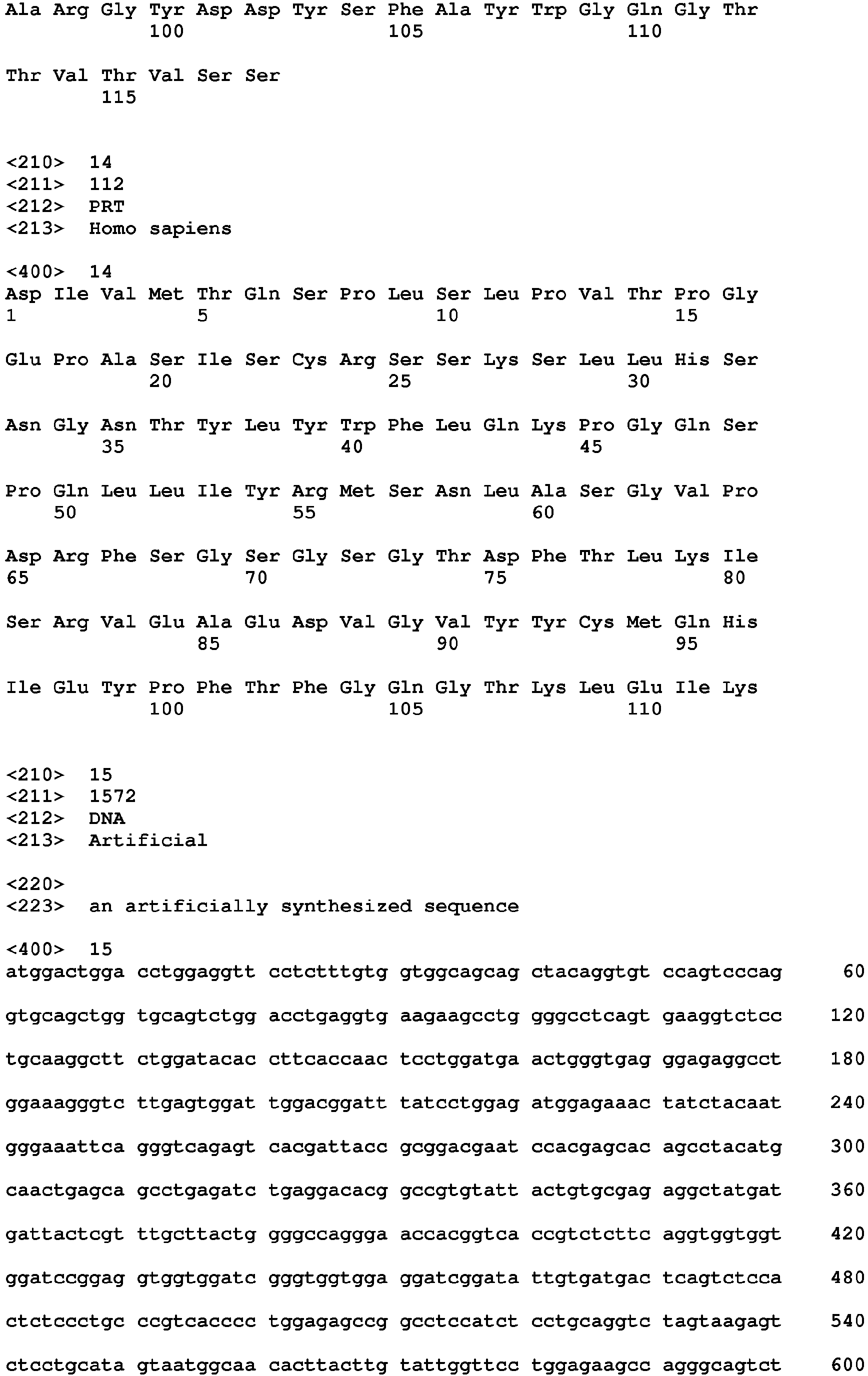


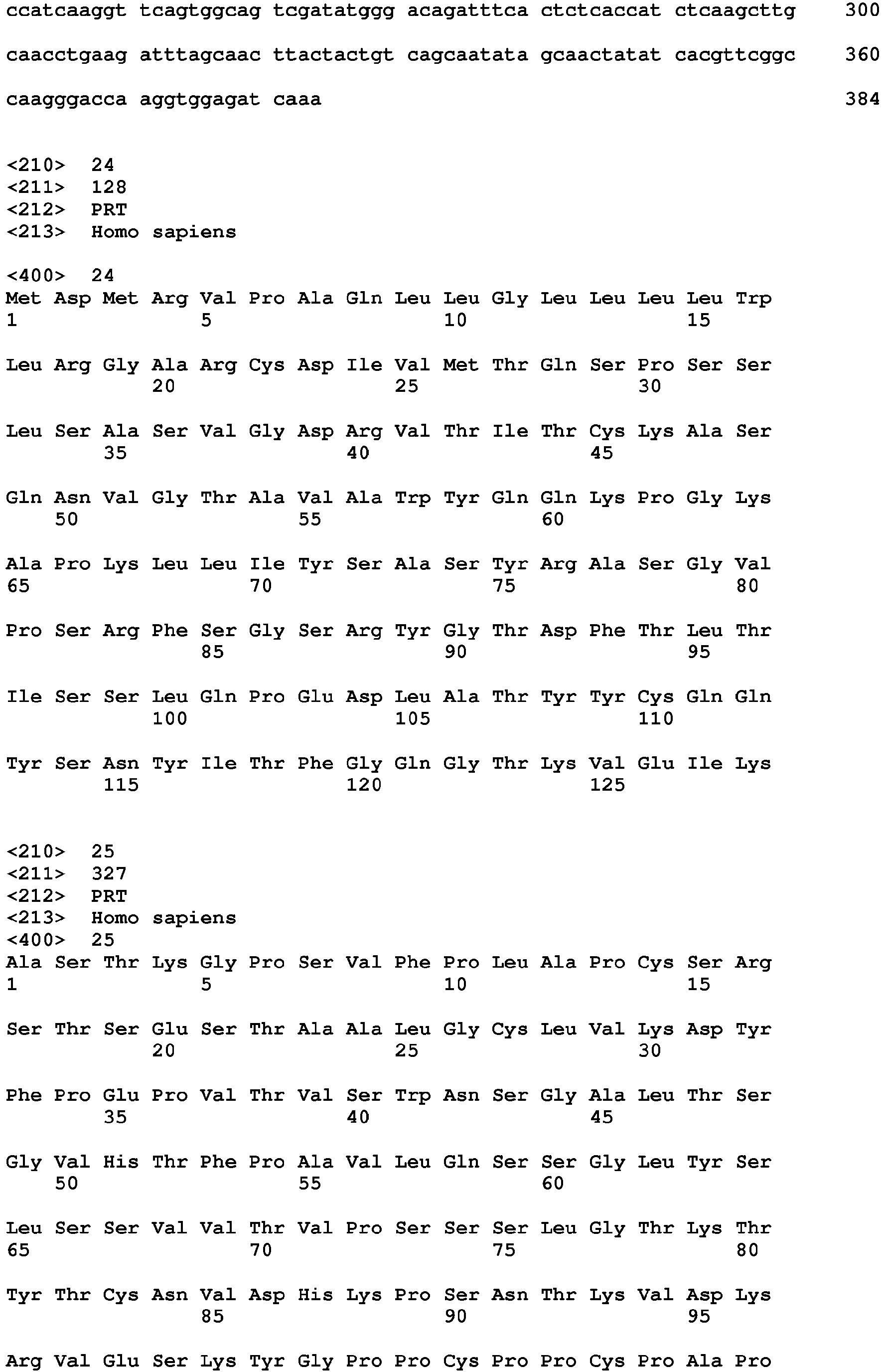


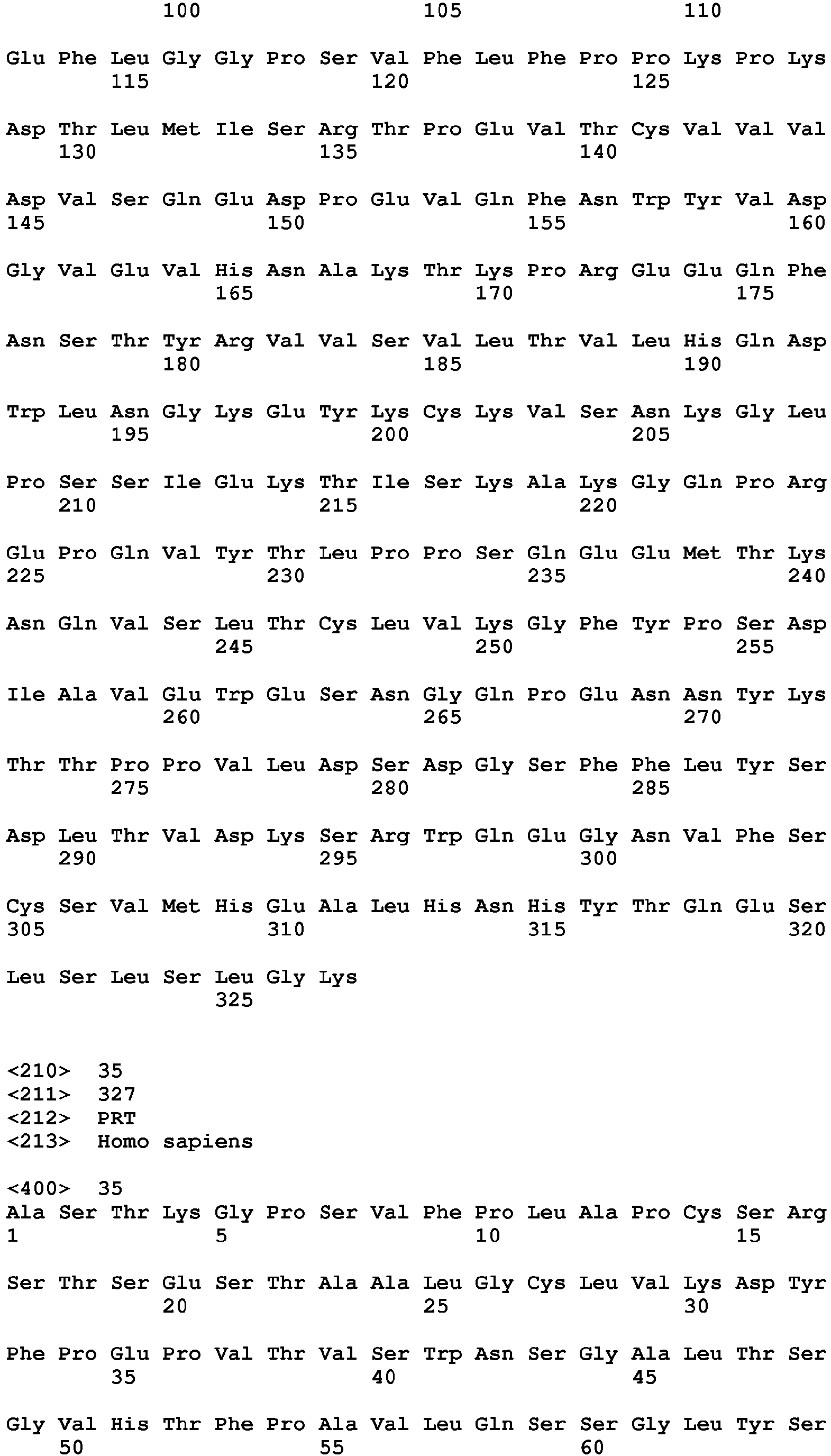


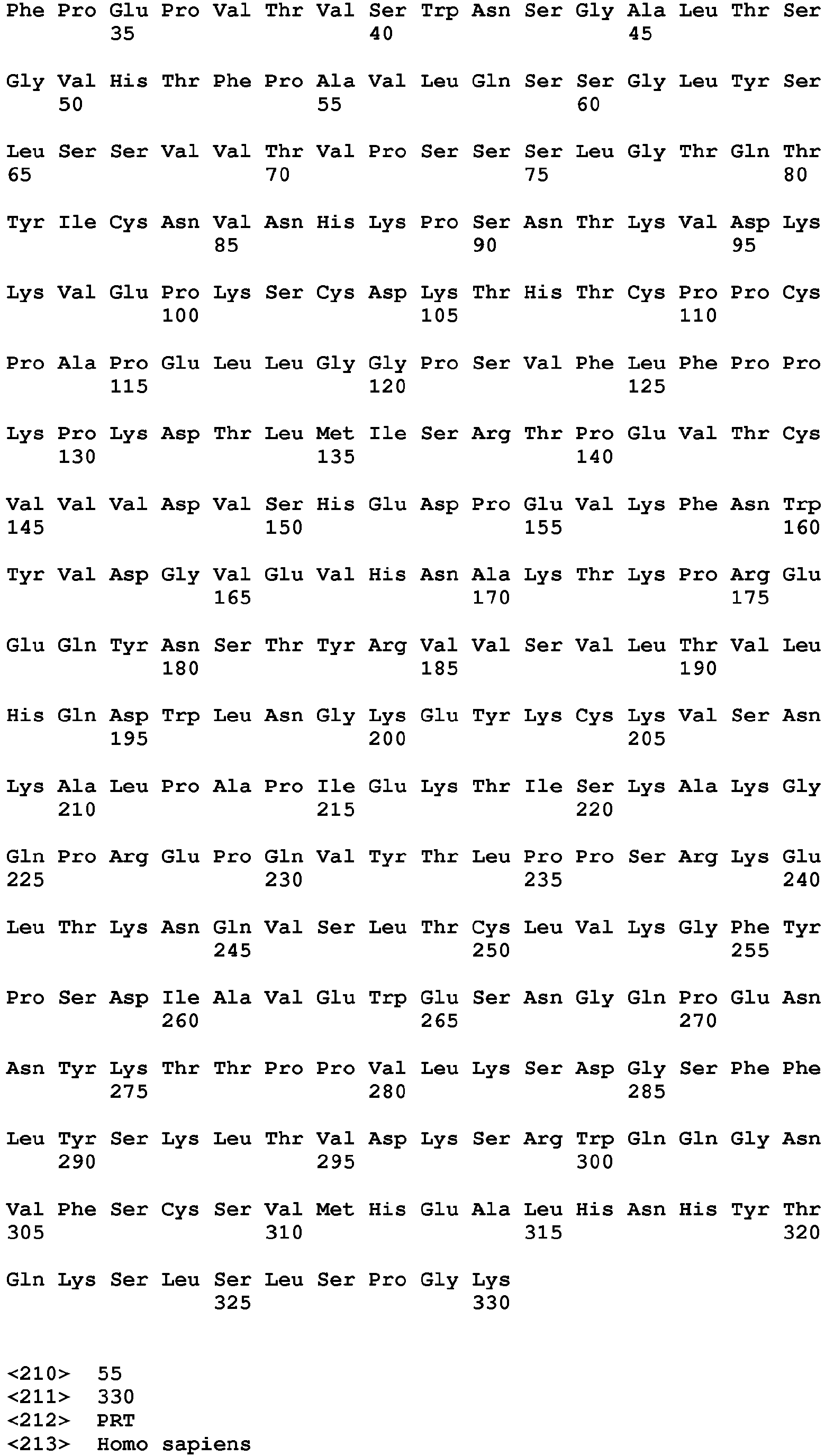


Claims (18)
- A method for producing a heteromultimer composed of more than one type of polypeptide comprising a substitution in an amino acid residue forming an interface between said polypeptides such that heteromultimer association will be regulated, wherein the method comprises:(a) modifying a nucleic acid encoding an amino acid residue forming the interface between polypeptides from the original nucleic acid, such that the association between polypeptides forming one or more multimers will be inhibited in a heteromultimer that may form two or more types of multimers;(b) culturing host cells such that a nucleic acid sequence modified by step (a) is expressed; and(c) recovering said heteromultimer from the host cell culture,wherein the modification of step (a) is modifying the original nucleic acid so that one or more amino acid residues are substituted at the interface such that two or more amino acid residues, including the mutated residue(s), forming the interface will carry the same type of positive or negative charge.
- The method of claim 1, wherein said one or more amino acid residues are substituted with:(a) glutamic acid (E);(b) aspartic acid (D);(c) lysine (K);(d) arginine (R); or(e) histidine (H).
- The method of claim 1 or claim 2, wherein the interface of the polypeptide is formed by(a) an antibody heavy chain variable region and light chain variable region;(b) two or more types of heavy chain variable regions;(c) an antibody heavy chain constant region and light chain constant region; or(d) two or more types of heavy chain constant regions.
- The method of claim 3, wherein the interface is formed by an antibody heavy chain variable region and a light chain variable region and wherein the amino acids to be substituted at the interface are the amino acid residues of (1) and (2) below or (3) and (4) below:(1) the amino acid residue which is included in the heavy chain variable region at position H39 according to Kabat numbering;(2) the amino acid residue which is included in the light chain variable region at position L38 according to Kabat numbering;(3) the amino acid residue which is included in the heavy chain variable region at position H45 according to Kabat numbering; and(4) the amino acid residue which is included in the light chain variable region at position L44 according to Kabat numbering.
- The method of claim 4, wherein(1) the amino acid residue in the heavy chain variable region at position H39 according to Kabat numbering is glutamine (Q);(2) the amino acid residue in the light chain variable region at position L38 according to Kabat numbering is glutamine (Q);(3) the amino acid residue in the heavy chain variable region at position H45 according to Kabat numbering is leucine (L); and(4) the amino acid residue in the light chain variable region at position L44 according to Kabat numbering is proline (P).
- The method of claim 3, wherein the interface is formed by two or more types of heavy chain constant regions and wherein the amino acids to be substituted at the interface are are at least one of the amino acid residues of (1) to (3) below:(1) amino acid residues included in the heavy chain CH3 region at positions 356 and 439 according to the EU numbering system;(2) amino acid residues included in the heavy chain CH3 region at positions 357 and 370 according to the EU numbering system;(3) amino acid residues included in the heavy chain CH3 region at positions 399 and 409 according to the EU numbering system.
- The method of any one of claims 1 to 6, wherein the heteromultimer is a multi-specific antibody comprising two or more types of heavy chain variable regions and two or more types of light chain variable regions.
- The method of claim 7, wherein the heteromultimer is a bispecific antibody.
- A method for regulating heteromultimer association, which comprises modifying amino acid residues forming an interface between the original polypeptides such that the association within the heteromultimer that form one or more types of multimers will be inhibited, wherein said modifying is substituting one or more amino acid residues at the interface wherein two or more amino acid residues, including the substituted residue(s), forming the interface will have the same type of positive or negative charge.
- The method of claim 9, wherein said one or more amino acid residues are substituted with:(a) glutamic acid (E);(b) aspartic acid (D);(c) lysine (K);(d) arginine (R); or(e) histidine (H).
- The method of claim 9 or claim 10, wherein the interface of the polypeptide is formed by(a) an antibody heavy chain variable region and light chain variable region;(b) two or more types of heavy chain variable regions;(c) an antibody heavy chain constant region and light chain constant region; or(d) two or more types of heavy chain constant regions.
- The method of claim 11, wherein the interface is formed by an antibody heavy chain variable region and a light chain variable region and wherein the amino acids to be substituted at the interface are the amino acid residues of (1) and (2) below or (3) and (4) below:(1) the amino acid residue which is included in the heavy chain variable region at position H39 according to Kabat numbering;(2) the amino acid residue which is included in the light chain variable region at position L38 according to Kabat numbering;(3) the amino acid residue which is included in the heavy chain variable region at position H45 according to Kabat numbering; and(4) the amino acid residue which is included in the light chain variable region at position L44 according to Kabat numbering.
- The method of claim 12, wherein(1) the amino acid residue in the heavy chain variable region at position H39 according to Kabat numbering is glutamine (Q);(2) the amino acid residue in the light chain variable region at position L38 according to Kabat numbering is glutamine (Q);(3) the amino acid residue in the heavy chain variable region at position H45 according to Kabat numbering is leucine (L); and(4) the amino acid residue in the light chain variable region at position L44 according to Kabat numbering is proline (P).
- The method of claim 11, wherein the interface is formed by two or more types of heavy chain constant regions and wherein the amino acids to be substituted at the interface are at least one of the amino acid residues of (1) to (3) below:(1) amino acid residues included in the heavy chain CH3 region at positions 356 and 439 according to the EU numbering system;(2) amino acid residues included in the heavy chain CH3 region at positions 357 and 370 according to the EU numbering system;(3) amino acid residues included in the heavy chain CH3 region at positions 399 and 409 according to the EU numbering system.
- The method of any one of claims 11 to 14, wherein the heteromultimer is a multi-specific antibody comprising two or more types of heavy chain variable regions and two or more types of light chain variable regions.
- The method of claim 15, wherein the heteromultimer is a bispecific antibody.
- A heteromultimer obtainable by the method of any one of claims 1 to 16.
- A pharmaceutical composition comprising a heteromultimer obtainable by the method of any one of claims 1 to 16 and a pharmaceutically acceptable carrier.
Applications Claiming Priority (5)
| Application Number | Priority Date | Filing Date | Title |
|---|---|---|---|
| JP2005101105 | 2005-03-31 | ||
| JP2005378266 | 2005-12-28 | ||
| EP06730751.2A EP1870459B1 (en) | 2005-03-31 | 2006-03-31 | Methods for producing polypeptides by regulating polypeptide association |
| EP15194500.3A EP3050963B1 (en) | 2005-03-31 | 2006-03-31 | Process for production of polypeptide by regulation of assembly |
| PCT/JP2006/306803 WO2006106905A1 (en) | 2005-03-31 | 2006-03-31 | Process for production of polypeptide by regulation of assembly |
Related Parent Applications (2)
| Application Number | Title | Priority Date | Filing Date |
|---|---|---|---|
| EP15194500.3A Division EP3050963B1 (en) | 2005-03-31 | 2006-03-31 | Process for production of polypeptide by regulation of assembly |
| EP06730751.2A Division EP1870459B1 (en) | 2005-03-31 | 2006-03-31 | Methods for producing polypeptides by regulating polypeptide association |
Publications (1)
| Publication Number | Publication Date |
|---|---|
| EP3623473A1 true EP3623473A1 (en) | 2020-03-18 |
Family
ID=37073456
Family Applications (3)
| Application Number | Title | Priority Date | Filing Date |
|---|---|---|---|
| EP06730751.2A Expired - Lifetime EP1870459B1 (en) | 2005-03-31 | 2006-03-31 | Methods for producing polypeptides by regulating polypeptide association |
| EP19197546.5A Pending EP3623473A1 (en) | 2005-03-31 | 2006-03-31 | Process for production of polypeptide by regulation of assembly |
| EP15194500.3A Revoked EP3050963B1 (en) | 2005-03-31 | 2006-03-31 | Process for production of polypeptide by regulation of assembly |
Family Applications Before (1)
| Application Number | Title | Priority Date | Filing Date |
|---|---|---|---|
| EP06730751.2A Expired - Lifetime EP1870459B1 (en) | 2005-03-31 | 2006-03-31 | Methods for producing polypeptides by regulating polypeptide association |
Family Applications After (1)
| Application Number | Title | Priority Date | Filing Date |
|---|---|---|---|
| EP15194500.3A Revoked EP3050963B1 (en) | 2005-03-31 | 2006-03-31 | Process for production of polypeptide by regulation of assembly |
Country Status (11)
| Country | Link |
|---|---|
| US (4) | US10011858B2 (en) |
| EP (3) | EP1870459B1 (en) |
| JP (2) | JP5620626B2 (en) |
| KR (1) | KR101374454B1 (en) |
| CN (1) | CN101198698B (en) |
| AU (1) | AU2006232287B2 (en) |
| CA (1) | CA2603408C (en) |
| DK (1) | DK3050963T3 (en) |
| ES (1) | ES2592271T3 (en) |
| TW (2) | TWI544076B (en) |
| WO (1) | WO2006106905A1 (en) |
Families Citing this family (926)
| Publication number | Priority date | Publication date | Assignee | Title |
|---|---|---|---|---|
| US7754208B2 (en) | 2001-01-17 | 2010-07-13 | Trubion Pharmaceuticals, Inc. | Binding domain-immunoglobulin fusion proteins |
| NZ537277A (en) | 2002-07-18 | 2008-04-30 | Crucell Holland Bv | Recombinant production of mixtures of antibodies |
| USRE47770E1 (en) | 2002-07-18 | 2019-12-17 | Merus N.V. | Recombinant production of mixtures of antibodies |
| JP4794301B2 (en) * | 2003-06-11 | 2011-10-19 | 中外製薬株式会社 | Antibody production method |
| AU2003271174A1 (en) | 2003-10-10 | 2005-04-27 | Chugai Seiyaku Kabushiki Kaisha | Double specific antibodies substituting for functional protein |
| EP1710255A4 (en) * | 2003-12-12 | 2008-09-24 | Chugai Pharmaceutical Co Ltd | MODIFIED ANTIBODIES RECOGNIZING A TRIMER OR LARGER RECEPTOR |
| TW200530269A (en) * | 2003-12-12 | 2005-09-16 | Chugai Pharmaceutical Co Ltd | Anti-Mpl antibodies |
| US20070281327A1 (en) * | 2003-12-12 | 2007-12-06 | Kiyotaka Nakano | Methods of Screening for Modified Antibodies With Agonistic Activities |
| KR101374454B1 (en) | 2005-03-31 | 2014-03-17 | 추가이 세이야쿠 가부시키가이샤 | Methods for producing polypeptides by regulating polypeptide association |
| JP5057967B2 (en) * | 2005-03-31 | 2012-10-24 | 中外製薬株式会社 | sc (Fv) 2 structural isomer |
| EP2824183B1 (en) * | 2005-04-08 | 2020-07-29 | Chugai Seiyaku Kabushiki Kaisha | Methods for producing bispecific antibodies |
| CN101237890A (en) * | 2005-06-10 | 2008-08-06 | 中外制药株式会社 | Stabilizer and Utilization of Protein Preparations Containing Meglumine |
| JP5085322B2 (en) | 2005-06-10 | 2012-11-28 | 中外製薬株式会社 | Pharmaceutical composition containing sc (Fv) 2 |
| AU2006272555B2 (en) | 2005-07-25 | 2012-03-08 | Aptevo Research And Development Llc | B-cell reduction using CD37-specific and CD20-specific binding molecules |
| DK1999154T3 (en) * | 2006-03-24 | 2012-12-03 | Merck Patent Gmbh | MANUFACTURED HETERODIMERED PROTEIN DOMAINS |
| EP4793360A2 (en) | 2006-03-31 | 2026-08-19 | Chugai Seiyaku Kabushiki Kaisha | Methods for controlling blood pharmacokinetics of antibodies |
| JP5144499B2 (en) | 2006-03-31 | 2013-02-13 | 中外製薬株式会社 | Antibody modification method for purifying bispecific antibodies |
| CN105837690A (en) | 2006-06-12 | 2016-08-10 | 新兴产品开发西雅图有限公司 | Single-chain multivalent binding proteins with effector function |
| HRP20160082T1 (en) | 2006-09-29 | 2016-02-26 | Oncomed Pharmaceuticals, Inc. | Compositions and methods for diagnosing and treating cancer |
| EP2626372B1 (en) | 2007-03-29 | 2018-03-21 | Genmab A/S | Bispecific antibodies and methods for production thereof |
| AU2008255352B2 (en) * | 2007-05-31 | 2014-05-22 | Genmab A/S | Stable IgG4 antibodies |
| ES2687808T3 (en) | 2007-09-26 | 2018-10-29 | Chugai Seiyaku Kabushiki Kaisha | Constant region of modified antibody |
| EP3127921A1 (en) | 2007-09-26 | 2017-02-08 | Chugai Seiyaku Kabushiki Kaisha | Method of modifying isoelectric point of antibody via amino acid substition in cdr |
| TWI548418B (en) | 2007-12-05 | 2016-09-11 | 中外製藥股份有限公司 | Anti-NR10 / IL-31RA antibody and its use |
| US8227577B2 (en) * | 2007-12-21 | 2012-07-24 | Hoffman-La Roche Inc. | Bivalent, bispecific antibodies |
| US9266967B2 (en) | 2007-12-21 | 2016-02-23 | Hoffmann-La Roche, Inc. | Bivalent, bispecific antibodies |
| US8242247B2 (en) | 2007-12-21 | 2012-08-14 | Hoffmann-La Roche Inc. | Bivalent, bispecific antibodies |
| US20090162359A1 (en) | 2007-12-21 | 2009-06-25 | Christian Klein | Bivalent, bispecific antibodies |
| EP3663318A1 (en) * | 2008-01-07 | 2020-06-10 | Amgen Inc. | Method for making antibody fc-heterodimeric molecules using electrostatic steering effects |
| TW201920257A (en) | 2008-04-11 | 2019-06-01 | 日商中外製藥股份有限公司 | Antigen-binding molecule capable of binding two or more antigen molecules repeatedly |
| NZ603059A (en) | 2008-04-11 | 2014-07-25 | Emergent Product Dev Seattle | Cd37 immunotherapeutic and combination with bifunctional chemotherapeutic thereof |
| TWI440469B (en) * | 2008-09-26 | 2014-06-11 | Chugai Pharmaceutical Co Ltd | Improved antibody molecules |
| US8268314B2 (en) | 2008-10-08 | 2012-09-18 | Hoffmann-La Roche Inc. | Bispecific anti-VEGF/anti-ANG-2 antibodies |
| TWI544077B (en) | 2009-03-19 | 2016-08-01 | 中外製藥股份有限公司 | Antibody constant region change body |
| JP5717624B2 (en) | 2009-03-19 | 2015-05-13 | 中外製薬株式会社 | Antibody constant region variants |
| WO2010112194A1 (en) | 2009-04-02 | 2010-10-07 | F. Hoffmann-La Roche Ag | Antigen-binding polypeptides and multispecific antibodies comprising them |
| BRPI1014089A2 (en) | 2009-04-02 | 2016-04-19 | Roche Glycart Ag | multispecific antibodies comprising full length antibodies and single chain fab fragments |
| PT2417156E (en) | 2009-04-07 | 2015-04-29 | Roche Glycart Ag | Trivalent, bispecific antibodies |
| CN102361884A (en) | 2009-04-07 | 2012-02-22 | 罗氏格黎卡特股份公司 | Bispecific anti-ErbB-2/anti-c-Met antibody |
| CN102378768A (en) | 2009-04-07 | 2012-03-14 | 罗氏格黎卡特股份公司 | Bispecific anti-erbb-3/anti-c-met antibodies |
| US9067986B2 (en) * | 2009-04-27 | 2015-06-30 | Oncomed Pharmaceuticals, Inc. | Method for making heteromultimeric molecules |
| SG176219A1 (en) * | 2009-05-27 | 2011-12-29 | Hoffmann La Roche | Tri- or tetraspecific antibodies |
| US9676845B2 (en) | 2009-06-16 | 2017-06-13 | Hoffmann-La Roche, Inc. | Bispecific antigen binding proteins |
| US8703132B2 (en) * | 2009-06-18 | 2014-04-22 | Hoffmann-La Roche, Inc. | Bispecific, tetravalent antigen binding proteins |
| US9493578B2 (en) | 2009-09-02 | 2016-11-15 | Xencor, Inc. | Compositions and methods for simultaneous bivalent and monovalent co-engagement of antigens |
| CN102712696A (en) | 2009-09-16 | 2012-10-03 | 弗·哈夫曼-拉罗切有限公司 | Protein complexes comprising coiled-coils and/or tethers and uses thereof |
| US10150808B2 (en) | 2009-09-24 | 2018-12-11 | Chugai Seiyaku Kabushiki Kaisha | Modified antibody constant regions |
| PL2483310T3 (en) | 2009-09-29 | 2015-01-30 | Roche Glycart Ag | Bispecific death receptor agonistic antibodies |
| EP3485908B1 (en) | 2009-10-16 | 2021-08-18 | Mereo BioPharma 5, Inc. | Therapeutic combination and use of dll4 antagonist antibodies and anti-hypertensive agents |
| EP2504360B1 (en) * | 2009-11-23 | 2018-08-15 | Amgen Inc. | Monomeric antibody fc |
| AU2010336277B2 (en) * | 2009-12-25 | 2015-02-19 | Chugai Seiyaku Kabushiki Kaisha | Polypeptide modification method for purifying polypeptide multimers |
| US8685524B2 (en) | 2010-01-29 | 2014-04-01 | Toray Industries, Inc. | Polylactic acid-based resin sheet |
| EP2543730B1 (en) | 2010-03-04 | 2018-10-31 | Chugai Seiyaku Kabushiki Kaisha | Antibody constant region variant |
| TWI426920B (en) | 2010-03-26 | 2014-02-21 | Hoffmann La Roche | Bispecific, bivalent anti-VEGF/anti-ANG-2 antibody |
| TW201138821A (en) | 2010-03-26 | 2011-11-16 | Roche Glycart Ag | Bispecific antibodies |
| PT2560993T (en) | 2010-04-20 | 2024-09-16 | Genmab As | FC HETERODIMERIC ANTIBODY CONTAINING PROTEINS AND METHODS FOR THEIR PRODUCTION |
| AU2016219622A1 (en) * | 2010-04-20 | 2016-09-15 | Genmab A/S | Heterodimeric antibody FC-containing proteins and methods for production thereof |
| AU2013203221B2 (en) * | 2010-04-20 | 2016-06-02 | Genmab A/S | Heterodimeric antibody FC-containing proteins and methods for production thereof |
| JP2019048814A (en) * | 2010-04-20 | 2019-03-28 | ゲンマブ エー/エス | Heterodimeric antibody Fc-containing protein and method for producing the same |
| WO2011143545A1 (en) | 2010-05-14 | 2011-11-17 | Rinat Neuroscience Corporation | Heterodimeric proteins and methods for producing and purifying them |
| IL299365A (en) | 2010-05-27 | 2023-02-01 | Genmab As | Monoclonal antibodies aganist her2 |
| EP2598530A2 (en) | 2010-07-29 | 2013-06-05 | Xencor, Inc. | Antibodies with modified isoelectric points |
| BR112013002167A2 (en) | 2010-08-24 | 2016-05-31 | Roche Glycart Ag | bispecific antibody, pharmaceutical composition, use, method of treatment of a cancer patient and a patient suffering from inflammation |
| CN103068846B9 (en) | 2010-08-24 | 2016-09-28 | 弗·哈夫曼-拉罗切有限公司 | Bispecific antibodies comprising disulfide-stabilized Fv fragments |
| US8551479B2 (en) | 2010-09-10 | 2013-10-08 | Oncomed Pharmaceuticals, Inc. | Methods for treating melanoma |
| CN103429620B (en) * | 2010-11-05 | 2018-03-06 | 酵活有限公司 | Antibody design for stable heterodimerization with mutations in the Fc domain |
| CN105859889B (en) | 2010-11-17 | 2020-01-07 | 中外制药株式会社 | Multispecific antigen binding molecules with functions that replace the functions of coagulation factor VIII |
| WO2012069466A1 (en) | 2010-11-24 | 2012-05-31 | Novartis Ag | Multispecific molecules |
| TWI736437B (en) * | 2010-11-30 | 2021-08-11 | 日商中外製藥股份有限公司 | Cell injury-inducing therapeutic agent |
| TWI654203B (en) | 2010-11-30 | 2019-03-21 | Chugai Seiyaku Kabushiki Kaisha | Antibodies with calcium-dependent antigen binding ability |
| EP2655413B1 (en) | 2010-12-23 | 2019-01-16 | F.Hoffmann-La Roche Ag | Polypeptide-polynucleotide-complex and its use in targeted effector moiety delivery |
| SG10201609665PA (en) | 2011-02-25 | 2017-01-27 | Chugai Pharmaceutical Co Ltd | FcɣRIIb-SPECIFIC Fc ANTIBODY |
| JP5768147B2 (en) | 2011-02-28 | 2015-08-26 | エフ.ホフマン−ラ ロシュ アーゲーF. Hoffmann−La Roche Aktiengesellschaft | Monovalent antigen binding protein |
| WO2012116926A1 (en) | 2011-02-28 | 2012-09-07 | F. Hoffmann-La Roche Ag | Antigen binding proteins |
| AU2012222833B2 (en) | 2011-03-03 | 2017-03-16 | Zymeworks Inc. | Multivalent heteromultimer scaffold design and constructs |
| EP2698431B1 (en) | 2011-03-30 | 2020-09-09 | Chugai Seiyaku Kabushiki Kaisha | Retention of antigen-binding molecules in blood plasma and method for modifying immunogenicity |
| WO2012143524A2 (en) | 2011-04-20 | 2012-10-26 | Genmab A/S | Bispecific antibodies against her2 and cd3 |
| EP2699260B1 (en) | 2011-04-20 | 2024-11-20 | Genmab A/S | Bispecifc antibodies against her2 |
| DK2714738T3 (en) | 2011-05-24 | 2019-01-28 | Zyngenia Inc | MULTIVALENT AND MONOVALENT MULTISPECIFIC COMPLEXES AND THEIR APPLICATIONS |
| WO2013002362A1 (en) | 2011-06-30 | 2013-01-03 | 中外製薬株式会社 | Heterodimerized polypeptide |
| UA117901C2 (en) | 2011-07-06 | 2018-10-25 | Ґенмаб Б.В. | METHOD FOR STRENGTHENING THE EFFECTORAL FUNCTION OF THE ORIGINAL POLYEPEPTIDE, ITS OPTIONS AND THEIR APPLICATIONS |
| KR101870555B1 (en) | 2011-08-23 | 2018-06-22 | 로슈 글리카트 아게 | Bispecific antibodies specific for t-cell activating antigens and a tumor antigen and methods of use |
| GB201116092D0 (en) | 2011-09-16 | 2011-11-02 | Bioceros B V | Antibodies and uses thereof |
| HK1200850A1 (en) | 2011-09-23 | 2015-08-14 | 罗氏格黎卡特股份公司 | Bispecific anti-egfr/anti igf-1r antibodies |
| TWI583699B (en) | 2011-09-23 | 2017-05-21 | 安可美德藥物股份有限公司 | VEGF/DLL4 binding agents and their use |
| CA2791109C (en) | 2011-09-26 | 2021-02-16 | Merus B.V. | Generation of binding molecules |
| KR102366029B1 (en) * | 2011-09-30 | 2022-02-23 | 추가이 세이야쿠 가부시키가이샤 | Antigen-binding molecule inducing immune response to target antigen |
| TW201817745A (en) | 2011-09-30 | 2018-05-16 | 日商中外製藥股份有限公司 | Therapeutic antigen-binding molecule having an FcRn binding domain that promotes antigen clearance |
| JP6322411B2 (en) | 2011-09-30 | 2018-05-09 | 中外製薬株式会社 | Antigen-binding molecules that promote the disappearance of antigens with multiple physiological activities |
| US12466897B2 (en) | 2011-10-10 | 2025-11-11 | Xencor, Inc. | Heterodimeric human IgG1 polypeptides with isoelectric point modifications |
| US10851178B2 (en) | 2011-10-10 | 2020-12-01 | Xencor, Inc. | Heterodimeric human IgG1 polypeptides with isoelectric point modifications |
| IN2014CN03887A (en) | 2011-10-27 | 2015-10-16 | Genmab As | |
| BR112014010257A2 (en) | 2011-10-31 | 2017-04-18 | Chugai Pharmaceutical Co Ltd | antigen binding molecule having regulated conjugation between heavy and light chains |
| US9574010B2 (en) | 2011-11-04 | 2017-02-21 | Zymeworks Inc. | Stable heterodimeric antibody design with mutations in the Fc domain |
| KR20210074395A (en) | 2011-11-30 | 2021-06-21 | 추가이 세이야쿠 가부시키가이샤 | Drug containing carrier into cell for forming immune complex |
| WO2013113615A1 (en) | 2012-02-03 | 2013-08-08 | F. Hoffmann-La Roche Ag | Bispecific antibody molecules with antigen-transfected t-cells and their use in medicine |
| EP4624490A3 (en) | 2012-02-09 | 2025-11-05 | Chugai Seiyaku Kabushiki Kaisha | Modified fc region of antibody |
| MX2014009565A (en) | 2012-02-10 | 2014-11-10 | Genentech Inc | Single-chain antibodies and other heteromultimers. |
| CA2865158C (en) | 2012-02-24 | 2022-11-01 | Chugai Seiyaku Kabushiki Kaisha | Antigen-binding molecule for promoting disappearance of antigen via fc.gamma.riib |
| KR101674784B1 (en) | 2012-04-05 | 2016-11-09 | 에프. 호프만-라 로슈 아게 | Bispecific antibodies against human tweak and human il17 and uses thereof |
| WO2013157953A1 (en) | 2012-04-20 | 2013-10-24 | Merus B.V. | Methods and means for the production of ig-like molecules |
| US9212227B2 (en) | 2012-04-30 | 2015-12-15 | Janssen Biotech, Inc. | ST2L antibody antagonists for the treatment of ST2L-mediated inflammatory pulmonary conditions |
| EP3553089A1 (en) | 2012-05-10 | 2019-10-16 | Bioatla, LLC | Multi-specific monoclonal antibodies |
| MX2014014162A (en) | 2012-05-24 | 2015-02-04 | Hoffmann La Roche | Multispecific antibodies. |
| WO2013180200A1 (en) | 2012-05-30 | 2013-12-05 | 中外製薬株式会社 | Target-tissue-specific antigen-binding molecule |
| EP4310191A3 (en) | 2012-06-14 | 2024-05-15 | Chugai Seiyaku Kabushiki Kaisha | Antigen-binding molecule containing modified fc region |
| WO2014004586A1 (en) | 2012-06-25 | 2014-01-03 | Zymeworks Inc. | Process and methods for efficient manufacturing of highly pure asymmetric antibodies in mammalian cells |
| KR20150030744A (en) | 2012-06-27 | 2015-03-20 | 에프. 호프만-라 로슈 아게 | Method for making antibody fc-region conjugates comprising at least one binding entity that specifically binds to a target and uses thereof |
| ES2597228T3 (en) | 2012-06-27 | 2017-01-17 | F. Hoffmann-La Roche Ag | Procedure for the selection and production of objectification entities, such as targets, highly selective and multi-specific, customized, which contain at least two different binding entities, and use of these |
| EP2869837B1 (en) | 2012-07-04 | 2016-09-14 | F. Hoffmann-La Roche AG | Anti-theophylline antibodies and methods of use |
| MX354303B (en) | 2012-07-04 | 2018-02-23 | Hoffmann La Roche | Anti-biotin antibodies and methods of use. |
| SG11201407420RA (en) | 2012-07-04 | 2015-02-27 | Hoffmann La Roche | Covalently linked antigen-antibody conjugates |
| EP3632462A1 (en) | 2012-07-06 | 2020-04-08 | Genmab B.V. | Dimeric protein with triple mutations |
| WO2014006217A1 (en) | 2012-07-06 | 2014-01-09 | Genmab B.V. | Dimeric protein with triple mutations |
| SI3495387T1 (en) | 2012-07-13 | 2021-12-31 | Roche Glycart Ag | Bispecific antibodies against VEGF / against ANG-2 and their use in the treatment of vascular diseases |
| IN2015DN01115A (en) | 2012-07-13 | 2015-06-26 | Zymeworks Inc | |
| CN102851338A (en) | 2012-07-25 | 2013-01-02 | 苏州康宁杰瑞生物科技有限公司 | Method for preparing homodimer protein mixture by using charge repulsive interaction |
| TWI855488B (en) | 2012-08-24 | 2024-09-11 | 日商中外製藥股份有限公司 | Fcγriib-specific fc region variant |
| KR101963231B1 (en) | 2012-09-11 | 2019-03-28 | 삼성전자주식회사 | Protein complex for preparing bispecific antibodies and method using thereof |
| BR112015006824A2 (en) | 2012-09-27 | 2017-07-04 | Merus B V | bispecific igg antibody, method for producing a bispecific igg antibody, antibody, pharmaceutical composition and use of a bispecific igg antibody |
| EP2904093B1 (en) | 2012-10-03 | 2019-04-10 | Zymeworks Inc. | Methods of quantitating heavy and light chain polypeptide pairs |
| MX2015003616A (en) | 2012-10-08 | 2015-06-05 | Roche Glycart Ag | Fc-free antibodies comprising two fab-fragments and methods of use. |
| CA2889638A1 (en) | 2012-10-31 | 2014-05-08 | Oncomed Pharmaceuticals, Inc. | Methods and monitoring of treatment with a dll4 antagonist |
| JP6506024B2 (en) * | 2012-11-05 | 2019-04-24 | 全薬工業株式会社 | Method of producing antibody or antibody composition |
| UY35148A (en) * | 2012-11-21 | 2014-05-30 | Amgen Inc | HETERODIMERIC IMMUNOGLOBULINS |
| KR102373193B1 (en) | 2012-11-21 | 2022-03-10 | 얀센 바이오테크 인코포레이티드 | BISPECIFIC EGFR/c-Met ANTIBODIES |
| US20170275367A1 (en) | 2012-11-21 | 2017-09-28 | Janssen Biotech, Inc. | Bispecific EGFR/C-Met Antibodies |
| MX385344B (en) * | 2012-11-28 | 2025-03-18 | Zymeworks Bc Inc | GENETICALLY MODIFIED IMMUNOGLOBULIN HEAVY CHAIN-LIGHT CHAIN PAIRS AND THEIR USES. |
| US9914785B2 (en) | 2012-11-28 | 2018-03-13 | Zymeworks Inc. | Engineered immunoglobulin heavy chain-light chain pairs and uses thereof |
| CN105102618B (en) | 2012-12-27 | 2018-04-17 | 中外制药株式会社 | heterodimeric polypeptide |
| MX387324B (en) | 2013-01-10 | 2025-03-18 | Genmab Bv | HUMAN IGG1 FC REGION VARIANTS AND THEIR USES. |
| US9701759B2 (en) | 2013-01-14 | 2017-07-11 | Xencor, Inc. | Heterodimeric proteins |
| US11053316B2 (en) | 2013-01-14 | 2021-07-06 | Xencor, Inc. | Optimized antibody variable regions |
| US10131710B2 (en) | 2013-01-14 | 2018-11-20 | Xencor, Inc. | Optimized antibody variable regions |
| US10487155B2 (en) | 2013-01-14 | 2019-11-26 | Xencor, Inc. | Heterodimeric proteins |
| KR102391731B1 (en) | 2013-01-14 | 2022-04-27 | 젠코어 인코포레이티드 | Novel heterodimeric proteins |
| US9605084B2 (en) | 2013-03-15 | 2017-03-28 | Xencor, Inc. | Heterodimeric proteins |
| US10968276B2 (en) | 2013-03-12 | 2021-04-06 | Xencor, Inc. | Optimized anti-CD3 variable regions |
| WO2014113510A1 (en) | 2013-01-15 | 2014-07-24 | Xencor, Inc. | Rapid clearance of antigen complexes using novel antibodies |
| JP6636803B2 (en) | 2013-02-05 | 2020-01-29 | エンクマフ エスアーエールエル | Method for selection of antibodies to BCMA |
| EP2762496A1 (en) | 2013-02-05 | 2014-08-06 | EngMab AG | Method for the selection of antibodies against BCMA |
| EP2762497A1 (en) | 2013-02-05 | 2014-08-06 | EngMab AG | Bispecific antibodies against CD3epsilon and BCMA |
| HK1218930A1 (en) | 2013-02-08 | 2017-03-17 | Abbvie Stemcentrx Llc | Novel multispecific constructs |
| CN110437337B (en) | 2013-02-26 | 2024-07-30 | 罗切格利卡特公司 | Bispecific T cell activating antigen binding molecules |
| WO2014131694A1 (en) | 2013-02-26 | 2014-09-04 | Roche Glycart Ag | Bispecific t cell activating antigen binding molecules |
| KR101813708B1 (en) * | 2013-03-13 | 2017-12-29 | (주) 아이벤트러스 | Protein in which electrostatic interaction is introduced within hydrophobic interaction site and preparation method thereof |
| US9168300B2 (en) | 2013-03-14 | 2015-10-27 | Oncomed Pharmaceuticals, Inc. | MET-binding agents and uses thereof |
| CN105358575B (en) | 2013-03-15 | 2020-09-22 | 詹森生物科技公司 | Interferon alpha and omega antibody antagonists |
| US10519242B2 (en) | 2013-03-15 | 2019-12-31 | Xencor, Inc. | Targeting regulatory T cells with heterodimeric proteins |
| MX2015013163A (en) | 2013-03-15 | 2016-04-04 | Zyngenia Inc | Multivalent and monovalent multispecific complexes and their uses. |
| EP3421495A3 (en) | 2013-03-15 | 2019-05-15 | Xencor, Inc. | Modulation of t cells with bispecific antibodies and fc fusions |
| US10858417B2 (en) | 2013-03-15 | 2020-12-08 | Xencor, Inc. | Heterodimeric proteins |
| US10106624B2 (en) | 2013-03-15 | 2018-10-23 | Xencor, Inc. | Heterodimeric proteins |
| US10047167B2 (en) | 2013-03-15 | 2018-08-14 | Eli Lilly And Company | Methods for producing fabs and bi-specific antibodies |
| RS57840B1 (en) | 2013-03-18 | 2018-12-31 | Biocerox Prod Bv | Humanized anti-cd134 (ox40) antibodies and uses thereof |
| SG11201508170TA (en) | 2013-04-02 | 2015-11-27 | Chugai Pharmaceutical Co Ltd | Fc REGION VARIANT |
| UA118028C2 (en) | 2013-04-03 | 2018-11-12 | Рош Глікарт Аг | Bispecific antibodies specific for fap and dr5, antibodies specific for dr5 and methods of use |
| EP2981286A4 (en) * | 2013-04-05 | 2016-08-24 | Hoffmann La Roche | ANTI-IL-4 ANTIBODIES AND BISPECIFIC ANTIBODIES AND USES THEREOF |
| EP2789630A1 (en) | 2013-04-09 | 2014-10-15 | EngMab AG | Bispecific antibodies against CD3e and ROR1 |
| CA2904805A1 (en) | 2013-04-29 | 2014-11-06 | F. Hoffmann-La Roche Ag | Fc-receptor binding modified asymmetric antibodies and methods of use |
| TW201920285A (en) | 2013-04-29 | 2019-06-01 | 瑞士商赫孚孟拉羅股份公司 | FcRn-binding abolished anti-IGF-1R antibodies and their use in the treatment of vascular eye diseases |
| CA2904806C (en) | 2013-04-29 | 2021-11-23 | F. Hoffmann-La Roche Ag | Human fcrn-binding modified antibodies and methods of use |
| US9879081B2 (en) | 2013-06-25 | 2018-01-30 | Samsung Electronics Co., Ltd. | Protein complex, bispecific antibody including the protein complex, and method of preparation thereof |
| KR102813816B1 (en) | 2013-07-05 | 2025-05-29 | 젠맵 에이/에스 | Humanized or chimeric cd3 antibodies |
| CA2925256C (en) * | 2013-09-27 | 2023-08-15 | Chugai Seiyaku Kabushiki Kaisha | Method for producing polypeptide heteromultimer |
| MX2016003617A (en) | 2013-09-30 | 2016-07-21 | Chugai Pharmaceutical Co Ltd | Method for producing antigen-binding molecule using modified helper phage. |
| BR112016006929A2 (en) | 2013-10-11 | 2017-09-19 | Hoffmann La Roche | ANTIBODY, NUCLEIC ACID, EXPRESSION VECTOR, HOST CELL, METHODS OF PREPARING ANTIBODY, TREATMENT OF PATIENTS AND GENERATION OF AN ANTIBODY, PHARMACEUTICAL COMPOSITION AND USE OF THE ANTIBODY |
| SMT202100473T1 (en) | 2013-11-06 | 2021-09-14 | Janssen Biotech Inc | Anti-ccl17 antibodies |
| CA2929044A1 (en) | 2013-11-11 | 2015-05-14 | Chugai Seiyaku Kabushiki Kaisha | Antigen-binding molecule containing modified antibody variable region |
| TWI702316B (en) | 2013-12-04 | 2020-08-21 | 日商中外製藥股份有限公司 | Antigen-binding molecules and their database that change antigen-binding ability in response to compound concentration |
| HUE050159T2 (en) | 2013-12-17 | 2020-11-30 | Genentech Inc | Anti-CD3 antibodies and methods of administration |
| CR20160270A (en) | 2013-12-20 | 2016-09-05 | Hoffmann La Roche | ANTI-TAU ANTIBODIES (pS422) HUMANIZED AND USED METHODS |
| WO2015101586A1 (en) | 2014-01-03 | 2015-07-09 | F. Hoffmann-La Roche Ag | Bispecific anti-hapten/anti-blood brain barrier receptor antibodies, complexes thereof and their use as blood brain barrier shuttles |
| BR112016014945A2 (en) | 2014-01-03 | 2018-01-23 | F. Hoffmann-La Roche Ag | conjugate, pharmaceutical formulation and use |
| EP3089758B1 (en) | 2014-01-03 | 2021-01-27 | F.Hoffmann-La Roche Ag | Covalently linked helicar-anti-helicar antibody conjugates and uses thereof |
| PL3092251T3 (en) | 2014-01-06 | 2021-08-02 | F. Hoffmann-La Roche Ag | Monovalent blood brain barrier shuttle modules |
| CN110903398B (en) | 2014-01-15 | 2023-08-15 | 豪夫迈·罗氏有限公司 | Fc region variants with modified FCRN and retained protein A binding properties |
| CN110981957B (en) | 2014-01-15 | 2024-12-24 | 豪夫迈·罗氏有限公司 | Fc region variants with improved protein A binding |
| UA122479C2 (en) | 2014-01-24 | 2020-11-25 | Дана-Фарбер Кенсер Інстітьют, Інк. | Isolated ANTIBODY MOLECULE BINDS TO HUMAN PROGRAMMED DEATH-1 (PD-1) PROTEIN |
| PL3099717T3 (en) | 2014-01-31 | 2019-10-31 | Novartis Ag | Antibody molecules to tim-3 and uses thereof |
| DK3805268T3 (en) | 2014-02-28 | 2025-01-20 | Merus Nv | ANTIBODY THAT BINDS ERBB-2 AND ERBB-3 |
| CA2941030C (en) | 2014-02-28 | 2025-05-13 | Merus N.V. | Antibodies that bind egfr and erbb3 |
| US9732154B2 (en) | 2014-02-28 | 2017-08-15 | Janssen Biotech, Inc. | Anti-CD38 antibodies for treatment of acute lymphoblastic leukemia |
| EA201691765A1 (en) | 2014-03-14 | 2016-12-30 | Новартис Аг | ANTIBODY MOLECULES AGAINST LAG-3 AND THEIR APPLICATIONS |
| CN122399016A (en) | 2014-03-15 | 2026-07-17 | 诺华股份有限公司 | Treatment of cancer using chimeric antigen receptor |
| PL3122781T3 (en) | 2014-03-28 | 2020-06-15 | Xencor, Inc. | Bispecific antibodies that bind to cd38 and cd3 |
| UA117289C2 (en) | 2014-04-02 | 2018-07-10 | Ф. Хоффманн-Ля Рош Аг | MULTISPECIFIC ANTIBODY |
| SG10202107077QA (en) | 2014-04-02 | 2021-07-29 | Hoffmann La Roche | Method for detecting multispecific antibody light chain mispairing |
| MX380176B (en) | 2014-04-07 | 2025-03-12 | Chugai Pharmaceutical Co Ltd | IMMUNOACTIVATED ANTIGEN-BOUND MOLECULE. |
| SG10201913507SA (en) | 2014-05-02 | 2020-02-27 | Momenta Pharmaceuticals Inc | Compositions and methods related to engineered fc constructs |
| KR20170017916A (en) | 2014-05-13 | 2017-02-15 | 추가이 세이야쿠 가부시키가이샤 | T cell-redirected antigen-binding molecule for cells having immunosuppression function |
| DK3107938T3 (en) | 2014-05-28 | 2022-07-11 | Zymeworks Inc | MODIFIED, ANTIGEN-BINDING POLYPEPTIDE CONSTRUCTS AND USES THEREOF |
| MX394895B (en) | 2014-06-03 | 2025-03-24 | Xbiotech Inc | COMPOSITIONS USEFUL FOR THE TREATMENT OF STAPHYLOCOCCUS AUREUS INFECTIONS. |
| TWI713453B (en) | 2014-06-23 | 2020-12-21 | 美商健生生物科技公司 | Interferon alpha and omega antibody antagonists |
| AR100978A1 (en) | 2014-06-26 | 2016-11-16 | Hoffmann La Roche | ANTI-Tau HUMANIZED ANTIBODY BRAIN LAUNCHERS (pS422) AND USES OF THE SAME |
| CN106687476B (en) | 2014-06-26 | 2020-11-13 | 豪夫迈·罗氏有限公司 | Anti-BRDU antibody and method of use |
| DK3169706T3 (en) | 2014-07-11 | 2020-03-09 | Genmab As | ANTIBODIES THAT BINDER AXL |
| JP2017528433A (en) | 2014-07-21 | 2017-09-28 | ノバルティス アーゲー | Low immunoenhancing dose of mTOR inhibitor and CAR combination |
| AU2015292744C1 (en) | 2014-07-21 | 2021-01-21 | Novartis Ag | Treatment of cancer using humanized anti-BCMA chimeric antigen receptor |
| WO2016014553A1 (en) | 2014-07-21 | 2016-01-28 | Novartis Ag | Sortase synthesized chimeric antigen receptors |
| JP6831777B2 (en) | 2014-07-21 | 2021-02-17 | ノバルティス アーゲー | Treatment of cancer using the CD33 chimeric antigen receptor |
| WO2016019300A1 (en) | 2014-07-31 | 2016-02-04 | Novartis Ag | Subset-optimized chimeric antigen receptor-containing t-cells |
| PL3177643T3 (en) | 2014-08-04 | 2019-09-30 | F.Hoffmann-La Roche Ag | Bispecific t cell activating antigen binding molecules |
| EP2982692A1 (en) | 2014-08-04 | 2016-02-10 | EngMab AG | Bispecific antibodies against CD3epsilon and BCMA |
| EP3180359A1 (en) | 2014-08-14 | 2017-06-21 | Novartis AG | Treatment of cancer using gfr alpha-4 chimeric antigen receptor |
| EP3712171A1 (en) | 2014-08-19 | 2020-09-23 | Novartis AG | Treatment of cancer using a cd123 chimeric antigen receptor |
| DK3189081T3 (en) | 2014-09-05 | 2020-05-04 | Janssen Pharmaceutica Nv | CD123 BINDING AGENTS AND APPLICATIONS THEREOF |
| WO2016040294A2 (en) | 2014-09-09 | 2016-03-17 | Janssen Biotech, Inc. | Combination therapies with anti-cd38 antibodies |
| MA40579A (en) | 2014-09-12 | 2016-03-17 | Genentech Inc | ANTI-CLL-1 ANTIBODIES AND IMMUNOCONJUGATES |
| UY36302A (en) | 2014-09-15 | 2016-04-29 | Amgen Inc | ANTIGENS, BI-SPECIFIC UNION PROTEIN OF THE ANTI-CGRP RECEIVER / PAC1 RECEIVER AND USES OF THE SAME |
| US10577417B2 (en) | 2014-09-17 | 2020-03-03 | Novartis Ag | Targeting cytotoxic cells with chimeric receptors for adoptive immunotherapy |
| TWI700300B (en) | 2014-09-26 | 2020-08-01 | 日商中外製藥股份有限公司 | Antibodies that neutralize substances with the function of FVIII coagulation factor (FVIII) |
| MA40764A (en) | 2014-09-26 | 2017-08-01 | Chugai Pharmaceutical Co Ltd | THERAPEUTIC AGENT INDUCING CYTOTOXICITY |
| TWI701435B (en) | 2014-09-26 | 2020-08-11 | 日商中外製藥股份有限公司 | Method to determine the reactivity of FVIII |
| EP3204415B1 (en) | 2014-10-09 | 2020-06-17 | EngMab Sàrl | Bispecific antibodies against cd3epsilon and ror1 |
| SG11201702401RA (en) | 2014-10-14 | 2017-04-27 | Novartis Ag | Antibody molecules to pd-l1 and uses thereof |
| EP3212233B1 (en) | 2014-10-31 | 2020-06-24 | Oncomed Pharmaceuticals, Inc. | Combination therapy for treatment of disease |
| RU2713131C1 (en) | 2014-11-06 | 2020-02-03 | Ф. Хоффманн-Ля Рош Аг | EMBODIMENTS OF Fc-REGION WITH MODIFIED BINDING PROPERTIES OF FcRn AND PROTEIN A |
| PT3215528T (en) | 2014-11-06 | 2019-10-11 | Hoffmann La Roche | Fc-region variants with modified fcrn-binding and methods of use |
| US11154615B2 (en) | 2014-11-11 | 2021-10-26 | Chugai Seiyaku Kabushiki Kaisha | Library of antigen-binding molecules including modified antibody variable region |
| RS61010B1 (en) | 2014-11-20 | 2020-11-30 | Hoffmann La Roche | T cell activating bispecific antigen binding molecules against folr1 and cd3 |
| ES2808853T3 (en) | 2014-11-20 | 2021-03-02 | Hoffmann La Roche | Common light chains and usage procedures |
| SG11201704056XA (en) | 2014-11-20 | 2017-06-29 | Hoffmann La Roche | Combination therapy of t cell activating bispecific antigen binding molecules cd3 abd folate receptor 1 (folr1) and pd-1 axis binding antagonists |
| EP3023437A1 (en) | 2014-11-20 | 2016-05-25 | EngMab AG | Bispecific antibodies against CD3epsilon and BCMA |
| HK1245171A1 (en) | 2014-11-26 | 2018-08-24 | Xencor, Inc. | Heterodimeric antibodies that bind cd3 and cd38 |
| JP6696982B2 (en) | 2014-11-26 | 2020-05-20 | ゼンコー・インコーポレイテッドXencor、 Inc. | Heterodimeric antibodies that bind to CD3 and tumor antigens |
| US10259887B2 (en) | 2014-11-26 | 2019-04-16 | Xencor, Inc. | Heterodimeric antibodies that bind CD3 and tumor antigens |
| WO2016087416A1 (en) | 2014-12-03 | 2016-06-09 | F. Hoffmann-La Roche Ag | Multispecific antibodies |
| US20180334490A1 (en) | 2014-12-03 | 2018-11-22 | Qilong H. Wu | Methods for b cell preconditioning in car therapy |
| PE20171094A1 (en) | 2014-12-04 | 2017-08-07 | Janssen Biotech Inc | ANTI-CD38 ANTIBODIES FOR THE TREATMENT OF ACUTE LYMPHOBLASTIC LEUKEMIA |
| EA201791366A1 (en) | 2014-12-19 | 2018-02-28 | Чугаи Сейяку Кабусики Кайся | ANTIBODIES TO C5 AND METHODS OF THEIR APPLICATION |
| EP3233907B1 (en) | 2014-12-19 | 2021-03-03 | Genmab A/S | Rodent bispecific heterodimeric proteins |
| MX2017005774A (en) | 2014-12-19 | 2017-07-28 | Chugai Pharmaceutical Co Ltd | Anti-myostatin antibodies, polypeptides containing variant fc regions, and methods of use. |
| US10428155B2 (en) | 2014-12-22 | 2019-10-01 | Xencor, Inc. | Trispecific antibodies |
| CN107660214B (en) | 2015-01-08 | 2022-02-08 | 根马布股份公司 | Bispecific antibodies against CD3 and CD20 |
| MA41375A (en) | 2015-01-22 | 2017-11-28 | Lilly Co Eli | BISPECIFIC IGG ANTIBODIES AND THEIR PREPARATION PROCESSES |
| CN114773469B (en) | 2015-02-05 | 2025-12-19 | 中外制药株式会社 | Antibodies comprising ion concentration-dependent antigen binding domains, variants of the FC region, IL-8-binding antibodies and uses thereof |
| TWI759261B (en) | 2015-02-27 | 2022-04-01 | 日商中外製藥股份有限公司 | Use of IL-6 receptor antibody for preparing pharmaceutical composition |
| US10227411B2 (en) | 2015-03-05 | 2019-03-12 | Xencor, Inc. | Modulation of T cells with bispecific antibodies and FC fusions |
| JP7082484B2 (en) | 2015-04-01 | 2022-06-08 | 中外製薬株式会社 | Method for Producing Polypeptide Heterogeneous Multimer |
| PL3280729T3 (en) | 2015-04-08 | 2022-08-22 | Novartis Ag | Cd20 therapies, cd22 therapies, and combination therapies with a cd19 chimeric antigen receptor (car) - expressing cell |
| CA2978038A1 (en) | 2015-04-17 | 2016-10-20 | F. Hoffmann-La Roche Ag | Combination therapy with coagulation factors and multispecific antibodies |
| WO2016172583A1 (en) | 2015-04-23 | 2016-10-27 | Novartis Ag | Treatment of cancer using chimeric antigen receptor and protein kinase a blocker |
| EA201792442A1 (en) | 2015-05-06 | 2018-06-29 | Янссен Байотек, Инк. | BISPECIFIC AGENTS, CONNECTING THE PROSTATIC SPECIFIC MEMBRANE ANTIGEN (PSMA), AND THEIR APPLICATION |
| CR20170526A (en) | 2015-05-20 | 2018-04-03 | Janssen Biotech Inc | ANTI-CD38 ANTIBODIES FOR THE TREATMENT OF LIGHT CHAIN AMYLOIDOSIS and OTHER POSITIVE HEMATOLOGICAL MALIGNAL DISEASES FOR CD38 |
| TW201718647A (en) | 2015-06-16 | 2017-06-01 | 建南德克公司 | Anti-CLL-1 antibodies and methods of use |
| US10323094B2 (en) | 2015-06-16 | 2019-06-18 | Genentech, Inc. | Humanized and affinity matured antibodies to FcRH5 and methods of use |
| CN107708734B (en) | 2015-06-22 | 2022-01-11 | 詹森生物科技公司 | Combination therapy of heme malignancies with anti-CD 38 antibodies and survivin inhibitors |
| EP3313441B1 (en) | 2015-06-24 | 2024-02-21 | Janssen Biotech, Inc. | Immune modulation and treatment of solid tumors with antibodies that specifically bind cd38 |
| ES2809728T3 (en) | 2015-06-24 | 2021-03-05 | Hoffmann La Roche | Humanized anti-tau (pS422) antibodies and procedures for use |
| EP3319996B1 (en) | 2015-07-09 | 2024-01-03 | Genmab A/S | Bispecific and multispecific antibodies and method for isolation of such |
| CA2991805A1 (en) | 2015-07-10 | 2017-01-19 | Genmab A/S | Axl-specific antibody-drug conjugates for cancer treatment |
| WO2017010874A1 (en) | 2015-07-10 | 2017-01-19 | Merus N.V. | Human cd3 binding antibody |
| FI3322727T3 (en) | 2015-07-15 | 2026-03-17 | Genmab As | Humanized or chimeric CD3 antibodies |
| US20180340025A1 (en) | 2015-07-29 | 2018-11-29 | Novartis Ag | Combination therapies comprising antibody molecules to lag-3 |
| EP3328418A1 (en) | 2015-07-29 | 2018-06-06 | Novartis AG | Combination therapies comprising antibody molecules to pd-1 |
| US20180207273A1 (en) | 2015-07-29 | 2018-07-26 | Novartis Ag | Combination therapies comprising antibody molecules to tim-3 |
| CA2992797A1 (en) | 2015-08-03 | 2017-02-09 | Engmab Sarl | Monoclonal antibodies against bcma |
| MY188405A (en) | 2015-08-05 | 2021-12-08 | Janssen Biotech Inc | Anti-cd154 antibodies and methods of using them |
| TWI811023B (en) | 2015-08-17 | 2023-08-01 | 美商健生生物科技公司 | Anti-bcma antibodies, bispecific antigen binding molecules that bind bcma and cd3, and uses thereof |
| JP6932700B2 (en) * | 2015-09-15 | 2021-09-08 | アムジエン・インコーポレーテツド | Tetravalent bispecific antigen-binding proteins and tetravalent quadrispecific antigen-binding proteins, and their use |
| HK1251480A1 (en) | 2015-09-21 | 2019-02-01 | Aptevo Research And Development Llc | Cd3 binding polypeptides |
| US11339213B2 (en) | 2015-09-23 | 2022-05-24 | Mereo Biopharma 5, Inc. | Methods and compositions for treatment of cancer |
| PE20181367A1 (en) | 2015-09-30 | 2018-08-27 | Janssen Biotech Inc | AGONIST ANTIBODIES THAT SPECIFICALLY BIND HUMAN CD40 AND METHODS OF USE |
| AR106188A1 (en) | 2015-10-01 | 2017-12-20 | Hoffmann La Roche | ANTI-CD19 HUMANIZED HUMAN ANTIBODIES AND METHODS OF USE |
| JP7044700B2 (en) | 2015-10-02 | 2022-03-30 | エフ・ホフマン-ラ・ロシュ・アクチェンゲゼルシャフト | Bispecific anti-CEAXCD3 T cell activating antigen binding molecule |
| EP3356407B1 (en) | 2015-10-02 | 2021-11-03 | F. Hoffmann-La Roche AG | Bispecific anti-cd19xcd3 t cell activating antigen binding molecules |
| WO2017055385A1 (en) | 2015-10-02 | 2017-04-06 | F. Hoffmann-La Roche Ag | Anti-cd3xgd2 bispecific t cell activating antigen binding molecules |
| EP3150637A1 (en) | 2015-10-02 | 2017-04-05 | F. Hoffmann-La Roche AG | Multispecific antibodies |
| WO2017055392A1 (en) | 2015-10-02 | 2017-04-06 | F. Hoffmann-La Roche Ag | Anti-cd3xcd44v6 bispecific t cell activating antigen binding molecules |
| US20180282410A1 (en) | 2015-10-02 | 2018-10-04 | Hoffmann-La Roche Inc. | Anti-cd3xrob04 bispecific t cell activating antigen binding molecules |
| WO2017055393A1 (en) | 2015-10-02 | 2017-04-06 | F. Hoffmann-La Roche Ag | Anti-cd3xtim-3 bispecific t cell activating antigen binding molecules |
| WO2017055388A2 (en) | 2015-10-02 | 2017-04-06 | F. Hoffmann-La Roche Ag | Bispecific t cell activating antigen binding molecules |
| EP3150636A1 (en) | 2015-10-02 | 2017-04-05 | F. Hoffmann-La Roche AG | Tetravalent multispecific antibodies |
| MA43028B1 (en) | 2015-10-02 | 2021-09-30 | Hoffmann La Roche | Bispecific antibodies for pd1 and tim3 |
| CN108139394B (en) | 2015-10-02 | 2020-10-30 | 豪夫迈·罗氏有限公司 | Cell-based FRET assay for determining simultaneous binding |
| US20170096485A1 (en) | 2015-10-02 | 2017-04-06 | Hoffmann-La Roche Inc. | Bispecific t cell activating antigen binding molecules |
| CN108283001B (en) | 2015-10-08 | 2022-08-19 | 酵活有限公司 | Antigen binding polypeptide constructs comprising kappa and lambda light chains and uses thereof |
| JP7296728B2 (en) | 2015-10-23 | 2023-06-23 | メルス ナムローゼ フェンノートシャップ | Binding molecules that suppress cancer growth |
| MX2018004721A (en) | 2015-10-23 | 2018-07-06 | Eureka Therapeutics Inc | CHEMICAL CONSTRUCTIONS ANTIBODY / T-CELL RECEIVER AND USES OF THE SAME. |
| EP4015533A1 (en) | 2015-10-29 | 2022-06-22 | F. Hoffmann-La Roche AG | Anti-variant fc-region antibodies and methods of use |
| BR112018008908A2 (en) | 2015-11-02 | 2018-11-27 | Janssen Pharmaceutica Nv | anti-il1rap antibodies, bispecific antigen-binding molecules that bind il1rap and cd3, and their uses |
| PT3370768T (en) | 2015-11-03 | 2022-04-21 | Janssen Biotech Inc | ANTIBODIES THAT SPECIFICALLY BIND TO PD-1 AND THEIR USES |
| JP7027321B2 (en) | 2015-11-03 | 2022-03-01 | ヤンセン バイオテツク,インコーポレーテツド | Subcutaneous preparation of anti-CD38 antibody and its use |
| JP6931329B2 (en) | 2015-11-18 | 2021-09-01 | 中外製薬株式会社 | Combination therapy using T cell redirection antigen-binding molecule for cells with immunosuppressive function |
| EP3378488A4 (en) | 2015-11-18 | 2019-10-30 | Chugai Seiyaku Kabushiki Kaisha | METHOD FOR IMPROVING THE HUMORAL IMMUNE REACTION |
| MX2018006333A (en) | 2015-12-01 | 2018-08-01 | Genmab Bv | Anti-dr5 antibodies and methods of use thereof. |
| EP3387013B1 (en) | 2015-12-07 | 2022-06-08 | Xencor, Inc. | Heterodimeric antibodies that bind cd3 and psma |
| EP3178848A1 (en) | 2015-12-09 | 2017-06-14 | F. Hoffmann-La Roche AG | Type ii anti-cd20 antibody for reducing formation of anti-drug antibodies |
| IL313608A (en) | 2015-12-09 | 2024-08-01 | Hoffmann La Roche | Type ii anti-cd20 antibody for reducing formation of anti-drug antibodies |
| CR20180365A (en) | 2015-12-16 | 2018-09-28 | Amgen Inc | PROTEINS OF UNION TO THE ANTI-TL1A / ANTI-TNF-a BISPECTIVE ANTIGEN AND ITS USES |
| CN108495651A (en) | 2015-12-17 | 2018-09-04 | 诺华股份有限公司 | The antibody molecule and application thereof of anti-PD-1 |
| CN108697794A (en) | 2015-12-17 | 2018-10-23 | 诺华股份有限公司 | Combinations of C-MET inhibitors and anti-PD-1 antibody molecules and uses thereof |
| KR20180087430A (en) | 2015-12-17 | 2018-08-01 | 얀센 바이오테크 인코포레이티드 | Antibodies specifically binding to HLA-DR and uses thereof |
| EA201891420A1 (en) | 2015-12-18 | 2019-02-28 | Чугаи Сейяку Кабусики Кайся | ANTIBODIES TO MYOSTATIN, POLYPEPTIDES, CONTAINING OPTIONS OF FC-REGIONS, AND METHODS OF THEIR APPLICATION |
| PT3393504T (en) | 2015-12-22 | 2025-12-30 | Novartis Ag | Mesothelin chimeric antigen receptor (CAR) and anti-PD-L1 inhibitor antibody for combined use in anticancer therapy. |
| EP3394098A4 (en) | 2015-12-25 | 2019-11-13 | Chugai Seiyaku Kabushiki Kaisha | ANTI-MYOSTATIN ANTIBODIES AND METHODS OF USE |
| US20200270363A1 (en) | 2015-12-25 | 2020-08-27 | Chugai Seiyaku Kabushiki Kaisha | Antibody having enhanced activity, and method for modifying same |
| SG11201803989WA (en) | 2015-12-28 | 2018-06-28 | Chugai Pharmaceutical Co Ltd | Method for promoting efficiency of purification of fc region-containing polypeptide |
| WO2017113181A1 (en) * | 2015-12-30 | 2017-07-06 | 深圳先进技术研究院 | Igg hybrid bispecific antibody against tnfα and il-17a |
| BR112018011029A2 (en) | 2016-01-08 | 2018-11-21 | Hoffmann La Roche | methods for treating or delaying cancer progression and improving immune function in a cancer individual, uses of a binding antagonist and a bispecific antibody, compositions and kits |
| EP3851457A1 (en) | 2016-01-21 | 2021-07-21 | Novartis AG | Multispecific molecules targeting cll-1 |
| US12391759B2 (en) | 2016-03-02 | 2025-08-19 | Momenta Pharmaceuticals, Inc. | Methods related to engineered Fc constructs |
| SG11201807489PA (en) | 2016-03-04 | 2018-09-27 | Novartis Ag | Cells expressing multiple chimeric antigen receptor (car) molecules and uses therefore |
| EP3431102A4 (en) | 2016-03-14 | 2019-09-25 | Chugai Seiyaku Kabushiki Kaisha | THERAPEUTIC MEDICINE INDUCING CELLULAR INJURY FOR USE IN THE TREATMENT OF CANCER |
| US11291721B2 (en) | 2016-03-21 | 2022-04-05 | Marengo Therapeutics, Inc. | Multispecific and multifunctional molecules and uses thereof |
| JP7015244B2 (en) | 2016-03-22 | 2022-02-02 | エフ・ホフマン-ラ・ロシュ・アクチェンゲゼルシャフト | Protease-activated T cell bispecific molecule |
| EP3432924A1 (en) | 2016-03-23 | 2019-01-30 | Novartis AG | Cell secreted minibodies and uses thereof |
| US20230071283A1 (en) | 2016-04-15 | 2023-03-09 | Aimee S. Payne | Compositions and methods for selective protein expression |
| AU2017248830B2 (en) | 2016-04-15 | 2023-03-09 | Alpine Immune Sciences, Inc. | CD80 variant immunomodulatory proteins and uses thereof |
| SG11201808457PA (en) | 2016-04-15 | 2018-10-30 | Alpine Immune Sciences Inc | Icos ligand variant immunomodulatory proteins and uses thereof |
| US11530277B2 (en) | 2016-04-20 | 2022-12-20 | Regeneron Pharmaceuticals, Inc. | Compositions and methods for making antibodies based on use of an expression-enhancing locus |
| BR112018071283A2 (en) | 2016-04-20 | 2019-02-12 | Regeneron Pharma | cell, set of vectors for expressing a bispecific antigen binding protein in a cell, set of vectors, method, and method for producing an antigen binding protein. |
| AU2017255077B2 (en) | 2016-04-28 | 2024-05-16 | Chugai Seiyaku Kabushiki Kaisha | Antibody-containing preparation |
| JP6675017B2 (en) | 2016-05-02 | 2020-04-01 | エフ.ホフマン−ラ ロシュ アーゲーF. Hoffmann−La Roche Aktiengesellschaft | Contrast body-single chain target binding substance |
| IL309293A (en) | 2016-05-23 | 2024-02-01 | Momenta Pharmaceuticals Inc | Compositions and methods related to engineered fc constructs |
| MX2018014432A (en) | 2016-05-25 | 2019-04-01 | Hoffmann La Roche | Materials and methods relating to dosage regimen design. |
| EP3252078A1 (en) | 2016-06-02 | 2017-12-06 | F. Hoffmann-La Roche AG | Type ii anti-cd20 antibody and anti-cd20/cd3 bispecific antibody for treatment of cancer |
| WO2017210617A2 (en) | 2016-06-02 | 2017-12-07 | Porter, David, L. | Therapeutic regimens for chimeric antigen receptor (car)- expressing cells |
| CA3026151A1 (en) | 2016-06-14 | 2017-12-21 | Xencor, Inc. | Bispecific checkpoint inhibitor antibodies |
| TWI760396B (en) | 2016-06-17 | 2022-04-11 | 日商中外製藥股份有限公司 | Anti-myostatin antibodies and methods of use |
| WO2018002181A1 (en) | 2016-06-28 | 2018-01-04 | Umc Utrecht Holding B.V. | TREATMENT OF IgE-MEDIATED DISEASES WITH ANTIBODIES THAT SPECIFICALLY BIND CD38 |
| RU2019102008A (en) | 2016-06-28 | 2020-07-28 | Ксенкор, Инк. | HETERODIMERIC ANTIBODIES THAT BIND TYPE 2 SOMATOSTATIN RECEPTOR |
| JP6983824B2 (en) | 2016-07-04 | 2021-12-17 | エフ.ホフマン−ラ ロシュ アーゲーF. Hoffmann−La Roche Aktiengesellschaft | New antibody format |
| BR112019000512A2 (en) | 2016-07-14 | 2019-04-24 | Genmab A/S | antibody, nucleic acid, expression vector, host cell, composition, methods of treating a disease, to produce a bispecific antibody and to detect if cross-linking between cd40 and cd137 expressing cells occurs in a sample, use of a multispecific antibody and kit |
| EP3484455A2 (en) | 2016-07-15 | 2019-05-22 | Novartis AG | Treatment and prevention of cytokine release syndrome using a chimeric antigen receptor in combination with a kinase inhibitor |
| TWI781108B (en) | 2016-07-20 | 2022-10-21 | 比利時商健生藥品公司 | Anti- gprc5d antibodies, bispecific antigen binding molecules that bind gprc5d and cd3, and uses thereof |
| KR20230100748A (en) | 2016-07-28 | 2023-07-05 | 노파르티스 아게 | Combination therapies of chimeric antigen receptors adn pd-1 inhibitors |
| EP3491013A1 (en) | 2016-07-28 | 2019-06-05 | Alpine Immune Sciences, Inc. | Cd155 variant immunomodulatory proteins and uses thereof |
| WO2018022945A1 (en) | 2016-07-28 | 2018-02-01 | Alpine Immune Sciences, Inc. | Cd112 variant immunomodulatory proteins and uses thereof |
| CA3027018A1 (en) | 2016-07-29 | 2018-02-01 | Chugai Seiyaku Kabushiki Kaisha | Bispecific antibody exhibiting increased alternative fviii-cofactor-function activity |
| SG11201900885VA (en) | 2016-08-01 | 2019-02-27 | Novartis Ag | Treatment of cancer using a chimeric antigen receptor in combination with an inhibitor of a pro-m2 macrophage molecule |
| CN116271014A (en) | 2016-08-05 | 2023-06-23 | 中外制药株式会社 | Composition for preventing or treating IL-8 related diseases |
| CA3033665A1 (en) | 2016-08-12 | 2018-02-15 | Janssen Biotech, Inc. | Fc engineered anti-tnfr superfamily member antibodies having enhanced agonistic activity and methods of using them |
| EP3497120A1 (en) | 2016-08-12 | 2019-06-19 | Janssen Biotech, Inc. | Engineered antibodies and other fc-domain containing molecules with enhanced agonism and effector functions |
| US10793632B2 (en) | 2016-08-30 | 2020-10-06 | Xencor, Inc. | Bispecific immunomodulatory antibodies that bind costimulatory and checkpoint receptors |
| US11352438B2 (en) | 2016-09-06 | 2022-06-07 | Chugai Seiyaku Kabushiki Kaisha | Methods of using a bispecific antibody that recognizes coagulation factor IX and/or activated coagulation factor IX and coagulation factor X and/or activated coagulation factor X |
| JP6785372B2 (en) | 2016-09-30 | 2020-11-18 | エフ.ホフマン−ラ ロシュ アーゲーF. Hoffmann−La Roche Aktiengesellschaft | SPR-based double bond assay for functional analysis of multispecific molecules |
| CN109843926B (en) | 2016-09-30 | 2023-01-20 | 豪夫迈·罗氏有限公司 | Bispecific antibodies against CD3 |
| JP7467117B2 (en) | 2016-10-07 | 2024-04-15 | ノバルティス アーゲー | Chimeric antigen receptors for the treatment of cancer - Patents.com |
| MX2019004327A (en) | 2016-10-14 | 2019-10-14 | Xencor Inc | Bispecific heterodimeric fusion proteins containing il-15/il-15ralpha fc-fusion proteins and pd-1 antibody fragments. |
| JOP20190095A1 (en) | 2016-10-27 | 2019-04-28 | Janssen Pharmaceutica Nv | Cyclic peptide tyrosine tyrosine compounds as modulators of neuropeptide y receptors |
| EP3535291A1 (en) | 2016-11-01 | 2019-09-11 | Genmab B.V. | Polypeptide variants and uses thereof |
| US11124577B2 (en) | 2016-11-02 | 2021-09-21 | Engmab Sàrl | Bispecific antibody against BCMA and CD3 and an immunological drug for combined use in treating multiple myeloma |
| EP3541843A1 (en) | 2016-11-15 | 2019-09-25 | Genentech, Inc. | Dosing for treatment with anti-cd20/anti-cd3 bispecific antibodies |
| TW201829463A (en) | 2016-11-18 | 2018-08-16 | 瑞士商赫孚孟拉羅股份公司 | anti-HLA-G antibody and use thereof |
| AU2017363309A1 (en) | 2016-11-23 | 2019-07-11 | Bioverativ Therapeutics Inc. | Mono- and bispecific antibodies binding to coagulation factor IX and coagulation factor X |
| WO2018102612A1 (en) | 2016-12-02 | 2018-06-07 | Juno Therapeutics, Inc. | Engineered b cells and related compositions and methods |
| US11129906B1 (en) | 2016-12-07 | 2021-09-28 | David Gordon Bermudes | Chimeric protein toxins for expression by therapeutic bacteria |
| WO2018122053A1 (en) | 2016-12-29 | 2018-07-05 | F. Hoffmann-La Roche Ag | Anti-angiopoietin-2 antibody formulation |
| CN110650748B (en) | 2017-01-06 | 2024-01-02 | 动量制药公司 | Compositions and methods related to engineered Fc constructs |
| US11535662B2 (en) | 2017-01-26 | 2022-12-27 | Novartis Ag | CD28 compositions and methods for chimeric antigen receptor therapy |
| BR112019015900A2 (en) | 2017-02-10 | 2020-04-07 | Genmab B.V. | polypeptide, methods to increase the agonistic activity of a polypeptide, to increase the cdc activity of a polypeptide and to treat an individual having a disease, composition, kit of parts, and, use of a polypeptide or composition |
| WO2018151820A1 (en) | 2017-02-16 | 2018-08-23 | Elstar Therapeutics, Inc. | Multifunctional molecules comprising a trimeric ligand and uses thereof |
| JP7556687B2 (en) | 2017-02-24 | 2024-09-26 | 中外製薬株式会社 | Pharmaceutical compositions, antigen-binding molecules, methods of treatment, and screening methods |
| EP3589650A1 (en) | 2017-03-02 | 2020-01-08 | Novartis AG | Engineered heterodimeric proteins |
| LT3592769T (en) | 2017-03-09 | 2024-08-26 | Genmab A/S | Antibodies against pd-l1 |
| KR20190124270A (en) | 2017-03-10 | 2019-11-04 | 에프. 호프만-라 로슈 아게 | Method of producing multispecific antibodies |
| JP2020511144A (en) | 2017-03-16 | 2020-04-16 | アルパイン イミューン サイエンシズ インコーポレイテッド | PD-L2 variant immunomodulatory proteins and uses thereof |
| MX2019010887A (en) | 2017-03-16 | 2019-10-15 | Alpine Immune Sciences Inc | VARIANT CB80 IMMUNOMODULATING PROTEINS AND USES OF THEM. |
| FI3596116T3 (en) | 2017-03-16 | 2023-11-09 | Alpine Immune Sciences Inc | IMMUNOMODULATORY PD-L1 VARIANT PROTEINS AND THEIR USES |
| JP7737220B2 (en) | 2017-03-31 | 2025-09-10 | メルス ナムローゼ フェンノートシャップ | ErbB-2 and ErbB3 binding bispecific antibodies for use in treating cells with NRG1 fusion genes - Patent Application 20070122999 |
| JP7209298B2 (en) | 2017-03-31 | 2023-01-20 | 公立大学法人奈良県立医科大学 | A pharmaceutical composition used for the prevention and/or treatment of blood coagulation factor IX disorders, containing a multispecific antigen-binding molecule that substitutes for the function of blood coagulation factor VIII |
| CN119285787A (en) | 2017-03-31 | 2025-01-10 | 健玛保控股有限公司 | Bispecific anti-CD37 antibodies, monoclonal anti-CD37 antibodies and methods of use thereof |
| JP7148539B2 (en) | 2017-04-03 | 2022-10-05 | エフ・ホフマン-ラ・ロシュ・アクチェンゲゼルシャフト | immunoconjugate |
| KR102461885B1 (en) | 2017-04-03 | 2022-11-03 | 에프. 호프만-라 로슈 아게 | Immunoconjugates of an anti-pd-1 antibody with a mutant il-2 or with il-15 |
| KR20200020662A (en) | 2017-04-03 | 2020-02-26 | 온콜로지, 인크. | How to Treat Cancer Using PS-Targeted Antibodies with Immuno-Oncology Agent |
| PE20200010A1 (en) | 2017-04-03 | 2020-01-06 | Hoffmann La Roche | ANTIBODIES THAT JOIN STEAP-1 |
| CA3052532A1 (en) | 2017-04-05 | 2018-10-11 | F. Hoffmann-La Roche Ag | Bispecific antibodies specifically binding to pd1 and lag3 |
| KR20190136076A (en) | 2017-04-13 | 2019-12-09 | 에프. 호프만-라 로슈 아게 | Interleukin-2 immunoconjugates, CD40 agonists and optional PD-1 axis binding antagonists for use in cancer treatment methods |
| WO2018200582A1 (en) | 2017-04-26 | 2018-11-01 | Eureka Therapeutics, Inc. | Chimeric antibody/t-cell receptor constructs and uses thereof |
| EP3615055A1 (en) | 2017-04-28 | 2020-03-04 | Novartis AG | Cells expressing a bcma-targeting chimeric antigen receptor, and combination therapy with a gamma secretase inhibitor |
| EP3615068A1 (en) | 2017-04-28 | 2020-03-04 | Novartis AG | Bcma-targeting agent, and combination therapy with a gamma secretase inhibitor |
| EP3620531A4 (en) | 2017-05-02 | 2021-03-17 | National Center of Neurology and Psychiatry | METHOD FOR PREDICTING AND EVALUATING A THERAPEUTIC EFFECT IN DISEASES ASSOCIATED WITH IL-6 AND NEUTROPHILS |
| EP3625264B9 (en) | 2017-05-17 | 2023-10-25 | Merus N.V. | Combination of an erbb-2/erbb-3 bispecific antibody with endocrine therapy for breast cancer |
| EP3630836A1 (en) | 2017-05-31 | 2020-04-08 | Elstar Therapeutics, Inc. | Multispecific molecules that bind to myeloproliferative leukemia (mpl) protein and uses thereof |
| JP2020521791A (en) | 2017-06-02 | 2020-07-27 | エフ・ホフマン−ラ・ロシュ・アクチェンゲゼルシャフト | Type II anti-CD20 antibody and anti-CD20/CD30 bispecific antibody for the treatment of cancer |
| KR20200014379A (en) | 2017-06-05 | 2020-02-10 | 얀센 바이오테크 인코포레이티드 | Engineered Multispecific Antibodies and Other Multimeric Proteins with Asymmetric CH2-CH3 Region Mutations |
| US10995149B2 (en) | 2017-06-05 | 2021-05-04 | Janssen Biotech, Inc. | Antibodies that specifically bind PD-1 and methods of use |
| EP3635005A1 (en) | 2017-06-07 | 2020-04-15 | Genmab B.V. | Therapeutic antibodies based on mutated igg hexamers |
| UY37758A (en) | 2017-06-12 | 2019-01-31 | Novartis Ag | METHOD OF MANUFACTURING OF BIESPECTIFIC ANTIBODIES, BISPECTIFIC ANTIBODIES AND THERAPEUTIC USE OF SUCH ANTIBODIES |
| MX2019015885A (en) | 2017-06-22 | 2020-09-10 | Novartis Ag | Antibody molecules to cd73 and uses thereof. |
| GB201709970D0 (en) | 2017-06-22 | 2017-08-09 | Kymab Ltd | Bispecific antigen-binding molecules |
| CN111050791A (en) | 2017-06-27 | 2020-04-21 | 诺华股份有限公司 | Dosing regimens for anti-TIM-3 antibodies and uses thereof |
| AU2018291497A1 (en) | 2017-06-30 | 2020-01-16 | Xencor, Inc. | Targeted heterodimeric Fc fusion proteins containing IL-15/IL-15Ra and antigen binding domains |
| AR112603A1 (en) | 2017-07-10 | 2019-11-20 | Lilly Co Eli | BIS SPECIFIC ANTIBODIES CONTROL POINT INHIBITORS |
| SG10201913147WA (en) | 2017-07-11 | 2020-02-27 | Compass Therapeutics Llc | Agonist antibodies that bind human cd137 and uses thereof |
| WO2019018730A1 (en) | 2017-07-20 | 2019-01-24 | Novartis Ag | Dosage regimens of anti-lag-3 antibodies and uses thereof |
| KR20250020679A (en) | 2017-08-04 | 2025-02-11 | 젠맵 에이/에스 | Binding agents binding to pd-l1 and cd137 and use thereof |
| RS66708B9 (en) | 2017-08-09 | 2025-08-29 | Merus Nv | Antibodies that bind egfr and cmet |
| WO2019035938A1 (en) | 2017-08-16 | 2019-02-21 | Elstar Therapeutics, Inc. | Multispecific molecules that bind to bcma and uses thereof |
| CA3071236A1 (en) | 2017-09-29 | 2019-04-04 | Chugai Seiyaku Kabushiki Kaisha | Multispecific antigen-binding molecule having blood coagulation factor viii (fviii) cofactor function-substituting activity, and pharmaceutical formulation containing said moleculeas active ingredient |
| EP3694870A1 (en) | 2017-10-10 | 2020-08-19 | Alpine Immune Sciences, Inc. | Ctla-4 variant immunomodulatory proteins and uses thereof |
| JP7282760B2 (en) | 2017-10-18 | 2023-05-29 | アルパイン イミューン サイエンシズ インコーポレイテッド | Variant ICOS ligand immunomodulatory proteins and related compositions and methods |
| WO2019077092A1 (en) | 2017-10-20 | 2019-04-25 | F. Hoffmann-La Roche Ag | Method for generating multispecific antibodies from monospecific antibodies |
| IL274071B2 (en) | 2017-10-30 | 2025-10-01 | Hoffmann La Roche | Method for in vivo generation of multispecific antibodies from monospecific antibodies |
| US11718679B2 (en) | 2017-10-31 | 2023-08-08 | Compass Therapeutics Llc | CD137 antibodies and PD-1 antagonists and uses thereof |
| KR20260090008A (en) | 2017-11-01 | 2026-06-16 | 추가이 세이야쿠 가부시키가이샤 | Antibody variant and isoform with lowered biological activity |
| CN111295392A (en) | 2017-11-01 | 2020-06-16 | 豪夫迈·罗氏有限公司 | Compbody-multivalent target binders |
| PE20210844A1 (en) | 2017-11-01 | 2021-05-10 | Hoffmann La Roche | CONTORSBODIES 2 + BI-SPECIFIC |
| BR112020008031A2 (en) | 2017-11-01 | 2020-10-27 | F. Hoffmann-La Roche Ag | multispecific antibody, method for preparing multispecific antibody, set of nucleic acids, expression vector, host cell and pharmaceutical composition |
| CN111246884A (en) | 2017-11-01 | 2020-06-05 | 豪夫迈·罗氏有限公司 | Novel Antigen Binding Molecules Containing Trimers of TNF Family Ligands |
| AU2018366199A1 (en) | 2017-11-08 | 2020-05-28 | Xencor, Inc. | Bispecific and monospecific antibodies using novel anti-PD-1 sequences |
| US10981992B2 (en) | 2017-11-08 | 2021-04-20 | Xencor, Inc. | Bispecific immunomodulatory antibodies that bind costimulatory and checkpoint receptors |
| MX2020004756A (en) | 2017-11-16 | 2020-08-20 | Novartis Ag | Combination therapies. |
| EP3713961A2 (en) | 2017-11-20 | 2020-09-30 | Compass Therapeutics LLC | Cd137 antibodies and tumor antigen-targeting antibodies and uses thereof |
| KR20200089312A (en) | 2017-11-28 | 2020-07-24 | 추가이 세이야쿠 가부시키가이샤 | Ligand binding molecule capable of modulating ligand binding activity |
| JP7357616B2 (en) | 2017-12-05 | 2023-10-06 | 中外製薬株式会社 | Antigen-binding molecules comprising engineered antibody variable regions that bind to CD3 and CD137 |
| JP7765181B2 (en) | 2017-12-19 | 2025-11-06 | ゼンコア インコーポレイテッド | Modified IL-2 FC fusion proteins |
| PE20201149A1 (en) | 2017-12-21 | 2020-10-26 | Hoffmann La Roche | HLA-A2 / WT1 BINDING ANTIBODIES |
| US11945839B2 (en) | 2017-12-22 | 2024-04-02 | Hoffmann-La Roche Inc. | Depletion of light chain mispaired antibody variants by hydrophobic interaction chromatography |
| CN109957026A (en) * | 2017-12-22 | 2019-07-02 | 成都恩沐生物科技有限公司 | Covalent Multispecific Antibody |
| JP7314146B2 (en) | 2017-12-28 | 2023-07-25 | 中外製薬株式会社 | Cytotoxicity-inducing therapeutic agent |
| SG11202006148UA (en) | 2018-01-03 | 2020-07-29 | Alpine Immune Sciences Inc | Multi-domain immunomodulatory proteins and methods of use thereof |
| US12247060B2 (en) | 2018-01-09 | 2025-03-11 | Marengo Therapeutics, Inc. | Calreticulin binding constructs and engineered T cells for the treatment of diseases |
| US12398209B2 (en) | 2018-01-22 | 2025-08-26 | Janssen Biotech, Inc. | Methods of treating cancers with antagonistic anti-PD-1 antibodies |
| US12649798B2 (en) | 2018-01-24 | 2026-06-09 | Genmab B.V. | Polypeptide variants and uses thereof |
| AU2019215031C1 (en) | 2018-01-31 | 2026-02-26 | Novartis Ag | Combination therapy using a chimeric antigen receptor |
| TW202311746A (en) * | 2018-02-02 | 2023-03-16 | 美商再生元醫藥公司 | System and method for characterizing protein dimerization |
| CN111699004A (en) | 2018-02-06 | 2020-09-22 | 豪夫迈·罗氏有限公司 | Treatment of ophthalmic disorders |
| CR20200391A (en) | 2018-02-08 | 2020-10-19 | Genentech Inc | Bispecific antigen-binding molecules and methods of use |
| TWI829667B (en) | 2018-02-09 | 2024-01-21 | 瑞士商赫孚孟拉羅股份公司 | Antibodies binding to gprc5d |
| WO2019160007A1 (en) | 2018-02-14 | 2019-08-22 | 中外製薬株式会社 | Antigen-binding molecule and combination |
| CA3115461A1 (en) | 2018-03-09 | 2019-09-12 | AskGene Pharma, Inc. | Novel cytokine prodrugs |
| MA52152A (en) | 2018-03-12 | 2021-01-20 | Genmab As | ANTIBODY |
| EP3765516A2 (en) | 2018-03-14 | 2021-01-20 | Elstar Therapeutics, Inc. | Multifunctional molecules and uses thereof |
| EP3765517A1 (en) | 2018-03-14 | 2021-01-20 | Elstar Therapeutics, Inc. | Multifunctional molecules that bind to calreticulin and uses thereof |
| CN112469477A (en) | 2018-04-04 | 2021-03-09 | Xencor股份有限公司 | Heterodimeric antibodies binding to fibroblast activation proteins |
| US20210147547A1 (en) | 2018-04-13 | 2021-05-20 | Novartis Ag | Dosage Regimens For Anti-Pd-L1 Antibodies And Uses Thereof |
| WO2019204646A1 (en) | 2018-04-18 | 2019-10-24 | Xencor, Inc. | Lag-3 targeted heterodimeric fusion proteins containing il-15/il-15ra fc-fusion proteins and lag-3 antigen binding domains |
| KR20210003814A (en) | 2018-04-18 | 2021-01-12 | 젠코어 인코포레이티드 | TIM-3 targeting heterodimer fusion protein containing IL-15/IL-15Rα Fc-fusion protein and TIM-3 antigen binding domain |
| AR114789A1 (en) | 2018-04-18 | 2020-10-14 | Hoffmann La Roche | ANTI-HLA-G ANTIBODIES AND THE USE OF THEM |
| CA3097593A1 (en) | 2018-04-18 | 2019-10-24 | Xencor, Inc. | Pd-1 targeted heterodimeric fusion proteins containing il-15/il-15ra fc-fusion proteins and pd-1 antigen binding domains and uses thereof |
| CA3097625A1 (en) | 2018-04-18 | 2019-10-24 | Xencor, Inc. | Il-15/il-15ra heterodimeric fc fusion proteins and uses thereof |
| AR115052A1 (en) | 2018-04-18 | 2020-11-25 | Hoffmann La Roche | MULTI-SPECIFIC ANTIBODIES AND THE USE OF THEM |
| US20210047405A1 (en) | 2018-04-27 | 2021-02-18 | Novartis Ag | Car t cell therapies with enhanced efficacy |
| MX2020011552A (en) | 2018-05-03 | 2020-11-24 | Genmab Bv | Antibody variant combinations and uses thereof. |
| MX2020011844A (en) * | 2018-05-08 | 2021-04-13 | Amgen Inc | Bispecific antibodies with cleavable c-terminal charge-paired tags. |
| MX2020012251A (en) | 2018-05-14 | 2021-04-28 | Werewolf Therapeutics Inc | Activatable interleukin-2 polypeptides and methods of use thereof. |
| WO2019222296A1 (en) | 2018-05-14 | 2019-11-21 | Werewolf Therapeutics, Inc. | Activatable interleukin 12 polypeptides and methods of use thereof |
| WO2019220368A1 (en) | 2018-05-16 | 2019-11-21 | Janssen Biotech, Inc. | Bcma/cd3 and gprdc5d/cd3 bispecific antibodies for use in cancer therapy |
| WO2019226658A1 (en) | 2018-05-21 | 2019-11-28 | Compass Therapeutics Llc | Multispecific antigen-binding compositions and methods of use |
| CN112384534A (en) | 2018-05-21 | 2021-02-19 | 指南针制药有限责任公司 | Compositions and methods for enhancing killing of target cells by NK cells |
| PL3796912T3 (en) | 2018-05-23 | 2023-09-11 | Celgene Corporation | ANTI-PROLIFERATIVE COMPOUNDS AND BISPECIFIC ANTIBODY AGAINST BCMA AND CD3 FOR COMBINATION USE |
| EA202092849A1 (en) | 2018-05-24 | 2021-03-16 | Янссен Байотек, Инк. | Monospecific and multispecific antibodies to TMEFF2 AND THEIR APPLICATION |
| BR112020023508A2 (en) | 2018-05-24 | 2021-03-30 | Janssen Biotech, Inc. | ANTI-CD3 ANTIBODIES AND USES OF THE SAME |
| MX2020012598A (en) | 2018-05-24 | 2021-05-27 | Janssen Biotech Inc | PSMA BINDING AGENTS AND THEIR USES. |
| JOP20190116A1 (en) | 2018-05-24 | 2019-11-24 | Janssen Biotech Inc | CD33 antibody, and CD33 bis-specific antibody 33 (CD33) / CD3 and their uses |
| US20210213063A1 (en) | 2018-05-25 | 2021-07-15 | Novartis Ag | Combination therapy with chimeric antigen receptor (car) therapies |
| WO2019232244A2 (en) | 2018-05-31 | 2019-12-05 | Novartis Ag | Antibody molecules to cd73 and uses thereof |
| SG11202011461TA (en) | 2018-06-01 | 2020-12-30 | Compugen Ltd | Anti-pvrig/anti-tigit bispecific antibodies and methods of use |
| PE20210320A1 (en) | 2018-06-01 | 2021-02-16 | Novartis Ag | BINDING MOLECULES AGAINST BCMA AND THE USES OF THEM |
| JP7370322B2 (en) | 2018-06-04 | 2023-10-27 | 中外製薬株式会社 | How to detect complexes |
| IL279367B2 (en) | 2018-06-13 | 2026-05-01 | Novartis Ag | Bcma chimeric antigen receptors and uses thereof |
| CN112513081A (en) | 2018-06-14 | 2021-03-16 | 生物蛋白有限公司 | Multispecific antibody constructs |
| WO2019241758A1 (en) | 2018-06-15 | 2019-12-19 | Alpine Immune Sciences, Inc. | Pd-1 variant immunomodulatory proteins and uses thereof |
| CA3102036A1 (en) | 2018-06-18 | 2019-12-26 | Anwita Biosciences, Inc. | Cytokine fusion proteins and uses thereof |
| CA3104295A1 (en) | 2018-06-19 | 2019-12-26 | Atarga, Llc | Antibody molecules to complement component 5 and uses thereof |
| WO2019244973A1 (en) | 2018-06-20 | 2019-12-26 | 中外製薬株式会社 | Method for activating immune response of target cell and composition therefor |
| JP7513530B2 (en) | 2018-06-22 | 2024-07-09 | ジェンマブ ホールディング ビー.ブイ. | Anti-CD37 and Anti-CD20 Antibodies, Compositions, and Methods of Use Thereof |
| WO2020010250A2 (en) | 2018-07-03 | 2020-01-09 | Elstar Therapeutics, Inc. | Anti-tcr antibody molecules and uses thereof |
| AR116109A1 (en) | 2018-07-10 | 2021-03-31 | Novartis Ag | DERIVATIVES OF 3- (5-AMINO-1-OXOISOINDOLIN-2-IL) PIPERIDINE-2,6-DIONA AND USES OF THE SAME |
| MA53123A (en) | 2018-07-13 | 2021-05-19 | Genmab As | TROGOCYTOSIS MEDIATION THERAPY USING CD38 ANTIBODIES |
| EP3820900A1 (en) | 2018-07-13 | 2021-05-19 | Genmab A/S | Variants of cd38 antibody and uses thereof |
| WO2020023702A1 (en) | 2018-07-25 | 2020-01-30 | AskGene Pharma, Inc. | Novel il-21 prodrugs and methods of use thereof |
| JP2021531306A (en) | 2018-07-25 | 2021-11-18 | アドバンスド アクセラレーター アプリケーションズ エスエー | How to treat neuroendocrine tumors |
| JP7523349B2 (en) | 2018-08-29 | 2024-07-26 | 中外製薬株式会社 | Antibody half molecules and methods for inhibiting homodimer formation of antibody half molecules |
| GB2576914A (en) | 2018-09-06 | 2020-03-11 | Kymab Ltd | Antigen-binding molecules comprising unpaired variable domains produced in mammals |
| EP3856778A1 (en) | 2018-09-24 | 2021-08-04 | The Medical College of Wisconsin, Inc. | System and method for the development of cd30 bispecific antibodies for immunotherapy of cd30+ malignancies |
| CN113286812B (en) | 2018-09-27 | 2025-05-30 | 西里欧发展公司 | Masked cytokine peptides |
| KR20210068079A (en) | 2018-09-28 | 2021-06-08 | 추가이 세이야쿠 가부시키가이샤 | antigen binding molecule capable of binding to CD3 and CD137 but not simultaneously |
| KR102884523B1 (en) | 2018-10-03 | 2025-11-10 | 젠코어 인코포레이티드 | IL-12 heterodimeric Fc-fusion protein |
| AU2019354105A1 (en) | 2018-10-04 | 2021-04-29 | Genmab Holding B.V. | Pharmaceutical compositions comprising bispecific anti-CD37 antibodies |
| CA3116188A1 (en) | 2018-10-12 | 2020-04-16 | Xencor, Inc. | Pd-1 targeted il-15/il-15ralpha fc fusion proteins and uses in combination therapies thereof |
| CN119033684A (en) | 2018-10-29 | 2024-11-29 | 豪夫迈·罗氏有限公司 | Antibody formulations |
| CN113454111A (en) | 2018-11-06 | 2021-09-28 | 健玛保 | Antibody formulation |
| JP7497351B2 (en) | 2018-11-13 | 2024-06-10 | コンパス セラピューティクス リミテッド ライアビリティ カンパニー | Multispecific binding constructs for checkpoint molecules and uses thereof |
| CN113727998A (en) | 2018-11-30 | 2021-11-30 | 高山免疫科学股份有限公司 | CD86 variant immunomodulatory proteins and uses thereof |
| KR20210099614A (en) | 2018-12-04 | 2021-08-12 | 노파르티스 아게 | Binding molecules for CD3 and uses thereof |
| CA3121699A1 (en) | 2018-12-05 | 2020-06-11 | Morphosys Ag | Multispecific antigen-binding molecules |
| TWI874341B (en) | 2018-12-18 | 2025-03-01 | 美商健生生物科技公司 | Methods of producing heterodimeric antibodies |
| GB201820687D0 (en) | 2018-12-19 | 2019-01-30 | Kymab Ltd | Antagonists |
| US20210386763A1 (en) | 2018-12-20 | 2021-12-16 | Novartis Ag | Pharmaceutical combinations |
| AU2019402189B2 (en) | 2018-12-20 | 2023-04-13 | Novartis Ag | Dosing regimen and pharmaceutical combination comprising 3-(1-oxoisoindolin-2-yl)piperidine-2,6-dione derivatives |
| US11618776B2 (en) | 2018-12-20 | 2023-04-04 | Xencor, Inc. | Targeted heterodimeric Fc fusion proteins containing IL-15/IL-15RA and NKG2D antigen binding domains |
| TWI772724B (en) | 2018-12-21 | 2022-08-01 | 英商克馬伯有限公司 | Fixaxfx bispecific antibody with common light chain |
| SG11202102859TA (en) | 2018-12-21 | 2021-04-29 | Hoffmann La Roche | Antibodies binding to cd3 |
| WO2020136566A1 (en) | 2018-12-24 | 2020-07-02 | Sanofi | Multispecific binding proteins with mutant fab domains |
| EP3902560A1 (en) | 2018-12-28 | 2021-11-03 | F. Hoffmann-La Roche AG | A peptide-mhc-i-antibody fusion protein for therapeutic use in a patient with amplified immune response |
| TWI852977B (en) | 2019-01-10 | 2024-08-21 | 美商健生生物科技公司 | Prostate neoantigens and their uses |
| US20220153827A1 (en) | 2019-01-15 | 2022-05-19 | Janssen Biotech, Inc. | Anti-TNF Antibody Compositions and Methods for the Treatment of Juvenile Idiopathic Arthritis |
| US12077592B2 (en) | 2019-01-18 | 2024-09-03 | Janssen Biotech, Inc. | GPRC5D chimeric antigen receptors and cells expressing the same |
| KR20210118878A (en) | 2019-01-23 | 2021-10-01 | 얀센 바이오테크 인코포레이티드 | Anti-TNF antibody composition for use in a method of treating psoriatic arthritis |
| EP3924054B1 (en) | 2019-02-15 | 2025-04-02 | Novartis AG | 3-(1-oxo-5-(piperidin-4-yl)isoindolin-2-yl)piperidine-2,6-dione derivatives and uses thereof |
| US10871640B2 (en) | 2019-02-15 | 2020-12-22 | Perkinelmer Cellular Technologies Germany Gmbh | Methods and systems for automated imaging of three-dimensional objects |
| CA3123519A1 (en) | 2019-02-15 | 2020-08-20 | Novartis Ag | Substituted 3-(1-oxoisoindolin-2-yl)piperidine-2,6-dione derivatives and uses thereof |
| WO2020172598A1 (en) | 2019-02-21 | 2020-08-27 | Elstar Therapeutics, Inc. | Multifunctional molecules that bind to t cells and uses thereof to treat autoimmune disorders |
| AU2020226893B2 (en) | 2019-02-21 | 2025-02-27 | Marengo Therapeutics, Inc. | Multifunctional molecules that bind to T cell related cancer cells and uses thereof |
| SG11202109056TA (en) | 2019-02-21 | 2021-09-29 | Marengo Therapeutics Inc | Multifunctional molecules that bind to calreticulin and uses thereof |
| JP7579795B2 (en) | 2019-02-21 | 2024-11-08 | マレンゴ・セラピューティクス,インコーポレーテッド | Antibody molecules that bind to NKp30 and uses thereof |
| SG11202109122SA (en) | 2019-02-21 | 2021-09-29 | Marengo Therapeutics Inc | Anti-tcr antibody molecules and uses thereof |
| EP3927371A1 (en) | 2019-02-22 | 2021-12-29 | Novartis AG | Combination therapies of egfrviii chimeric antigen receptors and pd-1 inhibitors |
| MX2021010265A (en) | 2019-02-26 | 2021-09-23 | Janssen Biotech Inc | Combination therapies and patient stratification with bispecific anti-egfr/c-met antibodies. |
| EP3930850A1 (en) | 2019-03-01 | 2022-01-05 | Xencor, Inc. | Heterodimeric antibodies that bind enpp3 and cd3 |
| CN119954959A (en) | 2019-03-11 | 2025-05-09 | 詹森生物科技公司 | Anti-Vβ17/anti-CD123 bispecific antibody |
| MA55283A (en) | 2019-03-14 | 2022-01-19 | Janssen Biotech Inc | METHODS FOR PRODUCING ANTI-TNF ANTIBODY COMPOSITIONS |
| EP3938390A1 (en) | 2019-03-14 | 2022-01-19 | Janssen Biotech, Inc. | Manufacturing methods for producing anti-tnf antibody compositions |
| CN113840837A (en) | 2019-03-14 | 2021-12-24 | 詹森生物科技公司 | Methods for producing anti-TNF antibody compositions |
| KR20210141990A (en) | 2019-03-14 | 2021-11-23 | 얀센 바이오테크 인코포레이티드 | Methods of Preparation for Generating Anti-IL12/IL23 Antibody Compositions |
| JP7601758B2 (en) | 2019-03-19 | 2024-12-17 | 中外製薬株式会社 | Antigen-binding molecule containing an antigen-binding domain whose antigen-binding activity changes in an MTA-dependent manner, and library for obtaining said antigen-binding domain |
| CN113646622B (en) | 2019-03-29 | 2024-11-12 | 豪夫迈·罗氏有限公司 | SPR-based binding assays for functional analysis of multivalent molecules |
| WO2020200944A1 (en) | 2019-03-29 | 2020-10-08 | F. Hoffmann-La Roche Ag | Method for generating avid-binding multispecific antibodies |
| PH12021552414A1 (en) | 2019-03-29 | 2022-07-25 | Atarga Llc | Anti fgf23 antibody |
| AR118720A1 (en) | 2019-04-19 | 2021-10-27 | Janssen Biotech Inc | METHODS FOR TREATING PROSTATE CANCER WITH AN ANTI-PSMA / CD3 ANTIBODY |
| JP7812230B2 (en) | 2019-04-25 | 2026-02-09 | エフ. ホフマン-ラ ロシュ アーゲー | Generation of antibody-derived polypeptides by polypeptide chain exchange |
| AU2020263910A1 (en) | 2019-04-25 | 2021-10-21 | F. Hoffmann-La Roche Ag | Activatable therapeutic multispecific polypeptides with extended half-life |
| EP3959237A1 (en) | 2019-04-25 | 2022-03-02 | F. Hoffmann-La Roche AG | Therapeutic multispecific polypeptides activated by polypeptide chain exchange |
| JP7686571B2 (en) | 2019-05-08 | 2025-06-02 | ヤンセン バイオテツク,インコーポレーテツド | Materials and methods for modulating T cell-mediated immunity |
| US20220315661A1 (en) | 2019-05-09 | 2022-10-06 | Genmab B.V. | Dosage regimens for a combination of anti-dr5 antibodies for use in treating cancer |
| EP3969907B1 (en) | 2019-05-13 | 2025-09-24 | F. Hoffmann-La Roche AG | Interference-suppressed pharmacokinetic immunoassay |
| BR112021022666A2 (en) | 2019-05-14 | 2022-03-29 | Werewolf Therapeutics Inc | Separation fractions and their methods and use |
| MY208668A (en) | 2019-05-14 | 2025-05-23 | Janssen Biotech Inc | Combination therapies with bispecific anti-egfr/c-met antibodies and 3rd generation egfr tyrosine kinase inhibitors |
| US11850248B2 (en) | 2019-05-14 | 2023-12-26 | Yuhan Corporation | Therapies with 3rd generation EGFR tyrosine kinase inhibitors |
| US12037378B2 (en) | 2019-05-21 | 2024-07-16 | Novartis Ag | Variant CD58 domains and uses thereof |
| AU2020279224B2 (en) | 2019-05-21 | 2024-12-05 | Novartis Ag | Trispecific binding molecules against BCMA and uses thereof |
| UY38701A (en) | 2019-05-21 | 2020-12-31 | Novartis Ag | MOLECULES OF BINDING TO CD19, CONJUGATES, COMPOSITIONS THAT INCLUDE THEM AND USES OF THE SAME |
| JP2022536279A (en) | 2019-06-03 | 2022-08-15 | ヤンセン バイオテツク,インコーポレーテツド | Anti-TNF antibody compositions and methods for treating psoriatic arthritis |
| CN113905757B (en) | 2019-06-05 | 2026-01-13 | 中外制药株式会社 | Antibody cleavage site binding molecules |
| EP3981428A4 (en) | 2019-06-05 | 2023-07-12 | Chugai Seiyaku Kabushiki Kaisha | PROTEAS SUBSTRATE AND POLYPEPTIDE WITH PROTEAS CLEAVAGE SEQUENCE |
| CN114341189A (en) | 2019-06-12 | 2022-04-12 | 奥美药业有限公司 | Novel IL-15 prodrug and application thereof |
| CA3140297A1 (en) | 2019-06-19 | 2020-12-24 | Simon Auslaender | Method for the generation of a protein expressing cell by targeted integration using cre mrna |
| MX2021015823A (en) | 2019-06-26 | 2022-02-03 | Hoffmann La Roche | Mammalian cell lines with sirt-1 gene knockout. |
| JP2022538139A (en) | 2019-07-02 | 2022-08-31 | エフ・ホフマン-ラ・ロシュ・アクチェンゲゼルシャフト | Immune complex comprising mutant interleukin-2 and anti-CD8 antibody |
| JP7359864B2 (en) | 2019-07-10 | 2023-10-11 | 中外製薬株式会社 | Claudin-6 binding molecules and their uses |
| US12435131B2 (en) | 2019-07-11 | 2025-10-07 | Tavotek Biotherapeutics (Hong Kong) Limited | Agents that interfere with thymic stromal lymphopoietin (TSLP)-receptor signaling |
| KR20220034206A (en) | 2019-07-12 | 2022-03-17 | 얀센 파마슈티카 엔.브이. | Binders and their uses |
| AR119393A1 (en) | 2019-07-15 | 2021-12-15 | Hoffmann La Roche | ANTIBODIES THAT BIND NKG2D |
| CA3313684A1 (en) | 2019-07-16 | 2026-06-21 | Sanofi | Neutralizing anti-amyloid beta antibodies for the treatment of alzheimer's disease |
| CR20220025A (en) | 2019-07-26 | 2022-05-04 | Janssen Biotech Inc | Proteins comprising kallikrein related peptidase 2 antigen binding domains and their uses |
| JP2022543553A (en) | 2019-07-31 | 2022-10-13 | エフ・ホフマン-ラ・ロシュ・アクチェンゲゼルシャフト | Antibody that binds to GPRC5D |
| GB201910900D0 (en) | 2019-07-31 | 2019-09-11 | Scancell Ltd | Modified fc-regions to enhance functional affinity of antibodies and antigen binding fragments thereof |
| WO2021018925A1 (en) | 2019-07-31 | 2021-02-04 | F. Hoffmann-La Roche Ag | Antibodies binding to gprc5d |
| CN114585651A (en) | 2019-08-08 | 2022-06-03 | 再生元制药公司 | Novel antigen binding molecular forms |
| EP4013775A1 (en) | 2019-08-12 | 2022-06-22 | Askgene Pharma, Inc. | Il-2 fusion proteins that preferentially bind il-2ralpha |
| TW202120537A (en) | 2019-08-15 | 2021-06-01 | 美商健生生物科技公司 | Materials and methods for improved single chain variable fragments |
| EP4017594A1 (en) | 2019-08-21 | 2022-06-29 | Askgene Pharma, Inc. | Novel il-21 prodrugs and methods of use thereof |
| WO2021062406A1 (en) | 2019-09-28 | 2021-04-01 | AskGene Pharma, Inc. | Cytokine prodrugs and dual-prodrugs |
| TW202128757A (en) | 2019-10-11 | 2021-08-01 | 美商建南德克公司 | Pd-1 targeted il-15/il-15ralpha fc fusion proteins with improved properties |
| WO2021079195A1 (en) | 2019-10-21 | 2021-04-29 | Novartis Ag | Tim-3 inhibitors and uses thereof |
| CN114786679A (en) | 2019-10-21 | 2022-07-22 | 诺华股份有限公司 | Combination therapy with Vernetork and TIM-3 inhibitors |
| AU2020379735A1 (en) | 2019-11-05 | 2022-05-26 | Regeneron Pharmaceuticals, Inc. | N-terminal SCFV multispecific binding molecules |
| JP7880817B2 (en) | 2019-11-06 | 2026-06-26 | ジェンマブ ビー.ブイ. | Combinations of antibody variants and their use |
| BR112022009110A2 (en) | 2019-11-14 | 2022-07-26 | Werewolf Therapeutics Inc | ACTIVABLE CYTOKINE POLYPEPTIDES AND METHODS OF USE THEREOF |
| MX2022005983A (en) | 2019-11-18 | 2022-09-07 | Janssen Biotech Inc | Anti-cd79 chimeric antigen receptors, car-t cells, and uses thereof. |
| WO2021108661A2 (en) | 2019-11-26 | 2021-06-03 | Novartis Ag | Chimeric antigen receptors and uses thereof |
| WO2021116337A1 (en) | 2019-12-11 | 2021-06-17 | Cilag Gmbh International | Multispecific binding molecules comprising ltbr and edb binding domains and uses thereof |
| BR112022012010A2 (en) | 2019-12-18 | 2022-08-30 | Hoffmann La Roche | ANTIBODIES, ISOLATED NUCLEIC ACID, HOST CELL, PHARMACEUTICAL FORMULATION, USE OF THE ANTIBODY, METHOD OF PRODUCTION OF AN ANTIBODY, METHOD OF TREATMENT OF AN INDIVIDUAL THAT HAS CANCER, AND METHOD OF TREATMENT OF AN INDIVIDUAL THAT HAS AN INFLAMMATORY OR AUTOIMMUNE DISEASE |
| CN114828965B (en) | 2019-12-18 | 2025-09-05 | 豪夫迈·罗氏有限公司 | Antibodies that bind to HLA-A2/MAGE-A4 |
| IL293978A (en) | 2019-12-20 | 2022-08-01 | Regeneron Pharma | Novel il2 agonists and methods of use thereof |
| US20230057071A1 (en) | 2019-12-20 | 2023-02-23 | Novartis Ag | Combination of anti tim-3 antibody mbg453 and anti tgf-beta antibody nis793, with or without decitabine or the anti pd-1 antibody spartalizumab, for treating myelofibrosis and myelodysplastic syndrome |
| MY202559A (en) | 2019-12-27 | 2024-05-08 | Chugai Pharmaceutical Co Ltd | Anti-ctla-4 antibody and use thereof |
| EP4085251B1 (en) | 2020-01-02 | 2024-07-31 | F. Hoffmann-La Roche AG | Method for determining the amount of a therapeutic antibody in the brain |
| WO2021138474A2 (en) | 2020-01-03 | 2021-07-08 | Marengo Therapeutics, Inc. | Anti-tcr antibody molecules and uses thereof |
| EP4084821A4 (en) | 2020-01-03 | 2024-04-24 | Marengo Therapeutics, Inc. | CD33-BINDING MULTIFUNCTIONAL MOLECULES AND THEIR USES |
| AU2021205981A1 (en) | 2020-01-11 | 2022-07-14 | AskGene Pharma, Inc. | Novel masked cytokines and methods of use thereof |
| MX2022008050A (en) | 2020-01-16 | 2022-07-27 | Genmab As | Formulations of cd38 antibodies and uses thereof. |
| EP4090335A1 (en) | 2020-01-17 | 2022-11-23 | Novartis AG | Combination comprising a tim-3 inhibitor and a hypomethylating agent for use in treating myelodysplastic syndrome or chronic myelomonocytic leukemia |
| CN115298322A (en) | 2020-01-17 | 2022-11-04 | 贝克顿迪金森公司 | Methods and compositions for single-cell secretomics |
| CN115943210A (en) | 2020-01-20 | 2023-04-07 | 中外制药株式会社 | ligand-binding fusion protein |
| IL272194A (en) | 2020-01-22 | 2021-07-29 | Yeda Res & Dev | Multi-target antibodies for use in the treatment of diseases |
| WO2021154839A1 (en) | 2020-01-30 | 2021-08-05 | Umoja Biopharma, Inc. | Bispecific transduction enhancer |
| IL272389A (en) | 2020-01-30 | 2021-08-31 | Yeda Res & Dev | Articles of manufacture comprising anti pd-l1 antibodies and their use in therapy |
| WO2021155916A1 (en) | 2020-02-04 | 2021-08-12 | BioNTech SE | Treatment involving antigen vaccination and binding agents binding to pd-l1 and cd137 |
| BR112022015140A2 (en) | 2020-02-12 | 2022-10-11 | Janssen Biotech Inc | TREATMENT OF PATIENTS WHO HAVE C-MET EXON 14 LEAP MUTATIONS |
| TW202144389A (en) | 2020-02-14 | 2021-12-01 | 美商健生生物科技公司 | Neoantigens expressed in multiple myeloma and their uses |
| TW202144388A (en) | 2020-02-14 | 2021-12-01 | 美商健生生物科技公司 | Neoantigens expressed in ovarian cancer and their uses |
| IL295878A (en) | 2020-02-27 | 2022-10-01 | Novartis Ag | Methods of making chimeric antigen receptor-expressing cells |
| PE20231517A1 (en) | 2020-03-13 | 2023-09-28 | Janssen Biotech Inc | MATERIALS AND METHODS FOR THE UNION OF SIGLEC-3/CD33 |
| KR20220154757A (en) | 2020-03-18 | 2022-11-22 | 젠맵 에이/에스 | Antibodies that bind to B7H4 |
| WO2021190980A1 (en) | 2020-03-22 | 2021-09-30 | Quadrucept Bio Limited | Multimers for viral strain evolution |
| WO2021195513A1 (en) | 2020-03-27 | 2021-09-30 | Novartis Ag | Bispecific combination therapy for treating proliferative diseases and autoimmune disorders |
| CA3175577A1 (en) | 2020-03-30 | 2021-10-07 | Mie University | Bispecific antibody |
| CA3173587A1 (en) | 2020-03-31 | 2021-10-07 | Chugai Seiyaku Kabushiki-Kaisha | Dll3-targeting multispecific antigen-binding molecules and uses thereof |
| JP7736688B2 (en) | 2020-03-31 | 2025-09-09 | 中外製薬株式会社 | Methods for producing multispecific antigen-binding molecules |
| CA3180222A1 (en) | 2020-04-15 | 2021-10-21 | Voyager Therapeutics, Inc. | Tau binding compounds |
| CA3168460A1 (en) | 2020-04-15 | 2021-10-21 | F. Hoffmann-La Roche Ag | Immunoconjugates |
| CA3180350A1 (en) | 2020-04-16 | 2021-10-21 | Janssen Biotech, Inc | Systems, materials, and methods for reversed-phase high performance liquid chromatography (rp-hplc) for monitoring formation of multi-specific molecules |
| GB202005879D0 (en) | 2020-04-22 | 2020-06-03 | Petmedix Ltd | Heterodimeric proteins |
| AU2021261420A1 (en) | 2020-04-24 | 2022-12-01 | Marengo Therapeutics, Inc. | Multifunctional molecules that bind to T cell related cancer cells and uses thereof |
| CN113563473A (en) | 2020-04-29 | 2021-10-29 | 三生国健药业(上海)股份有限公司 | Tetravalent bispecific antibody, preparation method and application thereof |
| AU2021263408A1 (en) | 2020-04-30 | 2022-10-27 | Bristol-Myers Squibb Company | Methods of treating cytokine-related adverse events |
| US20230242647A1 (en) | 2020-05-01 | 2023-08-03 | Novartis Ag | Engineered immunoglobulins |
| US12202882B2 (en) | 2020-05-08 | 2025-01-21 | Alpine Immune Sciences, Inc. | APRIL and BAFF inhibitory immunomodulatory proteins and methods of use thereof |
| KR20230008775A (en) | 2020-05-08 | 2023-01-16 | 젠맵 에이/에스 | Bispecific antibodies to CD3 and CD20 |
| US20230181712A1 (en) | 2020-05-11 | 2023-06-15 | Hoffmann-La Roche Inc. | Combination therapy with modified pbmcs and an immunoconjugate |
| CN116249548A (en) | 2020-05-11 | 2023-06-09 | 詹森生物科技公司 | Method for treating multiple myeloma |
| KR20230009430A (en) | 2020-05-12 | 2023-01-17 | 리제너론 파아마슈티컬스, 인크. | Novel IL10 agonists and methods of their use |
| WO2021231976A1 (en) | 2020-05-14 | 2021-11-18 | Xencor, Inc. | Heterodimeric antibodies that bind prostate specific membrane antigen (psma) and cd3 |
| EP4149632A1 (en) | 2020-05-14 | 2023-03-22 | Xencor, Inc. | Heterodimeric antibodies that bind msln and cd3 |
| JP7752613B2 (en) | 2020-05-22 | 2025-10-10 | 中外製薬株式会社 | Antibodies that neutralize substances with coagulation factor VIII (F.VIII) functional substitution activity |
| PE20230389A1 (en) | 2020-05-27 | 2023-03-06 | Janssen Biotech Inc | PROTEINS THAT COMPRISE BINDING DOMAINS TO THE CD3 ANTIGEN AND USES OF THESE |
| GB202008860D0 (en) | 2020-06-11 | 2020-07-29 | Univ Oxford Innovation Ltd | BTLA antibodies |
| IL296089A (en) | 2020-06-19 | 2022-11-01 | Hoffmann La Roche | Antibodies binding to cd3 |
| CR20220637A (en) | 2020-06-19 | 2023-01-31 | Hoffmann La Roche | ANTIBODIES THAT BIND CD3 AND CD19 |
| WO2021255146A1 (en) | 2020-06-19 | 2021-12-23 | F. Hoffmann-La Roche Ag | Antibodies binding to cd3 and cea |
| AR122656A1 (en) | 2020-06-19 | 2022-09-28 | Hoffmann La Roche | ANTIBODIES THAT BIND TO CD3/FOLR1 |
| CA3176552A1 (en) | 2020-06-19 | 2021-12-23 | F. Hoffmann-La Roche Ag | Immune activating fc domain binding molecules |
| EP4168007A1 (en) | 2020-06-23 | 2023-04-26 | Novartis AG | Dosing regimen comprising 3-(1-oxoisoindolin-2-yl)piperidine-2,6-dione derivatives |
| EP4175664A2 (en) | 2020-07-06 | 2023-05-10 | Janssen Biotech, Inc. | Prostate neoantigens and their uses |
| WO2022009049A1 (en) | 2020-07-06 | 2022-01-13 | Janssen Biotech, Inc. | Prostate neoantigens and their uses |
| CA3176556A1 (en) | 2020-07-16 | 2022-01-20 | Novartis Ag | Anti-betacellulin antibodies, fragments thereof, and multi-specific binding molecules |
| US20230293680A1 (en) | 2020-07-23 | 2023-09-21 | Genmab B.V. | A composition of anti-dr5 antibodies and an immunomodulatory imide drug for use in treating multiple myeloma |
| WO2022026592A2 (en) | 2020-07-28 | 2022-02-03 | Celltas Bio, Inc. | Antibody molecules to coronavirus and uses thereof |
| JP7862361B2 (en) | 2020-07-29 | 2026-05-19 | ヤンセン バイオテツク,インコーポレーテツド | Proteins containing HLA-G antigen-binding domains and their use |
| TW202220677A (en) | 2020-07-31 | 2022-06-01 | 日商中外製藥股份有限公司 | Pharmaceutical composition comprising cell expressing chimeric receptor |
| EP4188549A1 (en) | 2020-08-03 | 2023-06-07 | Novartis AG | Heteroaryl substituted 3-(1-oxoisoindolin-2-yl)piperidine-2,6-dione derivatives and uses thereof |
| TW202212354A (en) | 2020-08-03 | 2022-04-01 | 美商健生生物科技公司 | Materials and methods for multidirectional biotransportation in virotherapeutics |
| WO2022029011A1 (en) | 2020-08-06 | 2022-02-10 | BioNTech SE | Binding agents for coronavirus s protein |
| IL300505A (en) | 2020-08-10 | 2023-04-01 | Janssen Biotech Inc | Materials and methods for producing bioengineered virus specific lymphocytes |
| US11919958B2 (en) | 2020-08-19 | 2024-03-05 | Xencor, Inc. | Anti-CD28 compositions |
| EP4204455A4 (en) | 2020-08-25 | 2024-10-16 | Janssen Biotech, Inc. | TREATMENT OF NON-SMALL CELL LUNG CANCER WITH EGFR MUTATIONS |
| AU2021331075A1 (en) | 2020-08-26 | 2023-04-06 | Marengo Therapeutics, Inc. | Multifunctional molecules that bind to calreticulin and uses thereof |
| CA3190573A1 (en) | 2020-08-26 | 2022-03-03 | Andreas Loew | Methods of detecting trbc1 or trbc2 |
| JP2023539645A (en) | 2020-08-26 | 2023-09-15 | マレンゴ・セラピューティクス,インコーポレーテッド | Antibody molecules that bind to NKP30 and uses thereof |
| US20230416371A1 (en) | 2020-08-28 | 2023-12-28 | Chugai Seiyaku Kabushiki Kaisha | Heterodimer fc polypeptide |
| WO2022043558A1 (en) | 2020-08-31 | 2022-03-03 | Advanced Accelerator Applications International Sa | Method of treating psma-expressing cancers |
| US20230321285A1 (en) | 2020-08-31 | 2023-10-12 | Advanced Accelerator Applications International Sa | Method of treating psma-expressing cancers |
| JP2023539525A (en) | 2020-09-02 | 2023-09-14 | ジェンマブ エー/エス | antibody therapy |
| BR112023004319A2 (en) | 2020-09-10 | 2023-04-04 | Genmab As | METHOD TO TREAT DIFFUSE LARGE B-CELL LYMPHOMA |
| CN116437956A (en) | 2020-09-10 | 2023-07-14 | 健玛保 | Bispecific antibodies against CD3 and CD20 for the treatment of chronic lymphocytic leukemia |
| WO2022053654A1 (en) | 2020-09-10 | 2022-03-17 | Genmab A/S | Bispecific antibody against cd3 and cd20 in combination therapy for treating diffuse large b-cell lymphoma |
| IL301086A (en) | 2020-09-10 | 2023-05-01 | Genmab As | Bispecific antibody against CD3 and CD20 in combination therapy for the treatment of follicular lymphoma |
| JP2023542290A (en) | 2020-09-10 | 2023-10-06 | ジェンマブ エー/エス | Bispecific antibodies against CD3 and CD20 in combination therapy to treat follicular lymphoma |
| WO2022053657A1 (en) | 2020-09-10 | 2022-03-17 | Genmab A/S | Bispecific antibody against cd3 and cd20 in combination therapy for treating diffuse large b-cell lymphoma |
| UY39415A (en) | 2020-09-11 | 2022-03-31 | Janssen Biotech Inc | METHODS AND COMPOSITIONS FOR MODULATING IMMUNITY MEDIATED BY BETA CHAINS |
| WO2022056197A1 (en) | 2020-09-11 | 2022-03-17 | Janssen Biotech, Inc. | Immune targeting molecules and uses thereof |
| EP4211156A1 (en) | 2020-09-14 | 2023-07-19 | Sutro Biopharma, Inc. | Method for large scale production of antibodies using a cell-free protein synthesis system |
| MX2023002191A (en) | 2020-09-18 | 2023-03-03 | Chugai Pharmaceutical Co Ltd | Anti-hla-dq2.5 antibody and its use for the treatment of celiac disease. |
| KR20230068415A (en) | 2020-09-24 | 2023-05-17 | 에프. 호프만-라 로슈 아게 | Mammalian cell lines with gene knockouts |
| US20230365714A1 (en) | 2020-10-02 | 2023-11-16 | Genmab A/S | Antibodies capable of binding to ror2 and bispecific antibodies binding to ror2 and cd3 |
| KR20230086765A (en) | 2020-10-13 | 2023-06-15 | 얀센 바이오테크 인코포레이티드 | Bio-engineered T cell mediated immunity, substances and other methods for modulating clusters of differentiation IV and/or VIII |
| US20240025992A1 (en) | 2020-10-22 | 2024-01-25 | Janssen Biotech, Inc. | Proteins comprising delta-like ligand 3 (dll3) antigen binding domains and their uses |
| KR20230112632A (en) | 2020-10-23 | 2023-07-27 | 애셔 바이오테라퓨틱스, 인크. | Fusion with CD8 antigen binding molecules to modulate immune cell function |
| US12076413B2 (en) | 2020-10-28 | 2024-09-03 | Janssen Biotech, Inc. | Compositions and methods for modulating delta gamma chain mediated immunity |
| BR112023008317A2 (en) | 2020-11-02 | 2024-02-06 | Attralus Inc | SAP FC FUSION PROTEINS AND METHODS OF USE |
| JP7716473B2 (en) | 2020-11-04 | 2025-07-31 | ジェネンテック, インコーポレイテッド | Subcutaneous administration of anti-CD20/anti-CD3 bispecific antibodies |
| WO2022098638A2 (en) | 2020-11-04 | 2022-05-12 | Genentech, Inc. | Dosing for treatment with anti-cd20/anti-cd3 bispecific antibodies |
| EP4240493A2 (en) | 2020-11-04 | 2023-09-13 | Genentech, Inc. | Dosing for treatment with anti-cd20/anti-cd3 bispecific antibodies and anti-cd79b antibody drug conjugates |
| AU2021373366A1 (en) | 2020-11-06 | 2023-06-01 | Novartis Ag | Cd19 binding molecules and uses thereof |
| US20250215081A1 (en) | 2020-11-06 | 2025-07-03 | Novartis Ag | Anti-cd19 agent and b cell targeting agent combination therapy for treating b cell malignancies |
| CN117120477A (en) | 2020-11-10 | 2023-11-24 | 上海齐鲁制药研究中心有限公司 | Bispecific antibodies against claudin 18A2 and CD3 and their applications |
| KR20230107617A (en) | 2020-11-13 | 2023-07-17 | 노파르티스 아게 | Combination therapy using chimeric antigen receptor (CAR)-expressing cells |
| EP4251187A4 (en) | 2020-11-25 | 2025-09-10 | Xilio Dev Inc | Tumor-specific cleavable linkers |
| WO2022129120A1 (en) | 2020-12-17 | 2022-06-23 | F. Hoffmann-La Roche Ag | Anti-hla-g antibodies and use thereof |
| WO2022129313A1 (en) | 2020-12-18 | 2022-06-23 | F. Hoffmann-La Roche Ag | Precursor proteins and kit for targeted therapy |
| CN116670282A (en) | 2020-12-22 | 2023-08-29 | 豪夫迈·罗氏有限公司 | Oligonucleotides targeting XBP1 |
| CN116829598A (en) | 2021-01-06 | 2023-09-29 | 豪夫迈·罗氏有限公司 | Combination therapy using PD1-LAG3 bispecific antibody and CD20 T cell bispecific antibody |
| WO2022148853A1 (en) | 2021-01-11 | 2022-07-14 | F. Hoffmann-La Roche Ag | Immunoconjugates |
| US20240076355A1 (en) | 2021-01-14 | 2024-03-07 | AskGene Pharma, Inc. | Interferon Prodrugs and Methods of Making and Using the Same |
| MX2023008909A (en) | 2021-01-28 | 2023-10-23 | Janssen Biotech Inc | Psma binding proteins and uses thereof. |
| EP4284510A1 (en) | 2021-01-29 | 2023-12-06 | Novartis AG | Dosage regimes for anti-cd73 and anti-entpd2 antibodies and uses thereof |
| EP4284819A1 (en) | 2021-02-01 | 2023-12-06 | Askgene Pharma, Inc. | Chimeric molecules comprising an il-10 or tgf-beta agonist polypeptide |
| WO2022175255A2 (en) | 2021-02-16 | 2022-08-25 | Janssen Pharmaceutica Nv | Trispecific antibody targeting bcma, gprc5d, and cd3 |
| CA3211114A1 (en) | 2021-02-16 | 2022-08-25 | Janssen Biotech, Inc. | Materials and methods for enhanced linker targeting |
| WO2022178103A1 (en) | 2021-02-17 | 2022-08-25 | AskGene Pharma, Inc. | Il-2 receptor beta subunit mutants |
| CN116888473A (en) | 2021-02-18 | 2023-10-13 | 豪夫迈·罗氏有限公司 | Methods for resolving complex, multi-step antibody interactions |
| WO2022184659A1 (en) | 2021-03-01 | 2022-09-09 | Quadrucept Bio Limited | Antibody domains & multimers |
| EP4305067A1 (en) | 2021-03-09 | 2024-01-17 | Xencor, Inc. | Heterodimeric antibodies that bind cd3 and cldn6 |
| IL305700A (en) | 2021-03-09 | 2023-11-01 | Janssen Biotech Inc | Treatment of cancers lacking egfr-activating mutations |
| US11859012B2 (en) | 2021-03-10 | 2024-01-02 | Xencor, Inc. | Heterodimeric antibodies that bind CD3 and GPC3 |
| KR20230156921A (en) | 2021-03-12 | 2023-11-15 | 젠맵 에이/에스 | Non-activating antibody variants |
| CA3214594A1 (en) | 2021-03-24 | 2022-09-29 | Janssen Biotech, Inc. | Trispecific antibody targeting cd79b, cd20, and cd3 |
| AR125212A1 (en) | 2021-03-24 | 2023-06-28 | Janssen Biotech Inc | PROTEINS INCLUDING CD3 ANTIGEN-BINDING DOMAINS AND THEIR USES |
| AR125210A1 (en) | 2021-03-24 | 2023-06-21 | Janssen Biotech Inc | ANTIBODIES DIRECTED TO CD22 AND CD79B |
| US20240301031A1 (en) | 2021-03-31 | 2024-09-12 | Jiangsu Hengrui Pharmaceuticals Co., Ltd. | Truncated taci polypeptide and fusion protein and use thereof |
| TW202304979A (en) | 2021-04-07 | 2023-02-01 | 瑞士商諾華公司 | USES OF ANTI-TGFβ ANTIBODIES AND OTHER THERAPEUTIC AGENTS FOR THE TREATMENT OF PROLIFERATIVE DISEASES |
| CA3214757A1 (en) | 2021-04-08 | 2022-10-13 | Andreas Loew | Multifuntional molecules binding to tcr and uses thereof |
| AU2022261268A1 (en) | 2021-04-22 | 2023-11-16 | Guangdong Fapon Biopharma Inc. | Bispecific multifunctional fusion polypeptide |
| WO2022228706A1 (en) | 2021-04-30 | 2022-11-03 | F. Hoffmann-La Roche Ag | Dosing for treatment with anti-cd20/anti-cd3 bispecific antibody |
| CA3213632A1 (en) | 2021-04-30 | 2022-11-03 | F. Hoffmann-La Roche Ag | Dosing for combination treatment with anti-cd20/anti-cd3 bispecific antibody and anti-cd79b antibody drug conjugate |
| CN117597365A (en) | 2021-05-04 | 2024-02-23 | 再生元制药公司 | Multispecific FGF21 receptor agonists and their applications |
| BR112023022878A2 (en) | 2021-05-04 | 2024-01-23 | Regeneron Pharma | MULTI-SPECIFIC FGF21 RECEPTOR AGONISTS AND THEIR USES |
| AU2022269139A1 (en) | 2021-05-07 | 2023-11-16 | Alpine Immune Sciences, Inc. | Methods of dosing and treatment with a taci-fc fusion immunomodulatory protein |
| KR20240004949A (en) | 2021-05-07 | 2024-01-11 | 젠맵 에이/에스 | Pharmaceutical composition comprising a bispecific antibody that binds B7H4 and CD3 |
| US20240254245A1 (en) | 2021-05-12 | 2024-08-01 | Jiangsu Hengrui Pharmaceuticals Co., Ltd. | Antigen binding molecule specifically binding to rankl and ngf, and medical use thereof |
| KR20240007171A (en) | 2021-05-14 | 2024-01-16 | 제넨테크, 인크. | Methods for treating CD20 positive proliferative disorders using mosunetuzumab and polatuzumab vedotin |
| AU2022273737A1 (en) | 2021-05-14 | 2023-11-16 | Jiangsu Hengrui Pharmaceuticals Co., Ltd. | Antigen-binding molecule |
| AR125874A1 (en) | 2021-05-18 | 2023-08-23 | Novartis Ag | COMBINATION THERAPIES |
| TW202309094A (en) | 2021-05-18 | 2023-03-01 | 美商健生生物科技公司 | Methods for identifying cancer patients for combination treatment |
| WO2022245500A1 (en) | 2021-05-19 | 2022-11-24 | Asher Biotherapeutics, Inc. | Il-21 polypeptides and targeted constructs |
| JP2024523034A (en) | 2021-06-18 | 2024-06-25 | エフ. ホフマン-ラ ロシュ アーゲー | Bispecific anti-CCL2 antibodies |
| BR112023027006A2 (en) | 2021-06-21 | 2024-03-12 | BioNTech SE | METHOD FOR REDUCE OR PREVENT THE PROGRESSION OF A TUMOR OR TREAT A CANCER IN A SUBJECT, AND, LINKING AGENT |
| WO2022269451A1 (en) | 2021-06-22 | 2022-12-29 | Novartis Ag | Bispecific antibodies for use in treatment of hidradenitis suppurativa |
| US12448451B2 (en) | 2021-06-25 | 2025-10-21 | Chugai Seiyaku Kabushiki Kaisha | Anti-CTLA-4 antibody and use thereof |
| CN117616123B (en) | 2021-06-25 | 2024-11-08 | 中外制药株式会社 | Anti-CTLA-4 antibodies |
| IL308633B2 (en) | 2021-06-25 | 2025-12-01 | Chugai Pharmaceutical Co Ltd | Use of anti-ctla-4 antibodies |
| KR20240028452A (en) | 2021-07-02 | 2024-03-05 | 제넨테크, 인크. | Methods and compositions for treating cancer |
| IL309997A (en) | 2021-07-09 | 2024-03-01 | Janssen Biotech Inc | Manufacturing methods for producing anti-tnf antibody compositions |
| IL309996A (en) | 2021-07-09 | 2024-03-01 | Janssen Biotech Inc | Manufacturing methods for producing anti-tnf antibody compositions |
| US20230038355A1 (en) | 2021-07-09 | 2023-02-09 | Janssen Biotech, Inc. | Manufacturing Methods for Producing Anti-IL12/IL23 Antibody Compositions |
| EP4372001A4 (en) | 2021-07-14 | 2025-02-12 | Jiangsu Hengrui Pharmaceuticals Co., Ltd. | Antigen-binding molecule specifically binding to hgfr and egfr, and pharmaceutical use thereof |
| AU2022314734A1 (en) | 2021-07-19 | 2024-02-08 | Regeneron Pharmaceuticals, Inc. | Il12 receptor agonists and methods of use thereof |
| KR20240035556A (en) * | 2021-07-19 | 2024-03-15 | 추가이 세이야쿠 가부시키가이샤 | Protease-mediated target-specific cytokine delivery using fusion polypeptides |
| JP2024528631A (en) | 2021-07-22 | 2024-07-30 | エフ・ホフマン-ラ・ロシュ・アクチェンゲゼルシャフト | Heterodimeric Fc domain antibodies |
| AU2022318255A1 (en) | 2021-07-27 | 2024-01-18 | Morphosys Ag | Combinations of antigen binding molecules |
| IL309120A (en) | 2021-07-28 | 2024-02-01 | Hoffmann La Roche | Methods and compositions for treating cancer |
| US20250270314A1 (en) | 2021-08-02 | 2025-08-28 | Tavotek Biotech (Suzhou) Ltd | Anti-cdh17 monoclonal and bispecific antibodies and uses thereof |
| US20250277051A1 (en) | 2021-08-02 | 2025-09-04 | Hangzhou Unogen Biotech, Ltd | Anti-cd38 antibodies, anti-cd3 antibodies, and bispecific antibodies, and uses thereof |
| CA3229369A1 (en) | 2021-08-16 | 2023-02-23 | Regeneron Pharmaceuticals, Inc. | Novel il27 receptor agonists and methods of use thereof |
| US20240350588A1 (en) * | 2021-08-24 | 2024-10-24 | Sunshine Lake Pharma Co., Ltd. | Gdf15 fusion proteins and use thereof |
| IL311003A (en) | 2021-08-25 | 2024-04-01 | Denali Therapeutics Inc | Anti-her2 antibodies and methods of use thereof |
| AR127743A1 (en) | 2021-09-06 | 2024-02-28 | Genmab Bv | ANTIBODIES CAPABLE OF BINDING CD27, VARIANTS AND USES THEREOF |
| KR20240055002A (en) | 2021-09-13 | 2024-04-26 | 얀센 바이오테크 인코포레이티드 | CD33 x Vδ2 multispecific antibody for cancer treatment |
| IL286430A (en) | 2021-09-14 | 2023-04-01 | Yeda Res & Dev | Multispecific antibodies for use in treating diseases |
| WO2023044483A2 (en) | 2021-09-20 | 2023-03-23 | Voyager Therapeutics, Inc. | Compositions and methods for the treatment of her2 positive cancer |
| WO2023046071A1 (en) | 2021-09-23 | 2023-03-30 | 江苏恒瑞医药股份有限公司 | Anti-klb antibodies and uses |
| WO2023046322A1 (en) | 2021-09-24 | 2023-03-30 | Janssen Pharmaceutica Nv | Proteins comprising cd20 binding domains, and uses thereof |
| JPWO2023053282A1 (en) | 2021-09-29 | 2023-04-06 | ||
| TW202330594A (en) * | 2021-09-29 | 2023-08-01 | 美商莫德斯醫療公司 | Antigen binding polypeptides, antigen binding polypeptide complexes and methods of use thereof |
| US20240400670A1 (en) | 2021-09-30 | 2024-12-05 | Jiangsu Hengrui Pharmaceuticals Co., Ltd. | Anti-il23 antibody fusion protein and uses thereof |
| EP4413998A4 (en) | 2021-10-08 | 2026-02-25 | Chugai Pharmaceutical Co Ltd | METHOD FOR PRODUCING A PRE-FILLED SYRINGE FORMULATION |
| AR127298A1 (en) | 2021-10-08 | 2024-01-10 | Genmab As | ANTIBODIES THAT BIND CD30 AND CD3 |
| PE20241627A1 (en) | 2021-10-14 | 2024-08-07 | Hoffmann La Roche | NEW INTERLEUKIN-7 IMMUNOCONJUGATES |
| EP4429706A1 (en) | 2021-10-14 | 2024-09-18 | F. Hoffmann-La Roche AG | Alternative pd1-il7v immunoconjugates for the treatment of cancer |
| CN118355030A (en) | 2021-10-18 | 2024-07-16 | 拓维创新生物科技(香港)有限公司 | Anti-EGFR antibody, anti-cMET antibody, anti-VEGF antibody, multispecific antibody and use thereof |
| US20250011428A1 (en) | 2021-10-28 | 2025-01-09 | Novartis Ag | Engineered fc variants |
| EP4426734A1 (en) | 2021-11-01 | 2024-09-11 | Janssen Biotech, Inc. | Compositions and methods for the modulation of beta chain-mediated immunity |
| EP4426437A4 (en) | 2021-11-03 | 2025-09-17 | Janssen Biotech Inc | Methods for treating cancer and increasing the efficacy of bispecific BCMAXCD3 antibodies |
| US12559576B2 (en) | 2021-11-11 | 2026-02-24 | Regeneron Pharmaceuticals, Inc. | CD20-PD1 binding molecules and methods of use thereof |
| WO2023091887A1 (en) | 2021-11-16 | 2023-05-25 | Genentech, Inc. | Methods and compositions for treating systemic lupus erythematosus (sle) with mosunetuzumab |
| WO2023092004A1 (en) | 2021-11-17 | 2023-05-25 | Voyager Therapeutics, Inc. | Compositions and methods for the treatment of tau-related disorders |
| EP4436669A1 (en) | 2021-11-22 | 2024-10-02 | Janssen Biotech, Inc. | Compositions comprising enhanced multispecific binding agents for an immune response |
| CN118284809A (en) | 2021-11-25 | 2024-07-02 | 豪夫迈·罗氏有限公司 | Quantification of small amounts of antibody byproducts |
| EP4445911A4 (en) | 2021-12-06 | 2025-10-22 | Beijing Solobio Genetechnology Co Ltd | BISPECIFIC ANTIBODY WITH SPECIFIC BINDING TO KLEBSIELLA PNEUMONIAE O2 AND O1 ANTIGENS AND COMPOSITION |
| US20230183360A1 (en) | 2021-12-09 | 2023-06-15 | Janssen Biotech, Inc. | Use of Amivantamab to Treat Colorectal Cancer |
| AR127887A1 (en) | 2021-12-10 | 2024-03-06 | Hoffmann La Roche | ANTIBODIES THAT BIND CD3 AND PLAP |
| KR20240128067A (en) | 2021-12-29 | 2024-08-23 | 브리스톨-마이어스 스큅 컴퍼니 | Generation of landing pad cell lines |
| CA3248133A1 (en) | 2022-01-24 | 2023-07-27 | Novimmune Sa | Composition and methods for the selective activation of cytokine signaling pathways |
| KR20240144239A (en) | 2022-01-28 | 2024-10-02 | 젠맵 에이/에스 | Bispecific antibodies to CD3 and CD20 in combination therapy for the treatment of diffuse large B-cell lymphoma |
| CA3243415A1 (en) | 2022-01-28 | 2023-08-03 | Genmab A/S | Bispecific antibody against cd3 and cd20 in combination therapy for treating diffuse large b-cell lymphoma |
| TW202342548A (en) | 2022-02-07 | 2023-11-01 | 美商威特拉公司 | Anti-idiotype antibody molecules and uses thereof |
| TW202342057A (en) | 2022-02-07 | 2023-11-01 | 美商健生生物科技公司 | Methods for reducing infusion-related reactions in patients treated with egfr/met bispecific antibodies |
| WO2023147784A1 (en) | 2022-02-07 | 2023-08-10 | 江苏恒瑞医药股份有限公司 | Antigen-binding molecule specifically binding to psma and cd3, and pharmaceutical use thereof |
| EP4477673A4 (en) | 2022-02-11 | 2025-09-03 | Jiangsu Hengrui Pharmaceuticals Co Ltd | IMMUNOCONJUGATE AND ITS USE |
| EP4490192A1 (en) | 2022-03-07 | 2025-01-15 | Novimmune S.A. | Cd28 bispecific antibodies for targeted t cell activation |
| WO2023174925A1 (en) | 2022-03-14 | 2023-09-21 | Novimmune Sa | Bispecific gpc3xcd28 and gpc3xcd3 antibodies and their combination for targeted killing of gpc3 positive malignant cells |
| MX2024011128A (en) | 2022-03-14 | 2024-09-18 | Jiangsu Hengrui Pharmaceuticals Co Ltd | Antigen-binding molecule specifically binding to gprc5d and cd3 and medical use thereof. |
| WO2023174521A1 (en) | 2022-03-15 | 2023-09-21 | Genmab A/S | Binding agents binding to epcam and cd137 |
| US20230414750A1 (en) | 2022-03-23 | 2023-12-28 | Hoffmann-La Roche Inc. | Combination treatment of an anti-cd20/anti-cd3 bispecific antibody and chemotherapy |
| EP4499683A1 (en) | 2022-03-29 | 2025-02-05 | NGM Biopharmaceuticals, Inc. | Ilt3 and cd3 binding agents and methods of use thereof |
| WO2023198727A1 (en) | 2022-04-13 | 2023-10-19 | F. Hoffmann-La Roche Ag | Pharmaceutical compositions of anti-cd20/anti-cd3 bispecific antibodies and methods of use |
| WO2023198839A2 (en) | 2022-04-13 | 2023-10-19 | Genmab A/S | Bispecific antibodies against cd3 and cd20 |
| EP4511388A1 (en) | 2022-04-19 | 2025-02-26 | F. Hoffmann-La Roche AG | Improved production cells |
| IL316174A (en) | 2022-04-26 | 2024-12-01 | Novartis Ag | Multispecific antibodies targeting il-13 and il-18 |
| IL316892A (en) | 2022-05-11 | 2025-01-01 | Regeneron Pharma | Multispecific binding molecule proproteins and uses thereof |
| TW202409090A (en) | 2022-05-12 | 2024-03-01 | 丹麥商珍美寶股份有限公司 | Binding agents capable of binding to cd27 in combination therapy |
| CA3253038A1 (en) | 2022-05-12 | 2023-11-16 | Genmab A/S | Binding agents capable of binding to cd27 in combination therapy |
| WO2023220695A2 (en) | 2022-05-13 | 2023-11-16 | Voyager Therapeutics, Inc. | Compositions and methods for the treatment of her2 positive cancer |
| JP2025519158A (en) | 2022-05-27 | 2025-06-24 | リジェネロン・ファーマシューティカルズ・インコーポレイテッド | Interleukin-2 proprotein and uses thereof |
| JP2025517572A (en) | 2022-06-03 | 2025-06-05 | エフ. ホフマン-ラ ロシュ アーゲー | Improved Producer Cells |
| CN119654338A (en) | 2022-06-04 | 2025-03-18 | 再生元制药公司 | Interleukin-2 protein and its use |
| KR20250027562A (en) | 2022-06-23 | 2025-02-26 | 지앙수 헨그루이 파마슈티컬스 컴퍼니 리미티드 | Antigen binding molecule specifically binding to DLL3 and CD3 and medicinal uses thereof |
| CN119790073A (en) | 2022-06-30 | 2025-04-08 | 詹森生物科技公司 | Treatment of gastric or esophageal cancer using anti-EGFR/anti-Met antibodies |
| WO2024020429A1 (en) | 2022-07-22 | 2024-01-25 | Lyell Immunopharma, Inc. | Immune cell therapy |
| CA3263767A1 (en) | 2022-08-03 | 2024-02-08 | Voyager Therapeutics, Inc. | Compositions and methods for crossing the blood brain barrier |
| WO2024027815A1 (en) | 2022-08-05 | 2024-02-08 | 江苏恒瑞医药股份有限公司 | Antigen-binding molecule specifically binding to gucy2c and cd3 and pharmaceutical use thereof |
| KR20250048583A (en) | 2022-08-18 | 2025-04-09 | 리제너론 파아마슈티컬스, 인크. | Interferon precursor protein and uses thereof |
| US20240067691A1 (en) | 2022-08-18 | 2024-02-29 | Regeneron Pharmaceuticals, Inc. | Interferon receptor agonists and uses thereof |
| JP2025535203A (en) | 2022-09-15 | 2025-10-23 | ボイジャー セラピューティクス インコーポレイテッド | Tau-binding compounds |
| IL319997A (en) | 2022-10-04 | 2025-06-01 | Alpine Immune Sciences Inc | Mutated TACI-FAC fusion proteins for use in the treatment of autoimmune-mediated diseases |
| TW202430211A (en) | 2022-10-10 | 2024-08-01 | 瑞士商赫孚孟拉羅股份公司 | Combination therapy of a gprc5d tcb and imids |
| TW202423969A (en) | 2022-10-10 | 2024-06-16 | 瑞士商赫孚孟拉羅股份公司 | Combination therapy of a gprc5d tcb and proteasome inhibitors |
| TW202423970A (en) | 2022-10-10 | 2024-06-16 | 瑞士商赫孚孟拉羅股份公司 | Combination therapy of a gprc5d tcb and cd38 antibodies |
| JP2025535744A (en) | 2022-10-12 | 2025-10-28 | エフ. ホフマン-ラ ロシュ アーゲー | Methods for classifying cells |
| CN120693395A (en) | 2022-10-20 | 2025-09-23 | 北京三诺佳邑生物技术有限责任公司 | Antibody combinations and bispecific antibodies that specifically bind to TRAIL or FasL |
| AU2023362569A1 (en) | 2022-10-21 | 2025-04-24 | Novimmune Sa | Pd-l1xcd28 bispecific antibodies for immune checkpoint-dependent t cell activation |
| WO2024089551A1 (en) | 2022-10-25 | 2024-05-02 | Janssen Biotech, Inc. | Msln and cd3 binding agents and methods of use thereof |
| US20250382378A1 (en) | 2022-10-31 | 2025-12-18 | Genmab A/S | Cd38 antibodies and uses thereof |
| TW202432596A (en) | 2022-11-01 | 2024-08-16 | 大陸商上海齊魯製藥研究中心有限公司 | Bispecific antibody for targeting glypican 3 and application thereof |
| IL320562A (en) | 2022-11-02 | 2025-07-01 | Janssen Biotech Inc | Methods of treating cancers |
| IL319999A (en) | 2022-11-02 | 2025-06-01 | Genmab As | Bispecific antibodies against cd3 and cd20 for treating richter's syndrome |
| WO2024100170A1 (en) | 2022-11-11 | 2024-05-16 | F. Hoffmann-La Roche Ag | Antibodies binding to hla-a*02/foxp3 |
| CN120187748A (en) | 2022-11-15 | 2025-06-20 | 豪夫迈·罗氏有限公司 | Antigen Binding Molecules |
| WO2024104988A1 (en) | 2022-11-15 | 2024-05-23 | F. Hoffmann-La Roche Ag | Recombinant binding proteins with activatable effector domain |
| WO2024111657A1 (en) | 2022-11-25 | 2024-05-30 | 中外製薬株式会社 | Method for producing protein |
| WO2024114676A1 (en) | 2022-11-29 | 2024-06-06 | 江苏恒瑞医药股份有限公司 | Cldn18.2/4-1bb binding protein and medical use thereof |
| WO2024119193A2 (en) | 2022-12-02 | 2024-06-06 | AskGene Pharma, Inc. | Mutant il-2 polypeptides and il-2 prodrugs |
| JP2026500017A (en) | 2022-12-16 | 2026-01-05 | リジェネロン・ファーマシューティカルズ・インコーポレイテッド | Antigen-binding molecules that bind to AAV particles and uses thereof |
| CN120476149A (en) | 2022-12-23 | 2025-08-12 | 成都恩沐生物科技有限公司 | Multispecific peptide complex targeting GPRC5D |
| EP4638729A1 (en) | 2022-12-23 | 2025-10-29 | Regeneron Pharmaceuticals, Inc. | Ace2 fusion proteins and uses thereof |
| EP4644548A1 (en) * | 2022-12-27 | 2025-11-05 | Chugai Seiyaku Kabushiki Kaisha | Polypeptide with controlled association |
| CN121002062A (en) | 2023-01-13 | 2025-11-21 | 再生元制药公司 | FGFR3 binding molecules and their usage |
| AU2024207005A1 (en) | 2023-01-13 | 2025-08-28 | Regeneron Pharmaceuticals, Inc. | Il12 receptor agonists and methods of use thereof |
| WO2024153722A1 (en) | 2023-01-20 | 2024-07-25 | F. Hoffmann-La Roche Ag | Immunoconjugates |
| EP4655322A1 (en) | 2023-01-25 | 2025-12-03 | F. Hoffmann-La Roche AG | Antibodies binding to csf1r and cd3 |
| TW202436339A (en) | 2023-01-31 | 2024-09-16 | 瑞士商赫孚孟拉羅股份公司 | Use for treating cancer selected from non-small cell lung cancer or triple negative breast cancer |
| WO2024163009A1 (en) | 2023-01-31 | 2024-08-08 | Genentech, Inc. | Methods and compositions for treating urothelial bladder cancer |
| WO2024168061A2 (en) | 2023-02-07 | 2024-08-15 | Ayan Therapeutics Inc. | Antibody molecules binding to sars-cov-2 |
| AU2024217296A1 (en) | 2023-02-09 | 2025-09-25 | Janssen Biotech, Inc. | Anti-v beta 17/anti-cd123 bispecific antibodies |
| WO2024175031A1 (en) | 2023-02-21 | 2024-08-29 | 江苏恒瑞医药股份有限公司 | Il-36r binding protein and medicinal use thereof |
| CN121057744A (en) | 2023-02-28 | 2025-12-02 | 再生元制药公司 | Multivalent anti-spike protein binding molecules and their applications |
| IL322890A (en) | 2023-02-28 | 2025-10-01 | Regeneron Pharma | Multispecific molecules comprising a peptide-mhc complex comprising an mhc domain and an antigenic peptide and an immune cell antigen targeting moiety |
| CN120826234A (en) | 2023-03-06 | 2025-10-21 | 豪夫迈·罗氏有限公司 | Combination therapy of anti-EGFRvIII/anti-CD3 antibodies and tumor-targeted 4-1BB agonists |
| CN120835901A (en) | 2023-03-13 | 2025-10-24 | 豪夫迈·罗氏有限公司 | Combination therapy using PD1-LAG3 bispecific antibodies and HLA-G T cell bispecific antibodies |
| AU2024236678A1 (en) | 2023-03-13 | 2025-10-30 | Janssen Biotech, Inc. | Combination therapies with bi-specific anti-egfr/c-met antibodies and anti-pd-1 antibodies |
| EP4688841A1 (en) | 2023-04-03 | 2026-02-11 | F. Hoffmann-La Roche AG | All-in-one agonistic antibodies |
| JP2026515642A (en) | 2023-04-03 | 2026-05-19 | エフ・ホフマン-ラ・ロシュ・アクチェンゲゼルシャフト | Agonist split antibody |
| TW202506178A (en) | 2023-04-05 | 2025-02-16 | 丹麥商珍美寶股份有限公司 | Pharmaceutical compositions comprising antibodies binding to cd30 and cd3 |
| CN121175072A (en) | 2023-04-11 | 2025-12-19 | 浙江博锐生物制药有限公司 | Anti-ROR 1 antibodies and drug conjugates thereof |
| EP4695293A1 (en) | 2023-04-13 | 2026-02-18 | Genmab A/S | Methods of treating lymphoma with bispecific antibodies against cd3 and cd20 |
| AU2024269754A1 (en) | 2023-05-08 | 2025-10-23 | F. Hoffmann-La Roche Ag | Targeted interferon alpha fusion proteins and methods of use |
| WO2024233926A1 (en) | 2023-05-10 | 2024-11-14 | Regeneron Pharmaceuticals, Inc. | Cd20-pd1 binding molecules and methods of use thereof |
| IL324457A (en) | 2023-05-12 | 2026-01-01 | Genmab As | Antibodies capable of binding to ox40, variants thereof and uses thereof |
| KR20260026098A (en) | 2023-05-12 | 2026-02-25 | 리제너론 파아마슈티컬스, 인크. | Interferon receptor antagonists and uses thereof |
| JP2026517390A (en) | 2023-05-16 | 2026-05-29 | エフ・ホフマン-ラ・ロシュ・アクチェンゲゼルシャフト | PD-1-regulated IL-2 immune cytokine and its use |
| CA3228195A1 (en) | 2023-05-23 | 2025-06-30 | Janssen Biotech, Inc. | Methods for treatment of non-small cell lung cancer (nsclc) |
| EP4725501A1 (en) | 2023-06-09 | 2026-04-15 | Staidson (Beijing) Biopharmaceuticals Co., Ltd. | Antibody specifically binding to masp3, and multi-specific antibody specifically binding to masp3 and masp2 |
| CN121646605A (en) | 2023-06-11 | 2026-03-10 | 再生元制药公司 | Cyclized antibody molecules |
| CN119143869A (en) | 2023-06-16 | 2024-12-17 | 复旦大学 | Hepatitis B virus surface antibody and application thereof |
| WO2024263195A1 (en) | 2023-06-23 | 2024-12-26 | Genentech, Inc. | Methods for treatment of liver cancer |
| WO2024263904A1 (en) | 2023-06-23 | 2024-12-26 | Genentech, Inc. | Methods for treatment of liver cancer |
| TW202509077A (en) | 2023-06-30 | 2025-03-01 | 丹麥商珍美寶股份有限公司 | Antibodies binding to fibroblast activation protein alpha and death receptor 4 |
| US12624097B2 (en) | 2023-07-03 | 2026-05-12 | Medicovestor, Inc. | Nucleic acids, vectors, and cells that encode anti-Sp17 antibodies and other Sp17 binding proteins |
| US12649790B2 (en) | 2023-07-03 | 2026-06-09 | Medicovestor, Inc. | Proteins that bind SP17 including fully-human anti-SP17 antibodies |
| US12319747B2 (en) | 2023-07-03 | 2025-06-03 | Medicovestor, Inc. | Methods of using anti-SP17 immunotherapeutics |
| PE20260581A1 (en) | 2023-07-26 | 2026-03-11 | Hoffmann La Roche | ANTIBODIES THAT BIND TO CD3 |
| CN121925428A (en) | 2023-07-30 | 2026-04-24 | 詹森生物科技公司 | Molecules that bind mutant calreticulin and uses thereof |
| AU2024321510A1 (en) | 2023-08-07 | 2026-03-26 | Janssen Biotech, Inc. | Stabilized cd3 antigen binding agents and methods of use thereof |
| IL326398A (en) | 2023-08-07 | 2026-04-01 | Janssen Biotech Inc | GUCY2C antibodies and their uses |
| EP4758173A1 (en) | 2023-08-07 | 2026-06-17 | Janssen Biotech, Inc. | Enpp3 and cd3 binding agents and methods of use thereof |
| AU2024320793A1 (en) | 2023-08-09 | 2026-03-12 | F. Hoffmann-La Roche Ag | Mono and multispecific anti-trem2 antibodies, methods and uses thereof |
| AU2024323186A1 (en) | 2023-08-09 | 2026-01-15 | F. Hoffmann-La Roche Ag | Mono and multispecific anti-trem2 antibodies, methods and uses thereof |
| WO2025036892A1 (en) | 2023-08-14 | 2025-02-20 | Morphosys Ag | Cycat halfbody molecules comprising sterically occluding moieties |
| TW202508641A (en) | 2023-08-16 | 2025-03-01 | 大陸商上海邁晉生物醫藥科技有限公司 | A pharmaceutical composition containing immune conjugate and use thereof |
| GB202312575D0 (en) | 2023-08-17 | 2023-10-04 | Bivictrix Ltd | Bispecific antibodies |
| KR20260057078A (en) | 2023-08-18 | 2026-04-27 | 브리스톨-마이어스 스큅 컴퍼니 | Composition and treatment method comprising antibodies binding to BCMA and CD3 |
| WO2025042428A1 (en) | 2023-08-18 | 2025-02-27 | Regeneron Pharmaceuticals, Inc. | Bispecific antigen-binding molecules and uses thereof |
| TW202525845A (en) | 2023-08-23 | 2025-07-01 | 法商賽諾菲公司 | Ctla-4-based lysosomal degraders and uses thereof |
| IL326946A (en) | 2023-09-05 | 2026-05-01 | Janssen Biotech Inc | Methods of treating non-small cell lung cancer |
| WO2025051895A1 (en) | 2023-09-06 | 2025-03-13 | Novimmune Sa | Combination therapy with a cea x cd28 bispecific antibody and blocking anti-pd-1 antibodies for enhanced in vivo anti-tumor activity |
| CN121969385A (en) | 2023-09-11 | 2026-05-01 | 丹娜-法伯癌症研究院 | CAR-adaptors containing IL-2 variants to enhance functionality of CAR T cells |
| WO2025056180A1 (en) | 2023-09-15 | 2025-03-20 | BioNTech SE | Methods of treatment using agents binding to epcam and cd137 in combination with pd-1 axis binding antagonists |
| WO2025068957A1 (en) | 2023-09-29 | 2025-04-03 | Novartis Ag | Bispecific antibodies for use in lowering the risk of cardiovascular disease events in subjects known to be a carrier of clonal expansion of hematopoietic cell lines with somatic mutations |
| WO2025079020A1 (en) | 2023-10-12 | 2025-04-17 | Janssen Biotech, Inc. | First line treatment in egfr exon 20 insertion-mutated advanced non-small cell lung cancer |
| WO2025082777A1 (en) | 2023-10-17 | 2025-04-24 | Morphosys Ag | Dual-targeting of muc16 and mesothelin co-expressing tumor cells by functional complementation of cycat® halfbody molecules |
| WO2025085610A1 (en) | 2023-10-18 | 2025-04-24 | Janssen Biotech, Inc. | Combination treatment of prostate cancers with two bispecific antibodies |
| US12364777B2 (en) | 2023-10-20 | 2025-07-22 | Medicovestor, Inc. | Homodimeric antibodies for use in treating cancers and methods of use |
| IL328105A (en) | 2023-10-30 | 2026-06-01 | Johnson & Johnson Entpr Innovation Inc | Safe administration of an A2A receptor antagonist |
| CN122122176A (en) | 2023-11-03 | 2026-05-29 | 拓济医药(苏州)有限责任公司 | Fc-region-based heterodimers and their applications |
| IL328245A (en) | 2023-11-08 | 2026-07-01 | Sanofi Sa | Cd25 based lysosomal degrader and uses thereof |
| KR20260113057A (en) | 2023-11-14 | 2026-07-21 | 리제너론 파아마슈티컬스, 인크. | Manipulated heavy chain variable domain and its uses |
| AU2024386429A1 (en) | 2023-11-22 | 2026-05-21 | Mabylon Ag | Multispecific anti-allergen antibodies and uses thereof |
| AU2023474055A1 (en) | 2023-11-23 | 2026-06-04 | Mabylon Ag | Multispecific anti-allergen antibodies and uses thereof |
| CN122249464A (en) | 2023-11-30 | 2026-06-19 | 金麦安博股份有限公司 | Antibodies that can bind to OX40 in combination therapy |
| WO2025122634A1 (en) | 2023-12-05 | 2025-06-12 | Voyager Therapeutics, Inc. | Compositions and methods for the treatment of tau-related disorders |
| WO2025122614A1 (en) | 2023-12-05 | 2025-06-12 | Regeneron Pharmaceuticals, Inc. | Il18 receptor agonists and methods of use thereof |
| AR134580A1 (en) | 2023-12-08 | 2026-01-28 | Janssen Biotech Inc | CD33 ANTIBODIES, CD33/Vd2 MULTISPECIFIC ANTIBODIES AND THEIR USES |
| CN122459340A (en) | 2023-12-14 | 2026-07-24 | 豪夫迈·罗氏有限公司 | Antibodies that bind to FOLR1 and their usage |
| US12116410B1 (en) | 2023-12-26 | 2024-10-15 | Medicovestor, Inc. | Methods of manufacturing dimeric antibodies |
| US12600795B2 (en) | 2023-12-26 | 2026-04-14 | Medicovestor, Inc. | Oligomeric IgG for immunotherapeutics and diagnostics |
| US12673991B2 (en) | 2023-12-26 | 2026-07-07 | Medicovestor, Inc. | Methods of crosslinking IgG |
| US12121587B1 (en) | 2023-12-26 | 2024-10-22 | Medicovestor, Inc. | Dimeric antibodies |
| WO2025151752A1 (en) | 2024-01-10 | 2025-07-17 | Xilio Development, Inc. | Masked il-2 cytokines and methods of use thereof |
| WO2025155602A1 (en) | 2024-01-16 | 2025-07-24 | Genentech, Inc. | Method of treating hemophilia a |
| TW202547867A (en) | 2024-01-16 | 2025-12-16 | 美商健生生物科技公司 | Use of amivantamab to treat colorectal cancer |
| WO2025158277A1 (en) | 2024-01-22 | 2025-07-31 | Janssen Biotech, Inc. | Use of amivantamab to treat head and neck cancer |
| US12240900B1 (en) | 2024-02-02 | 2025-03-04 | Medicovestor, Inc. | Nucleic acids, vectors, and cells that encode antibodies and other proteins that bind folate receptor alpha |
| US12258396B1 (en) | 2024-02-02 | 2025-03-25 | Medicovestor, Inc. | Methods of using immunotherapeutics that bind folate receptor alpha |
| US12378314B1 (en) | 2024-02-02 | 2025-08-05 | Medicovestor, Inc. | Proteins that bind folate receptor alpha including fully-human antibodies |
| WO2025167631A1 (en) | 2024-02-05 | 2025-08-14 | 北京三诺佳邑生物技术有限责任公司 | Multi-specific antibody specifically binding to hbv pre-s1 antigen, pd-l1 antigen and cd3 antigen and use thereof |
| GB202402048D0 (en) | 2024-02-14 | 2024-03-27 | Bivictrix Ltd | Therapeutic antibodies |
| GB202402046D0 (en) | 2024-02-14 | 2024-03-27 | Bivictrix Ltd | Therapeutic antibodies |
| WO2025181189A1 (en) | 2024-03-01 | 2025-09-04 | F. Hoffmann-La Roche Ag | Antibodies binding to cd3 |
| WO2025191459A1 (en) | 2024-03-11 | 2025-09-18 | Janssen Biotech, Inc. | Use of bispecific anti-egfr/c-met antibodies to treat solid tumors |
| WO2025199243A1 (en) | 2024-03-20 | 2025-09-25 | Regeneron Pharmaceuticals, Inc. | Trivalent multispecific binding molecules and methods of use thereof |
| WO2025202147A1 (en) | 2024-03-27 | 2025-10-02 | F. Hoffmann-La Roche Ag | Interleukin-7 immunoconjugates |
| WO2025221728A2 (en) | 2024-04-15 | 2025-10-23 | Janssen Biotech, Inc. | Ltbr binding molecules and uses thereof |
| WO2025219504A1 (en) | 2024-04-19 | 2025-10-23 | F. Hoffmann-La Roche Ag | Treatment of ophthalmologic diseases |
| WO2025226541A2 (en) | 2024-04-26 | 2025-10-30 | Janssen Biotech, Inc. | Klk2xcd3 antibody and an anti-cancer agent for treating prostate cancer |
| WO2025231372A2 (en) | 2024-05-03 | 2025-11-06 | Janssen Biotech, Inc. | Methods for treating multiple myeloma with car-t cells and bispecific antibodies |
| US20260041768A1 (en) | 2024-05-03 | 2026-02-12 | Janssen Biotech, Inc. | Methods for treating multiple myeloma with car-t cells and bispecific antibodies |
| WO2025233825A1 (en) | 2024-05-06 | 2025-11-13 | Janssen Pharmaceutica Nv | Enrichment of cells expressing a bird linker |
| WO2025240335A1 (en) | 2024-05-13 | 2025-11-20 | Regeneron Pharmaceuticals, Inc. | Fgfr3 binding molecules and methods of use thereof |
| WO2025237931A1 (en) | 2024-05-15 | 2025-11-20 | F. Hoffmann-La Roche Ag | Recombinant binding proteins with conditionally activatable t cell and nk cell recruiting effector domains |
| US20250361309A1 (en) | 2024-05-24 | 2025-11-27 | Regeneron Pharmaceuticals, Inc. | Tumor-targeted split il12 receptor agonists |
| US20250361317A1 (en) | 2024-05-24 | 2025-11-27 | Janssen Biotech, Inc. | Bispecific antibody targeting emr2 (cd312) and the t-cell receptor trbv19 |
| WO2025249551A1 (en) * | 2024-05-31 | 2025-12-04 | 中外製薬株式会社 | Method for quantifying mispaired light chain exchanger of bispecific antibody |
| WO2025255480A1 (en) | 2024-06-07 | 2025-12-11 | Regeneron Pharmaceuticals, Inc. | Tetravalent multispecific binding molecules and methods of use thereof |
| WO2025255452A2 (en) | 2024-06-07 | 2025-12-11 | Regeneron Pharmaceuticals, Inc. | Antigen-binding molecules that bind to aav particles and uses thereof |
| US20260055171A1 (en) | 2024-06-11 | 2026-02-26 | Regeneron Pharmaceuticals, Inc. | Vegf antagonists and methods of use thereof |
| WO2026003224A2 (en) | 2024-06-26 | 2026-01-02 | Iomx Therapeutics Ag | Bispecific antigen binding proteins (abp) targeting immune checkpoint molecules and both leukocyte immunoglobulin-like receptor subfamily b1 (lilrb1) and lilrb2; combinations and uses thereof |
| WO2026011013A1 (en) | 2024-07-02 | 2026-01-08 | Epibiologics, Inc. | Binding agents and uses thereof |
| WO2026025058A1 (en) | 2024-07-25 | 2026-01-29 | Regeneron Pharmaceuticals, Inc. | Aav viral particles retargeted to egfr-expressing cancer cells |
| WO2026035888A1 (en) | 2024-08-06 | 2026-02-12 | Janssen Biotech, Inc. | Methods and compositions for modulating beta chain mediated immunity |
| WO2026036047A1 (en) | 2024-08-08 | 2026-02-12 | Altus Enterprises, Inc. | Antibody molecules to fixa and fx and uses thereof |
| WO2026038160A1 (en) | 2024-08-13 | 2026-02-19 | Janssen Biotech, Inc. | Methods for reducing infusion-related reactions in patients treated with egfr/met bispecific antibodies |
| CA3278557A1 (en) | 2024-08-13 | 2026-03-01 | Janssen Biotech, Inc. | Methods for reducing dermatologic adverse events in patients treated with egfr/met bispecific antibodies |
| WO2026039791A1 (en) | 2024-08-16 | 2026-02-19 | Regeneron Pharmaceuticals, Inc. | Tumor-targeted split il2 receptor agonists |
| WO2026042017A1 (en) | 2024-08-19 | 2026-02-26 | Janssen Biotech, Inc. | Amivantamab in combination with lazertinib for the treatment of non-small cell lung cancer (nsclc) |
| WO2026041568A1 (en) | 2024-08-20 | 2026-02-26 | F. Hoffmann-La Roche Ag | Antibodies binding to cd3 and dotam |
| WO2026044177A1 (en) | 2024-08-23 | 2026-02-26 | Janssen Biotech, Inc. | Methods of treatment with gprc5d antibodies with enhanced effector function |
| WO2026050572A2 (en) | 2024-08-29 | 2026-03-05 | Marengo Therapeutics, Inc. | Multifunctional molecules binding to tcr and uses thereof |
| WO2026052654A1 (en) | 2024-09-03 | 2026-03-12 | F. Hoffmann-La Roche Ag | Cytokine receptor agonist |
| WO2026052652A1 (en) | 2024-09-03 | 2026-03-12 | F. Hoffmann-La Roche Ag | Cytokine receptor agonist |
| WO2026052756A1 (en) | 2024-09-05 | 2026-03-12 | Ablynx Nv | Her2 binding immunoglobulin single variable domains, constructs comprising the same and uses thereof |
| US20260167709A1 (en) | 2024-09-11 | 2026-06-18 | Novartis Ag | Antibodies targeting il-31 |
| WO2026073816A1 (en) | 2024-09-25 | 2026-04-09 | Centre Hospitalier Universitaire Vaudois | Potency-tuned cd70 ligands, targeted chimeric antigen receptors (cars) and methods for cancer |
| WO2026068864A1 (en) | 2024-09-30 | 2026-04-02 | BioNTech SE | Engineered ch1 and cl domains for the prevention of chain mispairing |
| WO2026073840A1 (en) | 2024-10-01 | 2026-04-09 | F. Hoffmann-La Roche Ag | Antibodies that bind to cd3 and uses therefor |
| WO2026075989A1 (en) | 2024-10-01 | 2026-04-09 | Regeneron Pharmaceuticals, Inc. | Engineered igg molecules and methods of use thereof |
| WO2026076013A1 (en) | 2024-10-01 | 2026-04-09 | Regeneron Pharmaceuticals, Inc. | Tumor-targeted il2 receptor agonists and multispecific t-cell engagers |
| WO2026078067A1 (en) | 2024-10-08 | 2026-04-16 | Novimmune Sa | Fcrh5 monospecific antibodies and derived fcrh5xcd28 bispecific antibodies and use thereof |
| US20260109746A1 (en) | 2024-10-22 | 2026-04-23 | Gilead Sciences, Inc. | Cd4-targeted il-15 molecules and methods of use |
| WO2026102093A1 (en) | 2024-11-07 | 2026-05-15 | Voyager Therapeutics, Inc. | Compositions and methods for the treatment of tau-related disorders |
| WO2026104323A1 (en) | 2024-11-12 | 2026-05-21 | F. Hoffmann-La Roche Ag | Targeted flt3l immunoconjugates and methods of use |
| WO2026104330A1 (en) | 2024-11-12 | 2026-05-21 | F. Hoffmann-La Roche Ag | Pd-1-regulated il-2 immunoconjugates and uses thereof |
| WO2026104336A1 (en) | 2024-11-13 | 2026-05-21 | F. Hoffmann-La Roche Ag | Immunoconjugates |
| WO2026136279A1 (en) | 2024-12-16 | 2026-06-25 | Regeneron Pharmaceuticals, Inc. | Engineered single domain antibody constructs and methods of use thereof |
| WO2026136030A1 (en) | 2024-12-18 | 2026-06-25 | Janssen Biotech, Inc. | Combination treatment of prostate cancer |
| WO2026136805A1 (en) | 2024-12-19 | 2026-06-25 | Agni Bio, Inc. | Methods and compositions for modulating v-beta-17 chain mediated immunity |
| WO2026131910A1 (en) | 2024-12-19 | 2026-06-25 | F. Hoffmann-La Roche Ag | Treatment of inflammatory lung disease by combined inhibition of il-33 and il-6 with bispecific antibodies |
| WO2026133288A2 (en) | 2024-12-20 | 2026-06-25 | Sanofi | IL-2RβΥ BASED LYSOSOMAL DEGRADER AND USES THEREOF |
| WO2026133294A1 (en) | 2024-12-20 | 2026-06-25 | Sanofi | Pd-1/gitr multispecific binding polypeptides and uses thereof |
| WO2026151679A1 (en) | 2025-01-07 | 2026-07-16 | Compass Therapeutics, Llc. | Multispecific binding constructs targeting pd-1 and vegf and uses thereof |
| WO2026159103A1 (en) | 2025-01-23 | 2026-07-30 | F. Hoffmann-La Roche Ag | Antibodies binding to cd3 |
| US20260217815A1 (en) | 2025-01-29 | 2026-07-30 | Novartis Ag | Treatment of atopic dermatitis with multispecific antibodies |
Citations (29)
| Publication number | Priority date | Publication date | Assignee | Title |
|---|---|---|---|---|
| JPS59878B2 (en) | 1975-09-04 | 1984-01-09 | 松下電工株式会社 | sensor |
| EP0125023A1 (en) | 1983-04-08 | 1984-11-14 | Genentech, Inc. | Recombinant immunoglobulin preparations, methods for their preparation, DNA sequences, expression vectors and recombinant host cells therefor |
| EP0239400A2 (en) | 1986-03-27 | 1987-09-30 | Medical Research Council | Recombinant antibodies and methods for their production |
| EP0404097A2 (en) | 1989-06-22 | 1990-12-27 | BEHRINGWERKE Aktiengesellschaft | Bispecific and oligospecific, mono- and oligovalent receptors, production and applications thereof |
| WO1992001047A1 (en) | 1990-07-10 | 1992-01-23 | Cambridge Antibody Technology Limited | Methods for producing members of specific binding pairs |
| WO1992003918A1 (en) | 1990-08-29 | 1992-03-19 | Genpharm International, Inc. | Transgenic non-human animals capable of producing heterologous antibodies |
| WO1992020791A1 (en) | 1990-07-10 | 1992-11-26 | Cambridge Antibody Technology Limited | Methods for producing members of specific binding pairs |
| WO1993006213A1 (en) | 1991-09-23 | 1993-04-01 | Medical Research Council | Production of chimeric antibodies - a combinatorial approach |
| WO1993011161A1 (en) | 1991-11-25 | 1993-06-10 | Enzon, Inc. | Multivalent antigen-binding proteins |
| WO1993011236A1 (en) | 1991-12-02 | 1993-06-10 | Medical Research Council | Production of anti-self antibodies from antibody segment repertoires and displayed on phage |
| WO1993012227A1 (en) | 1991-12-17 | 1993-06-24 | Genpharm International, Inc. | Transgenic non-human animals capable of producing heterologous antibodies |
| WO1993019172A1 (en) | 1992-03-24 | 1993-09-30 | Cambridge Antibody Technology Limited | Methods for producing members of specific binding pairs |
| WO1994002602A1 (en) | 1992-07-24 | 1994-02-03 | Cell Genesys, Inc. | Generation of xenogeneic antibodies |
| WO1995001438A1 (en) | 1993-06-30 | 1995-01-12 | Medical Research Council | Sbp members with a chemical moiety covalently bound within the binding site; production and selection thereof |
| WO1995015388A1 (en) | 1993-12-03 | 1995-06-08 | Medical Research Council | Recombinant binding proteins and peptides |
| WO1995015393A1 (en) | 1993-12-03 | 1995-06-08 | Asahi Kasei Kogyo Kabushiki Kaisha | Novel expression screening vector |
| WO1996002576A1 (en) | 1994-07-13 | 1996-02-01 | Chugai Seiyaku Kabushiki Kaisha | Reconstituted human antibody against human interleukin-8 |
| WO1996027011A1 (en) | 1995-03-01 | 1996-09-06 | Genentech, Inc. | A method for making heteromultimeric polypeptides |
| WO1996034096A1 (en) | 1995-04-28 | 1996-10-31 | Abgenix, Inc. | Human antibodies derived from immunized xenomice |
| WO1996033735A1 (en) | 1995-04-27 | 1996-10-31 | Abgenix, Inc. | Human antibodies derived from immunized xenomice |
| WO1998013388A1 (en) | 1996-09-26 | 1998-04-02 | Chugai Seiyaku Kabushiki Kaisha | Antibody against human parathormone related peptides |
| WO1998046777A1 (en) | 1997-04-11 | 1998-10-22 | Centre National De La Recherche Scientifique (Cnrs) | Preparing membrane receptors from extracellular baciloviruses |
| WO1999051743A1 (en) | 1998-04-03 | 1999-10-14 | Chugai Seiyaku Kabushiki Kaisha | Humanized antibody against human tissue factor (tf) and process for constructing humanized antibody |
| US6485943B2 (en) * | 1995-01-17 | 2002-11-26 | The University Of Chicago | Method for altering antibody light chain interactions |
| JP2005112514A (en) | 2003-10-06 | 2005-04-28 | Tadano Ltd | Expansion boom |
| WO2005056604A1 (en) | 2003-12-12 | 2005-06-23 | Chugai Seiyaku Kabushiki Kaisha | ANTI-MPl ANTIBODY |
| EP1870458A1 (en) * | 2005-03-31 | 2007-12-26 | Chugai Seiyaku Kabushiki Kaisha | sc(Fv)2 STRUCTURAL ISOMERS |
| JP2008504970A (en) | 2004-07-06 | 2008-02-21 | エス・エム・エス・デマーク・アクチエンゲゼルシャフト | Method and apparatus for measuring and controlling flatness and / or strip stress of cold rolled special steel strip or special steel foil in a multi-stage rolling stand, particularly a 20 roll feed rolling mechanism |
| EP1900814A1 (en) * | 2005-06-10 | 2008-03-19 | Chugai Seiyaku Kabushiki Kaisha | sc(Fv)2 SITE-DIRECTED MUTANT |
Family Cites Families (323)
| Publication number | Priority date | Publication date | Assignee | Title |
|---|---|---|---|---|
| JPS5144499B1 (en) | 1970-08-29 | 1976-11-29 | ||
| JPS5334319B2 (en) | 1971-12-28 | 1978-09-20 | ||
| JPS5717624B2 (en) | 1974-04-17 | 1982-04-12 | ||
| US4208479A (en) | 1977-07-14 | 1980-06-17 | Syva Company | Label modified immunoassays |
| JPS5912436B2 (en) | 1980-08-05 | 1984-03-23 | ファナック株式会社 | Industrial robot safety mechanism |
| US4474893A (en) | 1981-07-01 | 1984-10-02 | The University of Texas System Cancer Center | Recombinant monoclonal antibodies |
| US4444878A (en) | 1981-12-21 | 1984-04-24 | Boston Biomedical Research Institute, Inc. | Bispecific antibody determinants |
| JPS58201994A (en) | 1982-05-21 | 1983-11-25 | Hideaki Hagiwara | Method for producing antigen-specific human immunoglobulin |
| JPH0234615Y2 (en) | 1986-08-08 | 1990-09-18 | ||
| JPH06104071B2 (en) | 1986-08-24 | 1994-12-21 | 財団法人化学及血清療法研究所 | Factor IX Monoclonal antibody specific for conformation |
| US5004697A (en) | 1987-08-17 | 1991-04-02 | Univ. Of Ca | Cationized antibodies for delivery through the blood-brain barrier |
| US5670373A (en) | 1988-01-22 | 1997-09-23 | Kishimoto; Tadamitsu | Antibody to human interleukin-6 receptor |
| US5322678A (en) | 1988-02-17 | 1994-06-21 | Neorx Corporation | Alteration of pharmacokinetics of proteins by charge modification |
| US6010902A (en) | 1988-04-04 | 2000-01-04 | Bristol-Meyers Squibb Company | Antibody heteroconjugates and bispecific antibodies for use in regulation of lymphocyte activity |
| US5126250A (en) | 1988-09-28 | 1992-06-30 | Eli Lilly And Company | Method for the reduction of heterogeneity of monoclonal antibodies |
| IL89491A0 (en) | 1988-11-17 | 1989-09-10 | Hybritech Inc | Bifunctional chimeric antibodies |
| JPH0341033A (en) | 1989-07-07 | 1991-02-21 | Kyowa Hakko Kogyo Co Ltd | Stable preparation containing motilins |
| GB8916400D0 (en) | 1989-07-18 | 1989-09-06 | Dynal As | Modified igg3 |
| EP0505357B1 (en) | 1989-12-11 | 1999-03-10 | Immunomedics, Inc. | Method for antibody targeting of diagnostic or therapeutic agents |
| US5859205A (en) | 1989-12-21 | 1999-01-12 | Celltech Limited | Humanised antibodies |
| TW212184B (en) | 1990-04-02 | 1993-09-01 | Takeda Pharm Industry Co Ltd | |
| JPH05184383A (en) | 1990-06-19 | 1993-07-27 | Dainabotsuto Kk | Bispecific antibody |
| JPH05199894A (en) | 1990-08-20 | 1993-08-10 | Takeda Chem Ind Ltd | Bi-specific antibody and antibody-containing medicine |
| AU668349B2 (en) | 1991-04-25 | 1996-05-02 | Chugai Seiyaku Kabushiki Kaisha | Reconstituted human antibody against human interleukin 6 receptor |
| JPH05304992A (en) | 1991-06-20 | 1993-11-19 | Takeda Chem Ind Ltd | Hybridoma-monoclonal antibody and medicine containing antibody |
| US5637481A (en) | 1993-02-01 | 1997-06-10 | Bristol-Myers Squibb Company | Expression vectors encoding bispecific fusion proteins and methods of producing biologically active bispecific fusion proteins in a mammalian cell |
| US6136310A (en) | 1991-07-25 | 2000-10-24 | Idec Pharmaceuticals Corporation | Recombinant anti-CD4 antibodies for human therapy |
| US5667988A (en) | 1992-01-27 | 1997-09-16 | The Scripps Research Institute | Methods for producing antibody libraries using universal or randomized immunoglobulin light chains |
| JPH05203652A (en) | 1992-01-28 | 1993-08-10 | Fuji Photo Film Co Ltd | Antibody enzyme immunoassay |
| JPH05213775A (en) | 1992-02-05 | 1993-08-24 | Otsuka Pharmaceut Co Ltd | Bfa antibody |
| US6749853B1 (en) | 1992-03-05 | 2004-06-15 | Board Of Regents, The University Of Texas System | Combined methods and compositions for coagulation and tumor treatment |
| US6129914A (en) | 1992-03-27 | 2000-10-10 | Protein Design Labs, Inc. | Bispecific antibody effective to treat B-cell lymphoma and cell line |
| US5744446A (en) | 1992-04-07 | 1998-04-28 | Emory University | Hybrid human/animal factor VIII |
| US5639641A (en) | 1992-09-09 | 1997-06-17 | Immunogen Inc. | Resurfacing of rodent antibodies |
| ZA936260B (en) | 1992-09-09 | 1994-03-18 | Smithkline Beecham Corp | Novel antibodies for conferring passive immunity against infection by a pathogen in man |
| CA2126967A1 (en) | 1992-11-04 | 1994-05-11 | Anna M. Wu | Novel antibody construct |
| ATE199392T1 (en) | 1992-12-04 | 2001-03-15 | Medical Res Council | MULTIVALENT AND MULTI-SPECIFIC BINDING PROTEINS, THEIR PRODUCTION AND USE |
| JPH06175590A (en) | 1992-12-09 | 1994-06-24 | Ricoh Res Inst Of Gen Electron | Card type display device |
| CA2117477C (en) | 1992-12-11 | 2001-06-12 | Peter S. Mezes | Multivalent single chain antibodies |
| JPH08510555A (en) | 1993-07-01 | 1996-11-05 | デイド、インターナショナル、インコーポレイテッド | Method for the preparation of factor X depleted plasma |
| UA40577C2 (en) | 1993-08-02 | 2001-08-15 | Мерк Патент Гмбх | Bispecific antigen molecule for lysis of tumor cells, method for preparing of bispecific antigen molecule, monoclonal antibody (variants), pharmaceutical preparation, pharmaceutical kit for lysis of tumor cells (variants), method of lysis of tumor cells |
| IL107742A0 (en) | 1993-11-24 | 1994-02-27 | Yeda Res & Dev | Chemically-modified binding proteins |
| US5945311A (en) | 1994-06-03 | 1999-08-31 | GSF--Forschungszentrumfur Umweltund Gesundheit | Method for producing heterologous bi-specific antibodies |
| DE4419399C1 (en) | 1994-06-03 | 1995-03-09 | Gsf Forschungszentrum Umwelt | Process for the preparation of heterologous bispecific antibodies |
| US8017121B2 (en) | 1994-06-30 | 2011-09-13 | Chugai Seiyaku Kabushika Kaisha | Chronic rheumatoid arthritis therapy containing IL-6 antagonist as effective component |
| EP0771216B9 (en) | 1994-07-11 | 2003-01-02 | The Board Of Regents, The University Of Texas System | Methods and compositions for the specific coagulation of tumoral vasculature |
| AU3272695A (en) | 1994-08-12 | 1996-03-07 | Immunomedics Inc. | Immunoconjugates and humanized antibodies specific for b-cell lymphoma and leukemia cells |
| US6451523B1 (en) | 1994-09-14 | 2002-09-17 | Interneuron Pharmaceuticals, Inc. | Detection of a leptin receptor variant and methods for regulating obesity |
| US6309636B1 (en) | 1995-09-14 | 2001-10-30 | Cancer Research Institute Of Contra Costa | Recombinant peptides derived from the Mc3 anti-BA46 antibody, methods of use thereof, and methods of humanizing antibody peptides |
| AU700819B2 (en) | 1994-10-07 | 1999-01-14 | Chugai Seiyaku Kabushiki Kaisha | Rheumatoid arthritis remedy containing IL-6 antagonist as effective component |
| PL182089B1 (en) | 1994-10-21 | 2001-11-30 | Chugai Pharmaceutical Co Ltd | Pharmaceutic compositions for treating diseases caused by production of il-6 |
| AU4289496A (en) | 1994-12-02 | 1996-06-19 | Chiron Corporation | Method of promoting an immune response with a bispecific antibody |
| WO1996026648A1 (en) | 1995-02-28 | 1996-09-06 | The Procter & Gamble Company | Preparation of noncarbonated beverage products having superior microbial stability |
| EP0871673B1 (en) | 1995-05-03 | 2006-04-05 | Bioenhancementsments Ltd. | Bispecific antibodies in which the binding capability is reversibly inhibited by a photocleavable moiety |
| ES2233974T3 (en) | 1995-09-11 | 2005-06-16 | Kyowa Hakko Kogyo Co., Ltd. | ANTIBODY AGAINST THE ALFA CHAIN OF THE 5 HUMAN INTERLEUCINE RECEIVER. |
| AU721129B2 (en) | 1996-01-08 | 2000-06-22 | Genentech Inc. | WSX receptor and ligands |
| MA24512A1 (en) | 1996-01-17 | 1998-12-31 | Univ Vermont And State Agrienl | PROCESS FOR THE PREPARATION OF ANTICOAGULATING AGENTS USEFUL IN THE TREATMENT OF THROMBOSIS |
| FR2745008A1 (en) | 1996-02-20 | 1997-08-22 | Ass Pour Le Dev De La Rech En | MODIFIED NUCLEAR GLUCOCORTICOID RECEPTOR, DNA FRAGMENTS ENCODING SAID RECEPTOR, AND METHODS IN WHICH THEY ARE USED |
| JP3032287U (en) | 1996-06-10 | 1996-12-17 | 幸喜 高橋 | Human form |
| US20020147326A1 (en) | 1996-06-14 | 2002-10-10 | Smithkline Beecham Corporation | Hexameric fusion proteins and uses therefor |
| NZ333650A (en) | 1996-07-19 | 2000-02-28 | Amgen Inc | Analogs of cationic proteins like NT-3 (neurotrophin-3) and BDNF (brain derived neurotrophic factor) that are circulated more readily due to a lower isoelectric point and a lower protein charge relative to the native protein |
| JPH10165184A (en) | 1996-12-16 | 1998-06-23 | Tosoh Corp | Methods for producing antibodies, genes and chimeric antibodies |
| US5990286A (en) | 1996-12-18 | 1999-11-23 | Techniclone, Inc. | Antibodies with reduced net positive charge |
| US6323000B2 (en) | 1996-12-20 | 2001-11-27 | Clark A. Briggs | Variant human α7 acetylcholine receptor subunit, and methods of production and uses thereof |
| WO1998041641A1 (en) | 1997-03-20 | 1998-09-24 | The Government Of The United States As Represented By The Secretary Of The Department Of Health And Human Services | Recombinant antibodies and immunoconjugates targeted to cd-22 bearing cells and tumors |
| US6183744B1 (en) | 1997-03-24 | 2001-02-06 | Immunomedics, Inc. | Immunotherapy of B-cell malignancies using anti-CD22 antibodies |
| US6306393B1 (en) | 1997-03-24 | 2001-10-23 | Immunomedics, Inc. | Immunotherapy of B-cell malignancies using anti-CD22 antibodies |
| US20070059302A1 (en) | 1997-04-07 | 2007-03-15 | Genentech, Inc. | Anti-vegf antibodies |
| US6884879B1 (en) | 1997-04-07 | 2005-04-26 | Genentech, Inc. | Anti-VEGF antibodies |
| EP0979281B1 (en) | 1997-05-02 | 2005-07-20 | Genentech, Inc. | A method for making multispecific antibodies having heteromultimeric and common components |
| US20020062010A1 (en) | 1997-05-02 | 2002-05-23 | Genentech, Inc. | Method for making multispecific antibodies having heteromultimeric and common components |
| US20030207346A1 (en) | 1997-05-02 | 2003-11-06 | William R. Arathoon | Method for making multispecific antibodies having heteromultimeric and common components |
| DE19725586C2 (en) | 1997-06-17 | 1999-06-24 | Gsf Forschungszentrum Umwelt | Process for the preparation of cell preparations for immunization by means of heterologous intact bispecific and / or trispecific antibodies |
| WO1999002567A2 (en) | 1997-07-08 | 1999-01-21 | Board Of Regents, The University Of Texas System | Compositions and methods for producing homoconjugates of antibodies which induce growth arrest or apoptosis of tumor cells |
| US5980893A (en) | 1997-07-17 | 1999-11-09 | Beth Israel Deaconess Medical Center, Inc. | Agonist murine monoclonal antibody as a stimulant for megakaryocytopoiesis |
| US6207805B1 (en) | 1997-07-18 | 2001-03-27 | University Of Iowa Research Foundation | Prostate cell surface antigen-specific antibodies |
| US20020187150A1 (en) | 1997-08-15 | 2002-12-12 | Chugai Seiyaku Kabushiki Kaisha | Preventive and/or therapeutic agent for systemic lupus erythematosus comprising anti-IL-6 receptor antibody as an active ingredient |
| US6342220B1 (en) | 1997-08-25 | 2002-01-29 | Genentech, Inc. | Agonist antibodies |
| AU750453B2 (en) | 1997-10-03 | 2002-07-18 | Chugai Seiyaku Kabushiki Kaisha | Natural human antibody |
| ATE383875T1 (en) | 1998-03-17 | 2008-02-15 | Chugai Pharmaceutical Co Ltd | PROPHYLACTIC OR THERAPEUTIC AGENTS AGAINST INFLAMMATORY DISEASES OF THE DIGESTIVE TRACT CONTAINING ANTAGONISTIC IL-6 RECEPTOR ANTIBODIES |
| DE19819846B4 (en) | 1998-05-05 | 2016-11-24 | Deutsches Krebsforschungszentrum Stiftung des öffentlichen Rechts | Multivalent antibody constructs |
| GB9809951D0 (en) | 1998-05-08 | 1998-07-08 | Univ Cambridge Tech | Binding molecules |
| US7081360B2 (en) | 1998-07-28 | 2006-07-25 | Cadus Technologies, Inc. | Expression of G protein-coupled receptors with altered ligand binding and/or coupling properties |
| JP2002522063A (en) | 1998-08-17 | 2002-07-23 | アブジェニックス インコーポレイテッド | Generation of modified molecules with increased serum half-life |
| WO2000032634A1 (en) | 1998-12-01 | 2000-06-08 | Protein Design Labs, Inc. | Humanized antibodies to gamma-interferon |
| US6737056B1 (en) | 1999-01-15 | 2004-05-18 | Genentech, Inc. | Polypeptide variants with altered effector function |
| US6897044B1 (en) | 1999-01-28 | 2005-05-24 | Biogen Idec, Inc. | Production of tetravalent antibodies |
| US6972125B2 (en) | 1999-02-12 | 2005-12-06 | Genetics Institute, Llc | Humanized immunoglobulin reactive with B7-2 and methods of treatment therewith |
| CO5280147A1 (en) | 1999-05-18 | 2003-05-30 | Smithkline Beecham Corp | MONOCLONAL HUMAN ANTIBODY |
| SK782002A3 (en) | 1999-07-21 | 2003-08-05 | Lexigen Pharm Corp | FC fusion proteins for enhancing the immunogenicity of protein and peptide antigens |
| AT411997B (en) | 1999-09-14 | 2004-08-26 | Baxter Ag | FACTOR IX / FACTOR IXA ACTIVATING ANTIBODIES AND ANTIBODY DERIVATIVES |
| SE9903895D0 (en) | 1999-10-28 | 1999-10-28 | Active Biotech Ab | Novel compounds |
| US20020028178A1 (en) | 2000-07-12 | 2002-03-07 | Nabil Hanna | Treatment of B cell malignancies using combination of B cell depleting antibody and immune modulating antibody related applications |
| JP2003515323A (en) | 1999-11-18 | 2003-05-07 | オックスフォード バイオメディカ(ユーケイ)リミテッド | Body |
| AU2578401A (en) | 1999-12-14 | 2001-06-25 | Burnham Institute, The | Bcl-g polypeptides, encoding nucleic acids and methods of use |
| WO2001064713A2 (en) | 2000-03-01 | 2001-09-07 | Christoph Gasche | Mammalian interleukin-10 (il-10) receptor variants |
| TWI242043B (en) | 2000-03-10 | 2005-10-21 | Chugai Pharmaceutical Co Ltd | Polypeptide inducing apoptosis |
| JP2003527849A (en) | 2000-03-22 | 2003-09-24 | キュラゲン コーポレイション | Novel peptide and nucleic acid encoding the same |
| EP1283722A1 (en) | 2000-03-31 | 2003-02-19 | Idec Pharmaceuticals Corporation | Combined use of anti-cytokine antibodies or antagonists and anti-cd20 for the treatment of b cell lymphoma |
| US20020164668A1 (en) | 2000-04-03 | 2002-11-07 | Durham L. Kathryn | Nucleic acid molecules, polypeptides and uses therefor, including diagnosis and treatment of alzheimer's disease |
| AU2001246934A1 (en) | 2000-04-17 | 2001-10-30 | Chugai Seiyaku Kabushiki Kaisha | Agonist antibodies |
| JP2004511426A (en) | 2000-05-03 | 2004-04-15 | ミュンヘン バイオテク アーゲー | Cationic diagnostic, imaging and therapeutic agents associated with activated vascular sites |
| AU2001264946A1 (en) | 2000-05-24 | 2001-12-03 | Imclone Systems Incorporated | Bispecific immunoglobulin-like antigen binding proteins and method of production |
| AU6836301A (en) | 2000-06-20 | 2002-01-02 | Idec Pharma Corp | Treatment of b-cell associated diseases such as malignancies and autoimmune diseases using a cold anti-cd20 antibody/radiolabeled anti-cd22 antibody combination |
| JP2004502742A (en) | 2000-07-12 | 2004-01-29 | アイデック ファーマスーティカルズ コーポレイション | B-cell malignant disease treatment-related application using antibodies that kill B cells and immunomodulatory antibodies in combination |
| US7732133B2 (en) | 2000-07-17 | 2010-06-08 | Chugai Seiyaku Kabushiki Kaisha | Screening methods for biologically active ligands |
| WO2002022212A2 (en) | 2000-09-18 | 2002-03-21 | Idec Pharmaceuticals Corporation | Combination therapy for treatment of autoimmune diseases using b cell depleting/immunoregulatory antibody combination |
| DE60139944D1 (en) | 2000-10-12 | 2009-10-29 | Genentech Inc | LOW VISCOSIS CONCENTRATED PROTEIN FORMULATIONS |
| AU1091702A (en) | 2000-10-20 | 2002-04-29 | Chugai Pharmaceutical Co Ltd | Degraded tpo agonist antibody |
| CN1308447C (en) | 2000-10-20 | 2007-04-04 | 中外制药株式会社 | Low molecular weight agonist antibody |
| RU2287534C2 (en) | 2000-10-20 | 2006-11-20 | Тугаи Сейяку Кабусики Кайся | Degraded antibody as tpo agonist |
| EP1327681A4 (en) | 2000-10-20 | 2004-09-01 | Chugai Pharmaceutical Co Ltd | DEGREE AGONIST ANTIBODIES |
| JP4889187B2 (en) | 2000-10-27 | 2012-03-07 | 中外製薬株式会社 | A blood MMP-3 concentration reducing agent comprising an IL-6 antagonist as an active ingredient |
| EP1355919B1 (en) | 2000-12-12 | 2010-11-24 | MedImmune, LLC | Molecules with extended half-lives, compositions and uses thereof |
| DK1366067T3 (en) | 2001-03-07 | 2012-10-22 | Merck Patent Gmbh | EXPRESSION TECHNOLOGY FOR PROTEINS CONTAINING A HYBRID ISOTYPE ANTIBODY UNIT |
| UA80091C2 (en) | 2001-04-02 | 2007-08-27 | Chugai Pharmaceutical Co Ltd | Remedies for infant chronic arthritis-relating diseases and still's disease which contain an interleukin-6 (il-6) antagonist |
| AU2002307062A1 (en) | 2001-04-02 | 2002-10-15 | Purdue Pharma L.P. | Thrombopoietin (tpo) synthebody for stimulation of platelet production |
| EP1423431B1 (en) | 2001-04-13 | 2010-06-16 | Biogen Idec MA Inc. | Antibodies to vla-1 |
| EP1411118B1 (en) | 2001-06-22 | 2008-09-03 | Chugai Seiyaku Kabushiki Kaisha | Cell proliferation inhibitors containing anti-glypican-3 antibody |
| JP4303105B2 (en) | 2001-06-28 | 2009-07-29 | ドマンティス リミテッド | Dual specific ligands and their use |
| US6833441B2 (en) | 2001-08-01 | 2004-12-21 | Abmaxis, Inc. | Compositions and methods for generating chimeric heteromultimers |
| US20030049203A1 (en) | 2001-08-31 | 2003-03-13 | Elmaleh David R. | Targeted nucleic acid constructs and uses related thereto |
| CN1604966A (en) | 2001-10-15 | 2005-04-06 | 免疫医疗公司 | Direct targeting binding proteins |
| PL213948B1 (en) | 2001-10-25 | 2013-05-31 | Genentech Inc | Glycoprotein compositions |
| US20030190705A1 (en) | 2001-10-29 | 2003-10-09 | Sunol Molecular Corporation | Method of humanizing immune system molecules |
| DE10156482A1 (en) | 2001-11-12 | 2003-05-28 | Gundram Jung | Bispecific antibody molecule |
| MXPA04007583A (en) * | 2002-02-11 | 2005-04-25 | Genentech Inc | Antibody variants with faster antigen association rates. |
| AU2003217912A1 (en) | 2002-03-01 | 2003-09-16 | Xencor | Antibody optimization |
| US8188231B2 (en) | 2002-09-27 | 2012-05-29 | Xencor, Inc. | Optimized FC variants |
| US7736652B2 (en) | 2002-03-21 | 2010-06-15 | The Regents Of The University Of California | Antibody fusion proteins: effective adjuvants of protein vaccination |
| EP1500665B1 (en) | 2002-04-15 | 2011-06-15 | Chugai Seiyaku Kabushiki Kaisha | METHODS FOR CONSTRUCTING scDb LIBRARIES |
| DE60327199D1 (en) | 2002-04-26 | 2009-05-28 | Chugai Pharmaceutical Co Ltd | PROCESS FOR SCREENING AGONISTIC ANTIBODIES |
| JP2004086862A (en) | 2002-05-31 | 2004-03-18 | Celestar Lexico-Sciences Inc | Apparatus, method and program for processing protein interaction information, and recording medium |
| WO2003107218A1 (en) | 2002-05-31 | 2003-12-24 | セレスター・レキシコ・サイエンシズ株式会社 | Interaction predicting device |
| WO2003104425A2 (en) | 2002-06-07 | 2003-12-18 | The Government Of The United States Of America, As Represented By The Secretary Of The Department Of Health And Human Services | Novel stable anti-cd22 antibodies |
| AU2003256266A1 (en) | 2002-06-12 | 2003-12-31 | Genencor International, Inc. | Methods and compositions for milieu-dependent binding of a targeted agent to a target |
| NZ537277A (en) | 2002-07-18 | 2008-04-30 | Crucell Holland Bv | Recombinant production of mixtures of antibodies |
| AU2003264009A1 (en) | 2002-08-15 | 2004-03-03 | Epitomics, Inc. | Humanized rabbit antibodies |
| WO2004019966A1 (en) | 2002-08-27 | 2004-03-11 | Chugai Seiyaku Kabushiki Kaisha | Method of stabilizing protein solution preparation |
| JP2004086682A (en) | 2002-08-28 | 2004-03-18 | Fujitsu Ltd | Functional block design method and functional block design device |
| US8158385B2 (en) | 2002-10-11 | 2012-04-17 | Chugai Seiyaku Kabushiki Kaisha | Cell death-inducing agent |
| US7217797B2 (en) | 2002-10-15 | 2007-05-15 | Pdl Biopharma, Inc. | Alteration of FcRn binding affinities or serum half-lives of antibodies by mutagenesis |
| GB0224082D0 (en) | 2002-10-16 | 2002-11-27 | Celltech R&D Ltd | Biological products |
| US7098189B2 (en) * | 2002-12-16 | 2006-08-29 | Kimberly-Clark Worldwide, Inc. | Wound and skin care compositions |
| DK1575517T3 (en) | 2002-12-24 | 2012-05-14 | Rinat Neuroscience Corp | ANTI-NGF ANTIBODIES AND PROCEDURES FOR USING THE SAME |
| AU2003303543A1 (en) | 2002-12-26 | 2004-07-29 | Chugai Seiyaku Kabushiki Kaisha | Agonist antibody against heteroreceptor |
| US8337841B2 (en) | 2003-01-21 | 2012-12-25 | Chugai Seiyaku Kabushiki Kaisha | Methods of screening for antibody light chains |
| US7223393B2 (en) | 2003-02-07 | 2007-05-29 | Pdl Biopharma, Inc | Amphiregulin antibodies and their use to treat cancer and psoriasis |
| JP2004279086A (en) | 2003-03-13 | 2004-10-07 | Konica Minolta Holdings Inc | Radiation image conversion panel and method for manufacturing it |
| EP1616880A4 (en) | 2003-03-13 | 2006-07-26 | Chugai Pharmaceutical Co Ltd | LIGAND HAVING AGONIST ACTIVITY WITH RESPECT TO A RECEPTOR HAVING MUTATION |
| EP1609803A4 (en) | 2003-03-31 | 2006-05-24 | Chugai Pharmaceutical Co Ltd | MODIFIED ANTIBODY AGAINST CD22 AND ITS USE |
| JP2004321100A (en) | 2003-04-25 | 2004-11-18 | Rikogaku Shinkokai | VARIANT OF PROTEIN COMPRISING Fc REGION OF IgG |
| GB2400851B (en) | 2003-04-25 | 2004-12-15 | Bioinvent Int Ab | Identifying binding of a polypeptide to a polypeptide target |
| GB2401040A (en) | 2003-04-28 | 2004-11-03 | Chugai Pharmaceutical Co Ltd | Method for treating interleukin-6 related diseases |
| KR100973564B1 (en) | 2003-05-02 | 2010-08-03 | 젠코어 인코포레이티드 | Optimized Fc Variants and Methods of Making the Same |
| WO2004106375A1 (en) | 2003-05-30 | 2004-12-09 | Merus Biopharmaceuticals B.V. I.O. | Fab library for the preparation of anti vegf and anti rabies virus fabs |
| RS20150135A1 (en) | 2003-05-30 | 2015-08-31 | Genentech Inc. | TREATMENT WITH ANTI-VEGF ANTIBODIES |
| ES2537738T3 (en) | 2003-06-05 | 2015-06-11 | Genentech, Inc. | Combination therapy for B cell disorders |
| JP4794301B2 (en) | 2003-06-11 | 2011-10-19 | 中外製薬株式会社 | Antibody production method |
| EP1636264A2 (en) | 2003-06-24 | 2006-03-22 | MERCK PATENT GmbH | Tumour necrosis factor receptor molecules with reduced immunogenicity |
| EP1644416A4 (en) | 2003-06-30 | 2007-08-29 | Centocor Inc | Engineered anti-target immunoglobulin derived proteins, compositions, methods and uses |
| US7297336B2 (en) | 2003-09-12 | 2007-11-20 | Baxter International Inc. | Factor IXa specific antibodies displaying factor VIIIa like activity |
| JP2005101105A (en) | 2003-09-22 | 2005-04-14 | Canon Inc | Positioning apparatus, exposure apparatus, and device manufacturing method |
| US20060134105A1 (en) | 2004-10-21 | 2006-06-22 | Xencor, Inc. | IgG immunoglobulin variants with optimized effector function |
| AU2003271174A1 (en) | 2003-10-10 | 2005-04-27 | Chugai Seiyaku Kabushiki Kaisha | Double specific antibodies substituting for functional protein |
| AU2003271186A1 (en) | 2003-10-14 | 2005-04-27 | Chugai Seiyaku Kabushiki Kaisha | Double specific antibodies substituting for functional protein |
| WO2005047327A2 (en) | 2003-11-12 | 2005-05-26 | Biogen Idec Ma Inc. | NEONATAL Fc RECEPTOR (FcRn)-BINDING POLYPEPTIDE VARIANTS, DIMERIC Fc BINDING PROTEINS AND METHODS RELATED THERETO |
| US20050142133A1 (en) | 2003-12-03 | 2005-06-30 | Xencor, Inc. | Optimized proteins that target the epidermal growth factor receptor |
| DK2383295T3 (en) | 2003-12-10 | 2015-06-15 | Squibb & Sons Llc | Ip-10 antibodies and uses thereof |
| PT2418220T (en) | 2003-12-10 | 2017-10-04 | Squibb & Sons Llc | Interferon alpha antibodies and their uses |
| US20070281327A1 (en) | 2003-12-12 | 2007-12-06 | Kiyotaka Nakano | Methods of Screening for Modified Antibodies With Agonistic Activities |
| EP1710255A4 (en) | 2003-12-12 | 2008-09-24 | Chugai Pharmaceutical Co Ltd | MODIFIED ANTIBODIES RECOGNIZING A TRIMER OR LARGER RECEPTOR |
| TW200530266A (en) | 2003-12-12 | 2005-09-16 | Chugai Pharmaceutical Co Ltd | Method of reinforcing antibody activity |
| KR20060130606A (en) | 2003-12-12 | 2006-12-19 | 추가이 세이야쿠 가부시키가이샤 | Cell death inducers |
| AR048210A1 (en) | 2003-12-19 | 2006-04-12 | Chugai Pharmaceutical Co Ltd | A PREVENTIVE AGENT FOR VASCULITIS. |
| WO2005062916A2 (en) | 2003-12-22 | 2005-07-14 | Centocor, Inc. | Methods for generating multimeric molecules |
| EP1707627B1 (en) | 2003-12-25 | 2012-11-14 | Kyowa Hakko Kirin Co., Ltd. | Antagonistic anti-CD40 antibody mutant |
| KR101163424B1 (en) | 2003-12-30 | 2012-07-13 | 메르크 파텐트 게엠베하 | Il-7 fusion proteins |
| US20050266425A1 (en) | 2003-12-31 | 2005-12-01 | Vaccinex, Inc. | Methods for producing and identifying multispecific antibodies |
| DOP2005000002A (en) | 2004-01-09 | 2005-08-15 | Pfizer | "ANTIBODIES AGAINST MADCAM" |
| AR048335A1 (en) | 2004-03-24 | 2006-04-19 | Chugai Pharmaceutical Co Ltd | THERAPEUTIC AGENTS FOR INTERNAL EAR DISORDERS CONTAINING AN IL-6 ANTAGONIST AS AN ACTIVE INGREDIENT |
| US7276585B2 (en) | 2004-03-24 | 2007-10-02 | Xencor, Inc. | Immunoglobulin variants outside the Fc region |
| US20080274110A1 (en) | 2004-04-09 | 2008-11-06 | Shuji Ozaki | Cell Death-Inducing Agents |
| WO2005112564A2 (en) | 2004-04-15 | 2005-12-01 | The Government Of The United States Of America As Represented By The Secretary Of The Department Of Health And Human Services | Germline and sequence variants of humanized antibodies and methods of making and using them |
| TW200605906A (en) | 2004-05-11 | 2006-02-16 | Chugai Pharmaceutical Co Ltd | Remedy for thrombopenia |
| KR100620554B1 (en) | 2004-06-05 | 2006-09-06 | 한국생명공학연구원 | Humanized antibody against TA-72 |
| AR049390A1 (en) | 2004-06-09 | 2006-07-26 | Wyeth Corp | ANTIBODIES AGAINST HUMAN INTERLEUQUINE-13 AND USES OF THE SAME |
| EP1773391A4 (en) | 2004-06-25 | 2009-01-21 | Medimmune Inc | Increasing the production of recombinant antibodies in mammalian cells by site-directed mutagenesis |
| AU2005256113B2 (en) | 2004-07-09 | 2011-02-10 | Chugai Seiyaku Kabushiki Kaisha | Anti-glypican 3 antibody |
| EP3342782B1 (en) | 2004-07-15 | 2022-08-17 | Xencor, Inc. | Optimized fc variants |
| WO2006028936A2 (en) | 2004-09-02 | 2006-03-16 | Genentech, Inc. | Heteromultimeric molecules |
| WO2006031825A2 (en) | 2004-09-13 | 2006-03-23 | Macrogenics, Inc. | Humanized antibodies against west nile virus and therapeutic and prophylactic uses thereof |
| US20060074225A1 (en) | 2004-09-14 | 2006-04-06 | Xencor, Inc. | Monomeric immunoglobulin Fc domains |
| EP1799718A1 (en) | 2004-09-14 | 2007-06-27 | National Institute for Biological Standards and Control (NIBSC) | Vaccine |
| US7563443B2 (en) | 2004-09-17 | 2009-07-21 | Domantis Limited | Monovalent anti-CD40L antibody polypeptides and compositions thereof |
| TWI309240B (en) | 2004-09-17 | 2009-05-01 | Hoffmann La Roche | Anti-ox40l antibodies |
| JP4958555B2 (en) | 2004-09-22 | 2012-06-20 | 協和発酵キリン株式会社 | Stabilized human IgG4 antibody |
| WO2006047350A2 (en) | 2004-10-21 | 2006-05-04 | Xencor, Inc. | IgG IMMUNOGLOBULIN VARIANTS WITH OPTIMIZED EFFECTOR FUNCTION |
| EP1805320B1 (en) | 2004-10-22 | 2014-09-03 | Amgen Inc. | Methods for refolding of recombinant antibodies |
| US7462697B2 (en) | 2004-11-08 | 2008-12-09 | Epitomics, Inc. | Methods for antibody engineering |
| AU2005335714B2 (en) | 2004-11-10 | 2012-07-26 | Macrogenics, Inc. | Engineering Fc antibody regions to confer effector function |
| WO2006065208A1 (en) | 2004-12-14 | 2006-06-22 | Ge Healthcare Bio-Sciences Ab | Purification of immunoglobulins |
| JPWO2006067847A1 (en) | 2004-12-22 | 2008-06-12 | 中外製薬株式会社 | Antibody production method using cells in which fucose transporter function is inhibited |
| US8728828B2 (en) | 2004-12-22 | 2014-05-20 | Ge Healthcare Bio-Sciences Ab | Purification of immunoglobulins |
| CA2592015A1 (en) | 2004-12-27 | 2006-07-06 | Progenics Pharmaceuticals (Nevada), Inc. | Orally deliverable and anti-toxin antibodies and methods for making and using them |
| RU2481356C2 (en) | 2004-12-28 | 2013-05-10 | Иннейт Фарма | Nkg2a monoclonal antibodies |
| CA2595169A1 (en) | 2005-01-12 | 2006-07-20 | Xencor, Inc. | Antibodies and fc fusion proteins with altered immunogenicity |
| EP1847602B1 (en) | 2005-01-12 | 2014-04-23 | Kyowa Hakko Kirin Co., Ltd. | STABILIZED HUMAN IgG2 ANTIBODIES |
| US7700099B2 (en) | 2005-02-14 | 2010-04-20 | Merck & Co., Inc. | Non-immunostimulatory antibody and compositions containing the same |
| US20060263357A1 (en) | 2005-05-05 | 2006-11-23 | Tedder Thomas F | Anti-CD19 antibody therapy for autoimmune disease |
| KR101374454B1 (en) | 2005-03-31 | 2014-03-17 | 추가이 세이야쿠 가부시키가이샤 | Methods for producing polypeptides by regulating polypeptide association |
| EP2824183B1 (en) | 2005-04-08 | 2020-07-29 | Chugai Seiyaku Kabushiki Kaisha | Methods for producing bispecific antibodies |
| RU2403261C2 (en) | 2005-04-15 | 2010-11-10 | Дженентек, Инк. | Hgf beta-chain versions |
| CA2606102C (en) | 2005-04-26 | 2014-09-30 | Medimmune, Inc. | Modulation of antibody effector function by hinge domain engineering |
| JP5085322B2 (en) | 2005-06-10 | 2012-11-28 | 中外製薬株式会社 | Pharmaceutical composition containing sc (Fv) 2 |
| CN101237890A (en) | 2005-06-10 | 2008-08-06 | 中外制药株式会社 | Stabilizer and Utilization of Protein Preparations Containing Meglumine |
| KR20080025174A (en) | 2005-06-23 | 2008-03-19 | 메디뮨 인코포레이티드 | Antibody Preparations with Optimized Aggregation and Fragmentation Profiles |
| CA2614766A1 (en) | 2005-07-11 | 2007-01-18 | Macrogenics, Inc. | Methods of treating autoimmune disease using humanized anti-cd16a antibodies |
| DK2573114T3 (en) | 2005-08-10 | 2016-07-04 | Macrogenics Inc | The identification and production of antibodies with variant Fc regions, and methods of using same |
| US7888486B2 (en) | 2005-08-19 | 2011-02-15 | Wyeth Llc | Antagonist antibodies against GDF-8 |
| CA2622772A1 (en) | 2005-09-29 | 2007-04-12 | Viral Logic Systems Technology Corp. | Immunomodulatory compositions and uses therefor |
| US8470316B2 (en) | 2005-10-14 | 2013-06-25 | Chugai Seiyaku Kabushiki Kaisha | Agents for suppressing damage to transplanted islets after islet transplantation |
| RU2450830C2 (en) | 2005-10-21 | 2012-05-20 | Чугаи Сейяку Кабусики Кайся | Agent for cardiopathy |
| WO2007060411A1 (en) | 2005-11-24 | 2007-05-31 | Ucb Pharma S.A. | Anti-tnf alpha antibodies which selectively inhibit tnf alpha signalling through the p55r |
| EP2006380A4 (en) | 2006-03-23 | 2010-08-11 | Kyowa Hakko Kirin Co Ltd | Agonistic antibody directed against human thrombopoietin receptor |
| DK1999154T3 (en) | 2006-03-24 | 2012-12-03 | Merck Patent Gmbh | MANUFACTURED HETERODIMERED PROTEIN DOMAINS |
| EP4793360A2 (en) | 2006-03-31 | 2026-08-19 | Chugai Seiyaku Kabushiki Kaisha | Methods for controlling blood pharmacokinetics of antibodies |
| JP5144499B2 (en) | 2006-03-31 | 2013-02-13 | 中外製薬株式会社 | Antibody modification method for purifying bispecific antibodies |
| JP5754875B2 (en) | 2006-04-07 | 2015-07-29 | 国立大学法人大阪大学 | Muscle regeneration promoter |
| ES2544888T3 (en) | 2006-06-08 | 2015-09-04 | Chugai Seiyaku Kabushiki Kaisha | Prevention or remedy for inflammatory diseases |
| WO2007147901A1 (en) | 2006-06-22 | 2007-12-27 | Novo Nordisk A/S | Production of bispecific antibodies |
| US20100034194A1 (en) | 2006-10-11 | 2010-02-11 | Siemens Communications Inc. | Eliminating unreachable subscribers in voice-over-ip networks |
| EP2107115A1 (en) | 2007-01-24 | 2009-10-07 | Kyowa Hakko Kirin Co., Ltd. | Genetically recombinant antibody composition capable of binding specifically to ganglioside gm2 |
| WO2008092117A2 (en) | 2007-01-25 | 2008-07-31 | Xencor, Inc. | Immunoglobulins with modifications in the fcr binding region |
| AU2008230795B2 (en) | 2007-03-27 | 2014-05-29 | Bioassets, Llc | Constructs and libraries comprising antibody surrogate light chain sequences |
| EP2626372B1 (en) | 2007-03-29 | 2018-03-21 | Genmab A/S | Bispecific antibodies and methods for production thereof |
| AU2008255352B2 (en) | 2007-05-31 | 2014-05-22 | Genmab A/S | Stable IgG4 antibodies |
| WO2008145141A1 (en) | 2007-05-31 | 2008-12-04 | Genmab A/S | Method for extending the half-life of exogenous or endogenous soluble molecules |
| AU2008275985B2 (en) | 2007-07-17 | 2013-09-19 | E. R. Squibb & Sons, L.L.C. | Monoclonal antibodies against Glypican-3 |
| EP2031064A1 (en) | 2007-08-29 | 2009-03-04 | Boehringer Ingelheim Pharma GmbH & Co. KG | Method for increasing protein titres |
| JP5963341B2 (en) | 2007-09-14 | 2016-08-10 | アムジエン・インコーポレーテツド | Homogeneous antibody population |
| WO2009041734A1 (en) | 2007-09-26 | 2009-04-02 | Kyowa Hakko Kirin Co., Ltd. | Agonistic antibody against human thrombopoietin receptor |
| EP3127921A1 (en) | 2007-09-26 | 2017-02-08 | Chugai Seiyaku Kabushiki Kaisha | Method of modifying isoelectric point of antibody via amino acid substition in cdr |
| RU2505603C2 (en) | 2007-09-26 | 2014-01-27 | Чугаи Сейяку Кабусики Кайся | Antibody against il-6 receptor |
| ES2687808T3 (en) | 2007-09-26 | 2018-10-29 | Chugai Seiyaku Kabushiki Kaisha | Constant region of modified antibody |
| KR20150126724A (en) | 2007-09-28 | 2015-11-12 | 추가이 세이야쿠 가부시키가이샤 | Anti-glypican-3 antibody having improved kinetics in plasma |
| JO3076B1 (en) | 2007-10-17 | 2017-03-15 | Janssen Alzheimer Immunotherap | Immunotherapy regimes dependent on apoe status |
| WO2009053368A1 (en) | 2007-10-22 | 2009-04-30 | Merck Serono S.A. | Single ifn-beta fused to a mutated igg fc fragment |
| TWI548418B (en) | 2007-12-05 | 2016-09-11 | 中外製藥股份有限公司 | Anti-NR10 / IL-31RA antibody and its use |
| CN105732813A (en) | 2007-12-18 | 2016-07-06 | 生物联合公司 | Antibodies recognizing a carbohydrate containing epitope on cd-43 and cea expressed on cancer cells and methods using same |
| PE20091174A1 (en) | 2007-12-27 | 2009-08-03 | Chugai Pharmaceutical Co Ltd | LIQUID FORMULATION WITH HIGH CONCENTRATION OF ANTIBODY CONTENT |
| EP3663318A1 (en) | 2008-01-07 | 2020-06-10 | Amgen Inc. | Method for making antibody fc-heterodimeric molecules using electrostatic steering effects |
| MX2010008578A (en) | 2008-02-08 | 2010-11-10 | Medimmune Llc | Anti-ifnar1 antibodies with reduced fc ligand affinity. |
| TW201920257A (en) | 2008-04-11 | 2019-06-01 | 日商中外製藥股份有限公司 | Antigen-binding molecule capable of binding two or more antigen molecules repeatedly |
| WO2009139822A1 (en) | 2008-05-01 | 2009-11-19 | Amgen Inc. | Anti-hepcidin antibodies and methods of use |
| TWI440469B (en) | 2008-09-26 | 2014-06-11 | Chugai Pharmaceutical Co Ltd | Improved antibody molecules |
| NZ592611A (en) | 2008-10-10 | 2013-01-25 | Emergent Product Dev Seattle | A single chain fusion protein that binds to tcr complex and does not induce or induces a minimally detectable cytokine release |
| WO2010064090A1 (en) | 2008-12-02 | 2010-06-10 | Pierre Fabre Medicament | Process for the modulation of the antagonistic activity of a monoclonal antibody |
| AR074438A1 (en) | 2008-12-02 | 2011-01-19 | Pf Medicament | PROCESS FOR THE MODULATION OF ANTAGONIST ACTIVITY OF A MONOCLONAL ANTIBODY |
| CN102265193A (en) | 2008-12-23 | 2011-11-30 | 住友化学株式会社 | Optical film and liquid crystal display device comprising same |
| US20120149875A1 (en) | 2009-01-12 | 2012-06-14 | Ge Healthcare Bio-Sciences Ab | Affinity chromatography matrix |
| JP5717624B2 (en) | 2009-03-19 | 2015-05-13 | 中外製薬株式会社 | Antibody constant region variants |
| TWI544077B (en) | 2009-03-19 | 2016-08-01 | 中外製藥股份有限公司 | Antibody constant region change body |
| EP2233500A1 (en) | 2009-03-20 | 2010-09-29 | LFB Biotechnologies | Optimized Fc variants |
| PT2417156E (en) | 2009-04-07 | 2015-04-29 | Roche Glycart Ag | Trivalent, bispecific antibodies |
| US9067986B2 (en) | 2009-04-27 | 2015-06-30 | Oncomed Pharmaceuticals, Inc. | Method for making heteromultimeric molecules |
| TWI507525B (en) | 2009-06-26 | 2015-11-11 | Regeneron Pharma | Easy-to-separate bispecific antibody with native immunoglobulin form |
| CA2771575A1 (en) | 2009-08-29 | 2011-03-03 | Abbott Laboratories | Therapeutic dll4 binding proteins |
| US10150808B2 (en) | 2009-09-24 | 2018-12-11 | Chugai Seiyaku Kabushiki Kaisha | Modified antibody constant regions |
| AU2010336277B2 (en) | 2009-12-25 | 2015-02-19 | Chugai Seiyaku Kabushiki Kaisha | Polypeptide modification method for purifying polypeptide multimers |
| US20130089554A1 (en) | 2009-12-29 | 2013-04-11 | Emergent Product Development Seattle, Llc | RON Binding Constructs and Methods of Use Thereof |
| AU2011207253B2 (en) | 2010-01-20 | 2015-02-12 | Merck Sharp & Dohme Corp. | Anti-ILT5 antibodies and ILT5-binding antibody fragments |
| JP5947727B2 (en) | 2010-01-20 | 2016-07-06 | メルク・シャープ・アンド・ドーム・コーポレーションMerck Sharp & Dohme Corp. | Immunomodulation with anti-ILT5 antibodies and ILT5-binding antibody fragments |
| AR080428A1 (en) | 2010-01-20 | 2012-04-11 | Chugai Pharmaceutical Co Ltd | FORMULATIONS STABILIZED LIQUID CONTAINERS OF ANTIBODIES |
| CA2791652C (en) | 2010-03-02 | 2018-06-12 | Kyowa Kirin Co., Ltd. | Modified antibody composition |
| EP2543730B1 (en) | 2010-03-04 | 2018-10-31 | Chugai Seiyaku Kabushiki Kaisha | Antibody constant region variant |
| NZ602220A (en) | 2010-03-11 | 2014-10-31 | Rinat Neuroscience Corp | Antibodies with ph dependent antigen binding |
| US9162161B2 (en) | 2010-03-31 | 2015-10-20 | Jsr Corporation | Filler for affinity chromatography |
| PT2560993T (en) | 2010-04-20 | 2024-09-16 | Genmab As | FC HETERODIMERIC ANTIBODY CONTAINING PROTEINS AND METHODS FOR THEIR PRODUCTION |
| WO2011133886A2 (en) | 2010-04-23 | 2011-10-27 | Genentech, Inc. | Production of heteromultimeric proteins |
| WO2011143545A1 (en) | 2010-05-14 | 2011-11-17 | Rinat Neuroscience Corporation | Heterodimeric proteins and methods for producing and purifying them |
| EP2598530A2 (en) | 2010-07-29 | 2013-06-05 | Xencor, Inc. | Antibodies with modified isoelectric points |
| JP2013537416A (en) | 2010-08-13 | 2013-10-03 | メディミューン リミテッド | Monomer polypeptide containing mutant Fc region and method of use |
| CN103429620B (en) | 2010-11-05 | 2018-03-06 | 酵活有限公司 | Antibody design for stable heterodimerization with mutations in the Fc domain |
| CN105859889B (en) | 2010-11-17 | 2020-01-07 | 中外制药株式会社 | Multispecific antigen binding molecules with functions that replace the functions of coagulation factor VIII |
| TWI736437B (en) | 2010-11-30 | 2021-08-11 | 日商中外製藥股份有限公司 | Cell injury-inducing therapeutic agent |
| JP2014511836A (en) | 2011-03-25 | 2014-05-19 | グレンマーク ファーマシューティカルズ, エセ.アー. | Heterodimeric immunoglobulin |
| US20140112883A1 (en) | 2011-04-20 | 2014-04-24 | Liquidating Trust | Methods for reducing an adverse immune response to a foreign antigen in a human subject with anti-cd4 antibodies or cd4-binding fragments thereof or cd4-binding molecules |
| US9098611B2 (en) | 2012-11-26 | 2015-08-04 | Intouch Technologies, Inc. | Enhanced video interaction for a user interface of a telepresence network |
| IN2014CN03887A (en) | 2011-10-27 | 2015-10-16 | Genmab As | |
| BR112014010257A2 (en) | 2011-10-31 | 2017-04-18 | Chugai Pharmaceutical Co Ltd | antigen binding molecule having regulated conjugation between heavy and light chains |
| US9574010B2 (en) | 2011-11-04 | 2017-02-21 | Zymeworks Inc. | Stable heterodimeric antibody design with mutations in the Fc domain |
| GB201203051D0 (en) | 2012-02-22 | 2012-04-04 | Ucb Pharma Sa | Biological products |
| JP5859148B2 (en) | 2012-03-08 | 2016-02-10 | エフ.ホフマン−ラ ロシュ アーゲーF. Hoffmann−La Roche Aktiengesellschaft | Aβ antibody preparation |
| EP3517548A1 (en) | 2012-03-13 | 2019-07-31 | NovImmune S.A. | Readily isolated bispecific antibodies with native immunoglobulin format |
| US9751942B2 (en) | 2012-03-29 | 2017-09-05 | Chugai Seiyaku Kabushiki Kaisha | Anti-LAMP5 antibody and utilization thereof |
| WO2013157953A1 (en) | 2012-04-20 | 2013-10-24 | Merus B.V. | Methods and means for the production of ig-like molecules |
| IN2014MN02293A (en) | 2012-04-20 | 2015-08-07 | Emergent Product Dev Seattle | |
| US20140154270A1 (en) | 2012-05-21 | 2014-06-05 | Chen Wang | Purification of non-human antibodies using kosmotropic salt enhanced protein a affinity chromatography |
| CN104520331B (en) | 2012-06-01 | 2018-09-07 | 美国政府(由卫生和人类服务部的部长所代表) | High-affinity monoclonal antibody to Glypican 3 and use thereof |
| NZ704771A (en) | 2012-08-13 | 2018-02-23 | Regeneron Pharma | Anti-pcsk9 antibodies with ph-dependent binding characteristics |
| BR112015006824A2 (en) | 2012-09-27 | 2017-07-04 | Merus B V | bispecific igg antibody, method for producing a bispecific igg antibody, antibody, pharmaceutical composition and use of a bispecific igg antibody |
| WO2014054804A1 (en) | 2012-10-05 | 2014-04-10 | 協和発酵キリン株式会社 | Heterodimeric protein composition |
| CA2889951C (en) * | 2012-11-02 | 2023-04-18 | Zymeworks Inc. | Crystal structures of heterodimeric fc domains |
| CN103833852A (en) | 2012-11-23 | 2014-06-04 | 上海市肿瘤研究所 | Bispecific antibody aiming at phosphatidylinositols protein polysaccharide-3 and T cell antigen |
| ES2699599T3 (en) | 2013-03-15 | 2019-02-11 | Abbvie Biotherapeutics Inc | Fc variants |
| CA2925256C (en) | 2013-09-27 | 2023-08-15 | Chugai Seiyaku Kabushiki Kaisha | Method for producing polypeptide heteromultimer |
| MX2016003617A (en) | 2013-09-30 | 2016-07-21 | Chugai Pharmaceutical Co Ltd | Method for producing antigen-binding molecule using modified helper phage. |
| AP2016009222A0 (en) | 2013-11-04 | 2016-05-31 | Glenmark Pharmaceuticals Sa | Production of t cell retargeting hetero-dimeric immunoglobulins |
| MX380176B (en) | 2014-04-07 | 2025-03-12 | Chugai Pharmaceutical Co Ltd | IMMUNOACTIVATED ANTIGEN-BOUND MOLECULE. |
| KR20170017916A (en) | 2014-05-13 | 2017-02-15 | 추가이 세이야쿠 가부시키가이샤 | T cell-redirected antigen-binding molecule for cells having immunosuppression function |
| TW201625299A (en) | 2014-06-20 | 2016-07-16 | Chugai Pharmaceutical Co Ltd | Medicinal composition for the prevention and/or treatment of a disease which is afflicted and/or progressed due to a decrease or deficiency of the activity of the VIII clotting factor and/or the activated VIII clotting factor |
| AR101262A1 (en) | 2014-07-26 | 2016-12-07 | Regeneron Pharma | PURIFICATION PLATFORM FOR Bispecific Antibodies |
| MA40764A (en) | 2014-09-26 | 2017-08-01 | Chugai Pharmaceutical Co Ltd | THERAPEUTIC AGENT INDUCING CYTOTOXICITY |
| JP6630036B2 (en) | 2014-09-30 | 2020-01-15 | Jsr株式会社 | Method for purifying target substance and carrier for mixed mode |
| JP7082484B2 (en) | 2015-04-01 | 2022-06-08 | 中外製薬株式会社 | Method for Producing Polypeptide Heterogeneous Multimer |
| CA2978038A1 (en) | 2015-04-17 | 2016-10-20 | F. Hoffmann-La Roche Ag | Combination therapy with coagulation factors and multispecific antibodies |
| JP2018123055A (en) | 2015-04-24 | 2018-08-09 | 公立大学法人奈良県立医科大学 | Pharmaceutical composition used for prevention and / or treatment of blood coagulation factor XI (FXI) abnormality, comprising a multispecific antigen-binding molecule that substitutes for the function of blood coagulation factor VIII (FVIII) |
| SG11201803989WA (en) | 2015-12-28 | 2018-06-28 | Chugai Pharmaceutical Co Ltd | Method for promoting efficiency of purification of fc region-containing polypeptide |
| JOP20170017B1 (en) | 2016-01-25 | 2021-08-17 | Amgen Res Munich Gmbh | Pharmaceutical composition comprising bispecific antibody constructs |
| EP3431102A4 (en) | 2016-03-14 | 2019-09-25 | Chugai Seiyaku Kabushiki Kaisha | THERAPEUTIC MEDICINE INDUCING CELLULAR INJURY FOR USE IN THE TREATMENT OF CANCER |
| AU2017255077B2 (en) | 2016-04-28 | 2024-05-16 | Chugai Seiyaku Kabushiki Kaisha | Antibody-containing preparation |
| JP7209298B2 (en) | 2017-03-31 | 2023-01-20 | 公立大学法人奈良県立医科大学 | A pharmaceutical composition used for the prevention and/or treatment of blood coagulation factor IX disorders, containing a multispecific antigen-binding molecule that substitutes for the function of blood coagulation factor VIII |
-
2006
- 2006-03-31 KR KR1020077025125A patent/KR101374454B1/en not_active Expired - Lifetime
- 2006-03-31 TW TW095111601A patent/TWI544076B/en not_active IP Right Cessation
- 2006-03-31 AU AU2006232287A patent/AU2006232287B2/en not_active Expired
- 2006-03-31 EP EP06730751.2A patent/EP1870459B1/en not_active Expired - Lifetime
- 2006-03-31 EP EP19197546.5A patent/EP3623473A1/en active Pending
- 2006-03-31 US US11/910,128 patent/US10011858B2/en active Active
- 2006-03-31 WO PCT/JP2006/306803 patent/WO2006106905A1/en not_active Ceased
- 2006-03-31 CN CN200680018841.9A patent/CN101198698B/en not_active Expired - Lifetime
- 2006-03-31 DK DK15194500T patent/DK3050963T3/en active
- 2006-03-31 JP JP2007511155A patent/JP5620626B2/en not_active Expired - Lifetime
- 2006-03-31 EP EP15194500.3A patent/EP3050963B1/en not_active Revoked
- 2006-03-31 TW TW105116065A patent/TWI671403B/en not_active IP Right Cessation
- 2006-03-31 ES ES06730751.2T patent/ES2592271T3/en not_active Expired - Lifetime
- 2006-03-31 CA CA2603408A patent/CA2603408C/en not_active Expired - Lifetime
-
2012
- 2012-08-02 JP JP2012171614A patent/JP5739387B2/en not_active Expired - Lifetime
-
2017
- 2017-10-12 US US15/782,256 patent/US11168344B2/en active Active
-
2021
- 2021-11-05 US US17/520,368 patent/US20220267822A1/en not_active Abandoned
-
2025
- 2025-10-17 US US19/361,428 patent/US20260035728A1/en not_active Abandoned
Patent Citations (29)
| Publication number | Priority date | Publication date | Assignee | Title |
|---|---|---|---|---|
| JPS59878B2 (en) | 1975-09-04 | 1984-01-09 | 松下電工株式会社 | sensor |
| EP0125023A1 (en) | 1983-04-08 | 1984-11-14 | Genentech, Inc. | Recombinant immunoglobulin preparations, methods for their preparation, DNA sequences, expression vectors and recombinant host cells therefor |
| EP0239400A2 (en) | 1986-03-27 | 1987-09-30 | Medical Research Council | Recombinant antibodies and methods for their production |
| EP0404097A2 (en) | 1989-06-22 | 1990-12-27 | BEHRINGWERKE Aktiengesellschaft | Bispecific and oligospecific, mono- and oligovalent receptors, production and applications thereof |
| WO1992020791A1 (en) | 1990-07-10 | 1992-11-26 | Cambridge Antibody Technology Limited | Methods for producing members of specific binding pairs |
| WO1992001047A1 (en) | 1990-07-10 | 1992-01-23 | Cambridge Antibody Technology Limited | Methods for producing members of specific binding pairs |
| WO1992003918A1 (en) | 1990-08-29 | 1992-03-19 | Genpharm International, Inc. | Transgenic non-human animals capable of producing heterologous antibodies |
| WO1993006213A1 (en) | 1991-09-23 | 1993-04-01 | Medical Research Council | Production of chimeric antibodies - a combinatorial approach |
| WO1993011161A1 (en) | 1991-11-25 | 1993-06-10 | Enzon, Inc. | Multivalent antigen-binding proteins |
| WO1993011236A1 (en) | 1991-12-02 | 1993-06-10 | Medical Research Council | Production of anti-self antibodies from antibody segment repertoires and displayed on phage |
| WO1993012227A1 (en) | 1991-12-17 | 1993-06-24 | Genpharm International, Inc. | Transgenic non-human animals capable of producing heterologous antibodies |
| WO1993019172A1 (en) | 1992-03-24 | 1993-09-30 | Cambridge Antibody Technology Limited | Methods for producing members of specific binding pairs |
| WO1994002602A1 (en) | 1992-07-24 | 1994-02-03 | Cell Genesys, Inc. | Generation of xenogeneic antibodies |
| WO1995001438A1 (en) | 1993-06-30 | 1995-01-12 | Medical Research Council | Sbp members with a chemical moiety covalently bound within the binding site; production and selection thereof |
| WO1995015388A1 (en) | 1993-12-03 | 1995-06-08 | Medical Research Council | Recombinant binding proteins and peptides |
| WO1995015393A1 (en) | 1993-12-03 | 1995-06-08 | Asahi Kasei Kogyo Kabushiki Kaisha | Novel expression screening vector |
| WO1996002576A1 (en) | 1994-07-13 | 1996-02-01 | Chugai Seiyaku Kabushiki Kaisha | Reconstituted human antibody against human interleukin-8 |
| US6485943B2 (en) * | 1995-01-17 | 2002-11-26 | The University Of Chicago | Method for altering antibody light chain interactions |
| WO1996027011A1 (en) | 1995-03-01 | 1996-09-06 | Genentech, Inc. | A method for making heteromultimeric polypeptides |
| WO1996033735A1 (en) | 1995-04-27 | 1996-10-31 | Abgenix, Inc. | Human antibodies derived from immunized xenomice |
| WO1996034096A1 (en) | 1995-04-28 | 1996-10-31 | Abgenix, Inc. | Human antibodies derived from immunized xenomice |
| WO1998013388A1 (en) | 1996-09-26 | 1998-04-02 | Chugai Seiyaku Kabushiki Kaisha | Antibody against human parathormone related peptides |
| WO1998046777A1 (en) | 1997-04-11 | 1998-10-22 | Centre National De La Recherche Scientifique (Cnrs) | Preparing membrane receptors from extracellular baciloviruses |
| WO1999051743A1 (en) | 1998-04-03 | 1999-10-14 | Chugai Seiyaku Kabushiki Kaisha | Humanized antibody against human tissue factor (tf) and process for constructing humanized antibody |
| JP2005112514A (en) | 2003-10-06 | 2005-04-28 | Tadano Ltd | Expansion boom |
| WO2005056604A1 (en) | 2003-12-12 | 2005-06-23 | Chugai Seiyaku Kabushiki Kaisha | ANTI-MPl ANTIBODY |
| JP2008504970A (en) | 2004-07-06 | 2008-02-21 | エス・エム・エス・デマーク・アクチエンゲゼルシャフト | Method and apparatus for measuring and controlling flatness and / or strip stress of cold rolled special steel strip or special steel foil in a multi-stage rolling stand, particularly a 20 roll feed rolling mechanism |
| EP1870458A1 (en) * | 2005-03-31 | 2007-12-26 | Chugai Seiyaku Kabushiki Kaisha | sc(Fv)2 STRUCTURAL ISOMERS |
| EP1900814A1 (en) * | 2005-06-10 | 2008-03-19 | Chugai Seiyaku Kabushiki Kaisha | sc(Fv)2 SITE-DIRECTED MUTANT |
Non-Patent Citations (89)
| Title |
|---|
| "GenBank", Database accession no. AY204756 |
| "New Comprehensive Biochemistry", vol. 18B, 1988, ELSEVIER, article "Hormones and their Actions Part Π", pages: 1 - 46 |
| "Strategies for Protein Purification and Characterization: A Laboratory Course Manual", 1996, COLD SPRING HARBOR LABORATORY PRESS |
| ACTA. PHARMACOL. SIN., vol. 26, no. 6, 2005, pages 649 - 58 |
| ALT M ET AL., FEBS LETTERS, vol. 454, 1999, pages 90 - 94 |
| AMIT ET AL., SCIENCE, vol. 233, 1986, pages 747 - 53 |
| ARNDT K M ET AL: "Factors influencing the dimer to monomer transition of an antibody single-chain Fv fragment", BIOCHEMISTRY, AMERICAN CHEMICAL SOCIETY, US LNKD- DOI:10.1021/BI9810407, vol. 37, no. 37, 15 September 1998 (1998-09-15), pages 12918 - 12926, XP002348237, ISSN: 0006-2960 * |
| ATWELL ET AL., MOL.IMMUNOL., vol. 33, 1996, pages 1301 - 12 |
| BIRDWALKER, TRENDS BIOTECHNOL., vol. 9, 1991, pages 132 - 7 |
| BRENNAN ET AL., SCIENCE, vol. 229, 1985, pages 81 |
| CANCER RESEARCH, vol. 60, 2000, pages 4336 - 41 |
| CHATELLIER JEAN ET AL: "Functional mapping of conserved residues located at the VL and VH domain interface of a Fab", JOURNAL OF MOLECULAR BIOLOGY, vol. 264, no. 1, 1996, pages 1 - 6, XP002592199, ISSN: 0022-2836 * |
| CHO, J. EXP. MED., vol. 108, 1995, pages 945 |
| CHOTHIA ET AL., J. MOL. BIOL., vol. 196, 1987, pages 901 - 17 |
| CHOTHIA ET AL., NATURE, vol. 342, 1989, pages 877 |
| CLACKSON, NATURE, vol. 352, 1991, pages 624 - 8 |
| CLIN. CANCER RES., vol. 2, no. 2, February 1996 (1996-02-01), pages 245 - 52 |
| CO ET AL., J. IMMUNOL., vol. 152, 1994, pages 2968 - 76 |
| D'ANDREA, AD. ET AL., CELL, vol. 57, 1989, pages 277 - 285 |
| DAVIES J ET AL: "ANTIBODY VH DOMAINS AS SMALL RECOGNITION UNITS", BIO/TECHNOLOGY, NATURE PUBLISHING CO. NEW YORK, US LNKD- DOI:10.1038/NBT0595-475, vol. 13, no. 5, 1 May 1995 (1995-05-01), pages 475 - 479, XP002011336, ISSN: 0733-222X * |
| DEMAISON ET AL., IMMUNOGETETICS, vol. 42, 1995, pages 342 - 352 |
| EBERT ET AL., BIO/TECHNOLOGY, vol. 12, 1994, pages 699 - 702 |
| EMBO. J., vol. 6, 1987, pages 2939 |
| FANTL WI. ET AL., ANNU. REV. BIOCHEM., vol. 62, 1993, pages 453 - 481 |
| FLOWER DR., BIOCHIM. BIOPHYS. ACTA, vol. 1422, 1999, pages 207 - 234 |
| FUKUNAGA, R. ET AL., PROC. NATL. ACAD. SCI. USA., vol. 87, 1990, pages 8702 - 8706 |
| G KOHLERC. MILSTEIN, METHODS ENZYMOL., vol. 73, 1981, pages 3 - 46 |
| GRIFFITHS, EMBO J., vol. 113, 1994, pages 3245 - 315 |
| GRONWALD, RGK. ET AL., PROC. NATL. ACAD. SCI. USA., vol. 85, 1988, pages 3435 - 3439 |
| HUDSON ET AL., J IMMUNOL. METHODS, vol. 231, 1999, pages 177 - 89 |
| HUDSON ET AL., J. IMMUNOL. METHODS, vol. 231, 1999, pages 177 - 189 |
| HUSTON ET AL., PROC. NATL. ACAD. SCI. USA, vol. 85, 1988, pages 5879 - 83 |
| JOHN ET AL., PROTEIN ENGINEERING, vol. 12, no. 7, 1999, pages 597 - 604 |
| JOHNSON ET AL., METHOD IN ENZYMOLOGY, vol. 203, 1991, pages 88 - 98 |
| JOURNAL OF IMMUNOLOGICAL METHODS, vol. 231, 1999, pages 77 - 89 |
| JUNG S ET AL: "The Importance of Framework Residues H6, H7 and H10 in Antibody Heavy Chains: Experimental Evidence for a New Structural Subclassification of Antibody VH Domains", JOURNAL OF MOLECULAR BIOLOGY, LONDON, GB LNKD- DOI:10.1006/JMBI.2001.4665, vol. 309, no. 3, 8 June 2001 (2001-06-08), pages 701 - 716, XP004626896, ISSN: 0022-2836 * |
| KHALIFA MYRIAM BEN ET AL: "Effects on interaction kinetics of mutations at the VH-VL interface of Fabs depend on the structural context", JOURNAL OF MOLECULAR RECOGNITION, vol. 13, no. 3, May 2000 (2000-05-01), pages 127 - 139, XP002592197, ISSN: 0952-3499 * |
| KIPPS ET AL., J. CLIN. INVEST., vol. 87, 1991, pages 2087 - 2096 |
| KIPRIYANOV S M ET AL: "Bispecific tandem diabody for tumor therapy with improved antigen binding and pharmacokinetics", JOURNAL OF MOLECULAR BIOLOGY, LONDON, GB LNKD- DOI:10.1006/JMBI.1999.3156, vol. 293, no. 1, 15 October 1999 (1999-10-15), pages 41 - 56, XP004457324, ISSN: 0022-2836 * |
| KIPRIYANOV S M ET AL: "Effect of Domain Order on the Activity of Bacterially Produced Bispecific Single-chain Fv Antibodies", JOURNAL OF MOLECULAR BIOLOGY, LONDON, GB LNKD- DOI:10.1016/S0022-2836(03)00526-6, vol. 330, no. 1, 27 June 2003 (2003-06-27), pages 99 - 111, XP004445110, ISSN: 0022-2836 * |
| KONTERMANN ROLAND E: "Recombinant bispecific antibodies for cancer therapy", ACTA PHARMACOLOGICA SINICA, NATURE PUBLISHING GROUP, US, CN LNKD- DOI:10.1111/J.1745-7254.2005.00008.X, vol. 26, no. 1, 1 January 2005 (2005-01-01), pages 1 - 9, XP002426874, ISSN: 1671-4083 * |
| KORN T ET AL: "Recombinant bispecific antibodies for the targeting of adenoviruses to CEA-expressing tumour cells: a comparative analysis of bacterially expressed single-chain diabody and tandem scFv", JOURNAL OF GENE MEDICINE, WILEY, US LNKD- DOI:10.1002/JGM.555, vol. 6, no. 6, 1 January 2004 (2004-01-01), pages 642 - 651, XP003005521, ISSN: 1099-498X * |
| KREBBER ET AL., J. IMMUNOL. METHODS, vol. 201, 1997, pages 35 - 55 |
| KUMAR R ET AL: "The second PDZ domain of INAD is a type I domain involved in binding to eye protein kinase C. Mutational analysis and naturally occurring variants", JOURNAL OF BIOLOGICAL CHEMISTRY, AMERICAN SOCIETY FOR BIOCHEMISTRY AND MOLECULAR BIOLOGY, INC, US LNKD- DOI:10.1074/JBC.M103570200, vol. 276, no. 27, 1 January 2001 (2001-01-01), pages 24971 - 24977, XP003005869, ISSN: 0021-9258 * |
| KUNKEL, PROC. NATL. ACAD. SCI. USA, vol. 1986, 1985, pages 488 - 103 |
| LE GALL FABRICE ET AL: "Effect of linker sequences between the antibody variable domains on the formation, stability and biological activity of a bispecific tandem diabody", PROTEIN ENGINEERING, DESIGN AND SELECTION, OXFORD JOURNAL, LONDON, GB LNKD- DOI:10.1093/PROTEIN/GZH039, vol. 17, no. 4, 1 April 2004 (2004-04-01), pages 357 - 366, XP002429042, ISSN: 1741-0126 * |
| MA ET AL., EUR. J. IMMUNOL., vol. 24, 1994, pages 131 - 138 |
| MARIETTE, ARTHRITIS RHEUM., vol. 36, 1993, pages 1315 - 1324 |
| MARKS ET AL., J. MOL. BIOL., vol. 222, 1991, pages 581 - 597 |
| MASSAGUL J, CELL, vol. 69, 1992, pages 1067 - 1070 |
| MCPHEE F ET AL: "Engineering human immunodeficiency virus 1 protease heterodimers as macromolecular inhibitors of viral maturation", PROCEEDINGS OF THE NATIONAL ACADEMY OF SCIENCES, NATIONAL ACADEMY OF SCIENCES, US, vol. 93, 1 October 1996 (1996-10-01), pages 11477 - 11481, XP002126434, ISSN: 0027-8424, DOI: 10.1073/PNAS.93.21.11477 * |
| MENDEZ ET AL., NAT. GENET., vol. 15, 1997, pages 146 - 56 |
| MERCHANT AM ET AL., NATURE BIOTECHNOLOGY, vol. 16, 1998, pages 677 - 681 |
| MIYAJIMA A. ET AL., ANNU. REV. IMMUNOL., vol. 10, 1992, pages 295 - 331 |
| MOL. CELL BIOL., vol. 8, 1998, pages 466 - 472 |
| MORIMOTO ET AL., J. BIOCHEM. BIOPHYS. METHODS, vol. 24, 1992, pages 107 - 17 |
| NIEBA L ET AL: "Disrupting the hydrophobic patches at the antibody variable/constant domain interface: Improved in vivo folding and physical characterization of an engineered scFv fragment", PROTEIN ENGINEERING, OXFORD UNIVERSITY PRESS, SURREY, GB LNKD- DOI:10.1093/PROTEIN/10.4.435, vol. 10, no. 4, 1 January 1997 (1997-01-01), pages 435 - 444, XP002249462, ISSN: 0269-2139 * |
| NIWA ET AL., GENE, vol. 108, 1991, pages 193 - 199 |
| NOHAILE M J ET AL: "Altering dimerization specificity by changes in surface electrostatics", PROCEEDINGS OF THE NATIONAL ACADEMY OF SCIENCES, NATIONAL ACADEMY OF SCIENCES, US, vol. 98, no. 6, 13 March 2001 (2001-03-13), pages 3109 - 3114, XP002412033, ISSN: 0027-8424, DOI: 10.1073/PNAS.051624498 * |
| NOVICK, D. ET AL., CELL, vol. 113, 1994, pages 391 - 400 |
| ORITA ET AL., BLOOD, vol. 105, 2005, pages 562 - 566 |
| P. HOLLIGER ET AL., PROC. NATL. ACAD. SCI. USA, vol. 90, 1993, pages 6444 - 6448 |
| PERISIC ET AL., STRUCTURE, vol. 113, 1994, pages 1217 - 315 |
| PLUCKTHUNSKERRA, METHODS ENZYMOL., vol. 178, 1989, pages 497 - 515 |
| PROC. NATL. ACAD. SCI. USA., vol. 81, 1984, pages 1075 |
| PROTEIN SCI., vol. 6, no. 4, April 1997 (1997-04-01), pages 781 - 8 |
| R. RAFFEN ET AL: "Reengineering immunoglobulin domain interactions by introduction of charged residues", PROTEIN ENGINEERING, vol. 11, no. 4, 1 April 1998 (1998-04-01), Oxford, pages 303 - 309, XP055759474, ISSN: 1741-0126, DOI: 10.1093/protein/11.4.303 * |
| RIDGWAY JB ET AL., PROTEIN ENGINEERING, vol. 9, no. 3, 1996, pages 299 - 305 |
| ROUSSEAUX ET AL., METHODS ENZYMOL., vol. 121, 1986, pages 663 - 63 |
| SAL-MAN N ET AL: "Arginine mutations within a transmembrane domain of Tar, an Escherichia coli aspartate receptor, can drive homodimer dissociation and heterodimer association in vivo", BIOCHEMICAL JOURNAL, THE BIOCHEMICAL SOCIETY, LONDON, GB LNKD- DOI:10.1042/BJ20041022, vol. 385, no. PART 1, 1 January 2005 (2005-01-01), pages 29 - 36, XP003005868, ISSN: 0264-6021 * |
| SATO, K. ET AL., CANCER RES., vol. 53, 1993, pages 851 - 856 |
| SEGAL DM ET AL., CURRENT OPINION IN IMMUNOLOGY, vol. 11, 1999, pages 558 - 562 |
| SIMON, S. ET AL., BLOOD, vol. 76, 1990, pages 31 - 35 |
| SINHA NEETI ET AL: "ELECTROSTATICS IN PROTEIN BINDING AND FUNCTION", CURRENT PROTEIN AND PEPTIDE SCIENCE, BENTHAM SCIENCE PULBISHERS, NL, vol. 3, no. 6, 1 December 2002 (2002-12-01), pages 601 - 614, XP008077600, ISSN: 1389-2037, DOI: 10.2174/1389203023380431 * |
| SMALL, D. ET AL., PROC. NATL. ACAD. SCI. USA., vol. 91, 1994, pages 459 - 463 |
| TAGA T.KISHIMOTO T., FASEB J., vol. 7, 1992, pages 3387 - 3396 |
| ULLRICH A. ET AL., CELL, vol. 60, 1990, pages 225 - 234 |
| ULLRICH, A. ET AL., NATURE, vol. 315, 1985, pages 592 - 594 |
| VALLE ET AL., NATURE, vol. 291, 1981, pages 338 - 340 |
| VARGAS-MADRAZO E ET AL., J. MOL. RECOGNIT., vol. 16, 2003, pages 113 - 120 |
| VARGAS-MADRAZO ENRIQUE ET AL: "An improved model of association for VH-VL immunoglobulin domains: Asymmetries between VH and VL in the packing of some interface residues.", JOURNAL OF MOLECULAR RECOGNITION, vol. 16, no. 3, May 2003 (2003-05-01), pages 113 - 120, XP002592198, ISSN: 0952-3499 * |
| VAUGHAN ET AL., NATURE BIOTECHNOLOGY, vol. 14, 1996, pages 309 - 14 |
| W H WARD ET AL: "Effects of engineering complementary charged residues into the hydrophobic subunit interface of tyrosyl-tRNA synthetase. Appendix: Kinetic analysis of dimeric enzymes that reversibly dissociate into inactive subunits", BIOCHEMISTRY, 30 June 1987 (1987-06-30), UNITED STATES, pages 4131 - 4138, XP055276947, Retrieved from the Internet <URL:http://pubs.acs.org/doi/pdf/10.1021/bi00387a058> * |
| WATERHOUSES ET AL., NUCLEIC ACIDS RES., vol. 21, 1993, pages 2265 - 6 |
| WELSCHOF ET AL., J. IMMUNOL. METHOD, vol. 179, 1995, pages 203 - 214 |
| WORN A ET AL: "Stability engineering of antibody single-chain Fv fragments", JOURNAL OF MOLECULAR BIOLOGY, LONDON, GB LNKD- DOI:10.1006/JMBI.2000.4265, vol. 305, no. 5, 2 February 2001 (2001-02-02), pages 989 - 1010, XP004465987, ISSN: 0022-2836 * |
| WU A M ET AL: "Multimerization of a chimeric anti-CD20 single-chain Fv-Fc fusion protein is mediated through variable domain exchange", PROTEIN ENGINEERING, OXFORD UNIVERSITY PRESS, SURREY, GB LNKD- DOI:10.1093/PROTEIN/14.12.1025, vol. 14, no. 12, 1 January 2001 (2001-01-01), pages 1025 - 1033, XP002982160, ISSN: 0269-2139 * |
| ZHE Z ET AL., PROTEIN SCIENCE, vol. 6, 1997, pages 781 - 788 |
| ZHU Z ET AL: "REMODELING DOMAIN INTERFACES TO ENHANCE HETERODIMER FORMATION", PROTEIN SCIENCE, WILEY, US, vol. 6, no. 4, 1 April 1997 (1997-04-01), pages 781 - 788, XP000929847, ISSN: 0961-8368 * |
Also Published As
| Publication number | Publication date |
|---|---|
| KR20080013875A (en) | 2008-02-13 |
| KR101374454B1 (en) | 2014-03-17 |
| AU2006232287B2 (en) | 2011-10-06 |
| CA2603408A1 (en) | 2006-10-12 |
| US20100015133A1 (en) | 2010-01-21 |
| US10011858B2 (en) | 2018-07-03 |
| EP1870459A4 (en) | 2010-09-01 |
| EP3050963A1 (en) | 2016-08-03 |
| EP3050963B1 (en) | 2019-09-18 |
| EP1870459A1 (en) | 2007-12-26 |
| AU2006232287A8 (en) | 2008-01-24 |
| US20180051307A1 (en) | 2018-02-22 |
| WO2006106905A1 (en) | 2006-10-12 |
| ES2592271T3 (en) | 2016-11-29 |
| US20260035728A1 (en) | 2026-02-05 |
| TW200722517A (en) | 2007-06-16 |
| AU2006232287A1 (en) | 2006-10-12 |
| CN101198698B (en) | 2014-03-19 |
| EP1870459B1 (en) | 2016-06-29 |
| TWI671403B (en) | 2019-09-11 |
| DK3050963T3 (en) | 2019-12-09 |
| CA2603408C (en) | 2018-08-21 |
| JPWO2006106905A1 (en) | 2008-09-11 |
| JP2013009675A (en) | 2013-01-17 |
| US11168344B2 (en) | 2021-11-09 |
| TWI544076B (en) | 2016-08-01 |
| US20220267822A1 (en) | 2022-08-25 |
| HK1114878A1 (en) | 2008-11-14 |
| JP5739387B2 (en) | 2015-06-24 |
| CN101198698A (en) | 2008-06-11 |
| JP5620626B2 (en) | 2014-11-05 |
| TW201631154A (en) | 2016-09-01 |
Similar Documents
| Publication | Publication Date | Title |
|---|---|---|
| US20260035728A1 (en) | Methods for producing polypeptides by regulating polypeptide association | |
| US10934344B2 (en) | Methods of modifying antibodies for purification of bispecific antibodies | |
| US11851476B2 (en) | Antigen-binding molecule having regulated conjugation between heavy-chain and light-chain | |
| RU2663123C2 (en) | Cytotoxicity-inducing therapeutic agent | |
| CN101460622A (en) | Antibody modification process for purification of bispecific antibodies | |
| RU2824285C2 (en) | Cytotoxicity-inducing therapeutic agent | |
| HK1114878B (en) | Methods for producing polypeptides by regulating polypeptide association |
Legal Events
| Date | Code | Title | Description |
|---|---|---|---|
| PUAI | Public reference made under article 153(3) epc to a published international application that has entered the european phase |
Free format text: ORIGINAL CODE: 0009012 |
|
| STAA | Information on the status of an ep patent application or granted ep patent |
Free format text: STATUS: THE APPLICATION HAS BEEN PUBLISHED |
|
| AC | Divisional application: reference to earlier application |
Ref document number: 3050963 Country of ref document: EP Kind code of ref document: P Ref document number: 1870459 Country of ref document: EP Kind code of ref document: P |
|
| AK | Designated contracting states |
Kind code of ref document: A1 Designated state(s): AT BE BG CH CY CZ DE DK EE ES FI FR GB GR HU IE IS IT LI LT LU LV MC NL PL PT RO SE SI SK TR |
|
| STAA | Information on the status of an ep patent application or granted ep patent |
Free format text: STATUS: REQUEST FOR EXAMINATION WAS MADE |
|
| 17P | Request for examination filed |
Effective date: 20200918 |
|
| RBV | Designated contracting states (corrected) |
Designated state(s): AT BE BG CH CY CZ DE DK EE ES FI FR GB GR HU IE IS IT LI LT LU LV MC NL PL PT RO SE SI SK TR |
|
| STAA | Information on the status of an ep patent application or granted ep patent |
Free format text: STATUS: EXAMINATION IS IN PROGRESS |
|
| 17Q | First examination report despatched |
Effective date: 20220801 |