EP3621941B1 - Verwendung von präkursoren für die herstellung von kohlenstoff-11-markierten aminosäuren und derivaten davon - Google Patents
Verwendung von präkursoren für die herstellung von kohlenstoff-11-markierten aminosäuren und derivaten davon Download PDFInfo
- Publication number
- EP3621941B1 EP3621941B1 EP18724833.1A EP18724833A EP3621941B1 EP 3621941 B1 EP3621941 B1 EP 3621941B1 EP 18724833 A EP18724833 A EP 18724833A EP 3621941 B1 EP3621941 B1 EP 3621941B1
- Authority
- EP
- European Patent Office
- Prior art keywords
- substituted
- compound
- unsubstituted
- formula
- group
- Prior art date
- Legal status (The legal status is an assumption and is not a legal conclusion. Google has not performed a legal analysis and makes no representation as to the accuracy of the status listed.)
- Active
Links
- 0 *C(N[S@](*)=O)I Chemical compound *C(N[S@](*)=O)I 0.000 description 10
- SURNLDMUXHLWDG-OFFHKIPUSA-N CC(C)C/C=N/[S@@](C(C)(C)C)=O Chemical compound CC(C)C/C=N/[S@@](C(C)(C)C)=O SURNLDMUXHLWDG-OFFHKIPUSA-N 0.000 description 1
Images


Classifications
-
- C—CHEMISTRY; METALLURGY
- C07—ORGANIC CHEMISTRY
- C07B—GENERAL METHODS OF ORGANIC CHEMISTRY; APPARATUS THEREFOR
- C07B59/00—Introduction of isotopes of elements into organic compounds ; Labelled organic compounds per se
- C07B59/001—Acyclic or carbocyclic compounds
-
- C—CHEMISTRY; METALLURGY
- C07—ORGANIC CHEMISTRY
- C07C—ACYCLIC OR CARBOCYCLIC COMPOUNDS
- C07C227/00—Preparation of compounds containing amino and carboxyl groups bound to the same carbon skeleton
- C07C227/02—Formation of carboxyl groups in compounds containing amino groups, e.g. by oxidation of amino alcohols
-
- C—CHEMISTRY; METALLURGY
- C07—ORGANIC CHEMISTRY
- C07C—ACYCLIC OR CARBOCYCLIC COMPOUNDS
- C07C253/00—Preparation of carboxylic acid nitriles
- C07C253/30—Preparation of carboxylic acid nitriles by reactions not involving the formation of cyano groups
-
- C—CHEMISTRY; METALLURGY
- C07—ORGANIC CHEMISTRY
- C07C—ACYCLIC OR CARBOCYCLIC COMPOUNDS
- C07C313/00—Sulfinic acids; Sulfenic acids; Halides, esters or anhydrides thereof; Amides of sulfinic or sulfenic acids, i.e. compounds having singly-bound oxygen atoms of sulfinic or sulfenic groups replaced by nitrogen atoms, not being part of nitro or nitroso groups
- C07C313/02—Sulfinic acids; Derivatives thereof
- C07C313/06—Sulfinamides
Definitions
- the invention relates to the use of precursors for the production of carbon-11-labeled amino acids and amino acid derivatives and a method for the production of carbon-11-labeled amino acids and amino acid derivatives using these precursors.
- Radiolabeled compounds are used as radiopharmaceuticals in positron emission tomography (PET). They can be used as tracers in oncological imaging. They are also used in neuro-oncology.
- An important group of these radiolabeled compounds are carbon-11 radiolabeled amino acids. These amino acids belong to the group of chiral PET radiopharmaceuticals. For example, they can be used to depict the increased amino acid metabolism described for cancer cells.
- the radioactive labeling of amino acids with carbon-11 offers the advantage that the radiolabeled amino acid and the endogenous molecule have an identical structure.
- L-enantiomers are preferred in mammalian cells, as demonstrated by the use of L- and D- [11 C] phenylalanine, with the L-enantiomer of [ 11 C] phenylalanine showing better pancreas-to-liver ratios . This was also demonstrated by the better imaging properties of L- 18 F-labeled fluoroalkylphenylalanine analogues, all of which show a high tumor uptake compared to the surrounding tissue.
- the half-life of carbon-11 (20.39 min) enables a patient to be examined with different [ 11 C] labeled PET radiotracers in a single hospital visit on the same day can be carried out.
- the half-life also means that the period of time available for the production and use of the [ 11 C] marked PET radiotracer is extremely short. Time-consuming syntheses therefore considerably reduce the practical applicability of a [ 11 C] labeled PET radiotracer.
- As a rule only 60 minutes are available for the synthesis, purification and quality control of a [ 11 C] marked PET radiotracer. This means that the number of synthesis steps must be as small as possible.
- the reaction time required for a synthesis step must be as short as possible.
- the Strecker reaction can be used to synthesize carbon-11-labeled amino acids (see Xing, J. et al., High-yielding automated convergent synthesis of no-carrier-added [11C-carbonyl] -labeled amino acids using the halogen reaction. Synlett (2017), 28 (3), 371-375 ).
- the Xing et al. proposed variant of the Strecker reaction for the production of [ 11 C] sacrosine, where the carbon atom of the carbonyl group is the carbon 11 atom, requires the production of [ 11 C] ⁇ -aminonitrile by condensation of formaldehyde with methylamine and [ 11 C ] Sodium cyanide.
- the aminonitrile thus obtained is then subjected to basic hydrolysis with sodium hydroxide.
- This variant can be transferred to other [ 11 C] amino acids, in which case the formaldehyde has to be replaced by another ketone or the methylamine by another amine or both compounds.
- the synthesis times required are less than 20 minutes, but the radioactive yields are low.
- Prasad, B., et al. (Tetrahedron Letters (2004) 45, 9565-9567 ) describe the addition of trimethylsilyl cyanide to aryl aldimines as a form of the Strecker synthesis.
- the object of the invention is to eliminate the disadvantages of the prior art.
- the use of precursors for the enantioselective production of amino acids and derivatives thereof is to be proposed.
- a method for the diastereoselective labeling of these precursors with carbon-11 is to be proposed.
- the precursor of the invention enables diastereoselective labeling with a carbon-11 synthon, i. H. a diastereomer is preferably obtained.
- a diastereomer is preferably obtained.
- the precursor thus allows the enantioselective production of carbon-11-labeled amino acids and derivatives thereof.
- the precursor according to the invention can be used in particular for the enantioselective production of ⁇ -amino acids and derivatives thereof such as ⁇ -amino acid esters and ⁇ -amino acid amides, particularly preferably L- ⁇ -amino acids and derivatives thereof such as L- ⁇ -amino acid esters and L- ⁇ - Amino acid amides can be used.
- the precursor according to the invention can, however, also be used for the enantioselective production of D- ⁇ -amino acids and derivatives thereof such as D- ⁇ -amino acid esters and D- ⁇ -amino acid amides.
- the precursor according to the invention thus enables the enantioselective production of either the L- ⁇ -amino acids and derivatives thereof such as L- ⁇ -amino acid esters and L- ⁇ -amino acid amides or the D- ⁇ -amino acids and derivatives thereof such as D- ⁇ -amino acid -Esters and D- ⁇ -amino acid amides.
- the precursors of the formula I should be thermodynamically stable compounds.
- substituted in the present invention relates in particular to one or more substituents selected from the group consisting of halogen, cyano, nitro, protected or unprotected hydroxy, protected or unprotected -N (R 11 R 12 ) and protected or unprotected thiol.
- R 11 and R 12 can be independently selected from the group comprising hydrogen, unsubstituted or substituted C 1 -C 6 -alkyl, unsubstituted or substituted C 2 -C 6 -alkenyl, substituted or unsubstituted aryl and substituted or unsubstituted heteroaryl.
- R 11 and R 12 are preferably both hydrogen.
- protected relates in particular to a protecting group for protecting the hydroxyl group, the -N (R 11 R 12 ) group or the thiol group.
- the protective group can be removed after the precursor has been converted.
- Known protecting groups can be used to protect the hydroxy group.
- a protective group for protecting the hydroxy group can be selected, for example, from the group consisting of trityl, benzyl, methoxybenzyl, p-nitrobenzyl, benzoyl, substituted benzoyl, trimethylsilyl, triethylsilyl, isopropyldimethylsilyl, tert-butyldimethylsilyl, tert-butyldiphenyldimethylsilyl, Methoxymethyl, (2-methoxyethoxy) methyl and tetrahydropyranyl.
- Known protecting groups can be used to protect the amine group, ie R 11 and R 12 are both hydrogen.
- a protective group for protecting the amine group can be selected, for example, from the group comprising tert-butylcarbonyl, benzylcarbonyl, 9-fluorenylmethylcarbonyl and allylcarbonyl.
- Known protecting groups can be used to protect the thiol group.
- halogens refers to fluorine, chlorine, bromine or iodine.
- alkyl particularly refers to a saturated aliphatic hydrocarbon group having a branched or unbranched carbon chain of 1 to 6 carbon atoms.
- alkylene particularly refers to an unsaturated aliphatic hydrocarbon group having from 2 to 6 carbon atoms, for example ethylene, 2,2-dimethylethylene, propylene, 2-methylpropylene, butylene, pentylene and the like.
- aryl refers to a monovalent cyclic aromatic hydrocarbon group which can comprise a mono-, bi-, or tricyclic aromatic ring.
- the aryl group can optionally be substituted.
- aryl groups are - optionally substituted - phenyl, naphthyl, phenanthryl, fluorenyl, indenyl, azulenyl, oxydiphenyl, biphenyl, methylenediphenyl, aminodiphenyl, diphenylsulphidyl, diphenylsulphonyl, diphenylisopropylidenyl, benzo-dioxanyl, benzo-peroxadioxylylynyl, benzo-azolene-ylidenyl, benzo-piper-dioxylylynyl, benzo-azol-dioxylyinyl, benzo-azoledioxylylynyl, benzo-piper-dioxylylynyl
- heteroaryl relates in particular to a monocyclic, bicyclic or tricyclic group having 5 to 12 ring atoms, at least one aromatic ring containing one, two or three ring heteroatoms selected from N, O or S, the remaining ring atoms being C. .
- the heteroaryl group can optionally be substituted.
- heteroaryl groups are - optionally substituted - imidazolyl, oxazolyl, isoxazolyl, thiazolyl, isothiazolyl, oxadiazolyl, thiadiazolyl, pyrazinyl, pyridazinyl, thiophenyl, furanyl, pyranyl, Pyridinyl, pyrrolyl, pyrazolyl, pyrimidyl, quinolinyl, isoquinolinyl, quinazolinyl, benzofuranyl, benzothiophenyl, benzothiopyranyl, benzimidazolyl, benzoxazolyl, benzooxadiazolyl, benzothiazolyl, benzothiadiazolyl, quinopyranyl, tri-azolyl, quinopyranyl, trizinolyl, quinopyranyl, trizolyl, indolynyl, quinopyranyl, tricinoidia
- alkylaryl relates in particular to monovalent alkyl radicals bearing an aryl group, where the alkyl radical, as defined above, can have 1 to 6 carbon atoms.
- arylalkyl relates in particular to monovalent aryl radicals bearing an alkyl group, where the alkyl radical, as defined above, can have 1 to 6 carbon atoms.
- R 1 is selected from the group consisting of methyl, protected and unprotected hydroxymethyl, ethyl, n-propyl, iso-propyl, n-butyl, iso-butanyl, sec-butyl, tert-butyl, phenyl, protected and unprotected hydroxyphenyl, Includes benzyl and protected and unprotected hydroxybenzyl, and R 2 is hydrogen.
- chiral auxiliary relates in particular to a group with at least one center of chirality.
- the chiral auxiliary enables a diastereoselective conversion of the precursor according to the invention, so that one enantiomer is preferably obtained after the chiral auxiliary has been split off.
- Preferred chiral auxiliaries are substituted or unsubstituted alkylsulfinyl and substituted or unsubstituted arylsulfinyl, substituted or unsubstituted alkylsulfinyl being particularly preferred. Because of the chiral auxiliary, the precursor of formula I has two enantiomers.
- the two enantiomers are illustrated in the formulas Ia and Ib, the representation of the bond between the nitrogen atom and the group R 3 is only intended to illustrate the two enantiomers, but does not necessarily correspond to the projection rules because this depends on the structure of the radical R 3.
- Formula Ia illustrates an enantiomer that can preferably be used to prepare the D-amino acid.
- Formula Ib illustrates an enantiomer that can preferably be used to prepare the L-amino acid: where R 1 , R 2 and R 3 are as defined above. Depending on the chiral auxiliary and reaction conditions, either the L- or the D-amino acid is preferentially formed.
- alkylsulfinyl and arylsulfinyl represent a -S (O) -R 4 group, where R 4 is selected from the group comprising unsubstituted or substituted C 1 -C 6 -alkyl and substituted or unsubstituted aryl.
- the compound of the formula I is a compound of the formula II-a or II-b: where R 1 and R 2 are as defined above and R 4 is selected from the group comprising unsubstituted or substituted C 1 -C 6 -alkyl and substituted or unsubstituted aryl.
- R 4 is preferably tert -butyl.
- a compound of the formula II-b is preferably used for the production of L-amino acids and their derivatives.
- the precursor according to the invention is a compound of the formula II-a or II-b, where R 1 is selected from the group consisting of unsubstituted or substituted C 1 -C 6 -alkyl, substituted or unsubstituted aryl and substituted or unsubstituted heteroaryl includes; R 2 is hydrogen; and R 4 is selected from the group consisting of unsubstituted or substituted C 1 -C 6 alkyl and substituted or unsubstituted aryl.
- the precursor according to the invention is a compound of the formula II-a or II-b, where R 1 are selected from the group consisting of unsubstituted or substituted C 1 -C 6 -alkyl, substituted or unsubstituted aryl and substituted or unsubstituted Heteroaryl includes; R 2 is hydrogen; and R 4 is tert -butyl.
- R 1 are selected from the group consisting of unsubstituted or substituted C 1 -C 6 -alkyl, substituted or unsubstituted aryl and substituted or unsubstituted Heteroaryl includes; R 2 is hydrogen; and R 4 is tert -butyl.
- R 1 are selected from the group consisting of unsubstituted or substituted C 1 -C 6 -alkyl, substituted or unsubstituted aryl and substituted or unsubstituted Heteroaryl includes; R 2 is hydrogen; and R 4 is tert
- the precursor according to the invention is a compound of the formula III-a or III-b, where R 1 is selected from the group consisting of methyl, protected and unprotected hydroxymethyl, ethyl, n-propyl, iso-propyl, n- Includes butyl, iso-butanyl, sec-butyl, tert-butyl, phenyl, protected and unprotected hydroxyphenyl, benzyl, and protected and unprotected hydroxybenzyl.
- arylalkyl represent an aryl group which carries one or more C 1 -C 6 -alkyl groups.
- the arylalkyl group can be substituted or unsubstituted. Examples are - optionally substituted - benzyl, phenylethyl and arylglycinol, the list not being exhaustive.
- arylglycinol represent a subgroup of chiral auxiliaries referred to as “arylalkyl".
- precursors with arylglycinol group can be a group of the formula IV-a or IV-b: where R 13 is substituted or unsubstituted aryl as defined above.
- Examples of an arylglycinol group are - optionally substituted or unsubstituted - phenylglycinol, protected or unprotected phenylglycinol, the list not being exhaustive.
- the precursors according to the invention allow a rapid and diastereoselective reaction with a carbon-11 synthon.
- This reaction also known as the labeling reaction, is diastereoselective. Due to the subsequent cleavage of the chiral auxiliary, for example by means of alcoholysis and / or hydrolysis, an enantiomer is formed in excess. This means that the method according to the invention is enantioselective as a result.
- the precursors according to the invention can be used to produce amino acids, in particular ⁇ -amino acids and derivatives thereof such as amino acid esters and amino acid amides, the carbonyl unit of which has a carbon-11 atom instead of a carbon-12 atom.
- the remaining carbon atoms of the amino acids and amino acid derivatives are preferably not carbon-11 atoms.
- the time required for the synthesis of these compounds is less than 20 minutes.
- the radiochemical yield is over 10% (not corrected for decay (ndc)) or over 20% (corrected for decay (dc), based in each case on the [ 11 C] HCN formed).
- the precursors according to the invention can, for example, be synthesized by condensation of the corresponding aldehyde with an alkylsulfinyl amine in the presence of anhydrous copper sulfate in dichloromethane at room temperature and then optionally purified by chromatography.
- a method for the diastereoselective labeling of a precursor according to the invention with carbon-11 is provided, the precursor being reacted with a carbon-11-labeled synthon to form a carbon-11 labeled compound which has a carbon-11-labeled carbonyl group will.
- the carbon-11 labeled synthon is [ 11 C] R 31 CN, where R 31 is selected from the group consisting of hydrogen, an alkali metal such as lithium, sodium or potassium, acetyl and alkylsilyl.
- R 31 is preferably hydrogen, sodium or potassium, particularly preferably hydrogen or an alkylsilyl, particularly preferably hydrogen.
- a preferred example of an alkylsilyl is trimethylsilyl.
- R 31 can be present as a cation to the anion [ 11 C] CN - .
- [ 11 C] R 31 CN is preferably passed as a gas stream through the reaction mixture, which contains the precursor and optionally solvents and auxiliaries.
- [ 11 C] R 31 CN is preferably prepared by conversion from [ 11 C] CO 2 . This can be done using known methods.
- the implementation of the precursor with the synthon is not a specific reaction. Rather, it depends on the chiral auxiliary and / or the reaction conditions, in particular the auxiliary substance (s) added and / or the solvent (s) used, which of the two enantiomers is obtained when the precursor is reacted with the synthon. This implementation is therefore not a specific reaction.
- the carbon-11 labeled compound can be, for example, amino acids and derivatives thereof, such as amino acid esters and amino acid amides, preferably ⁇ -amino acids and derivatives thereof, such as ⁇ -amino acid esters and ⁇ -amino acid amides, in particular preferably L- ⁇ -amino acids and derivatives thereof, such as L- ⁇ -amino acid esters and L- ⁇ -amino acid amides.
- the carbon-11 labeled compound can, however, also be D- ⁇ -amino acids and derivatives thereof, such as D- ⁇ -amino acid esters and D- ⁇ -amino acid amides.
- the process according to the invention enables the enantioselective production of either the L- ⁇ -amino acids and derivatives thereof, such as L- ⁇ -amino acid esters and L- ⁇ -amino acid amides, or the D- ⁇ -amino acids and derivatives thereof, such as D- ⁇ - Amino acid esters and D- ⁇ -amino acid amides.
- L- ⁇ -amino acids and derivatives thereof such as L- ⁇ -amino acid esters and L- ⁇ -amino acid amides
- D- ⁇ -amino acids and derivatives thereof such as D- ⁇ - Amino acid esters and D- ⁇ -amino acid amides.
- a precursor is expediently selected which - apart from optionally provided protective groups on the radicals R 1 and / or R 2 - radicals R 1 and R 2 which correspond to the radicals R 21 and R 22 of the compound of the formula X. If a precursor is used which has protective groups on the radicals R 1 and / or R 2 , the process according to the invention can include the splitting off of the protective groups.
- the method according to the invention can comprise the reaction of the precursor according to the invention with the carbon-11-labeled synthon to give a compound of the formula V: where R 1 , R 2 and R 3 have the meanings given in claim 1.
- the reaction conditions are preferably chosen so that the carbon-11-labeled synthon binds to the precursor by nucleophilic addition.
- the reaction is preferably carried out in an aprotic solvent, for example 1,4-dioxane, tetrahydrofuran, diethyl ether, methyl tert-butyl ether, toluene, benzene, dichloromethane and other halogenated solvents, the list being non-exhaustive, a protic organic solvent, for example methanol , Ethanol, isopropyl alcohol, n-propyl alcohol, n-butanol, or the solvents water, DMSO and DMF, the list not being exhaustive, or mixtures of an aprotic solvent and a protic organic solvent.
- an aprotic solvent for example 1,4-dioxane, tetrahydrofuran, diethyl ether, methyl tert-butyl ether, toluene, benzene, dichloromethane and other halogenated solvents
- a protic organic solvent for example methanol
- a solvent mixture is preferred which has a mixing ratio of the aprotic solvent and the protic organic solvent in every conceivable ratio.
- a particularly preferred solvent mixture is a mixture of 1,4-dioxane and methanol.
- the reaction is preferably carried out at a temperature of 10 to 60 ° C., particularly preferably at room temperature.
- the reaction time can be between 1 and 10 minutes.
- the reaction mixture can contain one or more auxiliaries.
- Such an auxiliary can be an additive salt such as cesium fluoride, "tetrabutylammonium fluoride” (TBAF), zinc diiodide, aluminum trichloride or other Lewis acids or fluoride salts, with cesium fluoride being preferred.
- cesium fluoride tetrabutylammonium fluoride
- TBAF tetrabutylammonium fluoride
- zinc diiodide aluminum trichloride or other Lewis acids or fluoride salts, with cesium fluoride being preferred.
- a compound of the formula Ib is preferably converted into a compound of the formula Va (scheme la):
- the reaction according to scheme 2a is particularly advantageous when the process according to the invention is to be used for the preparation of L-amino acids and their derivatives. It depends on the precursor, in particular the chiral auxiliary used of the precursor, and the reaction conditions, in particular the auxiliary substance (s) and the solvent (s), which of the two compounds Va or Vb is obtained in excess.
- a compound of the formula Ia can be converted into a compound of the formula Va or Vb (Scheme 1b). It depends on the precursor, in particular the chiral auxiliary used of the precursor, and the reaction conditions, in particular the auxiliary substance (s) and / or the solvent (s) used, which of the two compounds Va or Vb is obtained in excess.
- the implementation of precursor I with the synthon is not a specific reaction.
- the compound of the formula XI does not include any amino acids. Apart from this and if the precursor does not have a protective group, the compound of the formula XI corresponds to the compound of the formula X.
- R 1 and R 2 correspond to R 21 and R 22 . If, on the other hand, the precursor has protective groups, the R 1 and / or R 2 , depending on whether both radicals have a protective group or only one of them, can be converted into the radicals R 21 and R 22 by splitting off the protective groups.
- reaction according to scheme 2a is particularly advantageous when the process according to the invention is to be used for the preparation of L-amino acids and their derivatives.
- the compound of the formula XI can then be converted into a compound of the formula XII by means of hydrolysis: where R 1 and R 2 are defined above.
- the compound of formula XII includes only amino acids. Apart from this and if the precursor does not have a protective group, the compound of the formula XII corresponds to the compound of the formula X. That is, R 1 and R 2 correspond to R 21 and R 22 . If, on the other hand, the precursor has protective groups, the R 1 and / or R 2 , depending on whether both radicals have a protective group or only one of them, can be converted into the radicals R 21 and R 22 by splitting off the protective groups.
- the hydrolysis can be carried out under reaction conditions known to the person skilled in the art.
- the hydrolysis can be carried out under acidic or basic conditions.
- reaction according to scheme 3a is particularly advantageous when the process according to the invention is to be used for the preparation of L-amino acids and their derivatives.
- the preferred embodiment may initially comprise reacting the compound of Formula II with the carbon-11 labeled synthon to give a compound of Formula XIV: where R 1 , R 2 and R 4 have the meanings given above.
- the reaction conditions are preferably chosen so that the carbon-11-labeled synthon binds to the precursor by nucleophilic addition.
- the reaction is preferably carried out in an aprotic solvent, for example 1,4-dioxane, tetrahydrofuran, diethyl ether, methyl tert-butyl ether, toluene, benzene, dichloromethane and other halogenated solvents, the (list not being exhaustive), a protic organic solvent, for example methanol, ethanol, isopropyl alcohol, n-propyl alcohol, n-butanol, or the solvents water, DMSO and DMF, the list not being exhaustive, or mixtures of an aprotic solvent and a protic organic solvent.
- an aprotic solvent for example 1,4-dioxane, tetrahydrofuran, diethyl ether, methyl tert-butyl ether, toluene, benzene, dichloromethane and other halogenated solvents, the (list not being exhaustive)
- a protic organic solvent for example
- a solvent mixture is preferred which has a mixing ratio of the aprotic solvent and the protic organic solvent in any conceivable ratio, preferably in a range from 7: 3 to 9: 1, based on volume.
- a particularly preferred mixture of solvents is a mixture from 1,4-dioxane and methanol.
- the reaction is preferably carried out at a temperature of 10 to 60 ° C., particularly preferably at room temperature.
- the reaction time can be between 1 and 10 minutes.
- the reaction mixture can contain one or more auxiliaries.
- auxiliary examples include cesium fluoride, tetrabutylammonium fluoride, zinc diiodide, aluminum trichloride or other Lewis acids or fluoride salts. If [ 11 C] HCN is used as a synthon, the labeling rates are 70 to 95%, based on the [ 11 C] HCN used.
- the conversion of the compound of the formula II-a into a mixture of the enantiomers of the formula XIV-a-1 and XIV-a-2 is shown in Scheme 4a
- the conversion of the compound of the formula II-b into a mixture of the enantiomers of the formula XIV- b-1 and XIV-b-2 are shown in Scheme 4b.
- reaction according to scheme 4b is particularly advantageous when the process according to the invention is to be used for the preparation of L-amino acids and their derivatives.
- the compound of the formula IV can then be converted into a compound of the formula XV by means of alcoholysis: where R 1 , R 2 and R 6 are as defined above, with the proviso that R 6 is not hydrogen.
- the compound of the formula XV does not include any amino acids.
- the compound of the formula XV corresponds to the compound of the formula X. That is, R 1 and R 2 correspond to R 21 and R 22 . If, on the other hand, the precursor has protective groups, the R 1 and / or R 2 , depending on whether both radicals have a protective group or only one of them, can be converted into the radicals R 21 and R 22 by splitting off the protective groups.
- the alcoholysis is carried out using an alcohol which has the group R 6 and is shown in Schemes 5a and 5b as R 6 OH.
- the alcoholysis can be carried out under reaction conditions known to the person skilled in the art.
- the reaction time can be, for example, from 5 to 60 minutes, and the reaction temperature, for example, from 60 to 150.degree.
- the conversion of the compound of the formula XIV-a-1 into a compound of the formula XV-a is in scheme 5a-1
- the conversion of the compound of the formula XIV-a-2 into a compound of the formula XVb is in scheme 5a-2
- the conversion of the compound of the formula XIV-b-1 into a compound of the formula XV-b is in scheme 5b-1
- the conversion of the compound of the formula XIV-b-2 into a compound of the formula XV-a is in scheme 5b- 2 shown.
- the compound of the formula XV-a is preferably prepared.
- the compound of the formula XV can then be converted into a compound of the formula XII by means of hydrolysis: where R 1 and R 2 are defined as above .. If the precursor does not have a protective group, the compound of the formula XII corresponds to the compound of the formula X, where R 5 is hydroxy. That is, R 1 and R 2 correspond to R 21 and R 22 . If, on the other hand, the precursor has protective groups, the R 1 and / or R 2 , depending on whether both radicals have a protective group or only one of them, can be converted into the radicals R 21 and R 22 by splitting off the protective groups.
- the hydrolysis can be carried out under acidic conditions.
- aqueous concentrated hydrochloric acid can be used for the hydrolysis.
- the reaction temperature can be, for example, from 100 to 250 ° C. and the reaction time from 2 to 20 minutes
- the conversion of the compound of the formula XV-a by hydrolysis into a compound of the formula XII-a is in Scheme 6a
- the conversion of the compound of the formula XV-b by means of hydrolysis into a compound of the formula XII-b is shown in Scheme 6b:
- the compound of the formula XV-a is converted to the compound of the formula XII-a.
- the compound of the formula XV-b is converted to the compound of the formula XII-b.
- the compounds of the formula XIV can be subjected directly to a direct hydrolysis.
- the compound of the formula XIV is first converted into a compound of the formula XVI wherein R 1 and R 2 are as defined in claim 6 and R 9 is selected from the group consisting of hydrogen, unsubstituted or substituted C 1 -C 6 -alkyl, unsubstituted or substituted C 2 -C 6 -alkenyl, substituted or unsubstituted aryl and substituted or unsubstituted heteroaryl.
- R 9 is preferably hydrogen.
- the hydrolysis can then be continued by converting the compound of the formula XVI into a compound of the formula XII: where R 1 and R 2 are as defined above.
- the direct hydrolysis can be carried out under acidic or basic conditions, preferably under acidic conditions.
- aqueous concentrated hydrochloric acid can be used for acidic hydrolysis.
- the reaction temperature can be, for example, from 100 to 250 ° C. and the reaction time from 2 to 20 minutes.
- the compound of the formula XVI-a is converted to the compound of the formula XII-a.
- the compound of the formula XVI-b is converted to the compound of the formula XII-b.
- radicals R 1 and R 2 are unprotected radicals, it can be provided that the radicals R 1 and R 2 of a compound of the formulas XI, XII, XIII, XV or XVI correspond to the radicals R 21 and / or R 22 of the compound X. If, on the other hand, the radical R 1 is a protected radical, provision can be made for the radical R 1 of a compound of the formulas XI, XII, XIII, XV or XVI to be converted into the radical R 21 of the compound X by splitting off one or more protective groups.
- radical R 2 is a protected radical, it can be provided that the radical R 2 of a compound of the formulas XI, XII, XIII, XV or XVI is converted into the radical R 22 of the compound X by splitting off one or more protective groups.
- the method according to the invention can be carried out in a microfluidic system, in particular a microfluidic reactor.
- the microfluidic system can be, for example, the ISAR® platform offered by General Electric.
- the microfluidic system may include cleaning cartridges to clean the target compound, i. H. to subject a compound of the formula X, or an intermediate stage to a purification.
- the microfluidic system can have a polymer chip on which the synthesis of the carbon-11-labeled amino acids or derivatives thereof can be carried out.
- the method according to the invention can be an automated method.
- the process according to the invention is preferably carried out as a synthesis that is not bound to a carrier (n.c.a synthesis).
- the process according to the invention can comprise a purification step to separate off the undesired enantiomer.
- the purification step can be, for example, an enzymatic purification or a chiral separation. If the aim of the method according to the invention is to produce an L-amino acid or a derivative thereof, the corresponding D-amino acid or its derivative can be separated off by means of the purification step.
- the process of the invention enables synthesis times of less than 20 min for the preparation of carbon-11-labeled amino acids or their derivatives, including (i) the conversion of [ 11 C] CO 2 to [ 11 C] R 31 CN, ( ii) the incorporation of [ 11 C] R 31 CN into the precursor and (iii) the alcoholysis, and optionally subsequent hydrolysis, or the direct hydrolysis of the nitrile group in the optionally substituted carboxylic acid.
- the carbon-11-labeled amino acids or derivatives thereof produced by means of the method according to the invention can be converted further into peptides, in particular oligopeptides, or peptide analogs.
- the carbon-11-labeled amino acids or derivatives thereof produced by the method according to the invention can be used for incorporation into peptides, proteins or antibodies.
- the invention is based, without wishing to be bound by an explanation, on the following findings:
- the optimal solvent preferably 1,4-dioxane in a ratio to methanol of 4: 1
- the auxiliary substance preferably cesium fluoride (CsF)
- CsF cesium fluoride
- the de values are very good (70% to> 90%) in pure dioxane, dichloromethane, toluene or other aprotic non-polar solvents with the addition of cesium fluoride.
- CsF is only sparingly soluble in these solvents, which means that the reaction time is unacceptably extended to several hours or days.
- the auxiliary substance CsF is more soluble in protic polar solvents such as water, DMSO or various alcohols such as methanol, ethanol and propanol. This shortens the response times to less than an hour. However, the stereo selectivity changes for the worse ( ⁇ 50%) and even turns around.
- the inventors have found that in a mixture of dioxane with a little methanol or water, ie a proportion of preferably 10 to 20%, based on the volume, of the solvent mixture, the solubility of the auxiliary CsF rises sharply and thus the reaction time to less than 20 min decreases.
- the de values were a good 70 to 80%.
- enzymatic purification can take place.
- the D-amino acid can be removed by immobilized D- ⁇ -amino acid oxidase (D-AAO).
- D-AAO immobilized D- ⁇ -amino acid oxidase
- L-AAO L- ⁇ -amino acid oxidase
- the enantiomeric D-amino acid can in principle also be represented.
- amino acids and derivatives thereof can be obtained - without purification such as enzymatic or chiral purification - with an ee value of 30% or higher, preferably 50% or higher, more preferably 70% or higher and particularly preferably 90% or higher will.
- specific activities of approx. 20 to 70 GBq / ⁇ mol can be obtained. It is possible to achieve higher specific activities, which among other things requires the use of extremely clean gases, in particular nitrogen and / or hydrogen.
- a reagent kit can also be provided which can comprise a precursor according to the invention for the enantioselective production of a carbon-11-labeled amino acid or a derivative thereof, solvent and one or more auxiliaries.
- the reagent kit according to the invention can comprise one or more cleaning cartridges. The reagent kit according to the invention enables the automated enantioselective production of the carbon-11-labeled amino acid or the derivative thereof.
- the [ 11 C] CO 2 formed in the cyclotron is fed into the hot cell and absorbed there on a molecular sieve (4 ⁇ ). Meanwhile, nitrogen flows through the molecular sieve and pulls unwanted impurities with it.
- the molecular sieve is now heated to a temperature of 350 ° C, with the captured [ 11 C] CO 2 being desorbed by the molecular sieve from approx. 200 ° C and forwarding through the nitrogen stream (40 mL / min).
- hydrogen gas (20 ml / min) is passed to the nitrogen / [ 11 C] CO 2 mixture and this gas mixture is passed over a 400 ° C nickel catalyst.
- the [ 11 C] CO 2 is reduced to 11 C methane ([ 11 C] CH 4 ) and water.
- Water and unreacted [11 C] CO 2 are captured (with ascarite and siccapent) and gaseous ammonia (5 ml / min) is added to the methane stream that remains.
- This gas mixture is passed over a platinum wire at 950 ° C and [ 11 C] HCN is formed in the process. This gas stream is now used directly for the synthesis of amino acids.
- the radiolabeled, gaseous [ 11 C] HCN is introduced into this reactor vial with a carrier gas stream (mix of N 2 , H 2 and NH 3 ) of approx. 50-500 mL / min.
- the reaction is carried out at room temperature, but higher and lower temperatures are also possible, e.g. B. 10 to 60 ° C.
- V 2 to 4 ml
- the hydrolysis can also be carried out in the same reactor vial.
- the reactor vial is heated externally and hydrogen gas is passed through the reaction solution, whereby the solution is somewhat concentrated.
- concentrated HCl 400-1000 ⁇ l
- the reaction solution is heated at 100-250 ° C. for 2-20 min.
- sufficient buffer K 3 PO 4
- the pH is advantageously about 2 points below the isoelectric point of the target compound, ie an ⁇ -amino acid of the formula X.
- the target compound obtained in step B) can be purified automatically or manually.
- SPE solid phase extraction
- the SPE cartridge is rinsed with so-called washing solutions (H 2 O, acetonitrile (ACN), dilute acids such as acetic acid (AcOH)) and the purified, free target compound is washed with a suitable eluent (e.g. 0.5 M aqueous NaOH or 0.4 M NH 3 in H 2 O / ACN) eluted (other eluent solutions are possible).
- washing solutions H 2 O, acetonitrile (ACN), dilute acids such as acetic acid (AcOH)
- a suitable eluent e.g. 0.5
- This solution is slowly passed through a cartridge which is filled with 0.1-2 g of immobilized D- ⁇ -amino acid oxidase (D-AAO).
- D-AAO immobilized D- ⁇ -amino acid oxidase
- a compound of the formula X where R 5 is hydroxy is obtained in about 30 to 50% decay-corrected yield (10 to 15% non-decay-corrected, based on the [ 11 C] HCN formed, although higher yields are also possible), in > 95% radiochemical purity, and an ee value of 100%. Without enzymatic purification, the amino acid is obtained with an ee value of 70 to 90%.
- the radiolabeled, gaseous [ 11 C] HCN was introduced into this reactor vial for 8 min at room temperature from below with a carrier gas stream (mix of N 2 , H 2 and NH 3) of approx. 65-70 mL / min.
- the [1- 11 C] pheirylalanine nitrile was formed as an intermediate compound with labeling rates of 73 ⁇ 3% of the [ 11 C] HCN used.
- the solution was applied to a conditioned SPE cartridge (eg PSH + from Machery Nagel), 4 ml / min.
- the SPE cartridge was washed successively with 2 ml 3% acetic acid (AcOH), 2 ml of acetonitrile (ACN) and 5 ml H 2 O and rinsed the [1- 11 C] -phenylalanine was treated with 1.5 ml of 0.5 M aqueous NaOH eluted.
- This eluate was mixed with 500 ⁇ l of a Tris buffer (500 mM Tris base, 50 ⁇ M flavin adenine dinucleotide, pH 7.5) and the solution was slowly passed through a cartridge which was filled with 0.5 g of immobilized D- Alpha Amino Acid Oxidase (D-AAO) was filled.
- a Tris buffer 500 mM Tris base, 50 ⁇ M flavin adenine dinucleotide, pH 7.5
- the radiolabeled, gaseous [ 11 C] HCN was introduced into this reactor vial for 8 min at room temperature from below with a carrier gas stream (mix of N 2 , H 2 and NH 3) of approx. 65-70 mL / min.
- the para-methoxybenzyl-protected [1- 11 C] tyrosine nitrile was formed as an intermediate compound with labeling rates of 88 ⁇ 5% of the [ 11 C] HCN used.
- the reactor vial was then heated from the outside and hydrogen gas was passed through the reaction solution, whereby the solution was concentrated somewhat.
- concentrated HCl 800 ⁇ l was added to this reactor vial and the reaction solution was heated at 150 ° C. for 5 minutes.
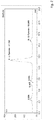
- FIG. 1 shows the results of the labeling reaction.
- (S) -N - ((R) -1-cyano-2- (4- (4-methoxybenzyloxy) phenyl) ethyl) -2-methylpropane-2-sulfinamide at 13.684 min you find that (S) -N - ((S) -1-cyano-2- (4- (4-methoxybenzyloxy) phenyl) ethyl) -2-methylpropane-2-sulfinamide.
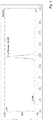
- Fig. 2 shows the reaction products after hydrolysis and before purification. It can be seen that the target compound is present in a large excess to the other enantiomer (D-tyrosine).
- Fig. 3 shows the results of the purification with an SPE cartridge and Fig. 4 the results of the enzymatic purification. It can be seen that the enantiomeric purity was further increased by the purification steps.
- the radiolabeled, gaseous [ 11 C] HCN was introduced into this reactor vial for 8 min at room temperature from below with a carrier gas stream (mix of N 2 , H 2 and NH 3) of approx. 65-70 mL / min.
- the [1- 11 C] leucine nitrile was formed as an intermediate compound with labeling rates of 70 ⁇ 10% of the [11 C] HCN used.
- the hydrolysis was carried out as in Example 1, except that the hydrolysis temperature was 130 ° C.
- the radiolabeled, gaseous [ 11 C] HCN was introduced into this reactor vial for 8 min at room temperature from below with a carrier gas stream (mix of N 2 , H 2 and NH 3) of approx. 65-70 mL / min.
- the [1- 11 C] valine nitrile was formed as an intermediate compound with labeling rates of 70 ⁇ 3% of the [ 11 C] HCN used.
- the radiolabeled, gaseous [ 11 C] HCN was introduced into this reactor vial for 8 min at room temperature from below with a carrier gas stream (mix of N 2 , H 2 and NH 3) of approx. 65-70 mL / min.
- the [1- 11 C] alanine nitrile was formed as an intermediate compound with labeling rates of 76 ⁇ 5% of the [ 11 C] HCN used.
- the radiolabeled, gaseous [ 11 C] HCN was introduced into this reactor vial for 8 min at room temperature from below with a carrier gas stream (mix of N 2 , H 2 and NH 3) of approx. 65-70 mL / min.
- the para-methoxybenzyl-protected [1- 11 C] serine nitrile was formed as an intermediate compound with labeling rates of 78 ⁇ 5% of the [ 11 C] H
Landscapes
- Chemical & Material Sciences (AREA)
- Organic Chemistry (AREA)
- Chemical Kinetics & Catalysis (AREA)
- Organic Low-Molecular-Weight Compounds And Preparation Thereof (AREA)
Description
- Die Erfindung betrifft die Verwendung von Präkursoren für die Herstellung von Kohlenstoff-11-markierten Aminosäuren und Aminosäure-Derivaten sowie ein Verfahren zur Herstellung von Kohlenstoff-11-markierten Aminosäuren und Aminosäure-Derivaten unter Verwendung dieser Präkursoren.
- Mit Kohlenstoff-11-radiomarkierte Verbindungen werden als Radiopharmazeutika in der Positronenemissionstomografie (PET) verwendet. Sie können dabei in der onkologischen Bildgebung als Tracer eingesetzt werden. Sie werden auch in der Neuro-Onkologie verwendet. Eine wichtige Gruppe dieser radiomarkierten Verbindungen sind Kohlenstoff-11-radiomarkierte Aminosäuren. Diese Aminosäuren gehören zu den chiralen PET-Radiopharmazeutika. Sie können beispielsweise verwendet werden, um den erhöhten Aminosäuremetabolismus, der für Krebszellen beschrieben wird, darzustellen. Die radioaktive Markierung von Aminosäuren mit Kohlenstoff-11 bietet den Vorteil, dass die radiomarkierte Aminosäure und das endogene Molekül eine identische Struktur aufweisen. Im Vergleich zu Fluorid-18-markierten Aminosäuren ist der Aufwand, um Kohlenstoff-11 markierte Aminosäure in der klinischen Praxis einzusetzen zu können, deutlich geringer, weil die dazu jeweils notwendigen pharmakologischen und toxikologischen Tests weniger Aufwand erfordern. Dieser Umstand zeigt sich beispielsweise im Vergleich von [11C]Cholin, das eine Kohlenstoff-11-markierte Variante der endogenen Verbindung Cholin ist, und seinem fluorierten Analogon, [16F]Fluorcholin.
- Mit variablen Erfolgen und oft in asymmetrischer Weise wurden viele Kohlenstoff-11-Aminosäure-Isotopologen hergestellt, bei denen Kohlenstoff-12 mit radioaktivem Kohlenstoff-11 substituiert ist. Die größte Herausforderung bei der Synthese von Kohlenstoff-11-markierten Aminosäuren liegt immer noch in der stereoselektiven Reaktion am α-Kohlenstoff zur Vermeidung zeitraubender chiraler Trennung via HPLC, um die enantiomerenreine Form einfach und zuverlässig aus dem Radiomarkierungsprozess zu erhalten, welcher selbst schon durch die Synthesezeit und die spezifische Aktivität begrenzt ist.
- Die Bedeutung der Enantiomerenreinheit von Radiopharmaka ist für radioaktiv markierte Aminosäuren von größter Bedeutung, da die Stereochemie die Geschwindigkeit und Selektivität des Aminosäuretransports beeinflusst. Aus diesem Grund werden L-Enantiomere in Säugetierzellen bevorzugt, wie durch die Anwendung von L- und D-[11C]Phenylalanin gezeigt werden konnte, wobei das L-Enantiomer von [11C]Phenylalanin bessere Pankreas-zu-Leber-Verhältnisse zeigte. Dies wurde auch noch durch die besseren bilderzeugenden Eigenschaften von L-18F-markierten Fluoralkylphenylalanin-Analoga nachgewiesen, die alle eine hohe Tumoraufnahme im Vergleich zum umliegenden Gewebe zeigen. Diese Studien, ohne näher auf die Goldstandards L-[11C]Methionin und L-[18F]Fluorethyltyrosin einzugehen, betonen daher die Notwendigkeit, Methoden zur Synthese von enantiomerenreinen Aminosäuren als PET-Tracer zu entwickeln.
- Darüber hinaus ermöglicht die Halbwertszeit von Kohlenstoff-11 (20,39 min), dass bei einem Patienten am selben Tag bei einem einzigen Krankenhausbesuch Untersuchungen mit verschiedenen [11C]markierten PET-Radiotracern durchgeführt werden können. Die Halbwertszeit bedeutet allerdings auch, dass der Zeitraum, der für die Herstellung und Anwendung des [11C]markierten PET-Radiotracers zur Verfügung steht, äußert kurz ist. Zeitaufwendige Synthesen verringern die praktische Anwendbarkeit eines [11C]markierten PET-Radiotracers daher erheblich. In der Regel stehen für die Synthese, Reinigung und Qualitätskontrolle eines [11C]markierten PET-Radiotracers nur 60 min zur Verfügung. Das heißt, die Anzahl der Syntheseschritte muss so gering wie möglich sein. Außerdem muss die für einen Syntheseschritt erforderliche Reaktionszeit so kurz wie möglich sein.
- Zur Synthese Kohlenstoff-11-markierter Aminosäuren kann die Strecker-Reaktion eingesetzt werden (siehe Xing, J. et al., High-yielding automated convergent synthesis of no-carrier-added [11C-carbonyl]-labeled amino acids using the strecker reaction. Synlett (2017), 28(3), 371-375). Die von Xing et al. vorgeschlagene Variante der Strecker-Reaktion für die Herstellung von [11C]Sacrosin, wobei das Kohlenstoffatom der Carbonylgruppe das Kohlenstoff-11-Atom ist, erfordert die Herstellung von [11C]α-Aminonitril durch Kondensation von Formaldehyd mit Methylamin und [11C]Natriumcyanid. Das so erhaltene Aminonitril wird anschließend einer basischen Hydrolyse mit Natriumhydroxid unterzogen. Diese Variante kann auf andere [11C]Aminosäuren übertragen werden, wobei das Formaldehyd durch ein anderes Keton oder das Methylamin durch ein anderes Amin oder beide Verbindungen ersetzt werden müssen. Die erforderlichen Synthesezeiten liegen unter 20 min. Die radioaktiven Ausbeuten sind jedoch gering. Darüber hinaus gibt es in diesem Verfahren keine Möglichkeit, Aminosäuren enantioselektiv herzustellen. Prasad, B., et al. (Tetrahedron Letters (2004) 45, 9565-9567) beschreiben die Addition von Trimethylsilylcyanid an Arylaldimine als Form der Strecker-Synthese.
- Aufgabe der Erfindung ist es, die Nachteile nach dem Stand der Technik zu beseitigen. Es sollen insbesondere eine Verwendung von Präkursoren zur enantioselektiven Herstellung von Aminosäuren und Derivaten davon vorgeschlagen werden. Ferner soll ein Verfahren zur diastereoselektiven Markierung dieser Präkursoren mit Kohlenstoff-11 vorgeschlagen werden.
- Diese Aufgabe wird durch die Merkmale der Ansprüche 1 und 5 gelöst. Zweckmäßige Ausgestaltungen der Erfindungen ergeben sich aus den Merkmalen der Unteransprüche.
- Nach Maßgabe der Erfindung ist die Verwendung eines Präkursors für die Herstellung von Kohlenstoff-11 markierten Aminosäuren oder Derivaten vorgesehen. Der Präkursor ist eine Verbindung der Formel I:

- R1 und R2 unabhängig voneinander aus der Gruppe ausgewählt sind, die Wasserstoff, unsubstituiertes oder substituiertes C1-C6-Alkyl, das gegebenenfalls durch Einlagerung zumindest einer Gruppe X in die Kohlenstoffkette modifiziert sein kann, unsubstituiertes oder substituiertes C2-C6-Alkenyl, das gegebenenfalls durch Einlagerung zumindest einer Gruppe X in die Kohlenstoffkette modifiziert sein kann, substituiertes oder unsubstituiertes Alkylaryl, substituiertes oder unsubstituiertes Arylalkyl substituiertes oder unsubstituiertes Aryl und substituiertes oder unsubstituiertes Heteroaryl umfasst; wobei R1 vorzugsweise unsubstituiertes oder substituiertes C1-C6-Alkyl, substituiertes oder unsubstituiertes Aryl oder substituiertes oder unsubstituiertes Heteroaryl, stärker bevorzugt substituiertes oder unsubstituiertes C1-C6-Alkyl oder substituiertes oder unsubstituiertes Aryl und besonders bevorzugt unsubstituiertes oder substituiertes C1-C6-Alkyl ist; und R2 vorzugsweise unsubstituiertes oder substituiertes C1-C6-Alkyl oder Wasserstoff, besonders bevorzugt Wasserstoff ist;
- R3 ein chirales Auxilar ist, das aus der Gruppe ausgewählt ist, die substituiertes oder unsubstituiertes C1-C6-Alkylsulfinyl, substituiertes oder unsubstituiertes Arylsulfinyl, substituiertes oder unsubstituiertes Arylalkyl und substituiertes oder unsubstituiertes Arylglycinol umfasst; wobei R3 vorzugsweise substituiertes oder unsubstituiertes C1-C6-Alkylsulfinyl ist;
- X aus der Gruppe ausgewählt ist, die Sauerstoff, Schwefel, -SO-, -SO2- und -N(R10)- umfasst;
- R10 Wasserstoff, unsubstituiertes oder substituiertes C1-C6-Alkyl, unsubstituiertes oder substituiertes C2-C6-Alkenyl, substituiertes oder unsubstituiertes Aryl und substituiertes oder unsubstituiertes Heteroaryl umfasst und
- die Reste gegebenenfalls ungeschützt oder geschützt sind. Insbesondere können R1 und/oder R2 ungeschützt oder geschützt und die anderen Reste ungeschützt sein.
- Der erfindungsgemäße Präkursor ermöglicht die diastereoselektive Markierung mit einem Kohlenstoff-11-Synthon, d. h. es wird ein Diastereomer bevorzugt erhalten. Durch die anschließende Abspaltung des chiralen Auxiliars erlaubt der Präkursor somit die enantioselektive Herstellung von Kohlenstoff-11-markierten Aminosäuren und Derivaten davon. Der erfindungsgemäße Präkursor kann insbesondere zur enantioselektiven Herstellung von α-Aminosäuren und Derivaten davon wie α-Aminosäure-Ester und α-Aminosäure-Amide, besonders bevorzugt L-α-Aminosäuren und Derivaten davon wie L-α-Aminosäure-Ester und L-α-Aminosäure-Amide verwendet werden. Der erfindungsgemäße Präkursor kann aber auch zur enantioselektiven Herstellung von D-α-Aminosäuren und Derivaten davon wie D-α-Aminosäure-Ester und D-α-Aminosäure-Amide verwendet werden. Der erfindungsgemäße Präkursor ermöglicht somit die enantioselektive Herstellung entweder der L-α-Aminosäuren und Derivaten davon wie L-α-Aminosäure-Ester und L-α-Aminosäure-Amide oder der D-α-Aminosäuren und Derivaten davon wie D-α-Aminosäure-Ester und D-α-Aminosäure-Amide.
- Die Präkursoren der Formel I sollten thermodynamisch stabile Verbindungen sein.
- Der Ausdruck "substituiert" bezieht sich in der vorliegenden Erfindung insbesondere auf einen oder mehrere Substituenten, die aus der Gruppe ausgewählt sind, die Halogen, Cyano, Nitro, geschütztes oder ungeschütztes Hydroxy, geschütztes oder ungeschütztes -N(R11R12) und geschütztes oder ungeschütztes Thiol umfassen. R11 und R12 können unabhängig voneinander aus der Gruppe ausgewählt sein, die Wasserstoff, unsubstituiertes oder substituiertes C1-C6-Alkyl, unsubstituiertes oder substituiertes C2-C6-Alkenyl, substituiertes oder unsubstituiertes Aryl und substituiertes oder unsubstituiertes Heteroaryl umfasst. R11 und R12 sind vorzugsweise beide Wasserstoff.
- Der Ausdruck "geschützt" bezieht sich insbesondere auf eine Schutzgruppe, zum Schutz der Hydroxy-Gruppe, der -N(R11R12)-Gruppe oder der Thiolgruppe. Die Schutzgruppe kann nach Umsetzung des Präkursors entfernt werden. Zum Schutz der Hydroxy-Gruppe können bekannte Schutzgruppen verwendet werden. Eine Schutzgruppe zum Schutz der Hydroxy-Gruppe kann beispielsweise aus der Gruppe ausgewählt sein, die Trityl, Benzyl, Methoxybenzyl, p-Nitrobenzyl, Benzoyl, substituiertes Benzoyl, Trimethylsilyl, Triethylsilyl, Isopropyldimethylsilyl, tert-Butyldimethylsilyl, tert-Butyldiphenylsilyl, Thexyldimethylsilyl, Allyl, Methoxymethyl, (2-Methoxyethoxy)methyl und Tetrahydropyranyl umfasst. Zum Schutz der Amin-Gruppe, d. h. R11 und R12 sind beide Wasserstoff, können bekannte Schutzgruppen verwendet werden. Eine Schutzgruppe zum Schutz der Amin-Gruppe kann beispielsweise aus der Gruppe ausgewählt sein, tert-Butylcarbonyl, Benzylcarbonyl, 9-Fluorenylmethylcarbonyl und Allylcarbonyl umfasst. Zum Schutz der Thiol-Gruppekönnen bekannte Schutzgruppen verwendet werden.
- Der Ausdruck "Halogene" bezieht sich auf Fluor, Chlor, Brom oder Iod.
- Der Ausdruck "Alkyl" bezieht sich insbesondere auf eine gesättigte aliphatische Kohlenwasserstoff-Gruppe mit einer verzweigten oder unverzweigten Kohlenstoffkette mit 1 bis 6 Kohlenstoffatomen.
- Der Ausdruck "Alkylen" bezieht sich insbesondere auf eine ungesättigte aliphatische Kohlenwasserstoff-Gruppe mit 2 bis 6 Kohlenstoffatomen, beispielsweise Ethylen, 2,2-Dimethylethylen, Propylen, 2-Methylpropylen, Butylen, Pentylen und dergleichen.
- Der Ausdruck "Aryl" bezieht sich auf eine einwertige cyclische aromatische Kohlenwasserstoff-Gruppe, die einen mono-, bi- oder tricyclischen aromatischen Ring umfassen kann. Die Arylgruppe kann gegebenenfalls substituiert sein. Beispiele von Arylgruppen sind - gegebenenfalls substituiertes - Phenyl, Naphthyl, Phenanthryl, Fluorenyl, Indenyl, Azulenyl, Oxydiphenyl, Biphenyl, Methylendiphenyl, Aminodiphenyl, Diphenylsulfidyl, Diphenylsulfonyl, Diphenylisopropylidenyl, Benzodioxanyl, Benzodioxylyl, Benzoxazinyl, Benzoxazinonyl, Benzopiperadinyl, Benzopiperazinyl, Benzopyrrolidinyl, Benzomorpholinyl, Methylendioxyphenyl, Ethylendioxyphenyl und dergleichen, wobei die Aufzählung nicht vollständig ist. Vorzugsweise umfasst Aryl gegebenenfalls substituiertes Phenyl und gegebenenfalls substituiertes Naphthyl.
- Der Ausdruck "Heteroaryl" bezieht sich insbesondere auf eine monocyclische, bicyclische oder tricyclische Gruppe mit 5 bis 12 Ringatomen, wobei mindestens ein aromatischer Ring ein, zwei oder drei Ringheteroatome, ausgewählt aus N, O oder S, enthält, wobei die verbleibenden Ringatome C sind. Die Heteroaryl-Gruppe kann gegebenenfalls substituiert sein. Beispiele von Heteroaryl-Gruppen sind - gegebenenfalls substituiertes - Imidazolyl, Oxazolyl, Isoxazolyl, Thiazolyl, Isothiazolyl, Oxadiazolyl, Thiadiazolyl, Pyrazinyl, Pyridazinyl, Thiophenyl, Furanyl, Pyranyl, Pyridinyl, Pyrrolyl, Pyrazolyl, Pyrimidyl, Chinolinyl, Isochinolinyl, Chinazolinyl, Benzofuranyl, Benzothiophenyl, Benzothiopyranyl, Benzimidazolyl, Benzoxazolyl, Benzooxadiazolyl, Benzothiazolyl, Benzothiadiazolyl, Benzopyranyl, Indolyl, Isoindolyl, Indazolyl, Triazolyl, Triazinyl, Chinoxalinyl, Purinyl, Chinazolinyl, Chinolizinyl, Naphthyridinyl, Pteridinyl, Carbazolyl, Azepinyl, Diazepinyl, Acridinyl und dergleichen, wobei die Aufzählung nicht vollständig ist.
- Der Ausdruck "Alkylaryl" bezieht sich insbesondere auf einwertige, eine Arylgruppe tragende Alkylreste, wobei der Alkylrest, wie oben definiert, 1 bis 6 Kohlenstoffatome aufweisen kann.
- Der Ausdruck "Arylalkyl" bezieht sich insbesondere auf einwertige, eine Alkylgruppe tragende Arylreste, wobei der Alkylrest, wie oben definiert, 1 bis 6 Kohlenstoffatome aufweisen kann.
- Vorzugsweise ist R1 aus der Gruppe ausgewählt, die Methyl, geschütztes und ungeschütztes Hydroxymethyl, Ethyl, n-Propyl, iso-Propyl, n-Butyl, iso-Butanyl, sec-Butyl, tert-Butyl, Phenyl, geschütztes und ungeschütztes Hydroxyphenyl, Benzyl und geschütztes und ungeschütztes Hydroxybenzyl umfasst, und ist R2 Wasserstoff.
- Der Ausdruck "chirales Auxiliar" bezieht sich insbesondere auf eine Gruppe mit zumindest einem Chiralitätszentrum. Das chirale Auxiliar ermöglicht eine diastereoselektive Umsetzung des erfindungsgemäßen Präkursors, so dass nach der Abspaltung des chiralen Auxiliars ein Enantiomer bevorzugt erhalten wird. Bevorzugte chirale Auxiliare sind substituiertes oder unsubstituiertes Alkylsulfinyl und substituiertes oder unsubstituiertes Arylsulfinyl, wobei substituiertes oder unsubstituiertes Alkylsulfinyl besonders bevorzugt ist. Aufgrund des chiralen Auxiliars weist der Präkursor der Formeln I zwei Enantiomere auf. Die beiden Enantiomere sind in den Formel I-a und Ib veranschaulicht, wobei die Darstellung der Bindung zwischen dem Stickstoffatom und der Gruppe R3 lediglich die beiden Enantiomere veranschaulichen soll, aber nicht zwingend den Projektionsregeln entspricht, weil diese vom Aufbau des Restes R3 abhängt. Formel I-a veranschaulicht ein Enantiomer, das bevorzugt zur Herstellung der D-Aminosäure verwendet werden kann. Formel I-b veranschaulicht ein Enantiomer, das bevorzugt zur Herstellung der L-Aminosäure verwendet werden kann:

- Die als Alkylsulfinyl und Arylsulfinyl bezeichneten chiralen Auxiliare stellen eine -S(O)-R4-Gruppe dar, wobei R4 aus der Gruppe ausgewählt ist, die unsubstituiertes oder substituiertes C1-C6-Alkyl und substituiertes oder unsubstituiertes Aryl umfasst. In diesem Fall ist die Verbindung der Formel I eine Verbindung der Formel II-a oder II-b:

- In der bevorzugten Ausführungsform ist der erfindungsgemäße Präkursor eine Verbindung der Formel II-a oder II-b, wobei R1 aus der Gruppe ausgewählt ist, die unsubstituiertes oder substituiertes C1-C6-Alkyl, substituiertes oder unsubstituiertes Aryl und substituiertes oder unsubstituiertes Heteroaryl umfasst; R2 Wasserstoff ist; und R4 aus der Gruppe ausgewählt ist, die unsubstituiertes oder substituiertes C1-C6-Alkyl und substituiertes oder unsubstituiertes Aryl umfasst. In einer stärker bevorzugten Ausführungsform ist der erfindungsgemäße Präkursor eine Verbindung der Formel II-a oder II-b, wobei R1 aus der Gruppe ausgewählt sind, die unsubstituiertes oder substituiertes C1-C6-Alkyl, substituiertes oder unsubstituiertes Aryl und substituiertes oder unsubstituiertes Heteroaryl umfasst; R2 Wasserstoff ist; und R4 tert.-Butyl ist. Ein derartiger Präkursor ist eine Verbindung der Formel III-a oder III-b:
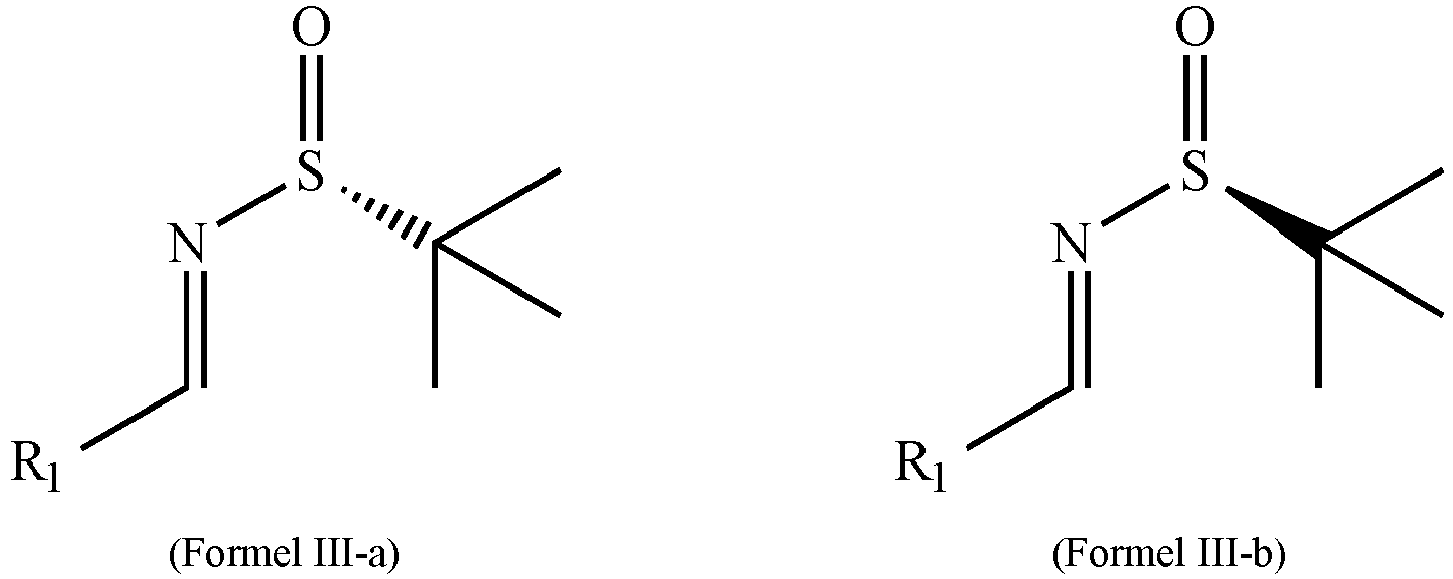
- In einer stärker bevorzugten Ausführungsform ist der erfindungsgemäße Präkursor eine Verbindung der Formel III-a oder III-b, wobei R1 aus der Gruppe ausgewählt ist, die Methyl, geschütztes und ungeschütztes Hydroxymethyl, Ethyl, n-Propyl, iso-Propyl, n-Butyl, iso-Butanyl, sec-Butyl, tert-Butyl, Phenyl, geschütztes und ungeschütztes Hydroxyphenyl, Benzyl und geschütztem und ungeschütztem Hydroxybenzyl umfasst.
- Die als "Arylalkyl" bezeichneten chiralen Auxiliare stellen eine Arylgruppe dar, die eine oder mehrere C1-C6-Alkylgruppen trägt. Die Arylalkyl-Gruppe kann substituiert oder unsubstituiert sein. Beispiele sind - gegebenenfalls substituiertes - Benzyl, Phenylethyl und Arylglycinol, wobei die Aufzählung nicht abschließend ist.
- Die als "Arylglycinol" bezeichneten chiralen Auxiliare stellen eine Untergruppe von als "Arylalkyl" bezeichneten chiralen Auxiliare dar. Beispielsweise können Präkursoren mit Arylglycinol-Gruppe eine Gruppe der Formel IV-a oder IV-b sein:

- Die erfindungsgemäßen Präkursoren erlauben eine schnelle und diastereoselektive Umsetzung mit einem Kohlenstoff-11-Synthon. Diese Reaktion, die auch als Markierungsreaktion bezeichnet wird, ist diastereoselektiv. Aufgrund der anschließenden Abspaltung des chiralen Auxiliars, beispielsweise mittels Alkoholyse und/oder Hydrolyse, wird, entsteht ein Enantiomer im Überschuss. Das bedeutet, dass das erfindungsgemäße Verfahren im Ergebnis enantioselektiv ist.
- Insbesondere können die erfindungsgemäßen Präkursoren verwendet werden, um Aminosäuren, insbesondere α-Aminosäuren und Derivate davon wie Aminosäure-Ester und Aminosäure-Amide herzustellen, deren Carbonyleinheit ein Kohlenstoff-11-Atom anstelle eines Kohlenstoff-12-Atoms aufweist. Die übrigen Kohlenstoffatome der Aminosäuren und Aminosäure-Derivate sind vorzugsweise keine Kohlenstoff-11-Atome. Die für die Synthese dieser Verbindungen benötigte Zeit liegt unter 20 min. Die radiochemische Ausbeute liegt über 10 % (nicht zerfallskorrigiert (n. d. c.)) bzw. über 20 % (zerfallskorrigiert (d.c.), jeweils bezogen auf gebildetes [11C]HCN).
- Die erfindungsgemäßen Präkursoren können beispielsweise durch Kondensation des entsprechenden Aldehyds mit einem Alkylsulfinyl-Amin in Gegenwart von wasserfreiem Kupfersulfat in Dichlormethan bei Raumtemperatur synthetisiert und optional anschließend chromatographisch gereinigt werden.
- Nach Maßgabe der Erfindung ist ferner ein Verfahren zur diastereoselektiven Markierung eines erfindungsgemäßen Präkursors mit Kohlenstoff-11 vorgesehen, wobei der Präkursor mit einem Kohlenstoff-11-markierten Synthon zu einer Kohlenstoff-11 markierten Verbindung, die eine Kohlenstoff-11-markierte Carbonylgruppe aufweist, umgesetzt wird. Vorzugsweise ist das Kohlenstoff-11-markierte Synthon [11C]R31CN, wobei R31 aus der Gruppe ausgewählt ist, die Wasserstoff, ein Alkalimetall wie Lithium, Natrium oder Kalium, Acetyl und Alkylsilyl umfasst. Vorzugsweise ist R31 Wasserstoff, Natrium oder Kalium, besonders bevorzugt Wasserstoff oder ein Alkylsilyl, besonders bevorzugt Wasserstoff. Ein bevorzugtes Beispiel eines Alkylsilyls ist Trimethylsilyl. R31 kann als Kation zu dem Anion [11C]CN- vorliegen. [11C]R31CN wird vorzugsweise als Gasstrom durch das Reaktionsgemisch, das den Präkursor und ggf. Lösungsmittel und Hilfsstoffe enthält, geführt. [11C]R31CN wird vorzugsweise durch Umwandlung aus [11C]CO2 hergestellt. Das kann mittels bekannter Verfahren geschehen. Die Umsetzung des Präkursors mit dem Synthon ist keine spezifische Reaktion. Vielmehr hängt es von dem chiralen Auxiliar und/oder den Reaktionsbedingungen, insbesondere dem oder den zugesetzten Hilfsstoffen und/oder dem oder den eingesetzten Lösungsmitteln, ab, welches der beiden Enantiomere bei der Umsetzung des Präkursors mit dem Synthon erhalten wird. Diese Umsetzung ist daher keine spezifische Reaktion.
- Bei der Kohlenstoff-11 markierten Verbindung kann es sich beispielsweise um Aminosäuren und Derivate davon, wie Aminosäure-Ester und Aminosäure-Amide, handeln, bevorzugt α-Aminosäuren und Derivate davon, wie α-Aminosäure-Ester und α-Aminosäure-Amide, besonders bevorzugt L-α-Aminosäuren und Derivate davon, wie L-α-Aminosäure-Ester und L-α-Aminosäure-Amide. Bei der Kohlenstoff-11 markierten Verbindung kann es sich aber auch um D-α-Aminosäuren und Derivate davon, wie D-α-Aminosäure-Ester und D-α-Aminosäure-Amide, handeln. Das erfindungsgemäße Verfahren ermöglicht die enantioselektive Herstellung entweder der L-α-Aminosäuren und Derivaten davon, wie L-α-Aminosäure-Ester und L-α-Aminosäure-Amide, oder der D-α-Aminosäuren und Derivaten davon, wie D-α-Aminosäure-Ester und D-α-Aminosäure-Amide.
- Beispielsweise kann es sich bei den Kohlenstoff-11 markierten Verbindung um eine Verbindung der Formel X handeln:

- R21 und R22 die oben im Zusammenhang mit den Resten R1 und R2 des erfindungsgemäßen Präkursors angegebene Bedeutung haben,
- R5 aus der Gruppe ausgewählt ist, die OR6 und NR7R8 umfasst, und
- R6, R7 und R8 unabhängig voneinander aus der Gruppe ausgewählt sind, die Wasserstoff, unsubstituiertes oder substituiertes C1-C6-Alkyl, unsubstituiertes oder substituiertes C2-C6-Alkenyl, substituiertes oder unsubstituiertes Aryl und substituiertes oder unsubstituiertes Heteroaryl umfasst. Die Ausdrücke "Alkyl", "Alkenyl", "Aryl", "Heteroaryl" und "substituiert" können die oben im Zusammenhang mit dem erfindungsgemäßen Präkursor angegebenen Bedeutungen haben. R7 und R8 sind vorzugsweise Wasserstoff.
- Für die Herstellung einer Verbindung der Formel X, die bestimmte Reste R21 und R22 aufweisen soll, wird zweckmäßigerweise ein Präkursor ausgewählt, der - abgesehen von optional vorgesehen Schutzgruppen an den Resten R1 und/oder R2 - Reste R1 und R2 aufweist, die mit den Resten R21 und R22 der Verbindung der Formel X übereinstimmen. Wird ein Präkursor eingesetzt, der Schutzgruppen an den Resten R1 und/oder R2 aufweist, so kann das erfindungsgemäße Verfahren die Abspaltung der Schutzgruppen umfassen.
- Beispiele für Verbindungen, der Formel X sind in der nachstehenden Tabelle 1 angegeben, wobei die Aufzählung nicht abschließend ist. Bei diesen Verbindungen ist R2 jeweils Wasserstoff und R5 Hydroxy.
Tabelle 1 Formel-Nr. Verbindung R1 X-11 

X-12 

X-13 

X-14 

X-15 

X-16 

- Das erfindungsgemäße Verfahren kann die Umsetzung des erfindungsgemäßen Präkursors mit dem Kohlenstoff-11-markierten Synthon zu einer Verbindung der Formel V umfassen:

- Vorzugsweise wird eine Verbindung der Formel I-b zu einer Verbindung der Formel V-a umgesetzt (Schema la):
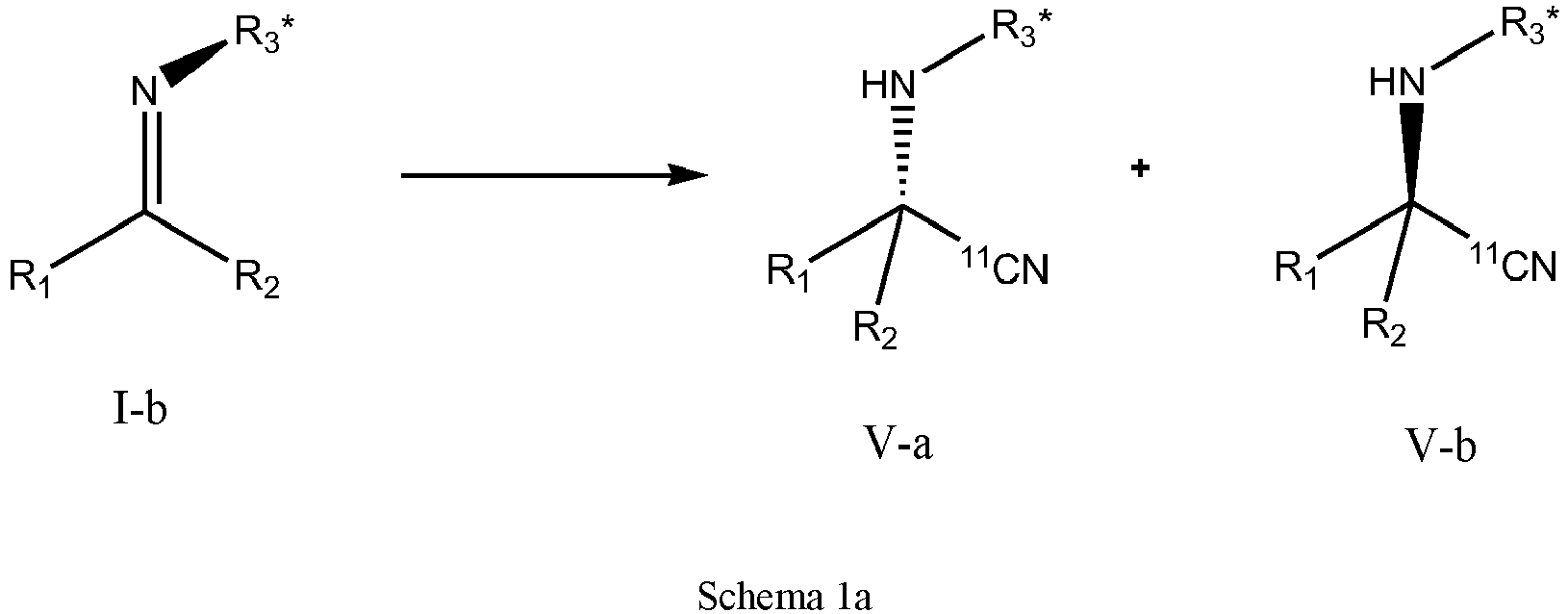
- Die Umsetzung gemäß Schema 2a ist insbesondere dann vorteilhaft, wenn das erfindungsgemäße Verfahren zur Herstellung von L-Aminosäuren und deren Derivaten eingesetzt werden soll. Es hängt vom dem Präkursor, insbesondere dem eingesetzen chiralen Auxiliar des Präkursors, und den Reaktionsbedinungen, insbesondere dem oder den Hilfsstoffen und dem oder den Lösungsmitteln ab, welche der beiden Verbindungen V-a oder V-b im Überschuss erhalten wird. Alternativ kann eine Verbindung der Formel I-a zu einer Verbindung der Formel Va oder V-b umgesetzt werden (Schema 1b). Es hängt vom dem Präkursor, insbesondere dem eingesetzten chiralen Auxiliar des Präkursors, und den Reaktionsbedingungen, insbesondere dem oder den Hilfsstoffen und/oder dem oder den eingesetzten Lösungsmitteln ab, welche der beiden Verbindungen V-a oder V-b im Überschuss erhalten wird. Die Umsetzung des Präkursors I mit dem Synthon ist keine spezifische Reaktion.

- Im nächsten Schritt kann die Verbindung der Formel V mittels Alkoholyse, die zu oder Hydrolyse (Alkoholyse führt zu OR6, Hydrolyse führt zu NR7R8 oder OH) in eine Verbindung der Formel XI überführt werden, wobei die Alkoholyse zu R5 = OR6 führt und die Hydrolyse zu R5 = NR7R8 oder OH führt:

- Die Überführung der Verbindung der Formel V-a in eine Verbindung der Formel XIa ist in Schema 2a, die Überführung der Verbindung der Formel V-b in eine Verbindung der Formel XIb ist in Schema 2b gezeigt:


- Die Umsetzung gemaß Schema 2a ist insbesondere dann vorteilhaft, wenn das erfindungsgemäße Verfahren zur Herstellung von L-Aminosäuren und deren Derivaten eingesetzt werden soll.
- Anschließend kann die Verbindung der Formel XI mittels Hydrolyse in eine Verbindung der Formel XII überführt werden:

- Die Überführung der Verbindung der Formel XI-a mittels Hydrolyse in eine Verbindung der Formel XII-a ist in Schema 3a, die Überführung der Verbindung der Formel XI-b mittels Hydrolyse in eine Verbindung der Formel XII-b ist in Schema 3b gezeigt:

- Die Umsetzung gemäß Schema 3a ist insbesondere dann vorteilhaft, wenn das erfindungsgemäße Verfahren zur Herstellung von L-Aminosäuren und deren Derivaten eingesetzt werden soll.
- Anstelle einer Alkoholyse der Verbindung der Formel V zu einer Verbindung der Formel XI und der optional anschließend Hydrolyse der Verbindung der Formel XI zu einer Verbindung der Formel XII kann eine direkte Hydrolyse der Formel V zu einer Verbindung der Formel XII vorgesehen sein.
- In einer bevorzugten Ausführungsform des erfindungsgemäßen Verfahrens wird ein Präkursor der Formel II


- Die bevorzugte Ausführungsform kann zunächst das Umsetzen der Verbindung der Formel II mit dem Kohlenstoff-11-markierten Synthon zu einer Verbindung der Formel XIV umfassen:


- Die Umsetzung gemaß Schema 4b ist insbesondere dann vorteilhaft, wenn das erfindungsgemäße Verfahren zur Herstellung von L-Aminosäuren und deren Derivaten eingesetzt werden soll.
- Die Verbindung der Formel IV kann anschließend mittels Alkoholyse in eine Verbindung der Formel XV überführt werden:

- Die Alkoholyse wird unter Einsatz eines Alkohols durchgeführt, der die Gruppe R6 aufweist und in den Schemen 5a und 5b als R6OH dargestellt ist. Die Alkoholyse kann unter dem Fachmann bekannten Reaktionsbedingungen durchgeführt werden. Die Reaktionszeit kann beispielsweise 5 bis 60 Minuten, die Reaktionstemperatur beispielsweise 60 bis 150 °C betragen. Die Überführung der Verbindung der Formel XIV-a-1 in eine Verbindung der Formel XV-a ist in Schema 5a-1, die Überführung der Verbindung der Formel XIV-a-2 in eine Verbindung der Formel XVb ist in Schema 5a-2, die Überführung der Verbindung der Formel XIV-b-1 in eine Verbindung der Formel XV-b ist in Schema 5b-1 und die Überführung der Verbindung der Formel XIV-b-2 in eine Verbindung der Formel XV-a ist in Schema 5b-2 gezeigt.


- Für die Herstellung von L-Aminosäuren und ihren Derivaten wird vorzugsweise die Verbindung der Formel XV-a hergestellt.
- Die Verbindung der Formel XV kann anschließend mittels Hydrolyse in eine Verbindung der Formel XII überführt werden:

- Die Hydrolyse kann unter sauren Bedingungen durchgeführt werden. Beispielsweise kann wässerige konzentrierte Salzsäure zur Hydrolyse eingesetzt werden. Die Reaktionstemperatur kann beispielsweise bei 100 bis 250 °C liegen, die Reaktionszeit bei 2 bis 20 min. Die Überführung der Verbindung der Formel XV-a mittels Hydrolyse in eine Verbindung der Formel XII-a ist in Schema 6a, die Überführung der Verbindung der Formel XV-b mittels Hydrolyse in eine Verbindung der Formel XII-b ist in Schema 6b gezeigt:


- Für die Herstellung von L-Aminosäuren und ihren Derivaten wird die Verbindung der Formel XV-a zur Verbindung der Formal XII-a umgesetzt. Für die Herstellung von D-Aminosäuren und ihren Derivaten wird die Verbindung der Formel XV-b zur Verbindung der Formal XII-b umgesetzt.
- Alternativ zu einer Alkoholyse der Verbindungen der Formel XIV, an die sich optional eine Hydrolyse anschließen kann, können die Verbindungen der Formel XIV direkt einer direkten Hydrolyse unterzogen werden. Dabei wird die Verbindung der Formel XIV zunächst in eine Verbindung der Formel XVI überführt


- Die Überführung der Verbindung der Formel XIV-a-1 in eine Verbindung der Formel XVI-a ist in Schema 7a-1, die Überführung der Verbindung der Formel XIV-a-2 in eine Verbindung der Formel XVI-b ist in Schema 7a-2, die Überführung einer Verbindung der Formel XIV-b-1 in eine Verbindung der Formel XVI-b ist in Schema 7b-1 und die Überführung einer Verbindung der Formel XIV-b-2 in eine Verbindung der Formel XVI-a ist in Schema 7b-2 gezeigt:


- Die Überführung der Verbindung der Formel XVI-a mittels Hydrolyse in eine Verbindung der Formel XII-a ist in Schema 8a, die Überführung der Verbindung der Formel XVI-b mittels Hydrolyse in eine Verbindung der Formel XII-b ist in Schema 8b gezeigt:


- Für die Herstellung von L-Aminosäuren und ihren Derivaten wird die Verbindung der Formel XVI-a zur Verbindung der Formal XII-a umgesetzt. Für die Herstellung von D-Aminosäuren und ihren Derivaten wird die Verbindung der Formel XVI-b zur Verbindung der Formal XII-b umgesetzt.
- Sind die Reste R1 und R2 ungeschützte Reste so kann vorgesehen sein, dass die Reste R1 und R2 einer Verbindung der Formeln XI, XII, XIII, XV oder XVI den Resten R21 und/oder R22 der Verbindung X entsprechen. Ist hingegen der Rest R1 ein geschützter Rest, so kann vorgesehen sein, dass der Rest R1 einer Verbindung der Formeln XI, XII, XIII, XV oder XVI in den Rest R21 der Verbindung X durch Abspalten einer oder mehrerer Schutzgruppen überführt wird. Ist Rest R2 ein geschützter Rest, so kann vorgesehen sein, dass der Rest R2 einer Verbindung der Formeln XI, XII, XIII, XV oder XVI in den Rest R22 der Verbindung X durch Abspalten einer oder mehrerer Schutzgruppen überführt wird.
- Das erfindungsgemäße Verfahren kann in einem Mikrofluidik-System, insbesondere einem Mikrofluidik-Reaktor durchgeführt werden. Bei dem Mikrofluidik-System kann es sich beispielsweise um die von General Electric angebotene ISAR®-Plattform handeln. Das Mikrofluidik-System kann Reinigungskartuschen umfassen, um die Zielverbindung, d. h. eine Verbindung der Formel X, oder eine Zwischenstufe einer Reinigung zu unterziehen. Das Mikrofluidik-System kann einen Polymerchip aufweisen, auf dem die Synthese der Kohlenstoff-11-markierten Aminosäuren oder Derivate davon durchgeführt werden kann. Das erfindungsgemäße Verfahren kann ein automatisiertes Verfahren sein.
- Das erfindungsgemäße Verfahren wird vorzugsweise als nicht-trägergebundene Synthese (n.c.a-Synthese) durchgeführt.
- Zum Erhalt einer enantiomerenreinen Verbindung der Formel X kann das erfindungsgemäße Verfahren einen Reinigungsschritt zur Abtrennung des ungewünschten Enantiomers umfassen. Der Reinigungsschritt kann beispielsweise eine enzymatische Reinigung oder eine chirale Trennung sein. Ist das Ziel des erfindungsgemäßen Verfahrens die Herstellung einer L-Aminosäure oder eines Derivates davon, so kann mittels des Reinigungsschrittes die entsprechende D-Aminosäure bzw. ihr Derivat abgetrennt werden.
- Das erfindungsgemäße Verfahren ermöglicht die Synthesezeiten von weniger als 20 min für die Herstellung von Kohlenstoff-11-markierten Aminosäuren oder ihren Derivaten, und zwar einschließlich (i) der Umwandung von [11C]CO2 in [11C]R31CN, (ii) dem Einbau von [11C]R31CN in den Präkursor und (iii) die Alkoholyse, und optional anschließende Hydrolyse, oder die direkte Hydrolyse der Nitrilgruppe in die ggf. substituierte Carbonsäure.
- Die mittels des erfindungsgemäßen Verfahrens hergestellten Kohlenstoff-11-markierten Aminosäuren oder Derivate davon können weiter zu Peptiden, insbesondere Oligopeptiden, oder Peptidanaloga umgesetzt werden. Die mittels des erfindungsgemäßen Verfahrens hergestellten Kohlenstoff-11-markierten Aminosäuren oder Derivate davon können zum Einbau in Peptide, Proteine oder Antikörper verwendet werden.
- Die Erfindung beruht, ohne an eine Erklärung gebunden sein zu wollen, auf folgenden Erkenntnissen: Durch gezielte Wahl des optimalen Lösungsmittels, vorzugsweise 1,4-Dioxan in einem Verhältnis zu Methanol von 4 : 1, und des Hilfsstoffes, vorzugsweise Cäsiumfluorid (CsF), können hohe Diastereomerenüberschüsse (de) in sehr kurzen Reaktionszeiten erreicht werden. Zum Einen sind in reinem Dioxan, Dichlormethan, Toluol oder anderen aprotisch unpolaren Lösungsmitteln unter Zusatz von Cäsiumfluorid zwar die de-Werte sehr gut (70% bis > 90%). Allerdings ist CsF in diesen Lösungsmitteln nur schlecht löslich, was dazu führt, dass die Reaktionszeit inakzeptabel auf mehrere Stunden bzw. Tage verlängert wird. Zum Anderen ist der Hilfsstoff CsF in protisch polaren Lösungsmitteln wie Wasser, DMSO oder verschiedenen Alkoholen wie Methanol, Ethanol und Propanol zwar besser löslich. Somit verkürzen sich die Reaktionszeiten auf unter eine Stunde. Allerdings verändert sich die Stereoselektivität zum schlechteren (< 50 %) und dreht sich dabei sogar um. Diese beiden gegenläufigen Effekte haben zu der Erkenntnis geführt, dass es prinzipiell möglich ist, durch geschickte Wahl des oder der Lösungsmittel und/oder des oder der Hilfsstoffe aus dem selben enantiomerenreinen (S)-Sulfinylimin-Präkursor sowohl die L-Aminosäure als auch die D-Aminosäure in guter Stereoselektivität (> 30 % ee bzw. de bei der Zwischenverbindung) darzustellen. Die Erfinder haben festgestellt, dass in einem Gemisch aus Dioxan mit wenig Methanol oder Wasser, d. h. einem Anteil von vorzugsweise 10 bis 20 %, bezogen auf das Volumen, an dem Lösungsmittelgemisch die Löslichkeit des Hilfsstoffes CsF stark steigt und somit die Reaktionszeit auf weniger als 20 min sinkt. Dabei lagen die de-Werte bei guten 70 bis 80 %. Nach der Freisetzung der angereicherten Aminosäure oder ihrem Derivat durch saure Hydrolyse, wobei auch eine basische Hydrolyse möglich ist, kann eine enzymatische Reinigung erfolgen. Beispielsweise kann durch immobilisierte D-α-Aminosäure-Oxidase (D-AAO) die D-Aminosäure entfernt werden. Dies ist auch umgekehrt möglich. Durch Verwendung des Enzyms L-α-Aminosäure-Oxidase (L-AAO) ist prinzipiell auch die Darstellung der enantiomeren D-Aminosäure möglich.
- Mittels des erfindungsgemäßen Verfahrens können Aminosäuren und Derivate davon - ohne Reinigung wie eine enzymatische oder chirale Reinigung - mit einem ee-Wert von 30 % oder höher, bevorzugt 50 % oder höher, stärker bevorzugt 70 % oder höher und besonders bevorzugt 90 % oder höher erhalten werden. Mittels des erfindungsgemäßen Verfahrens können spezifische Aktivitäten von ca. 20 bis 70 GBq/µmol, erhalten werden. Es ist möglich, höhere spezifische Aktivitäten zu erreichen, was u. a. den Einsatz äußerst sauberer Gase, insbesondere Stickstoff und/oder Wasserstoff erfordert.
- Die Vorteile des erfindungsgemäßen Verfahrens gegenüber dem Verfahren von Xing et al. liegen insbesondere in der diastereoselektiven Umsetzung eines chiralen Präkursors mit [11C]R31CN. Es können gezielt L- oder D- Aminosäuren hergestellt werden. Zudem muss der Präkursor nicht erst im Synthesemodul intermediär hergestellt werden, sondern ist thermodynamisch stabil und somit lagerbar.
- Nach Maßgabe der Erfindung kann ferner ein Reagenzienkit zur vorgesehen sein, das einen erfindungsgemäßen Präkursor für die enantioselektive Herstellung einer Kohlenstoff-11-markierten Aminosäure oder eines Derivates davon, Lösungsmittel und einen oder mehrere Hilfsstoffe umfassen kann. Zusätzlich kann das erfindungsgemäße Reagenzienkit eine oder mehrere Reinigungskartuschen umfassen. Das erfindungsgemäße Reagenzienkit ermöglicht die automatisierte enantioselektive Herstellung der Kohlenstoff-11-markierten Aminosäure oder des Derivates davon.
- Die Erfindung wird nachstehend anhand von Ausführungsbeispielen, die die Erfindung nicht einschränken sollen, näher erläutert. Dabei zeigen
- Fig. 1
- ein radiochemisches HPLC-Chromatogramm, das die Ergebnisse der Markierungsreaktion bei der diastereoselektiven Herstellung von [1-11C]-L-Tyrosin (Verbindung X-12) zeigt;
- Fig. 2
- ein radiochemisches HPLC-Chromatogramm, das die Reaktionsprodukte nach der Hydrolyse und vor der Aufreinigung zeigt;
- Fig. 3
- ein radiochemisches HPLC-Chromatogramm, das die Ergebnisse der Aufreinigung mit einer SPEKartusche zeigt; und
- Fig. 4
- ein radiochemisches HPLC-Chromatogramm, das die Ergebniise der enzymatischen Aufreinigung zeigt.
- Zunächst wird das im Zyklotron gebildete [11C]CO2 in die Heißzelle geleitet und dort auf einem Molsieb (4Ä) absorbiert. Währenddessen strömt Stickstoff durch das Molsieb und zieht ungewollte Verunreinigungen mit sich. Das Molsieb wird nun auf eine Temperatur von 350 °C erhitzt, wobei ab ca. 200 °C das abgefangene [11C]CO2 vom Molsieb desorbiert wird und durch den Stickstoffstrom (von 40 mL/min) weitergeleitet wird. Im nächsten Reaktionsschritt wird Wasserstoffgas (20 ml/min) zu dem Stickstoff/[11C]CO2-Gemisch geleitet und dieses Gasgemisch wird über einen 400 °C heißen Nickelkatalysator geleitet. Bei diesem Prozess wird das [11C]CO2 zu 11C-Methan ([11C]CH4) und Wasser reduziert. Wasser und nicht reagiertes [11C]CO2 werden abgefangen (mit Ascarit und Siccapent) und zum übrig bleibenden Methanstrom wird gasförmiges Ammoniak (5 ml/min) zugegeben. Dieses Gasgemisch wird über einen Platindraht bei 950 °C geleitet und dabei entsteht [11C]HCN. Dieser Gasstrom wird nun direkt für die Synthese von Aminosäuren verwendet.
- In ein kleines Reaktorvial (V=1-3 mL) werden ein Präkursors der Formel II, vorzugsweise der Formel III (zwischen 0,5 -5 mg) und Cäsiumfluorid (1-2 eq), gelöst in ca 200-800 µL eines Lösungsgemisches, bestehend aus 1,4-Dioxan und Methanol (Mischungsverhältnis 7 : 3 bis 9 : 1, vorzugsweise 8 : 2, bezogen auf das Volumen), vorgelegt. Das radiomarkierte, gasförmige [11C]HCN wird mit einem Trägergasstrom (Mix aus N2, H2 und NH3) von ca. 50-500 mL/min in dieses Reaktorvial eingeleitet. Die Reaktion wird bei Raumtemperatur durchgeführt, aber auch höhere und tiefere Temperaturen sind möglich, z. B. 10 bis 60 °C.
- Die vollständige Bildung von [11C]HCN dauert, je nach eingestelltem Gasfluss zwischen 1 und 10 Minuten. Nach Beendigung der [11C]HCN-Bildungsreaktion wird noch kurz (0,1-5 min) Wasserstoffgas (ca. 20-150 ml/min) durch das Reaktorvial geleitet um überschüssiges Ammoniak zu entfernen. Auf diese Weise entsteht das Aminosäurenitril der Formel II, vorzugsweise der Formel V als Zwischenverbindung. Die Markierungsraten liegen üblicherweise zwischen 70-95 % des eingesetzten [11C]HCNs.
- Die Reaktionslösung wird nach beendeter Markierungsreaktion in ein weiteres Reaktorvial (V = 2 bis 4 ml) überführt. (Das ist aber nicht erforderlich. Vielmehr kann die Hydrolyse auch im selben Reaktorvial durchgeführt werden). Das Reaktorvial wird von außen erhitzt und Wasserstoffgas wird durch die Reaktionslösung durchgeleitet, wodurch die Lösung etwas eingeengt wird. Als nächstes wird konzentrierte HCl (400-1000 µl) in dieses Reaktorvial gegeben und die Reaktionslösung für 2-20 min bei 100-250 °C erhitzt. Nach beendeter Hydrolyse wird die Lösung mit soviel an Puffer (K3PO4) versetzt, so dass der pH-Wert der Lösung auf pH = 2-2,5 eingestellt wird. Vorteilhafterweise liegt der pH-Wert ca. 2 Punkte unter dem isoelektischen Punkt der Zielverbindung, d. h. einer α-Aminosäure der Formel X.
- Die Aufreinigung der in Schritt B) erhaltenen Zielverbindung kann automatisch oder manuell vorgenommen werden. Zur manuellen Aufreinigung wird die Lösung so auf eine konditionierte SPE-Kartusche (SPE = Festphasenextraktion) aufgetragen (z. B. PSH+ oder SCX von Machery Nagel®, ähnliche Kartuschen sind von anderen Anbietern erhältlich), dass die Zielverbindung gebunden wird und die Nebenprodukte abgetrennt werden können. Die SPE-Kartusche wird mit sogenannten Waschlösungen gespült (H2O, Acetonitril (ACN), verdünnte Säuren wie Essigsäure (AcOH)) und die aufgereinigte, freie Zielverbindung wird mit einem geeigneten Eluenten (z.B. 0,5 M wässrige NaOH oder 0,4 M NH3 in H2O/ACN) eluiert (wobei andere Eluentenlösungen möglich sind).
- Dieses Eluat wird so mit einem Puffergemisch (Tris-Base, FAD-Lösung) versetzt, dass der pH-Wert der Lösung bei ca. 8-9 liegt und die Tris-Konzentration bei 50 mM, die FAD-Konzentration bei 10 µM (wobei andere Puffergemische möglich sind, FAD = Flavin-Adenin-Dinukleotid, das aber nicht zwingend notwendig ist). Diese Lösung wird langsam über eine Kartusche gegeben, welche mit 0,1-2 g immobilisierter D-α-Aminosäure-Oxidase (D-AAO) gefüllt ist.
- Man erhält eine Verbindung der Formel X mit R5 gleich Hydroxy in ca. 30 bis 50 % zerfallskorrigierter Ausbeute (10 bis 15 % nicht-zerfalls-korrigiert, bezogen auf gebildetes [11C]HCN, wobei auch höhere Ausbeuten möglich sind), in > 95% radiochemischer Reinheit, und einem ee-Wert von 100 %. Ohne enzymatische Aufreiniung wird die Aminosäure mit einem ee-Wert von 70 bis 90 % erhalten.
- In ein kleines Reaktorvial (V=1,3 mL) wurden der Phenylalanin-Sulfinylimin-Präkursor (S,E)-2-methyl-N-(2-phenylethylidene)propane-2-sulfinamide (Formel III-a-11, 2,1 mg)

- Als nächstes wurde konzentrierte HCl (600 µl) in dieses Reaktorvial gegeben und die Reaktionslösung für 5 min bei 150 °C erhitzt. Nach beendeter Hydrolyse wurde die Lösung in ein 10 ml-Vial gegeben, in welchem 2,5 ml einer wässrigen 1 M K3PO4-Lösung vorgelegt wurde, so dass der pH-Wert der Lösung auf pH = 2-2,5 eingestellt wurde.
- Die Lösung wurde auf eine konditionierte SPE-Kartusche aufgetragen (z.B. PSH+ von Machery Nagel), 4 ml/min. Die SPE-Kartusche wurde sukzessive mit 2 ml 3 % Essigsäure (AcOH), 2 ml Acetonitril (ACN) und 5 ml H2O gespült und das [1-11C]-Phenylalanin wurde mit 1,5 ml 0,5 M wässriger NaOH eluiert. Dieses Eluat wurde mit 500 µl eines Tris-Puffers (500 mM Tris-Base, 50 µM Flavin-Adenin-Dinukleotid, pH 7,5) versetzt und die Lösung wurde langsam über eine Kartusche gegeben, welche mit 0,5 g immobilisierter D-Alphaaminosäureoxidase (D-AAO) gefüllt war.
- Es wurde L-[1-11C]-Phenylalanin in ca. 30 ± 3 % zeitkorrigierter Ausbeute (bezogen auf gebildetes [11C]HCN), in > 95 % radiochemischer Reinheit, und einem ee-Wert von 100% erhalten.
- In ein kleines Reaktorvial (V=1,3 mL) wurden der Tyrosin-Sulfinylimin-Präkursor (S,E)-N-(2-(4-(4-methoxybenzyloxy)phenyl)ethylidene)-2-methylpropane-2-sulfinamide (Formel III-a-12, Schutzgruppe p-Methoxybenzyl, 2,7 mg)

- Das Reaktorvial wurde nun von außen erhitzt und Wasserstoffgas wurde durch die Reaktionslösung durchgeleitet, wodurch die Lösung etwas eingeengt wurde. Als nächstes wurde konzentrierte HCl (800 µl) in dieses Reaktorvial gegeben und die Reaktionslösung für 5 min bei 150 °C erhitzt. Nach beendeter Hydrolyse wurde die Lösung mit 3 ml einer wässrigen 1 M K3PO4-Lösung versetzt, so dass der pH-Wert der Lösung auf pH = 2-2,5 eingestellt wurde.
- Die Aufreinigung wurde wie in Beispiel 1 durchgeführt. Man erhielt L-[1-11C]-Tyrosin in ca. 39 ± 6 % zeitkorrigierter Ausbeute (bezogen auf gebildetes [11C]HCN), in > 95% radiochemischer Reinheit, und einem ee-Wert von 100%.
- Die
Figuren 1 bis 4 zeigen radiochemische HPLC-Chromatogramme, die die enantioselektive Herstellung der Zielverbindung X-12 bestätigen.Fig. 1 zeigt die Ergebnisse der Markierungsreaktion. Bei 13,207 min findet man das (S)-N-((R)-1-cyano-2-(4-(4-methoxybenzyloxy)phenyl)ethyl)-2-methylpropane-2-sulfinamid, bei 13,684 min findet man das (S)-N-((S)-1-cyano-2-(4-(4-methoxybenzyloxy)phenyl)ethyl)-2-methylpropane-2-sulfinamid. Das bestätigt, dass eines der beiden Diastereomere stark bevorzugt gebildet wird.Fig. 2 zeigt die Reaktionsprodukte nach der Hydrolyse und vor der Aufreinigung. Es ist zu erkennen, dass die Zielverbindung im hohen Überschuss zum anderen Enantiomer (D-Tyrosin) vorliegt.Fig. 3 zeigt die Ergebnisse der Aufreinigung mit einer SPE-Kartusche undFig. 4 die Ergebnisse der enzymatischen Aufreinigung. Es ist zu erkennen, dass durch die Reinigungsschritte die Enantiomerenreinheit weiter erhöht wurde. - In ein kleines Reaktorvial (V=1,3 mL) wurden der Leucin-Sulfinylimin-Präkursor (S,E)-2-methyl-N-(3-methylbutylidene)propane-2-sulfinamide (Formel III-a-13, 2,0 mg)

- Die Hydrolyse wurde wie in Beispiel 1 durchgeführt, außer dass die Hydrolysetemperatur 130 °C betrug.
- Die Aufreinigung wurde wie in Beispiel 1 durchgeführt. Man erhielt L-[1-11C]-Leucin in ca. 35 ± 5 % zeitkorrigierter Ausbeute (bezogen auf gebildetes [11C]HCN), in > 95% radiochemischer Reinheit, und einem ee-Wert von 100 %.
- In ein kleines Reaktorvial (V=1,3 mL) wurden der Valin-Sulfinylimin-Präkursor (S,E)-2-methyl-N-(2-methylpropylidene)propane-2-sulfinamide (Formel III-a-14 1,8 mg)

- Die Hydrolyse wurde wie in Beispiel 1 durchgeführt.
- Die Aufreinigung wurde wie in Beispiel 1 durchgeführt. Man erhielt L-[1-11C]-Valin in ca. 18 ± 6 % zeitkorrigierter Ausbeute (bezogen auf gebildetes [11C]HCN), in > 95 % radiochemischer Reinheit, und einem ee-Wert von 100%.
- In ein kleines Reaktorvial (V=1,3 mL) wurden der Alanin-Sulfinylimin-Präkursor (S,E)-N-ethylidene-2-methylpropane-2-sulfinamide (Formel III-a-15 1,8 mg)

- In ein kleines Reaktorvial (V=1,3 mL) wurden der Serin-Sulfinylimin-Präkursor [(S,E)-N-(2-(4-methoxybenzyloxy)ethylidene)-2-methylpropane-2-sulfinamide (Verbindung III-a-16, Schutzgruppe p-Methoxybenzyl, 2,4 mg)

Claims (17)
- Verwendung eines Präkursors für die Herstellung von Kohlenstoff-11 markierten Aminosäuren oder Derivaten davon, wobei der Präkursor eine Verbindung der Formel I ist:
 R1 und R2 unabhängig voneinander aus der Gruppe ausgewählt sind, die Wasserstoff, unsubstituiertes oder substituiertes C1-C6-Alkyl, das gegebenenfalls durch Einlagerung zumindest einer Gruppe X in die Kohlenstoffkette modifiziert sein kann, unsubstituiertes oder substituiertes C2-C6-Alkenyl, das gegebenenfalls durch Einlagerung zumindest einer Gruppe X in die Kohlenstoffkette modifiziert sein kann, substituiertes oder unsubstituiertes Alkylaryl, substituiertes oder unsubstituiertes Arylalkyl, substituiertes oder unsubstituiertes Aryl und substituiertes oder unsubstituiertes Heteroaryl umfasst,R3 ein chirales Auxiliar ist, das aus der Gruppe ausgewählt ist, die substituiertes oder unsubstituiertes C1-C6-Alkylsulfinyl, substituiertes oder unsubstituiertes Arylsulfinyl, substituiertes oder unsubstituiertes Arylalkyl und substituiertes oder unsubstituiertes Arylglycinol umfasst,X aus der Gruppe ausgewählt ist, die Sauerstoff, Schwefel, -SO-, -SO2- und -N(R10)- umfasst,R10 Wasserstoff, unsubstituiertes oder substituiertes C1-C6-Alkyl, unsubstituiertes oder substituiertes C2-C6-Alkenyl, substituiertes oder unsubstituiertes Aryl und substituiertes oder unsubstituiertes Heteroaryl umfasst unddie Reste gegebenenfalls ungeschützt oder geschützt sind.
 - Verwendung nach Anspruch 1, dadurch gekennzeichnet, dass der Präkursor eine Verbindung der Formel II-a oder II-b ist:

- Verwendung nach Anspruch 2, dadurch gekennzeichnet, dass R1 aus der Gruppe ausgewählt ist, die unsubstituiertes oder substituiertes C1-C6-Alkyl, substituiertes oder unsubstituiertes Aryl und substituiertes oder unsubstituiertes Heteroaryl umfasst; R2 Wasserstoff ist; und R4 wie in Anspruch 2 definiert ist.
- Verwendung nach einem der vorstehenden Ansprüche, dadurch gekennzeichnet, dass R1 aus der Gruppe ausgewählt ist, die Methyl, geschütztes oder ungeschütztes Hydroxymethyl, Ethyl, n-Propyl, iso-Propyl, n-Butyl, iso-Butanyl, sec-Butyl, tert-Butyl, Phenyl, geschütztes oder ungeschütztes Hydroxyphenyl, Benzyl und geschütztes oder ungeschütztes Hydroxybenzyl umfasst, und R2 Wasserstoff ist.
- Verfahren zur diastereoselektiven Markierung eines Präkursors der Formel I:
 R1 und R2 unabhängig voneinander aus der Gruppe ausgewählt sind, die Wasserstoff, unsubstituiertes oder substituiertes C1-C6-Alkyl, das gegebenenfalls durch Einlagerung zumindest einer Gruppe X in die Kohlenstoffkette modifiziert sein kann, unsubstituiertes oder substituiertes C2-C6-Alkenyl, das gegebenenfalls durch Einlagerung zumindest einer Gruppe X in die Kohlenstoffkette modifiziert sein kann, substituiertes oder unsubstituiertes Alkylaryl, substituiertes oder unsubstituiertes Arylalkyl, substituiertes oder unsubstituiertes Aryl und substituiertes oder unsubstituiertes Heteroaryl umfasst,R3 ein chirales Auxiliar ist, das aus der Gruppe ausgewählt ist, die substituiertes oder unsubstituiertes C1-C6-Alkylsulfinyl, substituiertes oder unsubstituiertes Arylsulfinyl, substituiertes oder unsubstituiertes Arylalkyl und substituiertes oder unsubstituiertes Arylglycinol umfasst,X aus der Gruppe ausgewählt ist, die Sauerstoff, Schwefel, -SO-, -SO2- und -N(R10)- umfasst,R10 Wasserstoff, unsubstituiertes oder substituiertes C1-C6-Alkyl, unsubstituiertes oder substituiertes C2-C6-Alkenyl, substituiertes oder unsubstituiertes Aryl und substituiertes oder unsubstituiertes Heteroaryl umfasst unddie Reste gegebenenfalls ungeschützt oder geschützt sind,dadurch gekennzeichnet, dass der Präkursor mit einem Kohlenstoff-11-markierten Synthon zu einer Kohlenstoff-11-markierten Verbindung, die eine Kohlenstoff-11-markierte Carbonylgruppe aufweist, umgesetzt wird.
 - Verfahren nach Anspruch 5, dadurch gekennzeichnet, dass die Kohlenstoff-11 markierte Verbindung eine Verbindung der Formel X ist:
 R21 und R22 die in den Ansprüchen 1 bis 4 für R1 und R2 angegebenen Bedeutungen haben,R5 aus der Gruppe ausgewählt ist, die OR6 und NR7R8 umfasst,R6, R7 und R8 unabhängig voneinander aus der Gruppe ausgewählt sind, die Wasserstoff, unsubstituiertes oder substituiertes C1-C6-Alkyl, unsubstituiertes oder substituiertes C2-C6-Alkenyl, substituiertes oder unsubstituiertes Aryl und substituiertes oder unsubstituiertes Heteroaryl umfasst,wobei ein Präkursor gemaß einem der Ansprüche 1 bis 4 mit einem Kohlenstoff-11-markierten Synthon zu der Verbindung der Formel X umgesetzt wird.
 - Verfahren nach Anspruch 5 oder Anspruch 6, dadurch gekennzeichnet, dass das Kohlenstoff-11-markierte Synthon [11C]R31CN ist, wobei R31 aus der Gruppe ausgewählt ist, die Wasserstoff, ein Alkalimetall wie Lithium, Natrium oder Kalium, Acetyl und Alkylsilyl umfasst.
- Verfahren nach einem der Ansprüche 5 bis 7, dadurch gekennzeichnet, dass der Präkursor mit dem Kohlenstoff-11-markierten Synthon zu einer Verbindung der Formel V umgesetzt wird:

- Verfahren nach Anspruch 8, dadurch gekennzeichnet, dass die Verbindung der Formel V mittels Alkoholyse oder Hydrolyse in eine Verbindung der Formel XI überführt wird,

- Verfahren nach Anspruch 9, dadurch gekennzeichnet, dass die Verbindung der Formel XI mittels Hydrolyse in eine Verbindung der Formel XII überführt wird

- Verfahren nach einem der Ansprüche 6 bis 8, dadurch gekennzeichnet, dass zur Herstellung einer Verbindung der Formel XIII:


- Verfahren nach Anspruch 11, dadurch gekennzeichnet, dass eine Verbindung der Formel II mit dem Kohlenstoff-11-markierten Synthon zu einer Verbindung der Formel XIV umgesetzt wird:

- Verfahren nach Anspruch 12, dadurch gekennzeichnet, dass die Verbindung der Formel XIV mittels Alkoholyse in eine Verbindung der Formel XV überführt wird:

- Verfahren nach Anspruch 12, dadurch gekennzeichnet, dass die Verbindung der Formel XIV mittels Hydrolyse in eine Verbindung der Formel XVI überführt wird:

- Verfahren nach Anspruch 13 oder Anspruch 14, dadurch gekennzeichnet, dass die Verbindung der Formel XV oder XVI mittels Hydrolyse in eine Verbindung der Formel XII überführt wird:

- Verfahren nach einem der vorstehenden Ansprüche, dadurch gekennzeichnet, dass die Reste R1 und R2 einer Verbindung der Formeln XI, XII, XIII, XV oder XVI den Resten R21 und/oder R22 der Verbindung X entsprechen, sofern die Reste R1 und R2 ungeschützt sind, oder dass der Rest R1 einer Verbindung der Formeln XI, XII, XIII, XV oder XVI in den Rest R21 der Verbindung X durch Abspalten einer oder mehrerer Schutzgruppen überführt wird und/oder dass der Rest R2 einer Verbindung der Formeln XI, XII, XIII, XV oder XVI in den Rest R22 der Verbindung X durch Abspalten einer oder mehrerer Schutzgruppen überführt wird.
- Kit zur enantioselektiven Herstellung einer Kohlenstoff-11-markierten Aminosäure oder eines Derivates davon, aufweisend einen Präkursor nach einem der Ansprüche 1 bis 4, ein oder mehrere Lösungsmittel, einen oder mehrere Hilfsstoffe und eine oder mehrere Reinigungskartuschen.
Priority Applications (1)
| Application Number | Priority Date | Filing Date | Title |
|---|---|---|---|
| PL18724833T PL3621941T3 (pl) | 2017-05-12 | 2018-05-09 | Zastosowanie prekursorów do wytwarzania aminokwasów znakowanych węglem 11C oraz ich pochodnych |
Applications Claiming Priority (2)
| Application Number | Priority Date | Filing Date | Title |
|---|---|---|---|
| DE102017110429.1A DE102017110429B4 (de) | 2017-05-12 | 2017-05-12 | Verwendung von Präkursoren für die Herstellung von Kohlenstoff-11-markierten Aminosäuren und Derivaten davon |
| PCT/EP2018/062147 WO2018206728A1 (de) | 2017-05-12 | 2018-05-09 | Verwendung von präkursoren für die herstellung von kohlenstoff-11-markierten aminosäuren und derivaten davon |
Publications (2)
| Publication Number | Publication Date |
|---|---|
| EP3621941A1 EP3621941A1 (de) | 2020-03-18 |
| EP3621941B1 true EP3621941B1 (de) | 2021-10-06 |
Family
ID=62167311
Family Applications (1)
| Application Number | Title | Priority Date | Filing Date |
|---|---|---|---|
| EP18724833.1A Active EP3621941B1 (de) | 2017-05-12 | 2018-05-09 | Verwendung von präkursoren für die herstellung von kohlenstoff-11-markierten aminosäuren und derivaten davon |
Country Status (7)
| Country | Link |
|---|---|
| EP (1) | EP3621941B1 (de) |
| DE (1) | DE102017110429B4 (de) |
| DK (1) | DK3621941T3 (de) |
| ES (1) | ES2902763T3 (de) |
| PL (1) | PL3621941T3 (de) |
| PT (1) | PT3621941T (de) |
| WO (1) | WO2018206728A1 (de) |
Families Citing this family (1)
| Publication number | Priority date | Publication date | Assignee | Title |
|---|---|---|---|---|
| DE102022210704A1 (de) | 2022-10-11 | 2024-04-11 | Robert Bosch Gesellschaft mit beschränkter Haftung | Reinigungskartusche für eine mikrofluidische Vorrichtung, mikrofluidische Vorrichtung und Verfahren zur Reinigung der mikrofluidischen Vorrichtung |
-
2017
- 2017-05-12 DE DE102017110429.1A patent/DE102017110429B4/de not_active Expired - Fee Related
-
2018
- 2018-05-09 PL PL18724833T patent/PL3621941T3/pl unknown
- 2018-05-09 DK DK18724833.1T patent/DK3621941T3/da active
- 2018-05-09 PT PT187248331T patent/PT3621941T/pt unknown
- 2018-05-09 ES ES18724833T patent/ES2902763T3/es active Active
- 2018-05-09 WO PCT/EP2018/062147 patent/WO2018206728A1/de not_active Ceased
- 2018-05-09 EP EP18724833.1A patent/EP3621941B1/de active Active
Also Published As
| Publication number | Publication date |
|---|---|
| DE102017110429A1 (de) | 2018-11-15 |
| ES2902763T3 (es) | 2022-03-29 |
| DE102017110429B4 (de) | 2020-12-17 |
| PL3621941T3 (pl) | 2022-02-07 |
| EP3621941A1 (de) | 2020-03-18 |
| PT3621941T (pt) | 2022-01-11 |
| WO2018206728A1 (de) | 2018-11-15 |
| DK3621941T3 (da) | 2022-01-10 |
Similar Documents
| Publication | Publication Date | Title |
|---|---|---|
| EP2252393B1 (de) | Neue chirale selektoren und stationäre phasen zur trennung von enantiomerengemischen | |
| WO2009141091A1 (de) | Neue [f-18] -markierte l-glutaminsäure- und l-glutaminderivate (i), ihre verwendung sowie verfahren zu ihrer herstellung | |
| EP1876168B1 (de) | Verfahren zur Herstellung von beta-Amino-alpha-hydroxy-carbonsäureamiden | |
| DE102017110429B4 (de) | Verwendung von Präkursoren für die Herstellung von Kohlenstoff-11-markierten Aminosäuren und Derivaten davon | |
| DE60102825T2 (de) | Kinetische racematspaltung chiraler 2- und 3- substituierter carbonsäuren | |
| EP0523449A2 (de) | Reduktive Aminierung einer Aminosäure oder eines Aminosäure-Derivates mit einer Alpha-Ketosäure oder einem Alpha-Ketosäurederivat | |
| AU2010321278B2 (en) | Method for production of F-18 labeled glutamic acid derivatives | |
| WO2009141079A1 (de) | Neue [f-18]-markierte l-glutaminsäure- und l-glutaminderivative (ii), ihre verwendung sowie verfahren zu ihrer herstellung | |
| DE112011103715T5 (de) | Herstellungsverfahren für Caspofungin | |
| US20040176637A1 (en) | Process for preparation of 2-chlorophenylglycine derivatives and enantiomerically separation | |
| DE69320931T2 (de) | 2-Amino-6,7-Dihydroxy-4-Thiaheptansäure Derivate, Synthese und deren Verwendung | |
| DE60031299T2 (de) | Verfahren zur industriellen Herstellung von (Aminomethyl)trifluormethlcarbinol-Derivaten | |
| DE19533617A1 (de) | Neues Verfahren zur Herstellung von optisch aktiven alpha-Aminosäuren und alpha-Aminosäure-Derivaten | |
| DE68906086T2 (de) | Von spergualin abgeleitete verbindungen, verfahren zu ihrer herstellung und ihre verwendung. | |
| KR101863795B1 (ko) | 헥사메틸프로필렌아민옥심의 신규 제조 방법 및 이의 중간체 | |
| DE69525169T2 (de) | Verfahren zur herstellung von n-carboxyanhydridaminosäuren aus n-(n'-nitrosocarbamoyl)-aminosäuren | |
| CA1331496C (fr) | Composes guanidiniques comprenant un ion tetraphenylborate, procede d'obtention de ces composes et utilisation des composes lors de la synthese peptidique | |
| DE60316973T2 (de) | Verfahren zur synthese von peptiden, die mindestens ein glycinmolekül enthalten | |
| US20120093726A1 (en) | Radiolabeled Fluorine Derivatives of Methionine | |
| JP2010260832A (ja) | アミノ酸−n−カルボキシ無水物の製造方法 | |
| DE3421303A1 (de) | Salze aus 3-hydroxy-4-oxo-3,4-dihydro-1,2,3-benzotriazin und amino-verbindungen | |
| JP2005504825A (ja) | キラルアミノ−ニトリルの製造および組成物 | |
| DE2720995C2 (de) | ||
| EP0771792A1 (de) | Verfahren zur Herstellung von (4,5)-trans-Oxazolidin-derivaten | |
| HU221844B1 (hu) | Alfa, omega-diaminosavakból származó ciklusos ureid és eljárás ciklikus ureidek előállítására |
Legal Events
| Date | Code | Title | Description |
|---|---|---|---|
| STAA | Information on the status of an ep patent application or granted ep patent |
Free format text: STATUS: UNKNOWN |
|
| STAA | Information on the status of an ep patent application or granted ep patent |
Free format text: STATUS: THE INTERNATIONAL PUBLICATION HAS BEEN MADE |
|
| PUAI | Public reference made under article 153(3) epc to a published international application that has entered the european phase |
Free format text: ORIGINAL CODE: 0009012 |
|
| STAA | Information on the status of an ep patent application or granted ep patent |
Free format text: STATUS: REQUEST FOR EXAMINATION WAS MADE |
|
| 17P | Request for examination filed |
Effective date: 20191023 |
|
| AK | Designated contracting states |
Kind code of ref document: A1 Designated state(s): AL AT BE BG CH CY CZ DE DK EE ES FI FR GB GR HR HU IE IS IT LI LT LU LV MC MK MT NL NO PL PT RO RS SE SI SK SM TR |
|
| AX | Request for extension of the european patent |
Extension state: BA ME |
|
| RIN1 | Information on inventor provided before grant (corrected) |
Inventor name: FASEL, ANTJE Inventor name: HESSE, RONNY Inventor name: MUELLER, MARCO Inventor name: HOEPPING, ALEXANDER Inventor name: BUGDAHN, NIKOLAS |
|
| DAV | Request for validation of the european patent (deleted) | ||
| DAX | Request for extension of the european patent (deleted) | ||
| GRAP | Despatch of communication of intention to grant a patent |
Free format text: ORIGINAL CODE: EPIDOSNIGR1 |
|
| STAA | Information on the status of an ep patent application or granted ep patent |
Free format text: STATUS: GRANT OF PATENT IS INTENDED |
|
| INTG | Intention to grant announced |
Effective date: 20210215 |
|
| GRAS | Grant fee paid |
Free format text: ORIGINAL CODE: EPIDOSNIGR3 |
|
| GRAJ | Information related to disapproval of communication of intention to grant by the applicant or resumption of examination proceedings by the epo deleted |
Free format text: ORIGINAL CODE: EPIDOSDIGR1 |
|
| GRAL | Information related to payment of fee for publishing/printing deleted |
Free format text: ORIGINAL CODE: EPIDOSDIGR3 |
|
| STAA | Information on the status of an ep patent application or granted ep patent |
Free format text: STATUS: REQUEST FOR EXAMINATION WAS MADE |
|
| INTC | Intention to grant announced (deleted) | ||
| GRAP | Despatch of communication of intention to grant a patent |
Free format text: ORIGINAL CODE: EPIDOSNIGR1 |
|
| STAA | Information on the status of an ep patent application or granted ep patent |
Free format text: STATUS: GRANT OF PATENT IS INTENDED |
|
| GRAA | (expected) grant |
Free format text: ORIGINAL CODE: 0009210 |
|
| STAA | Information on the status of an ep patent application or granted ep patent |
Free format text: STATUS: THE PATENT HAS BEEN GRANTED |
|
| INTG | Intention to grant announced |
Effective date: 20210817 |
|
| AK | Designated contracting states |
Kind code of ref document: B1 Designated state(s): AL AT BE BG CH CY CZ DE DK EE ES FI FR GB GR HR HU IE IS IT LI LT LU LV MC MK MT NL NO PL PT RO RS SE SI SK SM TR |
|
| REG | Reference to a national code |
Ref country code: GB Ref legal event code: FG4D Free format text: NOT ENGLISH |
|
| REG | Reference to a national code |
Ref country code: CH Ref legal event code: EP Ref country code: AT Ref legal event code: REF Ref document number: 1436104 Country of ref document: AT Kind code of ref document: T Effective date: 20211015 |
|
| REG | Reference to a national code |
Ref country code: DE Ref legal event code: R096 Ref document number: 502018007362 Country of ref document: DE |
|
| REG | Reference to a national code |
Ref country code: IE Ref legal event code: FG4D Free format text: LANGUAGE OF EP DOCUMENT: GERMAN |
|
| REG | Reference to a national code |
Ref country code: DK Ref legal event code: T3 Effective date: 20220106 |
|
| REG | Reference to a national code |
Ref country code: PT Ref legal event code: SC4A Ref document number: 3621941 Country of ref document: PT Date of ref document: 20220111 Kind code of ref document: T Free format text: AVAILABILITY OF NATIONAL TRANSLATION Effective date: 20220104 |
|
| REG | Reference to a national code |
Ref country code: LT Ref legal event code: MG9D |
|
| REG | Reference to a national code |
Ref country code: NL Ref legal event code: FP |
|
| REG | Reference to a national code |
Ref country code: GR Ref legal event code: EP Ref document number: 20220400042 Country of ref document: GR Effective date: 20220211 |
|
| REG | Reference to a national code |
Ref country code: ES Ref legal event code: FG2A Ref document number: 2902763 Country of ref document: ES Kind code of ref document: T3 Effective date: 20220329 |
|
| PG25 | Lapsed in a contracting state [announced via postgrant information from national office to epo] |
Ref country code: RS Free format text: LAPSE BECAUSE OF FAILURE TO SUBMIT A TRANSLATION OF THE DESCRIPTION OR TO PAY THE FEE WITHIN THE PRESCRIBED TIME-LIMIT Effective date: 20211006 Ref country code: LT Free format text: LAPSE BECAUSE OF FAILURE TO SUBMIT A TRANSLATION OF THE DESCRIPTION OR TO PAY THE FEE WITHIN THE PRESCRIBED TIME-LIMIT Effective date: 20211006 Ref country code: FI Free format text: LAPSE BECAUSE OF FAILURE TO SUBMIT A TRANSLATION OF THE DESCRIPTION OR TO PAY THE FEE WITHIN THE PRESCRIBED TIME-LIMIT Effective date: 20211006 Ref country code: BG Free format text: LAPSE BECAUSE OF FAILURE TO SUBMIT A TRANSLATION OF THE DESCRIPTION OR TO PAY THE FEE WITHIN THE PRESCRIBED TIME-LIMIT Effective date: 20220106 |
|
| PG25 | Lapsed in a contracting state [announced via postgrant information from national office to epo] |
Ref country code: IS Free format text: LAPSE BECAUSE OF FAILURE TO SUBMIT A TRANSLATION OF THE DESCRIPTION OR TO PAY THE FEE WITHIN THE PRESCRIBED TIME-LIMIT Effective date: 20220206 Ref country code: SE Free format text: LAPSE BECAUSE OF FAILURE TO SUBMIT A TRANSLATION OF THE DESCRIPTION OR TO PAY THE FEE WITHIN THE PRESCRIBED TIME-LIMIT Effective date: 20211006 Ref country code: NO Free format text: LAPSE BECAUSE OF FAILURE TO SUBMIT A TRANSLATION OF THE DESCRIPTION OR TO PAY THE FEE WITHIN THE PRESCRIBED TIME-LIMIT Effective date: 20220106 Ref country code: LV Free format text: LAPSE BECAUSE OF FAILURE TO SUBMIT A TRANSLATION OF THE DESCRIPTION OR TO PAY THE FEE WITHIN THE PRESCRIBED TIME-LIMIT Effective date: 20211006 Ref country code: HR Free format text: LAPSE BECAUSE OF FAILURE TO SUBMIT A TRANSLATION OF THE DESCRIPTION OR TO PAY THE FEE WITHIN THE PRESCRIBED TIME-LIMIT Effective date: 20211006 |
|
| REG | Reference to a national code |
Ref country code: DE Ref legal event code: R097 Ref document number: 502018007362 Country of ref document: DE |
|
| PG25 | Lapsed in a contracting state [announced via postgrant information from national office to epo] |
Ref country code: SM Free format text: LAPSE BECAUSE OF FAILURE TO SUBMIT A TRANSLATION OF THE DESCRIPTION OR TO PAY THE FEE WITHIN THE PRESCRIBED TIME-LIMIT Effective date: 20211006 Ref country code: SK Free format text: LAPSE BECAUSE OF FAILURE TO SUBMIT A TRANSLATION OF THE DESCRIPTION OR TO PAY THE FEE WITHIN THE PRESCRIBED TIME-LIMIT Effective date: 20211006 Ref country code: RO Free format text: LAPSE BECAUSE OF FAILURE TO SUBMIT A TRANSLATION OF THE DESCRIPTION OR TO PAY THE FEE WITHIN THE PRESCRIBED TIME-LIMIT Effective date: 20211006 Ref country code: EE Free format text: LAPSE BECAUSE OF FAILURE TO SUBMIT A TRANSLATION OF THE DESCRIPTION OR TO PAY THE FEE WITHIN THE PRESCRIBED TIME-LIMIT Effective date: 20211006 |
|
| PLBE | No opposition filed within time limit |
Free format text: ORIGINAL CODE: 0009261 |
|
| STAA | Information on the status of an ep patent application or granted ep patent |
Free format text: STATUS: NO OPPOSITION FILED WITHIN TIME LIMIT |
|
| 26N | No opposition filed |
Effective date: 20220707 |
|
| PG25 | Lapsed in a contracting state [announced via postgrant information from national office to epo] |
Ref country code: AL Free format text: LAPSE BECAUSE OF FAILURE TO SUBMIT A TRANSLATION OF THE DESCRIPTION OR TO PAY THE FEE WITHIN THE PRESCRIBED TIME-LIMIT Effective date: 20211006 |
|
| PG25 | Lapsed in a contracting state [announced via postgrant information from national office to epo] |
Ref country code: SI Free format text: LAPSE BECAUSE OF FAILURE TO SUBMIT A TRANSLATION OF THE DESCRIPTION OR TO PAY THE FEE WITHIN THE PRESCRIBED TIME-LIMIT Effective date: 20211006 |
|
| PG25 | Lapsed in a contracting state [announced via postgrant information from national office to epo] |
Ref country code: MC Free format text: LAPSE BECAUSE OF FAILURE TO SUBMIT A TRANSLATION OF THE DESCRIPTION OR TO PAY THE FEE WITHIN THE PRESCRIBED TIME-LIMIT Effective date: 20211006 Ref country code: LU Free format text: LAPSE BECAUSE OF NON-PAYMENT OF DUE FEES Effective date: 20220509 |
|
| PGFP | Annual fee paid to national office [announced via postgrant information from national office to epo] |
Ref country code: PT Payment date: 20230504 Year of fee payment: 6 Ref country code: NL Payment date: 20230523 Year of fee payment: 6 Ref country code: IT Payment date: 20230525 Year of fee payment: 6 Ref country code: IE Payment date: 20230516 Year of fee payment: 6 Ref country code: FR Payment date: 20230517 Year of fee payment: 6 Ref country code: ES Payment date: 20230605 Year of fee payment: 6 Ref country code: DK Payment date: 20230509 Year of fee payment: 6 Ref country code: CZ Payment date: 20230505 Year of fee payment: 6 Ref country code: CH Payment date: 20230605 Year of fee payment: 6 |
|
| PGFP | Annual fee paid to national office [announced via postgrant information from national office to epo] |
Ref country code: TR Payment date: 20230505 Year of fee payment: 6 Ref country code: PL Payment date: 20230504 Year of fee payment: 6 Ref country code: GR Payment date: 20230523 Year of fee payment: 6 Ref country code: AT Payment date: 20230516 Year of fee payment: 6 |
|
| PGFP | Annual fee paid to national office [announced via postgrant information from national office to epo] |
Ref country code: BE Payment date: 20230517 Year of fee payment: 6 |
|
| PGFP | Annual fee paid to national office [announced via postgrant information from national office to epo] |
Ref country code: GB Payment date: 20230522 Year of fee payment: 6 |
|
| PG25 | Lapsed in a contracting state [announced via postgrant information from national office to epo] |
Ref country code: MK Free format text: LAPSE BECAUSE OF FAILURE TO SUBMIT A TRANSLATION OF THE DESCRIPTION OR TO PAY THE FEE WITHIN THE PRESCRIBED TIME-LIMIT Effective date: 20211006 Ref country code: CY Free format text: LAPSE BECAUSE OF FAILURE TO SUBMIT A TRANSLATION OF THE DESCRIPTION OR TO PAY THE FEE WITHIN THE PRESCRIBED TIME-LIMIT Effective date: 20211006 |
|
| PG25 | Lapsed in a contracting state [announced via postgrant information from national office to epo] |
Ref country code: HU Free format text: LAPSE BECAUSE OF FAILURE TO SUBMIT A TRANSLATION OF THE DESCRIPTION OR TO PAY THE FEE WITHIN THE PRESCRIBED TIME-LIMIT; INVALID AB INITIO Effective date: 20180509 |
|
| PG25 | Lapsed in a contracting state [announced via postgrant information from national office to epo] |
Ref country code: MT Free format text: LAPSE BECAUSE OF FAILURE TO SUBMIT A TRANSLATION OF THE DESCRIPTION OR TO PAY THE FEE WITHIN THE PRESCRIBED TIME-LIMIT Effective date: 20211006 |
|
| PG25 | Lapsed in a contracting state [announced via postgrant information from national office to epo] |
Ref country code: PT Free format text: LAPSE BECAUSE OF NON-PAYMENT OF DUE FEES Effective date: 20241111 |
|
| REG | Reference to a national code |
Ref country code: CH Ref legal event code: PL |
|
| PG25 | Lapsed in a contracting state [announced via postgrant information from national office to epo] |
Ref country code: PT Free format text: LAPSE BECAUSE OF NON-PAYMENT OF DUE FEES Effective date: 20241111 |
|
| REG | Reference to a national code |
Ref country code: DK Ref legal event code: EBP Effective date: 20240531 |
|
| REG | Reference to a national code |
Ref country code: NL Ref legal event code: MM Effective date: 20240601 |
|
| REG | Reference to a national code |
Ref country code: AT Ref legal event code: MM01 Ref document number: 1436104 Country of ref document: AT Kind code of ref document: T Effective date: 20240509 |
|
| PG25 | Lapsed in a contracting state [announced via postgrant information from national office to epo] |
Ref country code: GR Free format text: LAPSE BECAUSE OF NON-PAYMENT OF DUE FEES Effective date: 20241204 |
|
| PG25 | Lapsed in a contracting state [announced via postgrant information from national office to epo] |
Ref country code: AT Free format text: LAPSE BECAUSE OF NON-PAYMENT OF DUE FEES Effective date: 20240509 |
|
| PG25 | Lapsed in a contracting state [announced via postgrant information from national office to epo] |
Ref country code: CZ Free format text: LAPSE BECAUSE OF NON-PAYMENT OF DUE FEES Effective date: 20240509 |
|
| GBPC | Gb: european patent ceased through non-payment of renewal fee |
Effective date: 20240509 |
|
| PG25 | Lapsed in a contracting state [announced via postgrant information from national office to epo] |
Ref country code: GR Free format text: LAPSE BECAUSE OF NON-PAYMENT OF DUE FEES Effective date: 20241204 Ref country code: CZ Free format text: LAPSE BECAUSE OF NON-PAYMENT OF DUE FEES Effective date: 20240509 Ref country code: AT Free format text: LAPSE BECAUSE OF NON-PAYMENT OF DUE FEES Effective date: 20240509 Ref country code: CH Free format text: LAPSE BECAUSE OF NON-PAYMENT OF DUE FEES Effective date: 20240531 |
|
| PG25 | Lapsed in a contracting state [announced via postgrant information from national office to epo] |
Ref country code: NL Free format text: LAPSE BECAUSE OF NON-PAYMENT OF DUE FEES Effective date: 20240601 |
|
| REG | Reference to a national code |
Ref country code: BE Ref legal event code: MM Effective date: 20240531 |
|
| PG25 | Lapsed in a contracting state [announced via postgrant information from national office to epo] |
Ref country code: DK Free format text: LAPSE BECAUSE OF NON-PAYMENT OF DUE FEES Effective date: 20240531 |
|
| PG25 | Lapsed in a contracting state [announced via postgrant information from national office to epo] |
Ref country code: IE Free format text: LAPSE BECAUSE OF NON-PAYMENT OF DUE FEES Effective date: 20240509 |
|
| PG25 | Lapsed in a contracting state [announced via postgrant information from national office to epo] |
Ref country code: BE Free format text: LAPSE BECAUSE OF NON-PAYMENT OF DUE FEES Effective date: 20240531 |
|
| PG25 | Lapsed in a contracting state [announced via postgrant information from national office to epo] |
Ref country code: FR Free format text: LAPSE BECAUSE OF NON-PAYMENT OF DUE FEES Effective date: 20240531 |
|
| PG25 | Lapsed in a contracting state [announced via postgrant information from national office to epo] |
Ref country code: IT Free format text: LAPSE BECAUSE OF NON-PAYMENT OF DUE FEES Effective date: 20240509 Ref country code: GB Free format text: LAPSE BECAUSE OF NON-PAYMENT OF DUE FEES Effective date: 20240509 |
|
| REG | Reference to a national code |
Ref country code: ES Ref legal event code: FD2A Effective date: 20250627 |
|
| PGFP | Annual fee paid to national office [announced via postgrant information from national office to epo] |
Ref country code: DE Payment date: 20250513 Year of fee payment: 8 |
|
| PG25 | Lapsed in a contracting state [announced via postgrant information from national office to epo] |
Ref country code: ES Free format text: LAPSE BECAUSE OF NON-PAYMENT OF DUE FEES Effective date: 20240510 |
|
| PG25 | Lapsed in a contracting state [announced via postgrant information from national office to epo] |
Ref country code: PL Free format text: LAPSE BECAUSE OF FAILURE TO SUBMIT A TRANSLATION OF THE DESCRIPTION OR TO PAY THE FEE WITHIN THE PRESCRIBED TIME-LIMIT Effective date: 20240509 |
|
| PG25 | Lapsed in a contracting state [announced via postgrant information from national office to epo] |
Ref country code: PL Free format text: LAPSE BECAUSE OF NON-PAYMENT OF DUE FEES Effective date: 20240509 |