EP3618459B1 - Verfahren und vorrichtung zur wiedergabe von audiodaten - Google Patents
Verfahren und vorrichtung zur wiedergabe von audiodaten Download PDFInfo
- Publication number
- EP3618459B1 EP3618459B1 EP18919405.3A EP18919405A EP3618459B1 EP 3618459 B1 EP3618459 B1 EP 3618459B1 EP 18919405 A EP18919405 A EP 18919405A EP 3618459 B1 EP3618459 B1 EP 3618459B1
- Authority
- EP
- European Patent Office
- Prior art keywords
- audio data
- channel
- frequency sub
- channel audio
- bands
- Prior art date
- Legal status (The legal status is an assumption and is not a legal conclusion. Google has not performed a legal analysis and makes no representation as to the accuracy of the status listed.)
- Active
Links
Images



Classifications
-
- H—ELECTRICITY
- H04—ELECTRIC COMMUNICATION TECHNIQUE
- H04S—STEREOPHONIC SYSTEMS
- H04S1/00—Two-channel systems
- H04S1/007—Two-channel systems in which the audio signals are in digital form
-
- G—PHYSICS
- G06—COMPUTING OR CALCULATING; COUNTING
- G06F—ELECTRIC DIGITAL DATA PROCESSING
- G06F3/00—Input arrangements for transferring data to be processed into a form capable of being handled by the computer; Output arrangements for transferring data from processing unit to output unit, e.g. interface arrangements
- G06F3/16—Sound input; Sound output
- G06F3/165—Management of the audio stream, e.g. setting of volume, audio stream path
-
- G—PHYSICS
- G10—MUSICAL INSTRUMENTS; ACOUSTICS
- G10L—SPEECH ANALYSIS TECHNIQUES OR SPEECH SYNTHESIS; SPEECH RECOGNITION; SPEECH OR VOICE PROCESSING TECHNIQUES; SPEECH OR AUDIO CODING OR DECODING
- G10L19/00—Speech or audio signals analysis-synthesis techniques for redundancy reduction, e.g. in vocoders; Coding or decoding of speech or audio signals, using source filter models or psychoacoustic analysis
- G10L19/02—Speech or audio signals analysis-synthesis techniques for redundancy reduction, e.g. in vocoders; Coding or decoding of speech or audio signals, using source filter models or psychoacoustic analysis using spectral analysis, e.g. transform vocoders or subband vocoders
-
- G—PHYSICS
- G10—MUSICAL INSTRUMENTS; ACOUSTICS
- G10L—SPEECH ANALYSIS TECHNIQUES OR SPEECH SYNTHESIS; SPEECH RECOGNITION; SPEECH OR VOICE PROCESSING TECHNIQUES; SPEECH OR AUDIO CODING OR DECODING
- G10L19/00—Speech or audio signals analysis-synthesis techniques for redundancy reduction, e.g. in vocoders; Coding or decoding of speech or audio signals, using source filter models or psychoacoustic analysis
- G10L19/02—Speech or audio signals analysis-synthesis techniques for redundancy reduction, e.g. in vocoders; Coding or decoding of speech or audio signals, using source filter models or psychoacoustic analysis using spectral analysis, e.g. transform vocoders or subband vocoders
- G10L19/032—Quantisation or dequantisation of spectral components
-
- H—ELECTRICITY
- H04—ELECTRIC COMMUNICATION TECHNIQUE
- H04M—TELEPHONIC COMMUNICATION
- H04M1/00—Substation equipment, e.g. for use by subscribers
- H04M1/72—Mobile telephones; Cordless telephones, i.e. devices for establishing wireless links to base stations without route selection
- H04M1/724—User interfaces specially adapted for cordless or mobile telephones
- H04M1/72403—User interfaces specially adapted for cordless or mobile telephones with means for local support of applications that increase the functionality
- H04M1/72409—User interfaces specially adapted for cordless or mobile telephones with means for local support of applications that increase the functionality by interfacing with external accessories
-
- H—ELECTRICITY
- H04—ELECTRIC COMMUNICATION TECHNIQUE
- H04R—LOUDSPEAKERS, MICROPHONES, GRAMOPHONE PICK-UPS OR LIKE ACOUSTIC ELECTROMECHANICAL TRANSDUCERS; ELECTRIC HEARING AIDS; PUBLIC ADDRESS SYSTEMS
- H04R3/00—Circuits for transducers
- H04R3/04—Circuits for transducers for correcting frequency response
-
- H—ELECTRICITY
- H04—ELECTRIC COMMUNICATION TECHNIQUE
- H04S—STEREOPHONIC SYSTEMS
- H04S7/00—Indicating arrangements; Control arrangements, e.g. balance control
- H04S7/30—Control circuits for electronic adaptation of the sound field
- H04S7/301—Automatic calibration of stereophonic sound system, e.g. with test microphone
-
- H—ELECTRICITY
- H04—ELECTRIC COMMUNICATION TECHNIQUE
- H04S—STEREOPHONIC SYSTEMS
- H04S2420/00—Techniques used stereophonic systems covered by H04S but not provided for in its groups
- H04S2420/07—Synergistic effects of band splitting and sub-band processing
Definitions
- the present disclosure relates to the field of computer technologies, and in particular, relates to a method and a terminal for playing audio data, and a storage medium thereof.
- stereo audio is becoming more and more popular.
- a left channel and a right channel are used for playing.
- Balance generally needs to be kept between the left channel and the right channel when audio data is played over the left channel and the right channel.
- US2011/081024A1 discloses a sound processing system which receives an audio input signal that includes at least two different input channels of audio content.
- the sound processing system dissects the audio input signal to separate sources of audible sound included in the audio input signal into sound source vectors. Separation of the sources of audible sound into sound source vectors may be based on a perceived location of each of the sources of audible sound within a listener perceived sound stage.
- the sound source vectors may represent spatial slices across the listener perceived sound stage that may be individually and independently processed with the sound processing system. Following processing, the sound source vectors may be selectively assembled to form an audio output signal having output channels used to drive respective loudspeakers. Since the sources of audible sound are separated and independent, the audible sound sources may be included on any one or more of the output channels.
- US2011/085677A1 discloses methods and an apparatus for conditioning an audio signal.
- a method for conditioning an audio signal having the steps of: receiving at least one audio signal, each audio signal having at least one channel, each channel being segmented into a plurality of frames over a series of time; calculating at least one measure of dynamic excursion of the audio signal for a plurality of successive segments of time; filtering the audio signal into a plurality of subbands, each frame being represented by at least one subband; deriving a dynamic gain factor from the successive segments of time; analyzing at least one subband of the frame to determine if a transient exists in the frame; and applying the dynamic gain factor to each frame having a transient.
- the article "Adjust your phone or tablet's audio balance for better listening” discloses a method for adjusting iOS audio balance. Specifically, it discloses "In iOS 9.3, head to Settings > General > Accessibility. Scroll down to the Hearing section and you'll see a slider for left/right balance. Move the slider to the side where you would like to increase the volume level. For many audio sources, stereo sound features different sounds and levels in the left and right channels. With mono sound, you'll hear the same sounds in both channels. Above the volume balance slider on the Accessibility page in Settings is a toggle switch to enable Mono Audio".
- a method for playing audio data includes:
- the performing polyphase filtering on the left-channel audio data to partition the left-channel audio data into the preset number of frequency sub-bands, and performing polyphase filtering on the right-channel audio data to partition the right-channel audio data into the preset number of frequency sub-bands includes:
- the synthesizing, according to left-channel calibration parameter values corresponding to the preset number of frequency sub-bands respectively, the left-channel audio data partitioned into the preset number of frequency sub-bands, to obtain left-channel audio data to be played, and synthesizing, according to right-channel calibration parameter values corresponding to the preset number of frequency sub-bands respectively, the right-channel audio data partitioned into the preset number of frequency sub-bands, to obtain right-channel audio data to be played includes:
- the determining a left-channel calibration parameter value and a right-channel calibration parameter value which correspond to the second frequency sub-band, according to a left-channel adjustment coefficient and a right-channel adjustment coefficient which correspond to the second frequency sub-band and the left-channel adjustment parameter value and the right-channel adjustment parameter value which correspond to the second preset frequency range includes: multiplying the left-channel adjustment coefficient corresponding to the second frequency sub-band by the left-channel adjustment parameter value corresponding to the second preset frequency range to obtain the left-channel calibration parameter value corresponding to the second frequency sub-band, and multiplying the right-channel adjustment coefficient corresponding to the second frequency sub-band by the right-channel adjustment parameter value corresponding to the second preset frequency range to obtain the right-channel calibration parameter value corresponding to the second frequency sub-band.
- the synthesizing, according to left-channel calibration parameter values corresponding to the preset number of frequency sub-bands respectively, the left-channel audio data partitioned into the preset number of frequency sub-bands, to obtain left-channel audio data to be played, and synthesizing, according to right-channel calibration parameter values corresponding to the preset number of frequency sub-bands respectively, the right-channel audio data partitioned into the preset number of frequency sub-bands, to obtain right-channel audio data to be played includes: synthesizing, according to the left-channel calibration parameter values corresponding to the preset number of frequency sub-bands respectively, the left-channel audio data partitioned into the preset number of frequency sub-bands, to obtain synthesized left-channel audio data, and multiplying left-channel calibration parameter values corresponding to a third preset frequency range by the synthesized left-channel audio data to obtain the left-channel audio data to be played; and synthesizing, according to the right-channel calibration parameter values corresponding to the preset number of frequency sub-band
- the third preset frequency range is obtained by merging a frequency range of a fundamental-tone and a frequency range of an overtone.
- the at least one instruction is further configured to be executed by the processor to perform the following operations:
- the at least one instruction is further configured to be executed by the processor to perform the following operations:
- the at least one instruction is further configured to be executed by the processor to perform the following operations: synthesizing, according to the left-channel calibration parameter values corresponding to the preset number of frequency sub-bands respectively, the left-channel audio data partitioned into the preset number of frequency sub-bands, to obtain synthesized left-channel audio data, and multiplying left-channel calibration parameter values corresponding to a third preset frequency range by the synthesized left-channel audio data to obtain the left-channel audio data to be played; and synthesizing, according to the right-channel calibration parameter values corresponding to the preset number of frequency sub-bands respectively, the right-channel audio data partitioned into the preset number of frequency sub-bands, to obtain synthesized right-channel audio data and multiplying right-channel calibration parameter values corresponding to the third preset frequency range by the synthesized right-channel audio data to obtain the right-channel audio data to be played.
- the third preset frequency range is obtained by merging the fundamental-tone frequency range and the overtone frequency range.
- a computer-readable storage medium is provided. At least one instruction is stored in the storage medium and the at least one instruction is adapted to be loaded and executed by a processor embedded in a terminal comprising a display, causing the terminal to perform the following operations:
- the at least one instruction is further configured to be executed by the processor to perform the following operation:
- the at least one instruction is further configured to be executed by the processor to perform the following operations:
- the at least one instruction is further configured to be executed by the processor to perform the following operations: multiplying the left-channel adjustment coefficient corresponding to the second frequency sub-band by the left-channel adjustment parameter value corresponding to the second preset frequency range to obtain the left-channel calibration parameter value corresponding to the second frequency sub-band, and multiplying the right-channel adjustment coefficient corresponding to the second frequency sub-band by the right-channel adjustment parameter value corresponding to the second preset frequency range to obtain the right-channel calibration parameter value corresponding to the second frequency sub-band.
- the at least one instruction is further configured to be executed by the processor to perform the following operations:
- the third preset frequency range is obtained by merging the fundamental-tone frequency range and the overtone frequency range.
- the audio is partitioned into a plurality of frequency sub-bands, and based on the left-channel calibration parameter values and the right-channel calibration parameter values of the different frequency sub-bands, the left-channel audio data at the respective frequency sub-bands and the right-channel audio data at the respective frequency sub-bands are respectively calibrated; and compared with the method which only adjusts the volume in the related art, a method for adjusting the balance between the left channel and the right channel is provided, which may better adjust the balance between the left channel and the right channel, and thus achieve a better audio data playing effect.
- the memory may be configured to store data required for and data generated in the audio data playing process.
- the transceiver may be configured to receive and send data.
- the player may be configured to play audio data.
- the processor may be connected to the memory, the transceiver and player.
- a screen and other input and output devices may also be arranged in the terminal.
- the screen may be configured to display an audio-playing control interface and may be a touch screen or the like.
- the solution is described in detail by taking a mobile phone as the terminal. Other situations are similar to this and thus are not repeatedly described in the embodiment of the present disclosure.
- left-channel audio data and right-channel audio data are different.
- Some users have different sensitivities to sounds having different frequencies.
- the left ear is sensitive to guitar sounds, but not sensitive to piano sounds.
- the volume of the left channel is increased only.
- the user may hear the piano sounds, the volume of other sounds that are heard originally is also increased, and thus the user experience is relatively poor.
- the solution of the embodiment of the present disclosure is proposed.
- a processing flowchart of the method for playing audio data may be as follows.
- step 101 left-channel audio data and right-channel audio data of target audio are acquired in a process of playing the target audio.
- the target audio is any audio data in stereo audio, such as the song Ice Rain and the like.
- an audio application is mounted in the terminal.
- the user may open the audio application, and the terminal may display a song list.
- the user may select the target audio in the song list and then click on a corresponding playing option.
- the terminal detects a clicking instruction of the playing option, and caches the audio data in the target audio to the player of the terminal (either from the terminal locally to the player or from a background server of the audio application to the player). It should be noted here that since there are two channels, there are two channels of audio data at the same time during caching, one is the left-channel audio data and the other is the right-channel audio data.
- the terminal may acquire the cached left-channel audio data and the cached right-channel audio data.
- a certain amount of left-channel audio data and a certain amount of right-channel audio data may be acquired every time, and the corresponding processing may be as follows.
- Left-channel audio data and right-channel audio data in the target audio are cached; and the currently-cached left-channel audio data and the currently-cached right-channel audio data are acquired when the data amount of each of the cached left-channel audio data and the cached right-channel audio data in the target audio reaches a first preset value.
- the first preset value may be preset, and stored to the terminal, and is, for example, 1024 audio frames or the like.
- the terminal may acquire the currently-cached left-channel audio data and the currently-cached right-channel audio data for subsequent processing. For example, if the first preset value is 1024 audio frames, the terminal may acquire the currently-cached 2048 audio frames for subsequent processing when detecting that the data amount of each of the left-channel audio data and the right-channel audio data in the target audio, which are cached to the player, reaches 1024 audio frames.
- step 102 according to a sampling frequency of the target audio, a preset number of frequency sub-bands corresponding to the sampling frequency are determined.
- the sampling frequency refers to the number of samples which are extracted per second from a continuous signal and constitute a discrete signal.
- the sampling frequency is 44.1 KHz.
- the frequency bandwidths of the preset number of frequency sub-bands are substantially the same. That is, for all frequency sub-bands, differences between the maximum frequencies and the minimum frequencies are substantially the same, and for example, the difference is 689 Hz or the like.
- the preset number may be an even number.
- the terminal may acquire the sampling frequency of the target audio from attribute information of the target audio.
- the sampling frequency of the target audio corresponds to a frequency range of audio data in the target audio, and the maximum value of the frequency range of the audio data may be half of the sampling frequency. For example, if the sampling frequency is 44.1 KHz, the frequency range of the data in the target audio is "0-22.05 KHz"; and if the sampling frequency is 88.2 KHz, the frequency range of the data in the target audio is "0-44.10 KHz".
- a corresponding relationship between the sampling frequency and the frequency sub-band is stored in the terminal.
- the terminal may determine the preset number of frequency sub-bands corresponding to the sampling frequency from this corresponding relationship by using the sampling frequency of the target audio. For example, if the sampling frequency is 44.1 KHz, the corresponding number of frequency sub-bands is 32, and the frequency ranges of 32 frequency sub-bands are also included.
- the terminal may also store a standard sampling frequency and the corresponding number of the frequency sub-bands, that is, the standard sampling frequency is 44.1 KHz, and the corresponding number of the frequency sub-bands is 32.
- the frequency sub-bands corresponding to the sampling frequency of the target audio may be determined by using the standard sampling frequency. For example, if the sampling frequency of the target audio is 22.05 KHz, the corresponding number of the frequency sub-bands is 16 (since the sampling frequency is half of the standard sampling frequency, the number of the frequency sub-bands is also half of the standard number of the frequency sub-bands).
- the corresponding number of the frequency sub-bands is 64 (since the sampling frequency is 2 times of the standard sampling frequency, the number of the frequency sub-bands is also 2 times of the standard number of the frequency sub-bands).
- step 103 polyphase filtering is performed on the left-channel audio data to partition the left-channel audio data into the preset number of frequency sub-bands; and polyphase filtering is performed on the right-channel audio data to partition the right-channel audio data into the preset number of frequency sub-bands.
- the terminal may perform polyphase filtering on the left-channel audio data with a cascaded quadrature mirror filter (QMF) to partition the left-channel audio data into the preset number of frequency sub-bands, wherein the frequency sub-bands correspond to different frequency ranges respectively; and the terminal may perform polyphase filtering on the right-channel audio data with the cascaded QMF to partition the right-channel audio data into the preset number of frequency sub-bands.
- QMF quadrature mirror filter
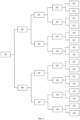
- the cascaded QMF includes a plurality of QMFs.
- Each QMF may partition the input audio data into two sets of audio data having different frequency ranges, and all frequencies of one set of audio data are higher than the frequencies of the other set of audio data. For example, if the frequency range of the audio data input into the QMF is 20 Hz-22050 Hz, the frequency ranges of two sets of obtained audio data are 20 Hz-11035 Hz and 11035 Hz-22050 Hz respectively.
- the cascaded QMF includes (the preset number - 1) QMFs. For example, as shown in FIG. 2 , if the preset number is 32, 31 QMFs are required.
- the target audio data with the frequency range of 20 Hz-22050 Hz may be input into the first QMF and thus two sets of audio data with the frequency ranges of 20 Hz-11035 Hz and 11035 Hz-22050 Hz respectively of the frequency sub-bands are obtained. Subsequently, the two sets of audio data with the frequency ranges of 20 Hz-11035 Hz and 11035 Hz-22050 Hz respectively are equally partitioned, such that audio data of the preset number of frequency sub-bands is obtained.
- the acquired left-channel audio data and the acquired right-channel audio data may be windowed, and the corresponding processing of step 103 may be as follows.
- the left-channel audio data is windowed to obtain windowed left-channel audio data and the right-channel audio data is windowed to obtain windowed right-channel audio data; and polyphase filtering is performed on the windowed left-channel audio data to partition the windowed left-channel audio data into the preset number of frequency sub-bands; and polyphase filtering is performed on the windowed right-channel audio data to partition the windowed right-channel audio data into the preset number of frequency sub-bands.
- the preset window function may be pre-stored in the terminal.
- different interception functions may be used to cut off a signal.
- the interception function is called a window function, such as the Hamming window function, the Hann window function or the like.
- the Hamming window function is also a type of cosine window function and also called an improved raised cosine window function.
- the embodiment of the present disclosure is illustrated by taking the window function as the Hamming window function.
- the window length of the preset window function may be equal to the first preset value in step 101.
- the terminal may acquire the preset window function and then window the cached left-channel audio data to obtain the windowed left-channel audio data.
- the terminal may window the cached right-channel audio data with the preset window function to obtain the windowed right-channel audio data.
- the windowed left-channel audio data acquired in step 101 is X1 and the window function is W
- the windowed left-channel audio data is X1*W
- the windowed right-channel audio data acquired in step 102 is X2 and the window function is W
- the windowed right-channel audio data is X2*W.
- the terminal may perform polyphase filtering on the left-channel audio data with the cascaded QMF to partition the windowed left-channel audio data into the preset number of frequency sub-bands; and may perform polyphase filtering on the right-channel audio data with the cascaded QMF to partition the windowed right-channel audio data into the preset number of frequency sub-bands.
- step 104 according to left-channel calibration parameter values corresponding to the preset number of frequency sub-bands respectively, the left-channel audio data partitioned into the preset number of frequency sub-bands is synthesized to obtain left-channel audio data to be played, and according to right-channel calibration parameter values corresponding to the preset number of frequency sub-bands respectively, the right-channel audio data partitioned into the preset number of frequency sub-bands is synthesized to obtain right-channel audio data to be played.
- the terminal pre-stores the left-channel calibration parameter value and the right-channel calibration parameter value which correspond to each frequency sub-band.
- the terminal may acquire the pre-stored left-channel calibration parameter value and the pre-stored right-channel calibration parameter value which correspond to each frequency sub-band.
- the terminal may synthesize, according to left-channel calibration parameter values corresponding to the frequency sub-bands respectively, the left-channel audio data partitioned into the preset number of frequency sub-bands to obtain left-channel audio data to be played, and may synthesize, according to right-channel calibration parameter values corresponding to the frequency sub-bands respectively, the right-channel audio data partitioned into the preset number of frequency sub-bands to obtain right-channel audio data to be played.
- the left-channel audio data to be played and the right-channel audio data to be played may be determined based on a multiplication mode, and the corresponding processing of step 104 may be as follows.
- the left-channel calibration parameter value corresponding to the frequency sub-band is multiplied by the left-channel audio data partitioned into the frequency sub-band to obtain calibrated left-channel audio data at the frequency sub-band
- the right-channel calibration parameter value corresponding to the frequency sub-band is multiplied by the right-channel audio data partitioned into the frequency sub-band to obtain calibrated right-channel audio data at the frequency sub-band
- the calibrated left-channel audio data at the preset number of frequency sub-bands is synthesized to obtain left-channel audio data to be played
- the calibrated right-channel audio data at the preset number of frequency sub-bands is synthesized to obtain right-channel audio data to be played.
- the terminal may acquire the left-channel calibration parameter value corresponding to the frequency sub-band and may acquire the right-channel calibration parameter value corresponding to the frequency sub-band; and then multiply the left-channel audio data partitioned into the frequency sub-band by the acquired left-channel calibration parameter value to obtain the calibrated left-channel audio data at the frequency sub-band, and multiply the right-channel audio data partitioned into the frequency sub-band by the acquired right-channel calibration parameter value to obtain calibrated right-channel audio data at the frequency sub-band.
- the terminal performs synthesis (which may also be called audio mixing processing) on calibrated left-channel audio data at the preset number of frequency sub-bands to obtain left-channel audio data to be played, and performs synthesis on the calibrated right-channel audio data at the preset number of frequency sub-bands to obtain right-channel audio data to be played.
- synthesis which may also be called audio mixing processing
- the preset number is 32
- the left-channel audio data at the preset number of audio sub-bands is represented by SUBBAND1(n), where n represents any frequency sub-band and is greater than or equal to 1 and less than or equal to 32.
- the audio data is windowed.
- the audio data should also be inversely windowed and the corresponding processing of step 104 may be as follows.
- the windowed left-channel audio data partitioned into the preset number of frequency sub-bands is synthesized to obtain synthesized left-channel audio data, and based on a preset inverse window function, the synthesized left-channel audio data is inversely windowed to obtain left-channel audio data to be played; and according to right-channel calibration parameter values corresponding to the preset number of frequency sub-bands respectively, the windowed right-channel audio data partitioned into the preset number of frequency sub-bands is synthesized to obtain synthesized right-channel audio data, and based on the preset inverse window function, the synthesized right-channel audio data is inversely windowed to obtain right-channel audio data to be played.
- the inverse window function may be preset and stored in the terminal and corresponds to the foregoing window function. If the window function is the Hamming window function, the inverse window function is the inverse Hamming window function. The window function is formulated as W and the inverse window function is formulated as IW.
- the terminal may acquire the left-channel calibration parameter value corresponding to the frequency sub-band and may acquire the right-channel calibration parameter value corresponding to the frequency sub-band; and then multiply the windowed left-channel audio data partitioned into the frequency sub-band by the acquired left-channel calibration parameter value to obtain the calibrated left-channel audio data at the frequency sub-band, and multiply the windowed right-channel audio data partitioned into the frequency sub-band by the acquired right-channel calibration parameter value to obtain calibrated right-channel audio data at the frequency sub-band.
- the terminal performs synthesis (which may also be called audio mixing processing) on calibrated left-channel audio data at the preset number of frequency sub-bands to obtain synthesized left-channel audio data, and inversely window the synthesized left-channel audio data based on the preset inverse window function to obtain the left-channel audio data to be played; and performs synthesis (which may also be called audio mixing processing) on calibrated right-channel audio data at the preset number of frequency sub-bands to obtain synthesized right-channel audio data, and inversely window the synthesized right-channel audio data based on the preset inverse window function to obtain the right-channel audio data to be played.
- synthesis which may also be called audio mixing processing
- the synthesized right-channel audio data is Y2 and the inverse window function may be IW
- the synthesized left-channel audio data and the synthesized right-channel audio data may further be adjusted and the corresponding processing may be as follows.
- the left-channel audio data partitioned into the preset number of frequency sub-bands is synthesized to obtain synthesized left-channel audio data, and multiplying left-channel calibration parameter values corresponding to a third preset frequency range by the synthesized left-channel audio data to obtain the left-channel audio data to be played; and according to right-channel calibration parameter values corresponding to the preset number of frequency sub-bands respectively, the right-channel audio data partitioned into the preset number of frequency sub-bands is synthesized to obtain synthesized right-channel audio data, and multiplying right-channel calibration parameter values corresponding to the third preset frequency range by the synthesized right-channel audio data to obtain the right-channel audio data to be played.
- the third preset frequency range may be preset and stored in the terminal, and may be obtained by merging a first preset frequency range and a second preset frequency range which are mentioned below.
- the third preset frequency range is 20 Hz-22050 Hz.
- the terminal may acquire the left-channel calibration parameter value corresponding to the frequency sub-band and the right-channel calibration parameter value corresponding to the frequency sub-band; and multiply the left-channel audio data partitioned into the frequency sub-band by the acquired left-channel calibration parameter value to obtain the calibrated left-channel audio data at the frequency sub-band, and multiply the right-channel audio data partitioned into the frequency sub-band by the acquired right-channel calibration parameter value to obtain calibrated right-channel audio data at the frequency sub-band.
- the terminal performs synthesis (which may also be called audio mixing processing) on calibrated left-channel audio data at the preset number of frequency sub-bands to obtain synthesized left-channel audio data, and multiplies the synthesized left-channel audio data by the left-channel calibration parameter values corresponding to the third preset frequency range to obtain the left-channel audio data to be played; and performs synthesis (which may also be called audio mixing processing) on calibrated right-channel audio data at the preset number of frequency sub-bands to obtain synthesized right-channel audio data, and multiplies the synthesized right-channel audio data by the right-channel calibration parameter values corresponding to the third preset frequency range to obtain the right-channel audio data to be played.
- synthesis which may also be called audio mixing processing
- the synthesized left-channel audio data is calibrated with the left-channel calibration parameter values corresponding to the third preset frequency range and the synthesized right-channel audio data is calibrated with the right-channel calibration parameter values corresponding to the third preset frequency range. Since the third preset frequency range corresponds to the frequency range of the synthesized left-channel audio data and the frequency range of the synthesized right-channel audio data, the balance between the left channel and the right channel may be adjusted better by using the left-channel calibration parameter values and the right-channel calibration parameter values which all correspond to the third preset frequency range for comprehensive calibration again.
- the mode for determining the right-channel calibration parameter values and the left-channel calibration parameter values which all correspond to the third preset frequency range, is the same as the mode for determining the right-channel calibration parameter values and the left-channel calibration parameter values, which all correspond to the first preset frequency range latter and will be described later.
- step 105 the left-channel audio data to be played is played over the left channel, and the right-channel audio data to be played is played over the right channel.
- the terminal may play, over the left channel of the player, the left-channel audio data to be played and at the same play, over the right channel of the player, the right-channel audio data to be played.
- the left-channel audio data to be played and the right-channel audio data to be played are adjusted with the calibration parameter values, the balance between the left channel and the right channel may be kept better and thus the user may hear the stereo audio with the best effect.
- the method for determining the left-channel calibration parameter value and the right-channel calibration parameter value is also given and the corresponding processing is as follows.
- First preset audio data in a first preset frequency range is played over the left channel and the right channel simultaneously, and an adjustment slider of an adjustment parameter is displayed, wherein the first preset audio data is single-channel audio data.
- a determining instruction corresponding to the adjustment slider is detected, a left-channel adjustment parameter value and a right-channel adjustment parameter value which correspond to the first preset frequency range are determined according to a position of an adjustment pointer on the adjustment slider.
- a left-channel calibration parameter value and a right-channel calibration parameter value which correspond to the first frequency sub-band are determined according to a left-channel adjustment coefficient and a right-channel adjustment coefficient which correspond to the first frequency sub-band, and the left-channel adjustment parameter value and the right-channel adjustment parameter value which correspond to the first preset frequency range.
- the first preset frequency range may be a fundamental-tone frequency range, such as 20 Hz-689 Hz.
- the first preset audio data may be preset, and is any audio data and single-channel audio data.
- the user when opening the audio application for listening to the target audio, the user may open set options having a balance adjustment option, and click on the balance adjustment option, and the terminal will detect a clicking instruction of the balance adjustment option.
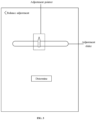
- the terminal may display a balance adjustment interface and plays first preset audio data in the first preset frequency range.
- a slider and a determination button are displayed in the balance adjustment interface.
- the user may determine whether the left channel and the right channel are balanced by listening to the first preset audio data. If feeling unbalanced, the user may drag the adjustment pointer on the slider until the user feels that the sounds of the left channel and the right channel are balanced.
- the user may click on the determination button displayed in the interface.
- the terminal will detect the clicking instruction of the determination button, that is, detect the determination button corresponding to the adjustment slider, and determine the position of the adjustment pointer on the adjustment slider.
- the terminal determines, according to the determined position, the left-channel adjustment parameter value and the right-channel adjustment parameter value which correspond to the first preset frequency range;
- the terminal acquires the pre-stored left-channel adjustment coefficient and the pre-stored right-channel adjustment coefficient which correspond to the first preset frequency range; multiplies the left-channel adjustment coefficient by the left-channel adjustment parameter value to obtain the left-channel calibration parameter value corresponding to the first preset frequency range, and multiplies the right-channel adjustment coefficient by the right-channel adjustment parameter value to obtain the right-channel calibration parameter value corresponding to the first preset frequency range.
- the terminal determines the left-channel calibration parameter value corresponding to the first preset frequency range as the left-channel calibration parameter value corresponding to the first frequency sub-band, and determines the right-channel calibration parameter value corresponding to the first preset frequency range as the right-channel calibration parameter value corresponding to the first frequency sub-band; and stores the left-channel calibration parameter value and the right-channel calibration parameter value. These two calibration parameter values may be used subsequently.
- the user may perform setting in the set options of the terminal, and the corresponding processing may be as follows.
- a sound option is set in the set options of the terminal.
- the user may trigger the display of an interface corresponding to the sound option, and a balance option of the audio is displayed in the interface.
- the user may control the terminal to display a balance adjustment interface by triggering this option.
- the terminal detects a triggering instruction of this option, the first preset audio data in the first preset frequency range may be played while the balance adjustment interface is displayed.
- the subsequent mode is consistent with the mode for setting in the audio application, and is not described repeatedly here.
- the solution for determining left-channel parameter values and right-channel parameter values of other frequency sub-bands, except the first frequency sub-band, in the preset number of frequency sub-bands is also provided and the corresponding processing may be as follows.
- Second preset audio data in a second preset frequency range is played over the left channel and the right channel simultaneously, and an adjustment slider of an adjustment parameter is displayed, wherein the second preset audio data is single-channel audio data; when a determining instruction corresponding to the adjustment slider is detected, a left-channel adjustment parameter value and a right-channel adjustment parameter value which correspond to the second preset frequency range are determined according to a position of an adjustment pointer on the adjustment slider; and for a second frequency sub-band in other frequency sub-bands, except the first frequency sub-band, in the preset number of frequency sub-bands, a left-channel calibration parameter value and a right-channel calibration parameter value which correspond to the second frequency sub-band are determined according to a left-channel adjustment coefficient and a right-channel adjustment coefficient which correspond to the second frequency sub-band, and the left-channel adjustment parameter value and the right-channel adjustment parameter value which correspond to the second preset frequency range.
- the second preset frequency range may be an overtone frequency range, such as 690 Hz-22050 Hz.
- the second preset audio data may be preset, and is any audio data and single-channel audio data.
- the terminal may play the second preset audio data in the second preset frequency range.
- the user may determine whether the left channel and the right channel are balanced by listening to the second preset audio data. If feeling unbalanced, the user may drag an adjustment pointer on the slider until the user feels that the sounds of the left channel and the right channel are balanced.
- the user may click on the determination button displayed in the interface.
- the terminal may detect the clicking instruction of the determination button, that is, detect the determination button corresponding to the adjustment slider, and determine the position of the adjustment pointer on the adjustment slider.
- the terminal determines, according to the determined position, a left-channel adjustment parameter value and a right-channel adjustment parameter value which correspond to the second preset frequency range.
- the terminal may acquire a pre-stored left-channel adjustment coefficient and a pre-stored right-channel adjustment coefficient which correspond to the second frequency sub-band; and then determine a left-channel calibration parameter value and a right-channel calibration parameter value which correspond to the second frequency sub-band, according to the left-channel adjustment coefficient and the right-channel adjustment coefficient which correspond to the second frequency sub-band, and the left-channel adjustment parameter value and the right-channel adjustment parameter value which correspond to the second preset frequency range.
- the left-channel calibration parameter values and the right-channel calibration parameter values of the preset number of frequency sub-bands may be determined.
- the left-channel calibration parameter value and the right-channel calibration parameter value are stored and these two parameter values may be used subsequently.
- the user may perform setting in the set options of the terminal, and the corresponding processing may be as follows.
- a sound option is set in the set options of the terminal.
- the user may trigger the display of an interface corresponding to the sound option, and a balance option of the audio is displayed in the interface.
- the user may control the terminal to display a balance adjustment interface by triggering this option.
- the terminal detects a triggering instruction of this option, the second preset audio data in the second preset frequency range may be played while the balance adjustment interface is displayed.
- the subsequent mode is consistent with the mode for setting in the audio application, and is not described repeatedly here.
- the range of the above adjustment slider may be [-100, +100].
- the minimum movement length of the adjustment pointer is at least 1, that is, the adjustment pointer at least moves from-100 to - 99, other than -9.55.
- Each value from -100 to +100 may be split into a left-channel adjustment parameter value and a right-channel adjustment parameter value.
- -100 may be split into [100, 0] 100 represents the left-channel adjustment parameter value and 0 represents the right-channel adjustment parameter value.
- -50 may be split into [100, 50]
- 100 represents the left-channel adjustment parameter value and 50 represents the right-channel adjustment parameter value.
- the left-channel adjustment parameter value and the right-channel adjustment parameter value may be determined as long as the current position of the adjustment pointer is known.
- the first frequency range corresponds to the fundamental-tone frequency range and the second frequency range corresponds to the overtone frequency range.
- Most users have different perception abilities to the fundamental tone and the overtone, such that the left-channel calibration parameter value and the right-channel calibration parameter value which correspond to the fundamental tone, and the left-channel calibration parameter value and the right-channel calibration parameter value which correspond to the overtone need to be determined respectively, that is, the left-channel calibration parameter value and the right-channel calibration parameter value which correspond to the first frequency sub-band, and the left-channel calibration parameter value and the right-channel calibration parameter value which correspond to the other frequency sub-band except the first frequency sub-band are determined respectively. As such, the determined left-channel calibration parameter value and right-channel calibration parameter value are more accurate.
- the following mode may be used to determine the left-channel calibration parameter value and the right-channel calibration parameter value which correspond to the second frequency sub-band, and the corresponding processing may be as follows.
- the left-channel adjustment coefficient corresponding to the second frequency sub-band is multiplied by the left-channel adjustment parameter value corresponding to the second preset frequency range to obtain the left-channel calibration parameter value corresponding to the second frequency sub-band
- the right-channel adjustment coefficient corresponding to the second frequency sub-band is multiplied by the right-channel adjustment parameter value corresponding to the second preset frequency range to obtain the right-channel calibration parameter value corresponding to the second frequency sub-band.
- the terminal multiplies the left-channel adjustment coefficient of the second frequency sub-band by the left-channel adjustment parameter value corresponding to the second preset frequency range to obtain the left-channel calibration parameter value corresponding to the second frequency sub-band, and multiplies the right-channel adjustment coefficient of the second frequency sub-band by the right-channel adjustment parameter value corresponding to the second preset frequency range to obtain the right-channel calibration parameter value corresponding to the second frequency sub-band.
- third preset audio data in the third preset frequency range is used only.
- the user performs adjustment based on the third preset audio data heard, and uses a left-channel adjustment coefficient and a right-channel adjustment coefficient which correspond to the third preset frequency range, during calculation later, and the remaining process is the same as the process for determining the left-channel calibration parameter value and the right-channel calibration parameter value which correspond to the first preset frequency range, and is not described repeatedly here.
- left-channel adjustment coefficients and right-channel adjustment coefficients of respective frequency sub-bands are also given when the sampling frequency of the audio is 44.1 KHz and the preset number is 32, as shown in Table 1.
- Table 1 N Left-channel adjustment coefficient Right-channel adjustment coefficient 1 1.0 1.0 2 1.0 1.0 3 1.0 1.0 4 0.989 1.011 5 0.978 1.022 6 0.967 1.033 7 0.846 1.154 8 1.154 0.846 9 1.033 0.967 10 1.022 0.978 11 1.011 0.989 12 0.877 1.123 13 0.877 1.123 14 0.877 1.123 15 0.877 1.123 16 1.123 0.877 17 1.123 0.877 18 1.123 0.877 19 1.123 0.877 20 0.941 1.059 21 0.904 1.096 22 0.867 1.133 23 0.83 1.17 24 1.17 0.83 25 1.133 0.867 26 1.096 0.904 27 1.059 0.941 28 1.0 1.0 29 0.9999 0.9999 30 0.999 0.999 31 0.99 0.99 32 0.9
- N denotes the number of the frequency sub-band
- each frequency sub-band corresponds to one frequency range and there is no crossover frequency range.
- the difference between endpoint values of the frequency range corresponding to each frequency sub-band is approximately equal to 689 Hz (the second preset value is 689 Hz).
- the sampling frequency is 88.2 KHz, the frequency range is 0-44100 Hz.
- the left-channel calibration parameter values and the right-channel calibration parameter values of the above 32 frequency sub-bands may be used to adjust audio data with the frequency range of 0-22050 Hz only; and since the audio data with the frequency range of 22061 Hz-44100 Hz cannot be heard by the user, it does not matter if it is not adjusted.
- the sampling frequency is 22.05 KHz
- the frequency range is 0-11025 Hz.
- the left-channel calibration parameter values and the right-channel calibration parameter values of the first 16 frequency sub-bands in 32 frequency sub-bands may be used only to adjust audio data with the frequency range of 0-11025 Hz.
- the mode of playing the currently-cached left-channel audio data and the currently-cached right-channel audio data is only described, and the above processing is performed when the left-channel audio data and the right-channel audio data each are cached to the data amount equal to the first preset value each time. As such, it may be determined that the balance between the left channel and the right channel is adjusted for all the left-channel audio data and right-channel audio data in the target audio, and thus the user may hear the stereo audio with the best effect.
- the user determines, by listening to the audio in advance, the left-channel calibration parameter value and the right-channel calibration parameter value of each frequency sub-band, which satisfy user's requirements, and subsequently, directly uses these two calibration parameter values for adjustment, such that the user may hear the audio data that the user feels that the left channel and the right channel is balanced.
- the audio data of the different frequency sub-bands is adjusted based on the calibration parameter values corresponding to different frequency sub-bands, such that the user may hear sounds to which, the user are not sensitive.
- the left ear is sensitive to guitar sounds, but not sensitive to piano sounds.
- the volume of the piano sounds may become a little higher without changing other sounds at other frequencies of the left channel.
- volume of the left channel and the right channel of a playing device are adjusted to maintain the balance between the left channel and the right channel.
- the audio is partitioned into a plurality of frequency sub-bands, and based on the left-channel calibration parameter values and the right-channel calibration parameter values of the different frequency sub-bands, the left-channel audio data at the respective frequency sub-bands and the right-channel audio data at the respective frequency sub-bands are respectively calibrated; and compared with the method which only adjusts the volume in the related art, the method for adjusting the balance between the left channel and the right channel is provided, which may better adjust the balance between the left channel and the right channel, and thus achieve a better audio data playing effect.
- the embodiment of the present disclosure further provides an apparatus for playing audio data.
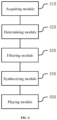
- the apparatus includes:
- the acquiring module 410 is configured to:
- the filtering module 430 is configured to:
- the synthesizing module 440 is configured to:
- the playing module 450 is further configured to: play first preset audio data in a first preset frequency range over the left channel and the right channel simultaneously.
- the apparatus further includes:
- the playing module 450 is further configured to:
- the determining module 420 is further configured to: multiply the left-channel adjustment coefficient corresponding to the second frequency sub-band by the left-channel adjustment parameter value corresponding to the second preset frequency range to obtain the left-channel calibration parameter value corresponding to the second frequency sub-band, and multiply the right-channel adjustment coefficient corresponding to the second frequency sub-band by the right-channel adjustment parameter value corresponding to the second preset frequency range to obtain the right-channel calibration parameter value corresponding to the second frequency sub-band.
- the synthesizing module 440 is configured to: synthesize, according to the left-channel calibration parameter values corresponding to the preset number of frequency sub-bands respectively, the left-channel audio data partitioned into the preset number of frequency sub-bands, to obtain synthesized left-channel audio data, and multiply left-channel calibration parameter values corresponding to a third preset frequency range by the synthesized left-channel audio data to obtain the left-channel audio data to be played; and synthesize, according to the right-channel calibration parameter values corresponding to the preset number of frequency sub-bands respectively, the right-channel audio data partitioned into the preset number of frequency sub-bands, to obtain synthesized right-channel audio data and multiply right-channel calibration parameter values corresponding to the third preset frequency range by the synthesized right-channel audio data to obtain the right-channel audio data to be played.
- the first preset frequency range is a fundamental-tone frequency range
- the second preset frequency range is an overtone frequency range.
- the third preset frequency range is obtained by merging the fundamental-tone frequency range and the overtone frequency range.
- the preset number of frequency sub-bands are partitioned according to the fact that the difference between endpoint values of the frequency range corresponding to each frequency sub-band is a second preset value.
- the audio is partitioned into a plurality of frequency sub-bands, and based on the left-channel calibration parameter values and the right-channel calibration parameter values of the different frequency sub-bands, the left-channel audio data at the respective frequency sub-bands and the right-channel audio data at the respective frequency sub-bands are respectively calibrated; and compared with the method which only adjusts the volume in the related art, the method for adjusting the balance between the left channel and the right channel is provided, which may better adjust the balance between the left channel and the right channel, and thus achieve a better audio data playing effect.
- the apparatus for playing audio data according to the above embodiment is only illustrated by the division of various functional modules when playing audio data.
- the above functions may be assigned to be implemented by different functional modules according to needs. That is, the internal structure of the apparatus is partitioned into different functional modules to implement all or a part of the functions described above.
- the apparatus for playing audio data according to the above embodiment and the method for playing audio data are based on the same inventive concept, and the specific implementation process of the apparatus is detailed in the method embodiment and is thus not repeatedly described herein.
- FIG. 6 is a structural block diagram of a terminal 600 according to an exemplary embodiment of the present disclosure.
- the terminal 600 may be a smart phone, a tablet computer, a Moving Picture Experts Group Audio Layer III (MP3) player, a Moving Picture Experts Group Audio Layer IV (MP4) player, or a laptop or desktop computer.
- MP3 Moving Picture Experts Group Audio Layer III
- MP4 Moving Picture Experts Group Audio Layer IV
- the terminal 600 may also be referred to as a user equipment, a portable terminal, a laptop terminal, a desktop terminal, or the like
- the terminal 600 includes a processor 601 and a memory 602.
- the processor 601 may include one or more processing cores, such as a 4-core processor, an 8-core processor, or the like.
- the processor 601 may be practiced by using at least one of hardware forms in a digital signal processor (DSP), a field-programmable gate array (FPGA) and a programmable logic array (PLA).
- DSP digital signal processor
- FPGA field-programmable gate array
- PDA programmable logic array
- the processor 601 may also include a main processor and a co-processor.
- the main processor is a processor for processing data in an awaken state, and is also called as a central processing unit (CPU).
- the co-processor is a low-power processor for processing data in a standby state.
- the processor 601 may be integrated with a graphics processing unit (GPU) which is responsible for rendering and drawing of content required to be displayed by a display.
- the processor 601 may also include an artificial intelligence (AI) processor for processing a calculation operation related to machine learning.
- AI artificial
- the memory 602 may include one or more computer-readable storage media which may be non-transitory.
- the memory 602 may also include a high-speed random-access memory, as well as a non-volatile memory, such as one or more disk storage devices and flash storage devices.
- the non-transitory computer-readable storage medium in the memory 602 is configured to store at least one instruction which is executable by the processor 601 to implement the method for determining the karaoke singing score according to the embodiments of the present disclosure.
- the terminal 600 may optionally include a peripheral device interface 603 and at least one peripheral device.
- the processor 601, the memory 602 and the peripheral device interface 603 may be connected to each other via a bus or a signal line.
- the at least one peripheral device may be connected to the peripheral device interface 603 via a bus, a signal line or a circuit board.
- the peripheral device includes at least one of a radio frequency circuit 604, a touch display screen 605, a camera assembly 606, an audio circuit 607, a positioning assembly 608 and a power source 609.
- the peripheral device interface 603 may be configured to connect the at least one peripheral device related to input/output (I/O) to the processor 601 and the memory 602.
- the processor 601, the memory 602 and the peripheral device interface 603 are integrated on the same chip or circuit board.
- any one or two of the processor 601, the memory 602 and the peripheral device interface 603 may be practiced on a separate chip or circuit board, which is not limited in this embodiment.
- the radio frequency circuit 604 is configured to receive and transmit a radio frequency (RF) signal, which is also referred to as an electromagnetic signal.
- the radio frequency circuit 604 communicates with a communication network or another communication device via the electromagnetic signal.
- the radio frequency circuit 604 converts an electrical signal to an electromagnetic signal and sends the signal, or converts a received electromagnetic signal to an electrical signal.
- the radio frequency circuit 604 includes an antenna system, an RF transceiver, one or a plurality of amplifiers, a tuner, an oscillator, a digital signal processor, a codec chip set, a subscriber identification module card or the like.
- the radio frequency circuit 604 may communicate with another terminal based on a wireless communication protocol.
- the wireless communication protocol includes, but not limited to: a metropolitan area network, generations of mobile communication networks (including 2G, 3G, 4G and 5G), a wireless local area network and/or a wireless fidelity (WiFi) network.
- the radio frequency circuit 504 may further include a near field communication (NFC)-related circuits, which is not limited in the present disclosure.
- NFC near field communication
- the display screen 605 may be configured to display a user interface (UI).
- the UE may include graphics, texts, icons, videos and any combination thereof.
- the display screen 605 may further have the capability of acquiring a touch signal on a surface of the display screen 605 or above the surface of the display screen 605.
- the touch signal may be input to the processor 601 as a control signal, and further processed therein.
- the display screen 605 may be further configured to provide a virtual button and/or a virtual keyboard or keypad, also referred to as a soft button and/or a soft keyboard or keypad.
- one display screen 605 may be provided, which is arranged on a front panel of the terminal 600.
- the display screen 605 may be a flexible display screen, which is arranged on a bent surface or a folded surface of the terminal 600. Even, the display screen 605 may be further arranged to an irregular pattern which is non-rectangular, that is, a specially-shaped screen.
- the display screen 605 may be fabricated from such materials as a liquid crystal display (LCD), an organic light-emitting diode (OLED) and the like.
- the camera assembly 606 is configured to capture an image or a video.
- the camera assembly 606 includes a front camera and a rear camera.
- the front camera is arranged on a front panel of the terminal
- the rear camera is arranged on a rear panel of the terminal.
- at least two rear cameras are arranged, which are respectively any one of a primary camera, a depth of field (DOF) camera, a wide-angle camera and a long-focus camera, such that the primary camera and the DOF camera are fused to implement the background virtualization function, and the primary camera and the wide-angle camera are fused to implement the panorama photographing and virtual reality (VR) photographing functions or other fused photographing functions.
- DOF depth of field
- VR virtual reality
- the camera assembly 606 may further include a flash.
- the flash may be a single-color temperature flash or a double-color temperature flash.
- the double-color temperature flash refers to a combination of a warm-light flash and a cold-light flash, which may be used for light compensation under different color temperatures.
- the audio circuit 607 may include a microphone and a speaker.
- the microphone is configured to capture an acoustic wave of a user and an environment, and convert the acoustic wave to an electrical signal and output the electrical signal to the processor 601 for further processing, or output to the radio frequency circuit 504 to implement voice communication.
- a plurality of such microphones may be provided, which are respectively arranged at different positions of the terminal 600.
- the microphone may also be a microphone array or an omnidirectional capturing microphone.
- the speaker is configured to convert an electrical signal from the processor 601 or the radio frequency circuit 604 to an acoustic wave.
- the speaker may be a traditional thin-film speaker, or may be a piezoelectric ceramic speaker.
- an electrical signal may be converted to an acoustic wave audible by human beings, or an electrical signal may be converted to an acoustic wave inaudible by human beings for the purpose of ranging or the like.
- the audio circuit 607 may further include a headphone plug.
- the positioning assembly 608 is configured to determine a current geographical position of the terminal 600 to implement navigation or a local based service (LBS).
- the positioning assembly 608 may be the global positioning system (GPS) from the United States, the Beidou positioning system from China, the Grenas satellite positioning system from Russia or the Galileo satellite navigation system from the European Union.
- GPS global positioning system
- Beidou positioning system from China
- Grenas satellite positioning system from Russia
- Galileo satellite navigation system from the European Union.
- the power source 609 is configured to supply power for the components in the terminal 600.
- the power source 609 may be an alternating current, a direct current, a disposable battery or a rechargeable battery.
- the rechargeable battery may support wired charging or wireless charging.
- the rechargeable battery may also support the supercharging technology.
- the terminal may further include one or a plurality of sensors 610.
- the one or plurality of sensors 610 include, but not limited to: an acceleration sensor 611, a gyroscope sensor 612, a pressure sensor 613, a fingerprint sensor 614, an optical sensor 615 and a proximity sensor 616.
- the acceleration sensor 611 may detect accelerations on three coordinate axes in a coordinate system established for the terminal 600.
- the acceleration sensor 611 may be configured to detect components of a gravity acceleration on the three coordinate axes.
- the processor 601 may control the touch display screen 605 to display the user interface in a horizontal view or a longitudinal view based on a gravity acceleration signal acquired by the acceleration sensor 611.
- the acceleration sensor 611 may be further configured to acquire motion data of a game or a user.
- the gyroscope sensor 612 may detect a direction and a rotation angle of the terminal 600, and the gyroscope sensor 612 may collaborate with the acceleration sensor 611 to capture a 3D action performed by the user for the terminal 600.
- the processor 601 may implement the following functions: action sensing (for example, modifying the UE based on an inclination operation of the user), image stabilization during the photographing, game control and inertial navigation.
- the force sensor 613 may be arranged on a side frame of the terminal and/or on a lowermost layer of the touch display screen 605.
- a grip signal of the user against the terminal 600 may be detected, and the processor 601 implements left or right hand identification or perform a shortcut operation based on the grip signal acquired by the force sensor 613.
- the processor 601 implement control of an operable control on the UI based on a force operation of the user against the touch display screen 605.
- the operable control includes at least one of a button control, a scroll bar control, an icon control, and a menu control.
- the fingerprint sensor 614 is configured to acquire fingerprints of the user, and the processor 601 determines the identity of the user based on the fingerprints acquired by the fingerprint sensor 614, or the fingerprint sensor 614 determines the identity of the user based on the acquired fingerprints. When it is determined that the identify of the user is trustable, the processor 601 authorizes the user to perform related sensitive operations, wherein the sensitive operations include unlocking the screen, checking encrypted information, downloading software, paying and modifying settings and the like.
- the fingerprint sensor 614 may be arranged on a front face a back face or a side face of the terminal 600. When the terminal 600 is provided with a physical key or a manufacturer's logo, the fingerprint sensor 614 may be integrated with the physical key or the manufacturer's logo.
- the optical sensor 615 is configured to acquire the intensity of ambient light.
- the processor 601 may control a display luminance of the touch display screen 605 based on the intensity of ambient light acquired by the optical sensor 615. Specifically, when the intensity of ambient light is high, the display luminance of the touch display screen 605 is up-shifted; and when the intensity of ambient light is low, the display luminance of the touch display screen 605 is down-shifted.
- the processor 601 may further dynamically adjust photographing parameters of the camera assembly 506 based on the intensity of ambient light acquired by the optical sensor.
- the proximity sensor 616 also referred to as a distance sensor, is generally arranged on the front panel of the terminal 600.
- the proximity sensor 616 is configured to acquire a distance between the user and the front face of the terminal 600.
- the processor 601 controls the touch display screen 605 to switch from an active state to a rest state; and when the proximity sensor 616 detects that the distance between the user and the front face of the terminal 600 gradually increases, the processor 601 controls the touch display screen 605 to switch from the rest state to the active state.
- the terminal may include more components over those illustrated in FIG. 6 , or combinations of some components, or employ different component deployments.
Landscapes
- Engineering & Computer Science (AREA)
- Physics & Mathematics (AREA)
- Signal Processing (AREA)
- Acoustics & Sound (AREA)
- Multimedia (AREA)
- Human Computer Interaction (AREA)
- Audiology, Speech & Language Pathology (AREA)
- Health & Medical Sciences (AREA)
- Theoretical Computer Science (AREA)
- Spectroscopy & Molecular Physics (AREA)
- Computational Linguistics (AREA)
- General Health & Medical Sciences (AREA)
- General Engineering & Computer Science (AREA)
- General Physics & Mathematics (AREA)
- Computer Networks & Wireless Communication (AREA)
- Stereophonic System (AREA)
Claims (13)
- Ein Verfahren zum Abspielen von Audiodaten, das Folgendes umfasst:Erfassen (101) von Audiodaten des linken Kanals und Audiodaten des rechten Kanals von Ziel-Audio in einem Vorgang zum Abspielen des Ziel-Audios;Bestimmen (102) einer voreingestellten Anzahl von Frequenzunterbändern, die der Abtastfrequenz entsprechen, gemäß einer Abtastfrequenz des Ziel-Audios;Durchführen einer Mehrphasenfilterung (103) an den Audiodaten des linken Kanals, um die Audiodaten des linken Kanals in die voreingestellte Anzahl von Frequenzunterbändern aufzuteilen, und Durchführen einer Mehrphasenfilterung an den Audiodaten des rechten Kanals, um die Audiodaten des rechten Kanals in die voreingestellte Anzahl von Frequenzunterbändern aufzuteilen;Synthetisieren (104) der in die voreingestellte Anzahl von Frequenzunterbändern aufgeteilten Audiodaten des linken Kanals gemäß Kalibrierungsparameterwerten des linken Kanals, die jeweils der voreingestellten Anzahl von Frequenzunterbändern entsprechen, um wiederzugebende Audiodaten des linken Kanals zu erhalten, und Synthetisieren der in die voreingestellte Anzahl von Frequenzunterbändern aufgeteilten Audiodaten des rechten Kanals gemäß Kalibrierungsparameterwerten des rechten Kanals, die jeweils der voreingestellten Anzahl von Frequenzunterbändern entsprechen, um wiederzugebende Audiodaten des rechten Kanals zu erhalten; undWiedergeben (105) der wiederzugebenden Audiodaten des linken Kanals über einen linken Kanal und Wiedergeben über einen rechten Kanal, die abzuspielenden Audiodaten des rechten Kanals,wobei das Verfahren des Weiteren Folgendes umfasst:Abspielen von ersten voreingestellten Audiodaten in einem ersten voreingestellten Frequenzbereich über den linken und den rechten Kanal gleichzeitig und Anzeigen eines Einstellreglers für einen Einstellparameter, wobei die ersten voreingestellten Audiodaten einkanalige Audiodaten sind;Wenn eine Bestätigungsanweisung entsprechend dem Einstellregler erkannt wird, Bestimmen eines linken Kanal-Einstellparameterwerts und eines rechten Kanal-Einstellparameterwerts entsprechend einer Position eines Einstellzeigers auf dem Einstellregler, die dem ersten voreingestellten Frequenzbereich entsprechen; undfür ein erstes Frequenzunterband, dessen Frequenzbereich der erste voreingestellte Frequenzbereich in der voreingestellten Anzahl von Frequenzunterbändern ist,Bestimmen eines Kalibrierungsparameterwerts für den linken Kanal und eines Kalibrierungsparameterwerts für den rechten Kanal, die dem ersten Frequenzunterband entsprechen, gemäß einem Anpassungskoeffizienten für den linken Kanal und einem Anpassungskoeffizienten für den rechten Kanal, die dem ersten Frequenzunterband entsprechen, und dem Anpassungsparameterwert für den linken Kanal und dem Anpassungsparameterwert für den rechten Kanal, die dem ersten voreingestellten Frequenzbereich entsprechen, undwobei die Kalibrierungsparameterwerte des linken Kanals, die der voreingestellten Anzahl von Frequenzunterbändern entsprechen, den Kalibrierungsparameterwert des linken Kanals umfassen, der dem ersten Frequenzunterband entspricht, und die Kalibrierungsparameterwerte des rechten Kanals, die der voreingestellten Anzahl von Frequenzunterbändern entsprechen, den Kalibrierungsparameterwert des rechten Kanals umfassen, der dem ersten Frequenzunterband entspricht.
- Verfahren nach Anspruch 1, wobei das Erfassen (101) von Audiodaten des linken Kanals und von Audiodaten des rechten Kanals in dem Ziel-Audio Folgendes umfasst:Zwischenspeicherung der Audiodaten des linken und rechten Kanals im Ziel-Audio; undErfassen der aktuell zwischengespeicherten Audiodaten des linken Kanals und der aktuell zwischengespeicherten Audiodaten des rechten Kanals, wenn die Datenmenge der jeweils zwischengespeicherten Audiodaten des linken Kanals und der zwischengespeicherten Audiodaten des rechten Kanals im Ziel-Audio einen ersten voreingestellten Wert erreicht.
- Verfahren nach Anspruch 1 oder 2, wobei das Durchführen einer Mehrphasenfilterung (103) an den Audiodaten des linken Kanals, um die Audiodaten des linken Kanals in die voreingestellte Anzahl von Frequenzunterbändern zu unterteilen, und das Durchführen einer Mehrphasenfilterung an den Audiodaten des rechten Kanals, um die Audiodaten des rechten Kanals in die voreingestellte Anzahl von Frequenzunterbändern zu unterteilen, Folgendes umfasst:Unterteilen der Audiodaten des linken Kanals in Fenster, um gefensterte Audiodaten des linken Kanals zu erhalten, und Unterteilen der Audiodaten des rechten Kanals in Fenster, um gefensterte Audiodaten des rechten Kanals zu erhalten, basierend auf einer voreingestellten Fensterfunktion; und Durchführen einer Mehrphasenfilterung an den in Fenstern unterteilten Audiodaten des linken Kanals, um die in Fenstern unterteilten Audiodaten des linken Kanals in die voreingestellte Anzahl von Frequenzunterbändern zu unterteilen, und Durchführen einer Mehrphasenfilterung an den in Fenstern unterteilten Audiodaten des rechten Kanals, um die in Fenstern unterteilten Audiodaten des rechten Kanals in die voreingestellte Anzahl von Frequenzunterbändern zu unterteilen, undSynthetisieren der in die voreingestellte Anzahl von Frequenzunterbändern aufgeteilten Audiodaten des linken Kanals gemäß Kalibrierungsparameterwerten des linken Kanals, die jeweils der voreingestellten Anzahl von Frequenzunterbändern entsprechen, um wiederzugebende Audiodaten des linken Kanals zu erhalten, und Synthetisieren der in die voreingestellte Anzahl von Frequenzunterbändern aufgeteilten Audiodaten des rechten Kanals gemäß Kalibrierungsparameterwerten des rechten Kanals, die jeweils der voreingestellten Anzahl von Frequenzunterbändern entsprechen, um wiederzugebende Audiodaten des rechten Kanals zu erhalten:
Synthetisieren, gemäß den Kalibrierungsparameterwerten für den linken Kanal, die jeweils der voreingestellten Anzahl von Frequenzunterbändern entsprechen, der gefensterten Audiodaten des linken Kanals, die in die voreingestellte Anzahl von Frequenzunterbändern unterteilt sind, um synthetisierte Audiodaten des linken Kanals zu erhalten, und basierend auf einer voreingestellten inversen Fensterfunktion, inverses Unterteilen in Fenster der synthetisierten Audiodaten des linken Kanals, um die abzuspielenden Audiodaten des linken Kanals zu erhalten; und Synthetisieren der gefensterten Audiodaten des rechten Kanals, die in die voreingestellte Anzahl von Frequenzunterbändern unterteilt sind, gemäß den Kalibrierungsparameterwerten des rechten Kanals, die jeweils der voreingestellten Anzahl von Frequenzunterbändern entsprechen, um synthetisierte Audiodaten des rechten Kanals zu erhalten, und basierend auf der voreingestellten inversen Fensterfunktion, inverses Unterteilen in Fenster der synthetisierten Audiodaten des rechten Kanals, um die abzuspielenden Audiodaten des rechten Kanals zu erhalten. - Verfahren nach einem der Ansprüche 1 bis 3, wobei das Synthetisieren (104) gemäß den Kalibrierungsparameterwerten für den linken Kanal, die jeweils der voreingestellten Anzahl von Frequenzunterbändern entsprechen, der Audiodaten des linken Kanals, die in die voreingestellte Anzahl von Frequenzunterbändern unterteilt sind, um abzuspielende Audiodaten des linken Kanals zu erhalten, und das Synthetisieren gemäß den Kalibrierungsparameterwerten für den rechten Kanal, die jeweils der voreingestellten Anzahl von Frequenzunterbändern entsprechen, der Audiodaten des rechten Kanals, die in die voreingestellte Anzahl von Frequenzunterbändern unterteilt sind, um abzuspielende Audiodaten des rechten Kanals zu erhalten, Folgendes umfasst:
für jedes Frequenzunterband in der voreingestellten Anzahl von Frequenzunterbändern, Multiplizieren des Kalibrierungsparameterwertes für den linken Kanal, der dem Frequenzunterband entspricht, mit den Audiodaten des linken Kanals, die in das Frequenzunterband unterteilt sind, um kalibrierte Audiodaten des linken Kanals bei dem Frequenzunterband zu erhalten, und Multiplizieren des Kalibrierungsparameterwertes für den rechten Kanal, der dem Frequenzunterband entspricht, mit den Audiodaten des rechten Kanals, die in das Frequenzunterband unterteilt sind, um kalibrierte Audiodaten des rechten Kanals bei dem Frequenzunterband zu erhalten;
und Synthetisieren der kalibrierten Audiodaten des linken Kanals mit der voreingestellten Anzahl von Frequenzunterbändern, um die abzuspielenden Audiodaten des linken Kanals zu erhalten, und Synthetisieren der kalibrierten Audiodaten des rechten Kanals mit der voreingestellten Anzahl von Frequenzunterbändern, um die abzuspielenden Audiodaten des rechten Kanals zu erhalten. - Das Verfahren gemäß Anspruch 1, das des Weiteren Folgendes umfasst:gleichzeitiges Abspielen zweiter voreingestellter Audiodaten in einem zweiten voreingestellten Frequenzbereich über den linken Kanal und den rechten Kanal und Anzeigen eines zweiten Einstellreglers eines Einstellparameters, wobei die zweiten voreingestellten Audiodaten Einkanal-Audiodaten sind;wenn eine dem zweiten Einstellregler entsprechende Bestimmungsanweisung erkannt wird, Bestimmen eines Einstellparameterwerts für den linken Kanal und eines Einstellparameterwerts für den rechten Kanal, die dem zweiten voreingestellten Frequenzbereich entsprechen, gemäß einer Position eines Einstellzeigers auf dem zweiten Einstellregler; undfür ein zweites Frequenzunterband in anderen Frequenzunterbändern außer dem ersten Frequenzunterband in der voreingestellten Anzahl von Frequenzunterbändern, Bestimmen eines Kalibrierungsparameterwerts für den linken Kanal und eines Kalibrierungsparameterwerts für den rechten Kanal, die dem zweiten Frequenzunterband entsprechen, gemäß einem Anpassungskoeffizienten für den linken Kanal und einem Anpassungskoeffizienten für den rechten Kanal, die dem zweiten Frequenzunterband entsprechen, und dem Anpassungsparameterwert für den linken Kanal und dem Anpassungsparameterwert für den rechten Kanal, die dem zweiten voreingestellten Frequenzbereich entsprechen, wobei das zweite Frequenzunterband ein beliebiges Frequenzunterband in den anderen Frequenzunterbändern ist.
- Verfahren nach Anspruch 5, wobei das Bestimmen eines Kalibrierungsparameterwerts für den linken Kanal und eines Kalibrierungsparameterwerts für den rechten Kanal, die dem zweiten Frequenzteilband entsprechen, gemäß einem Anpassungskoeffizienten für den linken Kanal und einem Anpassungskoeffizienten für den rechten Kanal, die dem zweiten Frequenzteilband entsprechen, und dem Anpassungsparameterwert für den linken Kanal und dem Anpassungsparameterwert für den rechten Kanal, die dem zweiten voreingestellten Frequenzbereich entsprechen, Folgendes umfasst:
Multiplizieren des Anpassungskoeffizienten des linken Kanals, der dem zweiten Frequenzunterband entspricht, mit dem Anpassungsparameterwert des linken Kanals, der dem zweiten voreingestellten Frequenzbereich entspricht, um den Kalibrierungsparameterwert des linken Kanals zu erhalten, der dem zweiten Frequenzunterband entspricht, und Multiplizieren des Anpassungskoeffizienten des rechten Kanals, der dem zweiten Frequenzunterband entspricht, mit dem Anpassungsparameterwert des rechten Kanals, der dem zweiten voreingestellten Frequenzbereich entspricht, um den Kalibrierungsparameterwert des rechten Kanals zu erhalten, der dem zweiten Frequenzunterband entspricht. - Verfahren nach Anspruch 1, wobei das Synthetisieren (104) gemäß den Kalibrierungsparameterwerten des linken Kanals, die jeweils der voreingestellten Anzahl von Frequenzunterbändern entsprechen, die Audiodaten des linken Kanals, die in die voreingestellte Anzahl von Frequenzunterbändern unterteilt sind, um abzuspielende Audiodaten des linken Kanals zu erhalten, und das Synthetisieren gemäß den Kalibrierungsparameterwerten des rechten Kanals, die jeweils der voreingestellten Anzahl von Frequenzunterbändern entsprechen, die Audiodaten des rechten Kanals, die in die voreingestellte Anzahl von Frequenzunterbändern unterteilt sind, um abzuspielende Audiodaten des rechten Kanals zu erhalten, Folgendes umfasst:
Synthetisieren der in die voreingestellte Anzahl von Frequenzunterbändern aufgeteilten Audiodaten des linken Kanals gemäß den Kalibrierungsparameterwerten des linken Kanals, die jeweils der voreingestellten Anzahl von Frequenzunterbändern entsprechen, um synthetisierte Audiodaten des linken Kanals zu erhalten, und Multiplizieren der Kalibrierungsparameterwerte des linken Kanals, die einem dritten voreingestellten Frequenzbereich entsprechen, mit den synthetisierten Audiodaten des linken Kanals, um die wiederzugebenden Audiodaten des linken Kanals zu erhalten; und Synthetisieren der in die voreingestellte Anzahl von Frequenzunterbändern aufgeteilten Audiodaten des rechten Kanals gemäß den Kalibrierungsparameterwerten des rechten Kanals, die jeweils der voreingestellten Anzahl von Frequenzunterbändern entsprechen, um synthetisierte Audiodaten des rechten Kanals zu erhalten, und Multiplizieren der Kalibrierungsparameterwerte des rechten Kanals, die dem dritten voreingestellten Frequenzbereich entsprechen, mit den synthetisierten Audiodaten des rechten Kanals, um die wiederzugebenden Audiodaten des rechten Kanals zu erhalten. - Verfahren nach Anspruch 5, wobei der erste voreingestellte Frequenzbereich ein Grundtonfrequenzbereich ist und der zweite voreingestellte Frequenzbereich ein Obertonfrequenzbereich ist.
- Verfahren nach Anspruch 7, wobei der dritte voreingestellte Frequenzbereich durch das Zusammenführen eines Grundtonfrequenzbereichs und eines Obertonfrequenzbereichs erhalten wird.
- Ein Endgerät, das Folgendes umfasst: einen Prozessor, eine Anzeige und einen Speicher;
wobei der Speicher so konfiguriert ist, dass es mindestens eine Anweisung speichert;
Die mindestens eine Anweisung ist so konfiguriert, dass sie vom Prozessor ausgeführt wird, um die folgenden Vorgänge durchzuführen:Erfassen von Audiodaten des linken Kanals und des rechten Kanals des Ziel-Audios in einem Vorgang der Wiedergabe des Ziel-Audios;Bestimmen einer voreingestellten Anzahl von Frequenzunterbändern, die der Abtastfrequenz entsprechen, gemäß einer Abtastfrequenz des Ziel-Audios;Durchführen einer Mehrphasenfilterung an den Audiodaten des linken Kanals, um die Audiodaten des linken Kanals in die voreingestellte Anzahl von Frequenzunterbändern aufzuteilen, und Durchführen einer Mehrphasenfilterung an denAudiodaten des rechten Kanals, um die Audiodaten des rechten Kanals in die voreingestellte Anzahl von Frequenzunterbändern aufzuteilen;Synthetisieren der in die voreingestellte Anzahl von Frequenzunterbändern aufgeteilten Audiodaten des linken Kanals gemäß Kalibrierungsparameterwerten des linken Kanals, die jeweils der voreingestellten Anzahl von Frequenzunterbändern entsprechen, um wiederzugebende Audiodaten des linken Kanals zu erhalten, und Synthetisieren der in die voreingestellte Anzahl von Frequenzunterbändern aufgeteilten Audiodaten des rechten Kanals gemäß Kalibrierungsparameterwerten des rechten Kanals, die jeweils der voreingestellten Anzahl von Frequenzunterbändern entsprechen, um wiederzugebende Audiodaten des rechten Kanals zu erhalten; und Wiedergeben der wiederzugebenden Audiodaten des linken Kanals über einen linken Kanal und Wiedergeben der wiederzugebenden Audiodaten des rechten Kanals über einen rechten Kanal,wobei die mindestens eine Anweisung ferner so konfiguriert ist, dass sie vom Prozessor ausgeführt wird, was dazu führt, dass das Endgerät die folgenden Vorgänge durchführt:Abspielen von ersten voreingestellten Audiodaten in einem ersten voreingestellten Frequenzbereich über den linken und den rechten Kanal gleichzeitig und Anzeigen eines Einstellreglers für einen Einstellparameter, wobei die ersten voreingestellten Audiodaten einkanalige Audiodaten sind;Wenn eine Bestätigungsanweisung entsprechend dem Einstellregler erkannt wird, Bestimmen eines linken Kanal-Einstellparameterwerts und eines rechten Kanal-Einstellparameterwerts entsprechend einer Position eines Einstellzeigers auf dem Einstellregler, die dem ersten voreingestellten Frequenzbereich entsprechen; undfür ein erstes Frequenzunterband, dessen Frequenzbereich der erste voreingestellte Frequenzbereich in der voreingestellten Anzahl von Frequenzunterbändern ist, Bestimmen eines Kalibrierungsparameterwerts für den linken Kanal und eines Kalibrierungsparameterwerts für den rechten Kanal, die dem ersten Frequenzunterband entsprechen, gemäß einem Anpassungskoeffizienten für den linken Kanal und einem Anpassungskoeffizienten für den rechten Kanal, die dem ersten Frequenzunterband entsprechen, und dem Anpassungsparameterwert für den linken Kanal und dem Anpassungsparameterwert für den rechten Kanal, die dem ersten voreingestellten Frequenzbereich entsprechen, undwobei die Kalibrierungsparameterwerte des linken Kanals, die der voreingestellten Anzahl von Frequenzunterbändern entsprechen, den Kalibrierungsparameterwert des linken Kanals umfassen, der dem ersten Frequenzunterband entspricht, und die Kalibrierungsparameterwerte des rechten Kanals, die der voreingestellten Anzahl von Frequenzunterbändern entsprechen, den Kalibrierungsparameterwert des rechten Kanals umfassen, der dem ersten Frequenzunterband entspricht. - Endgerät nach Anspruch 10, wobei der mindestens ein Befehl ferner so konfiguriert ist, dass er vom Prozessor ausgeführt wird, um die folgenden Vorgänge durchzuführen:Unterteilen der Audiodaten des linken Kanals in Fenster, um gefensterte Audiodaten des linken Kanals zu erhalten, und Unterteilen der Audiodaten des rechten Kanals in Fenster, um gefensterte Audiodaten des rechten Kanals zu erhalten, basierend auf einer voreingestellten Fensterfunktion; und Durchführen einer Mehrphasenfilterung an den in Fenstern unterteilten Audiodaten des linken Kanals, um die in Fenstern unterteilten Audiodaten des linken Kanals in die voreingestellte Anzahl von Frequenzunterbändern zu unterteilen, und Durchführen einer Mehrphasenfilterung an den in Fenstern unterteilten Audiodaten des rechten Kanals, um die in Fenstern unterteilten Audiodaten des rechten Kanals in die voreingestellte Anzahl von Frequenzunterbändern zu unterteilen, undmindestens eine Anweisung ist weiterhin so konfiguriert, dass sie vom Prozessor ausgeführt wird, um die folgenden Vorgänge auszuführen:
Synthetisieren, gemäß den Kalibrierungsparameterwerten für den linken Kanal, die jeweils der voreingestellten Anzahl von Frequenzunterbändern entsprechen, der gefensterten Audiodaten des linken Kanals, die in die voreingestellte Anzahl von Frequenzunterbändern unterteilt sind, um synthetisierte Audiodaten des linken Kanals zu erhalten, und basierend auf einer voreingestellten inversen Fensterfunktion, inverses Unterteilen in Fenster der synthetisierten Audiodaten des linken Kanals, um die abzuspielenden Audiodaten des linken Kanals zu erhalten; und Synthetisieren der gefensterten Audiodaten des rechten Kanals, die in die voreingestellte Anzahl von Frequenzunterbändern unterteilt sind, gemäß den Kalibrierungsparameterwerten des rechten Kanals, die jeweils der voreingestellten Anzahl von Frequenzunterbändern entsprechen, um synthetisierte Audiodaten des rechten Kanals zu erhalten, und basierend auf der voreingestellten inversen Fensterfunktion, inverses Unterteilen in Fenster der synthetisierten Audiodaten des rechten Kanals, um die abzuspielenden Audiodaten des rechten Kanals zu erhalten. - Endgerät nach Anspruch 10 oder 11, wobei der mindestens ein Befehl ferner so konfiguriert ist, dass er vom Prozessor ausgeführt wird, um die folgenden Vorgänge durchzuführen:für jedes Frequenzunterband in der voreingestellten Anzahl von Frequenzunterbändern, Multiplizieren des Kalibrierungsparameterwertes für den linken Kanal, der dem Frequenzunterband entspricht, mit den Audiodaten des linken Kanals, die in das Frequenzunterband unterteilt sind, um kalibrierte Audiodaten des linken Kanals bei dem Frequenzunterband zu erhalten, und Multiplizieren des Kalibrierungsparameterwertes für den rechten Kanal, der dem Frequenzunterband entspricht, mit den Audiodaten des rechten Kanals, die in das Frequenzunterband unterteilt sind, um kalibrierte Audiodaten des rechten Kanals bei dem Frequenzunterband zu erhalten; undSynthetisieren der kalibrierten Audiodaten des linken Kanals mit der voreingestellten Anzahl von Frequenzunterbändern, um die abzuspielenden Audiodaten des linken Kanals zu erhalten, und Synthetisieren der kalibrierten Audiodaten des rechten Kanals mit der voreingestellten Anzahl von Frequenzunterbändern, um die abzuspielenden Audiodaten des rechten Kanals zu erhalten.
- Computerlesbares Speichermedium, wobei mindestens eine Anweisung in dem Speichermedium gespeichert ist und mindestens eine Anweisung geeignet ist, von einem in einem Endgerät mit einer Anzeige eingebetteten Prozessor geladen und ausgeführt zu werden, wodurch das Endgerät veranlasst wird, die Schritte des Verfahrens nach einem der Ansprüche 1 bis 9 durchzuführen.
Applications Claiming Priority (2)
| Application Number | Priority Date | Filing Date | Title |
|---|---|---|---|
| CN201810603069.1A CN108834037B (zh) | 2018-06-12 | 2018-06-12 | 播放音频数据的方法和装置 |
| PCT/CN2018/117916 WO2019237667A1 (zh) | 2018-06-12 | 2018-11-28 | 播放音频数据的方法和装置 |
Publications (3)
| Publication Number | Publication Date |
|---|---|
| EP3618459A1 EP3618459A1 (de) | 2020-03-04 |
| EP3618459A4 EP3618459A4 (de) | 2020-11-18 |
| EP3618459B1 true EP3618459B1 (de) | 2024-10-02 |
Family
ID=64143751
Family Applications (1)
| Application Number | Title | Priority Date | Filing Date |
|---|---|---|---|
| EP18919405.3A Active EP3618459B1 (de) | 2018-06-12 | 2018-11-28 | Verfahren und vorrichtung zur wiedergabe von audiodaten |
Country Status (4)
| Country | Link |
|---|---|
| US (1) | US11272304B2 (de) |
| EP (1) | EP3618459B1 (de) |
| CN (1) | CN108834037B (de) |
| WO (1) | WO2019237667A1 (de) |
Families Citing this family (5)
| Publication number | Priority date | Publication date | Assignee | Title |
|---|---|---|---|---|
| CN108008930B (zh) * | 2017-11-30 | 2020-06-30 | 广州酷狗计算机科技有限公司 | 确定k歌分值的方法和装置 |
| CN108834037B (zh) | 2018-06-12 | 2019-09-13 | 广州酷狗计算机科技有限公司 | 播放音频数据的方法和装置 |
| GB201909715D0 (en) | 2019-07-05 | 2019-08-21 | Nokia Technologies Oy | Stereo audio |
| CN112333531B (zh) * | 2020-07-09 | 2024-09-17 | 深圳Tcl新技术有限公司 | 音频数据播放方法、设备及可读存储介质 |
| CN113724728B (zh) * | 2021-08-05 | 2024-01-26 | 北京信息职业技术学院 | 一种基于gmm模型的音频信号的处理方法 |
Family Cites Families (13)
| Publication number | Priority date | Publication date | Assignee | Title |
|---|---|---|---|---|
| US7920078B2 (en) | 2009-06-19 | 2011-04-05 | Conexant Systems, Inc. | Systems and methods for variable rate conversion |
| US9372251B2 (en) * | 2009-10-05 | 2016-06-21 | Harman International Industries, Incorporated | System for spatial extraction of audio signals |
| CA2777182C (en) * | 2009-10-09 | 2016-11-08 | Dts, Inc. | Adaptive dynamic range enhancement of audio recordings |
| CN102623040B (zh) * | 2012-03-12 | 2014-12-10 | 四川和芯微电子股份有限公司 | 数据合成播放系统及数据合成播放方法 |
| CN102752687A (zh) * | 2012-06-28 | 2012-10-24 | 华为终端有限公司 | 终端设备音效调整方法以及终端设备 |
| US9787217B2 (en) * | 2013-08-30 | 2017-10-10 | Huawei Technologies Co., Ltd. | Power conversion circuit and power conversion system |
| CN104168435B (zh) * | 2014-08-15 | 2018-01-12 | 北京彩云动力教育科技有限公司 | 一种音频文件批量合并和播放的方法及系统 |
| US9747367B2 (en) * | 2014-12-05 | 2017-08-29 | Stages Llc | Communication system for establishing and providing preferred audio |
| US9743187B2 (en) | 2014-12-19 | 2017-08-22 | Lee F. Bender | Digital audio processing systems and methods |
| CN106658301B (zh) * | 2015-11-03 | 2019-12-03 | 塞舌尔商元鼎音讯股份有限公司 | 调整均衡器设定的电子装置、均衡器调整方法及声音播放装置 |
| US20170223474A1 (en) * | 2015-11-10 | 2017-08-03 | Bender Technologies, Inc. | Digital audio processing systems and methods |
| CN106100777B (zh) | 2016-05-27 | 2018-08-17 | 西华大学 | 基于语音识别技术的广播保障方法 |
| CN108834037B (zh) * | 2018-06-12 | 2019-09-13 | 广州酷狗计算机科技有限公司 | 播放音频数据的方法和装置 |
-
2018
- 2018-06-12 CN CN201810603069.1A patent/CN108834037B/zh active Active
- 2018-11-28 US US16/617,926 patent/US11272304B2/en active Active
- 2018-11-28 WO PCT/CN2018/117916 patent/WO2019237667A1/zh not_active Ceased
- 2018-11-28 EP EP18919405.3A patent/EP3618459B1/de active Active
Also Published As
| Publication number | Publication date |
|---|---|
| CN108834037A (zh) | 2018-11-16 |
| US20210274301A1 (en) | 2021-09-02 |
| US11272304B2 (en) | 2022-03-08 |
| CN108834037B (zh) | 2019-09-13 |
| EP3618459A4 (de) | 2020-11-18 |
| WO2019237667A1 (zh) | 2019-12-19 |
| EP3618459A1 (de) | 2020-03-04 |
Similar Documents
| Publication | Publication Date | Title |
|---|---|---|
| EP3624463B1 (de) | Audiosignalverarbeitungsverfahren und vorrichtung, endgerät und speichermedium | |
| EP3618459B1 (de) | Verfahren und vorrichtung zur wiedergabe von audiodaten | |
| CN110764730B (zh) | 播放音频数据的方法和装置 | |
| EP3618461B1 (de) | Audiosignalverarbeitungsverfahren und -vorrichtung, endgerät sowie speichermedium | |
| CN110996305B (zh) | 连接蓝牙设备的方法、装置、电子设备及介质 | |
| US12437739B2 (en) | Method and apparatus for determining volume adjustment ratio information, device, and storage medium | |
| CN111142838B (zh) | 音频播放方法、装置、计算机设备及存储介质 | |
| US10051368B2 (en) | Mobile apparatus and control method thereof | |
| CN109086027B (zh) | 一种音频信号播放方法及终端 | |
| JP2022505283A (ja) | オーディオの再生及び収集方法、装置、機器並びにコンピュータプログラム | |
| US11315582B2 (en) | Method for recovering audio signals, terminal and storage medium | |
| CN113963707B (zh) | 音频处理方法、装置、设备和存储介质 | |
| EP3618055B1 (de) | Audiomischverfahren und -terminal sowie speichermedium | |
| WO2021139535A1 (zh) | 播放音频的方法、装置、系统、设备及存储介质 | |
| CN112086102B (zh) | 扩展音频频带的方法、装置、设备以及存储介质 | |
| WO2019237666A1 (zh) | 音频处理方法、装置、存储介质及电子设备 | |
| CN111984222A (zh) | 调节音量的方法、装置、电子设备及可读存储介质 | |
| CN112133319B (zh) | 音频生成的方法、装置、设备及存储介质 | |
| CN109360582B (zh) | 音频处理方法、装置及存储介质 | |
| CN111063364B (zh) | 生成音频的方法、装置、计算机设备和存储介质 | |
| CN112133267B (zh) | 音频效果处理的方法、设备及存储介质 | |
| CN115956270B (zh) | 音频处理方法、装置、设备及存储介质 | |
| CN113380248B (zh) | 语音控制方法、装置、设备及存储介质 | |
| CN113709652B (zh) | 音频播放控制方法和电子设备 | |
| CN120853591A (zh) | 均衡音频的方法、设备、存储介质和程序产品 |
Legal Events
| Date | Code | Title | Description |
|---|---|---|---|
| STAA | Information on the status of an ep patent application or granted ep patent |
Free format text: STATUS: UNKNOWN |
|
| STAA | Information on the status of an ep patent application or granted ep patent |
Free format text: STATUS: THE INTERNATIONAL PUBLICATION HAS BEEN MADE |
|
| PUAI | Public reference made under article 153(3) epc to a published international application that has entered the european phase |
Free format text: ORIGINAL CODE: 0009012 |
|
| STAA | Information on the status of an ep patent application or granted ep patent |
Free format text: STATUS: REQUEST FOR EXAMINATION WAS MADE |
|
| 17P | Request for examination filed |
Effective date: 20191129 |
|
| AK | Designated contracting states |
Kind code of ref document: A1 Designated state(s): AL AT BE BG CH CY CZ DE DK EE ES FI FR GB GR HR HU IE IS IT LI LT LU LV MC MK MT NL NO PL PT RO RS SE SI SK SM TR |
|
| AX | Request for extension of the european patent |
Extension state: BA ME |
|
| A4 | Supplementary search report drawn up and despatched |
Effective date: 20201015 |
|
| RIC1 | Information provided on ipc code assigned before grant |
Ipc: H04S 1/00 20060101AFI20201009BHEP Ipc: G06F 3/16 20060101ALN20201009BHEP |
|
| DAV | Request for validation of the european patent (deleted) | ||
| DAX | Request for extension of the european patent (deleted) | ||
| STAA | Information on the status of an ep patent application or granted ep patent |
Free format text: STATUS: EXAMINATION IS IN PROGRESS |
|
| RIC1 | Information provided on ipc code assigned before grant |
Ipc: G06F 3/16 20060101ALN20221111BHEP Ipc: H04S 1/00 20060101AFI20221111BHEP |
|
| 17Q | First examination report despatched |
Effective date: 20221125 |
|
| GRAP | Despatch of communication of intention to grant a patent |
Free format text: ORIGINAL CODE: EPIDOSNIGR1 |
|
| STAA | Information on the status of an ep patent application or granted ep patent |
Free format text: STATUS: GRANT OF PATENT IS INTENDED |
|
| INTG | Intention to grant announced |
Effective date: 20240507 |
|
| RIC1 | Information provided on ipc code assigned before grant |
Ipc: G06F 3/16 20060101ALN20240419BHEP Ipc: H04S 1/00 20060101AFI20240419BHEP |
|
| GRAS | Grant fee paid |
Free format text: ORIGINAL CODE: EPIDOSNIGR3 |
|
| GRAA | (expected) grant |
Free format text: ORIGINAL CODE: 0009210 |
|
| STAA | Information on the status of an ep patent application or granted ep patent |
Free format text: STATUS: THE PATENT HAS BEEN GRANTED |
|
| AK | Designated contracting states |
Kind code of ref document: B1 Designated state(s): AL AT BE BG CH CY CZ DE DK EE ES FI FR GB GR HR HU IE IS IT LI LT LU LV MC MK MT NL NO PL PT RO RS SE SI SK SM TR |
|
| REG | Reference to a national code |
Ref country code: GB Ref legal event code: FG4D |
|
| REG | Reference to a national code |
Ref country code: CH Ref legal event code: EP |
|
| REG | Reference to a national code |
Ref country code: IE Ref legal event code: FG4D |
|
| REG | Reference to a national code |
Ref country code: DE Ref legal event code: R096 Ref document number: 602018075092 Country of ref document: DE |
|
| REG | Reference to a national code |
Ref country code: LT Ref legal event code: MG9D |
|
| REG | Reference to a national code |
Ref country code: NL Ref legal event code: MP Effective date: 20241002 |
|
| REG | Reference to a national code |
Ref country code: AT Ref legal event code: MK05 Ref document number: 1729333 Country of ref document: AT Kind code of ref document: T Effective date: 20241002 |
|
| PG25 | Lapsed in a contracting state [announced via postgrant information from national office to epo] |
Ref country code: NL Free format text: LAPSE BECAUSE OF FAILURE TO SUBMIT A TRANSLATION OF THE DESCRIPTION OR TO PAY THE FEE WITHIN THE PRESCRIBED TIME-LIMIT Effective date: 20241002 |
|
| PG25 | Lapsed in a contracting state [announced via postgrant information from national office to epo] |
Ref country code: NL Free format text: LAPSE BECAUSE OF FAILURE TO SUBMIT A TRANSLATION OF THE DESCRIPTION OR TO PAY THE FEE WITHIN THE PRESCRIBED TIME-LIMIT Effective date: 20241002 |
|
| PG25 | Lapsed in a contracting state [announced via postgrant information from national office to epo] |
Ref country code: HR Free format text: LAPSE BECAUSE OF FAILURE TO SUBMIT A TRANSLATION OF THE DESCRIPTION OR TO PAY THE FEE WITHIN THE PRESCRIBED TIME-LIMIT Effective date: 20241002 Ref country code: PT Free format text: LAPSE BECAUSE OF FAILURE TO SUBMIT A TRANSLATION OF THE DESCRIPTION OR TO PAY THE FEE WITHIN THE PRESCRIBED TIME-LIMIT Effective date: 20250203 Ref country code: IS Free format text: LAPSE BECAUSE OF FAILURE TO SUBMIT A TRANSLATION OF THE DESCRIPTION OR TO PAY THE FEE WITHIN THE PRESCRIBED TIME-LIMIT Effective date: 20250202 |
|
| PG25 | Lapsed in a contracting state [announced via postgrant information from national office to epo] |
Ref country code: FI Free format text: LAPSE BECAUSE OF FAILURE TO SUBMIT A TRANSLATION OF THE DESCRIPTION OR TO PAY THE FEE WITHIN THE PRESCRIBED TIME-LIMIT Effective date: 20241002 |
|
| PG25 | Lapsed in a contracting state [announced via postgrant information from national office to epo] |
Ref country code: BG Free format text: LAPSE BECAUSE OF FAILURE TO SUBMIT A TRANSLATION OF THE DESCRIPTION OR TO PAY THE FEE WITHIN THE PRESCRIBED TIME-LIMIT Effective date: 20241002 |
|
| PG25 | Lapsed in a contracting state [announced via postgrant information from national office to epo] |
Ref country code: ES Free format text: LAPSE BECAUSE OF FAILURE TO SUBMIT A TRANSLATION OF THE DESCRIPTION OR TO PAY THE FEE WITHIN THE PRESCRIBED TIME-LIMIT Effective date: 20241002 |
|
| PG25 | Lapsed in a contracting state [announced via postgrant information from national office to epo] |
Ref country code: NO Free format text: LAPSE BECAUSE OF FAILURE TO SUBMIT A TRANSLATION OF THE DESCRIPTION OR TO PAY THE FEE WITHIN THE PRESCRIBED TIME-LIMIT Effective date: 20250102 |
|
| PG25 | Lapsed in a contracting state [announced via postgrant information from national office to epo] |
Ref country code: LV Free format text: LAPSE BECAUSE OF FAILURE TO SUBMIT A TRANSLATION OF THE DESCRIPTION OR TO PAY THE FEE WITHIN THE PRESCRIBED TIME-LIMIT Effective date: 20241002 Ref country code: AT Free format text: LAPSE BECAUSE OF FAILURE TO SUBMIT A TRANSLATION OF THE DESCRIPTION OR TO PAY THE FEE WITHIN THE PRESCRIBED TIME-LIMIT Effective date: 20241002 Ref country code: GR Free format text: LAPSE BECAUSE OF FAILURE TO SUBMIT A TRANSLATION OF THE DESCRIPTION OR TO PAY THE FEE WITHIN THE PRESCRIBED TIME-LIMIT Effective date: 20250103 |
|
| PG25 | Lapsed in a contracting state [announced via postgrant information from national office to epo] |
Ref country code: PL Free format text: LAPSE BECAUSE OF FAILURE TO SUBMIT A TRANSLATION OF THE DESCRIPTION OR TO PAY THE FEE WITHIN THE PRESCRIBED TIME-LIMIT Effective date: 20241002 Ref country code: CZ Free format text: LAPSE BECAUSE OF FAILURE TO SUBMIT A TRANSLATION OF THE DESCRIPTION OR TO PAY THE FEE WITHIN THE PRESCRIBED TIME-LIMIT Effective date: 20241002 |
|
| PG25 | Lapsed in a contracting state [announced via postgrant information from national office to epo] |
Ref country code: RS Free format text: LAPSE BECAUSE OF FAILURE TO SUBMIT A TRANSLATION OF THE DESCRIPTION OR TO PAY THE FEE WITHIN THE PRESCRIBED TIME-LIMIT Effective date: 20250102 |
|
| REG | Reference to a national code |
Ref country code: CH Ref legal event code: PL |
|
| PG25 | Lapsed in a contracting state [announced via postgrant information from national office to epo] |
Ref country code: SM Free format text: LAPSE BECAUSE OF FAILURE TO SUBMIT A TRANSLATION OF THE DESCRIPTION OR TO PAY THE FEE WITHIN THE PRESCRIBED TIME-LIMIT Effective date: 20241002 |
|
| REG | Reference to a national code |
Ref country code: DE Ref legal event code: R097 Ref document number: 602018075092 Country of ref document: DE |
|
| PG25 | Lapsed in a contracting state [announced via postgrant information from national office to epo] |
Ref country code: MC Free format text: LAPSE BECAUSE OF FAILURE TO SUBMIT A TRANSLATION OF THE DESCRIPTION OR TO PAY THE FEE WITHIN THE PRESCRIBED TIME-LIMIT Effective date: 20241002 |
|
| PG25 | Lapsed in a contracting state [announced via postgrant information from national office to epo] |
Ref country code: DK Free format text: LAPSE BECAUSE OF FAILURE TO SUBMIT A TRANSLATION OF THE DESCRIPTION OR TO PAY THE FEE WITHIN THE PRESCRIBED TIME-LIMIT Effective date: 20241002 |
|
| PG25 | Lapsed in a contracting state [announced via postgrant information from national office to epo] |
Ref country code: LU Free format text: LAPSE BECAUSE OF NON-PAYMENT OF DUE FEES Effective date: 20241128 |
|
| REG | Reference to a national code |
Ref country code: CH Ref legal event code: PL |
|
| PG25 | Lapsed in a contracting state [announced via postgrant information from national office to epo] |
Ref country code: EE Free format text: LAPSE BECAUSE OF FAILURE TO SUBMIT A TRANSLATION OF THE DESCRIPTION OR TO PAY THE FEE WITHIN THE PRESCRIBED TIME-LIMIT Effective date: 20241002 |
|
| PG25 | Lapsed in a contracting state [announced via postgrant information from national office to epo] |
Ref country code: CH Free format text: LAPSE BECAUSE OF NON-PAYMENT OF DUE FEES Effective date: 20241130 |
|
| PG25 | Lapsed in a contracting state [announced via postgrant information from national office to epo] |
Ref country code: RO Free format text: LAPSE BECAUSE OF FAILURE TO SUBMIT A TRANSLATION OF THE DESCRIPTION OR TO PAY THE FEE WITHIN THE PRESCRIBED TIME-LIMIT Effective date: 20241002 |
|
| PG25 | Lapsed in a contracting state [announced via postgrant information from national office to epo] |
Ref country code: SK Free format text: LAPSE BECAUSE OF FAILURE TO SUBMIT A TRANSLATION OF THE DESCRIPTION OR TO PAY THE FEE WITHIN THE PRESCRIBED TIME-LIMIT Effective date: 20241002 |
|
| PG25 | Lapsed in a contracting state [announced via postgrant information from national office to epo] |
Ref country code: IT Free format text: LAPSE BECAUSE OF FAILURE TO SUBMIT A TRANSLATION OF THE DESCRIPTION OR TO PAY THE FEE WITHIN THE PRESCRIBED TIME-LIMIT Effective date: 20241002 |
|
| PLBE | No opposition filed within time limit |
Free format text: ORIGINAL CODE: 0009261 |
|
| STAA | Information on the status of an ep patent application or granted ep patent |
Free format text: STATUS: NO OPPOSITION FILED WITHIN TIME LIMIT |
|
| REG | Reference to a national code |
Ref country code: BE Ref legal event code: MM Effective date: 20241130 |
|
| PG25 | Lapsed in a contracting state [announced via postgrant information from national office to epo] |
Ref country code: SE Free format text: LAPSE BECAUSE OF FAILURE TO SUBMIT A TRANSLATION OF THE DESCRIPTION OR TO PAY THE FEE WITHIN THE PRESCRIBED TIME-LIMIT Effective date: 20241002 |
|
| 26N | No opposition filed |
Effective date: 20250703 |
|
| PG25 | Lapsed in a contracting state [announced via postgrant information from national office to epo] |
Ref country code: BE Free format text: LAPSE BECAUSE OF NON-PAYMENT OF DUE FEES Effective date: 20241130 |
|
| PG25 | Lapsed in a contracting state [announced via postgrant information from national office to epo] |
Ref country code: IE Free format text: LAPSE BECAUSE OF NON-PAYMENT OF DUE FEES Effective date: 20241128 |
|
| PGFP | Annual fee paid to national office [announced via postgrant information from national office to epo] |
Ref country code: DE Payment date: 20251118 Year of fee payment: 8 |
|
| PGFP | Annual fee paid to national office [announced via postgrant information from national office to epo] |
Ref country code: GB Payment date: 20251010 Year of fee payment: 8 |
|
| PGFP | Annual fee paid to national office [announced via postgrant information from national office to epo] |
Ref country code: FR Payment date: 20251010 Year of fee payment: 8 |
|
| PG25 | Lapsed in a contracting state [announced via postgrant information from national office to epo] |
Ref country code: HU Free format text: LAPSE BECAUSE OF FAILURE TO SUBMIT A TRANSLATION OF THE DESCRIPTION OR TO PAY THE FEE WITHIN THE PRESCRIBED TIME-LIMIT; INVALID AB INITIO Effective date: 20181128 |