EP3624463B1 - Audiosignalverarbeitungsverfahren und vorrichtung, endgerät und speichermedium - Google Patents
Audiosignalverarbeitungsverfahren und vorrichtung, endgerät und speichermedium Download PDFInfo
- Publication number
- EP3624463B1 EP3624463B1 EP18895910.0A EP18895910A EP3624463B1 EP 3624463 B1 EP3624463 B1 EP 3624463B1 EP 18895910 A EP18895910 A EP 18895910A EP 3624463 B1 EP3624463 B1 EP 3624463B1
- Authority
- EP
- European Patent Office
- Prior art keywords
- channel
- signal
- frequency
- hrtf
- hrtf data
- Prior art date
- Legal status (The legal status is an assumption and is not a legal conclusion. Google has not performed a legal analysis and makes no representation as to the accuracy of the status listed.)
- Active
Links
Images



Classifications
-
- H—ELECTRICITY
- H04—ELECTRIC COMMUNICATION TECHNIQUE
- H04S—STEREOPHONIC SYSTEMS
- H04S7/00—Indicating arrangements; Control arrangements, e.g. balance control
- H04S7/30—Control circuits for electronic adaptation of the sound field
- H04S7/302—Electronic adaptation of stereophonic sound system to listener position or orientation
- H04S7/303—Tracking of listener position or orientation
-
- H—ELECTRICITY
- H04—ELECTRIC COMMUNICATION TECHNIQUE
- H04S—STEREOPHONIC SYSTEMS
- H04S3/00—Systems employing more than two channels, e.g. quadraphonic
- H04S3/002—Non-adaptive circuits, e.g. manually adjustable or static, for enhancing the sound image or the spatial distribution
-
- H—ELECTRICITY
- H04—ELECTRIC COMMUNICATION TECHNIQUE
- H04R—LOUDSPEAKERS, MICROPHONES, GRAMOPHONE PICK-UPS OR LIKE ACOUSTIC ELECTROMECHANICAL TRANSDUCERS; ELECTRIC HEARING AIDS; PUBLIC ADDRESS SYSTEMS
- H04R5/00—Stereophonic arrangements
- H04R5/02—Spatial or constructional arrangements of loudspeakers
-
- H—ELECTRICITY
- H04—ELECTRIC COMMUNICATION TECHNIQUE
- H04R—LOUDSPEAKERS, MICROPHONES, GRAMOPHONE PICK-UPS OR LIKE ACOUSTIC ELECTROMECHANICAL TRANSDUCERS; ELECTRIC HEARING AIDS; PUBLIC ADDRESS SYSTEMS
- H04R5/00—Stereophonic arrangements
- H04R5/04—Circuit arrangements, e.g. for selective connection of amplifier inputs/outputs to loudspeakers, for loudspeaker detection, or for adaptation of settings to personal preferences or hearing impairments
-
- H—ELECTRICITY
- H04—ELECTRIC COMMUNICATION TECHNIQUE
- H04S—STEREOPHONIC SYSTEMS
- H04S3/00—Systems employing more than two channels, e.g. quadraphonic
- H04S3/002—Non-adaptive circuits, e.g. manually adjustable or static, for enhancing the sound image or the spatial distribution
- H04S3/004—For headphones
-
- H—ELECTRICITY
- H04—ELECTRIC COMMUNICATION TECHNIQUE
- H04S—STEREOPHONIC SYSTEMS
- H04S3/00—Systems employing more than two channels, e.g. quadraphonic
- H04S3/008—Systems employing more than two channels, e.g. quadraphonic in which the audio signals are in digital form, i.e. employing more than two discrete digital channels
-
- H—ELECTRICITY
- H04—ELECTRIC COMMUNICATION TECHNIQUE
- H04S—STEREOPHONIC SYSTEMS
- H04S7/00—Indicating arrangements; Control arrangements, e.g. balance control
- H04S7/30—Control circuits for electronic adaptation of the sound field
-
- H—ELECTRICITY
- H04—ELECTRIC COMMUNICATION TECHNIQUE
- H04S—STEREOPHONIC SYSTEMS
- H04S7/00—Indicating arrangements; Control arrangements, e.g. balance control
- H04S7/30—Control circuits for electronic adaptation of the sound field
- H04S7/302—Electronic adaptation of stereophonic sound system to listener position or orientation
-
- H—ELECTRICITY
- H04—ELECTRIC COMMUNICATION TECHNIQUE
- H04S—STEREOPHONIC SYSTEMS
- H04S7/00—Indicating arrangements; Control arrangements, e.g. balance control
- H04S7/30—Control circuits for electronic adaptation of the sound field
- H04S7/302—Electronic adaptation of stereophonic sound system to listener position or orientation
- H04S7/303—Tracking of listener position or orientation
- H04S7/304—For headphones
-
- H—ELECTRICITY
- H04—ELECTRIC COMMUNICATION TECHNIQUE
- H04R—LOUDSPEAKERS, MICROPHONES, GRAMOPHONE PICK-UPS OR LIKE ACOUSTIC ELECTROMECHANICAL TRANSDUCERS; ELECTRIC HEARING AIDS; PUBLIC ADDRESS SYSTEMS
- H04R2205/00—Details of stereophonic arrangements covered by H04R5/00 but not provided for in any of its subgroups
- H04R2205/026—Single (sub)woofer with two or more satellite loudspeakers for mid- and high-frequency band reproduction driven via the (sub)woofer
-
- H—ELECTRICITY
- H04—ELECTRIC COMMUNICATION TECHNIQUE
- H04S—STEREOPHONIC SYSTEMS
- H04S2400/00—Details of stereophonic systems covered by H04S but not provided for in its groups
- H04S2400/01—Multi-channel, i.e. more than two input channels, sound reproduction with two speakers wherein the multi-channel information is substantially preserved
-
- H—ELECTRICITY
- H04—ELECTRIC COMMUNICATION TECHNIQUE
- H04S—STEREOPHONIC SYSTEMS
- H04S2400/00—Details of stereophonic systems covered by H04S but not provided for in its groups
- H04S2400/11—Positioning of individual sound objects, e.g. moving airplane, within a sound field
-
- H—ELECTRICITY
- H04—ELECTRIC COMMUNICATION TECHNIQUE
- H04S—STEREOPHONIC SYSTEMS
- H04S2420/00—Techniques used stereophonic systems covered by H04S but not provided for in its groups
- H04S2420/01—Enhancing the perception of the sound image or of the spatial distribution using head related transfer functions [HRTF's] or equivalents thereof, e.g. interaural time difference [ITD] or interaural level difference [ILD]
Definitions
- the present disclosure relates to the field of audio processing technology and in particular to an audio signal processing method, a terminal and a storage medium.
- 5.1 channels include five channels, namely a front left channel, a front right channel, a front center channel, a rear left channel and a rear right channel, as well as a 0.1 channel which is also called a low-frequency channel or a bass channel.
- TUCKER TIMOTHY JOHN discloses a method and device processing multi-channel audio signals, each channel corresponding to a loudspeaker placed in a particular location in a room, in such a way as to create, over headphones, the sensation of multiple "phantom” loudspeakers placed throughout the room.
- HRTFs Head Related Transfer Functions
- HRTFs are chosen according to the elevation and azimuth of each intended loudspeaker relative to the listener, each channel being filtered with an HRTF such that when combined into left and right channels and played over headphones, the listener senses that the sound is actually produced by phantom loudspeakers placed throughout the "virtual" room.
- a database collection of sets of HRTF coefficients from numerous individuals and subsequent matching of the best HRTF set to the individual listener provides the listener with listening sensations similar to that which the listener as an individual, would experience when listening to multiple loudspeakers placed throughout the room.
- An appropriate transfer function applied to the right and left channel output allows the sensation of open-ear listening to be experienced through closed-ear headphones.
- GORZEL MARCIN discloses methods and systems for updating a sound field in response to user movement.
- the methods and systems are less computationally expensive than existing approaches for updating a sound field, and are also suitable for use with arbitrary loudspeaker configurations.
- the methods and systems provide a dynamic binaural sound field rendering realized with the use of "virtual loudspeakers.” Rather than loudspeaker signals being fed into the physical loudspeakers, the signals are instead filtered with left and right HRIRs (Head Related Input Response) corresponding to the spatial locations of these loudspeakers. The sums of the left and right ear signals are then fed into the audio output device of the user.
- HRIRs Head Related Input Response
- Embodiments of the present disclosure provide an audio signal processing method, a terminal and a storage medium thereof, which may solve the problem that 5.1-channel audio signals cannot be played when a user does not have a 5.1-channel speaker box device.
- the technical solutions are described as below.
- 5.1-channel audio signals for audio recording and playback.
- a user needs to buy a 5.1-channel speaker box.
- the 5.1-channel audio signals are input into an audio playback device and a power amplifier. Then, audio signals of all the channels are output to the 5.1-channel speaker box by the power amplifier device for playback.
- the 5.1-channel audio signals may not be played when the user does not have the 5.1-channel speaker box.
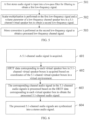
- FIG. 1 is a flowchart of an audio signal processing method in accordance with an exemplary embodiment of the present disclosure. The method may be performed by a terminal with an audio signal processing function, and includes the following steps.
- step 101 a first stereo audio signal is acquired.
- the terminal reads the first stereo audio signal that is locally stored, or acquires the first stereo audio signal on a server over a wired or wireless network.
- the first stereo audio signal is obtained by sound recording by a stereo recording device, which usually includes a first microphone on a left side and a second microphone on a right side.
- the stereo recording device records sound on the left side and sound on the right side by the first microphone and the second microphone respectively to obtain a left-channel audio signal and a right-channel audio signal.
- the stereo recording device superimposes the left-channel audio signal over the right-channel audio signal to obtain the first stereo signal.
- the received first stereo audio signal is stored in a buffer of the terminal and denoted as X_PCM.
- the terminal stores the received first stereo audio signal in a built-in buffer area in the form of a sample pair of the left-channel audio signal and the corresponding right-channel audio signal and acquires the first stereo audio signal from the buffer area for use.
- step 102 the first stereo audio signal is split into 5.1-channel audio signals.
- the terminal splits the first stereo audio signal into the 5.1-channel audio signals by a preset algorithm.
- the 5.1-channel audio signals include a front left-channel signal, a front right-channel signal, a front center-channel signal, a low-frequency channel signal, a rear left-channel signal and a rear right-channel signal.
- step 103 the 5.1-channel audio signals are processed based on a speaker box parameter of a three-dimensional surround 5.1-channel virtual speaker box to obtain processed 5.1-channel audio signals.
- the terminal processes the 5.1-channel audio signals based on the speaker box parameter of the three-dimensional surround 5.1-channel virtual speaker box to obtain the processed 5.1-channel audio signals.
- the processed 5.1-channel audio signals include a processed front left-channel signal, a processed front right-channel signal, a processed front center-channel signal, a processed low-frequency channel signal, a processed rear left-channel signal and a processed rear right-channel signal.
- the three-dimensional surround 5.1-channel virtual speaker box is an audio model preset by the terminal, and simulates the playback effect of a 5.1-channel speaker box that surrounds a user in a real scene.
- the 5.1-channel speaker box includes a front left speaker box at the left front side of the user, a front right speaker box at the right front side of the user, a front center speaker box right ahead the user, a low-frequency speaker box (not limited in location), a rear left speaker box at the left rear side of the user and a rear right speaker box at the right rear side of the user.
- step 104 the processed 5.1-channel audio signals are synthesized into a second stereo audio signal.
- the terminal synthesizes the processed 5.1-channel audio signals into the second stereo audio signal, which may be played by a common stereo earphone, a 2.0 speaker box or the like.
- the user may enjoy a 5.1-channel stereo effect upon hearing the second stereo audio signal of the common stereo earphone or the 2.0 speaker box.
- the first stereo audio signal is split into the 5.1-channel audio signals, which are processed and combined into the second stereo audio signal, and the second stereo audio signal is played by a double-channel audio playback unit, such that the user enjoys a 5.1-channel audio stereo effect.
- the present disclosure solves the problem in the related art that a relatively poor stereo effect is caused by only playing two channels of audio signals. Further, a stereo effect in audio playback is improved.
- the process in which the first stereo audio signal is split into the 5.1-channel audio signals is divided into two stages.
- a 5.0-channel audio signal in the 5.1-channel audio signals is acquired, and the embodiments illustrated in FIG. 2 , FIG. 3 and FIG. 4 may explain splitting of the 5.0-channel audio signal from the first stereo audio signal.
- a 0.1-channel audio signal in the 5.1-channel audio signals is acquired, and the embodiment illustrated in FIG. 5 will explain splitting of the 0.1-channel audio signal from the first stereo audio signal.
- the 5.0-channel audio signal and the 0.1-channel audio signal are synthesized into the second stereo audio signal.
- the embodiments illustrated in FIG. 6 and FIG. 8 provide methods for processing and synthesizing the 5.1-channel audio signals to obtain the second stereo audio signal.
- FIG. 2 is a flowchart of an audio signal processing method in accordance with an exemplary embodiment of the present disclosure.
- the method may be performed by a terminal with an audio signal processing function and may be an optional implementation mode of step 102 and step 103 in the embodiment illustrated in FIG. 1 .
- the method includes the following steps.
- a first stereo audio signal is input into a high-pass filter for filtering to obtain a first high-frequency signal.
- the terminal inputs the first stereo audio signal into the high-pass filter for filtering to obtain the first high-frequency signal.
- the first high-frequency signal is a superimposed signal of a first left-channel high-frequency signal and a first right-channel high-frequency signal.
- the terminal filters the first stereo by a 4-order IIR high-pass filter to obtain the first high-frequency signal.
- step 202 a left-channel high-frequency signal, a center-channel high-frequency signal and a right-channel high-frequency signal are obtained by calculation based on the first high-frequency signal.
- the terminal splits the first high-frequency signal into the left-channel high-frequency signal, the center-channel high-frequency signal and the right-channel high-frequency signal.
- the left-channel high-frequency signal includes a front left-channel signal and a rear left-channel signal.
- the center-channel high-frequency signal includes a front center-channel signal.
- the right-channel high-frequency signal includes a front right-channel signal and a rear right-channel signal.
- the terminal obtains the center-channel high-frequency signal by calculation based on the first high-frequency signal.
- the center-channel high-frequency signal is subtracted from the first left-channel high-frequency signal to obtain the left-channel high-frequency signal.
- the center-channel high-frequency signal is subtracted from the first right-channel high-frequency signal to obtain the right-channel high-frequency signal.
- step 203 the front left-channel signal, the front right-channel signal, the front center-channel signal, the rear left-channel signal and the rear right-channel signal in the 5.1-channel audio signals are obtained by calculation based on the left-channel high-frequency signal, the center-channel high-frequency signal and the right-channel high-frequency signal.
- the terminal obtains the front left-channel signal and the rear left-channel signal by calculation based on the left-channel high-frequency signal, obtains the front right-channel signal and the rear right-channel signal by calculation based on the right-channel high-frequency signal, and obtains the front center-channel signal by calculation based on the center-channel high-frequency signal.
- the terminal extracts first rear/reverberation signal data in the left-channel high-frequency signal, second rear/reverberation signal data in the center-channel high-frequency signal and third rear/reverberation signal data in the right-channel high-frequency signal, and calculates the front left-channel signal, the rear left-channel signal, the front right-channel signal, the rear right-channel signal and the front center-channel signal based on the first rear/reverberation signal data, the second rear/reverberation signal data and the third rear/reverberation signal data.
- step 204 the front left-channel signal, the front right-channel signal, the front center-channel signal, the rear left-channel signal and the rear right-channel signal are respectively subjected to scalar multiplication with corresponding speaker box parameters to obtain a processed front left-channel signal, a processed front right-channel signal, a processed front center-channel signal, a processed rear left-channel signal and a processed rear right-channel signal.
- the terminal performs scalar multiplication on the front left-channel signal and a volume V1 of a virtual front left-channel speaker box to obtain the processed front left-channel signal X_FL, on the front right-channel signal and a volume V2 of a virtual front right-channel speaker box to obtain the processed front right-channel signal X_FR, on the front center-channel signal and a volume V3 of a virtual front center-channel speaker box to obtain the processed front center-channel signal X_FC, on the rear left-channel signal and a volume V4 of a virtual rear left-channel speaker box to obtain the processed rear left-channel signal X_RL, and on the rear right-channel signal and a volume V5 of a virtual rear right-channel speaker box to obtain the processed rear right-channel signal X_RR.
- the first stereo audio signal is filtered to obtain the first high-frequency signal.
- the left-channel high-frequency signal, the center-channel high-frequency signal and the right-channel high-frequency signal are obtained by calculation based on the first high-frequency signal.
- the 5.0-channel audio signal is obtained by calculation based on the left-channel high-frequency signal, the center-channel high-frequency signal and the right-channel high-frequency signal to further obtain the processed 5,0-channel audio signal.
- the first high-frequency signal is extracted from the first stereo audio signal and split into the 5.0-channel audio signal in the 5.1-channel audio signals to further obtain the processed 5.0-channel audio signal.
- FIG. 3 is a flowchart of an audio signal processing method in accordance with an exemplary embodiment of the present disclosure.
- the audio signal processing method is applied to a terminal with an audio signal processing function and may be an optional implementation mode of step 202 in the embodiment illustrated in FIG. 2 .
- the method includes the following steps.
- step 301 fast Fourier transform (FFT) is performed on the first high-frequency signal to obtain a high-frequency real number signal and a high-frequency imaginary number signal.
- FFT fast Fourier transform
- the terminal performs FFT on the first high-frequency signal to obtain the high-frequency real number signal and the high-frequency imaginary number signal.
- the FFT is an algorithm for transforming a time-domain signal into a frequency-domain signal.
- the first high-frequency signal is subjected to FFT to obtain the high-frequency real number signal and the high-frequency imaginary number signal.
- the high-frequency real number signal includes a left-channel high-frequency real number signal and a right-channel high-frequency real number signal.
- the high-frequency imaginary number signal includes a left-channel high-frequency imaginary number signal and a right-channel high-frequency imaginary number signal.
- step 302 a vector projection is calculated based on the high-frequency real number signal and the high-frequency imaginary number signal.
- the terminal obtains a high-frequency real number signal by adding the right-channel high-frequency real number signal to the left-channel high-frequency real number signal in the high-frequency real number signal.
- X_HIPASS_RE_L is the left-channel high-frequency real number signal
- X_HIPASS_RE_R is the right-channel high-frequency real number signal
- sumRE is the high-frequency real number signal.
- the terminal obtains a high-frequency imaginary number signal by adding the right-channel high-frequency imaginary number signal to the left-channel high-frequency imaginary number signal in the high-frequency imaginary number signal.
- X_HIPASS_IM_L is the left-channel high-frequency imaginary number signal
- X_HIPASS_IM_R is the right-channel high-frequency imaginary number signal
- sumlM is the high-frequency imaginary number signal.
- the terminal performs subtraction on the left-channel high-frequency real number signal and the right-channel high-frequency real number signal in the high-frequency real number signal to obtain a high-frequency real number difference signal.
- diffRE is the high-frequency real number difference signal.
- the terminal performs subtraction on the left-channel high-frequency imaginary number signal and the right-channel high-frequency imaginary number signal in the high-frequency imaginary number signal to obtain a high-frequency imaginary number difference signal.
- diffIM is the high-frequency imaginary number difference signal.
- the terminal obtains a real number signal by calculation based on the high-frequency real number signal and the high-frequency imaginary number signal.
- the terminal obtains a real number difference signal based on the high-frequency real number difference signal and the high-frequency imaginary number difference signal.
- diffSq is the real difference signal.
- the terminal calculates the vector projection based on the real number signal and the real number difference signal to obtain the vector projection that represents a distance between each virtual speaker box in the three-dimensional surround 5.1-channel virtual speaker box and the user.
- alpha is the vector projection
- SORT represents extraction of square root
- * represents a scalar product
- step 303 inverse fast Fourier transform (IFFT) and overlap-add are performed on the product of the left-channel high-frequency real number signal in the high-frequency real number signal and the vector projection to obtain a center-channel high-frequency signal.
- IFFT inverse fast Fourier transform
- overlap-add are performed on the product of the left-channel high-frequency real number signal in the high-frequency real number signal and the vector projection to obtain a center-channel high-frequency signal.
- IFFT is an algorithm for transforming a frequency-domain signal into a time-domain signal.
- the terminal performs IFFT and overlap-add on the product of the left-channel high-frequency real number signal in the high-frequency real number signal and the vector projection to obtain the center-channel high-frequency signal.
- the center-channel high-frequency signal may be calculated through the left-channel high-frequency real number signal or the right-channel high-frequency real number signal. However, since most audio signals are gathered at a left channel if the first stereo signal only includes an audio signal of one channel, the center high-frequency signal may be calculated more accurately based on the left-channel high-frequency real number signal.
- step 304 a difference between a left-channel high-frequency signal in the first high-frequency signal and the center-channel signal is taken as a left-channel high-frequency signal.
- the terminal takes the difference between the left-channel high-frequency signal in the first high-frequency signal and the center-channel signal as the left-channel high-frequency signal.
- X_HIPASS_L is the left-channel high-frequency signal in the first high-frequency signal
- X_PRE_C is the center-channel signal
- X_PRE_L is the left-channel high-frequency signal.
- step 305 a difference between a right-channel signal in the first high-frequency signal and the center-channel high-frequency signal is taken as a right-channel high-frequency signal.
- the terminal takes the difference between the right-channel high-frequency signal in the first high-frequency signal and the center-channel signal as the right-channel high-frequency signal.
- X_HIPASS_R is the right-channel high-frequency signal in the first high-frequency signal
- X_PRE_C is the center-channel signal
- X_PRE_R is the right-channel high-frequency signal.
- step 304 and step 305 is not limited.
- the terminal may perform step 304 prior to step 305, or perform step 305 prior to step 304.
- FFT is performed on the first high-frequency signal to obtain the high-frequency real number signal and the high-frequency imaginary number signal.
- the center high-frequency signal is obtained by a series of calculations based on the high-frequency real number signal and the high-frequency imaginary number signal.
- the left-channel high-frequency signal and the right-channel high-frequency signal are obtained by calculation based on the center high-frequency signal.
- the left-channel high-frequency signal, the center-channel high-frequency signal and the right-channel high-frequency signal are obtained by calculation based on the first high-frequency signal.
- FIG. 4 is a flowchart of an audio signal processing method in accordance with an exemplary embodiment of the present disclosure.
- the audio signal processing method may be performed by a terminal with an audio signal processing function and may be an optional implementation mode of step 203 in the embodiment illustrated in FIG. 2 .
- the method includes the following steps.
- step 401 at least one moving window is obtained based on a sampling point in any of a left-channel high-frequency signal, a center-channel high-frequency signal and a right-channel high-frequency signal.
- Each moving window includes n sampling points, and n/2 sampling points of every two adjacent moving windows are overlapping.
- the terminal obtains at least one moving window based on the sampling point in any of the left-channel high-frequency signal, the center-channel high-frequency signal and the right-channel high-frequency signal by a moving window algorithm. If each moving window has n sampling points, n/2 sampling points of every two adjacent moving windows are overlapping, and n ⁇ 1.
- the moving window is an algorithm similar to overlap-add, which realizes only overlap but not addition.
- data A include 1,024 sampling points, if a moving step length is 128 and an overlap length is 64, the following signals are output by the moving window every time: A[0-128] output firstly, A[64-192] output secondly, A[128-256] output thirdly, ....
- A is the moving window, and a serial number of the sampling point is inside the square brackets.
- a low-correlation signal in the moving window and a start time point of the low-correlation signal are calculated.
- the low-correlation signal includes a signal of which a first decay envelope sequence in a magnitude spectrum and a second decay envelope sequence in a phase spectrum are unequal.
- the terminal performs FFT on a sampling point signal in an i th moving window to obtain a sampling point signal subjected to FFT, and i ⁇ 1.
- the terminal performs the moving window algorithm and FFT on the left-channel signal, the right-channel high-frequency signal and the center-channel high-frequency signal respectively based on a preset moving step length and overlap length to sequentially obtain a left-channel high-frequency real number signal and a left-channel high-frequency imaginary number signal (denoted as FFT _L), a right-channel high-frequency real number signal and a right-channel high-frequency imaginary number signal (denoted as FFT_R), and a center-channel real number signal and a center-channel imaginary number signal (denoted as FFT_C).
- FFT _L left-channel high-frequency imaginary number signal
- FFT_R right-channel high-frequency real number signal and a right-channel high-frequency imaginary number signal
- FFT_C center-channel real number signal and a center-channel imaginary number signal
- the terminal calculates a magnitude spectrum and a phase spectrum of the sampling point signal subjected to FFT.
- the terminal calculates a magnitude spectrum AMP_L and a phase spectrum PH_L of the left-channel high-frequency signal based on FFT_L, calculates a magnitude spectrum AMP_R and a phase spectrum PH_R of the left-channel high-frequency signal based on FFT_R and calculates a magnitude spectrum AMP_C and a phase spectrum PH_C of the center-channel signal.
- AMP_L, AMP_R and AMP_C are denoted as AMP_L/R/C
- PH_L, PH_R and PH_C are denoted as PH_L/R/C.
- the terminal calculates a first decay envelope sequence of m frequency lines in the i th moving window based on the magnitude spectrum of the sampling point signal subjected to FFT, calculates a second decay envelope sequence of the m frequency lines in the i th moving window based on the phase spectrum of the sampling point signal subjected to FFT, determines a j th frequency line as the low-correlation signal when the decay envelope sequence and the second decay envelope sequence of the j th frequency line in the m frequency lines are different, and determines a start time point of the low-correlation signal based on a window number of the i th moving window and a frequency line number of the j th frequency line, wherein m ⁇ 1 and 1 ⁇ j ⁇ m.
- the terminal calculates the decay envelope sequences and relevancy of all the frequency lines for AMP_L/R/C and PH_L/R/C of all the moving windows.
- An effective condition is that the calculated decay envelope sequence of the moving window corresponds to the magnitude spectrum and the phase spectrum of the same moving window.
- a moving window 2 and a moving window 3 are respectively 1.0, 0.8 and 0.6
- the decay envelope sequences of phase spectra of No. 0 frequency lines corresponding to the moving window 1 the moving window 3 and the moving window 3 are respectively 1.0, 0.8 and 1.0
- the No. 0 frequency line of the moving window 1 and the No. 0 frequency line of the moving window 2 are highly relevant, and the No. 0 frequency line of the moving window 2 and the No. 0 frequency line of the moving window 3 are less relevant.
- the n sampling points may be subjected to FFT to obtain n/2+1 frequency lines.
- a window number and the frequency lines of a moving window corresponding to a signal with low correlation are taken.
- the start time point of the signal in X_PRE_L, X_PRE_R and X_PRE_C may be calculated based on the window number.
- step 403 a target low-correlation signal that conforms to a rear/reverberation feature is determined.
- the terminal determines the target low-correlation signal that conforms to the rear/reverberation feature by the following means.
- VHF line When magnitude spectrum energy of a very high frequency (VHF) line of the low-correlation signal is less than a first threshold and a decay envelope slope of a window adjacent to a window where the VHF line is greater than a second threshold, the terminal determines the low-correlation signal as the target low-correlation signal that conforms to the rear/reverberation feature.
- the VHF line is a frequency line of which a frequency band ranges from 30 MHz to 300 MHz.
- a method by which the terminal determines the target low-correlation signal that conforms to the rear/reverberation feature may include but not limited to the following steps.
- the terminal determines the low-correlation signal as the target low-correlation signal that conforms to the rear/reverberation feature.
- step 404 an end time point of the target low-correlation signal is calculated.
- the terminal calculates the end time point of the low-correlation signal by the following means.
- the terminal acquires a time point at which energy of a frequency line corresponding to the magnitude spectrum of the target low-correlation signal is smaller than a fourth threshold and uses the acquired time point as the end time point.
- the terminal calculates the end time point of the low-correlation signal by the following means.
- the terminal determines a start time point of the next low-correlation signal as the end time point of the target low-correlation signal when energy of the target low-correlation signal is smaller than 1/n of energy of the next low-correlation signal.
- step 405 the target low-correlation signal is extracted based on the start time point and the end time point, and the extracted target low-correlation signal is taken as rear/reverberation signal data in the corresponding channel high-frequency signal.
- the terminal extracts channel signal segments in the start time point and the end time point, performs FFT on the channel signal segments to obtain signal segments subjected to FFT, extracts a frequency line corresponding to the target low-correlation signal from the signal segments subjected to FFT to obtain a first portion signal, and performs IFFT and overlap-add on the first portion to obtain the rear/reverberation signal data in the corresponding channel high-frequency signal.
- the terminal obtains first rear/reverberation signal data in the left-channel high-frequency signal, second rear/reverberation signal data in the center-channel high-frequency signal and third rear/reverberation signal data in the channel-channel high-frequency signal.
- a front left-channel signal, a rear left-channel signal, a front right-channel signal, a rear right-channel signal and a front center-channel signal are calculated based on the first rear/reverberation signal data, the second rear/reverberation signal data and the third rear/reverberation signal data.
- the terminal determines a difference between the left-channel high-frequency signal and the first rear/reverberation signal data acquired in the above step as the front left-channel signal.
- the first rear/reverberation signal data is audio data included in the left-channel high-frequency signal and is audio data included in the rear left-channel signal of a three-dimensional surround 5.1-channel virtual speaker.
- the left-channel high-frequency signal includes the front left-channel signal and part of the rear left-channel signal.
- the front left-channel signal may be obtained by subtracting the part of the rear left-channel signal, namely the first rear/reverberation signal data, from the left-channel high-frequency signal.
- the terminal determines the sum of the first rear/reverberation signal data and the second rear/reverberation signal data, which are acquired in the above step, as the rear left-channel signal.
- the terminal determines a difference between the right-channel high-frequency signal and the third rear/reverberation signal data acquired in the above step as the front right-channel signal.
- the third rear/reverberation signal data is audio data included in the right-channel high-frequency signal and is audio data included in the rear right-channel signal of the three-dimensional surround 5.1-channel virtual speaker.
- the right-channel high-frequency signal includes the front right-channel signal and part of the rear right-channel signal.
- the front right-channel signal may be obtained by subtracting the part of the rear right-channel signal, namely the third rear/reverberation signal data, from the right-channel high-frequency signal.
- the terminal determines the sum of the third rear/reverberation signal data and the second rear/reverberation signal data, which are acquired in the above step, as the rear right-channel signal.
- the terminal determines a difference between the center-channel high-frequency signal and the second rear/reverberation signal data acquired in the above step as the front center-channel signal.
- the second rear/reverberation signal data is audio data included in the rear left-channel signal of the three-dimensional surround 5.1-channel virtual speaker box and is audio data included in the rear right-channel signal.
- the center-channel high-frequency signal includes the front center-channel signal and the second rear/reverberation signal data.
- the second rear/reverberation signal data may be subtracted from the center-channel high-frequency signal.
- the rear/reverberation signal data in each channel high-frequency signal is extracted by calculating the start time and the end time of the rear/reverberation signal data in each channel high-frequency signal.
- the front left-channel signal, the rear left-channel signal, the front right-channel signal, the rear right-channel signal and the front center-channel signal are obtained by calculation based on the rear/reverberation signal data in each channel high-frequency signal.
- the accuracy is improved in obtaining the 5.1-channel audio signals by calculation based on the left-channel high-frequency signal, the center-channel high-frequency signal and the right-channel high-frequency signal.
- FIG. 5 is a flowchart of an audio signal processing method in accordance with an exemplary embodiment of the present disclosure.
- the audio signal processing method may be performed by a terminal with an audio signal processing function and may be an optional embodiment of step 102 in the embodiment illustrated in FIG. 1 .
- the method includes the following steps.
- step 501 a first stereo audio signal is input into a low-pass filter for filtering to obtain a first low-frequency signal.
- the terminal inputs the first stereo audio signal into the low-pass filter for filtering to obtain the first low-frequency signal.
- the first low-frequency signal is a superimposed signal of a first left-channel low-frequency signal and a first right-channel low-frequency signal.
- the terminal filters the first stereo by a 4-order IIR low-pass filter to obtain the first low-frequency signal.
- step 502 scalar multiplication is performed on the first low-frequency signal and a volume parameter of a low-frequency channel speaker box in a 5.1-channel virtual speaker box to obtain a second low-frequency signal.
- the terminal performs the scalar multiplication on the first low-frequency signal and the volume parameter of the low-frequency channel speaker box in the 5.1-channel virtual speaker box to obtain the second low-frequency signal.
- X_LFE is the first stereo low-frequency signal
- V6 is the volume parameter of the low-frequency channel speaker box in the 5.1-channel virtual speaker box
- X_LFE_S is the second low-frequency signal which is the superimposed signal of the first left-channel low-frequency signal X_LFE_S_L and the first right-channel low-frequency signal X_LFE_S_R
- * represents the scalar multiplication.
- step 503 mono conversion is performed on the second low-frequency signal to obtain a processed low-frequency channel signal.
- the terminal performs mono conversion on the second low-frequency signal to obtain the processed low-frequency channel signal.
- X_LFE_M is the processed low-frequency channel signal.
- the first stereo audio signal is filtered to obtain the first low-frequency signal.
- Mono conversion is performed on the first low-frequency signal to obtain the low-frequency channel signal in 5.1-channel audio signals.
- the first low-frequency signal is extracted from the first stereo signal and split into a 0.1-channel audio signal in the 5.1-channel audio signals.
- the first stereo audio signal is split and processed to obtain the 5.1-channel audio signals, including the front left-channel signal, the front right-channel signal, the front center-channel signal, the low-frequency channel signal, the rear left-channel signal and the rear right-channel signal.
- the following embodiment illustrated in FIG. 6 and FIG. 8 provides a method by which the 5.1-channel audio signals are processed and synthesized to obtain a second stereo audio signal.
- the method may be an optional embodiment of step 104 in the embodiment illustrated in FIG. 1 and may also be an independent embodiment.
- a stereo signal obtained in the embodiments illustrated in FIG. 6 and FIG. 8 may be the second stereo audio signal in the above method embodiments.
- the HRTF processing technology is a processing technology for producing a stereo surround sound effect.
- a technician may re-establish an HRTF database, in which HRTF data, an HRTF data sampling point and a corresponding relationship between the HRTF data sampling point and position coordinates of a reference head are recorded.
- the HRTF data is a group of parameters for processing a left-channel audio signal and a right-channel audio signal.
- FIG. 6 is a flowchart of an audio signal processing method in accordance with an exemplary embodiment of the present disclosure.
- the audio signal processing method may be performed by a terminal with an audio signal processing function and may be an optional embodiment of step 104 of the embodiment illustrated in FIG. 1 .
- the method includes the following steps.
- step 601 a 5.1-channel audio signal is acquired.
- the 5.1-channel audio signal is the processed 5.1-channel audio signal which is obtained by splitting and processing the first stereo audio signal in the embodiment illustrated in FIGS. 1 to 5 .
- the 5.1-channel audio signal is a 5.1-channel audio signal that is downloaded or read from a storage medium.
- the 5.1-channel audio signal includes a front left-channel signal, a front right-channel signal, a front center-channel signal, a low-frequency channel signal, a rear left-channel signal and a rear right-channel signal.
- step 602 HRTF data corresponding to each virtual speaker box in 5.1-channel virtual speaker boxes is acquired based on coordinates of the 5.1-channl virtual speaker boxes in a virtual environment.
- the 5.1 virtual speaker boxes include a front left-channel virtual speaker box FL, a front right-channel virtual speaker box FR, a front center-channel virtual speaker box FC, a bass virtual speaker box LFE, a rear left-channel virtual speaker box RL and a rear right-channel virtual speaker box RR.
- the 5.1 virtual speaker boxes have their respective coordinates in the virtual environment that may be a two-dimensional planar virtual environment or a three-dimensional virtual environment planar virtual environment.
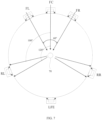
- FIG. 7 a schematic diagram of a 5.1-channel virtual speaker box in a two-dimensional planar virtual environment is illustrated. It is assumed that the reference head is located at a central point 70 in FIG. 7 and faces towards the location of the center-channel virtual speaker box FC, and distances from all channels to the central point 70 where the reference head is located are the same, and the channels and the central point are on the same plane.
- a front center-channel virtual speaker box is located right ahead a direction that the reference head faces towards.
- the front left-channel virtual speaker box FL and the front right-channel virtual speaker box FR are located at two sides of the front center-channel FC respectively, form an angle of 30° with the direction that the reference head faces towards respectively and are disposed symmetrically.
- the rear left-channel virtual speaker box RL and the rear right-channel virtual speaker box RR are located behind two sides of the direction that the reference head faces towards respectively, form an angle of 100° to 120° with the direction that the reference head faces towards respectively and are disposed symmetrically.
- the bass virtual speaker box LFE Since the bass virtual speaker box LFE is relatively weaker in sense of direction, its locating place is not strictly required. In the text, a direction that the reference head faces away from is taken as an example for explanation. However, the angle formed by the bass virtual speaker box LFT and the direction that the reference head faces towards is not limited by the present disclosure.
- each virtual speaker box in the 5.1-channel virtual speaker boxes and the direction that the reference head faces towards is merely exemplary.
- the distances between the virtual speaker boxes and the reference head may be different.
- the virtual speaker boxes may be at different heights. Due to the different locating places of the virtual speaker boxes, sound signals may be different, which is not limited in the present disclosure.
- coordinates of each virtual speaker box in the virtual environment may be obtained.
- the HRTF database stored in the terminal includes a corresponding relationship between at least one HRTF data sampling point and the HRTF data.
- Each HRTF data sampling point has its own coordinates.
- the terminal inquires the HRTF data sampling point nearest to an i th coordinate from the HRTF database based on an i th coordinate of an i th virtual speaker box in the 5.1-channel virtual speaker boxes and determines HRTF data of the HRTF data sampling point nearest to the i th coordinate as HRTF data of the i th virtual speaker box, and i ⁇ 1.
- step 603 the corresponding channel audio signal in the 5.1-channel audio signals is processed based on the HRTF data corresponding to each virtual speaker box to obtain the processed 5.1-channel audio signal.
- each piece of HRTF data includes a left-channel HRTF coefficient and a right-channel HRTF coefficient.
- the terminal processes an i th channel audio signal in the 5.1-channel audio signals based on the left-channel HRTF coefficient in the HRTF data corresponding to the i th virtual speaker box to obtain a left-channel component corresponding to the processed i th channel audio signal.
- the terminal processes the i th channel audio signal in the 5.1-channel audio signals based on the right-channel HRTF coefficient in the HRTF data corresponding to the i th virtual speaker box to obtain a right-channel component corresponding to the processed i th channel audio signal.
- step 604 the processed 5.1-channel audio signals are synthesized into a stereo audio signal.
- the stereo audio signal in this step is the second stereo audio signal in the embodiment illustrated in FIG. 1 .
- the 5.1-channel audio signals are processed based on the HRTF data of all the 5.1-channel virtual speaker boxes, and the processed 5.1-channel audio signals are synthesized into the stereo audio signal, such that a user may play the 5.1-channel audio signals only using a common stereo earphone or a 2.0 speaker box and may also enjoy a better tone quality.
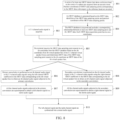
- FIG. 8 is a flowchart of an audio signal processing method in accordance with an exemplary embodiment.
- the audio signal processing method may be performed by a terminal with an audio signal processing function and may be an optional embodiment of step 104 in the embodiment illustrated in FIG. 1 .
- the method includes the following steps.
- step 1201 a series of at least one piece of HRTF data that takes a reference head as the center of a sphere is acquired from an acoustic room. Position coordinates of HRTF data sampling points corresponding to the HRTF data with respect to the reference head are recorded.
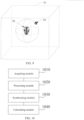
- a developer places the reference head 92 (made by simulating a human head) in the center of the acoustic room 91 (sound-absorbing sponge is disposed at the periphery of the room to reduce interference of echoes) in advance and disposes miniature omni-directional microphones in a left ear canal and a right ear canal of the reference head 92 respectively.
- the developer disposes the HRTF data sampling points on the surface of a sphere that takes the reference head 92 as the center every preset distance and plays preset audios at the HRTF data sampling points by a speaker 93.
- the distance between the left ear canal and the speaker 93 is different from that between the right ear canal and the speaker 93.
- the same audio has different audio features when reaching the left ear canal and the right ear canal because sound waves are affected by refraction, interference, diffraction and the like.
- the HRTF data at the HRTF data sampling points may be obtained by analyzing the difference between the audios acquired by the microphones and an original audio.
- the HRTF data corresponding to the same HRTF data sampling point includes a left-channel HRTF coefficient corresponding to a left channel and a right-channel HRTF coefficient corresponding to a right channel.
- an HRTF database is generated based on the HRTF data, identifiers of the HRTF data sampling points and position coordinates of the HRTF data sampling points.
- a coordinate system is built by taking the reference head 92 as a central point.
- the coordinate system is built in the same way as a coordinate system of a 5.1-channel virtual speaker box.
- a coordinate system may only be built for a horizontal plane where the reference head 92 is during acquisition of the HRTF data, and only the HRTF data of the horizontal plane are acquired. For example, on a circular ring that takes the reference head 92 as the center, a point is taken every 5° as the HRTF data sampling point. At this time, the HRTF data volume required to be stored in the terminal may be reduced.
- a coordinate system may be built for the three-dimensional environment where the reference head 92 is during acquisition of the HRTF data, and the HRTF data on the surface of the sphere that takes the reference head 92 as the center are acquired. For example, on the surface of the sphere that takes the reference head 92 as the center, a point is taken every 5° in a longitude direction and a latitude direction as the HRTF data sampling point.
- the terminal produces the HRTF database based on an identifier of each HRTF data sampling point, HRTF data of each HRTF data sampling point and the position coordinate of each HRTF data sampling point.
- step 1201 and step 1202 may also be performed and implemented by other devices.
- the generated HRTF database is transmitted to a current terminal over a network or a storage medium.
- step 1203 a 5.1-channel audio signal is acquired.
- the terminal acquires the 5.1-channel audio signal.
- the 5.1-channel audio signal is the processed 5.1-channel audio signal obtained by splitting and processing the first stereo audio signal in the embodiment illustrated in FIGS. 1 to 5 .
- the 5.1-channel audio signal is a 5.1-channel audio signal that is downloaded or read from a storage medium.
- the 5.1-channel audio signal includes a front left-channel signal X_FL, a front right-channel signal X_FC, a front center-channel signal X_FC, a low-frequency channel signal X_LFE_M, a rear left-channel signal X_RL and a rear right-channel signal X_RR.
- the HRTF database is acquired and includes a corresponding relationship between at least one HRTF data sampling point and the HRTF data.
- Each HRTF data acquisition point has its own coordinates.
- the terminal may read the HRTF database that is stored locally, or access the HRTF database stored on the network.
- step 1205 the terminal inquires the HRTF data sampling point nearest to an i th coordinate from the HRTF database based on the i th coordinate of an i th virtual speaker box in the 5.1-channel virtual speaker boxes and determines HRTF data of the HRTF data sampling point nearest to the i th coordinate as HRTF data of the i th virtual speaker box.
- the coordinates of each virtual speaker box in the 5.1-channel virtual speaker boxes are pre-stored in the terminal, and i ⁇ 1.
- the terminal inquires the HRTF data acquisition point nearest to a first coordinate from the HRTF database based on the first coordinate of a front left-channel virtual speaker box, and determines the HRTF data of the HRTF data acquisition point nearest to the first coordinate as HRTF data of the front left-channel virtual speaker box.
- the terminal inquires the HRTF data acquisition point nearest to second coordinates from the HRTF database based on the second coordinate of a front right-channel virtual speaker box, and determines the HRTF data of the HRTF data acquisition point nearest to the second coordinates as HRTF data of the front right-channel virtual speaker box.
- the terminal inquires the HRTF data acquisition point nearest to third coordinates from the HRTF database based on the third coordinate of a front center-channel virtual speaker box, and determines the HRTF data of the HRTF data acquisition point nearest to the third coordinates as HRTF data of the front center-channel virtual speaker box.
- the terminal inquires the HRTF data acquisition point nearest to fourth coordinates from the HRTF database based on the fourth coordinate of a rear left-channel virtual speaker box, and determines the HRTF data of the HRTF data acquisition point nearest to the fourth coordinates as HRTF data of the rear left-channel virtual speaker box.
- the terminal inquires the HRTF data acquisition point nearest to fifth coordinates from the HRTF database based on the fifth coordinate of a rear right-channel virtual speaker box, and determines the HRTF data of the HRTF data acquisition point nearest to the fifth coordinates as HRTF data of the rear right-channel virtual speaker box.
- the terminal inquires the HRTF data acquisition point nearest to sixth coordinates from the HRTF database based on the sixth coordinate of a low-frequency virtual speaker box, and determines the HRTF data of the HRTF data acquisition point nearest to the sixth coordinates as HRTF data of the low-frequency virtual speaker box.
- the phrase 'nearest to' means that the coordinates of the virtual speaker box and the coordinates of the HRTF data acquisition point are the same or the distance therebetween is the shortest.
- step 1207 all the channel audio signals subjected to the primary convolution are superimposed to obtain a left-channel signal in a stereo audio signal.
- step 1208 secondary convolution is performed on the i th channel audio signal in the 5.1-channel audio signals using the right-channel HRTF coefficient in the HRTF data corresponding to the i th virtual speaker box to obtain an i th channel audio signal subjected to the secondary convolution.
- step 1209 all the channel audio signals subjected to the secondary convolution are superimposed to obtain a right-channel signal in the stereo audio signal.
- step 1210 the left-channel signal and the right-channel signal are synthesized into a stereo audio signal.
- the synthesized stereo audio signal may be stored as an audio file or input into a playback device for playback.
- the stereo audio signal in this step is the second stereo audio signal in the embodiment illustrated in FIG. 1 .
- the 5.1-channel audio signals are processed based on the HRTF data of each 5.1-channel virtual speaker box, and the processed 5.1-channel audio signals are synthesized into the stereo audio signal.
- a user may play the 5.1-channel audio signals only by a common stereo earphone or a 2.0 speaker box and may enjoy a better playback tone quality.
- the stereo audio signal with a better three-dimensional surround sound effect may be obtained.
- the stereo audio signal has a better three-dimensional surround effect during playback.
- FIG. 10 is a structural block diagram of an audio signal processing apparatus in accordance with an exemplary embodiment of the present disclosure.
- the apparatus may be a terminal or part of the terminal, and includes:
- an acquiring module 1010 configured to acquire a first stereo audio signal
- a processing module 1020 configured to split the first stereo audio signal into 5.1-channel audio signals and to process the 5.1-channel audio signals based on a speaker box parameter of a three-dimensional surround 5.1-channel virtual speaker box to obtain processed 5.1-channel audio signals;
- a synthesizing module 1030 configured to synthesize the processed 5.1-channel audio signals into a second stereo audio signal.
- the apparatus further includes a calculation module 1040;
- a processing module 1020 configured to input the first stereo audio signal into a high-pass filter for filtering to obtain a first high-frequency signal.
- the calculating module 1040 is configured to: obtain a left-channel high-frequency signal, a center-channel high-frequency signal and a right-channel high-frequency signal by calculation based on the first high-frequency signal; and obtain a front left-channel signal, a front right-channel signal, a front center-channel signal, a low-frequency channel signal, a rear left-channel signal and a rear right-channel signal in the 5.1-channel audio signals by calculation based on the left-channel high-frequency signal, the center-channel high-frequency signal and the right-channel high-frequency signal.
- the calculating module 1040 is further configured to: perform FFT on the first high-frequency signal to obtain a high-frequency real number signal and a high-frequency imaginary number signal; calculate a vector projection based on the high-frequency real number signal and the high-frequency imaginary number signal; perform FFT on a product of a left-channel high-frequency real number signal in the high-frequency real number signal and the vector projection to obtain the center-channel high-frequency signal; take a difference between a left-channel high-frequency signal in the first high-frequency signal and the center-channel high -frequency signal as the left-channel high-frequency signal; and take a difference between a right-channel high-frequency signal in the first high-frequency signal and the center-channel high-frequency signal as the right-channel high-frequency signal.
- the calculating module 1040 is further configured to: add the right-channel high-frequency real number signal to the left-channel high-frequency real number signal in the high-frequency real number signal to obtain a high-frequency real number signal; add the right-channel high-frequency imaginary number signal to the left-channel high-frequency imaginary number signal in the high-frequency imaginary number signal to obtain a high-frequency imaginary number signal; perform subtraction on the left-channel high-frequency real number signal and the right-channel high-frequency real number signal in the high-frequency real number signal to obtain a high-frequency real number difference signal; perform subtraction on the left-channel high-frequency imaginary number signal and the right-channel high-frequency imaginary number signal in the high-frequency imaginary number signal to obtain a high-frequency imaginary number difference signal; obtain a real number signal by calculation based on the high-frequency real number signal and the high-frequency imaginary number signal; obtain a real number difference signal based on the high-frequency real number difference signal and the high-frequency imaginary number difference signal; and calculate a vector projection based on the real number signal and the real
- the processing module 1020 is further configured to extract first rear/reverberation signal data in the left-channel high-frequency signal, second rear/reverberation signal data in the center-channel high-frequency signal and third rear/reverberation signal data in the right-channel high-frequency signal.
- the calculating module 1040 is further configured to: determine a difference between the left-channel high-frequency signal and the first rear/reverberation signal data as the front left-channel signal; determine a sum of the first rear/reverberation signal data and the second rear/reverberation signal data as the rear left-channel signal; determine a difference between the right-channel high-frequency signal and the third rear/reverberation signal data as the front right-channel signal; determine a sum of the third rear/reverberation signal data and the second rear/reverberation signal data as the rear right-channel signal; and determine a difference between the center-channel high-frequency signal and the second rear/reverberation signal data as the front center-channel signal.
- the calculating module 1040 is further configured to: calculate a low-correlation signal in the moving window and a start time point of the low-correlation signal, wherein the low-correlation signal includes a signal of which a first decay envelope sequence in a magnitude spectrum and a second decay envelope sequence in a phase spectrum are unequal; determine a target low-correlation signal that conforms to a rear/reverberation feature; calculate an end time point of the target low-correlation signal; and extract the target low-correlation signal based on the start time point and the end time point, and take the extracted target low-correlation signal as rear/reverberation signal data in the corresponding channel high-frequency signal.
- the calculating module 1040 is further configured to: calculate a low-correlation signal in the moving window and a start time point of the low-correlation signal, wherein the low-correlation signal includes a signal of which a first decay envelope sequence in a magnitude spectrum and a second decay envelope sequence in a phase spectrum are unequal; determine a target low-correlation signal that conforms to a rear/reverberation feature; calculate an end time point of the target low-correlation signal; and extract the target low-correlation signal based on the start time point and the end time point, and take the extracted target low-correlation signal as rear/reverberation signal data in the corresponding channel high-frequency signal.
- the calculating module 1040 is further configured to: perform FFT on a sampling point signal in an i th moving window to obtain a sampling point signal subjected to FFT; calculate a magnitude spectrum and a phase spectrum of the sampling point signal subjected to FFT; calculate a first decay envelope sequence of m frequency lines in the i th moving window based on a magnitude spectrum of the sampling point subjected to FFT; calculate a second decay envelope sequence of m frequency lines in the i th moving window based on a phase spectrum of the sampling point subjected to FFT; determine a j th frequency line as the low-correlation signal when the first decay envelope sequence and the second decay envelope sequence of the j th frequency line in the m frequency lines are different; and determine a start time point of the low-correlation signal based on a window number of the i th moving window and a frequency line number of the j th frequency line, wherein i ⁇ 1, m ⁇ 1, 1 ⁇ j ⁇ m.
- the calculating module 1040 is further configured to: when magnitude spectrum energy of a VHF line of the low-correlation signal is smaller than a first threshold and a decay envelope slope of a window adjacent to a window where the VHF line is greater than a second threshold, determine the low-correlation signal as a target low-correlation signal that conforms to a rear/reverberation feature; or when the magnitude spectrum energy of the VHF line of the low-correlation signal is smaller than the first threshold and a decay rate of a window adjacent to a window where the VHF line is larger than a third threshold, determine the low-correlation signal as the target low-correlation signal that conforms to the rear/reverberation feature.
- the calculating module 1040 is further configured to: acquire a time point at which energy of a frequency line corresponding to the magnitude spectrum of the target low-correlation signal is smaller than a fourth threshold and uses the acquired time point as the end time point; or determine a start time point of the next low-correlation signal as an end time point of the target low-correlation signal when energy of the target low-correlation signal is smaller than 1/m of energy of the next low-correlation signal.
- the acquiring module 1010 is further configured to extract channel signal segments in the start time point and the end time point.
- the calculating module 1040 is further configured to: perform FFT on the channel signal segments to obtain signal segments subjected to FFT; extract a frequency line corresponding to the target low-correlation signal from the signal segments subjected to FFT to obtain a first portion signal; and perform IFFT and overlap-add on the first portion signal to obtain the rear/reverberation signal data in the corresponding channel high-frequency signal.
- the calculating module 1040 is further configured to perform scalar multiplication on the front left-channel signal and a volume of a front virtual left-channel speaker box to obtain the processed front left-channel signal, on the front right-channel signal and a volume of a front virtual right-channel speaker box to obtain the processed front right-channel signal, on the front center-channel signal and a volume of a front virtual center-channel speaker box to obtain the processed front center-channel signal, on the rear left-channel signal and a volume of a rear virtual left-channel speaker box to obtain the processed rear left-channel signal, and on the rear right-channel signal and a volume of a rear virtual right-channel speaker to obtain the processed rear right-channel signal.
- the 5.1-channel audio signals include a low-frequency channel signal.
- the processing module 1020 is further configured to input the first stereo audio signal into a low-pass filter for filtering to obtain a first low-frequency signal.
- the calculating module 1040 is further configured to perform scalar multiplication on the first low-frequency signal and a volume parameter of a low-frequency channel speaker box in the 5.1-channel virtual speaker box to obtain a second low-frequency signal, and perform mono conversion on the second low-frequency signal to obtain a processed low-frequency channel signal.
- the second low-frequency signal includes a left-channel low-frequency signal and a right-channel low-frequency signal.
- the calculating module 1040 is further configured to superimpose the left-channel low-frequency signal over the right-channel low-frequency signal, then perform averaging, and use an averaged audio signal as the processed low-frequency channel signal.
- FIG. 11 is a structural block diagram of an audio signal processing apparatus in accordance with an exemplary embodiment of the present disclosure.
- the apparatus may be a terminal or part of the terminal, and includes:
- the second acquiring module 1140 is configured to: acquire an HRTF database, wherein the HRTF database includes a corresponding relationship between at least one HRTF data sampling point and HRTF data, and each HRTF data sampling point has its own coordinates; and inquire the HRTF data sampling point nearest to an i th coordinate from the HRTF database based on the i th coordinate of an i th virtual speaker box in the 5.1 virtual speaker boxes and determine HRTF data of the HRTF data sampling point nearest to the i th coordinate as HRTF data of the i th virtual speaker box, wherein i ⁇ 1.
- the apparatus further includes:
- the HRTF data include a left-channel HRTF coefficient.
- the processing module 1160 includes:
- the HRTF data include a right-channel HRTF coefficient.
- the processing module 1160 includes:
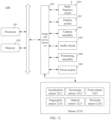
- FIG. 12 is a block diagram of a terminal 1200 in accordance with an exemplary embodiment of the present disclosure.
- the terminal 1200 may be a smart phone, a tablet computer, a Moving Picture Experts Group Audio Layer III (MP3) player, a Moving Picture Experts Group Audio Layer IV (MP4) player, or a laptop or desktop computer.
- MP3 Moving Picture Experts Group Audio Layer III
- MP4 Moving Picture Experts Group Audio Layer IV
- the terminal 1200 may also be referred to as a user equipment, a portable terminal, a laptop terminal, a desktop terminal, and the like.
- the terminal 1200 includes a processor 1201 and a memory 1202.
- the processor 1201 may include one or a plurality of processing cores, for example, a four-core processor, an eight-core processor or the like.
- the processor 1201 may be practiced based on a hardware form of at least one of digital signal processing (DSP), field-programmable gate array (FPGA), and programmable logic array (PLA).
- DSP digital signal processing
- FPGA field-programmable gate array
- PDA programmable logic array
- the processor 1201 may further include a primary processor and a secondary processor.
- the primary processor is a processor configured to process data in an active state, and is also referred to as a central processing unit (CPU); and the secondary processor is a low-power consumption processor configured to process data in a standby state.
- CPU central processing unit
- the secondary processor is a low-power consumption processor configured to process data in a standby state.
- the processor 1201 may be integrated with a graphics processing unit (GPU), wherein the GPU is configured to render and draw the content to be displayed on the screen.
- the processor 1201 may further include an artificial intelligence (Al) processor, wherein the Al processor is configured to process calculate operations related to machine learning.
- Al artificial intelligence
- the memory 1202 may include one or a plurality of computer-readable storage media, wherein the computer-readable storage medium may be non-transitory.
- the memory 1202 may include a high-speed random access memory, and a non-volatile memory, for example, one or a plurality of magnetic disk storage devices or flash storage devices.
- the non-transitory computer-readable storage medium in the memory 1202 may be configured to store at least one instruction, wherein the at least one instruction is executed by the processor 1201 to perform the following processing:
- the at least one instruction is executed by the processor 1201 to perform the following processing:
- the at least one instruction is executed by the processor 1201 to perform the following processing:
- the HRTF data comprises a left-channel HRTF coefficient
- the at least one instruction is executed by the processor 1201 to perform the following processing:
- the HRTF data comprises a right-channel HRTF coefficient
- the at least one instruction is executed by the processor 1201 to perform the following processing:
- the terminal 1200 may optionally include a peripheral device interface 1203 and at least one peripheral device.
- the processor 1201, the memory 1202 and the peripheral device interface 1203 may be connected to each other via a bus or a signal line.
- the at least one peripheral device may be connected to the peripheral device interface 1203 via a bus, a signal line or a circuit board.
- the peripheral device includes at least one of a radio frequency circuit 1204, a touch display screen 1205, a camera assembly 1206, an audio circuit 1207, a positioning assembly 1208 and a power source 1209.
- the peripheral device interface 1203 may be configured to connect the at least one peripheral device related to input/output (I/O) to the processor 1201 and the memory 1202.
- the processor 1201, the memory 1202 and the peripheral device interface 1203 are integrated on the same chip or circuit board.
- any one or two of the processor 1201, the memory 1202 and the peripheral device interface 1203 may be practiced on a separate chip or circuit board, which is not limited in this embodiment.
- the radio frequency circuit 1204 is configured to receive and transmit a radio frequency (RF) signal, which is also referred to as an electromagnetic signal.
- the radio frequency circuit 1204 communicates with a communication network or another communication device via the electromagnetic signal.
- the radio frequency circuit 1204 converts an electrical signal to an electromagnetic signal and sends the signal, or converts a received electromagnetic signal to an electrical signal.
- the radio frequency circuit 1204 includes an antenna system, an RF transceiver, one or a plurality of amplifiers, a tuner, an oscillator, a digital signal processor, a codec chip set, a subscriber identification module card or the like.
- the radio frequency circuit 1204 may communicate with another terminal based on a wireless communication protocol.
- the wireless communication protocol includes, but not limited to: a metropolitan area network, generations of mobile communication networks (including 2G, 3G, 4G and 5G), a wireless local area network and/or a wireless fidelity (WiFi) network.
- the radio frequency circuit 1204 may further include a near field communication (NFC)-related circuits, which is not limited in the present disclosure.
- NFC near field communication
- the display screen 1205 may be configured to display a user interface (Ul).
- the UE may include graphics, texts, icons, videos and any combination thereof.
- the display screen 1205 may further have the capability of acquiring a touch signal on a surface of the display screen 1205 or above the surface of the display screen 1205.
- the touch signal may be input to the processor 1201 as a control signal, and further processed therein.
- the display screen 1205 may be further configured to provide a virtual button and/or a virtual keyboard or keypad, also referred to as a soft button and/or a soft keyboard or keypad.
- one display screen 1205 may be provided, which is arranged on a front panel of the terminal 1200.
- the display screen 1205 may be a flexible display screen, which is arranged on a bent surface or a folded surface of the terminal 1200. Even, the display screen 1205 may be further arranged to an irregular pattern which is non-rectangular, that is, a specially-shaped screen.
- the display screen 1205 may be fabricated from such materials as a liquid crystal display (LCD), an organic light-emitting diode (OLED) and the like.
- the camera assembly 1206 is configured to capture an image or a video.
- the camera assembly 1206 includes a front camera and a rear camera.
- the front camera is arranged on a front panel of the terminal
- the rear camera is arranged on a rear panel of the terminal.
- at least two rear cameras are arranged, which are respectively any one of a primary camera, a depth of field (DOF) camera, a wide-angle camera and a long-focus camera, such that the primary camera and the DOF camera are fused to implement the background virtualization function, and the primary camera and the wide-angle camera are fused to implement the panorama photographing and virtual reality (VR) photographing functions or other fused photographing functions.
- DOF depth of field
- VR virtual reality
- the camera assembly 1206 may further include a flash.
- the flash may be a single-color temperature flash or a double-color temperature flash.
- the double-color temperature flash refers to a combination of a warm-light flash and a cold-light flash, which may be used for light compensation under different color temperatures.
- the audio circuit 1207 may include a microphone and a speaker.
- the microphone is configured to capture an acoustic wave of a user and an environment, and convert the acoustic wave to an electrical signal and output the electrical signal to the processor 1201 for further processing, or output to the radio frequency circuit 1204 to implement voice communication.
- a plurality of such microphones may be provided, which are respectively arranged at different positions of the terminal 1200.
- the microphone may also be a microphone array or an omnidirectional capturing microphone.
- the speaker is configured to convert an electrical signal from the processor 1201 or the radio frequency circuit 1204 to an acoustic wave.
- the speaker may be a traditional thin-film speaker, or may be a piezoelectric ceramic speaker.
- an electrical signal may be converted to an acoustic wave audible by human beings, or an electrical signal may be converted to an acoustic wave inaudible by human beings for the purpose of ranging or the like.
- the audio circuit 1207 may further include a headphone plug.
- the positioning assembly 1208 is configured to determine a current geographical position of the terminal 1200 to implement navigation or a local based service (LBS).
- the positioning assembly 1208 may be the global positioning system (GPS) from the United States, the Beidou positioning system from China, the Grenas satellite positioning system from Russia or the Galileo satellite navigation system from the European Union.
- GPS global positioning system
- Beidou positioning system from China
- Grenas satellite positioning system from Russia
- Galileo satellite navigation system from the European Union.
- the power source 1209 is configured to supply power for the components in the terminal 1200.
- the power source 1209 may be an alternating current, a direct current, a disposable battery or a rechargeable battery.
- the rechargeable battery may support wired charging or wireless charging.
- the rechargeable battery may also support the supercharging technology.
- the acceleration sensor 1211 may detect accelerations on three coordinate axes in a coordinate system established for the terminal 1200.
- the acceleration sensor 1211 may be configured to detect components of a gravity acceleration on the three coordinate axes.
- the processor 1201 may control the touch display screen 1205 to display the user interface in a horizontal view or a longitudinal view based on a gravity acceleration signal acquired by the acceleration sensor 1211.
- the acceleration sensor 1211 may be further configured to acquire motion data of a game or a user.
- the gyroscope sensor 1212 may detect a direction and a rotation angle of the terminal 1200, and the gyroscope sensor 1212 may collaborate with the acceleration sensor 1211 to capture a three-dimensional action performed by the user for the terminal 1200.
- the processor 1201 may implement the following functions: action sensing (for example, modifying the UE based on an inclination operation of the user), image stabilization during the photographing, game control and inertial navigation.
- the force sensor 1213 may be arranged on a side frame of the terminal and/or on a lowermost layer of the touch display screen 1205.
- a grip signal of the user against the terminal 1200 may be detected, and the processor 1201 implements left or right hand identification or perform a shortcut operation based on the grip signal acquired by the force sensor 1213.
- the processor 1201 implement control of an operable control on the UI based on a force operation of the user against the touch display screen 1205.
- the operable control includes at least one of a button control, a scroll bar control, an icon control, and a menu control.
- the fingerprint sensor 1214 is configured to acquire fingerprints of the user, and the processor 1201 determines the identity of the user based on the fingerprints acquired by the fingerprint sensor 1214, or the fingerprint sensor 1214 determines the identity of the user based on the acquired fingerprints. When it is determined that the identity of the user is trustable, the processor 1201 authorizes the user to perform related sensitive operations, wherein the sensitive operations include unlocking the screen, checking encrypted information, downloading software, paying and modifying settings and the like.
- the fingerprint sensor 1214 may be arranged on a front face a back face or a side face of the terminal 1200. When the terminal 1200 is provided with a physical key or a manufacturer's logo, the fingerprint sensor 1214 may be integrated with the physical key or the manufacturer's logo.
- the optical sensor 1215 is configured to acquire the intensity of ambient light.
- the processor 1201 may control a display luminance of the touch display screen 1205 based on the intensity of ambient light acquired by the optical sensor 1215. Specifically, when the intensity of ambient light is high, the display luminance of the touch display screen 1205 is up-shifted; and when the intensity of ambient light is low, the display luminance of the touch display screen 1205 is down-shifted.
- the processor 1201 may further dynamically adjust photographing parameters of the camera assembly 1206 based on the intensity of ambient light acquired by the optical sensor.
- the proximity sensor 1216 also referred to as a distance sensor, is generally arranged on the front panel of the terminal 1200.
- the proximity sensor 1216 is configured to acquire a distance between the user and the front face of the terminal 1200.
- the processor 1201 controls the touch display screen 1205 to switch from an active state to a rest state; and when the proximity sensor 1216 detects that the distance between the user and the front face of the terminal 1200 gradually increases, the processor 1201 controls the touch display screen 1205 to switch from the rest state to the active state.
- the terminal may include more components over those illustrated in FIG. 12 , or combinations of some components, or employ different component deployments.
Landscapes
- Engineering & Computer Science (AREA)
- Physics & Mathematics (AREA)
- Acoustics & Sound (AREA)
- Signal Processing (AREA)
- Multimedia (AREA)
- Stereophonic System (AREA)
Claims (15)
- Audiosignalverarbeitungsverfahren, wobei das Verfahren durch ein Endgerät durchgeführt wird und Folgendes umfasst:Erfassen (601; 803) von 5.1-Kanal-Audiosignalen;Erfassen (602) von Daten einer kopfbezogenen Übertragungsfunktion (HRTF), die jeder virtuellen Lautsprecherbox in virtuellen 5.1-Kanal-Lautsprecherboxen entsprechen, basierend auf Koordinaten der virtuellen 5.1-Kanal-Lautsprecherboxen in einer virtuellen Umgebung;Erhalten von verarbeiteten 5.1-Kanal-Audiosignalen durch Verarbeiten (603) von entsprechenden Kanal-Audiosignalen in den. 5.1-Kanal-Audiosignalen basierend auf den HRTF-Daten, die jeder virtuellen Lautsprecherbox entsprechen; undSynthetisieren (604) der verarbeiteten 5.1-Kanal-Audiosignale in ein zweites Stereo-Audiosignal,dadurch gekennzeichnet, dass das Erfassen (601; 803) von 5.1-Kanal-Audiosignalen Folgendes umfasst:Erfassen (101) eines ersten Stereo-Audiosignals;Erhalten (201) eines ersten Hochfrequenzsignals durch Eingeben des ersten Stereo-Audiosignals in ein Hochpassfilter zur Filterung;Erhalten (301) eines Hochfrequenz-Realzahl-Signals und eines Hochfrequenz-Imaginärzähl-Signals durch Durchführen.einer schnellen Fourier-Transformation, FFT, an dem ersten Hochfrequenzsignal;Berechnen (302) einer Vektorprojektion basierend auf dem Hochfrequenz-Realzahl-Signal und dem Hochfrequenz-Imaginärzahl-Signal;Erhalten (303) eines Mittenkanal-Hochfrequenzsignals durch Durchführen einer inversen schnellen Fourier-Transformation, IFFT, und einer segmentierten Faltung an einem Produkt eines Linkskanal-Hochfrequenz-Realzahl-Signals in dem Hochfrequenz-Realzahl-Signal und der Vektorprojektion;Bestimmen (304) einer Differenz zwischen einem ersten Linkskanal-Hochfrequenzsignal in dem ersten Hochfrequenzsignal und dem Mittenkanal-Hochfrequenzsignal als Linkskanal-Hochfrequenzsignal;Bestimmen (305) einer Differenz zwischen einem ersten Rechtskanal-Hochfrequenzsignal in dem ersten Hochfrequenzsignal und dem Mittenkanal-Hochfrequenzsignal als Rechtskanal-Hochfrequenzsignal;Erhalten (203) eines Vorne-Links-Kanal-Signals, eines Vorne-Rechts-Kanal-Signals, eines Vorne-Mitte-Kanal-Signals, eines Hinten-Links-Kanal-Signals und eines Hinten-Rechts-Kanal-Signals in den 5.1-Kanal-Audiosignalen durch Berechnung basierend auf dem Linkskanal-Hochfrequenzsignal, dem Mittekanal-Hochfrequenzsignal und dem Rechtskanal-Hochfrequenzsignal;Erhalten (204) eines verarbeiteten Vorne-Links-Kanal-Signals, einesverarbeiteten Vorne-Rechts-Kanal-Signals, eines verarbeiteten Vorne-Mitte-Kanal-Signals, eines verarbeiteten Hinten-Links-Kanal-Signals und eines verarbeiteten Hinten-Rechts-Kanal-Signals durch Durchführen einer Skalarmultiplikation des Vorne-Links-Kanal-Signals, des Vorne-Rechts-Kanal-Signals, des Vorne-Mitte-Kanal-Signals, des Hinten-Links-Kanal-Signals und des Hinten-Rechts-Kanal-Signals jeweils mit entsprechenden Lautsprecherbox-Parametern;Erhalten (501) eines ersten Niederfrequenzsignals durch Eingeben des ersten Stereo-Audiosignals in ein Tiefpassfilter zur Filterung;Erhalten (502) eines zweiten Niederfrequenzsignals durch Durchführen einer Skalarmultiplikation an dem ersten Niederfrequenzsignal und einem Lautstärkeparameter einer Niederfrequenzkanal-Lautsprecherbox in der virtuellen 5.1-Kanal-Lautsprecherbox; undErhalten (503) eines verarbeiteten Niederfrequenzkanal-Signals durch Durchführen einer Mono-Umwandlung an dem zweiten Niederfrequenzsignal.
- Verfahren nach Anspruch 1, wobei das Erfassen (602) von HRTF-Daten, die jeder virtuellen Lautsprecherbox in virtuellen 5.1-Kanal-Lautsprecherboxen entsprechen; basierend auf Koordinaten der virtuellen 5.1-Kanal-Lautsprecherboxen in einer virtuellen Umgebung Folgendes umfasst:Erfassen (804) einer HRTF-Datenbank, wobei die HRTF-Datenbank eine entsprechende Beziehung zwischen mindestens einem HRTF-Datenerfassungspunkt und HRTF-Daten umfasst und jeder HRTF-Datenerfassungspunk seine eigenen Koordinaten aufweist; undAbfragen (805) eines HRTF-Datenerfassungspunkts, der einer i-ten Koordinate am nächsten ist, aus der HRTF-Datenbank basierend auf der i-ten Koordinate einer i-ten virtuellen Lautsprecherbox in den virtuellen 5.1-Kanal-Lautsprecherboxen, und Bestimmen (805) von HRTF-Daten des HRTF-Datenerfassungspunkts, der der i-ten Koordinate am nächsten ist, als HRTF-Daten der i-ten virtuellen Lautsprecherbox, und i ≥ 1.
- Verfahren nach Anspruch 2, wobei das Verfahren vor dem Erfassen (804) einer HRTF-Datenbank ferner Folgendes umfasst:Erfassen (801) einer Reihe von mindestens einem Element von HRTF-Daten, die einen Referenzkopf als Mittelpunkt einer Sphäre aus einem akustischen Raum nimmt,Aufzeichnen (801) von Positionskoordinaten der den HRTF-Daten entsprechenden HRTF-Datenerfassungspunkte in Bezug auf den Referenzkopf; undErzeugen (802) der HRTF-Datenbank basierend auf den HRTF-Daten, Kennungen der HRTF-Datenerfassungspunkte und den Positionskoordinaten der HRTF-Datenerfassungspunkte.
- Verfahren nach einem der Ansprüche 1 bis 3, wobei die HRTF-Daten einen Linkskanal-HRTF-Koeffizienten umfassen; und
das Erhalten von verarbeiteten 5.1-Kanal-Audiosignalen durch Verarbeiten (603) von entsprechenden Kanal-Audiosignalen in den 5.1-Kanal-Audiosignalen basierend auf den HRTF-Daten, die jeder virtuellen Lautsprecherbox entsprechen, Folgendes umfasst:Erhalten einer Linkskanalkomponente in einem i-ten Kanal-Audiosignal, das der primären Faltung unterzogen wurde, durch Durchführen einer primären Faltung (806) an einem Audiosignal in dem i-ten Kanal-Audiosignal in den 5.1-Kanal-Audiosignalen unter Verwendung des Linkskanal-HRTF-Koeffizienten in den HRTF-Daten, die der i-ten virtuellen Lautsprecherbox entsprechen; undErhalten eines Linkskanalsignals in dem Stereo-Audiosignal durch Überlagern (807) von Linkskanalkomponenten in allen der primären Faltung unterzogenen Kanälen. - Verfahren nach einem der Ansprüche 1 bis 3, wobei die HRTF-Daten einen Rechtskanal-HRTF-Koeffizienten umfassen; und
das Erhalten von verarbeiteten 5.1-Kanal-Audiosignalen durch Verarbeiten (603) von entsprechenden Kanal-Audiosignalen in den 5.1-Kanal-Audiosignalen basierend auf den HRTF-Daten, die jeder virtuellen Lautsprecherbox entsprechen, Folgendes umfasst:Erhalten einer Rechtskanalkomponente in einem i-ten Kanal, der der sekundären Faltung unterzogen wurde, durch Durchführen einer sekundären Faltung (808) an einem Audiosignal in dem i-ten Kanal-Audiosignal in den 5.1-Kanal-Audiosignalen unter Verwendung des Rechtskanal-HRTF-Koeffizienten in den HRTF-Daten, die der i-ten virtuellen Lautsprecherbox entsprechen; undErhalten eines Rechtskanalsignals in dem Stereo-Audiosignal durch Überlagern (809) von Rechtskanalkomponenten in allen der sekundären Faltung unterzogenen Kanälen. - Endgerät, umfassend einen Prozessor und einen Speicher; wobei mindestens eine Anweisung in dem Speicher gespeichert ist und die mindestens eine Anweisung durch den Prozessor geladen und ausgeführt wird, um die folgende Verarbeitung durchzuführen:Erfassen (601; 803) von 5.1-Kanal-Audiosignalen;Erfassen (602) von Daten einer kopfbezogenen Übertragungsfunktion (HRTF), die jeder virtuellen Lautsprecherbox in virtuellen 5.1-Kanal-Lautsprecherboxen entsprechen, basierend auf Koordinaten der virtuellen 5.1-Kanal-Lautsprecherboxen in einer virtuellen Umgebung;Verarbeiten (603) von entsprechenden Kanal-Audiosignalen in den 5.1-Kanal-Audiosignalen basierend auf den HRTF-Daten, die jeder virtuellen Lautsprecherbox entsprechen, um verarbeitete 5.1-Kanal-Audiosignale zu erhalten; undSynthetisieren (604) der verarbeiteten 5.1-Kanal-Audiosignale in ein zweites Stereo-Audiosignal,dadurch gekennzeichnet, dass die mindestens eine Anweisung durch den Prozessor geladen und ausgeführt wird, um ferner die folgende Verarbeitung durchzuführen:Erfassen (101) eines ersten Stereo-Audiosignals;Erhalten (201) eines ersten Hochfrequenzsignals durch Eingeben des ersten Stereo-Audiosignals in ein Hochpassfilter zur Filterung;Erhalten (301) eines Hochfrequenz-Realzahl-Signals und eines Hochfrequenz-Imaginärzahl-Signals durch Durchführen einer schnellen Fourier-Transformation, FFT, an dem ersten Hochfrequenzsignal;Berechnen (302) einer Vektorprojektion basierend auf dem Hochfrequenz-Realzahl-Signal und dem Hochfrequenz-Imaginärzahl-Signal;Erhalten (303) eines Mittenkanal-Hochfrequenzsignals durch Durchführen einer inversen schnellen Fourier-Transformation, IFFT, und einer segmentierten Faltung an einem Produkt eines Linkskanal-Hochfrequenz-Realzahl-Signals in dem Hochfrequenz-Realzahl-Signal und der Vektorprojektion;Bestimmen (304) einer Differenz zwischen einem ersten Linkskanal-Hochfrequenzsignal in dem ersten Hochfrequenzsignal und dem Mittenkanal-Hochfrequenzsignal als Linkskanal-Hochfrequenzsignal;Bestimmen (305) einer Differenz zwischen einem ersten Rechtskanal-Hochfrequenzsignal in dem ersten Hochfrequenzsignal und dem Mittenkanal-Hochfrequenzsignal als Rechtskanal-Hochfrequenzsignal;Erhalten (203) eines Vorne-Links-Kanal-Signals, eines Vorne-Rechts-Kanal-Signals, eines Vorne-Mitte-Kanal-Signals, eines Hinten-Links-Kanal-Signals und eines Hinten-Rechts-Kanal-Signals in den 5.1-Kanal-Audiosignalen durch Berechnung basierend auf dem Linkskanal-Hochfrequenzsignal, dem Mittekanal-Hochfrequenzsignal und dem Rechtskanal-Hochfrequenzsignal;Erhalten (204) eines verarbeiteten Vorne-Links-Kanal-Signals, eines verarbeiteten Vorne-Rechts-Kanal-Signals, eines verarbeiteten Vorne-Mitte-Kanal-Signals, eines verarbeiteten Hinten-Links-Kanal-Signals und eines verarbeiteten Hinten-Rechts-Kanal-Signals durch Durchführen einer Skalarmultiplikation des Vorne-Links-Kanal-Signals, des Vorne-Rechts-Kanal-Signals, des Vorne-Mitte-Kanal-Signals, des Hinten-Links-Kanal-Signals und des Hinten-Rechts-Kanal-Signals jeweils mit entsprechenden Lautsprecherbox-Parametern;Erhalten (501) eines ersten Niederfrequenzsignals durch Eingeben des ersten Stereo-Audiosignals in ein Tiefpassfilter zur Filterung;Erhalten (502) eines zweiten Niederfrequenzsignals durch Durchführen einer Skalarmultiplikation an dem ersten Niederfrequenzsignal und einem Lautstärkeparameter einer Niederfrequenzkanal-Lautsprecherbox in der virtuellen 5.1-Kanal-Lautsprecherbox; undErhalten (503) eines verarbeiteten Niederfrequenzkanal-Signals durch Durchführen einer Mono-Umwandlung an dem zweiten Niederfrequenzsignal.
- Endgerät nach Anspruch 6, wobei die mindestens eine Anweisung durch den Prozessor geladen und ausgeführt wird, um die folgende Verarbeitung durchzuführen:Erfassen (804) einer HRTF-Datenbank, wobei die HRTF-Datenbank eine entsprechende Beziehung zwischen mindestens einem HRTF-Datenerfassungspunkt und HRTF-Daten umfasst und jeder HRTF-Datenerfassungspunkt seine eigenen Koordinaten aufweist; undAbfragen (805) eines HRTF-Datenerfassungspunkts, der einer i-ten Koordinate am nächsten ist, aus der HRTF-Datenbank basierend auf der i-ten Koordinate einer i-ten virtuellen Lautsprecherbox in den virtuellen 5.1-Kanal-Lautsprecherboxen, und Bestimmen (8.05) von HRTF-Daten des HRTF-Datenerfassungspunkts, der der i-ten Koordinate am nächsten ist, als HRTF-Daten der i-ten virtuellen Lautsprecherbox, und i ≥ 1.
- Endgerät nach Anspruch 7, wobei die mindestens eine Anweisung durch den Prozessor geladen und ausgeführt wird, um die folgende Verarbeitung durchzuführen:Erfassen (801) einer Reihe von mindestens einem Element von HRTF-Daten, die einen Referenzkopf als Mittelpunkt einer Sphäre aus einem akustischen Raum nimmt, Aufzeichnen (801) von Positionskoordinaten der den HRTF-Daten entsprechenden HRTF-Datenerfassungspunkte in Bezug auf den Referenzkopf; undErzeugen (802) der HRTF-Datenbank basierend auf den HRTF-Daten, Kennungen der HRTF-Datenerfassungspunkte und den Positionskoordinaten der HRTF-Datenerfassungspunkte.
- Endgerät nach einem der Ansprüche 6 bis 8, wobei die HRTF-Daten einen Linkskanal-HRTF-Koeffizienten umfassen; und die mindestens eine Anweisung durch den Prozessor geladen und ausgeführt wird, um die folgende Verarbeitung durchzuführen:Erhalten einer Linkskanalkomponente in einem i-ten Kanal-Audiosignal, das der primären Faltung unterzogen wurde, durch Durchführen einer primären Faltung (806) an einem Audiosignal in dem i-ten Kanal-Audiosignal in den 5.1-Kanal-Audiosignalen unter Verwendung des Linkskanal-HRTF-Koeffizienten in den HRTF-Daten, die der i-ten virtuellen Lautsprecherbox entsprechen; undErhalten eines Linkskanalsignals in dem Stereo-Audiosignal durch Überlagern (807) von Linkskanalkomponenten in allen der primären Faltung unterzogenen Kanälen.
- Endgerät nach einem der Ansprüche 6 bis 8, wobei die HRTF-Daten einen Rechtskanal-HRTF-Koeffizienten umfassen; und die mindestens eine Anweisung durch den Prozessor geladen und ausgeführt wird, um die folgende Verarbeitung durchzuführen:Erhalten einer Reckitskanalkomponente in einem i-ten Kanal, der der sekundären Faltung unterzogen wurde, durch Durchführen einer sekundären Faltung (808) an einem Audiosignal in dem i-ten Kanal-Audiosignal in den 5.1-Kanal-Audiosignalen unter Verwendung des Rechtskanal-HRTF-Koeffizienten in den HRTF-Daten, die der i-ten virtuellen Lautsprecherbox entsprechen; undErhalten eines Rechtskanalsignals in dem Stereo-Audiosignal durch Überlagern (809) von Rechtskanalkomponenten in allen der sekundären Faltung unterzogenen Kanälen.
- Computerlesbares Speichermedium; wobei mindestens eine Anweisung in dem Speichermedium gespeichert ist und die mindestens eine Anweisung durch einen Prozessor geladen und ausgeführt wird, um die folgende Verarbeitung durchzuführen:Erfassen (601; 803) von 5.1-Kanal-Audiosignalen;Erfassen (602) von Daten einer kopfbezogenen Übertragungsfunktion (HRTF), die jeder virtuellen Lautsprecherbox in virtuellen 5.1-Kanal-Lautsprecherboxen entsprechen, basierend auf Koordinaten der virtuellen 5.1-Kanal-Lautsprecherboxen in einer virtuellen Umgebung;Verarbeiten (603) von entsprechenden Kanal-Audiosignalen in den 5.1-Kanal-Audiosignalen basierend auf den HRTF-Daten, die jeder virtuellen Lautsprecherbox entsprechen, um verarbeitete 5.1-Kanal-Audiosignale zu erhalten; undSynthetisieren (604) der verarbeiteten 5.1-Kanal-Audiosignale in ein zweites Stereo-Audiosignal,dadurch gekennzeichnet, dass die mindestens eine Anweisung durch den Prozessor geladen und ausgeführt wird, um ferner die folgende Verarbeitung durchzuführen:Erfassen (101) eines ersten Stereo-Audiosignals;Erhalten (201) eines ersten Hochfrequenzsignals durch Eingeben des ersten Stereo-Audiosignals in ein Hochpassfilter zur Filterung;Erhalten (301) eines Hochfrequenz-Realzahl-Signals und eines Hochfrequenz-Imaginärzahl-Signals durch Durchführen einer schnellen Fourier-Transformation, FFT, an dem ersten Hochfrequenzsignal;Berechnen (302) einer Vektorprojektion basierend auf dem Hochfrequenz-Realzahl-Signal und dem Hochfrequenz-Imaginärzahl-Signal;Erhalten (303) eines Mittenkanal-Hochfrequenzsignals durch Durchführen einer inversen schnellen Fourier-Transformation, IFFT, und einer segmentierten Faltung an einem Produkt eines Linkskanal-Hochfrequenz-Realzahl-Signals in dem Hochfrequenz-Realzahl-Signal und der Vektorprojektion;Bestimmen (304) einer Differenz zwischen einem ersten Linkskanal-Hochfrequenzsignal in dem ersten Hochfrequenzsignal und dem Mittenkanal-Hochfrequenzsignal als Linkskanal-Hochfrequenzsignal;Bestimmen (305) einer Differenz zwischen einem ersten Rechtskanal-Hochfrequenzsignal in dem ersten Hochfrequenzsignal und dem Mittenkanal-Hochfrequenzsignal als Rechtskanal-Hochfrequenzsignal;Erhalten (203) eines Vorne-Links-Kanal-Signals, eines Vorne-Rechts-Kanal-Signals, eines Vorne-Mitte-Kanal-Signals, eines Hinten-Links-Kanal-Signals und eines Hinten-Rechts-Kanal-Signals in den 5.1-Kanal-Audiosignalen durch Berechnung basierend auf dem Linkskanal-Hochfrequenzsignal, dem Mittekanal-Hochfrequenzsignal und dem Rechtskanal-Hochfrequenzsignal;Erhalten (204) eines verarbeiteten Vorne-Links-Kanal-Signals, eines verarbeiteten Vorne-Rechts-Kanal-Signals, eines verarbeiteten Vorne-Mitte-Kanal-Signals, eines verarbeiteten Hinten-Links-Kanal-Signals und eines verarbeiteten Hinten-Rechts-Kanal-Signals durch Durchführen einer Skalarmultiplikation des Vorne-Links-Kanal-Signals, des Vorne-Rechts-Kanal-Signals, des Vorne-Mitte-Kanal-Signals, des Hinten-Links-Kanal-Signals und des Hinten-Rechts-Kanal-Signals jeweils mit entsprechenden Lautsprecherbox-Parametern;Erhalten (501) eines ersten Niederfrequenzsignals durch Eingeben des ersten Stereo-Audiosignals in ein Tiefpassfilter zur Filterung;Erhalten (502) eines zweiten Niederfrequenzsignals durch Durchführen einer Skalarmultiplikation an dem ersten Niederfrequenzsignal und einem Lautstärkeparameter einer Niederfrequenzkanal-Lautsprecherbox in der virtuellen 5.1-Kanal-Lautsprecherbox; undErhalten (503) eines verarbeiteten Niederfrequenzkanal-Signals durch Durchführen einer Mono-Umwandlung an dem zweiten Niederfrequenzsignal.
- Computerlesbares Speichermedium nach Anspruch 11, wobei die mindestens eine Anweisung durch den Prozessor geladen und ausgeführt wird, um die folgende Verarbeitung durchzuführen:Erfassen (804) einer HRTF-Datenbank, wobei die HRTF-Datenbank eine entsprechende Beziehung zwischen mindestens einem HRTF-Datenerfassungspunkt und HRTF-Daten umfasst, und jeder HRTF-Datenerfassungspunkt seine eigenen Koordinaten aufweist; undAbfragen (805) eines HRTF-Datenerfassungspunkts, der einer i-ten Koordinate am nächsten ist, aus der HRTF-Datenbank basierend auf der i-ten Koordinate einer i-ten virtuellen Lautsprecherbox in den virtuellen 5.1-Kanal-Lautsprecherboxen, und Bestimmen (805) von HRTF-Daten des HRTF-Datenerfassungspunkts, der der i-ten Koordinate am nächsten ist, als HRTF-Daten der i-ten virtuellen Lautsprecherbox, und i ≥ 1.
- Computerlesbares Speichermedium nach Anspruch 12, wobei die mindestens eine Anweisung durch den Prozessor geladen und ausgeführt wird, um die folgende Verarbeitung durchzuführen:Erfassen (801) einer Reihe von mindestens einem Element von HRTF-Daten, die einen Referenzkopf als Mittelpunkt einer Sphäre aus einem akustischen Raum nimmt, Aufzeichnen (801) von Positionskoordinaten der den HRTF-Daten entsprechenden HRTF-Datenerfassungspunkte in Bezug auf den Referenzkopf; undErzeugen (802) der HRTF-Datenbank basierend auf den HRTF-Daten, Kennungen der HRTF-Datenerfassungspunkte und den Positionskoordinaten der HRTF-Datenerfassungspunkte.
- Computerlesbares Speichermedium nach einem der Ansprüche 11 bis 13, wobei die HRTF-Daten einen Linkskanal-HRTF-Koeffizienten umfassen; und die mindestens eine Anweisung durch den Prozessor geladen und ausgeführt wird, um die folgende Verarbeitung durchzuführen:Erhalten einer Linkskanalkomponente in einem i-ten Kanal-Audiosignal, das der primären Faltung unterzogen wurde, durch Durchführen einer primären Faltung (806) an einem Audiosignal in dem i-ten Kanal-Audiosignal in den 5.1-Kanal-Audiosignalen unter Verwendung des Linkskanal-HRTF-Koeffizienten in den .HRTF-Daten, die der i-ten virtuellen Lautsprecherbox entsprechen; undErhalten eines Linkskanalsignals in dem Stereo-Audiosignal durch Überlagern (807) von Linkskanalkomponenten in allen der primären Faltung unterzogenen Kanälen.
- Computerlesbares Speichermedium nach einem der Ansprüche 11 bis 13, wobei die HRTF-Daten einen Rechtskanal-HRTF-Koeffizienten umfassen; und die mindestens eine Anweisung durch den Prozessor geladen und ausgeführt wird, um die folgende Verarbeitung durchzuführen:Erhalten einer Rechtskanalkomponente in einem i-ten Kanal, der der sekundären Faltung unterzogen wurde, durch Durchführen einer sekundären Faltung (808) an einem Audiosignal in. dem i-ten Kanal-Audiosignal in den 5.1-Kanal-Audiosignalen unter Verwendung des Rechtskanal-HRTF-Koeffizienten in den HRTF-Daten, die der i-ten virtuellen Lautsprecherbox entsprechen; und.Erhalten eines Rechtskanalsignals in dem Stereo-Audiosignal durch Überlagern (809) von Rechtskanalkomponenten in allen der sekundären -Faltung unterzogenen Kanälen.
Applications Claiming Priority (2)
| Application Number | Priority Date | Filing Date | Title |
|---|---|---|---|
| CN201711436811.6A CN108156561B (zh) | 2017-12-26 | 2017-12-26 | 音频信号的处理方法、装置及终端 |
| PCT/CN2018/118766 WO2019128630A1 (zh) | 2017-12-26 | 2018-11-30 | 音频信号的处理方法、装置、终端及存储介质 |
Publications (3)
| Publication Number | Publication Date |
|---|---|
| EP3624463A1 EP3624463A1 (de) | 2020-03-18 |
| EP3624463A4 EP3624463A4 (de) | 2020-11-18 |
| EP3624463B1 true EP3624463B1 (de) | 2024-07-24 |
Family
ID=62461968
Family Applications (1)
| Application Number | Title | Priority Date | Filing Date |
|---|---|---|---|
| EP18895910.0A Active EP3624463B1 (de) | 2017-12-26 | 2018-11-30 | Audiosignalverarbeitungsverfahren und vorrichtung, endgerät und speichermedium |
Country Status (4)
| Country | Link |
|---|---|
| US (1) | US10924877B2 (de) |
| EP (1) | EP3624463B1 (de) |
| CN (1) | CN108156561B (de) |
| WO (1) | WO2019128630A1 (de) |
Families Citing this family (16)
| Publication number | Priority date | Publication date | Assignee | Title |
|---|---|---|---|---|
| CN107863095A (zh) | 2017-11-21 | 2018-03-30 | 广州酷狗计算机科技有限公司 | 音频信号处理方法、装置和存储介质 |
| CN108156575B (zh) | 2017-12-26 | 2019-09-27 | 广州酷狗计算机科技有限公司 | 音频信号的处理方法、装置及终端 |
| CN108156561B (zh) | 2017-12-26 | 2020-08-04 | 广州酷狗计算机科技有限公司 | 音频信号的处理方法、装置及终端 |
| CN108831425B (zh) * | 2018-06-22 | 2022-01-04 | 广州酷狗计算机科技有限公司 | 混音方法、装置及存储介质 |
| TWI698132B (zh) * | 2018-07-16 | 2020-07-01 | 宏碁股份有限公司 | 音效輸出裝置、運算裝置及其音效控制方法 |
| CN109036457B (zh) | 2018-09-10 | 2021-10-08 | 广州酷狗计算机科技有限公司 | 恢复音频信号的方法和装置 |
| WO2020102994A1 (zh) * | 2018-11-20 | 2020-05-28 | 深圳市欢太科技有限公司 | 3d音效实现方法、装置、存储介质及电子设备 |
| CN113875265A (zh) * | 2020-04-20 | 2021-12-31 | 深圳市大疆创新科技有限公司 | 音频信号处理方法、音频处理装置及录音设备 |
| CN111866644B (zh) * | 2020-07-14 | 2022-02-22 | 歌尔科技有限公司 | 蓝牙耳机、蓝牙耳机的检测方法、设备及存储介质 |
| CN112073890B (zh) * | 2020-09-11 | 2022-08-02 | 成都极米科技股份有限公司 | 音频数据处理方法、装置和终端设备 |
| CN112492380B (zh) * | 2020-11-18 | 2023-06-30 | 腾讯科技(深圳)有限公司 | 音效调整方法、装置、设备及存储介质 |
| US12543012B2 (en) * | 2020-12-16 | 2026-02-03 | Nvidia Corporation | Visually tracked spatial audio |
| CN113194400B (zh) * | 2021-07-05 | 2021-08-27 | 广州酷狗计算机科技有限公司 | 音频信号的处理方法、装置、设备及存储介质 |
| CN113873420B (zh) * | 2021-09-28 | 2023-06-23 | 联想(北京)有限公司 | 音频数据处理方法及装置 |
| CN115967883A (zh) * | 2021-10-12 | 2023-04-14 | Oppo广东移动通信有限公司 | 耳机、用户设备及处理信号的方法 |
| CN118741405B (zh) * | 2023-03-30 | 2025-10-03 | 广州视源电子科技股份有限公司 | 音频信号混合重放方法、装置、电子设备和存储介质 |
Family Cites Families (46)
| Publication number | Priority date | Publication date | Assignee | Title |
|---|---|---|---|---|
| US5742689A (en) * | 1996-01-04 | 1998-04-21 | Virtual Listening Systems, Inc. | Method and device for processing a multichannel signal for use with a headphone |
| DE69943265D1 (de) * | 1998-03-25 | 2011-04-21 | Dolby Lab Licensing Corp | Verfahren und Vorrichtung zur Verarbeitung von Audiosignalen |
| AUPP271598A0 (en) * | 1998-03-31 | 1998-04-23 | Lake Dsp Pty Limited | Headtracked processing for headtracked playback of audio signals |
| US20020159607A1 (en) | 2001-04-26 | 2002-10-31 | Ford Jeremy M. | Method for using source content information to automatically optimize audio signal |
| CN1219414C (zh) * | 2002-07-23 | 2005-09-14 | 华南理工大学 | 两扬声器虚拟5.1通路环绕声的信号处理方法 |
| TWI236307B (en) | 2002-08-23 | 2005-07-11 | Via Tech Inc | Method for realizing virtual multi-channel output by spectrum analysis |
| US6937737B2 (en) * | 2003-10-27 | 2005-08-30 | Britannia Investment Corporation | Multi-channel audio surround sound from front located loudspeakers |
| US20050273324A1 (en) * | 2004-06-08 | 2005-12-08 | Expamedia, Inc. | System for providing audio data and providing method thereof |
| EP1761110A1 (de) * | 2005-09-02 | 2007-03-07 | Ecole Polytechnique Fédérale de Lausanne | Methode zur Generation eines Multikanalaudiosignals aus Stereosignalen |
| CN1937854A (zh) * | 2005-09-22 | 2007-03-28 | 三星电子株式会社 | 用于再现双声道虚拟声音的装置和方法 |
| CN100588288C (zh) | 2005-12-09 | 2010-02-03 | 华南理工大学 | 双通路立体声信号模拟5.1通路环绕声的信号处理方法 |
| KR100829560B1 (ko) * | 2006-08-09 | 2008-05-14 | 삼성전자주식회사 | 멀티채널 오디오 신호의 부호화/복호화 방법 및 장치,멀티채널이 다운믹스된 신호를 2 채널로 출력하는 복호화방법 및 장치 |
| US8688441B2 (en) | 2007-11-29 | 2014-04-01 | Motorola Mobility Llc | Method and apparatus to facilitate provision and use of an energy value to determine a spectral envelope shape for out-of-signal bandwidth content |
| US8335331B2 (en) * | 2008-01-18 | 2012-12-18 | Microsoft Corporation | Multichannel sound rendering via virtualization in a stereo loudspeaker system |
| TWI475896B (zh) * | 2008-09-25 | 2015-03-01 | Dolby Lab Licensing Corp | 單音相容性及揚聲器相容性之立體聲濾波器 |
| CN101902679B (zh) | 2009-05-31 | 2013-07-24 | 比亚迪股份有限公司 | 立体声音频信号模拟5.1声道音频信号的处理方法 |
| US8000485B2 (en) * | 2009-06-01 | 2011-08-16 | Dts, Inc. | Virtual audio processing for loudspeaker or headphone playback |
| CN101645268B (zh) | 2009-08-19 | 2012-03-14 | 李宋 | 一种演唱和演奏的计算机实时分析系统 |
| CN101695151B (zh) | 2009-10-12 | 2011-12-21 | 清华大学 | 多声道音频信号变换为双声道音频信号的方法和设备 |
| WO2011045506A1 (fr) * | 2009-10-12 | 2011-04-21 | France Telecom | Traitement de donnees sonores encodees dans un domaine de sous-bandes |
| CN102883245A (zh) * | 2011-10-21 | 2013-01-16 | 郝立 | 3d幻音 |
| CN102568470B (zh) | 2012-01-11 | 2013-12-25 | 广州酷狗计算机科技有限公司 | 一种音频文件音质识别方法及其系统 |
| TWI479905B (zh) * | 2012-01-12 | 2015-04-01 | Univ Nat Central | Multi-channel down mixing device |
| ES2633741T3 (es) * | 2012-03-05 | 2017-09-25 | Institut für Rundfunktechnik GmbH | Procedimiento y aparato para mezclar una señal de audio multicanal |
| KR101897455B1 (ko) | 2012-04-16 | 2018-10-04 | 삼성전자주식회사 | 음질 향상 장치 및 방법 |
| CN203206451U (zh) * | 2012-07-30 | 2013-09-18 | 郝立 | 一种3d音频处理系统 |
| CN103237287B (zh) * | 2013-03-29 | 2015-03-11 | 华南理工大学 | 具定制功能的5.1通路环绕声耳机重放信号处理方法 |
| CN105900170B (zh) | 2014-01-07 | 2020-03-10 | 哈曼国际工业有限公司 | 压缩音频信号的以信号质量为基础的增强和补偿 |
| CN104091601A (zh) | 2014-07-10 | 2014-10-08 | 腾讯科技(深圳)有限公司 | 音乐品质检测方法和装置 |
| CN104103279A (zh) | 2014-07-16 | 2014-10-15 | 腾讯科技(深圳)有限公司 | 音乐真实品质判断方法和系统 |
| CN104581602B (zh) | 2014-10-27 | 2019-09-27 | 广州酷狗计算机科技有限公司 | 录音数据训练方法、多轨音频环绕方法及装置 |
| KR102033603B1 (ko) | 2014-11-07 | 2019-10-17 | 삼성전자주식회사 | 오디오 신호를 복원하는 방법 및 장치 |
| US10063989B2 (en) * | 2014-11-11 | 2018-08-28 | Google Llc | Virtual sound systems and methods |
| CN104464725B (zh) | 2014-12-30 | 2017-09-05 | 福建凯米网络科技有限公司 | 一种唱歌模仿的方法与装置 |
| CN107040862A (zh) * | 2016-02-03 | 2017-08-11 | 腾讯科技(深圳)有限公司 | 音频处理方法及处理系统 |
| US10123120B2 (en) | 2016-03-15 | 2018-11-06 | Bacch Laboratories, Inc. | Method and apparatus for providing 3D sound for surround sound configurations |
| WO2017165968A1 (en) * | 2016-03-29 | 2017-10-05 | Rising Sun Productions Limited | A system and method for creating three-dimensional binaural audio from stereo, mono and multichannel sound sources |
| CN105788612B (zh) | 2016-03-31 | 2019-11-05 | 广州酷狗计算机科技有限公司 | 一种检测音质的方法和装置 |
| CN105869621B (zh) | 2016-05-20 | 2019-10-25 | 广州华多网络科技有限公司 | 音频合成装置及其音频合成的方法 |
| CN105872253B (zh) | 2016-05-31 | 2020-07-07 | 腾讯科技(深圳)有限公司 | 一种直播声音处理方法及移动终端 |
| CN106652986B (zh) | 2016-12-08 | 2020-03-20 | 腾讯音乐娱乐(深圳)有限公司 | 一种歌曲音频拼接方法及设备 |
| CN107172566B (zh) * | 2017-05-11 | 2019-01-01 | 广州酷狗计算机科技有限公司 | 音频处理方法及装置 |
| CN107863095A (zh) | 2017-11-21 | 2018-03-30 | 广州酷狗计算机科技有限公司 | 音频信号处理方法、装置和存储介质 |
| CN108156561B (zh) * | 2017-12-26 | 2020-08-04 | 广州酷狗计算机科技有限公司 | 音频信号的处理方法、装置及终端 |
| CN108156575B (zh) | 2017-12-26 | 2019-09-27 | 广州酷狗计算机科技有限公司 | 音频信号的处理方法、装置及终端 |
| CN109036457B (zh) | 2018-09-10 | 2021-10-08 | 广州酷狗计算机科技有限公司 | 恢复音频信号的方法和装置 |
-
2017
- 2017-12-26 CN CN201711436811.6A patent/CN108156561B/zh active Active
-
2018
- 2018-11-30 EP EP18895910.0A patent/EP3624463B1/de active Active
- 2018-11-30 US US16/617,986 patent/US10924877B2/en active Active
- 2018-11-30 WO PCT/CN2018/118766 patent/WO2019128630A1/zh not_active Ceased
Also Published As
| Publication number | Publication date |
|---|---|
| CN108156561A (zh) | 2018-06-12 |
| CN108156561B (zh) | 2020-08-04 |
| US10924877B2 (en) | 2021-02-16 |
| EP3624463A4 (de) | 2020-11-18 |
| WO2019128630A1 (zh) | 2019-07-04 |
| US20200112812A1 (en) | 2020-04-09 |
| EP3624463A1 (de) | 2020-03-18 |
Similar Documents
| Publication | Publication Date | Title |
|---|---|---|
| EP3624463B1 (de) | Audiosignalverarbeitungsverfahren und vorrichtung, endgerät und speichermedium | |
| US11039261B2 (en) | Audio signal processing method, terminal and storage medium thereof | |
| CN111050250B (zh) | 降噪方法、装置、设备和存储介质 | |
| US10397722B2 (en) | Distributed audio capture and mixing | |
| CN111402913B (zh) | 降噪方法、装置、设备和存储介质 | |
| KR101812862B1 (ko) | 오디오 장치 | |
| CN114727212B (zh) | 音频的处理方法及电子设备 | |
| US11315582B2 (en) | Method for recovering audio signals, terminal and storage medium | |
| CN112133332B (zh) | 播放音频的方法、装置及设备 | |
| EP3618459B1 (de) | Verfahren und vorrichtung zur wiedergabe von audiodaten | |
| WO2019105238A1 (zh) | 重构语音信号的方法、终端及计算机存储介质 | |
| JP2016201723A (ja) | 頭部伝達関数選択装置、頭部伝達関数選択方法、頭部伝達関数選択プログラム、音声再生装置 | |
| CN114339582B (zh) | 双通道音频处理、方向感滤波器生成方法、装置以及介质 | |
| CN108574925A (zh) | 虚拟听觉环境中控制音频信号输出的方法和装置 | |
| CN109360582B (zh) | 音频处理方法、装置及存储介质 | |
| CN116744215B (zh) | 音频处理方法和装置 | |
| CN113990340B (zh) | 音频信号的处理方法、装置、终端及存储介质 | |
| CN116781817B (zh) | 双耳拾音方法和装置 | |
| CN117676002B (zh) | 音频处理方法及电子设备 | |
| US20250380105A1 (en) | System for determining customized audio | |
| CN116781817A (zh) | 双耳拾音方法和装置 | |
| CN120853591A (zh) | 均衡音频的方法、设备、存储介质和程序产品 |
Legal Events
| Date | Code | Title | Description |
|---|---|---|---|
| STAA | Information on the status of an ep patent application or granted ep patent |
Free format text: STATUS: THE INTERNATIONAL PUBLICATION HAS BEEN MADE |
|
| PUAI | Public reference made under article 153(3) epc to a published international application that has entered the european phase |
Free format text: ORIGINAL CODE: 0009012 |
|
| STAA | Information on the status of an ep patent application or granted ep patent |
Free format text: STATUS: REQUEST FOR EXAMINATION WAS MADE |
|
| 17P | Request for examination filed |
Effective date: 20191127 |
|
| AK | Designated contracting states |
Kind code of ref document: A1 Designated state(s): AL AT BE BG CH CY CZ DE DK EE ES FI FR GB GR HR HU IE IS IT LI LT LU LV MC MK MT NL NO PL PT RO RS SE SI SK SM TR |
|
| AX | Request for extension of the european patent |
Extension state: BA ME |
|
| REG | Reference to a national code |
Ref country code: DE Free format text: PREVIOUS MAIN CLASS: H04R0005040000 Ipc: H04S0003000000 Ref country code: DE Ref legal event code: R079 Ref document number: 602018072316 Country of ref document: DE Free format text: PREVIOUS MAIN CLASS: H04R0005040000 Ipc: H04S0003000000 |
|
| A4 | Supplementary search report drawn up and despatched |
Effective date: 20201015 |
|
| RIC1 | Information provided on ipc code assigned before grant |
Ipc: H04S 3/00 20060101AFI20201009BHEP Ipc: H04S 7/00 20060101ALI20201009BHEP |
|
| DAV | Request for validation of the european patent (deleted) | ||
| DAX | Request for extension of the european patent (deleted) | ||
| STAA | Information on the status of an ep patent application or granted ep patent |
Free format text: STATUS: EXAMINATION IS IN PROGRESS |
|
| 17Q | First examination report despatched |
Effective date: 20210713 |
|
| GRAP | Despatch of communication of intention to grant a patent |
Free format text: ORIGINAL CODE: EPIDOSNIGR1 |
|
| STAA | Information on the status of an ep patent application or granted ep patent |
Free format text: STATUS: GRANT OF PATENT IS INTENDED |
|
| INTG | Intention to grant announced |
Effective date: 20240313 |
|
| GRAS | Grant fee paid |
Free format text: ORIGINAL CODE: EPIDOSNIGR3 |
|
| GRAA | (expected) grant |
Free format text: ORIGINAL CODE: 0009210 |
|
| STAA | Information on the status of an ep patent application or granted ep patent |
Free format text: STATUS: THE PATENT HAS BEEN GRANTED |
|
| AK | Designated contracting states |
Kind code of ref document: B1 Designated state(s): AL AT BE BG CH CY CZ DE DK EE ES FI FR GB GR HR HU IE IS IT LI LT LU LV MC MK MT NL NO PL PT RO RS SE SI SK SM TR |
|
| REG | Reference to a national code |
Ref country code: GB Ref legal event code: FG4D |
|
| REG | Reference to a national code |
Ref country code: CH Ref legal event code: EP |
|
| REG | Reference to a national code |
Ref country code: DE Ref legal event code: R096 Ref document number: 602018072316 Country of ref document: DE |
|
| REG | Reference to a national code |
Ref country code: IE Ref legal event code: FG4D |
|
| REG | Reference to a national code |
Ref country code: LT Ref legal event code: MG9D |
|
| REG | Reference to a national code |
Ref country code: NL Ref legal event code: MP Effective date: 20240724 |
|
| PG25 | Lapsed in a contracting state [announced via postgrant information from national office to epo] |
Ref country code: PT Free format text: LAPSE BECAUSE OF FAILURE TO SUBMIT A TRANSLATION OF THE DESCRIPTION OR TO PAY THE FEE WITHIN THE PRESCRIBED TIME-LIMIT Effective date: 20241125 |
|
| REG | Reference to a national code |
Ref country code: AT Ref legal event code: MK05 Ref document number: 1707407 Country of ref document: AT Kind code of ref document: T Effective date: 20240724 |
|
| PG25 | Lapsed in a contracting state [announced via postgrant information from national office to epo] |
Ref country code: NL Free format text: LAPSE BECAUSE OF FAILURE TO SUBMIT A TRANSLATION OF THE DESCRIPTION OR TO PAY THE FEE WITHIN THE PRESCRIBED TIME-LIMIT Effective date: 20240724 |
|
| PG25 | Lapsed in a contracting state [announced via postgrant information from national office to epo] |
Ref country code: PT Free format text: LAPSE BECAUSE OF FAILURE TO SUBMIT A TRANSLATION OF THE DESCRIPTION OR TO PAY THE FEE WITHIN THE PRESCRIBED TIME-LIMIT Effective date: 20241125 Ref country code: NL Free format text: LAPSE BECAUSE OF FAILURE TO SUBMIT A TRANSLATION OF THE DESCRIPTION OR TO PAY THE FEE WITHIN THE PRESCRIBED TIME-LIMIT Effective date: 20240724 |
|
| PG25 | Lapsed in a contracting state [announced via postgrant information from national office to epo] |
Ref country code: NO Free format text: LAPSE BECAUSE OF FAILURE TO SUBMIT A TRANSLATION OF THE DESCRIPTION OR TO PAY THE FEE WITHIN THE PRESCRIBED TIME-LIMIT Effective date: 20241024 |
|
| PG25 | Lapsed in a contracting state [announced via postgrant information from national office to epo] |
Ref country code: GR Free format text: LAPSE BECAUSE OF FAILURE TO SUBMIT A TRANSLATION OF THE DESCRIPTION OR TO PAY THE FEE WITHIN THE PRESCRIBED TIME-LIMIT Effective date: 20241025 Ref country code: PL Free format text: LAPSE BECAUSE OF FAILURE TO SUBMIT A TRANSLATION OF THE DESCRIPTION OR TO PAY THE FEE WITHIN THE PRESCRIBED TIME-LIMIT Effective date: 20240724 Ref country code: FI Free format text: LAPSE BECAUSE OF FAILURE TO SUBMIT A TRANSLATION OF THE DESCRIPTION OR TO PAY THE FEE WITHIN THE PRESCRIBED TIME-LIMIT Effective date: 20240724 |
|
| PG25 | Lapsed in a contracting state [announced via postgrant information from national office to epo] |
Ref country code: BG Free format text: LAPSE BECAUSE OF FAILURE TO SUBMIT A TRANSLATION OF THE DESCRIPTION OR TO PAY THE FEE WITHIN THE PRESCRIBED TIME-LIMIT Effective date: 20240724 |
|
| PG25 | Lapsed in a contracting state [announced via postgrant information from national office to epo] |
Ref country code: LV Free format text: LAPSE BECAUSE OF FAILURE TO SUBMIT A TRANSLATION OF THE DESCRIPTION OR TO PAY THE FEE WITHIN THE PRESCRIBED TIME-LIMIT Effective date: 20240724 |
|
| PG25 | Lapsed in a contracting state [announced via postgrant information from national office to epo] |
Ref country code: IS Free format text: LAPSE BECAUSE OF FAILURE TO SUBMIT A TRANSLATION OF THE DESCRIPTION OR TO PAY THE FEE WITHIN THE PRESCRIBED TIME-LIMIT Effective date: 20241124 Ref country code: AT Free format text: LAPSE BECAUSE OF FAILURE TO SUBMIT A TRANSLATION OF THE DESCRIPTION OR TO PAY THE FEE WITHIN THE PRESCRIBED TIME-LIMIT Effective date: 20240724 |
|
| PG25 | Lapsed in a contracting state [announced via postgrant information from national office to epo] |
Ref country code: HR Free format text: LAPSE BECAUSE OF FAILURE TO SUBMIT A TRANSLATION OF THE DESCRIPTION OR TO PAY THE FEE WITHIN THE PRESCRIBED TIME-LIMIT Effective date: 20240724 |
|
| PG25 | Lapsed in a contracting state [announced via postgrant information from national office to epo] |
Ref country code: RS Free format text: LAPSE BECAUSE OF FAILURE TO SUBMIT A TRANSLATION OF THE DESCRIPTION OR TO PAY THE FEE WITHIN THE PRESCRIBED TIME-LIMIT Effective date: 20241024 Ref country code: ES Free format text: LAPSE BECAUSE OF FAILURE TO SUBMIT A TRANSLATION OF THE DESCRIPTION OR TO PAY THE FEE WITHIN THE PRESCRIBED TIME-LIMIT Effective date: 20240724 |
|
| PG25 | Lapsed in a contracting state [announced via postgrant information from national office to epo] |
Ref country code: RS Free format text: LAPSE BECAUSE OF FAILURE TO SUBMIT A TRANSLATION OF THE DESCRIPTION OR TO PAY THE FEE WITHIN THE PRESCRIBED TIME-LIMIT Effective date: 20241024 Ref country code: PL Free format text: LAPSE BECAUSE OF FAILURE TO SUBMIT A TRANSLATION OF THE DESCRIPTION OR TO PAY THE FEE WITHIN THE PRESCRIBED TIME-LIMIT Effective date: 20240724 Ref country code: NO Free format text: LAPSE BECAUSE OF FAILURE TO SUBMIT A TRANSLATION OF THE DESCRIPTION OR TO PAY THE FEE WITHIN THE PRESCRIBED TIME-LIMIT Effective date: 20241024 Ref country code: LV Free format text: LAPSE BECAUSE OF FAILURE TO SUBMIT A TRANSLATION OF THE DESCRIPTION OR TO PAY THE FEE WITHIN THE PRESCRIBED TIME-LIMIT Effective date: 20240724 Ref country code: IS Free format text: LAPSE BECAUSE OF FAILURE TO SUBMIT A TRANSLATION OF THE DESCRIPTION OR TO PAY THE FEE WITHIN THE PRESCRIBED TIME-LIMIT Effective date: 20241124 Ref country code: HR Free format text: LAPSE BECAUSE OF FAILURE TO SUBMIT A TRANSLATION OF THE DESCRIPTION OR TO PAY THE FEE WITHIN THE PRESCRIBED TIME-LIMIT Effective date: 20240724 Ref country code: GR Free format text: LAPSE BECAUSE OF FAILURE TO SUBMIT A TRANSLATION OF THE DESCRIPTION OR TO PAY THE FEE WITHIN THE PRESCRIBED TIME-LIMIT Effective date: 20241025 Ref country code: FI Free format text: LAPSE BECAUSE OF FAILURE TO SUBMIT A TRANSLATION OF THE DESCRIPTION OR TO PAY THE FEE WITHIN THE PRESCRIBED TIME-LIMIT Effective date: 20240724 Ref country code: ES Free format text: LAPSE BECAUSE OF FAILURE TO SUBMIT A TRANSLATION OF THE DESCRIPTION OR TO PAY THE FEE WITHIN THE PRESCRIBED TIME-LIMIT Effective date: 20240724 Ref country code: BG Free format text: LAPSE BECAUSE OF FAILURE TO SUBMIT A TRANSLATION OF THE DESCRIPTION OR TO PAY THE FEE WITHIN THE PRESCRIBED TIME-LIMIT Effective date: 20240724 Ref country code: AT Free format text: LAPSE BECAUSE OF FAILURE TO SUBMIT A TRANSLATION OF THE DESCRIPTION OR TO PAY THE FEE WITHIN THE PRESCRIBED TIME-LIMIT Effective date: 20240724 |
|
| PG25 | Lapsed in a contracting state [announced via postgrant information from national office to epo] |
Ref country code: DK Free format text: LAPSE BECAUSE OF FAILURE TO SUBMIT A TRANSLATION OF THE DESCRIPTION OR TO PAY THE FEE WITHIN THE PRESCRIBED TIME-LIMIT Effective date: 20240724 Ref country code: SM Free format text: LAPSE BECAUSE OF FAILURE TO SUBMIT A TRANSLATION OF THE DESCRIPTION OR TO PAY THE FEE WITHIN THE PRESCRIBED TIME-LIMIT Effective date: 20240724 Ref country code: RO Free format text: LAPSE BECAUSE OF FAILURE TO SUBMIT A TRANSLATION OF THE DESCRIPTION OR TO PAY THE FEE WITHIN THE PRESCRIBED TIME-LIMIT Effective date: 20240724 |
|
| PG25 | Lapsed in a contracting state [announced via postgrant information from national office to epo] |
Ref country code: EE Free format text: LAPSE BECAUSE OF FAILURE TO SUBMIT A TRANSLATION OF THE DESCRIPTION OR TO PAY THE FEE WITHIN THE PRESCRIBED TIME-LIMIT Effective date: 20240724 |
|
| PG25 | Lapsed in a contracting state [announced via postgrant information from national office to epo] |
Ref country code: CZ Free format text: LAPSE BECAUSE OF FAILURE TO SUBMIT A TRANSLATION OF THE DESCRIPTION OR TO PAY THE FEE WITHIN THE PRESCRIBED TIME-LIMIT Effective date: 20240724 |
|
| REG | Reference to a national code |
Ref country code: DE Ref legal event code: R097 Ref document number: 602018072316 Country of ref document: DE |
|
| PG25 | Lapsed in a contracting state [announced via postgrant information from national office to epo] |
Ref country code: IT Free format text: LAPSE BECAUSE OF FAILURE TO SUBMIT A TRANSLATION OF THE DESCRIPTION OR TO PAY THE FEE WITHIN THE PRESCRIBED TIME-LIMIT Effective date: 20240724 Ref country code: SK Free format text: LAPSE BECAUSE OF FAILURE TO SUBMIT A TRANSLATION OF THE DESCRIPTION OR TO PAY THE FEE WITHIN THE PRESCRIBED TIME-LIMIT Effective date: 20240724 |
|
| PLBE | No opposition filed within time limit |
Free format text: ORIGINAL CODE: 0009261 |
|
| STAA | Information on the status of an ep patent application or granted ep patent |
Free format text: STATUS: NO OPPOSITION FILED WITHIN TIME LIMIT |
|
| REG | Reference to a national code |
Ref country code: CH Ref legal event code: PL |
|
| 26N | No opposition filed |
Effective date: 20250425 |
|
| PG25 | Lapsed in a contracting state [announced via postgrant information from national office to epo] |
Ref country code: MC Free format text: LAPSE BECAUSE OF FAILURE TO SUBMIT A TRANSLATION OF THE DESCRIPTION OR TO PAY THE FEE WITHIN THE PRESCRIBED TIME-LIMIT Effective date: 20240724 |
|
| PG25 | Lapsed in a contracting state [announced via postgrant information from national office to epo] |
Ref country code: LU Free format text: LAPSE BECAUSE OF NON-PAYMENT OF DUE FEES Effective date: 20241130 |
|
| REG | Reference to a national code |
Ref country code: CH Ref legal event code: PL |
|
| PG25 | Lapsed in a contracting state [announced via postgrant information from national office to epo] |
Ref country code: CH Free format text: LAPSE BECAUSE OF NON-PAYMENT OF DUE FEES Effective date: 20241130 |
|
| REG | Reference to a national code |
Ref country code: BE Ref legal event code: MM Effective date: 20241130 |
|
| PG25 | Lapsed in a contracting state [announced via postgrant information from national office to epo] |
Ref country code: SE Free format text: LAPSE BECAUSE OF FAILURE TO SUBMIT A TRANSLATION OF THE DESCRIPTION OR TO PAY THE FEE WITHIN THE PRESCRIBED TIME-LIMIT Effective date: 20240724 |
|
| PG25 | Lapsed in a contracting state [announced via postgrant information from national office to epo] |
Ref country code: BE Free format text: LAPSE BECAUSE OF NON-PAYMENT OF DUE FEES Effective date: 20241130 |
|
| PG25 | Lapsed in a contracting state [announced via postgrant information from national office to epo] |
Ref country code: IE Free format text: LAPSE BECAUSE OF NON-PAYMENT OF DUE FEES Effective date: 20241130 |
|
| PGFP | Annual fee paid to national office [announced via postgrant information from national office to epo] |
Ref country code: DE Payment date: 20251118 Year of fee payment: 8 |
|
| PGFP | Annual fee paid to national office [announced via postgrant information from national office to epo] |
Ref country code: GB Payment date: 20251010 Year of fee payment: 8 |
|
| PGFP | Annual fee paid to national office [announced via postgrant information from national office to epo] |
Ref country code: FR Payment date: 20251010 Year of fee payment: 8 |