EP3617831A1 - Verfahren, vorrichtung und verwaltungssystem zum prüfen einer route für ein mobiles technisches system in einem bauwerk - Google Patents
Verfahren, vorrichtung und verwaltungssystem zum prüfen einer route für ein mobiles technisches system in einem bauwerk Download PDFInfo
- Publication number
- EP3617831A1 EP3617831A1 EP19193675.6A EP19193675A EP3617831A1 EP 3617831 A1 EP3617831 A1 EP 3617831A1 EP 19193675 A EP19193675 A EP 19193675A EP 3617831 A1 EP3617831 A1 EP 3617831A1
- Authority
- EP
- European Patent Office
- Prior art keywords
- building
- route
- technical system
- computer
- mobile technical
- Prior art date
- Legal status (The legal status is an assumption and is not a legal conclusion. Google has not performed a legal analysis and makes no representation as to the accuracy of the status listed.)
- Granted
Links
Images

Classifications
-
- G—PHYSICS
- G05—CONTROLLING; REGULATING
- G05D—SYSTEMS FOR CONTROLLING OR REGULATING NON-ELECTRIC VARIABLES
- G05D1/00—Control of position, course, altitude or attitude of land, water, air or space vehicles, e.g. using automatic pilots
- G05D1/02—Control of position or course in two dimensions
- G05D1/021—Control of position or course in two dimensions specially adapted to land vehicles
- G05D1/0212—Control of position or course in two dimensions specially adapted to land vehicles with means for defining a desired trajectory
-
- G—PHYSICS
- G05—CONTROLLING; REGULATING
- G05B—CONTROL OR REGULATING SYSTEMS IN GENERAL; FUNCTIONAL ELEMENTS OF SUCH SYSTEMS; MONITORING OR TESTING ARRANGEMENTS FOR SUCH SYSTEMS OR ELEMENTS
- G05B19/00—Program-control systems
- G05B19/02—Program-control systems electric
- G05B19/418—Total factory control, i.e. centrally controlling a plurality of machines, e.g. direct or distributed numerical control [DNC], flexible manufacturing systems [FMS], integrated manufacturing systems [IMS] or computer integrated manufacturing [CIM]
- G05B19/4189—Total factory control, i.e. centrally controlling a plurality of machines, e.g. direct or distributed numerical control [DNC], flexible manufacturing systems [FMS], integrated manufacturing systems [IMS] or computer integrated manufacturing [CIM] characterised by the transport system
- G05B19/41895—Total factory control, i.e. centrally controlling a plurality of machines, e.g. direct or distributed numerical control [DNC], flexible manufacturing systems [FMS], integrated manufacturing systems [IMS] or computer integrated manufacturing [CIM] characterised by the transport system using automatic guided vehicles [AGV]
-
- G—PHYSICS
- G08—SIGNALLING
- G08G—TRAFFIC CONTROL SYSTEMS
- G08G1/00—Traffic control systems for road vehicles
- G08G1/09—Arrangements for giving variable traffic instructions
- G08G1/0962—Arrangements for giving variable traffic instructions having an indicator mounted inside the vehicle, e.g. giving voice messages
- G08G1/0968—Systems involving transmission of navigation instructions to the vehicle
-
- G—PHYSICS
- G05—CONTROLLING; REGULATING
- G05B—CONTROL OR REGULATING SYSTEMS IN GENERAL; FUNCTIONAL ELEMENTS OF SUCH SYSTEMS; MONITORING OR TESTING ARRANGEMENTS FOR SUCH SYSTEMS OR ELEMENTS
- G05B2219/00—Program-control systems
- G05B2219/30—Nc systems
- G05B2219/31—From computer integrated manufacturing till monitoring
- G05B2219/31003—Supervise route, reserve route and allocate route to vehicle, avoid collision
Definitions
- the invention relates to a computer-implemented method and a device for checking a route for a mobile technical system in a building.
- the invention further relates to a management system of a building, a computer program product and a computer-readable storage medium.
- a simulation model can in particular include information about technical data and / or statics of the building.
- Such a simulation model can be used, for example, to carry out a simulation for a static installation in the building.
- a simulation model and / or sensor data of a building can be managed using a building management system.
- a mobile technical system is, in particular, movable or mobile and can be, for example, a mobile transport system, a mobile robot, or a vehicle that is configured autonomously or can be moved or controlled by a person.
- Parameters of a mobile technical system can in particular be technical and physical parameters, such as Dimensions, weight, heat resistance, turning radius and the like.
- the parameters of the mobile technical system can also contain information about a charge, such as Bulky or special transport requirements.
- data of a model of a building, a route and / or parameters of the mobile technical system can be stored and / or read in on a storage unit.
- a "route" for a mobile technical system is in particular an indication of a path or path to be followed, at least one starting point and one end point being specified.
- a route can be stored in a data structure.
- a route can be determined, for example, by means of a path planning algorithm for the building or predefined by a user.
- a computer-aided spatial model of a building can in particular include or model physical and / or technical and / or functional building data.
- a model of a building can be a digital, three-dimensional simulation model, which depicts in particular physical quantities and technical features of the building.
- a model of a building can include a floor plan, dimensions, information on statics and / or construction materials.
- the method can be used to check whether a structure of the structure is suitable for the weight of the mobile technical system at a location on a route.
- a computer-aided simulation of the route in the building can be carried out in particular.
- the building data can in particular be physical and / or technical and / or functional data of the building, such as Data on size, material, or resilience of building parts as well as information on building plans and functional details.
- “computer-assisted” can be understood to mean, for example, an implementation of the method in which, in particular, a processor executes at least one method step of the method.
- a boundary condition can in particular be seen as a requirement that limits a solution space beyond what is necessary to meet functional requirements and / or quality requirements.
- the boundary condition can in particular be derived from the parameters of the mobile technical system, i.e. for example calculated or simulated.
- predefined routes or predefined points i.e. Locations
- a route in a building for a mobile technical system can be checked based on a model of the building for suitability for the mobile technical system, whether they meet the conditions of the building and / or the mobile technical system.
- suitability can in particular also be understood as usability, feasibility, feasibility, usability, applicability, suitability, usability, suitability, driveability, or usability.
- the checking of a route, whether it is suitable for a mobile technical system can be carried out for more than one predetermined point. In particular, it can be checked for each point of the route whether the boundary condition is met at the corresponding location in the building.
- a check is carried out, for example, by comparing the load limits of the building and a weight of the mobile technical system at a predetermined point on the route in the building. For example, a route of a mobile technical system can be checked for feasibility using the building model before the route is traveled. In particular, more than one route for a mobile technical system can be checked in this way and a suitable route can be selected.
- rules and / or specifications and / or areas of uncertainty and / or danger areas can be defined in relation to a transported goods, on the basis of which the result of the test can be classified.
- a rescheduling of the route or a part of the route can be initiated by transmitting feedback to a coupled path planning software, which initiates an alternative planning of the route.
- a check can show that only a slow route is possible, so that the route is released to the mobile technical system with a warning. If the test result is negative, for example, the mobile technical system can be stopped, switched off, braked or redirected.
- the mobile technical system and an administration system of the building can be coupled via a communication link and data can be exchanged via the communication link.
- a management system of the building such as a building management system
- the management system of the building can thus in particular be coupled directly to a control unit of the mobile technical system via a wireless or wired connection.
- current environmental data in the building can be detected by a sensor and the current environmental data can be transmitted to the management system of the building, and the environmental data can be verified with building data and / or taken into account when checking the route.
- a sensor can, for example, be attached to or in the building or on the mobile technical system.
- current environmental data in the building can be recorded using a laser scan.
- environmental data can include measurement data from different sensors, e.g. Temperature sensors, strain sensors, smoke detectors or load sensors, which can be installed in or on the structure.
- the current environmental data can be seen in connection with the invention in particular as additional conditions for path validation, such as current temperature data for a refrigerated transport.
- a route for a mobile technical system can be checked for suitability in almost real time.
- the environmental data can preferably be taken continuously or at predetermined measuring times, compared with predetermined building data, thus verified, and used to check the route.
- data from the mobile technical system can be detected by a sensor, and this data of the mobile technical system can be transmitted to the management system and the data of the mobile technical system can be taken into account when checking the route.
- the at least one sensor can in particular be installed on or coupled to the mobile technical system.
- the sensor can also be installed in the building and monitor the mobile technical system in this way.
- the sensor data via the mobile technical system can include, for example, operating data, movement data and / or location data.
- the parameter data can preferably be based on this sensor data of the mobile technical system can be updated, such as by continuously measuring the total weight of a transport system.
- the path for the system can be verified in real time using the current sensor data of the mobile technical system. It is also possible for dynamic, ie time-variable, data of the building to be recorded by means of a sensor coupled to the mobile technical system and to be transmitted to the management system of the building and used for checking a route.
- the route can be checked in the administration system of the building or on the mobile technical system, and the result of the check can be transmitted to and output from the administration system of the building and / or from the mobile technical system.
- the suitability test for a route can preferably be carried out directly on the system.
- route validation can advantageously be carried out centrally by the management system of the building.
- the route can preferably be checked directly on the mobile technical system, the test result being local as a message, e.g. as a warning signal.
- a computer-based spatial model of the building can be generated and made available from a non-computer-based model of the building.
- older building plans or architectural drawings can be converted into computer-aided models of the building.
- the device and / or the modules of the device can in particular be designed as hardware and / or software modules.
- the device can be coupled to a management system of a building and / or to the mobile technical system.
- the device can be understood as part of the administration system of the building and / or can be coupled directly to a control unit of the mobile technical system.
- the device can be designed to carry out steps of a computer-implemented method according to the invention.
- the device can in particular comprise at least one processor that carries out at least one step of a computer-implemented method according to the invention.
- the invention relates to a management system of a building, the management system comprising a device according to the invention.
- a management system of a building can in particular be coupled to the building.
- the management system can be coupled to at least one sensor and / or to the mobile technical system via a communication link and can be designed to carry out the steps of a method according to the invention.
- the invention relates to a computer program product which can be loaded directly into a programmable computer, comprising program code parts which are suitable for carrying out the steps of a method according to the invention and a computer-readable data carrier on which the computer program product is stored.
- a computer program product according to the invention can be provided by a network service, a computer system, a server system, a distributed computer system, a cloud-based computer system and / or a virtual computer system.
- the complete computer program product can be provided, for example, as a download in the form of a program data block and / or command data block, preferably as a file, in particular as a download file.
- Such a computer program product is read in, for example, using a provision device, in particular in the form of a computer-readable data carrier, and executes the program commands, so that the method according to the invention is carried out on a computer.
- the following exemplary embodiments can have at least one processor and / or have a storage unit in order to implement or execute the method.
- Figure 1 shows a flowchart of a method according to the invention for computer-aided testing, in particular testing for suitability, of a route for a mobile technical system in a building.
- a computer-aided spatial model of the building such as a three-dimensional simulation model, information about a route in the building for the mobile technical system and parameters of the mobile technical system are read.
- this information is read in as data from a database or storage unit.
- the Route can in particular be specified by a user and / or determined and provided by means of suitable path planning software.
- the building model preferably includes physical and / or technical and / or functional properties of the building.
- Non-computer-aided models of the building such as architectural drawings, can be converted into a computer-aided model of the building, in particular physical and / or technical and / or functional building data of the building being recorded and modeled in a simulation model.
- boundary conditions for the route in the building can be derived using the parameters of the mobile technical system.
- “Derive” can be understood to mean, for example, “determine”, “calculate”, “obtain”, “determine”, “restrict”, “derive”, “infer”, “conclude”, “infer”, “infer”, or the like .
- requirements that must be met in order to travel the route can be determined on the basis of dimensions or safety information that are assigned to the mobile technical system.
- the parameters can preferably include specific features of the mobile technical system, such as e.g. Weight, size of the turning circle, safety regulations or information about transported goods, so that boundary conditions include, for example, load, size or safety restrictions.
- the building data In order for a route to be validated for a mobile technical system, the building data must meet the boundary conditions along the specified location points of the route.
- each predetermined location point of the route can be checked for suitability for the mobile technical system.
- the test can include, for example, a comparison of the boundary conditions with corresponding building data at a predetermined location, such as a height comparison of a ceiling height of the building with the dimensions of the mobile technical system. For example, it can be checked in this way whether a predefined route, or at least part of the route at predefined location points of the route, is suitable for the mobile technical system, ie whether the building data at the respective location point satisfy the boundary conditions of the mobile technical system and thus driving allow the route.
- Location information of the building model with location information of the route is used for the test.
- the boundary conditions for the route are in particular technical and / or physical and / or functional in nature and are derived from the parameters of the mobile technical system.
- a simulation of the route in the building can be carried out on the basis of the building model and thus the suitability of the route for the mobile technical system can be checked.
- the check can be carried out, for example, using predefined rules.
- a predetermined route in the building can consequently be verified explicitly for the mobile technical system, in particular taking into account physical and / or technical properties of the building.
- step S4 the result of the route check is output to the mobile technical system and / or to the management system of the building.
- the result of checking the route can, for example, show that the route is suitable for the mobile technical system in the building or is only suitable or not suitable under certain conditions.
- the route can be checked directly on a processor on the mobile technical system.
- the test can also be carried out by an administration system of the building, in particular parameters of the mobile technical system being transmitted to the administration system for this purpose.
- a route for a mobile technical system can be found suitable and released, step S5.
- the route can be driven or executed by the mobile technical system.
- the route can be released to a control unit of the mobile technical system.
- test result is negative, i.e. if the route or at least part of the route is found to be unsuitable for the mobile technical system, the path cannot be released and / or a warning message can be issued, step S6, and / or the mobile technical system can be stopped, step S7 .
- an alternative route can be planned, step S8. This alternative route can subsequently be checked according to the invention on the basis of the building model and depending on the parameters of the mobile technical system whether all the necessary boundary conditions for driving the route have been met, steps S1 to S4. If the test result for the alternative route is positive, it can be transmitted to the mobile technical system and / or to the administration system of the building and executed by the mobile technical system, step S9.
- FIG. 2 shows an embodiment of a method according to the invention.
- a building B is shown schematically, in which a route W is specified for a mobile technical system TS.
- the mobile technical system TS can be, for example, a mobile robot that is to drive along a certain route W in the building B to a next floor.
- the route W can be planned, for example, using a path planning algorithm.
- the route is simulated and validated according to the invention using a model of the building.
- At least one parameter of the mobile robot is used to determine at least one Boundary conditions determined for the given route, such as a minimum value for the load capacity of the ramp.
- Boundary conditions determined for the given route such as a minimum value for the load capacity of the ramp.
- the model of the structure, the route W and parameters of the mobile robot TS are transferred to a device 100 according to the invention, which comprises an input module 101, a derivation module 102, a test module 103 and an output module 104.
- the modules of the device 100 are advantageously connected to one another via communication links.
- the device 100 can, for example, be designed as software and can be executed on a processor.
- a user or buyer of a mobile technical system TS can thus check a planned route system in advance as to whether it is suitable for the mobile technical system.
- a supplier of a mobile technical system TS can check in advance whether a mobile transport system can actually travel a route W in a building B and / or whether a transported goods can actually be delivered on the specified route W in accordance with safety regulations or delivery regulations.
- the device 100 is set up such steps of the method according to the invention, as exemplified in Figure 1 shown to perform.
- the device 100 can be connected directly to the mobile robot TS via a wireless communication connection C, so that the test result can be transmitted directly to a control unit of the mobile robot TS.
- the device 100 can in particular be coupled to and / or be integrated in an administration system 200 of the building B (not shown).
- the model of the building can be provided by the management system 200.
- the check of the route W can show, for example, that it is not suitable for the mobile robot TS, for example on the basis of a permissible total weight and / or on the basis of of security conditions.
- device 100 and / or management system 200 may be coupled to a path planning module (not shown) that includes path planning software, with which an alternative route W ′ can be planned.
- a path planning module (not shown) that includes path planning software, with which an alternative route W ′ can be planned.
- an alternative route W 'via an elevator A is shown. If the alternative route W 'is positively validated by means of the device 100, this route W' can instead be released and carried out for the mobile robot TS.
- an optimal route can be determined from a plurality of routes for a mobile technical system TS, the boundary conditions dependent on the parameters of the mobile technical system being compared with the building data along the respective route for a respective route.
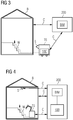
- FIG. 3 schematically shows another embodiment of the computer-implemented method according to the invention.
- a mobile transport device is shown by way of example as a mobile technical system TS, which comprises a device 100 according to the invention.
- the transport device TS and / or the device 100 can be coupled to a management system 200 of the building B via a wireless or wired communication link C.
- the management system 200 is coupled to the building B and can, among other things, manage the computer-aided spatial model of the building BIM and make it available to the device 100 for reading.
- the TS transport system can be controlled by an operator or autonomously.
- the route W specified for the transport system TS can be physically validated by checking the route W in the device 100 using the building model BIM and depending on the boundary conditions that are given by the parameters of the transport system TS.
- current location data or environmental data of the transport system TS can be recorded by means of at least one sensor S. and be used in route verification.
- the transport system TS can transport temperature-sensitive goods, so that a boundary condition for the route can be a maximum temperature which must not be exceeded.
- a current environmental measurement in building B can be carried out at at least one predetermined point in the route and taken into account when checking the route.
- the route can be released for the TS transport system. If the test result is negative, a warning message such as a warning signal for an operator.
- the device 100 can also be connected directly to a control unit of the transport device, so that the autonomous transport device TS can be stopped, braked or deflected directly.
- a management system 200 of a building B can comprise a device 100, ie the device 100 can be integrated, for example, as software in the management system 200.
- at least one sensor S can be installed in the building B, which is directly coupled to the management system 200.
- the sensor S can be a smoke detector, for example, which continuously monitors part of the building B and transmits the corresponding current environmental data in the building to the management system 200.
- the current environmental data can be taken into account and, for example, a rescheduling of the route can be initiated in the event of a negative test result.
- the management system 200 can transmit the current environmental data to the device 100, so that the feasibility of the route W can be checked there using the model of the structure BIM. Furthermore, additional requirements of the structure, such as escape routes, can be defined in the model of the BIM structure, which should be taken into account when checking route W in the event of a fire.
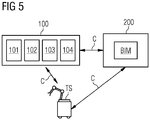
- Figure 5 shows a block diagram of a device 100 according to the invention, which is coupled to an administration system 200 according to the invention and a mobile technical system TS.
- the coupling can be set up, for example, in each case via a wireless or wired communication connection C or via a communication network.
- the device 100 comprises an input module 101 for reading in a building model BIM, a route in the building for the mobile technical system TS and parameters of the mobile technical system TS.
- the input module 101 can, for example, be connected to a storage unit or database and from there call up the data relevant for checking the route.
- the building model BIM can also be provided by the management system 200. At least one boundary condition for the route is derived in the derivation module 102 on the basis of the parameters of the mobile technical system TS.
- the device 100 further comprises a test module 103 for checking the suitability of the route using the building model BIM and depending on the boundary conditions specific to the mobile technical system. Rules or test regulations can be transmitted to the test module 103, for example, by means of which the route can be checked.
- the result of the test can be output via the output module 104 of the device 100 to the management system 200 and / or to the mobile technical system TS.
- predetermined routes for the mobile technical system can be checked in real time and, if necessary, rescheduled.
Landscapes
- Engineering & Computer Science (AREA)
- Physics & Mathematics (AREA)
- General Physics & Mathematics (AREA)
- Automation & Control Theory (AREA)
- Radar, Positioning & Navigation (AREA)
- Remote Sensing (AREA)
- General Engineering & Computer Science (AREA)
- Manufacturing & Machinery (AREA)
- Quality & Reliability (AREA)
- Aviation & Aerospace Engineering (AREA)
- Navigation (AREA)
- Control Of Position, Course, Altitude, Or Attitude Of Moving Bodies (AREA)
Abstract
Description
- Die Erfindung betrifft ein computerimplementiertes Verfahren und eine Vorrichtung zum Prüfen einer Route für ein mobiles technisches System in einem Bauwerk. Ferner betrifft die Erfindung ein Verwaltungssystem eines Bauwerks, ein Computerprogrammprodukt und ein computerlesbares Speichermedium.
- In Bauwerken, wie z.B. Produktionsanlagen, Industrieanlagen, Krankenhäusern, Flughäfen oder ähnlichem, werden zunehmend für den Betrieb, Service und/oder die Logistik mobile technische Systeme, wie z.B. Transportsysteme, eingesetzt. Diese mobilen Systeme können sowohl vom Menschen geführt bzw. mittels eines Steuergeräts gesteuert werden als auch autonom konzipiert sein. Es ist dabei bekannt, mittels beispielsweise Pfadplanungs- und/oder Optimierungsalgorithmen Pfade für ein mobiles System in einem Bauwerk zu ermitteln. Bei der Pfadplanung werden in der Regel lediglich Randbedingungen des Bauwerks, wie z.B. Wände oder Durchgänge, berücksichtigt.
- Weiter ist bekannt, für ein Bauwerk zur Vorhersage und Überprüfung bestimmter Merkmale und zur Entscheidungsunterstützung ein Simulationsmodell mittels Bauwerksdatenmodellierung (engl. Building Information Modelling, kurz BIM), bereitzustellen. Ein Simulationsmodell kann insbesondere Informationen über technische Daten und/oder Statik des Bauwerks umfassen. Anhand eines solchen Simulationsmodells kann beispielsweise für eine statische Installation im Bauwerk eine Simulation durchgeführt werden. In der Regel können ein Simulationsmodell und/oder Sensordaten eines Bauwerks mittels eines Gebäudemanagementsystems verwaltet werden.
- Es ist eine Aufgabe der Erfindung, eine Route eines mobilen technischen Systems in einem Bauwerk auf Eignung für das mobile technische System zu prüfen.
- Die Aufgabe wird durch die in den unabhängigen Ansprüchen beschriebenen Maßnahmen gelöst. In den abhängigen Ansprüchen sind vorteilhafte Weiterbildungen der Erfindung dargestellt.
- Gemäß einem ersten Aspekt betrifft die Erfindung ein computerimplementiertes Verfahren zum Prüfen einer Route in einem Bauwerk für ein mobiles technisches System, wobei
- ein computergestütztes räumliches Modell des Bauwerks, das Bauwerksdaten umfasst, eine Route für das mobile technische System im Bauwerk und Parameter des mobilen technischen Systems eingelesen werden,
- abhängig von den Parametern eine Randbedingung für die Route abgeleitet wird,
- für einen vorgegebenen Punkt der Route anhand des Modells des Bauwerks geprüft wird, ob die Bauwerksdaten die Randbedingung am vorgegebenen Punkt der Route erfüllen
und - ein Ergebnis der Prüfung ausgegeben wird.
- Ein mobiles technisches System ist insbesondere bewegbar bzw. fahrbar und kann beispielsweise ein fahrbares Transportsystem, ein mobiler Roboter, oder ein Fahrzeug sein, das autonom konfiguriert ist oder von einem Menschen bewegt bzw. gesteuert werden kann. Parameter eines mobilen technischen Systems können insbesondere technische und physikalische Parameter sein, wie z.B. Ausmaße, Gewicht, Hitzebeständigkeit, Wendekreisradius und ähnliches. Des Weiteren können die Parameter des mobilen technischen Systems auch Informationen über eine Ladung, wie z.B. Sperrigkeit oder besondere Anforderungen an den Transportweg, umfassen.
- Sofern es in der nachfolgenden Beschreibung nicht anders angegeben ist, beziehen sich die Begriffe "ermitteln", "durchführen", "bereitstellen", "erfolgen", "berechnen", "rechnergestützt", "rechnen", "feststellen", "generieren", "konfigurieren", "rekonstruieren" und dergleichen, vorzugsweise auf Handlungen und/oder Prozesse und/oder Verarbeitungsschritte, die Daten verändern und/oder erzeugen und/oder die Daten in andere Daten überführen, wobei die Daten insbesondere als physikalische Größen dargestellt werden oder vorliegen können. Insbesondere können Daten eines Modells eines Bauwerks, einer Route und/oder Parameter des mobilen technischen Systems auf eine Speichereinheit gespeichert sein und/oder eingelesen werden. Eine "Route" für ein mobiles technisches System ist insbesondere eine Angabe über einen zu folgenden Weg oder Pfad, wobei mindestens ein Startpunkt und ein Endpunkt angegeben ist. Eine Route kann in einer Datenstruktur gespeichert sein. Eine Route kann beispielsweise mittels eines Pfadplanungsalgorithmus für das Bauwerk ermittelt oder von einem Nutzer vorgegeben sein.
- Ein computergestütztes räumliches Modell eines Bauwerks, im Folgenden auch als Bauwerksmodell bezeichnet, kann insbesondere physikalische und/oder technische und/oder funktionale Bauwerksdaten umfassen bzw. modellieren. Ein Modell eines Bauwerks kann ein digitales, dreidimensionales Simulationsmodell sein, welches insbesondere physikalische Größen und technische Merkmale des Bauwerks abbildet. Beispielsweise kann ein Modell eines Bauwerks einen Grundriss, Maße, Informationen zur Statik und/oder zu Baumaterialien umfassen. Beispielsweise kann mittels des Verfahrens überprüft werden, ob an einem Ortspunkt einer Route ein Tragwerk des Bauwerks für das Gewicht des mobilen technischen Systems geeignet ist. Dazu kann insbesondere eine computergestützte Simulation der Route im Bauwerk durchgeführt werden.
- Die Bauwerksdaten können insbesondere physikalische und/oder technische und/oder funktionale Daten des Bauwerks sein, wie z.B. Daten zu Größe, Material, oder Belastbarkeit von Bauwerksteilen sowie Informationen zum Bauwerkspläne und funktionale Details.
- Unter "computergestützt" kann im Zusammenhang mit der Erfindung beispielsweise eine Implementierung des Verfahrens verstanden werden, bei dem insbesondere ein Prozessor mindestens einen Verfahrensschritt des Verfahrens ausführt.
- Eine Randbedingung kann insbesondere als eine Anforderung gesehen werden, die einen Lösungsraum jenseits dessen einschränkt, was notwendig ist, um funktionale Anforderungen und/oder Qualitätsanforderungen zu erfüllen. Die Randbedingung kann insbesondere anhand der Parameter des mobilen technischen Systems abgeleitet, d.h. beispielsweise berechnet oder simuliert, werden.
- Es ist ein Vorteil der Erfindung, dass vorgegebene Routen bzw. vorgegebene Punkte, d.h. Ortspunkte, einer Route in einem Bauwerk für ein mobiles technisches System anhand eines Modells des Bauwerks auf Eignung für das mobile technische System geprüft werden können, ob sie den Bedingungen des Bauwerks und/oder des mobilen technischen Systems genügen. Unter "Eignung" kann im Zusammenhang mit der Erfindung insbesondere auch Nutzbarkeit, Ausführbarkeit, Durchführbarkeit, Benutzbarkeit, Anwendbarkeit, Tauglichkeit, Einsetzbarkeit, Geeignetheit, Befahrbarkeit, oder Einsatzfähigkeit verstanden werden. Insbesondere kann die Prüfung einer Route, ob sie für ein mobiles technisches System geeignet ist, für mehr als einen vorgegebenen Punkt durchgeführt werden. Insbesondere kann für jeden Punkt der Route geprüft werden, ob am entsprechenden Ort im Bauwerk die Randbedingung erfüllt ist.
- Eine Prüfung erfolgt beispielsweise anhand eines Abgleichs von Belastungsgrenzen des Bauwerks und einem Gewicht des mobilen technischen Systems an einem vorgegebenen Punkt der Route im Bauwerk. So kann beispielsweise eine Route eines mobilen technischen Systems auf Durchführbarkeit anhand des Bauwerksmodells geprüft werden, bevor die Route befahren wird. Insbesondere können mehr als eine Route für ein mobiles technisches System derart geprüft werden und eine geeignete Route selektiert werden.
- In einer vorteilhaften Ausführungsform des computerimplementierten Verfahrens kann abhängig vom Ergebnis der Prüfung
- die Route oder zumindest Teile der Route für das mobile technische System freigegeben und/oder
- eine Warnmeldung ausgegeben und/oder
- das mobile technische System angehalten und/oder
- eine Planung einer alternativen Route veranlasst und/oder
- eine alternative Route ausgegeben werden.
- Insbesondere können Regeln und/oder Vorgaben und/oder Unsicherheitsbereiche und/oder Gefahrenbereiche bezogen auf eine transportierte Ware definiert werden, anhand derer das Ergebnis der Prüfung eingestuft werden kann. Beispielsweise kann eine Umplanung der Route oder eines Teils der Route veranlasst werden, indem eine Rückmeldung an eine gekoppelte Pfadplanungssoftware übermittelt wird, die eine alternative Planung der Route veranlasst. Beispielsweise kann eine Prüfung ergeben, dass lediglich ein langsames Befahren einer Route möglich ist, so dass die Route für das mobile technische System mit einer Warnung freigegeben wird. Bei einem negativen Prüfergebnis kann beispielsweise das mobile technische System gestoppt, ausgeschalten, gebremst oder umgelenkt werden.
- In einer weiteren vorteilhaften Ausführungsform des computerimplementierten Verfahrens können das mobile technische System und ein Verwaltungssystem des Bauwerks über eine Kommunikationsverbindung gekoppelt sein und es können Daten über die Kommunikationsverbindung ausgetauscht werden.
- Es ist ein Vorteil der Erfindung, dass ein Verwaltungssystem des Bauwerks, wie z.B. ein Gebäudemanagementsystem, mit dem mobilen technischen System derart gekoppelt sein kann, dass Daten ausgetauscht werden können. Das Verwaltungssystem des Bauwerks kann somit insbesondere direkt mit einer Steuereinheit des mobilen technischen Systems über eine drahtlose oder drahtgebundene Verbindung gekoppelt sein.
- In einer weiteren vorteilhaften Ausführungsform des computerimplementierten Verfahrens können aktuelle Umgebungsdaten im Bauwerk von einem Sensor erfasst und die aktuellen Umgebungsdaten an das Verwaltungssystem des Bauwerks übermittelt und die Umgebungsdaten mit Bauwerksdaten verifiziert und/oder beim Prüfen der Route berücksichtigt werden.
- Ein Sensor kann beispielsweise an oder im Bauwerk oder am mobilen technischen System angebracht sein. Beispielsweise können mittels eines Laserscans aktuelle Umgebungsdaten im Bauwerk erfasst werden. Umgebungsdaten können beispielsweise Messdaten von unterschiedlichen Sensoren, wie z.B. Temperatursensoren, Dehnungssensoren, Rauchmeldern oder Lastsensoren, die im oder am Bauwerk installiert sein können, umfassen. Die aktuellen Umgebungsdaten können im Zusammenhang mit der Erfindung insbesondere als zusätzliche Bedingungen für die Pfadvalidierung gesehen werden, wie z.B. aktuelle Temperaturdaten für einen Kühltransport. Beispielsweise kann somit eine Route für ein mobiles technisches System in nahezu Echtzeit auf Eignung geprüft werden. Vorzugsweise können die Umgebungsdaten kontinuierlich oder zu vorgegebenen Messzeitpunkten genommen, mit vorgegebenen Bauwerksdaten verglichen, somit verifiziert, und zur Prüfung der Route genutzt werden.
- In einer weiteren vorteilhaften Ausführungsform des computerimplementierten Verfahrens können Daten vom mobilen technischen System von einem Sensor erfasst werden und es können diese Daten des mobilen technischen Systems an das Verwaltungssystem übermittelt und die Daten des mobilen technischen Systems beim Prüfen der Route berücksichtigt werden.
- Der mindestens eine Sensor kann insbesondere am mobilen technischen System installiert oder mit diesem gekoppelt sein. Der Sensor kann auch im Bauwerk installiert sein und das mobile technische System derart überwachen. Die Sensordaten über das mobile technische System können beispielsweise Betriebsdaten, Bewegungsdaten und/oder Standortdaten umfassen. Vorzugsweise können anhand dieser Sensordaten die Parameterdaten des mobilen technischen Systems aktualisiert werden, wie z.B. durch eine durchgehende Messung des Gesamtgewichts eines Transportsystems. Anhand der aktuellen Sensordaten des mobilen technischen Systems kann der Pfad für das System in Echtzeit verifiziert werden. Es ist auch möglich, dass mittels eines mit dem mobilen technischen System gekoppelten Sensors dynamische, d.h. zeitlich variable, Daten des Bauwerks erfasst und dem Verwaltungssystem des Bauwerks übermittelt und für die Prüfung einer Route genutzt werden.
- In einer weiteren vorteilhaften Ausführungsform des computerimplementierten Verfahrens kann das Prüfen der Route im Verwaltungssystem des Bauwerks oder auf dem mobilen technischen System durchgeführt werden und das Ergebnis der Prüfung kann dem Verwaltungssystem des Bauwerks und/oder vom mobilen technischen System übermittelt und von diesem ausgegeben werden.
- Für ein autonomes mobiles technisches System, wie z.B. ein autonomes mobiles System, kann die Prüfung auf Eignung einer Route vorzugsweise direkt auf dem System durchgeführt werden. Für eine Flotte von ähnlichen mobilen technischen Systemen kann eine Routenvalidierung vorteilhafter Weise zentral vom Veraltungssystem des Bauwerks durchgeführt werden. Für ein von einem Menschen geführten mobilen technischen System kann die Überprüfung einer Route vorzugsweise auf dem mobilen technischen System direkt durchgeführt werden, wobei das Prüfergebnis lokal als Nachricht, z.B. als Warnsignal, ausgegeben werden kann.
- In einer weiteren vorteilhaften Ausführungsform des computerimplementierten Verfahrens kann aus einem nicht-computergestützten Modell des Bauwerks ein computergestütztes räumliches Modell des Bauwerks generiert und dieses bereitgestellt werden.
- Es können insbesondere ältere Baupläne oder Architekturzeichnungen in computergestützte Modelle des Bauwerks konvertiert werden.
- Gemäß einem weiteren Aspekt betrifft die Erfindung eine Vorrichtung zum Prüfen einer Route in einem Bauwerk für ein mobiles technisches System, umfassend:
- ein Eingabemodul zum Einlesen eines computergestützten räumlichen Modells des Bauwerks, das Bauwerksdaten umfasst, einer Route (W) für das mobile technische System im Bauwerk und von Parametern des mobilen technischen Systems,
- ein Ableitungsmodul zum Ableiten einer Randbedingung für die Route abhängig von den Parametern,
- ein Prüfmodul zum Prüfen für einen vorgegebenen Punkt der Route anhand des Modells des Bauwerks, die Bauwerksdaten die Randbedingung am vorgegebenen Punkt der Route erfüllen,
- ein Ausgabemodul zum Ausgeben des Ergebnisses der Prüfung.
- Die Vorrichtung und/oder die Module der Vorrichtung können insbesondere als Hardware- und/oder Softwaremodule ausgestaltet sein.
- In einer vorteilhaften Ausführungsform kann die Vorrichtung mit einem Verwaltungssystem eines Bauwerks und/oder mit dem mobilen technischen System gekoppelt sein.
- Insbesondere kann die Vorrichtung als Teil des Verwaltungssystems des Bauwerks verstanden werden und/oder direkt mit einer Steuereinheit des mobilen technischen Systems gekoppelt sein.
- In einer vorteilhaften Ausführungsform kann die Vorrichtung derart ausgestaltet sein, Schritte eines erfindungsgemäßen computerimplementierten Verfahrens durchzuführen.
- Die Vorrichtung kann insbesondere mindestens einen Prozessor umfassen, der zumindest einen Schritt eines erfindungsgemäßen computerimplementierten Verfahrens durchführt.
- Gemäß einem weiteren Aspekt betrifft die Erfindung ein Verwaltungssystem eines Bauwerks, wobei das Verwaltungssystem eine Vorrichtung gemäß der Erfindung umfasst.
- Ein Verwaltungssystem eines Bauwerks kann insbesondere mit dem Bauwerk gekoppelt sein.
- In einer vorteilhaften Ausführungsform kann das Verwaltungssystem mit mindestens einem Sensor und/oder mit dem mobilen technischen System über eine Kommunikationsverbindung gekoppelt sein und derart ausgestaltet sein, die Schritte eines erfindungsgemäßen Verfahrens durchzuführen.
- Des Weiteren betrifft die Erfindung ein Computerprogrammprodukt, das direkt in einen programmierbaren Computer ladbar ist, umfassend Programmcodeteile, die dazu geeignet sind, die Schritte eines erfindungsgemäßen Verfahrens durchzuführen und einen computerlesbaren Datenträger, auf dem das Computerprogrammprodukt gespeichert ist.
- Insbesondere kann ein erfindungsgemäßes Computerprogrammprodukt von einem Netzwerkdienst, einem Computersystem, einem Serversystem, einem verteilten Computersystem, einem cloudbasierten Rechnersystem und/oder virtuellen Rechnersystem bereitgestellt werden. Die Bereitstellung kann beispielsweise als Download in Form eines Programmdatenblocks und/oder Befehlsdatenblocks, vorzugsweise als Datei, insbesondere als Downloaddatei, des vollständigen Computerprogrammprodukts erfolgen. Ein solches Computerprogrammprodukt wird beispielsweise unter Verwendung einer Bereitstellungsvorrichtung, insbesondere in Form eines computerlesbaren Datenträgers, eingelesen und führt die Programmbefehle aus, sodass das erfindungsgemäße Verfahren auf einem Computer zur Ausführung gebracht wird.
- Die nachfolgenden Ausführungsbeispiele können, sofern nicht anders angegeben oder bereits angegeben, zumindest einen Prozessor und/oder eine Speichereinheit aufweisen, um das Verfahren zu implementieren oder auszuführen.
- Ausführungsbeispiele des erfindungsgemäßen Verfahrens, der erfindungsgemäßen Vorrichtung und des erfindungsgemäßen Verwaltungssystems sind in den Zeichnungen beispielhaft dargestellt und werden anhand der nachfolgenden Beschreibung näher erläutert. Es zeigen:
-
Fig. 1 : ein Ablaufdiagramm eines erfindungsgemäßen Verfahrens; -
Fig. 2 : eine schematische Darstellung eines erfindungsgemäßen Verfahrens; -
Fig. 3 : eine weitere schematische Darstellung eines erfindungsgemäßen Verfahrens; -
Fig. 4 : eine schematische Darstellung eines erfindungsgemäßen Verfahrens; und -
Fig. 5 : eine schematische Darstellung einer erfindungsgemäßen Vorrichtung und eines erfindungsgemäßen Verwaltungssystems. - Einander entsprechende Teile sind in allen Figuren mit den gleichen Bezugszeichen versehen.
-
Figur 1 zeigt ein Ablaufdiagramm eines erfindungsgemäßen Verfahrens zum computergestützten Prüfen, insbesondere Prüfen auf Eignung, einer Route für ein mobiles technisches System in einem Bauwerk. - Im Schritt S1 wird ein computergestütztes räumliches Modell des Bauwerks, wie z.B. ein dreidimensionales Simulationsmodell, Angaben zu einer Route im Bauwerk für das mobile technische System und Paramater des mobilen technischen Systems eingelesen. Beispielsweise werden diese Informationen als Daten von einer Datenbank oder Speichereinheit eingelesen. Die Route kann insbesondere von einem Nutzer vorgegeben und/oder mittels einer geeigneten Pfadplanungssoftware ermittelt und bereitgestellt werden. Das Bauwerksmodell umfasst vorzugsweise physikalische und/oder technische und/oder funktionale Eigenschaften des Bauwerks. Nicht-computergestützte Modelle des Bauwerks, wie z.B. Architekturzeichnungen, können in ein computergestütztes Modell des Bauwerks konvertiert werden, wobei insbesondere physikalische und/oder technische und/oder funktionale Bauwerksdaten des Bauwerks erfasst und in einem Simulationsmodell modelliert werden.
- Im Schritt S2 können anhand der Parameter des mobilen technischen Systems Randbedingungen für die Route im Bauwerk abgeleitet werden. Unter "ableiten" kann beispielsweise "ermitteln", "berechnen", "erlangen", "bestimmen", "einschränken", "herleiten", "folgern", "schlussfolgern", "erschließen", "rückschließen", oder ähnliches verstanden werden. Beispielsweise können anhand von Maßangaben oder Sicherheitsinformationen, die dem mobilen technischen System zugeordnet sind, Anforderungen bestimmt werden, welche zum Befahren der Route erfüllt sein müssen. Die Parameter können vorzugsweise spezifische Merkmale des mobilen technischen Systems umfassen, wie z.B. Gewicht, Größe des Wendekreises, Sicherheitsbestimmungen oder Informationen über transportierte Ware, so dass Randbedingungen beispielsweise Last-, Größen-, oder Sicherheitsbeschränkungen umfassen. Damit eine Route für ein mobiles technisches System validiert werden kann, müssen die Bauwerksdaten die Randbedingungen entlang der vorgegebenen Ortspunkte der Route erfüllen.
- Im Schritt S3 kann anhand des räumlichen Modells des Bauwerks und abhängig von den Parametern des mobilen technischen Systems jeder vorgegebene Ortspunkt der Route auf eine Eignung für das mobile technische System überprüft werden. Die Prüfung kann beispielsweise einen Vergleich der Randbedingung mit entsprechenden Bauwerksdaten an einem vorgegebenen Ortspunkt umfassen, wie z.B. ein Höhenvergleich einer Deckenhöhe des Bauwerks mit den Abmaßen des mobilen technischen Systems. Beispielsweise kann derart überprüft werden, ob eine vorgegebene Route, oder mindestens ein Teil der Route an vorgegebenen Ortspunkten der Route, für das mobile technische System geeignet ist, d.h. ob die Bauwerksdaten an dem jeweiligen Ortspunkt den Randbedingungen des mobilen technischen Systems genügen und somit ein Befahren der Route erlauben. Für die Prüfung wird eine Ortsinformation des Bauwerksmodells mit einer Ortsinformation der Route genutzt. Die Randbedingungen für die Route sind insbesondere technischer und/oder physikalischer und/oder funktioneller Natur und werden von den Parametern des mobilen technischen Systems abgeleitet.
- Insbesondere kann anhand des Bauwerksmodells eine Simulation der Route im Bauwerk durchgeführt werden und damit die Eignung der Route für das mobile technische System überprüft werden. Die Überprüfung kann beispielsweise anhand vorgegebener Regeln erfolgen.
- Es kann folglich explizit für das mobile technische System eine vorgegebene Route im Bauwerk verifiziert werden, indem insbesondere physikalische und/oder technische Eigenschaften des Bauwerks in Betracht gezogen werden.
- Im Schritt S4 wird das Ergebnis der Prüfung der Route an das mobile technische System und/oder an das Verwaltungssystem des Bauwerks ausgegeben. Das Ergebnis der Prüfung der Route kann beispielsweise ergeben, dass die Route für das mobile technische System im Bauwerk geeignet ist oder nur unter bestimmten Bedingungen oder nicht geeignet ist.
- Die Prüfung der Route kann direkt auf einem Prozessor auf dem mobilen technischen System erfolgen. Alternativ kann die Prüfung auch von einem Verwaltungssystem des Bauwerks durchgeführt werden, wobei dafür insbesondere Parameter des mobilen technischen Systems an das Verwaltungssystem übermittelt werden.
- Weitere Schritte des Verfahrens erfolgen abhängig vom Prüfergebnis R. Beispielsweise kann eine Route für ein mobiles technisches System für geeignet befunden und freigegeben werden, Schritt S5. Nach einer Freigabe der Route kann die Route vom mobilen technischen System befahren bzw. ausgeführt werden. Beispielsweise kann die Freigabe der Route an ein Steuergerät des mobilen technischen Systems übermittelt werden.
- Bei einem negativen Prüfergebnis, d.h. wenn die Route oder mindestens ein Teil der Route für nicht geeignet für das mobile technische System befunden wird, kann keine Freigabe des Pfades erfolgen und/oder es kann eine Warnmeldung ausgegeben, Schritt S6, und/oder das mobile technische System angehalten werden, Schritt S7. Zusätzlich kann bei einem negativen Prüfergebnis, eine Planung einer alternativen Route veranlasst werden, Schritt S8. Diese alternative Route kann nachfolgend gemäß der Erfindung anhand des Bauwerksmodells und abhängig von den Parametern des mobilen technischen Systems geprüft werden, ob alle erforderlichen Randbedingungen für das Befahren der Route erfüllt sind, Schritt S1 bis S4. Bei positivem Prüfergebnis für die alternative Route kann diese an das mobile technische System und/oder an das Verwaltungssystem des Bauwerks übermittelt und vom mobilen technischen System ausgeführt werden, Schritt S9.
-
Figur 2 zeigt ein Ausführungsbeispiel eines erfindungsgemäßen Verfahrens. Es ist schematisch ein Bauwerk B gezeigt, in welchem eine Route W für ein mobiles technisches System TS vorgegeben wird. Das mobile technische System TS kann beispielsweise ein mobiler Roboter sein, der im Bauwerk B einer bestimmten Route W entlang in ein nächstes Stockwerk fahren soll. Die Route W kann beispielsweise mittels eines Pfadplanungsalgorithmus geplant sein. Um zu prüfen, ob die Route für den mobilen Roboter TS geeignet ist, z.B. ob eine Rampe einem Gesamtgewicht des mobilen Roboters TS standhält, wird erfindungsgemäß mittels eines Modells des Bauwerks die Route simuliert und validiert. Anhand mindestens einem Parameter des mobilen Roboters, z.B. das Gesamtgewicht, wird mindestens eine Randbedingung für die vorgegebene Route bestimmt, wie z.B. einen Mindestwert für die Belastbarkeit der Rampe. Anhand des Bauwerksmodells kann an jedem Punkt der Route überprüft werden, ob die Bauwerksdaten an dem gleichen Punkt die Randbedingung erfüllen. - Dazu wird an eine erfindungsgemäße Vorrichtung 100, die ein Eingabemodul 101, ein Ableitungsmodul 102, ein Prüfmodul 103 und ein Ausgabemodul 104, umfasst, das Modell des Bauwerks, die Route W und Parameter des mobilen Roboters TS übergeben. Die Module der Vorrichtung 100 sind vorteilhaft miteinander über Kommunikationsverbindungen verbunden. Die Vorrichtung 100 kann beispielsweise als Software ausgestaltet sein und auf einem Prozessor ausgeführt werden. Ein Nutzer oder Käufer eines mobilen technischen Systems TS kann damit eine geplante Route System vorab überprüfen, ob diese für das mobile technische System geeignet ist. Des Weiteren kann ein Lieferant eines mobilen technischen Systems TS vorab überprüfen, ob ein mobiles Transportsystem eine Route W in einem Bauwerk B tatsächlich befahren kann und/oder ob eine transportierte Ware auf der vorgegebenen Route W gemäß Sicherheitsbestimmungen oder Liefervorschriften tatsächlich ausgeliefert werden kann.
- Die Vorrichtung 100 ist derart eingerichtet, Schritte des erfindungsgemäßen Verfahrens, wie beispielhaft in
Figur 1 dargestellt, durchzuführen. Die Vorrichtung 100 kann über eine drahtlose Kommunikationsverbindung C direkt mit dem mobilen Roboter TS verbunden sein, so dass das Prüfergebnis direkt an eine Steuereinheit des mobilen Roboters TS übermittelt werden kann. Die Vorrichtung 100 kann insbesondere mit einem Verwaltungssystem 200 des Bauwerks B gekoppelt sein und/oder in dieses integriert sein (nicht dargestellt). Beispielsweise kann das Modell des Bauwerks vom Verwaltungssystem 200 bereitgestellt werden. - Die Prüfung der Route W kann beispielsweise ergeben, dass diese nicht für den mobilen Roboter TS geeignet ist, z.B. aufgrund eines zulässigen Gesamtgewichts und/oder aufgrund von Sicherheitsbedingungen. So kann beispielsweise die Vorrichtung 100 und/oder das Verwaltungssystem 200 mit einem Pfadplanungsmodul (nicht dargestellt), das eine Pfadplanungssoftware umfasst, gekoppelt sein, womit eine alternative Route W' geplant werden kann. In
Figur 2 ist eine alternative Route W' über einen Aufzug A dargestellt. Wenn die alternative Route W' mittels der Vorrichtung 100 positiv validiert wird, kann diese Route W' stattdessen für den mobilen Roboter TS freigegeben und ausgeführt werden. - Des Weiteren kann mittels des erfindungsgemäßen computerimplementierten Verfahrens eine optimale Route aus einer Vielzahl an Routen für ein mobiles technisches System TS ermittelt werden, wobei für eine jeweilige Route die von den Parametern des mobilen technischen Systems abhängigen Randbedingungen mit den Bauwerksdaten entlang der jeweiligen Route abgeglichen werden.
-
Figur 3 zeigt schematisch ein weiteres Ausführungsbeispiel des erfindungsgemäßen computerimplementierten Verfahrens. Als mobiles technisches System TS ist beispielhaft ein mobiles Transportgerät gezeigt, welches eine Vorrichtung 100 gemäß der Erfindung umfasst. Das Transportgerät TS und/oder die Vorrichtung 100 können mit einem Verwaltungssystem 200 des Bauwerks B über eine drahtlose oder drahtgebundene Kommunikationsverbindung C gekoppelt sein. Das Verwaltungssystem 200 ist mit dem Bauwerk B gekoppelt und kann unter anderem das computergestützte räumliche Modell des Bauwerks BIM verwalten und dieses der Vorrichtung 100 zum Einlesen bereitstellen. - Das Transportsystem TS kann von einer Bedienperson oder autonom gesteuert werden. Die für das Transportsystem TS vorgegebene Route W kann physikalisch validiert werden, indem in der Vorrichtung 100 die Route W anhand des Bauwerksmodells BIM und abhängig von den Randbedingungen, die durch die Parameter des Transportsystems TS gegeben sind, geprüft wird. Zusätzlich können mittels mindestens eines Sensors S aktuelle Standortdaten oder Umgebungsdaten des Transportsystems TS erfasst und bei der Routenüberprüfung genutzt werden. Beispielsweise kann das Transportsystem TS temperaturempfindliche Ware transportieren, so dass eine Randbedingung für die Route eine Maximaltemperatur sein kann, welche nicht überschritten werden darf.
- Mittels mindestens eines Umgebungssensors, z.B. ein Temperatur- oder Feuchtigkeitssensor oder ein Radar-/Ultraschallsensor zur Überprüfung eines Durchgangs, kann eine aktuelle Umgebungsmessung im Bauwerk B an mindestens einem vorgegebenen Punkt der Route durchgeführt und bei der Prüfung der Route berücksichtigt werden.
- Abhängig vom Ergebnis der Routenprüfung kann die Route für das Transportsystem TS freigegeben werden. Bei einem negativen Prüfergebnis kann beispielsweise eine Warnmeldung, wie z.B. ein Warnsignal für eine Bedienperson, ausgegeben werden. Bei einem autonomen Transportgerät TS kann die Vorrichtung 100 auch direkt mit einer Steuereinheit des Transportgeräts verbunden sein, so dass das autonome Transportgerät TS direkt angehalten oder abgebremst oder umgelenkt werden kann.
- In
Figur 4 ist ein weiteres Ausführungsbeispiel der Erfindung gezeigt. Ein Verwaltungssystem 200 eines Bauwerks B kann eine Vorrichtung 100 umfassen, d.h. die Vorrichtung 100 kann zum Beispiel als Software im Verwaltungssystem 200 integriert sein. Des Weiteren kann im Bauwerk B mindestens ein Sensor S installiert sein, der direkt mit dem Verwaltungssystem 200 gekoppelt ist. Der Sensor S kann beispielsweise ein Rauchmelder sein, der kontinuierlich einen Teil des Bauwerks B überwacht und die entsprechenden aktuellen Umgebungsdaten im Bauwerk an das Verwaltungssystem 200 übermittelt. So können bei einer Prüfung einer Route W für ein mobiles technisches System TS bei einem Brandfall die aktuellen Umgebungsdaten berücksichtigt werden und beispielsweise bei einem negativen Prüfungsergebnis eine Umplanung der Route veranlasst werden. Das Verwaltungssystem 200 kann die aktuellen Umgebungsdaten an die Vorrichtung 100 übermitteln, so dass dort anhand des Modells des Bauwerks BIM die Route W auf ihre Durchführbarkeit überprüft werden kann. Des Weiteren können im Modell des Bauwerks BIM zusätzliche Anforderungen des Bauwerks, wie z.B. Fluchtwege, definiert sein, die bei der Überprüfung der Route W im Brandfall berücksichtigt werden sollen. -
Figur 5 zeigt in Blockdarstellung eine erfindungsgemäße Vorrichtung 100, die mit einem erfindungsgemäßen Verwaltungssystem 200 und einem mobilen technischen System TS gekoppelt ist. Die Kopplung kann beispielsweise jeweils über eine drahtlose oder drahtgebundene Kommunikationsverbindung C oder über ein Kommunikationsnetzwerk eingerichtet sein. - Die erfindungsgemäße Vorrichtung 100 umfasst ein Eingabemodul 101 zum Einlesen eines Bauwerksmodells BIM, einer Route im Bauwerk für das mobile technische System TS und von Parametern des mobilen technischen Systems TS. Das Eingabemodul 101 kann beispielsweise mit einer Speichereinheit oder Datenbank verbunden sein und von dort die für die Prüfung der Route relevanten Daten abrufen. Das Bauwerksmodell BIM kann auch vom Verwaltungssystem 200 bereitgestellt werden. Anhand der Parameter des mobilen technischen Systems TS wird im Ableitungsmodul 102 mindestens eine Randbedingung für die Route abgeleitet.
- Die Vorrichtung 100 umfasst des Weiteren ein Prüfmodul 103 zum Prüfen der Route auf Eignung anhand des Bauwerksmodells BIM und abhängig von den für das mobile technische System spezifischen Randbedingungen. Dem Prüfmodul 103 können beispielsweise Regeln oder Prüfvorschriften übermittelt werden anhand derer die Prüfung der Route erfolgen kann.
- Das Ergebnis der Prüfung kann über das Ausgabemodul 104 der Vorrichtung 100 an das Verwaltungssystem 200 und/oder an das mobile technische System TS ausgegeben werden.
- Aufgrund der Kopplung des Verwaltungssystems 200, der Vorrichtung 100, des mobilen technischen Systems TS, und vorzugsweise Sensoren in oder am Bauwerk und/oder mobilen technischen System, können vorgegebene Routen für das mobile technische System in Echtzeit überprüft und gegebenenfalls umgeplant werden.
- Alle beschriebenen und/oder gezeichneten Merkmale können im Rahmen der Erfindung vorteilhaft miteinander kombiniert werden. Die Erfindung ist nicht auf die beschriebenen Ausführungsbeispiele beschränkt.
Claims (14)
- Computerimplementiertes Verfahren zum Prüfen einer Route in einem Bauwerk (B) für ein mobiles technisches System (TS), wobei- ein computergestütztes räumliches Modell (BIM) des Bauwerks, das Bauwerksdaten umfasst, eine Route (W) für das mobile technische System (TS) im Bauwerk (B) und Parameter des mobilen technischen Systems (TS) eingelesen werden (S1),- abhängig von den Parametern eine Randbedingung für die Route (W) abgeleitet wird (S2),- für einen vorgegebenen Punkt der Route (W) anhand des Modells des Bauwerks (BIM) geprüft wird, ob die Bauwerksdaten die Randbedingung am vorgegebenen Punkt der Route (W) erfüllen (S3)
und- ein Ergebnis der Prüfung ausgegeben wird (S4). - Computerimplementiertes Verfahren nach Anspruch 1, wobei abhängig vom Ergebnis der Prüfung- die Route oder zumindest Teile der Route für das mobile technische System (TS) freigegeben (S5) und/oder- eine Warnmeldung ausgegeben (S6) und/oder- das mobile technische System (TS) angehalten (S7) und/oder- eine Planung einer alternativen Route (W') veranlasst (S8) und/oder- eine alternative Route (W') ausgegeben wird (S9).
- Computerimplementiertes Verfahren nach einem der vorhergehenden Ansprüche, wobei das mobile technische System (TS) und ein Verwaltungssystem (200) des Bauwerks über eine Kommunikationsverbindung (C) gekoppelt sind und Daten über die Kommunikationsverbindung (C) ausgetauscht werden.
- Computerimplementiertes Verfahren nach einem der vorhergehenden Ansprüche, wobei aktuelle Umgebungsdaten im Bauwerk von einem Sensor (S) erfasst und die aktuellen Umgebungsdaten an das Verwaltungssystem (200) des Bauwerks übermittelt und die Umgebungsdaten mit Bauwerksdaten verifiziert und/oder beim Prüfen der Route (W) berücksichtigt werden.
- Computerimplementiertes Verfahren nach einem der vorhergehenden Ansprüche, wobei- Daten vom mobilen technischen System (TS) von einem Sensor (S) erfasst und- diese Daten des mobilen technischen Systems (TS) an das Verwaltungssystem (200) übermittelt und die Daten des mobilen technischen Systems beim Prüfen der Route (W) berücksichtigt werden.
- Computerimplementiertes Verfahren nach einem der vorhergehenden Ansprüche, wobei- das Prüfen der Route im Verwaltungssystem (200) des Bauwerks oder auf dem mobilen technischen System (TS) durchgeführt wird
und- das Ergebnis der Prüfung dem Verwaltungssystem (200) des Bauwerks und/oder vom mobilen technischen System (TS) übermittelt und von diesem ausgegeben wird. - Computerimplementiertes Verfahren nach einem der vorhergehenden Ansprüche, wobei aus einem nicht-computergestützten Modell des Bauwerks ein computergestütztes räumliches Modell (BIM) des Bauwerks generiert wird und dieses bereitgestellt wird.
- Vorrichtung (100) zum Prüfen einer Route in einem Bauwerk (B) für ein mobiles technisches System (TS), umfassend:- ein Eingabemodul (101) zum Einlesen eines computergestützten räumlichen Modells (BIM) des Bauwerks, das Bauwerksdaten umfasst, einer Route (W) für das mobile technische System (TS) im Bauwerk (B) und von Parametern des mobilen technischen Systems (TS),- ein Ableitungsmodul (102) zum Ableiten einer Randbedingung für die Route (W) abhängig von den Parametern,- ein Prüfmodul (103) zum Prüfen für einen vorgegebenen Punkt der Route (W) anhand des Modells des Bauwerks (BIM), die Bauwerksdaten die Randbedingung am vorgegebenen Punkt der Route (W) erfüllen,- ein Ausgabemodul (104) zum Ausgeben des Ergebnisses der Prüfung.
- Vorrichtung (100) nach Anspruch 8, wobei die Vorrichtung (100) mit einem Verwaltungssystem (200) eines Bauwerks (B) und/oder mit dem mobilen technischen System (TS) gekoppelt ist.
- Vorrichtung (100) nach Anspruch 8 oder 9, die derart ausgestaltet ist, die Schritte eines computerimplementierten Verfahrens nach einem der Ansprüche 1 bis 7 durchzuführen.
- Verwaltungssystem (200) eines Bauwerks (B), wobei das Verwaltungssystem (200) eine Vorrichtung (100) nach einem der Ansprüche 8 bis 10 umfasst.
- Verwaltungssystem (200) eines Bauwerks (B) nach Anspruch 11, wobei das Verwaltungssystem (200) mit mindestens einem Sensor (S) und/oder mit dem mobilen technischen System (TS) über eine Kommunikationsverbindung (C) gekoppelt ist und derart ausgestaltet ist, die Schritte eines Verfahrens nach einem der Ansprüche 1 bis 7 durchzuführen.
- Computerprogrammprodukt, das direkt in einen programmierbaren Computer ladbar ist, umfassend Programmcodeteile, die dazu geeignet sind, Schritte eines Verfahrens nach einem der Ansprüche 1 bis 7 durchzuführen.
- Computerlesbarer Datenträger, auf dem das Computerprogrammprodukt nach Anspruch 13 gespeichert ist.
Applications Claiming Priority (1)
| Application Number | Priority Date | Filing Date | Title |
|---|---|---|---|
| DE102018214927.5A DE102018214927A1 (de) | 2018-09-03 | 2018-09-03 | Verfahren, Vorrichtung und Verwaltungssystem zum Prüfen einer Route für ein mobiles technisches System in einem Bauwerk |
Publications (2)
| Publication Number | Publication Date |
|---|---|
| EP3617831A1 true EP3617831A1 (de) | 2020-03-04 |
| EP3617831B1 EP3617831B1 (de) | 2022-04-06 |
Family
ID=67988844
Family Applications (1)
| Application Number | Title | Priority Date | Filing Date |
|---|---|---|---|
| EP19193675.6A Active EP3617831B1 (de) | 2018-09-03 | 2019-08-27 | Verfahren, vorrichtung und verwaltungssystem zum prüfen einer route für ein mobiles technisches system in einem bauwerk |
Country Status (3)
| Country | Link |
|---|---|
| US (1) | US11249465B2 (de) |
| EP (1) | EP3617831B1 (de) |
| DE (1) | DE102018214927A1 (de) |
Families Citing this family (3)
| Publication number | Priority date | Publication date | Assignee | Title |
|---|---|---|---|---|
| DE102018214927A1 (de) * | 2018-09-03 | 2020-03-05 | Siemens Schweiz Ag | Verfahren, Vorrichtung und Verwaltungssystem zum Prüfen einer Route für ein mobiles technisches System in einem Bauwerk |
| WO2022264413A1 (ja) * | 2021-06-18 | 2022-12-22 | 株式会社センシンロボティクス | 移動体の移動経路生成方法及びプログラム、管理サーバ、管理システム |
| KR102627736B1 (ko) * | 2023-03-07 | 2024-01-23 | 주식회사 정윤에이엠 | 건물관리 인력배치 및 경로설정 방법 및 시스템 |
Citations (2)
| Publication number | Priority date | Publication date | Assignee | Title |
|---|---|---|---|---|
| US20140032179A1 (en) * | 2012-07-27 | 2014-01-30 | Wawan Solihin | Building path identification |
| EP2806324A1 (de) * | 2012-01-16 | 2014-11-26 | Hitachi, Ltd. | Ausgaberouten-planungssystem |
Family Cites Families (7)
| Publication number | Priority date | Publication date | Assignee | Title |
|---|---|---|---|---|
| US9043028B2 (en) * | 2013-03-13 | 2015-05-26 | Trimble Navigation Limited | Method of determining the orientation of a machine |
| US20140323148A1 (en) * | 2013-04-30 | 2014-10-30 | Qualcomm Incorporated | Wide area localization from slam maps |
| WO2017152067A1 (en) * | 2016-03-04 | 2017-09-08 | Animusoft Llc | Drone and robot control systems and methods |
| DE102016217950A1 (de) * | 2016-09-20 | 2018-03-22 | Siemens Schweiz Ag | Verfahren und Anordnung zum Erkennen von Hindernissen auf Fluchtwegen, insbesondere in Gebäuden |
| DE102017208174A1 (de) * | 2017-05-15 | 2018-11-15 | Siemens Schweiz Ag | Verfahren und Anordnung zur Berechnung von Navigationspfaden für Objekte in Gebäuden oder auf einem Campus |
| US10900790B2 (en) * | 2018-01-26 | 2021-01-26 | Autodesk, Inc. | Interior building navigation system |
| DE102018214927A1 (de) * | 2018-09-03 | 2020-03-05 | Siemens Schweiz Ag | Verfahren, Vorrichtung und Verwaltungssystem zum Prüfen einer Route für ein mobiles technisches System in einem Bauwerk |
-
2018
- 2018-09-03 DE DE102018214927.5A patent/DE102018214927A1/de not_active Withdrawn
-
2019
- 2019-08-27 EP EP19193675.6A patent/EP3617831B1/de active Active
- 2019-09-03 US US16/558,513 patent/US11249465B2/en active Active
Patent Citations (2)
| Publication number | Priority date | Publication date | Assignee | Title |
|---|---|---|---|---|
| EP2806324A1 (de) * | 2012-01-16 | 2014-11-26 | Hitachi, Ltd. | Ausgaberouten-planungssystem |
| US20140032179A1 (en) * | 2012-07-27 | 2014-01-30 | Wawan Solihin | Building path identification |
Also Published As
| Publication number | Publication date |
|---|---|
| DE102018214927A1 (de) | 2020-03-05 |
| EP3617831B1 (de) | 2022-04-06 |
| US11249465B2 (en) | 2022-02-15 |
| US20200073374A1 (en) | 2020-03-05 |
Similar Documents
| Publication | Publication Date | Title |
|---|---|---|
| EP3617831B1 (de) | Verfahren, vorrichtung und verwaltungssystem zum prüfen einer route für ein mobiles technisches system in einem bauwerk | |
| WO2017174195A1 (de) | Verfahren und vorrichtung zum planen und/oder steuern und/oder simulieren des betriebs einer baumaschine | |
| DE102017208174A1 (de) | Verfahren und Anordnung zur Berechnung von Navigationspfaden für Objekte in Gebäuden oder auf einem Campus | |
| WO2014183953A1 (de) | Anordnung und verfahren zur sensorfusion sowie herstellungsverfahren zur erstellung eines fusionsmodells | |
| EP3982349A1 (de) | Fluggerät sowie verfahren und rechnergestütztes system zur steuerung eines fluggeräts | |
| EP3695244A1 (de) | Verfahren und vorrichtung zum erzeugen eines inversen sensormodells und verfahren zum erkennen von hindernissen | |
| WO2018054659A1 (de) | Verfahren und anordnung zum erkennen von hindernissen auf fluchtwegen, insbesondere in gebäuden | |
| Rutkowska et al. | FRAM modelling of the transfer of control over aircraft | |
| DE102021106584A1 (de) | System mit mindestens einem Anlagesystem mit mindestens mehreren Anlageteilen | |
| Kouroutakis | Autonomous vehicles: Regulatory challenges and the response from Germany and UK | |
| EP3791375A1 (de) | Verfahren und vorrichtung zur gegenseitigen überwachung und/oder kontrolle autonomer technischer systeme | |
| EP3365140A1 (de) | Verifikation einer position eines manipulatorsystems | |
| EP3760392B1 (de) | Verfahren und system zur prüfung und/oder montage eines objekts mittels eines roboters | |
| EP3902759B1 (de) | Verfahren und vorrichtung zum kommissionieren einer personentransportanlage | |
| DE102021214584A1 (de) | Zuweisen einer Aufgabe an einen örtlich entfernten Experten | |
| EP3798088B1 (de) | Verfahren und anordnung zum verteilen von personen in einem personenzug | |
| DE102019216486A1 (de) | Verfahren zum Bestimmen einer geschätzten Abweichung zumindest einer Zustandsvariablen eines dynamischen Systems | |
| DE102020210408A1 (de) | System und Verfahren zum geführten Inbetriebnehmen wenigstens eines Fahrzeugs in einer Logistikeinrichtung | |
| DE102022205999A1 (de) | Verfahren zum Trainieren eines Deep-Learning basierten Algorithmus des maschinellen Lernens | |
| EP3895091B1 (de) | Verfahren zum austauschen eines bauteils in einer personentransportanlage sowie hierbei einzusetzende vorrichtung | |
| EP3553679A1 (de) | Verfahren zur computergestützten fehlerdiagnose für ein technisches system | |
| EP4441639A1 (de) | Feldgerät, feldgerätenetzwerk und verfahren für einen nutzerzugang | |
| DE102024120262B4 (de) | Computerimplementiertes Verfahren zur Steuerung des Betriebs von Fahrzeugsystemen einer Flotte von Kraftfahrzeugen, Kraftfahrzeug und Kommunikationssystem | |
| EP2998924A1 (de) | Verfahren zur abwicklung eines belade- bzw. entladevorganges eines lastkraftwagens sowie verwendung eines smartphone | |
| EP3570233A1 (de) | Verfahren und system zur erfassung und verwaltung einer vielzahl von daten eines bauelements |
Legal Events
| Date | Code | Title | Description |
|---|---|---|---|
| PUAI | Public reference made under article 153(3) epc to a published international application that has entered the european phase |
Free format text: ORIGINAL CODE: 0009012 |
|
| STAA | Information on the status of an ep patent application or granted ep patent |
Free format text: STATUS: THE APPLICATION HAS BEEN PUBLISHED |
|
| AK | Designated contracting states |
Kind code of ref document: A1 Designated state(s): AL AT BE BG CH CY CZ DE DK EE ES FI FR GB GR HR HU IE IS IT LI LT LU LV MC MK MT NL NO PL PT RO RS SE SI SK SM TR |
|
| AX | Request for extension of the european patent |
Extension state: BA ME |
|
| STAA | Information on the status of an ep patent application or granted ep patent |
Free format text: STATUS: REQUEST FOR EXAMINATION WAS MADE |
|
| 17P | Request for examination filed |
Effective date: 20200901 |
|
| RBV | Designated contracting states (corrected) |
Designated state(s): AL AT BE BG CH CY CZ DE DK EE ES FI FR GB GR HR HU IE IS IT LI LT LU LV MC MK MT NL NO PL PT RO RS SE SI SK SM TR |
|
| STAA | Information on the status of an ep patent application or granted ep patent |
Free format text: STATUS: EXAMINATION IS IN PROGRESS |
|
| 17Q | First examination report despatched |
Effective date: 20201223 |
|
| GRAP | Despatch of communication of intention to grant a patent |
Free format text: ORIGINAL CODE: EPIDOSNIGR1 |
|
| STAA | Information on the status of an ep patent application or granted ep patent |
Free format text: STATUS: GRANT OF PATENT IS INTENDED |
|
| INTG | Intention to grant announced |
Effective date: 20211206 |
|
| GRAS | Grant fee paid |
Free format text: ORIGINAL CODE: EPIDOSNIGR3 |
|
| GRAA | (expected) grant |
Free format text: ORIGINAL CODE: 0009210 |
|
| STAA | Information on the status of an ep patent application or granted ep patent |
Free format text: STATUS: THE PATENT HAS BEEN GRANTED |
|
| AK | Designated contracting states |
Kind code of ref document: B1 Designated state(s): AL AT BE BG CH CY CZ DE DK EE ES FI FR GB GR HR HU IE IS IT LI LT LU LV MC MK MT NL NO PL PT RO RS SE SI SK SM TR |
|
| REG | Reference to a national code |
Ref country code: GB Ref legal event code: FG4D Free format text: NOT ENGLISH |
|
| REG | Reference to a national code |
Ref country code: CH Ref legal event code: EP |
|
| REG | Reference to a national code |
Ref country code: AT Ref legal event code: REF Ref document number: 1481952 Country of ref document: AT Kind code of ref document: T Effective date: 20220415 |
|
| REG | Reference to a national code |
Ref country code: DE Ref legal event code: R096 Ref document number: 502019003945 Country of ref document: DE |
|
| REG | Reference to a national code |
Ref country code: IE Ref legal event code: FG4D Free format text: LANGUAGE OF EP DOCUMENT: GERMAN |
|
| REG | Reference to a national code |
Ref country code: SE Ref legal event code: TRGR |
|
| REG | Reference to a national code |
Ref country code: LT Ref legal event code: MG9D |
|
| REG | Reference to a national code |
Ref country code: NL Ref legal event code: MP Effective date: 20220406 |
|
| PG25 | Lapsed in a contracting state [announced via postgrant information from national office to epo] |
Ref country code: NL Free format text: LAPSE BECAUSE OF FAILURE TO SUBMIT A TRANSLATION OF THE DESCRIPTION OR TO PAY THE FEE WITHIN THE PRESCRIBED TIME-LIMIT Effective date: 20220406 |
|
| PG25 | Lapsed in a contracting state [announced via postgrant information from national office to epo] |
Ref country code: PT Free format text: LAPSE BECAUSE OF FAILURE TO SUBMIT A TRANSLATION OF THE DESCRIPTION OR TO PAY THE FEE WITHIN THE PRESCRIBED TIME-LIMIT Effective date: 20220808 Ref country code: NO Free format text: LAPSE BECAUSE OF FAILURE TO SUBMIT A TRANSLATION OF THE DESCRIPTION OR TO PAY THE FEE WITHIN THE PRESCRIBED TIME-LIMIT Effective date: 20220706 Ref country code: LT Free format text: LAPSE BECAUSE OF FAILURE TO SUBMIT A TRANSLATION OF THE DESCRIPTION OR TO PAY THE FEE WITHIN THE PRESCRIBED TIME-LIMIT Effective date: 20220406 Ref country code: HR Free format text: LAPSE BECAUSE OF FAILURE TO SUBMIT A TRANSLATION OF THE DESCRIPTION OR TO PAY THE FEE WITHIN THE PRESCRIBED TIME-LIMIT Effective date: 20220406 Ref country code: GR Free format text: LAPSE BECAUSE OF FAILURE TO SUBMIT A TRANSLATION OF THE DESCRIPTION OR TO PAY THE FEE WITHIN THE PRESCRIBED TIME-LIMIT Effective date: 20220707 Ref country code: FI Free format text: LAPSE BECAUSE OF FAILURE TO SUBMIT A TRANSLATION OF THE DESCRIPTION OR TO PAY THE FEE WITHIN THE PRESCRIBED TIME-LIMIT Effective date: 20220406 Ref country code: ES Free format text: LAPSE BECAUSE OF FAILURE TO SUBMIT A TRANSLATION OF THE DESCRIPTION OR TO PAY THE FEE WITHIN THE PRESCRIBED TIME-LIMIT Effective date: 20220406 Ref country code: BG Free format text: LAPSE BECAUSE OF FAILURE TO SUBMIT A TRANSLATION OF THE DESCRIPTION OR TO PAY THE FEE WITHIN THE PRESCRIBED TIME-LIMIT Effective date: 20220706 |
|
| PG25 | Lapsed in a contracting state [announced via postgrant information from national office to epo] |
Ref country code: RS Free format text: LAPSE BECAUSE OF FAILURE TO SUBMIT A TRANSLATION OF THE DESCRIPTION OR TO PAY THE FEE WITHIN THE PRESCRIBED TIME-LIMIT Effective date: 20220406 Ref country code: PL Free format text: LAPSE BECAUSE OF FAILURE TO SUBMIT A TRANSLATION OF THE DESCRIPTION OR TO PAY THE FEE WITHIN THE PRESCRIBED TIME-LIMIT Effective date: 20220406 Ref country code: LV Free format text: LAPSE BECAUSE OF FAILURE TO SUBMIT A TRANSLATION OF THE DESCRIPTION OR TO PAY THE FEE WITHIN THE PRESCRIBED TIME-LIMIT Effective date: 20220406 Ref country code: IS Free format text: LAPSE BECAUSE OF FAILURE TO SUBMIT A TRANSLATION OF THE DESCRIPTION OR TO PAY THE FEE WITHIN THE PRESCRIBED TIME-LIMIT Effective date: 20220806 |
|
| REG | Reference to a national code |
Ref country code: DE Ref legal event code: R097 Ref document number: 502019003945 Country of ref document: DE |
|
| PG25 | Lapsed in a contracting state [announced via postgrant information from national office to epo] |
Ref country code: SM Free format text: LAPSE BECAUSE OF FAILURE TO SUBMIT A TRANSLATION OF THE DESCRIPTION OR TO PAY THE FEE WITHIN THE PRESCRIBED TIME-LIMIT Effective date: 20220406 Ref country code: SK Free format text: LAPSE BECAUSE OF FAILURE TO SUBMIT A TRANSLATION OF THE DESCRIPTION OR TO PAY THE FEE WITHIN THE PRESCRIBED TIME-LIMIT Effective date: 20220406 Ref country code: RO Free format text: LAPSE BECAUSE OF FAILURE TO SUBMIT A TRANSLATION OF THE DESCRIPTION OR TO PAY THE FEE WITHIN THE PRESCRIBED TIME-LIMIT Effective date: 20220406 Ref country code: EE Free format text: LAPSE BECAUSE OF FAILURE TO SUBMIT A TRANSLATION OF THE DESCRIPTION OR TO PAY THE FEE WITHIN THE PRESCRIBED TIME-LIMIT Effective date: 20220406 Ref country code: DK Free format text: LAPSE BECAUSE OF FAILURE TO SUBMIT A TRANSLATION OF THE DESCRIPTION OR TO PAY THE FEE WITHIN THE PRESCRIBED TIME-LIMIT Effective date: 20220406 Ref country code: CZ Free format text: LAPSE BECAUSE OF FAILURE TO SUBMIT A TRANSLATION OF THE DESCRIPTION OR TO PAY THE FEE WITHIN THE PRESCRIBED TIME-LIMIT Effective date: 20220406 |
|
| PLBE | No opposition filed within time limit |
Free format text: ORIGINAL CODE: 0009261 |
|
| STAA | Information on the status of an ep patent application or granted ep patent |
Free format text: STATUS: NO OPPOSITION FILED WITHIN TIME LIMIT |
|
| 26N | No opposition filed |
Effective date: 20230110 |
|
| PG25 | Lapsed in a contracting state [announced via postgrant information from national office to epo] |
Ref country code: MC Free format text: LAPSE BECAUSE OF FAILURE TO SUBMIT A TRANSLATION OF THE DESCRIPTION OR TO PAY THE FEE WITHIN THE PRESCRIBED TIME-LIMIT Effective date: 20220406 Ref country code: AL Free format text: LAPSE BECAUSE OF FAILURE TO SUBMIT A TRANSLATION OF THE DESCRIPTION OR TO PAY THE FEE WITHIN THE PRESCRIBED TIME-LIMIT Effective date: 20220406 |
|
| PG25 | Lapsed in a contracting state [announced via postgrant information from national office to epo] |
Ref country code: LU Free format text: LAPSE BECAUSE OF NON-PAYMENT OF DUE FEES Effective date: 20220827 |
|
| REG | Reference to a national code |
Ref country code: BE Ref legal event code: MM Effective date: 20220831 |
|
| PG25 | Lapsed in a contracting state [announced via postgrant information from national office to epo] |
Ref country code: SI Free format text: LAPSE BECAUSE OF FAILURE TO SUBMIT A TRANSLATION OF THE DESCRIPTION OR TO PAY THE FEE WITHIN THE PRESCRIBED TIME-LIMIT Effective date: 20220406 |
|
| PG25 | Lapsed in a contracting state [announced via postgrant information from national office to epo] |
Ref country code: IE Free format text: LAPSE BECAUSE OF NON-PAYMENT OF DUE FEES Effective date: 20220827 |
|
| PG25 | Lapsed in a contracting state [announced via postgrant information from national office to epo] |
Ref country code: BE Free format text: LAPSE BECAUSE OF NON-PAYMENT OF DUE FEES Effective date: 20220831 |
|
| REG | Reference to a national code |
Ref country code: DE Ref legal event code: R079 Ref document number: 502019003945 Country of ref document: DE Free format text: PREVIOUS MAIN CLASS: G05D0001020000 Ipc: G05D0001430000 |
|
| PG25 | Lapsed in a contracting state [announced via postgrant information from national office to epo] |
Ref country code: HU Free format text: LAPSE BECAUSE OF FAILURE TO SUBMIT A TRANSLATION OF THE DESCRIPTION OR TO PAY THE FEE WITHIN THE PRESCRIBED TIME-LIMIT; INVALID AB INITIO Effective date: 20190827 |
|
| PG25 | Lapsed in a contracting state [announced via postgrant information from national office to epo] |
Ref country code: CY Free format text: LAPSE BECAUSE OF FAILURE TO SUBMIT A TRANSLATION OF THE DESCRIPTION OR TO PAY THE FEE WITHIN THE PRESCRIBED TIME-LIMIT Effective date: 20220406 |
|
| PG25 | Lapsed in a contracting state [announced via postgrant information from national office to epo] |
Ref country code: MK Free format text: LAPSE BECAUSE OF FAILURE TO SUBMIT A TRANSLATION OF THE DESCRIPTION OR TO PAY THE FEE WITHIN THE PRESCRIBED TIME-LIMIT Effective date: 20220406 |
|
| PG25 | Lapsed in a contracting state [announced via postgrant information from national office to epo] |
Ref country code: TR Free format text: LAPSE BECAUSE OF FAILURE TO SUBMIT A TRANSLATION OF THE DESCRIPTION OR TO PAY THE FEE WITHIN THE PRESCRIBED TIME-LIMIT Effective date: 20220406 |
|
| PG25 | Lapsed in a contracting state [announced via postgrant information from national office to epo] |
Ref country code: MT Free format text: LAPSE BECAUSE OF FAILURE TO SUBMIT A TRANSLATION OF THE DESCRIPTION OR TO PAY THE FEE WITHIN THE PRESCRIBED TIME-LIMIT Effective date: 20220406 |
|
| PG25 | Lapsed in a contracting state [announced via postgrant information from national office to epo] |
Ref country code: BG Free format text: LAPSE BECAUSE OF FAILURE TO SUBMIT A TRANSLATION OF THE DESCRIPTION OR TO PAY THE FEE WITHIN THE PRESCRIBED TIME-LIMIT Effective date: 20220406 |
|
| PG25 | Lapsed in a contracting state [announced via postgrant information from national office to epo] |
Ref country code: BG Free format text: LAPSE BECAUSE OF FAILURE TO SUBMIT A TRANSLATION OF THE DESCRIPTION OR TO PAY THE FEE WITHIN THE PRESCRIBED TIME-LIMIT Effective date: 20220406 |
|
| PGFP | Annual fee paid to national office [announced via postgrant information from national office to epo] |
Ref country code: IT Payment date: 20250827 Year of fee payment: 7 |
|
| PGFP | Annual fee paid to national office [announced via postgrant information from national office to epo] |
Ref country code: GB Payment date: 20250902 Year of fee payment: 7 |
|
| PGFP | Annual fee paid to national office [announced via postgrant information from national office to epo] |
Ref country code: AT Payment date: 20250708 Year of fee payment: 7 Ref country code: FR Payment date: 20250827 Year of fee payment: 7 |
|
| PGFP | Annual fee paid to national office [announced via postgrant information from national office to epo] |
Ref country code: SE Payment date: 20250819 Year of fee payment: 7 |
|
| REG | Reference to a national code |
Ref country code: CH Ref legal event code: U11 Free format text: ST27 STATUS EVENT CODE: U-0-0-U10-U11 (AS PROVIDED BY THE NATIONAL OFFICE) Effective date: 20251110 |
|
| PGFP | Annual fee paid to national office [announced via postgrant information from national office to epo] |
Ref country code: DE Payment date: 20251020 Year of fee payment: 7 |
|
| PGFP | Annual fee paid to national office [announced via postgrant information from national office to epo] |
Ref country code: CH Payment date: 20251110 Year of fee payment: 7 |