EP3614745A1 - Nachrichtensendeverfahren, nachrichtenempfangsverfahren und entsprechende vorrichtung - Google Patents
Nachrichtensendeverfahren, nachrichtenempfangsverfahren und entsprechende vorrichtung Download PDFInfo
- Publication number
- EP3614745A1 EP3614745A1 EP17908282.1A EP17908282A EP3614745A1 EP 3614745 A1 EP3614745 A1 EP 3614745A1 EP 17908282 A EP17908282 A EP 17908282A EP 3614745 A1 EP3614745 A1 EP 3614745A1
- Authority
- EP
- European Patent Office
- Prior art keywords
- terminal device
- indication signal
- imsi set
- imsi
- signal
- Prior art date
- Legal status (The legal status is an assumption and is not a legal conclusion. Google has not performed a legal analysis and makes no representation as to the accuracy of the status listed.)
- Withdrawn
Links
- 238000000034 method Methods 0.000 title claims abstract description 66
- 238000012545 processing Methods 0.000 claims description 31
- 230000005540 biological transmission Effects 0.000 claims description 27
- 230000006870 function Effects 0.000 description 22
- 238000013461 design Methods 0.000 description 20
- 230000011664 signaling Effects 0.000 description 14
- 238000010586 diagram Methods 0.000 description 13
- 238000004891 communication Methods 0.000 description 12
- 238000004590 computer program Methods 0.000 description 5
- 238000001514 detection method Methods 0.000 description 5
- 238000010295 mobile communication Methods 0.000 description 5
- 230000006399 behavior Effects 0.000 description 4
- 125000004122 cyclic group Chemical group 0.000 description 2
- 238000005516 engineering process Methods 0.000 description 2
- 230000007774 longterm Effects 0.000 description 2
- 238000012986 modification Methods 0.000 description 2
- 230000004048 modification Effects 0.000 description 2
- 230000001413 cellular effect Effects 0.000 description 1
- 230000000694 effects Effects 0.000 description 1
- PCHJSUWPFVWCPO-UHFFFAOYSA-N gold Chemical group [Au] PCHJSUWPFVWCPO-UHFFFAOYSA-N 0.000 description 1
- 230000000977 initiatory effect Effects 0.000 description 1
- 230000003287 optical effect Effects 0.000 description 1
- 238000004080 punching Methods 0.000 description 1
- 230000002618 waking effect Effects 0.000 description 1
- 239000002699 waste material Substances 0.000 description 1
Images



Classifications
-
- H—ELECTRICITY
- H04—ELECTRIC COMMUNICATION TECHNIQUE
- H04W—WIRELESS COMMUNICATION NETWORKS
- H04W68/00—User notification, e.g. alerting and paging, for incoming communication, change of service or the like
- H04W68/02—Arrangements for increasing efficiency of notification or paging channel
-
- H—ELECTRICITY
- H04—ELECTRIC COMMUNICATION TECHNIQUE
- H04W—WIRELESS COMMUNICATION NETWORKS
- H04W52/00—Power management, e.g. Transmission Power Control [TPC] or power classes
- H04W52/02—Power saving arrangements
- H04W52/0209—Power saving arrangements in terminal devices
- H04W52/0212—Power saving arrangements in terminal devices managed by the network, e.g. network or access point is leader and terminal is follower
- H04W52/0216—Power saving arrangements in terminal devices managed by the network, e.g. network or access point is leader and terminal is follower using a pre-established activity schedule, e.g. traffic indication frame
-
- H—ELECTRICITY
- H04—ELECTRIC COMMUNICATION TECHNIQUE
- H04W—WIRELESS COMMUNICATION NETWORKS
- H04W52/00—Power management, e.g. Transmission Power Control [TPC] or power classes
- H04W52/02—Power saving arrangements
-
- H—ELECTRICITY
- H04—ELECTRIC COMMUNICATION TECHNIQUE
- H04W—WIRELESS COMMUNICATION NETWORKS
- H04W52/00—Power management, e.g. Transmission Power Control [TPC] or power classes
- H04W52/02—Power saving arrangements
- H04W52/0209—Power saving arrangements in terminal devices
- H04W52/0225—Power saving arrangements in terminal devices using monitoring of external events, e.g. the presence of a signal
- H04W52/0229—Power saving arrangements in terminal devices using monitoring of external events, e.g. the presence of a signal where the received signal is a wanted signal
- H04W52/0235—Power saving arrangements in terminal devices using monitoring of external events, e.g. the presence of a signal where the received signal is a wanted signal where the received signal is a power saving command
-
- H—ELECTRICITY
- H04—ELECTRIC COMMUNICATION TECHNIQUE
- H04W—WIRELESS COMMUNICATION NETWORKS
- H04W72/00—Local resource management
- H04W72/12—Wireless traffic scheduling
-
- H—ELECTRICITY
- H04—ELECTRIC COMMUNICATION TECHNIQUE
- H04W—WIRELESS COMMUNICATION NETWORKS
- H04W8/00—Network data management
- H04W8/18—Processing of user or subscriber data, e.g. subscribed services, user preferences or user profiles; Transfer of user or subscriber data
-
- H—ELECTRICITY
- H04—ELECTRIC COMMUNICATION TECHNIQUE
- H04W—WIRELESS COMMUNICATION NETWORKS
- H04W76/00—Connection management
- H04W76/20—Manipulation of established connections
- H04W76/28—Discontinuous transmission [DTX]; Discontinuous reception [DRX]
-
- Y—GENERAL TAGGING OF NEW TECHNOLOGICAL DEVELOPMENTS; GENERAL TAGGING OF CROSS-SECTIONAL TECHNOLOGIES SPANNING OVER SEVERAL SECTIONS OF THE IPC; TECHNICAL SUBJECTS COVERED BY FORMER USPC CROSS-REFERENCE ART COLLECTIONS [XRACs] AND DIGESTS
- Y02—TECHNOLOGIES OR APPLICATIONS FOR MITIGATION OR ADAPTATION AGAINST CLIMATE CHANGE
- Y02D—CLIMATE CHANGE MITIGATION TECHNOLOGIES IN INFORMATION AND COMMUNICATION TECHNOLOGIES [ICT], I.E. INFORMATION AND COMMUNICATION TECHNOLOGIES AIMING AT THE REDUCTION OF THEIR OWN ENERGY USE
- Y02D30/00—Reducing energy consumption in communication networks
- Y02D30/70—Reducing energy consumption in communication networks in wireless communication networks
Definitions
- This application relates to the field of communications technologies, and in particular, to a signal sending method, a signal receiving method, and a corresponding device.
- a terminal device In a wireless communications system, a terminal device has two modes. One is a connected mode, indicating that the terminal device has established a connection to a network device, and can directly communicate with the network device; and the other is an idle mode (also referred to as a sleep mode), and the terminal device can enter the idle mode to reduce power consumption when sending or receiving no service.
- the terminal device in the idle mode cannot directly communicate with the network device.
- the network device usually sends a paging scheduling signal to the terminal device regularly, to indicate whether the terminal device should switch from the idle mode to the connected mode, so as to communicate with the network device.
- the terminal device in the idle mode regularly wakes up to listen to the paging scheduling signal, and a cycle of regularly waking up is referred to as a discontinuous reception (discontinuous reception, DRX) cycle.
- a moment at which the terminal device wakes up in the DRX cycle is referred to as a paging occasion (paging occasion, PO).
- the terminal device in the idle mode remains in the idle mode in most of time of the DRX cycle.
- the terminal device only wakes up at a corresponding PO moment to listen to the paging scheduling signal, and the terminal device needs to wake up at only one PO to listen to the paging scheduling signal in a DRX cycle.
- many terminal devices may remain in the idle mode in most of time, and need to constantly listen to a paging scheduling signal to determine whether the terminal device is paged or a system message changes. Services of many terminal devices belong to an active reporting type, a probability of being paged is relatively low, and a change frequency of a system message is also relatively low. In addition, it needs to be satisfied that when the network device needs to page the terminal device, a delay from a moment at which a paging requirement is generated to a moment at which the terminal device is actually paged cannot be excessively long. Therefore, for these terminal devices in the idle mode, the network device does not send the paging scheduling signal to the terminal devices at PO moments in most of the DRX cycles.
- the terminal device still needs to wake up to listen to the paging scheduling signal at the PO moment in each DRX cycle.
- the terminal device may listen to a paging scheduling signal for a long time, leading to more power consumption and a shorter standby time of the terminal device.
- a plurality of terminal devices share a PO moment in a DRX cycle, that is, the plurality of terminal devices listen to a paging scheduling signal at a same PO moment.
- a DRX cycle is short
- there are usually not many POs in the DRX cycle consequently, a relatively large quantity of terminal devices listen to a same PO.
- the paging scheduling signal may be directed to a small quantity or even one of all terminal devices sharing the PO moment.
- terminal devices still need to receive the paging scheduling signal, and can determine that the terminal devices are not paged only after parsing a paging message (where the parsing message is scheduled by the paging scheduling signal). Consequently, the power consumption of the terminal device is increased, and the standby time of the terminal device is shortened.
- Embodiments of this application provide a signal sending method, a signal receiving method, and a corresponding device, to reduce a probability that a terminal device listens to a paging scheduling signal when the terminal device does not need to listen to the paging scheduling signal.
- an embodiment of this application provides a signal sending method, including: generating, by a network device, a first indication signal, where the first indication signal is used to indicate that a terminal device is not paged and/or no system message changes, the first indication signal corresponds to a first international mobile subscriber identity IMSI set, and a quantity of IMSIs in the first IMSI set is less than or equal to a quantity of IMSIs corresponding to one paging occasion PO. In other words, the quantity of IMSIs in the first IMSI set is less than or equal to a quantity of terminal devices sharing one PO.
- a signal used to indicate that a terminal device is not paged and/or no system message changes is a first-type indication signal.
- the first indication signal is a first-type indication signal corresponding to the first IMSI set, and is an example of the first-type indication signal.
- the network device sends the first indication signal to a first terminal device, where the first terminal device is a terminal device corresponding to any IMSI in the first IMSI set.
- the network device when a terminal device corresponding to an IMSI set is not paged and/or no system message changes, the network device sends the first-type indication signal to the terminal device corresponding to the IMSI set, to indicate that the terminal device is not paged and/or no system message changes.
- the terminal device may not listen to a paging scheduling signal, thereby reducing a probability that the terminal device listens to the paging scheduling signal when the terminal device does not need to listen to the paging scheduling signal.
- the terminal device may spend far less time listening to the first-type indication signal than listening to the paging scheduling signal.
- the terminal device does not listen to the paging scheduling signal, thereby reducing power consumption and extending a standby time.
- a quantity of IMSIs in the IMSI set may be less than a quantity of IMSIs corresponding to one PO, when only some of all terminal devices sharing a PO are paged and/or no system message changes, IMSIs of all or some terminal devices that are not paged and/or whose system message does not change at the PO may be in one IMSI set.
- the network device may send the first-type indication signal to the terminal device corresponding to the IMSI set, and the terminal device receiving the first-type indication signal may not listen to the paging scheduling signal, thereby reducing the power consumption.
- the network device sends higher layer signaling or a system message to the first terminal device.
- the higher layer signaling or the system message is used to indicate a time resource and/or a frequency resource of the first indication signal.
- the higher layer signaling may be a radio resource control (Radio Resource Control, RRC) signaling.
- the system message may be a system information block (system information block, SIB) or a master system module (master information block, MIB).
- the network device sends the first indication signal to the first terminal device on the time resource and/or the frequency resource.
- the terminal device and the network device agree on a transmission resource for listening to the first-type indication signal, to ensure that the terminal device successfully receives the first-type indication signal sent by the network device to the terminal device.
- the signal sending method further includes: generating, by the network device, a third indication signal, where the third indication signal is used to indicate that a terminal device is paged and/or a system message changes, the third indication signal corresponds to a sixth IMSI set, and a quantity of IMSIs in the sixth IMSI set is less than or equal to a quantity of IMSIs corresponding to one PO.
- a signal used to indicate that a terminal device is paged and/or a system message changes is a second-type indication signal.
- the third indication signal is a second-type indication signal corresponding to the sixth IMSI set, and is an example of the second-type indication signal.
- the network device sends the third indication signal to a second terminal device, and the second terminal device is a terminal device corresponding to any IMSI in the sixth IMSI set.
- the network device may separately send indication signals of different types to a terminal device that corresponds to an IMSI set and that needs to listen to a paging scheduling signal and to a terminal device that corresponds to the IMSI set and that does not need to listen to the paging scheduling signal, to be applicable to a case in which a plurality of terminal devices corresponding to one PO have different requirements for listening to the paging scheduling signal, thereby reducing a probability that another terminal device corresponding to a PO listens to the paging scheduling signal because some terminal devices corresponding to the PO are paged and/or a system message changes, and reducing power consumption of the terminal device that is not paged and/or whose system message does not change.
- an embodiment of this application provides a signal receiving method, including: listening to, by a terminal device, an indication signal, where the indication signal includes a first indication signal, the first indication signal is used to indicate that a terminal device is not paged and/or no system message changes, the first indication signal corresponds to a first IMSI set, a quantity of IMSIs in the first IMSI set is less than or equal to a quantity of IMSIs corresponding to one PO, and an IMSI of the terminal device belongs to the first IMSI set; and maintaining, by the terminal device, a state of not listening to a paging scheduling signal at a PO of the terminal device if the first indication signal is received.
- the network device when a terminal device corresponding to an IMSI set is not paged and/or no system message changes, the network device sends the first-type indication signal to the terminal device corresponding to the IMSI set, to indicate that the terminal device is not paged and/or no system message changes.
- the terminal device may not listen to the paging scheduling signal, thereby reducing a probability that the terminal device listens to the paging scheduling signal when the terminal device does not need to listen to the paging scheduling signal.
- the terminal device may spend far less time listening to the first-type indication signal than listening to the paging scheduling signal.
- the terminal device does not listen to the paging scheduling signal, thereby reducing power consumption and extending a standby time.
- a quantity of IMSIs in the IMSI set may be less than a quantity of IMSIs corresponding to one PO, when only some of all terminal devices sharing a PO are paged and/or no system message changes, IMSIs of all or some terminal devices that are not paged and/or whose system message does not change at the PO may be in one IMSI set.
- the network device may send the first-type indication signal to the terminal device corresponding to the IMSI set, and the terminal device receiving the first-type indication signal may not listen to the paging scheduling signal, thereby reducing the power consumption.
- the terminal device listens to a paging scheduling signal at the PO of the terminal device if the first indication signal is not received.
- the network device may not send the indication signal to the terminal device corresponding to the IMSI set, to save a resource, and the terminal device corresponding to the IMSI set may still correctly learn that the terminal device may be paged or a system message may change.
- the indication signal further includes a third indication signal, used to indicate that a terminal device is paged and/or a system message changes, and the third indication signal corresponds to a first IMSI set.
- the terminal device listens to the indication signal, the terminal device listens to a paging scheduling signal at the PO of the terminal device if the third indication signal is received.
- the network device may separately send indication signals of different types to a terminal device that corresponds to an IMSI set and that needs to listen to the paging scheduling signal and a terminal device that corresponds to the IMSI set and that does not need to listen to the paging scheduling signal, to be applicable to a case in which a plurality of terminal devices corresponding to one PO have different requirements for listening to the paging scheduling signal, thereby reducing a probability that another terminal device corresponding to a PO listens to the paging scheduling signal because some terminal devices corresponding to the PO are paged and/or a system message changes, and reducing power consumption of a terminal device that is not paged and/or whose system message does not change.
- an embodiment of this application provides a signal sending method, including: generating, by a network device, a third indication signal, where the third indication signal is used to indicate that a terminal device is paged and/or a system message changes, the third indication signal corresponds to a sixth IMSI set, and a quantity of IMSIs in the sixth IMSI set is less than or equal to a quantity of IMSIs corresponding to one PO; and sending, by the network device, the third indication signal to a second terminal device, where the second terminal device is a terminal device corresponding to any IMSI in the sixth IMSI set.
- the network device when any terminal device corresponding to an IMSI set is paged and/or a system message changes, the network device sends a second-type indication signal to the terminal device corresponding to the IMSI set (where the third indication signal is an example of the second-type indication signal), and the terminal device may determine, after receiving the second-type indication signal, that the terminal device may be paged and/or a system message may change, so as to listen to a paging scheduling signal at a PO.
- the network device does not send the second-type indication signal to the terminal device corresponding to the IMSI set, and the terminal device may determine, after the terminal device does not receive the second-type indication signal, that the terminal device is not paged and/or no system message changes, so as to not listen to the paging scheduling signal at the PO.
- the network device differentiates the terminal device that corresponds to the IMSI set and that needs to listen to the paging scheduling signal and the terminal device that corresponds to the IMSI set and that does not need to listen to the paging scheduling signal.
- the network device sends the second-type indication signal only to the terminal device that corresponds to the IMSI set and that needs to listen to the paging scheduling signal, so that the terminal device that corresponds to the IMSI set and that needs to listen to the paging scheduling signal may determine, according to the second-type indication signal, that the terminal device may be paged and/or a system message may change, and the terminal device that corresponds to the IMSI set and that does not need to listen to the paging scheduling signal may determine that the terminal device is not paged and/or no system message changes, to be applicable to a case in which a plurality of terminal devices corresponding to one PO have different requirements for listening to the paging scheduling signal, thereby reducing a probability that another terminal device corresponding to a PO listens to the paging scheduling signal because some terminal devices corresponding to the PO are paged and/or a system message changes, and reducing power consumption of a terminal device that is not paged and/or whose system message does not change.
- an embodiment of this application provides a signal receiving method, including: listening to, by a terminal device, a third indication signal, where the third indication signal is used to indicate that a terminal device is paged and/or a system message changes, the third indication signal corresponds to a sixth IMSI set, a quantity of IMSIs in the sixth IMSI set is less than or equal to a quantity of IMSIs corresponding to one PO, and an IMSI of the terminal device belongs to the sixth IMSI set; and listening to, by the terminal device, a paging scheduling signal at a PO of the terminal device if the third indication signal is received.
- the terminal device after the terminal device listens to the third indication signal, the terminal device maintains a state of not listening to the paging scheduling signal at the PO of the terminal device if the third indication signal is not received.
- an embodiment of this application provides a network device.
- the network device has a function of implementing behavior of the network device according to the first aspect in the foregoing method.
- the function may be implemented by using hardware, or may be implemented by hardware executing corresponding software.
- the hardware or the software includes one or more modules corresponding to the foregoing function.
- a structure of the network device includes a processor and a transmitter.
- the processor is configured to support the network device in performing a corresponding function in the foregoing method.
- the transmitter is configured to: support communication between the network device and a terminal device, and send information or signaling used in the foregoing method to the terminal device.
- the network device may further include a memory.
- the memory is configured to be coupled with the processor and store a necessary program instruction and necessary data of the network device.
- an embodiment of this application provides a terminal device.
- the terminal device has a function of implementing behavior of the terminal device according to the second aspect in the foregoing method.
- the function may be implemented by using hardware, or may be implemented by hardware executing corresponding software.
- the hardware or the software includes one or more modules corresponding to the foregoing function.
- a structure of the terminal device includes a receiver and a processor.
- the receiver is configured to receive a signal or information sent by a network device.
- the processor is configured to support the terminal device in performing a corresponding function in the foregoing method according to the second aspect.
- an embodiment of this application provides a network device.
- the network device has a function of implementing behavior of the network device according to the third aspect in the foregoing method.
- the function may be implemented by using hardware, or may be implemented by hardware executing corresponding software.
- the hardware or the software includes one or more modules corresponding to the foregoing function.
- a structure of the network device includes a processor and a transmitter.
- the processor is configured to support the network device in performing a corresponding function in the foregoing method.
- the transmitter is configured to: support communication between the network device and a terminal device, and send information or signaling used in the foregoing method to the terminal device.
- the network device may further include a memory.
- the memory is configured to be coupled with the processor and store a necessary program instruction and necessary data of the network device.
- an embodiment of this application provides a terminal device.
- the terminal device has a function of implementing behavior of the terminal device according to the fourth aspect in the foregoing method.
- the function may be implemented by using hardware, or may be implemented by hardware executing corresponding software.
- the hardware or the software includes one or more modules corresponding to the foregoing function.
- a structure of the terminal device includes a receiver and a processor.
- the receiver is configured to receive a signal or information sent by a network device.
- the processor is configured to support the terminal device in performing a corresponding function in the foregoing method according to the second aspect.
- the terminal device corresponding to the IMSI set may be paged, but a system message does not change.
- the network device When none of the terminal devices corresponding to the IMSI set is paged, the network device generates a first-type indication signal of a type (type) 1, and the first-type indication signal of the type 1 is used to indicate that a terminal device is not paged. Then, the network device sends the first-type indication signal of the type 1 to the terminal device corresponding to the IMSI set. After receiving the first-type indication signal of the type 1, the terminal device can maintain the state of not listening to a paging scheduling signal, thereby reducing the power consumption.
- a system message of the terminal device corresponding to the IMSI set may change, but the terminal device is not paged.
- the network device When none of system messages of all terminal devices corresponding to the IMSI set changes, the network device generates a first-type indication signal of a type 2, and the first-type indication signal of the type 2 is used to indicate that no system message of the terminal device changes. Then, the network device sends the first-type indication signal of the type 2 to the terminal device corresponding to the IMSI set. After receiving the first-type indication signal of the type 2, the terminal device can maintain the state of not listening to a paging scheduling signal, thereby reducing the power consumption.
- the terminal device corresponding to the IMSI set may be paged, and a system message may change.
- the network device When none of the terminal devices corresponding to the IMSI set is paged, and no system message changes, the network device generates a first-type indication signal of a type 3, and the first-type indication signal of the type 3 is used to indicate that a terminal device is not paged and no system message changes. Then, the network device sends the first-type indication signal of the type 3 to the terminal device corresponding to the IMSI set. After receiving the first-type indication signal of type 3, the terminal device can maintain the state of not listening to a paging scheduling signal, thereby reducing the power consumption.
- the first IMSI set is a subset of an IMSI set corresponding to a first PO
- the first PO is a PO of the first terminal device.
- an IMSI set is a subset of an IMSI set corresponding to one PO.
- a union set of the first IMSI set and at least one second IMSI set is an IMSI set corresponding to a first PO
- any IMSI set in the at least one second IMSI set corresponds to a second indication signal
- the second indication signal is used to indicate that a terminal device is not paged and/or no system message changes.
- each IMSI set in a plurality of IMSI sets is a subset of an IMSI set corresponding to one PO
- a union set of the plurality of IMSI sets is an IMSI set corresponding to the PO.
- the first IMSI set includes a plurality of subsets, and any one of the plurality of subsets is a subset of an IMSI set corresponding to any PO.
- one IMSI set includes a plurality of subsets, each subset is a subset of an IMSI set corresponding to any PO, and different subsets of the IMSI set may correspond to different POs.
- the network device can instruct the terminal devices corresponding to the different POs by sending a first-type indication signal, to improve flexibility of instructing the terminal device.
- a union set of the first IMSI set and at least one third IMSI set is an IMSI set corresponding to at least two POs
- any IMSI set of the at least one third IMSI set corresponds to a second indication signal
- the second indication signal is used to indicate that a terminal device is not paged and/or no system message changes
- any subset of each IMSI set of the at least one third IMSI set is a subset of an IMSI set corresponding to any PO.
- each of the plurality of IMSI sets includes a plurality of subsets.
- Each subset of each IMSI set is a subset of an IMSI set corresponding to any PO.
- Different subsets of each IMSI set may correspond to different POs, and a union set of the plurality of IMSI sets is an IMSI set corresponding to a plurality of POs.
- the network device can instruct the terminal devices corresponding to the different POs by sending a first-type indication signal, to improve flexibility of instructing the terminal device.
- the first IMSI set includes at least one subset, any one of the at least one subset is an IMSI set corresponding to at least one terminal device identity corresponding to a first PO, and the first PO is a PO of the first terminal device.
- one IMSI set includes at least one subset, and each subset is an IMSI set corresponding to at least one terminal device identity corresponding to a same PO.
- IMSI sets can be divided based on a small quantity of terminal device identities, thereby providing higher efficiency.
- a union set of the first IMSI set and at least one fourth IMSI set is an IMSI set corresponding to a first PO
- any IMSI set of the at least one fourth IMSI set corresponds to a second indication signal
- the second indication signal is used to indicate that a terminal device is not paged and/or no system message changes
- any subset of each IMSI set of the at least one fourth IMSI set is an IMSI set corresponding to at least one terminal device identity corresponding to the first PO.
- each of a plurality of IMSI sets includes at least one subset, each subset of each IMSI set is an IMSI set corresponding to at least one terminal device identity corresponding to a same PO, and a union set of the plurality of IMSI sets is an IMSI set corresponding to one PO.
- IMSI sets can be divided based on a small quantity of terminal device identities, thereby providing higher efficiency.
- the first IMSI set includes a plurality of subsets, and any one of the plurality of subsets is an IMSI set corresponding to at least one terminal device identity corresponding to any PO.
- one IMSI set includes a plurality of subsets, each subset is an IMSI set corresponding to at least one terminal device identity corresponding to any PO, and different subsets of the IMSI set may correspond to different POs.
- IMSI sets can be divided based on a small quantity of terminal device identities, thereby providing higher efficiency.
- the network device can instruct the terminal devices corresponding to the different POs by sending a first-type indication signal, to improve flexibility of instructing the terminal device.
- a union set of the first IMSI set and at least one fifth IMSI set is an IMSI set corresponding to at least two POs
- any IMSI set in the at least one fifth IMSI set corresponds to a second indication signal
- the second indication signal is used to indicate that a terminal device is not paged and/or no system message changes
- any subset of each IMSI set of the at least one fifth IMSI set is an IMSI set corresponding to at least one terminal device identity corresponding to any PO.
- each of the plurality of IMSI sets includes a plurality of subsets.
- Each subset of each IMSI set is an IMSI set corresponding to at least one terminal device identity corresponding to any PO.
- Different subsets of each IMSI set may correspond to different POs, and a union set of the plurality of IMSI sets is an IMSI set corresponding to a plurality of POs.
- IMSI sets can be divided based on a small quantity of terminal device identities, thereby providing higher efficiency.
- the network device can instruct the terminal devices corresponding to the different POs by sending a first-type indication signal, to improve flexibility of instructing the terminal device.
- higher layer signaling or a system message is used to indicate a time resource of the first indication signal.
- a moment corresponding to a time resource in a first discontinuous reception DRX cycle is not later than a PO moment of the first terminal device in the first DRX cycle, to ensure that the terminal device can maintain, in a timely manner according to the first-type indication signal, the state of not listening to a paging scheduling signal at the PO, to reduce the power consumption.
- the first IMSI set corresponds to a transmission resource for the first indication signal, or the first IMSI set corresponds to a combination of a transmission resource for the first indication signal and a signal format of the first indication signal.
- the transmission resource may be one or more of a time resource, a frequency resource, a code domain resource, and the like.
- a first-type indication signal can be sent to different IMSI sets by using different transmission resources or by using different combinations of the transmission resources and the signal format, to ensure that each terminal device can correctly receive the first-type indication signal that is sent to the terminal device.
- the network device before the network device sends the first indication signal to the first terminal device, the network device sends higher layer signaling or a system message to the second terminal device, and the higher layer signaling or the system message is used to indicate a time resource and/or a frequency resource of the first indication signal.
- the network device specifically sends the first indication signal to the first terminal device on the time resource and/or the frequency resource.
- the sixth IMSI set is a subset of an IMSI set corresponding to a second PO, and the second PO is a PO of the second terminal device.
- the sixth IMSI set includes a plurality of subsets, and any one of the plurality of subsets is a subset of an IMSI set corresponding to any PO.
- the third indication signal corresponds to a sixth IMSI set includes: the sixth IMSI set corresponds to a transmission resource for the third indication signal, or the sixth IMSI set corresponds to a combination of a transmission resource for the third indication signal and a format of the third indication signal.
- an embodiment of this application provides a computer-readable storage medium.
- the readable storage medium stores a computer instruction, and when the instruction is run on a computer, the computer is enabled to perform the method according to any one of the first aspect, the possible implementations of the first aspect, the second aspect, the possible implementations of the second aspect, the third aspect, the possible implementations of the third aspect, the fourth aspect, and the possible implementation of the fourth aspect.
- the embodiments of this application may be applicable to a long term evolution (Long Term Evolution, LTE) system, such as a narrowband internet of things (Narrow Band Internet of Things, NB-IoT) system; or may alternatively be applicable to another wireless communications system, for example, a global system for mobile communications (Global System for Mobile Communication, GSM), a mobile communications system (Universal Mobile Telecommunications System, UMTS), a code division multiple access (Code Division Multiple Access, CDMA) system, and a new network device system.
- GSM Global System for Mobile Communication
- UMTS Universal Mobile Telecommunications System
- CDMA Code Division Multiple Access
- Specific embodiments are described below by using the NB-IoT system as an example.
- a terminal device mentioned in the embodiments of this application may be a device that provides a user with voice and/or data connectivity, a handheld device with a radio connection function, or another processing device connected to a wireless modem.
- a wireless terminal device may communicate with one or more core networks through a radio access network (Radio Access Network, RAN).
- the wireless terminal device may be a mobile terminal, such as a mobile phone (also referred to as a "cellular" phone) and a computer with a mobile terminal, for example, may be a portable, pocket-sized, handheld, computer built-in, or vehicle-mounted mobile apparatus, which exchanges voice and/or data with the radio access network.
- the wireless terminal device may be a device such as a personal communications service (Personal Communication Service, PCS) phone, a cordless telephone set, a session initiation protocol (SIP) phone, a wireless local loop (Wireless Local Loop, WLL) station, or a personal digital assistant (Personal Digital Assistant, PDA).
- PCS Personal Communications Service
- SIP session initiation protocol
- WLL Wireless Local Loop
- PDA Personal Digital Assistant
- the wireless terminal device may alternatively be referred to as a system, a subscriber unit (Subscriber Unit), a subscriber station (Subscriber Station), a mobile station (Mobile Station), a mobile console (Mobile), a remote station (Remote Station), an access point (Access Point), a remote terminal (Remote Terminal), an access terminal (Access Terminal), a user terminal (User Terminal), a user agent (User Agent), a user device (User Device), or user equipment (User Equipment, UE).
- a network device used in the embodiments of this application may be a base station, and the base station may be configured to mutually convert a received over-the-air frame and an IP packet and serve as a router between the wireless terminal device and a remaining part of an access network.
- the remaining part of the access network may include an internet protocol (IP) network device.
- IP internet protocol
- the base station may coordinate attribute management of an air interface.
- the base station may be a base transceiver station (Base Transceiver Station, BTS) in the global system for mobile communications (Global System for Mobile Communication, GSM) or the code division multiple access (Code Division Multiple Access, CDMA) system, or may be a NodeB (NodeB) in a wideband code division multiple access (Wideband Code Division Multiple Access, WCDMA) system, or may alternatively be an evolved Node B (evolutional Node B, eNB or e-NodeB) in an LTE system, and this is not limited in the embodiments of this application.
- BTS Base Transceiver Station
- GSM Global System for Mobile Communication
- CDMA Code Division Multiple Access
- NodeB NodeB
- WCDMA Wideband Code Division Multiple Access
- a network device sends a paging scheduling signal to a terminal device on a physical downlink control channel (Physical Downlink Control Channel, PDCCH) at a PO moment in a DRX cycle.
- the paging scheduling signal may alternatively be referred to as a PDCCH signal
- the PO moment may be identified by a terminal device identity of the terminal device.
- the terminal device identity is a user equipment identity (UE Identity, UEID).
- UE Identity user equipment identity
- the terminal device in an idle mode detects a PDCCH signal in a blind detection manner in a PDCCH search space.
- the PDCCH search space refers to a set of possible candidate locations (candidate) for a target PDCCH signal
- a PO is a start location at which the terminal device listens to the PDCCH signal, to determine a start location of a search space, and perform blind detection based on the location.
- a search space one block represents one candidate.
- the terminal device sequentially performs blind detection on different candidates in a search space having a PO location as a start location, until the detection is successful. If the terminal device fails to detect all the candidates, the terminal device continues to listen to the PDCCH at the corresponding PO location in a next DRX.
- the sending of the PDCCH signal by the network device may include the following three cases:
- the terminal device listens to the PDCCH signal at the PO moment of the terminal device, and the following corresponding cases are provided.
- the terminal device if the terminal device can detect the PDCCH format 1 signal, the terminal device considers that the network device may page the terminal device, and a system message may change.
- the terminal device reads a PDSCH signal scheduled by using the PDCCH signal, to determine whether the IMSI of the terminal device is carried in the PDSCH signal. If the PDSCH signal carries the IMSI of the terminal device, the terminal device needs to switch from an idle mode to a connected mode, and performs a corresponding receiving or sending operation. If the PDSCH signal does not carry the IMSI of the terminal device, the terminal device considers that the network device does not page the terminal device, but the terminal device further determines, based on the system message change indication in the PDSCH signal, whether the system message changes. If the system message changes, the terminal device needs to re-read the system message, and if no system message changes, the terminal device does not need to re-read the system message.
- the terminal device if the terminal device can detect the PDCCH format 2 signal, the terminal device considers that the network device does not page the terminal device, but a system message may change, and the terminal device may need to re-read the system message.
- the terminal device determines that the network device does not page the terminal device, and no system message changes. In this case, the terminal device may continue to remain in the idle mode.
- uplink services are main services in the NB-IoT
- a probability that the network device pages the terminal device is relatively low, and a change frequency of a system message is also relatively low. Therefore, for the terminal device in the idle mode, at most PO moments of the terminal device, the network device does not send a paging scheduling signal, namely, a PDCCH signal, to the terminal device. However, the terminal device still needs to listen to the paging scheduling signal at each PO moment, leading to more power consumption and a shorter standby time of the terminal device.
- terminal devices corresponding to 4096 terminal device identities may share one PO, and each terminal device identity may correspond to a plurality of IMSIs, and one IMSI corresponds to one terminal device.
- a network device sends a paging scheduling signal when needing to page one or several terminal devices (such as UE 1 shown in FIG. 2 ) at a PO moment, all other terminal devices sharing this PO (such as UE 2 and UE 3 shown in FIG.
- the terminal device 2 need to listen to the paging scheduling signal based on the case 1, read the PDSCH signal, determine whether an IMSI of the terminal device is included in the PDSCH signal, and restore to the idle mode after determining that the IMSI of the terminal device is not included in the PDSCH signal. It can be learned that, when the terminal device is not paged and no system message changes, the terminal device still receives the paging scheduling signal and reads the PDSCH signal, leading to more power consumption of the terminal device, a waste of power, and a shorter service life of a battery.
- the embodiments of this application provide a signal sending method, a signal receiving method, and a corresponding device, to reduce a probability that the terminal device listens to a paging scheduling signal when the terminal device does not need to listen to the paging scheduling signal, and reduce the power consumption of the terminal device.
- FIG. 3 is a schematic flowchart of a signal sending method according to Embodiment 1 of this application. The method includes the following steps.
- Step 101 A network device generates a first indication signal, where the first indication signal is used to indicate that a terminal device is not paged and/or no system message changes, the first indication signal corresponds to a first IMSI set, and a quantity of IMSIs in the first IMSI set is less than or equal to a quantity of IMSIs corresponding to one PO.
- a signal that is used to indicate that a terminal device is not paged and/or no system message changes is referred to as a first-type indication signal.
- the first indication signal is a first-type indication signal corresponding to the first IMSI set, and is an example of the first-type indication signal.
- the second indication signal according to Summary in this application is an example corresponding to another IMSI set than the first IMSI set.
- the first-type indication signal may be a preset sequence, and the sequence may be a common pseudo-random sequence, a Gold sequence, a Hadamard sequence, a Zadoff-Chu sequence, or the like, or a variation of the sequences, for example, a product sequence of a plurality of sequences, or a sequence obtained after circular shift extension or punching.
- the first-type indication signal may alternatively be a data packet, that is, a transport block formed by encoding and modulating an original information bit.
- the original information bit of the first-type indication signal may be "0", "1", "00", "01", "10", or "11".
- the quantity of IMSIs corresponding to one PO is a quantity of terminal devices sharing one PO.
- quantities of IMSIs corresponding to different POs in a DRX cycle are the same, and in some other implementations, quantities of IMSIs corresponding to different POs in a DRX cycle may be different. If the quantities of IMSIs corresponding to different POs in a DRX cycle are different, and a minimum value is MIN, the quantity of IMSIs in the first IMSI set is less than or equal to MIN. If the quantities of IMSIs corresponding to different POs in a DRX cycle are the same, the quantity of IMSIs in the first IMSI set is less than or equal to a quantity of IMSIs corresponding to any PO.
- Step 102 The network device sends the first indication signal to a first terminal device, where the first terminal device is a terminal device corresponding to any IMSI in the first IMSI set.
- the first terminal device is a terminal device corresponding to any IMSI in the first IMSI set.
- different terminal devices corresponding to the first IMSI set may be distributed in different cells, and a network device in each cell sends the first indication signal to a terminal device whose IMSI belongs to the first IMSI set in the cell of the network device.
- an IMSI set is used as a unit.
- the network device can generate a first-type indication signal, and send the first-type indication signal to the terminal device corresponding to the IMSI set, to indicate that the terminal device is not paged and/or no system message changes.
- the first IMSI set is used as an example for description.
- the first IMSI set may be any IMSI set, and the first-type indication signal sent to the first IMSI set is referred to as the first indication signal.
- the first terminal device receives the first indication signal, and maintains, according to the first indication signal, a state of not listening to a paging scheduling signal. In some implementations, the first terminal device maintains, according to the first indication signal, the state of not listening to a paging scheduling signal at an agreed PO.
- the agreed PO may be a next PO after the first terminal device receives the first indication signal; or the agreed PO may be an M th PO after the first terminal device receives the first indication signal, where M is an integer greater than 1; or the agreed PO may be N consecutive POs after the first terminal device receives the first indication signal, where N is an integer greater than 1.
- the first indication signal carries a number of a DRX cycle, and the first terminal device determines, based on the number, to maintain the state of not listening to a paging scheduling signal in the DRX cycle corresponding to the number.
- the network device when a terminal device corresponding to the IMSI set is not paged and/or no system message changes, the network device generates a first-type indication signal, and sends the first-type indication signal to the terminal device corresponding to the IMSI set, to indicate that the terminal device is not paged and/or no system message changes.
- the terminal device may not listen to a paging scheduling signal, thereby reducing a probability that the terminal device listens to the paging scheduling signal when the terminal device does not need to listen to the paging scheduling signal. Because the paging scheduling signal needs to carry scheduling information of a paging message, dozens of bits need to be carried.
- the terminal device needs to spend a relatively long time receiving the paging scheduling signal.
- the first-type indication signal may carry only several bits, such as one or two bits, so that the terminal device can spend far less time listening to an indication signal in this embodiment of this application than listening to the paging scheduling signal. Therefore, after receiving the first-type indication signal, the terminal device does not listen to the paging scheduling signal, thereby reducing power consumption and extending a standby time.
- a quantity of IMSIs in an IMSI set may be less than a quantity of IMSIs corresponding to one PO
- IMSIs of all or some terminal devices that are not paged and/or whose system message does not change at the PO may be in one IMSI set.
- the network device may generate the first-type indication signal, send the first-type indication signal to the terminal device corresponding to the IMSI set, and the terminal device receiving the first-type indication signal may not listen to the paging scheduling signal, thereby reducing the power consumption.
- the network device sends the first-type indication signal to the terminal device corresponding to the IMSI set causes no effect on a terminal device that is paged and/or whose system message changes at the PO, and the terminal device that is paged and/or whose system message changes can still listen to the paging scheduling signal.
- the network device can indicate that some terminal devices corresponding to the PO are not paged and/or no system message changes, thereby reducing a probability that another terminal device corresponding to a PO listens to the paging scheduling signal because some terminal devices corresponding to the PO are paged and/or a system message changes, and reducing the power consumption of the terminal device that is not paged and/or whose system message does not change.
- a terminal device corresponding to an IMSI set may be paged, but a system message does not change.
- the network device When none of terminal devices corresponding to the IMSI set is paged, the network device generates a first-type indication signal of a type (type) 1, and the first-type indication signal of the type 1 is used to indicate that a terminal device is not paged. Then, the network device sends the first-type indication signal of the type 1 to the terminal device corresponding to the IMSI set. After receiving the first-type indication signal of the type 1, the terminal device can maintain a state of not listening to a paging scheduling signal, thereby reducing the power consumption.
- a system message of a terminal device corresponding to an IMSI set may change, but the terminal device is not paged.
- the network device When none of system messages of all terminal devices corresponding to the IMSI set changes, the network device generates a first-type indication signal of a type 2, and the first-type indication signal of the type 2 is used to indicate that no system message of the terminal device changes. Then, the network device sends the first-type indication signal of the type 2 to the terminal device corresponding to the IMSI set. After receiving the first-type indication signal of the type 2, the terminal device can maintain a state of not listening to a paging scheduling signal, thereby reducing the power consumption.
- a terminal device corresponding to an IMSI set may be paged, and a system message may change.
- the network device When none of terminal devices corresponding to the IMSI set is paged, and no system message changes, the network device generates a first-type indication signal of a type 3, and the first-type indication signal of the type 3 is used to indicate that a terminal device is not paged and no system message changes. Then, the network device sends the first-type indication signal of the type 3 to the terminal device corresponding to the IMSI set. After receiving the first-type indication signal of the type 3, the terminal device can maintain a state of not listening to a paging scheduling signal, thereby reducing the power consumption.
- a granularity indicated by a first-type indication signal is an IMSI set.
- An IMSI set and a PO may have a plurality of correspondences, which include but are not limited to the following correspondences.
- IMSI sets can be divided based on a small quantity of terminal device identities, thereby providing higher efficiency.
- the network device can instruct the terminal devices corresponding to the different POs by sending a first-type indication signal, to improve flexibility of instructing the terminal device.
- the IMSI set may be the IMSI set corresponding to the PO.
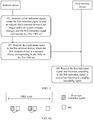
- the network device instructs the terminal devices corresponding to a PO by sending a first-type indication signal, as shown in FIG. 4a .
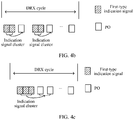
- the network device instructs the terminal devices corresponding to a PO by sending a plurality of first-type indication signals.
- the plurality of first-type indication signals can be consecutively sent, to form an indication signal cluster, as shown in FIG. 4b .
- the network device instructs the terminal devices corresponding to a plurality of POs by sending a plurality of first-type indication signals.
- the plurality of first-type indication signals can be consecutively sent, to form an indication signal cluster, as shown in FIG. 4c .
- the IMSI set in this embodiment of this application can conform to any of the plurality of correspondences. If there is no contradiction, different IMSI sets can also conform to different correspondences. For example, one of a plurality of IMSI sets conforms to the correspondence 1, and another IMSI set conforms to the correspondence 3. In addition, an IMSI set can conform to a plurality of the correspondences. For example, an IMSI set can not only conform to the correspondence 1, but also conform to the correspondence 2 and the correspondence 5. Moreover, in any of the correspondences, a quantity of IMSIs in an IMSI set is not greater than a quantity of IMSIs corresponding to one PO.
- the network device sends the first-type indication signal to the first terminal device at a first agreed moment.
- the first agreed moment is not later than a PO of the first terminal device in a first DRX cycle, so that the terminal device receives the first-type indication signal at a moment not later than the PO of the terminal device, and further, the terminal device does not listen to a paging scheduling signal according to an indication of the first-type indication signal, thereby reducing the power consumption.
- the first agreed moment can be agreed in a protocol, or can be agreed by the network device and the first terminal device before the network device sends the first-type indication signal to the terminal device.
- the network device sends higher layer signaling or a system message to the first terminal device.
- the higher layer signaling or the system message carries time resource indication information, and the terminal device determines, according to the time resource indication information, a moment at which the terminal device listens to the first-type indication signal.
- the higher layer signaling may be radio resource control (Radio Resource Control, RRC) signaling
- the system message may be a system information block (system information block, SIB) or a master system module (master information block, MIB).
- the higher layer signaling or the system message can not only carry the time resource indication information, but also one or more of frequency resource indication information, modulation and coding scheme indication information, signal length/size indication information, and DRX cycle indication information.
- the frequency resource indication information is used to indicate a frequency of listening to a first-type indication signal.
- the modulation and coding scheme indication information is used to indicate a modulation and coding scheme of the first-type indication signal.
- the signal length/size indication information is used to indicate a length/size of the first-type indication signal.
- the DRX cycle indication information is used to indicate a DRX cycle in which the terminal device maintains, according to the first-type indication signal, a state of not listening to a paging scheduling signal.
- an IMSI set may correspond to a first-type indication signal in a plurality of implementations, which include but are not limited to the following manners.
- an IMSI set corresponds to a transmission resource for a first-type indication signal
- the transmission resource may be a time resource, a frequency resource, a code domain resource, or the like.
- the transmission resource is a time resource
- a moment at which the first-type indication signal is listened to and that corresponds to an IMSI set 1 is T1
- a moment at which the first-type indication signal is listened to and that corresponds to an IMSI set 2 is T2.
- the network device separately sends the first-type indication signal at T1 and T2.
- the terminal device corresponding to the IMSI set 1 listens to and receives the first-type indication signal at T1
- the terminal device corresponding to the IMSI set 2 listens to and receives the first-type indication signal at T2.
- an IMSI set corresponds to a combination of a transmission resource for a first-type indication signal and a format of the first-type indication signal.
- the transmission resource is a frequency resource
- a frequency on which a first-type indication signal is listened to and that corresponds to both an IMSI set 3 and an IMSI set 4 is f1
- the IMSI set 3 corresponds to a signal format 1
- the IMSI set 4 corresponds to a signal format 2.
- the terminal device corresponding to the IMSI set 3 listens to and receives the first-type indication signal of the signal format 1 on the frequency fl, and the terminal device corresponding to the IMSI set 4 listens to and receives the first-type indication signal of the signal format 2 on the frequency f1.
- the transmission resource in the first and the second manners may alternatively refer to a combination of two or more transmission resources.
- the moment at which the first-type indication signal is listened to and that corresponds to the IMSI set 1 is T1 and a frequency on which the first type indication signal is listened to and that corresponds to the IMSI set 1 is fl
- the moment at which the first-type indication signal is listened to and that corresponds to the IMSI set 2 is T2 and a frequency on which the first-type indication signal is listened to and that corresponds to the IMSI set 2 is f2.
- the network device sends the first-type indication signal at T1 on the frequency f1, and sends the first-type indication signal at T2 on the frequency f2.
- the terminal device corresponding to the IMSI set 1 listens to and receives the first-type indication signal at T1 on the frequency f1
- the terminal device corresponding to the IMSI set 2 listens to and receives the first-type indication signal at T2 on the frequency f2.
- a granularity indicated by a first-type indication signal is an IMSI set, to be specific, the first-type indication signal corresponds to an IMSI set in the first manner or the second manner.
- the first-type indication signal may be used to indicate only one or several terminal devices corresponding to the IMSI set. For example, only one or several terminal devices corresponding to the IMSI set exist in a communication subnet serving the network device, and the network device sends the first-type indication signal only to the one or several terminal devices.
- the first-type indication signal corresponds to an IMSI set does not mean the first-type indication signal needs to instruct all terminal devices corresponding to the IMSI set.
- the first-type indication signals used to indicate that terminal devices corresponding to an IMSI set have some common properties, such as a same transmission resource and/or a same transmission format.
- the signal sending method further includes the following steps.
- a signal that is used to indicate that a terminal device is paged and/or a system message changes is referred to as a second-type indication signal.
- the third indication signal is a second-type indication signal corresponding to the sixth IMSI set, and is an example of the second-type indication signal.
- the sixth IMSI set is any IMSI set conforming to any one of the correspondence 1 to the correspondence 8.
- the second-type indication signal may alternatively be a preset sequence or a data packet. When the first-type indication signal and the second-type indication signal are preset sequences, the preset sequences are different. When the first-type indication signal and the second-type indication signal are data packets, original information bits corresponding to the two data packets are different.
- the second terminal device listens to a paging scheduling signal at an agreed PO according to the third indication signal.
- the agreed PO refer to relevant description in step 103.
- the third indication signal and the sixth IMSI set refer to the correspondence between the first indication signal and the first IMSI set.
- the network device when at least one terminal device corresponding to at least one IMSI in an IMSI set is paged and/or a system message changes, the network device generates a second-type indication signal, and sends the second-type indication signal to the terminal device corresponding to the IMSI set, and the terminal device listens to a paging scheduling signal at the PO after receiving the second-type indication signal.
- the network device separately sends indication signals of different types to a terminal device that corresponds to an IMSI set and that needs to listen to the paging scheduling signal and a terminal device that corresponds to the IMSI set and that does not need to listen to the paging scheduling signal, to be applicable to a case in which a plurality of terminal devices corresponding to one PO have different requirements for listening to the paging scheduling signal, thereby reducing a probability that another terminal device corresponding to a PO listens to the paging scheduling signal because some terminal devices corresponding to the PO are paged and/or a system message changes, and reducing power consumption of the terminal device that is not paged and/or whose system message does not change.
- a terminal device corresponding to an IMSI set may be paged, but a system message does not change.
- the network device When any terminal device corresponding to the IMSI set is paged, the network device generates a second-type indication signal of a type 1, and the second-type indication signal of the type 1 is used to indicate that a terminal device is paged. Then, the network device sends the second-type indication signal of the type 1 to the terminal device corresponding to the IMSI set. After receiving the second-type indication signal of the type 1, the terminal device can listen to a paging scheduling signal at a PO.
- a system message of a terminal device corresponding to an IMSI set may change, but the terminal device is not paged.
- the network device When a system message of any terminal device corresponding to the IMSI set changes, the network device generates a second-type indication signal of a type 2, and the second-type indication signal of the type 2 is used to indicate a system message of the terminal device changes. Then, the network device sends the second-type indication signal of the type 2 to the terminal device corresponding to the IMSI set. After receiving the second-type indication signal of the type 2, the terminal device can listen to a paging scheduling signal at a PO.
- a terminal device corresponding to an IMSI set may be paged, and a system message may change.
- the network device When any terminal device corresponding to the IMSI set is paged and/or a system message changes, the network device generates a second-type indication signal of a type 3, and the second-type indication signal of the type 3 is used to indicate that a terminal device is paged and/or a system message changes. Then, the network device sends the second-type indication signal of the type 3 to the terminal device corresponding to the IMSI set. After receiving the second-type indication signal of the type 3, the terminal device can listen to a paging scheduling signal at a PO.
- a terminal device corresponding to each IMSI in the sixth IMSI set is paged and/or a system message changes.
- only the terminal device that is paged and/or whose system message changes can receive the second-type indication signal.
- This implementation can be used to achieve accurate indication, so that none of terminal devices corresponding to the sixth IMSI set listens to a paging scheduling signal if not being paged and/or no system message changes, to reduce a probability of wasting power because of an unnecessary operation of listening to the paging scheduling signal by the terminal device, thereby reducing the power consumption of the terminal device.
- the network device sends the first-type indication signal to the terminal device corresponding to the IMSI set 1, and sends the second-type indication signal to the terminal device corresponding to the IMSI set 2.
- the terminal device corresponding to the IMSI set 1 receives the first-type indication signal, and does not listen to the paging scheduling signal at a PO in the first DRX cycle.
- the terminal device corresponding to the IMSI set 2 receives the second-type indication signal, and listens to the paging scheduling signal at the PO in the first DRX cycle.
- a transmission resource for the first-type indication signal sent by the network device to the IMSI set 1 and a transmission resource for the second-type indication signal sent by the network device to the IMSI set 2 are different.
- a combination of a transmission resource for and a signal format of the first-type indication signal sent by the network device to the IMSI set 1 and a combination of a transmission resource for and a signal format of the second-type indication signal sent by the network device to the IMSI set 2 are different. Therefore, the terminal devices corresponding to the IMSI set 1 and the IMSI set 2 can correctly receive indication signals belonging to the terminal devices corresponding to the IMSI set 1 and the IMSI set 2.
- the network device sends an indication signal to terminal devices corresponding to the IMSI sets. For an IMSI set corresponding to which none of terminal devices is paged and/or no system message changes, the network device sends the first-type indication signal to the terminal device corresponding to the IMSI set. For an IMSI set corresponding to which a terminal device is paged and/or a system message changes, the network device sends the second-type indication signal to the terminal device corresponding to the IMSI set.
- the network device sends the first-type indication signal to the terminal device corresponding to the IMSI set 1 in the first DRX cycle, and sends the second-type indication signal to the terminal device corresponding to the IMSI set 2 in the second DRX cycle.
- the terminal device corresponding to the IMSI set 1 receives the first-type indication signal in the first DRX cycle, so that the terminal device does not listen to the paging scheduling signal at a PO in the first DRX cycle.
- the terminal device corresponding to the IMSI set 1 receives the second-type indication signal in the second DRX cycle, and listens to the paging scheduling signal at a PO in the second DRX cycle.
- the network device may send an indication signal to an IMSI set in each DRX cycle.
- the network device For an IMSI set corresponding to which a terminal device corresponding to the IMSI set is not paged and/or no system message changes in a DRX cycle, the network device sends the first-type indication signal to the terminal device corresponding to the IMSI set.
- the network device For an IMSI set corresponding to which any terminal device corresponding to the IMSI set is paged and/or a system message changes in a DRX cycle, the network device sends the second-type indication signal to the terminal device corresponding to the IMSI set, as shown in FIG. 6a .
- the first-type indication signal and the second-type indication signal in this embodiment of this application may alternatively be considered as different states of an indication signal.
- the network device and the IMSI set agree on a moment at which the network device sends the indication signal, and the network device sends the indication signal to terminal devices corresponding to the IMSI set at the agreed moment in each DRX cycle.
- an indication signal of a first state sent by the network device to the IMSI set is the first-type indication signal.
- an indication signal of a second state sent by the network device to the IMSI set is the second-type indication signal.
- the network device may send one or more indication signal clusters.
- Each indication signal cluster may include a plurality of consecutive first-type indication signals, or may include a plurality of consecutive second-type indication signals, or may include consecutive signals including at least one first-type indication signal and at least one second-type indication signal, as shown in FIG. 6b and FIG. 6c .
- Manner 2 If a terminal device corresponding to an IMSI in the sixth IMSI set is paged and/or a system message changes, the network device does not send the first-type indication signal to the terminal device corresponding to the sixth IMSI set.
- the terminal device corresponding to the sixth IMSI set listens to the first-type indication signal. If the first-type indication signal is not received, the terminal device determines that the terminal device may be paged or a system message may change, and listens to the paging scheduling signal at a PO.
- the terminal device further determines, based on a paging signal on a PDSCH signal invoked by the received paging scheduling signal, whether the terminal device is paged or a system message changes.
- the network device sends the first-type indication signal to the terminal device corresponding to the IMSI set 1, and does not send the first-type indication signal to the terminal device corresponding to the IMSI set 2.
- the terminal device corresponding to the IMSI set 1 receives the first-type indication signal, and does not listen to the paging scheduling signal at a PO in the first DRX cycle.
- the terminal device corresponding to the IMSI set 2 does not receive the first-type indication signal, and listens to the paging scheduling signal at the PO in the first DRX cycle.
- the network device sends the first-type indication signal to the terminal device corresponding to the IMSI set 1 in the first DRX cycle, and does not send the first-type indication signal to the terminal device corresponding to the IMSI set 1 in the second DRX cycle.
- the terminal device corresponding to the IMSI set 1 receives the first-type indication signal in the first DRX cycle, and does not listen to the paging scheduling signal at the PO in the first DRX cycle.
- the terminal device corresponding to the IMSI set 1 does not receive the first-type indication signal in the second DRX cycle, and listens to the paging scheduling signal at a PO in the second DRX cycle.
- the network device may not send the indication signal to the terminal device corresponding to the IMSI set, to save a resource, and the terminal device corresponding to the IMSI set can still correctly learn that the terminal device may be paged and/or a system message may change.
- An embodiment of this application provides a schematic diagram of another signal sending method.
- the method includes: A network device generates a third indication signal, where the third indication signal is used to indicate that a terminal device is paged and/or a system message changes, a sixth IMSI set corresponds to the third indication signal, and a quantity of IMSIs in the sixth IMSI set is less than or equal to a quantity of IMSIs corresponding to one PO.
- the network device sends the third indication signal to a second terminal device, where the second terminal device is a terminal device corresponding to any IMSI in the sixth IMSI set.
- the second terminal device receives the third indication signal, and listens to a paging scheduling signal according to the third indication signal at a PO.
- the foregoing method refer to the description in step 201 to step 203.
- the network device when any terminal device corresponding to the IMSI set is paged and/or a system message changes, the network device sends a second-type indication signal to the terminal device corresponding to the IMSI set (where the third indication signal is an example of the second-type indication signal), and the terminal device may determine, after receiving the second-type indication signal, that the terminal device may be paged and/or a system message may change, so as to listen to the paging scheduling signal at a PO.
- the third indication signal is an example of the second-type indication signal
- the network device does not send the second-type indication signal to the terminal device corresponding to the IMSI set, and after the terminal device does not receive the second-type indication signal, the terminal device may determine that the terminal device is not paged and/or no system message changes, so as to not listen to the paging scheduling signal at the PO. Therefore, the terminal device needs to listen to the second-type indication signal only on a transmission resource agreed with the network device. If the terminal device receives the second-type indication signal, the terminal device listens to the paging scheduling signal at the PO. If the terminal device does not receive the second-type indication signal, the terminal device does not listen to the paging scheduling signal at the PO.
- the network device does not send the second-type indication signal to the terminal device corresponding to the IMSI set 1, and sends the second-type indication signal to the terminal device corresponding to the IMSI set 2.
- the terminal device corresponding to the IMSI set 1 does not receive the second-type indication signal, and does not listen to the paging scheduling signal at a PO in the first DRX cycle.
- the terminal device corresponding to the IMSI set 2 receives the second-type indication signal, and listens to the paging scheduling signal at the PO in the first DRX cycle.
- the network device does not send the second-type indication signal to the terminal device corresponding to the IMSI set 1 in the first DRX cycle, and sends the second-type indication signal to the terminal device corresponding to the IMSI set 1 in the second DRX cycle.
- the terminal device corresponding to the IMSI set 1 does not receive the second-type indication signal in the first DRX cycle, and does not listen to the paging scheduling signal at the PO in the first DRX cycle.
- the terminal device corresponding to the IMSI set 1 receives the second-type indication signal in the second DRX cycle, and listens to the paging scheduling signal at a PO in the second DRX cycle.
- the network device differentiates the terminal device that corresponds to the IMSI set and that needs to listen to the paging scheduling signal and the terminal device that corresponds to the IMSI set and that does not need to listen to the paging scheduling signal.
- the network device sends the second-type indication signal only to the terminal device that corresponds to the IMSI set and that needs to listen to the paging scheduling signal, so that the terminal device that corresponds to the IMSI set and that needs to listen to the paging scheduling signal may determine, according to the second-type indication signal, that the terminal device may be paged and/or a system message may change, and the terminal device that corresponds to the IMSI set and that does not need to listen to the paging scheduling signal may determine that the terminal device may not be paged and/or no system message changes, to be applicable to a case in which a plurality of terminal devices corresponding to one PO have different requirements for listening to the paging scheduling signal, thereby reducing a probability that another terminal device corresponding to a PO
- FIG. 7 is a schematic diagram of a network device according to an embodiment of this application.
- the network device is configured to implement functions of the network device according to Embodiment 1.
- the network device includes:
- the processing module 301 is further configured to generate a third indication signal, where the third indication signal is used to indicate that a terminal device is paged and/or a system message changes, the third indication signal corresponds to a sixth IMSI set, and a quantity of IMSIs in the sixth IMSI set is less than or equal to a quantity of IMSIs corresponding to one PO.
- the sending module 302 is further configured to send the third indication signal to a second terminal device, where the second terminal device is a terminal device corresponding to any IMSI in the sixth IMSI set.
- the network device may further include a receiving module 303, configured to receive a signal sent by the terminal device or another network element in a network.
- a receiving module 303 configured to receive a signal sent by the terminal device or another network element in a network.
- FIG. 8 is a schematic diagram of a terminal device according to an embodiment of this application.
- the terminal device is configured to implement functions of the first terminal device according to Embodiment 1.
- the terminal device includes:
- a receiving module 401 configured to listen to an indication signal, where the indication signal includes a first indication signal, the first indication signal is used to indicate that a terminal device is not paged and/or no system message changes, the first indication signal corresponds to a first IMSI set, a quantity of IMSIs in the first IMSI set is less than or equal to a quantity of IMSIs corresponding to one PO, and an IMSI of the terminal device belongs to the first IMSI set; and a processing module 402, configured to maintain a state of not listening to a paging scheduling signal at a PO of the processing module 402 after the receiving module receives the first indication signal.
- the processing module 402 is further configured to listen to a paging scheduling signal at the PO of the processing module 402 after the receiving module does not receive the first indication signal.
- the indication signal further includes a third indication signal, used to indicate that a terminal device is paged and/or a system message changes, and the third indication signal corresponds to the first IMSI set.
- the processing module 402 is further configured to listen to a paging scheduling signal at the PO of the processing module 402 after the receiving module 401 receives the third indication signal.
- the terminal device may further include a sending module 403, configured to send a signal to a network device or another network element in a network.
- a sending module 403 configured to send a signal to a network device or another network element in a network.
- this embodiment of this application provides a network device, including:
- the network device may further include a receiving module, configured to receive a signal sent by the terminal device or another network element in a network.
- a receiving module configured to receive a signal sent by the terminal device or another network element in a network.
- this embodiment of this application provides a network device, including:
- the terminal device may further include a sending module, configured to send a signal to the network device or another network element in a network.
- a sending module configured to send a signal to the network device or another network element in a network.
- both the first IMSI set and the sixth IMSI set according to Embodiment 3 to Embodiment 6 can satisfy any one of the correspondence 1 to the correspondence 8 according to Embodiment 1.
- the correspondence between the first indication signal and the first IMSI set, and the correspondence between the third indication signal and the sixth IMSI set are described in Embodiment 1, and details are not described herein again.
- each module of the network device according to Embodiment 3 refer to the implementation of the network device according to Embodiment 1.
- each module of the terminal device according to Embodiment 4 refer to the implementation of the terminal device according to Embodiment 1.
- each module of the network device according to Embodiment 5 refers to the implementation of the network device according to Embodiment 2.
- division of the modules in Embodiments 3 to Embodiment 6 is an example, and is merely a logical function division. There may be another division manner during actual implementation.
- the functional modules in the embodiments of this application may be integrated into one processor, or each of the modules may exist alone physically, or two or more modules may be integrated into one module.
- the integrated module may be implemented in a form of hardware, or may be implemented in a form of a software functional module.
- the hardware of an entity corresponding to the processing module may be a processor, configured to implement functions for the device to perform the method according to Embodiment 1 or Embodiment 2.
- the processor may be a central processing unit (central processing unit, CPU), a digital processing module, or the like.
- the hardware of an entity corresponding to the sending module may be a transmitter
- the hardware of an entity corresponding to the receiving module may be a receiver.
- the transmitter and the receiver are configured to support the device in communicating with another device in a communications system.
- the network device or the terminal device may further include a memory, configured to store a program executed by the processor.
- the memory may be a non-volatile memory, for example, a hard disk drive (hard disk drive, HDD), or a solid-state drive (solid-state drive, SSD), or may be a volatile memory (volatile memory), for example, a random access memory (random-access memory, RAM).
- the memory is any other medium that can carry or store expected program code in a form of an instruction or a data structure and that can be accessed by a computer, but is not limited thereto.
- An embodiment of this application further provides a computer-readable storage medium.
- the readable storage medium stores a computer instruction, and when the instruction is run on a computer, the computer is enabled to perform the steps performed by the network device according to Embodiment 1 and Embodiment 2.
- An embodiment of this application further provides a computer-readable storage medium.
- the readable storage medium stores a computer instruction, and when the instruction is run on a computer, the computer is enabled to perform the steps performed by the terminal device according to Embodiment 1 and Embodiment 2.
- this application may be provided as a method, a system, or a computer program product. Therefore, this application may use a form of hardware only embodiments, software only embodiments, or embodiments with a combination of software and hardware. Moreover, this application may use a form of a computer program product that is implemented on one or more computer-usable storage media (including but not limited to a disk memory, a CD-ROM, an optical memory, and the like) that include computer usable program code.
- a computer-usable storage media including but not limited to a disk memory, a CD-ROM, an optical memory, and the like
- These computer program instructions may be provided for a general-purpose computer, a special-purpose computer, an embedded processor, or a processor of any other programmable data processing device to generate a machine, so that the instructions executed by a computer or a processor of any other programmable data processing device generate an apparatus for implementing a specific function in one or more processes in the flowcharts and/or in one or more blocks in the block diagrams.
Landscapes
- Engineering & Computer Science (AREA)
- Computer Networks & Wireless Communication (AREA)
- Signal Processing (AREA)
- Databases & Information Systems (AREA)
- Mobile Radio Communication Systems (AREA)
Applications Claiming Priority (1)
| Application Number | Priority Date | Filing Date | Title |
|---|---|---|---|
| PCT/CN2017/083336 WO2018201486A1 (zh) | 2017-05-05 | 2017-05-05 | 一种消息发送方法、消息接收方法及对应设备 |
Publications (2)
| Publication Number | Publication Date |
|---|---|
| EP3614745A1 true EP3614745A1 (de) | 2020-02-26 |
| EP3614745A4 EP3614745A4 (de) | 2020-05-27 |
Family
ID=64016853
Family Applications (1)
| Application Number | Title | Priority Date | Filing Date |
|---|---|---|---|
| EP17908282.1A Withdrawn EP3614745A4 (de) | 2017-05-05 | 2017-05-05 | Nachrichtensendeverfahren, nachrichtenempfangsverfahren und entsprechende vorrichtung |
Country Status (5)
| Country | Link |
|---|---|
| US (1) | US10917873B2 (de) |
| EP (1) | EP3614745A4 (de) |
| CN (1) | CN110393027A (de) |
| BR (1) | BR112019023165A2 (de) |
| WO (1) | WO2018201486A1 (de) |
Families Citing this family (10)
| Publication number | Priority date | Publication date | Assignee | Title |
|---|---|---|---|---|
| US11224088B2 (en) | 2018-07-02 | 2022-01-11 | Qualcomm Incorporated | Beam sweeping during an on-period of a DRX cycle |
| CN115696229B (zh) * | 2020-07-15 | 2026-03-20 | 北京小米移动软件有限公司 | 指示广播方法和装置、指示接收方法和装置 |
| CN112088541A (zh) * | 2020-07-16 | 2020-12-15 | 北京小米移动软件有限公司 | 一种寻呼信道监听方法、寻呼信道监听装置及存储介质 |
| EP4686318A3 (de) | 2020-07-23 | 2026-04-08 | Apple Inc. | Übertragung von aufwecksignalen für funkrufoperationen |
| WO2022016458A1 (en) | 2020-07-23 | 2022-01-27 | Apple Inc. | Determining a location of a wake-up signal for paging reception |
| US12574846B2 (en) * | 2020-07-23 | 2026-03-10 | Apple Inc. | Wake-up signal reception for paging operations |
| CN115152286B (zh) * | 2021-01-28 | 2024-04-30 | 北京小米移动软件有限公司 | 通信方法及装置、用户设备、网络设备及存储介质 |
| EP4238341A4 (de) * | 2021-01-29 | 2024-01-24 | Huawei Technologies Co., Ltd. | Vorrichtungen und verfahren zur überwachung von downlink-benachrichtigungen |
| US12262347B2 (en) * | 2021-05-10 | 2025-03-25 | Qualcomm Incorporated | Paging based on cross-slot scheduling |
| WO2023060553A1 (zh) * | 2021-10-15 | 2023-04-20 | 北京小米移动软件有限公司 | 一种传输和接收节能指示信息的方法、装置、设备及存储介质 |
Family Cites Families (8)
| Publication number | Priority date | Publication date | Assignee | Title |
|---|---|---|---|---|
| MY187397A (en) * | 2006-04-28 | 2021-09-22 | Qualcomm Inc | Method and apparatus for enhanced paging |
| US8077677B2 (en) * | 2007-01-31 | 2011-12-13 | Interdigital Technology Corporation | Method and apparatus for paging group handling |
| EP2457403B1 (de) * | 2009-07-23 | 2013-12-11 | Telefonaktiebolaget LM Ericsson (publ) | Steuern eines beweglichen radioempfängers zum empfang von signalen für eine mehrzahl von empfängern bestimmt |
| EP2534903A1 (de) * | 2010-02-12 | 2012-12-19 | InterDigital Patent Holdings, Inc. | Gruppenfunkruf für maschinenkommunikation |
| KR20120111248A (ko) * | 2011-03-31 | 2012-10-10 | 주식회사 팬택 | 이종 무선네트워크 시스템에서 페이징 제어장치 및 방법 |
| CN105493591A (zh) * | 2013-05-17 | 2016-04-13 | 华为技术有限公司 | 小区寻呼的方法、装置及系统 |
| CN106341877A (zh) * | 2016-09-29 | 2017-01-18 | 青岛海信移动通信技术股份有限公司 | 中继设备的状态控制方法、中继设备及通信系统 |
| CN108668359B (zh) * | 2017-03-28 | 2022-07-15 | 中兴通讯股份有限公司 | 一种寻呼方法、寻呼监听方法及装置和设备 |
-
2017
- 2017-05-05 CN CN201780088248.XA patent/CN110393027A/zh active Pending
- 2017-05-05 BR BR112019023165-0A patent/BR112019023165A2/pt not_active IP Right Cessation
- 2017-05-05 WO PCT/CN2017/083336 patent/WO2018201486A1/zh not_active Ceased
- 2017-05-05 EP EP17908282.1A patent/EP3614745A4/de not_active Withdrawn
-
2019
- 2019-11-04 US US16/673,640 patent/US10917873B2/en not_active Expired - Fee Related
Also Published As
| Publication number | Publication date |
|---|---|
| WO2018201486A1 (zh) | 2018-11-08 |
| BR112019023165A2 (pt) | 2020-06-02 |
| US10917873B2 (en) | 2021-02-09 |
| EP3614745A4 (de) | 2020-05-27 |
| CN110393027A (zh) | 2019-10-29 |
| US20200068526A1 (en) | 2020-02-27 |
Similar Documents
| Publication | Publication Date | Title |
|---|---|---|
| US10917873B2 (en) | Signal sending method, signal receiving method, and corresponding device | |
| US11445472B2 (en) | Signal transmission method, network device, and terminal device | |
| US11057916B2 (en) | Methods and apparatus for indication information communication | |
| EP4280705A1 (de) | Verfahren zum senden von dci, verfahren zum empfangen von dci, vorrichtung, netzwerkseitige vorrichtung und endgerät | |
| US20190349884A1 (en) | Signal Transmission Method, Device, and System | |
| US20230422210A1 (en) | Paging monitoring method and apparatus, and device and storage medium | |
| CN117528805A (zh) | 一种通信方法及设备 | |
| CN114826504B (zh) | 目标小区搜索空间集组的切换及其控制方法及装置 | |
| US20210022075A1 (en) | Method and device for transmitting power saving signal | |
| JP2020535677A (ja) | 間欠受信方法、端末装置及びネットワーク装置 | |
| US12114244B2 (en) | Communication method and device | |
| CN116438879A (zh) | 寻呼消息发送的方法和装置 | |
| US20250240794A1 (en) | Communication method and device | |
| US20180317171A1 (en) | System information sending method, system information update method, and device | |
| CN110603860B (zh) | 用于非连续接收的方法和设备 | |
| EP4017126B1 (de) | Verfahren und vorrichtung zum senden von aufwecksignalsequenzen sowie verfahren und vorrichtung zum empfangen von aufwecksignalsequenzen | |
| WO2022198593A1 (zh) | 寻呼监听方法、装置、设备及存储介质 | |
| EP4280715A1 (de) | Verfahren zur bestimmung der übertragungsposition, kommunikationsvorrichtung und speichermedium | |
| WO2023060605A1 (zh) | 寻呼指示方法、装置、设备及存储介质 | |
| WO2018058453A1 (zh) | 通信方法、终端设备和基站 | |
| WO2020164455A1 (zh) | 一种测量信息上报方法以及相关装置 | |
| CN120475480A (zh) | 低功耗唤醒信号传输方法、装置及设备 | |
| CN116095829A (zh) | Pei的资源位置确定方法、装置、终端及网络侧设备 | |
| CN101146279A (zh) | 一种移动终端在多载波小区搜索高速共享控制信道的方法 |
Legal Events
| Date | Code | Title | Description |
|---|---|---|---|
| STAA | Information on the status of an ep patent application or granted ep patent |
Free format text: STATUS: THE INTERNATIONAL PUBLICATION HAS BEEN MADE |
|
| PUAI | Public reference made under article 153(3) epc to a published international application that has entered the european phase |
Free format text: ORIGINAL CODE: 0009012 |
|
| STAA | Information on the status of an ep patent application or granted ep patent |
Free format text: STATUS: REQUEST FOR EXAMINATION WAS MADE |
|
| 17P | Request for examination filed |
Effective date: 20191118 |
|
| AK | Designated contracting states |
Kind code of ref document: A1 Designated state(s): AL AT BE BG CH CY CZ DE DK EE ES FI FR GB GR HR HU IE IS IT LI LT LU LV MC MK MT NL NO PL PT RO RS SE SI SK SM TR |
|
| AX | Request for extension of the european patent |
Extension state: BA ME |
|
| A4 | Supplementary search report drawn up and despatched |
Effective date: 20200429 |
|
| RIC1 | Information provided on ipc code assigned before grant |
Ipc: H04W 52/02 20090101AFI20200423BHEP |
|
| DAV | Request for validation of the european patent (deleted) | ||
| DAX | Request for extension of the european patent (deleted) | ||
| STAA | Information on the status of an ep patent application or granted ep patent |
Free format text: STATUS: EXAMINATION IS IN PROGRESS |
|
| 17Q | First examination report despatched |
Effective date: 20210222 |
|
| GRAP | Despatch of communication of intention to grant a patent |
Free format text: ORIGINAL CODE: EPIDOSNIGR1 |
|
| STAA | Information on the status of an ep patent application or granted ep patent |
Free format text: STATUS: GRANT OF PATENT IS INTENDED |
|
| INTG | Intention to grant announced |
Effective date: 20210504 |
|
| STAA | Information on the status of an ep patent application or granted ep patent |
Free format text: STATUS: THE APPLICATION IS DEEMED TO BE WITHDRAWN |
|
| 18D | Application deemed to be withdrawn |
Effective date: 20210915 |