EP4017126B1 - Verfahren und vorrichtung zum senden von aufwecksignalsequenzen sowie verfahren und vorrichtung zum empfangen von aufwecksignalsequenzen - Google Patents
Verfahren und vorrichtung zum senden von aufwecksignalsequenzen sowie verfahren und vorrichtung zum empfangen von aufwecksignalsequenzen Download PDFInfo
- Publication number
- EP4017126B1 EP4017126B1 EP19942260.1A EP19942260A EP4017126B1 EP 4017126 B1 EP4017126 B1 EP 4017126B1 EP 19942260 A EP19942260 A EP 19942260A EP 4017126 B1 EP4017126 B1 EP 4017126B1
- Authority
- EP
- European Patent Office
- Prior art keywords
- wus
- resource
- sequence
- parameter
- gap
- Prior art date
- Legal status (The legal status is an assumption and is not a legal conclusion. Google has not performed a legal analysis and makes no representation as to the accuracy of the status listed.)
- Active
Links
Images




Classifications
-
- H—ELECTRICITY
- H04—ELECTRIC COMMUNICATION TECHNIQUE
- H04W—WIRELESS COMMUNICATION NETWORKS
- H04W52/00—Power management, e.g. Transmission Power Control [TPC] or power classes
- H04W52/02—Power saving arrangements
- H04W52/0209—Power saving arrangements in terminal devices
- H04W52/0212—Power saving arrangements in terminal devices managed by the network, e.g. network or access point is leader and terminal is follower
-
- H—ELECTRICITY
- H04—ELECTRIC COMMUNICATION TECHNIQUE
- H04W—WIRELESS COMMUNICATION NETWORKS
- H04W52/00—Power management, e.g. Transmission Power Control [TPC] or power classes
- H04W52/02—Power saving arrangements
- H04W52/0209—Power saving arrangements in terminal devices
- H04W52/0225—Power saving arrangements in terminal devices using monitoring of external events, e.g. the presence of a signal
- H04W52/0229—Power saving arrangements in terminal devices using monitoring of external events, e.g. the presence of a signal where the received signal is a wanted signal
- H04W52/0232—Power saving arrangements in terminal devices using monitoring of external events, e.g. the presence of a signal where the received signal is a wanted signal according to average transmission signal activity
-
- H—ELECTRICITY
- H04—ELECTRIC COMMUNICATION TECHNIQUE
- H04J—MULTIPLEX COMMUNICATION
- H04J13/00—Code division multiplex systems
- H04J13/0007—Code type
- H04J13/0022—PN, e.g. Kronecker
- H04J13/0029—Gold
-
- H—ELECTRICITY
- H04—ELECTRIC COMMUNICATION TECHNIQUE
- H04W—WIRELESS COMMUNICATION NETWORKS
- H04W52/00—Power management, e.g. Transmission Power Control [TPC] or power classes
- H04W52/02—Power saving arrangements
- H04W52/0209—Power saving arrangements in terminal devices
- H04W52/0225—Power saving arrangements in terminal devices using monitoring of external events, e.g. the presence of a signal
- H04W52/0229—Power saving arrangements in terminal devices using monitoring of external events, e.g. the presence of a signal where the received signal is a wanted signal
-
- H—ELECTRICITY
- H04—ELECTRIC COMMUNICATION TECHNIQUE
- H04W—WIRELESS COMMUNICATION NETWORKS
- H04W52/00—Power management, e.g. Transmission Power Control [TPC] or power classes
- H04W52/02—Power saving arrangements
- H04W52/0209—Power saving arrangements in terminal devices
- H04W52/0225—Power saving arrangements in terminal devices using monitoring of external events, e.g. the presence of a signal
- H04W52/0248—Power saving arrangements in terminal devices using monitoring of external events, e.g. the presence of a signal dependent on the time of the day, e.g. according to expected transmission activity
-
- H—ELECTRICITY
- H04—ELECTRIC COMMUNICATION TECHNIQUE
- H04W—WIRELESS COMMUNICATION NETWORKS
- H04W52/00—Power management, e.g. Transmission Power Control [TPC] or power classes
- H04W52/02—Power saving arrangements
- H04W52/0209—Power saving arrangements in terminal devices
- H04W52/0261—Power saving arrangements in terminal devices managing power supply demand, e.g. depending on battery level
-
- H—ELECTRICITY
- H04—ELECTRIC COMMUNICATION TECHNIQUE
- H04W—WIRELESS COMMUNICATION NETWORKS
- H04W52/00—Power management, e.g. Transmission Power Control [TPC] or power classes
- H04W52/04—Transmission power control [TPC]
- H04W52/18—TPC being performed according to specific parameters
-
- H—ELECTRICITY
- H04—ELECTRIC COMMUNICATION TECHNIQUE
- H04W—WIRELESS COMMUNICATION NETWORKS
- H04W68/00—User notification, e.g. alerting and paging, for incoming communication, change of service or the like
-
- H—ELECTRICITY
- H04—ELECTRIC COMMUNICATION TECHNIQUE
- H04W—WIRELESS COMMUNICATION NETWORKS
- H04W68/00—User notification, e.g. alerting and paging, for incoming communication, change of service or the like
- H04W68/005—Transmission of information for alerting of incoming communication
-
- Y—GENERAL TAGGING OF NEW TECHNOLOGICAL DEVELOPMENTS; GENERAL TAGGING OF CROSS-SECTIONAL TECHNOLOGIES SPANNING OVER SEVERAL SECTIONS OF THE IPC; TECHNICAL SUBJECTS COVERED BY FORMER USPC CROSS-REFERENCE ART COLLECTIONS [XRACs] AND DIGESTS
- Y02—TECHNOLOGIES OR APPLICATIONS FOR MITIGATION OR ADAPTATION AGAINST CLIMATE CHANGE
- Y02D—CLIMATE CHANGE MITIGATION TECHNOLOGIES IN INFORMATION AND COMMUNICATION TECHNOLOGIES [ICT], I.E. INFORMATION AND COMMUNICATION TECHNOLOGIES AIMING AT THE REDUCTION OF THEIR OWN ENERGY USE
- Y02D30/00—Reducing energy consumption in communication networks
- Y02D30/70—Reducing energy consumption in communication networks in wireless communication networks
Definitions
- This application relates to communications technologies, and in particular, to methods and apparatuses for sending and receiving a wake-up signal sequence.
- a communications device In a wireless communications system, a communications device has two modes. One mode is a connected mode, indicating that the communications device is connected to a network device and can directly communicate with the network device; and the other mode is an idle mode or referred to as a sleep mode, in which the communications device cannot directly communicate with the network device.
- the network device usually performs paging, that is, regularly sends a paging signal to the communications device, to indicate whether the communications device needs to switch from the idle mode to the connected mode, to facilitate communication with the network device. As shown in FIG.
- a communications device in an idle mode regularly wakes up to monitor a paging signal, and a cycle of regular wake-up is referred to as a discontinuous reception (discontinuous reception, DRX) cycle, where the DRX cycle may be indicated to the communications device through a system message.
- An occasion at which the communications device wakes up in the DRX cycle is referred to as a paging occasion (paging occasion, PO).
- the communications device in the idle mode is in sleep for most of the time of the DRX cycle, and wakes up only at a PO to detect a physical downlink control channel (physical downlink control channel, PDCCH).
- PDCCH physical downlink control channel
- the communications device detects first in a paging common search space (paging common search space, Paging CSS).
- the communications device receives a physical downlink shared channel (physical downlink shared channel, PDSCH) based on indication information carried on the detected PDCCH; or if no PDCCH is detected in the paging CSS, the communications device does not need to further receive a PDSCH.
- a physical downlink shared channel physical downlink shared channel, PDSCH
- a wake-up signal (wake-up signal, WUS) is introduced in R15, and the WUS is used to indicate whether a communications device needs to wake up at a PO to detect a PDCCH.
- WUS wake-up signal
- FIG. 2 on a network device side, when a network device needs to page a communications device or system a message change, the network device sends a WUS before at least one gap (gap) that is before a PO; otherwise, the network device does not send any signal.
- a WUS is monitored before a PO, and if a WUS is detected, a communications device detects a PDCCH at the PO; or if no WUS is detected, the communications device does not detect a PDCCH at the PO.
- a network device can configure three gaps at most. As shown in FIG. 3 , a network device configures communications devices into two types, namely, a DRX communications device and an eDRX communications device, based on capacities of communications devices.
- a DRX gap corresponding to the DRX communications device is from a set ⁇ 40 ms, 80 ms, 160 ms, 240 ms ⁇
- an eDRX short gap (eDRX short gap) corresponding to the eDRX communications device is from a set ⁇ 40 ms, 80 ms, 160 ms, 240 ms ⁇
- an eDRX long gap (eDRX long gap) corresponding to the eDRX communications device is from a set ⁇ 1s, 2s ⁇ .
- a communications device calculates a PO to which the communications device belongs based on an identity (Identity, ID), and a plurality of communications devices may belong to a same PO.
- a network device sends a WUS when paging any communications device within a PO, and once the WUS is detected by a communications device, the communications device is woken up. For example, it is assumed that 100 communications devices (with serial numbers 0 to 99) belong to a same PO, and the network device sends a WUS before the PO if the network device needs to wake up a communications device 0. If the WUS is detected by all the 100 communications devices, the 100 communications devices are all woken up. However, the communications devices 1 to 99 actually do not need to be woken up. Therefore, the WUS is a "false alarm" for the communications devices 1 to 99. This causes an increase of power consumption of the communications devices.
- a network device may configure at most two group WUS resources (group WUS resources) for a same gap, namely, a new WUS resource (new WUS resource) and a legacy WUS resource (legacy WUS resource), and the new WUS resource is before the legacy WUS resource.
- group WUS resources group WUS resources
- a communications device When monitoring a WUS before a PO, a communications device only performs monitoring on a group WUS resource.
- a communications device needs to monitor WUS sequences in an eDRX short gap and on a legacy WUS resource.
- FIG. 5 it is assumed that a network device sends WUS sequences only in a DRX gap and on a new WUS resource, and the WUS sequences from the network device are not sent to the communications device.
- the WUS sequences of "the DRX gap and the new WUS resource" can actually be detected by the communications device, which causes a false alarm.
- the communications device detects a PDCCH at a PO, which causes an increase of power consumption.
- This application provides methods and apparatuses for sending and receiving a wake-up signal sequence, to ensure that WUS sequence sets transmitted on various WUS resources are not exactly the same, thereby avoiding a WUS false alarm of a communications device and reducing power consumption of the communications device.
- WUS sequence sets transmitted on different WUS resources are calculated by using different parameters, to ensure that WUS sequence sets transmitted on various WUS resources are not exactly the same, where different WUS sequences are used especially on N WUS resources/resource that have an intersection set of time, to avoid a WUS false alarm of a communications device and reduce power consumption of the communications device.
- the first WUS resource is associated with at least one group of communications devices, and at least one WUS sequence in the first WUS sequence set corresponds to the at least one group of communications devices.
- the generating the N WUS sequence sets/set based on the N parameters/parameter includes: obtaining a first Gold seed through calculation based on a first parameter, where the first parameter corresponds to the first WUS resource; and obtaining the first WUS sequence set through calculation based on the first Gold seed.
- This application further provides a method for sending a wake-up signal sequence according to claim 2.
- the generating the N WUS sequence sets/set based on the N parameters/parameter includes: obtaining a first cover mode through calculation based on a first parameter, where the first parameter corresponds to the first WUS resource; and obtaining the first WUS sequence set through calculation based on the first cover mode.
- the N WUS resources include the first WUS resource and a second WUS resource, and the first WUS resource and the second WUS resource correspond to a same type of gap Gap of a same PO.
- the N WUS resources include the first WUS resources, a second WUS resource, and a third WUS resource
- the first WUS resource corresponds to a first gap Gap
- the second WUS resource corresponds to a second gap
- the third WUS resource corresponds to a third gap
- the first gap, the second gap, and the third gap are three types of gaps of a same PO.
- this application provides a method for receiving a wake-up signal sequence according to claim 6.
- the generating a first WUS sequence based on the first parameter includes: obtaining a first Gold seed through calculation based on a first parameter; and obtaining the first WUS sequence through calculation based on the first Gold seed.
- the generating a WUS sequence of the first group based on the group identifier and the total quantity includes: calculating a modulus value based on the group identifier and the total quantity; and generating the WUS sequence of the first group based on the modulus value.
- this application provides an apparatus for sending a wake-up signal sequence, where the apparatus includes: a processing module, configured to: determine N parameters/parameter for one paging occasion PO, where the N parameters/parameter correspond to N WUS resources/resource in wake-up signal WUS resources associated with the PO, N is an integer greater than or equal to 1, and when N>1, the N parameters are different from each other; and generate N WUS sequence sets/set based on the N parameters/parameter, where the N WUS sequence sets/set are separately transmitted on associated resources in the N WUS resources/resource, and each of the WUS sequence sets includes at least one WUS sequence; and a sending module, configured to send at least one sequence in a first WUS sequence set on a first WUS resource, where the first WUS resource is one of the N WUS resources/resource, and the first WUS sequence set is a WUS sequence set transmitted on the first WUS resource.
- a processing module configured to: determine N parameters/parameter for one paging occasion PO, where the N parameters/parameter
- the first WUS resource is associated with at least one group of communications devices, and at least one WUS sequence in the first WUS sequence set corresponds to the at least one group of communications devices.
- the processing module is specifically configured to: obtain a first Gold seed through calculation based on a first parameter, where the first parameter corresponds to the first WUS resource; and obtain the first WUS sequence set through calculation based on the first Gold seed.
- the processing module is specifically configured to: obtain a first cover mode through calculation based on a first parameter, where the first parameter corresponds to the first WUS resource; and obtain the first WUS sequence set through calculation based on the first cover mode.
- the processing module is specifically configured to: generate a Gold sequence; and intercept a part of sequence corresponding to the first parameter from the Gold sequence to obtain the first WUS sequence set through calculation, where the first parameter corresponds to the first WUS resource.
- the N WUS resources include the first WUS resource and a second WUS resource, and the first WUS resource and the second WUS resource correspond to a same type of gap of a same PO.
- the N WUS resources include the first WUS resources, a second WUS resource, and a third WUS resource
- the first WUS resource corresponds to a first gap
- the second WUS resource corresponds to a second gap
- the third WUS resource corresponds to a third gap
- the first gap, the second gap, and the third gap are three types of gaps of a same PO.
- this application provides an apparatus for receiving a wake-up signal sequence, where the apparatus includes: a processing module, configured to: determine a first parameter, where the first parameter corresponds to a first WUS resource, and the first WUS resource is a WUS resource that is configured by a network device and that is associated with a paging occasion PO; and generate a first WUS sequence based on the first parameter; and a receiving module, configured to: monitor the first WUS sequence on the first WUS resource; and detect a PDCCH at the PO when the first WUS sequence on the first WUS resource is detected.
- a processing module configured to: determine a first parameter, where the first parameter corresponds to a first WUS resource, and the first WUS resource is a WUS resource that is configured by a network device and that is associated with a paging occasion PO; and generate a first WUS sequence based on the first parameter
- a receiving module configured to: monitor the first WUS sequence on the first WUS resource; and detect a PDCCH at the PO when the first
- the processing module is specifically configured to: obtain a first Gold seed through calculation based on a first parameter; and obtain the first WUS sequence through calculation based on the first Gold seed.
- the processing module is specifically configured to: obtain a first cover mode through calculation based on a first parameter; and obtain the first WUS sequence through calculation based on the first cover mode.
- the processing module is specifically configured to: generate a Gold sequence; and intercept a part of sequence corresponding to the first parameter from the Gold sequence to obtain the first WUS sequence through calculation.
- this application provides an apparatus for sending a wake-up signal sequence, where the apparatus includes: a processing module, configured to: obtain a group identifier of a first group, where the first group is a group to which a communications device belongs; obtain a total quantity of WUS sequences configured on a first WUS resource, where the first WUS resource is a resource for the communications device to receive a WUS; and generate a WUS sequence of the first group based on the group identifier and the total quantity; and a sending module, configured to send the WUS sequence of the first group on the first WUS resource.
- a processing module configured to: obtain a group identifier of a first group, where the first group is a group to which a communications device belongs; obtain a total quantity of WUS sequences configured on a first WUS resource, where the first WUS resource is a resource for the communications device to receive a WUS; and generate a WUS sequence of the first group based on the group identifier and the total quantity; and a sending module, configured
- the processing module is specifically configured to: calculate a modulus value based on the group identifier and the total quantity; and generate the WUS sequence of the first group based on the modulus value.
- this application provides a network device.
- the network device includes:
- this application provides a communications device.
- the communications device includes:
- this application provides a computer-readable storage medium, including a computer program.
- the computer program When the computer program is executed by a computer, the computer is enabled to perform the method according to any one of the first aspect to the third aspect.
- this application provides a computer program according to claim 12.
- the computer program When the computer program is executed by a computer, the computer is enabled to perform the method according to any one of the first aspect to the third aspect.
- This application further provides an apparatus according to claim 11.
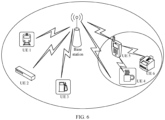
- the foregoing network device may be configured to group a received air frame and an Internet protocol (Internet Protocol, IP) and perform mutual conversion.
- the network device is used as a router between a wireless terminal and a remaining part of an access network, and the remaining part of the access network may include an IP network.
- the network device may further coordinate attribute management of an air interface.
- the network device may be a base transceiver station (Base Transceiver Station, BTS) in GSM or CDMA, or may be a NodeB (NodeB) in WCDMA, or may be an evolved NodeB (evolutional Node B, eNB or e-NodeB) in LTE. This is not specifically limited in this application.
- the foregoing communications device may be a device that provides a user with voice and/or data connectivity, a handheld device with a wireless connection function, or another processing device connected to a wireless modem.
- the communications device may communicate with one or more core networks through a radio access network (Radio Access Network, RAN).
- the communications device may be a mobile terminal, such as a mobile phone (also referred to as a "cellular" phone) or a computer with a mobile terminal, or may be a portable, a pocket-sized, a handheld, a computer built-in, or a vehicle-mounted mobile apparatus, which exchanges voice and/or data with the radio access network.
- the communications device may be a device such as a personal communications service (Personal Communication Service, PCS) phone, a cordless telephone set, a session initiation protocol (SIP) phone, a wireless local loop (Wireless Local Loop, WLL) station, or a personal digital assistant (Personal Digital Assistant, PDA).
- PCS Personal Communications Service
- SIP session initiation protocol
- WLL Wireless Local Loop
- PDA Personal Digital Assistant
- the communications service may also be referred to as a system, a subscriber unit (Subscriber Unit), a subscriber station (Subscriber Station), a mobile station (Mobile Station), a remote station (Remote Station), an access point (Access Point), a remote terminal (Remote Terminal), an access terminal (Access Terminal), a user terminal (User Terminal), a user agent (User Agent), a user device (User Device), or user equipment (User Equipment).
- FIG. 7 is a flowchart of embodiment 1 of a method for sending a wake-up signal sequence according to this application. As shown in FIG. 7 , the method of this embodiment may include: Step 701: A network device determines N parameters/parameter for one PO.
- the N parameters/parameter correspond to N WUS resources/resource in wake-up WUS resources associated with the PO, N is an integer greater than or equal to 1, and when N>1, the N parameters are different from each other.
- the network device can configure three gaps at most, namely, a DRX gap, an eDRX short gap, and an eDRX long gap.
- the network device may configure two WUS resources, namely, a new WUS resource and a legacy WUS resource. Based on the foregoing example, N can be a maximum of 6.
- the six WUS resources may include a new WUS resource and a legacy WUS resource that correspond to a DRX gap, a new WUS resource and a legacy WUS resource that correspond to an eDRX short gap, and a new WUS resource and a legacy WUS resource that correspond to an eDRX long gap.
- the network device may configure one parameter for each of the WUS resources, at most six different parameters can be relevant.
- the network device may configure a parameter only for a new WUS resource, and does not configure a parameter for a legacy WUS resource.
- the WUS resources are differentiated by configuring or not configuring a parameter.
- the network device may further configure a parameter for a legacy WUS resource.
- All legacy WUS resources may be configured with parameters, or a part of legacy WUS resources is configured with parameters. Parameters for various legacy WUS resources may be different from each other completely, or may be partly the same. Preferably, a parameter configured by the network device for a new WUS resource corresponding to a DRX gap and a parameter configured by the network device for a legacy WUS resource corresponding to an eDRX short gap is different.
- Step 702 The network device generates N WUS sequence sets/set based on the N parameters/parameter.
- the N WUS sequence sets/set are separately transmitted on associated resources in the N WUS resources/resource, and each of the WUS sequence sets includes at least one WUS sequence.
- R16 the concept of grouping is introduced. To be specific, for a plurality of communications devices belonging to a same PO, different communications devices corresponding to different WUS sequences are grouped on a same WUS resource. Therefore, one WUS sequence set can be transmitted on each WUS resource, at least one WUS sequence in the WUS sequence set separately corresponds to one group of communications devices, and communications devices in one group use a same WUS sequence.
- the network device may use the following several methods to generate a WUS sequence set: In a first method, the network device obtains a first Gold seed through calculation based on a first parameter, where the first parameter corresponds to the first WUS resource; and a first WUS sequence set is obtained through calculation based on the first Gold seed.
- Table 1 shows identifiers respectively corresponding to a new WUS resource and a legacy WUS resource.
- the network device uses the two identifiers in Table 1 as two parameters respectively corresponding to the new WUS resource and the legacy WUS resource.
- the network device may intercept parts of sequence, where a quantity of the parts of sequence is the same as a quantity of relevant WUS resources in this method. For example, in FIG. 8 , the network device intercepts four parts of sequence from the long Gold sequence and obtains four WUS sequences, and the four WUS sequences each correspond to one WUS resource.
- Step 703 A communications device determines the first parameter.
- the communications device in this application also needs to determine, in advance, a WUS sequence to be monitored by the communications device.
- the first WUS resource is a WUS resource that is configured by the network device and that is associated with a PO, and the first parameter corresponds to the first WUS resource.
- the network device may configure the first WUS resource and the first parameter for the communications device in advance in a semi-static manner.
- Step 704 The communications device generates a first WUS sequence based on the first parameter.
- the three methods in step 702 may also be used in a process of generating the first WUS sequence by the communications device based on the first parameter.
- the network device configures a related parameter (such as N mentioned above) used in a calculation process in advance, or uses a specified value according to a protocol.
- a related parameter such as N mentioned above
- the communications device may directly obtain, through calculation, the WUS sequence to be monitored, and does not need to calculate an entire WUS sequence set.
- the first parameter is either 1 corresponding to the new WUS resource or 0 corresponding to the legacy WUS resource, and an exclusive Gold seed or cover mode is further obtained through calculation.
- the first parameter points to a location in the long Gold sequence. Therefore, the intercepted part of sequence is also exclusive.
- Step 705 The communications device monitors the first WUS sequence on the first WUS resource.
- the communications device wakes up at a fixed time point corresponding to a WUS resource based on a configuration of the network device, and monitors whether a corresponding WUS sequence is received.
- Step 706 The network device sends at least one sequence in the first WUS sequence set on the first WUS resource.
- a WUS sequence corresponding to a group to which the communications device belongs is sent on a WUS resource configured for the communications device, to wake up the communications device to detect a PDCCH at an associated PO.
- the apparatus in this embodiment may be configured to execute the technical solution in the method embodiment shown in FIG. 7 or FIG. 9 .
- Implementation principles and technical effects are similar to those in the method embodiment, and details are not described herein again.
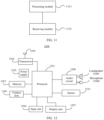
- FIG. 11 is a schematic diagram of a structure of an apparatus for receiving a wake-up signal sequence according to an embodiment of this application. As shown in FIG. 11 , the apparatus in this embodiment may be applied to the foregoing communications device.
- the apparatus includes a processing module 1101 and a receiving module 1102.
- the processing module 1101 is configured to: determine a first parameter, where the first parameter corresponds to a first WUS resource, and the first WUS resource is a WUS resource that is configured by a network device and that is associated with a paging occasion PO; and generate a first WUS sequence based on the first parameter.
- the receiving module 1102 is configured to: monitor the first WUS sequence on the first WUS resource; and detect a PDCCH at the PO when the first WUS sequence on the first WUS resource is detected.
- C gold ( N ID ) represents the first cover mode
- N ID represents the first parameter
- m 1 N ID 127 N total
- N total N
- x 0 ( i +7) ( x 0 ( i +4)+ x 0 ( i ))mod2
- x 1 ( i +7) ( x 1 ( i +4)+ x 1 ( i ))mod2
- both initial values of x 0 ( i ) and x 1 ( i ) are [0000001]
- N indicates a quantity of parameters determined by the network device for one PO
- N is an integer greater than or equal to 1.
- FIG. 12 is a schematic diagram of a structure of a communications device according to this application.
- the communications device 1200 may be the communications device in the foregoing embodiments.
- the communications device 1200 includes a processor 1201 and a transceiver 1202.
- the memory 1203 is configured to store a computer program.
- the processor 1201 is configured to execute the computer program stored in the memory 1203, thereby implementing various functions in the foregoing apparatus embodiment.
- the processor 1201 may be configured to perform the operations and/or processing performed by the processing module 301 in the apparatus embodiment (for example, FIG. 3 ), and the transceiver 1202 is configured to perform the operations and/or processing performed by the receiving module 302 and the sending module 303.
- the memory 1203 may alternatively be integrated in the processor 1201, or may be independent of the processor 1201.
- the communications device 1200 may further include a power supply 1205, configured to supply power to various components or circuits in the device.
- a power supply 1205 configured to supply power to various components or circuits in the device.
- the communications device 1200 may further include one or more of an input unit 1206, a display unit 1207 (which may also be considered an output unit), an audio circuit 1208, a camera lens 1209, and a sensor 1210.
- the audio circuit may further include a loudspeaker 12081, a microphone 12082, and the like. Details are not described again.
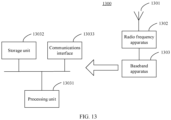
- FIG. 13 is a schematic diagram of a structure of a network device according to this application.
- the network device 1300 may be the network device in the foregoing embodiments.
- the network device 1300 includes an antenna 1301, a radio frequency apparatus 1302, and a baseband apparatus 1303.
- the antenna 1301 is connected to the radio frequency apparatus 1302.
- the radio frequency apparatus 1302 receives a signal from a communications device through the antenna 1301, and sends the received signal to the baseband apparatus 1303 for processing.
- the baseband apparatus 1303 In downlink, the baseband apparatus 1303 generates a signal to be sent to a communications device, and sends the generated signal to the radio frequency apparatus 1302.
- the radio frequency apparatus 1302 sends the signal through the antenna 1301.
- the steps in the foregoing method embodiments may be completed by using a hardware integrated logic circuit in a processor or instructions in a form of software.
- the processor may be a general-purpose processor, a digital signal processor (digital signal processor, DSP), an application-specific integrated circuit (application-specific integrated circuit, ASIC), a field programmable gate array (field programmable gate array, FPGA) or another programmable logic device, a discrete gate or a transistor logic device, or a discrete hardware component.
- the general-purpose processor may be a microprocessor, or the processor may be any conventional processor, or the like.
Landscapes
- Engineering & Computer Science (AREA)
- Computer Networks & Wireless Communication (AREA)
- Signal Processing (AREA)
- Mobile Radio Communication Systems (AREA)
Claims (12)
- Verfahren zum Senden einer Wecksignalsequenz, umfassend:Bestimmen (701) von N Parametern/Parameter für einen Paging-Anlass, PO, wobei die/der N Parameter N Wecksignal-Ressourcen/Ressource, WUS-Ressourcen/Ressource, in WUS-Ressourcen, die mit dem PO verknüpft sind, entsprechen/entspricht, N eine Ganzzahl größer oder gleich 1 ist und, wenn N>1, die N Parameter sich voneinander unterscheiden;Erzeugen (702) von N WUS-Sequenzsätzen/-satz basierend auf den/dem N Parametern/Parameter, wobei die/der N WUS-Sequenzsätze/-satz separat auf einer verknüpften Ressource in den/der N WUS-Ressourcen/Ressource übertragen werden/wird und jeder der WUS-Sequenzsätze/der WUS-Sequenzsatz mindestens eine WUS-Sequenz umfasst; undSenden (706) mindestens einer Sequenz in einem ersten WUS-Sequenzsatz auf einer ersten WUS-Ressource, wobei die erste WUS-Ressource eine der N WUS-Ressourcen/Ressource ist und der erste WUS-Sequenzsatz ein WUS-Sequenzsatz ist, der auf der ersten WUS-Ressource übertragen wird;wobei das Erzeugen von N WUS-Sequenzsätzen/-satz basierend auf den/dem N Parametern/Parameter Folgendes umfasst:Erlangen eines ersten Gold-Seeds durch Berechnung basierend auf einem ersten Parameter, wobei der erste Parameter der ersten WUS-Ressource entspricht; undErlangen des ersten WUS-Sequenzsatzes durch Berechnung basierend auf dem ersten Gold-Seed;wobei der erste Gold-Seed, der durch Berechnung basierend auf dem ersten Parameter erlangt wurde, die folgende Formel erfüllt:
 Cinit_WUS für den ersten Gold-Seed steht, NID für den ersten Parameter steht,
- Verfahren zum Senden einer Wecksignalsequenz, umfassend:Bestimmen (701) von N Parametern/Parameter für einen Paging-Anlass, PO, wobei die/der N Parameter N Wecksignal-Ressourcen/Ressource, WUS-Ressourcen/Ressource, in WUS-Ressourcen, die mit dem PO verknüpft sind, entsprechen/entspricht, N eine Ganzzahl größer oder gleich 1 ist und, wenn N>1, die N Parameter sich voneinander unterscheiden;Erzeugen (702) von N WUS-Sequenzsätzen/-satz basierend auf den/dem N Parametern/Parameter, wobei die/der N WUS-Sequenzsätze/-satz separat auf einer verknüpften Ressource in den/der N WUS-Ressourcen/Ressource übertragen werden/wird und jeder der WUS-Sequenzsätze/der WUS-Sequenzsatz mindestens eine WUS-Sequenz umfasst; undSenden (706) mindestens einer Sequenz in einem ersten WUS-Sequenzsatz auf einer ersten WUS-Ressource, wobei die erste WUS-Ressource eine der N WUS-Ressourcen/Ressource ist und der erste WUS-Sequenzsatz ein WUS-Sequenzsatz ist, der auf der ersten WUS-Ressource übertragen wird;wobei das Erzeugen von N WUS-Sequenzsätzen/-satz basierend auf den/dem N Parametern/Parameter Folgendes umfasst:Erlangen eines ersten Cover-Modus durch Berechnung basierend auf einem ersten Parameter, wobei der erste Parameter der ersten WUS-Ressource entspricht; undErlangen des ersten WUS-Sequenzsatzes durch Berechnung basierend auf dem ersten Cover-Modus;wobei der erste Cover-Modus, der durch Berechnung basierend auf dem ersten Parameter erlangt wurde, die folgende Formel erfüllt: cqold (NID ) = (1-2x 0(m mod 127))(1 - 2x 1((m + m 1)mod 127)), wobeiCgold (NID ) für den ersten Cover-Modus steht, NID für den ersten Parameter steht,

- Verfahren nach Anspruch 1 oder 2, wobei die erste WUS-Ressource mit mindestens einer Kommunikationsvorrichtungsgruppe verknüpft ist und mindestens eine WUS-Sequenz in dem ersten WUS-Sequenzsatz der mindestens einen Kommunikationsvorrichtungsgruppe entspricht.
- Verfahren nach einem der Ansprüche 1 bis 3, wobei, wenn N gleich 2 ist, die N WUS-Ressourcen die erste WUS-Ressource und eine zweite WUS-Ressource umfassen und die erste WUS-Ressource und die zweite WUS-Ressource einem gleichen Lückentyp eines gleichen PO entsprechen.
- Verfahren nach einem der Ansprüche 1 bis 3, wobei, wenn N gleich 3 ist, die N WUS-Ressourcen die ersten WUS-Ressourcen, eine zweite WUS-Ressource und eine dritte WUS-Ressource umfassen, die erste WUS-Ressource einer ersten Lücke entspricht, die zweite WUS-Ressource einer zweiten Lücke entspricht, die dritte WUS-Ressource einer dritten Lücke entspricht und die erste Lücke, die zweite Lücke und die dritte Lücke drei Arten von Lücken eines gleichen PO sind.
- Verfahren zum Empfangen einer Wecksignalsequenz, umfassend:Empfangen mindestens einer Sequenz in einem ersten Wecksignal-Sequenzsatz, WUS-Sequenzsatz, auf einer ersten WUS-Ressource;Bestimmen (703) eines ersten Parameters, wobei der erste Parameter der ersten WUS-Ressource entspricht und die erste WUS-Ressource eine WUS-Ressource ist, die durch eine Netzwerkvorrichtung konfiguriert wird und die mit einem Paging-Anlass, PO, verknüpft ist;Erzeugen (704) einer ersten WUS-Sequenz basierend auf dem ersten Parameter;Überwachen (705) der ersten WUS-Sequenz auf der ersten WUS-Ressource; undErkennen (707) eines PDCCH bei dem PO, wenn die erste WUS-Sequenz auf der ersten WUS-Ressource erkannt wird;wobei das Erzeugen der ersten WUS-Sequenz basierend auf dem ersten Parameter Folgendes umfasst:Erlangen eines ersten Gold-Seeds durch Berechnung basierend auf dem ersten Parameter; undErlangen der ersten WUS-Sequenz durch Berechnung basierend auf dem ersten Gold-Seed;wobei der erste Gold-Seed, der durch Berechnung basierend auf dem ersten Parameter erlangt wurde, die folgende Formel erfüllt:
 Cinit_WUS für den ersten Gold-Seed steht, NID für den ersten Parameter steht,
- Verfahren zum Empfangen einer Wecksignalsequenz, umfassend:Empfangen mindestens einer Sequenz in einem ersten Wecksignal-Sequenzsatz, WUS-Sequenzsatz, auf einer ersten WUS-Ressource;Bestimmen (703) eines ersten Parameters, wobei der erste Parameter der ersten WUS-Ressource entspricht und die erste WUS-Ressource eine WUS-Ressource ist, die durch eine Netzwerkvorrichtung konfiguriert wird und die mit einem Paging-Anlass, PO, verknüpft ist;Erzeugen (704) einer ersten WUS-Sequenz basierend auf dem ersten Parameter;Überwachen (705) der ersten WUS-Sequenz auf der ersten WUS-Ressource; undErkennen (707) eines PDCCH bei dem PO, wenn die erste WUS-Sequenz auf der ersten WUS-Ressource erkannt wird;wobei das Erzeugen der ersten WUS-Sequenz basierend auf dem ersten Parameter Folgendes umfasst:Erlangen eines ersten Cover-Modus durch Berechnung basierend auf dem ersten Parameter, wobei der erste Parameter der ersten WUS-Ressource entspricht; undErlangen des ersten WUS-Sequenzsatzes durch Berechnung basierend auf dem ersten Cover-Modus;wobei der erste Cover-Modus, der durch Berechnung basierend auf dem ersten Parameter erlangt wurde, die folgende Formel erfüllt: Cgold (NID ) = (1 - 2x 0(m mod 127))(1 - 2x 1((m + m 1)mod 127)), wobeiCgold (NID ) für den ersten Cover-Modus steht, NID für den ersten Parameter steht,

- Verfahren nach Anspruch 6 oder 7, wobei die erste WUS-Ressource mit mindestens einer Kommunikationsvorrichtungsgruppe verknüpft ist und mindestens eine WUS-Sequenz in dem ersten WUS-Sequenzsatz der mindestens einen Kommunikationsvorrichtungsgruppe entspricht.
- Verfahren nach einem der Ansprüche 6 bis 8, wobei, wenn N gleich 2 ist, die N WUS-Ressourcen die erste WUS-Ressource und eine zweite WUS-Ressource umfassen und die erste WUS-Ressource und die zweite WUS-Ressource einem gleichen Lückentyp eines gleichen PO entsprechen.
- Verfahren nach einem der Ansprüche 6 bis 8, wobei, wenn N gleich 3 ist, die N WUS-Ressourcen die ersten WUS-Ressourcen, eine zweite WUS-Ressource und eine dritte WUS-Ressource umfassen, die erste WUS-Ressource einer ersten Lücke entspricht, die zweite WUS-Ressource einer zweiten Lücke entspricht, die dritte WUS-Ressource einer dritten Lücke entspricht und die erste Lücke, die zweite Lücke und die dritte Lücke drei Arten von Lücken eines gleichen PO sind.
- Gerät, das dazu konfiguriert ist, das Verfahren nach einem der Ansprüche 1 bis 10 umzusetzen.
- Computerprogrammprodukt, wobei, wenn das Computerprogrammprodukt durch einen Computer ausgeführt wird, der Computer dazu konfiguriert ist, das Verfahren nach einem der Ansprüche 1 bis 10 durchzuführen.
Applications Claiming Priority (1)
| Application Number | Priority Date | Filing Date | Title |
|---|---|---|---|
| PCT/CN2019/101174 WO2021031001A1 (zh) | 2019-08-16 | 2019-08-16 | 唤醒信号序列的发送和接收方法及装置 |
Publications (3)
| Publication Number | Publication Date |
|---|---|
| EP4017126A1 EP4017126A1 (de) | 2022-06-22 |
| EP4017126A4 EP4017126A4 (de) | 2022-08-10 |
| EP4017126B1 true EP4017126B1 (de) | 2025-06-25 |
Family
ID=74660435
Family Applications (1)
| Application Number | Title | Priority Date | Filing Date |
|---|---|---|---|
| EP19942260.1A Active EP4017126B1 (de) | 2019-08-16 | 2019-08-16 | Verfahren und vorrichtung zum senden von aufwecksignalsequenzen sowie verfahren und vorrichtung zum empfangen von aufwecksignalsequenzen |
Country Status (5)
| Country | Link |
|---|---|
| US (2) | US12150059B2 (de) |
| EP (1) | EP4017126B1 (de) |
| CN (2) | CN114208301B (de) |
| LT (1) | LT4017126T (de) |
| WO (1) | WO2021031001A1 (de) |
Families Citing this family (2)
| Publication number | Priority date | Publication date | Assignee | Title |
|---|---|---|---|---|
| EP4668876A4 (de) * | 2023-02-16 | 2026-03-25 | Beijing Xiaomi Mobile Software Co Ltd | Verfahren und vorrichtungen zur signalsequenzbestimmung |
| WO2025112004A1 (zh) * | 2023-11-30 | 2025-06-05 | Oppo广东移动通信有限公司 | 唤醒信号的传输方法、装置、设备及介质 |
Family Cites Families (5)
| Publication number | Priority date | Publication date | Assignee | Title |
|---|---|---|---|---|
| EP3968709B1 (de) * | 2017-03-24 | 2024-11-27 | LG Electronics Inc. | Verfahren und drahtlosvorrichtung zum empfangen einer funkrufnachricht |
| US11284372B2 (en) * | 2017-03-24 | 2022-03-22 | Apple Inc. | Wake up signal for machine type communication and narrowband-internet-of-things devices |
| US10945205B2 (en) * | 2017-09-15 | 2021-03-09 | Qualcomm Incorporated | Techniques and apparatuses for wakeup signal transmission |
| US11166237B2 (en) * | 2017-11-24 | 2021-11-02 | Nokia Technologies Oy | Paging indication channel for EC-GSM-IoT |
| US11483895B2 (en) * | 2018-04-13 | 2022-10-25 | Qualcomm Incorporated | Interaction between WUS and RRM measurement |
-
2019
- 2019-08-16 WO PCT/CN2019/101174 patent/WO2021031001A1/zh not_active Ceased
- 2019-08-16 EP EP19942260.1A patent/EP4017126B1/de active Active
- 2019-08-16 LT LTEPPCT/CN2019/101174T patent/LT4017126T/lt unknown
- 2019-08-16 CN CN201980099142.9A patent/CN114208301B/zh active Active
- 2019-08-16 CN CN202311286783.XA patent/CN117500031A/zh active Pending
-
2022
- 2022-02-15 US US17/671,690 patent/US12150059B2/en active Active
-
2024
- 2024-10-15 US US18/915,526 patent/US20250048265A1/en active Pending
Also Published As
| Publication number | Publication date |
|---|---|
| EP4017126A1 (de) | 2022-06-22 |
| EP4017126A4 (de) | 2022-08-10 |
| CN117500031A (zh) | 2024-02-02 |
| WO2021031001A1 (zh) | 2021-02-25 |
| US20250048265A1 (en) | 2025-02-06 |
| US12150059B2 (en) | 2024-11-19 |
| CN114208301B (zh) | 2023-11-03 |
| LT4017126T (lt) | 2025-08-11 |
| CN114208301A (zh) | 2022-03-18 |
| US20220174600A1 (en) | 2022-06-02 |
Similar Documents
| Publication | Publication Date | Title |
|---|---|---|
| US20200107294A1 (en) | Signal Transmission Method, Network Device, And Terminal Device | |
| US11653408B2 (en) | Discontinuous reception method, terminal device and network device | |
| CA3074879C (en) | Discontinuous reception method, network device and terminal device | |
| US10917873B2 (en) | Signal sending method, signal receiving method, and corresponding device | |
| US11895729B2 (en) | Discontinuous reception method, terminal device and network device | |
| US20250048265A1 (en) | Methods and apparatuses for sending and receiving wake-up signal sequence | |
| CN110139361A (zh) | 信号传输的方法和装置 | |
| WO2019196038A1 (zh) | 节能信号的传输方法和设备 | |
| US11546964B2 (en) | Method and device for discontinuous reception | |
| EP3883319B1 (de) | Drahtloskommunikationsverfahren, endgerätevorrichtung und netzwerkvorrichtung | |
| US20220264628A1 (en) | Communication method, communication apparatus, and device | |
| EP4280715A1 (de) | Verfahren zur bestimmung der übertragungsposition, kommunikationsvorrichtung und speichermedium | |
| CN114365562B (zh) | 一种唤醒信号序列发送方法以及相关装置 | |
| CN115696512B (zh) | 一种信息传输方法及装置 |
Legal Events
| Date | Code | Title | Description |
|---|---|---|---|
| STAA | Information on the status of an ep patent application or granted ep patent |
Free format text: STATUS: THE INTERNATIONAL PUBLICATION HAS BEEN MADE |
|
| PUAI | Public reference made under article 153(3) epc to a published international application that has entered the european phase |
Free format text: ORIGINAL CODE: 0009012 |
|
| STAA | Information on the status of an ep patent application or granted ep patent |
Free format text: STATUS: REQUEST FOR EXAMINATION WAS MADE |
|
| 17P | Request for examination filed |
Effective date: 20220315 |
|
| AK | Designated contracting states |
Kind code of ref document: A1 Designated state(s): AL AT BE BG CH CY CZ DE DK EE ES FI FR GB GR HR HU IE IS IT LI LT LU LV MC MK MT NL NO PL PT RO RS SE SI SK SM TR |
|
| A4 | Supplementary search report drawn up and despatched |
Effective date: 20220711 |
|
| RIC1 | Information provided on ipc code assigned before grant |
Ipc: H04W 68/00 20090101ALI20220705BHEP Ipc: H04W 72/04 20090101ALI20220705BHEP Ipc: H04W 52/02 20090101AFI20220705BHEP |
|
| DAV | Request for validation of the european patent (deleted) | ||
| DAX | Request for extension of the european patent (deleted) | ||
| GRAP | Despatch of communication of intention to grant a patent |
Free format text: ORIGINAL CODE: EPIDOSNIGR1 |
|
| STAA | Information on the status of an ep patent application or granted ep patent |
Free format text: STATUS: GRANT OF PATENT IS INTENDED |
|
| INTG | Intention to grant announced |
Effective date: 20250210 |
|
| GRAS | Grant fee paid |
Free format text: ORIGINAL CODE: EPIDOSNIGR3 |
|
| GRAA | (expected) grant |
Free format text: ORIGINAL CODE: 0009210 |
|
| STAA | Information on the status of an ep patent application or granted ep patent |
Free format text: STATUS: THE PATENT HAS BEEN GRANTED |
|
| AK | Designated contracting states |
Kind code of ref document: B1 Designated state(s): AL AT BE BG CH CY CZ DE DK EE ES FI FR GB GR HR HU IE IS IT LI LT LU LV MC MK MT NL NO PL PT RO RS SE SI SK SM TR |
|
| REG | Reference to a national code |
Ref country code: GB Ref legal event code: FG4D |
|
| REG | Reference to a national code |
Ref country code: CH Ref legal event code: EP |
|
| REG | Reference to a national code |
Ref country code: CH Ref legal event code: EP |
|
| REG | Reference to a national code |
Ref country code: IE Ref legal event code: FG4D |
|
| REG | Reference to a national code |
Ref country code: DE Ref legal event code: R096 Ref document number: 602019071796 Country of ref document: DE |
|
| PG25 | Lapsed in a contracting state [announced via postgrant information from national office to epo] |
Ref country code: FI Free format text: LAPSE BECAUSE OF FAILURE TO SUBMIT A TRANSLATION OF THE DESCRIPTION OR TO PAY THE FEE WITHIN THE PRESCRIBED TIME-LIMIT Effective date: 20250625 |
|
| PGFP | Annual fee paid to national office [announced via postgrant information from national office to epo] |
Ref country code: LT Payment date: 20250723 Year of fee payment: 7 Ref country code: DE Payment date: 20250708 Year of fee payment: 7 |
|
| PG25 | Lapsed in a contracting state [announced via postgrant information from national office to epo] |
Ref country code: NO Free format text: LAPSE BECAUSE OF FAILURE TO SUBMIT A TRANSLATION OF THE DESCRIPTION OR TO PAY THE FEE WITHIN THE PRESCRIBED TIME-LIMIT Effective date: 20250925 Ref country code: GR Free format text: LAPSE BECAUSE OF FAILURE TO SUBMIT A TRANSLATION OF THE DESCRIPTION OR TO PAY THE FEE WITHIN THE PRESCRIBED TIME-LIMIT Effective date: 20250926 |
|
| PG25 | Lapsed in a contracting state [announced via postgrant information from national office to epo] |
Ref country code: BG Free format text: LAPSE BECAUSE OF FAILURE TO SUBMIT A TRANSLATION OF THE DESCRIPTION OR TO PAY THE FEE WITHIN THE PRESCRIBED TIME-LIMIT Effective date: 20250625 |
|
| PGFP | Annual fee paid to national office [announced via postgrant information from national office to epo] |
Ref country code: GB Payment date: 20250710 Year of fee payment: 7 |
|
| PG25 | Lapsed in a contracting state [announced via postgrant information from national office to epo] |
Ref country code: HR Free format text: LAPSE BECAUSE OF FAILURE TO SUBMIT A TRANSLATION OF THE DESCRIPTION OR TO PAY THE FEE WITHIN THE PRESCRIBED TIME-LIMIT Effective date: 20250625 |
|
| PG25 | Lapsed in a contracting state [announced via postgrant information from national office to epo] |
Ref country code: RS Free format text: LAPSE BECAUSE OF FAILURE TO SUBMIT A TRANSLATION OF THE DESCRIPTION OR TO PAY THE FEE WITHIN THE PRESCRIBED TIME-LIMIT Effective date: 20250925 |
|
| PG25 | Lapsed in a contracting state [announced via postgrant information from national office to epo] |
Ref country code: LV Free format text: LAPSE BECAUSE OF FAILURE TO SUBMIT A TRANSLATION OF THE DESCRIPTION OR TO PAY THE FEE WITHIN THE PRESCRIBED TIME-LIMIT Effective date: 20250625 |
|
| REG | Reference to a national code |
Ref country code: NL Ref legal event code: MP Effective date: 20250625 |
|
| PG25 | Lapsed in a contracting state [announced via postgrant information from national office to epo] |
Ref country code: NL Free format text: LAPSE BECAUSE OF FAILURE TO SUBMIT A TRANSLATION OF THE DESCRIPTION OR TO PAY THE FEE WITHIN THE PRESCRIBED TIME-LIMIT Effective date: 20250625 |
|
| PG25 | Lapsed in a contracting state [announced via postgrant information from national office to epo] |
Ref country code: PT Free format text: LAPSE BECAUSE OF FAILURE TO SUBMIT A TRANSLATION OF THE DESCRIPTION OR TO PAY THE FEE WITHIN THE PRESCRIBED TIME-LIMIT Effective date: 20251027 |
|
| REG | Reference to a national code |
Ref country code: AT Ref legal event code: MK05 Ref document number: 1807964 Country of ref document: AT Kind code of ref document: T Effective date: 20250625 |
|
| PG25 | Lapsed in a contracting state [announced via postgrant information from national office to epo] |
Ref country code: IS Free format text: LAPSE BECAUSE OF FAILURE TO SUBMIT A TRANSLATION OF THE DESCRIPTION OR TO PAY THE FEE WITHIN THE PRESCRIBED TIME-LIMIT Effective date: 20251025 |
|
| PG25 | Lapsed in a contracting state [announced via postgrant information from national office to epo] |
Ref country code: AT Free format text: LAPSE BECAUSE OF FAILURE TO SUBMIT A TRANSLATION OF THE DESCRIPTION OR TO PAY THE FEE WITHIN THE PRESCRIBED TIME-LIMIT Effective date: 20250625 Ref country code: SM Free format text: LAPSE BECAUSE OF FAILURE TO SUBMIT A TRANSLATION OF THE DESCRIPTION OR TO PAY THE FEE WITHIN THE PRESCRIBED TIME-LIMIT Effective date: 20250625 |
|
| PG25 | Lapsed in a contracting state [announced via postgrant information from national office to epo] |
Ref country code: CZ Free format text: LAPSE BECAUSE OF FAILURE TO SUBMIT A TRANSLATION OF THE DESCRIPTION OR TO PAY THE FEE WITHIN THE PRESCRIBED TIME-LIMIT Effective date: 20250625 |
|
| PG25 | Lapsed in a contracting state [announced via postgrant information from national office to epo] |
Ref country code: PL Free format text: LAPSE BECAUSE OF FAILURE TO SUBMIT A TRANSLATION OF THE DESCRIPTION OR TO PAY THE FEE WITHIN THE PRESCRIBED TIME-LIMIT Effective date: 20250625 |
|
| PG25 | Lapsed in a contracting state [announced via postgrant information from national office to epo] |
Ref country code: EE Free format text: LAPSE BECAUSE OF FAILURE TO SUBMIT A TRANSLATION OF THE DESCRIPTION OR TO PAY THE FEE WITHIN THE PRESCRIBED TIME-LIMIT Effective date: 20250625 |
|
| PG25 | Lapsed in a contracting state [announced via postgrant information from national office to epo] |
Ref country code: SK Free format text: LAPSE BECAUSE OF FAILURE TO SUBMIT A TRANSLATION OF THE DESCRIPTION OR TO PAY THE FEE WITHIN THE PRESCRIBED TIME-LIMIT Effective date: 20250625 |
|
| PG25 | Lapsed in a contracting state [announced via postgrant information from national office to epo] |
Ref country code: ES Free format text: LAPSE BECAUSE OF FAILURE TO SUBMIT A TRANSLATION OF THE DESCRIPTION OR TO PAY THE FEE WITHIN THE PRESCRIBED TIME-LIMIT Effective date: 20250625 |
|
| PG25 | Lapsed in a contracting state [announced via postgrant information from national office to epo] |
Ref country code: RO Free format text: LAPSE BECAUSE OF FAILURE TO SUBMIT A TRANSLATION OF THE DESCRIPTION OR TO PAY THE FEE WITHIN THE PRESCRIBED TIME-LIMIT Effective date: 20250625 |
|
| REG | Reference to a national code |
Ref country code: CH Ref legal event code: H13 Free format text: ST27 STATUS EVENT CODE: U-0-0-H10-H13 (AS PROVIDED BY THE NATIONAL OFFICE) Effective date: 20260324 |
|
| PG25 | Lapsed in a contracting state [announced via postgrant information from national office to epo] |
Ref country code: MC Free format text: LAPSE BECAUSE OF FAILURE TO SUBMIT A TRANSLATION OF THE DESCRIPTION OR TO PAY THE FEE WITHIN THE PRESCRIBED TIME-LIMIT Effective date: 20250625 |
|
| PG25 | Lapsed in a contracting state [announced via postgrant information from national office to epo] |
Ref country code: DK Free format text: LAPSE BECAUSE OF FAILURE TO SUBMIT A TRANSLATION OF THE DESCRIPTION OR TO PAY THE FEE WITHIN THE PRESCRIBED TIME-LIMIT Effective date: 20250625 |
|
| PG25 | Lapsed in a contracting state [announced via postgrant information from national office to epo] |
Ref country code: LU Free format text: LAPSE BECAUSE OF NON-PAYMENT OF DUE FEES Effective date: 20250816 Ref country code: IT Free format text: LAPSE BECAUSE OF FAILURE TO SUBMIT A TRANSLATION OF THE DESCRIPTION OR TO PAY THE FEE WITHIN THE PRESCRIBED TIME-LIMIT Effective date: 20250625 |