EP2457403B1 - Steuern eines beweglichen radioempfängers zum empfang von signalen für eine mehrzahl von empfängern bestimmt - Google Patents
Steuern eines beweglichen radioempfängers zum empfang von signalen für eine mehrzahl von empfängern bestimmt Download PDFInfo
- Publication number
- EP2457403B1 EP2457403B1 EP09752140.5A EP09752140A EP2457403B1 EP 2457403 B1 EP2457403 B1 EP 2457403B1 EP 09752140 A EP09752140 A EP 09752140A EP 2457403 B1 EP2457403 B1 EP 2457403B1
- Authority
- EP
- European Patent Office
- Prior art keywords
- signal
- radio receiver
- cbs
- mobile terminal
- reception time
- Prior art date
- Legal status (The legal status is an assumption and is not a legal conclusion. Google has not performed a legal analysis and makes no representation as to the accuracy of the status listed.)
- Not-in-force
Links
- 238000005259 measurement Methods 0.000 claims description 23
- 238000000034 method Methods 0.000 claims description 20
- 230000001419 dependent effect Effects 0.000 claims description 9
- 230000003044 adaptive effect Effects 0.000 claims description 5
- 238000004590 computer program Methods 0.000 claims description 5
- 238000005516 engineering process Methods 0.000 claims description 4
- 238000010586 diagram Methods 0.000 description 15
- 230000004913 activation Effects 0.000 description 12
- 230000005540 biological transmission Effects 0.000 description 7
- 230000007423 decrease Effects 0.000 description 6
- 238000004364 calculation method Methods 0.000 description 3
- 238000010295 mobile communication Methods 0.000 description 3
- 230000008569 process Effects 0.000 description 3
- 230000008901 benefit Effects 0.000 description 1
- 238000004422 calculation algorithm Methods 0.000 description 1
- 238000004891 communication Methods 0.000 description 1
- 230000009849 deactivation Effects 0.000 description 1
- 230000003247 decreasing effect Effects 0.000 description 1
- 230000007613 environmental effect Effects 0.000 description 1
- 230000002779 inactivation Effects 0.000 description 1
- 230000007246 mechanism Effects 0.000 description 1
- 230000004044 response Effects 0.000 description 1
- 238000009331 sowing Methods 0.000 description 1
Images

Classifications
-
- H—ELECTRICITY
- H04—ELECTRIC COMMUNICATION TECHNIQUE
- H04W—WIRELESS COMMUNICATION NETWORKS
- H04W52/00—Power management, e.g. Transmission Power Control [TPC] or power classes
- H04W52/02—Power saving arrangements
- H04W52/0209—Power saving arrangements in terminal devices
- H04W52/0225—Power saving arrangements in terminal devices using monitoring of external events, e.g. the presence of a signal
- H04W52/0245—Power saving arrangements in terminal devices using monitoring of external events, e.g. the presence of a signal according to signal strength
-
- H—ELECTRICITY
- H04—ELECTRIC COMMUNICATION TECHNIQUE
- H04W—WIRELESS COMMUNICATION NETWORKS
- H04W76/00—Connection management
- H04W76/20—Manipulation of established connections
- H04W76/28—Discontinuous transmission [DTX]; Discontinuous reception [DRX]
-
- Y—GENERAL TAGGING OF NEW TECHNOLOGICAL DEVELOPMENTS; GENERAL TAGGING OF CROSS-SECTIONAL TECHNOLOGIES SPANNING OVER SEVERAL SECTIONS OF THE IPC; TECHNICAL SUBJECTS COVERED BY FORMER USPC CROSS-REFERENCE ART COLLECTIONS [XRACs] AND DIGESTS
- Y02—TECHNOLOGIES OR APPLICATIONS FOR MITIGATION OR ADAPTATION AGAINST CLIMATE CHANGE
- Y02D—CLIMATE CHANGE MITIGATION TECHNOLOGIES IN INFORMATION AND COMMUNICATION TECHNOLOGIES [ICT], I.E. INFORMATION AND COMMUNICATION TECHNOLOGIES AIMING AT THE REDUCTION OF THEIR OWN ENERGY USE
- Y02D30/00—Reducing energy consumption in communication networks
- Y02D30/70—Reducing energy consumption in communication networks in wireless communication networks
Definitions
- the present invention relates to channel quality, and specifically to mobile terminals of mobile communications networks.
- Cell Broadcast is designed for simultaneous delivery of messages to multiple users in a specified area.
- Cell Broadcast allows transmitting data (e.g. any text or binary message) to all idle mobile terminals connected to one or a set of cells.
- Cell broadcast messages are usually send periodically with a certain repetition period.
- Cell Broadcast Service/ Multicast Service data is received on a broadcast/multicast channel, which has to be available to all users (mobile terminals) in a given cell range.
- the signal quality e.g. signal-to-noise ratio SNR
- sender e.g. a base station
- receiver e.g. a mobile device also being referred to as user equipment UE, mobile terminal or mobile (phone)
- the signal is transmitted at maximum power (e.g. at a power such that the remotest user will receive the signal with sufficient quality, e.g. signal-to-noise ratio.
- sufficient quality e.g. signal-to-noise ratio.
- Mobile terminals are especially designed to consume as little as possible power in idle mode, (i.e. in a mode, wherein most of the components -including the receiver- are generally disabled, and only to be enabled periodically for short time periods in order to receive information from the network, check the signal power, etc.)
- a multiple of CBS occasions need to be received.
- One solution to avoid such power consumption is to switch-off the CBS service; this however means to (at least temporarily) disconnect from valuable services.
- CBS might be mandatory in some countries.
- EP2076081 A1 relates to controlling a discontinuous reception or transmission (DRX/DTX) at a mobile terminal wherein a base station.
- a base station analyzes traffic characteristics with respect to the mobile station and commands the mobile station to switch between an activation mode and an inactivation mode dependent on the analyzed traffic characteristics.
- WO 2007/148198 A2 relates to controlling a discontinuous reception or transmission (DRX/DTX) at a mobile terminal using control layers, wherein a first control layer sets a regular DRX/DTX scheme within the terminal and the second control layer sets a temporary DRX/DTX scheme within the terminal.
- a base station assigns one or both schemes to the mobile terminal in response to data throughput needed and determined by the network.
- the invention proposes controlling a radio receiver of a mobile terminal of a telecommunications network, wherein the telecommunications network sends a signal within a signal frame to be received by a plurality of mobile terminals, the signal comprising an encoded digital content.
- a reception time scheme for the radio receiver is determined depending on the signal quality to controlling radio receiver accordingly.
- the reception time scheme might be further dependent on the coding technology (e.g. Turbo Coding or Convolutional Coding) used for encoding the digital content.
- the signal quality might be determined by measuring a certain signal quality parameter and determining whether this parameter is above a defined threshold.
- the signal quality parameter might be one of: an energy/noise power ratio, a received signal strength Indicator, a received signal code power, and a reference signal received power.
- the defined threshold might be a fixed value or an adaptive value. Further the threshold might be determined autonomously by the mobile terminal alone or might be based on an information received from the network.
- the time scheme comprises one or a plurality of reception time periods during which the radio receiver is controlled to be active, wherein the radio receiver can be controlled to be inactive outside the reception time periods.
- the radio receiver might be turned-on (each) at the beginning of the reception time period(s) and turned-off (each) at the end of the reception time period(s).
- the reception time period might be chosen to end before the end of a corresponding signal frame and/or to start after the corresponding start of the corresponding signal frame.
- CBS signals each signal comprising one or a plurality of (e.g. two) CBS frames, and the information, data or messages to be decoded from the signal is also being referred to as CBS data.
- a mobile terminal might reduce the reception time of the CBS signals, so that only a fraction of the signal is received. This is possible as the signals comprise redundancy information that allows to correctly decoding the data from a fraction of the corresponding signals.
- the mobile terminal's power consumption especially during the reception of Cell Broadcast or Multicast Services in stand-by time is kept low.
- the reception time is reduced to a time period that the redundancy is reduced to a level that is still or even just sufficient to correctly decode the data.
- the CBS signals are transmitted with maximum power that is sufficient for the most remote mobile terminal (located somewhere at the cell boundary) to correctly decode the corresponding messages even in bad conditions, it is clear that a mobile terminal will nearly always receive more signal information than necessary for decoding; the "redundancy factor" decreases with the distance to the base station.
- controlling the radio receiver is further performed being dependent on a feedback signal from a digital decoder of the mobile terminal to ensure that the reception time is always long enough that the digital content can be correctly decoded, but is not unnecessary long (ideally the reception time is just as long as necessary to correctly decoding).
- the decoder might report if errors have been corrected during the decoding process (and how many); such reporting might be used as a metric for an adaptive algorithm.
- a mobile terminal calculates one or a plurality of signal quality values indicative of the current (cell broadcast or cell multicast) signal quality. Depending on the determined signal quality, the mobile terminal decides whether to shorten a signal reception time or not, i.e. to provide a signal reception time shorter than the signal duration time. This allows reducing the active time of the receiver (e.g. turn-off the receiver earlier and/or turn-on later with respect to the CBS frames) and thus allows decreasing the power consumption of the mobile terminal, as the radio (and therewith the receiver or transceiver) is a part of the mobile terminal that consumes a significant part of the battery power.
- the active time of the receiver e.g. turn-off the receiver earlier and/or turn-on later with respect to the CBS frames
- the mobile terminal compares at least one of these values with a predetermined signal quality value. Based on the comparison result, the mobile terminal decides whether to shorten the reception time with respect to the CBS frames or not (e.g. to turn-off the receiver before the end of the corresponding CBS frame or to turn-on the receiver later than the start of the corresponding CBS frame).
- a mobile terminal comprises a control unit adapted to perform a method described above.
- the present invention also concerns computer programs comprising portions of software codes in order to implement the method as described above when operated by a respective processing unit of the mobile terminal.
- the computer program can be stored on a computer readable medium.
- the computer-readable medium can be a permanent or rewritable memory within the user device or the recipient device or located externally.
- the respective computer program can be also transferred to the mobile terminal for example via a cable or a wireless link as a sequence of signals.
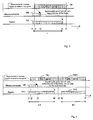
- Fig. 1 shows a principle diagram of a sender-receiver distance d versus signal power P, wherein the sender is a base station BS and the receivers are the mobile terminals UE1 and UE2 within a cell served by the base station BS.
- a first mobile terminal UE1 is shown to be at a first distance d1 with respect to the base station and a second mobile terminal UE 2 is depicted.
- the signal strength P at the distance d2 is roughly half of the signal strength P at the distance d1; thus the second mobile terminal UE2 will receive the same signal with half the power compared to the first mobile terminal UE1.
- Mobile terminals are designed to consume as little as possible power in idle mode, i.e. if being switched on but not being connected to any other party.
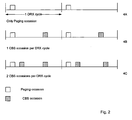
- Cell Broadcast Service -CBS- when Cell Broadcast Service -CBS- is activated, the stand-by time of the corresponding mobile devices (or user equipments UE) decreases, as in addition to the discontinuous reception (DRX) cycle, a multiple of CBS occasions need to be received. This can e.g. be seen in Fig. 2 showing three schematic diagrams 4A, 4B and 4C. If CBS is turned-off, the mobile device thus has to listen periodically to just receive paging information. Thereto, it turns on the radio once every DRX cycle. This is depicted in schematic diagram 4A, sowing just one paging occasion per DRX frame.
- CBS is turned on, the mobile device has to turn on the radio more frequently. If there is one CBS occasion per DRX cycle as depicted in schematic diagram 4B, the stand-by time will decrease up to 50%, as the mobile terminal has to turn on for two occasions, one paging occasion and one CBS occasion per DRX cycle. If there are more CBS occasions the decrease might be even higher.
- the schematic diagram 4C by way of example shows a situation of two CBS occasions per DRX cycle.
- suitable channel coding provides effective means of reconstructing a corrupted message from fractions of the respective signal.
- the receiver does not need to receive the full signal information for decoding the corresponding message or data carried by the signal. This is especially valid, if the channel is coded e.g. in UMTS Convolutional Coding or Turbo Coding that is used to increase the reliability.
- the signal reception time is purposely cut, whereby the remaining time is long enough to receive enough information so that the mobile terminal is still able to decode the messages within the signal.
- the switch-off periods of the radio (the time periods wherein the radio receiver is switched to be inactive or non-responsive) is being chosen to be dependent on the signal quality; thus with higher signal quality, the switch-off periods are chosen to be longer (e.g. up to a certain minimum amount.
- Dedicated figures are dependent on the used coding scheme. As a mere example, it might be possible to cut-off up to 30-40% of the signal e.g. for 1/3 Turbo Coding, (1/3 thereby means that for one information bit there are 2 redundant bits).
- the actual signal quality is determined, and depending on the actual signal quality it is decided whether the radio circuit of the mobile terminal shall receive the whole following CBS signal or whether it is sufficient to receive only a certain fraction of the CBS signal. Accordingly, the radio is controlled to either receive the whole signal or to only receive certain fractions of the signal. In the latter case, the radio can be switched-off e.g. for the rest of the CBS signal.
- the repetition rate of the quality measurement might be determined (e.g. performing a measurement with every new frame in unstable radio conditions, or to repeat the measurements e.g. every 6th frame, every 10th frame, or even less frequent in more stable conditions).
- the CBS signal might be regarded as a sequence of consecutive CBS or transmission frames, so one frame can be regarded as just a small part of the whole CBS signal.
- the CBS occasion length might extend just over one or alternatively over a plurality of transmission frames.
- Fig. 3 exemplarity shows a principle diagram with CBS occasion length of one transmission frame and Fig. 4 exemplarity shows a principle diagram with CBS occasion length of two transmission frames.
- Fig. 3 CBS occasion time durations of a single frame FR, a (signal quality) measurement period ME and a radio activation period RA are shown over the time t.
- Time points t1 to t5 are depicted on the time axis t, wherein first time point t1 denotes the beginning of the measurement period ME as well as the beginning of the radio activation period RA, second time point t2 denotes the beginning of the CBS occasion frame FR, third time point t3 denotes the end of the measurement period ME, fourth time point t4 denotes the end of the radio activation period RA, and fifth time point t5 denotes the end of the CBS occasion frame FR.
- the radio reception time tr is denoted as time period between the first time point t1 and the third time point t3.
- Signal quality measurement starts a short time (t2 - t1) earlier with respect to the CBS frame FR, as the receiver needs to synchronize with the received signal.
- the necessary synchronization time might depend on the specific hardware and architecture. (This time might be coded in the software being based on the knowledge if the receiver is stable or not).
- the radio reception time tr is shorter than the CBS frame FR.
- the reception time tr might be as long or even longer than the CBS frame although a redundancy reserve allows for reducing the reception time of the CBS frame.
- Fig. 4 exemplarily shows time durations of two consecutive CBS occasion frames FR1 and FR2 over the time t, wherein the first CBS occasion frame FR1 is similar to the CBS occasion frame FR in Fig. 3 .
- Fig. 4 shows the (signal quality) measurement period ME as shown in Fig. 3 and a first and a second radio activation period RA1 and RA2 over the time, wherein the first radio activation period RA1 is by way of example similar to the radio activation period RA of Fig.3 .
- Time points t1 to t7 are depicted on the time axis t, wherein first time point t1 to the fifth time point t5 are similar and denote similar events with respect to Fig.
- a sixth time point t6 denotes the beginning of the second radio activation period RA2 and a seventh time point t7 denotes the end of the second CBS occasion frame FR2 as well as the end of the second radio activation period RA2.
- signal quality measurement and consequently the first radio activation period RA1 starts earlier with respect to the (first) CBS occasion frame FR1.
- the radio will be switched-off earlier (time point t4) with respect to the end of the first CBS occasion frame FR1.
- the second radio activation period RA 2 restarts later at sixth time point t6.
- time difference t6 - t5 is similar to time difference t5 - t4.
- the sum of radio reception times tr1 and tr2 is shorter than the duration of both CBS occasion frames FR1 and FR2.
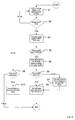
- FIG. 5 shows a flow chart diagram illustrating an exemplary method being performed within a mobile terminal according to embodiments of the invention:
- a first step S1 the mobile terminal performs signal quality measurements (e.g. collecting signal quality parameters) after the radio is turned on for CBS signal reception.
- signal quality measurements e.g. collecting signal quality parameters
- a second step S2 it is decided whether sufficient measurement data is collected.
- the signal quality e.g. signal-to-noise ratio, or any other signal quality indicator (or quality value) is calculated.
- Exemplary signal quality values are shown below for exemplarily for GSM/ WCDMA/ LTE access technologies of mobile communications networks:
- a fourth step S4 the calculated signal quality is evaluated with respect to a certain quality threshold. This can be performed by comparing one of the above signal quality indicators with a certain (predetermined or adaptive) threshold value.
- the threshold value might be a value stored within the mobile terminal and/or being received from the network. This value might be a predetermined value that might be valid for one or a plurality of cells. Alternatively, this value is an adaptive value e.g. based on recent signal quality measurements within the terminal and/or information received from the network (base station). If the signal quality is above the threshold (TRUE), following fifth step S5 is carried out. Otherwise (FALSE) the next step to be carried out is ninth step S9.
- a calculation (and/or estimation) is performed to determine a time point to turn-off the transceiver receiving a CBS occasion frame.
- step S6 it is determined whether the actual CBS signal (sequence) end with the current CBS occasion frame or whether the CBS signal extends over a further CBS occasion frame. In a case that the current CBS sequence ends at the end of the current CBS occasion frame, the sequence directly branches to the eighth step S8 after the next step. Otherwise, seventh step S7 is carried out.
- a time point is calculated to turn on the radio within the next CBS occasion frame (see t6 in Fig.4 ).
- the transceiver is controlled to turn-off before the end of that CBS frame (according to the calculated turn-off time calculated in step 5).
- the ninth step S9 is carried out next to fifth step S5 in the case that the signal quality is not above the threshold.
- the radio is not turned off.
- tenth step S10 is carried out to control the transceiver is controlled to turn-off just at the end of that CBS occasion frame.
- the above-described sequence might be repeated every time after performing the measurements, e.g. every time at the beginning of a new sequence, and in the case of a long running CBS read, every time the measurements were done.
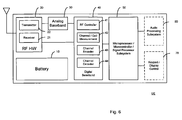
- Fig. 6 shows an exemplary simplified block diagram of a mobile terminal UE, wherein this mobile terminal can be any of the terminals UE1 and UE2 discussed above.
- the mobile terminal UE comprises by way of example a power supply 10, a radio circuit 20 further comprising a receiver 21 and a transmitter 22, an analog baseband circuit 30, a digital baseband circuit 40, a signal processor 50 and optionally an audio processing subsystem 60 and a display control (keypad) 70.
- the digital baseband circuit by way of example comprises a radio controller circuit 41, a channel/cell measurement circuit 42, a channel encoder 43 and a channel decoder 44.
- the radio controller circuit 41 controls activation and deactivation of the receiver 21. Measurement results of the channel/cell measurement circuit 42 are retrieved and processed by the microprocessor 50. Depending on the results, the radio controller circuit 41 will be configured by the microprocessor 50 with the minimum reception time for the CBS signal and the switch-on and/or switch-off time point(s) for the receiver 21 accordingly.
- the decoder 44 might provide feedback information to the microprocessor 50 informing about at least one of: information about the current "redundancy reserve", and information whether the current signal was correctly decoded/not correctly decoded.
- This feedback information might be used to adapt the calculation process of calculation the reception time (or switch-on and/or switch-off time points) with respect to the CBS signal scheme).
- the invention allows keeping the active time of the radio circuit 20 for CBS mode short.
- a power consumption of the mobile terminal (during active CBS mode) might be significantly reduced.
- the stand-by time of the mobile terminal significantly increase. This may further rise the acceptance of CBS and thus might offer a plurality of business opportunities for network/service providers.
- the invention allows the mobile terminal to control its power consumption autonomously from the network.
- the above-described solutions are compatible with current protocols for the CBS communication between terminal and network described e.g. in the above-cited standard documents.
Landscapes
- Engineering & Computer Science (AREA)
- Computer Networks & Wireless Communication (AREA)
- Signal Processing (AREA)
- Mobile Radio Communication Systems (AREA)
Claims (15)
- Verfahren zur Steuerung eines Funkempfängers (21) eines mobilen Endgeräts (UE1, UE2) eines Telekommunikationsnetzes, wobei das Telekommunikationsnetz ein Signal innerhalb eines Signalrahmens (FR, FR1, FR2) sendet, das durch eine Mehrzahl von mobilen Endgeräten (UE1, UE2) empfangen werden soll, wobei das Signal einen codierten digitalen Inhalt umfasst, gekennzeichnet durch:- Bestimmen einer Signalqualität des Signals,- Bestimmen in Abhängigkeit von der Signalqualität eines Empfangszeitschemas (tr, tr1, tr2) für den Funkempfänger (21), und- Steuern des Funkempfängers gemäß dem Empfangszeitschema, um das Signal zu empfangen.
- Verfahren nach Anspruch 1, wobei das Bestimmen des Empfangszeitschemas (tr, tr1, tr2) ferner von der zum Codieren des digitalen Inhalts verwendeten Codierungstechnologie abhängt.
- Verfahren nach Anspruch 1 oder einem der vorhergehenden Ansprüche, wobei das Zeitschema (tr, tr1, tr2) mindestens eine Empfangszeitdauer (tr, tr1, tr2) umfasst, während der der Funkempfänger (21) so gesteuert wird, dass er aktiv ist.
- Verfahren nach Anspruch 1 oder einem der vorhergehenden Ansprüche, wobei das Zeitschema (tr, tr1, tr2) mindestens eine Zeitdauer innerhalb des Signalrahmens (FR, FR1, FR2) umfasst, während der der Funkempfänger (21) so gesteuert wird, dass er inaktiv ist.
- Verfahren nach einem der vorhergehenden Ansprüche, wobei der Funkempfänger (21) so gesteuert wird, dass er eine bestimmte Zeitdauer vor dem Ende des entsprechenden Signalrahmens ausgeschaltet wird.
- Verfahren nach Anspruch 4 oder einem der vorhergehenden Ansprüche, wobei der Funkempfänger so gesteuert wird, dass er eine bestimmte Zeitdauer nach dem Start des entsprechenden Signalrahmens eingeschaltet wird.
- Verfahren nach Anspruch 3 oder einem der vorhergehenden Ansprüche, wobei die Empfangszeitdauer derart bestimmt wird, dass eine Redundanz des decodierten digitalen Inhalts genau oder noch ausreichend ist, um die Daten korrekt zu decodieren.
- Verfahren nach Anspruch 1 oder einem der vorhergehenden Ansprüche, wobei das Steuern des Funkempfängers (21) ferner in Abhängigkeit von einem Rückführsignal von einem digitalen Decodierer (44) des mobilen Endgeräts (UE1, UE2) durchgeführt wird, um das Empfangszeitschema (tr, tr1, tr2) gemäß einer verbleibenden Redundanz des decodierten digitalen Inhalts innerhalb des empfangenen Signals anzupassen.
- Verfahren nach dem vorhergehenden Anspruch, wobei das Empfangszeitschema derart angepasst wird, dass die verbleibende Redundanz null oder beinahe null ist.
- Verfahren nach Anspruch 1 oder einem der vorhergehenden Ansprüche, wobei die Signalqualität durch Messen eines bestimmten Signalqualitätsparameters und Bestimmen, ob dieser Parameter über einer definierten Schwelle ist, bestimmt wird.
- Verfahren nach dem vorhergehenden Anspruch, wobei der Signalqualitätsparameter eines von einem Energie- /Rauschleistungsverhältnis, einem Empfangssignalstärke-Indikator, einer Empfangssignal-Codeleistung und einer Referenzsignalempfangsleistung ist.
- Verfahren nach Anspruch 10 oder dem vorhergehenden Ansprüche, wobei die definierte Schwelle einer von einem Wert, der im mobilen Endgerät (UE1, UE2) gespeichert ist, und einem Wert ist, der vom Telekommunikationsnetz empfangen wird.
- Verfahren nach Anspruch 10 oder einem der vorhergehenden Ansprüche, wobei die Schwelle ein adaptiver Wert ist, der auf jüngsten Signalqualitätsmessungen basiert.
- Mobiles Endgerät (UE1, UE2), umfassend einen Funkempfänger (21), der so ausgelegt ist, dass er ein Signal innerhalb eines Signalrahmens (FR, FR1, FR2) empfängt, das von einem Telekommunikationsnetz gesendet wird und durch eine Mehrzahl von mobilen Endgeräten (UE1, UE2) empfangen werden soll, gekennzeichnet durch:- eine Messschaltung (42), die so ausgelegt ist, dass sie eine Signalqualität des Signals bestimmt,- einen Prozessor (50), der so ausgelegt ist, dass er ein Empfangszeitschema (tr, tr1, tr2) für den Funkempfänger (21) in Abhängigkeit von der Signalqualität bestimmt, und- eine Steuerung (41), die so ausgelegt ist, dass sie den Funkempfänger gemäß dem Empfangszeitschema steuert, um das Signal zu empfangen.
- Computerprogramm, das in die Verarbeitungseinheit des mobilen Endgeräts (UE1, UE2) nach dem vorhergehenden Anspruch geladen werden kann, wobei das Computerprogramm Code umfasst, der zum Ausführen des Verfahrens nach Anspruch 1 ausgelegt ist.
Applications Claiming Priority (2)
| Application Number | Priority Date | Filing Date | Title |
|---|---|---|---|
| US22799509P | 2009-07-23 | 2009-07-23 | |
| PCT/EP2009/064209 WO2011009499A1 (en) | 2009-07-23 | 2009-10-28 | Controlling a mobile radio receiver to receiving signals destined for a plurality of receivers |
Publications (2)
| Publication Number | Publication Date |
|---|---|
| EP2457403A1 EP2457403A1 (de) | 2012-05-30 |
| EP2457403B1 true EP2457403B1 (de) | 2013-12-11 |
Family
ID=41582061
Family Applications (1)
| Application Number | Title | Priority Date | Filing Date |
|---|---|---|---|
| EP09752140.5A Not-in-force EP2457403B1 (de) | 2009-07-23 | 2009-10-28 | Steuern eines beweglichen radioempfängers zum empfang von signalen für eine mehrzahl von empfängern bestimmt |
Country Status (5)
| Country | Link |
|---|---|
| US (1) | US8611289B2 (de) |
| EP (1) | EP2457403B1 (de) |
| CN (1) | CN102474816B (de) |
| RU (1) | RU2526048C2 (de) |
| WO (1) | WO2011009499A1 (de) |
Cited By (1)
| Publication number | Priority date | Publication date | Assignee | Title |
|---|---|---|---|---|
| EP3466126B1 (de) * | 2016-08-30 | 2022-04-06 | Microsoft Technology Licensing, LLC | Adaptiver empfang von zellrundfunkdienst |
Families Citing this family (9)
| Publication number | Priority date | Publication date | Assignee | Title |
|---|---|---|---|---|
| EP2457403B1 (de) * | 2009-07-23 | 2013-12-11 | Telefonaktiebolaget LM Ericsson (publ) | Steuern eines beweglichen radioempfängers zum empfang von signalen für eine mehrzahl von empfängern bestimmt |
| US20140086123A1 (en) * | 2012-09-27 | 2014-03-27 | Apple Inc. | Disabling a low power mode to improve the reception of high priority messages |
| US9749075B2 (en) * | 2013-09-27 | 2017-08-29 | Mediatek Inc. | Methods of discovery and measurements for small cells in OFDM/OFDMA systems |
| EP2858276A1 (de) * | 2013-10-01 | 2015-04-08 | Nxp B.V. | Empfänger |
| ES2873401T3 (es) | 2014-11-07 | 2021-11-03 | Ericsson Telefon Ab L M | Nodo de red y método en una red de telecomunicaciones inalámbrica |
| DE102015106201A1 (de) * | 2015-04-22 | 2016-10-27 | Intel IP Corporation | Schaltung, integrierte schaltung, empfänger, sendeempfänger und verfahren zum empfangen eines signals |
| US10048302B2 (en) * | 2016-02-15 | 2018-08-14 | Ford Global Technologies, Llc | Vehicle communications signal diagnostics using radio receiver |
| CN110393027A (zh) * | 2017-05-05 | 2019-10-29 | 华为技术有限公司 | 一种消息发送方法、消息接收方法及对应设备 |
| CN113424601A (zh) * | 2019-02-14 | 2021-09-21 | 株式会社Ntt都科摩 | 终端以及无线通信控制方法 |
Family Cites Families (12)
| Publication number | Priority date | Publication date | Assignee | Title |
|---|---|---|---|---|
| FI111596B (fi) * | 2001-09-18 | 2003-08-15 | Nokia Corp | Menetelmä matkaviestimen tehonkulutuksen alentamiseksi ja matkaviestin |
| US8509859B2 (en) * | 2005-03-11 | 2013-08-13 | Qualcomm Incorporated | Apparatus and methods for control of sleep modes in a transceiver |
| US7916675B2 (en) | 2006-06-20 | 2011-03-29 | Nokia Corporation | Method and system for providing interim discontinuous reception/transmission |
| US8094554B2 (en) * | 2006-10-26 | 2012-01-10 | Qualcomm Incorporated | Compressed mode operation and power control with discontinuous transmission and/or reception |
| KR100938754B1 (ko) * | 2006-10-30 | 2010-01-26 | 엘지전자 주식회사 | 비연속 수신을 이용한 데이터 수신 및 전송 방법 |
| US7957360B2 (en) * | 2007-01-09 | 2011-06-07 | Motorola Mobility, Inc. | Method and system for the support of a long DRX in an LTE—active state in a wireless network |
| US8169957B2 (en) * | 2007-02-05 | 2012-05-01 | Qualcomm Incorporated | Flexible DTX and DRX in a wireless communication system |
| US8023467B2 (en) * | 2007-04-27 | 2011-09-20 | Research In Motion Limited | Method and system for efficient DRX operation during handover in LTE |
| US8285346B2 (en) * | 2007-05-23 | 2012-10-09 | Telefonaktiebolaget Lm Ericsson (Publ) | Method and arrangement for reducing battery power consumption of a user equipment |
| WO2009062186A2 (en) * | 2007-11-09 | 2009-05-14 | G2 Microsystems Pty. Ltd | Early receiver shutdown |
| KR100948689B1 (ko) * | 2007-12-24 | 2010-03-24 | 한국전자통신연구원 | 이동통신시스템의 전용무선접속상태에서의 접속 제어 방법 |
| EP2457403B1 (de) * | 2009-07-23 | 2013-12-11 | Telefonaktiebolaget LM Ericsson (publ) | Steuern eines beweglichen radioempfängers zum empfang von signalen für eine mehrzahl von empfängern bestimmt |
-
2009
- 2009-10-28 EP EP09752140.5A patent/EP2457403B1/de not_active Not-in-force
- 2009-10-28 RU RU2012106340/07A patent/RU2526048C2/ru active
- 2009-10-28 CN CN200980160672.6A patent/CN102474816B/zh not_active Expired - Fee Related
- 2009-10-28 WO PCT/EP2009/064209 patent/WO2011009499A1/en not_active Ceased
- 2009-10-28 US US12/812,783 patent/US8611289B2/en not_active Expired - Fee Related
Cited By (1)
| Publication number | Priority date | Publication date | Assignee | Title |
|---|---|---|---|---|
| EP3466126B1 (de) * | 2016-08-30 | 2022-04-06 | Microsoft Technology Licensing, LLC | Adaptiver empfang von zellrundfunkdienst |
Also Published As
| Publication number | Publication date |
|---|---|
| CN102474816A (zh) | 2012-05-23 |
| EP2457403A1 (de) | 2012-05-30 |
| WO2011009499A1 (en) | 2011-01-27 |
| US20110164513A1 (en) | 2011-07-07 |
| RU2012106340A (ru) | 2013-08-27 |
| HK1171149A1 (zh) | 2013-03-15 |
| RU2526048C2 (ru) | 2014-08-20 |
| US8611289B2 (en) | 2013-12-17 |
| CN102474816B (zh) | 2015-07-29 |
Similar Documents
| Publication | Publication Date | Title |
|---|---|---|
| EP2457403B1 (de) | Steuern eines beweglichen radioempfängers zum empfang von signalen für eine mehrzahl von empfängern bestimmt | |
| US11722962B2 (en) | Method of receiving a wake-up signal, wireless device and computer program | |
| US8086195B2 (en) | Communication unit and method of operation therefor | |
| EP2095666B1 (de) | Reduktion eines verbindungsaufbaus mit einem mobilen endgerät mittels erkennung und abschwächung von überlagerung zwischen funkruf und systeminformationsausstrahlung | |
| EP1974476B1 (de) | Verfahren und anordnung zum verringern des stromverbrauchs in einem mobilkommunikationsnetz | |
| US8903349B2 (en) | Receiver apparatus and method | |
| CN104322113B (zh) | 使用终端建议的drx/dtx模式的电信网络中的非连续业务 | |
| WO2020144350A1 (en) | User equipment receiver for wake up signal reception | |
| CN115066859B (zh) | 无线通信设备、接入节点和操作方法 | |
| US9338746B2 (en) | Method and apparatus for measuring system signal | |
| US8179999B2 (en) | Decoding of blocks in radio communications | |
| EP3298809B1 (de) | Drahtlose einrichtung bestimmung, dass bedingungen erfüllt sind vor der einsatz von mobilitätsgeschichtenliste | |
| EP1808974A2 (de) | Verfahren zum Dekodieren eines Steuerkanals in einem drahtlosen Kommunikationssystem und ein drahtloses Kommunikationsendgerät | |
| HK1171149B (en) | Controlling a mobile radio receiver to receiving signals destined for a plurality of receivers | |
| EP4278518A1 (de) | Referenzsignale im abgeschalteten modus | |
| US9686742B1 (en) | Method and apparatus to reduce power consumption in standby mode for wireless communication systems | |
| KR20070078708A (ko) | 무선 통신 시스템에서 선택적인 디코딩 방법 및 장치 | |
| HK1182874A (en) | Power efficient paging channel decoding |
Legal Events
| Date | Code | Title | Description |
|---|---|---|---|
| PUAI | Public reference made under article 153(3) epc to a published international application that has entered the european phase |
Free format text: ORIGINAL CODE: 0009012 |
|
| 17P | Request for examination filed |
Effective date: 20120215 |
|
| AK | Designated contracting states |
Kind code of ref document: A1 Designated state(s): AT BE BG CH CY CZ DE DK EE ES FI FR GB GR HR HU IE IS IT LI LT LU LV MC MK MT NL NO PL PT RO SE SI SK SM TR |
|
| DAX | Request for extension of the european patent (deleted) | ||
| GRAP | Despatch of communication of intention to grant a patent |
Free format text: ORIGINAL CODE: EPIDOSNIGR1 |
|
| INTG | Intention to grant announced |
Effective date: 20130625 |
|
| GRAS | Grant fee paid |
Free format text: ORIGINAL CODE: EPIDOSNIGR3 |
|
| GRAA | (expected) grant |
Free format text: ORIGINAL CODE: 0009210 |
|
| AK | Designated contracting states |
Kind code of ref document: B1 Designated state(s): AT BE BG CH CY CZ DE DK EE ES FI FR GB GR HR HU IE IS IT LI LT LU LV MC MK MT NL NO PL PT RO SE SI SK SM TR |
|
| REG | Reference to a national code |
Ref country code: GB Ref legal event code: FG4D |
|
| REG | Reference to a national code |
Ref country code: CH Ref legal event code: EP |
|
| REG | Reference to a national code |
Ref country code: AT Ref legal event code: REF Ref document number: 645123 Country of ref document: AT Kind code of ref document: T Effective date: 20140115 |
|
| REG | Reference to a national code |
Ref country code: IE Ref legal event code: FG4D |
|
| REG | Reference to a national code |
Ref country code: DE Ref legal event code: R096 Ref document number: 602009020691 Country of ref document: DE Effective date: 20140206 |
|
| REG | Reference to a national code |
Ref country code: NL Ref legal event code: VDEP Effective date: 20131211 |
|
| REG | Reference to a national code |
Ref country code: AT Ref legal event code: MK05 Ref document number: 645123 Country of ref document: AT Kind code of ref document: T Effective date: 20131211 |
|
| PG25 | Lapsed in a contracting state [announced via postgrant information from national office to epo] |
Ref country code: NO Free format text: LAPSE BECAUSE OF FAILURE TO SUBMIT A TRANSLATION OF THE DESCRIPTION OR TO PAY THE FEE WITHIN THE PRESCRIBED TIME-LIMIT Effective date: 20140311 Ref country code: FI Free format text: LAPSE BECAUSE OF FAILURE TO SUBMIT A TRANSLATION OF THE DESCRIPTION OR TO PAY THE FEE WITHIN THE PRESCRIBED TIME-LIMIT Effective date: 20131211 Ref country code: SE Free format text: LAPSE BECAUSE OF FAILURE TO SUBMIT A TRANSLATION OF THE DESCRIPTION OR TO PAY THE FEE WITHIN THE PRESCRIBED TIME-LIMIT Effective date: 20131211 Ref country code: LT Free format text: LAPSE BECAUSE OF FAILURE TO SUBMIT A TRANSLATION OF THE DESCRIPTION OR TO PAY THE FEE WITHIN THE PRESCRIBED TIME-LIMIT Effective date: 20131211 Ref country code: HR Free format text: LAPSE BECAUSE OF FAILURE TO SUBMIT A TRANSLATION OF THE DESCRIPTION OR TO PAY THE FEE WITHIN THE PRESCRIBED TIME-LIMIT Effective date: 20131211 Ref country code: NL Free format text: LAPSE BECAUSE OF FAILURE TO SUBMIT A TRANSLATION OF THE DESCRIPTION OR TO PAY THE FEE WITHIN THE PRESCRIBED TIME-LIMIT Effective date: 20131211 |
|
| REG | Reference to a national code |
Ref country code: LT Ref legal event code: MG4D |
|
| PG25 | Lapsed in a contracting state [announced via postgrant information from national office to epo] |
Ref country code: LV Free format text: LAPSE BECAUSE OF FAILURE TO SUBMIT A TRANSLATION OF THE DESCRIPTION OR TO PAY THE FEE WITHIN THE PRESCRIBED TIME-LIMIT Effective date: 20131211 Ref country code: AT Free format text: LAPSE BECAUSE OF FAILURE TO SUBMIT A TRANSLATION OF THE DESCRIPTION OR TO PAY THE FEE WITHIN THE PRESCRIBED TIME-LIMIT Effective date: 20131211 Ref country code: CY Free format text: LAPSE BECAUSE OF FAILURE TO SUBMIT A TRANSLATION OF THE DESCRIPTION OR TO PAY THE FEE WITHIN THE PRESCRIBED TIME-LIMIT Effective date: 20131211 |
|
| PG25 | Lapsed in a contracting state [announced via postgrant information from national office to epo] |
Ref country code: EE Free format text: LAPSE BECAUSE OF FAILURE TO SUBMIT A TRANSLATION OF THE DESCRIPTION OR TO PAY THE FEE WITHIN THE PRESCRIBED TIME-LIMIT Effective date: 20131211 Ref country code: BE Free format text: LAPSE BECAUSE OF FAILURE TO SUBMIT A TRANSLATION OF THE DESCRIPTION OR TO PAY THE FEE WITHIN THE PRESCRIBED TIME-LIMIT Effective date: 20131211 Ref country code: IS Free format text: LAPSE BECAUSE OF FAILURE TO SUBMIT A TRANSLATION OF THE DESCRIPTION OR TO PAY THE FEE WITHIN THE PRESCRIBED TIME-LIMIT Effective date: 20140411 |
|
| PG25 | Lapsed in a contracting state [announced via postgrant information from national office to epo] |
Ref country code: RO Free format text: LAPSE BECAUSE OF FAILURE TO SUBMIT A TRANSLATION OF THE DESCRIPTION OR TO PAY THE FEE WITHIN THE PRESCRIBED TIME-LIMIT Effective date: 20131211 Ref country code: PT Free format text: LAPSE BECAUSE OF FAILURE TO SUBMIT A TRANSLATION OF THE DESCRIPTION OR TO PAY THE FEE WITHIN THE PRESCRIBED TIME-LIMIT Effective date: 20140411 Ref country code: CZ Free format text: LAPSE BECAUSE OF FAILURE TO SUBMIT A TRANSLATION OF THE DESCRIPTION OR TO PAY THE FEE WITHIN THE PRESCRIBED TIME-LIMIT Effective date: 20131211 Ref country code: ES Free format text: LAPSE BECAUSE OF FAILURE TO SUBMIT A TRANSLATION OF THE DESCRIPTION OR TO PAY THE FEE WITHIN THE PRESCRIBED TIME-LIMIT Effective date: 20131211 Ref country code: PL Free format text: LAPSE BECAUSE OF FAILURE TO SUBMIT A TRANSLATION OF THE DESCRIPTION OR TO PAY THE FEE WITHIN THE PRESCRIBED TIME-LIMIT Effective date: 20131211 Ref country code: SK Free format text: LAPSE BECAUSE OF FAILURE TO SUBMIT A TRANSLATION OF THE DESCRIPTION OR TO PAY THE FEE WITHIN THE PRESCRIBED TIME-LIMIT Effective date: 20131211 |
|
| REG | Reference to a national code |
Ref country code: DE Ref legal event code: R097 Ref document number: 602009020691 Country of ref document: DE |
|
| PLBE | No opposition filed within time limit |
Free format text: ORIGINAL CODE: 0009261 |
|
| STAA | Information on the status of an ep patent application or granted ep patent |
Free format text: STATUS: NO OPPOSITION FILED WITHIN TIME LIMIT |
|
| PG25 | Lapsed in a contracting state [announced via postgrant information from national office to epo] |
Ref country code: DK Free format text: LAPSE BECAUSE OF FAILURE TO SUBMIT A TRANSLATION OF THE DESCRIPTION OR TO PAY THE FEE WITHIN THE PRESCRIBED TIME-LIMIT Effective date: 20131211 |
|
| 26N | No opposition filed |
Effective date: 20140912 |
|
| REG | Reference to a national code |
Ref country code: DE Ref legal event code: R097 Ref document number: 602009020691 Country of ref document: DE Effective date: 20140912 |
|
| PG25 | Lapsed in a contracting state [announced via postgrant information from national office to epo] |
Ref country code: SI Free format text: LAPSE BECAUSE OF FAILURE TO SUBMIT A TRANSLATION OF THE DESCRIPTION OR TO PAY THE FEE WITHIN THE PRESCRIBED TIME-LIMIT Effective date: 20131211 |
|
| PG25 | Lapsed in a contracting state [announced via postgrant information from national office to epo] |
Ref country code: MC Free format text: LAPSE BECAUSE OF FAILURE TO SUBMIT A TRANSLATION OF THE DESCRIPTION OR TO PAY THE FEE WITHIN THE PRESCRIBED TIME-LIMIT Effective date: 20131211 Ref country code: LU Free format text: LAPSE BECAUSE OF FAILURE TO SUBMIT A TRANSLATION OF THE DESCRIPTION OR TO PAY THE FEE WITHIN THE PRESCRIBED TIME-LIMIT Effective date: 20141028 |
|
| REG | Reference to a national code |
Ref country code: CH Ref legal event code: PL |
|
| REG | Reference to a national code |
Ref country code: IE Ref legal event code: MM4A |
|
| PG25 | Lapsed in a contracting state [announced via postgrant information from national office to epo] |
Ref country code: CH Free format text: LAPSE BECAUSE OF NON-PAYMENT OF DUE FEES Effective date: 20141031 Ref country code: LI Free format text: LAPSE BECAUSE OF NON-PAYMENT OF DUE FEES Effective date: 20141031 |
|
| REG | Reference to a national code |
Ref country code: FR Ref legal event code: ST Effective date: 20150630 |
|
| PG25 | Lapsed in a contracting state [announced via postgrant information from national office to epo] |
Ref country code: FR Free format text: LAPSE BECAUSE OF NON-PAYMENT OF DUE FEES Effective date: 20141031 |
|
| PG25 | Lapsed in a contracting state [announced via postgrant information from national office to epo] |
Ref country code: IE Free format text: LAPSE BECAUSE OF NON-PAYMENT OF DUE FEES Effective date: 20141028 |
|
| PG25 | Lapsed in a contracting state [announced via postgrant information from national office to epo] |
Ref country code: SM Free format text: LAPSE BECAUSE OF FAILURE TO SUBMIT A TRANSLATION OF THE DESCRIPTION OR TO PAY THE FEE WITHIN THE PRESCRIBED TIME-LIMIT Effective date: 20131211 |
|
| PG25 | Lapsed in a contracting state [announced via postgrant information from national office to epo] |
Ref country code: GR Free format text: LAPSE BECAUSE OF FAILURE TO SUBMIT A TRANSLATION OF THE DESCRIPTION OR TO PAY THE FEE WITHIN THE PRESCRIBED TIME-LIMIT Effective date: 20140312 Ref country code: BG Free format text: LAPSE BECAUSE OF FAILURE TO SUBMIT A TRANSLATION OF THE DESCRIPTION OR TO PAY THE FEE WITHIN THE PRESCRIBED TIME-LIMIT Effective date: 20131211 |
|
| PG25 | Lapsed in a contracting state [announced via postgrant information from national office to epo] |
Ref country code: MT Free format text: LAPSE BECAUSE OF FAILURE TO SUBMIT A TRANSLATION OF THE DESCRIPTION OR TO PAY THE FEE WITHIN THE PRESCRIBED TIME-LIMIT Effective date: 20131211 Ref country code: TR Free format text: LAPSE BECAUSE OF FAILURE TO SUBMIT A TRANSLATION OF THE DESCRIPTION OR TO PAY THE FEE WITHIN THE PRESCRIBED TIME-LIMIT Effective date: 20131211 Ref country code: HU Free format text: LAPSE BECAUSE OF FAILURE TO SUBMIT A TRANSLATION OF THE DESCRIPTION OR TO PAY THE FEE WITHIN THE PRESCRIBED TIME-LIMIT; INVALID AB INITIO Effective date: 20091028 |
|
| PG25 | Lapsed in a contracting state [announced via postgrant information from national office to epo] |
Ref country code: MK Free format text: LAPSE BECAUSE OF FAILURE TO SUBMIT A TRANSLATION OF THE DESCRIPTION OR TO PAY THE FEE WITHIN THE PRESCRIBED TIME-LIMIT Effective date: 20131211 |
|
| PGFP | Annual fee paid to national office [announced via postgrant information from national office to epo] |
Ref country code: DE Payment date: 20201028 Year of fee payment: 12 Ref country code: GB Payment date: 20201027 Year of fee payment: 12 Ref country code: IT Payment date: 20201023 Year of fee payment: 12 |
|
| REG | Reference to a national code |
Ref country code: DE Ref legal event code: R119 Ref document number: 602009020691 Country of ref document: DE |
|
| GBPC | Gb: european patent ceased through non-payment of renewal fee |
Effective date: 20211028 |
|
| PG25 | Lapsed in a contracting state [announced via postgrant information from national office to epo] |
Ref country code: GB Free format text: LAPSE BECAUSE OF NON-PAYMENT OF DUE FEES Effective date: 20211028 Ref country code: DE Free format text: LAPSE BECAUSE OF NON-PAYMENT OF DUE FEES Effective date: 20220503 |
|
| PG25 | Lapsed in a contracting state [announced via postgrant information from national office to epo] |
Ref country code: IT Free format text: LAPSE BECAUSE OF NON-PAYMENT OF DUE FEES Effective date: 20211028 |