EP3613780A1 - Curable resin composition, cured product thereof, and structure including cured product thereof - Google Patents
Curable resin composition, cured product thereof, and structure including cured product thereof Download PDFInfo
- Publication number
- EP3613780A1 EP3613780A1 EP18787549.7A EP18787549A EP3613780A1 EP 3613780 A1 EP3613780 A1 EP 3613780A1 EP 18787549 A EP18787549 A EP 18787549A EP 3613780 A1 EP3613780 A1 EP 3613780A1
- Authority
- EP
- European Patent Office
- Prior art keywords
- resin composition
- curable resin
- compound
- group
- phenol compound
- Prior art date
- Legal status (The legal status is an assumption and is not a legal conclusion. Google has not performed a legal analysis and makes no representation as to the accuracy of the status listed.)
- Withdrawn
Links
- 239000011342 resin composition Substances 0.000 title claims abstract description 87
- -1 phenol compound Chemical class 0.000 claims abstract description 125
- 150000001875 compounds Chemical class 0.000 claims abstract description 63
- 125000004435 hydrogen atom Chemical group [H]* 0.000 claims abstract description 39
- 125000002887 hydroxy group Chemical group [H]O* 0.000 claims abstract description 31
- 125000000008 (C1-C10) alkyl group Chemical group 0.000 claims abstract description 12
- 125000003342 alkenyl group Chemical group 0.000 claims abstract description 12
- 125000003545 alkoxy group Chemical group 0.000 claims abstract description 12
- 125000000882 C2-C6 alkenyl group Chemical group 0.000 claims abstract description 9
- 125000003118 aryl group Chemical group 0.000 claims description 41
- ISWSIDIOOBJBQZ-UHFFFAOYSA-N phenol group Chemical group C1(=CC=CC=C1)O ISWSIDIOOBJBQZ-UHFFFAOYSA-N 0.000 claims description 30
- 125000000962 organic group Chemical group 0.000 claims description 16
- 238000006116 polymerization reaction Methods 0.000 claims description 16
- 125000003903 2-propenyl group Chemical group [H]C([*])([H])C([H])=C([H])[H] 0.000 claims description 9
- 125000006713 (C5-C10) cycloalkyl group Chemical group 0.000 claims description 8
- 125000000217 alkyl group Chemical group 0.000 claims description 8
- 125000001624 naphthyl group Chemical group 0.000 claims description 8
- 239000000945 filler Substances 0.000 claims description 7
- XAZPKEBWNIUCKF-UHFFFAOYSA-N 1-[4-[4-[2-[4-[4-(2,5-dioxopyrrol-1-yl)phenoxy]phenyl]propan-2-yl]phenoxy]phenyl]pyrrole-2,5-dione Chemical compound C=1C=C(OC=2C=CC(=CC=2)N2C(C=CC2=O)=O)C=CC=1C(C)(C)C(C=C1)=CC=C1OC(C=C1)=CC=C1N1C(=O)C=CC1=O XAZPKEBWNIUCKF-UHFFFAOYSA-N 0.000 claims description 5
- XQUPVDVFXZDTLT-UHFFFAOYSA-N 1-[4-[[4-(2,5-dioxopyrrol-1-yl)phenyl]methyl]phenyl]pyrrole-2,5-dione Chemical compound O=C1C=CC(=O)N1C(C=C1)=CC=C1CC1=CC=C(N2C(C=CC2=O)=O)C=C1 XQUPVDVFXZDTLT-UHFFFAOYSA-N 0.000 claims description 5
- 125000004432 carbon atom Chemical group C* 0.000 claims description 3
- 238000009826 distribution Methods 0.000 claims description 3
- 229920005989 resin Polymers 0.000 abstract description 13
- 239000011347 resin Substances 0.000 abstract description 13
- 239000000047 product Substances 0.000 description 31
- 238000000034 method Methods 0.000 description 27
- 238000001723 curing Methods 0.000 description 24
- 229920001568 phenolic resin Polymers 0.000 description 24
- 239000005011 phenolic resin Substances 0.000 description 24
- KXGFMDJXCMQABM-UHFFFAOYSA-N 2-methoxy-6-methylphenol Chemical compound [CH]OC1=CC=CC([CH])=C1O KXGFMDJXCMQABM-UHFFFAOYSA-N 0.000 description 23
- 238000002156 mixing Methods 0.000 description 23
- 239000000203 mixture Substances 0.000 description 13
- 239000002994 raw material Substances 0.000 description 13
- VYPSYNLAJGMNEJ-UHFFFAOYSA-N Silicium dioxide Chemical compound O=[Si]=O VYPSYNLAJGMNEJ-UHFFFAOYSA-N 0.000 description 12
- YXFVVABEGXRONW-UHFFFAOYSA-N Toluene Chemical compound CC1=CC=CC=C1 YXFVVABEGXRONW-UHFFFAOYSA-N 0.000 description 12
- 239000004065 semiconductor Substances 0.000 description 12
- 238000005538 encapsulation Methods 0.000 description 11
- 230000002349 favourable effect Effects 0.000 description 11
- 239000000463 material Substances 0.000 description 11
- 238000006243 chemical reaction Methods 0.000 description 10
- 238000004519 manufacturing process Methods 0.000 description 10
- 238000000465 moulding Methods 0.000 description 10
- 238000005821 Claisen rearrangement reaction Methods 0.000 description 9
- 238000010438 heat treatment Methods 0.000 description 9
- 239000011256 inorganic filler Substances 0.000 description 9
- 229910003475 inorganic filler Inorganic materials 0.000 description 9
- 239000002245 particle Substances 0.000 description 9
- 238000006266 etherification reaction Methods 0.000 description 7
- UFWIBTONFRDIAS-UHFFFAOYSA-N naphthalene-acid Natural products C1=CC=CC2=CC=CC=C21 UFWIBTONFRDIAS-UHFFFAOYSA-N 0.000 description 7
- XLYOFNOQVPJJNP-UHFFFAOYSA-N water Substances O XLYOFNOQVPJJNP-UHFFFAOYSA-N 0.000 description 7
- ZWEHNKRNPOVVGH-UHFFFAOYSA-N 2-Butanone Chemical compound CCC(C)=O ZWEHNKRNPOVVGH-UHFFFAOYSA-N 0.000 description 6
- OKTJSMMVPCPJKN-UHFFFAOYSA-N Carbon Chemical compound [C] OKTJSMMVPCPJKN-UHFFFAOYSA-N 0.000 description 6
- 239000000654 additive Substances 0.000 description 6
- 230000000052 comparative effect Effects 0.000 description 6
- 239000007822 coupling agent Substances 0.000 description 6
- 230000014759 maintenance of location Effects 0.000 description 6
- 238000003756 stirring Methods 0.000 description 6
- IJGRMHOSHXDMSA-UHFFFAOYSA-N Atomic nitrogen Chemical compound N#N IJGRMHOSHXDMSA-UHFFFAOYSA-N 0.000 description 5
- 229910001873 dinitrogen Inorganic materials 0.000 description 5
- 239000003822 epoxy resin Substances 0.000 description 5
- 239000003999 initiator Substances 0.000 description 5
- 238000005259 measurement Methods 0.000 description 5
- 239000012044 organic layer Substances 0.000 description 5
- 229920000647 polyepoxide Polymers 0.000 description 5
- 239000000843 powder Substances 0.000 description 5
- 239000002904 solvent Substances 0.000 description 5
- SFHYNDMGZXWXBU-LIMNOBDPSA-N 6-amino-2-[[(e)-(3-formylphenyl)methylideneamino]carbamoylamino]-1,3-dioxobenzo[de]isoquinoline-5,8-disulfonic acid Chemical compound O=C1C(C2=3)=CC(S(O)(=O)=O)=CC=3C(N)=C(S(O)(=O)=O)C=C2C(=O)N1NC(=O)N\N=C\C1=CC=CC(C=O)=C1 SFHYNDMGZXWXBU-LIMNOBDPSA-N 0.000 description 4
- 238000013329 compounding Methods 0.000 description 4
- RTZKZFJDLAIYFH-UHFFFAOYSA-N ether Substances CCOCC RTZKZFJDLAIYFH-UHFFFAOYSA-N 0.000 description 4
- 239000003063 flame retardant Substances 0.000 description 4
- 230000009477 glass transition Effects 0.000 description 4
- LNEPOXFFQSENCJ-UHFFFAOYSA-N haloperidol Chemical compound C1CC(O)(C=2C=CC(Cl)=CC=2)CCN1CCCC(=O)C1=CC=C(F)C=C1 LNEPOXFFQSENCJ-UHFFFAOYSA-N 0.000 description 4
- 239000010410 layer Substances 0.000 description 4
- HVAMZGADVCBITI-UHFFFAOYSA-M pent-4-enoate Chemical compound [O-]C(=O)CCC=C HVAMZGADVCBITI-UHFFFAOYSA-M 0.000 description 4
- SCVFZCLFOSHCOH-UHFFFAOYSA-M potassium acetate Chemical compound [K+].CC([O-])=O SCVFZCLFOSHCOH-UHFFFAOYSA-M 0.000 description 4
- 239000000377 silicon dioxide Substances 0.000 description 4
- 239000007787 solid Substances 0.000 description 4
- 238000012360 testing method Methods 0.000 description 4
- 230000000930 thermomechanical effect Effects 0.000 description 4
- 238000001721 transfer moulding Methods 0.000 description 4
- RNFJDJUURJAICM-UHFFFAOYSA-N 2,2,4,4,6,6-hexaphenoxy-1,3,5-triaza-2$l^{5},4$l^{5},6$l^{5}-triphosphacyclohexa-1,3,5-triene Chemical class N=1P(OC=2C=CC=CC=2)(OC=2C=CC=CC=2)=NP(OC=2C=CC=CC=2)(OC=2C=CC=CC=2)=NP=1(OC=1C=CC=CC=1)OC1=CC=CC=C1 RNFJDJUURJAICM-UHFFFAOYSA-N 0.000 description 3
- UOXJNGFFPMOZDM-UHFFFAOYSA-N 2-[di(propan-2-yl)amino]ethylsulfanyl-methylphosphinic acid Chemical compound CC(C)N(C(C)C)CCSP(C)(O)=O UOXJNGFFPMOZDM-UHFFFAOYSA-N 0.000 description 3
- OAICVXFJPJFONN-UHFFFAOYSA-N Phosphorus Chemical compound [P] OAICVXFJPJFONN-UHFFFAOYSA-N 0.000 description 3
- 239000006087 Silane Coupling Agent Substances 0.000 description 3
- HEMHJVSKTPXQMS-UHFFFAOYSA-M Sodium hydroxide Chemical compound [OH-].[Na+] HEMHJVSKTPXQMS-UHFFFAOYSA-M 0.000 description 3
- 238000004458 analytical method Methods 0.000 description 3
- 125000006267 biphenyl group Chemical group 0.000 description 3
- 229910052799 carbon Inorganic materials 0.000 description 3
- 239000003795 chemical substances by application Substances 0.000 description 3
- 229910052736 halogen Inorganic materials 0.000 description 3
- 150000002367 halogens Chemical class 0.000 description 3
- 125000005439 maleimidyl group Chemical group C1(C=CC(N1*)=O)=O 0.000 description 3
- 229920003986 novolac Polymers 0.000 description 3
- 150000001451 organic peroxides Chemical class 0.000 description 3
- 229910052698 phosphorus Inorganic materials 0.000 description 3
- 239000011574 phosphorus Substances 0.000 description 3
- 238000002360 preparation method Methods 0.000 description 3
- 238000010298 pulverizing process Methods 0.000 description 3
- 239000000243 solution Substances 0.000 description 3
- 239000000126 substance Substances 0.000 description 3
- 238000005406 washing Methods 0.000 description 3
- XMNIXWIUMCBBBL-UHFFFAOYSA-N 2-(2-phenylpropan-2-ylperoxy)propan-2-ylbenzene Chemical compound C=1C=CC=CC=1C(C)(C)OOC(C)(C)C1=CC=CC=C1 XMNIXWIUMCBBBL-UHFFFAOYSA-N 0.000 description 2
- 229910052582 BN Inorganic materials 0.000 description 2
- PZNSFCLAULLKQX-UHFFFAOYSA-N Boron nitride Chemical compound N#B PZNSFCLAULLKQX-UHFFFAOYSA-N 0.000 description 2
- KDLHZDBZIXYQEI-UHFFFAOYSA-N Palladium Chemical compound [Pd] KDLHZDBZIXYQEI-UHFFFAOYSA-N 0.000 description 2
- 229910000831 Steel Inorganic materials 0.000 description 2
- WYURNTSHIVDZCO-UHFFFAOYSA-N Tetrahydrofuran Chemical compound C1CCOC1 WYURNTSHIVDZCO-UHFFFAOYSA-N 0.000 description 2
- 230000002411 adverse Effects 0.000 description 2
- 125000001931 aliphatic group Chemical group 0.000 description 2
- MWPLVEDNUUSJAV-UHFFFAOYSA-N anthracene Chemical group C1=CC=CC2=CC3=CC=CC=C3C=C21 MWPLVEDNUUSJAV-UHFFFAOYSA-N 0.000 description 2
- 125000004653 anthracenylene group Chemical group 0.000 description 2
- 239000012298 atmosphere Substances 0.000 description 2
- 125000002529 biphenylenyl group Chemical group C1(=CC=CC=2C3=CC=CC=C3C12)* 0.000 description 2
- 238000009835 boiling Methods 0.000 description 2
- 229920006026 co-polymeric resin Polymers 0.000 description 2
- 238000002485 combustion reaction Methods 0.000 description 2
- 238000004132 cross linking Methods 0.000 description 2
- 238000006073 displacement reaction Methods 0.000 description 2
- 230000000694 effects Effects 0.000 description 2
- 125000001495 ethyl group Chemical group [H]C([H])([H])C([H])([H])* 0.000 description 2
- 238000011156 evaluation Methods 0.000 description 2
- 239000012065 filter cake Substances 0.000 description 2
- 238000001914 filtration Methods 0.000 description 2
- 125000005567 fluorenylene group Chemical group 0.000 description 2
- 238000009413 insulation Methods 0.000 description 2
- 230000010354 integration Effects 0.000 description 2
- 125000001449 isopropyl group Chemical group [H]C([H])([H])C([H])(*)C([H])([H])[H] 0.000 description 2
- 238000004898 kneading Methods 0.000 description 2
- 238000002844 melting Methods 0.000 description 2
- 230000008018 melting Effects 0.000 description 2
- 239000012528 membrane Substances 0.000 description 2
- 125000002496 methyl group Chemical group [H]C([H])([H])* 0.000 description 2
- UHOVQNZJYSORNB-UHFFFAOYSA-N monobenzene Natural products C1=CC=CC=C1 UHOVQNZJYSORNB-UHFFFAOYSA-N 0.000 description 2
- 125000004108 n-butyl group Chemical group [H]C([H])([H])C([H])([H])C([H])([H])C([H])([H])* 0.000 description 2
- 125000000740 n-pentyl group Chemical group [H]C([H])([H])C([H])([H])C([H])([H])C([H])([H])C([H])([H])* 0.000 description 2
- 125000004123 n-propyl group Chemical group [H]C([H])([H])C([H])([H])C([H])([H])* 0.000 description 2
- 125000004957 naphthylene group Chemical group 0.000 description 2
- 125000001997 phenyl group Chemical group [H]C1=C([H])C([H])=C(*)C([H])=C1[H] 0.000 description 2
- 125000000843 phenylene group Chemical group C1(=C(C=CC=C1)*)* 0.000 description 2
- 229920000642 polymer Polymers 0.000 description 2
- 235000013824 polyphenols Nutrition 0.000 description 2
- 235000011056 potassium acetate Nutrition 0.000 description 2
- BWHMMNNQKKPAPP-UHFFFAOYSA-L potassium carbonate Chemical compound [K+].[K+].[O-]C([O-])=O BWHMMNNQKKPAPP-UHFFFAOYSA-L 0.000 description 2
- 238000012545 processing Methods 0.000 description 2
- 230000035484 reaction time Effects 0.000 description 2
- 230000008707 rearrangement Effects 0.000 description 2
- 150000003839 salts Chemical class 0.000 description 2
- 229920006395 saturated elastomer Polymers 0.000 description 2
- 125000002914 sec-butyl group Chemical group [H]C([H])([H])C([H])([H])C([H])(*)C([H])([H])[H] 0.000 description 2
- CDBYLPFSWZWCQE-UHFFFAOYSA-L sodium carbonate Substances [Na+].[Na+].[O-]C([O-])=O CDBYLPFSWZWCQE-UHFFFAOYSA-L 0.000 description 2
- 239000010959 steel Substances 0.000 description 2
- 125000001424 substituent group Chemical group 0.000 description 2
- 125000000999 tert-butyl group Chemical group [H]C([H])([H])C(*)(C([H])([H])[H])C([H])([H])[H] 0.000 description 2
- 238000010998 test method Methods 0.000 description 2
- 238000005979 thermal decomposition reaction Methods 0.000 description 2
- BPSIOYPQMFLKFR-UHFFFAOYSA-N trimethoxy-[3-(oxiran-2-ylmethoxy)propyl]silane Chemical compound CO[Si](OC)(OC)CCCOCC1CO1 BPSIOYPQMFLKFR-UHFFFAOYSA-N 0.000 description 2
- RIOQSEWOXXDEQQ-UHFFFAOYSA-N triphenylphosphine Chemical compound C1=CC=CC=C1P(C=1C=CC=CC=1)C1=CC=CC=C1 RIOQSEWOXXDEQQ-UHFFFAOYSA-N 0.000 description 2
- 125000006839 xylylene group Chemical group 0.000 description 2
- YOQWWJUTQCKGRJ-UHFFFAOYSA-N 1-[1-(2,5-dioxopyrrol-1-yl)-9,10-dioxoanthracen-2-yl]pyrrole-2,5-dione Chemical compound C1(C=CC(N1C1=C(C=CC=2C(C3=CC=CC=C3C(C12)=O)=O)N1C(C=CC1=O)=O)=O)=O YOQWWJUTQCKGRJ-UHFFFAOYSA-N 0.000 description 1
- CWTOAWSZRWDJHQ-UHFFFAOYSA-N 1-[10-(2,5-dioxopyrrol-1-yl)phenanthren-9-yl]pyrrole-2,5-dione Chemical compound C1(C=CC(N1C=1C2=CC=CC=C2C=2C=CC=CC2C1N1C(C=CC1=O)=O)=O)=O CWTOAWSZRWDJHQ-UHFFFAOYSA-N 0.000 description 1
- FUDBHMPNYQUSSR-UHFFFAOYSA-N 1-[2,6-dibutyl-4-[[3,5-dibutyl-4-(2,5-dioxopyrrol-1-yl)phenyl]methyl]phenyl]pyrrole-2,5-dione Chemical compound C=1C(CCCC)=C(N2C(C=CC2=O)=O)C(CCCC)=CC=1CC(C=C1CCCC)=CC(CCCC)=C1N1C(=O)C=CC1=O FUDBHMPNYQUSSR-UHFFFAOYSA-N 0.000 description 1
- UFFVWIGGYXLXPC-UHFFFAOYSA-N 1-[2-(2,5-dioxopyrrol-1-yl)phenyl]pyrrole-2,5-dione Chemical compound O=C1C=CC(=O)N1C1=CC=CC=C1N1C(=O)C=CC1=O UFFVWIGGYXLXPC-UHFFFAOYSA-N 0.000 description 1
- DTLOCEKBDTZQCT-UHFFFAOYSA-N 1-[2-butyl-4-[[3-butyl-4-(2,5-dioxopyrrol-1-yl)phenyl]methyl]phenyl]pyrrole-2,5-dione Chemical compound C=1C=C(N2C(C=CC2=O)=O)C(CCCC)=CC=1CC(C=C1CCCC)=CC=C1N1C(=O)C=CC1=O DTLOCEKBDTZQCT-UHFFFAOYSA-N 0.000 description 1
- VAPJJJQBDRMEGC-UHFFFAOYSA-N 1-[3-(2,5-dioxopyrrol-1-yl)-2,4,6-trimethylphenyl]pyrrole-2,5-dione Chemical compound CC1=C(N2C(C=CC2=O)=O)C(C)=CC(C)=C1N1C(=O)C=CC1=O VAPJJJQBDRMEGC-UHFFFAOYSA-N 0.000 description 1
- CWYCAAQKRLBRDJ-UHFFFAOYSA-N 1-[3-(2,5-dioxopyrrol-1-yl)-4-ethylphenyl]pyrrole-2,5-dione Chemical compound C(C)C1=C(C=C(C=C1)N1C(C=CC1=O)=O)N1C(C=CC1=O)=O CWYCAAQKRLBRDJ-UHFFFAOYSA-N 0.000 description 1
- FJKKJQRXSPFNPM-UHFFFAOYSA-N 1-[3-(2,5-dioxopyrrol-1-yl)-4-methylphenyl]pyrrole-2,5-dione Chemical compound CC1=CC=C(N2C(C=CC2=O)=O)C=C1N1C(=O)C=CC1=O FJKKJQRXSPFNPM-UHFFFAOYSA-N 0.000 description 1
- RKDDUCJHSPCBIZ-UHFFFAOYSA-N 1-[3-(2,5-dioxopyrrol-1-yl)-5-ethylphenyl]pyrrole-2,5-dione Chemical compound C(C)C=1C=C(C=C(C1)N1C(C=CC1=O)=O)N1C(C=CC1=O)=O RKDDUCJHSPCBIZ-UHFFFAOYSA-N 0.000 description 1
- CBCSAMMACGVOFA-UHFFFAOYSA-N 1-[3-(2,5-dioxopyrrol-1-yl)naphthalen-2-yl]pyrrole-2,5-dione Chemical compound O=C1C=CC(=O)N1C1=CC2=CC=CC=C2C=C1N1C(=O)C=CC1=O CBCSAMMACGVOFA-UHFFFAOYSA-N 0.000 description 1
- IPJGAEWUPXWFPL-UHFFFAOYSA-N 1-[3-(2,5-dioxopyrrol-1-yl)phenyl]pyrrole-2,5-dione Chemical compound O=C1C=CC(=O)N1C1=CC=CC(N2C(C=CC2=O)=O)=C1 IPJGAEWUPXWFPL-UHFFFAOYSA-N 0.000 description 1
- QYMHAZGTGFATHT-UHFFFAOYSA-N 1-[3-[3-(2,5-dioxopyrrol-1-yl)benzoyl]phenyl]pyrrole-2,5-dione Chemical compound C=1C=CC(N2C(C=CC2=O)=O)=CC=1C(=O)C(C=1)=CC=CC=1N1C(=O)C=CC1=O QYMHAZGTGFATHT-UHFFFAOYSA-N 0.000 description 1
- JXSACHSFSSDFBQ-UHFFFAOYSA-N 1-[3-[3-(2,5-dioxopyrrol-1-yl)phenoxy]phenyl]pyrrole-2,5-dione Chemical compound O=C1C=CC(=O)N1C1=CC=CC(OC=2C=C(C=CC=2)N2C(C=CC2=O)=O)=C1 JXSACHSFSSDFBQ-UHFFFAOYSA-N 0.000 description 1
- GHTQTZRKJXWHMJ-UHFFFAOYSA-N 1-[3-[3-(2,5-dioxopyrrol-1-yl)phenyl]phenyl]pyrrole-2,5-dione Chemical group O=C1C=CC(=O)N1C1=CC=CC(C=2C=C(C=CC=2)N2C(C=CC2=O)=O)=C1 GHTQTZRKJXWHMJ-UHFFFAOYSA-N 0.000 description 1
- DCHKIJZYNLJRTB-UHFFFAOYSA-N 1-[3-[3-(2,5-dioxopyrrol-1-yl)phenyl]sulfanylphenyl]pyrrole-2,5-dione Chemical compound O=C1C=CC(=O)N1C1=CC=CC(SC=2C=C(C=CC=2)N2C(C=CC2=O)=O)=C1 DCHKIJZYNLJRTB-UHFFFAOYSA-N 0.000 description 1
- XMWSWKTVLCVNHO-UHFFFAOYSA-N 1-[3-[3-(2,5-dioxopyrrol-1-yl)phenyl]sulfinylphenyl]pyrrole-2,5-dione Chemical compound O=C1C=CC(=O)N1C1=CC=CC(=C1)S(=O)C1=CC(=CC=C1)N1C(=O)C=CC1=O XMWSWKTVLCVNHO-UHFFFAOYSA-N 0.000 description 1
- RNSJLHIBGRARKK-UHFFFAOYSA-N 1-[3-[3-(2,5-dioxopyrrol-1-yl)phenyl]sulfonylphenyl]pyrrole-2,5-dione Chemical compound O=C1C=CC(=O)N1C1=CC=CC(S(=O)(=O)C=2C=C(C=CC=2)N2C(C=CC2=O)=O)=C1 RNSJLHIBGRARKK-UHFFFAOYSA-N 0.000 description 1
- MUBZHCKKGIAWOG-UHFFFAOYSA-N 1-[3-[[3-(2,5-dioxopyrrol-1-yl)cyclohexyl]methyl]cyclohexyl]pyrrole-2,5-dione Chemical compound O=C1C=CC(=O)N1C1CCCC(CC2CCCC(C2)N2C(=O)C=CC2=O)C1 MUBZHCKKGIAWOG-UHFFFAOYSA-N 0.000 description 1
- IIWWWMXVTXGLRZ-UHFFFAOYSA-N 1-[3-[[3-(2,5-dioxopyrrol-1-yl)phenyl]methyl]phenyl]pyrrole-2,5-dione Chemical compound O=C1C=CC(=O)N1C1=CC=CC(CC=2C=C(C=CC=2)N2C(C=CC2=O)=O)=C1 IIWWWMXVTXGLRZ-UHFFFAOYSA-N 0.000 description 1
- PIXSVGBXTOZDIW-UHFFFAOYSA-N 1-[4-(2,5-dioxopyrrol-1-yl)-2,3,5,6-tetramethylphenyl]pyrrole-2,5-dione Chemical compound CC=1C(C)=C(N2C(C=CC2=O)=O)C(C)=C(C)C=1N1C(=O)C=CC1=O PIXSVGBXTOZDIW-UHFFFAOYSA-N 0.000 description 1
- DMNLNQGWYJCRHJ-UHFFFAOYSA-N 1-[4-(2,5-dioxopyrrol-1-yl)-2,3-dimethylphenyl]pyrrole-2,5-dione Chemical compound CC1=C(C)C(N2C(C=CC2=O)=O)=CC=C1N1C(=O)C=CC1=O DMNLNQGWYJCRHJ-UHFFFAOYSA-N 0.000 description 1
- ZKWNVZJWZSWSOD-UHFFFAOYSA-N 1-[4-(2,5-dioxopyrrol-1-yl)-2,5-dimethylphenyl]pyrrole-2,5-dione Chemical compound CC=1C=C(N2C(C=CC2=O)=O)C(C)=CC=1N1C(=O)C=CC1=O ZKWNVZJWZSWSOD-UHFFFAOYSA-N 0.000 description 1
- OLBISNSZXACLFY-UHFFFAOYSA-N 1-[4-(2,5-dioxopyrrol-1-yl)-3,5-dimethylphenyl]pyrrole-2,5-dione Chemical compound CC1=CC(N2C(C=CC2=O)=O)=CC(C)=C1N1C(=O)C=CC1=O OLBISNSZXACLFY-UHFFFAOYSA-N 0.000 description 1
- KNWKZOKQUOIVBL-UHFFFAOYSA-N 1-[4-(2,5-dioxopyrrol-1-yl)-3-methylphenyl]pyrrole-2,5-dione Chemical compound CC1=CC(N2C(C=CC2=O)=O)=CC=C1N1C(=O)C=CC1=O KNWKZOKQUOIVBL-UHFFFAOYSA-N 0.000 description 1
- RLHYLWDBFVGVCT-UHFFFAOYSA-N 1-[4-(2,5-dioxopyrrol-1-yl)naphthalen-1-yl]pyrrole-2,5-dione Chemical compound O=C1C=CC(=O)N1C(C1=CC=CC=C11)=CC=C1N1C(=O)C=CC1=O RLHYLWDBFVGVCT-UHFFFAOYSA-N 0.000 description 1
- AQGZJQNZNONGKY-UHFFFAOYSA-N 1-[4-(2,5-dioxopyrrol-1-yl)phenyl]pyrrole-2,5-dione Chemical compound O=C1C=CC(=O)N1C1=CC=C(N2C(C=CC2=O)=O)C=C1 AQGZJQNZNONGKY-UHFFFAOYSA-N 0.000 description 1
- WYEOPIGTAMXOST-UHFFFAOYSA-N 1-[4-[2-[4-(2,5-dioxopyrrol-1-yl)phenyl]propan-2-yl]phenyl]pyrrole-2,5-dione Chemical compound C=1C=C(N2C(C=CC2=O)=O)C=CC=1C(C)(C)C(C=C1)=CC=C1N1C(=O)C=CC1=O WYEOPIGTAMXOST-UHFFFAOYSA-N 0.000 description 1
- RLZORSFIWIXNFE-UHFFFAOYSA-N 1-[4-[3-(2,5-dioxopyrrol-1-yl)phenyl]phenyl]pyrrole-2,5-dione Chemical group O=C1C=CC(=O)N1C1=CC=C(C=C1)C1=CC(=CC=C1)N1C(=O)C=CC1=O RLZORSFIWIXNFE-UHFFFAOYSA-N 0.000 description 1
- ORQOWEDKMXGKDJ-UHFFFAOYSA-N 1-[4-[4-(2,5-dioxopyrrol-1-yl)benzoyl]phenyl]pyrrole-2,5-dione Chemical compound C=1C=C(N2C(C=CC2=O)=O)C=CC=1C(=O)C(C=C1)=CC=C1N1C(=O)C=CC1=O ORQOWEDKMXGKDJ-UHFFFAOYSA-N 0.000 description 1
- XOJRVZIYCCJCRD-UHFFFAOYSA-N 1-[4-[4-(2,5-dioxopyrrol-1-yl)phenoxy]phenyl]pyrrole-2,5-dione Chemical compound O=C1C=CC(=O)N1C(C=C1)=CC=C1OC1=CC=C(N2C(C=CC2=O)=O)C=C1 XOJRVZIYCCJCRD-UHFFFAOYSA-N 0.000 description 1
- DEUOGTWMGGLRID-UHFFFAOYSA-N 1-[4-[4-(2,5-dioxopyrrol-1-yl)phenyl]phenyl]pyrrole-2,5-dione Chemical group O=C1C=CC(=O)N1C1=CC=C(C=2C=CC(=CC=2)N2C(C=CC2=O)=O)C=C1 DEUOGTWMGGLRID-UHFFFAOYSA-N 0.000 description 1
- ZXZWXBTZYQSCRW-UHFFFAOYSA-N 1-[4-[4-(2,5-dioxopyrrol-1-yl)phenyl]sulfanylphenyl]pyrrole-2,5-dione Chemical compound O=C1C=CC(=O)N1C(C=C1)=CC=C1SC1=CC=C(N2C(C=CC2=O)=O)C=C1 ZXZWXBTZYQSCRW-UHFFFAOYSA-N 0.000 description 1
- NBWXCIZBLUHZRE-UHFFFAOYSA-N 1-[4-[4-(2,5-dioxopyrrol-1-yl)phenyl]sulfinylphenyl]pyrrole-2,5-dione Chemical compound O=C1C=CC(=O)N1C1=CC=C(C=C1)S(=O)C1=CC=C(C=C1)N1C(=O)C=CC1=O NBWXCIZBLUHZRE-UHFFFAOYSA-N 0.000 description 1
- GUIACFHOZIQGKX-UHFFFAOYSA-N 1-[4-[4-(2,5-dioxopyrrol-1-yl)phenyl]sulfonylphenyl]pyrrole-2,5-dione Chemical compound O=C1C=CC(=O)N1C1=CC=C(S(=O)(=O)C=2C=CC(=CC=2)N2C(C=CC2=O)=O)C=C1 GUIACFHOZIQGKX-UHFFFAOYSA-N 0.000 description 1
- UARUPSPWUIRUTJ-UHFFFAOYSA-N 1-[4-[4-[4-(2,5-dioxopyrrol-1-yl)phenyl]cyclohexyl]phenyl]pyrrole-2,5-dione Chemical compound O=C1C=CC(=O)N1C1=CC=C(C2CCC(CC2)C=2C=CC(=CC=2)N2C(C=CC2=O)=O)C=C1 UARUPSPWUIRUTJ-UHFFFAOYSA-N 0.000 description 1
- OISJVYHHVMZVAN-UHFFFAOYSA-N 1-[4-[4-[4-(2,5-dioxopyrrol-1-yl)phenyl]phenyl]phenyl]pyrrole-2,5-dione Chemical compound O=C1C=CC(=O)N1C1=CC=C(C=C1)C1=CC=C(C=C1)C1=CC=C(C=C1)N1C(=O)C=CC1=O OISJVYHHVMZVAN-UHFFFAOYSA-N 0.000 description 1
- NJMJISMIDHAPSG-UHFFFAOYSA-N 1-[4-[4-[4-[4-(2,5-dioxopyrrol-1-yl)phenoxy]phenyl]sulfonylphenoxy]phenyl]pyrrole-2,5-dione Chemical compound O=C1C=CC(=O)N1C(C=C1)=CC=C1OC1=CC=C(S(=O)(=O)C=2C=CC(OC=3C=CC(=CC=3)N3C(C=CC3=O)=O)=CC=2)C=C1 NJMJISMIDHAPSG-UHFFFAOYSA-N 0.000 description 1
- LPAVUZMZVWGKNQ-UHFFFAOYSA-N 1-[4-[9-[4-(2,5-dioxopyrrol-1-yl)-3-ethylphenyl]fluoren-9-yl]-2-ethylphenyl]pyrrole-2,5-dione Chemical compound CCC1=C(C=CC(=C1)C1(C2=CC=CC=C2C2=C1C=CC=C2)C1=CC(CC)=C(C=C1)N1C(=O)C=CC1=O)N1C(=O)C=CC1=O LPAVUZMZVWGKNQ-UHFFFAOYSA-N 0.000 description 1
- CBEWYRQEDQNBTE-UHFFFAOYSA-N 1-[4-[9-[4-(2,5-dioxopyrrol-1-yl)-3-methylphenyl]fluoren-9-yl]-2-methylphenyl]pyrrole-2,5-dione Chemical compound CC1=C(C=CC(=C1)C1(C2=CC=CC=C2C2=C1C=CC=C2)C1=CC(C)=C(C=C1)N1C(=O)C=CC1=O)N1C(=O)C=CC1=O CBEWYRQEDQNBTE-UHFFFAOYSA-N 0.000 description 1
- BXPYZSVAHMLJJI-UHFFFAOYSA-N 1-[4-[9-[4-(2,5-dioxopyrrol-1-yl)phenyl]fluoren-9-yl]phenyl]pyrrole-2,5-dione Chemical compound O=C1C=CC(=O)N1C1=CC=C(C2(C3=CC=CC=C3C3=CC=CC=C32)C=2C=CC(=CC=2)N2C(C=CC2=O)=O)C=C1 BXPYZSVAHMLJJI-UHFFFAOYSA-N 0.000 description 1
- BCITUOJIBNHJMC-UHFFFAOYSA-N 1-[4-[[3,4-bis(2,5-dioxopyrrol-1-yl)phenyl]methyl]-2-(2,5-dioxopyrrol-1-yl)phenyl]pyrrole-2,5-dione Chemical compound O=C1C=CC(=O)N1C(C(=C1)N2C(C=CC2=O)=O)=CC=C1CC(C=C1N2C(C=CC2=O)=O)=CC=C1N1C(=O)C=CC1=O BCITUOJIBNHJMC-UHFFFAOYSA-N 0.000 description 1
- NHWYMYDMYCNUKI-UHFFFAOYSA-N 1-[4-[[4-(2,5-dioxopyrrol-1-yl)-3,5-diethylphenyl]methyl]-2,6-diethylphenyl]pyrrole-2,5-dione Chemical compound C=1C(CC)=C(N2C(C=CC2=O)=O)C(CC)=CC=1CC(C=C1CC)=CC(CC)=C1N1C(=O)C=CC1=O NHWYMYDMYCNUKI-UHFFFAOYSA-N 0.000 description 1
- RUORVEVRVBXRIO-UHFFFAOYSA-N 1-[4-[[4-(2,5-dioxopyrrol-1-yl)-3,5-dimethylphenyl]methyl]-2,6-dimethylphenyl]pyrrole-2,5-dione Chemical compound C=1C(C)=C(N2C(C=CC2=O)=O)C(C)=CC=1CC(C=C1C)=CC(C)=C1N1C(=O)C=CC1=O RUORVEVRVBXRIO-UHFFFAOYSA-N 0.000 description 1
- GGJXQNFVMPYEBQ-UHFFFAOYSA-N 1-[4-[[4-(2,5-dioxopyrrol-1-yl)-3,5-dipropylphenyl]methyl]-2,6-dipropylphenyl]pyrrole-2,5-dione Chemical compound C=1C(CCC)=C(N2C(C=CC2=O)=O)C(CCC)=CC=1CC(C=C1CCC)=CC(CCC)=C1N1C(=O)C=CC1=O GGJXQNFVMPYEBQ-UHFFFAOYSA-N 0.000 description 1
- YNSSPVZNXLACMW-UHFFFAOYSA-N 1-[4-[[4-(2,5-dioxopyrrol-1-yl)-3-ethyl-5-methylphenyl]methyl]-2-ethyl-6-methylphenyl]pyrrole-2,5-dione Chemical compound C=1C(C)=C(N2C(C=CC2=O)=O)C(CC)=CC=1CC(C=C1CC)=CC(C)=C1N1C(=O)C=CC1=O YNSSPVZNXLACMW-UHFFFAOYSA-N 0.000 description 1
- MZXBGQAYUVYKAL-UHFFFAOYSA-N 1-[4-[[4-(2,5-dioxopyrrol-1-yl)-3-ethylphenyl]methyl]-2-ethylphenyl]pyrrole-2,5-dione Chemical compound C=1C=C(N2C(C=CC2=O)=O)C(CC)=CC=1CC(C=C1CC)=CC=C1N1C(=O)C=CC1=O MZXBGQAYUVYKAL-UHFFFAOYSA-N 0.000 description 1
- DRIJMZWXZMSZKJ-UHFFFAOYSA-N 1-[4-[[4-(2,5-dioxopyrrol-1-yl)-3-methylphenyl]methyl]-2-methylphenyl]pyrrole-2,5-dione Chemical compound C=1C=C(N2C(C=CC2=O)=O)C(C)=CC=1CC(C=C1C)=CC=C1N1C(=O)C=CC1=O DRIJMZWXZMSZKJ-UHFFFAOYSA-N 0.000 description 1
- LVLHJETUWCAZGW-UHFFFAOYSA-N 1-[4-[[4-(2,5-dioxopyrrol-1-yl)-3-propylphenyl]methyl]-2-propylphenyl]pyrrole-2,5-dione Chemical compound CCCC1=C(C=CC(CC2=CC(CCC)=C(C=C2)N2C(=O)C=CC2=O)=C1)N1C(=O)C=CC1=O LVLHJETUWCAZGW-UHFFFAOYSA-N 0.000 description 1
- LIRFWAADGFIXIJ-UHFFFAOYSA-N 1-[4-[[4-(2,5-dioxopyrrol-1-yl)cyclohexyl]methyl]cyclohexyl]pyrrole-2,5-dione Chemical compound O=C1C=CC(=O)N1C1CCC(CC2CCC(CC2)N2C(C=CC2=O)=O)CC1 LIRFWAADGFIXIJ-UHFFFAOYSA-N 0.000 description 1
- DRKKXODCPQWHNU-UHFFFAOYSA-N 1-[4-[bis[4-(2,5-dioxopyrrol-1-yl)phenyl]methyl]phenyl]pyrrole-2,5-dione Chemical compound O=C1C=CC(=O)N1C1=CC=C(C(C=2C=CC(=CC=2)N2C(C=CC2=O)=O)C=2C=CC(=CC=2)N2C(C=CC2=O)=O)C=C1 DRKKXODCPQWHNU-UHFFFAOYSA-N 0.000 description 1
- WHQGTBWKCDUZBX-UHFFFAOYSA-N 1-[5-(2,5-dioxopyrrol-1-yl)-2,4-dimethylphenyl]pyrrole-2,5-dione Chemical compound CC1=CC(C)=C(N2C(C=CC2=O)=O)C=C1N1C(=O)C=CC1=O WHQGTBWKCDUZBX-UHFFFAOYSA-N 0.000 description 1
- XHFAFYQDOSPACU-UHFFFAOYSA-N 1-[5-(2,5-dioxopyrrol-1-yl)-9,10-dioxoanthracen-1-yl]pyrrole-2,5-dione Chemical compound C1(C=CC(N1C1=CC=CC=2C(C3=C(C=CC=C3C(C12)=O)N1C(C=CC1=O)=O)=O)=O)=O XHFAFYQDOSPACU-UHFFFAOYSA-N 0.000 description 1
- RQKQQZAZSOOCFT-UHFFFAOYSA-N 1-[5-(2,5-dioxopyrrol-1-yl)naphthalen-1-yl]pyrrole-2,5-dione Chemical compound O=C1C=CC(=O)N1C1=CC=CC2=C(N3C(C=CC3=O)=O)C=CC=C12 RQKQQZAZSOOCFT-UHFFFAOYSA-N 0.000 description 1
- XMZKKCAMCRJIJH-UHFFFAOYSA-N 1-[6-(2,5-dioxopyrrol-1-yl)-7-methoxy-9H-fluoren-2-yl]pyrrole-2,5-dione Chemical compound COC1=CC2=C(C=C1N1C(=O)C=CC1=O)C1=CC=C(C=C1C2)N1C(=O)C=CC1=O XMZKKCAMCRJIJH-UHFFFAOYSA-N 0.000 description 1
- HGVZVVHTWAMJKK-UHFFFAOYSA-N 1-[6-(2,5-dioxopyrrol-1-yl)-9,10-dioxoanthracen-2-yl]pyrrole-2,5-dione Chemical compound C1(C=CC(N1C1=CC=2C(C3=CC=C(C=C3C(C2C=C1)=O)N1C(C=CC1=O)=O)=O)=O)=O HGVZVVHTWAMJKK-UHFFFAOYSA-N 0.000 description 1
- PNTPAGWAORSRAY-UHFFFAOYSA-N 1-[6-(2,5-dioxopyrrol-1-yl)naphthalen-2-yl]pyrrole-2,5-dione Chemical compound O=C1C=CC(=O)N1C1=CC2=CC=C(C=C2C=C1)N1C(=O)C=CC1=O PNTPAGWAORSRAY-UHFFFAOYSA-N 0.000 description 1
- IXMHRQHOQDFLHF-UHFFFAOYSA-N 1-[7-(2,5-dioxopyrrol-1-yl)-9h-fluoren-2-yl]pyrrole-2,5-dione Chemical compound O=C1C=CC(=O)N1C1=CC=C2C3=CC=C(N4C(C=CC4=O)=O)C=C3CC2=C1 IXMHRQHOQDFLHF-UHFFFAOYSA-N 0.000 description 1
- UMPFSTNRTARSLG-UHFFFAOYSA-N 1-[7-(2,5-dioxopyrrol-1-yl)naphthalen-2-yl]pyrrole-2,5-dione Chemical compound O=C1C=CC(=O)N1C1=CC=C(C=CC(=C2)N3C(C=CC3=O)=O)C2=C1 UMPFSTNRTARSLG-UHFFFAOYSA-N 0.000 description 1
- NHAHKAQOUJOOAN-UHFFFAOYSA-N 1-[8-(2,5-dioxopyrrol-1-yl)naphthalen-1-yl]pyrrole-2,5-dione Chemical compound O=C1C=CC(=O)N1C1=CC=CC2=CC=CC(N3C(=O)C=CC3=O)=C12 NHAHKAQOUJOOAN-UHFFFAOYSA-N 0.000 description 1
- HECLRDQVFMWTQS-RGOKHQFPSA-N 1755-01-7 Chemical compound C1[C@H]2[C@@H]3CC=C[C@@H]3[C@@H]1C=C2 HECLRDQVFMWTQS-RGOKHQFPSA-N 0.000 description 1
- DMWVYCCGCQPJEA-UHFFFAOYSA-N 2,5-bis(tert-butylperoxy)-2,5-dimethylhexane Chemical compound CC(C)(C)OOC(C)(C)CCC(C)(C)OOC(C)(C)C DMWVYCCGCQPJEA-UHFFFAOYSA-N 0.000 description 1
- KRDXTHSSNCTAGY-UHFFFAOYSA-N 2-cyclohexylpyrrolidine Chemical compound C1CCNC1C1CCCCC1 KRDXTHSSNCTAGY-UHFFFAOYSA-N 0.000 description 1
- MIRQGKQPLPBZQM-UHFFFAOYSA-N 2-hydroperoxy-2,4,4-trimethylpentane Chemical compound CC(C)(C)CC(C)(C)OO MIRQGKQPLPBZQM-UHFFFAOYSA-N 0.000 description 1
- QTWJRLJHJPIABL-UHFFFAOYSA-N 2-methylphenol;3-methylphenol;4-methylphenol Chemical compound CC1=CC=C(O)C=C1.CC1=CC=CC(O)=C1.CC1=CC=CC=C1O QTWJRLJHJPIABL-UHFFFAOYSA-N 0.000 description 1
- FRIBMENBGGCKPD-UHFFFAOYSA-N 3-(2,3-dimethoxyphenyl)prop-2-enal Chemical compound COC1=CC=CC(C=CC=O)=C1OC FRIBMENBGGCKPD-UHFFFAOYSA-N 0.000 description 1
- OHXAOPZTJOUYKM-UHFFFAOYSA-N 3-Chloro-2-methylpropene Chemical compound CC(=C)CCl OHXAOPZTJOUYKM-UHFFFAOYSA-N 0.000 description 1
- SJECZPVISLOESU-UHFFFAOYSA-N 3-trimethoxysilylpropan-1-amine Chemical compound CO[Si](OC)(OC)CCCN SJECZPVISLOESU-UHFFFAOYSA-N 0.000 description 1
- XDLMVUHYZWKMMD-UHFFFAOYSA-N 3-trimethoxysilylpropyl 2-methylprop-2-enoate Chemical compound CO[Si](OC)(OC)CCCOC(=O)C(C)=C XDLMVUHYZWKMMD-UHFFFAOYSA-N 0.000 description 1
- OSDWBNJEKMUWAV-UHFFFAOYSA-N Allyl chloride Chemical compound ClCC=C OSDWBNJEKMUWAV-UHFFFAOYSA-N 0.000 description 1
- KZMGYPLQYOPHEL-UHFFFAOYSA-N Boron trifluoride etherate Chemical compound FB(F)F.CCOCC KZMGYPLQYOPHEL-UHFFFAOYSA-N 0.000 description 1
- 229920000742 Cotton Polymers 0.000 description 1
- 239000004793 Polystyrene Substances 0.000 description 1
- 229910052581 Si3N4 Inorganic materials 0.000 description 1
- BHELZAPQIKSEDF-UHFFFAOYSA-N allyl bromide Chemical compound BrCC=C BHELZAPQIKSEDF-UHFFFAOYSA-N 0.000 description 1
- PNEYBMLMFCGWSK-UHFFFAOYSA-N aluminium oxide Inorganic materials [O-2].[O-2].[O-2].[Al+3].[Al+3] PNEYBMLMFCGWSK-UHFFFAOYSA-N 0.000 description 1
- 239000002518 antifoaming agent Substances 0.000 description 1
- 239000007864 aqueous solution Substances 0.000 description 1
- 238000003491 array Methods 0.000 description 1
- 238000009529 body temperature measurement Methods 0.000 description 1
- 125000004369 butenyl group Chemical group C(=CCC)* 0.000 description 1
- 238000011088 calibration curve Methods 0.000 description 1
- 150000001721 carbon Chemical group 0.000 description 1
- 239000003086 colorant Substances 0.000 description 1
- 238000000748 compression moulding Methods 0.000 description 1
- PMHQVHHXPFUNSP-UHFFFAOYSA-M copper(1+);methylsulfanylmethane;bromide Chemical compound Br[Cu].CSC PMHQVHHXPFUNSP-UHFFFAOYSA-M 0.000 description 1
- 238000005260 corrosion Methods 0.000 description 1
- 230000007797 corrosion Effects 0.000 description 1
- 229930003836 cresol Natural products 0.000 description 1
- 229910002026 crystalline silica Inorganic materials 0.000 description 1
- 230000001186 cumulative effect Effects 0.000 description 1
- 125000004122 cyclic group Chemical group 0.000 description 1
- 125000000582 cycloheptyl group Chemical group [H]C1([H])C([H])([H])C([H])([H])C([H])([H])C([H])(*)C([H])([H])C1([H])[H] 0.000 description 1
- 125000000113 cyclohexyl group Chemical group [H]C1([H])C([H])([H])C([H])([H])C([H])(*)C([H])([H])C1([H])[H] 0.000 description 1
- 125000001511 cyclopentyl group Chemical group [H]C1([H])C([H])([H])C([H])([H])C([H])(*)C1([H])[H] 0.000 description 1
- 125000002704 decyl group Chemical group [H]C([H])([H])C([H])([H])C([H])([H])C([H])([H])C([H])([H])C([H])([H])C([H])([H])C([H])([H])C([H])([H])C([H])([H])* 0.000 description 1
- LSXWFXONGKSEMY-UHFFFAOYSA-N di-tert-butyl peroxide Chemical compound CC(C)(C)OOC(C)(C)C LSXWFXONGKSEMY-UHFFFAOYSA-N 0.000 description 1
- 239000002305 electric material Substances 0.000 description 1
- 239000012776 electronic material Substances 0.000 description 1
- FWDBOZPQNFPOLF-UHFFFAOYSA-N ethenyl(triethoxy)silane Chemical compound CCO[Si](OCC)(OCC)C=C FWDBOZPQNFPOLF-UHFFFAOYSA-N 0.000 description 1
- NKSJNEHGWDZZQF-UHFFFAOYSA-N ethenyl(trimethoxy)silane Chemical compound CO[Si](OC)(OC)C=C NKSJNEHGWDZZQF-UHFFFAOYSA-N 0.000 description 1
- 125000001301 ethoxy group Chemical group [H]C([H])([H])C([H])([H])O* 0.000 description 1
- 238000000605 extraction Methods 0.000 description 1
- 150000004820 halides Chemical class 0.000 description 1
- 125000006038 hexenyl group Chemical group 0.000 description 1
- 239000011229 interlayer Substances 0.000 description 1
- 238000011835 investigation Methods 0.000 description 1
- 239000007788 liquid Substances 0.000 description 1
- 230000007774 longterm Effects 0.000 description 1
- 239000000155 melt Substances 0.000 description 1
- 229910052751 metal Inorganic materials 0.000 description 1
- 239000002184 metal Substances 0.000 description 1
- 125000000956 methoxy group Chemical group [H]C([H])([H])O* 0.000 description 1
- 239000003607 modifier Substances 0.000 description 1
- 239000004570 mortar (masonry) Substances 0.000 description 1
- KBJFYLLAMSZSOG-UHFFFAOYSA-N n-(3-trimethoxysilylpropyl)aniline Chemical compound CO[Si](OC)(OC)CCCNC1=CC=CC=C1 KBJFYLLAMSZSOG-UHFFFAOYSA-N 0.000 description 1
- 125000001280 n-hexyl group Chemical group C(CCCCC)* 0.000 description 1
- 125000001400 nonyl group Chemical group [H]C([*])([H])C([H])([H])C([H])([H])C([H])([H])C([H])([H])C([H])([H])C([H])([H])C([H])([H])C([H])([H])[H] 0.000 description 1
- 125000002347 octyl group Chemical group [H]C([*])([H])C([H])([H])C([H])([H])C([H])([H])C([H])([H])C([H])([H])C([H])([H])C([H])([H])[H] 0.000 description 1
- 239000003921 oil Substances 0.000 description 1
- 239000012766 organic filler Substances 0.000 description 1
- 239000012188 paraffin wax Substances 0.000 description 1
- 125000002255 pentenyl group Chemical group C(=CCCC)* 0.000 description 1
- 150000002989 phenols Chemical class 0.000 description 1
- 150000003014 phosphoric acid esters Chemical class 0.000 description 1
- 229920001281 polyalkylene Polymers 0.000 description 1
- 230000000379 polymerizing effect Effects 0.000 description 1
- 150000008442 polyphenolic compounds Chemical class 0.000 description 1
- 229920001296 polysiloxane Polymers 0.000 description 1
- 229920002223 polystyrene Polymers 0.000 description 1
- 229910000027 potassium carbonate Inorganic materials 0.000 description 1
- 239000002244 precipitate Substances 0.000 description 1
- 230000002250 progressing effect Effects 0.000 description 1
- 238000006462 rearrangement reaction Methods 0.000 description 1
- 239000012925 reference material Substances 0.000 description 1
- 238000010992 reflux Methods 0.000 description 1
- 238000007493 shaping process Methods 0.000 description 1
- 235000012239 silicon dioxide Nutrition 0.000 description 1
- HQVNEWCFYHHQES-UHFFFAOYSA-N silicon nitride Chemical compound N12[Si]34N5[Si]62N3[Si]51N64 HQVNEWCFYHHQES-UHFFFAOYSA-N 0.000 description 1
- 229910000029 sodium carbonate Inorganic materials 0.000 description 1
- AKHNMLFCWUSKQB-UHFFFAOYSA-L sodium thiosulfate Chemical compound [Na+].[Na+].[O-]S([O-])(=O)=S AKHNMLFCWUSKQB-UHFFFAOYSA-L 0.000 description 1
- 235000019345 sodium thiosulphate Nutrition 0.000 description 1
- 229910000679 solder Inorganic materials 0.000 description 1
- 238000003860 storage Methods 0.000 description 1
- YLQBMQCUIZJEEH-UHFFFAOYSA-N tetrahydrofuran Natural products C=1C=COC=1 YLQBMQCUIZJEEH-UHFFFAOYSA-N 0.000 description 1
- 238000001029 thermal curing Methods 0.000 description 1
- 229920001187 thermosetting polymer Polymers 0.000 description 1
- 125000003944 tolyl group Chemical group 0.000 description 1
- 125000000391 vinyl group Chemical group [H]C([*])=C([H])[H] 0.000 description 1
Classifications
-
- C—CHEMISTRY; METALLURGY
- C08—ORGANIC MACROMOLECULAR COMPOUNDS; THEIR PREPARATION OR CHEMICAL WORKING-UP; COMPOSITIONS BASED THEREON
- C08F—MACROMOLECULAR COMPOUNDS OBTAINED BY REACTIONS ONLY INVOLVING CARBON-TO-CARBON UNSATURATED BONDS
- C08F212/00—Copolymers of compounds having one or more unsaturated aliphatic radicals, each having only one carbon-to-carbon double bond, and at least one being terminated by an aromatic carbocyclic ring
- C08F212/34—Monomers containing two or more unsaturated aliphatic radicals
-
- C—CHEMISTRY; METALLURGY
- C08—ORGANIC MACROMOLECULAR COMPOUNDS; THEIR PREPARATION OR CHEMICAL WORKING-UP; COMPOSITIONS BASED THEREON
- C08F—MACROMOLECULAR COMPOUNDS OBTAINED BY REACTIONS ONLY INVOLVING CARBON-TO-CARBON UNSATURATED BONDS
- C08F222/00—Copolymers of compounds having one or more unsaturated aliphatic radicals, each having only one carbon-to-carbon double bond, and at least one being terminated by a carboxyl radical and containing at least one other carboxyl radical in the molecule; Salts, anhydrides, esters, amides, imides, or nitriles thereof
- C08F222/36—Amides or imides
- C08F222/40—Imides, e.g. cyclic imides
-
- C—CHEMISTRY; METALLURGY
- C08—ORGANIC MACROMOLECULAR COMPOUNDS; THEIR PREPARATION OR CHEMICAL WORKING-UP; COMPOSITIONS BASED THEREON
- C08F—MACROMOLECULAR COMPOUNDS OBTAINED BY REACTIONS ONLY INVOLVING CARBON-TO-CARBON UNSATURATED BONDS
- C08F222/00—Copolymers of compounds having one or more unsaturated aliphatic radicals, each having only one carbon-to-carbon double bond, and at least one being terminated by a carboxyl radical and containing at least one other carboxyl radical in the molecule; Salts, anhydrides, esters, amides, imides, or nitriles thereof
- C08F222/36—Amides or imides
- C08F222/40—Imides, e.g. cyclic imides
- C08F222/404—Imides, e.g. cyclic imides substituted imides comprising oxygen other than the carboxy oxygen
-
- C—CHEMISTRY; METALLURGY
- C08—ORGANIC MACROMOLECULAR COMPOUNDS; THEIR PREPARATION OR CHEMICAL WORKING-UP; COMPOSITIONS BASED THEREON
- C08G—MACROMOLECULAR COMPOUNDS OBTAINED OTHERWISE THAN BY REACTIONS ONLY INVOLVING UNSATURATED CARBON-TO-CARBON BONDS
- C08G73/00—Macromolecular compounds obtained by reactions forming a linkage containing nitrogen with or without oxygen or carbon in the main chain of the macromolecule, not provided for in groups C08G12/00 - C08G71/00
- C08G73/06—Polycondensates having nitrogen-containing heterocyclic rings in the main chain of the macromolecule
- C08G73/10—Polyimides; Polyester-imides; Polyamide-imides; Polyamide acids or similar polyimide precursors
- C08G73/12—Unsaturated polyimide precursors
- C08G73/126—Unsaturated polyimide precursors the unsaturated precursors being wholly aromatic
- C08G73/127—Unsaturated polyimide precursors the unsaturated precursors being wholly aromatic containing oxygen in the form of ether bonds in the main chain
-
- C—CHEMISTRY; METALLURGY
- C08—ORGANIC MACROMOLECULAR COMPOUNDS; THEIR PREPARATION OR CHEMICAL WORKING-UP; COMPOSITIONS BASED THEREON
- C08L—COMPOSITIONS OF MACROMOLECULAR COMPOUNDS
- C08L35/00—Compositions of homopolymers or copolymers of compounds having one or more unsaturated aliphatic radicals, each having only one carbon-to-carbon double bond, and at least one being terminated by a carboxyl radical, and containing at least one other carboxyl radical in the molecule, or of salts, anhydrides, esters, amides, imides or nitriles thereof; Compositions of derivatives of such polymers
-
- C—CHEMISTRY; METALLURGY
- C08—ORGANIC MACROMOLECULAR COMPOUNDS; THEIR PREPARATION OR CHEMICAL WORKING-UP; COMPOSITIONS BASED THEREON
- C08L—COMPOSITIONS OF MACROMOLECULAR COMPOUNDS
- C08L61/00—Compositions of condensation polymers of aldehydes or ketones; Compositions of derivatives of such polymers
- C08L61/04—Condensation polymers of aldehydes or ketones with phenols only
- C08L61/06—Condensation polymers of aldehydes or ketones with phenols only of aldehydes with phenols
-
- C—CHEMISTRY; METALLURGY
- C08—ORGANIC MACROMOLECULAR COMPOUNDS; THEIR PREPARATION OR CHEMICAL WORKING-UP; COMPOSITIONS BASED THEREON
- C08L—COMPOSITIONS OF MACROMOLECULAR COMPOUNDS
- C08L79/00—Compositions of macromolecular compounds obtained by reactions forming in the main chain of the macromolecule a linkage containing nitrogen with or without oxygen or carbon only, not provided for in groups C08L61/00 - C08L77/00
- C08L79/04—Polycondensates having nitrogen-containing heterocyclic rings in the main chain; Polyhydrazides; Polyamide acids or similar polyimide precursors
- C08L79/08—Polyimides; Polyester-imides; Polyamide-imides; Polyamide acids or similar polyimide precursors
- C08L79/085—Unsaturated polyimide precursors
Definitions
- the present invention relates to a curable resin composition, a cured product thereof, and a structure comprising the cured product thereof.
- epoxy resins have been used as the encapsulation material for semiconductors from the viewpoints of moldability, adhesiveness, electrical properties, heat resistance, and moisture resistance.
- epoxy resins generally have a heat resistance temperature that can be used at around 150 to 200 °C, and continuous use for long periods of time in temperature ranges exceeding 200 °C is difficult.
- a skeleton such as a naphthalene skeleton or a tetraphenyl skeleton into the epoxy resin.
- these structures are special structures, they are expensive, their practical applications are limited, and their heat resistance is not sufficient.
- compositions comprising an alkenyl phenol compound and a maleimide compound as thermosetting resins having a high heat resistance are known (for example, Patent Literature 1 (Japanese Unexamined Patent Publication (Kokai) No. 2016-74902 ) and Patent Literature 2 (Japanese Unexamined Patent Publication (Kokai) No. 7-165825 )).
- Patent Literature 1 Japanese Unexamined Patent Publication (Kokai) No. 2016-74902
- Patent Literature 2 Japanese Unexamined Patent Publication (Kokai) No. 7-165825 )
- Patent Literature 1 does not describe flame retardancy at all.
- Patent Literature 2 describes only that flame-retardant compounds such as chlorinated paraffin and phosphoric acid ester can be mixed in the heat-curable resin composition.
- a heat-curable resin composition that provides a cured product having a high heat resistance and flame retardancy has not been proposed.
- the present invention aims to provide a curable resin composition with which a cured product having excellent heat resistance and flame retardancy can be obtained.
- the present inventors have discovered that a composition comprising an alkenylated (an alkenyl group is bonded to the aromatic ring) polyphenol compounding having a specific basic skeleton, and a polymaleimide compound can provide a curable resin composition with which a cured resin product having excellent heat resistance and flame retardancy can be obtained by curing.
- the present invention includes the following Aspects.
- the present invention can provide a curable resin composition with which a cured product having excellent heat resistance and flame retardancy can be obtained.
- the curable resin composition of the present invention comprises a polyalkenyl phenol compound (A) and a polymaleimide compound (B) as indispensable components.
- the polyalkenyl phenol compound (A) is a compound which contains at least two structural units represented by formula (1a) or (1b) below, or includes a structural unit represented by formula (1c) below, and which can be obtained by, for example, Claisen rearrangement of a poly-2-alkenyl aromatic ether compound.
- R 1 to R 13 each independently represent a hydrogen atom, a C 1-10 alkyl group, a C 1-2 alkoxy group, a C 2-6 alkenyl group, or a hydroxy group
- R 10 to R 13 may be located on any of the carbon atoms constituting the naphthalene ring
- Q represents a divalent organic group containing, in the main chain, an aromatic group which does not contain a phenolic hydroxy group
- U represents a divalent organic group containing an aromatic ring
- Y 1 to Y 3 are each independently an alkenyl group represented by the following formula (2): where R 14 , R 15 , R 16 , R 17 , and R 18 in formula (2) each independently represent a hydrogen atom, a C 1-5 alkyl group, a C 5-10 cycloalkyl group, or a C 6-12 aryl group, and * represents the bonding portion with the aromatic ring.
- Each independently means that a plurality of R 1 contained in the compound may be the same or may be different. The same is true for substituents R 2 to R 18 , divalent groups Q and U, and substituents such as compound (C) described below.
- Specific examples of the C 1-10 alkyl group constituting R 1 to R 13 in formulas (1a), (1b), and (1c) include methyl groups, ethyl groups, n-propyl groups, isopropyl groups, n-butyl groups, sec-butyl groups, t-butyl groups, n-pentyl groups, n-hexyl groups, octyl groups, nonyl groups, and decyl groups.
- Specific examples of the C 1-2 alkoxy group include methoxy groups and ethoxy groups.
- Specific examples of the C 2-6 alkenyl group include vinyl groups, allyl groups, butenyl groups, pentenyl groups, and hexenyl groups.
- the polyalkenyl phenol compound (A) is preferably a compound containing at least two structural units represented by formula (1a), or including a structural unit represented by formula (1c).
- the polyalkenyl phenol compound (A) is a compound containing at least two structural units represented by formula (1c).
- the polyalkenyl phenol compound (A) be a compound containing at least two structural units represented by formula (1a) since the heat resistance of a cured product obtained therewith is high.
- R 3 to R 7 in formula (1a) are each independent selected from a hydrogen atom, an allyl group, and a hydroxy group. In another embodiment, one of R 3 to R 7 in formula (1a) is a hydroxy group, one is an allyl group, and the remaining three are hydrogen atoms. In yet another embodiment, R 3 to R 7 in formula (1a) are each independently selected from a hydrogen atom, a C 1-10 alkyl group, a C 1-2 alkoxy group, and a C 2-6 alkenyl group.
- one of R 3 to R 7 in formula (1a) is a C 2-6 alkenyl group, and the remaining are each independently selected from a hydrogen atom, a C 1-10 alkyl group, a C 1-2 alkoxy group, and a hydroxy group.
- a polyalkenyl phenol compound (A) in which one of R 3 to R 7 of formula (1a) is a C 2-6 alkenyl group and one is a hydroxy group is particularly excellent in flame retardancy since a cured product having a high crosslinking density can be obtained therewith and many hydroxy groups are present.
- at least one, at least two, at least three, at least four, or all of R 3 to R 7 in formula (1a) are hydrogen atoms.
- R 1 , R 2 , R 8 , R 9 , R 10 , R 11 , R 12 , and R 13 in formulas (1a), (1b), and (1c) be hydrogen atoms from the viewpoint of low steric hindrance and excellent reaction rate.
- at least one of R 1 and R 2 of formula (1a), R 8 and R 9 of formula (1b), and R 10 , R 11 , R 12 , and R 13 of formula (1c) be a C 1-10 alkyl group, a C 1-2 alkoxy group, or a C 2-6 alkenyl group.
- One of the factors why a cured product having a high heat resistance can be obtained therewith is due to the high crosslinking density of the obtained cured product.
- At least one, at least two, or at least three of R 10 to R 13 in formula (1c) is a hydrogen group. In another embodiment, at least one of R 10 to R 13 in formula (1c) is a hydroxy group. In another embodiment, at least one of R 10 to R 13 of formula (1c) is an allyl group.
- the carbon number of the divalent organic group containing, on the main chain thereof, the aromatic ring, which does not contain a phenolic hydroxy group, constituting Q in formula (1b) be 6 to 14.
- a divalent organic group containing, on the main chain thereof, an aromatic ring which does not contain a phenolic hydroxy group preferably does not contain saturated carbons, which are continuously present on the main chain.
- C 6-14 divalent organic groups containing, on the main chain thereof, an aromatic ring which does not contain a phenolic hydroxy group include phenylene groups, methylphenylene groups, naphthylene groups, biphenylene groups, fluorenylene groups, anthracenylene groups, xylylene groups, 4,4-methylene diphenyl groups, 1,4-phenylene bis-methylene groups, and 4,4'- biphenylene bis-methylene groups.
- Q is preferably a 1,4-phenylene bis-methylene group or a 4,4'- biphenylene bis-methylene group.
- the carbon number of the divalent organic group containing the aromatic ring constituting the U in formula (1c) be 6 to 14. It is preferable that the divalent organic group containing the aromatic ring constituting the U be a divalent organic group containing an aromatic ring on the main chain thereof. It is preferable that the divalent organic group containing an aromatic ring constituting U be a divalent organic group containing an aromatic ring which does not contain a phenolic hydroxy group.
- C 6-14 divalent organic groups containing an aromatic ring includes phenylene groups, methylphenylene groups, naphthylene groups, biphenylene groups, fluorenylene groups, anthracenylene groups, xylylene groups, 4,4-methylene diphenyl groups, 1,4-phenylene bis-methylene groups, and 4,4'- biphenylene bis-methylene groups.
- U is preferably a 1,4-phenylene bis-methylene group or a 4,4'- biphenylene bis-methylene group.
- C 1-5 alkyl groups constituting R 14 , R 15 , R 16 , R 17 , and R 18 in formula (2) include methyl groups, ethyl groups, n-propyl groups, isopropyl groups, n-butyl groups, sec-butyl groups, t-butyl groups, and n-pentyl groups.
- C 5-10 cycloalkyl groups include cyclopentyl groups, cyclohexyl groups, methylcyclohexyl groups, and cycloheptyl groups.
- C 6-12 aryl groups include phenyl groups, methylphenyl groups, ethylphenyl groups, biphenyl groups, and naphthyl groups.
- R 14 , R 15 , R 16 , R 17 , and R 18 are all preferably hydrogen atoms, i.e., the alkyenyl group represented by formula (2) is preferably an allyl group.
- the polyalkenyl phenol compound (A) may be a mixture of compounds having different numbers of structural units.
- the average value (degree of polymerization) per molecule of the total number of structural units represented by formulas (1a), (1b), and (1c) is preferably 2 to 20, more preferably 2 to 15, and further preferably 2 to 10.
- the average value per molecule of the total number of structural units is 2 or more, the heat resistance of the cured product, which is the ultimately desired object, obtained by using the polyalkenyl phenol compound as a curing agent is more favorable, and when the average value is 20 or less, fluidity during molding is more favorable.
- the number average molecular weight of the polyalkenyl phenol compound (A) is preferably 300 to 5000, more preferably 400 to 4000, and further preferably 500 to 3000. As long as the number average molecular weight is 300 or more, when the cured product of the curable resin composition is placed in a high temperature environment, the thermal decomposition starting temperature is more suitable, and as long as the number average molecular weight is 5000 or less, the viscosity of the curable resin composition is within a more preferable range for processing at the time of molding.
- the polyalkenyl phenol compound (A) can be obtained by rearrangement of the 2-alkenyl group by Claisen rearrangement after carrying out alkenyl etherification on a part of the hydroxy groups of a phenolic resin, which is a raw material. It is preferable that a known phenolic resin containing structural units represented by formula (5a), (5b), or (5c) below be used as the raw material phenolic resin. where R 1 to R 13 , Q, and U are the same as the R 1 to R 13 , Q, and U of formulas (1a), (1b), and (1c).
- the raw material phenolic resin of the polyalkenyl phenol compound (A) include phenol aralkyl resins, biphenylaralkyl phenolic resins, naphtholaralkyl resins, naphthalenediol aralkyl resins, phenol-benzaldehyde copolymer resins, and phenol-salicylaldehyde copolymer resins.
- the 2-alkenyl etherification of the raw material phenolic resin can be carried out by exemplary two methods, (i) a known method in which a halogenated 2-alkenyl compound such as allyl chloride, methallyl chloride, and allyl bromide is reacted with a phenol compound, and (ii) a known method in which a 2-alkenyl carboxylic acid compound such as allyl acetate is reacted with a phenol compound.
- the method described in, for example, Japanese Unexamined Patent Publication (Kokai) No. 2-91113 can be used as the 2-alkenyl etherification reaction in which a halogenated 2-alkenyl compound is used.
- the method described in, for example, Japanese Unexamined Patent Publication (Kokai) No. 2011-26253 can be used as the method in which a 2-alkenyl carboxylic acid compound is reacted with a phenolic resin.
- the amount of the halogenated 2-alkenyl compound or 2-alkenyl carboxylic acid compound used is preferably 0.4 to 5.0 equiv, and more preferably 0.6 to 4.0 equiv relative to the phenolic hydroxy group.
- the 2-alkenyl etherification reaction can be carried out by mixing the 2-alkenyl compound with the raw material phenolic resin, and reacting for 4 to 40 hours. In the 2-alkenyl etherification reaction, a solvent can be used to dissolve the raw material phenolic resin.
- the reaction can also be carried out without the use of a solvent by using a 2-alkenyl carboxylic acid compound capable of dissolving the raw material phenolic resin.
- the 2-alkenyl etherification rate of the raw material phenolic resin can be controlled by suppressing the reaction rate (conversion rate) of the of the 2-alkenyl compound by using a halogenated 2-alkenyl compound or a 2-alkenyl carboxylic acid compound in an amount greater than the abovementioned amount of the halogenated 2-alkenyl compound or the 2-alkenyl carboxylic acid compound used, and by adjusting the reaction time to a short reaction time.
- the target polyalkenyl phenol compound (A) can be obtained by carrying out Claisen rearrangement on the polyalkenyl ether compound produced by the method described in (i) or (ii) above. Claisen rearrangement can be performed by heating the polyalkenyl ether compound to a temperature in the range of 100 to 250 °C, and reacting for 1 to 20 hours. Claisen rearrangement may be carried out using a high boiling point solvent or can be carried out without a solvent. Inorganic salts such as sodium thiosulfate and sodium carbonate can also be added to accelerate the rearrangement reaction. The details are disclosed in Japanese Unexamined Patent Publication (Kokai) No. 2-91113 .
- the polymaleimide compound (B) is a compound containing two or more maleimide groups represented by formula (6): where * represents the bonding portion with the aromatic ring or an organic group containing a linear, branched, or cyclic aliphatic hydrocarbon group.
- polymaleimide compound (B) examples include bis-maleimides such as bis(4-maleimidophenyl)methane, tris-maleimides such as tris(4-maleimidophenyl)methane, tetrakis-maleimides such as bis(3,4-dimaleimidophenyl)methane, and polymaleimides such as poly(4-maleimide styrene).
- the polymaleimide compound (B) includes an aromatic polymaleimide compound and an aliphatic polymaleimide compound. From the viewpoint of a particularly excellent flame retardancy of the obtained cured product, an aromatic polymaleimide compound is preferable.
- the aromatic polymaleimide compound is a compound containing two or more maleimide groups represented by formula (6), and these maleimide groups may be bonded to the same or different aromatic rings.
- Specific examples of the aromatic ring include single rings such as benzene and fused rings such as naphthalene and anthracene.
- the polymaleimide compound (B) be an aromatic bis-maleimide compound or an aliphatic bis-maleimide compound because they mix well in the curable resin composition.
- aromatic bis-maleimide compound examples include bis(4-maleimidophenyl)methane, bis(3-maleimidophenyl)methane, bis(3-methyl-4-maleimidophenyl)methane, bis(3,5-dimethyl-4-maleimidophenyl)methane, bis(3-ethyl-4-maleimidophenyl)methane, bis(3,5-diethyl-4-maleimidophenyl)methane, bis(3-propyl-4-maleimidophenyl)methane, bis(3,5-dipropyl-4-maleimidophenyl)methane, bis(3-butyl-4-maleimidophenyl)methane, bis(3,5-dibutyl-4-maleimidophenyl)methane, bis(3-ethyl-4-maleimido-5-methylphenyl)methane, 2,2-bis(4-maleimidopheny
- aliphatic bis-maleimide compound examples include bis(4-maleimidocyclohexyl)methane and bis(3-maleimidocyclohexyl)methane.
- bis(4-maleimidophenyl)methane and 2,2-bis[4-(4-maleimidophenyloxy)phenyl]propane are preferable.
- commercially available products include the BMI (trade name, manufactured by Daiwa Kasei Kogyo Co., Ltd.) series.
- the mixing amount of the polyalkenyl phenol compound (A) is preferably 5 to 200 parts by mass, more preferably 10 to 150 parts by mass, and further preferably 20 to 130 parts by mass when the mixing amount of the polymaleimide compound (B) is 100 parts by mass.
- the above mixing amount is 5 parts by mass or more, the fluidity/liquidity at the time of shaping/molding is more favorable. Additionally, as long as the above mixing amount is 200 parts by mass or less, the heat resistance of cured product is more favorable.
- the curable resin composition may further contain a polyalkenyl phenol compound (C).
- the polyalkenyl phenol compound (C) is a compound which contains a structural unit represented by formula (3) below and which can be obtained by the Claisen rearrangement of, for example, a poly-2-alkenyl aromatic ether compound.
- the polyalkenyl phenol compound (C) contains at least two structural units represented by formula (3): where R 19 and R 20 each independently represent a hydrogen atom, a C 1-10 alkyl group, a C 1-2 alkoxy group, or a hydroxy group, and Z is an alkenyl group represented by formula (4) below: where R 21 , R 22 , R 23 , R 24 , and R 25 each independently represents a hydrogen atom, a C 1-5 alkyl group, a C 5-10 cycloalkyl group, or a C 6-12 aryl group, and * represents the bonding portion with the aromatic ring.
- C 1-10 alkyl group and C 1-2 alkoxy group constituting R 19 and R 20 of formula (3) are the same as those described regarding R 1 to R 13 in formulas (1a), (1b), and (1c).
- Specific examples of the C 1-5 alkyl group, C 5-10 cycloalkyl group, and C 6-12 aryl group constituting R 21 to R 25 of Z of formula (3) represented by formula (4) are the same as those described regarding Y 1 to Y 3 of formulas (1a), (1b), and (1c).
- the total mixing amount of the polyalkenyl phenol compound (A) and the polyalkenyl phenol compound (C) is preferably 10 to 200 parts by mass, more preferably 30 to 180 parts by mass, and further preferably 50 to 150 parts by mass when the mixing amount of the polymaleimide compound (B) is 100 parts by mass.
- the above mixing amount is 10 parts by mass or greater, fluidity at the time of molding is more favorable. Additionally, as long as the above mixing amount is 200 parts by mass or less, the heat resistance of the cured product is more favorable.
- the mixing amount of the polyalkenyl phenol compound (C) is preferably 5 to 2000 parts by mass, more preferably 15 to 1000 parts by mass, and further preferably 20 to 500 parts by mass when the mixing amount of the polyalkenyl phenol compound (A) is 100 parts by mass. As long as the above mixing amount is 5 parts by mass or more, the heat resistance of the cured product is more favorable. Additionally, as long as the above mixing amount is 2000 parts by mass or less, the fluidity at the time of molding is more favorable.
- the total content of the polyalkenyl phenol compound (A), the polyalkenyl phenol compound (C), and the polymaleimide compound (B) in the curable resin composition can be, for example, 5% by mass or more, 10% by mass or more, or 20% by mass or more, and can be 100% by mass or less, 95% by mass or less, or 90% by mass or less.
- the above total content is preferably 5 to 50% by mass, more preferably 7 to 45% by mass, and further preferably 10 to 30% by mass.
- the polyalkenyl phenol compound (C) can be obtained by rearrangement of the 2-alkenyl group to the ortho position or para position by Claisen rearrangement after carrying out alkenyl etherification on a part of the hydroxy groups of a phenolic resin as a raw material.
- Z which is the alkenyl group represented by formula (4), is bonded with the carbon atom at the ortho position or para position, to phenolic hydroxy group, of the aromatic ring.
- a known phenolic resin containing a structural unit represented by formula (7) below be used as the raw material phenol. where R 19 and R 20 are the same as R 19 and R 20 of formula (3).
- raw material phenolic resin of polyalkenyl phenol compound (C) include phenolic novolak resins and cresol novolak resins.
- additives can be mixed into the curable resin composition as long as they do not interfer with the curing properties thereof.
- additives examples include a curing accelerator (D) and a filler (E).
- the curing accelerator (D) By mixing the curing accelerator (D) into the curable resin composition, the curing of the curable resin composition can be accelerated.
- the curing accelerator (D) include radical initiators such as photo radical initiators and thermal radical initiators.
- the curing accelerator is preferably a thermal radical initiator.
- examples of more preferable thermal radial initiators include organic peroxides.
- organic peroxides having a ten-hour half-life temperature in the range of 100 to 170 °C are further preferable, and specific examples thereof include dicumyl peroxide, 2,5-dimethyl-2,5-di(tert-butylperoxy)hexane, tert-butylcumyl peroxide, di-tert-butyl peroxide, 1,1,3,3-tetramethylbutyl hydroperoxide, and cumene hydroperoxide.
- the amount of curing accelerator (D) used is preferably 0.01 to 10 parts by mass, more preferably 0.05 to 7.5 parts by mass, and further preferably 0.1 to 5 parts by mass relative to a total 100 parts by mass of the polyalkenyl phenol compound (A), the polymaleimide compound (B), and the polyalkenyl phenol compound (C) (when present).
- the amount of curing accelerator (D) used is 0.01 parts by mass or greater, the curing reaction proceeds sufficiently, and as long as the amount is 10 parts by mass or less, the storage stability of the curable resin composition is more favorable.
- the type of the filler (E) is not particularly limited, and an organic filler such as a silicone powder, and an inorganic filler such as silica and boron nitride can be appropriately used depending on the application.
- the curable resin composition when used in semiconductor encapsulation applications, it is preferable to mix an insulating inorganic filler to obtain a cured product having a low coefficient of thermal expansion.
- the inorganic filler is not particularly limited and any known inorganic filler can be used. Specific examples of the inorganic filler include particles such as amorphous silica, crystalline silica, alumina, boron nitride, aluminum nitride, and silicon nitride. From the viewpoint of lowering viscosity, spherical amorphous silica is desirable.
- the inorganic filler may be surface-treated with a silane coupling agent, etc., or may not be surface-treated.
- the average particle size of the inorganic filler is preferably 0.1 to 30 ⁇ m, and it is more preferable that the maximum particle size be 100 ⁇ m or less, in particular 75 ⁇ m or less. When the average particles size is within this range, the viscosity of the curable resin composition is suitable at the time of use, whereby injectability into narrow pitch wiring or narrow gaps is suitable.
- This average particle size is the volume cumulative particle size D50 measured with a laser diffraction/scattering particle size distribution measurement device.
- the content of the inorganic filler of the curable resin composition can be appropriately selected depending on the application. For example, in semiconductor encapsulation applications, the content of the inorganic filler of the curable resin composition is preferably 50 to 95% by mass, more preferably 55 to 93% by mass, and further preferably 70 to 90% by mass.
- coupling agents As other additives, coupling agents, antifoaming agents, coloring agents, fluorescent materials, modifiers, leveling agents, light-diffusing agents, and flame retardants, etc., can be added to the curable resin composition of the present invention.
- a coupling agent may be added.
- the coupling agent is not particularly limited, and includes, for example, a silane coupling agent such as vinyltriethoxysilane, vinyltrimethoxysilane, 3-glycidoxypropyltrimethoxysilane, ⁇ -methacryloxypropyltrimethoxysilane, ⁇ -aminopropyltrimethoxysilane, and N-phenyl-3-aminopropyltrimethoxysilane.
- a single coupling agent may be used or two or more types may be used.
- the compounding amount of the coupling agent in the curable resin composition is preferably 0.1 to 5% by mass.
- the melt viscosity thereof and the hygroscopicity and strength of the cured product are more favorable.
- the curable resin composition includes 25 parts by mass or less, more preferably 20 parts by mass or less, of a halogen-based or phosphorus-based flame retardant, relative to a total of 100 parts by mass of the polyalkenyl phenol compound (A) and the polymaleimide compound (B), and especially preferably does not include a halogen-based or phosphorus-based flame retardant.
- a halogen-based or phosphorus-based flame retardant relative to a total of 100 parts by mass of the polyalkenyl phenol compound (A) and the polymaleimide compound (B), and especially preferably does not include a halogen-based or phosphorus-based flame retardant.
- halides are known to cause metal corrosion and to adversely affect electrical reliability.
- the curable resin composition according to the present embodiment is excellent in electrical properties such as long-term insulation and is preferably used in the field of electric and electronic materials, etc.
- the curable resin composition can be a high solid content composition.
- the solid content of the curable resin composition can be, for example, greater than 60% by mass, 70% by mass or more, or 80% by mass or more, and can be 100% by mass or less, 95% by mass or less, or 90% by mass or less.
- the curable resin composition does not contain a solvent, i.e., the curable resin composition is a solvent-free composition.
- the solid content of the curable resin composition can be 90% by mass or more, 92% by mass or more, or 95% by mass or more, and can be 100% by mass or less, 99% by mass or less, or 98% by mass or less.
- the method for the preparation of the curable resin composition is not particularly limited as long as the polyalkenyl phenol compound (A), the polymaleimide compound (B), and the other components can be uniformly mixed.
- a method in which the polyalkenyl phenol compound (A), the polyalkenyl phenol compound (C), when present, and the polymaleimide compound (B) are first mixed, and thereafter additives are added is preferable since each of the materials can be uniformly mixed.
- the method for mixing the polyalkenyl phenol compound (A), the polyalkenyl phenol compound (C), when present, and the polymaleimide compound (B) is not particularly limited.
- Mixing can be carried out by introducing each of the components into a mixer such as a reaction vessel, pot mill, two-roll mill, three-roll mill, rotary mixer, twin-screw mixer, disper, single- or twin-screw (co-directional or opposite-directional) extruder, and kneader at a prescribed mixing ratio, and thereafter stirring or kneading.
- a rotary mixer is preferable since the stirring conditions thereof can be easily changed, and industrially, a twin-screw mixer is preferable from the viewpoint of productivity.
- Each mixing machine can be used by appropriately changing the stirring conditions.
- the curable resin composition preparation method is not particularly limited.
- the curable resin composition can be prepared by introducing the polyalkenyl phenol compound (A), the polyalkenyl phenol compound (C), when present, the polymaleimide compound (B), and additives, when present, into a mixer such as a pot mill, two-roll mill, three-roll mill, rotary mixer, twin screw mixer, disper, single or twin screw (co-directional or opposite-directional) extruder, and kneader at a prescribed mixing ratio and mixing.
- a mixer such as a pot mill, two-roll mill, three-roll mill, rotary mixer, twin screw mixer, disper, single or twin screw (co-directional or opposite-directional) extruder, and kneader at a prescribed mixing ratio and mixing.
- the pulverization is not particularly limited as long as the resin does not melt due to the heat generated during processing.For small amounts, the use of an agate mortar is convenient.
- the curable resin composition can be melted by heating.
- the structure can be produced by molding the melted curable resin composition into a desired preferable shape, and curing as necessary. Transfer molding and compression molding are preferable as the structure production method.
- preferred conditions include, in the case of, for example, a mold having a size of 10 mm ⁇ 75 mm ⁇ 3 mm thick, a temperature of the top plate and mold in the range of 170 to 190 °C, a retention pressure of 50 to 150 kg/cm 2 , and a retention time of 1.5 to 5 minutes.
- Preferred conditions of compressing molding include, in the case of, for example, a mold having a size of 100 mm ⁇ 75 mm ⁇ 3 mm thick, a temperature of the top plate and mold in the range of 170 to 190 °C, a molding pressure of 5 to 20 MPa, and a pressurization time of 1.5 to 10 minutes.
- the curable resin composition can be cured by heating.
- the thermal curing conditions are preferably 110 to 300 °C, more preferably 120 to 280 °C, and further preferably 130 to 250 °C. As long as the temperature is 110 °C or more, curing proceeds sufficiently in a more suitable time, and as long as the temperature is 300 °C or less, the components are less deteriorated or volatilized, whereby the safety of the equipment is maintained.
- the heating time can be appropriately changed in accordance with the curable resin composition and the curing temperature, but is preferably 0.1 to 24 hours from the viewpoint of productivity. The heating may be divided into a plurality of repetitions.
- the final curing temperature be 250 °C or less, more preferably 230 °C or less by, for example, raising the temperature as the curing progresses, without curing at an excessively high temperature.
- the heat resistance can be evaluated from, for example, the value of the glass transition temperature (Tg) of the cured product of the curable resin composition.
- Tg is measured by thermo-mechanical analysis (TMA).
- TMA thermo-mechanical analysis
- a TMA/SS6100 thermo-mechanical analyzer manufactured by SII Nanotechnology, Inc. can be used.
- Tg glass transition temperature
- a temperature increase rate of 5 °C/min, and a load of 20.0 mN the temperature of the displacement point of the linear expansion coefficient is Tg.
- the heat resistance is suitable at 250 °C or higher of Tg.
- the flame retardancy can be evaluated by, for example, a burning assessment (Vertical Burning Test: V) in accordance with the UL-94 standard.
- V Vertical Burning Test
- the test method of UL-94 VTM-0 and the criterion are as follows.
- a plurality of 1.6 mm thick ⁇ 125 mm long ⁇ 13 mm wide samples are prepared. Each sample is vertically mounted on a clamp, and five samples are contacted with a 20 mm flame, respectively, for ten seconds twice and V-0, V-1, V-2, and Not are determined from the combustion behavior.
- the determination criteria are shown in Table 1. Determination Criteria Flammability Classification V-0 V-1 V-2 Burning Time of Each Sample 10 sec or less 30 sec or less 30 sec or less Total Burning Time of Five Samples 50 sec or less 250 sec or less 250 sec or less Burning and Glowing Time of Each Sample 30 sec or less 60 sec or less 60 sec or less Burning up to Clamp No No No Cotton Ignited by Dripping No No Yes
- the cured product of the curable resin composition of the present invention can be used in applications such as semiconductor encapsulation materials, prepregs, interlayer insulation resins, solder resists, and die attachments.
- the GPC measurement conditions are as described below.
- Device Name JASCO LC-2000 plus (manufactured by JASCO Corporation)
- the number average molecular weight Mn and the weight average molecular weight Mw are detected under the above measurement conditions using a calibration curve generated using a polystyrene reference material.
- Glass transition temperature measurement samples are prepared using a powder curable resin composition by molding with a transfer molding machine at a mold temperature of 180 °C, a retention pressure of 100 kg/cm 2 , and a retention time of 3 minutes. After heating at 230 °C for six hours and curing, the samples are measured by thermo-mechanical analysis (TMA). Measurement of a 5 mm ⁇ 5 mm ⁇ 5 mm sample is performed using a TMA/SS6100 thermo-mechanical analyzer manufactured by SII Nanotechnology Co., Ltd., in a temperature range of 30 to 300 °C at a temperature increase rate of 5 °C/min and a load of 20.0 mN, and the temperature of the displacement point of the linear expansion coefficient is set as the Tg. The results are shown in Table 2.
- a plurality of burning assessment samples (1.6 mm thickness ⁇ 125 mm length x 13 mm width) are prepared using a powder curable resin composition by molding with a transfer molding machine at a mold temperature of 180 °C, a retention pressure of 100 kg/cm 2 , and a retention time of 3 minutes. After heating at 230 °C for six hours and curing, a UL94 standard burning assessment (Vertical Burning Test: V) is performed for each sample.
- the UL94 VTM-0 test method is as described below.
- R 1 and R 2 hydrogen atom
- R 3 hydroxy group
- R 4 allyl group
- R 5 to R 7 hydrogen atom
- R 14 to R 18 hydrogen atom
- a compound allylated at the ortho position or the para position to phenolic hydroxy group (hydroxy group: 168 equiv, number average molecular weight Mn: 600, weight average molecular weight Mw: 800, degree of polymerization: 3.5) was produced using a triphenylmethane-type phenolic resin ShonolTM TRI-002 (manufactured by Showa Denko, Co., Ltd.) by the following method.
- the activated carbon was then removed by filtration (pressurization (0.3 MPa) using a 1-micron membrane filter (ADSTEK KST-142-JA)), and the mixture was concentrated under reduced pressure to remove the toluene and excess allyl acetate, whereby a brown oil triphenylmethane-type polyallyl ether compound (number average molecular weight Mn: 600, weight average molecular weight Mw: 800) was obtained. The yield at this stage was 95%.
- R 1 and R 2 hydrogen atom
- R 3 to R 7 hydrogen atom
- R 14 to R 18 hydrogen atom
- a compound allylated at the ortho position or the para position to phenolic hydroxy group (hydroxy group: 191 equiv, number average molecular weight Mn: 500, weight average molecular weight Mw: 600, degree of polymerization: 2.6) was produced by the following method using a triphenylmethane-type phenolic resin ShonolTM TRI-220 (manufactured by Showa Denko, Co., Ltd.).
- the triphenylmethane-type polyallyl phenol compound A2 (number average molecular weight Mn: 500, weight average molecular weight Mw: 600, degree of polymerization: 2.6) was obtained by the same process as the production method of the polyallyl phenol compound A1 described above except that 150.0 g (hydroxy group: 0.82 mol) of the triphenylmethane-type phenolic resin ShonolTM TRI-220 (manufactured by Showa Denko, Co., Ltd.; number average molecular weight Mn: 350, weight average molecular weight Mw: 400) was used in place of the 150.0 g of triphenylmethane-type phenolic resin ShonolTM TRI-002 (manufactured by Showa Denko, Co., Ltd.). The yield was 93%.
- R 8 and R 9 hydrogen atom
- Q a 1,4-phenylene bis-methylene group
- R 14 to R 18 hydrogen atom
- a compound allylated at the the para position to phenolic hydroxy group (hydroxy group: 222 equiv, number average molecular weight Mn: 900, weight average molecular weight Mw: 1900, degree of polymerization: 4.3) was produced by the following method using a phenol aralkyl resin (HE-100C-12; Air Water Inc.).
- the phenol aralkyl-type polyallyl phenol compound A3 (number average molecular weight Mn: 900, weight average molecular weight Mw: 1900, degree of polymerization: 4.3) was obtained by the same process as the production method of the polyallyl phenol compound A1 except that 150.0 g (hydroxy group: 0.76 mol) of the phenol aralkyl resin (HE-100C-12; Air Water Inc.; number average molecular weight Mn : 600, weight average molecular weight Mw: 850) was used in place of the 150.0 g of the triphenylmethane-type phenolic resin ShonolTM TRI-002 (manufactured by Showa Denko, Co., Ltd.). The yield was 95%.
- R 10 allyl group
- R 11 and R 12 hydrogen atom
- R 13 hydroxy group
- Q a 1,4-pheylene bis-methylene group
- R 14 to R 18 hydrogen atom.
- a compound (hydroxy group: 159 equiv, number average molecular weight Mn: 800, weight average molecular weight Mw: 1800, degree of polymerization: 5.0) in which part of naphthalene ring is allylated was produced by the following method using a naphthalene diol-type phenolic resin (SN-395, Nippon Steel Chemical Co., Ltd.).
- the naphthalene diol-type polyallyl phenol compound A4 (number average molecular weight Mn: 800, weight average molecular weight Mw: 1800, degree of polymerization: 5.0) was obtained by the same process as the production method of the polyallyl phenol compound A1 described above except that 150.0 g (hydroxy group: 1.1 mol) of the naphthalene diol-type phenolic resin (SN-395, Nippon Steel Chemical Co., Ltd., number average molecular weight Mn: 550, weight average molecular weight Mw: 1200) was used in place of the 150.0 g of the triphenylmethane-type phenolic resin ShonolTM TRI-002 (manufactured by Showa Denko, Co., Ltd.). The yield was 90%.
- R 19 and R 20 hydrogen atom
- R 21 to R 25 hydrogen atom
- a compound allylated at the ortho position or the para position to phenolic hydroxy group (hydroxy group: 154 equiv, number average molecular weight Mn: 1000, weight average molecular weight Mw: 3000, degree of polymerization: 6.6) was produced using a 1:1 mixture of phenol novolak resins ShonolTM BRG-556 and BRG-558 (Showa Denko, Co., Ltd.). Regarding the production method, refer to Example 3 of Japanese Unexamined Patent Publication (Kokai.) No. 2016-28129 .
- R 8 and R 9 hydrogen atom
- the group corresponding to Q was a dicyclopentadienylene group (without an aromatic ring)
- R 14 to R 18 hydrogen atom
- a dicyclopentadiene-type phenol compound was synthesized as below in accordance with the description of Japanese Unexamined Patent Publication (Kokai) No. 63-99224 .
- 150 g (1.59 mol) of phenol (manufactured by Junsei Chemical Co., Ltd.) was charged into a 1000 mL tri-neck flask having a reflux condenser, and after adding 2.25 g (15.9 mmol) of a boron trifluoride diethyl ether complex (manufactured by Tokyo Chemical Industry Co., Ltd.) while maintaining a temperature of 100 °C, 105 g (0.797 mol) of dicyclopentadiene (manufactured by Wako Pure Chemical Industries, Ltd.) was added dropwise over 1.5 hours.
- the temperature was maintained at 100 °C for 3 hours, allowed to cool, and the polymer was dissolved in 150 g of methyl ethyl ketone (manufactured by Junsei Chemical Co., Ltd.). 100 g of a 2% aqueous solution of sodium hydroxide was added to the polymer solution and shaking extraction was performed twice. Thereafter, the organic layer was washed three times with 150 g of pure water, and after the third washing, it was confirmed that the pH of the separated aqueous layer was 7.0.
- the separated organic layer was concentrated under reduced pressure to remove the methyl ethyl ketone and excess phenol, whereby 184 g (0.797 mol) of a brown solid dicyclopentadiene-type phenol compound (hydroxy group: 231 equiv, number average molecular weight Mn: 670, weight average molecular weight Mw: 1300) was obtained.
- the yield at this stage was 100%.
- a compound X which is allylated at the ortho position or the para position to phenolic hydroxy group (hydroxy group: 266 equiv, number average molecular weight Mn: 800, weight average molecular weight Mw: 1350, degree of polymerization: 3.0) was produced by the following method using the obtained dicyclopentadiene-type phenol compound.
- the dicyclopentadiene-type polyallyl phenol compound X was obtained by the same process as the production method of the polyallyl phenol compound A1 except that 150.0 g (hydroxy group 0.65 mol) of the dicyclopentadiene-type phenol compound was used in place of the 150.0 g of the triphenylmethane-type phenolic resin Shonol TRI-002 (manufactured by Showa Denko, Co., Ltd.). The yield was 95%.
- BMI-4000 100 parts by mass of BMI-4000 was added to a reaction vessel, heated to 170 °C, and stirred. When all of the BMI-4000 had melted and become a clear liquid, the temperature was lowered to 150 °C. 50 parts by mass of polyallyl phenol compound C1, which was heated and melted at 80 °C, and 50 pars by mass of polyallyl phenol compound A1 were added to the reaction vessel, and the three compounds were mixed by heating and stirring at 150 °C for 10 minutes.
- Blending was performed using the obtained mixture and each of the components shown in Table 1 below at the proportions shown in the table 1, and thereafter melt-kneading (110 °C, 10 minutes with a double-roller (eight-inch roller diameter) manufactured by Toyo Seiki) was carried out. Next, the mixture was allowed to cool at room temperature (25 °C) for one hour and solidify, and was subsequently ground using a mil mixer (Osaka Chemical Co., Ltd., model WB-1, 25 °C, 30 seconds), whereby the target powder curable resin composition was obtained.
- a mil mixer Osaka Chemical Co., Ltd., model WB-1, 25 °C, 30 seconds
- a curable resin composition was obtained by the same procedure as in Example 1 except that the polyallyl phenol compound A2 was used in place of the polyallyl phenol compound A1 of Example 1.
- a curable resin composition was produced in the same manner as Example 1 except that the polyallyl phenol compound A3 was used in place of the polyallyl phenol compound A1 of Example 1.
- a curable resin composition was obtained by the same procedure as in Example 1 except that the polyallyl phenol compound A4 was used in place of the polyallyl phenol compound A1 of Example 1.
- a curable resin composition was obtained by the same procedure as in Example 2 except that the mass of the polyallyl phenol compound A2 of Example 2 was changed to 20 parts and the mass of the polyallyl phenol compound C1 was changed to 80 parts.
- a curable resin composition was obtained by the same procedure as in Example 3 except that the mass of the polyallyl phenol compound A3 of Example 3 was changed to 80 parts and the mass of the polyallyl phenol compound C1 was changed to 20 parts.
- a curable resin composition was obtained by the same procedure as in Example 3 except that the mass of the polyallyl phenol compound A3 of Example 3 was changed to 20 parts and the mass of the polyallyl phenol compound C1 was changed to 80 parts.
- a curable resin composition was obtained by the same procedure as in Example 1 except that 100 parts by mass of the polyallyl phenol compound C1 was used in place of 50 parts by mass of the polyallyl phenol compound A1 and 50 parts by mass of the polyallyl phenol compound C1 of Example 1.
- a curable resin composition was obtained by the same procedure as in Example 1 except that the polyallyl phenol compound X was used in place of the polyallyl phenol compound A1 of Example 1.
- Example 2 shows that Examples 1 to 7 had excellent flame retardancies.
- Example 2 exhibited a high Tg and a suitable heat resistance.
- Comparative Examples 1 and 2 failed to achieve V-0 in the UL-94 test, and the flame retardancies thereof were poor.
- the curable resin composition according to the present invention can be used to provide electronic components which are excellent in flame retardancy.
- an encapsulation material having a high flame retardancy can be obtained. Since the use of halogen-based and phosphorus-based flame retardants that adversely affect reliability can be reduced, a highly reliable encapsulation material can be obtained.
Landscapes
- Chemical & Material Sciences (AREA)
- Health & Medical Sciences (AREA)
- Chemical Kinetics & Catalysis (AREA)
- Medicinal Chemistry (AREA)
- Polymers & Plastics (AREA)
- Organic Chemistry (AREA)
- Macromonomer-Based Addition Polymer (AREA)
- Compositions Of Macromolecular Compounds (AREA)
- Addition Polymer Or Copolymer, Post-Treatments, Or Chemical Modifications (AREA)
- Structures Or Materials For Encapsulating Or Coating Semiconductor Devices Or Solid State Devices (AREA)
- Polyoxymethylene Polymers And Polymers With Carbon-To-Carbon Bonds (AREA)
Abstract

Description
- The present invention relates to a curable resin composition, a cured product thereof, and a structure comprising the cured product thereof.
- In recent years, in order to achieve higher quality electronic devices having greater functionality and higher speed, it is necessary to further increase the density, reduce the size, and reduce the thickness of semiconductor packages used in electronic devices. In particular, high-density integration of electronic devices and further high-density mounting are progressing along with the demand for greater functionality, etc., of electronic devices, and thus, miniaturization and increased density of semiconductor packages compatible with high-density mounting are accelerating. Along with the high-density integration of semiconductor packages, there is an increasing demand for materials that can withstand use in high temperature environments, enabling higher power operation. Additionally, it is important to restrain excessive increases in costs. Wire bond-type and flip chip-type BGAs (Ball Grid Arrays) are used as semiconductor packages.
- Conventionally, epoxy resins have been used as the encapsulation material for semiconductors from the viewpoints of moldability, adhesiveness, electrical properties, heat resistance, and moisture resistance. However, epoxy resins generally have a heat resistance temperature that can be used at around 150 to 200 °C, and continuous use for long periods of time in temperature ranges exceeding 200 °C is difficult. Thus, there is an attempt to improve the heat resistance of epoxy resins by introducing a skeleton such as a naphthalene skeleton or a tetraphenyl skeleton into the epoxy resin. However, since these structures are special structures, they are expensive, their practical applications are limited, and their heat resistance is not sufficient.
- Compositions comprising an alkenyl phenol compound and a maleimide compound as thermosetting resins having a high heat resistance are known (for example, Patent Literature 1 (Japanese Unexamined Patent Publication (Kokai) No.
2016-74902 7-165825 -
- [PTL 1] Japanese Unexamined Patent Publication (Kokai) No.
2016-74902 - [PTL 2] Japanese Unexamined Patent Publication (Kokai) No.
7-165825 - In order to use the semiconductor encapsulation material in high temperature environments, it is also important that the encapsulation material have a high flame retardancy to ensure safety. The UL94 standard by Underwriters Laboratories, Inc., is a representative standard thereof. It is desirable to achieve a score of V-0 in the burning assessment (Vertical Burning Test: V).
- However, Patent Literature 1 does not describe flame retardancy at all. Patent Literature 2 describes only that flame-retardant compounds such as chlorinated paraffin and phosphoric acid ester can be mixed in the heat-curable resin composition. A heat-curable resin composition that provides a cured product having a high heat resistance and flame retardancy has not been proposed.
- In light of the foregoing, the present invention aims to provide a curable resin composition with which a cured product having excellent heat resistance and flame retardancy can be obtained.
- As a result of rigorous investigation, the present inventors have discovered that a composition comprising an alkenylated (an alkenyl group is bonded to the aromatic ring) polyphenol compounding having a specific basic skeleton, and a polymaleimide compound can provide a curable resin composition with which a cured resin product having excellent heat resistance and flame retardancy can be obtained by curing. In other words, the present invention includes the following Aspects.
- [1] A curable resin composition comprising a polyalkenyl phenol compound (A) and a polymaleimide compound (B), wherein the polyalkenyl phenol compound (A) is a compound containing at least two structural units represented by the following formula (1a) or formula (1b), or a compound containing a structural unit represented by the following formula (1c):

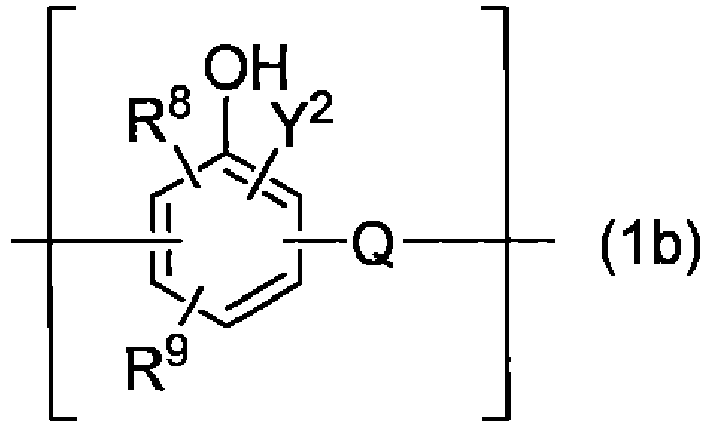


- [2] The curable resin composition according to [1], wherein R1, R2, R8, R9, R10, R11, R12 and R13 in formulas (1a), (1b), and (1c) are hydrogen atoms.
- [3] The curable resin composition according to [1] or [2], wherein the polyalkenyl phenol compound (A) is a compound containing at least two structural units represented by formula (1a), or is a compound containing a structural unit represented by formula (1c).
- [4] The curable resin composition according to any one of [1] to [3], wherein R3 to R7 in formula (1a) are each independent selected from a hydrogen atom, an allyl group, and a hydroxy group.
- [5] The curable resin composition according to [1] or [2], wherein Q and U in formulas (1b) and (1c) are at least one selected from a 1,4-phenylene bis-methylene group and a 4,4'-biphenylene bis-methylene group.
- [6] The curable resin composition according to any one of [1] to [5], wherein the degree of polymerization of the polyalkenyl phenol compound (A), as determined from the molecular weight distribution measured by GPC, is 2 to 20.
- [7] The curable resin composition according to any one of [1] to [6], wherein the polyalkenyl phenol compound (A) is included in an amount of 5 to 200 parts by mass relative to 100 parts by mass of the polymaleimide compound (B).
- [8] The curable resin composition according to any one of [1] to [7], wherein the polymaleimide compound (B) is an aromatic polymaleimide compound.
- [9] The curable resin composition according to [8], wherein the polymaleimide compound (B) is at least one compound selected from bis(4-maleimidophenyl)methane and 2,2-bis[4-(4-maleimidophenyloxy)phenyl]propane.
- [10] The curable resin composition according to any one of [1] to [9], further comprising a polyalkylene phenol compound (C) containing a structural unit represented by the following formula (3):


- [11] The curable resin composition according to [10], wherein the polyalkenyl phenol compound (C) is included in an amount of 5 to 2000 parts by mass relative to 100 parts by mass of the polyalkenyl phenol compound (A).
- [12] The curable resin composition according to any one of [1] to [11], further comprising a curing accelerator (D) in an amount of 0.01 to 10 parts by mass relative to a total 100 parts by mass of the polyalkenyl phenol compound (A), the polymaleimide compound (B), and the polyalkenyl phenol compound (C) (when present).
- [13] The curable resin composition according to any one of [1] to [12], further comprising a filler (E).
- [14] A cured product of the curable resin composition according to any one of [1] to [13].
- [15] A structure comprising a cured produce of the curable resin composition according to any one of [1] to [13].
- The present invention can provide a curable resin composition with which a cured product having excellent heat resistance and flame retardancy can be obtained.
- The present invention will be described in detail below. The curable resin composition of the present invention comprises a polyalkenyl phenol compound (A) and a polymaleimide compound (B) as indispensable components.
- The polyalkenyl phenol compound (A) is a compound which contains at least two structural units represented by formula (1a) or (1b) below, or includes a structural unit represented by formula (1c) below, and which can be obtained by, for example, Claisen rearrangement of a poly-2-alkenyl aromatic ether compound.


- In formulas (1a), (1b), and (1c), R1 to R13 each independently represent a hydrogen atom, a C1-10 alkyl group, a C1-2 alkoxy group, a C2-6 alkenyl group, or a hydroxy group, R10 to R13 may be located on any of the carbon atoms constituting the naphthalene ring, Q represents a divalent organic group containing, in the main chain, an aromatic group which does not contain a phenolic hydroxy group, U represents a divalent organic group containing an aromatic ring, and Y1 to Y3 are each independently an alkenyl group represented by the following formula (2):

- "Each independently" means that a plurality of R1 contained in the compound may be the same or may be different. The same is true for substituents R2 to R18, divalent groups Q and U, and substituents such as compound (C) described below.
- Specific examples of the C1-10 alkyl group constituting R1 to R13 in formulas (1a), (1b), and (1c) include methyl groups, ethyl groups, n-propyl groups, isopropyl groups, n-butyl groups, sec-butyl groups, t-butyl groups, n-pentyl groups, n-hexyl groups, octyl groups, nonyl groups, and decyl groups. Specific examples of the C1-2 alkoxy group include methoxy groups and ethoxy groups. Specific examples of the C2-6 alkenyl group include vinyl groups, allyl groups, butenyl groups, pentenyl groups, and hexenyl groups.
- The polyalkenyl phenol compound (A) is preferably a compound containing at least two structural units represented by formula (1a), or including a structural unit represented by formula (1c).
- Since a naphthyl group having high thermal decomposition resistance is included in the main chain, compounds including the structural unit represented by formula (1c) are particularly excellent in flame retardancy. In certain embodiments, the polyalkenyl phenol compound (A) is a compound containing at least two structural units represented by formula (1c).
- It is preferable that the polyalkenyl phenol compound (A) be a compound containing at least two structural units represented by formula (1a) since the heat resistance of a cured product obtained therewith is high.
- In a certain embodiment, R3 to R7 in formula (1a) are each independent selected from a hydrogen atom, an allyl group, and a hydroxy group. In another embodiment, one of R3 to R7 in formula (1a) is a hydroxy group, one is an allyl group, and the remaining three are hydrogen atoms. In yet another embodiment, R3 to R7 in formula (1a) are each independently selected from a hydrogen atom, a C1-10 alkyl group, a C1-2 alkoxy group, and a C2-6 alkenyl group. In another embodiment, one of R3 to R7 in formula (1a) is a C2-6 alkenyl group, and the remaining are each independently selected from a hydrogen atom, a C1-10 alkyl group, a C1-2 alkoxy group, and a hydroxy group. A polyalkenyl phenol compound (A) in which one of R3 to R7 of formula (1a) is a C2-6 alkenyl group and one is a hydroxy group is particularly excellent in flame retardancy since a cured product having a high crosslinking density can be obtained therewith and many hydroxy groups are present. In another embodiment, at least one, at least two, at least three, at least four, or all of R3 to R7 in formula (1a) are hydrogen atoms.
- In a certain embodiment, it is preferable that R1, R2, R8, R9, R10, R11, R12, and R13 in formulas (1a), (1b), and (1c) be hydrogen atoms from the viewpoint of low steric hindrance and excellent reaction rate. In another embodiment, from the viewpoint of high heat resistance of a cured product obtained therewith, it is preferable that at least one of R1 and R2 of formula (1a), R8 and R9 of formula (1b), and R10, R11, R12, and R13 of formula (1c) be a C1-10 alkyl group, a C1-2 alkoxy group, or a C2-6 alkenyl group. One of the factors why a cured product having a high heat resistance can be obtained therewith is due to the high crosslinking density of the obtained cured product.
- In a certain embodiment, at least one, at least two, or at least three of R10 to R13 in formula (1c) is a hydrogen group. In another embodiment, at least one of R10 to R13 in formula (1c) is a hydroxy group. In another embodiment, at least one of R10 to R13 of formula (1c) is an allyl group.
- It is preferable that the carbon number of the divalent organic group containing, on the main chain thereof, the aromatic ring, which does not contain a phenolic hydroxy group, constituting Q in formula (1b) be 6 to 14. A divalent organic group containing, on the main chain thereof, an aromatic ring which does not contain a phenolic hydroxy group preferably does not contain saturated carbons, which are continuously present on the main chain. When saturated carbons are not continuously present on the main chain of the divalent group Q, it is believed that since the density of the aromatic ring of the obtained cured product is high, particularly excellent flame retardancy can be obtained. Specific examples of C6-14 divalent organic groups containing, on the main chain thereof, an aromatic ring which does not contain a phenolic hydroxy group include phenylene groups, methylphenylene groups, naphthylene groups, biphenylene groups, fluorenylene groups, anthracenylene groups, xylylene groups, 4,4-methylene diphenyl groups, 1,4-phenylene bis-methylene groups, and 4,4'- biphenylene bis-methylene groups.
- Among these, from the viewpoint of a high flame retardancy of the obtained cured product, Q is preferably a 1,4-phenylene bis-methylene group or a 4,4'- biphenylene bis-methylene group.
- It is preferable that the carbon number of the divalent organic group containing the aromatic ring constituting the U in formula (1c) be 6 to 14. It is preferable that the divalent organic group containing the aromatic ring constituting the U be a divalent organic group containing an aromatic ring on the main chain thereof. It is preferable that the divalent organic group containing an aromatic ring constituting U be a divalent organic group containing an aromatic ring which does not contain a phenolic hydroxy group. Specific examples of C6-14 divalent organic groups containing an aromatic ring includes phenylene groups, methylphenylene groups, naphthylene groups, biphenylene groups, fluorenylene groups, anthracenylene groups, xylylene groups, 4,4-methylene diphenyl groups, 1,4-phenylene bis-methylene groups, and 4,4'- biphenylene bis-methylene groups.
- Among these, from the viewpoint of a high flame retardancy of the obtained cured product, U is preferably a 1,4-phenylene bis-methylene group or a 4,4'- biphenylene bis-methylene group.
- Specific examples of the C1-5 alkyl groups constituting R14, R15, R16, R17, and R18 in formula (2) include methyl groups, ethyl groups, n-propyl groups, isopropyl groups, n-butyl groups, sec-butyl groups, t-butyl groups, and n-pentyl groups. Specific examples of C5-10 cycloalkyl groups include cyclopentyl groups, cyclohexyl groups, methylcyclohexyl groups, and cycloheptyl groups. Specific examples of C6-12 aryl groups include phenyl groups, methylphenyl groups, ethylphenyl groups, biphenyl groups, and naphthyl groups. Among these, R14, R15, R16, R17, and R18 are all preferably hydrogen atoms, i.e., the alkyenyl group represented by formula (2) is preferably an allyl group.
- The polyalkenyl phenol compound (A) may be a mixture of compounds having different numbers of structural units. In the present embodiment, the average value (degree of polymerization) per molecule of the total number of structural units represented by formulas (1a), (1b), and (1c) is preferably 2 to 20, more preferably 2 to 15, and further preferably 2 to 10. When the average value per molecule of the total number of structural units is 2 or more, the heat resistance of the cured product, which is the ultimately desired object, obtained by using the polyalkenyl phenol compound as a curing agent is more favorable, and when the average value is 20 or less, fluidity during molding is more favorable.
- When the number average molecular weight calculated by GPC is Mn and the molecular weight of the repeating structure of the polyalkenyl phenol compound is M, the degree of polymerization P is determined from the following formula:

- The number average molecular weight of the polyalkenyl phenol compound (A) is preferably 300 to 5000, more preferably 400 to 4000, and further preferably 500 to 3000. As long as the number average molecular weight is 300 or more, when the cured product of the curable resin composition is placed in a high temperature environment, the thermal decomposition starting temperature is more suitable, and as long as the number average molecular weight is 5000 or less, the viscosity of the curable resin composition is within a more preferable range for processing at the time of molding.
- The polyalkenyl phenol compound (A) can be obtained by rearrangement of the 2-alkenyl group by Claisen rearrangement after carrying out alkenyl etherification on a part of the hydroxy groups of a phenolic resin, which is a raw material. It is preferable that a known phenolic resin containing structural units represented by formula (5a), (5b), or (5c) below be used as the raw material phenolic resin.


- Specific examples of the raw material phenolic resin of the polyalkenyl phenol compound (A) include phenol aralkyl resins, biphenylaralkyl phenolic resins, naphtholaralkyl resins, naphthalenediol aralkyl resins, phenol-benzaldehyde copolymer resins, and phenol-salicylaldehyde copolymer resins.
- The 2-alkenyl etherification of the raw material phenolic resin can be carried out by exemplary two methods, (i) a known method in which a halogenated 2-alkenyl compound such as allyl chloride, methallyl chloride, and allyl bromide is reacted with a phenol compound, and (ii) a known method in which a 2-alkenyl carboxylic acid compound such as allyl acetate is reacted with a phenol compound. The method described in, for example, Japanese Unexamined Patent Publication (Kokai) No.
2-91113 2011-26253 - The amount of the halogenated 2-alkenyl compound or 2-alkenyl carboxylic acid compound used is preferably 0.4 to 5.0 equiv, and more preferably 0.6 to 4.0 equiv relative to the phenolic hydroxy group. When the amount used is 0.4 equiv or more, the amount of reaction sites with the polymaleimide compound (B) after Claisen rearrangement is more favorable, and a cured product having excellent heat resistance can be obtained. The 2-alkenyl etherification reaction can be carried out by mixing the 2-alkenyl compound with the raw material phenolic resin, and reacting for 4 to 40 hours. In the 2-alkenyl etherification reaction, a solvent can be used to dissolve the raw material phenolic resin. The reaction can also be carried out without the use of a solvent by using a 2-alkenyl carboxylic acid compound capable of dissolving the raw material phenolic resin. The 2-alkenyl etherification rate of the raw material phenolic resin can be controlled by suppressing the reaction rate (conversion rate) of the of the 2-alkenyl compound by using a halogenated 2-alkenyl compound or a 2-alkenyl carboxylic acid compound in an amount greater than the abovementioned amount of the halogenated 2-alkenyl compound or the 2-alkenyl carboxylic acid compound used, and by adjusting the reaction time to a short reaction time.
- The target polyalkenyl phenol compound (A) can be obtained by carrying out Claisen rearrangement on the polyalkenyl ether compound produced by the method described in (i) or (ii) above. Claisen rearrangement can be performed by heating the polyalkenyl ether compound to a temperature in the range of 100 to 250 °C, and reacting for 1 to 20 hours. Claisen rearrangement may be carried out using a high boiling point solvent or can be carried out without a solvent. Inorganic salts such as sodium thiosulfate and sodium carbonate can also be added to accelerate the rearrangement reaction. The details are disclosed in Japanese Unexamined Patent Publication (Kokai) No.
2-91113 - The polymaleimide compound (B) is a compound containing two or more maleimide groups represented by formula (6):

- Examples of the polymaleimide compound (B) include bis-maleimides such as bis(4-maleimidophenyl)methane, tris-maleimides such as tris(4-maleimidophenyl)methane, tetrakis-maleimides such as bis(3,4-dimaleimidophenyl)methane, and polymaleimides such as poly(4-maleimide styrene). The polymaleimide compound (B) includes an aromatic polymaleimide compound and an aliphatic polymaleimide compound. From the viewpoint of a particularly excellent flame retardancy of the obtained cured product, an aromatic polymaleimide compound is preferable. The aromatic polymaleimide compound is a compound containing two or more maleimide groups represented by formula (6), and these maleimide groups may be bonded to the same or different aromatic rings. Specific examples of the aromatic ring include single rings such as benzene and fused rings such as naphthalene and anthracene. It is preferable that the polymaleimide compound (B) be an aromatic bis-maleimide compound or an aliphatic bis-maleimide compound because they mix well in the curable resin composition. Specific examples of the aromatic bis-maleimide compound include bis(4-maleimidophenyl)methane, bis(3-maleimidophenyl)methane, bis(3-methyl-4-maleimidophenyl)methane, bis(3,5-dimethyl-4-maleimidophenyl)methane, bis(3-ethyl-4-maleimidophenyl)methane, bis(3,5-diethyl-4-maleimidophenyl)methane, bis(3-propyl-4-maleimidophenyl)methane, bis(3,5-dipropyl-4-maleimidophenyl)methane, bis(3-butyl-4-maleimidophenyl)methane, bis(3,5-dibutyl-4-maleimidophenyl)methane, bis(3-ethyl-4-maleimido-5-methylphenyl)methane, 2,2-bis(4-maleimidophenyl)propane, 2,2-bis[4-(4-maleimidophenyloxy)phenyl]propane, bis(4-maleimidophenyl)ether, bis(3-maleimidophenyl)ether, bis(4-maleimidophenyl)ketone, bis(3-maleimidophenyl)ketone, bis(4-maleimidophenyl)sulfone, bis(3-maleimidophenyl)sulfone, bis[4-(4-maleimidophenyloxy)phenyl] sulfone, bis(4-maleimidophenyl)sulfide, bis(3-maleimidophenyl) sulfide, bis(4-maleimidophenyl)sulfoxide, bis(3-maleimidophenyl)sulfoxide, 1,4-bis(4-maleimidophenyl)cyclohexane, 1,4-dimaleimidonaphthalene, 2,3-dimaleimidonaphthalene, 1,5-dimaleimidonaphthalene, 1,8-dimaleimidonaphthalene, 2,6-dimaleimidonaphthalene, 2,7-dimaleimidonaphthalene, 4,4'-dimaleimidobiphenyl, 3,3'-dimaleimidobiphenyl, 3,4'-dimaleimidobiphenyl, 2,5-dimaleimide-1,3-xylene, 2,7-dimaleimidofluorene, 9,9-bis(4-maleimidophenyl)fluorene, 9,9-bis(4-maleimido-3-methylphenyl)fluorene, 9,9-bis(3-ethyl-4-maleimidophenyl)fluorene, 3,7-dimaleimido-2-methoxyfluorene, 9,10-dimaleimidophenanthrene, 1,2-dimaleimidoanthraquinone, 1,5-dimaleimidoanthraquinone, 2,6-dimaleimidoanthraquinone, 1,2-dimaleimidobenzene, 1,3-dimaleimidobenzene, 1,4-dimaleimidobenzene, 1,4-bis(4-maleimidophenyl)benzene, 2-methyl-1,4-dimaleimidobenzene, 2,3-dimethyl-1,4-dimaleimidobenzene, 2,5-dimethyl-1,4-dimaleimidobenzene, 2,6-dimethyl-1,4-dimaleimidobenzene, 4-ethyl-1,3-dimaleimidobenzene, 5-ethyl-1,3-dimaleimidobenzene, 4,6-dimethyl-1,3-dimaleimidobenzene, 2,4,6-trimethyl-1,3-dimaleimidobenzene, 2,3,5,6-tetramethyl-1,4-dimaleimidobenzene, and 4-methyl-1,3-dimaleimidobenzene. Specific examples of the aliphatic bis-maleimide compound include bis(4-maleimidocyclohexyl)methane and bis(3-maleimidocyclohexyl)methane. Among these, bis(4-maleimidophenyl)methane and 2,2-bis[4-(4-maleimidophenyloxy)phenyl]propane are preferable. Examples of commercially available products include the BMI (trade name, manufactured by Daiwa Kasei Kogyo Co., Ltd.) series.
- The mixing amount of the polyalkenyl phenol compound (A) is preferably 5 to 200 parts by mass, more preferably 10 to 150 parts by mass, and further preferably 20 to 130 parts by mass when the mixing amount of the polymaleimide compound (B) is 100 parts by mass. As long as the above mixing amount is 5 parts by mass or more, the fluidity/liquidity at the time of shaping/molding is more favorable. Additionally, as long as the above mixing amount is 200 parts by mass or less, the heat resistance of cured product is more favorable.
- The curable resin composition may further contain a polyalkenyl phenol compound (C). The polyalkenyl phenol compound (C) is a compound which contains a structural unit represented by formula (3) below and which can be obtained by the Claisen rearrangement of, for example, a poly-2-alkenyl aromatic ether compound. In certain embodiments, the polyalkenyl phenol compound (C) contains at least two structural units represented by formula (3):


- Specific examples of the C1-10 alkyl group and C1-2 alkoxy group constituting R19 and R20 of formula (3) are the same as those described regarding R1 to R13 in formulas (1a), (1b), and (1c). Specific examples of the C1-5 alkyl group, C5-10 cycloalkyl group, and C6-12 aryl group constituting R21 to R25 of Z of formula (3) represented by formula (4) are the same as those described regarding Y1 to Y3 of formulas (1a), (1b), and (1c).
- The total mixing amount of the polyalkenyl phenol compound (A) and the polyalkenyl phenol compound (C) is preferably 10 to 200 parts by mass, more preferably 30 to 180 parts by mass, and further preferably 50 to 150 parts by mass when the mixing amount of the polymaleimide compound (B) is 100 parts by mass. As long as the above mixing amount is 10 parts by mass or greater, fluidity at the time of molding is more favorable. Additionally, as long as the above mixing amount is 200 parts by mass or less, the heat resistance of the cured product is more favorable.
- The mixing amount of the polyalkenyl phenol compound (C) is preferably 5 to 2000 parts by mass, more preferably 15 to 1000 parts by mass, and further preferably 20 to 500 parts by mass when the mixing amount of the polyalkenyl phenol compound (A) is 100 parts by mass. As long as the above mixing amount is 5 parts by mass or more, the heat resistance of the cured product is more favorable. Additionally, as long as the above mixing amount is 2000 parts by mass or less, the fluidity at the time of molding is more favorable.
- The total content of the polyalkenyl phenol compound (A), the polyalkenyl phenol compound (C), and the polymaleimide compound (B) in the curable resin composition can be, for example, 5% by mass or more, 10% by mass or more, or 20% by mass or more, and can be 100% by mass or less, 95% by mass or less, or 90% by mass or less. In semiconductor encapsulation applications, the above total content is preferably 5 to 50% by mass, more preferably 7 to 45% by mass, and further preferably 10 to 30% by mass.
- The polyalkenyl phenol compound (C) can be obtained by rearrangement of the 2-alkenyl group to the ortho position or para position by Claisen rearrangement after carrying out alkenyl etherification on a part of the hydroxy groups of a phenolic resin as a raw material. Thus, in an embodiment of the present invention, Z, which is the alkenyl group represented by formula (4), is bonded with the carbon atom at the ortho position or para position, to phenolic hydroxy group, of the aromatic ring. It is preferable that a known phenolic resin containing a structural unit represented by formula (7) below be used as the raw material phenol.

- Specific examples of the raw material phenolic resin of polyalkenyl phenol compound (C) include phenolic novolak resins and cresol novolak resins.
- Various additives can be mixed into the curable resin composition as long as they do not interfer with the curing properties thereof.
- Examples of the additives include a curing accelerator (D) and a filler (E).
- By mixing the curing accelerator (D) into the curable resin composition, the curing of the curable resin composition can be accelerated. Examples of the curing accelerator (D) include radical initiators such as photo radical initiators and thermal radical initiators. The curing accelerator is preferably a thermal radical initiator. Examples of more preferable thermal radial initiators include organic peroxides. Among organic peroxides, organic peroxides having a ten-hour half-life temperature in the range of 100 to 170 °C are further preferable, and specific examples thereof include dicumyl peroxide, 2,5-dimethyl-2,5-di(tert-butylperoxy)hexane, tert-butylcumyl peroxide, di-tert-butyl peroxide, 1,1,3,3-tetramethylbutyl hydroperoxide, and cumene hydroperoxide. The amount of curing accelerator (D) used is preferably 0.01 to 10 parts by mass, more preferably 0.05 to 7.5 parts by mass, and further preferably 0.1 to 5 parts by mass relative to a total 100 parts by mass of the polyalkenyl phenol compound (A), the polymaleimide compound (B), and the polyalkenyl phenol compound (C) (when present). As long as the amount of curing accelerator (D) used is 0.01 parts by mass or greater, the curing reaction proceeds sufficiently, and as long as the amount is 10 parts by mass or less, the storage stability of the curable resin composition is more favorable.
- The type of the filler (E) is not particularly limited, and an organic filler such as a silicone powder, and an inorganic filler such as silica and boron nitride can be appropriately used depending on the application.
- For example, when the curable resin composition is used in semiconductor encapsulation applications, it is preferable to mix an insulating inorganic filler to obtain a cured product having a low coefficient of thermal expansion. The inorganic filler is not particularly limited and any known inorganic filler can be used. Specific examples of the inorganic filler include particles such as amorphous silica, crystalline silica, alumina, boron nitride, aluminum nitride, and silicon nitride. From the viewpoint of lowering viscosity, spherical amorphous silica is desirable. The inorganic filler may be surface-treated with a silane coupling agent, etc., or may not be surface-treated. The average particle size of the inorganic filler is preferably 0.1 to 30 µm, and it is more preferable that the maximum particle size be 100 µm or less, in particular 75 µm or less. When the average particles size is within this range, the viscosity of the curable resin composition is suitable at the time of use, whereby injectability into narrow pitch wiring or narrow gaps is suitable. This average particle size is the volume cumulative particle size D50 measured with a laser diffraction/scattering particle size distribution measurement device. The content of the inorganic filler of the curable resin composition can be appropriately selected depending on the application. For example, in semiconductor encapsulation applications, the content of the inorganic filler of the curable resin composition is preferably 50 to 95% by mass, more preferably 55 to 93% by mass, and further preferably 70 to 90% by mass.
- As other additives, coupling agents, antifoaming agents, coloring agents, fluorescent materials, modifiers, leveling agents, light-diffusing agents, and flame retardants, etc., can be added to the curable resin composition of the present invention. For example, from the viewpoint of improving adhesion, a coupling agent may be added. The coupling agent is not particularly limited, and includes, for example, a silane coupling agent such as vinyltriethoxysilane, vinyltrimethoxysilane, 3-glycidoxypropyltrimethoxysilane, γ-methacryloxypropyltrimethoxysilane, γ-aminopropyltrimethoxysilane, and N-phenyl-3-aminopropyltrimethoxysilane. A single coupling agent may be used or two or more types may be used. The compounding amount of the coupling agent in the curable resin composition is preferably 0.1 to 5% by mass. As long as the above compounding amount is 0.1% by mass or greater, the effect of the coupling agent is sufficiently exhibited, and as long as the compounding amount is 5% by mass or less, the melt viscosity thereof and the hygroscopicity and strength of the cured product are more favorable.
- The curable resin composition includes 25 parts by mass or less, more preferably 20 parts by mass or less, of a halogen-based or phosphorus-based flame retardant, relative to a total of 100 parts by mass of the polyalkenyl phenol compound (A) and the polymaleimide compound (B), and especially preferably does not include a halogen-based or phosphorus-based flame retardant. For example, when the curable resin composition is used as a semiconductor encapsulation material, halides are known to cause metal corrosion and to adversely affect electrical reliability. The curable resin composition according to the present embodiment is excellent in electrical properties such as long-term insulation and is preferably used in the field of electric and electronic materials, etc.
- The curable resin composition can be a high solid content composition. In some embodiments, the solid content of the curable resin composition can be, for example, greater than 60% by mass, 70% by mass or more, or 80% by mass or more, and can be 100% by mass or less, 95% by mass or less, or 90% by mass or less. In an embodiment, the curable resin composition does not contain a solvent, i.e., the curable resin composition is a solvent-free composition. In this embodiment, the solid content of the curable resin composition can be 90% by mass or more, 92% by mass or more, or 95% by mass or more, and can be 100% by mass or less, 99% by mass or less, or 98% by mass or less.
- The method for the preparation of the curable resin composition is not particularly limited as long as the polyalkenyl phenol compound (A), the polymaleimide compound (B), and the other components can be uniformly mixed. A method in which the polyalkenyl phenol compound (A), the polyalkenyl phenol compound (C), when present, and the polymaleimide compound (B) are first mixed, and thereafter additives are added is preferable since each of the materials can be uniformly mixed.
- The method for mixing the polyalkenyl phenol compound (A), the polyalkenyl phenol compound (C), when present, and the polymaleimide compound (B) is not particularly limited. Mixing can be carried out by introducing each of the components into a mixer such as a reaction vessel, pot mill, two-roll mill, three-roll mill, rotary mixer, twin-screw mixer, disper, single- or twin-screw (co-directional or opposite-directional) extruder, and kneader at a prescribed mixing ratio, and thereafter stirring or kneading. On a laboratory scale, a rotary mixer is preferable since the stirring conditions thereof can be easily changed, and industrially, a twin-screw mixer is preferable from the viewpoint of productivity. Each mixing machine can be used by appropriately changing the stirring conditions.
- Like the above mixing method, the curable resin composition preparation method is not particularly limited. The curable resin composition can be prepared by introducing the polyalkenyl phenol compound (A), the polyalkenyl phenol compound (C), when present, the polymaleimide compound (B), and additives, when present, into a mixer such as a pot mill, two-roll mill, three-roll mill, rotary mixer, twin screw mixer, disper, single or twin screw (co-directional or opposite-directional) extruder, and kneader at a prescribed mixing ratio and mixing. In the case of pulverization of the curable resin composition, the pulverization is not particularly limited as long as the resin does not melt due to the heat generated during processing.For small amounts, the use of an agate mortar is convenient. When using a commercially available pulverizer, it is preferable that the amount of heat generated during pulverization be small in order to prevent the melting of the mixture. The particle size of the powder is preferably about 1 mm or less.
- The curable resin composition can be melted by heating. The structure can be produced by molding the melted curable resin composition into a desired preferable shape, and curing as necessary. Transfer molding and compression molding are preferable as the structure production method. In transfer molding, preferred conditions include, in the case of, for example, a mold having a size of 10 mm × 75 mm × 3 mm thick, a temperature of the top plate and mold in the range of 170 to 190 °C, a retention pressure of 50 to 150 kg/cm2, and a retention time of 1.5 to 5 minutes. Preferred conditions of compressing molding include, in the case of, for example, a mold having a size of 100 mm × 75 mm × 3 mm thick, a temperature of the top plate and mold in the range of 170 to 190 °C, a molding pressure of 5 to 20 MPa, and a pressurization time of 1.5 to 10 minutes.
- The curable resin composition can be cured by heating. The thermal curing conditions are preferably 110 to 300 °C, more preferably 120 to 280 °C, and further preferably 130 to 250 °C. As long as the temperature is 110 °C or more, curing proceeds sufficiently in a more suitable time, and as long as the temperature is 300 °C or less, the components are less deteriorated or volatilized, whereby the safety of the equipment is maintained. The heating time can be appropriately changed in accordance with the curable resin composition and the curing temperature, but is preferably 0.1 to 24 hours from the viewpoint of productivity. The heating may be divided into a plurality of repetitions. When a particularly high degree of curing is desired, it is preferable that the final curing temperature be 250 °C or less, more preferably 230 °C or less by, for example, raising the temperature as the curing progresses, without curing at an excessively high temperature.
- The heat resistance can be evaluated from, for example, the value of the glass transition temperature (Tg) of the cured product of the curable resin composition. Tg is measured by thermo-mechanical analysis (TMA). For example, a TMA/SS6100 thermo-mechanical analyzer manufactured by SII Nanotechnology, Inc., can be used. When measurement is performed using a 5 mm × 5 mm × 5 mm sample at a temperature in the range of 30 to 300 °C, a temperature increase rate of 5 °C/min, and a load of 20.0 mN the temperature of the displacement point of the linear expansion coefficient is Tg. The heat resistance is suitable at 250 °C or higher of Tg.
- The flame retardancy can be evaluated by, for example, a burning assessment (Vertical Burning Test: V) in accordance with the UL-94 standard. The test method of UL-94 VTM-0 and the criterion are as follows.
- A plurality of 1.6 mm thick × 125 mm long × 13 mm wide samples are prepared. Each sample is vertically mounted on a clamp, and five samples are contacted with a 20 mm flame, respectively, for ten seconds twice and V-0, V-1, V-2, and Not are determined from the combustion behavior. The determination criteria are shown in Table 1.
Determination Criteria Flammability Classification V-0 V-1 V-2 Burning Time of Each Sample 10 sec or less 30 sec or less 30 sec or less Total Burning Time of Five Samples 50 sec or less 250 sec or less 250 sec or less Burning and Glowing Time of Each Sample 30 sec or less 60 sec or less 60 sec or less Burning up to Clamp No No No Cotton Ignited by Dripping No No Yes - The cured product of the curable resin composition of the present invention can be used in applications such as semiconductor encapsulation materials, prepregs, interlayer insulation resins, solder resists, and die attachments.
- The present invention will be specifically described below based on the Examples and Comparative Examples. However, the present invention is not limited to these Examples.
- The analysis methods and characteristics evaluation methods used in the Examples and Comparative Examples are as described below.
- The GPC measurement conditions are as described below.
Device Name: JASCO LC-2000 plus (manufactured by JASCO Corporation) Column: Shodex™ LF-804 (manufactured by Showa Denko Corporation) Mobile Phase: Tetrahydrofuran Flow Rate: 1.0 mL/min Detector: JASCO RI-2031 plus (manufactured by JASCO Corporation) Temperature: 40 °C - The number average molecular weight Mn and the weight average molecular weight Mw are detected under the above measurement conditions using a calibration curve generated using a polystyrene reference material.
- The degree of polymerization P is determined with the following formula:

- Glass transition temperature measurement samples are prepared using a powder curable resin composition by molding with a transfer molding machine at a mold temperature of 180 °C, a retention pressure of 100 kg/cm2, and a retention time of 3 minutes. After heating at 230 °C for six hours and curing, the samples are measured by thermo-mechanical analysis (TMA). Measurement of a 5 mm × 5 mm × 5 mm sample is performed using a TMA/SS6100 thermo-mechanical analyzer manufactured by SII Nanotechnology Co., Ltd., in a temperature range of 30 to 300 °C at a temperature increase rate of 5 °C/min and a load of 20.0 mN, and the temperature of the displacement point of the linear expansion coefficient is set as the Tg. The results are shown in Table 2.
- A plurality of burning assessment samples (1.6 mm thickness × 125 mm length x 13 mm width) are prepared using a powder curable resin composition by molding with a transfer molding machine at a mold temperature of 180 °C, a retention pressure of 100 kg/cm2, and a retention time of 3 minutes. After heating at 230 °C for six hours and curing, a UL94 standard burning assessment (Vertical Burning Test: V) is performed for each sample. The UL94 VTM-0 test method is as described below.
- Each of five samples is attached vertically to a clamp, and contacted with a 20 mm flame, respectively, for ten seconds twice, and V-0, V-1, V-2, or Not is determined from the combustion behavior. The determination criteria are as shown in Table 1. The results are shown in Table 2.
- In formula (1a), R1 and R2 = hydrogen atom, R3 = hydroxy group, R4 = allyl group, R5 to R7 = hydrogen atom, and in formula (2), R14 to R18 = hydrogen atom.
- A compound allylated at the ortho position or the para position to phenolic hydroxy group (hydroxy group: 168 equiv, number average molecular weight Mn: 600, weight average molecular weight Mw: 800, degree of polymerization: 3.5) was produced using a triphenylmethane-type phenolic resin Shonol™ TRI-002 (manufactured by Showa Denko, Co., Ltd.) by the following method. A solution in which 201 g (1.45 mol) of potassium carbonate (manufactured by Nippon Soda Co., Ltd.) has been dissolved in 150 g of pure water, and 150.0 g (hydroxy group: 1.4 mol) of the triphenylmethane-type phenolic resin Shonol™ TRI-002 (manufactured by Showa Denko, Co., Ltd.; number average molecular weight Mn: 400, weight average molecular weight Mw: 500) were charged into a 1000 mL tri-neck flask, and thereafter the vessel was purged with nitrogen gas and heated to 85 °C. Under a nitrogen gas flow, 204 g (2.04 mol) of allyl acetate (manufactured by Showa Denko, Co., Ltd.), 3.82 g (14.6 mmol) of triphenylphosphine (manufactured by Hokko Chemical Industry Co., Ltd.), and 0.62 g (0.291 mmol) of 50 mass% water-containing 5 mass%-Pd/C-STD type (manufactured by NE Chem Cat Co., Ltd.) were charged into the vessel, and after raising the temperature to 105 °C and reacting in a nitrogen gas atmosphere for four hours, 29 g (0.291 mol) of allyl acetate was further added thereto, and heating was continued for ten hours. Thereafter, stirring was stopped, and the mixture was allowed to stand to separate into an organic layer and an aqueous layer. Thereafter, pure water (200 g) was added until the precipitated salt (potassium acetate) dissolved, and 200 g of toluene was added while maintaining the temperature at 80 °C or higher to confirm that a white precipitate (potassium acetate) had not precipitated. The Pd/C was recovered by filtration (1 micrometer membrane filter (pressure (0.3 MPa) using an Advantech KST-142-JA). The filter cake was washed with 100 g of toluene and the aqueous layer was separated. The combined product of the toluene, which was used for washing the filter cake and the organic layer was washed three times with 200 g of pure water, and after the third washing, it was confirmed that the pH of the separated aqueous layer was 7.0. 4.5 g of activated carbon CN1 (manufactured by Nihon Norit Co., Ltd.) was added to the separated organic layer, and the mixture was heated to 60 °C and stirred at 300 rpm with a magnetic stirrer for 1 hour. The activated carbon was then removed by filtration (pressurization (0.3 MPa) using a 1-micron membrane filter (ADSTEK KST-142-JA)), and the mixture was concentrated under reduced pressure to remove the toluene and excess allyl acetate, whereby a brown oil triphenylmethane-type polyallyl ether compound (number average molecular weight Mn: 600, weight average molecular weight Mw: 800) was obtained. The yield at this stage was 95%. 200 g of the obtained triphenylmethane-type polyallyl ether compound and 200 g of phenol (C6H5OH, manufactured by Junsei Chemical Co., Ltd., boiling point 182 °C) were charged into a 1000 mL separable flask. Nitrogen gas was pumped into the reaction vessel, the temperature was raised to 170 °C while stirring at 300 rpm with a mechanical stirrer, and the Claisen rearrangement reaction was carried out for seven hours in a nitrogen gas atmosphere. Thereafter, the phenol was removed at 160 °C under reduced pressure, whereby the target reddish-brown triphenylmethane-type polyallyl phenol compound A1 (number average molecular weight Mn: 600, weight average molecular weight Mw: 800, degree of polymerization 3.5) was obtained. The yield was 92%.
- In formula (1a), R1 and R2 = hydrogen atom, R3 to R7 = hydrogen atom, and in formula (2), R14 to R18 = hydrogen atom.
- A compound allylated at the ortho position or the para position to phenolic hydroxy group (hydroxy group: 191 equiv, number average molecular weight Mn: 500, weight average molecular weight Mw: 600, degree of polymerization: 2.6) was produced by the following method using a triphenylmethane-type phenolic resin Shonol™ TRI-220 (manufactured by Showa Denko, Co., Ltd.). The triphenylmethane-type polyallyl phenol compound A2 (number average molecular weight Mn: 500, weight average molecular weight Mw: 600, degree of polymerization: 2.6) was obtained by the same process as the production method of the polyallyl phenol compound A1 described above except that 150.0 g (hydroxy group: 0.82 mol) of the triphenylmethane-type phenolic resin Shonol™ TRI-220 (manufactured by Showa Denko, Co., Ltd.; number average molecular weight Mn: 350, weight average molecular weight Mw: 400) was used in place of the 150.0 g of triphenylmethane-type phenolic resin Shonol™ TRI-002 (manufactured by Showa Denko, Co., Ltd.). The yield was 93%.
- In formula (1b), R8 and R9 = hydrogen atom, Q = a 1,4-phenylene bis-methylene group, and in formula (2), R14 to R18 = hydrogen atom.
- A compound allylated at the the para position to phenolic hydroxy group (hydroxy group: 222 equiv, number average molecular weight Mn: 900, weight average molecular weight Mw: 1900, degree of polymerization: 4.3) was produced by the following method using a phenol aralkyl resin (HE-100C-12; Air Water Inc.). The phenol aralkyl-type polyallyl phenol compound A3 (number average molecular weight Mn: 900, weight average molecular weight Mw: 1900, degree of polymerization: 4.3) was obtained by the same process as the production method of the polyallyl phenol compound A1 except that 150.0 g (hydroxy group: 0.76 mol) of the phenol aralkyl resin (HE-100C-12; Air Water Inc.; number average molecular weight Mn : 600, weight average molecular weight Mw: 850) was used in place of the 150.0 g of the triphenylmethane-type phenolic resin Shonol™ TRI-002 (manufactured by Showa Denko, Co., Ltd.). The yield was 95%.
- In formula (1c), R10 = allyl group, R11 and R12 = hydrogen atom, R13 = hydroxy group, Q = a 1,4-pheylene bis-methylene group, and in formula (2), R14 to R18 = hydrogen atom.
- A compound (hydroxy group: 159 equiv, number average molecular weight Mn: 800, weight average molecular weight Mw: 1800, degree of polymerization: 5.0) in which part of naphthalene ring is allylated was produced by the following method using a naphthalene diol-type phenolic resin (SN-395, Nippon Steel Chemical Co., Ltd.). The naphthalene diol-type polyallyl phenol compound A4 (number average molecular weight Mn: 800, weight average molecular weight Mw: 1800, degree of polymerization: 5.0) was obtained by the same process as the production method of the polyallyl phenol compound A1 described above except that 150.0 g (hydroxy group: 1.1 mol) of the naphthalene diol-type phenolic resin (SN-395, Nippon Steel Chemical Co., Ltd., number average molecular weight Mn: 550, weight average molecular weight Mw: 1200) was used in place of the 150.0 g of the triphenylmethane-type phenolic resin Shonol™ TRI-002 (manufactured by Showa Denko, Co., Ltd.). The yield was 90%.
- In formula (3), R19 and R20 = hydrogen atom, and in formula (4), R21 to R25 = hydrogen atom.
- A compound allylated at the ortho position or the para position to phenolic hydroxy group (hydroxy group: 154 equiv, number average molecular weight Mn: 1000, weight average molecular weight Mw: 3000, degree of polymerization: 6.6) was produced using a 1:1 mixture of phenol novolak resins Shonol™ BRG-556 and BRG-558 (Showa Denko, Co., Ltd.). Regarding the production method, refer to Example 3 of Japanese Unexamined Patent Publication (Kokai.) No.
2016-28129 - In formula (1b), R8 and R9 = hydrogen atom, the group corresponding to Q was a dicyclopentadienylene group (without an aromatic ring), and in formula (2), R14 to R18 = hydrogen atom.
- First, a dicyclopentadiene-type phenol compound was synthesized as below in accordance with the description of Japanese Unexamined Patent Publication (Kokai) No.
63-99224 - A compound X, which is allylated at the ortho position or the para position to phenolic hydroxy group (hydroxy group: 266 equiv, number average molecular weight Mn: 800, weight average molecular weight Mw: 1350, degree of polymerization: 3.0) was produced by the following method using the obtained dicyclopentadiene-type phenol compound. The dicyclopentadiene-type polyallyl phenol compound X was obtained by the same process as the production method of the polyallyl phenol compound A1 except that 150.0 g (hydroxy group 0.65 mol) of the dicyclopentadiene-type phenol compound was used in place of the 150.0 g of the triphenylmethane-type phenolic resin Shonol TRI-002 (manufactured by Showa Denko, Co., Ltd.). The yield was 95%.
- The raw materials other than the polyalkenyl phenol compounds used in the Examples and Comparative Examples are as described below:
- Aromatic bis-maleimide compound: BMI-4000 (2,2-bis[4-(4-maleimidophenyloxy)phenyl]propane, melting point: 165 °C, Daiwa Kasei Kogyo Co., Ltd.)
- Curing accelerator: Percumyl™ D (dicumyl peroxide, NOF Corporation)
- Silica filler: MSR2212 (spherical silica, average particle size 25.5 µm, Tatsumori Co., Ltd., treated with 0.5% by mass silane coupling agent KBM-403 (Shin-Etsu Chemical Co., Ltd.))
- 100 parts by mass of BMI-4000 was added to a reaction vessel, heated to 170 °C, and stirred. When all of the BMI-4000 had melted and become a clear liquid, the temperature was lowered to 150 °C. 50 parts by mass of polyallyl phenol compound C1, which was heated and melted at 80 °C, and 50 pars by mass of polyallyl phenol compound A1 were added to the reaction vessel, and the three compounds were mixed by heating and stirring at 150 °C for 10 minutes. Blending was performed using the obtained mixture and each of the components shown in Table 1 below at the proportions shown in the table 1, and thereafter melt-kneading (110 °C, 10 minutes with a double-roller (eight-inch roller diameter) manufactured by Toyo Seiki) was carried out. Next, the mixture was allowed to cool at room temperature (25 °C) for one hour and solidify, and was subsequently ground using a mil mixer (Osaka Chemical Co., Ltd., model WB-1, 25 °C, 30 seconds), whereby the target powder curable resin composition was obtained.
- A curable resin composition was obtained by the same procedure as in Example 1 except that the polyallyl phenol compound A2 was used in place of the polyallyl phenol compound A1 of Example 1.
- A curable resin composition was produced in the same manner as Example 1 except that the polyallyl phenol compound A3 was used in place of the polyallyl phenol compound A1 of Example 1.
- A curable resin composition was obtained by the same procedure as in Example 1 except that the polyallyl phenol compound A4 was used in place of the polyallyl phenol compound A1 of Example 1.
- A curable resin composition was obtained by the same procedure as in Example 2 except that the mass of the polyallyl phenol compound A2 of Example 2 was changed to 20 parts and the mass of the polyallyl phenol compound C1 was changed to 80 parts.
- A curable resin composition was obtained by the same procedure as in Example 3 except that the mass of the polyallyl phenol compound A3 of Example 3 was changed to 80 parts and the mass of the polyallyl phenol compound C1 was changed to 20 parts.
- A curable resin composition was obtained by the same procedure as in Example 3 except that the mass of the polyallyl phenol compound A3 of Example 3 was changed to 20 parts and the mass of the polyallyl phenol compound C1 was changed to 80 parts.
- A curable resin composition was obtained by the same procedure as in Example 1 except that 100 parts by mass of the polyallyl phenol compound C1 was used in place of 50 parts by mass of the polyallyl phenol compound A1 and 50 parts by mass of the polyallyl phenol compound C1 of Example 1.
- A curable resin composition was obtained by the same procedure as in Example 1 except that the polyallyl phenol compound X was used in place of the polyallyl phenol compound A1 of Example 1.
Ex 1 Ex 2 Ex 3 Ex 4 Ex 5 Ex 6 Ex 7 Comp Ex 1 Comp Ex 2 Blending Quantity (parts by mass) Polyallyl Phenol Compound A1 50 A2 50 20 A3 50 80 20 A4 50 C1 50 50 50 50 80 20 80 100 50 X 50 Aromatic Bis-Maleimide Compound 100 100 100 100 100 100 100 100 100 Curing Accelerator 0.65 0.65 0.65 0.65 0.65 0.65 0.65 0.65 0.65 Silica Filler 800 800 800 800 800 800 800 800 800 Results UL-94 Flame Retardancy V-0 V-0 V-0 V-0 V-0 V-0 V-0 V-1 V-2 Burning Time of Each Sample (sec) 5 10 10 6 10 9 10 18 30 Tg (°C) 294 299 263 265 291 271 256 281 290 - Table 2 shows that Examples 1 to 7 had excellent flame retardancies. Example 2 exhibited a high Tg and a suitable heat resistance. Conversely, Comparative Examples 1 and 2 failed to achieve V-0 in the UL-94 test, and the flame retardancies thereof were poor.
- The curable resin composition according to the present invention can be used to provide electronic components which are excellent in flame retardancy. In particular, when used in a semiconductor encapsulation material for power devices, an encapsulation material having a high flame retardancy can be obtained. Since the use of halogen-based and phosphorus-based flame retardants that adversely affect reliability can be reduced, a highly reliable encapsulation material can be obtained.
Claims (15)
- A curable resin composition comprising a polyalkenyl phenol compound (A) and a polymaleimide compound (B), wherein the polyalkenyl phenol compound (A) is a compound containing at least two structural units represented by the following formula (1a) or formula (1b), or a compound containing a structural unit represented by the following formula (1c):


- The curable resin composition according to claim 1, wherein R1, R2, R8, R9, R10, R11, R12, and R13 in formulas (1a), (1b), and (1c) are hydrogen atoms.
- The curable resin composition according to claim 1 or 2, wherein the polyalkenyl phenol compound (A) is a compound containing at least two structural units represented by formula (1a), or is a compound containing a structural unit represented by formula (1c).
- The curable resin composition according to any one of claims 1 to 3, wherein R3 to R7 in formula (1a) are each independent selected from a hydrogen atom, an allyl group, and a hydroxy group.
- The curable resin composition according to claim 1 or 2, wherein Q and U in formulas (1b) and (1c) are at least one selected from a 1,4-phenylene bis-methylene group and a 4,4'-biphenylene bis-methylene group.
- The curable resin composition according to any one of claims 1 to 5, wherein the degree of polymerization of the polyalkenyl phenol compound (A), as determined from the molecular weight distribution measured by GPC, is 2 to 20.
- The curable resin composition according to any one of claims 1 to 6, wherein the polyalkenyl phenol compound (A) is included in an amount of 5 to 200 parts by mass relative to 100 parts by mass of the polymaleimide compound (B).
- The curable resin composition according to any one of claims 1 to 7, wherein the polymaleimide compound (B) is an aromatic polymaleimide compound.
- The curable resin composition according to claim 8, wherein the polymaleimide compound (B) is at least one compound selected from bis(4-maleimidophenyl)methane and 2,2-bis[4-(4-maleimidophenyloxy)phenyl] propane.
- The curable resin composition according to any one of claims 1 to 9, further comprising a polyalkenyl phenol compound (C) containing a structural unit represented by the following formula (3):


- The curable resin composition according to claim 10, wherein the polyalkenyl phenol compound (C) is included in an amount of 5 to 2000 parts by mass relative to 100 parts by mass of the polyalkenyl phenol compound (A).
- The curable resin composition according to any one of claims 1 to 11, further comprising a curing accelerator (D) in an amount of 0.01 to 10 parts by mass relative to a total 100 parts by mass of the polyalkenyl phenol compound (A), the polymaleimide compound (B), and the polyalkenyl phenol compound (C) (when present).
- The curable resin composition according to any one of claims 1 to 12, further comprising a filler (E).
- A cured product of the curable resin composition according to any one of claims 1 to 13.
- A structure comprising a cured product of the curable resin composition according to any one of claims 1 to 13.
Applications Claiming Priority (2)
| Application Number | Priority Date | Filing Date | Title |
|---|---|---|---|
| JP2017082701 | 2017-04-19 | ||
| PCT/JP2018/014455 WO2018193850A1 (en) | 2017-04-19 | 2018-04-04 | Curable resin composition, cured product thereof, and structure including cured product thereof |
Publications (2)
| Publication Number | Publication Date |
|---|---|
| EP3613780A1 true EP3613780A1 (en) | 2020-02-26 |
| EP3613780A4 EP3613780A4 (en) | 2021-03-24 |
Family
ID=63855830
Family Applications (1)
| Application Number | Title | Priority Date | Filing Date |
|---|---|---|---|
| EP18787549.7A Withdrawn EP3613780A4 (en) | 2017-04-19 | 2018-04-04 | Curable resin composition, cured product thereof, and structure including cured product thereof |
Country Status (6)
| Country | Link |
|---|---|
| US (1) | US20200031966A1 (en) |
| EP (1) | EP3613780A4 (en) |
| JP (1) | JP7065832B2 (en) |
| KR (1) | KR102187509B1 (en) |
| CN (1) | CN110225931A (en) |
| WO (1) | WO2018193850A1 (en) |
Families Citing this family (5)
| Publication number | Priority date | Publication date | Assignee | Title |
|---|---|---|---|---|
| JP7239579B2 (en) * | 2018-06-15 | 2023-03-14 | リンテック株式会社 | Adhesive sheet for device encapsulation and method for manufacturing device encapsulation |
| WO2020152906A1 (en) * | 2019-01-24 | 2020-07-30 | 昭和電工株式会社 | Thermosetting resin composition |
| JP7400627B2 (en) * | 2020-05-26 | 2023-12-19 | 味の素株式会社 | resin composition |
| WO2021240879A1 (en) * | 2020-05-28 | 2021-12-02 | 昭和電工株式会社 | Thermosetting resin composition |
| JP7593401B2 (en) * | 2020-05-28 | 2024-12-03 | 株式会社レゾナック | Thermosetting resin composition |
Family Cites Families (21)
| Publication number | Priority date | Publication date | Assignee | Title |
|---|---|---|---|---|
| JPH072830B2 (en) | 1986-10-16 | 1995-01-18 | 日本石油化学株式会社 | Method for producing phenolic resin |
| JP2646701B2 (en) | 1988-09-28 | 1997-08-27 | 三菱化学株式会社 | Polyalkenyl phenol compound |
| JP2823636B2 (en) * | 1990-02-26 | 1998-11-11 | 住友ベークライト株式会社 | High heat resistant epoxy resin composition |
| MY105477A (en) * | 1990-03-29 | 1994-10-31 | Sumitomo Chemical Co | Thermosetting resin composition and use thereof for an electronic part. |
| JPH04211449A (en) * | 1990-03-29 | 1992-08-03 | Sumitomo Chem Co Ltd | Thermosetting resin composition and electronic part made thereof |
| JP3128291B2 (en) * | 1990-10-31 | 2001-01-29 | 株式会社東芝 | Maleimide resin composition and resin-sealed semiconductor device using the same |
| JPH04292617A (en) * | 1991-03-20 | 1992-10-16 | Fujitsu Ltd | Maleimide resin composition |
| JPH0543630A (en) * | 1991-08-14 | 1993-02-23 | Mitsubishi Petrochem Co Ltd | Aromatic bismaleimide resin composition |
| JP3022668B2 (en) * | 1991-11-18 | 2000-03-21 | 東亞合成株式会社 | Curable resin composition |
| JPH07165825A (en) | 1993-12-16 | 1995-06-27 | Sumitomo Bakelite Co Ltd | Thermosetting resin composition |
| JP5511251B2 (en) | 2009-07-27 | 2014-06-04 | 昭和電工株式会社 | Method for producing allyl ether |
| JP6060541B2 (en) * | 2012-02-23 | 2017-01-18 | 日立化成株式会社 | Thermosetting resin composition for semiconductor encapsulation and semiconductor device using the same |
| JP6388909B2 (en) * | 2013-03-28 | 2018-09-12 | エボニック デグサ ゲーエムベーハーEvonik Degussa GmbH | Curable mixture based on xylylene bismaleimide |
| CN105408418B (en) * | 2013-09-30 | 2017-04-26 | 株式会社Lg化学 | Thermosetting resin composition for semiconductor package and prepreg and metal-clad laminate using same |
| JP6445848B2 (en) * | 2013-11-15 | 2018-12-26 | 明和化成株式会社 | Maleimide compound-containing resin composition, cured product obtained by curing the same, method for producing cured product, and fiber-reinforced resin molded article |
| JP2015117375A (en) * | 2013-11-15 | 2015-06-25 | 明和化成株式会社 | Allylphenol novolac resin composition, cured product obtained by curing the same, method for producing cured product, and fiber-reinforced resin molded article |
| KR102413139B1 (en) * | 2014-07-01 | 2022-06-27 | 우베 가부시키가이샤 | Allyl ether-modified biphenyl aralkyl novolac resin, allyl-modified biphenyl aralkyl novolac resin, method for producing same and composition using same |
| JP6494444B2 (en) | 2014-07-08 | 2019-04-03 | 昭和電工株式会社 | Method for producing polyalkenylphenol compound |
| JP6722933B2 (en) | 2014-10-08 | 2020-07-15 | 堺化学工業株式会社 | Thermosetting resin composition and thermosetting resin |
| WO2018047417A1 (en) * | 2016-09-09 | 2018-03-15 | 昭和電工株式会社 | Curable resin mixture and method for producing curable resin composition |
| KR102171008B1 (en) * | 2016-10-18 | 2020-10-28 | 쇼와 덴코 가부시키가이샤 | Method for producing polyalkenylphenol compound, and curable composition containing polyalkenylphenol compound and cured product thereof |
-
2018
- 2018-04-04 JP JP2019513548A patent/JP7065832B2/en active Active
- 2018-04-04 KR KR1020197018603A patent/KR102187509B1/en not_active Expired - Fee Related
- 2018-04-04 EP EP18787549.7A patent/EP3613780A4/en not_active Withdrawn
- 2018-04-04 CN CN201880008410.7A patent/CN110225931A/en active Pending
- 2018-04-04 WO PCT/JP2018/014455 patent/WO2018193850A1/en not_active Ceased
- 2018-04-04 US US16/603,375 patent/US20200031966A1/en not_active Abandoned
Also Published As
| Publication number | Publication date |
|---|---|
| EP3613780A4 (en) | 2021-03-24 |
| JPWO2018193850A1 (en) | 2020-02-27 |
| CN110225931A (en) | 2019-09-10 |
| KR102187509B1 (en) | 2020-12-07 |
| US20200031966A1 (en) | 2020-01-30 |
| KR20190084126A (en) | 2019-07-15 |
| WO2018193850A1 (en) | 2018-10-25 |
| JP7065832B2 (en) | 2022-05-12 |
Similar Documents
| Publication | Publication Date | Title |
|---|---|---|
| JP7153635B2 (en) | Curable resin composition, cured product thereof, and structure containing cured product | |
| CN107108821B (en) | Thermosetting resin composition | |
| JP7065832B2 (en) | A curable resin composition, a cured product thereof, and a structure containing the cured product thereof. | |
| EP3239200B1 (en) | Thermosetting resin composition | |
| JPWO2020096036A1 (en) | Resin composition, prepreg, laminated board, resin film, multi-layer printed wiring board and multi-layer printed wiring board for millimeter-wave radar | |
| CN109689742B (en) | Curable resin mixture and method for producing curable resin composition | |
| TWI639635B (en) | Method for producing polyalkenyl phenol compound, and curable composition containing polyalkenyl phenol compound and hardened product thereof | |
| JP2019048933A (en) | Curable resin composition, cured article thereof, manufacturing method of structure using the curable resin composition, and structure containing the cured article |
Legal Events
| Date | Code | Title | Description |
|---|---|---|---|
| STAA | Information on the status of an ep patent application or granted ep patent |
Free format text: STATUS: THE INTERNATIONAL PUBLICATION HAS BEEN MADE |
|
| PUAI | Public reference made under article 153(3) epc to a published international application that has entered the european phase |
Free format text: ORIGINAL CODE: 0009012 |
|
| STAA | Information on the status of an ep patent application or granted ep patent |
Free format text: STATUS: REQUEST FOR EXAMINATION WAS MADE |
|
| 17P | Request for examination filed |
Effective date: 20190912 |
|
| AK | Designated contracting states |
Kind code of ref document: A1 Designated state(s): AL AT BE BG CH CY CZ DE DK EE ES FI FR GB GR HR HU IE IS IT LI LT LU LV MC MK MT NL NO PL PT RO RS SE SI SK SM TR |
|
| AX | Request for extension of the european patent |
Extension state: BA ME |
|
| DAV | Request for validation of the european patent (deleted) | ||
| DAX | Request for extension of the european patent (deleted) | ||
| A4 | Supplementary search report drawn up and despatched |
Effective date: 20210224 |
|
| RIC1 | Information provided on ipc code assigned before grant |
Ipc: C08F 212/34 20060101AFI20210218BHEP Ipc: C08L 79/08 20060101ALI20210218BHEP Ipc: C08J 3/24 20060101ALI20210218BHEP Ipc: C08F 222/40 20060101ALI20210218BHEP Ipc: C08L 61/14 20060101ALI20210218BHEP |
|
| STAA | Information on the status of an ep patent application or granted ep patent |
Free format text: STATUS: EXAMINATION IS IN PROGRESS |
|
| 17Q | First examination report despatched |
Effective date: 20211104 |
|
| STAA | Information on the status of an ep patent application or granted ep patent |
Free format text: STATUS: THE APPLICATION IS DEEMED TO BE WITHDRAWN |
|
| 18D | Application deemed to be withdrawn |
Effective date: 20221101 |