EP3613449A1 - Verbesserung der polymerschicht bei degradierbaren vorrichtungen - Google Patents
Verbesserung der polymerschicht bei degradierbaren vorrichtungen Download PDFInfo
- Publication number
- EP3613449A1 EP3613449A1 EP18190387.3A EP18190387A EP3613449A1 EP 3613449 A1 EP3613449 A1 EP 3613449A1 EP 18190387 A EP18190387 A EP 18190387A EP 3613449 A1 EP3613449 A1 EP 3613449A1
- Authority
- EP
- European Patent Office
- Prior art keywords
- degradable
- coating
- implant according
- implant
- base body
- Prior art date
- Legal status (The legal status is an assumption and is not a legal conclusion. Google has not performed a legal analysis and makes no representation as to the accuracy of the status listed.)
- Withdrawn
Links
- GLBKZJOCDPYBOD-UHFFFAOYSA-N CC(C)=C(C(CC1)CCC1O)O Chemical compound CC(C)=C(C(CC1)CCC1O)O GLBKZJOCDPYBOD-UHFFFAOYSA-N 0.000 description 1
Images

Classifications
-
- A—HUMAN NECESSITIES
- A61—MEDICAL OR VETERINARY SCIENCE; HYGIENE
- A61L—METHODS OR APPARATUS FOR STERILISING MATERIALS OR OBJECTS IN GENERAL; DISINFECTION, STERILISATION OR DEODORISATION OF AIR; CHEMICAL ASPECTS OF BANDAGES, DRESSINGS, ABSORBENT PADS OR SURGICAL ARTICLES; MATERIALS FOR BANDAGES, DRESSINGS, ABSORBENT PADS OR SURGICAL ARTICLES
- A61L31/00—Materials for other surgical articles, e.g. stents, stent-grafts, shunts, surgical drapes, guide wires, materials for adhesion prevention, occluding devices, surgical gloves, tissue fixation devices
- A61L31/02—Inorganic materials
- A61L31/022—Metals or alloys
-
- A—HUMAN NECESSITIES
- A61—MEDICAL OR VETERINARY SCIENCE; HYGIENE
- A61K—PREPARATIONS FOR MEDICAL, DENTAL OR TOILETRY PURPOSES
- A61K31/00—Medicinal preparations containing organic active ingredients
- A61K31/33—Heterocyclic compounds
- A61K31/335—Heterocyclic compounds having oxygen as the only ring hetero atom, e.g. fungichromin
- A61K31/337—Heterocyclic compounds having oxygen as the only ring hetero atom, e.g. fungichromin having four-membered rings, e.g. taxol
-
- A—HUMAN NECESSITIES
- A61—MEDICAL OR VETERINARY SCIENCE; HYGIENE
- A61L—METHODS OR APPARATUS FOR STERILISING MATERIALS OR OBJECTS IN GENERAL; DISINFECTION, STERILISATION OR DEODORISATION OF AIR; CHEMICAL ASPECTS OF BANDAGES, DRESSINGS, ABSORBENT PADS OR SURGICAL ARTICLES; MATERIALS FOR BANDAGES, DRESSINGS, ABSORBENT PADS OR SURGICAL ARTICLES
- A61L31/00—Materials for other surgical articles, e.g. stents, stent-grafts, shunts, surgical drapes, guide wires, materials for adhesion prevention, occluding devices, surgical gloves, tissue fixation devices
- A61L31/08—Materials for coatings
-
- A—HUMAN NECESSITIES
- A61—MEDICAL OR VETERINARY SCIENCE; HYGIENE
- A61L—METHODS OR APPARATUS FOR STERILISING MATERIALS OR OBJECTS IN GENERAL; DISINFECTION, STERILISATION OR DEODORISATION OF AIR; CHEMICAL ASPECTS OF BANDAGES, DRESSINGS, ABSORBENT PADS OR SURGICAL ARTICLES; MATERIALS FOR BANDAGES, DRESSINGS, ABSORBENT PADS OR SURGICAL ARTICLES
- A61L31/00—Materials for other surgical articles, e.g. stents, stent-grafts, shunts, surgical drapes, guide wires, materials for adhesion prevention, occluding devices, surgical gloves, tissue fixation devices
- A61L31/08—Materials for coatings
- A61L31/10—Macromolecular materials
-
- A—HUMAN NECESSITIES
- A61—MEDICAL OR VETERINARY SCIENCE; HYGIENE
- A61L—METHODS OR APPARATUS FOR STERILISING MATERIALS OR OBJECTS IN GENERAL; DISINFECTION, STERILISATION OR DEODORISATION OF AIR; CHEMICAL ASPECTS OF BANDAGES, DRESSINGS, ABSORBENT PADS OR SURGICAL ARTICLES; MATERIALS FOR BANDAGES, DRESSINGS, ABSORBENT PADS OR SURGICAL ARTICLES
- A61L31/00—Materials for other surgical articles, e.g. stents, stent-grafts, shunts, surgical drapes, guide wires, materials for adhesion prevention, occluding devices, surgical gloves, tissue fixation devices
- A61L31/14—Materials characterised by their function or physical properties, e.g. injectable or lubricating compositions, shape-memory materials, surface modified materials
- A61L31/16—Biologically active materials, e.g. therapeutic substances
-
- C—CHEMISTRY; METALLURGY
- C08—ORGANIC MACROMOLECULAR COMPOUNDS; THEIR PREPARATION OR CHEMICAL WORKING-UP; COMPOSITIONS BASED THEREON
- C08L—COMPOSITIONS OF MACROMOLECULAR COMPOUNDS
- C08L67/00—Compositions of polyesters obtained by reactions forming a carboxylic ester link in the main chain; Compositions of derivatives of such polymers
- C08L67/04—Polyesters derived from hydroxycarboxylic acids, e.g. lactones
-
- A—HUMAN NECESSITIES
- A61—MEDICAL OR VETERINARY SCIENCE; HYGIENE
- A61L—METHODS OR APPARATUS FOR STERILISING MATERIALS OR OBJECTS IN GENERAL; DISINFECTION, STERILISATION OR DEODORISATION OF AIR; CHEMICAL ASPECTS OF BANDAGES, DRESSINGS, ABSORBENT PADS OR SURGICAL ARTICLES; MATERIALS FOR BANDAGES, DRESSINGS, ABSORBENT PADS OR SURGICAL ARTICLES
- A61L2300/00—Biologically active materials used in bandages, wound dressings, absorbent pads or medical devices
- A61L2300/40—Biologically active materials used in bandages, wound dressings, absorbent pads or medical devices characterised by a specific therapeutic activity or mode of action
- A61L2300/416—Anti-neoplastic or anti-proliferative or anti-restenosis or anti-angiogenic agents, e.g. paclitaxel, sirolimus
-
- A—HUMAN NECESSITIES
- A61—MEDICAL OR VETERINARY SCIENCE; HYGIENE
- A61L—METHODS OR APPARATUS FOR STERILISING MATERIALS OR OBJECTS IN GENERAL; DISINFECTION, STERILISATION OR DEODORISATION OF AIR; CHEMICAL ASPECTS OF BANDAGES, DRESSINGS, ABSORBENT PADS OR SURGICAL ARTICLES; MATERIALS FOR BANDAGES, DRESSINGS, ABSORBENT PADS OR SURGICAL ARTICLES
- A61L2300/00—Biologically active materials used in bandages, wound dressings, absorbent pads or medical devices
- A61L2300/60—Biologically active materials used in bandages, wound dressings, absorbent pads or medical devices characterised by a special physical form
- A61L2300/606—Coatings
- A61L2300/608—Coatings having two or more layers
-
- A—HUMAN NECESSITIES
- A61—MEDICAL OR VETERINARY SCIENCE; HYGIENE
- A61L—METHODS OR APPARATUS FOR STERILISING MATERIALS OR OBJECTS IN GENERAL; DISINFECTION, STERILISATION OR DEODORISATION OF AIR; CHEMICAL ASPECTS OF BANDAGES, DRESSINGS, ABSORBENT PADS OR SURGICAL ARTICLES; MATERIALS FOR BANDAGES, DRESSINGS, ABSORBENT PADS OR SURGICAL ARTICLES
- A61L2420/00—Materials or methods for coatings medical devices
- A61L2420/02—Methods for coating medical devices
-
- A—HUMAN NECESSITIES
- A61—MEDICAL OR VETERINARY SCIENCE; HYGIENE
- A61L—METHODS OR APPARATUS FOR STERILISING MATERIALS OR OBJECTS IN GENERAL; DISINFECTION, STERILISATION OR DEODORISATION OF AIR; CHEMICAL ASPECTS OF BANDAGES, DRESSINGS, ABSORBENT PADS OR SURGICAL ARTICLES; MATERIALS FOR BANDAGES, DRESSINGS, ABSORBENT PADS OR SURGICAL ARTICLES
- A61L2420/00—Materials or methods for coatings medical devices
- A61L2420/08—Coatings comprising two or more layers
Definitions
- the invention relates to an implant, in particular an endovascular implant, and a method for its production.
- Stents are mainly used for cardiovascular diseases in which blood vessels or hollow organs are to be kept open.
- permanent stents can be used that remain in the body or have to be removed surgically, or degradable stents that are removed from the body after a certain time.
- drug-eluting stents are currently used which are coated with active substances such as antiproliferatives, cytostatics, immunomodulators and the like, which release the abovementioned substances into the environment.
- Permanent stents made of, for example, metals or metal alloys can continue to cause thrombosis.
- degradable or bioresorbable stents offer an advantage here, and they only remain in the vessel for as long as is clinically necessary.
- the durability or rate of degradation of such degradable stents is largely dependent on the materials selected.
- the materials used must be well tolerated by the body and must have a certain deformability and strength.
- Preferred materials are in particular biocompatible metals such as magnesium, which play a role in the metabolism.
- pure magnesium or magnesium alloys usually show a high rate of degradation.
- magnesium stents in particular are preferably coated with a degradable polymer in order to reduce the rate of degradation or to be able to control them more precisely.
- the object of the present invention is to provide an implant which is degradable without residue and has a lower risk of developing a restenosis.
- the first degradable coating essentially completely surrounds the degradable base body, and the antiproliferative active ingredient is applied to the first degradable coating on the abluminal side of the base body.
- the coating By arranging the coating in this way, it is possible to decouple the regimes of controlling the degradation and the release of active ingredient.
- Known stent coatings provide that the active ingredient is mixed in the polymer matrix. In such an arrangement, the active ingredient release is largely determined by the degradation of the polymer coating.
- the degradation control of the degradable scaffold of the stent is influenced by the polymer coating by the specific properties of the active ingredient in the coating.
- the separate application of the polymeric coating and the active ingredient on the abluminal side ensures that the degradation of the scaffold of the stent can be precisely controlled by the polymeric coating, since the coating is present without a dissolved active ingredient.
- the active ingredient can only be released into the tissue on the abluminal side, regardless of the degradation properties of the polymeric coating.
- the term "essentially complete" in the sense of the present invention means in particular that the base body is enclosed or covered by at least 80%, 85%, 90%, 95%, 98% or 99% of the first degradable coating.
- degradation in the sense of the invention means in particular that the relevant components are gradually dissolved by chemical processes in the living organism, especially by the body fluids coming into contact with the components, and the degradation products of the dissolved components are resorbed or resorbed by the living organism be eliminated.
- the basic body can have any shape or form which is essentially dependent on the desired place of use and / or intended use in the body of a patient.
- the entire implant is preferably completely degradable.
- the base body is completely enclosed by the first degradable coating.
- the first degradable coating polylactic acid (CAS No. 26100-51-6 ), in particular poly (L-lactic acid), polylactide-co-glycolide or poly- ⁇ -caprolactone or essentially consists thereof.
- a coating of the implant according to the invention with polylactic acid or poly (lactide-co-glycolide) is particularly advantageous in the case of particularly hydrophobic antiproliferative active substances, since an abluminal application of the active substance is possible without premature delamination.
- the antiproliferative active substance is an mTOR inhibitor or a cytostatic.
- the cytostatic is paclitaxel.
- the antiproliferative active ingredient or the mTOR inhibitor is a compound of the formula I. where RC (O) - (CH2) is nX, n is 0, 1 or 2, X is a cyclic hydrocarbon with 3-9 carbon atoms, which optionally contains one or more unsaturated bonds.
- the compound according to formula I has the following structure: and R with C (O) - (CH 2 ) n- X has one of the following structures: and
- the first coating (4) poly (L-lactic acid) with a suitable molecular weight can be selected from the entire available range, depending on the properties of the base body.
- the first coating (4) comprises poly (L-lactic acid) with an inherent viscosity in the range from 0.5 dl / g to 4.0 dl / g, more preferably in the range from 0.7 dl / g to 3.8 dl / g, or the first coating consists essentially of the aforementioned poly (L-lactic acids).
- the first coating (4) comprises or consists of poly (L-lactic acid) with an inherent viscosity in the range from 0.9 dl / g to 3.8 dl / g.
- the first coating (4) comprises or consists of poly (L-lactic acid) with an inherent viscosity in the range from 0.7 dl / g to 1.2 dl / g.
- the base body is made of a degradable metal or a degradable metal alloy.
- the metal or the metal alloy is selected from the group comprising or consisting of magnesium, iron and zinc or alloys from them, the aforementioned metals being their largest constituents.
- the implant comprises a base body which comprises or essentially consists of magnesium or a degradable magnesium alloy.
- the base body is designed in the form of a hollow cylindrical lattice.
- the implant is an endovascular implant. In one embodiment of the implant according to the invention it is provided that the implant is a stent.
- the first degradable coating and / or the antiproliferative active ingredient is applied by spraying, atomizing, immersing or pipetting.
- Figure 2 shows schematically a strut 1 of the base body.
- the strut 1 like the entire base body, is enclosed by a first degradable coating, preferably made of PLLA or PLGA.
- This coating preferably serves as a passivation layer, which can advantageously delay the dismantling of the implant, since only after the first coating has been removed can the base body come into contact with the surrounding body fluids, which then causes the base body to be degraded.
- an antiproliferative active ingredient 5, preferably a rapamycin derivative, is applied to the abluminal side 2 of the base body 1 to the first degradable coating 4.
- This application to the abluminal side enables targeted medication or targeted tissue-side delivery of the active substance 5, which can then develop its effect precisely at the destination. Thereby the healing of the sten can advantageously be effectively accelerated.
- DAPT dual anti-platelet therapy
- CRC-015 species main structure R is C (O) - (CH2) nX with one of the following structures species CRC 015a CRC-0 15b CRC 015c CRC 015D CRC 015e CRC 015f CRC 015g CRC-01 5h
- CRC-015 is intended to describe a group of compounds here and refers to the individual species or compound from Table 2: CRC-015a, CRC-015b, CRC-015c, CRC-015d, CRC-015e, CRC-015f, CRC -015g, and CRC-015h.
- a CRC_015 compound is preferably formulated with a water-soluble solubilizer and a human serum protein. For this, the compound is dissolved in EtOH and a physiological saline solution with the human serum protein is given.
Landscapes
- Health & Medical Sciences (AREA)
- Life Sciences & Earth Sciences (AREA)
- Veterinary Medicine (AREA)
- Public Health (AREA)
- General Health & Medical Sciences (AREA)
- Animal Behavior & Ethology (AREA)
- Epidemiology (AREA)
- Chemical & Material Sciences (AREA)
- Heart & Thoracic Surgery (AREA)
- Vascular Medicine (AREA)
- Surgery (AREA)
- Medicinal Chemistry (AREA)
- Inorganic Chemistry (AREA)
- Engineering & Computer Science (AREA)
- Biomedical Technology (AREA)
- Molecular Biology (AREA)
- Organic Chemistry (AREA)
- Polymers & Plastics (AREA)
- Chemical Kinetics & Catalysis (AREA)
- Pharmacology & Pharmacy (AREA)
- Materials For Medical Uses (AREA)
- Pharmaceuticals Containing Other Organic And Inorganic Compounds (AREA)
Abstract
Die Erfindung betrifft ein Implantat, insbesondere ein endovaskulares Implantat, mit einem abbaubaren Grundkörper; einer ersten abbaubaren Beschichtung umfassend mindestens ein abbaubares Polymer; und einem antiproliferativen Wirkstoff, wobei die erste abbaubare Beschichtung den abbaubaren Grundkörper im Wesentlichen vollständig umschließt, und der antiproliferative Wirkstoff auf der abluminalen Seite des Grundkörpers auf die erste abbaubare Beschichtung aufgetragen ist. Die Erfindung betrifft weiterhin ein Verfahren zur Herstellung eines solchen Implantats.
Description
- Die Erfindung betrifft ein Implantat, insbesondere ein endovaskuläres Implantat, und ein Verfahren zu dessen Herstellung.
- Medizinische Implantate oder Endoprothesen, insbesondere Stents, sind in großer Vielfalt aus dem Stand der Technik bekannt.
- Stents werden vor allem bei Herz-Kreislauferkrankungen verwendet, in welchen Blutgefäße oder Hohlorgane offengehalten werden sollen. Je nach beabsichtigter Einsatzdauer können hierbei permanente Stents verwendetet werden, die im Körper verbleiben oder operativ entfernt werden müssen, oder abbaubare Stents, welche nach einer gewissen Zeit vom Körper abgebaut werden.
- Vor allem bei Blutgefäß-Stents besteht jedoch das Risiko eines Verschlusses. Dies kann beispielsweise durch die Bildung eines Thrombus geschehen, da der Stent als Fremdkörper die Blutgerinnung anregen kann. Weiterhin kann es im Laufe der Zeit zu einem allmählichen Zuwachsen und Verschluss durch die Neubildung von Bindegewebe kommen.
- Um die Neubildung des Bindegewebes zu verhindern werden gegenwärtig Drug-Eluting-Stents, verwendetet, die mit aktiven Substanzen wie Antiproliferativa, Zytostatika, Immunmodulatoren und ähnlichen beschichtet sind, welche die vorgenannten Substanzen an die Umgebung freigeben.
- Permanente Stents aus beispielsweise Metallen oder Metalllegierungen können weiterhin Thrombosen verursachen.
- Ein Vorteil hierbei bieten die oben genannten abbaubaren oder bioresorbierbaren Stents, welche nur so lange im Gefäß verbleiben, wie es klinisch notwendig ist. Die Haltbarkeit bzw. Abbaugeschwindigkeit solcher abbaubarer Stents ist wesentlich von den gewählten Materialien abhängig. Weiterhin müssen die verwendeten Materialien vom Körper gut vertragen werden und müssen eine bestimmte Verformbarkeit und Festigkeit aufweisen. Bevorzugte Materialien sind insbesondere biokompatible Metalle wie Magnesium, die eine Rolle im Stoffwechsel spielen. Reines Magnesium oder Magnesiumlegierungen weisen jedoch meist eine hohe Abbaugeschwindigkeit auf.
- Daher sind insbesondere Magnesiumstents vorzugsweise mit einem abbaubaren Polymer beschichtet, um die Abbaugeschwindigkeit zu verringern bzw. genauer steuern zu können.
- Basierend auf diesem Hintergrund ist die Aufgabe der vorliegenden Erfindung, ein Implantat zur Verfügung zu stellen, welches rückstandslos abbaubar ist und ein geringeres Risiko zur Ausbildung einer Restenose aufweist.
- Diese Aufgabe wird durch ein hierin vorgeschlagenes Implantat sowie durch ein hierin vorgeschlagenes Verfahren gelöst.
- Demgemäß wird ein Implantat vorgeschlagen, das folgendes umfasst:
- einen abbaubaren Grundkörper;
- eine erste abbaubare Beschichtung umfassend mindestens ein abbaubares Polymer; und
- einen antiproliferativen Wirkstoff.
- Erfindungsgemäß ist dabei vorgesehen, dass die erste abbaubare Beschichtung den abbaubaren Grundkörper im Wesentlichen vollständig umschließt, und der antiproliferative Wirkstoff auf der abluminalen Seite des Grundkörpers auf die erste abbaubare Beschichtung aufgetragen ist.
- Durch eine solche Anordnung der Beschichtung ist es möglich die Regime der Steuerung der Degradation und der Wirkstoffabgabe zu entkoppeln. Bekannte Stentbeschichtungen sehen vor, dass der Wirkstoff in der Polymermatrix gemischt vorliegt. In einer solchen Anordnung wird die Wirkstoffabgabe maßgeblich durch die Degradation der polymeren Beschichtung bestimmt. Des Weiteren wird die Degradationssteuerung des abbaubaren Gerüstes der Gefäßstütze durch die polymere Beschichtung durch die spezifischen Eigenschaften des Wirkstoffes in der Beschichtung ebenfalls beeinflusst. Durch die getrennte Auftragung der polymeren Beschichtung und des Wirkstoffes auf der abluminalen Seite wird zum einen erreicht, dass man die Degradation des Gerüstes der Gefäßstütze durch die polymere Beschichtung exakt steuern kann, da die Beschichtung ohne gelösten Wirkstoff vorliegt. Zum anderen kann die Wirkstoffabgabe nur in das Gewebe auf der abluminalen Seite unabhängig von den Degradationseigenschaften der polymeren Beschichtung erfolgen.
- Der Begriff "im Wesentlichen vollständig" im Sinne der vorliegenden Erfindung bedeutet insbesondere, dass der Grundkörper zu mindestens 80 %, 85 %, 90 %, 95 %, 98 % oder 99 % von der ersten abbaubaren Beschichtung umschlossen bzw. bedeckt ist.
- Der Begriff "abbaubar" im Sinne der Erfindung bedeutet insbesondere, dass die betreffenden Komponenten durch chemische Prozesse im lebenden Organismus, vor allem durch die mit den Komponenten in Kontakt gelangenden Körperflüssigkeiten, allmählich aufgelöst werden, und die Abbauprodukte der aufgelösten Komponenten vom lebenden Organismus resorbiert oder ausgeschieden werden.
- Der Grundköper kann hierbei jede Gestalt bzw. Form aufweisen, welche im Wesentlichen von dem gewünschten Einsatzort und/oder Verwendungszweck im Körper eines Patienten abhängig ist.
- Vorzugsweise ist das gesamte Implantat vollständig abbaubar.
- In einer Ausführungsform des erfindungsgemäßen Implantats ist vorgesehen, dass der Grundkörper vollständig von der ersten abbaubaren Beschichtung umschlossen ist.
- In einer Ausführungsform des erfindungsgemäßen Implantats ist vorgesehen, dass die erste abbaubare Beschichtung Polymilchsäure (CAS Nr. 26100-51-6), insbesondere Poly(L-Milchsäure), Polylactid-co-Glycolid oder Poly-ε-Caprolacton umfasst oder im Wesentlichen daraus besteht.
- Eine Beschichtung des erfindungsgemäßen Implantat mit Polymilchsäure oder Poly(Lactid-co-Glykolid) ist besonderes bei besonders hydrophoben antiproliferativen Wirkstoffen vorteilhaft, da hierbei eine abluminale Auftragung des Wirkstoffes ohne vorzeitige Delamination möglich ist.
- In einer Ausführungsform des erfindungsgemäßen Implantats ist vorgesehen, dass der antiproliferative Wirkstoff ein mTOR-Inhibitor oder ein Zytostatikum ist. In einer Ausführungsform des erfindungsgemäßen Implantats ist vorgesehen, dass das Zytostatikum Paclitaxel ist.
- In einer Ausführungsform des erfindungsgemäßen Implantats ist vorgesehen, dass der mTOR-Inhibitor ausgewählt ist aus:
- Sirolimus (CAS-Nr. 53123-88-9);
- Everolimus (CAS-Nr.159351-69-6);
- Temsirolimus (CAS-Nr. 162635-04-3);
- Ridaforolimus (CAS-Nr.572924-54-0);
- Zotarolimus; oder
- Biolimus A9.
- In einer Ausführungsform des erfindungsgemäßen Implantats ist vorgesehen, dass der antiproliferative Wirkstoff bzw. der mTOR-Inibhitor eine Verbindung nach Formel I ist
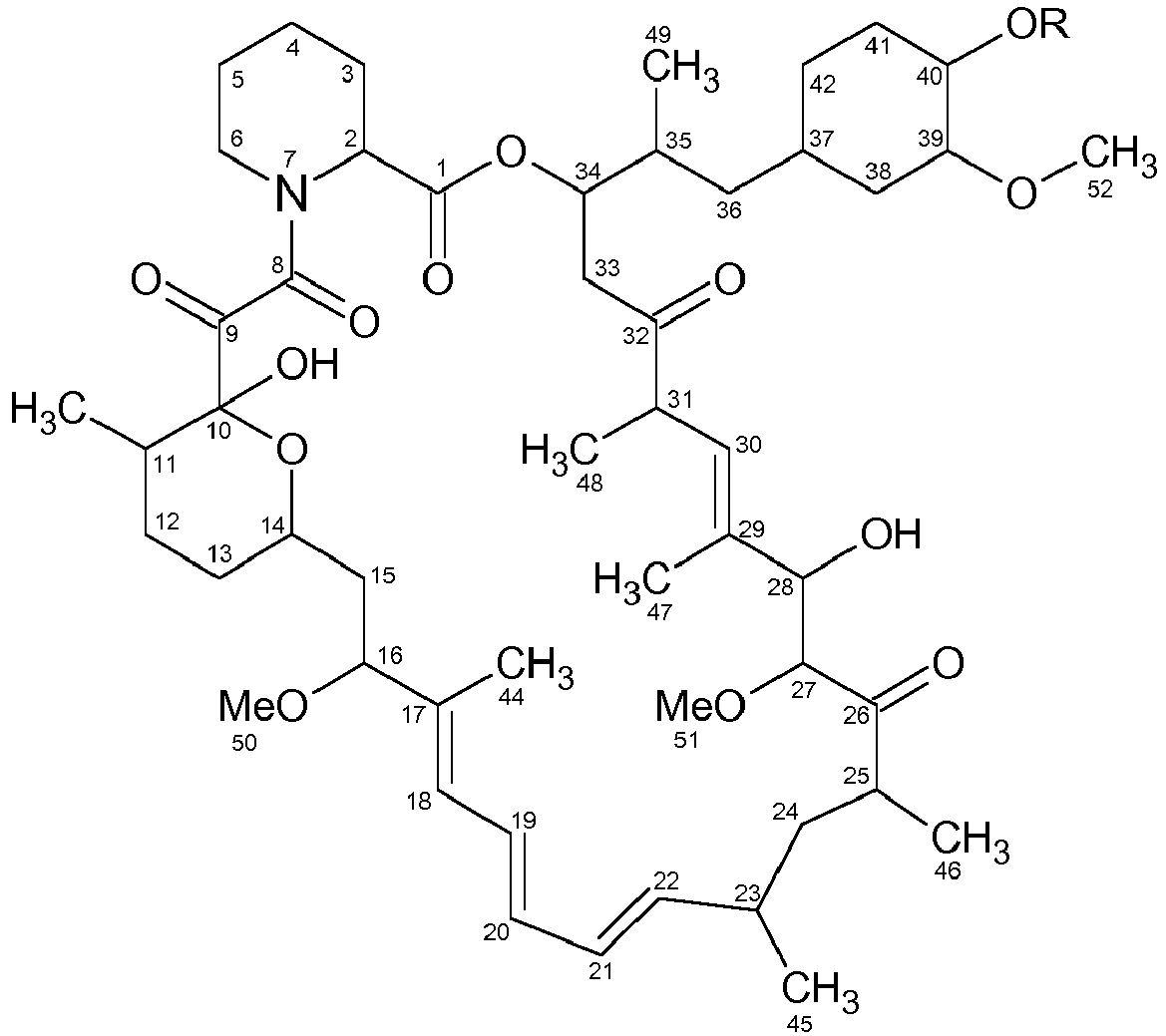
- In einer Ausführungsform des erfindungsgemäßen Implantats ist vorgesehen, dass die Verbindung nach Formel I die folgende Struktur aufweist:


- In einer Ausführungsform des erfindungsgemäßen Implantats ist vorgesehen, dass die erste Beschichtung (4) Poly(L-Milchsäure) mit einem geeigneten Molekulargewicht aus dem gesamten verfügbaren Bereich gewählt werden kann, je nach Eigenschaften des Grundkörpers.
- In einer bevorzugten Ausführungsform umfasst die erste Beschichtung (4) Poly(L-Milchsäure) mit einer inhärenten Viskosität im Bereich von 0.5 dl/g bis 4.0 dl/g, weiter bevorzugt im Bereich von 0.7 dl/g bis 3.8 dl/g, oder die erste Beschichtung besteht im Wesentlichen aus den zuvor genannten Poly(L-Milchsäuren). In einer Ausführungsform umfasst oder besteht die erste Beschichtung (4) Poly(L-Milchsäure) mit einer inhärenten Viskosität im Bereich von 0.9 dl/g bis 3.8 dl/g. In einer weiteren Ausführungsform umfasst oder besteht die erste Beschichtung (4) Poly(L-Milchsäure) mit einer inhärenten Viskosität im Bereich von 0.7 dl/g bis 1.2 dl/g.
- Für das erfindungsgemäße Implantat ist es vorgesehen, dass der Grundkörper aus einem abbaubaren Metall oder einer abbaubaren Metalllegierung hergestellt ist. In einer bevorzugten Ausführungsform ist das Metall oder die Metalllegierung ausgewählt aus der Gruppe umfassend oder bestehend aus Magnesium, Eisen und Zink oder Legierungen daraus, wobei die zuvor genannten Metalle deren größte Bestandteile darstellen. In einer besonders bevorzugten Ausführungsformumfasst das Implantat einen Grundkörper, der Magnesium oder eine abbaubare Magnesiumlegierung umfasst oder im Wesentlichen daraus besteht. Vorteilhafterweise werden beim Abbau des erfindungsgemäßen Implantats Magnesiumionen am Einsatzort freigesetzt, welche dort einen vorteilhaften antithrombischen Effekt hervorrufen können.
- In einer Ausführungsform des erfindungsgemäßen Implantats ist vorgesehen, dass der Grundkörper in Form eines hohlzylinderförmigen Gitters ausgebildet ist.
- In einer Ausführungsform des erfindungsgemäßen Implantats ist vorgesehen, dass das Implantat ein endovaskulares Implantat ist. In einer Ausführungsform des erfindungsgemäßen Implantats ist vorgesehen, dass das Implantat ein Stent ist.
- In einer Ausführungsform wird ein Implantat und vorzugsweise ein Stent vorgeschlagen, umfassend
- einen abbaubaren Grundkörper aus Magnesium oder einer Magnesiumlegierung;
- eine erste abbaubare Beschichtung umfassend oder bestehend aus Poly(L-Milchsäure) mit einem Molekulargewicht im Bereich von 0.7 dl/g bis 1.2 dl/g; und
- einen antiproliferativen Wirkstoff, vorzugsweise einem Wirkstoff der Formel I wie hierin beschrieben.
- In einer weiteren Ausführungsform wird ein Implantat und vorzugsweise ein Stent vorgeschlagen, umfassend
- einen abbaubaren Grundkörper aus Eisen oder einer Eisenlegierung;
- eine erste abbaubare Beschichtung umfassend oder bestehend aus Poly(L-Milchsäure) mit einem Molekulargewicht im Bereich von 0.9 dl/g bis 3.8 dl/g; und
- einen antiproliferativen Wirkstoff, vorzugsweise einem Wirkstoff der Formel I wie hierin beschrieben.
- Ein weiterer Aspekt der vorliegenden Erfindung betrifft ein Verfahren zur Herstellung des erfindungsgemäßen Implantats. Das Verfahren umfasst die Schritte:
- Bereitstellen eines abbaubaren Grundkörpers;
- Auftragen einer ersten abbaubaren Beschichtung umfassend mindestens ein abbaubares Polymer im Wesentlichen auf die gesamte Oberfläche des abbaubaren Grundköper; und
- Auftragen eines antiproliferativen Wirkstoffes auf der abluminalen Seite des Grundkörpers auf die erste abbaubare Beschichtung.
- In einer Ausführungsform des erfindungsgemäßen Verfahrens ist vorgesehen, dass die erste abbaubare Beschichtung und/oder der antiproliferative Wirkstoff durch Aufsprühen, Zerstäuben, Eintauchen oder Pipettieren aufgetragen wird.
- Nachfolgend sollen schließlich weitere Merkmale sowie Vorteile der vorliegenden Erfindung anhand von einzelnen Ausführungsformen bzw. Beispielen der Erfindung erläutert werden.
- Erstes Beispiel:
- Das erfindungsgemäße Implantat ist schematisch in
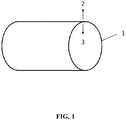
Figur 1 dargestellt. In dieser Ausführungsform der Erfindung ist das Implantat als Gefäßstütze oder Stent ausgebildet, wobei der Grundkörper 1 die Gestalt eines gitterförmigen Hohlzylinders hat, der durch eine Vielzahl von einzelnen Streben 1 gebildet wird. Der Grundköper weist hierbei eine luminale 3, das heißt dem Lumen des Gefäßes, in welchem der Stent eingesetzt werden soll, zugewandte Seite auf sowie eine abluminale 2, das heißt der Gefäßwand zugewandte Seite. Der Grundkörper besteht dabei aus einer abbaubaren Magnesiumlegierung. -
Figur 2 zeigt schematisch eine Strebe 1 des Grundkörpers. Hierbei ist die Strebe 1, wie auch der gesamte Grundkörper, von einer ersten abbaubaren Beschichtung, vorzugsweise aus PLLA oder PLGA, umschlossen. Diese Beschichtung dient vorzugsweise als Passivierungsschicht, welche den Abbau des Implantats vorteilhafterweise verzögern kann, da erst nach Abbau der ersten Beschichtung, der Grundkörper im Kontakt mit den umgebenden Körperflüssigkeiten gelangen kann, welche dann den Abbau des Grundkörpers verursacht. - Erfindungsgemäß ist dabei vorgesehen, dass ein antiproliferativer Wirkstoff 5, vorzugsweise ein Derivat von Rapamycin, auf die abluminale Seite 2 des Grundkörpers 1 auf die erste abbaubare Beschichtung 4 aufgetragen ist. Diese Auftragung auf die abluminale Seite ermöglicht eine gezielte Medikamentierung bzw. gezielt gewebeseitige Abgabe des Wirkstoffes 5, welcher dann genau am Bestimmungsort seine Wirkung entfalten kann. Dadurch kann vorteilhafterweise die Einheilung des Stens effektiv beschleunigt werden. Auch ist es dadurch in vorteilhafter Weise möglich, die Dual-Anti-Platelet-Therpie (DAPT) zu verkürzen.
- Besonders vorteilhafte antiproliferative Wirkstoffe werden in der folgenden Tabelle 2 dargestellt.
Tabelle 2 CRC-015 Spezies Hauptstruktur R ist C(O)-(CH2)n-X mit einem der folgenden Strukturen Spezies 

CRC-015a 
CRC-0 15b 
CRC-015c 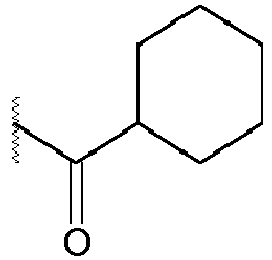
CRC-015d 
CRC-015e 
CRC-015f 
CRC-015g 
CRC-01 5h - Der Begriff CRC-015 soll hier einen Gruppe von Verbindungen beschreiben und bezieht sich auf die einzelnen Spezies oder Verbindung aus Tabelle 2: CRC-015a, CRC-015b, CRC-015c, CRC-015d, CRC-015e, CRC-015f, CRC-015g, und CRC-015h.
- Vorzugsweise wird eine CRC_015 Verbindung mit einem wasserlöslichen Lösungsvermittler und einem humanen Serumprotein formuliert. Dafür wird die Verbindung in EtOH gelöst und eine physiologische Kochsalzlösung mit dem humanen Serumprotein gegeben.
Claims (11)
- Implantat mit:- einem abbaubaren Grundkörper (1);- einer ersten abbaubaren Beschichtung (4) umfassend mindestens ein abbaubares Polymer; und- einem antiproliferativen Wirkstoff (5),dadurch gekennzeichnet, dass
die erste abbaubare Beschichtung (4) den abbaubaren Grundkörper (1) im Wesentlichen vollständig umschließt, und
der antiproliferative Wirkstoff (5) auf der abluminalen Seite (2) des Grundkörpers (1) auf die erste abbaubare Beschichtung (5) aufgetragen ist. - Implantat nach Anspruch 1, dadurch gekennzeichnet, dass die erste abbaubare Beschichtung (4) Polymilchsäure und/oder Poly(Lactid-co-Glycolid) umfasst oder daraus im Wesentlichen besteht, insbesondere Poly(L-Milchsäure), Poly-ε-Caprolacton oder Poly(L-Lactid-co-Glycolid).
- Implantat nach einem der vorherigen Ansprüche, dadurch gekennzeichnet, dass der antiproliferative Wirkstoff (5) ein mTor-Inhibitor oder ein Zytostatikum, insbesondere Paclitaxel, ist.
- Implantat nach Anspruch 3, dadurch gekennzeichnet, dass der mTor-Inhibitor (5) ausgewählt ist aus:- Sirolimus;- Everolimus;- Zotarolimus- Temsirolimus;- Biolimus A9- Ridaforolimus; oder- Verbindung nach Formel I:

- Implantat nach einem der vorherigen Ansprüche, dadurch gekennzeichnet, dass die erste Beschichtung (4) Poly(L-Milchsäure) mit einem mittleren Molekulargewicht im Bereich von X Da bis Y Da umfasst oder im Wesentlichen daraus besteht.
- Implantat nach einem der vorherigen Ansprüche, dadurch kennzeichnet, dass der Grundkörper (1) im Wesentlichen aus einem abbaubaren Metall besteht oder ein abbaubares Metall in Form einer abbaubaren Legierung umfasst.
- Implantat nach einem der vorherigen Ansprüche, dadurch kennzeichnet, dass der Grundkörper (1) Magnesium oder eine abbaubare Magnesiumlegierung umfasst oder im Wesentlichen daraus besteht.
- Implantat nach einem der vorherigen Ansprüche, dadurch gekennzeichnet, dass der Grundkörper (1) in Form eines hohlzylinderförmigen Gitters ausgebildet ist.
- Implantat nach einem der vorherigen Ansprüche, dadurch gekennzeichnet, dass das Implantat ein endovaskulares Implantat ist, insbesondere ein Stent.
- Verfahren zur Herstellung eines Implantats gemäß einem der Ansprüche 1 bis 9, umfassend die Schritte:- Bereitstellen eines abbaubaren Grundkörpers- Auftragen einer ersten abbaubaren Beschichtung umfassend mindestens ein abbaubares Polymer auf mindestens die abluminale Seite des abbaubaren Grundköper,- Auftragen eines antiproliferativen Wirkstoffes auf die erste abbaubare Beschichtung auf der abluminale Seite des Grundkörpers.
- Verfahren zur Herstellung eines Implantats nach Anspruch 10, dadurch gekennzeichnet, dass die erste abbaubare Beschichtung und /oder der antiproliferative Wirkstoff durch Aufsprühen, Zerstäuben, Eintauchen oder Pipettieren aufgetragen wird.
Priority Applications (6)
| Application Number | Priority Date | Filing Date | Title |
|---|---|---|---|
| EP18190387.3A EP3613449A1 (de) | 2018-08-23 | 2018-08-23 | Verbesserung der polymerschicht bei degradierbaren vorrichtungen |
| US17/260,893 US12485207B2 (en) | 2018-08-23 | 2019-08-14 | Implant with antiproliferative active substance limited to abluminal side and method of production |
| EP19752524.9A EP3840792B1 (de) | 2018-08-23 | 2019-08-14 | Verbesserung einer polymerschicht auf abbaubaren vorrichtungen |
| CN201980045711.1A CN112368030A (zh) | 2018-08-23 | 2019-08-14 | 可降解器材上的聚合物层的改进 |
| JP2021507603A JP7531480B2 (ja) | 2018-08-23 | 2019-08-14 | 分解可能なデバイス上のポリマー層の改良 |
| PCT/EP2019/071832 WO2020038800A1 (en) | 2018-08-23 | 2019-08-14 | Improving the polymer layer on degradable devices |
Applications Claiming Priority (1)
| Application Number | Priority Date | Filing Date | Title |
|---|---|---|---|
| EP18190387.3A EP3613449A1 (de) | 2018-08-23 | 2018-08-23 | Verbesserung der polymerschicht bei degradierbaren vorrichtungen |
Publications (1)
| Publication Number | Publication Date |
|---|---|
| EP3613449A1 true EP3613449A1 (de) | 2020-02-26 |
Family
ID=63371526
Family Applications (2)
| Application Number | Title | Priority Date | Filing Date |
|---|---|---|---|
| EP18190387.3A Withdrawn EP3613449A1 (de) | 2018-08-23 | 2018-08-23 | Verbesserung der polymerschicht bei degradierbaren vorrichtungen |
| EP19752524.9A Active EP3840792B1 (de) | 2018-08-23 | 2019-08-14 | Verbesserung einer polymerschicht auf abbaubaren vorrichtungen |
Family Applications After (1)
| Application Number | Title | Priority Date | Filing Date |
|---|---|---|---|
| EP19752524.9A Active EP3840792B1 (de) | 2018-08-23 | 2019-08-14 | Verbesserung einer polymerschicht auf abbaubaren vorrichtungen |
Country Status (5)
| Country | Link |
|---|---|
| US (1) | US12485207B2 (de) |
| EP (2) | EP3613449A1 (de) |
| JP (1) | JP7531480B2 (de) |
| CN (1) | CN112368030A (de) |
| WO (1) | WO2020038800A1 (de) |
Families Citing this family (3)
| Publication number | Priority date | Publication date | Assignee | Title |
|---|---|---|---|---|
| JP7862105B2 (ja) | 2021-05-10 | 2026-05-19 | シラグ・ゲーエムベーハー・インターナショナル | 吸収性ステープルを備える外科用ステープルカートリッジのシステム |
| JP2024518074A (ja) | 2021-05-10 | 2024-04-24 | シラグ・ゲーエムベーハー・インターナショナル | コーティングを備える吸収性外科用ステープル |
| US11998192B2 (en) | 2021-05-10 | 2024-06-04 | Cilag Gmbh International | Adaptive control of surgical stapling instrument based on staple cartridge type |
Citations (5)
| Publication number | Priority date | Publication date | Assignee | Title |
|---|---|---|---|---|
| WO2006065685A2 (en) * | 2004-12-16 | 2006-06-22 | Advanced Cardiovascular Systems, Inc. | Abluminal, multilayer coating constructs for drug-delivery stents |
| EP2407184A2 (de) * | 2010-07-16 | 2012-01-18 | Biotronik AG | Abluminal beschichtete Wirkstoff-freisetzende Stents mit einer formschlüssigen Schutzschicht |
| WO2013024125A1 (de) * | 2011-08-15 | 2013-02-21 | Meko Laserstrahl-Materialbearbeitungen E.K. | Resorbierbare stents, welche eine magnesiumlegierung enthalten |
| EP3120877A1 (de) * | 2015-07-24 | 2017-01-25 | B. Braun Melsungen AG | Endoluminale vorrichtung |
| WO2018050916A1 (en) * | 2016-09-19 | 2018-03-22 | Biotronik Ag | Polymer-free drug eluting vascular stents |
Family Cites Families (13)
| Publication number | Priority date | Publication date | Assignee | Title |
|---|---|---|---|---|
| US20020143284A1 (en) * | 2001-04-03 | 2002-10-03 | Hosheng Tu | Drug-releasing trabecular implant for glaucoma treatment |
| CN1655738A (zh) * | 2002-05-20 | 2005-08-17 | 奥勃斯医学技术股份有限公司 | 可植入的药物洗脱医疗装置 |
| CA2601864A1 (en) * | 2005-04-08 | 2006-10-19 | Surmodics, Inc. | Sustained release implants and methods for subretinal delivery of bioactive agents to treat or prevent retinal disease |
| ZA200904416B (en) * | 2007-01-30 | 2010-08-25 | Hemoteq Ag | Biodegradable vascular support |
| US8709071B1 (en) * | 2007-09-28 | 2014-04-29 | Abbott Cardiovascular Systems Inc. | Stent with preferential coating |
| EP2415489B1 (de) * | 2010-08-03 | 2016-07-06 | Biotronik AG | Polylactid-beschichtetes Implantat aus einer biokorrodierbaren Magnesiumlegierung |
| US10098765B2 (en) | 2010-12-15 | 2018-10-16 | Biotronik Ag | Implant and method for producing the same |
| CN104203959B (zh) * | 2012-06-08 | 2017-09-15 | 百多力股份公司 | 雷帕霉素40‑o‑环状烃酯、组合物和方法 |
| JP2016165375A (ja) * | 2015-03-10 | 2016-09-15 | 株式会社日本ステントテクノロジー | 防食被覆層を有するステントの製造方法 |
| ES2955235T3 (es) * | 2016-09-08 | 2023-11-29 | Karl Leibinger Medizintechnik Gmbh & Co Kg | Procedimiento de fabricación de un implante mediante un polvo compuesto que contiene sales de calcio con partículas microestructuradas |
| ES2853273T3 (es) * | 2016-09-08 | 2021-09-15 | Karl Leibinger Medizintechnik Gmbh & Co Kg | Implante que contiene carbonato de calcio inhibidor |
| EP3829666B1 (de) * | 2018-08-01 | 2023-08-30 | Boston Scientific Scimed Inc. | Wirkstofffreisetzende beschichtungszusammensetzungen |
| US10960110B2 (en) * | 2018-08-21 | 2021-03-30 | Jian Xie | Iron-based biodegradable metals for implantable medical devices |
-
2018
- 2018-08-23 EP EP18190387.3A patent/EP3613449A1/de not_active Withdrawn
-
2019
- 2019-08-14 EP EP19752524.9A patent/EP3840792B1/de active Active
- 2019-08-14 WO PCT/EP2019/071832 patent/WO2020038800A1/en not_active Ceased
- 2019-08-14 JP JP2021507603A patent/JP7531480B2/ja active Active
- 2019-08-14 US US17/260,893 patent/US12485207B2/en active Active
- 2019-08-14 CN CN201980045711.1A patent/CN112368030A/zh active Pending
Patent Citations (5)
| Publication number | Priority date | Publication date | Assignee | Title |
|---|---|---|---|---|
| WO2006065685A2 (en) * | 2004-12-16 | 2006-06-22 | Advanced Cardiovascular Systems, Inc. | Abluminal, multilayer coating constructs for drug-delivery stents |
| EP2407184A2 (de) * | 2010-07-16 | 2012-01-18 | Biotronik AG | Abluminal beschichtete Wirkstoff-freisetzende Stents mit einer formschlüssigen Schutzschicht |
| WO2013024125A1 (de) * | 2011-08-15 | 2013-02-21 | Meko Laserstrahl-Materialbearbeitungen E.K. | Resorbierbare stents, welche eine magnesiumlegierung enthalten |
| EP3120877A1 (de) * | 2015-07-24 | 2017-01-25 | B. Braun Melsungen AG | Endoluminale vorrichtung |
| WO2018050916A1 (en) * | 2016-09-19 | 2018-03-22 | Biotronik Ag | Polymer-free drug eluting vascular stents |
Non-Patent Citations (5)
| Title |
|---|
| CHEMICAL ABSTRACTS, Columbus, Ohio, US; abstract no. 159351-69-6 |
| CHEMICAL ABSTRACTS, Columbus, Ohio, US; abstract no. 162635-04-3 |
| CHEMICAL ABSTRACTS, Columbus, Ohio, US; abstract no. 26100-51-6 |
| CHEMICAL ABSTRACTS, Columbus, Ohio, US; abstract no. 53123-88-9 |
| CHEMICAL ABSTRACTS, Columbus, Ohio, US; abstract no. 572924-54-0 |
Also Published As
| Publication number | Publication date |
|---|---|
| CN112368030A (zh) | 2021-02-12 |
| JP7531480B2 (ja) | 2024-08-09 |
| JP2021533886A (ja) | 2021-12-09 |
| EP3840792A1 (de) | 2021-06-30 |
| US12485207B2 (en) | 2025-12-02 |
| US20210252198A1 (en) | 2021-08-19 |
| EP3840792B1 (de) | 2022-10-05 |
| WO2020038800A1 (en) | 2020-02-27 |
Similar Documents
| Publication | Publication Date | Title |
|---|---|---|
| EP1389471B1 (de) | Verfahren zur Herstellung eines implantationsfähigen Stents mit einer polymeren Beschichtung aus hochmolekularem Poly-L-Lactid | |
| EP2744532B1 (de) | Resorbierbare stents, welche eine magnesiumlegierung enthalten | |
| DE60032912T2 (de) | Poröse prothese und verfahren zur abscheidung von substanzen in den poren | |
| EP2070558A2 (de) | Implantate mit membrandiffusionskontrollierter Wirkstofffreisetzung | |
| EP3342433A1 (de) | Stent aus einer biologisch abbaubaren magnesiumlegierung mit einer magnesiumfluorid-beschichtung und einer organischen beschichtung | |
| DE102007034364A1 (de) | Degradierbarer Metallstent mit wirkstoffhaltiger Beschichtung | |
| EP2967934B1 (de) | Bioresorbierbarer stent | |
| EP2111880A2 (de) | Biodegradierbarer Metallstent | |
| EP2161045A2 (de) | Verwendung von organischen Gold-Komplexen als bioaktive und radioopaque Stentbeschichtung für permanente und degradierbare vaskuläre Implantate | |
| WO2002080996A1 (de) | Medizinisches implantat und verfahren zu seiner herstellung | |
| EP3840792B1 (de) | Verbesserung einer polymerschicht auf abbaubaren vorrichtungen | |
| EP2289575B1 (de) | Medizinisches Implantat enthaltend eine antioxidative Substanz | |
| EP2055328B1 (de) | Stent mit einem Grundkörper aus einem bioinerten metallischen Implantatwerkstoff | |
| EP2415489A2 (de) | Polylactid-beschichtetes Implantat aus einer biokorrodierbaren Magnesiumlegierung | |
| EP2500043A1 (de) | Medizinprodukt mit einer aktiven Beschichtung | |
| EP2806981B1 (de) | Verfahren zur beschichtung eines stents | |
| EP2462962B1 (de) | Implantat mit einer das implantat zumindest bereichsweise bedeckenden, wirkstoffhaltigen beschichtung | |
| DE10234398B4 (de) | Beschichtungszusammensetzung für eine implantierbare medizinische Vorrichtung und Verfahren zur Beschichtung einer solchen Vorrichtung und seine Verwendung | |
| EP2371404A2 (de) | Medizinisches Implantat mit einer Beschichtung bestehend aus oder enthaltend mindestens einen Nitro-Statin-Wirkstoff | |
| DE102019116791B4 (de) | Stent mit sofort ablösbarer Beschichtung | |
| EP2433660B1 (de) | Beschichtetes Implantat aus einer biokorrodierbaren Magnesiumlegierung | |
| EP2281590A2 (de) | Biokorrodierbares Implantat mit einer aktiven Beschichtung | |
| EP2653174B1 (de) | Implantat und verfahren zur herstellung desselben | |
| EP2462961A2 (de) | Implantat aus einem biokorrodierbaren Werkstoff und mit einer einen Gewebekleber enthaltenden Beschichtung |
Legal Events
| Date | Code | Title | Description |
|---|---|---|---|
| PUAI | Public reference made under article 153(3) epc to a published international application that has entered the european phase |
Free format text: ORIGINAL CODE: 0009012 |
|
| AK | Designated contracting states |
Kind code of ref document: A1 Designated state(s): AL AT BE BG CH CY CZ DE DK EE ES FI FR GB GR HR HU IE IS IT LI LT LU LV MC MK MT NL NO PL PT RO RS SE SI SK SM TR |
|
| AX | Request for extension of the european patent |
Extension state: BA ME |
|
| STAA | Information on the status of an ep patent application or granted ep patent |
Free format text: STATUS: THE APPLICATION IS DEEMED TO BE WITHDRAWN |
|
| 18D | Application deemed to be withdrawn |
Effective date: 20200827 |