EP3610259B1 - Fluorophoren mit hoher helligkeit - Google Patents
Fluorophoren mit hoher helligkeit Download PDFInfo
- Publication number
- EP3610259B1 EP3610259B1 EP18722811.9A EP18722811A EP3610259B1 EP 3610259 B1 EP3610259 B1 EP 3610259B1 EP 18722811 A EP18722811 A EP 18722811A EP 3610259 B1 EP3610259 B1 EP 3610259B1
- Authority
- EP
- European Patent Office
- Prior art keywords
- linker
- fluorophore
- dye
- fluorescent
- fluorophores
- Prior art date
- Legal status (The legal status is an assumption and is not a legal conclusion. Google has not performed a legal analysis and makes no representation as to the accuracy of the status listed.)
- Active
Links
Images





Classifications
-
- A—HUMAN NECESSITIES
- A61—MEDICAL OR VETERINARY SCIENCE; HYGIENE
- A61B—DIAGNOSIS; SURGERY; IDENTIFICATION
- A61B5/00—Measuring for diagnostic purposes; Identification of persons
- A61B5/0059—Measuring for diagnostic purposes; Identification of persons using light, e.g. diagnosis by transillumination, diascopy, fluorescence
- A61B5/0071—Measuring for diagnostic purposes; Identification of persons using light, e.g. diagnosis by transillumination, diascopy, fluorescence by measuring fluorescence emission
-
- A—HUMAN NECESSITIES
- A61—MEDICAL OR VETERINARY SCIENCE; HYGIENE
- A61K—PREPARATIONS FOR MEDICAL, DENTAL OR TOILETRY PURPOSES
- A61K49/00—Preparations for testing in vivo
- A61K49/001—Preparation for luminescence or biological staining
- A61K49/0013—Luminescence
- A61K49/0017—Fluorescence in vivo
- A61K49/0019—Fluorescence in vivo characterised by the fluorescent group, e.g. oligomeric, polymeric or dendritic molecules
- A61K49/0021—Fluorescence in vivo characterised by the fluorescent group, e.g. oligomeric, polymeric or dendritic molecules the fluorescent group being a small organic molecule
- A61K49/0041—Xanthene dyes, used in vivo, e.g. administered to a mice, e.g. rhodamines, rose Bengal
-
- A—HUMAN NECESSITIES
- A61—MEDICAL OR VETERINARY SCIENCE; HYGIENE
- A61K—PREPARATIONS FOR MEDICAL, DENTAL OR TOILETRY PURPOSES
- A61K49/00—Preparations for testing in vivo
- A61K49/001—Preparation for luminescence or biological staining
- A61K49/0013—Luminescence
- A61K49/0017—Fluorescence in vivo
- A61K49/005—Fluorescence in vivo characterised by the carrier molecule carrying the fluorescent agent
- A61K49/0058—Antibodies
-
- B—PERFORMING OPERATIONS; TRANSPORTING
- B82—NANOTECHNOLOGY
- B82Y—SPECIFIC USES OR APPLICATIONS OF NANOSTRUCTURES; MEASUREMENT OR ANALYSIS OF NANOSTRUCTURES; MANUFACTURE OR TREATMENT OF NANOSTRUCTURES
- B82Y5/00—Nanobiotechnology or nanomedicine, e.g. protein engineering or drug delivery
-
- C—CHEMISTRY; METALLURGY
- C07—ORGANIC CHEMISTRY
- C07K—PEPTIDES
- C07K16/00—Immunoglobulins [IG], e.g. monoclonal or polyclonal antibodies
- C07K16/18—Immunoglobulins [IG], e.g. monoclonal or polyclonal antibodies against material from animals or humans
- C07K16/28—Immunoglobulins [IG], e.g. monoclonal or polyclonal antibodies against material from animals or humans against receptors, cell surface antigens or cell surface determinants
- C07K16/2803—Immunoglobulins [IG], e.g. monoclonal or polyclonal antibodies against material from animals or humans against receptors, cell surface antigens or cell surface determinants against the immunoglobulin superfamily
- C07K16/2812—Immunoglobulins [IG], e.g. monoclonal or polyclonal antibodies against material from animals or humans against receptors, cell surface antigens or cell surface determinants against the immunoglobulin superfamily against CD4
-
- G—PHYSICS
- G01—MEASURING; TESTING
- G01N—INVESTIGATING OR ANALYSING MATERIALS BY DETERMINING THEIR CHEMICAL OR PHYSICAL PROPERTIES
- G01N33/00—Investigating or analysing materials by specific methods not covered by groups G01N1/00 - G01N31/00
- G01N33/48—Biological material, e.g. blood, urine; Haemocytometers
- G01N33/50—Chemical analysis of biological material, e.g. blood, urine; Testing involving biospecific ligand binding methods; Immunological testing
- G01N33/5005—Chemical analysis of biological material, e.g. blood, urine; Testing involving biospecific ligand binding methods; Immunological testing involving human or animal cells
-
- G—PHYSICS
- G01—MEASURING; TESTING
- G01N—INVESTIGATING OR ANALYSING MATERIALS BY DETERMINING THEIR CHEMICAL OR PHYSICAL PROPERTIES
- G01N33/00—Investigating or analysing materials by specific methods not covered by groups G01N1/00 - G01N31/00
- G01N33/48—Biological material, e.g. blood, urine; Haemocytometers
- G01N33/50—Chemical analysis of biological material, e.g. blood, urine; Testing involving biospecific ligand binding methods; Immunological testing
- G01N33/53—Immunoassay; Biospecific binding assay; Materials therefor
- G01N33/531—Production of immunochemical test materials
- G01N33/532—Production of labelled immunochemicals
- G01N33/533—Production of labelled immunochemicals with fluorescent label
-
- G—PHYSICS
- G01—MEASURING; TESTING
- G01N—INVESTIGATING OR ANALYSING MATERIALS BY DETERMINING THEIR CHEMICAL OR PHYSICAL PROPERTIES
- G01N33/00—Investigating or analysing materials by specific methods not covered by groups G01N1/00 - G01N31/00
- G01N33/48—Biological material, e.g. blood, urine; Haemocytometers
- G01N33/50—Chemical analysis of biological material, e.g. blood, urine; Testing involving biospecific ligand binding methods; Immunological testing
- G01N33/53—Immunoassay; Biospecific binding assay; Materials therefor
- G01N33/543—Immunoassay; Biospecific binding assay; Materials therefor with an insoluble carrier for immobilising immunochemicals
- G01N33/54313—Immunoassay; Biospecific binding assay; Materials therefor with an insoluble carrier for immobilising immunochemicals the carrier being characterised by its particulate form
- G01N33/54346—Nanoparticles
Definitions
- Fluorophores are compounds with fluorescent properties that have biomedical applications.
- fluorophores can be used as tracers or dyes for staining certain molecules or structures. More particularly, fluorophores can be used to stain tissues, cells, or materials in a variety of analytical methods, such as fluorescent imaging and spectroscopy.
- Fluorophores may be attached to other molecules for delivery to certain tissues, cells or materials. When attached to these other delivery molecules, fluorophores can exhibit quenching, which is a reduction in the brightness of the fluorescence of the fluorophore.
- An example fluorophore according to the present application includes a carrier which is a boron nitride nanotube, at least one fluorescent entity, and an amphiphilic linker linking each of the at last one fluorescent entities to the carrier.
- the linker has a molecular weight greater than 1000 Da and/or a stretched linker length greater than 5 nanometers.
- the linker comprises at least one hydrophilic portion and a hydrophobic portion, wherein the hydrophobic portion is non-covalently bonded to the carrier and the hydrophilic portion is covalently bonded to the fluorescent entity.
- CNT carbon nanotubes
- high-brightness fluorophores contain a carrier element, a fluorescent element, and a linker linking the carrier element to the fluorescent element.
- a carrier element for biomedical applications, each of the carrier element, the linker, and the fluorescent element must be biocompatible (though the requirements for biocompatibility will vary with the particular application).
- One example carrier element is a nanomaterial, such as carbon nanotubes (CNT) and boron nitride nanotubes (BNNTs), both of which are recognized as biologically compatible nanomaterials for biomedical applications such as cellular drug delivery and spectroscopy applications.
- CNT carbon nanotubes
- BNNTs boron nitride nanotubes
- fluorescent elements linked to nanotubes exhibit quenching, or a reduction in the brightness of the fluorescence.
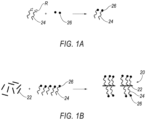
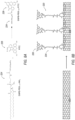
- Fluorophores 20 are schematically shown.
- Fluorophores 20 generally comprise an inorganic nano-scale carrier 22, a linker 24, and a fluorescent entity 26.
- the carrier 22 is a BNNT carrier.
- the carrier 22 is a multi-walled BNNT carrier, where each BNNT has multiple co-axial shells of hexagonal boron nitride (h-BN for BNNTs), with a typical external diameter of more than about 5 nm but less than about 80 nm.
- the length of these BNNTs may be between about 50-1000 nm.
- the carrier 22 can be fabricated by any known method.
- the linker 24 is an amphiphilic polymeric linker, linking each of the at least one fluorescent entities to the carrier, the linker having a molecular weight greater than 1000 Da and/or a stretched linker length greater than 5 nanometers.
- the linker 24 includes a hydrophobic region 28 and a hydrophilic region 30.
- the hydrophobic region 26 non-covalently bonds to the nanotube carrier 22, while the hydrophilic region is covalently bonded to the fluorescent entity 26.
- One example linker 24 is DSPE-PEG n (1,2-distearoyl-sn-glycero-3-phosphoethanolamine-N-[(polyethylene glycol) n ]), where n is a number of polyethylene glycol (PEG) molecules in a PEG chain.
- Other linkers 24 can similarly include a PEG chain (or a different chain) which varies in length.
- linker 24 comprising more than one of the above groups will be selected such that the linker 24 is stable; for example, a linker 24 may not include two adjacent -O- groups, which would generate an unstable peroxide linkage.
- the linker 24 may be a straight chain, a branched chain, or may include one or more ring systems.
- Non-limiting exemplary linkers include a hydrophobic area which can be fatty acids, phospholipids, sphingolipids, phosphosphingolipids [such as DSPE, 1-O-hexadecanyl-2-O-(9Z-octadecenyl)-sn-glycero-3-phospho-(1'-rac-glycerol) (ammonium salt), N-octanoyl-sphingosine-1- ⁇ succinyl[methoxy(polyethylene glycol)5000, D-erythro-sphingosyl phosphoethanolamine, 1,2-diphytanoyl-sn-glycero-3-phospho-L-serine, 3-sn-phosphatidyl-L-serine (PS), glycosylphosphatidylinositol,1,2-dioleoyl-sn-glycero-3-phosphoethanoamine but not limited).
- DSPE 1-O-he
- the hydrophobic unit can be used to conjugate with water soluble polymeric chains such as PEG (or PEO polyethyleneoxide), PMO (poly methyl oxazoline), PEI (polyethyleneimine), polyvinyl alcohol, polyvinylpyrolidone, polyacrylamide, polypeptide, carbohydrate anchors.
- water soluble polymeric chains such as PEG (or PEO polyethyleneoxide), PMO (poly methyl oxazoline), PEI (polyethyleneimine), polyvinyl alcohol, polyvinylpyrolidone, polyacrylamide, polypeptide, carbohydrate anchors.
- the water soluble polymeric chains are attached to the linkers at one end, and attached to the fluorescent entity at a second end.
- These hydrophobic and hydrophilic units must have reactive groups as mentioned above and such that the groups conjugate together into amphiphilic linkers.
- the fluorescent entity 26 is any know fluorescent dye, including but not limited to coumarins, benzoxadiazoles, acridones, acridines, bisbenzimides, indole, benzoisoquinoline, naphthalene, anthracene, xanthene, pyrene, porphyrin, fluorescein, rhodamine, boron-dipyrromethene (BODIPY) and cyanine derivatives. Many such fluorescent dyes are commercially available.
- the fluorescent entity 26 is bonded to the linker 24 by any appropriate method.
- the brightness of the fluorophore 20 is directly related to the number of fluorescent entities 26 on the fluorophore 20. That is, a fluorophore 20 with less fluorescent entities 26 will exhibit a lower brightness than a fluorophore 20 with more fluorescent entities 26.
- linker 24 length also affects the brightness of the fluorophore 20.
- varying the number of PEG molecules in the PEG chain (n) varies the length of the linker 24, and thus the brightness of the fluorophore 20. It will be appreciated that varying linker lengths of the other types of linkers discussed above can also be achieved.
- fluorophores 20 having linker 24 molecular weight of greater than about 1000 Da exhibit a nonlinear quenching effect, which is unexpected. Accordingly, the fluorophores 20 described herein exhibit brightness several orders of magnitude higher than prior art fluorophores. Furthermore, it has been discovered that fluorophores 20 with different fluorescent entities 26 may have a different relationship between their fluorescent properties and linker 24 length.
- the linker 24 can include a functional group R.
- the functional group R is a reactive group that facilitates covalent bonding of the linker 24 to the fluorescent entity 26 by know chemistry.
- An example functional group R is an amine group.
- Other example functional groups are carboxylic acid, isothiocyanate, maleimide, an alkynyl group, an azide group, a thiol group, monosulfone, or an ester group such as a succinimidyl, sulfodichlorophenol, pentafluorophenyl or tetrafluorophenyl.
- the functionalized linker 24 (that is, a linker 24 with a functional group R) may be commercially available, or may be synthesized according to methods described herein or other methods known to those skilled in the art.
- Figures 2A-B show an example red fluorophore 120.
- the example red fluorophore 120 includes a BNNT carrier 122, an amide-functionalized DSPE-PEGn-NH 2 linker 124 (that is, a linker as discussed above with an amide functional group, NH 2 ), and a sulforhodamine B (RhB, red) fluorescent entity 126.
- the RhB fluorescent dye entity 126 is covalently bonded to the DSPE-PEGn-NH 2 linker 124 by any method to form a dye-linker structure 124, 126 as shown in Figure 2A .
- the RhB fluorescent entity 126 is combined with DSPE-PEGn-NH 2 linker 124 in an ice bath under nitrogen in anhydrous dichloromethane (DCM), and then purified by flash chromatography or another purification method.
- DCM hydrous dichloromethane
- DSPE-PEGn-NH 2 linker 124 with various molecular weight (MW) PEG chains (that is, with various n values) causes dye-linker structure 124, 126 to emit at different fluorescence intensity and fluorescence quantum yield (QY). Since the dye entity 126 is at the end of the PEG chain of the linker 124 opposite the linker 124 connection to the BNNT carrier 122, higher MW of the PEG chain (and higher n values) means the linker 124 is longer, and thus that the dye entity 126 would be further from the BNNT carrier 122. Though the below description is made with respect to the particular example red fluorophore 120, it should be understood that it is also applicable to fluorophores 20 including other linkers, carriers, or fluorescent entities, as discussed above.
- the length of a fully stretched PEGn chain can be estimated because the known length of one PEG entity is 0.44nm.
- the fully stretched linker lengths for PEG chains with MW of 1000, 2000, 3400, 5000, 10,000 are estimated to be 5-10nm, 11-20nm, 18-34nm, 27-50nm, and 54-100nm, respectively.
- the PEG chains may be coiled about one another or themselves, and may not retain their fully stretched state.
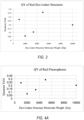
- the relative QY was independent of the dye concentration of the samples as it was calculated by fluorescence/absorbance slope ratio of the samples and reference which were both linearly scaled to concentration as shown in Figure 3 .
- the QY changes for various linker 124 MW (e.g., various linker 124 length).
- the QY increases in a nonlinear manner with the linker length for MW of 2000 to 5000 but is saturated of decreasing at MW by 10,000 (that is at MW 10000, a longer linker does not cause a higher QY).
- the QY at MW of 1000 was higher than the QY at MW of 2000 and 3400.
- fluorophore 120, the dye-linker structure 124, 126 (DSPE-PEGn-NH 2 -RhB) is non-covalently labeled on the BNNT carrier 122 as shown in Figure 2B by any method.
- the BNNT carrier 122 is fabricated and cut by any known method to a desired length.
- the BNNT carrier 122 is between about 50 and 1000 nm, more particularly, between about 300 and 400 nm.
- the BNNT carrier 122 is exposed to the dye-linker structure 124, 126 so that the dye-linker structure 124, 126 non-covalently bonds to the BNNT carrier 122 by any method.
- the BNNT carrier 122/dye-linker structure 124-126 solution can be distilled or filtered to remove excess unbonded dye-linker structures 124, 126.
- the alkyl chain (-C(O)(CH 2 ) 34 ) of the linker 124 is non-covalently adsorbed on the surface of BNNT carrier 122 while the PEGn-NH 2 -RhB of the dye-linker structure 124, 126 extends away from the BNNT carrier 122.
- the hydrophobic end of the linker 24 non-covalently bonds to the carrier 22 while the free hydrophilic end is covalently bonded to a fluorescent entity 26, as discussed above.
- the surface area of one DSPE-PEGn-NH 2 linker 124 molecule adsorb on a BNNT is 1.44 nm 2 .
- the fluorophore 120 is estimated to have 6 orders of magnitude more fluorescent entities than prior art fluorophores that consist of only 1-6 florescent entities. More generally, it is estimated that the fluorophores 20 described herein include at least 100, and more particularly at least 1000 dye-linker structures 24, 26.
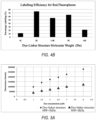
- Figure 4A shows the QY of the fluorophores 120 with various dye-linker structures 124, 126 as discussed above. As shown, the trend of the QY is quite similar to that of QY for the dye-linker structures 124, 126 alone, as illustrated in Figure 3 .
- Figure 4B shows the labeling efficiency of the various dye-linker structures 124, 126 discussed above on BNNT carriers 122.
- the labelling efficiency was calculated by determining the concentrations of dye-linker structures 124, 126 after being labeled on carrier BNNTs 122. This actual concentration of dye-linker structures 124, 126 was then compared to initial dye concentration being used for each labeling process to determine the labeling efficiency.
- the fluorescence brightness of the fluorophore 120 is also related to the concentration of dye-linker structures 124, 126 that the BNNT carriers 122 are exposed to. This in turn affects the labelling efficiency, discussed above, and ultimately the number of fluorescent dye entities 126 on each BNNT carrier 122.
- Figure 5A shows a plot of fluorescence intensity versus concentration of dye-linker structures 124, 126 themselves, while Figure 5B shows a plot of fluorescence intensity versus concentration of dye-linker structures 124, 126 for fluorophores 120.
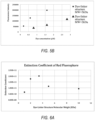
- Brightness of fluorophores is defined as product of quantum yield (QY) and extinction coefficient ( ⁇ ). Since a single BNNT carrier 120 could be loaded as many as 1.5 ⁇ 10 6 fluorescent entities, as discussed above, the brightness of each of the example fluorophores 120 is several orders of magnitude brighter than prior art fluorophores which have only a few fluorescent dye entities on each fluorophore (e.g., 1-6, as discussed above).
- the extinction coefficient for the example fluorophores 120 with various molecular weight linkers 124 are in the range of 1 ⁇ 10 7 to 1 ⁇ 10 11 M -1 cm -1 (as shown in Figure 6A ), which is much higher than the extinction coefficient of brightest commercial dye (phycoerythrin (PE)) with an extinction coefficient of about 1 ⁇ 10 6 M -1 cm -1 .
- Figure 6B shows the brightness of the fluorophores 120.
- Figures 7A-B show the extinction coefficient and brightness of the dye-linker structures 124, 126.
- the brightness of the example fluorophores 120 are much higher ⁇ 10 10 than those of the dye-linker structures 124, 126 shown in Figure 7B .
- the extinction coefficients for the example fluorophores 120 for all linker 124 lengths are several orders of magnitudes higher than those of existing commercial fluorophores.
- FIG. 8A-B Another example green fluorophore 220, shown in Figures 8A-B includes a nanotube carrier 222 and a DSPE-PEG-NH 2 linker 224, as in the previous example, but includes a fluorescein isothiocyanate (FITC, green) fluorescent entity 226 instead of RhB as in the previous example.
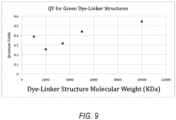
- Figure 9 shows QY for dye-linker structures 224, 226 for the same molecular weight linkers 224 as in the previous example. As shown in Figure 9 , the dye-linker structures 224, 226 exhibit a non-linear trend with linker 224 molecular weight.
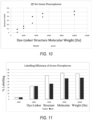
- Figure 10 shows QY of dye-linker structures 224, 226 labelled onto two types of nanotube carriers 220, CNTs (reference) and BNNTs. As shown, there is a nominal difference in QY between CNT and BNNT carriers. Also, there is generally a linear trend between linker molecular weight and QY for both CNT and BNNT carriers.
- the fluorophores 220 exhibited lower QY than laser grade fluorescein was used as reference which is known to have QY of 0.86 in phosphate-buffered saline (PBS) solution. Therefore, the fluorophores 220 exhibited quenching.
- PBS phosphate-buffered saline
- FITC is a pH sensitive dye and the low labeling efficiency of these short-length dye-linker structures 224, 226 is affected by the molecular structure of dye-linker structures 224, 226.
- FIG. 12A-B Another example far-red fluorophore 320, shown in Figures 12A-B includes a nanotube carrier 322 and a DSPE-PEG-NH2 linker 324, as in the previous example, but includes a sulfoCy5 (far-red) fluorescent entity 326 instead of RhB or FITC as in the previous examples.
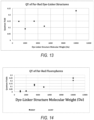
- Figure 13 shows QY for dye-linker structures 324, 326 for the same molecular weight linkers 224 as in the previous example. As shown in Figure 13 , the dye-linker structures 324, 326 exhibit a non-linear trend with linker 324 molecular weight.
- Figure 14 shows QY of dye-linker structures 324, 326 labelled onto two types of nanotube carriers 320, CNTs (reference) and BNNTs. As shown, there is a nominal difference in QY between CNT and BNNT carriers. Also, there is generally a linear trend between linker molecular weight and QY for both CNT and BNNT carriers.
- the fluorophores 320 exhibited lower QY than a reference dye (3,3'Diethythiadicarbobynine iodine, which is known to have QY of 0.31 in EtOH). Therefore, the fluorophores 320 exhibited quenching, especially for linker 324 MW below 10000.
- the green fluorophores 220 and far-red fluorophores 320 exhibited high extinction coefficients within linkers of molecular weight 5000, as estimated from the slope of the absorbance of the FITC entity 226 as a function of dye concentration (which in turn is related to the number of dye-linker structures on each nanotube carrier.
- Figure 16 shows the extinction coefficient of fluorophores 220 versus number of dye-linker structures 224, 226 per BNNT carrier 222. As shown, the extinction coefficient of these green fluorophores 220 can be as high as 1.65 ⁇ 10 12 to 5.63 ⁇ 10 13 M -1 cm -1 .
- the fluorescence intensity continues to increase linearly with the number of dye-linker structures 224, 226 labeled on BNNT carriers 222 (at the range of 3.96 ⁇ 10 7 to 3.2 ⁇ 10 8 dye-linker structures 224, 226 per BNNT carrier 222). This is unexpected as in prior art fluorophores, quenching occurred where more than a few dyes molecules were conjugated in close proximity.
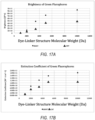
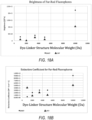
- Figures 17A-B and 18A-B show brightness and extinction coefficients of green and far-red fluorophores 220, 320 respectively, for both CNT (reference) and BNNT carriers.
- the extinction coefficients for green fluorophores 220 increase with linker MW up to about 2 ⁇ 10 11 M -1 cm -1 while brightness ranges between about 6 ⁇ 10 9 and 1 ⁇ 10 11 .
- the extinction coefficients increase with linker MW up to about 1 ⁇ 10 12 M -1 cm -1 and brightness ranges between about 4 ⁇ 10 10 and 2 ⁇ 10 11 .
- BNNT and CNT are structurally similar. However, CNTs are electrically conductive, while BNNTs are electrically insulating.
- the BNNT fluorophores exhibit a fluorescence intensity about 4.5 times larger than that for similar CNTs. This result suggests that the relative QY of red-fluorophores using BNNTs as the carrier can be 4.5-times higher than the QY of red-fluorophores using CNTs as the carrier.
- the fluorescent entity 26 used herein is connected to the carrier 20 through a long polymeric linker 24 e.g., one that is electrically insulating such as the DSPE-PEG linker discussed above. Accordingly, it is expected the linker 24 insulates the fluorescent entity 26 from any effect of the electrical conductivity of a CNT carrier 22.
- the discovered different fluorescent intensities between fluorophores with CNT carriers and BNNT carries implies characteristics of the carrier do affect the fluorescence of a fluorophore.
- electrically insulating nanomaterials form higher-brightness fluorophores with high QY than prior art fluorophores.
- Other electrically insulating nanomaterials that can be used as carrier 22 include BN nanosheets, BN nanoparticles, silica particles, alumina particles, nanowires or nanorods of Si, Ge, ZnO, etc.
- the high-brightness fluorophores described here are photostable even under the irradiation of tightly focused laser under a confocal fluorescence microscopy.
- red fluorophores 120 in HeLa cells were monitored for five days and did not indicate visible reduction in fluorescence intensity as examined using the same microscopy setting (same focus ratio, same light source power, same gain and same excitation wavelength).
- proliferation and signal stability were observed in daughter cells. This result suggests that the structure of the fluorophores described herein is stable and biological compatible such that it can also be used as a photostable stain in vitro and in vivo for tracking.
- red fluorophores 120 exhibited a relationship between concentration of dye-linkers and fluorescence intensity. This means fluorescence intensity described above for red, green, and far-red fluorophores has the same trend inside cells and is therefore applicable for in vitro and in vivo cell tracking application.
- fluorophores 20 including multiple types of fluorescent entities 26 linked to a single carrier 22 are also contemplated.
- any of the fluorophores 20 described herein can also be conjugated with biological molecules such as antibodies in addition to fluorescent entities 26 using the same or different linkers 24.
- biological molecules such as antibodies in addition to fluorescent entities 26 using the same or different linkers 24.
- Antibodies or other biological molecules can be attached to linkers 24 by known methods and chemistries.
- linkers 24 include R functional groups to facilitate conjugation to other molecules.
- the R group can be selected according to the biological molecule to be attached to the linker 24. For instance, a monosulfone-thiol reaction can be used to conjugate an antibody to a monosulfone R-group. Malimide R groups can also be used.
- the green fluorophore 220 with 5000 MW linker 224 discussed above was co-labelled anti-human CD4 on BNNT carriers 222. Absorption spectra indicated that the antibody concentration on fluorophore 220 was comparable to that of the commercial FITC fluorophores with CD4. The fluorophore 220 with CD4 had 5X higher fluorescence intensity than the commercial anti-human CD4 FITC compound at 4X lower concentration.
- fluorophores 20 can also be labelled with peptides, oligonucleotides or other macromolecules such as DNA, RNA, antibodies via a linker 24 in the same manner discussed above.
- Cross-linkers which contain dual functional groups can also be used to connect the linker 24 to other entities such as fluorescent entities 26, peptides, oligonucleotides, DNA, RNA, antibodies, etc.
- Example cross-linkers might be SMCC (succinimidyl 4-(N-maleimidomethyl)cyclohexane-1-carboxylate), sulfo-SMCC ((sulfosuccinimidyl 4-(N-maleimidomethyl)cyclohexane-1-carboxylate), AMAS (N- ⁇ -maleimidoacet-oxysuccinimide ester), BMPS (N- ⁇ -maleimidopropyl-oxysuccinimide ester), GMBS (N- ⁇ -maleimidobutyryl-oxysuccinimide ester), sulfo-GMBS, MBS (m-maleimidobenzoyl-N-hydroxysuccinimide ester), sulfo-MBS,
Landscapes
- Health & Medical Sciences (AREA)
- Life Sciences & Earth Sciences (AREA)
- Engineering & Computer Science (AREA)
- Immunology (AREA)
- Chemical & Material Sciences (AREA)
- Biomedical Technology (AREA)
- Molecular Biology (AREA)
- General Health & Medical Sciences (AREA)
- Hematology (AREA)
- Urology & Nephrology (AREA)
- Medicinal Chemistry (AREA)
- Biotechnology (AREA)
- Biochemistry (AREA)
- Pathology (AREA)
- Physics & Mathematics (AREA)
- Food Science & Technology (AREA)
- Analytical Chemistry (AREA)
- General Physics & Mathematics (AREA)
- Microbiology (AREA)
- Cell Biology (AREA)
- Nanotechnology (AREA)
- Animal Behavior & Ethology (AREA)
- Public Health (AREA)
- Veterinary Medicine (AREA)
- Epidemiology (AREA)
- Biophysics (AREA)
- Medical Informatics (AREA)
- Organic Chemistry (AREA)
- Bioinformatics & Cheminformatics (AREA)
- General Engineering & Computer Science (AREA)
- Pharmacology & Pharmacy (AREA)
- Crystallography & Structural Chemistry (AREA)
- Tropical Medicine & Parasitology (AREA)
- Proteomics, Peptides & Aminoacids (AREA)
- Genetics & Genomics (AREA)
- Heart & Thoracic Surgery (AREA)
- Surgery (AREA)
- Investigating Or Analysing Materials By The Use Of Chemical Reactions (AREA)
- Investigating, Analyzing Materials By Fluorescence Or Luminescence (AREA)
- Investigating Or Analysing Biological Materials (AREA)
Claims (15)
- Ein Fluorophor, der Folgendes umfasst:einen Träger, der ein Bornitridnanoröhrchen ist,mindestens eine fluoreszierende Einheit undein amphiphiles Verknüpfungselement, das jede der mindestens einen fluoreszierenden Einheiten mit dem Träger verbindet, wobei das Verknüpfungselement ein Molekulargewicht von mehr als 1000 Da und/oder eine gestreckte Verknüpfungselementlänge von mehr als 5 Nanometern hat, wobei das Verknüpfungselement mindestens einen hydrophilen Anteil und einen hydrophoben Anteil umfasst und wobei der hydrophobe Anteil nicht-kovalent an den Träger gebunden ist und der hydrophile Anteil kovalent an die fluoreszierende Einheit gebunden ist.
- Der Fluorophor gemäß Anspruch 1, wobei der hydrophile Anteil eine Kette wasserlöslicher Polymermoleküle einschließt, gebunden an den hydrophoben Anteil an einem ersten Ende, und die mindestens eine fluoreszierende Einheit an einem zweiten Ende an die Kette gebunden ist; wobei das Verknüpfungselement stärker bevorzugt eine DSPE- (1,2-Distearoyl-sn-glycero-3-phosphoethanolamin-)Gruppe und eine Kette von Polyethylenglykol-(PEG-)Molekülen umfasst.
- Der Fluorophor gemäß Anspruch 1, wobei die mindestens eine fluoreszierende Einheit mindestens eines von einem Cumarin, einem Benzoxadiazol, einem Acridon, einem Acridin, einem Bisbenzimid, Indol, Benzoisochinolin, Naphthalen, Anthracen, Xanthen, Pyren, Porphyrin, Fluoreszein, Rhodamin, Bor-Dipyrromethen (BODIPY) und einem Cyaninderivat umfasst.
- Ein Fluorophor gemäß Anspruch 1, der Folgendes umfasst:ein Bornitridnanoröhrchen;mindestens ein amphiphiles Verknüpfungselement, das einen hydrophoben Anteil und einen hydrophilen Anteil hat, wobei der hydrophobe Anteil nicht-kovalent an das Nanoröhrchen gebunden ist, wobei das mindestens eine amphiphile Verknüpfungselement ein Molekulargewicht von mehr als 1000 Da hat, undmindestens eine fluoreszierende Einheit, kovalent an den hydrophilen Anteil des mindestens einen amphiphilen Verknüpfungselements gebunden.
- Der Fluorophor gemäß Anspruch 4, wobei der hydrophile Anteil eine Kette wasserlöslicher Polymermoleküle einschließt.
- Der Fluorophor gemäß Anspruch 5, wobei die wasserlöslichen Polymermoleküle Polyethylenglykol- (PEG-)Moleküle sind.
- Der Fluorophor gemäß Anspruch 6, wobei das Verknüpfungselement eine DSPE- (1,2-Distearoyl-sn-glycero-3-phosphoethanolamin-)Gruppe umfasst.
- Der Fluorophor gemäß Anspruch 5, wobei die Kette von PEG-Molekülen ein Molekulargewicht von mehr als 1000 Da hat.
- Der Fluorophor gemäß Anspruch 8, wobei die Kette von PEG-Molekülen eine gestreckte Länge von mehr als 5 Nanometern hat.
- Der Fluorophor gemäß Anspruch 1 oder Anspruch 7, wobei das Verknüpfungselement ein Molekulargewicht von mehr als 3400 Da hat und/oder wobei das Verknüpfungselement ein Molekulargewicht von weniger als 10000 Da hat.
- Der Fluorophor gemäß Anspruch 1 oder Anspruch 8, wobei die Länge des Nanoröhrchens zwischen 50 und 1000 nm beträgt.
- Der Fluorophor gemäß Anspruch 1 oder Anspruch 8, der mindestens 100 fluoreszierende Einheiten, vorzugsweise mindestens 1000 fluoreszierende Einheiten, umfasst.
- Der Fluorophor gemäß Anspruch 1 oder Anspruch 8, wobei die mindestens eine fluoreszierende Einheit eine erste fluoreszierende Einheit und eine zweite fluoreszierende Einheit umfasst, die sich von der ersten fluoreszierenden Einheit unterscheidet.
- Der Fluorophor gemäß Anspruch 1 oder Anspruch 8, der weiter einen Anteil umfasst, welcher gewählt ist aus einer Gruppe aus einem Kronenether, einem Kohlenhydrat, einer Nukleinsäure, einem Peptid, einem Oligonukleotid, einem Protein und einem Antikörper, wobei das Verknüpfungselement ein erstes Verknüpfungselement ist und ein zweites Verknüpfungselement den Anteil mit dem Nanoröhrchen verknüpft.
- Der Fluorophor gemäß Anspruch 1 oder Anspruch 8, wobei das mindestens eine Verknüpfungselement über eine reaktionsfähige Funktionsgruppe kovalent an die mindestens eine fluoreszierende Einheit gebunden ist.
Applications Claiming Priority (2)
| Application Number | Priority Date | Filing Date | Title |
|---|---|---|---|
| US201762485379P | 2017-04-13 | 2017-04-13 | |
| PCT/US2018/027612 WO2018191690A1 (en) | 2017-04-13 | 2018-04-13 | High-brightness fluorophores |
Publications (2)
| Publication Number | Publication Date |
|---|---|
| EP3610259A1 EP3610259A1 (de) | 2020-02-19 |
| EP3610259B1 true EP3610259B1 (de) | 2025-02-12 |
Family
ID=62116577
Family Applications (1)
| Application Number | Title | Priority Date | Filing Date |
|---|---|---|---|
| EP18722811.9A Active EP3610259B1 (de) | 2017-04-13 | 2018-04-13 | Fluorophoren mit hoher helligkeit |
Country Status (8)
| Country | Link |
|---|---|
| US (2) | US20180296705A1 (de) |
| EP (1) | EP3610259B1 (de) |
| JP (2) | JP7116743B2 (de) |
| KR (2) | KR102536155B1 (de) |
| CN (1) | CN110753844A (de) |
| CA (1) | CA3061892A1 (de) |
| ES (1) | ES3033941T3 (de) |
| WO (1) | WO2018191690A1 (de) |
Families Citing this family (8)
| Publication number | Priority date | Publication date | Assignee | Title |
|---|---|---|---|---|
| CA3061892A1 (en) * | 2017-04-13 | 2018-10-18 | Michigan Technological University | High-brightness fluorophores |
| US12544462B2 (en) | 2017-04-13 | 2026-02-10 | Michigan Technological University | Composite high-brightness fluorophores with controllable spectra shapes and method of using composite highbrightness fluorophores |
| CN109916866B (zh) * | 2019-03-04 | 2021-06-29 | 三峡大学 | 一种七元氟硼荧光染料的新用途 |
| EP3977123A1 (de) * | 2019-05-31 | 2022-04-06 | Michigan Technological University | Nanoröhrchen-fluorophore mit hoher helligkeit durch kovalente funktionalisierung |
| CN113892026A (zh) * | 2019-05-31 | 2022-01-04 | 密歇根理工大学 | 通过共价官能化的高亮度纳米点荧光团 |
| EP4018192A1 (de) * | 2019-08-21 | 2022-06-29 | Michigan Technological University | Sehr helle fluorophore zur quantifizierung und phänotypisierung von extrazellulären vesikeln |
| KR20220070512A (ko) * | 2019-09-30 | 2022-05-31 | 미시간 테크놀로지컬 유니버시티 | 제어 가능한 스펙트럼 형태를 갖는 복합 고휘도 형광단 및 복합 고휘도 형광단을 사용하는 방법 |
| CN110964513A (zh) * | 2019-12-13 | 2020-04-07 | 齐齐哈尔大学 | 一种香豆素功能化氧化石墨烯可逆荧光探针及其制备方法和应用 |
Family Cites Families (5)
| Publication number | Priority date | Publication date | Assignee | Title |
|---|---|---|---|---|
| FR2840611B1 (fr) * | 2002-06-06 | 2005-09-09 | Cis Bio Int | Entite fluorescente comportant un fluorophore lie de maniere covalente a au moins un oligonucleotide et comportant au moins un groupe fonctionnel et ses utilisations |
| JP2012032358A (ja) * | 2010-08-03 | 2012-02-16 | National Institute Of Advanced Industrial & Technology | 蛍光分子内包型カーボンナノチューブ |
| US10024863B2 (en) * | 2013-03-15 | 2018-07-17 | Life Technologies Corporation | Methods for dye selection for protein melt temperature determinations |
| US20150056142A1 (en) * | 2013-08-20 | 2015-02-26 | The Board Of Trustees Of The Leland Stanford Junior University | Near-infrared-ii fluorescent agents, methods of making near-infrared-ii fluorescent agents, and methods of using water-soluble nir-ii fluorescent agents |
| CA3061892A1 (en) * | 2017-04-13 | 2018-10-18 | Michigan Technological University | High-brightness fluorophores |
-
2018
- 2018-04-13 CA CA3061892A patent/CA3061892A1/en active Pending
- 2018-04-13 WO PCT/US2018/027612 patent/WO2018191690A1/en not_active Ceased
- 2018-04-13 EP EP18722811.9A patent/EP3610259B1/de active Active
- 2018-04-13 CN CN201880040069.3A patent/CN110753844A/zh active Pending
- 2018-04-13 ES ES18722811T patent/ES3033941T3/es active Active
- 2018-04-13 JP JP2019556207A patent/JP7116743B2/ja active Active
- 2018-04-13 KR KR1020217026065A patent/KR102536155B1/ko active Active
- 2018-04-13 KR KR1020197033463A patent/KR102292609B1/ko active Active
- 2018-04-13 US US15/953,200 patent/US20180296705A1/en active Pending
-
2022
- 2022-07-29 JP JP2022121082A patent/JP2022174038A/ja active Pending
-
2025
- 2025-01-05 US US19/010,120 patent/US20250127934A1/en active Pending
Non-Patent Citations (3)
| Title |
|---|
| CIOFANI GIANNI ET AL: "Folate Functionalized Boron Nitride Nanotubes and their Selective Uptake by Glioblastoma Multiforme Cells: Implications for their Use as Boron Carriers in Clinical Boron Neutron Capture Therapy", NANOSCALE RESEARCH LETTERS, vol. 4, no. 2, 25 November 2008 (2008-11-25), pages 113 - 121, XP055851623, DOI: 10.1007/s11671-008-9210-9 * |
| CIOFANI GIANNI ET AL: "Transferrin-conjugated boron nitride nanotubes: Protein grafting, characterization, and interaction with human endothelial cells", INTERNATIONAL JOURNAL OF PHARMACEUTICS, vol. 436, no. 1-2, 23 June 2012 (2012-06-23), NL, pages 444 - 453, XP055851624, ISSN: 0378-5173, DOI: 10.1016/j.ijpharm.2012.06.037 * |
| XING CHEN ET AL: "Boron Nitride Nanotubes Are Noncytotoxic and Can Be Functionalized for Interaction with Proteins and Cells", JOURNAL OF THE AMERICAN CHEMICAL SOCIETY, vol. 131, no. 3, 28 January 2009 (2009-01-28), pages 890 - 891, XP055012679, ISSN: 0002-7863, DOI: 10.1021/ja807334b * |
Also Published As
| Publication number | Publication date |
|---|---|
| CA3061892A1 (en) | 2018-10-18 |
| WO2018191690A1 (en) | 2018-10-18 |
| US20180296705A1 (en) | 2018-10-18 |
| JP2022174038A (ja) | 2022-11-22 |
| KR20210107141A (ko) | 2021-08-31 |
| CN110753844A (zh) | 2020-02-04 |
| KR102292609B1 (ko) | 2021-08-23 |
| KR20200006541A (ko) | 2020-01-20 |
| EP3610259A1 (de) | 2020-02-19 |
| JP7116743B2 (ja) | 2022-08-10 |
| US20250127934A1 (en) | 2025-04-24 |
| KR102536155B1 (ko) | 2023-05-26 |
| JP2020516749A (ja) | 2020-06-11 |
| ES3033941T3 (en) | 2025-08-11 |
Similar Documents
| Publication | Publication Date | Title |
|---|---|---|
| US20250127934A1 (en) | High-brightness fluorophores | |
| Zuo et al. | A review on syntheses, properties, characterization and bioanalytical applications of fluorescent carbon dots | |
| Qian et al. | DNA nanosensor based on biocompatible graphene quantum dots and carbon nanotubes | |
| Ali et al. | Red fluorescent carbon nanoparticle-based cell imaging probe | |
| Li et al. | Chemical modification of M13 bacteriophage and its application in cancer cell imaging | |
| US10254287B2 (en) | Protein fluorescent nanoparticles and methods of synthesis thereof | |
| Ding et al. | Fluorescent detection of Mucin 1 protein based on aptamer functionalized biocompatible carbon dots and graphene oxide | |
| Lv et al. | Conjugated polymer-based hybrid nanoparticles with two-photon excitation and near-infrared emission features for fluorescence bioimaging within the biological window | |
| US20190212335A1 (en) | AIE Nanoparticle Conjugates And Methods Therefor | |
| Botequim et al. | Fluorescent dye nano-assemblies by thiol attachment directed to the tips of gold nanorods for effective emission enhancement | |
| Choudhury et al. | Carbon dots-stimulated amplification of aggregation-induced emission of size-tunable organic nanoparticles | |
| KR102881189B1 (ko) | 공유적 작용기화에 의한 고휘도 나노도트 형광단 | |
| WO2013011242A1 (fr) | Nouveau chromophore hydrosoluble | |
| KR102945851B1 (ko) | 공유적 작용기화에 의한 고휘도 형광단 | |
| US20220229048A1 (en) | High-brightness fluorophores by covalent functionalization | |
| Patsenker et al. | Conjugates, complexes, and interlocked systems based on squaraines and cyanines | |
| US20220226509A1 (en) | High-brightness nanodot fluorophores by covalent functionalization | |
| Li et al. | Conjugated Polymers for Two‐Photon Live Cell Imaging | |
| WO2024215301A1 (en) | High-brightness fluorescent probes | |
| Melnychuk | Synthesis of organic fluorescent nanoparticles for detection of biomolecules | |
| Morales et al. | Folate Receptor Targeting Probes for Two-Photon Fluorescence Bioimaging |
Legal Events
| Date | Code | Title | Description |
|---|---|---|---|
| STAA | Information on the status of an ep patent application or granted ep patent |
Free format text: STATUS: UNKNOWN |
|
| STAA | Information on the status of an ep patent application or granted ep patent |
Free format text: STATUS: THE INTERNATIONAL PUBLICATION HAS BEEN MADE |
|
| PUAI | Public reference made under article 153(3) epc to a published international application that has entered the european phase |
Free format text: ORIGINAL CODE: 0009012 |
|
| STAA | Information on the status of an ep patent application or granted ep patent |
Free format text: STATUS: REQUEST FOR EXAMINATION WAS MADE |
|
| 17P | Request for examination filed |
Effective date: 20191112 |
|
| AK | Designated contracting states |
Kind code of ref document: A1 Designated state(s): AL AT BE BG CH CY CZ DE DK EE ES FI FR GB GR HR HU IE IS IT LI LT LU LV MC MK MT NL NO PL PT RO RS SE SI SK SM TR |
|
| AX | Request for extension of the european patent |
Extension state: BA ME |
|
| DAV | Request for validation of the european patent (deleted) | ||
| DAX | Request for extension of the european patent (deleted) | ||
| STAA | Information on the status of an ep patent application or granted ep patent |
Free format text: STATUS: EXAMINATION IS IN PROGRESS |
|
| 17Q | First examination report despatched |
Effective date: 20200928 |
|
| GRAP | Despatch of communication of intention to grant a patent |
Free format text: ORIGINAL CODE: EPIDOSNIGR1 |
|
| STAA | Information on the status of an ep patent application or granted ep patent |
Free format text: STATUS: GRANT OF PATENT IS INTENDED |
|
| INTG | Intention to grant announced |
Effective date: 20240903 |
|
| GRAS | Grant fee paid |
Free format text: ORIGINAL CODE: EPIDOSNIGR3 |
|
| GRAA | (expected) grant |
Free format text: ORIGINAL CODE: 0009210 |
|
| STAA | Information on the status of an ep patent application or granted ep patent |
Free format text: STATUS: THE PATENT HAS BEEN GRANTED |
|
| AK | Designated contracting states |
Kind code of ref document: B1 Designated state(s): AL AT BE BG CH CY CZ DE DK EE ES FI FR GB GR HR HU IE IS IT LI LT LU LV MC MK MT NL NO PL PT RO RS SE SI SK SM TR |
|
| REG | Reference to a national code |
Ref country code: GB Ref legal event code: FG4D |
|
| REG | Reference to a national code |
Ref country code: CH Ref legal event code: EP |
|
| REG | Reference to a national code |
Ref country code: DE Ref legal event code: R096 Ref document number: 602018079059 Country of ref document: DE |
|
| REG | Reference to a national code |
Ref country code: IE Ref legal event code: FG4D |
|
| REG | Reference to a national code |
Ref country code: NL Ref legal event code: FP |
|
| P01 | Opt-out of the competence of the unified patent court (upc) registered |
Free format text: CASE NUMBER: APP_23711/2025 Effective date: 20250519 |
|
| PG25 | Lapsed in a contracting state [announced via postgrant information from national office to epo] |
Ref country code: RS Free format text: LAPSE BECAUSE OF FAILURE TO SUBMIT A TRANSLATION OF THE DESCRIPTION OR TO PAY THE FEE WITHIN THE PRESCRIBED TIME-LIMIT Effective date: 20250512 |
|
| PG25 | Lapsed in a contracting state [announced via postgrant information from national office to epo] |
Ref country code: FI Free format text: LAPSE BECAUSE OF FAILURE TO SUBMIT A TRANSLATION OF THE DESCRIPTION OR TO PAY THE FEE WITHIN THE PRESCRIBED TIME-LIMIT Effective date: 20250212 |
|
| PG25 | Lapsed in a contracting state [announced via postgrant information from national office to epo] |
Ref country code: PL Free format text: LAPSE BECAUSE OF FAILURE TO SUBMIT A TRANSLATION OF THE DESCRIPTION OR TO PAY THE FEE WITHIN THE PRESCRIBED TIME-LIMIT Effective date: 20250212 |
|
| PGFP | Annual fee paid to national office [announced via postgrant information from national office to epo] |
Ref country code: DE Payment date: 20250528 Year of fee payment: 8 |
|
| PGFP | Annual fee paid to national office [announced via postgrant information from national office to epo] |
Ref country code: ES Payment date: 20250528 Year of fee payment: 8 |
|
| REG | Reference to a national code |
Ref country code: LT Ref legal event code: MG9D |
|
| PG25 | Lapsed in a contracting state [announced via postgrant information from national office to epo] |
Ref country code: IS Free format text: LAPSE BECAUSE OF FAILURE TO SUBMIT A TRANSLATION OF THE DESCRIPTION OR TO PAY THE FEE WITHIN THE PRESCRIBED TIME-LIMIT Effective date: 20250612 Ref country code: NO Free format text: LAPSE BECAUSE OF FAILURE TO SUBMIT A TRANSLATION OF THE DESCRIPTION OR TO PAY THE FEE WITHIN THE PRESCRIBED TIME-LIMIT Effective date: 20250512 |
|
| PG25 | Lapsed in a contracting state [announced via postgrant information from national office to epo] |
Ref country code: HR Free format text: LAPSE BECAUSE OF FAILURE TO SUBMIT A TRANSLATION OF THE DESCRIPTION OR TO PAY THE FEE WITHIN THE PRESCRIBED TIME-LIMIT Effective date: 20250212 |
|
| PG25 | Lapsed in a contracting state [announced via postgrant information from national office to epo] |
Ref country code: PT Free format text: LAPSE BECAUSE OF FAILURE TO SUBMIT A TRANSLATION OF THE DESCRIPTION OR TO PAY THE FEE WITHIN THE PRESCRIBED TIME-LIMIT Effective date: 20250612 Ref country code: LV Free format text: LAPSE BECAUSE OF FAILURE TO SUBMIT A TRANSLATION OF THE DESCRIPTION OR TO PAY THE FEE WITHIN THE PRESCRIBED TIME-LIMIT Effective date: 20250212 |
|
| PG25 | Lapsed in a contracting state [announced via postgrant information from national office to epo] |
Ref country code: GR Free format text: LAPSE BECAUSE OF FAILURE TO SUBMIT A TRANSLATION OF THE DESCRIPTION OR TO PAY THE FEE WITHIN THE PRESCRIBED TIME-LIMIT Effective date: 20250513 Ref country code: BG Free format text: LAPSE BECAUSE OF FAILURE TO SUBMIT A TRANSLATION OF THE DESCRIPTION OR TO PAY THE FEE WITHIN THE PRESCRIBED TIME-LIMIT Effective date: 20250212 |
|
| PGFP | Annual fee paid to national office [announced via postgrant information from national office to epo] |
Ref country code: CH Payment date: 20250604 Year of fee payment: 8 |
|
| REG | Reference to a national code |
Ref country code: ES Ref legal event code: FG2A Ref document number: 3033941 Country of ref document: ES Kind code of ref document: T3 Effective date: 20250811 |
|
| REG | Reference to a national code |
Ref country code: AT Ref legal event code: MK05 Ref document number: 1766478 Country of ref document: AT Kind code of ref document: T Effective date: 20250212 |
|
| PG25 | Lapsed in a contracting state [announced via postgrant information from national office to epo] |
Ref country code: SE Free format text: LAPSE BECAUSE OF FAILURE TO SUBMIT A TRANSLATION OF THE DESCRIPTION OR TO PAY THE FEE WITHIN THE PRESCRIBED TIME-LIMIT Effective date: 20250212 |
|
| PG25 | Lapsed in a contracting state [announced via postgrant information from national office to epo] |
Ref country code: SM Free format text: LAPSE BECAUSE OF FAILURE TO SUBMIT A TRANSLATION OF THE DESCRIPTION OR TO PAY THE FEE WITHIN THE PRESCRIBED TIME-LIMIT Effective date: 20250212 |
|
| PG25 | Lapsed in a contracting state [announced via postgrant information from national office to epo] |
Ref country code: DK Free format text: LAPSE BECAUSE OF FAILURE TO SUBMIT A TRANSLATION OF THE DESCRIPTION OR TO PAY THE FEE WITHIN THE PRESCRIBED TIME-LIMIT Effective date: 20250212 |
|
| PGFP | Annual fee paid to national office [announced via postgrant information from national office to epo] |
Ref country code: IT Payment date: 20250620 Year of fee payment: 8 |
|
| PG25 | Lapsed in a contracting state [announced via postgrant information from national office to epo] |
Ref country code: AT Free format text: LAPSE BECAUSE OF FAILURE TO SUBMIT A TRANSLATION OF THE DESCRIPTION OR TO PAY THE FEE WITHIN THE PRESCRIBED TIME-LIMIT Effective date: 20250212 |
|
| PG25 | Lapsed in a contracting state [announced via postgrant information from national office to epo] |
Ref country code: EE Free format text: LAPSE BECAUSE OF FAILURE TO SUBMIT A TRANSLATION OF THE DESCRIPTION OR TO PAY THE FEE WITHIN THE PRESCRIBED TIME-LIMIT Effective date: 20250212 Ref country code: CZ Free format text: LAPSE BECAUSE OF FAILURE TO SUBMIT A TRANSLATION OF THE DESCRIPTION OR TO PAY THE FEE WITHIN THE PRESCRIBED TIME-LIMIT Effective date: 20250212 |
|
| PG25 | Lapsed in a contracting state [announced via postgrant information from national office to epo] |
Ref country code: RO Free format text: LAPSE BECAUSE OF FAILURE TO SUBMIT A TRANSLATION OF THE DESCRIPTION OR TO PAY THE FEE WITHIN THE PRESCRIBED TIME-LIMIT Effective date: 20250212 |
|
| PG25 | Lapsed in a contracting state [announced via postgrant information from national office to epo] |
Ref country code: SK Free format text: LAPSE BECAUSE OF FAILURE TO SUBMIT A TRANSLATION OF THE DESCRIPTION OR TO PAY THE FEE WITHIN THE PRESCRIBED TIME-LIMIT Effective date: 20250212 |
|
| REG | Reference to a national code |
Ref country code: DE Ref legal event code: R097 Ref document number: 602018079059 Country of ref document: DE |
|
| PG25 | Lapsed in a contracting state [announced via postgrant information from national office to epo] |
Ref country code: LU Free format text: LAPSE BECAUSE OF NON-PAYMENT OF DUE FEES Effective date: 20250413 |
|
| PLBE | No opposition filed within time limit |
Free format text: ORIGINAL CODE: 0009261 |
|
| STAA | Information on the status of an ep patent application or granted ep patent |
Free format text: STATUS: NO OPPOSITION FILED WITHIN TIME LIMIT |
|
| PG25 | Lapsed in a contracting state [announced via postgrant information from national office to epo] |
Ref country code: MC Free format text: LAPSE BECAUSE OF FAILURE TO SUBMIT A TRANSLATION OF THE DESCRIPTION OR TO PAY THE FEE WITHIN THE PRESCRIBED TIME-LIMIT Effective date: 20250212 |
|
| REG | Reference to a national code |
Ref country code: BE Ref legal event code: MM Effective date: 20250430 |
|
| PG25 | Lapsed in a contracting state [announced via postgrant information from national office to epo] |
Ref country code: BE Free format text: LAPSE BECAUSE OF NON-PAYMENT OF DUE FEES Effective date: 20250430 |
|
| 26N | No opposition filed |
Effective date: 20251113 |
|
| PGFP | Annual fee paid to national office [announced via postgrant information from national office to epo] |
Ref country code: GB Payment date: 20260317 Year of fee payment: 9 |
|
| PG25 | Lapsed in a contracting state [announced via postgrant information from national office to epo] |
Ref country code: IE Free format text: LAPSE BECAUSE OF NON-PAYMENT OF DUE FEES Effective date: 20250413 |
|
| PGFP | Annual fee paid to national office [announced via postgrant information from national office to epo] |
Ref country code: NL Payment date: 20260311 Year of fee payment: 9 |
|
| PGFP | Annual fee paid to national office [announced via postgrant information from national office to epo] |
Ref country code: FR Payment date: 20260331 Year of fee payment: 9 |