EP3609947B1 - Monomeric balance control in the preparation of precursors for polyamidation processes - Google Patents
Monomeric balance control in the preparation of precursors for polyamidation processes Download PDFInfo
- Publication number
- EP3609947B1 EP3609947B1 EP18721598.3A EP18721598A EP3609947B1 EP 3609947 B1 EP3609947 B1 EP 3609947B1 EP 18721598 A EP18721598 A EP 18721598A EP 3609947 B1 EP3609947 B1 EP 3609947B1
- Authority
- EP
- European Patent Office
- Prior art keywords
- diamine
- balance
- acid
- diacid
- salt
- Prior art date
- Legal status (The legal status is an assumption and is not a legal conclusion. Google has not performed a legal analysis and makes no representation as to the accuracy of the status listed.)
- Active
Links
Images





Classifications
-
- C—CHEMISTRY; METALLURGY
- C08—ORGANIC MACROMOLECULAR COMPOUNDS; THEIR PREPARATION OR CHEMICAL WORKING-UP; COMPOSITIONS BASED THEREON
- C08G—MACROMOLECULAR COMPOUNDS OBTAINED OTHERWISE THAN BY REACTIONS ONLY INVOLVING UNSATURATED CARBON-TO-CARBON BONDS
- C08G69/00—Macromolecular compounds obtained by reactions forming a carboxylic amide link in the main chain of the macromolecule
- C08G69/02—Polyamides derived from amino-carboxylic acids or from polyamines and polycarboxylic acids
- C08G69/26—Polyamides derived from amino-carboxylic acids or from polyamines and polycarboxylic acids derived from polyamines and polycarboxylic acids
- C08G69/28—Preparatory processes
-
- B—PERFORMING OPERATIONS; TRANSPORTING
- B01—PHYSICAL OR CHEMICAL PROCESSES OR APPARATUS IN GENERAL
- B01J—CHEMICAL OR PHYSICAL PROCESSES, e.g. CATALYSIS OR COLLOID CHEMISTRY; THEIR RELEVANT APPARATUS
- B01J19/00—Chemical, physical or physico-chemical processes in general; Their relevant apparatus
- B01J19/0006—Controlling or regulating processes
-
- B—PERFORMING OPERATIONS; TRANSPORTING
- B01—PHYSICAL OR CHEMICAL PROCESSES OR APPARATUS IN GENERAL
- B01J—CHEMICAL OR PHYSICAL PROCESSES, e.g. CATALYSIS OR COLLOID CHEMISTRY; THEIR RELEVANT APPARATUS
- B01J4/00—Feed or outlet devices; Feed or outlet control devices
- B01J4/008—Feed or outlet control devices
-
- G—PHYSICS
- G01—MEASURING; TESTING
- G01N—INVESTIGATING OR ANALYSING MATERIALS BY DETERMINING THEIR CHEMICAL OR PHYSICAL PROPERTIES
- G01N21/00—Investigating or analysing materials by the use of optical means, i.e. using sub-millimetre waves, infrared, visible or ultraviolet light
- G01N21/62—Systems in which the material investigated is excited whereby it emits light or causes a change in wavelength of the incident light
- G01N21/63—Systems in which the material investigated is excited whereby it emits light or causes a change in wavelength of the incident light optically excited
- G01N21/65—Raman scattering
-
- G—PHYSICS
- G16—INFORMATION AND COMMUNICATION TECHNOLOGY [ICT] SPECIALLY ADAPTED FOR SPECIFIC APPLICATION FIELDS
- G16C—COMPUTATIONAL CHEMISTRY; CHEMOINFORMATICS; COMPUTATIONAL MATERIALS SCIENCE
- G16C20/00—Chemoinformatics, i.e. ICT specially adapted for the handling of physicochemical or structural data of chemical particles, elements, compounds or mixtures
- G16C20/30—Prediction of properties of chemical compounds, compositions or mixtures
-
- G—PHYSICS
- G01—MEASURING; TESTING
- G01N—INVESTIGATING OR ANALYSING MATERIALS BY DETERMINING THEIR CHEMICAL OR PHYSICAL PROPERTIES
- G01N2201/00—Features of devices classified in G01N21/00
- G01N2201/12—Circuits of general importance; Signal processing
- G01N2201/129—Using chemometrical methods
Definitions
- This disclosure relates to a method for preparing aqueous salt solutions suitable as feeds for polyamidation.
- Raman spectroscopy and chemometric modelling are applied to provide an estimate of molar balance that is useful in characterization and control of either continuous, batch or semi-batch processes or feed systems used to supply polyamidation processes with suitable precursors.
- aqueous solutions containing diamines and dicarboxylic acids is an important and common intermediate step in their conversion into useful polyamides.
- Industrial processes making these solutions require control schemes that are affordable and capable of maintaining the process streams at their desired composition and concentration. Effective control improves polymer quality and avoids undesirable precipitation of solids.
- Several approaches are suitable for approximate control of initial steps of a preparation. Control based only on feed rates to the first mixing steps can be accomplished with volumetric, gravimetric or other conventional process instrumentation. Online pH instruments are also available. Best results with pH based systems require extensive control of dilution and temperature for the side stream to be analyzed by the pH instrument.
- Previously known salt production facilities generally depend upon pH instrumentation as a basis of control. pH instruments have limited precision due to their accuracy being determined by the buffer solutions used to calibrate them. In addition, the pH instruments are subject to drift and fouling. The accuracy of the pH measurement is such that it requires salt storage and blending to reduce salt balance variability to prevent swings of salt properties for the salt being used for polymer production. Storing salt is expensive and limits the maximum concentration of the salt used.
- Fine tuning the monomeric balance may be achieved within semi-batch or batch-wise operations by iterative steps of collecting samples for laboratory pH testing followed by adjustments in the vessels.
- US 3,730,685 relates to a process of automatically performing titrations of solutions.
- US 4,213,884 and US 4,251,653 relate to a two-step process for the production of concentrated salt solutions.
- US 4,442,260 relates to a multi-step process for the production of concentrated aqueous salt solutions using weight of salt charge as a key process control parameter.
- US 5,801,278 relates to a method of directly preparing salts in substantially solid particulate form in which variation in pH is used as an indicator of process consistency.
- US 9,561,999 relates to a two-step salt process using measurement of pH for control of salt monomeric balance.
- Respective aspects of a group of recent applications may be considered together to illustrate the relative complexity of current control systems: WO 2014/179057 , WO 2014/179058 , WO 2014/179060 , WO 2014/179061 , WO 2014/179062 , WO 2014/179064 , WO 2014/179065 , and WO 2014/179066 .
- the references relate to various features including weight-in-loss feeders to limit feed rate variability of the powdered dicarboxylic acid; sample loops for dilution and temperature control for online pH measurements; offline pH measurements; sample loops for the measurement of concentration using refractometers; density measurement; and the use of the various measurements from the systems described to build predictive models to tune control of molar balance and concentration.
- US 8,772,439 relates to the two-step processes of earlier patents to produce aqueous salt solutions.
- the diacid-diamine balance is determined by pH.
- US 8,802,810 relates to multi-step process to produce aqueous salt solutions of varying combinations of aliphatic, cycloaliphatic and aromatic diacids. Molar balance between the diacids and diamines is based upon pH.
- US 9,561,999 relates to the sensitivity of pH to temperature, composition and concentration.
- US 4,233,234 relates to a continuous preparation of aqueous nylon salt solutions in which a small fraction of the bulk stream is then taken off, diluted to 10% concentration and the pH is measured. The pH signal is used to control the amount of trim diamine injected into the bulk stream as required to tune the molar balance.
- US 2,130,947A relates to the inflection of the pH curve as the control point for ensuring the diamine and dicarboxylic acid are at a molar ratio that will polymerize to high molecular weight.
- NIR near infrared
- Instrumentation used for monitoring and control of polyamidation systems is both expensive and inadequate. An approach is needed to reduce costs and complexity. Therefore, it would be desirable to provide a relatively simple, lower-cost online method for analyzing polyamidation feed streams that functions reliably, consistently and accurately within the normal ranges of process conditions. Such a simple and reliable method is much desired in polyamide manufacturing. The method also needs to be affordable to implement at commercial scale.
- the problem is to develop a real-time, online measurement method for controlling the balance between diacid and diamine in an aqueous salt solution for making polyamides.
- a process control method for measuring and controlling diacid-diamine balance of a polyamide precursor solution comprising:
- One aspect of the disclosed process control method further comprises comparing the diacid:diamine balance determined in step (c) with a setpoint.
- Another aspect of the disclosed process control method further comprises adjusting at least one process variable in response to the comparison of the determined diacid:diamine balance with the setpoint.
- the polyamide precursor solution comprises at least one dicarboxylic acid, at least one diamine and water.
- the dicarboxylic acid comprises adipic acid.
- the diamine comprises hexamethylenediamine (HMD).
- the process variable that is adjusted in step (c) is selected from the group consisting of: flow rate of dicarboxylic acid or of a dicarboxylic acid-rich feed stream, flow rate of diamine or of a diamine-rich feed stream, residence time, and flow rate of additive.
- a process control method for measuring and controlling diacid-diamine balance of a polyamide precursor solution comprising:
- the disclosed process control method can comprise comparing the diacid:diamine balance determined in step (c) with a setpoint, and can further comprise adjusting at least one process variable in response to the comparison of the determined diacid:diamine balance with the setpoint.
- the polyamide precursor solution can comprise dicarboxylic acid, diamine and water.
- the dicarboxylic acid can be adipic acid, and the diamine can be hexamethylenediamine.
- a process of preparing nylon-6,6 including feeding the polyamide precursor solution to a batch, semi-batch or continuous polymerizer.
- the process can be controlled by adjusting one or more of: flow rate of dicarboxylic acid or of a dicarboxylic acid-rich feed stream, flow rate of diamine or of a diamine-rich feed stream, residence time, and flow rate of additive.
- the thermal polycondensation of salts of diamines and dicarboxylic acids is one of the most important means of production of polyamides via polymerization (also known as polyamidation).
- Diamine and dicarboxylic acid components are first reacted under conditions effective to form acid-base neutralization salts and the salts are then subjected to polycondensation conditions to prepare polyamides.
- polyamides may be produced via polymerization of aminocarboxylic acids, aminonitriles, or lactams.
- the polyamidation or polymerization process can include steps such as a salt strike step where polyamide (e.g., nylon 6,6) salt solutions are prepared using proper monomeric balance, an evaporation step where some of the water from the salt solution is evaporated off, an autoclave process where the salt solution is placed under heat and pressure for polyamidation, and extrusion/cutting steps where the essentially final polymeric raw materials are formed. Other steps can also be included as understood generally by those skilled in the art.
- steps such as a salt strike step where polyamide (e.g., nylon 6,6) salt solutions are prepared using proper monomeric balance
- an evaporation step where some of the water from the salt solution is evaporated off
- an autoclave process where the salt solution is placed under heat and pressure for polyamidation
- extrusion/cutting steps where the essentially final polymeric raw materials are formed.
- Other steps can also be included as understood generally by those skilled in the art.
- Calibration models can be developed and used to predict properties of interest based on measured properties of a chemical system, such as pressure, flow, temperature, infrared, Raman, NMR spectra and mass spectra. Examples include the development of multivariate models relating to multi-wavelength spectral responses to analyte concentration.
- the process involves a calibration data by gathering data from a number of reference samples, including analyte concentrations and salt monomeric balance for each sample and the corresponding spectrum of that sample.
- Multivariate calibration technique such as partial-least squares regression or principal component regression can be used to construct a mathematical model that relates the multivariate response to the analyte concentration. Such a model can be useful to predict the concentrations of new (unknown) samples.
- the present disclosure relates to the application of chemometric modelling and analysis of Raman spectra as a means of online analysis and control of salt composition.
- Raman spectra have relatively little sensitivity to temperature or moisture fluctuations and so provide a more fundamentally stable signal.
- the reduced sensitivity to temperature and concentration leads to less complicated deployment configurations.
- Raman spectra can be collected at process conditions providing a simpler deployment scenario than pH measurement. Less sensitivity to moisture and temperature provides fewer sources of noise and error than with NIR modelling. Adequate stability enables using plant configurations without large buffering storage between the balancing point and production.
- a chemometric model is developed for a specific system by varying the composition of the system and collecting spectra, followed by analysis of the collected samples and analysis of the spectra. The resulting model is then used dynamically by analysing input spectra and obtaining an estimate of the ends balance of the solution.
- Non-limiting examples of commercially available software packages for chemometric analysis and modeling may include Simca [Sartorius Stedim Biotech; http://umetrics.com/products/simca], PLS Toolbox or Solo [Eigenvector; http://www.eigenvector.corn], The Unscrambler X [Camo Software; http://www.camo.com/rt/Resources/chemometrics.html], GRAMS [ThermoFisher; https://www.thermofisher.com/order/catalog/product/INF-15000], Horizon [ABB; http://new.abb.com/products/measurement-products/analytical/ft-ir-and-ft-nir-software/horizon-mb-qa-software], PLSplus IQ [Adept Scientific; http://www.adeptscience.co.ulc/products/lab/ gramsai/plsplus-iq-spectroscopy-chemometrics-toolbox.html],
- the processed data files from the above chemometric modeling may be exported for analysis by other techniques.
- One example of this approach may be to use peak heights or peak areas of any specific ranges of a spectral response within general multi-variate analysis, such as that illustrated by using MiniTab analysis in Example 3.
- MiniTab analysis in Example 3.
- Several software packages are commercially available to perform such analysis.
- the instrumentation probe for Raman spectroscopy measurement may be inserted into a flowline, into a slip stream, into a main process vessel, a transfer or measuring vessel, or into any other suitable process point.
- the Raman probe may alternatively be located in the lab sample collection point. The choice of probe location must be appropriate for the specific process design and control scheme utilized.
- the instrumentation probe for Raman spectroscopy measurement may be inserted into a flowline of an acid-rich solution.
- the instrumentation probe for Raman spectroscopy measurement may be inserted in the output flowline from a salt balancing process vessel.
- the instrumentation probe for Raman spectroscopy measurement may be inserted in the output flowline from an acid dilution process vessel.
- the instrumentation probe for Raman spectroscopy measurement may be submerged in the contents of a salt solution supply vessel.
- a skilled person in the field of process control will understand that application may involve any of these either by itself or in combination along with the other process control instruments and devices that are integrated with the process control architecture.
- Suitable salt solutions include the aqueous precursors of polyamides, which can be charged to batch or continuous polymerizers to carry out condensation reactions to make nylons.
- aqueous precursors of polyamides Such lists of precursors are well known in the art, and may include those appropriate for manufacturing nylon 6,6, nylon 6,12, nylon 6,10, nylon 4,6, and such like and any copolymers or blends thereof. Inclusion of polymer additives would not be a departure from the envisioned embodiments.
- the Raman probe is fixed in a suitable process location as required by the desired embodiment.
- the illuminating laser is transmitted from the spectrometer via a fiber optic cable through the probe and into the process fluid.
- the lens of the probe also collects the scattered light.
- the scattered light is then filtered so that only Raman scattering light is included.
- This scattered light is then split so that it may be processed into a spectrum of scattered light intensities as a function of wavelength.
- spectral processing software such as is familiar to those skilled in the art. Multiple individual spectra can be co-added into a single composite spectrum as required to achieve the desired resolution, with the number of spectra co-added being dependent on the embodiment, configuration, instrument and resolution required.
- the number of spectra co-added fixes the periodicity of the sampling rate.
- These Raman spectra are analyzed using the Partial Least Square [or PLS] chemometrics model to give a continuous estimate of real time salt monomeric balance. This monomeric balance estimate then can be used to correct the monomeric balance of the salt for any deviations from target by precise metering of diamine and/or diacid flows to the process.
- Dimonomeric polyamides are those which are derived from the condensation polymerization of a dicarboxylic acid and a diamine. Adipic acid and hexamethylenediamine, for example, are commonly polymerized to form nylon 6,6. Copolyamides are often prepared from aqueous solutions or blends of aqueous solutions that contain more than two monomers.
- the dicarboxylic acid component is suitably at least one dicarboxylic acid of the molecular formula (I): HO2C-R1-CO2H; wherein R1 represents a divalent aliphatic, cycloaliphatic or aromatic radical or a covalent bond.
- R1 suitably comprises from 2 to 20 carbon atoms, preferably 2 to 12 carbon atoms, more preferably 2 to 10 carbon atoms.
- R1 may be a linear or branched, preferably linear, alkylene radical comprising 2 to 12 carbon atoms, or 2 to 10 carbon atoms, for example 2, 4, 6 or 8 carbon atoms, an unsubstituted phenylene radical, or an unsubstituted cyclohexylene radical.
- R1 may contain one or more ether groups.
- R1 is an alkylene radical, more preferably a linear alkylene radical, comprising 2 to 12 carbon atoms, or 2 to 10 carbon atoms, for example 2, 4, 6 or 8 carbon atoms.
- Suitable diacids include oxalic acid, malonic acid, succinic acid, glutaric acid, pimelic acid, hexane-1,6-dioic acid (adipic acid), octane-1,8-dioic acid (suberic acid), azelaic acid, decane-1,10-dioic acid (sebacic acid), undecanedioic acid, dodecane-1,12-dioic acid, maleic acid, glutaconic acid, traumatic acid, muconic acid, 1,2-cyclohexanedicarboxylic acid, 1,3-cyclohexanedicarboxylic acid, 1,4-cyclohexanedicarboxylic acid, 1,2- or 1,3-phenylenediacetic acids, 1,2- or 1,3-cyclohexane diacetic acids, benzene-1,2-dicarboxylic acid (phthalic acid), benzene-1,3-dicarboxylic acid (
- the preferred dicarboxyic acid is adipic acid.
- These diacids may be supplied in powder form, molten form, as a cake, as a slurry or as aqueous solutions. These diacids may be supplied in a pure form with low levels of impurities or they may be supplied as blended ratios with other diacids or monomers.
- the diamine component is suitably at least one diamine of the formula (II): H2N-R2-NH2; wherein R2 represents a divalent aliphatic, cycloaliphatic or aromatic radical.
- R2 suitably comprises from 2 to 20 carbon atoms, preferably 4 to 12 carbon atoms, more preferably 4 to 10 carbon atoms.
- R2 may be a linear or branched, preferably linear, alkylene radical comprising 4 to 12 carbon atoms, more preferably 4 to 10 carbon atoms, for example 4, 6 or 8 carbon atoms, an unsubstituted phenylene radical, or an unsubstituted cyclohexylene radical.
- R2 may contain one or more ether groups.
- R2 is an alkylene radical, more preferably a linear alkylene radical, comprising 4 to 12 carbon atoms, or 4 to 10 carbon atoms, for example 2, 4, 6 or 8 carbon atoms.
- Suitable diamines include ethanol diamine, trimethylene diamine, tetramethylene diamine (putrescine), pentamethylene diamine (cadaverine), hexamethylene diamine, 2-methyl pentamethylene diamine, heptamethylene diamine, 2-methyl hexamethylene diamine, 3 methyl hexamethylene diamine, 2,2-dimethyl pentamethylene diamine, octamethylene diamine, 2,5-dimethyl hexamethylene diamine, nonamethylene diamine, 2,2,4- and 2,4,4-trimethyl hexamethylene diamines, decamethylene diamine, 5-methylnonane diamine, isophorone diamine, undecamethylene diamine, dodecamethylene diamine, 2,2,7,7-tetramethyl octamethylene diamine, bis(p-aminocyclohexyl)methane, bis(aminomethyl)norbornane, C2-C16 aliphatic diamine optionally substituted with one or more C1 to
- these di-functional monomers may include mono-functional carboxylic acids such as formic acid, acetic acid, propionic acid, butyric acid, valeric acid, benzoic acid, caproic acid, enanthic acid, octanoic acid, pelargonic acid, capric acid, undecanoic acid, lauric acid, myristic acid, myristoleic acid, palmitic acid, palmitoleic acid, sapienic acid, stearic acid, oleic acid, elaidic acid, vaccenic acid, linoleic acid, erucic acid and the like.
- mono-functional carboxylic acids such as formic acid, acetic acid, propionic acid, butyric acid, valeric acid, benzoic acid, caproic acid, enanthic acid, octanoic acid, pelargonic acid, capric acid, undecanoic acid, lauric acid, myristic acid, myristoleic acid, palmitic
- These monomers may also include lactams such as ⁇ -acetolactam, ⁇ -propiolactam, ⁇ -priopiolactam, ⁇ -butyrolactam, ⁇ -valerolactam, ⁇ -valerolactam, caprolactam and the like.
- lactams such as ⁇ -acetolactam, ⁇ -propiolactam, ⁇ -priopiolactam, ⁇ -butyrolactam, ⁇ -valerolactam, ⁇ -valerolactam, caprolactam and the like.
- lactones such as ⁇ -acetolactone, ⁇ -propiolactone, ⁇ -priopiolactone, ⁇ -butyrolactone, ⁇ -valerolactone, ⁇ -valerolactone, caprolactone and the like.
- These monomers may include di-functional alcohols such as monoethylene glycol, diethylene glycol, 1,2-propanediol, 1,3-propanediol, dipropylene glycol, 1,2-butanediol, 1,3-butanediol, 1,4-butanediol, 2,3-butanediol, 1,2-pentanediol, 1,5-pentanediol, etohexadiol, p-menthane-3,8-diol, 2-methyl-2,4-pentandiol, 1,6-hexanediol,, 1,7-heptanediol, 1,8-octanediol and the like.
- di-functional alcohols such as monoethylene glycol, diethylene glycol, 1,2-propanediol, 1,3-propanediol, dipropylene glycol, 1,2-butanediol, 1,3
- Monomers may include those with one carboxylic acid functional group and one amine functional group such as 6-aminohexanoic acid, 5-aminopentanoic acid, 7-aminoheptanoic acid and the like. Molecules with higher degrees of functionality may be used such as glycerine, trimethylolpropane, triethanolamine and the like.
- These monomers may also be suitable hydroxylamines such as ethanolamine, diethanolamine, 3-amino-1-propanol, 1-amino-2-propanol, 4-amino-1-butanol, 3-amino-1-butanol, 2-amino-1-butanol, 4-amino-2-butanol, pentanolmaine, hexanolamine and the like. It will be understood that precursor solutions may include any of these monomers without departing from this disclosure.
- Suitable examples of the polymer may include, but are not limited to, AABB type polyamide (nylon) resins such as PA22, PA46, PA66, PA77, PA610, PA612, PA1010, PA1212, etc.
- Polyamide is interchangeably used with "Nylon", both having the same meaning to a person skilled in polymer science.
- Polyamide 6 PA6
- Nylon 6 N6
- Polyamide 66 PA66
- Nylon 66 or nylon-6,6 (N66).
- suitable polyamides include, but are not limited to, polytetramethlyeneadipamide (PA46), polyhexamethlyeneadipamide (PA66), polyhexamethylenedodecamide (PA612), and any combination thereof.
- amorphous and semi-aromatic copolyamides such as poly-hexamethyleneterephthalamide (known as "6T"), poly-hexamethyleneisophthalamide (known as “6I”), 2-methyl-1,5-pentamethyleneterephthalamide (known as “MPMD-T” or “DT”), 2-methyl-1,5-pentamethyleneisophthalamide (known as “MPMD-I” or “DI”), and their combinations such as “66/6T”, “66/6I”, “6I/6T”, “DT/DI”, “66/DT/DI”, etc.
- 6T poly-hexamethyleneterephthalamide
- 6I poly-hexamethyleneisophthalamide
- MPMD-T 2-methyl-1,5-pentamethyleneterephthalamide
- MPMD-I 2-methyl-1,5-pentamethyleneisophthalamide
- DI 2-methyl-1,5-pentamethyleneisophthalamide
- Suitable feeds for the disclosed process can include mixtures of diamines, diacids, aminoacids and lactams, and can include monofunctional monomers as well as multifunctional monomers.
- a one liter, jacketed reactor was fabricated with a side port suitable for fixing a 1/2" diameter probe approximately at agitator height or at about the 300 mL fill line.
- a 1/2" diameter MarqMetrix Performance Ball-probe (available from MarqMetrix Inc., Seattle, Washington) was fixed in place with appropriate process fittings.
- This probe was connected via 5 meter fiber optic lines to a HyperFlux PRO Plus Raman spectroscopic instrument (available from Tornado Spectral Systems, Toronto, Ontario). This HyperFlux PRO Plus utilized a 785 nm laser with 495 mW power. Each spectral file collected was a co-addition of 25 spectra collected from 750 millisecond exposures.
- Figure 1 is a representation of an overlay of the Raman spectra of an adipic acid and an HMD solution.
- the X-axis is spectral wavelength in cm-1 and the Y-axis is its corresponding measured intensity.
- the Fig. 1 data confirmed that there were several wavelength ranges in which the spectra differed, for example, at wavelength regions 800-900 cm-1, ca. 1400 cm-1, 1500 cm-1, ca. 1750 cm-1.
- Figure 2 is a representation of measured Raman spectra according to the Table 1 compositions. It was clear that the Fig. 2 spectra showed a different signature compared to the Fig. 1 spectra obtained for individual monomers. Compared to Fig. 1 , major peaks were missing, some other peaks appeared, and also, relative peak heights within the spectra shifted in Fig. 2 .
- Table 2 below is a summary of the PLS model result obtained from Raman spectra analysis of the Fig. 2 data.
- Table 2 Component R2X R2X(cum) Eigenvalue R2Y R2Y(cum) Q2 Limit Q2(cum) 0 Cent. 1 0.116 0.116 15.6 0.756 0.756 0.714 0 0.714 2 0.196 0.312 26.2 0.198 0.954 0.795 0 0.941 3 0.134 0.446 17.9 0.0229 0.977 0.465 0 0.969 4 0.03... 0.479 4.55 0.0167 0.993 0.615 0 0.988
- Figure 3 is a representation of the PLS-model to predict DE for the Fig. 2 data.
- the X-axis is PLS model predicted DE values for the Table 1 compositions and the Y-Axis is their corresponding DE values from gravimetric method.
- a set of multi-point data represents multiple Raman spectra collected and analyzed with excellent reproducibility.
- the R-squared value for a line [not shown] through the Fig. 3 data points was about 0.988 indicating an excellent model predictability.
- Fig. 3 shows the descriptive ability of the PLS model on the subset of spectra that was used to develop it.
- Example 1 demonstrates the practical use of Raman spectroscopy measurements for achieving robust process control to strike a proper monomeric balance ahead of the polyamidation step.
- Example 1 The model approach according to the Example 1 method was applied for the prediction of process samples that were collected during the operation and analyzed off-line using lab-scale pH/titration analysis.
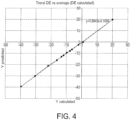
- Figure 4 is a parity plot between the DE determined from lab analysis [shown on the X-axis] and predicted DE values [shown on the Y-axis] using the PLS model developed from twelve-point compositional data of Table 1.
- the solid line connects the square data points and the dotted line is its corresponding linear fit with the slope of about 0.994. From the quality of data match, it was clear that the Example 1 model approach obtained excellent predictability, and therefore, can be a useful technique for implementing a robust process control for monomeric balance during polymerization.
- Fig. 4 shows how the PLS model, developed from the Example 1 spectra data, performs for process samples of this example.
- Figure 5 is a representation of the analysis predictability using an alternate modeling approach of this example.
- the DE values of Table 1 data determined via gravimetric analysis are plotted on the X-axis, and the predicted DE values from the above multi-variate model equation are plotted on the Y-axis.
- the dotted line shown in Fig. 5 obtains the R-squared value of 0.941 and demonstrates reasonably good predictability of the above multi-variate model.
- the multi-point data set represents reproducibility of the data.
- Example 3 illustrates the practical use of Raman spectroscopy measurements for achieving robust process control to strike a proper monomeric balance ahead of the polyamidation step.
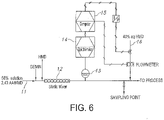
- Example 6 is a schematic representation of such feed forward control arrangement.
- a flow line 11 is schematically shown that carries an acid-rich feed mixture [about 2.43:1 AA:HMD on a molar basis] containing about 58% by weight total solids.
- the feed mixture passes through an inline static mixing device 12.
- a Raman spectroscopy probe 13 is inserted into the flow line 11 downstream of the static mixing device 12.
- the Raman spectra for the flowing feed mixture are measured in the Raman spectrometer device 14 and analyzed by computer 15 using the four-component PLS analysis according to Example 1.
- the PLS-model to predict DE provides monomeric balance or DE value prediction for the analyzed feed.
- the resulting signal shown as hashed lines in Fig. 6 , is integrated in a feed-forward manner to meter and control the subsequent addition of 40 wt% aqueous HMD solution through a valved supply line 16 to achieve the desired monomeric balance.
- the feed with the desired monomeric balance [DE value] is fed forward to a downstream polymerization process.
- the static mixing device 12 is optional. If desired, the mixing operation can optionally be accomplished via an agitated vessel or through a pump. Within some process designs it may be found that component miscibility and internal flow turbulence are sufficient such that no additional mixing is required.
- a baffled, salt balancing process vessel 111 is used for striking a proper monomeric balance before feeding to a downstream polymerization process.
- Mixing in the salt balancing vessel may be achieved by a motor-driven agitator 112, an external pump circulation loop 113 or a combination of the two as shown in Fig. 7 .
- a heat exchange device 114 in the circulation loop 113 provides the necessary temperature monitoring/control for the salt balancing vessel contents.
- the salt balancing vessel 111 receives an acid-rich feed [about 2.43:1 AA:HMD on a molar basis] containing about 58wt% total solids, demineralized [DM] water and additional HMD.
- the salt balancing vessel operates under an inert [nitrogen] blanket maintained in the overhead space.
- a Raman spectroscopy probe 115 is mounted in the output line 116 from the salt balancing vessel 111.
- the Raman spectra for the flowing output line mixture are measured by the spectrometer device 117 and analyzed by computer 118 using the four-component PLS analysis according to either Example 1 or Example 2.
- the PLS-model to predict DE provides an estimate of monomeric balance or DE value prediction for the analyzed mixture.
- the resulting signal shown as hashed lines in Fig. 7 , is integrated in a feed-back manner to meter and control addition of 40wt% aqueous HMD solution via inlet line 119 to the pump 121 of the circulation loop 113.
- the monomeric balance [or DE value] of the salt balancing vessel contents is thereby monitored and adjusted using the feed-back control scheme shown in Fig. 7 .
- the output line feed mixture with the desired monomeric balance is taken to the downstream process.
- the four-component PLS analysis signal may be used in feed-back mode to the one or both of the monomer feed controls on the salt balancing vessel. It may also be combined in a feed-forward mode to a trim diamine system as described in Example 4. A combination of the two may also be applied to keep the whole process stable. Alternatively, the signal could be used to control the incoming flow rate of the acid-rich feed to the vessel.
- the tuning of the HMD control loop can be improved by incorporating secondary instruments [not shown in Fig. 7 ]. These may include the flow meter on the salt feed or on the salt output line, the level instrument on the salt balancing vessel, valve action indicators or other instruments within the assembly. Such improvements to the tuning do not represent a departure from this example of using Raman instrumentation in a control loop on monomeric balance within a salt balancing vessel.
- a single HMD feed is combined with the feed of DM water prior to connection to the acid dissolution vessel. These may be separately connected directly to the vessel without departing from this invention. More than one HMD feeds may also be applied without departing from this example.
- one or more trim feeds of neat or dilute HMD may be controlled via the Raman instrumentation feedback and one or more coarse HMD feeds may be varied to keep the trim feed in an optimal part of its control range.
- the Raman probe itself may also be arranged in an independent slip stream, bypass, recirculating sample pot or other arrangement without departing from this example.
- the design of the mixing system within the salt balancing tank is non-limiting to the principle of using Raman instrumentation for control of the monomeric balance.
- Different agitator designs may be used.
- Different baffle designs and arrangements may be used.
- Jet mixers may be used to supplement or replace the mechanical mixer.
- Different vessel proportions [LID or aspect ratio] may be used.
- LID or aspect ratio may be used.
- the Raman signal is based on a representative sample of the contents of the salt balancing vessel so that good mixing is required, but the details of how that mixing is achieved can be varied without departing from the present disclosure.
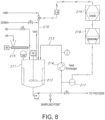
- a baffled, acid dissolution process vessel 211 is used for striking a proper monomeric balance before feeding to a downstream polymerization process.
- Mixing in the acid dissolution vessel 211 may be achieved by a motor-driven agitator 212, an external pump circulation loop 213 or a combination of the two as shown in Fig. 8 .
- a heat exchange device 214 in the circulation loop 213 provides the necessary temperature monitoring/control for the acid dissolution vessel contents.
- the acid dissolution vessel 211 receivessolid adipic acid [AA] feed via a screw conveyor 215 and, demineralized water and HMD via line 216.
- the acid dissolution vessel 211 may optionally operate under an inert nitrogen blanket (such as nitrogen) maintained in the overhead space or for some compositions it may operate under ambient conditions.
- a Raman spectroscopy probe 217 is mounted in the circulation loop 213.
- the Raman spectra for the ciculating feed mixture are measured in the spectrometer device 218 and analyzed by computer 219 using the four-component PLS analysis according to either Example 1 or Example 2.
- the PLS-model to predict DE provides an estimate of monomeric balance or DE value prediction for the analyzed mixture.
- the resulting signal shown as hashed lines in Fig. 8 , is integrated in a feed-back manner to meter and control the diamine feed rate [shown in Fig. 8 ], or it could optionally be used to vary the screw speed of the acid feeder [not shown in Fig. 8 ], or it could optionally be used strictly for data collection and estimate of composition for downstream flow control.
- the output line feed mixture with the desired monomeric balance is taken to the downstream process.
- the tuning of the HMD control loop can be improved by incorporating secondary instruments [not shown in Fig. 8 ]. These may include averaging of the AA feed rate from the screw feeder or the flow meter on the salt output line or the level instrument on the mix tank or other instruments within the assembly. Such improvements to the tuning do not represent a departure from this example of using Raman instrumentation in a control loop on monomeric balance within an acid dissolution vessel.
- a single HMD feed is combined with the feed of DM water prior to connection to the acid dissolution vessel. These may be separately connected directly to the vessel without departing from this example. More than one HMD feed may also be applied without departing from this example.
- one or more trim feeds of neat or dilute HMD may be controlled via the Raman instrumentation feedback and one or more coarse HMD feeds may be varied to keep the trim feed in an optimal part of its control range.
- connections of the water and HMD feeds may also be made at other points around the vessel such as to the suction of the recirculation pump or in the heat exchanger loop or another bypass loop or below the liquid level in the vessel.
- Such commonly known variations of stream arrangements are a matter of convenience to the process designer and do not represent a departure from this example.
- the design of the mixing system within the acid dissolution tank is non-limiting to the principle of using Raman instrumentation for control of the monomeric balance.
- Different agitator designs may be used.
- Different baffle designs and arrangements may be used.
- Jet mixers may be used.
- Different vessel proportions [LID or aspect ratio] may be used.
- LID or aspect ratio may be used.
- Many variations are well known in the art. It is desirable that the Raman signal is based on a representative sample of the contents of the acid dissolution vessel so that good mixing is required, but the details of how that mixing is achieved can be varied without departing from this example.
- the PLS-model to predict DE approach of Example 1 is applied for determining the diamine adjustment that may be made to a salt solution supply vessel that supplies feed to a polymerizer.
- Figure 9 is a schematic representation of such a process control arrangement.
- a baffled, salt solution supply vessel 311 is used for fine-tuning of monomeric balance before feeding to the downstream polymerization process.
- Mixing in the salt solution supply vessel may be achieved by a motor-driven agitator 312 as shown in Fig. 9 .
- the salt solution from upstream salt preparation process feeds to the salt solution supply vessel.
- a Raman spectroscopy probe 313 is submerged inside the salt solution supply vessel 311.
- the Raman spectra for the salt solution supply vessel contents are measured in the spectrometer device 314 and analyzed by computer 315 using the four-component PLS analysis according to either Example 1 or Example 2.
- the PLS-model to predict DE provides an instant monomeric balance or DE value prediction for the analyzed mixture.
- the resulting signal shown as hashed lines in Fig. 9 , is integrated to finely adjust the total diamine charge to the salt solution batch in the supply vessel [shown in Fig. 9 ] which maintains and controls the final monomeric balance desired for the downstream polymerization process.
- the supply vessel contents are pump transported to the downstream process.
- Use of diluted HMD as a feed instead of neat HMD is found to provide improvements to control in some cases and that does not represent a departure from this example.
- HMD feed - such as a larger feed for coarse adjustment and a smaller feed for fine adjustment and wherein the multiple feeds may or may not be at the same concentration - is also found to provide improvements to control and is not considered as a departure from this example.
- the instrumentation choice used to control the total HMD charge may also be changed without departing from this example.
- the arrangement of Figure 9 is found to be suitable if this system is used as a fine tuning of the monomeric balance in continuous or semi-continuous mode wherein the HMD flow rate is modulated.
- the arrangement may be used in batch or semi-batch mode wherein a total HMD charge is used.
- it is found in some cases that using a small charging pot on a weigh scale is also a suitable instrumentation arrangement. It is beneficial to use estimates of the salt charge - obtained either from totalizing flow meters on the salt feed or via level instrumentation or other means - to tune the HMD charge or flow rate.
- a salt solution supply vessel batch may be monitored in this manner during loading to the polymerization process.
- the composite co-added spectra from the salt solution supply vessel are used for the desired monomeric balance for the polymerizer operation.
- Example 8 Control using Process Sampling and Offline Analysis
- a feed sample is drawn from a sampling point; the location of which is schematically shown in either of Figs. 6 , 7 , 8 or 9 .
- the collected feed sample is needed to be properly conditioned, handled, transported to the lab and analyzed offline.
- the monomeric balance is determined.
- the deviation from the target monomeric balance then accounts for any necessary adjustments to feed streams and other feed devices.
Landscapes
- Chemical & Material Sciences (AREA)
- Health & Medical Sciences (AREA)
- Organic Chemistry (AREA)
- Chemical Kinetics & Catalysis (AREA)
- Life Sciences & Earth Sciences (AREA)
- General Physics & Mathematics (AREA)
- Pathology (AREA)
- Physics & Mathematics (AREA)
- Polymers & Plastics (AREA)
- Analytical Chemistry (AREA)
- Biochemistry (AREA)
- General Health & Medical Sciences (AREA)
- Medicinal Chemistry (AREA)
- Immunology (AREA)
- Nuclear Medicine, Radiotherapy & Molecular Imaging (AREA)
- Crystallography & Structural Chemistry (AREA)
- Engineering & Computer Science (AREA)
- Bioinformatics & Cheminformatics (AREA)
- Bioinformatics & Computational Biology (AREA)
- Computing Systems (AREA)
- Theoretical Computer Science (AREA)
- Investigating, Analyzing Materials By Fluorescence Or Luminescence (AREA)
- Polyamides (AREA)
- Macromolecular Compounds Obtained By Forming Nitrogen-Containing Linkages In General (AREA)
- Investigating Or Analysing Materials By Optical Means (AREA)
Applications Claiming Priority (2)
| Application Number | Priority Date | Filing Date | Title |
|---|---|---|---|
| US201762485058P | 2017-04-13 | 2017-04-13 | |
| PCT/US2018/027213 WO2018191445A1 (en) | 2017-04-13 | 2018-04-12 | Monomeric balance control in the preparation of precursors for polyamidation processes |
Publications (2)
| Publication Number | Publication Date |
|---|---|
| EP3609947A1 EP3609947A1 (en) | 2020-02-19 |
| EP3609947B1 true EP3609947B1 (en) | 2023-03-29 |
Family
ID=62092306
Family Applications (1)
| Application Number | Title | Priority Date | Filing Date |
|---|---|---|---|
| EP18721598.3A Active EP3609947B1 (en) | 2017-04-13 | 2018-04-12 | Monomeric balance control in the preparation of precursors for polyamidation processes |
Country Status (10)
| Country | Link |
|---|---|
| US (1) | US20200024396A1 (pl) |
| EP (1) | EP3609947B1 (pl) |
| JP (1) | JP7163309B2 (pl) |
| KR (1) | KR102534493B1 (pl) |
| CN (1) | CN110461908B (pl) |
| CA (1) | CA3054450C (pl) |
| ES (1) | ES2943018T3 (pl) |
| PL (1) | PL3609947T3 (pl) |
| TW (1) | TWI787251B (pl) |
| WO (1) | WO2018191445A1 (pl) |
Families Citing this family (5)
| Publication number | Priority date | Publication date | Assignee | Title |
|---|---|---|---|---|
| CN114341625B (zh) * | 2019-06-28 | 2025-03-11 | 阿尔托大学注册基金会 | 定量拉曼光谱 |
| CN111442876B (zh) * | 2020-01-03 | 2021-08-17 | 武汉钢铁有限公司 | 一种变送器智能校验系统 |
| KR102651465B1 (ko) | 2022-02-08 | 2024-03-25 | 도레이첨단소재 주식회사 | 유로를 갖는 탄소섬유 직물 및 그의 제조방법 |
| KR102651489B1 (ko) | 2022-02-08 | 2024-03-25 | 도레이첨단소재 주식회사 | 유로를 갖는 탄소섬유 직물 및 그의 제조방법 |
| CN118914165B (zh) * | 2024-10-10 | 2025-02-21 | 浙江大学衢州研究院 | 一种聚氨酯反应进程在线监测方法和系统 |
Family Cites Families (26)
| Publication number | Priority date | Publication date | Assignee | Title |
|---|---|---|---|---|
| US2130947A (en) | 1935-01-02 | 1938-09-20 | Du Pont | Diamine-dicarboxylic acid salts and process of preparing same |
| US3730685A (en) | 1971-02-24 | 1973-05-01 | Du Pont | Computer controlled method of titration |
| DE2728931A1 (de) | 1977-06-27 | 1979-01-04 | Basf Ag | Verfahren zur herstellung von polyamiden |
| DE2728818C3 (de) | 1977-06-27 | 1980-05-08 | Basf Ag, 6700 Ludwigshafen | Verfahren zur kontinuierlichen Herstellung wäßriger Lösungen von Salzen aus Alkandicarbonsäuren und Alkandiaminen |
| DE2728817A1 (de) | 1977-06-27 | 1979-01-04 | Basf Ag | Verfahren zur herstellung von hochkonzentrierten waessrigen loesungen von dicarbonsaeurediaminsalzen und polyamidpraekondensaten |
| US4442260A (en) | 1983-03-14 | 1984-04-10 | E. I. Du Pont De Nemours & Company | Preparation of salt solution useful for making nylon |
| US4620284A (en) | 1983-12-29 | 1986-10-28 | Uop Inc. | Qualitative and quantitative analysis using Raman scattering |
| US5532487A (en) * | 1994-11-23 | 1996-07-02 | E. I. Du Pont De Nemours And Company | Near-infrared measurement and control of polyamide processes |
| US5801278A (en) | 1997-03-07 | 1998-09-01 | E. I. Du Pont De Nemours And Companh | Low water diamine-dicarboxylic acid salt preparation |
| US6169162B1 (en) | 1999-05-24 | 2001-01-02 | Solutia Inc. | Continuous polyamidation process |
| FR2794760B1 (fr) | 1999-06-11 | 2001-08-17 | Rhodianyl | Procede de fabrication de polyamides |
| FR2814747B1 (fr) * | 2000-10-04 | 2002-12-06 | Rhodianyl | Procede de fabrication de polyamides |
| US6608678B1 (en) * | 2000-10-19 | 2003-08-19 | General Electric Company | Situ determination of DPC and BPA in polycarbonate by Raman spectroscopy |
| US7319040B2 (en) * | 2002-10-28 | 2008-01-15 | Ineos Usa Llc | Process control using on-line instrumentation and process models |
| FR2916756B1 (fr) | 2007-06-04 | 2009-07-17 | Rhodia Recherches & Tech | Procede de fabrication d'une solution de sels de diacides/diamines |
| FR2944279B1 (fr) | 2009-04-09 | 2011-06-24 | Rhodia Operations | Procede de fabrication d'une solution de sels de diacides/diamine(s) |
| PL2546227T3 (pl) | 2011-07-11 | 2016-12-30 | Sposób wytwarzania wodnego roztworu soli | |
| KR20140107362A (ko) * | 2011-12-05 | 2014-09-04 | 인비스타 테크놀러지스 에스.에이 알.엘. | 폴리아미드 제조 방법 |
| TW201446836A (zh) | 2013-05-01 | 2014-12-16 | Invista Tech Sarl | 用於製備部分平衡之酸性溶液之方法 |
| CN104130396B (zh) | 2013-05-01 | 2018-05-29 | 英威达纺织(英国)有限公司 | 使用补充二胺的尼龙盐溶液制备方法 |
| CN104130136B (zh) | 2013-05-01 | 2017-10-24 | 英威达科技公司 | 尼龙盐溶液制备方法中的前馈和后馈工序控制 |
| CN104130134B (zh) | 2013-05-01 | 2017-12-08 | 英威达纺织(英国)有限公司 | 用于尼龙盐溶液制备方法的前馈工序控制和pH值后馈 |
| TW201446730A (zh) | 2013-05-01 | 2014-12-16 | Invista Tech Sarl | 使用調節二胺混合之尼龍鹽溶液製備方法 |
| TW201443103A (zh) | 2013-05-01 | 2014-11-16 | Invista Tech Sarl | 自部分平衡之酸性溶液製備尼龍鹽溶液的方法 |
| CN104130403B (zh) | 2013-05-01 | 2018-05-29 | 英威达纺织(英国)有限公司 | 用于生产尼龙盐溶液的二羧酸粉末的计量方法 |
| TW201446812A (zh) | 2013-05-01 | 2014-12-16 | Invista Tech Sarl | 用於尼龍鹽溶液製備方法中之前饋程序控制 |
-
2018
- 2018-04-11 TW TW107112377A patent/TWI787251B/zh active
- 2018-04-12 WO PCT/US2018/027213 patent/WO2018191445A1/en not_active Ceased
- 2018-04-12 ES ES18721598T patent/ES2943018T3/es active Active
- 2018-04-12 CA CA3054450A patent/CA3054450C/en active Active
- 2018-04-12 JP JP2019555926A patent/JP7163309B2/ja active Active
- 2018-04-12 EP EP18721598.3A patent/EP3609947B1/en active Active
- 2018-04-12 PL PL18721598.3T patent/PL3609947T3/pl unknown
- 2018-04-12 US US16/490,084 patent/US20200024396A1/en not_active Abandoned
- 2018-04-12 CN CN201880021746.7A patent/CN110461908B/zh active Active
- 2018-04-12 KR KR1020197029527A patent/KR102534493B1/ko active Active
Also Published As
| Publication number | Publication date |
|---|---|
| CA3054450A1 (en) | 2018-10-18 |
| KR102534493B1 (ko) | 2023-05-22 |
| JP2020516744A (ja) | 2020-06-11 |
| CN110461908B (zh) | 2022-07-22 |
| ES2943018T3 (es) | 2023-06-08 |
| PL3609947T3 (pl) | 2023-05-29 |
| TW201841982A (zh) | 2018-12-01 |
| KR20190134651A (ko) | 2019-12-04 |
| CA3054450C (en) | 2024-02-27 |
| JP7163309B2 (ja) | 2022-10-31 |
| CN110461908A (zh) | 2019-11-15 |
| EP3609947A1 (en) | 2020-02-19 |
| TWI787251B (zh) | 2022-12-21 |
| WO2018191445A1 (en) | 2018-10-18 |
| US20200024396A1 (en) | 2020-01-23 |
Similar Documents
| Publication | Publication Date | Title |
|---|---|---|
| EP3609947B1 (en) | Monomeric balance control in the preparation of precursors for polyamidation processes | |
| US5674974A (en) | Continuous polymerization process for polyamides | |
| KR100969262B1 (ko) | 폴리아미드의 연속 제조 방법 | |
| US6696544B1 (en) | Method for making polyamides | |
| CN104130396A (zh) | 使用补充二胺的尼龙盐溶液制备方法 | |
| EP2991962A1 (en) | Process for producing a partially balanced acid solution | |
| CN104130130A (zh) | 使用补充二胺混合的尼龙盐溶液制备方法 | |
| CN104130133A (zh) | 尼龙盐溶液制备方法中的前馈工序控制 | |
| CN104130134A (zh) | 用于尼龙盐溶液制备方法的前馈工序控制和pH值后馈 | |
| EP1223186B1 (en) | Process for production of polyamide | |
| JP2002516365A (ja) | 連続的ポリアミド化法のための制御システム | |
| CN109790288B (zh) | 二胺/二酸盐的水溶液的生产 | |
| CN109073581B (zh) | 电导率或电阻率测量和聚酰胺合成 | |
| JP2005263950A (ja) | ポリアミドの製造方法 | |
| JP2004155951A (ja) | ポリアミドの製造方法 |
Legal Events
| Date | Code | Title | Description |
|---|---|---|---|
| STAA | Information on the status of an ep patent application or granted ep patent |
Free format text: STATUS: UNKNOWN |
|
| STAA | Information on the status of an ep patent application or granted ep patent |
Free format text: STATUS: THE INTERNATIONAL PUBLICATION HAS BEEN MADE |
|
| PUAI | Public reference made under article 153(3) epc to a published international application that has entered the european phase |
Free format text: ORIGINAL CODE: 0009012 |
|
| STAA | Information on the status of an ep patent application or granted ep patent |
Free format text: STATUS: REQUEST FOR EXAMINATION WAS MADE |
|
| 17P | Request for examination filed |
Effective date: 20191028 |
|
| AK | Designated contracting states |
Kind code of ref document: A1 Designated state(s): AL AT BE BG CH CY CZ DE DK EE ES FI FR GB GR HR HU IE IS IT LI LT LU LV MC MK MT NL NO PL PT RO RS SE SI SK SM TR |
|
| AX | Request for extension of the european patent |
Extension state: BA ME |
|
| DAV | Request for validation of the european patent (deleted) | ||
| DAX | Request for extension of the european patent (deleted) | ||
| GRAP | Despatch of communication of intention to grant a patent |
Free format text: ORIGINAL CODE: EPIDOSNIGR1 |
|
| STAA | Information on the status of an ep patent application or granted ep patent |
Free format text: STATUS: GRANT OF PATENT IS INTENDED |
|
| INTG | Intention to grant announced |
Effective date: 20221007 |
|
| GRAS | Grant fee paid |
Free format text: ORIGINAL CODE: EPIDOSNIGR3 |
|
| GRAA | (expected) grant |
Free format text: ORIGINAL CODE: 0009210 |
|
| STAA | Information on the status of an ep patent application or granted ep patent |
Free format text: STATUS: THE PATENT HAS BEEN GRANTED |
|
| AK | Designated contracting states |
Kind code of ref document: B1 Designated state(s): AL AT BE BG CH CY CZ DE DK EE ES FI FR GB GR HR HU IE IS IT LI LT LU LV MC MK MT NL NO PL PT RO RS SE SI SK SM TR |
|
| REG | Reference to a national code |
Ref country code: CH Ref legal event code: EP |
|
| REG | Reference to a national code |
Ref country code: DE Ref legal event code: R096 Ref document number: 602018047735 Country of ref document: DE |
|
| REG | Reference to a national code |
Ref country code: AT Ref legal event code: REF Ref document number: 1556627 Country of ref document: AT Kind code of ref document: T Effective date: 20230415 |
|
| REG | Reference to a national code |
Ref country code: NL Ref legal event code: FP Ref country code: IE Ref legal event code: FG4D |
|
| REG | Reference to a national code |
Ref country code: ES Ref legal event code: FG2A Ref document number: 2943018 Country of ref document: ES Kind code of ref document: T3 Effective date: 20230608 |
|
| REG | Reference to a national code |
Ref country code: LT Ref legal event code: MG9D |
|
| P01 | Opt-out of the competence of the unified patent court (upc) registered |
Effective date: 20230528 |
|
| PG25 | Lapsed in a contracting state [announced via postgrant information from national office to epo] |
Ref country code: RS Free format text: LAPSE BECAUSE OF FAILURE TO SUBMIT A TRANSLATION OF THE DESCRIPTION OR TO PAY THE FEE WITHIN THE PRESCRIBED TIME-LIMIT Effective date: 20230329 Ref country code: NO Free format text: LAPSE BECAUSE OF FAILURE TO SUBMIT A TRANSLATION OF THE DESCRIPTION OR TO PAY THE FEE WITHIN THE PRESCRIBED TIME-LIMIT Effective date: 20230629 Ref country code: LV Free format text: LAPSE BECAUSE OF FAILURE TO SUBMIT A TRANSLATION OF THE DESCRIPTION OR TO PAY THE FEE WITHIN THE PRESCRIBED TIME-LIMIT Effective date: 20230329 Ref country code: LT Free format text: LAPSE BECAUSE OF FAILURE TO SUBMIT A TRANSLATION OF THE DESCRIPTION OR TO PAY THE FEE WITHIN THE PRESCRIBED TIME-LIMIT Effective date: 20230329 Ref country code: HR Free format text: LAPSE BECAUSE OF FAILURE TO SUBMIT A TRANSLATION OF THE DESCRIPTION OR TO PAY THE FEE WITHIN THE PRESCRIBED TIME-LIMIT Effective date: 20230329 |
|
| REG | Reference to a national code |
Ref country code: AT Ref legal event code: MK05 Ref document number: 1556627 Country of ref document: AT Kind code of ref document: T Effective date: 20230329 |
|
| PG25 | Lapsed in a contracting state [announced via postgrant information from national office to epo] |
Ref country code: SE Free format text: LAPSE BECAUSE OF FAILURE TO SUBMIT A TRANSLATION OF THE DESCRIPTION OR TO PAY THE FEE WITHIN THE PRESCRIBED TIME-LIMIT Effective date: 20230329 Ref country code: GR Free format text: LAPSE BECAUSE OF FAILURE TO SUBMIT A TRANSLATION OF THE DESCRIPTION OR TO PAY THE FEE WITHIN THE PRESCRIBED TIME-LIMIT Effective date: 20230630 Ref country code: FI Free format text: LAPSE BECAUSE OF FAILURE TO SUBMIT A TRANSLATION OF THE DESCRIPTION OR TO PAY THE FEE WITHIN THE PRESCRIBED TIME-LIMIT Effective date: 20230329 |
|
| PG25 | Lapsed in a contracting state [announced via postgrant information from national office to epo] |
Ref country code: SM Free format text: LAPSE BECAUSE OF FAILURE TO SUBMIT A TRANSLATION OF THE DESCRIPTION OR TO PAY THE FEE WITHIN THE PRESCRIBED TIME-LIMIT Effective date: 20230329 Ref country code: RO Free format text: LAPSE BECAUSE OF FAILURE TO SUBMIT A TRANSLATION OF THE DESCRIPTION OR TO PAY THE FEE WITHIN THE PRESCRIBED TIME-LIMIT Effective date: 20230329 Ref country code: PT Free format text: LAPSE BECAUSE OF FAILURE TO SUBMIT A TRANSLATION OF THE DESCRIPTION OR TO PAY THE FEE WITHIN THE PRESCRIBED TIME-LIMIT Effective date: 20230731 Ref country code: EE Free format text: LAPSE BECAUSE OF FAILURE TO SUBMIT A TRANSLATION OF THE DESCRIPTION OR TO PAY THE FEE WITHIN THE PRESCRIBED TIME-LIMIT Effective date: 20230329 Ref country code: AT Free format text: LAPSE BECAUSE OF FAILURE TO SUBMIT A TRANSLATION OF THE DESCRIPTION OR TO PAY THE FEE WITHIN THE PRESCRIBED TIME-LIMIT Effective date: 20230329 |
|
| RAP4 | Party data changed (patent owner data changed or rights of a patent transferred) |
Owner name: INVISTA TEXTILES (U.K.) LIMITED |
|
| PG25 | Lapsed in a contracting state [announced via postgrant information from national office to epo] |
Ref country code: SK Free format text: LAPSE BECAUSE OF FAILURE TO SUBMIT A TRANSLATION OF THE DESCRIPTION OR TO PAY THE FEE WITHIN THE PRESCRIBED TIME-LIMIT Effective date: 20230329 Ref country code: IS Free format text: LAPSE BECAUSE OF FAILURE TO SUBMIT A TRANSLATION OF THE DESCRIPTION OR TO PAY THE FEE WITHIN THE PRESCRIBED TIME-LIMIT Effective date: 20230729 |
|
| PG25 | Lapsed in a contracting state [announced via postgrant information from national office to epo] |
Ref country code: LU Free format text: LAPSE BECAUSE OF NON-PAYMENT OF DUE FEES Effective date: 20230412 |
|
| REG | Reference to a national code |
Ref country code: DE Ref legal event code: R097 Ref document number: 602018047735 Country of ref document: DE |
|
| REG | Reference to a national code |
Ref country code: BE Ref legal event code: MM Effective date: 20230430 |
|
| PG25 | Lapsed in a contracting state [announced via postgrant information from national office to epo] |
Ref country code: MC Free format text: LAPSE BECAUSE OF FAILURE TO SUBMIT A TRANSLATION OF THE DESCRIPTION OR TO PAY THE FEE WITHIN THE PRESCRIBED TIME-LIMIT Effective date: 20230329 |
|
| PG25 | Lapsed in a contracting state [announced via postgrant information from national office to epo] |
Ref country code: MC Free format text: LAPSE BECAUSE OF FAILURE TO SUBMIT A TRANSLATION OF THE DESCRIPTION OR TO PAY THE FEE WITHIN THE PRESCRIBED TIME-LIMIT Effective date: 20230329 Ref country code: DK Free format text: LAPSE BECAUSE OF FAILURE TO SUBMIT A TRANSLATION OF THE DESCRIPTION OR TO PAY THE FEE WITHIN THE PRESCRIBED TIME-LIMIT Effective date: 20230329 Ref country code: CZ Free format text: LAPSE BECAUSE OF FAILURE TO SUBMIT A TRANSLATION OF THE DESCRIPTION OR TO PAY THE FEE WITHIN THE PRESCRIBED TIME-LIMIT Effective date: 20230329 |
|
| PLBE | No opposition filed within time limit |
Free format text: ORIGINAL CODE: 0009261 |
|
| STAA | Information on the status of an ep patent application or granted ep patent |
Free format text: STATUS: NO OPPOSITION FILED WITHIN TIME LIMIT |
|
| REG | Reference to a national code |
Ref country code: IE Ref legal event code: MM4A |
|
| PG25 | Lapsed in a contracting state [announced via postgrant information from national office to epo] |
Ref country code: BE Free format text: LAPSE BECAUSE OF NON-PAYMENT OF DUE FEES Effective date: 20230430 |
|
| 26N | No opposition filed |
Effective date: 20240103 |
|
| PG25 | Lapsed in a contracting state [announced via postgrant information from national office to epo] |
Ref country code: IE Free format text: LAPSE BECAUSE OF NON-PAYMENT OF DUE FEES Effective date: 20230412 |
|
| PG25 | Lapsed in a contracting state [announced via postgrant information from national office to epo] |
Ref country code: IE Free format text: LAPSE BECAUSE OF NON-PAYMENT OF DUE FEES Effective date: 20230412 |
|
| PG25 | Lapsed in a contracting state [announced via postgrant information from national office to epo] |
Ref country code: SI Free format text: LAPSE BECAUSE OF FAILURE TO SUBMIT A TRANSLATION OF THE DESCRIPTION OR TO PAY THE FEE WITHIN THE PRESCRIBED TIME-LIMIT Effective date: 20230329 |
|
| PG25 | Lapsed in a contracting state [announced via postgrant information from national office to epo] |
Ref country code: SI Free format text: LAPSE BECAUSE OF FAILURE TO SUBMIT A TRANSLATION OF THE DESCRIPTION OR TO PAY THE FEE WITHIN THE PRESCRIBED TIME-LIMIT Effective date: 20230329 |
|
| REG | Reference to a national code |
Ref country code: DE Ref legal event code: R081 Ref document number: 602018047735 Country of ref document: DE Owner name: INVISTA TEXTILES (U.K.) LIMITED, GB Free format text: FORMER OWNER: INVISTA TEXTILES (U.K.) LIMITED, MANCHESTER, GB |
|
| PG25 | Lapsed in a contracting state [announced via postgrant information from national office to epo] |
Ref country code: BG Free format text: LAPSE BECAUSE OF FAILURE TO SUBMIT A TRANSLATION OF THE DESCRIPTION OR TO PAY THE FEE WITHIN THE PRESCRIBED TIME-LIMIT Effective date: 20230329 |
|
| PG25 | Lapsed in a contracting state [announced via postgrant information from national office to epo] |
Ref country code: BG Free format text: LAPSE BECAUSE OF FAILURE TO SUBMIT A TRANSLATION OF THE DESCRIPTION OR TO PAY THE FEE WITHIN THE PRESCRIBED TIME-LIMIT Effective date: 20230329 |
|
| PGFP | Annual fee paid to national office [announced via postgrant information from national office to epo] |
Ref country code: NL Payment date: 20250317 Year of fee payment: 8 |
|
| PGFP | Annual fee paid to national office [announced via postgrant information from national office to epo] |
Ref country code: FR Payment date: 20250310 Year of fee payment: 8 Ref country code: PL Payment date: 20250314 Year of fee payment: 8 |
|
| PGFP | Annual fee paid to national office [announced via postgrant information from national office to epo] |
Ref country code: GB Payment date: 20250306 Year of fee payment: 8 Ref country code: IT Payment date: 20250320 Year of fee payment: 8 |
|
| PGFP | Annual fee paid to national office [announced via postgrant information from national office to epo] |
Ref country code: TR Payment date: 20250327 Year of fee payment: 8 |
|
| PGFP | Annual fee paid to national office [announced via postgrant information from national office to epo] |
Ref country code: DE Payment date: 20250305 Year of fee payment: 8 |
|
| PGFP | Annual fee paid to national office [announced via postgrant information from national office to epo] |
Ref country code: ES Payment date: 20250508 Year of fee payment: 8 |
|
| PGFP | Annual fee paid to national office [announced via postgrant information from national office to epo] |
Ref country code: CH Payment date: 20250501 Year of fee payment: 8 |
|
| PG25 | Lapsed in a contracting state [announced via postgrant information from national office to epo] |
Ref country code: CY Free format text: LAPSE BECAUSE OF FAILURE TO SUBMIT A TRANSLATION OF THE DESCRIPTION OR TO PAY THE FEE WITHIN THE PRESCRIBED TIME-LIMIT; INVALID AB INITIO Effective date: 20180412 |
|
| PG25 | Lapsed in a contracting state [announced via postgrant information from national office to epo] |
Ref country code: HU Free format text: LAPSE BECAUSE OF FAILURE TO SUBMIT A TRANSLATION OF THE DESCRIPTION OR TO PAY THE FEE WITHIN THE PRESCRIBED TIME-LIMIT; INVALID AB INITIO Effective date: 20180412 |