EP3609113B1 - Communication method and device - Google Patents
Communication method and device Download PDFInfo
- Publication number
- EP3609113B1 EP3609113B1 EP18843649.7A EP18843649A EP3609113B1 EP 3609113 B1 EP3609113 B1 EP 3609113B1 EP 18843649 A EP18843649 A EP 18843649A EP 3609113 B1 EP3609113 B1 EP 3609113B1
- Authority
- EP
- European Patent Office
- Prior art keywords
- data
- bearer
- data volume
- message
- network device
- Prior art date
- Legal status (The legal status is an assumption and is not a legal conclusion. Google has not performed a legal analysis and makes no representation as to the accuracy of the status listed.)
- Active
Links
Images





Classifications
-
- H—ELECTRICITY
- H04—ELECTRIC COMMUNICATION TECHNIQUE
- H04W—WIRELESS COMMUNICATION NETWORKS
- H04W28/00—Network traffic management; Network resource management
- H04W28/02—Traffic management, e.g. flow control or congestion control
- H04W28/08—Load balancing or load distribution
- H04W28/082—Load balancing or load distribution among bearers or channels
-
- H—ELECTRICITY
- H04—ELECTRIC COMMUNICATION TECHNIQUE
- H04W—WIRELESS COMMUNICATION NETWORKS
- H04W76/00—Connection management
- H04W76/10—Connection setup
- H04W76/15—Setup of multiple wireless link connections
-
- H—ELECTRICITY
- H04—ELECTRIC COMMUNICATION TECHNIQUE
- H04L—TRANSMISSION OF DIGITAL INFORMATION, e.g. TELEGRAPHIC COMMUNICATION
- H04L5/00—Arrangements affording multiple use of the transmission path
-
- H—ELECTRICITY
- H04—ELECTRIC COMMUNICATION TECHNIQUE
- H04W—WIRELESS COMMUNICATION NETWORKS
- H04W28/00—Network traffic management; Network resource management
- H04W28/02—Traffic management, e.g. flow control or congestion control
- H04W28/08—Load balancing or load distribution
- H04W28/088—Load balancing or load distribution among core entities
-
- H—ELECTRICITY
- H04—ELECTRIC COMMUNICATION TECHNIQUE
- H04W—WIRELESS COMMUNICATION NETWORKS
- H04W28/00—Network traffic management; Network resource management
- H04W28/02—Traffic management, e.g. flow control or congestion control
- H04W28/10—Flow control between communication endpoints
- H04W28/12—Flow control between communication endpoints using signalling between network elements
-
- H—ELECTRICITY
- H04—ELECTRIC COMMUNICATION TECHNIQUE
- H04W—WIRELESS COMMUNICATION NETWORKS
- H04W36/00—Hand-off or reselection arrangements
- H04W36/02—Buffering or recovering information during reselection ; Modification of the traffic flow during hand-off
-
- H—ELECTRICITY
- H04—ELECTRIC COMMUNICATION TECHNIQUE
- H04W—WIRELESS COMMUNICATION NETWORKS
- H04W68/00—User notification, e.g. alerting and paging, for incoming communication, change of service or the like
- H04W68/005—Transmission of information for alerting of incoming communication
-
- H—ELECTRICITY
- H04—ELECTRIC COMMUNICATION TECHNIQUE
- H04W—WIRELESS COMMUNICATION NETWORKS
- H04W76/00—Connection management
- H04W76/10—Connection setup
- H04W76/11—Allocation or use of connection identifiers
-
- H—ELECTRICITY
- H04—ELECTRIC COMMUNICATION TECHNIQUE
- H04W—WIRELESS COMMUNICATION NETWORKS
- H04W76/00—Connection management
- H04W76/10—Connection setup
- H04W76/15—Setup of multiple wireless link connections
- H04W76/16—Involving different core network technologies, e.g. a packet-switched [PS] bearer in combination with a circuit-switched [CS] bearer
-
- H—ELECTRICITY
- H04—ELECTRIC COMMUNICATION TECHNIQUE
- H04W—WIRELESS COMMUNICATION NETWORKS
- H04W76/00—Connection management
- H04W76/20—Manipulation of established connections
-
- H—ELECTRICITY
- H04—ELECTRIC COMMUNICATION TECHNIQUE
- H04W—WIRELESS COMMUNICATION NETWORKS
- H04W80/00—Wireless network protocols or protocol adaptations to wireless operation
- H04W80/02—Data link layer protocols
-
- H—ELECTRICITY
- H04—ELECTRIC COMMUNICATION TECHNIQUE
- H04W—WIRELESS COMMUNICATION NETWORKS
- H04W80/00—Wireless network protocols or protocol adaptations to wireless operation
- H04W80/08—Upper layer protocols
-
- H—ELECTRICITY
- H04—ELECTRIC COMMUNICATION TECHNIQUE
- H04W—WIRELESS COMMUNICATION NETWORKS
- H04W92/00—Interfaces specially adapted for wireless communication networks
- H04W92/16—Interfaces between hierarchically similar devices
- H04W92/20—Interfaces between hierarchically similar devices between access points
-
- H—ELECTRICITY
- H04—ELECTRIC COMMUNICATION TECHNIQUE
- H04L—TRANSMISSION OF DIGITAL INFORMATION, e.g. TELEGRAPHIC COMMUNICATION
- H04L47/00—Traffic control in data switching networks
- H04L47/10—Flow control; Congestion control
- H04L47/28—Flow control; Congestion control in relation to timing considerations
-
- H—ELECTRICITY
- H04—ELECTRIC COMMUNICATION TECHNIQUE
- H04W—WIRELESS COMMUNICATION NETWORKS
- H04W36/00—Hand-off or reselection arrangements
- H04W36/0005—Control or signalling for completing the hand-off
- H04W36/0011—Control or signalling for completing the hand-off for data sessions of end-to-end connection
- H04W36/0027—Control or signalling for completing the hand-off for data sessions of end-to-end connection for a plurality of data sessions of end-to-end connections, e.g. multi-call or multi-bearer end-to-end data connections
-
- H—ELECTRICITY
- H04—ELECTRIC COMMUNICATION TECHNIQUE
- H04W—WIRELESS COMMUNICATION NETWORKS
- H04W36/00—Hand-off or reselection arrangements
- H04W36/0005—Control or signalling for completing the hand-off
- H04W36/0055—Transmission or use of information for re-establishing the radio link
- H04W36/0069—Transmission or use of information for re-establishing the radio link in case of dual connectivity, e.g. decoupled uplink/downlink
-
- H—ELECTRICITY
- H04—ELECTRIC COMMUNICATION TECHNIQUE
- H04W—WIRELESS COMMUNICATION NETWORKS
- H04W84/00—Network topologies
- H04W84/18—Self-organising networks, e.g. ad-hoc networks or sensor networks
- H04W84/20—Leader-follower arrangements
Definitions
- This application relates to the field of wireless communications technologies, and in particular, to a communication method, a communication apparatus, a computer program product and a communication system.
- dual connectivity supporting different access technologies for example, multi-RAT dual connectivity (Multi-RAT Dual Connectivity, MR-DC) and long term evolution (long term evolution, LTE)-wireless local area network (wireless local area network, WLAN) interworking (LTE-WLAN interworking, LWI), is introduced.
- Multi-RAT Dual Connectivity, MR-DC Multi-RAT Dual Connectivity
- LTE long term evolution
- WLAN wireless local area network
- LWI LTE-WLAN interworking
- FIG 1 is a schematic diagram of a network with dual connectivity.
- a terminal 01 may communicate with both a master node A and a secondary node B.
- the master node A and the secondary node B are connected to a core network C.
- Access technologies used for the master node A and the secondary node B may be the same or different.
- the master node A is an evolved node (evolved universal terrestrial radio access network NodeB, eNB), and the secondary node B is a new radio node (new radio nodeB, gNB); or the master node A is a gNB, and the secondary node B is an eNB; or the master node A is an eNB or a gNB, and the secondary node B is a wireless local area network (wireless local area network, WLAN) device, where the WLAN device may be a WLAN termination (WLAN termination, WT), an access controller (access controller, AC), or an access point (access point, AP).
- the core network may be a 4G core network EPC, or a 5G core network (5G core, 5GC).
- a secondary bearer or a secondary split bearer may be established for the terminal 01.
- the secondary bearer may be referred to as a secondary cell group(Secondary Cell Group, SCG) bearer in MR-DC, and corresponds to an entire bearer that is moved to a WLAN side in LWI.
- the secondary split bearer may be referred to as a secondary cell group (SCG) split bearer in MR-DC.
- MR-DC For related content of MR-DC, refer to, for example, related content in Section 4 in 3GPP TS 37.340 V0.2.1.
- LWI For related content of LWI, refer to, for example, related content in Section 22A in 3GPP TS 36.300 V14.2.0.
- FIG. 2 is a schematic diagram of a secondary bearer.
- a user plane connection between a core network C and a secondary node B is established for a terminal 01, and a user plane connection is established between the secondary node B and the terminal 01.
- the core network C sends all data of the bearer to the secondary node B, and then the secondary node B sends all the data of the bearer to the terminal 01.
- the terminal 01 sends all data of the bearer to the secondary node B, and then the secondary node B sends all the data of the bearer to the core network C.
- FIG. 3 is a schematic diagram of a secondary split bearer.
- a user plane connection between a core network C and a secondary node B is established for a terminal 01
- a user plane connection is established between the secondary node B and the terminal 01
- a user plane connection is established between a master node A and the terminal 01.
- the core network C sends all data of the bearer to the secondary node B
- the secondary node B sends a part of the data to the master node A
- the master node A sends the part of the data to the terminal 01
- the secondary node B sends remaining data to the terminal 01.
- the terminal 01 may send a part of data of the bearer to the master node A, the master node A sends the part of the data to the secondary node B, the terminal 01 sends remaining data of the bearer to the secondary node B, and the secondary node B sends all of the received data of the bearer to the core network C.
- the terminal 01 may be configured that the terminal 01 sends all data of the bearer to the master node A, and the master node A sends all the data of the bearer to the secondary node B; or it may be configured that the terminal 01 sends all data of the bearer to the secondary node B.
- WO 2017/022388 A1 discloses traffic monitoring and reporting in diverse connection scenarios.
- This application provides a communication method and a communications apparatus, to more precisely calculate a data volume.
- a core network C may learn of a data volume transmitted between the core network C and a secondary node B after the secondary bearer is established, but does not know whether a master node A transfers data to the secondary node B for transmission in a process of establishing the secondary bearer, and consequently, a data volume transmitted via the secondary node B that is learned of by the core network C is inaccurate.
- the core network C may learn of a total data volume of the secondary split bearer, but cannot learn of a data volume transmitted via each of the master node A and the secondary node B.
- Solution 1 In a scenario of a secondary split bearer, a master node A reports a data volume of the bearer that is split to the master node A. According to the solution, a core network may learn of, by using the data volume of the bearer that is split to the master node A, a data volume of the bearer that is transmitted via a secondary node B, so that the core network may separately learn of data volumes of the bearer that are transmitted via different nodes, thereby more precisely counting the data volume.
- Solution 2 In a scenario of a secondary bearer or a secondary split bearer, a master node A reports, to a core network C, a data volume sent by the master node A to a secondary node B in a process of establishing the secondary bearer or the secondary split bearer.
- the core network C may correct a data volume of the bearer that is transmitted via the secondary node B, to correctly obtain the data volume of the bearer that is transmitted via the secondary node, thereby precisely counting the data volume.
- Solution 3 In a scenario of a secondary bearer or a secondary split bearer, a secondary node B sends, to a master node A, a data volume of the bearer that is transmitted via the secondary node B, and the master node A sends the data volume to a core network.
- the core network may learn of, by using the data volume of the bearer that is transmitted via the secondary node B, a data volume of the bearer that is transmitted via the master node A, thereby precisely counting the data volume.
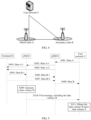
- FIG. 4 shows an application scenario of the network shown in FIG. 1 .
- the master node A is an eNB 01
- the secondary node B is a gNB 01
- the core network C is an EPC or a 5GC.
- the network establishes an SCG split bearer for the terminal 01.
- the 5GC supports a session (session) and a flow (flow), to be specific, the 5GC can identify a flow or a session to which data belongs, and the session may include one or more flows.
- the EPC supports a bearer, to be specific, the EPC can identify a bearer to which data belongs.
- the 5GC is likely to further support a bearer, and the EPC is likely to further support a flow and a session. This is not limited in this application.
- the EPC 01 may separately obtain a data volume of data of the SCG split bearer that is transmitted via the eNB 01 and a data volume of data of the SCG split bearer that is transmitted via the gNB 01.
- the eNB 01 counts the data volume (which is expressed as a data volume M below) of the data of the SCG split bearer that is transmitted via the eNB 01.
- the data volume of the data of the SCG split bearer that is transmitted via the gNB 01 is expressed as a data volume S below.
- the data volume may be reported based on an uplink/downlink granularity.
- the data volume M is at least one data volume of a data volume of the data A-1 and a data volume of the data B-1.
- the data volume M may be a sum of a data volume of the data A-1 and a data volume of the data B-1.
- the data volume may be counted in real time, periodically, or as triggered by an event (for example, the network initiates some particular procedures). This is not limited in this embodiment of this application.
- the eNB 01 sends a first message to the core network C, where the first message includes first information, and the first information is used to indicate the data volume M.
- the eNB 01 may include, according to a network requirement, a bearer identifier, a session identifier, or a flow identifier corresponding to the data volume M.
- the first information may further include the bearer identifier, the session identifier, or the flow identifier corresponding to the data volume M.
- reporting the data volume corresponding to the bearer, the session, or the flow may be indicated by the core network C to the eNB 01.
- the core network C separately obtains the data volume M and the data volume S.
- the data volume S may be at least one data volume of a data volume of the data A-2 and the data volume of the data B-1.
- the data volume M may be a sum of a data volume of the data A-2 and a data volume of the data B-2.
- the core network C may learn of a data volume of the data A. Therefore, the core network C may obtain the data volume of the data A-2 based on the data volume of the data A and the data volume of the data A-1.
- the data volume of the data A-2 is equal to the data volume of the data A minus the data volume of the data A-1.
- the core network C may learn of a data volume of the data B. Therefore, the core network C may obtain the data volume of the data B-2 based on the data volume of the data B and the data volume of the data B-1.
- the data volume of the data B-2 is equal to the data volume of the data B minus the data volume of the data B-1.
- the core network C may learn of a sum of the data volume of the data A and the data volume of the data B. Therefore, the core network C may obtain the sum of the data volume of the data A-2 and the data volume of the data B-2 based on the sum of the data volume of the data A and the data volume of the data B and the sum of the data volume of the data A-1 and the data volume of the data B-1.
- the sum of the data volume of the data A-2 and the data volume of the data B-2 is equal to the sum of the data volume of the data A and the data volume of the data B minus the sum of the data volume of the data A-1 and the data volume of the data B-1.
- the eNB 01 reports the data volume to the core network C (for example, S510), there are the following optional implementations.
- the eNB 01 may periodically send the first message to the core network C.
- the period may be determined by the gNB 01 or the eNB 01, or the core network C sends the period to the eNB 01.
- the data volume M reported via the first message may be a data volume of the SCG split bearer that is transmitted via the eNB 01 within a current period or an accumulated data volume of the SCG split bearer that is transmitted via the eNB 01 after the SCG split bearer is established.
- the eNB 01 may send the first message to the core network C after receiving a request from the core network C to report the data volume of the SCG split bearer.
- the data volume M reported via the first message may be a data volume of the SCG split bearer that is transmitted via the eNB 01 in duration between a previous request of the core network C and the current request or an accumulated data volume of the SCG split bearer that is transmitted via the eNB 01 after the SCG split bearer is established.
- the eNB 01 may report the data volume M via the first message.
- the core network is a 5GC
- the eNB 01 may report the data volume M via the first message.
- the first message may be an existing message in the foregoing procedure, or may be a newly added message.
- the first message may further include a bearer type of the bearer corresponding to the data volume M (for example, a bearer type of the SCG split bearer is an SCG split bearer).
- a bearer type of the SCG split bearer is an SCG split bearer.
- the first message in S510 further includes timestamps, and the timestamps are used to indicate a start time and an end time, generated by the eNB 01, of the data volume that is transmitted via the eNB 01 in S509.
- the core network for example, a network element serving gateway (serving gateway, SGW) or a packet data network gateway (packet data network gateway, PGW) of the core network
- can count the data volume in more dimensions for example, based on a bearer granularity, based on a time granularity, or based on a radio access technology granularity
- the core network can implement multidimensional charging based on the multidimensional data volume counting.
- the counting of the data volume in S509 may exclude data header overheads, for example, header overheads of a protocol layer such as a packet data convergence protocol (packet data convergence protocol, PDCP) layer, a radio link control (radio link control, RLC) layer, a media access control (media access control, MAC) layer, or a service data adaptation protocol (service data adaptation protocol, SDAP) layer.
- a protocol layer such as a packet data convergence protocol (packet data convergence protocol, PDCP) layer, a radio link control (radio link control, RLC) layer, a media access control (media access control, MAC) layer, or a service data adaptation protocol (service data adaptation protocol, SDAP) layer.
- a protocol layer such as a packet data convergence protocol (packet data convergence protocol, PDCP) layer, a radio link control (radio link control, RLC) layer, a media access control (media access control, MAC) layer, or a service data adaptation protocol (service data adaptation protocol, SDAP) layer.
- the process may further include a step of sending, by the eNB 01 to the core network C in a process of establishing the SCG split bearer, the data volume of the data sent to the gNB 01.
- the core network C may correct the data volume of the data of the SCG split bearer that is transmitted via the secondary node, thereby more precisely counting the data volume.
- the data volume may be counted based on a session or flow granularity.
- the master node and the secondary node may learn of a flow (flow) or a session (session) to which data belongs.
- the session may also be referred to as a packet data unit (packet data unit, PDU) session.
- One session may include one or more flows.
- the data A and the data B are data of a session A.
- the session A includes a flow 1 and a flow 2.
- the data A-1 may include a part of data of the flow 1 (which is referred to as data A-1-f1 for short) and a part of data of the flow 2 (which is referred to as data A-1-f2 for short).
- the data A-2 may include a part of data of the flow 1 (which is referred to as data A-2-f1 for short) and a part of data of the flow 2 (which is referred to as data A-2-f2 for short).
- the data B-1 may include a part of data of the flow 1 (which is referred to as data B-1-f1 for short) and a part of data of the flow 2 (which is referred to as data B-1-f2 for short).
- the data B-2 may include a part of data of the flow 1 (which is referred to as data B-2-f1 for short) and a part of data of the flow 2 (which is referred to as data B-2-f2 for short).
- the eNB 01 may count the data volume at a flow granularity or a session granularity. For example, at least one of an uplink data volume and a downlink data volume of the flow 1 carried by the SCG split bearer that are transmitted via the eNB 01 or a sum of uplink and downlink data volumes is counted; or at least one of an uplink data volume and a downlink data volume of the session A carried by the SCG split bearer that are transmitted via the eNB 01 or a sum of uplink and downlink data volumes is counted.
- the data volume M reported by the eNB 01 may be a data volume at the flow granularity or a data volume at the session granularity.
- the eNB 01 may further report at least one (which, for example, is carried in the first message in S510) of the flow identifier and the session identifier corresponding to the data volume M.
- the data volume M is the downlink data volume of the flow 1 (for example, a data volume of the data A-1-f1), so that a flow identifier of the flow 1 is reported, and optionally, a session identifier of the session A corresponding to the flow 1 may be further reported;
- the data volume M is an uplink data volume of the flow 2 (for example, a data volume of the data B-1-f2, so that a flow identifier of the flow 2 may be reported, and optionally, the session identifier of the session A corresponding to the flow 2 may be further reported);
- the data volume M is a downlink data volume of the session A (for example, the data volume of the data A-1, so that the session identifier of the session A is reported);
- the data volume M is an uplink data volume of the session A (for example, the data volume of the data B-1, so that the session identifier of the session A is reported).
- the data volume of the SCG split bearer that is transmitted via the eNB 01 is reported by the eNB 01, so that the core network C can calculate, based on a total data volume of the SCG split bearer and the data volume of the SCG split bearer that is transmitted via the eNB 01, the data volume of the SCG split bearer that is transmitted via the gNB 01, so that the core network C may separately learn of the data volume of the data of the SCG split bearer that is transmitted via the eNB 01 and the data volume of the data of the SCG split bearer that is transmitted via the gNB 01.
- radio access technologies of the eNB 01 and the gNB 01 are different. Therefore, the core network C can separately learn of data volumes of the SCG split bearer that are transmitted by using the different radio access technologies, thereby implementing precise data volume calculation.
- Solution 1 is also applicable to another application scenario of the secondary split bearer.
- the master node A is a gNB, the secondary node B is an eNB, and the core network C is an EPC or a 5GC; or the master node A is an eNB, the secondary node B is a WT, and the core network C is an EPC or a 5GC; or the master node A is a gNB, the secondary node B is a WT, and the core network C is an EPC or a 5GC.
- the master node A is a gNB, the secondary node B is a WT, and the core network C is an EPC or a 5GC.
- Solution 1 The method provided in Solution 1 is described below separately from a perspective of a master node side and a perspective of a core network side.
- the following is the method of Solution 1 that is described from the perspective of the master node side.
- the method M1 includes the following steps.
- the master node obtains information about a data volume of data of a secondary split bearer that is transmitted via the master node.
- the master node sends a first message to the core network, where the first message includes first information, and the first information is used to indicate the information about the data volume of the data of the secondary split bearer that is transmitted via the master node.
- the method M1 further includes M103:
- the master node sends second information to the core network, where the second information is used to indicate a data volume of data sent by the master node to the secondary node in a process of establishing the secondary split bearer.
- the core network may correct a data volume of data of the secondary split bearer, thereby more precisely counting the data volume.
- the following is the method of Solution 1 that is described from the perspective of the core network side.
- the method M2 includes the following steps.
- a network element in the core network receives a first message from the master node, where the first message includes first information, and the first information is used to indicate a data volume of data of the secondary split bearer that is transmitted via the master node.
- the network element in the core network obtains, based on a data volume of data of the secondary split bearer and the data volume of the data of the secondary split bearer that is transmitted via the master node, information about a data volume of data of the secondary split bearer that is transmitted via the secondary node.
- the method M2 further includes: receiving, by the network element in the core network, second information from the master node, where the second information is used to indicate a data volume of data sent by the master node to the secondary node in a process of establishing the secondary split bearer.
- the network element in the core network element may correct a data volume of data of the secondary split bearer, thereby more precisely counting the data volume.
- the core network may separately learn of the data volume of the data of the secondary split bearer that is transmitted via the master node and the data volume of the data of the secondary split bearer that is transmitted via the secondary node, thereby more precisely counting the data volume.
- Example 2 The master node A is an eNB 01, the core network is an EPC or a 5GC, and the terminal 01 communicates with the eNB 01.
- the eNB 01 selects a gNB 01 as the secondary node B, and establishes an SCG bearer or an SCG split bearer.
- the data that has not been transmitted may be at least one of the following: downlink data that is to be sent by the eNB 01 to the terminal 01, and uplink data that is to be sent by the eNB 01 to the core network C and that is of the terminal 01.
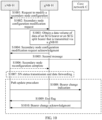
- S601 to S605 separately refer to, for example, related content of steps 1, 2, 5, 7, and 8 in FIG. 10.2.1-1 in Section 10.2.1 in 3GPP TS 37.340 V0.2.1.
- the eNB 01 obtains a data volume of the data (which is referred to as migrated data for short below) sent by the eNB 01 to the gNB 01.
- the counting of the data volume may exclude migrated data header overheads, for example, header overheads of a protocol layer such as a PDCP layer, an RLC layer, a MAC layer, or an SDAP layer.
- a protocol layer such as a PDCP layer, an RLC layer, a MAC layer, or an SDAP layer.
- the eNB 01 sends a bearer change indication message to the core network C, where the bearer change indication message includes first information, and the first information is used to indicate the data volume of the migrated data.
- the eNB 01 may alternatively add the first information to another message.
- a message carrying the first information is referred to as a first message.
- the data volume of the migrated data may be counted or reported based on a bearer granularity, a session granularity, or a flow granularity.
- the first message further includes one or more of a bearer identifier (namely, an identifier of the SCG bearer or the SCG split bearer), a session identifier, and a flow identifier that correspond to the migrated data.
- a bearer identifier namely, an identifier of the SCG bearer or the SCG split bearer
- a session identifier namely, an identifier of the SCG bearer or the SCG split bearer
- a flow identifier that correspond to the migrated data.
- a granularity of the data volume reported to the core network C may be indicated by the core network C to the master node.
- the data volume of the migrated data may be counted or reported based on an uplink/downlink granularity.
- related content refer to related content of Example 1.
- the first message may further include a radio access technology of the secondary node.
- a radio access technology of the secondary node For related content, refer to related content of Example 1.
- the first message may further include a bearer type of the SCG bearer or the SCG split bearer.
- a bearer type of the SCG bearer or the SCG split bearer For related content, refer to related content of Example 1.
- the first information may be alternatively sent by the master node to the core network via a newly added message.
- the core network C can learn of the data volume migrated by the master node to the secondary node in a process of establishing the SCG bearer or the SCG split bearer, so that the core network C can correctly learn of a data volume of data of the SCG bearer or the SCG split bearer that is transmitted via the secondary node, thereby more precisely counting the data volume.
- the core network C sends an end flag to the eNB 01.
- S608 and S609 refer to, for example, related content of steps 11 and 12 in FIG. 10.2.1-1 in Section 10.2.1 in 3GPP TS 37.340 V0.2.1.
- Example 2 in Example 1 is also applicable to Example 2, and details are not described herein again.
- Example 2 is also applicable to another application scenario of the secondary bearer or the secondary split bearer.
- the master node A is a gNB
- the secondary node B is an eNB
- the core network C is an EPC or a 5GC
- the master node A is an eNB
- the secondary node B is a WT
- the core network C is an EPC or a 5GC
- the master node A is a gNB
- the secondary node B is a WT
- the core network C is an EPC or a 5GC.
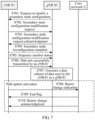
- Example 3 The master node A is an eNB 01, the secondary node B is a gNB 01, and the core network C is an EPC or a 5GC.
- Example 3 mainly relates to establishing an SCG split bearer or an SCG bearer through secondary node configuration modification.
- the data that has not been transmitted may be at least one of the following: downlink data that is to be sent by the eNB 01 to the terminal 01 and uplink data that is to be sent by the eNB 01 to the core network C.
- S701 to S706 separately refer to, for example, related content of steps 1, 2, 3, 6, 8, and 9 in FIG. 10.3.1-2 in Section 10.3.1 in 3GPP TS 37.340 V0.2.1.
- the eNB 01 obtains a data volume of the data sent by the eNB 01 to the gNB 01.
- the counting of the data volume may exclude migrated data header overheads, for example, header overheads of a protocol layer such as a PDCP layer, an RLC layer, a MAC layer, or an SDAP layer.
- a protocol layer such as a PDCP layer, an RLC layer, a MAC layer, or an SDAP layer.
- the eNB 01 sends a bearer change indication message to the core network C, where the bearer change indication message includes first information, and the first information is used to indicate the data volume of the migrated data.
- the eNB 01 may alternatively add the first information to another message.
- a message carrying the first information is referred to as a first message.
- the data volume of the migrated data may be counted or reported based on a bearer granularity, a session granularity, or a flow granularity.
- the first message further includes one or more of a bearer identifier (namely, an identifier of the SCG bearer or the SCG split bearer), a session identifier, and a flow identifier that correspond to the migrated data.
- a bearer identifier namely, an identifier of the SCG bearer or the SCG split bearer
- a session identifier namely, an identifier of the SCG bearer or the SCG split bearer
- a flow identifier that correspond to the migrated data.
- a granularity of the data volume reported to the core network C may be indicated by the core network C to the master node.
- the data volume of the migrated data may be counted or reported based on an uplink/downlink granularity.
- related content refer to related content of Example 1 and Example 2.
- the first message may further include a radio access technology of the secondary node.
- a radio access technology of the secondary node For related content, refer to related content of Example 1 and Example 2.
- the first message may further include a bearer type of the SCG bearer or the SCG split bearer.
- a bearer type of the SCG bearer or the SCG split bearer For related content, refer to related content of Example 1 and Example 2.
- the first information may be alternatively sent by the master node to the core network via a newly added message.
- the core network C can learn of the data volume migrated by the master node to the secondary node in a process of establishing the SCG bearer or the SCG split bearer, so that the core network C can correctly learn of a data volume of data of the SCG bearer or the SCG split bearer that is transmitted via the secondary node, thereby more precisely counting the data volume.
- the other part of path updating is shown below.
- the core network C sends an end flag to the eNB 01.
- Example 3 in Example 1 and Example 2 are also applicable to Example 3, and details are not described herein again.
- Example 3 is also applicable to another application scenario of the secondary bearer or the secondary split bearer.
- the master node A is a gNB
- the secondary node B is an eNB
- the core network C is an EPC or a 5GC
- the master node A is an eNB
- the secondary node B is a WT
- the core network C is an EPC or a 5GC
- the master node A is a gNB
- the secondary node B is a WT
- the core network C is an EPC or a 5GC.
- Solution 2 The method provided in Solution 2 is described below separately from a perspective of a master node side and a perspective of a core network side.
- the following is the method of Solution 2 that is described from the perspective of the master node side.
- the method M3 includes the following steps.
- M301 When establishing the secondary bearer or the secondary split bearer, the master node sends migrated data to the secondary node.
- the master node sends a first message to the core network, where the first message includes first information, and the first information is used to indicate a data volume of the migrated data.
- the following is the method of Solution 2 that is described from the perspective of the core network side.
- the method M4 includes the following steps.
- a network element in a core network receives a first message from the master node, where the first message includes first information, and the first information is used to indicate a data volume of migrated data sent by the master node to the secondary node when the secondary bearer or the secondary split bearer is established.
- the network element in the core network obtains, based on the data volume of the migrated data, a data volume of data of the secondary bearer or the secondary split bearer that is transmitted via the secondary node.
- the core network may correct the data volume of the data of the secondary bearer or the secondary split bearer that is transmitted via the secondary node, thereby more precisely counting the data volume.
- Example 4 The master node A is an eNB 01, the secondary node B is a gNB 01, the core network C is an EPC or a 5GC, and the network establishes an SCG bearer or an SCG split bearer for the terminal 01.
- the master node A remains unchanged, and the secondary node B is handed over from the gNB 01 (a source gNB) to a gNB 02 (a target gNB).
- the SCG split bearer For uplink data and downlink data transmission processes of the SCG split bearer before the handover, refer to related descriptions of S501 to S508 in FIG. 5 .
- the 5GC supports a session (session) and a flow (flow), to be specific, the 5GC can identify a flow or a session to which data belongs, and the session may include one or more flows.
- the EPC supports a bearer, to be specific, the EPC can identify a bearer to which data belongs.
- the 5GC is likely to further support a bearer, and the EPC is likely to further support a flow and a session. This is not limited in this application.
- the following examples show some signaling interaction processes. It should be noted that the processes or message names in the processes may vary with development of technologies or for different networks. This is not limited in this embodiment of this application.
- S801 to S806 separately refer to, for example, related content of steps 1 to 3, 6, and 8a to 14 in FIG. 10.5.1-1 in Section 10.5.1 in 3GPP TS 37.340 V0.2.1.
- S807 to S809 show that the source secondary node reports, to the master node, a data volume of data of the secondary bearer or the secondary split bearer that is transmitted via the source secondary node.
- the eNB 01 sends a terminal 01 context release message to the gNB 01, where the message includes information used to instruct the gNB 01 to send, to the eNB 01, the data volume of the data of the SCG bearer or the SCG split bearer that is transmitted via the gNB 01.
- the message itself may be alternatively understood as an indication for instructing the gNB 01 to send, to the eNB 01, the data volume of the data of the SCG bearer or the SCG split bearer that is transmitted via the gNB 01.
- the foregoing indication may be alternatively performed via a newly added message.
- the gNB 01 counts the data volume of the data of the SCG bearer or the SCG split bearer that is transmitted via the gNB 01.
- the data volume of the data of the SCG split bearer or the SCG bearer that is transmitted via the gNB 01 may be expressed as a data volume S.
- the data volume S may be at least one data volume of a data volume of data A-2 and a data volume of data B-2.
- the data volume S may be a sum of a data volume of data A-2 and a data volume of data B-2.
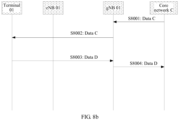
- the data volume S may be at least one data volume of a data volume of data C sent by the gNB 01 to the terminal 01 and a data volume of data D sent by the terminal 01 to the gNB 01.
- the data volume S may be a sum of the data volume of the data C and the data volume of the data D.
- the data volume may be counted based on an uplink/downlink granularity.
- the gNB 01 may count the data volume S after the data forwarding or the path update, so that it is ensured that the gNB 01 no longer performs data transmission with the terminal 01 when and after the gNB 01 counts the data volume S, thereby ensuring precision of the data volume.
- the data volume may be counted based on a bearer granularity, a session granularity, or a flow granularity.
- a bearer granularity For related content, refer to related content of Example 1 to Example 3.
- the gNB 01 sends a first message to the eNB 01, where the first message includes first information, and the first information is used to indicate the data volume S.
- the secondary node may report the data volume to the master node based on a bearer granularity, a session granularity, or a flow granularity.
- the first message further includes one or more of a bearer identifier (namely, an identifier of the SCG bearer or the SCG split bearer), a session identifier, and a flow identifier that correspond to the data volume S.
- a granularity of the data volume reported by the secondary node to the master node may be negotiated between the master node and the secondary node, or may be indicated by the core network C to the master node.
- a granularity of the data volume reported by the secondary node to the master node may be negotiated between the master node and the secondary node, or may be indicated by the core network C to the master node.
- the secondary node may report the data volume to the master node based on an uplink/downlink granularity.
- related content refer to related content of Example 1 to Example 3.
- the master node may learn, before the secondary node is handed over, of the data volume of the data of the secondary bearer or the secondary split bearer that is transmitted via the source secondary node.
- the master node may accumulate, during a plurality of secondary node handovers, data volumes of data of the secondary bearer or the secondary split bearer that is transmitted via the source secondary nodes, and report the accumulated data volume when needing to report the data volume to the core network.
- S810 shows that the master node reports a data volume to the core network.
- the eNB 01 sends a second message to the core network C, where the second message includes second information, and the second information is used to indicate a data volume of data of the SCG bearer or the SCG split bearer that is transmitted via the source secondary node.
- the data volume may be a data volume of data of the SCG bearer or the SCG split bearer that is transmitted via the source secondary node in a handover.
- the data volume may be the data volume S.
- the data volume may be an accumulated value of data volumes of data of the SCG bearer or the SCG split bearer that is transmitted via a plurality of source secondary nodes in a plurality of handovers.
- the accumulated value may be an accumulated value that is of a plurality of data volumes S received by the master node.
- the core network C obtains the data volume of the data of the SCG bearer or the SCG split bearer that is transmitted via the source secondary node, and may obtain, based on a total data volume of data of the SCG bearer or the SCG split bearer, a data volume of data of the SCG bearer or the SCG split bearer that is transmitted via the master node.
- the eNB 01 may further report (for example, S810) a radio access technology of the gNB 01 to the core network C.
- S810 a radio access technology of the gNB 01 to the core network C.
- a same bearer may be transferred between a plurality of gNBs.
- the SCG or the SCG split bearer is initially established on the eNB 01 and the gNB 01, and then a handover from the gNB 01 occurs or the gNB 01 is released, or when the bearer on the gNB 01 is released due to a configuration modification, the gNB 01 sends, to the eNB 01, a data volume of the bearer that is transmitted via the gNB 01. Then, the eNB 01 migrates the bearer to another gNB, for example, a gNB 03.
- the gNB 03 sends, to the eNB 01, a data volume of the bearer that is transmitted via the gNB 03.
- the eNB 01 may obtain a data volume that corresponds to the bearer and that corresponds to a radio access technology 1 of the gNB 01 and a data volume that corresponds to the bearer 1 and that corresponds to a radio access technology 2 of the gNB 02, and then report the data volumes to the core network C.
- the process may further include: accumulating, by the eNB 01, data volumes for a same SCG or SCG split bearer of a same radio access technology; obtaining accumulated data volumes corresponding to different radio access technologies; and then reporting the data volumes to the core network C.
- the master node may periodically send the second message to the core network C.
- the master node may send the second message after receiving a request from the core network for reporting the secondary bearer or the secondary split bearer.
- the master node may send the second message when an interface between the master node and the core network is released, when a connection between the master node and the core network is suspended, in a bearer deactivation procedure, or the like.
- the second message may be a message in the existing procedure, or may be a newly added message.
- the reporting occasion in S510 in Example 1 For a specific occasion for reporting the data volume, refer to related descriptions of the reporting occasion in S510 in Example 1.
- the data volume S may be reported based on a bearer granularity, a session granularity, or a flow granularity.
- the second message further includes one or more of a bearer identifier (namely, an identifier of the SCG bearer or the SCG split bearer), a session identifier, and a flow identifier that correspond to the data volume.
- a granularity of the data volume reported to the core network C may be indicated by the core network C to the master node.
- the data volume S may be reported based on an uplink/downlink granularity.
- related content refer to related content of Example 1 to Example 3.
- the second message may further include a bearer type of the SCG bearer or the SCG split bearer.
- a bearer type of the SCG bearer or the SCG split bearer For related content, refer to related content of Example 1 to Example 3.
- the second message in S810 further includes timestamps, and the timestamps are used to indicate a start time and an end time corresponding to the data volume reported in S810.
- the counting of the data volume in Example 4 excludes header overheads of a protocol layer such as a PDCP layer, an RLC layer, a MAC layer, or an SDAP layer. According to the design, a data volume of an actual service can be precisely calculated, and user experience is better.
- a protocol layer such as a PDCP layer, an RLC layer, a MAC layer, or an SDAP layer.
- the second message may further include, for example, the first information in S607 in Example 2, or the first information in S708 in Example 3.
- the first information in S607 in Example 2 or the first information in S708 in Example 3.
- data A and data B are data of a session A.
- the session A includes a flow 1 and a flow 2.
- Data A-1 may include a part of data of the flow 1 (which is referred to as data A-1-f1 for short) and a part of data of the flow 2 (which is referred to as data A-1-f2 for short).
- the data A-2 may include a part of data of the flow 1 (which is referred to as data A-2-f1 for short) and a part of data of the flow 2 (which is referred to as data A-2-f2 for short).
- Data B-1 may include a part of data of the flow 1 (which is referred to as data B-1-f1 for short) and a part of data of the flow 2 (which is referred to as data B-1-f2 for short).
- the data B-2 may include a part of data of the flow 1 (which is referred to as data B-2-f1 for short) and a part of data of the flow 2 (which is referred to as data B-2-f2 for short).
- the gNB 01 may count the data volume at a flow granularity or a session granularity. For example, at least one of an uplink data volume and a downlink data volume of the flow 1 carried by the SCG split bearer that are transmitted via the gNB 01 is counted; or at least one of an uplink data volume and a downlink data volume of the session A carried by the SCG split bearer that are transmitted via the gNB 01 is counted.
- the data volume S reported by the gNB 01 may be a data volume at a flow granularity or a data volume at a session granularity.
- the first message in S809 further includes the flow identifier or the session identifier corresponding to the data volume S.
- the data volume S is a downlink data volume of the flow 1 (for example, a data volume of the data A-2-f1), and the flow identifier corresponding to the data volume S is a flow identifier of the flow 1;
- the data volume S is an uplink data volume of the flow 2 (for example, a data volume of the data B-2-f2), and the flow identifier corresponding to the data volume S is a flow identifier of the flow 2;
- the data volume S is a downlink data volume of the session A (for example, a data volume of the data A-2), and the session identifier corresponding to the data volume S is a session identifier of the session A;
- the data volume S is an uplink data volume of the session A (for example, a data volume of the data B-2), and the session identifier corresponding to the data volume S is the session identifier of the session A.
- the second message may further include at least one of a flow identifier or a session identifier corresponding to the reported data volume. If the first message obtained by the eNB 01 includes the data volume S and a session identifier, the second message may include the data volume S and the session identifier. If the first message obtained by the eNB 01 includes the data volume S and a flow identifier, the eNB 01 obtains, based on a correspondence between a session and a flow, a session identifier corresponding to the flow identifier, and the eNB 01 may report the session identifier. To be specific, the second message may include the data volume S, and at least one of the session identifier, or the flow identifier.
- the data C and the data D are data of a session C.
- the session C includes a flow 3 and a flow 4.
- the data C may include downlink data of the flow 3 and downlink data of the flow 4
- the data D may include uplink data of the flow 3 and uplink data of the flow 4.
- the gNB 01 may count the data volume at a flow granularity or a session granularity. For example, at least one of an uplink data volume and a downlink data volume of the flow 3 carried by the SCG bearer that are transmitted via the gNB 01 is counted; or at least one of an uplink data volume and a downlink data volume of the session C carried by the SCG bearer that are transmitted via the gNB 01 is counted.
- the data volume S reported by the gNB 01 may be a data volume at a flow granularity or a data volume at a session granularity.
- the first message in S809 further includes the flow identifier or the session identifier corresponding to the data volume S.
- the data volume S is a downlink data volume of the flow 3 (for example, data C-f3), and the flow identifier corresponding to the data volume S is a flow identifier of the flow 3;
- the data volume S is an uplink data volume of the flow 4 (for example, data C-f4), and the flow identifier corresponding to the data volume S is a flow identifier of the flow 4;
- the data volume S is a downlink data volume of the session A (the data C), and the session identifier corresponding to the data volume S is the session identifier of the session A;
- the data volume S is an uplink data volume of the session A (the data D), and the session identifier corresponding to the data volume S is the session identifier of the session A.
- the second message may include the data volume S and the session identifier. If the first message obtained by the eNB 01 includes the data volume S and a flow identifier, the second message may include the data volume S and the flow identifier. If the first message obtained by the eNB 01 includes the data volume S and a flow identifier, the eNB 01 obtains, based on a correspondence between a session and a flow, a session identifier corresponding to the flow identifier, and the eNB 01 may report the session identifier. To be specific, the second message may include the data volume S and the session identifier.
- the core network may learn, before a handover of the secondary node occurs, of the data volume of the data of the secondary bearer or the secondary split bearer that is transmitted via the source secondary node, thereby more precisely counting the data volume.
- the core network may learn, based on the data volume of the data of the secondary bearer or the secondary split bearer that is transmitted via the source secondary node, the data volume of the data of the secondary bearer or the secondary split bearer that is transmitted via the master node before the handover of the secondary node occurs, thereby more precisely counting the data volume.
- Example 5 The master node A is an eNB 01, the secondary node B is a gNB 01, the core network C is an EPC or a 5GC, and the network establishes an SCG or an SCG split bearer for the terminal 01.
- the master node A remains unchanged, and the gNB 01 is released.
- S901 to S903 show some signaling interaction processes for releasing the secondary node. It should be noted that the processes or message names in the processes may vary with development of technologies or for different networks. This is not limited in this embodiment of this application.
- the eNB 01 sends a terminal context release message to the gNB 01, where the message includes information used to instruct the gNB 01 to send, to the eNB 01, a data volume of data of the SCG bearer or the SCG split bearer that is transmitted via the gNB 01.
- the message itself may be alternatively understood as an indication for instructing the gNB 01 to send, to the eNB 01, the data volume of the data of the SCG bearer or the SCG split bearer that is transmitted via the gNB 01.
- the foregoing indication may be alternatively performed via a newly added message.
- the gNB 01 obtains the data volume S of the data of the SCG bearer or the SCG split bearer that is transmitted via the gNB 01.
- the gNB 01 counts a data volume of each SCG bearer or each SCG split bearer on the gNB 01 that is transmitted via the gNB 01. In this case, the gNB 01 is released. Therefore, all bearers on the gNB 01 are released or migrated. The data volume of each SCG bearer or each SCG split bearer that is transmitted via the gNB 01 needs to be counted.
- the data volume S is counted (for example, S905) based on an uplink/downlink granularity.
- S905 For detailed descriptions of related content, refer to related content of Example 1 to Example 4.
- the counting of the data volume S (for example, S905) excludes data header overheads.
- S905 For detailed descriptions of related content, refer to related content of Example 1 to Example 4.
- the data volume S is counted (for example, S905) based on a bearer granularity, a session granularity, or a flow granularity.
- a bearer granularity for example, S905
- a session granularity for example, S905
- a flow granularity for example, S905
- the gNB 01 When obtaining the data volume S, the gNB 01 already completes the data forwarding and the path update, so that it is ensured that the gNB 01 no longer performs data transmission with the terminal 01 when and after the gNB 01 obtains the data volume S, thereby ensuring precision of the data volume.
- the gNB 01 sends a first message to the eNB 01, where the first message includes the data volume S.
- the gNB 01 Before the gNB 01 is released, the gNB 01 reports the data volume of the data of the SCG bearer or the SCG split bearer that is transmitted via the gNB 01.
- the gNB 01 may report, to the eNB 01 (for example, S906), at least one of a bearer identifier, a flow identifier, or a session identifier that corresponds to the data volume S.
- a bearer identifier for example, S906
- a flow identifier for example, S906
- a session identifier that corresponds to the data volume S.
- the eNB 01 sends a second message to the core network C, where the second message includes the data volume S.
- the core network C obtains a data volume of data of the SCG bearer or the SCG split bearer that is transmitted via a secondary node, and obtains, in a scenario of the SCG split bearer based on a total data volume of data of the SCG split bearer, a data volume of data of the SCG split bearer that is transmitted via the master node.
- the eNB 01 may further report, to the core network C (for example, S907), at least one of the bearer identifier, the flow identifier, or the session identifier that corresponds to the data volume S.
- the core network C for example, S907
- the bearer identifier for example, the bearer identifier
- the flow identifier for example, the flow identifier
- the session identifier that corresponds to the data volume S.
- the eNB 01 may further report (for example, S907) a radio access technology of the gNB 01 to the core network C.
- S907 a radio access technology of the gNB 01 to the core network C.
- the process may further include: accumulating, by the eNB 01, data volumes for a same SCG or SCG split bearer of a same radio access technology.
- the process may further include: accumulating, by the eNB 01, data volumes for a same SCG or SCG split bearer of a same radio access technology.
- the eNB 01 may further report (for example, S907) timestamps to the core network C, and the timestamps are used to indicate a start time and an end time corresponding to the counting of the data volume S.
- S907 timestamps to the core network C, and the timestamps are used to indicate a start time and an end time corresponding to the counting of the data volume S.
- the eNB 01 may further report (for example, S907) a bearer type, for example, an SCG split bearer or an SCG bearer, to the core network C.
- a bearer type for example, an SCG split bearer or an SCG bearer
- the eNB 01 reports the data volume to the core network C (for example, S907)
- the core network C for example, S907
- related content refer to related content of Example 1 to Example 4.
- Example 6 The master node A is an eNB 01, the secondary node B is a gNB 01, the core network C is an EPC or a 5GC, and the network establishes an SCG or an SCG split bearer for the terminal 01.
- the eNB 01 or the gNB 01 may request to change a bearer type, to change the SCG bearer or the SCG split bearer to an MCG bearer.
- the change of the bearer type on the gNB 01 may be changes of bearer types of some bearers. Therefore, in this case, data volumes of data of the some bearers that is transmitted via the gNB 01 need to be counted.
- the secondary node configuration modification request may include at least one of bearer identifiers, session identifiers, or flow identifiers of the some bearers.
- the secondary node configuration modification request message may include the bearer identifiers; or when the core network is a 5GC, the secondary node configuration modification request message may include the session identifiers, the flow identifiers, or the like.
- the gNB 01 obtains the data volume of the data of the SCG bearer or the SCG split bearer that is transmitted via the gNB 01.
- the gNB 01 obtains, based on at least one of a bearer identifier, a session identifier, or a flow identifier in the secondary node configuration modification request message, the corresponding data volume of the data of the SCG bearer or the SCG split bearer that is transmitted via the gNB 01.
- the data volume S may be counted (for example, S1003) based on an uplink/downlink granularity.
- S1003 For detailed descriptions of related content, refer to related content of Example 1 to Example 4.
- the counting of the data volume S may exclude data header overheads.
- related content refer to related content of Example 1 to Example 4.
- the data volume S may be counted (for example, S1003) based on a bearer granularity, a session granularity, or a flow granularity.
- S1003 a bearer granularity, a session granularity, or a flow granularity.
- the gNB 01 no longer performs data transmission with the terminal 01 when and after obtaining the data volume S, thereby ensuring precision of the data volume.
- the gNB 01 sends a secondary node configuration modification request acknowledgment message to the eNB 01, where the secondary node configuration modification request acknowledgment message includes the data volume S.
- the gNB 01 may report, to the eNB 01 (for example, S1004), at least one of a bearer identifier, a flow identifier, or a session identifier that corresponds to the data volume S.
- a bearer identifier for example, S1004
- a flow identifier for example, S1004
- a session identifier that corresponds to the data volume S.
- the gNB 01 may further report (for example, S1004) timestamps to the eNB 01, and the timestamps are used to indicate a start time and an end time corresponding to the counting of the data volume S.
- S1004 timestamps
- the eNB 01 sends a second message to the core network C.
- the eNB 01 sends a secondary node reconfiguration complete message to the gNB 01.
- S1007 The eNB 01 and the gNB 01 complete SN status transmission and data forwarding.
- Data that is not successfully transmitted may be downlink data that is not sent by the eNB 01 to the terminal 01, uplink data that is not sent to the gNB 01, or the downlink data and the uplink data.
- S1001, S1002, and S1004 to S1007 separately refer to, for example, related content of steps 1, 2, 3, 6, 8, and 9 in FIG. 10.3.1-2 in Section 10.3.1 in 3GPP TS 37.340 V0.2.1.
- the eNB 01 sends a bearer change indication message to the core network C.
- the second message in S1005 may be the bearer change indication message in S1007.
- the core network C sends an end flag to the eNB 01.
- the core network C sends a bearer change acknowledgment message to the eNB 01.
- the eNB 01 may further report, to the core network C, at least one of the bearer identifier, the flow identifier, or the session identifier that corresponds to the data volume S.
- the core network C may further report, to the core network C, at least one of the bearer identifier, the flow identifier, or the session identifier that corresponds to the data volume S.
- the eNB 01 may further report a radio access technology of the gNB 01 to the core network C.
- a radio access technology of the gNB 01 may be further reported to the core network C.
- the process may further include: accumulating, by the eNB 01, data volumes for a same SCG or SCG split bearer of a same radio access technology.
- accumulating, by the eNB 01 data volumes for a same SCG or SCG split bearer of a same radio access technology.
- the eNB 01 may further report timestamps to the core network C, and the timestamps are used to indicate a start time and an end time corresponding to the counting of the data volume S.
- the timestamps are used to indicate a start time and an end time corresponding to the counting of the data volume S.
- the eNB 01 may further report a bearer type, for example, an SCG split bearer or an SCG bearer, to the core network C.
- a bearer type for example, an SCG split bearer or an SCG bearer
- Example 7 The master node A is an eNB 01, the secondary node B is a gNB 01, the core network C is an EPC or a 5GC, and the network establishes an SCG or an SCG split bearer for the terminal 01.
- the gNB 01 remains unchanged, and the master node A is handed over from the eNB 01 to an eNB 02.
- S1101 to S1108 show some signaling interaction processes for releasing the secondary node. It should be noted that the processes or message names in the processes may vary with development of technologies or for different networks. This is not limited in this embodiment of this application.
- the eNB 01 sends a handover request message to the eNB 02.
- the eNB 02 sends a secondary node addition request message to the gNB 01.
- the gNB 01 sends a secondary node addition request acknowledgment message to the eNB 02.
- S1104 The eNB 02 sends a handover request acknowledgment message to the eNB 01.
- the eNB 01 sends a secondary node release request message to the gNB 01.
- S1106 The eNB 02 sends a secondary node reconfiguration complete message to the gNB 01.
- S1107 The eNB 01, the gNB 01, and the eNB 02 complete SN status transmission and data forwarding.
- S1108 The eNB 01, the gNB 01, the eNB 02, and the core network C complete a path update procedure.
- the eNB 02 sends a terminal context release message to the eNB 01.
- the message is used to instruct the gNB 01 to send, to the eNB 01, the data volume of the data of the SCG bearer or the SCG split bearer that is transmitted via the gNB 01.
- S1101 to S1109 separately refer to, for example, related content of steps 1 to 5, and 10 to 17 in FIG. 10.7.1-1 in Section 10.7.1 in 3GPP TS 37.340 V0.2.1.
- the eNB 01 sends a terminal context release message to the gNB 01, where the message is used to instruct the gNB 01 to send, to the eNB 01, the data volume of the data of the SCG bearer or the SCG split bearer that is transmitted via the gNB 01.
- the gNB 01 obtains the data volume of the data of the SCG bearer or the SCG split bearer that is transmitted via the gNB 01 (namely, a data volume S).
- the data volume S may be counted (for example, S905) based on an uplink/downlink granularity.
- S905 For detailed descriptions of related content, refer to related content of Example 1 to Example 4.
- the counting of the data volume S may exclude data header overheads.
- related content refer to related content of Example 1 to Example 4.
- the data volume S may be counted (for example, S905) based on a bearer granularity, a session granularity, or a flow granularity.
- a bearer granularity for example, S905
- a session granularity for example, S905
- a flow granularity for example, S905
- the gNB 01 When obtaining the data volume S, the gNB 01 already completes the data forwarding and the path update, so that it is ensured that the gNB 01 no longer performs data transmission with the terminal 01 when and after the gNB 01 obtains the data volume S, thereby ensuring precision of the data volume.
- the gNB 01 sends a first message to the eNB 01, where the first message includes the data volume S.
- the gNB 01 may report, to the eNB 01 (for example, S1112), at least one of a bearer identifier, a flow identifier, or a session identifier that corresponds to the data volume S.
- a bearer identifier for example, S1112
- a flow identifier for example, S1112
- a session identifier that corresponds to the data volume S.
- the gNB 01 may further report (for example, S1112) timestamps to the eNB 01, and the timestamps are used to indicate a start time and an end time corresponding to the counting of the data volume S.
- S1112 timestamps
- the eNB 01 sends a second message to the core network C, where the second message includes the data volume S.
- the eNB 01 may further report, to the core network C (for example, S1113), at least one of the bearer identifier, the flow identifier, or the session identifier that corresponds to the data volume S.
- the core network C for example, S1113
- the bearer identifier for example, the bearer identifier
- the flow identifier for example, the flow identifier
- the session identifier that corresponds to the data volume S.
- the eNB 01 may further report (for example, S1113) a radio access technology of the gNB 01 to the core network C.
- S1113 a radio access technology of the gNB 01 to the core network C.
- the process may further include: accumulating, by the eNB 01, data volumes for a same SCG or SCG split bearer of a same radio access technology.
- the process may further include: accumulating, by the eNB 01, data volumes for a same SCG or SCG split bearer of a same radio access technology.
- the eNB 01 may further report (for example, S1113) timestamps to the core network C, and the timestamps are used to indicate a start time and an end time corresponding to the counting of the data volume S.
- S1113 timestamps
- the eNB 01 may further report (for example, S1113) a bearer type, for example, an SCG split bearer or an SCG bearer, to the core network C.
- a bearer type for example, an SCG split bearer or an SCG bearer
- the eNB 01 reports the data volume to the core network C (for example, S1113)
- the core network C for example, S1113
- related content refer to related content of Example 1 to Example 4.
- Example 8 The master node A is an eNB 01, the secondary node B is a gNB 01, the core network C is an EPC or a 5GC, and the network establishes an SCG or an SCG split bearer for the terminal 01.
- S1201 to S1203 may include a message in the existing procedure, or may be newly added messages. This is not limited in this embodiment.
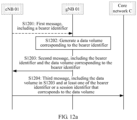
- the eNB 01 sends a first message to the gNB 01, where the message is used to instruct the gNB 01 to send, to the eNB 01, a data volume of data of the SCG bearer or the SCG split bearer that is transmitted via the gNB 01.
- the gNB 01 obtains the data volume of the data of the SCG bearer or the SCG split bearer that is transmitted via the gNB 01.
- the data volume S may be counted (for example, S1202) based on an uplink/downlink granularity.
- S1202 For detailed descriptions of related content, refer to related content of Example 1 to Example 4.
- the counting of the data volume S may exclude data header overheads.
- related content refer to related content of Example 1 to Example 4.
- the data volume S may be counted (for example, S1202) based on a bearer granularity, a session granularity, or a flow granularity.
- a bearer granularity for example, S1202
- a session granularity for example, S1202
- a flow granularity for example, S1202
- the gNB 01 no longer performs data transmission with the terminal 01 after obtaining the data volume S, thereby ensuring precision of the data volume.
- the gNB 01 sends a second message to the eNB 01, where the second message includes the data volume S.
- the gNB 01 may report, to the eNB 01 (for example, S1203), at least one of a bearer identifier, a flow identifier, or a session identifier that corresponds to the data volume S.
- a bearer identifier for example, S1203
- a flow identifier for example, S1203
- a session identifier that corresponds to the data volume S.
- the gNB 01 may further report (for example, S1203) timestamps to the eNB 01, and the timestamps are used to indicate a start time and an end time corresponding to the counting of the data volume S.
- S1203 timestamps
- the eNB 01 sends a third message to the core network C, where the third message includes the data volume, and at least one of the bearer identifier or the session identifier that corresponds to the data volume.
- the eNB 01 may further report, to the core network C (for example, S1204), at least one of the bearer identifier, the flow identifier, or the session identifier that corresponds to the data volume S.
- the core network C for example, S1204
- the bearer identifier for example, the bearer identifier
- the flow identifier for example, the flow identifier
- the session identifier that corresponds to the data volume S.
- the eNB 01 may further report (for example, S1204) a radio access technology of the gNB 01 to the core network C.
- S1204 a radio access technology of the gNB 01 to the core network C.
- the process may further include: accumulating, by the eNB 01, data volumes for a same SCG or SCG split bearer of a same radio access technology.
- the process may further include: accumulating, by the eNB 01, data volumes for a same SCG or SCG split bearer of a same radio access technology.
- the eNB 01 may further report (for example, S1204) timestamps to the core network C, and the timestamps are used to indicate a start time and an end time corresponding to the counting of the data volume S.
- S1204 timestamps
- the eNB 01 may further report (for example, S1204) a bearer type, for example, an SCG split bearer or an SCG bearer, to the core network C.
- a bearer type for example, an SCG split bearer or an SCG bearer
- the eNB 01 reports the data volume to the core network C (for example, S1204)
- the core network C for example, S1204
- related content refer to related content of Example 1 to Example 4.
- Solution 3 is also applicable to the secondary bearer or the secondary split bearer.
- the master node A is a gNB, the secondary node B is an eNB, and the core network C is an EPC or a 5GC; or the master node A is an eNB, the secondary node B is a WT, and the core network C is an EPC; or the master node A is a gNB, the secondary node B is a WT, and the core network C is a 5GC.
- the master node A is a gNB, the secondary node B is a WT, and the core network C is a 5GC.
- the method provided in Solution 3 is described below separately from a perspective of a master node side, a perspective of a secondary node side, and a perspective of a core network side.
- the following is the method of Solution 3 that is described from the perspective of the master node side.
- the method M5 includes the following steps.
- M501 When a bearer on the secondary node is released, the secondary node obtains a data volume of the secondary bearer or the secondary split bearer that is transmitted via the secondary node.
- the secondary node sends a first message to the master node, where the first message is used to indicate the data volume of the secondary bearer or the secondary split bearer that is transmitted via the secondary node.
- M502 For related descriptions of M502, refer to S809, S906, S1004, S1112, and S1203.
- the following is the method of Solution 3 that is described from the perspective of the master node side.
- the method M6 includes the following steps.
- M601 When a bearer on the secondary node is released, the master node receives a first message sent by the secondary node, where the first message includes information used to indicate a data volume of data of the secondary bearer or the secondary split bearer that is transmitted via the secondary node.
- M601 For related descriptions of M601, refer to S808, S905, S1003, S1111, and S1202.
- the master node sends a second message to the core network, where the first message includes the information used to indicate the data volume of the data of the secondary bearer or the secondary split bearer that is transmitted via the secondary node.
- M602 For related descriptions of M602, refer to S810, S907, S1005, S1113, and S1204.
- the following is the method of Solution 3 that is described from the perspective of the core network side.
- the method M7 includes the following steps.
- M701 When a bearer on the secondary node is released, a network element in the core network receives a second message from the master node, where the second message includes information used to indicate a data volume of data of the secondary bearer or the secondary split bearer that is transmitted via the secondary node.
- M701 For related descriptions of M701, refer to S810, S907, S1005, S1113, and S1204.
- the network element in the core network obtains, based on a data volume of transmitted data of the secondary bearer or the secondary split bearer and the data volume of the data of the secondary bearer or the secondary split bearer that is transmitted via the secondary node, information about a data volume of data of the secondary split bearer that is transmitted via the master node.
- FIG. 14 is a schematic diagram of a master split bearer.
- a user plane connection between a core network C and a master node A is established for a terminal 01
- a user plane connection is established between the master node A and the terminal 01
- a user plane connection is established between a secondary node B and the terminal 01.
- the core network C sends all data of the bearer to the master node A
- the master node A sends a part of the data to the secondary node B
- the secondary node B sends the part of the data to the terminal 01
- the master node A sends remaining data to the terminal 01.
- the terminal 01 may send a part of data of the bearer to the master node A, the terminal 01 sends remaining data of the bearer to the secondary node B, the secondary node B sends the remaining data to the master node A, and the master node A sends all of the received data of the bearer to the core network C.
- the terminal 01 may be configured that the terminal 01 sends all the data of the bearer to the secondary node B, and the secondary node B sends all the data of the bearer to the master node A; or it may be configured that the terminal 01 sends all the data of the bearer to the master node A.
- the master split bearer for example, refer to related content of Section 4.2.2 in 3GPP TS 37.340 V0.2.1.
- the secondary node B may send, to the master node A, a data volume of the master split bearer that is transmitted via the secondary node B, and the master node A reports the data volume to the core network C.
- the core network may learn of, according to the data volume of the master split bearer that is transmitted via the secondary node B, a data volume of the bearer that is transmitted via the master node A, thereby precisely counting the data volume.
- the master node A may report the data volume to the core network C based on the examples shown in Table 1 to Table 6.
- the network device may be the secondary node B in the network shown in FIG. 1 , and may perform the method performed by the secondary node B. As shown in FIG. 12b :
- the network device 1200 includes one or more remote radio units (English: remote radio unit, RRU for short) 1201 and one or more baseband units (English: baseband unit, BBU for short) 1202.
- the RRU 1201 may be referred to as a transceiver unit, a transceiver machine, a transceiver circuit, a transceiver, or the like.
- the RRU 1201 may include at least one antenna 1203 and a radio frequency unit 1204.
- the RRU 1201 is partially configured to: perform radio frequency signal sending and receiving and perform conversion between a radio frequency signal and a baseband signal.
- the BBU 1202 is partially configured to: perform baseband processing, control the network device, and the like.
- the RRU 1201 and the BBU 1202 may be physically disposed together; or may be physically disposed separately, that is, the network device 1200 is a distributed network device.
- the BBU 1202 is a control center of the network device, and may also be referred to as a processing unit.
- the BBU 1202 is mainly configured to perform a baseband processing function such as channel encoding, multiplexing, modulation, and spectrum spreading.
- the BBU processing unit
- the BBU may be configured to control the network device to perform the method performed by the secondary node B in the foregoing method embodiments.
- the BBU 1202 may include one or more boards.
- a plurality of boards may together support a radio access network having a single radio access technology (for example, an LTE network or an NR network), or may separately support a radio access network having different radio access technologies (for example, an LTE network, an NR network, or another network).
- the BBU 1202 further includes a memory 1025 and a processor 1206.
- the memory 1025 is configured to store necessary instructions and necessary data.
- the processor 1206 is configured to control the network device to perform a necessary action, for example, control the network device to perform the method performed by the secondary node B in the foregoing method embodiments.
- the memory 1025 and the processor 1206 may serve the one or more boards. In other words, the memory and the processor may be disposed independently on each board. Alternatively, a plurality of boards may share a same memory and a same processor. In addition, a necessary circuit may be further disposed on each board.
- an uplink signal (including data and the like) sent by a terminal device is received via the antenna 1203.
- a downlink signal (including data and/or control information) is sent to the terminal device via the antenna 1203.
- the processor 1206 processes service data and a signaling message. These units perform processing based on radio access technologies (for example, LTE, NR, and an access technology of another evolved system) used in a radio access network.
- the processor 1206 is further configured to control and manage an action of the network device, and is configured to perform the processing performed by the secondary node B in the foregoing method embodiments.
- FIG. 12b merely shows a simplified design of the network device.
- the network device may include any quantity of antennas, memories, processors, radio frequency units, RRUs, BBUs, and the like. All network devices that can implement this application fall within the protection scope of this application.
- An embodiment of this application provides another communications apparatus 1300.
- the communications apparatus may perform the method performed by the master node A in the foregoing method embodiments.
- the communications apparatus 1300 includes a processing system 1307, configured to perform the method M1, M3, or M5 performed by the master node A in the foregoing method embodiments.
- the processing system 1307 may be a circuit, and the circuit may be implemented by a chip.
- the processing system 1307 includes one or more processors 1301.
- the processor 1301 may be a general-purpose processor or a dedicated processor, for example, may be a baseband processor or a central processing unit.
- the processor 1301 may alternatively integrate a function of a baseband processor or a central processing unit.
- the baseband processor is mainly configured to process a communication protocol and communication data.
- the baseband processor may also be referred to as a baseband processing circuit or a baseband processing chip.
- the central processing unit is mainly configured to: control the entire communications apparatus (for example, a chip, a network device, or a terminal device), execute a software program, and process data of the software program.
- the central processing unit may also be referred to as a central processing circuit or a central processing chip.
- the one or more processors 1301 may perform the method M1, M3, or M5.
- the processor 1301 may be any one of the following components having a calculation processing capability: a central processing unit (English: Central Processing Unit, CPU for short), an ARM processor (English full name of AMR is: Advanced RISC Machines, and English full name of RISC is: Reduced Instruction Set Computing, translated into Reduced Instruction Set Computing in Chinese), a field programmable gate array (English: Field Programmable Gate Array, FPGA for short), and a dedicated processor.
- a central processing unit English: Central Processing Unit, CPU for short
- an ARM processor English full name of AMR is: Advanced RISC Machines, and English full name of RISC is: Reduced Instruction Set Computing, translated into Reduced Instruction Set Computing in Chinese
- a field programmable gate array English: Field Programmable Gate Array, FPGA for short
- the processor 1301 may be integrated as a many-core processor.
- the processor 1301 may include instructions 1303, and the instructions 1303 may be run on the processor 1301, so that the communications apparatus 1300 performs the method M1, M3, or M5.
- the processing system 1307 may include one or more memories 1302, and the memory 1302 is connected to the processor 1303 via a bus 1306.
- the memory 1302 store instructions 1304, and the instructions 1304 may be run on the processor 1301, so that the communications apparatus 1300 performs the method M1, M3, or M5.
- the memory 1302 may further store data.
- the processor 1301 may further store instructions and/or data.
- the one or more memories 1302 may store instructions and data in the foregoing method embodiments.
- the processor 1301 and the memory 1302 may be separately disposed, or may be integrated together.
- the memory 1302 may be any one or any combination of the following storage media: a random access memory (English: Random Access Memory, RAM for short), a read-only memory (English: read only memory, ROM for short), a non-volatile memory (English: non-volatile memory, NVM for short), a solid state drive (English: Solid State Drive, SSD for short), a mechanical hard disk, a magnetic disk, a disk array, and the like.
- a random access memory (English: Random Access Memory, RAM for short)
- a read-only memory English: read only memory, ROM for short
- a non-volatile memory English: non-volatile memory, NVM for short
- SSD Solid State Drive
- the bus 1306 may include an address bus, a data bus, a control bus, and the like. For ease of denotation, the bus is represented by using a bold line in FIG. 13 .
- the bus 1306 may be any one or any combination of the following components for wired data transmission: an industry standard architecture (English: Industry Standard Architecture, ISA for short) bus, a peripheral component interconnect (English: Peripheral Component Interconnect, PCI for short) bus, an extended industry standard architecture (English: Extended Industry Standard Architecture, EISA for short) bus, and the like.
- the processing system 1307 may further include a transceiver unit 1305, and the transceiver unit 1305 is connected to the processor 1303 via the bus 1306.
- the transceiver unit 1305 may be an input/output circuit of the chip, and the transceiver unit 1305 may exchange data with another communications unit (for example, a radio frequency chip or another unit in the network device).
- the communications apparatus 1300 may further include an antenna 1307, and the antenna 1307 may be connected to the transceiver unit 1305.
- the communications apparatus 1300 may be a network device (for example, the master node A).
- the transceiver unit 1305 may be a radio frequency unit.
- the transceiver unit 1305 may implement data exchange between the communications apparatus 1300 and another device via the antenna 1307. For example, when the communications apparatus 1300 is the master node A, the transceiver unit 1305 of the communications apparatus 1300 may exchange data with a secondary node B via the antenna 1307.
- the processor 1301 may be considered as a processing unit, and the memory 1302 may be considered as a storage unit.
- the communications apparatus 1300 may include a processing unit.
- the communications apparatus 1300 may further include at least one of the storage unit or the transceiver unit.
- An embodiment of this application further provides a computer-readable storage medium. All or some of the methods described in the foregoing method embodiments may be implemented by using software, hardware, firmware, or any combination thereof. If functions are implemented in software, the functions may be used as one or more instructions or code stored on the computer-readable medium or transferred over the computer-readable medium.
- the computer-readable medium may include a computer storage medium and a communications medium, and may further include any medium that enables a computer program to be transmitted from one place to another.
- the storage medium may be any available medium that can be accessed by a computer.
- the computer-readable medium may include a RAM, a ROM, an EEPROM, a CD-ROM or another compact disc memory, a magnetic disk memory or another magnetic disk storage device, or any other medium that can be used to carry or store expected program code in a form of an instruction or a data structure and that can be accessed by a computer.
- any connection may be appropriately referred to as a computer-readable medium.
- the coaxial cable, the optical fiber cable, the twisted pair, the DSL, or the radio technology such as infrared, radio, and microwave is included in a definition of the medium.
- the magnetic disk and the compact disc used in this specification include a compact disc (CD), a laser disk, an optical disc, a digital versatile disc (DVD), a floppy disk, and a Blu-ray disc.
- the magnetic disk usually magnetically reproduces data, and the compact disc optically reproduces data by using laser.
- the foregoing combination should also be included in the scope of the computer-readable medium.
- An embodiment of this application further provides a computer program product. All or some of the methods described in the foregoing method embodiments may be implemented by using software, hardware, firmware, or any combination thereof. When the methods are implemented in software, all or some the methods may be implemented in a form of a computer program product.
- the computer program product includes one or more computer instructions. When the computer program instructions are loaded and executed on a computer, all or some of the procedures or functions according to the foregoing method embodiments are generated.
- the foregoing computer may be a general-purpose computer, a dedicated computer, a computer network, a network device, user equipment, or another programmable apparatus.
Landscapes
- Engineering & Computer Science (AREA)
- Signal Processing (AREA)
- Computer Networks & Wireless Communication (AREA)
- Mobile Radio Communication Systems (AREA)
Applications Claiming Priority (2)
| Application Number | Priority Date | Filing Date | Title |
|---|---|---|---|
| CN201710687801.3A CN109547176B9 (zh) | 2017-08-11 | 2017-08-11 | 一种通信方法和装置 |
| PCT/CN2018/099615 WO2019029616A1 (zh) | 2017-08-11 | 2018-08-09 | 一种通信方法和装置 |
Publications (4)
| Publication Number | Publication Date |
|---|---|
| EP3609113A1 EP3609113A1 (en) | 2020-02-12 |
| EP3609113A4 EP3609113A4 (en) | 2020-07-29 |
| EP3609113C0 EP3609113C0 (en) | 2025-02-19 |
| EP3609113B1 true EP3609113B1 (en) | 2025-02-19 |
Family
ID=65270868
Family Applications (1)
| Application Number | Title | Priority Date | Filing Date |
|---|---|---|---|
| EP18843649.7A Active EP3609113B1 (en) | 2017-08-11 | 2018-08-09 | Communication method and device |
Country Status (8)
| Country | Link |
|---|---|
| US (2) | US10743213B2 (enExample) |
| EP (1) | EP3609113B1 (enExample) |
| JP (1) | JP7007406B2 (enExample) |
| KR (1) | KR102363791B1 (enExample) |
| CN (3) | CN110572882B (enExample) |
| BR (1) | BR112020000154A2 (enExample) |
| CA (1) | CA3064656C (enExample) |
| WO (1) | WO2019029616A1 (enExample) |
Families Citing this family (10)
| Publication number | Priority date | Publication date | Assignee | Title |
|---|---|---|---|---|
| CN110572785B (zh) | 2018-03-02 | 2020-12-04 | 华为技术有限公司 | 一种多连接下的数据量上报方法、设备及可读存储介质 |
| MX2021001451A (es) | 2018-08-08 | 2021-04-12 | Guangdong Oppo Mobile Telecommunications Corp Ltd | Metodo y aparato de configuracion de informacion, terminal y dispositivo de red. |
| CN113412640B (zh) * | 2019-02-08 | 2024-07-02 | 瑞典爱立信有限公司 | 5gs中的数据量报告 |
| CN111818572B (zh) * | 2019-04-10 | 2023-01-13 | 中国移动通信有限公司研究院 | 一种信息传输方法及设备 |
| CN111866963B (zh) * | 2019-04-28 | 2021-12-31 | 华为技术有限公司 | 通信方法、通信装置、计算机存储介质及通信系统 |
| WO2021029048A1 (ja) * | 2019-08-14 | 2021-02-18 | 株式会社Nttドコモ | マスターノード及びセカンダリノード |
| CN114223293B (zh) | 2019-08-15 | 2025-07-22 | 苹果公司 | 针对双连接模式中的ue功率效率的基于流量速率的分支去激活 |
| WO2021030984A1 (zh) * | 2019-08-16 | 2021-02-25 | 华为技术有限公司 | 一种配置方法、装置、计算机可读存储介质及系统 |
| CN112584453B (zh) * | 2019-09-30 | 2024-11-08 | 北京三星通信技术研究有限公司 | 移动通信网络中的主节点、辅节点和用户设备及其通信方法 |
| CN111093234B (zh) | 2019-11-04 | 2024-11-26 | 中兴通讯股份有限公司 | 交叉流程的处理方法、装置、设备和存储介质 |
Family Cites Families (61)
| Publication number | Priority date | Publication date | Assignee | Title |
|---|---|---|---|---|
| US8225002B2 (en) | 1999-01-22 | 2012-07-17 | Network Disk, Inc. | Data storage and data sharing in a network of heterogeneous computers |
| TWI397287B (zh) * | 2004-07-30 | 2013-05-21 | Ericsson Telefon Ab L M | 混合式通信網路中用以提供相關通信對話訊息之方法與系統 |
| FR2881306B1 (fr) | 2005-01-21 | 2007-03-23 | Meiosys Soc Par Actions Simpli | Procede de journalisation non intrusive d'evenements externes aupres d'un processus applicatif, et systeme mettant en oeuvre ce procede |
| FR2881308B1 (fr) | 2005-01-21 | 2007-03-23 | Meiosys Soc Par Actions Simpli | Procede d'acceleration de la transmission de donnees de journalisation en environnement multi ordinateurs et systeme utilisant ce procede |
| CN101247238B (zh) | 2007-02-14 | 2011-10-05 | 华为技术有限公司 | 数据流量统计的方法及系统 |
| GB2469509B8 (en) | 2009-04-16 | 2012-05-30 | Aircom Internat Ltd | Modelling apparatus and method |
| JP2013520096A (ja) * | 2010-02-12 | 2013-05-30 | インターデイジタル テクノロジー コーポレーション | 複数のサイト間のデータ分割 |
| CN102202419B (zh) * | 2011-04-25 | 2014-04-02 | 华为技术有限公司 | 多种无线接入技术服务一个用户设备的数据分配方法及装置 |
| WO2013022751A1 (en) * | 2011-08-10 | 2013-02-14 | Interdigital Patent Holdings, Inc. | Uplink feedback for multi-site scheduling |
| CN102958108B (zh) | 2011-08-26 | 2015-03-18 | 华为技术有限公司 | 用于数据传输的方法、分流点设备、用户终端和系统 |
| CN103249078A (zh) * | 2012-02-10 | 2013-08-14 | 中兴通讯股份有限公司 | 一种用于最小化路测的吞吐量测量方法和测量节点 |
| KR20160062216A (ko) * | 2012-03-22 | 2016-06-01 | 인터디지탈 패튼 홀딩스, 인크 | 백홀 트래픽을 오프로딩하는 방법 및 장치 |
| US9408125B2 (en) * | 2012-07-05 | 2016-08-02 | Qualcomm Incorporated | Aggregation of data bearers for carrier aggregation |
| EP2908570B1 (en) | 2012-11-13 | 2019-06-19 | Huawei Technologies Co., Ltd. | Method and base station for transmitting data |
| US9173147B2 (en) * | 2013-01-18 | 2015-10-27 | Blackberry Limited | Communicating data using a local wireless access network node |
| WO2015016550A1 (en) * | 2013-07-29 | 2015-02-05 | Lg Electronics Inc. | Method for calculating and reporting a buffer status and device therefor |
| EP2835925B1 (en) * | 2013-08-09 | 2018-08-08 | Panasonic Intellectual Property Corporation of America | Efficient Status Reporting for UEs in dual connectivity during mobility |
| JP6255497B2 (ja) * | 2013-09-26 | 2017-12-27 | エルジー エレクトロニクス インコーポレイティド | バッファ状態の報告及びトリガリング方法並びにそのための装置 |
| CN104581948B (zh) * | 2013-10-17 | 2018-10-30 | 普天信息技术研究院有限公司 | 一种双连接网络中的bsr处理方法 |
| ES2820330T3 (es) * | 2013-10-31 | 2021-04-20 | Nec Corp | Sistema de radiocomunicación, aparato de estación base, terminal de radio y método de control de comunicación |
| CN104797000B (zh) * | 2014-01-21 | 2018-06-19 | 普天信息技术有限公司 | 双连接网络中的无线承载建立方法及系统 |
| EP3099114B1 (en) * | 2014-01-24 | 2018-11-28 | Sharp Kabushiki Kaisha | Base station apparatus, terminal apparatus and integrated circuit |
| CN104812000A (zh) * | 2014-01-27 | 2015-07-29 | 中兴通讯股份有限公司 | 一种实现数据传输的方法及装置 |
| US10075381B2 (en) * | 2014-01-28 | 2018-09-11 | Mediatek Inc. | Buffer status report and logical channel prioritization for dual connectivity |
| KR102211263B1 (ko) * | 2014-03-21 | 2021-02-04 | 삼성전자주식회사 | 통신 시스템에서 단말의 버퍼 상태 보고 방법 및 장치 |
| CN104936228B (zh) * | 2014-03-21 | 2019-04-09 | 上海诺基亚贝尔股份有限公司 | 用于在双连接系统中流量控制的方法和装置 |
| CN106165511A (zh) * | 2014-04-18 | 2016-11-23 | 株式会社Ntt都科摩 | 用户装置、基站、上行数据分割比率计算方法、以及上行数据分割比率提供方法 |
| CN112672430A (zh) * | 2014-05-07 | 2021-04-16 | 株式会社Ntt都科摩 | 移动台、上行链路数据量报告方法 |
| US9838282B2 (en) * | 2014-05-09 | 2017-12-05 | Telefonaktiebolaget Lm Ericsson (Publ) | PDCP and flow control for split bearer |
| GB2528913B (en) * | 2014-08-04 | 2017-03-01 | Samsung Electronics Co Ltd | Signalling in dual connectivity mobile communication networks |
| EP3179761B1 (en) * | 2014-08-07 | 2022-06-01 | Nec Corporation | Base station and communication method |
| CN111246390B (zh) | 2014-08-07 | 2025-08-26 | 华为技术有限公司 | 用户设备位置信息上报方法和装置 |
| GB2528988A (en) * | 2014-08-08 | 2016-02-10 | Nec Corp | Communication system |
| CN104168655B (zh) * | 2014-08-08 | 2017-12-19 | 电信科学技术研究院 | 一种数据传输方法及装置 |
| US10219317B2 (en) * | 2014-09-25 | 2019-02-26 | Lg Electronics Inc. | Method for handling of data transmission and reception for SeNB related bearer release at a user equipment in a dual connectivity system and device therefor |
| EP3198925B1 (en) * | 2014-09-26 | 2019-10-16 | Nokia Solutions and Networks Oy | Lower and upper bounds for flow-control data requests between network nodes |
| CN107113901B (zh) * | 2014-11-07 | 2021-02-19 | 诺基亚技术有限公司 | 双连接中的数据转发支持 |
| WO2016144383A1 (en) * | 2015-03-10 | 2016-09-15 | Intel IP Corporation | Apparatus, system and method of offloading traffic of a secondary cell group (scg) |
| CN106332175A (zh) * | 2015-07-01 | 2017-01-11 | 中兴通讯股份有限公司 | 一种控制双连接x2状态报告发送的方法、装置及辅基站 |
| US20180199365A1 (en) * | 2015-07-06 | 2018-07-12 | Lg Electronics Inc. | Method for triggering buffer status report in dual connectivity and a device therefor |
| WO2017007171A1 (en) * | 2015-07-06 | 2017-01-12 | Lg Electronics Inc. | Method for triggering a buffer status reporting in dual connectivity and a device therefor |
| JPWO2017018538A1 (ja) * | 2015-07-30 | 2018-05-31 | 京セラ株式会社 | 無線端末 |
| WO2017022388A1 (ja) * | 2015-07-31 | 2017-02-09 | 株式会社Nttドコモ | 基地局、データ通信量管理装置、データ通信量報告方法、及びデータ通信量取得方法 |
| CN106454946A (zh) * | 2015-08-12 | 2017-02-22 | 中兴通讯股份有限公司 | 一种数据承载的迁移方法、装置和演进型节点 |
| WO2017030487A1 (en) | 2015-08-14 | 2017-02-23 | Telefonaktiebolaget Lm Ericsson (Publ) | Traffic monitoring and reporting in diverse connection scenarios |
| US10638282B2 (en) | 2015-12-31 | 2020-04-28 | Huawei Technologies Co., Ltd. | Charging system and method, and network device |
| CN106937396B (zh) * | 2015-12-31 | 2020-06-30 | 上海无线通信研究中心 | 一种上行资源调度方法、终端和基站 |
| WO2017117776A1 (en) * | 2016-01-07 | 2017-07-13 | Telefonaktiebolaget Lm Ericsson (Publ) | Methods and devices for downlink flow control in wireless communication systems |
| WO2017175823A1 (ja) * | 2016-04-08 | 2017-10-12 | 株式会社Nttドコモ | 基地局及び送信制御方法 |
| WO2017198308A1 (en) * | 2016-05-20 | 2017-11-23 | Nokia Solutions And Networks Oy | Power efficiency in multiple radio access technologies scenarios |
| EP3398366B1 (en) * | 2016-06-08 | 2019-10-02 | Huawei Technologies Co., Ltd. | Gateway, master access node and methods thereof |
| CN109314884B (zh) * | 2016-06-15 | 2021-01-29 | 华为技术有限公司 | 业务数据分流方法及装置 |
| WO2018059866A1 (en) * | 2016-09-28 | 2018-04-05 | Sony Corporation | Telecommunications apparatus and methods for handling split radio bearers |
| WO2018059704A1 (en) * | 2016-09-30 | 2018-04-05 | Nokia Solutions And Networks Oy | Communication control for uplink data in multi-connectivity communication mode |
| GB201621072D0 (en) * | 2016-12-12 | 2017-01-25 | Samsung Electronics Co Ltd | NR QOS handling |
| CN108282796B (zh) * | 2017-01-05 | 2022-08-09 | 中兴通讯股份有限公司 | 一种无线链路管理的方法及装置、系统 |
| KR102307472B1 (ko) * | 2017-03-22 | 2021-10-01 | 에스케이텔레콤 주식회사 | 이중 연결 네트워크에서의 연계 기지국의 데이터 전송 속도를 추정하는 방법 및 그 방법이 적용된 기지국 |
| US10237784B2 (en) * | 2017-03-24 | 2019-03-19 | Motorola Mobility Llc | Split bearer packet data converge protocol protocol data unit routing |
| US11032432B2 (en) * | 2017-05-08 | 2021-06-08 | Nokia Solutions And Networks Oy | Core networks controlled traffic transmission in dual/multiple-connectivity system |
| GB2563590B (en) * | 2017-06-16 | 2021-12-29 | Tcl Communication Ltd | Methods and devices associated with improvements in or relating to an uplink split bearer in new radio |
| US10757042B2 (en) * | 2017-08-11 | 2020-08-25 | Qualcomm Incorporated | Buffer management for multiple radio access technologies |
-
2017
- 2017-08-11 CN CN201910771691.8A patent/CN110572882B/zh active Active
- 2017-08-11 CN CN201710687801.3A patent/CN109547176B9/zh active Active
-
2018
- 2018-08-09 JP JP2019570975A patent/JP7007406B2/ja active Active
- 2018-08-09 CN CN201880052199.9A patent/CN111034104B/zh active Active
- 2018-08-09 BR BR112020000154-6A patent/BR112020000154A2/pt unknown
- 2018-08-09 KR KR1020197036229A patent/KR102363791B1/ko active Active
- 2018-08-09 EP EP18843649.7A patent/EP3609113B1/en active Active
- 2018-08-09 CA CA3064656A patent/CA3064656C/en active Active
- 2018-08-09 WO PCT/CN2018/099615 patent/WO2019029616A1/zh not_active Ceased
-
2019
- 2019-09-10 US US16/566,436 patent/US10743213B2/en active Active
-
2020
- 2020-06-30 US US16/916,529 patent/US11412414B2/en active Active
Also Published As
| Publication number | Publication date |
|---|---|
| JP7007406B2 (ja) | 2022-01-24 |
| CN111034104B (zh) | 2021-06-08 |
| EP3609113C0 (en) | 2025-02-19 |
| CN109547176B (zh) | 2022-05-17 |
| CA3064656C (en) | 2023-07-04 |
| BR112020000154A2 (pt) | 2020-07-14 |
| EP3609113A4 (en) | 2020-07-29 |
| RU2019143655A3 (enExample) | 2021-12-13 |
| RU2019143655A (ru) | 2021-06-25 |
| KR20200005618A (ko) | 2020-01-15 |
| US20200008100A1 (en) | 2020-01-02 |
| JP2020526081A (ja) | 2020-08-27 |
| CA3064656A1 (en) | 2019-02-14 |
| US20200336939A1 (en) | 2020-10-22 |
| CN109547176A (zh) | 2019-03-29 |
| CN110572882A (zh) | 2019-12-13 |
| US11412414B2 (en) | 2022-08-09 |
| CN110572882B (zh) | 2021-03-05 |
| KR102363791B1 (ko) | 2022-02-15 |
| WO2019029616A1 (zh) | 2019-02-14 |
| CN109547176B9 (zh) | 2022-07-01 |
| EP3609113A1 (en) | 2020-02-12 |
| CN111034104A (zh) | 2020-04-17 |
| US10743213B2 (en) | 2020-08-11 |
Similar Documents
| Publication | Publication Date | Title |
|---|---|---|
| EP3609113B1 (en) | Communication method and device | |
| JP7207475B2 (ja) | 無線通信システム、無線局、無線端末、及びこれらの通信制御方法 | |
| EP4171102A1 (en) | Communication method, device and system | |
| EP4221005A1 (en) | Multipath transmission method and communication apparatus | |
| RU2772980C2 (ru) | Способ связи и устройство связи | |
| WO2023061048A1 (zh) | 一种通信方法、装置及设备 | |
| WO2025055618A1 (zh) | 一种通信方法、装置及存储介质 | |
| KR20150134703A (ko) | 호처리 방법 및 장치 |
Legal Events
| Date | Code | Title | Description |
|---|---|---|---|
| STAA | Information on the status of an ep patent application or granted ep patent |
Free format text: STATUS: THE INTERNATIONAL PUBLICATION HAS BEEN MADE |
|
| PUAI | Public reference made under article 153(3) epc to a published international application that has entered the european phase |
Free format text: ORIGINAL CODE: 0009012 |
|
| STAA | Information on the status of an ep patent application or granted ep patent |
Free format text: STATUS: REQUEST FOR EXAMINATION WAS MADE |
|
| 17P | Request for examination filed |
Effective date: 20191107 |
|
| AK | Designated contracting states |
Kind code of ref document: A1 Designated state(s): AL AT BE BG CH CY CZ DE DK EE ES FI FR GB GR HR HU IE IS IT LI LT LU LV MC MK MT NL NO PL PT RO RS SE SI SK SM TR |
|
| AX | Request for extension of the european patent |
Extension state: BA ME |
|
| A4 | Supplementary search report drawn up and despatched |
Effective date: 20200626 |
|
| RIC1 | Information provided on ipc code assigned before grant |
Ipc: H04L 5/00 20060101ALI20200622BHEP Ipc: H04W 76/15 20180101ALI20200622BHEP Ipc: H04W 28/12 20090101AFI20200622BHEP Ipc: H04W 28/08 20090101ALI20200622BHEP |
|
| DAV | Request for validation of the european patent (deleted) | ||
| DAX | Request for extension of the european patent (deleted) | ||
| STAA | Information on the status of an ep patent application or granted ep patent |
Free format text: STATUS: EXAMINATION IS IN PROGRESS |
|
| 17Q | First examination report despatched |
Effective date: 20210617 |
|
| REG | Reference to a national code |
Ref country code: DE Ref legal event code: R079 Free format text: PREVIOUS MAIN CLASS: H04L0005000000 Ipc: H04W0028120000 Ref document number: 602018079401 Country of ref document: DE |
|
| GRAP | Despatch of communication of intention to grant a patent |
Free format text: ORIGINAL CODE: EPIDOSNIGR1 |
|
| STAA | Information on the status of an ep patent application or granted ep patent |
Free format text: STATUS: GRANT OF PATENT IS INTENDED |
|
| RIC1 | Information provided on ipc code assigned before grant |
Ipc: H04W 36/02 20090101ALI20240327BHEP Ipc: H04L 5/00 20060101ALI20240327BHEP Ipc: H04W 76/16 20180101ALI20240327BHEP Ipc: H04W 28/088 20230101ALI20240327BHEP Ipc: H04W 28/082 20230101ALI20240327BHEP Ipc: H04W 28/12 20090101AFI20240327BHEP |
|
| INTG | Intention to grant announced |
Effective date: 20240415 |
|
| GRAJ | Information related to disapproval of communication of intention to grant by the applicant or resumption of examination proceedings by the epo deleted |
Free format text: ORIGINAL CODE: EPIDOSDIGR1 |
|
| STAA | Information on the status of an ep patent application or granted ep patent |
Free format text: STATUS: EXAMINATION IS IN PROGRESS |
|
| GRAS | Grant fee paid |
Free format text: ORIGINAL CODE: EPIDOSNIGR3 |
|
| STAA | Information on the status of an ep patent application or granted ep patent |
Free format text: STATUS: GRANT OF PATENT IS INTENDED |
|
| GRAP | Despatch of communication of intention to grant a patent |
Free format text: ORIGINAL CODE: EPIDOSNIGR1 |
|
| INTC | Intention to grant announced (deleted) | ||
| INTG | Intention to grant announced |
Effective date: 20240913 |
|
| GRAA | (expected) grant |
Free format text: ORIGINAL CODE: 0009210 |
|
| STAA | Information on the status of an ep patent application or granted ep patent |
Free format text: STATUS: THE PATENT HAS BEEN GRANTED |
|
| AK | Designated contracting states |
Kind code of ref document: B1 Designated state(s): AL AT BE BG CH CY CZ DE DK EE ES FI FR GB GR HR HU IE IS IT LI LT LU LV MC MK MT NL NO PL PT RO RS SE SI SK SM TR |
|
| REG | Reference to a national code |
Ref country code: GB Ref legal event code: FG4D |
|
| REG | Reference to a national code |
Ref country code: CH Ref legal event code: EP |
|
| REG | Reference to a national code |
Ref country code: DE Ref legal event code: R096 Ref document number: 602018079401 Country of ref document: DE |
|
| REG | Reference to a national code |
Ref country code: IE Ref legal event code: FG4D |
|
| U01 | Request for unitary effect filed |
Effective date: 20250220 |
|
| U07 | Unitary effect registered |
Designated state(s): AT BE BG DE DK EE FI FR IT LT LU LV MT NL PT RO SE SI Effective date: 20250226 |
|
| PG25 | Lapsed in a contracting state [announced via postgrant information from national office to epo] |
Ref country code: RS Free format text: LAPSE BECAUSE OF FAILURE TO SUBMIT A TRANSLATION OF THE DESCRIPTION OR TO PAY THE FEE WITHIN THE PRESCRIBED TIME-LIMIT Effective date: 20250519 |
|
| PG25 | Lapsed in a contracting state [announced via postgrant information from national office to epo] |
Ref country code: PL Free format text: LAPSE BECAUSE OF FAILURE TO SUBMIT A TRANSLATION OF THE DESCRIPTION OR TO PAY THE FEE WITHIN THE PRESCRIBED TIME-LIMIT Effective date: 20250219 |
|
| PG25 | Lapsed in a contracting state [announced via postgrant information from national office to epo] |
Ref country code: ES Free format text: LAPSE BECAUSE OF FAILURE TO SUBMIT A TRANSLATION OF THE DESCRIPTION OR TO PAY THE FEE WITHIN THE PRESCRIBED TIME-LIMIT Effective date: 20250219 |
|
| PG25 | Lapsed in a contracting state [announced via postgrant information from national office to epo] |
Ref country code: IS Free format text: LAPSE BECAUSE OF FAILURE TO SUBMIT A TRANSLATION OF THE DESCRIPTION OR TO PAY THE FEE WITHIN THE PRESCRIBED TIME-LIMIT Effective date: 20250619 Ref country code: NO Free format text: LAPSE BECAUSE OF FAILURE TO SUBMIT A TRANSLATION OF THE DESCRIPTION OR TO PAY THE FEE WITHIN THE PRESCRIBED TIME-LIMIT Effective date: 20250519 |
|
| PG25 | Lapsed in a contracting state [announced via postgrant information from national office to epo] |
Ref country code: HR Free format text: LAPSE BECAUSE OF FAILURE TO SUBMIT A TRANSLATION OF THE DESCRIPTION OR TO PAY THE FEE WITHIN THE PRESCRIBED TIME-LIMIT Effective date: 20250219 |
|
| PG25 | Lapsed in a contracting state [announced via postgrant information from national office to epo] |
Ref country code: GR Free format text: LAPSE BECAUSE OF FAILURE TO SUBMIT A TRANSLATION OF THE DESCRIPTION OR TO PAY THE FEE WITHIN THE PRESCRIBED TIME-LIMIT Effective date: 20250520 |
|
| PG25 | Lapsed in a contracting state [announced via postgrant information from national office to epo] |
Ref country code: SM Free format text: LAPSE BECAUSE OF FAILURE TO SUBMIT A TRANSLATION OF THE DESCRIPTION OR TO PAY THE FEE WITHIN THE PRESCRIBED TIME-LIMIT Effective date: 20250219 |
|
| U20 | Renewal fee for the european patent with unitary effect paid |
Year of fee payment: 8 Effective date: 20250901 |
|
| PGFP | Annual fee paid to national office [announced via postgrant information from national office to epo] |
Ref country code: GB Payment date: 20250703 Year of fee payment: 8 |
|
| PG25 | Lapsed in a contracting state [announced via postgrant information from national office to epo] |
Ref country code: CZ Free format text: LAPSE BECAUSE OF FAILURE TO SUBMIT A TRANSLATION OF THE DESCRIPTION OR TO PAY THE FEE WITHIN THE PRESCRIBED TIME-LIMIT Effective date: 20250219 |
|
| PG25 | Lapsed in a contracting state [announced via postgrant information from national office to epo] |
Ref country code: SK Free format text: LAPSE BECAUSE OF FAILURE TO SUBMIT A TRANSLATION OF THE DESCRIPTION OR TO PAY THE FEE WITHIN THE PRESCRIBED TIME-LIMIT Effective date: 20250219 |