EP3608293A2 - Method for manufacturing positive electrode additive for lithium secondary battery - Google Patents
Method for manufacturing positive electrode additive for lithium secondary battery Download PDFInfo
- Publication number
- EP3608293A2 EP3608293A2 EP18881260.6A EP18881260A EP3608293A2 EP 3608293 A2 EP3608293 A2 EP 3608293A2 EP 18881260 A EP18881260 A EP 18881260A EP 3608293 A2 EP3608293 A2 EP 3608293A2
- Authority
- EP
- European Patent Office
- Prior art keywords
- positive electrode
- lithium
- heat treating
- raw material
- electrode additive
- Prior art date
- Legal status (The legal status is an assumption and is not a legal conclusion. Google has not performed a legal analysis and makes no representation as to the accuracy of the status listed.)
- Pending
Links
Images

Classifications
-
- H—ELECTRICITY
- H01—ELECTRIC ELEMENTS
- H01M—PROCESSES OR MEANS, e.g. BATTERIES, FOR THE DIRECT CONVERSION OF CHEMICAL ENERGY INTO ELECTRICAL ENERGY
- H01M4/00—Electrodes
-
- C—CHEMISTRY; METALLURGY
- C01—INORGANIC CHEMISTRY
- C01G—COMPOUNDS CONTAINING METALS NOT COVERED BY SUBCLASSES C01D OR C01F
- C01G53/00—Compounds of nickel
- C01G53/40—Complex oxides containing nickel and at least one other metal element
- C01G53/42—Complex oxides containing nickel and at least one other metal element containing alkali metals, e.g. LiNiO2
-
- H—ELECTRICITY
- H01—ELECTRIC ELEMENTS
- H01M—PROCESSES OR MEANS, e.g. BATTERIES, FOR THE DIRECT CONVERSION OF CHEMICAL ENERGY INTO ELECTRICAL ENERGY
- H01M10/00—Secondary cells; Manufacture thereof
- H01M10/05—Accumulators with non-aqueous electrolyte
- H01M10/052—Li-accumulators
-
- H—ELECTRICITY
- H01—ELECTRIC ELEMENTS
- H01M—PROCESSES OR MEANS, e.g. BATTERIES, FOR THE DIRECT CONVERSION OF CHEMICAL ENERGY INTO ELECTRICAL ENERGY
- H01M4/00—Electrodes
- H01M4/02—Electrodes composed of, or comprising, active material
- H01M4/04—Processes of manufacture in general
- H01M4/0471—Processes of manufacture in general involving thermal treatment, e.g. firing, sintering, backing particulate active material, thermal decomposition, pyrolysis
-
- H—ELECTRICITY
- H01—ELECTRIC ELEMENTS
- H01M—PROCESSES OR MEANS, e.g. BATTERIES, FOR THE DIRECT CONVERSION OF CHEMICAL ENERGY INTO ELECTRICAL ENERGY
- H01M4/00—Electrodes
- H01M4/02—Electrodes composed of, or comprising, active material
- H01M4/13—Electrodes for accumulators with non-aqueous electrolyte, e.g. for lithium-accumulators; Processes of manufacture thereof
- H01M4/131—Electrodes based on mixed oxides or hydroxides, or on mixtures of oxides or hydroxides, e.g. LiCoOx
-
- H—ELECTRICITY
- H01—ELECTRIC ELEMENTS
- H01M—PROCESSES OR MEANS, e.g. BATTERIES, FOR THE DIRECT CONVERSION OF CHEMICAL ENERGY INTO ELECTRICAL ENERGY
- H01M4/00—Electrodes
- H01M4/02—Electrodes composed of, or comprising, active material
- H01M4/13—Electrodes for accumulators with non-aqueous electrolyte, e.g. for lithium-accumulators; Processes of manufacture thereof
- H01M4/139—Processes of manufacture
- H01M4/1391—Processes of manufacture of electrodes based on mixed oxides or hydroxides, or on mixtures of oxides or hydroxides, e.g. LiCoOx
-
- H—ELECTRICITY
- H01—ELECTRIC ELEMENTS
- H01M—PROCESSES OR MEANS, e.g. BATTERIES, FOR THE DIRECT CONVERSION OF CHEMICAL ENERGY INTO ELECTRICAL ENERGY
- H01M4/00—Electrodes
- H01M4/02—Electrodes composed of, or comprising, active material
- H01M4/36—Selection of substances as active materials, active masses, active liquids
- H01M4/48—Selection of substances as active materials, active masses, active liquids of inorganic oxides or hydroxides
- H01M4/485—Selection of substances as active materials, active masses, active liquids of inorganic oxides or hydroxides of mixed oxides or hydroxides for inserting or intercalating light metals, e.g. LiTi2O4 or LiTi2OxFy
-
- H—ELECTRICITY
- H01—ELECTRIC ELEMENTS
- H01M—PROCESSES OR MEANS, e.g. BATTERIES, FOR THE DIRECT CONVERSION OF CHEMICAL ENERGY INTO ELECTRICAL ENERGY
- H01M4/00—Electrodes
- H01M4/02—Electrodes composed of, or comprising, active material
- H01M4/36—Selection of substances as active materials, active masses, active liquids
- H01M4/48—Selection of substances as active materials, active masses, active liquids of inorganic oxides or hydroxides
- H01M4/52—Selection of substances as active materials, active masses, active liquids of inorganic oxides or hydroxides of nickel, cobalt or iron
- H01M4/525—Selection of substances as active materials, active masses, active liquids of inorganic oxides or hydroxides of nickel, cobalt or iron of mixed oxides or hydroxides containing iron, cobalt or nickel for inserting or intercalating light metals, e.g. LiNiO2, LiCoO2 or LiCoOxFy
-
- H—ELECTRICITY
- H01—ELECTRIC ELEMENTS
- H01M—PROCESSES OR MEANS, e.g. BATTERIES, FOR THE DIRECT CONVERSION OF CHEMICAL ENERGY INTO ELECTRICAL ENERGY
- H01M4/00—Electrodes
- H01M4/02—Electrodes composed of, or comprising, active material
- H01M4/36—Selection of substances as active materials, active masses, active liquids
- H01M4/58—Selection of substances as active materials, active masses, active liquids of inorganic compounds other than oxides or hydroxides, e.g. sulfides, selenides, tellurides, halogenides or LiCoFy; of polyanionic structures, e.g. phosphates, silicates or borates
- H01M4/5825—Oxygenated metallic salts or polyanionic structures, e.g. borates, phosphates, silicates, olivines
-
- C—CHEMISTRY; METALLURGY
- C01—INORGANIC CHEMISTRY
- C01P—INDEXING SCHEME RELATING TO STRUCTURAL AND PHYSICAL ASPECTS OF SOLID INORGANIC COMPOUNDS
- C01P2002/00—Crystal-structural characteristics
- C01P2002/50—Solid solutions
- C01P2002/52—Solid solutions containing elements as dopants
- C01P2002/54—Solid solutions containing elements as dopants one element only
-
- C—CHEMISTRY; METALLURGY
- C01—INORGANIC CHEMISTRY
- C01P—INDEXING SCHEME RELATING TO STRUCTURAL AND PHYSICAL ASPECTS OF SOLID INORGANIC COMPOUNDS
- C01P2002/00—Crystal-structural characteristics
- C01P2002/70—Crystal-structural characteristics defined by measured X-ray, neutron or electron diffraction data
- C01P2002/72—Crystal-structural characteristics defined by measured X-ray, neutron or electron diffraction data by d-values or two theta-values, e.g. as X-ray diagram
-
- C—CHEMISTRY; METALLURGY
- C01—INORGANIC CHEMISTRY
- C01P—INDEXING SCHEME RELATING TO STRUCTURAL AND PHYSICAL ASPECTS OF SOLID INORGANIC COMPOUNDS
- C01P2002/00—Crystal-structural characteristics
- C01P2002/70—Crystal-structural characteristics defined by measured X-ray, neutron or electron diffraction data
- C01P2002/74—Crystal-structural characteristics defined by measured X-ray, neutron or electron diffraction data by peak-intensities or a ratio thereof only
-
- C—CHEMISTRY; METALLURGY
- C01—INORGANIC CHEMISTRY
- C01P—INDEXING SCHEME RELATING TO STRUCTURAL AND PHYSICAL ASPECTS OF SOLID INORGANIC COMPOUNDS
- C01P2002/00—Crystal-structural characteristics
- C01P2002/80—Crystal-structural characteristics defined by measured data other than those specified in group C01P2002/70
- C01P2002/88—Crystal-structural characteristics defined by measured data other than those specified in group C01P2002/70 by thermal analysis data, e.g. TGA, DTA, DSC
-
- C—CHEMISTRY; METALLURGY
- C01—INORGANIC CHEMISTRY
- C01P—INDEXING SCHEME RELATING TO STRUCTURAL AND PHYSICAL ASPECTS OF SOLID INORGANIC COMPOUNDS
- C01P2006/00—Physical properties of inorganic compounds
- C01P2006/40—Electric properties
-
- H—ELECTRICITY
- H01—ELECTRIC ELEMENTS
- H01M—PROCESSES OR MEANS, e.g. BATTERIES, FOR THE DIRECT CONVERSION OF CHEMICAL ENERGY INTO ELECTRICAL ENERGY
- H01M10/00—Secondary cells; Manufacture thereof
- H01M10/05—Accumulators with non-aqueous electrolyte
- H01M10/052—Li-accumulators
- H01M10/0525—Rocking-chair batteries, i.e. batteries with lithium insertion or intercalation in both electrodes; Lithium-ion batteries
-
- H—ELECTRICITY
- H01—ELECTRIC ELEMENTS
- H01M—PROCESSES OR MEANS, e.g. BATTERIES, FOR THE DIRECT CONVERSION OF CHEMICAL ENERGY INTO ELECTRICAL ENERGY
- H01M4/00—Electrodes
- H01M4/02—Electrodes composed of, or comprising, active material
- H01M2004/026—Electrodes composed of, or comprising, active material characterised by the polarity
- H01M2004/028—Positive electrodes
-
- Y—GENERAL TAGGING OF NEW TECHNOLOGICAL DEVELOPMENTS; GENERAL TAGGING OF CROSS-SECTIONAL TECHNOLOGIES SPANNING OVER SEVERAL SECTIONS OF THE IPC; TECHNICAL SUBJECTS COVERED BY FORMER USPC CROSS-REFERENCE ART COLLECTIONS [XRACs] AND DIGESTS
- Y02—TECHNOLOGIES OR APPLICATIONS FOR MITIGATION OR ADAPTATION AGAINST CLIMATE CHANGE
- Y02E—REDUCTION OF GREENHOUSE GAS [GHG] EMISSIONS, RELATED TO ENERGY GENERATION, TRANSMISSION OR DISTRIBUTION
- Y02E60/00—Enabling technologies; Technologies with a potential or indirect contribution to GHG emissions mitigation
- Y02E60/10—Energy storage using batteries
Definitions
- the present invention relates to a method for preparing a positive electrode additive of a lithium secondary battery that is capable of reducing by-products and unreacted materials produced in a preparing process, thereby significantly reducing the amount of gas generated when the electrode is operated.
- lithium secondary battery having high energy density and a high voltage, a long cycle life, and a low self-discharge rate is commercially available and widely used.
- Graphite is mainly used as a negative electrode material of the lithium secondary battery, but it is difficult to increase capacity of the lithium secondary battery because capacity per unit mass of graphite is as small as 372 mAh/g. Accordingly, as non-carbon materials of the negative electrode having higher capacity than graphite, materials for forming a lithium-metal compound with lithium, such as silicon, tin, and oxides thereof have been developed and used, but these materials of the negative electrode have high irreversible capacity loss because they have low initial efficiency during initial charge/discharge.
- a method for compensating the irreversible capacity loss of the negative electrode by using a material that can provide a positive electrode material with a lithium ion source or storage, and become electrochemically active after an initial cycle so as to not deteriorate performance of the entire battery has been studied and proposed.
- the lithium nickel-based oxide is mainly produced by reacting a nickel oxide or nickel carbonate with an excess amount of a lithium oxide, and in this case, the unreacted lithium oxide (Li 2 O), or by-products such as LiOH or Li 2 CO 3 , remain in the finally produced lithium nickel-based oxide.
- the unreacted lithium oxide and the by-products remaining in the lithium nickel-based oxide are decomposed during the initial cycle of the battery, and generate an excessive amount of gas such as O 2 and CO 2 .
- the by-products such as LiOH reacts with a binder component of the electrode to increase viscosity of the composition or cause gelation, thereby making it difficult to uniform apply the composition of the electrode for forming the active material layer, and deteriorating characteristics of the battery. Further, free Li derived from free LiOH, and/or LiOH, deteriorates cycle efficiency of the positive electrode.
- the present invention has been made in an effort to provide a method for preparing a positive electrode additive of a lithium secondary battery that is capable of reducing the amount of Li-based by-products and unreacted lithium oxides, thereby drastically reducing the amount of gas generated when an electrode is operated.
- the present invention has been made in an effort to provide a positive electrode additive for a lithium secondary battery that is produced according to the preparing method to significantly reduce the amount of Li-based by-products and unreacted materials causing generation of gas, and a positive electrode for a lithium secondary battery and a lithium secondary battery that include the positive electrode additive and exhibit excellent electrochemical characteristics.
- a preparing method of a positive electrode additive for a lithium secondary battery including mixing a lithium raw material, a nickel raw material, and a raw material of an element M and heat treating them under an atmosphere of an inert gas to produce a lithium nickel oxide of Chemical Formula 1 below, wherein the heat treating includes first heat treating at 300 °C to 500 °C, and second heat treating at 550 °C to 800 °C after the first heat treating, and the first heat treating is performed for 30 % to 50 % of a total duration of the heat treating, wherein the positive electrode additive includes the lithium nickel oxide of Chemical Formula 1: [Chemical Formula 1] Li 2 Ni 1-x M x O 2 wherein, in Chemical Formula 1, M is selected from the group consisting of a transition metal, an amphoteric element, P, F, and B, wherein M is not nickel, and 0 ⁇ x ⁇ 1.
- a positive electrode additive for a lithium secondary battery is provided.
- the positive electrode additive is prepared by the preparing method, and includes a lithium nickel oxide of Chemical Formula 1, and further includes less than 11 wt% NiO and 1 wt% or less Li 2 O, wherein a total amount of the NiO and the Li 2 O is less than or equal to 11 wt% based on a total weight of the positive electrode additive.
- a positive electrode for a lithium secondary battery and a lithium secondary battery that include the positive electrode additive are provided.
- the preparing method of a positive electrode additive for a lithium secondary battery according to the present invention can reduce the by-products and the unreacted materials produced in the preparing process, thereby significantly reducing the amount of gas generated when the electrode is operated. Accordingly, the positive electrode and the lithium secondary battery manufactured using the positive electrode additive may exhibit excellent electrochemical and lifespan characteristics.
- a preparing method of a positive electrode additive for a lithium secondary battery according to an exemplary embodiment of the present invention, a positive electrode additive produced by the method, and a positive electrode and a lithium secondary battery including the positive electrode additive will now be described.
- a preparing method of a positive electrode additive for a lithium secondary battery includes mixing a lithium raw material, a nickel raw material, and a raw material of an element M, and heat treating them under an atmosphere of an inert gas to manufacture a lithium nickel oxide of Chemical Formula 1, wherein the heat treating includes first heat treating at 300 °C to 500 °C and second heat treating at 550 °C to 800 °C after the first heat treating, and the first heat treating is performed for 30 % to 50 % of a total duration of the heat treating.
- M is selected from the group consisting of a transition metal, an amphoteric element, P, F, and B, wherein M is not nickel, and 0 ⁇ x ⁇ 1.
- the additive comprising the lithium nickel oxide of the above formula 1 is prepared by using the nickel raw material, the element M raw material, and the lithium raw material, a multi-step heat treatment is performed at the reaction temperatures confirmed by thermal analysis of the raw materials and mixtures thereof, so as to induce a sufficient reaction of the lithium raw materials and to significantly reduce unreacted lithium oxides and by-products which cause gas generation during the operation of the battery
- the heat treating includes: reacting the lithium raw material and the raw material of the element M in a mixture containing the lithium raw material, the nickel raw material, and the raw material of the element M through the first heat treating under an atmosphere of an inert gas at 300 °C to 500 °C to produce a compound containing lithium and the element M; and producing the lithium nickel oxide of Chemical Formula 1 through the second heat treating for the compound under an atmosphere of an inert gas at 550 to 800 °C, and simultaneously reacting the remaining lithium and nickel raw materials that are not reacted in the heat treating.
- the first heat treating is performed at 300 °C to 500 °C.
- the reaction between the lithium raw material and the raw material of the element M sufficiently occurs, and the compound containing lithium and the element M can be produced with a high yield.
- the temperature is below 300 °C during the first heat treating, the reaction between the lithium raw material and the raw material of the element M does not sufficiently occur, and as a result, a large amount of unreacted raw materials is produced, thereby generating by-products in the subsequent second heat treating.
- the temperature exceeds 500 °C, it is not easy to control a reaction rate of the lithium raw material and the raw material of the element M, thereby generating by-products.
- the first heat treating may be performed at 330 °C to 450 °C, and more specifically may be performed at 350 °C to 400 °C.
- the first heat treating may be performed for 30 % to 50 % of a total duration of the heat treating.
- the reaction between the lithium raw material and the raw material of the element M may sufficiently occur.
- the duration of the first heat treating is less than 30 % of the total duration of the heat treating, the reaction between the lithium raw material and the raw material of the element M does not sufficiently occur, and as a result, a large amount of the unreacted raw materials is produced, thereby producing by-products in the subsequent second heat treating.
- the duration of the first heat treating exceeds 50 % of the total duration of the heat treating, a duration of the second heat treating relatively decreases, and an amount of the unreacted lithium oxide may increase because there is not sufficient time for the unreacted lithium raw material and the nickel raw material to react during the second heat treating.
- the first heat treating may be performed for 35 % to 45 % of the total duration of the heat treating, and more specifically, for 40 % to 45 % of the total duration of the heat treating.
- the first heat treating may also include a temperature rising step of heating the mixture of the reaction materials to the above-described heat treating temperature, and a maintaining step of maintaining the heated temperature for a predetermined time such that the reaction sufficiently occurs.
- the temperature rising step in the first heat treating may be specifically performed by heating to a temperature of 300 °C to 500 °C at a rate of 2 °C/min to 7 °C/min, and more specifically, at a rate of 2 °C/min to 5 °C/min.
- efficiency of the reaction can be further improved.
- the maintaining step may be performed for 40 % to 80 % of the total duration of the first heat treating.
- the maintaining step is performed for the above-described duration, a diffusion reaction between particles can sufficiently occur, and the reaction between the raw material of the element M and the lithium raw material can be further improved.
- the maintaining step may be performed for 40 % to 70 % of the total duration of the first heat treating.
- the first heat treating may be performed under an atmosphere of an inert gas such as nitrogen, helium, or argon to suppress the side reaction.
- an inert gas such as nitrogen, helium, or argon
- the first heat treating may be performed under an atmosphere of nitrogen.
- the lithium raw material such as an oxide, a sulfate, a nitrate, an acetate, a carbonate, an oxalate, a citrate, a halide, a hydroxide, or an oxyhydroxide that contain lithium
- Li 2 CO 3 , LiNO 3 , LiNO 2 LiOH, LiOH • H 2 O, LiH, LiF, LiCl, LiBr, LiI, CH 3 COOLi, Li 2 O, Li 2 SO 4 , CH 3 COOLi, or Li 3 C 6 H 5 O 7 may be used.
- Li 2 CO 3 , LiNO 3 , LiNO 2 , LiOH, LiOH • H 2 O, LiH, LiF, LiCl, LiBr, LiI, CH 3 COOLi, Li 2 O, Li 2 SO 4 , CH 3 COOLi, or Li 3 C 6 H 5 O 7 may be used.
- the lithium raw material may be Li 2 O.
- the nickel raw material may be a nickel-containing oxide or hydroxide such as a nickel oxide (NiO) or a nickel hydroxide (Ni(OH) 2 ).
- Examples of the raw material of the element M may be an oxide, sulfate, a nitrate, an acetate, a carbonate, an oxalate, a citrate, a halide, a hydroxide, an oxyhydroxide, or a phosphate containing M, and among them, may be a phosphate.
- the M is contained in a finally produced lithium nickel-containing oxide by substituting some of nickel and serves to improve thermal stability and structural stability, and specifically, may be: a transition metal element having a divalent, trivalent, or pentavalent oxidation number such as Co, Mn, W, Fe, Mg, Ti, Cu, or Zr; an amphoteric element having a trivalent oxidation number such as Al; and one selected from the group consisting of P, F, and B.
- a transition metal element having a divalent, trivalent, or pentavalent oxidation number such as Co, Mn, W, Fe, Mg, Ti, Cu, or Zr
- an amphoteric element having a trivalent oxidation number such as Al
- P, F, and B one selected from the group consisting of P, F, and B.
- the M may be selected from the group consisting of W, Ti, Al, Zr, P, F, and B, and more specifically, may be W, Al, P, or B, which is excellent in reactivity with lithium and makes it possible to produce a more stable compound, and specifically, among them, may be W, Al, or P.
- the lithium raw material, the nickel raw material, and the raw material of the element M may be respectively used in amounts such that they satisfy a composition ratio of metal elements such as lithium and nickel in the finally produced lithium nickel oxide represented by Chemical Formula 1.
- the lithium raw material may be used in the amount such that a mole ratio of lithium:(nickel+element M) is 2:1.
- the mole ratio of lithium:(nickel+element M) does not satisfy 2:1, the composition of Chemical Formula 1 is not satisfied, and as a result, it cannot fully function as a sacrificial positive electrode material or a non-reversible additive.
- a sintering agent may be further optionally added.
- the sintering agent may be: an ammonium ion-containing compound such as NH 4 F, NH 4 NO 3 , or (NH 4 ) 2 SO 4 ; a metal oxide such as B 2 O 3 or Bi 2 O 3 ; or a metal halide such as NiCl 2 or CaCl 2 , and any one or a mixture of two or more of them may be used.
- the sintering agent may be used in an amount of 0.01 mol to 0.2 mol based on 1 mol of the raw material containing nickel.
- a moisture-removing agent when mixing the raw materials, a moisture-removing agent may be further optionally added.
- the moisture-removing agent may include citric acid, tartaric acid, glycolic acid, and maleic acid, and any one or a mixture of two or more of them may be used.
- the moisture-removing agent may be used in an amount of 0.01 mol to 0.2 mol based on 1 mol of the nickel raw material.
- the lithium-element M-containing compound is produced by the reaction between the lithium raw material and the raw material of the element M.
- the lithium-element M-containing compound may be a compound having a Li-M-O phase such as Li 3 PO 4 , Li 5 AlO 4 , or LiBO 2 (the M is the same as described above).
- the unreacted lithium raw material such as Li 2 O and the nickel raw material are present in reaction products.
- the second heat treating is specifically performed at 550 to 800 °C.
- the lithium nickel-containing oxide of Chemical Formula 1 can be prepared with excellent efficiency, and the amount of the unreacted lithium oxide can be reduced by the reaction between the unreacted lithium oxide and the nickel raw material at the same time.
- the second heat treating may be performed at 600 °C to 800 °C, and more specifically, at 600 °C to 700 °C.
- the second heat treating may be performed for 50 to 70 % of the total duration of the heat treating.
- the duration of the second heat treating is less than 50 % of the total duration of the heat treating, a sufficient reaction between the unreacted lithium oxide and the nickel raw material hardly occurs because the duration of the reaction is short, and an amount of lithium-based byproduct in the positive electrode additive may be hardly reduced due to poor efficiency of the reaction.
- the duration of the second heat treating exceeds 70 %, an excessive reaction is likely to occur, and this is inefficient because the heat treating is excessively long.
- the second heat treating may be performed for 50 % to 65 % of the total duration of the heat treatment, and more specifically, for 50 % to 60 %.
- the second heat treating may include: a temperature rising step of heating the mixture of the lithium-element M-containing compound, the nickel raw material, the unreacted lithium raw material that is manufactured in the previous step; and a maintaining step of maintaining the heated temperature for a predetermined time such that the reaction sufficiently occurs.
- the temperature rising step in the second heat treating may be performed by heating to a temperature of 550 °C to 800 °C, more specifically at 600 °C to 800 °C, and even more specifically at 600 °C to 700 °C, at a rate of 2 to 7 °C/min, and more specifically at a rate of 2 to 5 °C/min.
- efficiency of the reaction can be further improved.
- the maintaining step may be performed for 60 % to 90 % of the total duration of the second heat treating.
- the maintaining step is performed for the above-described duration, a diffusion reaction between particles can sufficiently occur, and the reaction between the raw material of the element M and the lithium raw material can be improved.
- the maintaining step may be performed for 60 to 80 % of the total duration of the second heat treating.
- the second heat treating may also be performed under an atmosphere of an inert gas such as nitrogen, helium, or argon so as to suppress the side reaction.
- an inert gas such as nitrogen, helium, or argon
- the second heat treating may be performed under an atmosphere of nitrogen.
- Cooling may be optionally further performed after the second heat treating.
- the cooling may be performed according to a conventional method, and specifically, may be performed by methods such as natural cooling and hot air cooling under an air atmosphere.
- a Li-M-O phase included in a reaction product obtained from the first heat treating as described above reacts with the remaining unreacted Li 2 O and NiO, thereby producing a positive electrode additive including a lithium nickel oxide doped with M of Chemical Formula 1.
- M is selected from the group consisting of a transition metal, an amphoteric element, P, F, and B, wherein M is not nickel, and 0 ⁇ x ⁇ 1.
- the element M may be one selected from the group consisting of: a transition metal element having a divalent, trivalent, or pentavalent oxidation number such as Co, Mn, W, Fe, Mg, Ti, Cu, or Zr; an amphoteric element having a trivalent oxidation number such as Al; and P, F, and B, and among them, the M may be one selected from the group consisting of W, Ti, Zr, Al, P, F, and B, and more specifically, may be P, Al, or B, which is excellent in reactivity with lithium and capable of forming a more stable compound.
- a transition metal element having a divalent, trivalent, or pentavalent oxidation number such as Co, Mn, W, Fe, Mg, Ti, Cu, or Zr
- an amphoteric element having a trivalent oxidation number such as Al
- P, F, and B and among them, the M may be one selected from the group consisting of W, Ti, Zr, Al, P, F,
- the element M may be contained in an amount corresponding to x by substituting Ni.
- the amount of the substituted element M may be 0 ⁇ x ⁇ 0.5 or 0.01 ⁇ x ⁇ 0.1 when considering an improved effect of controlling the amount of the substituted M contained in the lithium nickel oxide, and more specifically, 0.01 ⁇ x ⁇ 0.06.
- the amount of the remaining unreacted Li 2 O and the amount of NiO in the produced positive electrode additive significantly decrease when compared with the prior art, and particularly the amount of the lithium-based byproduct such as Li 2 O significantly decreases.
- the positive electrode additive produced according to the preparing method includes the lithium nickel oxide of Chemical Formula 1, and further includes less than 11 wt% NiO and 1 wt% or less Li 2 O based on a total weight of the positive electrode additive, wherein a total amount of NiO and Li 2 O may be less than or equal to 11 wt% based on a total weight of the positive electrode additive.
- the positive electrode additive may include Li 2 O at 0.5 wt% or less, and more specifically, 0 wt% of Li 2 O, that is, it does not include Li 2 O. As the amount of the unreacted material and the lithium byproduct decreases, an amount of gas generated when the battery is operated can be significantly reduced.
- the positive electrode additive produced according to the preparing method may further include LiOH of 5 wt% or less, specifically LiOH of 4.5 wt% or less, and more specifically, LiOH of 4.2 wt% or less, and Li 2 CO 3 of 0.5 wt% to 1 wt%.
- the lithium-based byproduct including LiOH and Li 2 CO 3 may be contained in an amount of 0.5 wt% to 3.5 wt%, and more specifically, 0.5 wt% to 3.1 wt%, based on the total weight of the positive electrode additive. Because the amount of LiOH is significantly reduced, gelation may not occur during the mixing for forming the positive electrode.
- the positive electrode additive can exhibit a superior effect when used as a sacrificial positive electrode material or an irreversible additive for a lithium-transition metal oxide capable of intercalating and deintercalating lithium ions. Further, since Li 2 CO 3 is present on a surface of the positive electrode additive, it can suppress heat from being generated from the positive electrode when a short circuit occurs, and suppress moisture adsorption from the atmosphere.
- the positive electrode additive produced according to the preparing method for a lithium secondary battery may reduce by-products and unreacted materials that are inevitably produced in the preparing process, thereby significantly reducing the amount of gas generated when the battery is operated. Accordingly, the positive electrode and the lithium secondary battery manufactured using the positive electrode additive may exhibit excellent electrochemical and lifespan characteristics.
- the positive electrode additive contains an excess amount of lithium, it may be used as a sacrificial positive electrode material or an irreversible additive (or an overdischarge inhibitor) that can compensate for an irreversible capacity loss.
- a positive electrode for a lithium secondary battery and a lithium secondary battery including the positive electrode additive produced by the preparing method are provided.
- the positive electrode includes a positive electrode current collector, and a positive electrode active material layer that is formed on the positive electrode current collector and includes the positive electrode additive.
- the positive electrode current collector is not specifically limited as long as it has conductivity without causing chemical changes to a battery, and stainless steel, aluminum, nickel, titanium, sintered carbon, or aluminum or stainless steel surface-treated with carbon, nickel, titanium, or silver may be used as the positive electrode current collector, for example.
- the positive electrode current collector may have a thickness of 3 ⁇ m to 500 ⁇ m, and minute protrusions and depressions may be formed on a surface of the current collector to increase adhesiveness of the positive electrode active material.
- the positive electrode current collector may have various forms such as a film, a sheet, a foil, a net, a porous body, foam, and a non-woven fabric.
- the positive electrode active material layer may include a positive electrode active material, a conductive material, and a binder.
- the conductive material is used to provide conductivity to the electrode, and is not specifically limited as long as it has electron conductivity without causing any chemical changes to the battery.
- the conductive material include: carbon-based materials such as carbon black, acetylene black, Ketjen black, channel black, furnace black, lamp black, summer black, and carbon fiber; graphite such as natural graphite or artificial graphite; a metal powder or a metal fiber such as copper, nickel, aluminum, and silver; conductive whiskers such as zinc oxide and potassium titanate; a conductive metal oxide such as a titanium oxide; and a conductive polymer such as polyphenylene derivatives. These may be used alone or in a mixture of two or more.
- the conductive material may be included in an amount of 1 wt% to 30 wt% based on the total weight of the positive electrode active material layer.
- the binder facilitates adhesion between particles of the positive electrode active material and adhesion between the positive electrode active material and the current collector.
- the binder may include polyvinylidene fluoride (PVdF), a vinylidene fluoride-hexafluoropropylene copolymer (PVdF-co-HFP), polyvinyl alcohol, polyacrylonitrile, carboxymethyl cellulose (CMC), starch, hydroxypropyl cellulose, regenerated cellulose, polyvinylpyrrolidone, tetrafluoroethylene, polyethylene, polypropylene, an ethylene-propylene-diene monomer (EPDM), sulfonated-EPDM, styrene butadiene rubber (SBR), fluoro rubber, and various copolymers thereof.
- the binder may be included in an amount of 1 wt% to 30 wt% based on a
- the positive electrode active material layer may include, as a positive electrode active material, a lithium transition metal oxide capable of intercalating and deintercalating lithium ions.
- the lithium transition metal compound may be LiCoO 2 or LiNiO 2 , when considering that remarkable improvement is observed when it is used in combination with the lithium nickel-based compound of Chemical Formula 1.
- the positive electrode additive may be included in an amount of 0.1 to 10 parts by weight based on 100 parts by weight of the positive electrode active material.
- the positive electrode may be manufactured by a conventional preparing method of a positive electrode, except that the positive electrode additive is used. Specifically, the positive electrode additive and optionally a composition for forming a positive electrode active material layer including a binder, a conductive material, and a positive electrode active material are applied on a positive electrode collector, and are then dried and rolled to manufacture the positive electrode. In this case, the kind and content of the positive electrode active material, the binder, and the conductive material are as described above.
- the solvent may be a generally solvent in the art, and examples of the solvent include dimethyl sulfoxide (DMSO), isopropyl alcohol, N-methylpyrrolidone (NMP), acetone, and water, and one or a mixture of two or more of them may be used as the solvent.
- DMSO dimethyl sulfoxide
- NMP N-methylpyrrolidone
- acetone acetone
- water water
- the solvent may be a generally solvent in the art, and examples of the solvent include dimethyl sulfoxide (DMSO), isopropyl alcohol, N-methylpyrrolidone (NMP), acetone, and water, and one or a mixture of two or more of them may be used as the solvent.
- DMSO dimethyl sulfoxide
- NMP N-methylpyrrolidone
- acetone acetone
- water water
- the composition for forming a positive electrode active material layer may be casted on a separate support, and a film obtained by delamination from the support may be laminated on the positive electrode current collector, so as to manufacture the positive electrode.
- an electrochemical device including the positive electrode is provided.
- the electrochemical device may be a battery, a capacitor, and the like, and more specifically, a lithium secondary battery.
- the lithium secondary battery includes a positive electrode, a negative electrode disposed to face the positive electrode, a separator interposed between the positive electrode and the negative electrode, and an electrolyte, and the positive electrode is as described above.
- the lithium secondary battery may further optionally include a battery container for accommodating an electrode assembly of the positive electrode, the negative electrode, and the separator, and a sealing member for sealing the battery container.
- the negative electrode includes a negative electrode current collector and a negative electrode active material layer disposed on the negative electrode current collector.
- the negative electrode current collector is not specifically limited as long as it has high conductivity without causing any chemical changes to the battery, and copper, stainless steel, aluminum, nickel, titanium, sintered carbon, or copper or stainless steel surface-treated with carbon, nickel, titanium, or silver, and an aluminum-cadmium alloy may be used as the negative electrode current collector, for example.
- the negative electrode current collector may generally have a thickness of 3 ⁇ m to 500 ⁇ m, and like the positive electrode current collector, minute protrusions and depressions may be formed on a surface of the current collector to improve binding strength of the negative electrode active material.
- the negative electrode current collector may have various forms such as a film, a sheet, a foil, a net, a porous body, foam, and a non-woven fabric.
- the negative electrode active material layer optionally includes a binder and a conductive material.
- the negative electrode active material layer may be prepared by applying a composition for forming a negative electrode that includes the negative electrode active material and selectively includes the binder and the conductive material on the negative electrode current collector and then drying, or by casting the composition for forming the negative electrode on a separate support body and then laminating a film obtained by separation from the support body on the negative electrode current collector.
- a compound capable of reversibly intercalating and deintercalating lithium may be used as the negative electrode active material.
- the negative electrode active material include: carbon materials such as artificial graphite, natural graphite, graphitized carbon fiber, and amorphous carbon; metal substances capable of alloying with lithium such as Si, Al, Sn, Pb, Zn, Bi, In, Mg, Ga, Cd, Si alloys, Sn alloys or Al alloys; metal oxides capable of doping and dedoping lithium, such as SiO x (0 ⁇ x ⁇ 2), SnO 2 , a vanadium oxide, or a lithium vanadium oxide; or complexes including the metal substances and the carbon material such as Si-C complexes or Sn-C complexes, and any one or a mixture of two or more thereof may be used.
- a metal lithium thin film may be used as the negative electrode active material.
- a carbon material may use both low crystalline carbon and high crystalline carbon.
- the low crystalline carbon typically includes soft carbon and hard carbon
- the high crystalline carbon typically includes amorphous, platy, scaly, spherical or fiber-shaped natural graphite or artificial graphite, and high-temperature baked carbon such as Kish graphite, pyrolytic carbon, mesophase pitch based carbon fiber, meso-carbon microbeads, mesophase pitches, and petroleum or coal tar pitch derived cokes.
- binder and the conductive material may be the same as those described above with respect to the positive electrode.
- the separator separates a negative electrode and a positive electrode, and provides an ion channel for lithium ions, and is not particularly limited as long as it is commonly used as a separator in a general lithium secondary battery. Particularly, a separator having low resistance against ion migration of an electrolyte and having excellent electrolyte moisture containing ability is preferable.
- the separator may be made of a porous polymer film, for example, a porous polymer film prepared from a polyolefin-based polymer such as an ethylene homopolymer, a propylene homopolymer, an ethylene-butene copolymer, an ethylene-hexene copolymer or an ethylene-methacrylate copolymer or a laminate structure having two or more layers.
- the separator may be made of a porous nonwoven fabric, for example, a nonwoven fabric made of high-melting point glass fiber, polyethylene terephthalate fiber, and the like.
- the separator may be a coated separator including ceramic components or polymer materials, and selectively, may be used in a single-layer or multi-layer structure.
- the electrolyte used in the present invention may be an organic liquid electrolyte, an inorganic liquid electrolyte, a solid polymer electrolyte, a gel polymer electrolyte, an inorganic solid electrolyte, a molten-type inorganic electrolyte or the like, which may be used in the manufacture of a lithium secondary battery, but the present invention is not limited thereto.
- the electrolyte may include an organic solvent and a lithium salt.
- examples of the organic solvent are not specifically limited as long as they serve as a medium through which ions involved in an electrochemical reaction of the battery can move.
- examples of the organic solvent may include: an ester-based solvent such as methyl acetate, ethyl acetate, ⁇ -butyrolactone, and ⁇ -caprolactone; an ether-based solvent such as dibutyl ether and tetrahydrofuran; a ketone-based solvent such as cyclohexanone; an aromatic hydrocarbon-based solvent such as benzene and fluorobenzene; a carbonate-based solvent such as dimethyl carbonate (DMC), diethyl carbonate (DEC), methylethyl carbonate (MEC), ethylmethyl carbonate (EMC), ethylene carbonate (EC), and propylene carbonate (PC); an alcohol-based solvent such as ethanol and isopropyl alcohol; nitriles such as R-CN (R denotes a linear, branched
- the carbonate-based solvent is desirable, and a mixture of a cyclic carbonate (e.g., ethylene carbonate or propylene carbonate) having high ion conductivity and a high dielectric constant which can increase charging/discharging performance of the battery, and a chain carbonate-based compound (e.g., ethylmethyl carbonate, dimethyl carbonate, or diethyl carbonate) having low viscosity is more desirable.
- a cyclic carbonate e.g., ethylene carbonate or propylene carbonate
- a chain carbonate-based compound e.g., ethylmethyl carbonate, dimethyl carbonate, or diethyl carbonate
- performance of the electrolytic solution may be improved.
- the lithium salt is not specifically limited as long as it is a compound capable of providing lithium ions used in the lithium secondary battery.
- the lithium salt may be LiPF 6 , LiClO 4 , LiAsF 6 , LiBF 4 , LiSbF 6 , LiAl0 4 , LiAlCl 4 , LiCF 3 SO 3 , LiC 4 F 9 SO 3 , LiN(C 2 F 5 SO 3 ) 2 , LiN(C 2 F 5 SO 2 ) 2 , LiN(CF 3 SO 2 ) 2 , LiCl, LiI, or LiB(C 2 O 4 ) 2 .
- a concentration of the lithium salt may range from 0.1 M to 2.0 M. When the lithium salt is included at the above-described concentration range, the electrolyte may exhibit excellent performance because it has appropriate conductivity and viscosity, and lithium ions may effectively move.
- the electrolyte may further include one or more additives such as a haloalkylene carbonate-based compound such as difluoroethylene carbonate or the like, pyridine, triethyl phosphite, triethanolamine, a cyclic ether, ethylene diamine, n-glyme, hexaphosphoric triamide, nitrobenzene derivatives, sulfur, quinoneimine dyes, N-substituted oxazolidinone, N,N-substituted imidazolidine, ethylene glycol dialkyl ethers, ammonium salts, pyrrole, 2-methoxyethanol, aluminum trichloride and the like.
- the additives may be included at 0.1 wt% to 5 wt% based on a total weight of the electrolyte.
- the lithium secondary battery including the positive electrode additive according to the present invention stably exhibits excellent discharge capacity, output characteristics, and capacity retention, it can be useful in the fields of portable devices such as a mobile phone, a laptop computer, a digital camera, and the like and the electric vehicles such as a hybrid electric vehicle (HEV), and the like.
- portable devices such as a mobile phone, a laptop computer, a digital camera, and the like
- the electric vehicles such as a hybrid electric vehicle (HEV), and the like.
- HEV hybrid electric vehicle
- a battery module including the lithium secondary battery as a unit cell and a battery pack including the same are provided.
- the battery module or the battery pack may be used as a power source of a medium-large size device of at least one of a power tool; an electric vehicle including an electric vehicle (EV), a hybrid electric vehicle and a plug-in hybrid electric vehicle (PHEV); or a system for storing electric power.
- a power tool including an electric vehicle (EV), a hybrid electric vehicle and a plug-in hybrid electric vehicle (PHEV); or a system for storing electric power.
- EV electric vehicle
- PHEV plug-in hybrid electric vehicle
- the positive electrode additive according to the present invention was not produced, and a lithium composite oxide in a layered phase which was generally used as a positive electrode active material was formed.
- thermogravimetric analyzer TGA
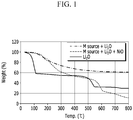
- thermal analysis was performed on a Li 2 O material only and a mixture of Li 2 O and the M source, and the results were shown in FIG. 1 .
- a positive electrode is manufactured using a positive electrode additive or particles of the positive electrode active material prepared in Examples 1 to 3 and Comparative Examples 1 to 5, and after the positive electrode is charged to 3.8 V, X-ray diffraction analysis (XRD) is performed on the positive electrode.
- XRD X-ray diffraction analysis
- the positive electrode additive prepared in Examples 1 to 3 or in Comparative Examples 1 to 5 were mixed in a N-methylpyrrolidone solvent in a weight ratio of 85:10:5 to prepare a composition for forming the positive electrode (viscosity: 5000 mPa ⁇ s), and the composition was coated to an aluminum current collector and then dried and rolled to manufacture the positive electrode.
- EC ethylene carbonate
- DMC dimethyl carbonate
- EMC ethyl methyl carbonate
- Comparative Examples 1 to 3 in addition to the LiNiO 2 peak, a Li 2 O peak was observed.
- Comparative Example 4 as the first heat treating was performed under an atmosphere of oxygen, a lithium composite oxide in a layered phase which was generally used as a positive electrode active material was formed.
- Comparative Example 5 the positive electrode additive was not synthesized due to the low temperature during the first heat treatment, and only the unreacted Li 2 O was confirmed.
- a positive electrode was prepared as follows, and generation of gas is evaluated during charging and discharging of a battery.
- the positive electrode additive prepared in Examples 1 to 3 or in Comparative Examples 1 to 3 were mixed in a N-methylpyrrolidone solvent at a weight ratio of 85:10:5 (Viscosity: 5000 mPa ⁇ s) to prepare a composition for forming the positive electrode, and the composition is coated to an aluminum current collector and then dried and rolled to manufacture the positive electrode.
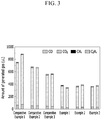
- the manufactured battery was charged to 4.25 V at 0.1 C at 25 °C, and gas collected into a pouch was analyzed by a gas chromatography-thermal conductivity detector (GC-TCD). The same experiment was repeated twice. The results are shown in FIG. 3 and Table 2. For reference, in Comparative Examples 4 and 5, a gas experiment was not performed because the desired positive electrode additive was not formed.
- GC-TCD gas chromatography-thermal conductivity detector
Landscapes
- Chemical & Material Sciences (AREA)
- Chemical Kinetics & Catalysis (AREA)
- Electrochemistry (AREA)
- General Chemical & Material Sciences (AREA)
- Engineering & Computer Science (AREA)
- Inorganic Chemistry (AREA)
- Manufacturing & Machinery (AREA)
- Materials Engineering (AREA)
- Organic Chemistry (AREA)
- Crystallography & Structural Chemistry (AREA)
- Battery Electrode And Active Subsutance (AREA)
- Inorganic Compounds Of Heavy Metals (AREA)
- Secondary Cells (AREA)
Abstract
Description
- This application claims priority to and the benefit of Korean Patent Application No.
10-2017-0156744 10-2018-0143870 - The present invention relates to a method for preparing a positive electrode additive of a lithium secondary battery that is capable of reducing by-products and unreacted materials produced in a preparing process, thereby significantly reducing the amount of gas generated when the electrode is operated.
- As technology development and demand for mobile devices increase, demand for secondary batteries as energy sources has been rapidly increasing. Among these secondary batteries, a lithium secondary battery having high energy density and a high voltage, a long cycle life, and a low self-discharge rate is commercially available and widely used.
- Graphite is mainly used as a negative electrode material of the lithium secondary battery, but it is difficult to increase capacity of the lithium secondary battery because capacity per unit mass of graphite is as small as 372 mAh/g. Accordingly, as non-carbon materials of the negative electrode having higher capacity than graphite, materials for forming a lithium-metal compound with lithium, such as silicon, tin, and oxides thereof have been developed and used, but these materials of the negative electrode have high irreversible capacity loss because they have low initial efficiency during initial charge/discharge.
- To overcome this, a method for compensating the irreversible capacity loss of the negative electrode by using a material that can provide a positive electrode material with a lithium ion source or storage, and become electrochemically active after an initial cycle so as to not deteriorate performance of the entire battery, has been studied and proposed. Specifically, there is a method of using, as a sacrificial positive electrode material or an irreversible additive (or overdischarge inhibitor), a lithium nickel-based oxide including an excess amount of lithium, such as Li2NiO2, in the positive electrode.
- However, the lithium nickel-based oxide is mainly produced by reacting a nickel oxide or nickel carbonate with an excess amount of a lithium oxide, and in this case, the unreacted lithium oxide (Li2O), or by-products such as LiOH or Li2CO3, remain in the finally produced lithium nickel-based oxide. The unreacted lithium oxide and the by-products remaining in the lithium nickel-based oxide are decomposed during the initial cycle of the battery, and generate an excessive amount of gas such as O2 and CO2. When a composition for preparing the electrode is prepared, the by-products such as LiOH reacts with a binder component of the electrode to increase viscosity of the composition or cause gelation, thereby making it difficult to uniform apply the composition of the electrode for forming the active material layer, and deteriorating characteristics of the battery. Further, free Li derived from free LiOH, and/or LiOH, deteriorates cycle efficiency of the positive electrode.
- The present invention has been made in an effort to provide a method for preparing a positive electrode additive of a lithium secondary battery that is capable of reducing the amount of Li-based by-products and unreacted lithium oxides, thereby drastically reducing the amount of gas generated when an electrode is operated.
- Further, the present invention has been made in an effort to provide a positive electrode additive for a lithium secondary battery that is produced according to the preparing method to significantly reduce the amount of Li-based by-products and unreacted materials causing generation of gas, and a positive electrode for a lithium secondary battery and a lithium secondary battery that include the positive electrode additive and exhibit excellent electrochemical characteristics.
- According to an exemplary embodiment of the present invention, a preparing method of a positive electrode additive for a lithium secondary battery is provided, including mixing a lithium raw material, a nickel raw material, and a raw material of an element M and heat treating them under an atmosphere of an inert gas to produce a lithium nickel oxide of Chemical Formula 1 below, wherein the heat treating includes first heat treating at 300 °C to 500 °C, and second heat treating at 550 °C to 800 °C after the first heat treating, and the first heat treating is performed for 30 % to 50 % of a total duration of the heat treating, wherein the positive electrode additive includes the lithium nickel oxide of Chemical Formula 1:
[Chemical Formula 1] Li2Ni1-xMxO2
wherein, in Chemical Formula 1, M is selected from the group consisting of a transition metal, an amphoteric element, P, F, and B, wherein M is not nickel, and 0<x<1. - According to another exemplary embodiment of the present invention, a positive electrode additive for a lithium secondary battery is provided. The positive electrode additive is prepared by the preparing method, and includes a lithium nickel oxide of Chemical Formula 1, and further includes less than 11 wt% NiO and 1 wt% or less Li2O, wherein a total amount of the NiO and the Li2O is less than or equal to 11 wt% based on a total weight of the positive electrode additive.
- According to another exemplary embodiment of the present invention, a positive electrode for a lithium secondary battery and a lithium secondary battery that include the positive electrode additive are provided.
- The preparing method of a positive electrode additive for a lithium secondary battery according to the present invention can reduce the by-products and the unreacted materials produced in the preparing process, thereby significantly reducing the amount of gas generated when the electrode is operated. Accordingly, the positive electrode and the lithium secondary battery manufactured using the positive electrode additive may exhibit excellent electrochemical and lifespan characteristics.
-
-
FIG. 1 is a graph showing a result of thermal analysis of a mixture for preparing a positive electrode additive in Experimental Example 1. -
FIG. 2 is a graph showing a result of X-ray diffraction spectroscopy (XRD) for positive electrode additives according to Examples 1 to 3 and Comparative Examples 1 to 5. -
FIG. 3 is a graph showing an amount of gas generated when the battery including a positive electrode additive according to Examples 1 to 3 and Comparative Examples 1 to 3 is operated. - Hereinafter, the present invention will be described in detail for better understanding of the present invention.
- Terms and words used in the present specification and claims should not be construed as limited to ordinary or dictionary terms, and the present invention should be construed with meanings and concepts that are consistent with the technical idea of the present disclosure based on the principle that the inventors may appropriately define concepts of the terms to appropriately describe their own invention in the best way.
- A preparing method of a positive electrode additive for a lithium secondary battery according to an exemplary embodiment of the present invention, a positive electrode additive produced by the method, and a positive electrode and a lithium secondary battery including the positive electrode additive will now be described.
- A preparing method of a positive electrode additive for a lithium secondary battery according to the exemplary embodiment of the present invention includes mixing a lithium raw material, a nickel raw material, and a raw material of an element M, and heat treating them under an atmosphere of an inert gas to manufacture a lithium nickel oxide of Chemical Formula 1,
wherein the heat treating includes first heat treating at 300 °C to 500 °C and second heat treating at 550 °C to 800 °C after the first heat treating, and
the first heat treating is performed for 30 % to 50 % of a total duration of the heat treating.
[Chemical Formula 1] Li2Ni1-xMxO2
InChemical Formula 1, M is selected from the group consisting of a transition metal, an amphoteric element, P, F, and B, wherein M is not nickel, and 0<x<1. - As described above, in the preparing method according to the exemplary embodiment, when the additive comprising the lithium nickel oxide of the
above formula 1 is prepared by using the nickel raw material, the element M raw material, and the lithium raw material, a multi-step heat treatment is performed at the reaction temperatures confirmed by thermal analysis of the raw materials and mixtures thereof, so as to induce a sufficient reaction of the lithium raw materials and to significantly reduce unreacted lithium oxides and by-products which cause gas generation during the operation of the battery - Specifically, in the preparing method according to the exemplary embodiment, the heat treating includes: reacting the lithium raw material and the raw material of the element M in a mixture containing the lithium raw material, the nickel raw material, and the raw material of the element M through the first heat treating under an atmosphere of an inert gas at 300 °C to 500 °C to produce a compound containing lithium and the element M; and producing the lithium nickel oxide of Chemical Formula 1 through the second heat treating for the compound under an atmosphere of an inert gas at 550 to 800 °C, and simultaneously reacting the remaining lithium and nickel raw materials that are not reacted in the heat treating.
- Specifically, the first heat treating is performed at 300 °C to 500 °C. When the first heat treating is performed within the temperature range, the reaction between the lithium raw material and the raw material of the element M sufficiently occurs, and the compound containing lithium and the element M can be produced with a high yield. However, if the temperature is below 300 °C during the first heat treating, the reaction between the lithium raw material and the raw material of the element M does not sufficiently occur, and as a result, a large amount of unreacted raw materials is produced, thereby generating by-products in the subsequent second heat treating. If the temperature exceeds 500 °C, it is not easy to control a reaction rate of the lithium raw material and the raw material of the element M, thereby generating by-products. In addition, if the temperature exceeds 500 °C, because Li2O and NiO and the M raw material react simultaneously, there is no effect of controlling the unreacted Li2O in the first heat treating. When considering that the generation of unreacted materials and by-products are prevented by controlling the temperature in the first heat treating and that the compound containing lithium and the element M is well produced, the first heat treating may be performed at 330 °C to 450 °C, and more specifically may be performed at 350 °C to 400 °C.
- The first heat treating may be performed for 30 % to 50 % of a total duration of the heat treating. When the first heat treating is performed for the above-described duration, the reaction between the lithium raw material and the raw material of the element M may sufficiently occur. However, if the duration of the first heat treating is less than 30 % of the total duration of the heat treating, the reaction between the lithium raw material and the raw material of the element M does not sufficiently occur, and as a result, a large amount of the unreacted raw materials is produced, thereby producing by-products in the subsequent second heat treating. When the duration of the first heat treating exceeds 50 % of the total duration of the heat treating, a duration of the second heat treating relatively decreases, and an amount of the unreacted lithium oxide may increase because there is not sufficient time for the unreacted lithium raw material and the nickel raw material to react during the second heat treating. When considering that the generation of unreacted materials and by-products are prevented by controlling the temperature in the first heat treating and that the compound containing lithium and the element M is well produced, the first heat treating may be performed for 35 % to 45 % of the total duration of the heat treating, and more specifically, for 40 % to 45 % of the total duration of the heat treating.
- The first heat treating may also include a temperature rising step of heating the mixture of the reaction materials to the above-described heat treating temperature, and a maintaining step of maintaining the heated temperature for a predetermined time such that the reaction sufficiently occurs.
- The temperature rising step in the first heat treating may be specifically performed by heating to a temperature of 300 °C to 500 °C at a rate of 2 °C/min to 7 °C/min, and more specifically, at a rate of 2 °C/min to 5 °C/min. When the temperature rising step is performed at the controlled heating rate as described above, efficiency of the reaction can be further improved.
- The maintaining step may be performed for 40 % to 80 % of the total duration of the first heat treating. When the maintaining step is performed for the above-described duration, a diffusion reaction between particles can sufficiently occur, and the reaction between the raw material of the element M and the lithium raw material can be further improved. When considering that further improvement is made by controlling the duration of the maintaining, the maintaining step may be performed for 40 % to 70 % of the total duration of the first heat treating.
- The first heat treating, specifically, the first heat treating including the temperature rising step and the maintaining step, may be performed under an atmosphere of an inert gas such as nitrogen, helium, or argon to suppress the side reaction. Among them, when considering that efficiency of the reaction increases and the side reaction is suppressed, the first heat treating may be performed under an atmosphere of nitrogen.
- In the first heat treating, the lithium raw material such as an oxide, a sulfate, a nitrate, an acetate, a carbonate, an oxalate, a citrate, a halide, a hydroxide, or an oxyhydroxide that contain lithium may be used, and specifically, Li2CO3, LiNO3, LiNO2, LiOH, LiOH • H2O, LiH, LiF, LiCl, LiBr, LiI, CH3COOLi, Li2O, Li2SO4, CH3COOLi, or Li3C6H5O7 may be used. One or a mixture of two or more of them may be used. Among them, when considering that when reacted with a nickel-containing precursor material, efficiency of the reaction is improved and that the side reaction materials are reduced, the lithium raw material may be Li2O.
- The nickel raw material may be a nickel-containing oxide or hydroxide such as a nickel oxide (NiO) or a nickel hydroxide (Ni(OH)2).
- Examples of the raw material of the element M may be an oxide, sulfate, a nitrate, an acetate, a carbonate, an oxalate, a citrate, a halide, a hydroxide, an oxyhydroxide, or a phosphate containing M, and among them, may be a phosphate. In this case, the M is contained in a finally produced lithium nickel-containing oxide by substituting some of nickel and serves to improve thermal stability and structural stability, and specifically, may be: a transition metal element having a divalent, trivalent, or pentavalent oxidation number such as Co, Mn, W, Fe, Mg, Ti, Cu, or Zr; an amphoteric element having a trivalent oxidation number such as Al; and one selected from the group consisting of P, F, and B. Among them, the M may be selected from the group consisting of W, Ti, Al, Zr, P, F, and B, and more specifically, may be W, Al, P, or B, which is excellent in reactivity with lithium and makes it possible to produce a more stable compound, and specifically, among them, may be W, Al, or P.
- The lithium raw material, the nickel raw material, and the raw material of the element M may be respectively used in amounts such that they satisfy a composition ratio of metal elements such as lithium and nickel in the finally produced lithium nickel oxide represented by
Chemical Formula 1. Specifically, the lithium raw material may be used in the amount such that a mole ratio of lithium:(nickel+element M) is 2:1. When the mole ratio of lithium:(nickel+element M) does not satisfy 2:1, the composition ofChemical Formula 1 is not satisfied, and as a result, it cannot fully function as a sacrificial positive electrode material or a non-reversible additive. - When mixing the raw materials, a sintering agent may be further optionally added. Specifically, the sintering agent may be: an ammonium ion-containing compound such as NH4F, NH4NO3, or (NH4)2SO4; a metal oxide such as B2O3 or Bi2O3; or a metal halide such as NiCl2 or CaCl2, and any one or a mixture of two or more of them may be used. The sintering agent may be used in an amount of 0.01 mol to 0.2 mol based on 1 mol of the raw material containing nickel. When used within the above-mentioned content range, since the sintering property is greatly improved, performance of the positive electrode additive is improved and initial capacity of the battery is prevented from being deteriorated when the battery is charged/discharged.
- In addition, when mixing the raw materials, a moisture-removing agent may be further optionally added. Specifically, examples of the moisture-removing agent may include citric acid, tartaric acid, glycolic acid, and maleic acid, and any one or a mixture of two or more of them may be used. The moisture-removing agent may be used in an amount of 0.01 mol to 0.2 mol based on 1 mol of the nickel raw material.
- After the first heat treating of the mixture including the lithium raw material, the nickel raw material, and the raw material of the element M, the lithium-element M-containing compound is produced by the reaction between the lithium raw material and the raw material of the element M. Specifically, the lithium-element M-containing compound may be a compound having a Li-M-O phase such as Li3PO4, Li5AlO4, or LiBO2 (the M is the same as described above). In this case, together with the lithium-element M-containing compound, the unreacted lithium raw material such as Li2O and the nickel raw material are present in reaction products.
- Next, the second heat treating is specifically performed at 550 to 800 °C. When the second heat treating is performed within the temperature range described above, without worrying about a decrease in discharge capacity per unit weight, deterioration of cycle characteristics, and decrease of the operating voltage due to presence of the unreacted raw materials, occurrence of the side reaction, or a decomposition reaction of the reaction materials, the lithium nickel-containing oxide of
Chemical Formula 1 can be prepared with excellent efficiency, and the amount of the unreacted lithium oxide can be reduced by the reaction between the unreacted lithium oxide and the nickel raw material at the same time. More specifically, when considering the superior effect of controlling the heating temperature, the second heat treating may be performed at 600 °C to 800 °C, and more specifically, at 600 °C to 700 °C. - The second heat treating may be performed for 50 to 70 % of the total duration of the heat treating. When the duration of the second heat treating is less than 50 % of the total duration of the heat treating, a sufficient reaction between the unreacted lithium oxide and the nickel raw material hardly occurs because the duration of the reaction is short, and an amount of lithium-based byproduct in the positive electrode additive may be hardly reduced due to poor efficiency of the reaction. When the duration of the second heat treating exceeds 70 %, an excessive reaction is likely to occur, and this is inefficient because the heat treating is excessively long. Specifically, the second heat treating may be performed for 50 % to 65 % of the total duration of the heat treatment, and more specifically, for 50 % to 60 %.
- The second heat treating may include: a temperature rising step of heating the mixture of the lithium-element M-containing compound, the nickel raw material, the unreacted lithium raw material that is manufactured in the previous step; and a maintaining step of maintaining the heated temperature for a predetermined time such that the reaction sufficiently occurs.
- Specifically, the temperature rising step in the second heat treating may be performed by heating to a temperature of 550 °C to 800 °C, more specifically at 600 °C to 800 °C, and even more specifically at 600 °C to 700 °C, at a rate of 2 to 7 °C/min, and more specifically at a rate of 2 to 5 °C/min. When the temperature rising step is performed at a controlled heating rate as described above, efficiency of the reaction can be further improved.
- The maintaining step may be performed for 60 % to 90 % of the total duration of the second heat treating. When the maintaining step is performed for the above-described duration, a diffusion reaction between particles can sufficiently occur, and the reaction between the raw material of the element M and the lithium raw material can be improved. When considering the superior effect of controlling the duration of the maintaining, the maintaining step may be performed for 60 to 80 % of the total duration of the second heat treating.
- The second heat treating, specifically, the second heat treating including the temperature rising step and the maintaining step, may also be performed under an atmosphere of an inert gas such as nitrogen, helium, or argon so as to suppress the side reaction. Among them, when considering that efficiency of the reaction increases and the side reaction is suppressed, the second heat treating may be performed under an atmosphere of nitrogen.
- Cooling may be optionally further performed after the second heat treating.
- The cooling may be performed according to a conventional method, and specifically, may be performed by methods such as natural cooling and hot air cooling under an air atmosphere.
- A Li-M-O phase included in a reaction product obtained from the first heat treating as described above reacts with the remaining unreacted Li2O and NiO, thereby producing a positive electrode additive including a lithium nickel oxide doped with M of
Chemical Formula 1.
[Chemical Formula 1] Li2Ni1-xMxO2
InChemical Formula 1, M is selected from the group consisting of a transition metal, an amphoteric element, P, F, and B, wherein M is not nickel, and 0<x<1. - Specifically, the element M may be one selected from the group consisting of: a transition metal element having a divalent, trivalent, or pentavalent oxidation number such as Co, Mn, W, Fe, Mg, Ti, Cu, or Zr; an amphoteric element having a trivalent oxidation number such as Al; and P, F, and B, and among them, the M may be one selected from the group consisting of W, Ti, Zr, Al, P, F, and B, and more specifically, may be P, Al, or B, which is excellent in reactivity with lithium and capable of forming a more stable compound.
- The element M may be contained in an amount corresponding to x by substituting Ni. Specifically, the amount of the substituted element M may be 0≤x<0.5 or 0.01≤x≤0.1 when considering an improved effect of controlling the amount of the substituted M contained in the lithium nickel oxide, and more specifically, 0.01≤x≤0.06.
- As the remaining unreacted Li2O reacts with NiO during the second heat treating, the amount of the remaining unreacted Li2O and the amount of NiO in the produced positive electrode additive significantly decrease when compared with the prior art, and particularly the amount of the lithium-based byproduct such as Li2O significantly decreases.
- Specifically, the positive electrode additive produced according to the preparing method includes the lithium nickel oxide of
Chemical Formula 1, and further includes less than 11 wt% NiO and 1 wt% or less Li2O based on a total weight of the positive electrode additive, wherein a total amount of NiO and Li2O may be less than or equal to 11 wt% based on a total weight of the positive electrode additive. - More specifically, the positive electrode additive may include Li2O at 0.5 wt% or less, and more specifically, 0 wt% of Li2O, that is, it does not include Li2O. As the amount of the unreacted material and the lithium byproduct decreases, an amount of gas generated when the battery is operated can be significantly reduced.
- When the positive electrode additive is charged at 0.1C to 3.8 V at 25 °C and is then analyzed using X-ray diffraction, d1/d2=0 if intensity of a Li2O peak appearing at 2θ = 30° to 35° is d1 and intensity of a LiNiO2 peak appearing at 2θ = 15° to 20° is d2.
- In the present invention, X-ray diffraction analysis of the positive electrode additive can be performed according to a conventional XRD analysis method using an X-ray diffraction analyzer, and specifically, the XRD analysis has been carried out by D4-Endeavor™ (made by Bruker AXS GmbH) using Cu-Kα radiation (2θ = 15° to 35°, scanning speed = 4°/min).
- The positive electrode additive produced according to the preparing method, as a lithium-based byproduct, may further include LiOH of 5 wt% or less, specifically LiOH of 4.5 wt% or less, and more specifically, LiOH of 4.2 wt% or less, and Li2CO3 of 0.5 wt% to 1 wt%. The lithium-based byproduct including LiOH and Li2CO3 may be contained in an amount of 0.5 wt% to 3.5 wt%, and more specifically, 0.5 wt% to 3.1 wt%, based on the total weight of the positive electrode additive. Because the amount of LiOH is significantly reduced, gelation may not occur during the mixing for forming the positive electrode. Accordingly, the positive electrode additive can exhibit a superior effect when used as a sacrificial positive electrode material or an irreversible additive for a lithium-transition metal oxide capable of intercalating and deintercalating lithium ions. Further, since Li2CO3 is present on a surface of the positive electrode additive, it can suppress heat from being generated from the positive electrode when a short circuit occurs, and suppress moisture adsorption from the atmosphere.
- The positive electrode additive produced according to the preparing method for a lithium secondary battery may reduce by-products and unreacted materials that are inevitably produced in the preparing process, thereby significantly reducing the amount of gas generated when the battery is operated. Accordingly, the positive electrode and the lithium secondary battery manufactured using the positive electrode additive may exhibit excellent electrochemical and lifespan characteristics.
- Because the positive electrode additive contains an excess amount of lithium, it may be used as a sacrificial positive electrode material or an irreversible additive (or an overdischarge inhibitor) that can compensate for an irreversible capacity loss.
- According to another exemplary embodiment, a positive electrode for a lithium secondary battery and a lithium secondary battery including the positive electrode additive produced by the preparing method are provided.
- Specifically, the positive electrode includes a positive electrode current collector, and a positive electrode active material layer that is formed on the positive electrode current collector and includes the positive electrode additive.
- The positive electrode current collector is not specifically limited as long as it has conductivity without causing chemical changes to a battery, and stainless steel, aluminum, nickel, titanium, sintered carbon, or aluminum or stainless steel surface-treated with carbon, nickel, titanium, or silver may be used as the positive electrode current collector, for example. The positive electrode current collector may have a thickness of 3 µm to 500 µm, and minute protrusions and depressions may be formed on a surface of the current collector to increase adhesiveness of the positive electrode active material. For example, the positive electrode current collector may have various forms such as a film, a sheet, a foil, a net, a porous body, foam, and a non-woven fabric.
- In addition to the positive electrode additive, the positive electrode active material layer may include a positive electrode active material, a conductive material, and a binder.
- In this case, the conductive material is used to provide conductivity to the electrode, and is not specifically limited as long as it has electron conductivity without causing any chemical changes to the battery. Specific examples of the conductive material include: carbon-based materials such as carbon black, acetylene black, Ketjen black, channel black, furnace black, lamp black, summer black, and carbon fiber; graphite such as natural graphite or artificial graphite; a metal powder or a metal fiber such as copper, nickel, aluminum, and silver; conductive whiskers such as zinc oxide and potassium titanate; a conductive metal oxide such as a titanium oxide; and a conductive polymer such as polyphenylene derivatives. These may be used alone or in a mixture of two or more. The conductive material may be included in an amount of 1 wt% to 30 wt% based on the total weight of the positive electrode active material layer.
- In addition, the binder facilitates adhesion between particles of the positive electrode active material and adhesion between the positive electrode active material and the current collector. Specific examples of the binder may include polyvinylidene fluoride (PVdF), a vinylidene fluoride-hexafluoropropylene copolymer (PVdF-co-HFP), polyvinyl alcohol, polyacrylonitrile, carboxymethyl cellulose (CMC), starch, hydroxypropyl cellulose, regenerated cellulose, polyvinylpyrrolidone, tetrafluoroethylene, polyethylene, polypropylene, an ethylene-propylene-diene monomer (EPDM), sulfonated-EPDM, styrene butadiene rubber (SBR), fluoro rubber, and various copolymers thereof. One or a mixture of two or more of them may be used as the binder. The binder may be included in an amount of 1 wt% to 30 wt% based on a total weight of the positive electrode active material layer.
- When the positive electrode additive is included in the active material layer as a sacrificial positive electrode material or an irreversible additive, the positive electrode active material layer may include, as a positive electrode active material, a lithium transition metal oxide capable of intercalating and deintercalating lithium ions.
- Specifically, examples of the lithium transition metal compound may be LiCoO2, LiNiO2, LiMnO2, LiMn2O2, Li(NiaCobMnc)O2 (0<a<1, 0<b<1, 0<c<1, a+b+c=1), LiNi1-dCodO2, LiCo1-dMndO2, LiNi1-dMndO2 (0≤d<1), Li(NiaCobMnc)O4 (0<a<2, 0<b<2, 0<c<2, a+b+c=2), LiMn2-eNieO4, LiMn2-eCoeO4 (0<e<2), LiCoPO4, or LiFePO4. One or a mixture of two or more of them may be used as the lithium transition metal compound. Among them, the lithium transition metal compound may be LiCoO2 or LiNiO2, when considering that remarkable improvement is observed when it is used in combination with the lithium nickel-based compound of
Chemical Formula 1. - When the positive electrode active material layer includes a positive electrode active material, the positive electrode additive may be included in an amount of 0.1 to 10 parts by weight based on 100 parts by weight of the positive electrode active material.
- The positive electrode may be manufactured by a conventional preparing method of a positive electrode, except that the positive electrode additive is used. Specifically, the positive electrode additive and optionally a composition for forming a positive electrode active material layer including a binder, a conductive material, and a positive electrode active material are applied on a positive electrode collector, and are then dried and rolled to manufacture the positive electrode. In this case, the kind and content of the positive electrode active material, the binder, and the conductive material are as described above.
- The solvent may be a generally solvent in the art, and examples of the solvent include dimethyl sulfoxide (DMSO), isopropyl alcohol, N-methylpyrrolidone (NMP), acetone, and water, and one or a mixture of two or more of them may be used as the solvent. In consideration of a thickness of the slurry coating and a yield of the slurry, the positive electrode active material, the conductive material, and the binder are dissolved or dispersed, and an amount of the solvent is sufficient if it can dissolve or disperse the positive electrode active material, the conductive material, and the binder and have viscosity exhibiting excellent thickness uniformity.
- Alternatively, the composition for forming a positive electrode active material layer may be casted on a separate support, and a film obtained by delamination from the support may be laminated on the positive electrode current collector, so as to manufacture the positive electrode.
- According to another exemplary embodiment of the present invention, an electrochemical device including the positive electrode is provided. Specifically, the electrochemical device may be a battery, a capacitor, and the like, and more specifically, a lithium secondary battery.
- Specifically, the lithium secondary battery includes a positive electrode, a negative electrode disposed to face the positive electrode, a separator interposed between the positive electrode and the negative electrode, and an electrolyte, and the positive electrode is as described above. The lithium secondary battery may further optionally include a battery container for accommodating an electrode assembly of the positive electrode, the negative electrode, and the separator, and a sealing member for sealing the battery container.
- In the lithium secondary battery according to the exemplary embodiment of the present invention, the negative electrode includes a negative electrode current collector and a negative electrode active material layer disposed on the negative electrode current collector.
- The negative electrode current collector is not specifically limited as long as it has high conductivity without causing any chemical changes to the battery, and copper, stainless steel, aluminum, nickel, titanium, sintered carbon, or copper or stainless steel surface-treated with carbon, nickel, titanium, or silver, and an aluminum-cadmium alloy may be used as the negative electrode current collector, for example. The negative electrode current collector may generally have a thickness of 3 µm to 500 µm, and like the positive electrode current collector, minute protrusions and depressions may be formed on a surface of the current collector to improve binding strength of the negative electrode active material. For example, the negative electrode current collector may have various forms such as a film, a sheet, a foil, a net, a porous body, foam, and a non-woven fabric.
- In addition to the negative electrode active material, the negative electrode active material layer optionally includes a binder and a conductive material. As an example, the negative electrode active material layer may be prepared by applying a composition for forming a negative electrode that includes the negative electrode active material and selectively includes the binder and the conductive material on the negative electrode current collector and then drying, or by casting the composition for forming the negative electrode on a separate support body and then laminating a film obtained by separation from the support body on the negative electrode current collector.
- A compound capable of reversibly intercalating and deintercalating lithium may be used as the negative electrode active material. Specific examples of the negative electrode active material include: carbon materials such as artificial graphite, natural graphite, graphitized carbon fiber, and amorphous carbon; metal substances capable of alloying with lithium such as Si, Al, Sn, Pb, Zn, Bi, In, Mg, Ga, Cd, Si alloys, Sn alloys or Al alloys; metal oxides capable of doping and dedoping lithium, such as SiOx (0<x<2), SnO2, a vanadium oxide, or a lithium vanadium oxide; or complexes including the metal substances and the carbon material such as Si-C complexes or Sn-C complexes, and any one or a mixture of two or more thereof may be used. In addition, a metal lithium thin film may be used as the negative electrode active material. Further, a carbon material may use both low crystalline carbon and high crystalline carbon. The low crystalline carbon typically includes soft carbon and hard carbon, and the high crystalline carbon typically includes amorphous, platy, scaly, spherical or fiber-shaped natural graphite or artificial graphite, and high-temperature baked carbon such as Kish graphite, pyrolytic carbon, mesophase pitch based carbon fiber, meso-carbon microbeads, mesophase pitches, and petroleum or coal tar pitch derived cokes.
- In addition, the binder and the conductive material may be the same as those described above with respect to the positive electrode.
- Meanwhile, in the lithium secondary battery, the separator separates a negative electrode and a positive electrode, and provides an ion channel for lithium ions, and is not particularly limited as long as it is commonly used as a separator in a general lithium secondary battery. Particularly, a separator having low resistance against ion migration of an electrolyte and having excellent electrolyte moisture containing ability is preferable. Specifically, the separator may be made of a porous polymer film, for example, a porous polymer film prepared from a polyolefin-based polymer such as an ethylene homopolymer, a propylene homopolymer, an ethylene-butene copolymer, an ethylene-hexene copolymer or an ethylene-methacrylate copolymer or a laminate structure having two or more layers. Alternatively, the separator may be made of a porous nonwoven fabric, for example, a nonwoven fabric made of high-melting point glass fiber, polyethylene terephthalate fiber, and the like. In addition, in order to ensure heat resistance or mechanical strength, the separator may be a coated separator including ceramic components or polymer materials, and selectively, may be used in a single-layer or multi-layer structure.
- In addition, the electrolyte used in the present invention may be an organic liquid electrolyte, an inorganic liquid electrolyte, a solid polymer electrolyte, a gel polymer electrolyte, an inorganic solid electrolyte, a molten-type inorganic electrolyte or the like, which may be used in the manufacture of a lithium secondary battery, but the present invention is not limited thereto.
- Specifically, the electrolyte may include an organic solvent and a lithium salt.
- Examples of the organic solvent are not specifically limited as long as they serve as a medium through which ions involved in an electrochemical reaction of the battery can move. Specifically, examples of the organic solvent may include: an ester-based solvent such as methyl acetate, ethyl acetate, γ-butyrolactone, and ε-caprolactone; an ether-based solvent such as dibutyl ether and tetrahydrofuran; a ketone-based solvent such as cyclohexanone; an aromatic hydrocarbon-based solvent such as benzene and fluorobenzene; a carbonate-based solvent such as dimethyl carbonate (DMC), diethyl carbonate (DEC), methylethyl carbonate (MEC), ethylmethyl carbonate (EMC), ethylene carbonate (EC), and propylene carbonate (PC); an alcohol-based solvent such as ethanol and isopropyl alcohol; nitriles such as R-CN (R denotes a linear, branched, or ring structured hydrocarbon group of C2 to C20, and may include a double-bonded aromatic ring or an ether bond); amides such as dimethyl formamide; dioxolanes such as 1,3-dioxolane; and sulfolanes. Among them, the carbonate-based solvent is desirable, and a mixture of a cyclic carbonate (e.g., ethylene carbonate or propylene carbonate) having high ion conductivity and a high dielectric constant which can increase charging/discharging performance of the battery, and a chain carbonate-based compound (e.g., ethylmethyl carbonate, dimethyl carbonate, or diethyl carbonate) having low viscosity is more desirable. In this case, when the cyclic carbonate and the chain carbonate are mixed in a volume ratio of about 1:1 to about 1:9, performance of the electrolytic solution may be improved.
- The lithium salt is not specifically limited as long as it is a compound capable of providing lithium ions used in the lithium secondary battery. Specifically, the lithium salt may be LiPF6, LiClO4, LiAsF6, LiBF4, LiSbF6, LiAl04, LiAlCl4, LiCF3SO3, LiC4F9SO3, LiN(C2F5SO3)2, LiN(C2F5SO2)2, LiN(CF3SO2)2, LiCl, LiI, or LiB(C2O4)2. A concentration of the lithium salt may range from 0.1 M to 2.0 M. When the lithium salt is included at the above-described concentration range, the electrolyte may exhibit excellent performance because it has appropriate conductivity and viscosity, and lithium ions may effectively move.
- In addition to the electrolyte components, for the purpose of improving lifespan characteristics of the battery, suppressing a decrease in battery capacity, improving discharge capacity of the battery and the like, the electrolyte may further include one or more additives such as a haloalkylene carbonate-based compound such as difluoroethylene carbonate or the like, pyridine, triethyl phosphite, triethanolamine, a cyclic ether, ethylene diamine, n-glyme, hexaphosphoric triamide, nitrobenzene derivatives, sulfur, quinoneimine dyes, N-substituted oxazolidinone, N,N-substituted imidazolidine, ethylene glycol dialkyl ethers, ammonium salts, pyrrole, 2-methoxyethanol, aluminum trichloride and the like. In this case, the additives may be included at 0.1 wt% to 5 wt% based on a total weight of the electrolyte.
- As described above, since the lithium secondary battery including the positive electrode additive according to the present invention stably exhibits excellent discharge capacity, output characteristics, and capacity retention, it can be useful in the fields of portable devices such as a mobile phone, a laptop computer, a digital camera, and the like and the electric vehicles such as a hybrid electric vehicle (HEV), and the like.
- Accordingly, according to another embodiment of the present invention, a battery module including the lithium secondary battery as a unit cell and a battery pack including the same are provided.
- The battery module or the battery pack may be used as a power source of a medium-large size device of at least one of a power tool; an electric vehicle including an electric vehicle (EV), a hybrid electric vehicle and a plug-in hybrid electric vehicle (PHEV); or a system for storing electric power.
- Hereinafter, embodiments of the present invention will be described in detail so that those skilled in the art may easily carry out the present invention. However, the present invention may be implemented in various different forms and is not limited to the embodiments described herein.
- 26.7 g of Li2O as a lithium raw material, 66.5 g of NiO as a nickel raw material, and 6.8 g of ammonium phosphate as a raw material of an element M were mixed, heated to 400 °C at a heating rate of 2 °C/min for about 3 hours under an atmosphere of nitrogen and then maintained at the heated temperature for 4 hours (first heat treating), and heated to 700 °C at a rate of 2 °C/min for about 2 hours and 30 minutes under an atmosphere of nitrogen and then maintained at the heated temperature for about 6 hours (second heat treating). A resulting reactant was cooled to obtain particles of a positive electrode additive of Li2Ni0.94P0.06O2.
- 26.7 g of Li2O as a lithium raw material, 66.5 g of NiO as a nickel raw material, and 6.8 g of aluminum phosphate as a raw material of an element M were mixed, heated to 400 °C at a heating rate of 2 °C/min for about 3 hours under an atmosphere of nitrogen and then maintained at the heated temperature for 4 hours (first heat treating), and heated to 700 °C at a rate of 2 °C/min for about 2 hours and 30 minutes under an atmosphere of nitrogen and then maintained at the heated temperature for 7 hours (second heat treating). A resulting reactant was cooled to obtain particles of a positive electrode additive.
- 26.7 g of Li2O as a lithium raw material, 66.5 g of NiO as a nickel raw material, and 12.4 g of WO3 as a raw material of an element M were mixed, heated to 400 °C at a heating rate of 2 °C/min for about 3 hours under an atmosphere of nitrogen and then maintained at the heated temperature for 4 hours (first heat treating), and heated to 700 °C at a rate of 2 °C/min for about 2 hours and 30 minutes under an atmosphere of nitrogen and then maintained at the heated temperature for about 6 hours (second heat treating). A resulting reactant was cooled to obtain particles of a positive electrode additive of Li2Ni0.94W0.06O2.
- 26.7 g of Li2O as a lithium raw material, 66.5 g of NiO as a nickel raw material, and 6.8 g of aluminum phosphate as a raw material of an element M were mixed, heated to 700 °C at a heating rate of 2 °C/min for about 5 hours and 30 minutes under an atmosphere of nitrogen, and then maintained at the heated temperature for 6 hours. A resulting reactant was cooled to obtain particles of a positive electrode additive.
- 26.7 g of Li2O as a lithium raw material, 66.5 g of NiO as a nickel raw material, and 6.8 g of ammonium phosphate as a raw material of an element M were mixed, heated to 400 °C at a heating rate of 5 °C/min for about 1 hour under an atmosphere of nitrogen and then maintained at the heated temperature for 2 hours (first heat treating), and heated to 700 °C at a rate of 2 °C/min for about 2 hours and 30 minutes under an atmosphere of nitrogen and then maintained at the heated temperature for 6 hours (second heat treating). A resulting reactant was cooled to obtain particles of a positive electrode additive.
- 26.7 g of Li2O as a lithium raw material, 66.5 g of NiO as a nickel raw material, and 6.8 g of ammonium phosphate as a raw material of an element M were mixed, heated to 400 °C a heating rate of 1 °C/min for about 6 hours under an atmosphere of nitrogen and then maintained at the heated temperature for 6 hours (first heat treating), and heated to 700 °C at a rate of 2 °C/min for about 2 hours and 30 minutes under an atmosphere of nitrogen and maintained at the heated temperature for 6 hours (second heat treating). A resulting reactant was cooled to obtain particles of a positive electrode additive.
- 26.7 g of Li2O as a lithium raw material, 66.5 g of NiO as a nickel raw material, and 6.8 g of aluminum phosphate as a raw material of an element M were mixed, heated to 400 °C at a heating rate of 2 °C/min for about 3 hours under an atmosphere of oxygen and then maintained at the heated temperature for 4 hours (first heat treating), and heated to 700 °C at a rate of 2 °C/min for about 2 hours and 30 minutes under an atmosphere of nitrogen and then maintained at the heated temperature for about 6 hours (second heat treating).
- However, as the first heat treating is performed under the atmosphere of oxygen, the positive electrode additive according to the present invention was not produced, and a lithium composite oxide in a layered phase which was generally used as a positive electrode active material was formed.
- 26.7 g of Li2O as a lithium raw material, 66.5 g of NiO as a nickel raw material, and 6.8 g of aluminum phosphate as a raw material of an element M were mixed, heated to 200 °C at a heating rate of 2 °C/min for about 1 hour and 30 minutes under an atmosphere of nitrogen and then maintained at the heated temperature for 4 hours (first heat treating), and heated to 400 °C at a rate of 2 °C/min for 1 hour and 30 minutes under an atmosphere of nitrogen and then maintained at the heated temperature for 6 hours (second heat treating).
- However, it can be seen from an X-ray diffraction analysis result that a crystal structure was not formed due to a low temperature during the first heat treating, and a positive electrode additive was not produced and only unreacted Li2O is present (see Experimental Example 2).
- For a mixture of Li2O, NiO, and ammonium phosphate as an M source, a thermogravimetric analyzer (TGA) was used to analyze reaction temperatures of reaction materials in the mixture. For comparison, thermal analysis was performed on a Li2O material only and a mixture of Li2O and the M source, and the results were shown in
FIG. 1 . - As shown in
FIG. 1 , it can be seen from the TGA analysis that ammonium phosphate (M source) and Li2O first react at about 400 °C to form Li3PO4 as a Li-M-O phase, and the Li-M-O phase, the remaining Li2O and NiO were reacted at about 700°C to form a P-doped Li2NiO2 phase. From the results, it can be seen that an amount of unreacted Li2O was reduced through multiple steps of heat treating at the temperature at which the reaction occurs. - A positive electrode is manufactured using a positive electrode additive or particles of the positive electrode active material prepared in Examples 1 to 3 and Comparative Examples 1 to 5, and after the positive electrode is charged to 3.8 V, X-ray diffraction analysis (XRD) is performed on the positive electrode.
- Specifically, the positive electrode additive prepared in Examples 1 to 3 or in Comparative Examples 1 to 5, the carbon black conductive material, and the PVdF binder were mixed in a N-methylpyrrolidone solvent in a weight ratio of 85:10:5 to prepare a composition for forming the positive electrode (viscosity: 5000 mPa·s), and the composition was coated to an aluminum current collector and then dried and rolled to manufacture the positive electrode. A Li-metal was used as a negative electrode, and an electrolyte solution containing 1.15 M LiPF6 with a mixing solvent containing ethylene carbonate (EC)/dimethyl carbonate (DMC)/ethyl methyl carbonate (EMC) (mixing volume ratio of EC:DMC:EMC=3:4:3) was used to manufacture a pouch type of battery.
- The manufactured battery was charged at 0.1 C to 3.8 V at 25 °C, and the positive electrode was separated and subjected to XRD analysis using D4-Endeavor™ (manufactured by Bruker AXS GmbH) using Cu-Kα radiation (2θ = 15 ∼ 35°, scanning speed = 4°/min). The results are shown in
FIG. 2 . - The results show that as Li2NiO2 was converted into LiNiO2 during charging, and only a LiNiO2 peak was observed in the electrode containing the positive electrode additive of Examples 1 to 3. Accordingly, when intensity of the peak appearing at 2θ = 30° to 35° was d1, and intensity of the peak at 2θ = 15° to 20° was d2, d1/d2 = 0.
- However, in Comparative Examples 1 to 3, in addition to the LiNiO2 peak, a Li2O peak was observed. In Comparative Example 4, as the first heat treating was performed under an atmosphere of oxygen, a lithium composite oxide in a layered phase which was generally used as a positive electrode active material was formed. In Comparative Example 5, the positive electrode additive was not synthesized due to the low temperature during the first heat treatment, and only the unreacted Li2O was confirmed.
- It can be seen that unreacted Li2O was reduced by multiple steps of heat treating under a controlled condition when preparing the positive electrode additive, as in the examples.
- From the XRD result, the amounts of unreacted Li2O, by-products, Li2NiO2, and a lithium oxide containing an element M in the positive electrode additive were quantitatively analyzed. The results were shown in Table 1 below.
[Table 1] a (Å) B (Å) C (Å) Li2Ni0.94P0.06O2 (wt%) NiO (wt%) Li2O (wt%) Comparative Example 1 3.7431 2.7791 9.0266 84.1 12 3.9 Comparative Example 2 3.7435 2.7796 9.0272 87.2 11 1.8 Comparative example 3 3.7438 2.7791 9.0276 86.8 10.9 2.3 Comparative Example 4 2.872 2.872 14.23 Layered phase formed - - Comparative Example 5 - - - - - - Example 1 3.7439 2.7793 9.0278 89.3 10.7 0 Example 2 3.7439 2.7792 9.0278 89.2 10.8 0 Example 3 3.7439 2.7793 9.0277 89.5 10.5 0 In Table 1, "-" means no measurement. - As shown in Table 1, in the positive electrode additives of Examples 1 to 3 prepared according to the present invention, the amount of NiO and the amount of Li2O are significantly reduced when compared with those of Comparative Examples 1 to 3.
- Using the positive electrode additives prepared in Examples 1 to 3 or in Comparative Examples 1 to 3, a positive electrode was prepared as follows, and generation of gas is evaluated during charging and discharging of a battery.
- Specifically, the positive electrode additive prepared in Examples 1 to 3 or in Comparative Examples 1 to 3, the carbon black conductive material, and the PVdF binder were mixed in a N-methylpyrrolidone solvent at a weight ratio of 85:10:5 (Viscosity: 5000 mPa·s) to prepare a composition for forming the positive electrode, and the composition is coated to an aluminum current collector and then dried and rolled to manufacture the positive electrode. Li-metal was used as a negative electrode, and an electrolyte containing 1.15 M of LiPF6 with a solvent having a mixed volume ratio of EC:DMC:EMC = 3:4:3 was used to manufacture a pouch type of battery.
- The manufactured battery was charged to 4.25 V at 0.1 C at 25 °C, and gas collected into a pouch was analyzed by a gas chromatography-thermal conductivity detector (GC-TCD). The same experiment was repeated twice. The results are shown in
FIG. 3 and Table 2. For reference, in Comparative Examples 4 and 5, a gas experiment was not performed because the desired positive electrode additive was not formed.[Table 2] Comparative Example 1 Comparative Example 2 Comparative example 3 Example 1 Example 2 Example 3 1st 2nd 1st 2nd 1st 2nd 1st 2nd 1st 2nd 1st 2nd Amo unt of gas (µℓ) CO 63.8 76.1 51.8 53.8 47.8 45.1 32.7 26.6 30.2 29.8 31.6 30.1 CO2 677 797 612 602 499 508 336 305 325 348 320 335 CH4 2.2 2.9 3.6 2.8 2.9 3.6 3.2 3.2 3 3.2 3 2.5 C2H4 10 11 12.6 12.4 12 11.5 12.5 12 13.1 11.8 10.2 13.2 Total 753 887 680 671 561.7 568.2 384.4 346.8 371.3 392.8 364.8 380.8 - From the experimental results, when the positive electrode additive of Examples 1 to 3 prepared according to the preparing method of the present invention is included, because the amount of by-products and unreacted materials contained in the positive electrode additive decreases, the amount of generated gas is significantly reduced when compared with Comparative Example 1 in which the heat treating is performed once when preparing the positive electrode additive, Comparative Example 2 in which the heat treating is performed twice but the duration of the first heat treating is too short, and Comparative Example 3 in which the duration of the first heat treating was too long, and in particular, was reduced by 50 % or more when compared with Comparative Example 1.
Claims (15)
- A method for preparing a positive electrode additive of a lithium secondary battery, comprising
mixing a lithium raw material, a nickel raw material, and a raw material of an element M, and heat treating them under an atmosphere of an inert gas to produce a lithium nickel oxide of Chemical Formula 1 below,
wherein the heat treating comprises first heat treating at 300 °C to 500 °C, and second heat treating at 550 °C to 800 °C after the first heat treating, and the first heat treating is performed for 30 % to 50 % of a total duration of the heat treating,
wherein the positive electrode additive comprises the lithium nickel oxide of Chemical Formula 1:
[Chemical Formula 1] Li2Ni1-xMxO2
wherein, in Chemical Formula 1, M is selected from the group consisting of a transition metal, an amphoteric element, P, F, and B, wherein M is not nickel, and 0<x<1. - The method of claim 1, wherein the first heat treating is performed for 35 % to 45 % of the total duration of the heat treating at 330 °C to 450 °C.
- The method of claim 1, wherein the first heat treating comprises a temperature rising step of heating to a temperature of 300 °C to 500 °C at a rate of 2 °C/min to 7 °C/min, and a maintaining step of maintaining the heated temperature for 40 % to 80 % of the total duration of the first heat treating.
- The method of claim 1, wherein the second heat treating is performed at 600 °C to 800 °C.
- The method of claim 1, wherein the second heat treating comprises a temperature rising step of heating to a temperature of 550 °C to 800 °C at a rate of 2 °C/min to 7 °C/min and a maintaining step of maintaining the heated temperature for 60 % to 90 % of the total duration of the second heat treating.
- The method of claim 1, wherein the lithium raw material is used in an amount such that a mole ratio of lithium:(nickel+element M) is 2:1 when mixing the lithium raw material, the nickel raw material, and the raw material of the element M.
- The method of claim 1, wherein the lithium raw material comprises any one or a mixture of two or more selected from the group consisting of a lithium-containing oxide, a hydroxide, an oxyhydroxide, a sulfate, a nitrate, an acetate, a carbonate, an oxalate, a citrate, a halide, and hydrates thereof.
- The method of claim 1, wherein the raw material of the element M comprises any one or a mixture of two or more selected from the group consisting of an oxide, a hydroxide, an oxyhydroxide, a sulfate, a nitrate, an acetate, a carbonate, an oxalate, a citrate, a halide, a phosphate, and hydrates thereof that contain the element M.
- The method of claim 1, wherein the Ni raw material comprises NiO.
- The method of claim 1, wherein the element M is selected from the group consisting of W, Ti, Zr, Al, P, F, and B.
- The method of claim 1, wherein the positive electrode additive further comprises less than 11 wt% NiO and 1 wt% or less Li2O based on a total weight of the positive electrode additive, wherein a total amount of the NiO and the Li2O is less than or equal to 11 wt% based on a total weight of the positive electrode additive.
- A positive electrode additive for a lithium secondary battery, comprising a lithium nickel oxide of Chemical Formula 1, wherein the positive electrode additive further comprises less than 11 wt% NiO and 1 wt% or less Li2O based on the total weight of the positive electrode additive, wherein a total amount of the NiO and the Li2O is less than or equal to 11 wt% based on a total weight of the positive electrode additive:
[Chemical Formula 1] Li2Ni1-xMxO2
wherein, in Chemical Formula 1, M is selected from the group consisting of a transition metal, an amphoteric element, P, F, and B, wherein M is not nickel, and 0<x<1. - The positive electrode additive of claim 12, wherein after being charged at 0.1C to 3.8 V at 25 °C and then being analyzed using X-ray diffraction, the positive electrode additive has a peak intensity ratio of d1/d2=0, when a peak intensity appearing at 2θ = 30° to 35° is d1 and a peak intensity appearing at 2θ = 15° to 20° is d2.
- A positive electrode for a lithium secondary battery comprising the positive electrode additive of claim 12.
- A lithium secondary battery comprising: a positive electrode comprising the positive electrode additive of claim 12; an electrolyte; and a negative electrode.
Applications Claiming Priority (3)
| Application Number | Priority Date | Filing Date | Title |
|---|---|---|---|
| KR20170156744 | 2017-11-22 | ||
| KR1020180143870A KR102646712B1 (en) | 2017-11-22 | 2018-11-20 | Method for preparing positive electrode additives of lithium secondary battery |
| PCT/KR2018/014368 WO2019103459A2 (en) | 2017-11-22 | 2018-11-21 | Method for manufacturing positive electrode additive for lithium secondary battery |
Publications (2)
| Publication Number | Publication Date |
|---|---|
| EP3608293A2 true EP3608293A2 (en) | 2020-02-12 |
| EP3608293A4 EP3608293A4 (en) | 2020-05-06 |
Family
ID=66675889
Family Applications (1)
| Application Number | Title | Priority Date | Filing Date |
|---|---|---|---|
| EP18881260.6A Pending EP3608293A4 (en) | 2017-11-22 | 2018-11-21 | METHOD FOR MANUFACTURING POSITIVE ELECTRODE ADDITIVE FOR LITHIUM SECONDARY BATTERY |
Country Status (5)
| Country | Link |
|---|---|
| US (1) | US11398623B2 (en) |
| EP (1) | EP3608293A4 (en) |
| JP (1) | JP7045557B2 (en) |
| KR (1) | KR102646712B1 (en) |
| CN (1) | CN110573459B (en) |
Cited By (3)
| Publication number | Priority date | Publication date | Assignee | Title |
|---|---|---|---|---|
| WO2021224092A1 (en) * | 2020-05-06 | 2021-11-11 | Basf Se | Electrode active materials and processes to make them |
| EP4261942A4 (en) * | 2021-05-10 | 2024-10-09 | LG Energy Solution, Ltd. | ADDITIVE FOR POSITIVE ELECTRODE OF A LITHIUM SECONDARY BATTERY, METHOD FOR PRODUCING SAME AND LITHIUM SECONDARY BATTERY COMPRISING THE SAME |
| EP4379864A4 (en) * | 2021-07-30 | 2024-12-04 | Panasonic Intellectual Property Management Co., Ltd. | POSITIVE ELECTRODE ACTIVE MATERIAL FOR NONAQUEOUS ELECTROLYTE SECONDARY BATTERIES, AND NONAQUEOUS ELECTROLYTE SECONDARY BATTERY |
Families Citing this family (18)
| Publication number | Priority date | Publication date | Assignee | Title |
|---|---|---|---|---|
| KR102715574B1 (en) * | 2019-05-27 | 2024-10-08 | 주식회사 엘지에너지솔루션 | Additives for cathode, manufacturing method of the same, cathode including the same, lithium recharegable battery including the same |
| KR102214599B1 (en) * | 2019-05-31 | 2021-02-10 | (주)포스코케미칼 | Preparation method of lithium-nikel composite oxide for secondary battery positive electrode active material |
| KR102698847B1 (en) * | 2019-09-20 | 2024-08-23 | 주식회사 엘지에너지솔루션 | Irreversible additive comprised in cathod material for secondary battery, cathode material comprising the same, and secondary battery comprising cathod active material |
| KR102782814B1 (en) * | 2019-11-27 | 2025-03-14 | 주식회사 엘지에너지솔루션 | Method for preparing irreversible additive comprised in cathod material for lithium secondary battery, cathode material comprising irreversible additive prepared by the same, and lithium secondary battery comprising cathod active material |
| ES2974780T3 (en) * | 2020-02-26 | 2024-07-01 | Lg Energy Solution Ltd | Irreversible additive, positive electrode including the irreversible additive, and secondary lithium battery including the positive electrode |
| CA3182054A1 (en) * | 2020-06-17 | 2021-12-23 | Ryuta Masaki | Positive electrode active material for non-aqueous electrolyte secondarybattery and method for producing the same |
| JP7423133B2 (en) * | 2020-09-21 | 2024-01-29 | エルジー エナジー ソリューション リミテッド | Lithium secondary battery activation method and lithium secondary battery |
| KR102471332B1 (en) | 2020-10-23 | 2022-11-28 | 주식회사 에코프로비엠 | Cathode additive and cathode material comprising the same for lithium secondary battery |
| EP4120397A4 (en) * | 2020-11-25 | 2023-12-20 | Contemporary Amperex Technology Co., Limited | LITHIUM COMPENSATION AGENT FOR LITHIUM SECONDARY BATTERY, METHOD FOR PREPARING LITHIUM COMPENSATION AGENT, AND LITHIUM SECONDARY BATTERY, BATTERY MODULE, BATTERY PACK AND DEVICE |
| EP4191711B1 (en) * | 2020-11-26 | 2026-03-25 | LG Energy Solution, Ltd. | Additive for positive electrode of lithium secondary battery, method for manufacturing same, and lithium secondary battery comprising same |
| US12374678B2 (en) * | 2020-12-03 | 2025-07-29 | Elevated Materials Us Llc | Lithium metal surface modification using carbonate passivation |
| EP4109588B1 (en) | 2021-02-23 | 2026-04-08 | LG Energy Solution, Ltd. | Sacrificial positive electrode material with reduced gas generation and method of preparing thereof |
| CN116569365A (en) * | 2021-05-10 | 2023-08-08 | 株式会社Lg新能源 | Additive for positive electrode of lithium secondary battery, method for producing same, and lithium secondary battery containing same |
| KR102840395B1 (en) * | 2021-05-25 | 2025-07-29 | 주식회사 엘지에너지솔루션 | Positive electrode material slurry and positive electrode for lithium secondary battery using the same |
| CN115498178A (en) * | 2021-06-18 | 2022-12-20 | 珠海冠宇电池股份有限公司 | Positive electrode lithium supplement material and lithium ion battery comprising same |
| CN113896256A (en) * | 2021-09-30 | 2022-01-07 | 蜂巢能源科技有限公司 | A kind of lithium supplementing agent and preparation method and application thereof |
| WO2023070287A1 (en) * | 2021-10-25 | 2023-05-04 | 宁德新能源科技有限公司 | Positive electrode plate, electrochemical device, and electronic device |
| CN116525831B (en) * | 2023-05-17 | 2026-04-17 | 深圳市德方创域新能源科技有限公司 | Lithium supplementation materials and their preparation methods, positive electrode sheets and secondary batteries |
Family Cites Families (22)
| Publication number | Priority date | Publication date | Assignee | Title |
|---|---|---|---|---|
| JPH10158017A (en) | 1996-11-29 | 1998-06-16 | Sharp Corp | Lithium-nickel-multiple oxide, its production and its use |
| JP4043000B2 (en) | 1997-05-02 | 2008-02-06 | 日本化学工業株式会社 | Method for producing lithium composite oxide |
| EP1490916B1 (en) | 2002-03-22 | 2015-04-08 | LG Chem, Ltd. | Lithium secondary battery comprising overdischarge-preventing agent |
| US7695867B2 (en) | 2002-03-22 | 2010-04-13 | Lg Chem, Ltd. | Method for regulating terminal voltage of cathode during overdischarge and cathode active material for lithium secondary battery |
| US9023525B2 (en) | 2002-03-22 | 2015-05-05 | Lg Chem, Ltd. | Cathode active material for lithium secondary battery |
| KR100484713B1 (en) | 2002-03-22 | 2005-04-22 | 주식회사 엘지화학 | Lithium ion secondary battery comprising overdischarge retardant |
| JP4767484B2 (en) | 2002-08-08 | 2011-09-07 | パナソニック株式会社 | Method for producing positive electrode active material for non-aqueous electrolyte secondary battery and positive electrode active material |
| US7410511B2 (en) | 2002-08-08 | 2008-08-12 | Matsushita Electric Industrial Co., Ltd. | Production method of positive electrode active material for non-aqueous electrolyte secondary battery and positive electrode active material |
| JP2004284845A (en) * | 2003-03-20 | 2004-10-14 | Nippon Chem Ind Co Ltd | Lithium nickel copper oxide, method for producing the same, and nonaqueous electrolyte secondary battery |
| KR100595362B1 (en) * | 2004-07-21 | 2006-06-30 | 제일모직주식회사 | Lithium-nickel composite oxide for non-aqueous electrolyte secondary battery positive electrode active material, method for preparing same, and positive electrode active material comprising same |
| KR100709833B1 (en) | 2005-09-22 | 2007-04-23 | 삼성에스디아이 주식회사 | Lithium secondary battery which can prevent elution of copper current collector |
| KR100826074B1 (en) | 2005-11-17 | 2008-04-29 | 주식회사 엘지화학 | Overcharge prevention electrode additive and its manufacturing method |
| EP2466671A3 (en) * | 2007-09-04 | 2012-08-22 | Mitsubishi Chemical Corporation | Lithium transition metal-based compound powder, method for manufacturing the same, spray-dried substance serving as firing precursor thereof, and lithium secondary battery positive electrode and lithium secondary battery using the same |
| KR101202334B1 (en) * | 2010-07-20 | 2012-11-16 | 삼성에스디아이 주식회사 | Positive electrode and Lithium battery comprising the same |
| KR101255539B1 (en) | 2010-12-14 | 2013-04-16 | 삼성에스디아이 주식회사 | Positive electrode active material for lithium battery and lithium battery using the same |
| CN102790203B (en) | 2011-05-19 | 2016-03-30 | 中国科学院宁波材料技术与工程研究所 | A kind of preparation method of anode material for lithium-ion batteries |
| JP5607189B2 (en) | 2013-01-28 | 2014-10-15 | 三洋電機株式会社 | Nickel composite hydroxide particles and manufacturing method thereof, positive electrode active material for non-aqueous electrolyte secondary battery, manufacturing method thereof, and non-aqueous electrolyte secondary battery |
| KR102044735B1 (en) | 2013-04-12 | 2019-11-15 | 에스케이이노베이션 주식회사 | Layered lithium nickel oxide, process for producing the same and lithium secondary cell employing it |
| JP6058151B2 (en) | 2013-09-05 | 2017-01-11 | エルジー・ケム・リミテッド | Positive electrode additive for high-capacity lithium secondary batteries |
| KR101595322B1 (en) | 2013-12-31 | 2016-02-22 | 주식회사 에코프로 | Manufacturing method of positive active material for lithium rechargeable batteries and positive active material made by the same |
| KR101900823B1 (en) | 2015-12-04 | 2018-09-20 | 재단법인 포항산업과학연구원 | Thin film type all-solid-state battery, and manufacturing method thereof |
| KR101809720B1 (en) * | 2016-02-17 | 2017-12-15 | 한국과학기술연구원 | Surface coated cathode material, method of preparing the same and lithium secondary battery using the same |
-
2018
- 2018-11-20 KR KR1020180143870A patent/KR102646712B1/en active Active
- 2018-11-21 CN CN201880028288.XA patent/CN110573459B/en active Active
- 2018-11-21 US US16/615,519 patent/US11398623B2/en active Active
- 2018-11-21 JP JP2019559758A patent/JP7045557B2/en active Active
- 2018-11-21 EP EP18881260.6A patent/EP3608293A4/en active Pending
Cited By (3)
| Publication number | Priority date | Publication date | Assignee | Title |
|---|---|---|---|---|
| WO2021224092A1 (en) * | 2020-05-06 | 2021-11-11 | Basf Se | Electrode active materials and processes to make them |
| EP4261942A4 (en) * | 2021-05-10 | 2024-10-09 | LG Energy Solution, Ltd. | ADDITIVE FOR POSITIVE ELECTRODE OF A LITHIUM SECONDARY BATTERY, METHOD FOR PRODUCING SAME AND LITHIUM SECONDARY BATTERY COMPRISING THE SAME |
| EP4379864A4 (en) * | 2021-07-30 | 2024-12-04 | Panasonic Intellectual Property Management Co., Ltd. | POSITIVE ELECTRODE ACTIVE MATERIAL FOR NONAQUEOUS ELECTROLYTE SECONDARY BATTERIES, AND NONAQUEOUS ELECTROLYTE SECONDARY BATTERY |
Also Published As
| Publication number | Publication date |
|---|---|
| JP2020518967A (en) | 2020-06-25 |
| KR20190059242A (en) | 2019-05-30 |
| CN110573459B (en) | 2022-06-17 |
| CN110573459A (en) | 2019-12-13 |
| EP3608293A4 (en) | 2020-05-06 |
| US20200176754A1 (en) | 2020-06-04 |
| JP7045557B2 (en) | 2022-04-01 |
| KR102646712B1 (en) | 2024-03-12 |
| US11398623B2 (en) | 2022-07-26 |
Similar Documents
| Publication | Publication Date | Title |
|---|---|---|
| US11398623B2 (en) | Method for preparing positive electrode additives of lithium secondary battery | |
| KR102302038B1 (en) | Positive electrode active material for lithium secondary battery, preparing method of the same, positive electrode and lithium secondary battery including the same | |
| EP3604229B1 (en) | Method of preparing irreversible additive included in cathode material for lithium secondary battery, cathode material including irreversible additive prepared by the same, and lithium secondary battery including cathode material | |
| KR102379596B1 (en) | Positive electrode active material for secondary battery, method for preparing the same and lithium secondary battery comprising the same | |
| US12327858B2 (en) | Method for preparing positive electrode additive for lithium secondary battery, and positive electrode additive for lithium secondary battery prepared thereby | |
| KR102270119B1 (en) | Method for preparing of positive electrode active material for secondary battery | |
| KR102412586B1 (en) | Positive electrode active material for lithium secondary battery, preparing method of the same, positive electrode and lithium secondary battery including the same | |
| KR102429236B1 (en) | Positive electrode active material for secondary battery, method for preparing the same and lithium secondary battery comprising the same | |
| KR20220074149A (en) | Manufacturing method of lithium secondary battery and lithium secondary battery manufactured thereby | |
| KR20210069595A (en) | Method for preparing positive electrode active material for lithium secondary battery and positive electrode active material thereby | |
| KR102772415B1 (en) | Method for preparing positive electrode active material for lithium secondary battery and positive electrode active material thereby | |
| KR102395236B1 (en) | Method for preparing positive electrode active material of lithium secondary battery | |
| KR20210101912A (en) | Method for producing positive electrode active material, positive electrode active material, positive electrode and secondary battery comprising the same | |
| KR20210071629A (en) | Irreversible additive, positive electrode including the same, lithium secondary battery including the positive electrode | |
| KR102128011B1 (en) | Positive electrode active material for secondary battery, method for producing the same, positive electrode and secondary battery comprising the same | |
| KR102888920B1 (en) | Irreversible additive, positive electrode including the same, lithium secondary battery including the positive electrode | |
| KR20220000245A (en) | Positive electrode additives and manufacturing method threrof | |
| KR102719684B1 (en) | Positive electrode active material precursor, method for preparing the same and positive electrode active material comprising the same | |
| KR102809638B1 (en) | Positive electrode active material, positive electrode comprising the positive electrode active material and lithium secondary battery comprising the positive electrode | |
| KR20250168050A (en) | Method for preparing positive electrode active material, positive electrode active material, positive electrode and lithium secondary battery comprising the same | |
| KR20250021686A (en) | Manufacturing method of positive electrode active material | |
| EP4418361A1 (en) | Method for producing positive electrode active material | |
| KR20220018670A (en) | Irreversible additive for positive electrode, manufacturing method thereof, and positive electrode comprising the same | |
| KR20220040755A (en) | Positive electrode active material and manufacturing method of the same | |
| KR20210065662A (en) | Method for preparing irreversible additive comprised in cathod material for lithium secondary battery, cathode material comprising irreversible additive prepared by the same, and lithium secondary battery comprising cathod active material |
Legal Events
| Date | Code | Title | Description |
|---|---|---|---|
| STAA | Information on the status of an ep patent application or granted ep patent |
Free format text: STATUS: THE INTERNATIONAL PUBLICATION HAS BEEN MADE |
|
| PUAI | Public reference made under article 153(3) epc to a published international application that has entered the european phase |
Free format text: ORIGINAL CODE: 0009012 |
|
| STAA | Information on the status of an ep patent application or granted ep patent |
Free format text: STATUS: REQUEST FOR EXAMINATION WAS MADE |
|
| 17P | Request for examination filed |
Effective date: 20191106 |
|
| AK | Designated contracting states |
Kind code of ref document: A2 Designated state(s): AL AT BE BG CH CY CZ DE DK EE ES FI FR GB GR HR HU IE IS IT LI LT LU LV MC MK MT NL NO PL PT RO RS SE SI SK SM TR |
|
| AX | Request for extension of the european patent |
Extension state: BA ME |
|
| A4 | Supplementary search report drawn up and despatched |
Effective date: 20200402 |
|
| RIC1 | Information provided on ipc code assigned before grant |
Ipc: C01G 53/00 20060101AFI20200328BHEP Ipc: H01M 10/052 20100101ALI20200328BHEP Ipc: H01M 4/485 20100101ALI20200328BHEP Ipc: H01M 4/525 20100101ALI20200328BHEP |
|
| DAV | Request for validation of the european patent (deleted) | ||
| DAX | Request for extension of the european patent (deleted) | ||
| RAP1 | Party data changed (applicant data changed or rights of an application transferred) |
Owner name: LG ENERGY SOLUTION LTD. |
|
| RAP3 | Party data changed (applicant data changed or rights of an application transferred) |
Owner name: LG ENERGY SOLUTION, LTD. |
|
| STAA | Information on the status of an ep patent application or granted ep patent |
Free format text: STATUS: EXAMINATION IS IN PROGRESS |
|
| 17Q | First examination report despatched |
Effective date: 20220525 |