EP3606864B1 - Linear actuator system for moving tines of a work vehicle - Google Patents
Linear actuator system for moving tines of a work vehicle Download PDFInfo
- Publication number
- EP3606864B1 EP3606864B1 EP18720828.5A EP18720828A EP3606864B1 EP 3606864 B1 EP3606864 B1 EP 3606864B1 EP 18720828 A EP18720828 A EP 18720828A EP 3606864 B1 EP3606864 B1 EP 3606864B1
- Authority
- EP
- European Patent Office
- Prior art keywords
- power
- tines
- receiving system
- power receiving
- linear electric
- Prior art date
- Legal status (The legal status is an assumption and is not a legal conclusion. Google has not performed a legal analysis and makes no representation as to the accuracy of the status listed.)
- Active
Links
Images





Classifications
-
- B—PERFORMING OPERATIONS; TRANSPORTING
- B66—HOISTING; LIFTING; HAULING
- B66F—HOISTING, LIFTING, HAULING OR PUSHING, NOT OTHERWISE PROVIDED FOR, e.g. DEVICES WHICH APPLY A LIFTING OR PUSHING FORCE DIRECTLY TO THE SURFACE OF A LOAD
- B66F9/00—Devices for lifting or lowering bulky or heavy goods for loading or unloading purposes
- B66F9/06—Devices for lifting or lowering bulky or heavy goods for loading or unloading purposes movable, with their loads, on wheels or the like, e.g. fork-lift trucks
- B66F9/075—Constructional features or details
- B66F9/20—Means for actuating or controlling masts, platforms, or forks
- B66F9/24—Electrical devices or systems
-
- B—PERFORMING OPERATIONS; TRANSPORTING
- B66—HOISTING; LIFTING; HAULING
- B66F—HOISTING, LIFTING, HAULING OR PUSHING, NOT OTHERWISE PROVIDED FOR, e.g. DEVICES WHICH APPLY A LIFTING OR PUSHING FORCE DIRECTLY TO THE SURFACE OF A LOAD
- B66F9/00—Devices for lifting or lowering bulky or heavy goods for loading or unloading purposes
- B66F9/06—Devices for lifting or lowering bulky or heavy goods for loading or unloading purposes movable, with their loads, on wheels or the like, e.g. fork-lift trucks
- B66F9/075—Constructional features or details
- B66F9/07504—Accessories, e.g. for towing, charging, locking
-
- B—PERFORMING OPERATIONS; TRANSPORTING
- B66—HOISTING; LIFTING; HAULING
- B66F—HOISTING, LIFTING, HAULING OR PUSHING, NOT OTHERWISE PROVIDED FOR, e.g. DEVICES WHICH APPLY A LIFTING OR PUSHING FORCE DIRECTLY TO THE SURFACE OF A LOAD
- B66F9/00—Devices for lifting or lowering bulky or heavy goods for loading or unloading purposes
- B66F9/06—Devices for lifting or lowering bulky or heavy goods for loading or unloading purposes movable, with their loads, on wheels or the like, e.g. fork-lift trucks
- B66F9/075—Constructional features or details
- B66F9/12—Platforms; Forks; Other load supporting or gripping members
- B66F9/14—Platforms; Forks; Other load supporting or gripping members laterally movable, e.g. swingable, for slewing or transverse movements
-
- H—ELECTRICITY
- H02—GENERATION; CONVERSION OR DISTRIBUTION OF ELECTRIC POWER
- H02J—ELECTRIC POWER NETWORKS; CIRCUIT ARRANGEMENTS OR SYSTEMS FOR SUPPLYING OR DISTRIBUTING ELECTRIC POWER; SYSTEMS FOR STORING ELECTRIC ENERGY
- H02J7/00—Circuit arrangements for charging or discharging batteries or for supplying loads from batteries
- H02J7/50—Circuit arrangements for charging or discharging batteries or for supplying loads from batteries acting upon multiple batteries simultaneously or sequentially
-
- H—ELECTRICITY
- H02—GENERATION; CONVERSION OR DISTRIBUTION OF ELECTRIC POWER
- H02J—ELECTRIC POWER NETWORKS; CIRCUIT ARRANGEMENTS OR SYSTEMS FOR SUPPLYING OR DISTRIBUTING ELECTRIC POWER; SYSTEMS FOR STORING ELECTRIC ENERGY
- H02J2105/00—Networks for supplying or distributing electric power characterised by their spatial reach or by the load
- H02J2105/30—Networks for supplying or distributing electric power characterised by their spatial reach or by the load the load networks being external to vehicles, i.e. exchanging power with vehicles
-
- H—ELECTRICITY
- H02—GENERATION; CONVERSION OR DISTRIBUTION OF ELECTRIC POWER
- H02J—ELECTRIC POWER NETWORKS; CIRCUIT ARRANGEMENTS OR SYSTEMS FOR SUPPLYING OR DISTRIBUTING ELECTRIC POWER; SYSTEMS FOR STORING ELECTRIC ENERGY
- H02J50/00—Circuit arrangements or systems for wireless supply or distribution of electric power
- H02J50/10—Circuit arrangements or systems for wireless supply or distribution of electric power using inductive coupling
-
- H—ELECTRICITY
- H02—GENERATION; CONVERSION OR DISTRIBUTION OF ELECTRIC POWER
- H02J—ELECTRIC POWER NETWORKS; CIRCUIT ARRANGEMENTS OR SYSTEMS FOR SUPPLYING OR DISTRIBUTING ELECTRIC POWER; SYSTEMS FOR STORING ELECTRIC ENERGY
- H02J7/00—Circuit arrangements for charging or discharging batteries or for supplying loads from batteries
- H02J7/70—Circuit arrangements for charging or discharging batteries or for supplying loads from batteries characterised by the mechanical construction
-
- Y—GENERAL TAGGING OF NEW TECHNOLOGICAL DEVELOPMENTS; GENERAL TAGGING OF CROSS-SECTIONAL TECHNOLOGIES SPANNING OVER SEVERAL SECTIONS OF THE IPC; TECHNICAL SUBJECTS COVERED BY FORMER USPC CROSS-REFERENCE ART COLLECTIONS [XRACs] AND DIGESTS
- Y02—TECHNOLOGIES OR APPLICATIONS FOR MITIGATION OR ADAPTATION AGAINST CLIMATE CHANGE
- Y02T—CLIMATE CHANGE MITIGATION TECHNOLOGIES RELATED TO TRANSPORTATION
- Y02T10/00—Road transport of goods or passengers
- Y02T10/60—Other road transportation technologies with climate change mitigation effect
- Y02T10/70—Energy storage systems for electromobility, e.g. batteries
-
- Y—GENERAL TAGGING OF NEW TECHNOLOGICAL DEVELOPMENTS; GENERAL TAGGING OF CROSS-SECTIONAL TECHNOLOGIES SPANNING OVER SEVERAL SECTIONS OF THE IPC; TECHNICAL SUBJECTS COVERED BY FORMER USPC CROSS-REFERENCE ART COLLECTIONS [XRACs] AND DIGESTS
- Y02—TECHNOLOGIES OR APPLICATIONS FOR MITIGATION OR ADAPTATION AGAINST CLIMATE CHANGE
- Y02T—CLIMATE CHANGE MITIGATION TECHNOLOGIES RELATED TO TRANSPORTATION
- Y02T10/00—Road transport of goods or passengers
- Y02T10/60—Other road transportation technologies with climate change mitigation effect
- Y02T10/7072—Electromobility specific charging systems or methods for batteries, ultracapacitors, supercapacitors or double-layer capacitors
Definitions
- This invention relates to systems for operating a work vehicle, such as a forklift, and more particularly, to a system for moving tines on a work vehicle using linear electric actuators and selective charging of a power source for the linear actuators.
- Working vehicles such as trucks, forklifts, cranes, backhoes, excavators, bulldozers, loaders and the like, oftentimes include mechanisms which may be movable with respect to one another to accomplish a function.
- tow trucks may be fitted with beds which may be hydraulically inclined and moved to ground level to allow disabled vehicles to be loaded.
- forklifts will typically include forks which may be raised along masts or uprights for lifting and moving heavy objects on pallets. Integral in these vehicles is the ability to provide a mechanical movement to accomplish a function, such as lifting, digging, swinging, rotating, holding, and the like.
- hydraulic linear actuators it is known to use hydraulic linear actuators to provide various movements on such vehicles.
- some forklifts use a first set of hydraulic actuators for raising or lowering the forks along the masts, and a second set of hydraulic actuators for spreading the individual forks or tines, regardless of whether they have been raised or lowered.
- an advance roll up system for hydraulic hoses is provided, so that hydraulic fluid can be provided to the second set of hydraulic actuators for spreading the forks when the first set of hydraulic actuators has raised the forks.
- US2012145485 discloses a lift truck including a secondary rechargeable energy storage device on a vertically movable platform that is separate from a primary rechargeable energy storage device on the lift truck's main tractor unit.
- US2012145485 discloses the features of a system according to the preamble of the independent claim 1, of a method according to the preamble of the independent claim 10 and of a work vehicle according to the preamble of the independent claim 13.
- US4252217 discloses a semi-automated warehousing system for unitized loads, such as load carrying pallets, which are retained in storage racks arranged in a multiple lane, multiple tier array.
- DE102012021043 discloses an industrial truck having a load portion comprising a first element that is movably mounted to second component. An electrical load is arranged on the first component. An electrical generator (32) is arranged between first and second components.
- WO2016137540 discloses systems and methods for wirelessly transmitting power between an industrial vehicle and an attachment, using an inductive power transfer unit comprising an inductive power transmitter and an inductive power receiver.
- the invention is defined by a system according to the independent claim 1, by a method according to the independent claim 10 and by a work vehicle according to the independent claim 13.
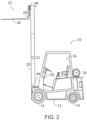
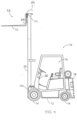
- the forklift 10 can include a frame 12 supported by wheels 14.
- the frame 12 can support an operator cab 16, an electric power source 18, which could be charged by a conventional engine, and uprights or masts 20.
- the masts 20, in turn, can support a component, such as a cargo or loading area 22, which can include a load apron 24 and forks or tines 26.
- the operator cab 16 can include a seat for an operator, along with instrumentation and controls for monitoring and controlling the forklift 10, including operation of the loading area 22.
- an operator can drive the forklift 10 and control movement of the loading area 22 upward (shown in FIG. 2 ) or downward (shown in FIG. 1 ) with respect to the masts 20 via a set of electric or hydraulic mast actuators (not shown).
- the operator can also control movement of the tines 26 of the loading area 22, such as first and second tines 26a and 26b, respectively, by moving such tines inward or outward with respect to one another via a set of time actuators.
- first and second tines 26a and 26b can be controlled to move individually with respect to one another, i.e., independently from one another and by varying amounts, or can be controlled to move in cooperation with one another.
- the forklift 10 is operable to move objects of varying sizes by grasping such objects with the tines 26 or supporting such objects on the tines 26, raising or lowering such objects along the masts 20, and moving such objects with the wheels 14.
- a set of tine actuators can include first and second linear electric actuators 30a and 30b, respectively.
- the first and second linear electric actuators 30a and 30b, respectively, can correspondingly control movement of a portion of the component, such as the first and second tines 26a and 26b, respectively, inward or outward with respect to one another, when in downward/lowered or upward/raised positions with respect to the masts 20.
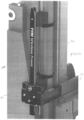
- An isometric view of a representative linear electric actuator 30 is provided in FIG. 4 .
- first and second tines 26a and 26b can be configured to include first and second retainers 32a and 32b, respectively, at upper ends of the tines for coupling to a guide bar 34 of the load apron 24.
- the first and second tines 26a and 26b, respectively, can also be configured to include first and second rollers 36a and 36b, respectively, at lower ends of the tines for rolling along the load apron 24.
- the first linear electric actuator 30a can be mounted between the first tine 26a and the load apron 24, and the second linear electric actuator 30b can be mounted between the second tine 26b and the load apron 24.
- an operator in the operator cab 16 can control movement of the first tine 26a, with respect to the load apron 24, by actuating the first linear electric actuator 30a to retract, causing the first tine 26a to move inward, or extend, causing the first tine 26a to move outward.
- the operator in the operator cab 16 can control movement of the second tine 26b, with respect to the load apron 24, by actuating the second linear electric actuator 30b to retract, causing the second tine 26b to move inward, or extend, causing the second tine 26b to move outward.
- the operator in the operator cab 16 can control movement of the first and second tines 26a and 26b, respectively, individually, or in cooperation with one another, which can be beneficial to achieve variable symmetrical spacing between the first and second tines 26a and 26b, respectively.
- a battery system 40 can be provided for each linear electric actuator 30, such as a first battery system 40a for the first linear electric actuator 30a, and a second battery system 40b for the second linear electric actuator 30b.
- Each battery system 40 can be positioned proximal to its corresponding linear electric actuator 30, such as by being directly mounted to the linear electric actuator 30 as shown in FIG. 4 , or can be positioned further from the linear electric actuator 30, such as by being mounted on the load apron 24.
- a single battery system may be provided for both electric actuators.
- each battery system 40 can include a power source, such as a power storage 56, which can comprise one or more batteries, capacitors and/or other electrical or chemical charge elements for receiving electrical charge, storing electrical power and providing power to the linear electric actuator 30.
- the power source can provide power to the linear electric actuator 30 while being charged when in a downward/lowered position with respect to the masts 20.
- the power source can also provide power to the linear electric actuator 30 without being charged when in an upward/raised position with respect to the masts 20.
- Each battery system 40 can also include a control system 58 for receiving wired or wireless commands from the operator cab 16, such as by a wired or wireless communication device 35.
- control system 58 can be controlled by the operator in the operator cab 16 to allow the power storage 56 to provide a polarity, magnitude and duration of power to actuate its corresponding linear electric actuator 30 to retract or extend by a desired amount, with each battery system 40 moving with its corresponding linear electric actuator 30 as the loading area 22 is controlled to move up or down.
- each battery system 40 can be charged via a charging system 42.
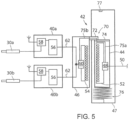
- the charging system 42 can include a power sending system 44 and a power receiving system 46 which can operate to charge each battery system 40 by wireless induction charging and/or direct (wired) contact charging.
- the power sending system 44 can be attached, for example, to the frame 12 to be proximal to the power receiving system 46 when the loading area 22 is in the downward/lowered position, or "first position.”
- the power sending system 44 can receive power, such as from the power source 18, and can provide power to the power receiving system 46, when proximal to one another.
- Such power can be transferred wirelessly (inductively) via an electromagnetic field, or by direct power contact, when the loading area 22 is in the downward/lowered position.
- the power sending system 44 proximal to the power receiving system 46, can transfer charge inductively and/or by direct contact with the power receiving system 46.
- the power sending system 44 can include power sending circuitry 48 configured to receive power from the power source 18 via a power signal 50.
- the power sending circuitry 48 can, in turn, generate an electrical current in a primary coil 52 to produce an electromagnetic field and transmit power.
- the electromagnetic field in turn, can induce an electrical current in a secondary coil 54 of the power receiving system 46.
- the distance between the power sending system 44 and the power receiving system 46 in the presence of the electromagnetic field can be small, such as approximately 10 mm, which can also help to prevent dirt buildup.
- Power receiving circuitry 60 of the power receiving system 46 can receive the induced electrical current from the secondary coil 54 and send charge to the power storage 56 of each battery system 40 via a power signal 62.
- the power receiving circuitry 60 can provide the power signal 62 to charge the power storage 56 of the first battery system 40a (for powering the first linear electric actuator 30a) and to charge the power storage 56 of the second battery system 40b (for powering the second linear electric actuator 30b).
- the power storage 56 of each battery system 40 in turn, can provide power to the control system 58, and the control system 58 can determine the polarity, magnitude and duration of power to provide to the corresponding linear electric actuator 30.
- the first and second battery systems 40a, and 40b, respectively can have sufficient charge to correspondingly actuate the first and second linear electric actuators 30a and 30b, respectively, even when the loading area 22 is in an upward/raised position, or "second position," as shown in FIGS. 2 and 7 , and no longer charging.
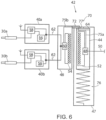
- the power sending system 44 and/or the power receiving system 46 can be in fixed positions. However, with additional reference to FIG. 6 , the power sending system 44 and/or the power receiving system 46 can be configured to move a relatively small distance to maintain proximity for power transfer. In addition, if either the power sending system 44 or the power receiving system 46 is configured to move, a lock 70 can be provided between the power receiving system 46 and the power sending system 44. The lock 70 can cause the power receiving system 46 and the power sending system 44 to be movable together over a limited range in the first position when the lock is enabled. For example, as the load apron 24 moves with the power receiving system 46 upward, the power receiving system 46 can lock to the power sending system 44 to correspondingly move the power sending system 44 a small distance in the same direction.
- the lock 70 can be magnetically and/or mechanically operated.
- the lock 70 can include a first portion 72 connected to the power receiving system 46 and a second portion 74 connected to the power sending system 44.
- the first and second portions 72 and 74, respectively, could be opposite poles of a magnet, for example.
- a magnet could be a permanent magnet, such as one made from an alloy of neodymium, or could be an electromagnetically produced magnetism, or otherwise.
- the first and second portions 72 and 74, respectively can be opposite portions of a mechanical lock, such as a hook and loop, a detent and pin, or otherwise.
- the lock 70 can cause the power receiving system 46 and the power sending system 44 to be movable together, such as over a limited range of about ⁇ 100 mm, in order to maximize charging while in the first position.
- the lock 70 can also provide the direct contacting electrical power connection between the power sending system 44 and the power receiving system 46.
- the power sending system 44 may transfer charge to the power receiving system 46 accordingly.
- the power sending system 44 can charge the power receiving system 46 inductively and/or by direct (wired) contact, such as by conducting an electrical current via a first contact power signal 75a from the power sending circuitry 48 connecting to a second contact power signal 75b to the power receiving circuitry 60 via the first and second portions 72 and 74.
- Such contact based charging can be in addition to, or alternative to, induction based power transfer via the primary coil 52 and the secondary coil 54.
- Either the power receiving system 46 or the power sending system 44 can be attached to a support mechanism via one or more springs.
- a spring can be operable to maintain positioning of the power receiving system 46 and/or the power sending system 44 through a limited range with respect to the support mechanism when in the first position.
- a spring 76 can be connected to the power sending system 44 to maintain the power sending system 44 in the first position (with the power receiving system 46) through a limited range with respect to the second support mechanism. Accordingly, the first position can be maintained until overcoming a tension of the spring 76 and/or reaching a stop 77.
- the spring 76 can operate from a compressed condition, as illustrated in FIG. 5 , to an extended condition, as illustrated in FIG. 6 .
- the lock 70 when lifting the loading area 22, the lock 70 can lift the power sending system 44, extending the spring 76, until a tension of the spring 76 is overcome and/or the power sending system 44 reaches the stop 77. Then, the lock 70 can disable, and the power receiving system 46 can continue to travel upwards with the loading area 22, away from the power sending system 44. In a subsequent lock operation, such as when the loading area 22 is lowered and the power receiving system 46 is again in proximity to the power sending system 44, the lock 70 can enable again and overcome the force of the spring 76 to drag the power sending system 44 along with the power receiving system 46 while charging.
- the spring 76 upon reaching the extended condition, can cause a tension sufficient to overcome the lock 70. As a result, the spring 76 can cause the power sending system 44 to pull away from the power receiving system 46 (disabling the lock 70) and into the second position, as illustrated in FIG. 7 . Upon disabling of the lock 70, in the second position, the power sending system 44 can become distal to the power receiving system 46, thereby disrupting charging of the power receiving system 46. In addition, the spring 76 can cause the power sending system 44 to return to an equilibrium position for a subsequent lock operation between the power sending system 44 and the power receiving system 46 when moving again into proximity. Also, in another aspect, the stop 77 can prevent the power sending system 44 from further travel, thereby overcoming the lock 70 and causing the power sending system 44 to return to the equilibrium position via the spring 76 for a subsequent lock operation.
- the present invention has been shown with the spring 76 connected to the power sending system 44. It should be appreciated, however, that a spring may in addition, or alternatively, be connected to the power receiving system 46. Accordingly, other alternative configurations can be employed as desired without departing from the scope of the invention as set forth above.
- the present invention has been shown and described with respect to the power receiving system 46 being employed to power an electrical device remotely from the power sending system 44, it is understood that the present invention contemplates providing power to any type of powered component or device carried by or secured to a movable component of a vehicle and is not limited to electrical devices.
- the battery system 40 is configured to receive electrical power from a when a connector 102 of the battery system 40 is in contact with a powered rail 104 in the first position as shown.
- the battery system 40 and the connector 102 can be attached to the loading area 22, while the powered rail 104 is attached to the one of the masts 20, as shown. Accordingly, the connector 102 can move along the powered rail 104 with electrical contact through a length of the powered rail 104 in the first position. Accordingly, direct contact charging of the power battery system 40 can be achieved in the first position.
- the connector 102 can be configured to move with direct contact to the powered rail 104 through a distance, which may preferably be less than about 20% of the travel distance of the loading area 22 with respect to the masts 20.
- the powered rail 104 could be a rigid conductor having a length of about 1 meter disposed in a direction of motion between loading area 22 and the masts 20.
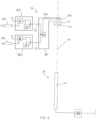
- Fig. 10 a schematic view of the charging system of Fig. 8 is provided. Shown in the first position, the connector 102 and the powered rail 104 are in direct electrical contact with one another. As a result, the battery system 40 receives electrical power from the power sending system 44 in a charging state. In one aspect, the power sending system 44 can provide Direct Current (DC) electrical power to the powered rail 104, which, in turn, can be received by the battery system 40 for electrical charging.
- DC Direct Current
- the connector 102 can move along an axis 105, in a direction of motion between the loading area 22 and the masts 20. While in the first position, direct contact charging can be provided at an interface between the powered rail 104 and an electrically conductive surface 106 of the connector 102. Such direct contact charging can be maintained while traveling through the length of the powered rail 104 with the electrically conductive surface 106 sliding along the powered rail 104.
- the connector 102 can be further configured to move with direct contact to the powered rail 104 using one or more guide wheels 108.
- the electrically conductive surface 106 can maximize transfer and conduction of electrical power from the powered rail 104 to battery system 40 when in direct contact with the powered rail 104 by providing a large, substantially flat, conductive surface area for contacting the powered rail 104.
- the electrically conductive surface 106 can, in turn, connect to the power storage unit circuitry 60, for example, via the second contact power signal 75b. It should be appreciated that wireless inductive charging could also be included in this embodiment for additional charging ability by implementation and alignment of the primary and secondary coils 52 and 54, respectively.
- Fig. 11 a schematic view of the charging system of Fig. 9 is provided. Shown in the second position, the connector 102 and the powered rail 104 are no longer in electrical contact with one another. As a result, the battery system 40 no longer receives electrical power from the sending system 44. Instead, the battery system 40 and the connector 102 are moved along the axis 105, away from the powered rail 104, such as to accomplish a work function. Nevertheless, the actuators 30a, 30b can continue to operate using charge held by the battery system 40.It will be appreciated that variations of the invention can include more than two tines, tines in differing configurations, differing integrations between the battery system and the power receiving system, and the like. All such variations are deemed within the scope of the invention, which is defined by the appended claims.
Landscapes
- Engineering & Computer Science (AREA)
- Structural Engineering (AREA)
- Transportation (AREA)
- Geology (AREA)
- Civil Engineering (AREA)
- Life Sciences & Earth Sciences (AREA)
- Mechanical Engineering (AREA)
- Chemical & Material Sciences (AREA)
- Combustion & Propulsion (AREA)
- Power Engineering (AREA)
- Forklifts And Lifting Vehicles (AREA)
- Charge And Discharge Circuits For Batteries Or The Like (AREA)
- Computer Networks & Wireless Communication (AREA)
Applications Claiming Priority (3)
| Application Number | Priority Date | Filing Date | Title |
|---|---|---|---|
| US201762481264P | 2017-04-04 | 2017-04-04 | |
| US15/944,358 US10501298B2 (en) | 2017-04-04 | 2018-04-03 | Linear actuator system for moving tines of a work vehicle |
| PCT/US2018/026008 WO2018187417A1 (en) | 2017-04-04 | 2018-04-04 | Linear actuator system for moving tines of a work vehicle |
Publications (2)
| Publication Number | Publication Date |
|---|---|
| EP3606864A1 EP3606864A1 (en) | 2020-02-12 |
| EP3606864B1 true EP3606864B1 (en) | 2024-06-19 |
Family
ID=63672166
Family Applications (1)
| Application Number | Title | Priority Date | Filing Date |
|---|---|---|---|
| EP18720828.5A Active EP3606864B1 (en) | 2017-04-04 | 2018-04-04 | Linear actuator system for moving tines of a work vehicle |
Country Status (5)
| Country | Link |
|---|---|
| US (1) | US10501298B2 (enExample) |
| EP (1) | EP3606864B1 (enExample) |
| JP (1) | JP7178359B2 (enExample) |
| FI (1) | FI3606864T3 (enExample) |
| WO (1) | WO2018187417A1 (enExample) |
Families Citing this family (3)
| Publication number | Priority date | Publication date | Assignee | Title |
|---|---|---|---|---|
| CN109095401A (zh) * | 2018-10-10 | 2018-12-28 | 浙江亚鼎科技有限公司 | 一种叉车门架仪器的充电装置 |
| EP4115024A2 (en) | 2020-03-02 | 2023-01-11 | Clark Equipment Company | Electrically powered power machine |
| WO2023034572A1 (en) | 2021-09-02 | 2023-03-09 | Clark Equipment Company | Lift arm arrangements for power machines |
Family Cites Families (25)
| Publication number | Priority date | Publication date | Assignee | Title |
|---|---|---|---|---|
| US3543959A (en) * | 1969-02-17 | 1970-12-01 | Crown Controls Corp | Lift truck mechanism |
| US4252217A (en) | 1978-02-28 | 1981-02-24 | Litton Systems, Inc. | Semi-automated warehousing system |
| US5139385A (en) | 1990-04-03 | 1992-08-18 | Swingshift Manufacturing, Inc. | Dual pallet fork attachment for a lift truck |
| US5326217A (en) | 1990-09-24 | 1994-07-05 | Clark Material Handling Company | Lift truck with negative drop upright |
| US6430761B1 (en) | 1999-01-25 | 2002-08-13 | Take-Along Lifts Llc | Compact portable patient lift |
| JP2002302395A (ja) | 2001-04-05 | 2002-10-18 | Nippon Yusoki Co Ltd | 電気開閉器 |
| SE521188C2 (sv) | 2002-02-11 | 2003-10-07 | Kalmar Ind Sverige Ab | Hydraulsystem för ett fordon, fordon innefattande ett sådant hydraulsystem samt en tilläggsenhet för ett sådant fordon |
| JP2004338869A (ja) | 2003-05-15 | 2004-12-02 | Kaga Sangyo Sharyo:Kk | フォークリフト車両の可動フォークユニット |
| JP4288245B2 (ja) | 2005-02-25 | 2009-07-01 | 三菱重工業株式会社 | フォークリフト及び、それに適用される誘導モータ制御方法 |
| US20060255943A1 (en) * | 2005-05-16 | 2006-11-16 | Psc Scanning, Inc. | Induction charging machine, methods, and system for a data reader |
| CA2614773C (en) | 2005-07-13 | 2014-10-07 | Crown Equipment Corporation | Pallet clamping device |
| CA2677836C (en) | 2007-02-16 | 2016-06-21 | Ecb Novatech Inc. | Gripping device for load structure |
| AU2009244439C1 (en) | 2008-05-08 | 2012-12-13 | Paladin Brands Group, Inc. | Fork apparatus for handling cotton bales |
| JP2010112409A (ja) * | 2008-11-05 | 2010-05-20 | Hitachi Constr Mach Co Ltd | リニアアクチュエータ |
| JP5319320B2 (ja) * | 2009-02-17 | 2013-10-16 | 日立建機株式会社 | フォークリフト |
| US20100327544A1 (en) | 2009-06-29 | 2010-12-30 | Richard Allen Pebworth | Cylinder Cart |
| US8869944B2 (en) * | 2010-03-01 | 2014-10-28 | The Raymond Corporation | Energy storage on an elevated platform and transfer method |
| EP2628703A1 (en) | 2012-02-20 | 2013-08-21 | Elme Spreader AB | Side lift spreader |
| EP3026002B1 (en) | 2012-02-20 | 2022-05-11 | Elme Spreader AB | Side lift spreader |
| DE102012021043A1 (de) | 2012-10-26 | 2014-04-30 | Jungheinrich Aktiengesellschaft | Flurförderzeug mit einem Lastteil |
| JP5286445B1 (ja) | 2012-12-28 | 2013-09-11 | 株式会社日立パワーソリューションズ | 電動式移動体の無線給電装置 |
| WO2014128928A1 (ja) | 2013-02-22 | 2014-08-28 | ニチュ三菱フォークリフト株式会社 | 荷役車両及び荷役車両におけるマスト側ブラケット電源の充電方法 |
| US9935469B2 (en) * | 2015-02-10 | 2018-04-03 | Cascade Corporation | Wireless power transfer and communications for industrial equipment |
| US10414359B2 (en) | 2015-02-16 | 2019-09-17 | Tyri International, Inc. | System for providing wireless operation of powered device(s) on a vehicle |
| US9525288B2 (en) | 2015-02-26 | 2016-12-20 | Cascade Corporation | Devices and methods for inductive power transfer and power control for industrial equipment |
-
2018
- 2018-04-03 US US15/944,358 patent/US10501298B2/en active Active
- 2018-04-04 FI FIEP18720828.5T patent/FI3606864T3/fi active
- 2018-04-04 EP EP18720828.5A patent/EP3606864B1/en active Active
- 2018-04-04 WO PCT/US2018/026008 patent/WO2018187417A1/en not_active Ceased
- 2018-04-04 JP JP2019554643A patent/JP7178359B2/ja active Active
Also Published As
| Publication number | Publication date |
|---|---|
| WO2018187417A1 (en) | 2018-10-11 |
| US10501298B2 (en) | 2019-12-10 |
| JP7178359B2 (ja) | 2022-11-25 |
| FI3606864T3 (fi) | 2024-07-03 |
| EP3606864A1 (en) | 2020-02-12 |
| JP2020515486A (ja) | 2020-05-28 |
| US20180282141A1 (en) | 2018-10-04 |
Similar Documents
| Publication | Publication Date | Title |
|---|---|---|
| JP6644801B2 (ja) | 産業機器用ワイヤレスパワー伝送及び通信 | |
| US8025474B2 (en) | Battery-changing vehicle with cantilevered boom | |
| JP6647313B2 (ja) | 誘導パワー伝送装置及びその方法、並びに産業機器のためのパワー制御 | |
| US10501298B2 (en) | Linear actuator system for moving tines of a work vehicle | |
| EP3112312A1 (en) | Telehandler | |
| US10680678B2 (en) | System for providing wireless operation of powered device(s) on a vehicle with direct charging | |
| CN116101095A (zh) | 具有位置补偿的物料搬运车辆充电系统和方法 | |
| US12043100B2 (en) | Telehandler with improved stabilisers | |
| US10414359B2 (en) | System for providing wireless operation of powered device(s) on a vehicle | |
| US11524584B2 (en) | Current collector arrangement for a vehicle and a vehicle therefore | |
| US8240683B1 (en) | Portable hand truck with powered lifting device | |
| JP2023082056A (ja) | 直接充電により車両上の1つ以上の被給電機器のワイヤレス動作を実現するシステム | |
| AU2024278324B2 (en) | Tire handler having tire lay flat capability | |
| EP3953275B1 (en) | Container handling vehicle and method | |
| US20070003395A1 (en) | Device in a vehicle adapted to handle loads | |
| EP3812339A1 (en) | Material handling vehicle | |
| EP3653434B1 (en) | Dumper with variable track width | |
| JPH074500U (ja) | 高所作業車の安全装置 |
Legal Events
| Date | Code | Title | Description |
|---|---|---|---|
| STAA | Information on the status of an ep patent application or granted ep patent |
Free format text: STATUS: UNKNOWN |
|
| STAA | Information on the status of an ep patent application or granted ep patent |
Free format text: STATUS: THE INTERNATIONAL PUBLICATION HAS BEEN MADE |
|
| PUAI | Public reference made under article 153(3) epc to a published international application that has entered the european phase |
Free format text: ORIGINAL CODE: 0009012 |
|
| STAA | Information on the status of an ep patent application or granted ep patent |
Free format text: STATUS: REQUEST FOR EXAMINATION WAS MADE |
|
| 17P | Request for examination filed |
Effective date: 20191001 |
|
| AK | Designated contracting states |
Kind code of ref document: A1 Designated state(s): AL AT BE BG CH CY CZ DE DK EE ES FI FR GB GR HR HU IE IS IT LI LT LU LV MC MK MT NL NO PL PT RO RS SE SI SK SM TR |
|
| AX | Request for extension of the european patent |
Extension state: BA ME |
|
| DAV | Request for validation of the european patent (deleted) | ||
| DAX | Request for extension of the european patent (deleted) | ||
| RIC1 | Information provided on ipc code assigned before grant |
Ipc: H02J 7/00 20060101ALI20220729BHEP Ipc: B66F 9/14 20060101ALI20220729BHEP Ipc: B66F 9/075 20060101ALI20220729BHEP Ipc: H02J 7/34 20060101ALI20220729BHEP Ipc: B66F 9/24 20060101AFI20220729BHEP |
|
| STAA | Information on the status of an ep patent application or granted ep patent |
Free format text: STATUS: EXAMINATION IS IN PROGRESS |
|
| 17Q | First examination report despatched |
Effective date: 20220930 |
|
| GRAP | Despatch of communication of intention to grant a patent |
Free format text: ORIGINAL CODE: EPIDOSNIGR1 |
|
| STAA | Information on the status of an ep patent application or granted ep patent |
Free format text: STATUS: GRANT OF PATENT IS INTENDED |
|
| INTG | Intention to grant announced |
Effective date: 20240202 |
|
| GRAS | Grant fee paid |
Free format text: ORIGINAL CODE: EPIDOSNIGR3 |
|
| GRAA | (expected) grant |
Free format text: ORIGINAL CODE: 0009210 |
|
| STAA | Information on the status of an ep patent application or granted ep patent |
Free format text: STATUS: THE PATENT HAS BEEN GRANTED |
|
| P01 | Opt-out of the competence of the unified patent court (upc) registered |
Effective date: 20240417 |
|
| AK | Designated contracting states |
Kind code of ref document: B1 Designated state(s): AL AT BE BG CH CY CZ DE DK EE ES FI FR GB GR HR HU IE IS IT LI LT LU LV MC MK MT NL NO PL PT RO RS SE SI SK SM TR |
|
| REG | Reference to a national code |
Ref country code: GB Ref legal event code: FG4D |
|
| REG | Reference to a national code |
Ref country code: CH Ref legal event code: EP |
|
| REG | Reference to a national code |
Ref country code: FI Ref legal event code: FGE |
|
| REG | Reference to a national code |
Ref country code: DE Ref legal event code: R096 Ref document number: 602018070758 Country of ref document: DE |
|
| REG | Reference to a national code |
Ref country code: SE Ref legal event code: TRGR |
|
| PG25 | Lapsed in a contracting state [announced via postgrant information from national office to epo] |
Ref country code: BG Free format text: LAPSE BECAUSE OF FAILURE TO SUBMIT A TRANSLATION OF THE DESCRIPTION OR TO PAY THE FEE WITHIN THE PRESCRIBED TIME-LIMIT Effective date: 20240619 |
|
| PG25 | Lapsed in a contracting state [announced via postgrant information from national office to epo] |
Ref country code: HR Free format text: LAPSE BECAUSE OF FAILURE TO SUBMIT A TRANSLATION OF THE DESCRIPTION OR TO PAY THE FEE WITHIN THE PRESCRIBED TIME-LIMIT Effective date: 20240619 |
|
| REG | Reference to a national code |
Ref country code: LT Ref legal event code: MG9D |
|
| PG25 | Lapsed in a contracting state [announced via postgrant information from national office to epo] |
Ref country code: GR Free format text: LAPSE BECAUSE OF FAILURE TO SUBMIT A TRANSLATION OF THE DESCRIPTION OR TO PAY THE FEE WITHIN THE PRESCRIBED TIME-LIMIT Effective date: 20240920 |
|
| PG25 | Lapsed in a contracting state [announced via postgrant information from national office to epo] |
Ref country code: LV Free format text: LAPSE BECAUSE OF FAILURE TO SUBMIT A TRANSLATION OF THE DESCRIPTION OR TO PAY THE FEE WITHIN THE PRESCRIBED TIME-LIMIT Effective date: 20240619 |
|
| PG25 | Lapsed in a contracting state [announced via postgrant information from national office to epo] |
Ref country code: NO Free format text: LAPSE BECAUSE OF FAILURE TO SUBMIT A TRANSLATION OF THE DESCRIPTION OR TO PAY THE FEE WITHIN THE PRESCRIBED TIME-LIMIT Effective date: 20240919 Ref country code: LV Free format text: LAPSE BECAUSE OF FAILURE TO SUBMIT A TRANSLATION OF THE DESCRIPTION OR TO PAY THE FEE WITHIN THE PRESCRIBED TIME-LIMIT Effective date: 20240619 Ref country code: HR Free format text: LAPSE BECAUSE OF FAILURE TO SUBMIT A TRANSLATION OF THE DESCRIPTION OR TO PAY THE FEE WITHIN THE PRESCRIBED TIME-LIMIT Effective date: 20240619 Ref country code: GR Free format text: LAPSE BECAUSE OF FAILURE TO SUBMIT A TRANSLATION OF THE DESCRIPTION OR TO PAY THE FEE WITHIN THE PRESCRIBED TIME-LIMIT Effective date: 20240920 Ref country code: BG Free format text: LAPSE BECAUSE OF FAILURE TO SUBMIT A TRANSLATION OF THE DESCRIPTION OR TO PAY THE FEE WITHIN THE PRESCRIBED TIME-LIMIT Effective date: 20240619 Ref country code: RS Free format text: LAPSE BECAUSE OF FAILURE TO SUBMIT A TRANSLATION OF THE DESCRIPTION OR TO PAY THE FEE WITHIN THE PRESCRIBED TIME-LIMIT Effective date: 20240919 |
|
| PG25 | Lapsed in a contracting state [announced via postgrant information from national office to epo] |
Ref country code: NL Free format text: LAPSE BECAUSE OF FAILURE TO SUBMIT A TRANSLATION OF THE DESCRIPTION OR TO PAY THE FEE WITHIN THE PRESCRIBED TIME-LIMIT Effective date: 20240619 |
|
| REG | Reference to a national code |
Ref country code: AT Ref legal event code: MK05 Ref document number: 1695820 Country of ref document: AT Kind code of ref document: T Effective date: 20240619 |
|
| PG25 | Lapsed in a contracting state [announced via postgrant information from national office to epo] |
Ref country code: NL Free format text: LAPSE BECAUSE OF FAILURE TO SUBMIT A TRANSLATION OF THE DESCRIPTION OR TO PAY THE FEE WITHIN THE PRESCRIBED TIME-LIMIT Effective date: 20240619 |
|
| PG25 | Lapsed in a contracting state [announced via postgrant information from national office to epo] |
Ref country code: PT Free format text: LAPSE BECAUSE OF FAILURE TO SUBMIT A TRANSLATION OF THE DESCRIPTION OR TO PAY THE FEE WITHIN THE PRESCRIBED TIME-LIMIT Effective date: 20241021 |
|
| PG25 | Lapsed in a contracting state [announced via postgrant information from national office to epo] |
Ref country code: PT Free format text: LAPSE BECAUSE OF FAILURE TO SUBMIT A TRANSLATION OF THE DESCRIPTION OR TO PAY THE FEE WITHIN THE PRESCRIBED TIME-LIMIT Effective date: 20241021 |
|
| PG25 | Lapsed in a contracting state [announced via postgrant information from national office to epo] |
Ref country code: PL Free format text: LAPSE BECAUSE OF FAILURE TO SUBMIT A TRANSLATION OF THE DESCRIPTION OR TO PAY THE FEE WITHIN THE PRESCRIBED TIME-LIMIT Effective date: 20240619 |
|
| PG25 | Lapsed in a contracting state [announced via postgrant information from national office to epo] |
Ref country code: EE Free format text: LAPSE BECAUSE OF FAILURE TO SUBMIT A TRANSLATION OF THE DESCRIPTION OR TO PAY THE FEE WITHIN THE PRESCRIBED TIME-LIMIT Effective date: 20240619 |
|
| PG25 | Lapsed in a contracting state [announced via postgrant information from national office to epo] |
Ref country code: IS Free format text: LAPSE BECAUSE OF FAILURE TO SUBMIT A TRANSLATION OF THE DESCRIPTION OR TO PAY THE FEE WITHIN THE PRESCRIBED TIME-LIMIT Effective date: 20241019 Ref country code: AT Free format text: LAPSE BECAUSE OF FAILURE TO SUBMIT A TRANSLATION OF THE DESCRIPTION OR TO PAY THE FEE WITHIN THE PRESCRIBED TIME-LIMIT Effective date: 20240619 |
|
| PG25 | Lapsed in a contracting state [announced via postgrant information from national office to epo] |
Ref country code: CZ Free format text: LAPSE BECAUSE OF FAILURE TO SUBMIT A TRANSLATION OF THE DESCRIPTION OR TO PAY THE FEE WITHIN THE PRESCRIBED TIME-LIMIT Effective date: 20240619 |
|
| PG25 | Lapsed in a contracting state [announced via postgrant information from national office to epo] |
Ref country code: RO Free format text: LAPSE BECAUSE OF FAILURE TO SUBMIT A TRANSLATION OF THE DESCRIPTION OR TO PAY THE FEE WITHIN THE PRESCRIBED TIME-LIMIT Effective date: 20240619 Ref country code: SK Free format text: LAPSE BECAUSE OF FAILURE TO SUBMIT A TRANSLATION OF THE DESCRIPTION OR TO PAY THE FEE WITHIN THE PRESCRIBED TIME-LIMIT Effective date: 20240619 |
|
| PG25 | Lapsed in a contracting state [announced via postgrant information from national office to epo] |
Ref country code: ES Free format text: LAPSE BECAUSE OF FAILURE TO SUBMIT A TRANSLATION OF THE DESCRIPTION OR TO PAY THE FEE WITHIN THE PRESCRIBED TIME-LIMIT Effective date: 20240619 Ref country code: SM Free format text: LAPSE BECAUSE OF FAILURE TO SUBMIT A TRANSLATION OF THE DESCRIPTION OR TO PAY THE FEE WITHIN THE PRESCRIBED TIME-LIMIT Effective date: 20240619 |
|
| PG25 | Lapsed in a contracting state [announced via postgrant information from national office to epo] |
Ref country code: SM Free format text: LAPSE BECAUSE OF FAILURE TO SUBMIT A TRANSLATION OF THE DESCRIPTION OR TO PAY THE FEE WITHIN THE PRESCRIBED TIME-LIMIT Effective date: 20240619 Ref country code: SK Free format text: LAPSE BECAUSE OF FAILURE TO SUBMIT A TRANSLATION OF THE DESCRIPTION OR TO PAY THE FEE WITHIN THE PRESCRIBED TIME-LIMIT Effective date: 20240619 Ref country code: RO Free format text: LAPSE BECAUSE OF FAILURE TO SUBMIT A TRANSLATION OF THE DESCRIPTION OR TO PAY THE FEE WITHIN THE PRESCRIBED TIME-LIMIT Effective date: 20240619 Ref country code: PL Free format text: LAPSE BECAUSE OF FAILURE TO SUBMIT A TRANSLATION OF THE DESCRIPTION OR TO PAY THE FEE WITHIN THE PRESCRIBED TIME-LIMIT Effective date: 20240619 Ref country code: IS Free format text: LAPSE BECAUSE OF FAILURE TO SUBMIT A TRANSLATION OF THE DESCRIPTION OR TO PAY THE FEE WITHIN THE PRESCRIBED TIME-LIMIT Effective date: 20241019 Ref country code: ES Free format text: LAPSE BECAUSE OF FAILURE TO SUBMIT A TRANSLATION OF THE DESCRIPTION OR TO PAY THE FEE WITHIN THE PRESCRIBED TIME-LIMIT Effective date: 20240619 Ref country code: EE Free format text: LAPSE BECAUSE OF FAILURE TO SUBMIT A TRANSLATION OF THE DESCRIPTION OR TO PAY THE FEE WITHIN THE PRESCRIBED TIME-LIMIT Effective date: 20240619 Ref country code: CZ Free format text: LAPSE BECAUSE OF FAILURE TO SUBMIT A TRANSLATION OF THE DESCRIPTION OR TO PAY THE FEE WITHIN THE PRESCRIBED TIME-LIMIT Effective date: 20240619 Ref country code: AT Free format text: LAPSE BECAUSE OF FAILURE TO SUBMIT A TRANSLATION OF THE DESCRIPTION OR TO PAY THE FEE WITHIN THE PRESCRIBED TIME-LIMIT Effective date: 20240619 |
|
| REG | Reference to a national code |
Ref country code: DE Ref legal event code: R097 Ref document number: 602018070758 Country of ref document: DE |
|
| PG25 | Lapsed in a contracting state [announced via postgrant information from national office to epo] |
Ref country code: DK Free format text: LAPSE BECAUSE OF FAILURE TO SUBMIT A TRANSLATION OF THE DESCRIPTION OR TO PAY THE FEE WITHIN THE PRESCRIBED TIME-LIMIT Effective date: 20240619 |
|
| PLBE | No opposition filed within time limit |
Free format text: ORIGINAL CODE: 0009261 |
|
| STAA | Information on the status of an ep patent application or granted ep patent |
Free format text: STATUS: NO OPPOSITION FILED WITHIN TIME LIMIT |
|
| 26N | No opposition filed |
Effective date: 20250320 |
|
| PGFP | Annual fee paid to national office [announced via postgrant information from national office to epo] |
Ref country code: FI Payment date: 20250424 Year of fee payment: 8 |
|
| PGFP | Annual fee paid to national office [announced via postgrant information from national office to epo] |
Ref country code: DE Payment date: 20250422 Year of fee payment: 8 |
|
| PGFP | Annual fee paid to national office [announced via postgrant information from national office to epo] |
Ref country code: GB Payment date: 20250403 Year of fee payment: 8 |
|
| PGFP | Annual fee paid to national office [announced via postgrant information from national office to epo] |
Ref country code: IT Payment date: 20250422 Year of fee payment: 8 |
|
| PGFP | Annual fee paid to national office [announced via postgrant information from national office to epo] |
Ref country code: FR Payment date: 20250425 Year of fee payment: 8 |
|
| PGFP | Annual fee paid to national office [announced via postgrant information from national office to epo] |
Ref country code: SE Payment date: 20250429 Year of fee payment: 8 |
|
| REG | Reference to a national code |
Ref country code: CH Ref legal event code: H13 Free format text: ST27 STATUS EVENT CODE: U-0-0-H10-H13 (AS PROVIDED BY THE NATIONAL OFFICE) Effective date: 20251125 |
|
| PG25 | Lapsed in a contracting state [announced via postgrant information from national office to epo] |
Ref country code: LU Free format text: LAPSE BECAUSE OF NON-PAYMENT OF DUE FEES Effective date: 20250404 |
|
| PG25 | Lapsed in a contracting state [announced via postgrant information from national office to epo] |
Ref country code: MC Free format text: LAPSE BECAUSE OF FAILURE TO SUBMIT A TRANSLATION OF THE DESCRIPTION OR TO PAY THE FEE WITHIN THE PRESCRIBED TIME-LIMIT Effective date: 20240619 |
|
| REG | Reference to a national code |
Ref country code: BE Ref legal event code: MM Effective date: 20250430 |
|
| PG25 | Lapsed in a contracting state [announced via postgrant information from national office to epo] |
Ref country code: BE Free format text: LAPSE BECAUSE OF NON-PAYMENT OF DUE FEES Effective date: 20250430 |
|
| PG25 | Lapsed in a contracting state [announced via postgrant information from national office to epo] |
Ref country code: CH Free format text: LAPSE BECAUSE OF NON-PAYMENT OF DUE FEES Effective date: 20250430 |
|
| PG25 | Lapsed in a contracting state [announced via postgrant information from national office to epo] |
Ref country code: IE Free format text: LAPSE BECAUSE OF NON-PAYMENT OF DUE FEES Effective date: 20250404 |
|
| PG25 | Lapsed in a contracting state [announced via postgrant information from national office to epo] |
Ref country code: CY Free format text: LAPSE BECAUSE OF FAILURE TO SUBMIT A TRANSLATION OF THE DESCRIPTION OR TO PAY THE FEE WITHIN THE PRESCRIBED TIME-LIMIT Effective date: 20240619 |
|
| PG25 | Lapsed in a contracting state [announced via postgrant information from national office to epo] |
Ref country code: LT Free format text: LAPSE BECAUSE OF FAILURE TO SUBMIT A TRANSLATION OF THE DESCRIPTION OR TO PAY THE FEE WITHIN THE PRESCRIBED TIME-LIMIT Effective date: 20240619 |