EP3606218A1 - Benutzerausrüstung, basisstation und entsprechendes verfahren - Google Patents
Benutzerausrüstung, basisstation und entsprechendes verfahren Download PDFInfo
- Publication number
- EP3606218A1 EP3606218A1 EP18770561.1A EP18770561A EP3606218A1 EP 3606218 A1 EP3606218 A1 EP 3606218A1 EP 18770561 A EP18770561 A EP 18770561A EP 3606218 A1 EP3606218 A1 EP 3606218A1
- Authority
- EP
- European Patent Office
- Prior art keywords
- pusch
- subcarriers
- prb
- sub
- subframe
- Prior art date
- Legal status (The legal status is an assumption and is not a legal conclusion. Google has not performed a legal analysis and makes no representation as to the accuracy of the status listed.)
- Granted
Links
Images



Classifications
-
- H—ELECTRICITY
- H04—ELECTRIC COMMUNICATION TECHNIQUE
- H04W—WIRELESS COMMUNICATION NETWORKS
- H04W72/00—Local resource management
- H04W72/12—Wireless traffic scheduling
- H04W72/1263—Mapping of traffic onto schedule, e.g. scheduled allocation or multiplexing of flows
- H04W72/1268—Mapping of traffic onto schedule, e.g. scheduled allocation or multiplexing of flows of uplink data flows
-
- H—ELECTRICITY
- H04—ELECTRIC COMMUNICATION TECHNIQUE
- H04W—WIRELESS COMMUNICATION NETWORKS
- H04W76/00—Connection management
- H04W76/20—Manipulation of established connections
- H04W76/27—Transitions between radio resource control [RRC] states
-
- H—ELECTRICITY
- H04—ELECTRIC COMMUNICATION TECHNIQUE
- H04L—TRANSMISSION OF DIGITAL INFORMATION, e.g. TELEGRAPHIC COMMUNICATION
- H04L5/00—Arrangements affording multiple use of the transmission path
- H04L5/003—Arrangements for allocating sub-channels of the transmission path
- H04L5/0044—Allocation of payload; Allocation of data channels, e.g. PDSCH or PUSCH
-
- H—ELECTRICITY
- H04—ELECTRIC COMMUNICATION TECHNIQUE
- H04L—TRANSMISSION OF DIGITAL INFORMATION, e.g. TELEGRAPHIC COMMUNICATION
- H04L5/00—Arrangements affording multiple use of the transmission path
- H04L5/003—Arrangements for allocating sub-channels of the transmission path
- H04L5/0053—Allocation of signalling, i.e. of overhead other than pilot signals
-
- H—ELECTRICITY
- H04—ELECTRIC COMMUNICATION TECHNIQUE
- H04L—TRANSMISSION OF DIGITAL INFORMATION, e.g. TELEGRAPHIC COMMUNICATION
- H04L5/00—Arrangements affording multiple use of the transmission path
- H04L5/0091—Signalling for the administration of the divided path, e.g. signalling of configuration information
- H04L5/0094—Indication of how sub-channels of the path are allocated
-
- H—ELECTRICITY
- H04—ELECTRIC COMMUNICATION TECHNIQUE
- H04W—WIRELESS COMMUNICATION NETWORKS
- H04W4/00—Services specially adapted for wireless communication networks; Facilities therefor
- H04W4/70—Services for machine-to-machine communication [M2M] or machine type communication [MTC]
-
- H—ELECTRICITY
- H04—ELECTRIC COMMUNICATION TECHNIQUE
- H04W—WIRELESS COMMUNICATION NETWORKS
- H04W72/00—Local resource management
- H04W72/04—Wireless resource allocation
- H04W72/044—Wireless resource allocation based on the type of the allocated resource
- H04W72/0453—Resources in frequency domain, e.g. a carrier in FDMA
-
- H—ELECTRICITY
- H04—ELECTRIC COMMUNICATION TECHNIQUE
- H04W—WIRELESS COMMUNICATION NETWORKS
- H04W72/00—Local resource management
- H04W72/20—Control channels or signalling for resource management
- H04W72/23—Control channels or signalling for resource management in the downlink direction of a wireless link, i.e. towards a terminal
-
- H—ELECTRICITY
- H04—ELECTRIC COMMUNICATION TECHNIQUE
- H04W—WIRELESS COMMUNICATION NETWORKS
- H04W72/00—Local resource management
- H04W72/20—Control channels or signalling for resource management
- H04W72/23—Control channels or signalling for resource management in the downlink direction of a wireless link, i.e. towards a terminal
- H04W72/232—Control channels or signalling for resource management in the downlink direction of a wireless link, i.e. towards a terminal the control data signalling from the physical layer, e.g. DCI signalling
-
- H—ELECTRICITY
- H04—ELECTRIC COMMUNICATION TECHNIQUE
- H04W—WIRELESS COMMUNICATION NETWORKS
- H04W74/00—Wireless channel access
- H04W74/002—Transmission of channel access control information
- H04W74/006—Transmission of channel access control information in the downlink, i.e. towards the terminal
-
- H—ELECTRICITY
- H04—ELECTRIC COMMUNICATION TECHNIQUE
- H04W—WIRELESS COMMUNICATION NETWORKS
- H04W80/00—Wireless network protocols or protocol adaptations to wireless operation
- H04W80/02—Data link layer protocols
-
- H—ELECTRICITY
- H04—ELECTRIC COMMUNICATION TECHNIQUE
- H04W—WIRELESS COMMUNICATION NETWORKS
- H04W74/00—Wireless channel access
- H04W74/08—Non-scheduled access, e.g. ALOHA
- H04W74/0833—Random access procedures, e.g. with 4-step access
Definitions
- the present disclosure relates to the field of wireless communications technologies. More specifically, the present disclosure relates to user equipment, a base station, and related methods.
- MTC machine type communication
- 3GPP 3rd Generation Partnership Project
- One of the goals of the research project is to support resource allocation based on sub-physical resource blocks (sub-PRBs) (namely, support resource allocation based on less than one PRB) so as to improve the spectral efficiency of an MTC physical uplink shared channel.
- sub-PRBs sub-physical resource blocks
- the problem that needs to be solved is how to support sub-PRB resource allocation.
- a method used in user equipment comprising: receiving an indication for enabling a sub-physical resource block enhancement mode from a base station through a media access control (MAC) random access response (RAR) or radio resource control signaling, wherein one or more bits in the MAC RAR indicate that the sub-physical resource block enhancement mode is to be applied to transmission of a random access message 3 "Msg3" and subsequent physical uplink shared channels (PUSCHs); enabling the sub-physical resource block enhancement mode in response to the indication, and receiving downlink control information (DCI) from the base station, the DCI comprising a subcarrier indication field indicating the number of subcarriers used for a PUSCH and locations of the subcarriers; and transmitting the PUSCH according to the subcarrier indication field.
- DCI downlink control information
- MPDCCH physical downlink control channel
- a same scrambling sequence and/or a same redundancy version is applied to PUSCHs on Nacc ⁇ (12/Nsc) consecutive absolute subframes.
- a transport block size of the PUSCH is determined at least based on N PRB determined by the number of subcarriers allocated for the PUSCH, wherein N PRB is 3 when the number of subcarriers allocated for the PUSCH is 3, or N PRB is 6 when the number of subcarriers allocated for the PUSCH is 6.
- user equipment comprising a transceiver, a processor, and a memory, the processor storing instructions executable by the processor so that the user equipment performs the method according to the aforementioned first aspect.
- a method used in a base station comprising: transmitting an indication for enabling a sub-physical resource block enhancement mode to user equipment through a media access control (MAC) random access response (RAR) or radio resource control signaling, wherein one or more bits in the MAC RAR indicate that the sub-physical resource block enhancement mode is to be applied to transmission of a random access message 3 "Msg3" and subsequent physical uplink shared channels (PUSCHs); transmitting downlink control information (DCI) to the user equipment, the DCI comprising a subcarrier indication field indicating the number of subcarriers used for a PUSCH and locations of the subcarriers; and receiving the PUSCH from the user equipment.
- DCI downlink control information
- MPDCCH physical downlink control channel
- a same scrambling sequence and/or a same redundancy version is applied to PUSCHs on Nacc ⁇ (12/Nsc) consecutive absolute subframes.
- a transport block size of the PUSCH is determined at least based on NPRB determined by the number of subcarriers allocated for the PUSCH, wherein N PRB is 3 when the number of subcarriers allocated for the PUSCH is 3, or N PRB is 6 when the number of subcarriers allocated for the PUSCH is 6.
- a base station comprising a transceiver, a processor, and a memory, the processor storing instructions executable by the processor so that the base station performs the method according to the aforementioned third aspect.
- FIG. 1 is a flowchart of a method 100 used in user equipment (UE) according to an embodiment of the present disclosure. As shown in the figure, the method 100 includes the following steps:
- a subframe n+ko is a first subframe available for transmitting the PUSCH subsequent to a subframe n+x, where k 0 ⁇ k 1 ⁇ k 2 ⁇ ... ⁇ k N-1 are values related to N subframes available for transmitting the PUSCH, and x is a constant.
- Nsc is 12 when the UE operates in a coverage enhancement mode A or a coverage enhancement mode B.
- n max ⁇ is determined by nmax configured through RRC signaling.
- 3GPP TS 36.331 defines a group of n max s.
- pusch-maxNumRepetitionCEmodeB-r13 ENUMERATED ⁇ r192, r256, r384, r512, r768, r1024, rl536, r2048 ⁇ OPTIONAL, --Need OR.
- n max is configured for the UE from the aforementioned set using radio resource control (RRC) signaling.
- RRC radio resource control
- TS 36.213 defines a set of eight values for each n max above:
- the base station selects a value for the PUSCH from the aforementioned set corresponding to n max according to n max configured through the RRC signaling, and indicates the value to the UE through the DCI, where the value is N (the repeated transmission number of the PUSCH).
- a same scrambling sequence and/or a same redundancy version is applied to PUSCHs on Nacc ⁇ Q consecutive absolute subframes.
- a transport block size of the PUSCH is determined at least based on N PRB determined by the number of subcarriers allocated for the PUSCH, where N PRB is 3 when the number of subcarriers allocated for the PUSCH is 3, or N PRB is 6 when the number of subcarriers allocated for the PUSCH is 6.
- FIG. 2 is a block diagram of UE 200 according to an embodiment of the present disclosure.
- the UE 200 includes a transceiver 210, a processor 220, and a memory 230, the processor 230 storing instructions executable by the processor 220 so that the user equipment 200 performs the method 100 described above with reference to FIG. 1 .
- the UE 200 receives an indication for enabling a sub-physical resource block enhancement mode from a base station through a media access control (MAC) random access response (RAR) or radio resource control signaling.
- MAC media access control
- RAR random access response
- one or more bits in the MAC RAR indicate that the sub-physical resource block enhancement mode is to be applied to transmission of a random access message 3 "Msg3" and subsequent physical uplink shared channels (PUSCHs).
- Msg3 random access message 3
- PUSCHs physical uplink shared channels
- the UE 200 enables the sub-physical resource block enhancement mode in response to the indication, and receives downlink control information (DCI) from the base station, the DCI including a subcarrier indication field indicating the number of subcarriers used for a PUSCH and locations of the subcarriers.
- DCI downlink control information
- the UE 200 transmits the PUSCH according to the subcarrier indication field.
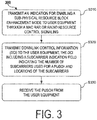
- FIG. 3 is a flowchart of a method 300 used in a base station according to an embodiment of the present disclosure. As shown in the figure, the method 300 includes the following steps.
- Step S310 transmit an indication for enabling a sub-physical resource block enhancement mode to user equipment through a media access control (MAC) random access response (RAR) or radio resource control signaling.
- MAC media access control
- RAR random access response
- Msg3 the sub-physical resource block enhancement mode is to be applied to transmission of a random access message 3 "Msg3" and subsequent physical uplink shared channels (PUSCHs).
- Step S320 transmit downlink control information (DCI) to the user equipment, the DCI including a subcarrier indication field indicating the number of subcarriers used for a PUSCH and locations of the subcarriers.
- DCI downlink control information
- Step S330 receive the PUSCH from the user equipment.
- a subframe n+ko is a first subframe available for transmitting the PUSCH subsequent to a subframe n+x
- k 0 ⁇ k 1 ⁇ k 2 ⁇ ... ⁇ k N-1 are values related to N subframes available for transmitting the PUSCH
- x is a constant.
- a same scrambling sequence and/or a same redundancy version is applied to PUSCHs on Nacc ⁇ Q consecutive absolute subframes.
- a transport block size of the PUSCH is determined at least based on N PRB determined by the number of subcarriers allocated for the PUSCH, where N PRB is 3 when the number of subcarriers allocated for the PUSCH is 3, or N PRB is 6 when the number of subcarriers allocated for the PUSCH is 6.
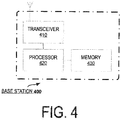
- FIG. 4 is a block diagram of a base station 400 according to an embodiment of the present disclosure.
- the base station 400 includes a transceiver 410, a processor 420, and a memory 430, the processor 430 storing instructions executable by the processor 420 so that the base station 400 performs the method 300 described above with reference to FIG. 3 .
- the base station 300 transmits an indication for enabling a sub-physical resource block enhancement mode to user equipment through a media access control (MAC) random access response (RAR) or radio resource control signaling.
- MAC media access control
- RAR random access response
- one or more bits in the MAC RAR indicate that the sub-physical resource block enhancement mode is to be applied to transmission of a random access message 3 "Msg3" and subsequent physical uplink shared channels (PUSCHs).
- Msg3 random access message 3
- PUSCHs physical uplink shared channels
- the base station 300 transmits downlink control information (DCI) to the user equipment, the DCI including a subcarrier indication field indicating the number of subcarriers used for a PUSCH and locations of the subcarriers.
- DCI downlink control information
- the base station 300 receives the PUSCH from the user equipment.
- MTC UE in an RRC connected state supports two coverage enhancement modes: a coverage enhancement mode A (CE mode A) and a coverage enhancement mode B (CE mode B).
- CE mode A coverage enhancement mode A
- CE mode B coverage enhancement mode B
- the coverage enhancement mode A is used for UE having good channel conditions, not requiring coverage enhancement or requiring small coverage enhancement, and not requiring repeated transmission or requiring quite few repeated transmissions
- the coverage enhancement mode B is used for UE having poor channel conditions, requiring large or quite large coverage enhancement, or requiring many or quite many repeated transmissions.
- a base station also referred to as an eNB expands the coverage of a PUSCH by repeatedly transmitting the PUSCH.
- the eNB configures a maximum value of the repeated transmission number of the PUSCH through RRC signaling, and one repeated PUSCH transmission number set is defined for each configurable maximum value of the repeated transmission number.
- one repeated PUSCH transmission number set contains four values
- one repeated PUSCH transmission number set contains eight values.
- the UE obtains the maximum value of the repeated transmission number of the PUSCH through RRC signaling, where a repeated PUSCH transmission number set can be known from the maximum value.
- the repeated transmission number N rep PUSCH used in this PUSCH transmission can be obtained from DCI.
- Nacc refers to the number of consecutive absolute subframes in the time domain, and PUSCHs transmitted in these subframes use the same scrambling sequence and/or the same redundancy version.
- the MTC UE can obtain, through the DCI, the repeated transmission number N rep PUSCH in this PUSCH transmission and an absolute subframe number of a first uplink subframe used for PUSCH transmission.
- N abs PUSCH of absolute subframes over which this repeated PUSCH transmission needs to be performed can be known.
- a same scrambling sequence is applied to a PUSCH on each subframe used for PUSCH transmission in the Nacc consecutive absolute subframes.
- the redundancy version is determined in the following manner: the total number N abs PUSCH of absolute subframes over which this repeated PUSCH transmission is performed is divided into multiple groups of Nacc consecutive absolute subframes, and 4 redundancy versions RV0, RV1, RV2, and RV3 of PUSCHs are cyclically applied, in an order of RVO, RV2, RV3, and RV1, to the multiple groups of Nacc consecutive absolute subframes starting from the first group of Nacc consecutive absolute subframes until the last group.
- a PUSCH on each subframe available for PUSCH transmission in the same group of Nacc consecutive absolute subframes uses the same redundancy version.
- the smallest resource allocation unit for the existing MTC UE is one PRB, namely, occupying a bandwidth of 12 subcarriers in the frequency domain; the subcarrier spacing in the existing LTE is 15 kHz; and the physical bandwidth of one PRB is 180 kHz.
- available methods include increasing the transmit power of the UE or increasing the repeated transmission number of the PUSCH.
- the UE has transmission power limits, or has a transmission power maximum.
- existing LTE systems already use the transmission power maximum.
- the same power is applied to different frequency bandwidths, resulting in different quality for received signal strength or received signal reception. The larger the frequency bandwidth, the lower the reception quality.
- transmission of data packets of the same size using a small frequency bandwidth consumes fewer time-frequency resources than transmission of data packets using a large frequency bandwidth.
- the minimum allocation bandwidth for a PUSCH of MTC UE is one PRB.
- a frequency bandwidth of less than one PRB may be used for transmitting UE having poor channel conditions.
- the smallest unit for resource allocation of the PUSCH should be less than 12 subcarriers, namely, sub-PRB enhancement must be performed.
- the sub-PRB enhancement function refers to performing function enhancement on UE in the coverage enhancement mode B and/or coverage enhancement mode A in existing LTE systems, so as to support resource allocation or configuration for a PUSCH and/or PUCCH (physical uplink control channel) of less than one PRB or less than 12 subcarriers.
- the allocatable subcarrier numbers are 1, 2, 3, 4, 6, 12, and the like, namely, divisible by 12, and allocated multiple subcarriers are consecutive subcarriers in the frequency domain.
- the allocated multiple subcarriers may also be inconsecutive subcarriers in one PRB.
- the frequency resources allocated to the PUSCH are less than one PRB, namely, the number of allocated subcarriers is less than 12.
- the smallest allocation unit for a PUSCH of MTC UE is one PRB, namely, 12 subcarriers.
- the design of the value of the repetition number of the PUSCH is performed by the surrounding minimum allocation resource for one PRB.
- the resource allocation unit for the PUSCH is less than one PRB, for transmission of data packets of the same size, in order to achieve the same received signal quality, the repeated transmission number required for the PUSCH should be increased.
- a fixed value Q may be set for each allocatable subcarrier number, as shown in Table 1.
- Table 1 Number of subcarriers 1 2 3 4 6 12 Q 12 6 4 3 2 1
- the UE can obtain the value of Q from Table 1 according to the number of subcarriers allocated to the PUSCH.
- the actual repeated transmission number of the PUSCH can thus be obtained.
- the number of allocated subcarriers is 3, and the repeated transmission number of this PUSCH indicated by the MPDCCH is 16.
- Q 4.
- the repetition number value of the PUSCH may be redesigned according to the minimum number of subcarriers supported by sub-PRB resource allocation, and the maximum repetition number value should be a multiple of an existing maximum repetition number value. For example, if the existing maximum value of the allowable repeated transmission number of the PUSCH is 2048, then the redesigned maximum value of the repeated PUSCH transmission number may be 2048 ⁇ (12/the minimum allocatable subcarrier number). If the minimum number of subcarriers is 3, the allowable maximum value is 8192. However, the size of each PUSCH repetition number set does not change. For example, for UE in the coverage enhancement mode B, one repeated PUSCH transmission number set still contains eight values. In this way, three bits are still used in DCI to indicate the repeated transmission number of the PUSCH.
- the same scrambling sequence is applied to PUSCHs on subframes available for PUSCH transmission in Nacc consecutive absolute subframes
- the same redundancy version is also applied to PUSCHs on subframes available for PUSCH transmission in Nacc consecutive absolute subframes.
- a simple implementation is to multiply Nacc by a value P to obtain Mace consecutive absolute subframes in sub-PRB resource allocation.
- the same scrambling sequence and/or the same redundancy version can be applied to PUSCHs on subframes available for PUSCH transmission in Macc consecutive absolute subframes.
- the same scrambling sequence and/or the same redundancy version are applied to PUSCHs on subframes available for PUSCH transmission in Nacc ⁇ 4 consecutive absolute subframes.
- the number Nsc of subcarriers is the number of subcarriers allocated to this PUSCH.
- Other steps or procedures for determining the scrambling sequence and the redundancy version of the PUSCH are similar to those in existing LTE systems and remain unchanged.
- a fixed value P may be set for each allocatable subcarrier number, as shown in Table 2.
- Table 2 Number of subcarriers 1 2 3 4 6 12 P 12 6 4 3 2 1
- the values P and Q in this embodiment may be the same or different.
- the aforementioned determining method for a repeated PUSCH transmission number is used, while the determining method for a scrambling sequence and a redundancy version is not changed; namely, a scrambling sequence and a redundancy version of a PUSCH using sub-PRB resource allocation are determined using the determining method for a scrambling sequence and a redundancy version of a PUSCH of MTC UE in existing LTE systems.
- MTC UE in an RRC connected state supports two coverage enhancement modes: a coverage enhancement mode A (CE mode A) and a coverage enhancement mode B (CE mode B).
- CE mode A coverage enhancement mode A
- CE mode B coverage enhancement mode B
- the coverage enhancement mode A is used for UE having good channel conditions, not requiring coverage enhancement or requiring small coverage enhancement, and not requiring repeated transmission or requiring quite few repeated transmissions
- the coverage enhancement mode B is used for UE having poor channel conditions, requiring large or quite large coverage enhancement or requiring many or quite many repeated transmissions.
- the smallest resource allocation unit for the existing MTC UE is one PRB, namely, occupying a bandwidth of 12 subcarriers in the frequency domain, the subcarrier spacing in the existing LTE is 15 kHz, and the physical bandwidth of one PRB is 180 kHz.
- available methods include increasing the transmit power of the UE or increasing the repeated transmission number of the PUSCH.
- the UE has a transmit power limit, or has a transmit power maximum.
- existing LTE systems already use the maximum power for transmission.
- the same power is applied to different frequency bandwidths, resulting in different received signal strength or signal reception quality. The larger the frequency bandwidth, the lower the reception quality.
- transmission of data packets of the same size using a small frequency bandwidth consumes fewer time-frequency resources than transmission using a large frequency bandwidth.
- the minimum allocation bandwidth for a PUSCH of MTC UE is one PRB.
- a frequency bandwidth of less than one PRB needs be used for transmitting UE having poor channel conditions.
- the smallest unit for resource allocation of the PUSCH should be less than 12 subcarriers, namely, sub-PRB enhancement must be performed.
- the sub-PRB enhancement function refers to performing function enhancement on UE in the coverage enhancement mode B and/or coverage enhancement mode A in existing LTE systems so as to support resource allocation or configuration for a PUSCH and/or PUCCH (physical uplink control channel) based on less than one PRB or less than 12 subcarriers.
- the allocatable subcarrier numbers are 1, 2, 3, 4, 6, 12, and the like, namely, divisible by 12, and allocated multiple subcarriers are consecutive subcarriers in the frequency domain.
- the allocated multiple subcarriers may also be inconsecutive subcarriers in one PRB.
- Sub-PRB resource allocation is mainly applied to the coverage enhancement mode B.
- this embodiment uses the coverage enhancement mode B as an example for discussion. The same applies to the coverage enhancement mode A or other application scenarios.
- the DCI format used for scheduling a PUSCH of UE in the coverage enhancement mode B is DCI format 6-0B; reference can be made to non-patent literature: 3GPP TS 36.212 V14.0.0 (2016-09 ).
- the maximum operation bandwidth of existing MTC UE is 1.4 MHz or 6 PRBs.
- the system bandwidth is divided into multiple narrowbands, each narrowband having a frequency width with six consecutive PRBs. For example, for a system having a channel bandwidth of 20 MHz, the transmission bandwidth of the system is 100 PRBs, and the 100 PRBs may be divided into 16 narrowbands when MTC is designed for a group of MTC systems.
- the MTC UE can work only on one of the narrowbands.
- the minimum allocation bandwidth for a PUSCH of MTC UE is one PRB
- the DCI format 6-0B has a resource block allocation field: ⁇ log 2 ⁇ N RB UL 6 ⁇ ⁇ + 3 ⁇ Bit + 3 bits , which is used for indicating the size and location of resources allocated to the PUSCH.
- N RB UL is the size of uplink transmission bandwidth
- ⁇ log 2 ⁇ N RB UL 6 ⁇ ⁇ indicates on which narrowband the PUSCH works
- 3 bits are used for indicating which PRB or which two PRBs in the narrowband are used for transmitting the PUSCH.
- Table 3 3-bit Resource Allocation Field Allocated Resource Block '000' First PRB in narrowband '001' Second PRB in narrowband '010' Third PRB in narrowband '011' Fourth PRB in narrowband '100' Fifth PRB in narrowband '101' Sixth PRB in narrowband '110' First and second PRBs in narrowband '111' Third and fourth PRBs in narrowband
- the resource block allocation field is changed into a subcarrier allocation field, and the specific information is: ⁇ log 2 ⁇ N RB UL 6 ⁇ ⁇ + 3 ⁇ Bit + 3 ⁇ Bit , wherein ⁇ log 2 ⁇ N RB UL 6 ⁇ ⁇ + 3 ⁇ Bit has the same definition as that in the existing LTE, and the further added 3 bits are used for indicating which subcarriers in 12 subcarriers of one PRB are used for transmitting the PUSCH.
- the allocated subcarriers are consecutive subcarriers in the frequency domain, and the number of subcarriers should be divisible by 12. In this way, allocatable subcarrier numbers are 1, 2, 3, 4, 6, and 12. 3 and 4 are close so that 4 can be removed.
- MTC and NB-IoT Two technologies for Internet of Things exist in existing LTE systems and are respectively MTC and NB-IoT.
- MTC and NB-IoT have different application scenarios: MTC is applied to mid to high-end markets, and NB-IoT is applied to low-end markets. Therefore, MTC does not need to support a PUSCH having a bandwidth of 1 subcarrier.
- the situation of 12 subcarriers may be indicated by the first 3-bit information. Therefore, only resource allocation of 3 and 6 subcarriers needs to be indicated.
- the distribution of subcarriers in one PRB is continuous. As shown in FIG.
- 5 , 12 subcarriers in one PRB may be divided into four non-overlapping subcarrier groups of three consecutive subcarriers, and divided into two subcarrier groups of six consecutive subcarriers. In this way, there are only six combinations which can be indicated by 3 bits, as shown in Table 4.
- the second 3-bit information, namely, Table 4 applies only to the situation of one PRB in Table 3 and does not apply to the situation of two PRBs.
- the additional 3 bits may be used to indicate one of available subcarrier locations of one or more of allocatable subcarrier numbers of 1, 2, 3, 4, 6, and 12.
- the resource block allocation field is changed into a subcarrier allocation field, and the specific information is: ⁇ log 2 ⁇ N RB UL 6 ⁇ ⁇ + 6 ⁇ Bit , wherein ⁇ log 2 ⁇ N RB UL 6 ⁇ ⁇ has the same definition as that in the existing LTE. Compared with Manner 1, this manner supports only resource allocation of three subcarriers and six subcarriers, and 6 bits are used to indicate possible locations of three subcarriers and six subcarriers in six PRBs of one narrowband. The distribution of three subcarriers and six subcarriers in each of the six PRBs is shown in FIG. 5 .
- the UE is configured, through high-layer signaling, to operate in the existing coverage enhancement mode B or sub-PRB enhancement of the coverage enhancement mode B. If the UE operates in the existing coverage enhancement mode B, the existing DCI format 6-0B is used. If the UE operates in sub-PRB enhancement of the coverage enhancement mode B, a newly-defined DCI format 6-0B or another DCI format used for sub-PRB enhancement is used. The definition of 6-bit information is shown in Table 5.
- Table 5 6-bit Resource Allocation Field Allocated Resource Block '000000' First three consecutive subcarriers of first PRB in narrowband '000001' Second three consecutive subcarriers of first PRB in narrowband '000010' Third three consecutive subcarriers of first PRB in narrowband '000011' Fourth three consecutive subcarriers of first PRB in narrowband ... ... '010110' Third three consecutive subcarriers of sixth PRB in narrowband '010111' Fourth three consecutive subcarriers of sixth PRB in narrowband '011000' First six consecutive subcarriers of first PRB in narrowband '011001' Second six consecutive subcarriers of first PRB in narrowband ... ... '100010' First six consecutive subcarriers of sixth PRB in narrowband '100011' First six consecutive subcarriers of sixth PRB in narrowband Other Reserved
- the 6 bits may be used to indicate one of available subcarrier locations of one or more of allocatable subcarrier numbers of 1, 2, 3, 4, 6, and 12.
- the resource block allocation field is changed into a subcarrier allocation field, and the specific information is: ⁇ log 2 ⁇ N RB UL 6 ⁇ ⁇ + 6 ⁇ Bit , wherein ⁇ log 2 ⁇ N RB UL 6 ⁇ ⁇ has the same definition as that in the existing LTE.
- the 3-bit information (namely, the information in Table 1) of the resource allocation field in the DCI format 6-0B of the existing coverage enhancement mode B and possible location information of resource allocation of three subcarriers and six subcarriers supported in Manner 2 are arranged in a unified way to obtain a total of 42 possibilities, which may be indicated by 6-bit information, as shown in Table 6.
- Table 6 6-bit Resource Allocation Field Allocated Resource Block '000000' First PRB in narrowband '000001' Second PRB in narrowband '000010' Third PRB in narrowband '000011' Fourth PRB in narrowband '000100' Fifth PRB in narrowband '000101' Sixth PRB in narrowband '000110' First and second PRBs in narrowband '000111' Third and fourth PRBs in narrowband '001000' First three consecutive subcarriers of first PRB in narrowband '001001' Second three consecutive subcarriers of first PRB in narrowband '001010' Third three consecutive subcarriers of first PRB in narrowband '001011' Fourth three consecutive subcarriers of first PRB in narrowband ... ...
- the 6 bits may be used to indicate one of available subcarrier locations of one or more of allocatable subcarrier numbers of 1, 2, 3, 4, 6, and 12.
- the sub-PRB enhancement function is mainly applied to PUSCHs.
- the transmission of PUSCHs may be divided into a random access message 3 (Msg3) and subsequent PUSCHs before RRC connection establishment and PUSCHs after RRC connection establishment.
- Msg3 random access message 3
- subsequent PUSCHs before RRC connection establishment and PUSCHs after RRC connection establishment may be carried out with respect to the following two cases:
- the sub-PRB enhancement function is applied to a random access message 3 (Msg3) and subsequent PUSCHs before RRC connection establishment and PUSCHs after RRC connection establishment. Namely, the sub-PRB enhancement function can be used by UE to transmit all PUSCHs.
- an eNB may notify the UE through a media access control (MAC) random access response (RAR) whether to use the sub-PRB enhancement function to transmit Msg3 and subsequent PUSCHs.
- MAC media access control
- RAR random access response
- existing MTC UE does not support this function, and before receiving an RAR message, the UE needs to inform the eNB whether the MTC UE supports the sub-PRB enhancement function. This can only be implemented through a random access message 1 (Msg1).
- Msg1 random access message 1
- random access preamble sequences are divided into different groups, or different time-frequency resources are configured for random access preamble sequences (Preamble) to respectively transmit preamble sequences of existing MTC UE and MTC UE supporting the sub-PRB enhancement function.
- the eNB may indicate, through an RAR, to the MTC UE supporting the sub-PRB enhancement function whether to use the sub-PRB enhancement function to transmit Msg3 and subsequent PUSCHs.
- the eNB may re-configure, through UE-specific RRC signaling, whether the UE uses the sub-PRB enhancement function to transmit PUSCHs.
- RAR uplink grant information (UL grant).
- the content of RAR uplink grant information in the existing MTC is shown in Table 7.
- Table 7 DCI content Coverage enhancement mode A Coverage enhancement mode B Msg3 PUSCH narrowband index N NB index 2 Msg3 PUSCH resource allocation 4 3 Msg3 PUSCH repetition number 2 3 MCS 3 0 TBS 0 2 TPC 3 0 CSI request 1 0 UL delay 1 0 Msg3/4 MPDCCH narrowband index 2 2 Zero padding 4 ⁇ N NB index 0 Total Nr bits 20 12
- the uplink grant information has a total of 20 bits of information; for the coverage enhancement mode B, the uplink grant information has a total of 12 bits of information.
- bits need to be added to existing RAR uplink grant information to support resource allocation based on sub-PRBs. This embodiment uses the coverage enhancement mode B as an example for discussion.
- the eNB puts together RAR messages of UE that uses the sub-PRB enhancement function to transmit Msg3 and subsequent PUSCHs, and uses different RA-RNTIs to transmit MPDCCHs which are responsible for scheduling PDSCHs bearing the RAR messages.
- the other way is to use a reserved bit in a MAC RAR message to indicate whether UE uses the sub-PRB enhancement function to transmit Msg3 and subsequent PUSCHs.
- the first bit is a reserved bit. When the bit is "0,” it indicates that the MAC RAR is the coverage enhancement mode A and the coverage enhancement mode B; when the bit is "1," it indicates that the MAC RAR is the coverage enhancement mode B supporting the sub-PRB enhancement function.
- one or more bits of information is used in a MAC RAR to indicate whether the uplink grant information format in the MAC RAR is an uplink grant with the sub-PRB enhancement function.
- one or more bits of information is used in a MAC PDU (Protocol Data Unit) header or subheader corresponding to a MAC RAR to indicate whether the MAC RAR is a MAC RAR with the sub-PRB enhancement function or whether the uplink grant information format in the MAC RAR is an uplink grant with the sub-PRB enhancement function.
- MAC PDU Protocol Data Unit
- the sub-PRB enhancement function is not applied to a random access message 3 (Msg3) and subsequent PUSCHs before RRC connection establishment, but applied only to PUSCHs after RRC connection establishment.
- Msg3 random access message 3
- transmission of all PUSCHs before RRC connection establishment uses the existing transmission method, not supporting sub-PRB enhancement.
- the eNB may configure, through UE-specific RRC signaling, whether the UE supporting the sub-PRB enhancement function uses the sub-PRB enhancement function to transmit PUSCHs.
- the program running on the device according to the present invention may be a program that enables the computer to implement the functions of the embodiments of the present invention by controlling a central processing unit (CPU).
- the program or information processed by the program can be stored temporarily in a volatile memory (for example, a random access memory (RAM), a hard disk drive (HDD), a non-volatile memory (for example, a flash memory), or other memory systems.
- a volatile memory for example, a random access memory (RAM), a hard disk drive (HDD), a non-volatile memory (for example, a flash memory), or other memory systems.
- the program for implementing the functions of the embodiments of the present invention may be recorded on a computer-readable recording medium.
- the corresponding functions can be achieved by reading programs recorded on the recording medium and executing them by the computer system.
- the so-called "computer system” herein may be a computer system embedded in the device, which may include operating systems or hardware (for example, peripherals).
- the "computer-readable recording medium” may be a semiconductor recording medium, an optical recording medium, a magnetic recording medium, a recording medium for programs that are dynamically stored for a short time, or any other recording medium readable by a computer.
- circuits for example, monolithic or multi-chip integrated circuits.
- Circuits designed to execute the functions described in this description may include general-purpose processors, digital signal processors (DSPs), application specific integrated circuits (ASICs), field programmable gate arrays (FPGAs) or other programmable logic devices, discrete gates or transistor logic, or discrete hardware components, or any combination of the above.
- DSPs digital signal processors
- ASICs application specific integrated circuits
- FPGAs field programmable gate arrays
- the general-purpose processor may be a microprocessor, or may be any existing processor, controller, microcontroller, or state machine.
- the circuit may be a digital circuit or an analog circuit.
- the present invention is not limited to the embodiments described above. Although various examples of the embodiments have been described, the present invention is not limited thereto.
- Fixed or non-mobile electronic devices installed indoors or outdoors such as AV equipment, kitchen equipment, cleaning equipment, air conditioner, office equipment, vending machines, and other household appliances, may be used as terminal devices or communications devices.
Landscapes
- Engineering & Computer Science (AREA)
- Signal Processing (AREA)
- Computer Networks & Wireless Communication (AREA)
- Mobile Radio Communication Systems (AREA)
Applications Claiming Priority (2)
| Application Number | Priority Date | Filing Date | Title |
|---|---|---|---|
| CN201710180639.6A CN108633024B (zh) | 2017-03-23 | 2017-03-23 | 用户设备、基站和相关方法 |
| PCT/CN2018/079595 WO2018171581A1 (zh) | 2017-03-23 | 2018-03-20 | 用户设备、基站和相关方法 |
Publications (3)
| Publication Number | Publication Date |
|---|---|
| EP3606218A1 true EP3606218A1 (de) | 2020-02-05 |
| EP3606218A4 EP3606218A4 (de) | 2020-12-02 |
| EP3606218B1 EP3606218B1 (de) | 2023-02-22 |
Family
ID=63586131
Family Applications (1)
| Application Number | Title | Priority Date | Filing Date |
|---|---|---|---|
| EP18770561.1A Active EP3606218B1 (de) | 2017-03-23 | 2018-03-20 | Benutzerausrüstung, basisstation und entsprechendes verfahren |
Country Status (6)
| Country | Link |
|---|---|
| US (1) | US11044778B2 (de) |
| EP (1) | EP3606218B1 (de) |
| KR (1) | KR102835799B1 (de) |
| CN (1) | CN108633024B (de) |
| RU (1) | RU2764059C2 (de) |
| WO (1) | WO2018171581A1 (de) |
Cited By (2)
| Publication number | Priority date | Publication date | Assignee | Title |
|---|---|---|---|---|
| EP3646656A4 (de) * | 2017-08-02 | 2021-01-27 | Samsung Electronics Co., Ltd. | Verfahren, ausrüstung zum empfangen von planungsinformationen, endgerät, basisstation und verfahren zur übertragung von informationen |
| US11317431B2 (en) | 2017-08-02 | 2022-04-26 | Samsung Electronics Co., Ltd. | Method, equipment for receiving scheduling information, terminal, base station and method for transmitting information |
Families Citing this family (18)
| Publication number | Priority date | Publication date | Assignee | Title |
|---|---|---|---|---|
| WO2018175521A1 (en) * | 2017-03-24 | 2018-09-27 | Intel IP Corporation | Sub-prb resource allocation for pusch in even further enhanced mtc |
| US11398882B2 (en) * | 2017-05-04 | 2022-07-26 | Lg Electronics Inc. | Early termination of repeated transmissions between terminal and base station in wireless communication system |
| WO2019028816A1 (en) * | 2017-08-11 | 2019-02-14 | Qualcomm Incorporated | SWITCHING BETWEEN STANDARD SUB-PRB AND PRB POWERS FOR EMTC PURPOSES |
| WO2019036492A1 (en) * | 2017-08-14 | 2019-02-21 | Cohere Technologies | ASSIGNMENT OF TRANSMISSION RESOURCES BY DIVISION OF BLOCKS OF PHYSICAL RESOURCES |
| WO2019213978A1 (zh) * | 2018-05-11 | 2019-11-14 | 华为技术有限公司 | 一种信息传输方法和终端设备以及网络设备 |
| US11075694B2 (en) * | 2019-03-04 | 2021-07-27 | Infinera Corporation | Frequency division multiple access optical subcarriers |
| CN113924806B (zh) * | 2019-03-28 | 2024-07-30 | 苹果公司 | Emtc的dci格式3/3a的重复次数的指示 |
| WO2020199171A1 (zh) * | 2019-04-03 | 2020-10-08 | 北京欧珀通信有限公司 | 一种传输参数确定方法及装置、用户设备 |
| WO2020223979A1 (zh) * | 2019-05-09 | 2020-11-12 | Oppo广东移动通信有限公司 | 一种确定冗余版本的方法、终端设备及网络设备 |
| CN113676921B (zh) * | 2020-05-13 | 2024-10-18 | 维沃移动通信有限公司 | Pusch传输参数的确定方法和通信设备 |
| JPWO2021229777A1 (de) * | 2020-05-14 | 2021-11-18 | ||
| CN113677013B (zh) * | 2020-05-15 | 2024-12-10 | 维沃移动通信有限公司 | Pusch资源分配方法、装置及电子设备 |
| US12426064B2 (en) * | 2020-06-30 | 2025-09-23 | Beijing Xiaomi Mobile Software Co., Ltd. | Method for information transmission, communication device and storage medium |
| KR102955594B1 (ko) * | 2020-10-14 | 2026-04-23 | 삼성전자 주식회사 | 무선통신 시스템에서 상향 링크 채널 송신 방법 및 장치 |
| CN116458228A (zh) * | 2020-11-12 | 2023-07-18 | 高通股份有限公司 | 对具有频域资源分配字段的子物理资源块的指示 |
| US12225523B2 (en) | 2021-01-14 | 2025-02-11 | Lg Electronics Inc. | Coverage enhancement |
| WO2022178787A1 (zh) * | 2021-02-25 | 2022-09-01 | 北京小米移动软件有限公司 | 信道传输方法及装置、存储介质 |
| CN117242711A (zh) * | 2021-04-23 | 2023-12-15 | 高通股份有限公司 | 用于用户设备协作的配置 |
Family Cites Families (8)
| Publication number | Priority date | Publication date | Assignee | Title |
|---|---|---|---|---|
| RU2518934C2 (ru) * | 2008-01-07 | 2014-06-10 | Эл Джи Электроникс Инк. | Способ передачи/приема нисходящих данных с использованием ресурсных блоков в системе беспроводной подвижной связи и устройства для его реализации |
| CN102055707B (zh) * | 2009-11-02 | 2015-01-28 | 中兴通讯股份有限公司 | 信道测量导频映射方法及装置 |
| KR20130049582A (ko) * | 2011-11-04 | 2013-05-14 | 삼성전자주식회사 | 무선 다중 캐리어 시스템에서 자원 할당 방법 및 장치 |
| WO2014098358A1 (ko) * | 2012-12-18 | 2014-06-26 | 엘지전자 주식회사 | 데이터 수신 방법 및 장치 |
| US20160088594A1 (en) * | 2014-09-18 | 2016-03-24 | Gang Xiong | Device and method of supporting reduced data transmission bandwidth |
| WO2016099057A1 (ko) * | 2014-12-16 | 2016-06-23 | 엘지전자 주식회사 | 상향링크 데이터의 복조를 위한 dmrs를 전송하는 방법 및 mtc 기기 |
| EP3400667B1 (de) * | 2016-01-08 | 2020-06-24 | Intel IP Corporation | Downlink-harq-rückkopplung für schmalbandige internet-der-dinge-vorrichtungen |
| EP4184848B1 (de) * | 2016-01-11 | 2024-07-31 | Sony Group Corporation | Kommunikationsvorrichtung, infrastrukturausrüstung, drahtloskommunikationsnetzwerk und verfahren |
-
2017
- 2017-03-23 CN CN201710180639.6A patent/CN108633024B/zh active Active
-
2018
- 2018-03-20 WO PCT/CN2018/079595 patent/WO2018171581A1/zh not_active Ceased
- 2018-03-20 KR KR1020197030450A patent/KR102835799B1/ko active Active
- 2018-03-20 EP EP18770561.1A patent/EP3606218B1/de active Active
- 2018-03-20 RU RU2019132957A patent/RU2764059C2/ru active
- 2018-03-20 US US16/495,710 patent/US11044778B2/en active Active
Cited By (3)
| Publication number | Priority date | Publication date | Assignee | Title |
|---|---|---|---|---|
| EP3646656A4 (de) * | 2017-08-02 | 2021-01-27 | Samsung Electronics Co., Ltd. | Verfahren, ausrüstung zum empfangen von planungsinformationen, endgerät, basisstation und verfahren zur übertragung von informationen |
| US11317431B2 (en) | 2017-08-02 | 2022-04-26 | Samsung Electronics Co., Ltd. | Method, equipment for receiving scheduling information, terminal, base station and method for transmitting information |
| US11963192B2 (en) | 2017-08-02 | 2024-04-16 | Samsung Electronics Co., Ltd. | Method, equipment for receiving scheduling information, terminal, base station and method for transmitting information |
Also Published As
| Publication number | Publication date |
|---|---|
| RU2019132957A (ru) | 2021-04-23 |
| RU2019132957A3 (de) | 2021-08-19 |
| US20200100316A1 (en) | 2020-03-26 |
| CA3056836A1 (en) | 2018-09-27 |
| EP3606218A4 (de) | 2020-12-02 |
| US11044778B2 (en) | 2021-06-22 |
| CN108633024A (zh) | 2018-10-09 |
| CN108633024B (zh) | 2023-07-11 |
| KR102835799B1 (ko) | 2025-07-21 |
| WO2018171581A1 (zh) | 2018-09-27 |
| RU2764059C2 (ru) | 2022-01-13 |
| KR20190128690A (ko) | 2019-11-18 |
| EP3606218B1 (de) | 2023-02-22 |
Similar Documents
| Publication | Publication Date | Title |
|---|---|---|
| EP3606218B1 (de) | Benutzerausrüstung, basisstation und entsprechendes verfahren | |
| EP4048010B1 (de) | Umschaltung von bandbreitenteilen | |
| EP3661294B1 (de) | Verfahren, vorrichtung und system zur anpassung einer frequenzdomänenressource und zum senden von anzeigeinformationen | |
| JP6913895B2 (ja) | トランスポートブロックをアップリンク送信する、ユーザ機器により実行される方法、トランスポートブロックをダウンリンク受信する、ユーザ機器により実行される方法およびユーザ機器 | |
| US11985635B2 (en) | Wireless communication method, system, network device, and user equipment for improving transmission performance | |
| US9894654B2 (en) | Defining sub-subchannels for data communication using separately provided frequency and time resources and related wireless terminals and network nodes | |
| US8767644B2 (en) | Method and apparatus for contention-based granting in a wireless communication network | |
| EP3742858A1 (de) | Benutzergerät, basisstation und entsprechendes verfahren | |
| EP3691375B1 (de) | Verfahren und vorrichtung für drahtloskommunikation | |
| CN113711678A (zh) | 网络节点、用户设备(ue)和用于由网络节点调度ue的相关方法 | |
| EP3528536A1 (de) | Verfahren und vorrichtung zur drahtloskommunikation | |
| EP3800815A1 (de) | Vorrichtungen und verfahren zur epdcch-überwachung in drahtloskommunikationssystemen | |
| EP3793237A1 (de) | Von benutzergerät ausgeführtes verfahren und benutzergerät | |
| US11736262B2 (en) | User equipment, base station, and related method | |
| JP2018516485A (ja) | Harqフィードバックをコンパクト化するための方法及びユーザ機器 | |
| CN116783861A (zh) | 网络设备、终端设备及其方法 | |
| EP3694279A1 (de) | Kommunikationsverfahren und -vorrichtung | |
| JP2019507512A (ja) | Enodeb、ユーザ機器および無線通信方法 | |
| EP3780860B1 (de) | Informationsübertragungsverfahren, endgerätevorrichtung und netzwerkvorrichtung | |
| EP4569988A1 (de) | Benutzergerät, planungsknoten, verfahren für benutzergerät und verfahren zur planung von knoten | |
| CN108886773A (zh) | 终端装置、基站装置、通信方法以及集成电路 | |
| EP3800958A1 (de) | Bestimmung der anwendbarkeit von slot-übergreifender planungsanpassung | |
| EP4044712B1 (de) | Informationsverarbeitungsverfahren und kommunikationsvorrichtung | |
| CN118511619A (zh) | 无线通信中的多pdcch监测和多pdsch/pusch调度 | |
| EP3764709A1 (de) | Informationsübertragungsverfahren und -vorrichtung |
Legal Events
| Date | Code | Title | Description |
|---|---|---|---|
| STAA | Information on the status of an ep patent application or granted ep patent |
Free format text: STATUS: THE INTERNATIONAL PUBLICATION HAS BEEN MADE |
|
| PUAI | Public reference made under article 153(3) epc to a published international application that has entered the european phase |
Free format text: ORIGINAL CODE: 0009012 |
|
| STAA | Information on the status of an ep patent application or granted ep patent |
Free format text: STATUS: REQUEST FOR EXAMINATION WAS MADE |
|
| 17P | Request for examination filed |
Effective date: 20191017 |
|
| AK | Designated contracting states |
Kind code of ref document: A1 Designated state(s): AL AT BE BG CH CY CZ DE DK EE ES FI FR GB GR HR HU IE IS IT LI LT LU LV MC MK MT NL NO PL PT RO RS SE SI SK SM TR |
|
| AX | Request for extension of the european patent |
Extension state: BA ME |
|
| DAV | Request for validation of the european patent (deleted) | ||
| DAX | Request for extension of the european patent (deleted) | ||
| A4 | Supplementary search report drawn up and despatched |
Effective date: 20201029 |
|
| RIC1 | Information provided on ipc code assigned before grant |
Ipc: H04W 72/04 20090101AFI20201023BHEP Ipc: H04W 74/08 20090101ALI20201023BHEP |
|
| GRAP | Despatch of communication of intention to grant a patent |
Free format text: ORIGINAL CODE: EPIDOSNIGR1 |
|
| STAA | Information on the status of an ep patent application or granted ep patent |
Free format text: STATUS: GRANT OF PATENT IS INTENDED |
|
| INTG | Intention to grant announced |
Effective date: 20221010 |
|
| GRAS | Grant fee paid |
Free format text: ORIGINAL CODE: EPIDOSNIGR3 |
|
| GRAA | (expected) grant |
Free format text: ORIGINAL CODE: 0009210 |
|
| STAA | Information on the status of an ep patent application or granted ep patent |
Free format text: STATUS: THE PATENT HAS BEEN GRANTED |
|
| AK | Designated contracting states |
Kind code of ref document: B1 Designated state(s): AL AT BE BG CH CY CZ DE DK EE ES FI FR GB GR HR HU IE IS IT LI LT LU LV MC MK MT NL NO PL PT RO RS SE SI SK SM TR |
|
| REG | Reference to a national code |
Ref country code: GB Ref legal event code: FG4D |
|
| REG | Reference to a national code |
Ref country code: CH Ref legal event code: EP |
|
| REG | Reference to a national code |
Ref country code: AT Ref legal event code: REF Ref document number: 1550313 Country of ref document: AT Kind code of ref document: T Effective date: 20230315 Ref country code: IE Ref legal event code: FG4D |
|
| REG | Reference to a national code |
Ref country code: DE Ref legal event code: R096 Ref document number: 602018046436 Country of ref document: DE |
|
| REG | Reference to a national code |
Ref country code: LT Ref legal event code: MG9D |
|
| REG | Reference to a national code |
Ref country code: NL Ref legal event code: MP Effective date: 20230222 |
|
| REG | Reference to a national code |
Ref country code: AT Ref legal event code: MK05 Ref document number: 1550313 Country of ref document: AT Kind code of ref document: T Effective date: 20230222 |
|
| PG25 | Lapsed in a contracting state [announced via postgrant information from national office to epo] |
Ref country code: RS Free format text: LAPSE BECAUSE OF FAILURE TO SUBMIT A TRANSLATION OF THE DESCRIPTION OR TO PAY THE FEE WITHIN THE PRESCRIBED TIME-LIMIT Effective date: 20230222 Ref country code: PT Free format text: LAPSE BECAUSE OF FAILURE TO SUBMIT A TRANSLATION OF THE DESCRIPTION OR TO PAY THE FEE WITHIN THE PRESCRIBED TIME-LIMIT Effective date: 20230622 Ref country code: NO Free format text: LAPSE BECAUSE OF FAILURE TO SUBMIT A TRANSLATION OF THE DESCRIPTION OR TO PAY THE FEE WITHIN THE PRESCRIBED TIME-LIMIT Effective date: 20230522 Ref country code: NL Free format text: LAPSE BECAUSE OF FAILURE TO SUBMIT A TRANSLATION OF THE DESCRIPTION OR TO PAY THE FEE WITHIN THE PRESCRIBED TIME-LIMIT Effective date: 20230222 Ref country code: LV Free format text: LAPSE BECAUSE OF FAILURE TO SUBMIT A TRANSLATION OF THE DESCRIPTION OR TO PAY THE FEE WITHIN THE PRESCRIBED TIME-LIMIT Effective date: 20230222 Ref country code: LT Free format text: LAPSE BECAUSE OF FAILURE TO SUBMIT A TRANSLATION OF THE DESCRIPTION OR TO PAY THE FEE WITHIN THE PRESCRIBED TIME-LIMIT Effective date: 20230222 Ref country code: HR Free format text: LAPSE BECAUSE OF FAILURE TO SUBMIT A TRANSLATION OF THE DESCRIPTION OR TO PAY THE FEE WITHIN THE PRESCRIBED TIME-LIMIT Effective date: 20230222 Ref country code: ES Free format text: LAPSE BECAUSE OF FAILURE TO SUBMIT A TRANSLATION OF THE DESCRIPTION OR TO PAY THE FEE WITHIN THE PRESCRIBED TIME-LIMIT Effective date: 20230222 Ref country code: AT Free format text: LAPSE BECAUSE OF FAILURE TO SUBMIT A TRANSLATION OF THE DESCRIPTION OR TO PAY THE FEE WITHIN THE PRESCRIBED TIME-LIMIT Effective date: 20230222 |
|
| PG25 | Lapsed in a contracting state [announced via postgrant information from national office to epo] |
Ref country code: SE Free format text: LAPSE BECAUSE OF FAILURE TO SUBMIT A TRANSLATION OF THE DESCRIPTION OR TO PAY THE FEE WITHIN THE PRESCRIBED TIME-LIMIT Effective date: 20230222 Ref country code: PL Free format text: LAPSE BECAUSE OF FAILURE TO SUBMIT A TRANSLATION OF THE DESCRIPTION OR TO PAY THE FEE WITHIN THE PRESCRIBED TIME-LIMIT Effective date: 20230222 Ref country code: IS Free format text: LAPSE BECAUSE OF FAILURE TO SUBMIT A TRANSLATION OF THE DESCRIPTION OR TO PAY THE FEE WITHIN THE PRESCRIBED TIME-LIMIT Effective date: 20230622 Ref country code: GR Free format text: LAPSE BECAUSE OF FAILURE TO SUBMIT A TRANSLATION OF THE DESCRIPTION OR TO PAY THE FEE WITHIN THE PRESCRIBED TIME-LIMIT Effective date: 20230523 Ref country code: FI Free format text: LAPSE BECAUSE OF FAILURE TO SUBMIT A TRANSLATION OF THE DESCRIPTION OR TO PAY THE FEE WITHIN THE PRESCRIBED TIME-LIMIT Effective date: 20230222 |
|
| PG25 | Lapsed in a contracting state [announced via postgrant information from national office to epo] |
Ref country code: SM Free format text: LAPSE BECAUSE OF FAILURE TO SUBMIT A TRANSLATION OF THE DESCRIPTION OR TO PAY THE FEE WITHIN THE PRESCRIBED TIME-LIMIT Effective date: 20230222 Ref country code: RO Free format text: LAPSE BECAUSE OF FAILURE TO SUBMIT A TRANSLATION OF THE DESCRIPTION OR TO PAY THE FEE WITHIN THE PRESCRIBED TIME-LIMIT Effective date: 20230222 Ref country code: EE Free format text: LAPSE BECAUSE OF FAILURE TO SUBMIT A TRANSLATION OF THE DESCRIPTION OR TO PAY THE FEE WITHIN THE PRESCRIBED TIME-LIMIT Effective date: 20230222 Ref country code: DK Free format text: LAPSE BECAUSE OF FAILURE TO SUBMIT A TRANSLATION OF THE DESCRIPTION OR TO PAY THE FEE WITHIN THE PRESCRIBED TIME-LIMIT Effective date: 20230222 Ref country code: CZ Free format text: LAPSE BECAUSE OF FAILURE TO SUBMIT A TRANSLATION OF THE DESCRIPTION OR TO PAY THE FEE WITHIN THE PRESCRIBED TIME-LIMIT Effective date: 20230222 |
|
| REG | Reference to a national code |
Ref country code: CH Ref legal event code: PL |
|
| REG | Reference to a national code |
Ref country code: DE Ref legal event code: R097 Ref document number: 602018046436 Country of ref document: DE |
|
| PG25 | Lapsed in a contracting state [announced via postgrant information from national office to epo] |
Ref country code: SK Free format text: LAPSE BECAUSE OF FAILURE TO SUBMIT A TRANSLATION OF THE DESCRIPTION OR TO PAY THE FEE WITHIN THE PRESCRIBED TIME-LIMIT Effective date: 20230222 |
|
| REG | Reference to a national code |
Ref country code: BE Ref legal event code: MM Effective date: 20230331 |
|
| PG25 | Lapsed in a contracting state [announced via postgrant information from national office to epo] |
Ref country code: LU Free format text: LAPSE BECAUSE OF NON-PAYMENT OF DUE FEES Effective date: 20230320 |
|
| PLBE | No opposition filed within time limit |
Free format text: ORIGINAL CODE: 0009261 |
|
| STAA | Information on the status of an ep patent application or granted ep patent |
Free format text: STATUS: NO OPPOSITION FILED WITHIN TIME LIMIT |
|
| PG25 | Lapsed in a contracting state [announced via postgrant information from national office to epo] |
Ref country code: MC Free format text: LAPSE BECAUSE OF FAILURE TO SUBMIT A TRANSLATION OF THE DESCRIPTION OR TO PAY THE FEE WITHIN THE PRESCRIBED TIME-LIMIT Effective date: 20230222 |
|
| REG | Reference to a national code |
Ref country code: IE Ref legal event code: MM4A |
|
| 26N | No opposition filed |
Effective date: 20231123 |
|
| PG25 | Lapsed in a contracting state [announced via postgrant information from national office to epo] |
Ref country code: SI Free format text: LAPSE BECAUSE OF FAILURE TO SUBMIT A TRANSLATION OF THE DESCRIPTION OR TO PAY THE FEE WITHIN THE PRESCRIBED TIME-LIMIT Effective date: 20230222 Ref country code: MC Free format text: LAPSE BECAUSE OF FAILURE TO SUBMIT A TRANSLATION OF THE DESCRIPTION OR TO PAY THE FEE WITHIN THE PRESCRIBED TIME-LIMIT Effective date: 20230222 Ref country code: LI Free format text: LAPSE BECAUSE OF NON-PAYMENT OF DUE FEES Effective date: 20230331 Ref country code: IE Free format text: LAPSE BECAUSE OF NON-PAYMENT OF DUE FEES Effective date: 20230320 Ref country code: CH Free format text: LAPSE BECAUSE OF NON-PAYMENT OF DUE FEES Effective date: 20230331 |
|
| PG25 | Lapsed in a contracting state [announced via postgrant information from national office to epo] |
Ref country code: BE Free format text: LAPSE BECAUSE OF NON-PAYMENT OF DUE FEES Effective date: 20230331 |
|
| PG25 | Lapsed in a contracting state [announced via postgrant information from national office to epo] |
Ref country code: IT Free format text: LAPSE BECAUSE OF FAILURE TO SUBMIT A TRANSLATION OF THE DESCRIPTION OR TO PAY THE FEE WITHIN THE PRESCRIBED TIME-LIMIT Effective date: 20230222 |
|
| PG25 | Lapsed in a contracting state [announced via postgrant information from national office to epo] |
Ref country code: BG Free format text: LAPSE BECAUSE OF FAILURE TO SUBMIT A TRANSLATION OF THE DESCRIPTION OR TO PAY THE FEE WITHIN THE PRESCRIBED TIME-LIMIT Effective date: 20230222 |
|
| PG25 | Lapsed in a contracting state [announced via postgrant information from national office to epo] |
Ref country code: BG Free format text: LAPSE BECAUSE OF FAILURE TO SUBMIT A TRANSLATION OF THE DESCRIPTION OR TO PAY THE FEE WITHIN THE PRESCRIBED TIME-LIMIT Effective date: 20230222 |
|
| REG | Reference to a national code |
Ref country code: DE Ref legal event code: R081 Ref document number: 602018046436 Country of ref document: DE Owner name: SHARP KABUSHIKI KAISHA, SAKAI CITY, JP Free format text: FORMER OWNERS: FG INNOVATION COMPANY LIMITED, HONG KONG, HK; SHARP KABUSHIKI KAISHA, SAKAI-SHI, OSAKA, JP |
|
| REG | Reference to a national code |
Ref country code: GB Ref legal event code: 732E Free format text: REGISTERED BETWEEN 20250501 AND 20250507 |
|
| PG25 | Lapsed in a contracting state [announced via postgrant information from national office to epo] |
Ref country code: CY Free format text: LAPSE BECAUSE OF FAILURE TO SUBMIT A TRANSLATION OF THE DESCRIPTION OR TO PAY THE FEE WITHIN THE PRESCRIBED TIME-LIMIT; INVALID AB INITIO Effective date: 20180320 |
|
| PG25 | Lapsed in a contracting state [announced via postgrant information from national office to epo] |
Ref country code: HU Free format text: LAPSE BECAUSE OF FAILURE TO SUBMIT A TRANSLATION OF THE DESCRIPTION OR TO PAY THE FEE WITHIN THE PRESCRIBED TIME-LIMIT; INVALID AB INITIO Effective date: 20180320 |
|
| PG25 | Lapsed in a contracting state [announced via postgrant information from national office to epo] |
Ref country code: TR Free format text: LAPSE BECAUSE OF FAILURE TO SUBMIT A TRANSLATION OF THE DESCRIPTION OR TO PAY THE FEE WITHIN THE PRESCRIBED TIME-LIMIT Effective date: 20230222 |
|
| PGFP | Annual fee paid to national office [announced via postgrant information from national office to epo] |
Ref country code: GB Payment date: 20260324 Year of fee payment: 9 |
|
| PGFP | Annual fee paid to national office [announced via postgrant information from national office to epo] |
Ref country code: DE Payment date: 20260319 Year of fee payment: 9 |
|
| PGFP | Annual fee paid to national office [announced via postgrant information from national office to epo] |
Ref country code: FR Payment date: 20260320 Year of fee payment: 9 |