EP3605950B1 - System zur selbstzuweisung von ressourcen - Google Patents
System zur selbstzuweisung von ressourcen Download PDFInfo
- Publication number
- EP3605950B1 EP3605950B1 EP19198283.4A EP19198283A EP3605950B1 EP 3605950 B1 EP3605950 B1 EP 3605950B1 EP 19198283 A EP19198283 A EP 19198283A EP 3605950 B1 EP3605950 B1 EP 3605950B1
- Authority
- EP
- European Patent Office
- Prior art keywords
- event
- endpoint
- resources
- historic
- solution
- Prior art date
- Legal status (The legal status is an assumption and is not a legal conclusion. Google has not performed a legal analysis and makes no representation as to the accuracy of the status listed.)
- Active
Links
Images


Classifications
-
- H—ELECTRICITY
- H04—ELECTRIC COMMUNICATION TECHNIQUE
- H04L—TRANSMISSION OF DIGITAL INFORMATION, e.g. TELEGRAPHIC COMMUNICATION
- H04L41/00—Arrangements for maintenance, administration or management of data switching networks, e.g. of packet switching networks
- H04L41/08—Configuration management of networks or network elements
- H04L41/0803—Configuration setting
- H04L41/0813—Configuration setting characterised by the conditions triggering a change of settings
- H04L41/0816—Configuration setting characterised by the conditions triggering a change of settings the condition being an adaptation, e.g. in response to network events
-
- H—ELECTRICITY
- H04—ELECTRIC COMMUNICATION TECHNIQUE
- H04L—TRANSMISSION OF DIGITAL INFORMATION, e.g. TELEGRAPHIC COMMUNICATION
- H04L12/00—Data switching networks
- H04L12/02—Details
- H04L12/16—Arrangements for providing special services to substations
- H04L12/18—Arrangements for providing special services to substations for broadcast or conference, e.g. multicast
- H04L12/1813—Arrangements for providing special services to substations for broadcast or conference, e.g. multicast for computer conferences, e.g. chat rooms
- H04L12/1822—Conducting the conference, e.g. admission, detection, selection or grouping of participants, correlating users to one or more conference sessions, prioritising transmission
-
- G—PHYSICS
- G06—COMPUTING OR CALCULATING; COUNTING
- G06F—ELECTRIC DIGITAL DATA PROCESSING
- G06F11/00—Error detection; Error correction; Monitoring
- G06F11/30—Monitoring
- G06F11/34—Recording or statistical evaluation of computer activity, e.g. of down time, of input/output operation ; Recording or statistical evaluation of user activity, e.g. usability assessment
- G06F11/3409—Recording or statistical evaluation of computer activity, e.g. of down time, of input/output operation ; Recording or statistical evaluation of user activity, e.g. usability assessment for performance assessment
-
- H—ELECTRICITY
- H04—ELECTRIC COMMUNICATION TECHNIQUE
- H04L—TRANSMISSION OF DIGITAL INFORMATION, e.g. TELEGRAPHIC COMMUNICATION
- H04L41/00—Arrangements for maintenance, administration or management of data switching networks, e.g. of packet switching networks
- H04L41/06—Management of faults, events, alarms or notifications
-
- H—ELECTRICITY
- H04—ELECTRIC COMMUNICATION TECHNIQUE
- H04L—TRANSMISSION OF DIGITAL INFORMATION, e.g. TELEGRAPHIC COMMUNICATION
- H04L41/00—Arrangements for maintenance, administration or management of data switching networks, e.g. of packet switching networks
- H04L41/06—Management of faults, events, alarms or notifications
- H04L41/0654—Management of faults, events, alarms or notifications using network fault recovery
- H04L41/0659—Management of faults, events, alarms or notifications using network fault recovery by isolating or reconfiguring faulty entities
- H04L41/0661—Management of faults, events, alarms or notifications using network fault recovery by isolating or reconfiguring faulty entities by reconfiguring faulty entities
-
- H—ELECTRICITY
- H04—ELECTRIC COMMUNICATION TECHNIQUE
- H04L—TRANSMISSION OF DIGITAL INFORMATION, e.g. TELEGRAPHIC COMMUNICATION
- H04L41/00—Arrangements for maintenance, administration or management of data switching networks, e.g. of packet switching networks
- H04L41/06—Management of faults, events, alarms or notifications
- H04L41/069—Management of faults, events, alarms or notifications using logs of notifications; Post-processing of notifications
-
- H—ELECTRICITY
- H04—ELECTRIC COMMUNICATION TECHNIQUE
- H04L—TRANSMISSION OF DIGITAL INFORMATION, e.g. TELEGRAPHIC COMMUNICATION
- H04L41/00—Arrangements for maintenance, administration or management of data switching networks, e.g. of packet switching networks
- H04L41/08—Configuration management of networks or network elements
- H04L41/085—Retrieval of network configuration; Tracking network configuration history
- H04L41/0859—Retrieval of network configuration; Tracking network configuration history by keeping history of different configuration generations or by rolling back to previous configuration versions
-
- H—ELECTRICITY
- H04—ELECTRIC COMMUNICATION TECHNIQUE
- H04L—TRANSMISSION OF DIGITAL INFORMATION, e.g. TELEGRAPHIC COMMUNICATION
- H04L41/00—Arrangements for maintenance, administration or management of data switching networks, e.g. of packet switching networks
- H04L41/08—Configuration management of networks or network elements
- H04L41/0893—Assignment of logical groups to network elements
-
- H—ELECTRICITY
- H04—ELECTRIC COMMUNICATION TECHNIQUE
- H04L—TRANSMISSION OF DIGITAL INFORMATION, e.g. TELEGRAPHIC COMMUNICATION
- H04L47/00—Traffic control in data switching networks
- H04L47/70—Admission control; Resource allocation
- H04L47/74—Admission control; Resource allocation measures in reaction to resource unavailability
- H04L47/743—Reaction at the end points
-
- H—ELECTRICITY
- H04—ELECTRIC COMMUNICATION TECHNIQUE
- H04L—TRANSMISSION OF DIGITAL INFORMATION, e.g. TELEGRAPHIC COMMUNICATION
- H04L47/00—Traffic control in data switching networks
- H04L47/70—Admission control; Resource allocation
- H04L47/76—Admission control; Resource allocation using dynamic resource allocation, e.g. in-call renegotiation requested by the user or requested by the network in response to changing network conditions
- H04L47/765—Admission control; Resource allocation using dynamic resource allocation, e.g. in-call renegotiation requested by the user or requested by the network in response to changing network conditions triggered by the end-points
-
- H—ELECTRICITY
- H04—ELECTRIC COMMUNICATION TECHNIQUE
- H04L—TRANSMISSION OF DIGITAL INFORMATION, e.g. TELEGRAPHIC COMMUNICATION
- H04L47/00—Traffic control in data switching networks
- H04L47/70—Admission control; Resource allocation
- H04L47/82—Miscellaneous aspects
- H04L47/822—Collecting or measuring resource availability data
-
- H—ELECTRICITY
- H04—ELECTRIC COMMUNICATION TECHNIQUE
- H04M—TELEPHONIC COMMUNICATION
- H04M3/00—Automatic or semi-automatic exchanges
- H04M3/42—Systems providing special services or facilities to subscribers
- H04M3/56—Arrangements for connecting several subscribers to a common circuit, i.e. affording conference facilities
- H04M3/563—User guidance or feature selection
- H04M3/565—User guidance or feature selection relating to time schedule aspects
-
- H—ELECTRICITY
- H04—ELECTRIC COMMUNICATION TECHNIQUE
- H04L—TRANSMISSION OF DIGITAL INFORMATION, e.g. TELEGRAPHIC COMMUNICATION
- H04L12/00—Data switching networks
- H04L12/02—Details
- H04L12/16—Arrangements for providing special services to substations
- H04L12/18—Arrangements for providing special services to substations for broadcast or conference, e.g. multicast
- H04L12/1813—Arrangements for providing special services to substations for broadcast or conference, e.g. multicast for computer conferences, e.g. chat rooms
- H04L12/1831—Tracking arrangements for later retrieval, e.g. recording contents, participants activities or behavior, network status
-
- H—ELECTRICITY
- H04—ELECTRIC COMMUNICATION TECHNIQUE
- H04M—TELEPHONIC COMMUNICATION
- H04M2203/00—Aspects of automatic or semi-automatic exchanges
- H04M2203/55—Aspects of automatic or semi-automatic exchanges related to network data storage and management
- H04M2203/551—Call history
Definitions
- the invention relates generally to systems and methods for system resource management and particularly to the processing, data storage, and communication resources utilized by the system.
- US 2014/0177819 discloses a routing strategy technique for a contact center via a geographical user interface, which provides a plurality of selectable blocks and a workspace for assembling selected ones of the blocks.
- WO 2007/011598 discloses a technique for servicing a caller at a contact center including an automatic call distributor (ACD) and an emergency response system that issues an emergency notification signal to the ACD in response to an emergency condition affecting the call center.
- ACD automatic call distributor
- the present invention can provide a number of advantages depending on the particular configuration. These and other advantages will be apparent from the disclosure of the invention(s) contained herein. Accordingly, systems and methods are provided to proactively detect, analyze, and solve known and new problems based on the solutions of known similar past problems based on information and conditions detected prior to a surge in contact center activity.
- the invention provides a system according to claim 1. In another aspect the invention provides a method according to claim 10.
- Systems and methods are provided to proactively detect, analyze, and solve new problems based on one or more prior solutions to one or more prior events requiring re-allocation of resources.
- a contact center can be over allocated resources, such as to accommodate the highest utilization possible, but with unused resources, which themselves take material and other resources to maintain even when idle (e.g., security monitoring, staffing, electricity usage, address utilization, port utilization, etc.).
- systems, such as contact centers are often well equipped to allocate resources (human, data processing, communication, etc.) for historic peaks and troughs of activity. However, the unexpected often happens. The event itself, the timing, the location, and/or the severity of the event may be unexpected and the system unprepared for a sudden spike in resource utilization.
- Preventing shortfalls associated with a contact center may be provided by creating a contact center decision support system (DSS) that is proactive to unexpected external events.
- the DSS may access and utilize case-based reasoning to retrieve, reuse, revise, and retain solutions for unexpected events that generate contact center impact.
- the impact on the contact center may be within normal operating parameters, and processed by other means, or significant, which may be defined as one or more key metrics are outside of acceptable operational parameters. For example, it may be acceptable for an average wait time to connect a communication comprising a voice call from a customer to an agent to be three minutes, but acceptable to be up to five minutes if experienced by fewer than fifteen percent of the callers.
- the deallocation threshold may be the same, such as in the preceding example, once the wait time is down to three minutes or up to five minutes for no more than fifteen percent of the callers, the resources newly allocated to address the unacceptable wait time may be deallocated. However, deallocation may have a different threshold, such as one minute generally and no more than two minutes for twenty percent of the callers, before the newly allocated (or other) resources are deallocated.
- the unexpected occurs. It should be appreciated that the term "unexpected" may be an event never before encountered or a known event or type of event, but the timing, location, severity, and/or other factors cannot be anticipated in advance. For example, it is an unfortunate reality that terrorist activities occur. The perpetrators are clandestine actors who strike unexpectedly. As a result, while it is reasonable to assume terrorist strikes will occur the timing, location, severity, etc., cannot.
- the system whether providing support for emergency services or airlines receiving travel cancellations, may be unprepared to handle an influx of activity.
- bad weather e.g., hurricane, tornado, rain-induced flooding, etc.
- some storms are of limited severity, such that they are little more than a minor and short-lived inconvenience, while others have a severity that the impact is catastrophic and long-term.
- a case-based reasoning solution comprising systems and methods for proactively detecting and solving known and new problems based on the solutions of known similar past problems.
- the systems may include policies and actions including retrieve, reuse, revise, and retain.
- the solution when applied, will reconfigure contact center resources (e.g., hardware, methodologies, routing, etc.) automatically to maintain an acceptable service level.
- the solution is determined based on past events previously stored as a solution for a past similar happening.
- a selected solution can be automatically applied and administrators can intervene and regain manual control/override. Reapplying previous behaviors, the CC may react to previous triggers with a particular solution with iterative fine-tuning.
- sources of events that may be monitored by the system include, weather, news, social media, finance, targeted websites (e.g., emergency services, site-specific, event specific, etc.), and/or certain object(s) (e.g., internet-of-things, weather stations, water level reporting stations, etc.).
- targeted websites e.g., emergency services, site-specific, event specific, etc.
- certain object(s) e.g., internet-of-things, weather stations, water level reporting stations, etc.
- the proactive response may include one or more of retrieving stored events and their associated solutions, analyze the stored events to determine similarity to the candidate event, select a solution associated with the stored event that most closely matches the candidate event, and update the solutions in accordance with candidate event and the actions taken and the actual impact on the system and any under/over allocations that were observed.
- the existing solutions may be sorted, ranked, or otherwise ordered in terms of similarity to a candidate event.
- a k-nearest-neighbor determines the similarity of the candidate event to a stored event or event classification. The system then selects the solution associated with the closest matching event. If the event is a plurality of events, a weighted average of the solutions may be implemented. Additionally or alternatively, the solution may be modified based on any difference(s) between the candidate event and the closest matching event.
- other selection means may be provided (e.g., specific index structures such as kd-trees, case-retrieval nets, discrimination networks, etc.).
- the system When the system detects a candidate event and retrieves stored events and their solutions, the system is operable to choose: a best fit solution from a plurality of solutions, adapt a best fit solution by modifying one or more existing solutions based on parameter analysis of the candidate and/or stored events and their solutions, and/or reuse a retrieved solution unmodified for implementing, such as when the match between the candidate event and a particular stored event is or is substantially the same.
- a solution may be selected for implementation comprising one or more of: automatic notification to administrators and agents, reassignment of agents, streamlining of business processes, changing interactive voice response (IVR) parameters (e.g., music, messages, options, etc.), summons additional agents for work, auto-provisioning of additional trunks, auto-on powering of additional servers for load balancing, auto-on sentiment monitoring, outbound campaign initiation/termination, automatic rerouting based on customer needs and additional events/details, execution of any additional pre-defined rules, and/or other solutions or combinations thereof.
- IVR interactive voice response
- a solution may be determined to be successful if the system experienced no parameter changes outside an acceptable range for a particular metric.
- the system can evolve and become more intelligent and responsive as more incidents are detected and events and solutions are added. For example, if a solution was implemented and a particular metric was unmet, such as incoming voice calls were refused (busy signal), the event and solution may be identified as insufficient so that the solution, once populated into a database or other storage, if selected as a potential solution for a future candidate event will impact the solution for the future candidate event accordingly.
- the future candidate event may implement a solution whereby an additional thirty percent of the resources utilized for voice communications are allocated.
- the amount of additional increase may be determined by analysis of the stored solution and an analysis during implementation, for example, if the number of refused calls is known, then additional resources - beyond those implemented in the stored solution - may be allocated such as to handle the known number of refused calls that occurred during the prior event.
- the system will be more intelligent and accurate as more events are detected and their associated solutions implemented and assessed.
- the system may self-improve (“learn") by one or more of: analyzing the service level maintained throughout the period of the event, determining the occurrence and/or severity of spikes in calls waiting, and if so, how many and how quickly were they resolved, determining if IVR messages fulfilled their task of rerouting customers to other sources of information (e.g., websites), determine if any hardware failures/deficiencies occurred due to the increase in activity, determine if any hardware allocated as part of a solution was properly configured for performing the tasks needed, and/or assessing the event and the response for retention and to enable future consideration.
- the system may learn how it impacts the system. For example, a change may be selected having a particular impact. Upon implementing the change, the system may be evaluated to see if the observed impact and the expected impact are the same, or at least substantially so. If the change produces an unexpected result (e.g., more of a desired result than expected, less of the desired result than expected, a result different from that what was expected, etc.), then the system may self-learn that a particular solution requires other modification so as to produce the expected result. For example, a particular reallocation of voice channels to data channels may be expected to increase an overall resolution rate by 10% while only increasing average wait time on the voice channels by 5%.
- a particular reallocation of voice channels to data channels may be expected to increase an overall resolution rate by 10% while only increasing average wait time on the voice channels by 5%.
- a future iteration seeking a 10% increase may select reallocating half the number of voice channels to data channels, as compared to the first iteration. If there were other effects, positive or negative, such as an accompanying increase in voice channel wait time by 15% (generally a negative effect), then if such an increase is outside a previously determined guideline, then an additional aspect of the solution may be selected and implemented to keep the average voice channel wait time from reaching an unacceptable level.
- system is a case-based reasoning solution, so the system is operable to: add data to the learning phase of the system and/or add details and revise events and solutions in the database.
- the administrators can quickly respond.
- the administrators may be provided manual overrides to effectively respond to or not respond to certain events and provide input to the learning system when a selected event and/or solution is observed and determined to be in error for a candidate event.
- vents refer to incidences external to the subject system, such as a contact center, that the occurrence thereof is neither caused, avoided, nor mitigated by any action to or by the subject system.
- the occurrence of an event is entirely outside the influence of the subject system.
- the subject system is limited to responding to events, such as determining that an event has occurred and responding to, or in advance of, the system's operational variations that may result from the event.
- Events may be variously embodied and include one or more of natural acts (e.g., weather, earthquake, tsunami, volcano, etc.), terrorist act (e.g., actual or threatened harm to a civilian or civilian population), outbreak of war, riot, or civil strife, infrastructure failures or impairment (e.g., road, air, or rail impairment, cyber-attack, power outage, communication outage, etc.), and/or public or private entity's failure to perform business as usual (e.g., bankruptcy of a rail company or airline, government upheaval, labor strike, etc.), a public or private entity's unexpected announcement (e.g., location of a sporting event or concert), etc.
- “events” expressly exclude acts or circumstances that are caused, avoided, or mitigated by the system, a component comprising the system, and/or the operation or management thereof.
- each of the expressions “at least one of A, B, and C,” “at least one of A, B, or C,” “one or more of A, B, and C,” “one or more of A, B, or C,” “A, B, and/or C,” and "A, B, or C” means A alone, B alone, C alone, A and B together, A and C together, B and C together, or A, B, and C together.
- automated refers to any process or operation, which is typically continuous or semi-continuous, done without material human input when the process or operation is performed.
- a process or operation can be automatic, even though performance of the process or operation uses material or immaterial human input, if the input is received before performance of the process or operation.
- Human input is deemed to be material if such input influences how the process or operation will be performed. Human input that consents to the performance of the process or operation is not deemed to be "material.”
- aspects of the present disclosure may take the form of an embodiment that is entirely hardware , an embodiment that is entirely software (including firmware, resident software, microcode, etc.) or an embodiment combining software and hardware aspects that may all generally be referred to herein as a "circuit,” “module,” or “system.” Any combination of one or more computer-readable medium(s) may be utilized.
- the computer-readable medium may be a computer-readable signal medium or a computer-readable storage medium.
- a computer-readable storage medium may be, for example, but not limited to, an electronic, magnetic, optical, electromagnetic, infrared, or semiconductor system, apparatus, or device, or any suitable combination of the foregoing. More specific examples (a non-exhaustive list) of the computer-readable storage medium would include the following: an electrical connection having one or more wires, a portable computer diskette, a hard disk, a random access memory (RAM), a read-only memory (ROM), an erasable programmable read-only memory (EPROM or Flash memory), an optical fiber, a portable compact disc read-only memory (CD-ROM), an optical storage device, a magnetic storage device, or any suitable combination of the foregoing.
- a computer-readable storage medium may be any tangible medium that can contain or store a program for use by or in connection with an instruction execution system, apparatus, or device.
- a computer-readable signal medium may include a propagated data signal with computer-readable program code embodied therein, for example, in baseband or as part of a carrier wave. Such a propagated signal may take any of a variety of forms, including, but not limited to, electromagnetic, optical, or any suitable combination thereof.
- a computer-readable signal medium may be any computer-readable medium that is not a computer-readable storage medium and that can communicate, propagate, or transport a program for use by or in connection with an instruction execution system, apparatus, or device.
- Program code embodied on a computer-readable medium may be transmitted using any appropriate medium, including, but not limited to, wireless, wireline, optical fiber cable, RF, etc., or any suitable combination of the foregoing.
- Fig. 1 depicts process 100 in accordance with embodiments of the present disclosure.
- process 100 is executed by a processor (i.e., microprocessor) or a collection of processors, as will be described more completely with respect to Fig. 3 .
- process 100 starts at step 102, however, once started, process 100 may run perpetually (e.g., step 124 directly precedes step 102) or until the process is terminated.
- Process 100 may be implemented to monitor a system, such as a contact center, having a plurality of resources (e.g., processing resources, data storage resources, and/or communication/connectivity resources).
- step 102 detects events. Not all events will impact the operation of the system and, test 104, determines of an event is a candidate event. Test 104 may be determined in the negative, such as when the event detected in step 102 is irrelevant or of a de minimums severity, to require action by the system. If test 104 is determined in the negative, process 100 may return to step 102 to detect the next event. If test 104 is determined in the affirmative, processing may continue to step 106, whereby stored or historical events may be accessed. Step 108 compares the stored event to the candidate event and test 110 determine if a match is found to a stored event.
- events that are not determent to be candidate events may be determined by a positive match to a non-event record. Additionally or alternative, events that are newly encountered, such as upon the first iteration of process 100, may be processed as a generic candidate event whereby step 116 determines a default solution.
- processing may continue back to step 102 to detect the next event.
- a closest match may be found from a plurality of stored candidate events (e.g., test 110, if determined in the negative, resumes processing back at step 108 to compare the candidate event to the next stored event).
- the closest match is then selected or if no match, within a reasonable proximity is found, then process 100 may return to step 102.
- Steps 108 and/or step 110 may utilize a k-nearest neighbor to determine a closest proximity to a stored event and/or event category.
- step 112 determines differences between the historic event or events and the candidate event (e.g., deltas). Differences may be one of time, location, severity, etc. For example, an earthquake at a popular tourist destination, during the off-season will have a different impact than during the height of the season. Planning for travel, which may occur during the off-season may be highly impacted versus actual travel. Conversely, during the height of the season, planning may be minimally affected but greatly impact actual travel.
- step 116 determines a solution.
- step 114 determines historic solution deltas. For example, a historic event may have caused an increase in telephone-based cancellations by 45%.
- a candidate event that is, for example, determined in step 112 to have a lessor severity (e.g., a severity delta) of half may be expected to have an effect of approximately one-half of the historic event, or 22 1 ⁇ 2 %.
- step 114 may then indicate a solution delta of one-half of what was, or should have been, allocated to accommodate the increase in telephone-based cancellations of the historic event. For example, if in response to the historic event, telephone traffic was routed to a dedicated IVR to process cancellations and connections to agent staffing increased by 10%, then a historic solution delta of 1 ⁇ 2 that of the historic event may then indicate a similar IVR be allocated and connections to agent staffing increased by 5% as solution case.
- Step 114 may utilize a k-nearest neighbor to find a closest match.
- a weather-caused natural disaster at a vacation resort may be more closely related to an earthquake-caused natural disaster at a different vacation resort, as opposed to a weather-caused natural disaster in a seldom visited location.
- Step 116 may also divert communications from/to a first endpoint, associated with a customer, and connected to a second endpoint of the system configured for one type of communication (e.g., agent endpoint configured for voice and/or video communications) to a third endpoint of the system configured for different type of communication (e.g., voicemail, IVR, agent endpoint configured for text communications).
- a second endpoint of the system configured for one type of communication (e.g., agent endpoint configured for voice and/or video communications)
- a third endpoint of the system configured for different type of communication (e.g., voicemail, IVR, agent endpoint configured for text communications).
- step 112 and/or step 114 may be restricted to a particular domain.
- a candidate event that disrupts rail travel may have a similar impact, which may be further adjusted via determination of deltas in step 112 and/or 114.
- an historic airline strike that affect a wide segment of the traveling public (one domain) and a candidate event, disruption of a rail line may affect a narrower segment of the traveling public.
- a power outage (a different domain) may affect an, at least a partially, overlapping segment of the traveling public, and have a delta selected accordingly.
- Step 118 implements the solution.
- Step 118 may allocate hardware not currently allocated, such as by "spinning up" servers, allocating switch ports for telephony connections, a trunk line established, etc. Additionally or alternatively, hardware may be reconfigured. For example, a voice prompt may be altered to present an option addressing the candidate event. A decision tree may be altered to allow callers to connect to an agent upon being presented with more, fewer, or different prompts. Communications to agents (e.g., allocation notifications for work shifts, alternate type of work, etc.) may also be provided and, additionally or alternatively, endpoints associated with an agent allocated and/or configured to address the candidate event.
- agents e.g., allocation notifications for work shifts, alternate type of work, etc.
- step 118 may proactively address the impact of the candidate event on the system.
- step 114 may determine a number of end-customers (e.g., travelers) will require information.
- Step 118 may proactively contact the number of end-customers, such as with an email or text message, which may reduce the utilization of components utilized to process incoming calls, as well as improve customer satisfaction.
- outbound voice calls may be configured and implemented to deliver a recorded message and/or connect a customer's endpoint to an endpoint of a resource (see, Fig. 2 , item 212).
- Step 120 may be executed following step 118 or in parallel to assess system performance during the candidate event and the attempts to mitigate the impact on the system that result from the candidate event. For example, it may become known that inbound callers where receiving a "busy signal" or placed on hold for an unacceptably long period of time. Step 122 may then determine deltas between the desired result and the observed result. Continuing the example, additional telephony connections may have been needed and/or additionally non-telephony connections (e.g., IVR, outbound telephony, outbound text, etc.) may have been utilized to reduce the load on the inbound telephony components. Step 122 may also consider whether additionally allocated hardware (e.g., telephony equipment, switches, etc.) and/or reconfigured components were appropriately configured.
- additionally allocated hardware e.g., telephony equipment, switches, etc.
- an IVR absent the candidate event, may have presented a caller with many options and sub-options and after a number of selections reach information on canceling a flight.
- a candidate event affecting air travel step 118 may have reconfigured the IVR incorrectly. It may have been expected that the reconfigured IVR would place a trip cancelation option at the root menu of the IVR but, due to an error, removed it.
- the IVR system was overutilized, as callers hunted for a now absent option, and voice circuitry overutilized as callers required access to an agent.
- Step 124 then stores the solution and, if not otherwise stored, the candidate event such that the candidate event and solution becomes part of the pool of historic events considered in a future interaction of step 106, 108, 110, and/or 112 as well as the solution added to the pool of solutions for consideration in future iteration of step 114, 116, 118, 120, and/or 122.
- an event detected in step 102 may have a known duration or, if unknown, a subsequent iteration of test 104 may determine the event has diminished or passed. Accordingly, a solution selected in step 116 and implemented in step 118 may be reduced or discontinued as the event diminishes and thereby allow the system to, gradually or suddenly, return to the state as it existed prior to execution of step 118.
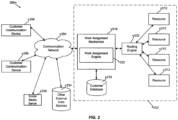
- the networked components 200 may be a distributed system and, in some embodiments, comprises a communication network 204 connecting one or more communication devices 208 to a work assignment mechanism 216, which may be owned and operated by an enterprise administering contact center 202 in which a plurality of resources 212 is distributed to handle incoming work items (in the form of contacts) from customer communication devices 208.
- a system such as contact center 202, may be variously embodied to receive and/or send messages that are or are associated with work items and the processing and management (e.g., scheduling, assigning, routing, generating, accounting, receiving, monitoring, reviewing, etc.) of the work items by one or more resources 212.
- the work items are generally generated and/or received requests for a processing resource 212 embodied as, or a component of, an electronic and/or electromagnetically conveyed message.
- Contact center 202 may include more or fewer components than illustrated and/or provide more or fewer services than illustrated.
- the border indicating contact center 202 may be a physical boundary (e.g., a building, campus, etc.), legal boundary (e.g., company, enterprise, etc.), and/or logical boundary (e.g., resources 212 utilized to provide services to customers for a customer of contact center 202).
- a physical boundary e.g., a building, campus, etc.
- legal boundary e.g., company, enterprise, etc.
- logical boundary e.g., resources 212 utilized to provide services to customers for a customer of contact center 202).
- contact center 202 may be as-illustrated or, in other embodiments, include alterations and/or more and/or fewer components than illustrated.
- one or more of resources 212, customer database 218, and/or other component may connect to routing engine 232 via communication network 204, such as when such components connect via a public network (e.g., Internet).
- communication network 204 may be a private utilization of, at least in part, a public network (e.g., VPN); a private network located, at least partially, within contact center 202; or a mixture of private and public networks that may be utilized to provide electronic communication of components described herein.
- components illustrated as external such as social media server 230 and/or other external data sources 234 may be within contact center 202 physically and/or logically, such as to mirror externally collected data, but still be considered external.
- contact center 202 may operate social media server 230 (e.g., a website operable to receive user messages from customers and/or resources 212) as one means to interact with customers via their customer communication device 208.
- External data sources 234 and/or social media server 230 may be websites, database, API's of other components, or other sources whereby events may be detected.
- External data sources 234 may include, but is not limited to, weather, news, governmental agencies, social media (as a component of social media server 230 and/or other social media sources), IoT devices (e.g., flood, snowpack, seismic, and/or power outage sensors, cameras, etc.), and/or other sources selected to provide event information, such as to step 102.
- social media as a component of social media server 230 and/or other social media sources
- IoT devices e.g., flood, snowpack, seismic, and/or power outage sensors, cameras, etc.
- other sources selected to provide event information such as to step 102.
- An endpoint may be embodied as one or more customer communication devices 208, which are further embodied as external to contact center 202 as they are under the more direct control of their respective user.
- embodiments may be provided whereby one or more customer communication devices 208 are physically and/or logically located within contact center 202 and are still considered external to contact center 202, such as when a customer utilizes customer communication device 208 at a kiosk and attaches to a private network of contact center 202 (e.g., WiFi connection to a kiosk, etc.), within or controlled by contact center 202.
- a private network of contact center 202 e.g., WiFi connection to a kiosk, etc.
- contact center 202 provides at least one embodiment whereby the following embodiments may be more readily understood without limiting such embodiments.
- Contact center 202 may be further altered, added to, and/or subtracted from without departing from the scope of any embodiment described herein and without limiting the scope of the embodiments or claims, except as expressly provided.
- contact center 202 may incorporate and/or utilize social media website 230 and/or other external data sources 234 may be utilized to provide one means for a resource 212 to receive and/or retrieve contacts and connect to a customer via their endpoint (customer communication device 208).
- Other external data sources 234 may include data sources, such as service bureaus, third-party data providers.
- Customers may utilize their respective customer communication device 208 to send/receive communications utilizing social media server 230.
- the communication network 204 may comprise any type of known communication medium or collection of communication media and may use any type of protocols to transport electronic messages between endpoints. Communication components may require allocation and/or configuration to provide a certain volume and/or types of communications (e.g., POTS, voice-over-IP, email, text, video, etc.).
- the communication network 204 may include wired and/or wireless communication technologies.
- the Internet is an example of the communication network 204 that constitutes an Internet Protocol (IP) network consisting of many computers, computing networks, and other communication devices located all over the world, which are connected through many telephone systems and other means.
- IP Internet Protocol
- the communication network 204 examples include, without limitation, a standard Plain Old Telephone System (POTS), an Integrated Services Digital Network (ISDN), the Public Switched Telephone Network (PSTN), a Local Area Network (LAN), a Wide Area Network (WAN), a Session Initiation Protocol (SIP) network, a Voice over IP (VoIP) network, a cellular network, and any other type of packet-switched or circuit-switched network known in the art.
- POTS Plain Old Telephone System
- ISDN Integrated Services Digital Network
- PSTN Public Switched Telephone Network
- LAN Local Area Network
- WAN Wide Area Network
- VoIP Voice over IP
- cellular network any other type of packet-switched or circuit-switched network known in the art.
- the communication network 204 need not be limited to any one network type and instead may be comprised of a number of different networks and/or network types.
- embodiments of the present disclosure may be utilized to increase the efficiency of a grid-based contact
- the communication network 204 may comprise a number of different communication media, such as coaxial cable, copper cable/wire, fiber-optic cable, antennas for transmitting/receiving wireless messages, and combinations thereof.
- the communication devices 208 may correspond to a customer's endpoint.
- a customer may utilize their communication device 208 to initiate a work item.
- Illustrative work items include, but are not limited to, a contact directed toward and received at a contact center 202, a web page request directed toward and received at a server farm (e.g., collection of servers), a media request, an application request (e.g., a request for application resources location on a remote application server, such as a SIP application server), and the like.
- the work item may be in the form of a message or collection of messages transmitted over the communication network 204.
- the work item may be transmitted as a telephone call, a packet or collection of packets (e.g., IP packets transmitted over an IP network), an email message, an Instant Message, an SMS message, a fax, and combinations thereof.
- the communication may not necessarily be directed at the work assignment mechanism 216, but rather may be on some other server in the communication network 204 where it is harvested by the work assignment mechanism 216, which generates a work item for the harvested communication, such as social media server 230.
- An example of such a harvested communication includes a social media communication that is harvested by the work assignment mechanism 216 from a social media network or server 230. Exemplary architectures for harvesting social media communications and generating work items based thereon are described in U.S. Patent Application Nos. 12/784,369 , 12/706,942 , and 12/707,277, filed March 20, 2010 , February 17, 2010, and February 17, 2010, respectively.
- the format of the work item may depend upon the capabilities of the communication device 208 and the format of the communication.
- work items are logical representations within a contact center 202 of work to be performed in connection with servicing a communication received at contact center 202 (and, more specifically, the work assignment mechanism 216).
- the communication may be received and maintained at the work assignment mechanism 216, a switch or server connected to the work assignment mechanism 216, or the like, until a resource 212 is assigned to the work item representing that communication.
- the work assignment mechanism 216 passes the work item to a routing engine 232 to connect the communication device 208, which initiated the communication, with the assigned resource 212.
- routing engine 232 may be incorporated into the work assignment mechanism 216 or its functionality may be executed by the work assignment engine 220.
- Routing engine 232, work assignment mechanism 216, and/or work assignment engine 220 may comprise hardware (e.g., switches, routers, servers, ports, etc.) that may be allocated, such as by "waking" idle components and/or de-allocating such components currently being utilized for other tasks.
- Routing engine 232, work assignment mechanism 216, and/or work assignment engine 220 may comprise hardware located at more than one location, such as requiring an allocation of management hardware and/or inter-hardware communications equipment.
- hardware may be configured or reconfigured as at least a portion of a strategy to address a particular candidate event.
- an endpoint associated with additional resources 212 may be configured to address particular issues known or anticipated in response to the event.
- One type of resource 212 may be reconfigured, in whole or in part, such as to implement outbound dialing/messaging as opposed to otherwise being utilized for inbound call/messaging processing.
- an inbound service may be configured to have a longer wait-time in queue for processing to enable components to be available or configured to provide an increased dialing/messaging rate for outbound calls/messages.
- the communication devices 208 may comprise any type of known communication equipment or collection of communication equipment.
- Examples of a suitable communication device 208 include, but are not limited to, a personal computer, laptop, Personal Digital Assistant (PDA), cellular phone, smart phone, telephone, or combinations thereof.
- PDA Personal Digital Assistant
- each communication device 208 may be adapted to support video, audio, text, and/or data communications with other communication devices 208 as well as the processing resources 212.
- the type of medium used by the communication device 208 to communicate with other communication devices 208 or processing resources 212 may depend upon the communication applications available on the communication device 208.
- the work item is sent toward a collection of processing resources 212 via the combined efforts of the work assignment mechanism 216 and routing engine 232.
- the resources 212 can either be completely automated resources (e.g., Interactive Voice Response (IVR) units, microprocessors, servers, or the like), or a connection to an endpoint operated by an agent.
- IVR Interactive Voice Response
- the work assignment mechanism 216 and resources 212 may be owned and operated by a common entity in a contact center 202 format.
- the work assignment mechanism 216 may be administered by multiple enterprises, each of which has its own dedicated resources 212 connected to the work assignment mechanism 216.
- the work assignment mechanism 216 comprises a work assignment engine 220, which enables the work assignment mechanism 216 to make intelligent routing decisions for work items.
- the work assignment engine 220 is configured to administer and make work assignment decisions in a queueless contact center 202, as is described in U.S. Patent Application Serial No. 12/882,950 .
- the work assignment engine 220 may be configured to execute work assignment decisions in a traditional queue-based (or skill-based) contact center 102.
- the work assignment engine 220 and its various components may reside in the work assignment mechanism 216 or in a number of different servers or processing devices.
- cloud-based computing architectures can be employed whereby one or more components of the work assignment mechanism 216 are made available in a cloud or network such that they can be shared resources among a plurality of different users.
- Work assignment mechanism 216 may access customer database 218, such as to retrieve records, profiles, purchase history, previous work items, and/or other aspects of a customer known to contact center 202.
- Customer database 218 may be updated in response to a work item and/or input from resource 212 processing the work item.
- one or more components of contact center 202 may be implemented in a cloud-based architecture in their entirety, or components thereof (e.g., hybrid), in addition to embodiments being entirely on-premises.
- customer communication device 208 is connected to one of resources 212 via components entirely hosted by a cloud-based service provider, wherein processing and data storage elements may be dedicated to the operator of contact center 202 or shared or distributed amongst a plurality of service provider customers, one being contact center 202.
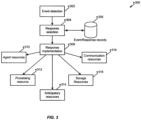
- Fig. 3 depicts block diagram 300 for use with embodiments of the present disclosure.
- process 302 performs event detection.
- a server e.g., computer comprising at least one processor
- a plurality of servers, or other computing resource may monitor sources, such as social media server 230, other external data sources 234, and/or other external sources for events.
- process 302 may examine the content of incoming communications for cues on a particular event. For example, a traveler who was just turned away from boarding a plane or ship may initiate a communication to resolve the issue and thereby be a first indication that an event has occurred. One or more confirming indications may be required before taking action.
- a server may initiate inquiries specifically targeted to the suspected event, such as determining if the airline or cruise line has issued any notifications on their website, is still operating normally, etc. As described more completely with respect to Fig. 1 , not all events will impact the operation of the system, such as contact center 202, and may result in no action taken. Additionally or alternatively, a domain of events may be, or not be, relevant. For example, the domain of air travel may be minimally, if at all, affected by a pipeline workers strike.
- Process 304 determines a response, which may comprise accessing event/response records block 306, such as may be performed by a computing resource performing step 106 of process 100.
- Block 308 then implements the response.
- Response implementation block 308 may be one or more servers, robots, subsystems, etc. that allocate and/or configure hardware components of system 202.
- Response implementation block 308 may "wake" idle or offline components, add additional components that were previously allocated for other tasks, and/or reconfigure components to perform the selected response.
- response implementation block 308 triggers agent resources block 310 to be allocated and/or reconfigured to accommodate the selected response.
- response implementation block 308 may cause additional agent resources to be allocated, configure endpoints to address the event, discontinue/decrease tasks unrelated to the selected response, change a type of tasks in accordance with the selected response (e.g., allocate additional bandwidth for video-based interactions, establish/maintain a connection to another data source, reconfigure the operation of the endpoint, etc.).
- response implementation block 308 triggers processing resource block 312 to be allocated and/or reconfigured to accommodate the selected response.
- processors e.g., as embodied in servers, blades, distributed systems, "cloud” platforms, etc.
- processors are allocated to perform additional computational tasks that may result from the candidate event.
- processors may be general purpose processors or specialized processors (e.g., graphical processing units "GPU").
- response implementation block 308 triggers communication resource block 318 to be allocated and/or reconfigured to accommodate the selected response.
- communication resource block 318 may allocate additional connection resource (e.g., switches, trunks, etc.) and/or reconfigure existing hardware (e.g., enable calls related to the incident to be advanced out-of-turn to connect to an endpoint of an agent sooner than other types of calls), handle media types likely needed to handle the communication types (e.g., allocate more resource to text and audio and fewer/lower capacity resource for video, etc.).
- response implementation block 308 triggers storage resource block 316 to be allocated and/or reconfigured to accommodate the selected response.
- storage resource block 316 may allocate additional resources and/or reconfigure existing resources. For example, a candidate event may cause customers to inquire into data that, due to pre-event optimization is kept in physical media, such as magnetic tape. However, as such information is predicted to be known, such as by step 116, the data may be cached into faster memory.
- response implementation block 308 triggers anticipatory resource block 314 to be allocated and/or reconfigured to accommodate the selected response.
- anticipatory resource block 314 may comprise one or more other blocks (e.g., agent resource block 310, processing resource 312, storage resource 316, communication resource 318.
- Anticipatory resource block 314 may cause one or more of the aforementioned blocks to be reconfigured to imitate a communication between an endpoint of the system (e.g., resource 112) to an endpoint of a customer (e.g., customer communication device 208).
- anticipatory reconfiguration 314 may require generic or customer-specific information be retrieved from a database 218 and/or other resource, requiring reconfiguration/allocation of storage resources 316, additional and/or reconfigured communications block 318 in order to provide relevant information to the customer's endpoint. Additionally or alternatively, the customer may be presented with options or other choices that require a communication and, in response or anticipation thereto, cause response implementation block 308 to perform additional, different, or supplemental modifications to accommodate the replies. In the case of outbound voice calls, an agent's endpoint may be configured to have relevant information and/or options prior to a communication allocation to connect the agent's endpoint to the customer's endpoint.
- a particular solution, determined in step 116, may comprise a plurality of blocks 310-318.
- Fig. 4 depicts data structure 400 for use with embodiments of the present disclosure.
- one or more data structures 400 may be accessed, such as by a processor executing test 104, to determine if a detected event is a candidate event and/or if an event is a sufficient match to a historic event, (e.g., step 106-110).
- Data structure 400 may include more records, such as indicated by ellipses 414, or fewer records.
- Records of data structure 400 may include event identifier 402, such as a unique number or other identifier of the particular data structure 400; type identifier 404 to identify a category, subcategory, or other attribute of the event (e.g., natural disaster, terrorist attack, weather, etc.); severity 406 may be utilized to indicate the severity of a particular event (e.g., category 5 hurricane, earthquake of 1.6 magnitude, minor weather incident, etc.); type of impact 408 may be utilize to categorize the type of impact (e.g., all travel, air travel, all operations, international travel, beachfront hotels, etc.); location of impact 410 may be utilized to categorize the location or area of the event (e.g., widespread power outage, flooding along the river, nation-wide rail strike, etc.); alternatives 412 may be utilized to indicate mitigating or enhancing factors (e.g., minor flooding but a major roadway is underwater, flights to the Canary Islands cancelled but additional passenger ships available from southern Morocco, etc.).
- event identifier 402 such as
- step 124 may cause a new data structure 400 to be wrote for a current candidate event to then become a member of the stored events of step 106 (see, Fig. 1 ).
- Fig. 5 depicts data structure 500 for use with embodiments of the present disclosure.
- one or more data structures 500 may be accessed, such as by a processor executing step 116, to determine a solution to a candidate event.
- Data structure 500 may include more records, such as indicated by ellipses 514, or fewer records.
- Records of data structure 500 may include response identifier 502, such as to provide a unique identifier of a particular data structure 500; type identifier 504, such as to provide a category or description of a response type (e.g., launch proactive outbound communication campaign, increase communication capacity, decrease video communication capacity, etc.); degree of response type 506, such as to indicate magnitude of response (e.g., increase communication capacity 10%, additional 35% processing demand, etc.); timing 508 (e.g., call travelers with flights leaving in the next day within the next 15 minutes; have communication capacity increased within the next 24 hours, etc.); impact 510 (e.g., video resources will become impaired/unavailable, agent endpoints will be utilized an additional 22%, etc.); exceptions 512 (e.g., automatic or manual entry of differences not otherwise accounted for).
- response identifier 502 such as to provide a unique identifier of a particular data structure 500
- type identifier 504 such as to provide a category or description of a response type (e.g.,
- data structure 500 is illustrated as a "flat file" for one event but other data structures, for one or a plurality of events, comprising the same or similar information may be utilized without departing from the scope of the disclosure.
- step 124 may cause a new data structure 500 to be wrote for a current candidate event to then become a member of the stored events of step 106 (see, Fig. 1 ).
- data structures 400 and 500 may be combined into a single flat file or other structure.
- a microprocessor may be a system or collection of processing hardware components, such as a microprocessor on a client device and a microprocessor on a server, a collection of devices with their respective microprocessor, or a shared or remote processing service (e.g., "cloud" based microprocessor).
- a system of microprocessors may comprise task-specific allocation of processing tasks and/or shared or distributed processing tasks.
- a microprocessor may execute software to provide the services to emulate a different microprocessor or microprocessors.
- first microprocessor comprised of a first set of hardware components, may virtually provide the services of a second microprocessor whereby the hardware associated with the first microprocessor may operate using an instruction set associated with the second microprocessor.
- machine-executable instructions may be stored on one or more machine-readable mediums, such as CD-ROMs or other type of optical disks, floppy diskettes, ROMs, RAMs, EPROMs, EEPROMs, magnetic or optical cards, flash memory, or other types of machine-readable mediums suitable for storing electronic instructions.
- machine-readable mediums such as CD-ROMs or other type of optical disks, floppy diskettes, ROMs, RAMs, EPROMs, EEPROMs, magnetic or optical cards, flash memory, or other types of machine-readable mediums suitable for storing electronic instructions.
- the methods may be performed by a combination of hardware and software.
- machine-executable instructions may be stored and executed locally to a particular machine (e.g., personal computer, mobile computing device, laptop, etc.), it should be appreciated that the storage of data and/or instructions and/or the execution of at least a portion of the instructions may be provided via connectivity to a remote data storage and/or processing device or collection of devices, commonly known as “the cloud,” but may include a public, private, dedicated, shared and/or other service bureau, computing service, and/or "server farm.”
- Examples of the microprocessors as described herein may include, but are not limited to, at least one of Qualcomm ® Qualcomm ® Qualcomm ® Qualcomm ® Qualcomm ® Qualcomm ® Qualcomm ® 610 and 615 with 4G LTE Integration and 64-bit computing, Apple ® A7 microprocessor with 64-bit architecture, Apple ® M7 motion comicroprocessors, Samsung ® Exynos ® series, the Intel@ Core TM family of microprocessors, the Intel ® Xeon ® family of microprocessors, the Intel ® Atom TM family of microprocessors, the Intel Itanium ® family of microprocessors, Intel ® Core ® i5-4670K and i7-4770K 22nm Haswell, Intel ® Core ® i5-3570K 22nm Ivy Bridge, the AMD ® FX TM family of microprocessors, AMD ® FX-4300, FX-6300, and FX-8350 32nm Vishera, AMD ® Kaveri microprocessors, Texas
- certain components of the system can be located remotely, at distant portions of a distributed network, such as a LAN and/or the Internet, or within a dedicated system.
- a distributed network such as a LAN and/or the Internet
- the components or portions thereof (e.g., microprocessors, memory/storage, interfaces, etc.) of the system can be combined into one or more devices, such as a server, servers, computer, computing device, terminal, "cloud” or other distributed processing, or collocated on a particular node of a distributed network, such as an analog and/or digital telecommunications network, a packet-switched network, or a circuit-switched network.
- the components may be physical or logically distributed across a plurality of components (e.g., a microprocessor may comprise a first microprocessor on one component and a second microprocessor on another component, each performing a portion of a shared task and/or an allocated task).
- a microprocessor may comprise a first microprocessor on one component and a second microprocessor on another component, each performing a portion of a shared task and/or an allocated task.
- the components of the system can be arranged at any location within a distributed network of components without affecting the operation of the system.
- the various components can be located in a switch such as a PBX and media server, gateway, in one or more communications devices, at one or more users' premises, or some combination thereof.
- one or more functional portions of the system could be distributed between a telecommunications device(s) and an associated computing device.
- the various links connecting the elements can be wired or wireless links, or any combination thereof, or any other known or later developed element(s) that is capable of supplying and/or communicating data to and from the connected elements.
- These wired or wireless links can also be secure links and may be capable of communicating encrypted information.
- Transmission media used as links can be any suitable carrier for electrical signals, including coaxial cables, copper wire, and fiber optics, and may take the form of acoustic or light waves, such as those generated during radio-wave and infra-red data communications.
- the systems and methods of this invention can be implemented in conjunction with a special purpose computer, a programmed microprocessor or microcontroller and peripheral integrated circuit element(s), an ASIC or other integrated circuit, a digital signal microprocessor, a hard-wired electronic or logic circuit such as discrete element circuit, a programmable logic device or gate array such as PLD, PLA, FPGA, PAL, special purpose computer, any comparable means, or the like.
- a special purpose computer e.g., cellular, Internet enabled, digital, analog, hybrids, and others
- other hardware known in the art e.g.
- microprocessors e.g., a single or multiple microprocessors
- memory e.g., a single or multiple microprocessors
- nonvolatile storage e.g., a single or multiple microprocessors
- input devices e.g., keyboards, touch screens, and the like
- output devices e.g., a display, keyboards, and the like
- alternative software implementations including, but not limited to, distributed processing or component/object distributed processing, parallel processing, or virtual machine processing can also be constructed to implement the methods described herein.
- the disclosed methods may be readily implemented in conjunction with software using object or object-oriented software development environments that provide portable source code that can be used on a variety of computer or workstation platforms.
- the disclosed system may be implemented partially or fully in hardware using standard logic circuits or VLSI design. Whether software or hardware is used to implement the systems in accordance with this invention is dependent on the speed and/or efficiency requirements of the system, the particular function, and the particular software or hardware systems or microprocessor or microcomputer systems being utilized.
- the disclosed methods may be partially implemented in software that can be stored on a storage medium, executed on programmed general-purpose computer with the cooperation of a controller and memory, a special purpose computer, a microprocessor, or the like.
- the systems and methods of this invention can be implemented as a program embedded on a personal computer such as an applet, JAVA ® or CGI script, as a resource residing on a server or computer workstation, as a routine embedded in a dedicated measurement system, system component, or the like.
- the system can also be implemented by physically incorporating the system and/or method into a software and/or hardware system.
- the present invention in various embodiments, configurations, and aspects, includes components, methods, processes, systems and/or apparatus substantially as depicted and described herein, including various embodiments, subcombinations, and subsets thereof. Those of skill in the art will understand how to make and use the present invention after understanding the present disclosure.
- the present invention in various embodiments, configurations, and aspects, includes providing devices and processes in the absence of items not depicted and/or described herein or in various embodiments, configurations, or aspects hereof, including in the absence of such items as may have been used in previous devices or processes, e.g., for improving performance, achieving ease, and ⁇ or reducing cost of implementation.
Landscapes
- Engineering & Computer Science (AREA)
- Signal Processing (AREA)
- Computer Networks & Wireless Communication (AREA)
- General Engineering & Computer Science (AREA)
- Theoretical Computer Science (AREA)
- Multimedia (AREA)
- Computer Hardware Design (AREA)
- Quality & Reliability (AREA)
- Physics & Mathematics (AREA)
- General Physics & Mathematics (AREA)
- Computer Vision & Pattern Recognition (AREA)
- Telephonic Communication Services (AREA)
- Management, Administration, Business Operations System, And Electronic Commerce (AREA)
Claims (13)
- System, umfassend:mindestens einen Mikroprozessor;einen Speicher, der für den mindestens einen Mikroprozessor zugänglich ist und Anweisungen zur Ausführung durch den mindestens einen Mikroprozessor speichert;wobei der mindestens eine Mikroprozessor Anweisungen als einen Teil einer Vielzahl von Ressourcen ausführt;wobei die mindestens eine von der Vielzahl von Ressourcen eine Datenverarbeitungsressource, eine Kommunikationsressource, die weiterhin eine erste Netzwerkschnittstelle zu einem Netzwerk umfasst und selektiv Kommunikationen zwischen einem ersten und einem zweiten Endpunkt, die das Netzwerk nutzen, ermöglicht, oder eine Datenspeicherressource umfasst und wobei die Vielzahl von Ressourcen für Kommunikationen dazwischen miteinander verbunden ist und dem ersten Endpunkt ermöglicht, Daten zu beziehen oder an den zweiten Endpunkt bereitzustellen;einen Ereignismonitor, der eine zweite Netzwerkschnittstelle zu dem Netzwerk umfasst, wobei der Ereignismonitor dazu eingerichtet ist, eine Ereignisinformation von einer Ereignisquelle in Bezug auf ein Ereignis zu beziehen;eine Ereignisbeurteilungskomponente, wobei die Ereignisbeurteilungskomponente dazu eingerichtet ist, zu bestimmen (112), ob die bezogene Ereignisinformation einem historischen Ereignis von einer Vielzahl von historischen Ereignissen in der Datenspeicherressource entspricht;einen Ereignisantwortprozessor, wobei der Ereignisantwortprozessor dazu eingerichtet ist, das System (118) gemäß einer Lösung, die aus einer historischen Lösung von einer Vielzahl von historischen Lösungen, die mit dem historischen Ereignis assoziiert ist, bestimmt wurde, zu rekonfigurieren; undwobei die Datenspeicherressource dazu eingerichtet ist, mit dem historischen Ereignis und der historischen Lösung ein tatsächlich beobachtetes Leistungsdelta zu pflegen, das einen Unterschied der Leistung des Systems, wie während des historischen Ereignisses beobachtet, während das System gemäß der historischen Lösung konfiguriert wurde, im Vergleich zu der erwarteten Leistung des Systems angibt; undwobei der Ereignisantwortprozessor weiterhin dazu eingerichtet ist, die Lösung gemäß einem tatsächlich beobachteten Leistungsdelta, das mit dem historischen Ereignis assoziiert ist, zu bestimmen.
- System nach Anspruch 1, wobei der Ereignisantwortprozessor dazu eingerichtet ist, das System zu rekonfigurieren, umfassend ein Hinzufügen von mindestens einer nicht zugewiesenen Ressource, die nicht innerhalb der Vielzahl von Ressourcen ist, um zu einer von der Vielzahl von Ressourcen zu werden.
- System nach Anspruch 1, wobei der Ereignisantwortprozessor dazu eingerichtet ist, das System zu rekonfigurieren, umfassend ein Bewirken mindestens eines Betriebsparameters von mindestens einer von der Vielzahl von Ressourcen, um dem ersten Endpunkt, der vorher nicht dazu in der Lage war, mit einem dritten Endpunkt zu kommunizieren, zu ermöglichen, mit dem dritten Endpunkt zu kommunizieren.
- System nach Anspruch 3, wobei der zweite Endpunkt und der dritte Endpunkt sich in Bezug auf einen oder mehrere von einem Mediatypen, einem automatisch im Vergleich zu von Menschen erzeugten Kommunikationsinhalt oder einem Echtzeit- im Vergleich zu Nicht-Echtzeit-Kommunikationstypen unterscheiden.
- System nach Anspruch 1, weiterhin umfassend:eine Anzahl von Endpunkten zusätzlich zu dem ersten und dem zweiten Endpunkt; undwobei das System in einem ersten Modus dem mindestens einen Endpunkt von der Anzahl von Endpunkten ermöglicht, Daten zu beziehen oder an den mindestens einen anderen Endpunkt von der Anzahl von Endpunkten bereitzustellen, und nachdem der Ereignisantwortprozessor das System rekonfiguriert ist, in einem zweiten Modus dem mindestens einen Endpunkt von der Anzahl von Endpunkten ermöglicht, Daten zu beziehen oder an den mindestens einen anderen Endpunkt von der Anzahl von Endpunkten bereitzustellen, der sich von dem mindestens einen anderen Endpunkt unterschiedet, der in dem ersten Modus genutzt wird.
- System nach Anspruch 1, weiterhin umfassend:eine Anzahl von Endpunkten zusätzlich zu dem ersten und dem zweiten Endpunkt undwobei das System in einem ersten Modus dem mindestens einen Endpunkt von der Anzahl von Endpunkten ermöglicht, Daten zu beziehen oder an mindestens einen anderen Endpunkt von der Anzahl von Endpunkten bereitzustellen, und nachdem der Ereignisantwortprozessor das System rekonfiguriert ist, dem mindestens einen Endpunkt von der Anzahl von Endpunkten ermöglicht, Daten zu beziehen oder an den mindestens einen zusätzlichen Endpunkt bereitzustellen, der sich von dem mindestens einen anderen Endpunkt unterschiedet, der in dem ersten Modus genutzt wird.
- System nach Anspruch 1, wobei die Lösung umfasst, dass der zweite Endpunkt eine Kommunikation mit dem ersten Endpunkt initiiert.
- System nach Anspruch 1, wobei der mindestens eine Mikroprozessor weiterhin dazu eingerichtet ist, Anweisungen als einen Teil einer Beurteilungskomponente auszuführen, und wobei die Beurteilungskomponente dazu eingerichtet ist, die erwartete Leistung des Systems während des Ereignisses mit einer beobachteten Leistung des Systems während des Ereignisses zu vergleichen, und dazu eingerichtet ist, zu bewirken, dass die Lösung mit einem assoziierten tatsächlich beobachteten Leistungsdelta gespeichert wird.
- System nach Anspruch 1, wobei Kennzeichen der bezogenen Ereignisinformation und der Lösung in der Datenspeicherressource als ein zusätzliches historisches Ereignis und eine assoziierte historische Lösung gespeichert werden.
- Verfahren, umfassend:Nutzen einer Vielzahl von Ressourcen, um Konnektivität zwischen einem ersten und einem zweiten Endpunkt bereitzustellen, wobei mindestens ein Teil der Vielzahl von Ressourcen mindestens eine Computerressource, wobei jede von der mindestens einen Computerressource einen Mikroprozessor und einen Speicher zum Speichern von Anweisungen zur Ausführung durch den Mikroprozessor umfasst, eine Kommunikationsressource, die eine erste Netzwerkschnittstelle zu einem Netzwerk umfasst und selektiv Kommunikationen unter Nutzung des Netzwerks ermöglicht, oder eine Datenspeicherressource umfasst und wobei die Vielzahl von Ressourcen für Kommunikationen dazwischen miteinander verbunden ist und dem ersten Endpunkt selektiv ermöglicht, Daten zu beziehen oder an den zweiten Endpunkt bereitzustellen;Beziehen einer Ereignisinformation von einer Ereignisquelle mittels einer zweiten Netzwerkschnittstelle zu dem Netzwerk in Bezug auf ein Ereignis;Bestimmen (112), ob die bezogene Ereignisinformation einem historischen Ereignis von einer Vielzahl von historischen Ereignissen entspricht;automatisches Rekonfigurieren der Vielzahl von Ressourcen (118) gemäß einer Lösung, die aus einer historischen Lösung von einer Vielzahl von historischen Lösungen, die mit dem historischen Ereignis assoziiert ist, bestimmt wurde;Pflegen eines tatsächlich beobachteten Leistungsdeltas, das einen Unterschied der Leistung der Ressourcen, wie während des historischen Ereignisses beobachtet, während die Ressourcen gemäß der historischen Lösung konfiguriert wurden, im Vergleich zu der erwarteten Leistung der Ressourcen angibt; undwobei die Lösung gemäß einem tatsächlich beobachteten Leistungsdelta, das mit dem historischen Ereignis assoziiert ist, bestimmt wird.
- Verfahren nach Anspruch 10, wobei das Rekonfigurieren der Vielzahl von Ressourcen ein Hinzufügen von mindestens einer nicht zugewiesenen Ressource, die nicht innerhalb der Vielzahl von Ressourcen ist, um zu einer von der Vielzahl von Ressourcen zu werden, umfasst.
- Verfahren nach Anspruch 10, wobei das Rekonfigurieren der Vielzahl von Ressourcen ein Bewirken mindestens eines Betriebsparameters von mindestens einer von der Vielzahl von Ressourcen, um dem ersten Endpunkt, der vorher nicht dazu in der Lage war, mit einem dritten Endpunkt zu kommunizieren, zu ermöglichen, mit dem dritten Endpunkt zu kommunizieren, umfasst.
- Verfahren nach Anspruch 12, wobei der zweite Endpunkt und der dritte Endpunkt sich in Bezug auf einen oder mehrere von einem Mediatypen, einem automatisch im Vergleich zu von Menschen erzeugten Kommunikationsinhalt oder einem Echtzeit- im Vergleich zu Nicht-Echtzeit-Kommunikationstypen unterscheiden.
Applications Claiming Priority (2)
| Application Number | Priority Date | Filing Date | Title |
|---|---|---|---|
| US16/043,452 US10735258B2 (en) | 2018-07-24 | 2018-07-24 | System for self-allocating resources |
| EP19187492.4A EP3599739A1 (de) | 2018-07-24 | 2019-07-22 | Elektronisches konferenzsystems und verfahren zum betrieb eines elektronischen konferenzsystems |
Related Parent Applications (2)
| Application Number | Title | Priority Date | Filing Date |
|---|---|---|---|
| EP19187492.4A Division EP3599739A1 (de) | 2018-07-24 | 2019-07-22 | Elektronisches konferenzsystems und verfahren zum betrieb eines elektronischen konferenzsystems |
| EP19187492.4A Division-Into EP3599739A1 (de) | 2018-07-24 | 2019-07-22 | Elektronisches konferenzsystems und verfahren zum betrieb eines elektronischen konferenzsystems |
Publications (2)
| Publication Number | Publication Date |
|---|---|
| EP3605950A1 EP3605950A1 (de) | 2020-02-05 |
| EP3605950B1 true EP3605950B1 (de) | 2024-02-21 |
Family
ID=67438335
Family Applications (2)
| Application Number | Title | Priority Date | Filing Date |
|---|---|---|---|
| EP19187492.4A Withdrawn EP3599739A1 (de) | 2018-07-24 | 2019-07-22 | Elektronisches konferenzsystems und verfahren zum betrieb eines elektronischen konferenzsystems |
| EP19198283.4A Active EP3605950B1 (de) | 2018-07-24 | 2019-07-22 | System zur selbstzuweisung von ressourcen |
Family Applications Before (1)
| Application Number | Title | Priority Date | Filing Date |
|---|---|---|---|
| EP19187492.4A Withdrawn EP3599739A1 (de) | 2018-07-24 | 2019-07-22 | Elektronisches konferenzsystems und verfahren zum betrieb eines elektronischen konferenzsystems |
Country Status (4)
| Country | Link |
|---|---|
| US (1) | US10735258B2 (de) |
| EP (2) | EP3599739A1 (de) |
| JP (1) | JP7012047B2 (de) |
| CN (1) | CN110784334B (de) |
Families Citing this family (7)
| Publication number | Priority date | Publication date | Assignee | Title |
|---|---|---|---|---|
| US20210392230A1 (en) * | 2020-06-11 | 2021-12-16 | Avaya Management L.P. | System and method for indicating and measuring responses in a multi-channel contact center |
| US20220374809A1 (en) * | 2020-12-16 | 2022-11-24 | Wells Fargo Bank, N.A. | Computer-based tracking and determining impact of events on contact center operations |
| GB2604587B (en) * | 2021-03-01 | 2023-05-17 | British Telecomm | Method of operating a telecommunications network |
| US12164962B2 (en) * | 2021-08-23 | 2024-12-10 | Micron Technology, Inc. | Navigational assistance for the visually impaired |
| CN116347453A (zh) * | 2021-12-13 | 2023-06-27 | 中兴通讯股份有限公司 | 资源分配方法、装置、服务器和存储介质 |
| US20240362649A1 (en) * | 2023-04-25 | 2024-10-31 | The Texas A&M University System | Customer notification system based on outage state of risk prediction |
| US12445559B1 (en) * | 2024-10-08 | 2025-10-14 | Intradiem, Inc. | Systems and methods for modifying contact center queue assignments |
Family Cites Families (32)
| Publication number | Priority date | Publication date | Assignee | Title |
|---|---|---|---|---|
| US7373410B2 (en) * | 2002-10-23 | 2008-05-13 | Genesys Telecommunications Laboratories, Inc. | Method and system for providing adaptive and proactive interaction management for multiple types of business interactions occurring in a multimedia communications environment |
| US7602893B2 (en) | 2002-05-07 | 2009-10-13 | Randeep Bhatia | Method and system for supporting rendezvous based instant group conferencing among mobile users |
| US20060075093A1 (en) * | 2004-10-05 | 2006-04-06 | Enterasys Networks, Inc. | Using flow metric events to control network operation |
| US7127230B2 (en) | 2004-12-10 | 2006-10-24 | Bellsouth Intellectual Property Corporation | Methods and computer program products for providing communications in emergency situations |
| US7957520B2 (en) * | 2005-07-14 | 2011-06-07 | Cisco Technology, Inc. | System and method for responding to an emergency at a call center |
| US8811597B1 (en) * | 2006-09-07 | 2014-08-19 | Avaya Inc. | Contact center performance prediction |
| US20080133300A1 (en) | 2006-10-30 | 2008-06-05 | Mady Jalinous | System and apparatus for enterprise resilience |
| US7814405B2 (en) | 2006-11-28 | 2010-10-12 | International Business Machines Corporation | Method and system for automatic generation and updating of tags based on type of communication and content state in an activities oriented collaboration tool |
| US8478819B1 (en) * | 2007-09-25 | 2013-07-02 | Avaya Inc. | Automatically initiating a process by the outcome of a voting conference |
| US9712679B2 (en) * | 2008-01-28 | 2017-07-18 | Afiniti International Holdings, Ltd. | Systems and methods for routing callers to an agent in a contact center |
| US20100235218A1 (en) | 2008-09-29 | 2010-09-16 | Avaya Inc. | Pre-qualified or history-based customer service |
| US8515049B2 (en) * | 2009-03-26 | 2013-08-20 | Avaya Inc. | Social network urgent communication monitor and real-time call launch system |
| US8964958B2 (en) | 2009-05-20 | 2015-02-24 | Avaya Inc. | Grid-based contact center |
| US20110125826A1 (en) | 2009-11-20 | 2011-05-26 | Avaya Inc. | Stalking social media users to maximize the likelihood of immediate engagement |
| US20110125793A1 (en) | 2009-11-20 | 2011-05-26 | Avaya Inc. | Method for determining response channel for a contact center from historic social media postings |
| US20110231773A1 (en) * | 2010-03-19 | 2011-09-22 | Avaya Inc. | System and method for providing just-in-time resources based on context |
| US8634543B2 (en) | 2010-04-14 | 2014-01-21 | Avaya Inc. | One-to-one matching in a contact center |
| JP2010166627A (ja) | 2010-05-06 | 2010-07-29 | Fujitsu Ltd | 無線回線接続制御装置、および移動通信ネットワークシステム |
| CN103024825B (zh) * | 2011-09-26 | 2015-07-01 | 中国移动通信集团公司 | 终端多应用间网络资源分配方法及其设备 |
| US11082371B2 (en) | 2012-04-27 | 2021-08-03 | Calendar Research Llc | Appointment negotiation systems and methods |
| US9912812B2 (en) | 2012-11-21 | 2018-03-06 | Genesys Telecommunications Laboratories, Inc. | Graphical user interface for configuring contact center routing strategies |
| EP2785008A1 (de) * | 2013-03-29 | 2014-10-01 | British Telecommunications public limited company | Verfahren und Vorrichtung zur Erkennung eines mehrstufigen Ereignisses |
| WO2015045444A1 (ja) | 2013-09-26 | 2015-04-02 | 日本電気株式会社 | 無線基地局装置およびリソース割り当て方法 |
| US9871741B2 (en) | 2014-03-10 | 2018-01-16 | Microsoft Technology Licensing, Llc | Resource management based on device-specific or user-specific resource usage profiles |
| US9485263B2 (en) * | 2014-07-16 | 2016-11-01 | Microsoft Technology Licensing, Llc | Volatility-based classifier for security solutions |
| US9516169B2 (en) | 2014-12-05 | 2016-12-06 | Avaya Inc. | Automatic contact center expansion and contraction |
| JP2016158078A (ja) | 2015-02-24 | 2016-09-01 | 株式会社日立製作所 | ネットワークシステム及びネットワーク管理方法 |
| US20170004178A1 (en) * | 2015-06-30 | 2017-01-05 | Avaya Inc. | Reference validity checker |
| US10083073B2 (en) * | 2015-09-14 | 2018-09-25 | Dynatrace Llc | Method and system for real-time causality and root cause determination of transaction and infrastructure related events provided by multiple, heterogeneous agents |
| US10505948B2 (en) * | 2015-11-05 | 2019-12-10 | Trilliant Networks, Inc. | Method and apparatus for secure aggregated event reporting |
| US20170308866A1 (en) * | 2016-04-22 | 2017-10-26 | Microsoft Technology Licensing, Llc | Meeting Scheduling Resource Efficiency |
| US10812329B2 (en) * | 2017-08-01 | 2020-10-20 | At&T Intellectual Property I, L.P. | Systems and methods to control operation of virtualized networks |
-
2018
- 2018-07-24 US US16/043,452 patent/US10735258B2/en active Active
-
2019
- 2019-07-22 EP EP19187492.4A patent/EP3599739A1/de not_active Withdrawn
- 2019-07-22 EP EP19198283.4A patent/EP3605950B1/de active Active
- 2019-07-22 JP JP2019134353A patent/JP7012047B2/ja active Active
- 2019-07-24 CN CN201910671258.7A patent/CN110784334B/zh active Active
Also Published As
| Publication number | Publication date |
|---|---|
| EP3605950A1 (de) | 2020-02-05 |
| US20200036588A1 (en) | 2020-01-30 |
| CN110784334A (zh) | 2020-02-11 |
| JP7012047B2 (ja) | 2022-01-27 |
| CN110784334B (zh) | 2023-10-17 |
| US10735258B2 (en) | 2020-08-04 |
| JP2020017278A (ja) | 2020-01-30 |
| EP3599739A1 (de) | 2020-01-29 |
Similar Documents
| Publication | Publication Date | Title |
|---|---|---|
| US10735258B2 (en) | System for self-allocating resources | |
| US12413672B1 (en) | Analysis of call metrics for call direction | |
| US11611654B1 (en) | Identifying and processing, for priority, calls in data communications server | |
| EP3706402A1 (de) | Vorrangige wiederverbindung von abgeworfenen knoten aus einem netzwerk | |
| US11503157B2 (en) | Limiting contact in a networked contact center environment | |
| US8305911B2 (en) | System and method for identifying and managing service disruptions using network and systems data | |
| US7382773B2 (en) | Contact center with normalized multiple protocol architecture | |
| US20150016600A1 (en) | Tiered call routing | |
| CN111357257B (zh) | 用于对媒体服务器实例进行负载均衡的系统和方法 | |
| US10681214B1 (en) | Enhanced real-time routing | |
| CN108540673A (zh) | 好友添加方法、装置、可读存储介质及移动终端 | |
| US11700329B2 (en) | Managed channel for agent-to-agent consultation | |
| CN104125090A (zh) | 管理通信渠道的方法和装置 | |
| US12120157B2 (en) | Personalized action reminders and dynamic injection of information in a cellular network | |
| US20050105709A1 (en) | Method and system for intelligent routing of telephone calls | |
| US20220174152A1 (en) | Efficient media establishment for webrtc call center agents | |
| US10812321B2 (en) | Predictive network node allocation | |
| US20220272199A1 (en) | Selective aggregation of enqueued nodes into a subnetwork for simultaneous communication | |
| US20230177519A1 (en) | Targeted selection and presentation of alerts | |
| US11025776B2 (en) | Interaction determined auto-answer time | |
| US20240244139A1 (en) | Binding multiple agent-matching algorithms and the dynamic selection thereof | |
| US20220292431A1 (en) | Resolution selection and deployment | |
| US20150142527A1 (en) | Architecture for a contact center with emulator driven self control loop | |
| US12531948B2 (en) | Contact center evolution model | |
| CN118870406B (zh) | 一种应用于物流行业的移动端网点云呼管理系统 |
Legal Events
| Date | Code | Title | Description |
|---|---|---|---|
| PUAI | Public reference made under article 153(3) epc to a published international application that has entered the european phase |
Free format text: ORIGINAL CODE: 0009012 |
|
| STAA | Information on the status of an ep patent application or granted ep patent |
Free format text: STATUS: THE APPLICATION HAS BEEN PUBLISHED |
|
| AC | Divisional application: reference to earlier application |
Ref document number: 3599739 Country of ref document: EP Kind code of ref document: P |
|
| AK | Designated contracting states |
Kind code of ref document: A1 Designated state(s): AL AT BE BG CH CY CZ DE DK EE ES FI FR GB GR HR HU IE IS IT LI LT LU LV MC MK MT NL NO PL PT RO RS SE SI SK SM TR |
|
| AX | Request for extension of the european patent |
Extension state: BA ME |
|
| STAA | Information on the status of an ep patent application or granted ep patent |
Free format text: STATUS: REQUEST FOR EXAMINATION WAS MADE |
|
| 17P | Request for examination filed |
Effective date: 20200804 |
|
| RBV | Designated contracting states (corrected) |
Designated state(s): AL AT BE BG CH CY CZ DE DK EE ES FI FR GB GR HR HU IE IS IT LI LT LU LV MC MK MT NL NO PL PT RO RS SE SI SK SM TR |
|
| STAA | Information on the status of an ep patent application or granted ep patent |
Free format text: STATUS: EXAMINATION IS IN PROGRESS |
|
| 17Q | First examination report despatched |
Effective date: 20201106 |
|
| GRAP | Despatch of communication of intention to grant a patent |
Free format text: ORIGINAL CODE: EPIDOSNIGR1 |
|
| STAA | Information on the status of an ep patent application or granted ep patent |
Free format text: STATUS: GRANT OF PATENT IS INTENDED |
|
| INTG | Intention to grant announced |
Effective date: 20230915 |
|
| GRAS | Grant fee paid |
Free format text: ORIGINAL CODE: EPIDOSNIGR3 |
|
| GRAA | (expected) grant |
Free format text: ORIGINAL CODE: 0009210 |
|
| STAA | Information on the status of an ep patent application or granted ep patent |
Free format text: STATUS: THE PATENT HAS BEEN GRANTED |
|
| AC | Divisional application: reference to earlier application |
Ref document number: 3599739 Country of ref document: EP Kind code of ref document: P |
|
| AK | Designated contracting states |
Kind code of ref document: B1 Designated state(s): AL AT BE BG CH CY CZ DE DK EE ES FI FR GB GR HR HU IE IS IT LI LT LU LV MC MK MT NL NO PL PT RO RS SE SI SK SM TR |
|
| REG | Reference to a national code |
Ref country code: GB Ref legal event code: FG4D |
|
| REG | Reference to a national code |
Ref country code: CH Ref legal event code: EP |
|
| REG | Reference to a national code |
Ref country code: DE Ref legal event code: R096 Ref document number: 602019046817 Country of ref document: DE |
|
| REG | Reference to a national code |
Ref country code: IE Ref legal event code: FG4D |
|
| REG | Reference to a national code |
Ref country code: LT Ref legal event code: MG9D |
|
| REG | Reference to a national code |
Ref country code: NL Ref legal event code: MP Effective date: 20240221 |
|
| PG25 | Lapsed in a contracting state [announced via postgrant information from national office to epo] |
Ref country code: IS Free format text: LAPSE BECAUSE OF FAILURE TO SUBMIT A TRANSLATION OF THE DESCRIPTION OR TO PAY THE FEE WITHIN THE PRESCRIBED TIME-LIMIT Effective date: 20240621 |
|
| PG25 | Lapsed in a contracting state [announced via postgrant information from national office to epo] |
Ref country code: LT Free format text: LAPSE BECAUSE OF FAILURE TO SUBMIT A TRANSLATION OF THE DESCRIPTION OR TO PAY THE FEE WITHIN THE PRESCRIBED TIME-LIMIT Effective date: 20240221 |
|
| PG25 | Lapsed in a contracting state [announced via postgrant information from national office to epo] |
Ref country code: GR Free format text: LAPSE BECAUSE OF FAILURE TO SUBMIT A TRANSLATION OF THE DESCRIPTION OR TO PAY THE FEE WITHIN THE PRESCRIBED TIME-LIMIT Effective date: 20240522 |
|
| REG | Reference to a national code |
Ref country code: AT Ref legal event code: MK05 Ref document number: 1660076 Country of ref document: AT Kind code of ref document: T Effective date: 20240221 |
|
| PG25 | Lapsed in a contracting state [announced via postgrant information from national office to epo] |
Ref country code: HR Free format text: LAPSE BECAUSE OF FAILURE TO SUBMIT A TRANSLATION OF THE DESCRIPTION OR TO PAY THE FEE WITHIN THE PRESCRIBED TIME-LIMIT Effective date: 20240221 Ref country code: NL Free format text: LAPSE BECAUSE OF FAILURE TO SUBMIT A TRANSLATION OF THE DESCRIPTION OR TO PAY THE FEE WITHIN THE PRESCRIBED TIME-LIMIT Effective date: 20240221 Ref country code: RS Free format text: LAPSE BECAUSE OF FAILURE TO SUBMIT A TRANSLATION OF THE DESCRIPTION OR TO PAY THE FEE WITHIN THE PRESCRIBED TIME-LIMIT Effective date: 20240521 |
|
| PG25 | Lapsed in a contracting state [announced via postgrant information from national office to epo] |
Ref country code: ES Free format text: LAPSE BECAUSE OF FAILURE TO SUBMIT A TRANSLATION OF THE DESCRIPTION OR TO PAY THE FEE WITHIN THE PRESCRIBED TIME-LIMIT Effective date: 20240221 |
|
| PG25 | Lapsed in a contracting state [announced via postgrant information from national office to epo] |
Ref country code: AT Free format text: LAPSE BECAUSE OF FAILURE TO SUBMIT A TRANSLATION OF THE DESCRIPTION OR TO PAY THE FEE WITHIN THE PRESCRIBED TIME-LIMIT Effective date: 20240221 |
|
| PG25 | Lapsed in a contracting state [announced via postgrant information from national office to epo] |
Ref country code: RS Free format text: LAPSE BECAUSE OF FAILURE TO SUBMIT A TRANSLATION OF THE DESCRIPTION OR TO PAY THE FEE WITHIN THE PRESCRIBED TIME-LIMIT Effective date: 20240521 Ref country code: NO Free format text: LAPSE BECAUSE OF FAILURE TO SUBMIT A TRANSLATION OF THE DESCRIPTION OR TO PAY THE FEE WITHIN THE PRESCRIBED TIME-LIMIT Effective date: 20240521 Ref country code: NL Free format text: LAPSE BECAUSE OF FAILURE TO SUBMIT A TRANSLATION OF THE DESCRIPTION OR TO PAY THE FEE WITHIN THE PRESCRIBED TIME-LIMIT Effective date: 20240221 Ref country code: LT Free format text: LAPSE BECAUSE OF FAILURE TO SUBMIT A TRANSLATION OF THE DESCRIPTION OR TO PAY THE FEE WITHIN THE PRESCRIBED TIME-LIMIT Effective date: 20240221 Ref country code: IS Free format text: LAPSE BECAUSE OF FAILURE TO SUBMIT A TRANSLATION OF THE DESCRIPTION OR TO PAY THE FEE WITHIN THE PRESCRIBED TIME-LIMIT Effective date: 20240621 Ref country code: HR Free format text: LAPSE BECAUSE OF FAILURE TO SUBMIT A TRANSLATION OF THE DESCRIPTION OR TO PAY THE FEE WITHIN THE PRESCRIBED TIME-LIMIT Effective date: 20240221 Ref country code: GR Free format text: LAPSE BECAUSE OF FAILURE TO SUBMIT A TRANSLATION OF THE DESCRIPTION OR TO PAY THE FEE WITHIN THE PRESCRIBED TIME-LIMIT Effective date: 20240522 Ref country code: FI Free format text: LAPSE BECAUSE OF FAILURE TO SUBMIT A TRANSLATION OF THE DESCRIPTION OR TO PAY THE FEE WITHIN THE PRESCRIBED TIME-LIMIT Effective date: 20240221 Ref country code: ES Free format text: LAPSE BECAUSE OF FAILURE TO SUBMIT A TRANSLATION OF THE DESCRIPTION OR TO PAY THE FEE WITHIN THE PRESCRIBED TIME-LIMIT Effective date: 20240221 Ref country code: BG Free format text: LAPSE BECAUSE OF FAILURE TO SUBMIT A TRANSLATION OF THE DESCRIPTION OR TO PAY THE FEE WITHIN THE PRESCRIBED TIME-LIMIT Effective date: 20240221 Ref country code: AT Free format text: LAPSE BECAUSE OF FAILURE TO SUBMIT A TRANSLATION OF THE DESCRIPTION OR TO PAY THE FEE WITHIN THE PRESCRIBED TIME-LIMIT Effective date: 20240221 |
|
| PG25 | Lapsed in a contracting state [announced via postgrant information from national office to epo] |
Ref country code: PL Free format text: LAPSE BECAUSE OF FAILURE TO SUBMIT A TRANSLATION OF THE DESCRIPTION OR TO PAY THE FEE WITHIN THE PRESCRIBED TIME-LIMIT Effective date: 20240221 Ref country code: PT Free format text: LAPSE BECAUSE OF FAILURE TO SUBMIT A TRANSLATION OF THE DESCRIPTION OR TO PAY THE FEE WITHIN THE PRESCRIBED TIME-LIMIT Effective date: 20240621 |
|
| PG25 | Lapsed in a contracting state [announced via postgrant information from national office to epo] |
Ref country code: SE Free format text: LAPSE BECAUSE OF FAILURE TO SUBMIT A TRANSLATION OF THE DESCRIPTION OR TO PAY THE FEE WITHIN THE PRESCRIBED TIME-LIMIT Effective date: 20240221 Ref country code: PT Free format text: LAPSE BECAUSE OF FAILURE TO SUBMIT A TRANSLATION OF THE DESCRIPTION OR TO PAY THE FEE WITHIN THE PRESCRIBED TIME-LIMIT Effective date: 20240621 Ref country code: PL Free format text: LAPSE BECAUSE OF FAILURE TO SUBMIT A TRANSLATION OF THE DESCRIPTION OR TO PAY THE FEE WITHIN THE PRESCRIBED TIME-LIMIT Effective date: 20240221 Ref country code: LV Free format text: LAPSE BECAUSE OF FAILURE TO SUBMIT A TRANSLATION OF THE DESCRIPTION OR TO PAY THE FEE WITHIN THE PRESCRIBED TIME-LIMIT Effective date: 20240221 |
|
| PGFP | Annual fee paid to national office [announced via postgrant information from national office to epo] |
Ref country code: DE Payment date: 20240729 Year of fee payment: 6 |
|
| PG25 | Lapsed in a contracting state [announced via postgrant information from national office to epo] |
Ref country code: DK Free format text: LAPSE BECAUSE OF FAILURE TO SUBMIT A TRANSLATION OF THE DESCRIPTION OR TO PAY THE FEE WITHIN THE PRESCRIBED TIME-LIMIT Effective date: 20240221 |
|
| PG25 | Lapsed in a contracting state [announced via postgrant information from national office to epo] |
Ref country code: SM Free format text: LAPSE BECAUSE OF FAILURE TO SUBMIT A TRANSLATION OF THE DESCRIPTION OR TO PAY THE FEE WITHIN THE PRESCRIBED TIME-LIMIT Effective date: 20240221 |
|
| PGFP | Annual fee paid to national office [announced via postgrant information from national office to epo] |
Ref country code: GB Payment date: 20240729 Year of fee payment: 6 |
|
| PGFP | Annual fee paid to national office [announced via postgrant information from national office to epo] |
Ref country code: FR Payment date: 20240725 Year of fee payment: 6 |
|
| PG25 | Lapsed in a contracting state [announced via postgrant information from national office to epo] |
Ref country code: EE Free format text: LAPSE BECAUSE OF FAILURE TO SUBMIT A TRANSLATION OF THE DESCRIPTION OR TO PAY THE FEE WITHIN THE PRESCRIBED TIME-LIMIT Effective date: 20240221 Ref country code: CZ Free format text: LAPSE BECAUSE OF FAILURE TO SUBMIT A TRANSLATION OF THE DESCRIPTION OR TO PAY THE FEE WITHIN THE PRESCRIBED TIME-LIMIT Effective date: 20240221 |
|
| PG25 | Lapsed in a contracting state [announced via postgrant information from national office to epo] |
Ref country code: SK Free format text: LAPSE BECAUSE OF FAILURE TO SUBMIT A TRANSLATION OF THE DESCRIPTION OR TO PAY THE FEE WITHIN THE PRESCRIBED TIME-LIMIT Effective date: 20240221 |
|
| PG25 | Lapsed in a contracting state [announced via postgrant information from national office to epo] |
Ref country code: SM Free format text: LAPSE BECAUSE OF FAILURE TO SUBMIT A TRANSLATION OF THE DESCRIPTION OR TO PAY THE FEE WITHIN THE PRESCRIBED TIME-LIMIT Effective date: 20240221 Ref country code: SK Free format text: LAPSE BECAUSE OF FAILURE TO SUBMIT A TRANSLATION OF THE DESCRIPTION OR TO PAY THE FEE WITHIN THE PRESCRIBED TIME-LIMIT Effective date: 20240221 Ref country code: RO Free format text: LAPSE BECAUSE OF FAILURE TO SUBMIT A TRANSLATION OF THE DESCRIPTION OR TO PAY THE FEE WITHIN THE PRESCRIBED TIME-LIMIT Effective date: 20240221 Ref country code: EE Free format text: LAPSE BECAUSE OF FAILURE TO SUBMIT A TRANSLATION OF THE DESCRIPTION OR TO PAY THE FEE WITHIN THE PRESCRIBED TIME-LIMIT Effective date: 20240221 Ref country code: DK Free format text: LAPSE BECAUSE OF FAILURE TO SUBMIT A TRANSLATION OF THE DESCRIPTION OR TO PAY THE FEE WITHIN THE PRESCRIBED TIME-LIMIT Effective date: 20240221 Ref country code: CZ Free format text: LAPSE BECAUSE OF FAILURE TO SUBMIT A TRANSLATION OF THE DESCRIPTION OR TO PAY THE FEE WITHIN THE PRESCRIBED TIME-LIMIT Effective date: 20240221 |
|
| REG | Reference to a national code |
Ref country code: DE Ref legal event code: R097 Ref document number: 602019046817 Country of ref document: DE |
|
| PG25 | Lapsed in a contracting state [announced via postgrant information from national office to epo] |
Ref country code: IT Free format text: LAPSE BECAUSE OF FAILURE TO SUBMIT A TRANSLATION OF THE DESCRIPTION OR TO PAY THE FEE WITHIN THE PRESCRIBED TIME-LIMIT Effective date: 20240221 |
|
| PLBE | No opposition filed within time limit |
Free format text: ORIGINAL CODE: 0009261 |
|
| STAA | Information on the status of an ep patent application or granted ep patent |
Free format text: STATUS: NO OPPOSITION FILED WITHIN TIME LIMIT |
|
| PG25 | Lapsed in a contracting state [announced via postgrant information from national office to epo] |
Ref country code: IT Free format text: LAPSE BECAUSE OF FAILURE TO SUBMIT A TRANSLATION OF THE DESCRIPTION OR TO PAY THE FEE WITHIN THE PRESCRIBED TIME-LIMIT Effective date: 20240221 |
|
| 26N | No opposition filed |
Effective date: 20241122 |
|
| PG25 | Lapsed in a contracting state [announced via postgrant information from national office to epo] |
Ref country code: MC Free format text: LAPSE BECAUSE OF FAILURE TO SUBMIT A TRANSLATION OF THE DESCRIPTION OR TO PAY THE FEE WITHIN THE PRESCRIBED TIME-LIMIT Effective date: 20240221 |
|
| REG | Reference to a national code |
Ref country code: CH Ref legal event code: PL |
|
| PG25 | Lapsed in a contracting state [announced via postgrant information from national office to epo] |
Ref country code: LU Free format text: LAPSE BECAUSE OF NON-PAYMENT OF DUE FEES Effective date: 20240722 |
|
| PG25 | Lapsed in a contracting state [announced via postgrant information from national office to epo] |
Ref country code: LU Free format text: LAPSE BECAUSE OF NON-PAYMENT OF DUE FEES Effective date: 20240722 |
|
| PG25 | Lapsed in a contracting state [announced via postgrant information from national office to epo] |
Ref country code: BE Free format text: LAPSE BECAUSE OF NON-PAYMENT OF DUE FEES Effective date: 20240731 Ref country code: SI Free format text: LAPSE BECAUSE OF FAILURE TO SUBMIT A TRANSLATION OF THE DESCRIPTION OR TO PAY THE FEE WITHIN THE PRESCRIBED TIME-LIMIT Effective date: 20240221 Ref country code: CH Free format text: LAPSE BECAUSE OF NON-PAYMENT OF DUE FEES Effective date: 20240731 |
|
| REG | Reference to a national code |
Ref country code: BE Ref legal event code: MM Effective date: 20240731 |
|
| PG25 | Lapsed in a contracting state [announced via postgrant information from national office to epo] |
Ref country code: IE Free format text: LAPSE BECAUSE OF NON-PAYMENT OF DUE FEES Effective date: 20240722 |
|
| PG25 | Lapsed in a contracting state [announced via postgrant information from national office to epo] |
Ref country code: CY Free format text: LAPSE BECAUSE OF FAILURE TO SUBMIT A TRANSLATION OF THE DESCRIPTION OR TO PAY THE FEE WITHIN THE PRESCRIBED TIME-LIMIT; INVALID AB INITIO Effective date: 20190722 |
|
| REG | Reference to a national code |
Ref country code: DE Ref legal event code: R119 Ref document number: 602019046817 Country of ref document: DE |
|
| PG25 | Lapsed in a contracting state [announced via postgrant information from national office to epo] |
Ref country code: HU Free format text: LAPSE BECAUSE OF FAILURE TO SUBMIT A TRANSLATION OF THE DESCRIPTION OR TO PAY THE FEE WITHIN THE PRESCRIBED TIME-LIMIT; INVALID AB INITIO Effective date: 20190722 |
|
| GBPC | Gb: european patent ceased through non-payment of renewal fee |
Effective date: 20250722 |
|
| PG25 | Lapsed in a contracting state [announced via postgrant information from national office to epo] |
Ref country code: GB Free format text: LAPSE BECAUSE OF NON-PAYMENT OF DUE FEES Effective date: 20250722 |
|
| PG25 | Lapsed in a contracting state [announced via postgrant information from national office to epo] |
Ref country code: DE Free format text: LAPSE BECAUSE OF NON-PAYMENT OF DUE FEES Effective date: 20260203 |
|
| PG25 | Lapsed in a contracting state [announced via postgrant information from national office to epo] |
Ref country code: FR Free format text: LAPSE BECAUSE OF NON-PAYMENT OF DUE FEES Effective date: 20250731 |