EP3604985B1 - Ultraschallbehältersteuerung in einer eismaschine, überwachungsvorrichtung für behälter einer eismaschine und verfahren zum verwenden einer eismaschine - Google Patents
Ultraschallbehältersteuerung in einer eismaschine, überwachungsvorrichtung für behälter einer eismaschine und verfahren zum verwenden einer eismaschine Download PDFInfo
- Publication number
- EP3604985B1 EP3604985B1 EP19189917.8A EP19189917A EP3604985B1 EP 3604985 B1 EP3604985 B1 EP 3604985B1 EP 19189917 A EP19189917 A EP 19189917A EP 3604985 B1 EP3604985 B1 EP 3604985B1
- Authority
- EP
- European Patent Office
- Prior art keywords
- ice
- bin
- ultrasonic
- sensor
- controller
- Prior art date
- Legal status (The legal status is an assumption and is not a legal conclusion. Google has not performed a legal analysis and makes no representation as to the accuracy of the status listed.)
- Active
Links
Images




Classifications
-
- F—MECHANICAL ENGINEERING; LIGHTING; HEATING; WEAPONS; BLASTING
- F25—REFRIGERATION OR COOLING; COMBINED HEATING AND REFRIGERATION SYSTEMS; HEAT PUMP SYSTEMS; MANUFACTURE OR STORAGE OF ICE; LIQUEFACTION SOLIDIFICATION OF GASES
- F25C—PRODUCING, WORKING OR HANDLING ICE
- F25C1/00—Producing ice
- F25C1/12—Producing ice by freezing water on cooled surfaces, e.g. to form slabs
-
- F—MECHANICAL ENGINEERING; LIGHTING; HEATING; WEAPONS; BLASTING
- F25—REFRIGERATION OR COOLING; COMBINED HEATING AND REFRIGERATION SYSTEMS; HEAT PUMP SYSTEMS; MANUFACTURE OR STORAGE OF ICE; LIQUEFACTION SOLIDIFICATION OF GASES
- F25C—PRODUCING, WORKING OR HANDLING ICE
- F25C5/00—Working or handling ice
- F25C5/18—Storing ice
- F25C5/182—Ice bins therefor
- F25C5/187—Ice bins therefor with ice level sensing means
-
- F—MECHANICAL ENGINEERING; LIGHTING; HEATING; WEAPONS; BLASTING
- F25—REFRIGERATION OR COOLING; COMBINED HEATING AND REFRIGERATION SYSTEMS; HEAT PUMP SYSTEMS; MANUFACTURE OR STORAGE OF ICE; LIQUEFACTION SOLIDIFICATION OF GASES
- F25D—REFRIGERATORS; COLD ROOMS; ICE-BOXES; COOLING OR FREEZING APPARATUS NOT OTHERWISE PROVIDED FOR
- F25D23/00—General constructional features
- F25D23/06—Walls
- F25D23/062—Walls defining a cabinet
- F25D23/063—Walls defining a cabinet formed by an assembly of panels
-
- G—PHYSICS
- G01—MEASURING; TESTING
- G01F—MEASURING VOLUME, VOLUME FLOW, MASS FLOW OR LIQUID LEVEL; METERING BY VOLUME
- G01F23/00—Indicating or measuring liquid level or level of fluent solid material, e.g. indicating in terms of volume or indicating by means of an alarm
- G01F23/22—Indicating or measuring liquid level or level of fluent solid material, e.g. indicating in terms of volume or indicating by means of an alarm by measuring physical variables, other than linear dimensions, pressure or weight, dependent on the level to be measured, e.g. by difference of heat transfer of steam or water
- G01F23/28—Indicating or measuring liquid level or level of fluent solid material, e.g. indicating in terms of volume or indicating by means of an alarm by measuring physical variables, other than linear dimensions, pressure or weight, dependent on the level to be measured, e.g. by difference of heat transfer of steam or water by measuring the variations of parameters of electromagnetic or acoustic waves applied directly to the liquid or fluent solid material
- G01F23/296—Acoustic waves
-
- G—PHYSICS
- G01—MEASURING; TESTING
- G01S—RADIO DIRECTION-FINDING; RADIO NAVIGATION; DETERMINING DISTANCE OR VELOCITY BY USE OF RADIO WAVES; LOCATING OR PRESENCE-DETECTING BY USE OF THE REFLECTION OR RERADIATION OF RADIO WAVES; ANALOGOUS ARRANGEMENTS USING OTHER WAVES
- G01S15/00—Systems using the reflection or reradiation of acoustic waves, e.g. sonar systems
- G01S15/02—Systems using the reflection or reradiation of acoustic waves, e.g. sonar systems using reflection of acoustic waves
- G01S15/06—Systems determining the position data of a target
- G01S15/08—Systems for measuring distance only
-
- G—PHYSICS
- G01—MEASURING; TESTING
- G01S—RADIO DIRECTION-FINDING; RADIO NAVIGATION; DETERMINING DISTANCE OR VELOCITY BY USE OF RADIO WAVES; LOCATING OR PRESENCE-DETECTING BY USE OF THE REFLECTION OR RERADIATION OF RADIO WAVES; ANALOGOUS ARRANGEMENTS USING OTHER WAVES
- G01S15/00—Systems using the reflection or reradiation of acoustic waves, e.g. sonar systems
- G01S15/88—Sonar systems specially adapted for specific applications
-
- F—MECHANICAL ENGINEERING; LIGHTING; HEATING; WEAPONS; BLASTING
- F25—REFRIGERATION OR COOLING; COMBINED HEATING AND REFRIGERATION SYSTEMS; HEAT PUMP SYSTEMS; MANUFACTURE OR STORAGE OF ICE; LIQUEFACTION SOLIDIFICATION OF GASES
- F25C—PRODUCING, WORKING OR HANDLING ICE
- F25C2400/00—Auxiliary features or devices for producing, working or handling ice
- F25C2400/12—Means for sanitation
-
- F—MECHANICAL ENGINEERING; LIGHTING; HEATING; WEAPONS; BLASTING
- F25—REFRIGERATION OR COOLING; COMBINED HEATING AND REFRIGERATION SYSTEMS; HEAT PUMP SYSTEMS; MANUFACTURE OR STORAGE OF ICE; LIQUEFACTION SOLIDIFICATION OF GASES
- F25D—REFRIGERATORS; COLD ROOMS; ICE-BOXES; COOLING OR FREEZING APPARATUS NOT OTHERWISE PROVIDED FOR
- F25D23/00—General constructional features
- F25D23/06—Walls
- F25D23/062—Walls defining a cabinet
- F25D23/064—Walls defining a cabinet formed by moulding, e.g. moulding in situ
Definitions
- This disclosure relates to ice machines. More specifically, this disclosure relates to systems comprising ultrasonic devices for detecting the amount of ice produced and stored inside ice machines.
- Ice level detectors can be useful in an ice machine with an ice storage bin to control when an ice maker of the ice machine turns on and off. More specifically, when the ice storage bin is empty, an electronic circuit comprising a level detector can electronically signal to a controller of the ice maker to begin ice production. Once the storage bin becomes full of ice, the level detector can electronically signal the controller to halt ice production.
- Mechanical and thermostatic level detectors common in commercial ice machines, can detect the presence of ice inside a storage bin by making physical contact with the ice inside the storage bin.
- an ultrasonic sensor can be used generally to detect the depth-or corresponding height-of a material.
- a sensor typically can comprise a transmitter, a receiver and one or more transducers.
- the transmitter can emit an electrical signal, which can be converted to acoustic energy by the transducer-an acoustic "pulse.”
- the acoustic energy signal can then travel until it is reflected back to the ultrasonic sensor by the surface of the measured material.
- the transducer can then convert the reflected signal or return signal into an electrical signal. The travel time between the transmission and reception of the acoustic energy signal can determine the depth of the measured material.
- US5172595A discloses an ultrasonic bin level control circuit which employs a fail-safe circuit to shut off a compressor when echoes are late or absent, and a transducer mounting system which facilitates installation and removal of a transducer for servicing and cleaning.
- US5922030A discloses a method and system for controlling a solid product release mechanism to control the level of solid products in a storage bin. An acoustical wave is transmitted across either a passage of a delivery chute or a cavity of the storage bin. The strength of the transmitted acoustical wave is sensed.
- US2009/100847A1 discloses an ice maker for a refrigerator and a driving method thereof using a mechanical device in that an ice height can be more accurately detected by a detection signal reflected from ice, wherein an ultrasonic signal is transmitted to the ice to sense the height of ice in the ice storage bin using the reflected ultrasonic signal, enabling to precisely detect the ice height, prevent the overflow of ice, prolong the life and prevent the failure of the ice maker for refrigerator.
- an ice machine comprising: an ice maker comprising: an ultrasonic bin sensor mounted to a body; and a controller in electrical communication with the ultrasonic bin sensor and configured to control the ultrasonic bin sensor; and a storage bin coupled to the ice maker and sized to receive ice, a lens of the ultrasonic bin sensor facing a bottom of an interior cavity of the storage bin, the controller configured to process a return signal of the ultrasonic bin sensor to control a level of the ice stored inside the storage bin, the controller further configured to apply a predetermined time delay to filter out a portion of the return signal that exceeds a threshold voltage but does not exceed the time delay.
- a bin control system for an ice machine, the system comprising: an ultrasonic bin sensor comprising a body defining a first end and a second end distal from the first end, the first end comprising a lens; and a controller in electrical communication with the ultrasonic bin sensor and configured to control the ultrasonic bin sensor, the controller configured to process a return signal of the ultrasonic bin sensor to control a level of ice stored inside a storage bin, the controller configured to apply a predetermined time delay to filter out a portion of the return signal that exceeds a threshold voltage but does not exceed the time delay.
- Also disclosed is a method of using an ice machine comprising: transmitting an acoustic pulse from an ultrasonic bin sensor of an ice maker of the ice machine into a storage bin of the ice machine, the ultrasonic bin sensor mounted to a body of the ice maker, the acoustic pulse initiated by the ultrasonic bin sensor in electrical communication with the a controller; receiving a return signal resulting from a reflection of the acoustic pulse off surfaces of materials present inside an interior cavity of the ice machine within range of the ultrasonic bin sensor; converting the return signal from an acoustic signal into an electrical signal; changing an ice production setting of the ice machine based on the electrical signal; filtering out a portion of the return signal that exceeds a threshold voltage but does not exceed a predetermined time delay; and switching off production of the ice maker of the ice machine when a portion of the return signal does exceed a threshold voltage and does exceed the predetermined time delay.
- any of the elements described herein can be a first such element, a second such element, and so forth (e.g., a first widget and a second widget, even if only a “widget” is referenced).
- the terms "optional” or “optionally” mean that the subsequently described event or circumstance can or cannot occur, and that the description includes instances where said event or circumstance occurs and instances where it does not.
- “Horizontal” or “horizontal orientation” describes that which is in a plane extending from left to right and aligned with the horizon.
- “Vertical” or “vertical orientation” describes that which is in a plane that is angled at 90 degrees to the horizontal.
- the ice machine comprises an ice maker and a storage bin.
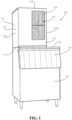
- FIG. 1 is a front perspective view of an ice machine 100 in accordance with one aspect of the present disclosure.
- the ice machine 100 comprises an ice maker 110 and a storage bin 190.
- the ice maker 110 is configured to produce ice which is fed by gravity downwards into the storage bin 190.
- the storage bin 190 can be insulated to maintain cold temperatures within the bit storage compartment to prevent the ice from melting.
- the storage bin 190 can be refrigerated, and in other aspects, the storage bin 190 can be unrefrigerated.
- the storage bin 190 can define an interior cavity formed by interior walls thereof.
- the ice maker 110 can comprise an outer casing 120, which can be configured to enclose the ice maker 110 and its internal components.
- the outer casing can comprise a front panel assembly 122.
- the front panel assembly 122 can extend from a top maker end 112 to a bottom maker end 114 of the ice maker 110, and from a left maker side 116a to a right maker side 116b of the ice maker 110.
- the front panel assembly 122 can define an air inlet opening 180 and can comprise an air filter 124.
- the air inlet opening 180 and the air filter 124 can be configured to provide ventilation for the ice maker 110 in the form of clean air from outside the ice maker 110.
- the storage bin 190 can define a top bin end 192, on which the bottom maker end 114 of the ice maker 110 can be mounted.
- the storage bin 190 can comprise a bin door 194 located proximate to the top bin end 192, and the bin door 194 can provide access to a bin storage compartment (not shown) defined within the storage bin 190.
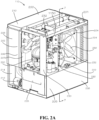
- FIG 2A is a front perspective view of the ice maker 110 of Figure 1 with the outer casing 120 (shown in Figure 1 ) removed.
- the ice maker 110 can be an air-cooled model, which can be cooled by circulating air through the outer casing 120, such as through the air inlet opening 180 (shown in Figure 1 ).
- the ice maker 110 can be a water-cooled model or can coupled to a remote condensing unit for cooling.
- the ice maker 110 can comprise a fan assembly 280, which can be configured to circulate air through the ice maker 110.
- the ice maker 110 and a body 200 thereof can be compartmentalized into a wet compartment 202 and a dry compartment 204 and can further comprise a frame 201 and a base case 205.
- the wet compartment 202 can be primarily defined by an evaporator case 206, which can be insulated.
- the evaporator case 206 can enclose the majority of the components of a water circuit 450 (shown in Figure 3 ) of the ice maker 110, which can be configured to form ice from liquid water delivered to and circulating through the ice maker 110.
- An evaporator compartment 306 (shown in Figure 2B ) of the evaporator casing 206 can be insulated.
- the evaporator case 206 can comprise a removable front insulation 208 and a removable top insulation 210, for example and without limitation, which can partially enclose and insulate the evaporator compartment 306. Either of the front insulation 208 or the top insulation 210 can be a panel or an insulation panel. Additionally, a tank 214 and evaporator walls 207a,b (207a shown in Figure 2B ) of the evaporator case 206 can be insulated.
- the water circuit 450 can comprise a water pump 212, which can be mounted on or adjacent to the tank 214 in a location external to the evaporator compartment 306. A portion of the tank 214 enclosing the water pump 212 can be uninsulated. The tank 214 can be positioned beneath the evaporator walls 207a,b. The water pump 212 can be configured to pump water from the tank 214 upwards into the evaporation compartment where the water can be formed into ice.
- a refrigeration circuit 400 (shown in Figure 3 ) of the ice maker 110 can be enclosed, including a compressor 220, a drier 222, and a condenser 224, for example and without limitation.
- the compressor 220 can be mounted to a compressor base 226, which can comprise a horizontal compressor base panel to which the compressor can be more directly mounted.
- the compressor base 226 can comprise a base case cover 228.
- refrigerant flowing through the refrigeration circuit 400 can be compressed by the compressor 220 and then cooled into a liquid state in the condenser 224 before being fed through an expansion device 240 (shown in Figure 3 ), such as a thermostatic expansion valve , before being fed into an evaporator 310 housed inside the evaporator compartment 306.
- a control box 230 of the ice maker 110 which can comprise a main controller 232 and a bin controller 1130, can be housed within the dry compartment 204. Either of the main controller 232 and the bin controller 1130 can comprise a control board as shown.
- An ultrasonic bin sensor 290 can be installed from within the dry compartment 204 and can extend through the compressor base 226.
- the ultrasonic bin sensor 290 can be or comprise a sensor bearing model number TK0143-000 and available from Audiowell Electronics(Guangdong)Co., Ltd. of Guandong, China.
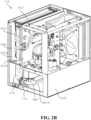
- Figure 2B is a front perspective view of the ice maker 110 of Figure 2 with the front insulation 208 and top insulation 210 of the evaporator case 206 and the base case cover 228 of the compressor base 226 further removed. With the front insulation 208 and the top insulation 210 removed, the evaporator compartment 306 can be exposed. The evaporator 310 and a spray tube 312 can be enclosed within the evaporator compartment 306 between the evaporator walls 207a,b.
- the refrigeration circuit 400 can comprise the evaporator 310, and the liquid refrigerant can evaporate to a gaseous phase within the evaporator 310, thereby cooling the evaporator compartment 306 below the freezing temperature of water.
- Liquid water can be pumped by the water pump 212 up to the spray tube 312, where the liquid water can be sprayed towards the evaporator 310 to form ice.
- a suction hose 560 can connect the water pump 212 to the tank 214 to provide a source of water from which to produce the ice.
- the body 200 and specifically at least the base case 205 can define a bottom opening 3814 at the bottom maker end 114 of the ice maker 110.
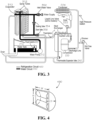
- FIG 3 is a circuit diagram showing the interaction and interconnections between each of various components of the refrigeration circuit 400 and each of various components of the water circuit 450 of the ice maker 110 of Figure 1 .
- the water circuit 450 can further comprise an inlet water valve 352, a cleaning valve 354, and a drain valve 356.
- Figure 4 shows a perspective view of the ice cube 490 in one exemplary aspect.
- the ice cube 490 can define a crescent shape, at least in part.
- the ice cube 490 can define a non-crescent shape.
- the ice cube 490 can define a height H, a width W, and a depth D.
- the height H can measure approximately 1.5 inches (approximately 38.1 millimeters)
- the width W can measure approximately 1.125 inches (approximately 28.6 mm)
- the depth D can measure approximately 0.5 inches (approximately 12.7 mm).
- the ice cube 490 can measure smaller or larger in any dimension and can have a variable shape such that the ice cubes 490 are not identical.
- the cube guide 550 (shown in Figure 7 ) can be configured to guide the ice cubes 490 coming out of the evaporator case 206 downwards under the force of gravity and out of the cube opening 552 (shown in Figure 7 ).
- the ice cubes 490 coming through the cube opening 552 can be ejected underneath the compressor base 226 (shown in Figure 2A ).
- the ice maker 110 (shown in Figure 1 ) can be positioned over the storage bin 190 (shown in Figure 1 ) so that an opening (not shown) of the storage bin 190 can be aligned underneath the compressor base 226.
- the ice cubes 490 falling from the cube opening 552 can fall out underneath the compressor base 226 and into the opening of the storage bin 190 to fill the storage bin 190.
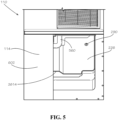
- FIG 5 is a bottom perspective view of the bottom maker end 114 of the ice maker 110 of Figure 1 .
- the tank base 602 and the base case 205 can together define the bottom maker end 114 and the bottom opening 3814.
- the bottom opening 3814 can be aligned with an opening (not shown) in the top bin end 192 (shown in Figure 1 ) of the storage bin 190 (shown in Figure 1 ).
- the ice cubes 490 produced by the ice maker 110 can fall through the bottom opening 3814 and into storage bin 190.
- the ultrasonic bin sensor 290 can extend through the compressor base 226 and be positioned above the bottom opening 3814.
- the ultrasonic bin sensor 290 can transmit ultrasonic waves downwards through the bottom opening 3814 and into the storage bin 190 in order to measure the level of the ice cubes 490 within the storage bin 190, as previously discussed.
- a level detector sometimes referred to as a bin control-positioned within the storage bin 190 to measure the level of the mound of ice cubes 490 within the storage bin 190.
- the level detector is typically a mechanical type, which can comprise an arm or paddle that is lifted by the rising level of the ice cubes 490, or a thermostatic type, which can comprise a bulb that thermally senses the physical presence of the ice cubes 490. Both the mechanical and the thermostatic types of level detectors or bin controls can be prone to malfunction, such as by accumulation of ice inside or around the level detector even when the storage bin 190 is not sufficiently full.
- the level detector can be exposed to intentional tampering or accidental damage from users opening the storage bin.
- the level detector of the mechanical or thermostatic type must generally be installed in the field and cannot generally be practically installed in the factory.
- the level detector can require an electrical switch to operate, and the storage bin is a cold and wet environment that can produce malfunctions within the electrical components.
- the level detector can require the use of exposed wiring inside the storage bin 190.
- the ultrasonic bin sensor 290 By positioning the ultrasonic bin sensor 290 within the ice maker 110 and above the bottom opening 3814, the ultrasonic bin sensor 290 can be concealed from sight of a user accessing the storage bin 190, thereby making it a less likely target for tampering or other damage. Additionally, the ultrasonic bin sensor 290 can be positioned above the bottom maker end 114 and out of the storage bin 190, which can protect the ultrasonic bin sensor 290 from accidental damage, such as an impact with an ice bucket or ice scoop by a user retrieving ice from the storage bin 190.
- the electronic connection of the ultrasonic bin sensor 290 can also be positioned within the dry compartment 204 (shown in Figure 2A ) of the ice maker 110, which can be both ventilated and protected from water and ice, thereby reducing the likelihood of electrical component failure.
- the ultrasonic bin sensor 290 is configured to monitor a level of a top end 601 of a mound 600 of the ice cubes 490 accumulated within the storage bin 190.
- the ultrasonic bin sensor 290 acts as a proximity sensor by transmitting ultrasonic waves downwards towards the ice and receiving the ultrasonic waves that reflect off the ice cubes 490.
- the distance 610 from a level position A defined by an outlet of the ultrasonic bin sensor 290 to a level position B defined by the level of the ice cubes 490 is determined from the travel times of the returning ultrasonic waves, which is referred to as the return signal or return signals and can measure as short as 6 milliseconds or less.
- the ultrasonic bin sensor 290 is in electronic communication with the control box 230 and specifically the main controller 232. Once the level of the ice cubes 490 in the storage bin 190 reaches a shut-off height, which can be a predetermined value as desired and set by a technician or a user of the ice maker 110 or even left as set at the factory, a signal from the ultrasonic bin sensor 290 is received by the main controller 232, and the main controller 232 ceases the ice making process, thereby stopping further production of the ice cubes 490. As the ice melts or ice is removed from the storage bin 190, the level can reach a refill height.
- the ultrasonic bin sensor 290 sends a signal to the main controller 232, and the main controller 232 resumes the ice making process to refill the storage bin 190 with the ice cubes 490.
- the refill height can be a predetermined value as desired and set by a technician or a user of the ice maker 110, or the refill height can be programmed into and controlled separately by the bin controller 1130 (shown in Figure 11 ), which can be positioned in the control box 230 or elsewhere.
- Figure 7 shows the relative position of the ultrasonic bin sensor 290 in the ice maker 110.
- the ultrasonic bin sensor 290 can be installed between an upper surface 2261 and a lower surface 2262 of the compressor base 226, which can be considered part of the base case 205.
- a lens 1430 (shown in Figure 16 ) of the ultrasonic bin sensor 290 can be offset by an offset distance 770 of 8 inches from the bottom maker end 114 of the ice maker 110, which will tend to maximize protection of the ultrasonic bin sensor 290 by not positioning it proximate to the storage bin 190 and anything else that might contact and even impact the bottom maker end 114 of the ice maker 110.
- the offset distance 770 can be zero or can be another distance.
- the ultrasonic bin sensor 290 or the bin controller 1130 can confuse water droplets and other substances on surfaces of the ice machine 100 as ice.
- the ultrasonic bin sensor 290 which can be a piezo ultrasonic sensor comprising a piezo element, can emit a high frequency signal.
- the signal emitted by the ultrasonic bin sensor can have a frequency of 60 KHz.
- the frequency can be above or below 60 KHz.
- the frequency can be at least 55 kHz.
- the frequency can be at least 60 kHz. In some aspects, the frequency can be between 55 and 80 kHz. In some aspects, the frequency can be greater than 80 kHz with the caveat that increasing the frequency can increase a variability in sensor performance.
- an echo sensitivity of the ultrasonic bin sensor can be 80 millivolts, and a capacitance can be 1650 picofarads.
- the signal emitted by the ultrasonic bin sensor 290 can define a viewing cone 710, which can have the shape of a three-dimensional cone, defining a viewing angle 720.
- the viewing cone 710 of the ultrasonic bin sensor 290 can also be the "directivity" of the ultrasonic bin sensor 290.
- the viewing cone 710 can originate at or proximate to a first end 1415 (shown in Figure 14 ) of the ultrasonic bin sensor 290, which can receive or comprise a lens 1430 (shown in Figure 14 ) of the ultrasonic bin sensor 290.
- the viewing angle 720 of the viewing cone 710 can be 80 degrees.
- the viewing angle 720 of the viewing cone 710 can be less than 80 degrees, although it can be advantageous for the viewing angle 720 to not be so small or narrow as to affect the ability of the ultrasonic bin sensor 290 to properly "see” the ice inside the storage bin 190.
- the viewing angle 720 of the viewing cone 710 can be higher than 80 degrees, although for reasons that will be described below it can be advantageous for the viewing angle 720 to not be so great that the viewing cone 710 will intersect with any portion of the ice maker 110 presenting a surface that can reflect a transmission signal of the ultrasonic bin sensor 290 back to the ultrasonic bin sensor 290.
- the viewing angle 720 can have an angular tolerance of between 5, 10, 15, or 20 degrees, wherein the viewing angle 720 can measure a predetermined or set viewing angle plus or minus the tolerance. In some aspects, the viewing angle 720 can have an angular tolerance of any other value.
- the position of the ultrasonic bin sensor 290 can cause geometry of the ice maker 110 or the storage bin 190 to fall within the viewing cone 710. For example and without limitation, an inner wall 750 of the compressor base 226 and the base case 205 or any other inner wall or wall of the ice maker 110 or the storage bin 190 can fall within the viewing cone 710.
- the ice cubes 490 will generally form the mound 600, which will define the top end 601, which can be the highest point of the mound 600.
- the viewing cone 710 of the ultrasonic bin sensor 290 can "see” ice that is not directly below the sensor and so can view even the top end 601 or close enough to the top end 601 to initiate a timely change in the ice production setting.
- the ultrasonic bin sensor 290 can be positioned in an opening (not shown) defined in the lower surface 2262 of the compressor base 226.
- Dimensions A, B, C, and D can more specifically define the position of the ultrasonic bin sensor 290 with respect to surrounding geometry of the ice maker 110 including the bottom opening 3814.
- the ultrasonic bin sensor can be positioned inside a shape formed by the bottom opening 3814 when viewed from the bottom maker end 114 of the ice maker 110.
- the dimensions C and D can measure between about 203 mm and about 254 mm (between about 8 and about 10 inches or approximately halfway front to back in the bottom opening 3814.
- the dimension C can measure 230 mm (9.1 inches) and the dimension D can measure 209 mm (8.2 inches).
- the dimension B can fall within a range of values and be positioned close to the inner wall 750, it can be advantageous for the dimension A to great enough that the viewing cone 710 does not intersect with any portion of the ice maker 110 presenting a surface that can reflect a transmission signal of the ultrasonic bin sensor 290 back to the ultrasonic bin sensor 290 (such as, for example and without limitation, the suction hose 560).
- the dimension A can measure 228 mm (9.0 inches).
- the ultrasonic bin sensor 290 can be positioned above the storage bin 190 without attaching the ultrasonic bin sensor 290 to the ice maker 110 using, for example and without limitation, a mounting surface of the storage bin 190 or another surrounding structure.
- any ultrasonic signal hitting the inner wall 750 can simply reflect off the inner wall 750 and continue downward into the storage bin 190 below and not reflect back towards the ultrasonic bin sensor 290.
- a surface of the inner wall 750 can be covered with a substance 990 able to reflect a return signal 960 back towards the ultrasonic bin sensor 290.
- a surface of the inner wall 750 can be covered at least partially with moisture.
- the moisture can be in the form of water droplets 990, which can form when, for example and without limitation, the ice cubes 490 fall into the storage bin 190 and cause water to splash up against a portion of the inner wall 750 within the viewing cone 710.
- inadequate cleaning can cause contamination to form on the inner wall 750 within the viewing cone 710.
- the surface of the inner wall 750 can be at least partially covered with "slime,” which can form over time in environments where, for example, bread is made and the yeast used in the bread-making process can cause bacteria growth manifesting itself in the form of a soft and/or sticky residue on the inner wall 750.
- the surface of the inner wall 750 can be at least partially covered with mold, which can form over time in the moist and dark environment that can typically be present inside the storage bin 190.
- the surface of the inner wall 750 can be at least partially covered with scale, which can form from minerals in "hard” water found in some installation environments manifesting itself in the form of a harder residue on the inner wall 750.
- a vertical or horizontal surface or edge of a wall of the storage bin 190 can fall within the viewing cone 710, including where a footprint of the ice maker 110 is either larger than or offset towards the outside from the top bin end 192 (shown in Figure 1 ) of the storage bin 190.
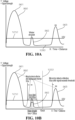
- the return signal 960 can be shown graphically by its strength (e.g., as measured in voltage) with respect to a time from which a transmission signal is sent (e.g., as measured in seconds). Such a time measurement can and generally will correspond to a physical distance from the ultrasonic bin sensor 290 to the source of a particular component of the return signal 960, i.e., the object "seen” by the ultrasonic bin sensor 290 and reflected in that particular component of the return signal 960.
- a peak 961 of the return signal 960 which as shown can be nearest to the ultrasonic bin sensor 290, can simply be a transmission signal created by the ultrasonic bin sensor 290 (i.e., the original ultrasonic "pulse") that the ultrasonic bin sensor 290 detects as an element of the return signal 960.
- a peak 963 of the return signal 960 can be formed by a portion of the ultrasonic pulse that reflects off the ice cubes 490 forming the mound 600 inside the storage bin 190. Between the peaks 961 and 963, another peak can form such as the peak 962 caused by the presence of the substance 990 on the inner wall 750.
- the transmission signal as it leaves the ultrasonic bin sensor 290 can measure, for example and without limitation, approximately 2.5V.
- the return signal 960 and specifically the peak 963 reflecting of the ice cubes 490 forming the mound 600 can measure approximately 1.0 V.
- the controller 1130 can use an analog comparator that compares a measured voltage to a threshold voltage value 1010 (shown in Figure 10A ).
- the water droplets 990 can cause the ice maker 110 to operate differently depending on how the ultrasonic bin sensor 290 is controlled-and in particular how the return signal 960 is processed.
- the peak 962 in the return signal 960 can represent the presence of scale or "slime" and not just the water droplets on the inner wall 750.
- a return signal 960 can comprise each of the peak 962 and the peak 963, each exceeding the threshold voltage 1010 of 0.5 V set to filter out a trough 1090 representing signal "noise.” Because both of the peak 962 and the peak 963 exceed the threshold voltage 1010, however, both the peak 962 and the peak 963 can signal to the ice maker 110 that the ice has reached a height in the bin-or a corresponding distance 610 from the sensor to the top end 601 of the mound 600 of the ice cubes 490-exceeding that of a full storage bin 190 itself.
- a threshold voltage setting of the controller can be set at or about 50% of the return signal 960 at 30 inches from the ultrasonic bin sensor 290 or the maximum ice detection distance 610.
- a threshold voltage setting of the controller can fall within a range between 40% and 50% of a strength of the return signal 960 at such a distance 610. In other aspects, a threshold voltage setting of the controller can fall within a range between 50% and 60% of a strength of the return signal 960 at such a distance 610. In other aspects, a threshold voltage setting of the controller can fall within a range between 30% and 60% of a strength of the return signal 960 at such a distance 610.
- the ice maker 110 can be configured to distinguish between various components of the return signal 960 captured by the ultrasonic bin sensor 290.
- the return signal 960 once converted from an acoustic pulse into an electrical voltage, can effectively be filtered based on the distance of the object sensed and the strength of the signal.
- a 300 microsecond filter can be used, and outside a time range corresponding to the distance 610 measuring greater than 10 inches a 50 microsecond filter can be used.
- a distance threshold 1020 can define what filter or time delay is used.
- a portion of the return signal 960 formed by the measurement of an object distance (i.e., an X-axis dimension in the chart on Figure 10B ) to objects closer than the distance threshold 1020 can be filtered using a first filter, and a portion of the return signal 960 formed by the measurement of objects further than the distance threshold 1020 can be filtered using a second filter.
- the 50 microsecond filter can be used especially to avoid electrical noise from any source in or around the ice machine 100.
- the filter can be reduced to any value approaching 200 microseconds or even below (e.g., 175 microseconds, 200 microseconds, 225 microseconds, 250 microseconds, or 275 microseconds) with simply an increased risk of noise as the filter is reduced.
- ranges of values above or below 300 microseconds including ranges bounded by the aforementioned filter values (e.g., in a range of 250 to 300 microseconds) can be used.
- a user's hand, if caught within the viewing cone 710, similar to ice will generally exceed the threshold voltage 1010 for greater than 300 microseconds.
- Setting the filter at 300 microseconds in the first 10 inches (254 millimeters) from the ultrasonic bin sensor 290 can reduce the risk of false alarms, such as resulting from the ultrasonic bin sensor 290 sensing a full bin when it is actually sensing a larger amount of the substance 990 than usual on the inner wall 750.
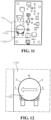
- the resulting electrical noise in the return signal can similarly be filtered out by adjusting parameters of the ultrasonic bin sensor 290 or a controller 1130 (shown in Figure 11 ) described herein, both of which can together form a bin control system.
- the controller 1130 via the ultrasonic bin sensor 290 then "sees" the object as ice and then send a corresponding signal to the ice maker via the main controller 232 to turn an ice production setting of the ice machine to ON or OFF based on how the board is programmed and based on the selected control board setting 1-5.
- the controller 1130 can be configured to use or process only one return signal 960.
- the controller 1130 can be configured to use a minimum number of two or more return signals 960 or a single signal with the multiple peaks 961,962,963 as described herein.
- the ultrasonic bin sensor 290 in electrical communication with the controller 1130, can be configured to emit a specific number of acoustic pulses in a given time period.
- the acoustic pulses can be sent by the ultrasonic bin sensor 290 every 200 milliseconds. In some aspects, the acoustic pulses can be sent more or less frequently.
- the ultrasonic bin sensor 290 can emit 5 pulses in the chosen interval-200 milliseconds here. In other aspects, the ultrasonic bin sensor 290 can emit a greater number of pulses, but increasing the number of pulses to certain levels (to 16 pulses, for example) can under certain conditions impact the ability of the controller 1130 to filter out noise and the aforementioned transmission signal.
- the ice maker 110 can effectively distinguish between an acoustic "signature” created by the mound 600 of the ice cubes 490 inside the storage bin 190 and an acoustic "signature” created by any substance 990 on the inner wall 750-or any material elsewhere on the ice machine 100 having a similar effect.
- the peak 962 resulting from detection of the substance 990 will generally be too weak or too short in duration (or both) to appear as a mound of ice.
- the peak 963 resulting from detection of the mound 600 will generally be strong enough to appear as ice, thereby causing the controller 1130 and the main controller 232 of the ice maker 110 to halt ice production once the mound 600 reaches the desired level.
- the shut-off height which can correspond to the level position B (shown in Figure 6 ), can be adjusted to any one of a number of bin control settings by means of an adjustor 1140, which can comprise a dial fit over or incorporated into a potentiometer mounted to the controller 1130.
- the controller 1130 can be a separate bin control board as shown.
- the controller 1130 can be incorporated into the main controller 232.
- the adjustor 1140 can be positioned in any one of five different bin control settings, which can be labeled 1, 2, 3, 4, and 5 as shown. In other aspects, the adjustor 1140 can have less than or more than five bin control settings.
- some users may install an ice dispenser unit (not shown) under the ice maker 110.
- the ice dispenser while configured for more automated dispensing of ice-by pressing a lever instead of manually removing ice with a scoop-can otherwise be considered another example of the storage bin 190.
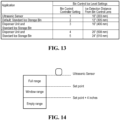
- the controller 1130 can be configured to recognize three signal ranges: full, window, and empty.
- the setting or set point (i.e., 1, 2, 3, 4, or 5) of the adjustor 1140 of the controller 1130 can correspond to a beginning of the "full” range, also corresponding to the ice detection distance 610.
- the "empty” range can begin 4 inches before the set point-or at any other offset distance from the set point as a user may desire.
- the "window” range can be the range between the "full” and "empty” ranges where, to prevent short cycling of the ice maker 110, the controller 1130 does not change the state of the bin control.
- the controller 1130 can be configured to change the bin control state to "full” after the return signal 960 stays in the "full” range for two seconds.
- the controller 1130 can change the bin control state to "empty” if the signal stays in the "empty” range for 30 seconds. Again, in the "window” range the controller 1130 can be configured to not change the bin control state.
- Figure 15 shows test data representative of a return signal from the ultrasonic bin sensor 290 with water droplets 990 (shown in Figure 9 ) on the inner wall 750 (shown in Figure 7 ) and no ice cubes 490 in the storage bin 190 or its equivalent.
- the mark X shows the transmission signal from the ultrasonic bin sensor, which can correspond to the peak 961 of the return signal 960, and the next largest peak, which can correspond to the peak 962, represents the presence of the water droplets 990.
- Figures 16 and 17 show the structure of an exemplary ultrasonic bin sensor 290, which can comprise a body 1410 secured by a single fastener (not shown) through a hole 1490 defined in a mounting flange 1420.
- the body 1410 can define an axis 1411, the first end 1415, and a second end 1416 distal from the first end 1415.
- a diameter 1470 of the body 1410 can be sized to fit within the opening defined in the compressor base 226 (shown in Figure 7 ).
- a connector 1450 can connect the ultrasonic bin sensor 290 to the controller 1130 (shown in Figure 11 ) for transmission of the original ultrasonic pulse and the return signal 960 through a lead wire 1460.
- Figure 18 shows a flowchart for operation of the ultrasonic bin sensor 290.
- a method of detecting an ice level inside a storage bin 190 can comprise the steps 1801-1828. Introductory steps 1801 and 1802 can occur before operation of the ultrasonic bin sensor 290 begins.
- a step 1801 can comprise a user (or the factory) adjusting or setting a bin control setting (from bin control settings 1 to 5, for example) to set a target ice level.
- a step 1802 can comprise turning the ice machine or ice maker 110 power ON.
- Subsequent steps 1811-1816 can commence with operation of the ultrasonic bin sensor 290.
- a step 1811 can comprise the bin controller 1130 sending a voltage signal or signals to the ultrasonic bin sensor 290 at predetermined time intervals (e.g., every 200 milliseconds).
- a step 1812 can comprise the ultrasonic bin sensor 290 producing and emitting acoustic pulses with the voltage supplied by the bin controller 1130.
- a step 1813 can comprise the transmission signal travelling from the ultrasonic bin sensor 290 to the ice mound 600 in the storage bin 190 and surrounding areas falling within the viewing cone 710.
- a step 1814 can comprise the bin controller determining if the transmission signal is formed as suspected, i.e., whether the ultrasonic sensor is forming a proper transmission signal or even forming a transmission signal at all.
- a step 1815 can commence. If the transmission signal is not as expected or is not detected at all, a step 1816 can commence in which the bin controller 1130 can signal to the bin controller-or the bin controller 1130 can simply detect by the shape or absence of the transmission signal-and the bin controller 1310 can signals to the main controller to stop ice production and then return to the step 1811.
- the step 1815 can comprise the transmission signal reflecting off ice such as in the form of the ice mound 600 and any surrounding structures and/or materials on those structures.
- Steps 1821-1828 can commence after reflection of the transmission signal.
- a step 1821 can comprise the return signal 960 travelling back to the ultrasonic bin sensor 290.
- a step 1822 can comprise the ultrasonic sensor 290 receiving the return signal 960.
- a step 1823 can comprise the bin controller 1130 processing the return signal 960 by, for example, filtering out the noise peaks 962 and identifying a measured distance to the "ice" peaks 963 that remain.
- a step 1824 can comprise the bin controller 1130 comparing the measured distance to the target ice level or ice detection distance 610 for a full storage bin 190 (or a bin at the desired ice level, which could be more or less than "full").
- a step 1825 if the measured distance is less than or equal to the target ice level or ice detection distance 610 (i.e., the bin has reached the "full" level position), the bin controller 1130 can send a signal to the main controller 232 to stop ice production and then loop back to the step 1811. If the measured distance is not less than or equal to the target ice level or ice detection distance 610, a subsequent step 1827 can comprise the bin controller 1130 determining whether the measured distance if greater than the target ice level plus 4 inches. If the answer is YES, the bin controller 1130 can signal to the main controller 232 to restart ice production and then loop back to the step 1811.
- the systems and methods disclosed herein are particularly adjusted for use with ice-makers configured to produce ice in the form of the discrete ice cubes 490-i.e., "cuber” type ice machines, but can be adjusted for use with other forms of use including, for example and without limitation, finely cut flaked ice, roughly cut “cubelet” flaked ice, iced formed inside trays or molds, and other forms of ice.
- the ice machine comprises: an ice maker comprising: an ultrasonic bin sensor mounted to a body; and a controller in electrical communication with the ultrasonic bin sensor and configured to control the ultrasonic bin sensor; and a storage bin coupled to the ice maker and sized to receive ice, a lens of the ultrasonic bin sensor facing a bottom of an interior cavity of the storage bin, the controller configured to process a return signal of the ultrasonic bin sensor to control a level of the ice stored inside the storage bin, the controller further configured to apply a predetermined time delay to filter out a portion of the return signal that exceeds a threshold voltage but does not exceed the time delay.
- the ultrasonic bin sensor can be offset from a bottom maker end of the ice maker.
- the ultrasonic bin sensor when viewed from the bottom maker end of the ice maker through a bottom opening defined by the bottom maker end, can be positioned inside a shape formed by the bottom opening.
- the time delay is in a range of 200 to 350 milliseconds.
- a signal emitted by the ultrasonic bin sensor can define a viewing cone defining a viewing angle of 75 to 85 degrees.
- the controller can define a plurality of bin control settings, the plurality of bin control settings configured to regulate an ice detection distance measured from the lens of the ultrasonic bin sensor to a level position defined by a target level of ice in the storage bin.
- the ice machine can produce ice cubes measuring at least about one half inch in each direction.
- a bin control system for an ice machine comprises: an ultrasonic bin sensor comprising a body defining a first end and a second end distal from the first end, the first end comprising a lens; and a controller in electrical communication with the ultrasonic bin sensor and configured to control the ultrasonic bin sensor, the controller configured to process a return signal of the ultrasonic bin sensor to control a level of ice stored inside a storage bin, the controller configured to apply a predetermined time delay to filter out a portion of the return signal that exceeds a threshold voltage but does not exceed the time delay.
- the ultrasonic bin sensor can comprise a mounting flange defining the second end of the body, the mounting flange angled with respect to an axis of the body.
- the controller can define a plurality of bin control settings, the plurality of bin control settings configured to regulate an ice detection distance measured from the lens of the ultrasonic bin sensor to a level position defined by a desired level of ice in the storage bin.
- the controller can comprise a potentiometer configured to move the controller from a first bin control setting of the plurality of bin control settings to a second bin control setting of the plurality of bin control settings.
- a signal emitted by the ultrasonic bin sensor can define a viewing cone defining a viewing angle of 80 degrees, plus or minus 5 degrees.
- a threshold voltage setting of the controller can fall within a range between 30% and 60% of a strength of the return signal at a distance of 30 inches.
- the predetermined time delay can measure in a range of 200 to 350 milliseconds.
- the time delay can a first time delay, the first time delay can be 300 milliseconds and a second time delay can be 50 milliseconds.
- a method of using an ice machine comprises: transmitting an acoustic pulse from an ultrasonic bin sensor of an ice maker of the ice machine into a storage bin of the ice machine, the ultrasonic bin sensor mounted to a body of the ice maker, the acoustic pulse initiated by the ultrasonic bin sensor in electrical communication with a controller; receiving a return signal resulting from a reflection of the acoustic pulse off surfaces of materials present inside an interior cavity of the ice machine within range of the ultrasonic bin sensor; converting the return signal from an acoustic signal into an electrical signal; changing an ice production setting of the ice machine based on the electrical signal; filtering out a portion of the return signal that exceeds a threshold voltage but does not exceed a predetermined time delay; and switching off production of the ice maker of the ice machine when a portion of the return signal does exceed a threshold voltage and does exceed the predetermined time delay.
- the time delay can be in a range of 275 to 325 milliseconds.
- filtering out the portion of the return signal that exceeds a threshold voltage but does not exceed a predetermined time delay can comprise: filtering out with a first time delay a portion of the return signal reflecting a first object distance, the first object distance being closer than a distance threshold; and filtering out with a second time delay a portion of the return signal reflecting a second object distance, the second object distance being further than the distance threshold.
- the first time delay can be 300 milliseconds and the second time delay can be 50 milliseconds.
- the method can further comprise moving from a first bin control setting to a second bin control setting by adjusting the controller.
Landscapes
- Engineering & Computer Science (AREA)
- Physics & Mathematics (AREA)
- Radar, Positioning & Navigation (AREA)
- Remote Sensing (AREA)
- Thermal Sciences (AREA)
- General Physics & Mathematics (AREA)
- Acoustics & Sound (AREA)
- Mechanical Engineering (AREA)
- General Engineering & Computer Science (AREA)
- Computer Networks & Wireless Communication (AREA)
- Electromagnetism (AREA)
- Fluid Mechanics (AREA)
- Chemical & Material Sciences (AREA)
- Combustion & Propulsion (AREA)
- Production, Working, Storing, Or Distribution Of Ice (AREA)
- Measurement Of Levels Of Liquids Or Fluent Solid Materials (AREA)
Claims (14)
- Eismaschine (100), umfassend:
einem Eisbereiter (110), umfassend:einen Ultraschall-Behältersensor (290), der an einem Gehäuse (200) montiert ist; undeine Steuerung (232), die in elektrischer Verbindung mit dem Ultraschall-Behältersensor (290) steht und zur Steuerung des Ultraschall-Behältersensors (290) konfiguriert ist; undeinen Vorratsbehälter (190), der mit der Eismaschine (110) gekoppelt und für die Aufnahme von Eis ausgelegt ist, wobei eine Linse (1430) des Ultraschall-Behältersensors (290) auf einen Boden eines inneren Hohlraums des Vorratsbehälters (190) gerichtet ist, wobei die Steuerung (232) so konfiguriert ist, dass sie ein Rücksignal des Ultraschall-Behälter-sensors (290) verarbeitet, um einen Füllstand des in dem Vorratsbehälter (190) gelagerten Eises zu steuern, dadurch gekennzeichnet, dass die Steuerung (232) ferner so konfiguriert ist, dass sie eine vorgegebene Zeitverzögerung anwendet, um einen Teil des Rücksignals herauszufiltern, der eine Schwellenspannung überschreitet, aber die Zeitverzögerung nicht überschreitet. - Eismaschine nach Anspruch 1, wobei der Ultraschall-Behältersensor (290) von einem bodenseitigen Ende des Eisbereiters (110) versetzt ist.
- Eismaschine nach Anspruch 1, wobei die vorgegebene Zeitverzögerung in einem Bereich von 200 bis 300 Mikrosekunden liegt.
- Eismaschine nach Anspruch 1, wobei ein von dem Ultraschall-Behältersensor (290) ausgesendetes Signal einen Betrachtungskegel definiert, der einen Betrachtungswinkel von 75 bis 85 Grad definiert.
- Eismaschine nach Anspruch 1, wobei die Steuerung eine Vielzahl von Behältersteuerungseinstellungen definiert, wobei die Vielzahl von Behältersteuerungseinstellungen konfiguriert sind, um einen von der Linse (1430) des Ultraschall-Behältersensors (290) zu einer durch einen Zieleispegel in dem Vorratsbehälter (190) definierten Pegelposition gemessenen Eiserkennungsabstand zu regulieren.
- Behältersteuerungssystem für eine Eismaschine (100) nach einem der Ansprüche 1 bis 4, wobei das System umfasst:einen Ultraschall-Behältersensor (290) mit einem Gehäuse (200), der ein erstes Ende und ein zweites Ende distal von dem ersten Ende definiert, wobei das erste Ende eine Linse (1430) aufweist; undeine Steuerung (232), die in elektrischer Kommunikation mit dem Ultraschall-Behältersensor (290) steht und konfiguriert ist, um den Ultraschall-Behältersensor (290) zu steuern, wobei die Steuerung (232) so konfiguriert ist, dass sie ein Rücksignal des Ultraschall-Behältersensors (290) verarbeitet, um einen Pegel von in einem Vorratsbehälter (190) gelagertem Eis zu steuern, und wobei die Steuerung (232) so konfiguriert ist, dass sie eine vorbestimmte Zeitverzögerung anwendet, um einen Teil des Rücksignals herauszufiltern, der eine Schwellenspannung überschreitet, nicht aber die Zeitverzögerung überschreitet.
- System nach Anspruch 6, wobei die Steuerung eine Vielzahl von Behältersteuerungseinstellungen definiert, wobei die Vielzahl von Behältersteuerungseinstellungen konfiguriert ist, um einen von der Linse (1430) des Ultraschall-Behältersensors (290) zu einer durch einen gewünschten Eisgehalt in dem Vorratsbehälter (190) definierten Pegelposition gemessenen Eiserkennungsabstand zu regulieren.
- System nach Anspruch 6, wobei ein von dem Ultraschall-Behältersensor (290) ausgesendetes Signal einen Betrachtungskegel definiert, der einen Betrachtungswinkel von 80 Grad plus oder minus 5 Grad definiert.
- System nach Anspruch 6, wobei eine Schwellenspannungseinstellung der Steuerung (232) in einen Bereich zwischen 30 % und 60 % einer Stärke des Rücksignals in einem Abstand von 30 Zoll fällt.
- System nach Anspruch 6, wobei die vorgegebene Zeitverzögerung in einem Bereich von 200 bis 300 Mikrosekunden misst.
- Verfahren zur Verwendung einer Eismaschine (100) nach einem der Ansprüche 1 bis 4, wobei das Verfahren umfasst:Übertragen eines akustischen Impulses von einem Ultraschall-Behältersensor (290) eines Eisbereiters (110) der Eismaschine (100) in einen Vorratsbehälter (190) der Eismaschine (100), wobei der Ultraschallbehältersensors (190) an einem Gehäuse (200) des Eisbereiters (110) montiert ist, wobei der akustische Impuls durch den Ultraschall-Behältersensor (290) in elektrischer Kommunikation mit einer Steuerung (232) ausgelöst wird;Empfangen eines Rücksignals, das sich aus einer Reflexion des akustischen Impulses an Oberflächen von sich in einem inneren Hohlraum der Eismaschine (100) innerhalb der Reichweite des Ultraschallbehältersensors (290) befindenden Materialien ergibt;Umwandlung des Rücksignals von einem akustischen Signal in ein elektrisches Signal;Ändern einer Eisproduktionseinstellung der Eismaschine (100) basierend auf dem elektrischen Signal;Herausfiltern eines Teils des Rücksignals, der eine Schwellenspannung überschreitet, nicht aber eine vorgegebene Zeitverzögerung überschreitet; undAbschalten der Produktion des Eisbereiters (110) der Eismaschine (100), wenn ein Teil des Rücksignals eine Schwellenspannung überschreitet und die voreingestellte Zeitverzögerung überschreitet.
- Verfahren nach Anspruch 11, wobei die vorgegebene Zeitverzögerung in einem Bereich von 200 bis 300 Mikrosekunden liegt.
- Verfahren nach Anspruch 12, wobei das Herausfiltern eines Teils des Rücksignals, der eine Schwellenspannung überschreitet, nicht aber eine vorgegebene Zeitverzögerung überschreitet, umfasst:Herausfiltern eines Teils des Rücksignals, der eine erste Objektentfernung widerspiegelt, mit einer ersten Zeitverzögerung, wobei die Entfernung des ersten Objekts näher als eine Entfernungsschwelle ist; undHerausfiltern eines Teils des Rücksignals, der eine zweite Objektentfernung widerspiegelt, mit einer zweiten Zeitverzögerung, wobei die zweite Objektentfernung weiter als die Entfernungsschwelle ist.
- Verfahren nach Anspruch 13, wobei die erste Zeitverzögerung 300 Mikrosekunden und die zweite Zeitverzögerung 50 Mikrosekunden beträgt.
Applications Claiming Priority (4)
| Application Number | Priority Date | Filing Date | Title |
|---|---|---|---|
| US201862714412P | 2018-08-03 | 2018-08-03 | |
| US201862714414P | 2018-08-03 | 2018-08-03 | |
| US16/529,055 US11506438B2 (en) | 2018-08-03 | 2019-08-01 | Ice machine |
| US16/529,047 US11255588B2 (en) | 2018-08-03 | 2019-08-01 | Ultrasonic bin control in an ice machine |
Publications (2)
| Publication Number | Publication Date |
|---|---|
| EP3604985A1 EP3604985A1 (de) | 2020-02-05 |
| EP3604985B1 true EP3604985B1 (de) | 2024-08-28 |
Family
ID=67544075
Family Applications (2)
| Application Number | Title | Priority Date | Filing Date |
|---|---|---|---|
| EP19189917.8A Active EP3604985B1 (de) | 2018-08-03 | 2019-08-02 | Ultraschallbehältersteuerung in einer eismaschine, überwachungsvorrichtung für behälter einer eismaschine und verfahren zum verwenden einer eismaschine |
| EP19189919.4A Active EP3604984B1 (de) | 2018-08-03 | 2019-08-02 | Eiserzeuger und verfahren zur herstellung eines eiserzeugers |
Family Applications After (1)
| Application Number | Title | Priority Date | Filing Date |
|---|---|---|---|
| EP19189919.4A Active EP3604984B1 (de) | 2018-08-03 | 2019-08-02 | Eiserzeuger und verfahren zur herstellung eines eiserzeugers |
Country Status (1)
| Country | Link |
|---|---|
| EP (2) | EP3604985B1 (de) |
Families Citing this family (3)
| Publication number | Priority date | Publication date | Assignee | Title |
|---|---|---|---|---|
| US11506438B2 (en) | 2018-08-03 | 2022-11-22 | Hoshizaki America, Inc. | Ice machine |
| CN115682538B (zh) * | 2021-07-28 | 2024-10-15 | 青岛海尔电冰箱有限公司 | 一种冰箱及其超声辅助处理装置的故障监测方法 |
| US20240191927A1 (en) * | 2022-12-13 | 2024-06-13 | Marmon Foodservice Technologies, Inc. | Ice dispensers |
Family Cites Families (7)
| Publication number | Priority date | Publication date | Assignee | Title |
|---|---|---|---|---|
| US3520581A (en) * | 1967-03-06 | 1970-07-14 | Giovanni Borghi | Cabinets for refrigerators and the like |
| US5172595A (en) * | 1990-06-12 | 1992-12-22 | Scotsman Group, Inc. | Bin level control circuit and transducer mounting system for an ice making machine |
| US5245841A (en) * | 1992-11-24 | 1993-09-21 | Scotsman Group, Inc. | Undercounter ice making machine |
| US5922030A (en) * | 1995-12-20 | 1999-07-13 | Nartron Corporation | Method and system for controlling a solid product release mechanism |
| KR101423332B1 (ko) * | 2007-10-23 | 2014-08-13 | 엘지전자 주식회사 | 냉장고용 제빙기의 구동 방법 |
| KR101541769B1 (ko) * | 2014-11-19 | 2015-08-05 | 대영이앤비 주식회사 | 제빙기 |
| AU2017363597B2 (en) * | 2016-11-23 | 2021-12-09 | True Manufacturing Co., Inc. | Sanitary evaporator assembly |
-
2019
- 2019-08-02 EP EP19189917.8A patent/EP3604985B1/de active Active
- 2019-08-02 EP EP19189919.4A patent/EP3604984B1/de active Active
Also Published As
| Publication number | Publication date |
|---|---|
| EP3604984A1 (de) | 2020-02-05 |
| EP3604985A1 (de) | 2020-02-05 |
| EP3604984B1 (de) | 2024-03-06 |
Similar Documents
| Publication | Publication Date | Title |
|---|---|---|
| US11906229B2 (en) | Ultrasonic bin control in an ice machine | |
| EP2304349B1 (de) | Eiserfassungsvorrichtung für einen eiserzeuger für einen kühlschrank und eiserfassungsverfahren dafür | |
| EP3604985B1 (de) | Ultraschallbehältersteuerung in einer eismaschine, überwachungsvorrichtung für behälter einer eismaschine und verfahren zum verwenden einer eismaschine | |
| EP1510767B1 (de) | Eiserzeugungsmaschine mit geringem Volumen | |
| EP2297532B1 (de) | Eisbereiter | |
| US8602744B2 (en) | Condensate pump | |
| US20080110186A1 (en) | Systems and Methods for Providing an Ice Storage Bin Control Sensor and Housing | |
| US20100218542A1 (en) | Ice maker control system and method | |
| US20080134709A1 (en) | Ice dispensing and detecting apparatus | |
| EP2304346B1 (de) | Kühlschrank und eiserzeuger dafür | |
| US20110214441A1 (en) | Select-fill dispensing system | |
| EP1078210A1 (de) | Photoelektrische überwachungsvorrichtung für eisbehälter | |
| CN102326042B (zh) | 冰箱及用于冰箱的冰位感测设备 | |
| US10401080B2 (en) | Refrigerator appliance with a dispenser | |
| US20110113799A1 (en) | Ice level sensing system | |
| MX2010012876A (es) | Metodo para detectar una cantidad de hielo de un aparato de deteccion de hielo de una maquia de hacer hielo para refrigerador. | |
| EP1729076B1 (de) | Verfahren zum vollständigen Einfrieren von Eis und Kühlschrank dafür | |
| CN110794881B (zh) | 制冰机中的超声波储箱控制 | |
| CN113494791A (zh) | 制冰机 | |
| KR101369706B1 (ko) | 얼음 조각 제조 및 분배 장치 | |
| WO2020108265A1 (zh) | 制冰装置及冰检测方法 | |
| US9395232B2 (en) | Detection of contamination status for refrigerator ultrasonic sensor assembly | |
| CN119146655B (zh) | 一种出冰称重装置及制冰机 | |
| HK40058687A (en) | Ice maker | |
| KR20090036725A (ko) | 냉장고용 디스펜서 구조 |
Legal Events
| Date | Code | Title | Description |
|---|---|---|---|
| PUAI | Public reference made under article 153(3) epc to a published international application that has entered the european phase |
Free format text: ORIGINAL CODE: 0009012 |
|
| STAA | Information on the status of an ep patent application or granted ep patent |
Free format text: STATUS: THE APPLICATION HAS BEEN PUBLISHED |
|
| AK | Designated contracting states |
Kind code of ref document: A1 Designated state(s): AL AT BE BG CH CY CZ DE DK EE ES FI FR GB GR HR HU IE IS IT LI LT LU LV MC MK MT NL NO PL PT RO RS SE SI SK SM TR |
|
| AX | Request for extension of the european patent |
Extension state: BA ME |
|
| STAA | Information on the status of an ep patent application or granted ep patent |
Free format text: STATUS: REQUEST FOR EXAMINATION WAS MADE |
|
| 17P | Request for examination filed |
Effective date: 20200706 |
|
| RBV | Designated contracting states (corrected) |
Designated state(s): AL AT BE BG CH CY CZ DE DK EE ES FI FR GB GR HR HU IE IS IT LI LT LU LV MC MK MT NL NO PL PT RO RS SE SI SK SM TR |
|
| STAA | Information on the status of an ep patent application or granted ep patent |
Free format text: STATUS: EXAMINATION IS IN PROGRESS |
|
| 17Q | First examination report despatched |
Effective date: 20210304 |
|
| RIC1 | Information provided on ipc code assigned before grant |
Ipc: G01S 15/08 20060101ALI20230823BHEP Ipc: G01F 23/296 20060101ALI20230823BHEP Ipc: G01S 15/88 20060101ALI20230823BHEP Ipc: F25D 23/06 20060101ALI20230823BHEP Ipc: F25C 1/12 20060101ALI20230823BHEP Ipc: F25C 5/187 20180101AFI20230823BHEP |
|
| GRAP | Despatch of communication of intention to grant a patent |
Free format text: ORIGINAL CODE: EPIDOSNIGR1 |
|
| STAA | Information on the status of an ep patent application or granted ep patent |
Free format text: STATUS: GRANT OF PATENT IS INTENDED |
|
| INTG | Intention to grant announced |
Effective date: 20231002 |
|
| GRAJ | Information related to disapproval of communication of intention to grant by the applicant or resumption of examination proceedings by the epo deleted |
Free format text: ORIGINAL CODE: EPIDOSDIGR1 |
|
| STAA | Information on the status of an ep patent application or granted ep patent |
Free format text: STATUS: EXAMINATION IS IN PROGRESS |
|
| INTC | Intention to grant announced (deleted) | ||
| GRAP | Despatch of communication of intention to grant a patent |
Free format text: ORIGINAL CODE: EPIDOSNIGR1 |
|
| STAA | Information on the status of an ep patent application or granted ep patent |
Free format text: STATUS: GRANT OF PATENT IS INTENDED |
|
| INTG | Intention to grant announced |
Effective date: 20240318 |
|
| GRAS | Grant fee paid |
Free format text: ORIGINAL CODE: EPIDOSNIGR3 |
|
| GRAA | (expected) grant |
Free format text: ORIGINAL CODE: 0009210 |
|
| STAA | Information on the status of an ep patent application or granted ep patent |
Free format text: STATUS: THE PATENT HAS BEEN GRANTED |
|
| AK | Designated contracting states |
Kind code of ref document: B1 Designated state(s): AL AT BE BG CH CY CZ DE DK EE ES FI FR GB GR HR HU IE IS IT LI LT LU LV MC MK MT NL NO PL PT RO RS SE SI SK SM TR |
|
| REG | Reference to a national code |
Ref country code: GB Ref legal event code: FG4D |
|
| REG | Reference to a national code |
Ref country code: CH Ref legal event code: EP |
|
| REG | Reference to a national code |
Ref country code: DE Ref legal event code: R096 Ref document number: 602019057770 Country of ref document: DE |
|
| REG | Reference to a national code |
Ref country code: IE Ref legal event code: FG4D |
|
| REG | Reference to a national code |
Ref country code: LT Ref legal event code: MG9D |
|
| PG25 | Lapsed in a contracting state [announced via postgrant information from national office to epo] |
Ref country code: NO Free format text: LAPSE BECAUSE OF FAILURE TO SUBMIT A TRANSLATION OF THE DESCRIPTION OR TO PAY THE FEE WITHIN THE PRESCRIBED TIME-LIMIT Effective date: 20241128 |
|
| REG | Reference to a national code |
Ref country code: AT Ref legal event code: MK05 Ref document number: 1718342 Country of ref document: AT Kind code of ref document: T Effective date: 20240828 |
|
| PG25 | Lapsed in a contracting state [announced via postgrant information from national office to epo] |
Ref country code: NL Free format text: LAPSE BECAUSE OF FAILURE TO SUBMIT A TRANSLATION OF THE DESCRIPTION OR TO PAY THE FEE WITHIN THE PRESCRIBED TIME-LIMIT Effective date: 20240828 Ref country code: FI Free format text: LAPSE BECAUSE OF FAILURE TO SUBMIT A TRANSLATION OF THE DESCRIPTION OR TO PAY THE FEE WITHIN THE PRESCRIBED TIME-LIMIT Effective date: 20240828 Ref country code: GR Free format text: LAPSE BECAUSE OF FAILURE TO SUBMIT A TRANSLATION OF THE DESCRIPTION OR TO PAY THE FEE WITHIN THE PRESCRIBED TIME-LIMIT Effective date: 20241129 Ref country code: PT Free format text: LAPSE BECAUSE OF FAILURE TO SUBMIT A TRANSLATION OF THE DESCRIPTION OR TO PAY THE FEE WITHIN THE PRESCRIBED TIME-LIMIT Effective date: 20241230 Ref country code: PL Free format text: LAPSE BECAUSE OF FAILURE TO SUBMIT A TRANSLATION OF THE DESCRIPTION OR TO PAY THE FEE WITHIN THE PRESCRIBED TIME-LIMIT Effective date: 20240828 |
|
| PG25 | Lapsed in a contracting state [announced via postgrant information from national office to epo] |
Ref country code: BG Free format text: LAPSE BECAUSE OF FAILURE TO SUBMIT A TRANSLATION OF THE DESCRIPTION OR TO PAY THE FEE WITHIN THE PRESCRIBED TIME-LIMIT Effective date: 20240828 |
|
| PG25 | Lapsed in a contracting state [announced via postgrant information from national office to epo] |
Ref country code: LV Free format text: LAPSE BECAUSE OF FAILURE TO SUBMIT A TRANSLATION OF THE DESCRIPTION OR TO PAY THE FEE WITHIN THE PRESCRIBED TIME-LIMIT Effective date: 20240828 |
|
| REG | Reference to a national code |
Ref country code: NL Ref legal event code: MP Effective date: 20240828 |
|
| PG25 | Lapsed in a contracting state [announced via postgrant information from national office to epo] |
Ref country code: AT Free format text: LAPSE BECAUSE OF FAILURE TO SUBMIT A TRANSLATION OF THE DESCRIPTION OR TO PAY THE FEE WITHIN THE PRESCRIBED TIME-LIMIT Effective date: 20240828 Ref country code: IS Free format text: LAPSE BECAUSE OF FAILURE TO SUBMIT A TRANSLATION OF THE DESCRIPTION OR TO PAY THE FEE WITHIN THE PRESCRIBED TIME-LIMIT Effective date: 20241228 |
|
| PG25 | Lapsed in a contracting state [announced via postgrant information from national office to epo] |
Ref country code: HR Free format text: LAPSE BECAUSE OF FAILURE TO SUBMIT A TRANSLATION OF THE DESCRIPTION OR TO PAY THE FEE WITHIN THE PRESCRIBED TIME-LIMIT Effective date: 20240828 |
|
| PG25 | Lapsed in a contracting state [announced via postgrant information from national office to epo] |
Ref country code: RS Free format text: LAPSE BECAUSE OF FAILURE TO SUBMIT A TRANSLATION OF THE DESCRIPTION OR TO PAY THE FEE WITHIN THE PRESCRIBED TIME-LIMIT Effective date: 20241128 |
|
| PG25 | Lapsed in a contracting state [announced via postgrant information from national office to epo] |
Ref country code: RS Free format text: LAPSE BECAUSE OF FAILURE TO SUBMIT A TRANSLATION OF THE DESCRIPTION OR TO PAY THE FEE WITHIN THE PRESCRIBED TIME-LIMIT Effective date: 20241128 Ref country code: PT Free format text: LAPSE BECAUSE OF FAILURE TO SUBMIT A TRANSLATION OF THE DESCRIPTION OR TO PAY THE FEE WITHIN THE PRESCRIBED TIME-LIMIT Effective date: 20241230 Ref country code: PL Free format text: LAPSE BECAUSE OF FAILURE TO SUBMIT A TRANSLATION OF THE DESCRIPTION OR TO PAY THE FEE WITHIN THE PRESCRIBED TIME-LIMIT Effective date: 20240828 Ref country code: NO Free format text: LAPSE BECAUSE OF FAILURE TO SUBMIT A TRANSLATION OF THE DESCRIPTION OR TO PAY THE FEE WITHIN THE PRESCRIBED TIME-LIMIT Effective date: 20241128 Ref country code: NL Free format text: LAPSE BECAUSE OF FAILURE TO SUBMIT A TRANSLATION OF THE DESCRIPTION OR TO PAY THE FEE WITHIN THE PRESCRIBED TIME-LIMIT Effective date: 20240828 Ref country code: LV Free format text: LAPSE BECAUSE OF FAILURE TO SUBMIT A TRANSLATION OF THE DESCRIPTION OR TO PAY THE FEE WITHIN THE PRESCRIBED TIME-LIMIT Effective date: 20240828 Ref country code: IS Free format text: LAPSE BECAUSE OF FAILURE TO SUBMIT A TRANSLATION OF THE DESCRIPTION OR TO PAY THE FEE WITHIN THE PRESCRIBED TIME-LIMIT Effective date: 20241228 Ref country code: HR Free format text: LAPSE BECAUSE OF FAILURE TO SUBMIT A TRANSLATION OF THE DESCRIPTION OR TO PAY THE FEE WITHIN THE PRESCRIBED TIME-LIMIT Effective date: 20240828 Ref country code: GR Free format text: LAPSE BECAUSE OF FAILURE TO SUBMIT A TRANSLATION OF THE DESCRIPTION OR TO PAY THE FEE WITHIN THE PRESCRIBED TIME-LIMIT Effective date: 20241129 Ref country code: FI Free format text: LAPSE BECAUSE OF FAILURE TO SUBMIT A TRANSLATION OF THE DESCRIPTION OR TO PAY THE FEE WITHIN THE PRESCRIBED TIME-LIMIT Effective date: 20240828 Ref country code: BG Free format text: LAPSE BECAUSE OF FAILURE TO SUBMIT A TRANSLATION OF THE DESCRIPTION OR TO PAY THE FEE WITHIN THE PRESCRIBED TIME-LIMIT Effective date: 20240828 Ref country code: AT Free format text: LAPSE BECAUSE OF FAILURE TO SUBMIT A TRANSLATION OF THE DESCRIPTION OR TO PAY THE FEE WITHIN THE PRESCRIBED TIME-LIMIT Effective date: 20240828 |
|
| REG | Reference to a national code |
Ref country code: ES Ref legal event code: FG2A Ref document number: 3004014 Country of ref document: ES Kind code of ref document: T3 Effective date: 20250311 |
|
| PG25 | Lapsed in a contracting state [announced via postgrant information from national office to epo] |
Ref country code: SM Free format text: LAPSE BECAUSE OF FAILURE TO SUBMIT A TRANSLATION OF THE DESCRIPTION OR TO PAY THE FEE WITHIN THE PRESCRIBED TIME-LIMIT Effective date: 20240828 Ref country code: DK Free format text: LAPSE BECAUSE OF FAILURE TO SUBMIT A TRANSLATION OF THE DESCRIPTION OR TO PAY THE FEE WITHIN THE PRESCRIBED TIME-LIMIT Effective date: 20240828 Ref country code: RO Free format text: LAPSE BECAUSE OF FAILURE TO SUBMIT A TRANSLATION OF THE DESCRIPTION OR TO PAY THE FEE WITHIN THE PRESCRIBED TIME-LIMIT Effective date: 20240828 |
|
| PG25 | Lapsed in a contracting state [announced via postgrant information from national office to epo] |
Ref country code: EE Free format text: LAPSE BECAUSE OF FAILURE TO SUBMIT A TRANSLATION OF THE DESCRIPTION OR TO PAY THE FEE WITHIN THE PRESCRIBED TIME-LIMIT Effective date: 20240828 |
|
| PG25 | Lapsed in a contracting state [announced via postgrant information from national office to epo] |
Ref country code: CZ Free format text: LAPSE BECAUSE OF FAILURE TO SUBMIT A TRANSLATION OF THE DESCRIPTION OR TO PAY THE FEE WITHIN THE PRESCRIBED TIME-LIMIT Effective date: 20240828 |
|
| PG25 | Lapsed in a contracting state [announced via postgrant information from national office to epo] |
Ref country code: SK Free format text: LAPSE BECAUSE OF FAILURE TO SUBMIT A TRANSLATION OF THE DESCRIPTION OR TO PAY THE FEE WITHIN THE PRESCRIBED TIME-LIMIT Effective date: 20240828 |
|
| REG | Reference to a national code |
Ref country code: DE Ref legal event code: R097 Ref document number: 602019057770 Country of ref document: DE |
|
| PLBE | No opposition filed within time limit |
Free format text: ORIGINAL CODE: 0009261 |
|
| STAA | Information on the status of an ep patent application or granted ep patent |
Free format text: STATUS: NO OPPOSITION FILED WITHIN TIME LIMIT |
|
| 26N | No opposition filed |
Effective date: 20250530 |
|
| PG25 | Lapsed in a contracting state [announced via postgrant information from national office to epo] |
Ref country code: SE Free format text: LAPSE BECAUSE OF FAILURE TO SUBMIT A TRANSLATION OF THE DESCRIPTION OR TO PAY THE FEE WITHIN THE PRESCRIBED TIME-LIMIT Effective date: 20240828 |
|
| PGFP | Annual fee paid to national office [announced via postgrant information from national office to epo] |
Ref country code: ES Payment date: 20250901 Year of fee payment: 7 |
|
| PGFP | Annual fee paid to national office [announced via postgrant information from national office to epo] |
Ref country code: DE Payment date: 20250806 Year of fee payment: 7 |
|
| PGFP | Annual fee paid to national office [announced via postgrant information from national office to epo] |
Ref country code: IT Payment date: 20250730 Year of fee payment: 7 |
|
| PGFP | Annual fee paid to national office [announced via postgrant information from national office to epo] |
Ref country code: GB Payment date: 20250702 Year of fee payment: 7 |
|
| PGFP | Annual fee paid to national office [announced via postgrant information from national office to epo] |
Ref country code: FR Payment date: 20250827 Year of fee payment: 7 |