EP3604390A1 - Polymer having a structure of polyamide, polyamide-imide, or polyimide, photosensitive resin composition, patterning process, photosensitive dry film, and protective film for electric and electronic parts - Google Patents
Polymer having a structure of polyamide, polyamide-imide, or polyimide, photosensitive resin composition, patterning process, photosensitive dry film, and protective film for electric and electronic parts Download PDFInfo
- Publication number
- EP3604390A1 EP3604390A1 EP19188162.2A EP19188162A EP3604390A1 EP 3604390 A1 EP3604390 A1 EP 3604390A1 EP 19188162 A EP19188162 A EP 19188162A EP 3604390 A1 EP3604390 A1 EP 3604390A1
- Authority
- EP
- European Patent Office
- Prior art keywords
- general formula
- group
- photosensitive resin
- phr
- resin composition
- Prior art date
- Legal status (The legal status is an assumption and is not a legal conclusion. Google has not performed a legal analysis and makes no representation as to the accuracy of the status listed.)
- Pending
Links
- 239000011342 resin composition Substances 0.000 title claims abstract description 201
- 229920000642 polymer Polymers 0.000 title claims abstract description 123
- 229920001721 polyimide Polymers 0.000 title claims abstract description 78
- 239000004642 Polyimide Substances 0.000 title claims abstract description 59
- 239000004962 Polyamide-imide Substances 0.000 title claims abstract description 55
- 229920002312 polyamide-imide Polymers 0.000 title claims abstract description 55
- 239000004952 Polyamide Substances 0.000 title claims abstract description 33
- 229920002647 polyamide Polymers 0.000 title claims abstract description 33
- 238000000059 patterning Methods 0.000 title claims description 54
- 238000000034 method Methods 0.000 title claims description 41
- 230000001681 protective effect Effects 0.000 title claims description 35
- 230000008569 process Effects 0.000 title claims description 23
- 150000004985 diamines Chemical class 0.000 claims abstract description 105
- GTDPSWPPOUPBNX-UHFFFAOYSA-N ac1mqpva Chemical compound CC12C(=O)OC(=O)C1(C)C1(C)C2(C)C(=O)OC1=O GTDPSWPPOUPBNX-UHFFFAOYSA-N 0.000 claims abstract description 100
- 229920005989 resin Polymers 0.000 claims abstract description 94
- 239000011347 resin Substances 0.000 claims abstract description 94
- OFOBLEOULBTSOW-UHFFFAOYSA-N Malonic acid Chemical compound OC(=O)CC(O)=O OFOBLEOULBTSOW-UHFFFAOYSA-N 0.000 claims abstract description 50
- 125000006158 tetracarboxylic acid group Chemical group 0.000 claims abstract description 47
- 150000004820 halides Chemical class 0.000 claims abstract description 39
- 239000002243 precursor Substances 0.000 claims abstract description 26
- 239000012670 alkaline solution Substances 0.000 claims abstract description 24
- 229920002577 polybenzoxazole Polymers 0.000 claims abstract description 14
- 239000007795 chemical reaction product Substances 0.000 claims abstract description 7
- 239000003431 cross linking reagent Substances 0.000 claims description 122
- 239000003795 chemical substances by application Substances 0.000 claims description 70
- -1 phenol compound Chemical class 0.000 claims description 66
- 150000001875 compounds Chemical class 0.000 claims description 57
- 239000002904 solvent Substances 0.000 claims description 48
- WSFSSNUMVMOOMR-UHFFFAOYSA-N Formaldehyde Chemical group O=C WSFSSNUMVMOOMR-UHFFFAOYSA-N 0.000 claims description 44
- ISWSIDIOOBJBQZ-UHFFFAOYSA-N phenol group Chemical group C1(=CC=CC=C1)O ISWSIDIOOBJBQZ-UHFFFAOYSA-N 0.000 claims description 44
- 125000004432 carbon atom Chemical group C* 0.000 claims description 41
- 125000004435 hydrogen atom Chemical group [H]* 0.000 claims description 40
- 239000000758 substrate Substances 0.000 claims description 36
- 239000002253 acid Substances 0.000 claims description 33
- 238000011161 development Methods 0.000 claims description 31
- 125000003118 aryl group Chemical group 0.000 claims description 29
- 125000002723 alicyclic group Chemical group 0.000 claims description 27
- 125000006165 cyclic alkyl group Chemical group 0.000 claims description 26
- 125000000962 organic group Chemical group 0.000 claims description 26
- 125000002496 methyl group Chemical group [H]C([H])([H])* 0.000 claims description 22
- 239000000463 material Substances 0.000 claims description 21
- 125000001424 substituent group Chemical group 0.000 claims description 20
- 125000001495 ethyl group Chemical group [H]C([H])([H])C([H])([H])* 0.000 claims description 19
- 238000010438 heat treatment Methods 0.000 claims description 18
- 125000002887 hydroxy group Chemical group [H]O* 0.000 claims description 17
- 238000011417 postcuring Methods 0.000 claims description 16
- 125000004122 cyclic group Chemical group 0.000 claims description 15
- 125000003055 glycidyl group Chemical group C(C1CO1)* 0.000 claims description 13
- 125000000217 alkyl group Chemical group 0.000 claims description 9
- 238000004519 manufacturing process Methods 0.000 claims description 9
- 125000004849 alkoxymethyl group Chemical group 0.000 claims description 8
- LGRFSURHDFAFJT-UHFFFAOYSA-N phthalic anhydride Chemical group C1=CC=C2C(=O)OC(=O)C2=C1 LGRFSURHDFAFJT-UHFFFAOYSA-N 0.000 claims description 8
- WPYMKLBDIGXBTP-UHFFFAOYSA-N benzoic acid group Chemical group C(C1=CC=CC=C1)(=O)O WPYMKLBDIGXBTP-UHFFFAOYSA-N 0.000 claims description 7
- 238000001035 drying Methods 0.000 claims description 7
- 238000010894 electron beam technology Methods 0.000 claims description 7
- 125000005843 halogen group Chemical group 0.000 claims description 7
- 125000005647 linker group Chemical group 0.000 claims description 7
- 125000004433 nitrogen atom Chemical group N* 0.000 claims description 7
- 150000001991 dicarboxylic acids Chemical class 0.000 claims description 6
- 229910052731 fluorine Inorganic materials 0.000 claims description 5
- 125000005842 heteroatom Chemical group 0.000 claims description 5
- 125000002924 primary amino group Chemical group [H]N([H])* 0.000 claims description 5
- WTQZSMDDRMKJRI-UHFFFAOYSA-N 4-diazoniophenolate Chemical group [O-]C1=CC=C([N+]#N)C=C1 WTQZSMDDRMKJRI-UHFFFAOYSA-N 0.000 claims description 4
- 125000002947 alkylene group Chemical group 0.000 claims description 4
- 125000001153 fluoro group Chemical group F* 0.000 claims description 4
- 238000010030 laminating Methods 0.000 claims description 3
- 239000003960 organic solvent Substances 0.000 abstract description 18
- 239000010408 film Substances 0.000 description 133
- 230000015572 biosynthetic process Effects 0.000 description 80
- 238000003786 synthesis reaction Methods 0.000 description 79
- 238000006243 chemical reaction Methods 0.000 description 64
- LLHKCFNBLRBOGN-UHFFFAOYSA-N propylene glycol methyl ether acetate Chemical compound COCC(C)OC(C)=O LLHKCFNBLRBOGN-UHFFFAOYSA-N 0.000 description 49
- 239000000243 solution Substances 0.000 description 39
- 239000002585 base Substances 0.000 description 38
- 230000000052 comparative effect Effects 0.000 description 28
- 230000018109 developmental process Effects 0.000 description 27
- SECXISVLQFMRJM-UHFFFAOYSA-N N-Methylpyrrolidone Chemical compound CN1CCCC1=O SECXISVLQFMRJM-UHFFFAOYSA-N 0.000 description 26
- YEJRWHAVMIAJKC-UHFFFAOYSA-N 4-Butyrolactone Chemical compound O=C1CCCO1 YEJRWHAVMIAJKC-UHFFFAOYSA-N 0.000 description 21
- 0 C1C=C=C=C*1 Chemical compound C1C=C=C=C*1 0.000 description 20
- 239000004793 Polystyrene Substances 0.000 description 16
- 229920002223 polystyrene Polymers 0.000 description 16
- 125000003277 amino group Chemical group 0.000 description 15
- 239000010410 layer Substances 0.000 description 15
- 239000009719 polyimide resin Substances 0.000 description 15
- 239000002981 blocking agent Substances 0.000 description 14
- 238000001723 curing Methods 0.000 description 14
- 239000000203 mixture Substances 0.000 description 14
- KECOIASOKMSRFT-UHFFFAOYSA-N 2-amino-4-(3-amino-4-hydroxyphenyl)sulfonylphenol Chemical compound C1=C(O)C(N)=CC(S(=O)(=O)C=2C=C(N)C(O)=CC=2)=C1 KECOIASOKMSRFT-UHFFFAOYSA-N 0.000 description 10
- PLIKAWJENQZMHA-UHFFFAOYSA-N 4-aminophenol Chemical compound NC1=CC=C(O)C=C1 PLIKAWJENQZMHA-UHFFFAOYSA-N 0.000 description 10
- LFQSCWFLJHTTHZ-UHFFFAOYSA-N Ethanol Chemical compound CCO LFQSCWFLJHTTHZ-UHFFFAOYSA-N 0.000 description 10
- OKKJLVBELUTLKV-UHFFFAOYSA-N Methanol Chemical group OC OKKJLVBELUTLKV-UHFFFAOYSA-N 0.000 description 10
- BGTOWKSIORTVQH-UHFFFAOYSA-N cyclopentanone Chemical compound O=C1CCCC1 BGTOWKSIORTVQH-UHFFFAOYSA-N 0.000 description 10
- 150000003254 radicals Chemical class 0.000 description 10
- 239000000126 substance Substances 0.000 description 10
- WGTYBPLFGIVFAS-UHFFFAOYSA-M tetramethylammonium hydroxide Chemical compound [OH-].C[N+](C)(C)C WGTYBPLFGIVFAS-UHFFFAOYSA-M 0.000 description 10
- MSTZGVRUOMBULC-UHFFFAOYSA-N 2-amino-4-[2-(3-amino-4-hydroxyphenyl)-1,1,1,3,3,3-hexafluoropropan-2-yl]phenol Chemical compound C1=C(O)C(N)=CC(C(C=2C=C(N)C(O)=CC=2)(C(F)(F)F)C(F)(F)F)=C1 MSTZGVRUOMBULC-UHFFFAOYSA-N 0.000 description 9
- QROUUECTKRZFHF-UHFFFAOYSA-N 4,4,5,5,5-pentafluoropentan-1-ol Chemical compound OCCCC(F)(F)C(F)(F)F QROUUECTKRZFHF-UHFFFAOYSA-N 0.000 description 9
- QQGYZOYWNCKGEK-UHFFFAOYSA-N 5-[(1,3-dioxo-2-benzofuran-5-yl)oxy]-2-benzofuran-1,3-dione Chemical compound C1=C2C(=O)OC(=O)C2=CC(OC=2C=C3C(=O)OC(C3=CC=2)=O)=C1 QQGYZOYWNCKGEK-UHFFFAOYSA-N 0.000 description 9
- UHOVQNZJYSORNB-UHFFFAOYSA-N Benzene Chemical compound C1=CC=CC=C1 UHOVQNZJYSORNB-UHFFFAOYSA-N 0.000 description 9
- 238000003756 stirring Methods 0.000 description 9
- XLYOFNOQVPJJNP-UHFFFAOYSA-N water Substances O XLYOFNOQVPJJNP-UHFFFAOYSA-N 0.000 description 9
- JUJWROOIHBZHMG-UHFFFAOYSA-N Pyridine Chemical compound C1=CC=NC=C1 JUJWROOIHBZHMG-UHFFFAOYSA-N 0.000 description 8
- XSQUKJJJFZCRTK-UHFFFAOYSA-N Urea Chemical compound NC(N)=O XSQUKJJJFZCRTK-UHFFFAOYSA-N 0.000 description 8
- 238000004132 cross linking Methods 0.000 description 8
- JHIVVAPYMSGYDF-UHFFFAOYSA-N cyclohexanone Chemical compound O=C1CCCCC1 JHIVVAPYMSGYDF-UHFFFAOYSA-N 0.000 description 8
- RTZKZFJDLAIYFH-UHFFFAOYSA-N Diethyl ether Chemical compound CCOCC RTZKZFJDLAIYFH-UHFFFAOYSA-N 0.000 description 7
- CTQNGGLPUBDAKN-UHFFFAOYSA-N O-Xylene Chemical compound CC1=CC=CC=C1C CTQNGGLPUBDAKN-UHFFFAOYSA-N 0.000 description 7
- 150000008065 acid anhydrides Chemical class 0.000 description 7
- 238000004090 dissolution Methods 0.000 description 7
- 239000008096 xylene Substances 0.000 description 7
- ZWEHNKRNPOVVGH-UHFFFAOYSA-N 2-Butanone Chemical compound CCC(C)=O ZWEHNKRNPOVVGH-UHFFFAOYSA-N 0.000 description 6
- CSCPPACGZOOCGX-UHFFFAOYSA-N Acetone Chemical compound CC(C)=O CSCPPACGZOOCGX-UHFFFAOYSA-N 0.000 description 6
- PAYRUJLWNCNPSJ-UHFFFAOYSA-N Aniline Chemical compound NC1=CC=CC=C1 PAYRUJLWNCNPSJ-UHFFFAOYSA-N 0.000 description 6
- YMWUJEATGCHHMB-UHFFFAOYSA-N Dichloromethane Chemical compound ClCCl YMWUJEATGCHHMB-UHFFFAOYSA-N 0.000 description 6
- XEKOWRVHYACXOJ-UHFFFAOYSA-N Ethyl acetate Chemical compound CCOC(C)=O XEKOWRVHYACXOJ-UHFFFAOYSA-N 0.000 description 6
- ZMXDDKWLCZADIW-UHFFFAOYSA-N N,N-Dimethylformamide Chemical compound CN(C)C=O ZMXDDKWLCZADIW-UHFFFAOYSA-N 0.000 description 6
- YXFVVABEGXRONW-UHFFFAOYSA-N Toluene Chemical compound CC1=CC=CC=C1 YXFVVABEGXRONW-UHFFFAOYSA-N 0.000 description 6
- 125000003178 carboxy group Chemical group [H]OC(*)=O 0.000 description 6
- WMPOZLHMGVKUEJ-UHFFFAOYSA-N decanedioyl dichloride Chemical compound ClC(=O)CCCCCCCCC(Cl)=O WMPOZLHMGVKUEJ-UHFFFAOYSA-N 0.000 description 6
- VLKZOEOYAKHREP-UHFFFAOYSA-N n-Hexane Chemical compound CCCCCC VLKZOEOYAKHREP-UHFFFAOYSA-N 0.000 description 6
- 229910021642 ultra pure water Inorganic materials 0.000 description 6
- 239000012498 ultrapure water Substances 0.000 description 6
- WKDNYTOXBCRNPV-UHFFFAOYSA-N bpda Chemical compound C1=C2C(=O)OC(=O)C2=CC(C=2C=C3C(=O)OC(C3=CC=2)=O)=C1 WKDNYTOXBCRNPV-UHFFFAOYSA-N 0.000 description 5
- 239000007810 chemical reaction solvent Substances 0.000 description 5
- 150000001805 chlorine compounds Chemical class 0.000 description 5
- 230000018044 dehydration Effects 0.000 description 5
- 238000006297 dehydration reaction Methods 0.000 description 5
- 230000002829 reductive effect Effects 0.000 description 5
- 239000004065 semiconductor Substances 0.000 description 5
- 239000004094 surface-active agent Substances 0.000 description 5
- 238000001308 synthesis method Methods 0.000 description 5
- HYBINYDVKCVNPA-UHFFFAOYSA-N (3-hydroxy-2,2-dimethylpropyl) 2,2,2-trifluoroacetate Chemical compound CC(C)(CO)COC(=O)C(F)(F)F HYBINYDVKCVNPA-UHFFFAOYSA-N 0.000 description 4
- RFFLAFLAYFXFSW-UHFFFAOYSA-N 1,2-dichlorobenzene Chemical compound ClC1=CC=CC=C1Cl RFFLAFLAYFXFSW-UHFFFAOYSA-N 0.000 description 4
- ARXJGSRGQADJSQ-UHFFFAOYSA-N 1-methoxypropan-2-ol Chemical compound COCC(C)O ARXJGSRGQADJSQ-UHFFFAOYSA-N 0.000 description 4
- NGNBDVOYPDDBFK-UHFFFAOYSA-N 2-[2,4-di(pentan-2-yl)phenoxy]acetyl chloride Chemical compound CCCC(C)C1=CC=C(OCC(Cl)=O)C(C(C)CCC)=C1 NGNBDVOYPDDBFK-UHFFFAOYSA-N 0.000 description 4
- MGECQCPJQHINMP-UHFFFAOYSA-N 2-hydroxyethyl 2,2,2-trifluoroacetate Chemical compound OCCOC(=O)C(F)(F)F MGECQCPJQHINMP-UHFFFAOYSA-N 0.000 description 4
- JCMNMOBHVPONLD-UHFFFAOYSA-N 3,3,4,4,5,5,6,6,6-nonafluorohexan-1-ol Chemical compound OCCC(F)(F)C(F)(F)C(F)(F)C(F)(F)F JCMNMOBHVPONLD-UHFFFAOYSA-N 0.000 description 4
- FAQXMAJQQVDRQM-UHFFFAOYSA-N 4,4,5,5,6,6,7,7,7-nonafluoroheptane-1,2-diol Chemical compound OCC(O)CC(F)(F)C(F)(F)C(F)(F)C(F)(F)F FAQXMAJQQVDRQM-UHFFFAOYSA-N 0.000 description 4
- IJGRMHOSHXDMSA-UHFFFAOYSA-N Atomic nitrogen Chemical compound N#N IJGRMHOSHXDMSA-UHFFFAOYSA-N 0.000 description 4
- XTHFKEDIFFGKHM-UHFFFAOYSA-N Dimethoxyethane Chemical compound COCCOC XTHFKEDIFFGKHM-UHFFFAOYSA-N 0.000 description 4
- IAZDPXIOMUYVGZ-UHFFFAOYSA-N Dimethylsulphoxide Chemical compound CS(C)=O IAZDPXIOMUYVGZ-UHFFFAOYSA-N 0.000 description 4
- IMNFDUFMRHMDMM-UHFFFAOYSA-N N-Heptane Chemical compound CCCCCCC IMNFDUFMRHMDMM-UHFFFAOYSA-N 0.000 description 4
- KKEYFWRCBNTPAC-UHFFFAOYSA-N Terephthalic acid Chemical compound OC(=O)C1=CC=C(C(O)=O)C=C1 KKEYFWRCBNTPAC-UHFFFAOYSA-N 0.000 description 4
- WYURNTSHIVDZCO-UHFFFAOYSA-N Tetrahydrofuran Chemical compound C1CCOC1 WYURNTSHIVDZCO-UHFFFAOYSA-N 0.000 description 4
- 125000001931 aliphatic group Chemical group 0.000 description 4
- 239000004202 carbamide Substances 0.000 description 4
- MVPPADPHJFYWMZ-UHFFFAOYSA-N chlorobenzene Chemical compound ClC1=CC=CC=C1 MVPPADPHJFYWMZ-UHFFFAOYSA-N 0.000 description 4
- 238000009833 condensation Methods 0.000 description 4
- 230000005494 condensation Effects 0.000 description 4
- 238000001816 cooling Methods 0.000 description 4
- 238000005516 engineering process Methods 0.000 description 4
- 150000002148 esters Chemical group 0.000 description 4
- LZCLXQDLBQLTDK-UHFFFAOYSA-N ethyl 2-hydroxypropanoate Chemical compound CCOC(=O)C(C)O LZCLXQDLBQLTDK-UHFFFAOYSA-N 0.000 description 4
- 239000000706 filtrate Substances 0.000 description 4
- 238000009472 formulation Methods 0.000 description 4
- 230000009477 glass transition Effects 0.000 description 4
- 230000002140 halogenating effect Effects 0.000 description 4
- 238000003475 lamination Methods 0.000 description 4
- 239000007788 liquid Substances 0.000 description 4
- JDSHMPZPIAZGSV-UHFFFAOYSA-N melamine Chemical compound NC1=NC(N)=NC(N)=N1 JDSHMPZPIAZGSV-UHFFFAOYSA-N 0.000 description 4
- 150000007974 melamines Chemical class 0.000 description 4
- 125000001997 phenyl group Chemical group [H]C1=C([H])C([H])=C(*)C([H])=C1[H] 0.000 description 4
- XNGIFLGASWRNHJ-UHFFFAOYSA-N phthalic acid Chemical compound OC(=O)C1=CC=CC=C1C(O)=O XNGIFLGASWRNHJ-UHFFFAOYSA-N 0.000 description 4
- 229920005575 poly(amic acid) Polymers 0.000 description 4
- 238000006068 polycondensation reaction Methods 0.000 description 4
- 239000002244 precipitate Substances 0.000 description 4
- UMJSCPRVCHMLSP-UHFFFAOYSA-N pyridine Natural products COC1=CC=CN=C1 UMJSCPRVCHMLSP-UHFFFAOYSA-N 0.000 description 4
- 230000035945 sensitivity Effects 0.000 description 4
- FYSNRJHAOHDILO-UHFFFAOYSA-N thionyl chloride Chemical compound ClS(Cl)=O FYSNRJHAOHDILO-UHFFFAOYSA-N 0.000 description 4
- 150000003672 ureas Chemical class 0.000 description 4
- QPRQEDXDYOZYLA-UHFFFAOYSA-N 2-methylbutan-1-ol Chemical compound CCC(C)CO QPRQEDXDYOZYLA-UHFFFAOYSA-N 0.000 description 3
- MSXVEPNJUHWQHW-UHFFFAOYSA-N 2-methylbutan-2-ol Chemical compound CCC(C)(C)O MSXVEPNJUHWQHW-UHFFFAOYSA-N 0.000 description 3
- DKPFZGUDAPQIHT-UHFFFAOYSA-N Butyl acetate Natural products CCCCOC(C)=O DKPFZGUDAPQIHT-UHFFFAOYSA-N 0.000 description 3
- KFZMGEQAYNKOFK-UHFFFAOYSA-N Isopropanol Chemical compound CC(C)O KFZMGEQAYNKOFK-UHFFFAOYSA-N 0.000 description 3
- 229920000877 Melamine resin Polymers 0.000 description 3
- NTIZESTWPVYFNL-UHFFFAOYSA-N Methyl isobutyl ketone Chemical compound CC(C)CC(C)=O NTIZESTWPVYFNL-UHFFFAOYSA-N 0.000 description 3
- UIHCLUNTQKBZGK-UHFFFAOYSA-N Methyl isobutyl ketone Natural products CCC(C)C(C)=O UIHCLUNTQKBZGK-UHFFFAOYSA-N 0.000 description 3
- LRHPLDYGYMQRHN-UHFFFAOYSA-N N-Butanol Chemical compound CCCCO LRHPLDYGYMQRHN-UHFFFAOYSA-N 0.000 description 3
- XUIMIQQOPSSXEZ-UHFFFAOYSA-N Silicon Chemical compound [Si] XUIMIQQOPSSXEZ-UHFFFAOYSA-N 0.000 description 3
- ZMANZCXQSJIPKH-UHFFFAOYSA-N Triethylamine Chemical compound CCN(CC)CC ZMANZCXQSJIPKH-UHFFFAOYSA-N 0.000 description 3
- 150000001299 aldehydes Chemical class 0.000 description 3
- 239000003513 alkali Substances 0.000 description 3
- 125000003545 alkoxy group Chemical group 0.000 description 3
- 150000001408 amides Chemical class 0.000 description 3
- 238000009835 boiling Methods 0.000 description 3
- BTANRVKWQNVYAZ-UHFFFAOYSA-N butan-2-ol Chemical compound CCC(C)O BTANRVKWQNVYAZ-UHFFFAOYSA-N 0.000 description 3
- 239000003054 catalyst Substances 0.000 description 3
- 239000010949 copper Substances 0.000 description 3
- SBZXBUIDTXKZTM-UHFFFAOYSA-N diglyme Chemical compound COCCOCCOC SBZXBUIDTXKZTM-UHFFFAOYSA-N 0.000 description 3
- 230000000694 effects Effects 0.000 description 3
- 150000002170 ethers Chemical class 0.000 description 3
- 238000013007 heat curing Methods 0.000 description 3
- FUZZWVXGSFPDMH-UHFFFAOYSA-N hexanoic acid Chemical compound CCCCCC(O)=O FUZZWVXGSFPDMH-UHFFFAOYSA-N 0.000 description 3
- 239000011810 insulating material Substances 0.000 description 3
- 239000012212 insulator Substances 0.000 description 3
- 150000002576 ketones Chemical class 0.000 description 3
- 239000002184 metal Substances 0.000 description 3
- 229910052751 metal Inorganic materials 0.000 description 3
- 125000001570 methylene group Chemical group [H]C([H])([*:1])[*:2] 0.000 description 3
- BDJRBEYXGGNYIS-UHFFFAOYSA-N nonanedioic acid Chemical compound OC(=O)CCCCCCCC(O)=O BDJRBEYXGGNYIS-UHFFFAOYSA-N 0.000 description 3
- 229920003986 novolac Polymers 0.000 description 3
- NMRPBPVERJPACX-UHFFFAOYSA-N octan-3-ol Chemical compound CCCCCC(O)CC NMRPBPVERJPACX-UHFFFAOYSA-N 0.000 description 3
- 238000002360 preparation method Methods 0.000 description 3
- 239000000047 product Substances 0.000 description 3
- BDERNNFJNOPAEC-UHFFFAOYSA-N propan-1-ol Chemical compound CCCO BDERNNFJNOPAEC-UHFFFAOYSA-N 0.000 description 3
- 229910052710 silicon Inorganic materials 0.000 description 3
- 239000010703 silicon Substances 0.000 description 3
- 238000004528 spin coating Methods 0.000 description 3
- AVQQQNCBBIEMEU-UHFFFAOYSA-N 1,1,3,3-tetramethylurea Chemical compound CN(C)C(=O)N(C)C AVQQQNCBBIEMEU-UHFFFAOYSA-N 0.000 description 2
- WSLDOOZREJYCGB-UHFFFAOYSA-N 1,2-Dichloroethane Chemical compound ClCCCl WSLDOOZREJYCGB-UHFFFAOYSA-N 0.000 description 2
- KJDRSWPQXHESDQ-UHFFFAOYSA-N 1,4-dichlorobutane Chemical compound ClCCCCCl KJDRSWPQXHESDQ-UHFFFAOYSA-N 0.000 description 2
- KBPLFHHGFOOTCA-UHFFFAOYSA-N 1-Octanol Chemical compound CCCCCCCCO KBPLFHHGFOOTCA-UHFFFAOYSA-N 0.000 description 2
- XFRVVPUIAFSTFO-UHFFFAOYSA-N 1-Tridecanol Chemical compound CCCCCCCCCCCCCO XFRVVPUIAFSTFO-UHFFFAOYSA-N 0.000 description 2
- UZKWTJUDCOPSNM-UHFFFAOYSA-N 1-ethenoxybutane Chemical compound CCCCOC=C UZKWTJUDCOPSNM-UHFFFAOYSA-N 0.000 description 2
- JOLQKTGDSGKSKJ-UHFFFAOYSA-N 1-ethoxypropan-2-ol Chemical compound CCOCC(C)O JOLQKTGDSGKSKJ-UHFFFAOYSA-N 0.000 description 2
- BBMCTIGTTCKYKF-UHFFFAOYSA-N 1-heptanol Chemical compound CCCCCCCO BBMCTIGTTCKYKF-UHFFFAOYSA-N 0.000 description 2
- GQHTUMJGOHRCHB-UHFFFAOYSA-N 2,3,4,6,7,8,9,10-octahydropyrimido[1,2-a]azepine Chemical compound C1CCCCN2CCCN=C21 GQHTUMJGOHRCHB-UHFFFAOYSA-N 0.000 description 2
- HTQNYBBTZSBWKL-UHFFFAOYSA-N 2,3,4-trihydroxbenzophenone Chemical compound OC1=C(O)C(O)=CC=C1C(=O)C1=CC=CC=C1 HTQNYBBTZSBWKL-UHFFFAOYSA-N 0.000 description 2
- XNWFRZJHXBZDAG-UHFFFAOYSA-N 2-METHOXYETHANOL Chemical compound COCCO XNWFRZJHXBZDAG-UHFFFAOYSA-N 0.000 description 2
- CDAWCLOXVUBKRW-UHFFFAOYSA-N 2-aminophenol Chemical compound NC1=CC=CC=C1O CDAWCLOXVUBKRW-UHFFFAOYSA-N 0.000 description 2
- ZNQVEEAIQZEUHB-UHFFFAOYSA-N 2-ethoxyethanol Chemical compound CCOCCO ZNQVEEAIQZEUHB-UHFFFAOYSA-N 0.000 description 2
- CETWDUZRCINIHU-UHFFFAOYSA-N 2-heptanol Chemical compound CCCCCC(C)O CETWDUZRCINIHU-UHFFFAOYSA-N 0.000 description 2
- WXUAQHNMJWJLTG-UHFFFAOYSA-N 2-methylbutanedioic acid Chemical compound OC(=O)C(C)CC(O)=O WXUAQHNMJWJLTG-UHFFFAOYSA-N 0.000 description 2
- NGDNVOAEIVQRFH-UHFFFAOYSA-N 2-nonanol Chemical compound CCCCCCCC(C)O NGDNVOAEIVQRFH-UHFFFAOYSA-N 0.000 description 2
- TUAMRELNJMMDMT-UHFFFAOYSA-N 3,5-xylenol Chemical compound CC1=CC(C)=CC(O)=C1 TUAMRELNJMMDMT-UHFFFAOYSA-N 0.000 description 2
- IJFXRHURBJZNAO-UHFFFAOYSA-N 3-hydroxybenzoic acid Chemical compound OC(=O)C1=CC=CC(O)=C1 IJFXRHURBJZNAO-UHFFFAOYSA-N 0.000 description 2
- MNUOZFHYBCRUOD-UHFFFAOYSA-N 3-hydroxyphthalic acid Chemical compound OC(=O)C1=CC=CC(O)=C1C(O)=O MNUOZFHYBCRUOD-UHFFFAOYSA-N 0.000 description 2
- MXLMTQWGSQIYOW-UHFFFAOYSA-N 3-methyl-2-butanol Chemical compound CC(C)C(C)O MXLMTQWGSQIYOW-UHFFFAOYSA-N 0.000 description 2
- XJMMNTGIMDZPMU-UHFFFAOYSA-N 3-methylglutaric acid Chemical compound OC(=O)CC(C)CC(O)=O XJMMNTGIMDZPMU-UHFFFAOYSA-N 0.000 description 2
- HRXZRAXKKNUKRF-UHFFFAOYSA-N 4-ethylaniline Chemical compound CCC1=CC=C(N)C=C1 HRXZRAXKKNUKRF-UHFFFAOYSA-N 0.000 description 2
- JXYITCJMBRETQX-UHFFFAOYSA-N 4-ethynylaniline Chemical compound NC1=CC=C(C#C)C=C1 JXYITCJMBRETQX-UHFFFAOYSA-N 0.000 description 2
- BKQICAFAUMRYLZ-UHFFFAOYSA-N 4-methylheptan-3-ol Chemical compound CCCC(C)C(O)CC BKQICAFAUMRYLZ-UHFFFAOYSA-N 0.000 description 2
- YYROPELSRYBVMQ-UHFFFAOYSA-N 4-toluenesulfonyl chloride Chemical compound CC1=CC=C(S(Cl)(=O)=O)C=C1 YYROPELSRYBVMQ-UHFFFAOYSA-N 0.000 description 2
- FCOUHTHQYOMLJT-UHFFFAOYSA-N 6-methylheptan-2-ol Chemical compound CC(C)CCCC(C)O FCOUHTHQYOMLJT-UHFFFAOYSA-N 0.000 description 2
- OKTJSMMVPCPJKN-UHFFFAOYSA-N Carbon Chemical compound [C] OKTJSMMVPCPJKN-UHFFFAOYSA-N 0.000 description 2
- RYGMFSIKBFXOCR-UHFFFAOYSA-N Copper Chemical compound [Cu] RYGMFSIKBFXOCR-UHFFFAOYSA-N 0.000 description 2
- RGSFGYAAUTVSQA-UHFFFAOYSA-N Cyclopentane Chemical compound C1CCCC1 RGSFGYAAUTVSQA-UHFFFAOYSA-N 0.000 description 2
- PWLXTFFHCFWCGG-UHFFFAOYSA-N Heneicosanedioic acid Chemical compound OC(=O)CCCCCCCCCCCCCCCCCCCC(O)=O PWLXTFFHCFWCGG-UHFFFAOYSA-N 0.000 description 2
- QCNWZROVPSVEJA-UHFFFAOYSA-N Heptadecanedioic acid Chemical compound OC(=O)CCCCCCCCCCCCCCCC(O)=O QCNWZROVPSVEJA-UHFFFAOYSA-N 0.000 description 2
- RZKSECIXORKHQS-UHFFFAOYSA-N Heptan-3-ol Chemical compound CCCCC(O)CC RZKSECIXORKHQS-UHFFFAOYSA-N 0.000 description 2
- VEXZGXHMUGYJMC-UHFFFAOYSA-N Hydrochloric acid Chemical compound Cl VEXZGXHMUGYJMC-UHFFFAOYSA-N 0.000 description 2
- UFHFLCQGNIYNRP-UHFFFAOYSA-N Hydrogen Chemical compound [H][H] UFHFLCQGNIYNRP-UHFFFAOYSA-N 0.000 description 2
- FXHOOIRPVKKKFG-UHFFFAOYSA-N N,N-Dimethylacetamide Chemical compound CN(C)C(C)=O FXHOOIRPVKKKFG-UHFFFAOYSA-N 0.000 description 2
- AMQJEAYHLZJPGS-UHFFFAOYSA-N N-Pentanol Chemical compound CCCCCO AMQJEAYHLZJPGS-UHFFFAOYSA-N 0.000 description 2
- BTZVDPWKGXMQFW-UHFFFAOYSA-N Pentadecanedioic acid Chemical compound OC(=O)CCCCCCCCCCCCCC(O)=O BTZVDPWKGXMQFW-UHFFFAOYSA-N 0.000 description 2
- ATUOYWHBWRKTHZ-UHFFFAOYSA-N Propane Chemical compound CCC ATUOYWHBWRKTHZ-UHFFFAOYSA-N 0.000 description 2
- XBDQKXXYIPTUBI-UHFFFAOYSA-M Propionate Chemical compound CCC([O-])=O XBDQKXXYIPTUBI-UHFFFAOYSA-M 0.000 description 2
- VYPSYNLAJGMNEJ-UHFFFAOYSA-N Silicium dioxide Chemical compound O=[Si]=O VYPSYNLAJGMNEJ-UHFFFAOYSA-N 0.000 description 2
- QXGVRGZJILVMDF-UHFFFAOYSA-N Tetracosanedioic acid Chemical compound OC(=O)CCCCCCCCCCCCCCCCCCCCCCC(O)=O QXGVRGZJILVMDF-UHFFFAOYSA-N 0.000 description 2
- ALVGSDOIXRPZFH-UHFFFAOYSA-N [(1-diazonioimino-3,4-dioxonaphthalen-2-ylidene)hydrazinylidene]azanide Chemical group C1=CC=C2C(=N[N+]#N)C(=NN=[N-])C(=O)C(=O)C2=C1 ALVGSDOIXRPZFH-UHFFFAOYSA-N 0.000 description 2
- KXKVLQRXCPHEJC-UHFFFAOYSA-N acetic acid trimethyl ester Natural products COC(C)=O KXKVLQRXCPHEJC-UHFFFAOYSA-N 0.000 description 2
- WNLRTRBMVRJNCN-UHFFFAOYSA-N adipic acid Chemical compound OC(=O)CCCCC(O)=O WNLRTRBMVRJNCN-UHFFFAOYSA-N 0.000 description 2
- 150000008064 anhydrides Chemical class 0.000 description 2
- RWZYAGGXGHYGMB-UHFFFAOYSA-N anthranilic acid Chemical compound NC1=CC=CC=C1C(O)=O RWZYAGGXGHYGMB-UHFFFAOYSA-N 0.000 description 2
- 150000007514 bases Chemical class 0.000 description 2
- HUMNYLRZRPPJDN-UHFFFAOYSA-N benzaldehyde Chemical compound O=CC1=CC=CC=C1 HUMNYLRZRPPJDN-UHFFFAOYSA-N 0.000 description 2
- IISBACLAFKSPIT-UHFFFAOYSA-N bisphenol A Chemical compound C=1C=C(O)C=CC=1C(C)(C)C1=CC=C(O)C=C1 IISBACLAFKSPIT-UHFFFAOYSA-N 0.000 description 2
- 229910052799 carbon Inorganic materials 0.000 description 2
- 239000012320 chlorinating reagent Substances 0.000 description 2
- 229910052802 copper Inorganic materials 0.000 description 2
- WOSVXXBNNCUXMT-UHFFFAOYSA-N cyclopentane-1,2,3,4-tetracarboxylic acid Chemical compound OC(=O)C1CC(C(O)=O)C(C(O)=O)C1C(O)=O WOSVXXBNNCUXMT-UHFFFAOYSA-N 0.000 description 2
- MWKFXSUHUHTGQN-UHFFFAOYSA-N decan-1-ol Chemical compound CCCCCCCCCCO MWKFXSUHUHTGQN-UHFFFAOYSA-N 0.000 description 2
- WYACBZDAHNBPPB-UHFFFAOYSA-N diethyl oxalate Chemical compound CCOC(=O)C(=O)OCC WYACBZDAHNBPPB-UHFFFAOYSA-N 0.000 description 2
- ZUOUZKKEUPVFJK-UHFFFAOYSA-N diphenyl Chemical compound C1=CC=CC=C1C1=CC=CC=C1 ZUOUZKKEUPVFJK-UHFFFAOYSA-N 0.000 description 2
- DGXRZJSPDXZJFG-UHFFFAOYSA-N docosanedioic acid Chemical compound OC(=O)CCCCCCCCCCCCCCCCCCCCC(O)=O DGXRZJSPDXZJFG-UHFFFAOYSA-N 0.000 description 2
- LQZZUXJYWNFBMV-UHFFFAOYSA-N dodecan-1-ol Chemical compound CCCCCCCCCCCCO LQZZUXJYWNFBMV-UHFFFAOYSA-N 0.000 description 2
- 238000003379 elimination reaction Methods 0.000 description 2
- FJKIXWOMBXYWOQ-UHFFFAOYSA-N ethenoxyethane Chemical compound CCOC=C FJKIXWOMBXYWOQ-UHFFFAOYSA-N 0.000 description 2
- 229940116333 ethyl lactate Drugs 0.000 description 2
- 238000011156 evaluation Methods 0.000 description 2
- 150000008282 halocarbons Chemical class 0.000 description 2
- GOQYKNQRPGWPLP-UHFFFAOYSA-N heptadecan-1-ol Chemical compound CCCCCCCCCCCCCCCCCO GOQYKNQRPGWPLP-UHFFFAOYSA-N 0.000 description 2
- JJWZFUFNJNGKAF-UHFFFAOYSA-N hexacosanedioic acid Chemical compound OC(=O)CCCCCCCCCCCCCCCCCCCCCCCCC(O)=O JJWZFUFNJNGKAF-UHFFFAOYSA-N 0.000 description 2
- BXWNKGSJHAJOGX-UHFFFAOYSA-N hexadecan-1-ol Chemical compound CCCCCCCCCCCCCCCCO BXWNKGSJHAJOGX-UHFFFAOYSA-N 0.000 description 2
- FVDRFBGMOWJEOR-UHFFFAOYSA-N hexadecan-2-ol Chemical compound CCCCCCCCCCCCCCC(C)O FVDRFBGMOWJEOR-UHFFFAOYSA-N 0.000 description 2
- QQHJDPROMQRDLA-UHFFFAOYSA-N hexadecanedioic acid Chemical compound OC(=O)CCCCCCCCCCCCCCC(O)=O QQHJDPROMQRDLA-UHFFFAOYSA-N 0.000 description 2
- ZSIAUFGUXNUGDI-UHFFFAOYSA-N hexan-1-ol Chemical compound CCCCCCO ZSIAUFGUXNUGDI-UHFFFAOYSA-N 0.000 description 2
- QNVRIHYSUZMSGM-UHFFFAOYSA-N hexan-2-ol Chemical compound CCCCC(C)O QNVRIHYSUZMSGM-UHFFFAOYSA-N 0.000 description 2
- ZOCHHNOQQHDWHG-UHFFFAOYSA-N hexan-3-ol Chemical compound CCCC(O)CC ZOCHHNOQQHDWHG-UHFFFAOYSA-N 0.000 description 2
- 229930195733 hydrocarbon Natural products 0.000 description 2
- 150000002430 hydrocarbons Chemical class 0.000 description 2
- 239000001257 hydrogen Substances 0.000 description 2
- 229910052739 hydrogen Inorganic materials 0.000 description 2
- JJOJFIHJIRWASH-UHFFFAOYSA-N icosanedioic acid Chemical compound OC(=O)CCCCCCCCCCCCCCCCCCC(O)=O JJOJFIHJIRWASH-UHFFFAOYSA-N 0.000 description 2
- 150000003949 imides Chemical class 0.000 description 2
- 239000003999 initiator Substances 0.000 description 2
- 230000010354 integration Effects 0.000 description 2
- PHTQWCKDNZKARW-UHFFFAOYSA-N isoamylol Chemical compound CC(C)CCO PHTQWCKDNZKARW-UHFFFAOYSA-N 0.000 description 2
- ZXEKIIBDNHEJCQ-UHFFFAOYSA-N isobutanol Chemical compound CC(C)CO ZXEKIIBDNHEJCQ-UHFFFAOYSA-N 0.000 description 2
- QQVIHTHCMHWDBS-UHFFFAOYSA-N isophthalic acid Chemical compound OC(=O)C1=CC=CC(C(O)=O)=C1 QQVIHTHCMHWDBS-UHFFFAOYSA-N 0.000 description 2
- 150000002596 lactones Chemical class 0.000 description 2
- RLSSMJSEOOYNOY-UHFFFAOYSA-N m-cresol Chemical compound CC1=CC=CC(O)=C1 RLSSMJSEOOYNOY-UHFFFAOYSA-N 0.000 description 2
- 125000001434 methanylylidene group Chemical group [H]C#[*] 0.000 description 2
- 150000002762 monocarboxylic acid derivatives Chemical class 0.000 description 2
- 150000002763 monocarboxylic acids Chemical class 0.000 description 2
- RXOHFPCZGPKIRD-UHFFFAOYSA-N naphthalene-2,6-dicarboxylic acid Chemical compound C1=C(C(O)=O)C=CC2=CC(C(=O)O)=CC=C21 RXOHFPCZGPKIRD-UHFFFAOYSA-N 0.000 description 2
- 229910052757 nitrogen Inorganic materials 0.000 description 2
- XGFDHKJUZCCPKQ-UHFFFAOYSA-N nonadecan-1-ol Chemical compound CCCCCCCCCCCCCCCCCCCO XGFDHKJUZCCPKQ-UHFFFAOYSA-N 0.000 description 2
- ZWRUINPWMLAQRD-UHFFFAOYSA-N nonan-1-ol Chemical compound CCCCCCCCCO ZWRUINPWMLAQRD-UHFFFAOYSA-N 0.000 description 2
- QWVGKYWNOKOFNN-UHFFFAOYSA-N o-cresol Chemical compound CC1=CC=CC=C1O QWVGKYWNOKOFNN-UHFFFAOYSA-N 0.000 description 2
- WHTKRYWWSTYDNH-UHFFFAOYSA-N octacosanedioic acid Chemical compound OC(=O)CCCCCCCCCCCCCCCCCCCCCCCCCCC(O)=O WHTKRYWWSTYDNH-UHFFFAOYSA-N 0.000 description 2
- GLDOVTGHNKAZLK-UHFFFAOYSA-N octadecan-1-ol Chemical compound CCCCCCCCCCCCCCCCCCO GLDOVTGHNKAZLK-UHFFFAOYSA-N 0.000 description 2
- OXGBCSQEKCRCHN-UHFFFAOYSA-N octadecan-2-ol Chemical compound CCCCCCCCCCCCCCCCC(C)O OXGBCSQEKCRCHN-UHFFFAOYSA-N 0.000 description 2
- BNJOQKFENDDGSC-UHFFFAOYSA-N octadecanedioic acid Chemical compound OC(=O)CCCCCCCCCCCCCCCCC(O)=O BNJOQKFENDDGSC-UHFFFAOYSA-N 0.000 description 2
- SJWFXCIHNDVPSH-UHFFFAOYSA-N octan-2-ol Chemical compound CCCCCCC(C)O SJWFXCIHNDVPSH-UHFFFAOYSA-N 0.000 description 2
- 239000012788 optical film Substances 0.000 description 2
- 239000012044 organic layer Substances 0.000 description 2
- CTSLXHKWHWQRSH-UHFFFAOYSA-N oxalyl chloride Chemical compound ClC(=O)C(Cl)=O CTSLXHKWHWQRSH-UHFFFAOYSA-N 0.000 description 2
- IWDCLRJOBJJRNH-UHFFFAOYSA-N p-cresol Chemical compound CC1=CC=C(O)C=C1 IWDCLRJOBJJRNH-UHFFFAOYSA-N 0.000 description 2
- 238000012536 packaging technology Methods 0.000 description 2
- VHDHONCVIHDOAO-UHFFFAOYSA-N pentacosanedioic acid Chemical compound OC(=O)CCCCCCCCCCCCCCCCCCCCCCCC(O)=O VHDHONCVIHDOAO-UHFFFAOYSA-N 0.000 description 2
- REIUXOLGHVXAEO-UHFFFAOYSA-N pentadecan-1-ol Chemical compound CCCCCCCCCCCCCCCO REIUXOLGHVXAEO-UHFFFAOYSA-N 0.000 description 2
- ALVGHPMGQNBJRC-UHFFFAOYSA-N pentadecan-2-ol Chemical compound CCCCCCCCCCCCCC(C)O ALVGHPMGQNBJRC-UHFFFAOYSA-N 0.000 description 2
- JYVLIDXNZAXMDK-UHFFFAOYSA-N pentan-2-ol Chemical compound CCCC(C)O JYVLIDXNZAXMDK-UHFFFAOYSA-N 0.000 description 2
- AQIXEPGDORPWBJ-UHFFFAOYSA-N pentan-3-ol Chemical compound CCC(O)CC AQIXEPGDORPWBJ-UHFFFAOYSA-N 0.000 description 2
- FDPIMTJIUBPUKL-UHFFFAOYSA-N pentan-3-one Chemical compound CCC(=O)CC FDPIMTJIUBPUKL-UHFFFAOYSA-N 0.000 description 2
- LYKRPDCJKSXAHS-UHFFFAOYSA-N phenyl-(2,3,4,5-tetrahydroxyphenyl)methanone Chemical compound OC1=C(O)C(O)=CC(C(=O)C=2C=CC=CC=2)=C1O LYKRPDCJKSXAHS-UHFFFAOYSA-N 0.000 description 2
- WLJVNTCWHIRURA-UHFFFAOYSA-N pimelic acid Chemical compound OC(=O)CCCCCC(O)=O WLJVNTCWHIRURA-UHFFFAOYSA-N 0.000 description 2
- 230000009467 reduction Effects 0.000 description 2
- 230000007261 regionalization Effects 0.000 description 2
- 238000007363 ring formation reaction Methods 0.000 description 2
- YGSDEFSMJLZEOE-UHFFFAOYSA-N salicylic acid Chemical compound OC(=O)C1=CC=CC=C1O YGSDEFSMJLZEOE-UHFFFAOYSA-N 0.000 description 2
- CXMXRPHRNRROMY-UHFFFAOYSA-N sebacic acid Chemical compound OC(=O)CCCCCCCCC(O)=O CXMXRPHRNRROMY-UHFFFAOYSA-N 0.000 description 2
- TYFQFVWCELRYAO-UHFFFAOYSA-N suberic acid Chemical compound OC(=O)CCCCCCC(O)=O TYFQFVWCELRYAO-UHFFFAOYSA-N 0.000 description 2
- 231100000615 substance of very high concern Toxicity 0.000 description 2
- 125000000472 sulfonyl group Chemical group *S(*)(=O)=O 0.000 description 2
- 230000008961 swelling Effects 0.000 description 2
- DYHSDKLCOJIUFX-UHFFFAOYSA-N tert-butoxycarbonyl anhydride Chemical compound CC(C)(C)OC(=O)OC(=O)OC(C)(C)C DYHSDKLCOJIUFX-UHFFFAOYSA-N 0.000 description 2
- 238000012360 testing method Methods 0.000 description 2
- HLZKNKRTKFSKGZ-UHFFFAOYSA-N tetradecan-1-ol Chemical compound CCCCCCCCCCCCCCO HLZKNKRTKFSKGZ-UHFFFAOYSA-N 0.000 description 2
- HQHCYKULIHKCEB-UHFFFAOYSA-N tetradecanedioic acid Chemical compound OC(=O)CCCCCCCCCCCCC(O)=O HQHCYKULIHKCEB-UHFFFAOYSA-N 0.000 description 2
- YLQBMQCUIZJEEH-UHFFFAOYSA-N tetrahydrofuran Natural products C=1C=COC=1 YLQBMQCUIZJEEH-UHFFFAOYSA-N 0.000 description 2
- QJXPRGZXRIIGOP-UHFFFAOYSA-N tricosanedioic acid Chemical compound OC(=O)CCCCCCCCCCCCCCCCCCCCCC(O)=O QJXPRGZXRIIGOP-UHFFFAOYSA-N 0.000 description 2
- HKOLRKVMHVYNGG-UHFFFAOYSA-N tridecan-2-ol Natural products CCCCCCCCCCCC(C)O HKOLRKVMHVYNGG-UHFFFAOYSA-N 0.000 description 2
- ARCGXLSVLAOJQL-UHFFFAOYSA-N trimellitic acid Chemical compound OC(=O)C1=CC=C(C(O)=O)C(C(O)=O)=C1 ARCGXLSVLAOJQL-UHFFFAOYSA-N 0.000 description 2
- XMUJIPOFTAHSOK-UHFFFAOYSA-N undecan-2-ol Chemical compound CCCCCCCCCC(C)O XMUJIPOFTAHSOK-UHFFFAOYSA-N 0.000 description 2
- KJIOQYGWTQBHNH-UHFFFAOYSA-N undecanol Chemical compound CCCCCCCCCCCO KJIOQYGWTQBHNH-UHFFFAOYSA-N 0.000 description 2
- HGTUJZTUQFXBIH-UHFFFAOYSA-N (2,3-dimethyl-3-phenylbutan-2-yl)benzene Chemical compound C=1C=CC=CC=1C(C)(C)C(C)(C)C1=CC=CC=C1 HGTUJZTUQFXBIH-UHFFFAOYSA-N 0.000 description 1
- KNDQHSIWLOJIGP-UMRXKNAASA-N (3ar,4s,7r,7as)-rel-3a,4,7,7a-tetrahydro-4,7-methanoisobenzofuran-1,3-dione Chemical compound O=C1OC(=O)[C@@H]2[C@H]1[C@]1([H])C=C[C@@]2([H])C1 KNDQHSIWLOJIGP-UMRXKNAASA-N 0.000 description 1
- OLQWMCSSZKNOLQ-ZXZARUISSA-N (3s)-3-[(3r)-2,5-dioxooxolan-3-yl]oxolane-2,5-dione Chemical compound O=C1OC(=O)C[C@H]1[C@@H]1C(=O)OC(=O)C1 OLQWMCSSZKNOLQ-ZXZARUISSA-N 0.000 description 1
- UOCLXMDMGBRAIB-UHFFFAOYSA-N 1,1,1-trichloroethane Chemical compound CC(Cl)(Cl)Cl UOCLXMDMGBRAIB-UHFFFAOYSA-N 0.000 description 1
- JDGFELYPUWNNGR-UHFFFAOYSA-N 1,2,3,3a,4,5,6,6a-octahydropentalene-1,3,4,6-tetracarboxylic acid Chemical compound OC(=O)C1CC(C(O)=O)C2C(C(=O)O)CC(C(O)=O)C21 JDGFELYPUWNNGR-UHFFFAOYSA-N 0.000 description 1
- RDOWUHKQVFEIIN-UHFFFAOYSA-N 1,2,3,4,4a,5,6,7,8,8a-decahydronaphthalene-1,3,5,7-tetracarboxylic acid Chemical compound OC(=O)C1CC(C(=O)O)CC2C1CC(C(O)=O)CC2C(O)=O RDOWUHKQVFEIIN-UHFFFAOYSA-N 0.000 description 1
- DQIMGVGOYZOPBZ-UHFFFAOYSA-N 1,2,3,4,4a,5,6,7,8,8a-decahydronaphthalene-1,3,6,8-tetracarboxylic acid Chemical compound C1C(C(O)=O)CC(C(O)=O)C2C(C(O)=O)CC(C(=O)O)CC21 DQIMGVGOYZOPBZ-UHFFFAOYSA-N 0.000 description 1
- SKYXLDSRLNRAPS-UHFFFAOYSA-N 1,2,4-trifluoro-5-methoxybenzene Chemical compound COC1=CC(F)=C(F)C=C1F SKYXLDSRLNRAPS-UHFFFAOYSA-N 0.000 description 1
- LEEANUDEDHYDTG-UHFFFAOYSA-N 1,2-dimethoxypropane Chemical compound COCC(C)OC LEEANUDEDHYDTG-UHFFFAOYSA-N 0.000 description 1
- MQQRFOXFIPBFOV-UHFFFAOYSA-N 1,2-dimethylcyclobutane-1,2,3,4-tetracarboxylic acid Chemical compound OC(=O)C1(C)C(C(O)=O)C(C(O)=O)C1(C)C(O)=O MQQRFOXFIPBFOV-UHFFFAOYSA-N 0.000 description 1
- YJTKZCDBKVTVBY-UHFFFAOYSA-N 1,3-Diphenylbenzene Chemical group C1=CC=CC=C1C1=CC=CC(C=2C=CC=CC=2)=C1 YJTKZCDBKVTVBY-UHFFFAOYSA-N 0.000 description 1
- SBHHKGFHJWTZJN-UHFFFAOYSA-N 1,3-dimethylcyclobutane-1,2,3,4-tetracarboxylic acid Chemical compound OC(=O)C1(C)C(C(O)=O)C(C)(C(O)=O)C1C(O)=O SBHHKGFHJWTZJN-UHFFFAOYSA-N 0.000 description 1
- 125000001140 1,4-phenylene group Chemical group [H]C1=C([H])C([*:2])=C([H])C([H])=C1[*:1] 0.000 description 1
- SGUVLZREKBPKCE-UHFFFAOYSA-N 1,5-diazabicyclo[4.3.0]-non-5-ene Chemical compound C1CCN=C2CCCN21 SGUVLZREKBPKCE-UHFFFAOYSA-N 0.000 description 1
- 239000005968 1-Decanol Substances 0.000 description 1
- ASOKPJOREAFHNY-UHFFFAOYSA-N 1-Hydroxybenzotriazole Chemical compound C1=CC=C2N(O)N=NC2=C1 ASOKPJOREAFHNY-UHFFFAOYSA-N 0.000 description 1
- JEIHSRORUWXJGF-UHFFFAOYSA-N 1-[(2-methylpropan-2-yl)oxy]propan-2-yl acetate Chemical compound CC(=O)OC(C)COC(C)(C)C JEIHSRORUWXJGF-UHFFFAOYSA-N 0.000 description 1
- FHMMQQXRSYSWCM-UHFFFAOYSA-N 1-aminonaphthalen-2-ol Chemical compound C1=CC=C2C(N)=C(O)C=CC2=C1 FHMMQQXRSYSWCM-UHFFFAOYSA-N 0.000 description 1
- VFFRLRQQWXGEBX-UHFFFAOYSA-N 1-aminonaphthalene-2-carboxylic acid Chemical compound C1=CC=C2C(N)=C(C(O)=O)C=CC2=C1 VFFRLRQQWXGEBX-UHFFFAOYSA-N 0.000 description 1
- VPSMSRGGNXFQIO-UHFFFAOYSA-N 1-aminonaphthalene-2-thiol Chemical compound C1=CC=C2C(N)=C(S)C=CC2=C1 VPSMSRGGNXFQIO-UHFFFAOYSA-N 0.000 description 1
- WVUYYXUATWMVIT-UHFFFAOYSA-N 1-bromo-4-ethoxybenzene Chemical compound CCOC1=CC=C(Br)C=C1 WVUYYXUATWMVIT-UHFFFAOYSA-N 0.000 description 1
- VLDPXPPHXDGHEW-UHFFFAOYSA-N 1-chloro-2-dichlorophosphoryloxybenzene Chemical compound ClC1=CC=CC=C1OP(Cl)(Cl)=O VLDPXPPHXDGHEW-UHFFFAOYSA-N 0.000 description 1
- OZCMOJQQLBXBKI-UHFFFAOYSA-N 1-ethenoxy-2-methylpropane Chemical compound CC(C)COC=C OZCMOJQQLBXBKI-UHFFFAOYSA-N 0.000 description 1
- OVGRCEFMXPHEBL-UHFFFAOYSA-N 1-ethenoxypropane Chemical compound CCCOC=C OVGRCEFMXPHEBL-UHFFFAOYSA-N 0.000 description 1
- LIPRQQHINVWJCH-UHFFFAOYSA-N 1-ethoxypropan-2-yl acetate Chemical compound CCOCC(C)OC(C)=O LIPRQQHINVWJCH-UHFFFAOYSA-N 0.000 description 1
- OVIUVDDIQGWAKX-UHFFFAOYSA-N 1-ethynylnaphthalen-2-amine Chemical compound C1=CC=CC2=C(C#C)C(N)=CC=C21 OVIUVDDIQGWAKX-UHFFFAOYSA-N 0.000 description 1
- SJJCQDRGABAVBB-UHFFFAOYSA-N 1-hydroxy-2-naphthoic acid Chemical compound C1=CC=CC2=C(O)C(C(=O)O)=CC=C21 SJJCQDRGABAVBB-UHFFFAOYSA-N 0.000 description 1
- BDQNKCYCTYYMAA-UHFFFAOYSA-N 1-isocyanatonaphthalene Chemical compound C1=CC=C2C(N=C=O)=CC=CC2=C1 BDQNKCYCTYYMAA-UHFFFAOYSA-N 0.000 description 1
- QWDQYHPOSSHSAW-UHFFFAOYSA-N 1-isocyanatooctadecane Chemical compound CCCCCCCCCCCCCCCCCCN=C=O QWDQYHPOSSHSAW-UHFFFAOYSA-N 0.000 description 1
- RTBFRGCFXZNCOE-UHFFFAOYSA-N 1-methylsulfonylpiperidin-4-one Chemical compound CS(=O)(=O)N1CCC(=O)CC1 RTBFRGCFXZNCOE-UHFFFAOYSA-N 0.000 description 1
- OZAAEETZNZUQRX-UHFFFAOYSA-N 1-sulfanylnaphthalene-2-carboxylic acid Chemical compound C1=CC=CC2=C(S)C(C(=O)O)=CC=C21 OZAAEETZNZUQRX-UHFFFAOYSA-N 0.000 description 1
- QFGCFKJIPBRJGM-UHFFFAOYSA-N 12-[(2-methylpropan-2-yl)oxy]-12-oxododecanoic acid Chemical compound CC(C)(C)OC(=O)CCCCCCCCCCC(O)=O QFGCFKJIPBRJGM-UHFFFAOYSA-N 0.000 description 1
- LJCZNYWLQZZIOS-UHFFFAOYSA-N 2,2,2-trichlorethoxycarbonyl chloride Chemical compound ClC(=O)OCC(Cl)(Cl)Cl LJCZNYWLQZZIOS-UHFFFAOYSA-N 0.000 description 1
- YPCSMEGZIYWAAZ-UHFFFAOYSA-N 2,2,3,3,4,4,5,5,6,6,7,7,8,8,9,9-hexadecafluorodecanedioic acid Chemical compound OC(=O)C(F)(F)C(F)(F)C(F)(F)C(F)(F)C(F)(F)C(F)(F)C(F)(F)C(F)(F)C(O)=O YPCSMEGZIYWAAZ-UHFFFAOYSA-N 0.000 description 1
- LVKMGHBPYIRYPS-UHFFFAOYSA-N 2,2,3,3,4,4,5,5,6,6,7,7-dodecafluorooctanedioic acid;dihydrate Chemical compound O.O.OC(=O)C(F)(F)C(F)(F)C(F)(F)C(F)(F)C(F)(F)C(F)(F)C(O)=O LVKMGHBPYIRYPS-UHFFFAOYSA-N 0.000 description 1
- CCUWGJDGLACFQT-UHFFFAOYSA-N 2,2,3,3,4,4-hexafluoropentanedioic acid Chemical compound OC(=O)C(F)(F)C(F)(F)C(F)(F)C(O)=O CCUWGJDGLACFQT-UHFFFAOYSA-N 0.000 description 1
- YUDUFRYTKFGQCL-UHFFFAOYSA-N 2,2,3,3-tetrafluorobutanedioic acid Chemical compound OC(=O)C(F)(F)C(F)(F)C(O)=O YUDUFRYTKFGQCL-UHFFFAOYSA-N 0.000 description 1
- KJDGGLOKWHMBOX-UHFFFAOYSA-N 2,2,3-trimethylbutanedioic acid Chemical compound OC(=O)C(C)C(C)(C)C(O)=O KJDGGLOKWHMBOX-UHFFFAOYSA-N 0.000 description 1
- CKUJONFLPBQEKM-UHFFFAOYSA-N 2,2,6,6-tetramethylheptanedioic acid Chemical compound OC(=O)C(C)(C)CCCC(C)(C)C(O)=O CKUJONFLPBQEKM-UHFFFAOYSA-N 0.000 description 1
- WUHHVDQBQZVSJV-UHFFFAOYSA-N 2,2-dibutylpropanedioic acid Chemical compound CCCCC(C(O)=O)(C(O)=O)CCCC WUHHVDQBQZVSJV-UHFFFAOYSA-N 0.000 description 1
- LTMRRSWNXVJMBA-UHFFFAOYSA-L 2,2-diethylpropanedioate Chemical compound CCC(CC)(C([O-])=O)C([O-])=O LTMRRSWNXVJMBA-UHFFFAOYSA-L 0.000 description 1
- BTUDGPVTCYNYLK-UHFFFAOYSA-N 2,2-dimethylglutaric acid Chemical compound OC(=O)C(C)(C)CCC(O)=O BTUDGPVTCYNYLK-UHFFFAOYSA-N 0.000 description 1
- GOHPTLYPQCTZSE-UHFFFAOYSA-N 2,2-dimethylsuccinic acid Chemical compound OC(=O)C(C)(C)CC(O)=O GOHPTLYPQCTZSE-UHFFFAOYSA-N 0.000 description 1
- CASXWXSTPJILAM-UHFFFAOYSA-N 2,3,3a,4,5,6,7,7a-octahydro-1h-indene-1,3,4,6-tetracarboxylic acid Chemical compound C1C(C(O)=O)CC(C(O)=O)C2C1C(C(=O)O)CC2C(O)=O CASXWXSTPJILAM-UHFFFAOYSA-N 0.000 description 1
- KLZYRCVPDWTZLH-UHFFFAOYSA-N 2,3-dimethylsuccinic acid Chemical compound OC(=O)C(C)C(C)C(O)=O KLZYRCVPDWTZLH-UHFFFAOYSA-N 0.000 description 1
- BVLCBFFLJLEBAA-UHFFFAOYSA-N 2,4,4-trimethylhexan-1-ol Chemical compound CCC(C)(C)CC(C)CO BVLCBFFLJLEBAA-UHFFFAOYSA-N 0.000 description 1
- SNIXNPJWOZSSEI-UHFFFAOYSA-N 2,4-diethynylaniline Chemical compound NC1=CC=C(C#C)C=C1C#C SNIXNPJWOZSSEI-UHFFFAOYSA-N 0.000 description 1
- MHKYUIOGLZZSSH-UHFFFAOYSA-N 2,4-diethynylbenzoic acid Chemical compound OC(=O)C1=CC=C(C#C)C=C1C#C MHKYUIOGLZZSSH-UHFFFAOYSA-N 0.000 description 1
- HVRFWRROUIDGQO-UHFFFAOYSA-N 2,4-dimethylheptan-1-ol Chemical compound CCCC(C)CC(C)CO HVRFWRROUIDGQO-UHFFFAOYSA-N 0.000 description 1
- KLXIWNNKFUMLDY-UHFFFAOYSA-N 2,5-diethynylaniline Chemical compound NC1=CC(C#C)=CC=C1C#C KLXIWNNKFUMLDY-UHFFFAOYSA-N 0.000 description 1
- PWUPPVLAUOWBKC-UHFFFAOYSA-N 2,5-diethynylbenzoic acid Chemical compound OC(=O)C1=CC(C#C)=CC=C1C#C PWUPPVLAUOWBKC-UHFFFAOYSA-N 0.000 description 1
- KUMMBDBTERQYCG-UHFFFAOYSA-N 2,6-bis(hydroxymethyl)-4-methylphenol Chemical compound CC1=CC(CO)=C(O)C(CO)=C1 KUMMBDBTERQYCG-UHFFFAOYSA-N 0.000 description 1
- LQNOYDGUEFOHDD-UHFFFAOYSA-N 2,6-diethynylaniline Chemical compound NC1=C(C#C)C=CC=C1C#C LQNOYDGUEFOHDD-UHFFFAOYSA-N 0.000 description 1
- PVOJHHDGUQKBHZ-UHFFFAOYSA-N 2,6-diethynylbenzoic acid Chemical compound OC(=O)C1=C(C#C)C=CC=C1C#C PVOJHHDGUQKBHZ-UHFFFAOYSA-N 0.000 description 1
- SBASXUCJHJRPEV-UHFFFAOYSA-N 2-(2-methoxyethoxy)ethanol Chemical compound COCCOCCO SBASXUCJHJRPEV-UHFFFAOYSA-N 0.000 description 1
- ACUZDYFTRHEKOS-SNVBAGLBSA-N 2-Decanol Natural products CCCCCCCC[C@@H](C)O ACUZDYFTRHEKOS-SNVBAGLBSA-N 0.000 description 1
- WOFPPJOZXUTRAU-UHFFFAOYSA-N 2-Ethyl-1-hexanol Natural products CCCCC(O)CCC WOFPPJOZXUTRAU-UHFFFAOYSA-N 0.000 description 1
- QNVRIHYSUZMSGM-LURJTMIESA-N 2-Hexanol Natural products CCCC[C@H](C)O QNVRIHYSUZMSGM-LURJTMIESA-N 0.000 description 1
- SLWIPPZWFZGHEU-UHFFFAOYSA-N 2-[4-(carboxymethyl)phenyl]acetic acid Chemical compound OC(=O)CC1=CC=C(CC(O)=O)C=C1 SLWIPPZWFZGHEU-UHFFFAOYSA-N 0.000 description 1
- UZSDRHVOBLQYCX-UHFFFAOYSA-N 2-amino-6-hydroxybenzoic acid Chemical compound NC1=CC=CC(O)=C1C(O)=O UZSDRHVOBLQYCX-UHFFFAOYSA-N 0.000 description 1
- ZMCHBSMFKQYNKA-UHFFFAOYSA-N 2-aminobenzenesulfonic acid Chemical compound NC1=CC=CC=C1S(O)(=O)=O ZMCHBSMFKQYNKA-UHFFFAOYSA-N 0.000 description 1
- QPKNFEVLZVJGBM-UHFFFAOYSA-N 2-aminonaphthalen-1-ol Chemical compound C1=CC=CC2=C(O)C(N)=CC=C21 QPKNFEVLZVJGBM-UHFFFAOYSA-N 0.000 description 1
- CXOWHCCVISNMIX-UHFFFAOYSA-N 2-aminonaphthalene-1-carboxylic acid Chemical compound C1=CC=CC2=C(C(O)=O)C(N)=CC=C21 CXOWHCCVISNMIX-UHFFFAOYSA-N 0.000 description 1
- BSZMQMCPMFBCJT-UHFFFAOYSA-N 2-aminonaphthalene-1-thiol Chemical compound C1=CC=CC2=C(S)C(N)=CC=C21 BSZMQMCPMFBCJT-UHFFFAOYSA-N 0.000 description 1
- KPIVDNYJNOPGBE-UHFFFAOYSA-N 2-aminonicotinic acid Chemical compound NC1=NC=CC=C1C(O)=O KPIVDNYJNOPGBE-UHFFFAOYSA-N 0.000 description 1
- VRVRGVPWCUEOGV-UHFFFAOYSA-N 2-aminothiophenol Chemical compound NC1=CC=CC=C1S VRVRGVPWCUEOGV-UHFFFAOYSA-N 0.000 description 1
- POAOYUHQDCAZBD-UHFFFAOYSA-N 2-butoxyethanol Chemical compound CCCCOCCO POAOYUHQDCAZBD-UHFFFAOYSA-N 0.000 description 1
- PGYJSURPYAAOMM-UHFFFAOYSA-N 2-ethenoxy-2-methylpropane Chemical compound CC(C)(C)OC=C PGYJSURPYAAOMM-UHFFFAOYSA-N 0.000 description 1
- GNUGVECARVKIPH-UHFFFAOYSA-N 2-ethenoxypropane Chemical compound CC(C)OC=C GNUGVECARVKIPH-UHFFFAOYSA-N 0.000 description 1
- YIWUKEYIRIRTPP-UHFFFAOYSA-N 2-ethylhexan-1-ol Chemical compound CCCCC(CC)CO YIWUKEYIRIRTPP-UHFFFAOYSA-N 0.000 description 1
- LSTVMHDBTOZXME-UHFFFAOYSA-N 2-ethynyl-1h-naphthalene-2-carboxylic acid Chemical compound C1=CC=C2C=CC(C(=O)O)(C#C)CC2=C1 LSTVMHDBTOZXME-UHFFFAOYSA-N 0.000 description 1
- ALQPJHSFIXARGX-UHFFFAOYSA-N 2-ethynylaniline Chemical compound NC1=CC=CC=C1C#C ALQPJHSFIXARGX-UHFFFAOYSA-N 0.000 description 1
- IOSGANIYBODQTB-UHFFFAOYSA-N 2-ethynylbenzoic acid Chemical compound OC(=O)C1=CC=CC=C1C#C IOSGANIYBODQTB-UHFFFAOYSA-N 0.000 description 1
- BBADOHRNBDTOQR-UHFFFAOYSA-N 2-ethynylnaphthalen-1-amine Chemical compound C1=CC=C2C(N)=C(C#C)C=CC2=C1 BBADOHRNBDTOQR-UHFFFAOYSA-N 0.000 description 1
- XHCUNMRWCLLEEM-UHFFFAOYSA-N 2-ethynylnaphthalene-1-carboxylic acid Chemical compound C1=CC=C2C(C(=O)O)=C(C#C)C=CC2=C1 XHCUNMRWCLLEEM-UHFFFAOYSA-N 0.000 description 1
- YEGNTQBFSQBGJT-UHFFFAOYSA-N 2-heptylundecan-1-ol Chemical compound CCCCCCCCCC(CO)CCCCCCC YEGNTQBFSQBGJT-UHFFFAOYSA-N 0.000 description 1
- MIRQGKQPLPBZQM-UHFFFAOYSA-N 2-hydroperoxy-2,4,4-trimethylpentane Chemical compound CC(C)(C)CC(C)(C)OO MIRQGKQPLPBZQM-UHFFFAOYSA-N 0.000 description 1
- YOETUEMZNOLGDB-UHFFFAOYSA-N 2-methylpropyl carbonochloridate Chemical compound CC(C)COC(Cl)=O YOETUEMZNOLGDB-UHFFFAOYSA-N 0.000 description 1
- BNCADMBVWNPPIZ-UHFFFAOYSA-N 2-n,2-n,4-n,4-n,6-n,6-n-hexakis(methoxymethyl)-1,3,5-triazine-2,4,6-triamine Chemical compound COCN(COC)C1=NC(N(COC)COC)=NC(N(COC)COC)=N1 BNCADMBVWNPPIZ-UHFFFAOYSA-N 0.000 description 1
- HHCHLHOEAKKCAB-UHFFFAOYSA-N 2-oxaspiro[3.5]nonane-1,3-dione Chemical compound O=C1OC(=O)C11CCCCC1 HHCHLHOEAKKCAB-UHFFFAOYSA-N 0.000 description 1
- DQEUFPARIOFOAI-UHFFFAOYSA-N 2-propan-2-ylpropanedioic acid Chemical compound CC(C)C(C(O)=O)C(O)=O DQEUFPARIOFOAI-UHFFFAOYSA-N 0.000 description 1
- LASHFHLFDRTERB-UHFFFAOYSA-N 2-propylpentan-1-ol Chemical compound CCCC(CO)CCC LASHFHLFDRTERB-UHFFFAOYSA-N 0.000 description 1
- ZMPRRFPMMJQXPP-UHFFFAOYSA-N 2-sulfobenzoic acid Chemical compound OC(=O)C1=CC=CC=C1S(O)(=O)=O ZMPRRFPMMJQXPP-UHFFFAOYSA-N 0.000 description 1
- DUHQIGLHYXLKAE-UHFFFAOYSA-N 3,3-dimethylglutaric acid Chemical compound OC(=O)CC(C)(C)CC(O)=O DUHQIGLHYXLKAE-UHFFFAOYSA-N 0.000 description 1
- HCBNHPOQPCHHMA-UHFFFAOYSA-N 3,4-diethynylaniline Chemical compound NC1=CC=C(C#C)C(C#C)=C1 HCBNHPOQPCHHMA-UHFFFAOYSA-N 0.000 description 1
- UZSIKPMYGUPSKG-UHFFFAOYSA-N 3,4-diethynylbenzoic acid Chemical compound OC(=O)C1=CC=C(C#C)C(C#C)=C1 UZSIKPMYGUPSKG-UHFFFAOYSA-N 0.000 description 1
- XRGBJBOYNHXWPA-UHFFFAOYSA-N 3,5-diethynylaniline Chemical compound NC1=CC(C#C)=CC(C#C)=C1 XRGBJBOYNHXWPA-UHFFFAOYSA-N 0.000 description 1
- KUZBIUTZPWIHSI-UHFFFAOYSA-N 3,5-diethynylbenzoic acid Chemical compound OC(=O)C1=CC(C#C)=CC(C#C)=C1 KUZBIUTZPWIHSI-UHFFFAOYSA-N 0.000 description 1
- JBDAZSHVHIDGPT-UHFFFAOYSA-N 3,5-diethynylnaphthalen-1-amine Chemical compound C1=CC=C2C(N)=CC(C#C)=CC2=C1C#C JBDAZSHVHIDGPT-UHFFFAOYSA-N 0.000 description 1
- YMVUNBCWNRFOSD-UHFFFAOYSA-N 3,5-diethynylnaphthalen-2-amine Chemical compound C1=CC(C#C)=C2C=C(C#C)C(N)=CC2=C1 YMVUNBCWNRFOSD-UHFFFAOYSA-N 0.000 description 1
- IKCFDNIEBQUKHF-UHFFFAOYSA-N 3,6-diethynylnaphthalen-1-amine Chemical compound C#CC1=CC=C2C(N)=CC(C#C)=CC2=C1 IKCFDNIEBQUKHF-UHFFFAOYSA-N 0.000 description 1
- SZBPSVXMPXULOK-UHFFFAOYSA-N 3,6-diethynylnaphthalen-2-amine Chemical compound C1=C(C#C)C=C2C=C(C#C)C(N)=CC2=C1 SZBPSVXMPXULOK-UHFFFAOYSA-N 0.000 description 1
- WNPKXUIDHJMMRW-UHFFFAOYSA-N 3,7-diethynylnaphthalen-1-amine Chemical compound C1=C(C#C)C=C2C(N)=CC(C#C)=CC2=C1 WNPKXUIDHJMMRW-UHFFFAOYSA-N 0.000 description 1
- JUXWFAWSNPEVJE-UHFFFAOYSA-N 3,7-diethynylnaphthalen-2-amine Chemical compound C#CC1=CC=C2C=C(C#C)C(N)=CC2=C1 JUXWFAWSNPEVJE-UHFFFAOYSA-N 0.000 description 1
- DLHQZZUEERVIGQ-UHFFFAOYSA-N 3,7-dimethyl-3-octanol Chemical compound CCC(C)(O)CCCC(C)C DLHQZZUEERVIGQ-UHFFFAOYSA-N 0.000 description 1
- GWHLJVMSZRKEAQ-UHFFFAOYSA-N 3-(2,3-dicarboxyphenyl)phthalic acid Chemical compound OC(=O)C1=CC=CC(C=2C(=C(C(O)=O)C=CC=2)C(O)=O)=C1C(O)=O GWHLJVMSZRKEAQ-UHFFFAOYSA-N 0.000 description 1
- FRIBMENBGGCKPD-UHFFFAOYSA-N 3-(2,3-dimethoxyphenyl)prop-2-enal Chemical compound COC1=CC=CC(C=CC=O)=C1OC FRIBMENBGGCKPD-UHFFFAOYSA-N 0.000 description 1
- AJHPGXZOIAYYDW-UHFFFAOYSA-N 3-(2-cyanophenyl)-2-[(2-methylpropan-2-yl)oxycarbonylamino]propanoic acid Chemical compound CC(C)(C)OC(=O)NC(C(O)=O)CC1=CC=CC=C1C#N AJHPGXZOIAYYDW-UHFFFAOYSA-N 0.000 description 1
- KHZYMPDILLAIQY-UHFFFAOYSA-N 3-(3-carboxyphenyl)benzoic acid Chemical compound OC(=O)C1=CC=CC(C=2C=C(C=CC=2)C(O)=O)=C1 KHZYMPDILLAIQY-UHFFFAOYSA-N 0.000 description 1
- GSYIVQLTSZFJRV-UHFFFAOYSA-N 3-(4-carboxyphenyl)benzoic acid Chemical compound C1=CC(C(=O)O)=CC=C1C1=CC=CC(C(O)=O)=C1 GSYIVQLTSZFJRV-UHFFFAOYSA-N 0.000 description 1
- DSSAWHFZNWVJEC-UHFFFAOYSA-N 3-(ethenoxymethyl)heptane Chemical compound CCCCC(CC)COC=C DSSAWHFZNWVJEC-UHFFFAOYSA-N 0.000 description 1
- NMRPBPVERJPACX-QMMMGPOBSA-N 3-Octanol Natural products CCCCC[C@@H](O)CC NMRPBPVERJPACX-QMMMGPOBSA-N 0.000 description 1
- TYKLCAKICHXQNE-UHFFFAOYSA-N 3-[(2,3-dicarboxyphenyl)methyl]phthalic acid Chemical compound OC(=O)C1=CC=CC(CC=2C(=C(C(O)=O)C=CC=2)C(O)=O)=C1C(O)=O TYKLCAKICHXQNE-UHFFFAOYSA-N 0.000 description 1
- UCFMKTNJZCYBBJ-UHFFFAOYSA-N 3-[1-(2,3-dicarboxyphenyl)ethyl]phthalic acid Chemical compound C=1C=CC(C(O)=O)=C(C(O)=O)C=1C(C)C1=CC=CC(C(O)=O)=C1C(O)=O UCFMKTNJZCYBBJ-UHFFFAOYSA-N 0.000 description 1
- PAHZZOIHRHCHTH-UHFFFAOYSA-N 3-[2-(2,3-dicarboxyphenyl)propan-2-yl]phthalic acid Chemical compound C=1C=CC(C(O)=O)=C(C(O)=O)C=1C(C)(C)C1=CC=CC(C(O)=O)=C1C(O)=O PAHZZOIHRHCHTH-UHFFFAOYSA-N 0.000 description 1
- XFXOLBNQYFRSLQ-UHFFFAOYSA-N 3-amino-2-naphthoic acid Chemical compound C1=CC=C2C=C(C(O)=O)C(N)=CC2=C1 XFXOLBNQYFRSLQ-UHFFFAOYSA-N 0.000 description 1
- GIMFLOOKFCUUOQ-UHFFFAOYSA-N 3-amino-4-hydroxy-1,2-dihydropyrimidin-6-one Chemical compound NN1CN=C(O)C=C1O GIMFLOOKFCUUOQ-UHFFFAOYSA-N 0.000 description 1
- WXZMGZRGVJLUNP-UHFFFAOYSA-N 3-amino-4-sulfanyl-1,2-dihydropyrimidine-6-thione Chemical compound NN1CNC(=S)C=C1S WXZMGZRGVJLUNP-UHFFFAOYSA-N 0.000 description 1
- ZAJAQTYSTDTMCU-UHFFFAOYSA-N 3-aminobenzenesulfonic acid Chemical compound NC1=CC=CC(S(O)(=O)=O)=C1 ZAJAQTYSTDTMCU-UHFFFAOYSA-N 0.000 description 1
- KFFUEVDMVNIOHA-UHFFFAOYSA-N 3-aminobenzenethiol Chemical compound NC1=CC=CC(S)=C1 KFFUEVDMVNIOHA-UHFFFAOYSA-N 0.000 description 1
- QMIJLOSXZVDDAT-UHFFFAOYSA-N 3-aminonaphthalen-1-ol Chemical compound C1=CC=CC2=CC(N)=CC(O)=C21 QMIJLOSXZVDDAT-UHFFFAOYSA-N 0.000 description 1
- ZHVPTERSBUMMHK-UHFFFAOYSA-N 3-aminonaphthalen-2-ol Chemical compound C1=CC=C2C=C(O)C(N)=CC2=C1 ZHVPTERSBUMMHK-UHFFFAOYSA-N 0.000 description 1
- YIPRQTYMJYGRER-UHFFFAOYSA-N 3-aminonaphthalene-1-carboxylic acid Chemical compound C1=CC=CC2=CC(N)=CC(C(O)=O)=C21 YIPRQTYMJYGRER-UHFFFAOYSA-N 0.000 description 1
- RRGZIHVGADOGME-UHFFFAOYSA-N 3-aminonaphthalene-1-thiol Chemical compound C1=CC=CC2=CC(N)=CC(S)=C21 RRGZIHVGADOGME-UHFFFAOYSA-N 0.000 description 1
- AUSYVGSRIHOEPI-UHFFFAOYSA-N 3-aminonaphthalene-2-thiol Chemical compound C1=CC=C2C=C(S)C(N)=CC2=C1 AUSYVGSRIHOEPI-UHFFFAOYSA-N 0.000 description 1
- CWLKGDAVCFYWJK-UHFFFAOYSA-N 3-aminophenol Chemical compound NC1=CC=CC(O)=C1 CWLKGDAVCFYWJK-UHFFFAOYSA-N 0.000 description 1
- 229940018563 3-aminophenol Drugs 0.000 description 1
- XAWFHZMTJUGGEE-UHFFFAOYSA-N 3-ethyl-3-methylpentanedioic acid Chemical compound OC(=O)CC(C)(CC)CC(O)=O XAWFHZMTJUGGEE-UHFFFAOYSA-N 0.000 description 1
- NNKQLUVBPJEUOR-UHFFFAOYSA-N 3-ethynylaniline Chemical compound NC1=CC=CC(C#C)=C1 NNKQLUVBPJEUOR-UHFFFAOYSA-N 0.000 description 1
- PHPIMLZTBYCDSX-UHFFFAOYSA-N 3-ethynylbenzoic acid Chemical compound OC(=O)C1=CC=CC(C#C)=C1 PHPIMLZTBYCDSX-UHFFFAOYSA-N 0.000 description 1
- JBRQTCRFMFDFMX-UHFFFAOYSA-N 3-ethynylnaphthalen-1-amine Chemical compound C1=CC=C2C(N)=CC(C#C)=CC2=C1 JBRQTCRFMFDFMX-UHFFFAOYSA-N 0.000 description 1
- JPNBYODBCTYDOR-UHFFFAOYSA-N 3-ethynylnaphthalen-2-amine Chemical compound C1=CC=C2C=C(C#C)C(N)=CC2=C1 JPNBYODBCTYDOR-UHFFFAOYSA-N 0.000 description 1
- OCSLCWLTRCYWNR-UHFFFAOYSA-N 3-ethynylnaphthalene-1-carboxylic acid Chemical compound C1=CC=C2C(C(=O)O)=CC(C#C)=CC2=C1 OCSLCWLTRCYWNR-UHFFFAOYSA-N 0.000 description 1
- QJTVJXLRRWKGFE-UHFFFAOYSA-N 3-ethynylnaphthalene-2-carboxylic acid Chemical compound C1=CC=C2C=C(C#C)C(C(=O)O)=CC2=C1 QJTVJXLRRWKGFE-UHFFFAOYSA-N 0.000 description 1
- JSGVZVOGOQILFM-UHFFFAOYSA-N 3-methoxy-1-butanol Chemical compound COC(C)CCO JSGVZVOGOQILFM-UHFFFAOYSA-N 0.000 description 1
- MFKRHJVUCZRDTF-UHFFFAOYSA-N 3-methoxy-3-methylbutan-1-ol Chemical compound COC(C)(C)CCO MFKRHJVUCZRDTF-UHFFFAOYSA-N 0.000 description 1
- RSFDFESMVAIVKO-UHFFFAOYSA-N 3-sulfanylbenzoic acid Chemical compound OC(=O)C1=CC=CC(S)=C1 RSFDFESMVAIVKO-UHFFFAOYSA-N 0.000 description 1
- QMWGSOMVXSRXQX-UHFFFAOYSA-N 3-sulfobenzoic acid Chemical compound OC(=O)C1=CC=CC(S(O)(=O)=O)=C1 QMWGSOMVXSRXQX-UHFFFAOYSA-N 0.000 description 1
- LJMPOXUWPWEILS-UHFFFAOYSA-N 3a,4,4a,7a,8,8a-hexahydrofuro[3,4-f][2]benzofuran-1,3,5,7-tetrone Chemical compound C1C2C(=O)OC(=O)C2CC2C(=O)OC(=O)C21 LJMPOXUWPWEILS-UHFFFAOYSA-N 0.000 description 1
- XXWNCTPNSZGRRM-UHFFFAOYSA-N 4,8-diethynylnaphthalen-1-amine Chemical compound C1=CC(C#C)=C2C(N)=CC=C(C#C)C2=C1 XXWNCTPNSZGRRM-UHFFFAOYSA-N 0.000 description 1
- HQERXARAVMSCGQ-UHFFFAOYSA-N 4,8-diethynylnaphthalen-2-amine Chemical compound C1=CC=C(C#C)C2=CC(N)=CC(C#C)=C21 HQERXARAVMSCGQ-UHFFFAOYSA-N 0.000 description 1
- FYYYKXFEKMGYLZ-UHFFFAOYSA-N 4-(1,3-dioxo-2-benzofuran-5-yl)-2-benzofuran-1,3-dione Chemical compound C=1C=C2C(=O)OC(=O)C2=CC=1C1=CC=CC2=C1C(=O)OC2=O FYYYKXFEKMGYLZ-UHFFFAOYSA-N 0.000 description 1
- JCZGZRWDWZWOKN-UHFFFAOYSA-N 4-(3,4-dicarboxyphenyl)-3-phenylphthalic acid Chemical compound C1=C(C(O)=O)C(C(=O)O)=CC=C1C1=CC=C(C(O)=O)C(C(O)=O)=C1C1=CC=CC=C1 JCZGZRWDWZWOKN-UHFFFAOYSA-N 0.000 description 1
- WVDRSXGPQWNUBN-UHFFFAOYSA-N 4-(4-carboxyphenoxy)benzoic acid Chemical compound C1=CC(C(=O)O)=CC=C1OC1=CC=C(C(O)=O)C=C1 WVDRSXGPQWNUBN-UHFFFAOYSA-N 0.000 description 1
- NEQFBGHQPUXOFH-UHFFFAOYSA-N 4-(4-carboxyphenyl)benzoic acid Chemical compound C1=CC(C(=O)O)=CC=C1C1=CC=C(C(O)=O)C=C1 NEQFBGHQPUXOFH-UHFFFAOYSA-N 0.000 description 1
- FJXIPWRKSXGKSY-UHFFFAOYSA-N 4-(4-carboxyphenyl)sulfanylbenzoic acid Chemical compound C1=CC(C(=O)O)=CC=C1SC1=CC=C(C(O)=O)C=C1 FJXIPWRKSXGKSY-UHFFFAOYSA-N 0.000 description 1
- SQJQLYOMPSJVQS-UHFFFAOYSA-N 4-(4-carboxyphenyl)sulfonylbenzoic acid Chemical compound C1=CC(C(=O)O)=CC=C1S(=O)(=O)C1=CC=C(C(O)=O)C=C1 SQJQLYOMPSJVQS-UHFFFAOYSA-N 0.000 description 1
- VHYFNPMBLIVWCW-UHFFFAOYSA-N 4-Dimethylaminopyridine Chemical compound CN(C)C1=CC=NC=C1 VHYFNPMBLIVWCW-UHFFFAOYSA-N 0.000 description 1
- IWXCYYWDGDDPAC-UHFFFAOYSA-N 4-[(3,4-dicarboxyphenyl)methyl]phthalic acid Chemical compound C1=C(C(O)=O)C(C(=O)O)=CC=C1CC1=CC=C(C(O)=O)C(C(O)=O)=C1 IWXCYYWDGDDPAC-UHFFFAOYSA-N 0.000 description 1
- MDJNHBKUSAIEHT-UHFFFAOYSA-N 4-[(4-carboxyphenyl)-methyl-trimethylsilyloxysilyl]benzoic acid Chemical compound C=1C=C(C(O)=O)C=CC=1[Si](C)(O[Si](C)(C)C)C1=CC=C(C(O)=O)C=C1 MDJNHBKUSAIEHT-UHFFFAOYSA-N 0.000 description 1
- LPWHZOQMHXBJLR-UHFFFAOYSA-N 4-[(4-carboxyphenyl)-phenyl-triphenylsilyloxysilyl]benzoic acid Chemical compound C1=CC(C(=O)O)=CC=C1[Si](C=1C=CC(=CC=1)C(O)=O)(C=1C=CC=CC=1)O[Si](C=1C=CC=CC=1)(C=1C=CC=CC=1)C1=CC=CC=C1 LPWHZOQMHXBJLR-UHFFFAOYSA-N 0.000 description 1
- VTDMBRAUHKUOON-UHFFFAOYSA-N 4-[(4-carboxyphenyl)methyl]benzoic acid Chemical compound C1=CC(C(=O)O)=CC=C1CC1=CC=C(C(O)=O)C=C1 VTDMBRAUHKUOON-UHFFFAOYSA-N 0.000 description 1
- BRPSWMCDEYMRPE-UHFFFAOYSA-N 4-[1,1-bis(4-hydroxyphenyl)ethyl]phenol Chemical compound C=1C=C(O)C=CC=1C(C=1C=CC(O)=CC=1)(C)C1=CC=C(O)C=C1 BRPSWMCDEYMRPE-UHFFFAOYSA-N 0.000 description 1
- IJJNNSUCZDJDLP-UHFFFAOYSA-N 4-[1-(3,4-dicarboxyphenyl)ethyl]phthalic acid Chemical compound C=1C=C(C(O)=O)C(C(O)=O)=CC=1C(C)C1=CC=C(C(O)=O)C(C(O)=O)=C1 IJJNNSUCZDJDLP-UHFFFAOYSA-N 0.000 description 1
- APXJLYIVOFARRM-UHFFFAOYSA-N 4-[2-(3,4-dicarboxyphenyl)-1,1,1,3,3,3-hexafluoropropan-2-yl]phthalic acid Chemical compound C1=C(C(O)=O)C(C(=O)O)=CC=C1C(C(F)(F)F)(C(F)(F)F)C1=CC=C(C(O)=O)C(C(O)=O)=C1 APXJLYIVOFARRM-UHFFFAOYSA-N 0.000 description 1
- GEYAGBVEAJGCFB-UHFFFAOYSA-N 4-[2-(3,4-dicarboxyphenyl)propan-2-yl]phthalic acid Chemical compound C=1C=C(C(O)=O)C(C(O)=O)=CC=1C(C)(C)C1=CC=C(C(O)=O)C(C(O)=O)=C1 GEYAGBVEAJGCFB-UHFFFAOYSA-N 0.000 description 1
- KWYFTCCSVGYCLJ-UHFFFAOYSA-N 4-[2-(4-carboxy-2,3-difluorophenyl)propan-2-yl]-2,3,5,6-tetrafluorobenzoic acid Chemical compound FC=1C(=C(C(=O)O)C=CC=1C(C)(C)C1=C(C(=C(C(=O)O)C(=C1F)F)F)F)F KWYFTCCSVGYCLJ-UHFFFAOYSA-N 0.000 description 1
- PHQYMDAUTAXXFZ-UHFFFAOYSA-N 4-[2-(4-carboxyphenyl)-1,1,1,3,3,3-hexafluoropropan-2-yl]benzoic acid Chemical compound C1=CC(C(=O)O)=CC=C1C(C(F)(F)F)(C(F)(F)F)C1=CC=C(C(O)=O)C=C1 PHQYMDAUTAXXFZ-UHFFFAOYSA-N 0.000 description 1
- XKACUVXWRVMXOE-UHFFFAOYSA-N 4-[2-(4-carboxyphenyl)propan-2-yl]benzoic acid Chemical compound C=1C=C(C(O)=O)C=CC=1C(C)(C)C1=CC=C(C(O)=O)C=C1 XKACUVXWRVMXOE-UHFFFAOYSA-N 0.000 description 1
- WIAXTLMPLSENDX-UHFFFAOYSA-N 4-[4-[2-[4-(3,4-dicarboxybenzoyl)oxyphenyl]-1,1,1,3,3,3-hexafluoropropan-2-yl]phenoxy]carbonylphthalic acid Chemical compound C1=C(C(O)=O)C(C(=O)O)=CC=C1C(=O)OC1=CC=C(C(C=2C=CC(OC(=O)C=3C=C(C(C(O)=O)=CC=3)C(O)=O)=CC=2)(C(F)(F)F)C(F)(F)F)C=C1 WIAXTLMPLSENDX-UHFFFAOYSA-N 0.000 description 1
- KMKWGXGSGPYISJ-UHFFFAOYSA-N 4-[4-[2-[4-(4-aminophenoxy)phenyl]propan-2-yl]phenoxy]aniline Chemical compound C=1C=C(OC=2C=CC(N)=CC=2)C=CC=1C(C)(C)C(C=C1)=CC=C1OC1=CC=C(N)C=C1 KMKWGXGSGPYISJ-UHFFFAOYSA-N 0.000 description 1
- WFCQTAXSWSWIHS-UHFFFAOYSA-N 4-[bis(4-hydroxyphenyl)methyl]phenol Chemical compound C1=CC(O)=CC=C1C(C=1C=CC(O)=CC=1)C1=CC=C(O)C=C1 WFCQTAXSWSWIHS-UHFFFAOYSA-N 0.000 description 1
- ALYNCZNDIQEVRV-PZFLKRBQSA-N 4-amino-3,5-ditritiobenzoic acid Chemical compound [3H]c1cc(cc([3H])c1N)C(O)=O ALYNCZNDIQEVRV-PZFLKRBQSA-N 0.000 description 1
- HVBSAKJJOYLTQU-UHFFFAOYSA-N 4-aminobenzenesulfonic acid Chemical compound NC1=CC=C(S(O)(=O)=O)C=C1 HVBSAKJJOYLTQU-UHFFFAOYSA-N 0.000 description 1
- WCDSVWRUXWCYFN-UHFFFAOYSA-N 4-aminobenzenethiol Chemical compound NC1=CC=C(S)C=C1 WCDSVWRUXWCYFN-UHFFFAOYSA-N 0.000 description 1
- ABJQKDJOYSQVFX-UHFFFAOYSA-N 4-aminonaphthalen-1-ol Chemical compound C1=CC=C2C(N)=CC=C(O)C2=C1 ABJQKDJOYSQVFX-UHFFFAOYSA-N 0.000 description 1
- HZVWUBNSJFILOV-UHFFFAOYSA-N 4-aminonaphthalen-2-ol Chemical compound C1=CC=C2C(N)=CC(O)=CC2=C1 HZVWUBNSJFILOV-UHFFFAOYSA-N 0.000 description 1
- GTCAZWRERBLCFJ-UHFFFAOYSA-N 4-aminonaphthalene-1-carboxylic acid Chemical compound C1=CC=C2C(N)=CC=C(C(O)=O)C2=C1 GTCAZWRERBLCFJ-UHFFFAOYSA-N 0.000 description 1
- JHENTVXBIZIMMA-UHFFFAOYSA-N 4-aminonaphthalene-1-thiol Chemical compound C1=CC=C2C(N)=CC=C(S)C2=C1 JHENTVXBIZIMMA-UHFFFAOYSA-N 0.000 description 1
- HLYLEARJBJRRTJ-UHFFFAOYSA-N 4-aminonaphthalene-2-carboxylic acid Chemical compound C1=CC=C2C(N)=CC(C(O)=O)=CC2=C1 HLYLEARJBJRRTJ-UHFFFAOYSA-N 0.000 description 1
- AREXLWHDUHMFQE-UHFFFAOYSA-N 4-aminonaphthalene-2-thiol Chemical compound C1=CC=C2C(N)=CC(S)=CC2=C1 AREXLWHDUHMFQE-UHFFFAOYSA-N 0.000 description 1
- IASBMUIXBJNMDW-UHFFFAOYSA-N 4-aminonicotinic acid Chemical compound NC1=CC=NC=C1C(O)=O IASBMUIXBJNMDW-UHFFFAOYSA-N 0.000 description 1
- BSAWDWUYBRFYFY-UHFFFAOYSA-N 4-aminoquinolin-8-ol Chemical compound C1=CC=C2C(N)=CC=NC2=C1O BSAWDWUYBRFYFY-UHFFFAOYSA-N 0.000 description 1
- YNUVMGHGDJXUHN-UHFFFAOYSA-N 4-aminoquinoline-8-thiol Chemical compound C1=CC=C2C(N)=CC=NC2=C1S YNUVMGHGDJXUHN-UHFFFAOYSA-N 0.000 description 1
- WUBBRNOQWQTFEX-UHFFFAOYSA-N 4-aminosalicylic acid Chemical compound NC1=CC=C(C(O)=O)C(O)=C1 WUBBRNOQWQTFEX-UHFFFAOYSA-N 0.000 description 1
- SJXHLZCPDZPBPW-UHFFFAOYSA-N 4-ethynylbenzoic acid Chemical compound OC(=O)C1=CC=C(C#C)C=C1 SJXHLZCPDZPBPW-UHFFFAOYSA-N 0.000 description 1
- VRPMGUALLSTNQM-UHFFFAOYSA-N 4-ethynylnaphthalen-1-amine Chemical compound C1=CC=C2C(N)=CC=C(C#C)C2=C1 VRPMGUALLSTNQM-UHFFFAOYSA-N 0.000 description 1
- ICZVRYSMHMDVAG-UHFFFAOYSA-N 4-ethynylnaphthalen-2-amine Chemical compound C1=CC=CC2=CC(N)=CC(C#C)=C21 ICZVRYSMHMDVAG-UHFFFAOYSA-N 0.000 description 1
- AWWSLTXLFWUHST-UHFFFAOYSA-N 4-ethynylnaphthalene-1-carboxylic acid Chemical compound C1=CC=C2C(C(=O)O)=CC=C(C#C)C2=C1 AWWSLTXLFWUHST-UHFFFAOYSA-N 0.000 description 1
- QIXTZHZGNAISAE-UHFFFAOYSA-N 4-ethynylnaphthalene-2-carboxylic acid Chemical compound C1=CC=CC2=CC(C(=O)O)=CC(C#C)=C21 QIXTZHZGNAISAE-UHFFFAOYSA-N 0.000 description 1
- CCTOEAMRIIXGDJ-UHFFFAOYSA-N 4-hydroxy-2-benzofuran-1,3-dione Chemical compound OC1=CC=CC2=C1C(=O)OC2=O CCTOEAMRIIXGDJ-UHFFFAOYSA-N 0.000 description 1
- FJKROLUGYXJWQN-UHFFFAOYSA-N 4-hydroxybenzoic acid Chemical compound OC(=O)C1=CC=C(O)C=C1 FJKROLUGYXJWQN-UHFFFAOYSA-N 0.000 description 1
- PSAGPCOTGOTBQB-UHFFFAOYSA-N 4-hydroxynaphthalene-1-carboxylic acid Chemical compound C1=CC=C2C(C(=O)O)=CC=C(O)C2=C1 PSAGPCOTGOTBQB-UHFFFAOYSA-N 0.000 description 1
- NIOAVQYSSKOCQP-UHFFFAOYSA-N 4-hydroxynaphthalene-2-carboxylic acid Chemical compound C1=CC=CC2=CC(C(=O)O)=CC(O)=C21 NIOAVQYSSKOCQP-UHFFFAOYSA-N 0.000 description 1
- LMJXSOYPAOSIPZ-UHFFFAOYSA-N 4-sulfanylbenzoic acid Chemical compound OC(=O)C1=CC=C(S)C=C1 LMJXSOYPAOSIPZ-UHFFFAOYSA-N 0.000 description 1
- VJSGJGHLMKUIFY-UHFFFAOYSA-N 4-sulfanylnaphthalene-1-carboxylic acid Chemical compound C1=CC=C2C(C(=O)O)=CC=C(S)C2=C1 VJSGJGHLMKUIFY-UHFFFAOYSA-N 0.000 description 1
- XZCBVCRSAHQOER-UHFFFAOYSA-N 4-sulfanylnaphthalene-2-carboxylic acid Chemical compound C1=CC=CC2=CC(C(=O)O)=CC(S)=C21 XZCBVCRSAHQOER-UHFFFAOYSA-N 0.000 description 1
- HWAQOZGATRIYQG-UHFFFAOYSA-N 4-sulfobenzoic acid Chemical compound OC(=O)C1=CC=C(S(O)(=O)=O)C=C1 HWAQOZGATRIYQG-UHFFFAOYSA-N 0.000 description 1
- YGYCECQIOXZODZ-UHFFFAOYSA-N 4415-87-6 Chemical compound O=C1OC(=O)C2C1C1C(=O)OC(=O)C12 YGYCECQIOXZODZ-UHFFFAOYSA-N 0.000 description 1
- VQVIHDPBMFABCQ-UHFFFAOYSA-N 5-(1,3-dioxo-2-benzofuran-5-carbonyl)-2-benzofuran-1,3-dione Chemical compound C1=C2C(=O)OC(=O)C2=CC(C(C=2C=C3C(=O)OC(=O)C3=CC=2)=O)=C1 VQVIHDPBMFABCQ-UHFFFAOYSA-N 0.000 description 1
- DGQOZCNCJKEVOA-UHFFFAOYSA-N 5-(2,5-dioxooxolan-3-yl)-7-methyl-3a,4,5,7a-tetrahydro-2-benzofuran-1,3-dione Chemical compound C1C(C(OC2=O)=O)C2C(C)=CC1C1CC(=O)OC1=O DGQOZCNCJKEVOA-UHFFFAOYSA-N 0.000 description 1
- FMACFWAQBPYRFO-UHFFFAOYSA-N 5-[9-(1,3-dioxo-2-benzofuran-5-yl)fluoren-9-yl]-2-benzofuran-1,3-dione Chemical compound C1=C2C(=O)OC(=O)C2=CC(C2(C3=CC=CC=C3C3=CC=CC=C32)C=2C=C3C(=O)OC(C3=CC=2)=O)=C1 FMACFWAQBPYRFO-UHFFFAOYSA-N 0.000 description 1
- ZBIBQNVRTVLOHQ-UHFFFAOYSA-N 5-aminonaphthalen-1-ol Chemical compound C1=CC=C2C(N)=CC=CC2=C1O ZBIBQNVRTVLOHQ-UHFFFAOYSA-N 0.000 description 1
- FSBRKZMSECKELY-UHFFFAOYSA-N 5-aminonaphthalen-2-ol Chemical compound OC1=CC=C2C(N)=CC=CC2=C1 FSBRKZMSECKELY-UHFFFAOYSA-N 0.000 description 1
- FPKNJPIDCMAIDW-UHFFFAOYSA-N 5-aminonaphthalene-1-carboxylic acid Chemical compound C1=CC=C2C(N)=CC=CC2=C1C(O)=O FPKNJPIDCMAIDW-UHFFFAOYSA-N 0.000 description 1
- WGRZTSLWBZOVFI-UHFFFAOYSA-N 5-aminonaphthalene-1-thiol Chemical compound C1=CC=C2C(N)=CC=CC2=C1S WGRZTSLWBZOVFI-UHFFFAOYSA-N 0.000 description 1
- XVOBQVZYYPJXCK-UHFFFAOYSA-N 5-aminonaphthalene-2-carboxylic acid Chemical compound OC(=O)C1=CC=C2C(N)=CC=CC2=C1 XVOBQVZYYPJXCK-UHFFFAOYSA-N 0.000 description 1
- ZHUYLNSBLAZTRJ-UHFFFAOYSA-N 5-aminonaphthalene-2-thiol Chemical compound SC1=CC=C2C(N)=CC=CC2=C1 ZHUYLNSBLAZTRJ-UHFFFAOYSA-N 0.000 description 1
- BYIORJAACCWFPU-UHFFFAOYSA-N 5-aminonicotinic acid Chemical compound NC1=CN=CC(C(O)=O)=C1 BYIORJAACCWFPU-UHFFFAOYSA-N 0.000 description 1
- YDEUKNRKEYICTH-UHFFFAOYSA-N 5-aminoquinolin-8-ol Chemical compound C1=CC=C2C(N)=CC=C(O)C2=N1 YDEUKNRKEYICTH-UHFFFAOYSA-N 0.000 description 1
- DDJGBTRFBDNVIW-UHFFFAOYSA-N 5-aminoquinoline-8-thiol Chemical compound C1=CC=C2C(N)=CC=C(S)C2=N1 DDJGBTRFBDNVIW-UHFFFAOYSA-N 0.000 description 1
- JATKASGNRMGFSW-UHFFFAOYSA-N 5-bromobenzene-1,3-dicarboxylic acid Chemical compound OC(=O)C1=CC(Br)=CC(C(O)=O)=C1 JATKASGNRMGFSW-UHFFFAOYSA-N 0.000 description 1
- PLPFTLXIQQYOMW-UHFFFAOYSA-N 5-chlorobenzene-1,3-dicarboxylic acid Chemical compound OC(=O)C1=CC(Cl)=CC(C(O)=O)=C1 PLPFTLXIQQYOMW-UHFFFAOYSA-N 0.000 description 1
- GLIOCVOEJRWCKQ-UHFFFAOYSA-N 5-ethynylnaphthalen-1-amine Chemical compound C1=CC=C2C(N)=CC=CC2=C1C#C GLIOCVOEJRWCKQ-UHFFFAOYSA-N 0.000 description 1
- CQQJVGOAXKPFLD-UHFFFAOYSA-N 5-ethynylnaphthalen-2-amine Chemical compound C#CC1=CC=CC2=CC(N)=CC=C21 CQQJVGOAXKPFLD-UHFFFAOYSA-N 0.000 description 1
- PBLRRQVVWAHEKS-UHFFFAOYSA-N 5-ethynylnaphthalene-1-carboxylic acid Chemical compound C1=CC=C2C(C(=O)O)=CC=CC2=C1C#C PBLRRQVVWAHEKS-UHFFFAOYSA-N 0.000 description 1
- DRBKSABBNPZXOG-UHFFFAOYSA-N 5-ethynylnaphthalene-2-carboxylic acid Chemical compound C#CC1=CC=CC2=CC(C(=O)O)=CC=C21 DRBKSABBNPZXOG-UHFFFAOYSA-N 0.000 description 1
- AUIOTTUHAZONIC-UHFFFAOYSA-N 5-fluorobenzene-1,3-dicarboxylic acid Chemical compound OC(=O)C1=CC(F)=CC(C(O)=O)=C1 AUIOTTUHAZONIC-UHFFFAOYSA-N 0.000 description 1
- NYYMNZLORMNCKK-UHFFFAOYSA-N 5-hydroxynaphthalene-1-carboxylic acid Chemical compound C1=CC=C2C(C(=O)O)=CC=CC2=C1O NYYMNZLORMNCKK-UHFFFAOYSA-N 0.000 description 1
- SMAMQSIENGBTRV-UHFFFAOYSA-N 5-hydroxynaphthalene-2-carboxylic acid Chemical compound OC1=CC=CC2=CC(C(=O)O)=CC=C21 SMAMQSIENGBTRV-UHFFFAOYSA-N 0.000 description 1
- GAYWCADKXYCKCG-UHFFFAOYSA-N 5-pyridin-3-yl-1,2-dihydro-1,2,4-triazole-3-thione Chemical compound N1NC(=S)N=C1C1=CC=CN=C1 GAYWCADKXYCKCG-UHFFFAOYSA-N 0.000 description 1
- VTUGNNIWJSWUSP-UHFFFAOYSA-N 5-sulfanylnaphthalene-1-carboxylic acid Chemical compound C1=CC=C2C(C(=O)O)=CC=CC2=C1S VTUGNNIWJSWUSP-UHFFFAOYSA-N 0.000 description 1
- NQSLRCGJQDKCHO-UHFFFAOYSA-N 5-sulfanylnaphthalene-2-carboxylic acid Chemical compound SC1=CC=CC2=CC(C(=O)O)=CC=C21 NQSLRCGJQDKCHO-UHFFFAOYSA-N 0.000 description 1
- BJLUCDZIWWSFIB-UHFFFAOYSA-N 5-tert-butylbenzene-1,3-dicarboxylic acid Chemical compound CC(C)(C)C1=CC(C(O)=O)=CC(C(O)=O)=C1 BJLUCDZIWWSFIB-UHFFFAOYSA-N 0.000 description 1
- XVMSFILGAMDHEY-UHFFFAOYSA-N 6-(4-aminophenyl)sulfonylpyridin-3-amine Chemical compound C1=CC(N)=CC=C1S(=O)(=O)C1=CC=C(N)C=N1 XVMSFILGAMDHEY-UHFFFAOYSA-N 0.000 description 1
- QYFYIOWLBSPSDM-UHFFFAOYSA-N 6-aminonaphthalen-1-ol Chemical compound OC1=CC=CC2=CC(N)=CC=C21 QYFYIOWLBSPSDM-UHFFFAOYSA-N 0.000 description 1
- SERBLGFKBWPCJD-UHFFFAOYSA-N 6-aminonaphthalen-2-ol Chemical compound C1=C(O)C=CC2=CC(N)=CC=C21 SERBLGFKBWPCJD-UHFFFAOYSA-N 0.000 description 1
- CKSZZOAKPXZMAT-UHFFFAOYSA-N 6-aminonaphthalene-1-carboxylic acid Chemical compound OC(=O)C1=CC=CC2=CC(N)=CC=C21 CKSZZOAKPXZMAT-UHFFFAOYSA-N 0.000 description 1
- OTCMXMNFUXNIKQ-UHFFFAOYSA-N 6-aminonaphthalene-1-thiol Chemical compound SC1=CC=CC2=CC(N)=CC=C21 OTCMXMNFUXNIKQ-UHFFFAOYSA-N 0.000 description 1
- NZTPZUIIYNYZKT-UHFFFAOYSA-N 6-aminonaphthalene-2-carboxylic acid Chemical compound C1=C(C(O)=O)C=CC2=CC(N)=CC=C21 NZTPZUIIYNYZKT-UHFFFAOYSA-N 0.000 description 1
- RMSBBNHNSZBDOJ-UHFFFAOYSA-N 6-aminonaphthalene-2-thiol Chemical compound C1=C(S)C=CC2=CC(N)=CC=C21 RMSBBNHNSZBDOJ-UHFFFAOYSA-N 0.000 description 1
- ZCIFWRHIEBXBOY-UHFFFAOYSA-N 6-aminonicotinic acid Chemical compound NC1=CC=C(C(O)=O)C=N1 ZCIFWRHIEBXBOY-UHFFFAOYSA-N 0.000 description 1
- QRDAGKVHMGNVHB-UHFFFAOYSA-N 6-chloro-1,1-dioxo-3,4-dihydro-2h-1$l^{6},2,4-benzothiadiazine-7-sulfonamide;3,5-diamino-6-chloro-n-(diaminomethylidene)pyrazine-2-carboxamide;hydrochloride Chemical compound Cl.NC(N)=NC(=O)C1=NC(Cl)=C(N)N=C1N.C1=C(Cl)C(S(=O)(=O)N)=CC2=C1NCNS2(=O)=O QRDAGKVHMGNVHB-UHFFFAOYSA-N 0.000 description 1
- YWIDJMFOZRIXSC-UHFFFAOYSA-N 6-ethynylnaphthalen-1-amine Chemical compound C#CC1=CC=C2C(N)=CC=CC2=C1 YWIDJMFOZRIXSC-UHFFFAOYSA-N 0.000 description 1
- AVDVMYQBZCZBQW-UHFFFAOYSA-N 6-ethynylnaphthalen-2-amine Chemical compound C1=C(C#C)C=CC2=CC(N)=CC=C21 AVDVMYQBZCZBQW-UHFFFAOYSA-N 0.000 description 1
- BWLLTHWGXJNEOO-UHFFFAOYSA-N 6-ethynylnaphthalene-1-carboxylic acid Chemical compound C#CC1=CC=C2C(C(=O)O)=CC=CC2=C1 BWLLTHWGXJNEOO-UHFFFAOYSA-N 0.000 description 1
- XVWOKXNSMMSUKA-UHFFFAOYSA-N 6-ethynylnaphthalene-2-carboxylic acid Chemical compound C1=C(C#C)C=CC2=CC(C(=O)O)=CC=C21 XVWOKXNSMMSUKA-UHFFFAOYSA-N 0.000 description 1
- ZYSOYLBBCYWEMB-UHFFFAOYSA-N 7-aminonaphthalen-1-ol Chemical compound C1=CC=C(O)C2=CC(N)=CC=C21 ZYSOYLBBCYWEMB-UHFFFAOYSA-N 0.000 description 1
- WSUYONLKFXZZRV-UHFFFAOYSA-N 7-aminonaphthalen-2-ol Chemical compound C1=CC(O)=CC2=CC(N)=CC=C21 WSUYONLKFXZZRV-UHFFFAOYSA-N 0.000 description 1
- BFBAHPDPLUEECU-UHFFFAOYSA-N 7-aminonaphthalene-1-carboxylic acid Chemical compound C1=CC=C(C(O)=O)C2=CC(N)=CC=C21 BFBAHPDPLUEECU-UHFFFAOYSA-N 0.000 description 1
- NSLJDNHNUHPTRB-UHFFFAOYSA-N 7-aminonaphthalene-1-thiol Chemical compound C1=CC=C(S)C2=CC(N)=CC=C21 NSLJDNHNUHPTRB-UHFFFAOYSA-N 0.000 description 1
- NBPYPKQPLKDTKB-UHFFFAOYSA-N 7-aminonaphthalene-2-carboxylic acid Chemical compound C1=CC(C(O)=O)=CC2=CC(N)=CC=C21 NBPYPKQPLKDTKB-UHFFFAOYSA-N 0.000 description 1
- RYFKPYQPRJODAP-UHFFFAOYSA-N 7-aminonaphthalene-2-thiol Chemical compound C1=CC(S)=CC2=CC(N)=CC=C21 RYFKPYQPRJODAP-UHFFFAOYSA-N 0.000 description 1
- REMRJGQQKYABFP-UHFFFAOYSA-N 7-ethynylnaphthalen-1-amine Chemical compound C1=C(C#C)C=C2C(N)=CC=CC2=C1 REMRJGQQKYABFP-UHFFFAOYSA-N 0.000 description 1
- WOCIZHLFJWDCCB-UHFFFAOYSA-N 7-ethynylnaphthalen-2-amine Chemical compound C1=CC(C#C)=CC2=CC(N)=CC=C21 WOCIZHLFJWDCCB-UHFFFAOYSA-N 0.000 description 1
- ZPBZRIPGGXCCOU-UHFFFAOYSA-N 7-ethynylnaphthalene-1-carboxylic acid Chemical compound C1=C(C#C)C=C2C(C(=O)O)=CC=CC2=C1 ZPBZRIPGGXCCOU-UHFFFAOYSA-N 0.000 description 1
- FPWYOZBHNWGHPQ-UHFFFAOYSA-N 7-ethynylnaphthalene-2-carboxylic acid Chemical compound C1=CC(C#C)=CC2=CC(C(=O)O)=CC=C21 FPWYOZBHNWGHPQ-UHFFFAOYSA-N 0.000 description 1
- QDTDKYHPHANITQ-UHFFFAOYSA-N 7-methyloctan-1-ol Chemical compound CC(C)CCCCCCO QDTDKYHPHANITQ-UHFFFAOYSA-N 0.000 description 1
- HMNPDEGBVWDHAR-UHFFFAOYSA-N 8-aminonaphthalen-1-ol Chemical compound C1=CC(O)=C2C(N)=CC=CC2=C1 HMNPDEGBVWDHAR-UHFFFAOYSA-N 0.000 description 1
- KVHHMYZBFBSVDI-UHFFFAOYSA-N 8-aminonaphthalen-2-ol Chemical compound C1=C(O)C=C2C(N)=CC=CC2=C1 KVHHMYZBFBSVDI-UHFFFAOYSA-N 0.000 description 1
- OXTCGCGDPOLJDV-UHFFFAOYSA-N 8-aminonaphthalene-1-carboxylic acid Chemical compound C1=CC(C(O)=O)=C2C(N)=CC=CC2=C1 OXTCGCGDPOLJDV-UHFFFAOYSA-N 0.000 description 1
- WADVNNXCMDTMFG-UHFFFAOYSA-N 8-aminonaphthalene-1-thiol Chemical compound C1=CC(S)=C2C(N)=CC=CC2=C1 WADVNNXCMDTMFG-UHFFFAOYSA-N 0.000 description 1
- PBWULNOSRHQTHZ-UHFFFAOYSA-N 8-aminonaphthalene-2-carboxylic acid Chemical compound C1=C(C(O)=O)C=C2C(N)=CC=CC2=C1 PBWULNOSRHQTHZ-UHFFFAOYSA-N 0.000 description 1
- ZBJJIISFJKHEBB-UHFFFAOYSA-N 8-aminonaphthalene-2-thiol Chemical compound C1=C(S)C=C2C(N)=CC=CC2=C1 ZBJJIISFJKHEBB-UHFFFAOYSA-N 0.000 description 1
- NELHPYYMPHEHKN-UHFFFAOYSA-N 8-ethynylnaphthalen-1-amine Chemical compound C1=CC(C#C)=C2C(N)=CC=CC2=C1 NELHPYYMPHEHKN-UHFFFAOYSA-N 0.000 description 1
- LYYNPXUMSSLQLF-UHFFFAOYSA-N 8-ethynylnaphthalen-2-amine Chemical compound C1=CC=C(C#C)C2=CC(N)=CC=C21 LYYNPXUMSSLQLF-UHFFFAOYSA-N 0.000 description 1
- SZMUNCBTPDLAGM-UHFFFAOYSA-N 8-ethynylnaphthalene-1-carboxylic acid Chemical compound C1=CC(C#C)=C2C(C(=O)O)=CC=CC2=C1 SZMUNCBTPDLAGM-UHFFFAOYSA-N 0.000 description 1
- QRIXVVLMGPYOFP-UHFFFAOYSA-N 8-ethynylnaphthalene-2-carboxylic acid Chemical compound C1=CC=C(C#C)C2=CC(C(=O)O)=CC=C21 QRIXVVLMGPYOFP-UHFFFAOYSA-N 0.000 description 1
- SHOOSJLGRQTMFC-UHFFFAOYSA-N 8-hydroxynaphthalene-1-carboxylic acid Chemical compound C1=CC(O)=C2C(C(=O)O)=CC=CC2=C1 SHOOSJLGRQTMFC-UHFFFAOYSA-N 0.000 description 1
- ZPCQQOXOXNMOIJ-UHFFFAOYSA-N 8-hydroxynaphthalene-2-carboxylic acid Chemical compound C1=CC=C(O)C2=CC(C(=O)O)=CC=C21 ZPCQQOXOXNMOIJ-UHFFFAOYSA-N 0.000 description 1
- CUIJVFOKZZPKKO-UHFFFAOYSA-N 8-sulfanylnaphthalene-1-carboxylic acid Chemical compound C1=CC(S)=C2C(C(=O)O)=CC=CC2=C1 CUIJVFOKZZPKKO-UHFFFAOYSA-N 0.000 description 1
- PRRFQAVIPFFRRL-UHFFFAOYSA-N 8-sulfanylnaphthalene-2-carboxylic acid Chemical compound C1=CC=C(S)C2=CC(C(=O)O)=CC=C21 PRRFQAVIPFFRRL-UHFFFAOYSA-N 0.000 description 1
- LQVMZVKOVPITOO-UHFFFAOYSA-N 9h-fluoren-1-ylmethyl carbonochloridate Chemical compound C1C2=CC=CC=C2C2=C1C(COC(=O)Cl)=CC=C2 LQVMZVKOVPITOO-UHFFFAOYSA-N 0.000 description 1
- CTNOLBGDCOUHGG-UHFFFAOYSA-N CC(C=C1)C=CC(C(O2)=O)=C1C2=O Chemical compound CC(C=C1)C=CC(C(O2)=O)=C1C2=O CTNOLBGDCOUHGG-UHFFFAOYSA-N 0.000 description 1
- QOSSAOTZNIDXMA-UHFFFAOYSA-N Dicylcohexylcarbodiimide Chemical compound C1CCCCC1N=C=NC1CCCCC1 QOSSAOTZNIDXMA-UHFFFAOYSA-N 0.000 description 1
- QEVGZEDELICMKH-UHFFFAOYSA-N Diglycolic acid Chemical compound OC(=O)COCC(O)=O QEVGZEDELICMKH-UHFFFAOYSA-N 0.000 description 1
- HXQPUEQDBSPXTE-UHFFFAOYSA-N Diisobutylcarbinol Chemical compound CC(C)CC(O)CC(C)C HXQPUEQDBSPXTE-UHFFFAOYSA-N 0.000 description 1
- GZDFHIJNHHMENY-UHFFFAOYSA-N Dimethyl dicarbonate Chemical compound COC(=O)OC(=O)OC GZDFHIJNHHMENY-UHFFFAOYSA-N 0.000 description 1
- GKQLYSROISKDLL-UHFFFAOYSA-N EEDQ Chemical compound C1=CC=C2N(C(=O)OCC)C(OCC)C=CC2=C1 GKQLYSROISKDLL-UHFFFAOYSA-N 0.000 description 1
- BRLQWZUYTZBJKN-UHFFFAOYSA-N Epichlorohydrin Chemical compound ClCC1CO1 BRLQWZUYTZBJKN-UHFFFAOYSA-N 0.000 description 1
- XXRCUYVCPSWGCC-UHFFFAOYSA-N Ethyl pyruvate Chemical compound CCOC(=O)C(C)=O XXRCUYVCPSWGCC-UHFFFAOYSA-N 0.000 description 1
- YCKRFDGAMUMZLT-UHFFFAOYSA-N Fluorine atom Chemical compound [F] YCKRFDGAMUMZLT-UHFFFAOYSA-N 0.000 description 1
- 239000004439 Isononyl alcohol Substances 0.000 description 1
- 239000012359 Methanesulfonyl chloride Substances 0.000 description 1
- VYIHOUQRXDZWSV-UHFFFAOYSA-N NC(C(CC1)=CC=C1C1(CCCCCCC1)c(cc1)ccc1C(N)=O)O Chemical compound NC(C(CC1)=CC=C1C1(CCCCCCC1)c(cc1)ccc1C(N)=O)O VYIHOUQRXDZWSV-UHFFFAOYSA-N 0.000 description 1
- IFAWYXIHOVRGHQ-UHFFFAOYSA-N Nonadecandioic acid Chemical compound OC(=O)CCCCCCCCCCCCCCCCCC(O)=O IFAWYXIHOVRGHQ-UHFFFAOYSA-N 0.000 description 1
- HPCUIDUIGUGZOP-UHFFFAOYSA-N O=C(c1cccc(C2(CCCCCCCCCCC2)c(cccc2C(O3)=O)c2C3=O)c11)OC1=O Chemical compound O=C(c1cccc(C2(CCCCCCCCCCC2)c(cccc2C(O3)=O)c2C3=O)c11)OC1=O HPCUIDUIGUGZOP-UHFFFAOYSA-N 0.000 description 1
- 229930040373 Paraformaldehyde Natural products 0.000 description 1
- KDYFGRWQOYBRFD-UHFFFAOYSA-N Succinic acid Natural products OC(=O)CCC(O)=O KDYFGRWQOYBRFD-UHFFFAOYSA-N 0.000 description 1
- 239000004809 Teflon Substances 0.000 description 1
- 229920006362 Teflon® Polymers 0.000 description 1
- DKGAVHZHDRPRBM-UHFFFAOYSA-N Tert-Butanol Chemical compound CC(C)(C)O DKGAVHZHDRPRBM-UHFFFAOYSA-N 0.000 description 1
- JADFUOUIMWDTFX-UHFFFAOYSA-N Triacontanedioic acid Chemical compound OC(=O)CCCCCCCCCCCCCCCCCCCCCCCCCCCCC(O)=O JADFUOUIMWDTFX-UHFFFAOYSA-N 0.000 description 1
- QYKIQEUNHZKYBP-UHFFFAOYSA-N Vinyl ether Chemical compound C=COC=C QYKIQEUNHZKYBP-UHFFFAOYSA-N 0.000 description 1
- DDGFMBWDFYHXSK-UHFFFAOYSA-N [(4,6-diamino-1,3,5-triazin-2-yl)-(dimethoxymethyl)amino]methanol Chemical compound COC(OC)N(CO)C1=NC(N)=NC(N)=N1 DDGFMBWDFYHXSK-UHFFFAOYSA-N 0.000 description 1
- ZMPRWOVDLKORBV-UHFFFAOYSA-N [(4,6-diamino-1,3,5-triazin-2-yl)-(trimethoxymethyl)amino]methanol Chemical compound COC(OC)(OC)N(CO)C1=NC(N)=NC(N)=N1 ZMPRWOVDLKORBV-UHFFFAOYSA-N 0.000 description 1
- USDJGQLNFPZEON-UHFFFAOYSA-N [[4,6-bis(hydroxymethylamino)-1,3,5-triazin-2-yl]amino]methanol Chemical compound OCNC1=NC(NCO)=NC(NCO)=N1 USDJGQLNFPZEON-UHFFFAOYSA-N 0.000 description 1
- YGCOKJWKWLYHTG-UHFFFAOYSA-N [[4,6-bis[bis(hydroxymethyl)amino]-1,3,5-triazin-2-yl]-(hydroxymethyl)amino]methanol Chemical compound OCN(CO)C1=NC(N(CO)CO)=NC(N(CO)CO)=N1 YGCOKJWKWLYHTG-UHFFFAOYSA-N 0.000 description 1
- BJSBGAIKEORPFG-UHFFFAOYSA-N [[6-amino-1,2,3,4-tetramethoxy-4-(methoxyamino)-1,3,5-triazin-2-yl]-methoxyamino]methanol Chemical compound CONC1(N(C(N(C(=N1)N)OC)(N(CO)OC)OC)OC)OC BJSBGAIKEORPFG-UHFFFAOYSA-N 0.000 description 1
- IKHGUXGNUITLKF-XPULMUKRSA-N acetaldehyde Chemical compound [14CH]([14CH3])=O IKHGUXGNUITLKF-XPULMUKRSA-N 0.000 description 1
- 230000002378 acidificating effect Effects 0.000 description 1
- 230000004913 activation Effects 0.000 description 1
- 239000001361 adipic acid Substances 0.000 description 1
- 235000011037 adipic acid Nutrition 0.000 description 1
- 150000001298 alcohols Chemical class 0.000 description 1
- 125000005907 alkyl ester group Chemical group 0.000 description 1
- WUOACPNHFRMFPN-UHFFFAOYSA-N alpha-terpineol Chemical compound CC1=CCC(C(C)(C)O)CC1 WUOACPNHFRMFPN-UHFFFAOYSA-N 0.000 description 1
- 229960004909 aminosalicylic acid Drugs 0.000 description 1
- JFCQEDHGNNZCLN-UHFFFAOYSA-N anhydrous glutaric acid Natural products OC(=O)CCCC(O)=O JFCQEDHGNNZCLN-UHFFFAOYSA-N 0.000 description 1
- 231100000831 aspiration hazard Toxicity 0.000 description 1
- 238000013475 authorization Methods 0.000 description 1
- 229960002255 azelaic acid Drugs 0.000 description 1
- 230000008901 benefit Effects 0.000 description 1
- PASDCCFISLVPSO-UHFFFAOYSA-N benzoyl chloride Chemical compound ClC(=O)C1=CC=CC=C1 PASDCCFISLVPSO-UHFFFAOYSA-N 0.000 description 1
- HSDAJNMJOMSNEV-UHFFFAOYSA-N benzyl chloroformate Chemical compound ClC(=O)OCC1=CC=CC=C1 HSDAJNMJOMSNEV-UHFFFAOYSA-N 0.000 description 1
- FHRRJZZGSJXPRQ-UHFFFAOYSA-N benzyl phenylmethoxycarbonyl carbonate Chemical compound C=1C=CC=CC=1COC(=O)OC(=O)OCC1=CC=CC=C1 FHRRJZZGSJXPRQ-UHFFFAOYSA-N 0.000 description 1
- SYEOWUNSTUDKGM-UHFFFAOYSA-N beta-methyladipic acid Natural products OC(=O)CC(C)CCC(O)=O SYEOWUNSTUDKGM-UHFFFAOYSA-N 0.000 description 1
- NIDNOXCRFUCAKQ-UHFFFAOYSA-N bicyclo[2.2.1]hept-5-ene-2,3-dicarboxylic acid Chemical compound C1C2C=CC1C(C(=O)O)C2C(O)=O NIDNOXCRFUCAKQ-UHFFFAOYSA-N 0.000 description 1
- VAYBSUUSYTWKBX-UHFFFAOYSA-N bicyclo[2.2.1]heptane-2,3,3,4-tetracarboxylic acid Chemical compound C1CC2(C(O)=O)C(C(O)=O)(C(O)=O)C(C(=O)O)C1C2 VAYBSUUSYTWKBX-UHFFFAOYSA-N 0.000 description 1
- XQBSPQLKNWMPMG-UHFFFAOYSA-N bicyclo[2.2.2]octane-2,3,5,6-tetracarboxylic acid Chemical compound C1CC2C(C(O)=O)C(C(=O)O)C1C(C(O)=O)C2C(O)=O XQBSPQLKNWMPMG-UHFFFAOYSA-N 0.000 description 1
- 230000033228 biological regulation Effects 0.000 description 1
- 239000004305 biphenyl Substances 0.000 description 1
- 235000010290 biphenyl Nutrition 0.000 description 1
- PFYXSUNOLOJMDX-UHFFFAOYSA-N bis(2,5-dioxopyrrolidin-1-yl) carbonate Chemical compound O=C1CCC(=O)N1OC(=O)ON1C(=O)CCC1=O PFYXSUNOLOJMDX-UHFFFAOYSA-N 0.000 description 1
- KDYFGRWQOYBRFD-NUQCWPJISA-N butanedioic acid Chemical compound O[14C](=O)CC[14C](O)=O KDYFGRWQOYBRFD-NUQCWPJISA-N 0.000 description 1
- JHIWVOJDXOSYLW-UHFFFAOYSA-N butyl 2,2-difluorocyclopropane-1-carboxylate Chemical compound CCCCOC(=O)C1CC1(F)F JHIWVOJDXOSYLW-UHFFFAOYSA-N 0.000 description 1
- 229940043232 butyl acetate Drugs 0.000 description 1
- NRDQFWXVTPZZAZ-UHFFFAOYSA-N butyl carbonochloridate Chemical compound CCCCOC(Cl)=O NRDQFWXVTPZZAZ-UHFFFAOYSA-N 0.000 description 1
- 150000001732 carboxylic acid derivatives Chemical class 0.000 description 1
- 229960000541 cetyl alcohol Drugs 0.000 description 1
- 230000008859 change Effects 0.000 description 1
- AOGYCOYQMAVAFD-UHFFFAOYSA-N chlorocarbonic acid Chemical class OC(Cl)=O AOGYCOYQMAVAFD-UHFFFAOYSA-N 0.000 description 1
- 239000011248 coating agent Substances 0.000 description 1
- 238000000576 coating method Methods 0.000 description 1
- 229910052681 coesite Inorganic materials 0.000 description 1
- 238000006482 condensation reaction Methods 0.000 description 1
- 238000007796 conventional method Methods 0.000 description 1
- 239000012787 coverlay film Substances 0.000 description 1
- 229910052906 cristobalite Inorganic materials 0.000 description 1
- SPTHWAJJMLCAQF-UHFFFAOYSA-M ctk4f8481 Chemical compound [O-]O.CC(C)C1=CC=CC=C1C(C)C SPTHWAJJMLCAQF-UHFFFAOYSA-M 0.000 description 1
- SCSZPLHTELLLSX-UHFFFAOYSA-N cycloheptane-1,2,3,4-tetracarboxylic acid Chemical compound OC(=O)C1CCCC(C(O)=O)C(C(O)=O)C1C(O)=O SCSZPLHTELLLSX-UHFFFAOYSA-N 0.000 description 1
- QYQADNCHXSEGJT-UHFFFAOYSA-N cyclohexane-1,1-dicarboxylate;hydron Chemical compound OC(=O)C1(C(O)=O)CCCCC1 QYQADNCHXSEGJT-UHFFFAOYSA-N 0.000 description 1
- HPXRVTGHNJAIIH-UHFFFAOYSA-N cyclohexanol Chemical compound OC1CCCCC1 HPXRVTGHNJAIIH-UHFFFAOYSA-N 0.000 description 1
- XCIXKGXIYUWCLL-UHFFFAOYSA-N cyclopentanol Chemical compound OC1CCCC1 XCIXKGXIYUWCLL-UHFFFAOYSA-N 0.000 description 1
- ACUZDYFTRHEKOS-UHFFFAOYSA-N decan-2-ol Chemical compound CCCCCCCCC(C)O ACUZDYFTRHEKOS-UHFFFAOYSA-N 0.000 description 1
- 230000003247 decreasing effect Effects 0.000 description 1
- 238000007033 dehydrochlorination reaction Methods 0.000 description 1
- SQIFACVGCPWBQZ-UHFFFAOYSA-N delta-terpineol Natural products CC(C)(O)C1CCC(=C)CC1 SQIFACVGCPWBQZ-UHFFFAOYSA-N 0.000 description 1
- 238000013461 design Methods 0.000 description 1
- 230000006866 deterioration Effects 0.000 description 1
- FFYPMLJYZAEMQB-UHFFFAOYSA-N diethyl pyrocarbonate Chemical compound CCOC(=O)OC(=O)OCC FFYPMLJYZAEMQB-UHFFFAOYSA-N 0.000 description 1
- 229940028356 diethylene glycol monobutyl ether Drugs 0.000 description 1
- XXJWXESWEXIICW-UHFFFAOYSA-N diethylene glycol monoethyl ether Chemical compound CCOCCOCCO XXJWXESWEXIICW-UHFFFAOYSA-N 0.000 description 1
- 229940075557 diethylene glycol monoethyl ether Drugs 0.000 description 1
- 239000000539 dimer Substances 0.000 description 1
- 239000004316 dimethyl dicarbonate Substances 0.000 description 1
- 235000010300 dimethyl dicarbonate Nutrition 0.000 description 1
- OREAFAJWWJHCOT-UHFFFAOYSA-N dimethylmalonic acid Chemical compound OC(=O)C(C)(C)C(O)=O OREAFAJWWJHCOT-UHFFFAOYSA-N 0.000 description 1
- 239000006185 dispersion Substances 0.000 description 1
- XSWSEQPWKOWORN-UHFFFAOYSA-N dodecan-2-ol Chemical compound CCCCCCCCCCC(C)O XSWSEQPWKOWORN-UHFFFAOYSA-N 0.000 description 1
- SIGDBIXJUHHOIA-UHFFFAOYSA-N dotriacontanedioic acid Chemical compound OC(=O)CCCCCCCCCCCCCCCCCCCCCCCCCCCCCCC(O)=O SIGDBIXJUHHOIA-UHFFFAOYSA-N 0.000 description 1
- 230000007613 environmental effect Effects 0.000 description 1
- 239000003822 epoxy resin Substances 0.000 description 1
- 238000005886 esterification reaction Methods 0.000 description 1
- AZDCYKCDXXPQIK-UHFFFAOYSA-N ethenoxymethylbenzene Chemical compound C=COCC1=CC=CC=C1 AZDCYKCDXXPQIK-UHFFFAOYSA-N 0.000 description 1
- 125000005745 ethoxymethyl group Chemical group [H]C([H])([H])C([H])([H])OC([H])([H])* 0.000 description 1
- BHXIWUJLHYHGSJ-UHFFFAOYSA-N ethyl 3-ethoxypropanoate Chemical compound CCOCCC(=O)OCC BHXIWUJLHYHGSJ-UHFFFAOYSA-N 0.000 description 1
- RIFGWPKJUGCATF-UHFFFAOYSA-N ethyl chloroformate Chemical compound CCOC(Cl)=O RIFGWPKJUGCATF-UHFFFAOYSA-N 0.000 description 1
- 229940117360 ethyl pyruvate Drugs 0.000 description 1
- UKFXDFUAPNAMPJ-UHFFFAOYSA-N ethylmalonic acid Chemical compound CCC(C(O)=O)C(O)=O UKFXDFUAPNAMPJ-UHFFFAOYSA-N 0.000 description 1
- ZQTYQMYDIHMKQB-UHFFFAOYSA-N exo-norborneol Chemical compound C1CC2C(O)CC1C2 ZQTYQMYDIHMKQB-UHFFFAOYSA-N 0.000 description 1
- 230000002349 favourable effect Effects 0.000 description 1
- 239000007888 film coating Substances 0.000 description 1
- 238000009501 film coating Methods 0.000 description 1
- 239000011737 fluorine Substances 0.000 description 1
- 238000001879 gelation Methods 0.000 description 1
- 231100000206 health hazard Toxicity 0.000 description 1
- LWGMOHWJLCZCLJ-UHFFFAOYSA-N hentriacontanedioic acid Chemical compound OC(=O)CCCCCCCCCCCCCCCCCCCCCCCCCCCCCC(O)=O LWGMOHWJLCZCLJ-UHFFFAOYSA-N 0.000 description 1
- JPUCVAQYQIGVSJ-UHFFFAOYSA-N heptacosanedioic acid Chemical compound OC(=O)CCCCCCCCCCCCCCCCCCCCCCCCCC(O)=O JPUCVAQYQIGVSJ-UHFFFAOYSA-N 0.000 description 1
- ZNYQHFLBAPNPRC-UHFFFAOYSA-N heptadecan-2-ol Chemical compound CCCCCCCCCCCCCCCC(C)O ZNYQHFLBAPNPRC-UHFFFAOYSA-N 0.000 description 1
- DMEGYFMYUHOHGS-UHFFFAOYSA-N heptamethylene Natural products C1CCCCCC1 DMEGYFMYUHOHGS-UHFFFAOYSA-N 0.000 description 1
- GNOIPBMMFNIUFM-UHFFFAOYSA-N hexamethylphosphoric triamide Chemical compound CN(C)P(=O)(N(C)C)N(C)C GNOIPBMMFNIUFM-UHFFFAOYSA-N 0.000 description 1
- ZTVZLYBCZNMWCF-UHFFFAOYSA-N homocystine Chemical compound [O-]C(=O)C([NH3+])CCSSCCC([NH3+])C([O-])=O ZTVZLYBCZNMWCF-UHFFFAOYSA-N 0.000 description 1
- NPZTUJOABDZTLV-UHFFFAOYSA-N hydroxybenzotriazole Substances O=C1C=CC=C2NNN=C12 NPZTUJOABDZTLV-UHFFFAOYSA-N 0.000 description 1
- BTFJIXJJCSYFAL-UHFFFAOYSA-N icosan-1-ol Chemical compound CCCCCCCCCCCCCCCCCCCCO BTFJIXJJCSYFAL-UHFFFAOYSA-N 0.000 description 1
- 230000006872 improvement Effects 0.000 description 1
- 230000005764 inhibitory process Effects 0.000 description 1
- 239000012948 isocyanate Substances 0.000 description 1
- 238000001459 lithography Methods 0.000 description 1
- 238000013035 low temperature curing Methods 0.000 description 1
- VZCYOOQTPOCHFL-UPHRSURJSA-N maleic acid Chemical compound OC(=O)\C=C/C(O)=O VZCYOOQTPOCHFL-UPHRSURJSA-N 0.000 description 1
- 239000011976 maleic acid Substances 0.000 description 1
- FPYJFEHAWHCUMM-UHFFFAOYSA-N maleic anhydride Chemical compound O=C1OC(=O)C=C1 FPYJFEHAWHCUMM-UHFFFAOYSA-N 0.000 description 1
- KBOPZPXVLCULAV-UHFFFAOYSA-N mesalamine Chemical compound NC1=CC=C(O)C(C(O)=O)=C1 KBOPZPXVLCULAV-UHFFFAOYSA-N 0.000 description 1
- 229960004963 mesalazine Drugs 0.000 description 1
- QARBMVPHQWIHKH-UHFFFAOYSA-N methanesulfonyl chloride Chemical compound CS(Cl)(=O)=O QARBMVPHQWIHKH-UHFFFAOYSA-N 0.000 description 1
- WSFSSNUMVMOOMR-NJFSPNSNSA-N methanone Chemical compound O=[14CH2] WSFSSNUMVMOOMR-NJFSPNSNSA-N 0.000 description 1
- 125000004184 methoxymethyl group Chemical group [H]C([H])([H])OC([H])([H])* 0.000 description 1
- BDJSOPWXYLFTNW-UHFFFAOYSA-N methyl 3-methoxypropanoate Chemical compound COCCC(=O)OC BDJSOPWXYLFTNW-UHFFFAOYSA-N 0.000 description 1
- 238000001471 micro-filtration Methods 0.000 description 1
- PSHKMPUSSFXUIA-UHFFFAOYSA-N n,n-dimethylpyridin-2-amine Chemical compound CN(C)C1=CC=CC=N1 PSHKMPUSSFXUIA-UHFFFAOYSA-N 0.000 description 1
- 125000004108 n-butyl group Chemical group [H]C([H])([H])C([H])([H])C([H])([H])C([H])([H])* 0.000 description 1
- HNHVTXYLRVGMHD-UHFFFAOYSA-N n-butyl isocyanate Chemical compound CCCCN=C=O HNHVTXYLRVGMHD-UHFFFAOYSA-N 0.000 description 1
- QQZOPKMRPOGIEB-UHFFFAOYSA-N n-butyl methyl ketone Natural products CCCCC(C)=O QQZOPKMRPOGIEB-UHFFFAOYSA-N 0.000 description 1
- OBKARQMATMRWQZ-UHFFFAOYSA-N naphthalene-1,2,5,6-tetracarboxylic acid Chemical compound OC(=O)C1=C(C(O)=O)C=CC2=C(C(O)=O)C(C(=O)O)=CC=C21 OBKARQMATMRWQZ-UHFFFAOYSA-N 0.000 description 1
- KYTZHLUVELPASH-UHFFFAOYSA-N naphthalene-1,2-dicarboxylic acid Chemical compound C1=CC=CC2=C(C(O)=O)C(C(=O)O)=CC=C21 KYTZHLUVELPASH-UHFFFAOYSA-N 0.000 description 1
- VQVIZUZWMMBRRP-UHFFFAOYSA-N naphthalene-1,2-dione sulfuryl dichloride diazide Chemical compound S(=O)(=O)(Cl)Cl.[N-]=[N+]=[N-].[N-]=[N+]=[N-].C1(C(C=CC2=CC=CC=C12)=O)=O VQVIZUZWMMBRRP-UHFFFAOYSA-N 0.000 description 1
- CHDRADPXNRULGA-UHFFFAOYSA-N naphthalene-1,3-dicarboxylic acid Chemical compound C1=CC=CC2=CC(C(=O)O)=CC(C(O)=O)=C21 CHDRADPXNRULGA-UHFFFAOYSA-N 0.000 description 1
- ABMFBCRYHDZLRD-UHFFFAOYSA-N naphthalene-1,4-dicarboxylic acid Chemical compound C1=CC=C2C(C(=O)O)=CC=C(C(O)=O)C2=C1 ABMFBCRYHDZLRD-UHFFFAOYSA-N 0.000 description 1
- DFFZOPXDTCDZDP-UHFFFAOYSA-N naphthalene-1,5-dicarboxylic acid Chemical compound C1=CC=C2C(C(=O)O)=CC=CC2=C1C(O)=O DFFZOPXDTCDZDP-UHFFFAOYSA-N 0.000 description 1
- VAWFFNJAPKXVPH-UHFFFAOYSA-N naphthalene-1,6-dicarboxylic acid Chemical compound OC(=O)C1=CC=CC2=CC(C(=O)O)=CC=C21 VAWFFNJAPKXVPH-UHFFFAOYSA-N 0.000 description 1
- JSKSILUXAHIKNP-UHFFFAOYSA-N naphthalene-1,7-dicarboxylic acid Chemical compound C1=CC=C(C(O)=O)C2=CC(C(=O)O)=CC=C21 JSKSILUXAHIKNP-UHFFFAOYSA-N 0.000 description 1
- HRRDCWDFRIJIQZ-UHFFFAOYSA-N naphthalene-1,8-dicarboxylic acid Chemical compound C1=CC(C(O)=O)=C2C(C(=O)O)=CC=CC2=C1 HRRDCWDFRIJIQZ-UHFFFAOYSA-N 0.000 description 1
- DOBFTMLCEYUAQC-UHFFFAOYSA-N naphthalene-2,3,6,7-tetracarboxylic acid Chemical compound OC(=O)C1=C(C(O)=O)C=C2C=C(C(O)=O)C(C(=O)O)=CC2=C1 DOBFTMLCEYUAQC-UHFFFAOYSA-N 0.000 description 1
- KHARCSTZAGNHOT-UHFFFAOYSA-N naphthalene-2,3-dicarboxylic acid Chemical compound C1=CC=C2C=C(C(O)=O)C(C(=O)O)=CC2=C1 KHARCSTZAGNHOT-UHFFFAOYSA-N 0.000 description 1
- WPUMVKJOWWJPRK-UHFFFAOYSA-N naphthalene-2,7-dicarboxylic acid Chemical compound C1=CC(C(O)=O)=CC2=CC(C(=O)O)=CC=C21 WPUMVKJOWWJPRK-UHFFFAOYSA-N 0.000 description 1
- 239000012454 non-polar solvent Substances 0.000 description 1
- BHZDBSUDGBEJDI-UHFFFAOYSA-N nonacosanedioic acid Chemical compound OC(=O)CCCCCCCCCCCCCCCCCCCCCCCCCCCC(O)=O BHZDBSUDGBEJDI-UHFFFAOYSA-N 0.000 description 1
- QXYWIOWTBOREMG-UHFFFAOYSA-N nonadecan-2-ol Chemical compound CCCCCCCCCCCCCCCCCC(C)O QXYWIOWTBOREMG-UHFFFAOYSA-N 0.000 description 1
- TVMXDCGIABBOFY-UHFFFAOYSA-N octane Chemical compound CCCCCCCC TVMXDCGIABBOFY-UHFFFAOYSA-N 0.000 description 1
- 150000001451 organic peroxides Chemical class 0.000 description 1
- UFOIOXZLTXNHQH-UHFFFAOYSA-N oxolane-2,3,4,5-tetracarboxylic acid Chemical compound OC(=O)C1OC(C(O)=O)C(C(O)=O)C1C(O)=O UFOIOXZLTXNHQH-UHFFFAOYSA-N 0.000 description 1
- JCGNDDUYTRNOFT-UHFFFAOYSA-N oxolane-2,4-dione Chemical compound O=C1COC(=O)C1 JCGNDDUYTRNOFT-UHFFFAOYSA-N 0.000 description 1
- 238000004806 packaging method and process Methods 0.000 description 1
- QNGNSVIICDLXHT-UHFFFAOYSA-N para-ethylbenzaldehyde Natural products CCC1=CC=C(C=O)C=C1 QNGNSVIICDLXHT-UHFFFAOYSA-N 0.000 description 1
- 229920002866 paraformaldehyde Polymers 0.000 description 1
- HVNWRBWNOPYOER-UHFFFAOYSA-N pentane-1,2,3,4-tetracarboxylic acid Chemical compound OC(=O)C(C)C(C(O)=O)C(C(O)=O)CC(O)=O HVNWRBWNOPYOER-UHFFFAOYSA-N 0.000 description 1
- 125000005010 perfluoroalkyl group Chemical group 0.000 description 1
- DGTNSSLYPYDJGL-UHFFFAOYSA-N phenyl isocyanate Chemical compound O=C=NC1=CC=CC=C1 DGTNSSLYPYDJGL-UHFFFAOYSA-N 0.000 description 1
- CLYVDMAATCIVBF-UHFFFAOYSA-N pigment red 224 Chemical compound C=12C3=CC=C(C(OC4=O)=O)C2=C4C=CC=1C1=CC=C2C(=O)OC(=O)C4=CC=C3C1=C42 CLYVDMAATCIVBF-UHFFFAOYSA-N 0.000 description 1
- 238000007747 plating Methods 0.000 description 1
- 239000002798 polar solvent Substances 0.000 description 1
- 238000012643 polycondensation polymerization Methods 0.000 description 1
- 229920000647 polyepoxide Polymers 0.000 description 1
- 229920001296 polysiloxane Polymers 0.000 description 1
- 230000001737 promoting effect Effects 0.000 description 1
- CAEWJEXPFKNBQL-UHFFFAOYSA-N prop-2-enyl carbonochloridate Chemical compound ClC(=O)OCC=C CAEWJEXPFKNBQL-UHFFFAOYSA-N 0.000 description 1
- IVRIRQXJSNCSPQ-UHFFFAOYSA-N propan-2-yl carbonochloridate Chemical compound CC(C)OC(Cl)=O IVRIRQXJSNCSPQ-UHFFFAOYSA-N 0.000 description 1
- 239000001294 propane Substances 0.000 description 1
- 125000001436 propyl group Chemical group [H]C([*])([H])C([H])([H])C([H])([H])[H] 0.000 description 1
- 238000010926 purge Methods 0.000 description 1
- JRDBISOHUUQXHE-UHFFFAOYSA-N pyridine-2,3,5,6-tetracarboxylic acid Chemical compound OC(=O)C1=CC(C(O)=O)=C(C(O)=O)N=C1C(O)=O JRDBISOHUUQXHE-UHFFFAOYSA-N 0.000 description 1
- 230000002441 reversible effect Effects 0.000 description 1
- 229960004889 salicylic acid Drugs 0.000 description 1
- 238000007789 sealing Methods 0.000 description 1
- 239000000377 silicon dioxide Substances 0.000 description 1
- 125000005373 siloxane group Chemical group [SiH2](O*)* 0.000 description 1
- 238000002791 soaking Methods 0.000 description 1
- 229910000679 solder Inorganic materials 0.000 description 1
- 238000005507 spraying Methods 0.000 description 1
- 229910052682 stishovite Inorganic materials 0.000 description 1
- 229950000244 sulfanilic acid Drugs 0.000 description 1
- 230000002194 synthesizing effect Effects 0.000 description 1
- 229940116411 terpineol Drugs 0.000 description 1
- OAXARSVKYJPDPA-UHFFFAOYSA-N tert-butyl 4-prop-2-ynylpiperazine-1-carboxylate Chemical compound CC(C)(C)OC(=O)N1CCN(CC#C)CC1 OAXARSVKYJPDPA-UHFFFAOYSA-N 0.000 description 1
- WMOVHXAZOJBABW-UHFFFAOYSA-N tert-butyl acetate Chemical compound CC(=O)OC(C)(C)C WMOVHXAZOJBABW-UHFFFAOYSA-N 0.000 description 1
- UJJDEOLXODWCGK-UHFFFAOYSA-N tert-butyl carbonochloridate Chemical compound CC(C)(C)OC(Cl)=O UJJDEOLXODWCGK-UHFFFAOYSA-N 0.000 description 1
- JAELLLITIZHOGQ-UHFFFAOYSA-N tert-butyl propanoate Chemical compound CCC(=O)OC(C)(C)C JAELLLITIZHOGQ-UHFFFAOYSA-N 0.000 description 1
- XTXFUQOLBKQKJU-UHFFFAOYSA-N tert-butylperoxy(trimethyl)silane Chemical compound CC(C)(C)OO[Si](C)(C)C XTXFUQOLBKQKJU-UHFFFAOYSA-N 0.000 description 1
- CIHOLLKRGTVIJN-UHFFFAOYSA-N tert‐butyl hydroperoxide Chemical compound CC(C)(C)OO CIHOLLKRGTVIJN-UHFFFAOYSA-N 0.000 description 1
- BRGJIIMZXMWMCC-UHFFFAOYSA-N tetradecan-2-ol Chemical compound CCCCCCCCCCCCC(C)O BRGJIIMZXMWMCC-UHFFFAOYSA-N 0.000 description 1
- NBOMNTLFRHMDEZ-UHFFFAOYSA-N thiosalicylic acid Chemical compound OC(=O)C1=CC=CC=C1S NBOMNTLFRHMDEZ-UHFFFAOYSA-N 0.000 description 1
- 230000036962 time dependent Effects 0.000 description 1
- VZCYOOQTPOCHFL-UHFFFAOYSA-N trans-butenedioic acid Natural products OC(=O)C=CC(O)=O VZCYOOQTPOCHFL-UHFFFAOYSA-N 0.000 description 1
- DXNCZXXFRKPEPY-UHFFFAOYSA-N tridecanedioic acid Chemical compound OC(=O)CCCCCCCCCCCC(O)=O DXNCZXXFRKPEPY-UHFFFAOYSA-N 0.000 description 1
- 229910052905 tridymite Inorganic materials 0.000 description 1
- 125000002023 trifluoromethyl group Chemical group FC(F)(F)* 0.000 description 1
- 239000013638 trimer Substances 0.000 description 1
- 238000005406 washing Methods 0.000 description 1
Classifications
-
- G—PHYSICS
- G03—PHOTOGRAPHY; CINEMATOGRAPHY; ANALOGOUS TECHNIQUES USING WAVES OTHER THAN OPTICAL WAVES; ELECTROGRAPHY; HOLOGRAPHY
- G03F—PHOTOMECHANICAL PRODUCTION OF TEXTURED OR PATTERNED SURFACES, e.g. FOR PRINTING, FOR PROCESSING OF SEMICONDUCTOR DEVICES; MATERIALS THEREFOR; ORIGINALS THEREFOR; APPARATUS SPECIALLY ADAPTED THEREFOR
- G03F7/00—Photomechanical, e.g. photolithographic, production of textured or patterned surfaces, e.g. printing surfaces; Materials therefor, e.g. comprising photoresists; Apparatus specially adapted therefor
- G03F7/004—Photosensitive materials
- G03F7/022—Quinonediazides
- G03F7/023—Macromolecular quinonediazides; Macromolecular additives, e.g. binders
- G03F7/0233—Macromolecular quinonediazides; Macromolecular additives, e.g. binders characterised by the polymeric binders or the macromolecular additives other than the macromolecular quinonediazides
-
- C—CHEMISTRY; METALLURGY
- C08—ORGANIC MACROMOLECULAR COMPOUNDS; THEIR PREPARATION OR CHEMICAL WORKING-UP; COMPOSITIONS BASED THEREON
- C08G—MACROMOLECULAR COMPOUNDS OBTAINED OTHERWISE THAN BY REACTIONS ONLY INVOLVING UNSATURATED CARBON-TO-CARBON BONDS
- C08G73/00—Macromolecular compounds obtained by reactions forming a linkage containing nitrogen with or without oxygen or carbon in the main chain of the macromolecule, not provided for in groups C08G12/00 - C08G71/00
- C08G73/06—Polycondensates having nitrogen-containing heterocyclic rings in the main chain of the macromolecule
- C08G73/10—Polyimides; Polyester-imides; Polyamide-imides; Polyamide acids or similar polyimide precursors
-
- C—CHEMISTRY; METALLURGY
- C08—ORGANIC MACROMOLECULAR COMPOUNDS; THEIR PREPARATION OR CHEMICAL WORKING-UP; COMPOSITIONS BASED THEREON
- C08G—MACROMOLECULAR COMPOUNDS OBTAINED OTHERWISE THAN BY REACTIONS ONLY INVOLVING UNSATURATED CARBON-TO-CARBON BONDS
- C08G73/00—Macromolecular compounds obtained by reactions forming a linkage containing nitrogen with or without oxygen or carbon in the main chain of the macromolecule, not provided for in groups C08G12/00 - C08G71/00
- C08G73/06—Polycondensates having nitrogen-containing heterocyclic rings in the main chain of the macromolecule
- C08G73/10—Polyimides; Polyester-imides; Polyamide-imides; Polyamide acids or similar polyimide precursors
- C08G73/1003—Preparatory processes
- C08G73/1007—Preparatory processes from tetracarboxylic acids or derivatives and diamines
-
- C—CHEMISTRY; METALLURGY
- C08—ORGANIC MACROMOLECULAR COMPOUNDS; THEIR PREPARATION OR CHEMICAL WORKING-UP; COMPOSITIONS BASED THEREON
- C08G—MACROMOLECULAR COMPOUNDS OBTAINED OTHERWISE THAN BY REACTIONS ONLY INVOLVING UNSATURATED CARBON-TO-CARBON BONDS
- C08G69/00—Macromolecular compounds obtained by reactions forming a carboxylic amide link in the main chain of the macromolecule
- C08G69/02—Polyamides derived from amino-carboxylic acids or from polyamines and polycarboxylic acids
- C08G69/26—Polyamides derived from amino-carboxylic acids or from polyamines and polycarboxylic acids derived from polyamines and polycarboxylic acids
-
- C—CHEMISTRY; METALLURGY
- C08—ORGANIC MACROMOLECULAR COMPOUNDS; THEIR PREPARATION OR CHEMICAL WORKING-UP; COMPOSITIONS BASED THEREON
- C08G—MACROMOLECULAR COMPOUNDS OBTAINED OTHERWISE THAN BY REACTIONS ONLY INVOLVING UNSATURATED CARBON-TO-CARBON BONDS
- C08G73/00—Macromolecular compounds obtained by reactions forming a linkage containing nitrogen with or without oxygen or carbon in the main chain of the macromolecule, not provided for in groups C08G12/00 - C08G71/00
- C08G73/06—Polycondensates having nitrogen-containing heterocyclic rings in the main chain of the macromolecule
- C08G73/10—Polyimides; Polyester-imides; Polyamide-imides; Polyamide acids or similar polyimide precursors
- C08G73/1039—Polyimides; Polyester-imides; Polyamide-imides; Polyamide acids or similar polyimide precursors comprising halogen-containing substituents
-
- C—CHEMISTRY; METALLURGY
- C08—ORGANIC MACROMOLECULAR COMPOUNDS; THEIR PREPARATION OR CHEMICAL WORKING-UP; COMPOSITIONS BASED THEREON
- C08G—MACROMOLECULAR COMPOUNDS OBTAINED OTHERWISE THAN BY REACTIONS ONLY INVOLVING UNSATURATED CARBON-TO-CARBON BONDS
- C08G73/00—Macromolecular compounds obtained by reactions forming a linkage containing nitrogen with or without oxygen or carbon in the main chain of the macromolecule, not provided for in groups C08G12/00 - C08G71/00
- C08G73/06—Polycondensates having nitrogen-containing heterocyclic rings in the main chain of the macromolecule
- C08G73/10—Polyimides; Polyester-imides; Polyamide-imides; Polyamide acids or similar polyimide precursors
- C08G73/1042—Copolyimides derived from at least two different tetracarboxylic compounds or two different diamino compounds
-
- C—CHEMISTRY; METALLURGY
- C08—ORGANIC MACROMOLECULAR COMPOUNDS; THEIR PREPARATION OR CHEMICAL WORKING-UP; COMPOSITIONS BASED THEREON
- C08G—MACROMOLECULAR COMPOUNDS OBTAINED OTHERWISE THAN BY REACTIONS ONLY INVOLVING UNSATURATED CARBON-TO-CARBON BONDS
- C08G73/00—Macromolecular compounds obtained by reactions forming a linkage containing nitrogen with or without oxygen or carbon in the main chain of the macromolecule, not provided for in groups C08G12/00 - C08G71/00
- C08G73/06—Polycondensates having nitrogen-containing heterocyclic rings in the main chain of the macromolecule
- C08G73/10—Polyimides; Polyester-imides; Polyamide-imides; Polyamide acids or similar polyimide precursors
- C08G73/1046—Polyimides containing oxygen in the form of ether bonds in the main chain
- C08G73/1053—Polyimides containing oxygen in the form of ether bonds in the main chain with oxygen only in the tetracarboxylic moiety
-
- C—CHEMISTRY; METALLURGY
- C08—ORGANIC MACROMOLECULAR COMPOUNDS; THEIR PREPARATION OR CHEMICAL WORKING-UP; COMPOSITIONS BASED THEREON
- C08G—MACROMOLECULAR COMPOUNDS OBTAINED OTHERWISE THAN BY REACTIONS ONLY INVOLVING UNSATURATED CARBON-TO-CARBON BONDS
- C08G73/00—Macromolecular compounds obtained by reactions forming a linkage containing nitrogen with or without oxygen or carbon in the main chain of the macromolecule, not provided for in groups C08G12/00 - C08G71/00
- C08G73/06—Polycondensates having nitrogen-containing heterocyclic rings in the main chain of the macromolecule
- C08G73/10—Polyimides; Polyester-imides; Polyamide-imides; Polyamide acids or similar polyimide precursors
- C08G73/1057—Polyimides containing other atoms than carbon, hydrogen, nitrogen or oxygen in the main chain
- C08G73/1064—Polyimides containing other atoms than carbon, hydrogen, nitrogen or oxygen in the main chain containing sulfur
-
- C—CHEMISTRY; METALLURGY
- C08—ORGANIC MACROMOLECULAR COMPOUNDS; THEIR PREPARATION OR CHEMICAL WORKING-UP; COMPOSITIONS BASED THEREON
- C08G—MACROMOLECULAR COMPOUNDS OBTAINED OTHERWISE THAN BY REACTIONS ONLY INVOLVING UNSATURATED CARBON-TO-CARBON BONDS
- C08G73/00—Macromolecular compounds obtained by reactions forming a linkage containing nitrogen with or without oxygen or carbon in the main chain of the macromolecule, not provided for in groups C08G12/00 - C08G71/00
- C08G73/06—Polycondensates having nitrogen-containing heterocyclic rings in the main chain of the macromolecule
- C08G73/10—Polyimides; Polyester-imides; Polyamide-imides; Polyamide acids or similar polyimide precursors
- C08G73/1067—Wholly aromatic polyimides, i.e. having both tetracarboxylic and diamino moieties aromatically bound
-
- C—CHEMISTRY; METALLURGY
- C08—ORGANIC MACROMOLECULAR COMPOUNDS; THEIR PREPARATION OR CHEMICAL WORKING-UP; COMPOSITIONS BASED THEREON
- C08G—MACROMOLECULAR COMPOUNDS OBTAINED OTHERWISE THAN BY REACTIONS ONLY INVOLVING UNSATURATED CARBON-TO-CARBON BONDS
- C08G73/00—Macromolecular compounds obtained by reactions forming a linkage containing nitrogen with or without oxygen or carbon in the main chain of the macromolecule, not provided for in groups C08G12/00 - C08G71/00
- C08G73/06—Polycondensates having nitrogen-containing heterocyclic rings in the main chain of the macromolecule
- C08G73/10—Polyimides; Polyester-imides; Polyamide-imides; Polyamide acids or similar polyimide precursors
- C08G73/1067—Wholly aromatic polyimides, i.e. having both tetracarboxylic and diamino moieties aromatically bound
- C08G73/1071—Wholly aromatic polyimides containing oxygen in the form of ether bonds in the main chain
-
- C—CHEMISTRY; METALLURGY
- C08—ORGANIC MACROMOLECULAR COMPOUNDS; THEIR PREPARATION OR CHEMICAL WORKING-UP; COMPOSITIONS BASED THEREON
- C08G—MACROMOLECULAR COMPOUNDS OBTAINED OTHERWISE THAN BY REACTIONS ONLY INVOLVING UNSATURATED CARBON-TO-CARBON BONDS
- C08G73/00—Macromolecular compounds obtained by reactions forming a linkage containing nitrogen with or without oxygen or carbon in the main chain of the macromolecule, not provided for in groups C08G12/00 - C08G71/00
- C08G73/06—Polycondensates having nitrogen-containing heterocyclic rings in the main chain of the macromolecule
- C08G73/10—Polyimides; Polyester-imides; Polyamide-imides; Polyamide acids or similar polyimide precursors
- C08G73/1085—Polyimides with diamino moieties or tetracarboxylic segments containing heterocyclic moieties
-
- C—CHEMISTRY; METALLURGY
- C08—ORGANIC MACROMOLECULAR COMPOUNDS; THEIR PREPARATION OR CHEMICAL WORKING-UP; COMPOSITIONS BASED THEREON
- C08G—MACROMOLECULAR COMPOUNDS OBTAINED OTHERWISE THAN BY REACTIONS ONLY INVOLVING UNSATURATED CARBON-TO-CARBON BONDS
- C08G73/00—Macromolecular compounds obtained by reactions forming a linkage containing nitrogen with or without oxygen or carbon in the main chain of the macromolecule, not provided for in groups C08G12/00 - C08G71/00
- C08G73/06—Polycondensates having nitrogen-containing heterocyclic rings in the main chain of the macromolecule
- C08G73/10—Polyimides; Polyester-imides; Polyamide-imides; Polyamide acids or similar polyimide precursors
- C08G73/14—Polyamide-imides
-
- C—CHEMISTRY; METALLURGY
- C08—ORGANIC MACROMOLECULAR COMPOUNDS; THEIR PREPARATION OR CHEMICAL WORKING-UP; COMPOSITIONS BASED THEREON
- C08G—MACROMOLECULAR COMPOUNDS OBTAINED OTHERWISE THAN BY REACTIONS ONLY INVOLVING UNSATURATED CARBON-TO-CARBON BONDS
- C08G73/00—Macromolecular compounds obtained by reactions forming a linkage containing nitrogen with or without oxygen or carbon in the main chain of the macromolecule, not provided for in groups C08G12/00 - C08G71/00
- C08G73/06—Polycondensates having nitrogen-containing heterocyclic rings in the main chain of the macromolecule
- C08G73/22—Polybenzoxazoles
-
- C—CHEMISTRY; METALLURGY
- C08—ORGANIC MACROMOLECULAR COMPOUNDS; THEIR PREPARATION OR CHEMICAL WORKING-UP; COMPOSITIONS BASED THEREON
- C08J—WORKING-UP; GENERAL PROCESSES OF COMPOUNDING; AFTER-TREATMENT NOT COVERED BY SUBCLASSES C08B, C08C, C08F, C08G or C08H
- C08J5/00—Manufacture of articles or shaped materials containing macromolecular substances
- C08J5/18—Manufacture of films or sheets
-
- C—CHEMISTRY; METALLURGY
- C08—ORGANIC MACROMOLECULAR COMPOUNDS; THEIR PREPARATION OR CHEMICAL WORKING-UP; COMPOSITIONS BASED THEREON
- C08K—Use of inorganic or non-macromolecular organic substances as compounding ingredients
- C08K5/00—Use of organic ingredients
- C08K5/0008—Organic ingredients according to more than one of the "one dot" groups of C08K5/01 - C08K5/59
- C08K5/0016—Plasticisers
-
- C—CHEMISTRY; METALLURGY
- C08—ORGANIC MACROMOLECULAR COMPOUNDS; THEIR PREPARATION OR CHEMICAL WORKING-UP; COMPOSITIONS BASED THEREON
- C08K—Use of inorganic or non-macromolecular organic substances as compounding ingredients
- C08K5/00—Use of organic ingredients
- C08K5/04—Oxygen-containing compounds
- C08K5/15—Heterocyclic compounds having oxygen in the ring
- C08K5/151—Heterocyclic compounds having oxygen in the ring having one oxygen atom in the ring
- C08K5/1515—Three-membered rings
-
- C—CHEMISTRY; METALLURGY
- C08—ORGANIC MACROMOLECULAR COMPOUNDS; THEIR PREPARATION OR CHEMICAL WORKING-UP; COMPOSITIONS BASED THEREON
- C08K—Use of inorganic or non-macromolecular organic substances as compounding ingredients
- C08K5/00—Use of organic ingredients
- C08K5/16—Nitrogen-containing compounds
- C08K5/17—Amines; Quaternary ammonium compounds
-
- C—CHEMISTRY; METALLURGY
- C08—ORGANIC MACROMOLECULAR COMPOUNDS; THEIR PREPARATION OR CHEMICAL WORKING-UP; COMPOSITIONS BASED THEREON
- C08L—COMPOSITIONS OF MACROMOLECULAR COMPOUNDS
- C08L79/00—Compositions of macromolecular compounds obtained by reactions forming in the main chain of the macromolecule a linkage containing nitrogen with or without oxygen or carbon only, not provided for in groups C08L61/00 - C08L77/00
- C08L79/04—Polycondensates having nitrogen-containing heterocyclic rings in the main chain; Polyhydrazides; Polyamide acids or similar polyimide precursors
- C08L79/08—Polyimides; Polyester-imides; Polyamide-imides; Polyamide acids or similar polyimide precursors
-
- G—PHYSICS
- G03—PHOTOGRAPHY; CINEMATOGRAPHY; ANALOGOUS TECHNIQUES USING WAVES OTHER THAN OPTICAL WAVES; ELECTROGRAPHY; HOLOGRAPHY
- G03F—PHOTOMECHANICAL PRODUCTION OF TEXTURED OR PATTERNED SURFACES, e.g. FOR PRINTING, FOR PROCESSING OF SEMICONDUCTOR DEVICES; MATERIALS THEREFOR; ORIGINALS THEREFOR; APPARATUS SPECIALLY ADAPTED THEREFOR
- G03F7/00—Photomechanical, e.g. photolithographic, production of textured or patterned surfaces, e.g. printing surfaces; Materials therefor, e.g. comprising photoresists; Apparatus specially adapted therefor
- G03F7/004—Photosensitive materials
- G03F7/0045—Photosensitive materials with organic non-macromolecular light-sensitive compounds not otherwise provided for, e.g. dissolution inhibitors
-
- G—PHYSICS
- G03—PHOTOGRAPHY; CINEMATOGRAPHY; ANALOGOUS TECHNIQUES USING WAVES OTHER THAN OPTICAL WAVES; ELECTROGRAPHY; HOLOGRAPHY
- G03F—PHOTOMECHANICAL PRODUCTION OF TEXTURED OR PATTERNED SURFACES, e.g. FOR PRINTING, FOR PROCESSING OF SEMICONDUCTOR DEVICES; MATERIALS THEREFOR; ORIGINALS THEREFOR; APPARATUS SPECIALLY ADAPTED THEREFOR
- G03F7/00—Photomechanical, e.g. photolithographic, production of textured or patterned surfaces, e.g. printing surfaces; Materials therefor, e.g. comprising photoresists; Apparatus specially adapted therefor
- G03F7/004—Photosensitive materials
- G03F7/022—Quinonediazides
-
- G—PHYSICS
- G03—PHOTOGRAPHY; CINEMATOGRAPHY; ANALOGOUS TECHNIQUES USING WAVES OTHER THAN OPTICAL WAVES; ELECTROGRAPHY; HOLOGRAPHY
- G03F—PHOTOMECHANICAL PRODUCTION OF TEXTURED OR PATTERNED SURFACES, e.g. FOR PRINTING, FOR PROCESSING OF SEMICONDUCTOR DEVICES; MATERIALS THEREFOR; ORIGINALS THEREFOR; APPARATUS SPECIALLY ADAPTED THEREFOR
- G03F7/00—Photomechanical, e.g. photolithographic, production of textured or patterned surfaces, e.g. printing surfaces; Materials therefor, e.g. comprising photoresists; Apparatus specially adapted therefor
- G03F7/004—Photosensitive materials
- G03F7/038—Macromolecular compounds which are rendered insoluble or differentially wettable
- G03F7/0382—Macromolecular compounds which are rendered insoluble or differentially wettable the macromolecular compound being present in a chemically amplified negative photoresist composition
-
- G—PHYSICS
- G03—PHOTOGRAPHY; CINEMATOGRAPHY; ANALOGOUS TECHNIQUES USING WAVES OTHER THAN OPTICAL WAVES; ELECTROGRAPHY; HOLOGRAPHY
- G03F—PHOTOMECHANICAL PRODUCTION OF TEXTURED OR PATTERNED SURFACES, e.g. FOR PRINTING, FOR PROCESSING OF SEMICONDUCTOR DEVICES; MATERIALS THEREFOR; ORIGINALS THEREFOR; APPARATUS SPECIALLY ADAPTED THEREFOR
- G03F7/00—Photomechanical, e.g. photolithographic, production of textured or patterned surfaces, e.g. printing surfaces; Materials therefor, e.g. comprising photoresists; Apparatus specially adapted therefor
- G03F7/004—Photosensitive materials
- G03F7/039—Macromolecular compounds which are photodegradable, e.g. positive electron resists
-
- G—PHYSICS
- G03—PHOTOGRAPHY; CINEMATOGRAPHY; ANALOGOUS TECHNIQUES USING WAVES OTHER THAN OPTICAL WAVES; ELECTROGRAPHY; HOLOGRAPHY
- G03F—PHOTOMECHANICAL PRODUCTION OF TEXTURED OR PATTERNED SURFACES, e.g. FOR PRINTING, FOR PROCESSING OF SEMICONDUCTOR DEVICES; MATERIALS THEREFOR; ORIGINALS THEREFOR; APPARATUS SPECIALLY ADAPTED THEREFOR
- G03F7/00—Photomechanical, e.g. photolithographic, production of textured or patterned surfaces, e.g. printing surfaces; Materials therefor, e.g. comprising photoresists; Apparatus specially adapted therefor
- G03F7/004—Photosensitive materials
- G03F7/039—Macromolecular compounds which are photodegradable, e.g. positive electron resists
- G03F7/0392—Macromolecular compounds which are photodegradable, e.g. positive electron resists the macromolecular compound being present in a chemically amplified positive photoresist composition
-
- G—PHYSICS
- G03—PHOTOGRAPHY; CINEMATOGRAPHY; ANALOGOUS TECHNIQUES USING WAVES OTHER THAN OPTICAL WAVES; ELECTROGRAPHY; HOLOGRAPHY
- G03F—PHOTOMECHANICAL PRODUCTION OF TEXTURED OR PATTERNED SURFACES, e.g. FOR PRINTING, FOR PROCESSING OF SEMICONDUCTOR DEVICES; MATERIALS THEREFOR; ORIGINALS THEREFOR; APPARATUS SPECIALLY ADAPTED THEREFOR
- G03F7/00—Photomechanical, e.g. photolithographic, production of textured or patterned surfaces, e.g. printing surfaces; Materials therefor, e.g. comprising photoresists; Apparatus specially adapted therefor
- G03F7/20—Exposure; Apparatus therefor
-
- C—CHEMISTRY; METALLURGY
- C08—ORGANIC MACROMOLECULAR COMPOUNDS; THEIR PREPARATION OR CHEMICAL WORKING-UP; COMPOSITIONS BASED THEREON
- C08J—WORKING-UP; GENERAL PROCESSES OF COMPOUNDING; AFTER-TREATMENT NOT COVERED BY SUBCLASSES C08B, C08C, C08F, C08G or C08H
- C08J2379/00—Characterised by the use of macromolecular compounds obtained by reactions forming in the main chain of the macromolecule a linkage containing nitrogen with or without oxygen, or carbon only, not provided for in groups C08J2361/00 - C08J2377/00
- C08J2379/04—Polycondensates having nitrogen-containing heterocyclic rings in the main chain; Polyhydrazides; Polyamide acids or similar polyimide precursors
- C08J2379/08—Polyimides; Polyester-imides; Polyamide-imides; Polyamide acids or similar polyimide precursors
-
- G—PHYSICS
- G03—PHOTOGRAPHY; CINEMATOGRAPHY; ANALOGOUS TECHNIQUES USING WAVES OTHER THAN OPTICAL WAVES; ELECTROGRAPHY; HOLOGRAPHY
- G03F—PHOTOMECHANICAL PRODUCTION OF TEXTURED OR PATTERNED SURFACES, e.g. FOR PRINTING, FOR PROCESSING OF SEMICONDUCTOR DEVICES; MATERIALS THEREFOR; ORIGINALS THEREFOR; APPARATUS SPECIALLY ADAPTED THEREFOR
- G03F7/00—Photomechanical, e.g. photolithographic, production of textured or patterned surfaces, e.g. printing surfaces; Materials therefor, e.g. comprising photoresists; Apparatus specially adapted therefor
- G03F7/16—Coating processes; Apparatus therefor
- G03F7/162—Coating on a rotating support, e.g. using a whirler or a spinner
-
- G—PHYSICS
- G03—PHOTOGRAPHY; CINEMATOGRAPHY; ANALOGOUS TECHNIQUES USING WAVES OTHER THAN OPTICAL WAVES; ELECTROGRAPHY; HOLOGRAPHY
- G03F—PHOTOMECHANICAL PRODUCTION OF TEXTURED OR PATTERNED SURFACES, e.g. FOR PRINTING, FOR PROCESSING OF SEMICONDUCTOR DEVICES; MATERIALS THEREFOR; ORIGINALS THEREFOR; APPARATUS SPECIALLY ADAPTED THEREFOR
- G03F7/00—Photomechanical, e.g. photolithographic, production of textured or patterned surfaces, e.g. printing surfaces; Materials therefor, e.g. comprising photoresists; Apparatus specially adapted therefor
- G03F7/16—Coating processes; Apparatus therefor
- G03F7/168—Finishing the coated layer, e.g. drying, baking, soaking
-
- G—PHYSICS
- G03—PHOTOGRAPHY; CINEMATOGRAPHY; ANALOGOUS TECHNIQUES USING WAVES OTHER THAN OPTICAL WAVES; ELECTROGRAPHY; HOLOGRAPHY
- G03F—PHOTOMECHANICAL PRODUCTION OF TEXTURED OR PATTERNED SURFACES, e.g. FOR PRINTING, FOR PROCESSING OF SEMICONDUCTOR DEVICES; MATERIALS THEREFOR; ORIGINALS THEREFOR; APPARATUS SPECIALLY ADAPTED THEREFOR
- G03F7/00—Photomechanical, e.g. photolithographic, production of textured or patterned surfaces, e.g. printing surfaces; Materials therefor, e.g. comprising photoresists; Apparatus specially adapted therefor
- G03F7/20—Exposure; Apparatus therefor
- G03F7/2002—Exposure; Apparatus therefor with visible light or UV light, through an original having an opaque pattern on a transparent support, e.g. film printing, projection printing; by reflection of visible or UV light from an original such as a printed image
- G03F7/2004—Exposure; Apparatus therefor with visible light or UV light, through an original having an opaque pattern on a transparent support, e.g. film printing, projection printing; by reflection of visible or UV light from an original such as a printed image characterised by the use of a particular light source, e.g. fluorescent lamps or deep UV light
-
- G—PHYSICS
- G03—PHOTOGRAPHY; CINEMATOGRAPHY; ANALOGOUS TECHNIQUES USING WAVES OTHER THAN OPTICAL WAVES; ELECTROGRAPHY; HOLOGRAPHY
- G03F—PHOTOMECHANICAL PRODUCTION OF TEXTURED OR PATTERNED SURFACES, e.g. FOR PRINTING, FOR PROCESSING OF SEMICONDUCTOR DEVICES; MATERIALS THEREFOR; ORIGINALS THEREFOR; APPARATUS SPECIALLY ADAPTED THEREFOR
- G03F7/00—Photomechanical, e.g. photolithographic, production of textured or patterned surfaces, e.g. printing surfaces; Materials therefor, e.g. comprising photoresists; Apparatus specially adapted therefor
- G03F7/20—Exposure; Apparatus therefor
- G03F7/2037—Exposure with X-ray radiation or corpuscular radiation, through a mask with a pattern opaque to that radiation
-
- G—PHYSICS
- G03—PHOTOGRAPHY; CINEMATOGRAPHY; ANALOGOUS TECHNIQUES USING WAVES OTHER THAN OPTICAL WAVES; ELECTROGRAPHY; HOLOGRAPHY
- G03F—PHOTOMECHANICAL PRODUCTION OF TEXTURED OR PATTERNED SURFACES, e.g. FOR PRINTING, FOR PROCESSING OF SEMICONDUCTOR DEVICES; MATERIALS THEREFOR; ORIGINALS THEREFOR; APPARATUS SPECIALLY ADAPTED THEREFOR
- G03F7/00—Photomechanical, e.g. photolithographic, production of textured or patterned surfaces, e.g. printing surfaces; Materials therefor, e.g. comprising photoresists; Apparatus specially adapted therefor
- G03F7/26—Processing photosensitive materials; Apparatus therefor
- G03F7/30—Imagewise removal using liquid means
- G03F7/32—Liquid compositions therefor, e.g. developers
- G03F7/322—Aqueous alkaline compositions
-
- G—PHYSICS
- G03—PHOTOGRAPHY; CINEMATOGRAPHY; ANALOGOUS TECHNIQUES USING WAVES OTHER THAN OPTICAL WAVES; ELECTROGRAPHY; HOLOGRAPHY
- G03F—PHOTOMECHANICAL PRODUCTION OF TEXTURED OR PATTERNED SURFACES, e.g. FOR PRINTING, FOR PROCESSING OF SEMICONDUCTOR DEVICES; MATERIALS THEREFOR; ORIGINALS THEREFOR; APPARATUS SPECIALLY ADAPTED THEREFOR
- G03F7/00—Photomechanical, e.g. photolithographic, production of textured or patterned surfaces, e.g. printing surfaces; Materials therefor, e.g. comprising photoresists; Apparatus specially adapted therefor
- G03F7/26—Processing photosensitive materials; Apparatus therefor
- G03F7/40—Treatment after imagewise removal, e.g. baking
Definitions
- the present invention relates to a polymer having a structure of polyamide, polyamide-imide, or polyimide, a photosensitive resin composition, a patterning process using the composition, a photosensitive dry film, and a protective film for electric and electronic parts.
- a polyimide film As the photosensitive insulating material capable of forming a pattern on a substrate in the high density mounting technology including three-dimensional lamination, a polyimide film has been used for a protective film or an insulator layer.
- the polyimide film has attracted attention because of its insulating property, mechanical strength, and adhesiveness to a substrate, and has been still actively developed.
- the photosensitive polyimide material includes materials using polyamic acid, which is a precursor of polyimide.
- polyamic acid which is a precursor of polyimide.
- Patent Documents 1 and 2 there are proposed materials in which a photosensitive group is introduced into a carboxy group of polyamic acid by an ester bond.
- Patent Documents 1 and 2 require imidization treatment at a high temperature exceeding 300°C after forming a patterned film to obtain an intended polyimide film.
- these materials need to restrict a base substrate and oxidize a copper wiring in order to withstand the high temperature.
- Patent Documents 3 and 4 A negative photosensitive resin composition containing the polyimide described in Patent Document 3 uses N-methyl-2-pyrrolidone (NMP) for development in patterning.
- NMP N-methyl-2-pyrrolidone
- N-methyl-2-pyrrolidone has a risk of environmental load and health hazard, especially aspiration hazard.
- N-methyl-2-pyrrolidone is included in SVHC (Substance of Very High Concern) by European REACH (Registration, Evaluation, Authorization and Restriction of Chemicals) regulation.
- SVHC Substance of Very High Concern
- European REACH Registration, Evaluation, Authorization and Restriction of Chemicals
- Patent Document 3 fails to specifically describe the resolution performance in patterning.
- Patent Document 4 describes a patterning process using a photosensitive resin composition that contains a material utilizing polyamic acid, which is a precursor of polyimide, for example, a resin in which an ester bond is introduced into a carboxy group of polyamic acid.
- a formed film is baked at a relatively low temperature of 250°C to obtain an intended polyimide film.
- a solvent in this photosensitive resin composition is N-methyl-2-pyrrolidone
- the organic solvent used for development process is also N-methyl-2-pyrrolidone.
- the use of N-methyl-2-pyrrolidone as an organic solvent should be avoided as much as possible in a developer.
- this patent document fails to specifically disclose the resolution performance.
- Patent Document 5 refers to patterning of a negative photosensitive resin composition using a polyimide precursor.
- This photosensitive resin composition contains N-methyl-2-pyrrolidone-based solvent, but utilizes cyclopentanone for developing the photosensitive resin composition.
- This patent document discloses about the resolution performance, specifically, that an aspect ratio of 1 or more can be achieved. However, this aspect ratio is not a ratio of final film thickness or pattern height to pattern dimension, but a ratio of film thickness to dimension after coating and drying. Thus, this resolution performance is not a practical value and should be improved.
- the use of cyclopentanone which is an organic solvent widely used, sometimes causes a drawback of tending to form an overhang profile just after development due to swelling of the film during the development.
- the photosensitive resin composition proposed in Patent Document 6 uses a base resin that has already been imidized, which is constructed in consideration of low-temperature curing.
- the solvent of the composition is cyclopentanone and an aqueous alkaline solution is used in the developing process, so that use of N-methyl-2-pyrrolidone can be avoided.
- the resolution performance still needs to be improved. That is, the pattern formation using the photosensitive resin composition disclosed in Patent Document 6 is carried out with an ultrathin film, and a size of the pattern to be resolved is also large. This insufficiency of the resolution performance is probably due to poor solubility of the polyimide resin, which is a base resin disclosed in Patent Document 6, in an aqueous alkaline solution used for the developing solution.
- the aspect ratio (finished film thickness (or height of the pattern)/dimension of the pattern) of the formed pattern is required to be 1 or more and 2 or so. That is, when the desired finished film thickness or height of the pattern is 10 ⁇ m, a dimension of the pattern of 10 ⁇ m or less or near 5 ⁇ m must be formed.
- Patent Document 7 refers to patterning of a negative photosensitive resin composition using a polyimide precursor.
- This photosensitive resin composition contains ⁇ -butyrolactone as a solvent and utilizes an aqueous alkaline solution as a developer.
- solubility in the alkaline developer is improved by incorporating acidic groups, i.e., alkali-soluble groups such as carboxyl groups into the resin of the polyimide precursor, and a pattern is formed by development with aqueous alkaline solution.
- the development with aqueous alkaline solution hardly causes swelling and can improve pattern profile and resolution performance.
- the alkali-soluble groups are incorporated into the resin, although the resolution is improved, the resin after curing cannot withstand a removing liquid having an extremely strong alkalinity, which is used for removing a resist pattern for plating in a step of forming a metal wiring. This problem still remain unsolved.
- the alkali-soluble groups in the resin require completely sealing or completely removing from the system.
- Patent Document 8 describes patterning of a negative photosensitive resin composition using a polyimide precursor.
- This photosensitive resin composition also employs N-methyl-2-pyrrolidone, which have to be remedied.
- a polyimide precursor is used as a base resin
- heat treatment is required to imidize the polyimide precursor after the patterning, and the heat treatment at 350°C is exemplified.
- the heating temperature is recently desired to be 200°C or less in view of allowable conditions of heating a device to be packaged. Accordingly, it is apparent that the above heat treatment is diverged from the actual requirement.
- the base resin is a polyimide precursor
- the imidization reaction in the heat treatment causes elimination reaction of the ester part, and the film shrinks largely thereby. Due to the higher density packaging, even a photosensitive resin composition with improved resolution performance fails to gain the aspect ratio of a finished pattern if the film shrinks largely after the heat treatment curing. Accordingly, the large film shrink is unfavorable.
- the pattern miniaturization in rewiring technology of an insulating protective film is expected to progress more and more in future with the increase of density and integration of chips. It is thus strongly desired to develop a photosensitive resin composition using a polymer having a polyimide or polyimide precursor structural unit that can achieve high resolution while maintaining excellent properties such as mechanical strength and adhesiveness of a pattern and a protective film of polyimide obtained by baking.
- the insulating protective film after patterning and curing has resistance to heat in various steps and resistance to various chemicals.
- the present invention was accomplished in view of the above-described circumstances. It is an object of the present invention to provide a polymer which is selected from a polyamide, a polyamide-imide, a polyimide, a polyimide precursor, a polybenzoxazole, and a polybenzoxazole precursor, is readily soluble in a safe organic solvent used widely, and is usable as a base resin of a positive photosensitive resin composition that is soluble in an aqueous alkaline solution and capable of forming a fine pattern to give higher resolution.
- Another object of the present invention is to provide a positive photosensitive resin composition that is soluble in an aqueous alkaline solution, is excellent in resolution, is capable of forming a fine pattern in patterning using the polymer, and is capable of curing at lower temperature of 200°C or less and forming a cured film having excellent mechanical strength and heat resistance as well as higher glass transition temperature (Tg) after the patterning.
- Tg glass transition temperature
- the present invention provides a polymer having a polyamide structural unit, a polyamide-imide structural unit, or a polyimide structural unit, the polymer being selected from the group consisting of a polyamide, a polyamide-imide, a polyimide, a polyimide precursor, a polybenzoxazole, and a polybenzoxazole precursor, comprising a reaction product of a diamine and at least one of a tetracarboxylic dianhydride, a dicarboxylic acid, and a dicarboxylic halide; the diamine comprising at least one of a diamine shown by the following general formula (1) and a diamine shown by the following general formula (2); the tetracarboxylic dianhydride comprising phthalic anhydride structures, shown by the following general formula (3); and the dicarboxylic acid and the dicarboxylic halide each comprising benzoic acid structures, shown by the following general formula (4): wherein Z represents a
- the inventive polymer is readily soluble in a safe organic solvent used widely, and is usable as a base resin of a positive photosensitive resin composition that is soluble in an aqueous alkaline solution and capable of forming a fine pattern to give higher resolution.
- the cyclic structure Z in the general formulae (3) and (4) be represented by the following general formula (11) or (12): wherein the dotted line represents a bond; "k” represents an integer of 0 or more; Y 2 represents a divalent group selected from groups shown by the following general formulae (13), (14), (15), and (16); when “k” is 1, Y 1 represents a divalent group selected from groups shown by the following general formulae (17), (18), (19), and (20); and when "k” is 2 or more, Y 1 represents a divalent group shown by the following general formula (17): wherein the dotted line represents a bond; R 1 , R 2 , R 3 , R 4 , R 5 , and R 6 are the same or different and each represent a hydrogen atom or a substituent selected from a methyl group, an ethyl group, and a linear, branched, or cyclic alkyl group having 3 to 12 carbon atoms, or alternatively, R 1 , R 1 , R 1 , R
- the polymer like this is more readily soluble in a safe organic solvent used widely, and is usable as a base resin of a positive photosensitive resin composition that is more soluble in an aqueous alkaline solution and capable of forming a finer pattern to give higher resolution.
- the divalent linking groups X 1 and X 2 in the general formulae (3) and (4) be each represented by any of the following general formulae (5), (6), (7), (8), (9), and (10) : wherein the dotted line represents a bond.
- the polymer like this is still more readily soluble in a safe organic solvent widely used as a solvent of a photosensitive resin composition, and is usable as a base resin of a photosensitive resin composition.
- This photosensitive resin composition gives a cured film, after patterning, having excellent mechanical strength and heat resistance.
- the diamine shown by the general formula (1) be represented by the following general formula (21).
- an aqueous alkaline developer is more favorably usable in the patterning and in the developing step, and the dissolution rate of the base resin in an aqueous alkaline developer can be easily measured and controlled. Accordingly, such a polymer allows the photosensitive resin composition to be improved in resolution.
- the inventive polymer can further contain a tetracarboxylic acid diester unit shown by the following general formula (22): wherein W1 represents a tetravalent organic group, and R 16 represents a group shown by the following general formula (23) : wherein the dotted line represents a bond; V 1 represents an organic group with a valency of r+1; Rf represents a linear, branched, or cyclic alkyl group or an aromatic group having 1 to 20 carbon atoms, with the aromatic group optionally substituted by an alkyl group, provided that all of or a part of the hydrogen atoms is substituted by a fluorine atom; "r” represents 1, 2, or 3; and "q" represents 0 or 1.
- the polymer like this is still more readily soluble to in a safe organic solvent used widely.
- R 16 in the general formula (22) be an organic group selected from groups shown by the following general formulae (24), (25), (26), and (27): wherein the dotted line represents a bond; Rf is as defined above; Ra and Rb each represent a hydrogen atom or an alkyl group having 1 to 3 carbon atoms; V 2 and V 3 each represent a linear or branched alkylene group having 1 to 6 carbon atoms; q1 represents an integer of 0 to 6, q2 represents an integer of 1 to 6, q3 represents an integer of 0 to 6, q4 represents an integer of 1 to 6, q5 represents an integer of 0 to 6, q6 represents 0 or 1, and q7 represents 0 or 1.
- R 16 in the general formula (22) be a group shown by the following general formula (23-1): *--------CH 2 -CH 2 -Rf (23-1) wherein the dotted line represents a bond; and Rf is as defined above.
- the polymer like this is still more readily soluble in a safe organic solvent used widely.
- the cyclic structure Z in the general formula (3) is a tetracarboxylic dianhydride structure shown by the following general formula (Z-1) or (Z-2), and the cyclic structure Z in the general formula (4) is at least one structure selected from dicarboxylic acids or dicarboxylic halides shown by the following general formulae (Z-3), (Z-4), (Z-5), (Z-6), (Z-7), and (Z-8).
- the dotted line represents a bond
- R 1 , R 2 , R 3 , R 4 , R 5 , and R 6 are the same or different and each represent a hydrogen atom or a substituent selected from a methyl group, an ethyl group, and a linear, branched, or cyclic alkyl group having 3 to 12 carbon atoms, or alternatively, R 1 , R 2 , R 3 , R 4 , R 5 , and R 6 are bonded with each other to form an alicycle or an aromatic ring
- R 7 represents a methyl group, an ethyl group, or a linear, branched, or cyclic alkyl group having 3 to 12 carbon atoms
- R 8 , R 9 , R 10 , R 11 , R 12 , R 13 , R 14 , and R 15 are the same or different and each represent a hydrogen atom or a substituent selected from a methyl group, an ethyl group, and a linear
- the polymer like this is preferable because the corresponding tetracarboxylic dianhydride and dicarboxylic acid are readily available or synthesizable. Additionally, the dicarboxylic acid is also readily available or synthesizable in which the alicyclic structure Z in (4) is selected from (Z-3) to (Z-8) of the above formulae. Dicarboxylic halides can be easily obtained by reaction of these dicarboxylic acids and a halogenating agent.
- the present invention also provides a positive photosensitive resin composition, comprising:
- the inventive positive photosensitive resin composition is soluble in aqueous alkaline solution and makes it possible to achieve excellent resolution and to form a fine pattern in its patterning. This can be cured at lower temperature of 200°C or less to give a cured film after patterning having excellent mechanical strength, heat resistance, and higher glass transition temperature.
- the inventive positive photosensitive resin composition is also capable of containing the following component (C): (C) one or more crosslinking agents selected from an amino condensate modified with formaldehyde or formaldehyde-alcohol, a phenol compound having on average two or more methylol groups or alkoxymethyl groups per molecule, a polyhydric phenol compound in which a hydrogen atom of a phenolic hydroxy group thereof is substituted with a glycidyl group, a polyhydric phenol compound in which a hydrogen atom of a phenolic hydroxy group is substituted with a substituent shown by the following formula (C-1), and a compound containing two or more nitrogen atoms having a glycidyl group as shown by the following formula (C-2), wherein, the dotted line represents a bond; Rc represents a linear, branched or a cyclic alkyl group having 1 to 6 carbon atoms; and "s" represents 1 or 2.
- the positive photosensitive resin composition like this is particularly excellent in resolution in patterning and allows the cured film after patterning to have excellent mechanical strength and heat resistance.
- inventive positive photosensitive resin composition further contains (E) a compound to generate an acid or a radical by heat.
- the positive photosensitive resin composition like this is allowed to accelerate the crosslinking and curing reaction to give a pattern or a film that is still more improved in mechanical strength, chemical resistance, and adhesiveness.
- the present invention also provides a patterning process comprising:
- the inventive patterning process is capable of forming a fine pattern and giving higher resolution.
- the patterning process like this makes it possible to increase the crosslinking density of a film, to remove the residual volatile components, and to achieve preferable adhesiveness to a substrate, heat resistance, strength, and electric characteristics.
- the present invention also provides a photosensitive dry film comprising a supporting film, a protective film, and a photosensitive resin layer having a thickness of 5 to 100 ⁇ m and sandwiched between the supporting film and the protective film, wherein the photosensitive resin layer is formed from the positive photosensitive resin composition described above.
- the inventive photosensitive dry film makes it possible to form a pattern on a substrate easily.
- the present invention also provides a method for producing a photosensitive dry film, comprising:
- the method for producing a photosensitive dry film like this makes it possible to produce a photosensitive dry film easily.
- the present invention also provides a patterning process comprising:
- the inventive patterning process makes it possible to obtain a fine pattern conveniently and to give higher resolution.
- the patterning process like this makes it possible to increase the crosslinking density of a film and to achieve preferable adhesiveness to a substrate, heat resistance, strength, and electric characteristics.
- the present invention further provides a protective film for electric and electronic parts, comprising a cured film in which the positive photosensitive resin composition described above is cured.
- the inventive protective film for electric and electronic parts is excellent in adhesiveness to a substrate, heat resistance, electric characteristics, mechanical strength, and chemical resistance to an alkaline removing liquid and so on.
- This protective film is applied to a semiconductor device to give excellent reliability, and especially, can prevent generation of cracks during a thermal cycle test.
- the inventive polymer is soluble in a safe organic solvent widely used as a solvent for positive photosensitive resin compositions, and makes it possible to provide a base resin of a photosensitive resin composition.
- the development can be performed by using an aqueous alkaline solution because the inventive polymer is soluble in an aqueous alkaline solution, and it is possible to prevent residues such as scum in the bottom of an opened pattern and pattern deterioration such as footing profile to resolve a fine pattern.
- the polymer having a structural unit of polyamide, polyamide-imide, or polyimide is useful as a base resin of a photosensitive resin composition when the polymer is selected from a polyamide, a polyamide-imide, a polyimide, a polyimide precursor, a polybenzoxazole, and a polybenzoxazole precursor, and contains a reaction product of a diamine containing at least one of a diamine shown by the following general formula (1) and a diamine shown by the following general formula (2), together with at least one of a tetracarboxylic dianhydride shown by the following general formula (3) as well as a dicarboxylic acid and a dicarboxylic halide shown by the following general formula (4), because the polymer is readily soluble in a safe organic solvent used widely, and the polymer is soluble in an aqueous alkaline developer to be applied to a positive photosensitive resin composition that can be
- the present inventors have also found that patterning and baking of a photosensitive resin composition containing this polymer gives a film having excellent resistance to a plating-removing liquid with strong alkalinity though the polymer is soluble in an aqueous alkaline solution.
- the present inventors have additionally found that patterning and baking of a photosensitive resin composition containing the polymer as a base resin gives a protective film that is excellent in mechanical strength and adhesiveness, that is, such a cured film with a pattern is excellent as a protective film for electric and electronic parts as well as an insulating protective film using the polymer as a base resin; thereby bringing this invention to completion.
- the present invention is a polymer having a polyamide structural unit, a polyamide-imide structural unit, or a polyimide structural unit, the polymer being selected from the group consisting of a polyamide, a polyamide-imide, a polyimide, a polyimide precursor, a polybenzoxazole, and a polybenzoxazole precursor, comprising a reaction product of a diamine and at least one of a tetracarboxylic dianhydride, a dicarboxylic acid, and a dicarboxylic halide; the diamine comprising at least one of a diamine shown by the following general formula (1) and a diamine shown by the following general formula (2); with the tetracarboxylic dianhydride being shown by the following general formula (3); and the dicarboxylic acid and the dicarboxylic halide being shown by the following general formula (4).
- Z represents an alicyclic structure having 3 to 20 carbon atoms optionally having an aromatic ring linked therewith and optionally containing a heteroatom;
- A represents a hydroxy group or a halogen atom;
- j represents 0 or 1; when “j” is 0, each cyclic structure Z is directly linked to the phthalic anhydride structures in the general formula (3) or the benzoic acid structures in the general formula (4); and when “j" is 1, X 1 and X 2 each represent a divalent linking group.
- the inventive polymer is a polymer having a structural unit of polyamide, polyamide-imide, or polyimide; selected from a polyamide, a polyamide-imide, a polyimide, a polyimide precursor, a polybenzoxazole, and a polybenzoxazole precursor; and contains a reaction product of a diamine containing at least one of a diamine shown by the general formula (1) and a diamine shown by the general formula (2), together with at least one of a tetracarboxylic dianhydride shown by the general formula (3) as well as a dicarboxylic acid and a dicarboxylic halide shown by the general formula (4).
- the inventive polymer may be any polymer that satisfies the requirements described above and is not particularly limited in other points.
- the polymer described above can be used as a base resin of a positive photosensitive resin composition to improve the mechanical strength and to increase the glass transition temperature, is readily soluble in a safe organic solvent used widely, and is soluble in an aqueous alkaline developer.
- the inventive polymer has an amide structural unit or an imide structural unit that is already formed in synthesizing the polymer. Accordingly, in heat curing of a photosensitive resin composition using the polymer after patterning, reaction such as imidization ring-closure reaction is not necessary, and the heating temperature does not have to be so high as in imidization reaction. In the polymer, an amide structural unit or an imide structural unit is already formed, and elimination reaction does not occur thereby to bring an advantage of smaller film shrink in the heat treatment.
- the inventive polymer is soluble in a safe organic solvent widely used as a solvent for a photosensitive resin composition without having such a method and can have a positive photosensitive resin composition capable of forming a cured film after patterning having excellent mechanical strength and heat resistance of higher glass transition temperature.
- the alicyclic structure Z in the general formulae (3) and (4) be represented by the following general formula (11) or (12): wherein the dotted line represents a bond; "k” represents an integer of 0 or more; Y 2 represents a divalent group selected from groups shown by the following general formulae (13), (14), (15), and (16); when “k” is 1, Y 1 represents a divalent group selected from groups shown by the following general formulae (17), (18), (19), and (20); when "k” is 2 or more, Y 1 represents a divalent group shown by the following general formula (17); and R 1 , R 2 , R 3 , R 4 , R 5 , and R 6 are the same or different and each represent a hydrogen atom or a substituent selected from a methyl group, an ethyl group, and a linear, branched, or cyclic alkyl group having 3 to 12 carbon atoms, or alternatively, R 1 , R 2 , R 3
- the dotted line represents a bond
- R 7 represents a methyl group, an ethyl group, or a linear, branched, or cyclic alkyl group having 3 to 12 carbon atoms.
- the dotted line represents a bond
- R 8 , R 9 , R 10 , R 11 , R 12 , R 13 , R 14 , and R 15 are the same or different and each represent a hydrogen atom or a substituent selected from a methyl group, an ethyl group, and a linear, branched, or cyclic alkyl group having 3 to 12 carbon atoms, or alternatively, R 8 , R 9 , R 10 , R 11 , R 12 , R 13 , R 14 , and R 15 are bonded with each other to form an alicyclic structure or an aromatic ring structure; "m” and “p” each represent an integer of 0 to 9; "n” represents 0 or 1; and Y 3 represents a divalent group
- the alicyclic structure Z in the general formula (3) be a tetracarboxylic dianhydride structure shown by the general formula (Z-1) or (Z-2), and the alicyclic structure Z in the general formula (4) is at least one structure selected from dicarboxylic acids or dicarboxylic halides shown by the following general formulae (Z-3) to (Z-8).
- the dotted line represents a bond
- R 1 , R 2 , R 3 , R 4 , R 5 , and R 6 are the same or different and each represent a hydrogen atom or a substituent selected from a methyl group, an ethyl group, and a linear, branched, or cyclic alkyl group having 3 to 12 carbon atoms, or alternatively, R 1 , R 2 , R 3 , R 4 , R 5 , and R 6 are bonded with each other to form an alicycle or an aromatic ring
- R 7 represents a methyl group, an ethyl group, or a linear, branched, or cyclic alkyl group having 3 to 12 carbon atoms
- R 8 , R 9 , R 10 , R 11 , R 12 , R 13 , R 14 , and R 15 are the same or different and each represent a hydrogen atom or a substituent selected from a methyl group, an ethyl group, and a linear
- the tetracarboxylic dianhydride is readily available or synthesizable when the alicyclic structure Z in the general formula (3) is represented by any of the general formula (Z-1) and (Z-2).
- the dicarboxylic acid is readily available or synthesizable when the alicyclic structure Z in the general formula (4) is represented by any of the general formula (Z-3) to (Z-8).
- Dicarboxylic halides can be readily obtained by reaction of these dicarboxylic acids with a halogenating agent.
- illustrative examples of the preferable structure shown by the general formula (11) include the following, although not limited thereto.
- the dotted line represents a bond.
- the general formula (3-1) is preferable in view of easiness of synthesis method and acquisition.
- the general formula (4-1) is preferable in view of easiness of synthesis method and acquisition.
- X 1 and X 2 each represent a divalent linking group.
- Illustrative examples of the preferable linking groups X 1 and X 2 include the structures shown by the following general formulae (5), (6), (7), (8), (9), and (10). In the formulae, the dotted line represents a bond.
- the concrete examples include the following, but are not limited thereto.
- Z is as defined above.
- the general formulae (3-5), (3-7), and (3-8) are preferable in view of easiness of synthesis method and acquisition. Particularly, the general formulae (3-5) and (3-7) are preferable.
- the concrete examples include the following, but are not limited thereto.
- the general formulae (4-8), (4-10), and (4-11) are preferable in view of easiness of synthesis method and acquisition.
- the general formulae (4-8) and (4-10) are preferable.
- diamine shown by the general formula (1) is preferably a diamine shown by the general formula (21).
- an aqueous alkaline developer can be used in patterning and a developing step.
- the use of an aqueous alkaline developer helps to improve the resolution of a photosensitive resin composition because the dissolution rate of a base resin in an aqueous alkaline developer can be easily measured and controlled.
- W1 represents a tetravalent organic group
- R 16 represents a group shown by the following general formula (23): wherein the dotted line represents a bond; V 1 represents an organic group with a valency of r+1; Rf represents a linear, branched, or cyclic alkyl group or an aromatic group having 1 to 20 carbon atoms, with the aromatic group optionally substituted by an alkyl group, provided that all of or a part of the hydrogen atoms is substituted by a fluorine atom; "r” represents 1, 2, or 3; and "q" represents 0 or 1.
- R 16 in the general formula (22) is preferably an organic group selected from groups shown by the following general formulae (24), (25), (26), and (27): wherein the dotted line represents a bond; Rf is as defined above; Ra and Rb each represent a hydrogen atom or an alkyl group having 1 to 3 carbon atoms; V 2 and V 3 each represent a linear or branched alkylene group having 1 to 6 carbon atoms; q1 represents an integer of 0 to 6, q2 represents an integer of 1 to 6, q3 represents an integer of 0 to 6, q4 represents an integer of 1 to 6, q5 represents an integer of 0 to 6, q6 represents 0 or 1, and q7 represents 0 or 1.
- R 16 in the general formula (22) be a group shown by the following general formula (23-1) : *-----CH 2 -CH 2 -Rf (23-1) wherein the dotted line represents a bond; and Rf is as defined above.
- organic group shown by the general formula (25) concrete examples of the organic group that can be used preferably include the following, but are not limited thereto.
- the dotted line represents a bond; and n2 is an integer of 1 to 6, preferably an integer of 1 to 3, more preferably 1 or 2, most preferably 1.
- organic group shown by the general formula (26) concrete examples of the organic group that can be used preferably include the following, but are not limited thereto.
- n4 is an integer of 1 to 6, preferably an integer of 1 to 3, more preferably 1 or 2, most preferably 1.
- the polyimide precursor structural unit undergoes imidization ring-closure reaction by baking for post-curing.
- the introduced R 16 is eliminated and removed from the system, and thus the thickness of the formed film is reduced.
- R 16 more preferably has lower molecular weight to minimize the film loss during post-curing.
- the tetracarboxylic acid diester unit can be introduced into the inventive polymer, for example, by reaction using an excess diamine containing at least one of a diamine shown by the general formulae (1) and (2), together with a tetracarboxylic dianhydride shown by the general formula (3) to synthesize an amic acid oligomer having amino group terminals, followed by reaction of the amino group terminals of the amic acid oligomer and the tetracarboxylic acid diester compound shown by the general formula (22).
- the tetracarboxylic acid diester unit can be introduced into the polymer by the same reaction using the excess diamine and at least one of the dicarboxylic acid and the dicarboxylic halide shown by the general formula (4).
- R 16 can be introduced by reaction of tetracarboxylic dianhydride shown by the following general formula (28) and a compound having a hydroxy group at the terminal shown by the following general formula (29) in the presence of a basic catalyst such as pyridine.
- W1 is as defined above.
- V 1 , Rf, "q", and "r" are as defined above.
- tetracarboxylic dianhydride shown by the general formula (28) include aromatic dianhydrides, alicyclic dianhydrides, and aliphatic dianhydrides.
- aromatic dianhydride include pyromellitic dianhydride, 3,3',4,4'-biphenyltetracarboxylic dianhydride, 2,3,3',4'-biphenyltetracarboxylic dianhydride, 2,3,2',3'-biphenyltetracarboxylic dianhydride, 3,3',4,4'-terphenyltetracarboxylic dianhydride, 3,3',4,4'-oxyphthalic dianhydride, 2,3,3',4'-oxyphthalic dianhydride, 2,3,2',3'-oxyphthalic dianhydride, diphenylsulfone-3,3',4,4'-tetracarboxylic dianhydride, benzophenone-3,3'
- alicyclic dianhydride examples include 1,2,3,4-cyclobutanetetracarboxylic dianhydride, 1,2,3,4-cyclopentanetetracarboxylic dianhydride, 1,2,4,5-cyclohexanetetracarboxylic dianhydride, 1,2,4,5-cyclopentanetetracarboxylic dianhydride, 1,2,3,4-tetramethyl-1,2,3,4-cyclobutanetetracarboxylic dianhydride, 1,2-dimethyl-1,2,3,4-cyclobutanetetracarboxylic dianhydride, 1,3-dimethyl-1,2,3,4-cyclobutanetetracarboxylic dianhydride, 1,2,3,4-cycloheptanetetracarboxylic dianhydride, 2,3,4,5-tetrahydrofurantetracarboxylic dianhydride, 3,4-dicarboxy-1-cyclohexylsuccinic dianhydride, 2,3,5-tricarbox
- aliphatic dianhydride examples include 1,2,3,4-butanetetracarboxylic dianhydride, 1,2,3,4-pentanetetracarboxylic dianhydride, and derivative thereof, although not limited thereto.
- aromatic dianhydrides alicyclic dianhydrides, and aliphatic dianhydrides may be used alone or in combination of two or more kinds.
- the tetracarboxylic dianhydride shown by the general formula (28) and the compound having a hydroxy group at the terminal shown by the general formula (29) are stirred, dissolved, and mixed in the presence of a basic catalyst such as pyridine in a reaction solvent, at a reaction temperature of 20 to 50°C, over 4 to 10 hours.
- a basic catalyst such as pyridine
- a reaction solvent at a reaction temperature of 20 to 50°C, over 4 to 10 hours.
- the obtained tetracarboxylic acid diester compound may be isolated, or the obtained solution as is may be used for a subsequent reaction with a diamine.
- the reaction solvent is preferably a solvent that can favorably dissolve the above tetracarboxylic acid diester compound and a polymer having a polyimide precursor structural unit obtained by the subsequent polycondensation reaction of the tetracarboxylic acid diester compound with a diamine.
- the solvent include N-methyl-2-pyrrolidone, N,N-dimethylacetamide, N,N-dimethylformamide, dimethylsulfoxide, tetramethylurea, and ⁇ -butyrolactone.
- ketones, esters, lactones, ethers, halogenated hydrocarbons, and hydrocarbons can also be used.
- Illustrative examples thereof include acetone, methyl ethyl ketone, methyl isobutyl ketone, cyclohexanone, methyl acetate, ethyl acetate, butyl acetate, diethyl oxalate, ethylene glycol dimethyl ether, diethylene glycol dimethyl ether, tetrahydrofuran, dichloromethane, 1,2-dichloroethane, 1,4-dichlorobutane, chlorobenzene, o-dichlorobenzene, hexane, heptane, benzene, toluene, and xylene.
- These solvents may be used alone or in combination of two or more kinds as needed.
- the inventive polymer may also be a polymer having a structure obtained by reaction of diamines containing another diamine shown by the following general formula (30), together with the above diamine containing at least one of the diamine shown by the general formula (1) and the diamine shown by the general formula (2) as well as at least one of the tetracarboxylic dianhydride shown by the general formula (3), the dicarboxylic acid and the dicarboxylic halide shown by the general formula (4).
- H 2 N—T—NH 2 (30)
- T is a divalent organic group, which is any divalent organic group, is preferably a divalent organic group having 6 to 40 carbon atoms, more preferably a cyclic organic group containing 1 to 4 aromatic or alicyclic rings each having a substituent, or an aliphatic group or siloxane group having no cyclic structure. Still more preferably, T is a structure shown by the following formula (31) or (32). The structure of T may be one kind or a combination of two or more kinds. In the formulae, the dotted line represents a bond with an amino group.
- the dotted line represents a bond with an amino group
- each R 17 independently represents a methyl group, an ethyl group, a propyl group, an n-butyl group, or a trifluoromethyl group
- "t" represents a positive number of 2 to 20.
- the inventive polymer may be a polymer that has a structure obtained by reaction of another tetracarboxylic dianhydride shown by the following general formula (33), which is contained together with a diamine containing at least one of a diamine shown by the general formula (1) and a diamine shown by the general formula (2), and at least one of a tetracarboxylic dianhydride shown by the general formula (3) as well as a dicarboxylic acid and a dicarboxylic halide shown by the general formula (4).
- another tetracarboxylic dianhydride shown by the following general formula (33) which is contained together with a diamine containing at least one of a diamine shown by the general formula (1) and a diamine shown by the general formula (2), and at least one of a tetracarboxylic dianhydride shown by the general formula (3) as well as a dicarboxylic acid and a dicarboxylic halide shown by the general formula (4).
- W 2 is preferably a tetravalent organic group similar to W1 in the general formula (28).
- the tetracarboxylic dianhydride shown by the general formula (28) can be exemplified.
- the inventive polymer may be a polymer that has a structure obtained by reaction of another dicarboxylic acid or dicarboxylic halide shown by the following general formula (34), which is contained together with a diamine containing at least one of a diamine shown by the general formula (1) and a diamine shown by the general formula (2), and at least one of a tetracarboxylic dianhydride shown by the general formula (3) as well as a dicarboxylic acid and a dicarboxylic halide shown by the general formula (4).
- "A" is as defined above.
- U represents a divalent organic group of an aliphatic chain-lengthening structure or an alicyclic aliphatic group having 4 to 40 carbon atoms, or an aromatic group; more preferably, a divalent organic group shown by the following formula (34-1).
- the structure of U may be one kind or a combination of two or more kinds.
- R 18 and R 19 each independently represent a hydrogen atom, a fluorine atom, or an alkyl group having 1 to 6 carbon atoms; "s" represents an integer of 1 to 30; and the dotted line represents a bond with a carboxy group or a carboxy halide group.
- U is preferably a divalent organic group of chain-lengthening structure because the photosensitive resin composition, using the inventive polymer as a base resin, is allowed to be improved in mechanical strength of the cured film, particularly its elongation.
- the dicarboxylic acid compound represented by the general formula (34) may be mentioned, for example, malonic acid, dimethylmalonic acid, ethylmalonic acid, isopropylmalonic acid, di-n-butylmalonic acid, succinic acid, tetrafluorosuccinic acid, methylsuccinic acid, 2,2-dimethylsuccinic acid, 2,3-dimethylsuccinic acid, dimethylmethylsuccinic acid, glutaric acid, hexafluoroglutaric acid, 2-methylglutaric acid, 3-methylglutaric acid, 2,2-dimethylglutaric acid, 3,3-dimethylglutaric acid, 3-ethyl-3-methylglutaric acid, adipic acid, octafluoroadipic acid, 3-methyladipic acid, pimelic acid, 2,2,6,6-tetramethylpimelic acid, suberic acid, dodecafluorosuberic acid, azelaic acid, sebacic acid,
- the dicarboxylic acid compound having an aromatic ring may be mentioned, for example, phthalic acid, isophthalic acid, terephthalic acid, 4,4'-diphenyl ether dicarboxylic acid, 3,4'-diphenyl ether dicarboxylic acid, 3,3'-diphenyl ether dicarboxylic acid, 4,4'-biphenyl dicarboxylic acid, 3,4'-biphenyl dicarboxylic acid, 3,3'-biphenyl dicarboxylic acid, 4,4'-benzophenone dicarboxylic acid, 3,4'-benzophenone dicarboxylic acid, 3,3'-benzophenone dicarboxylic acid, 4,4'-hexafluoroisopropylidene dibenzoic acid, 4,4'-dicarboxydiphenylamide, 1,4-phenylenediethanoic acid, bis(4-carboxyphenyl)sulfide, 2,2-bis(4-carbox
- the inventive polymer is a polymer characterized by having a structural unit of polyamide, polyamide-imide, or polyimide obtained by reaction of a diamine containing at least one of a diamine shown by the general formula (1) and a diamine shown by the general formula (2), together with at least one of a tetracarboxylic dianhydride shown by the general formula (3) as well as a dicarboxylic acid and a dicarboxylic halide shown by the general formula (4).
- the polyamide structural unit is represented by polyamide structural units shown by the following general formulae (35) and (36), each of which is obtained by reaction of a diamine containing at least one of a diamine shown by the general formula (1) and a diamine shown by the general formula (2), together with at least one of a dicarboxylic acid and a dicarboxylic halide shown by the general formula (4).
- the polyimide structural unit is represented by polyimide structural units shown by the following general formulae (37) and (38), each of which is obtained by reaction of a diamine containing at least one of a diamine shown by the general formula (1) and a diamine shown by the general formula (2), together with a tetracarboxylic dianhydride shown by the general formula (3).
- the polyamide-imide structural unit is represented by a polyamide-imide structural unit having at least one of structural units of the general formulae (35) and (36) as well as at least one of structural units of the general formulae (37) and (38), which is obtained by simultaneous reaction of a diamine containing at least one of a diamine shown by the general formula (1) and a diamine shown by the general formula (2), together with at least one of a tetracarboxylic dianhydride shown by the general formula (3) as well as a dicarboxylic acid and a dicarboxylic halide shown by the general formula (4); or by reactions of obtaining a polyimide structure, followed by adding at least one of a dicarboxylic acid and a dicarboxylic halide shown by the general formula (4).
- the polymer containing a polyamide structural unit of the structural unit (35) or (36) can be obtained by reaction of dicarboxylic acid of the general formula (4) in which "A" is a hydroxy group in the presence of a dehydration condensation agent or to convert to an acid halide compound using a halogenating agent, followed by reaction with a diamine; or reaction using a dicarboxylic halide of the general formula (4) in which "A” is a halogen atom, together with a diamine.
- halogenating agent to convert the dicarboxylic acid to an acid halide compound a chlorinating agent such as thionyl chloride and oxalyl dichloride can be exemplified.
- the conversion to acid chloride is followed by reaction with a diamine.
- a basic compound may be used in the reaction of the dicarboxylic acid using a chlorinating agent to convert to an acid chloride.
- the basic compound include pyridine, dimethylaminopyridine, 1,8-diazabicyclo[5.4.0]undec-7-ene, and 1,5-diazabicyclo[4.3.0]non-5-ene.
- a solvent that can favorably dissolve the acid chloride, the dicarboxylic halide, and the polymer having a polyamide structure obtained by polycondensation reaction with a diamine.
- a solvent that can favorably dissolve the acid chloride, the dicarboxylic halide, and the polymer having a polyamide structure obtained by polycondensation reaction with a diamine.
- Illustrative examples thereof include N-methyl-2-pyrrolidone, N,N-dimethylacetamide, N,N-dimethylformamide, dimethylsulfoxide, tetramethylurea, hexamethylphosphoric triamide, and ⁇ -butyrolactone.
- ketones, esters, lactones, ethers, halogenated hydrocarbons, and hydrocarbons can also be used.
- Illustrative examples thereof include acetone, diethyl ketone, methyl ethyl ketone, methyl isobutyl ketone, cyclohexanone, methyl acetate, ethyl acetate, butyl acetate, diethyl oxalate, diethyl malonate, diethyl ether, ethylene glycol dimethyl ether, diethylene glycol dimethyl ether, tetrahydrofuran, dichloromethane, 1,2-dichloroethane, 1,4-dichlorobutane, trichloroethane, chlorobenzene, o-dichlorobenzene, hexane, heptane, octane, benzene, toluene, and xylene.
- Another possible method includes reaction of a diamine containing at least one of a diamine shown by the general formula (1) and a diamine shown by the general formula (2), together with a dicarboxylic acid of the general formula (4) in which "A" represents a hydroxy group in the presence of a dehydration condensation agent.
- the polymer containing the structural unit (35) or (36) can be obtained by reaction using the dicarboxylic acid of the general formula (4) in which "A" represents a hydroxy group such that the dicarboxylic acid is dissolved in the same reaction solvent as described above; to this reaction solvent, a known dehydration condensation agent (for example, dicyclohexylcarbodiimide, 1-ethoxycarbonyl-2-ethoxy-1,2-dihydroquinoline, 1,1-carbonyldioxy-di-1,2,3-benzotriazole, or N,N'-disuccinimidylcarbonate) is added and mixed under ice-cooling to obtain a polyacid anhydride of the dicarboxylic acid compound of the general formula (4) in which "A" represents a hydroxy group; and then, the diamine shown by the general formula (1) and the diamine shown by the general formula (2) are separately dissolved or dispersed in a solvent, and this solution or dispersion is added dropwise thereto to
- the polyimide structure shown by the general formula (37) or (38) is formed by reaction of a diamine containing at least one of a diamine shown by the general formula (1) and a diamine shown by the general formula (2), together with a tetracarboxylic dianhydride shown by the general formula (3) to synthesize an amic acid at first, followed by heat dehydration to form a polyimide structure.
- the polyimide structure can be produced such that a diamine is dissolved into a high boiling point solvent with higher polarity such as ⁇ -butyrolactone and N-methyl-2-pyrorridone, then an acid anhydride is added thereto to react at 0 to 80°C, preferably 10 to 50°C to an amic acid, non-polar solvent such as xylene is added subsequently, and this is heated to 100 to 200°C, preferably 130 to 180°C to perform imidization reaction while removing water from the reaction system.
- a diamine is dissolved into a high boiling point solvent with higher polarity such as ⁇ -butyrolactone and N-methyl-2-pyrorridone
- an acid anhydride is added thereto to react at 0 to 80°C, preferably 10 to 50°C to an amic acid
- non-polar solvent such as xylene
- polyamide-imide structure having at least one of the structures of the general formulae (35) and (36) as well as at least one of the structures of the general formulae (37) and (38), it is possible to form the polyamide-imide structure by reaction of a diamine containing at least one of the diamine shown by the general formula (1) and the diamine shown by the general formula (2), together with a tetracarboxylic dianhydride shown by the general formula (3) to form an amic acid, followed by heat dehydration of the dicarboxylic acid of the general formula (4) in which "A" represents a hydroxy group added to the same system of this amic acid.
- the polyamide-imide structure can be obtained by reaction using a diamine containing at least one of the diamine shown by the general formula (1) and the diamine shown by the general formula (2), together with a tetracarboxylic dianhydride shown by the general formula (3) to synthesize an amic acid oligomer having terminal amino groups, followed by reaction of the terminal amino groups of the amic acid oligomer and the dicarboxylic acid shown by the general formula (4) using the same method for producing the polyamide structure.
- the method for introducing a tetracarboxylic acid diester unit shown by the general formula (22) will be described.
- the tetracarboxylic acid diester unit shown by the general formula (22) into the inventive polymer characterized by containing a structural unit of polyamide, polyamide-imide, or polyimide obtained by reaction of a diamine containing at least one of the diamine shown by the general formula (1) and the diamine shown by the general formula (2), together with at least one of a tetracarboxylic dianhydride shown by the general formula (3) as well as a dicarboxylic acid and a dicarboxylic halide shown by the general formula (4), the tetracarboxylic acid diester unit shown by the general formula (22) can be introduced by reaction using an excess amount of diamine containing at least one of the diamine shown by the general formula (1) and the diamine shown by the general formula (2), together with a tetracarboxylic dianhydride
- the tetracarboxylic acid diester unit shown by the general formula (22) can be introduced by reaction using an excess amount of diamine containing at least one of the diamine shown by the general formula (1) and the diamine shown by the general formula (2), together with at least one of a dicarboxylic acid and a dicarboxylic halide shown by the general formula (4) to synthesize an amide oligomer having terminal amino groups, followed by reaction of the terminal amino groups and the tetracarboxylic acid diester compound shown by the general formula (22) by the same method for obtaining the polyamide structure.
- the molecular weight is preferably 5,000 to 100,000, more preferably 7,000 to 30,000.
- the molecular weight of 5,000 or more allows the photosensitive resin composition using the polymer as a base resin to form a film easily with a desired film thickness on a substrate.
- the molecular weight of 100,000 or less prevents the photosensitive resin composition from increasing the viscosity extremely high to prevent the risk of failing to form a film.
- the inventive polymer may be blocked with an end-blocking agent at the both terminals to control the molecular weight at polycondensation reaction and to inhibit time-dependent change of the molecular weight of the obtained polymer, i.e., to inhibit gelation.
- An end-blocking agent for the acid dianhydride may be a monoamine or a monohydric alcohol.
- An end-blocking agent for the diamine compound may be an acid anhydride, a monocarboxylic acid, a monoacid chloride compound, a mono-active ester compound, a dicarbonic acid ester, or a vinyl ether.
- reaction of the end-blocking agent allows various organic groups to be introduced into the terminal.
- Examples of the monoamine used as the end-blocking agent for the acid anhydride terminal include aniline, 5-amino-8-hydroxyquinoline, 4-amino-8-hydroxyquinoline, 1-hydroxy-8-aminonaphthalene, 1-hydroxy-7-aminonaphthalene, 1-hydroxy-6-aminonaphthalene, 1-hydroxy-5-aminonaphthalene, 1-hydroxy-4-aminonaphthalene, 1-hydroxy-3-aminonaphthalene, 1-hydroxy-2-aminonaphthalene, 1-amino-7-hydroxynaphthalene, 2-hydroxy-7-aminonaphthalene, 2-hydroxy-6-aminonaphthalene, 2-hydroxy-5-aminonaphthalene, 2-hydroxy-4-aminonaphthalene, 2-hydroxy-3-aminonaphthalene, 1-amino-2-hydroxynaphthalene, 1-carboxy-8-aminonaphthalene, 1-carboxy-7-aminonaphthalene, 1-carboxy-6-aminonaphthalen
- Examples of the monohydric alcohol used as the end-blocking agent for the acid anhydride terminal include methanol, ethanol, 1-propanol, 2-propanol, 1-butanol, 2-butanol, 1-pentanol, 2-pentanol, 3-pentanol, 1-hexanol, 2-hexanol, 3-hexanol, 1-heptanol, 2-heptanol, 3-heptanol, 1-octanol, 2-octanol, 3-octanol, 1-nonanol, 2-nonanol, 1-decanol, 2-decanol, 1-undecanol, 2-undecanol, 1-dodecanol, 2-dodecanol, 1-tridecanol, 2-tridecanol, 1-tetradecanol, 2-tetradecanol, 1-pentadecanol, 2-pentadecanol, 1-hexadecanol,
- Examples of the acid anhydride, the monocarboxylic acid, the monoacid chloride compound, and the mono-active ester compound used as the end-blocking agent for terminal amino groups include acid anhydrides such as phthalic anhydride, maleic anhydride, nadic anhydride, cyclohexanedicarboxylic anhydride, and 3-hydroxyphthalic anhydride; monocarboxylic acids such as 2-carboxyphenol, 3-carboxyphenol, 4-carboxyphenol, 2-carboxythiophenol, 3-carboxythiophenol, 4-carboxythiophenol, 1-hydroxy-8-carboxynaphthalene, 1-hydroxy-7-carboxynaphthalene, 1-hydroxy-6-carboxynaphthalene, 1-hydroxy-5-carboxynaphthalene, 1-hydroxy-4-carboxynaphthalene, 1-hydroxy-3-carboxynaphthalene, 1-hydroxy-2-carboxynaphthalene, 1-mercapto-8-carboxynaphthalene, 1-
- dicarbonic acid ester used as the end-blocking agent for terminal amino groups examples include di-tert-butyl dicarbonate, dibenzyl dicarbonate, dimethyl dicarbonate, and diethyl dicarbonate.
- Examples of the vinyl ether compound used as the end-blocking agent for terminal amino groups include butyl vinyl ether, cyclohexyl vinyl ether, ethyl vinyl ether, 2-ethylhexyl vinyl ether, isobutyl vinyl ether, isopropyl vinyl ether, n-propyl vinyl ether, tert-butyl vinyl ether, and benzyl vinyl ether.
- Examples of other compounds used as the end-blocking agent for terminal amino groups include chloroformic acid esters such as fluorenylmethyl chloroformate, 2,2,2-trichloroethyl chloroformate, tert-butyl chloroformate, n-butyl chloroformate, isobutyl chloroformate, benzyl chloroformate, allyl chloroformate, ethyl chloroformate, and isopropyl chloroformate; isocyanate compounds such as butyl isocyanate, 1-naphthyl isocyanate, octadecyl isocyanate, and phenyl isocyanate; benzoyl chloride, methanesulfonyl chloride, and p-toluenesulfonyl chloride.
- chloroformic acid esters such as fluorenylmethyl chloroformate, 2,2,2-trichloroethyl chloroformate, tert
- the introduction rate of the end-blocking agent for acid anhydride terminal is preferably in a range of 0.1 to 60 mol%, more preferably 5 to 50 mol%, much more preferably 5 to 20 mol%, with respect to tetracarboxylic dianhydride components shown by the general formulae (3) and (33) or carboxylic acid components shown by the general formulae (4) and (34).
- the introduction rate of the end-blocking agent for terminal amino groups is preferably in a range of 0.1 to 100 mol%, particularly preferably 5 to 90 mol%, with respect to the diamine containing at least one of the diamine shown by the general formula (1) and the diamine shown by the general formula (2) as well as the diamine component shown by the general formula (30).
- multiple different terminal groups may be introduced by reaction with multiple end-blocking agents.
- a positive photosensitive resin composition can be obtained by using the inventive polymer described above as a base resin.
- a positive photosensitive resin composition which can be developed with alkali, will be described at first.
- the inventive positive photosensitive resin composition is not limited thereto.
- the inventive positive photosensitive resin composition contains (A) the inventive polymer, (B) a compound having a quinonediazide structure, which is a photosensitive agent to generate an acid by light, and (D) a solvent.
- the inventive positive photosensitive resin composition can further contain the following component (C) : (C) one or more crosslinking agents selected from an amino condensate modified with formaldehyde or formaldehyde-alcohol, a phenol compound having on average two or more methylol groups or alkoxymethyl groups per molecule, a polyhydric phenol compound in which a hydrogen atom of a phenolic hydroxy group thereof is substituted with a glycidyl group, a polyhydric phenol compound in which a hydrogen atom of a phenolic hydroxy group is substituted with a substituent shown by the following formula (C-1), and a compound containing two or more nitrogen atoms having a glycidyl group as shown by the following formula (C-2), wherein, the dotted line represents a bond; Rc represents a linear, branched or a cyclic alkyl group having 1 to 6 carbon atoms; and "s" represents 1 or 2.
- the inventive positive photosensitive resin composition can be expressed by the molar number of the phenolic hydroxy group, which is derived from the diamine containing at least one of the diamine shown by the general formula (1) and the diamine shown by the general formula (2), with respect to 100 g of the component (A). That is, in 100 g of the component (A), the molar number of the phenolic hydroxy group is preferably 0.10 mol or more and 0.40 mol or less, more preferably 0.20 mol or more and 0.35 mol or less, most preferably 0.25 mol or more and 0.35 mol or less.
- the molar number of the phenolic hydroxy group is 0.10 mol or more, a desired alkali dissolution rate can be obtained with respect to an aqueous alkaline developer, and failure at pattern opening and scum in pattern bottom are not caused in patterning, thus preventing reduction in resolution.
- possible amount of the phenolic hydroxy group that can be introduced into 100 g of the component (A) is about 0.40 mol in design of the inventive polymer. This amount enables higher solubility in an aqueous alkaline developer.
- the inventive photosensitive resin composition is post-cured after patterning to form a cured film, however, and the cured film sometimes contains many phenolic hydroxy groups that is alkali-soluble remained therein to increase the solubility of the obtained cured film to alkaline chemicals. Accordingly, the preferable amount of introduced phenolic hydroxy groups is controlled in accordance with the alkali-solubility.
- the component (B) in the inventive positive photosensitive resin composition which is a photosensitive agent capable of generating an acid by light and increasing a dissolution rate in an aqueous alkaline solution, is a compound having a quinonediazide structure.
- the component (B) may be a compound having a 1,2-naphthoquinone diazide sulfonyl group in its molecule.
- Examples of the compound having a 1,2-naphthoquinone diazide sulfonyl group in its molecule include compounds having a 1,2-naphthoquinone diazide sulfonyl group shown by the following general formula.
- Illustrative examples of a preferable parent compound into which the 1,2-naphthoquinone diazide sulfonyl group is introduced include trihydroxybenzophenone, tetrahydroxybenzophenone, a ballast molecule having a phenolic hydroxy group as shown by the following general formula (38') (hereinafter, also referred to as "low nuclear compound”, and a novolac resin having a repeating unit shown by the following formula (43) with a weight average molecular weight of 2,000 to 20,000, preferably 3,000 to 10,000.
- a compound obtained by substituting a hydrogen atom of a hydroxy group of the following resin or compound having the phenolic hydroxy group with a 1,2-naphthoquinone diazide sulfonyl group is preferably used as the component (B).
- R 101 to R 106 independently represent a hydrogen atom, a methyl group, a group shown by the following formula (39), or a group shown by the following formula (40);
- "w” represents an integer of 0 to 2; and
- “z” represents an integer of 0 to 2, provided that when “z” is 0, “w” is 1 or 2.
- A' is a hydrogen atom, a methyl group, or a group shown by the following formula (39).
- one A' is a methylene group or a group shown by the following formula (41) and the other A' is a hydrogen atom, a methyl group, or a group shown by the following formula (39).
- A' is a methylene group or a group shown by the following formula (41).
- A' is a methine group or a group shown by the following formula (42).
- a1, a2, a3, a4, a5, a6, and a7 each represent an integer of 0 to 3 and satisfy a1+a2 ⁇ 5, a3+a4 ⁇ 4, a6+a7 ⁇ 3.
- the low nuclear compound (ballast molecule) of the formula (38') is preferably designed such that the number of benzene rings is 2 to 20, more preferably 2 to 10, much more preferably 3 to 6, and a ratio of the number of phenolic hydroxy groups to the number of benzene rings ranges from 0.5 to 2.5, more preferably from 0.7 to 2.0, much more preferably from 0.8 to 1.5.
- Examples of the low nuclear compound include the following compounds.
- (B-3), (B-29), (B-33), and (B-38) are preferable, and a compound obtained by substituting a hydrogen atom of a phenolic hydroxy group of these ballast molecules with a 1,2-naphthoquinone diazide sulfonyl group is preferably used for the component (B) in the inventive positive photosensitive resin composition.
- mm represents an integer of 0 to 3.
- the novolac resin having the repeating unit shown by the formula (43) can be synthesized by condensation of a phenol shown by the following formula (44), specifically, at least one phenol compound selected from o-cresol, m-cresol, p-cresol, and 3,5-xylenol, with an aldehyde according to a usual method.
- a phenol shown by the following formula (44) specifically, at least one phenol compound selected from o-cresol, m-cresol, p-cresol, and 3,5-xylenol, with an aldehyde according to a usual method.
- mm represents an integer of 0 to 3.
- aldehyde examples include formaldehyde, paraformaldehyde, acetaldehyde, and benzaldehyde, and formaldehyde is preferable.
- the mole ratio of the aldehyde to the phenol shown by the formula (44) preferably ranges from 0.2 to 2, more preferably from 0.3 to 2.
- a preferable method for introducing a 1,2-naphthoquinone diazide sulfonyl group into the parent compound is dehydrochlorination condensation reaction of 1,2-naphthoquinone diazide sulfonyl chloride with phenolic hydroxy groups in the presence of a base catalyst.
- a hydrogen atom of its phenolic hydroxy group is preferably substituted with a 1,2-naphthoquinone diazide sulfonyl group in a proportion of 10 to 100 mol%, more preferably 50 to 100 mol%.
- a hydrogen atom of its phenolic hydroxy group is preferably substituted with 1,2-naphthoquinone diazide sulfonyl group in a proportion of 2 to 50 mol%, more preferably 3 to 27 mol%.
- the adding amount of the component (B) is preferably 1 to 50 parts by mass, more preferably 10 to 40 parts by mass, with respect to 100 parts by bass of the component (A).
- the component (B) to be used may be one kind or a combination of two or more kinds.
- the solubility in an aqueous alkaline solution before exposure is decreased due to the effect of dissolution inhibition by the component (B), and thus the system becomes alkaliinsoluble.
- the photosensitive agent of the component (B) generates an acid by light and increases the dissolution rate in an aqueous alkaline solution, and thus the system becomes alkali-soluble. That is, when an aqueous alkaline solution is used as a developer, an exposed part dissolves in the developer, while an unexposed part does not dissolve therein. This allows a positive pattern to be formed.
- the component (C) in the inventive positive photosensitive resin composition is one or more crosslinking agents selected from an amino condensate modified with formaldehyde or formaldehyde-alcohol, a phenol compound having on average two or more methylol groups or alkoxymethyl groups per molecule, a polyhydric phenol compound in which a hydrogen atom of a phenolic hydroxy group is substituted with a glycidyl group, a polyhydric phenol compound in which a hydrogen atom of a phenolic hydroxy group is substituted with a group shown by the following formula (C-1), and a compound containing two or more nitrogen atoms bonded to a glycidyl group as shown by the following formula (C-2).
- the dotted line represents a bond
- Rc represents a linear, branched or cyclic alkyl group having 1 to 6 carbon atoms
- "s" represents 1 or 2.
- the amino condensate modified with formaldehyde or formaldehyde-alcohol may be mentioned, for example, hexamethoxymethylmelamine, a melamine condensate modified with formaldehyde or formaldehyde-alcohol, or a urea condensate modified with formaldehyde or formaldehyde-alcohol.
- Preparation of the melamine condensate modified with formaldehyde or formaldehyde-alcohol may be carried out, for example, by firstly according to the conventionally known method, modifying the melamine monomer with formalin to methylolation, or further modifying it with an alcohol to alkoxylation to make a modified melamine represented by the following general formula (45).
- the alcohol is preferably a lower alcohol, for example, an alcohol having 1 to 4 carbon atoms.
- R 50 s may be the same or different from each other, and represent a methylol group, an alkoxymethyl group containing an alkoxy group having 1 to 4 carbon atoms, or a hydrogen atom, and at least one of which is a methylol group or the alkoxymethyl group.
- the R 50 may be mentioned, for example, an alkoxymethyl group such as a methoxymethyl group, an ethoxymethyl group, a methylol group, and a hydrogen atom.
- the modified melamine represented by the general formula (45) may be more specifically mentioned trimethoxymethylmonomethylol melamine, dimethoxymethylmonomethylol melamine, trimethylol melamine, hexamethylol melamine, hexamethoxymethylol melamine, and the like. Then, the modified melamine represented by the general formula (45) or its multimer (for example, an oligomer such as a dimer or a trimer) is subjected to addition condensation polymerization with formaldehyde until the product has a desired molecular weight according to the conventional method to obtain a melamine condensate modified with formaldehyde or formaldehyde-alcohol.
- trimethoxymethylmonomethylol melamine dimethoxymethylmonomethylol melamine
- trimethylol melamine trimethylol melamine
- hexamethylol melamine hexamethoxymethylol melamine
- Preparation of the urea condensate modified with formaldehyde or formaldehyde-alcohol may be carried out, for example, according to the conventionally known method, by modifying the urea condensate having a desired molecular weight with formaldehyde to methylolation, or further modifying it with an alcohol to alkoxylation.
- urea condensate modified with formaldehyde or formaldehyde-alcohol may be mentioned, for example, a methoxymethylated urea condensate, an ethoxymethylated urea condensate, a propoxymethylated urea condensate, and the like.
- modified melamine condensates and modified urea condensates may be used one kind or in combination of two or more kinds in admixture.
- the phenol compound having two or more methylol groups or alkoxymethyl groups in one molecule in average may be mentioned, for example, (2-hydroxy-5-methyl)-1,3-benzenedimethanol, 2,2',6,6'-tetramethoxymethylbisphenol A, compounds represented by the following formulae (C-3) to (C-7), and the like.
- the crosslinking agents may be used one kind or in combination of two or more kinds.
- the compound in which a hydrogen atom of a hydroxy group of a polyhydric phenol is substituted by a glycidyl group may be mentioned a compound obtained by reaction of the hydroxy group of bisphenol A, tris(4-hydroxyphenyl)methane, and 1,1,1-tris(4-hydroxyphenyl)ethane with epichlorohydrin in the presence of a base.
- Suitable examples of the compound in which a hydrogen atom of a hydroxy group of a polyhydric phenol is substituted by a glycidyl group may be mentioned the compounds represented by the following formulae (C-8) to (C-14). In the formula, "t" is 2 ⁇ t ⁇ 3.
- One kind or two kinds of these compounds in which a hydroxy group of a polyhydric phenol is substituted by a glycidoxy group may be used as a crosslinking agent.
- the compound in which a hydrogen atom of a hydroxy group of a polyhydric phenol is substituted by a substituent represented by the following formula (C-1) may be mentioned a compound having two or more of the substituents and represented by the following formula (C-15) : wherein, the dotted line represents a bond; wherein, 1 ⁇ u ⁇ 3.
- the compound having two or more nitrogen atoms having a glycidyl group represented by the following formula (C-2) may be mentioned a compound represented by the following formula (C-16): wherein, the dotted line represents a bond; Rc represents a linear, branched or cyclic alkyl group having 1 to 6 carbon atoms; and “s" represents 1 or 2; wherein, W represents a linear, branched, or cyclic alkylene group having 2 to 12 carbon atoms, or a divalent aromatic group.
- Examples of the compound represented by the formula (C-16) may be mentioned, for example, compounds represented by the following formulae (C-17) to (C-20).
- the compound having two or more nitrogen atoms each of which has a glycidyl group(s) and represented by the formula (C-2) may be suitably used a compound represented by the following formula (C-21).
- These compounds having two or more nitrogen atoms having a glycidyl group represented by the formula (C-2) may be used a single kind or two kinds thereof as a crosslinking agent(s).
- the component (C) is a component that causes a crosslinking reaction upon post-curing after patterning the positive type photosensitive resin composition using the inventive polymer, and further increases the strength of the cured product.
- a weight average molecular weight of such a component (C) is preferably 150 to 10,000, particularly preferably 200 to 3,000 from the viewpoints of curability and heat resistance.
- the component (D) in the positive photosensitive resin composition is a solvent.
- the solvent of the component (D) may be any solvent to dissolve the component (A) and the component (B).
- Illustrative examples of the solvent include ketones such as cyclohexanone, cyclopentanone, and methyl-2-n-amylketone; alcohols such as 3-methoxybutanol, 3-methyl-3-methoxybutanol, 1-methoxy-2-propanol, and 1-ethoxy-2-propanol; ethers such as propylene glycol monomethyl ether, ethylene glycol monomethyl ether, propylene glycol monoethyl ether, ethylene glycol monoethyl ether, propylene glycol dimethyl ether, and diethylene glycol dimethyl ether; and esters such as propylene glycol monomethyl ether acetate, propylene glycol monoethyl ether acetate, ethyl lactate, ethyl pyru
- solvents may be used one or more kinds.
- ethyl lactate, cyclohexanone, cyclopentanone, propylene glycol monomethyl ether acetate, and ⁇ -butyrolactone, or a mixture thereof are preferred.
- the formulation amount of the component (D) is preferably 50 to 2,000 parts by mass, more preferably 100 to 1,000 parts by mass, based on 100 parts by mass of the total amount of the component (A) and the component (B).
- the inventive positive photosensitive resin composition may further contain (E) a compound capable of generating an acid or a radical by heat.
- the component (E), a compound capable of generating an acid or a radical by heat, can be blended in order to promote the thermal crosslinking reaction with the component (A) in the step of baking and post-curing a film at 100 to 300°C after patterning.
- the component (E) is preferably a compound that does not promote curing of a film and not prevent pattern formation until a pattern is formed by development.
- the component (E) preferably does not generate an acid or a radical at temperature in the step of removing and drying the solvent after applying the photosensitive resin composition, but generates an acid or a radical only by heat treatment after patterning, thereby promoting curing of the film or the pattern of the positive photosensitive resin composition.
- the component (E) is preferably a compound that is decomposed by heat treatment at 100°C to 300°C, preferably 150°C to 300°C and thereby generates an acid or a radical.
- crosslinking and curing reaction of the pattern or the film of the positive photosensitive resin composition can be further promoted in the step of baking and post-curing at 100 to 300°C after patterning.
- the component (E) can further promote the crosslinking and curing reaction, thereby improving properties such as mechanical strength, chemical resistance, and adhesiveness of the obtained pattern or the film.
- Preferable examples of the compound capable of generating an acid by heat include compounds described in paragraphs (0061) to (0085) of Japanese Patent Laid-Open Publication No. 2007-199653 .
- the formulation amount of the compound capable of generating an acid by heat is preferably 0.1 part by mass or more, more preferably 0.5 part by mass or more and preferably 30 parts by mass or less, more preferably 10 parts by mass or less, with respect to 100 parts by mass of the component (A) in the inventive positive photosensitive resin composition.
- the compound capable of generating a radical by heat include organic peroxides such as diisopropylbenzene hydroperoxide, 1,1,3,3-tetramethylbutyl hydroperoxide, cumene hydroperoxide, t-butyl hydroperoxide, and t-butyltrimethylsilyl peroxide; and radical initiators consisting of only carbon and hydrogen such as 2,3-dimethyl-2,3-diphenylbutane.
- radical initiators consisting of only carbon and hydrogen are preferable because they have high activation energy and are difficult to decompose by heat for drying.
- the formulation amount of the compound capable of generating a radical by heat is preferably 0.5 to 4 parts by mass, more preferably 1 to 3 parts by mass, with respect to 100 parts by mass of the component (A) in the inventive positive photosensitive resin composition.
- the inventive positive photosensitive resin composition may further contain a component (F) other than the components (A), (B), (C), (D), and (E).
- a component (F) includes an adhesion assistant and a surfactant.
- the surfactant the following compounds can be suitably used.
- the surfactant is preferably nonionic.
- examples thereof include fluorinated surfactants, specifically, perfluoroalkyl polyoxyethylene ethanol, fluorinated alkyl ester, perfluoroalkylamine oxide, and a fluorine-containing organosiloxane compound.
- Flolade "FC-4430” available from Sumitomo 3M Ltd.
- Surflon “S-141” and “S-145" both are available from Asahi Glass Co., Ltd.
- Unidyne "DS-401", “DS-4031”, and “DS-451” all are available from Daikin Industries, Ltd.
- Megafac “F-8151” available from DIC Co.
- "X-70-093” available from Shin-Etsu Chemical Co., Ltd.
- Flolade "FC-4430” available from Sumitomo 3M Ltd.
- X-70-093 available from Shin-Etsu Chemical Co., Ltd.
- a pattern can be formed by the method including the steps of (1) applying the inventive positive photosensitive resin composition onto a substrate to form a photosensitive material film; (2) exposing the photosensitive material film to a high energy beam having a wavelength of 190 to 500 nm or an electron beam via a photomask after a heat treatment; and (3) performing development with a developer of an aqueous alkaline solution.
- a well-known lithography technology can be applied.
- the photosensitive resin composition may be applied by a spin coating method on a silicon wafer, a SiO 2 substrate, a SiN substrate, or a substrate having a formed pattern such as copper wiring, and pre-baked at about 80 to 130°C for 50 to 600 seconds to form a photosensitive material film with a thickness of 1 to 50 ⁇ m, preferably 1 to 30 ⁇ m, more preferably 5 to 20 ⁇ m.
- the spin coating method may be to dispense about 5 mL of the photosensitive resin composition on a silicon substrate and then rotate the substrate, thereby applying the photosensitive resin composition on the substrate. By adjusting the rotational speed during this operation, the thickness of the photosensitive material film on the substrate can be easily controlled.
- a mask for forming an intended pattern is put over the photosensitive material film, and the film is irradiated with a high energy beam having a wavelength of 190 to 500 nm such as i-line beam and g-line beam or an electron beam with an exposure dose of about 1 to 5,000 mJ/cm 2 , preferably about 100 to 2,000 mJ/cm 2 .
- the inventive positive photosensitive resin composition is available for development with aqueous alkaline solution.
- aqueous alkaline solvent examples include 2.38% aqueous tetramethylammonium hydroxide (TMAH) solution.
- TMAH aqueous tetramethylammonium hydroxide
- the development can be performed by a usual method such as spraying, puddling, or soaking in a developer. Then, if necessary, washing, rinsing, drying, and so forth may be performed to obtain a resist film having an intended pattern.
- the film having a pattern obtained by the patterning process may be baked and post-cured with an oven or a hot plate at 100 to 300°C, preferably 150 to 300°C, more preferably 180 to 250°C to form a cured film.
- the post-curing temperature of 100 to 300°C allows the film of the photosensitive resin composition to increase the crosslinking density and to remove remaining volatile components.
- this temperature range is preferable in view of adhesiveness to a substrate, heat resistance, strength, and electronic characteristics.
- the time for the post-curing can be 10 minutes to 10 hours.
- the positive photosensitive resin composition using the polymer of the present invention it is possible to produce a photosensitive dry film having a supporting film, a protective film, and a photosensitive resin layer having a thickness of 5 to 100 ⁇ m and sandwiched between the supporting film and the protective film by the following process:
- the above dry film cam be used for patterning through the steps of:
- the formed pattern can be used for a protective film coating a wiring, a circuit, and a substrate, etc.
- Such formed pattern and a protective film have excellent insulating property and excellent adhesiveness to a metal layer of, for example, Cu of a wiring and a circuit to be coated, a metal electrode on a substrate, and an insulating substrate such as SiN substrate with a wiring and a circuit to be coated, and can significantly improve resolution performance for forming a fine pattern with an appropriate mechanical strength as a protective film.
- the cured film thus obtained has excellent adhesiveness to a substrate, heat resistance, electric characteristics, mechanical strength, and chemical resistance to an alkaline removing liquid.
- a semiconductor device using this cured film as a protective film has excellent reliability, and especially, generation of cracks during a thermal cycle test can be prevented. Therefore, this cured film is useful for a protective film to protect electric and electronic parts, semiconductor devices, etc.
- the above protective film is useful for an insulator film for a semiconductor device including rewiring use, an insulator film for a multilayer printed substrate, a solder mask, and a cover lay film, because of its heat resistance, chemical resistance, and insulating property.
- Polyimide resin (A-1) This was washed with water appropriately and dried under reduced pressure at 40°C for 48 hours to give Polyimide resin (A-1). This polymer was measured for the molecular weight by GPC to reveal that the weight average molecular weight was 35,000 in terms of polystyrene.
- Polyimide resins (A-2) to (A-17) were obtained in the same manner as in Synthesis Example 1 except for using tetracarboxylic dianhydrides (AN-2) to (AN-17) in respective weight shown in the following Table 1 instead of 18.8 g of tetracarboxylic dianhydride (AN-1). Each polymer was measured for the molecular weight by GPC. Each weight average molecular weight is shown in the following Table 1 in terms of polystyrene.
- Polyimide resin (A-18) was obtained in the same manner as in Synthesis Example 1 except for using 23.0 g of bis(3-amino-4-hydroxyphenyl)sulfone (BPS) instead of 30 g of 2,2-bis(3-amino-4-hydroxyphenyl)hexafluoropropane (6FAP). This polymer was measured for the molecular weight by GPC to reveal that the weight average molecular weight was 33,000 in terms of polystyrene as shown in Table 1.
- BPS bis(3-amino-4-hydroxyphenyl)sulfone
- 6FAP 2,2-bis(3-amino-4-hydroxyphenyl)hexafluoropropane
- Tetracarboxylic acid diester dichloride (X-2) in N-methyl-2-pyrorridone was obtained in the same manner as in Synthesis Example 19 except for using 94.8 g (322 mmol) of 3,3',4,4'-biphenyltetracarboxylic dianhydride (s-BPDA) instead of 3,3',4,4'-oxydiphthalic dianhydride (s-ODPA).
- s-BPDA 3,3',4,4'-biphenyltetracarboxylic dianhydride
- s-ODPA 3,3',4,4'-oxydiphthalic dianhydride
- Tetracarboxylic acid diester dichloride (X-3) in N-methyl-2-pyrorridone was obtained in the same manner as in Synthesis Example 19 except for using 170.1 g (644 mmol) of 1H,1H,2H,2H-nonafluoro-1-hexanol (Rf-2) instead of 4,4,5,5,5-pentafluoropentanol (Rf-1).
- Tetracarboxylic acid diester dichloride (X-4) in N-methyl-2-pyrorridone was obtained in the same manner as in Synthesis Example 19 except for using 136.6 g (644 mmol) of 1-trifluoromethyl-2,2,2-trifluoroethyl-2'-hydroxyethyl ether (Rf-3) instead of 4,4,5,5,5-pentafluoropentanol (Rf-1).
- Tetracarboxylic acid diester dichloride (X-5) in N-methyl-2-pyrorridone was obtained in the same manner as in Synthesis Example 19 except for using 112.2 g (644 mmol) of 3,3,3-trifluoropropyl-2'-hydroxyethyl ether (Rf-4) instead of 4,4,5,5,5-pentafluoropentanol (Rf-1).
- Tetracarboxylic acid diester dichloride (X-6) in N-methyl-2-pyrorridone was obtained in the same manner as in Synthesis Example 19 except for using 101.8 g (644 mmol) of 2-hydroxyethyl trifluoroacetate (Rf-5) instead of 4,4,5,5,5-pentafluoropentanol (Rf-1).
- Tetracarboxylic acid diester dichloride (X-8) in N-methyl-2-pyrorridone was obtained in the same manner as in Synthesis Example 19 except for using 189.4 g (644 mmol) of 4,4,5,5,6,6,7,7,7-nonafluoro-1,2-heptanediol (Rf-7) instead of 4,4,5,5,5-pentafluoropentanol (Rf-1).
- Polyamide-imide resins (A-20) to (A-26) were obtained in the same manner as in Synthesis Example 27 except for using the solutions of tetracarboxylic diester dichlorides (X-2) to (X-8) in N-methyl-2-pyrorridone in respective weight shown in the column of Synthesis Example 28 to Synthesis Example 34 of the following Table 2 instead of the solution of tetracarboxylic diester dichloride (X-1) in N-methyl-2-pyrorridone.
- Each polymer was measured for the molecular weight by GPC.
- Each weight average molecular weight is shown in the following Table 2 in terms of polystyrene.
- Polyamide-imide resin (A-27) was obtained in the same manner as in Synthesis Example 27 except for using 7.9 g of tetracarboxylic dianhydride (AN-2) instead of 5.6 g of tetracarboxylic dianhydride (AN-1). This polymer was measured for the molecular weight by GPC to reveal that the weight average molecular weight was 39,000 in terms of polystyrene as shown in Table 2.
- Polyimide resin (A-28) was obtained in the same manner as in Synthesis Example 27 except for using 6.9 g of dodecanedioly dichloride (DC-2) instead of 5.9 g of sebacoyl dichloride (DC-1). This polymer was measured for the molecular weight by GPC to reveal that the weight average molecular weight was 39,000 in terms of polystyrene as shown in Table 2.
- Polyimide resin (A-29) was obtained in the same manner as in Synthesis Example 27 except for using 23.0 g of bis (3-amino-4-hydroxyphenyl)sulfone (BPS) instead of 30 g of 2,2-bis(3-amino-4-hydroxyphenyl)hexafluoropropane (6FAP). This polymer was measured for the molecular weight by GPC to reveal that the weight average molecular weight was 35,000 in terms of polystyrene as shown in Table 2.
- BPS bis (3-amino-4-hydroxyphenyl)sulfone
- 6FAP 2,2-bis(3-amino-4-hydroxyphenyl)hexafluoropropane
- Polyamide-imide resin (A-31) was obtained in the same manner as in Synthesis Example 38 except for using 1.0 g of 4-ethynylaniline (PAE) instead of 0.9 g of 4-aminophenol (PAP). This polymer was measured for the molecular weight by GPC to reveal that the weight average molecular weight was 29,000 in terms of polystyrene as shown in Table 2.
- PAE 4-ethynylaniline
- PAP 4-aminophenol
- Polyamide-imide resin (A-32) was obtained in the same manner as in Synthesis Example 38 except for using 0.8 g of aniline (PA) instead of 0.9 g of 4-aminophenol (PAP). This polymer was measured for the molecular weight by GPC to reveal that the weight average molecular weight was 28,000 in terms of polystyrene as shown in Table 2.
- Polyamide-imide resin (A-33) was obtained in the same manner as in Synthesis Example 27 except for using the dicarboxylic acid solution prepared separately after Synthesis Example 19 using 14.5 g of dicarboxylic acid (CA-1) instead of 5.9 g of sebacoyl dichloride (DC-1). This polymer was measured for the molecular weight by GPC to reveal that the weight average molecular weight was 37,000 in terms of polystyrene as shown in Table 2.
- Polyamide-imide resin (B-2) was obtained in the same manner as in Comparative Synthesis Example 1 except for using 23.0 g of bis(3-amino-4-hydroxyphenyl)sulfone (BPS) instead of 30 g of 2,2-bis(3-amino-4-hydroxyphenyl)hexafluoropropane (6FAP). This polymer was measured for the molecular weight by GPC to reveal that the weight average molecular weight was 33,000 in terms of polystyrene as shown in Table 2.
- BPS bis(3-amino-4-hydroxyphenyl)sulfone
- 6FAP 2,2-bis(3-amino-4-hydroxyphenyl)hexafluoropropane
- Polyamide-imide resin (B-3) was obtained in the same manner as in Comparative Synthesis Example 1 except for using 12.1 g of 3,3',4,4'-biphenyltetracarboxylic dianhydride (s-BPDA) instead of 12.7 g of 3,3',4,4'-oxydiphthalic dianhydride (s-ODPA).
- This polymer was measured for the molecular weight by GPC to reveal that the weight average molecular weight was 35,000 in terms of polystyrene as shown in Table 2.
- Polyamide-imide resin (B-4) was obtained in the same manner as in Comparative Synthesis Example 1 except for using 23.0 g of bis(3-amino-4-hydroxyphenyl)sulfone (BPS) instead of 30 g of 2,2-bis(3-amino-4-hydroxyphenyl)hexafluoropropane (6FAP) and 12.1 g of 3,3',4,4'-biphenyltetracarboxylic dianhydride (s-BPDA) instead of 12.7 g of 3,3',4,4'-oxydiphthalic dianhydride (s-ODPA).
- BPS bis(3-amino-4-hydroxyphenyl)sulfone
- 6FAP 2,2-bis(3-amino-4-hydroxyphenyl)hexafluoropropane
- s-BPDA 3,3',4,4'-biphenyltetracarboxylic dianhydride
- s-ODPA 3,3',4,4'-
- Resin compositions each containing 40 mass% of resin were prepared using Polyimide resins (A-1) to (A-18) synthesized in Synthesis Examples 1 to 18 as well as Polyamide-imide resins and Polyimide resins (A-19) to (A-33) synthesized in Synthesis Examples 27 to 41 and Polyamide-imide resins synthesized in Comparative Synthesis Examples 1 to 4 as base resins, with the composition and the formulation amount shown in Tables 3A to 3F.
- the resin compositions were each stirred, mixed, dissolved, and filtered through a 0.5- ⁇ m filter made of Teflon (registered trade mark) for microfiltration to obtain photosensitive resin compositions.
- Photosensitive resin composition 1 Photosensitive resin composition 2
- Photosensitive resin composition 3 Photosensitive resin composition 4
- Photosensitive resin composition 5 Photosensitive resin composition 6
- Base resin A-1 A-2 A-3 A-4 A-5 A-6 A-7 100 phr 100 phr 100 phr 100 phr 100 phr 100 phr 100 phr 100 phr 100 phr 100 phr Photosensitive agent
- Photosensitive agent 1 Photosensitive agent 1 Photosensitive agent 1 Photosensitive agent 1 Photosensitive agent 1 Photosensitive agent 1 Photosensitive agent 1 Photosensitive agent 1 Photosensitive agent 1 Photosensitive agent 1 Photosensitive agent 1 Photosensitive agent 1 Photosensitive agent 1 Photosensitive agent 1 Photosensitive agent 1 Photosensitive agent 1 Photosensitive agent 1 Photosensitive agent 1 Photosensitive agent 1 Photosensitive agent 1 Photosensitive agent 1 Photosensitive agent 1 Photosensitive agent 1 Photosensitive agent 1 Photosensitive agent 1 Photosensitive agent 1 Photosensitive agent 1 Photosensitive agent 1 Photosensitive agent 1 Photosensitive agent 1 Photosensitive agent 1 Photosensitive agent 1 Photosensitive agent 1 Photosensitive agent 1 Photosensitive agent 1 Photosensitive agent 1 Photosensitive agent
- Comparative photosensitive resin compositions shown in Table 3F which used (B-1) to (B-4) as respective base resins, were insoluble into PGMEA used as a solvent.
- the base resins of (B-1) to (B-4) do not contain polyamide-imide resin or polyimide resin derived by the reaction of at least one of a tetracarboxylic dianhydride shown by the general formula (3) as well as a dicarboxylic acid and a dicarboxylic halide shown by the general formula (4) of the present invention, thereby being insoluble in widely used solvent like PGMEA.
- photosensitive resin compositions were produced using (B-1) to (B-4) as base resins in the same manner in Comparative photosensitive resin compositions described above except for changing the solvent to GBL.
- the composition was insoluble also in the GBL solvent.
- the solvent "GBL” represents ⁇ -butyrolactone.
- Photosensitive resin compositions 34 to 38 shown in Table 5 relate to the particular form of the inventive positive photosensitive resin composition described above having the component (E). [Table 5] Photo-sensitive resin composition 34 Photo-sensitive resin composition 35 Photo-sensitive resin composition 36 Photo-sensitive resin composition 37 Photo-sensitive resin composition 38 Base resin A-1 A-2 A-19 A-27 A-33 100 phr 100 phr 100 phr 100 phr 100 phr Photo-sensitive agent Photo-sensitive agent 1 Photo-sensitive agent 1 Photo-sensitive agent 1 Photo-sensitive agent 1 Photo-sensitive agent 1 Photo-sensitive agent 1 Photo-sensitive agent 1 Photo-sensitive agent 1 Photo-sensitive agent 1 Photo-sensitive agent 1 Photo-sensitive agent 1 Photo-sensitive agent 1 Photo-sensitive agent 1 15 phr 15 phr 15 phr 15 phr 15 phr Crosslinking agent 1 CL-1 CL-1 CL-1 CL-1 CL-1 5 phr 5 phr 5 phr 5 phr Crosslinking agent 2 CL-2 CL-2 CL-2 CL-2 CL-2 CL-2 15
- Photosensitive agent (Photosensitive agent 1)
- Q represents a 1,2-naphthoquinone diazide sulfonyl group shown by the following formula or a hydrogen atom, provided that 90% of Q is substituted with a 1,2-naphthoquinone diazide sulfonyl group shown by the following formula.
- Crosslinking agent (CL-2) epoxy resin EP4000L manufactured by ADEKA CORPORATION
- Photosensitive resin compositions 1 to 38 and Comparative photosensitive resin compositions 5 and 6 were each dispensed and applied onto a silicon substrate by rotating the substrate, i.e., by the spin coating method so as to give a film thickness of 10 ⁇ m after patterning and baking for post-curing. That is, the rotational speed during applying was adjusted such that a post-cured film had a thickness of 10 ⁇ m, in consideration of an expected reduction in film thickness after the post-curing step.
- pre-baking was performed on a hot plate at 100°C for 2 minutes.
- the film was then exposed to an i-line beam with an i-line stepper, NSR-2205i11, manufactured by Nikon Corporation, to form a pattern.
- a mask for positive pattern was used.
- the mask had a pattern capable of forming 20 ⁇ m holes arranged with a 1:1 ratio lengthwise and breadthwise, and permitted to form a hole pattern of 50 ⁇ m to 20 ⁇ m holes with 10- ⁇ m pitch, 20 ⁇ m to 10 ⁇ m holes with 5- ⁇ m pitch, and 10 ⁇ m to 1 ⁇ m holes with 1- ⁇ m pitch.
- aqueous tetramethylammonium hydroxide solution was used as an aqueous alkaline developer.
- Puddling development with 2.38% aqueous tetramethylammonium hydroxide (TMAH) solution was performed for 1 minute for the appropriate number of times shown in Table 6, followed by rinsing with ultrapure water.
- TMAH aqueous tetramethylammonium hydroxide
- the obtained pattern on the substrate was then post-cured with an oven at 180°C for 2 hours while purging with nitrogen.
- each substrate was cut to observe the profile of the obtained hole pattern, and the hole pattern profile was observed with a scanning electron microscope (SEM).
- SEM scanning electron microscope
- the hole pattern profile was evaluated based on the following criterion. The evaluation results are shown in Tables 6 and 7.
- the holes were rectangular or forward tapered (the upper part of the hole is larger than the bottom).
- Photosensitive resin compositions 1 to 38 and Comparative photosensitive resin compositions 5 and 6 were each spin coated on a silicone wafer so as to have a finished film thickness of 10 ⁇ m after curing. Then, pre-baking was performed at 100°C for 3 minutes on a hot plate to give a photosensitive resin film. Subsequently, the film thickness of each obtained film was measured with an optical film thickness gauge (VM-1210 manufactured by Dainippon Screen Mfg. Co., Ltd.).
- an optical film thickness gauge VM-1210 manufactured by Dainippon Screen Mfg. Co., Ltd.
- the inventive positive photosensitive resin composition showed a good pattern profile and a small minimum hole dimension, compared to a final film thickness of 10 ⁇ m. It was thus revealed that an aspect ratio of 1 or more could be achieved. It is conceivable that the improvement of the base resin in solubility in a developer, as in Examples, improved the resolution performance in patterning.
- Comparative photosensitive resin compositions 5 and 6 showed gross film loss as in Table 7, together with poor resolution performance.
- One reason for the gross film loss is that the solvent of Comparative photosensitive resin compositions 5 and 6 was GBL, which is a high boiling point solvent to remain in a patterning process, thereby accelerating dissolution of the film when the much solvent remained in the development to cause large film loss.
- Another reason is the large heat shrinkage in the heat curing step as shown in Table 7. This is probably due to heat shrinkage caused by losing the remained GBL solvent.
- the gross film loss of a pattern can be prevented by the inventive polyamide-imide or polyimide resins described above, derived from reaction of at least one of a tetracarboxylic dianhydride shown by the general formula (3) as well as a dicarboxylic acid and a dicarboxylic halide shown by the general formula (4), because they are readily soluble in low boiling point solvents such as PGMEA.
- the inventive polymer makes it possible to obtain a photosensitive resin composition that can achieve high resolution, which is required to accommodate increase of density and integration of chips, without losing excellent characteristics such as mechanical strength and adhesiveness of a pattern and a protective film of the resin.
- This photosensitive resin composition is highly usable for actual uses because it forms an insulating protective film with heat resistance and resistance to various chemicals in various processes after patterning and curing.
Landscapes
- Chemical & Material Sciences (AREA)
- Health & Medical Sciences (AREA)
- Chemical Kinetics & Catalysis (AREA)
- Medicinal Chemistry (AREA)
- Polymers & Plastics (AREA)
- Organic Chemistry (AREA)
- Physics & Mathematics (AREA)
- Spectroscopy & Molecular Physics (AREA)
- General Physics & Mathematics (AREA)
- Engineering & Computer Science (AREA)
- Manufacturing & Machinery (AREA)
- Materials Engineering (AREA)
- Materials For Photolithography (AREA)
- Exposure And Positioning Against Photoresist Photosensitive Materials (AREA)
- Macromolecular Compounds Obtained By Forming Nitrogen-Containing Linkages In General (AREA)
- Compositions Of Macromolecular Compounds (AREA)
- Photosensitive Polymer And Photoresist Processing (AREA)
Abstract
Description
- The present invention relates to a polymer having a structure of polyamide, polyamide-imide, or polyimide, a photosensitive resin composition, a patterning process using the composition, a photosensitive dry film, and a protective film for electric and electronic parts.
- As various electronic devices including a personal computer, a digital camera, and a mobile phone progress toward downsizing and higher performance, requirements are rapidly increasing for further downsizing, thinning, and densifying in semiconductor devices. It is thus desired to develop a photosensitive insulating material that can accommodate an increase in surface area of a substrate for the sake of higher productivity and can form a fine pattern with high aspect ratio on a substrate, in high density mounting technologies including chip size package or chip scale package (CSP) and three-dimensional lamination.
- As the photosensitive insulating material capable of forming a pattern on a substrate in the high density mounting technology including three-dimensional lamination, a polyimide film has been used for a protective film or an insulator layer. The polyimide film has attracted attention because of its insulating property, mechanical strength, and adhesiveness to a substrate, and has been still actively developed.
- Conventional examples of the photosensitive polyimide material include materials using polyamic acid, which is a precursor of polyimide. For example, there are proposed materials in which a photosensitive group is introduced into a carboxy group of polyamic acid by an ester bond (Patent Documents 1 and 2). However, these proposed materials require imidization treatment at a high temperature exceeding 300°C after forming a patterned film to obtain an intended polyimide film. Thus, these materials need to restrict a base substrate and oxidize a copper wiring in order to withstand the high temperature.
- To solve such problems, there are proposed photosensitive polyimides using a solvent-soluble resin that has been already imidized to lower the temperature for post-curing (Patent Documents 3 and 4). A negative photosensitive resin composition containing the polyimide described in Patent Document 3 uses N-methyl-2-pyrrolidone (NMP) for development in patterning. However, N-methyl-2-pyrrolidone has a risk of environmental load and health hazard, especially aspiration hazard. In particular, N-methyl-2-pyrrolidone is included in SVHC (Substance of Very High Concern) by European REACH (Registration, Evaluation, Authorization and Restriction of Chemicals) regulation. Thus, the use of N-methyl-2-pyrrolidone as a solvent should be avoided as much as possible in patterning. Moreover, Patent Document 3 fails to specifically describe the resolution performance in patterning.
- Patent Document 4 describes a patterning process using a photosensitive resin composition that contains a material utilizing polyamic acid, which is a precursor of polyimide, for example, a resin in which an ester bond is introduced into a carboxy group of polyamic acid. In some examples of this patterning process, a formed film is baked at a relatively low temperature of 250°C to obtain an intended polyimide film. However, a solvent in this photosensitive resin composition is N-methyl-2-pyrrolidone, and the organic solvent used for development process is also N-methyl-2-pyrrolidone. As described above, the use of N-methyl-2-pyrrolidone as an organic solvent should be avoided as much as possible in a developer. Moreover, this patent document fails to specifically disclose the resolution performance.
- Patent Document 5 refers to patterning of a negative photosensitive resin composition using a polyimide precursor. This photosensitive resin composition contains N-methyl-2-pyrrolidone-based solvent, but utilizes cyclopentanone for developing the photosensitive resin composition. This patent document discloses about the resolution performance, specifically, that an aspect ratio of 1 or more can be achieved. However, this aspect ratio is not a ratio of final film thickness or pattern height to pattern dimension, but a ratio of film thickness to dimension after coating and drying. Thus, this resolution performance is not a practical value and should be improved. Moreover, the use of cyclopentanone, which is an organic solvent widely used, sometimes causes a drawback of tending to form an overhang profile just after development due to swelling of the film during the development.
- On the other hand, the photosensitive resin composition proposed in Patent Document 6 uses a base resin that has already been imidized, which is constructed in consideration of low-temperature curing. The solvent of the composition is cyclopentanone and an aqueous alkaline solution is used in the developing process, so that use of N-methyl-2-pyrrolidone can be avoided. However, the resolution performance still needs to be improved. That is, the pattern formation using the photosensitive resin composition disclosed in Patent Document 6 is carried out with an ultrathin film, and a size of the pattern to be resolved is also large. This insufficiency of the resolution performance is probably due to poor solubility of the polyimide resin, which is a base resin disclosed in Patent Document 6, in an aqueous alkaline solution used for the developing solution.
- As the resolution performance of the photosensitive insulating material in the high density packaging technology such as a three-dimensional lamination in recent years, the aspect ratio (finished film thickness (or height of the pattern)/dimension of the pattern) of the formed pattern is required to be 1 or more and 2 or so. That is, when the desired finished film thickness or height of the pattern is 10 µm, a dimension of the pattern of 10 µm or less or near 5 µm must be formed.
- Furthermore, Patent Document 7 refers to patterning of a negative photosensitive resin composition using a polyimide precursor. This photosensitive resin composition contains γ-butyrolactone as a solvent and utilizes an aqueous alkaline solution as a developer. In the patterning process, solubility in the alkaline developer is improved by incorporating acidic groups, i.e., alkali-soluble groups such as carboxyl groups into the resin of the polyimide precursor, and a pattern is formed by development with aqueous alkaline solution. The development with aqueous alkaline solution hardly causes swelling and can improve pattern profile and resolution performance. However, when the alkali-soluble groups are incorporated into the resin, although the resolution is improved, the resin after curing cannot withstand a removing liquid having an extremely strong alkalinity, which is used for removing a resist pattern for plating in a step of forming a metal wiring. This problem still remain unsolved. To form an excellent insulating protective film, the alkali-soluble groups in the resin require completely sealing or completely removing from the system.
- Patent Document 8 describes patterning of a negative photosensitive resin composition using a polyimide precursor. This photosensitive resin composition also employs N-methyl-2-pyrrolidone, which have to be remedied. In this photosensitive resin composition, since a polyimide precursor is used as a base resin, heat treatment is required to imidize the polyimide precursor after the patterning, and the heat treatment at 350°C is exemplified. In the high density packaging technology such as a three-dimensional lamination, however, the heating temperature is recently desired to be 200°C or less in view of allowable conditions of heating a device to be packaged. Accordingly, it is apparent that the above heat treatment is diverged from the actual requirement. In this photosensitive resin composition, since the base resin is a polyimide precursor, the imidization reaction in the heat treatment causes elimination reaction of the ester part, and the film shrinks largely thereby. Due to the higher density packaging, even a photosensitive resin composition with improved resolution performance fails to gain the aspect ratio of a finished pattern if the film shrinks largely after the heat treatment curing. Accordingly, the large film shrink is unfavorable.
- As mentioned above, the pattern miniaturization in rewiring technology of an insulating protective film is expected to progress more and more in future with the increase of density and integration of chips. It is thus strongly desired to develop a photosensitive resin composition using a polymer having a polyimide or polyimide precursor structural unit that can achieve high resolution while maintaining excellent properties such as mechanical strength and adhesiveness of a pattern and a protective film of polyimide obtained by baking.
- It is also strongly desired that the insulating protective film after patterning and curing has resistance to heat in various steps and resistance to various chemicals.
-
- Patent Document 1: Japanese Patent Laid-Open Publication No.
S49-115541 - Patent Document 2: Japanese Patent Laid-Open Publication No.
S55-45746 - Patent Document 3: Japanese Patent No.
3232022 - Patent Document 4: Japanese Patent Laid-Open Publication No.
2005-49504 - Patent Document 5:
WO2013/168675 - Patent Document 6: Japanese Patent No.
5417623 - Patent Document 7: Japanese Patent No.
3627488 - Patent Document 8: Japanese Patent No.
4250982 - The present invention was accomplished in view of the above-described circumstances. It is an object of the present invention to provide a polymer which is selected from a polyamide, a polyamide-imide, a polyimide, a polyimide precursor, a polybenzoxazole, and a polybenzoxazole precursor, is readily soluble in a safe organic solvent used widely, and is usable as a base resin of a positive photosensitive resin composition that is soluble in an aqueous alkaline solution and capable of forming a fine pattern to give higher resolution. Another object of the present invention is to provide a positive photosensitive resin composition that is soluble in an aqueous alkaline solution, is excellent in resolution, is capable of forming a fine pattern in patterning using the polymer, and is capable of curing at lower temperature of 200°C or less and forming a cured film having excellent mechanical strength and heat resistance as well as higher glass transition temperature (Tg) after the patterning.
- To achieve the objects, the present invention provides a polymer having a polyamide structural unit, a polyamide-imide structural unit, or a polyimide structural unit, the polymer being selected from the group consisting of a polyamide, a polyamide-imide, a polyimide, a polyimide precursor, a polybenzoxazole, and a polybenzoxazole precursor, comprising a reaction product of a diamine and at least one of a tetracarboxylic dianhydride, a dicarboxylic acid, and a dicarboxylic halide;
the diamine comprising at least one of a diamine shown by the following general formula (1) and a diamine shown by the following general formula (2);
the tetracarboxylic dianhydride comprising phthalic anhydride structures, shown by the following general formula (3); and
the dicarboxylic acid and the dicarboxylic halide each comprising benzoic acid structures, shown by the following general formula (4):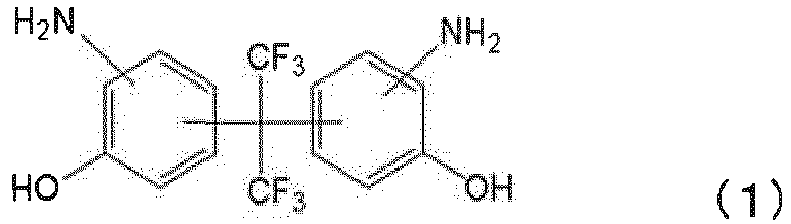


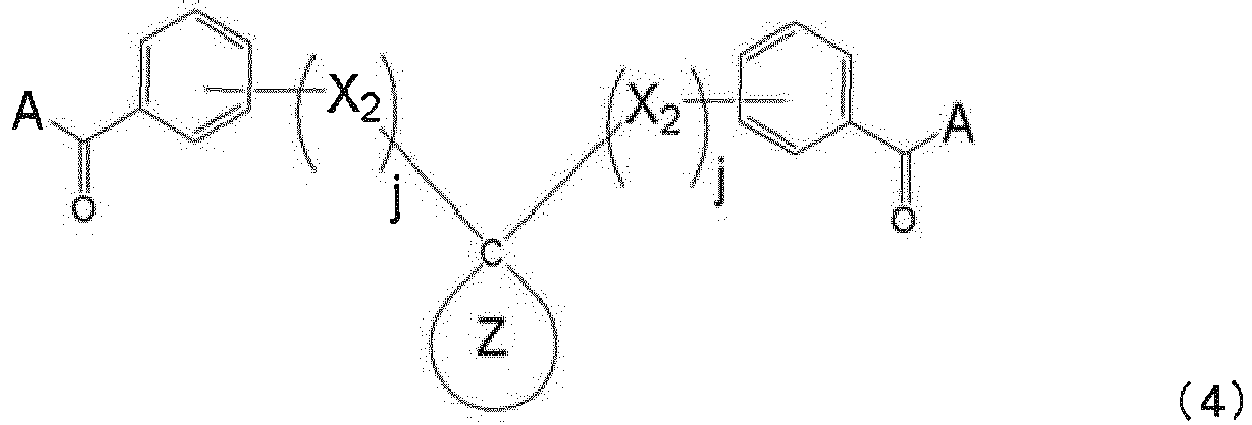
- The inventive polymer is readily soluble in a safe organic solvent used widely, and is usable as a base resin of a positive photosensitive resin composition that is soluble in an aqueous alkaline solution and capable of forming a fine pattern to give higher resolution.
- In this case, it is preferable that the cyclic structure Z in the general formulae (3) and (4) be represented by the following general formula (11) or (12):


- The polymer like this is more readily soluble in a safe organic solvent used widely, and is usable as a base resin of a positive photosensitive resin composition that is more soluble in an aqueous alkaline solution and capable of forming a finer pattern to give higher resolution.
- In the polymer of the present invention, it is preferable that the divalent linking groups X1 and X2 in the general formulae (3) and (4) be each represented by any of the following general formulae (5), (6), (7), (8), (9), and (10) :


- The polymer like this is still more readily soluble in a safe organic solvent widely used as a solvent of a photosensitive resin composition, and is usable as a base resin of a photosensitive resin composition. This photosensitive resin composition gives a cured film, after patterning, having excellent mechanical strength and heat resistance.
- In the polymer of the present invention, it is preferable that the diamine shown by the general formula (1) be represented by the following general formula (21).

- In the use of a photosensitive resin composition containing such a polymer, an aqueous alkaline developer is more favorably usable in the patterning and in the developing step, and the dissolution rate of the base resin in an aqueous alkaline developer can be easily measured and controlled. Accordingly, such a polymer allows the photosensitive resin composition to be improved in resolution.
- The inventive polymer can further contain a tetracarboxylic acid diester unit shown by the following general formula (22):


- The polymer like this is still more readily soluble to in a safe organic solvent used widely.
- In the polymer of the present invention, it is preferable that R16 in the general formula (22) be an organic group selected from groups shown by the following general formulae (24), (25), (26), and (27):


- In the polymer of the present invention, it is more preferable that R16 in the general formula (22) be a group shown by the following general formula (23-1):
*--------CH2-CH2-Rf (23-1)
wherein the dotted line represents a bond; and Rf is as defined above. - The polymer like this is still more readily soluble in a safe organic solvent used widely.
- In the polymer of the present invention, it is preferable that the cyclic structure Z in the general formula (3) is a tetracarboxylic dianhydride structure shown by the following general formula (Z-1) or (Z-2), and the cyclic structure Z in the general formula (4) is at least one structure selected from dicarboxylic acids or dicarboxylic halides shown by the following general formulae (Z-3), (Z-4), (Z-5), (Z-6), (Z-7), and (Z-8).

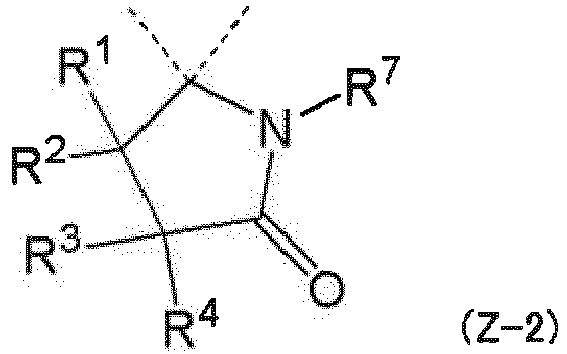


- The polymer like this is preferable because the corresponding tetracarboxylic dianhydride and dicarboxylic acid are readily available or synthesizable. Additionally, the dicarboxylic acid is also readily available or synthesizable in which the alicyclic structure Z in (4) is selected from (Z-3) to (Z-8) of the above formulae. Dicarboxylic halides can be easily obtained by reaction of these dicarboxylic acids and a halogenating agent.
- The present invention also provides a positive photosensitive resin composition, comprising:
- (A) the polymer described above;
- (B) a compound having a quinonediazide structure for serving as a photosensitive agent to generate an acid by light, and
- (D) a solvent.
- The inventive positive photosensitive resin composition is soluble in aqueous alkaline solution and makes it possible to achieve excellent resolution and to form a fine pattern in its patterning. This can be cured at lower temperature of 200°C or less to give a cured film after patterning having excellent mechanical strength, heat resistance, and higher glass transition temperature.
- The inventive positive photosensitive resin composition is also capable of containing the following component (C):
(C) one or more crosslinking agents selected from an amino condensate modified with formaldehyde or formaldehyde-alcohol, a phenol compound having on average two or more methylol groups or alkoxymethyl groups per molecule, a polyhydric phenol compound in which a hydrogen atom of a phenolic hydroxy group thereof is substituted with a glycidyl group, a polyhydric phenol compound in which a hydrogen atom of a phenolic hydroxy group is substituted with a substituent shown by the following formula (C-1), and a compound containing two or more nitrogen atoms having a glycidyl group as shown by the following formula (C-2),

- The positive photosensitive resin composition like this is particularly excellent in resolution in patterning and allows the cured film after patterning to have excellent mechanical strength and heat resistance.
- It is preferable that the inventive positive photosensitive resin composition further contains (E) a compound to generate an acid or a radical by heat.
- The positive photosensitive resin composition like this is allowed to accelerate the crosslinking and curing reaction to give a pattern or a film that is still more improved in mechanical strength, chemical resistance, and adhesiveness.
- The present invention also provides a patterning process comprising:
- (1) applying the positive photosensitive resin composition described above onto a substrate to form a photosensitive material film;
- (2) exposing the photosensitive material film to a high energy beam having a wavelength of 190 to 500 nm or an electron beam via a photomask after a heat treatment; and
- (3) performing development with a developer of an aqueous alkaline solution.
- The inventive patterning process is capable of forming a fine pattern and giving higher resolution.
- In this case, it is preferable to further include (4) post-curing a patterned film formed by the development of the photosensitive material film at a temperature of 100 to 300°C.
- The patterning process like this makes it possible to increase the crosslinking density of a film, to remove the residual volatile components, and to achieve preferable adhesiveness to a substrate, heat resistance, strength, and electric characteristics.
- The present invention also provides a photosensitive dry film comprising a supporting film, a protective film, and a photosensitive resin layer having a thickness of 5 to 100 µm and sandwiched between the supporting film and the protective film, wherein the photosensitive resin layer is formed from the positive photosensitive resin composition described above.
- The inventive photosensitive dry film makes it possible to form a pattern on a substrate easily.
- The present invention also provides a method for producing a photosensitive dry film, comprising:
- (i) continuously applying the positive photosensitive resin composition described above onto a supporting film to form a photosensitive resin layer;
- (ii) continuously drying the photosensitive resin layer; and further
- (iii) laminating a protective film onto the photosensitive resin layer.
- The method for producing a photosensitive dry film like this makes it possible to produce a photosensitive dry film easily.
- The present invention also provides a patterning process comprising:
- (i) separating the protective film from the photosensitive dry film described above and bringing the photosensitive resin layer thereby uncovered into close contact with a substrate;
- (ii) exposing the photosensitive resin layer to a high energy beam having a wavelength of 190 to 500 nm or an electron beam via a photomask either through the supporting film or after removing the supporting film; and
- (iii) performing development with a developer.
- The inventive patterning process makes it possible to obtain a fine pattern conveniently and to give higher resolution.
- In this case, it is preferable to further include (iv) post-curing a patterned film formed by the development of the photosensitive material film at a temperature of 100 to 300°C.
- The patterning process like this makes it possible to increase the crosslinking density of a film and to achieve preferable adhesiveness to a substrate, heat resistance, strength, and electric characteristics.
- The present invention further provides a protective film for electric and electronic parts, comprising a cured film in which the positive photosensitive resin composition described above is cured.
- The inventive protective film for electric and electronic parts is excellent in adhesiveness to a substrate, heat resistance, electric characteristics, mechanical strength, and chemical resistance to an alkaline removing liquid and so on. This protective film is applied to a semiconductor device to give excellent reliability, and especially, can prevent generation of cracks during a thermal cycle test.
- As described above, the inventive polymer is soluble in a safe organic solvent widely used as a solvent for positive photosensitive resin compositions, and makes it possible to provide a base resin of a photosensitive resin composition. In patterning using a photosensitive resin composition containing the inventive polymer, the development can be performed by using an aqueous alkaline solution because the inventive polymer is soluble in an aqueous alkaline solution, and it is possible to prevent residues such as scum in the bottom of an opened pattern and pattern deterioration such as footing profile to resolve a fine pattern.
- As described above, it has been desired to develop a polymer that is soluble in a safe organic solvent widely used as a solvent for positive photosensitive resin compositions and can be used as a base resin of a photosensitive resin composition usable for alkaline development.
- The present inventors have earnestly investigated to achieve the above object and consequently found that the polymer having a structural unit of polyamide, polyamide-imide, or polyimide is useful as a base resin of a photosensitive resin composition when the polymer is selected from a polyamide, a polyamide-imide, a polyimide, a polyimide precursor, a polybenzoxazole, and a polybenzoxazole precursor, and contains a reaction product of a diamine containing at least one of a diamine shown by the following general formula (1) and a diamine shown by the following general formula (2), together with at least one of a tetracarboxylic dianhydride shown by the following general formula (3) as well as a dicarboxylic acid and a dicarboxylic halide shown by the following general formula (4), because the polymer is readily soluble in a safe organic solvent used widely, and the polymer is soluble in an aqueous alkaline developer to be applied to a positive photosensitive resin composition that can be developed using an aqueous alkaline solution, and the use of the photosensitive resin composition gives a fine pattern having good pattern profile.
- The present inventors have also found that patterning and baking of a photosensitive resin composition containing this polymer gives a film having excellent resistance to a plating-removing liquid with strong alkalinity though the polymer is soluble in an aqueous alkaline solution.
- The present inventors have additionally found that patterning and baking of a photosensitive resin composition containing the polymer as a base resin gives a protective film that is excellent in mechanical strength and adhesiveness, that is, such a cured film with a pattern is excellent as a protective film for electric and electronic parts as well as an insulating protective film using the polymer as a base resin; thereby bringing this invention to completion.
- That is, the present invention is a polymer having a polyamide structural unit, a polyamide-imide structural unit, or a polyimide structural unit, the polymer being selected from the group consisting of a polyamide, a polyamide-imide, a polyimide, a polyimide precursor, a polybenzoxazole, and a polybenzoxazole precursor, comprising a reaction product of a diamine and at least one of a tetracarboxylic dianhydride, a dicarboxylic acid, and a dicarboxylic halide;
the diamine comprising at least one of a diamine shown by the following general formula (1) and a diamine shown by the following general formula (2);
with the tetracarboxylic dianhydride being shown by the following general formula (3); and the dicarboxylic acid and the dicarboxylic halide being shown by the following general formula (4).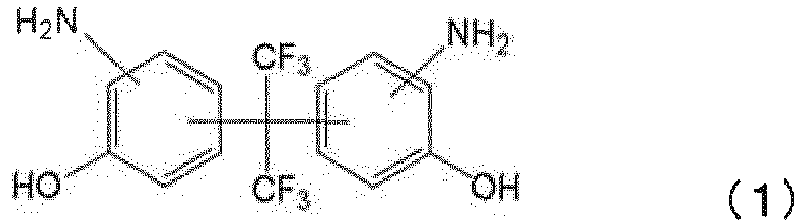


- Hereinafter, the present invention will be described concretely, but the present invention is not limited thereto.
- The inventive polymer is a polymer having a structural unit of polyamide, polyamide-imide, or polyimide; selected from a polyamide, a polyamide-imide, a polyimide, a polyimide precursor, a polybenzoxazole, and a polybenzoxazole precursor; and contains a reaction product of a diamine containing at least one of a diamine shown by the general formula (1) and a diamine shown by the general formula (2), together with at least one of a tetracarboxylic dianhydride shown by the general formula (3) as well as a dicarboxylic acid and a dicarboxylic halide shown by the general formula (4). The inventive polymer may be any polymer that satisfies the requirements described above and is not particularly limited in other points.
- The polymer described above can be used as a base resin of a positive photosensitive resin composition to improve the mechanical strength and to increase the glass transition temperature, is readily soluble in a safe organic solvent used widely, and is soluble in an aqueous alkaline developer.
- The inventive polymer has an amide structural unit or an imide structural unit that is already formed in synthesizing the polymer. Accordingly, in heat curing of a photosensitive resin composition using the polymer after patterning, reaction such as imidization ring-closure reaction is not necessary, and the heating temperature does not have to be so high as in imidization reaction. In the polymer, an amide structural unit or an imide structural unit is already formed, and elimination reaction does not occur thereby to bring an advantage of smaller film shrink in the heat treatment.
- As a method for improving the properties of an obtained pattern after the curing, particularly mechanical strength such as tensile strength and Tg, it has been commonly known to introduce a biphenyl structural unit or a terphenyl structural unit into a polymer. However, the polymer having such an introduced structural unit is markedly lowered in solubility in a safe organic solvent used widely and is unfavorable because it becomes a polymer that is soluble only in N-methyl-2-pyrorridone or insoluble in any organic solvents. On the other hand, the inventive polymer is soluble in a safe organic solvent widely used as a solvent for a photosensitive resin composition without having such a method and can have a positive photosensitive resin composition capable of forming a cured film after patterning having excellent mechanical strength and heat resistance of higher glass transition temperature.
- In the polymer of the present invention, it is preferable that the alicyclic structure Z in the general formulae (3) and (4) be represented by the following general formula (11) or (12):


- In the polymer of the present invention, it is preferable that the alicyclic structure Z in the general formula (3) be a tetracarboxylic dianhydride structure shown by the general formula (Z-1) or (Z-2), and the alicyclic structure Z in the general formula (4) is at least one structure selected from dicarboxylic acids or dicarboxylic halides shown by the following general formulae (Z-3) to (Z-8).


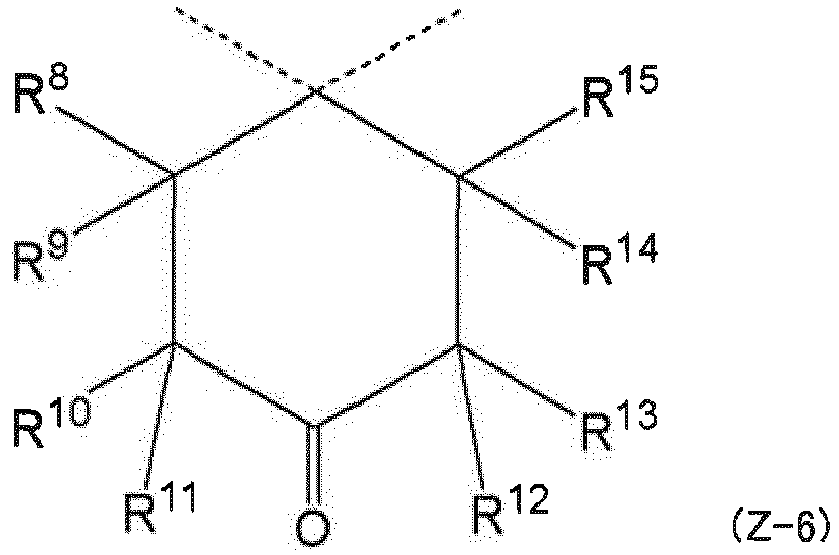


- The tetracarboxylic dianhydride is readily available or synthesizable when the alicyclic structure Z in the general formula (3) is represented by any of the general formula (Z-1) and (Z-2). The dicarboxylic acid is readily available or synthesizable when the alicyclic structure Z in the general formula (4) is represented by any of the general formula (Z-3) to (Z-8). Dicarboxylic halides can be readily obtained by reaction of these dicarboxylic acids with a halogenating agent.
- In the alicyclic structure Z in the general formulae (3) and (4), illustrative examples of the preferable structure shown by the general formula (11) include the following, although not limited thereto.







- In the alicyclic structure Z in the general formulae (3) and (4), concrete examples of the preferable structure shown by the general formula (12) include the following, but are not limited thereto.


- The general formulae (3) and (4) in which "j" is 0 represents that each cyclic structure Z is directly linked to the phthalic anhydride structures in the general formula (3) or the benzoic acid structures in the general formula (4). Accordingly, as a structure in which the aforementioned structure is directly bonded to the phthalic anhydride structures or the benzoic acid structures through the parts of dotted lines, the following general formulae (3-1), (3-2), (3-3), and (4-1) to (4-6) are exemplified preferably.
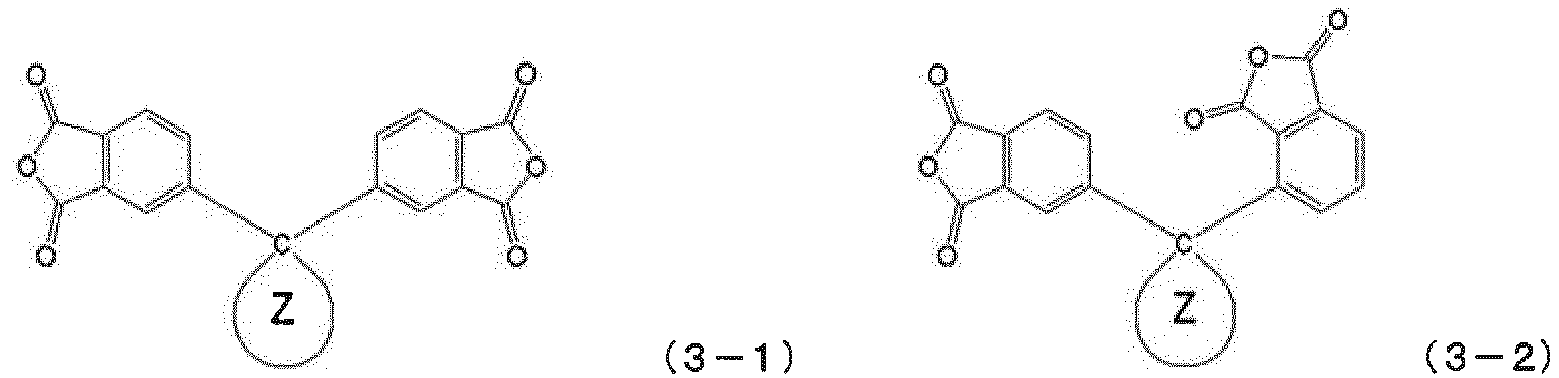


- In the general formula (3), the general formula (3-1) is preferable in view of easiness of synthesis method and acquisition. In the general formula (4), the general formula (4-1) is preferable in view of easiness of synthesis method and acquisition.
- When "j" is 1, in the general formulae (3) and (4), X1 and X2 each represent a divalent linking group. Illustrative examples of the preferable linking groups X1 and X2 include the structures shown by the following general formulae (5), (6), (7), (8), (9), and (10).


- As a preferable structure shown by the general formula (3) in which j is 1, the concrete examples include the following, but are not limited thereto.


- In these general formulae (3-4) to (3-9) described above, the general formulae (3-5), (3-7), and (3-8) are preferable in view of easiness of synthesis method and acquisition. Particularly, the general formulae (3-5) and (3-7) are preferable.
- As a preferable structure shown by the general formula (4) in which j is 1, the concrete examples include the following, but are not limited thereto.
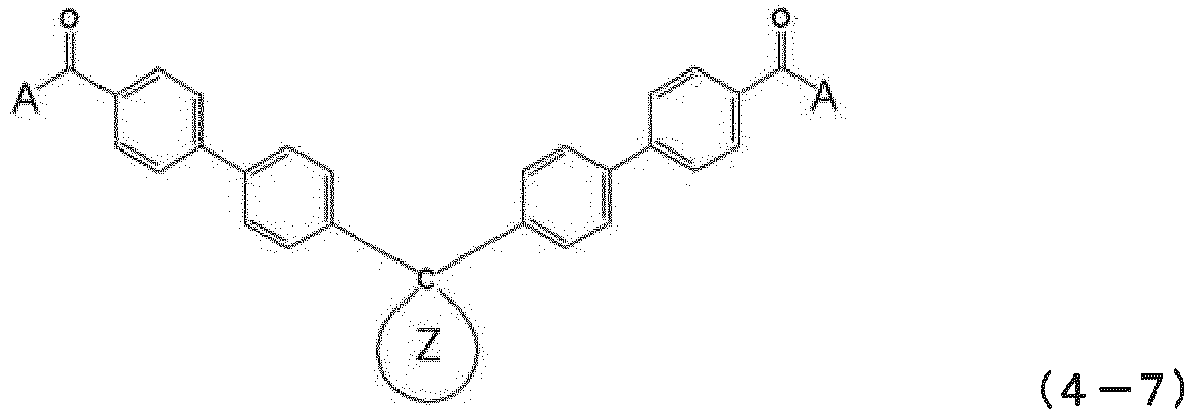


- In these general formulae (4-7) to (4-12) described above, the general formulae (4-8), (4-10), and (4-11) are preferable in view of easiness of synthesis method and acquisition. Particularly, the general formulae (4-8) and (4-10) are preferable.
- Additionally, the diamine shown by the general formula (1) is preferably a diamine shown by the general formula (21).

- When the diamine of the general formula (1) is represented by the general formula (21), an aqueous alkaline developer can be used in patterning and a developing step. The use of an aqueous alkaline developer helps to improve the resolution of a photosensitive resin composition because the dissolution rate of a base resin in an aqueous alkaline developer can be easily measured and controlled.
- Additionally, the polymer containing a tetracarboxylic acid diester unit shown by the general formula (22) is still more readily soluble in a safe organic solvent used widely.


- In this case, R16 in the general formula (22) is preferably an organic group selected from groups shown by the following general formulae (24), (25), (26), and (27):


- It is also preferable that R16 in the general formula (22) be a group shown by the following general formula (23-1) :
*--------CH2-CH2-Rf (23-1)
wherein the dotted line represents a bond; and Rf is as defined above. - In the organic group shown by the general formula (24), concrete examples of the organic group that can be used preferably include the following, but are not limited thereto.
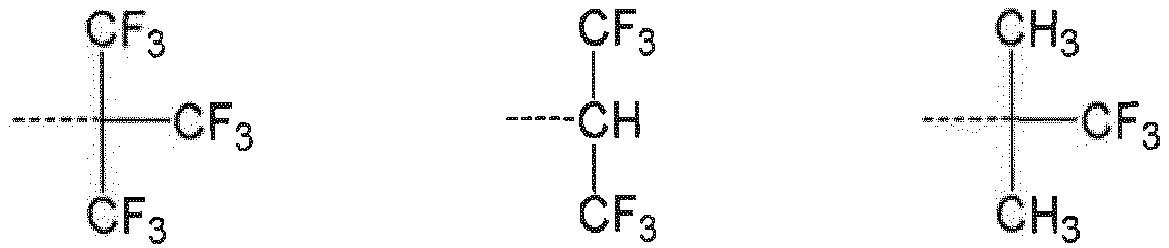








- In the organic group shown by the general formula (25), concrete examples of the organic group that can be used preferably include the following, but are not limited thereto.






- In the organic group shown by the general formula (26), concrete examples of the organic group that can be used preferably include the following, but are not limited thereto.










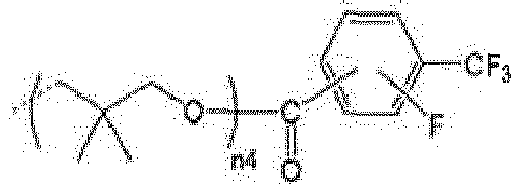

- In the formulae, the dotted line represents a bond; and n4 is an integer of 1 to 6, preferably an integer of 1 to 3, more preferably 1 or 2, most preferably 1.
- In the organic group shown by the general formula (27), concrete examples of the organic group that can be used preferably include the following, but are not limited thereto.


- In this regard, after patterning of a photosensitive resin composition using the inventive polymer having the tetracarboxylic acid diester unit shown by the general formula (22), the polyimide precursor structural unit undergoes imidization ring-closure reaction by baking for post-curing. At this time, the introduced R16 is eliminated and removed from the system, and thus the thickness of the formed film is reduced. Accordingly, R16 more preferably has lower molecular weight to minimize the film loss during post-curing.
- The tetracarboxylic acid diester unit can be introduced into the inventive polymer, for example, by reaction using an excess diamine containing at least one of a diamine shown by the general formulae (1) and (2), together with a tetracarboxylic dianhydride shown by the general formula (3) to synthesize an amic acid oligomer having amino group terminals, followed by reaction of the amino group terminals of the amic acid oligomer and the tetracarboxylic acid diester compound shown by the general formula (22). Alternatively, the tetracarboxylic acid diester unit can be introduced into the polymer by the same reaction using the excess diamine and at least one of the dicarboxylic acid and the dicarboxylic halide shown by the general formula (4).
- As a preferable method for producing a tetracarboxylic acid diester compound shown by the general formula (22), R16 can be introduced by reaction of tetracarboxylic dianhydride shown by the following general formula (28) and a compound having a hydroxy group at the terminal shown by the following general formula (29) in the presence of a basic catalyst such as pyridine.


- Preferable examples of the tetracarboxylic dianhydride shown by the general formula (28) include aromatic dianhydrides, alicyclic dianhydrides, and aliphatic dianhydrides. Examples of the aromatic dianhydride include pyromellitic dianhydride, 3,3',4,4'-biphenyltetracarboxylic dianhydride, 2,3,3',4'-biphenyltetracarboxylic dianhydride, 2,3,2',3'-biphenyltetracarboxylic dianhydride, 3,3',4,4'-terphenyltetracarboxylic dianhydride, 3,3',4,4'-oxyphthalic dianhydride, 2,3,3',4'-oxyphthalic dianhydride, 2,3,2',3'-oxyphthalic dianhydride, diphenylsulfone-3,3',4,4'-tetracarboxylic dianhydride, benzophenone-3,3',4,4'-tetracarboxylic dianhydride, 2,2-bis(3,4-dicarboxyphenyl)propane dianhydride, 2,2-bis(2,3-dicarboxyphenyl)propane dianhydride, 1,1-bis(3,4-dicarboxyphenyl)ethane dianhydride, 1,1-bis(2,3-dicarboxyphenyl)ethane dianhydride, bis(3,4-dicarboxyphenyl)methane dianhydride, bis(2,3-dicarboxyphenyl)methane dianhydride, 1,4-(3,4-dicarboxyphenoxy)benzene dianhydride, p-phenylene bis (trimellitic acid monoester anhydride), bis(1,3-dioxo-1,3-dihydroisobenzofuran-5-carboxylic acid)-1,4-phenylene, 2,2-bis(4-(4-aminophenoxy)phenyl)propane, 1,2,5,6-naphthalenetetracarboxylic dianhydride, 2,3,6,7-naphthalenetetracarboxylic dianhydride, 9,9-bis(3,4-dicarboxyphenyl)fluorene dianhydride, 2,3,5,6-pyridinetetracarboxylic dianhydride, 3,4,9,10-perylenetetracarboxylic dianhydride, 2,2-bis(3,4-dicarboxyphenyl)hexafluoropropane dianhydride, 2,2-bis(4-(3,4-dicarboxybenzoyloxy)phenyl)hexafluoropropane dianhydride, 1,6-difluoropromellitic dianhydride, 1-trifluoromethylpyromellitic dianhydride, 1,6-ditrifluoromethylpyromellitic dianhydride, 2,2'-bis(trifluoromethyl)-4,4'-bis(3,4-dicarboxyphenoxy)biphenyl dianhydride, 2,2'-bis[(dicarboxyphenoxy)phenyl]propane dianhydride, 2,2'-bis[(dicarboxyphenoxy)phenyl]hexafluoropropane dianhydride, and acid dianhydride compounds obtained by substituting the aromatic ring of the above compounds with a substituent such as an alkyl group, an alkoxy group, or a halogen atom, although not limited thereto.
- Examples of the alicyclic dianhydride include 1,2,3,4-cyclobutanetetracarboxylic dianhydride, 1,2,3,4-cyclopentanetetracarboxylic dianhydride, 1,2,4,5-cyclohexanetetracarboxylic dianhydride, 1,2,4,5-cyclopentanetetracarboxylic dianhydride, 1,2,3,4-tetramethyl-1,2,3,4-cyclobutanetetracarboxylic dianhydride, 1,2-dimethyl-1,2,3,4-cyclobutanetetracarboxylic dianhydride, 1,3-dimethyl-1,2,3,4-cyclobutanetetracarboxylic dianhydride, 1,2,3,4-cycloheptanetetracarboxylic dianhydride, 2,3,4,5-tetrahydrofurantetracarboxylic dianhydride, 3,4-dicarboxy-1-cyclohexylsuccinic dianhydride, 2,3,5-tricarboxycyclopentylacetic dianhydride, 3,4-dicarboxy-1,2,3,4-tetrahydro-1-naphthalenesuccinic dianhydride, bicyclo[3.3.0]octane-2,4,6,8-tetracarboxylic dianhydride, bicyclo[4.3.0]nonane-2,4,7,9-tetracarboxylic dianhydride, bicyclo[4.4.0]decane-2,4,7,9-tetracarboxylic dianhydride, bicyclo[4.4.0]decane-2,4,8,10-tetracarboxylic dianhydride, tricyclo[6.3.0.02,6]undecane-3,5,9,11-tetracarboxylic dianhydride, bicyclo[2.2.2]octane-2,3,5,6-tetracarboxylic dianhydride, bicyclo[2.2.2]oct-7-ene-2,3,5,6-tetracarboxylic dianhydride, bicyclo[2.2.1]heptane tetracarboxylic dianhydride, bicyclo[2.2.1]heptane-5-carboxymethyl-2,3,6-tricarboxylic dianhydride, 7-oxabicyclo[2.2.1]heptane-2,4,6,8-tetracarboxylic dianhydride, octahydronaphthalene-1,2,6,7-tetracarboxylic dianhydride, tetradecahydroanthracene-1,2,8,9-tetracarboxylic dianhydride, 3,3',4,4'-dicyclohexanetetracarboxylic dianhydride, 3,3',4,4'-oxydicyclohexanetetracarboxylic dianhydride, 5-(2,5-dioxotetrahydro-3-furanyl)-3-methyl-3-cyclohexene-1,2-dicarboxylic anhydride, and "RIKACID" (registered trade mark) BT-100 (manufactured by New Japan Chemical Co., Ltd), derivatives thereof, and acid dianhydride compounds obtained by substituting the alicyclic ring of the above compounds with a substituent such as an alkyl group, an alkoxy group, or a halogen atom, although not limited thereto.
- Examples of the aliphatic dianhydride include 1,2,3,4-butanetetracarboxylic dianhydride, 1,2,3,4-pentanetetracarboxylic dianhydride, and derivative thereof, although not limited thereto.
- These aromatic dianhydrides, alicyclic dianhydrides, and aliphatic dianhydrides may be used alone or in combination of two or more kinds.
- For the reaction of the tetracarboxylic dianhydride shown by the general formula (28) with the compound having a hydroxy group at the terminal shown by the general formula (29), the tetracarboxylic dianhydride shown by the general formula (28) and the compound having a hydroxy group at the terminal shown by the general formula (29) are stirred, dissolved, and mixed in the presence of a basic catalyst such as pyridine in a reaction solvent, at a reaction temperature of 20 to 50°C, over 4 to 10 hours. In this manner, half-esterification reaction of the acid dianhydride progresses, and a solution in which an intended tetracarboxylic acid diester compound shown by the general formula (28) is dissolved in the reaction solvent can be obtained.
- The obtained tetracarboxylic acid diester compound may be isolated, or the obtained solution as is may be used for a subsequent reaction with a diamine.
- The reaction solvent is preferably a solvent that can favorably dissolve the above tetracarboxylic acid diester compound and a polymer having a polyimide precursor structural unit obtained by the subsequent polycondensation reaction of the tetracarboxylic acid diester compound with a diamine. Examples of the solvent include N-methyl-2-pyrrolidone, N,N-dimethylacetamide, N,N-dimethylformamide, dimethylsulfoxide, tetramethylurea, and γ-butyrolactone. In addition, ketones, esters, lactones, ethers, halogenated hydrocarbons, and hydrocarbons can also be used. Illustrative examples thereof include acetone, methyl ethyl ketone, methyl isobutyl ketone, cyclohexanone, methyl acetate, ethyl acetate, butyl acetate, diethyl oxalate, ethylene glycol dimethyl ether, diethylene glycol dimethyl ether, tetrahydrofuran, dichloromethane, 1,2-dichloroethane, 1,4-dichlorobutane, chlorobenzene, o-dichlorobenzene, hexane, heptane, benzene, toluene, and xylene. These solvents may be used alone or in combination of two or more kinds as needed.
- The inventive polymer may also be a polymer having a structure obtained by reaction of diamines containing another diamine shown by the following general formula (30), together with the above diamine containing at least one of the diamine shown by the general formula (1) and the diamine shown by the general formula (2) as well as at least one of the tetracarboxylic dianhydride shown by the general formula (3), the dicarboxylic acid and the dicarboxylic halide shown by the general formula (4).
H2N—T—NH2 (30)
- In the structural unit (30), T is a divalent organic group, which is any divalent organic group, is preferably a divalent organic group having 6 to 40 carbon atoms, more preferably a cyclic organic group containing 1 to 4 aromatic or alicyclic rings each having a substituent, or an aliphatic group or siloxane group having no cyclic structure. Still more preferably, T is a structure shown by the following formula (31) or (32). The structure of T may be one kind or a combination of two or more kinds.


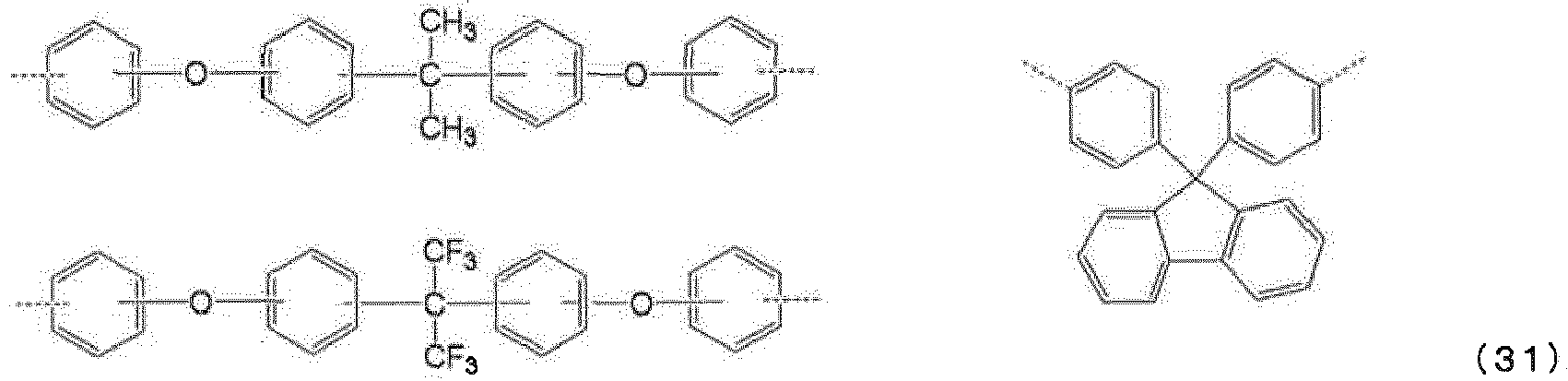


- The inventive polymer may be a polymer that has a structure obtained by reaction of another tetracarboxylic dianhydride shown by the following general formula (33), which is contained together with a diamine containing at least one of a diamine shown by the general formula (1) and a diamine shown by the general formula (2), and at least one of a tetracarboxylic dianhydride shown by the general formula (3) as well as a dicarboxylic acid and a dicarboxylic halide shown by the general formula (4).

- In the formula of the tetracarboxylic dianhydride shown by the general formula (33), W2 is preferably a tetravalent organic group similar to W1 in the general formula (28). As a favorable tetracarboxylic dianhydride shown by the general formula (33), the tetracarboxylic dianhydride shown by the general formula (28) can be exemplified.
- Additionally, the inventive polymer may be a polymer that has a structure obtained by reaction of another dicarboxylic acid or dicarboxylic halide shown by the following general formula (34), which is contained together with a diamine containing at least one of a diamine shown by the general formula (1) and a diamine shown by the general formula (2), and at least one of a tetracarboxylic dianhydride shown by the general formula (3) as well as a dicarboxylic acid and a dicarboxylic halide shown by the general formula (4).

- In the formula, U represents a divalent organic group of an aliphatic chain-lengthening structure or an alicyclic aliphatic group having 4 to 40 carbon atoms, or an aromatic group; more preferably, a divalent organic group shown by the following formula (34-1). The structure of U may be one kind or a combination of two or more kinds.


- In the dicarboxylic acid and the dicarboxylic halide shown by the general formula (34), U is preferably a divalent organic group of chain-lengthening structure because the photosensitive resin composition, using the inventive polymer as a base resin, is allowed to be improved in mechanical strength of the cured film, particularly its elongation.
- The dicarboxylic acid compound represented by the general formula (34) may be mentioned, for example, malonic acid, dimethylmalonic acid, ethylmalonic acid, isopropylmalonic acid, di-n-butylmalonic acid, succinic acid, tetrafluorosuccinic acid, methylsuccinic acid, 2,2-dimethylsuccinic acid, 2,3-dimethylsuccinic acid, dimethylmethylsuccinic acid, glutaric acid, hexafluoroglutaric acid, 2-methylglutaric acid, 3-methylglutaric acid, 2,2-dimethylglutaric acid, 3,3-dimethylglutaric acid, 3-ethyl-3-methylglutaric acid, adipic acid, octafluoroadipic acid, 3-methyladipic acid, pimelic acid, 2,2,6,6-tetramethylpimelic acid, suberic acid, dodecafluorosuberic acid, azelaic acid, sebacic acid, hexadecafluorosebacic acid, 1,9-nonanedioic acid, dodecanedioic acid, tridecanedioic acid, tetradecanedioic acid, pentadecanedioic acid, hexadecanedioic acid, heptadecanedioic acid, octadecanedioic acid, nonadecanedioic acid, eicosanedioic acid, heneicosanedioic acid, docosanedioic acid, tricosanedioic acid, tetracosanedioic acid, pentacosanedioic acid, hexacosanedioic acid, heptacosanedioic acid, octacosanedioic acid, nonacosane-dioic acid, triacontanedioic acid, hentriacontanedioic acid, dotriacontanedioic acid, diglycolic acid, and the like.
- Furthermore, the dicarboxylic acid compound having an aromatic ring may be mentioned, for example, phthalic acid, isophthalic acid, terephthalic acid, 4,4'-diphenyl ether dicarboxylic acid, 3,4'-diphenyl ether dicarboxylic acid, 3,3'-diphenyl ether dicarboxylic acid, 4,4'-biphenyl dicarboxylic acid, 3,4'-biphenyl dicarboxylic acid, 3,3'-biphenyl dicarboxylic acid, 4,4'-benzophenone dicarboxylic acid, 3,4'-benzophenone dicarboxylic acid, 3,3'-benzophenone dicarboxylic acid, 4,4'-hexafluoroisopropylidene dibenzoic acid, 4,4'-dicarboxydiphenylamide, 1,4-phenylenediethanoic acid, bis(4-carboxyphenyl)sulfide, 2,2-bis(4-carboxyphenyl)-1,1,1,3,3,3-hexafluoropropane, bis(4-carboxyphenyl)tetraphenyldisiloxane, bis(4-carboxyphenyl)tetramethyldisiloxane, bis(4-carboxyphenyl)sulfone, bis(4-carboxyphenyl)methane, 5-tert-butylisophthalic acid, 5-bromoisophthalic acid, 5-fluoroisophthalic acid, 5-chloroisophthalic acid, 2,2-bis-(p-carboxyphenyl)propane, and 2,6-naphthalene dicarboxylic acid, although not limited thereto. Also, these materials may be used singly or in admixture.
- The inventive polymer is a polymer characterized by having a structural unit of polyamide, polyamide-imide, or polyimide obtained by reaction of a diamine containing at least one of a diamine shown by the general formula (1) and a diamine shown by the general formula (2), together with at least one of a tetracarboxylic dianhydride shown by the general formula (3) as well as a dicarboxylic acid and a dicarboxylic halide shown by the general formula (4).
- The polyamide structural unit is represented by polyamide structural units shown by the following general formulae (35) and (36), each of which is obtained by reaction of a diamine containing at least one of a diamine shown by the general formula (1) and a diamine shown by the general formula (2), together with at least one of a dicarboxylic acid and a dicarboxylic halide shown by the general formula (4).


- The polyimide structural unit is represented by polyimide structural units shown by the following general formulae (37) and (38), each of which is obtained by reaction of a diamine containing at least one of a diamine shown by the general formula (1) and a diamine shown by the general formula (2), together with a tetracarboxylic dianhydride shown by the general formula (3).


- The polyamide-imide structural unit is represented by a polyamide-imide structural unit having at least one of structural units of the general formulae (35) and (36) as well as at least one of structural units of the general formulae (37) and (38), which is obtained by simultaneous reaction of a diamine containing at least one of a diamine shown by the general formula (1) and a diamine shown by the general formula (2), together with at least one of a tetracarboxylic dianhydride shown by the general formula (3) as well as a dicarboxylic acid and a dicarboxylic halide shown by the general formula (4); or by reactions of obtaining a polyimide structure, followed by adding at least one of a dicarboxylic acid and a dicarboxylic halide shown by the general formula (4).
- The polymer containing a polyamide structural unit of the structural unit (35) or (36) can be obtained by reaction of dicarboxylic acid of the general formula (4) in which "A" is a hydroxy group in the presence of a dehydration condensation agent or to convert to an acid halide compound using a halogenating agent, followed by reaction with a diamine; or reaction using a dicarboxylic halide of the general formula (4) in which "A" is a halogen atom, together with a diamine.
- As the halogenating agent to convert the dicarboxylic acid to an acid halide compound, a chlorinating agent such as thionyl chloride and oxalyl dichloride can be exemplified. In the synthesis method, the conversion to acid chloride is followed by reaction with a diamine.
- In the reaction of the dicarboxylic acid using a chlorinating agent to convert to an acid chloride, a basic compound may be used. Examples of the basic compound include pyridine, dimethylaminopyridine, 1,8-diazabicyclo[5.4.0]undec-7-ene, and 1,5-diazabicyclo[4.3.0]non-5-ene.
- As the solvent in the method via an acid chloride or the solvent in the reaction of obtaining a polyimide structure using a previously prepared dicarboxylic halide of the general formula (4) in which "A" represents a halogen atom, it is preferable to use a solvent that can favorably dissolve the acid chloride, the dicarboxylic halide, and the polymer having a polyamide structure obtained by polycondensation reaction with a diamine. Illustrative examples thereof include N-methyl-2-pyrrolidone, N,N-dimethylacetamide, N,N-dimethylformamide, dimethylsulfoxide, tetramethylurea, hexamethylphosphoric triamide, and γ-butyrolactone. In addition to polar solvents, ketones, esters, lactones, ethers, halogenated hydrocarbons, and hydrocarbons can also be used. Illustrative examples thereof include acetone, diethyl ketone, methyl ethyl ketone, methyl isobutyl ketone, cyclohexanone, methyl acetate, ethyl acetate, butyl acetate, diethyl oxalate, diethyl malonate, diethyl ether, ethylene glycol dimethyl ether, diethylene glycol dimethyl ether, tetrahydrofuran, dichloromethane, 1,2-dichloroethane, 1,4-dichlorobutane, trichloroethane, chlorobenzene, o-dichlorobenzene, hexane, heptane, octane, benzene, toluene, and xylene. These solvents may be used alone or in combination of two or more kinds.
- Another possible method includes reaction of a diamine containing at least one of a diamine shown by the general formula (1) and a diamine shown by the general formula (2), together with a dicarboxylic acid of the general formula (4) in which "A" represents a hydroxy group in the presence of a dehydration condensation agent. That is, the polymer containing the structural unit (35) or (36) can be obtained by reaction using the dicarboxylic acid of the general formula (4) in which "A" represents a hydroxy group such that the dicarboxylic acid is dissolved in the same reaction solvent as described above; to this reaction solvent, a known dehydration condensation agent (for example, dicyclohexylcarbodiimide, 1-ethoxycarbonyl-2-ethoxy-1,2-dihydroquinoline, 1,1-carbonyldioxy-di-1,2,3-benzotriazole, or N,N'-disuccinimidylcarbonate) is added and mixed under ice-cooling to obtain a polyacid anhydride of the dicarboxylic acid compound of the general formula (4) in which "A" represents a hydroxy group; and then, the diamine shown by the general formula (1) and the diamine shown by the general formula (2) are separately dissolved or dispersed in a solvent, and this solution or dispersion is added dropwise thereto to perform polycondensation.
- In producing a polymer containing a polyamide structural unit of the structural unit (35) or (36), it is possible to obtain the inventive polymer that inevitably contains a polyamide structural unit using the diamine shown by the general formula (1) and the diamine shown by the general formula (2), together with a diamine other than these, such as another diamine shown by the general formula (30).
- In producing a polymer containing a polyamide structural unit of the structural unit (35) or (36), it is also possible to obtain the inventive polymer that inevitably contains a polyamide structural unit using the dicarboxylic acid or the dicarboxylic halide shown by the general formula (4), together with a dicarboxylic acid or a dicarboxylic halide other than these, that is, another dicarboxylic acid or dicarboxylic halide shown by the general formula (34).
- The following describes a method for producing the polyimide structure shown by the general formula (37) or (38). The polyimide structure shown by the general formula (37) or (38) is formed by reaction of a diamine containing at least one of a diamine shown by the general formula (1) and a diamine shown by the general formula (2), together with a tetracarboxylic dianhydride shown by the general formula (3) to synthesize an amic acid at first, followed by heat dehydration to form a polyimide structure.
- The polyimide structure can be produced such that a diamine is dissolved into a high boiling point solvent with higher polarity such as γ-butyrolactone and N-methyl-2-pyrorridone, then an acid anhydride is added thereto to react at 0 to 80°C, preferably 10 to 50°C to an amic acid, non-polar solvent such as xylene is added subsequently, and this is heated to 100 to 200°C, preferably 130 to 180°C to perform imidization reaction while removing water from the reaction system.
- In producing a polymer containing a polyimide structure of the general formula (37) or (38), it is possible to obtain the inventive polymer that inevitably contains a polyimide structural unit using the tetracarboxylic dianhydride shown by the general formula (3), together with another tetracarboxylic dianhydride, that is, a tetracarboxylic dianhydride shown by the general formula (33).
- In producing a polymer containing a polyimide structure of the general formula (37) or (38), it is possible to obtain the inventive polymer that inevitably contains a polyimide structural unit using a diamine containing at least one of the diamine shown by the general formula (1) and the diamine shown by the general formula (2), together with a diamine other than these, that is, another diamine shown by the general formula (30), for example.
- In producing a polymer containing a polyamide-imide structure having at least one of the structures of the general formulae (35) and (36) as well as at least one of the structures of the general formulae (37) and (38), it is possible to form the polyamide-imide structure by reaction of a diamine containing at least one of the diamine shown by the general formula (1) and the diamine shown by the general formula (2), together with a tetracarboxylic dianhydride shown by the general formula (3) to form an amic acid, followed by heat dehydration of the dicarboxylic acid of the general formula (4) in which "A" represents a hydroxy group added to the same system of this amic acid.
- There is another method for producing a polyamide-imide structure. In producing the polymer containing a polyimide structure shown by the general formula (37) or (38), the polyamide-imide structure can be obtained by reaction using a diamine containing at least one of the diamine shown by the general formula (1) and the diamine shown by the general formula (2), together with a tetracarboxylic dianhydride shown by the general formula (3) to synthesize an amic acid oligomer having terminal amino groups, followed by reaction of the terminal amino groups of the amic acid oligomer and the dicarboxylic acid shown by the general formula (4) using the same method for producing the polyamide structure.
- In the same way as described above, also in producing a polymer containing a polyamide-imide structure, it is possible to use a diamine containing at least one of the diamine shown by the general formula (1) and the diamine shown by the general formula (2), together with a diamine other than these, such as shown by the general formula (30). It is also possible to use the tetracarboxylic dianhydride shown by the general formula (3), together with a tetracarboxylic dianhydride other than that, that is, the tetracarboxylic dianhydride shown by the general formula (33); alternatively it is possible to use the dicarboxylic acid or the dicarboxylic halide shown by the general formula (4), together with a dicarboxylic acid or a dicarboxylic halide other than these, that is, the dicarboxylic acid or dicarboxylic halide shown by the general formula (34).
- Subsequently, the method for introducing a tetracarboxylic acid diester unit shown by the general formula (22) will be described. As a method for introducing the tetracarboxylic acid diester unit shown by the general formula (22) into the inventive polymer characterized by containing a structural unit of polyamide, polyamide-imide, or polyimide obtained by reaction of a diamine containing at least one of the diamine shown by the general formula (1) and the diamine shown by the general formula (2), together with at least one of a tetracarboxylic dianhydride shown by the general formula (3) as well as a dicarboxylic acid and a dicarboxylic halide shown by the general formula (4), the tetracarboxylic acid diester unit shown by the general formula (22) can be introduced by reaction using an excess amount of diamine containing at least one of the diamine shown by the general formula (1) and the diamine shown by the general formula (2), together with a tetracarboxylic dianhydride shown by the general formula (3) to synthesize an amic acid oligomer having terminal amino groups, followed by reaction of the terminal amino groups of the amic acid oligomer and the dicarboxylic acid shown by the general formula (22) using the same method as the method for obtaining the polyamide structure.
- Alternatively, the tetracarboxylic acid diester unit shown by the general formula (22) can be introduced by reaction using an excess amount of diamine containing at least one of the diamine shown by the general formula (1) and the diamine shown by the general formula (2), together with at least one of a dicarboxylic acid and a dicarboxylic halide shown by the general formula (4) to synthesize an amide oligomer having terminal amino groups, followed by reaction of the terminal amino groups and the tetracarboxylic acid diester compound shown by the general formula (22) by the same method for obtaining the polyamide structure.
- In the inventive polymer characterized by having a structural unit of polyamide, polyamide-imide, or polyimide obtained by reaction of a diamine containing at least one of the diamine shown by the general formula (1) and the diamine shown by the general formula (2), together with at least one of a tetracarboxylic dianhydride shown by the general formula (3) as well as a dicarboxylic acid and a dicarboxylic halide shown by the general formula (4), the molecular weight is preferably 5,000 to 100,000, more preferably 7,000 to 30,000. The molecular weight of 5,000 or more allows the photosensitive resin composition using the polymer as a base resin to form a film easily with a desired film thickness on a substrate. The molecular weight of 100,000 or less prevents the photosensitive resin composition from increasing the viscosity extremely high to prevent the risk of failing to form a film.
- The inventive polymer may be blocked with an end-blocking agent at the both terminals to control the molecular weight at polycondensation reaction and to inhibit time-dependent change of the molecular weight of the obtained polymer, i.e., to inhibit gelation. An end-blocking agent for the acid dianhydride may be a monoamine or a monohydric alcohol. An end-blocking agent for the diamine compound may be an acid anhydride, a monocarboxylic acid, a monoacid chloride compound, a mono-active ester compound, a dicarbonic acid ester, or a vinyl ether. In addition, reaction of the end-blocking agent allows various organic groups to be introduced into the terminal.
- Examples of the monoamine used as the end-blocking agent for the acid anhydride terminal include aniline, 5-amino-8-hydroxyquinoline, 4-amino-8-hydroxyquinoline, 1-hydroxy-8-aminonaphthalene, 1-hydroxy-7-aminonaphthalene, 1-hydroxy-6-aminonaphthalene, 1-hydroxy-5-aminonaphthalene, 1-hydroxy-4-aminonaphthalene, 1-hydroxy-3-aminonaphthalene, 1-hydroxy-2-aminonaphthalene, 1-amino-7-hydroxynaphthalene, 2-hydroxy-7-aminonaphthalene, 2-hydroxy-6-aminonaphthalene, 2-hydroxy-5-aminonaphthalene, 2-hydroxy-4-aminonaphthalene, 2-hydroxy-3-aminonaphthalene, 1-amino-2-hydroxynaphthalene, 1-carboxy-8-aminonaphthalene, 1-carboxy-7-aminonaphthalene, 1-carboxy-6-aminonaphthalene, 1-carboxy-5-aminonaphthalene, 1-carboxy-4-aminonaphthalene, 1-carboxy-3-aminonaphthalene, 1-carboxy-2-aminonaphthalene, 1-amino-7-carboxynaphthalene, 2-carboxy-7-aminonaphthalene, 2-carboxy-6-aminonaphthalene, 2-carboxy-5-aminonaphthalene, 2-carboxy-4-aminonaphthalene, 2-carboxy-3-aminonaphthalene, 1-amino-2-carboxynaphthalene, 2-aminonicotinic acid, 4-aminonicotinic acid, 5-aminonicotinic acid, 6-aminonicotinic acid, 4-aminosalicylic acid, 5-aminosalicylic acid, 6-aminosalicylic acid, ameride, 2-aminobenzoic acid, 3-aminobenzoic acid, 4-aminobenzoic acid, 2-aminobenzenesulfonic acid, 3-aminobenzenesulfonic acid, 4-aminobenzenesulfonic acid, 3-amino-4,6-dihydroxypyrimidine, 2-aminophenol, 3-aminophenol, 4-aminophenol, 5-amino-8-mercaptoquinoline, 4-amino-8-mercaptoquinoline, 1-mercapto-8-aminonaphthalene, 1-mercapto-7-aminonaphthalene, 1-mercapto-6-aminonaphthalene, 1-mercapto-5-aminonaphthalene, 1-mercapto-4-aminonaphthalene, 1-mercapto-3-aminonaphthalene, 1-mercapto-2-aminonaphthalene, 1-amino-7-mercaptonaphthalene, 2-mercapto-7-aminonaphthalene, 2-mercapto-6-aminonaphthalene, 2-mercapto-5-aminonaphthalene, 2-mercapto-4-aminonaphthalene, 2-mercapto-3-aminonaphthalene, 1-amino-2-mercaptonaphthalene, 3-amino-4,6-dimercaptopyrimidine, 2-aminothiophenol, 3-aminothiophenol, 4-aminothiophenol, 2-ethynylaniline, 3-ethynylaniline, 4-ethynylaniline, 2,4-diethynylaniline, 2,5-diethynylaniline, 2,6-diethynylaniline, 3,4-diethynylaniline, 3,5-diethynylaniline, 1-ethynyl-2-aminonaphthalene, 1-ethynyl-3-aminonaphthalene, 1-ethynyl-4-aminonaphthalene, 1-ethynyl-5-aminonaphthalene, 1-ethynyl-6-aminonaphthalene, 1-ethynyl-7-aminonaphthalene, 1-ethynyl-8-aminonaphthalene, 2-ethynyl-1-aminonaphthalene, 2-ethynyl-3-aminonaphthalene, 2-ethynyl-4-aminonaphthalene, 2-ethynyl-5-aminonaphthalene, 2-ethynyl-6-aminonaphthalene, 2-ethynyl-7-aminonaphthalene, 2-ethynyl-8-aminonaphthalene, 3,5-diethynyl-1-aminonaphthalene, 3,5-diethynyl-2-aminonaphthalene, 3,6-diethynyl-1-aminonaphthalene, 3,6-diethynyl-2-aminonaphthalene, 3,7-diethynyl-1-aminonaphthalene, 3,7-diethynyl-2-aminonaphthalene, 4,8-diethynyl-1-aminonaphthalene, and 4,8-diethynyl-2-aminonaphthalene, although not limited thereto. These compounds may be used alone or in combination of two or more kinds.
- Examples of the monohydric alcohol used as the end-blocking agent for the acid anhydride terminal include methanol, ethanol, 1-propanol, 2-propanol, 1-butanol, 2-butanol, 1-pentanol, 2-pentanol, 3-pentanol, 1-hexanol, 2-hexanol, 3-hexanol, 1-heptanol, 2-heptanol, 3-heptanol, 1-octanol, 2-octanol, 3-octanol, 1-nonanol, 2-nonanol, 1-decanol, 2-decanol, 1-undecanol, 2-undecanol, 1-dodecanol, 2-dodecanol, 1-tridecanol, 2-tridecanol, 1-tetradecanol, 2-tetradecanol, 1-pentadecanol, 2-pentadecanol, 1-hexadecanol, 2-hexadecanol, 1-heptadecanol, 2-heptadecanol, 1-octadecanol, 2-octadecanol, 1-nonadecanol, 2-nonadecanol, 1-icosanol, 2-methyl-1-propanol, 2-methyl-2-propanol, 2-methyl-1-butanol, 3-methyl-1-butanol, 2-methyl-2-butanol, 3-methyl-2-butanol, 2-propyl-1-pentanol, 2-ethyl-1-hexanol, 4-methyl-3-heptanol, 6-methyl-2-heptanol, 2,4,4-trimethyl-1-hexanol, 2,6-dimethyl-4-heptanol, isononyl alcohol, 3,7-dimethyl-3-octanol, 2,4-dimethyl-1-heptanol, 2-heptylundecanol, ethylene glycol monoethyl ether, ethylene glycol monomethyl ether, ethylene glycol monobutyl ether, propylene glycol 1-methyl ether, diethylene glycol monoethyl ether, diethylene glycol monomethyl ether, diethylene glycol monobutyl ether, cyclopentanol, cyclohexanol, cyclopentane monomethylol, dicyclopentane monomethylol, tricyclodecane monomethylol, norborneol, and terpineol, although not limited thereto. These compounds may be used alone or in combination of two or more kinds.
- Examples of the acid anhydride, the monocarboxylic acid, the monoacid chloride compound, and the mono-active ester compound used as the end-blocking agent for terminal amino groups include acid anhydrides such as phthalic anhydride, maleic anhydride, nadic anhydride, cyclohexanedicarboxylic anhydride, and 3-hydroxyphthalic anhydride; monocarboxylic acids such as 2-carboxyphenol, 3-carboxyphenol, 4-carboxyphenol, 2-carboxythiophenol, 3-carboxythiophenol, 4-carboxythiophenol, 1-hydroxy-8-carboxynaphthalene, 1-hydroxy-7-carboxynaphthalene, 1-hydroxy-6-carboxynaphthalene, 1-hydroxy-5-carboxynaphthalene, 1-hydroxy-4-carboxynaphthalene, 1-hydroxy-3-carboxynaphthalene, 1-hydroxy-2-carboxynaphthalene, 1-mercapto-8-carboxynaphthalene, 1-mercapto-7-carboxynaphthalene, 1-mercapto-6-carboxynaphthalene, 1-mercapto-5-carboxynaphthalene, 1-mercapto-4-carboxynaphthalene, 1-mercapto-3-carboxynaphthalene, 1-mercapto-2-carboxynaphthalene, 2-carboxybenzenesulfonic acid, 3-carboxybenzenesulfonic acid, 4-carboxybenzenesulfonic acid, 2-ethynylbenzoic acid, 3-ethynylbenzoic acid, 4-ethynylbenzoic acid, 2,4-diethynylbenzoic acid, 2,5-diethynylbenzoic acid, 2,6-diethynylbenzoic acid, 3,4-diethynylbenzoic acid, 3,5-diethynylbenzoic acid, 2-ethynyl-1-naphthoic acid, 3-ethynyl-1-naphthoic acid, 4-ethynyl-1-naphthoic acid, 5-ethynyl-1-naphthoic acid, 6-ethynyl-1-naphthoic acid, 7-ethynyl-1-naphthoic acid, 8-ethynyl-1-naphthoic acid, 2-ethynyl-2-naphthoic acid, 3-ethynyl-2-naphthoic acid, 4-ethynyl-2-naphthoic acid, 5-ethynyl-2-naphthoic acid, 6-ethynyl-2-naphthoic acid, 7-ethynyl-2-naphthoic acid, and 8-ethynyl-2-naphthoic acid, and monoacid chloride compounds obtained by acid-chloridizing carboxyl groups of the above monocarboxylic acids; monoacid chloride compounds obtained by acid-chloridizing only a monocarboxy group of dicarboxylic acids such as terephthalic acid, phthalic acid, maleic acid, cyclohexanedicarboxylic acid, 3-hydroxyphthalic acid, 5-norbornene-2,3-dicarboxylic acid, 1,2-dicarboxynaphthalene, 1,3-dicarboxynaphthalene, 1,4-dicarboxynaphthalene, 1,5-dicarboxynaphthalene, 1,6-dicarboxynaphthalene, 1,7-dicarboxynaphthalene, 1,8-dicarboxynaphthalene, 2,3-dicarboxynaphthalene, 2,6-dicarboxynaphthalene, and 2,7-dicarboxynaphthalene; and active ester compounds obtained by reaction of a monoacid chloride compound with N-hydroxybenzotriazole or N-hydroxy-5-norbornene-2,3-dicarboxyimide.
- Examples of the dicarbonic acid ester used as the end-blocking agent for terminal amino groups include di-tert-butyl dicarbonate, dibenzyl dicarbonate, dimethyl dicarbonate, and diethyl dicarbonate.
- Examples of the vinyl ether compound used as the end-blocking agent for terminal amino groups include butyl vinyl ether, cyclohexyl vinyl ether, ethyl vinyl ether, 2-ethylhexyl vinyl ether, isobutyl vinyl ether, isopropyl vinyl ether, n-propyl vinyl ether, tert-butyl vinyl ether, and benzyl vinyl ether.
- Examples of other compounds used as the end-blocking agent for terminal amino groups include chloroformic acid esters such as fluorenylmethyl chloroformate, 2,2,2-trichloroethyl chloroformate, tert-butyl chloroformate, n-butyl chloroformate, isobutyl chloroformate, benzyl chloroformate, allyl chloroformate, ethyl chloroformate, and isopropyl chloroformate; isocyanate compounds such as butyl isocyanate, 1-naphthyl isocyanate, octadecyl isocyanate, and phenyl isocyanate; benzoyl chloride, methanesulfonyl chloride, and p-toluenesulfonyl chloride.
- The introduction rate of the end-blocking agent for acid anhydride terminal is preferably in a range of 0.1 to 60 mol%, more preferably 5 to 50 mol%, much more preferably 5 to 20 mol%, with respect to tetracarboxylic dianhydride components shown by the general formulae (3) and (33) or carboxylic acid components shown by the general formulae (4) and (34). Additionally, the introduction rate of the end-blocking agent for terminal amino groups is preferably in a range of 0.1 to 100 mol%, particularly preferably 5 to 90 mol%, with respect to the diamine containing at least one of the diamine shown by the general formula (1) and the diamine shown by the general formula (2) as well as the diamine component shown by the general formula (30). Moreover, multiple different terminal groups may be introduced by reaction with multiple end-blocking agents.
- Subsequently, the photosensitive resin composition having the inventive polymer as a base resin will be described. In the present invention, a positive photosensitive resin composition can be obtained by using the inventive polymer described above as a base resin.
- Among the photosensitive resin compositions having the inventive polymer as a base resin, a positive photosensitive resin composition, which can be developed with alkali, will be described at first. The inventive positive photosensitive resin composition is not limited thereto.
- The inventive positive photosensitive resin composition contains (A) the inventive polymer, (B) a compound having a quinonediazide structure, which is a photosensitive agent to generate an acid by light, and (D) a solvent.
- The inventive positive photosensitive resin composition can further contain the following component (C) :
(C) one or more crosslinking agents selected from an amino condensate modified with formaldehyde or formaldehyde-alcohol, a phenol compound having on average two or more methylol groups or alkoxymethyl groups per molecule, a polyhydric phenol compound in which a hydrogen atom of a phenolic hydroxy group thereof is substituted with a glycidyl group, a polyhydric phenol compound in which a hydrogen atom of a phenolic hydroxy group is substituted with a substituent shown by the following formula (C-1), and a compound containing two or more nitrogen atoms having a glycidyl group as shown by the following formula (C-2),

- In view of obtaining alkali-solubility, the inventive positive photosensitive resin composition can be expressed by the molar number of the phenolic hydroxy group, which is derived from the diamine containing at least one of the diamine shown by the general formula (1) and the diamine shown by the general formula (2), with respect to 100 g of the component (A). That is, in 100 g of the component (A), the molar number of the phenolic hydroxy group is preferably 0.10 mol or more and 0.40 mol or less, more preferably 0.20 mol or more and 0.35 mol or less, most preferably 0.25 mol or more and 0.35 mol or less. When the molar number of the phenolic hydroxy group is 0.10 mol or more, a desired alkali dissolution rate can be obtained with respect to an aqueous alkaline developer, and failure at pattern opening and scum in pattern bottom are not caused in patterning, thus preventing reduction in resolution. On the other hand, possible amount of the phenolic hydroxy group that can be introduced into 100 g of the component (A) is about 0.40 mol in design of the inventive polymer. This amount enables higher solubility in an aqueous alkaline developer. The inventive photosensitive resin composition is post-cured after patterning to form a cured film, however, and the cured film sometimes contains many phenolic hydroxy groups that is alkali-soluble remained therein to increase the solubility of the obtained cured film to alkaline chemicals. Accordingly, the preferable amount of introduced phenolic hydroxy groups is controlled in accordance with the alkali-solubility.
- The component (B) in the inventive positive photosensitive resin composition, which is a photosensitive agent capable of generating an acid by light and increasing a dissolution rate in an aqueous alkaline solution, is a compound having a quinonediazide structure. The component (B) may be a compound having a 1,2-naphthoquinone diazide sulfonyl group in its molecule.
- Examples of the compound having a 1,2-naphthoquinone diazide sulfonyl group in its molecule include compounds having a 1,2-naphthoquinone diazide sulfonyl group shown by the following general formula.


- Illustrative examples of a preferable parent compound into which the 1,2-naphthoquinone diazide sulfonyl group is introduced include trihydroxybenzophenone, tetrahydroxybenzophenone, a ballast molecule having a phenolic hydroxy group as shown by the following general formula (38') (hereinafter, also referred to as "low nuclear compound", and a novolac resin having a repeating unit shown by the following formula (43) with a weight average molecular weight of 2,000 to 20,000, preferably 3,000 to 10,000. That is, a compound obtained by substituting a hydrogen atom of a hydroxy group of the following resin or compound having the phenolic hydroxy group with a 1,2-naphthoquinone diazide sulfonyl group is preferably used as the component (B).

- In the above formula, R101 to R106 independently represent a hydrogen atom, a methyl group, a group shown by the following formula (39), or a group shown by the following formula (40); "w" represents an integer of 0 to 2; and "z" represents an integer of 0 to 2, provided that when "z" is 0, "w" is 1 or 2. When "z" is 0 and "w" is 1, A' is a hydrogen atom, a methyl group, or a group shown by the following formula (39). When "z" is 0 and "w" is 2, one A' is a methylene group or a group shown by the following formula (41) and the other A' is a hydrogen atom, a methyl group, or a group shown by the following formula (39). When "z" is 1, A' is a methylene group or a group shown by the following formula (41). When "z" is 2 and "w" is 1, A' is a methine group or a group shown by the following formula (42). When "z" is 2 and "w" is 2, one A' is a methylene group or a group shown by the following formula (41) and the other A' is a methine group or a group shown by the following formula (42).


- In this case, the low nuclear compound (ballast molecule) of the formula (38') is preferably designed such that the number of benzene rings is 2 to 20, more preferably 2 to 10, much more preferably 3 to 6, and a ratio of the number of phenolic hydroxy groups to the number of benzene rings ranges from 0.5 to 2.5, more preferably from 0.7 to 2.0, much more preferably from 0.8 to 1.5.
- Examples of the low nuclear compound (ballast molecule) include the following compounds.


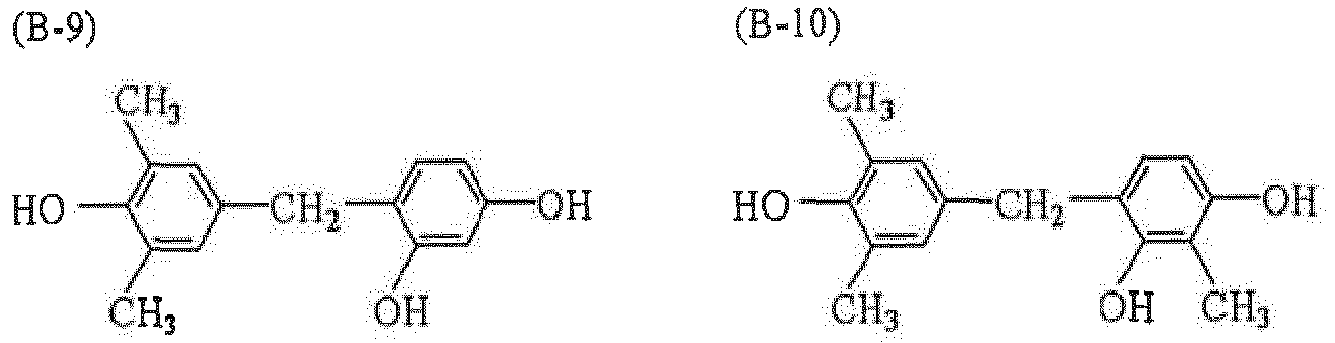


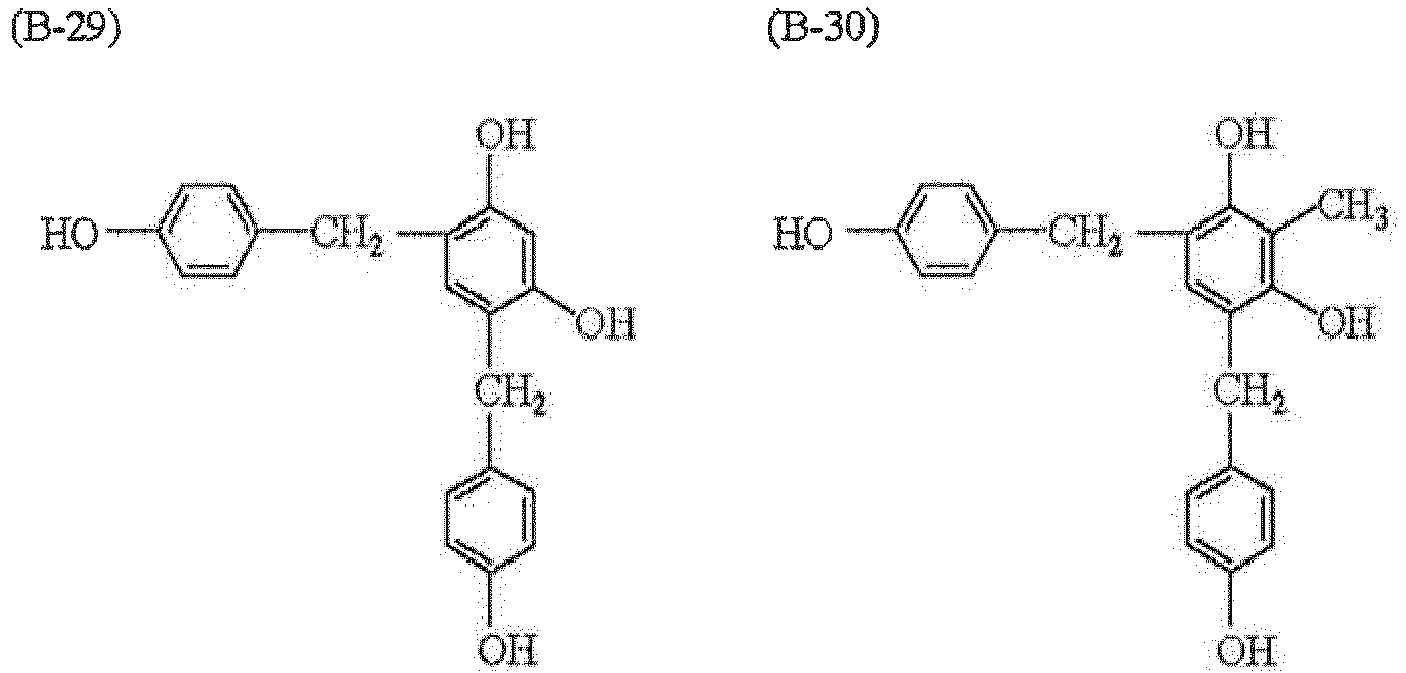


- Among the low nuclear compounds (ballast molecules) shown above, (B-3), (B-29), (B-33), and (B-38) are preferable, and a compound obtained by substituting a hydrogen atom of a phenolic hydroxy group of these ballast molecules with a 1,2-naphthoquinone diazide sulfonyl group is preferably used for the component (B) in the inventive positive photosensitive resin composition.

- The novolac resin having the repeating unit shown by the formula (43) can be synthesized by condensation of a phenol shown by the following formula (44), specifically, at least one phenol compound selected from o-cresol, m-cresol, p-cresol, and 3,5-xylenol, with an aldehyde according to a usual method.

- Examples of the aldehyde used in this reaction include formaldehyde, paraformaldehyde, acetaldehyde, and benzaldehyde, and formaldehyde is preferable.
- The mole ratio of the aldehyde to the phenol shown by the formula (44) preferably ranges from 0.2 to 2, more preferably from 0.3 to 2.
- A preferable method for introducing a 1,2-naphthoquinone diazide sulfonyl group into the parent compound is dehydrochlorination condensation reaction of 1,2-naphthoquinone diazide sulfonyl chloride with phenolic hydroxy groups in the presence of a base catalyst. In the case that the ballast molecule shown by the formula (38'), trihydroxy benzophenone, or tetrahydroxy benzophenone is used, a hydrogen atom of its phenolic hydroxy group is preferably substituted with a 1,2-naphthoquinone diazide sulfonyl group in a proportion of 10 to 100 mol%, more preferably 50 to 100 mol%. In the case that the novolac resin shown by the formula (40) is used, a hydrogen atom of its phenolic hydroxy group is preferably substituted with 1,2-naphthoquinone diazide sulfonyl group in a proportion of 2 to 50 mol%, more preferably 3 to 27 mol%.
- The adding amount of the component (B) is preferably 1 to 50 parts by mass, more preferably 10 to 40 parts by mass, with respect to 100 parts by bass of the component (A). The component (B) to be used may be one kind or a combination of two or more kinds.
- When such component (B) is blended, the solubility in an aqueous alkaline solution before exposure is decreased due to the effect of dissolution inhibition by the component (B), and thus the system becomes alkaliinsoluble. On the other hand, once exposure is carried out, the photosensitive agent of the component (B) generates an acid by light and increases the dissolution rate in an aqueous alkaline solution, and thus the system becomes alkali-soluble. That is, when an aqueous alkaline solution is used as a developer, an exposed part dissolves in the developer, while an unexposed part does not dissolve therein. This allows a positive pattern to be formed.
- The component (C) in the inventive positive photosensitive resin composition is one or more crosslinking agents selected from an amino condensate modified with formaldehyde or formaldehyde-alcohol, a phenol compound having on average two or more methylol groups or alkoxymethyl groups per molecule, a polyhydric phenol compound in which a hydrogen atom of a phenolic hydroxy group is substituted with a glycidyl group, a polyhydric phenol compound in which a hydrogen atom of a phenolic hydroxy group is substituted with a group shown by the following formula (C-1), and a compound containing two or more nitrogen atoms bonded to a glycidyl group as shown by the following formula (C-2).


- The amino condensate modified with formaldehyde or formaldehyde-alcohol may be mentioned, for example, hexamethoxymethylmelamine, a melamine condensate modified with formaldehyde or formaldehyde-alcohol, or a urea condensate modified with formaldehyde or formaldehyde-alcohol.
- Preparation of the melamine condensate modified with formaldehyde or formaldehyde-alcohol may be carried out, for example, by firstly according to the conventionally known method, modifying the melamine monomer with formalin to methylolation, or further modifying it with an alcohol to alkoxylation to make a modified melamine represented by the following general formula (45). The alcohol is preferably a lower alcohol, for example, an alcohol having 1 to 4 carbon atoms.

- The R50 may be mentioned, for example, an alkoxymethyl group such as a methoxymethyl group, an ethoxymethyl group, a methylol group, and a hydrogen atom.
- The modified melamine represented by the general formula (45) may be more specifically mentioned trimethoxymethylmonomethylol melamine, dimethoxymethylmonomethylol melamine, trimethylol melamine, hexamethylol melamine, hexamethoxymethylol melamine, and the like. Then, the modified melamine represented by the general formula (45) or its multimer (for example, an oligomer such as a dimer or a trimer) is subjected to addition condensation polymerization with formaldehyde until the product has a desired molecular weight according to the conventional method to obtain a melamine condensate modified with formaldehyde or formaldehyde-alcohol.
- Preparation of the urea condensate modified with formaldehyde or formaldehyde-alcohol may be carried out, for example, according to the conventionally known method, by modifying the urea condensate having a desired molecular weight with formaldehyde to methylolation, or further modifying it with an alcohol to alkoxylation.
- Specific examples of the urea condensate modified with formaldehyde or formaldehyde-alcohol may be mentioned, for example, a methoxymethylated urea condensate, an ethoxymethylated urea condensate, a propoxymethylated urea condensate, and the like.
- These modified melamine condensates and modified urea condensates may be used one kind or in combination of two or more kinds in admixture.
- Then, the phenol compound having two or more methylol groups or alkoxymethyl groups in one molecule in average may be mentioned, for example, (2-hydroxy-5-methyl)-1,3-benzenedimethanol, 2,2',6,6'-tetramethoxymethylbisphenol A, compounds represented by the following formulae (C-3) to (C-7), and the like.


- The crosslinking agents may be used one kind or in combination of two or more kinds.
- The compound in which a hydrogen atom of a hydroxy group of a polyhydric phenol is substituted by a glycidyl group may be mentioned a compound obtained by reaction of the hydroxy group of bisphenol A, tris(4-hydroxyphenyl)methane, and 1,1,1-tris(4-hydroxyphenyl)ethane with epichlorohydrin in the presence of a base. Suitable examples of the compound in which a hydrogen atom of a hydroxy group of a polyhydric phenol is substituted by a glycidyl group may be mentioned the compounds represented by the following formulae (C-8) to (C-14).


- One kind or two kinds of these compounds in which a hydroxy group of a polyhydric phenol is substituted by a glycidoxy group may be used as a crosslinking agent.
- The compound in which a hydrogen atom of a hydroxy group of a polyhydric phenol is substituted by a substituent represented by the following formula (C-1) may be mentioned a compound having two or more of the substituents and represented by the following formula (C-15) :


- Additionally, the compound having two or more nitrogen atoms having a glycidyl group represented by the following formula (C-2) may be mentioned a compound represented by the following formula (C-16):


- Examples of the compound represented by the formula (C-16) may be mentioned, for example, compounds represented by the following formulae (C-17) to (C-20).


- Also, the compound having two or more nitrogen atoms each of which has a glycidyl group(s) and represented by the formula (C-2) may be suitably used a compound represented by the following formula (C-21).

- These compounds having two or more nitrogen atoms having a glycidyl group represented by the formula (C-2) may be used a single kind or two kinds thereof as a crosslinking agent(s).
- The component (C) is a component that causes a crosslinking reaction upon post-curing after patterning the positive type photosensitive resin composition using the inventive polymer, and further increases the strength of the cured product. A weight average molecular weight of such a component (C) is preferably 150 to 10,000, particularly preferably 200 to 3,000 from the viewpoints of curability and heat resistance.
- The component (D) in the positive photosensitive resin composition is a solvent. The solvent of the component (D) may be any solvent to dissolve the component (A) and the component (B). Illustrative examples of the solvent include ketones such as cyclohexanone, cyclopentanone, and methyl-2-n-amylketone; alcohols such as 3-methoxybutanol, 3-methyl-3-methoxybutanol, 1-methoxy-2-propanol, and 1-ethoxy-2-propanol; ethers such as propylene glycol monomethyl ether, ethylene glycol monomethyl ether, propylene glycol monoethyl ether, ethylene glycol monoethyl ether, propylene glycol dimethyl ether, and diethylene glycol dimethyl ether; and esters such as propylene glycol monomethyl ether acetate, propylene glycol monoethyl ether acetate, ethyl lactate, ethyl pyruvate, butyl acetate, methyl 3-methoxypropionate, ethyl 3-ethoxypropionate, tert-butyl acetate, tert-butyl propionate, propylene glycol mono-tert-butyl ether acetate, and γ-butyrolactone. These solvents may be used one or more kinds. In particular, ethyl lactate, cyclohexanone, cyclopentanone, propylene glycol monomethyl ether acetate, and γ-butyrolactone, or a mixture thereof are preferred.
- The formulation amount of the component (D) is preferably 50 to 2,000 parts by mass, more preferably 100 to 1,000 parts by mass, based on 100 parts by mass of the total amount of the component (A) and the component (B).
- The inventive positive photosensitive resin composition may further contain (E) a compound capable of generating an acid or a radical by heat. The component (E), a compound capable of generating an acid or a radical by heat, can be blended in order to promote the thermal crosslinking reaction with the component (A) in the step of baking and post-curing a film at 100 to 300°C after patterning.
- In particular, the component (E) is preferably a compound that does not promote curing of a film and not prevent pattern formation until a pattern is formed by development. To this end, the component (E) preferably does not generate an acid or a radical at temperature in the step of removing and drying the solvent after applying the photosensitive resin composition, but generates an acid or a radical only by heat treatment after patterning, thereby promoting curing of the film or the pattern of the positive photosensitive resin composition. More specifically, the component (E) is preferably a compound that is decomposed by heat treatment at 100°C to 300°C, preferably 150°C to 300°C and thereby generates an acid or a radical. By containing such component (E), crosslinking and curing reaction of the pattern or the film of the positive photosensitive resin composition can be further promoted in the step of baking and post-curing at 100 to 300°C after patterning. Thus, the component (E) can further promote the crosslinking and curing reaction, thereby improving properties such as mechanical strength, chemical resistance, and adhesiveness of the obtained pattern or the film.
- Preferable examples of the compound capable of generating an acid by heat include compounds described in paragraphs (0061) to (0085) of Japanese Patent Laid-Open Publication No.
2007-199653 - The formulation amount of the compound capable of generating an acid by heat is preferably 0.1 part by mass or more, more preferably 0.5 part by mass or more and preferably 30 parts by mass or less, more preferably 10 parts by mass or less, with respect to 100 parts by mass of the component (A) in the inventive positive photosensitive resin composition.
- Preferable examples of the compound capable of generating a radical by heat include organic peroxides such as diisopropylbenzene hydroperoxide, 1,1,3,3-tetramethylbutyl hydroperoxide, cumene hydroperoxide, t-butyl hydroperoxide, and t-butyltrimethylsilyl peroxide; and radical initiators consisting of only carbon and hydrogen such as 2,3-dimethyl-2,3-diphenylbutane. Among them, radical initiators consisting of only carbon and hydrogen are preferable because they have high activation energy and are difficult to decompose by heat for drying.
- The formulation amount of the compound capable of generating a radical by heat is preferably 0.5 to 4 parts by mass, more preferably 1 to 3 parts by mass, with respect to 100 parts by mass of the component (A) in the inventive positive photosensitive resin composition.
- The inventive positive photosensitive resin composition may further contain a component (F) other than the components (A), (B), (C), (D), and (E). Examples of the component (F) includes an adhesion assistant and a surfactant. As the surfactant, the following compounds can be suitably used.
- The surfactant is preferably nonionic. Examples thereof include fluorinated surfactants, specifically, perfluoroalkyl polyoxyethylene ethanol, fluorinated alkyl ester, perfluoroalkylamine oxide, and a fluorine-containing organosiloxane compound.
- As these surfactants, commercially available products can be used, and illustrative examples thereof include Flolade "FC-4430" (available from Sumitomo 3M Ltd.), Surflon "S-141" and "S-145" (both are available from Asahi Glass Co., Ltd.), Unidyne "DS-401", "DS-4031", and "DS-451" (all are available from Daikin Industries, Ltd.), Megafac "F-8151" (available from DIC Co.), and "X-70-093" (available from Shin-Etsu Chemical Co., Ltd.). Among them, Flolade "FC-4430" (available from Sumitomo 3M Ltd.) and "X-70-093" (available from Shin-Etsu Chemical Co., Ltd.) are preferable.
- Then, the patterning processes using the inventive positive photosensitive resin composition will be described.
- In case of using the inventive positive photosensitive resin composition, a pattern can be formed by the method including the steps of (1) applying the inventive positive photosensitive resin composition onto a substrate to form a photosensitive material film; (2) exposing the photosensitive material film to a high energy beam having a wavelength of 190 to 500 nm or an electron beam via a photomask after a heat treatment; and (3) performing development with a developer of an aqueous alkaline solution. Concretely, a well-known lithography technology can be applied. For example, the photosensitive resin composition may be applied by a spin coating method on a silicon wafer, a SiO2 substrate, a SiN substrate, or a substrate having a formed pattern such as copper wiring, and pre-baked at about 80 to 130°C for 50 to 600 seconds to form a photosensitive material film with a thickness of 1 to 50 µm, preferably 1 to 30 µm, more preferably 5 to 20 µm.
- The spin coating method may be to dispense about 5 mL of the photosensitive resin composition on a silicon substrate and then rotate the substrate, thereby applying the photosensitive resin composition on the substrate. By adjusting the rotational speed during this operation, the thickness of the photosensitive material film on the substrate can be easily controlled.
- Then, a mask for forming an intended pattern is put over the photosensitive material film, and the film is irradiated with a high energy beam having a wavelength of 190 to 500 nm such as i-line beam and g-line beam or an electron beam with an exposure dose of about 1 to 5,000 mJ/cm2, preferably about 100 to 2,000 mJ/cm2.
- Then, development is performed. The inventive positive photosensitive resin composition is available for development with aqueous alkaline solution.
- Examples of the aqueous alkaline solvent that can be favorably used for alkali development include 2.38% aqueous tetramethylammonium hydroxide (TMAH) solution. The development can be performed by a usual method such as spraying, puddling, or soaking in a developer. Then, if necessary, washing, rinsing, drying, and so forth may be performed to obtain a resist film having an intended pattern.
- Moreover, the film having a pattern obtained by the patterning process may be baked and post-cured with an oven or a hot plate at 100 to 300°C, preferably 150 to 300°C, more preferably 180 to 250°C to form a cured film. In this post-curing step, the post-curing temperature of 100 to 300°C allows the film of the photosensitive resin composition to increase the crosslinking density and to remove remaining volatile components. Thus, this temperature range is preferable in view of adhesiveness to a substrate, heat resistance, strength, and electronic characteristics. The time for the post-curing can be 10 minutes to 10 hours.
- With the positive photosensitive resin composition using the polymer of the present invention, it is possible to produce a photosensitive dry film having a supporting film, a protective film, and a photosensitive resin layer having a thickness of 5 to 100 µm and sandwiched between the supporting film and the protective film by the following process:
- (i) continuously applying the positive photosensitive resin composition using the polymer of the present invention onto a supporting film to form a photosensitive resin layer;
- (ii) continuously drying the photosensitive resin layer; and further
- (iii) laminating a protective film onto the photosensitive resin layer.
- The above dry film cam be used for patterning through the steps of:
- (i) separating the protective film from the photosensitive dry film described above and bringing the photosensitive resin layer thereby uncovered into close contact with a substrate;
- (ii) exposing the photosensitive resin layer to a high energy beam having a wavelength of 190 to 500 nm or an electron beam via a photomask either through the supporting film or after removing the supporting film; and
- (iii) performing development with a developer.
- Additionally, it is also possible to obtain a cured film that is improved in adhesiveness to a substrate, heat resistance, strength, and electric characteristics through the step of (iv) post-curing a patterned film formed by the development of the photosensitive material film at a temperature of 100 to 300°C in the same manner as in the above.
- The formed pattern can be used for a protective film coating a wiring, a circuit, and a substrate, etc. Such formed pattern and a protective film have excellent insulating property and excellent adhesiveness to a metal layer of, for example, Cu of a wiring and a circuit to be coated, a metal electrode on a substrate, and an insulating substrate such as SiN substrate with a wiring and a circuit to be coated, and can significantly improve resolution performance for forming a fine pattern with an appropriate mechanical strength as a protective film.
- The cured film thus obtained has excellent adhesiveness to a substrate, heat resistance, electric characteristics, mechanical strength, and chemical resistance to an alkaline removing liquid. A semiconductor device using this cured film as a protective film has excellent reliability, and especially, generation of cracks during a thermal cycle test can be prevented. Therefore, this cured film is useful for a protective film to protect electric and electronic parts, semiconductor devices, etc.
- The above protective film is useful for an insulator film for a semiconductor device including rewiring use, an insulator film for a multilayer printed substrate, a solder mask, and a cover lay film, because of its heat resistance, chemical resistance, and insulating property.
- Hereinafter, the present invention will be specifically described using Synthesis Examples, Comparative Synthesis Examples, Examples, and Comparative Examples, but the present invention is not limited thereto.
- Regarding the compounds used in the following Synthesis Examples, the chemical structures and names are shown below.





- 6FAP 2,2-bis(3-amino-4-hydroxyphenyl)hexafluoropropane
- BPS bis (3-amino-4-hydroxyphenyl) sulfone
- s-ODPA 3,3',4,4'-oxydiphthalic dianhydride
- s-BPDA 3,3',4,4'-biphenyltetracarboxylic dianhydride
- DC-1 sebacoyl dichloride
- DC-2 dodecanedioly dichloride
- PAP 4-aminophenol
- PAE 4-ethylaniline
- PA aniline
- Rf-1 4,4,5,5,5-pentafluoropentanol
- Rf-2 1H,1H,2H,2H-nonafluoro-1-hexanol
- Rf-3 1-trifluoromethyl-2,2,2-trifluoroethyl-2'-hydroxyethyl ether
- Rf-4 3,3,3-trifluoropropyl-2'-hydroxyethyl ether
- Rf-5 hydroxyethyl trifluoroacetate
- Rf-6 3-hydroxy-2,2-dimethylpropyl trifluoroacetate
- Rf-7 4,4,5,5,6,6,7,7,7-nonafluoro-1,2-heptanediol
- Into a 1 L flask equipped with a stirrer and a thermometer, 30 g (81.9 mmol) of 2,2-bis(3-amino-4-hydroxyphenyl)hexafluoropropane (6FAP) was added, together with 170 g of N-methyl-2-pyrorridone, and dissolved by stirring at room temperature. To this, the solution of 12.7 g (41.0 mmol) of 3,3',4,4'-oxydiphthalic dianhydride (s-ODPA) and 18.8 g (41.0 mmol) of tetracarboxylic dianhydride (AN-1) dissolved into 320 g of N-methyl-2-pyrorridone was added dropwise at room temperature, and this was stirred at room temperature for 3 hours after finishing the dropping. To this reaction solution, 40 g of xylene was then added, and this was refluxed with heating at 170°C for 3 hours while removing the generated water to outside the system. This reaction solution was cooled to room temperature, and then added dropwise to 2 L of ultrapure water with stirring to filtrate the precipitate. This was washed with water appropriately and dried under reduced pressure at 40°C for 48 hours to give Polyimide resin (A-1). This polymer was measured for the molecular weight by GPC to reveal that the weight average molecular weight was 35,000 in terms of polystyrene.
- Polyimide resins (A-2) to (A-17) were obtained in the same manner as in Synthesis Example 1 except for using tetracarboxylic dianhydrides (AN-2) to (AN-17) in respective weight shown in the following Table 1 instead of 18.8 g of tetracarboxylic dianhydride (AN-1). Each polymer was measured for the molecular weight by GPC. Each weight average molecular weight is shown in the following Table 1 in terms of polystyrene.
- Polyimide resin (A-18) was obtained in the same manner as in Synthesis Example 1 except for using 23.0 g of bis(3-amino-4-hydroxyphenyl)sulfone (BPS) instead of 30 g of 2,2-bis(3-amino-4-hydroxyphenyl)hexafluoropropane (6FAP). This polymer was measured for the molecular weight by GPC to reveal that the weight average molecular weight was 33,000 in terms of polystyrene as shown in Table 1.

- Into a 3 L flask equipped with a stirrer and a thermometer, 100 g (322 mmol) of 3,3',4,4'-oxydiphthalic dianhydride (s-ODPA), 65.2 g (644 mmol) of triethylamine, 39.3 g (322 mmol) of N,N-dimethyl-4-aminopyridine, and 400 g of γ-butyrolactone were added and stirred at room temperature. To this, 114.7 g (644 mmol) of 4,4,5,5,5-pentafluoropentanol (Rf-1) was added dropwise and stirred at room temperature for additional 24 hours. Then, 370 g of 10% aqueous hydrochloric acid solution was added dropwise with ice-cooling to stop the reaction. To the reaction solution, 800 g of 4-methyl-2-pentanone was added to separate the organic layer. This was washed with 600 g of ultrapure water for 6 times, and the solvent was distilled out from the obtained organic layer to give 193 g of tetracarboxylic acid diester compound. The obtained tetracarboxylic acid diester compound was dissolved in 772 g of N-methyl-2-pyrorridone added thereto by stirring at room temperature. Then, 75.8 g (637 mmol) of thionyl chloride was added dropwise with ice-cooling so as to keep the temperature of the reaction solution to 10°C or less. This was stirred with ice-cooling at 2 hours after finishing the dropping to give a solution of tetracarboxylic acid diester dichloride (X-1) in N-methyl-2-pyrorridone.
- The solution of Tetracarboxylic acid diester dichloride (X-2) in N-methyl-2-pyrorridone was obtained in the same manner as in Synthesis Example 19 except for using 94.8 g (322 mmol) of 3,3',4,4'-biphenyltetracarboxylic dianhydride (s-BPDA) instead of 3,3',4,4'-oxydiphthalic dianhydride (s-ODPA).
- The solution of Tetracarboxylic acid diester dichloride (X-3) in N-methyl-2-pyrorridone was obtained in the same manner as in Synthesis Example 19 except for using 170.1 g (644 mmol) of 1H,1H,2H,2H-nonafluoro-1-hexanol (Rf-2) instead of 4,4,5,5,5-pentafluoropentanol (Rf-1).
- The solution of Tetracarboxylic acid diester dichloride (X-4) in N-methyl-2-pyrorridone was obtained in the same manner as in Synthesis Example 19 except for using 136.6 g (644 mmol) of 1-trifluoromethyl-2,2,2-trifluoroethyl-2'-hydroxyethyl ether (Rf-3) instead of 4,4,5,5,5-pentafluoropentanol (Rf-1).
- The solution of Tetracarboxylic acid diester dichloride (X-5) in N-methyl-2-pyrorridone was obtained in the same manner as in Synthesis Example 19 except for using 112.2 g (644 mmol) of 3,3,3-trifluoropropyl-2'-hydroxyethyl ether (Rf-4) instead of 4,4,5,5,5-pentafluoropentanol (Rf-1).
- The solution of Tetracarboxylic acid diester dichloride (X-6) in N-methyl-2-pyrorridone was obtained in the same manner as in Synthesis Example 19 except for using 101.8 g (644 mmol) of 2-hydroxyethyl trifluoroacetate (Rf-5) instead of 4,4,5,5,5-pentafluoropentanol (Rf-1).
- The solution of Tetracarboxylic acid diester dichloride (X-7) in N-methyl-2-pyrorridone was obtained in the same manner as in Synthesis Example 19 except for using 101.8 g (644 mmol) of 3-hydroxy-2,2-dimethylpropyl trifluoroacetate (Rf-6) instead of 4,4,5,5,5-pentafluoropentanol (Rf-1).
- The solution of Tetracarboxylic acid diester dichloride (X-8) in N-methyl-2-pyrorridone was obtained in the same manner as in Synthesis Example 19 except for using 189.4 g (644 mmol) of 4,4,5,5,6,6,7,7,7-nonafluoro-1,2-heptanediol (Rf-7) instead of 4,4,5,5,5-pentafluoropentanol (Rf-1).
- Into a 500 ml flask equipped with a stirrer and a thermometer, 30 g (81.9 mmol) of 2,2-bis(3-amino-4-hydroxyphenyl)hexafluoropropane (6FAP) was added, together with 170 g of N-methyl-2-pyrorridone, and dissolved by stirring at room temperature. To this, the solution of 12.7 g (41.0 mmol) of 3,3',4,4'-oxydiphthalic dianhydride (s-ODPA) and 5.6 g (12.3 mmol) of tetracarboxylic dianhydride (AN-1) dissolved into 185 g of N-methyl-2-pyrorridone was added dropwise at room temperature, and this was stirred at room temperature for 3 hours after finishing the dropping. To this reaction solution, 40 g of xylene was then added, and this was refluxed with heating at 170°C for 3 hours while removing the generated water to outside the system. After this was cooled to room temperature, 1.4 g (18.0 mmol) of pyridine was added thereto, and the mixture solution of 14.7 g of the solution of tetracarboxylic acid diester dichloride (X-1) in N-methyl-2-pyrorridone (4.1 mmol as a tetracarboxylic acid diester dichloride) and 5.9 g (24.6 mmol) of sebacoyl dichloride (DC-1) prepared separately was added dropwise so as to keep the temperature to 5°C or less. After finishing the dropping, this reaction solution was warmed to room temperature, and then added dropwise to 2 L of ultrapure water with stirring to filtrate the precipitate. This was washed with water appropriately and dried under reduced pressure at 40°C for 48 hours to give Polyamide-imide resin (A-19). This polymer was measured for the molecular weight by GPC to reveal that the weight average molecular weight was 38,000 in terms of polystyrene.
- Polyamide-imide resins (A-20) to (A-26) were obtained in the same manner as in Synthesis Example 27 except for using the solutions of tetracarboxylic diester dichlorides (X-2) to (X-8) in N-methyl-2-pyrorridone in respective weight shown in the column of Synthesis Example 28 to Synthesis Example 34 of the following Table 2 instead of the solution of tetracarboxylic diester dichloride (X-1) in N-methyl-2-pyrorridone. Each polymer was measured for the molecular weight by GPC. Each weight average molecular weight is shown in the following Table 2 in terms of polystyrene.
- Polyamide-imide resin (A-27) was obtained in the same manner as in Synthesis Example 27 except for using 7.9 g of tetracarboxylic dianhydride (AN-2) instead of 5.6 g of tetracarboxylic dianhydride (AN-1). This polymer was measured for the molecular weight by GPC to reveal that the weight average molecular weight was 39,000 in terms of polystyrene as shown in Table 2.
- Polyimide resin (A-28) was obtained in the same manner as in Synthesis Example 27 except for using 6.9 g of dodecanedioly dichloride (DC-2) instead of 5.9 g of sebacoyl dichloride (DC-1). This polymer was measured for the molecular weight by GPC to reveal that the weight average molecular weight was 39,000 in terms of polystyrene as shown in Table 2.
- Polyimide resin (A-29) was obtained in the same manner as in Synthesis Example 27 except for using 23.0 g of bis (3-amino-4-hydroxyphenyl)sulfone (BPS) instead of 30 g of 2,2-bis(3-amino-4-hydroxyphenyl)hexafluoropropane (6FAP). This polymer was measured for the molecular weight by GPC to reveal that the weight average molecular weight was 35,000 in terms of polystyrene as shown in Table 2.
- Into a 500 ml flask equipped with a stirrer and a thermometer, 27.0 g (73.7 mmol) of 2,2-bis(3-amino-4-hydroxyphenyl)hexafluoropropane (6FAP) was added, together with 108 g of N-methyl-2-pyrorridone, and dissolved by stirring at room temperature. To this, the solution of 12.7 g (41.0 mmol) of 3,3',4,4'-oxydiphthalic dianhydride (s-ODPA) and 5.6 g (12.3 mmol) of tetracarboxylic dianhydride (AN-1) dissolved into 185 g of N-methyl-2-pyrorridone was added dropwise at room temperature, and this was stirred at room temperature for 3 hours after finishing the dropping. To this reaction solution, 40 g of xylene was then added, and this was refluxed with heating at 170°C for 3 hours while removing the generated water to outside the system. After this was cooled to room temperature, 0.9 g (8.2 mmol) of 4-aminophenol (PAP) and 1.4 g (18.0 mmol) of pyridine was added thereto, and the mixture solution of 14.7 g of the solution of tetracarboxylic acid diester dichloride (X-1) in N-methyl-2-pyrorridone (4.1 mmol as a tetracarboxylic acid diester dichloride) and 5.9 g (24.6 mmol) of sebacoyl dichloride (DC-1) prepared separately was added dropwise so as to keep the temperature to 5°C or less. After finishing the dropping, this reaction solution was warmed to room temperature, and then added dropwise to 2 L of ultrapure water with stirring to filtrate the precipitate. This was washed with water appropriately and dried under reduced pressure at 40°C for 48 hours to give Polyamide-imide resin (A-30). This polymer was measured for the molecular weight by GPC to reveal that the weight average molecular weight was 30,000 in terms of polystyrene as shown in Table 2.
- Polyamide-imide resin (A-31) was obtained in the same manner as in Synthesis Example 38 except for using 1.0 g of 4-ethynylaniline (PAE) instead of 0.9 g of 4-aminophenol (PAP). This polymer was measured for the molecular weight by GPC to reveal that the weight average molecular weight was 29,000 in terms of polystyrene as shown in Table 2.
- Polyamide-imide resin (A-32) was obtained in the same manner as in Synthesis Example 38 except for using 0.8 g of aniline (PA) instead of 0.9 g of 4-aminophenol (PAP). This polymer was measured for the molecular weight by GPC to reveal that the weight average molecular weight was 28,000 in terms of polystyrene as shown in Table 2.
- Polyamide-imide resin (A-33) was obtained in the same manner as in Synthesis Example 27 except for using the dicarboxylic acid solution prepared separately after Synthesis Example 19 using 14.5 g of dicarboxylic acid (CA-1) instead of 5.9 g of sebacoyl dichloride (DC-1). This polymer was measured for the molecular weight by GPC to reveal that the weight average molecular weight was 37,000 in terms of polystyrene as shown in Table 2.
- Into a 500 ml flask equipped with a stirrer and a thermometer, 30 g (81.9 mmol) of 2,2-bis(3-amino-4-hydroxyphenyl)hexafluoropropane (6FAP) was added, together with 170 g of N-methyl-2-pyrorridone, and dissolved by stirring at room temperature. To this, the solution of 12.7 g (41.0 mmol) of 3,3',4,4'-oxydiphthalic dianhydride (s-ODPA) dissolved into 128 g of N-methyl-2-pyrorridone was added dropwise at room temperature, and this was stirred at room temperature for 3 hours after finishing the dropping. To this reaction solution, 40 g of xylene was then added, and this was refluxed with heating at 170°C for 3 hours while removing the generated water to outside the system. After this was cooled to room temperature, the solution of 9.8 g (41.0 mmol) of sebacoyl dichloride (DC-1) was added dropwise so as to keep the temperature to 5°C or less. After finishing the dropping, this reaction solution was warmed to room temperature, and then added dropwise to 2 L of ultrapure water with stirring to filtrate the precipitate. This was washed with water appropriately and dried under reduced pressure at 40°C for 48 hours to give Polyamide-imide resin (B-1). This polymer was measured for the molecular weight by GPC to reveal that the weight average molecular weight was 34,000 in terms of polystyrene.
- Polyamide-imide resin (B-2) was obtained in the same manner as in Comparative Synthesis Example 1 except for using 23.0 g of bis(3-amino-4-hydroxyphenyl)sulfone (BPS) instead of 30 g of 2,2-bis(3-amino-4-hydroxyphenyl)hexafluoropropane (6FAP). This polymer was measured for the molecular weight by GPC to reveal that the weight average molecular weight was 33,000 in terms of polystyrene as shown in Table 2.
- Polyamide-imide resin (B-3) was obtained in the same manner as in Comparative Synthesis Example 1 except for using 12.1 g of 3,3',4,4'-biphenyltetracarboxylic dianhydride (s-BPDA) instead of 12.7 g of 3,3',4,4'-oxydiphthalic dianhydride (s-ODPA). This polymer was measured for the molecular weight by GPC to reveal that the weight average molecular weight was 35,000 in terms of polystyrene as shown in Table 2.
- Polyamide-imide resin (B-4) was obtained in the same manner as in Comparative Synthesis Example 1 except for using 23.0 g of bis(3-amino-4-hydroxyphenyl)sulfone (BPS) instead of 30 g of 2,2-bis(3-amino-4-hydroxyphenyl)hexafluoropropane (6FAP) and 12.1 g of 3,3',4,4'-biphenyltetracarboxylic dianhydride (s-BPDA) instead of 12.7 g of 3,3',4,4'-oxydiphthalic dianhydride (s-ODPA). This polymer was measured for the molecular weight by GPC to reveal that the weight average molecular weight was 34,000 in terms of polystyrene as shown in Table 2.

- Resin compositions each containing 40 mass% of resin were prepared using Polyimide resins (A-1) to (A-18) synthesized in Synthesis Examples 1 to 18 as well as Polyamide-imide resins and Polyimide resins (A-19) to (A-33) synthesized in Synthesis Examples 27 to 41 and Polyamide-imide resins synthesized in Comparative Synthesis Examples 1 to 4 as base resins, with the composition and the formulation amount shown in Tables 3A to 3F. The resin compositions were each stirred, mixed, dissolved, and filtered through a 0.5-µm filter made of Teflon (registered trade mark) for microfiltration to obtain photosensitive resin compositions. In Tables, the solvent "PGMEA" represents propylene glycol monomethyl ether acetate, and the unit "phr" represents per hundred resin by mass.
[Table 3A] Photosensitive resin composition 1 Photosensitive resin composition 2 Photosensitive resin composition 3 Photosensitive resin composition 4 Photosensitive resin composition 5 Photosensitive resin composition 6 Photosensitive resin composition 7 Base resin A-1 A-2 A-3 A-4 A-5 A-6 A-7 100 phr 100 phr 100 phr 100 phr 100 phr 100 phr 100 phr Photosensitive agent Photosensitive agent 1 Photosensitive agent 1 Photosensitive agent 1 Photosensitive agent 1 Photosensitive agent 1 Photosensitive agent 1 Photosensitive agent 1 15 phr 15 phr 15 phr 15 phr 15 phr 15 phr 15 phr Crosslinking agent 1 CL-1 CL-1 CL-1 CL-1 CL-1 CL-1 CL-1 5 phr 5 phr 5 phr 5 phr 5 phr 5 phr 5 phr Crosslinking agent 2 CL-2 CL-2 CL-2 CL-2 CL-2 CL-2 CL-2 15 phr 15 phr 15 phr 15 phr 15 phr 15 phr 15 phr Solvent PGMEA PGMEA PGMEA PGMEA PGMEA PGMEA PGMEA 150 phr 150 phr 150 phr 150 phr 150 phr 150 phr 150 phr [Table 3B] Photo-sensitive resin composition 8 Photo-sensitive resin composition 9 Photo- sensitive resin composition 10 Photo-sensitive resin composition 11 Photosensitive resin composition 12 Photosensitive resin composition 13 Photosensitive resin composition 14 Base resin A-8 A-9 A-10 A-11 A-12 A-13 A-14 100 phr 100 phr 100 phr 100 phr 100 phr 100 phr 100 phr Photosensitive agent Photosensitive agent 1 Photosensitive agent 1 Photosensitive agent 1 Photosensitive agent 1 Photosensitive agent 1 Photosensitive agent 1 Photosensitive agent 1 15 phr 15 phr 15 phr 15 phr 15 phr 15 phr 15 phr Crosslinking agent 1 CL-1 CL-1 CL-1 CL-1 CL-1 CL-1 CL-1 5 phr 5 phr 5 phr 5 phr 5 phr 5 phr 5 phr Crosslinking agent 2 CL-2 CL-2 CL-2 CL-2 CL-2 CL-2 CL-2 15 phr 15 phr 15 phr 15 phr 15 phr 15 phr 15 phr Solvent PGMEA PGMEA PGMEA PGMEA PGMEA PGMEA PGMEA 150 phr 150 phr 150 phr 150 phr 150 phr 150 phr 150 phr [Table 3C] Photo-sensitive resin composition 15 Photo-sensitive resin composition 16 Photo-sensitive resin composition 17 Photo-sensitive resin composition 18 Photo-sensitive resin composition 19 Photo-sensitive resin composition 20 Photo-sensitive resin composition 21 Base resin A-15 A-16 100 ph A-17 A-18 A-19 A-20 A-21 100 phr 100 phr 100 phr 100 phr 100 phr 100 phr 100 phr Photo-sensitive agent Photo-sensitive agent 1 Photo-sensitive agent 1 Photo-sensitive agent 1 Photo-sensitive agent 1 Photo-sensitive agent 1 Photo-sensitive agent 1 Photo-sensitive agent 1 15 phr 15 phr 15 phr 15 phr 15 phr 15 phr 15 phr Crosslinking agent 1 CL-1 CL-1 CL-1 CL-1 CL-1 CL-1 CL-1 5 phr 5 phr 5 phr 5 phr 5 phr 5 phr 5 phr Crosslinking agent 2 CL-2 CL-2 CL-2 CL-2 CL-2 CL-2 CL-2 15 phr 15 phr 15 phr 15 phr 15 phr 15 phr 15 phr Solvent PGMEA PGMEA PGMEA PGMEA PGMEA PGMEA PGMEA 150 phr 150 phr 150 phr 150 phr 150 phr 150 phr 150 phr [Table 3D] Photo-sensitive resin composition 22 Photo-sensitive resin composition 23 Photo-sensitive resin composition 24 Photo-sensitive resin composition 25 Photo-sensitive resin composition 26 Photo-sensitive resin composition 27 Photo-sensitive resin composition 28 Base resin A-22 A-23 A-24 A-25 A-26 A-27 A-28 100 phr 100 phr 100 phr 100 phr 100 phr 100 phr 100 phr Photo-sensitive agent Photo-sensitive agent 1 Photo-sensitive agent 1 Photo-sensitive agent 1 Photo-sensitive agent 1 Photo-sensitive agent 1 Photo-sensitive agent 1 Photo-sensitive agent 1 15 phr 15 phr 15 phr 15 phr 15 phr 15 phr 15 phr Crosslinking agent 1 CL-1 CL-1 CL-1 CL-1 CL-1 CL-1 CL-1 5 phr 5 phr 5 phr 5 phr 5 phr 5 phr 5 phr Crosslin king agent 2 CL-2 CL-2 CL-2 CL-2 CL-2 CL-2 CL-2 15 phr 15 phr 15 phr 15 phr 15 phr 15 phr 15 phr Solvent PGMEA PGMEA PGMEA PGMEA PGMEA PGMEA PGMEA 150 phr 150 phr 150 phr 150 phr 150 phr 150 phr 150 phr [Table 3E] Photo-sensitive resin composition 29 Photo-sensitive resin composition 30 Photo-sensitive resin composition 31 Photo-sensitive resin composition 32 Photo-sensitive resin composition 33 Base resin A-29 A-30 A-31 A-32 A-33 100 phr 100 phr 100 phr 100 phr 100 phr Photo-sensitive agent Photo-sensitive agent 1 Photo-sensitive agent 1 Photo-sensitive agent 1 Photo-sensitive agent 1 Photo-sensitive agent 1 15 phr 15 phr 15 phr 15 phr 15 phr Crosslinking agent 1 CL-1 CL-1 CL-1 CL-1 CL-1 5 phr 5 phr 5 phr 5 phr 5 phr Crosslinking agent 2 CL-2 CL-2 CL-2 CL-2 CL-2 15 phr 15 phr 15 phr 15 phr 15 phr Solvent PGMEA PGMEA PGMEA PGMEA PGMEA 150 phr 150 phr 150 phr 150 phr 150 phr [Table 3F] Comparative Photo-sensitive resin composition 1 Comparative Photo-sensitive resin composition 2 Comparative Photo-sensitive resin composition 3 Comparative Photo-sensitive resin composition 4 Base resin B-1 B-2 B-3 B-4 100 phr 100 phr 100 phr 100 phr Photo-sensitive agent Photo-sensitive agent 1 Photo-sensitive agent 1 Photo-sensitive agent 1 Photo-sensitive agent 1 15 phr 15 phr 15 phr 15 phr Crosslinking agent 1 CL-1 CL-1 CL-1 CL-1 5 phr 5 phr 5 phr 5 phr Crosslinking agent 2 CL-2 CL-2 CL-2 CL-2 15 phr 15 phr 15 phr 15 phr Solvent PGMEA PGMEA PGMEA PGMEA 150 phr 150 phr 150 phr 150 phr - Comparative photosensitive resin compositions shown in Table 3F, which used (B-1) to (B-4) as respective base resins, were insoluble into PGMEA used as a solvent. The base resins of (B-1) to (B-4) do not contain polyamide-imide resin or polyimide resin derived by the reaction of at least one of a tetracarboxylic dianhydride shown by the general formula (3) as well as a dicarboxylic acid and a dicarboxylic halide shown by the general formula (4) of the present invention, thereby being insoluble in widely used solvent like PGMEA.
- As shown in the following Table 4, photosensitive resin compositions were produced using (B-1) to (B-4) as base resins in the same manner in Comparative photosensitive resin compositions described above except for changing the solvent to GBL. In case of using (B-3) or (B-4) as a base resin, however, the composition was insoluble also in the GBL solvent. Herein, the solvent "GBL" represents γ-butyrolactone.
[Table 4] Comparative Photo-sensitive resin composition 5 Comparative Photo-sensitive resin composition 6 Comparative Photo-sensitive resin composition 7 Comparative Photo-sensitive resin composition 8 Base resin B-1 B-2 B-3 B-4 100 phr 100 phr 100 phr 100 phr Photo-sensitive agent Photo-sensitive agent 1 Photo-sensitive agent 1 Photo-sensitive agent 1 Photo-sensitive agent 1 15 phr 15 phr 15 phr 15 phr Crosslinking agent 1 CL-1 CL-1 CL-1 CL-1 5 phr 5 phr 5 phr 5 phr Crosslin king agent 2 CL-2 CL-2 CL-2 CL-2 15 phr 15 phr 15 phr 15 phr Solvent GBL GBL GBL GBL 150 phr 150 phr 150 phr 150 phr - Photosensitive resin compositions 34 to 38 shown in Table 5 relate to the particular form of the inventive positive photosensitive resin composition described above having the component (E).
[Table 5] Photo-sensitive resin composition 34 Photo-sensitive resin composition 35 Photo-sensitive resin composition 36 Photo-sensitive resin composition 37 Photo-sensitive resin composition 38 Base resin A-1 A-2 A-19 A-27 A-33 100 phr 100 phr 100 phr 100 phr 100 phr Photo-sensitive agent Photo-sensitive agent 1 Photo-sensitive agent 1 Photo-sensitive agent 1 Photo-sensitive agent 1 Photo-sensitive agent 1 15 phr 15 phr 15 phr 15 phr 15 phr Crosslinking agent 1 CL-1 CL-1 CL-1 CL-1 CL-1 5 phr 5 phr 5 phr 5 phr 5 phr Crosslinking agent 2 CL-2 CL-2 CL-2 CL-2 CL-2 15 phr 15 phr 15 phr 15 phr 15 phr Thermal acid generator E-1 E-1 E-1 E-1 E-1 2 phr 2 phr 2 phr 2 phr 2 phr Solvent PGMEA PGMEA PGMEA PGMEA PGMEA 150 phr 150 phr 150 phr 150 phr 150 phr - Incidentally, in Tables 3 to 5, the specifics of the photosensitive agent of a quinonediazide compound (Photosensitive agent 1), the crosslinking agents (CL-1) and (CL-2), and the thermal acid generator (E-1) are as follows.
-


-

-

- 5 mL of Photosensitive resin compositions 1 to 38 and Comparative photosensitive resin compositions 5 and 6 were each dispensed and applied onto a silicon substrate by rotating the substrate, i.e., by the spin coating method so as to give a film thickness of 10 µm after patterning and baking for post-curing. That is, the rotational speed during applying was adjusted such that a post-cured film had a thickness of 10 µm, in consideration of an expected reduction in film thickness after the post-curing step.
- Then, pre-baking was performed on a hot plate at 100°C for 2 minutes. The film was then exposed to an i-line beam with an i-line stepper, NSR-2205i11, manufactured by Nikon Corporation, to form a pattern. In the patterning, a mask for positive pattern was used. The mask had a pattern capable of forming 20 µm holes arranged with a 1:1 ratio lengthwise and breadthwise, and permitted to form a hole pattern of 50 µm to 20 µm holes with 10-µm pitch, 20 µm to 10 µm holes with 5-µm pitch, and 10 µm to 1 µm holes with 1-µm pitch.
- In the development step, 2.38% aqueous tetramethylammonium hydroxide solution was used as an aqueous alkaline developer. Puddling development with 2.38% aqueous tetramethylammonium hydroxide (TMAH) solution was performed for 1 minute for the appropriate number of times shown in Table 6, followed by rinsing with ultrapure water.
- The obtained pattern on the substrate was then post-cured with an oven at 180°C for 2 hours while purging with nitrogen.
- Then, each substrate was cut to observe the profile of the obtained hole pattern, and the hole pattern profile was observed with a scanning electron microscope (SEM). A minimum diameter of the opening holes was measured on the post-cured film having a thickness of 10 µm, and the pattern profile was evaluated. Tables 6 and 7 show these results and sensitivity at which a minimum pattern could be formed.
- The hole pattern profile was evaluated based on the following criterion. The evaluation results are shown in Tables 6 and 7.
- Good: The holes were rectangular or forward tapered (the upper part of the hole is larger than the bottom).
- Poor: The holes were reverse tapered (the upper part of the hole is smaller than the bottom) or overhanging (the upper part of the hole is protruded); gross film loss or residues in the hole bottom were observed.
- Photosensitive resin compositions 1 to 38 and Comparative photosensitive resin compositions 5 and 6 were each spin coated on a silicone wafer so as to have a finished film thickness of 10 µm after curing. Then, pre-baking was performed at 100°C for 3 minutes on a hot plate to give a photosensitive resin film. Subsequently, the film thickness of each obtained film was measured with an optical film thickness gauge (VM-1210 manufactured by Dainippon Screen Mfg. Co., Ltd.).
- Then, curing was performed at 180°C for 2 hours using an oven while being purged with nitrogen to give a cured film of photosensitive resin. Subsequently, the film thickness of the obtained film was measured with the optical film thickness gauge. The difference between the film thicknesses before and after the curing was divided by the film thickness after the pre-baking, and the value shown in percentage was determined as a cure shrinkage. As the value is smaller, the shrinkage factor is smaller. The obtained values were compared to evaluate each film shrinkage due to heat curing. The results are shown in Tables 6 and 7.
[Table 6A] Composition Development conditions Hole profile Minimum hole diameter (µm) Sensitivity (mJ/cm2) Shrinkage % Example 1 Photosensitive resin composition 1 Puddling 60 sec. 2 times Good 5 640 7 Example 2 Photosensitive resin composition 2 Puddling 60 sec. 3 times Good 5 400 8 Example 3 Photosensitive resin composition 3 Puddling 60 sec. 2 times Good 5 600 7 Example 4 Photosensitive resin composition 4 Puddling 60 sec. 3 times Good 5 420 8 Example 5 Photosensitive resin composition 5 Puddling 60 sec. 3 times Good 5 400 9 Example 6 Photosensitive resin composition 6 Puddling 60 sec. 3 times Good 5 380 8 Example 7 Photosensitive resin composition 7 Puddling 60 sec. 3 times Good 5 400 8 Example 8 Photosensitive resin composition 8 Puddling 60 sec. 2 times Good 5 580 7 Example 9 Photosensitive resin composition 9 Puddling 60 sec. 2 times Good 5 560 9 Example 10 Photosensitive resin composition 10 Puddling 60 sec. 2 times Good 5 540 7 Example 11 Photosensitive resin composition 11 Puddling 60 sec. 3 times Good 6 380 7 Example 12 Photosensitive resin composition 12 Puddling 60 sec. 3 times Good 6 340 7 Example 13 Photosensitive resin composition 13 Puddling 60 sec. 3 times Good 6 360 9 Example 14 Photosensitive resin composition 14 Puddling 60 sec. 3 times Good 6 360 9 Example 15 Photosensitive resin composition 15 Puddling 60 sec. 3 times Good 6 400 7 Example 16 Photosensitive resin composition 16 Puddling 60 sec. 3 times Good 6 420 8 Example 17 Photosensitive resin composition 17 Puddling 60 sec. 3 times Good 5 420 8 Example 18 Photosensitive resin composition 18 Puddling 60 sec. 4 times Good 7 500 7 Example 19 Photosensitive resin composition 19 Puddling 60 sec. 3 times Good 5 420 8 Example 20 Photosensitive resin composition 20 Puddling 60 sec. 3 times Good 5 440 9 Example 21 Photosensitive resin composition 21 Puddling 60 sec. 3 times Good 5 400 9 Example 22 Photosensitive resin composition 22 Puddling 60 sec. 3 times Good 5 400 7 Example 23 Photosensitive resin composition 23 Puddling 60 sec. 3 times Good 5 420 8 Example 24 Photosensitive resin composition 24 Puddling 60 sec. 3 times Good 5 380 6 [Table 6B] Composition Development conditions Hole profile Minimum hole diameter (µm) sensitivity (mJ/cm2) Shrinkage (%) Example 25 Photosensitive resin composition 25 Puddling 60 sec. 3 times Good 5 400 7 Example 26 Photosensitive resin composition 26 Puddling 60 sec. 3 times Good 5 460 7 Example 27 Photosensitive resin composition 27 Puddling 60 sec. 3 times Good 5 460 10 Example 28 Photosensitive resin composition 28 Puddling 60 sec. 3 times Good 5 420 9 Example 29 Photosensitive resin composition 29 Puddling 60 sec. 3 times Good 5 500 7 Example 30 Photosensitive resin composition 30 Puddling 60 sec. 3 times Good 5 420 7 Example 31 Photosensitive resin composition 31 Puddling 60 sec. 3 times Good 5 440 8 Example 32 Photosensitive resin composition 32 Puddling 60 sec. 3 times Good 5 420 8 Example 33 Photosensitive resin composition 33 Puddling 60 sec. 3 times Good 5 500 7 Example 34 Photosensitive resin composition 34 Puddling 60 sec. 3 times Good 5 460 6 Example 35 Photosensitive resin composition 35 Puddling 60 sec. 3 times. Good 5 640 5 Example 36 Photosensitive resin composition 36 Puddling 60 sec. 3 times Good 5 400 6 Example 37 Photosensitive resin composition 37 Puddling 60 sec. 3 times Good 5 420 7 Example 38 Photosensitive resin composition 38 Puddling 60 sec. 3 times Good 5 460 7 [Table 7] Composition Development conditions Hole profile Minimum hole diameter (µm) Sensitivity (mJ/cm2) Shrinkage (%) Comparative Example 5 Comparative photosensitive resin composition 5 Puddling 60 sec. 2 times Poor 10 380 24 Comparative Example 6 Comparative photosensitive resin composition 6 Puddling 60 sec. 2 times Poor 10 380 23 - As shown in Tables 6A and 6B, in the development with alkaline solution, the inventive positive photosensitive resin composition showed a good pattern profile and a small minimum hole dimension, compared to a final film thickness of 10 µm. It was thus revealed that an aspect ratio of 1 or more could be achieved. It is conceivable that the improvement of the base resin in solubility in a developer, as in Examples, improved the resolution performance in patterning.
- On the other hand, Comparative photosensitive resin compositions 5 and 6 showed gross film loss as in Table 7, together with poor resolution performance. One reason for the gross film loss is that the solvent of Comparative photosensitive resin compositions 5 and 6 was GBL, which is a high boiling point solvent to remain in a patterning process, thereby accelerating dissolution of the film when the much solvent remained in the development to cause large film loss. Another reason is the large heat shrinkage in the heat curing step as shown in Table 7. This is probably due to heat shrinkage caused by losing the remained GBL solvent. The gross film loss of a pattern can be prevented by the inventive polyamide-imide or polyimide resins described above, derived from reaction of at least one of a tetracarboxylic dianhydride shown by the general formula (3) as well as a dicarboxylic acid and a dicarboxylic halide shown by the general formula (4), because they are readily soluble in low boiling point solvents such as PGMEA.
- As described above, the inventive polymer makes it possible to obtain a photosensitive resin composition that can achieve high resolution, which is required to accommodate increase of density and integration of chips, without losing excellent characteristics such as mechanical strength and adhesiveness of a pattern and a protective film of the resin. This photosensitive resin composition is highly usable for actual uses because it forms an insulating protective film with heat resistance and resistance to various chemicals in various processes after patterning and curing.
- It is to be noted that the present invention is not restricted to the foregoing embodiment. The embodiment is just an exemplification, and any examples that have substantially the same feature and demonstrate the same functions and effects as those in the technical concept described in claims of the present invention are included in the technical scope of the present invention.
Claims (15)
- A polymer having a polyamide structural unit, a polyamide-imide structural unit, or a polyimide structural unit, the polymer being selected from the group consisting of a polyamide, a polyamide-imide, a polyimide, a polyimide precursor, a polybenzoxazole, and a polybenzoxazole precursor, comprising a reaction product of a diamine and at least one of a tetracarboxylic dianhydride, a dicarboxylic acid, and a dicarboxylic halide;
the diamine comprising at least one of a diamine shown by the following general formula (1) and a diamine shown by the following general formula (2);
the tetracarboxylic dianhydride comprising phthalic anhydride structures, shown by the following general formula (3); and
the dicarboxylic acid and the dicarboxylic halide each comprising benzoic acid structures, shown by the following general formula (4):

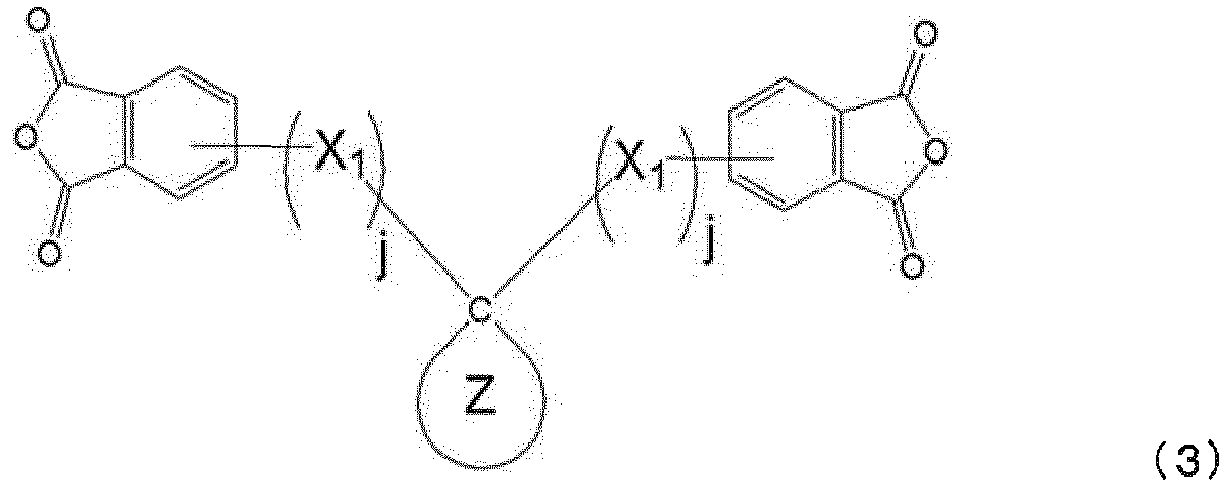

- The polymer according to claim 1, wherein the cyclic structure Z in the general formulae (3) and (4) is represented by the following general formula (11) or (12):


- The polymer according to claim 1 or 2, wherein the divalent linking groups X1 and X2 in the general formulae (3) and (4) are each represented by any of the following general formulae (5), (6), (7), (8), (9), and (10):


- The polymer according to any one of claims 1 to 3, wherein the diamine shown by the general formula (1) is represented by the following general formula (21).

- The polymer according to any one of claims 1 to 4, wherein the reaction product further contains a tetracarboxylic acid diester unit shown by the following general formula (22):


wherein R16 in the general formula (22) is an organic group selected from groups shown by the following general formulae (24), (25), (26), and (27):


wherein R16 in the general formula (22) is a group shown by the following general formula (23-1):
*--------CH2-CH2 Rf (23-1)
wherein the dotted line represents a bond; and Rf is as defined above. - The polymer according to any one of claims 1 to 5, wherein the cyclic structure Z in the general formula (3) is a tetracarboxylic dianhydride structure shown by the following general formula (Z-1) or (Z-2), and the cyclic structure Z in the general formula (4) is at least one structure selected from dicarboxylic acids or dicarboxylic halides shown by the following general formulae (Z-3), (Z-4), (Z-5), (Z-6), (Z-7), and (Z-8):


- A positive photosensitive resin composition, comprising:(A) the polymer according to any one of claims 1 to 6 ;(B) a compound having a quinonediazide structure for serving as a photosensitive agent to generate an acid by light, and(D) a solvent.
- The positive photosensitive resin composition according to claim 7, further comprising:
(C) one or more crosslinking agents selected from an amino condensate modified with formaldehyde or formaldehyde-alcohol, a phenol compound having on average two or more methylol groups or alkoxymethyl groups per molecule, a polyhydric phenol compound in which a hydrogen atom of a phenolic hydroxy group thereof is substituted with a glycidyl group, a polyhydric phenol compound in which a hydrogen atom of a phenolic hydroxy group is substituted with a substituent shown by the following formula (C-1), and a compound containing two or more nitrogen atoms having a glycidyl group as shown by the following formula (C-2),

- The positive photosensitive resin composition according to claim 7 or 9, further comprising
(E) a compound to generate an acid or a radical by heat. - A patterning process comprising:(1) applying the positive photosensitive resin composition according to any one of claims 7 to 9 onto a substrate to form a photosensitive material film;(2) exposing the photosensitive material film to a high energy beam having a wavelength of 190 to 500 nm or an electron beam via a photomask after a heat treatment; and(3) performing development with a developer of an aqueous alkaline solution, optionally further comprising:(4) post-curing a patterned film formed by the development of the photosensitive material film at a temperature of 100 to 300°C.
- A photosensitive dry film comprising a supporting film, a protective film, and a photosensitive resin layer having a thickness of 5 to 100 µm and sandwiched between the supporting film and the protective film, wherein the photosensitive resin layer is formed from the positive photosensitive resin composition according to any one of claims 7 to 9.
- A method for producing a photosensitive dry film, comprising:(i) continuously applying the positive photosensitive resin composition according to any one of claims 7 to 9 onto a supporting film to form a photosensitive resin layer;(ii) continuously drying the photosensitive resin layer; and further(iii) laminating a protective film onto the photosensitive resin layer.
- A patterning process comprising:(i) separating the protective film from the photosensitive dry film according to claim 11 and bringing the photosensitive resin layer thereby uncovered into close contact with a substrate;(ii) exposing the photosensitive resin layer to a high energy beam having a wavelength of 190 to 500 nm or an electron beam via a photomask either through the supporting film or after removing the supporting film; and(iii) performing development with a developer.
- The patterning process according to claim 13, further comprising:
(iv) post-curing a patterned film formed by the development of the photosensitive material film at a temperature of 100 to 300°C. - A protective film for electric and electronic parts, comprising a cured film in which the positive photosensitive resin composition according to any one of claims 7 to 9 is cured.
Applications Claiming Priority (1)
| Application Number | Priority Date | Filing Date | Title |
|---|---|---|---|
| JP2018144831 | 2018-08-01 |
Publications (1)
| Publication Number | Publication Date |
|---|---|
| EP3604390A1 true EP3604390A1 (en) | 2020-02-05 |
Family
ID=67438756
Family Applications (1)
| Application Number | Title | Priority Date | Filing Date |
|---|---|---|---|
| EP19188162.2A Pending EP3604390A1 (en) | 2018-08-01 | 2019-07-24 | Polymer having a structure of polyamide, polyamide-imide, or polyimide, photosensitive resin composition, patterning process, photosensitive dry film, and protective film for electric and electronic parts |
Country Status (6)
| Country | Link |
|---|---|
| US (1) | US11768434B2 (en) |
| EP (1) | EP3604390A1 (en) |
| JP (1) | JP7145126B2 (en) |
| KR (1) | KR102224610B1 (en) |
| CN (1) | CN110790928B (en) |
| TW (1) | TWI710586B (en) |
Cited By (5)
| Publication number | Priority date | Publication date | Assignee | Title |
|---|---|---|---|---|
| EP3869268A1 (en) * | 2020-02-19 | 2021-08-25 | Shin-Etsu Chemical Co., Ltd. | Material for forming organic film, patterning process, and polymer |
| EP3896521A1 (en) * | 2020-04-14 | 2021-10-20 | Shin-Etsu Chemical Co., Ltd. | Polymer, photosensitive resin composition, patterning method, method of forming cured film, interlayer insulating film, surface protective film, and electronic component |
| CN114853714A (en) * | 2022-05-13 | 2022-08-05 | 大连理工大学 | Novel photo-crosslinkable photosensitive material and application thereof |
| US11572442B2 (en) | 2020-04-14 | 2023-02-07 | International Business Machines Corporation | Compound, polyimide resin and method of producing the same, photosensitive resin composition, patterning method and method of forming cured film, interlayer insulating film, surface protective film, and electronic component |
| EP4273624A1 (en) * | 2022-05-02 | 2023-11-08 | Shin-Etsu Chemical Co., Ltd. | Negative photosensitive resin composition, patterning process, interlayer insulating film, surface protection film, and electronic component |
Families Citing this family (15)
| Publication number | Priority date | Publication date | Assignee | Title |
|---|---|---|---|---|
| JP7565692B2 (en) | 2020-02-14 | 2024-10-11 | キヤノン株式会社 | Power transmission device, method performed by the power transmission device, and program |
| KR102573177B1 (en) * | 2020-03-11 | 2023-09-01 | 주식회사 엘지화학 | Acid anhydride compound, polyimide-based polymer, polymer film, substrate for display device and optical device using the same |
| JP7540961B2 (en) * | 2020-03-23 | 2024-08-27 | 信越化学工業株式会社 | Material for forming organic film, substrate for manufacturing semiconductor device, method for forming organic film, method for forming pattern, and compound for forming organic film |
| JP7352530B2 (en) | 2020-10-05 | 2023-09-28 | 信越化学工業株式会社 | Organic film forming material, semiconductor device manufacturing substrate, organic film forming method, pattern forming method, and organic film forming compound |
| CN116529291A (en) * | 2020-12-04 | 2023-08-01 | 默克专利股份有限公司 | Dielectric materials based on bismaleimides containing carbopol/spiro moieties |
| JP7495897B2 (en) * | 2021-03-23 | 2024-06-05 | 信越化学工業株式会社 | Positive-type photosensitive resin composition, positive-type photosensitive dry film, method for producing positive-type photosensitive dry film, pattern forming method, method for forming cured film, interlayer insulating film, surface protective film, and electronic component |
| JP7667105B2 (en) | 2021-03-23 | 2025-04-22 | 信越化学工業株式会社 | Negative photosensitive resin composition, pattern forming method, cured film forming method, interlayer insulating film, surface protective film, and electronic component |
| TWI822026B (en) * | 2021-05-17 | 2023-11-11 | 仁寶電腦工業股份有限公司 | Ventilator |
| TWI786979B (en) * | 2021-09-03 | 2022-12-11 | 財團法人工業技術研究院 | Anhydride compound, polyimide, and thin film |
| CN115745931B (en) | 2021-09-03 | 2024-05-24 | 财团法人工业技术研究院 | Acid anhydride compound, polyimide and film made therefrom |
| TWI830581B (en) * | 2022-01-21 | 2024-01-21 | 日商信越化學工業股份有限公司 | Composition for forming protective film against alkaline aqueous hydrogen peroxide, substrate for producing semiconductor apparatus, method for forming protective film, and method for forming pattern |
| CN114920934B (en) * | 2022-06-29 | 2024-03-22 | 深圳职业技术学院 | Preparation method and application of photosensitive polyimide resin |
| KR102845592B1 (en) * | 2022-11-14 | 2025-08-13 | 에스케이마이크로웍스솔루션즈 주식회사 | Polyamide-imide-based film, preparation method thereof, and cover window and display device comprising the same |
| WO2025249261A1 (en) * | 2024-05-29 | 2025-12-04 | 東レ株式会社 | Photosensitive resin composition, cured product, method for producing cured product, and electronic component |
| CN118496504B (en) * | 2024-05-31 | 2025-10-14 | 江西师范大学 | A fluorinated polyimide copolymer containing anthrone structure and its preparation method |
Citations (11)
| Publication number | Priority date | Publication date | Assignee | Title |
|---|---|---|---|---|
| JPS49115541A (en) | 1973-02-22 | 1974-11-05 | ||
| JPS5417623B2 (en) | 1975-10-02 | 1979-07-02 | ||
| JPS5545746A (en) | 1978-09-29 | 1980-03-31 | Hitachi Ltd | Reactive polymer composition |
| JPS627488B2 (en) | 1977-12-16 | 1987-02-17 | Coulter Electronics | |
| JP3232022B2 (en) | 1997-03-31 | 2001-11-26 | 信越化学工業株式会社 | Photosensitive resin composition |
| JP2004272083A (en) * | 2003-03-11 | 2004-09-30 | Hitachi Chemical Dupont Microsystems Ltd | Positive photosensitive resin composition, method for manufacturing pattern, and electronic parts |
| JP2005049504A (en) | 2003-07-31 | 2005-02-24 | Hitachi Chemical Dupont Microsystems Ltd | Photosensitive resin composition, method for producing pattern using the same, and electronic component |
| JP2007199653A (en) | 2005-12-27 | 2007-08-09 | Shin Etsu Chem Co Ltd | Photoresist underlayer film forming material and pattern forming method |
| WO2013168675A1 (en) | 2012-05-07 | 2013-11-14 | 旭化成イーマテリアルズ株式会社 | Negative photosensitive resin composition, method for manufacturing hardening relief pattern, and semiconductor device |
| CN105301902A (en) * | 2015-11-10 | 2016-02-03 | 杭州福斯特光伏材料股份有限公司 | Positive photosensitive polyimide resin composition with ester bond connected fluorene unit and siloxane |
| US20180024434A1 (en) * | 2016-07-25 | 2018-01-25 | Shin-Etsu Chemical Co., Ltd. | Tetracarboxylic acid diester compound, polyimide precursor polymer and method for producing the same, negative photosensitive resin composition, patterning process, and method for forming cured film |
Family Cites Families (15)
| Publication number | Priority date | Publication date | Assignee | Title |
|---|---|---|---|---|
| JPS627488A (en) | 1985-07-02 | 1987-01-14 | Nec Kansai Ltd | Treatment of waste water |
| JPS62129316A (en) * | 1985-07-16 | 1987-06-11 | Kanegafuchi Chem Ind Co Ltd | Thin film of partially cyclized polyimide precursor |
| JP3627488B2 (en) | 1997-12-22 | 2005-03-09 | 日立化成工業株式会社 | Photosensitive polyimide precursor composition and pattern forming method using the same |
| DE10228770A1 (en) * | 2002-06-27 | 2004-02-12 | Infineon Technologies Ag | Dielectric with barrier effect against copper diffusion |
| ATE486682T1 (en) | 2002-09-30 | 2010-11-15 | Welding Inst | METHOD FOR WORKPIECE STRUCTURE MODIFICATION |
| CN1910221B (en) * | 2004-01-20 | 2010-12-08 | 旭化成电子材料株式会社 | Resin and resin composition |
| KR101275474B1 (en) * | 2007-10-29 | 2013-06-14 | 히다치 가세이듀퐁 마이쿠로시스데무즈 가부시키가이샤 | Positive photosensitive resin composition, method for forming pattern, electronic component |
| JP5549801B2 (en) * | 2007-12-14 | 2014-07-16 | 日産化学工業株式会社 | Method for producing polyhydroxyimide and positive photosensitive resin composition containing polyhydroxyimide obtained by the production method |
| JP5417623B2 (en) | 2009-12-10 | 2014-02-19 | 信越化学工業株式会社 | Polyimide-based photocurable resin composition, pattern forming method, and film for protecting substrate |
| TWI516527B (en) | 2009-12-10 | 2016-01-11 | 信越化學工業股份有限公司 | Photocurable resin composition, pattern forming method and substrate protective film, and film adhesive and adhesive sheet using the same |
| JP5640413B2 (en) * | 2010-03-19 | 2014-12-17 | 東レ株式会社 | Positive photosensitive resin composition |
| JP5831092B2 (en) * | 2011-09-27 | 2015-12-09 | 東レ株式会社 | Positive photosensitive resin composition |
| EP2952342A4 (en) * | 2013-01-29 | 2016-08-17 | Toray Industries | Substrate and touch panel member using same |
| CN107406590B (en) * | 2015-01-27 | 2020-08-04 | 东丽株式会社 | Resin, photosensitive resin composition, electronic component and display device using the same |
| JP6487875B2 (en) * | 2016-04-19 | 2019-03-20 | 信越化学工業株式会社 | Tetracarboxylic acid diester compound, polymer of polyimide precursor and method for producing the same, negative photosensitive resin composition, positive photosensitive resin composition, pattern forming method, and cured film forming method |
-
2019
- 2019-07-01 JP JP2019122661A patent/JP7145126B2/en active Active
- 2019-07-16 US US16/512,589 patent/US11768434B2/en active Active
- 2019-07-24 EP EP19188162.2A patent/EP3604390A1/en active Pending
- 2019-07-30 TW TW108126869A patent/TWI710586B/en active
- 2019-07-31 KR KR1020190093335A patent/KR102224610B1/en active Active
- 2019-08-01 CN CN201910708540.8A patent/CN110790928B/en active Active
Patent Citations (12)
| Publication number | Priority date | Publication date | Assignee | Title |
|---|---|---|---|---|
| JPS49115541A (en) | 1973-02-22 | 1974-11-05 | ||
| JPS5417623B2 (en) | 1975-10-02 | 1979-07-02 | ||
| JPS627488B2 (en) | 1977-12-16 | 1987-02-17 | Coulter Electronics | |
| JPS5545746A (en) | 1978-09-29 | 1980-03-31 | Hitachi Ltd | Reactive polymer composition |
| JP3232022B2 (en) | 1997-03-31 | 2001-11-26 | 信越化学工業株式会社 | Photosensitive resin composition |
| JP2004272083A (en) * | 2003-03-11 | 2004-09-30 | Hitachi Chemical Dupont Microsystems Ltd | Positive photosensitive resin composition, method for manufacturing pattern, and electronic parts |
| JP4250982B2 (en) | 2003-03-11 | 2009-04-08 | 日立化成デュポンマイクロシステムズ株式会社 | Positive photosensitive resin composition, pattern manufacturing method, and electronic component |
| JP2005049504A (en) | 2003-07-31 | 2005-02-24 | Hitachi Chemical Dupont Microsystems Ltd | Photosensitive resin composition, method for producing pattern using the same, and electronic component |
| JP2007199653A (en) | 2005-12-27 | 2007-08-09 | Shin Etsu Chem Co Ltd | Photoresist underlayer film forming material and pattern forming method |
| WO2013168675A1 (en) | 2012-05-07 | 2013-11-14 | 旭化成イーマテリアルズ株式会社 | Negative photosensitive resin composition, method for manufacturing hardening relief pattern, and semiconductor device |
| CN105301902A (en) * | 2015-11-10 | 2016-02-03 | 杭州福斯特光伏材料股份有限公司 | Positive photosensitive polyimide resin composition with ester bond connected fluorene unit and siloxane |
| US20180024434A1 (en) * | 2016-07-25 | 2018-01-25 | Shin-Etsu Chemical Co., Ltd. | Tetracarboxylic acid diester compound, polyimide precursor polymer and method for producing the same, negative photosensitive resin composition, patterning process, and method for forming cured film |
Cited By (8)
| Publication number | Priority date | Publication date | Assignee | Title |
|---|---|---|---|---|
| EP3869268A1 (en) * | 2020-02-19 | 2021-08-25 | Shin-Etsu Chemical Co., Ltd. | Material for forming organic film, patterning process, and polymer |
| US11851530B2 (en) | 2020-02-19 | 2023-12-26 | Shin-Etsu Chemical Co., Ltd. | Material for forming organic film, patterning process, and polymer |
| EP3896521A1 (en) * | 2020-04-14 | 2021-10-20 | Shin-Etsu Chemical Co., Ltd. | Polymer, photosensitive resin composition, patterning method, method of forming cured film, interlayer insulating film, surface protective film, and electronic component |
| US11333975B2 (en) | 2020-04-14 | 2022-05-17 | International Business Machines Corporation | Polymer, photosensitive resin composition, patterning method, method of forming cured film, interlayer insulating film, surface protective film, and electronic component |
| US11572442B2 (en) | 2020-04-14 | 2023-02-07 | International Business Machines Corporation | Compound, polyimide resin and method of producing the same, photosensitive resin composition, patterning method and method of forming cured film, interlayer insulating film, surface protective film, and electronic component |
| EP4273624A1 (en) * | 2022-05-02 | 2023-11-08 | Shin-Etsu Chemical Co., Ltd. | Negative photosensitive resin composition, patterning process, interlayer insulating film, surface protection film, and electronic component |
| CN114853714A (en) * | 2022-05-13 | 2022-08-05 | 大连理工大学 | Novel photo-crosslinkable photosensitive material and application thereof |
| CN114853714B (en) * | 2022-05-13 | 2024-04-16 | 大连理工大学 | A type of photosensitive material capable of photocrosslinking and its application |
Also Published As
| Publication number | Publication date |
|---|---|
| TW202012498A (en) | 2020-04-01 |
| TWI710586B (en) | 2020-11-21 |
| KR20200014709A (en) | 2020-02-11 |
| US20200041903A1 (en) | 2020-02-06 |
| JP2020023666A (en) | 2020-02-13 |
| CN110790928B (en) | 2022-06-07 |
| KR102224610B1 (en) | 2021-03-05 |
| JP7145126B2 (en) | 2022-09-30 |
| US11768434B2 (en) | 2023-09-26 |
| CN110790928A (en) | 2020-02-14 |
Similar Documents
| Publication | Publication Date | Title |
|---|---|---|
| US11768434B2 (en) | Polymer having a structure of polyamide, polyamide-imide, or polyimide, photosensitive resin composition, patterning process, photosensitive dry film, and protective film for electric and electronic parts | |
| EP3734362B1 (en) | Positive photosensitive resin composition, patterning process, method of forming cured film, interlayer insulation film, surface protective film, and electronic component | |
| JP6724363B2 (en) | Resin and photosensitive resin composition | |
| JP2906637B2 (en) | Positive photosensitive polyimide resin composition | |
| US6677099B1 (en) | Positive type photosensitive polyimide resin composition | |
| JP5381491B2 (en) | Resin and positive photosensitive resin composition | |
| JPWO2018159384A1 (en) | Resin composition, resin sheet, cured pattern, semiconductor electronic component or semiconductor device | |
| JP6960404B2 (en) | Polyimide resin and resin composition | |
| JP2020094194A (en) | Resin composition, resin sheet, cured film, cured film relief pattern manufacturing method, protective film, insulator film, electronic component, and display device | |
| WO2015137281A1 (en) | Photosensitive resin composition | |
| JP2005173027A (en) | Positive photosensitive resin composition and hardened product | |
| EP4273624A1 (en) | Negative photosensitive resin composition, patterning process, interlayer insulating film, surface protection film, and electronic component | |
| KR101750463B1 (en) | Positive photosensitive resin composition, photosensitive resin film prepared by using the same, and display device | |
| JP5030743B2 (en) | Polymer and positive photosensitive resin composition | |
| KR101667787B1 (en) | Positive photosensitive resin composition, and photosensitive resin film and display device prepared by using the same | |
| JP2001228609A (en) | Positive photosensitive polyimide resin composition | |
| JP2011053315A (en) | Positive photosensitive polyimide resin composition and polyimide relief pattern obtained therefrom | |
| JP4771412B2 (en) | Photosensitive resin and method for producing the same | |
| KR101881943B1 (en) | Positive photosensitive resin composition, photosensitive resin film and display device using the same | |
| JP2001343747A (en) | Positive type photosensitive polyimide resin composition | |
| JP2009080390A (en) | Method for producing positive photosensitive resin composition |
Legal Events
| Date | Code | Title | Description |
|---|---|---|---|
| PUAI | Public reference made under article 153(3) epc to a published international application that has entered the european phase |
Free format text: ORIGINAL CODE: 0009012 |
|
| STAA | Information on the status of an ep patent application or granted ep patent |
Free format text: STATUS: THE APPLICATION HAS BEEN PUBLISHED |
|
| AK | Designated contracting states |
Kind code of ref document: A1 Designated state(s): AL AT BE BG CH CY CZ DE DK EE ES FI FR GB GR HR HU IE IS IT LI LT LU LV MC MK MT NL NO PL PT RO RS SE SI SK SM TR |
|
| AX | Request for extension of the european patent |
Extension state: BA ME |
|
| STAA | Information on the status of an ep patent application or granted ep patent |
Free format text: STATUS: REQUEST FOR EXAMINATION WAS MADE |
|
| 17P | Request for examination filed |
Effective date: 20200721 |
|
| RBV | Designated contracting states (corrected) |
Designated state(s): AL AT BE BG CH CY CZ DE DK EE ES FI FR GB GR HR HU IE IS IT LI LT LU LV MC MK MT NL NO PL PT RO RS SE SI SK SM TR |
|
| RAP3 | Party data changed (applicant data changed or rights of an application transferred) |
Owner name: SHIN-ETSU CHEMICAL CO., LTD. |
|
| STAA | Information on the status of an ep patent application or granted ep patent |
Free format text: STATUS: EXAMINATION IS IN PROGRESS |
|
| 17Q | First examination report despatched |
Effective date: 20230619 |