EP3603416A1 - Jelly containing pyrroloquinoline quinone - Google Patents
Jelly containing pyrroloquinoline quinone Download PDFInfo
- Publication number
- EP3603416A1 EP3603416A1 EP18774700.1A EP18774700A EP3603416A1 EP 3603416 A1 EP3603416 A1 EP 3603416A1 EP 18774700 A EP18774700 A EP 18774700A EP 3603416 A1 EP3603416 A1 EP 3603416A1
- Authority
- EP
- European Patent Office
- Prior art keywords
- jelly
- pyrroloquinoline quinone
- salt
- percent
- weight
- Prior art date
- Legal status (The legal status is an assumption and is not a legal conclusion. Google has not performed a legal analysis and makes no representation as to the accuracy of the status listed.)
- Pending
Links
Classifications
-
- A—HUMAN NECESSITIES
- A23—FOODS OR FOODSTUFFS; TREATMENT THEREOF, NOT COVERED BY OTHER CLASSES
- A23L—FOODS, FOODSTUFFS OR NON-ALCOHOLIC BEVERAGES, NOT OTHERWISE PROVIDED FOR; PREPARATION OR TREATMENT THEREOF
- A23L33/00—Modifying nutritive qualities of foods; Dietetic products; Preparation or treatment thereof
- A23L33/10—Modifying nutritive qualities of foods; Dietetic products; Preparation or treatment thereof using additives
-
- A—HUMAN NECESSITIES
- A23—FOODS OR FOODSTUFFS; TREATMENT THEREOF, NOT COVERED BY OTHER CLASSES
- A23L—FOODS, FOODSTUFFS OR NON-ALCOHOLIC BEVERAGES, NOT OTHERWISE PROVIDED FOR; PREPARATION OR TREATMENT THEREOF
- A23L21/00—Marmalades, jams, jellies or the like; Products from apiculture; Preparation or treatment thereof
- A23L21/10—Marmalades; Jams; Jellies; Other similar fruit or vegetable compositions; Simulated fruit products
-
- A—HUMAN NECESSITIES
- A23—FOODS OR FOODSTUFFS; TREATMENT THEREOF, NOT COVERED BY OTHER CLASSES
- A23L—FOODS, FOODSTUFFS OR NON-ALCOHOLIC BEVERAGES, NOT OTHERWISE PROVIDED FOR; PREPARATION OR TREATMENT THEREOF
- A23L21/00—Marmalades, jams, jellies or the like; Products from apiculture; Preparation or treatment thereof
-
- A—HUMAN NECESSITIES
- A23—FOODS OR FOODSTUFFS; TREATMENT THEREOF, NOT COVERED BY OTHER CLASSES
- A23L—FOODS, FOODSTUFFS OR NON-ALCOHOLIC BEVERAGES, NOT OTHERWISE PROVIDED FOR; PREPARATION OR TREATMENT THEREOF
- A23L27/00—Spices; Flavouring agents or condiments; Artificial sweetening agents; Table salts; Dietetic salt substitutes; Preparation or treatment thereof
- A23L27/30—Artificial sweetening agents
- A23L27/33—Artificial sweetening agents containing sugars or derivatives
-
- A—HUMAN NECESSITIES
- A23—FOODS OR FOODSTUFFS; TREATMENT THEREOF, NOT COVERED BY OTHER CLASSES
- A23L—FOODS, FOODSTUFFS OR NON-ALCOHOLIC BEVERAGES, NOT OTHERWISE PROVIDED FOR; PREPARATION OR TREATMENT THEREOF
- A23L29/00—Foods or foodstuffs containing additives; Preparation or treatment thereof
- A23L29/03—Organic compounds
- A23L29/045—Organic compounds containing nitrogen as heteroatom
-
- A—HUMAN NECESSITIES
- A23—FOODS OR FOODSTUFFS; TREATMENT THEREOF, NOT COVERED BY OTHER CLASSES
- A23L—FOODS, FOODSTUFFS OR NON-ALCOHOLIC BEVERAGES, NOT OTHERWISE PROVIDED FOR; PREPARATION OR TREATMENT THEREOF
- A23L29/00—Foods or foodstuffs containing additives; Preparation or treatment thereof
- A23L29/20—Foods or foodstuffs containing additives; Preparation or treatment thereof containing gelling or thickening agents
- A23L29/206—Foods or foodstuffs containing additives; Preparation or treatment thereof containing gelling or thickening agents of vegetable origin
- A23L29/25—Exudates, e.g. gum arabic, gum acacia, gum karaya or tragacanth
-
- A—HUMAN NECESSITIES
- A23—FOODS OR FOODSTUFFS; TREATMENT THEREOF, NOT COVERED BY OTHER CLASSES
- A23L—FOODS, FOODSTUFFS OR NON-ALCOHOLIC BEVERAGES, NOT OTHERWISE PROVIDED FOR; PREPARATION OR TREATMENT THEREOF
- A23L29/00—Foods or foodstuffs containing additives; Preparation or treatment thereof
- A23L29/20—Foods or foodstuffs containing additives; Preparation or treatment thereof containing gelling or thickening agents
- A23L29/206—Foods or foodstuffs containing additives; Preparation or treatment thereof containing gelling or thickening agents of vegetable origin
- A23L29/256—Foods or foodstuffs containing additives; Preparation or treatment thereof containing gelling or thickening agents of vegetable origin from seaweeds, e.g. alginates, agar or carrageenan
-
- A—HUMAN NECESSITIES
- A23—FOODS OR FOODSTUFFS; TREATMENT THEREOF, NOT COVERED BY OTHER CLASSES
- A23L—FOODS, FOODSTUFFS OR NON-ALCOHOLIC BEVERAGES, NOT OTHERWISE PROVIDED FOR; PREPARATION OR TREATMENT THEREOF
- A23L29/00—Foods or foodstuffs containing additives; Preparation or treatment thereof
- A23L29/20—Foods or foodstuffs containing additives; Preparation or treatment thereof containing gelling or thickening agents
- A23L29/269—Foods or foodstuffs containing additives; Preparation or treatment thereof containing gelling or thickening agents of microbial origin, e.g. xanthan or dextran
- A23L29/27—Xanthan not combined with other microbial gums
-
- A—HUMAN NECESSITIES
- A23—FOODS OR FOODSTUFFS; TREATMENT THEREOF, NOT COVERED BY OTHER CLASSES
- A23L—FOODS, FOODSTUFFS OR NON-ALCOHOLIC BEVERAGES, NOT OTHERWISE PROVIDED FOR; PREPARATION OR TREATMENT THEREOF
- A23L29/00—Foods or foodstuffs containing additives; Preparation or treatment thereof
- A23L29/20—Foods or foodstuffs containing additives; Preparation or treatment thereof containing gelling or thickening agents
- A23L29/275—Foods or foodstuffs containing additives; Preparation or treatment thereof containing gelling or thickening agents of animal origin, e.g. chitin
- A23L29/281—Proteins, e.g. gelatin or collagen
- A23L29/284—Gelatin; Collagen
-
- A—HUMAN NECESSITIES
- A23—FOODS OR FOODSTUFFS; TREATMENT THEREOF, NOT COVERED BY OTHER CLASSES
- A23L—FOODS, FOODSTUFFS OR NON-ALCOHOLIC BEVERAGES, NOT OTHERWISE PROVIDED FOR; PREPARATION OR TREATMENT THEREOF
- A23L29/00—Foods or foodstuffs containing additives; Preparation or treatment thereof
- A23L29/30—Foods or foodstuffs containing additives; Preparation or treatment thereof containing carbohydrate syrups; containing sugars; containing sugar alcohols, e.g. xylitol; containing starch hydrolysates, e.g. dextrin
-
- A—HUMAN NECESSITIES
- A23—FOODS OR FOODSTUFFS; TREATMENT THEREOF, NOT COVERED BY OTHER CLASSES
- A23L—FOODS, FOODSTUFFS OR NON-ALCOHOLIC BEVERAGES, NOT OTHERWISE PROVIDED FOR; PREPARATION OR TREATMENT THEREOF
- A23L5/00—Preparation or treatment of foods or foodstuffs, in general; Food or foodstuffs obtained thereby; Materials therefor
- A23L5/40—Colouring or decolouring of foods
-
- A—HUMAN NECESSITIES
- A61—MEDICAL OR VETERINARY SCIENCE; HYGIENE
- A61K—PREPARATIONS FOR MEDICAL, DENTAL OR TOILETRY PURPOSES
- A61K31/00—Medicinal preparations containing organic active ingredients
- A61K31/33—Heterocyclic compounds
- A61K31/395—Heterocyclic compounds having nitrogen as a ring hetero atom, e.g. guanethidine or rifamycins
- A61K31/435—Heterocyclic compounds having nitrogen as a ring hetero atom, e.g. guanethidine or rifamycins having six-membered rings with one nitrogen as the only ring hetero atom
- A61K31/47—Quinolines; Isoquinolines
- A61K31/4738—Quinolines; Isoquinolines ortho- or peri-condensed with heterocyclic ring systems
- A61K31/4745—Quinolines; Isoquinolines ortho- or peri-condensed with heterocyclic ring systems condensed with ring systems having nitrogen as a ring hetero atom, e.g. phenantrolines
-
- C—CHEMISTRY; METALLURGY
- C07—ORGANIC CHEMISTRY
- C07D—HETEROCYCLIC COMPOUNDS
- C07D471/00—Heterocyclic compounds containing nitrogen atoms as the only ring hetero atoms in the condensed system, at least one ring being a six-membered ring with one nitrogen atom, not provided for by groups C07D451/00 - C07D463/00
- C07D471/02—Heterocyclic compounds containing nitrogen atoms as the only ring hetero atoms in the condensed system, at least one ring being a six-membered ring with one nitrogen atom, not provided for by groups C07D451/00 - C07D463/00 in which the condensed system contains two hetero rings
- C07D471/04—Ortho-condensed systems
-
- A—HUMAN NECESSITIES
- A23—FOODS OR FOODSTUFFS; TREATMENT THEREOF, NOT COVERED BY OTHER CLASSES
- A23V—INDEXING SCHEME RELATING TO FOODS, FOODSTUFFS OR NON-ALCOHOLIC BEVERAGES AND LACTIC OR PROPIONIC ACID BACTERIA USED IN FOODSTUFFS OR FOOD PREPARATION
- A23V2002/00—Food compositions, function of food ingredients or processes for food or foodstuffs
-
- A—HUMAN NECESSITIES
- A23—FOODS OR FOODSTUFFS; TREATMENT THEREOF, NOT COVERED BY OTHER CLASSES
- A23V—INDEXING SCHEME RELATING TO FOODS, FOODSTUFFS OR NON-ALCOHOLIC BEVERAGES AND LACTIC OR PROPIONIC ACID BACTERIA USED IN FOODSTUFFS OR FOOD PREPARATION
- A23V2200/00—Function of food ingredients
- A23V2200/04—Colour
- A23V2200/048—Preventing colour changes
-
- A—HUMAN NECESSITIES
- A61—MEDICAL OR VETERINARY SCIENCE; HYGIENE
- A61K—PREPARATIONS FOR MEDICAL, DENTAL OR TOILETRY PURPOSES
- A61K9/00—Medicinal preparations characterised by special physical form
- A61K9/0012—Galenical forms characterised by the site of application
- A61K9/0053—Mouth and digestive tract, i.e. intraoral and peroral administration
- A61K9/0056—Mouth soluble or dispersible forms; Suckable, eatable, chewable coherent forms; Forms rapidly disintegrating in the mouth; Lozenges; Lollipops; Bite capsules; Baked products; Baits or other oral forms for animals
Definitions
- the present invention relates to a pyrroloquinoline quinone-containing jelly, a method for producing the same, and the like.
- Pyrroloquinoline quinone (hereinafter sometimes referred to as "PQQ”) has been known as a microbial coenzyme, and its known functions include brain function improvement, mitochondrial activation and cell proliferation.
- Pyrroloquinoline quinone can be blended as a watersoluble disodium salt when added to food.
- a pyrroloquinoline quinone disodium salt is specifically described.
- a salt of PQQ is known to form a fibrous structure and eventually form a gel by mixing its aqueous solution with a reducing agent at room temperature (Patent Literature 2).
- Patent Literature 2 A salt of PQQ is known to form a fibrous structure and eventually form a gel by mixing its aqueous solution with a reducing agent at room temperature.
- Patent Literature 2 A salt of PQQ is known to form a fibrous structure and eventually form a gel by mixing its aqueous solution with a reducing agent at room temperature.
- a jelly such as gel.
- it is necessary to examine its stability, etc. as a gel food but there are many types of gelling agents, and there is no information regarding gelation in the presence of pyrroloquinoline quinone.
- An object of the present invention is to provide a stable jelly blended with pyrroloquinoline quinone.
- the type of sugar does not affect the gelation.
- the present inventors have found that, surprisingly, gelation does not occur depending on the type of sugar when PQQ is added, and even when gelation occurs, the stability of the jelly also changes depending on the type of sugar.
- PQQ easily colors the tongue and the skin, and a method of using PQQ in combination with a chelating agent has been proposed to prevent coloring (Patent Literature 3), but it became clear that coloring can be suppressed without any chelating agent by using a specific sugar. That is, the inventors have found that using a specific sugar is unexpectedly important for producing a pyrroloquinoline quinone-containing jelly, and has completed the present invention.
- the present invention is as follows.
- isomerized sugars that hardly change with temperature are often used.
- the investigation by the present inventors showed for the first time that, when an isomerized sugar, which is a reducing sugar, is blended, the stability of the jelly containing pyrroloquinoline quinone is reduced, whereas the stability improves when a non-reducing sugar is used.
- the present invention (hereinafter, simply referred to as “the present embodiments”) will be described in detail, but the present invention is not limited to the following present embodiments.
- the present invention can be variously modified without deviating from the scope of the invention.
- the pyrroloquinoline quinone-containing jelly of the present invention contains pyrroloquinoline quinone and/or a salt thereof and a non-reducing sugar.
- the jelly of the present invention is gelled by a gelling agent. That is, as used herein, "jelly” means a jelly such as a gel formed by the gelling ability possessed by commonly used gelling agents such as agar or gelatin, and gels formed by the gel-forming ability of pyrroloquinoline quinone itself using a dispersion medium, as described in International Publication No. WO 2012/020767 (supra), are not intended to be included within the scope of the present invention.
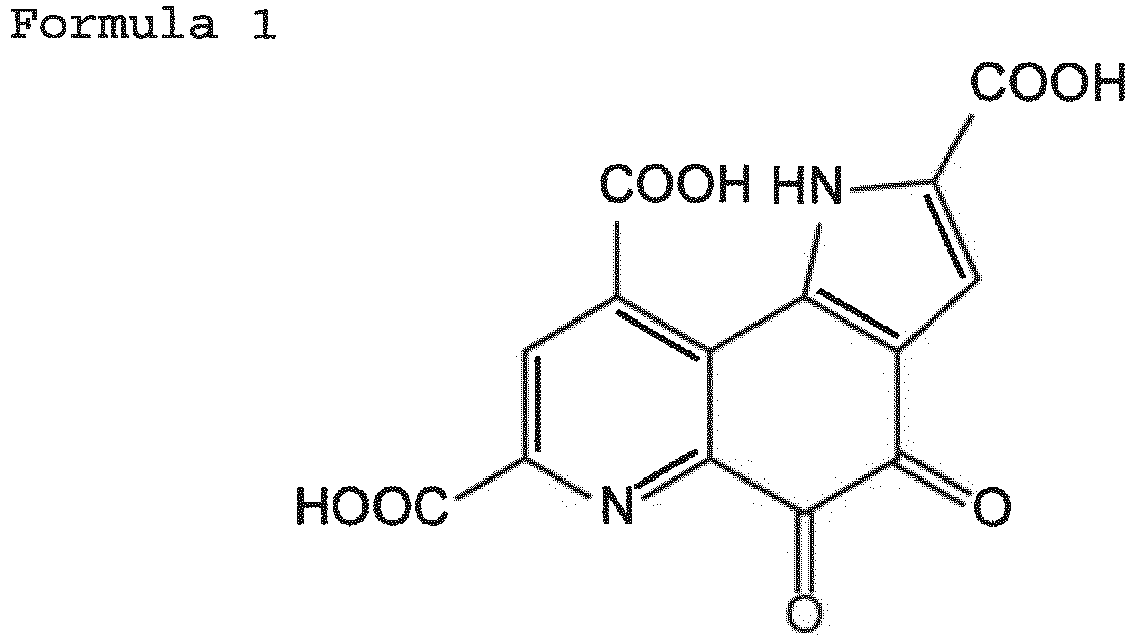
- the pyrroloquinoline quinone used in the present invention is a substance having the structure shown in Formula 1.
- a free form of pyrroloquinoline quinone but also a salt thereof can be used.
- the pyrroloquinoline quinone or a salt thereof used in the present invention can be obtained commercially, but it can also be produced by a known method.
- Examples of a salt of pyrroloquinoline quinone include alkali metal salts, alkaline earth metal salts and ammonium salts of pyrroloquinoline quinone.
- a preferable salt is an alkali metal salt.
- alkali metal salt of pyrroloquinoline quinone used in the present invention examples include salts of sodium, potassium, lithium, cesium and rubidium.
- a sodium salt or a potassium salt is more preferable in terms of easy availability.
- the alkali metal salt of pyrroloquinoline quinone may be an alkali metal salt substituted with 1 to 3 alkali metal atoms, and may be any one of a mono-alkali metal salt, a di-alkali metal salt or a tri-alkali metal salt.
- a di-alkali metal salt is used.
- a disodium salt and a dipotassium salt are used. Among these, hydrated crystals of a disodium salt are preferable since they have a high stability and are easy to use.
- Various gelling agents can be used as long as they can form a jelly containing pyrroloquinoline quinone.
- agar or gelatin is preferable because it easily forms a jelly.
- the amount of agar or gelatin is more preferably about 0.4 to 2 percent by weight.
- the active ingredients such as agar or gelatin be contained in an amount of 80 percent by weight or more in the gelling agent.
- Agar or gelatin is further preferable since it promotes gelation without coloring even in the presence of pyrroloquinoline quinone.
- the gelling agent is not limited to agar and gelatin, and other gelling agents may be used alone or in combination with agar or gelatin, as long as they can form a gel.
- the gelling agent used in the present invention can be used as long as it can form a gel, regardless of the origin and treatment method of the raw materials.
- the non-reducing sugar blended as a sweetener suppresses the color change of pyrroloquinoline quinone and contributes to the stabilization of the gel.
- the non-reducing sugar is a sugar that does not form a ketone or an aldehyde under basic conditions. Specific example thereof includes sorbitol, xylitol, palatinit, sucrose and reducing starch syrup.
- the gelation progresses when using a reducing sugar such as glucose, but the use of a reducing sugar in the present invention brought about an unexpected effect of making gelation difficult.
- the addition of a reducing sugar is not to be completely excluded, and it is acceptable to add a reducing sugar in an amount that does not inhibit the desired effect.
- the jelly of the present invention contains 0.004 to 0.05 percent by weight of pyrroloquinoline quinone and/or a salt thereof.
- the description of "... to " includes both upper limit value and lower limit value, and the same applies hereinafter).
- the amount of pyrroloquinoline quinone blended in this range coloring on the tongue can be suppressed.
- the amount of pyrroloquinoline quinone and/or a salt thereof blended in the jelly may be 0.01 to 0.04 percent by weight. It is preferable to ingest pyrroloquinoline quinone and/or a salt thereof in an amount of 10 to 200 mg in terms of pyrroloquinoline quinone disodium trihydrate per day for an adult.
- the amount of the pyrroloquinoline quinone and/or a salt thereof blended or the amount of jelly may be adjusted so that the pyrroloquinoline quinone and/or a salt thereof be 2 to 200 mg, preferably 5 to 50 mg, in terms of pyrroloquinoline quinone disodium trihydrate per day for an adult.
- the jelly of the present invention may contain 2 to 20 percent by weight of a non-reducing sugar sweetener in terms of sucrose based on the total weight. By setting it to this range, moderate sweetness can be obtained so that good taste is felt.
- a fluid jelly has an excellent texture and has the advantage of being able to be ingested in a short time.
- the following components can be optionally added to the pyrroloquinoline quinone-containing jelly of the present invention, as needed, to such an extent that the effects of the present invention and the flavor of the jelly are not adversely affected.
- Functional materials such as dietary fiber, vitamins, minerals and amino acids, fats and oils, emulsifiers, dairy products, high-sweetness sweeteners (aspartame, neotame, glycyrrhizin, saccharin, stevioside, rebaudio, dulcin, alitame, trichlorosucrose, thaumatin, acesulfame potassium, sucralose and the like) and the like are used.
- high-sweetness sweeteners aspartame, neotame, glycyrrhizin, saccharin, stevioside, rebaudio, dulcin, alitame, trichlorosucrose, thaumatin, acesulfame potassium, sucralose and the like
- the gelling agent and the non-reducing sugar are first dissolved in water or in a buffer solution, and the resulting solution is heated to prepare a gelling agent solution.
- the jelly of the present invention can be produced.
- a buffer solution that can be used for the preparation of the gelling agent solution
- any aqueous solution prepared from a pH adjuster that is allowed to be added to food may be used, for example, phosphate buffer and citrate buffer can be used.
- the aqueous solution of pyrroloquinoline quinone having a concentration of 0.004 percent by weight to 0.2 percent by weight can be used.
- gelatin in the case of using gelatin as the gelling agent, it is preferable to mix at 30 to 50°C in order to increase the stability of pyrroloquinoline quinone.
- the temperature at which gelatin is mixed may be arbitrary, but it is preferable to be 50 to 120°C in consideration of the temperature at which gelatin dissolves.
- the pyrroloquinoline quinone and/or a salt thereof, the gelling agent and the non-reducing sugar may be mixed simultaneously. When mixed simultaneously, it is preferable not to leave it at a high temperature for a long time in order to improve the stability of PQQ.
- the amount of the jelly of the present invention to be ingested be 10 to 50 mg in terms of pyrroloquinoline quinone disodium trihydrate per day. With this amount of ingestion, it becomes a functional food that can be expected to moisturize the skin, improve brain function and improve the lipids.
- the present invention provides a stabilizer for the jelly containing pyrroloquinoline quinone or a salt thereof, comprising a non-reducing sugar as an active ingredient.
- the content of the active ingredient is the same as the amount blended in the above jelly.
- the present invention provides a coloring inhibitor for the jelly containing pyrroloquinoline quinone or a salt thereof, comprising a non-reducing sugar as an active ingredient.
- BioPQQ registered trademark
- Mitsubishi Gas Chemical Company, Inc. was used as pyrroloquinoline quinone disodium. This product is crystalline and the trihydrate is stable.
- the other reagents used were manufactured by Wako Pure Chemical Industries, Ltd.
- a sample (total weight: 50 g) with a composition consisting of 0.02 percent by weight of pyrroloquinoline quinone disodium, 10 percent by weight of sorbitol, 2 percent by weight of agar and the balance being water was prepared and heated in an autoclave (121°C) for 15 minutes. The heated solution was homogenized by mixing. The resulting solution was cooled in a refrigerator (4°C) and stored for one day to obtain a jelly food. The resulting jelly had a red color due to the pyrroloquinoline quinone, and the color was uniform as a whole.
- isomerized sugar As isomerized sugar, isomerized sugar HC (55% or more fructose content) manufactured by Oji Cornstarch Co., Ltd. was used.
- the pyrroloquinoline quinone disodium content in the jelly had been reduced to 59% relative to the addition amount.
- a jelly food in which only the content of pyrroloquinoline quinone disodium was changed in the composition of the sample of Example 1 was prepared according to the same method as in Example 1 (Examples 2 to 5).
- a jelly food in which only the content of pyrroloquinoline quinone disodium was changed in the composition of the sample of Comparative Example 1 was prepared according to the same method as in Comparative Example 1 (Comparative Example 2).
- jelly foods to which glucose (Comparative Example 3) or fructose (Comparative Example 4) was added instead of the isomerized sugar of Comparative Example 1 were also prepared. 5 g of each prepared jelly food was put in the mouth and held for 30 seconds, then the ease of coloring of pyrroloquinoline quinone on the tongue was observed by looking at the whole tongue 5 minutes later.
- the jerry hardly turned into a gel when using reducing sugars, and in particular, no gel was formed with isomerized sugars and fructose. Although gelation was observed when glucose was added, the formed jelly was soft.
- the formation of jelly was examined by changing the type of the gelling agent.
- a sample (total weight: 50 g) with a composition consisting of 0.02 percent by weight of pyrroloquinoline quinone disodium, 10 percent by weight of sorbitol, 2 percent by weight of gelling agent and the balance being water was prepared, heated in an autoclave (121°C) for 15 minutes and homogenized. The resultant was cooled in a refrigerator (4°C) and the formation of jelly was observed one day later. The results are shown in Table 2.
- gelatin was suitable for the jelly.
- a gel of pyrroloquinoline quinone itself was prepared using a salt of pyrroloquinoline quinone and a dispersion medium.
- 0.1 g of PQQ powder was added to a 15 mL plastic centrifugation container, 10 ml of water was added thereto, and the mixture was mixed by shaking at room temperature (about 25°C). The resultant was cooled in a refrigerator to 4°C, then further shaken to mix. When the resultant was stored in a refrigerator overnight, it turned entirely into a uniform gel.
- agar 0.01 g was added to 10 mL of water and dissolved in a microwave oven, the resultant was cooled to about 40°C, and 1 mL each was mixed with the above pyrroloquinoline quinone 1% gel. When the mixture was cooled overnight in a refrigerator, it gelled, and fibers were observed by an optical microscope. The resulting jelly was put in the mouth and held for 30 seconds, and the color of the jelly colored the tongue.
- Example 1 Using a homogenizer, the jelly made in Example 1 was crushed so as to break into a uniform size at room temperature. The solidified jelly was crushed into a fluid crushed jelly.
- Example 9-1 Example 9-2 and Comparative Example 6
- the jelly of the present invention is useful for supplements, functional foods, jelly complex sweets and cosmetics.
Landscapes
- Chemical & Material Sciences (AREA)
- Life Sciences & Earth Sciences (AREA)
- Health & Medical Sciences (AREA)
- Nutrition Science (AREA)
- Engineering & Computer Science (AREA)
- Food Science & Technology (AREA)
- Polymers & Plastics (AREA)
- Dispersion Chemistry (AREA)
- Organic Chemistry (AREA)
- Zoology (AREA)
- Proteomics, Peptides & Aminoacids (AREA)
- Medicinal Chemistry (AREA)
- Veterinary Medicine (AREA)
- Pharmacology & Pharmacy (AREA)
- Epidemiology (AREA)
- Animal Behavior & Ethology (AREA)
- General Health & Medical Sciences (AREA)
- Public Health (AREA)
- Molecular Biology (AREA)
- Mycology (AREA)
- Medicinal Preparation (AREA)
- Pharmaceuticals Containing Other Organic And Inorganic Compounds (AREA)
- Coloring Foods And Improving Nutritive Qualities (AREA)
- Jellies, Jams, And Syrups (AREA)
- Nitrogen Condensed Heterocyclic Rings (AREA)
Abstract
Description
- The present invention relates to a pyrroloquinoline quinone-containing jelly, a method for producing the same, and the like.
- Pyrroloquinoline quinone (hereinafter sometimes referred to as "PQQ") has been known as a microbial coenzyme, and its known functions include brain function improvement, mitochondrial activation and cell proliferation.
- Pyrroloquinoline quinone can be blended as a watersoluble disodium salt when added to food. For example, in Patent Literature 1, carbonated water blended with a pyrroloquinoline quinone disodium salt is specifically described.
-
- Patent Literature 1: Japanese Patent Laid-Open No.
2013-237644 - Patent Literature 2: International Publication No.
WO 2012/020767 - Patent Literature 3: Japanese Patent Laid-Open No.
2013-103913 - A salt of PQQ is known to form a fibrous structure and eventually form a gel by mixing its aqueous solution with a reducing agent at room temperature (Patent Literature 2). However, there is no known example in which PQQ is blended in a jelly such as gel. To provide a jelly containing PQQ, it is necessary to examine its stability, etc. as a gel food, but there are many types of gelling agents, and there is no information regarding gelation in the presence of pyrroloquinoline quinone.
- When provided as a dessert, gels often have a sweet taste. Therefore, in order to include PQQ in a gel, it is necessary to examine the stability of the gel in the presence of a sweetener besides the gelling agent. Typical substances for sweeteners are sugars, but their interaction with pyrroloquinoline quinone is unknown. Moreover, there is no information regarding the effect of sweeteners on the gel stability, either.
- An object of the present invention is to provide a stable jelly blended with pyrroloquinoline quinone.
- Usually, the type of sugar does not affect the gelation. However, as a result of intensive studies to achieve the above object, the present inventors have found that, surprisingly, gelation does not occur depending on the type of sugar when PQQ is added, and even when gelation occurs, the stability of the jelly also changes depending on the type of sugar. Furthermore, PQQ easily colors the tongue and the skin, and a method of using PQQ in combination with a chelating agent has been proposed to prevent coloring (Patent Literature 3), but it became clear that coloring can be suppressed without any chelating agent by using a specific sugar. That is, the inventors have found that using a specific sugar is unexpectedly important for producing a pyrroloquinoline quinone-containing jelly, and has completed the present invention.
- That is, the present invention is as follows.
- (1) A jelly comprising:
- pyrroloquinoline quinone and/or a salt thereof;
- a non-reducing sugar; and
- a gelling agent.
- (2) The jelly according to (1), comprising:
- 0.004 to 0.05 percent by weight of pyrroloquinoline quinone and/or a salt thereof;
- 2 to 20 percent by weight of the non-reducing sugar; and
- 0.2 to 5 percent by weight of the gelling agent.
- (3) The jelly according to (1), wherein a salt of pyrroloquinoline quinone is a pyrroloquinoline quinone disodium salt.
- (4) The jelly according to any one of (1) to (3), wherein the non-reducing sugar is sorbitol, xylitol or sucrose.
- (5) The jelly according to any one of (1) to (4), wherein the gelling agent is agar or gelatin.
- (6) The jelly according to any one of (1) to (5), wherein the jelly is homogenized.
- (7) A method for producing the jelly according to any one of (1) to (6), comprising a step of blending pyrroloquinoline quinone and/or a salt thereof, a non-reducing sugar and a gelling agent.
- (8) A stabilizer for the jelly containing pyrroloquinoline quinone or a salt thereof, comprising a non-reducing sugar as an active ingredient.
- (9) A coloring inhibitor for the jelly containing pyrroloquinoline quinone or a salt thereof, comprising a non-reducing sugar as an active ingredient.
- According to the present invention, it becomes possible to stabilize pyrroloquinoline quinone-containing jelly and to suppress the coloring specific to pyrroloquinoline quinone by blending with a non-reducing sugar. As a result, functional foods containing pyrroloquinoline quinone can be ingested in the form of an easy-to-eat jelly.
- As sweeteners to be blended with gels that are often eaten at low temperatures such as desserts, isomerized sugars that hardly change with temperature are often used. Unexpectedly, the investigation by the present inventors showed for the first time that, when an isomerized sugar, which is a reducing sugar, is blended, the stability of the jelly containing pyrroloquinoline quinone is reduced, whereas the stability improves when a non-reducing sugar is used.
- Hereinafter, the embodiments of the present invention (hereinafter, simply referred to as "the present embodiments") will be described in detail, but the present invention is not limited to the following present embodiments. The present invention can be variously modified without deviating from the scope of the invention.
- The pyrroloquinoline quinone-containing jelly of the present invention contains pyrroloquinoline quinone and/or a salt thereof and a non-reducing sugar. The jelly of the present invention is gelled by a gelling agent. That is, as used herein, "jelly" means a jelly such as a gel formed by the gelling ability possessed by commonly used gelling agents such as agar or gelatin, and gels formed by the gel-forming ability of pyrroloquinoline quinone itself using a dispersion medium, as described in International Publication No.
WO 2012/020767 (supra), are not intended to be included within the scope of the present invention. - The pyrroloquinoline quinone used in the present invention is a substance having the structure shown in Formula 1. In the present invention, not only a free form of pyrroloquinoline quinone but also a salt thereof can be used.
- The pyrroloquinoline quinone or a salt thereof used in the present invention can be obtained commercially, but it can also be produced by a known method. Examples of a salt of pyrroloquinoline quinone include alkali metal salts, alkaline earth metal salts and ammonium salts of pyrroloquinoline quinone. A preferable salt is an alkali metal salt.
- Examples of the alkali metal salt of pyrroloquinoline quinone used in the present invention include salts of sodium, potassium, lithium, cesium and rubidium. Preferably, a sodium salt or a potassium salt is more preferable in terms of easy availability. The alkali metal salt of pyrroloquinoline quinone may be an alkali metal salt substituted with 1 to 3 alkali metal atoms, and may be any one of a mono-alkali metal salt, a di-alkali metal salt or a tri-alkali metal salt. Preferably, a di-alkali metal salt is used. Particularly preferably, a disodium salt and a dipotassium salt are used. Among these, hydrated crystals of a disodium salt are preferable since they have a high stability and are easy to use.
- Various gelling agents can be used as long as they can form a jelly containing pyrroloquinoline quinone. However, when 0.2 to 5 percent by weight, for example, 2 percent by weight of the gelling agent is added based on the total weight of the jelly, agar or gelatin is preferable because it easily forms a jelly. The amount of agar or gelatin is more preferably about 0.4 to 2 percent by weight. It is preferable that the active ingredients such as agar or gelatin be contained in an amount of 80 percent by weight or more in the gelling agent. Agar or gelatin is further preferable since it promotes gelation without coloring even in the presence of pyrroloquinoline quinone. The gelling agent is not limited to agar and gelatin, and other gelling agents may be used alone or in combination with agar or gelatin, as long as they can form a gel.
- The gelling agent used in the present invention can be used as long as it can form a gel, regardless of the origin and treatment method of the raw materials.
- The non-reducing sugar blended as a sweetener suppresses the color change of pyrroloquinoline quinone and contributes to the stabilization of the gel. The non-reducing sugar is a sugar that does not form a ketone or an aldehyde under basic conditions. Specific example thereof includes sorbitol, xylitol, palatinit, sucrose and reducing starch syrup. In general, the gelation progresses when using a reducing sugar such as glucose, but the use of a reducing sugar in the present invention brought about an unexpected effect of making gelation difficult. However, the addition of a reducing sugar is not to be completely excluded, and it is acceptable to add a reducing sugar in an amount that does not inhibit the desired effect.
- In one embodiment, the jelly of the present invention contains 0.004 to 0.05 percent by weight of pyrroloquinoline quinone and/or a salt thereof. (the description of "... to ..." includes both upper limit value and lower limit value, and the same applies hereinafter). By setting the amount of pyrroloquinoline quinone blended in this range, coloring on the tongue can be suppressed. In a preferable embodiment, the amount of pyrroloquinoline quinone and/or a salt thereof blended in the jelly may be 0.01 to 0.04 percent by weight. It is preferable to ingest pyrroloquinoline quinone and/or a salt thereof in an amount of 10 to 200 mg in terms of pyrroloquinoline quinone disodium trihydrate per day for an adult. In particular, from the viewpoint of improving brain function, the amount of the pyrroloquinoline quinone and/or a salt thereof blended or the amount of jelly may be adjusted so that the pyrroloquinoline quinone and/or a salt thereof be 2 to 200 mg, preferably 5 to 50 mg, in terms of pyrroloquinoline quinone disodium trihydrate per day for an adult. The jelly of the present invention may contain 2 to 20 percent by weight of a non-reducing sugar sweetener in terms of sucrose based on the total weight. By setting it to this range, moderate sweetness can be obtained so that good taste is felt.
- Homogenizing the jelly of the present invention could produce jelly sweets with fluidity. A fluid jelly has an excellent texture and has the advantage of being able to be ingested in a short time.
- The following components can be optionally added to the pyrroloquinoline quinone-containing jelly of the present invention, as needed, to such an extent that the effects of the present invention and the flavor of the jelly are not adversely affected.
- There are no particular limitations on the use of acidulants, flavoring agents, coloring agents and the like.
- Functional materials such as dietary fiber, vitamins, minerals and amino acids, fats and oils, emulsifiers, dairy products, high-sweetness sweeteners (aspartame, neotame, glycyrrhizin, saccharin, stevioside, rebaudio, dulcin, alitame, trichlorosucrose, thaumatin, acesulfame potassium, sucralose and the like) and the like are used.
- In the case of producing the jelly of the present invention, the gelling agent and the non-reducing sugar are first dissolved in water or in a buffer solution, and the resulting solution is heated to prepare a gelling agent solution. Next, by mixing the gelling agent solution with an aqueous pyrroloquinoline quinone solution, the jelly of the present invention can be produced. As a buffer solution that can be used for the preparation of the gelling agent solution, any aqueous solution prepared from a pH adjuster that is allowed to be added to food may be used, for example, phosphate buffer and citrate buffer can be used. The aqueous solution of pyrroloquinoline quinone having a concentration of 0.004 percent by weight to 0.2 percent by weight can be used.
- In the case of using gelatin as the gelling agent, it is preferable to mix at 30 to 50°C in order to increase the stability of pyrroloquinoline quinone. The temperature at which gelatin is mixed may be arbitrary, but it is preferable to be 50 to 120°C in consideration of the temperature at which gelatin dissolves. The pyrroloquinoline quinone and/or a salt thereof, the gelling agent and the non-reducing sugar may be mixed simultaneously. When mixed simultaneously, it is preferable not to leave it at a high temperature for a long time in order to improve the stability of PQQ.
- It is preferable that the amount of the jelly of the present invention to be ingested be 10 to 50 mg in terms of pyrroloquinoline quinone disodium trihydrate per day. With this amount of ingestion, it becomes a functional food that can be expected to moisturize the skin, improve brain function and improve the lipids.
- In another aspect, the present invention provides a stabilizer for the jelly containing pyrroloquinoline quinone or a salt thereof, comprising a non-reducing sugar as an active ingredient. The content of the active ingredient is the same as the amount blended in the above jelly.
- Furthermore, in another aspect, the present invention provides a coloring inhibitor for the jelly containing pyrroloquinoline quinone or a salt thereof, comprising a non-reducing sugar as an active ingredient.
- Hereafter, the present invention is further described in detail with Examples, but the present invention is not limited to these Examples.
- As pyrroloquinoline quinone disodium, BioPQQ (registered trademark) manufactured by Mitsubishi Gas Chemical Company, Inc. was used. This product is crystalline and the trihydrate is stable. The other reagents used were manufactured by Wako Pure Chemical Industries, Ltd.
- A sample (total weight: 50 g) with a composition consisting of 0.02 percent by weight of pyrroloquinoline quinone disodium, 10 percent by weight of sorbitol, 2 percent by weight of agar and the balance being water was prepared and heated in an autoclave (121°C) for 15 minutes. The heated solution was homogenized by mixing. The resulting solution was cooled in a refrigerator (4°C) and stored for one day to obtain a jelly food. The resulting jelly had a red color due to the pyrroloquinoline quinone, and the color was uniform as a whole.
- Analysis of the pyrroloquinoline quinone in the jelly
1 g of each jelly was mixed with 10 mL of water, placed in a 15 mL polypropylene centrifugation container, and shaken at room temperature for 30 minutes. This solution was diluted 10 times with an eluent for liquid chromatography. The resultant was filtered through a 0.2 pm filter. The pyrroloquinoline quinone content was analyzed using high performance liquid chromatography (HPLC) under the following conditions.
HPLC conditions: 259 nm, 40°C, YMC-Pack ODS-A 150 mm, 4.6 mm, 30 mM acetic acid - 70 mM ammonium acetate, apparatus LC2010 (manufactured by Shimadzu Corporation) - As a result, the content of pyrroloquinoline quinone disodium added was retained at 100% in the jelly.
- As isomerized sugar, isomerized sugar HC (55% or more fructose content) manufactured by Oji Cornstarch Co., Ltd. was used. A sample (total weight: 50 g) with a composition consisting of 0.02 percent by weight of pyrroloquinoline quinone disodium, 10 percent by weight of isomerized sugar, 2 percent by weight of agar and the balance water was prepared, heated in an autoclave (121°C) for 15 minutes, and homogenized. The resulting solution was cooled in a refrigerator (4°C). Even after one day, the solution was not solidified in a jelly-like state and the color of the mixture that was initially red had turned yellow. In addition, according to the HPLC analysis, the pyrroloquinoline quinone disodium content in the jelly had been reduced to 59% relative to the addition amount.
- A jelly food in which only the content of pyrroloquinoline quinone disodium was changed in the composition of the sample of Example 1 was prepared according to the same method as in Example 1 (Examples 2 to 5). Similarly, a jelly food in which only the content of pyrroloquinoline quinone disodium was changed in the composition of the sample of Comparative Example 1 was prepared according to the same method as in Comparative Example 1 (Comparative Example 2). In addition, jelly foods to which glucose (Comparative Example 3) or fructose (Comparative Example 4) was added instead of the isomerized sugar of Comparative Example 1 were also prepared. 5 g of each prepared jelly food was put in the mouth and held for 30 seconds, then the ease of coloring of pyrroloquinoline quinone on the tongue was observed by looking at the whole tongue 5 minutes later.
- The gelation was evaluated by visual observation on a three-level scale; A: solidified, B: solidified but soft, C: solidified but very soft and solid substances and solution are mixed. The results are shown in Table 1.
[Table 1] PQQ disodium (percent by weight) Sweetener (10 percent by weight) Gelling agent (2 percent by weight) Gelation evaluation PQQ content in gel (%) Coloring on tongue Example 1 0.02 Sorbitol Agar A 100 No Example 2 0.004 Sorbitol Agar A 100 No Example 3 0.01 Sorbitol Agar A 100 No Example 4 0.02 Sucrose Agar A 100 No Example 5 0.02 Xylitol Agar A 100 No Comparative Example 2 0.004 Isomerized sugar Agar C 25 No* Comparative Example 3 0.02 Glucose Agar B 71 No* Comparative Example 4 0.02 Fructose Agar C 67 No* *) The color of jelly changed from red to yellow over time - When sucrose, xylitol or sorbitol as a non-reducing sugar was added, a stable jelly containing pyrroloquinoline quinone could be made. On the other hand, unexpectedly, adding isomerized sugar, glucose or fructose as a reducing sugars resulted in a low stability of the jelly. In particular, when the amount of pyrroloquinoline quinone blended was small, the pyrroloquinoline quinone content in the gel decreased. No coloring on the tongue was observed for any of the jellies, but in the presence of a reducing sugar, the color of the jelly also changed from red to yellow over time. Despite a very high agar concentration, the jerry hardly turned into a gel when using reducing sugars, and in particular, no gel was formed with isomerized sugars and fructose. Although gelation was observed when glucose was added, the formed jelly was soft.
- The formation of jelly was examined by changing the type of the gelling agent. A sample (total weight: 50 g) with a composition consisting of 0.02 percent by weight of pyrroloquinoline quinone disodium, 10 percent by weight of sorbitol, 2 percent by weight of gelling agent and the balance being water was prepared, heated in an autoclave (121°C) for 15 minutes and homogenized. The resultant was cooled in a refrigerator (4°C) and the formation of jelly was observed one day later. The results are shown in Table 2.
[Table 2] Gelling agent Appearance after one day Example 6 Agar Jelly formed Example 7 Gelatin Jelly formed Reference Example 1 Carrageenan Not solidified, color changed to orange Reference Example 2 Gum Arabic Not solidified, color changed to orange Reference Example 3 Xanthan gum Jelly with color changed to green and inhomogeneously solidified - Besides agar, gelatin was suitable for the jelly. The content of pyrroloquinoline quinone in the jelly of Example 7, which was gelled with gelatin, was 86%. The results are not shown, but it was verified that, when the conditions used in the above Reference Examples were changed, for example, when the amount of carrageenan, gum arabic or xanthan gum, or the like was increased, all turned into a gel.
- Based on Example 13 of International Publication No.
WO 2012/020767 (supra), a gel of pyrroloquinoline quinone itself was prepared using a salt of pyrroloquinoline quinone and a dispersion medium. First, 0.1 g of PQQ powder was added to a 15 mL plastic centrifugation container, 10 ml of water was added thereto, and the mixture was mixed by shaking at room temperature (about 25°C). The resultant was cooled in a refrigerator to 4°C, then further shaken to mix. When the resultant was stored in a refrigerator overnight, it turned entirely into a uniform gel. Next, 0.01 g of agar was added to 10 mL of water and dissolved in a microwave oven, the resultant was cooled to about 40°C, and 1 mL each was mixed with the above pyrroloquinoline quinone 1% gel. When the mixture was cooled overnight in a refrigerator, it gelled, and fibers were observed by an optical microscope. The resulting jelly was put in the mouth and held for 30 seconds, and the color of the jelly colored the tongue. - Using a homogenizer, the jelly made in Example 1 was crushed so as to break into a uniform size at room temperature. The solidified jelly was crushed into a fluid crushed jelly.
- The concentration of pyrroloquinoline quinone disodium was varied to examine coloring on the tongue. Preparation of the jelly was performed as described above, except that the amounts were fixed at 10 percent by weight of sorbitol and 2% of agar.
[Table 3] PQQ disodium (percent by weight) Coloring Example 9-1 0.02 No Example 9-2 0.04 No Comparative Example 6 0.06 Yes - It became clear that when the amounts of sorbitol and agar are 10 percent by weight and 2%, respectively, the amount of PQQ blended of about 0.02 to 0.04 percent by weight did not cause coloring on the tongue.
- As a result of examining coloring by putting an aqueous solution of 0.04 percent by weight of pyrroloquinoline quinone disodium and 10 percent by weight of sorbitol in the mouth for 30 seconds, coloring was observed on the tongue. From these results, it has been surprisingly found that non-reducing sugars need to be blended with the jelly to suppress the coloring of pyrroloquinoline quinone.
- The jelly of the present invention is useful for supplements, functional foods, jelly complex sweets and cosmetics.
Claims (9)
- A jelly comprising:pyrroloquinoline quinone and/or a salt thereof;a non-reducing sugar; anda gelling agent.
- The jelly according to claim 1, comprising:0.004 to 0.05 percent by weight of pyrroloquinoline quinone and/or a salt thereof;2 to 20 percent by weight of the non-reducing sugar; and0.2 to 5 percent by weight of the gelling agent.
- The jelly according to claim 1 or 2, wherein a salt of pyrroloquinoline quinone is a pyrroloquinoline quinone disodium salt.
- The jelly according to any one of claims 1 to 3, wherein the non-reducing sugar is sorbitol, xylitol or sucrose.
- The jelly according to any one of claims 1 to 4, wherein the gelling agent is agar or gelatin.
- The jelly according to any one of claims 1 to 5, wherein the jelly is homogenized.
- A method for producing the jelly according to any one of claims 1 to 6, comprising a step of blending pyrroloquinoline quinone and/or a salt thereof, a non-reducing sugar and a gelling agent.
- A stabilizer for the jelly containing pyrroloquinoline quinone or a salt thereof, comprising a non-reducing sugar as an active ingredient.
- A coloring inhibitor for the jelly containing pyrroloquinoline quinone or a salt thereof, comprising a non-reducing sugar as an active ingredient.
Applications Claiming Priority (2)
| Application Number | Priority Date | Filing Date | Title |
|---|---|---|---|
| JP2017062594 | 2017-03-28 | ||
| PCT/JP2018/011390 WO2018180885A1 (en) | 2017-03-28 | 2018-03-22 | Jelly containing pyrroloquinoline quinone |
Publications (2)
| Publication Number | Publication Date |
|---|---|
| EP3603416A1 true EP3603416A1 (en) | 2020-02-05 |
| EP3603416A4 EP3603416A4 (en) | 2021-03-10 |
Family
ID=63676059
Family Applications (1)
| Application Number | Title | Priority Date | Filing Date |
|---|---|---|---|
| EP18774700.1A Pending EP3603416A4 (en) | 2017-03-28 | 2018-03-22 | JELLY CONTAINING QUINONE PYRROLOQUINOLEIN |
Country Status (6)
| Country | Link |
|---|---|
| US (1) | US20200068931A1 (en) |
| EP (1) | EP3603416A4 (en) |
| JP (1) | JP7167911B2 (en) |
| KR (1) | KR20190127755A (en) |
| CN (1) | CN110461168B (en) |
| WO (1) | WO2018180885A1 (en) |
Families Citing this family (1)
| Publication number | Priority date | Publication date | Assignee | Title |
|---|---|---|---|---|
| KR20210053281A (en) * | 2018-08-30 | 2021-05-11 | 미쯔비시 가스 케미칼 컴파니, 인코포레이티드 | Stabilizing agent for pyrroloquinoline quinone, composition comprising the same, and stabilizing method |
Family Cites Families (9)
| Publication number | Priority date | Publication date | Assignee | Title |
|---|---|---|---|---|
| JPH01156903A (en) * | 1987-09-03 | 1989-06-20 | Mitsubishi Gas Chem Co Inc | Pollen germination promoter |
| KR100923537B1 (en) * | 2007-12-05 | 2009-10-27 | 롯데제과주식회사 | Sugar-free jelly composition using gelatin |
| CN101228963B (en) * | 2008-01-25 | 2011-09-28 | 上海医学生命科学研究中心有限公司 | Fortified food containing pyrroloquinoline quinone |
| JP5884731B2 (en) * | 2010-08-09 | 2016-03-15 | 三菱瓦斯化学株式会社 | Pyrroloquinoline quinone gel |
| JP6045784B2 (en) | 2011-11-15 | 2016-12-14 | 日清ファルマ株式会社 | Preparation containing hard-to-color pyrroloquinoline quinones |
| WO2013073642A1 (en) * | 2011-11-15 | 2013-05-23 | 三菱瓦斯化学株式会社 | Gel of reduced pyrroloquinoline quinone |
| JP2013237644A (en) | 2012-05-16 | 2013-11-28 | Mitsubishi Gas Chemical Co Inc | Cell activating carbonated water |
| JP2014214089A (en) * | 2013-04-23 | 2014-11-17 | 三菱瓦斯化学株式会社 | Pyrroloquinoline quinone composition with low leachability |
| CN103525639B (en) * | 2013-10-22 | 2015-09-16 | 北京普利耐特生物科技有限公司 | A kind of wine containing Pyrroloquinoline quinone |
-
2018
- 2018-03-22 WO PCT/JP2018/011390 patent/WO2018180885A1/en not_active Ceased
- 2018-03-22 KR KR1020197027847A patent/KR20190127755A/en not_active Ceased
- 2018-03-22 EP EP18774700.1A patent/EP3603416A4/en active Pending
- 2018-03-22 JP JP2019509660A patent/JP7167911B2/en active Active
- 2018-03-22 US US16/492,821 patent/US20200068931A1/en not_active Abandoned
- 2018-03-22 CN CN201880021432.7A patent/CN110461168B/en active Active
Also Published As
| Publication number | Publication date |
|---|---|
| US20200068931A1 (en) | 2020-03-05 |
| JPWO2018180885A1 (en) | 2020-02-06 |
| CN110461168A (en) | 2019-11-15 |
| KR20190127755A (en) | 2019-11-13 |
| EP3603416A4 (en) | 2021-03-10 |
| CN110461168B (en) | 2023-02-17 |
| WO2018180885A1 (en) | 2018-10-04 |
| JP7167911B2 (en) | 2022-11-09 |
Similar Documents
| Publication | Publication Date | Title |
|---|---|---|
| EP2277393B1 (en) | Sucralose-containing composition | |
| JP5283676B2 (en) | Method for producing collagen peptide-containing composition | |
| US20120083460A1 (en) | Readily water-soluble isoquercitrin composition | |
| JPWO2000062628A1 (en) | Sucralose-containing compositions and edible products containing the compositions | |
| JP5309404B2 (en) | Method for inhibiting coloring of syrup-like sweetener containing non-reducing oligosaccharide having β-fructofuranoside bond and reducing sugar and use thereof | |
| US6383473B1 (en) | Solid composition for reducing tooth erosion | |
| EP2606747A1 (en) | Sweetness enhancer, sweetener compositions, and consumables containing the same | |
| US4001453A (en) | Sweetening compositions | |
| EP2692240B1 (en) | Flowable food composition and confection | |
| JP2001258502A (en) | Sweetener composition, method for imparting sweetness and its use | |
| JP7167911B2 (en) | Pyrroloquinoline quinone-containing jelly | |
| RU2270255C2 (en) | Method for production of sweetener composition | |
| JPH01265852A (en) | Low-calorific low-cariogenetic ice cream | |
| JP4013267B2 (en) | Oral solution | |
| JP4379751B1 (en) | How to control browning of honey | |
| US20070160731A1 (en) | Aspartame stability in edible compositions | |
| WO2018198411A1 (en) | Sweetener composition and method for improving taste of stevia extract | |
| JP2006321731A (en) | Coloring method stabilization | |
| BR112020001641A2 (en) | sweetener and compositions, products and uses that mask the flavor of these | |
| JP2001000110A (en) | Production of cotton candy |
Legal Events
| Date | Code | Title | Description |
|---|---|---|---|
| STAA | Information on the status of an ep patent application or granted ep patent |
Free format text: STATUS: THE INTERNATIONAL PUBLICATION HAS BEEN MADE |
|
| PUAI | Public reference made under article 153(3) epc to a published international application that has entered the european phase |
Free format text: ORIGINAL CODE: 0009012 |
|
| STAA | Information on the status of an ep patent application or granted ep patent |
Free format text: STATUS: REQUEST FOR EXAMINATION WAS MADE |
|
| 17P | Request for examination filed |
Effective date: 20191010 |
|
| AK | Designated contracting states |
Kind code of ref document: A1 Designated state(s): AL AT BE BG CH CY CZ DE DK EE ES FI FR GB GR HR HU IE IS IT LI LT LU LV MC MK MT NL NO PL PT RO RS SE SI SK SM TR |
|
| AX | Request for extension of the european patent |
Extension state: BA ME |
|
| DAV | Request for validation of the european patent (deleted) | ||
| DAX | Request for extension of the european patent (deleted) | ||
| A4 | Supplementary search report drawn up and despatched |
Effective date: 20210208 |
|
| RIC1 | Information provided on ipc code assigned before grant |
Ipc: A23L 29/20 20160101ALI20210202BHEP Ipc: A61K 31/4745 20060101ALI20210202BHEP Ipc: A23L 21/10 20160101AFI20210202BHEP Ipc: A23L 29/00 20160101ALI20210202BHEP |
|
| STAA | Information on the status of an ep patent application or granted ep patent |
Free format text: STATUS: EXAMINATION IS IN PROGRESS |
|
| 17Q | First examination report despatched |
Effective date: 20240417 |