EP3603188B1 - Präemptive handover-vorbereitung und verfolgungs-/funkrufbereichshandhabung und intelligente routenauswahl in einem zellularen netzwerk - Google Patents
Präemptive handover-vorbereitung und verfolgungs-/funkrufbereichshandhabung und intelligente routenauswahl in einem zellularen netzwerk Download PDFInfo
- Publication number
- EP3603188B1 EP3603188B1 EP18717827.2A EP18717827A EP3603188B1 EP 3603188 B1 EP3603188 B1 EP 3603188B1 EP 18717827 A EP18717827 A EP 18717827A EP 3603188 B1 EP3603188 B1 EP 3603188B1
- Authority
- EP
- European Patent Office
- Prior art keywords
- cellular network
- base station
- user entity
- handover
- enb
- Prior art date
- Legal status (The legal status is an assumption and is not a legal conclusion. Google has not performed a legal analysis and makes no representation as to the accuracy of the status listed.)
- Active
Links
Images







Classifications
-
- H—ELECTRICITY
- H04—ELECTRIC COMMUNICATION TECHNIQUE
- H04W—WIRELESS COMMUNICATION NETWORKS
- H04W36/00—Hand-off or reselection arrangements
- H04W36/0005—Control or signalling for completing the hand-off
- H04W36/0083—Determination of parameters used for hand-off, e.g. generation or modification of neighbour cell lists
- H04W36/00835—Determination of neighbour cell lists
-
- H—ELECTRICITY
- H04—ELECTRIC COMMUNICATION TECHNIQUE
- H04W—WIRELESS COMMUNICATION NETWORKS
- H04W36/00—Hand-off or reselection arrangements
- H04W36/0005—Control or signalling for completing the hand-off
- H04W36/0083—Determination of parameters used for hand-off, e.g. generation or modification of neighbour cell lists
- H04W36/00837—Determination of triggering parameters for hand-off
- H04W36/008375—Determination of triggering parameters for hand-off based on historical data
-
- H—ELECTRICITY
- H04—ELECTRIC COMMUNICATION TECHNIQUE
- H04W—WIRELESS COMMUNICATION NETWORKS
- H04W36/00—Hand-off or reselection arrangements
- H04W36/24—Reselection being triggered by specific parameters
- H04W36/32—Reselection being triggered by specific parameters by location or mobility data, e.g. speed data
-
- H—ELECTRICITY
- H04—ELECTRIC COMMUNICATION TECHNIQUE
- H04W—WIRELESS COMMUNICATION NETWORKS
- H04W68/00—User notification, e.g. alerting and paging, for incoming communication, change of service or the like
- H04W68/02—Arrangements for increasing efficiency of notification or paging channel
-
- H—ELECTRICITY
- H04—ELECTRIC COMMUNICATION TECHNIQUE
- H04W—WIRELESS COMMUNICATION NETWORKS
- H04W68/00—User notification, e.g. alerting and paging, for incoming communication, change of service or the like
- H04W68/04—User notification, e.g. alerting and paging, for incoming communication, change of service or the like multi-step notification using statistical or historical mobility data
-
- H—ELECTRICITY
- H04—ELECTRIC COMMUNICATION TECHNIQUE
- H04W—WIRELESS COMMUNICATION NETWORKS
- H04W36/00—Hand-off or reselection arrangements
- H04W36/0005—Control or signalling for completing the hand-off
- H04W36/0011—Control or signalling for completing the hand-off for data sessions of end-to-end connection
- H04W36/0016—Hand-off preparation specially adapted for end-to-end data sessions
-
- H—ELECTRICITY
- H04—ELECTRIC COMMUNICATION TECHNIQUE
- H04W—WIRELESS COMMUNICATION NETWORKS
- H04W36/00—Hand-off or reselection arrangements
- H04W36/0005—Control or signalling for completing the hand-off
- H04W36/0083—Determination of parameters used for hand-off, e.g. generation or modification of neighbour cell lists
- H04W36/00838—Resource reservation for handover
-
- H—ELECTRICITY
- H04—ELECTRIC COMMUNICATION TECHNIQUE
- H04W—WIRELESS COMMUNICATION NETWORKS
- H04W36/00—Hand-off or reselection arrangements
- H04W36/08—Reselecting an access point
-
- H—ELECTRICITY
- H04—ELECTRIC COMMUNICATION TECHNIQUE
- H04W—WIRELESS COMMUNICATION NETWORKS
- H04W36/00—Hand-off or reselection arrangements
- H04W36/24—Reselection being triggered by specific parameters
- H04W36/32—Reselection being triggered by specific parameters by location or mobility data, e.g. speed data
- H04W36/322—Reselection being triggered by specific parameters by location or mobility data, e.g. speed data by location data
-
- Y—GENERAL TAGGING OF NEW TECHNOLOGICAL DEVELOPMENTS; GENERAL TAGGING OF CROSS-SECTIONAL TECHNOLOGIES SPANNING OVER SEVERAL SECTIONS OF THE IPC; TECHNICAL SUBJECTS COVERED BY FORMER USPC CROSS-REFERENCE ART COLLECTIONS [XRACs] AND DIGESTS
- Y02—TECHNOLOGIES OR APPLICATIONS FOR MITIGATION OR ADAPTATION AGAINST CLIMATE CHANGE
- Y02D—CLIMATE CHANGE MITIGATION TECHNOLOGIES IN INFORMATION AND COMMUNICATION TECHNOLOGIES [ICT], I.E. INFORMATION AND COMMUNICATION TECHNOLOGIES AIMING AT THE REDUCTION OF THEIR OWN ENERGY USE
- Y02D30/00—Reducing energy consumption in communication networks
- Y02D30/70—Reducing energy consumption in communication networks in wireless communication networks
Definitions
- the present application is concerned with a concept for handovers in cellular networks, a concept for improved handling of tracking/paging/RAN notification areas for, for instance, user entities in inactive modes and a concept for enabling intelligent route selection in cellular networks.
- Handovers of connections such as an ongoing call or a data session, or a user entity from one cell to another is an oft-occurring process and the control signaling used to establish such handovers consumes a considerable amount of the available radio and network resources and currently has an undesirable high latency for high reliability communications. Any reduction in the control signaling overhead and/or latency would be desirable.
- Handovers take place in an activated mode of a user entity. Most of the time, however, user entities are not in an active mode or, differently speaking, most of the time there is no need for a continuous data communication for a user entity, but rather, discontinuously or intermittently, packets of a certain data session, are to be transmitted to/from the user entity. In such a case, continuously performing handovers might be unnecessary as long as a user entity is within a certain tracking/paging area. Merely when leaving the tracking/paging area, the user entity informs the cellular network on its new location or position. This requires, however, power consumption by the user entity and accordingly, it would be desirable to have a concept at hand which allows for reduction in this power consumption.
- US 2014/0355566 A1 systems and methods for adaptive access and handover configuration based on historical data are described.
- An operating environment predicts the need for a future handover based on a predicted travel path for a user device over a specified time period.
- the predicted travel path may be estimated using historical travel patterns for a user device.
- the present application provides, in accordance with a first aspect of the present application, a concept for improved handovers in a cellular network. This object is achieved by the subject matter of the independent claims of the present application in accordance with the first aspect of the present application.
- a prediction of a future route of a user entity may be used to improve the handover handling and/or the handling of non-active user entities, respectively.
- being able to exploit a predictive future route of the user entity allows for preemptive preparation of one or more handovers on the side of the cellular network. This, in turn, alleviates the control data overhead and/or reduces latency incurred by handovers.
- Such predictive future routes may also be advantageously used, for instance, in setting-up a time-varying tracking/paging area within which the user entity is allowed to stay without any need for keeping the cellular network updated on the exact cell within the tracking/paging area within which the user entity currently resides. This, in turn, may reduce the power consumption occurring in the user entity for indicating to the cellular network any departure from the tracking/paging area as the tracking/paging area may be adapted better to the route actually taken by the user entity.
- a preemptive preparation of a handover enables the reduction in the amount of control signaling for handovers wherein, depending on these situations where such preemptive preparation of handovers is performed, the possible wastage of network resources which might be incurred by the preemptive preparation of the handovers in order to, for example, meet a certain promise that the user entity may access the cellular network at a predetermined temporal access interval using one or more access parameters at a certain base station of the cellular network, may be kept comparatively low.
- a preemptive preparation of handovers avoids, for a short-term or mid-term future, control signaling for handovers which will very likely occur with respect to a certain user entity.
- This reduces control signaling at base stations for which the preemptive preparation of the handover has been performed, and reduces or avoids otherwise possibly occurring latency due to, for instance, the performance of handover related protocol signaling which then has to take place anytime just before the user entity seeks to move to the next cell.
- this idea may be combined with the first idea so as to improve the selection of the set of base stations with respect to which the preemptive preparation of handovers is performed.
- the fact that the user entity enters a predetermined area may be identified as a circumstance where a preemptive preparation of a handover is favorably performed.
- such a predetermined area may be associated with a very high likelihood that the user entity will, in a near future, enter the cell of a predetermined other, i.e. target, base station and accordingly, performing a preemptive preparation of a handover towards this base station, may favorably reduce otherwise-occurring handover latency and/or control signaling associated with the handover.
- some sort of scheduling of a tracking/paging area and/or handovers with respect to time may alleviate the control signaling otherwise occurring if the scheduling would be replaced by a passive triggering of otherwise necessary tracking/paging area updates and handovers, namely, merely when needed.
- This idea may, obviously also be combined with the idea of exploiting a prediction of a future route of the user entity.
- an improved concept for serving a user entity via a cellular network is provided; namely, in a manner increasing the connectivity of the user entity.
- a base station can be referred to as eNB (naming in the LTE context) or gNB (naming in the NR/5G context). In the following, it is not distinguished between these three terms.
- eNB naming in the LTE context
- gNB naming in the NR/5G context
- a user terminal/mobile user can be referred to as user equipment or user entity(UE).
- NR New Radio
- UAV unmanned aerial vehicles
- V2X vehicle-to-infrastructure
- V2V vehicle-to-vehicle
- UAV Unmanned Aerial Vehicle
- These services shall be enhanced in order to improve performance and enhance reliability of the handover (HO) procedure through signaling procedures that specifically introduce prediction and improve the reliability of UE context transfer to the target eNBs during the predictive HO procedure.
- HO handover
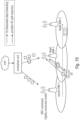
- the current HO procedures in LTE are designed to cater for scenarios where a UE transitions from a source eNB 12 to the target eNB 14 as indicated in Fig. 1 or from a cell 16 of eNB 12 to a cell 18 of eNB 14.
- the focus of this invention is on Intra-RAT HO procedures while Inter-RAT mobility is not precluded.
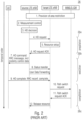
- the S1 handover procedure consists of 3 basic phases:
- Steps 13-15 it is noted that some are special to the S1-based HO 30, and comprise of acknowledgement and update information to the target MME.
- the radio resource control (RRC) context transfer is an important procedure of the HO process.
- the MME 32 as a part of the core network 22 creates a UE context when a UE 12 is switched on and subsequently attempts to connect to the network 24.
- a unique short temporary identity is assigned, also known as the SAE Temporary Mobile Subscriber Identity (S-TMSI), to the UE 12 that identifies the UE context in the MME 32.
- S-TMSI SAE Temporary Mobile Subscriber Identity
- This UE context contains user subscription data originally obtained from a Home Subscriber Server 34 (HSS) also being part of the core network 22.
- HSS Home Subscriber Server 34
- the local storage of subscription data in the MME 32 enables faster execution of procedures such as bearer establishment since it removes the need to consult the HSS every time.
- the UE context also holds dynamic information such as the list of bearers that are established and the terminal capabilities [2].
- the eNB 12 would be required to forward the UE's radio resource control (RRC) context to subsequent target eNBs such as eNB 14.
- RRC radio resource control
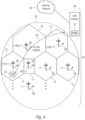
- Fig. 4 also shows a user entity or user equipment 10. It is currently served by base station 12. That is, base station 12 is a special base station 11 with respect to UE 10, namely the source base station 12. That is, UE 10 is located within cell 15 of base station 12 and base station 12 communicates with the UE 10 via radio resources it assigns to UE 10. The share of radio resources assigned to UE 10 depends on many factors such as subscriber data of UE 10, number of further UEs currently served by base station 10 and so forth. It is assumed that UE 10 is currently in a connected or active mode. That is, UE 10 has, for instance, one or more current communication sessions running such as a call and/or data session.
- the UE 10 which might be a mobile phone, a laptop or some other mobile or non-mobile device, may have one or more applications such as computer programs or the like, running thereon which communicate via base station 12 over network 34 with some third party which might be an entity within the cellular network 24, but may alternatively be a third party device being external to the cellular network 24 and connected to core network 34 via the Internet or some other external network 42.
- the core network 34 or some entity within core network 34 such as MME 32 contains or manages a context for each UE 10 currently served within region 40.
- the cellular network 24 of Fig. 4 is configured to support a preemptive preparation of a handover for user entity 10. This means the following. It might be, that cellular network 24, optionally, has the afore-mentioned functionality of initiating a handover of UE 10 to another, i.e., a target base station; namely, one of the neighboring base stations neighboring base station 12, on the basis of an evaluation of measurements made by the UE 10 which measure the connection quality between UE 10 and base station 12 as well as between UE 10 and any of the neighboring base stations 11, provided the UE 10 is within the reach of the respective neighboring base station 11.
- a target base station namely, one of the neighboring base stations neighboring base station 12
- the UE 10 which measure the connection quality between UE 10 and base station 12 as well as between UE 10 and any of the neighboring base stations 11, provided the UE 10 is within the reach of the respective neighboring base station 11.
- the handover is, as far as the cellular network's side is concerned, already done. It is merely up to the UE 10 or up to other circumstances discussed further below, whether the access opportunity provided within the temporal access intervals using the one or more access parameters for base stations 14a, 14b is actually used by UE 10.
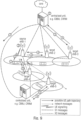
- Fig. 5 shows the process of preemptive preparation of the handover by way of establishing respective temporal access interval and one or more access parameters for one or more target base stations by illustrating the temporal sequence of steps performed along a temporal access t.
- the preemptive preparation of a handover is triggered at a time instant t 0 .
- the cellular network determines a preliminary set 50 of one or more base stations of the cellular network with respect to which a preemptive preparation of a handover might be performed.
- This preliminary set 50 of base stations is determined by the cellular networks so that their cells 15 cover an area where the UE 10 will probably move in the next future upon leaving the cell of current source base station 12.
- cellular network 24 may determine the preliminary set 50 depending on information on a predicted future route of the user entity.
- a predicted future route is illustrated using a dashed line 52.
- Fig. 5 illustrates the preliminary set 50 to be composed of, generally, base stations 14 1 ...14 M with M ⁇ N.
- the temporal length of the predicted future route 52 may cover a certain temporal interval 54 starting from time instant t 0 and lasting, for instance, for more than 10 seconds, 1 minute or even 5 minutes.
- the temporal length 54 might be determined variably as well and might be adapted, for instance, to the prediction accuracy of the predicted future route 52.
- the cellular network might receive the information on the predicted future route 52 of the user entity 10 from the user entity 10 itself such as, for instance, from an application running on the user entity or a certain component thereof being able to determine the position of the user entity 10 such as a navigation system or the like, or from some other module of the UE.
- the information transmission may take place during RRC Connection establishment, for instance.
- information on the predicted future route 52 of the user entity 10 might come from a device other than the cellular network 24 and the user entity 10. Such other device could be, for instance, a system which tracks the user entity 10, but resides external to cellular network 24.
- the information could be provided, for instance, by an external entity such as a V2V/V2X server, or from an over-the-top (OTT) entity such as Google ® . It might even be that the other device is responsible for granting allowance for the future route 2 such as a traffic management system which could be, for instance, responsible, for flight routes of drones as examples for UEs or the like. Additionally or alternatively, the cellular network 24 may determine the predicted future route 52 of the user entity itself such as by triangulation applied onto signals sent by the UE 10 and received by several of the base stations 11 or the like, or by extrapolating path 52 from a past travel path of UE 10 defined by updates on the UE's current position which the network 24 receives from the UE 10.
- an external entity such as a V2V/V2X server
- OTT over-the-top
- the cellular network 24 may determine the predicted future route 52 of the user entity itself such as by triangulation applied onto signals sent by the UE 10 and received by several of the base stations 11
- the derivation of the predicted future route 52 may involve, in any case, irrespective of the entity performing the derivation, a type of extrapolation or prediction on the basis of additional information in addition to a current position of the user entity 10 such as a route taken by the UE 10 immediately up to time instant t 0 , map data indicating a map of region 40 such as a street map or the like, and/or user preference data associated with the UE 10 having been gathered based on an evaluation of routes taken by the UE 10 in the past.
- Preliminary set 50 would then be determined so that the base station's cells within the set 50 would be crossed by route 52.
- the UE 10 is, thus, likely to need a handover at at least a subset of base stations of set 50.
- set 50 may, alternatively, be determined by the cellular network 24 by means other than based on an evaluation of predicted future route 52.
- the predicted route 52 could, for instance, be determined by a V2X broadcast server, or using information from other mobile users, e.g. by sensor fusion of a set of predicted routes from multiple UEs.
- base station 12 could be configured to request the route vector 52 as a kind of measurement report, including route updates and top-m routes e.g. route 1, route 2, route 3,...
- route 52 for determining set 50 is not necessary.
- the mere fact or circumstance that UE 10 enters a certain predetermined area 56 may be an indicator that there is a high probability that the user entity 10 will be, during a certain time interval 54 following time instant t 0 at which the UE 10 entered area 56, in a certain area, or will travel along a certain path or route so that set 50 could be automatically determined albeit fixedly associated with, the event of UE 10 entering area 56 at time instant t 0 .
- the area 56 could be one end of a street without any crossing until reaching, via a certain path 52, namely the street, a first crossing and accordingly, as soon as the UE 10 enters the street at this point, it is very likely that the UE 10 will follow this route/street 52.
- a UE 10 enters a tunnel at a first end and the tunnel being long so as to lead to another cell. While it might be unknown which street the UE takes after the tunnel, it is very likely that the UE will continue its journey after the tunnel and accordingly, set 50 could be determined so as to cover base stations surrounding that side of the tunnel.
- the prediction that there is a high probability that the user entity 10 will be, during some time interval 54 following a time instant t 0 , in a certain area, or will travel along a certain path or route could be triggered on the basis of an evaluation of a history of a route of the CE in the past such as a time interval preceding, or even immediately preceding, time instant t 0 .
- a current heading direction of UE 10 could be taken into account so as to trigger a preemptive HO preparation merely in case of the heading direction pointing into a certain direction or field of directions in addition to UE entering 56.
- preemptive preparation of HO could be triggered by the user entity coming from predetermined area 56.
- a history of UE positions could be evaluated in order to see whether this history meets some criteria and if so, preemptive HO could be initiated.
- the history of positions may be logged in any granularity or accuracy. For instance, a previous set of serving base stations or a list of previous base stations along the route of the user entity, i.e. some mobility history, could be used to this end.
- the triggering could be done based on matching current UE's position, current UE's heading direction and/or most recent history of UE positions against one or more predetermined criteria which are independent from the most recent connection quality measured by the UE with respect to its communication connection to the source base station 12 and/or any surrounding base station 11.
- cellular network 24 determines for each base station within set 50 an expected time t 1 ... t M at which the user entity enters the respective base station's cell 15, i.e., is within its reach. Accordingly, base station 12, i.e., the source eNB, queries each of the preliminary set 50 of target base stations regarding an accessibility of the cellular network 24 via the respective target base station at the respective expected time t I . As an outcome of this query, base station 12 of cellular network 24 receives from each of the preliminary set 50 of base stations, an answer to the query.
- Fig. 5 illustrates that a certain access interval 60 overlaps a first expected time t 1 .
- a base station of set 50 within the cell of which the user entity 10 is expected to be as time instant t 1 thus, allows user entity 10 to access the cellular network 24 using one or more access parameters via correspondingly reserving respective access radio resources during time interval 60.
- base station 12 is, thus, able to send to the user entity 10 a schedule 62 which indicates, for each of the set 64 of one or more base stations for which a temporal access interval 60 and one or more access parameters 66 have been determined, the temporal access temporal interval 60 as well as the one or more access parameters.
- This schedule 62 indicates to the user entity 10 that the same may access the cellular network 24 via the respective base station 14 x during the temporal access interval indicated, for instance, by its beginning or start at t x start using the associated one or more access parameters p x access with x being element of ⁇ a, b... ⁇ , i.e. being an index into set 64.
- schedule 62 could be submitted as an ordered list of elements, the elements having a temporal dependency, or the schedule 62 could be submitted as a set of elements.
- schedule 62 could be submitted as a list of lists or sets which may be ranked, e.g. top-m.
- Each such element would then be associated with a certain target base station, define its access interval 60 and the one or more access parameters 66.
- the preemptive preparation or one or more handovers is finished and the user entity has been notified thereabout and it is, from the sending of the schedule 62 to the user entity onwards, up to the user entity 10, whether or not the user entity uses the access opportunities during intervals 60 to handover itself from one base station to the next, or, from a different perspective, it is up to the user entity to exploit these opportunities provided that other external circumstances did not prevent user entity 10 from exploiting these opportunities because, for instance, the prediction of route 52 of the forecast on the basis of the event of UE 10 entering area 56, turned out not to be correct.
- the time consumed by querying the base stations of set 50 and obtaining the answers up to sending schedule 62 may be negligible compared to the temporal length 54 within which the one or more expected times t I are distributed.
- the schedule 62 may define a certain temporal access 60 by indicating, for instance, its start time t x start wherein an end of the temporal access interval 60 could implicitly be defined by a maximum length of each interval 60. In other words, the respective base station 14 x could close the access opportunity after a certain time after t x start .
- the temporal end of interval 60 could be indicated, too, however in the schedule 62.
- the query sent from base station 12 to the target base stations of set 50 may possibly contain one or more current identifiers using which the user entity 10 is identified in the cellular network such as, for instance, an identifier via which the user entity 10 is identified in the core network 34 such as in the MME 32.
- the query could additionally or alternatively inform the base stations of set 50 about the context data of user entity 10.
- performing the preemptive preparation of the handover as just described could also additionally involve sending a schedule 66 such as a copy of schedule 62 from base station 12 to core network 34 such as MME 32 within core network 34 so as to schedule a redirection of packets of one or more communication paths for communication sessions of the user entity 10 over the cellular network 24 and the user entity 10 so that the packets are distributed to each base station of set 64 depending on the respective temporal access interval 60 of the respective base station in set 64.
- a schedule 66 such as a copy of schedule 62 from base station 12 to core network 34 such as MME 32 within core network 34 so as to schedule a redirection of packets of one or more communication paths for communication sessions of the user entity 10 over the cellular network 24 and the user entity 10 so that the packets are distributed to each base station of set 64 depending on the respective temporal access interval 60 of the respective base station in set 64.
- MME 32 or the core network 34 would be able to plan, at an early stage; namely, at the time of receiving schedule 66, a distribution of inbound packets arriving, for instance, from the external network, to base stations among set 64 other than the base station via which the user entity 10 is currently connected to cellular network 24.
- Packets for instance, which are likely to be buffered too long at a certain base station of set 64 and cannot be transmitted from that base station to the user entity 10 before the expected handover from that base station to the next base station of set 64, may be forwarded by core network 34 or MME 32, respectively, to the next base station of set 64 according to the sequence of expected times covered by the respective temporal access intervals 60.
- the cellular network 34 would, first, not have to wait for such redirection until the handover actually takes place on behalf of UE 10 actually using the one or more access parameters it has been provided with by way of schedule 62.
- cardinality of the set 50 and the cardinality of set 64 or the cardinality of either of these sets might be greater than 1. Generally, however, both may be 1, 2.
- future start time 70 indicated in schedule 62 to indicate the start of the respective temporal access interval 60 it is noted that the same may be indicated by quantization indices or in seconds or the like.
- the UE 10 is likely to handover from base station 12 to the target base station for which the temporally-nearest temporal access interval 60 is indicated in schedule 62. That is, UE 10 will use the one or more access parameter 66 for this target base station which would, in the example illustrated in Fig. 4 , for instance, be the base station 14 a , during temporal access interval 60 and thus, would perform or activate the handover preemptively prepared as described so far.
- This base station 14 a would then inform base station 12 about the user entity having accessed the cellular network 24 via the base station 14 a and triggered by this information, base station 12 would cut its connection to UE 10, while core network 34 would be informed by base station 14 a with, triggered thereby, redirecting a cellular network internal sub-path of each of a set of one or more communication paths of one or more communication sessions running via the cellular network 24 and the user entity 10, from base station 12 to base station 14 a . Further, resources of the base station 11 via which the user entity 10 is currently or, better, has been so far, connected to the cellular network, here base station 12, could be released such as one or more buffers thereof managed by the base station for the one or more currently active communication sessions of UE 10.
- Base station 12 could cut its connection to UE 10 and/or release its resources alternatively in response to a signal sent from the core network indicating that the path redirection has been performed responsive, in turn, to the note sent from target base station 14 a , which then assumes the now role as source base station. In the same manner, the next handover between this target base station, which is now the source base station, to the next target base station of set 64 takes place.
- a cellular network 24 which supports a preemptive preparation of a handover for user entity 10.
- the above description revealed a user entity 10 for communication over a cellular network 24, wherein the user entity 10 is configured to gain information on a predicted future route 52 of the user entity and inform the cellular network on the predicted future route 52.
- the UE could transmit a list or vector of coordinates, e.g. WGS84 coordinates, to the cellular infrastructure 24.
- UE 10 could do this upon request from the base station 12, from a V2X server or in regular time intervals.
- the origin of the information on the predicted future route 52 may stem from an entity other than the user entity 10.
- the information on the predicted future route 52 may be sent to cellular network 24, for instance, as a set of pairs of time and coordinates of locations at which the user entity 10 is on the predicted future route 52, or a sequence of coordinates of location sequentially traversed by the user entity along the predicted future route 52 such as locations which the user entity traverses along the predicted future route 52 at a certain temporal pitch of a constant pitch interval.
- the above description revealed the description of a user entity for communication over a cellular network 24, wherein the user entity 10 is configured to manage a set of one or more preemptively prepared handovers.
- the user entity 10 not necessarily informs the cellular network on the predicted future route 52.
- the user entity 10 could handover to more than one carrier.
- the user entity 10 may be able to manage a set of one or more preemptively prepared handovers; namely, those indicated in schedule 62 which user entity 10 receives from the cellular network 24 and the source base station 12, respectively. From the reception onwards, i.e., substantially over the whole time interval 54, the user entity 10 continuously checks whether the schedule 62 becomes inadequate. For instance, the user entity recognizes that the user entity gets farther away from the predicted future route 52 because, for instance, the user of the user entity 10 decided to take another way than rule 52.
- user entity could inform the cellular network 24 on the inadequateness so that, for instance, cellular network 24 could inform the target base stations of set 64 thereabout so that the latter could render the reserved radio access resources associated with the one or more access parameters available for other user entities.
- the user entity could derive from the schedule 62 the temporal access interval 60 plus associated one or more access parameter 66 per target base station within set 64 and then, from the reception of schedule 62 onwards, continuously decide on accessing the cellular network 24 via any of this set 64 of target base stations; namely, any base station of the set 64 within a reach of which the user entity 10 currently is.
- user entity 10 may be configured to perform the management of the set of one or more preemptively prepared handovers as outlined in schedule 62 with respect to one or more wireless connections to the cellular network 24 of a set of current wireless connections to the cellular network 24.
- user entity 10 could use aggregated carriers and perform the exploitation of preemptively prepared handovers with respect to one or more than one component carrier of such aggregated carriers.
- the user entity may be able to resume connectivity to the cellular network after loss of the connectivity using any of the set of one or more preemptively prepared handovers despite a temporary loss of connection. For example, in a scenario where the UE lost connection due to a tunnel, UE 10 and the next base station involved in the preemptive preparation of HOs may simply resume the connection between using the preemptively prepared HO.
- the user of a user entity could be provided with this information such as, for instance, via a display or a similar output device of the UE 10, and the user could decide, as the bearer of the user entity 10, to take the favorite route in order to, for instance, enjoy a currently downloaded video without any stall event.
- the "user" should be, however, not be restricted to a human user.
- the UE to form an interface of a robot or other autonomous driving device where an interruption of the data connection could have tremendously negative and dangerous impacts.
- the recipient of a path recommendation could be another device such as device responsible for, or cooperating in, determining the future route which the UE takes such as a traffic management unit.
- the information about the possible routes could be provided by the cellular network from outside.
- Fig. 6 provides an overview of a Predictive-HO (P-HO) scheme in the LTE framework.
- a preemptive decision will have to be triggered before the actual HO occurs in order for the Source/ Anchor eNB/gNB 12 to signal the UE 10 with the target eNB/gNB parameters 66 (e.g. RRCConnectionReconfiguration including the mobilityControllnfo message), examples of which are outlined in the table shown in Fig. 7 .
- the target eNB/gNB parameters 66 e.g. RRCConnectionReconfiguration including the mobilityControllnfo message
- the P-HO request message via S1/X2 requests resource availability from potential target eNB/gNBs about a predicted handover from a specific UE. It can contain information about the user such as expected arrival time, unique IDs, context and security information and expected level of service requirements. Additionally, the context of the UE can be pushed to all target eNBs.
- This setup S1 message could include: P-HO-REQUEST-IE (Direction: source eNBs ⁇ Target eNBs) IE/Group Name Description Message Type [4] Identifies the message being transmitted, e.g. Handover Resource Allocation, Path Switch Request Handover Type[4] Indicates the type of Handover at the source eNB, e.g.
- LTEtoUTRAN eNB List to be setup Identifies a list of target eNBs MME-UE-S1-AP-ID[4] "Uniquely identifies the UE association over the S1 interface within the MME.” [12] eNB UE S1AP ID [4] "Uniquely identifies the UE association over the S1 interface within the eNB.” [12] Predicted UE Behavior Defines the future behavior of the UE with predictable activity with predicted info, to assist future eNBs in determining the optimum RRC connection time. UE Context Transfer The UE context is pushed to all Target nodes based on the prediction.
- UE Mobility Type Low, Medium, High speed Message 4 The response from the target eNB can acknowledge or deny the request via S1/X2 to the requesting centralized unit using a ACK/NACK message. The decision is based on the outcome of the admission control and availability of resources. Once the target eNB acknowledges the request it has prepared resources for the potential new UE, has stored the new context and configured the lower layer protocols.
- An example of such a message from each target eNB is given as: • P-HO-REQUEST-ACK-IE (Direction: Target eNBs ⁇ centralized Unit) IE/Group Name Description Message Type [4] "Identifies the message being transmitted, e.g.
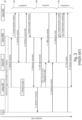
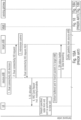
- P-HO User Data Forwarding in case of out-of-coverage scenario may be done as follows: In the event that the UE loses coverage and has a Radio Link Failure (RLF) during the P-HO process with source eNB-1, we have the out-of-coverage scenario shown in Fig. 10 . The UE attempts an RRC connection re-establishment to the target eNB given that it has already acquired the signaling parameters to connect with the target eNB. Redundant data forwarding could be applied to a centralized unit architecture.
- RLF Radio Link Failure
- Step/Description 2.1 Prior to timeout with the source eNB, the core network has already forwarded redundant data via the centralized unit to the next target eNB based on information from the predictive HO procedure. This redundant data is forwarded to the target eNB, subject to the initiation of the P-HO process.
- IE/Group Name Description Message Type [4] "Identifies the message being transmitted, e.g. Handover Resource Allocation, Path Switch Request" [12]
- X2 TNL Configuration Info [4] Contains the P-HO related information.
- Core Data Forwarding Forwards the redundant data as initially transmitted to the source eNB.
- MME-UE-S1-AP-ID-SeNB "Uniquely identifies the UE association over the S1 interface within the MME.” [12]
- Step/Description 2.2 The UE can transmit a last packet ACK sequence number to the target eNB, to resume data forwarding from the last known timeout of the RRC connection with the SeNB.
- IE/Group Name Description Message Type [4] "Identifies the message being transmitted, e.g. Handover Resource Allocation, Path Switch Request" [12]
- X2 TNL Configuration Info [4] Contains the P-HO related information.
- UE Data Forwarding Sends ACK and forwards the SN number.
- Dual-connectivity mode UE P-HO could be used as well.
- Dual-connected (DC) P-HOs enable URLLC services of mobile UEs and therefore can fulfill the high reliability requirement.
- Predicted UE route information can also aid in seamless handover of UEs, which are in dual-connectivity mode, i.e. simultaneously connected to two eNBs, the master eNB and secondary eNB. This is particularly applicable to scenarios where a mobile UE travels across a number of small cells within a macro cell environment, e.g. dense urban scenario. A group of such small cells belong to a secondary cell group (SCG).
- SCG secondary cell group
- DC enabled HOs can result in zero interruption due to the availability of at least one connected link at all times.
- the state machine in current control plane protocols in cellular wireless mainly support two modes: the idle mode and the connected mode.
- the idle mode the UE monitors the control channel (PCH) according to a discontinuous reception (DRX) cycle.
- the MME is responsible for the monitoring the UE.
- the connected mode the UE is connected to a known cell and can perform data transfer to and from the device.
- the corresponding eNB is responsible for monitoring the UE.
- HOs are performed when the UE is in the RRC connected mode.
- LTE lightly connected
- NR inactive state
- the UE is responsible for transferring into idle or connected states.
- the lightly connected UEs enter into legacy behavior in RRC connected via RRC procedure including three messages (i.e. request, response and complete).
- the S1 connection for this UE is kept and active, and a new signaling scheme from the UE could be introduced, in order to optimize handovers and improve network performance though movement predictions.
- Fig. 11 is an example of the lightly connected state mode of operation as proposed in [3].
- NR Architecture As to NR Architecture, two proposed architecture types for NR are proposed, viz. Centralized Unit (CU) Architecture or Distributed Unit (DU) Architecture as shown in Fig. 13 .
- CU Centralized Unit
- DU Distributed Unit
- V2X System Architecture one of the main modes of operation in V2X consists of the broadcast architecture and serves as example application of the proposed P-HO scheme.
- the high-level V2X broadcast architecture is shown in Fig. 14 with a new additional entity known as the V2X application server [8].
- V2X Application Server is out of scope of 3GPP [8], and an overview of the role of the Application server has been defined by the ITS.
- the Application server aggregates inputs from several sources including the vehicles on the road, road side units as well as external information from various other network entities.
- the Application Server then correlates this information based on time, location and incident to develop a better idea regarding the state of traffic. Once the information has been consolidated and processed it then has to decide in which information it has to disseminate to other vehicles in a geographic area [9].
- the V2X application server has the following specifications according to 3GPP, which fall in line with ETSI's proposal [8]:
- the V2X entities can be grouped into a eNB type Road Side Unit (RSU).
- RSU Road Side Unit
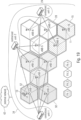
- This RSU can be deployed directly at a eNB, similar to edge-cloud computing, e.g. via local IP breakout interface (LIPA). This enables faster prediction of the HO process. See Fig. 15 .
- LIPA local IP breakout interface
- Dual-connectivity was included as part of small cell enhancements in LTE and offers several advantages which include [10]:
- a UE can be connected to a Master eNB and Secondary eNB but can have only one RRC connection with the Master eNB.
- DC can enhance seamless or zero interruption HO between various eNBs along a predicted route , by ensuring guaranteeing always one active/inactive.
- the data split in the User-plane can take place at the bearer or packet level as shown in Figs. 16 and 17 [10]
- the source eNB sends a HO Request on X2.
- the HO Request needs to be modified to indicate that this is a dual connectivity HO as opposed to a traditional HO.
- the goal of the HO is to hand over a subset of the DRBs to the target eNB.
- the UE context includes information on the bearers that are assigned to the source eNB. For dual connectivity, the UE context will need to specify which of its bearers are mapped to the target eNB.
- the target eNB will indicate which bearers it is willing to accept in the HO Request ACK. As in the current HO procedure, bearers that are not accepted will be dropped.
- the target eNB sends the DL allocation and RRCConn Reconf with mobilityControllnformation to the source who sends it to the UE. SN status transfer and data forwarding will proceed for the bearers that are to be transferred.
- the UE will start RACH on one of its radios while maintaining regular communication of all bearers that remain on the source eNB.
- the UE sends RRC Conn Reconf Complete as usual.
- RRC Conn Reconf Complete Upon HOF, a new RRC message is sent to the source eNB on its associated UE radio to indicate the failure.
- the source eNB can assist the UE by either accepting a connection from radio #2 or by preparing another eNB to do so.
- the target eNB will send a path switch Request to the MME on S1 requesting its assigned bearers.
- the MME will send Modify Bearer request to the Gateway.
- the target eNB updates its UE Context and sends a UE Context Update to the source eNB over X2.
- the source eNB updates its UE Context and releases resources associated with the HO.”
- the concept of managing a tracking/paging area for some user entity reduces the burden on the side of the cellular network to continuously reserve radio resources for user entities for which one or more communication sessions are active, but for which the one or more communication session does not involve a continuous transmission of packets.
- the cellular network keeps track of where the UE is at least approximately; namely, within some tracking/paging area, so that packets addressed to the UE may be forwarded to the one or more base stations within this tracking/paging area, and if the base stations within the tracking/paging area know the context data of the UE.
- Fig. 19 shows a cellular network 24 which is, as discussed with respect to Fig. 4 , composed of a plurality of base stations 11 spread so as to cover with their associated cells 15 a certain region or geographical area, wherein the base stations 11 serve UEs within their cells in that the same perform the wireless communication with the UEs within their cells.
- the base stations 11 are connected via some interface 28 with the core network 34 of cellular network 24.
- This core network 34 in turn, may have an interface towards an external network 42.
- the behavior of cellular network 24 and the UEs communicating via cellular network 24 of Fig.19 may be as described with respect to Fig. 4 or, optionally, in accordance with the current solutions discussed above with respect to Figs. 1 to 3 .
- the cellular network 24 of Fig. 19 is configured to establish for a predetermined user entity 10 a schedule of a time-varying tracking/paging area spanned or defined by a time-varying set of one or more base stations or made-up by the cell(s) of the set of one or more base stations.
- Figs. 19 and 20 assume that the base stations 11 are spatially pre-clustered into so-called "paging areas" 90. Four such clusters or spatially-neighboring base stations 11 are exemplarily shown in Fig. 19 . It should be noted, however, that this clustering is not mandatory.
- the cellular network 24 determines, at some time instant t 0 , for a UE 10, a time-varying tracking/paging area. The time instant t 0 might, for instance, be initiated by UE 10 which decides to switch from an active mode to an intermediate mode of low activity, the details of which are described and exemplified in more detail below.
- the tracking/paging area is, at each time instant, an area served or spanned by a set of one or more base stations, but this set varies in time. Its determination occurs at time instant t 0 based on some sort of prediction similar to thoughts which led to set 50 in Fig. 5 .
- the tracking/paging area may be defined to follow a predicted future route 52 of UE 10, i.e., to follow the position the UE 10 has predicted to assume in route 52.
- the outcome of such determination is shown in Fig. 20 as a schedule 100.
- schedule 100 defines, for each time instant within some time interval 102 which follows time instant t 0 , the set of one or more base stations 11 which form the tracking/paging area, i.e., set 104.
- schedule 100 indicates the set 104 in units of clusters 92, but this might be solved differently.
- schedule 100 indicates this set for consecutive partial intervals 106, into which the time interval 102 is sub-divided. That is, for each such partial interval 106, schedule 100 indicates the set 104 of base stations 11 which make up the tracking/paging area.
- the UE 10 is intermittently informed on the time-varying tracking/paging area by way of messages intermittently updating the set of base station cells defining the area 104.
- the cellular network 24 then sends the schedule 100 or messages intermittently updating area 104 to the user entity 10 which, thus, is able to continuously check whether the UE 10 leaves this time-varying tracking/paging area defined by the time-varying set of one or more base stations 104 or not. As long as the UE does not leave the time-varying tracking/paging area, the UE is within an area within which the cellular network 24 expects the UE 10 to be. As long as the UE 10 does not wish to initiate an uplink communication and to switch to active mode, the UE 10 needs to do nothing.
- the cellular network 24 provides each base station of set 104, i.e., each base station currently within the set 104 of base stations which define the tracking/paging area, with context data of UE 10 so that these base stations are aware, for instance, of the UE's 10 subscriber data currently active one or more communication sessions, one or more IDs used by the cellular network 24 to identify UE 10 and distinguish UE 10 from other UEs and/or other UE specific data.
- cellular network 24, itself uses schedule 100 so as to search for UE 10 whenever an inbound or downlink packet of one of one of more active communications sessions arrives at the core network 34 addressed to UE 10.
- the cellular network of Fig. 19 does not form a schedule 100 of a time-varying tracking/paging area. Rather, as depicted in Fig. 21 , according to this alternative, the cellular network 24 uses the gained knowledge about the predicted future route 52 so as to appropriately select the set 104 of one or more base stations which define the tracking/paging area. As long as the UE is within this area 104 which has precisely been predicted using predicted future route 52, control signaling overhead on the side of the UE which could negatively impact the power consumption of UE 10, may be avoided. In the example of Fig. 21 , cellular network 24 sends to the UE 10 the set 104. In both alternatives discussed above with respect to Figs.
- the user entity 10 is a user entity for communication over cellular network 24 and the user entity 10 is configured to continuously check whether it is still in the tracking/paging area defined by the set 100 of one or more base stations or whether the user entity has left the same. In case of leaving, the user entity 10 sends a tracking/paging area update message to the cellular network 24 which, in turn, then re-initiates the determination of the tracking/paging area according to Fig. 20 or Fig. 21 , respectively. In case of receiving schedule 100, user entity 10 is able to check this schedule 100.
- Efficient Paging using prediction information in Lightly Connected Mode as shown in Fig. 19 entails the update of the centralized unit information and the Tracking Area Identifier (TAI) List of the various RAN paging/notification areas using the predicted route information of the UE when in RRC lightly connected mode (RRC Idle mode not precluded).
- the UE traditionally receives a TAI list when initially attaching to a source eNB in the LTE network.
- the UE sends a Tracking Area Update (TAU) informing the MME (core network) about its position.
- TAU Tracking Area Update
- the source/anchor eNB or centralized unit provides a near complete predicted RAN paging/notification area list (pPAI) list to the UE upon connection establishment, corresponding with the predicted route of the UE, avoiding the need to page multiple cells of the same paging area (See Fig. 19 ) to locate the UE, thus reducing paging overhead.
- pPAI predicted RAN paging/notification area list
- embodiments of the present invention can be implemented as a computer program product with a program code, the program code being operative for performing one of the methods when the computer program product runs on a computer.
- the program code may for example be stored on a machine readable carrier.
- inventions comprise the computer program for performing one of the methods described herein, stored on a machine readable carrier.
- an embodiment of the inventive method is, therefore, a computer program having a program code for performing one of the methods described herein, when the computer program runs on a computer.
- a further embodiment of the inventive methods is, therefore, a data carrier (or a digital storage medium, or a computer-readable medium) comprising, recorded thereon, the computer program for performing one of the methods described herein.
- the data carrier, the digital storage medium or the recorded medium are typically tangible and/or non-transitionary.
- a further embodiment of the inventive method is, therefore, a data stream or a sequence of signals representing the computer program for performing one of the methods described herein.
- the data stream or the sequence of signals may for example be configured to be transferred via a data communication connection, for example via the Internet.
- a further embodiment comprises a processing means, for example a computer, or a programmable logic device, configured to or adapted to perform one of the methods described herein.
- a processing means for example a computer, or a programmable logic device, configured to or adapted to perform one of the methods described herein.
- a further embodiment comprises a computer having installed thereon the computer program for performing one of the methods described herein.
- a further embodiment according to the invention comprises an apparatus or a system configured to transfer (for example, electronically or optically) a computer program for performing one of the methods described herein to a receiver.
- the receiver may, for example, be a computer, a mobile device, a memory device or the like.
- the apparatus or system may, for example, comprise a file server for transferring the computer program to the receiver.
- a programmable logic device for example a field programmable gate array
- a field programmable gate array may cooperate with a microprocessor in order to perform one of the methods described herein.
- the methods are preferably performed by any hardware apparatus.
- the apparatus described herein may be implemented using a hardware apparatus, or using a computer, or using a combination of a hardware apparatus and a computer.
- the apparatus described herein, or any components of the apparatus described herein, may be implemented at least partially in hardware and/or in software.
- the methods described herein may be performed using a hardware apparatus, or using a computer, or using a combination of a hardware apparatus and a computer.
Landscapes
- Engineering & Computer Science (AREA)
- Computer Networks & Wireless Communication (AREA)
- Signal Processing (AREA)
- Physics & Mathematics (AREA)
- Probability & Statistics with Applications (AREA)
- Mobile Radio Communication Systems (AREA)
Claims (14)
- Zellulares Netzwerk, das eine präemptive Vorbereitung einer Weiterreichung für eine Nutzerentität unterstützt,
wobei das zellulare Netzwerk konfiguriert ist zumBestimmen eines vorläufigen Satzes (50) von mehr als einer Basisstation des zellularen Netzwerks;Senden einer Anfrage von einer zentralisierten Einheit des zellularen Netzwerks an jede des vorläufigen Satzes von mehr als einer Basisstation des zellularen Netzwerks bezüglich einer Zugänglichkeit des zellularen Netzwerks über die jeweilige Basisstation zu einer erwarteten Zeit, zu der die Nutzerentität in eine Zelle der jeweiligen Basisstation eintritt;Senden einer Antwort von der jeweiligen Basisstation an die zentralisierte Einheit;Durchführen der präemptiven Vorbereitung der Weiterreichung durch Einrichten, für jede des Satzes von mehr als einer Basisstation des zellularen Netzwerks,eines zeitlichen Zugriffsintervalls (60) undeines oder mehrerer Zugriffsparameter (66), undDurchführen oder Aktivieren der präemptiv vorbereiteten Weiterreichung und Zugreifen, durch die Nutzerentität, auf das zellulare Netzwerk über die jeweilige Basisstation während des zeitlichen Zugriffsintervalls unter Verwendung des einen oder der mehreren Zugriffsparameter. - Zellulares Netzwerk gemäß Anspruch 1, wobei das zellulare Netzwerk dazu konfiguriert ist, die präemptive Vorbereitung der Weiterreichung in Abhängigkeit von Informationen über eine vorhergesagte zukünftige Route (52) der Nutzerentität zu initiieren.
- Zellulares Netzwerk gemäß Anspruch 2, wobei das zellulare Netzwerk konfiguriert ist zumEmpfangen der Informationen über die vorhergesagte zukünftige Route (52) der Nutzerentität (10) vonder Nutzerentität odereiner anderen Vorrichtung als dem zellularen Netzwerk und als der Nutzerentität, oderBestimmen der vorhergesagten zukünftigen Route (52) der Nutzerentität.
- Zellulares Netzwerk gemäß einem der vorhergehenden Ansprüche, wobei das zellulare Netzwerk konfiguriert ist zumInitiieren der präemptiven Vorbereitung der Weiterreichung, die durch die Nutzerentität ausgelöst wird, die in einen vorbestimmten Bereich (56) eintritt, und/oderInitiieren der präemptiven Vorbereitung der Weiterreichung, die durch eine Historie von Positionen der Nutzerentität ausgelöst wird, die ein vorbestimmtes Kriterium erfüllt.
- Zellulares Netzwerk gemäß einem der Ansprüche 1 bis 4, wobei das zellulare Netzwerk dazu konfiguriert ist, den Satz von mehr als einer Basisstation des zellularen Netzwerks basierend auf der vorhergesagten zukünftigen Route (52) zu bestimmen, so dass der Satz (64) von mehr als einer Basisstation entlang der vorhergesagten zukünftigen Route (52) positioniert ist.
- Zellulares Netzwerk gemäß einem der Ansprüche 1 bis 5, wobei die Anfrage Informationen über
eine oder mehrere aktuelle Kennungen, mit denen die Nutzerentität (10) in dem zellularen Netzwerk identifiziert wird, umfasst. - Zellulares Netzwerk gemäß einem der Ansprüche 1 bis 6, das so konfiguriert ist, dass jede des Satzes (64) von mehr als einer Basisstation Funkzugriffsressourcen reserviert, die durch den einen oder die mehreren Zugriffsparameter (66) für die jeweilige Basisstation während des zeitlichen Zugriffsintervalls für die jeweilige Basisstation definiert sind.
- Zellulares Netzwerk gemäß einem der Ansprüche 1 bis 7, das dazu konfiguriert ist, die präemptive Vorbereitung der Weiterreichung durch weiteres Planen, für jede des Satzes (64) von mehr als einer Basisstation des zellularen Netzwerks, einer Umleitung von Paketen von einer oder mehreren Kommunikationen, die über das zellulare Netzwerk und die Nutzerentität laufen, durchzuführen, so dass die Pakete in Abhängigkeit von dem zeitlichen Zugriffsintervall für die jeweilige Basisstation an jede des Satzes von mehr als einer Basisstation des zellularen Netzwerks verteilt werden.
- Zellulares Netzwerk gemäß einem der Ansprüche 1 bis 8, wobei das zellulare Netzwerk dazu konfiguriert ist, zumindest für eine des Satzes von mehr als einer Basisstation das zeitliche Zugriffsintervall einzurichten, so dass das zeitliche Zugriffsintervall einen zukünftigen Start hat.
- Zellulares Netzwerk gemäß einem der Ansprüche 1 bis 9, das dazu konfiguriert ist, der Nutzerentität einen Plan bereitzustellen, der zumindest für jede eines Teilsatzes des Satzes von mehr als einer Basisstation angibt,das zeitliche Zugriffsintervall undden einen oder die mehreren Zugriffsparameter.
- Zellulares Netzwerk gemäß einem der Ansprüche 1 bis 10, das dazu konfiguriert ist, ausgelöst durch einen Zugriff des zellularen Netzwerks durch die Nutzerentität über eine des Satzes (64) von mehr als einer Basisstation, einen internen Teilpfad des zellularen Netzwerks von jedem eines Satzes von aktuellen Kommunikationspfaden, die über das zellulare Netzwerk und die Nutzerentität (10) laufen, von einer Basisstation, über die die Nutzerentität aktuell mit dem zellularen Netzwerk verbunden ist, zu der einen des Satzes von mehr als einer Basisstation umzuleiten.
- Zellulares Netzwerk gemäß einem der Ansprüche 1 bis 10, das dazu konfiguriert ist, ausgelöst durch einen Zugriff des zellularen Netzwerks durch die Nutzerentität über eine des Satzes (64) von mehr als einer Basisstation, ferner Ressourcen an einer Basisstation freizugeben, über die die Nutzerentität (10) zuvor mit dem zellularen Netzwerk verbunden war.
- Verfahren zum Betreiben eines zellularen Netzwerks, das ein präemptives Vorbereiten einer Weiterreichung für eine Nutzerentität aufweist,
wobei das Verfahren folgende Schritte aufweist:Bestimmen eines vorläufigen Satzes (50) von mehr als einer Basisstation des zellularen Netzwerks;Senden einer Anfrage von einer zentralisierten Einheit des zellularen Netzwerks an jede des vorläufigen Satzes von mehr als einer Basisstation des zellularen Netzwerks bezüglich einer Zugänglichkeit des zellularen Netzwerks über die jeweilige Basisstation zu einer erwarteten Zeit, zu der die Nutzerentität in eine Zelle der jeweiligen Basisstation eintritt;Senden einer Antwort von der jeweiligen Basisstation an die zentralisierte Einheit;Durchführen der präemptiven Vorbereitung der Weiterreichung durch Einrichten, für jede des Satzes von mehr als einer Basisstation des zellularen Netzwerks,eines zeitlichen Zugriffsintervalls (60) undeines oder mehrerer Zugriffsparameter (66), undDurchführen oder Aktivieren der präemptiv vorbereiteten Weiterreichung und Zugreifen, durch die Nutzerentität, auf das zellulare Netzwerk über die jeweilige Basisstation während des zeitlichen Zugriffsintervalls unter Verwendung des einen oder der mehreren Zugriffsparameter. - Computerprogramm mit einem Programmcode zum Durchführen, wenn dasselbe auf einem oder mehreren Computern läuft, die in einem zellularen Netzwerk enthalten sind, eines Verfahrens gemäß Anspruch 13.
Priority Applications (1)
| Application Number | Priority Date | Filing Date | Title |
|---|---|---|---|
| EP25181148.5A EP4593464A3 (de) | 2017-03-23 | 2018-03-22 | Präventive übergabevorbereitung und verfolgung/paging-bereichshandhabung und intelligente routenauswahl in einem mobilfunknetz |
Applications Claiming Priority (2)
| Application Number | Priority Date | Filing Date | Title |
|---|---|---|---|
| EP17162641 | 2017-03-23 | ||
| PCT/EP2018/000109 WO2018171941A1 (en) | 2017-03-23 | 2018-03-22 | Preemptive handover preparation and tracking/paging area handling and intelligent route selection in a cellular network |
Related Child Applications (1)
| Application Number | Title | Priority Date | Filing Date |
|---|---|---|---|
| EP25181148.5A Division EP4593464A3 (de) | 2017-03-23 | 2018-03-22 | Präventive übergabevorbereitung und verfolgung/paging-bereichshandhabung und intelligente routenauswahl in einem mobilfunknetz |
Publications (2)
| Publication Number | Publication Date |
|---|---|
| EP3603188A1 EP3603188A1 (de) | 2020-02-05 |
| EP3603188B1 true EP3603188B1 (de) | 2025-06-25 |
Family
ID=58454858
Family Applications (2)
| Application Number | Title | Priority Date | Filing Date |
|---|---|---|---|
| EP25181148.5A Pending EP4593464A3 (de) | 2017-03-23 | 2018-03-22 | Präventive übergabevorbereitung und verfolgung/paging-bereichshandhabung und intelligente routenauswahl in einem mobilfunknetz |
| EP18717827.2A Active EP3603188B1 (de) | 2017-03-23 | 2018-03-22 | Präemptive handover-vorbereitung und verfolgungs-/funkrufbereichshandhabung und intelligente routenauswahl in einem zellularen netzwerk |
Family Applications Before (1)
| Application Number | Title | Priority Date | Filing Date |
|---|---|---|---|
| EP25181148.5A Pending EP4593464A3 (de) | 2017-03-23 | 2018-03-22 | Präventive übergabevorbereitung und verfolgung/paging-bereichshandhabung und intelligente routenauswahl in einem mobilfunknetz |
Country Status (9)
| Country | Link |
|---|---|
| US (4) | US11343720B2 (de) |
| EP (2) | EP4593464A3 (de) |
| JP (2) | JP7410360B2 (de) |
| KR (2) | KR102799664B1 (de) |
| CN (2) | CN110506438B (de) |
| CA (1) | CA3048764C (de) |
| MX (1) | MX2019008121A (de) |
| MY (1) | MY205897A (de) |
| WO (1) | WO2018171941A1 (de) |
Families Citing this family (61)
| Publication number | Priority date | Publication date | Assignee | Title |
|---|---|---|---|---|
| WO2018104217A1 (en) * | 2016-12-09 | 2018-06-14 | Nokia Technologies Oy | Autonomous user equipment handover in licensed or unlicensed spectrum |
| KR102277946B1 (ko) * | 2017-03-17 | 2021-07-16 | 삼성전자주식회사 | 차량의 무선 통신을 지원하기 위한 방법들 및 장치들 |
| KR102799664B1 (ko) * | 2017-03-23 | 2025-04-23 | 프라운호퍼 게젤샤프트 쭈르 푀르데룽 데어 안겐반텐 포르슝 에. 베. | 셀룰러 네트워크에서 선점적 핸드오버 준비 및 추적/페이징 영역 처리 및 지능형 루트 선택 |
| US11218840B2 (en) | 2017-03-31 | 2022-01-04 | Telefonaktiebolaget Lm Ericsson (Publ) | Methods and systems for using network location services in a unmanned aircraft systems traffic management framework |
| CN110651314B (zh) | 2017-03-31 | 2023-07-28 | 瑞典爱立信有限公司 | 用于无人交通航空器系统的增强飞行计划 |
| KR102269925B1 (ko) | 2017-03-31 | 2021-06-29 | 텔레호낙티에볼라게트 엘엠 에릭슨(피유비엘) | 무인 공중 운반체로부터 송신되는 라디오 프레임에서의 지오로케이션 정보를 브로드캐스팅하기 위한 방법, 장치, 및 컴퓨터 판독가능 저장 매체 |
| EP3610346A1 (de) | 2017-04-14 | 2020-02-19 | Telefonaktiebolaget LM Ericsson (Publ) | Optimale unbemannte luftfahrzeugflugroutenplanung basierend auf den dienstgüteanforderungen für daten-, telemetrie und befehls- und steuerungsanforderungen in 3gpp-netzwerken |
| EP3628133B1 (de) | 2017-05-04 | 2024-01-10 | Koninklijke Philips N.V. | Intragruppe kommunikation |
| EP3619832B1 (de) | 2017-05-05 | 2021-04-07 | Telefonaktiebolaget LM Ericsson (PUBL) | Verfahren und anordnungen zum benutzen der flugbahn eines unbemanntes luftfahrzeugs (uav) zum koordinieren einer kommunikationsübergabe in netzwerken des kooperation projekts der dritten generation (3gpp). |
| CN111066342B (zh) | 2017-07-10 | 2023-05-02 | 瑞典爱立信有限公司 | 基于无人驾驶飞行器飞行路径信息的无线电资源分配优化 |
| EP3679741A1 (de) * | 2017-09-05 | 2020-07-15 | Telefonaktiebolaget LM Ericsson (PUBL) | Geplante kontinuität der verbindungskonnektivität eines unbemannten luftfahrzeugs (uav) in uav-verkehrsmanagementsystemen |
| EP4138456B1 (de) * | 2017-11-10 | 2025-07-30 | Beijing Xiaomi Mobile Software Co., Ltd. | Verfahren und vorrichtung zur übergabe von unbemannten luftfahrzeugen und basisstation |
| WO2019130050A1 (en) | 2017-12-29 | 2019-07-04 | Telefonaktiebolaget Lm Ericsson (Publ) | Using a cellular interface for unmanned aerial vehicle communications |
| US10827325B2 (en) * | 2018-01-25 | 2020-11-03 | Hyundai Motor Company | Method for transmitting and receiving data using heterogeneous radio access technology in communication system supporting vehicle-to-everything communication and apparatus for the same |
| WO2019186245A1 (en) | 2018-03-30 | 2019-10-03 | Telefonaktiebolaget Lm Ericsson (Publ) | Network coverage and policy information generation and distribution for unmanned aerial vehicle flight planning |
| ES2952283T3 (es) * | 2018-05-10 | 2023-10-30 | Beijing Xiaomi Mobile Software Co Ltd | Métodos para adquirir y enviar información de ruta de vehículo aéreo no tripulado |
| CN110784328B (zh) * | 2018-07-27 | 2021-12-14 | 华为技术有限公司 | 一种车联网通信解决方案 |
| US10966135B2 (en) * | 2018-09-28 | 2021-03-30 | Intel Corporation | Software-defined networking data re-direction |
| US11902843B2 (en) | 2018-11-28 | 2024-02-13 | Telefonaktiebolaget Lm Ericsson (Publ) | Method and wireless device for handling handover |
| WO2020115885A1 (ja) * | 2018-12-06 | 2020-06-11 | 富士通株式会社 | 通信装置、通信方法、通信制御装置、基地局装置及び端末装置 |
| JP2020127132A (ja) * | 2019-02-05 | 2020-08-20 | トヨタ自動車株式会社 | 車載通信装置、通信方法およびサーバ装置 |
| WO2020173552A1 (en) * | 2019-02-26 | 2020-09-03 | Telefonaktiebolaget Lm Ericsson (Publ) | Migration of computing information between edge computing devices |
| US10785634B1 (en) | 2019-03-08 | 2020-09-22 | Telefonaktiebolaget Lm Ericsson (Publ) | Method for end-to-end (E2E) user equipment (UE) trajectory network automation based on future UE location |
| FI3952453T3 (fi) * | 2019-03-29 | 2024-03-28 | Honda Motor Co Ltd | Tiedonsiirtolaite, tiedonsiirtojärjestelmä ja ohjelma |
| CN111787575B (zh) * | 2019-04-03 | 2022-02-18 | 华为技术有限公司 | 一种终端设备的网络接入管理方法及装置 |
| FR3095099B1 (fr) * | 2019-04-15 | 2021-09-03 | Continental Automotive | Procédé de prédiction d’une modification des conditions d’attachement d’un terminal à un réseau cellulaire |
| EP3966971A4 (de) * | 2019-05-09 | 2022-05-18 | Telefonaktiebolaget Lm Ericsson (Publ) | Netzwerkknoten, benutzergerät und verfahren zur handhabung von signalqualitätsvariationen |
| CN114073129B (zh) * | 2019-05-13 | 2025-03-25 | 弗劳恩霍夫应用研究促进协会 | 支持到蜂窝网络小区的条件切换的用户设备和支持条件切换的蜂窝网络 |
| CN112020108B (zh) | 2019-05-30 | 2022-06-10 | 华为技术有限公司 | 小区切换方法和装置 |
| CN112020110B (zh) * | 2019-05-31 | 2022-10-04 | 华为技术有限公司 | 一种终端设备的网络接入方法及装置 |
| CN110392357B (zh) * | 2019-06-21 | 2022-03-11 | 广东工业大学 | 一种无人机辅助物联网通信装置的资源分配控制方法 |
| JP7111077B2 (ja) * | 2019-07-31 | 2022-08-02 | 株式会社デンソー | 通信装置および通信制御装置 |
| US12520217B2 (en) | 2019-09-06 | 2026-01-06 | Nec Corporation | First radio station, second radio station, core network node, mobile terminal, system, method, and non-transitory computer readable recording medium |
| WO2021044864A1 (ja) * | 2019-09-06 | 2021-03-11 | 日本電気株式会社 | 管制装置、第1のコアネットワークノード、無線局、第2のコアネットワークノード、移動端末、システム、方法、プログラム、及び、コンピュータに読み取り可能な非一時的記録媒体 |
| CN115039439A (zh) * | 2019-11-06 | 2022-09-09 | 瑞典爱立信有限公司 | 用于配置用于用户设备的数据会话的方法 |
| JP7353944B2 (ja) * | 2019-11-27 | 2023-10-02 | キヤノン株式会社 | 通信装置、制御方法、および、プログラム |
| US11659453B2 (en) * | 2020-03-02 | 2023-05-23 | Nokia Solutions And Networks Oy | Efficient transfer of access context for user equipment among network nodes |
| US12439359B2 (en) | 2020-03-05 | 2025-10-07 | Sony Group Corporation | Notification area management in a wireless network |
| US12512898B2 (en) * | 2020-03-18 | 2025-12-30 | Qualcomm Incorporated | Determining beam directions of a repeater |
| WO2021203274A1 (en) * | 2020-04-08 | 2021-10-14 | Qualcomm Incorporated | Transitioning to single connectivity mode to address data transfer interruptions |
| CN111405626B (zh) * | 2020-04-16 | 2021-11-26 | 南京邮电大学 | 一种基于时隙计算实现微小区预切换的实现方法 |
| CN113613244B (zh) * | 2020-04-17 | 2024-09-24 | 华为技术有限公司 | 一种节点切换方法和装置 |
| US11706671B2 (en) | 2020-06-04 | 2023-07-18 | Electronics And Telecommunications Research Institute | Method and apparatus for conditional handover operation in communication system |
| US11457382B1 (en) * | 2020-06-15 | 2022-09-27 | Sprint Spectrum L.P. | Proactive increase of bearer quality of service (QoS) in response to prediction that UE will experience reduced-throughput coverage while receiving streaming media |
| WO2022012962A1 (en) * | 2020-07-17 | 2022-01-20 | Sony Group Corporation | Communications device, communications nodes in a wireless communicaitons network and methods |
| WO2022038067A1 (en) * | 2020-08-17 | 2022-02-24 | Telefonaktiebolaget Lm Ericsson (Publ) | Method and apparatus for managing conditional handover of a user equipment |
| US12418844B2 (en) * | 2020-08-25 | 2025-09-16 | Telefonaktiebolaget Lm Ericsson (Publ) | Methods, system and access point of a WLAN for handling a wireless device connected to an access point |
| CN112203285B (zh) * | 2020-09-07 | 2023-10-17 | 北京遥感设备研究所 | 一种多小区联合协同传输控制方法、装置和系统 |
| CN112203284B (zh) * | 2020-09-07 | 2023-10-17 | 北京遥感设备研究所 | 终端位置自适应的多小区联合资源分配方法、装置和系统 |
| US11812316B2 (en) * | 2020-10-09 | 2023-11-07 | Qualcomm Incorporated | Handover optimization based on UE mobility prediction |
| US11564063B2 (en) * | 2020-11-11 | 2023-01-24 | International Business Machines Corporation | Intelligent dynamic communication handoff for mobile applications |
| US12309657B1 (en) | 2020-11-17 | 2025-05-20 | Sprint Spectrum Llc | Prediction of connection loss as basis to control primary uplink path of dual-connected device |
| US11595864B1 (en) * | 2020-11-17 | 2023-02-28 | Sprint Spectrum Llc | Prediction of handover trigger as basis to control primary-uplink-path switching for dual-connected device |
| US20240323797A1 (en) | 2021-07-17 | 2024-09-26 | Nokia Technologies Oy | Conditional handover |
| EP4412327A4 (de) * | 2021-09-30 | 2025-01-22 | Denso Corporation | Vorrichtung und verfahren |
| EP4412266A4 (de) * | 2021-09-30 | 2025-03-26 | Denso Corporation | Vorrichtung und verfahren |
| WO2023206146A1 (zh) * | 2022-04-27 | 2023-11-02 | 京东方科技集团股份有限公司 | 通信控制方法、终端设备、基站和可读存储介质 |
| US12520218B2 (en) * | 2022-06-03 | 2026-01-06 | Qualcomm Incorporated | Spatially aware cells |
| CN115619080A (zh) * | 2022-11-11 | 2023-01-17 | 国网吉林省电力有限公司长春供电公司 | 一种考虑用户停电损失的配电网灾后应急抢修方法 |
| FI20235536A1 (en) * | 2023-05-11 | 2024-11-12 | Nokia Technologies Oy | Improved handovers in wireless telecommunications networks |
| CN117295008B (zh) * | 2023-11-24 | 2024-04-05 | 荣耀终端有限公司 | 信息推送方法及设备 |
Citations (5)
| Publication number | Priority date | Publication date | Assignee | Title |
|---|---|---|---|---|
| WO2005084146A2 (en) * | 2004-03-05 | 2005-09-15 | Lg Electronics Inc. | Mobile broadband wireless access system for transferring service information during handover |
| EP2615857A1 (de) * | 2012-01-10 | 2013-07-17 | Alcatel Lucent | Verfahren zur Bestimmung eines zukünftigen Standorts einer mobilen elektronischen Vorrichtung |
| EP2768250A1 (de) * | 2013-02-15 | 2014-08-20 | General Dynamics Broadband Inc | Verfahren und Vorrichtung zum Empfangen von Informationen aus einem Kommunikationsnetzwerk |
| US20140355566A1 (en) * | 2013-06-03 | 2014-12-04 | Broadcom Corporation | Cross Radio Access Technology Access with Handoff and Interference Management Using Communication Performance Data |
| US20150065146A1 (en) * | 2013-08-30 | 2015-03-05 | Swisscom Ag | Communication with a mobile virtual base station |
Family Cites Families (36)
| Publication number | Priority date | Publication date | Assignee | Title |
|---|---|---|---|---|
| JP4292156B2 (ja) * | 2002-10-30 | 2009-07-08 | 株式会社エヌ・ティ・ティ・ドコモ | 位置関連コンテキストに基づく、最適化されたモビリティ管理 |
| US7251491B2 (en) | 2003-07-31 | 2007-07-31 | Qualcomm Incorporated | System of and method for using position, velocity, or direction of motion estimates to support handover decisions |
| JP4913802B2 (ja) * | 2005-06-03 | 2012-04-11 | テレフオンアクチーボラゲット エル エム エリクソン(パブル) | セルラネットワークにおけるセル変更 |
| US8160613B2 (en) * | 2005-12-19 | 2012-04-17 | Rockstar Bidco, LP | Method and system for handover in cellular wireless using route programming and training processes |
| ATE496504T1 (de) * | 2007-06-08 | 2011-02-15 | Ericsson Telefon Ab L M | Handover von einer leitungsvermitteldomäne in eine leitungsvermittelter-dienst-über- paketvermittelt-domäne |
| JP5015856B2 (ja) * | 2008-02-01 | 2012-08-29 | パナソニック株式会社 | 基地局、無線通信システム、およびハンドオーバ方法 |
| EP2434805B1 (de) * | 2009-05-21 | 2017-08-02 | Mitsubishi Electric Corporation | Verfahren zur kommunikationssteuerung und drahtlose basisstation |
| JP2011010201A (ja) * | 2009-06-29 | 2011-01-13 | Mitsubishi Electric Corp | 通信制御方法および無線基地局 |
| US8626163B2 (en) * | 2009-10-02 | 2014-01-07 | Mitsubishi Electric Corporation | Mobile communication system |
| WO2011070308A1 (en) * | 2009-12-10 | 2011-06-16 | Fujitsu Limited | Relay handover control |
| EP2586248B1 (de) * | 2010-06-22 | 2014-03-12 | Telefonaktiebolaget LM Ericsson (publ) | Präventiver zugangsnetzwechsel |
| US20110310866A1 (en) * | 2010-06-22 | 2011-12-22 | Richard Howard Kennedy | Methods and apparatus to access network connectivity information associated with predicted times |
| US20110310840A1 (en) * | 2010-06-22 | 2011-12-22 | Richard Howard Kennedy | Methods and apparatus to reduce network configuration changes |
| JP5736217B2 (ja) * | 2011-04-01 | 2015-06-17 | 株式会社日立製作所 | ネットワークシステム、及び、通信ログ解析システム |
| GB2496165A (en) * | 2011-11-03 | 2013-05-08 | Renesas Mobile Corp | Method and Apparatus for Handover Using Predicted Vehicular Locations |
| JP5821686B2 (ja) * | 2012-02-22 | 2015-11-24 | 富士通株式会社 | リソース管理装置およびリソース管理方法 |
| CN102625378B (zh) * | 2012-02-29 | 2015-08-12 | 西安电子科技大学 | 一种异构无线网络快速切换协议流程 |
| US9198158B2 (en) * | 2012-05-25 | 2015-11-24 | Alcatel Lucent | Predictive paging based on mobility history and movement patterns |
| JP5880302B2 (ja) * | 2012-06-15 | 2016-03-09 | トヨタ自動車株式会社 | 路車間通信システム、管理サーバ、および車両 |
| WO2014011091A1 (en) * | 2012-07-10 | 2014-01-16 | Telefonaktiebolaget Lm Ericsson (Publ) | Methods, user equipment and base station for supporting update of neighbour cell relations in a cellular communications network |
| US10231155B2 (en) | 2012-07-18 | 2019-03-12 | Nec Corporation | Radio base station, mobile communication system, handover control method, and program |
| US20140242997A1 (en) | 2013-02-28 | 2014-08-28 | Microsoft Corporation | Wireless network selection |
| EP2822325A1 (de) * | 2013-07-03 | 2015-01-07 | Telefonica Digital España, S.L.U. | Verfahren, System und computerlesbares Speichermedien zur Schätzung einer Route |
| US20150038140A1 (en) | 2013-07-31 | 2015-02-05 | Qualcomm Incorporated | Predictive mobility in cellular networks |
| CN103501232B (zh) * | 2013-09-11 | 2017-01-25 | 西安交通大学 | 一种移动环境下基于虚拟终端的群组协作系统及方法 |
| US20150373602A1 (en) | 2014-06-18 | 2015-12-24 | Qualcomm Incorporated | Preemptive mobile handover preparation |
| WO2016032359A1 (en) * | 2014-08-28 | 2016-03-03 | Intel Corporation | Apparatus, system and method of communicating with a vehicle along a transportation route |
| CN104902529B (zh) * | 2015-04-27 | 2016-09-14 | 努比亚技术有限公司 | 一种网络切换方法、装置及基站 |
| US9930578B2 (en) | 2015-05-04 | 2018-03-27 | Apple Inc. | Enhanced voice roaming for UE devices associated with a home network without SRVCC |
| US10645528B2 (en) * | 2015-09-18 | 2020-05-05 | Huawei Technologies Co., Ltd. | System and methods for reliable communication with mobility along a predictable route |
| US10764825B2 (en) * | 2015-09-25 | 2020-09-01 | Sony Corporation | Wireless telecommunications system |
| US10542464B2 (en) * | 2016-04-01 | 2020-01-21 | Futurewei Technologies, Inc. | Methods for data communication to a platoon of connected vehicles |
| JP6750985B2 (ja) * | 2016-04-15 | 2020-09-02 | パナソニック インテレクチュアル プロパティ コーポレーション オブ アメリカPanasonic Intellectual Property Corporation of America | 通信装置および通信方法 |
| US10716039B2 (en) * | 2016-12-02 | 2020-07-14 | Ofinno, Llc | Handover procedure for a UE with V2X services |
| KR102799664B1 (ko) * | 2017-03-23 | 2025-04-23 | 프라운호퍼 게젤샤프트 쭈르 푀르데룽 데어 안겐반텐 포르슝 에. 베. | 셀룰러 네트워크에서 선점적 핸드오버 준비 및 추적/페이징 영역 처리 및 지능형 루트 선택 |
| US10263690B2 (en) * | 2017-08-01 | 2019-04-16 | Viasat, Inc. | Handover based on predicted network conditions |
-
2018
- 2018-03-22 KR KR1020227028089A patent/KR102799664B1/ko active Active
- 2018-03-22 JP JP2019533154A patent/JP7410360B2/ja active Active
- 2018-03-22 WO PCT/EP2018/000109 patent/WO2018171941A1/en not_active Ceased
- 2018-03-22 EP EP25181148.5A patent/EP4593464A3/de active Pending
- 2018-03-22 MY MYPI2019003141A patent/MY205897A/en unknown
- 2018-03-22 CA CA3048764A patent/CA3048764C/en active Active
- 2018-03-22 CN CN201880020556.3A patent/CN110506438B/zh active Active
- 2018-03-22 CN CN202110426065.2A patent/CN113194516A/zh active Pending
- 2018-03-22 KR KR1020197027566A patent/KR102433818B1/ko active Active
- 2018-03-22 EP EP18717827.2A patent/EP3603188B1/de active Active
- 2018-03-22 MX MX2019008121A patent/MX2019008121A/es unknown
-
2019
- 2019-06-04 US US16/431,647 patent/US11343720B2/en active Active
-
2022
- 2022-03-15 US US17/695,760 patent/US11751106B2/en active Active
- 2022-12-22 JP JP2022205143A patent/JP7524293B2/ja active Active
-
2023
- 2023-07-13 US US18/221,748 patent/US12143866B2/en active Active
-
2024
- 2024-10-25 US US18/927,147 patent/US20250193746A1/en active Pending
Patent Citations (5)
| Publication number | Priority date | Publication date | Assignee | Title |
|---|---|---|---|---|
| WO2005084146A2 (en) * | 2004-03-05 | 2005-09-15 | Lg Electronics Inc. | Mobile broadband wireless access system for transferring service information during handover |
| EP2615857A1 (de) * | 2012-01-10 | 2013-07-17 | Alcatel Lucent | Verfahren zur Bestimmung eines zukünftigen Standorts einer mobilen elektronischen Vorrichtung |
| EP2768250A1 (de) * | 2013-02-15 | 2014-08-20 | General Dynamics Broadband Inc | Verfahren und Vorrichtung zum Empfangen von Informationen aus einem Kommunikationsnetzwerk |
| US20140355566A1 (en) * | 2013-06-03 | 2014-12-04 | Broadcom Corporation | Cross Radio Access Technology Access with Handoff and Interference Management Using Communication Performance Data |
| US20150065146A1 (en) * | 2013-08-30 | 2015-03-05 | Swisscom Ag | Communication with a mobile virtual base station |
Non-Patent Citations (1)
| Title |
|---|
| INTERDIGITAL: "Minimizing the Timing Advance Procedure Requirement During LTE Handover", 3GPP DRAFT; R2-073521, 3RD GENERATION PARTNERSHIP PROJECT (3GPP), MOBILE COMPETENCE CENTRE ; 650, ROUTE DES LUCIOLES ; F-06921 SOPHIA-ANTIPOLIS CEDEX ; FRANCE, vol. RAN WG2, no. Athens, Greece; 20070815, 15 August 2007 (2007-08-15), XP050136217 * |
Also Published As
| Publication number | Publication date |
|---|---|
| US20220240129A1 (en) | 2022-07-28 |
| US20240089804A1 (en) | 2024-03-14 |
| US12143866B2 (en) | 2024-11-12 |
| EP4593464A2 (de) | 2025-07-30 |
| EP4593464A3 (de) | 2025-08-13 |
| KR20190117705A (ko) | 2019-10-16 |
| WO2018171941A1 (en) | 2018-09-27 |
| MX2019008121A (es) | 2020-02-17 |
| KR102433818B1 (ko) | 2022-08-18 |
| KR102799664B1 (ko) | 2025-04-23 |
| MY205897A (en) | 2024-11-19 |
| JP7524293B2 (ja) | 2024-07-29 |
| CN110506438A (zh) | 2019-11-26 |
| RU2019122452A3 (de) | 2021-01-18 |
| RU2019122452A (ru) | 2021-01-18 |
| EP3603188A1 (de) | 2020-02-05 |
| CN110506438B (zh) | 2023-08-01 |
| US20250193746A1 (en) | 2025-06-12 |
| US11751106B2 (en) | 2023-09-05 |
| US11343720B2 (en) | 2022-05-24 |
| US20190289505A1 (en) | 2019-09-19 |
| CA3048764C (en) | 2023-09-26 |
| JP2023036801A (ja) | 2023-03-14 |
| CA3048764A1 (en) | 2018-09-27 |
| KR20220117351A (ko) | 2022-08-23 |
| JP2020506566A (ja) | 2020-02-27 |
| JP7410360B2 (ja) | 2024-01-10 |
| CN113194516A (zh) | 2021-07-30 |
Similar Documents
| Publication | Publication Date | Title |
|---|---|---|
| US12143866B2 (en) | Preemptive handover preparation and tracking/paging area handling and intelligent route selection in a cellular network | |
| US11159925B2 (en) | Method and apparatus for transmitting V2X data in wireless communication system | |
| US20250024400A1 (en) | Multi-access protocol data unit session management | |
| US11418970B2 (en) | Method for transmitting and receiving signals related to QOS prediction in a wireless communication system and apparatus therefor | |
| US10849035B2 (en) | Sharing of context among base station nodes for mobility management in mobile communications network | |
| JP6983169B2 (ja) | メッセージマルチキャスト方法、メッセージブロードキャスト方法およびデバイス | |
| KR20220123261A (ko) | Ps 데이터 오프와 관련된 통신 | |
| US12563454B2 (en) | Communication related to UE context | |
| EP4193682A1 (de) | Nr-sidelink-weiterleitung | |
| JP7267506B2 (ja) | フォールバックリンクを使用する移動元セルからターゲットセルへのサイドリンクの切り替え | |
| RU2781810C2 (ru) | Упреждающая подготовка к хэндоверу и обработка зоны слежения/поискового вызова и интеллектуальный выбор маршрута в сотовой сети | |
| FI20215829A1 (en) | Improved forwarding in cellular communication networks | |
| KR102031189B1 (ko) | 이종 네트워크 시스템에서 서비스를 제공하는 방법 및 그를 위한 장치 | |
| KR20250069892A (ko) | 무선통신시스템에서 멀티 패스 릴레이에서 릴레이의 셀 변경에 관련된 동작 방법. | |
| KR20250044685A (ko) | 무선통신시스템에서 리모트 ue의 핸드오버에 관련된 소스 기지국의 동작 방법. |
Legal Events
| Date | Code | Title | Description |
|---|---|---|---|
| STAA | Information on the status of an ep patent application or granted ep patent |
Free format text: STATUS: UNKNOWN |
|
| STAA | Information on the status of an ep patent application or granted ep patent |
Free format text: STATUS: THE INTERNATIONAL PUBLICATION HAS BEEN MADE |
|
| PUAI | Public reference made under article 153(3) epc to a published international application that has entered the european phase |
Free format text: ORIGINAL CODE: 0009012 |
|
| STAA | Information on the status of an ep patent application or granted ep patent |
Free format text: STATUS: REQUEST FOR EXAMINATION WAS MADE |
|
| 17P | Request for examination filed |
Effective date: 20190802 |
|
| AK | Designated contracting states |
Kind code of ref document: A1 Designated state(s): AL AT BE BG CH CY CZ DE DK EE ES FI FR GB GR HR HU IE IS IT LI LT LU LV MC MK MT NL NO PL PT RO RS SE SI SK SM TR |
|
| AX | Request for extension of the european patent |
Extension state: BA ME |
|
| DAV | Request for validation of the european patent (deleted) | ||
| DAX | Request for extension of the european patent (deleted) | ||
| RIN1 | Information on inventor provided before grant (corrected) |
Inventor name: WIEGAND, THOMAS Inventor name: WIRTH, THOMAS Inventor name: FEHRENBACH, THOMAS Inventor name: THOMAS, ROBIN Inventor name: SCHIERL, THOMAS Inventor name: THIELE, LARS Inventor name: SEIDEL, EIKO Inventor name: HELLGE, CORNELIUS |
|
| RAP3 | Party data changed (applicant data changed or rights of an application transferred) |
Owner name: FRAUNHOFER-GESELLSCHAFT ZUR FOERDERUNG DER ANGEWANDTEN FORSCHUNG E.V. |
|
| PUAG | Search results despatched under rule 164(2) epc together with communication from examining division |
Free format text: ORIGINAL CODE: 0009017 |
|
| STAA | Information on the status of an ep patent application or granted ep patent |
Free format text: STATUS: EXAMINATION IS IN PROGRESS |
|
| 17Q | First examination report despatched |
Effective date: 20230207 |
|
| B565 | Issuance of search results under rule 164(2) epc |
Effective date: 20230207 |
|
| RIC1 | Information provided on ipc code assigned before grant |
Ipc: H04W 36/08 20090101ALI20230202BHEP Ipc: H04W 36/32 20090101ALI20230202BHEP Ipc: H04W 36/24 20090101ALI20230202BHEP Ipc: H04W 36/00 20090101AFI20230202BHEP |
|
| GRAP | Despatch of communication of intention to grant a patent |
Free format text: ORIGINAL CODE: EPIDOSNIGR1 |
|
| STAA | Information on the status of an ep patent application or granted ep patent |
Free format text: STATUS: GRANT OF PATENT IS INTENDED |
|
| RIC1 | Information provided on ipc code assigned before grant |
Ipc: H04W 36/32 20090101ALN20241220BHEP Ipc: H04W 36/08 20090101ALN20241220BHEP Ipc: H04W 36/00 20090101AFI20241220BHEP |
|
| INTG | Intention to grant announced |
Effective date: 20250120 |
|
| GRAS | Grant fee paid |
Free format text: ORIGINAL CODE: EPIDOSNIGR3 |
|
| GRAA | (expected) grant |
Free format text: ORIGINAL CODE: 0009210 |
|
| STAA | Information on the status of an ep patent application or granted ep patent |
Free format text: STATUS: THE PATENT HAS BEEN GRANTED |
|
| AK | Designated contracting states |
Kind code of ref document: B1 Designated state(s): AL AT BE BG CH CY CZ DE DK EE ES FI FR GB GR HR HU IE IS IT LI LT LU LV MC MK MT NL NO PL PT RO RS SE SI SK SM TR |
|
| P01 | Opt-out of the competence of the unified patent court (upc) registered |
Free format text: CASE NUMBER: APP_23998/2025 Effective date: 20250520 |
|
| REG | Reference to a national code |
Ref country code: GB Ref legal event code: FG4D |
|
| REG | Reference to a national code |
Ref country code: CH Ref legal event code: EP |
|
| REG | Reference to a national code |
Ref country code: CH Ref legal event code: EP |
|
| REG | Reference to a national code |
Ref country code: IE Ref legal event code: FG4D |
|
| REG | Reference to a national code |
Ref country code: DE Ref legal event code: R096 Ref document number: 602018082883 Country of ref document: DE |
|
| REG | Reference to a national code |
Ref country code: NL Ref legal event code: FP |
|
| PG25 | Lapsed in a contracting state [announced via postgrant information from national office to epo] |
Ref country code: FI Free format text: LAPSE BECAUSE OF FAILURE TO SUBMIT A TRANSLATION OF THE DESCRIPTION OR TO PAY THE FEE WITHIN THE PRESCRIBED TIME-LIMIT Effective date: 20250625 |
|
| REG | Reference to a national code |
Ref country code: LT Ref legal event code: MG9D |
|
| PG25 | Lapsed in a contracting state [announced via postgrant information from national office to epo] |
Ref country code: NO Free format text: LAPSE BECAUSE OF FAILURE TO SUBMIT A TRANSLATION OF THE DESCRIPTION OR TO PAY THE FEE WITHIN THE PRESCRIBED TIME-LIMIT Effective date: 20250925 Ref country code: GR Free format text: LAPSE BECAUSE OF FAILURE TO SUBMIT A TRANSLATION OF THE DESCRIPTION OR TO PAY THE FEE WITHIN THE PRESCRIBED TIME-LIMIT Effective date: 20250926 |
|
| PG25 | Lapsed in a contracting state [announced via postgrant information from national office to epo] |
Ref country code: BG Free format text: LAPSE BECAUSE OF FAILURE TO SUBMIT A TRANSLATION OF THE DESCRIPTION OR TO PAY THE FEE WITHIN THE PRESCRIBED TIME-LIMIT Effective date: 20250625 |
|
| PG25 | Lapsed in a contracting state [announced via postgrant information from national office to epo] |
Ref country code: HR Free format text: LAPSE BECAUSE OF FAILURE TO SUBMIT A TRANSLATION OF THE DESCRIPTION OR TO PAY THE FEE WITHIN THE PRESCRIBED TIME-LIMIT Effective date: 20250625 |
|
| PG25 | Lapsed in a contracting state [announced via postgrant information from national office to epo] |
Ref country code: RS Free format text: LAPSE BECAUSE OF FAILURE TO SUBMIT A TRANSLATION OF THE DESCRIPTION OR TO PAY THE FEE WITHIN THE PRESCRIBED TIME-LIMIT Effective date: 20250925 |
|
| PG25 | Lapsed in a contracting state [announced via postgrant information from national office to epo] |
Ref country code: LV Free format text: LAPSE BECAUSE OF FAILURE TO SUBMIT A TRANSLATION OF THE DESCRIPTION OR TO PAY THE FEE WITHIN THE PRESCRIBED TIME-LIMIT Effective date: 20250625 |
|
| PG25 | Lapsed in a contracting state [announced via postgrant information from national office to epo] |
Ref country code: PT Free format text: LAPSE BECAUSE OF FAILURE TO SUBMIT A TRANSLATION OF THE DESCRIPTION OR TO PAY THE FEE WITHIN THE PRESCRIBED TIME-LIMIT Effective date: 20251027 |
|
| REG | Reference to a national code |
Ref country code: AT Ref legal event code: MK05 Ref document number: 1807939 Country of ref document: AT Kind code of ref document: T Effective date: 20250625 |
|
| PG25 | Lapsed in a contracting state [announced via postgrant information from national office to epo] |
Ref country code: IS Free format text: LAPSE BECAUSE OF FAILURE TO SUBMIT A TRANSLATION OF THE DESCRIPTION OR TO PAY THE FEE WITHIN THE PRESCRIBED TIME-LIMIT Effective date: 20251025 |
|
| PG25 | Lapsed in a contracting state [announced via postgrant information from national office to epo] |
Ref country code: AT Free format text: LAPSE BECAUSE OF FAILURE TO SUBMIT A TRANSLATION OF THE DESCRIPTION OR TO PAY THE FEE WITHIN THE PRESCRIBED TIME-LIMIT Effective date: 20250625 Ref country code: SM Free format text: LAPSE BECAUSE OF FAILURE TO SUBMIT A TRANSLATION OF THE DESCRIPTION OR TO PAY THE FEE WITHIN THE PRESCRIBED TIME-LIMIT Effective date: 20250625 |
|
| PG25 | Lapsed in a contracting state [announced via postgrant information from national office to epo] |
Ref country code: CZ Free format text: LAPSE BECAUSE OF FAILURE TO SUBMIT A TRANSLATION OF THE DESCRIPTION OR TO PAY THE FEE WITHIN THE PRESCRIBED TIME-LIMIT Effective date: 20250625 |
|
| PG25 | Lapsed in a contracting state [announced via postgrant information from national office to epo] |
Ref country code: PL Free format text: LAPSE BECAUSE OF FAILURE TO SUBMIT A TRANSLATION OF THE DESCRIPTION OR TO PAY THE FEE WITHIN THE PRESCRIBED TIME-LIMIT Effective date: 20250625 |
|
| PG25 | Lapsed in a contracting state [announced via postgrant information from national office to epo] |
Ref country code: EE Free format text: LAPSE BECAUSE OF FAILURE TO SUBMIT A TRANSLATION OF THE DESCRIPTION OR TO PAY THE FEE WITHIN THE PRESCRIBED TIME-LIMIT Effective date: 20250625 |
|
| PG25 | Lapsed in a contracting state [announced via postgrant information from national office to epo] |
Ref country code: SK Free format text: LAPSE BECAUSE OF FAILURE TO SUBMIT A TRANSLATION OF THE DESCRIPTION OR TO PAY THE FEE WITHIN THE PRESCRIBED TIME-LIMIT Effective date: 20250625 |
|
| PG25 | Lapsed in a contracting state [announced via postgrant information from national office to epo] |
Ref country code: ES Free format text: LAPSE BECAUSE OF FAILURE TO SUBMIT A TRANSLATION OF THE DESCRIPTION OR TO PAY THE FEE WITHIN THE PRESCRIBED TIME-LIMIT Effective date: 20250625 |
|
| PGFP | Annual fee paid to national office [announced via postgrant information from national office to epo] |
Ref country code: GB Payment date: 20260324 Year of fee payment: 9 |
|
| PG25 | Lapsed in a contracting state [announced via postgrant information from national office to epo] |
Ref country code: DK Free format text: LAPSE BECAUSE OF FAILURE TO SUBMIT A TRANSLATION OF THE DESCRIPTION OR TO PAY THE FEE WITHIN THE PRESCRIBED TIME-LIMIT Effective date: 20250625 |
|
| PGFP | Annual fee paid to national office [announced via postgrant information from national office to epo] |
Ref country code: DE Payment date: 20260320 Year of fee payment: 9 |
|
| PG25 | Lapsed in a contracting state [announced via postgrant information from national office to epo] |
Ref country code: IT Free format text: LAPSE BECAUSE OF FAILURE TO SUBMIT A TRANSLATION OF THE DESCRIPTION OR TO PAY THE FEE WITHIN THE PRESCRIBED TIME-LIMIT Effective date: 20250625 |
|
| PGFP | Annual fee paid to national office [announced via postgrant information from national office to epo] |
Ref country code: NL Payment date: 20260323 Year of fee payment: 9 |
|
| PGFP | Annual fee paid to national office [announced via postgrant information from national office to epo] |
Ref country code: FR Payment date: 20260325 Year of fee payment: 9 |