EP3602018B1 - Système de mesure d'écoulement - Google Patents
Système de mesure d'écoulement Download PDFInfo
- Publication number
- EP3602018B1 EP3602018B1 EP18713651.0A EP18713651A EP3602018B1 EP 3602018 B1 EP3602018 B1 EP 3602018B1 EP 18713651 A EP18713651 A EP 18713651A EP 3602018 B1 EP3602018 B1 EP 3602018B1
- Authority
- EP
- European Patent Office
- Prior art keywords
- frequency
- signal
- signals
- range
- resonator
- Prior art date
- Legal status (The legal status is an assumption and is not a legal conclusion. Google has not performed a legal analysis and makes no representation as to the accuracy of the status listed.)
- Active
Links
Images




Classifications
-
- G—PHYSICS
- G01—MEASURING; TESTING
- G01F—MEASURING VOLUME, VOLUME FLOW, MASS FLOW OR LIQUID LEVEL; METERING BY VOLUME
- G01F1/00—Measuring the volume flow or mass flow of fluid or fluent solid material wherein the fluid passes through a meter in a continuous flow
- G01F1/74—Devices for measuring flow of a fluid or flow of a fluent solid material in suspension in another fluid
-
- G—PHYSICS
- G01—MEASURING; TESTING
- G01F—MEASURING VOLUME, VOLUME FLOW, MASS FLOW OR LIQUID LEVEL; METERING BY VOLUME
- G01F1/00—Measuring the volume flow or mass flow of fluid or fluent solid material wherein the fluid passes through a meter in a continuous flow
- G01F1/66—Measuring the volume flow or mass flow of fluid or fluent solid material wherein the fluid passes through a meter in a continuous flow by measuring frequency, phase shift or propagation time of electromagnetic or other waves, e.g. using ultrasonic flowmeters
-
- G—PHYSICS
- G01—MEASURING; TESTING
- G01N—INVESTIGATING OR ANALYSING MATERIALS BY DETERMINING THEIR CHEMICAL OR PHYSICAL PROPERTIES
- G01N22/00—Investigating or analysing materials by the use of microwaves or radio waves, i.e. electromagnetic waves with a wavelength of one millimetre or more
-
- G—PHYSICS
- G01—MEASURING; TESTING
- G01N—INVESTIGATING OR ANALYSING MATERIALS BY DETERMINING THEIR CHEMICAL OR PHYSICAL PROPERTIES
- G01N22/00—Investigating or analysing materials by the use of microwaves or radio waves, i.e. electromagnetic waves with a wavelength of one millimetre or more
- G01N22/04—Investigating moisture content
-
- G—PHYSICS
- G01—MEASURING; TESTING
- G01N—INVESTIGATING OR ANALYSING MATERIALS BY DETERMINING THEIR CHEMICAL OR PHYSICAL PROPERTIES
- G01N33/00—Investigating or analysing materials by specific methods not covered by groups G01N1/00 - G01N31/00
- G01N33/26—Oils; Viscous liquids; Paints; Inks
- G01N33/28—Oils, i.e. hydrocarbon liquids
Definitions
- the present invention relates to a measuring system for measuring dielectric properties of a multiphase fluid flow in a pipe.
- the system includes a microwave signal generator for transmitting signals within a predetermined frequency range into said flow and a signal receiver adapted to receive signals from said flow and analyzing means for calculating the dielectric properties.
- microwave sensors there are many types of microwave sensors in use in meters for various kinds of applications.
- In a meter there is always an electronics module connected to the sensor for measuring the properties of the sensor.
- the present invention relates to the use of resonator sensors within or close to the microwave range.
- the use of microwave resonators for measuring fluid characteristics in flow meters is well known in the oil and gas industry, for example as discussed in WO2014/122093 and WO2016/169847 providing salinity measurements in a fluid flow.
- a resonator sensor displays a resonance peak, when the insertion loss is measured.
- the peak has two main properties, which are the primary measurement results, the resonant frequency and the Q-factor, i.e. at which frequency the peak appears and how wide or sharp it is.
- the electronics needs to be able to find the peak within a given frequency range, which might be quite broad, e.g. an octave or more. In on-line applications the peak might in addition change position and shape quite fast. Then the measurement must be performed so fast that it will in practice represent an instantaneous snapshot of the peak. It is therefore an object of the present invention to provide a sufficiently fast measurement. This is obtained by utilizing a system as described in the accompanying claims.
- the most accurate method of measuring a resonance peak is to sample the insertion loss at a number of frequencies, and perform a curve-fit to find the resonant frequency and Q-factor. But if the frequencies are sampled one by one, the movement of the peak during the sampling process creates an error especially in the Q-factor. The sampling process must be fast compared to the dynamics in the resonance peak. Another alternative is to use a multi-tone signal and sample all frequencies simultaneously, as enabled by one embodiment of this invention.
- microwave sensor Another type of microwave sensor is a transmission sensor, see for example " Measurement Of Multiphase Flow Water Fraction And Water-cut" by Cheng-gang Xie in American Institute of Physics Conference Proceedings 014, 232 (2007 ). Then a signal is transmitted from one small antenna, often called a probe, to another one. On the path the signal passes through the medium to be measured and both the phase shift and the attenuation of the signal are affected by the properties of the medium. Also in this case the properties to be measured may vary fast in on-line applications. In addition, it is often of interest to measure at several, often widely separated, frequencies to gather information on frequency-dependent properties. The phase shift and/or the attenuation may therefore be measured at more than one frequency.
- the sensor is used for measuring a flow of oil, water and gas in a pipe, and the flow moves so fast that while the measurement at one frequency is performed when a gas slug passes the sensor, the measurement at another frequency is performed when there is substantially more liquid at the sensor, the two measurements correspond to different situations and are not directly comparable. In such cases averaging over a much longer time is needed to get useful results.
- the measured and derived properties which may be e.g. the salinity of the water component, the GVF (Gas Void Fraction), or the water to oil ratio in a flow of oil, water and gas.
- one aspect of the present invention is aimed at detecting the dielectric properties of a flow by using an IQ converter to combine a high frequency range signal from a high frequency generator such as a PLL with an easy to manipulate lower frequency signal from a frequency synthesizer such as a DAC (or DDS) or similar electronic circuit for generating any of a range of frequencies from a single fixed timebase or oscillator, to generate an easy to manipulate, high frequency range signal.
- the high frequency signal is coming from the PLL (up to several GHz for the use in multiphase flow meters) but as it is difficult to manipulate this signal a lower frequency signal from a DAC is provided manipulating the higher frequency signal using a IQ modulator.
- FIG. 1a shows a standard frequency multiplier M where two sinus signals I, LOi mixed together will form two new signals I ⁇ LOi with respectively the sum of and the difference between the two signals given by:
- Figure 1e illustrates a basic sketch for a mixer where the I and Q signals are mixed with LOi and LO q signals, respectively, and the outputs from these mixers are added to provide the sum Q ⁇ LO q + I ⁇ LO i .
- the I and Q signals are low frequency signals and the LOi and LOq are at a much higher frequency.
- the I and Q signals are complex signals (multiphase and multi frequency) and the LOi and LOq are single frequency carrier signals. If the I and Q have several frequencies, each of the frequencies needs to be shifted 90 degrees. Since the I and Q signals in most applications are complex signals with different phases and frequencies they are generated with DAC's combined with a processing unit (for instance a DSP, Digital Signal Processor). Provided that the DAC's are synchronized (using a single clock) a processor can calculate both the I signal and the corresponding 90 degree shifted Q signal for all the different frequencies in the I signal.
- a processing unit for instance a DSP, Digital Signal Processor
- the generation of the LOi and LOq signals (to be mixed with the I and Q signals respectively) from one LO signal may be performed in different ways, where figure 1g illustrates the use of an RC filter. If the two R and C's are matched the two signal will have exactly 90 degrees phase difference, the amplitude will however differ which can be restored by running both the LOi and LOq through a comparator and generate a square wave with a set amplitude.
- Figure 1h illustrates an alternative way to generating the LOi and LOq signals using a frequency divider. Starting with a frequency twice the desired frequency f and inverting it will result in a 90 degrees phase shift when both signal are used to trigger a frequency divider. In most applications the starting point is a differential LO signal and two identical frequency dividers, cross connecting the positive and negative part of the LO signal on the two frequency dividers enables a precise 90 degree phase shift.
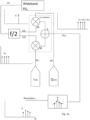
- FIG 2a shows an IQ modulator setup based on the discussion related to figures 1e and 1h .
- the illustrated embodiment includes a PLL, preferably capable of covering a wide frequency range, an IQ modulator and two DAC's (Digital to Analog Converter) I DAC , Q DAC .
- the signal from the PLL is divided as illustrated in figure 1h in order to produce the two LO inputs, LOi, LOq to the IQ modulator.
- the PLL in figure 2a may provide a frequency within a wide range from a few megahertz up to several Gigahertz, but the frequency cannot change instantly (typically 1 ⁇ s to settle on a new frequency) and the PLL cannot be used to generate multi-tunes.
- the DAC's are generating a lower frequency signal typically from a few hundred kilohertz up to some 10's of Megahertz (limited by the clock frequency of the ADC's in the IQ demodulator, for example 30 MHz).
- a DDS D irect D igital S ynthesis
- a DDS is also considered to be a DAC (a DDS is a DAC with a dedicated control system).
- the output from the DAC's is illustrated as a signal with number of distinct frequency components f RF at a relatively low frequency compared to the PLL signal.
- the IQ modulator needs both the I and Q version of both the signal from the PLL(LO I LO Q ) and from the DAC's (RF I , RF Q ) and provides signal IQ OUT at a corresponding number of output frequencies with known amplitudes that are applied to the microwave sensor, illustrated as a resonator.
- This is illustrated with the f R , a multitone signal at a high frequency.
- This process is usually referred to as an IQ modulation or a S ingle S ide B and mixing (SSB).
- the PLL when tracking a resonator, the PLL is in this embodiment is aiming to find the resonance frequency ⁇ R of the resonator in a certain range by applying signals at chosen frequencies within the range expected to have a resonance peak.
- the information can be used to determine the frequency of the resonance peak without sweeping over the frequency range.
- This may be used to provide an instant measurement to determine the peak and possibly the Q-factor of the resonance ⁇ R by means of curve fitting the information based on the amplitudes of the multiple frequency points f R illustrated in figure 2a as the Resonator out .
- four frequencies are used but other numbers may be used depending on the required accuracy in the calculated resonance frequency and the characteristics of the DACs and receiver system.
- a fast sweeping over a limited frequency range may be performed using the DAC's for providing the varying frequency, while the slower PLL may provide a constant base frequency. This way it is possible to make sure that one of the frequencies moves into the resonance frequency, thus being detected at the receiver means.
- the f/2 part in the illustrated example is used to divide the frequency in order to generate two signals with identical frequency and these signals needs to be exactly 90 degrees phase shifted to suppress the mirror signal (if we are generating f1+ f2 the mirror signal has fl-f2). If the LO signal goes to 2 different circuits, one divides the frequency in 2 (a D flip-flop for instance), the other inverts the signal and then divides the frequency, then the result is 2 signals 90 degrees phase shifted, as is described in figure 1h .
- the alternative is an RC network as illustrated in figure 1g , but this is less precise.
- DDS Digital Direct Synthesis
- FIG 3a an embodiment is shown using the IQ modulator for rapid scanning of a large frequency range.
- a wide band PLL is generally slow, after a frequency shift the PLL can take typically 1 ⁇ s to stabilize in the new frequency setting. Rapid scanning of a wide frequency range with high resolution is therefore a slow process with a PLL.
- a DAC on the other hand (or a DDS which is practically the same) changes frequency instantaneously and this allows for a rapid, high resolution scan.
- the disadvantage of using a DAC is that the clock frequency needs to be many times higher than the output frequency in order to avoid dominant spurious frequencies. This limits the max frequency in these components and makes it hard to use them in the GHz range.
- the PLL produces a high frequency signal, (GHz range) and this is added with the lower frequency signal from the 2 DAC's (MHz range).
- the 2 DAC's produces identical signals with a 90 degrees phase between them (I and Q), this allows for the frequency of the signal from the PLL (f LO ) and the frequency of the signals from the DAC's (f RF ) to be added producing a signal with a frequency equal to the sum of frequency of f RF and f LO .
- the DAC's to scan between 0 and the max DAC frequency f RF max we can perform a rapid scan around the PLL frequency f LO . (changing the order of the I and Q signal from the DAC will cause the frequency to be subtracted instead of added to the PLL frequency). After this operation we will have scanned (rapidly with high resolution) a band around the PLL frequency. To continue the scanning the PLL frequency may be increases with 2 X f RF max .
- a scan is performed from f LO1 -f RFmax to f LO1 +f RFmax by changing the frequency from the DAC but without changing the PLL frequency (f LO1 ), after the scan from f LO1 -f RFmax to f LO1 +f RFmax has been completed the PLL frequency is increased with 2 X f RF max to f LO2 , then the band from f LO2 -f RFmax to f LO2 +f RFmax is scanned so that all intermediate frequencies between f LO1 -f RFmax and f LO2 +f RFmax are covered.
- the advantages with this system are as follows. Few and large steps may be provided by the PLL, and therefore slow settling of the PLL will have less impact on the scanning speed.
- the DAC's (or DDS) may be operated with a high ratio between the clock signal and the RF signal, securing low spurious levels.
- the PLL signal can be used in the demodulator ensuring that there is a frequency difference between the signal used for measurement and the reference signal this will help avoiding leakage.
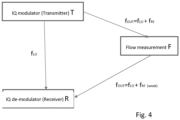
- FIG 4 an implementation of the system is illustrated.
- An example of an IQ de-modulator is illustrated in figure 2b .
- Figure 2a shows a IQ modulator and a resonator
- figure 2b illustrates how the signals coming out of the resonator can be demodulated.
- the IQ modulator up converts the signals to the frequency needed to analyze the resonator, the IQ demodulator down converts the signals to a frequency that within the range of an ADC.
- the I and Q ADC's provides information containing the phase and gain of the frequencies in the signal to a processing unit that can extract this.
- the IQ demodulator also receives the LO signal as a reference from the IQ modulator. As the frequency of the attenuated output signal from the resonator is different from the reference signal leakage between the reference and measuring signals is avoided.
- the invention relates to a measuring system for measuring dielectric properties of a multiphase fluid flow in a pipe.
- the system including a microwave signal generator connected to the multiphase fluid flow for transmitting signals within a predetermined frequency range into said flow through an antenna or similar.
- the signal receiver may include an antenna or similar and is adapted to receive signals within said range from said flow. It also includes analyzing means for calculating the dielectric properties based on the transmitted and received signals.
- microwave range in this case is meant in a broad sense covering the frequency range in or close to the usual definition, as ranges needed for measuring the dielectric characteristics may vary.
- the phrase multiphase fluid may also include wet gas.
- the signal generator unit used according to the invention for generating high frequency signals for a flow meter including a high frequency oscillator such as a Phase Locked Loop (PLL) oscillator generating a first, high frequency signal f LO , the output of the oscillator being connected to the first I and Q inputs of an IQ modulator.
- the system also comprises a low frequency oscillators constituted by a frequency synthesizer adapted to generating signals in several frequencies sequentially of simultaneously within a chosen frequency range f RF , preferably within a short time window so as to sample a measurement in the frequency range within the same flow volume, the duration of the time window depending on the known flow velocity.
- the output signal frequency f RF of the frequency synthesizer is significantly lower than the high frequency signal f LO , each being coupled the I and Q modulator inputs of the IQ modulator.
- the IQ-modulator thus generates output signals constituted by the mix of the input signals, i.e. a sum or difference between the high frequency signals f LO and the low frequency signal f RF at the modulator input, wherein the output range of the IQ modulator is defined by a range above and below the frequency of the oscillator.
- the system according to the invention may therefore provide a rapid frequency scan over a predetermined frequency range where the speed of the scan is driven by the frequency synthesizer and the carrier frequency is given by the oscillator.
- the scanning may alternatively be provided in two frequency ranges simultaneously as the frequency synthesizer may be capable of operating at more than one frequency at the same time. Also it is possible to extend the scanning range by changing the first, oscillator frequency
- the pipe containing the flow may constitute or include a resonator within the frequency range.
- frequency synthesizer may be adapted to emit signals at at least three fixed frequencies having known amplitudes, the receiver means being adapted to analyze the amplitudes of the received signal at each frequency and finding resonance frequency of the resonator by interpolating the amplitude curve between said frequencies.
- the synthesisor may be adapted to emit a rapid frequency scan having known amplitude and the analyzing means may analyse the signal so as to find resonance frequency. I both cases the Q-factor may also be calculated.
- the generator When used in a microwave resonator measuring system the generator is adapted to emit the output signal into a resonator for finding the resonance frequency of the resonator.
- the output of said IQ modulator may include at least four different frequencies.
- the system also comprising receiver means for measuring the amplitude of the signals at said output frequencies and analyzing means for calculating the resonance frequency and preferably also the Q factor based on the amplitude and frequencies of the received signals.
- the IQ modulator output signal including a signal having a varying frequency
- the system including a receiver means and an analyzing means for analyzing the amplitudes of the received signal and finding the resonance frequency and preferably also the Q-factor of the resonator.
- the system according to the invention may also be adapted to emit the output of the signal generator into an antenna in a transmission sensor system, measuring the received signal at another antenna, the IQ modulator output signal including a signal having a varying frequency, the system including a receiver means and an analyzing means for analyzing e.g. the phase shift and attenuation between the two antennas.
- the properties of the medium between the antennas can thereby be measured over a broad frequency range within a very short time window.
Landscapes
- Physics & Mathematics (AREA)
- General Physics & Mathematics (AREA)
- Electromagnetism (AREA)
- Biochemistry (AREA)
- Chemical & Material Sciences (AREA)
- Analytical Chemistry (AREA)
- Life Sciences & Earth Sciences (AREA)
- General Health & Medical Sciences (AREA)
- Health & Medical Sciences (AREA)
- Immunology (AREA)
- Pathology (AREA)
- Fluid Mechanics (AREA)
- Measuring Volume Flow (AREA)
- Radar Systems Or Details Thereof (AREA)
- Measurement Of Resistance Or Impedance (AREA)
Claims (10)
- Système de mesure permettant de mesurer des propriétés diélectriques d'un écoulement de fluide multiphase dans un tuyau, le système comportant un générateur de signaux micro-ondes connecté à l'écoulement de fluide multiphase pour transmettre des signaux fOUT dans une plage de fréquences prédéterminée dans ledit écoulement en appliquant des signaux FOUT à un capteur de micro-ondes constitué d'un résonateur, le résonateur étant censé avoir un pic de résonance dans ladite plage de fréquences, un récepteur de signaux adapté pour recevoir des signaux dans ladite plage à partir dudit écoulement, et un moyen d'analyse pour calculer les propriétés diélectriques sur la base des signaux transmis et reçus, dans lequel le générateur de signaux comporte : un modulateur IQ couplé à un oscillateur haute fréquence et à un synthétiseur basse fréquence,dans lequel l'oscillateur haute fréquence est adapté pour générer un signal haute fréquence fLO, dans une plage allant de quelques MHz à plusieurs GHz ;le synthétiseur basse fréquence est adapté pour générer des signaux fRF à un certain nombre de fréquences dans une plage de fréquences choisie inférieure au signal haute fréquence, la fréquence choisie étant de quelques centaines de kHz à quelques dizaines de MHz,ledit modulateur IQ étant adapté pour générer un signal de sortie IQOUT CONSTITUE par la combinaison desdits signaux provenant de l'oscillateur et du synthétiseur, les fréquences prédéterminées de l'oscillateur et du synthétiseur étant choisies sur la base de la plage de fréquences de sortie requise pour le modulateur IQ,le signal transmis à partir du modulateur IQ dans le résonateur étant donc fOUT = fLO + fRF, etdans lequel le récepteur comporte un démodulateur IQ recevant le signal (fLO + fRF(faible)) à partir du résonateur, le démodulateur IQ étant également connecté au modulateur IQ pour recevoir ledit signal haute fréquence fLO, le démodulateur convertissant ainsi le signal en une fréquence dans la plage d'un CAN de manière à fournir des signaux I et Q au moyen d'analyse configuré pour extraire lesdites propriétés diélectriques d'un fluide multiphase sur la base d'une analyse de la fréquence de résonance du pic de résonance dans le signal reçu.
- Système selon la revendication 1, dans lequel le synthétiseur de fréquence émet simultanément au moins deux signaux de fréquence différents, la sortie du modulateur IQ étant alors constituée d'un mélange dudit signal haute fréquence et desdits signaux provenant du synthétiseur basse fréquence.
- Système selon la revendication 1, dans lequel le synthétiseur de fréquence émet une séquence de fréquences différentes dans cette plage.
- Système selon la revendication 3, dans lequel ladite séquence constitue un balayage de fréquences sur une plage de fréquences prédéterminée.
- Système selon la revendication 1, dans lequel ledit synthétiseur de fréquence est un CNA adapté pour commander la fréquence et l'amplitude de sortie.
- Système selon la revendication 1, dans lequel ledit tuyau constitue un résonateur dans ladite plage de fréquences, où ledit synthétiseur de fréquence est adapté pour émettre des signaux à au moins trois fréquences fixes ayant des amplitudes connues, le moyen récepteur étant adapté pour analyser les amplitudes du signal reçu à chaque fréquence et trouver la fréquence de résonance du résonateur en interpolant la courbe d'amplitude entre lesdites fréquences, le moyen d'analyse étant adapté pour calculer les propriétés diélectriques sur cette base.
- Système selon la revendication 1, dans lequel ledit tuyau constitue un résonateur dans ladite plage de fréquences, où ledit synthétiseur de fréquence est adapté pour émettre un balayage de fréquences ayant une amplitude connue, le moyen récepteur étant adapté pour analyser le signal reçu de manière à trouver la fréquence de résonance du résonateur, le moyen d'analyse étant adapté pour calculer les propriétés diélectriques sur cette base.
- Système selon la revendication 6 ou 7, dans lequel le facteur Q du pic de résonance à ladite fréquence de résonance est calculé.
- Système selon la revendication 7, dans lequel l'oscillateur est adapté pour modifier la première fréquence, ce qui permet de modifier la plage de balayage du générateur de signaux.
- Système selon la revendication 1, dans lequel le moyen récepteur est adapté pour calculer le temps de transmission et l'atténuation du signal transmis à travers l'écoulement, le moyen d'analyse étant adapté pour calculer les propriétés diélectriques sur cette base.
Applications Claiming Priority (2)
| Application Number | Priority Date | Filing Date | Title |
|---|---|---|---|
| NO20170503A NO349134B1 (en) | 2017-03-28 | 2017-03-28 | Flow measuring system |
| PCT/EP2018/057639 WO2018178011A1 (fr) | 2017-03-28 | 2018-03-26 | Système de mesure d'écoulement |
Publications (3)
| Publication Number | Publication Date |
|---|---|
| EP3602018A1 EP3602018A1 (fr) | 2020-02-05 |
| EP3602018C0 EP3602018C0 (fr) | 2025-04-23 |
| EP3602018B1 true EP3602018B1 (fr) | 2025-04-23 |
Family
ID=61800537
Family Applications (1)
| Application Number | Title | Priority Date | Filing Date |
|---|---|---|---|
| EP18713651.0A Active EP3602018B1 (fr) | 2017-03-28 | 2018-03-26 | Système de mesure d'écoulement |
Country Status (5)
| Country | Link |
|---|---|
| US (1) | US11415446B2 (fr) |
| EP (1) | EP3602018B1 (fr) |
| CN (1) | CN110476057B (fr) |
| NO (1) | NO349134B1 (fr) |
| WO (1) | WO2018178011A1 (fr) |
Families Citing this family (1)
| Publication number | Priority date | Publication date | Assignee | Title |
|---|---|---|---|---|
| CA3179170A1 (fr) | 2020-03-30 | 2021-10-07 | Schlumberger Canada Limited | Systemes et procedes d'amortissement de torsion |
Citations (2)
| Publication number | Priority date | Publication date | Assignee | Title |
|---|---|---|---|---|
| EP0988513A1 (fr) * | 1997-07-04 | 2000-03-29 | Valmet Automation Inc. | Procede de mesure d'un ecoulement et debitmetre |
| US20130009646A1 (en) * | 2005-02-22 | 2013-01-10 | Matthieu Simon | Electromagnetic Probe |
Family Cites Families (43)
| Publication number | Priority date | Publication date | Assignee | Title |
|---|---|---|---|---|
| US4745617A (en) | 1987-03-27 | 1988-05-17 | Hughes Aircraft Company | Ideal distributed Bragg reflectors and resonators |
| JPH079398B2 (ja) * | 1987-12-12 | 1995-02-01 | 株式会社堀場製作所 | マルチ流体変調方式による流体分析装置 |
| FR2722293B1 (fr) * | 1994-07-08 | 2000-04-07 | Inst Francais Du Petrole | Debitmetre polyphasique |
| US5608665A (en) | 1995-10-03 | 1997-03-04 | Wyszynski; Adam S. | Self-tuned, continuous-time active filter |
| US5841288A (en) * | 1996-02-12 | 1998-11-24 | Microwave Imaging System Technologies, Inc. | Two-dimensional microwave imaging apparatus and methods |
| US6182504B1 (en) | 1997-11-03 | 2001-02-06 | Roxar, Inc. | Emulsion composition monitor |
| NO308922B1 (no) | 1998-06-03 | 2000-11-13 | Multi Fluid Asa | MÕler, særlig for kontinuerlig mÕling av blandingsforholdet mellom to fluider som strømmer i rør, f.eks. vanninnhold i olje; samt fremgangsmÕte for gjennomføring av slik mÕling |
| JP2002005971A (ja) * | 2000-06-26 | 2002-01-09 | Tatsuo Miyagawa | 物性判別装置 |
| US6351409B1 (en) | 2001-01-04 | 2002-02-26 | Motorola, Inc. | MRAM write apparatus and method |
| GB2376074B (en) | 2001-05-30 | 2004-02-04 | Schlumberger Holdings | Methods and apparatus for estimating on-line water conductivity of multiphase mixtures |
| RU2192646C1 (ru) * | 2001-06-13 | 2002-11-10 | Тамбовский государственный технический университет | Устройство для определения диэлектрической проницаемости жидкости |
| PL348996A1 (en) | 2001-08-01 | 2003-02-10 | B Sp Z Oo Ab | Method of and apparatus for monitoring the parameters of aqueous phase in water-and-oil emulsions |
| NO315584B1 (no) | 2001-10-19 | 2003-09-22 | Roxar Flow Measurement As | Kompakt stromningsmaler |
| US6696684B2 (en) | 2001-12-28 | 2004-02-24 | Schlumberger Technology Corporation | Formation evaluation through azimuthal tool-path identification |
| NO323247B1 (no) | 2003-12-09 | 2007-02-12 | Multi Phase Meters As | Fremgangsmåte og strømningsmåler for å bestemme strømningsratene til en flerfaseblanding |
| US7078913B1 (en) * | 2003-12-31 | 2006-07-18 | The United States Of America As Represented By The Secretary Of Agriculture | Multipath resistant microwave moisture sensor |
| NO320172B1 (no) | 2004-02-27 | 2005-11-07 | Roxar Flow Measurement As | Stromningsmaler og fremgangsmate for maling av individuelle mengder av gass, hydrokarbonvaeske og vann i en fluidblanding |
| ATE443855T1 (de) | 2004-07-13 | 2009-10-15 | Schlumberger Technology Bv | Detektor zum unterscheiden von phasen in einer multi-phasen flüssigkeitsmischung |
| NO323244B1 (no) | 2004-08-20 | 2007-02-12 | Multi Phase Meters As | Metode og utstyr for måling av sammensetning og salinitet i en multifasestrømning |
| DE602004007391T2 (de) | 2004-10-07 | 2008-07-17 | Schlumberger Technology B.V. | Probenentnahmegerät |
| US7524423B2 (en) | 2004-12-10 | 2009-04-28 | Clearwater Systems Corporation | System and method of generating a ringing magnetic pulse for the treatment of flowing liquids |
| NO323451B1 (no) * | 2005-08-11 | 2007-05-14 | Multi Phase Meters As | Fremgangsmåte og apparat for å bestemme konduktivitet og volumtraksjon av vann i en flerkomponentblanding |
| GB2430493B (en) * | 2005-09-23 | 2008-04-23 | Schlumberger Holdings | Systems and methods for measuring multiphase flow in a hydrocarbon transporting pipeline |
| GB2432425B (en) | 2005-11-22 | 2008-01-09 | Schlumberger Holdings | Isokinetic sampling method and system for multiphase flow from subterranean wells |
| NO324582B1 (no) | 2006-02-03 | 2007-11-26 | Roxar As | Anordning for differensialtrykkmaling |
| US9116104B2 (en) * | 2006-03-22 | 2015-08-25 | Agar Corporation, Ltd. | Method and apparatus for detecting water in a fluid media |
| NO326977B1 (no) | 2006-05-02 | 2009-03-30 | Multi Phase Meters As | Fremgangsmåte og innretning for måling av konduktiviteten av vannfraksjonen i en våtgass |
| DE102006052637B4 (de) | 2006-11-08 | 2009-02-26 | Technische Universität Darmstadt | Vorrichtung und Verfahren zur Bestimmung zumindest eines Parameters eines Mediums |
| NO328801B1 (no) * | 2007-01-12 | 2010-05-18 | Roxar Flow Measurement As | System og fremgangsmate for bestemmelse av egenskaper under transport av hydrokarbon-fluider i en rorledning |
| US8027794B2 (en) | 2008-02-11 | 2011-09-27 | Schlumberger Technology Corporaton | System and method for measuring properties of liquid in multiphase mixtures |
| AU2009252934B2 (en) | 2008-05-27 | 2013-09-19 | Bae Systems Plc | Damage sensors and processing arrangements therefor |
| AU2009252932A1 (en) | 2008-05-27 | 2009-12-03 | Bae Systems Plc | Damage sensors and processing arrangements therefor |
| NO331270B1 (no) | 2009-04-06 | 2011-11-14 | Roxar Flow Measurement As | Fremgangsmate for a overvake et legeme innsatt i en kanal, samt system som inkluderer en innsats for elektromagnetiske resonansmalinger |
| US8322228B2 (en) * | 2009-12-11 | 2012-12-04 | Schlumberger Technology Corporation | Method of measuring flow properties of a multiphase fluid |
| WO2013084183A2 (fr) * | 2011-12-06 | 2013-06-13 | Schlumberger Technology B.V. | Débitmètre multiphase |
| EP2856124A1 (fr) * | 2012-05-30 | 2015-04-08 | General Electric Company | Appareil de détection servant à mesurer les propriétés d'un matériau |
| US9109995B2 (en) * | 2012-10-16 | 2015-08-18 | Kam Controls, Inc. | Method and apparatus for determining the water concentration in a fluid mixture |
| US9856157B2 (en) | 2013-01-31 | 2018-01-02 | Reverse Ionizer Systems, Llc | Devices, systems and methods for treatment of water with electromagnetic fields |
| NO347105B1 (no) | 2013-02-05 | 2023-05-15 | Roxar Flow Measurement As | Konduktivitetsmåling |
| CN105026942B (zh) | 2013-02-07 | 2018-08-28 | 捷德移动安全有限责任公司 | 用于检查电路的方法和设备 |
| WO2016077011A1 (fr) * | 2014-11-10 | 2016-05-19 | General Electric Company | Mesure de fraction de fluide multiphase |
| NO342831B1 (en) | 2015-04-23 | 2018-08-13 | Roxar Flow Measurement As | System for measuring characteristics of a fluid flow |
| US20170038311A1 (en) * | 2015-08-03 | 2017-02-09 | William Thomas Conrad | Radio frequency material analysis utilizing phase |
-
2017
- 2017-03-28 NO NO20170503A patent/NO349134B1/en unknown
-
2018
- 2018-03-26 WO PCT/EP2018/057639 patent/WO2018178011A1/fr not_active Ceased
- 2018-03-26 CN CN201880022420.6A patent/CN110476057B/zh active Active
- 2018-03-26 EP EP18713651.0A patent/EP3602018B1/fr active Active
- 2018-03-26 US US16/497,528 patent/US11415446B2/en active Active
Patent Citations (2)
| Publication number | Priority date | Publication date | Assignee | Title |
|---|---|---|---|---|
| EP0988513A1 (fr) * | 1997-07-04 | 2000-03-29 | Valmet Automation Inc. | Procede de mesure d'un ecoulement et debitmetre |
| US20130009646A1 (en) * | 2005-02-22 | 2013-01-10 | Matthieu Simon | Electromagnetic Probe |
Also Published As
| Publication number | Publication date |
|---|---|
| WO2018178011A1 (fr) | 2018-10-04 |
| CN110476057A (zh) | 2019-11-19 |
| EP3602018A1 (fr) | 2020-02-05 |
| US11415446B2 (en) | 2022-08-16 |
| US20200116538A1 (en) | 2020-04-16 |
| EP3602018C0 (fr) | 2025-04-23 |
| CN110476057B (zh) | 2022-06-10 |
| NO349134B1 (en) | 2025-10-13 |
| NO20170503A1 (en) | 2018-10-01 |
Similar Documents
| Publication | Publication Date | Title |
|---|---|---|
| CN102325058B (zh) | 一种变频系统群时延测试方法 | |
| US9429528B2 (en) | Determining gas absorption line from separate and alternating RF signals | |
| US10623009B2 (en) | Frequency generator with two voltage controlled oscillators | |
| US20090212997A1 (en) | Method for measuring a distance running time | |
| Tschapek et al. | Phase noise spectral density measurement of broadband frequency-modulated radar signals | |
| CN110383063B (zh) | 借助于电磁波探测混凝土的结构 | |
| CN111665404B (zh) | 精确相位同步的非线性矢量网络分析仪测量方法及装置 | |
| EP3602018B1 (fr) | Système de mesure d'écoulement | |
| JP3973036B2 (ja) | パルスレーダ装置 | |
| CN106199187A (zh) | 一种多音信号相对相位的测试方法 | |
| JP6756491B2 (ja) | 正規化された位相スペクトルを生成する方法及び装置 | |
| JP2006017486A (ja) | 核磁気共鳴を用いるスペクトル分析方法および核磁気共鳴装置 | |
| CN120344872A (zh) | 用于测试以电磁波工作的间距传感器的检验装置和用于这样的检验装置的分频器设备 | |
| US2820898A (en) | Distance measuring equipment utilizing frequency modulation | |
| US20050151956A1 (en) | Apparatus for precise distance measurement | |
| Musch et al. | Measurement of the ramp linearity of extremely linear frequency ramps using a fractional dual loop structure | |
| RU2362180C2 (ru) | Радиолокатор ближнего действия с ультравысоким разрешением (варианты) | |
| Zajac et al. | Upgrade of the COMPASS tokamak microwave reflectometry system with I/Q modulation and detection | |
| RU2330298C2 (ru) | Способ определения места повреждения линий электропередачи и связи и устройство для его осуществления | |
| KR101766765B1 (ko) | 선형 위상 변위 방식의 반사계 시스템 | |
| Anthonys et al. | Jitter measurement in digital signals by using software defined radio technology | |
| JP2004264067A (ja) | パルスレーダ装置及びその距離検出方法 | |
| US20080122427A1 (en) | Device and Method for Measuring a Phase Deviation | |
| JP2000046932A (ja) | Fm−cwレーダ装置 | |
| JP2006030022A (ja) | 電波を利用した距離測定装置及び距離測定方法 |
Legal Events
| Date | Code | Title | Description |
|---|---|---|---|
| STAA | Information on the status of an ep patent application or granted ep patent |
Free format text: STATUS: UNKNOWN |
|
| STAA | Information on the status of an ep patent application or granted ep patent |
Free format text: STATUS: THE INTERNATIONAL PUBLICATION HAS BEEN MADE |
|
| PUAI | Public reference made under article 153(3) epc to a published international application that has entered the european phase |
Free format text: ORIGINAL CODE: 0009012 |
|
| STAA | Information on the status of an ep patent application or granted ep patent |
Free format text: STATUS: REQUEST FOR EXAMINATION WAS MADE |
|
| 17P | Request for examination filed |
Effective date: 20190924 |
|
| AK | Designated contracting states |
Kind code of ref document: A1 Designated state(s): AL AT BE BG CH CY CZ DE DK EE ES FI FR GB GR HR HU IE IS IT LI LT LU LV MC MK MT NL NO PL PT RO RS SE SI SK SM TR |
|
| AX | Request for extension of the european patent |
Extension state: BA ME |
|
| DAV | Request for validation of the european patent (deleted) | ||
| DAX | Request for extension of the european patent (deleted) | ||
| STAA | Information on the status of an ep patent application or granted ep patent |
Free format text: STATUS: EXAMINATION IS IN PROGRESS |
|
| 17Q | First examination report despatched |
Effective date: 20220222 |
|
| GRAP | Despatch of communication of intention to grant a patent |
Free format text: ORIGINAL CODE: EPIDOSNIGR1 |
|
| STAA | Information on the status of an ep patent application or granted ep patent |
Free format text: STATUS: GRANT OF PATENT IS INTENDED |
|
| INTG | Intention to grant announced |
Effective date: 20241223 |
|
| GRAS | Grant fee paid |
Free format text: ORIGINAL CODE: EPIDOSNIGR3 |
|
| GRAA | (expected) grant |
Free format text: ORIGINAL CODE: 0009210 |
|
| STAA | Information on the status of an ep patent application or granted ep patent |
Free format text: STATUS: THE PATENT HAS BEEN GRANTED |
|
| AK | Designated contracting states |
Kind code of ref document: B1 Designated state(s): AL AT BE BG CH CY CZ DE DK EE ES FI FR GB GR HR HU IE IS IT LI LT LU LV MC MK MT NL NO PL PT RO RS SE SI SK SM TR |
|
| REG | Reference to a national code |
Ref country code: GB Ref legal event code: FG4D |
|
| REG | Reference to a national code |
Ref country code: CH Ref legal event code: EP |
|
| REG | Reference to a national code |
Ref country code: DE Ref legal event code: R096 Ref document number: 602018081282 Country of ref document: DE |
|
| REG | Reference to a national code |
Ref country code: IE Ref legal event code: FG4D |
|
| U01 | Request for unitary effect filed |
Effective date: 20250514 |
|
| U07 | Unitary effect registered |
Designated state(s): AT BE BG DE DK EE FI FR IT LT LU LV MT NL PT RO SE SI Effective date: 20250520 |
|
| PG25 | Lapsed in a contracting state [announced via postgrant information from national office to epo] |
Ref country code: ES Free format text: LAPSE BECAUSE OF FAILURE TO SUBMIT A TRANSLATION OF THE DESCRIPTION OR TO PAY THE FEE WITHIN THE PRESCRIBED TIME-LIMIT Effective date: 20250423 |
|
| PG25 | Lapsed in a contracting state [announced via postgrant information from national office to epo] |
Ref country code: NO Free format text: LAPSE BECAUSE OF FAILURE TO SUBMIT A TRANSLATION OF THE DESCRIPTION OR TO PAY THE FEE WITHIN THE PRESCRIBED TIME-LIMIT Effective date: 20250723 Ref country code: GR Free format text: LAPSE BECAUSE OF FAILURE TO SUBMIT A TRANSLATION OF THE DESCRIPTION OR TO PAY THE FEE WITHIN THE PRESCRIBED TIME-LIMIT Effective date: 20250724 |
|
| PG25 | Lapsed in a contracting state [announced via postgrant information from national office to epo] |
Ref country code: PL Free format text: LAPSE BECAUSE OF FAILURE TO SUBMIT A TRANSLATION OF THE DESCRIPTION OR TO PAY THE FEE WITHIN THE PRESCRIBED TIME-LIMIT Effective date: 20250423 |
|
| PG25 | Lapsed in a contracting state [announced via postgrant information from national office to epo] |
Ref country code: HR Free format text: LAPSE BECAUSE OF FAILURE TO SUBMIT A TRANSLATION OF THE DESCRIPTION OR TO PAY THE FEE WITHIN THE PRESCRIBED TIME-LIMIT Effective date: 20250423 |
|
| PG25 | Lapsed in a contracting state [announced via postgrant information from national office to epo] |
Ref country code: RS Free format text: LAPSE BECAUSE OF FAILURE TO SUBMIT A TRANSLATION OF THE DESCRIPTION OR TO PAY THE FEE WITHIN THE PRESCRIBED TIME-LIMIT Effective date: 20250723 |
|
| PG25 | Lapsed in a contracting state [announced via postgrant information from national office to epo] |
Ref country code: IS Free format text: LAPSE BECAUSE OF FAILURE TO SUBMIT A TRANSLATION OF THE DESCRIPTION OR TO PAY THE FEE WITHIN THE PRESCRIBED TIME-LIMIT Effective date: 20250823 |
|
| PG25 | Lapsed in a contracting state [announced via postgrant information from national office to epo] |
Ref country code: SM Free format text: LAPSE BECAUSE OF FAILURE TO SUBMIT A TRANSLATION OF THE DESCRIPTION OR TO PAY THE FEE WITHIN THE PRESCRIBED TIME-LIMIT Effective date: 20250423 |
|
| PG25 | Lapsed in a contracting state [announced via postgrant information from national office to epo] |
Ref country code: CZ Free format text: LAPSE BECAUSE OF FAILURE TO SUBMIT A TRANSLATION OF THE DESCRIPTION OR TO PAY THE FEE WITHIN THE PRESCRIBED TIME-LIMIT Effective date: 20250423 |
|
| PG25 | Lapsed in a contracting state [announced via postgrant information from national office to epo] |
Ref country code: SK Free format text: LAPSE BECAUSE OF FAILURE TO SUBMIT A TRANSLATION OF THE DESCRIPTION OR TO PAY THE FEE WITHIN THE PRESCRIBED TIME-LIMIT Effective date: 20250423 |