EP3601609B1 - Gegenstände und verfahren mit dem nachweis einer bindung - Google Patents
Gegenstände und verfahren mit dem nachweis einer bindung Download PDFInfo
- Publication number
- EP3601609B1 EP3601609B1 EP18775017.9A EP18775017A EP3601609B1 EP 3601609 B1 EP3601609 B1 EP 3601609B1 EP 18775017 A EP18775017 A EP 18775017A EP 3601609 B1 EP3601609 B1 EP 3601609B1
- Authority
- EP
- European Patent Office
- Prior art keywords
- species
- equal
- composition
- small molecule
- less
- Prior art date
- Legal status (The legal status is an assumption and is not a legal conclusion. Google has not performed a legal analysis and makes no representation as to the accuracy of the status listed.)
- Active
Links
Images







Classifications
-
- C—CHEMISTRY; METALLURGY
- C12—BIOCHEMISTRY; BEER; SPIRITS; WINE; VINEGAR; MICROBIOLOGY; ENZYMOLOGY; MUTATION OR GENETIC ENGINEERING
- C12Q—MEASURING OR TESTING PROCESSES INVOLVING ENZYMES, NUCLEIC ACIDS OR MICROORGANISMS; COMPOSITIONS OR TEST PAPERS THEREFOR; PROCESSES OF PREPARING SUCH COMPOSITIONS; CONDITION-RESPONSIVE CONTROL IN MICROBIOLOGICAL OR ENZYMOLOGICAL PROCESSES
- C12Q1/00—Measuring or testing processes involving enzymes, nucleic acids or microorganisms; Compositions therefor; Processes of preparing such compositions
- C12Q1/68—Measuring or testing processes involving enzymes, nucleic acids or microorganisms; Compositions therefor; Processes of preparing such compositions involving nucleic acids
- C12Q1/6813—Hybridisation assays
- C12Q1/6816—Hybridisation assays characterised by the detection means
-
- C—CHEMISTRY; METALLURGY
- C40—COMBINATORIAL TECHNOLOGY
- C40B—COMBINATORIAL CHEMISTRY; LIBRARIES, e.g. CHEMICAL LIBRARIES
- C40B30/00—Methods of screening libraries
- C40B30/04—Methods of screening libraries by measuring the ability to specifically bind a target molecule, e.g. antibody-antigen binding, receptor-ligand binding
-
- G—PHYSICS
- G01—MEASURING; TESTING
- G01N—INVESTIGATING OR ANALYSING MATERIALS BY DETERMINING THEIR CHEMICAL OR PHYSICAL PROPERTIES
- G01N33/00—Investigating or analysing materials by specific methods not covered by groups G01N1/00 - G01N31/00
- G01N33/48—Biological material, e.g. blood, urine; Haemocytometers
- G01N33/50—Chemical analysis of biological material, e.g. blood, urine; Testing involving biospecific ligand binding methods; Immunological testing
- G01N33/68—Chemical analysis of biological material, e.g. blood, urine; Testing involving biospecific ligand binding methods; Immunological testing involving proteins, peptides or amino acids
- G01N33/6803—General methods of protein analysis not limited to specific proteins or families of proteins
- G01N33/6848—Methods of protein analysis involving mass spectrometry
- G01N33/6851—Methods of protein analysis involving laser desorption ionisation mass spectrometry
-
- H—ELECTRICITY
- H01—ELECTRIC ELEMENTS
- H01J—ELECTRIC DISCHARGE TUBES OR DISCHARGE LAMPS
- H01J49/00—Particle spectrometers or separator tubes
- H01J49/02—Details
- H01J49/10—Ion sources; Ion guns
- H01J49/16—Ion sources; Ion guns using surface ionisation, e.g. field-, thermionic- or photo-emission
- H01J49/161—Ion sources; Ion guns using surface ionisation, e.g. field-, thermionic- or photo-emission using photoionisation, e.g. by laser
- H01J49/164—Laser desorption/ionisation, e.g. matrix-assisted laser desorption/ionisation [MALDI]
-
- G—PHYSICS
- G01—MEASURING; TESTING
- G01N—INVESTIGATING OR ANALYSING MATERIALS BY DETERMINING THEIR CHEMICAL OR PHYSICAL PROPERTIES
- G01N2610/00—Assays involving self-assembled monolayers [SAMs]
-
- H—ELECTRICITY
- H01—ELECTRIC ELEMENTS
- H01J—ELECTRIC DISCHARGE TUBES OR DISCHARGE LAMPS
- H01J49/00—Particle spectrometers or separator tubes
- H01J49/02—Details
- H01J49/04—Arrangements for introducing or extracting samples to be analysed, e.g. vacuum locks; Arrangements for external adjustment of electron- or ion-optical components
- H01J49/0409—Sample holders or containers
- H01J49/0418—Sample holders or containers for laser desorption, e.g. matrix-assisted laser desorption/ionisation [MALDI] plates or surface enhanced laser desorption/ionisation [SELDI] plates
Definitions
- MALDI can be a useful tool to identify whether or not a species with a known mass is present in a sample. In some cases, it can be challenging to identify how much of the species is present due to imprecision inherent in the technique. Accordingly, improved methods related to performing MALDI in a quantitative or semi-quantitative manner would be beneficial.
- the signals are typically generated.
- the signals may include information regarding the mass of the species from which the signal arises, and may also include an intensity (usually understood to be the maximum intensity of the signal) and an AUC.
- the intensity and/or the AUC may be related to the concentration and/or amount of the species in the sample from which the signal arises.
- References herein to comparing normalized or unnormalized signals typically refer to comparing the intensity and/or the AUC of the normalized or unnormalized signals unless otherwise specified.
- the intensity of a signal should be understood to be the difference between the measured intensity of the signal and the measured baseline and the AUC of a signal should be understood to be the AUC of the portions of the signal that exceed the measured baseline.
- a method described herein may be capable of determining the concentration of the second species at which a certain percentage (e.g., 10%, 25%, 50%, 75%, or 90%) of the maximum binding occurs when this concentration is greater than or equal to 0.1 femtomolar, greater than or equal to 1 femtomolar, greater than or equal to 10 femtomolar, greater than or equal to 100 femtomolar, greater than or equal to 1 nanomolar, greater than or equal to 10 nanomolar, greater than or equal to 100 nanomolar, greater than or equal to 1 micromolar, greater than or equal to 10 micromolar, greater than or equal to 100 micromolar, greater than or equal to 1 millimolar, or greater than or equal to 10 millimolar. Combinations of the above-referenced ranges are also possible (e.g., greater than or equal to 0.1 femtomolar and less than or equal to 100 millimolar). Other ranges are also possible.
- a SAM may comprise a species capable of capturing a first species (e.g., a target polypeptide such as a protein, a target polynucleotide, a target small molecule) that may include a functional group suitable for capturing the first species, such as a maleimide group, a biotin group, a streptavidin group, a neutravidin group, an alkyne group, an alkene group, an azide group, a n-hydroxysuccinimide (NHS) group, a dibenzocyclooctyl (DBCO) group, a nitriloacetic acid (NTA) group, a phosphonate group, a glutathione group, a benzylguanine group, a benzylcytosine group, and/or a chloroalkane group.
- a functional group suitable for capturing the first species such as a maleimide group, a biotin group, a streptavidin
- the standard species may have a molecular weight that is within a range that is advantageous for detecting binding between a first species (e.g., a target polypeptide such as a protein, a target polynucleotide, a target small molecule) and a second species (e.g., a small molecule, a polypeptide such as a protein, a polynucleotide).
- a first species e.g., a target polypeptide such as a protein, a target polynucleotide, a target small molecule
- a second species e.g., a small molecule, a polypeptide such as a protein, a polynucleotide
- the molecular weight may be similar to the molecular weight of the second species and/or may not overlap with the molecular weight of the second species.
- the molecular weight of the standard species may be greater than or equal to 300 Da, greater than or equal to 500 Da, greater than or equal to 1 kDa, greater than or equal to 2 kDa, greater than or equal to 5 kDa, greater than or equal to 10 kDa, greater than or equal to 20 kDa, greater than or equal to 50 kDa, greater than or equal to 100 kDa, greater than or equal to 200 kDa, greater than or equal to 500 kDa, or greater than or equal to 1000 kDa.
- a SAM may comprise a standard species that comprises an alkane group.
- the alkane group is greater than or equal to 6 carbons long, greater than or equal to 7 carbons long, greater than or equal to 8 carbons long, greater than or equal to 9 carbons long, greater than or equal to 10 carbons long, or greater than or equal to 11 carbons long.
- the alkane group is less than or equal to 12 carbons long, less than or equal to 11 carbons long, less than or equal to 10 carbons long, less than or equal to 9 carbons long, less than or equal to 8 carbons long, or less than or equal to 7 carbons long. Combinations of the above-referenced ranges are also possible (e.g., greater than or equal to 6 carbons long and less than or equal to 12 carbons long). Other ranges are also possible.
- a SAM may comprise a standard species that comprises a non-alkane group.
- the non-alkane group may be a polar group.
- the non-alkane group may comprise one or more repeat units.
- the polar group may comprise greater than or equal to 1 repeat unit, greater than or equal to 2 repeat units, greater than or equal to 3 repeat units, greater than or equal to 4 repeat units, greater than or equal to 5 repeat units, greater than or equal to 6 repeat units, or greater than or equal to 7 repeat units.
- the non-alkane group may comprise one or more ethylene glycol (EG) repeat units.
- the polar group may comprise greater than or equal to 1 EG repeat units, greater than or equal to 2 EG repeat units, greater than or equal to 3 EG repeat units, greater than or equal to 4 EG repeat units, greater than or equal to 5 EG repeat units, greater than or equal to 6 EG repeat units, or greater than or equal to 7 EG repeat units.
- the non-alkane group may comprise less than or equal to 8 EG repeat units, less than or equal to 7 EG repeat units, less than or equal to 6 EG repeat units, less than or equal to 5 EG repeat units, less than or equal to 4 EG repeat units, less than or equal to 3 EG repeat units, or less than or equal to 2 EG repeat units. Combinations of the above-referenced ranges are also possible (e.g., greater than or equal to 1 and less than or equal to 8 EG repeat units). Other ranges are also possible.
- a SAM may comprise a standard species that comprises a group capable of bonding and/or interacting with a support on which the SAM is disposed.
- groups include thiol groups and disulfide groups.
- the SAM may have any suitable thickness.
- the thickness of the SAM is greater than or equal to 10 Angstroms, greater than or equal to 20 Angstroms, greater than or equal to 30 Angstroms, greater than or equal to 40 Angstroms, greater than or equal to 50 Angstroms, greater than or equal to 60 Angstroms, greater than or equal to 70 Angstroms, greater than or equal to 80 Angstroms, or greater than or equal to 90 Angstroms.
- certain embodiments may comprise applying a matrix to a SAM.
- the matrix may comprise one or more of 9-aminoacridine, 4-aminoquinaldine, anthranilamide, (2E)-3-(9-anthryl)-2-cyanoacrylic acid, 4-bromo-alpha-cyanocinnamic acid, a mixture comprising 4-bromo-alpha-cyanocinnamic acid and 4-chloro-alpha-cyanocinnamic acid, a mixture comprising 4-bromo-alpha-cyanocinnamic acid and alpha-Cyano-2,4-difluorocinnamic acid, trans-2-[3-(4-tert-butylphenyl)-2-methyl-2-propenylidene]malononitrile, caffe
- a matrix may be provided in a formulation comprising a solvent.
- the solvent may be an organic solvent such as acetonitrile and/or acetone.
- the solvent may comprise water.
- the composition comprises a control species that also allows for a method for performing quality control on a MALDI instrument.
- the methods may comprise performing a MALDI measurement on a self-assembled monolayer comprising a known concentration of the control species to generate a signal from the control species and determining whether an abnormality has occurred if the signal from the control species is outside of a pre-determined range.
- the first species is at least one of a target polypeptide, a target protein, a target oligonucleotide, a target DNA molecule, and a target RNA molecule.
- the composition comprises a third species.
- the third species is at least one of a polypeptide, a protein, an oligonucleotide, a DNA molecule, an RNA molecule, and a small molecule.
- the wt% of the first small molecule in the composition is equal to the wt% of the second small molecule in the composition.
- a ratio of the wt% of the second species in the composition to the third species in the composition is greater than or equal to 0.5 and less than or equal to 2.
- the target polypeptide is a protein.
- the target polypeptide is a biotinylated protein.
- the target polypeptide comprises BACE.
- the target polypeptide comprises DLK.
- the target polypeptide is exposed to the composition prior to being captured on the self-assembled monolayer.
- the target polypeptide is exposed to the composition in solution.
- the target polypeptide is exposed to the composition after being captured on the self-assembled monolayer.
- the composition comprises a surfactant.
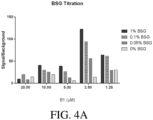
- the composition comprises an agent that reduces non-specific binding.
- a method further comprises washing the self-assembled monolayer after exposing the target polypeptide to the composition.
- a method further comprises applying a matrix to the self-assembled monolayer.
- the self-assembled monolayer comprises at least one of streptavidin, neutravidin, a maleimide group, biotin, an alkyne group, an alkene group, an azide group, n-hydroxysuccinimide, dibenzocyclooctyl, nitriloacetic acid, glutathione, a phosphonate, benzylguanine, benzylcytosine, and a chloroalkane.
- the self-assembled monolayer comprises a standard species.
- the standard species is present at a known concentration within the monolayer.
- the standard species does not undergo appreciable fragmentation during MALDI.
- the standard species comprises an (EG)n-alkane thiol or an (EG)n-alkyl disulfide, wherein EG is ethylene glycol.
- binding comprises non-covalent binding.
- the composition comprises a control species.
- a method further comprises determining that an abnormality has occurred if a signal from the control species is outside of a pre-determined range.
- This example describes an inventive screening format for small molecule binding using Self-Assembled Monolayers and matrix-assisted laser Desorption Ionization (SAMDI) technology.
- target proteins undergo the two following steps in either order: binding one or more small molecules and undergoing affinity capture on a self-assembled monolayer (SAM).
- SAM self-assembled monolayer
- the captured protein, bound small molecule(s), and monolayer are subject to MALDI-TOF analysis, where the identities of any bound small molecules may be identified by their masses and the relative amount of each bound small molecule may be determined by their relative areas under the curve (AUCs) in the measured MALDI-TOF spectrum.
- the method described in this Example may have one or more features that are advantageous for detecting small molecule binding.
- kinase inhibitors with molecular weights (MW) in the 200-600 Da range were prepared as solutions in dimethyl sulfoxide (DMSO) with concentrations between 20 and 0.625 ⁇ M.
- DMSO dimethyl sulfoxide
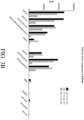
- the compounds were tested with a panel of 13 matrices (Table 1; FIGs. 3A and 3B ) by diluting the compound solution with an equal volume of matrix.
- One ⁇ L of each solution comprising a mixture of a compound and the matrix was then spotted onto a MALDI target plate. Matrices which resulted in appreciable signal and high signal to noise ratios for the representative compounds were considered acceptable.
- Table 1 Matrix No.
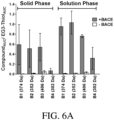
- Small molecules were bound to target proteins either in solution phase or in solid phase.
- the solution phase method was used for individual compound binding ECso determination, plate uniformity determination, and pooled compound experiments.
- solution phase binding eight different 1 ⁇ M biotinylated-protein sample in assay buffer were incubated at room temperature for up to 30 minutes with eight different solutions comprising the small molecule to be bound at varying concentrations ranging from 40 ⁇ M to 80 ⁇ M in aqueous buffer.
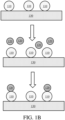
- the schematic of the SAMDI workflow to identify binding of small molecules to a protein target is shown in FIGs. 5A and 5B .
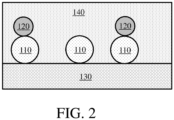
- the first step involved incubating a composition comprising a second species 120 (in this case a small molecule) and optionally a third species 122 with a first species 110 (in this case a biotinylated protein) in solution to allow complex formation.
- the solution was then spotted onto neutravidin-coated SAMDI plates 130 as described above for affinity capture of the biotinylated protein with bound and unbound compounds.
- the plates were washed, a matrix was applied to the plates, and then MALDI-TOF was employed to detect the amount and type of small molecules that had bound to the protein during incubation.
- the EG3 thiol may also serve as a quality control tool to assess assay performance over time.
- This material is present at a uniform concentration across the SAMDI plate, and so tracking its AUC over time can show trends both intra- and inter-SAMDI plate which indicate changes in the detection sensitivity over the duration of a screen.
- This set of data can also serve as an early indicator that source cleaning may be needed or recommended. If used in parallel with control compounds, the normalized data could also be used to monitor for potential complications with the automation process during sample preparation, such as incorrect transfer of analytes from the assay plate to the SAMDI plate.
Landscapes
- Life Sciences & Earth Sciences (AREA)
- Health & Medical Sciences (AREA)
- Engineering & Computer Science (AREA)
- Molecular Biology (AREA)
- Chemical & Material Sciences (AREA)
- Physics & Mathematics (AREA)
- Immunology (AREA)
- Bioinformatics & Cheminformatics (AREA)
- Organic Chemistry (AREA)
- Bioinformatics & Computational Biology (AREA)
- General Health & Medical Sciences (AREA)
- Biochemistry (AREA)
- Optics & Photonics (AREA)
- Spectroscopy & Molecular Physics (AREA)
- Urology & Nephrology (AREA)
- Hematology (AREA)
- Biomedical Technology (AREA)
- Medicinal Chemistry (AREA)
- Analytical Chemistry (AREA)
- Proteomics, Peptides & Aminoacids (AREA)
- Biophysics (AREA)
- Microbiology (AREA)
- Biotechnology (AREA)
- Pathology (AREA)
- Chemical Kinetics & Catalysis (AREA)
- Cell Biology (AREA)
- General Chemical & Material Sciences (AREA)
- Food Science & Technology (AREA)
- General Physics & Mathematics (AREA)
- Wood Science & Technology (AREA)
- Zoology (AREA)
- Plasma & Fusion (AREA)
- General Engineering & Computer Science (AREA)
- Genetics & Genomics (AREA)
- Measuring Or Testing Involving Enzymes Or Micro-Organisms (AREA)
- Investigating Or Analysing Materials By Optical Means (AREA)
- Analysing Materials By The Use Of Radiation (AREA)
Claims (15)
- Verfahren zur Detektion der Bindung zwischen einer ersten Spezies und einer zweiten Spezies, umfassend:In Kontakt bringen der ersten Spezies mit einer Zusammensetzung, die die zweite Spezies enthält;Einfangen der ersten Spezies auf einer selbstorganisierenden Monoschicht, wobei die selbstorganisierende Monoschicht eine Standardspezies umfasst;Durchführen von MALDI an der selbstorganisierenden Monoschicht, um ein Signal von der zweiten Spezies und ein Signal von der Standardspezies zu erzeugen; undBestimmen, ob eine Bindung stattgefunden hat, wenn ein Verhältnis des Signals von der zweiten Spezies zu dem Signal von der Standardspezies größer als oder gleich einem Grenzwert ist.
- Verfahren gemäß Anspruch 1, wobei:(a) die erste Spezies mindestens eines von einem Polypeptid, einem Protein, einem Oligonukleotid, einem DNA-Molekül und einem RNA-Molekül ist; und/oder(b) die zweite Spezies mindestens eines von einem Polypeptid, einem Protein, einem Oligonukleotid, einem DNA-Molekül, einem RNA-Molekül und einem kleinen Molekül ist.
- Verfahren gemäß irgendeinem der vorhergehenden Ansprüche, wobei die Zusammensetzung eine dritte Spezies umfasst, und, optional:(a) wobei die dritte Spezies mindestens eines von einem Polypeptid, einem Protein, einem Oligonukleotid, einem DNA-Molekül, einem RNA-Molekül und einem kleinen Molekül ist; und/oder(b) wobei ein Verhältnis der Gew.-% der zweiten Spezies in der Zusammensetzung zu der dritten Spezies in der Zusammensetzung größer oder gleich 0,5 und kleiner oder gleich 2 ist.
- Verfahren gemäß irgendeinem der vorhergehenden Ansprüche, wobei die Zusammensetzung umfasst:(a) ein Tensid; und/oder(b) ein Mittel, das unspezifische Bindungen reduziert.
- Verfahren gemäß irgendeinem der vorhergehenden Ansprüche, wobei die erste Spezies ein Zielpolypeptid ist und das Verfahren weiterhin umfasst:(a) Waschen der selbstorganisierenden Monoschicht nach dem Einfangen des Zielpolypeptids; und/oder(b) Waschen der selbstorganisierenden Monoschicht, nachdem das Zielpolypeptid der Zusammensetzung ausgesetzt wurde.
- Verfahren gemäß irgendeinem der vorhergehenden Ansprüche, das weiterhin das Aufbringen einer Matrix auf die selbstorganisierende Monoschicht umfasst, und, optional:
wobei die Matrix während MALDI-TOF keine nennenswerte Fragmentierung erfährt. - Verfahren gemäß irgendeinem der vorhergehenden Ansprüche, wobei die selbstorganisierende Monoschicht mindestens eines von Streptavidin, Neutravidin, eine Maleimidgruppe, Biotin, eine Alkingruppe, eine Azidgruppe, n-Hydroxysuccinimid, Dibenzocyclooctyl, Nitriloessigsäure, Glutathion, ein Phosphonat, Benzylguanin, Benzylcytosin und ein Chloralkan umfasst.
- Verfahren gemäß irgendeinem der vorhergehenden Ansprüche, wobei:(a) die Standardspezies in einer bekannten Konzentration innerhalb der Monoschicht vorhanden ist; und/oder(b) die Standardspezies während MALDI-TOF keine nennenswerte Fragmentierung erfährt; und/oder(c) die Standardspezies ein (EG)n-Alkanthiol oder ein (EG)n-Alkyldisulfid umfasst, wobei EG Ethylenglykol ist.
- Verfahren gemäß irgendeinem der vorhergehenden Ansprüche, wobei die Bindung eine nicht-kovalente Bindung umfasst.
- Verfahren gemäß irgendeinem der vorhergehenden Ansprüche, wobei die zweite Spezies ein kleines Molekül ist und das Verfahren weiterhin das Bestimmen des Betrags an Bindung, die aufgetreten ist, basierend auf einer Fläche unter einer Kurve eines normalisierten kleinen Molekülsignals oder basierend auf einer Spitzenintensität des normalisierten kleinen Molekülsignals umfasst.
- Verfahren gemäß irgendeinem der vorhergehenden Ansprüche, wobei die Zusammensetzung eine Kontrollspezies umfasst, und, optional:
weiterhin umfassend das Bestimmen, dass eine Abnormalität aufgetreten ist, wenn ein Signal der Kontrollspezies außerhalb eines vorbestimmten Bereichs liegt. - Verfahren zum Vergleichen einer relativen Affinität eines ersten kleinen Moleküls für ein Zielpolypeptid mit einer relativen Affinität eines zweiten kleinen Moleküls für das Zielpolypeptid, umfassend:In Kontakt bringen des Zielpolypeptids mit einer Zusammensetzung, die mindestens das erste kleine Molekül und das zweite kleine Molekül enthält;Einfangen des Zielpolypeptids auf einer selbstassemblierten Monoschicht, wobei die selbstorganisierende Monoschicht eine Standardspezies umfasst;Durchführen von MALDI an der selbstorganisierenden Monoschicht zur Erzeugung eines Signals von dem ersten kleinen Molekül, eines Signals von dem zweiten kleinen Molekül und eines Signals der Standardspezies; undVergleichen eines ersten Verhältnisses mit einem zweiten Verhältnis, um eine relative Affinität des ersten kleinen Moleküls für das Zielpolypeptid und des zweiten kleinen Moleküls für das Zielpolypeptid zu bestimmen, wobei das erste Verhältnis ein Verhältnis des Signals von dem ersten kleinen Molekül zu dem Signal von der Standardspezies umfasst und das zweite Verhältnis ein Verhältnis des Signals von dem zweiten kleinen Molekül zu dem Signal von der Standardspezies umfasst.
- Verfahren gemäß Anspruch 12, wobei:(a) die Gew.-% des ersten kleinen Moleküls in der Zusammensetzung gleich den Gew.-% des zweiten kleinen Moleküls in der Zusammensetzung ist; und/oder(b) das Zielpolypeptid ein Protein ist; und/oder(c) das Zielpolypeptid ein biotinyliertes Protein ist; und/oder(d) das Zielpolypeptid der Zusammensetzung in Lösung ausgesetzt wird.
- Verfahren gemäß Anspruch 12 oder Anspruch 13, wobei das Zielpolypeptid der Zusammensetzung ausgesetzt wird, bevor es auf der selbstorganisierenden Monoschicht eingefangen wird.
- Verfahren gemäß Anspruch 12 oder Anspruch 13, wobei das Zielpolypeptid der Zusammensetzung ausgesetzt wird, nachdem es auf der selbstorganisierenden Monoschicht eingefangen wurde.
Priority Applications (1)
| Application Number | Priority Date | Filing Date | Title |
|---|---|---|---|
| EP24181937.4A EP4407317A3 (de) | 2017-03-31 | 2018-03-28 | Artikel und verfahren mit bindungsnachweis |
Applications Claiming Priority (2)
| Application Number | Priority Date | Filing Date | Title |
|---|---|---|---|
| US201762480161P | 2017-03-31 | 2017-03-31 | |
| PCT/US2018/024821 WO2018183482A1 (en) | 2017-03-31 | 2018-03-28 | Articles and methods involving detection of binding |
Related Child Applications (1)
| Application Number | Title | Priority Date | Filing Date |
|---|---|---|---|
| EP24181937.4A Division EP4407317A3 (de) | 2017-03-31 | 2018-03-28 | Artikel und verfahren mit bindungsnachweis |
Publications (3)
| Publication Number | Publication Date |
|---|---|
| EP3601609A1 EP3601609A1 (de) | 2020-02-05 |
| EP3601609A4 EP3601609A4 (de) | 2021-10-06 |
| EP3601609B1 true EP3601609B1 (de) | 2024-07-03 |
Family
ID=63678221
Family Applications (2)
| Application Number | Title | Priority Date | Filing Date |
|---|---|---|---|
| EP24181937.4A Pending EP4407317A3 (de) | 2017-03-31 | 2018-03-28 | Artikel und verfahren mit bindungsnachweis |
| EP18775017.9A Active EP3601609B1 (de) | 2017-03-31 | 2018-03-28 | Gegenstände und verfahren mit dem nachweis einer bindung |
Family Applications Before (1)
| Application Number | Title | Priority Date | Filing Date |
|---|---|---|---|
| EP24181937.4A Pending EP4407317A3 (de) | 2017-03-31 | 2018-03-28 | Artikel und verfahren mit bindungsnachweis |
Country Status (5)
| Country | Link |
|---|---|
| US (2) | US12135330B2 (de) |
| EP (2) | EP4407317A3 (de) |
| DK (1) | DK3601609T3 (de) |
| ES (1) | ES2983694T3 (de) |
| WO (1) | WO2018183482A1 (de) |
Family Cites Families (10)
| Publication number | Priority date | Publication date | Assignee | Title |
|---|---|---|---|---|
| US6271037B1 (en) | 1992-05-29 | 2001-08-07 | The Rockefeller University | Method and product for the sequence determination of peptides using a mass spectrometer |
| NZ516848A (en) | 1997-06-20 | 2004-03-26 | Ciphergen Biosystems Inc | Retentate chromatography apparatus with applications in biology and medicine |
| EP1046036A4 (de) | 1997-07-29 | 2003-08-27 | James S Huston | Verfahren zum erlangen von sonden mit peptidfunktion |
| US6555813B1 (en) | 1999-04-29 | 2003-04-29 | Ciphergen Biosystems, Inc. | Probes with hydrophobic coatings for gas phase ion spectrometers |
| CA2424119A1 (en) * | 2000-10-03 | 2002-04-11 | Cynthia C. Bamdad | Electronic detection of interaction and detection of interaction based on the interruption of flow |
| JP4264002B2 (ja) | 2001-07-17 | 2009-05-13 | バイオ−ラド ラボラトリーズ インコーポレイテッド | ラテックスベース吸着チップ |
| AU2002366875B2 (en) | 2001-12-21 | 2008-08-21 | Sense Proteomic Limited | Probe for mass spectrometry |
| WO2003065043A2 (en) * | 2002-01-29 | 2003-08-07 | King's College London An Institute Incorporated By Royal Charter Of Strand | Identification and relative quantification of proteins |
| EP2137534A1 (de) * | 2007-03-26 | 2009-12-30 | The University of Chicago | Immunoassays und charakterisierung biomolekularer interaktionen anhand von selbstorganisierten monomolekularen schichten |
| US20130089932A1 (en) * | 2011-10-10 | 2013-04-11 | Qiang Wu | FET Sensor and Methods for Detecting Melamine |
-
2018
- 2018-03-28 US US16/497,485 patent/US12135330B2/en active Active
- 2018-03-28 EP EP24181937.4A patent/EP4407317A3/de active Pending
- 2018-03-28 WO PCT/US2018/024821 patent/WO2018183482A1/en not_active Ceased
- 2018-03-28 DK DK18775017.9T patent/DK3601609T3/da active
- 2018-03-28 ES ES18775017T patent/ES2983694T3/es active Active
- 2018-03-28 EP EP18775017.9A patent/EP3601609B1/de active Active
-
2024
- 2024-10-02 US US18/904,606 patent/US20250102517A1/en active Pending
Also Published As
| Publication number | Publication date |
|---|---|
| EP3601609A1 (de) | 2020-02-05 |
| US20250102517A1 (en) | 2025-03-27 |
| DK3601609T3 (da) | 2024-07-22 |
| EP4407317A3 (de) | 2024-10-23 |
| US20200018769A1 (en) | 2020-01-16 |
| EP4407317A2 (de) | 2024-07-31 |
| ES2983694T3 (es) | 2024-10-24 |
| WO2018183482A1 (en) | 2018-10-04 |
| US12135330B2 (en) | 2024-11-05 |
| EP3601609A4 (de) | 2021-10-06 |
Similar Documents
| Publication | Publication Date | Title |
|---|---|---|
| US20250180586A1 (en) | Quantitation of insulin by mass spectrometry | |
| EP2126584B1 (de) | Direkte massenspektrometrische analyse von auf proteinkomplexe zielenden arzneistoffkandidaten | |
| Bokhart et al. | Quantitative mass spectrometry imaging of emtricitabine in cervical tissue model using infrared matrix-assisted laser desorption electrospray ionization | |
| Ellis et al. | A critical evaluation of the current state-of-the-art in quantitative imaging mass spectrometry | |
| Hillenkamp et al. | The MALDI process and method | |
| EP2689251B1 (de) | Verfahren zum nachweis und zur quantifizierung eines zielmoleküls in einer probe | |
| Merdas et al. | On‐tissue chemical derivatization reagents for matrix‐assisted laser desorption/ionization mass spectrometry imaging | |
| Schulz et al. | DMSO-enhanced MALDI MS imaging with normalization against a deuterated standard for relative quantification of dasatinib in serial mouse pharmacology studies | |
| Jiang et al. | Direct identification of forensic body fluids by MALDI-MS | |
| Machálková et al. | A label-free MALDI TOF MS-based method for studying the kinetics and inhibitor screening of the Alzheimer’s disease drug target β-secretase | |
| Porta et al. | Alternative CHCA‐based matrices for the analysis of low molecular weight compounds by UV‐MALDI‐tandem mass spectrometry | |
| Zhang et al. | Peptide photodissociation with 157 nm light in a commercial tandem time-of-flight mass spectrometer | |
| US20250102517A1 (en) | Articles and methods involving detection of binding | |
| HK40114302A (en) | Articles and methods involving detection of binding | |
| Ilyushenkova et al. | Derivatization to increase the detectability of small peptides in blood serum in the analysis by ESI and MALDI high resolution mass spectrometric methods | |
| Zhang et al. | Fragmentation pathway for glutamine identification: loss of 73 Da from dimethylformamidine glutamine isobutyl ester | |
| JP2016148641A (ja) | ステロイドホルモン検出用質量分析用マトリックス | |
| Leib et al. | Direct quantitation of peptide mixtures without standards using clusters formed by electrospray ionization mass spectrometry | |
| Wang et al. | Liquid Chromatography‐Mass Spectrometry (LC‐MS) Quantification of Reactive Metabolites | |
| Pektas | Application of Mass Spectrometry in Proteomics | |
| JP2003522331A (ja) | 質量分析法を用いるrna標的についてのリガンド親和性の最適化法 | |
| HK40054096A (en) | Quantitation of insulin by mass spectrometry | |
| TAGS | VALIDATING APPROACHES OF RELATIVE QUANTITATION OF PEPTIDES | |
| Das et al. | QUANTIFICATION OF BIOANALYTES THROUGH LCMS/MS: CLINICAL INVESTIGATION ON EFFICACY OF A COMBINED FORMULATED CARDIOVASCULAR MARKETED DRUG | |
| HK1192315B (en) | Method for detecting and quantifying a target molecule in a sample |
Legal Events
| Date | Code | Title | Description |
|---|---|---|---|
| STAA | Information on the status of an ep patent application or granted ep patent |
Free format text: STATUS: THE INTERNATIONAL PUBLICATION HAS BEEN MADE |
|
| PUAI | Public reference made under article 153(3) epc to a published international application that has entered the european phase |
Free format text: ORIGINAL CODE: 0009012 |
|
| STAA | Information on the status of an ep patent application or granted ep patent |
Free format text: STATUS: REQUEST FOR EXAMINATION WAS MADE |
|
| 17P | Request for examination filed |
Effective date: 20191029 |
|
| AK | Designated contracting states |
Kind code of ref document: A1 Designated state(s): AL AT BE BG CH CY CZ DE DK EE ES FI FR GB GR HR HU IE IS IT LI LT LU LV MC MK MT NL NO PL PT RO RS SE SI SK SM TR |
|
| AX | Request for extension of the european patent |
Extension state: BA ME |
|
| DAV | Request for validation of the european patent (deleted) | ||
| DAX | Request for extension of the european patent (deleted) | ||
| REG | Reference to a national code |
Ref country code: DE Ref legal event code: R079 Free format text: PREVIOUS MAIN CLASS: C12Q0001683400 Ipc: C12Q0001681600 Ref country code: DE Ref legal event code: R079 Ref document number: 602018071320 Country of ref document: DE Free format text: PREVIOUS MAIN CLASS: C12Q0001683400 Ipc: C12Q0001681600 |
|
| A4 | Supplementary search report drawn up and despatched |
Effective date: 20210903 |
|
| RIC1 | Information provided on ipc code assigned before grant |
Ipc: G01N 33/68 20060101ALI20210830BHEP Ipc: C40B 30/04 20060101ALI20210830BHEP Ipc: C12Q 1/6816 20180101AFI20210830BHEP |
|
| STAA | Information on the status of an ep patent application or granted ep patent |
Free format text: STATUS: EXAMINATION IS IN PROGRESS |
|
| 17Q | First examination report despatched |
Effective date: 20230502 |
|
| GRAP | Despatch of communication of intention to grant a patent |
Free format text: ORIGINAL CODE: EPIDOSNIGR1 |
|
| STAA | Information on the status of an ep patent application or granted ep patent |
Free format text: STATUS: GRANT OF PATENT IS INTENDED |
|
| INTG | Intention to grant announced |
Effective date: 20240129 |
|
| GRAS | Grant fee paid |
Free format text: ORIGINAL CODE: EPIDOSNIGR3 |
|
| RAP1 | Party data changed (applicant data changed or rights of an application transferred) |
Owner name: CHARLES RIVER LABORATORIES, INC. |
|
| GRAA | (expected) grant |
Free format text: ORIGINAL CODE: 0009210 |
|
| STAA | Information on the status of an ep patent application or granted ep patent |
Free format text: STATUS: THE PATENT HAS BEEN GRANTED |
|
| AK | Designated contracting states |
Kind code of ref document: B1 Designated state(s): AL AT BE BG CH CY CZ DE DK EE ES FI FR GB GR HR HU IE IS IT LI LT LU LV MC MK MT NL NO PL PT RO RS SE SI SK SM TR |
|
| P01 | Opt-out of the competence of the unified patent court (upc) registered |
Effective date: 20240529 |
|
| REG | Reference to a national code |
Ref country code: CH Ref legal event code: EP |
|
| REG | Reference to a national code |
Ref country code: DK Ref legal event code: T3 Effective date: 20240716 |
|
| REG | Reference to a national code |
Ref country code: DE Ref legal event code: R096 Ref document number: 602018071320 Country of ref document: DE |
|
| REG | Reference to a national code |
Ref country code: NL Ref legal event code: FP |
|
| REG | Reference to a national code |
Ref country code: ES Ref legal event code: FG2A Ref document number: 2983694 Country of ref document: ES Kind code of ref document: T3 Effective date: 20241024 |
|
| REG | Reference to a national code |
Ref country code: LT Ref legal event code: MG9D |
|
| PG25 | Lapsed in a contracting state [announced via postgrant information from national office to epo] |
Ref country code: PT Free format text: LAPSE BECAUSE OF FAILURE TO SUBMIT A TRANSLATION OF THE DESCRIPTION OR TO PAY THE FEE WITHIN THE PRESCRIBED TIME-LIMIT Effective date: 20241104 |
|
| REG | Reference to a national code |
Ref country code: AT Ref legal event code: MK05 Ref document number: 1699851 Country of ref document: AT Kind code of ref document: T Effective date: 20240703 |
|
| PG25 | Lapsed in a contracting state [announced via postgrant information from national office to epo] |
Ref country code: PT Free format text: LAPSE BECAUSE OF FAILURE TO SUBMIT A TRANSLATION OF THE DESCRIPTION OR TO PAY THE FEE WITHIN THE PRESCRIBED TIME-LIMIT Effective date: 20241104 |
|
| PG25 | Lapsed in a contracting state [announced via postgrant information from national office to epo] |
Ref country code: NO Free format text: LAPSE BECAUSE OF FAILURE TO SUBMIT A TRANSLATION OF THE DESCRIPTION OR TO PAY THE FEE WITHIN THE PRESCRIBED TIME-LIMIT Effective date: 20241003 |
|
| PG25 | Lapsed in a contracting state [announced via postgrant information from national office to epo] |
Ref country code: FI Free format text: LAPSE BECAUSE OF FAILURE TO SUBMIT A TRANSLATION OF THE DESCRIPTION OR TO PAY THE FEE WITHIN THE PRESCRIBED TIME-LIMIT Effective date: 20240703 Ref country code: GR Free format text: LAPSE BECAUSE OF FAILURE TO SUBMIT A TRANSLATION OF THE DESCRIPTION OR TO PAY THE FEE WITHIN THE PRESCRIBED TIME-LIMIT Effective date: 20241004 Ref country code: PL Free format text: LAPSE BECAUSE OF FAILURE TO SUBMIT A TRANSLATION OF THE DESCRIPTION OR TO PAY THE FEE WITHIN THE PRESCRIBED TIME-LIMIT Effective date: 20240703 |
|
| PG25 | Lapsed in a contracting state [announced via postgrant information from national office to epo] |
Ref country code: BG Free format text: LAPSE BECAUSE OF FAILURE TO SUBMIT A TRANSLATION OF THE DESCRIPTION OR TO PAY THE FEE WITHIN THE PRESCRIBED TIME-LIMIT Effective date: 20240703 |
|
| PG25 | Lapsed in a contracting state [announced via postgrant information from national office to epo] |
Ref country code: LV Free format text: LAPSE BECAUSE OF FAILURE TO SUBMIT A TRANSLATION OF THE DESCRIPTION OR TO PAY THE FEE WITHIN THE PRESCRIBED TIME-LIMIT Effective date: 20240703 |
|
| PG25 | Lapsed in a contracting state [announced via postgrant information from national office to epo] |
Ref country code: IS Free format text: LAPSE BECAUSE OF FAILURE TO SUBMIT A TRANSLATION OF THE DESCRIPTION OR TO PAY THE FEE WITHIN THE PRESCRIBED TIME-LIMIT Effective date: 20241103 Ref country code: AT Free format text: LAPSE BECAUSE OF FAILURE TO SUBMIT A TRANSLATION OF THE DESCRIPTION OR TO PAY THE FEE WITHIN THE PRESCRIBED TIME-LIMIT Effective date: 20240703 |
|
| PG25 | Lapsed in a contracting state [announced via postgrant information from national office to epo] |
Ref country code: CZ Free format text: LAPSE BECAUSE OF FAILURE TO SUBMIT A TRANSLATION OF THE DESCRIPTION OR TO PAY THE FEE WITHIN THE PRESCRIBED TIME-LIMIT Effective date: 20240703 Ref country code: HR Free format text: LAPSE BECAUSE OF FAILURE TO SUBMIT A TRANSLATION OF THE DESCRIPTION OR TO PAY THE FEE WITHIN THE PRESCRIBED TIME-LIMIT Effective date: 20240703 |
|
| PG25 | Lapsed in a contracting state [announced via postgrant information from national office to epo] |
Ref country code: RS Free format text: LAPSE BECAUSE OF FAILURE TO SUBMIT A TRANSLATION OF THE DESCRIPTION OR TO PAY THE FEE WITHIN THE PRESCRIBED TIME-LIMIT Effective date: 20241003 |
|
| PG25 | Lapsed in a contracting state [announced via postgrant information from national office to epo] |
Ref country code: RS Free format text: LAPSE BECAUSE OF FAILURE TO SUBMIT A TRANSLATION OF THE DESCRIPTION OR TO PAY THE FEE WITHIN THE PRESCRIBED TIME-LIMIT Effective date: 20241003 Ref country code: PL Free format text: LAPSE BECAUSE OF FAILURE TO SUBMIT A TRANSLATION OF THE DESCRIPTION OR TO PAY THE FEE WITHIN THE PRESCRIBED TIME-LIMIT Effective date: 20240703 Ref country code: NO Free format text: LAPSE BECAUSE OF FAILURE TO SUBMIT A TRANSLATION OF THE DESCRIPTION OR TO PAY THE FEE WITHIN THE PRESCRIBED TIME-LIMIT Effective date: 20241003 Ref country code: LV Free format text: LAPSE BECAUSE OF FAILURE TO SUBMIT A TRANSLATION OF THE DESCRIPTION OR TO PAY THE FEE WITHIN THE PRESCRIBED TIME-LIMIT Effective date: 20240703 Ref country code: IS Free format text: LAPSE BECAUSE OF FAILURE TO SUBMIT A TRANSLATION OF THE DESCRIPTION OR TO PAY THE FEE WITHIN THE PRESCRIBED TIME-LIMIT Effective date: 20241103 Ref country code: HR Free format text: LAPSE BECAUSE OF FAILURE TO SUBMIT A TRANSLATION OF THE DESCRIPTION OR TO PAY THE FEE WITHIN THE PRESCRIBED TIME-LIMIT Effective date: 20240703 Ref country code: GR Free format text: LAPSE BECAUSE OF FAILURE TO SUBMIT A TRANSLATION OF THE DESCRIPTION OR TO PAY THE FEE WITHIN THE PRESCRIBED TIME-LIMIT Effective date: 20241004 Ref country code: FI Free format text: LAPSE BECAUSE OF FAILURE TO SUBMIT A TRANSLATION OF THE DESCRIPTION OR TO PAY THE FEE WITHIN THE PRESCRIBED TIME-LIMIT Effective date: 20240703 Ref country code: CZ Free format text: LAPSE BECAUSE OF FAILURE TO SUBMIT A TRANSLATION OF THE DESCRIPTION OR TO PAY THE FEE WITHIN THE PRESCRIBED TIME-LIMIT Effective date: 20240703 Ref country code: BG Free format text: LAPSE BECAUSE OF FAILURE TO SUBMIT A TRANSLATION OF THE DESCRIPTION OR TO PAY THE FEE WITHIN THE PRESCRIBED TIME-LIMIT Effective date: 20240703 Ref country code: AT Free format text: LAPSE BECAUSE OF FAILURE TO SUBMIT A TRANSLATION OF THE DESCRIPTION OR TO PAY THE FEE WITHIN THE PRESCRIBED TIME-LIMIT Effective date: 20240703 |
|
| REG | Reference to a national code |
Ref country code: DE Ref legal event code: R097 Ref document number: 602018071320 Country of ref document: DE |
|
| PG25 | Lapsed in a contracting state [announced via postgrant information from national office to epo] |
Ref country code: RO Free format text: LAPSE BECAUSE OF FAILURE TO SUBMIT A TRANSLATION OF THE DESCRIPTION OR TO PAY THE FEE WITHIN THE PRESCRIBED TIME-LIMIT Effective date: 20240703 Ref country code: SM Free format text: LAPSE BECAUSE OF FAILURE TO SUBMIT A TRANSLATION OF THE DESCRIPTION OR TO PAY THE FEE WITHIN THE PRESCRIBED TIME-LIMIT Effective date: 20240703 |
|
| PG25 | Lapsed in a contracting state [announced via postgrant information from national office to epo] |
Ref country code: EE Free format text: LAPSE BECAUSE OF FAILURE TO SUBMIT A TRANSLATION OF THE DESCRIPTION OR TO PAY THE FEE WITHIN THE PRESCRIBED TIME-LIMIT Effective date: 20240703 |
|
| PG25 | Lapsed in a contracting state [announced via postgrant information from national office to epo] |
Ref country code: SK Free format text: LAPSE BECAUSE OF FAILURE TO SUBMIT A TRANSLATION OF THE DESCRIPTION OR TO PAY THE FEE WITHIN THE PRESCRIBED TIME-LIMIT Effective date: 20240703 Ref country code: IT Free format text: LAPSE BECAUSE OF FAILURE TO SUBMIT A TRANSLATION OF THE DESCRIPTION OR TO PAY THE FEE WITHIN THE PRESCRIBED TIME-LIMIT Effective date: 20240703 |
|
| PLBE | No opposition filed within time limit |
Free format text: ORIGINAL CODE: 0009261 |
|
| STAA | Information on the status of an ep patent application or granted ep patent |
Free format text: STATUS: NO OPPOSITION FILED WITHIN TIME LIMIT |
|
| 26N | No opposition filed |
Effective date: 20250404 |
|
| PGFP | Annual fee paid to national office [announced via postgrant information from national office to epo] |
Ref country code: ES Payment date: 20250423 Year of fee payment: 8 |
|
| PG25 | Lapsed in a contracting state [announced via postgrant information from national office to epo] |
Ref country code: SE Free format text: LAPSE BECAUSE OF FAILURE TO SUBMIT A TRANSLATION OF THE DESCRIPTION OR TO PAY THE FEE WITHIN THE PRESCRIBED TIME-LIMIT Effective date: 20240703 |
|
| PG25 | Lapsed in a contracting state [announced via postgrant information from national office to epo] |
Ref country code: MC Free format text: LAPSE BECAUSE OF FAILURE TO SUBMIT A TRANSLATION OF THE DESCRIPTION OR TO PAY THE FEE WITHIN THE PRESCRIBED TIME-LIMIT Effective date: 20240703 |
|
| REG | Reference to a national code |
Ref country code: CH Ref legal event code: H13 Free format text: ST27 STATUS EVENT CODE: U-0-0-H10-H13 (AS PROVIDED BY THE NATIONAL OFFICE) Effective date: 20251023 |
|
| PG25 | Lapsed in a contracting state [announced via postgrant information from national office to epo] |
Ref country code: LU Free format text: LAPSE BECAUSE OF NON-PAYMENT OF DUE FEES Effective date: 20250328 |
|
| PG25 | Lapsed in a contracting state [announced via postgrant information from national office to epo] |
Ref country code: CH Free format text: LAPSE BECAUSE OF NON-PAYMENT OF DUE FEES Effective date: 20250331 |
|
| PG25 | Lapsed in a contracting state [announced via postgrant information from national office to epo] |
Ref country code: IE Free format text: LAPSE BECAUSE OF NON-PAYMENT OF DUE FEES Effective date: 20250328 |
|
| PGFP | Annual fee paid to national office [announced via postgrant information from national office to epo] |
Ref country code: GB Payment date: 20260319 Year of fee payment: 9 |
|
| PGFP | Annual fee paid to national office [announced via postgrant information from national office to epo] |
Ref country code: DE Payment date: 20260320 Year of fee payment: 9 Ref country code: DK Payment date: 20260323 Year of fee payment: 9 |
|
| PGFP | Annual fee paid to national office [announced via postgrant information from national office to epo] |
Ref country code: BE Payment date: 20260323 Year of fee payment: 9 |
|
| PGFP | Annual fee paid to national office [announced via postgrant information from national office to epo] |
Ref country code: NL Payment date: 20260323 Year of fee payment: 9 |
|
| PGFP | Annual fee paid to national office [announced via postgrant information from national office to epo] |
Ref country code: FR Payment date: 20260323 Year of fee payment: 9 |