EP3601440B1 - Matériau composite coloré - Google Patents
Matériau composite coloré Download PDFInfo
- Publication number
- EP3601440B1 EP3601440B1 EP18711145.5A EP18711145A EP3601440B1 EP 3601440 B1 EP3601440 B1 EP 3601440B1 EP 18711145 A EP18711145 A EP 18711145A EP 3601440 B1 EP3601440 B1 EP 3601440B1
- Authority
- EP
- European Patent Office
- Prior art keywords
- composite material
- pigment
- mineral pigment
- particles
- coating
- Prior art date
- Legal status (The legal status is an assumption and is not a legal conclusion. Google has not performed a legal analysis and makes no representation as to the accuracy of the status listed.)
- Active
Links
Images

Classifications
-
- C—CHEMISTRY; METALLURGY
- C04—CEMENTS; CONCRETE; ARTIFICIAL STONE; CERAMICS; REFRACTORIES
- C04B—LIME, MAGNESIA; SLAG; CEMENTS; COMPOSITIONS THEREOF, e.g. MORTARS, CONCRETE OR LIKE BUILDING MATERIALS; ARTIFICIAL STONE; CERAMICS; REFRACTORIES; TREATMENT OF NATURAL STONE
- C04B35/00—Shaped ceramic products characterised by their composition; Ceramics compositions; Processing powders of inorganic compounds preparatory to the manufacturing of ceramic products
- C04B35/01—Shaped ceramic products characterised by their composition; Ceramics compositions; Processing powders of inorganic compounds preparatory to the manufacturing of ceramic products based on oxide ceramics
-
- C—CHEMISTRY; METALLURGY
- C09—DYES; PAINTS; POLISHES; NATURAL RESINS; ADHESIVES; COMPOSITIONS NOT OTHERWISE PROVIDED FOR; APPLICATIONS OF MATERIALS NOT OTHERWISE PROVIDED FOR
- C09C—TREATMENT OF INORGANIC MATERIALS, OTHER THAN FIBROUS FILLERS, TO ENHANCE THEIR PIGMENTING OR FILLING PROPERTIES ; PREPARATION OF CARBON BLACK ; PREPARATION OF INORGANIC MATERIALS WHICH ARE NO SINGLE CHEMICAL COMPOUNDS AND WHICH ARE MAINLY USED AS PIGMENTS OR FILLERS
- C09C3/00—Treatment in general of inorganic materials, other than fibrous fillers, to enhance their pigmenting or filling properties
- C09C3/06—Treatment with inorganic compounds
- C09C3/063—Coating
-
- C—CHEMISTRY; METALLURGY
- C09—DYES; PAINTS; POLISHES; NATURAL RESINS; ADHESIVES; COMPOSITIONS NOT OTHERWISE PROVIDED FOR; APPLICATIONS OF MATERIALS NOT OTHERWISE PROVIDED FOR
- C09C—TREATMENT OF INORGANIC MATERIALS, OTHER THAN FIBROUS FILLERS, TO ENHANCE THEIR PIGMENTING OR FILLING PROPERTIES ; PREPARATION OF CARBON BLACK ; PREPARATION OF INORGANIC MATERIALS WHICH ARE NO SINGLE CHEMICAL COMPOUNDS AND WHICH ARE MAINLY USED AS PIGMENTS OR FILLERS
- C09C1/00—Treatment of specific inorganic materials other than fibrous fillers; Preparation of carbon black
- C09C1/0009—Pigments for ceramics
-
- C—CHEMISTRY; METALLURGY
- C03—GLASS; MINERAL OR SLAG WOOL
- C03C—CHEMICAL COMPOSITION OF GLASSES, GLAZES OR VITREOUS ENAMELS; SURFACE TREATMENT OF GLASS; SURFACE TREATMENT OF FIBRES OR FILAMENTS MADE FROM GLASS, MINERALS OR SLAGS; JOINING GLASS TO GLASS OR OTHER MATERIALS
- C03C1/00—Ingredients generally applicable to manufacture of glasses, glazes, or vitreous enamels
- C03C1/04—Opacifiers, e.g. fluorides or phosphates; Pigments
-
- C—CHEMISTRY; METALLURGY
- C04—CEMENTS; CONCRETE; ARTIFICIAL STONE; CERAMICS; REFRACTORIES
- C04B—LIME, MAGNESIA; SLAG; CEMENTS; COMPOSITIONS THEREOF, e.g. MORTARS, CONCRETE OR LIKE BUILDING MATERIALS; ARTIFICIAL STONE; CERAMICS; REFRACTORIES; TREATMENT OF NATURAL STONE
- C04B35/00—Shaped ceramic products characterised by their composition; Ceramics compositions; Processing powders of inorganic compounds preparatory to the manufacturing of ceramic products
- C04B35/622—Forming processes; Processing powders of inorganic compounds preparatory to the manufacturing of ceramic products
- C04B35/64—Burning or sintering processes
- C04B35/645—Pressure sintering
-
- C—CHEMISTRY; METALLURGY
- C09—DYES; PAINTS; POLISHES; NATURAL RESINS; ADHESIVES; COMPOSITIONS NOT OTHERWISE PROVIDED FOR; APPLICATIONS OF MATERIALS NOT OTHERWISE PROVIDED FOR
- C09C—TREATMENT OF INORGANIC MATERIALS, OTHER THAN FIBROUS FILLERS, TO ENHANCE THEIR PIGMENTING OR FILLING PROPERTIES ; PREPARATION OF CARBON BLACK ; PREPARATION OF INORGANIC MATERIALS WHICH ARE NO SINGLE CHEMICAL COMPOUNDS AND WHICH ARE MAINLY USED AS PIGMENTS OR FILLERS
- C09C1/00—Treatment of specific inorganic materials other than fibrous fillers; Preparation of carbon black
- C09C1/0009—Pigments for ceramics
- C09C1/0012—Pigments for ceramics containing zirconium and silicon
-
- C—CHEMISTRY; METALLURGY
- C09—DYES; PAINTS; POLISHES; NATURAL RESINS; ADHESIVES; COMPOSITIONS NOT OTHERWISE PROVIDED FOR; APPLICATIONS OF MATERIALS NOT OTHERWISE PROVIDED FOR
- C09C—TREATMENT OF INORGANIC MATERIALS, OTHER THAN FIBROUS FILLERS, TO ENHANCE THEIR PIGMENTING OR FILLING PROPERTIES ; PREPARATION OF CARBON BLACK ; PREPARATION OF INORGANIC MATERIALS WHICH ARE NO SINGLE CHEMICAL COMPOUNDS AND WHICH ARE MAINLY USED AS PIGMENTS OR FILLERS
- C09C1/00—Treatment of specific inorganic materials other than fibrous fillers; Preparation of carbon black
- C09C1/0015—Pigments exhibiting interference colours, e.g. transparent platelets of appropriate thinness or flaky substrates, e.g. mica, bearing appropriate thin transparent coatings
-
- C—CHEMISTRY; METALLURGY
- C09—DYES; PAINTS; POLISHES; NATURAL RESINS; ADHESIVES; COMPOSITIONS NOT OTHERWISE PROVIDED FOR; APPLICATIONS OF MATERIALS NOT OTHERWISE PROVIDED FOR
- C09C—TREATMENT OF INORGANIC MATERIALS, OTHER THAN FIBROUS FILLERS, TO ENHANCE THEIR PIGMENTING OR FILLING PROPERTIES ; PREPARATION OF CARBON BLACK ; PREPARATION OF INORGANIC MATERIALS WHICH ARE NO SINGLE CHEMICAL COMPOUNDS AND WHICH ARE MAINLY USED AS PIGMENTS OR FILLERS
- C09C1/00—Treatment of specific inorganic materials other than fibrous fillers; Preparation of carbon black
- C09C1/04—Compounds of zinc
- C09C1/043—Zinc oxide
-
- C—CHEMISTRY; METALLURGY
- C09—DYES; PAINTS; POLISHES; NATURAL RESINS; ADHESIVES; COMPOSITIONS NOT OTHERWISE PROVIDED FOR; APPLICATIONS OF MATERIALS NOT OTHERWISE PROVIDED FOR
- C09C—TREATMENT OF INORGANIC MATERIALS, OTHER THAN FIBROUS FILLERS, TO ENHANCE THEIR PIGMENTING OR FILLING PROPERTIES ; PREPARATION OF CARBON BLACK ; PREPARATION OF INORGANIC MATERIALS WHICH ARE NO SINGLE CHEMICAL COMPOUNDS AND WHICH ARE MAINLY USED AS PIGMENTS OR FILLERS
- C09C1/00—Treatment of specific inorganic materials other than fibrous fillers; Preparation of carbon black
- C09C1/22—Compounds of iron
- C09C1/24—Oxides of iron
-
- C—CHEMISTRY; METALLURGY
- C09—DYES; PAINTS; POLISHES; NATURAL RESINS; ADHESIVES; COMPOSITIONS NOT OTHERWISE PROVIDED FOR; APPLICATIONS OF MATERIALS NOT OTHERWISE PROVIDED FOR
- C09C—TREATMENT OF INORGANIC MATERIALS, OTHER THAN FIBROUS FILLERS, TO ENHANCE THEIR PIGMENTING OR FILLING PROPERTIES ; PREPARATION OF CARBON BLACK ; PREPARATION OF INORGANIC MATERIALS WHICH ARE NO SINGLE CHEMICAL COMPOUNDS AND WHICH ARE MAINLY USED AS PIGMENTS OR FILLERS
- C09C1/00—Treatment of specific inorganic materials other than fibrous fillers; Preparation of carbon black
- C09C1/28—Compounds of silicon
- C09C1/30—Silicic acid
- C09C1/3045—Treatment with inorganic compounds
-
- C—CHEMISTRY; METALLURGY
- C09—DYES; PAINTS; POLISHES; NATURAL RESINS; ADHESIVES; COMPOSITIONS NOT OTHERWISE PROVIDED FOR; APPLICATIONS OF MATERIALS NOT OTHERWISE PROVIDED FOR
- C09C—TREATMENT OF INORGANIC MATERIALS, OTHER THAN FIBROUS FILLERS, TO ENHANCE THEIR PIGMENTING OR FILLING PROPERTIES ; PREPARATION OF CARBON BLACK ; PREPARATION OF INORGANIC MATERIALS WHICH ARE NO SINGLE CHEMICAL COMPOUNDS AND WHICH ARE MAINLY USED AS PIGMENTS OR FILLERS
- C09C1/00—Treatment of specific inorganic materials other than fibrous fillers; Preparation of carbon black
- C09C1/34—Compounds of chromium
-
- C—CHEMISTRY; METALLURGY
- C09—DYES; PAINTS; POLISHES; NATURAL RESINS; ADHESIVES; COMPOSITIONS NOT OTHERWISE PROVIDED FOR; APPLICATIONS OF MATERIALS NOT OTHERWISE PROVIDED FOR
- C09C—TREATMENT OF INORGANIC MATERIALS, OTHER THAN FIBROUS FILLERS, TO ENHANCE THEIR PIGMENTING OR FILLING PROPERTIES ; PREPARATION OF CARBON BLACK ; PREPARATION OF INORGANIC MATERIALS WHICH ARE NO SINGLE CHEMICAL COMPOUNDS AND WHICH ARE MAINLY USED AS PIGMENTS OR FILLERS
- C09C1/00—Treatment of specific inorganic materials other than fibrous fillers; Preparation of carbon black
- C09C1/34—Compounds of chromium
- C09C1/346—Chromium oxides
-
- C—CHEMISTRY; METALLURGY
- C09—DYES; PAINTS; POLISHES; NATURAL RESINS; ADHESIVES; COMPOSITIONS NOT OTHERWISE PROVIDED FOR; APPLICATIONS OF MATERIALS NOT OTHERWISE PROVIDED FOR
- C09C—TREATMENT OF INORGANIC MATERIALS, OTHER THAN FIBROUS FILLERS, TO ENHANCE THEIR PIGMENTING OR FILLING PROPERTIES ; PREPARATION OF CARBON BLACK ; PREPARATION OF INORGANIC MATERIALS WHICH ARE NO SINGLE CHEMICAL COMPOUNDS AND WHICH ARE MAINLY USED AS PIGMENTS OR FILLERS
- C09C1/00—Treatment of specific inorganic materials other than fibrous fillers; Preparation of carbon black
- C09C1/36—Compounds of titanium
- C09C1/3607—Titanium dioxide
-
- C—CHEMISTRY; METALLURGY
- C09—DYES; PAINTS; POLISHES; NATURAL RESINS; ADHESIVES; COMPOSITIONS NOT OTHERWISE PROVIDED FOR; APPLICATIONS OF MATERIALS NOT OTHERWISE PROVIDED FOR
- C09C—TREATMENT OF INORGANIC MATERIALS, OTHER THAN FIBROUS FILLERS, TO ENHANCE THEIR PIGMENTING OR FILLING PROPERTIES ; PREPARATION OF CARBON BLACK ; PREPARATION OF INORGANIC MATERIALS WHICH ARE NO SINGLE CHEMICAL COMPOUNDS AND WHICH ARE MAINLY USED AS PIGMENTS OR FILLERS
- C09C1/00—Treatment of specific inorganic materials other than fibrous fillers; Preparation of carbon black
- C09C1/36—Compounds of titanium
- C09C1/3607—Titanium dioxide
- C09C1/3653—Treatment with inorganic compounds
- C09C1/3661—Coating
-
- C—CHEMISTRY; METALLURGY
- C09—DYES; PAINTS; POLISHES; NATURAL RESINS; ADHESIVES; COMPOSITIONS NOT OTHERWISE PROVIDED FOR; APPLICATIONS OF MATERIALS NOT OTHERWISE PROVIDED FOR
- C09C—TREATMENT OF INORGANIC MATERIALS, OTHER THAN FIBROUS FILLERS, TO ENHANCE THEIR PIGMENTING OR FILLING PROPERTIES ; PREPARATION OF CARBON BLACK ; PREPARATION OF INORGANIC MATERIALS WHICH ARE NO SINGLE CHEMICAL COMPOUNDS AND WHICH ARE MAINLY USED AS PIGMENTS OR FILLERS
- C09C1/00—Treatment of specific inorganic materials other than fibrous fillers; Preparation of carbon black
- C09C1/40—Compounds of aluminium
-
- C—CHEMISTRY; METALLURGY
- C09—DYES; PAINTS; POLISHES; NATURAL RESINS; ADHESIVES; COMPOSITIONS NOT OTHERWISE PROVIDED FOR; APPLICATIONS OF MATERIALS NOT OTHERWISE PROVIDED FOR
- C09C—TREATMENT OF INORGANIC MATERIALS, OTHER THAN FIBROUS FILLERS, TO ENHANCE THEIR PIGMENTING OR FILLING PROPERTIES ; PREPARATION OF CARBON BLACK ; PREPARATION OF INORGANIC MATERIALS WHICH ARE NO SINGLE CHEMICAL COMPOUNDS AND WHICH ARE MAINLY USED AS PIGMENTS OR FILLERS
- C09C1/00—Treatment of specific inorganic materials other than fibrous fillers; Preparation of carbon black
- C09C1/40—Compounds of aluminium
- C09C1/405—Compounds of aluminium containing combined silica, e.g. mica
-
- C—CHEMISTRY; METALLURGY
- C09—DYES; PAINTS; POLISHES; NATURAL RESINS; ADHESIVES; COMPOSITIONS NOT OTHERWISE PROVIDED FOR; APPLICATIONS OF MATERIALS NOT OTHERWISE PROVIDED FOR
- C09C—TREATMENT OF INORGANIC MATERIALS, OTHER THAN FIBROUS FILLERS, TO ENHANCE THEIR PIGMENTING OR FILLING PROPERTIES ; PREPARATION OF CARBON BLACK ; PREPARATION OF INORGANIC MATERIALS WHICH ARE NO SINGLE CHEMICAL COMPOUNDS AND WHICH ARE MAINLY USED AS PIGMENTS OR FILLERS
- C09C1/00—Treatment of specific inorganic materials other than fibrous fillers; Preparation of carbon black
- C09C1/40—Compounds of aluminium
- C09C1/407—Aluminium oxides or hydroxides
-
- C—CHEMISTRY; METALLURGY
- C09—DYES; PAINTS; POLISHES; NATURAL RESINS; ADHESIVES; COMPOSITIONS NOT OTHERWISE PROVIDED FOR; APPLICATIONS OF MATERIALS NOT OTHERWISE PROVIDED FOR
- C09C—TREATMENT OF INORGANIC MATERIALS, OTHER THAN FIBROUS FILLERS, TO ENHANCE THEIR PIGMENTING OR FILLING PROPERTIES ; PREPARATION OF CARBON BLACK ; PREPARATION OF INORGANIC MATERIALS WHICH ARE NO SINGLE CHEMICAL COMPOUNDS AND WHICH ARE MAINLY USED AS PIGMENTS OR FILLERS
- C09C1/00—Treatment of specific inorganic materials other than fibrous fillers; Preparation of carbon black
- C09C1/62—Metallic pigments or fillers
- C09C1/622—Comminution, shaping or abrasion of initially uncoated particles, possibly in presence of grinding aids, abrasives or chemical treating or coating agents; Particle solidification from melted or vaporised metal; Classification
- C09C1/625—Comminution, shaping or abrasion of initially uncoated particles, possibly in presence of grinding aids, abrasives or chemical treating or coating agents; Particle solidification from melted or vaporised metal; Classification the particles consisting of zinc or a zinc alloy
-
- C—CHEMISTRY; METALLURGY
- C09—DYES; PAINTS; POLISHES; NATURAL RESINS; ADHESIVES; COMPOSITIONS NOT OTHERWISE PROVIDED FOR; APPLICATIONS OF MATERIALS NOT OTHERWISE PROVIDED FOR
- C09C—TREATMENT OF INORGANIC MATERIALS, OTHER THAN FIBROUS FILLERS, TO ENHANCE THEIR PIGMENTING OR FILLING PROPERTIES ; PREPARATION OF CARBON BLACK ; PREPARATION OF INORGANIC MATERIALS WHICH ARE NO SINGLE CHEMICAL COMPOUNDS AND WHICH ARE MAINLY USED AS PIGMENTS OR FILLERS
- C09C1/00—Treatment of specific inorganic materials other than fibrous fillers; Preparation of carbon black
- C09C1/62—Metallic pigments or fillers
- C09C1/627—Copper
-
- C—CHEMISTRY; METALLURGY
- C09—DYES; PAINTS; POLISHES; NATURAL RESINS; ADHESIVES; COMPOSITIONS NOT OTHERWISE PROVIDED FOR; APPLICATIONS OF MATERIALS NOT OTHERWISE PROVIDED FOR
- C09C—TREATMENT OF INORGANIC MATERIALS, OTHER THAN FIBROUS FILLERS, TO ENHANCE THEIR PIGMENTING OR FILLING PROPERTIES ; PREPARATION OF CARBON BLACK ; PREPARATION OF INORGANIC MATERIALS WHICH ARE NO SINGLE CHEMICAL COMPOUNDS AND WHICH ARE MAINLY USED AS PIGMENTS OR FILLERS
- C09C1/00—Treatment of specific inorganic materials other than fibrous fillers; Preparation of carbon black
- C09C1/62—Metallic pigments or fillers
- C09C1/64—Aluminium
- C09C1/642—Aluminium treated with inorganic compounds
-
- C—CHEMISTRY; METALLURGY
- C01—INORGANIC CHEMISTRY
- C01P—INDEXING SCHEME RELATING TO STRUCTURAL AND PHYSICAL ASPECTS OF SOLID INORGANIC COMPOUNDS
- C01P2004/00—Particle morphology
- C01P2004/60—Particles characterised by their size
- C01P2004/61—Micrometer sized, i.e. from 1-100 micrometer
-
- C—CHEMISTRY; METALLURGY
- C01—INORGANIC CHEMISTRY
- C01P—INDEXING SCHEME RELATING TO STRUCTURAL AND PHYSICAL ASPECTS OF SOLID INORGANIC COMPOUNDS
- C01P2004/00—Particle morphology
- C01P2004/60—Particles characterised by their size
- C01P2004/62—Submicrometer sized, i.e. from 0.1-1 micrometer
-
- C—CHEMISTRY; METALLURGY
- C01—INORGANIC CHEMISTRY
- C01P—INDEXING SCHEME RELATING TO STRUCTURAL AND PHYSICAL ASPECTS OF SOLID INORGANIC COMPOUNDS
- C01P2004/00—Particle morphology
- C01P2004/80—Particles consisting of a mixture of two or more inorganic phases
- C01P2004/82—Particles consisting of a mixture of two or more inorganic phases two phases having the same anion, e.g. both oxidic phases
- C01P2004/84—Particles consisting of a mixture of two or more inorganic phases two phases having the same anion, e.g. both oxidic phases one phase coated with the other
-
- C—CHEMISTRY; METALLURGY
- C01—INORGANIC CHEMISTRY
- C01P—INDEXING SCHEME RELATING TO STRUCTURAL AND PHYSICAL ASPECTS OF SOLID INORGANIC COMPOUNDS
- C01P2006/00—Physical properties of inorganic compounds
- C01P2006/80—Compositional purity
-
- C—CHEMISTRY; METALLURGY
- C04—CEMENTS; CONCRETE; ARTIFICIAL STONE; CERAMICS; REFRACTORIES
- C04B—LIME, MAGNESIA; SLAG; CEMENTS; COMPOSITIONS THEREOF, e.g. MORTARS, CONCRETE OR LIKE BUILDING MATERIALS; ARTIFICIAL STONE; CERAMICS; REFRACTORIES; TREATMENT OF NATURAL STONE
- C04B2111/00—Mortars, concrete or artificial stone or mixtures to prepare them, characterised by specific function, property or use
- C04B2111/80—Optical properties, e.g. transparency or reflexibility
- C04B2111/805—Transparent material
-
- C—CHEMISTRY; METALLURGY
- C04—CEMENTS; CONCRETE; ARTIFICIAL STONE; CERAMICS; REFRACTORIES
- C04B—LIME, MAGNESIA; SLAG; CEMENTS; COMPOSITIONS THEREOF, e.g. MORTARS, CONCRETE OR LIKE BUILDING MATERIALS; ARTIFICIAL STONE; CERAMICS; REFRACTORIES; TREATMENT OF NATURAL STONE
- C04B2235/00—Aspects relating to ceramic starting mixtures or sintered ceramic products
- C04B2235/02—Composition of constituents of the starting material or of secondary phases of the final product
- C04B2235/50—Constituents or additives of the starting mixture chosen for their shape or used because of their shape or their physical appearance
- C04B2235/54—Particle size related information
- C04B2235/5418—Particle size related information expressed by the size of the particles or aggregates thereof
-
- C—CHEMISTRY; METALLURGY
- C09—DYES; PAINTS; POLISHES; NATURAL RESINS; ADHESIVES; COMPOSITIONS NOT OTHERWISE PROVIDED FOR; APPLICATIONS OF MATERIALS NOT OTHERWISE PROVIDED FOR
- C09C—TREATMENT OF INORGANIC MATERIALS, OTHER THAN FIBROUS FILLERS, TO ENHANCE THEIR PIGMENTING OR FILLING PROPERTIES ; PREPARATION OF CARBON BLACK ; PREPARATION OF INORGANIC MATERIALS WHICH ARE NO SINGLE CHEMICAL COMPOUNDS AND WHICH ARE MAINLY USED AS PIGMENTS OR FILLERS
- C09C2200/00—Compositional and structural details of pigments exhibiting interference colours
- C09C2200/10—Interference pigments characterized by the core material
- C09C2200/1004—Interference pigments characterized by the core material the core comprising at least one inorganic oxide, e.g. Al2O3, TiO2 or SiO2
-
- C—CHEMISTRY; METALLURGY
- C09—DYES; PAINTS; POLISHES; NATURAL RESINS; ADHESIVES; COMPOSITIONS NOT OTHERWISE PROVIDED FOR; APPLICATIONS OF MATERIALS NOT OTHERWISE PROVIDED FOR
- C09C—TREATMENT OF INORGANIC MATERIALS, OTHER THAN FIBROUS FILLERS, TO ENHANCE THEIR PIGMENTING OR FILLING PROPERTIES ; PREPARATION OF CARBON BLACK ; PREPARATION OF INORGANIC MATERIALS WHICH ARE NO SINGLE CHEMICAL COMPOUNDS AND WHICH ARE MAINLY USED AS PIGMENTS OR FILLERS
- C09C2200/00—Compositional and structural details of pigments exhibiting interference colours
- C09C2200/50—Interference pigments comprising a layer or a core consisting of or comprising discrete particles, e.g. nanometric or submicrometer-sized particles
- C09C2200/505—Inorganic particles, e.g. oxides, nitrides or carbides
-
- C—CHEMISTRY; METALLURGY
- C09—DYES; PAINTS; POLISHES; NATURAL RESINS; ADHESIVES; COMPOSITIONS NOT OTHERWISE PROVIDED FOR; APPLICATIONS OF MATERIALS NOT OTHERWISE PROVIDED FOR
- C09C—TREATMENT OF INORGANIC MATERIALS, OTHER THAN FIBROUS FILLERS, TO ENHANCE THEIR PIGMENTING OR FILLING PROPERTIES ; PREPARATION OF CARBON BLACK ; PREPARATION OF INORGANIC MATERIALS WHICH ARE NO SINGLE CHEMICAL COMPOUNDS AND WHICH ARE MAINLY USED AS PIGMENTS OR FILLERS
- C09C2220/00—Methods of preparing the interference pigments
- C09C2220/10—Wet methods, e.g. co-precipitation
- C09C2220/106—Wet methods, e.g. co-precipitation comprising only a drying or calcination step of the finally coated pigment
Definitions
- the present invention relates to colored composite materials, in particular ceramics (in particular ceramic-colored ceramic composite materials), their method of manufacture and their uses.
- Industrially produced colored ceramics are generally aluminum oxides (alumina) or charged zirconium oxides mixed with a pigment.
- a pigment is a coloring substance that is insoluble in the medium it colors. In particular, pigments are used to color a material in the mass.
- oxides can also be colored directly by the creation of defects, such as different atoms, in the crystal structure.
- the usual manufacturing process for colored ceramics consists of mixing the ceramic powder with a mineral pigment and then injecting the whole into molds to obtain what is called a “green body” bound by a polymer.
- This green body is then debinded, for example by heating to 600° C., the polymer binder then being sublimated.
- the green body is finally sintered at a temperature close to the melting point of the ceramic, thus causing its densification and obtaining a solid part.
- the level of pigment used varies according to the desired color, but in general a few volume percent, typically around 3% to 5%, are sufficient to color the ceramic. Indeed, during the sintering phase, the pigment will generally diffuse into the ceramic which is white and which will thus take on the color of the pigment.
- a desired predetermined color can be obtained by mixing pigment particles having nuclei of different colors, for example red, green, blue, optionally black and white (or red, yellow, blue, optionally black and white).
- the matrix which is adapted to let light through, i.e. it is transparent or translucent, allows the color of the pigment to diffuse outwards from the material even if the pigment particle is located deep in the matrix. This has the effect of increasing the pigmentation surface of the material and therefore of increasing the intensity of its color.
- the coating of the pigment particles makes it possible to avoid interactions between the colored nuclei, in particular during sintering. These interactions would randomize the result (especially the final color).
- the coating of the pigment particles makes it possible in particular to mix pigment particles having colored cores of different types, while avoiding such interactions between the cores. It is thus possible to obtain different colors, depending on the mixture chosen, while retaining substantially the same process for producing the composite material whatever the color chosen.
- the invention also relates to a use of a composite material as defined above, in watchmaking or jewelry.
- the mineral pigment can represent a volume fraction of between 2% and 50% of the composite material.
- the mineral pigment is in the form of discrete particles each comprising a colored core and a coating surrounding the core, said coating being adapted to allow light to pass (ie it is transparent or translucent).
- the core of the mineral pigment is chosen according to the desired color for the composite material.
- a mineral pigment core based on aluminum and cobalt is chosen, in particular the cobalt aluminate CoAl 2 O 4 having the spinel crystalline structure.
- the blue or green color of the pigment and the color intensity of the pigment depend on its rate of oxidation.
- an element or a combination of elements can be added to modify the color of the compound.
- These elements include chromium, lithium, magnesium, silicon, strontium, tin, titanium and zinc. Again, the blue or green color and color intensity of the pigment depends on its rate of oxidation.
- red pigments with a base of titanium oxide and mica are given in the following documents: US 4,344,987 A , US 5,522,923 A , and US 4,086,100A .
- the particles of mineral pigment can have an average diameter of between 0.2 ⁇ m and 10 ⁇ m.
- the deterioration temperature of the mineral pigment is greater than 1300°C. This temperature corresponds to the temperature of decomposition of the mineral pigment which causes a change in color thereof, or in other words to the temperature at which the color of the mineral pigment is altered.
- the matrix is chosen such that its densification temperature under pressure, under a pressure generally lower than 250 MPa, is lower than the deterioration temperature of the mineral pigment, therefore advantageously lower than 1300°C. It is thus possible to sinter the material under pressure, at a sintering temperature greater than or equal to the densification temperature at said pressure and lower than said deterioration temperature of the mineral pigment.
- the matrix is adapted to allow light to pass through, that is to say it is transparent or translucent.
- the matrix is for example prepared according to methods known for transparent ceramics. This adaptation then resides in particular in the choice of the oxide and in the forming conditions, that is to say the densification temperature and the pressure.
- the matrix is based on metal oxide or metalloid oxide.
- metalloid relates to a chemical element which cannot be classified either in metals or among the non-metals, that is to say whose physical and chemical properties are intermediate between those of a metal and a non-metal.
- the matrix can be a ceramic or comprise silica, in particular a glass.
- magnesium aluminate spinel MgAl 2 O 4
- zirconia or pure alumina mica
- zirconia stabilized with yttrium titanium dioxide
- the mineral pigment is stable while the matrix coats all particles of the mineral pigment.
- the sintering of the powder mixture is advantageously carried out under a pressure greater than 80 MPa.
- the sintering can be carried out for example under uniaxial pressure using an SPS (“Spark Plasma Sintering”) press in which the temperature rise can be carried out in a few minutes.
- SPS Spark Plasma Sintering
- the first step is to press the mixture of powders to form pellets or to inject components through a conventional technique of injecting ceramics, then carrying out a first sintering, the effect of which is to close the porosities without necessarily ending the process.
- the sintering is then finalized in a furnace which can be pressurized under gas up to 200 MPa in general.
- Magnesium aluminate spinel powder (MgAl 2 O 4 ) having a particle size of 0.2 ⁇ m with impurities less than 10 ppm of Fe, Ca, Na, and less than 20 ppm of Si is used as the matrix. , for example that produced by the company Baikowski under the reference S30 CR.
- the dosage of mineral pigment can vary from 5% to 30% by volume.
- the sintering of MgAl 2 O 4 spinel is generally carried out at a temperature above 1800°C.
- the sintering is carried out at approximately 1200° C., under very high pressure, isostatic or uniaxial.
- the densification of the MgAl 2 O 4 spinel is possible in this temperature zone, provided that the pressure is greater than 100 MPa.
- this temperature zone makes it possible to use a wide range of pigments without damaging them.
- a dense ceramic composite material is thus obtained with a transparency which makes it possible to use the coloring of the mineral pigment over a depth of a few tenths of a millimeter, instead of having only the effect of color by the particles of pigment on the surface.
- Zirconia stabilized with yttrium is used as the matrix which, after sintering at 1200° C. under a pressure greater than 200 MPa, isostatic or uniaxial, can lead to obtaining a transparent or translucent zirconia.
- red pigment for example the pigment of example 1
- a zirconia stabilized with yttrium addition of yttrium up to 8%
- the matrix guarantees a bright color of the final material as well as a maximum surface of pigments swept by incoming and passing light.
- the invention therefore proposes new ceramic composite materials with a very wide range of colors.
- step a) it is possible to carry out the selection and the mixing of step a) by using a limited number of predetermined types of particles of mineral pigment, the different types of particles respectively having nuclei presenting different basic colors, in suitable proportions to obtain said given color.
- This mixing of particles having cores of different types is made possible, without interaction between cores during sintering, by the fact that the core of each particle of mineral pigment is surrounded by a coating. It can be especially advantageous if the particles of the different types have identical coatings.
- three predetermined types of mineral pigment particles can be used, the cores of which have three basic colors respectively, namely red, green and blue (or red, yellow, blue).
- five predetermined kinds of inorganic pigment particles can be used, the cores of which have five basic colors, respectively, including red, green, blue, black and white (or red, yellow, blue, black and white).
- the last two types allow you to modulate the intensity, for example to obtain pastel shades.
- the colored composite materials of the present invention find their application in the manufacture, for example, of trim components for timepieces, such as bezels, casebands, strap buckles, etc.
- trim components for timepieces such as bezels, casebands, strap buckles, etc.
- the advantage of these materials in this application is their resistance to wear and the guarantee that the color of the components cannot be damaged by the constraints imposed on the watch worn on the wrist.
Landscapes
- Chemical & Material Sciences (AREA)
- Organic Chemistry (AREA)
- Engineering & Computer Science (AREA)
- Ceramic Engineering (AREA)
- Manufacturing & Machinery (AREA)
- Materials Engineering (AREA)
- Structural Engineering (AREA)
- Metallurgy (AREA)
- Inorganic Chemistry (AREA)
- Life Sciences & Earth Sciences (AREA)
- Chemical Kinetics & Catalysis (AREA)
- General Chemical & Material Sciences (AREA)
- Geochemistry & Mineralogy (AREA)
- Pigments, Carbon Blacks, Or Wood Stains (AREA)
- Adornments (AREA)
- Compositions Of Oxide Ceramics (AREA)
- Inorganic Compounds Of Heavy Metals (AREA)
- Compounds Of Alkaline-Earth Elements, Aluminum Or Rare-Earth Metals (AREA)
- Glass Compositions (AREA)
Description
- La présente invention concerne les matériaux composites colorés, notamment céramiques (notamment les matériaux composites céramique - céramique colorée), leur procédé de fabrication et leurs utilisations.
- Les céramiques de couleur produites industriellement sont en général des oxydes d'aluminium (alumine) ou des oxydes de zirconium chargés et mélangés à un pigment. Un pigment est une substance colorante insoluble dans le milieu qu'elle colore. En particulier, les pigments sont utilisés pour colorer un matériau dans la masse.
- Dans certains cas, les oxydes peuvent également être colorés directement par la création de défauts, tels que des atomes différents, dans la structure cristalline.
- La production de composants en céramique colorée est maîtrisée pour certaines couleurs telles que le noir, le blanc, le bleu et le vert, mais pas pour toutes les couleurs.
- Par exemple, malgré tous les efforts fournis, il n'a encore jamais été possible de produire de la céramique de couleur rouge vif. Il existe uniquement des déclinaisons de céramique rouge/orange ou rouge/brun.
- En effet, le procédé habituel de fabrication des céramiques colorées consiste à mélanger la céramique en poudre avec un pigment minéral puis à injecter l'ensemble dans des moules pour obtenir ce que l'on appelle un « corps vert » lié par un polymère. Ce corps vert est ensuite délianté, par exemple par chauffage à 600°C, le liant polymère étant alors sublimé. Le corps vert est finalement fritté à une température proche de la température de fusion de la céramique, provoquant ainsi sa densification et l'obtention d'une pièce solide.
- Le taux de pigment utilisé varie en fonction de la couleur souhaitée, mais en général quelques pourcents volumiques, typiquement de l'ordre de 3% à 5%, sont suffisants pour colorer la céramique. En effet, pendant la phase de frittage, le pigment va en général diffuser dans la céramique qui est blanche et qui va ainsi prendre la couleur du pigment.
- Cependant, lorsque le pigment ne diffuse pas dans la céramique, celle-ci apparaît blanche, ce qui diminue la puissance du pigment ajouté. Les couleurs ainsi obtenues sont en général pales et sans grand intérêt esthétique.
- En particulier, il n'existe pas de pigment de couleur rouge qui puisse maintenir sa couleur après l'étape de frittage. Les couleurs obtenues tirent plutôt sur l'orange, le bordeaux, voire le brun.
- La présente invention a notamment pour but de proposer de nouveaux matériaux composites colorés permettant d'élargir significativement la gamme de couleurs possibles.
- A cet effet, l'invention a pour objet un matériau composite solide fritté combinant :
- un pigment minéral sous forme de particules discrètes comprenant chacune un noyau coloré et un revêtement entourant le noyau, ledit revêtement étant adapté pour laisser passer la lumière ; et
- une matrice à base d'oxyde métallique ou de métalloïde, ladite matrice étant adaptée pour laisser passer la lumière,
- Grâce à ces dispositions, il est possible d'obtenir des matériaux composites céramiques avec une palette de couleurs très large, comprenant notamment des céramiques de couleur rouge vif. On peut obtenir une couleur prédéterminée souhaitée en, mélangeant des particules de pigment ayant des noyaux de couleurs différentes, par exemple rouge, vert, bleu, éventuellement noir et blanc (ou rouge, jaune, bleu, éventuellement noir et blanc). La matrice, qui est adaptée pour laisser passer la lumière c'est-à-dire qu'elle est transparente ou translucide, permet de laisser la couleur du pigment diffuser vers l'extérieur du matériau même si la particule de pigment est située en profondeur dans la matrice. Ceci a pour effet d'augmenter la surface de pigmentation du matériau et donc d'augmenter l'intensité de sa couleur.
- Le revêtement des particules de pigment permet d'éviter des interactions entre les noyaux colorés, notamment lors du frittage. Ces interactions rendraient aléatoire le résultat (notamment la couleur finale). Le revêtement des particules de pigment permet notamment de mélanger des particules de pigment ayant des noyaux colorés de différents types, tout en évitant de telles interactions entre les noyaux. On peut ainsi obtenir des couleurs différentes, selon le mélange choisi, tout en conservant sensiblement le même procédé de réalisation du matériau composite quelque soit la couleur choisie.
- Dans divers modes de réalisation du matériau composite selon l'invention, on peut avantageusement avoir recours en outre à l'une et/ou à l'autre des dispositions suivantes :
- toutes les particules du pigment minéral ont un revêtement identique ;
- le pigment minéral comprend un mélange de particules ayant respectivement des noyaux d'au moins deux types différents, notamment de couleurs différentes ;
- le pigment minéral représente une fraction volumique comprise entre 2% et 50% dudit matériau composite ;
- le noyau d'au moins une particule du pigment minéral est à base d'aluminate de cobalt CoAl2O4 ;
- le noyau d'au moins une particule du pigment minéral est un oxyde comprenant au moins un élément choisi parmi le fer, le chrome, l'aluminium, le titane, le silicium, le zinc, le nickel, le cobalt, le cadmium, le cuivre, le vanadium, le bismuth, le nobium et le manganèse ;
- le revêtement d'au moins une particule du pigment minéral est fabriqué à partir d'un matériau choisi parmi le mica, l'alumine, la zircone et le dioxyde de titane ;
- les particules de pigment minéral présentent un diamètre moyen compris entre 0,2 µm et 10 µm (ou entre 0,2 µm et 15 µm) ;
- la matrice est une céramique, en ce sens qu'elle est constituée d'oxydes métalliques ;
- la matrice est à base de spinelle d'aluminate de magnésium MgAl2O4 ;
- la matrice comprend un verre ;
- les particules discrètes de pigment minéral forment un mélange de plusieurs types de particules discrètes ayant respectivement des noyaux colorés de couleurs différentes.
- Par ailleurs, l'invention a également pour objet un procédé pour fabriquer un matériau composite tel que décrit ci-dessus, ledit procédé comportant les étapes suivantes :
- a) sélection d'un pigment minéral sous forme de particules discrètes comprenant chacune un noyau coloré et un revêtement entourant le noyau, ledit revêtement étant adapté pour laisser passer la lumière ;
- b) mélange du pigment minéral sous forme de poudre avec la matrice sous forme de poudre ; et
- c) frittage dudit mélange de poudres,
- Dans divers modes de réalisation du procédé selon l'invention, on peut avantageusement avoir recours en outre à l'une et/ou à l'autre des dispositions suivantes :
- toutes les -particules du pigment minéral ont un revêtement identique ;
- on réalise un matériau composite de couleur donnée et au cours de l'étape a), détermine à partir de la couleur donnée des proportions de particules de pigment minéral choisies parmi plusieurs types prédéterminés ayant respectivement plusieurs couleurs de base, et on mélange les particules de pigment minéral selon les proportions définies ;
- lesdites couleurs de base comprennent le rouge, le vert et le bleu (ou le rouge, le jaune et le bleu);
- lesdites couleurs de base comprennent en outre le noir et le blanc.
- Enfin, l'invention a en outre pour objet une utilisation d'un matériau composite tel que défini précédemment, en horlogerie ou joaillerie.
- L'invention sera mieux comprise à la lecture de la description qui va suivre de plusieurs de ses modes de réalisation, donnés uniquement à titre d'exemples non limitatifs en se référant aux dessins joint, sur lesquels :
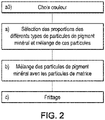
- la
figure 1 est une illustration schématique d'un exemple de procédé de fabrication d'un matériau composite selon un mode de réalisation de l'invention, - et la
figure 2 est un chronogramme du procédé illustré à lafigure 1 . - Comme expliqué ci-dessus, l'invention concerne un matériau composite solide, fritté, destiné à être utilisé notamment en horlogerie ou joaillerie, ledit matériau combinant :
- un pigment minéral ; et
- une matrice à base d'oxyde métallique ou de métalloïde, la matrice étant adaptée pour laisser passer la lumière (c'est-à-dire qu'elle est transparente ou translucide).
- Le pigment minéral peut représenter une fraction volumique comprise entre 2% et 50% du matériau composite.
- Le pigment minéral est sous forme de particules discrètes comprenant chacune un noyau coloré et un revêtement entourant le noyau, ledit revêtement étant adapté pour laisser passer la lumière (c'est-à-dire qu'il est transparent ou translucide).
- Le noyau du pigment minéral est choisi en fonction de la couleur souhaitée pour le matériau composite.
- Pour le bleu et le vert, on choisit un noyau de pigment minéral à base d'aluminium et de cobalt, en particulier l'aluminate de cobalt CoAl2O4 ayant la structure cristalline spinelle. La couleur bleue ou verte du pigment et l'intensité de la couleur du pigment dépendent de son taux d'oxydation.
- Mis à part l'aluminate de cobalt, il est également possible d'utiliser les composés ayant les formules chimiques suivantes, la couleur bleue ou verte ainsi que l'intensité de la couleur dépendant également du taux d'oxydation :
- (Co,Zn)Al2O4 ;
- (Zn,Co)(Cr,Al)2O4 ;
- Co(Al,Cr)2O4 ;
- CoAl2O4/Co2SnO4.
- En fonction de la couleur souhaitée pour le matériau composite, un élément ou une combinaison d'éléments peut être ajoutée pour modifier la couleur du composé. Parmi ces éléments, on trouve notamment le chrome, le lithium, le magnésium, le silicium, le strontium, l'étain, le titane et le zinc. Là encore, la couleur bleue ou verte et l'intensité de la couleur du pigment dépendent de son taux d'oxydation.
- Pour le rouge et le jaune, le noyau coloré peut être un oxyde comprenant du fer, du chrome, de l'aluminium, du titane, du silicium, du zinc, du nickel, du cobalt, du cadmium, du cuivre, du vanadium, du bismuth et/ou du manganèse. Par exemple, il peut s'agir notamment :
- de KAl2 (AlSi3O10)(OH)2 ;
- du TiO2 ;
- du SiO2 ;
- du ZnO.
- Des exemples de pigments rouges avec une base d'oxyde de titane et de mica sont donnés dans les documents suivants :
US 4 344 987 A ,US 5 522 923 A , etUS 4 086 100 A . - Le revêtement du pigment minéral peut être fabriqué à partir d'un matériau choisi parmi :
- le mica, par exemple la muscovite ou la biotite ;
- l'alumine Al2O3 ;
- la zircone ZrO2 ;
- le dioxyde de titane TiO2.
- Les particules de pigment minéral peuvent présenter un diamètre moyen compris entre 0,2 µm et 10 µm.
- Avantageusement, la température de détérioration du pigment minéral est supérieure à 1300°C. Cette température correspond à la température de décomposition du pigment minéral qui entraîne un changement de couleur de celui-ci, ou autrement dit à la température à laquelle la couleur du pigment minéral est altérée.
- La matrice est choisie de telle sorte que sa température de densification sous pression, sous une pression généralement inférieure à 250 MPa, soit inférieure à la température de détérioration du pigment minéral, donc avantageusement inférieure à 1300°C. On peut ainsi fritter le matériau sous pression, à une température de frittage supérieure ou égale à la température de densification à ladite pression et inférieure à ladite température de détérioration du pigment minéral.
- La matrice est adaptée pour laisser passer la lumière, c'est-à-dire qu'elle est transparente ou translucide. Pour cela, la matrice est par exemple préparée suivant des procédés connus pour les céramiques transparentes. Cette adaptation réside alors en particulier dans le choix de l'oxyde et dans les conditions de mise en forme, c'est-à-dire la température de densification et la pression.
- Comme vu précédemment, la matrice est à base d'oxyde métallique ou d'oxyde de métalloïde.
- Le concept de métalloïde se rapporte à un élément chimique qui ne peut être classé ni dans les métaux ni parmi les non-métaux, c'est-à-dire dont les propriétés physiques et chimiques sont intermédiaires entre celles d'un métal et d'un non-métal.
- Les métalloïdes sont caractérisés par les propriétés suivantes :
- leurs oxydes sont généralement amphotères (ceux des métaux sont plutôt basiques et ceux des non-métaux plutôt acides) ;
- ils se comportent comme des semi-conducteurs (notamment le bore, le silicium et le germanium).
- Les métalloïdes forment donc une bande oblique dans le tableau périodique entre les métaux et les non-métaux :
- Bore 5B
- Silicium 14Si
- Germanium 32Ge
- Arsenic 33As
- Antimoine 51Sb
- Tellure 52Te
- Astate 85At
- En particulier, la matrice peut être une céramique ou comprendre de la silice, notamment un verre.
- Parmi les matrices céramiques utilisables dans le cadre de la présente invention, on peut trouver le spinelle d'aluminate de magnésium (MgAl2O4), la zircone ou l'alumine pure, le mica, la zircone stabilisée à l'yttrium, le dioxyde de titane
- Parmi les matrices comportant du verre utilisables dans le cadre de la présente invention, on peut trouver :
- des silicates dont la température de transition vitreuse est proche de 600°C ;
- des borosilicates, tel que le Pyrex® dont la température de transition vitreuse est de 850°C ;
- des verres typiquement utilisés dans la fabrication des émaux.
- On peut fabriquer un matériau composite selon l'invention notamment par le procédé illustré sur les
figures 1 et2 et comprenant les étapes suivantes :
a0) choix de la couleur souhaitée, - a) sélection des proportions des différents types de particules de pigment minéral pour obtenir la couleur souhaitée et mélange de ces particules
- b) mélange du pigment minéral 10 sous forme de poudre avec la matrice 12 sous forme de poudre dans un moule 14 ;
- c) frittage du mélange de poudres sous une pression suffisante pour que la température de densification de la matrice 12 sous cette pression reste inférieure à la température de détérioration du pigment minéral 10, le frittage étant fait à une température de frittage supérieure ou égale à la température de densification à ladite pression et inférieure à ladite température de détérioration du pigment minéral ;
- d) retrait du matériau composite 16 du moule 14.
- Ainsi, sous la pression et la chaleur, le pigment minéral est stable tandis que la matrice enrobe toutes les particules du pigment minéral.
- Le frittage du mélange de poudre s'effectue avantageusement sous une pression supérieure à 80 MPa.
- Le frittage peut être réalisé par exemple sous pression uniaxiale à l'aide d'une presse SPS (« Spark Plasma Sintering ») dans laquelle la montée en température peut être effectuée en quelques minutes.
- Il est également possible de terminer le frittage par frittage sous pression isostatique. Il s'agit dans un premier temps de presser le mélange de poudres pour en former des pastilles ou d'injecter des composants par une technique classique d'injection des céramiques, puis d'effectuer un premier frittage dont l'effet est de fermer les porosités sans forcément terminer le procédé. Le frittage est alors finalisé dans un four qui peut être pressurisé sous gaz jusqu'à 200 MPa en général.
- On utilise comme matrice une poudre de spinelle d'aluminate de magnésium (MgAl2O4) ayant une taille de particules de 0,2 µm avec comme impuretés moins de 10 ppm de Fe, Ca, Na, et moins de 20 ppm de Si, par exemple celle produite par la société Baikowski sous la référence S30 CR.
- Le dosage de pigment minéral peut varier de 5% à 30% en volume.
- Le frittage du spinelle MgAl2O4 est généralement opéré à une température supérieure à 1800°C. Selon l'invention, afin de préserver le pigment minéral et conserver son intensité, le frittage est effectué à environ 1200°C, sous très haute pression, isostatique ou uniaxiale.
- La densification du spinelle MgAl2O4 est possible dans cette zone de température, à condition que la pression soit supérieure à 100 MPa.
- De plus, cette zone de température permet d'utiliser une large gamme de pigments sans les détériorer.
- On obtient ainsi un matériau composite céramique dense avec une transparence qui permette d'utiliser la coloration du pigment minéral sur une profondeur de quelques dixièmes de millimètres, au lieu d'avoir uniquement l'effet de couleur par les particules de pigment en surface.
- En particulier, on mélange 32,76 g de spinelle MgAl2O4 (S30 CR de Baikowski) avec 4,6 g de pigment rouge (revêtement de TiO2 sur un noyau de KAl2(AlSi3O10)(OH)2) pour obtenir un mélange avec 10% de pigment en volume. On remplit un moule en graphite de 30 mm de diamètre avec 4 g du mélange. On fritte le mélange sous pression pendant 5 min dans une presse SPS à 1200°C avec une force de 70 kN correspondant à une pression de 100 MPa. On obtient un disque de céramique dense de couleur rouge vif.
- On utilise comme matrice de la zircone stabilisée à l'yttrium qui, après frittage à 1200°C sous une pression supérieure à 200 MPa, isostatique ou uniaxiale, peut mener à l'obtention d'une zircone transparente ou translucide.
- Ainsi, en mélangeant jusqu'à 30% en volume de pigment rouge (par exemple le pigment de l'exemple 1) avec une zircone stabilisée à l'yttrium (ajout d'yttrium à hauteur de 8%), on obtient un effet similaire à celui obtenu avec le verre ou le spinelle MgAl2O4, c'est-à-dire une matrice transparente avec des pigments rouge emprisonnés à l'intérieur.
- Ainsi, par sa transparence/translucidité, la matrice garantit une couleur vive du matériau final ainsi qu'une surface maximale de pigments balayés par la lumière rentrante et traversante.
- L'invention propose donc de nouveaux matériaux composites céramiques avec une très large gamme de couleurs.
- En particulier, pour réaliser un matériau composite de couleur donnée, on peut effectuer la sélection et le mélange de l'étape a) en utilisant un nombre limité de types prédéterminés de particules de pigment minéral, les différents types de particules ayant respectivement des noyaux présentant différentes couleurs de base, dans des proportions adaptées pour obtenir ladite couleur donnée. Ce mélange de particules ayant des noyaux de différents types est rendu possible, sans interaction entre noyaux pendant le frittage, par le fait que le noyau de chaque particule de pigment minéral est entouré d'un revêtement. Il peut être spécialement avantageux que les particules des différents types aient des revêtements identiques.
- Avec une installation relativement simple, on peut ainsi obtenir une très large gamme de couleurs. En particulier, on peut utiliser trois types prédéterminés de particules de pigment minéral dont les noyaux ont respectivement trois couleurs de base, notamment rouge, vert et bleu (ou rouge, jaune, bleu). Eventuellement, on peut utiliser cinq types prédéterminés de particules de pigment minéral dont les noyaux ont respectivement cinq couleurs de base, notamment rouge, vert, bleu, noir et blanc (ou rouge, jaune, bleu, noir et blanc). Les deux derniers types (noir et blanc) permettent de moduler l'intensité par exemple pour obtenir des teintes pastel.
- Les matériaux composites colorés de la présente invention trouvent leur application dans la fabrication, par exemple, des composants d'habillage des pièces horlogères, tel que les lunettes, les carrures, les boucles de bracelets, etc. L'avantage de ces matériaux dans cette application est leur résistance à l'usure et la garantie que la couleur des composants ne pourra pas être abimée par les contraintes imposées à la montre portée au poignet.
Claims (18)
- Matériau composite solide (16) fritté combinant- un pigment minéral (10) sous forme de particules discrètes comprenant chacune un noyau coloré et un revêtement entourant le noyau, ledit revêtement étant adapté pour laisser passer la lumière ; et- une matrice (12) à base d'oxyde métallique ou de métalloïde, ladite matrice (12) étant adaptée pour laisser passer la lumière,dans lequel le revêtement des particules de pigment est adapté pour éviter des interactions entre les noyaux colorés lors du frittage.
- Matériau composite solide (16) selon la revendication 1, dans lequel toutes les particules du pigment minéral ont un revêtement identique.
- Matériau composite solide (16) selon la revendication 1 ou la revendication 2, dans lequel le pigment minéral comprend un mélange de particules ayant respectivement des noyaux d'au moins deux types différents, notamment de couleurs différentes.
- Matériau composite solide (16) selon l'une quelconque des revendications précédentes, dans lequel le pigment minéral (10) représente une fraction volumique comprise entre 2% et 50% dudit matériau composite (16).
- Matériau composite solide (16) selon l'une quelconque des revendications précédentes, dans lequel le noyau d'au moins une particule du pigment minéral (10) est à base d'aluminate de cobalt CoAl2O4.
- Matériau composite solide (16) selon l'une quelconque des revendications 1 à 4, dans lequel le noyau d'au moins une particule du pigment minéral (10) est un oxyde au moins un élément choisi parmi le fer, le chrome, l'aluminium, le titane, le silicium, le zinc, le nickel, le cobalt, le cadmium, le cuivre, le vanadium, le bismuth, le nobium et le manganèse.
- Matériau composite solide (16) selon l'une quelconque des revendications précédentes, dans lequel le revêtement d'au moins une particule du pigment minéral (10) est fabriqué à partir d'un matériau choisi parmi le mica, l'alumine, la zircone et le dioxyde de titane.
- Matériau composite solide (16) selon l'une quelconque des revendications précédentes, dans lequel les particules de pigment minéral (10) présentent un diamètre moyen compris entre 0,2 µm et 10 µm.
- Matériau composite solide (16) selon l'une quelconque des revendications 1 à 7, dans lequel les particules de pigment minéral (10) présentent un diamètre moyen compris entre 0,2 µm et 15 µm.
- Matériau composite solide (16) selon l'une quelconque des revendications précédentes, dans lequel la matrice (12) est une céramique.
- Matériau composite (16) selon l'une quelconque des revendications 1 à 9, dans lequel la matrice (12) comprend un verre.
- Procédé pour fabriquer un matériau composite solide (16) selon l'une quelconque des revendications précédentes, ledit procédé comportant les étapes suivantes :a) sélection d'un pigment minéral (10) sous forme de particules discrètes comprenant chacune un noyau coloré et un revêtement entourant le noyau, ledit revêtement étant adapté pour laisser passer la lumière ;b) mélange du pigment minéral (10) sous forme de poudre avec la matrice (12) sous forme de poudre ; etc) frittage dudit mélange de poudres,dans lequel le revêtement des particules de pigment est adapté pour éviter des interactions entre les noyaux colorés lors du frittage.
- Procédé selon la revendication 12, dans lequel toutes les particules du pigment minéral (10) ont un revêtement identique.
- Procédé selon la revendication 12 ou la revendication 13, pour réaliser un matériau composite de couleur donnée, dans lequel au cours de l'étape a), on détermine à partir de la couleur donnée des proportions de particules de pigment minéral choisies parmi plusieurs types prédéterminés ayant respectivement plusieurs couleurs de base, et on mélange les particules de pigment minéral selon les proportions définies.
- Procédé selon la revendication 14, dans lequel lesdites couleurs de base comprennent le rouge, le vert et le bleu.
- Procédé selon la revendication 14, dans lequel lesdites couleurs de base comprennent le rouge, le jaune et le bleu.
- Procédé selon la revendication 15 ou la revendication 16, dans lequel lesdites couleurs de base comprennent en outre le noir et le blanc.
- Utilisation d'un matériau composite (16) selon l'une quelconque des revendications 1 à 11 en horlogerie ou joaillerie.
Applications Claiming Priority (2)
| Application Number | Priority Date | Filing Date | Title |
|---|---|---|---|
| CH00370/17A CH713606B1 (fr) | 2017-03-22 | 2017-03-22 | Matériau composite coloré. |
| PCT/EP2018/057208 WO2018172428A1 (fr) | 2017-03-22 | 2018-03-21 | Matériau composite coloré |
Publications (2)
| Publication Number | Publication Date |
|---|---|
| EP3601440A1 EP3601440A1 (fr) | 2020-02-05 |
| EP3601440B1 true EP3601440B1 (fr) | 2022-04-27 |
Family
ID=58644747
Family Applications (1)
| Application Number | Title | Priority Date | Filing Date |
|---|---|---|---|
| EP18711145.5A Active EP3601440B1 (fr) | 2017-03-22 | 2018-03-21 | Matériau composite coloré |
Country Status (7)
| Country | Link |
|---|---|
| US (2) | US12202773B2 (fr) |
| EP (1) | EP3601440B1 (fr) |
| JP (1) | JP7270548B2 (fr) |
| KR (1) | KR102530489B1 (fr) |
| CN (1) | CN110799603A (fr) |
| CH (1) | CH713606B1 (fr) |
| WO (1) | WO2018172428A1 (fr) |
Cited By (2)
| Publication number | Priority date | Publication date | Assignee | Title |
|---|---|---|---|---|
| WO2026120189A1 (fr) | 2024-12-06 | 2026-06-11 | Hublot Sa, Genève | Procédé de fabrication d'un composant horloger ou joailler en céramique multicolore |
| FR3169464A1 (fr) | 2024-12-06 | 2026-06-12 | Hublot Sa, Genève | Procédé de fabrication d’un composant horloger ou joailler en céramique multicolore. |
Families Citing this family (4)
| Publication number | Priority date | Publication date | Assignee | Title |
|---|---|---|---|---|
| CN112441623B (zh) * | 2020-11-17 | 2022-06-14 | 浙大宁波理工学院 | 改性钴蓝颜料制备高近红外反射的彩色颜料 |
| CN115196678B (zh) * | 2021-04-12 | 2024-05-14 | 厦门稀土材料研究所 | 一种掺铬(iii)高近红外反射无机颜料及其制备方法和应用 |
| TW202406847A (zh) * | 2022-07-28 | 2024-02-16 | 日商Dic股份有限公司 | 高純度尖晶石粒子及其製造方法、樹脂組成物及成形物 |
| EP4328271A1 (fr) | 2022-08-23 | 2024-02-28 | The Swatch Group Research and Development Ltd | Article en ceramique de couleur vive et son procede de fabrication |
Family Cites Families (15)
| Publication number | Priority date | Publication date | Assignee | Title |
|---|---|---|---|---|
| US4086100A (en) | 1975-05-22 | 1978-04-25 | Merck Patent Gesellschaft Mit Beschrankter Haftung | Rutile-containing lustrous pigments |
| DE3030056A1 (de) | 1980-08-08 | 1982-03-25 | Basf Ag, 6700 Ludwigshafen | Verfahren zur herstellung von mit metalloxiden beschichteten schuppenfoermigen glimmerpigmenten |
| DE4014928C1 (fr) * | 1990-05-10 | 1991-10-17 | Degussa Ag, 6000 Frankfurt, De | |
| JP3132918B2 (ja) | 1992-09-22 | 2001-02-05 | 株式会社資生堂 | 赤色系顔料及びその製造方法 |
| DE19520964A1 (de) * | 1995-06-08 | 1996-12-12 | Inst Neue Mat Gemein Gmbh | Beschichtete anorganische Pigmente, Verfahren zu deren Herstellung und deren Verwendung |
| ITFI20020039A1 (it) * | 2002-03-08 | 2003-09-08 | Colorobbia Italiana Spa | Pigmenti inclusi per prodotti ceramici ed ossidi in forma di particelle nanometriche |
| DE602006009921D1 (de) * | 2006-07-31 | 2009-12-03 | Rolex Sa | Pigmentierter keramischer Körper |
| CN102741359B (zh) | 2010-02-04 | 2014-12-03 | 默克专利股份有限公司 | 效果颜料 |
| US9682888B2 (en) * | 2011-10-10 | 2017-06-20 | Certainteed Corporation | Coated granules for construction applications |
| JP6630152B2 (ja) | 2012-12-21 | 2020-01-15 | ロレックス エスアー | 着色工業用セラミック体及びその製造方法 |
| EP2746242B1 (fr) | 2012-12-21 | 2022-05-11 | Rolex S.A. | Corps céramique technique coloré et son procédé d'obtention |
| US9676927B2 (en) * | 2014-04-09 | 2017-06-13 | The Shepherd Color Company | Core-shell composite inorganic metal oxides and method of preparing for prevention of thermal oxidative degradation in polymer and resin compositions |
| JP6554771B2 (ja) * | 2014-09-24 | 2019-08-07 | 富士ゼロックス株式会社 | 光輝性トナー、静電荷像現像剤、トナーカートリッジ、画像形成方法、及び、画像形成装置 |
| JP2016088842A (ja) * | 2014-10-29 | 2016-05-23 | 京セラ株式会社 | 通信機器外装部品およびこれを備えてなる通信機器 |
| EP3045505B1 (fr) * | 2015-01-15 | 2020-06-24 | Hublot S.A., Genève | Matériau composite céramique |
-
2017
- 2017-03-22 CH CH00370/17A patent/CH713606B1/fr unknown
-
2018
- 2018-03-21 US US16/496,754 patent/US12202773B2/en active Active
- 2018-03-21 WO PCT/EP2018/057208 patent/WO2018172428A1/fr not_active Ceased
- 2018-03-21 CN CN201880026442.XA patent/CN110799603A/zh active Pending
- 2018-03-21 JP JP2019552457A patent/JP7270548B2/ja active Active
- 2018-03-21 KR KR1020197030481A patent/KR102530489B1/ko active Active
- 2018-03-21 EP EP18711145.5A patent/EP3601440B1/fr active Active
-
2024
- 2024-12-12 US US18/979,334 patent/US20250109070A1/en active Pending
Cited By (2)
| Publication number | Priority date | Publication date | Assignee | Title |
|---|---|---|---|---|
| WO2026120189A1 (fr) | 2024-12-06 | 2026-06-11 | Hublot Sa, Genève | Procédé de fabrication d'un composant horloger ou joailler en céramique multicolore |
| FR3169464A1 (fr) | 2024-12-06 | 2026-06-12 | Hublot Sa, Genève | Procédé de fabrication d’un composant horloger ou joailler en céramique multicolore. |
Also Published As
| Publication number | Publication date |
|---|---|
| CH713606B1 (fr) | 2021-02-26 |
| EP3601440A1 (fr) | 2020-02-05 |
| US20250109070A1 (en) | 2025-04-03 |
| CH713606A1 (fr) | 2018-09-28 |
| JP7270548B2 (ja) | 2023-05-10 |
| US20200031719A1 (en) | 2020-01-30 |
| WO2018172428A1 (fr) | 2018-09-27 |
| KR102530489B1 (ko) | 2023-05-08 |
| KR20190132422A (ko) | 2019-11-27 |
| JP2020514516A (ja) | 2020-05-21 |
| CN110799603A (zh) | 2020-02-14 |
| US12202773B2 (en) | 2025-01-21 |
Similar Documents
| Publication | Publication Date | Title |
|---|---|---|
| WO2018172428A1 (fr) | Matériau composite coloré | |
| EP3245259B1 (fr) | Procédé de fabrication d'un matériau composite céramique | |
| EP3674816B1 (fr) | Composant d'habillage d'horlogerie ou de bijouterie realise dans un materiau composite lourd | |
| EP3395784A1 (fr) | Composant en céramique pour pièce d'horlogerie | |
| EP3369784A1 (fr) | Pigment interferenciel basé sur un coeur métallique choisi parmit l'au, ag, pd, rh, ru, pt, os, ir et leurs alliages | |
| EP2991950B1 (fr) | Procede de fabrication d'un article colore; en particulier de couleur orange; a base de zircone et article decoratif colore a base de zircone obtenu selon ce procede | |
| EP3612504A1 (fr) | Fabrication d'un composant en céramique | |
| EP3943573B1 (fr) | Materiau metallique luminescent, procede de preparation et utilisation | |
| EP3663273A1 (fr) | Article decoratif en ceramique | |
| CH713536A2 (fr) | Pigment interférentiel. | |
| EP3226082B1 (fr) | Composant de mouvement horloger | |
| CH715694A2 (fr) | Article décoratif réalisé dans un matériau composite lourd. | |
| WO2013034841A1 (fr) | Utilisation d'un procédé de fabrication d'une pièce couche par couche | |
| WO2025073817A1 (fr) | Composant horloger ou de bijouterie et procede de fabrication d'un tel composant horloger ou de bijouterie | |
| WO2025224296A1 (fr) | Procede de fabrication d'un composant horloger ou de bijouterie | |
| WO2025224292A1 (fr) | Procede de fabrication d'un composant horloger ou de bijouterie et ledit composant horloger ou de bijouterie | |
| CH720483A2 (fr) | Article de couleur réalisé dans une céramique comprenant une zircone et son procédé de fabrication | |
| CH708030A2 (fr) | Procédé de fabrication d'un article coloré; en particulier de couleur orange; à base de zircone et article décoratif coloré à base de zircone obtenu selon ce procédé. | |
| CH715620A2 (fr) | Article décoratif en céramique. |
Legal Events
| Date | Code | Title | Description |
|---|---|---|---|
| STAA | Information on the status of an ep patent application or granted ep patent |
Free format text: STATUS: UNKNOWN |
|
| STAA | Information on the status of an ep patent application or granted ep patent |
Free format text: STATUS: THE INTERNATIONAL PUBLICATION HAS BEEN MADE |
|
| PUAI | Public reference made under article 153(3) epc to a published international application that has entered the european phase |
Free format text: ORIGINAL CODE: 0009012 |
|
| STAA | Information on the status of an ep patent application or granted ep patent |
Free format text: STATUS: REQUEST FOR EXAMINATION WAS MADE |
|
| 17P | Request for examination filed |
Effective date: 20190923 |
|
| AK | Designated contracting states |
Kind code of ref document: A1 Designated state(s): AL AT BE BG CH CY CZ DE DK EE ES FI FR GB GR HR HU IE IS IT LI LT LU LV MC MK MT NL NO PL PT RO RS SE SI SK SM TR |
|
| AX | Request for extension of the european patent |
Extension state: BA ME |
|
| DAV | Request for validation of the european patent (deleted) | ||
| DAX | Request for extension of the european patent (deleted) | ||
| STAA | Information on the status of an ep patent application or granted ep patent |
Free format text: STATUS: EXAMINATION IS IN PROGRESS |
|
| 17Q | First examination report despatched |
Effective date: 20201204 |
|
| GRAP | Despatch of communication of intention to grant a patent |
Free format text: ORIGINAL CODE: EPIDOSNIGR1 |
|
| STAA | Information on the status of an ep patent application or granted ep patent |
Free format text: STATUS: GRANT OF PATENT IS INTENDED |
|
| INTG | Intention to grant announced |
Effective date: 20220216 |
|
| GRAS | Grant fee paid |
Free format text: ORIGINAL CODE: EPIDOSNIGR3 |
|
| GRAA | (expected) grant |
Free format text: ORIGINAL CODE: 0009210 |
|
| STAA | Information on the status of an ep patent application or granted ep patent |
Free format text: STATUS: THE PATENT HAS BEEN GRANTED |
|
| AK | Designated contracting states |
Kind code of ref document: B1 Designated state(s): AL AT BE BG CH CY CZ DE DK EE ES FI FR GB GR HR HU IE IS IT LI LT LU LV MC MK MT NL NO PL PT RO RS SE SI SK SM TR |
|
| REG | Reference to a national code |
Ref country code: GB Ref legal event code: FG4D Free format text: NOT ENGLISH |
|
| REG | Reference to a national code |
Ref country code: CH Ref legal event code: EP |
|
| REG | Reference to a national code |
Ref country code: AT Ref legal event code: REF Ref document number: 1486935 Country of ref document: AT Kind code of ref document: T Effective date: 20220515 |
|
| REG | Reference to a national code |
Ref country code: DE Ref legal event code: R096 Ref document number: 602018034501 Country of ref document: DE |
|
| REG | Reference to a national code |
Ref country code: IE Ref legal event code: FG4D Free format text: LANGUAGE OF EP DOCUMENT: FRENCH |
|
| REG | Reference to a national code |
Ref country code: LT Ref legal event code: MG9D |
|
| REG | Reference to a national code |
Ref country code: NL Ref legal event code: MP Effective date: 20220427 |
|
| REG | Reference to a national code |
Ref country code: AT Ref legal event code: MK05 Ref document number: 1486935 Country of ref document: AT Kind code of ref document: T Effective date: 20220427 |
|
| PG25 | Lapsed in a contracting state [announced via postgrant information from national office to epo] |
Ref country code: NL Free format text: LAPSE BECAUSE OF FAILURE TO SUBMIT A TRANSLATION OF THE DESCRIPTION OR TO PAY THE FEE WITHIN THE PRESCRIBED TIME-LIMIT Effective date: 20220427 |
|
| PG25 | Lapsed in a contracting state [announced via postgrant information from national office to epo] |
Ref country code: SE Free format text: LAPSE BECAUSE OF FAILURE TO SUBMIT A TRANSLATION OF THE DESCRIPTION OR TO PAY THE FEE WITHIN THE PRESCRIBED TIME-LIMIT Effective date: 20220427 Ref country code: PT Free format text: LAPSE BECAUSE OF FAILURE TO SUBMIT A TRANSLATION OF THE DESCRIPTION OR TO PAY THE FEE WITHIN THE PRESCRIBED TIME-LIMIT Effective date: 20220829 Ref country code: NO Free format text: LAPSE BECAUSE OF FAILURE TO SUBMIT A TRANSLATION OF THE DESCRIPTION OR TO PAY THE FEE WITHIN THE PRESCRIBED TIME-LIMIT Effective date: 20220727 Ref country code: LT Free format text: LAPSE BECAUSE OF FAILURE TO SUBMIT A TRANSLATION OF THE DESCRIPTION OR TO PAY THE FEE WITHIN THE PRESCRIBED TIME-LIMIT Effective date: 20220427 Ref country code: HR Free format text: LAPSE BECAUSE OF FAILURE TO SUBMIT A TRANSLATION OF THE DESCRIPTION OR TO PAY THE FEE WITHIN THE PRESCRIBED TIME-LIMIT Effective date: 20220427 Ref country code: GR Free format text: LAPSE BECAUSE OF FAILURE TO SUBMIT A TRANSLATION OF THE DESCRIPTION OR TO PAY THE FEE WITHIN THE PRESCRIBED TIME-LIMIT Effective date: 20220728 Ref country code: FI Free format text: LAPSE BECAUSE OF FAILURE TO SUBMIT A TRANSLATION OF THE DESCRIPTION OR TO PAY THE FEE WITHIN THE PRESCRIBED TIME-LIMIT Effective date: 20220427 Ref country code: ES Free format text: LAPSE BECAUSE OF FAILURE TO SUBMIT A TRANSLATION OF THE DESCRIPTION OR TO PAY THE FEE WITHIN THE PRESCRIBED TIME-LIMIT Effective date: 20220427 Ref country code: BG Free format text: LAPSE BECAUSE OF FAILURE TO SUBMIT A TRANSLATION OF THE DESCRIPTION OR TO PAY THE FEE WITHIN THE PRESCRIBED TIME-LIMIT Effective date: 20220727 Ref country code: AT Free format text: LAPSE BECAUSE OF FAILURE TO SUBMIT A TRANSLATION OF THE DESCRIPTION OR TO PAY THE FEE WITHIN THE PRESCRIBED TIME-LIMIT Effective date: 20220427 |
|
| PG25 | Lapsed in a contracting state [announced via postgrant information from national office to epo] |
Ref country code: RS Free format text: LAPSE BECAUSE OF FAILURE TO SUBMIT A TRANSLATION OF THE DESCRIPTION OR TO PAY THE FEE WITHIN THE PRESCRIBED TIME-LIMIT Effective date: 20220427 Ref country code: PL Free format text: LAPSE BECAUSE OF FAILURE TO SUBMIT A TRANSLATION OF THE DESCRIPTION OR TO PAY THE FEE WITHIN THE PRESCRIBED TIME-LIMIT Effective date: 20220427 Ref country code: LV Free format text: LAPSE BECAUSE OF FAILURE TO SUBMIT A TRANSLATION OF THE DESCRIPTION OR TO PAY THE FEE WITHIN THE PRESCRIBED TIME-LIMIT Effective date: 20220427 Ref country code: IS Free format text: LAPSE BECAUSE OF FAILURE TO SUBMIT A TRANSLATION OF THE DESCRIPTION OR TO PAY THE FEE WITHIN THE PRESCRIBED TIME-LIMIT Effective date: 20220827 |
|
| REG | Reference to a national code |
Ref country code: DE Ref legal event code: R097 Ref document number: 602018034501 Country of ref document: DE |
|
| PG25 | Lapsed in a contracting state [announced via postgrant information from national office to epo] |
Ref country code: SM Free format text: LAPSE BECAUSE OF FAILURE TO SUBMIT A TRANSLATION OF THE DESCRIPTION OR TO PAY THE FEE WITHIN THE PRESCRIBED TIME-LIMIT Effective date: 20220427 Ref country code: SK Free format text: LAPSE BECAUSE OF FAILURE TO SUBMIT A TRANSLATION OF THE DESCRIPTION OR TO PAY THE FEE WITHIN THE PRESCRIBED TIME-LIMIT Effective date: 20220427 Ref country code: RO Free format text: LAPSE BECAUSE OF FAILURE TO SUBMIT A TRANSLATION OF THE DESCRIPTION OR TO PAY THE FEE WITHIN THE PRESCRIBED TIME-LIMIT Effective date: 20220427 Ref country code: EE Free format text: LAPSE BECAUSE OF FAILURE TO SUBMIT A TRANSLATION OF THE DESCRIPTION OR TO PAY THE FEE WITHIN THE PRESCRIBED TIME-LIMIT Effective date: 20220427 Ref country code: DK Free format text: LAPSE BECAUSE OF FAILURE TO SUBMIT A TRANSLATION OF THE DESCRIPTION OR TO PAY THE FEE WITHIN THE PRESCRIBED TIME-LIMIT Effective date: 20220427 Ref country code: CZ Free format text: LAPSE BECAUSE OF FAILURE TO SUBMIT A TRANSLATION OF THE DESCRIPTION OR TO PAY THE FEE WITHIN THE PRESCRIBED TIME-LIMIT Effective date: 20220427 |
|
| PLBE | No opposition filed within time limit |
Free format text: ORIGINAL CODE: 0009261 |
|
| STAA | Information on the status of an ep patent application or granted ep patent |
Free format text: STATUS: NO OPPOSITION FILED WITHIN TIME LIMIT |
|
| PG25 | Lapsed in a contracting state [announced via postgrant information from national office to epo] |
Ref country code: AL Free format text: LAPSE BECAUSE OF FAILURE TO SUBMIT A TRANSLATION OF THE DESCRIPTION OR TO PAY THE FEE WITHIN THE PRESCRIBED TIME-LIMIT Effective date: 20220427 |
|
| 26N | No opposition filed |
Effective date: 20230130 |
|
| PG25 | Lapsed in a contracting state [announced via postgrant information from national office to epo] |
Ref country code: SI Free format text: LAPSE BECAUSE OF FAILURE TO SUBMIT A TRANSLATION OF THE DESCRIPTION OR TO PAY THE FEE WITHIN THE PRESCRIBED TIME-LIMIT Effective date: 20220427 |
|
| P01 | Opt-out of the competence of the unified patent court (upc) registered |
Effective date: 20230523 |
|
| PG25 | Lapsed in a contracting state [announced via postgrant information from national office to epo] |
Ref country code: MC Free format text: LAPSE BECAUSE OF FAILURE TO SUBMIT A TRANSLATION OF THE DESCRIPTION OR TO PAY THE FEE WITHIN THE PRESCRIBED TIME-LIMIT Effective date: 20220427 |
|
| GBPC | Gb: european patent ceased through non-payment of renewal fee |
Effective date: 20230321 |
|
| REG | Reference to a national code |
Ref country code: BE Ref legal event code: MM Effective date: 20230331 |
|
| PG25 | Lapsed in a contracting state [announced via postgrant information from national office to epo] |
Ref country code: LU Free format text: LAPSE BECAUSE OF NON-PAYMENT OF DUE FEES Effective date: 20230321 |
|
| REG | Reference to a national code |
Ref country code: IE Ref legal event code: MM4A |
|
| PG25 | Lapsed in a contracting state [announced via postgrant information from national office to epo] |
Ref country code: GB Free format text: LAPSE BECAUSE OF NON-PAYMENT OF DUE FEES Effective date: 20230321 |
|
| PG25 | Lapsed in a contracting state [announced via postgrant information from national office to epo] |
Ref country code: IT Free format text: LAPSE BECAUSE OF FAILURE TO SUBMIT A TRANSLATION OF THE DESCRIPTION OR TO PAY THE FEE WITHIN THE PRESCRIBED TIME-LIMIT Effective date: 20220427 Ref country code: IE Free format text: LAPSE BECAUSE OF NON-PAYMENT OF DUE FEES Effective date: 20230321 Ref country code: GB Free format text: LAPSE BECAUSE OF NON-PAYMENT OF DUE FEES Effective date: 20230321 |
|
| PG25 | Lapsed in a contracting state [announced via postgrant information from national office to epo] |
Ref country code: BE Free format text: LAPSE BECAUSE OF NON-PAYMENT OF DUE FEES Effective date: 20230331 |
|
| PG25 | Lapsed in a contracting state [announced via postgrant information from national office to epo] |
Ref country code: BG Free format text: LAPSE BECAUSE OF FAILURE TO SUBMIT A TRANSLATION OF THE DESCRIPTION OR TO PAY THE FEE WITHIN THE PRESCRIBED TIME-LIMIT Effective date: 20220427 |
|
| PG25 | Lapsed in a contracting state [announced via postgrant information from national office to epo] |
Ref country code: BG Free format text: LAPSE BECAUSE OF FAILURE TO SUBMIT A TRANSLATION OF THE DESCRIPTION OR TO PAY THE FEE WITHIN THE PRESCRIBED TIME-LIMIT Effective date: 20220427 |
|
| REG | Reference to a national code |
Ref country code: DE Ref legal event code: R082 Ref document number: 602018034501 Country of ref document: DE Representative=s name: PLASSERAUD IP GMBH, DE |
|
| PG25 | Lapsed in a contracting state [announced via postgrant information from national office to epo] |
Ref country code: CY Free format text: LAPSE BECAUSE OF FAILURE TO SUBMIT A TRANSLATION OF THE DESCRIPTION OR TO PAY THE FEE WITHIN THE PRESCRIBED TIME-LIMIT; INVALID AB INITIO Effective date: 20180321 |
|
| PG25 | Lapsed in a contracting state [announced via postgrant information from national office to epo] |
Ref country code: HU Free format text: LAPSE BECAUSE OF FAILURE TO SUBMIT A TRANSLATION OF THE DESCRIPTION OR TO PAY THE FEE WITHIN THE PRESCRIBED TIME-LIMIT; INVALID AB INITIO Effective date: 20180321 |
|
| PG25 | Lapsed in a contracting state [announced via postgrant information from national office to epo] |
Ref country code: TR Free format text: LAPSE BECAUSE OF FAILURE TO SUBMIT A TRANSLATION OF THE DESCRIPTION OR TO PAY THE FEE WITHIN THE PRESCRIBED TIME-LIMIT Effective date: 20220427 |
|
| REG | Reference to a national code |
Ref country code: CH Ref legal event code: U11 Free format text: ST27 STATUS EVENT CODE: U-0-0-U10-U11 (AS PROVIDED BY THE NATIONAL OFFICE) Effective date: 20260401 |
|
| PGFP | Annual fee paid to national office [announced via postgrant information from national office to epo] |
Ref country code: DE Payment date: 20260313 Year of fee payment: 9 |
|
| PGFP | Annual fee paid to national office [announced via postgrant information from national office to epo] |
Ref country code: FR Payment date: 20260223 Year of fee payment: 9 |
|
| PGFP | Annual fee paid to national office [announced via postgrant information from national office to epo] |
Ref country code: CH Payment date: 20260401 Year of fee payment: 9 |