EP3598696B1 - Vorrichtung zur bereitstellung von puf-basiertem hardware-otp und verfahren zur authentifizierung von 2-faktor damit - Google Patents
Vorrichtung zur bereitstellung von puf-basiertem hardware-otp und verfahren zur authentifizierung von 2-faktor damit Download PDFInfo
- Publication number
- EP3598696B1 EP3598696B1 EP19196588.8A EP19196588A EP3598696B1 EP 3598696 B1 EP3598696 B1 EP 3598696B1 EP 19196588 A EP19196588 A EP 19196588A EP 3598696 B1 EP3598696 B1 EP 3598696B1
- Authority
- EP
- European Patent Office
- Prior art keywords
- otp
- authentication
- key
- puf
- authentication process
- Prior art date
- Legal status (The legal status is an assumption and is not a legal conclusion. Google has not performed a legal analysis and makes no representation as to the accuracy of the status listed.)
- Active
Links
Images




Classifications
-
- G—PHYSICS
- G09—EDUCATION; CRYPTOGRAPHY; DISPLAY; ADVERTISING; SEALS
- G09C—CIPHERING OR DECIPHERING APPARATUS FOR CRYPTOGRAPHIC OR OTHER PURPOSES INVOLVING THE NEED FOR SECRECY
- G09C1/00—Apparatus or methods whereby a given sequence of signs, e.g. an intelligible text, is transformed into an unintelligible sequence of signs by transposing the signs or groups of signs or by replacing them by others according to a predetermined system
-
- H—ELECTRICITY
- H04—ELECTRIC COMMUNICATION TECHNIQUE
- H04L—TRANSMISSION OF DIGITAL INFORMATION, e.g. TELEGRAPHIC COMMUNICATION
- H04L9/00—Cryptographic mechanisms or cryptographic arrangements for secret or secure communications; Network security protocols
- H04L9/30—Public key, i.e. encryption algorithm being computationally infeasible to invert or user's encryption keys not requiring secrecy
-
- H—ELECTRICITY
- H04—ELECTRIC COMMUNICATION TECHNIQUE
- H04L—TRANSMISSION OF DIGITAL INFORMATION, e.g. TELEGRAPHIC COMMUNICATION
- H04L9/00—Cryptographic mechanisms or cryptographic arrangements for secret or secure communications; Network security protocols
- H04L9/32—Cryptographic mechanisms or cryptographic arrangements for secret or secure communications; Network security protocols including means for verifying the identity or authority of a user of the system or for message authentication, e.g. authorization, entity authentication, data integrity or data verification, non-repudiation, key authentication or verification of credentials
- H04L9/3271—Cryptographic mechanisms or cryptographic arrangements for secret or secure communications; Network security protocols including means for verifying the identity or authority of a user of the system or for message authentication, e.g. authorization, entity authentication, data integrity or data verification, non-repudiation, key authentication or verification of credentials using challenge-response
- H04L9/3278—Cryptographic mechanisms or cryptographic arrangements for secret or secure communications; Network security protocols including means for verifying the identity or authority of a user of the system or for message authentication, e.g. authorization, entity authentication, data integrity or data verification, non-repudiation, key authentication or verification of credentials using challenge-response using physically unclonable functions [PUF]
-
- G—PHYSICS
- G06—COMPUTING OR CALCULATING; COUNTING
- G06F—ELECTRIC DIGITAL DATA PROCESSING
- G06F21/00—Security arrangements for protecting computers, components thereof, programs or data against unauthorised activity
- G06F21/60—Protecting data
- G06F21/602—Providing cryptographic facilities or services
-
- H—ELECTRICITY
- H04—ELECTRIC COMMUNICATION TECHNIQUE
- H04L—TRANSMISSION OF DIGITAL INFORMATION, e.g. TELEGRAPHIC COMMUNICATION
- H04L9/00—Cryptographic mechanisms or cryptographic arrangements for secret or secure communications; Network security protocols
- H04L9/08—Key distribution or management, e.g. generation, sharing or updating, of cryptographic keys or passwords
- H04L9/0861—Generation of secret information including derivation or calculation of cryptographic keys or passwords
- H04L9/0863—Generation of secret information including derivation or calculation of cryptographic keys or passwords involving passwords or one-time passwords
-
- H—ELECTRICITY
- H04—ELECTRIC COMMUNICATION TECHNIQUE
- H04L—TRANSMISSION OF DIGITAL INFORMATION, e.g. TELEGRAPHIC COMMUNICATION
- H04L9/00—Cryptographic mechanisms or cryptographic arrangements for secret or secure communications; Network security protocols
- H04L9/08—Key distribution or management, e.g. generation, sharing or updating, of cryptographic keys or passwords
- H04L9/0861—Generation of secret information including derivation or calculation of cryptographic keys or passwords
- H04L9/0866—Generation of secret information including derivation or calculation of cryptographic keys or passwords involving user or device identifiers, e.g. serial number, physical or biometrical information, DNA, hand-signature or measurable physical characteristics
-
- H—ELECTRICITY
- H04—ELECTRIC COMMUNICATION TECHNIQUE
- H04L—TRANSMISSION OF DIGITAL INFORMATION, e.g. TELEGRAPHIC COMMUNICATION
- H04L9/00—Cryptographic mechanisms or cryptographic arrangements for secret or secure communications; Network security protocols
- H04L9/08—Key distribution or management, e.g. generation, sharing or updating, of cryptographic keys or passwords
- H04L9/0861—Generation of secret information including derivation or calculation of cryptographic keys or passwords
- H04L9/0869—Generation of secret information including derivation or calculation of cryptographic keys or passwords involving random numbers or seeds
-
- H—ELECTRICITY
- H04—ELECTRIC COMMUNICATION TECHNIQUE
- H04L—TRANSMISSION OF DIGITAL INFORMATION, e.g. TELEGRAPHIC COMMUNICATION
- H04L9/00—Cryptographic mechanisms or cryptographic arrangements for secret or secure communications; Network security protocols
- H04L9/32—Cryptographic mechanisms or cryptographic arrangements for secret or secure communications; Network security protocols including means for verifying the identity or authority of a user of the system or for message authentication, e.g. authorization, entity authentication, data integrity or data verification, non-repudiation, key authentication or verification of credentials
-
- H—ELECTRICITY
- H04—ELECTRIC COMMUNICATION TECHNIQUE
- H04L—TRANSMISSION OF DIGITAL INFORMATION, e.g. TELEGRAPHIC COMMUNICATION
- H04L9/00—Cryptographic mechanisms or cryptographic arrangements for secret or secure communications; Network security protocols
- H04L9/32—Cryptographic mechanisms or cryptographic arrangements for secret or secure communications; Network security protocols including means for verifying the identity or authority of a user of the system or for message authentication, e.g. authorization, entity authentication, data integrity or data verification, non-repudiation, key authentication or verification of credentials
- H04L9/3226—Cryptographic mechanisms or cryptographic arrangements for secret or secure communications; Network security protocols including means for verifying the identity or authority of a user of the system or for message authentication, e.g. authorization, entity authentication, data integrity or data verification, non-repudiation, key authentication or verification of credentials using a predetermined code, e.g. password, passphrase or PIN
- H04L9/3228—One-time or temporary data, i.e. information which is sent for every authentication or authorization, e.g. one-time-password, one-time-token or one-time-key
-
- H—ELECTRICITY
- H04—ELECTRIC COMMUNICATION TECHNIQUE
- H04L—TRANSMISSION OF DIGITAL INFORMATION, e.g. TELEGRAPHIC COMMUNICATION
- H04L2209/00—Additional information or applications relating to cryptographic mechanisms or cryptographic arrangements for secret or secure communication H04L9/00
- H04L2209/12—Details relating to cryptographic hardware or logic circuitry
-
- H—ELECTRICITY
- H04—ELECTRIC COMMUNICATION TECHNIQUE
- H04L—TRANSMISSION OF DIGITAL INFORMATION, e.g. TELEGRAPHIC COMMUNICATION
- H04L2209/00—Additional information or applications relating to cryptographic mechanisms or cryptographic arrangements for secret or secure communication H04L9/00
- H04L2209/24—Key scheduling, i.e. generating round keys or sub-keys for block encryption
Definitions
- the present invention relates to an apparatus for providing a one-time password (OTP) and an authentication method using the OTP and, more particularly, to an OTP providing apparatus and an authentication method to prevent a security attack.
- OTP one-time password
- SE secure element
- USIM universal subscriber identity module
- SD secure digital
- the common SE may manage authentication means such as certificate authentications in a form of a file and thus, may a risk of accidents caused through replication of the certificate authentication or leakage of personal information.
- a one-time password (OTP) authentication may be performed using an existing OTP providing device of a user irrespective of a presence of the SE.
- an OTP providing apparatus may be provided in a form of, for example, an OTP token, a card type OTP terminal, and a USIM software-based OTP providing application.
- the OTP providing device may be subject to be exposed to a security attack such as a debugging port and an internal memory attack. Also, the OTP providing device may also be vulnerable to software hacking on a terminal operating system (OS) and OTP applications.
- OS terminal operating system
- a physically unclonable function may provide an unpredictable digital value.
- Each PUF may provide a different digital value although the PUF is produced through the exactly same manufacturing process.
- the PUF may also be referred to as, for example, a physical one-way function (POWF) practically impossible to be duplicated.
- PUF physical one-way function
- the PUF may be used as an identifier of a device for security and/or authentication.
- the PUF may be used to provide a unique key for distinguishing a device from other devices.
- the method of implementing a PUF, Korea Patent No. 10-1139630 may be provided in advance.
- the '630 patent provides a method of stochastically determining whether a via or an inter-layer contact between conductive layers of a semiconductor based on a process variation of the semiconductor.
- KR 2013 0019358 A discloses terminal devices that perform machine-to-machine (M2M) communication to perform password authentication by autonomously generating a personal identity number (PIN) value, which is not exposed externally, using a physical unclonable function (PUF).
- a terminal apparatus that performs M2M communication may include a PUF embedded in the terminal apparatus to generate an authentication key for password authentication associated with the terminal apparatus, and an authentication unit to perform the password authentication associated with the terminal apparatus using the authentication key generated by the PUF.
- the 2-factor authentication apparatus 100 may include an SE 110 to perform a first authentication process which is an authentication scheme widely used in general.
- the first authentication process may be, for example, an authentication process based on a password, a subscriber identifier, a user identification (ID), and an authentication certificate stored in the SE 110.
- the first authentication process may be performed using the SE 110 to authenticate a user and/or a device.
- a process of identifying an OTP value by an OTP device provided separately and/or an authentication certificate password or a digital signature.
- the 2-factor authentication apparatus 100 may also include a hardware-based (HW) OTP element 120.
- HW hardware-based
- an OTP authentication process performed relatively to and/or independently of the first authentication process may also be referred to as, for example, a second authentication process.
- a second authentication may be related to an OTP submission process requested from at least one of, for example, a trusted service manager (TSM), a mobile network operator (MNO), a contents provider, and a service provider.
- TSM trusted service manager
- MNO mobile network operator
- contents provider e.g., a content provider
- service provider e.g., a service provider
- At least one of the first authentication and the second authentication may be related to at least one of, for example, a mobile credit card payment, an electronic wallet payment, a mobile banking, an in-app store purchase payment, a content purchase payment, a website login, and a cloud computing service login.
- the HW OTP element 120 may be included in a single chip including the SE 110.
- each of the SE 110 and the HW OTP 120 is included in a corresponding chip
- the SE 110 and the HW OTP element 120 may be included in a single package.
- the SE 110 may be connected with the HW OTP element 120 is through a die-chip wiring.
- an interface for external access to the HW OTP element 120 may be omitted.
- An access to the HW OTP element 120 may be allowed through only the SE 110 and thus, an attack route may be blocked.
- the HW OTP element 120 may implement a key value used directly or in directly to generate an OTP value only through hardware in lieu of storing the key value in a non-volatile storage medium.
- the HW OTP element 120 may include at least one PUF, and use at least a portion of the at least one PUF to generate the OTP value.
- the PUF included in the HW OTP element 120 may be based on a process variation proposed in the '630 patent as described above.
- the foregoing may be provided as an example and thus, another hardware configuration for generating a key value, for example, a digital value applied directly or indirectly to an OTP generation, through hardware based on the PUF may also be applicable thereto.
- the HW OTP element 120 By implementing the HW OTP element 120 through hardware, for example, the PUF, vulnerability against a physical attack and replication may be enhanced. Accordingly, a safety of the authentication process may be ensured against a secure attack.
- the HW OTP element 120 when the HW OTP element 120 is implemented only through a hardware circuit and does not include a processing module, for example, a central processing unit (CPU) and a main chip unit (MCU), to process software, a system may be unchangeable in contrast to software and thus, a high-reliability and unmodulatable authentication process may be provided.
- a processing module for example, a central processing unit (CPU) and a main chip unit (MCU)
- CPU central processing unit
- MCU main chip unit
- HW OTP element 120 including the PUF and OTP generation will be provided as an example with reference to FIGS. 4 , 7 , 14 , and 15 .
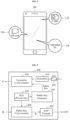
- FIG. 2 illustrates a package 200 including a chip corresponding to the HW OTP element 120 and a chip corresponding to the SE 120 of FIG. 1 .
- the SE 210 may be used to perform a first authentication process based on a typical method.
- the package 200 may include an HW OTP element 220 having a die-chip wiring with the SE 210.
- the aforementioned configuration may guarantee a compatibility of the package 200 with an authentication process based on general technology including the SE 210.
- the package 200 may function as a chip performing the first authentication through the SW 210 similarly to a typical process when a second authentication by the HW OTP element 220 is not requested during an authentication process.
- the HW OTP element 220 may be included in a chip as a package, thereby minimizing a complexity in the manufacturing process.
- the HW OTP element 220 may not directly display the generated OTP to be viewed by the user based on a scheme used by the typical OTP providing apparatus, and may transfer the generated OTP to the SE 210 such that the second authentication is performed seamlessly.
- the SE 210 may also safely encrypt the OTP received from the HW OTP element 220 and transfer the encrypted OTP externally.
- the HW OTP element 220 may display the generated OTP to be viewed by the user based on a different scheme.
- FIG. 3 is a diagram illustrating various examples to which an authentication apparatus of FIG. 1 is applied.
- the 2-Factor authentication apparatus 100 of FIG. 1 and the package 200 of FIG. 2 may be included in a various types of products.
- an SE may be included in a universal subscriber identity module (USIM) or a secure digital (SD) card.
- the 2-factor authentication apparatus 100 or the package 200 may be included in a USIM 310 or an SD card 320.
- the 2-factor authentication apparatus 100 or the package 200 may be provided in a form of an embedded secure element 330 included in an information and communications terminal 300 in manufacturing of the information and communications terminal 300, for example, a smartphone.
- an HW OTP providing apparatus 400 may correspond to the aforementioned HW OTP element, for example, the HW OTP element 120 and the HW OTP element 220.
- the HW OTP providing apparatus may be an OTP providing apparatus implemented through hardware irrespective of a 2-factor authentication.
- HW OTP providing apparatus 400 will be provided based on an example in which the HW OTP providing apparatus is an OTP element included in a 2-factor authentication apparatus or an example in which the HW OTP providing apparatus is a separate OTP providing apparatus. However, it is apparent that one of the examples is not excluded from this disclosure.
- the HW OTP providing apparatus 400 may include a first PUF 430 to generate a private key such that a public key-private key based encryption and decryption is to be performed with an external CA.
- the HW OTP providing apparatus 400 may also be referred to as, for example, the apparatus 400.
- the HW OTP providing apparatus 400 may include a second PUF to generate a unique PIN for identifying the 400.
- the first PUF 430 may also be referred to as, for example, "PUF(private key)”.
- the second PUF may also be referred to as, for example, "PUF(PIN)”.
- the HW OTP providing apparatus 400 may include a blocker 420.
- the blocker 420 may function as a route through which a unique PIN for identifying the apparatus 400 is safely extracted before the apparatus 400 is distributed and/or utilized.
- the blocker 420 may be configured to physically block a PIN extraction route, for example, PIN_out after the PIN is initially extracted in a safe state, and may be implemented using a fuse as illustrate herein.
- a public key generator 440 may generate a public key symmetric to the private key generated by the PUF(private key) based on the private key.
- a symmetric-key based encryption module 450 may generate P by encrypting the public key using the PIN generated by the PUF(PIN) 410 as a key value such that P is transmitted to the external CA.
- P may be transmitted through the SE 110.
- the external CA may transmit Q obtained by encrypting a random number, R corresponding to a challenge to the apparatus 400.
- Q obtained by encrypting R based on a unique public key of the apparatus 400 may be demodulated using the private key.
- a demodulation module 460 may demodulate Q using the private key, thereby restoring R corresponding to the challenge.
- An OTP generator 470 may generate an OTP based on R.
- the external CA may perform the OTP authentication process by verifying whether the received OTP matches an OTP generated by the external CA based on R.
- FIG. 5 is a flowchart illustrating a process of initially extracting a PIN in an HW OTP providing apparatus according to an example embodiment.
- a serial number, SN, of a device 501 may be assigned to the device 501 in a factory 502 for manufacturing the device 501.
- the device 501 may include PUF(PIN).
- a PIN generated by the PUF(PIN) may be initially extracted and provided to the factory 502 with SN.
- the blocker for example, the fuse, as described with reference to FIG. 4 may be physically shorted to block PIN_out.
- the factory 502 may provide SN and PIN to a CA 503 through a safe process.
- the CA 503 may manage SN and PIN through a matching.
- the CA 503 may perform the process performed in the factory 502 when SN ⁇ PIN is to be transmitted to the CA 503 with an increased safety.
- the factory 502 and the CA 503 may perform at least a portion of function of one another and thus, repeated descriptions will be omitted.
- FIG. 6 is a flowchart illustrating a process of exchanging a public key between an HW OTP providing apparatus and a CA according to an example embodiment.
- Public key exchanging process may be performed between a device 601 and a CA 602 in advance of an OTP authentication.
- the CA 602 may send a request for a public key PUB_KEY D to the device 601.
- the device 601 may generate P by encrypting SN and the public key PUB_KEY D based on a symmetric-key based encryption scheme using a PIN of the device 601.
- P may be transmitted to the CA 602.
- the CA 602 may demodulate P using the PIN of the device 601 previously acquired in operation 540 of FIG. 5 .
- verification on SN may be performed.
- the public key PUB_KEY D may be registered to be used in a subsequent OTP authentication process.
- a private key of the device 601 may not be extracted by the CA 602. Also, since the private key of the device 601 is not externally exposed in any case, only the device 601 may be allowed to demodulate data encrypted using the public key PUB_KEY D .
- a self-replication of the device 601 based on the PUF may be impossible.
- a device 691 other than the public key PUB_KEY D for example, a device pretending to function as the device 601 may demodulate the data encrypted using the public key PUB_KEY D .
- the CA 602 may not responsible for a payment transaction in which the encrypted data is successfully demodulated using the public key PUB_KEY D of the device 601.
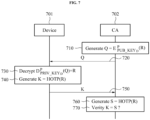
- FIG. 7 is a flowchart illustrating a process of generating an OTP in an HW OTP providing apparatus and authenticating the generated OTP in a CA according to an example embodiment.
- the CA 702 may generate a random number, R corresponding to a challenge in a challenge-response scheme, and generate Q by encrypting R using a public key PUB_KEY D of the device 701.
- the CA 702 may transmit Q to the device 701.
- the device 701 may restore Q by demodulating Q using a private key PRIV_KEY D of the device 701.
- the device 701 may generate an OTP K using a predetermined method by providing R to an OTP generation module, for example, a module based on a hash type OTP generation algorithm processing.
- the generated OTP K may be provided to the CA 702.
- the OTP K may be provided through an encryption based on a safe scheme.
- the OTP K may be provided by encrypting an OTP using the public key PUB_KEY CA .
- the SE 110 may provide K generated by the HW OTP element 120 to the CA 702 based on an encryption scheme of the SE 110.
- the CA 702 may generate an OTP value, S by using R based on the same scheme as that of the device 701.
- the CA 702 may verify whether S generated by the CA 702 is the same as K provided from the device 701, thereby performing an OTP authentication process.
- FIG. 8 illustrates an example of comparison between an authentication process of a 2-factor authentication apparatus and a general authentication process according to an example embodiment.
- a terminal and/or user authentication may be performed by only an SE 810 based on a 1-factor authentication. For this reason, various secure risks, for example, a certificate authentication file leakage, illegal re-issue of certificate authentications, a password leakage, screen or keyboard hacking may potentially exist.
- OTP authentication is performed separately from the SE 810, an OTP device may be implemented through software and thus, hacking risks may exist. Alternatively, since a key and data used in OTP generation are recorded in a storage medium, risks of OTP replication may also exist.
- a secure attack may not affect a 2-factor authentication.
- a high level of authentication reliability may be provided to commercial/financial transaction subjects and a TSM 830 managing future electronic commercial or financial transactions.
- FIG. 9 illustrates an example of an HW OTP authentication process according to an example embodiment.
- a user/terminal authentication performed by an HW OTP 910 may not be based on a successful authentication performed by the SE 810 using a typical scheme described with reference to FIG. 8 .
- an authentication process may be performed at a high level through an OTP authentication of the HW OTP 910 included in a terminal 900 and an external institute.
- the authentication may be performed by only the HW OTP when a subject of electronic commerce/financial transaction or a TSM requires an authentication of the HW OTP 910.
- the TSM may authenticate the terminal 900 by verifying the OTP.
- example embodiments are not limited to an example of the 2-factor authentication.
- FIG. 10 illustrates an example of safety of an HW OTP authentication according to an example embodiment.
- a probability that an authentication number provided to a terminal 1000 is extorted through a hacking may be present in an authentication process based on an authentication number, for example, a one-time authentication number including four or six digits, commonly used in a small sum payment in general.
- a hacking tool or a malignant code may be installed in the terminal 1000 to extort the authentication number through, for example, a screen hacking and a key input hacking.
- the extorted authentication number may be used in an authentication process performed in another terminal 1001.
- replication of an HW OTP 1010 may be impossible. Also, a proper OTP value may be generated only in the terminal 1000 including the HW OTP 1010 and thus, a high security level may be ensured.
- the OTP value generated by the HW OTP 1010 is not output through, for example, a display of the terminal 100 and seamlessly transmitted to a certificate authority through a safe encryption, the authentication process may not be affected by the screen hacking and the key input hacking. In this example, an individual may not recognize the generated OTP value during the authentication process.
- the aforementioned typical authentication based on a common authentication number and the authentication using the HW OTP 1010 may be performed simultaneously.
- a user may recognize a scheme using the authentication number and may not recognize the OTP authentication process. Accordingly, a user convenience may be improved and the user may be aware of a trivial difference when compared to the typical authentication process.
- FIG. 11 illustrates another example of safety of an HW OTP authentication according to an example embodiment.
- An authentication process of an HW OTP 1110 may be used in transactions such as a financial trade and an electronic payment, and an account login process of a website or a cloud service.
- an authentication may be performed in a terminal 1100 using the HW OTP 1110 in addition to and/or alternatively to a typical account information authentication based on, for example, e-mail, account identification (ID), password input.
- a typical account information authentication based on, for example, e-mail, account identification (ID), password input.
- ID account identification
- an account access of the terminal 1111 may not be allowed.
- the foregoing example may be based on a case in which the terminal 1111 may not be allowed to perform the OTP authentication since the replication of the HW OTP 1110 is impossible.
- FIG. 12 illustrates an example of a method of applying an HW OTP authentication to a digital rights management (DRM) according to an example embodiment.
- DRM digital rights management
- An HW OTP authentication according to example embodiments may also be applied to a contents copyright management such as a DRM in an online contents trade.
- a device 1201 of a reliable certificate authority such as a TSM may provide an HW OTP public key of a device 1203 when contents transmission is to be performed between a digital contents provider 1202 and the device 1203.
- a reliable certificate authority such as a TSM may provide an HW OTP public key of a device 1203 when contents transmission is to be performed between a digital contents provider 1202 and the device 1203.
- the foregoing example may be based on a case in which the public key is used in data or information encryption and there is no probability that may be disguised as the terminal 1203 when a private key for demodulation is absent.
- contents related to the DRM may need to be encrypted and decrypted.
- a secret key scheme may be used for efficiency of encryption and decryption.
- the digital contents provider 1202 may encrypt the contents based on a random number R, and transmit the random number R used to decrypt the encrypted contents based on the public key in operation 1220.
- only the private key of the terminal 1203 may be allowed to decrypt the random number R used by the digital contents provider 1220 for the contents DRM.
- the secret key may be restored to decrypt the contents in the terminal 1203.
- FIG. 13 illustrates an example of a time synchronization based HW OTP providing apparatus according to an example embodiment.
- an apparatus 1300 for generating an OTP through hardware based on a PUF may generate an OTP through an update performed by receiving an initial time value based on a time synchronization scheme.
- a time information updater 1310 may update the initial time value at a predetermined time interval, for example, at an interval of one minute, and provide the updated initial time value to an OTP generator 1340.
- the OTP generator 1340 may provide an OTP by generating the OTP based on the time information and a unique PIN of the apparatus 1300 provided from PUF(PIN) 1320.
- a blocker 1330 may physically block the PIN from the external source.
- FIG. 14 is a flowchart illustrating a process of initially extracting a PIN from the HW OTP 1300 of FIG. 13 .
- time synchronization information for example, an initial time value, and a serial number, SN of a device 1401 may be assigned to the device 1401 in a factory 1402 for manufacturing the device 1401.
- the device 1401 may provide SN and a unique PIN provided from PUF(PIN) to the factory 1402. After an initial extraction, PIN_out may be blocked in operation 1430.
- the factory 1402 may provide SN and PIN to a CA 1403 through a safe process.
- the CA 1403 may manage SN and PIN through a matching so as to use SN and PIN in a subsequent OTP authentication performed on the device 1401 based on the time synchronization scheme.
- the CA 1403 may perform the process performed in the factory 1402 when SN ⁇ PIN is to be transmitted to the CA 1403 with an increased safety.
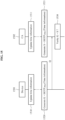
- FIG. 15 is a flowchart illustrating a process of generating an OTP in an HW OTP providing apparatus of FIG. 13 and authenticating the generated OTP in a CA.
- Each of a device 1501 and a CA 1502 may update synchronized time information through operations 1510 and 1511.
- the device 1510 may generate an OTP K based on the updated time information and a PIN of the device 1501. Thereafter, K may be safely encrypted as Q to be transferred to the CA 1502, and then decrypted to be K again.
- the CA 1502 may perform verification through a comparison between K and S autonomously generated based on the time information and the PIN of the device 1501 in operation 1521, thereby performing an OTP-based authentication on the device 1501.
Landscapes
- Engineering & Computer Science (AREA)
- Computer Security & Cryptography (AREA)
- Computer Networks & Wireless Communication (AREA)
- Signal Processing (AREA)
- Theoretical Computer Science (AREA)
- Physics & Mathematics (AREA)
- General Physics & Mathematics (AREA)
- Health & Medical Sciences (AREA)
- Software Systems (AREA)
- Computer Hardware Design (AREA)
- General Engineering & Computer Science (AREA)
- General Health & Medical Sciences (AREA)
- Bioethics (AREA)
- Computing Systems (AREA)
- Storage Device Security (AREA)
- Financial Or Insurance-Related Operations Such As Payment And Settlement (AREA)
Claims (7)
- Authentifizierungsvorrichtung (100), mit:einem sicheren Element (110) zum Ausführen eines ersten Authentifizierungsprozesses; undeinem Einmal-Passwort-, OTP, Element (120) mit einer physikalisch nicht klonbaren Funktion, PUF, zum Erzeugen eines OTP und zum Ausführen eines mit einem OTP-Übermittlungsprozess in Beziehung stehenden zweiten Authentifizierungsprozesses,wobei das OTP-Element (120) einen privaten Schlüssel (PRIV_KEYD), der unter Verwendung der PUF erzeugt wird, und einen öffentlichen Schlüssel (PUB_KEYD) aufweist, der entsprechend und basierend auf dem privaten Schlüssel (PRIV_KEYD) generiert wird,wobei der erste und der zweite Authentifizierungsprozess Prozesse einer Zwei-Faktor-Authentifizierung sind,wobei das OTP-Element (120) dazu eingerichtet ist, das OTP extern über eine Eingabe- und Ausgabeschnittstelle des sicheren Elements (110) zu übertragen, und dazu eingerichtet ist, in Antwort auf den zweiten Authentifizierungsprozess, wenn eine Zufallszahl (R), die unter Verwendung des öffentlichen Schlüssels (PUB_KEYD) des OTP-Elements (120) verschlüsselt wurde, von einer Zertifizierungsstelle (503) empfangen wird, die Zufallszahl (R) unter Verwendung des privaten Schlüssels (PRIV_KEYD) zu entschlüsseln und das OTP unter Verwendung der entschlüsselten Zufallszahl (R) zu erzeugen,wobei das OTP-Element (120) einen Blocker (420) aufweist, der dazu eingerichtet ist, eine erneute Extraktion einer PUF-PIN physisch zu blockieren, die durch das OTP-Element (120) verwendet wird, um den öffentlichen Schlüssel (PUB_KEYD) zu verschlüsseln, nachdem eine PUF-PIN extrahiert wurde und bevor die Authentifizierungsvorrichtung (100) den zweiten Authentifizierungsprozess ausführt,wobei der öffentliche Schlüssel (PUB_KEYD) vor dem Authentifizierungsprozess zwischen der Authentifizierungsvorrichtung (100) und der Zertifizierungsstelle (503) ausgetauscht worden ist, undwobei das sichere Element nur einen einzigen Zugriff auf das OTP-Element (120) bereitstellt, um einen externen Zugriff auf das OTP-Element (120) zu verhindern.
- Vorrichtung nach Anspruch 1, wobei das OTP-Element (120) auf einem Chip getrennt vom sicheren Element (110) angeordnet ist, um eine Die-Chip-Verdrahtung mit dem sicheren Element zu erhalten.
- Vorrichtung nach Anspruch 1, wobei die Authentifizierungsvorrichtung (100) in mindestens einer Komponente unter einem Teilnehmeridentifizierungsmodul, SIM, einem Speichermedium und einem internen Chip eines Endgerätes implementiert ist und das sichere Element (110) einen Sicherheitsspeicher zum Speichern mindestens eines mit der ersten Authentifizierung in Beziehung stehenden Sicherheitsinformationselements bereitstellt.
- Vorrichtung nach Anspruch 3, wobei die Sicherheitsinformation mindestens ein Element unter einem Authentifizierungszertifikat, einem Passwort und Teilnehmeridentifizierungsinformation aufweist.
- Vorrichtung nach Anspruch 1, wobei die zweite Authentifizierung mit einer Übermittlung des OTP in Beziehung steht, das von mindestens einer Instanz unter einem Trusted Service Manager, TSM, einem Mobilfunknetzbetreiber, MNO, einem Content Provider und einem Dienstanbieter angefordert wird.
- Vorrichtung nach Anspruch 1, wobei eine erste Authentifizierung und/oder eine zweite Authentifizierung in Verbindung mit mindestens einer Eingabe unter mobiler Kreditkartenzahlung, elektronischem Walletpayment, mobilem Banking, In-App Store Purchase Payment, Content Purchase Payment, Website-Login und Cloud-Computing-Service-Login ausgeführt wird.
- Authentifizierungsverfahren, mit den Schritten:Übertragen einer OTP-Bereitstellungsanforderung vom sicheren Element (110) an ein OTP-Element (120), das eine physikalisch nicht klonbare Funktion, PUF, aufweist, in Antwort auf die Einmal-Passwort-, OTP, Bereitstellungsanforderung für einen zweiten Authentifizierungsprozess, der sich von einem durch ein sicheres Element (110) ausgeführten ersten Authentifizierungsprozess unterscheidet;Erzeugen eines privaten Schlüssels (PRIV_KEYD) durch das OTP-Element (120) unter Verwendung der PUF und eines dem privaten Schlüssel (PRIV_KEYD) entsprechenden und darauf basierenden öffentlichen Schlüssels (PUB_KEYD);Entschlüsseln einer Zufallszahl (R), die von einer Zertifizierungsstelle (503) in Antwort auf die OTP-Bereitstellungsanforderung empfangen und unter Verwendung des öffentlichen Schlüssels (PUB_KEYD) verschlüsselt wurde, durch das OTP-Element (120) und unter Verwendung des privaten Schlüssels (PRIV_KEYD);Erzeugen eines OTP unter Verwendung des privaten Schlüssels (PRIV_KEYD) und der entschlüsselten Zufallszahl durch das OTP-Element (120) und Übertragen des OTP an das sichere Element (110); undexternes Bereitstellen des OTP über eine Eingabe- und Ausgabeschnittstelle des sicheren Elements (110) durch das sichere Element (110),wobei der erste und der zweite Authentifizierungsprozess Prozesse einer 2-Faktor-Authentifizierung sind,wobei eine Schnittstelle, über die eine PUF-PIN, die durch das OTP-Element (120) verwendet wird, um den öffentlichen Schlüssel (PUB_KEYD) zu verschlüsseln, extern offengelegt wird und nach einer Extraktion der PUF-PIN und vor einer Ausführung des zweiten Authentifizierungsprozesses physisch blockiert wird,wobei der öffentliche Schlüssel (PUB_KEYD) vor dem Authentifizierungsprozess zwischen der Authentifizierungsvorrichtung (100) und der Zertifizierungsstelle (503) ausgetauscht worden ist, undwobei das sichere Element (110) nur einen einzigen Zugriff auf das OTP-Element (120) bereitstellt, um einen externen Zugriff auf das OTP-Element (120) zu verhindern.
Applications Claiming Priority (3)
| Application Number | Priority Date | Filing Date | Title |
|---|---|---|---|
| KR20130043954A KR20140126787A (ko) | 2013-04-22 | 2013-04-22 | PUF 기반 하드웨어 OTP 제공 장치 및 이를 이용한 2-Factor 인증 방법 |
| PCT/KR2014/000454 WO2014175538A1 (ko) | 2013-04-22 | 2014-01-16 | Puf 기반 하드웨어 otp 제공 장치 및 이를 이용한 2-factor 인증 방법 |
| EP14789085.9A EP2991267B1 (de) | 2013-04-22 | 2014-01-16 | Vorrichtung zur bereitstellung von puf-basiertem hardware-otp und verfahren zur authentifizierung von 2-faktor damit |
Related Parent Applications (2)
| Application Number | Title | Priority Date | Filing Date |
|---|---|---|---|
| EP14789085.9A Division-Into EP2991267B1 (de) | 2013-04-22 | 2014-01-16 | Vorrichtung zur bereitstellung von puf-basiertem hardware-otp und verfahren zur authentifizierung von 2-faktor damit |
| EP14789085.9A Division EP2991267B1 (de) | 2013-04-22 | 2014-01-16 | Vorrichtung zur bereitstellung von puf-basiertem hardware-otp und verfahren zur authentifizierung von 2-faktor damit |
Publications (2)
| Publication Number | Publication Date |
|---|---|
| EP3598696A1 EP3598696A1 (de) | 2020-01-22 |
| EP3598696B1 true EP3598696B1 (de) | 2025-03-05 |
Family
ID=51792070
Family Applications (2)
| Application Number | Title | Priority Date | Filing Date |
|---|---|---|---|
| EP19196588.8A Active EP3598696B1 (de) | 2013-04-22 | 2014-01-16 | Vorrichtung zur bereitstellung von puf-basiertem hardware-otp und verfahren zur authentifizierung von 2-faktor damit |
| EP14789085.9A Active EP2991267B1 (de) | 2013-04-22 | 2014-01-16 | Vorrichtung zur bereitstellung von puf-basiertem hardware-otp und verfahren zur authentifizierung von 2-faktor damit |
Family Applications After (1)
| Application Number | Title | Priority Date | Filing Date |
|---|---|---|---|
| EP14789085.9A Active EP2991267B1 (de) | 2013-04-22 | 2014-01-16 | Vorrichtung zur bereitstellung von puf-basiertem hardware-otp und verfahren zur authentifizierung von 2-faktor damit |
Country Status (4)
| Country | Link |
|---|---|
| US (1) | US9876647B2 (de) |
| EP (2) | EP3598696B1 (de) |
| KR (1) | KR20140126787A (de) |
| WO (1) | WO2014175538A1 (de) |
Families Citing this family (38)
| Publication number | Priority date | Publication date | Assignee | Title |
|---|---|---|---|---|
| WO2015012667A1 (ko) | 2013-07-26 | 2015-01-29 | (주) 아이씨티케이 | 랜덤성 테스트 장치 및 방법 |
| CN106575324A (zh) * | 2014-04-09 | 2017-04-19 | 有限公司Ictk | 认证设备及方法 |
| KR101637272B1 (ko) | 2014-09-23 | 2016-07-07 | 현대자동차 주식회사 | 차량용 자동변속기의 유성기어트레인 |
| CN107690667A (zh) * | 2015-06-08 | 2018-02-13 | 亿贝韩国有限公司 | 使用用户终端的用于用户不可否认性的支付系统及其方法 |
| FR3038416B1 (fr) * | 2015-06-30 | 2017-07-21 | Maxim Integrated Products | Dispositifs et procedes d'authentification bases sur des fonctions physiquement non clonables |
| US20170126414A1 (en) * | 2015-10-28 | 2017-05-04 | Texas Instruments Incorporated | Database-less authentication with physically unclonable functions |
| WO2017077611A1 (ja) * | 2015-11-05 | 2017-05-11 | 三菱電機株式会社 | セキュリティ装置、及びセキュリティ方法 |
| US11257085B1 (en) * | 2015-12-11 | 2022-02-22 | Wells Fargo Bank, N.A | Systems and methods for authentication device-assisted transactions |
| US10630490B2 (en) * | 2016-02-26 | 2020-04-21 | Apple Inc. | Obtaining and using time information on a secure element (SE) |
| US10680833B2 (en) | 2016-02-26 | 2020-06-09 | Apple Inc. | Obtaining and using time information on a secure element (SE) |
| SE540649C2 (en) * | 2016-04-08 | 2018-10-09 | Authentico Tech Ab | Method and system for secure password storage |
| US10541994B2 (en) * | 2016-04-22 | 2020-01-21 | Dell Products, L.P. | Time based local authentication in an information handling system utilizing asymmetric cryptography |
| US10523443B1 (en) * | 2016-08-24 | 2019-12-31 | Bruce Kleinman | Devices, methods, and systems for cryptographic authentication and provenance of physical assets |
| JP6471130B2 (ja) * | 2016-09-20 | 2019-02-13 | ウィンボンド エレクトロニクス コーポレーション | 半導体装置およびセキュリティシステム |
| US11095461B2 (en) | 2016-11-04 | 2021-08-17 | Stc.Unm | System and methods for entropy and statistical quality metrics in physical unclonable function generated bitstrings |
| KR102665997B1 (ko) * | 2016-12-20 | 2024-05-13 | 에스케이하이닉스 주식회사 | 패킷을 부호화하는 장치 및 이를 포함하는 메모리 네트워크에서의 라우팅 방법 |
| US10880085B1 (en) * | 2017-08-03 | 2020-12-29 | The University Of Tulsa | Device, system, and method to facilitate secure data transmission, storage and key management |
| KR101953223B1 (ko) | 2017-09-01 | 2019-02-28 | (주) 시큐어가드테크놀러지 | 생체정보를 활용하는 2-요소 인증 방식의 로그인 방법 및 이를 적용한 컴퓨터로 읽을 수 있는 저장매체 |
| CN108092776B (zh) * | 2017-12-04 | 2020-11-10 | 南京南瑞信息通信科技有限公司 | 一种基于身份认证服务器和身份认证令牌的系统 |
| KR102172693B1 (ko) * | 2018-06-04 | 2020-11-02 | 차보영 | 양자암호키 4차 행렬 해시함수 블럭체인 스마트 그리드 배전반 제어시스템 감시 cctv 방재 감시카메라 |
| KR102172688B1 (ko) * | 2018-06-04 | 2020-11-02 | 차보영 | 양자난수 및 의사난수를 결합한 다차원 행렬 해시함수 블럭체인 스마트 블럭 배전반 제어시스템 |
| KR102350680B1 (ko) * | 2018-06-04 | 2022-01-12 | 채령 | 양자난수 및 의사난수를 결합한 다차원 행렬 해시함수 블럭체인(스마트 블럭 배전반, TTS 동보 방송장치, 구내 영상음성 방송장치, 암호화 영상저장 CCTV 감시장치, NB-IoT 고장감시 블랙박스형 CCTV 감시장치, 블럭체인 미터링 태양광 발전장치, 디밍제어 LED 가로등, 태양광 발전판넬 및 LED 전광판 열화감시 CCTV 열화상 감시카메라 영상처리장치, 차량번호 암호화 주차관제장치) 제어시스템 및 제어시스템 조기화재 감시 CCTV 감시카메라 |
| US11575517B2 (en) * | 2019-05-02 | 2023-02-07 | Ares Technologies, Inc. | Methods and systems for utilizing hardware-secured receptacle devices |
| US11101990B2 (en) * | 2019-08-19 | 2021-08-24 | Lenovo (Singapore) Pte. Ltd. | Default account authentication |
| US11456867B2 (en) * | 2019-10-25 | 2022-09-27 | International Business Machines Corporation | Trust-anchoring of cryptographic objects |
| KR102501379B1 (ko) * | 2019-11-30 | 2023-02-21 | 채령 | 양자난수 및 의사난수를 결합한 다차원 행렬 해시함수 블록체인 디밍제어 led 가로등 제어시스템 |
| KR102501385B1 (ko) * | 2019-11-30 | 2023-02-21 | 채령 | 다차원 행렬 해시함수 블록체인 차량번호 암호화 주차관제장치 |
| KR102501367B1 (ko) * | 2019-11-30 | 2023-02-17 | 채령 | 양자난수 및 의사난수를 결합한 다차원 행렬 해시함수 블록체인 NB-IoT 고장감시 블랙박스형 CCTV 감시장치 제어시스템 |
| KR102501383B1 (ko) * | 2019-11-30 | 2023-02-21 | 채령 | 양자난수 및 의사난수를 결합한 태양광 발전판넬 열화감시 제어시스템 |
| KR102501373B1 (ko) * | 2019-11-30 | 2023-02-21 | 채령 | 양자난수 및 의사난수를 결합한 다차원 행렬 해시함수 블럭체인 미터링 태양광 발전장치 제어시스템 |
| US12184795B2 (en) * | 2020-06-26 | 2024-12-31 | Taiwan Semiconductor Manufacturing Company, Ltd. | PUF method and structure |
| EP4020433A1 (de) * | 2020-12-23 | 2022-06-29 | Thales DIS France SA | Verfahren, chip und system zur verwaltung eines physisch unklonbaren öffentlichen funktionschipschlüssels |
| US12615142B2 (en) * | 2021-02-03 | 2026-04-28 | Gwangju Institute Of Science And Technology | PUF ID and PUF ID reader |
| US12581957B2 (en) * | 2021-04-19 | 2026-03-17 | Raytheon Company | Anti-counterfeiting fingerprint |
| EP4327504A1 (de) | 2021-04-23 | 2024-02-28 | Telefonaktiebolaget LM Ericsson (publ) | Sichere entfernbare hardware mit puf |
| GB202107886D0 (en) * | 2021-06-02 | 2021-07-14 | Nordic Semiconductor Asa | Device identity keys |
| CN115694905A (zh) * | 2022-09-29 | 2023-02-03 | 清华珠三角研究院 | 一种基于物理不可克隆硬件的标识认证方法及系统 |
| WO2024188464A1 (en) * | 2023-03-16 | 2024-09-19 | Huawei Technologies Co., Ltd. | Random number and hardware value in a secure electronic system |
Family Cites Families (6)
| Publication number | Priority date | Publication date | Assignee | Title |
|---|---|---|---|---|
| KR20080009242A (ko) * | 2008-01-15 | 2008-01-25 | 주식회사 싸이클롭스 | 이동통신 단말기를 이용하는 직불결제 서비스 시스템 |
| KR101139630B1 (ko) | 2010-12-09 | 2012-05-30 | 한양대학교 산학협력단 | 식별키 생성 장치 및 방법 |
| US9105432B2 (en) * | 2011-03-31 | 2015-08-11 | Ictk Co., Ltd | Apparatus and method for generating digital value |
| US8478990B2 (en) * | 2011-06-02 | 2013-07-02 | Cryptite LLC | Mobile transaction methods and devices with three-dimensional colorgram tokens |
| EP2747335B1 (de) * | 2011-08-16 | 2017-01-11 | ICTK Co., Ltd. | Vorrichtung und verfahren für puf-basierte sicherheitsauthentifizierung zwischen geräten in der maschine-maschine-kommunikation |
| US10033814B2 (en) * | 2013-10-08 | 2018-07-24 | Ictk Holdings Co., Ltd. | Vehicle security network device and design method therefor |
-
2013
- 2013-04-22 KR KR20130043954A patent/KR20140126787A/ko not_active Ceased
-
2014
- 2014-01-16 EP EP19196588.8A patent/EP3598696B1/de active Active
- 2014-01-16 EP EP14789085.9A patent/EP2991267B1/de active Active
- 2014-01-16 US US14/786,079 patent/US9876647B2/en active Active
- 2014-01-16 WO PCT/KR2014/000454 patent/WO2014175538A1/ko not_active Ceased
Also Published As
| Publication number | Publication date |
|---|---|
| KR20140126787A (ko) | 2014-11-03 |
| EP2991267B1 (de) | 2019-10-23 |
| EP2991267A1 (de) | 2016-03-02 |
| WO2014175538A1 (ko) | 2014-10-30 |
| US20160065378A1 (en) | 2016-03-03 |
| EP3598696A1 (de) | 2020-01-22 |
| EP2991267A4 (de) | 2016-12-21 |
| US9876647B2 (en) | 2018-01-23 |
Similar Documents
| Publication | Publication Date | Title |
|---|---|---|
| EP3598696B1 (de) | Vorrichtung zur bereitstellung von puf-basiertem hardware-otp und verfahren zur authentifizierung von 2-faktor damit | |
| US11258777B2 (en) | Method for carrying out a two-factor authentication | |
| CN111756533B (zh) | 用于安全密码生成的系统、方法和存储介质 | |
| CA2838763C (en) | Credential authentication methods and systems | |
| CN101350723B (zh) | 一种USB Key设备及其实现验证的方法 | |
| CN101312453B (zh) | 用户终端及其登录网络服务系统的方法 | |
| CN112260826A (zh) | 用于安全凭证供应的方法 | |
| US10263782B2 (en) | Soft-token authentication system | |
| CN107920052B (zh) | 一种加密方法及智能装置 | |
| CN101483654A (zh) | 实现认证及数据安全传输的方法及系统 | |
| CN103546289A (zh) | 一种基于USBKey的安全传输数据的方法及系统 | |
| CN113592484B (zh) | 一种账户的开立方法、系统及装置 | |
| CN103916363A (zh) | 加密机的通讯安全管理方法和系统 | |
| CN121532764A (zh) | 用于增强登录移动应用的安全性的系统和方法 | |
| WO2025085258A1 (en) | Systems and methods for automatically locking a contactless card | |
| CN115455497A (zh) | 一种计算机硬盘数据加密系统及方法 | |
| TWI476629B (zh) | Data security and security systems and methods | |
| BE1024812A1 (nl) | Een beveilingingsbenadering voor de opslag van credentials voor offline gebruik en tegen kopiëren beveiligde kluisinhoud in apparaten | |
| CN107548542A (zh) | 经强化完整性及安全性的用户认证方法 | |
| US20060053288A1 (en) | Interface method and device for the on-line exchange of content data in a secure manner | |
| WO2018114574A1 (en) | Method for secure management of secrets in a hierarchical multi-tenant environment | |
| CN104320261B (zh) | 金融智能卡上实现身份认证的方法、金融智能卡和终端 | |
| KR101947408B1 (ko) | PUF 기반 하드웨어 OTP 제공 장치 및 이를 이용한 2-Factor 인증 방법 | |
| CN115988495A (zh) | 一种适用于移动通信的商用密码安全身份验证方法 | |
| KR20190002388A (ko) | PUF 기반 하드웨어 OTP 제공 장치 및 이를 이용한 2-Factor 인증 방법 |
Legal Events
| Date | Code | Title | Description |
|---|---|---|---|
| PUAI | Public reference made under article 153(3) epc to a published international application that has entered the european phase |
Free format text: ORIGINAL CODE: 0009012 |
|
| STAA | Information on the status of an ep patent application or granted ep patent |
Free format text: STATUS: THE APPLICATION HAS BEEN PUBLISHED |
|
| AC | Divisional application: reference to earlier application |
Ref document number: 2991267 Country of ref document: EP Kind code of ref document: P |
|
| AK | Designated contracting states |
Kind code of ref document: A1 Designated state(s): AL AT BE BG CH CY CZ DE DK EE ES FI FR GB GR HR HU IE IS IT LI LT LU LV MC MK MT NL NO PL PT RO RS SE SI SK SM TR |
|
| STAA | Information on the status of an ep patent application or granted ep patent |
Free format text: STATUS: REQUEST FOR EXAMINATION WAS MADE |
|
| 17P | Request for examination filed |
Effective date: 20200722 |
|
| RBV | Designated contracting states (corrected) |
Designated state(s): AL AT BE BG CH CY CZ DE DK EE ES FI FR GB GR HR HU IE IS IT LI LT LU LV MC MK MT NL NO PL PT RO RS SE SI SK SM TR |
|
| STAA | Information on the status of an ep patent application or granted ep patent |
Free format text: STATUS: EXAMINATION IS IN PROGRESS |
|
| 17Q | First examination report despatched |
Effective date: 20210412 |
|
| GRAP | Despatch of communication of intention to grant a patent |
Free format text: ORIGINAL CODE: EPIDOSNIGR1 |
|
| STAA | Information on the status of an ep patent application or granted ep patent |
Free format text: STATUS: GRANT OF PATENT IS INTENDED |
|
| INTG | Intention to grant announced |
Effective date: 20241014 |
|
| GRAS | Grant fee paid |
Free format text: ORIGINAL CODE: EPIDOSNIGR3 |
|
| GRAA | (expected) grant |
Free format text: ORIGINAL CODE: 0009210 |
|
| STAA | Information on the status of an ep patent application or granted ep patent |
Free format text: STATUS: THE PATENT HAS BEEN GRANTED |
|
| AC | Divisional application: reference to earlier application |
Ref document number: 2991267 Country of ref document: EP Kind code of ref document: P |
|
| AK | Designated contracting states |
Kind code of ref document: B1 Designated state(s): AL AT BE BG CH CY CZ DE DK EE ES FI FR GB GR HR HU IE IS IT LI LT LU LV MC MK MT NL NO PL PT RO RS SE SI SK SM TR |
|
| REG | Reference to a national code |
Ref country code: GB Ref legal event code: FG4D |
|
| REG | Reference to a national code |
Ref country code: CH Ref legal event code: EP |
|
| REG | Reference to a national code |
Ref country code: IE Ref legal event code: FG4D |
|
| REG | Reference to a national code |
Ref country code: DE Ref legal event code: R096 Ref document number: 602014091658 Country of ref document: DE |
|
| P01 | Opt-out of the competence of the unified patent court (upc) registered |
Free format text: CASE NUMBER: APP_12065/2025 Effective date: 20250312 |
|
| PG25 | Lapsed in a contracting state [announced via postgrant information from national office to epo] |
Ref country code: RS Free format text: LAPSE BECAUSE OF FAILURE TO SUBMIT A TRANSLATION OF THE DESCRIPTION OR TO PAY THE FEE WITHIN THE PRESCRIBED TIME-LIMIT Effective date: 20250605 |
|
| PG25 | Lapsed in a contracting state [announced via postgrant information from national office to epo] |
Ref country code: FI Free format text: LAPSE BECAUSE OF FAILURE TO SUBMIT A TRANSLATION OF THE DESCRIPTION OR TO PAY THE FEE WITHIN THE PRESCRIBED TIME-LIMIT Effective date: 20250305 |
|
| REG | Reference to a national code |
Ref country code: NL Ref legal event code: MP Effective date: 20250305 |
|
| PG25 | Lapsed in a contracting state [announced via postgrant information from national office to epo] |
Ref country code: ES Free format text: LAPSE BECAUSE OF FAILURE TO SUBMIT A TRANSLATION OF THE DESCRIPTION OR TO PAY THE FEE WITHIN THE PRESCRIBED TIME-LIMIT Effective date: 20250305 |
|
| REG | Reference to a national code |
Ref country code: LT Ref legal event code: MG9D |
|
| PG25 | Lapsed in a contracting state [announced via postgrant information from national office to epo] |
Ref country code: NO Free format text: LAPSE BECAUSE OF FAILURE TO SUBMIT A TRANSLATION OF THE DESCRIPTION OR TO PAY THE FEE WITHIN THE PRESCRIBED TIME-LIMIT Effective date: 20250605 |
|
| PG25 | Lapsed in a contracting state [announced via postgrant information from national office to epo] |
Ref country code: HR Free format text: LAPSE BECAUSE OF FAILURE TO SUBMIT A TRANSLATION OF THE DESCRIPTION OR TO PAY THE FEE WITHIN THE PRESCRIBED TIME-LIMIT Effective date: 20250305 |
|
| PG25 | Lapsed in a contracting state [announced via postgrant information from national office to epo] |
Ref country code: LV Free format text: LAPSE BECAUSE OF FAILURE TO SUBMIT A TRANSLATION OF THE DESCRIPTION OR TO PAY THE FEE WITHIN THE PRESCRIBED TIME-LIMIT Effective date: 20250305 |
|
| PG25 | Lapsed in a contracting state [announced via postgrant information from national office to epo] |
Ref country code: GR Free format text: LAPSE BECAUSE OF FAILURE TO SUBMIT A TRANSLATION OF THE DESCRIPTION OR TO PAY THE FEE WITHIN THE PRESCRIBED TIME-LIMIT Effective date: 20250606 Ref country code: BG Free format text: LAPSE BECAUSE OF FAILURE TO SUBMIT A TRANSLATION OF THE DESCRIPTION OR TO PAY THE FEE WITHIN THE PRESCRIBED TIME-LIMIT Effective date: 20250305 |
|
| REG | Reference to a national code |
Ref country code: AT Ref legal event code: MK05 Ref document number: 1773958 Country of ref document: AT Kind code of ref document: T Effective date: 20250305 |
|
| PG25 | Lapsed in a contracting state [announced via postgrant information from national office to epo] |
Ref country code: NL Free format text: LAPSE BECAUSE OF FAILURE TO SUBMIT A TRANSLATION OF THE DESCRIPTION OR TO PAY THE FEE WITHIN THE PRESCRIBED TIME-LIMIT Effective date: 20250305 |
|
| PG25 | Lapsed in a contracting state [announced via postgrant information from national office to epo] |
Ref country code: SE Free format text: LAPSE BECAUSE OF FAILURE TO SUBMIT A TRANSLATION OF THE DESCRIPTION OR TO PAY THE FEE WITHIN THE PRESCRIBED TIME-LIMIT Effective date: 20250305 |
|
| PG25 | Lapsed in a contracting state [announced via postgrant information from national office to epo] |
Ref country code: SM Free format text: LAPSE BECAUSE OF FAILURE TO SUBMIT A TRANSLATION OF THE DESCRIPTION OR TO PAY THE FEE WITHIN THE PRESCRIBED TIME-LIMIT Effective date: 20250305 |
|
| PG25 | Lapsed in a contracting state [announced via postgrant information from national office to epo] |
Ref country code: PT Free format text: LAPSE BECAUSE OF FAILURE TO SUBMIT A TRANSLATION OF THE DESCRIPTION OR TO PAY THE FEE WITHIN THE PRESCRIBED TIME-LIMIT Effective date: 20250707 |
|
| PG25 | Lapsed in a contracting state [announced via postgrant information from national office to epo] |
Ref country code: PL Free format text: LAPSE BECAUSE OF FAILURE TO SUBMIT A TRANSLATION OF THE DESCRIPTION OR TO PAY THE FEE WITHIN THE PRESCRIBED TIME-LIMIT Effective date: 20250305 Ref country code: IT Free format text: LAPSE BECAUSE OF FAILURE TO SUBMIT A TRANSLATION OF THE DESCRIPTION OR TO PAY THE FEE WITHIN THE PRESCRIBED TIME-LIMIT Effective date: 20250305 |
|
| PG25 | Lapsed in a contracting state [announced via postgrant information from national office to epo] |
Ref country code: AT Free format text: LAPSE BECAUSE OF FAILURE TO SUBMIT A TRANSLATION OF THE DESCRIPTION OR TO PAY THE FEE WITHIN THE PRESCRIBED TIME-LIMIT Effective date: 20250305 |
|
| PG25 | Lapsed in a contracting state [announced via postgrant information from national office to epo] |
Ref country code: EE Free format text: LAPSE BECAUSE OF FAILURE TO SUBMIT A TRANSLATION OF THE DESCRIPTION OR TO PAY THE FEE WITHIN THE PRESCRIBED TIME-LIMIT Effective date: 20250305 Ref country code: CZ Free format text: LAPSE BECAUSE OF FAILURE TO SUBMIT A TRANSLATION OF THE DESCRIPTION OR TO PAY THE FEE WITHIN THE PRESCRIBED TIME-LIMIT Effective date: 20250305 |
|
| PG25 | Lapsed in a contracting state [announced via postgrant information from national office to epo] |
Ref country code: RO Free format text: LAPSE BECAUSE OF FAILURE TO SUBMIT A TRANSLATION OF THE DESCRIPTION OR TO PAY THE FEE WITHIN THE PRESCRIBED TIME-LIMIT Effective date: 20250305 |
|
| PG25 | Lapsed in a contracting state [announced via postgrant information from national office to epo] |
Ref country code: SK Free format text: LAPSE BECAUSE OF FAILURE TO SUBMIT A TRANSLATION OF THE DESCRIPTION OR TO PAY THE FEE WITHIN THE PRESCRIBED TIME-LIMIT Effective date: 20250305 |
|
| PG25 | Lapsed in a contracting state [announced via postgrant information from national office to epo] |
Ref country code: IS Free format text: LAPSE BECAUSE OF FAILURE TO SUBMIT A TRANSLATION OF THE DESCRIPTION OR TO PAY THE FEE WITHIN THE PRESCRIBED TIME-LIMIT Effective date: 20250705 |
|
| REG | Reference to a national code |
Ref country code: DE Ref legal event code: R097 Ref document number: 602014091658 Country of ref document: DE |
|
| PGFP | Annual fee paid to national office [announced via postgrant information from national office to epo] |
Ref country code: GB Payment date: 20251222 Year of fee payment: 13 |
|
| PLBE | No opposition filed within time limit |
Free format text: ORIGINAL CODE: 0009261 |
|
| STAA | Information on the status of an ep patent application or granted ep patent |
Free format text: STATUS: NO OPPOSITION FILED WITHIN TIME LIMIT |
|
| PG25 | Lapsed in a contracting state [announced via postgrant information from national office to epo] |
Ref country code: DK Free format text: LAPSE BECAUSE OF FAILURE TO SUBMIT A TRANSLATION OF THE DESCRIPTION OR TO PAY THE FEE WITHIN THE PRESCRIBED TIME-LIMIT Effective date: 20250305 |
|
| REG | Reference to a national code |
Ref country code: CH Ref legal event code: L10 Free format text: ST27 STATUS EVENT CODE: U-0-0-L10-L00 (AS PROVIDED BY THE NATIONAL OFFICE) Effective date: 20260114 |
|
| PGFP | Annual fee paid to national office [announced via postgrant information from national office to epo] |
Ref country code: FR Payment date: 20251223 Year of fee payment: 13 |
|
| 26N | No opposition filed |
Effective date: 20251208 |
|
| PGFP | Annual fee paid to national office [announced via postgrant information from national office to epo] |
Ref country code: DE Payment date: 20251222 Year of fee payment: 13 |