EP3593641A1 - Zusammensetzung zur kontrolle von oberflächlicher bräune bei kernobst - Google Patents
Zusammensetzung zur kontrolle von oberflächlicher bräune bei kernobst Download PDFInfo
- Publication number
- EP3593641A1 EP3593641A1 EP17900213.4A EP17900213A EP3593641A1 EP 3593641 A1 EP3593641 A1 EP 3593641A1 EP 17900213 A EP17900213 A EP 17900213A EP 3593641 A1 EP3593641 A1 EP 3593641A1
- Authority
- EP
- European Patent Office
- Prior art keywords
- squalane
- composition
- fruits
- scald
- plant origin
- Prior art date
- Legal status (The legal status is an assumption and is not a legal conclusion. Google has not performed a legal analysis and makes no representation as to the accuracy of the status listed.)
- Granted
Links
Images



Classifications
-
- A—HUMAN NECESSITIES
- A23—FOODS OR FOODSTUFFS; TREATMENT THEREOF, NOT COVERED BY OTHER CLASSES
- A23B—PRESERVATION OF FOODS, FOODSTUFFS OR NON-ALCOHOLIC BEVERAGES; CHEMICAL RIPENING OF FRUIT OR VEGETABLES
- A23B7/00—Preservation of fruit or vegetables; Chemical ripening of fruit or vegetables
- A23B7/16—Coating with a protective layer; Compositions or apparatus therefor
-
- A—HUMAN NECESSITIES
- A23—FOODS OR FOODSTUFFS; TREATMENT THEREOF, NOT COVERED BY OTHER CLASSES
- A23B—PRESERVATION OF FOODS, FOODSTUFFS OR NON-ALCOHOLIC BEVERAGES; CHEMICAL RIPENING OF FRUIT OR VEGETABLES
- A23B7/00—Preservation of fruit or vegetables; Chemical ripening of fruit or vegetables
- A23B7/14—Preserving or ripening with chemicals not covered by group A23B7/08 or A23B7/10
- A23B7/153—Preserving or ripening with chemicals not covered by group A23B7/08 or A23B7/10 in the form of liquids or solids
- A23B7/154—Organic compounds; Microorganisms; Enzymes
-
- A—HUMAN NECESSITIES
- A23—FOODS OR FOODSTUFFS; TREATMENT THEREOF, NOT COVERED BY OTHER CLASSES
- A23V—INDEXING SCHEME RELATING TO FOODS, FOODSTUFFS OR NON-ALCOHOLIC BEVERAGES AND LACTIC OR PROPIONIC ACID BACTERIA USED IN FOODSTUFFS OR FOOD PREPARATION
- A23V2002/00—Food compositions, function of food ingredients or processes for food or foodstuffs
Definitions
- the present invention is related to the technical field of food industries and with products for food preservation; and particularly discloses a new composition for the preservation of pome fruits.
- the superficial scald is a physiological disorder caused by cold stress to which fruits are subjected after being harvested, as part of the storage for prolonged periods of time longer than three months. Scald is characterized for producing necrotic lesions on the skin of fruits, which appear during shelf-life after cold storage, generating dark spots that alter their outer appearance. The above causes that the product is not chosen by consumers since it is not visually appealing, losing its commercial value.
- Superficial scald is one of the most damaging physiological disorders in pome fruits of prolonged storage, since it causes irreversible damages and limits their prolonged cold storage.
- Apple varieties such as Granny Smith, Fuji and Red Delicious and pear varieties such as Packham's Triumph, Anjou and Barlett are the most affected cultivars.
- Granny Smith variety is undoubtedly the most susceptible to scald and the cultivar with the highest impairments at commercial levels ( Torres C., Hernandez O., Fuentes M. (2012). Escaldado superficial en manzanas: nuevos desaf ⁇ os. Pomáceas, Bolet ⁇ n Técnico, Volumen 12, n ⁇ mero 1 ).
- Another variety that is affected is Law Rome ( Mditshwa, A. y cols. (2016). Classification of 'Granny Smith' apples with different levels of superficial scald severity based on targeted metabolites and discriminant analysis. Journal of Applied Botany and Food Quality, 89 ).
- scald appears in two forms: superficial and senescent. In the first one, unlike in apples, harvest time does not affect the level of incidence. On the other hand, senescent scald symptomatology is similar to that of superficial scald, however it may compromise fruit flesh and is manifested in pears stored for more than 6 to 7 months in cold conditions ( Torres C., Hernández O., Fuentes M. (2012). Escaldado superficial en manzanas: nuevos desaf ⁇ os. Pomáceas, Bolet ⁇ n Técnico, Volumen 12, n ⁇ mero 1 ).
- DPA Diphenylamine
- EFSA European Food Safety Authority
- ethoxyquin Another chemical compound widely used as anti-scalding agent is ethoxyquin, which is mainly used in pears.
- health authority of European Commission in 2011 determined that data known about this substance are still insufficient to conclude that it is safe for environment and for humans. Therefore, ethoxyquin became an active compound not permitted to elaborate phytosanitary products (Commission Decision 2011/143/EU of 3 March 2011 concerning the non-inclusion of ethoxyquin in Annex I to Council Directive 91/414/EEC and amending Commission Decision 2008/941/EC) [notified with number C(2011) 1265]).
- a third chemical compound used for the treatment of superficial scald in pears is 1-methylcyclopropene (1-MCP). Even though this compound may be a substitute for DPA or ethoxyquin, its effectiveness has not been completely demonstrated, and it has the additional disadvantage of producing the complete inhibition of pear maturation after harvest during cold storage. The above keeps pears hard, preventing them from reaching the quality required to consumption ( Chiriboga Varea, M. D. L. ⁇ . (2012). Universidad de Lleida, Espa ⁇ a. Aspectos bioqu ⁇ micos del bloqueo de la madura Neue de peras 'Conference' tratadas con 1-metilciclopropeno (1-MCP) y cooperatealism de istas de control. Cap ⁇ tulo 5.1. Escaldado superficial ).
- compositions to control fruit scald whose active ingredients are terpenic compounds.
- Squalene is a triterpenic compound containing 30 carbon atoms (C 30 H 50 ) which possess an important role as a precursor of sterols and is produced by a wide range of organisms from bacteria to human beings. This compound has been used as a natural antioxidant and in pharmaceutical industry.
- the main source for obtaining squalene is from an animal origin, specifically shark liver oil, however, current concerns about environment and conservation of marine species motivate the search of new alternative sources of squalene ( Spanova, M., & Daum, G. (2011). Squalene-biochemistry, molecular biology, process biotechnology, and applications. European Journal of Lipid Science and Technology, 113(11), 1299-1320 ).
- Squalane (IUPAC name 2,6,10,15,19,23-hexamethyltetracosane) is an organic triterpenic compound with a chemical formula of C 30 H 62 that possess different properties. It is a colorless, odorless and tasteless hydrocarbonated oil having a high physical and chemical stability and an elevated resistance to chemical oxidation. Squalane is a product naturally produced in small quantities in skin and it is an important component of sebum, it helps to maintain the skin moisturised. For this reason, squalane has been extensively used as an important ingredient in cosmetic industry ( Camin, F. y cols. (2010). Stable isotope ratios of carbon and hydrogen to distinguish olive oil from shark squalene-squalane. Rapid communications in mass spectrometry, 24(12), 1810-1816 ).
- squalane is produced from catalytic hydrogenation of squalene. Since squalene in its chemical structure possess numerous double bonds between carbon atoms, when it enters in contact with air is oxidised and produces compounds with undesired properties. By contrast, squalane does not have double bonds in its chemical structure, which makes it more stable in comparison with squalene ( Brunner, G. y cols. (2009). Phase Equilibrium of Hydrogen, Carbon Dioxide, Squalene, and Squalane. Journal of Chemical & Engineering Data, 54(5), 1598-1609 ).
- Figure 1 shows the chemical structures of squalene and squalane.
- Patent US 4,921,715 describes a method to protect citric fruits from chilling injury, comprising the application of a medium containing squalene or a derived compound such as squalane (Sigma Chemical Company). Said document describes that in an experimental assay, when these compounds are applied on citric fruits they are effective in reducing chilling injury, allowing them to be stored at low temperatures for a prolonged period. Particularly, the document describes an experiment where grapefruit was sprayed with Triton X-100 supplemented with squalane 1% or squalene 0.25% and then the fruit was stored at 40°F (approximately 4.4 °C) during 3 to 5 weeks. It was found that application of these solutions to citric fruits significantly increased resistance to chilling injury.
- Patent US 5,376,391 describes a method and a composition to improve stability of fruits, vegetables or fungi, comprising at least one polysaccharide polymer, a preservant and a preservative agent and an acidifier.
- the composition may optionally include an agent used for prevent from chilling injury, such as squalene.
- the present invention provides a composition for the control of scald in pome fruits, comprising squalane of plant origin and an appropriate vehicle.
- pome fruits are apples and pears.
- the squalane of plant origin has a concentration in a range between 0.1-100% v/v, which is obtained from olive oil, and preferentially it is hydrogenated squalene from olive oil.
- the appropriate vehicle of the composition of the present invention preferably it is an emulsifying agent in a concentration range of 0.1- 99.9% v/v of the composition.
- said emulsifying agent is selected from the group consisting of: oleic acid, palm fatty acid, a sorbitan ester or a primary alcohol.
- the composition comprises ammonia in a range from 0.05-10% v/v.
- Another object of invention of the present application is a method to control scalding in pome fruits, comprising the steps of providing a composition for the control of scald in pome fruits comprising squalane of plant origin and an appropriate vehicle; and contacting said composition with the surface of pome fruits. Said contact is preferably performed by immersion, nebulization or spray for at least one second.
- the present invention describes the use of squalane of plant origin to manufacture a composition for controlling superficial scald in pome fruits.
- the present invention provides an anti-scald composition for pome fruits, comprising squalane of plant origin as active ingredient and an appropriate emulsifying agent.
- the invention also refers to a method for controlling scald in said fruits, comprising the application of the composition based on squalane of plant origin to the surface of the fruits. In this way, it is avoided the physiological disorder that affects fruits when stored in cold conditions and controlled atmosphere to preserve them for long periods. This phenomenon is mainly manifested as dark spots on the surface or skin of fruits, which then can spread to the fruit flesh.
- squalane of plant origin also named phytosqualane
- active ingredient or principle in an anti-scald composition for pome fruits is used as active ingredient or principle in an anti-scald composition for pome fruits.
- the composition may be applied on the surface of any pome fruit.
- pome or "pomaceous” should be understood as those fruits of pome type from the family of Rosaceae, such as apples, pears, quinces, medlars, loquats, among others, including all species, hybrids and existing varieties.
- apples belong to varieties Granny Smith, Golden Delicious, Gala, Fuji, Braeburn, Pink Lady, Rome Beauty, Stayman, Turley and Cortland.
- pears belong to varieties Packham's Triumph, Beurré D'Anjou, Red Anjou and Conference.
- quinces belong to varieties Champion, Common and Wranja.
- medlars belong to varieties Argelino, Tanaka and Golden Nugget.
- Squalane used as active ingredient for controlling superficial scald in pome fruits of the present invention can be obtained from any raw material of plant origin, such as plant oils of olive, rice, palm, amaranth; or sugars or cellulosic biomass derived from plants such as sugar cane. Due to the plant origin of the raw material to obtain squalane is that the latter is named "squalane of plant origin or phytosqualane". These raw materials may be then treated by different processes for obtaining squalane. In a preferred embodiment of the present invention, squalane of plant origin is obtained from hydrogenation of squalene originated from olive oil.
- raw material is obtained from sugars of plants that are fermented to obtain farnesene, which is then dimerised and hydrogenated to obtain squalane ( F. Laserson (2013). Neossance, 3rd generation squalane. Expression Cosmographic, AZ Guide of Cosmetic Ingredients, pp 325-328 ).
- the composition for controlling scald or "anti-scald” in pome fruits which comprises squalane of plant origin as active ingredient additionally comprises an appropriate vehicle.
- Said vehicle is an emulsifying, emulgent, surfactant agent or any other useful for making fat miscible in aqueous solution and for obtaining an emulsion.
- the emulsifying agent is selected from the group consisting of a fatty acid, a sorbitan ester or a primary alcohol.
- squalane of plant origin is in a concentration between 20-100% v/v.
- the composition may comprise a stabilizing agent or a pH regulator agent (between 8-11).
- the composition may have a liquid, gaseous, spray, gelatin or powder form.
- the present invention also provides particular formulations whose active ingredient is squalane from plant origin and emulsifying agents selected after rigorous experimentation to find those able to provide an adequate emulsion.
- an initial emulsion of concentrated squalane of plant origin is prepared with the emulsifying agents and then, at the moment of utilization, it is diluted in an aqueous solution before application in fruits.
- a formulation of the present invention comprises an emulsion of squalane of plant origin 70% v/v, oleic acid 20% v/v, ammonia 4% v/v and deionized water 6% v/v.
- the formulation comprises an emulsion of squalane of plant origin 70% v/v, palm fatty acid 20% v/v, ammonia and water as previously mentioned.
- the formulation comprises squalane of plant origin 70% v/v and a surfactant primary alcohol having 9 to 15 carbon atoms, preferably a primary alcohol with 12 to 14 carbon atoms ethoxylated with ethylene oxide, such as Neodol® 30% v/v.
- the formulation comprises squalane of plant origin 70% v/v and a sorbitan ester 30% v/v, preferably polyoxyethylenesorbitan monolaurate (Tween® - 21).
- the different emulsions are diluted to 0.1 - 10% v/v in aqueous solution before being applied on fruits.
- dilution range is 1- 5% v/v in water.
- the present invention also provides a method to control scald in pome fruits, comprising the steps of providing a composition whose active principle is squalane of plant origin and an appropriate vehicle, as previously mentioned, and applying it in such a way of contacting it with the surface of pome fruits.
- the application may be performed topically through immersion, nebulization or spray, or any other form that allows the contact of the composition with the surface of fruits during at least one second of time.
- the composition is applied by immersion or submerging the fruits in the same, during a period of one minute.
- the composition is applied after fruits are harvested, during a period not longer than 24 hours post-harvest. The application must be performed before storage in cold conditions.
- the anti-scald composition of the present invention for controlling surface scald produced by cold in pome fruits has various advantages.
- the first one is having an anti-scald activity higher than 90% in apples and higher than 98% in pears.
- the fact that squalane is obtained from plant raw materials makes it suitable for commercialization as sustainable and eco-friendly organic products.
- Squalane from plant or vegetable origin is a clear, odorless and colorless oil which is also very stable to oxidation and supports high temperatures.
- composition of the present invention allows the control of scald in said fruits in significant rates, without producing adverse effects when consumed by humans.
- the application of squalane of plant origin causes neither deterioration nor alteration of maturity in fruits.
- the selection of squalane of plant origin as an anti-scald active ingredient to control surface scald in pome fruits is not a trivial task and it is sustained according to the results showed below, where squalane from animal origin does not have anti-scalding activity in pome fruits.
- Active ingredient Formulation Dose of use in immersion Squalene of animal origin Squalene (Merck) 100% 2% v/v dilution of the formulation in water or Squalene (Merck) 70% v/v Polysorbate (2-[2-[3,4-bis(2-hydroxyethoxy) oxolan-2-yl]-2-(2-hydroxyethoxy) ethoxy] ethyl (E)-octadec-9-enoate) 15% v/v or Squalene (Merck) 80% v/v Sorbitan Monooleate ([2-[(2R,3S,4R)-3,4-dihydroxyoxolan-2-yl]-2-hydroxyethyl] (Z)-octadec-9-enoate) 15% v/v Squalane of animal origin Squalane (Merck) 100% 2% v/v dilution of the formulation in water
- results showed that only after 120 days of storage in conventional cold and 7 days in ambient temperature (20°C) storage, squalene of animal origin significantly reduced the incidence (number of sick fruits/number of total fruits) of surface scald in comparison with control apples, but not in the case of squalane of animal origin which produced a 60% of scalded fruits. Moreover, after 180 days of storage in cold conditions and 7 days at ambient temperature (20°C) no significant differences were observed between treatments with squalene and squalane of animal origin and control group, wherein squalene of animal origin did not produce a significant anti-scalding effect. These results show that squalane of animal origin does not have anti-scalding activity in pome fruits, wherein 100% of fruits treated with said compound suffered surface scalding, just as the control group of untreated apples.
- Example 2 Use of squalane of plant origin as anti-scalding active ingredient in pome fruits.
- a composition was prepared as an emulsion, whose active ingredient was squalane (Phytosqualane, Sophim, France) of plant origin, according to Table 2 below. Said composition was named "Prototype D”. Table 2.
- Formulation of a composition based on squalane of plant origin. Active ingredient Formulation Dose of use in immersion Squalane of plant origin squalane 70% v/v 2, 3 and 4% dilution of the formulation in water oleic acid 20% v/v ammonium hydroxide (25%) 4% v/v deionised water * * * : Formulation equivalent to prototype number 7 of Table 3 shown hereinafter.
- the squalane used was obtained from hydrogenation of squalene from refining of olive oil (information available in www.sophim.com/en/phytosqualan-0). The effect of the composition in the different doses was assessed in apples and pears.
- squalane of plant origin as active ingredient has an anti-scald activity which is effective to avoid the generation of undesirable dark spots that are produced when pome fruits are stored under cold conditions.
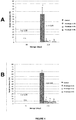
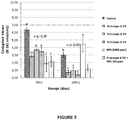
- tested formulations reduced the incidence of surface scald in more than 98% at 180 days ( Figure 3 ); while in the case of pears, compositions based on squalane of plant origin reduced scald incidence between 95-98% at 210 days (7 months) ( Figure 4 ).
- Example 3 Compositions comprising squalane of plant origin as anti-scald active ingredient for pome fruits.
- oils in a pure form are not commercially viable since it is very toxic for fruits, causing damage in lenticels and necrosis after its use. Therefore, it is preferred to obtain a composition of squalane which also contains an appropriate vehicle to form an emulsion and, in this way, stabilize the active ingredient before its application to the surface of pome fruits.
- compositions comprising squalane of plant origin as active ingredient were tested for anti-scald activity in pome fruits, and for this, different emulsifying, emulgent or surfactant stabilizing agents were analyzed to obtain an emulsion.
- the squalane used was obtained from hydrogenation of squalene from refinated olive oil (information available in www.sophim.com/en/phytosqualan-0).
- Table 3 shows proportions of squalane of plant origin used and different emulsifying agents tested, highlighting those prototypes that were able to form an emulsion (7, 11, 13 y 22). Table 3. Proportion (%) of emulsifying agent and active ingredient in different tested prototypes.
- Emulsifying agents and active ingredient 1 2 3 4 5 6 7 8 9 10 11 12 Squalane of plant origin (Phytosqualan®) 70 70 70 70 70 70 70 70 70 70 70 Polyoxyethylene sorbitan monooleate (TWEEN® 80) 15 5 Sorbitan monooleate (SPAN@ 80) 15 15 15 15 Polyoxyethylenesorbitan monostearate (TWEEN® 60) 15 Sorbitan monolaurate (SPAN@ 20) 25 15 Polyoxyethylene sorbitan monolaurate (TWEEN® 21) 15 15 Oleic acid 20 20 10 Palm fatty acid 20 20 Myristic acid 20 20 10 KOH 4 5 4 5 Ammonia 4 5 4 Deionised water.
- Emulsifying agents and active ingredient 13 14 15 16 17 18 19 20 21 22 Squalane of plant origin (Phytosqualan®) 70 70 70 70 70 70 70 70 70 70 Ethoxylated alcohol (Neodol®) 30 Ethoxylated alcohol (Rhenipal 10) 30 10 Polyethylene glycol nonylphenyl ether (Rhenipal 6) 30 20 Polyoxyethylene sorbitan monooleate (TWEEN® 80) 20 15 Sorbitan monooleate (SPAN® 80) 10 10 5 Polyoxyethylenesorbitan monostearate (TWEEN® 60) 20 Sorbitan monolaurate (SPAN® 20) 15 10 Polyoxyethylene sorbitan monolaurate (TWEEN® 21) 20 25 30 Generation of an emulsion YES NO NO NO NO NO NO NO NO NO NO NO NO NO NO NO NO NO NO NO NO NO NO NO NO NO NO NO NO NO NO NO NO NO NO NO NO NO NO NO NO NO NO NO NO NO NO NO NO NO NO NO NO NO NO NO NO NO NO
- Example 4 Evaluation of quality parameters in pome fruits treated with emulsions of squalane of plant origin.
- the concentration of conjugated trienes was estimated by means of spectrophotometry at different wavelengths. Measurement consisted in extracting fruit skin samples from a known area and submerging them in n-hexane for three minutes to then take an aliquot and Reading at different wavelengths in a spectrophotometer. Treatments consisted in application of an emulsion based on squalane of plant origin and oleic acid, diluted at 2-4% v/v in water (Prototype D or 7 in Table 3) and an untreated control group. Measurements were performed after 90 and 180 days of storage in conventional cold conditions (without modification of atmospheric gases) plus one day of exposure at ambient temperature (20°C).
- DPA Diphenylamine
- HSD Tukey
Landscapes
- Life Sciences & Earth Sciences (AREA)
- Engineering & Computer Science (AREA)
- Chemical & Material Sciences (AREA)
- Wood Science & Technology (AREA)
- General Chemical & Material Sciences (AREA)
- Chemical Kinetics & Catalysis (AREA)
- Zoology (AREA)
- Food Science & Technology (AREA)
- Polymers & Plastics (AREA)
- Microbiology (AREA)
- Storage Of Fruits Or Vegetables (AREA)
- Medicines Containing Plant Substances (AREA)
- General Preparation And Processing Of Foods (AREA)
- Materials Applied To Surfaces To Minimize Adherence Of Mist Or Water (AREA)
Applications Claiming Priority (1)
| Application Number | Priority Date | Filing Date | Title |
|---|---|---|---|
| PCT/CL2017/050010 WO2018161184A1 (es) | 2017-03-08 | 2017-03-08 | Composición para el control del escaldado superficial en pomáceas |
Publications (4)
| Publication Number | Publication Date |
|---|---|
| EP3593641A1 true EP3593641A1 (de) | 2020-01-15 |
| EP3593641A4 EP3593641A4 (de) | 2020-08-05 |
| EP3593641C0 EP3593641C0 (de) | 2023-09-20 |
| EP3593641B1 EP3593641B1 (de) | 2023-09-20 |
Family
ID=63447340
Family Applications (1)
| Application Number | Title | Priority Date | Filing Date |
|---|---|---|---|
| EP17900213.4A Active EP3593641B1 (de) | 2017-03-08 | 2017-03-08 | Verwendung einer zusammensetzung zur kontrolle von oberflächlicher bräune bei kernobst |
Country Status (7)
| Country | Link |
|---|---|
| US (1) | US20200008436A1 (de) |
| EP (1) | EP3593641B1 (de) |
| AR (1) | AR110032A1 (de) |
| ES (1) | ES2968295T3 (de) |
| PE (1) | PE20191659A1 (de) |
| PL (1) | PL3593641T3 (de) |
| WO (1) | WO2018161184A1 (de) |
Cited By (1)
| Publication number | Priority date | Publication date | Assignee | Title |
|---|---|---|---|---|
| EP4355101A4 (de) * | 2021-06-16 | 2025-04-16 | The Texas A&M University System | Essbare nanobeschichtungen und verfahren zur verwendung davon |
Families Citing this family (1)
| Publication number | Priority date | Publication date | Assignee | Title |
|---|---|---|---|---|
| US11019274B2 (en) | 2018-09-10 | 2021-05-25 | Tusimple, Inc. | Adaptive illumination for a time-of-flight camera on a vehicle |
Family Cites Families (14)
| Publication number | Priority date | Publication date | Assignee | Title |
|---|---|---|---|---|
| US3526519A (en) | 1967-07-12 | 1970-09-01 | Morton Kleiman | Control of apple storage scald using certain diphenylamine compositions |
| FR2576303B1 (fr) * | 1985-01-21 | 1987-04-10 | Derivan Sa | Procede d'obtention de squalene et de squalane a partir de sous-produits du raffinage des huiles vegetales |
| ES8703824A1 (es) * | 1986-01-04 | 1987-03-01 | Itg Intergrup S A | Un procedimiento para la obtencion de hexametiltetracosacuas y hexametiltetracasanos, a partir de materias primas de origen vegetal. |
| US4921715A (en) | 1989-01-03 | 1990-05-01 | Nordby Harold E | Method for protecting citrus fruit from chilling injury, and fruit protected thereby |
| GB8922777D0 (en) * | 1989-10-10 | 1989-11-22 | Sempernova Plc | Preparations for treating fruit |
| US5198254A (en) * | 1991-04-03 | 1993-03-30 | The United States Of America As Represented By The Secretary Of Agriculture | Composition and method of increasing stability of fruits, vegetables or fungi |
| ZA983101B (en) * | 1997-04-11 | 1998-10-20 | Tiger Food Ind Limited | A method for treating or preventing scald in fruit and an anti-scalding formulation for use therein |
| DE19830171C1 (de) * | 1998-07-06 | 1999-09-16 | Henkel Kgaa | Verfahren zur Herstellung von Phytosqualan |
| WO2013065051A1 (en) * | 2011-11-01 | 2013-05-10 | Naveh Pharma (1996) Ltd. | Formulation and device for treating ceruminosis |
| CN104334123B (zh) * | 2012-06-07 | 2019-02-12 | 意比图密医疗有限公司 | 膨胀装置 |
| US8701701B2 (en) | 2012-09-25 | 2014-04-22 | Chin-Cheng Huang | Float switch of a humidifier |
| CN103766475B (zh) * | 2014-01-16 | 2015-12-30 | 陕西师范大学 | 白藜芦醇在防治苹果虎皮病和梨黑皮病中的应用 |
| TW201625205A (zh) * | 2014-09-18 | 2016-07-16 | 葛蘭素史克消費者保健控股(美國)有限責任公司 | 新穎之配製物 |
| US10174378B2 (en) * | 2016-03-14 | 2019-01-08 | The United States Of America, As Represented By The Secretary Of Agriculture | Gene expression monitoring for risk assessment of apple and pear fruit storage stress and physiological disorders |
-
2017
- 2017-03-08 PL PL17900213.4T patent/PL3593641T3/pl unknown
- 2017-03-08 WO PCT/CL2017/050010 patent/WO2018161184A1/es not_active Ceased
- 2017-03-08 ES ES17900213T patent/ES2968295T3/es active Active
- 2017-03-08 US US16/490,046 patent/US20200008436A1/en not_active Abandoned
- 2017-03-08 PE PE2019001787A patent/PE20191659A1/es unknown
- 2017-03-08 EP EP17900213.4A patent/EP3593641B1/de active Active
- 2017-11-03 AR ARP170103044A patent/AR110032A1/es active IP Right Grant
Cited By (1)
| Publication number | Priority date | Publication date | Assignee | Title |
|---|---|---|---|---|
| EP4355101A4 (de) * | 2021-06-16 | 2025-04-16 | The Texas A&M University System | Essbare nanobeschichtungen und verfahren zur verwendung davon |
Also Published As
| Publication number | Publication date |
|---|---|
| PL3593641T3 (pl) | 2024-03-25 |
| ES2968295T3 (es) | 2024-05-08 |
| EP3593641C0 (de) | 2023-09-20 |
| PE20191659A1 (es) | 2019-11-11 |
| EP3593641B1 (de) | 2023-09-20 |
| EP3593641A4 (de) | 2020-08-05 |
| WO2018161184A1 (es) | 2018-09-13 |
| US20200008436A1 (en) | 2020-01-09 |
| AR110032A1 (es) | 2019-02-13 |
Similar Documents
| Publication | Publication Date | Title |
|---|---|---|
| Alfonzo et al. | Effect of the lemon essential oils on the safety and sensory quality of salted sardines (Sardina pilchardus Walbaum 1792) | |
| Ncama et al. | Plant-based edible coatings for managing postharvest quality of fresh horticultural produce: A review | |
| DE60222935T2 (de) | Zubereitungen für die konservierung von früchten und gemüsen | |
| Dang et al. | Edible coatings influence fruit ripening, quality, and aroma biosynthesis in mango fruit | |
| Xing et al. | Effects of chitosan coating enriched with cinnamon oil on qualitative properties of sweet pepper (Capsicum annuum L.) | |
| Kou et al. | Effects of CaCl2 dipping and pullulan coating on the development of brown spot on ‘Huangguan’pears during cold storage | |
| US8802594B2 (en) | Method for anti-sprouting and possibly fungicidal treatment of bulbs and/or tubers using clove oil and mint oil | |
| EP3928619A1 (de) | Verfahren zur behandlung und kontrolle von physiologischen störungen bei früchten nach der ernte über essbare beschichtungen | |
| Silveira et al. | Vanillin and cinnamic acid in aqueous solutions or in active modified packaging preserve the quality of fresh-cut Cantaloupe melon | |
| Tareen et al. | Combined applications of aminoethoxyvinylglycine with salicylic acid or nitric oxide reduce oxidative stress in peach during ripening and cold storage | |
| Kumar et al. | Edible coating for fresh fruit: A review | |
| Amaro et al. | Biologically active compounds in melon: Modulation by preharvest, post-harvest, and processing factors | |
| CA2810704A1 (fr) | Traitement fongicide bactericide et/ou antioxydant des denrees alimentaires par application de formulations comprenant une huile essentielle et un dialkylene glycol | |
| Fukuyama et al. | Effect of carnauba wax nanoemulsion associated with Syzygium aromaticum and Mentha piperita essential oils as an alternative to extend lychee post-harvest shelf life | |
| Lima et al. | Ozonated water and chlorine effects on the antioxidant properties of organic and conventional broccoli during postharvest | |
| Sokamte et al. | In vitro activity of Syzygium aromaticum against food spoilage fungi and its potential use as an antiradical agent | |
| EP3593641B1 (de) | Verwendung einer zusammensetzung zur kontrolle von oberflächlicher bräune bei kernobst | |
| Dac et al. | Enhancing mango shelf life through natural preservation: Investigating the efficacy of polysaccharide edible coating and leaf extracts | |
| Madhav et al. | Influence of lipid and polysaccharide based edible coatings on quality of guava fruits during storage | |
| Champa et al. | A systematic review on plant-based edible coatings for quality improvement and extended postharvest life of fresh fruits and vegetables | |
| Kamar et al. | Incorporating citronella oil into edible coating to extend the stable life and improve the quality of banana fruit | |
| Mohseni | Study of the effect of thyme essential oil on the reduction of peroxidase enzyme activity in black Spanish radish and green bean | |
| Charoenphun et al. | Application of Citral Nanoemulsion to Enhance Physicochemical Properties and Extend the Shelf Life of Fresh-Cut Longkong during Low-Temperature Storage | |
| Krasnova et al. | Application of different anti-browning agents in order to preserve the quality of apple slices. | |
| US20190069569A1 (en) | Compositions and methods for treating produce |
Legal Events
| Date | Code | Title | Description |
|---|---|---|---|
| STAA | Information on the status of an ep patent application or granted ep patent |
Free format text: STATUS: THE INTERNATIONAL PUBLICATION HAS BEEN MADE |
|
| PUAI | Public reference made under article 153(3) epc to a published international application that has entered the european phase |
Free format text: ORIGINAL CODE: 0009012 |
|
| STAA | Information on the status of an ep patent application or granted ep patent |
Free format text: STATUS: REQUEST FOR EXAMINATION WAS MADE |
|
| 17P | Request for examination filed |
Effective date: 20190827 |
|
| AK | Designated contracting states |
Kind code of ref document: A1 Designated state(s): AL AT BE BG CH CY CZ DE DK EE ES FI FR GB GR HR HU IE IS IT LI LT LU LV MC MK MT NL NO PL PT RO RS SE SI SK SM TR |
|
| AX | Request for extension of the european patent |
Extension state: BA ME |
|
| DAV | Request for validation of the european patent (deleted) | ||
| DAX | Request for extension of the european patent (deleted) | ||
| A4 | Supplementary search report drawn up and despatched |
Effective date: 20200706 |
|
| RIC1 | Information provided on ipc code assigned before grant |
Ipc: A23B 7/05 20060101AFI20200630BHEP Ipc: A23B 7/154 20060101ALI20200630BHEP Ipc: A23B 7/16 20060101ALI20200630BHEP |
|
| STAA | Information on the status of an ep patent application or granted ep patent |
Free format text: STATUS: EXAMINATION IS IN PROGRESS |
|
| 17Q | First examination report despatched |
Effective date: 20210511 |
|
| GRAP | Despatch of communication of intention to grant a patent |
Free format text: ORIGINAL CODE: EPIDOSNIGR1 |
|
| STAA | Information on the status of an ep patent application or granted ep patent |
Free format text: STATUS: GRANT OF PATENT IS INTENDED |
|
| INTG | Intention to grant announced |
Effective date: 20230420 |
|
| P01 | Opt-out of the competence of the unified patent court (upc) registered |
Effective date: 20230601 |
|
| GRAS | Grant fee paid |
Free format text: ORIGINAL CODE: EPIDOSNIGR3 |
|
| GRAA | (expected) grant |
Free format text: ORIGINAL CODE: 0009210 |
|
| STAA | Information on the status of an ep patent application or granted ep patent |
Free format text: STATUS: THE PATENT HAS BEEN GRANTED |
|
| AK | Designated contracting states |
Kind code of ref document: B1 Designated state(s): AL AT BE BG CH CY CZ DE DK EE ES FI FR GB GR HR HU IE IS IT LI LT LU LV MC MK MT NL NO PL PT RO RS SE SI SK SM TR |
|
| REG | Reference to a national code |
Ref country code: GB Ref legal event code: FG4D |
|
| REG | Reference to a national code |
Ref country code: CH Ref legal event code: EP |
|
| REG | Reference to a national code |
Ref country code: IE Ref legal event code: FG4D |
|
| REG | Reference to a national code |
Ref country code: DE Ref legal event code: R096 Ref document number: 602017074541 Country of ref document: DE |
|
| U01 | Request for unitary effect filed |
Effective date: 20231016 |
|
| U07 | Unitary effect registered |
Designated state(s): AT BE BG DE DK EE FI FR IT LT LU LV MT NL PT SE SI Effective date: 20231024 |
|
| P04 | Withdrawal of opt-out of the competence of the unified patent court (upc) registered |
Effective date: 20231020 |
|
| PG25 | Lapsed in a contracting state [announced via postgrant information from national office to epo] |
Ref country code: RS Free format text: LAPSE BECAUSE OF FAILURE TO SUBMIT A TRANSLATION OF THE DESCRIPTION OR TO PAY THE FEE WITHIN THE PRESCRIBED TIME-LIMIT Effective date: 20230920 Ref country code: NO Free format text: LAPSE BECAUSE OF FAILURE TO SUBMIT A TRANSLATION OF THE DESCRIPTION OR TO PAY THE FEE WITHIN THE PRESCRIBED TIME-LIMIT Effective date: 20231220 Ref country code: HR Free format text: LAPSE BECAUSE OF FAILURE TO SUBMIT A TRANSLATION OF THE DESCRIPTION OR TO PAY THE FEE WITHIN THE PRESCRIBED TIME-LIMIT Effective date: 20230920 |
|
| PG25 | Lapsed in a contracting state [announced via postgrant information from national office to epo] |
Ref country code: IS Free format text: LAPSE BECAUSE OF FAILURE TO SUBMIT A TRANSLATION OF THE DESCRIPTION OR TO PAY THE FEE WITHIN THE PRESCRIBED TIME-LIMIT Effective date: 20240120 |
|
| U20 | Renewal fee for the european patent with unitary effect paid |
Year of fee payment: 8 Effective date: 20240311 |
|
| PG25 | Lapsed in a contracting state [announced via postgrant information from national office to epo] |
Ref country code: SM Free format text: LAPSE BECAUSE OF FAILURE TO SUBMIT A TRANSLATION OF THE DESCRIPTION OR TO PAY THE FEE WITHIN THE PRESCRIBED TIME-LIMIT Effective date: 20230920 Ref country code: RO Free format text: LAPSE BECAUSE OF FAILURE TO SUBMIT A TRANSLATION OF THE DESCRIPTION OR TO PAY THE FEE WITHIN THE PRESCRIBED TIME-LIMIT Effective date: 20230920 Ref country code: IS Free format text: LAPSE BECAUSE OF FAILURE TO SUBMIT A TRANSLATION OF THE DESCRIPTION OR TO PAY THE FEE WITHIN THE PRESCRIBED TIME-LIMIT Effective date: 20240120 Ref country code: CZ Free format text: LAPSE BECAUSE OF FAILURE TO SUBMIT A TRANSLATION OF THE DESCRIPTION OR TO PAY THE FEE WITHIN THE PRESCRIBED TIME-LIMIT Effective date: 20230920 Ref country code: SK Free format text: LAPSE BECAUSE OF FAILURE TO SUBMIT A TRANSLATION OF THE DESCRIPTION OR TO PAY THE FEE WITHIN THE PRESCRIBED TIME-LIMIT Effective date: 20230920 |
|
| REG | Reference to a national code |
Ref country code: ES Ref legal event code: FG2A Ref document number: 2968295 Country of ref document: ES Kind code of ref document: T3 Effective date: 20240508 |
|
| REG | Reference to a national code |
Ref country code: DE Ref legal event code: R097 Ref document number: 602017074541 Country of ref document: DE |
|
| PLBE | No opposition filed within time limit |
Free format text: ORIGINAL CODE: 0009261 |
|
| STAA | Information on the status of an ep patent application or granted ep patent |
Free format text: STATUS: NO OPPOSITION FILED WITHIN TIME LIMIT |
|
| 26N | No opposition filed |
Effective date: 20240621 |
|
| REG | Reference to a national code |
Ref country code: CH Ref legal event code: PL |
|
| PG25 | Lapsed in a contracting state [announced via postgrant information from national office to epo] |
Ref country code: MC Free format text: LAPSE BECAUSE OF FAILURE TO SUBMIT A TRANSLATION OF THE DESCRIPTION OR TO PAY THE FEE WITHIN THE PRESCRIBED TIME-LIMIT Effective date: 20230920 |
|
| PG25 | Lapsed in a contracting state [announced via postgrant information from national office to epo] |
Ref country code: MC Free format text: LAPSE BECAUSE OF FAILURE TO SUBMIT A TRANSLATION OF THE DESCRIPTION OR TO PAY THE FEE WITHIN THE PRESCRIBED TIME-LIMIT Effective date: 20230920 |
|
| P05 | Withdrawal of opt-out of the competence of the unified patent court (upc) changed |
Free format text: CASE NUMBER: APP_581457/2023 Effective date: 20231024 |
|
| PG25 | Lapsed in a contracting state [announced via postgrant information from national office to epo] |
Ref country code: IE Free format text: LAPSE BECAUSE OF NON-PAYMENT OF DUE FEES Effective date: 20240308 |
|
| PG25 | Lapsed in a contracting state [announced via postgrant information from national office to epo] |
Ref country code: IE Free format text: LAPSE BECAUSE OF NON-PAYMENT OF DUE FEES Effective date: 20240308 Ref country code: CH Free format text: LAPSE BECAUSE OF NON-PAYMENT OF DUE FEES Effective date: 20240331 |
|
| U20 | Renewal fee for the european patent with unitary effect paid |
Year of fee payment: 9 Effective date: 20250313 |
|
| U1N | Appointed representative for the unitary patent procedure changed after the registration of the unitary effect |
Representative=s name: CLARKE, MODET Y CIA., S.L.; ES |
|
| PGFP | Annual fee paid to national office [announced via postgrant information from national office to epo] |
Ref country code: ES Payment date: 20250403 Year of fee payment: 9 |
|
| PG25 | Lapsed in a contracting state [announced via postgrant information from national office to epo] |
Ref country code: CY Free format text: LAPSE BECAUSE OF FAILURE TO SUBMIT A TRANSLATION OF THE DESCRIPTION OR TO PAY THE FEE WITHIN THE PRESCRIBED TIME-LIMIT; INVALID AB INITIO Effective date: 20170308 |
|
| PG25 | Lapsed in a contracting state [announced via postgrant information from national office to epo] |
Ref country code: HU Free format text: LAPSE BECAUSE OF FAILURE TO SUBMIT A TRANSLATION OF THE DESCRIPTION OR TO PAY THE FEE WITHIN THE PRESCRIBED TIME-LIMIT; INVALID AB INITIO Effective date: 20170308 |
|
| PG25 | Lapsed in a contracting state [announced via postgrant information from national office to epo] |
Ref country code: GR Free format text: LAPSE BECAUSE OF FAILURE TO SUBMIT A TRANSLATION OF THE DESCRIPTION OR TO PAY THE FEE WITHIN THE PRESCRIBED TIME-LIMIT; INVALID AB INITIO Effective date: 20170308 |
|
| PG25 | Lapsed in a contracting state [announced via postgrant information from national office to epo] |
Ref country code: TR Free format text: LAPSE BECAUSE OF FAILURE TO SUBMIT A TRANSLATION OF THE DESCRIPTION OR TO PAY THE FEE WITHIN THE PRESCRIBED TIME-LIMIT Effective date: 20230920 |
|
| U20 | Renewal fee for the european patent with unitary effect paid |
Year of fee payment: 10 Effective date: 20260211 |
|
| PGFP | Annual fee paid to national office [announced via postgrant information from national office to epo] |
Ref country code: GB Payment date: 20260120 Year of fee payment: 10 |
|
| PGFP | Annual fee paid to national office [announced via postgrant information from national office to epo] |
Ref country code: PL Payment date: 20260226 Year of fee payment: 10 |