EP3593296B1 - Ereignisplanung in einem hybriden datenverarbeitungssystem - Google Patents
Ereignisplanung in einem hybriden datenverarbeitungssystem Download PDFInfo
- Publication number
- EP3593296B1 EP3593296B1 EP18763996.8A EP18763996A EP3593296B1 EP 3593296 B1 EP3593296 B1 EP 3593296B1 EP 18763996 A EP18763996 A EP 18763996A EP 3593296 B1 EP3593296 B1 EP 3593296B1
- Authority
- EP
- European Patent Office
- Prior art keywords
- quantum
- classical
- processor
- computing system
- events
- Prior art date
- Legal status (The legal status is an assumption and is not a legal conclusion. Google has not performed a legal analysis and makes no representation as to the accuracy of the status listed.)
- Active
Links
Images





Classifications
-
- G—PHYSICS
- G06—COMPUTING OR CALCULATING; COUNTING
- G06F—ELECTRIC DIGITAL DATA PROCESSING
- G06F15/00—Digital computers in general; Data processing equipment in general
- G06F15/16—Combinations of two or more digital computers each having at least an arithmetic unit, a program unit and a register, e.g. for a simultaneous processing of several programs
- G06F15/163—Interprocessor communication
-
- G—PHYSICS
- G06—COMPUTING OR CALCULATING; COUNTING
- G06F—ELECTRIC DIGITAL DATA PROCESSING
- G06F15/00—Digital computers in general; Data processing equipment in general
- G06F15/76—Architectures of general purpose stored program computers
-
- G—PHYSICS
- G06—COMPUTING OR CALCULATING; COUNTING
- G06F—ELECTRIC DIGITAL DATA PROCESSING
- G06F9/00—Arrangements for program control, e.g. control units
- G06F9/06—Arrangements for program control, e.g. control units using stored programs, i.e. using an internal store of processing equipment to receive or retain programs
- G06F9/46—Multiprogramming arrangements
- G06F9/48—Program initiating; Program switching, e.g. by interrupt
- G06F9/4806—Task transfer initiation or dispatching
- G06F9/4843—Task transfer initiation or dispatching by program, e.g. task dispatcher, supervisor, operating system
- G06F9/4881—Scheduling strategies for dispatcher, e.g. round robin, multi-level priority queues
-
- G—PHYSICS
- G06—COMPUTING OR CALCULATING; COUNTING
- G06F—ELECTRIC DIGITAL DATA PROCESSING
- G06F9/00—Arrangements for program control, e.g. control units
- G06F9/06—Arrangements for program control, e.g. control units using stored programs, i.e. using an internal store of processing equipment to receive or retain programs
- G06F9/46—Multiprogramming arrangements
- G06F9/54—Interprogram communication
- G06F9/542—Event management; Broadcasting; Multicasting; Notifications
-
- G—PHYSICS
- G06—COMPUTING OR CALCULATING; COUNTING
- G06N—COMPUTING ARRANGEMENTS BASED ON SPECIFIC COMPUTATIONAL MODELS
- G06N10/00—Quantum computing, i.e. information processing based on quantum-mechanical phenomena
- G06N10/40—Physical realisations or architectures of quantum processors or components for manipulating qubits, e.g. qubit coupling or qubit control
Definitions
- qubits are implemented in superconducting circuits.
- the qubits can be implemented, for example, in circuit devices that include Josephson junctions.
- circuit devices in a superconducting circuit are controlled by an external control module.
- a control system schedules events (e.g., control signals and other types of events) in a quantum computing system (e.g., a hybrid classical/quantum computing system).
- the control system may efficiently schedule the events using a control processor that is programmable using a quantum instruction set (e.g., the quantum programming language Quil described in the publication entitled " A Practical Quantum Instruction Set Architecture" by Smith et al., arXiv:1608.03355v2 [quant-ph], 17 Feb 2017 ).
- the control processor may obtain a quantum program written in Quil and generate an event schedule that includes resource schedules for the respective qubits defined in a quantum processor.
- the resource schedules may include, for example, control signals to be delivered to the quantum processor and other types of events.
- the event schedule may include resource schedules for other types of resources (e.g., classical processors and classical memories) and other types of events (e.g., storage of quantum measurements in classical memory, classical computing operations, delays between control signals, etc.).
- a computing system can be configured to achieve a specified computing regime or paradigm.
- a computing system may be configured to achieve pure quantum computation, asynchronous classical and quantum computation, quantum computation with fast feedback based on classical and quantum state, fully hybrid and interleaved classical/quantum computation, hybrid computation with quantum error correction (QEC), or another type of computing regime.
- QEC quantum error correction
- Processor speeds, communication speeds, communication bandwidth, component proximity and integration, and other structural and operational aspects of the system may be configured based on the demands of a specified computing regime.
- communication links may be configured to provide signal transit times (e.g., point-to-point communication times) that are less than (or otherwise based on constraints imposed by) the coherence time of a quantum processor.
- quantum computers can be programmed, which may allow for quantum computing services to be provided, quantum computing subsystems for scientific and industrial applications, quantum operating systems, or integrated classical/quantum chips.
- a quantum computing system executes a quantum program, and the quantum program does not necessarily include any explicit notion of the time at which precise instructions are executed.
- a quantum program (e.g., instructions written in the Quil programming language) may be written generally for any quantum computer, without knowledge of the quantum computer's native gate set or architecture, and a scheduler may translate the quantum program to a sequence of operations that are directly executable by the quantum computing system.
- classical control processor can act as an interface to a programmer as well as the primary mode of the scheduling and orchestration of quantum computational events.
- An interface can be created between a quantum computing device and a programmer that abstracts away details of how a quantum or hybrid classical/quantum computation is performed.
- quantum programs are loaded into memory of a hybrid classical/quantum computer (just like classical programs can be with classical computers), and are executed by way of a similar process on a quantum processor cell.
- control signals are scheduled by a control system in a quantum computing system based on a linearly-written quantum program.
- the control system may have an architecture similar to the Von Neumann architecture.
- the control system may provide a generic programmable quantum architecture without specific regard to the particular control electronics or interconnects used, and may be integrated onto a single chip.
- the control system can implement such an architecture, for example, using a central processing unit (CPU), memory.
- CPU central processing unit
- the CPU may control the overall execution of the program and perform arithmetic operations, and may contain a set of data registers to hold temporary data being acted upon (e.g., which was loaded from or stored to memory) as well as an instruction register or program counter which contains the next instruction to execute (or the location in memory where the next instruction to execute is).
- the CPU may implement an instruction cycle or a fetch-decode-execute cycle.
- Some aspects may include a hardware device which allows humans or other computer information systems to program a quantum computing system; a process (implemented in hardware, software, or a combination thereof) for processing a programmer-provided program and preparing it for execution; a hardware device that schedules and orchestrates computations on the quantum computing system; a hardware device which efficiently produces and digitizes control signals for execution in a quantum processor; and an integrated, closed system in which these devices work synchronously.
- a quantum computing system includes a generic programmable hybrid classical/quantum architecture without specific regard to the particular control electronics or interconnects used. In some implementations, all components of such a system are integrated onto a single chip.
- a programmable quantum computing system may allow for all-in-one quantum computing hardware packages, internet-delivered quantum computing services, or other quantum computing implementations.
- a programmable quantum computing system such as a hybrid classical/quantum computer, may supersede supercomputers in computing performance and efficiency, and may be used in pharmaceutical applications (e.g., drug discovery), chemical engineering and synthesis, machine learning and artificial intelligence, medicine or medical diagnosis, or other applications which might benefit from high-performance computers.
- FIG. 1A is a schematic diagram of an example quantum computing system 100.
- the example quantum computing system 100 shown in FIG. 1A includes a control system 110, a signal delivery system 106, and a quantum processor cell 102.
- a quantum computing system may include additional or different features, and the components of a quantum computing system may operate as described with respect to FIG. 1A or in another manner.
- the example quantum computing system 100 shown in FIG. 1A can perform quantum computational tasks by executing quantum algorithms.
- the quantum computing system 100 can perform quantum computation by storing and manipulating information within individual quantum states of a composite quantum system.
- qubits i.e., quantum bits
- quantum logic can be performed in a manner that allows large-scale entanglement within the quantum system.
- Control signals can manipulate the quantum states of individual qubits and the joint states of the multiple qubits.
- information can be read out from the composite quantum system by measuring the quantum states of the individual qubits.
- the example quantum computing system 100 shown in FIG. 1A can perform classical computational tasks by executing classical algorithms.
- the quantum computing system 100 can perform classical computation by storing and manipulating information within individual digital states of a binary system.
- bits can be stored in and represented by an effective two-level physical system.
- binary logic can be applied to the bits to manipulate the states of individual bits and the joint states of the multiple bits.
- information can be read out from the binary system by measuring the individual bits.
- the quantum computing system 100 can operate using gate-based models for quantum computing.
- fault-tolerance can be achieved by applying a set of high-fidelity control and measurement operations to the qubits.
- topological quantum error correction schemes can operate on a lattice of nearest-neighbor coupled qubits.
- these and other types of quantum error correcting schemes can be adapted for a two- or three-dimensional lattice of nearest neighbor coupled qubits, for example, to achieve fault-tolerant quantum computation. Adjacent pairs of qubits in the lattice can be addressed, for example, with two-qubit logic operations that are capable of generating entanglement, independent of other pairs in the lattice.
- the quantum computing system 100 is constructed and operated according to a scalable quantum computing architecture.
- the architecture can be scaled to a large number of qubits to achieve large-scale general purpose coherent quantum computing.
- the architecture is adaptable and can incorporate a variety of modes for each technical component.
- the architecture can be adapted to incorporate different types of qubit devices, coupler devices, readout devices, signaling devices, etc.
- the quantum processor cell 102 functions as a quantum processor unit.
- the quantum processor cell 102 includes a quantum circuit system.
- the quantum circuit system may include qubit devices, resonator devices and possibly other devices that are used to store and process quantum information.
- the quantum circuit system is a superconducting quantum circuit system, in which various circuit elements are capable of operating in a superconducting state.
- the quantum circuit system is an integrated quantum circuit (e.g., an integrated superconducting quantum circuit).
- the example quantum processor cell 102 can process quantum information by applying control signals to the qubit devices or to the coupler devices housed in the quantum processor cell 102.
- the control signals can be configured to encode information in the qubit devices, to process the information by performing quantum logic gates or other types of operations, or to extract information from the qubit devices.
- the operations can be expressed as single-qubit logic gates, two-qubit logic gates, or other types of quantum logic gates that operate on one or more qubits.
- a sequence of quantum logic operations can be applied to the qubits to perform a quantum algorithm.
- the example quantum processor cell 102 includes a quantum circuit system 104.
- the example quantum circuit system 104 includes superconducting quantum circuit devices.
- the quantum circuit system 104 may include superconducting qubit devices that each store a single qubit of information, and the qubits can collectively represent the computational state of a quantum processor.
- the quantum circuit system 104 may include resonator devices coupled to the respective qubit devices, for instance, where each qubit device includes a superconducting quantum interference device (SQUID) loop and is capacitively coupled to a neighboring resonator device.
- the readout devices may be configured to generate readout signals that indicate the computational state of the quantum processor unit.
- some of the circuit devices in the quantum circuit system 104 are coupler devices that selectively operate on individual qubits or pairs of qubits.
- the coupler devices may produce entanglement or other multi-qubit states over two or more qubits.
- the example quantum circuit system 104 can include connections between neighboring pairs of circuit devices.
- the connections can provide electromagnetic communication between the connected circuit devices.
- the connections are implemented as capacitive, conductive or inductive signaling connections.
- the connections may include metal traces, capacitors, flux loops and other components.
- the superconducting circuit devices may be operated by radio frequency (RF) or microwave signals delivered in the quantum circuit system 104, for example, from the control system 110. Signals may be exchanged among the circuit devices through the connections or other signal pathways in the quantum circuit system 104.
- RF radio frequency
- the circuit devices in the quantum circuit system 104 may be arranged in one or more regular or irregular arrays.
- qubit devices may be arranged in a rectilinear (e.g., rectangular or square) array that extends in two spatial dimensions (in the plane of the page), where each qubit device has two or more nearest-neighbor qubit devices.
- Qubit devices can be arranged in another type of regular or irregular array (e.g., a triangular array, a hexagonal array, etc.).
- an array of circuit devices extends in a third spatial dimension (in/out of the page), for example, to form a cubic array or another type of regular or irregular three-dimensional array.
- the signal delivery system 106 provides communication between the control system 110 and the quantum processor cell 102.
- the signal delivery system 106 can receive control signals from the control system 110 and deliver the control signals to the quantum processor cell 102.
- the signal delivery system 106 performs preprocessing, signal conditioning, or other operations to the control signals before delivering them to the quantum processor cell 102.
- the signal delivery system 106 receives qubit readout signals from the quantum processor cell and delivers the qubit readout signals to the control system 110. In some instances, the signal delivery system 106 performs preprocessing, signal conditioning or other operations on the readout signals before delivering them to the control system 110. In some implementations, the signal delivery system 106 includes include input and output processing hardware, input and output connections, and other components.
- the input and processing hardware may include, for example, filters, attenuators, directional couplers, multiplexers, diplexers, bias components, signal channels, isolators, amplifiers, power dividers and other types of components.
- control system 110 controls operation of the quantum processor cell 102.
- the example control system 110 may include data processors, signal generators, interface components and other types of systems or subsystems.
- the control system 110 includes one or more classical computers or classical computing components. In some cases, one or more components of the control system 110 can be implemented as the example control system 200 shown in FIG. 2A , as the example circuit board 250 shown in FIG. 2B , or otherwise.
- FIG. 1A shows an example control system 110 that includes one or more processors 112, a memory 114, and signaling hardware 116.
- the signaling hardware 116 may include, in some implementations, radio frequency (RF) or microwave ( ⁇ W) generators, radio frequency (RF) or microwave ( ⁇ W) receivers, DC sources, or other type of radio frequency (RF) or microwave ( ⁇ W) devices.
- the control system 110 may include additional or different features and components. In some examples, components of the control system 110 operates in a room temperature regime, an intermediate temperature regime, or both. For example, the control system 110 can be configured to operate at much higher temperatures and be subject to much higher levels of noise than are present in the environment of the quantum processor cell 102.
- the control system 110 includes a classical computing cluster, servers, databases, networks, or other types of classical computing equipment.
- the memory 114 can include, for example, a random-access memory (RAM), a storage device (e.g., a writable read-only memory (ROM) or others), a hard disk, or another type of storage medium.
- the memory 114 can include various forms of memory, media and memory devices, including by way of example semiconductor memory devices (e.g., EPROM, EEPROM, flash memory devices, and others), magnetic disks (e.g., internal hard disks, removable disks, and others), magneto optical disks, and CD ROM and DVD-ROM disks.
- the processors 112 may include one or more single- or multi-core microprocessors, one or more FPGAs or ASICs, one or more other types of data processing apparatus.
- the processors 112 can generate control information, for example, based on a quantum program (e.g., a quantum logic circuit, a quantum simulation, a quantum algorithm, etc.) or a hybrid classical/quantum program to be performed by the quantum computing system 100 or based on other types of information.
- a quantum program e.g., a quantum logic circuit, a quantum simulation, a quantum algorithm, etc.
- hybrid classical/quantum program to be performed by the quantum computing system 100 or based on other types of information.
- radio frequency (RF) or microwave ( ⁇ W) generators and DC sources of the signaling hardware 116 can each generate control signals based on control information provided by the processors 112.
- the control signals can be delivered to the quantum processor cell 102 by the signal delivery system 106, for example, and interact with circuit devices in the quantum circuit system 104.
- radio frequency (RF) or microwave ( ⁇ W) receivers in the signaling hardware 116 can receive and process signals from the quantum processor cell 102.
- receivers in the signaling hardware 116 can include a digitizer, a microwave source, and other types of signal processing components.
- the receivers of the signaling hardware 116 can process (e.g., digitize, or otherwise process) the signals from the quantum processor cell 102 and provide the processed information to the processors 112.
- the processors 112 can extract data, for example, to identify the quantum states of qubits in the quantum processor cell 102 or for other purposes.
- the quantum computing system operates as a hybrid computing system (i.e., hybrid classical/quantum computing system) by using one or more classical processors (e.g., processors 112) and one or more quantum processors (e.g., quantum processor cell 102) in a coordinated manner.
- a hybrid computing system the quantum computer system 100 executes a program that leverages classical computing resources and quantum computing resources.
- the program provides an interface between the classical and quantum processors in the hybrid computing system, for example, by providing inputs to a classical processor based on outputs from a quantum processor, or by providing inputs to a quantum processor based on outputs from a classical processor.
- control system 110 generates classical signals, including electrical waveforms or laser fields, which interact with devices in the quantum processor cell 102 to operate the quantum computing system 100; and the control system 110 may also receive classical signals back from the devices.
- the quantum computing system 100 operates based on a clock cycle or another type of synchronization scheme.
- a quantum algorithm or quantum processing task may be expressed as a sequence of instructions corresponding to quantum gates, readouts, or other operations on the qubit devices, and a subset of the instructions can be executed on each clock cycle.
- the control system 110 on each clock cycle, the control system 110 generates control signals to implement a subset of instructions, control signals are delivered to the quantum processor cell 102, and qubit readout signals are delivered to the control system 110.
- the control signals delivered on each clock cycle can be configured, for example, based on the sequence of instructions, based on readout signals from a previous cycle, quantum error correction operations, error matching calculations, other information, or a combination of these.
- control system 110 generates a schedule of control signals for execution on the quantum processor cell 104.
- the control signals may be scheduled based on a quantum program (e.g., a program written in the Quil programming language described in the publication entitled " A Practical Quantum Instruction Set Architecture" by Smith et al., arXiv:1608.03355v2 [quant-ph], 17 Feb 2017 ).
- the control system 110 may generate schedule of control signals according to a variety of possible optimization criteria.
- the schedule may be configured to increase (e.g., optimize or otherwise improve) quantum process fidelity (e.g., by reducing cross-talk, etc.) or another measure of computational accuracy; the schedule is configured to reduce (in some cases, minimize or otherwise optimize) an overall amount of time spent by a quantum computing system implementing the control signals, making execution of a quantum program on the quantum computing system more efficient. Qubits are made available for interaction with additional control signals sooner.
- the control system 110 optimizes a schedule of control signals according to one or more techniques described in the techniques described below.
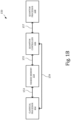
- FIG. 1B is a block diagram of another example quantum computing system 150.
- the example quantum computing system 150 shown in FIG. 1B includes a classical processor 152, a shared memory 154, a quantum controller 156, and a quantum processor 158.
- the quantum computing system 150 may include additional or different features, and the features may be configured as shown or in another manner.
- the classical processor 152 in FIG. 1B may be implemented, for example, as the classical processor 204 shown in FIG. 2A , as the CPU 252 in FIG. 2B , as a processor (e.g., a CPU) or co-processor on a laptop or desktop computer or a server, or another type of classical computing system or device.
- the shared memory 154 in FIG. 1B may be implemented, for example, as the memory 202 in FIG. 2A , as the DRAM 254 in FIG. 2B , as the FPGA registers 264 in FIG.
- the quantum controller 156 in FIG. 1B can be implemented as the signaling hardware 210 in FIG. 2B , as the signaling hardware 116 and signal delivery system 106 in FIG. 1A , as the program processor 206 in FIG. 2A , or as another type of signaling hardware.
- the quantum processor 158 in FIG. 1B can be implemented as the quantum processor cell 102 in FIG. 1A or another type of quantum processor unit (QPU) that can perform quantum computations.
- the quantum processor 158 includes a superconducting circuit, and the qubit devices are implemented as circuit devices that include Josephson junctions, for example, in superconducting quantum interference device (SQUID) loops or other arrangements, and are controlled by radio-frequency signals, microwave signals, and bias signals delivered to the quantum processor 158.
- the quantum processor 158 includes an ion trap system, and the qubit devices are implemented as trapped ions controlled by optical signals delivered to the quantum processor 158.
- the quantum processor 158 includes a spin system, and the qubit devices are implemented as nuclear or electron spins controlled by microwave or radio-frequency signals delivered to the quantum processor 158.
- the quantum processor 158 may be implemented based on another physical modality of quantum computing.
- the quantum processor 158 can operate using gate-based models for quantum computing.
- the qubits can be initialized in an initial state, and a quantum logic circuit comprised of a series of quantum logic gates can be applied to transform the qubits and extract measurements representing the output of the quantum computation.
- the quantum processor 158 can operate using adiabatic or annealing models for quantum computing. For instance, the qubits can be initialized in an initial state, and the controlling Hamiltonian can be transformed adiabatically by adjusting control parameters to another state that can be measured to obtain an output of the quantum computation.
- the classical processor 152 communicates with the shared memory 154 through a first link 153
- the shared memory 154 communicates with the quantum controller 156 through a second link 155
- the quantum controller 156 communicates with the quantum processor 158 through a third link 157
- the classical processor 152 communicates with the quantum controller 156 through a fourth link 159.
- the quantum computing system 150 may include additional or different links, including links that are shared by more than two components. In some cases, one or more components of the quantum computing system 150 uses Direct Memory Access (DMA) or another memory access scheme to access information stored in the shared memory 154.
- DMA Direct Memory Access
- Each of the links 153, 155, 157, 159 shown in FIG. 1B can include all or part of one or more connectors, ports, signal lines, data channels, data networks or other types of communication links.
- one or more of the links 153, 155, 157, 159 can include wired or wireless connections, wired or wireless networks or other communication channels.
- the links 153, 155, 157, 159 may provide communication over short distances (e.g., on the order of nanometers to centimeters, etc.) within an integrated system or component (e.g., within a circuit board or a chip, between distinct circuit boards or chips in a device, etc.), over long distances (e.g., on the order of kilometers or tens or hundreds of kilometers) in the context of cloud or network-based systems (e.g., between remote sites or distributed system components), or intermediate distances (e.g., less than a meter, or on the order of meters) within a contained or system or subsystem (e.g., between separate components, between different environments in a system, etc.).
- short distances e.g., on the order of nanometers to centimeters, etc.
- an integrated system or component e.g., within a circuit board or a chip, between distinct circuit boards or chips in a device, etc.
- long distances e.g., on
- the links 153, 155, 157, 159 can be selected and configured based on time requirements for signals transferred between the components during operation of the quantum computing system 150.
- the typical or characteristic time required to transfer a signal over a link, from one component to another, can be referred to as ⁇ t .
- One or more of the links 153, 155, 157, 159 may provide fast communication speeds, for example, between components that are integrated into a common structure or system.
- a link may include waveguides, coaxial cables, microstrip lines, feedthrough devices, conductive leads or contacts, signal ports, data buses, or other components that provide fast communication.
- such links can be used to achieve ⁇ t on the order of microseconds, nanoseconds, or shorter.
- One or more of the links 153, 155, 157, 159 may provide slower communication speeds, for example, between components that are remote from each other.
- a link may include a wired or wireless data network (Local Area Network (LAN), a Wide Area Network (WAN), a Virtual Private Network (VPN), the Internet, a peer-to-peer network, a cellular network, a Wi-Fi network, a Personal Area Network (PAN), etc.), wireless connections, a radio or modem interface, or other components that provide slower communication.
- LAN Local Area Network
- WAN Wide Area Network
- VPN Virtual Private Network
- the Internet the Internet
- peer-to-peer network the Internet
- a peer-to-peer network a cellular network
- Wi-Fi network Wireless Fidelity
- PAN Personal Area Network
- wireless connections a radio or modem interface
- One or more of the links 153, 155, 157, 159 may provide intermediate communication speeds, for example, between separate components within a system.
- a link may include multiple stages, a buffer memory or cache, components that perform data conversion or formatting, etc.
- such links can be used to achieve ⁇ t on the order of tens to hundreds of milliseconds.
- the links 153, 155, 157, 159 are configured to provide a specified computing regime or paradigm in the quantum computing system 150.
- the quantum computing system 150 is configured for pure quantum computation.
- the quantum processor 158 performs a quantum computation (e.g., by executing a quantum algorithm) and provides an output to the quantum controller 156, and the quantum computation does not depend on feedback or computations performed by the classical processor 152 or on information in the shared memory 154. In such cases, there are not necessarily any hard time, speed, or distance constraints for the links 153, 155, 159.
- the quantum controller 156 can compile a control sequence and deliver the control sequence to the quantum processor 158, and the quantum processor 158 can execute the control sequence without feedback from the quantum controller 156. In such cases, there are not necessarily any hard time, speed, or distance constraints for the link 157.
- the quantum computing system 150 is configured for asynchronous classical and quantum computation.
- the quantum processor 158 performs a quantum computation (e.g., by executing a quantum algorithm) and provides an output to the quantum controller 156, which places the output in the shared memory 154; the classical processor 152 then performs a classical computation based on the output (e.g., by retrieving the output from the shared memory 154); and the process may be iterated.
- the output of the classical computation may be provided as an input to a new quantum computation, but the quantum computation does not require new classical computation or other feedback to be generated or provided during the quantum computation.
- the coherence times of the quantum processor do not provide a time constraint for the links 153, 155, 157, 159.
- Practical implementations of the asynchronous classical and quantum computation regime may be achieved, for example, when the links 153, 155, 159 are configured to achieve ⁇ t on the order of seconds or shorter.
- the quantum computing system 150 is configured for quantum computation with fast feedback based on classical and quantum state (or "fast feedback computation” regime).
- fast feedback computation regime at least some operations in the quantum computation performed by the quantum processor 158 require feedback from the quantum controller 156 during the quantum computation.
- the quantum controller 156 must be able to deliver a control sequence to the quantum processor 158 in a characteristic time ⁇ t that is less than the coherence time of the quantum processor 158.
- the coherence times of the quantum processor 158 provide a time constraint for the link 157.
- the link 157 could be configured to achieve ⁇ t less than 500 nanoseconds.
- coaxial cables, waveguides, microstrip lines or other types of signal lines may be used to achieve communication times needed for the fast feedback computation regime.
- the quantum computing system 150 is configured for fully hybrid and interleaved classical/quantum computation.
- the fully hybrid and interleaved classical/quantum computation regime at least some operations in the quantum computation performed by the quantum processor 158 require output to be generated by the classical processor (provided through the shared memory 154 and the quantum controller 156) during the quantum computation.
- the quantum computing system 150 must be able to perform the classical computation and deliver a control sequence to the quantum processor 158 in a characteristic time ⁇ t that is less than the coherence time of the quantum processor 158.
- the coherence times of the quantum processor, and the complexity and speed of the classical computation provide a time constraint for the links 153, 155, 157, 159.
- the links 153, 155, 157, 159 may be configured to achieve ⁇ t less than 100 nanoseconds, less than 20 nanoseconds, or shorter.
- coaxial cables, waveguides, microstrip lines or other types of signal lines may be used to achieve communication times needed for the fully hybrid and interleaved classical/quantum computation regime.
- the quantum computing system 150 is configured for hybrid classical/quantum computation, with quantum error correction.
- a quantum error correcting (QEC) code may applied to the quantum processor 158 to preserve quantum states (e.g., some aspects or subsets of the quantum states) beyond the characteristic coherence time of the quantum processor 158, and may be used to achieve fault-tolerant quantum computation in some cases.
- QEC quantum error correcting
- fewer constraints may be placed on the links 153, 155, 157, 159, for example, when the effective coherence time of the quantum processor 158 can be extended indefinitely by QEC. Accordingly, practical implementations of hybrid classical/quantum computation with QEC may be achieved, for example, when the links 153, 155, 159 are configured to achieve ⁇ t on the order of seconds or shorter.
- attributes of one or more lower-complexity computing regimes provide features that are necessary (though not necessarily sufficient) for implementing higher-complexity regimes.
- the pure quantum computation regime, the asynchronous classical and quantum computation regime, and the fast feedback computation regime can be used to bootstrap the fully hybrid and interleaved classical/quantum computation regime.
- the pure quantum computation regime, the asynchronous classical and quantum computation regime, and the fast feedback computation regime are implemented well enough (e.g., with sufficiently low ⁇ t ), then they may be used together as the foundation for fully hybrid and interleaved classical/quantum computation.
- hybrid classical/quantum computation with QEC may be directly bootstrapped by the other four regimes described above.
- QEC can be seen as an algorithm or set of algorithms that run on top of the other regimes.
- events are scheduled in the quantum computing system 150 to achieve one or more of the computing regimes described above.
- an event schedule when executed in the quantum computing system 150, coordinates operation of the computing resources (e.g., the classical processor 152, the quantum processor 158, etc.) in the quantum computing system 150.
- the events include forming a gate, making a quantum measurement (e.g., a projective measurement of a qubit defined in the quantum processor 158), making a quantum measurement which interacts with the shared (e.g., classical) memory 154, control signals and delays between control signals, and other types of events.
- the events can controlled by, for example, DC/RF pulses or optical pulses to form gates or to make quantum measurements, electrical signals to control storage of data in the classical memory 154 or to perform classical computations, or otherwise.
- the resources that are coordinated by the schedule include, for example, quantum resources such as qubits (e.g., qubits defined in a superconducting quantum circuit, a trapped ion system, a spin system, etc.), classical resources such as memory and classical processors, fine-grained quantum resources (e.g., an RF gate line for a qubit and a read-out line for the same qubit, optical channels for qubits, etc.), or classical-quantum synchronization (e.g., measurement of a qubit into a classical memory).
- the event schedule can be stored in memory and executed by the quantum computing system 150.
- the event schedule can associate a particular time order for each event, and provide a time-based sequence of the events for execution in the quantum computing system 150.
- FIG. 2A is a block diagram of an example control system 200 for a quantum computing system.
- the example control system 200 represents a control system for a programmable hybrid classical/quantum computer.
- the control system 200 is implemented as the control system 110 of FIG. 1A .
- the control system 200 may be implemented in a quantum computing system similar to the quantum computing system 100 of FIG. 1A , and may generate control signals for a quantum processor cell similar to the quantum processor cell 102 of FIG. 1A .
- control system 200 includes a control processor 212 and signaling hardware 210.
- the control processor 212 includes a memory 202, a classical processor 204, a program processor 206, and an interface 208.
- the control system may include additional or different components, and they may be arranged as shown or in another manner. In some cases, some or all components of the control system 200 can be implemented in a single package or assembly.
- the example control processor 212 may be implemented as one or more Application-Specific Integrated Circuits (ASICs) along with a microprocessor, or as a single integrated package (e.g., as a Field Programmable Gate Array (FPGA)/ Advanced RISC Machines (ARM) package (e.g., ALTERA CYCLONE V or ZYNQ)).
- the control processor 212 can obtain quantum programs and store them (or compiled versions of them) in the memory 202.
- the control processor 212 interacts with an external system using the interface 208.
- an external system may interact with the control processor 212 (e.g., instructions may be sent to and received from the control processor 212), similar to the way the external system would interact with a classical computer running an operating system such as GNU/LINUX.
- the signaling hardware 210 may be similar to the signaling hardware 116 of FIG. 1A .
- the signaling hardware 210 may include radio frequency (RF) or microwave ( ⁇ W) components for generating control signals for qubit devices or other devices of a quantum processor cell.
- the signaling hardware 210 may be configured to couple the control system 200 to a quantum processor unit.
- the signaling hardware 210 may connect the control system 200 to a quantum circuit system using coaxial cables, waveguides or other components.
- the signaling hardware 210 is coupled to a quantum processing cell via a signal delivery system, similar to the signaling hardware 116, quantum processing cell 104, and signal delivery system 106 of FIG. 1A .
- the signaling hardware 210 is integrated into the control processor 212, with the signaling hardware 210 and the control processor 212 being conductively connected using electrical traces (e.g., conductive traces formed on a substrate). In some implementations, the signaling hardware 210 is distinct from the control processor 212. The signaling hardware 210 and control processor 212 may be connected in such implementations using any number of interconnects and protocols, such as, for example, TCP/IP over Ethernet. As shown in FIG. 2A , the signal hardware 210 can interface with components of the control processor 212. For example, the signal hardware 210 may have a direct connection to, and directly communicate with, one or more of the classical memory 202, the classical processor 204, the program processor 206, or other components.
- the example classical processor 204 executes instructions based on classical programs.
- the classical processor 204 may be implemented as CPU that includes a set of data registers that store temporary data being used by the CPU and an instruction register which stores the next instruction to execute or a location in the memory 202 where the next instruction to execute is.
- the classical processor 204 may be user-programmable.
- the classical processor 204 hosts a compiler or other program-transforming programs. External systems may interact with the classical processor 204, for example, via the interface 208.
- the classical processor 204 is implemented as an INTEL IA-64 or ARM processor, and the classical processor 204 may run operating systems such as GNU/LINUX which allow for a traditional programming interface.
- the classical processor 204 is coupled to, and has access to, the memory 202.
- the classical processor 204 can process a quantum program and schedule control signals for a quantum computing system based on the quantum program.
- the classical processor 204 may implement one or more operations in the process 300 of FIG. 3 to optimize a schedule of control signals for a quantum computing system.
- the program processor 206 executes instructions based on quantum programs, and in some cases, instructions based on classical programs.
- Quantum programs may include a set of instructions written to be executed by a quantum computing system or a hybrid classical/quantum computing system
- the program processor 206 may be implemented using an FPGA in some instances.
- the program processor 206 executes a state machine for a quantum computing system, autonomously controlling the signaling hardware 210 according to instructions of a quantum program stored in the memory 202.
- the program processor 206 can effect changes in both classical and quantum computing hardware.
- the program processor 206 can effect a change in a classical state (e.g., in the memory 202) or a quantum state (e.g., in qubits of a quantum processor unit coupled to the signaling hardware 210).
- the program processor 206 is coupled to, and has access to, the memory 202, and the instructions for the state changes can be obtained from the memory 202.
- the instructions may be specified in terms of the time at which they are to be performed and the action to be performed.
- the instructions for execution by the program processor 206 may be based on a quantum program, such as, for example, a quantum program written in the Quil programming language as described in the publication entitled " A Practical Quantum Instruction Set Architecture" by Smith et al., arXiv:1608.03355v2 [quant-ph], 17 Feb 2017 .
- the instructions may transition a state of the program processor 206.
- the instructions may transition a quantum state of the quantum processor unit, a classical state of information stored in the memory 202, or an ancillary state within the program processor 206 (e.g., the current instruction or state of the state machine).
- a result may be received in response from the quantum computing system, and the result may be stored in the memory 202.
- the memory 202 may include persistent (e.g., read-only memory (ROM)), ephemeral memory (e.g., random access memory (RAM)), CPU registers, or a combination thereof.
- the memory 202 may be accessible by both the classical processor 204 and the program processor 206.
- the memory 202 stores data generated from an execution of a classical program, a quantum program, or a combination thereof.
- the memory 202 may store measurement data, quantum gate parameter data, or other data received based on interactions with a quantum computing system.
- the memory 202 stores classical program instructions, quantum program instructions, or a combination thereof.
- the instructions stored in the memory 202 have been processed (e.g., compiled) on the classical processor 204 for execution by the program processor 206.
- the memory 202 may store instructions compiled by the classical processor 204 based on a quantum program written in the Quil programming language described in the publication entitled " A Practical Quantum Instruction Set Architecture" by Smith et al., arXiv:1608.03355v2 [quant-ph], 17 Feb 2017 , which are to be executed by the program processor 206 on a quantum computing system.
- FIG. 2B is a block diagram of another example control system for a quantum computing system.
- the example control system in FIG. 2B represents a control system for a programmable hybrid classical/quantum computer.
- the control system is implemented as the control system 110 of FIG. 1A .
- the control system in FIG. 2B may be implemented in a quantum computing system similar to the quantum computing system 100 of FIG. 1A , and may generate control signals for a quantum processor cell similar to the quantum processor cell 102 of FIG. 1A .
- the control system includes a circuit board 250 that supports a chip package 256 and a dynamic random access memory (DRAM) 254.
- the chip package 256 includes a CPU (e.g., an Advanced RISC Machines (ARM) unit, or another type of CPU) and a Field Programmable Gate Array (FPGA) 260.
- the chip package 256 may be implemented, for example, as an ALTERA CYCLONE V or ZYNQ package.
- the FPGA 260 includes FPGA registers 264 and FPGA control logic 262.
- the control system in FIG. 2B may include additional or different components, and they may be arranged as shown or in another manner.
- the control system in FIG. 2B also includes communication links between the various components. As shown, the link 263 provides communication between the CPU 252 and the DRAM 254, the link 265 provides communication between the DRAM 254 and the FPGA control logic, the link 267 provides communication between the chip package 256 and the quantum processor cell, and the communication link 269 provides communication between the CPU 252 and the FPGA register 264.
- the links and other components in the control system shown in FIG. 2B can be configured to achieve a specified computing regime or paradigm.
- the CPU 252 in FIG. 2B can function as the classical processor 152 in FIG. 1B ; the DRAM 254 or the FPGA registers 264 (or both) in FIG. 2B can function as the shared memory 154 in FIG. 1B ; the FPGA control logic 262 in FIG. 2B can function as the quantum controller 156 in FIG. 1B ; the link 263 in FIG. 2B can function as the link 153 in FIG. 1B ; the link 265 in FIG. 2B can function as the link 155 in FIG. 1B ; and the link 267 in FIG. 2B can function as the link 157 in FIG.
- the pure quantum computing regime, the asynchronous classical and quantum computing regime, the fast feedback computing regime, the fully hybrid and interleaved classical/quantum computing regime, the hybrid computing regime with QEC, or another computing regime may be achieved by configuring the links 263, 265, 267 and other components in FIG. 2B according to the constraints described above with respect to the links 153, 155, 157, 159 and other components in FIG. 1B .
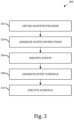
- FIG. 3 is a flow diagram of an example process 300 for executing a quantum program in a quantum computing system.
- the example process 300 is executed by a control system of a quantum computing system (e.g., the control system 110 or the control system 200 of FIGS. 1 and 2 , respectively).
- a control system of a quantum computing system e.g., the control system 110 or the control system 200 of FIGS. 1 and 2 , respectively.
- operations 302, 304, 306, 308 of the process 300 may be performed by the classical processor 204 to generate a schedule of control signals and store the schedule in the memory 202, and the control signals may be executed at 310 by the program processor 206 in accordance with the schedule.
- Operations may be programmed in hardware, software, firmware or combinations thereof.
- the quantum program may be a set of instructions written to be executed by a quantum computing system or a hybrid classical/quantum computing system (e.g., to effect changes in classical and quantum states of a quantum computing system as described above with respect to the example control system 200 of FIG. 2A ).
- the quantum program includes an instruction set written in the Quil programming language as described in the publication entitled " A Practical Quantum Instruction Set Architecture" by Smith et al., arXiv:1608.03355v2 [quant-ph], 17 Feb 2017 , or another computer programming language.
- the quantum program may be obtained by accessing instructions stored in a memory or in another manner.
- native instructions are generated.
- the native instructions may be instructions for a particular quantum computing system architecture that will execute the quantum program obtained at 302.
- quantum computing systems may have a unique architecture with qubit devices or other devices arranged in a particular manner.
- the quantum program instructions may be generic to the particular architecture of the quantum computing system, and the quantum program may be optimized, refined, or otherwise modified so that it contains a set of operations that are natively executable on the quantum computing system.
- the native instructions may include, for example, a sequence of quantum logic gates that can be applied directly in the quantum processor unit of the quantum computing system.
- events are identified based on the native instructions generated at 304.
- the events may be configured, for example, to encode information in qubit devices, to process the information by performing quantum logic gates or other types of operations, or to extract information from qubit devices.
- the events are microwave pulses configured to stimulate a qubit device, a resonator device, or another type of microwave quantum circuit device.
- the events are optical pulses configured to stimulate a trapped ion or another type of quantum optical system.
- information about the control signals e.g., pulse profiles describing a pulse magnitude, shape, etc. for each signal
- a memory e.g., the memory 202 of FIG. 2A .
- the stored control signal information may be accessed based on the native instructions generated at 304. For instance, certain pulse profiles may be accessed for scheduling (at 308) based on certain native instructions. As an example, a pulse profile for applying a particular quantum logic gate to a particular qubit or set of qubits may be accessed based on a name or other identifier of the quantum logic gate.
- the events may be configured, for example, to encode information in classical memory, to process the information by operation of a classical processor, or to store qubit readout data in classical memory.
- a schedule of the events is generated.
- the scheduling of the events may include laying out a set of instructions to execute the control signals (e.g., microwave or RF signals) and other events in a precise time table.
- the events may be scheduled according to one or more rules. For example, in some implementations, the events are scheduled according to one or more techniques described in the techniques described below.
- a state machine e.g., the program processor 206 of FIG. 2A ).
- the schedule generated at 308 is executed. Executing the schedule may include generating and sending control signals to components of a quantum computing system (e.g., qubit devices, resonator devices, or other types of quantum circuit devices), modifying (writing, updating, or other operations) the memory 202, or both, according to the schedule.
- the event schedule coordinates operation of the resources in the computing system. For example, certain events may be synchronized, an event may be performed in response to an earlier event being completed, events may be initiated in a certain order or in response to certain conditions, or events may be coordinated in another manner.
- FIG. 4 is a diagram of an example quantum logic circuit 400.
- the quantum logic circuit 400 of FIG. 4 is a quantum logic circuit for two qubits in a quantum processor unit, and includes a Hadamard gate 402, and controlled not (CNOT) gate 404, and a NOT gate 406.
- a control system of a quantum computing system e.g., the control system 110 or the control system 200 of FIGS. 1 and 2 , respectively
- a control system of a quantum computing system may generate a schedule of control signals according to the process 300 of FIG. 3 that implements the gates 402, 404, 406 of the quantum logic circuit 400.
- the quantum logic circuit can be represented as a human-readable program (e.g., a Quil program) or a computer-readable binary object code.
- FIGS. 5A-5B are diagrams showing example schedules 502, 504 of control signals that can be used to execute the example quantum logic circuit 400 of FIG. 4 .
- the schedules 502, 504 represent time tables of gate implementations on two qubits (qubits 0 and 1) of a quantum computing system.
- the horizontal axis represents time and the vertical axis represents resources that a processor (e.g., the program processor 206 of FIG. 2A ) can directly or indirectly affect.
- the schedules 502, 504 represent the logic gates of the quantum logic circuit in terms of events, which may be considered as an action executed on circuit devices in a quantum processor unit over a time period.
- schedules may include events representing actions on resources which may directly refer to resources within other components of the quantum computing system (e.g., the quantum processor cell 102 of FIG. 1A , or the memory 202, classical processor 204, program processor 206, or signaling hardware 210 of FIG. 2A ).
- the schedule 504 is an output of operation 308 of the process 300 of FIG. 3 .
- the schedule 504 is an output of one or more techniques described in the techniques described below.
- the schedules 502, 504 execute the same logic sequence as one another (the quantum logic circuit 400 of FIG. 4 ).
- the schedule 504 represents a more efficient (e.g., optimized) execution schedule.
- a Hadamard gate is applied to qubit 0 (e.g., for 50 ns)
- a CNOT gate is applied to qubits 0 and 1 (with the CNOT gate requiring more time on qubit 1 than on qubit 0, e.g., for 100 ns on qubit 0 and 150 ns on qubit 1).
- a NOT gate is applied to qubit 0 (e.g., for 50 ns).
- the schedule 502 thus leaves qubit 0 with idle time (e.g., 50 ns) as shown in FIG. 5A , while the CNOT gate is executed on qubit 1.
- the Hadamard gate is applied to qubit 0 (e.g., for 50 ns)
- a CNOT gate is applied to both qubits 0 and 1 (with the CNOT gate requiring more time on qubit 1 than on qubit 0, e.g., for 100 ns on qubit 0 and 150 ns on qubit 1) as in the schedule 502.
- the CNOT gate is being applied to qubit 1 (e.g., while the qubit 1 de-tunes after a 100 ns pulse)
- a NOT gate is applied qubit 0 (e.g., for 50 ns) in contrast to waiting until the CNOT gate has completed as shown in schedule 502 of FIG. 5A .
- the NOT gate is applied to qubit 0 earlier (e.g., 50 ns earlier).
- the qubit 0 is accordingly made available for interaction by another control signal sooner with schedule 504 than with schedule 502, freeing up the qubits resources of the quantum computing system.
- event schedules may be generated using temporal optimization or another technique.
- temporal optimization includes instruction parallelization. Some models for parallelization may assume a discrete time series with multiple events (for example, commuting gates), happening in parallel at each time step. Such a method can be referred to as a black box temporal optimization method herein.
- Black box temporal optimization may not make use of the finer structure imposed by quantum computing systems.
- gates and measurements on tunable superconducting microwave circuits may be represented as a combination of microwave pulses (for qubit excitation), magnetic field control (for qubit tuning), and delays (for resonant energy transfer).
- microwave pulses for qubit excitation
- magnetic field control for qubit tuning
- delays for resonant energy transfer
- Described herein includes a framework for performing white box temporal optimization by using event schedules.
- event schedules can have different possible instantiations, each allowing additional complexity of real hardware systems to be integrated in to the optimization model.
- Events can be used to describe white box temporal optimization. Events can be representative of an action being performed on a classical/quantum system over a period of time. The precise structure or behavior of an action is not represented, which means that events may represent a heterogeneous set of actions.
- two events e 1 and e 2 can be defined to overlap if and only if e 1 ⁇ e 2 is non-empty. If two events do not overlap, they are disjoint. The two events are adjacent if they do not overlap and e 1 ⁇ e 2 is an event.
- An event e 1 can be defined to precede e 2 if and only if L ( e 1) ⁇ L ( e 2). This induces a temporal ordering e 1 ⁇ e 2 ⁇ def L e 1 ⁇ L e 2
- R( e 1) # L( e 2) then either R( e 1) > L( e 2), which violates the fact that e 1 and e 2 do not overlap, or R ( e 1) ⁇ L ( e 2), which means there exists a point t such that R ( e 1) ⁇ t ⁇ L ( e 2), which violates the fact that e 1 ⁇ e 2 is an event.
- C( a , b ) is an event
- One proof for such a proposition can be that such a proposition is trivial from the fact that a and b are either adjacent or overlap, and as such, their union is a single, non-empty interval.
- an event can be described as an interval; however, the event can be representative of some action being performed.
- a data structure representing an event may be augmented with additional information about precisely which action or actions it represents, with a suitable interpretation of coalescing.
- the assignment of actions to intervals can be a factor for determining when actions are to be performed.
- An event can be represented as a subclass of an abstract class called "event", which can contain information about the interval the event represents.
- This abstract class can be subclassed, in this example, into two cases: first, a representation of a self-contained event called "atomic-event", and second, a representation of an event composed of other events called "compound-event”.
- a compound-event instance can be generated from an atomic-event instance, which can be done with a function called "lift".
- the implementation can be simple because the case of coalescing compound events has been determined; accordingly, other cases can be reduced to it. Instances of compound-event can be ensured to have only atomic-event instances as sub-events.
- This implementation involves some of the algebraic nature of "transitively coalescable" set of compound-event instances with respect to C. A set of such events nearly forms a semigroup: there is no identity element (because events must be non-empty) and coalesceing is associative, but there is no total closure under C. Nonetheless, the set with C forms a semigroupoid. Further, the coalesce generic function can be further specialized (for example, by producing a new atomic event which can be produced by two existing atomic events).
- Events can be built up to form larger, more complex constructs.
- One such construction was shown in the previous example with the compound-event class.
- events can occur in parallel. While not necessary in the formal sense, events can pertain to qubits.
- classical/quantum instruction code such as Quil, may require that the notion of events happen in classical memory as well.
- a resource schedule can be defined as a finite set of disjoint events.
- An indexed set of resource schedules can be called an event schedule or simply a schedule.
- a resource schedule can include events that pertain to any type of operation in the system (e.g., classical memory manipulation, quantum processor operation or classical processor operation).
- Resource schedules can be denoted generally with the capital letter S and event schedules can be denoted with the capital letter ⁇ .
- Resource schedules can have a total order to the constituent events. This fact implies a convenient representation for some things, namely for the following equivalent definitions.
- the close of a resource schedule S can be defined as the least upper bound of ⁇ 0 ⁇ U U e ⁇ S e . Equivalently, if en is the maximal element of S in the temporal sense, then the close is R ( e n ) . If a maximal element does not exist, then the close is 0. The close of S can be denoted as Close S .
- an event schedule can be a series of rows, each of which contains non-overlapping, time-delimited events.
- R en
- a suitable data structure must answer the following questions efficiently: (Question 1) What are the events for qubit q ? (Question 2) What are the soonest k events to happen after time t ? (Question 3) Which events happen between the times t and t + ⁇ t ? (Question 4) When does the last event end for a particular qubit? For some qubits? For all qubits?
- An accretive transformation can be defined as any function f : Schedule ⁇ Schedule satisfying the following properties.
- M i ⁇ e i , ⁇ , for temporally maximal e i ⁇ S i otherwise
- ⁇ ' should satisfy the following properties.
- accretive transformations can only either add to resource schedules, or modify their maximal elements so long as the modification does not move them, or both.
- the transformations can be accretive specifically because they satisfy an accretion property.
- Accretive transformations are relatively general in what they can represent. Certain parameterized collections of accretive transformations can be of interest; for example, some useful parameters can include: resource schedule indexes, collections of events, and absolute and relative times.
- the logic of the accretive transformation can be precisely what encodes any inter-event constraints. All three of the aforementioned parameters can be used in a particular example (described below), which embodies a principle behind blackbox temporal optimization-a method of organizing events so that they are accreted in lockstep. We will build up to this example with series of simpler building blocks.
- the transformation ⁇ k,t ( e ) is an accretive transformation only when t ⁇ R (max Sk ), where max is taken to mean the temporally maximal event.
- Proof for such a statement can be that since all resource schedules remain identical, which is accretive, how S k changes may only need to be considered.
- the particular example can represent an important step in an algorithm for black box temporal optimization of straight-line quantum programs. Namely, after the construction of a parallelized program, A ( e ) can be applied successively to an empty schedule for each successive time slice of events e . This demonstrates the general value of accretive transformations; they, along with coalescing, form the basis for catamorphic processing of programs and program-like data structures.
- White box temporal optimization can represent an improvement over blackbox temporal optimization when scheduling quantum programs for execution. This can be accomplished by choosing more elaborate accretive transformations in the process of scheduling a program, which can be understood to be a series of state transitions of an abstract machine in the context of an operational semantics of the language.
- a schedule can be used as a representation of a transformation of a (larger) schedule that is being computed iteratively.
- a schedule can be associated with each kind of abstract machine operation which defines the events and their temporal absolute relationship.
- the schedules are likewise dependent on the same parameters of the gate.
- an R ⁇ ( ⁇ ) gate might synthesize into events whose durations are proportional to ⁇ (mod ⁇ ).
- this representation may not necessarily encode relative temporal invariance of the events contained within the schedule. Nonetheless, such representations, which we call elastic representations, can be constructed.
- the choice of representation can be a matter of a complexity-expressivity tradeoff.
- ⁇ is seen as an elaborate "Tetris" block (referring to the game TETRISO, available from Tetris Holdings), then ⁇ ⁇ represents the falling of that block and subsequently settled placement of that block onto a given game state ⁇ .
- computing the minimal t can be computed in O ( n ) time, for schedules of n resource schedules.
- Question 1 and Question 4 can be represented by a structure which makes resource schedules explicit. This can be a vector of such data structures.
- the resource schedules can be a record containing a list of events and a pointer to the last list cell. Operation 1 can be done by mutating the last list cell.
- Questions 2 and Question 3 can be answered by way of an interval tree on all events in the schedule with in-order traversal. This also makes Operation 2 efficient. Operation 4 can also be made efficient if the qubit number is recorded within the event data structure.
- ProtoQuil a subset of Quil can be defined, called ProtoQuil.
- the quantum programming language Quil is described in the publication entitled " A Practical Quantum Instruction Set Architecture" by Smith et al., arXiv:1608.03355v2 [quant-ph], 17 Feb 2017 .
- ProtoQuil can be defined as a subset of Quil language consisting of static and parametric gates, measurement-for-effect, and the RESET instruction.
- each static gate can be associated with a schedule of events, and each parametric gate can be associated with a schedule likewise parameterized. Measurement for each qubit can also be associated with a schedule of events. Their incorporation into a schedule is straightforward.
- the RESET instruction might be implemented differently, having an accretive transformation similar to the synchronized behavior of the particular example, described above.
- Quil can also allow for a mechanism for extending the semantics of how instructions are processed by particular tools by way of the pragma directive PRAGMA.
- Pragma directives can change the way following instructions are scheduled by injecting ProtoQuil semantics-preserving accretive transformations. This can be demonstrated by way of an example.
- the X and H gates can be scheduled in parallel provided that their schedule repr e sentations allow for it. S equencing of these operations in time can be done, for example, to perform X before H. A pragma directive can be added to make this explicit.
- Some of the subject matter and operations described in this specification can be implemented in digital electronic circuitry, or in computer software, firmware, or hardware, including the structures disclosed in this specification and their structural equivalents, or in combinations of one or more of them.
- Some of the subject matter described in this specification can be implemented as one or more computer programs, i.e., one or more modules of computer program instructions, encoded on a computer storage medium for execution by, or to control the operation of, data-processing apparatus.
- certain example code is provided above using the Common Lisp Object System, the subject matter described in this specification can be implemented using other types of codes, languages, and systems.
- a computer storage medium can be, or can be included in, a computer-readable storage device, a computer-readable storage substrate, a random or serial access memory array or device, or a combination of one or more of them.
- the computer storage medium can also be, or be included in, one or more separate physical components or media (e.g., multiple CDs, disks, or other storage devices).
- Some of the operations described in this specification can be implemented as operations performed by a data processing apparatus on data stored on one or more computer-readable storage devices or received from other sources.
- data-processing apparatus encompasses all kinds of apparatus, devices, and machines for processing data, including by way of example a quantum processor, a programmable processor, a computer, a system on a chip, or multiple ones, or combinations, of the foregoing.
- the apparatus can include special purpose logic circuitry, e.g., an FPGA (field programmable gate array) or an ASIC (application specific integrated circuit).
- the apparatus can also include, in addition to hardware, code that creates an execution environment for the computer program in question, e.g., code that constitutes processor firmware, a protocol stack, a database management system, an operating system, a cross-platform runtime environment, a virtual machine, or a combination of one or more of them.
- a computer program (also known as a program, software, software application, script, or code) can be written in any form of programming language, including compiled or interpreted languages, declarative or procedural languages, and it can be deployed in any form, including as a stand-alone program or as a module, component, subroutine, object, or other unit suitable for use in a computing environment.
- a computer program may, but need not, correspond to a file in a file system.
- a program can be stored in a portion of a file that holds other programs or data (e.g., one or more scripts stored in a markup language document), in a single file dedicated to the program, or in multiple coordinated files (e.g., files that store one or more modules, sub programs, or portions of code).
- a computer program can be deployed to be executed on one computer or on multiple computers that are located at one site or distributed across multiple sites and interconnected by a communication network.
- processors suitable for the execution of a computer program include, by way of example, quantum processors, general and special purpose microprocessors, and processors of any kind of digital computer. Elements of a computer can include a processor that performs actions in accordance with instructions, and one or more memory devices that store the instructions and data. Moreover, Devices suitable for storing computer program instructions and data include all forms of non-volatile memory, media and memory devices, including by way of example semiconductor memory devices (e.g., EPROM, EEPROM, flash memory devices, and others), magnetic disks (e.g., internal hard disks, removable disks, and others), magneto optical disks, and CD ROM and DVD-ROM disks. In some cases, the processor and the memory can be supplemented by, or incorporated in, special purpose logic circuitry.
- semiconductor memory devices e.g., EPROM, EEPROM, flash memory devices, and others
- magnetic disks e.g., internal hard disks, removable disks, and others
- magneto optical disks e.
- a computer having a display device (e.g., a monitor, or another type of display device) for displaying information to the user and a keyboard and a pointing device (e.g., a mouse, a trackball, a tablet, a touch sensitive screen, or another type of pointing device) by which the user can provide input to the computer.
- a display device e.g., a monitor, or another type of display device
- a keyboard and a pointing device e.g., a mouse, a trackball, a tablet, a touch sensitive screen, or another type of pointing device
- Other kinds of devices can be used to provide for interaction with a user as well; for example, feedback provided to the user can be any form of sensory feedback, e.g., visual feedback, auditory feedback, or tactile feedback; and input from the user can be received in any form, including acoustic, speech, or tactile input.
- a computer can interact with a user by sending documents to and receiving documents from a device that is used
- a computer system may include a single computing device, or multiple computers that operate in proximity or generally remote from each other and typically interact through a communication network.
- Examples of communication networks include a local area network ("LAN”) and a wide area network (“WAN”), an inter-network (e.g., the Internet), a network comprising a satellite link, and peer-to-peer networks (e.g., ad hoc peer-to-peer networks).
- LAN local area network
- WAN wide area network
- Internet inter-network
- peer-to-peer networks e.g., ad hoc peer-to-peer networks.
- a relationship of client and server may arise by virtue of computer programs running on the respective computers and having a client-server relationship to each other.
Landscapes
- Engineering & Computer Science (AREA)
- Theoretical Computer Science (AREA)
- Software Systems (AREA)
- Physics & Mathematics (AREA)
- General Physics & Mathematics (AREA)
- General Engineering & Computer Science (AREA)
- Computer Hardware Design (AREA)
- Multimedia (AREA)
- Condensed Matter Physics & Semiconductors (AREA)
- Computational Mathematics (AREA)
- Artificial Intelligence (AREA)
- Data Mining & Analysis (AREA)
- Evolutionary Computation (AREA)
- Mathematical Analysis (AREA)
- Mathematical Optimization (AREA)
- Pure & Applied Mathematics (AREA)
- Computing Systems (AREA)
- Mathematical Physics (AREA)
- Superconductor Devices And Manufacturing Methods Thereof (AREA)
- Advance Control (AREA)
Claims (14)
- Hybrides Computing-Verfahren (300), umfassend: Identifizieren (302) eines Programms, das in einem hybriden Computing-System ausgeführt werden soll, wobei das hybride Computing-System umfasst:ein Steuersystem (110), das klassische Computing-Ressourcen umfasst, wobei die klassischen Computing-Ressourcen einen klassischen Prozessor (112) und einen klassischen Speicher (114) umfassen; undQuanten-Computing-Ressourcen, die einen Quantenprozessor (102) umfassen, der Qubits definiert, wobei die Qubits ein erstes Qubit und ein zweites Qubit umfassen;durch den Betrieb des Steuersystems, Identifizieren (306) eines Satzes von Ereignissen, die sich auf Operationen beziehen, die bei der Ausführung des Programms involviert sind, wobei der Satz von Ereignissen umfasst: Ereignisse, die sich auf Operationen beziehen, die unter Verwendung der jeweiligen Quanten-Computing-Ressourcen ausgeführt werden sollen, und ein oder mehrere Ereignisse, die sich auf Operationen beziehen, die unter Verwendung des klassischen Speichers der klassischen Computing-Ressourcen ausgeführt werden sollen, wobei die Ereignisse, die sich auf Operationen beziehen, die unter Verwendung der jeweiligen Quanten-Computing-Ressourcen ausgeführt werden sollen, ein erstes Ereignis umfassen, das sich auf eine Anwendung eines ersten Quanten-Logikgatters auf das erste Qubit bezieht;durch den Betrieb des Steuersystems, Erzeugen (308) eines Ereigniszeitplans, der Ressourcenzeitpläne für die jeweiligen Qubits umfasst, wobei der erzeugte Zeitplan so ist, dass das erste Quanten-Logikgatter auf das erste Qubit früher angewendet wird, um eine Inaktivzeit des ersten Qubits zu reduzieren; undAusführen (310) des Ereigniszeitplans im hybriden Computing-System, wobei der Ereigniszeitplan, wenn im hybriden Computing-System ausgeführt, den Betrieb des Quanten-Prozessors, des klassischen Prozessors und des klassischen Speichers koordiniert.
- Hybrides Computing-Verfahren nach Anspruch 1, wobei die Qubits durch Qubit-Vorrichtungen definiert werden, die im Quantenprozessor untergebracht sind, und das Ausführen des Ereigniszeitplans umfasst:Erzeugen von Steuersignalen; undLiefern der Steuersignale an den Quantenprozessor.
- Hybrides Computing-System, das umfasst:Quanten-Computing-Ressourcen, die einen Quantenprozessor (102) umfassen, der Qubits definiert, wobei die Qubits ein erstes Qubit und ein zweites Qubit umfassen; undein Steuersystem (110), das klassische Computing-Ressourcen umfasst, wobei die klassischen Computing-Ressourcen einen klassischen Prozessor (112) und einen klassischen Speicher (114) umfassen, wobei das Steuersystem dazu ausgelegt ist, Operationen durchzuführen, die umfassen:Identifizieren (306) eines Satzes von Ereignissen, die sich auf Operationen zum Ausführen eines Programms im hybriden Computing-System, wobei der Satz von Ereignissen umfasst: Ereignisse, die sich auf Operationen beziehen, die unter Verwendung der jeweiligen Quanten-Computing-Ressourcen ausgeführt werden sollen, und ein oder mehrere Ereignisse, die sich auf Operationen beziehen, die unter Verwendung des klassischen Speichers der klassischen Computing-Ressourcen ausgeführt werden sollen, wobei die Ereignisse, die sich auf Operationen beziehen, die unter Verwendung der jeweiligen Quanten-Computing-Ressourcen ausgeführt werden sollen, ein erstes Ereignis umfassen, das sich auf eine Anwendung eines ersten Quanten-Logikgatters auf das erste Qubit bezieht;Erzeugen (308) eines Ereigniszeitplans, der Ressourcenzeitpläne für die jeweiligen Qubits umfasst, wobei der Zeitplan, wenn im hybriden Computing-System ausgeführt, den Betrieb des Quantenprozessors, des klassischen Prozessors und des klassischen Speichers koordiniert, wobei der erzeugte Zeitplan so ist, dass das erste Quanten-Logikgatter auf das erste Qubit früher angewendet wird, um eine Inaktivzeit des ersten Qubits zu reduzieren.
- Hybrides Computing-Verfahren nach Anspruch 1 oder hybrides Computing-System nach Anspruch 3, wobei der Ereigniszeitplan Ressourcenzeitpläne umfasst für:die jeweiligen Qubits, undden klassischen Prozessor und den klassischen Speicher.
- Hybrides Computing-Verfahren nach Anspruch 1 oder hybrides Computing-System nach Anspruch 3, wobei das Identifizieren des Satzes von Ereignissen umfasst:Erhalten von hardwareunabhängigen Anweisungen vom Programm;basierend auf den hardwareunabhängigen Anweisungen, Erzeugen (304) nativer Anweisungen für Computing-Ressourcen des hybriden Computing-Systems; undIdentifizieren des Satzes von Ereignissen basierend auf den nativen Anweisungen.
- Hybrides Computing-Verfahren nach Anspruch 1 oder hybrides Computing-System nach Anspruch 3, wobei der Satz von Ereignissen mindestens eines von Folgendem umfasst:Anwendung eines Quanten-Logikgatters auf ein oder mehrere der Qubits;Messung eines Quantenzustands eines oder mehrerer der Qubits; undSpeichern einer Quantenzustandsmessung in den klassischen Speicher im hybriden Computing-System.
- Hybrides Computing-System nach Anspruch 3, wobei die Qubits durch Qubit-Vorrichtungen definiert werden, die im Quantenprozessor untergebracht sind, und das System ferner ein Signalliefersystem umfasst, das dazu ausgelegt ist, Steuersignale zwischen dem Quantenprozessor und dem Steuersystem zu liefern.
- Hybrides Computing-Verfahren nach Anspruch 2 oder hybrides Computing-System nach Anspruch 7, wobei der Quantenprozessor die Qubit-Vorrichtungen und Auslesevorrichtungen umfasst, und das Ausführen des Ereigniszeitplans das Liefern der Steuersignale an jeweilige Qubit-Vorrichtungen und Auslesevorrichtungen im Quantenprozessor umfasst.
- Hybrides Computing-Verfahren nach Anspruch 1 oder hybrides Computing-System nach Anspruch 3, wobei das hybride Computing-System dazu ausgelegt ist, asynchrone klassische und Quanten-Berechnung durchzuführen.
- Hybrides Computing-Verfahren nach Anspruch 1 oder hybrides Computing-System nach Anspruch 3, wobei das hybride Computing-System dazu ausgelegt ist, hybride klassische/Quanten-Berechnung mit Fehlerkorrektur durchzuführen.
- Hybrides Computing-Verfahren nach Anspruch 1 oder hybrides Computing-System nach Anspruch 3, wobei die Quanten-Computing-Ressourcen umfassen:Qubit-Vorrichtungen, die die Qubits im Quantenprozessor definieren; undSignalleitungen, die dazu ausgelegt sind, Steuersignale an die Qubit-Vorrichtungen zu liefern,wobei das eine oder die mehreren Ereignisse, die sich auf Operationen beziehen, die unter Verwendung der jeweiligen Quanten-Computing-Ressourcen ausgeführt werden sollen, die Lieferung von Steuersignalen an jeweilige Qubit-Vorrichtungen umfassen.
- Hybrides Computing-Verfahren nach Anspruch 1 oder hybrides Computing-System nach Anspruch 3, wobei das eine oder die mehreren Ereignisse, die sich auf Operationen beziehen, die unter Verwendung des klassischen Speichers der klassischen Computing-Ressourcen ausgeführt werden sollen, umfassen:
Speicherung von Werten im klassischen Speicher, und optional wobei die Werte Messungen umfassen, die durch Messen von Quantenzuständen der Qubits erhalten werden. - Hybrides Computing-Verfahren nach Anspruch 1 oder hybrides Computing-System nach Anspruch 3, wobei der Ereigniszeitplan, wenn im hybriden Computing-System ausgeführt, mindestens eine Operation, die durch eine klassische Computing-Ressource durchgeführt wird, mit mindestens einer Operation synchronisiert wird, die durch eine Quanten-Computing-Ressource durchgeführt wird.
- Hybrides Computing-Verfahren nach Anspruch 1 oder hybrides Computing-System nach Anspruch 3, wobei das Identifizieren des Satzes von Ereignissen das Identifizieren jeweiliger zweiter Ereignisse für das erste und zweite Qubit umfasst, die sich auf die Anwendung eines zweiten Quanten-Logikgatters beziehen.
Applications Claiming Priority (3)
| Application Number | Priority Date | Filing Date | Title |
|---|---|---|---|
| US201762469949P | 2017-03-10 | 2017-03-10 | |
| US201762521646P | 2017-06-19 | 2017-06-19 | |
| PCT/US2018/021838 WO2018165607A1 (en) | 2017-03-10 | 2018-03-09 | Event scheduling in a hybrid computing system |
Publications (3)
| Publication Number | Publication Date |
|---|---|
| EP3593296A1 EP3593296A1 (de) | 2020-01-15 |
| EP3593296A4 EP3593296A4 (de) | 2021-05-19 |
| EP3593296B1 true EP3593296B1 (de) | 2024-10-09 |
Family
ID=63444811
Family Applications (1)
| Application Number | Title | Priority Date | Filing Date |
|---|---|---|---|
| EP18763996.8A Active EP3593296B1 (de) | 2017-03-10 | 2018-03-09 | Ereignisplanung in einem hybriden datenverarbeitungssystem |
Country Status (3)
| Country | Link |
|---|---|
| US (2) | US20180260245A1 (de) |
| EP (1) | EP3593296B1 (de) |
| WO (1) | WO2018165607A1 (de) |
Cited By (1)
| Publication number | Priority date | Publication date | Assignee | Title |
|---|---|---|---|---|
| GB2643110A (en) * | 2024-07-30 | 2026-02-11 | Riverlane Ltd | A method of performing qubit operations |
Families Citing this family (99)
| Publication number | Priority date | Publication date | Assignee | Title |
|---|---|---|---|---|
| US10599988B2 (en) | 2016-03-02 | 2020-03-24 | D-Wave Systems Inc. | Systems and methods for analog processing of problem graphs having arbitrary size and/or connectivity |
| US11120357B2 (en) | 2017-03-10 | 2021-09-14 | Rigetti & Co, Inc. | Quantum approximate optimization |
| WO2018236925A1 (en) | 2017-06-19 | 2018-12-27 | Rigetti & Co, Inc. | Distributed quantum computing system |
| US11250341B2 (en) | 2017-09-07 | 2022-02-15 | Lockheed Martin Corporation | System, method and computer readable medium for quassical computing |
| US10872021B1 (en) | 2017-12-06 | 2020-12-22 | Rigetti & Co, Inc. | Testing hardware in a quantum computing system |
| US10846366B1 (en) | 2017-12-12 | 2020-11-24 | Rigetti & Co, Inc. | Selecting parameters for a quantum approximate optimization algorithm (QAOA) |
| US11521103B1 (en) | 2017-12-12 | 2022-12-06 | Rigetti & Co, Llc | Utilizing multiple quantum processor unit (QPU) instances |
| WO2019125456A1 (en) * | 2017-12-21 | 2019-06-27 | Intel Corporation | Quantum dot devices |
| US11477015B1 (en) | 2017-12-27 | 2022-10-18 | Rigetti & Co, Llc | Quantum state blockchain |
| US11194573B1 (en) | 2018-02-09 | 2021-12-07 | Rigetti & Co, Llc | Streaming execution for a quantum processing system |
| US11010145B1 (en) | 2018-02-21 | 2021-05-18 | Rigetti & Co, Inc. | Retargetable compilation for quantum computing systems |
| US11481354B2 (en) | 2018-04-24 | 2022-10-25 | D-Wave Systems Inc. | Systems and methods for calculating the ground state of non-diagonal Hamiltonians |
| US11551127B1 (en) | 2018-05-09 | 2023-01-10 | Rigetti & Co, Llc | Using a quantum processor unit to preprocess data |
| US11593707B2 (en) | 2018-07-02 | 2023-02-28 | Zapata Computing, Inc. | Compressed unsupervised quantum state preparation with quantum autoencoders |
| US11087232B2 (en) | 2018-07-18 | 2021-08-10 | IonQ, Inc. | Quantum hybrid computation |
| US11651232B2 (en) * | 2018-08-01 | 2023-05-16 | International Business Machines Corporation | Monte Carlo Markov chain based quantum program optimization |
| WO2020033807A1 (en) | 2018-08-09 | 2020-02-13 | Rigetti & Co, Inc. | Quantum streaming kernel |
| WO2020037300A1 (en) | 2018-08-17 | 2020-02-20 | Zapata Computing, Inc. | Quantum computer with exact compression of quantum states |
| US11749721B2 (en) * | 2018-09-28 | 2023-09-05 | Intel Corporation | Gate walls for quantum dot devices |
| WO2020072819A1 (en) * | 2018-10-03 | 2020-04-09 | Rigetti & Co, Inc. | Parcelled quantum resources |
| US11121302B2 (en) | 2018-10-11 | 2021-09-14 | SeeQC, Inc. | System and method for superconducting multi-chip module |
| US11593174B2 (en) * | 2018-10-16 | 2023-02-28 | D-Wave Systems Inc. | Systems and methods for scheduling programs for dedicated execution on a quantum processor |
| EP3867829B1 (de) * | 2018-10-17 | 2025-05-14 | Rigetti & Co, LLC | Parzellierte quantenressourcen |
| CA3117223A1 (en) | 2018-11-21 | 2020-05-28 | Zapata Computing, Inc. | Hybrid quantum-classical computer for packing bits into qubits for quantum optimization algorithms |
| US10333503B1 (en) | 2018-11-26 | 2019-06-25 | Quantum Machines | Quantum controller with modular and dynamic pulse generation and routing |
| AU2018274948B2 (en) * | 2018-12-06 | 2021-04-22 | Lockheed Martin Corporation | System, method and computer readable medium for quassical computing |
| US10454459B1 (en) | 2019-01-14 | 2019-10-22 | Quantum Machines | Quantum controller with multiple pulse modes |
| JP7535049B2 (ja) | 2019-01-17 | 2024-08-15 | ディー-ウェイブ システムズ インコーポレイテッド | クラスタ収縮を使用するハイブリッドアルゴリズムのためのシステム及び方法 |
| WO2020155461A1 (zh) * | 2019-01-30 | 2020-08-06 | 合肥本源量子计算科技有限责任公司 | 一种量子比特控制信号生成方法、系统 |
| US10536224B1 (en) | 2019-02-26 | 2020-01-14 | International Business Machines Corporation | Visualizing arbitrary pulse shapes and schedules in quantum computing applications |
| US10505524B1 (en) | 2019-03-06 | 2019-12-10 | Quantum Machines | Synchronization in a quantum controller with modular and dynamic pulse generation and routing |
| US11593695B2 (en) | 2019-03-26 | 2023-02-28 | D-Wave Systems Inc. | Systems and methods for hybrid analog and digital processing of a computational problem using mean fields |
| CN111796917B (zh) * | 2019-04-09 | 2024-06-25 | 华为技术有限公司 | 算子运算调度方法和装置 |
| US11222279B2 (en) | 2019-04-18 | 2022-01-11 | International Business Machines Corporation | Modular quantum circuit transformation |
| US11288121B2 (en) * | 2019-04-19 | 2022-03-29 | Zapata Computing, Inc. | Simulating errors of a quantum device using variational quantum channels |
| US11164100B2 (en) | 2019-05-02 | 2021-11-02 | Quantum Machines | Modular and dynamic digital control in a quantum controller |
| US11314908B2 (en) | 2019-05-29 | 2022-04-26 | International Business Machines Corporation | Providing reusable quantum circuit components as a curated service |
| US11509310B2 (en) * | 2019-06-17 | 2022-11-22 | Microsoft Technology Licensing, Llc | Charge locking circuits and control system for qubits |
| US11537925B2 (en) | 2019-06-19 | 2022-12-27 | International Business Machines Corporation | System and method for latency-aware mapping of quantum circuits to quantum chips |
| US11011693B2 (en) * | 2019-06-24 | 2021-05-18 | Intel Corporation | Integrated quantum circuit assemblies for cooling apparatus |
| US11474867B2 (en) * | 2019-07-11 | 2022-10-18 | Microsoft Technology Licensing, Llc | Measurement sequence determination for quantum computing device |
| US10931267B1 (en) | 2019-07-31 | 2021-02-23 | Quantum Machines | Frequency generation in a quantum controller |
| CN110442542B (zh) * | 2019-08-13 | 2022-08-02 | 吉林进取空间科技有限公司 | 一种箭载计算机 |
| US11714730B2 (en) | 2019-08-20 | 2023-08-01 | D-Wave Systems Inc. | Systems and methods for high availability, failover and load balancing of heterogeneous resources |
| US10862465B1 (en) | 2019-09-02 | 2020-12-08 | Quantum Machines | Quantum controller architecture |
| US11245390B2 (en) | 2019-09-02 | 2022-02-08 | Quantum Machines | Software-defined pulse orchestration platform |
| US12431879B2 (en) | 2019-09-25 | 2025-09-30 | Q.M Technologies Ltd. | Classical processor for quantum control |
| US11507873B1 (en) | 2019-12-16 | 2022-11-22 | Quantum Machines | Highly scalable quantum control |
| US11829737B2 (en) * | 2020-01-16 | 2023-11-28 | Microsoft Technology Licensing, Llc | Using compiler optimization to enable automatic generation of combinational circuits from high-level programs |
| CN111291893B (zh) * | 2020-01-22 | 2023-06-02 | 合肥本源量子计算科技有限责任公司 | 调度方法、调度系统、存储介质和电子装置 |
| GB202002491D0 (en) * | 2020-02-21 | 2020-04-08 | Oxford Quantum Circuits Ltd | Control method for a distributed processing system including a quantum information processor |
| US11126926B1 (en) | 2020-03-09 | 2021-09-21 | Quantum Machines | Concurrent results processing in a quantum control system |
| CN111310929A (zh) * | 2020-03-12 | 2020-06-19 | 苏州浪潮智能科技有限公司 | 面向量子计算的数据交互设备、方法、装置及介质 |
| WO2021204345A1 (en) * | 2020-04-06 | 2021-10-14 | Zurich Instruments Ag | Configurable quantum-computing control system |
| CN111638688B (zh) * | 2020-05-13 | 2023-02-03 | 宿迁学院 | 一种解决柔性流水车间调度问题的量子调度方法 |
| US11043939B1 (en) | 2020-08-05 | 2021-06-22 | Quantum Machines | Frequency management for quantum control |
| WO2022079406A1 (en) * | 2020-10-12 | 2022-04-21 | River Lane Research Ltd. | Methods and apparatus for parallel quantum computing |
| WO2022080521A1 (ko) * | 2020-10-14 | 2022-04-21 | 엘지전자 주식회사 | 컴퓨팅 장치 및 이를 구비하는 양자 컴퓨팅 시스템 |
| US11373113B1 (en) * | 2021-01-12 | 2022-06-28 | River Lane Research Ltd. | Methods and apparatus for parallel quantum computing |
| US12132486B2 (en) | 2021-04-08 | 2024-10-29 | Quantum Machines | System and method for pulse generation during quantum operations |
| EP4095766B1 (de) * | 2021-04-13 | 2023-08-30 | Tencent Technology (Shenzhen) Company Limited | Quantensteuerungssystem, quantensteuerungsprozessor und ausführungsverfahren für quantenbefehlssatz |
| US11671180B2 (en) | 2021-04-28 | 2023-06-06 | Quantum Machines | System and method for communication between quantum controller modules |
| WO2022228224A1 (zh) * | 2021-04-29 | 2022-11-03 | 合肥本源量子计算科技有限责任公司 | 量子计算任务执行方法、装置及量子计算机操作系统 |
| US20240220846A1 (en) * | 2021-04-30 | 2024-07-04 | Nokia Solutions And Networks Oy | Edge computing orchestration |
| US11853848B2 (en) | 2021-05-07 | 2023-12-26 | International Business Machines Corporation | Backend quantum runtimes |
| US12242406B2 (en) | 2021-05-10 | 2025-03-04 | Q.M Technologies Ltd. | System and method for processing between a plurality of quantum controllers |
| US20220357948A1 (en) * | 2021-05-10 | 2022-11-10 | Quantum Machines | System and method for configurable and distributed processing for quantum control |
| WO2022261523A1 (en) | 2021-06-11 | 2022-12-15 | SeeQC, Inc. | System and method of flux bias for superconducting quantum circuits |
| US11740901B2 (en) | 2021-06-15 | 2023-08-29 | International Business Machines Corporation | Centralized control of execution of quantum program |
| US11914443B2 (en) | 2021-06-16 | 2024-02-27 | Riverlane Ltd | Power-aware transmission of quantum control signals |
| GB2607923B (en) * | 2021-06-16 | 2023-06-14 | Riverlane Ltd | Power-aware transmission of quantum control signals |
| US12165011B2 (en) | 2021-06-19 | 2024-12-10 | Q.M Technologies Ltd. | Error detection mechanism for quantum bits |
| CN115511093B (zh) * | 2021-06-23 | 2024-08-13 | 本源量子计算科技(合肥)股份有限公司 | 分布式量子计算系统 |
| US12332682B2 (en) | 2021-07-21 | 2025-06-17 | Q.M Technologies Ltd. | System and method for clock synchronization and time transfer between quantum orchestration platform elements |
| US12039404B2 (en) | 2021-07-28 | 2024-07-16 | Red Hat, Inc. | Performing dynamic programmatic entanglement in quantum processing devices |
| US11972290B2 (en) * | 2021-08-12 | 2024-04-30 | International Business Machines Corporation | Time management for enhanced quantum circuit operation employing a hybrid classical/quantum system |
| US11934920B2 (en) | 2021-08-19 | 2024-03-19 | Quantinuum Llc | Quantum system controller configured for quantum error correction |
| US11907808B2 (en) * | 2021-09-01 | 2024-02-20 | Intel Corporation | Apparatus and method for quantum error correction without measurement or active feedback |
| EP4152219A1 (de) * | 2021-09-16 | 2023-03-22 | Bull SAS | Rechensystem zur ausführung von hybriden quanten/klassischen programmen |
| US12386604B2 (en) * | 2021-10-25 | 2025-08-12 | The Regents Of The University Of California | Quantum instruction set architecture (QUASAR) |
| US12327165B2 (en) * | 2021-12-11 | 2025-06-10 | International Business Machines Corporation | Visual presentation of quantum-classical interface in a user experience |
| US12111352B2 (en) | 2022-01-24 | 2024-10-08 | Quantum Machines | Machine learning for syncing multiple FPGA ports in a quantum system |
| US12314815B2 (en) | 2022-02-28 | 2025-05-27 | Q.M Technologies Ltd. | Auto-calibrating mixers in a quantum orchestration platform |
| US12524691B2 (en) * | 2022-04-26 | 2026-01-13 | International Business Machines Corporation | Central controller for a quantum system |
| US12541703B2 (en) | 2022-04-26 | 2026-02-03 | International Business Machines Corporation | Multitasking scheme for quantum computers |
| US12387123B2 (en) * | 2022-04-27 | 2025-08-12 | Red Hat, Inc. | Dynamically adjusting biases on quantum bits based on detected events |
| US12493810B2 (en) | 2022-05-09 | 2025-12-09 | Q.M Technologies Ltd. | Pulse generation in a quantum device operator |
| US12488275B1 (en) | 2022-05-10 | 2025-12-02 | Q.M Technologies Ltd. | Buffering the control of a quantum device |
| US11948046B2 (en) * | 2022-05-25 | 2024-04-02 | Red Hat, Inc. | MVC inspired quantum-classical service |
| US12450513B2 (en) * | 2022-05-31 | 2025-10-21 | Q.M Technologies Ltd. | Quantum controller validation |
| US12260113B1 (en) * | 2022-06-30 | 2025-03-25 | Lightsynq Technologies Inc. | Portable quantum memory package for quantum network nodes |
| US12154006B2 (en) | 2022-09-15 | 2024-11-26 | Red Hat, Inc. | Predicting and minimizing quantum decoherence in quantum computer systems |
| US20230032530A1 (en) * | 2022-10-06 | 2023-02-02 | Classiq Technologies LTD | Selecting a Quantum Computer |
| WO2024182036A2 (en) * | 2022-12-13 | 2024-09-06 | Schlumberger Technology Corporation | Quantum computing enabled construction planning |
| US12548019B2 (en) * | 2023-02-08 | 2026-02-10 | Bank Of America Corporation | Quantum cloud apparatus for event evaluation and authorization |
| US20240394621A1 (en) * | 2023-05-26 | 2024-11-28 | Schlumberger Technology Corporation | Devices, systems, and methods for validating drilling equipment |
| US12536275B2 (en) | 2023-11-08 | 2026-01-27 | Bank Of America Corporation | System for detection of unauthorized computer code using an artificial intelligence-based analyzer |
| US12549161B2 (en) | 2023-11-29 | 2026-02-10 | Q.M Technologies Ltd. | High resolution, direct synthesis of qubit control signals |
| US12489615B1 (en) * | 2024-06-14 | 2025-12-02 | Bank Of America Corporation | Leveraging quantum entanglement for replicating data in multiple locations and twin tagging the data |
Family Cites Families (17)
| Publication number | Priority date | Publication date | Assignee | Title |
|---|---|---|---|---|
| US20070239366A1 (en) * | 2004-06-05 | 2007-10-11 | Hilton Jeremy P | Hybrid classical-quantum computer architecture for molecular modeling |
| KR100643283B1 (ko) * | 2004-10-13 | 2006-11-10 | 삼성전자주식회사 | 양자 코프로세서를 사용하여 연산 속도를 향상시키는 방법및 장치 |
| US7876145B2 (en) * | 2007-07-13 | 2011-01-25 | International Business Machines Corporation | Control system architecture for qubits |
| US8832165B2 (en) * | 2007-12-12 | 2014-09-09 | Lockheed Martin Corporation | Computer systems and methods for quantum verification and validation |
| US8977717B2 (en) * | 2009-06-17 | 2015-03-10 | Nokia Corporation | Method and apparatus for providing applications with shared scalable caching |
| EP2729903B1 (de) * | 2011-07-06 | 2020-04-01 | D-Wave Systems Inc. | Quantenprozessor, systeme und verfahren zur minimierung einer zielfunktion |
| US9866379B2 (en) * | 2011-09-30 | 2018-01-09 | Los Alamos National Security, Llc | Polarization tracking system for free-space optical communication, including quantum communication |
| JP5921856B2 (ja) * | 2011-11-28 | 2016-05-24 | 株式会社日立製作所 | 量子コンピュータシステム、量子コンピュータシステムの制御方法及びプログラム |
| US9275011B2 (en) * | 2013-03-27 | 2016-03-01 | Microsoft Technology Licensing, Llc | Fast quantum and classical phase estimation |
| US9858531B1 (en) * | 2013-08-02 | 2018-01-02 | University Of Maryland | Fault tolerant scalable modular quantum computer architecture with an enhanced control of multi-mode couplings between trapped ion qubits |
| US9081560B2 (en) * | 2013-09-30 | 2015-07-14 | Sungard Systems International Inc. | Code tracing processor selection |
| WO2015178992A2 (en) * | 2014-02-28 | 2015-11-26 | Rigetti & Co., Inc. | Processing signals in a quantum computing system |
| US9881256B2 (en) * | 2014-08-22 | 2018-01-30 | D-Wave Systems Inc. | Systems and methods for problem solving, useful for example in quantum computing |
| CN104880476B (zh) * | 2015-06-05 | 2017-11-14 | 深圳市西凡谨顿科技有限公司 | 支持元素定性定量分析的数字多道系统 |
| KR102659959B1 (ko) * | 2016-02-12 | 2024-04-23 | 예일 유니버시티 | 양자 시스템을 제어하는 기술 그리고 관련 시스템 및 방법 |
| EP3300004A1 (de) * | 2016-09-27 | 2018-03-28 | Nederlandse Organisatie voor toegepast- natuurwetenschappelijk onderzoek TNO | Verfahren zur ausführung eines quantenfehlerkorrekturzyklus in einem quantencomputer |
| US20180121601A1 (en) * | 2016-10-28 | 2018-05-03 | Edico Genome, Corp. | Bioinformatics systems, apparatuses, and methods for performing secondary and/or tertiary processing |
-
2018
- 2018-03-09 EP EP18763996.8A patent/EP3593296B1/de active Active
- 2018-03-09 WO PCT/US2018/021838 patent/WO2018165607A1/en not_active Ceased
- 2018-03-09 US US15/917,317 patent/US20180260245A1/en not_active Abandoned
-
2024
- 2024-03-27 US US18/618,514 patent/US20250053441A1/en active Pending
Non-Patent Citations (2)
| Title |
|---|
| JAMES E LEVY ET AL: "Brief announcement", PARALLELISM IN ALGORITHMS AND ARCHITECTURES, ACM, 2 PENN PLAZA, SUITE 701NEW YORKNY10121-0701USA, 11 August 2009 (2009-08-11), pages 166 - 168, XP058378853, ISBN: 978-1-60558-606-9, DOI: 10.1145/1583991.1584039 * |
| MOSTAFA ELHOUSHI: "Model of a hybrid processor executing C++ with additional quantum functions", MICROPROCESSORS AND MICROSYSTEMS., vol. 38, no. 8, 1 November 2014 (2014-11-01), GB, pages 1000 - 1011, XP093153497, ISSN: 0141-9331, DOI: 10.1016/j.micpro.2014.09.002 * |
Cited By (1)
| Publication number | Priority date | Publication date | Assignee | Title |
|---|---|---|---|---|
| GB2643110A (en) * | 2024-07-30 | 2026-02-11 | Riverlane Ltd | A method of performing qubit operations |
Also Published As
| Publication number | Publication date |
|---|---|
| EP3593296A4 (de) | 2021-05-19 |
| WO2018165607A4 (en) | 2018-11-01 |
| WO2018165607A1 (en) | 2018-09-13 |
| US20250053441A1 (en) | 2025-02-13 |
| EP3593296A1 (de) | 2020-01-15 |
| US20180260245A1 (en) | 2018-09-13 |
Similar Documents
| Publication | Publication Date | Title |
|---|---|---|
| US20250053441A1 (en) | Event Scheduling in a Hybrid Computing System | |
| US12204991B1 (en) | Gate formation on a quantum processor | |
| US10846366B1 (en) | Selecting parameters for a quantum approximate optimization algorithm (QAOA) | |
| US10733522B2 (en) | Generating quantum logic control sequences for quantum information processing hardware | |
| US20220245497A1 (en) | Quantum Approximate Optimization | |
| US12001923B2 (en) | Quantum streaming kernel | |
| US11727299B2 (en) | Distributed quantum computing system | |
| US12067075B1 (en) | Solving optimization problems using a hybrid computer system | |
| US10332024B2 (en) | Modeling superconducting quantum circuit systems | |
| US20230020389A1 (en) | Executing a Quantum Logic Circuit on Multiple Processing Nodes | |
| US20210132969A1 (en) | Quantum Virtual Machine for Simulation of a Quantum Processing System | |
| Coopmans et al. | Protocol discovery for the quantum control of majoranas by differentiable programming and natural evolution strategies | |
| Jokar et al. | DigiQ: A scalable digital controller for quantum computers using SFQ logic | |
| US20090070402A1 (en) | Systems, methods, and apparatus for a distributed network of quantum computers | |
| US11960972B1 (en) | Using a quantum processor unit to preprocess data | |
| US20200161530A1 (en) | Quantum hardware characterized by programmable bose-hubbard hamiltonians | |
| Li et al. | Quantum circuit compilation for nearest-neighbor architecture based on reinforcement learning: Y. Li et al. | |
| Lee et al. | Massively parallel motion planning algorithms under uncertainty using POMDP | |
| US20230186131A1 (en) | Simulator for quantum computing systems | |
| Tang et al. | Quantum computing for several AGV scheduling models | |
| Carneiro et al. | Synchronous cellular automata-based scheduler initialized by heuristic and modeled by a pseudo-linear neighborhood | |
| Mebtouche et al. | Quantum computing for computer vision: Applications, challenges, and research tracks | |
| US20240311676A1 (en) | Performing Parametric Dissipation Operations in a Quantum Computing System | |
| Li et al. | Quantum walks with memory provided by parity of memory | |
| Singh et al. | GPU and CUDA in hard computing approaches: analytical review |
Legal Events
| Date | Code | Title | Description |
|---|---|---|---|
| STAA | Information on the status of an ep patent application or granted ep patent |
Free format text: STATUS: THE INTERNATIONAL PUBLICATION HAS BEEN MADE |
|
| PUAI | Public reference made under article 153(3) epc to a published international application that has entered the european phase |
Free format text: ORIGINAL CODE: 0009012 |
|
| STAA | Information on the status of an ep patent application or granted ep patent |
Free format text: STATUS: REQUEST FOR EXAMINATION WAS MADE |
|
| 17P | Request for examination filed |
Effective date: 20191010 |
|
| AK | Designated contracting states |
Kind code of ref document: A1 Designated state(s): AL AT BE BG CH CY CZ DE DK EE ES FI FR GB GR HR HU IE IS IT LI LT LU LV MC MK MT NL NO PL PT RO RS SE SI SK SM TR |
|
| AX | Request for extension of the european patent |
Extension state: BA ME |
|
| DAV | Request for validation of the european patent (deleted) | ||
| DAX | Request for extension of the european patent (deleted) | ||
| A4 | Supplementary search report drawn up and despatched |
Effective date: 20210420 |
|
| RIC1 | Information provided on ipc code assigned before grant |
Ipc: G06N 99/00 20190101AFI20210414BHEP Ipc: B82Y 10/00 20110101ALI20210414BHEP Ipc: G06F 9/48 20060101ALI20210414BHEP Ipc: G06F 9/54 20060101ALI20210414BHEP Ipc: G06F 15/76 20060101ALI20210414BHEP Ipc: G06N 10/00 20190101ALI20210414BHEP |
|
| RAP3 | Party data changed (applicant data changed or rights of an application transferred) |
Owner name: RIGETTI & CO, LLC |
|
| STAA | Information on the status of an ep patent application or granted ep patent |
Free format text: STATUS: EXAMINATION IS IN PROGRESS |
|
| 17Q | First examination report despatched |
Effective date: 20221208 |
|
| GRAP | Despatch of communication of intention to grant a patent |
Free format text: ORIGINAL CODE: EPIDOSNIGR1 |
|
| STAA | Information on the status of an ep patent application or granted ep patent |
Free format text: STATUS: GRANT OF PATENT IS INTENDED |
|
| INTG | Intention to grant announced |
Effective date: 20240515 |
|
| GRAS | Grant fee paid |
Free format text: ORIGINAL CODE: EPIDOSNIGR3 |
|
| GRAA | (expected) grant |
Free format text: ORIGINAL CODE: 0009210 |
|
| STAA | Information on the status of an ep patent application or granted ep patent |
Free format text: STATUS: THE PATENT HAS BEEN GRANTED |
|
| AK | Designated contracting states |
Kind code of ref document: B1 Designated state(s): AL AT BE BG CH CY CZ DE DK EE ES FI FR GB GR HR HU IE IS IT LI LT LU LV MC MK MT NL NO PL PT RO RS SE SI SK SM TR |
|
| REG | Reference to a national code |
Ref country code: CH Ref legal event code: EP |
|
| P01 | Opt-out of the competence of the unified patent court (upc) registered |
Free format text: CASE NUMBER: APP_52316/2024 Effective date: 20240918 |
|
| REG | Reference to a national code |
Ref country code: DE Ref legal event code: R096 Ref document number: 602018075214 Country of ref document: DE |
|
| REG | Reference to a national code |
Ref country code: IE Ref legal event code: FG4D |
|
| REG | Reference to a national code |
Ref country code: NL Ref legal event code: FP |
|
| REG | Reference to a national code |
Ref country code: LT Ref legal event code: MG9D |
|
| PGFP | Annual fee paid to national office [announced via postgrant information from national office to epo] |
Ref country code: NL Payment date: 20250115 Year of fee payment: 8 |
|
| REG | Reference to a national code |
Ref country code: AT Ref legal event code: MK05 Ref document number: 1731389 Country of ref document: AT Kind code of ref document: T Effective date: 20241009 |
|
| PG25 | Lapsed in a contracting state [announced via postgrant information from national office to epo] |
Ref country code: IS Free format text: LAPSE BECAUSE OF FAILURE TO SUBMIT A TRANSLATION OF THE DESCRIPTION OR TO PAY THE FEE WITHIN THE PRESCRIBED TIME-LIMIT Effective date: 20250209 Ref country code: PT Free format text: LAPSE BECAUSE OF FAILURE TO SUBMIT A TRANSLATION OF THE DESCRIPTION OR TO PAY THE FEE WITHIN THE PRESCRIBED TIME-LIMIT Effective date: 20250210 Ref country code: HR Free format text: LAPSE BECAUSE OF FAILURE TO SUBMIT A TRANSLATION OF THE DESCRIPTION OR TO PAY THE FEE WITHIN THE PRESCRIBED TIME-LIMIT Effective date: 20241009 |
|
| PGFP | Annual fee paid to national office [announced via postgrant information from national office to epo] |
Ref country code: DE Payment date: 20250114 Year of fee payment: 8 |
|
| PG25 | Lapsed in a contracting state [announced via postgrant information from national office to epo] |
Ref country code: FI Free format text: LAPSE BECAUSE OF FAILURE TO SUBMIT A TRANSLATION OF THE DESCRIPTION OR TO PAY THE FEE WITHIN THE PRESCRIBED TIME-LIMIT Effective date: 20241009 |
|
| PG25 | Lapsed in a contracting state [announced via postgrant information from national office to epo] |
Ref country code: BG Free format text: LAPSE BECAUSE OF FAILURE TO SUBMIT A TRANSLATION OF THE DESCRIPTION OR TO PAY THE FEE WITHIN THE PRESCRIBED TIME-LIMIT Effective date: 20241009 |
|
| PG25 | Lapsed in a contracting state [announced via postgrant information from national office to epo] |
Ref country code: ES Free format text: LAPSE BECAUSE OF FAILURE TO SUBMIT A TRANSLATION OF THE DESCRIPTION OR TO PAY THE FEE WITHIN THE PRESCRIBED TIME-LIMIT Effective date: 20241009 |
|
| PG25 | Lapsed in a contracting state [announced via postgrant information from national office to epo] |
Ref country code: NO Free format text: LAPSE BECAUSE OF FAILURE TO SUBMIT A TRANSLATION OF THE DESCRIPTION OR TO PAY THE FEE WITHIN THE PRESCRIBED TIME-LIMIT Effective date: 20250109 |
|
| PG25 | Lapsed in a contracting state [announced via postgrant information from national office to epo] |
Ref country code: LV Free format text: LAPSE BECAUSE OF FAILURE TO SUBMIT A TRANSLATION OF THE DESCRIPTION OR TO PAY THE FEE WITHIN THE PRESCRIBED TIME-LIMIT Effective date: 20241009 Ref country code: GR Free format text: LAPSE BECAUSE OF FAILURE TO SUBMIT A TRANSLATION OF THE DESCRIPTION OR TO PAY THE FEE WITHIN THE PRESCRIBED TIME-LIMIT Effective date: 20250110 Ref country code: AT Free format text: LAPSE BECAUSE OF FAILURE TO SUBMIT A TRANSLATION OF THE DESCRIPTION OR TO PAY THE FEE WITHIN THE PRESCRIBED TIME-LIMIT Effective date: 20241009 |
|
| PG25 | Lapsed in a contracting state [announced via postgrant information from national office to epo] |
Ref country code: PL Free format text: LAPSE BECAUSE OF FAILURE TO SUBMIT A TRANSLATION OF THE DESCRIPTION OR TO PAY THE FEE WITHIN THE PRESCRIBED TIME-LIMIT Effective date: 20241009 |
|
| PGFP | Annual fee paid to national office [announced via postgrant information from national office to epo] |
Ref country code: FR Payment date: 20250108 Year of fee payment: 8 |
|
| PGFP | Annual fee paid to national office [announced via postgrant information from national office to epo] |
Ref country code: GB Payment date: 20250116 Year of fee payment: 8 |
|
| PG25 | Lapsed in a contracting state [announced via postgrant information from national office to epo] |
Ref country code: RS Free format text: LAPSE BECAUSE OF FAILURE TO SUBMIT A TRANSLATION OF THE DESCRIPTION OR TO PAY THE FEE WITHIN THE PRESCRIBED TIME-LIMIT Effective date: 20250109 |
|
| PG25 | Lapsed in a contracting state [announced via postgrant information from national office to epo] |
Ref country code: SM Free format text: LAPSE BECAUSE OF FAILURE TO SUBMIT A TRANSLATION OF THE DESCRIPTION OR TO PAY THE FEE WITHIN THE PRESCRIBED TIME-LIMIT Effective date: 20241009 |
|
| PG25 | Lapsed in a contracting state [announced via postgrant information from national office to epo] |
Ref country code: DK Free format text: LAPSE BECAUSE OF FAILURE TO SUBMIT A TRANSLATION OF THE DESCRIPTION OR TO PAY THE FEE WITHIN THE PRESCRIBED TIME-LIMIT Effective date: 20241009 |
|
| REG | Reference to a national code |
Ref country code: DE Ref legal event code: R097 Ref document number: 602018075214 Country of ref document: DE |
|
| PG25 | Lapsed in a contracting state [announced via postgrant information from national office to epo] |
Ref country code: EE Free format text: LAPSE BECAUSE OF FAILURE TO SUBMIT A TRANSLATION OF THE DESCRIPTION OR TO PAY THE FEE WITHIN THE PRESCRIBED TIME-LIMIT Effective date: 20241009 |
|
| PGFP | Annual fee paid to national office [announced via postgrant information from national office to epo] |
Ref country code: CH Payment date: 20250401 Year of fee payment: 8 |
|
| PG25 | Lapsed in a contracting state [announced via postgrant information from national office to epo] |
Ref country code: RO Free format text: LAPSE BECAUSE OF FAILURE TO SUBMIT A TRANSLATION OF THE DESCRIPTION OR TO PAY THE FEE WITHIN THE PRESCRIBED TIME-LIMIT Effective date: 20241009 |
|
| PG25 | Lapsed in a contracting state [announced via postgrant information from national office to epo] |
Ref country code: SK Free format text: LAPSE BECAUSE OF FAILURE TO SUBMIT A TRANSLATION OF THE DESCRIPTION OR TO PAY THE FEE WITHIN THE PRESCRIBED TIME-LIMIT Effective date: 20241009 |
|
| PG25 | Lapsed in a contracting state [announced via postgrant information from national office to epo] |
Ref country code: CZ Free format text: LAPSE BECAUSE OF FAILURE TO SUBMIT A TRANSLATION OF THE DESCRIPTION OR TO PAY THE FEE WITHIN THE PRESCRIBED TIME-LIMIT Effective date: 20241009 |
|
| PG25 | Lapsed in a contracting state [announced via postgrant information from national office to epo] |
Ref country code: IT Free format text: LAPSE BECAUSE OF FAILURE TO SUBMIT A TRANSLATION OF THE DESCRIPTION OR TO PAY THE FEE WITHIN THE PRESCRIBED TIME-LIMIT Effective date: 20241009 |
|
| PLBE | No opposition filed within time limit |
Free format text: ORIGINAL CODE: 0009261 |
|
| STAA | Information on the status of an ep patent application or granted ep patent |
Free format text: STATUS: NO OPPOSITION FILED WITHIN TIME LIMIT |
|
| PG25 | Lapsed in a contracting state [announced via postgrant information from national office to epo] |
Ref country code: SE Free format text: LAPSE BECAUSE OF FAILURE TO SUBMIT A TRANSLATION OF THE DESCRIPTION OR TO PAY THE FEE WITHIN THE PRESCRIBED TIME-LIMIT Effective date: 20241009 |
|
| 26N | No opposition filed |
Effective date: 20250710 |
|
| PG25 | Lapsed in a contracting state [announced via postgrant information from national office to epo] |
Ref country code: MC Free format text: LAPSE BECAUSE OF FAILURE TO SUBMIT A TRANSLATION OF THE DESCRIPTION OR TO PAY THE FEE WITHIN THE PRESCRIBED TIME-LIMIT Effective date: 20241009 |
|
| PG25 | Lapsed in a contracting state [announced via postgrant information from national office to epo] |
Ref country code: LU Free format text: LAPSE BECAUSE OF NON-PAYMENT OF DUE FEES Effective date: 20250309 |
|
| REG | Reference to a national code |
Ref country code: BE Ref legal event code: MM Effective date: 20250331 |
|
| PG25 | Lapsed in a contracting state [announced via postgrant information from national office to epo] |
Ref country code: BE Free format text: LAPSE BECAUSE OF NON-PAYMENT OF DUE FEES Effective date: 20250331 |
|
| PG25 | Lapsed in a contracting state [announced via postgrant information from national office to epo] |
Ref country code: IE Free format text: LAPSE BECAUSE OF NON-PAYMENT OF DUE FEES Effective date: 20250309 |