EP3592391B1 - Pharmaceutical composition comprising selexipag - Google Patents
Pharmaceutical composition comprising selexipag Download PDFInfo
- Publication number
- EP3592391B1 EP3592391B1 EP18711258.6A EP18711258A EP3592391B1 EP 3592391 B1 EP3592391 B1 EP 3592391B1 EP 18711258 A EP18711258 A EP 18711258A EP 3592391 B1 EP3592391 B1 EP 3592391B1
- Authority
- EP
- European Patent Office
- Prior art keywords
- pharmaceutical composition
- reconstituted
- composition according
- aqueous
- compound
- Prior art date
- Legal status (The legal status is an assumption and is not a legal conclusion. Google has not performed a legal analysis and makes no representation as to the accuracy of the status listed.)
- Active
Links
Classifications
-
- A—HUMAN NECESSITIES
- A61—MEDICAL OR VETERINARY SCIENCE; HYGIENE
- A61K—PREPARATIONS FOR MEDICAL, DENTAL OR TOILETRY PURPOSES
- A61K9/00—Medicinal preparations characterised by special physical form
- A61K9/08—Solutions
-
- A—HUMAN NECESSITIES
- A61—MEDICAL OR VETERINARY SCIENCE; HYGIENE
- A61K—PREPARATIONS FOR MEDICAL, DENTAL OR TOILETRY PURPOSES
- A61K31/00—Medicinal preparations containing organic active ingredients
- A61K31/33—Heterocyclic compounds
- A61K31/395—Heterocyclic compounds having nitrogen as a ring hetero atom, e.g. guanethidine or rifamycins
- A61K31/495—Heterocyclic compounds having nitrogen as a ring hetero atom, e.g. guanethidine or rifamycins having six-membered rings with two or more nitrogen atoms as the only ring heteroatoms, e.g. piperazine or tetrazines
- A61K31/4965—Non-condensed pyrazines
-
- A—HUMAN NECESSITIES
- A61—MEDICAL OR VETERINARY SCIENCE; HYGIENE
- A61K—PREPARATIONS FOR MEDICAL, DENTAL OR TOILETRY PURPOSES
- A61K47/00—Medicinal preparations characterised by the non-active ingredients used, e.g. carriers or inert additives; Targeting or modifying agents chemically bound to the active ingredient
- A61K47/02—Inorganic compounds
-
- A—HUMAN NECESSITIES
- A61—MEDICAL OR VETERINARY SCIENCE; HYGIENE
- A61K—PREPARATIONS FOR MEDICAL, DENTAL OR TOILETRY PURPOSES
- A61K47/00—Medicinal preparations characterised by the non-active ingredients used, e.g. carriers or inert additives; Targeting or modifying agents chemically bound to the active ingredient
- A61K47/06—Organic compounds, e.g. natural or synthetic hydrocarbons, polyolefins, mineral oil, petrolatum or ozokerite
- A61K47/08—Organic compounds, e.g. natural or synthetic hydrocarbons, polyolefins, mineral oil, petrolatum or ozokerite containing oxygen, e.g. ethers, acetals, ketones, quinones, aldehydes, peroxides
- A61K47/10—Alcohols; Phenols; Salts thereof, e.g. glycerol; Polyethylene glycols [PEG]; Poloxamers; PEG/POE alkyl ethers
-
- A—HUMAN NECESSITIES
- A61—MEDICAL OR VETERINARY SCIENCE; HYGIENE
- A61K—PREPARATIONS FOR MEDICAL, DENTAL OR TOILETRY PURPOSES
- A61K47/00—Medicinal preparations characterised by the non-active ingredients used, e.g. carriers or inert additives; Targeting or modifying agents chemically bound to the active ingredient
- A61K47/06—Organic compounds, e.g. natural or synthetic hydrocarbons, polyolefins, mineral oil, petrolatum or ozokerite
- A61K47/16—Organic compounds, e.g. natural or synthetic hydrocarbons, polyolefins, mineral oil, petrolatum or ozokerite containing nitrogen, e.g. nitro-, nitroso-, azo-compounds, nitriles, cyanates
- A61K47/18—Amines; Amides; Ureas; Quaternary ammonium compounds; Amino acids; Oligopeptides having up to five amino acids
- A61K47/183—Amino acids, e.g. glycine, EDTA or aspartame
-
- A—HUMAN NECESSITIES
- A61—MEDICAL OR VETERINARY SCIENCE; HYGIENE
- A61K—PREPARATIONS FOR MEDICAL, DENTAL OR TOILETRY PURPOSES
- A61K47/00—Medicinal preparations characterised by the non-active ingredients used, e.g. carriers or inert additives; Targeting or modifying agents chemically bound to the active ingredient
- A61K47/06—Organic compounds, e.g. natural or synthetic hydrocarbons, polyolefins, mineral oil, petrolatum or ozokerite
- A61K47/26—Carbohydrates, e.g. sugar alcohols, amino sugars, nucleic acids, mono-, di- or oligo-saccharides; Derivatives thereof, e.g. polysorbates, sorbitan fatty acid esters or glycyrrhizin
-
- A—HUMAN NECESSITIES
- A61—MEDICAL OR VETERINARY SCIENCE; HYGIENE
- A61K—PREPARATIONS FOR MEDICAL, DENTAL OR TOILETRY PURPOSES
- A61K9/00—Medicinal preparations characterised by special physical form
- A61K9/0012—Galenical forms characterised by the site of application
- A61K9/0019—Injectable compositions; Intramuscular, intravenous, arterial, subcutaneous administration; Compositions to be administered through the skin in an invasive manner
-
- A—HUMAN NECESSITIES
- A61—MEDICAL OR VETERINARY SCIENCE; HYGIENE
- A61K—PREPARATIONS FOR MEDICAL, DENTAL OR TOILETRY PURPOSES
- A61K9/00—Medicinal preparations characterised by special physical form
- A61K9/14—Particulate form, e.g. powders, Processes for size reducing of pure drugs or the resulting products, Pure drug nanoparticles
- A61K9/19—Particulate form, e.g. powders, Processes for size reducing of pure drugs or the resulting products, Pure drug nanoparticles lyophilised, i.e. freeze-dried, solutions or dispersions
-
- A—HUMAN NECESSITIES
- A61—MEDICAL OR VETERINARY SCIENCE; HYGIENE
- A61P—SPECIFIC THERAPEUTIC ACTIVITY OF CHEMICAL COMPOUNDS OR MEDICINAL PREPARATIONS
- A61P17/00—Drugs for dermatological disorders
- A61P17/02—Drugs for dermatological disorders for treating wounds, ulcers, burns, scars, keloids, or the like
-
- A—HUMAN NECESSITIES
- A61—MEDICAL OR VETERINARY SCIENCE; HYGIENE
- A61P—SPECIFIC THERAPEUTIC ACTIVITY OF CHEMICAL COMPOUNDS OR MEDICINAL PREPARATIONS
- A61P9/00—Drugs for disorders of the cardiovascular system
- A61P9/12—Antihypertensives
Definitions
- the present invention relates to pharmaceutical compositions comprising 2- ⁇ 4-[N-(5,6-diphenylpyrazin-2-yl)-N-isopropylamino]butyloxy ⁇ -N-(methylsulfonyl)acetamide (selexipag, NS-304, ACT-293987; hereinafter COMPOUND) which are suitable for intra venous (i.v.) administration.
- selexipag or its active metabolite may be useful as preventive or therapeutic agent for ulcer, digital ulcer, diabetic gangrene, diabetic foot ulcer, pressure ulcer (bedsore), hypertension, pulmonary hypertension, pulmonary arterial hypertension, Fontan disease and pulmonary hypertension associated with Fontan disease, sarcoidosis and pulmonary hypertension associated with sarcoidosis, peripheral circulatory disturbance (e.g., chronic arterial occlusion, intermittent claudication, peripheral embolism, vibration syndrome, Raynaud's disease), connective tissue disease (e.g., systemic lupus erythematosus, scleroderma, mixed connective tissue disease, vasculitic syndrome), reocclusion/restenosis after percutaneous transluminal coronary angioplasty (PTCA), arteriosclerosis, thrombosis (e.g., acute-phase cerebral thrombosis, pulmonary embolism), transient ischemic attack (TIA), diabetic neuropathy
- Selexipag was shown to be beneficial in the treatment of pulmonary arterial hypertension.
- the risk of the primary composite end point of death or a complication related to pulmonary arterial hypertension was significantly lower among patients who received selexipag than among those who received placebo.
- Selexipag received market approval e.g. in the US and is indicated for the treatment of pulmonary arterial hypertension (PAH, WHO Group I) to delay disease progression and reduce the risk of hospitalization for PAH.
- PAH pulmonary arterial hypertension
- Selexipag is thought to function as a prodrug (while retaining some agonistic activity on the IP receptor on its own) which can exert long-lasting selective IP receptor agonist activity of the active metabolite 2-(4-((5,6-diphenylpyrazin-2-yl)(isopropyl)amino)butoxy) acetic acid in mammals, especially humans.
- the in vivo metabolism of selexipag effectively may act as a kind of 'slow-release mechanism' that potentially both prolongs activity and reduces typical adverse effects associated with high concentrations of PGI2 agonists ( Kuwano et al., J Pharmacol Exp Ther (2007), 322(3), 1181-1188 ).
- Adverse effects associated with PGI2 agonists are also addressed by a particular up-titration schedule.
- the recommended starting dose of oral selexipag is 200 micrograms given twice daily.
- the dose is then increased in increments of 200 micrograms twice daily, usually at weekly intervals, to the highest tolerated dose up to 1600 micrograms twice daily. If a patient reaches a dose that cannot be tolerated, the dose should be reduced to the previous tolerated dose.
- an oral formulation of selexipag may be inappropriate or impossible (e.g. in urgent care, or in case a patient is for some reasons unable to swallow a tablet).
- treatment of certain diseases may only require short term treatment, or a treatment comprising alternating periods of treatment / non-treatment, in which case the above-mentioned up-titration schedule could be inappropriate.
- diseases may comprise for example ulcer, digital ulcer, diabetic gangrene, diabetic foot ulcer, pressure ulcer (bedsore), peripheral circulatory disturbances, etc. Therefore, there is a need to develop a stable and reproducible i.v. formulation for selexipag.
- compositions comprising selexipag, a bulking agent, a detergent, and a buffer lead to chemically and physically stable aqueous formulations that can reproducibly be lyophilized to a stable cake and reconstituted to a controlled composition which is suitable for i.v. administration. Adsorption of active ingredient to tubings and syringes could be avoided.
- the present compositions according to embodiment 1) are liquid isotropic mixtures, which contain COMPOUND in free base form.
- COMPOUND may be used for the preparation of the present compositions in amorphous, or in one or more crystalline forms, or in mixtures of amorphous and crystalline form(s).
- Crystalline forms may be anhydrous, or solvate or hydrate forms.
- Such morphological forms are encompassed in the scope of COMPOUND.
- Preferably COMPOUND is used in crystalline form.
- the present compositions encompass COMPOUND in essentially pure form. The amount of COMPOUND may be adjusted taking into account the actual chemical purity, or the presence of a solvate, or hydrate, of COMPOUND.
- the term “bulking agent” refers to a substance or component that is chemically compatible with the active pharmaceutical ingredient and with further excipients of a composition, and that adds mass to a lyophilized composition.
- a bulking agent suitable for pharmaceutical compositions according to embodiment 1) of the present invention is glycine.
- Bulking agents typically used in pharmaceutical compositions are for example mannitol, trehalose, L-proline, and polyvinylpyrrolidone.
- excipient polysorbate 20 or polyoxyethylene (20) sorbitan monolaurate refers to commercially available polysorbate 20 ( CAS No 9005-64-5 , E 432), preferably Tween® 20 / Tween® 20 EMPROVE® from Croda Americas / Merck Chemicals.
- polysorbate 20 Alternative commercial forms of polysorbate 20 are for example Armotan® PML 20; Capmul® POE-L; CrilletTM 1; Eumulgin® SML 20; Glycosperse® L-20; Liposorb® L-20; MontanoxTM 20; Nonion® LT-221; Ritabate 20; Sorbax PML-20; T-Maz® 20; ProtasorbTM L-20; Tego® SML 20; Alkest® TW 20; Wilsurf® TF-20.
- Armotan® PML 20 Capmul® POE-L; CrilletTM 1; Eumulgin® SML 20; Glycosperse® L-20; Liposorb® L-20; MontanoxTM 20; Nonion® LT-221; Ritabate 20; Sorbax PML-20; T-Maz® 20; ProtasorbTM L-20; Tego® SML 20; Alkest® TW 20; Wilsurf® TF-20.
- Polysorbate 20 may be defined as (non-ionic) detergent / emulsifyer / surfactant.
- Detergents especially commercially available detergent products, are usually not pure compounds but may be rather complex mixtures of compounds containing one primary major detergent component.
- Polysorbate 20 for example is a polysorbate-type nonionic detergent formed by the ethoxylation of sorbitan before the addition of lauric acid. The ethoxylation process leaves the molecule with 20 repeat units of polyethylene glycol; in practice these are distributed across 4 different chains leading to a commercial product containing a range of chemical species.
- Polysorbate 20 may contain variable amounts of said primary major detergent component, and residual amounts of further components such as for example residual polyethyleneglycols (which may stem from the chemical production process). The above-mentioned variation in the chemical species and the residual further components possibly comprised in the commercial product are encompassed in the scope of term "polysorbate 20" as used herein.
- the total ww% of the pharmaceutical compositions as defined in embodiment 1), and embodiments 2) to 6) below is 100.
- compositions as defined in embodiment 1) and 2) to 6) below may additionally comprise further conventional ingredients and/ or additives, which may be used alone or in combination ( quantum satis, i.e. wherein the maximum amounts of said further conventional ingredients and/ or additives may need to be reduced to make up the total ww% of 100). It is understood that the pharmaceutical compositions as defined in embodiment 1) and 2) to 6) below will not comprise a further bulking agent or a further detergent.
- tonicity modifiers such as salts (e.g. NaCl, KCI, MgCI2, CaCl 2 ).
- Further conventional ingredients or additives are for example antimicrobial preservatives such as used e.g. in bacteriostatic water for injection.
- An example is benzyl alcohol.
- the total weight percent of the pharmaceutical composition is 100.
- composition is interchangeable with the terms “formulation”, or “composition”.
- the term "about” placed before a numerical value "X” refers in the current application to an interval extending from X minus 10% of X to X plus 10% of X, and preferably to an interval extending from X minus 5% of X to X plus 5% of X (wherein it is well understood that percent values below 0%, respectively higher than 100%, are not applicable).
- the term about is placed before a range, the respective interval is to be applied to both values of the range.
- the term about is placed before a list of particular values, the respective interval is to be applied to all values of the list.
- about 10, 20, or 30 g/kg of an about 10 ww% aqueous solution of polysorbate 20 refer to 10 ⁇ 1, 20 ⁇ 2, or 30 ⁇ 3 g/kg of a 10 ⁇ 1 ww% aqueous solution of polysorbate 20; preferably to 10 ⁇ 0.5, 20 ⁇ 1, or 30 ⁇ 1.5 g/kg of a 10 ⁇ 0.5 ww% aqueous solution of polysorbate 20.
- the term "about” placed before a temperature "Y” refers in the current application to an interval extending from the temperature Y minus 10 °C to Y plus 10 °C; and preferably, in case the temperature is at least 30 °C to an interval extending from Y minus 5 °C to Y plus 5 °C; or, in case the temperature is below 30 °C, to an interval extending from Y minus 2 °C to Y plus 2 °C.
- a temperature range is described to be between 40°C and 80°C (or 40°C to 80°C), this means that the end points 40°C and 80°C are included in the range; or if a variable is defined as being an integer between 1 and 4 (or 1 to 4), this means that the variable is the integer 1, 2, 3, or 4.
- ww% refers to a percentage by weight compared to the total weight of the composition considered. If not explicitly stated otherwise, the considered total weight is the total weight of the pharmaceutical composition. In case a certain value is given as % value, in absence of further specification such value refers to ww%.
- the expression (wt/wt) relating to a ratio refers to a ratio by weight of the respective components.
- composition consisting essentially of
- the respective composition consists in an amount of at least 90, notably of at least 95, especially of at least 99, and preferably in an amount of 100 per cent by weight (i.e. in the meaning of "consisting of") of the respective composition in the amounts as explicitly stated in the respective embodiment.
- comprising is preferably to be understood in the meaning of the term “consisting essentially of”.
- essentially for example when used in a term such as “essentially pure” is understood in the context of the present invention to mean especially that the respective composition / compound etc. consists in an amount of at least 90, especially of at least 95, and notably of at least 99 per cent by weight of the respective pure composition / compound etc..
- Osmolality is a measurement of a fluids concentration which is represented by the number of solutes per kg of fluid.
- the normal osmolality of extracellular fluid in the human body is about 275-295 mOsmol/kg.
- Hypertonic solutions have an osmolality higher than the extracellular fluid (above about 350 mOsmol/kg); physiological (or isotonic) solutions have an osmolality similar to the osmolality of the body (about 275-295 mOsmol/kg), hypotonic solutions have an osmolality lower than the body (below about 250 mOsmol/kg) which actively promotes fluid absorption.
- compositions according to the invention may be used as a medicament.
- compositions according to the invention are suitable for i.v. administration; and may be suitable for alternative parenteral administration routes such as sub-cutaneous, or intra-muscular administration; or when transformed to an aerosol, for inhaled administration.
- compositions according to the invention may especially be used for the preparation of a medicament, and / or are especially suitable, for use in the treatment of ulcer, digital ulcer, diabetic gangrene, diabetic foot ulcer, pressure ulcer (bedsore), hypertension, pulmonary hypertension, pulmonary arterial hypertension, Fontan disease and pulmonary hypertension associated with Fontan disease, sarcoidosis and pulmonary hypertension associated with sarcoidosis, peripheral circulatory disturbance (e.g., chronic arterial occlusion, intermittent claudication, peripheral embolism, vibration syndrome, Raynaud's disease), connective tissue disease (e.g., systemic lupus erythematosus, scleroderma, mixed connective tissue disease, vasculitic syndrome), reocclusion/restenosis after percutaneous transluminal coronary angioplasty (PTCA), arteriosclerosis, thrombosis (e.g., acute-phase cerebral thrombosis, pulmonary embolism), transient ischemic attack
- hepatocirrhosis hepatocirrhosis, viral hepatitis, chronic pancreatitis and scirrhous stomachic cancer
- cardiovascular diseases e.g, myocardial fibrosis
- bone and articular diseases e.g, bone marrow fibrosis and rheumatoid arthritis
- skin diseases e.g, cicatrix after operation, scalded cicatrix, keloid, and hypertrophic cicatrix
- obstetric diseases e.g., hysteromyoma
- urinary diseases e.g., prostatic hypertrophy
- other diseases e.g., alzheimer's disease, sclerosing peritonitis, type I diabetes and organ adhesion after operation
- erectile dysfunction e.g., diabetic erectile dysfunction, psychogenic erectile dysfunction, psychotic erectile dysfunction, erectile dysfunction associated with chronic renal failure,
- compositions according to the invention may in particular be used for the preparation of a medicament, and / or are especially suitable, for use in the treatment of ulcer, digital ulcer, diabetic gangrene, diabetic foot ulcer, pulmonary hypertension, pulmonary arterial hypertension, Fontan disease and pulmonary hypertension associated with Fontan disease, sarcoidosis and pulmonary hypertension associated with sarcoidosis, peripheral circulatory disturbance (e.g. intermittent claudication, Raynaud's disease), connective tissue disease (e.g.
- kidney diseases including glomerulonephritis and diabetic nephropathy at any stage, diseases in which fibrosis of organs or tissues is involved [e.g., renal diseases such as tubulointerstitial nephritis), or respiratory diseases (e.g., (usual) interstitial pneumonia / (idiopathic) pulmonary fibrosis)].
- renal diseases such as tubulointerstitial nephritis
- respiratory diseases e.g., (usual) interstitial pneumonia / (idiopathic) pulmonary fibrosis
- An aqueous (e.g. reconstituted, or reconstituted and further diluted) pharmaceutical composition is considered physically "stable", if during a certain period of time at least 80%, preferably at least 90% and most preferably at least 95% of the initial content of the COMPOUND is maintained over said period of time in a solubilized state.
- a lyophilized composition i.e. a lyophilized cake
- a lyophilized cake is considered physically "stable", if during a certain period of time variations of less than 30%, preferably less than 20% and most preferably less than 10% with regard to reconstitution time and/or residual moisture are observed. Additionally, the cake appearance may be considered as criterion to determine physical stability of a lyophilized composition.
- a pharmaceutical composition is considered chemically "stable", if under certain conditions and during a certain period of time at least 80%, notably at least 95%, especially at least 98%, and preferably at least 99% of the initial content of COMPOUND is maintained under said conditions and over said period of time without degradation.
- Especially degradation may be defined as degradation producing less than 1 %, preferably less than 0.5 %, of 2-(4-((5,6-diphenylpyrazin-2-yl)(isopropyl)amino) butoxy) acetic acid (i.e. the product resulting from hydrolysis of COMPOUND) under the specified conditions and during the specified period.
- chemical stability under exposure to light (measured e.g. by using an OSRAM L58W/840 lamp at a distance of 65 cm) may be considered in addition.
- the above values defining chemical stability are in absence of additional exposure to light.
- the lyophilized pharmaceutical compositions of this invention will be chemically and physically "stable" for at least 6, preferably for at least 12 months when kept at a temperature of 5 °C to 50 °C and a rH of about 75 % or below. More preferably, they will be stable for at least 6 or preferably for 12 months when kept at a temperature of 15 °C to 45 °C and a rH of about 75 % or below. Most preferred, they will be stable for at least 6 or preferably for 12 months when kept at a temperature of 25 °C to 40 °C and a rH of about 75 % or below, especially at 40 °C and 75 % rH, or in particular at 25 °C and 60 % rH.
- the aqueous pharmaceutical compositions (e.g. the aqueous composition prior to lyophilization, the reconstituted formulation, or the reconstituted and further diluted formulation) of this invention will be chemically and physically "stable" for at least 6 hours, preferably for at least 12 hours when kept at a temperature of 5 °C to 50 °C. More preferably, they will be stable for at least 6 or preferably for 12 hours when kept at a temperature of 15 °C to 45 C. Most preferred, they will be stable for at least 6 or preferably for 12 hours when kept at a temperature of 25 °C to 40 °C, especially at room temperature.
- the chemical stability of the pharmaceutical compositions may be tested in conventional manner, e.g. by measurement of the COMPOUND and its degradation products (such as especially 2-(4-((5,6-diphenylpyrazin-2-yl)(isopropyl)amino) butoxy) acetic acid).
- the content of COMPOUND and its degradation products may be evaluated via conventional HPLC.
- the physical stability of the pharmaceutical compositions may be tested in conventional manner, e.g. by measurement of reconstitution time; water content; appearance and/or microscopy of the lyophilized composition (i.e. a lyophilized cake), e.g. after storage at a certain temperature and relative humidity for defined periods of time; and by measurement of the ability of the aqueous formulation (e.g. the aqueous composition prior to lyophilization, the reconstituted formulation, or the reconstituted and further diluted formulation) to maintain drug solubilization and to prevent precipitation after storage at a certain temperature for defined periods of time.
- the aqueous formulation e.g. the aqueous composition prior to lyophilization, the reconstituted formulation, or the reconstituted and further diluted formulation
- the aqueous pharmaceutical composition according to any one of embodiments 1) to 6) may be formulated in containers.
- a batch size corresponding to 500 mg of COMPOUND (batch size of 1 kg of pharmaceutical composition)
- bulking agent 5 50.00 aqueous phosphoric acid (85 ww%) buffer (acid) 0.1153 1.153 aqueous sodium hydroxide solution (1 ww%) buffer (base) variable, adjust to pH 7.5 variable, adjust to pH 7.5 WFI solvent variable to adjust to a total of 100 variable to adjust to a total of 1000
- the amounts may be adjusted for the purity of the respective ingredient, which may give rise to increased amounts of COMPOUND.
- the process for the preparation of a lyophilized pharmaceutical composition as described before and filled in a container according to the present invention may comprise the following steps:
- the process for the lyophilization of the above pharmaceutical composition may for example comprise the following steps: Step Shelf temp. Ice condenser temp. Pressure Time step Cumulative time # Description [°C] [°C] [mbar] [h:min] [h:min] 1 Loading 20 - atm 00:01 00:01 2 Freezing, ramp -45 - atm 01:05 01:06 3 Freezing -45 - atm 01:30 02:36 4 Annealing, ramp -3 - atm 00:40 03:16 5 Annealing -3 - atm 02:00 05:16 6 Annealing, ramp -45 - atm 00:40 05:56 Freezing -45 -70 atm 00:30 06:26 7 Vacuum Adjustment -45 -70 0.5 00:30 06:56 8 Primary Drying, ramp 35 -70 0.5 02:00 08:56 9 Primary Drying 35 -70 0.5 05:00 13:56 10 Secondary Drying 35 -70 0.5
- An alternative process for the lyophilization of the above pharmaceutical composition may for example comprise the following steps: Step Shelf temp. Ice condenser temp. Pressure Time step Cumulative time # Description [°C] [°C] [mbar] [h:min] [h:min] 1 Loading 20 - atm 00:01 00:01 2 Freezing, ramp -45 - atm 01:05 01:06 3 Freezing -45 - atm 01:30 02:36 4 Annealing, ramp -3 - atm 00:40 03:16 5 Annealing -3 - atm 02:00 05:16 6 Annealing, ramp -45 - atm 00:40 05:56 Freezing -45 -70 atm 00:30 06:26 7 Vacuum Adjustment -45 -70 0.5 00:30 06:56 8 Primary Drying, ramp 35 -70 0.5 03:00 09:56 9 Primary Drying 35 -70 0.5 11:00 20:56 10 Secondary Drying 35 -70 0.5
- the annealing step (steps 4 to 6) in the above process is optional.
- a process comprising an annealing step may prevent shrinkage in the bottom region of the cake, as well as lid formation of the cake.
- a further alternative process for the lyophilisation of the above pharmaceutical composition may for example comprise the following steps: Step Shelf temp. Ice condenser temp. Pressure Time step Cumulative time # Description [°C] [°C] [mbar] [h:min] [h:min] 1 Loading 20 - atm 00:01 00:01 2 Freezing, ramp -45 - atm 01:05 01:06 3 Freezing -45 - atm 01:30 02:36 4 Annealing, ramp -3 - atm 00:40 03:16 5 Annealing -3 - atm 02:00 05:16 6 Annealing, ramp -45 - atm 00:40 05:56 Freezing -45 -70 atm 00:30 06:26 7 Vacuum Adjustment -45 -70 0.5 00:30 06:56 8 Primary Drying, ramp 35 -70 0.5 06:00 12:56 9 Primary Drying 35 -70 0.5 11:00 23:56 10 Secondary Drying 35 -70 0.5
- the closing temperature may be a fifth temperature, with respect to embodiment 7), namely about 20°C.
- the annealing step (steps 4 to 6) in the above process is optional.
- a process comprising an annealing step may prevent shrinkage in the bottom region of the cake, as well as lid formation of the cake.
- the vials may be sealed for example by crimping using the following process:
- the lyophilized pharmaceutical composition may be reconstituted by using the following process: Adding saline or WFI (e.g. target value 8.1 mL) and shake gently until the cake is fully dissolved.
- WFI target value 8.1 mL
- Raw materials were purchased from commercial suppliers: Substance Supplier/Manufacturer Cat. No. Octane-1-sulphonic acid sodium salt, ( ⁇ 98 %) Carl Roth GmbH KK55.2 Purified water ( ⁇ 0.2 ⁇ mS/cm, ⁇ 10 ppb TOC) - Saline for infusion, 0.9 % B Braun 6726174 o-Phosphoric acid, 85 % Merck KGaA 1.00563.1000 Methanol, ROTISOLV® HPLC Gradient Carl Roth GmbH 4627.2 Sodium hydroxide, ⁇ 98 %, (Ph.Eur., USP, BP, in pellets) Carl Roth GmbH P031 Kolliphor® P 188, Poloxamer, Ph EUR BASF 50259527 Tween® 20 EMPROVE® (exp Ph.
- HPLC Equipment Manufacturer Agilent Technologies (Santa Clara, CA, USA) Type: 1100 Series Degasser: G1322A BinPump: G1312A ALS: G1329A ALSTherm: G1330A ColCom: G1316A VWD: G1314A Chromatography management software: Dionex, Chromeleon 6.80 Agilent, Chemstation B.04.03 SP1 Wyatt, Astra 6.1
- UV Spectrophotometer Agilent Technologies Cary 50; Purified water supply: Siemens Ultra Clean UV UF TM; pH meter: Mettler Toledo SevenMulti; Electrode: InLab Micro; Balance: Kern EW 6200-2NM
- DSC Differential scanning calorimetry
- the thermal properties of the frozen bulk drug product solution are evaluated by differential scanning calorimetry.
- DSC phase transition temperatures i.e. crystallization- and melting point
- DSC phase transition temperatures can be identified by measuring the behavior of the sample when cooled down / heated up compared to an empty reference pan.
- an endothermic reaction like melting occurs the system has to put more energy into the sample than into the reference to keep both on the same temperature level. This required power is measured and used for the calculation of the phase transition temperature and enthalpy.
- phase transition temperatures of compositions prior to lyophilization are determined by differential scanning calorimetry using a DSC-8000 (Perkin Elmer, Waltham, MA, USA). Approx. 20 mg of the corresponding solution is weighted into a 50 ⁇ L aluminum sample pan. The pan is sealed with a closed aluminum DSC-cover. An empty aluminum sample pan is used as reference.
- Evaluation of the melting point is performed in the second heating step.
- RP-HPLC is used to quantify COMPOUND in the lyophilized compositions and to separate COMPOUND from potential impurities in order to rate the product purity. RP-HPLC measurements are converted by calculation into COMPOUND concentration in the respective sample.
- a 200 mL volumetric brown glass vessel is filled with 180 mL of diluent. Subsequently 20 mg of COMPOUND reference material are added. The mixture is treated in an ultra sound bath for 10 minutes at 20 °C. The volume is filled up to 200 mL after complete dissolution of COMPOUND. Standard solution (5 ⁇ g/mL): (v/v) using diluent. Standard stock solution (100 ⁇ g/mL) is diluted 1:20
- samples Prior to analysis, samples were diluted to a concentration of 10 ⁇ g/mL using diluent or they were used undiluted if the concentration was below 10 ⁇ g/mL.
- 50 -100 mg of three random vials of each lyophilization cycle are weighed into a glass vial which is sealed with a crimp cap.
- the sample is transferred into the oven of the Karl Fischer coulometer (756/774; Metrohm) which is heated to 100 °C.
- the septum of the cap is penetrated by an injection needle, and the generated water vapor is directly transferred into the titration chamber of the Karl Fischer coulometer by dry nitrogen flow. Empty glass vials are used for blank correction.
- Photographs are made of exemplary vials after each lyophilization cycle.
- Lyophilizates are removed from the vial by carefully breaking the glass vial and the lyophilized cake is cut vertically to screen its inner layer for collapse zones.
- Lyophilizates are analyzed by SEM to evaluate their microstructure. The respective lyophilizates are carefully cut and the vertical cross sections as well as the top/bottom surfaces are analyzed via SEM.
- a batch size corresponding to 500 mg of COMPOUND (batch size of 1 kg of pharmaceutical composition), leading to 250 vials of about 3.8 g of pharmaceutical composition per vial, was composed and prepared as follows: Material Function Percentage (%w/w) Unit Dose (g) water for injection (WFI) solvent 80 800 aqueous sodium hydroxide solution (15 ww%) buffer (base) 0.316 3.16 COMPOUND Active ingredient 5.00 0.500 polysorbate 20 (10 ww% aqueous stock solution) Excipient: Detergent 3 30.00 glycine Excipient: bulking agent 5 50.00 aqueous phosphoric acid (85 ww%) buffer (acid) 0.1153 1.153 aqueous sodium hydroxide solution (1 ww%) buffer (base) variable, adjust to pH 7.5 variable, adjust to pH 7.5 WFI solvent variable to adjust to a total of 100 variable to adjust to a total of 1000 Total 100.000 1000
- a batch size of 60 vials of the following composition (corresponding to 0.50 mg/g COMPOUND, 5 ww% glycine, 0.3 ww% polysorbate 20 in 10 mmol/kg sodium phosphate buffer, pH 7.5) was prepared: a WFI 3200 mg 3200 mg b NaOH, 15 % (w/w) 12.0 mg 12.0 mg c COMPOUND 1.90 mg - d glycine 190 mg 190 mg e H 3 PO 4 , 85 % (w/w) 4.38 mg 4.38 mg f polysorbate 20, 10 % (w/w) 114 mg 11.4 mg 9 NaOH, 1 % (w/w) adj. of pH 7.5 ⁇ 0.2 adj. of pH 7.5 ⁇ 0.2 h WFI ad to 3800 mg final weight ad.to 3800 mg final weight
- the vials were lyophilized using the following procedures: A : Process parameters of a lyophilization run using 0.85 mbar vacuum. Step Shelf temperature Ice condenser temperature Pressure Time step Cumulative time # Description [°C] [°C] [mbar] [h:min] [h:min] 1 Loading 20 - atm 00:01 0:01 2 Freezing ramp -5 - atm 00:25 0:26 3 Freezing -5 - atm 01:00 1:26 4 Freezing ramp -45 - atm 00:40 2:06 5 Freezing -45 - atm 06:00 8:06 6 Vacuum adjustment -45 -70 0.85 00:30 8:36 7 Primary Drying ramp 35 -70 0.85 02:00 10:36 8 Primary Drying 35 -70 0.85 25:00 35:36 9 Secondary Drying 35 -70 0.85 15:00 50:36
- the residual water content (Karl-Fischer) was 0.41 %.
- Step Shelf temperature Ice condenser temperature Pressure Time step Cumulative time # Description [°C] [°C] [mbar] [h:min] [h:min] 1 Loading 20 - atm 00:01 0:01 2 Freezing ramp -5 - atm 00:25 0:26 3 Freezing -5 - atm 01:00 1:26 4 Freezing ramp -45 - atm 00:40 2:06 5 Freezing -45 - atm 01:30 3:36 6 Vacuum adjustment -45 -70 0.50 00:30 4:06 7 Primary Drying ramp 35 -70 0.50 02:00 6:06 8 Primary Drying 35 -70 0.50 20:00 26:06 9 Secondary Drying 35 -70 0.50 10:00 36:06
- the residual water content (Karl-Fischer) was 0.50 %.
- a batch size of 60 vials of the following composition (corresponding to 0.50 mg/g COMPOUND, 5 ww% glycine, 0.1 ww% polysorbate 20 in 10 mmol/kg sodium phosphate buffer, pH 7.5) was prepared: a WFI 3200 mg 3200 mg b NaOH, 15 % (w/w) 12.0 mg 12.0 mg c COMPOUND 1.90 mg -- d glycine 190 mg 190 mg e H 3 PO 4 , 85 % (w/w) 4.38 mg 4.38 mg f polysorbate 20, 10 % (w/w) 38.0 mg 3.80 mg 9 NaOH, 1 % (w/w) adj. of pH 7.5 ⁇ 0.2 adj. of pH 7.5 ⁇ 0.2 h WFI ad to 3800 mg final weight ad to 3800 mg final weight
- compositions of Example 3 were subjected to lyophilization conditions as described in Example 2 A) to C). Visual examination revealed lyophilized cakes not different from the respective cakes obtained for the compositions of Example 2 under the same conditions.
- the solution was homogeneously mixed by gentle shaking.
- the overpressure in the syringe was released by careful opening of the closure cap in up-right position.
- the syringe was stored for 4 hours (as a worst case) at room temperature and in absence of light.
- the infusion tubing was coupled to the syringe and flushed with the infusion solution.
- the first mL was collected (sampling point 2) and analyzed by RP-HPLC.
- the COMPOUND concentration and impurity profile was evaluated.
- COMPOUND stock solution (1 mg / g COMPOUND in 10 mmol / kg Na-PO4, pH 7.5 via predissolution in NaOH):
- the glycine (# 6, # 11, and # 16) and mannitol (# 7 and # 12) containing variants showed almost no visible cake deformation.
- Trehalose containing variants (# 8 and # 13) showed slight shrinkage, whereby no cracks could be observed.
- the variants containing Kollidon® 17PF (# 9, # 14, and # 19) showed strong shrinkage as well as cracked cakes.
- L-proline (# 10, # 15, and # 20) was not suitable in these particular compositions. Despite the relatively low temperature level L-proline containing lyophilizates melted during the lyophilization process causing the sublimation pressure to push the cake upwards.
- the purity of COMPOUND at different sampling times was determined by calculating the relative peak areas at 302 nm. # before filtration after filtration after lyophilization before forced degradation after 4 weeks 40 °C 75 % rH after 4 weeks 60 °C uncontrolled rH 6 100.0 100.0 99.5 100.0 98.9 7 100.0 100.0 99.2 99.5 81.9 8 100.0 100.0 99.3 99.5 98.3 9 99.6 99.7 96.7 95.7 95.9 10 100.0 100.0 98.5 99.4 93.7 11 100.0 100.0 99.3 99.9 98.8 12 100.0 100.0 98.8 99.2 80.7 13 100.0 99.9 99.2 99.5 98.0 14 100.0 99.9 97.1 96.6 96.0 15 100.0 100.0 99.5 99.4 87.2 16 100.0 100.0 99.7 99.9 98.7 19 99.9 99.8 97.8 97.5 97.6 20 100.0 100.0 99.6 99.4 87.1
- Lyophilizates containing 0.1 mg/g of COMPOUND were prepared using the following composition at target pH of 7.5: Component Quantity COMPOUND 0.1 g/kg Sodium hydroxide aq. 1 M 1.04 g/kg Hydrochloric Acid aq. 1 M 0.6 g/kg Trometamol (2-Amino-2-hydroxymethyl-propane-1,3-diol) adjusted to pH 7.5 2.5 mM Glycine 25 g/kg WFI 973 g/kg
- Lyophilizates containing 0.5mg of COMPOUND in 20mL amber vials were prepared using the following composition at target pH of 7.5: Component Quantity per vial COMPOUND 0.5 mg Sodium hydroxide aq. 1 M 5.2 mg Hydrochloric Acid aq. 1 M 3.0 mg Trometamol (2-Amino-2-hydroxymethyl-propane-1,3-diol) 1.5 mg Glycine 125.0 mg
- compositions were reconstituted in the vial with 20 mL of vehicle and optionally further diluted to 1 ⁇ 2 concentration of COMPOUND by directly diluting with further vehicle in the syringe.
- Adsorption is tested by applying a flow rate of 0.3 mL/min in the infusion set.
- Concentrations of COMPOUND are measured in the lyophilization vial (reference value), [optionally: in the syringe following the dilution step (T s )], at T 0 (first drops flowing out of the infusion set), and after 5 min (T 5 ) and 10 min (T 10 ) of flow through the infusion set.
- composition 0.9 % saline as vehicle shows adsorption to the infusion set as follows: Time recovery Time recovery Time recovery Time recovery T s not measured T 0 59 % T 5 100 % T 10 100 % Addition of 2 ww% PEG 400, 10 ww% ethanol, or 6 % propylene glycol to the vehicle results in recovery at T 0 of 70 %, 76 %, 67 %, respectively.
- composition of reference example 6a reconstituted with saline was used; and the adsorption was overcome by using concentrations above 8 ⁇ g/mL, flushing of the entire infusion set with the reconstituted composition of reference example 6a, and using low infusion rates, such as 0.1-0.3 mL/min.
Landscapes
- Health & Medical Sciences (AREA)
- Chemical & Material Sciences (AREA)
- Life Sciences & Earth Sciences (AREA)
- Medicinal Chemistry (AREA)
- Pharmacology & Pharmacy (AREA)
- Animal Behavior & Ethology (AREA)
- General Health & Medical Sciences (AREA)
- Public Health (AREA)
- Veterinary Medicine (AREA)
- Epidemiology (AREA)
- Engineering & Computer Science (AREA)
- General Chemical & Material Sciences (AREA)
- Chemical Kinetics & Catalysis (AREA)
- Bioinformatics & Cheminformatics (AREA)
- Dermatology (AREA)
- Oil, Petroleum & Natural Gas (AREA)
- Nuclear Medicine, Radiotherapy & Molecular Imaging (AREA)
- Organic Chemistry (AREA)
- Heart & Thoracic Surgery (AREA)
- Cardiology (AREA)
- Molecular Biology (AREA)
- Biochemistry (AREA)
- Inorganic Chemistry (AREA)
- Proteomics, Peptides & Aminoacids (AREA)
- Medicinal Preparation (AREA)
- Pharmaceuticals Containing Other Organic And Inorganic Compounds (AREA)
Description
- The present invention relates to pharmaceutical compositions comprising 2-{4-[N-(5,6-diphenylpyrazin-2-yl)-N-isopropylamino]butyloxy}-N-(methylsulfonyl)acetamide (selexipag, NS-304, ACT-293987; hereinafter COMPOUND) which are suitable for intra venous (i.v.) administration.
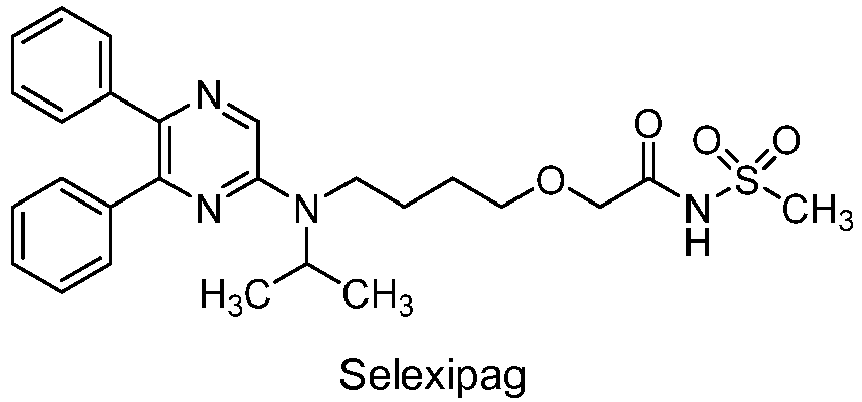
- The preparation and the medicinal use of selexipag and its active metabolite 2-(4-((5,6-diphenylpyrazin-2-yl)(isopropyl)amino)butoxy)acetic acid (MRE-269, ACT-333679) is described in
WO2002/088084 ;WO2009/157396 ;WO2009/107736 ;WO2009/154246 ;WO2009/157397 ;WO2009/157398 ;WO2010/150865 ;WO2011/024874 ; Nakamura et al., Bioorg Med Chem (2007), 15, 7720-7725; Kuwano et al., J Pharmacol Exp Ther (2007), 322(3), 1181-1188; Kuwano et al., J Pharmacol Exp Ther (2008), 326(3), 691-699; O. Sitbon et al., N Engl J Med (2015), 373, 2522-33; Asaki et al., Bioorg Med Chem (2007), 15, 6692-6704; Asaki et al., J. Med. Chem. (2015), 58, 7128-7137. Certain formulations are disclosed inWO2013/024051 , andWO2014/069401 . - Specifically, selexipag or its active metabolite may be useful as preventive or therapeutic agent for ulcer, digital ulcer, diabetic gangrene, diabetic foot ulcer, pressure ulcer (bedsore), hypertension, pulmonary hypertension, pulmonary arterial hypertension, Fontan disease and pulmonary hypertension associated with Fontan disease, sarcoidosis and pulmonary hypertension associated with sarcoidosis, peripheral circulatory disturbance (e.g., chronic arterial occlusion, intermittent claudication, peripheral embolism, vibration syndrome, Raynaud's disease), connective tissue disease (e.g., systemic lupus erythematosus, scleroderma, mixed connective tissue disease, vasculitic syndrome), reocclusion/restenosis after percutaneous transluminal coronary angioplasty (PTCA), arteriosclerosis, thrombosis (e.g., acute-phase cerebral thrombosis, pulmonary embolism), transient ischemic attack (TIA), diabetic neuropathy, ischemic disorder (e.g., cerebral infarction, myocardial infarction), angina (e.g., stable angina, unstable angina), chronic kidney diseases including glomerulonephritis and diabetic nephropathy at any stage, allergy, bronchial asthma, restenosis after coronary intervention such as atherectomy and stent implantation, thrombocytopenia by dialysis, the diseases in which fibrosis of organs or tissues is involved [e.g., renal diseases such as tubulointerstitial nephritis), respiratory diseases (e.g. (usual) interstitial pneumonia / (idiopathic) pulmonary fibrosis, chronic obstructive pulmonary disease), digestive diseases (e.g,. hepatocirrhosis, viral hepatitis, chronic pancreatitis and scirrhous stomachic cancer), cardiovascular diseases (e.g, myocardial fibrosis), bone and articular diseases (e.g, bone marrow fibrosis and rheumatoid arthritis), skin diseases (e.g, cicatrix after operation, scalded cicatrix, keloid, and hypertrophic cicatrix), obstetric diseases (e.g., hysteromyoma), urinary diseases (e.g., prostatic hypertrophy), other diseases (e.g., alzheimer's disease, sclerosing peritonitis, type I diabetes and organ adhesion after operation)], erectile dysfunction (e.g., diabetic erectile dysfunction, psychogenic erectile dysfunction, psychotic erectile dysfunction, erectile dysfunction associated with chronic renal failure, erectile dysfunction after intrapelvic operation for removing prostata, and vascular erectile dysfunction associated with aging and arteriosclerosis), inflammatory bowel disease (e.g., ulcerative colitis, Crohn's disease, intestinal tuberculosis, ischemic colitis and intestinal ulcer associated with Behcet disease), gastritis, gastric ulcer, ischemic ophthalmopathy (e.g., retinal artery occlusion, retinal vein occlusion, ischemic optic neuropathy), sudden hearing loss, avascular necrosis of bone, intestinal damage caused by administration of a non-steroidal anti-inflammatory agent and symptoms associated with lumbar spinal canal stenosis.
- Selexipag was shown to be beneficial in the treatment of pulmonary arterial hypertension. In a phase III clinical trial, among patients with pulmonary arterial hypertension, the risk of the primary composite end point of death or a complication related to pulmonary arterial hypertension was significantly lower among patients who received selexipag than among those who received placebo. Selexipag received market approval e.g. in the US and is indicated for the treatment of pulmonary arterial hypertension (PAH, WHO Group I) to delay disease progression and reduce the risk of hospitalization for PAH.
- So far, standard film-coated tablet formulations of selexipag intended for twice daily oral administration have been used, wherein excipients comprise D-mannitol, corn starch, low substituted hydroxypropylcellulose, hydroxypropylcellulose, and magnesium stearate; and the tablets are film coated with a coating material containing hypromellose, propylene glycol, titanium dioxide, carnauba wax along with mixtures of iron oxides.
- Selexipag is thought to function as a prodrug (while retaining some agonistic activity on the IP receptor on its own) which can exert long-lasting selective IP receptor agonist activity of the active metabolite 2-(4-((5,6-diphenylpyrazin-2-yl)(isopropyl)amino)butoxy) acetic acid in mammals, especially humans. The in vivo metabolism of selexipag effectively may act as a kind of 'slow-release mechanism' that potentially both prolongs activity and reduces typical adverse effects associated with high concentrations of PGI2 agonists (Kuwano et al., J Pharmacol Exp Ther (2007), 322(3), 1181-1188).
- Adverse effects associated with PGI2 agonists are also addressed by a particular up-titration schedule. The recommended starting dose of oral selexipag is 200 micrograms given twice daily. The dose is then increased in increments of 200 micrograms twice daily, usually at weekly intervals, to the highest tolerated dose up to 1600 micrograms twice daily. If a patient reaches a dose that cannot be tolerated, the dose should be reduced to the previous tolerated dose.
- In certain instances the use of an oral formulation of selexipag may be inappropriate or impossible (e.g. in urgent care, or in case a patient is for some reasons unable to swallow a tablet). Furthermore, treatment of certain diseases may only require short term treatment, or a treatment comprising alternating periods of treatment / non-treatment, in which case the above-mentioned up-titration schedule could be inappropriate. Such diseases may comprise for example ulcer, digital ulcer, diabetic gangrene, diabetic foot ulcer, pressure ulcer (bedsore), peripheral circulatory disturbances, etc. Therefore, there is a need to develop a stable and reproducible i.v. formulation for selexipag. In a Phase1 study "Absolute oral bioavailability of selexipag, a novel oral prostacyclin IP receptor agonist, in healthy subjects", selexipag was generally well tolerated when administered orally or by i.v. infusion (N. Hurst, P. Kaufmann, M. Richard, B.Astruc, J. Dingemanse, Poster presented at the American College of Clinical Pharmacology annual meeting, 25-27 September 2016, Bethesda, USA). Moreover, a "Safety Study of the Switch from Oral Selexipag to Intravenous Selexipag in Subjects With Stable Pulmonary Arterial Hypertension" has been posted on 15 June 2017 (https://clinicaltrials.gov/ct2/show/NCT03187678).
- Particular difficulties in the development of such an i.v. formulation comprising selexipag arise from the fact that the required dosage of selexipag is likely to be in the microgram to single digit milligram range per day, requiring rigid quantitative control of the injected dose. For example, adsorption of active ingredient on syringes or tubing may have an impact on the suitability of a selexipag i.v. formulation. Furthermore, by the nature of selexipag being a hydrolysable prodrug, premature hydrolysis to the active metabolite should be prevented in such i.v. formulation. Stability including chemical stability may, therefore, be another important criterion, for the selection of a pharmaceutical composition suitable for i.v. administration.
- It has now been found that only certain compositions comprising selexipag, a bulking agent, a detergent, and a buffer lead to chemically and physically stable aqueous formulations that can reproducibly be lyophilized to a stable cake and reconstituted to a controlled composition which is suitable for i.v. administration. Adsorption of active ingredient to tubings and syringes could be avoided.
- 1) A first embodiment relates to an aqueous pharmaceutical composition comprising:
- about 0.1 g/kg to 1 g/kg, especially about 0.5 g/kg (with respect to the total weight of said aqueous pharmaceutical composition) of the compound: 2-{4-[N-(5,6-diphenylpyrazin-2-yl)-N-isopropylamino]butyloxy}-N-(methylsulfonyl)acetamide:
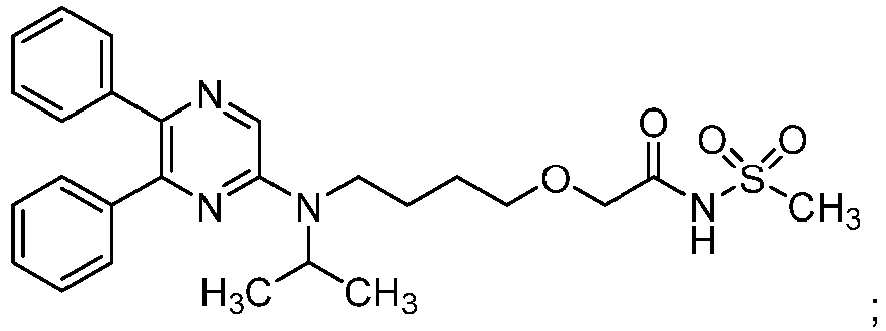
- about 2.5 ww% to 10 ww% of a bulking agent which is glycine (notably about 3 ww% to 6 ww% of glycine; especially about 5 ww% of glycine) (i.e. about 25-100 g/kg; notably about 30-60 g/kg especially about 50 g/kg of glycine);
- about 0.05 ww% to 0.4 ww% of a detergent which is polysorbate 20 (notably between about 0.1 ww% and 0.3 ww% of polysorbate 20; especially about 0.1, 0.2, or 0.3 ww% of polysorbate 20) (wherein preferably about 5-40 g/kg; notably between about 10 and 30 g/kg; especially about 10, 20, or 30 g/kg of an about 10 ww% aqueous solution of polysorbate 20 is used); and
- an aqueous phosphate buffer (especially an aqueous sodium phosphate buffer (i.e. an aqueous buffer composed of H3PO4 and NaOH)), wherein the total amount of said phosphate buffer is about 5 mmol/kg to 20 mmol/kg (with respect to the total weight of said aqueous pharmaceutical composition), in particular about 10 mmol/kg;
- about 0.1 g/kg to 1 g/kg, especially about 0.5 g/kg (with respect to the total weight of said aqueous pharmaceutical composition) of the compound: 2-{4-[N-(5,6-diphenylpyrazin-2-yl)-N-isopropylamino]butyloxy}-N-(methylsulfonyl)acetamide:
- The present compositions according to embodiment 1) are liquid isotropic mixtures, which contain COMPOUND in free base form. COMPOUND may be used for the preparation of the present compositions in amorphous, or in one or more crystalline forms, or in mixtures of amorphous and crystalline form(s). Crystalline forms may be anhydrous, or solvate or hydrate forms. Such morphological forms are encompassed in the scope of COMPOUND. Preferably COMPOUND is used in crystalline form. The present compositions encompass COMPOUND in essentially pure form. The amount of COMPOUND may be adjusted taking into account the actual chemical purity, or the presence of a solvate, or hydrate, of COMPOUND.
- The term "bulking agent" refers to a substance or component that is chemically compatible with the active pharmaceutical ingredient and with further excipients of a composition, and that adds mass to a lyophilized composition. A bulking agent suitable for pharmaceutical compositions according to embodiment 1) of the present invention is glycine. Bulking agents typically used in pharmaceutical compositions are for example mannitol, trehalose, L-proline, and polyvinylpyrrolidone.
- The excipient polysorbate 20 or polyoxyethylene (20) sorbitan monolaurate as used within the scope of the present invention refers to commercially available polysorbate 20 (CAS No 9005-64-5, E 432), preferably Tween® 20 / Tween® 20 EMPROVE® from Croda Americas / Merck Chemicals. Alternative commercial forms of polysorbate 20 are for example Armotan® PML 20; Capmul® POE-L; Crillet™ 1; Eumulgin® SML 20; Glycosperse® L-20; Liposorb® L-20; Montanox™ 20; Nonion® LT-221; Ritabate 20; Sorbax PML-20; T-Maz® 20; Protasorb™ L-20; Tego® SML 20; Alkest® TW 20; Wilsurf® TF-20.
- Polysorbate 20 may be defined as (non-ionic) detergent / emulsifyer / surfactant. Detergents, especially commercially available detergent products, are usually not pure compounds but may be rather complex mixtures of compounds containing one primary major detergent component. Polysorbate 20 for example is a polysorbate-type nonionic detergent formed by the ethoxylation of sorbitan before the addition of lauric acid. The ethoxylation process leaves the molecule with 20 repeat units of polyethylene glycol; in practice these are distributed across 4 different chains leading to a commercial product containing a range of chemical species. Polysorbate 20 may contain variable amounts of said primary major detergent component, and residual amounts of further components such as for example residual polyethyleneglycols (which may stem from the chemical production process). The above-mentioned variation in the chemical species and the residual further components possibly comprised in the commercial product are encompassed in the scope of term "polysorbate 20" as used herein.
- The total ww% of the pharmaceutical compositions as defined in embodiment 1), and embodiments 2) to 6) below is 100.
- For avoidance of any doubt, it is well understood that pharmaceutical compositions as defined in embodiment 1) and 2) to 6) below may additionally comprise further conventional ingredients and/ or additives, which may be used alone or in combination (quantum satis, i.e. wherein the maximum amounts of said further conventional ingredients and/ or additives may need to be reduced to make up the total ww% of 100). It is understood that the pharmaceutical compositions as defined in embodiment 1) and 2) to 6) below will not comprise a further bulking agent or a further detergent.
- Reference is made to the extensive literature on the subject for these and other pharmaceutically acceptable excipients and procedures mentioned herein, see for example R.C. Rowe, P.J. Seskey, S.C. Owen, Handbook of Pharmaceutical Excipients, 5th edition, Pharmaceutical Press 2006; Remington, The Science and Practice of Pharmacy, 21st Edition (2005), Part 5, "Pharmaceutical Manufacturing" [published by Lippincott Williams & Wilkins].
- Examples of such conventional ingredients or additives are tonicity modifiers such as salts (e.g. NaCl, KCI, MgCI2, CaCl2). Further conventional ingredients or additives are for example antimicrobial preservatives such as used e.g. in bacteriostatic water for injection. An example is benzyl alcohol.
- The absolute amounts of each pharmaceutically acceptable excipient and the amounts relative to other pharmaceutically acceptable excipients are dependent on the desired properties of the pharmaceutical composition and can be chosen by routine experimentation.
- The total weight percent of the pharmaceutical composition is 100.
- The term "pharmaceutical composition" is interchangeable with the terms "formulation", or "composition".
- Unless used regarding temperatures, the term "about" placed before a numerical value "X" refers in the current application to an interval extending from X minus 10% of X to X plus 10% of X, and preferably to an interval extending from X minus 5% of X to X plus 5% of X (wherein it is well understood that percent values below 0%, respectively higher than 100%, are not applicable). In case the term about is placed before a range, the respective interval is to be applied to both values of the range. In case the term about is placed before a list of particular values, the respective interval is to be applied to all values of the list. For example, about 10, 20, or 30 g/kg of an about 10 ww% aqueous solution of polysorbate 20 refer to 10 ± 1, 20 ± 2, or 30 ± 3 g/kg of a 10 ± 1 ww% aqueous solution of polysorbate 20; preferably to 10 ± 0.5, 20 ± 1, or 30 ± 1.5 g/kg of a 10 ± 0.5 ww% aqueous solution of polysorbate 20. In the particular case of temperatures, the term "about" placed before a temperature "Y" refers in the current application to an interval extending from the temperature Y minus 10 °C to Y plus 10 °C; and preferably, in case the temperature is at least 30 °C to an interval extending from Y minus 5 °C to Y plus 5 °C; or, in case the temperature is below 30 °C, to an interval extending from Y minus 2 °C to Y plus 2 °C. Whenever the word "between" or "to" is used to describe a numerical range, it is to be understood that the end points of the indicated range are explicitly disclosed and included in the range. For example: if a temperature range is described to be between 40°C and 80°C (or 40°C to 80°C), this means that the end points 40°C and 80°C are included in the range; or if a variable is defined as being an integer between 1 and 4 (or 1 to 4), this means that the variable is the integer 1, 2, 3, or 4.
- The expression "ww%" (or % (w/w)) refers to a percentage by weight compared to the total weight of the composition considered. If not explicitly stated otherwise, the considered total weight is the total weight of the pharmaceutical composition. In case a certain value is given as % value, in absence of further specification such value refers to ww%. The expression (wt/wt) relating to a ratio refers to a ratio by weight of the respective components.
- The term "consisting essentially of" is understood in the context of the present invention to mean especially that the respective composition consists in an amount of at least 90, notably of at least 95, especially of at least 99, and preferably in an amount of 100 per cent by weight (i.e. in the meaning of "consisting of") of the respective composition in the amounts as explicitly stated in the respective embodiment. The term "comprising" is preferably to be understood in the meaning of the term "consisting essentially of".
- The term "essentially", for example when used in a term such as "essentially pure" is understood in the context of the present invention to mean especially that the respective composition / compound etc. consists in an amount of at least 90, especially of at least 95, and notably of at least 99 per cent by weight of the respective pure composition / compound etc..
- Further embodiments of the invention are presented hereinafter:
- 2) In another embodiment, the invention relates to a pharmaceutical composition according to embodiment 1), comprising:
- about 0.1 g/kg to 1 g/kg, especially about 0.5 g/kg of the compound: 2-{4-[N-(5,6-diphenylpyrazin-2-yl)-N-isopropylamino]butyloxy}-N-(methylsulfonyl)acetamide;
- about 3 ww% to 6 ww% of glycine; especially 5 ± 0.5 ww% of glycine (i.e. 50 ± 5 g/kg of glycine);
- about 0.1 ww% to 0.3 ww% (especially about 0.1 ww%, 0.2 ww%, or 0.3 ww%) of polysorbate 20 (wherein preferably about 10 g/kg, 20 g/kg, or 30 g/kg of an about 10 ww% aqueous solution of polysorbate 20 is used); and
- aqueous sodium phosphate buffer (composed of H3PO4 and NaOH), wherein the concentration of said sodium phosphate buffer is about 5 mmol/kg to 20 mmol/kg, in particular about 10 mmol/kg;
- 3) In another embodiment, the invention relates to a pharmaceutical composition according to embodiment 1), comprising:
- about 0.1 g/kg to 1 g/kg, especially about 0.5 g/kg of the compound: 2-{4-[N-(5,6-diphenylpyrazin-2-yl)-N-isopropylamino]butyloxy}-N-(methylsulfonyl)acetamide;
- 5 ± 0.5 ww% of glycine (i.e. 50 ± 5 g/kg of glycine);
- about 0.3 ww% of polysorbate 20 (wherein preferably about 30 g/kg of an about 10 ww% aqueous solution of polysorbate 20 is used); and
- aqueous sodium phosphate buffer (i.e. an aqueous buffer composed of H3PO4 and NaOH), wherein the concentration of said sodium phosphate buffer is about 5 mmol/kg to 20 mmol/kg, in particular about 10 mmol/kg;
- 4) In another embodiment, the invention relates to a pharmaceutical composition according to embodiment 1), comprising:
- about 0.1 g/kg to 1 g/kg, especially about 0.5 g/kg of the compound: 2-{4-[N-(5,6-diphenylpyrazin-2-yl)-N-isopropylamino]butyloxy}-N-(methylsulfonyl)acetamide;
- 5 ± 0.5 ww% of glycine (i.e. 50 ± 5 g/kg of glycine);
- about 0.2 ww% of polysorbate 20 (wherein preferably about 20 g/kg of an about 10 ww% aqueous solution of polysorbate 20 is used); and
- aqueous sodium phosphate buffer (i.e. an aqueous buffer composed of H3PO4 and NaOH), wherein the concentration of said sodium phosphate buffer is about 5 mmol/kg to 20 mmol/kg, in particular about 10 mmol/kg;
- 5) In another embodiment, the invention relates to a pharmaceutical composition according to embodiment 1), comprising:
- about 0.1 g/kg to 1 g/kg, especially about 0.5 g/kg of the compound: 2-{4-[N-(5,6-diphenylpyrazin-2-yl)-N-isopropylamino]butyloxy}-N-(methylsulfonyl)acetamide;
- 5 ± 0.5 ww% of glycine (i.e. 50 ± 5 g/kg of glycine);
- about 0.1 ww% of polysorbate 20 (wherein preferably about 10 g/kg of an about 10 ww% aqueous solution of polysorbate 20 is used); and
- aqueous sodium phosphate buffer (i.e. an aqueous buffer composed of H3PO4 and NaOH), wherein the concentration of said sodium phosphate buffer is about 5 mmol/kg to 20 mmol/kg, in particular about 10 mmol/kg;
- 6) In another embodiment, the invention relates to a pharmaceutical composition according to any one of embodiments 1) to 5), wherein the compound 2-{4-[N-(5,6-diphenylpyrazin-2-yl)-N-isopropylamino]butyloxy}-N-(methylsulfonyl)acetamide in crystalline form, especially in essentially pure crystalline form (preferably in essentially pure crystalline form I or essentially pure crystalline form II as disclosed in
WO2010/150865 ), is used for the preparation of said composition.
The pharmaceutical composition according to the present invention will, prior to freeze drying, preferably be filled into containers (unit dose or multi-dose containers such as vials) suitable for storage of the lyophilized cake, and suitable for the later reconstitution of the pharmaceutical composition. Such containers may be filled under an inert gas atmosphere (such as notably a nitrogen atmosphere). Such inert gas atmosphere may reduce oxidative degradation of the active ingredient. A further embodiment thus relates to a container such as for example a vial, an ampoule, a syringe, a coupled chamber device, a pen device, or an autoinjector device, especially a vial, filled with a pharmaceutical composition according to any one of embodiments 1) to 6). - 7) A further embodiment relates to a method for the preparation of a lyophilized pharmaceutical composition (i.e. a lyophilized cake); said method pharmaceutical comprising the steps of :
- a) preparing an aqueous pharmaceutical composition according to any one of embodiments 1) to 6); and
- b) freeze-drying said aqueous pharmaceutical composition to form a cake using a method comprising the steps of:
- (i) freezing the aqueous pharmaceutical composition at a first temperature for a period sufficient to transform the liquid formulation into solid state (especially for a period of at least about 1 hour), wherein said first temperature is in the range of about -55 °C to -25 °C (especially about -45 °C);
- (ii) annealing the frozen composition at a second temperature (notably for a period of at least about 1 hour, especially at least about 2 hours); wherein said second temperature is in the range of about -20 °C to -1 °C (notably about -10 °C to -2 °C; especially about -3 °C);
- (iii) subjecting the frozen composition to a vacuum (notably a vacuum of about 0.1 to 1.5 mbar, especially about 0.2 to 1.2 mbar, in particular 0.5 ± 0.1 mbar) at a third temperature wherein said third temperature is in the range of about -55 °C to -25 °C (especially about -45 °C); and
- (iv) drying the composition in said vacuum at a fourth temperature (notably for a period of at least about 2 hours, especially of at least about 5 hours, in particular between about 5 to 15 hours, about 5 to 19 hours, preferably between about 5 to 22 hours or between 5 to 15 hours) wherein said fourth temperature is in the range of about 20 °C to 40 °C; notably in the range of about 25 °C to 35 °C; especially about 35 °C.
- (v) optionally, the composition may be hold at a closing temperature of about 20 °C to 35 °C, preferably 20 °C.
The term "cake" refers to a dry solid material that results when a liquid formulation has been lyophilized or freeze dried. - 8) A further embodiment relates to a lyophilized pharmaceutical composition prepared by lyophilizing an aqueous pharmaceutical composition according to any one of embodiments 1) to 6); especially by using the method of embodiment 7).
- 9) In another embodiment, the invention relates to a lyophilized pharmaceutical composition according to embodiment 8); wherein said lyophilized pharmaceutical composition is in a container; notably in a vial or in a syringe; especially in a vial.
- 10) In another embodiment, the invention relates to a lyophilized pharmaceutical composition according to embodiments 8) or 9); wherein said lyophilized pharmaceutical composition has a residual water content of less than about 2 ww% (e.g. as determined using a Karl Fischer analysis); notably less than about 1.5 ww%.
- 11) In another embodiment, the invention relates to a lyophilized pharmaceutical composition according to any one of embodiments 7) to 10); wherein said lyophilized pharmaceutical composition is chemically stable at room temperature and a relative humidity of about 75% or below (especially at about 25 °C and about 60 % rH) for at least 6 month.
- 12) In another embodiment, the invention relates to a lyophilized pharmaceutical composition according to any one of embodiments 7) to 10); wherein said lyophilized pharmaceutical composition is chemically stable at about 2 - 8°C and a relative humidity of about 75% or below (especially about 60 % rH) for at least 12 month.
- 13) In another embodiment, the invention relates to a lyophilized pharmaceutical composition according to any one of embodiments 7) to 10); wherein the cake of said lyophilized pharmaceutical composition is physically stable at room temperature and a relative humidity of about 75% or below (especially at about 25 °C and about 60 % rH) for at least 6 month.
- 14) A further embodiment relates to a method for the preparation of a reconstituted pharmaceutical composition; said method comprising the step of reconstituting the lyophilized pharmaceutical composition according to any one of embodiments 8) to 13) by adding at least one diluent to said lyophilized composition.
Suitable diluents to reconstitute said pharmacetical composition include any diluent that is a safe, stable and pharmaceutically acceptable carrier. Preferred is water for injection (WFI) such as especially sterile water for injection (SWFI) or bacteriostatic water for injection (BWFI), optionally containing a tonicity modifier, or mixtures of several tonicity modifiers. Preferred diluents are WFI and especially aqueous (preferably physiological) saline. - 15) In another embodiment, the invention relates to a method according to embodiment 20); wherein said diluent is water for injection or saline (notably saline, especially physiological saline / aqueous saline which has a concentration of about 0.9 ww%).
- 16) In another embodiment, the invention relates to a method according to embodiments 14) or 15); wherein said reconstituted pharmaceutical composition is further diluted with a second diluent (especially diluted to a total volume of about 50 mL) (wherein it is understood that said second diluent may be the same or different from the first diluent).
- 17) In another embodiment, the invention relates to a method according to embodiment 16); wherein said second diluent is saline, especially physiological saline / aqueous saline which has a concentration of about 0.9 ww%.
- 18) A further embodiment relates to a reconstituted pharmaceutical composition prepared from a lyophilized pharmaceutical composition according to any one of embodiments 8) to 13); especially prepared according to the method of embodiments 14) or 15); wherein especially said reconstituted pharmaceutical composition is reconstituted using, as diluent, water for injection (especially sterile water for injection) or saline (especially physiological saline / aqueous saline which has a concentration of about 0.9 ww%).
- 19) In another embodiment, the invention relates to a reconstituted pharmaceutical composition according to embodiment 18); wherein said reconstituted pharmaceutical composition is in a container; notably a vial, an ampoule, or a syringe; especially in a vial.
- 20) In another embodiment, the invention relates to a reconstituted pharmaceutical composition according to embodiments 18) or 19); wherein said reconstituted pharmaceutical composition is reconstituted in a reconstitution time of less than about 2 minutes, notably in about 1 minute or less, especially in about 30 seconds or less.
- 21) In another embodiment, the invention relates to a reconstituted pharmaceutical composition according to any one of embodiments 18) to 20); wherein said reconstituted pharmaceutical composition is reconstituted using, as diluent, water for injection (especially sterile water for injection) or saline (especially physiological saline / aqueous saline which has a concentration of about 0.9 ww%); wherein the total volume of said reconstituted pharmaceutical composition is notably between about 2 and 10 mL, especially between about 3 and 4.5 mL, or preferably between about 8 and 8.5 mL.
- 22) In another embodiment, the invention relates to a reconstituted pharmaceutical composition according to any one of embodiments 18) to 21); wherein said reconstituted pharmaceutical composition has an osmolality of below about 1500 mOsmol/kg, especially below about 1000 mOsmol/kg, in particular an osmolality of below about 950 mOsmol/kg; wherein the total volume is especially between about 8 mL and 8.5 mL.
- 23) In another embodiment, the invention relates to a reconstituted pharmaceutical composition according to any one of embodiments 18) to 22); wherein said reconstituted pharmaceutical composition contains about 0.1 to 0.5 mg/mL, especially about 0.225 mg/mL of the compound: 2-{4-[N-(5,6-diphenylpyrazin-2-yl)-N-isopropylamino]butyloxy}-N-(methylsulfonyl)acetamide.
- 24) A further embodiment relates to a reconstituted pharmaceutical composition for i.v. administration according to any one of embodiments 18) to 23); wherein said reconstituted pharmaceutical composition, or a part of said reconstituted pharmaceutical composition, is further diluted (especially further diluted to a total volume of about 50 mL); especially according to the method of embodiments 16) or 17); wherein said reconstituted and further diluted pharmaceutical composition contains an amount of about 4.5 µg/mL, 9 µg/mL, 13.5 µg/mL, 18 µg/mL, 22.5 µg/mL, 27 µg/mL, 31.5 µg/mL, or 36 µg/mL of the compound 2-{4-[N-(5,6-diphenylpyrazin-2-yl)-N-isopropylamino]butyloxy}-N-(methylsulfonyl)acetamide; wherein the tolerance of said amounts is notably 10%, especially 5%.
- 25) In another embodiment, the invention relates to a reconstituted and further diluted pharmaceutical composition according to embodiment 24); wherein said reconstituted and further diluted pharmaceutical composition is further diluted using saline (especially hypotonic or physiological saline, in particular physiological saline / aqueous saline which has a concentration of about 0.9 ww%); wherein especially the total volume of said reconstituted and further diluted pharmaceutical composition is 50 mL.
- 26) In another embodiment, the invention relates to a reconstituted and further diluted pharmaceutical composition according to embodiments 24) or 25); wherein said reconstituted and further diluted pharmaceutical composition has an osmolality of below about 1000 mOsmol/kg (especially below about 500 mOsmol/kg, in particular it is about isotonic).
- Osmolality is a measurement of a fluids concentration which is represented by the number of solutes per kg of fluid. The normal osmolality of extracellular fluid in the human body is about 275-295 mOsmol/kg. Hypertonic solutions have an osmolality higher than the extracellular fluid (above about 350 mOsmol/kg); physiological (or isotonic) solutions have an osmolality similar to the osmolality of the body (about 275-295 mOsmol/kg), hypotonic solutions have an osmolality lower than the body (below about 250 mOsmol/kg) which actively promotes fluid absorption.
- The pharmaceutical compositions according to the invention may be used as a medicament.
- The pharmaceutical compositions according to the invention are suitable for i.v. administration; and may be suitable for alternative parenteral administration routes such as sub-cutaneous, or intra-muscular administration; or when transformed to an aerosol, for inhaled administration.
- The pharmaceutical compositions according to the invention may especially be used for the preparation of a medicament, and / or are especially suitable, for use in the treatment of ulcer, digital ulcer, diabetic gangrene, diabetic foot ulcer, pressure ulcer (bedsore), hypertension, pulmonary hypertension, pulmonary arterial hypertension, Fontan disease and pulmonary hypertension associated with Fontan disease, sarcoidosis and pulmonary hypertension associated with sarcoidosis, peripheral circulatory disturbance (e.g., chronic arterial occlusion, intermittent claudication, peripheral embolism, vibration syndrome, Raynaud's disease), connective tissue disease (e.g., systemic lupus erythematosus, scleroderma, mixed connective tissue disease, vasculitic syndrome), reocclusion/restenosis after percutaneous transluminal coronary angioplasty (PTCA), arteriosclerosis, thrombosis (e.g., acute-phase cerebral thrombosis, pulmonary embolism), transient ischemic attack (TIA), diabetic neuropathy, ischemic disorder (e.g., cerebral infarction, myocardial infarction), angina (e.g., stable angina, unstable angina), chronic kidney diseases including glomerulonephritis and diabetic nephropathy at any stage, allergy, bronchial asthma, restenosis after coronary intervention such as atherectomy and stent implantation, thrombocytopenia by dialysis, the diseases in which fibrosis of organs or tissues is involved [e.g., renal diseases such as tubulointerstitial nephritis), respiratory diseases (e.g., interstitial pneumonia, (idiopathic) pulmonary fibrosis, chronic obstructive pulmonary disease), digestive diseases (e.g,. hepatocirrhosis, viral hepatitis, chronic pancreatitis and scirrhous stomachic cancer), cardiovascular diseases (e.g, myocardial fibrosis), bone and articular diseases (e.g, bone marrow fibrosis and rheumatoid arthritis), skin diseases (e.g, cicatrix after operation, scalded cicatrix, keloid, and hypertrophic cicatrix), obstetric diseases (e.g., hysteromyoma), urinary diseases (e.g., prostatic hypertrophy), other diseases (e.g., alzheimer's disease, sclerosing peritonitis, type I diabetes and organ adhesion after operation)], erectile dysfunction (e.g., diabetic erectile dysfunction, psychogenic erectile dysfunction, psychotic erectile dysfunction, erectile dysfunction associated with chronic renal failure, erectile dysfunction after intrapelvic operation for removing prostata, and vascular erectile dysfunction associated with aging and arteriosclerosis), inflammatory bowel disease (e.g., ulcerative colitis, Crohn's disease, intestinal tuberculosis, ischemic colitis and intestinal ulcer associated with Behcet disease), gastritis, gastric ulcer, ischemic ophthalmopathy (e.g., retinal artery occlusion, retinal vein occlusion, ischemic optic neuropathy), sudden hearing loss, avascular necrosis of bone, intestinal damage caused by administration of a non-steroidal anti-inflammatory agent and symptoms associated with lumbar spinal canal stenosis.
- The pharmaceutical compositions according to the invention may in particular be used for the preparation of a medicament, and / or are especially suitable, for use in the treatment of ulcer, digital ulcer, diabetic gangrene, diabetic foot ulcer, pulmonary hypertension, pulmonary arterial hypertension, Fontan disease and pulmonary hypertension associated with Fontan disease, sarcoidosis and pulmonary hypertension associated with sarcoidosis, peripheral circulatory disturbance (e.g. intermittent claudication, Raynaud's disease), connective tissue disease (e.g. systemic lupus erythematosus, scleroderma), chronic kidney diseases including glomerulonephritis and diabetic nephropathy at any stage, diseases in which fibrosis of organs or tissues is involved [e.g., renal diseases such as tubulointerstitial nephritis), or respiratory diseases (e.g., (usual) interstitial pneumonia / (idiopathic) pulmonary fibrosis)].
- An aqueous (e.g. reconstituted, or reconstituted and further diluted) pharmaceutical composition is considered physically "stable", if during a certain period of time at least 80%, preferably at least 90% and most preferably at least 95% of the initial content of the COMPOUND is maintained over said period of time in a solubilized state.
- A lyophilized composition (i.e. a lyophilized cake) is considered physically "stable", if during a certain period of time variations of less than 30%, preferably less than 20% and most preferably less than 10% with regard to reconstitution time and/or residual moisture are observed. Additionally, the cake appearance may be considered as criterion to determine physical stability of a lyophilized composition.
- A pharmaceutical composition is considered chemically "stable", if under certain conditions and during a certain period of time at least 80%, notably at least 95%, especially at least 98%, and preferably at least 99% of the initial content of COMPOUND is maintained under said conditions and over said period of time without degradation. Especially degradation may be defined as degradation producing less than 1 %, preferably less than 0.5 %, of 2-(4-((5,6-diphenylpyrazin-2-yl)(isopropyl)amino) butoxy) acetic acid (i.e. the product resulting from hydrolysis of COMPOUND) under the specified conditions and during the specified period.
- Furthermore, in particular for any aqueous pharmaceutical composition, chemical stability under exposure to light (measured e.g. by using an OSRAM L58W/840 lamp at a distance of 65 cm) may be considered in addition. The above values defining chemical stability are in absence of additional exposure to light.
- Preferably, the lyophilized pharmaceutical compositions of this invention will be chemically and physically "stable" for at least 6, preferably for at least 12 months when kept at a temperature of 5 °C to 50 °C and a rH of about 75 % or below. More preferably, they will be stable for at least 6 or preferably for 12 months when kept at a temperature of 15 °C to 45 °C and a rH of about 75 % or below. Most preferred, they will be stable for at least 6 or preferably for 12 months when kept at a temperature of 25 °C to 40 °C and a rH of about 75 % or below, especially at 40 °C and 75 % rH, or in particular at 25 °C and 60 % rH.
- Preferably, the aqueous pharmaceutical compositions (e.g. the aqueous composition prior to lyophilization, the reconstituted formulation, or the reconstituted and further diluted formulation) of this invention will be chemically and physically "stable" for at least 6 hours, preferably for at least 12 hours when kept at a temperature of 5 °C to 50 °C. More preferably, they will be stable for at least 6 or preferably for 12 hours when kept at a temperature of 15 °C to 45 C. Most preferred, they will be stable for at least 6 or preferably for 12 hours when kept at a temperature of 25 °C to 40 °C, especially at room temperature.
- The chemical stability of the pharmaceutical compositions may be tested in conventional manner, e.g. by measurement of the COMPOUND and its degradation products (such as especially 2-(4-((5,6-diphenylpyrazin-2-yl)(isopropyl)amino) butoxy) acetic acid). The content of COMPOUND and its degradation products may be evaluated via conventional HPLC.
- The physical stability of the pharmaceutical compositions may be tested in conventional manner, e.g. by measurement of reconstitution time; water content; appearance and/or microscopy of the lyophilized composition (i.e. a lyophilized cake), e.g. after storage at a certain temperature and relative humidity for defined periods of time; and by measurement of the ability of the aqueous formulation (e.g. the aqueous composition prior to lyophilization, the reconstituted formulation, or the reconstituted and further diluted formulation) to maintain drug solubilization and to prevent precipitation after storage at a certain temperature for defined periods of time.
- The aqueous pharmaceutical composition according to any one of embodiments 1) to 6) may be formulated in containers. For example from a batch size corresponding to 500 mg of COMPOUND (batch size of 1 kg of pharmaceutical composition), may lead to 250 vials of about 3.8 g of pharmaceutical composition per vial, and may be composed as follows:
Material Function Percentage (%w/w) Unit Dose (g) water for injection (WFI) solvent 80 800 aqueous sodium hydroxide solution (15 ww%) buffer (base) 0.316 3.16 COMPOUND Active ingredient 5.00 0.500 polysorbate 20 (10 ww% aqueous stock solution) Excipient: Detergent 3 30.00 glycine Excipient: bulking agent 5 50.00 aqueous phosphoric acid (85 ww%) buffer (acid) 0.1153 1.153 aqueous sodium hydroxide solution (1 ww%) buffer (base) variable, adjust to pH 7.5 variable, adjust to pH 7.5 WFI solvent variable to adjust to a total of 100 variable to adjust to a total of 1000 Total 100.000 1000 - The amounts may be adjusted for the purity of the respective ingredient, which may give rise to increased amounts of COMPOUND.
- The process for the preparation of a lyophilized pharmaceutical composition as described before and filled in a container according to the present invention, may comprise the following steps:
- Mix the amount of COMPOUND: target value: 0.500 g (e.g. in a 1500 mL glass beaker); with the respective amounts of WFI : target value: 800 g; glycine: target value: 50.00 g; 10 % (w/w) polysorbate 20: target value: 30.00 g; 15 % (w/w) NaOH: target value: 3.16 g; and phosphoric acid, 85 % (w/w): target value: 1.153 g;
- Stir to homogeneity.
- Adjust the pH to pH 7.5 using 1.0 % (w/w) NaOH.
- Add WFI to target weight: 1000 g.
- Filter (e.g. under laminar flow condition through a 0.22 µm PVDF membrane filter).
- Fill vials (e.g. under laminar flow condition): Target fill weight: 3.80 g ± 3 %.
- The process for the lyophilization of the above pharmaceutical composition may for example comprise the following steps:
Step Shelf temp. Ice condenser temp. Pressure Time step Cumulative time # Description [°C] [°C] [mbar] [h:min] [h:min] 1 Loading 20 - atm 00:01 00:01 2 Freezing, ramp -45 - atm 01:05 01:06 3 Freezing -45 - atm 01:30 02:36 4 Annealing, ramp -3 - atm 00:40 03:16 5 Annealing -3 - atm 02:00 05:16 6 Annealing, ramp -45 - atm 00:40 05:56 Freezing -45 -70 atm 00:30 06:26 7 Vacuum Adjustment -45 -70 0.5 00:30 06:56 8 Primary Drying, ramp 35 -70 0.5 02:00 08:56 9 Primary Drying 35 -70 0.5 05:00 13:56 10 Secondary Drying 35 -70 0.5 05:00 18:56 13 Closing 35 -70 800 00:10 19:06 - An alternative process for the lyophilization of the above pharmaceutical composition may for example comprise the following steps:
Step Shelf temp. Ice condenser temp. Pressure Time step Cumulative time # Description [°C] [°C] [mbar] [h:min] [h:min] 1 Loading 20 - atm 00:01 00:01 2 Freezing, ramp -45 - atm 01:05 01:06 3 Freezing -45 - atm 01:30 02:36 4 Annealing, ramp -3 - atm 00:40 03:16 5 Annealing -3 - atm 02:00 05:16 6 Annealing, ramp -45 - atm 00:40 05:56 Freezing -45 -70 atm 00:30 06:26 7 Vacuum Adjustment -45 -70 0.5 00:30 06:56 8 Primary Drying, ramp 35 -70 0.5 03:00 09:56 9 Primary Drying 35 -70 0.5 11:00 20:56 10 Secondary Drying 35 -70 0.5 05:00 25:56 13 Closing 35 -70 800 00:10 26:06 - The annealing step (steps 4 to 6) in the above process is optional. A process comprising an annealing step may prevent shrinkage in the bottom region of the cake, as well as lid formation of the cake.
- A further alternative process for the lyophilisation of the above pharmaceutical composition may for example comprise the following steps:
Step Shelf temp. Ice condenser temp. Pressure Time step Cumulative time # Description [°C] [°C] [mbar] [h:min] [h:min] 1 Loading 20 - atm 00:01 00:01 2 Freezing, ramp -45 - atm 01:05 01:06 3 Freezing -45 - atm 01:30 02:36 4 Annealing, ramp -3 - atm 00:40 03:16 5 Annealing -3 - atm 02:00 05:16 6 Annealing, ramp -45 - atm 00:40 05:56 Freezing -45 -70 atm 00:30 06:26 7 Vacuum Adjustment -45 -70 0.5 00:30 06:56 8 Primary Drying, ramp 35 -70 0.5 06:00 12:56 9 Primary Drying 35 -70 0.5 11:00 23:56 10 Secondary Drying 35 -70 0.5 05:00 28:56 13 Closing 20 -70 800 00:10 29:06 - In other words, the closing temperature may be a fifth temperature, with respect to embodiment 7), namely about 20°C. Again, the annealing step (steps 4 to 6) in the above process is optional. A process comprising an annealing step may prevent shrinkage in the bottom region of the cake, as well as lid formation of the cake.
- Following the process for the lyophilization of the above pharmaceutical composition the vials may be sealed for example by crimping using the following process:
- Place caps onto each vial and crimp e.g. with a semi- or fully automatic crimping machine, or equivalent.
- The lyophilized pharmaceutical composition may be reconstituted by using the following process:
Adding saline or WFI (e.g. target value 8.1 mL) and shake gently until the cake is fully dissolved. -
- aq.
- aqueous
- atm
- atmospheric pressure
- DSC
- differential scanning calorimetry
- HPLC
- high performace liquid chromatography
- min
- minute(s)
- poloxamer 188
- polyoxypropylene-polyoxyethylene copolymer, e.g. Kolliphor® P188
- PS20
- polysorbate 20, e.g. Tween® 20
- PS80
- polysorbate 80, e.g. Tween® 80
- rH
- relative humidity
- RP
- reversed phase
- RT
- room temperature
- WFI
- water for injection
- Raw materials were purchased from commercial suppliers:
Substance Supplier/Manufacturer Cat. No. Octane-1-sulphonic acid sodium salt, (≥ 98 %) Carl Roth GmbH KK55.2 Purified water (≤ 0.2 µmS/cm, < 10 ppb TOC) - Saline for infusion, 0.9 % B Braun 6726174 o-Phosphoric acid, 85 % Merck KGaA 1.00563.1000 Methanol, ROTISOLV® HPLC Gradient Carl Roth GmbH 4627.2 Sodium hydroxide, ≥ 98 %, (Ph.Eur., USP, BP, in pellets) Carl Roth GmbH P031 Kolliphor® P 188, Poloxamer, Ph EUR BASF 50259527 Tween® 20 EMPROVE® (exp Ph. Eur. JPE ,NF) Merck Chemicals 8.17072.1000 Tween® 80, EMPROVE (exp, Ph.Eur., JP, NF) Merck Chemicals 8.17061.1000 Glycine, (≥ 98,5 % Ph.Eur) Carl Roth GmbH T873 Trehalose dehydrate, 100PH Hayashibara 33016 Kollidon® 17 PF, Polyvinylpyrrolidone BASF 51598188 Material RP-HPLC column phenomenex CH0-3387 Amber glass HPLC vials WICOM Germany GmbH WIC 42720 10R glass vials, type I FIOLAX Nipro Glass MG037-002- Germany 0049-086 Lyo stopper 20 mm, 1319 4023 West Pharmaceutical 7002-2716 Syringe Luer-Lok, amber BD Plastipak™ 300869 Infusion tubing Cair LGL P03115B PVDF syringe filter, 0.22 µm Merck Millipore Ltd. SLGUM33RS Millex®-GV syringe filter unit 33 mm, 0.22 µm, PVDF membrane Merck Millipore Ltd. SLGV033RS Luer Lock Combi-Stopper Braun 4495101 Silicone tube for sterile filtration, thickness 1.6 mm, inner-Ø 3.2 mm, outer-Ø 6.4 mm Carl Roth GmbH CH26.1 PD-Tips for multistep pipette Brand® 702382 - The following apparatuses were used:
HPLC Equipment Manufacturer: Agilent Technologies (Santa Clara, CA, USA) Type: 1100 Series Degasser: G1322A BinPump: G1312A ALS: G1329A ALSTherm: G1330A ColCom: G1316A VWD: G1314A Chromatography management software: Dionex, Chromeleon 6.80 Agilent, Chemstation B.04.03 SP1 Wyatt, Astra 6.1 - UV Spectrophotometer: Agilent Technologies Cary 50; Purified water supply: Siemens Ultra Clean UV UF TM; pH meter: Mettler Toledo SevenMulti; Electrode: InLab Micro; Balance: Kern EW 6200-2NM
- The preparation of selexipag (COMPOUND: 2-{4-[N-(5,6-diphenylpyrazin-2-yl)-N-isopropylamino]butyloxy}-N-(methylsulfonyl)acetamide) is described in
WO2002/088084 . The preparation of polymorphic forms, i.e. the crystalline forms I, II, and III of the free base is disclosed inWO2010/150865 ; polymorphic forms of pharmaceutically acceptable salts are disclosed inWO2011/024874 . COMPOUND was used in the following Examples and assays in form of the free base, especially crystals of polymorphic form I. - The thermal properties of the frozen bulk drug product solution are evaluated by differential scanning calorimetry. By DSC phase transition temperatures (i.e. crystallization- and melting point) can be identified by measuring the behavior of the sample when cooled down / heated up compared to an empty reference pan. When an endothermic reaction like melting occurs the system has to put more energy into the sample than into the reference to keep both on the same temperature level. This required power is measured and used for the calculation of the phase transition temperature and enthalpy.
- The phase transition temperatures of compositions prior to lyophilization are determined by differential scanning calorimetry using a DSC-8000 (Perkin Elmer, Waltham, MA, USA). Approx. 20 mg of the corresponding solution is weighted into a 50 µL aluminum sample pan. The pan is sealed with a closed aluminum DSC-cover. An empty aluminum sample pan is used as reference. The following cycle is performed:
Step Start temp End temp Scanning rate Duration Equilibration 25°C 25°C - 1 min 1st cooling step 25°C -65°C 10°C/min 9 min Equilibration -65°C -65°C - 1 min 1st heating step -65°C 25°C 10°C/min 9 min Equilibration 25°C 25°C - 1 min 2nd cooling step 25°C -65°C 10°C/min 9 min Equilibration -65°C -65°C - 1 min 2nd heating step -65°C 25°C 10°C/min 9 min - Evaluation of the melting point is performed in the second heating step.
- RP-HPLC is used to quantify COMPOUND in the lyophilized compositions and to separate COMPOUND from potential impurities in order to rate the product purity. RP-HPLC measurements are converted by calculation into COMPOUND concentration in the respective sample.
-
Mobile phase: 3.24 g octane-1-sulphonic acid sodium salt are dissolved in 1500 mL purified water. 1.5 mL of o-phosphoric acid 85 % are added. 3500 mL methanol are added. Flow rate: 1.0 mL/min isocratic Temperature: 40 °C VWD: 302 nm Injection volume: 10 µL Sample temperature: 10 °C Run time: 40 min -
Diluent: 70 % methanol, 30 % purified water (v/v) - A 200 mL volumetric brown glass vessel is filled with 180 mL of diluent. Subsequently 20 mg of COMPOUND reference material are added. The mixture is treated in an ultra sound bath for 10 minutes at 20 °C. The volume is filled up to 200 mL after complete dissolution of COMPOUND.
Standard solution (5 µg/mL): (v/v) using diluent. Standard stock solution (100 µg/mL) is diluted 1:20 - Five different injection volumes of the reference solution (5 µg/mL) are applied to the column in equidistant steps (i.e. 5 µL, 10 µL, 15 µL, 20 µL and 25 µL) at the beginning and at the end of each analysis sequence. The detected peak areas are aligned with the respective applied masses and a formula for conversion of UV-measured responses into COMPOUND mass is generated by linear regression of the mean values.
-
Diluent: 70 % methanol, 30 % purified water (v/v) - Prior to analysis, samples were diluted to a concentration of 10 µg/mL using diluent or they were used undiluted if the concentration was below 10 µg/mL.
- 50 -100 mg of three random vials of each lyophilization cycle are weighed into a glass vial which is sealed with a crimp cap. The sample is transferred into the oven of the Karl Fischer coulometer (756/774; Metrohm) which is heated to 100 °C. The septum of the cap is penetrated by an injection needle, and the generated water vapor is directly transferred into the titration chamber of the Karl Fischer coulometer by dry nitrogen flow. Empty glass vials are used for blank correction.
- Photographs are made of exemplary vials after each lyophilization cycle.
- Lyophilizates are removed from the vial by carefully breaking the glass vial and the lyophilized cake is cut vertically to screen its inner layer for collapse zones.
- Lyophilizates are analyzed by SEM to evaluate their microstructure. The respective lyophilizates are carefully cut and the vertical cross sections as well as the top/bottom surfaces are analyzed via SEM.
- A batch size corresponding to 500 mg of COMPOUND (batch size of 1 kg of pharmaceutical composition), leading to 250 vials of about 3.8 g of pharmaceutical composition per vial, was composed and prepared as follows:
Material Function Percentage (%w/w) Unit Dose (g) water for injection (WFI) solvent 80 800 aqueous sodium hydroxide solution (15 ww%) buffer (base) 0.316 3.16 COMPOUND Active ingredient 5.00 0.500 polysorbate 20 (10 ww% aqueous stock solution) Excipient: Detergent 3 30.00 glycine Excipient: bulking agent 5 50.00 aqueous phosphoric acid (85 ww%) buffer (acid) 0.1153 1.153 aqueous sodium hydroxide solution (1 ww%) buffer (base) variable, adjust to pH 7.5 variable, adjust to pH 7.5 WFI solvent variable to adjust to a total of 100 variable to adjust to a total of 1000 Total 100.000 1000 - Fill the amount of WFI in a 1500 mL glass beaker: Target value: 800 g.
- Add the amount of 15 % (w/w) NaOH: Target value: 3.16 g.
- Stir to homogeneity.
- Add the amount of COMPOUND: Target value: 0.500 g.
- Stir to homogeneity.
- Add the amount of glycine: Target value: 50.00 g.
- Stir to homogeneity.
- Add the amount of 10 % (w/w) polysorbate 20: Target value: 30.00 g.
- Stir to homogeneity.
- Add the amount of phosphoric acid, 85 % (w/w): Target value: 1.153 g.
- Stir to homogeneity.
- Adjust the pH to pH 7.5 using 1.0 % (w/w) NaOH.
- Add WFI to target weight: 1000 g.
- Filter under laminar flow condition through a 0.22 µm PVDF membrane filter.
- Fill vials under laminar flow condition: Target fill weight: 3.80 g ± 3 %.
- The vials were lyophilized using the following procedure:
Step Shelf temp. Ice condenser temp. Pressure Time step Cumulative time # Description [°C] [°C] [mbar] [h:min] [h:min] 1 Loading 20 - atm 00:01 00:01 2 Freezing, ramp -45 - atm 01:05 01:06 3 Freezing -45 - atm 01:30 02:36 4 Annealing, ramp -3 - atm 00:40 03:16 5 Annealing -3 - atm 02:00 05:16 6 Annealing, ramp -45 - atm 00:40 05:56 Freezing -45 -70 atm 00:30 06:26 7 Vacuum Adjustment -45 -70 0.5 00:30 06:56 8 Primary Drying, ramp 35 -70 0.5 02:00 08:56 9 Primary Drying 35 -70 0.5 05:00 13:56 10 Secondary Drying 35 -70 0.5 05:00 18:56 13 Closing 35 -70 800 00:10 19:06 - Following the process for the lyophilization of the above pharmaceutical composition the vials were sealed by crimping using the following process:
- Place caps onto each vial and crimp e.g. with a semi- or fully automatic crimping machine.
- A batch size of 60 vials of the following composition (corresponding to 0.50 mg/g COMPOUND, 5 ww% glycine, 0.3 ww% polysorbate 20 in 10 mmol/kg sodium phosphate buffer, pH 7.5) was prepared:
a WFI 3200 mg 3200 mg b NaOH, 15 % (w/w) 12.0 mg 12.0 mg c COMPOUND 1.90 mg - d glycine 190 mg 190 mg e H3PO4, 85 % (w/w) 4.38 mg 4.38 mg f polysorbate 20, 10 % (w/w) 114 mg 11.4 mg 9 NaOH, 1 % (w/w) adj. of pH 7.5 ± 0.2 adj. of pH 7.5 ± 0.2 h WFI ad to 3800 mg final weight ad.to 3800 mg final weight - 1. Fill a) in a compounding vessel
- 2. Add b) under agitation
- 3. Add c) under agitation to obtain a clear solution in the absence of light
- 4. Add d) under agitation to obtain a clear solution
- 5. Add e) under agitation
- 6. Add f) under agitation
- 7. Adjust pH with g) (target: pH 7.5)
- 8. Fill up with h) to a final weight of 3.800 mg
- 9. Double check of target pH
- 60 vials were processed using the above procedure.
- The vials were lyophilized using the following procedures:
A : Process parameters of a lyophilization run using 0.85 mbar vacuum.Step Shelf temperature Ice condenser temperature Pressure Time step Cumulative time # Description [°C] [°C] [mbar] [h:min] [h:min] 1 Loading 20 - atm 00:01 0:01 2 Freezing ramp -5 - atm 00:25 0:26 3 Freezing -5 - atm 01:00 1:26 4 Freezing ramp -45 - atm 00:40 2:06 5 Freezing -45 - atm 06:00 8:06 6 Vacuum adjustment -45 -70 0.85 00:30 8:36 7 Primary Drying ramp 35 -70 0.85 02:00 10:36 8 Primary Drying 35 -70 0.85 25:00 35:36 9 Secondary Drying 35 -70 0.85 15:00 50:36 - Visual inspection revealed lyophilized cakes with slight shrinkage at the bottom region and top surfaces (also referred to as lids) showing a denser structure probably causing the shrinkage/increased density at the bottom region due to cake resistance.
- The residual water content (Karl-Fischer) was 0.41 %.
- For COMPOUND content and purity in the lyophilized drug product two random vials were reconstituted with 3.6 mL saline. The reconstituted solutions were diluted 1:50 using diluent and subsequently analyzed by RP-HPLC:
COMPOUND content (target value = 0.50 mg/mL): 0.54 mg/mL; COMPOUND purity: 100 % -
Step Shelf temperature Ice condenser temperature Pressure Time step Cumulative time # Description [°C] [°C] [mbar] [h:min] [h:min] 1 Loading 20 - atm 00:01 0:01 2 Freezing ramp -5 - atm 00:25 0:26 3 Freezing -5 - atm 01:00 1:26 4 Freezing ramp -45 - atm 00:40 2:06 5 Freezing -45 - atm 01:30 3:36 6 Vacuum adjustment -45 -70 0.50 00:30 4:06 7 Primary Drying ramp 35 -70 0.50 02:00 6:06 8 Primary Drying 35 -70 0.50 20:00 26:06 9 Secondary Drying 35 -70 0.50 10:00 36:06 - Visual inspection revealed lyophilized cakes with formation of a dense lid as well as shrinkage in the bottom region.
- The residual water content (Karl-Fischer) was 0.50 %.
- For COMPOUND content and purity in the lyophilized drug product two random vials were reconstituted with 3.6 mL saline. The reconstituted solutions were diluted 1:50 using diluent and subsequently analyzed by RP-HPLC:
COMPOUND content (target value = 0.50 mg/mL): 0.52 mg/mL; COMPOUND purity: 100 % -
Step Shelf temperature Ice condenser temperature Pressure Time step Cumulative time # Description [°C] [°C] [mbar] [h:min] [h:min] 1 Loading 20 - atm 00:01 0:01 2 Freezing ramp -45 - atm 01:00 1:01 3 Freezing -45 - atm 01:30 2:31 4 Annealing ramp -3 - atm 00:40 3:11 5 Annealing -3 - atm 02:00 5:11 6 Annealing ramp -45 - atm 00:40 5:51 7 Freezing -45 - atm 00:30 6:21 8 Vacuum adjustment -45 -70 0.50 00:30 6:51 9 Primary Drying ramp 35 -70 0.50 02:00 8:51 10 Primary Drying 35 -70 0.50 10:00 18:51 11 Secondary Drying 35 -70 0.50 10:00 28:51 - Visual inspection revealed lyophilized cakes with no shrinkage in the bottom region of the cake and no the lid formation.
- residual water (Karl-Fischer): 0.20 %
COMPOUND content (target value = 0.50 mg/mL): 0.51 mg/mL
COMPOUND purity: 100 %
The residual water content was significantly reduced by the annealing step to 0.20 %. - In analogy to Example 2, a batch size of 60 vials of the following composition (corresponding to 0.50 mg/g COMPOUND, 5 ww% glycine, 0.1 ww% polysorbate 20 in 10 mmol/kg sodium phosphate buffer, pH 7.5) was prepared:
a WFI 3200 mg 3200 mg b NaOH, 15 % (w/w) 12.0 mg 12.0 mg c COMPOUND 1.90 mg -- d glycine 190 mg 190 mg e H3PO4, 85 % (w/w) 4.38 mg 4.38 mg f polysorbate 20, 10 % (w/w) 38.0 mg 3.80 mg 9 NaOH, 1 % (w/w) adj. of pH 7.5 ± 0.2 adj. of pH 7.5 ± 0.2 h WFI ad to 3800 mg final weight ad to 3800 mg final weight - Compositions of Example 3 were subjected to lyophilization conditions as described in Example 2 A) to C).
Visual examination revealed lyophilized cakes not different from the respective cakes obtained for the compositions of Example 2 under the same conditions. - To evaluate potential adsorption of COMPOUND to the infusion set, the following procedure was applied:
Preparation of a simulated infusion solution in 0.9 % NaCl with COMPOUIND content of 4.5 µg/mL and 36 µg/mL, respectively, by direct mixing in the syringe:
The respective lyophilizate was reconstituted in 3.6 mL saline (resulting in approx. 3.8 mL total volume with a COMPOUND concentration of 0.5 mg/mL), the COMPOUND concentration was evaluated by RP-HPLC (sampling point 1). The plunger of the 50 mL PP amber syringe was removed and the syringe was closed by a luer lock combi cap. For 4.5 µg/mL COMPOUND: 49.55 g of 0.9 % NaCl (density at 25 °C = 1.003 g/mL) was filled in the 50 mL syringe. For 36 µg/mL COMPOUND: 46.40 g of 0.9 % NaCl (density at 25 °C = 1.003 g/mL) was filled in the 50 mL syringe. - For 4.5 µg/mL COMPOUND: 0.450 mL of the reconstituted formulation variant (0.5 mg/mL COMPOUND) was taken out of the 10R glass vial and transferred into the 50 mL PP syringe filled with saline to obtain a COMPOUND concentration for infusion of 4.5 µg/mL. For 36 µg/mL COMPOUND: 3.6 mL of the reconstituted formulation variant (0.5 mg/mL COMPOUND) was taken out of the 10R glass vial and transferred into the 50 mL PP syringe filled with saline to obtain a COMPOUND concentration for infusion of 36 µg/mL. The syringe was closed by inserting the plunger. The solution was homogeneously mixed by gentle shaking. The overpressure in the syringe was released by careful opening of the closure cap in up-right position. The syringe was stored for 4 hours (as a worst case) at room temperature and in absence of light. The infusion tubing was coupled to the syringe and flushed with the infusion solution. The first mL was collected (sampling point 2) and analyzed by RP-HPLC. The COMPOUND concentration and impurity profile was evaluated. After a total extraction time (testing an infusion flow of 0.625 mL/min) of 80 min at room temperature and in absence of light the remaining infusion solution was released and collected, the last 1 mL was sampled directly into an amber glass HPLC vial for analysis (sampling point 3). The COMPOUND concentration and impurity profile was evaluated. The total released infusion volume in the previous steps was collected and homogenized. The total volume was documented and the concentration of COMPOUND and impurity profile was determined using RP-HPLC (sampling point 4). All purity and content determination of COMPOUND in solution was done in duplicate by RP-HPLC using a standard curve.
- For judgment of the total dose of COMPOUND delivered to the patient the COMPOUND contents measured at the different sampling points were added up in a total mass balance (sampling point 4). The relative total dose with reference (100 %) to the measured COMPOUND concentration in the reconstituted vial is shown below:
# target pH detergent bulking agent target COMPOUND concentration for infusion [µg/mL] Relative total recovery of COMPOUND (sampling point 4) 1a 7.5 0.1 % PS20 5 % glycine 4.5 90 % 36 97 % 2 7.5 0.1 % poloxamer 188 5 % glycine 4.5 87 % 36 96 % 3 7.5 0.1 % poloxamer 188 5 % trehalose 4.5 87 % 36 96 % 4 7.5 0.1 % PS20 5 % trehalose 4.5 88 % 36 97 % 5 7.5 0.1 % PS80 5 % glycine 4.5 83 % 36 97 % 1b 7.5 0.3 % PS20 5 % glycine 4.5 93 %, 94 % - The relative reduction of COMPOUND content is higher in the higher diluted infusion solutions (4.5 µg/mL) than in the lower dilutions (36 µg/mL). With 4.5 µg/g COMPOUND, the highest decrease could be observed in variant #5; the lowest decrease in variant #1a. In the variants with 36 µg/g COMPOUND the adsorption to the infusion set was comparable in all tested variants with 3 % to 4 % loss of COMPOUND content.
- The in-use stability test with 3-fold polysorbate 20 concentration in variant #1b with 4.5 µg/g COMPOUND yielded to a further improvement of 3-4 percentage points over the observed COMPOOUND recovery of 90 % in variant #1a with 0.1 % polysorbate 20.
- 1680 mg of 4 M NaOH were topped with 500 g of purified water before 600 mg of COMPOUND were added. The mixture was stirred in a stainless steel beaker at room temperature for 60 min until a clear solution was obtained. 691.2 mg of o-phosphoric acid (85 %) was added and the pH was adjusted to 7.5 using 1 M NaOH. Finally the solution was filled up with purified water to a final mass of 600 g.
- 287.5 mg o-phosphoric acid (85 %) were topped with 75.0 g of purified water. 10.00 g of the respective bulking agent were added and the mixture was stirred until a clear solution was obtained. Subsequently the pH was adjusted to 7.5 using 1 M NaOH and the solution was filled up to a final mass of 100 g.
- 1.00 g of the respective detergent was filled up to 10.0 g with 10 mmol/kg Na-PO4, pH 7.5 and stirred until a clear solution was obtained.
- 900 mg of the respective detergent stock solution, 45 g of the respective bulking agent stock solution, and 45 g of COMPOUND stock solution were mixed in a stainless steel beaker resulting in the respective formulation variant containing 0.5 mg/g COMPOUND, 5 % (w/w) bulking agent and 0.1 % (w/w) detergent in 10 mmol/kg sodium phosphate buffer at pH 7.5. Subsequently, the resulting solution was filtered through a 0.22 µm PVDF filter and filled into 10R vials by aliquots of 3.8 mL. The vials were sealed with a lyo stopper and a proper crimp cap.
- The following samples were prepared:
# target pH detergent bulking agent 6 7.5 0.1 % poloxamer 188 5 % glycine 7 7.5 0.1 % poloxamer 188 5 % mannitol 8 7.5 0.1 % poloxamer 188 5 % trehalose 9 7.5 0.1 % poloxamer 188 5 % Kollidon® 17PF 10 7.5 0.1 % poloxamer 188 5 % L-proline 11 7.5 0.1 % PS20 5 % glycine 12 7.5 0.1 % PS20 5 % mannitol 13 7.5 0.1 % PS20 5 % trehalose 14 7.5 0.1 % PS20 5 % Kollidon® 17PF 15 7.5 0.1 % PS20 5 % L-proline 16 7.5 0.1 % PS80 5 % glycine 19 7.5 0.1 % PS80 5 % Kollidon® 17PF 20 7.5 0.1 % PS80 5 % L-proline - A conservative lyophilization cycle was chosen that was considered to be suitable for all formulation variants. The annealing step was performed according to literature (Xiaolin Tang and Michael J. Pikal, Pharmaceutical Research, Vol. 21, No. 2, February 2004).
Step Shelf temperature [°C] Ice condenser temperature [°C] Pressure (MKS) [mbar] Time step [h:min] Cumulative time [h:min] Loading 20 - 1000 00:01 0:01 Freezing ramp -45 - 1000 01:00 1:01 Freezing -45 - 1000 04:00 5:01 Annealing -20 - 1000 01:00 6:01 ramp Annealing -20 - 1000 03:00 9:01 Freezing ramp -45 - 1000 01:00 10:01 Freezing -45 - 1000 02:00 12:01 Vacuum adjustment -45 -75 0.05 00:30 12:31 Primary Drying ramp -10 -75 0.05 01:00 13:31 Primary Drying -10 -75 0.05 50:00 63:31 Secondary Drying ramp 40 -75 0.05 03:00 66:31 Secondary Drying 40 -75 0.05 05:00 71:31 - The glycine (# 6, # 11, and # 16) and mannitol (# 7 and # 12) containing variants showed almost no visible cake deformation. Trehalose containing variants (# 8 and # 13) showed slight shrinkage, whereby no cracks could be observed. The variants containing Kollidon® 17PF (# 9, # 14, and # 19) showed strong shrinkage as well as cracked cakes. L-proline (# 10, # 15, and # 20) was not suitable in these particular compositions. Despite the relatively low temperature level L-proline containing lyophilizates melted during the lyophilization process causing the sublimation pressure to push the cake upwards.
- Six different samples were taken of each formulation variant for content and purity analysis by RP-HPLC after the different preparation steps.
- The purity of COMPOUND at different sampling times was determined by calculating the relative peak areas at 302 nm.
# before filtration after filtration after lyophilization before forced degradation after 4 weeks 40 °C 75 % rH after 4 weeks 60 °C uncontrolled rH 6 100.0 100.0 99.5 100.0 98.9 7 100.0 100.0 99.2 99.5 81.9 8 100.0 100.0 99.3 99.5 98.3 9 99.6 99.7 96.7 95.7 95.9 10 100.0 100.0 98.5 99.4 93.7 11 100.0 100.0 99.3 99.9 98.8 12 100.0 100.0 98.8 99.2 80.7 13 100.0 99.9 99.2 99.5 98.0 14 100.0 99.9 97.1 96.6 96.0 15 100.0 100.0 99.5 99.4 87.2 16 100.0 100.0 99.7 99.9 98.7 19 99.9 99.8 97.8 97.5 97.6 20 100.0 100.0 99.6 99.4 87.1 - During compounding, filtration and lyophilization COMPOUND was sufficiently stable in all formulation matrices: No significant decrease of content and purity was observed. The lyophilization process has no detectable impact on content and purity. The samples stored at 40 °C showed few to no reduction of content and purity. Exposure to elevated temperatures of the lyophilisates during the forced degradation study at 60 °C showed low stability for mannitol containing lyophilisates (# 7, # 12) and best chemical stability for the glycine (# 6, # 11, # 16) and trehalose (# 8, # 13) containing variants.
- Lyophilizates containing 0.1 mg/g of COMPOUND were prepared using the following composition at target pH of 7.5:
Component Quantity COMPOUND 0.1 g/kg Sodium hydroxide aq. 1 M 1.04 g/kg Hydrochloric Acid aq. 1 M 0.6 g/kg Trometamol (2-Amino-2-hydroxymethyl-propane-1,3-diol) adjusted to pH 7.5 2.5 mM Glycine 25 g/kg WFI 973 g/kg - Lyophilizates containing 0.5mg of COMPOUND in 20mL amber vials were prepared using the following composition at target pH of 7.5:
Component Quantity per vial COMPOUND 0.5 mg Sodium hydroxide aq. 1 M 5.2 mg Hydrochloric Acid aq. 1 M 3.0 mg Trometamol (2-Amino-2-hydroxymethyl-propane-1,3-diol) 1.5 mg Glycine 125.0 mg - The compositions were reconstituted in the vial with 20 mL of vehicle and optionally further diluted to ½ concentration of COMPOUND by directly diluting with further vehicle in the syringe.
- Adsorption is tested by applying a flow rate of 0.3 mL/min in the infusion set. Concentrations of COMPOUND are measured in the lyophilization vial (reference value), [optionally: in the syringe following the dilution step (Ts)], at T0 (first drops flowing out of the infusion set), and after 5 min (T5) and 10 min (T10) of flow through the infusion set.
a) The reconstituted composition 0.9 % saline as vehicle (no further dilution) shows adsorption to the infusion set as follows:Time recovery Time recovery Time recovery Time recovery Ts not measured T0 59 % T5 100 % T10 100 %
b) The reconstituted composition using i) 0.9 % saline + 40 ww% hydroxypropyl-betacyclodextrin, ii) 0.9 % saline + 3 ww% Kolliphor®, or iii) 0.9 % saline + 2 ww% Tween® 80, as vehicle (no further dilution) shows adsorption to the infusion set as follows:# Time recovery Time recovery Time recovery Time recovery i) Ts not measured T0 97 % T5 102 % T10 100 % ii) Ts not measured T0 100 % T5 105 % T10 107 % iii) Ts not measured T0 101 % T5 106 % T10 104 %
c) Testing the reconstituted composition using i) 0.9 % saline + 0.1 ww% Kolliphor®, or ii) 0.9 % saline + 0.1 ww% Tween® 80, as vehicle with further dilution to ½ concentration of COMPOUND confirms that adsorption at T0 can be prevented:# Time recovery Time recovery Time recovery Time recovery i) Ts 92 % T0 93 % T5 96 % T10 96 % ii) Ts 95 % T0 95 % T5 96 % T10 96 % 0.9 % saline Ts 95 % T0 36 % T5 96 % T10 95 % - In an absolute bioavailability study, a composition of reference example 6a, reconstituted with saline was used; and the adsorption was overcome by using concentrations above 8 µg/mL, flushing of the entire infusion set with the reconstituted composition of reference example 6a, and using low infusion rates, such as 0.1-0.3 mL/min.
Claims (18)
- An aqueous pharmaceutical composition comprising:• 0.1 g/kg to 1 g/kg of the compound 2-{4-[N-(5,6-diphenylpyrazin-2-yl)-N-isopropylamino]butyloxy}-N-(methylsulfonyl)acetamide:
 • 2.5 ww% to 10 ww% of a bulking agent which is glycine;• 0.05 ww% to 0.4 ww% of a detergent which is polysorbate 20; and• an aqueous phosphate buffer, wherein the total amount of said phosphate buffer is 5 mmol/kg to 20 mmol/kg;wherein the pH of said aqueous pharmaceutical composition is between 7 and 8.
 - An aqueous pharmaceutical composition according to claim 1; comprising:• 0.5 g/kg of the compound: 2-{4-[N-(5,6-diphenylpyrazin-2-yl)-N-isopropylamino]butyloxy}-N-(methylsulfonyl)acetamide;• 3 ww% to 6 ww% of glycine;• 0.1 ww% to 0.3 ww% of polysorbate 20; and• aqueous sodium phosphate buffer, wherein the concentration of said sodium phosphate buffer is 5 mmol/kg to 20 mmol/kg;wherein the pH of said aqueous pharmaceutical composition is 7.5 ± 0.2.
- An aqueous pharmaceutical composition according to claim 1; comprising• 0.5 g/kg of the compound: 2-{4-[N-(5,6-diphenylpyrazin-2-yl)-N-isopropylamino]butyloxy}-N-(methylsulfonyl)acetamide;• 5 ± 0.5 ww% of glycine;• 0.3 ww% of polysorbate 20; and• aqueous sodium phosphate buffer, wherein the concentration of said sodium phosphate buffer is 5 mmol/kg to 20 mmol/kg;wherein the pH of said aqueous pharmaceutical composition is 7.5 ± 0.2.
- An aqueous pharmaceutical composition according to any one of claims 1 to 3, wherein the compound 2-{4-[N-(5,6-diphenylpyrazin-2-yl)-N-isopropylamino]butyloxy}-N-(methylsulfonyl)acetamide in crystalline form is used for the preparation of said composition.
- A method for the preparation of a lyophilized pharmaceutical composition; said method pharmaceutical comprising the steps of:a) preparing an aqueous pharmaceutical composition according to any one of claims 1 to 4; andb) freeze-drying said aqueous pharmaceutical composition to form a cake using a method comprising the steps of:(i) freezing the aqueous pharmaceutical composition at a first temperature for a period sufficient to transform the liquid formulation into solid state, wherein said first temperature is in the range of -55 °C to -25 °C;(ii) annealing the frozen composition at a second temperature; wherein said second temperature is in the range of -20 °C to -1 °C;(iii) subjecting the frozen composition to a vacuum at a third temperature wherein said third temperature is in the range of -55 °C to -25 °C; and(iv) drying the composition in said vacuum at a fourth temperature wherein said fourth temperature is in the range of 20 °C to 40 °C.
- A lyophilized pharmaceutical composition prepared by lyophilizing an aqueous pharmaceutical composition according to any one of claims 1 to 4.
- A lyophilized pharmaceutical composition according to claim 6; wherein said lyophilized pharmaceutical composition is in a container.
- A lyophilized pharmaceutical composition according to claim 6 or 7; wherein said lyophilized pharmaceutical composition has a residual water content of less than 2 ww%.
- A lyophilized pharmaceutical composition according to any one of claims 6 to 8; wherein said lyophilized pharmaceutical composition is chemically stable and physically stable at room temperature and a relative humidity of 75% or below for at least 6 month.
- A pharmaceutical composition according to any one of claims 1 to 4 or 6 to 9 for use as a medicament.
- A pharmaceutical composition according to any one of claims 1 to 4 or 6 to 9 for use in the prevention or treatment of ulcer, digital ulcer, diabetic gangrene, diabetic foot ulcer, pulmonary hypertension, pulmonary arterial hypertension, Fontan disease and pulmonary hypertension associated with Fontan disease, sarcoidosis and pulmonary hypertension associated with sarcoidosis, peripheral circulatory disturbance, connective tissue disease, chronic kidney diseases including glomerulonephritis and diabetic nephropathy at any stage, diseases in which fibrosis of organs or tissues is involved, or respiratory diseases.
- A method for the preparation of a reconstituted pharmaceutical composition; said method comprising the step of reconstituting the lyophilized pharmaceutical composition according to any one of claims 6 to 9 by adding at least one diluent to said lyophilized composition.
- A reconstituted pharmaceutical composition prepared from a lyophilized pharmaceutical composition according to any one of claims 6 to 8.
- A reconstituted pharmaceutical composition according to claim 13; wherein said reconstituted pharmaceutical composition is in a container.
- A reconstituted pharmaceutical composition according to claim 13 or 14; wherein said reconstituted pharmaceutical composition is reconstituted in a reconstitution time of less than 2 minutes.
- A reconstituted pharmaceutical composition according to claim 13 or 14; wherein said reconstituted pharmaceutical composition is reconstituted using, as diluent, water for injection or saline; wherein the total volume of said reconstituted pharmaceutical composition is between 2 and 10 mL.
- A reconstituted pharmaceutical composition according to any one of claims 13 to 16; wherein said reconstituted pharmaceutical composition, or a part of said reconstituted pharmaceutical composition, is further diluted; wherein said reconstituted and further diluted pharmaceutical composition contains an amount of 4.5 µg/mL, 9 µg/mL, 13.5 µg/mL, 18 µg/mL, 22.5 µg/mL, 27 µg/mL, 31.5 µg/mL, or 36 µg/mL of the compound 2-{4-[N-(5,6-diphenylpyrazin-2-yl)-N-isopropylamino]butyloxy}-N-(methylsulfonyl)acetamide.
- A reconstituted and further diluted pharmaceutical composition according to claim 17; wherein said reconstituted and further diluted pharmaceutical composition has an osmolality of below 1000 mOsmol/kg.
Priority Applications (1)
| Application Number | Priority Date | Filing Date | Title |
|---|---|---|---|
| PL18711258T PL3592391T3 (en) | 2017-03-08 | 2018-03-07 | Pharmaceutical composition comprising selexipag |
Applications Claiming Priority (2)
| Application Number | Priority Date | Filing Date | Title |
|---|---|---|---|
| EP2017055406 | 2017-03-08 | ||
| PCT/EP2018/055551 WO2018162527A1 (en) | 2017-03-08 | 2018-03-07 | Pharmaceutical composition comprising selexipag |
Publications (2)
| Publication Number | Publication Date |
|---|---|
| EP3592391A1 EP3592391A1 (en) | 2020-01-15 |
| EP3592391B1 true EP3592391B1 (en) | 2021-04-21 |
Family
ID=61655736
Family Applications (1)
| Application Number | Title | Priority Date | Filing Date |
|---|---|---|---|
| EP18711258.6A Active EP3592391B1 (en) | 2017-03-08 | 2018-03-07 | Pharmaceutical composition comprising selexipag |
Country Status (27)
| Country | Link |
|---|---|
| US (1) | US12121516B2 (en) |
| EP (1) | EP3592391B1 (en) |
| JP (1) | JP6964679B2 (en) |
| KR (1) | KR102593075B1 (en) |
| CN (1) | CN110430900B (en) |
| AR (1) | AR111570A1 (en) |
| AU (1) | AU2018229750B2 (en) |
| BR (1) | BR112019018420A2 (en) |
| CA (1) | CA3055010A1 (en) |
| CL (1) | CL2019002511A1 (en) |
| CO (1) | CO2019009221A2 (en) |
| CR (1) | CR20190455A (en) |
| DO (1) | DOP2019000250A (en) |
| EA (1) | EA201992074A1 (en) |
| EC (1) | ECSP19072294A (en) |
| ES (1) | ES2880009T3 (en) |
| IL (1) | IL269061A (en) |
| JO (1) | JOP20190204A1 (en) |
| MA (1) | MA47816A (en) |
| MX (1) | MX391339B (en) |
| NI (1) | NI201900090A (en) |
| PE (1) | PE20191492A1 (en) |
| PH (1) | PH12019502033A1 (en) |
| PL (1) | PL3592391T3 (en) |
| SG (1) | SG11201907804QA (en) |
| TW (1) | TWI764996B (en) |
| WO (1) | WO2018162527A1 (en) |
Families Citing this family (16)
| Publication number | Priority date | Publication date | Assignee | Title |
|---|---|---|---|---|
| WO2020225297A1 (en) * | 2019-05-06 | 2020-11-12 | Actelion Pharmaceuticals Ltd | Methods for treating sarcoidosis-associated pulmonary hypertension |
| US20220323437A1 (en) * | 2019-06-11 | 2022-10-13 | Actelion Pharmaceuticals Ltd | Methods for treating pulmonary arterial hypertension |
| CN114555088A (en) * | 2019-10-23 | 2022-05-27 | 埃科特莱茵药品有限公司 | Pharmaceutical composition comprising celecoxib |
| US20230113077A1 (en) | 2020-01-31 | 2023-04-13 | Actelion Pharmaceuticals Ltd | Controlled release selexipag composition |
| TW202239408A (en) * | 2021-01-29 | 2022-10-16 | 瑞士商艾克泰聯製藥有限公司 | Pharmaceutical composition comprising a diphenylpyrazine derivative |
| WO2022215045A1 (en) * | 2021-04-08 | 2022-10-13 | Glenmark Pharmaceutical Limited | Lyophilized composition comprising selexipag |
| WO2023131608A1 (en) | 2022-01-04 | 2023-07-13 | Actelion Pharmaceuticals Ltd | Controlled release compositions |
| WO2023209731A1 (en) * | 2022-04-25 | 2023-11-02 | Msn Laboratories Private Limited, R&D Center | Injectable liquid or lyophilized powder dosage forms of selexipag and their method of preparation |
| WO2023214059A1 (en) | 2022-05-06 | 2023-11-09 | Actelion Pharmaceuticals Ltd | Diphenylpyrazine compounds as prodrugs |
| JP2025114012A (en) * | 2022-06-10 | 2025-08-05 | 日本新薬株式会社 | Long-acting injectable |
| WO2024017964A1 (en) | 2022-07-20 | 2024-01-25 | Actelion Pharmaceuticals Ltd | Injectable pharmaceutical composition comprising a diphenylpyrazine derivative |
| WO2024133620A1 (en) | 2022-12-22 | 2024-06-27 | Actelion Pharmaceuticals Ltd | In vitro dissolution test |
| WO2024194449A1 (en) | 2023-03-23 | 2024-09-26 | Actelion Pharmaceuticals Ltd | Pharmaceutical composition comprising a diphenylpyrazine derivative |
| WO2025009945A1 (en) * | 2023-07-06 | 2025-01-09 | 재단법인대구경북과학기술원 | Pharmaceutical composition for prevention or treatment of degenerative brain diseases comprising selexipag |
| EP4595961A1 (en) * | 2024-02-01 | 2025-08-06 | Sorbonne Universite | Selexipag for use in the treatment and/or prevention of atherosclerosis |
| WO2025196095A1 (en) | 2024-03-20 | 2025-09-25 | Actelion Pharmaceuticals Ltd | Injectable pharmaceutical composition for treating pulmonary hypertension |
Citations (2)
| Publication number | Priority date | Publication date | Assignee | Title |
|---|---|---|---|---|
| WO2010150865A1 (en) | 2009-06-26 | 2010-12-29 | 日本新薬株式会社 | Crystals |
| EP2893922A1 (en) | 2014-01-10 | 2015-07-15 | Heart Biotech Pharma Limited | Pharmaceutical formulations for the treatment of pulmonary arterial hypertension |
Family Cites Families (16)
| Publication number | Priority date | Publication date | Assignee | Title |
|---|---|---|---|---|
| TWI316055B (en) | 2001-04-26 | 2009-10-21 | Nippon Shinyaku Co Ltd | |
| CA2662899A1 (en) * | 2002-02-22 | 2003-09-04 | Schering Corporation | Pharmaceutical formulations of antineoplastic agents, in particular temozolomide, processes of making and using the same |
| HRP20201352T1 (en) | 2008-02-28 | 2020-11-27 | Nippon Shinyaku Co., Ltd. | Fibrosis inhibitor |
| WO2009154246A1 (en) | 2008-06-19 | 2009-12-23 | 日本新薬株式会社 | Therapeutic agent for erectile dysfunction |
| HUE025885T2 (en) | 2008-06-23 | 2016-05-30 | Nippon Shinyaku Co Ltd | Therapeutic agent for spinal canal stenosis |
| WO2009157397A1 (en) | 2008-06-23 | 2009-12-30 | 日本新薬株式会社 | Therapeutic agent for intestinal tract injury accompanying administration of a non-steroid anti-inflammatory agent |
| SI2289518T1 (en) | 2008-06-23 | 2017-02-28 | Nippon Shinyaku Co., Ltd. | Therapeutic agent for inflammatory bowel disease |
| WO2011024874A1 (en) | 2009-08-26 | 2011-03-03 | 日本新薬株式会社 | Base addition salts |
| CA2832992A1 (en) * | 2011-04-19 | 2012-10-26 | Rigshospitalet | Prostacyclin and analogs thereof administered during surgery for prevention and treatment of capillary leakage |
| HK1198358A1 (en) | 2011-08-12 | 2015-04-10 | Ascendis Pharma A/S | Sustained release composition of prostacyclin |
| ES2733998T3 (en) | 2012-10-29 | 2019-12-03 | Cardio Incorporated | Specific therapeutic agent of lung disease |
| IL312865B2 (en) | 2013-09-11 | 2025-06-01 | Eagle Biologics Inc | Liquid protein formulations containing viscosity-reducing agents |
| WO2017029594A1 (en) | 2015-08-17 | 2017-02-23 | Dr. Reddy's Laboratories Limited | Processes for preparation of selexipag and its amorphous form |
| US10188648B2 (en) * | 2015-09-03 | 2019-01-29 | Teva Pharmaceuticals International Gmbh | Solid state forms of selexipag |
| EP4331607B1 (en) | 2015-12-02 | 2025-04-30 | Nippon Shinyaku Co., Ltd. | Solid pharmaceutical composition containing 2-{4-[n-(5,6-diphenylpyrazin-2-yl)-n-isopropylamino]butyloxy}-n-(methylsulfonyl)acetamide |
| EP3192502A1 (en) * | 2016-01-15 | 2017-07-19 | Sandoz Ag | Pharmaceutical composition of selexipag |
-
2017
- 2017-06-16 JO JOP/2019/0204A patent/JOP20190204A1/en unknown
-
2018
- 2018-03-06 TW TW107107374A patent/TWI764996B/en not_active IP Right Cessation
- 2018-03-07 SG SG11201907804QA patent/SG11201907804QA/en unknown
- 2018-03-07 EA EA201992074A patent/EA201992074A1/en unknown
- 2018-03-07 CN CN201880016540.5A patent/CN110430900B/en not_active Expired - Fee Related
- 2018-03-07 ES ES18711258T patent/ES2880009T3/en active Active
- 2018-03-07 AU AU2018229750A patent/AU2018229750B2/en not_active Expired - Fee Related
- 2018-03-07 PE PE2019001788A patent/PE20191492A1/en unknown
- 2018-03-07 BR BR112019018420A patent/BR112019018420A2/en not_active IP Right Cessation
- 2018-03-07 JP JP2019548608A patent/JP6964679B2/en not_active Expired - Fee Related
- 2018-03-07 MA MA047816A patent/MA47816A/en unknown
- 2018-03-07 WO PCT/EP2018/055551 patent/WO2018162527A1/en not_active Ceased
- 2018-03-07 CR CR20190455A patent/CR20190455A/en unknown
- 2018-03-07 KR KR1020197029059A patent/KR102593075B1/en active Active
- 2018-03-07 CA CA3055010A patent/CA3055010A1/en active Pending
- 2018-03-07 PL PL18711258T patent/PL3592391T3/en unknown
- 2018-03-07 MX MX2019010598A patent/MX391339B/en unknown
- 2018-03-07 EP EP18711258.6A patent/EP3592391B1/en active Active
- 2018-03-07 US US16/491,854 patent/US12121516B2/en active Active
- 2018-03-07 AR ARP180100522A patent/AR111570A1/en unknown
-
2019
- 2019-08-27 CO CONC2019/0009221A patent/CO2019009221A2/en unknown
- 2019-09-02 CL CL2019002511A patent/CL2019002511A1/en unknown
- 2019-09-02 IL IL26906119A patent/IL269061A/en unknown
- 2019-09-06 PH PH12019502033A patent/PH12019502033A1/en unknown
- 2019-09-06 NI NI201900090A patent/NI201900090A/en unknown
- 2019-10-02 DO DO2019000250A patent/DOP2019000250A/en unknown
- 2019-10-04 EC ECSENADI201972294A patent/ECSP19072294A/en unknown
Patent Citations (2)
| Publication number | Priority date | Publication date | Assignee | Title |
|---|---|---|---|---|
| WO2010150865A1 (en) | 2009-06-26 | 2010-12-29 | 日本新薬株式会社 | Crystals |
| EP2893922A1 (en) | 2014-01-10 | 2015-07-15 | Heart Biotech Pharma Limited | Pharmaceutical formulations for the treatment of pulmonary arterial hypertension |
Non-Patent Citations (12)
| Title |
|---|
| A. BAHETI ET AL.: "Excipients used in lyophilization of small molecules", JOURNAL OF EXCIPIENTS AND FOOD CHEMICALS, vol. 1, no. 1, 2010, pages 41 - 54, XP055371005 |
| ANONYMOUS: "Uptravi - Assessment report", EMA/272184/2016, EUROPEAN MEDICINES AGENCY, 1 April 2016 (2016-04-01), pages 1 - 117, XP055822500, Retrieved from the Internet <URL:https://www.ema.europa.eu/en/documents/assessment-report/uptravi-epar-public-assessment-report_en.pdf> [retrieved on 20210708] |
| BROADHEAD J, GIBSON, M: "Chapter 9: Parenteral Dosage Forms", PHARMACEUTICAL PREFORMULATION AND FORMULATION: A PRACTICAL GUIDE FROM CANDIDATE DRUG SELECTION TO COMMERCIAL DOSAGE FORM, CRC PRESS, vol. 199, 1 January 2009 (2009-01-01), pages 325 - 347, XP055882149 |
| M. SARDANA ET AL.: "Pharmacokinetic drug evaluation of selexipag for the treatment of pulmonary arterial hypertension", EXPERT OPINION ON DRUG METABOLISM & TOXICOLOGY, vol. 12, no. 12, 2016, pages 1513 - 1520, XP055466549, DOI: 10.1080/17425255.2016.1250883 |
| N. WARNE: "Development of high concentration protein biopharmaceuticals: the use of platform approaches in formulation development", EUR J PHARM BIOPHARM, vol. 78, no. 2, 2011, pages 208 - 12, XP055534222, DOI: 10.1016/j.ejpb.2011.03.004 |
| P. KAUFMANN ET AL.: "Absolute oral bioavailability of selexipag, a novel oral prostacyclin IP receptor agonist", EUR J CLIN PHARMACOL, vol. 73, no. 2, 2017, pages 151 - 156, XP036131749, DOI: 10.1007/s00228-016-2164-4 |
| SWARBRICK J (ED.): "Encyclopedia of Pharmaceutical Technology (3rd Ed.) Excerpts", 1 January 2007 (2007-01-01), pages 1 - 70, XP055882144 |
| T ASAKI ET AL.: "Selexipag: An Oral and Selective IP Prostacyclin Receptor Agonist for the Treatment of Pulmonary Arterial Hypertension", J MED CHEM, vol. 58, no. 18, 2015, pages 7128 - 37, XP055315948, DOI: 10.1021/acs.jmedchem.5b00698 |
| T. ICHIKAWA ET AL.: "Pharmacokinetics of the selective prostacyclin receptor agonist selexipag in rats, dogs and monkeys", XENOBIOTICA, vol. 48, no. 2, 2017, pages 186 - 196, XP055466542, DOI: 10.1080/00498254.2017.1294277 |
| W. WANG: "Tolerability of hypertonic injectables", INTERNATIONAL JOURNAL OF PHARMACEUTICS, vol. 490, no. 1-2, 2015, pages 308 - 315, XP029179847, DOI: 10.1016/j.ijpharm.2015.05.069 |
| X. TANG ET AL.: "Design of freeze-drying processes for pharmaceuticals: practical advice", PHARM RES, vol. 21, no. 2, 2004, pages 191 - 200, XP002370775, DOI: 10.1023/B:PHAM.0000016234.73023.75 |
| Y. MEHMOOD ET AL.: "Excipients Use in Parenteral and Lyophilized Formulation Development", OPEN SCIENCE JOURNAL OF PHARMACY AND PHARMACOLOGY, vol. 3, no. 3, 2015, pages 19 - 27, XP055754399 |
Also Published As
Similar Documents
| Publication | Publication Date | Title |
|---|---|---|
| EP3592391B1 (en) | Pharmaceutical composition comprising selexipag | |
| EP2187741B1 (en) | Novel forms of cddo methyl ester | |
| EP4284334A1 (en) | Pharmaceutical composition comprising a diphenylpyrazine derivative | |
| US20250073170A1 (en) | High concentration formulations of anti-csf1 and anti-csf1r antibodies | |
| CN107206014A (en) | Pharmaceutical preparations containing cangrelor in high purity and methods of making and using them | |
| WO2024017964A1 (en) | Injectable pharmaceutical composition comprising a diphenylpyrazine derivative | |
| JP2015078177A (en) | Lyophilized products for room temperature preservation | |
| CN116744903A (en) | Pharmaceutical compositions containing diphenylpyrazine derivatives | |
| HK40020707A (en) | Pharmaceutical composition comprising selexipag | |
| HK40020707B (en) | Pharmaceutical composition comprising selexipag | |
| EP4181872B1 (en) | Aqueous pharmaceutical composition comprising a p2y12 receptor antagonist | |
| EP4203919B1 (en) | Lipid-based composition for oral administration of bradykinin b2-receptor antagonists | |
| US10945947B2 (en) | Formulations for intravenous administration | |
| WO2017198224A1 (en) | Pharmaceutical composition of remimazolam | |
| HK40088043B (en) | Lipid-based composition for oral administration of bradykinin b2-receptor antagonists | |
| HK40088043A (en) | Lipid-based composition for oral administration of bradykinin b2-receptor antagonists | |
| HK1143537B (en) | Novel forms of cddo methyl ester | |
| EA023081B1 (en) | Injectable dosage form of flupirtine | |
| NZ751555B2 (en) | C1-inh compositions and methods for the prevention and treatment of disorders associated with c1 esterase inhibitor deficiency |
Legal Events
| Date | Code | Title | Description |
|---|---|---|---|
| STAA | Information on the status of an ep patent application or granted ep patent |
Free format text: STATUS: UNKNOWN |
|
| STAA | Information on the status of an ep patent application or granted ep patent |
Free format text: STATUS: THE INTERNATIONAL PUBLICATION HAS BEEN MADE |
|
| PUAI | Public reference made under article 153(3) epc to a published international application that has entered the european phase |
Free format text: ORIGINAL CODE: 0009012 |
|
| STAA | Information on the status of an ep patent application or granted ep patent |
Free format text: STATUS: REQUEST FOR EXAMINATION WAS MADE |
|
| 17P | Request for examination filed |
Effective date: 20191008 |
|
| AK | Designated contracting states |
Kind code of ref document: A1 Designated state(s): AL AT BE BG CH CY CZ DE DK EE ES FI FR GB GR HR HU IE IS IT LI LT LU LV MC MK MT NL NO PL PT RO RS SE SI SK SM TR |
|
| AX | Request for extension of the european patent |
Extension state: BA ME |
|
| RAV | Requested validation state of the european patent: fee paid |
Extension state: MA Effective date: 20191008 Extension state: MD Effective date: 20191008 Extension state: TN Effective date: 20191008 |
|
| REG | Reference to a national code |
Ref country code: HK Ref legal event code: DE Ref document number: 40020707 Country of ref document: HK |
|
| GRAP | Despatch of communication of intention to grant a patent |
Free format text: ORIGINAL CODE: EPIDOSNIGR1 |
|
| STAA | Information on the status of an ep patent application or granted ep patent |
Free format text: STATUS: GRANT OF PATENT IS INTENDED |
|
| INTG | Intention to grant announced |
Effective date: 20201113 |
|
| GRAS | Grant fee paid |
Free format text: ORIGINAL CODE: EPIDOSNIGR3 |
|
| GRAA | (expected) grant |
Free format text: ORIGINAL CODE: 0009210 |
|
| STAA | Information on the status of an ep patent application or granted ep patent |
Free format text: STATUS: THE PATENT HAS BEEN GRANTED |
|
| AK | Designated contracting states |
Kind code of ref document: B1 Designated state(s): AL AT BE BG CH CY CZ DE DK EE ES FI FR GB GR HR HU IE IS IT LI LT LU LV MC MK MT NL NO PL PT RO RS SE SI SK SM TR |
|
| AX | Request for extension of the european patent |
Extension state: BA ME |
|
| REG | Reference to a national code |
Ref country code: GB Ref legal event code: FG4D |
|
| REG | Reference to a national code |
Ref country code: CH Ref legal event code: EP |
|
| REG | Reference to a national code |
Ref country code: DE Ref legal event code: R096 Ref document number: 602018015859 Country of ref document: DE Ref country code: IE Ref legal event code: FG4D |
|
| REG | Reference to a national code |
Ref country code: AT Ref legal event code: REF Ref document number: 1383943 Country of ref document: AT Kind code of ref document: T Effective date: 20210515 |
|
| REG | Reference to a national code |
Ref country code: NL Ref legal event code: FP |
|
| REG | Reference to a national code |
Ref country code: LT Ref legal event code: MG9D Ref country code: SE Ref legal event code: TRGR |
|
| PG25 | Lapsed in a contracting state [announced via postgrant information from national office to epo] |
Ref country code: FI Free format text: LAPSE BECAUSE OF FAILURE TO SUBMIT A TRANSLATION OF THE DESCRIPTION OR TO PAY THE FEE WITHIN THE PRESCRIBED TIME-LIMIT Effective date: 20210421 Ref country code: HR Free format text: LAPSE BECAUSE OF FAILURE TO SUBMIT A TRANSLATION OF THE DESCRIPTION OR TO PAY THE FEE WITHIN THE PRESCRIBED TIME-LIMIT Effective date: 20210421 Ref country code: LT Free format text: LAPSE BECAUSE OF FAILURE TO SUBMIT A TRANSLATION OF THE DESCRIPTION OR TO PAY THE FEE WITHIN THE PRESCRIBED TIME-LIMIT Effective date: 20210421 Ref country code: BG Free format text: LAPSE BECAUSE OF FAILURE TO SUBMIT A TRANSLATION OF THE DESCRIPTION OR TO PAY THE FEE WITHIN THE PRESCRIBED TIME-LIMIT Effective date: 20210721 |
|
| REG | Reference to a national code |
Ref country code: ES Ref legal event code: FG2A Ref document number: 2880009 Country of ref document: ES Kind code of ref document: T3 Effective date: 20211123 |
|
| PG25 | Lapsed in a contracting state [announced via postgrant information from national office to epo] |
Ref country code: IS Free format text: LAPSE BECAUSE OF FAILURE TO SUBMIT A TRANSLATION OF THE DESCRIPTION OR TO PAY THE FEE WITHIN THE PRESCRIBED TIME-LIMIT Effective date: 20210821 Ref country code: GR Free format text: LAPSE BECAUSE OF FAILURE TO SUBMIT A TRANSLATION OF THE DESCRIPTION OR TO PAY THE FEE WITHIN THE PRESCRIBED TIME-LIMIT Effective date: 20210722 Ref country code: LV Free format text: LAPSE BECAUSE OF FAILURE TO SUBMIT A TRANSLATION OF THE DESCRIPTION OR TO PAY THE FEE WITHIN THE PRESCRIBED TIME-LIMIT Effective date: 20210421 Ref country code: NO Free format text: LAPSE BECAUSE OF FAILURE TO SUBMIT A TRANSLATION OF THE DESCRIPTION OR TO PAY THE FEE WITHIN THE PRESCRIBED TIME-LIMIT Effective date: 20210721 Ref country code: RS Free format text: LAPSE BECAUSE OF FAILURE TO SUBMIT A TRANSLATION OF THE DESCRIPTION OR TO PAY THE FEE WITHIN THE PRESCRIBED TIME-LIMIT Effective date: 20210421 Ref country code: PT Free format text: LAPSE BECAUSE OF FAILURE TO SUBMIT A TRANSLATION OF THE DESCRIPTION OR TO PAY THE FEE WITHIN THE PRESCRIBED TIME-LIMIT Effective date: 20210823 |
|
| REG | Reference to a national code |
Ref country code: AT Ref legal event code: UEP Ref document number: 1383943 Country of ref document: AT Kind code of ref document: T Effective date: 20210421 |
|
| REG | Reference to a national code |
Ref country code: DE Ref legal event code: R026 Ref document number: 602018015859 Country of ref document: DE |
|
| PLBI | Opposition filed |
Free format text: ORIGINAL CODE: 0009260 |
|
| PG25 | Lapsed in a contracting state [announced via postgrant information from national office to epo] |
Ref country code: EE Free format text: LAPSE BECAUSE OF FAILURE TO SUBMIT A TRANSLATION OF THE DESCRIPTION OR TO PAY THE FEE WITHIN THE PRESCRIBED TIME-LIMIT Effective date: 20210421 Ref country code: SM Free format text: LAPSE BECAUSE OF FAILURE TO SUBMIT A TRANSLATION OF THE DESCRIPTION OR TO PAY THE FEE WITHIN THE PRESCRIBED TIME-LIMIT Effective date: 20210421 Ref country code: SK Free format text: LAPSE BECAUSE OF FAILURE TO SUBMIT A TRANSLATION OF THE DESCRIPTION OR TO PAY THE FEE WITHIN THE PRESCRIBED TIME-LIMIT Effective date: 20210421 Ref country code: DK Free format text: LAPSE BECAUSE OF FAILURE TO SUBMIT A TRANSLATION OF THE DESCRIPTION OR TO PAY THE FEE WITHIN THE PRESCRIBED TIME-LIMIT Effective date: 20210421 Ref country code: CZ Free format text: LAPSE BECAUSE OF FAILURE TO SUBMIT A TRANSLATION OF THE DESCRIPTION OR TO PAY THE FEE WITHIN THE PRESCRIBED TIME-LIMIT Effective date: 20210421 Ref country code: RO Free format text: LAPSE BECAUSE OF FAILURE TO SUBMIT A TRANSLATION OF THE DESCRIPTION OR TO PAY THE FEE WITHIN THE PRESCRIBED TIME-LIMIT Effective date: 20210421 |
|
| PLAX | Notice of opposition and request to file observation + time limit sent |
Free format text: ORIGINAL CODE: EPIDOSNOBS2 |
|
| 26 | Opposition filed |
Opponent name: TEVA PHARMACEUTICAL INDUSTRIES, LTD. Effective date: 20220112 |
|
| VS25 | Lapsed in a validation state [announced via postgrant information from nat. office to epo] |
Ref country code: MD Free format text: LAPSE BECAUSE OF FAILURE TO SUBMIT A TRANSLATION OF THE DESCRIPTION OR TO PAY THE FEE WITHIN THE PRESCRIBED TIME-LIMIT Effective date: 20210421 |
|
| PG25 | Lapsed in a contracting state [announced via postgrant information from national office to epo] |
Ref country code: IS Free format text: LAPSE BECAUSE OF FAILURE TO SUBMIT A TRANSLATION OF THE DESCRIPTION OR TO PAY THE FEE WITHIN THE PRESCRIBED TIME-LIMIT Effective date: 20210821 Ref country code: AL Free format text: LAPSE BECAUSE OF FAILURE TO SUBMIT A TRANSLATION OF THE DESCRIPTION OR TO PAY THE FEE WITHIN THE PRESCRIBED TIME-LIMIT Effective date: 20210421 |
|
| PLBB | Reply of patent proprietor to notice(s) of opposition received |
Free format text: ORIGINAL CODE: EPIDOSNOBS3 |
|
| PLBP | Opposition withdrawn |
Free format text: ORIGINAL CODE: 0009264 |
|
| PLBD | Termination of opposition procedure: decision despatched |
Free format text: ORIGINAL CODE: EPIDOSNOPC1 |
|
| REG | Reference to a national code |
Ref country code: DE Ref legal event code: R100 Ref document number: 602018015859 Country of ref document: DE |
|
| PG25 | Lapsed in a contracting state [announced via postgrant information from national office to epo] |
Ref country code: MC Free format text: LAPSE BECAUSE OF FAILURE TO SUBMIT A TRANSLATION OF THE DESCRIPTION OR TO PAY THE FEE WITHIN THE PRESCRIBED TIME-LIMIT Effective date: 20210421 |
|
| PLBM | Termination of opposition procedure: date of legal effect published |
Free format text: ORIGINAL CODE: 0009276 |
|
| PG25 | Lapsed in a contracting state [announced via postgrant information from national office to epo] |
Ref country code: LU Free format text: LAPSE BECAUSE OF NON-PAYMENT OF DUE FEES Effective date: 20220307 |
|
| 27C | Opposition proceedings terminated |
Effective date: 20220912 |
|
| PGFP | Annual fee paid to national office [announced via postgrant information from national office to epo] |
Ref country code: NL Payment date: 20230215 Year of fee payment: 6 |
|
| PGFP | Annual fee paid to national office [announced via postgrant information from national office to epo] |
Ref country code: IE Payment date: 20230209 Year of fee payment: 6 Ref country code: FR Payment date: 20230208 Year of fee payment: 6 Ref country code: AT Payment date: 20230227 Year of fee payment: 6 |
|
| PGFP | Annual fee paid to national office [announced via postgrant information from national office to epo] |
Ref country code: TR Payment date: 20230306 Year of fee payment: 6 Ref country code: SE Payment date: 20230210 Year of fee payment: 6 Ref country code: PL Payment date: 20230215 Year of fee payment: 6 Ref country code: IT Payment date: 20230213 Year of fee payment: 6 Ref country code: GB Payment date: 20230202 Year of fee payment: 6 Ref country code: DE Payment date: 20230131 Year of fee payment: 6 Ref country code: BE Payment date: 20230216 Year of fee payment: 6 |
|
| P01 | Opt-out of the competence of the unified patent court (upc) registered |
Effective date: 20230510 |
|
| PGFP | Annual fee paid to national office [announced via postgrant information from national office to epo] |
Ref country code: ES Payment date: 20230405 Year of fee payment: 6 Ref country code: CH Payment date: 20230401 Year of fee payment: 6 |
|
| PG25 | Lapsed in a contracting state [announced via postgrant information from national office to epo] |
Ref country code: MK Free format text: LAPSE BECAUSE OF FAILURE TO SUBMIT A TRANSLATION OF THE DESCRIPTION OR TO PAY THE FEE WITHIN THE PRESCRIBED TIME-LIMIT Effective date: 20210421 Ref country code: CY Free format text: LAPSE BECAUSE OF FAILURE TO SUBMIT A TRANSLATION OF THE DESCRIPTION OR TO PAY THE FEE WITHIN THE PRESCRIBED TIME-LIMIT Effective date: 20210421 |
|
| VS25 | Lapsed in a validation state [announced via postgrant information from nat. office to epo] |
Ref country code: MA Free format text: LAPSE BECAUSE OF FAILURE TO SUBMIT A TRANSLATION OF THE DESCRIPTION OR TO PAY THE FEE WITHIN THE PRESCRIBED TIME-LIMIT Effective date: 20210421 |
|
| PG25 | Lapsed in a contracting state [announced via postgrant information from national office to epo] |
Ref country code: HU Free format text: LAPSE BECAUSE OF FAILURE TO SUBMIT A TRANSLATION OF THE DESCRIPTION OR TO PAY THE FEE WITHIN THE PRESCRIBED TIME-LIMIT; INVALID AB INITIO Effective date: 20180307 |
|
| PG25 | Lapsed in a contracting state [announced via postgrant information from national office to epo] |
Ref country code: MT Free format text: LAPSE BECAUSE OF FAILURE TO SUBMIT A TRANSLATION OF THE DESCRIPTION OR TO PAY THE FEE WITHIN THE PRESCRIBED TIME-LIMIT Effective date: 20210421 |
|
| REG | Reference to a national code |
Ref country code: DE Ref legal event code: R119 Ref document number: 602018015859 Country of ref document: DE |
|
| REG | Reference to a national code |
Ref country code: SE Ref legal event code: EUG |
|
| REG | Reference to a national code |
Ref country code: CH Ref legal event code: PL |
|
| REG | Reference to a national code |
Ref country code: NL Ref legal event code: MM Effective date: 20240401 |
|
| REG | Reference to a national code |
Ref country code: AT Ref legal event code: MM01 Ref document number: 1383943 Country of ref document: AT Kind code of ref document: T Effective date: 20240307 |
|
| GBPC | Gb: european patent ceased through non-payment of renewal fee |
Effective date: 20240307 |
|
| PG25 | Lapsed in a contracting state [announced via postgrant information from national office to epo] |
Ref country code: NL Free format text: LAPSE BECAUSE OF NON-PAYMENT OF DUE FEES Effective date: 20240401 |
|
| REG | Reference to a national code |
Ref country code: BE Ref legal event code: MM Effective date: 20240331 |
|
| PG25 | Lapsed in a contracting state [announced via postgrant information from national office to epo] |
Ref country code: NL Free format text: LAPSE BECAUSE OF NON-PAYMENT OF DUE FEES Effective date: 20240401 |
|
| PG25 | Lapsed in a contracting state [announced via postgrant information from national office to epo] |
Ref country code: DE Free format text: LAPSE BECAUSE OF NON-PAYMENT OF DUE FEES Effective date: 20241001 |
|
| PG25 | Lapsed in a contracting state [announced via postgrant information from national office to epo] |
Ref country code: BE Free format text: LAPSE BECAUSE OF NON-PAYMENT OF DUE FEES Effective date: 20240331 |
|
| PG25 | Lapsed in a contracting state [announced via postgrant information from national office to epo] |
Ref country code: GB Free format text: LAPSE BECAUSE OF NON-PAYMENT OF DUE FEES Effective date: 20240307 |
|
| PG25 | Lapsed in a contracting state [announced via postgrant information from national office to epo] |
Ref country code: FR Free format text: LAPSE BECAUSE OF NON-PAYMENT OF DUE FEES Effective date: 20240331 |
|
| PG25 | Lapsed in a contracting state [announced via postgrant information from national office to epo] |
Ref country code: AT Free format text: LAPSE BECAUSE OF NON-PAYMENT OF DUE FEES Effective date: 20240307 |
|
| PG25 | Lapsed in a contracting state [announced via postgrant information from national office to epo] |
Ref country code: IE Free format text: LAPSE BECAUSE OF NON-PAYMENT OF DUE FEES Effective date: 20240307 |
|
| PG25 | Lapsed in a contracting state [announced via postgrant information from national office to epo] |
Ref country code: IE Free format text: LAPSE BECAUSE OF NON-PAYMENT OF DUE FEES Effective date: 20240307 Ref country code: GB Free format text: LAPSE BECAUSE OF NON-PAYMENT OF DUE FEES Effective date: 20240307 Ref country code: FR Free format text: LAPSE BECAUSE OF NON-PAYMENT OF DUE FEES Effective date: 20240331 Ref country code: DE Free format text: LAPSE BECAUSE OF NON-PAYMENT OF DUE FEES Effective date: 20241001 Ref country code: BE Free format text: LAPSE BECAUSE OF NON-PAYMENT OF DUE FEES Effective date: 20240331 Ref country code: AT Free format text: LAPSE BECAUSE OF NON-PAYMENT OF DUE FEES Effective date: 20240307 Ref country code: CH Free format text: LAPSE BECAUSE OF NON-PAYMENT OF DUE FEES Effective date: 20240331 |
|
| REG | Reference to a national code |
Ref country code: ES Ref legal event code: FD2A Effective date: 20250425 |
|
| PG25 | Lapsed in a contracting state [announced via postgrant information from national office to epo] |
Ref country code: IT Free format text: LAPSE BECAUSE OF NON-PAYMENT OF DUE FEES Effective date: 20240307 |
|
| PG25 | Lapsed in a contracting state [announced via postgrant information from national office to epo] |
Ref country code: ES Free format text: LAPSE BECAUSE OF NON-PAYMENT OF DUE FEES Effective date: 20240308 |
|
| PG25 | Lapsed in a contracting state [announced via postgrant information from national office to epo] |
Ref country code: SE Free format text: LAPSE BECAUSE OF NON-PAYMENT OF DUE FEES Effective date: 20240308 |
|
| PG25 | Lapsed in a contracting state [announced via postgrant information from national office to epo] |
Ref country code: PL Free format text: LAPSE BECAUSE OF NON-PAYMENT OF DUE FEES Effective date: 20240307 |