EP3592241B1 - Ultrasound imaging device with thermally conductive plate - Google Patents
Ultrasound imaging device with thermally conductive plate Download PDFInfo
- Publication number
- EP3592241B1 EP3592241B1 EP18715478.6A EP18715478A EP3592241B1 EP 3592241 B1 EP3592241 B1 EP 3592241B1 EP 18715478 A EP18715478 A EP 18715478A EP 3592241 B1 EP3592241 B1 EP 3592241B1
- Authority
- EP
- European Patent Office
- Prior art keywords
- imaging
- plate
- array
- integrated circuit
- assembly
- Prior art date
- Legal status (The legal status is an assumption and is not a legal conclusion. Google has not performed a legal analysis and makes no representation as to the accuracy of the status listed.)
- Active
Links
Images


Classifications
-
- A—HUMAN NECESSITIES
- A61—MEDICAL OR VETERINARY SCIENCE; HYGIENE
- A61B—DIAGNOSIS; SURGERY; IDENTIFICATION
- A61B8/00—Diagnosis using ultrasonic, sonic or infrasonic waves
- A61B8/12—Diagnosis using ultrasonic, sonic or infrasonic waves in body cavities or body tracts, e.g. by using catheters
-
- A—HUMAN NECESSITIES
- A61—MEDICAL OR VETERINARY SCIENCE; HYGIENE
- A61B—DIAGNOSIS; SURGERY; IDENTIFICATION
- A61B8/00—Diagnosis using ultrasonic, sonic or infrasonic waves
- A61B8/44—Constructional features of the ultrasonic, sonic or infrasonic diagnostic device
- A61B8/4444—Constructional features of the ultrasonic, sonic or infrasonic diagnostic device related to the probe
-
- A—HUMAN NECESSITIES
- A61—MEDICAL OR VETERINARY SCIENCE; HYGIENE
- A61B—DIAGNOSIS; SURGERY; IDENTIFICATION
- A61B8/00—Diagnosis using ultrasonic, sonic or infrasonic waves
- A61B8/44—Constructional features of the ultrasonic, sonic or infrasonic diagnostic device
- A61B8/4444—Constructional features of the ultrasonic, sonic or infrasonic diagnostic device related to the probe
- A61B8/445—Details of catheter construction
-
- A—HUMAN NECESSITIES
- A61—MEDICAL OR VETERINARY SCIENCE; HYGIENE
- A61B—DIAGNOSIS; SURGERY; IDENTIFICATION
- A61B8/00—Diagnosis using ultrasonic, sonic or infrasonic waves
- A61B8/44—Constructional features of the ultrasonic, sonic or infrasonic diagnostic device
- A61B8/4483—Constructional features of the ultrasonic, sonic or infrasonic diagnostic device characterised by features of the ultrasound transducer
-
- A—HUMAN NECESSITIES
- A61—MEDICAL OR VETERINARY SCIENCE; HYGIENE
- A61B—DIAGNOSIS; SURGERY; IDENTIFICATION
- A61B8/00—Diagnosis using ultrasonic, sonic or infrasonic waves
- A61B8/44—Constructional features of the ultrasonic, sonic or infrasonic diagnostic device
- A61B8/4483—Constructional features of the ultrasonic, sonic or infrasonic diagnostic device characterised by features of the ultrasound transducer
- A61B8/4488—Constructional features of the ultrasonic, sonic or infrasonic diagnostic device characterised by features of the ultrasound transducer the transducer being a phased array
-
- A—HUMAN NECESSITIES
- A61—MEDICAL OR VETERINARY SCIENCE; HYGIENE
- A61B—DIAGNOSIS; SURGERY; IDENTIFICATION
- A61B8/00—Diagnosis using ultrasonic, sonic or infrasonic waves
- A61B8/44—Constructional features of the ultrasonic, sonic or infrasonic diagnostic device
- A61B8/4483—Constructional features of the ultrasonic, sonic or infrasonic diagnostic device characterised by features of the ultrasound transducer
- A61B8/4494—Constructional features of the ultrasonic, sonic or infrasonic diagnostic device characterised by features of the ultrasound transducer characterised by the arrangement of the transducer elements
-
- A—HUMAN NECESSITIES
- A61—MEDICAL OR VETERINARY SCIENCE; HYGIENE
- A61B—DIAGNOSIS; SURGERY; IDENTIFICATION
- A61B8/00—Diagnosis using ultrasonic, sonic or infrasonic waves
- A61B8/54—Control of the diagnostic device
- A61B8/546—Control of the diagnostic device involving monitoring or regulation of device temperature
-
- A—HUMAN NECESSITIES
- A61—MEDICAL OR VETERINARY SCIENCE; HYGIENE
- A61M—DEVICES FOR INTRODUCING MEDIA INTO, OR ONTO, THE BODY; DEVICES FOR TRANSDUCING BODY MEDIA OR FOR TAKING MEDIA FROM THE BODY; DEVICES FOR PRODUCING OR ENDING SLEEP OR STUPOR
- A61M25/00—Catheters; Hollow probes
- A61M25/0009—Making of catheters or other medical or surgical tubes
-
- A—HUMAN NECESSITIES
- A61—MEDICAL OR VETERINARY SCIENCE; HYGIENE
- A61M—DEVICES FOR INTRODUCING MEDIA INTO, OR ONTO, THE BODY; DEVICES FOR TRANSDUCING BODY MEDIA OR FOR TAKING MEDIA FROM THE BODY; DEVICES FOR PRODUCING OR ENDING SLEEP OR STUPOR
- A61M25/00—Catheters; Hollow probes
- A61M25/01—Introducing, guiding, advancing, emplacing or holding catheters
- A61M25/0105—Steering means as part of the catheter or advancing means; Markers for positioning
- A61M25/0108—Steering means as part of the catheter or advancing means; Markers for positioning using radio-opaque or ultrasound markers
Definitions
- the present disclosure relates generally to devices for imaging within a body of a subj ect.
- Ultrasound catheters have been designed for imaging inside many areas of the human body. Ultrasound catheters may be used and adapted for a variety of applications, including intra-cardiac echocardiography (ICE), transesophageal echocardiogram, intravascular imaging, and imaging of other intraluminal or fluid-filled structures.
- ICE intra-cardiac echocardiography
- transesophageal echocardiogram transesophageal echocardiogram
- intravascular imaging intravascular imaging
- imaging of other intraluminal or fluid-filled structures imaging of other intraluminal or fluid-filled structures.
- EP 3097861 discloses a wave transmission/reception unit is provided in the distal end of a probe.
- US 2003/028107 discloses a semi-invasive ultrasound imaging system for imaging biological tissue includes a transesophageal probe or a transnasal, transesophageal probe connected to a two-dimensional ultrasound transducer array
- US 2015/289854 discloses a ultrasonic imaging apparatus includes an ultrasonic probe arranged at a distal end portion of the ultrasonic imaging apparatus and a bending part connected to the ultrasonic probe This document discloses the closest prior art for the invention.
- US 2003/028108 discloses a system for attaching an acoustic element to an integrated circuit includes various ways in which to connect piezoelectric ceramic or micro-machined ultrasonic transducer (MUT) elements to an integrated circuit (IC).
- MUT micro-machined ultrasonic transducer
- ICE is emerging as the standard of care for imaging within the heart and surrounding structures, for example, to guide and facilitate transseptal lumen punctures, left atrial appendage closures, atrial fibrillation ablation, and valve repairs.
- An ICE catheter typically includes an array of transducers at the distal portion of the catheter and a plurality of signal wires connecting the array to an imaging console.
- the array may be flat, curved, annular or may have any other configuration.
- the same transducers or separate transducers may be used to generate and receive echoes from the tissue.
- the signal wires may carry signals to control the array and transmit echo signals to the imaging console.
- the assembly may provide rotational, 2-way, or 4-way steering mechanisms such that anterior, posterior, left, and/or right views of the heart anatomy may be imaged.
- transducers convert electrical energy into mechanical energy and vice versa. Conversion of energy from one form to another via a transducer is rarely 100% efficient. The inefficiencies often manifest themselves in other forms of energy, such as heat. If the heat is not managed, undesirable blood coagulation, thrombogenesis, tissue damage and denaturing can occur at relatively modest temperature rises above body temperature.
- the heat generated by catheters is managed by limiting the acoustic power generated by the transducers. While desirably reducing heat, limiting the acoustic power also has the undesirable side effects of reducing overall signal strength, both transmitted and received, thereby causing lower image quality. Thus, limits on acoustic output can infringe on a doctor's ability to easily obtain clinically relevant images.
- the present disclosure relates to imaging assemblies at a distal portion of an imaging device.
- a thermally conductive plate is disposed at the distal portion.
- the plate can be metal in some embodiments.
- the plate functions to draw heat away from an ultrasound imaging array and various electronic components disposed at the distal portion of the imaging device. This allows for the imaging device to operate at higher power and/or for longer periods of time, which allow for better quality images of tissue within the body.
- the imaging assembly can include the imaging array formed on an integrated circuit and an interconnect board.
- the integrated circuit and interconnect board can be coupled to a thermally conductive acoustic backing material, which is mechanically attached to the thermally conductive plate.
- the plate also strengthens the distal portion of the imaging device and inhibits bending/deflection that could damage the imaging array.
- Embodiments of the present disclosure provide a device for imaging within a body of a patient that include a flexible elongate member that may be inserted into the body of the patient.
- the device also includes an imaging assembly disposed at and extending a length of a distal portion of the flexible elongate member.
- the imaging assembly includes an array of imaging elements that have an outward surface and an inward surface.
- the imaging assembly further includes an integrated circuit adjacent to the inward surface of the array of imaging elements.
- the device further includes a conductive plate adjacent to and extending at least a portion of a length of the imaging assembly. The conductive plate receives heat generated by at least one of the array of imaging elements or the integrated circuit.
- the plate has a stiffness greater than a stiffness of the array of imaging elements such that the plate may inhibit deflection of the array of imaging elements.
- the plate can include one or more metals.
- the plate can be radiopaque.
- the imaging assembly may include an acoustic backing material that may have a first surface and a second surface opposite the first surface.
- the second surface of the first electronic component may be coupled to the first surface of the acoustic backing material.
- the second surface of the acoustic backing material may be coupled to the plate.
- the acoustic backing material is thermally conductive such that the heat generated by at least one of the array of imaging elements or the electronic circuit is received by the plate via the acoustic backing material.
- a cross section the plate may have a rectangular shape, a t-shape, or a semi-circular shape.
- an outward surface of the array of imaging elements may face a plane within the body of the patient being imaged.
- the integrated circuit may have a first surface and a second surface opposite the first surface such that the first surface of the integrated circuit may be coupled to the array of imaging elements.
- an electronic component may be in communication with at least one of the array of imaging elements or the integrated circuit such that the plate may also receive heat generated by the electronic component.
- the electronic component may be in contact with the acoustic backing material of the imaging assembly.
- the electronic component is an interconnect board.
- the integrated circuit may control the array of imaging elements.
- a method of manufacturing an imaging device includes providing a conductive plate and providing an imaging assembly.
- the imaging assembly defines a length and has an array of imaging elements.
- the array of imaging elements has an inward surface and an outward surface.
- the imaging assembly further includes an integrated circuit that is adjacent to the inward surface and in communication with the array of imaging elements.
- the method also includes establishing thermal contact between the plate and at least one of the integrated circuit or the array of imaging elements.
- the plate is adjacent to and extends at least a portion of the length of the imaging assembly.
- the method further includes disposing the plate and imaging assembly within a distal portion of a flexible elongate member
- the plate comprises a stiffness greater than a stiffness of the array of imaging elements such that the plate inhibits deflection of the array of imaging elements.
- the method of manufacturing the imaging device may further include obtaining the thermally conductive plate and obtaining a plate assembly comprising a metal and a foil.
- the method may further include etching a plurality of plates in the metal, but not the foil, of the plate assembly.
- the method may include obtaining a plurality of imaging assemblies and coupling the surface of the acoustic backing material of each of the plurality of imaging assemblies to a respective plate of the plurality of plates to form a plurality of subassemblies.
- the method may also include establishing thermal contact between the plate and an interconnect board.
- the method may also include singulating the subassemblies such that singulating may include etching the foil of the plate assembly.
- Embodiments of the present disclosure implement a thermally conductive member, e.g., a plate, at the distal portion of an imaging device.
- the plate serves as a heat sink that more evenly distributes heat generated by the ultrasound imaging array and/or electronic components, e.g., integrated circuits or interconnect boards, in communication with the ultrasound imaging array.
- the plate also strengthens of the imaging device such that the distal portion does not bend and damage/destroy the imaging array.
- the embodiments described herein provide numerous advantages. Complicated surgeries are more frequently accomplished using minimally invasive procedures.
- a key in minimally invasive procedures is the ability to provide quality images within the body to assess, monitor, or guide the intervention. For example, the ability to image within the vasculature and the heart with essentially the same resolution as externally.
- This invention disclosure describes a way to redistribute the thermal energy generated in the transducer and control circuitry so as to reduce the highest surface temperature of the device thus making it feasible to run at high powers or for longer durations. In fact, a better image quality can be attained from ultrasound probes that can operate at higher acoustic output powers.
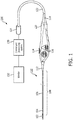
- Fig. 1 is a schematic diagram of an imaging system 100, according to embodiments of the present disclosure.
- the system 100 that can be used for imaging within a body of a patient may include an imaging device 110, a connector 124, a control and processing system 130, such as a console and/or a computer, and a monitor 132.
- the imaging device 110 includes an imaging assembly 102 at the tip of a flexible elongate member 108, and a handle 120.
- the imaging assembly 102 can include one or more ultrasound transducer elements, such as an array of transducer elements, and associated electronic circuitry.
- the imaging system 100 is used for generating 2D and/or 3D images.
- the imaging assembly can include a 1D imaging array for 2D imaging or a 2D imaging array for 3D imaging.
- the imaging system 100 is used for generating x-plane images at two different viewing directions perpendicular to each other.
- the transducer elements and/or electronic circuitry can be referenced as an imaging core or imaging assembly in various embodiments.
- the flexible elongate member 108 includes a distal portion 104 and a proximal portion 106.
- the imaging assembly 102 can be directly or indirectly coupled to the distal portion 104 of the flexible elongate member 108.
- the imaging assembly 102 can be positioned within a tip member (e.g., tip member 200 of Fig. 2 ) and the tip member can be coupled to the distal portion 104 of the flexible elongate member 108.
- the imaging assembly 102 can extend a length of the flexible elongate member 108, such as the length of the distal portion 104.
- the proximal end of the proximal portion 106 is attached to the handle 120, for example, by a resilient strain reliever 112, for manipulation of the imaging device 110 and manual control of the imaging device 110.
- the handle 120 can include actuators 116, a clutch 114, and/or other steering control components for steering the imaging device 110 in one or more directions, such as by deflecting the imaging assembly 102 and the distal portion 104.
- the handle 120 is connected to the connector 124 via another strain reliever 118 and a connection cable 122.
- the connector 124 may be configured in any suitable configurations to interconnect with the control and processing system 130 and the monitor 132 for processing, storing, analyzing, manipulating, and displaying data obtained from signals generated by the imaging core at the imaging assembly 102.
- the control and processing system 130 can include one or more processors, memory, one or more input devices, such as keyboards and any suitable command control interface device.
- the control and processing system 130 can be operable to facilitate the features of the imaging system 100 described herein.
- the processor can execute computer readable instructions stored on the non-transitory tangible computer readable medium.
- the monitor 132 can be any suitable display device, such as liquid-crystal display (LCD) panel or the like.
- a physician or a clinician advances the flexible elongate member 108 into a vessel within a heart anatomy.
- the physician or clinician can steer the flexible elongate member 108 to a position near the area of interest to be imaged by controlling the actuators 116 and the clutch 114 on the handle 120.
- one actuator 116 may deflect the imaging assembly 102 and the distal portion 104 in a left-right plane and the other actuator 116 may deflect the imaging assembly 102 and the distal portion 104 in an anterior-posterior plane.
- the clutch 114 provides a locking mechanism to lock the positions of the actuators 116 and in turn the deflection of the flexible elongate member while imaging the area of interest.
- the imaging process may include activating the ultrasound transducer elements on the imaging assembly 102 to produce ultrasonic energy. A portion of the ultrasonic energy is reflected by the area of interest and the surrounding anatomy, and the ultrasound echo signals are received by the ultrasound transducer elements.
- the connector 124 transfers the received echo signals to the control and processing system 130 where the ultrasound image is reconstructed and displayed on the monitor 132.
- the processing system 130 can control the activation of the ultrasound transducer elements and the reception of the echo signals.
- the control and processing system 130 and the monitor 132 may be part of the same system.
- the system 100 may be utilized in a variety of applications such as transseptal lumen punctures, left atrial appendage closures, atrial fibrillation ablation, and valve repairs.
- the system 100 can be used to image vessels, structures, lumens, and/or any suitable anatomy/tissue within a body of a patient including any number of anatomical locations and tissue types, including without limitation, organs including the liver, heart, kidneys, gall bladder, pancreas, lungs; ducts; intestines; nervous system structures including the brain, dural sac, spinal cord and peripheral nerves; the urinary tract; as well as valves within the blood, chambers or other parts of the heart, and/or other systems of the body.
- the imaging device 110 may be may be used to examine man-made structures such as, but without limitation, heart valves, stents, shunts, filters and other devices.
- the device 110 can be positioned within fluid filled or surrounded structures, both natural and man-made, such as within a body of a patient.
- the vessels, structures, lumens, and anatomy/tissue can include a blood vessel, as an artery or a vein of a patient's vascular system, including cardiac vasculature, peripheral vasculature, neural vasculature, renal vasculature, and/or any suitable lumen inside the body.
- the system 100 is suitable for use with any catheterization procedure.
- the imaging assembly 102 may include any suitable physiological sensor or component for diagnostic, treatment, and/or therapy.
- the imaging assembly can include an imaging component, an ablation component, a cutting component, a morcellation component, a pressure-sensing component, a flow-sensing component, a temperature-sensing component, and/or combinations thereof.
- the system 100 may be described in the context of intraluminal imaging procedures.
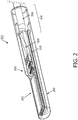
- Fig. 2 is a perspective view of the distal portion 104 of the imaging device 110, including the imaging assembly 102, according to embodiments of the present disclosure.
- the imaging assembly 102 is illustrated with the imaging core 262, including an array of transducer elements and associated circuitry, disposed within a tip member 200.
- the tip member 200 may be a housing for the imaging assembly 102 and include an acoustic window through which ultrasound energy and reflected echoes propagate.
- the imaging assembly 102 can be disposed within the tip member 200, and the tip member 200 can be coupled to the distal portion 104 of the flexible elongate member 108.
- the material type and the wall thickness of the tip member 200 are selected to minimize acoustic distortion, attenuation, and/or reflection.
- the tip member 200 can also include other features, for example, a guidewire lumen, holes, or other geometry to accommodate additional devices or features such as pressure sensors, drug delivery mechanisms, and/or any suitable interventional features.
- the tip member 200 may be an optically and/or acoustically translucent cover for the imaging assembly 102.
- the imaging assembly 102 includes the interconnect board 310 in electrical communication with the imaging core 262.
- the imaging core 262 is coupled to the electrical cable 266 via the electrical interconnection 264 to the interconnect board 310.
- the electrical cable 266 can extend from the distal portion 104 proximally through the flexible elongate member 108 and the device 110 to the connector 124, as shown in Fig. 1 .
- the diameter of the distal portion of the imaging device may be approximately 3 mm.
- Fig. 3A is a top view and Fig. 3B is a side view of an imaging assembly 102, according to embodiments of the present disclosure.
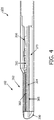
- Fig. 4 is a side view of the distal portion 104 of the imaging device 110, including the imaging assembly 102 positioned within the tip member 200.
- acoustic imaging elements 302 may be of any suitable type, including lead zirconate titanate (PZT), piezoelectric or capacitive micromachined ultrasonic transducer (PMUT or CMUT).
- the array 302 includes plurality of layers, such as a PZT layer, one or more electrode layers, one or more matching layers, etc.
- the array of imaging elements 302 can be in the form of an array of more than 800 imaging elements.
- the imaging elements 302 may be arranged in a 2-dimensional array having a same length and a same width such that the array of imaging elements 302 may have a symmetrical aperture.
- the imaging elements 302 may be arranged in a 2-dimensional array having a length greater than a width such that more imaging elements 302 extend along the length of the array than across the width. As a result, the array of imaging elements 302 may have an asymmetrical aperture.
- the imaging assembly 102 can also include electronic components 304, 310 in electrical communication with the imaging elements 302, each other, and/or the electrical cable 266.
- the integrated circuit 304 and/ 310 can be rigid or flexible printed circuit assemblies.
- the integrated circuit 304 can be an integrated circuit, such as an application specific integrated circuit (ASIC), configured to control operation of the imaging elements 302.
- the integrated circuit 304 can drive the transducer elements 302, provide switching between signal lines, generation of the excitation pulse, and/or other features associated with intraluminal imaging, imaging fluid filled structures, or imaging within a body of a patient.
- ASIC application specific integrated circuit
- the integrated circuit 304 may be a micro-beamformer integrated circuit (IC) that can control the array of imaging elements 302 and can perform beam forming for the array imaging elements 302.
- the transducer elements 302 are formed on, e.g., a substrate of the integrated circuit 304.
- the array of ultrasound imaging transducers 302 are directly flip-chip mounted to the integrated circuit 304. Piezoelectric elements 302 typically would be attached to the IC by flip-chip mounting an assembly of acoustic layers and sawing into individual elements. MUT elements may be flip-chip mounted as a unit or grown directly on top of the integrated circuit 304.
- mass termination of the acoustic imaging elements 302 is done at the integrated circuit 304.
- the integrated circuit 304 lies directly underneath the array of acoustic elements 302 and is electrically connected to them.
- the integrated circuit 304 may be in physical and thermal contact with the imaging elements 302.
- the electronic component 310 of the imaging assembly 102 can be an interconnect board and/or interposer.
- the interconnect board 310 is electrically and/or mechanically connected to the integrated circuit 304 through any suitable means such as wire bonding 320, as in illustrated in Figs. 3A and 3B .
- the interconnect board 310 may include one or more sensors 315 for measuring a temperature of the imaging assembly.
- the electrical cable 266 is in communication with the imaging elements 302, the integrated circuit 304, and/or the interconnect board 310.
- the electrical cable 266 includes one or more power lines for feeding power to the integrated circuit 304, one or more control lines for communicating control signals to the integrated circuit 304, and one or more signal lines for transferring imaging signals.
- wires of the electrical cable 266 are in electrical communication with the integrated circuit 304 is in through the interconnect board 310.
- the cable 266 can be coupled to the electrical interconnection 264 on the interconnect board 310.
- the imaging assembly 102 is configured such that the electrical cable 266 is directly coupled to the integrated circuit 304.
- the imaging assembly 102 includes an acoustic backing material 365, as shown in Figs. 3B and 4 .
- the acoustic backing material 365 can be configured to attenuate ultrasound signals emitted by the imaging elements 302 in an undesired direction.
- the acoustic backing material 365 can be a dampening material for ultrasound waves and prevent back propagation of the ultrasound waves. Accordingly, the acoustic backing material 365 facilitates transmission of the ultrasound signals by the imaging elements 302 in the desired direction, such as through the acoustic window of the tip member 200.
- the acoustic backing material 365 is thermally conductive.
- the distal portion 104 of the device 110 and/or the imaging assembly 102 includes a plate 375.
- the plate 375 can take the form of a square or rectangular bar or bars.
- the plate 375 can be shaped as a rectangular prism in some instances.
- the plate 375 can comprise a single metal rod or a plurality of rods parallel and adjacent to each other.
- the plate 375 may comprise any suitable material, such a ceramic, diamond, tungsten carbide, metal, such as aluminium, copper, or titanium, or a metal alloy, such as steel or beryllium copper.
- the plate 375 can be radiopaque.
- metals are electron dense and therefore highly radiopaque. This advantageously allows for the distal portion 104 of the device 110 to be more easily identified in radiographic images, such as x-ray, angiography, or fluoroscopy.
- the plate 375 is conductive.
- the plate 375 can be referenced as a heat sink in some instances.
- the plate 375 may be thermally conductive.
- the plate 375 may be electrically conductive.
- the plate 375 receives heat generated by the array of imaging elements 302, the integrated circuit 304, and/or the interconnect board 310 as a by productive of the operation of the imaging device 110.
- the plate 375 is in thermal contact with the array of imaging elements 302, the integrated circuit 304, and/or the interconnect board 310. Without the plate 375, the heat is concentrated at the location of the array of imaging elements 302, the integrated circuit 304, and/or the interconnect board 310.
- any temperature increase at the distal portion 104 of the imaging device 110 is localized.
- the plate 375 provides a path by which heat energy could travel from the point of highest temperature to the point of lowest temperature. This advantageously distributes the heat within the imaging device 110 and avoids any specific location of the distal portion 104 from a disproportionately large temperature increase. Additionally, by distributing the heating using the plate 375, a greater surface area of blood is in contact with the warmer portions of the imaging device 110, which allows for the blood to more easily dissipate the heat without damaging the blood. The greater the thermal conductivity of the material used for the plate 375, the more efficiently heat will be removed from the transducer and integrated circuit area.
- the plate 375 is also in thermal contact with the acoustic backing material 365.
- the acoustic backing material 365 can be thermally conductive.
- the acoustic backing material 365 and the plate 375 serve as a two stage heat sink for the imaging device 110.
- heat generated by the array of imaging elements 302, the integrated circuit 304, and/or the interconnect board 310 is first distributed as it is received by the acoustic backing material 365, and the distributed for a second time as it is received by the plate 375.
- the plate 375 may exhibit a stiffness greater than a stiffness of the array of imaging elements 302 such that the plate 375 inhibits deflection of the array of imaging elements 302.
- the plate 375 also advantageously provides structural support for the imaging assembly 102 by increasing the tensile/compressive strength and/or rigidity of the distal portion 104 of the imaging device 110.
- the tensile/compressive strength and/or rigidity of the material of the plate 375 may be greater than the rigidity of the array 302, the integrated circuit 304, the interconnect board 310, and/or the materials of the tip member 200.
- the distal portion 104 is less likely to experience bending or deflection that damages or destroys the array 302.
- the plate 375 is not thermally conductive and is implemented in the imaging device 110 only to provide structural support. In other embodiments, the plate 375 is both thermally conductive and provides structural support for the imaging assembly 102.
- the plate 375 is positioned within the distal portion 104 in longitudinal and lateral alignment with the imaging assembly 102.
- the plate 375 can extend adjacent to and extend at least a portion of the length of the imaging assembly 102.
- the dimensions 376, 377, 378 of the plate 375 can be selected to span all or at least a portion of the length and all or at least a portion of the width of the array of imaging elements 302, the integrated circuit 304, and/or the interconnect board 310.
- the plate 375 may extend beyond the length or width of those elements.
- the width 376 of the plate 375 can be between approximately 2 mm and 4 mm, including values such as 3 mm.
- the length 377 of the plate 375 can be between approximately 5 mm and 25 mm, in some embodiments.
- the height 378 of the plate 375 can be between 0.1 mm and 1 mm in some embodiments.
- the surface area of the plate 375 can be maximized to increase the radiating surface area and therefore the rate of energy transfer.
- the width 376, height 378, and length 377, of the plate 375 may be chosen based on an amount of heat dissipation desired.
- the distal edge of the array of imaging elements 302 and integrated circuit 304 can be aligned with the distal edge of the plate 375.
- the plate 375 may extend in a proximal direction beyond the proximal edge of the array of imaging elements 302 and integrated circuit 304.
- the proximal edge of the interconnect board 310 may be aligned with the proximal edge of the plate 375.
- the acoustic backing material 365 may be laterally and longitudinally aligned with the plate 375.
- one or more edges (sides) of the plate 375 may be aligned with one or more edges (sides) of the array of imaging elements 302 and/or the integrated circuit 304.
- the imaging assembly 102 includes one or more components in a stacked configuration, including the plate 375, array 302, integrated circuit 304, backing material 365, interconnect board 310, etc.
- One or more edges (sides) of the plate 375 may be flush with the edges (sides) of one or more of the other stacked components of the imaging assembly 102.
- the array 302 is formed on a superior surface of the integrated circuit 304.
- the array 302 can include an outward/superior surface and an inward/inferior surface.
- the superior/outward surface of the array 302 can be positioned to face the imaging plane of anatomy within the patient body that is being imaged.
- the integrated circuit 304 can be adjacent to the inferior/inward surface of the array 302.
- An inferior surface of the integrated circuit 304, opposite the superior surface, can be in contact with and coupled to a superior surface of the acoustic backing layer 365.
- An inferior surface of the interconnect board 310, opposite a superior surface, can be in contact with and coupled to the superior surface of the acoustic backing layer 365.
- the inferior surface of the acoustic backing layer 365, opposite the superior surface, can be in contact with and coupled to a superior surface of the plate 375.
- An inferior surface of the plate 375, opposite the superior surface can be adjacent to the tip member 200.
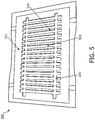
- Fig. 5 is a top view of a plate assembly 500 including a plurality of thermally conductive plates 510, according to aspects of the present disclosure.
- Fig. 5 may illustrate a stage during the method of manufacturing the imaging device 110. Any suitable number of plates 510 can be formed during a batch process, such as one, ten, sixteen, or more plates.
- the plate assembly 500 can include a block 515 coupled to a foil 505, such as with any suitable adhesive.
- the block 515 and/or the foil 505 can be a metal or metal alloy in some embodiment.
- the block 515 can be beryllium copper and the foil 505 can be aluminum or steel.
- Manufacturing the plate assembly 500 may start with the block 515 as being a solid, complete rectangular prism.
- the block 515, but not the foil 505 is etched to form islands or plates 510.
- Fig. 5 illustrates the plate assembly 500 after this step.
- the plates 510 are formed with the desired shape while maintaining the spacing between the plates 510.
- the strips 520 of foil 505, attached to individual plates 510 maintain the relative positioning between the plates 510.
- the etching can be very accurate and the precise spacing between the plates 510 is known.
- various components of the imaging assembly 102 can be precisely positioned on and coupled to the respective plates 510 while the plates 510 are still attached to the foil 505 using, e.g., pick and place processes.
- the assembly 500 can include fiducial markers to facilitate precise cutting and/or positioning of components on the plates 510.
- the plates 510 can be singulated by cutting/dicing through the foil such that the plates and any coupled imaging components can be moved relative to one another.
- Manufacturing may be more efficient as a result of forming a plurality of plates 510 in a single step.
- ICE devices are necessarily small as they have to travel to the chambers of the heart via blood vessels.
- a batch process could be considered where by the metal bar is etched from a larger plate of metal and supported by a very thin metal foil.
- the etching process has a number of advantages over other methods of manufacture. Etching is a very accurate process, the processing technique leaves a chamfer on the bars with ease the fit of the assembled device in the tip and the process readily lends itself pairing with other manufacturing methods that are currently employed in the construction of the transducer assembly.
- Figs. 6A, 6B, and 6C are cross-sectional images of plates 600, 650, 680, respectively, according to aspects of the present disclosure.
- the cross-sectional images correspond to the cross-section 6-6 in Fig. 3A , or similarly correspond to the cross-section 379 in Fig. 3B .
- Figs. 6A, 6B, and 6C illustrates exemplary cross-sectional shapes of the plates 600, 650, 680.
- the cross-section of the plates 600, 650, 680 may be solid.
- the cross-section may include one or more openings.
- the plate 600 includes a rectangular cross-section, which advantageously provides a shape that can be easily manufactured.
- the plate 650 includes a semicircular or semi-elliptical shape, which may advantageously match a shape of the tip member 200 of the imaging device 110.
- the plate 680 includes a T-shape, which may advantageously add tensile/compressive strength and/or rigidity to inhibit deflection/bending of the plate.
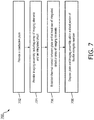
- Fig. 7 provides a flow diagram illustrating a method 700 of manufacturing an imaging device, such as the device 110. It is understood that the steps of method 700 may be performed in a different order than shown in Fig. 7 , additional steps can be provided before, during, and after the steps, and/or some of the steps described can be replaced or eliminated in other embodiments. The steps of the method 700 can be carried out by a manufacturer of the imaging device. In some examples, the device 110 may be used for intraluminal imaging, imaging fluid filled structures, or imaging within a body of a patient.
- the method 700 includes providing a conductive plate.
- the method 700 includes providing an imaging assembly.
- the imaging assembly can include an array of imaging elements as well as an integrated circuit in communication with the array of imaging elements.
- the imaging assembly may define a length of the imaging assembly.
- the method 700 includes establishing thermal contact between the plate and one or more components of the imaging assembly, such as the array of imaging elements 302, the integrated circuit 304, the interconnect board 310, and/or the acoustic backing material 365.
- the plate can be adjacent to and extend at least a portion of the length of the imaging assembly.
- step 706, establishing thermal contact can include bringing the components into direct or indirect contact or proximity such that heat energy can be transferred from one component to another.
- the method 700 includes disposing the plate and the imaging assembly within a distal portion of a flexible elongate member.
- disposing the plate and the imaging assembly may extend a length of the flexible elongate member.
- step 708 can include mechanically and/or electrically attaching the plate and imaging assembly within the distal portion of the flexible elongate member.
- the plate and the imaging assembly can be positioned within an imaging window or tip member that is coupled to the distal portion of the catheter body, such as the flexible elongate member.
- the plate is manufactured from a plate assembly.
- the method 700 can include obtaining a plate assembly comprising a metal block coupled to a foil.
- the method 700 can include etching a plurality of plates in the metal, and not the foil, of the plate assembly. In this manner, the foil extending between the plates maintains the precise spacing between the plates.
- the method 700 can further include coupling one or more components of the imagining assembly on each respective plate.
- the imaging assembly can include the acoustic backing material, the integrated circuit coupled to the acoustic backing material, and the array of imaging elements, e.g., transducer array, formed on the integrated circuit.
- step 706 can include coupling, such as by using an adhesive, a surface of the acoustic backing material of each imaging assembly to a respective plate of the plurality of plates.
- pick and place processes can be used to precisely position the portions of the imaging assembly on respective plates of the plate assembly.
- the portions of the imaging assembly connected to the plate can be referenced as a subassembly or plated imaging assembly in some embodiments.
- the method 700 can include singulating the subassemblies, such as the by etching, dicing, and/or otherwise cutting the foil of the plate assembly. This allows the subassemblies to be moved relative to one another.
- the method 700 can include adding additional components to each plated imaging assembly.
- the method 700 can include establishing thermal contact between an interconnect board of the imaging assembly and the plate in some embodiments.
- the interconnect board can be coupled to the acoustic backing material. Thus, heat from the interconnect board can be received by the plate via the acoustic backing material.
- the method 700 can also include mechanically and/or electrically coupling the integrated circuit and the interconnect board of the imaging assembly, such as with wire bonding 320.
- the method 700 can also include establishing electrical and/or mechanical contact between an electrical cable and the imaging assembly.
- the imaging assembly and plate can be attached to the distal portion of the flexible elongate member and extend a length of the flexible elongate member to form the imaging device.
- the embodiment as described above pertains to ICE but could readily be translated to other invasive ultrasound imaging devices such as intravascular ultrasound devices and transoesophageal probes.
Landscapes
- Health & Medical Sciences (AREA)
- Life Sciences & Earth Sciences (AREA)
- Biomedical Technology (AREA)
- Biophysics (AREA)
- Nuclear Medicine, Radiotherapy & Molecular Imaging (AREA)
- Pathology (AREA)
- Radiology & Medical Imaging (AREA)
- Engineering & Computer Science (AREA)
- Physics & Mathematics (AREA)
- Heart & Thoracic Surgery (AREA)
- Medical Informatics (AREA)
- Molecular Biology (AREA)
- Surgery (AREA)
- Animal Behavior & Ethology (AREA)
- General Health & Medical Sciences (AREA)
- Public Health (AREA)
- Veterinary Medicine (AREA)
- Gynecology & Obstetrics (AREA)
- Ultra Sonic Daignosis Equipment (AREA)
Applications Claiming Priority (2)
| Application Number | Priority Date | Filing Date | Title |
|---|---|---|---|
| US201762468046P | 2017-03-07 | 2017-03-07 | |
| PCT/EP2018/054805 WO2018162283A1 (en) | 2017-03-07 | 2018-02-27 | Ultrasound imaging device with thermally conductive plate |
Publications (2)
| Publication Number | Publication Date |
|---|---|
| EP3592241A1 EP3592241A1 (en) | 2020-01-15 |
| EP3592241B1 true EP3592241B1 (en) | 2021-04-14 |
Family
ID=61899151
Family Applications (1)
| Application Number | Title | Priority Date | Filing Date |
|---|---|---|---|
| EP18715478.6A Active EP3592241B1 (en) | 2017-03-07 | 2018-02-27 | Ultrasound imaging device with thermally conductive plate |
Country Status (4)
| Country | Link |
|---|---|
| US (3) | US11737728B2 (enExample) |
| EP (1) | EP3592241B1 (enExample) |
| JP (1) | JP6951456B2 (enExample) |
| WO (1) | WO2018162283A1 (enExample) |
Cited By (1)
| Publication number | Priority date | Publication date | Assignee | Title |
|---|---|---|---|---|
| EP4570188A1 (en) * | 2023-12-15 | 2025-06-18 | NuVera Medical, Inc. | Over-the-wire medical tool positioning devices, systems, and methods of use and manufacture |
Families Citing this family (12)
| Publication number | Priority date | Publication date | Assignee | Title |
|---|---|---|---|---|
| WO2019211150A1 (en) | 2018-05-02 | 2019-11-07 | Koninklijke Philips N.V. | Intraluminal medical imaging interface devices and systems |
| CA3120586A1 (en) | 2018-11-28 | 2020-06-04 | Histosonics, Inc. | Histotripsy systems and methods |
| JP2023513012A (ja) | 2020-01-28 | 2023-03-30 | ザ リージェンツ オブ ザ ユニバーシティー オブ ミシガン | ヒストトリプシー免疫感作のためのシステムおよび方法 |
| BR112022025722A2 (pt) | 2020-06-18 | 2023-03-07 | Histosonics Inc | Sistemas e métodos de acoplamento acústico e paciente de histotripsia |
| CN116782843A (zh) | 2020-08-27 | 2023-09-19 | 密歇根大学董事会 | 用于组织摧毁术的具有发射-接收能力的超声换能器 |
| US12582848B2 (en) | 2021-06-07 | 2026-03-24 | The Regents Of The University Of Michigan | Minimally invasive histotripsy systems and methods |
| EP4351430A1 (en) * | 2021-06-07 | 2024-04-17 | Koninklijke Philips N.V. | Sensor assembly with set acoustic matching layer thickness for intraluminal sensing device |
| EP4351447A4 (en) | 2021-06-07 | 2025-07-16 | Univ Michigan Regents | ALL-IN-ONE ULTRASOUND SYSTEMS AND METHODS INCLUDING HISTOTRIPSY |
| DE102022108491A1 (de) | 2022-04-07 | 2023-10-12 | Gea Westfalia Separator Group Gmbh | Separator |
| WO2024092272A1 (en) | 2022-10-28 | 2024-05-02 | Histosonics, Inc. | Histotripsy systems and methods |
| KR20260003742A (ko) | 2023-04-20 | 2026-01-07 | 히스토소닉스, 인크. | 치료 계획 및 요법을 위한 사용자 인터페이스들 및 작업 흐름들을 포함하는 히스토트립시 시스템들 및 연관된 방법들 |
| FR3162621A1 (fr) * | 2024-05-28 | 2025-12-05 | Vermon | Sonde ultrasonore |
Family Cites Families (16)
| Publication number | Priority date | Publication date | Assignee | Title |
|---|---|---|---|---|
| JPS5933894A (ja) * | 1982-08-19 | 1984-02-23 | 電気化学工業株式会社 | 混成集積用回路基板の製造法 |
| US6572547B2 (en) * | 2001-07-31 | 2003-06-03 | Koninklijke Philips Electronics N.V. | Transesophageal and transnasal, transesophageal ultrasound imaging systems |
| US6551248B2 (en) | 2001-07-31 | 2003-04-22 | Koninklijke Philips Electronics N.V. | System for attaching an acoustic element to an integrated circuit |
| US6942677B2 (en) | 2003-02-26 | 2005-09-13 | Flowcardia, Inc. | Ultrasound catheter apparatus |
| WO2004097896A2 (en) * | 2003-04-26 | 2004-11-11 | Freescale Semiconductor, Inc. | A packaged integrated circuit having a heat spreader and method therefor |
| US20080161890A1 (en) * | 2007-01-03 | 2008-07-03 | Boston Scientific Scimed, Inc. | Methods, systems, and apparatuses for protecting esophageal tissue during ablation |
| JP5154144B2 (ja) * | 2007-05-31 | 2013-02-27 | 富士フイルム株式会社 | 超音波内視鏡及び超音波内視鏡装置 |
| AU2009313687B2 (en) | 2008-11-17 | 2015-11-26 | Vytronus, Inc. | Systems and methods for ablating body tissue |
| CN104768472B (zh) * | 2012-10-31 | 2017-03-22 | 株式会社日立制作所 | 超声波探针 |
| US20150115773A1 (en) * | 2013-10-31 | 2015-04-30 | General Electric Company | Ultrasound transducer and method for manufacturing an ultrasound transducer |
| JP5771293B2 (ja) * | 2014-01-23 | 2015-08-26 | 日立アロカメディカル株式会社 | 超音波診断装置 |
| KR20150118750A (ko) | 2014-04-15 | 2015-10-23 | 삼성전자주식회사 | 초음파 영상 장치 |
| JP5905169B1 (ja) * | 2014-09-02 | 2016-04-20 | オリンパス株式会社 | 超音波内視鏡 |
| US9955945B2 (en) * | 2014-09-08 | 2018-05-01 | General Electric Company | Methods and systems for broadband intravascular ultrasound imaging |
| JP2016086956A (ja) * | 2014-10-31 | 2016-05-23 | セイコーエプソン株式会社 | 超音波プローブ並びに電子機器および超音波画像装置 |
| US10905398B2 (en) * | 2016-01-04 | 2021-02-02 | General Electric Company | Ultrasound transducer array with separated acoustic and electric module |
-
2018
- 2018-02-27 EP EP18715478.6A patent/EP3592241B1/en active Active
- 2018-02-27 JP JP2019548437A patent/JP6951456B2/ja active Active
- 2018-02-27 WO PCT/EP2018/054805 patent/WO2018162283A1/en not_active Ceased
- 2018-02-27 US US16/489,857 patent/US11737728B2/en active Active
-
2023
- 2023-08-28 US US18/238,555 patent/US12144680B2/en active Active
-
2024
- 2024-10-30 US US18/931,246 patent/US20250049417A1/en active Pending
Non-Patent Citations (1)
| Title |
|---|
| None * |
Cited By (1)
| Publication number | Priority date | Publication date | Assignee | Title |
|---|---|---|---|---|
| EP4570188A1 (en) * | 2023-12-15 | 2025-06-18 | NuVera Medical, Inc. | Over-the-wire medical tool positioning devices, systems, and methods of use and manufacture |
Also Published As
| Publication number | Publication date |
|---|---|
| US12144680B2 (en) | 2024-11-19 |
| US20230397904A1 (en) | 2023-12-14 |
| US11737728B2 (en) | 2023-08-29 |
| EP3592241A1 (en) | 2020-01-15 |
| WO2018162283A1 (en) | 2018-09-13 |
| JP6951456B2 (ja) | 2021-10-20 |
| JP2020508806A (ja) | 2020-03-26 |
| US20200029935A1 (en) | 2020-01-30 |
| US20250049417A1 (en) | 2025-02-13 |
Similar Documents
| Publication | Publication Date | Title |
|---|---|---|
| US12144680B2 (en) | Ultrasound imaging device with thermally conductive plate | |
| US12324701B2 (en) | Intra-cardiac echocardiography interposer | |
| EP3518772B1 (en) | Flexible imaging assembly for intraluminal imaging and associated devices and systems | |
| EP3518774B1 (en) | Intraluminal imaging devices with a reduced number of signal channels | |
| US12558067B2 (en) | Temperature insensitive backing structure for intraluminal imaging devices | |
| US12343209B2 (en) | Transducer arrays with air kerfs for intraluminal imaging | |
| US20200275909A1 (en) | Connectors for patient interface module and ultrasound imaging device | |
| US12539098B2 (en) | Radiopaque arrangement of electronic components in intra-cardiac echocardiography (ICE) catheter | |
| CN117500437A (zh) | 用于管腔内感测设备的具有设置声学匹配层厚度的传感器组件 | |
| CN114945328B (zh) | 管腔内超声成像装置和系统中的电线连接 |
Legal Events
| Date | Code | Title | Description |
|---|---|---|---|
| STAA | Information on the status of an ep patent application or granted ep patent |
Free format text: STATUS: UNKNOWN |
|
| STAA | Information on the status of an ep patent application or granted ep patent |
Free format text: STATUS: THE INTERNATIONAL PUBLICATION HAS BEEN MADE |
|
| PUAI | Public reference made under article 153(3) epc to a published international application that has entered the european phase |
Free format text: ORIGINAL CODE: 0009012 |
|
| STAA | Information on the status of an ep patent application or granted ep patent |
Free format text: STATUS: REQUEST FOR EXAMINATION WAS MADE |
|
| 17P | Request for examination filed |
Effective date: 20191007 |
|
| AK | Designated contracting states |
Kind code of ref document: A1 Designated state(s): AL AT BE BG CH CY CZ DE DK EE ES FI FR GB GR HR HU IE IS IT LI LT LU LV MC MK MT NL NO PL PT RO RS SE SI SK SM TR |
|
| AX | Request for extension of the european patent |
Extension state: BA ME |
|
| RAP1 | Party data changed (applicant data changed or rights of an application transferred) |
Owner name: KONINKLIJKE PHILIPS N.V. |
|
| DAV | Request for validation of the european patent (deleted) | ||
| DAX | Request for extension of the european patent (deleted) | ||
| GRAP | Despatch of communication of intention to grant a patent |
Free format text: ORIGINAL CODE: EPIDOSNIGR1 |
|
| STAA | Information on the status of an ep patent application or granted ep patent |
Free format text: STATUS: GRANT OF PATENT IS INTENDED |
|
| INTG | Intention to grant announced |
Effective date: 20201105 |
|
| GRAS | Grant fee paid |
Free format text: ORIGINAL CODE: EPIDOSNIGR3 |
|
| GRAA | (expected) grant |
Free format text: ORIGINAL CODE: 0009210 |
|
| STAA | Information on the status of an ep patent application or granted ep patent |
Free format text: STATUS: THE PATENT HAS BEEN GRANTED |
|
| AK | Designated contracting states |
Kind code of ref document: B1 Designated state(s): AL AT BE BG CH CY CZ DE DK EE ES FI FR GB GR HR HU IE IS IT LI LT LU LV MC MK MT NL NO PL PT RO RS SE SI SK SM TR |
|
| REG | Reference to a national code |
Ref country code: GB Ref legal event code: FG4D |
|
| REG | Reference to a national code |
Ref country code: CH Ref legal event code: EP |
|
| REG | Reference to a national code |
Ref country code: DE Ref legal event code: R096 Ref document number: 602018015537 Country of ref document: DE |
|
| REG | Reference to a national code |
Ref country code: IE Ref legal event code: FG4D |
|
| REG | Reference to a national code |
Ref country code: AT Ref legal event code: REF Ref document number: 1381555 Country of ref document: AT Kind code of ref document: T Effective date: 20210515 |
|
| REG | Reference to a national code |
Ref country code: LT Ref legal event code: MG9D |
|
| REG | Reference to a national code |
Ref country code: AT Ref legal event code: MK05 Ref document number: 1381555 Country of ref document: AT Kind code of ref document: T Effective date: 20210414 |
|
| REG | Reference to a national code |
Ref country code: NL Ref legal event code: MP Effective date: 20210414 |
|
| PG25 | Lapsed in a contracting state [announced via postgrant information from national office to epo] |
Ref country code: FI Free format text: LAPSE BECAUSE OF FAILURE TO SUBMIT A TRANSLATION OF THE DESCRIPTION OR TO PAY THE FEE WITHIN THE PRESCRIBED TIME-LIMIT Effective date: 20210414 Ref country code: HR Free format text: LAPSE BECAUSE OF FAILURE TO SUBMIT A TRANSLATION OF THE DESCRIPTION OR TO PAY THE FEE WITHIN THE PRESCRIBED TIME-LIMIT Effective date: 20210414 Ref country code: LT Free format text: LAPSE BECAUSE OF FAILURE TO SUBMIT A TRANSLATION OF THE DESCRIPTION OR TO PAY THE FEE WITHIN THE PRESCRIBED TIME-LIMIT Effective date: 20210414 Ref country code: NL Free format text: LAPSE BECAUSE OF FAILURE TO SUBMIT A TRANSLATION OF THE DESCRIPTION OR TO PAY THE FEE WITHIN THE PRESCRIBED TIME-LIMIT Effective date: 20210414 Ref country code: AT Free format text: LAPSE BECAUSE OF FAILURE TO SUBMIT A TRANSLATION OF THE DESCRIPTION OR TO PAY THE FEE WITHIN THE PRESCRIBED TIME-LIMIT Effective date: 20210414 Ref country code: BG Free format text: LAPSE BECAUSE OF FAILURE TO SUBMIT A TRANSLATION OF THE DESCRIPTION OR TO PAY THE FEE WITHIN THE PRESCRIBED TIME-LIMIT Effective date: 20210714 |
|
| PG25 | Lapsed in a contracting state [announced via postgrant information from national office to epo] |
Ref country code: GR Free format text: LAPSE BECAUSE OF FAILURE TO SUBMIT A TRANSLATION OF THE DESCRIPTION OR TO PAY THE FEE WITHIN THE PRESCRIBED TIME-LIMIT Effective date: 20210715 Ref country code: IS Free format text: LAPSE BECAUSE OF FAILURE TO SUBMIT A TRANSLATION OF THE DESCRIPTION OR TO PAY THE FEE WITHIN THE PRESCRIBED TIME-LIMIT Effective date: 20210814 Ref country code: LV Free format text: LAPSE BECAUSE OF FAILURE TO SUBMIT A TRANSLATION OF THE DESCRIPTION OR TO PAY THE FEE WITHIN THE PRESCRIBED TIME-LIMIT Effective date: 20210414 Ref country code: PL Free format text: LAPSE BECAUSE OF FAILURE TO SUBMIT A TRANSLATION OF THE DESCRIPTION OR TO PAY THE FEE WITHIN THE PRESCRIBED TIME-LIMIT Effective date: 20210414 Ref country code: NO Free format text: LAPSE BECAUSE OF FAILURE TO SUBMIT A TRANSLATION OF THE DESCRIPTION OR TO PAY THE FEE WITHIN THE PRESCRIBED TIME-LIMIT Effective date: 20210714 Ref country code: SE Free format text: LAPSE BECAUSE OF FAILURE TO SUBMIT A TRANSLATION OF THE DESCRIPTION OR TO PAY THE FEE WITHIN THE PRESCRIBED TIME-LIMIT Effective date: 20210414 Ref country code: PT Free format text: LAPSE BECAUSE OF FAILURE TO SUBMIT A TRANSLATION OF THE DESCRIPTION OR TO PAY THE FEE WITHIN THE PRESCRIBED TIME-LIMIT Effective date: 20210816 Ref country code: RS Free format text: LAPSE BECAUSE OF FAILURE TO SUBMIT A TRANSLATION OF THE DESCRIPTION OR TO PAY THE FEE WITHIN THE PRESCRIBED TIME-LIMIT Effective date: 20210414 |
|
| REG | Reference to a national code |
Ref country code: DE Ref legal event code: R097 Ref document number: 602018015537 Country of ref document: DE |
|
| PG25 | Lapsed in a contracting state [announced via postgrant information from national office to epo] |
Ref country code: CZ Free format text: LAPSE BECAUSE OF FAILURE TO SUBMIT A TRANSLATION OF THE DESCRIPTION OR TO PAY THE FEE WITHIN THE PRESCRIBED TIME-LIMIT Effective date: 20210414 Ref country code: DK Free format text: LAPSE BECAUSE OF FAILURE TO SUBMIT A TRANSLATION OF THE DESCRIPTION OR TO PAY THE FEE WITHIN THE PRESCRIBED TIME-LIMIT Effective date: 20210414 Ref country code: RO Free format text: LAPSE BECAUSE OF FAILURE TO SUBMIT A TRANSLATION OF THE DESCRIPTION OR TO PAY THE FEE WITHIN THE PRESCRIBED TIME-LIMIT Effective date: 20210414 Ref country code: EE Free format text: LAPSE BECAUSE OF FAILURE TO SUBMIT A TRANSLATION OF THE DESCRIPTION OR TO PAY THE FEE WITHIN THE PRESCRIBED TIME-LIMIT Effective date: 20210414 Ref country code: ES Free format text: LAPSE BECAUSE OF FAILURE TO SUBMIT A TRANSLATION OF THE DESCRIPTION OR TO PAY THE FEE WITHIN THE PRESCRIBED TIME-LIMIT Effective date: 20210414 Ref country code: SK Free format text: LAPSE BECAUSE OF FAILURE TO SUBMIT A TRANSLATION OF THE DESCRIPTION OR TO PAY THE FEE WITHIN THE PRESCRIBED TIME-LIMIT Effective date: 20210414 Ref country code: SM Free format text: LAPSE BECAUSE OF FAILURE TO SUBMIT A TRANSLATION OF THE DESCRIPTION OR TO PAY THE FEE WITHIN THE PRESCRIBED TIME-LIMIT Effective date: 20210414 |
|
| PLBE | No opposition filed within time limit |
Free format text: ORIGINAL CODE: 0009261 |
|
| STAA | Information on the status of an ep patent application or granted ep patent |
Free format text: STATUS: NO OPPOSITION FILED WITHIN TIME LIMIT |
|
| 26N | No opposition filed |
Effective date: 20220117 |
|
| PG25 | Lapsed in a contracting state [announced via postgrant information from national office to epo] |
Ref country code: IS Free format text: LAPSE BECAUSE OF FAILURE TO SUBMIT A TRANSLATION OF THE DESCRIPTION OR TO PAY THE FEE WITHIN THE PRESCRIBED TIME-LIMIT Effective date: 20210814 Ref country code: AL Free format text: LAPSE BECAUSE OF FAILURE TO SUBMIT A TRANSLATION OF THE DESCRIPTION OR TO PAY THE FEE WITHIN THE PRESCRIBED TIME-LIMIT Effective date: 20210414 |
|
| PGFP | Annual fee paid to national office [announced via postgrant information from national office to epo] |
Ref country code: FR Payment date: 20220224 Year of fee payment: 5 |
|
| PG25 | Lapsed in a contracting state [announced via postgrant information from national office to epo] |
Ref country code: IT Free format text: LAPSE BECAUSE OF FAILURE TO SUBMIT A TRANSLATION OF THE DESCRIPTION OR TO PAY THE FEE WITHIN THE PRESCRIBED TIME-LIMIT Effective date: 20210414 |
|
| PG25 | Lapsed in a contracting state [announced via postgrant information from national office to epo] |
Ref country code: MC Free format text: LAPSE BECAUSE OF FAILURE TO SUBMIT A TRANSLATION OF THE DESCRIPTION OR TO PAY THE FEE WITHIN THE PRESCRIBED TIME-LIMIT Effective date: 20210414 |
|
| REG | Reference to a national code |
Ref country code: CH Ref legal event code: PL |
|
| REG | Reference to a national code |
Ref country code: BE Ref legal event code: MM Effective date: 20220228 |
|
| PG25 | Lapsed in a contracting state [announced via postgrant information from national office to epo] |
Ref country code: LU Free format text: LAPSE BECAUSE OF NON-PAYMENT OF DUE FEES Effective date: 20220227 |
|
| PG25 | Lapsed in a contracting state [announced via postgrant information from national office to epo] |
Ref country code: LI Free format text: LAPSE BECAUSE OF NON-PAYMENT OF DUE FEES Effective date: 20220228 Ref country code: IE Free format text: LAPSE BECAUSE OF NON-PAYMENT OF DUE FEES Effective date: 20220227 Ref country code: CH Free format text: LAPSE BECAUSE OF NON-PAYMENT OF DUE FEES Effective date: 20220228 |
|
| PG25 | Lapsed in a contracting state [announced via postgrant information from national office to epo] |
Ref country code: BE Free format text: LAPSE BECAUSE OF NON-PAYMENT OF DUE FEES Effective date: 20220228 |
|
| PG25 | Lapsed in a contracting state [announced via postgrant information from national office to epo] |
Ref country code: FR Free format text: LAPSE BECAUSE OF NON-PAYMENT OF DUE FEES Effective date: 20230228 |
|
| PG25 | Lapsed in a contracting state [announced via postgrant information from national office to epo] |
Ref country code: MK Free format text: LAPSE BECAUSE OF FAILURE TO SUBMIT A TRANSLATION OF THE DESCRIPTION OR TO PAY THE FEE WITHIN THE PRESCRIBED TIME-LIMIT Effective date: 20210414 Ref country code: CY Free format text: LAPSE BECAUSE OF FAILURE TO SUBMIT A TRANSLATION OF THE DESCRIPTION OR TO PAY THE FEE WITHIN THE PRESCRIBED TIME-LIMIT Effective date: 20210414 |
|
| PG25 | Lapsed in a contracting state [announced via postgrant information from national office to epo] |
Ref country code: HU Free format text: LAPSE BECAUSE OF FAILURE TO SUBMIT A TRANSLATION OF THE DESCRIPTION OR TO PAY THE FEE WITHIN THE PRESCRIBED TIME-LIMIT; INVALID AB INITIO Effective date: 20180227 |
|
| PG25 | Lapsed in a contracting state [announced via postgrant information from national office to epo] |
Ref country code: MT Free format text: LAPSE BECAUSE OF FAILURE TO SUBMIT A TRANSLATION OF THE DESCRIPTION OR TO PAY THE FEE WITHIN THE PRESCRIBED TIME-LIMIT Effective date: 20210414 |
|
| PG25 | Lapsed in a contracting state [announced via postgrant information from national office to epo] |
Ref country code: TR Free format text: LAPSE BECAUSE OF FAILURE TO SUBMIT A TRANSLATION OF THE DESCRIPTION OR TO PAY THE FEE WITHIN THE PRESCRIBED TIME-LIMIT Effective date: 20210414 |
|
| PGFP | Annual fee paid to national office [announced via postgrant information from national office to epo] |
Ref country code: GB Payment date: 20260223 Year of fee payment: 9 |
|
| PGFP | Annual fee paid to national office [announced via postgrant information from national office to epo] |
Ref country code: DE Payment date: 20260220 Year of fee payment: 9 |