EP3591441A1 - Optical element, material, optical device and compound - Google Patents
Optical element, material, optical device and compound Download PDFInfo
- Publication number
- EP3591441A1 EP3591441A1 EP18776675.3A EP18776675A EP3591441A1 EP 3591441 A1 EP3591441 A1 EP 3591441A1 EP 18776675 A EP18776675 A EP 18776675A EP 3591441 A1 EP3591441 A1 EP 3591441A1
- Authority
- EP
- European Patent Office
- Prior art keywords
- group
- sup
- polymerizable functional
- substituted
- optical
- Prior art date
- Legal status (The legal status is an assumption and is not a legal conclusion. Google has not performed a legal analysis and makes no representation as to the accuracy of the status listed.)
- Granted
Links
- UPMGIXQGFLMNRR-UHFFFAOYSA-N CC(C(OCCC1(CCOC(C(C)=C)=O)c2cc(N(c3ccc(COC(C(C)=C)=O)cc3)c3cc(C(F)(F)F)cc(C(F)(F)F)c3)ccc2-c2c1cccc2)=O)=C Chemical compound CC(C(OCCC1(CCOC(C(C)=C)=O)c2cc(N(c3ccc(COC(C(C)=C)=O)cc3)c3cc(C(F)(F)F)cc(C(F)(F)F)c3)ccc2-c2c1cccc2)=O)=C UPMGIXQGFLMNRR-UHFFFAOYSA-N 0.000 description 1
- GUBCGTUUAMKLRN-UHFFFAOYSA-N CC(C)C(OCCC1(CCOC(C(C)=C)=O)c(cc(cc2)N(c3ccc(COC(C(C)=C)=C)cc3)c(cc3)ccc3C#N)c2-c2ccccc12)=O Chemical compound CC(C)C(OCCC1(CCOC(C(C)=C)=O)c(cc(cc2)N(c3ccc(COC(C(C)=C)=C)cc3)c(cc3)ccc3C#N)c2-c2ccccc12)=O GUBCGTUUAMKLRN-UHFFFAOYSA-N 0.000 description 1
- CNLOKPZJAQOEPJ-UHFFFAOYSA-N CC(C)c(cc1)ccc1N(c(cc1)cc(C2(C)C)c1-c1c2cccc1)c(cc1C#N)ccc1OC(C(C)=C)=O Chemical compound CC(C)c(cc1)ccc1N(c(cc1)cc(C2(C)C)c1-c1c2cccc1)c(cc1C#N)ccc1OC(C(C)=C)=O CNLOKPZJAQOEPJ-UHFFFAOYSA-N 0.000 description 1
- OPUNDODNYQXPEC-UHFFFAOYSA-N CC1(C)c(cc(cc2)N(c3cc(C(F)(F)F)cc(C(F)(F)F)c3)c3cc(OC(C(C)=C)=O)cc(OC(C(C)=C)=O)c3)c2C2=C1CCCC2 Chemical compound CC1(C)c(cc(cc2)N(c3cc(C(F)(F)F)cc(C(F)(F)F)c3)c3cc(OC(C(C)=C)=O)cc(OC(C(C)=C)=O)c3)c2C2=C1CCCC2 OPUNDODNYQXPEC-UHFFFAOYSA-N 0.000 description 1
- FJEANRUEBLYETM-UHFFFAOYSA-N CC1(C)c(cc(cc2)N(c3cc(OC(C(C)=C)=O)ccc3)c(cc3)cc(C#N)c3OC(C(C)=C)=O)c2-c2ccccc12 Chemical compound CC1(C)c(cc(cc2)N(c3cc(OC(C(C)=C)=O)ccc3)c(cc3)cc(C#N)c3OC(C(C)=C)=O)c2-c2ccccc12 FJEANRUEBLYETM-UHFFFAOYSA-N 0.000 description 1
- VCTAUIQKRHLERF-UHFFFAOYSA-N CC1(C)c2cc(N(c3cc(CCOC(C(C)=C)=O)ccc3)c(cc3)cc(OC(C(C)=C)=O)c3C#N)ccc2-c2c1cccc2 Chemical compound CC1(C)c2cc(N(c3cc(CCOC(C(C)=C)=O)ccc3)c(cc3)cc(OC(C(C)=C)=O)c3C#N)ccc2-c2c1cccc2 VCTAUIQKRHLERF-UHFFFAOYSA-N 0.000 description 1
- XCWRVKDVWHLXDW-JBCIEBSBSA-N CCCC1(CCO)[C@H]2C=CC=CC2C(CC2)C1C=C2N(c1ccc(CC(F)(F)F)cc1)c1ccc(C(F)(F)F)cc1 Chemical compound CCCC1(CCO)[C@H]2C=CC=CC2C(CC2)C1C=C2N(c1ccc(CC(F)(F)F)cc1)c1ccc(C(F)(F)F)cc1 XCWRVKDVWHLXDW-JBCIEBSBSA-N 0.000 description 1
- VOCMHTYIDFTZNW-UHFFFAOYSA-N CCCCCCCCC1(CCCCCCCC)c(cc(cc2)N(c3ccc(CCOC(C(C)=C)=O)cc3)c3cc(C(F)(F)F)cc(C(F)(F)F)c3)c2-c2ccccc12 Chemical compound CCCCCCCCC1(CCCCCCCC)c(cc(cc2)N(c3ccc(CCOC(C(C)=C)=O)cc3)c3cc(C(F)(F)F)cc(C(F)(F)F)c3)c2-c2ccccc12 VOCMHTYIDFTZNW-UHFFFAOYSA-N 0.000 description 1
Images

Classifications
-
- C—CHEMISTRY; METALLURGY
- C07—ORGANIC CHEMISTRY
- C07C—ACYCLIC OR CARBOCYCLIC COMPOUNDS
- C07C219/00—Compounds containing amino and esterified hydroxy groups bound to the same carbon skeleton
- C07C219/32—Compounds containing amino and esterified hydroxy groups bound to the same carbon skeleton having amino groups bound to carbon atoms of six-membered aromatic rings and esterified hydroxy groups bound to acyclic carbon atoms or to carbon atoms of rings other than six-membered aromatic rings of the same carbon skeleton
-
- G—PHYSICS
- G02—OPTICS
- G02B—OPTICAL ELEMENTS, SYSTEMS OR APPARATUS
- G02B1/00—Optical elements characterised by the material of which they are made; Optical coatings for optical elements
- G02B1/04—Optical elements characterised by the material of which they are made; Optical coatings for optical elements made of organic materials, e.g. plastics
- G02B1/041—Lenses
-
- C—CHEMISTRY; METALLURGY
- C07—ORGANIC CHEMISTRY
- C07C—ACYCLIC OR CARBOCYCLIC COMPOUNDS
- C07C217/00—Compounds containing amino and etherified hydroxy groups bound to the same carbon skeleton
- C07C217/76—Compounds containing amino and etherified hydroxy groups bound to the same carbon skeleton having amino groups bound to carbon atoms of six-membered aromatic rings and etherified hydroxy groups bound to acyclic carbon atoms or to carbon atoms of rings other than six-membered aromatic rings of the same carbon skeleton
-
- C—CHEMISTRY; METALLURGY
- C07—ORGANIC CHEMISTRY
- C07C—ACYCLIC OR CARBOCYCLIC COMPOUNDS
- C07C217/00—Compounds containing amino and etherified hydroxy groups bound to the same carbon skeleton
- C07C217/78—Compounds containing amino and etherified hydroxy groups bound to the same carbon skeleton having amino groups and etherified hydroxy groups bound to carbon atoms of six-membered aromatic rings of the same carbon skeleton
- C07C217/80—Compounds containing amino and etherified hydroxy groups bound to the same carbon skeleton having amino groups and etherified hydroxy groups bound to carbon atoms of six-membered aromatic rings of the same carbon skeleton having amino groups and etherified hydroxy groups bound to carbon atoms of non-condensed six-membered aromatic rings
- C07C217/82—Compounds containing amino and etherified hydroxy groups bound to the same carbon skeleton having amino groups and etherified hydroxy groups bound to carbon atoms of six-membered aromatic rings of the same carbon skeleton having amino groups and etherified hydroxy groups bound to carbon atoms of non-condensed six-membered aromatic rings of the same non-condensed six-membered aromatic ring
- C07C217/92—Compounds containing amino and etherified hydroxy groups bound to the same carbon skeleton having amino groups and etherified hydroxy groups bound to carbon atoms of six-membered aromatic rings of the same carbon skeleton having amino groups and etherified hydroxy groups bound to carbon atoms of non-condensed six-membered aromatic rings of the same non-condensed six-membered aromatic ring the nitrogen atom of at least one of the amino groups being further bound to a carbon atom of a six-membered aromatic ring
-
- C—CHEMISTRY; METALLURGY
- C07—ORGANIC CHEMISTRY
- C07C—ACYCLIC OR CARBOCYCLIC COMPOUNDS
- C07C219/00—Compounds containing amino and esterified hydroxy groups bound to the same carbon skeleton
- C07C219/34—Compounds containing amino and esterified hydroxy groups bound to the same carbon skeleton having amino groups and esterified hydroxy groups bound to carbon atoms of six-membered aromatic rings of the same carbon skeleton
-
- C—CHEMISTRY; METALLURGY
- C07—ORGANIC CHEMISTRY
- C07C—ACYCLIC OR CARBOCYCLIC COMPOUNDS
- C07C255/00—Carboxylic acid nitriles
- C07C255/49—Carboxylic acid nitriles having cyano groups bound to carbon atoms of six-membered aromatic rings of a carbon skeleton
- C07C255/58—Carboxylic acid nitriles having cyano groups bound to carbon atoms of six-membered aromatic rings of a carbon skeleton containing cyano groups and singly-bound nitrogen atoms, not being further bound to other hetero atoms, bound to the carbon skeleton
-
- C—CHEMISTRY; METALLURGY
- C07—ORGANIC CHEMISTRY
- C07C—ACYCLIC OR CARBOCYCLIC COMPOUNDS
- C07C255/00—Carboxylic acid nitriles
- C07C255/49—Carboxylic acid nitriles having cyano groups bound to carbon atoms of six-membered aromatic rings of a carbon skeleton
- C07C255/58—Carboxylic acid nitriles having cyano groups bound to carbon atoms of six-membered aromatic rings of a carbon skeleton containing cyano groups and singly-bound nitrogen atoms, not being further bound to other hetero atoms, bound to the carbon skeleton
- C07C255/59—Carboxylic acid nitriles having cyano groups bound to carbon atoms of six-membered aromatic rings of a carbon skeleton containing cyano groups and singly-bound nitrogen atoms, not being further bound to other hetero atoms, bound to the carbon skeleton the carbon skeleton being further substituted by singly-bound oxygen atoms
-
- C—CHEMISTRY; METALLURGY
- C07—ORGANIC CHEMISTRY
- C07D—HETEROCYCLIC COMPOUNDS
- C07D303/00—Compounds containing three-membered rings having one oxygen atom as the only ring hetero atom
- C07D303/02—Compounds containing oxirane rings
- C07D303/12—Compounds containing oxirane rings with hydrocarbon radicals, substituted by singly or doubly bound oxygen atoms
- C07D303/18—Compounds containing oxirane rings with hydrocarbon radicals, substituted by singly or doubly bound oxygen atoms by etherified hydroxyl radicals
- C07D303/20—Ethers with hydroxy compounds containing no oxirane rings
- C07D303/22—Ethers with hydroxy compounds containing no oxirane rings with monohydroxy compounds
-
- C—CHEMISTRY; METALLURGY
- C07—ORGANIC CHEMISTRY
- C07D—HETEROCYCLIC COMPOUNDS
- C07D303/00—Compounds containing three-membered rings having one oxygen atom as the only ring hetero atom
- C07D303/02—Compounds containing oxirane rings
- C07D303/12—Compounds containing oxirane rings with hydrocarbon radicals, substituted by singly or doubly bound oxygen atoms
- C07D303/18—Compounds containing oxirane rings with hydrocarbon radicals, substituted by singly or doubly bound oxygen atoms by etherified hydroxyl radicals
- C07D303/20—Ethers with hydroxy compounds containing no oxirane rings
- C07D303/22—Ethers with hydroxy compounds containing no oxirane rings with monohydroxy compounds
- C07D303/23—Oxiranylmethyl ethers of compounds having one hydroxy group bound to a six-membered aromatic ring, the oxiranylmethyl radical not being further substituted, i.e.
-
- C—CHEMISTRY; METALLURGY
- C08—ORGANIC MACROMOLECULAR COMPOUNDS; THEIR PREPARATION OR CHEMICAL WORKING-UP; COMPOSITIONS BASED THEREON
- C08L—COMPOSITIONS OF MACROMOLECULAR COMPOUNDS
- C08L79/00—Compositions of macromolecular compounds obtained by reactions forming in the main chain of the macromolecule a linkage containing nitrogen with or without oxygen or carbon only, not provided for in groups C08L61/00 - C08L77/00
- C08L79/02—Polyamines
-
- C—CHEMISTRY; METALLURGY
- C07—ORGANIC CHEMISTRY
- C07C—ACYCLIC OR CARBOCYCLIC COMPOUNDS
- C07C2603/00—Systems containing at least three condensed rings
- C07C2603/02—Ortho- or ortho- and peri-condensed systems
- C07C2603/04—Ortho- or ortho- and peri-condensed systems containing three rings
- C07C2603/06—Ortho- or ortho- and peri-condensed systems containing three rings containing at least one ring with less than six ring members
- C07C2603/10—Ortho- or ortho- and peri-condensed systems containing three rings containing at least one ring with less than six ring members containing five-membered rings
- C07C2603/12—Ortho- or ortho- and peri-condensed systems containing three rings containing at least one ring with less than six ring members containing five-membered rings only one five-membered ring
- C07C2603/18—Fluorenes; Hydrogenated fluorenes
Definitions
- the present invention relates to an optical element, a material, an optical apparatus, and a compound, and more particularly, to a triarylamine compound, a material, an optical element, and an optical apparatus each having a characteristic in that a dispersion characteristic (Abbe number (vd)) of refractive indices is high and a secondary dispersion characteristic ( ⁇ g,F) thereof is high (high ⁇ g,F).
- a dispersion characteristic Abbe number (vd)
- ⁇ g,F secondary dispersion characteristic
- the refractive index of an optical material gradually increases as the wavelength of light to be refracted by the material becomes shorter.
- Indicators each representing the wavelength dispersibility of the refractive index are, for example, an Abbe number (vd) and a secondary dispersion characteristic ( ⁇ g,F).
- the Abbe number and the ⁇ g,F value are values peculiar to each optical material, but in many cases, the values each fall within a certain range.
- a relationship between the secondary dispersion characteristic and Abbe number of each of conventional optical materials (a glass material and an organic resin) is shown in FIG. 1 .
- an optical material having a high ⁇ g,F characteristic deviating from a value in the certain range has also been synthesized by designing the configuration (material kind or molecular structure) of an optical material (e.g., a glass material or an organic resin) in detail.
- an optical material e.g., a glass material or an organic resin
- polyvinyl carbazole (positioned at a point A in FIG. 1 ) serving as an organic resin has a ⁇ g,F characteristic higher than that of a general-purpose organic resin material.
- a chromatic aberration is reduced by combining glass materials having different dispersion characteristics.
- the objective lens of a telescope or the like a chromatic aberration appearing on its optical axis is corrected by using the following materials in combination: a glass material having small dispersion is used as a positive lens, and a glass material having large dispersion is used as a negative lens. Accordingly, for example, when the configurations and number of lenses are limited, or when glass materials to be used are limited, it may become extremely difficult to sufficiently correct the chromatic aberration. As one method of solving such problem, the design of optical elements involving exploiting a glass material having an abnormal dispersion characteristic has been performed.
- a method involving, for example, molding an organic resin on a spherical glass or the like has the following advantage over a method involving using a glass material as a material: mass productivity, moldability, degree of freedom in shape, and lightweight property are excellent.
- mass productivity, moldability, degree of freedom in shape, and lightweight property are excellent.
- the optical characteristic of a conventional organic resin falls within a certain limited range as shown in FIG. 1 , and hence the number of organic resins showing specific dispersion characteristics is extremely small.
- Patent Literature 1 there is a report that a sulfone (meth)acrylate serving as an organic material positioned at the point A in FIG. 1 has a higher secondary dispersion characteristic (higher ⁇ g,F characteristic) than that of a general-purpose organic material.
- a triarylamine compound has been widely utilized in, for example, an electrophotographic photosensitive member, an organic electronics material, and an organic nonlinear optical material.
- Patent Literature 2 there is a proposal of a triarylamine compound as a charge-transportable compound to be used in the outermost surface layer of an electrophotographic photosensitive member.
- Patent Literature 3 there is a proposal of a triarylamine compound as an organic compound having nonlinear optical activity to be dispersed in a polymer binder.
- Patent Literature 1 has a high secondary dispersion characteristic (high ⁇ g,F characteristic), but a higher ⁇ g,F characteristic has been required in recent years.
- the inventors of the present invention have made an investigation, and as a result, have found that a triarylamine compound shows a high secondary dispersion characteristic (high ⁇ g,F characteristic).
- the triarylamine compounds disclosed in Patent Literatures 2 and 3 need to be improved before being put into practical use as optical materials (reduced in coloring and improved in transparency). In particular, the improvement of their transmittances has been needed.
- the present invention provides a triarylamine compound having a characteristic in that the dispersion characteristic (Abbe number (vd)) and secondary dispersion characteristic ( ⁇ g,F) of refractive indices are high (high ⁇ g,F characteristic), that is, a chromatic aberration-correction function is high, and having a high transmittance, and a material, an optical element, and an optical apparatus each using the compound.
- the dispersion characteristic Abbe number (vd)
- ⁇ g,F characteristic secondary dispersion characteristic of refractive indices
- a chromatic aberration-correction function is high
- R 1 and R 2 are each independently selected from a substituted or unsubstituted alkyl group having 1 to 10 carbon atoms, and a substituted or unsubstituted alkylene group having 1 to 8 carbon atoms, the alkylene group having a polymerizable functional group
- R 3 to R 12 are each independently selected from a hydrogen atom, a cyano group, a trifluoromethyl group, a substituted or unsubstituted alkyl group, a substituted or unsubstituted alkylene group having a polymerizable functional group, and a polymerizable functional group, provided that at least one of R 3 to R 12 represents an electron-withdrawing group, and at least one of R 1 to R 12 has a polymerizable functional group.
- a material including a polymerized product (cured product) of the compound.
- an optical element obtained by molding the material.
- an optical apparatus including the optical element.
- the triarylamine compound having a characteristic in that the dispersion characteristic (Abbe number (vd)) of refractive indices is high and the secondary dispersion characteristic ( ⁇ g,F) thereof is high (high ⁇ g,F characteristic), that is, a chromatic aberration-correction function is high, and the material and the optical element each using the compound can be provided.
- the optical material having a characteristic in a range A in FIG. 1 can be provided.
- the use of the optical element molded out of the optical material can efficiently remove a chromatic aberration. Accordingly, an optical system can be further reduced in weight and size.
- the term "high ⁇ g,F characteristic" means a characteristic included in the range A in FIG. 1 .
- R 1 and R 2 are each independently selected from a substituted or unsubstituted alkyl group having 1 to 10 carbon atoms, and a substituted or unsubstituted alkylene group having 1 to 8 carbon atoms, the alkylene group having a polymerizable functional group
- R 3 to R 12 are each independently selected from a hydrogen atom, a cyano group, a trifluoromethyl group, a substituted or unsubstituted alkyl group, a substituted or unsubstituted alkylene group having a polymerizable functional group, and a polymerizable functional group, provided that at least one of R 3 to R 12 represents an electron-withdrawing group, and at least one of R 1 to R 12 has a polymerizable functional group.
- the inventors of the present invention have made extensive investigations with a view to providing a triarylamine compound satisfying a characteristic in the range A in FIG. 1 and having a high transmittance, and as a result, have found that such a structure that the aryl groups of a triarylamine compound are formed of a fluorenyl group and two phenyl groups, and at least one of the phenyl groups has an electron-withdrawing group as a substituent provides a material having both a high secondary dispersion characteristic (high ⁇ g,F) and a high transmittance.
- high ⁇ g,F high secondary dispersion characteristic
- a compound having a long conjugated structure typified by an aromatic compound has a band gap smaller than that of a general-purpose material, and hence its absorption edge in a UV region shifts to a visible light region.
- the compound having a long conjugated structure has a high refractive index characteristic.
- the high refractive index characteristic has a larger influence on shorter wavelengths than on longer wavelengths. Accordingly, an improvement in secondary dispersion characteristic ( ⁇ g,F) of the compound inevitably advances, and hence the characteristic of the compound falls within the range A in FIG. 1 .
- ⁇ g,F secondary dispersion characteristic
- a material having practicality is not obtained merely by linking aromatic compounds to build a long conjugated structure.
- a large aromatic compound involves problems in terms of synthesizability, compatibility with any other compound, and coloring.
- a triarylamine is an aromatic compound having an electron-donating property and having a conjugated structure. As its conjugated structure becomes longer, its characteristic ( ⁇ g,F) is improved. However, when the conjugated structure becomes excessively long, the transmittance of the triarylamine at shorter wavelengths in the visible light region reduces. Accordingly, when the triarylamine is utilized as an optical material, the length of the conjugated structure needs to be adjusted from the viewpoint of an improvement in transmittance.
- an action for improving the transmittance of an aromatic compound such as the shortening of the conjugated structure of the aromatic compound or the widening of the intermolecular distance thereof by the steric hindrance of a substituent thereof, simultaneously causes a reduction in secondary dispersion characteristic ( ⁇ g,F) thereof.
- the inventors of the present invention have considered the reason why the triarylamine compound according to the present invention has both a high secondary dispersion characteristic (high ⁇ g,F) and a high transmittance to be as described below.
- the substitution of a phenyl group with an electron-withdrawing group is assumed to exhibit an improving effect on the secondary dispersion characteristic ( ⁇ g,F) by the electron withdrawal of the electron-withdrawing group in addition to an improvement in transmittance by the steric hindrance thereof.
- the inventors have considered that, as a result of the foregoing, a reduction in secondary dispersion characteristic ( ⁇ g,F) by the steric hindrance of the electron-withdrawing group is suppressed, and hence the triarylamine compound has both a high secondary dispersion characteristic (high ⁇ g,F) and a high transmittance.
- examples of the substituted or unsubstituted alkyl group having 1 to 10 carbon atoms represented by R 1 and R 2 include a methyl group, an ethyl group, a n-propyl group, a n-butyl group, a n-pentyl group, a n-hexyl group, a n-heptyl group, a n-octyl group, a n-decyl group, an iso-propyl group, an iso-butyl group, a sec-butyl group, a tert-butyl group, an iso-pentyl group, a neopentyl group, and a 2-ethylhexyl group, and the alkyl group is not limited thereto as long as a high ⁇ g,F characteristic is obtained.
- an alkyl group having 1 or more to 8 or less carbon atoms is preferred, and a methyl
- examples of the unsubstituted alkylene group having 1 to 8 carbon atoms, which has a polymerizable functional group, represented by R 1 and R 2 include a methylene group, an ethylene group, a n-propylene group, an iso-propylene group, a n-butylene group, a n-pentylene group, and a n-hexylene group, and the alkylene group is not limited thereto as long as a high ⁇ g,F characteristic is obtained.
- a methylene group, an ethylene group, a n-propylene group, and a n-butylene group are preferred.
- examples of the substituted alkylene group having 1 to 8 carbon atoms, which has a polymerizable functional group, represented by R 1 and R 2 include a group introduced by substituting at least one CH2 in a main chain of an alkylene group with an oxygen atom, and a group introduced by substituting at least one CH 2 in a main chain of an alkylene group with a sulfur atom, and the alkylene group is not limited thereto as long as a high ⁇ g,F characteristic is obtained.
- examples of the substituted or unsubstituted alkyl group represented by R 3 to R 12 include a methyl group, an ethyl group, a n-propyl group, a n-butyl group, an iso-propyl group, an iso-butyl group, a sec-butyl group, and a tert-butyl group, and the alkyl group is not limited thereto as long as a high ⁇ g,F characteristic is obtained. Of those, a methyl group and an ethyl group are preferred.
- examples of the unsubstituted alkylene group having a polymerizable functional group represented by R 3 to R 12 include a methylene group, an ethylene group, a n-propylene group, a n-butylene group, a n-pentylene group, and a n-hexylene group, and the alkylene group is not limited thereto as long as a high ⁇ g,F characteristic is obtained.
- a methylene group, an ethylene group, and a n-propylene group are preferred.
- examples of the substituted (obtained by substitution) alkylene group having 1 to 8 carbon atoms, which has a polymerizable functional group, represented by R 3 to R 12 include a group introduced by substituting at least one CH 2 in a main chain of an alkylene group with an oxygen atom, and a group introduced by substituting at least one CH 2 in a main chain of an alkylene group with a sulfur atom, and the alkylene group is not limited thereto as long as a high ⁇ g,F characteristic is obtained.
- examples of the electron-withdrawing substituent include a cyano group, a halogenated alkyl group, a nitro group, an alkylsulfonyl group, an acyl group, an alkoxycarbonyl group, a sulfamoyl group, a carbamoyl group, a halogenated alkoxy group, a sulfonyloxy group, a halogenated alkylthio group, and a fluorine group.
- a cyano group and a halogenated alkyl group are preferred, and a cyano group and a trifluoromethyl group are more preferred.
- at least one of R 5 , R 6 , R 9 , and R 10 represent an electron-withdrawing group, and the electron-withdrawing group be a cyano group or a trifluoromethyl group.
- examples of the polymerizable functional group include an active hydrogen group, an unsaturated polymerizable group, and an epoxy group.
- examples of the active hydrogen group include a hydroxy group, a carboxyl group, an amino group, a thiol group, and a methoxy group. Of those, a hydroxy group is preferred.
- examples of the unsaturated polymerizable group include a vinyl group, an acryloyloxy group, and a methacryloyloxy group. Of those, an acryloyloxy group and a methacryloyloxy group are preferred.
- the expression "at least one of R 3 to R 12 has a polymerizable functional group” means that the at least one substituent is a polymerizable functional group, or part of the substituent includes a polymerizable functional group.
- a phenyl group may be directly substituted with a polymerizable functional group, or the polymerizable functional group may be indirectly bonded to the phenyl group through an alkylene group.
- the number of polymerizable functional groups is preferably 2 or more from the viewpoint of the curability of the triarylamine compound, and is more preferably 2 from the viewpoint of the ease of synthesis thereof.
- an optical material according to the present invention may be a homopolymer of the compound represented by the general formula (1), or may be a copolymer thereof.
- an optical material according to the present invention may be a homopolymer of the compound represented by the general formula (1), or may be a copolymer thereof.
- a method of producing the triarylamine compound according to the present invention is described by way of an example.
- the method of producing the triarylamine compound is not limited to any specific production route, and any production method may be adopted.
- a derivative having a structure represented by the general formula (1) in the present invention may be synthesized by using a known synthesis method described in, for example, Japanese Patent Application Laid-Open No. 2000-066425 or Japanese Patent Application Laid-Open No. 2008-165248 .
- a first method is a method involving directly introducing a polymerizable functional group into the derivative having a structure represented by the general formula (1).
- a second method is a method involving introducing a structure having a polymerizable functional group or a functional group that may be a precursor of the polymerizable functional group into the derivative having a structure represented by the general formula (1).
- An example of the second method is a method involving introducing a functional group-containing aryl group through the use of a coupling reaction involving using a metal catalyst and a base based on a monoarylamine derivative.
- the following methods are available for causing the derivative having a structure represented by the general formula (1) to have an unsaturated hydrocarbon group (e.g., an acrylic group or a methacrylic group). That is, a method involving causing a (meth)acrylate to act on the derivative having a structure represented by the general formula (1), the derivative having a hydroxy group, or a method involving directly introducing a polymerizable functional group into the derivative having a structure represented by the general formula (1) is available.
- an unsaturated hydrocarbon group e.g., an acrylic group or a methacrylic group
- the coupling reaction based on the metal catalyst may be arbitrarily selected.
- the Ullmann reaction involving utilizing copper the Buchwald-Hartwig reaction involving utilizing an amine or the like, the Suzuki coupling involving utilizing boric acid or the like, the Stille coupling involving utilizing an organotin, or the Negishi coupling involving utilizing an organozinc is suitably used as a typical method.
- the (meth)acrylation reaction may be arbitrarily selected.
- a dehydration condensation agent such as N,N'-dicyclohexylcarbodiimide
- a method involving heating (meth)acrylic acid and the diol in the presence of a dehydrating agent, such as sulfuric acid is suitably used as a typical
- a polymerization inhibitor may be used as required so that the polymerization of the triarylamine compound of the present invention may not advance at the time of a reaction for the production of the compound or at the time of its storage.
- the polymerization inhibitor may include: hydroquinones, such as p-benzoquinone, hydroquinone, hydroquinone monomethyl ether, and 2,5-diphenyl-p-benzoquinone; N-oxy radicals, such as tetramethylpiperidinyl-N-oxy radical (TEMPO); substituted catechols, such as t-butylcatechol; amines, such as phenothiazine, diphenylamine, and phenyl- ⁇ -naphthylamine; nitrosobenzene; picric acid; molecular oxygen; sulfur; and copper(II) chloride.
- hydroquinones, phenothiazine, and N-oxyradicals are preferred from the viewpoints of a general-purpose property
- a lower limit for the usage amount of the polymerization inhibitor is typically 10 ppm or more, preferably 50 ppm or more with respect to the triarylamine compound, and an upper limit therefor is typically 10,000 ppm or less, preferably 1,000 ppm or less with respect thereto.
- the usage amount is excessively small, the following risk arises: the effect of the polymerization inhibitor is not expressed or the effect is small even when the effect is expressed, and hence the polymerization advances at the time of the reaction or at the time of condensation in a posttreatment step.
- the polymerization inhibitor serves as, for example, an impurity at the time of the production of an optical material to be described later, and has an adverse effect, such as the inhibition of the polymerization reactivity of the triarylamine compound.
- the optical material according to the present invention is formed of a composition including the above-mentioned triarylamine compound, a polymerization initiator, and the polymerization inhibitor, and as required, a photosensitizer, a heat-resistive stabilizer, a light-resistive stabilizer, an antioxidant, or a resin.
- the content of the triarylamine compound to be incorporated into the optical material of the present invention is desirably 1.0 wt% or more to 99 wt% or less, preferably 50 wt% or more to 99 wt% or less with respect to the entirety of the material.
- polymerization initiator examples include, but not limited to, a polymerization initiator that generates a radical species or a cation species through light irradiation, and a polymerization initiator that generates a radical species with heat.
- Examples of the polymerization initiator that generates a radical species through light irradiation include, but not limited to, 2-benzyl-2-dimethylamino-1-(4-morpholinophenyl)-1-butanone, 1-hydroxycyclohexyl phenyl ketone, 2-hydroxy-2-methyl-1-phenyl-propan-1-one, bis(2,4,6-trimethylbenzoyl)-phenylphosphine oxide, 4-phenylbenzophenone, 4-phenoxybenzophenone, 4,4'-diphenylbenzophenone, and 4,4'-diphenoxybenzophenone.
- suitable examples of the polymerization initiator that generates a cation species through light irradiation include, but not limited to, polymerization initiators such as iodonium (4-methylphenyl)[4-(2-methylpropyl)phenyl]-hexafluorophosphate.
- examples of the polymerization initiator that generates a radical species with heat include, but not limited to: azo compounds, such as azobisisobutyronitrile (AIBN); and peroxides, such as benzoyl peroxide, t-butyl peroxypivalate, t-butyl peroxyneohexanoate, t-hexyl peroxyneohexanoate, t-butyl peroxyneodecanoate, t-hexyl peroxyneodecanoate, cumyl peroxyneohexanoate, and cumyl peroxyneodecanoate.
- azo compounds such as azobisisobutyronitrile (AIBN)
- peroxides such as benzoyl peroxide, t-butyl peroxypivalate, t-butyl peroxyneohexanoate, t-hexyl peroxyneohexanoate, t
- a known sensitizer or the like may be used.
- the sensitizer include, but not limited to, benzophenone, 4,4-diethylaminobenzophenone, 1-hydroxycyclohexyl phenyl ketone, isoamyl p-dimethylaminobenzoate, methyl 4-dimethylaminobenzoate, benzoin, benzoin ethyl ether, benzoin isobutyl ether, benzoin isopropyl ether, 2,2-diethoxyacetophenone, methyl o-benzoylbenzoate, 2-hydroxy-2-methyl-1-phenylpropan-1-one, and acylphosphine oxides.
- the addition ratio of the photopolymerization initiator with respect to a polymerizable resin component may be appropriately selected in accordance with a light irradiation amount and an additional heating temperature. In addition, the addition ratio may be adjusted in accordance with the target average molecular weight of a polymer to be obtained.
- the addition amount of the photopolymerization initiator to be used in the polymerization (curing) and molding of the optical material according to the present invention preferably falls within the range of from 0.01 wt% or more to 10.00 wt% or less with respect to the polymerizable resin component.
- the photopolymerization initiators may be used alone or in combination thereof in accordance with the reactivity of the resin and the wavelength of the light to be applied.
- the light-resistive stabilizer is not particularly limited as long as the light-resistive stabilizer does not have a large influence on the optical characteristics of the molded body, and typical examples thereof may include: benzotriazole-based materials, such as 2-(2H-benzotriazol-2-yl)-p-cresol, 2-(2H-benzotriazol-2-yl)-4,6-bis(1-methyl-1-phenylethyl)phenol, 2-[5-chloro(2H)-benzotriazol-2-yl-4-methyl-6-(tert-butyl)]phenol, 2-(2H-benzotriazol-2-yl)-4,6-di-tert-pentylphenol, 2-(2H-benzotriazol-2-yl)-4-(1,1,3,3-tetramethylbutyl)phenol, 2,2'-methylenebis[6-(2H-benzotriazol-2-yl)-4-(1,1,3,3-tetramethylbut
- the addition amount of the light-resistive stabilizer to be used in the polymerization (curing) and molding of the optical material of the present invention preferably falls within the range of from 0.01 wt% or more to 10.00 wt% or less with respect to the total amount of the polymerizable resin component.
- the heat-resistive stabilizer is not particularly limited as long as the heat-resistive stabilizer does not have a large influence on the optical characteristics of the molded body, and for example: pentaerythritol tetrakis[3-(3,5-di-ert-butyl-4-hydroxyphenyl)]propionate, octadecyl-3-(3,5-di-tert-butyl-4-hydroxyphenyl)propionate, 3,5-bis(1,1-dimethylethyl)-4-hydroxybenzenepropanoic acid, and C7-C9 side chain alkyl esters; hindered phenol-based materials, such as 4,6-bis(octylthiomethyl)-o-cresol, 4,6-bis(dodecylthiomethyl)-o-cresol, ethylenebis(oxyethylene)bis[3-(5-tert-butyl-4-hydroxy-m-tolyl)]propionate, and
- the antioxidant is not particularly limited as long as the antioxidant does not have a large influence on the optical characteristics of the molded body, and typical examples thereof include hindered amine-based materials, such as bis(2,2,6,6-tetramethyl-4-piperidyl) sebacate and bis(1,2,2,6,6-pentamethyl-4-piperidyl)[[3,5-bis(1,1-dimethylethyl)-4-hydroxyphenyl]methyl]butyl malonate.
- the addition amount of the antioxidant to be used in the polymerization (curing) and molding of the optical material according to the present invention preferably falls within the range of from 0.01 wt% or more to 10.00 wt% or less with respect to the total amount of the polymerizable resin component.
- the resin that may be utilized in the optical material of the present invention is not particularly limited.
- examples thereof include, but not limited to: (meth)acrylate compounds, such as 1,3-adamantanediol dimethacrylate, 1,3-adamantanedimethanol dimethacrylate, tricyclodecanedimethanol diacrylate, pentaerythritol tetraacrylate, propoxylated neopentyl glycol diacrylate, dipropylene glycol diacrylate, ethoxylated bisphenol A dimethacrylate, tris(2-hydroxyethyl) isocyanurate triacrylate, 2-(2-ethoxyethoxy)ethyl acrylate, stearyl acrylate, tetrahydrofurfuryl acrylate, 2-phenoxyethyl acrylate, isodecyl acrylate, isobornyl acrylate, isobornyl methacrylate, 1,3-butylene glycol di
- the resin may be a thermoplastic resin.
- examples thereof include: polyolefin-based resins, such as an ethylene homopolymer, a random or block copolymer of ethylene and one or two or more kinds of ⁇ -olefins, such as propylene, 1-butene, 1-pentene, 1-hexene, and 4-methyl-1-pentene, a random or block copolymer of ethylene and one or two or more kinds of vinyl acetate, acrylic acid, methacrylic acid, methyl acrylate, and methyl methacrylate, a propylene homopolymer, a random or block copolymer of propylene and one or two or more kinds of ⁇ -olefins except propylene, such as 1-butene, 1-pentene, 1-hexene, and 4-methyl-1-pentene, a 1-butene homopolymer, an ionomer resin, and a mixture of those polymers; hydrocarbon atom-based resins, such as
- the content of the resin to be incorporated into the optical material according to the present invention is desirably 0.01 wt% or more to 99 wt% or less, and is preferably 0.01 wt% or more to 50 wt% or less in consideration of the ⁇ g,F characteristic of the optical material to be obtained and the brittleness of the molded body.
- the optical element of the present invention has a feature of including the molded body.
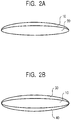
- FIG. 2A and FIG. 2B are each a schematic view for illustrating an example of the optical element of the present invention.
- a thin film obtained by molding and processing the optical material (or the optical composition) is arranged on one surface of a lens substrate 20.
- a method of producing the optical element of FIG. 2A for example, a method involving forming a layer structure having a small thickness on a substrate formed of a light-transmitting material is adopted.
- a die formed of a metal material is arranged so as to have a certain distance from a glass substrate, and a gap present between the die and the glass substrate is filled with the optical material or the optical composition that is fluid. After that, die molding is performed by lightly pressing down the die. Then, the optical material or the optical composition is polymerized while being kept in the state as required.
- Light irradiation to be used in such polymerization reaction is performed by using light having a suitable wavelength, typically UV light or visible light in correspondence with a mechanism resulting from radical formation involving using a photopolymerization initiator.
- a suitable wavelength typically UV light or visible light
- raw materials such as the monomers of the optical material or the optical composition subjected to the die molding, are uniformly irradiated with the light through the light-transmitting material to be utilized as the substrate, specifically the glass substrate.
- An irradiation light amount is appropriately selected in accordance with the mechanism resulting from the radical formation involving utilizing the photopolymerization initiator and with the content of the photopolymerization initiator to be incorporated.
- the entirety of the raw materials, such as the monomers, subjected to the die molding be uniformly irradiated with the irradiation light. Therefore, it is more preferred to select light having such a wavelength that the light irradiation to be utilized can be uniformly performed through the light-transmitting material to be utilized as the substrate, such as the glass substrate. At this time, a reduction in thickness of the molded body of the optical material to be formed on the substrate of the light-transmitting material is more suitable for the present invention.
- the thin film (optical member 10) obtained by molding and processing the optical composition is arranged between a lens substrate 30 and a lens substrate 40.
- a method of producing the optical element of FIG. 2B is, for example, as described below.
- a similar uncured optical material, optical composition, or the like is poured into a gap between both the surface of the optical material or optical composition of the molded body described in the foregoing and another corresponding lens, and is molded by being lightly pressed down. Then, the photopolymerization of the uncured resin composition is performed while the composition is kept in the state.
- a molded body in which the optical material or the optical composition is sandwiched between the lenses can be obtained.
- the molded body may be produced by a thermal polymerization method.
- the temperature of the entirety of the composition be further uniformized, and a reduction in total thickness of the molded body of the polymerizable composition to be formed on the substrate of the light-transmitting material is more suitable for the present invention.
- an irradiation amount, an irradiation intensity, a light source, and the like need to be selected while the thickness, the absorption of a resin component, and the absorption of a fine particle component are further considered.
- the molded body obtained by molding the optical composition of the present invention in accordance with the above-mentioned molding method may be used as an optical element in an optical apparatus.
- the optical element is utilized in, for example, a camera lens.
- Example 6 The same reactions and purifications as those of Example 3 were performed with the exception that an N35 intermediate 1 was obtained by changing 2-bromofluorene used in Example 3 to 3-[2-bromo-9-(3-hydroxy-propyl)-9H-fluoren-9-yl]-propan-1-ol.
- the optical characteristics of the product are shown in Table 6.
- Example 3 The same reactions and purifications as those of Example 3 were performed with the exception that 3-aminobenzotrifluoride, 3-bromobenzotrifluoride, and 4-bromobutyl acetate used in Example 3 were changed to 4-aminobenzonitrile, 2-bromo-m-xylene, and 2-bromoethyl acetate, respectively.
- Example 2 The same reactions and purifications as those of Example 2 were performed with the exception that 2-amino-9,9-dimethylfluorene, 4-bromobenzonitrile, and 4-bromobenzyl alcohol used in Example 2 were changed to 3,5-bis(trifluoromethyl)aniline, 2-bromo-9,9-di-n-octylfluorene, and 2-(4-bromophenyl)ethyl alcohol, respectively.
- the optical characteristics of the product are shown in Table 6.
- Example 3 The same reactions and purifications as those of Example 3 were performed with the exception that 3-bromobenzotrifluoride and 2-bromofluorene used in Example 3 were changed to 4-bromobenzyl alcohol and 3-[2-bromo-9-(3-hydroxy-propyl)-9H-fluoren-9-yl]-propan-1-ol, respectively.
- the optical characteristics of the product are shown in Table 6.
- Example 11 The same reaction and purification as those of Example 11 were performed with the exception that the N1 intermediate of Example 11 was changed to the N34 intermediate 1.
- a comparative example compound R1 was synthesized, and its refractive index, dispersion characteristic (Abbe number (vd)), secondary dispersion characteristic ( ⁇ g,F), and transmittance were compared. The results are shown in Table 6.
- a comparative example compound R2 was synthesized, and its refractive index, dispersion characteristic (Abbe number (vd)), secondary dispersion characteristic ( ⁇ g,F), and transmittance were compared. The results are shown in Table 6.
- a refractive index was measured with an Abbe refractometer (manufactured by Kalnew Optical Industrial Co., Ltd.).
- the optical element, material, optical apparatus, and triarylamine compound of the present invention each have a characteristic in that the dispersion characteristic (Abbe number (vd)) of refractive indices is high and the secondary dispersion characteristic ( ⁇ g,F) thereof is high (abnormal dispersion characteristic), that is, a chromatic aberration-correction function is high. Accordingly, the optical element, the material, the optical apparatus, and the triarylamine compound may each be suitably utilized in an apparatus having a plurality of lenses, such as a camera lens.
Landscapes
- Chemical & Material Sciences (AREA)
- Organic Chemistry (AREA)
- Physics & Mathematics (AREA)
- General Physics & Mathematics (AREA)
- Optics & Photonics (AREA)
- Health & Medical Sciences (AREA)
- Chemical Kinetics & Catalysis (AREA)
- Medicinal Chemistry (AREA)
- Polymers & Plastics (AREA)
- Addition Polymer Or Copolymer, Post-Treatments, Or Chemical Modifications (AREA)
- Organic Low-Molecular-Weight Compounds And Preparation Thereof (AREA)
- Epoxy Resins (AREA)
Abstract
Description
- The present invention relates to an optical element, a material, an optical apparatus, and a compound, and more particularly, to a triarylamine compound, a material, an optical element, and an optical apparatus each having a characteristic in that a dispersion characteristic (Abbe number (vd)) of refractive indices is high and a secondary dispersion characteristic (θg,F) thereof is high (high θg,F).
- In general, the refractive index of an optical material, such as a glass material or an organic resin, gradually increases as the wavelength of light to be refracted by the material becomes shorter. Indicators each representing the wavelength dispersibility of the refractive index are, for example, an Abbe number (vd) and a secondary dispersion characteristic (θg,F). The Abbe number and the θg,F value are values peculiar to each optical material, but in many cases, the values each fall within a certain range. A relationship between the secondary dispersion characteristic and Abbe number of each of conventional optical materials (a glass material and an organic resin) is shown in
FIG. 1 . - The Abbe number (vd) and the secondary dispersion characteristic (θg,F) are represented by the following equations:


- However, an optical material having a high θg,F characteristic deviating from a value in the certain range has also been synthesized by designing the configuration (material kind or molecular structure) of an optical material (e.g., a glass material or an organic resin) in detail. For example, polyvinyl carbazole (positioned at a point A in
FIG. 1 ) serving as an organic resin has a θg,F characteristic higher than that of a general-purpose organic resin material. - In general, in a refracting optical system, a chromatic aberration is reduced by combining glass materials having different dispersion characteristics. In, for example, the objective lens of a telescope or the like, a chromatic aberration appearing on its optical axis is corrected by using the following materials in combination: a glass material having small dispersion is used as a positive lens, and a glass material having large dispersion is used as a negative lens. Accordingly, for example, when the configurations and number of lenses are limited, or when glass materials to be used are limited, it may become extremely difficult to sufficiently correct the chromatic aberration. As one method of solving such problem, the design of optical elements involving exploiting a glass material having an abnormal dispersion characteristic has been performed.
- In addition, when an optical element that is excellent in chromatic aberration-correction function and has, for example, an aspherical shape is produced, a method involving, for example, molding an organic resin on a spherical glass or the like has the following advantage over a method involving using a glass material as a material: mass productivity, moldability, degree of freedom in shape, and lightweight property are excellent. However, the optical characteristic of a conventional organic resin falls within a certain limited range as shown in
FIG. 1 , and hence the number of organic resins showing specific dispersion characteristics is extremely small. - In
Patent Literature 1, there is a report that a sulfone (meth)acrylate serving as an organic material positioned at the point A inFIG. 1 has a higher secondary dispersion characteristic (higher θg,F characteristic) than that of a general-purpose organic material. - Meanwhile, a triarylamine compound has been widely utilized in, for example, an electrophotographic photosensitive member, an organic electronics material, and an organic nonlinear optical material. In Patent Literature 2, there is a proposal of a triarylamine compound as a charge-transportable compound to be used in the outermost surface layer of an electrophotographic photosensitive member. In Patent Literature 3, there is a proposal of a triarylamine compound as an organic compound having nonlinear optical activity to be dispersed in a polymer binder.
-
- PTL 1: Japanese Patent Application Laid-Open No.
2012-167019 - PTL 2: Japanese Patent Application Laid-Open No.
2007-011320 - PTL 3: Japanese Patent Application Laid-Open No.
2005-227368 - The material proposed in
Patent Literature 1 has a high secondary dispersion characteristic (high θg,F characteristic), but a higher θg,F characteristic has been required in recent years. The inventors of the present invention have made an investigation, and as a result, have found that a triarylamine compound shows a high secondary dispersion characteristic (high θg,F characteristic). However, the triarylamine compounds disclosed in Patent Literatures 2 and 3 need to be improved before being put into practical use as optical materials (reduced in coloring and improved in transparency). In particular, the improvement of their transmittances has been needed. - In view of such background art, the present invention provides a triarylamine compound having a characteristic in that the dispersion characteristic (Abbe number (vd)) and secondary dispersion characteristic (θg,F) of refractive indices are high (high θg,F characteristic), that is, a chromatic aberration-correction function is high, and having a high transmittance, and a material, an optical element, and an optical apparatus each using the compound.
- According to one aspect of the present invention, there is provided a compound represented by the following general formula (1).


- According to another aspect of the present invention, there is provided a material including a polymerized product (cured product) of the compound.
- According to still another aspect of the present invention, there is provided an optical element obtained by molding the material.
- According to still yet another aspect of the present invention, there is provided an optical apparatus including the optical element.
- According to the present invention, the triarylamine compound having a characteristic in that the dispersion characteristic (Abbe number (vd)) of refractive indices is high and the secondary dispersion characteristic (θg,F) thereof is high (high θg,F characteristic), that is, a chromatic aberration-correction function is high, and the material and the optical element each using the compound can be provided.
- In addition, according to the present invention, the optical material having a characteristic in a range A in
FIG. 1 can be provided. The use of the optical element molded out of the optical material can efficiently remove a chromatic aberration. Accordingly, an optical system can be further reduced in weight and size. In the following description, the term "high θg,F characteristic" means a characteristic included in the range A inFIG. 1 . -
- [
FIG. 1 ]
FIG. 1 is a graph for showing a relationship between the secondary dispersion characteristic and Abbe number of a commercially available optical material. - [
FIG. 2A ]
FIG. 2A is a schematic view for illustrating an example of an optical element according to the present invention. - [
FIG. 2B ]
FIG. 2B is a schematic view for illustrating an example of the optical element according to the present invention. - The present invention is described in detail below by way of embodiments.
- One aspect of the present invention is a triarylamine compound represented by the following general formula (1).

- The inventors of the present invention have made extensive investigations with a view to providing a triarylamine compound satisfying a characteristic in the range A in
FIG. 1 and having a high transmittance, and as a result, have found that such a structure that the aryl groups of a triarylamine compound are formed of a fluorenyl group and two phenyl groups, and at least one of the phenyl groups has an electron-withdrawing group as a substituent provides a material having both a high secondary dispersion characteristic (high θg,F) and a high transmittance. - In general, a compound having a long conjugated structure typified by an aromatic compound has a band gap smaller than that of a general-purpose material, and hence its absorption edge in a UV region shifts to a visible light region. Under the influence of the shift, the compound having a long conjugated structure has a high refractive index characteristic. The high refractive index characteristic has a larger influence on shorter wavelengths than on longer wavelengths. Accordingly, an improvement in secondary dispersion characteristic (θg,F) of the compound inevitably advances, and hence the characteristic of the compound falls within the range A in
FIG. 1 . However, a material having practicality is not obtained merely by linking aromatic compounds to build a long conjugated structure. For example, a large aromatic compound involves problems in terms of synthesizability, compatibility with any other compound, and coloring. Meanwhile, a triarylamine is an aromatic compound having an electron-donating property and having a conjugated structure. As its conjugated structure becomes longer, its characteristic (θg,F) is improved. However, when the conjugated structure becomes excessively long, the transmittance of the triarylamine at shorter wavelengths in the visible light region reduces. Accordingly, when the triarylamine is utilized as an optical material, the length of the conjugated structure needs to be adjusted from the viewpoint of an improvement in transmittance. However, an action for improving the transmittance of an aromatic compound, such as the shortening of the conjugated structure of the aromatic compound or the widening of the intermolecular distance thereof by the steric hindrance of a substituent thereof, simultaneously causes a reduction in secondary dispersion characteristic (θg,F) thereof. - The inventors of the present invention have considered the reason why the triarylamine compound according to the present invention has both a high secondary dispersion characteristic (high θg,F) and a high transmittance to be as described below. The substitution of a phenyl group with an electron-withdrawing group is assumed to exhibit an improving effect on the secondary dispersion characteristic (θg,F) by the electron withdrawal of the electron-withdrawing group in addition to an improvement in transmittance by the steric hindrance thereof. The inventors have considered that, as a result of the foregoing, a reduction in secondary dispersion characteristic (θg,F) by the steric hindrance of the electron-withdrawing group is suppressed, and hence the triarylamine compound has both a high secondary dispersion characteristic (high θg,F) and a high transmittance.
- In the general formula (1), examples of the substituted or unsubstituted alkyl group having 1 to 10 carbon atoms represented by R1 and R2 include a methyl group, an ethyl group, a n-propyl group, a n-butyl group, a n-pentyl group, a n-hexyl group, a n-heptyl group, a n-octyl group, a n-decyl group, an iso-propyl group, an iso-butyl group, a sec-butyl group, a tert-butyl group, an iso-pentyl group, a neopentyl group, and a 2-ethylhexyl group, and the alkyl group is not limited thereto as long as a high θg,F characteristic is obtained. Of those, an alkyl group having 1 or more to 8 or less carbon atoms is preferred, and a methyl group and an ethyl group are more preferred.
- In the general formula (1), examples of the unsubstituted alkylene group having 1 to 8 carbon atoms, which has a polymerizable functional group, represented by R1 and R2 include a methylene group, an ethylene group, a n-propylene group, an iso-propylene group, a n-butylene group, a n-pentylene group, and a n-hexylene group, and the alkylene group is not limited thereto as long as a high θg,F characteristic is obtained. Of those, a methylene group, an ethylene group, a n-propylene group, and a n-butylene group are preferred.
- In the general formula (1), examples of the substituted alkylene group having 1 to 8 carbon atoms, which has a polymerizable functional group, represented by R1 and R2 include a group introduced by substituting at least one CH2 in a main chain of an alkylene group with an oxygen atom, and a group introduced by substituting at least one CH2 in a main chain of an alkylene group with a sulfur atom, and the alkylene group is not limited thereto as long as a high θg,F characteristic is obtained.
- In the general formula (1), examples of the substituted or unsubstituted alkyl group represented by R3 to R12 include a methyl group, an ethyl group, a n-propyl group, a n-butyl group, an iso-propyl group, an iso-butyl group, a sec-butyl group, and a tert-butyl group, and the alkyl group is not limited thereto as long as a high θg,F characteristic is obtained. Of those, a methyl group and an ethyl group are preferred.
- In the general formula (1), examples of the unsubstituted alkylene group having a polymerizable functional group represented by R3 to R12 include a methylene group, an ethylene group, a n-propylene group, a n-butylene group, a n-pentylene group, and a n-hexylene group, and the alkylene group is not limited thereto as long as a high θg,F characteristic is obtained. Of those, a methylene group, an ethylene group, and a n-propylene group are preferred.
- In the general formula (1), examples of the substituted (obtained by substitution) alkylene group having 1 to 8 carbon atoms, which has a polymerizable functional group, represented by R3 to R12 include a group introduced by substituting at least one CH2 in a main chain of an alkylene group with an oxygen atom, and a group introduced by substituting at least one CH2 in a main chain of an alkylene group with a sulfur atom, and the alkylene group is not limited thereto as long as a high θg,F characteristic is obtained.
- In the general formula (1), examples of the electron-withdrawing substituent include a cyano group, a halogenated alkyl group, a nitro group, an alkylsulfonyl group, an acyl group, an alkoxycarbonyl group, a sulfamoyl group, a carbamoyl group, a halogenated alkoxy group, a sulfonyloxy group, a halogenated alkylthio group, and a fluorine group. Of those, a cyano group and a halogenated alkyl group are preferred, and a cyano group and a trifluoromethyl group are more preferred. It is particularly preferred that at least one of R5, R6, R9, and R10 represent an electron-withdrawing group, and the electron-withdrawing group be a cyano group or a trifluoromethyl group.
- In the general formula (1), examples of the polymerizable functional group include an active hydrogen group, an unsaturated polymerizable group, and an epoxy group. Examples of the active hydrogen group include a hydroxy group, a carboxyl group, an amino group, a thiol group, and a methoxy group. Of those, a hydroxy group is preferred. Examples of the unsaturated polymerizable group include a vinyl group, an acryloyloxy group, and a methacryloyloxy group. Of those, an acryloyloxy group and a methacryloyloxy group are preferred.
- In the present invention, the expression "at least one of R3 to R12 has a polymerizable functional group" means that the at least one substituent is a polymerizable functional group, or part of the substituent includes a polymerizable functional group. In other words, in the triarylamine compound according to the present invention, a phenyl group may be directly substituted with a polymerizable functional group, or the polymerizable functional group may be indirectly bonded to the phenyl group through an alkylene group.
- In the general formula (1), the number of polymerizable functional groups is preferably 2 or more from the viewpoint of the curability of the triarylamine compound, and is more preferably 2 from the viewpoint of the ease of synthesis thereof.
- Next, specific examples of the compound according to the present invention are shown in Tables 1 to 5 below, but the present invention is not limited thereto. In addition, a plurality of compounds may be used in combination. That is, an optical material according to the present invention may be a homopolymer of the compound represented by the general formula (1), or may be a copolymer thereof.
[Table 1] No. Compound Example No. Compound Example N1 
N2 
N3 
N4 
N5 
N6 
N7 
N8 
N9 
N10 
[Table 2] No. Compound Example No. Compound Example N11 
N12 
N13 
N14 
N15 
N16 
N17 
N18 
N19 
N20 
[Table 3] No. Compound Example No. Compound Example N21 
N22 
N23 
N24 
N25 
N26 
N27 
N28 
N29 
N30 
[Table 4] No. Compound Example No. Compound Example N31 
N32 
N33 
N34 
N35 
N36 
N37 
N38 
N39 
N40 
[Table 5] No. Compound Example No. Compound Example N41 
N42 
N43 
N44 
N45 
N46 
N47 
N48 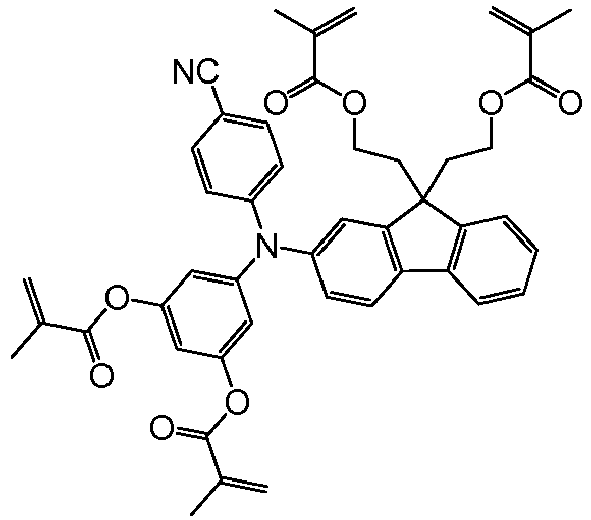
N49 
N50 
- A method of producing the triarylamine compound according to the present invention is described by way of an example.
- The method of producing the triarylamine compound is not limited to any specific production route, and any production method may be adopted. A derivative having a structure represented by the general formula (1) in the present invention may be synthesized by using a known synthesis method described in, for example, Japanese Patent Application Laid-Open No.
2000-066425 2008-165248 - Two methods are available for introducing a polymerizable functional group into the derivative having a structure represented by the general formula (1). A first method is a method involving directly introducing a polymerizable functional group into the derivative having a structure represented by the general formula (1). A second method is a method involving introducing a structure having a polymerizable functional group or a functional group that may be a precursor of the polymerizable functional group into the derivative having a structure represented by the general formula (1). An example of the second method is a method involving introducing a functional group-containing aryl group through the use of a coupling reaction involving using a metal catalyst and a base based on a monoarylamine derivative.
- The following methods are available for causing the derivative having a structure represented by the general formula (1) to have an unsaturated hydrocarbon group (e.g., an acrylic group or a methacrylic group). That is, a method involving causing a (meth)acrylate to act on the derivative having a structure represented by the general formula (1), the derivative having a hydroxy group, or a method involving directly introducing a polymerizable functional group into the derivative having a structure represented by the general formula (1) is available.
- The coupling reaction based on the metal catalyst may be arbitrarily selected. For example, the Ullmann reaction involving utilizing copper, the Buchwald-Hartwig reaction involving utilizing an amine or the like, the Suzuki coupling involving utilizing boric acid or the like, the Stille coupling involving utilizing an organotin, or the Negishi coupling involving utilizing an organozinc is suitably used as a typical method.
- The (meth)acrylation reaction may be arbitrarily selected. For example, a method involving esterifying a hydroxy group with a (meth)acrylic acid halide or (meth)acrylic anhydride, an ester exchange reaction involving using a lower alcohol ester of (meth)acrylic acid, a direct esterification reaction involving subjecting (meth)acrylic acid and the diol to dehydration condensation through the use of a dehydration condensation agent, such as N,N'-dicyclohexylcarbodiimide, or a method involving heating (meth)acrylic acid and the diol in the presence of a dehydrating agent, such as sulfuric acid, is suitably used as a typical method.
- In addition, a polymerization inhibitor may be used as required so that the polymerization of the triarylamine compound of the present invention may not advance at the time of a reaction for the production of the compound or at the time of its storage. Examples of the polymerization inhibitor may include: hydroquinones, such as p-benzoquinone, hydroquinone, hydroquinone monomethyl ether, and 2,5-diphenyl-p-benzoquinone; N-oxy radicals, such as tetramethylpiperidinyl-N-oxy radical (TEMPO); substituted catechols, such as t-butylcatechol; amines, such as phenothiazine, diphenylamine, and phenyl-β-naphthylamine; nitrosobenzene; picric acid; molecular oxygen; sulfur; and copper(II) chloride. Of those, hydroquinones, phenothiazine, and N-oxyradicals are preferred from the viewpoints of a general-purpose property and the suppression of the polymerization, and hydroquinones are particularly preferred.
- A lower limit for the usage amount of the polymerization inhibitor is typically 10 ppm or more, preferably 50 ppm or more with respect to the triarylamine compound, and an upper limit therefor is typically 10,000 ppm or less, preferably 1,000 ppm or less with respect thereto. In the case where the usage amount is excessively small, the following risk arises: the effect of the polymerization inhibitor is not expressed or the effect is small even when the effect is expressed, and hence the polymerization advances at the time of the reaction or at the time of condensation in a posttreatment step. In contrast, the case where the usage amount is excessively large is not preferred because the following risk arises: the polymerization inhibitor serves as, for example, an impurity at the time of the production of an optical material to be described later, and has an adverse effect, such as the inhibition of the polymerization reactivity of the triarylamine compound.
- Next, the optical material according to the present invention is described.
- The optical material according to the present invention is formed of a composition including the above-mentioned triarylamine compound, a polymerization initiator, and the polymerization inhibitor, and as required, a photosensitizer, a heat-resistive stabilizer, a light-resistive stabilizer, an antioxidant, or a resin.
- The content of the triarylamine compound to be incorporated into the optical material of the present invention is desirably 1.0 wt% or more to 99 wt% or less, preferably 50 wt% or more to 99 wt% or less with respect to the entirety of the material.
- Examples of the polymerization initiator include, but not limited to, a polymerization initiator that generates a radical species or a cation species through light irradiation, and a polymerization initiator that generates a radical species with heat.
- Examples of the polymerization initiator that generates a radical species through light irradiation include, but not limited to, 2-benzyl-2-dimethylamino-1-(4-morpholinophenyl)-1-butanone, 1-hydroxycyclohexyl phenyl ketone, 2-hydroxy-2-methyl-1-phenyl-propan-1-one, bis(2,4,6-trimethylbenzoyl)-phenylphosphine oxide, 4-phenylbenzophenone, 4-phenoxybenzophenone, 4,4'-diphenylbenzophenone, and 4,4'-diphenoxybenzophenone.
- In addition, suitable examples of the polymerization initiator that generates a cation species through light irradiation include, but not limited to, polymerization initiators such as iodonium (4-methylphenyl)[4-(2-methylpropyl)phenyl]-hexafluorophosphate.
- Further, examples of the polymerization initiator that generates a radical species with heat include, but not limited to: azo compounds, such as azobisisobutyronitrile (AIBN); and peroxides, such as benzoyl peroxide, t-butyl peroxypivalate, t-butyl peroxyneohexanoate, t-hexyl peroxyneohexanoate, t-butyl peroxyneodecanoate, t-hexyl peroxyneodecanoate, cumyl peroxyneohexanoate, and cumyl peroxyneodecanoate.
- When UV light or the like is applied as light to initiate the polymerization of the optical material, a known sensitizer or the like may be used. Typical examples of the sensitizer include, but not limited to, benzophenone, 4,4-diethylaminobenzophenone, 1-hydroxycyclohexyl phenyl ketone, isoamyl p-dimethylaminobenzoate, methyl 4-dimethylaminobenzoate, benzoin, benzoin ethyl ether, benzoin isobutyl ether, benzoin isopropyl ether, 2,2-diethoxyacetophenone, methyl o-benzoylbenzoate, 2-hydroxy-2-methyl-1-phenylpropan-1-one, and acylphosphine oxides.
- The addition ratio of the photopolymerization initiator with respect to a polymerizable resin component may be appropriately selected in accordance with a light irradiation amount and an additional heating temperature. In addition, the addition ratio may be adjusted in accordance with the target average molecular weight of a polymer to be obtained.
- The addition amount of the photopolymerization initiator to be used in the polymerization (curing) and molding of the optical material according to the present invention preferably falls within the range of from 0.01 wt% or more to 10.00 wt% or less with respect to the polymerizable resin component. The photopolymerization initiators may be used alone or in combination thereof in accordance with the reactivity of the resin and the wavelength of the light to be applied.
- The light-resistive stabilizer is not particularly limited as long as the light-resistive stabilizer does not have a large influence on the optical characteristics of the molded body, and typical examples thereof may include: benzotriazole-based materials, such as 2-(2H-benzotriazol-2-yl)-p-cresol, 2-(2H-benzotriazol-2-yl)-4,6-bis(1-methyl-1-phenylethyl)phenol, 2-[5-chloro(2H)-benzotriazol-2-yl-4-methyl-6-(tert-butyl)]phenol, 2-(2H-benzotriazol-2-yl)-4,6-di-tert-pentylphenol, 2-(2H-benzotriazol-2-yl)-4-(1,1,3,3-tetramethylbutyl)phenol, 2,2'-methylenebis[6-(2H-benzotriazol-2-yl)-4-(1,1,3,3-tetramethylbutyl)]phenol, and 2-(2H-benzotriazol-2-yl)-6-dodecyl-4-methylphenol; cyanoacrylate-based materials, such as ethyl 2-cyano-3,3-diphenylacrylate and 2-ethylhexyl 2-cyano-3,3-diphenylacrylate; triazine-based materials; and benzophenone-based materials, such as octabenzone and 2,2'-4,4'-tetrahydrobenzophenone. The light-resistive stabilizer may also serve as the photosensitizer, and in that case, the photosensitizer may not be added.
- The addition amount of the light-resistive stabilizer to be used in the polymerization (curing) and molding of the optical material of the present invention preferably falls within the range of from 0.01 wt% or more to 10.00 wt% or less with respect to the total amount of the polymerizable resin component.
- The heat-resistive stabilizer is not particularly limited as long as the heat-resistive stabilizer does not have a large influence on the optical characteristics of the molded body, and for example: pentaerythritol tetrakis[3-(3,5-di-ert-butyl-4-hydroxyphenyl)]propionate, octadecyl-3-(3,5-di-tert-butyl-4-hydroxyphenyl)propionate, 3,5-bis(1,1-dimethylethyl)-4-hydroxybenzenepropanoic acid, and C7-C9 side chain alkyl esters; hindered phenol-based materials, such as 4,6-bis(octylthiomethyl)-o-cresol, 4,6-bis(dodecylthiomethyl)-o-cresol, ethylenebis(oxyethylene)bis[3-(5-tert-butyl-4-hydroxy-m-tolyl)]propionate, and hexamethylenebis[3-(3,5-di-tert-butyl-4-hydroxyphenyl)]propionate; phosphorus-based materials, such as tris(2,4-di-tert-butylphenyl)phosphite; and sulfur-based materials, such as dioctadecyl 3,3'-thiodipropionate, may be used.
- The antioxidant is not particularly limited as long as the antioxidant does not have a large influence on the optical characteristics of the molded body, and typical examples thereof include hindered amine-based materials, such as bis(2,2,6,6-tetramethyl-4-piperidyl) sebacate and bis(1,2,2,6,6-pentamethyl-4-piperidyl)[[3,5-bis(1,1-dimethylethyl)-4-hydroxyphenyl]methyl]butyl malonate. The addition amount of the antioxidant to be used in the polymerization (curing) and molding of the optical material according to the present invention preferably falls within the range of from 0.01 wt% or more to 10.00 wt% or less with respect to the total amount of the polymerizable resin component.
- The resin that may be utilized in the optical material of the present invention is not particularly limited. Examples thereof include, but not limited to: (meth)acrylate compounds, such as 1,3-adamantanediol dimethacrylate, 1,3-adamantanedimethanol dimethacrylate, tricyclodecanedimethanol diacrylate, pentaerythritol tetraacrylate, propoxylated neopentyl glycol diacrylate, dipropylene glycol diacrylate, ethoxylated bisphenol A dimethacrylate, tris(2-hydroxyethyl) isocyanurate triacrylate, 2-(2-ethoxyethoxy)ethyl acrylate, stearyl acrylate, tetrahydrofurfuryl acrylate, 2-phenoxyethyl acrylate, isodecyl acrylate, isobornyl acrylate, isobornyl methacrylate, 1,3-butylene glycol diacrylate, 1,4-butanediol diacrylate, diethylene glycol diacrylate, 1,6-hexanediol diacrylate, triethylene glycol diacrylate, tripropylene glycol diacrylate, dipropylene glycol diacrylate, triethylene glycol dimethacrylate, ethylene glycol dimethacrylate, tetraethylene glycol dimethacrylate, 1,4-butanediol dimethacrylate, diethylene glycol dimethacrylate, 1,6-hexanediol dimethacrylate, tripropylene glycol dimethacrylate, dipropylene glycol dimethacrylate, trimethylol propane trimethacrylate, 9,9-bis[4-(2-acryloyloxyethoxy)phenyl]fluorene, 9,9-bis[4-(2-methacryloyloxyethoxy)phenyl]fluorene, 9,9-bis[4-(2-acryloyloxy)phenyl]fluorene, 9,9-bis[4-(2-methacryloyloxy)phenyl]fluorene, benzyl acrylate, benzyl methacrylate, butoxyethyl acrylate, butoxymethyl methacrylate, cyclohexyl acrylate, cyclohexyl methacrylate, 2-hydroxyethyl acrylate, 2-hydroxymethyl methacrylate, glycidyl acrylate, glycidyl methacrylate, phenoxyethyl acrylate, phenoxyethyl methacrylate, phenyl methacrylate, ethylene glycol diacrylate, ethylene glycol dimethacrylate, diethylene glycol diacrylate, diethylene glycol dimethacrylate, triethylene glycol diacrylate, triethylene glycol dimethacrylate, tetraethylene glycol diacrylate, tetraethylene glycol dimethacrylate, polyethylene glycol diacrylate, polyethylene glycol dimethacrylate, neopentyl glycol diacrylate, neopentyl glycol dimethacrylate, ethylene glycol bisglycidyl acrylate, ethylene glycol bisglycidyl methacrylate, bisphenol A diacrylate, bisphenol A dimethacrylate, 2,2-bis(4-acryloxyethoxyphenyl)propane, 2,2-bis(4-methacryloxyethoxyphenyl)propane, 2,2-bis(4-acryloxydiethoxyphenyl)propane, 2,2-bis(4-methacryloxydiethoxyphenyl)propane, bisphenol F diacrylate, bisphenol F dimethacrylate, 1,1-bis(4-acryloxyethoxyphenyl)methane, 1,1-bis(4-methacryloxyethoxyphenyl)methane, 1,1-bis(4-acryloxydiethoxyphenyl)methane, 1,1-bis(4-methacryloxydiethoxyphenyl)methane, 1,1-bis(4-acryloxyethoxyphenyl)sulfone, 1,1-bis(4-methacryloxyethoxyphenyl)sulfone, 1,1-bis(4-acryloxydiethoxyphenyl)sulfone, 1,1-bis(4-methacryloxydiethoxyphenyl)sulfone, dimethylol tricyclodecane diacrylate, trimethylol propane triacrylate, trimethylolpropane trimethacrylate, glycerol diacrylate, glycerol dimethacrylate, pentaerythritol triacrylate, pentaerythritol tetraacrylate, pentaerythritol tetramethacrylate, methyl thioacrylate, methyl thiomethacrylate, phenyl thioacrylate, benzyl thiomethacrylate, xylylene dithiol diacrylate, xylylene dithiol dimethacrylate, mercaptoethyl sulfide diacrylate, and mercaptoethyl sulfide dimethacrylate; allyl compounds, such as allyl glycidyl ether, diallyl phthalate, diallyl terephthalate, diallyl isophthalate, diallyl carbonate, and diethylene glycol bisallyl carbonate; vinyl compounds, such as styrene, chlorostyrene, methylstyrene, bromostyrene, dibromostyrene, divinylbenzene, and 3,9-divinylspirobi(m-dioxane); and diisopropenylbenzene.
- In addition, the resin may be a thermoplastic resin. Examples thereof include: polyolefin-based resins, such as an ethylene homopolymer, a random or block copolymer of ethylene and one or two or more kinds of α-olefins, such as propylene, 1-butene, 1-pentene, 1-hexene, and 4-methyl-1-pentene, a random or block copolymer of ethylene and one or two or more kinds of vinyl acetate, acrylic acid, methacrylic acid, methyl acrylate, and methyl methacrylate, a propylene homopolymer, a random or block copolymer of propylene and one or two or more kinds of α-olefins except propylene, such as 1-butene, 1-pentene, 1-hexene, and 4-methyl-1-pentene, a 1-butene homopolymer, an ionomer resin, and a mixture of those polymers; hydrocarbon atom-based resins, such as a petroleum resin and a terpene resin; polyester-based resins, such as polyethylene terephthalate, polybutylene terephthalate, and polyethylene naphthalate; polyamide-based resins, such as nylon 6, nylon 66, nylon 11, nylon 12, nylon 610, nylon 6/66, nylon 66/610, and nylon MXD; acrylic resins, such as polymethyl methacrylate; styrene- or acrylonitrile-based resins, such as polystyrene, a styrene-acrylonitrile copolymer, a styrene-acrylonitrile-butadiene copolymer, and polyacrylonitrile; polyvinyl alcohol-based resins, such as polyvinyl alcohol and an ethylene-vinyl alcohol copolymer; polycarbonate resins; polyketone resins; polymethylene oxide resins; polysulfone resins; polyimide resins; and polyamide imide resins. Those resins may be used alone or as a mixture thereof.
- The content of the resin to be incorporated into the optical material according to the present invention is desirably 0.01 wt% or more to 99 wt% or less, and is preferably 0.01 wt% or more to 50 wt% or less in consideration of the θg,F characteristic of the optical material to be obtained and the brittleness of the molded body.
- Next, an optical element according to the present invention is described with reference to the drawings.
- The optical element of the present invention has a feature of including the molded body.
FIG. 2A and FIG. 2B are each a schematic view for illustrating an example of the optical element of the present invention. In an optical element ofFIG. 2A , a thin film (optical member 10) obtained by molding and processing the optical material (or the optical composition) is arranged on one surface of alens substrate 20. As a method of producing the optical element ofFIG. 2A , for example, a method involving forming a layer structure having a small thickness on a substrate formed of a light-transmitting material is adopted. Specifically, a die formed of a metal material is arranged so as to have a certain distance from a glass substrate, and a gap present between the die and the glass substrate is filled with the optical material or the optical composition that is fluid. After that, die molding is performed by lightly pressing down the die. Then, the optical material or the optical composition is polymerized while being kept in the state as required. - Light irradiation to be used in such polymerization reaction is performed by using light having a suitable wavelength, typically UV light or visible light in correspondence with a mechanism resulting from radical formation involving using a photopolymerization initiator. For example, raw materials, such as the monomers of the optical material or the optical composition subjected to the die molding, are uniformly irradiated with the light through the light-transmitting material to be utilized as the substrate, specifically the glass substrate. An irradiation light amount is appropriately selected in accordance with the mechanism resulting from the radical formation involving utilizing the photopolymerization initiator and with the content of the photopolymerization initiator to be incorporated.
- Meanwhile, in such production of the molded body of the optical material or the optical composition by a photopolymerization reaction, it is more preferred that the entirety of the raw materials, such as the monomers, subjected to the die molding be uniformly irradiated with the irradiation light. Therefore, it is more preferred to select light having such a wavelength that the light irradiation to be utilized can be uniformly performed through the light-transmitting material to be utilized as the substrate, such as the glass substrate. At this time, a reduction in thickness of the molded body of the optical material to be formed on the substrate of the light-transmitting material is more suitable for the present invention.
- Meanwhile, in an optical element of
FIG. 2B , the thin film (optical member 10) obtained by molding and processing the optical composition is arranged between alens substrate 30 and alens substrate 40. A method of producing the optical element ofFIG. 2B is, for example, as described below. A similar uncured optical material, optical composition, or the like is poured into a gap between both the surface of the optical material or optical composition of the molded body described in the foregoing and another corresponding lens, and is molded by being lightly pressed down. Then, the photopolymerization of the uncured resin composition is performed while the composition is kept in the state. Thus, a molded body in which the optical material or the optical composition is sandwiched between the lenses can be obtained. - Similarly, the molded body may be produced by a thermal polymerization method. In this case, it is desired that the temperature of the entirety of the composition be further uniformized, and a reduction in total thickness of the molded body of the polymerizable composition to be formed on the substrate of the light-transmitting material is more suitable for the present invention. In addition, when the total thickness of the molded body of the optical composition to be formed is increased, an irradiation amount, an irradiation intensity, a light source, and the like need to be selected while the thickness, the absorption of a resin component, and the absorption of a fine particle component are further considered.
- The molded body obtained by molding the optical composition of the present invention in accordance with the above-mentioned molding method may be used as an optical element in an optical apparatus. The optical element is utilized in, for example, a camera lens.
- The present invention is described in more detail below by way of Examples. However, the present invention is by no means limited by Examples described below as long as the other examples do not depart from the gist of the present invention. A synthesized product was analyzed with a NMR apparatus (JNM-ECA400 (trade name) manufactured by JEOL Ltd.).
-

- Under a nitrogen atmosphere, 2.0 g of 2-amino-9,9-dimethylfluorene, 5.30 g of 4-bromo-2-(trifluoromethyl)phenol, 2.76 g of sodium tert-butoxide, 0.27 g of bis(dibenzylideneacetone)palladium, 0.46 g of 2-dicyclohexylphosphino-2,'4',6'-triisopropylbiphenyl, and 70 mL of orthoxylene were loaded into a 200-milliliter three-necked flask, and the mixture was heated to 130°C. After that, the mixture was stirred at the temperature (130°C) for 10 hours. After the heating, the mixture was left to cool to room temperature, and then the organic phase was extracted with chloroform. The resultant organic phase was washed with brine and water in the stated order, and was dried with anhydrous magnesium sulfate. The resultant crude product was purified by column chromatography to provide 2.2 g of an N1 intermediate (yield: 43%). The structure of the intermediate was identified by 1H-NMR.
1H-NMR (CDCl3): δ 1.52 (s, 6H), 6.96 (d, 1H), 7.31-7.37 (m, 3H), 7.44 (d, 1H), 7.50-7.55 (m, 2H), 7.67 (d, 1H), 7.70-7.75 (m, 4H), 7.93 (s, 1H), 11.96 (s, 2H) - Under a nitrogen atmosphere, 2.0 g of the N1 intermediate, 30 mL of chloroform, 0.14 g of hydroquinone monomethyl ether (MEHQ), and 10 mL of pyridine were loaded into a 100-milliliter three-necked flask. The reaction vessel was cooled to 0°C, and 1.0 mL of methacryloyl chloride was dropped into the mixture. The reaction liquid was diluted with 30 mL of toluene, and then a 2 N aqueous solution of hydrochloric acid was used to terminate the reaction. The resultant organic layer was washed with an acidic aqueous solution and a basic aqueous solution. After that, the organic layer was dried with brine and anhydrous magnesium sulfate. The solvent was removed, and the resultant crude product was purified by silica gel chromatography. Thus, 1.25 g of the N1 was obtained (yield: 50%). The structure of the product was identified by 1H-NMR. In addition, the optical characteristics of the product are shown in Table 6.
1H-NMR (CDCl3): δ 1.49 (s, 6H), 1.54 (s, 6H), 5.88 (t, 2H), 6.46 (t, 2H), 7.10 (d, 1H), 7.28-7.43 (m, 5H), 7.63-7.71 (m, 4H), 7.78 (d, 1H), 8.10 (d, 1H), 8.17 (d, 1H) -

- Under a nitrogen atmosphere, 5.0 g of 2-amino-9,9-dimethylfluorene, 4.35 g of 4-bromobenzonitrile, 6.89 g of sodium tert-butoxide, 0.27 g of bis(dibenzylideneacetone)palladium, 0.46 g of 2-dicyclohexylphosphino-2,'4',6'-triisopropylbiphenyl, and 180 mL of orthoxylene were loaded into a 300-milliliter three-necked flask, and the mixture was heated to 130°C. After that, the mixture was stirred at the temperature (130°C) for 10 hours. After the heating, the mixture was left to cool to room temperature, and then the organic phase was extracted with chloroform. The resultant organic phase was washed with brine and water in the stated order, and was dried with anhydrous magnesium sulfate. The resultant crude product was purified by column chromatography to provide 7.5 g of an N22 intermediate 1 (yield: 72%).
- Under a nitrogen atmosphere, 4.0 g of the N22 intermediate 1, 3.37 g of 4-bromobenzyl alcohol, 4.95 g of sodium tert-butoxide, 0.37 g of bis(dibenzylideneacetone)palladium, 0.61 g of 2-dicyclohexylphosphino-2,'4',6'-triisopropylbiphenyl, and 140 mL of orthoxylene were loaded into a 200-milliliter three-necked flask, and the mixture was heated to 130°C. After that, the mixture was stirred at the temperature (130°C) for 10 hours. After the heating, the mixture was left to cool to room temperature, and then the organic phase was extracted with chloroform. The resultant organic phase was washed with brine and water in the stated order, and was dried with anhydrous magnesium sulfate. The resultant crude product was purified by column chromatography to provide 3.4 g of an N22 intermediate 2 (yield: 63%).
-

- Under a nitrogen atmosphere, 3.0 g of the N22 intermediate 2, 45 mL of chloroform, 0.27 g of MEHQ, and 10 mL of pyridine were loaded into a 100-milliliter three-necked flask. The reaction vessel was cooled to 0°C, and 2.1 mL of methacryloyl chloride was dropped into the mixture. The reaction liquid was diluted with 30 mL of toluene, and then a 2 N aqueous solution of hydrochloric acid was used to terminate the reaction. The resultant organic layer was washed with an acidic aqueous solution and a basic aqueous solution. After that, the organic layer was dried with brine and anhydrous magnesium sulfate. The solvent was removed, and the resultant crude product was purified by silica gel chromatography. Thus, 1.51 g of the N22 was obtained (43%). The structure of the product was identified by 1H-NMR. In addition, the optical characteristics of the product are shown in Table 6.
1H-NMR (CDCl3): δ δ 1.49 (s, 6H), 1.53 (s, 6H), 5.05-5.11 (m, 2H), 5.50 (t, 1H), 6.02 (t, 1H), 6.85 (dd, 1H), 7.05 (dd, 1H), 7.19 (d, 4H), 7.30-7.36 (m, 2H), 7.40 (d, 1H), 7.48 (d, 4H), 7.63 (d, 2H) -
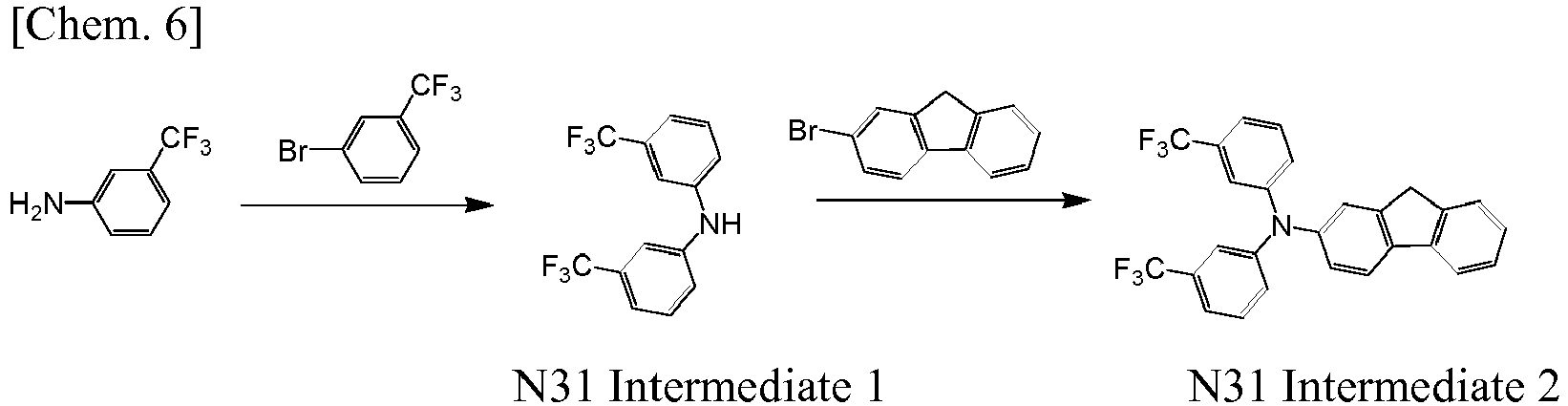
- Under a nitrogen atmosphere, 15.0 g of 3-aminobenzotrifluoride, 20.95 g of 3-bromobenzotrifluoride, 26.85 g of sodium tert-butoxide, 2.68 g of bis(dibenzylideneacetone)palladium, 4.44 g of 2-dicyclohexylphosphino-2,'4',6'-triisopropylbiphenyl, and 300 mL of orthoxylene were loaded into a 500-milliliter three-necked flask, and the mixture was heated to 120°C. After that, the mixture was stirred at the temperature (120°C) for 6 hours. After the heating, the mixture was left to cool to room temperature, and then the organic phase was extracted with ethyl acetate. The resultant organic phase was washed with brine and water in the stated order, and was dried with anhydrous magnesium sulfate. The resultant crude product was purified by column chromatography to provide 19.2 g of an N31 intermediate 1 (yield: 68%).
- Under a nitrogen atmosphere, 15.0 g of the N31 intermediate 1, 12.05 g of 2-bromofluorene, 18.89 g of sodium tert-butoxide, 0.28 g of bis(dibenzylideneacetone)palladium, 0.47 g of 2-dicyclohexylphosphino-2,'4',6'-triisopropylbiphenyl, and 500 mL of orthoxylene were loaded into a 1-liter three-necked flask, and the mixture was heated to 120°C. After that, the mixture was stirred at the temperature (120°C) for 10 hours. After the heating, the mixture was left to cool to room temperature, and then the organic phase was extracted with ethyl acetate. The resultant organic phase was washed with brine and water in the stated order, and was dried with anhydrous magnesium sulfate. The resultant crude product was purified by column chromatography to provide 10.5 g of an N31 intermediate 2 (yield: 46%).

- Under a nitrogen atmosphere, 9.44 g of the N31 intermediate 2 and 160 mL of N,N-dimethylacetamide were loaded into a 500-milliliter three-necked flask, and the mixture was stirred. After that, 6.77 g of sodium tert-butoxide was loaded into the mixture, and the whole was cooled to 5°C. A solution obtained by dissolving 10.21 g of 4-bromobutyl acetate in 40 mL of N,N-dimethylacetamide was dropped into the resultant over 30 minutes. After the dropping, the temperature of the mixture was increased to 20°C, and then the mixture was stirred at the temperature (20°C) for 20 hours. After the stirring, the mixture was cooled to 5°C. Next, 5.44 g of sodium methoxide was loaded into the mixture, and the temperature of the whole was gradually increased to 20°C. After the temperature increase, the mixture was stirred at the temperature (20°C) for 10 hours. After the stirring, the reaction liquid was loaded into ice water, and the organic layer was extracted with toluene. The resultant organic phase was washed with brine and water in the stated order, and was dried with anhydrous magnesium sulfate. The resultant crude product was purified by column chromatography to provide 5.5 g of an N31 intermediate 3 (yield: 45%). The structure of the product was identified by 1H-NMR.
1H-NMR (CDCl3): δ 0.71 (t, 2H), 1.38 (d, 4H), 1.60 (d, 4H), 1.94-2.00 (m, 4H), 3.22-3.29 (m, 4H), 7.08 (dd, 1H), 7.17 (d, 1H), 7.26-7.43 (m, 11H), 7.67 (t, 2H) -

- Under a nitrogen atmosphere, 5.0 g of the N31 intermediate 3, 175 mL of tetrahydrofuran, 0.30 g of MEHQ, and 4.6 mL of triethylamine were loaded into a 300-milliliter three-necked flask. The reaction vessel was cooled to 0°C, and 2.3 mL of methacryloyl chloride was dropped into the mixture. The reaction liquid was diluted with toluene, and then a 2 N aqueous solution of hydrochloric acid was used to terminate the reaction. The resultant organic layer was washed with an acidic aqueous solution and a basic aqueous solution. After that, the organic layer was dried with brine and anhydrous magnesium sulfate. The solvent was removed, and the resultant crude product was purified by silica gel chromatography. Thus, 1.65 g of the N31 was obtained (27%). The structure of the product was identified by 1H-NMR. In addition, the optical characteristics of the product are shown in Table 6.
1H-NMR (CDCl3): δ 1.42 (d, 4H), 1.71 (d, 4H), 1.78 (s, 6H), 2.13-2.18 (m, 4H), 3.22-3.27 (m, 4H), 5.43 (t, 2H), 5.80 (t, 2H), 6.90 (dd, 1H), 7.10 (dd, 1H), 7.22 (d, 4H), 7.30-7.36 (m, 2H), 7.42 (d, 1H), 7.50 (d, 4H), 7.65 (d, 2H) -

- Under a nitrogen atmosphere, 10.00 g of the N31 intermediate 2 and 80 mL of N,N-dimethylacetamide were loaded into a 300-milliliter three-necked flask, and the mixture was stirred. After that, 7.17 g of sodium tert-butoxide was loaded into the mixture, and the whole was cooled to 5°C. A liquid obtained by dissolving 9.25 g of 2-bromoethyl acetate in 20 mL of N,N-dimethylacetamide was dropped into the resultant over 30 minutes. After the dropping, the temperature of the mixture was increased to 20°C, and then the mixture was stirred at the temperature (20°C) for 20 hours. After the stirring, the mixture was cooled to 5°C. 5.75 g of sodium methoxide was loaded into the mixture, and the temperature of the whole was gradually increased to 20°C. After the temperature increase, the mixture was stirred at the temperature (20°C) for 10 hours. After the stirring, the reaction liquid was loaded into ice water, and the organic layer was extracted with toluene. The resultant organic phase was washed with brine and water in the stated order, and was dried with anhydrous magnesium sulfate. The resultant crude product was purified by column chromatography to provide 4.2 g of an N32 intermediate 1 (yield: 35%). The structure of the product was identified by 1H-NMR.
1H-NMR (CDCl3): δ 0.71 (t, 2H), 2.21-2.27 (m, 2H), 2.31-2.37 (m, 2H), 3.02-3.12 (m, 4H), 7.08 (dd, 1H), 7.18 (d, 1H), 7.27-7.44 (m, 11H), 7.67 (t, 2H) -

- Under a nitrogen atmosphere, 3.0 g of the N32 intermediate 1, 105 mL of tetrahydrofuran, 0.20 g of MEHQ, and 3.0 mL of triethylamine were loaded into a 300-milliliter three-necked flask. The reaction vessel was cooled to 0°C, and 1.5 mL of methacryloyl chloride was dropped into the mixture. The reaction liquid was diluted with toluene, and then a 2 N aqueous solution of hydrochloric acid was used to terminate the reaction. The resultant organic layer was washed with an acidic aqueous solution and a basic aqueous solution. After that, the organic layer was dried with brine and anhydrous magnesium sulfate. The solvent was removed, and the resultant crude product was purified by silica gel chromatography. Thus, 1.91 g of the N32 was obtained (52%). The structure of the product was identified by 1H-NMR. In addition, the optical characteristics of the product are shown in Table 6.
1H-NMR (CDCl3): δ 1.78 (s, 6H), 2.29-2.34 (m, 2H), 2.42-2.47 (m, 2H), 3.45-3.50 (m, 2H), 3.61-3.66 (m, 2H), 5.43 (t, 2H), 5.81 (t, 2H), 6.90 (dd, 1H), 7.10 (dd, 1H), 7.21 (d, 4H), 7.30-7.36 (m, 2H), 7.42 (d, 1H), 7.51 (d, 4H), 7.65 (d, 2H) -

- Under a nitrogen atmosphere, 5.0 g of 2-aminofluorene, 12.72 g of 4-bromobenzotrifluoride, 10.61 g of sodium tert-butoxide, 0.16 g of bis(dibenzylideneacetone)palladium, 0.26 g of 2-dicyclohexylphosphino-2,'4',6'-triisopropylbiphenyl, and 175 mL of orthoxylene were loaded into a 500-milliliter three-necked flask, and the mixture was heated to 120°C. After that, the mixture was stirred at the temperature (120°C) for 6 hours. After the heating, the mixture was left to cool to room temperature, and then the organic phase was extracted with ethyl acetate. The resultant organic phase was washed with brine and water in the stated order, and was dried with anhydrous magnesium sulfate. The resultant crude product was purified by column chromatography to provide 5.3 g of an N33 intermediate 1 (yield: 41%).
-
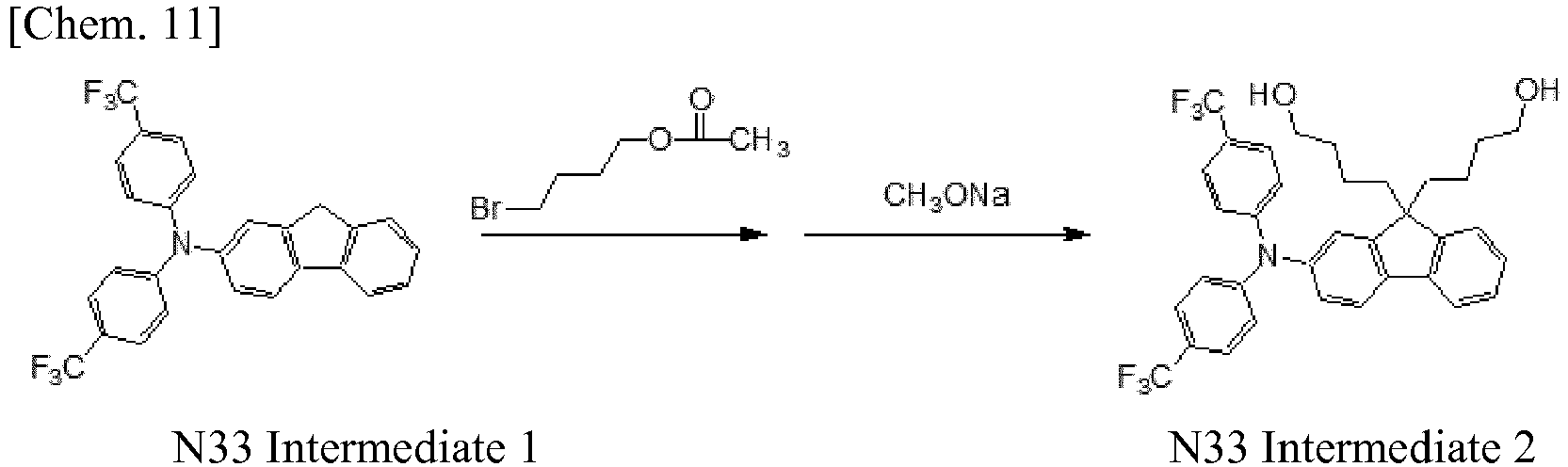
- Under a nitrogen atmosphere, 5.0 g of the N33 intermediate 1 and 50 mL of N,N-dimethylacetamide were loaded into a 300-milliliter three-necked flask, and the mixture was stirred. After that, 3.58 g of sodium tert-butoxide was loaded into the mixture, and the whole was cooled to 5°C. A solution obtained by dissolving 5.35 g of 4-bromobutyl acetate in 12 mL of N,N-dimethylacetamide was dropped into the resultant over 30 minutes. After the dropping, the temperature of the mixture was increased to 20°C, and then the mixture was stirred at the temperature (20°C) for 20 hours. After the stirring, the mixture was cooled to 5°C. Next, 2.87 g of sodium methoxide was loaded into the mixture, and the temperature of the whole was gradually increased to 20°C. After the temperature increase, the mixture was stirred at the temperature (20°C) for 10 hours. After the stirring, the reaction liquid was loaded into ice water, and the organic layer was extracted with toluene. The resultant organic phase was washed with brine and water in the stated order, and was dried with anhydrous magnesium sulfate. The resultant crude product was purified by column chromatography to provide 2.6 g of an N33 intermediate 2 (yield: 40%). The structure of the product was identified by 1H-NMR.
1H-NMR (CDCl3): δ 0.69 (t, 2H), 1.36 (d, 4H), 1.62 (d, 4H), 1.96 (dd, 4H), 3.08 (dd, 4H), 7.10 (dd, 1H), 7.17 (dd, 4H), 7.22 (d, 1H), 7.32-7.40 (m, 2H), 7.43 (d, 1H), 7.51 (d, 4H), 7.68 (t, 2H) -

- Under a nitrogen atmosphere, 2.0 g of the N33 intermediate 2, 70 mL of tetrahydrofuran, 0.12 g of MEHQ, and 1.8 mL of triethylamine were loaded into a 300-milliliter three-necked flask. The reaction vessel was cooled to 0°C, and 1.0 mL of methacryloyl chloride was dropped into the mixture. The reaction liquid was diluted with toluene, and then a 2 N aqueous solution of hydrochloric acid was used to terminate the reaction. The resultant organic layer was washed with an acidic aqueous solution and a basic aqueous solution. After that, the organic layer was dried with brine and anhydrous magnesium sulfate. The solvent was removed, and the resultant crude product was purified by silica gel chromatography. Thus, 1.33 g of the N33 was obtained (54%). The structure of the product was identified by 1H-NMR. In addition, the optical characteristics of the product are shown in Table 6.
1H-NMR (CDCl3): δ 1.79 (t, 6H), 1.41 (d, 4H), 1.73 (d, 4H), 2.12-2.19 (m, 4H), 3.22-3.29 (m, 4H), 5.43 (t, 2H), 5.80 (t, 2H), 6.91 (dd, 1H), 7.13 (dd, 1H), 7.22 (d, 4H), 7.30-7.38 (m, 2H), 7.43 (d, 1H), 7.54 (d, 4H), 7.67 (d, 2H) -

- Under a nitrogen atmosphere, 5.0 g of the N33 intermediate 1 and 50 mL of N,N-dimethylacetamide were loaded into a 300-milliliter three-necked flask, and the mixture was stirred. After that, 3.58 g of sodium tert-butoxide was loaded into the mixture, and the whole was cooled to 5°C. A solution obtained by dissolving 4.62 g of 2-bromoethyl acetate in 10 mL of N,N-dimethylacetamide was dropped into the resultant over 30 minutes. After the dropping, the temperature of the mixture was increased to 20°C, and then the mixture was stirred at the temperature (20°C) for 20 hours. After the stirring, the mixture was cooled to 5°C. 2.87 g of sodium methoxide was loaded into the mixture, and the temperature of the whole was gradually increased to 20°C. After the temperature increase, the mixture was stirred at the temperature (20°C) for 10 hours. After the stirring, the reaction liquid was loaded into ice water, and the organic layer was extracted with toluene. The resultant organic phase was washed with brine and water in the stated order, and was dried with anhydrous magnesium sulfate. The resultant crude product was purified by column chromatography to provide 1.8 g of an N34 intermediate 1 (yield: 30%). The structure of the product was identified by 1H-NMR.
1H-NMR (CDCl3): δ 0.69 (t, 2H), 2.25-2.37 (m, 4H), 3.09 (dd, 4H), 7.11 (dd, 1H), 7.16 (dd, 4H), 7.22 (d, 1H), 7.32-7.40 (m, 2H), 7.43 (d, 1H), 7.51 (d, 4H), 7.68 (t, 2H) -

- Under a nitrogen atmosphere, 1.7 g of the N34 intermediate 1, 60 mL of tetrahydrofuran, 0.11 g of MEHQ, and 1.7 mL of triethylamine were loaded into a 200-milliliter three-necked flask. The reaction vessel was cooled to 0°C, and 0.9 mL of methacryloyl chloride was dropped into the mixture. The reaction liquid was diluted with toluene, and then a 2 N aqueous solution of hydrochloric acid was used to terminate the reaction. The resultant organic layer was washed with an acidic aqueous solution and a basic aqueous solution. After that, the organic layer was dried with brine and anhydrous magnesium sulfate. The solvent was removed, and the resultant crude product was purified by silica gel chromatography. Thus, 1.20 g of the N34 was obtained (56%). The structure of the product was identified by 1H-NMR. In addition, the optical characteristics of the product are shown in Table 6.
1H-NMR (CDCl3): δ 1.79 (t, 6H), 2.30-2.37 (m, 2H), 2.40-2.49 (m, 2H), 3.46-3.51 (m, 2H), 3.62-3.67 (m, 2H), 5.43 (t, 2H), 5.82 (t, 2H), 6.91 (dd, 1H), 7.11 (dd, 1H), 7.22 (d, 4H), 7.31-7.37 (m, 2H), 7.43 (d, 1H), 7.52 (d, 4H), 7.66 (d, 2H) -

- The same reactions and purifications as those of Example 3 were performed with the exception that an N35 intermediate 1 was obtained by changing 2-bromofluorene used in Example 3 to 3-[2-bromo-9-(3-hydroxy-propyl)-9H-fluoren-9-yl]-propan-1-ol. In addition, the optical characteristics of the product are shown in Table 6.
1H-NMR (CDCl3): δ 1.52 (d, 4H), 1.78 (s, 6H), 1.90 (d, 4H), 3.47-3.52 (m, 2H), 3.60-3.65 (m, 2H), 5.43 (t, 2H), 5.81 (t, 2H), 6.90 (dd, 1H), 7.10 (dd, 1H), 7.21 (d, 4H), 7.30-7.36 (m, 2H), 7.42 (d, 1H), 7.51 (d, 4H), 7.65 (d, 2H) - The same reactions and purifications as those of Example 3 were performed with the exception that 3-aminobenzotrifluoride, 3-bromobenzotrifluoride, and 4-bromobutyl acetate used in Example 3 were changed to 4-aminobenzonitrile, 2-bromo-m-xylene, and 2-bromoethyl acetate, respectively.
- The same reactions and purifications as those of Example 2 were performed with the exception that 2-amino-9,9-dimethylfluorene, 4-bromobenzonitrile, and 4-bromobenzyl alcohol used in Example 2 were changed to 3,5-bis(trifluoromethyl)aniline, 2-bromo-9,9-di-n-octylfluorene, and 2-(4-bromophenyl)ethyl alcohol, respectively. In addition, the optical characteristics of the product are shown in Table 6.
- The same reactions and purifications as those of Example 3 were performed with the exception that 3-bromobenzotrifluoride and 2-bromofluorene used in Example 3 were changed to 4-bromobenzyl alcohol and 3-[2-bromo-9-(3-hydroxy-propyl)-9H-fluoren-9-yl]-propan-1-ol, respectively. In addition, the optical characteristics of the product are shown in Table 6.
-

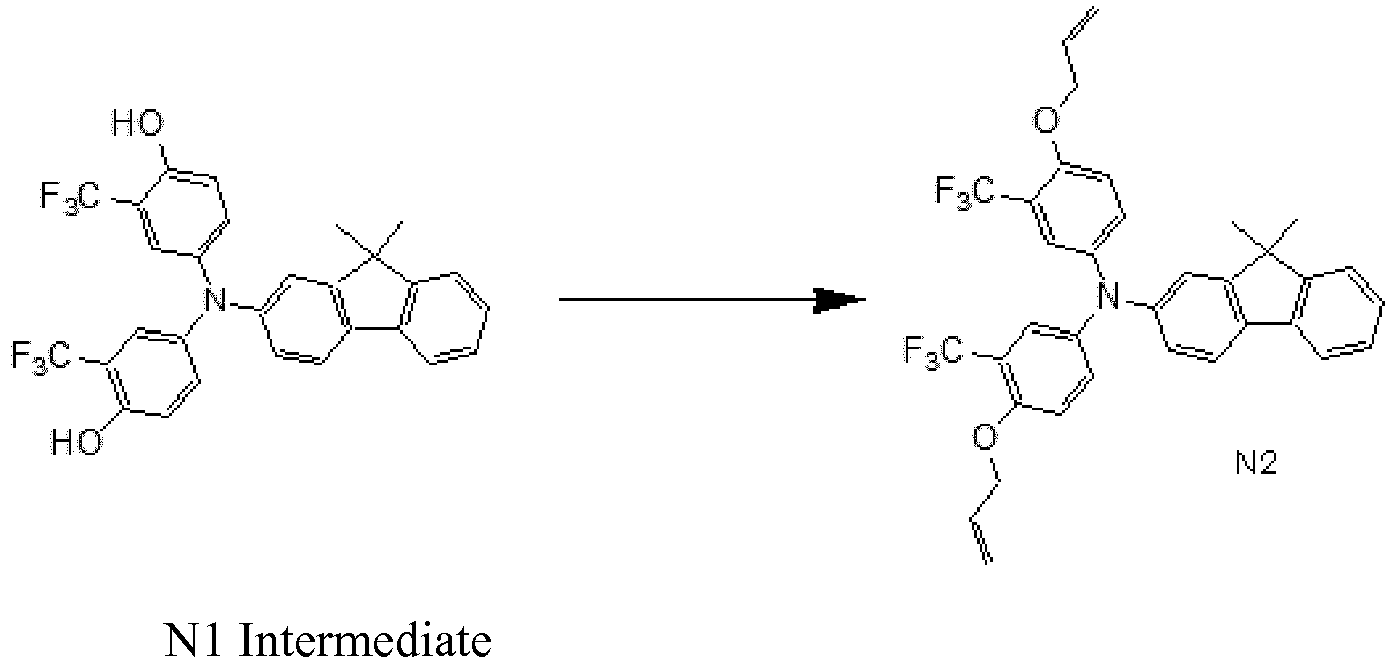
- Under a nitrogen atmosphere, 60 ml of a solution of 0.4 g of sodium hydride (55%) in tetrahydrofuran was loaded into a 200-milliliter three-necked flask, and 2.0 g of the N1 intermediate was slowly added to the solution at 0°C, followed by stirring at the temperature for 1 hour. Next, 1.6 g of allyl bromide was added to the mixture to confirm that a reaction occurred, and then a saturated aqueous solution of ammonium chloride was used to terminate the reaction. The organic phase was extracted with ethyl acetate, and was then dried with anhydrous magnesium sulfate. A crude product obtained by concentrating the organic phase was purified by silica gel chromatography to provide 1.48 g of the N2 (yield: 77%). The structure of the product was identified by 1H-NMR. In addition, the optical characteristics of the product are shown in Table 6.
1H-NMR (CDCl3): δ 1.54 (s, 6H), 4.55-4.62 (m, 4H), 5.43 (d, 2H), 5.88 (t, 2H), 6.46 (t, 2H), 7.10 (d, 1H), 7.27-7.42 (m, 5H), 7.62-7.69 (m, 4H), 7.78 (d, 1H), 8.10 (d, 1H), 8.17 (d, 1H) -

- The same reaction and purification as those of Example 11 were performed with the exception that the N1 intermediate of Example 11 was changed to the N34 intermediate 1.
- A comparative example compound R1 was synthesized, and its refractive index, dispersion characteristic (Abbe number (vd)), secondary dispersion characteristic (θg,F), and transmittance were compared. The results are shown in Table 6.

- A comparative example compound R2 was synthesized, and its refractive index, dispersion characteristic (Abbe number (vd)), secondary dispersion characteristic (θg,F), and transmittance were compared. The results are shown in Table 6.

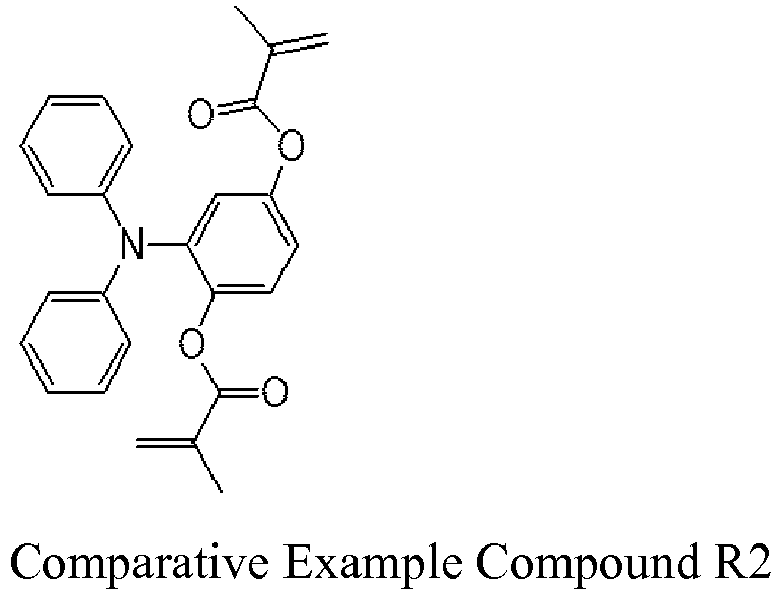
- A refractive index was measured with an Abbe refractometer (manufactured by Kalnew Optical Industrial Co., Ltd.).
- With regard to a transmittance, two kinds of films having different optical path lengths were molded, and their transmittances were each measured with a spectrophotometer U-4000 (trade name) manufactured by Hitachi High-Technologies Corporation, followed by their conversion into internal transmittances (500 µm) at 450 nm. The results are shown in Table 6.
[Table 6] nd νd θg,F Transmittance Example 1 1.64 18.9 0.79 96 Example 2 1.77 19.2 0.80 82 Example 3 1.60 16.5 0.79 95 Example 4 1.58 19.0 0.79 98 Example 5 1.60 15.6 0.82 98 Example 6 1.58 18.5 0.77 99 Example 7 1.59 17.4 0.78 96 Example 8 1.78 19.3 0.81 95 Example 9 1.66 17.7 0.79 85 Example 10 1.61 19.5 0.78 92 Example 11 1.62 18.1 0.80 90 Example 12 1.61 16.6 0.78 93 Comparative Example 1 1.78 21.0 0.78 72 Comparative Example 2 1.66 28.6 0.69 85 - The optical element, material, optical apparatus, and triarylamine compound of the present invention each have a characteristic in that the dispersion characteristic (Abbe number (vd)) of refractive indices is high and the secondary dispersion characteristic (θg,F) thereof is high (abnormal dispersion characteristic), that is, a chromatic aberration-correction function is high. Accordingly, the optical element, the material, the optical apparatus, and the triarylamine compound may each be suitably utilized in an apparatus having a plurality of lenses, such as a camera lens.
- This application claims the benefit of priority from Japanese Patent Application No.
2017-063817, filed on March 28, 2017 2018-040129, filed on March 6, 2018 -
- 10
- optical member
- 20
- lens substrate
- 30
- lens substrate
- 40
- lens substrate
Claims (11)
- An optical element comprising an optical member including a polymer obtained by subjecting a compound represented by the following general formula (1) to homopolymerization or copolymerization:
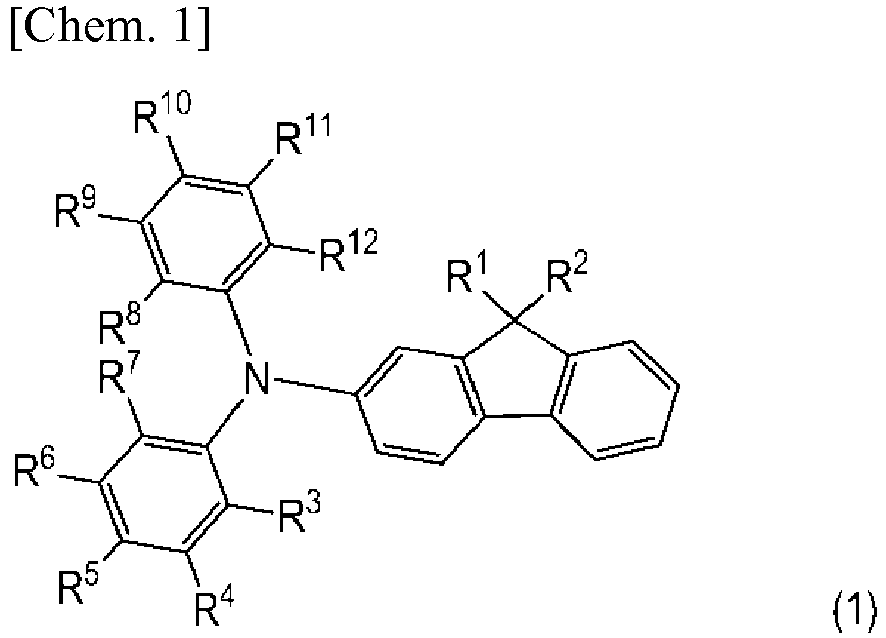
- The optical element according to claim 1, wherein the polymerizable functional group comprises an acryloyloxy group, a methacryloyloxy group, a vinyl group, or an epoxy group.
- The optical element according to claim 1 or 2, wherein at least one of R5, R6, R9, or R10 represents an electron-withdrawing group, and the electron-withdrawing group comprises a cyano group or a trifluoromethyl group.
- A material comprising a polymer obtained by subjecting a compound represented by the following general formula (1) to homopolymerization or copolymerization:

- The material according to claim 4, wherein the polymerizable functional group comprises an acryloyloxy group, a methacryloyloxy group, a vinyl group, or an epoxy group.
- The material according to claim 4 or 5, wherein at least one of R5, R6, R9, or R10 represents an electron-withdrawing group, and the electron-withdrawing group comprises a cyano group or a trifluoromethyl group.
- An optical apparatus comprising the optical element of any one of claims 1 to 3.
- The optical apparatus according to claim 7, wherein the optical element comprises a lens and the optical apparatus comprises a camera.
- A compound represented by the following general formula (1):

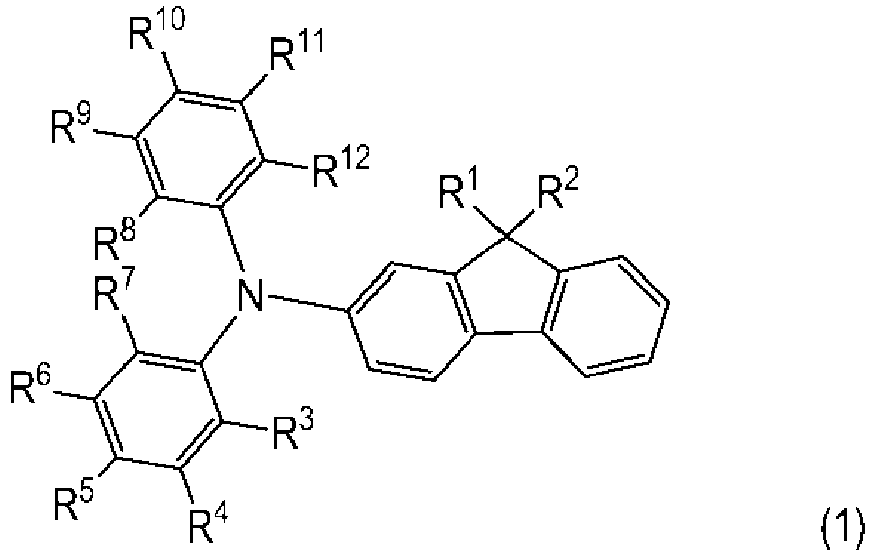
- The compound according to claim 9, wherein the polymerizable functional group comprises an acryloyloxy group, a methacryloyloxy group, a vinyl group, or an epoxy group.
- The compound according to claim 9 or 10, wherein at least one of R5, R6, R9, or R10 represents an electron-withdrawing group, and the electron-withdrawing group comprises a cyano group or a trifluoromethyl group.
Applications Claiming Priority (3)
| Application Number | Priority Date | Filing Date | Title |
|---|---|---|---|
| JP2017063817 | 2017-03-28 | ||
| JP2018040129A JP7417350B2 (en) | 2017-03-28 | 2018-03-06 | Optical elements, optical materials, optical instruments and triarylamine compounds |
| PCT/JP2018/012145 WO2018181183A1 (en) | 2017-03-28 | 2018-03-26 | Optical element, material, optical device and compound |
Publications (3)
| Publication Number | Publication Date |
|---|---|
| EP3591441A1 true EP3591441A1 (en) | 2020-01-08 |
| EP3591441A4 EP3591441A4 (en) | 2020-12-16 |
| EP3591441B1 EP3591441B1 (en) | 2024-11-06 |
Family
ID=63922417
Family Applications (1)
| Application Number | Title | Priority Date | Filing Date |
|---|---|---|---|
| EP18776675.3A Active EP3591441B1 (en) | 2017-03-28 | 2018-03-26 | Optical element, material, optical device and compound |
Country Status (4)
| Country | Link |
|---|---|
| US (1) | US11500129B2 (en) |
| EP (1) | EP3591441B1 (en) |
| JP (1) | JP7417350B2 (en) |
| CN (1) | CN110462449B (en) |
Cited By (1)
| Publication number | Priority date | Publication date | Assignee | Title |
|---|---|---|---|---|
| EP4095167A1 (en) * | 2021-05-27 | 2022-11-30 | Canon Kabushiki Kaisha | Cured product, optical element, optical apparatus, and image pickup apparatus |
Families Citing this family (5)
| Publication number | Priority date | Publication date | Assignee | Title |
|---|---|---|---|---|
| JP7536430B2 (en) | 2018-10-29 | 2024-08-20 | キヤノン株式会社 | (Meth)acrylate Compound |
| WO2020090598A1 (en) * | 2018-10-29 | 2020-05-07 | キヤノン株式会社 | (meth)acrylate compound |
| CN113165345B (en) * | 2018-11-28 | 2023-04-28 | Agc株式会社 | Fluorochemical, fluorochemical-containing composition, coating liquid, article, and method for producing same |
| JP7642347B2 (en) * | 2020-11-02 | 2025-03-10 | キヤノン株式会社 | Optical element, optical device, imaging device and compound |
| JP7814943B2 (en) * | 2022-01-11 | 2026-02-17 | キヤノン株式会社 | Cured products, optical elements, optical equipment, imaging devices |
Family Cites Families (30)
| Publication number | Priority date | Publication date | Assignee | Title |
|---|---|---|---|---|
| JP3514417B2 (en) | 1997-09-16 | 2004-03-31 | キヤノン株式会社 | Organic compound, polymer thereof and organic electroluminescent device |
| JP4011791B2 (en) | 1998-06-12 | 2007-11-21 | キヤノン株式会社 | Method for producing electrophotographic photosensitive member |
| DE69928725T2 (en) | 1998-06-12 | 2006-07-20 | Canon K.K. | An electrophotographic photosensitive member, process cartridge and electrophotographic apparatus, and a process for producing the photosensitive member |
| JP2008165248A (en) | 1998-11-13 | 2008-07-17 | Canon Inc | Electrophotographic photosensitive member, process cartridge, and electrophotographic apparatus |
| DE69927567T2 (en) | 1998-11-13 | 2006-06-14 | Canon Kk | Electrophotographic photosensitive member, process cartridge and electrophotographic apparatus |
| US7001708B1 (en) | 2001-11-28 | 2006-02-21 | University Of Central Florida Research Foundation, Inc. | Photosensitive polymeric material for worm optical data storage with two-photon fluorescent readout |
| JP4453383B2 (en) | 2004-02-10 | 2010-04-21 | 富士ゼロックス株式会社 | Organic nonlinear optical material and nonlinear optical element using the same |
| JP2006072293A (en) | 2004-08-06 | 2006-03-16 | Fuji Xerox Co Ltd | Electrophotographic photoreceptor, image forming apparatus, and process cartridge |
| JP2006058822A (en) | 2004-08-24 | 2006-03-02 | Canon Inc | Electrophotographic photosensitive member, process cartridge having the electrophotographic photosensitive member, and electrophotographic apparatus |
| JP2006085043A (en) | 2004-09-17 | 2006-03-30 | Fuji Xerox Co Ltd | Image forming apparatus |
| JP2006232907A (en) * | 2005-02-23 | 2006-09-07 | Canon Inc | Optical material, optical element molding method using the optical material, optical element molded by the molding method, and optical system apparatus having the optical element |
| WO2006129879A1 (en) | 2005-06-02 | 2006-12-07 | Canon Kabushiki Kaisha | Electrophotographic photoreceptor, process cartridge, and electrophotographic apparatus |
| JP4006461B2 (en) * | 2005-06-02 | 2007-11-14 | キヤノン株式会社 | Electrophotographic photosensitive member, process cartridge, and electrophotographic apparatus |
| JP2007086522A (en) | 2005-09-22 | 2007-04-05 | Canon Inc | Electrophotographic photoreceptor, process cartridge and electrophotographic apparatus having the electrophotographic photoreceptor |
| JP4659695B2 (en) * | 2005-11-01 | 2011-03-30 | キヤノン株式会社 | Fluorene compound and organic light emitting device |
| US8653279B2 (en) * | 2006-04-17 | 2014-02-18 | Samsung Sdi Co., Ltd. | Dye for dye-sensitized solar cell, and solar cell prepared from same |
| JP2008186717A (en) * | 2007-01-30 | 2008-08-14 | Konica Minolta Business Technologies Inc | Dye-sensitized photoelectric conversion element and dye-sensitized solar cell |
| JP2010091851A (en) | 2008-10-09 | 2010-04-22 | Canon Inc | Electrophotographic photoreceptor, process cartridge and electrophotographic apparatus |
| EP2390684B1 (en) | 2010-05-24 | 2019-04-24 | Canon Kabushiki Kaisha | Optical element compound, optical material, and optical element |
| JP5825798B2 (en) | 2011-02-09 | 2015-12-02 | キヤノン株式会社 | Compound for optical element, optical material and optical element |
| JP2012224618A (en) * | 2011-04-08 | 2012-11-15 | Fujifilm Corp | Method for purifying organic material, material for organic electronics, photoelectric conversion element, optical sensor, imaging element, and organic electroluminescent element |
| JP5993720B2 (en) * | 2011-11-30 | 2016-09-14 | キヤノン株式会社 | Electrophotographic photosensitive member, process cartridge, and electrophotographic apparatus |
| US9882143B2 (en) | 2012-02-07 | 2018-01-30 | Samsung Display Co., Ltd. | Amine-based compound and organic light-emitting diode including the same |
| US9181474B2 (en) * | 2012-02-07 | 2015-11-10 | Samsung Display Co., Ltd. | Amine-based compound and organic light-emitting diode including the same |
| US9718764B2 (en) | 2013-03-22 | 2017-08-01 | Merck Patent Gmbh | Synthetic building blocks for the production of materials for organic electroluminescence devices |
| KR102107106B1 (en) * | 2013-05-09 | 2020-05-07 | 삼성디스플레이 주식회사 | Styryl-based compound and organic light emitting diode comprising the same |
| EP3223330B1 (en) * | 2014-11-18 | 2022-02-23 | Hodogaya Chemical Co., Ltd. | Organic electroluminescent device |
| US11594683B2 (en) * | 2015-10-29 | 2023-02-28 | Hodogaya Chemical Co., Ltd. | Organic electroluminescent device |
| JP6810710B2 (en) * | 2016-01-14 | 2021-01-06 | 保土谷化学工業株式会社 | Organic electroluminescence device |
| WO2018181183A1 (en) | 2017-03-28 | 2018-10-04 | キヤノン株式会社 | Optical element, material, optical device and compound |
-
2018
- 2018-03-06 JP JP2018040129A patent/JP7417350B2/en active Active
- 2018-03-26 EP EP18776675.3A patent/EP3591441B1/en active Active
- 2018-03-26 CN CN201880020566.7A patent/CN110462449B/en active Active
-
2019
- 2019-09-18 US US16/574,708 patent/US11500129B2/en active Active
Cited By (2)
| Publication number | Priority date | Publication date | Assignee | Title |
|---|---|---|---|---|
| EP4095167A1 (en) * | 2021-05-27 | 2022-11-30 | Canon Kabushiki Kaisha | Cured product, optical element, optical apparatus, and image pickup apparatus |
| US12146011B2 (en) | 2021-05-27 | 2024-11-19 | Canon Kabushiki Kaisha | Cured product, optical element, optical apparatus, and image pickup apparatus |
Also Published As
| Publication number | Publication date |
|---|---|
| JP7417350B2 (en) | 2024-01-18 |
| US20200012014A1 (en) | 2020-01-09 |
| EP3591441B1 (en) | 2024-11-06 |
| US11500129B2 (en) | 2022-11-15 |
| JP2018165355A (en) | 2018-10-25 |
| CN110462449B (en) | 2023-08-18 |
| CN110462449A (en) | 2019-11-15 |
| EP3591441A4 (en) | 2020-12-16 |
Similar Documents
| Publication | Publication Date | Title |
|---|---|---|
| EP3591441B1 (en) | Optical element, material, optical device and compound | |
| EP2862012B1 (en) | (meth)acrylate compound, optical composition, molded article, and optical element | |
| JP2023036659A (en) | Optical element, optical device, and compound | |
| US20260110823A1 (en) | Optical element, optical apparatus, imaging apparatus, and compound | |
| CN102260201B (en) | Compounds for optical elements, optical materials, and optical elements | |
| JP7255351B2 (en) | Photocurable material, photocurable resin composition using the same, photocured product | |
| US10370474B2 (en) | Optical composition, cured product, and optical element | |
| US20250034294A1 (en) | Cured product, optical element, optical apparatus, and image pickup apparatus | |
| US12066593B2 (en) | (Meth)acrylate compound | |
| WO2020090598A1 (en) | (meth)acrylate compound | |
| JP7536493B2 (en) | Optical elements, optical instruments, imaging devices | |
| US12479976B2 (en) | Cured product, optical element, optical apparatus, and imaging apparatus |
Legal Events
| Date | Code | Title | Description |
|---|---|---|---|
| STAA | Information on the status of an ep patent application or granted ep patent |
Free format text: STATUS: THE INTERNATIONAL PUBLICATION HAS BEEN MADE |
|
| PUAI | Public reference made under article 153(3) epc to a published international application that has entered the european phase |
Free format text: ORIGINAL CODE: 0009012 |
|
| STAA | Information on the status of an ep patent application or granted ep patent |
Free format text: STATUS: REQUEST FOR EXAMINATION WAS MADE |
|
| 17P | Request for examination filed |
Effective date: 20191001 |
|
| AK | Designated contracting states |
Kind code of ref document: A1 Designated state(s): AL AT BE BG CH CY CZ DE DK EE ES FI FR GB GR HR HU IE IS IT LI LT LU LV MC MK MT NL NO PL PT RO RS SE SI SK SM TR |
|
| AX | Request for extension of the european patent |
Extension state: BA ME |
|
| DAV | Request for validation of the european patent (deleted) | ||
| DAX | Request for extension of the european patent (deleted) | ||
| A4 | Supplementary search report drawn up and despatched |
Effective date: 20201116 |
|
| RIC1 | Information provided on ipc code assigned before grant |
Ipc: G02B 1/04 20060101AFI20201110BHEP Ipc: C08F 20/34 20060101ALI20201110BHEP |
|
| STAA | Information on the status of an ep patent application or granted ep patent |
Free format text: STATUS: EXAMINATION IS IN PROGRESS |
|
| 17Q | First examination report despatched |
Effective date: 20221207 |
|
| GRAP | Despatch of communication of intention to grant a patent |
Free format text: ORIGINAL CODE: EPIDOSNIGR1 |
|
| STAA | Information on the status of an ep patent application or granted ep patent |
Free format text: STATUS: GRANT OF PATENT IS INTENDED |
|
| RIC1 | Information provided on ipc code assigned before grant |
Ipc: C07D 303/23 20060101ALI20240513BHEP Ipc: C07D 303/22 20060101ALI20240513BHEP Ipc: C07C 255/59 20060101ALI20240513BHEP Ipc: C07C 255/58 20060101ALI20240513BHEP Ipc: C07C 219/34 20060101ALI20240513BHEP Ipc: C07C 219/32 20060101ALI20240513BHEP Ipc: C07C 217/92 20060101ALI20240513BHEP Ipc: C07C 217/76 20060101ALI20240513BHEP Ipc: C08F 20/34 20060101ALI20240513BHEP Ipc: G02B 1/04 20060101AFI20240513BHEP |
|
| INTG | Intention to grant announced |
Effective date: 20240603 |
|
| GRAS | Grant fee paid |
Free format text: ORIGINAL CODE: EPIDOSNIGR3 |
|
| GRAA | (expected) grant |
Free format text: ORIGINAL CODE: 0009210 |
|
| STAA | Information on the status of an ep patent application or granted ep patent |
Free format text: STATUS: THE PATENT HAS BEEN GRANTED |
|
| AK | Designated contracting states |
Kind code of ref document: B1 Designated state(s): AL AT BE BG CH CY CZ DE DK EE ES FI FR GB GR HR HU IE IS IT LI LT LU LV MC MK MT NL NO PL PT RO RS SE SI SK SM TR |
|
| REG | Reference to a national code |
Ref country code: GB Ref legal event code: FG4D |
|
| REG | Reference to a national code |
Ref country code: CH Ref legal event code: EP |
|
| REG | Reference to a national code |
Ref country code: DE Ref legal event code: R096 Ref document number: 602018076293 Country of ref document: DE |
|
| REG | Reference to a national code |
Ref country code: IE Ref legal event code: FG4D |
|
| REG | Reference to a national code |
Ref country code: LT Ref legal event code: MG9D |
|
| REG | Reference to a national code |
Ref country code: NL Ref legal event code: MP Effective date: 20241106 |
|
| PG25 | Lapsed in a contracting state [announced via postgrant information from national office to epo] |
Ref country code: HR Free format text: LAPSE BECAUSE OF FAILURE TO SUBMIT A TRANSLATION OF THE DESCRIPTION OR TO PAY THE FEE WITHIN THE PRESCRIBED TIME-LIMIT Effective date: 20241106 Ref country code: PT Free format text: LAPSE BECAUSE OF FAILURE TO SUBMIT A TRANSLATION OF THE DESCRIPTION OR TO PAY THE FEE WITHIN THE PRESCRIBED TIME-LIMIT Effective date: 20250306 Ref country code: IS Free format text: LAPSE BECAUSE OF FAILURE TO SUBMIT A TRANSLATION OF THE DESCRIPTION OR TO PAY THE FEE WITHIN THE PRESCRIBED TIME-LIMIT Effective date: 20250306 |
|
| PG25 | Lapsed in a contracting state [announced via postgrant information from national office to epo] |
Ref country code: NL Free format text: LAPSE BECAUSE OF FAILURE TO SUBMIT A TRANSLATION OF THE DESCRIPTION OR TO PAY THE FEE WITHIN THE PRESCRIBED TIME-LIMIT Effective date: 20241106 Ref country code: FI Free format text: LAPSE BECAUSE OF FAILURE TO SUBMIT A TRANSLATION OF THE DESCRIPTION OR TO PAY THE FEE WITHIN THE PRESCRIBED TIME-LIMIT Effective date: 20241106 |
|
| REG | Reference to a national code |
Ref country code: AT Ref legal event code: MK05 Ref document number: 1739957 Country of ref document: AT Kind code of ref document: T Effective date: 20241106 |
|
| PG25 | Lapsed in a contracting state [announced via postgrant information from national office to epo] |
Ref country code: BG Free format text: LAPSE BECAUSE OF FAILURE TO SUBMIT A TRANSLATION OF THE DESCRIPTION OR TO PAY THE FEE WITHIN THE PRESCRIBED TIME-LIMIT Effective date: 20241106 |
|
| PG25 | Lapsed in a contracting state [announced via postgrant information from national office to epo] |
Ref country code: ES Free format text: LAPSE BECAUSE OF FAILURE TO SUBMIT A TRANSLATION OF THE DESCRIPTION OR TO PAY THE FEE WITHIN THE PRESCRIBED TIME-LIMIT Effective date: 20241106 |
|
| PG25 | Lapsed in a contracting state [announced via postgrant information from national office to epo] |
Ref country code: NO Free format text: LAPSE BECAUSE OF FAILURE TO SUBMIT A TRANSLATION OF THE DESCRIPTION OR TO PAY THE FEE WITHIN THE PRESCRIBED TIME-LIMIT Effective date: 20250206 |
|
| PG25 | Lapsed in a contracting state [announced via postgrant information from national office to epo] |
Ref country code: LV Free format text: LAPSE BECAUSE OF FAILURE TO SUBMIT A TRANSLATION OF THE DESCRIPTION OR TO PAY THE FEE WITHIN THE PRESCRIBED TIME-LIMIT Effective date: 20241106 Ref country code: GR Free format text: LAPSE BECAUSE OF FAILURE TO SUBMIT A TRANSLATION OF THE DESCRIPTION OR TO PAY THE FEE WITHIN THE PRESCRIBED TIME-LIMIT Effective date: 20250207 Ref country code: AT Free format text: LAPSE BECAUSE OF FAILURE TO SUBMIT A TRANSLATION OF THE DESCRIPTION OR TO PAY THE FEE WITHIN THE PRESCRIBED TIME-LIMIT Effective date: 20241106 |
|
| PG25 | Lapsed in a contracting state [announced via postgrant information from national office to epo] |
Ref country code: PL Free format text: LAPSE BECAUSE OF FAILURE TO SUBMIT A TRANSLATION OF THE DESCRIPTION OR TO PAY THE FEE WITHIN THE PRESCRIBED TIME-LIMIT Effective date: 20241106 |
|
| PG25 | Lapsed in a contracting state [announced via postgrant information from national office to epo] |
Ref country code: RS Free format text: LAPSE BECAUSE OF FAILURE TO SUBMIT A TRANSLATION OF THE DESCRIPTION OR TO PAY THE FEE WITHIN THE PRESCRIBED TIME-LIMIT Effective date: 20250206 |
|
| PG25 | Lapsed in a contracting state [announced via postgrant information from national office to epo] |
Ref country code: SM Free format text: LAPSE BECAUSE OF FAILURE TO SUBMIT A TRANSLATION OF THE DESCRIPTION OR TO PAY THE FEE WITHIN THE PRESCRIBED TIME-LIMIT Effective date: 20241106 |
|
| PG25 | Lapsed in a contracting state [announced via postgrant information from national office to epo] |
Ref country code: DK Free format text: LAPSE BECAUSE OF FAILURE TO SUBMIT A TRANSLATION OF THE DESCRIPTION OR TO PAY THE FEE WITHIN THE PRESCRIBED TIME-LIMIT Effective date: 20241106 |
|
| PG25 | Lapsed in a contracting state [announced via postgrant information from national office to epo] |
Ref country code: EE Free format text: LAPSE BECAUSE OF FAILURE TO SUBMIT A TRANSLATION OF THE DESCRIPTION OR TO PAY THE FEE WITHIN THE PRESCRIBED TIME-LIMIT Effective date: 20241106 |
|
| PG25 | Lapsed in a contracting state [announced via postgrant information from national office to epo] |
Ref country code: RO Free format text: LAPSE BECAUSE OF FAILURE TO SUBMIT A TRANSLATION OF THE DESCRIPTION OR TO PAY THE FEE WITHIN THE PRESCRIBED TIME-LIMIT Effective date: 20241106 |
|
| PG25 | Lapsed in a contracting state [announced via postgrant information from national office to epo] |
Ref country code: SK Free format text: LAPSE BECAUSE OF FAILURE TO SUBMIT A TRANSLATION OF THE DESCRIPTION OR TO PAY THE FEE WITHIN THE PRESCRIBED TIME-LIMIT Effective date: 20241106 |
|
| PG25 | Lapsed in a contracting state [announced via postgrant information from national office to epo] |
Ref country code: CZ Free format text: LAPSE BECAUSE OF FAILURE TO SUBMIT A TRANSLATION OF THE DESCRIPTION OR TO PAY THE FEE WITHIN THE PRESCRIBED TIME-LIMIT Effective date: 20241106 |
|
| PG25 | Lapsed in a contracting state [announced via postgrant information from national office to epo] |
Ref country code: IT Free format text: LAPSE BECAUSE OF FAILURE TO SUBMIT A TRANSLATION OF THE DESCRIPTION OR TO PAY THE FEE WITHIN THE PRESCRIBED TIME-LIMIT Effective date: 20241106 |
|
| REG | Reference to a national code |
Ref country code: DE Ref legal event code: R097 Ref document number: 602018076293 Country of ref document: DE |
|
| PG25 | Lapsed in a contracting state [announced via postgrant information from national office to epo] |
Ref country code: SE Free format text: LAPSE BECAUSE OF FAILURE TO SUBMIT A TRANSLATION OF THE DESCRIPTION OR TO PAY THE FEE WITHIN THE PRESCRIBED TIME-LIMIT Effective date: 20241106 |
|
| PLBE | No opposition filed within time limit |
Free format text: ORIGINAL CODE: 0009261 |
|
| STAA | Information on the status of an ep patent application or granted ep patent |
Free format text: STATUS: NO OPPOSITION FILED WITHIN TIME LIMIT |
|
| PG25 | Lapsed in a contracting state [announced via postgrant information from national office to epo] |
Ref country code: MC Free format text: LAPSE BECAUSE OF FAILURE TO SUBMIT A TRANSLATION OF THE DESCRIPTION OR TO PAY THE FEE WITHIN THE PRESCRIBED TIME-LIMIT Effective date: 20241106 |
|
| 26N | No opposition filed |
Effective date: 20250807 |
|
| REG | Reference to a national code |
Ref country code: CH Ref legal event code: H13 Free format text: ST27 STATUS EVENT CODE: U-0-0-H10-H13 (AS PROVIDED BY THE NATIONAL OFFICE) Effective date: 20251023 |
|
| PG25 | Lapsed in a contracting state [announced via postgrant information from national office to epo] |
Ref country code: LU Free format text: LAPSE BECAUSE OF NON-PAYMENT OF DUE FEES Effective date: 20250326 |
|
| REG | Reference to a national code |
Ref country code: BE Ref legal event code: MM Effective date: 20250331 |
|
| PG25 | Lapsed in a contracting state [announced via postgrant information from national office to epo] |
Ref country code: FR Free format text: LAPSE BECAUSE OF NON-PAYMENT OF DUE FEES Effective date: 20250331 |
|
| PG25 | Lapsed in a contracting state [announced via postgrant information from national office to epo] |
Ref country code: BE Free format text: LAPSE BECAUSE OF NON-PAYMENT OF DUE FEES Effective date: 20250331 |
|
| PG25 | Lapsed in a contracting state [announced via postgrant information from national office to epo] |
Ref country code: CH Free format text: LAPSE BECAUSE OF NON-PAYMENT OF DUE FEES Effective date: 20250331 |
|
| PG25 | Lapsed in a contracting state [announced via postgrant information from national office to epo] |
Ref country code: IE Free format text: LAPSE BECAUSE OF NON-PAYMENT OF DUE FEES Effective date: 20250326 |
|
| PGFP | Annual fee paid to national office [announced via postgrant information from national office to epo] |
Ref country code: GB Payment date: 20260220 Year of fee payment: 9 |
|
| PGFP | Annual fee paid to national office [announced via postgrant information from national office to epo] |
Ref country code: DE Payment date: 20260219 Year of fee payment: 9 |