EP3576798B1 - Verfahren zur herstellung von metall - funktionalisierter fullerene nanoverbundstoff - Google Patents
Verfahren zur herstellung von metall - funktionalisierter fullerene nanoverbundstoff Download PDFInfo
- Publication number
- EP3576798B1 EP3576798B1 EP18704843.4A EP18704843A EP3576798B1 EP 3576798 B1 EP3576798 B1 EP 3576798B1 EP 18704843 A EP18704843 A EP 18704843A EP 3576798 B1 EP3576798 B1 EP 3576798B1
- Authority
- EP
- European Patent Office
- Prior art keywords
- metal
- fullerene
- phf
- nanocomposite
- nanocomposites
- Prior art date
- Legal status (The legal status is an assumption and is not a legal conclusion. Google has not performed a legal analysis and makes no representation as to the accuracy of the status listed.)
- Active
Links
Images





Classifications
-
- C—CHEMISTRY; METALLURGY
- C01—INORGANIC CHEMISTRY
- C01B—NON-METALLIC ELEMENTS; COMPOUNDS THEREOF; METALLOIDS OR COMPOUNDS THEREOF NOT COVERED BY SUBCLASS C01C
- C01B32/00—Carbon; Compounds thereof
- C01B32/15—Nano-sized carbon materials
- C01B32/152—Fullerenes
- C01B32/156—After-treatment
-
- C—CHEMISTRY; METALLURGY
- C01—INORGANIC CHEMISTRY
- C01B—NON-METALLIC ELEMENTS; COMPOUNDS THEREOF; METALLOIDS OR COMPOUNDS THEREOF NOT COVERED BY SUBCLASS C01C
- C01B32/00—Carbon; Compounds thereof
- C01B32/15—Nano-sized carbon materials
- C01B32/152—Fullerenes
-
- A—HUMAN NECESSITIES
- A61—MEDICAL OR VETERINARY SCIENCE; HYGIENE
- A61K—PREPARATIONS FOR MEDICAL, DENTAL OR TOILETRY PURPOSES
- A61K31/00—Medicinal preparations containing organic active ingredients
- A61K31/28—Compounds containing heavy metals
-
- A—HUMAN NECESSITIES
- A61—MEDICAL OR VETERINARY SCIENCE; HYGIENE
- A61L—METHODS OR APPARATUS FOR STERILISING MATERIALS OR OBJECTS IN GENERAL; DISINFECTION, STERILISATION OR DEODORISATION OF AIR; CHEMICAL ASPECTS OF BANDAGES, DRESSINGS, ABSORBENT PADS OR SURGICAL ARTICLES; MATERIALS FOR BANDAGES, DRESSINGS, ABSORBENT PADS OR SURGICAL ARTICLES
- A61L2/00—Disinfection or sterilisation of materials or objects, in general; Accessories therefor
- A61L2/16—Disinfection or sterilisation of materials or objects, in general; Accessories therefor using chemical substances
- A61L2/23—Solid materials, e.g. granules, powders, blocks or tablets
- A61L2/232—Solid materials, e.g. granules, powders, blocks or tablets layered or coated
-
- A—HUMAN NECESSITIES
- A61—MEDICAL OR VETERINARY SCIENCE; HYGIENE
- A61L—METHODS OR APPARATUS FOR STERILISING MATERIALS OR OBJECTS IN GENERAL; DISINFECTION, STERILISATION OR DEODORISATION OF AIR; CHEMICAL ASPECTS OF BANDAGES, DRESSINGS, ABSORBENT PADS OR SURGICAL ARTICLES; MATERIALS FOR BANDAGES, DRESSINGS, ABSORBENT PADS OR SURGICAL ARTICLES
- A61L2/00—Disinfection or sterilisation of materials or objects, in general; Accessories therefor
- A61L2/16—Disinfection or sterilisation of materials or objects, in general; Accessories therefor using chemical substances
- A61L2/23—Solid materials, e.g. granules, powders, blocks or tablets
- A61L2/238—Metals or alloys, e.g. oligodynamic metals
-
- B—PERFORMING OPERATIONS; TRANSPORTING
- B22—CASTING; POWDER METALLURGY
- B22F—WORKING METALLIC POWDER; MANUFACTURE OF ARTICLES FROM METALLIC POWDER; MAKING METALLIC POWDER; APPARATUS OR DEVICES SPECIALLY ADAPTED FOR METALLIC POWDER
- B22F1/00—Metallic powder; Treatment of metallic powder, e.g. to facilitate working or to improve properties
- B22F1/05—Metallic powder characterised by the size or surface area of the particles
- B22F1/054—Nanosized particles
-
- B—PERFORMING OPERATIONS; TRANSPORTING
- B82—NANOTECHNOLOGY
- B82Y—SPECIFIC USES OR APPLICATIONS OF NANOSTRUCTURES; MEASUREMENT OR ANALYSIS OF NANOSTRUCTURES; MANUFACTURE OR TREATMENT OF NANOSTRUCTURES
- B82Y5/00—Nanobiotechnology or nanomedicine, e.g. protein engineering or drug delivery
-
- C—CHEMISTRY; METALLURGY
- C01—INORGANIC CHEMISTRY
- C01P—INDEXING SCHEME RELATING TO STRUCTURAL AND PHYSICAL ASPECTS OF SOLID INORGANIC COMPOUNDS
- C01P2004/00—Particle morphology
- C01P2004/80—Particles consisting of a mixture of two or more inorganic phases
- C01P2004/82—Particles consisting of a mixture of two or more inorganic phases two phases having the same anion, e.g. both oxidic phases
- C01P2004/84—Particles consisting of a mixture of two or more inorganic phases two phases having the same anion, e.g. both oxidic phases one phase coated with the other
-
- C—CHEMISTRY; METALLURGY
- C22—METALLURGY; FERROUS OR NON-FERROUS ALLOYS; TREATMENT OF ALLOYS OR NON-FERROUS METALS
- C22C—ALLOYS
- C22C26/00—Alloys containing diamond or cubic or wurtzitic boron nitride, fullerenes or carbon nanotubes
- C22C2026/001—Fullerenes
Definitions
- Microbes are gaining resistance to current antimicrobials, and there is an urgent need to develop novel antimicrobial agents.
- the use of metal compounds such as silver in antimicrobial coatings for medical devices is known in the art.
- a specific advantage in using the silver ion as antibacterial agent is the inability of bacteria to acquire tolerance to the silver ion.
- Silver is known to possess antibacterial properties and is used topically either as a metal or as silver salts due to their ability to generate bactericidal amounts of silver ions (Ag + ), in which in this bioactive species, is released to the contacting environment.
- silver nitrate can cause toxic side effects, and can cause discoloration of the skin.
- Metal nanoparticles have been reported to be antibacterial due to their ability to bind strongly with sulfur, which is present in enzymes and proteins.
- gold nanoparticles with a size less than 10 nm also known as gold nanoclusters
- Zheng et al. ACS Nano, 11, 6904-6910 (2017 ). This is mainly due to the very low quantum efficiency of free-radical generation by metal nanoparticles, which are suitable for reducing small organic compounds but not killing microbes.
- Antimicrobial polymers with metal nanoparticles have also been described. Palza H., Int. J. Mol. Sci., 16, 2099-2116 (2015 ).
- Metal nanoparticles have been reported in several applications that utilizes their electronic properties, such as solar cell, biosensors and electronic circuits.
- the metal nanoparticles during synthesis have capping agents to control the size of nanoparticles.
- These capping agents are organic compounds that limit electron transfer between the metal nanoparticles and materials of interest (e.g., fullerene in solar cells and analytes in biosensors).
- majority of the research is focused on design of capping agents to enhance the electronic properties of metal nanoparticles.
- the present disclosure relates to nanocomposites comprising metal nanoparticles and functionalized fullerenes.
- Functionalized fullerenes include polyhydroxy fullerenes (PHF) which are water-soluble form of fullerenes.
- Fullerenes are spherical cages made of carbon atoms with a general formula of C 2n , where n can range from 10 to 270.
- the molecular formula for an unmodified PHF is C 2n (OH) x ; where x is in the range of 12 to 40.
- the metal nanoparticles can be made of gold, silver, copper, platinum, iron, or palladium.
- the disclosed metal-fullerene nanocomposites have sufficiently high catalytic activity to generate free radicals that kill microbes.
- the invention provides a method for making the metal-fullerene nanocomposites disclosed herein, which method is defined by claim 1.
- metal nanoparticles are produced by reduction of their salts.
- gold nanoparticles are produced by reduction of gold chloride with a reducing agent, such as NaBH 4 or NaOH.
- a reducing agent such as NaBH 4 or NaOH.
- Other requirements for conventional methods are the need for a base to control the pH for reduction and nucleation, and the need for a capping agent to control the size of the nanoparticles.
- the present invention provides a simpler reaction in which the functionalized fullerene serves as both a reducing agent and a capping agent.
- a base is not required to neutralize the acid.
- the metal-fullerene nanocomposites can be produced simply by mixing the two components, while nanoparticle size and shape can be controlled by varying reactant concentrations, time, and pH.
- the present disclosure relates a fullerene-metal nanocomposite that comprises a metal nanoparticle bonded to a functionalized fullerene compound.
- a useful method of making a fullerene-metal nanocomposite is described and is the subject of the claimed invention. The method consists essentially of the steps of mixing a water solution of metal salt or metal ion with a functionalized fullerene compound, and purifying the fullerene-metal nanocomposite from the solution.
- antimicrobial surfaces comprising a substrate surface and a coating on the substrate surface comprising a fullerene-metal nanocomposite that includes a metal nanoparticle bonded to a functionalized fullerene compound.
- organic group is used for the purpose of this invention to mean a hydrocarbon group that is classified as an aliphatic group, cyclic group, or combination of aliphatic and cyclic groups (e . g ., alkaryl and aralkyl groups).
- aliphatic group means a saturated or unsaturated linear or branched hydrocarbon group. This term is used to encompass alkyl, alkenyl, and alkynyl groups, for example.
- alkyl As used herein, the terms "alkyl”, “alkenyl”, and the prefix “alk-” are inclusive of straight chain groups and branched chain groups and cyclic groups, e . g ., cycloalkyl and cycloalkenyl. Unless otherwise specified, these groups contain from 1 to 20 carbon atoms, with alkenyl groups containing from 2 to 20 carbon atoms. In some embodiments, these groups have a total of at most 10 carbon atoms, at most 8 carbon atoms, at most 6 carbon atoms, or at most 4 carbon atoms. Lower alkyl groups are those including at most 6 carbon atoms. Examples of alkyl groups include haloalkyl groups and hydroxyalkyl groups.
- alkylene and alkenylene are the divalent forms of the “alkyl” and “alkenyl” groups defined above.
- alkylenyl and alkenylenyl are used when “alkylene” and “alkenylene”, respectively, are substituted.
- an arylalkylenyl group comprises an alkylene moiety to which an aryl group is attached.
- each group (or substituent) is independently selected, whether explicitly stated or not.
- each R group is independently selected for the formula -C(O)-NR 2 .
- group and “moiety” are used to differentiate between chemical species that allow for substitution or that may be substituted and those that do not so allow for substitution or may not be so substituted.
- group when the term “group” is used to describe a chemical substituent, the described chemical material includes the unsubstituted group and that group with nonperoxidic O, N, S, Si, or F atoms, for example, in the chain as well as carbonyl groups or other conventional substituents.
- moiety is used to describe a chemical compound or substituent, only an unsubstituted chemical material is intended to be included.
- alkyl group is intended to include not only pure open chain saturated hydrocarbon alkyl substituents, such as methyl, ethyl, propyl, tert -butyl, and the like, but also alkyl substituents bearing further substituents known in the art, such as hydroxy, alkoxy, alkylsulfonyl, halogen atoms, cyano, nitro, amino, carboxyl, etc.
- alkyl group includes ether groups, haloalkyls, nitroalkyls, carboxyalkyls, hydroxyalkyls, sulfoalkyls, etc.
- the phrase “alkyl moiety” is limited to the inclusion of only pure open chain saturated hydrocarbon alkyl substituents, such as methyl, ethyl, propyl, tert -butyl, and the like.
- antimicrobial or "antimicrobial action” as used herein refers to the general term of bacteriostasis and bactericidal action.
- bacteria or “bacteriostatic action” refers to an action of inhibiting the growth and reproduction of microbes.
- bactericidal or “bactericidal action” refers to an action of killing trophosomes and propagules of microbes.
- an antimicrobial effective amount refers to an antimicrobial amount which can achieve the desired antimicrobial action. Generally, the antimicrobial effects as needed to be achieved may be different according to different antimicrobial requirements.
- an antimicrobial effective amount of silver powders may refer to about 0.01-10% of antimicrobial nanocomposite. In some other embodiments, an antimicrobial effective amount of antimicrobial nanocomposite refers to about 0.1-5% of antimicrobial fullerene-metal nanocomposite. In other embodiments, an antimicrobial effective amount refers to about 0.5-2% of antimicrobial fullerene-metal nanocomposite.
- the present invention provides a method for making a fullerene-metal nanocomposite.
- the fullerene-metal nanocomposite includes a metal nanoparticle bonded to a fullerene compound according to the formula C 2n (OH) t (SH) u (NH 2 ) v (COOH) w (COOM) x O y M z , wherein M is an alkali metal, alkaline earth metal, transition metal, post-transition metal, lanthanide, or actinide, n is a number ranging from 10 to 270, t is number ranging from 1 to 60, u is a number ranging from 0 to 60, v is a number ranging from 0 to 60, w is a number ranging from 0 to 60, x is a numbering ranging from 0 to 60, y is a number ranging from 0 to 30, and z is a number ranging from 0 to 30.
- the fullerene compound can be attached to metal nanoparticle by covalent bonds, ionic bonds, or Dewar coordination, Kubas interactions, or any combination thereof.
- the nature of the association between the fullerene compound and the metal nanoparticle depends on the part of the fullerene compound to which the metal nanoparticle is associating.
- the nanocomposites are a combination of fullerene and metal nanoparticles.
- the fullerene can be combined with the metal nanoparticle in various different ways, depending on the reaction conditions used to make the fullerene-metal nanocomposite.
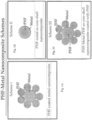
- Three different configurations for fullerene-metal nanocomposites are shown in Figures 1A-1C.
- Figure 1A shows a PHF-coated metal nanocomposite in which the fullerene molecules are attached around a metal nanoparticle core.
- a plurality of fullerene compounds are bonded to the outside of a metal nanoparticle core.
- Figure 1B shows a nanocomposite having a PHF core and a metal shell around the core.
- Figure 1C shows a nanocomposite having a PHF core and metal shell that is coated with PHF.
- Figures 1B and 1C both illustrate embodiments in which a fullerene compound is within the metal nanoparticle of the fullerene-metal nanocomposite.
- Functionalized fullerenes include fullerenes with functional groups attached to the outer surface of the cage via covalent bonds, ionic bonds, or Dewar coordination, or Kubas interactions, or any combination thereof.
- functional groups include hydroxyl, sulfhydryl, amine, and carboxyl groups.
- Polyhydroxy fullerenes (PHF) are water-soluble form of fullerenes including hydroxyl functional groups. Because the fullerene is "functionalized,” the total of t, u, v, w, x and y must be 1 or more in order for a functional group to be present in the formula.
- the number of functional groups attached per cage of fullerene can vary from 1 to a majority of the number of carbons in the fullerene cage.
- Fullerenes are spherical cages made of carbon atoms with a general formula of C 2n , where n can range from 10 to 270.
- the molecular formula for a relatively unmodified PHF is C 2n (OH) t O y M z ; where M is an alkali metal, alkaline earth metal, or transition metal; t is in the range of 8 to 60; y is in the range of 0 to 30; and z is in the range of 0 to 30.
- Functionalized fullerenes can be of a single size or can be mixtures of different fullerene sizes.
- the fullerene cage can be C 28 , C 32 , C 44 , C 50 , C 58 , C 60 , C 70 , C 84 , C 250 , C 540 , or any other fullerene.
- a fullerene which contains 60 carbon atoms is denoted C 60 .
- n is 14, 16, 22, 25, 29, 30, 35, 42, 125, and 270, respectively.
- Polyhydroxy fullerenes have an average of about 1.25 to 3 C atoms per OH group, which is equivalent to about 27 to about 48 OH groups on a C 60 cage.
- Functionalized fullerenes are often C 60 molecules due to their commercial availability, but other fullerene cages such as C 70 , C 82 or their mixtures or other functionalized fullerenes can be used in various embodiments of the invention.
- Functionalized fullerenes have numerous C-C single bonds that can be observed by Fourier transform infrared spectroscopy (FTIR).
- FTIR Fourier transform infrared spectroscopy
- the functionalized fullerene is a PHF according to the formula C 2n (OH) t O y M z , which corresponds to the broader formula wherein u. v, w, and x are 0.
- the structure of unmodified polyhydroxy fullerene is shown in Figure 2 .
- the polyhydroxy fullerene is a compound according to formula C 2n (OH) t , which corresponds to a functionalized fullerene wherein t is 1 to 60, and u, v, w, x, y, and z are 0.
- the polyhydroxy fullerene is a compound according to the formula C 2n (OH) t (SH) u O y M z , which corresponds to a functionalized fullerene wherein v, w and x are 0.
- the polyhydroxy fullerene is a compound according to the formula C 2n (OH) t (NH 2 ) v O y M z , which corresponds to a functionalized fullerene wherein u, w and x are 0.
- the polyhydroxy fullerene is a compound according to the formula C 2n (OH) t (COOH) w O y M z , which corresponds to a functionalized fullerene wherein u, v and x are 0.
- the polyhydroxy fullerene is a compound according to the formula C 2n (OH) t (COOM) x O y M z , which corresponds to a functionalized fullerene wherein u, v and w are 0.
- the specific variants within the formula are examples of the types of functionalized fullerenes encompassed by the formula, and are not meant to limit the scope of the claim to these specific examples.
- the number of hydroxyl (OH), sulfhydryl (SH), amine (NH 2 ), carboxyl (COOH), metal carboxylate (COOM), oxygen (O) and metal (M) groups can all vary between different functionalized fullerenes.
- the number can range from 0 to 60, 1 to 60, 8 to 60, 12 to 60, 20 to 60, 0 to 50, 1 to 50, 8 to 50, 12 to 50, 20 to 50, 0 to 40, 1 to 40, 8 to 40, 12 to 40, 20 to 40, 0 to 30, 1 to 30, 8 to 30, 12 to 30, or 20 to 30, or any other ranges within 0 to 60.
- the number can range from 0 to 30, 1 to 30, 4 to 30, 8 to 30, 12 to 30, 0 to 20, 1 to 20, 4 to 20, 8 to 20, 12 to 20, 0 to 10, 1 to 10, and 4 to 10.
- the functionalized fullerenes have a formula of C 2n (OH) t O y M1 a M2 b ; where M1 and M2 are different alkali metals, alkaline earth metals, transition metals, post-transition metal, lanthanide, or actinide; t is in the range of 0 to 60; y, a and b are in the range of 0 to 30.
- the functionalized fullerenes include carbon or polymer strands bound to the surface of the fullerene cage.
- the carbon or polymer strands can include polyethylene, polyethylene glycol, polyanhydrides, polyesters, and polyolefins.
- the functionalized fullerene is a compound according to C 2 [C m O p H q ](COOH) r (COOM) s (OH) t O y M z ; where carboxylic acid or metal salts are attached directly to fullerene cage or via the one or more carbon or polymer chains [C m O p H q ]; m is in the range of 1 to 30 and p is in the range of 0 to 15, q is in the range of 2 to 60; n is in the range of 10 to 270, r, s and t are in the range of 0 to 60; M is an alkali metal, alkaline earth metal, transition metal, post-transition metal or lanthanide; x is in the range of 0 to 60; y, z are in the range of 0 to 30.
- the functionalized fullerene is a compound according to C 2n [C m O p H q ](OH) t (NH 2 ) v O y M z ; where amine groups are attached directly to fullerene cage or via the one or more carbon or polymer chains [C m O p H q ]; m is in the range of 1 to 30 and p is in the range of 0 to 15, q is in the range of 2 to 60; n is in the range of 10 to 270, t is in the range of 0 to 60, v is in the range of 1 to 60, M is an alkali metal, alkaline earth metal, transition metal, post-transition metal or lanthanide; and y and z are in the range of 0 to 30.
- any of the above functionalized fullerenes can be prepared as endohedral metallofullerenes. See for example Lu et al., Chem Commun (Camb)., 50(94), pp. 14701-15 (2014 ), and Lu et al., Chem Soc Rev., 41(23), pp. 7723-60 (2012 ).
- Endohedral metallofullerenes have been made using a variety of different metals and rare earth metals, such as gadolinium, scandium, scandium-titanium, samarium, yttrium, neodymium, dysprosium, erbium, and lutetium.
- Gd@C 60 , Gd 3 N@C60, and Sc 3 N@C 80 are typical endohedral fullerenes.
- Functionalized fullerenes may be synthesized by synthetic routes that include processes similar to those well known in the chemical arts, particularly in light of the description contained herein. See for Example U.S. Patent No. 9,084,989 , and U.S. Patent Publication No. 2007/0202413 .
- a number of fullerenes are also commercially available. See for example the Fullerene Supplier Database provided online by Nanotechnik TM .
- the fullerene-metal nanocomposite includes metal nanoparticles.
- metal nanoparticles does not require that the metal nanoparticle be a discrete particle, but rather in some embodiments can be a metal shell around a fullerene particle.
- the metal nanoparticle can be made of any metal.
- Metal groups suitable for the metal nanoparticles included in the nanocomposites of the present invention include transition metals (e.g., gold, silver and platinum), post-transition metals (e.g., aluminum, indium and lead), lanthanides (e.g., cerium, gadolinium and terbium), and actinides (e.g., uranium, thorium and plutonium).
- the metal nanoparticle is selected from the group consisting of gold, silver, copper, platinum, iron, and palladium nanoparticles.
- a preferred metal nanoparticle is a gold nanoparticle.
- the metal nanoparticle size can range from 0.1 nm to 150 nm. Other suitable ranges include 0.5 nm to 100 nm, 0.5 nm to 50 nm, and 1.0 nm to 50 nm.
- the metal nanoparticle can be in form of nanoclusters (0.1 - 10 nm), nanoparticles (5 nm - 150 nm), nanorods, or any other crystalline shape (e.g., hexagonal, octagonal bipyramid and cubic).
- Metal nanoclusters consist of a small number of metal atoms, typically in the tens.
- a preferred size range of the metal nanoparticles, particularly for antimicrobial application, is 0.5 nm - 5 nm.
- the present invention provides a method of making a fullerene-metal nanocomposite.
- the method consists essentially of the steps of: a) mixing a water solution of metal salt or metal ion with a functionalized fullerene compound dispersed or dissolved in water, according to the formula C 2n (OH) t (SH) u (NH 2 ) v (COOH) w (COOM) x O y M z , wherein M is an alkali metal, alkaline earth metal, transition metal, post-transition metal, lanthanide, or actinide, n is a number ranging from 10 to 270, t is number ranging from 1 to 60, u is a number ranging from 0 to 60, v is a number ranging from 0 to 60, w is a number ranging from 0 to 60, x is a numbering ranging from 0 to 60, y is a number ranging from 0 to 30, and z is a number ranging
- the specific functionalized fullerenes and metal salts or ions can be any of the functionalized fullerenes or metals suitable for nanoparticles described herein.
- the metal salt is selected from the group consisting of gold, silver, copper, platinum, iron, and palladium salts, while in yet further embodiments the metal salt is a HAuCl 4 .
- Metal salts can easily be prepared by immersing a metal in an acid or base solution, with the nature of the salt depending on the solution used. Examples of suitable salts include both inorganic and organic salts such as acetate, carbonate, chloride, citrate, cyanide, nitrate, nitrite, oxide, phosphate, and sulfate.
- u, v, w, and x of the fullerene compound formula are 0, while in further embodiments u, v, w, x, y, and z of the fullerene compound formula are 0.
- n of the fullerene compound formula is 30, resulting in a C 60 fullerene being used.
- fullerene-metal nanocomposite The key components required to make a fullerene-metal nanocomposite are the metal salt (or metal ion) and the functionalized fullerene. Furthermore, in order to make a nanocomposite, the fullerene compound(s) must have the ability to associate with the metal when mixed. Fullerene-metal nanocomposites can be made so long as functionalized fullerenes and metal salts (and/or metal ions) are mixed together in solution. Additional components can be present in the reaction mixture, so long as they don't interfere with the association of the functionalized fullerene with the metal. Interfering components can be easily avoided by those skilled in the art, or readily identified without undue experimentation.
- a variety of ratios of functionalized fullerene to metal salt or metal ion can be used, although different ratios can affect the amount and nature of the fullerene-metal nanocomposites that are formed. While the nanocomposites are formed upon mixing, it is generally preferable to also include a step in which the nanocomposites are purified from the reaction mixture so that the nanocomposites are substantially isolated from the reaction mixture.
- Reaction of the functionalized fullerene with metal is typically carried out at room temperature. Increasing temperature speeds the reaction kinetics, while decreasing temperature can decrease the reaction kinetics and affect the particle size as well.
- the nanocomposites typically form within a few minutes. The amount of nanocomposites formed increases with time reaching the maximum in 1 hour to 12 hours depending on the temperature and the concentration of reactants.
- the method also includes the step of adjusting the pH of the solution.
- the pH (potential of hydrogen) is a numeric logarithmic scale used to specify the acidity or basicity of an aqueous solution.
- a pH from 2 to 12 may be used for the reaction mixture.
- it is preferable to adjust the pH to a basic value i.e., from greater than 7 to 12
- it is preferable to adjust the pH to an acidic value i.e., from less than 7 to 2).
- a relatively neutral pH from 6 to 8 is preferred. Acid is added to reduce the pH, while a base is added to increase the pH.
- a suitable acid is 1 M HCl
- a suitable base is 1 M NaOH.
- the pH of the solution can affect the nature and yield of the fullerene-metal nanocomposite formed by the reaction. For example, for certain functionalized fullerenes, increasing pH ( ⁇ 10) accelerates the reaction kinetics. In another example, decreasing the pH ( ⁇ 4) results in smaller size of nanocomposites.
- the ratio of metal salt or metal ion to functionalized fullerene (FF) used in the method of making depends on the type and size of the desired nancomposite.
- the size of the nanocomposite can be varied by changing the ratio of metal ion and initial concentration of FF.
- the FF/metal ratio can vary from 0.01 - 200 mg/mL of FF to mM of metal solution.
- a preferred FF/metal ratio for FF-gold nanocluster is 2 - 200 mg/mL FF to mM metal solution.
- the inventors have synthesized PHF-gold nanoclusters at ratio of 2, 7, 125 and 150 (The ratios of PHF (mg/mL) to gold chloride (mM)), which suggests that FF concentration can also have an effect on the nanocomposites formed.
- the FF concentration can range from 1 ng/mL to 100 mg/mL.
- the preferred FF concentration for FF-gold nanocluster is in the range of 1 - 20 mg/mL.
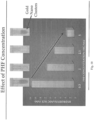
- Figure 10 provides a schematic/graphic representation showing that as PHF concentration increases, that the particle size of PHF-gold nanocomposites formed decreases.
- the size of nanocomposites decrease below 5 nm at ratios greater than 20 (mg/mL of PHF to mM HAuCl 4 ).
- the size of gold nanoclusters decreases with increase in ratio above 20.
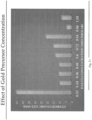
- Figure 11 provides a graph showing the effect of concentration of a metal salt precursor (i.e., HAuCl 4 millimolar) on hydrodynamic size (nm).
- a metal salt precursor i.e., HAuCl 4 millimolar
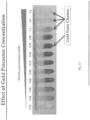
- FIG. 12 provides an image showing the effect of HAuCl4 concentration on PHF-gold nanocomposite formation.
- the functionalized fullerenes are dissolved or dispersed in water in order to more readily mix them as solutions.
- the functionalized fullerene and metal salts or ions can be dispersed or dissolved in the water solvent separately or together. It is known to those skilled in the art that because of the nanoscale size of functionalized fullerenes, as well as their solubility in polar and non-polar solvents, that the terms such as “dissolve,” “disperse” and “suspend” can be interchangeable herein, as can be “solution,” “dispersion” and “suspension,” as in some cases it is not readily apparent that for the liquid phase employed if a true solution or a suspension is formed. In some embodiments of the invention, as is obvious to one skilled in the art, a solution and dispersion are distinct entities.
- the solvent or reaction media is aqueous (e.g., de-ionized water or pH adjusted water).
- the fullerene-metal nanocomposite is purified from the solution.
- Methods for purifying nanocomposites are centrifugation, dialysis, chromatographic methods, phase transfer, and tangential flow filtration.
- the fullerene-metal nanocomposite is purified by centrifugation or dialysis. Purified particles can be further washed to improve their purity, but obtaining 100% purity is not necessary for the nanocomposites to remain stable.
- the fullerene-metal nanocomposites described herein have antimicrobial activity, and can be included in a coating to provide an antimicrobial surface.
- the antimicrobial surface includes a substrate surface and a coating on the substrate surface comprising a fullerene-metal nanocomposite, comprising a metal nanoparticle bonded to a fullerene compound according to the formula C 2n (OH) t (SH) u (NH 2 ) v (COOH) w (COOM) x O y M z , wherein M is an alkali metal, alkaline earth metal, transition metal, post-transition metal, lanthanide, or actinide, n is a number ranging from 10 to 270, t is number ranging from 1 to 60, u is a number ranging from 0 to 60, v is a number ranging from 0 to 60, w is a number ranging from 0 to 60, x is a numbering 0 to 60, y is a
- the specific functionalized fullerenes and metal nanoparticles can be any of the functionalized fullerenes or metal nanoparticles described herein.
- the metal nanoparticle is a gold nanoparticle, while in other embodiments, u, v, w, x, y, and z of the fullerene compound formula are 0.
- the fullerene-metal nanocomposite can be applied to a surface to provide it with antimicrobial activity.
- the fullerene-metal nanocomposite is mixed with or placed upon a carrier, such as a polymer, to provide an antimicrobial coating.
- the antimicrobial coating may be applied to the surface of a variety of substrate materials, including but not limited to synthetic and naturally occurring organic and inorganic polymers, plastics, metals, glass, and ceramics. While the coating formulations of the invention may applied either directly on materials with a hydrophilic surface such as metals, glass and cellulose or optionally on top of a primer undercoat, materials with hydrophobic surfaces such as silicone are subject to a surface pre-treatment step prior to application of the coating.
- the substrate may be a device configured to be worn on a human body (e.g., jewelry, clothing, surgical gowns, masks, gloves, etc.).
- the substrate may be a structure configured to hold, support and/or house a subject (e.g., gurney, chair, bed, table, etc.).
- the coating may be applied to all or a portion of the substrate, particularly those surfaces of the substrate that may be placed in contact with a bodily fluid (e.g., a handle, supporting surface, etc.).
- the substrate may be a household item, such as a cutlery (e.g., spoons, baby spoons, forks, etc.), food handling items (e.g., platters, plates, straws, cups, etc.), handles (e.g., doorknobs, pushes, etc.), faucets, drains, tubs, toilets, toilet knobs, light switches, etc.
- a cutlery e.g., spoons, baby spoons, forks, etc.
- food handling items e.g., platters, plates, straws, cups, etc.
- handles e.g., doorknobs, pushes, etc.
- faucets drains, tubs, toilets, toilet knobs, light switches, etc.
- the substrate surface comprises the outer surface of a medical device.
- the medical device may be device configured to be temporarily or permanently inserted into the body (e.g., surgical tools, implants, etc.).
- the substrate surface may be the outer surface of one of: a pacemaker, defibrillator, neurostimulator, or ophthalmic implant.
- the substrate surface may also be the outer surface of one of: an implantable shunt, an artificial joint, a hip implant, a knee implant, a catheter, a stent, an implantable coil, a pump, an intrauterine device (IUD), a heart valve, a surgical fastener, a surgical staple, a surgical pin, a surgical screw, a suture (e.g., surgical suture material, or other suture), an implantable electrical lead, or an implantable plate.
- the substrate surface may also be the outer surface of one of: a retractor, a bariatric balloon, an orthodontic brace, a breast implant, a surgical sponge, a gauze, a mesh pouch (e.g., mesh envelope) or a wound packing material.
- the substrate surface comprises a porous surface such as a membrane or porous filter.
- Filtration technology remains the most effective and economical means for air and water purification and disinfection.
- a problem with conventional filtration technology is that microbes trapped in filters can remain viable to the extent they can grow in and colonize the filter.
- the warm and humid environment encourages microbial growth and presents a two-fold problem.
- the colonization also poses a clear risk of contamination of the air to be filtered by the very pathogenic bacteria, viruses and fungi that the filter is designed to eliminate. Accordingly, it can be very beneficial to supply such surfaced with an antimicrobial coating to prevent colonization of the filter.
- An antimicrobial coating comprising the fullerene-metal nanocomposite can be applied on porous materials and porous media.
- porous materials and porous media were used as substrates for coating with the instant antimicrobial material.
- Porous materials include, but are not limited to, personal protective equipment, i.e. lab coats, facial masks, shoe covers and hair caps, household products, i.e. tissues, linens, napkins, curtains and tablecloths, clothes and infant products, i.e. diapers, wipes and toys.
- Porous media may include membranes and filters made up of different materials such as polymers, ceramics and metals. Typical embodiments are commercial polyethylene membrane and high-efficiency particulate arrestance (HEPA) filters.
- HEPA high-efficiency particulate arrestance
- the fullerene-metal nanocomposite is applied to the surface of the substrate as a coating.
- the coating readily adheres to the surface of the substrate, and retains the nanocomposite on the surface of the substrate.
- the fullerene-metal nanocomposites can be mixed into the coating, or placed upon the coating.
- the coating further comprises a polymer.
- Suitable polymers for providing an antimicrobial coating with the fullerene-metal nanocomposite include acrylics, urethanes, methacrylates, silicones, silica precursors (tetraethyl ortho silicate), glycolates (poly ethylene glycol), styrenes, di-block and tri-block co-polymers (e.g., pluronics).
- the concentration of the fullerene-metal nanocomposite included in the coating can range from 1 ng/m 2 to 1 g/m 2 . In some embodiments, the concentration can range from 10 ng/m 2 to 500 mg/m 2 . In further embodiments, the concentration can range from 100 ng/m 2 to 100 mg/m 2 . A preferred concentration range is from 1 mg/m 2 to 100 mg/m 2 .
- the fullerene-metal nanocomposite can be coated on surfaces by wiping, brushing, casting, dip-coating, spin-coating or spraying.
- the resulting antimicrobial coating exhibits the advantages of the different components displaying a multi-level, wide-spectrum and durable antimicrobial performance at broad range of temperatures.
- the instant coatings are employed in without otherwise changing the properties and functions of the substrate. For example, a porous filter material will function as originally intended with the added benefit and result of the antimicrobial coating as described herein.
- the coating thickness can range from 0.01 - 1000 microns. In some embodiments, the coating has a thickness from 0.1 to 1000 microns. In other embodiments, the coating has a thickness from 0.1 to 100 microns. In further embodiments, the coating has a thickness from 0.1 to 10 microns. The preferred thickness for the coating is less than 0.5 microns. In some embodiments, a substantially smooth (i.e., uniform) coating is applied. In other embodiments, an uneven or non-uniform coating is applied. Both types of surfaces have advantages in some situations. An advantage to providing a non-uniform coating is that a greater surface area is provided that can generate a larger antimicrobial effect.
- Fullerene-metal nanocomposites can be used in a variety of applications other than antimicrobial use that utilizes their electronic properties, such as solar cell, biosensors and electronic circuits.
- metal nanoparticles of the prior art have capping agents to control the size of nanoparticles. These capping agents are organic compounds that limit electron transfer between the metal nanoparticles and materials of interest. For example, in design of solar cells with gold and fullerenes, the capping agents hinder the electron transfer between fullerene and gold nanoparticles and a direct contact is ideal.
- the present invention allows direct contact of fullerenes with metal nanoparticles providing superior properties for solar cell applications.
- capping agents reduce the theoretical efficiency of biosensors and electronic circuits designed with metal nanoparticles.
- Functionalized fullerenes are excellent electron relays, and as a result of their direct contact with metal nanoparticles, they can overcome the drawbacks of convention metal nanoparticles with capping agents for applications including catalysis, solar cells, biosensors, electronic circuits, thermal regulators and DNA hybridization.
- PHF polyhydroxyfullerene
- AuNP gold nanoparticles
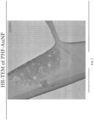
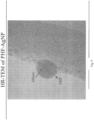
- FIG. 1 provides a high-resolution transmission electron microscopy (HR-TEM) image of PHF-gold nanoparticle nanocomposites at a magnification of 22,500 ⁇ that were synthesized by simple mixing of HAuCl 4 and PHF, illustrating the uniform size of the nanocomposites.
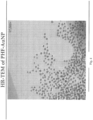
- Figure 4 provides an HR-TEM image of PHF-gold nanoparticle nanocomposites at a magnification of 97,000 ⁇ . This image shows the uniform size distribution can be obtained by simple mixing of HAuCl 4 and PHF.
- Figure 5 provides an HR-TEM image of a single PHF-gold nanoparticle nanocomposite at a magnification of 500,000 ⁇ , showing the presence of a PHF layer surrounding a gold nanoparticle core.
- Figure 6 provides an X-ray photoelectron spectroscopy (XPS) graph showing the type of elements found in PHF-gold nanoparticle nanocomposite.
- Silicon (Si) is from the substrate on which PHF-gold nanoparticles were deposited for XPS analysis.
- Figure 7 provides a high-resolution XPS graph for C1s that is similar to the PHF used and hence confirms the presence of PHF on the gold nanoparticles.
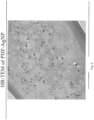
- Figure 8 provides an HR-TEM image of PHF-silver nanoparticle nanocomposites at a magnification of 52,000 ⁇ .
- Figure 9 provides an HR-TEM image of a single PHF-silver nanoparticle nanocomposite at a magnification of 600,000 ⁇ , showing the presence of a PHF layer surrounding a silver nanoparticle core.
- Figures 13A and 13B provide images at a magnification of 500,000 ⁇ showing the formation of PHF-gold nanorod nanocomposites having a length around 20 nm and width around 10 nm.
- Figure 14 provides an image at a magnification 120,000 ⁇ showing a large PHF-gold nanoparticle nanocomposite having a size close to 80 nm.
- Figures 15A and 15B provide images showing PHF-gold nanocluster nanocomposites with uniform size distribution in the range of 3 to 5 nm. Magnification for 15A is 35,000 ⁇ and 15B is 500,000 ⁇ .
Landscapes
- Chemical & Material Sciences (AREA)
- Health & Medical Sciences (AREA)
- Engineering & Computer Science (AREA)
- Organic Chemistry (AREA)
- Nanotechnology (AREA)
- Inorganic Chemistry (AREA)
- Life Sciences & Earth Sciences (AREA)
- Medicinal Chemistry (AREA)
- General Health & Medical Sciences (AREA)
- Materials Engineering (AREA)
- Animal Behavior & Ethology (AREA)
- Epidemiology (AREA)
- Public Health (AREA)
- Veterinary Medicine (AREA)
- General Chemical & Material Sciences (AREA)
- Chemical Kinetics & Catalysis (AREA)
- Pharmacology & Pharmacy (AREA)
- Biophysics (AREA)
- Biotechnology (AREA)
- General Engineering & Computer Science (AREA)
- Medical Informatics (AREA)
- Molecular Biology (AREA)
- Bioinformatics & Cheminformatics (AREA)
- Crystallography & Structural Chemistry (AREA)
- Pharmaceuticals Containing Other Organic And Inorganic Compounds (AREA)
- Carbon And Carbon Compounds (AREA)
Claims (8)
- Verfahren zur Herstellung eines Fulleren-Metall-Nanoverbundwerkstoffs, das im Wesentlichen aus den folgenden Schritten besteht:a) Mischen einer Wasserlösung von Metallsalz oder Metallion mit einer in Wasser dispergierten oder gelösten funktionalisierten Fullerenverbindung gemäß der Formel C2n(OH)t(SH)u(NH2)v(COOH)w(COOM)xOyMz, wobei M für ein Alkalimetall, Erdalkalimetall, Übergangsmetall, Nachübergangsmetall, Lanthanid oder Actinid steht, n für eine Zahl im Bereich von 10 bis 270 steht, t für eine Zahl im Bereich von 1 bis 60 steht, u für eine Zahl im Bereich von 0 bis 60 steht, v für eine Zahl im Bereich von 0 bis 60 steht, w für eine Zahl im Bereich von 0 bis 60 steht, x für eine Zahl im Bereich von 0 bis 60 steht, y für eine Zahl im Bereich von 0 bis 30 steht und z für eine Zahl im Bereich von 0 bis 30 steht, in einer wässrigen Lösung unter Bildung eines Fulleren-Metall-Nanoverbundwerkstoffs,b) Einstellen des pH-Werts der Lösung undc) Reinigen des Fulleren-Metall-Nanoverbundwerkstoffs aus der Lösung unter Verwendung eines aus der Gruppe bestehend aus Zentrifugation, Dialyse, Chromatographie, Phasentransfer und Tangentialstromfiltration ausgewählten Reinigungsverfahrens.
- Herstellungsverfahren nach Anspruch 1, wobei es sich bei dem Metallsalz um HAuCl4 handelt.
- Herstellungsverfahren nach Anspruch 1, wobei es sich bei dem Metallsalz um AgNO3 handelt.
- Verfahren nach Anspruch 1, wobei die Reinigung der Fulleren-Metall-Nanoverbundwerkstoffe aus der Lösung mittels Zentrifugation erfolgt.
- Verfahren nach Anspruch 1, wobei das Einstellen des pH-Werts das Einstellen des pH-Werts auf einen neutralen pH-Wert von 6 bis 8 umfasst.
- Verfahren nach Anspruch 1, wobei der Fulleren-Metall-Nanoverbundwerkstoff eine Größe von 0,5 nm bis 5,0 nm aufweist, wobei die Teilchengröße unter Verwendung eines Transmissionselektronenmikroskops gemessen wird.
- Verfahren nach Anspruch 1, wobei u, v, w und x für 0 stehen.
- Verfahren nach Anspruch 1, wobei n für 30 steht.
Applications Claiming Priority (2)
| Application Number | Priority Date | Filing Date | Title |
|---|---|---|---|
| US201762453676P | 2017-02-02 | 2017-02-02 | |
| PCT/US2018/016598 WO2018144823A1 (en) | 2017-02-02 | 2018-02-02 | Functionalized fullerene metal nanocomposites |
Publications (2)
| Publication Number | Publication Date |
|---|---|
| EP3576798A1 EP3576798A1 (de) | 2019-12-11 |
| EP3576798B1 true EP3576798B1 (de) | 2023-07-26 |
Family
ID=61193216
Family Applications (1)
| Application Number | Title | Priority Date | Filing Date |
|---|---|---|---|
| EP18704843.4A Active EP3576798B1 (de) | 2017-02-02 | 2018-02-02 | Verfahren zur herstellung von metall - funktionalisierter fullerene nanoverbundstoff |
Country Status (3)
| Country | Link |
|---|---|
| US (1) | US11267708B2 (de) |
| EP (1) | EP3576798B1 (de) |
| WO (1) | WO2018144823A1 (de) |
Families Citing this family (5)
| Publication number | Priority date | Publication date | Assignee | Title |
|---|---|---|---|---|
| KR102562279B1 (ko) * | 2018-01-26 | 2023-07-31 | 삼성전자주식회사 | 도금액과 금속 복합 재료 및 그 제조 방법 |
| GB2604362A (en) * | 2021-03-03 | 2022-09-07 | Gant Innovations Ltd | Protective articles |
| CN113842916A (zh) * | 2021-10-28 | 2021-12-28 | 厦门大学 | 一种富勒烯稳定的亚铜功能材料及其制备方法和应用 |
| CN114044992B (zh) * | 2021-11-29 | 2023-04-07 | 厦门福纳新材料科技有限公司 | 一种含铜抗菌高分子复合材料及其制备方法和应用 |
| WO2024191143A1 (ko) * | 2023-03-12 | 2024-09-19 | 최종훈 | 다중 금속 나노복합체 |
Citations (1)
| Publication number | Priority date | Publication date | Assignee | Title |
|---|---|---|---|---|
| EP1941887A1 (de) * | 2005-09-19 | 2008-07-09 | Inst. of High Energy Phys., Chinese Acad. of Sc. | Metallo-fullerenole und ihre anwendung bei der herstellung von medikamenten zur hemmung des tumorwachstums |
Family Cites Families (5)
| Publication number | Priority date | Publication date | Assignee | Title |
|---|---|---|---|---|
| US6683783B1 (en) * | 1997-03-07 | 2004-01-27 | William Marsh Rice University | Carbon fibers formed from single-wall carbon nanotubes |
| DE29916518U1 (de) * | 1999-09-15 | 2000-06-29 | Donath, Jutta, 13051 Berlin | Vorrichtung zur kontinuierlichen licht-induzierten Keimreduzierung mittels fester, unlöslicher und schichtförmig aufgetragener Photosensibilisatorstrukturen für Anwendungen in Konservierungs- und Vorratsbehältern, Umwälz- und Durchflußanlagen |
| WO2007101057A2 (en) | 2006-02-23 | 2007-09-07 | The Regents Of The University Of California | Pegylated fullerenes as lithium solid electrolyte |
| WO2010008889A2 (en) | 2008-06-24 | 2010-01-21 | University Of Florida Research Foundation, Inc. | Enhancement of electron scavenging by water-soluble fullerenes |
| CN101961785A (zh) | 2010-10-21 | 2011-02-02 | 中国科学院上海应用物理研究所 | 一种纳米金-富勒烯纳米复合材料的制备方法 |
-
2018
- 2018-02-02 EP EP18704843.4A patent/EP3576798B1/de active Active
- 2018-02-02 US US16/483,096 patent/US11267708B2/en active Active
- 2018-02-02 WO PCT/US2018/016598 patent/WO2018144823A1/en not_active Ceased
Patent Citations (1)
| Publication number | Priority date | Publication date | Assignee | Title |
|---|---|---|---|---|
| EP1941887A1 (de) * | 2005-09-19 | 2008-07-09 | Inst. of High Energy Phys., Chinese Acad. of Sc. | Metallo-fullerenole und ihre anwendung bei der herstellung von medikamenten zur hemmung des tumorwachstums |
Non-Patent Citations (2)
| Title |
|---|
| C. LANZELLOTTO ET AL: "Nanostructured enzymatic biosensor based on fullerene and gold nanoparticles: Preparation, characterization and analytical applications", BIOSENSORS AND BIOELECTRONICS, vol. 55, 25 December 2013 (2013-12-25), AMSTERDAM, NL, pages 430 - 437, XP055722384, ISSN: 0956-5663, DOI: 10.1016/j.bios.2013.12.028 * |
| VWR: "Methanol >=99.8% ACS, VWR Chemicals BDH", 19 May 2021 (2021-05-19), pages 1 - 4, XP055805654, Retrieved from the Internet <URL:https://us.vwr.com/store/product/4548839/methanol-99-8-acs-vwr-chemicals-bdh> [retrieved on 20210519] * |
Also Published As
| Publication number | Publication date |
|---|---|
| EP3576798A1 (de) | 2019-12-11 |
| US20200231441A1 (en) | 2020-07-23 |
| US11267708B2 (en) | 2022-03-08 |
| WO2018144823A1 (en) | 2018-08-09 |
Similar Documents
| Publication | Publication Date | Title |
|---|---|---|
| US11267708B2 (en) | Functionalized fullerene metal nanocomposites | |
| US8318698B2 (en) | Process for synthesizing silver-silica particles and applications | |
| EP3461333B1 (de) | Desodorierendes/antibakterielles/antimykotisches mittel, verfahren zur herstellung davon und element mit desodorierenden/antibakteriellen/antimykotischen mitteln auf seiner oberfläche | |
| CA2647325C (en) | Methods and systems for preparing antimicrobial bridged polycyclic compounds | |
| EP2136621B1 (de) | Antimikrobielle substanz | |
| Yan et al. | Immobilization of highly dispersed Ag nanoparticles on carbon nanotubes using electron-assisted reduction for antibacterial performance | |
| BRPI0718908A2 (pt) | Uso de uma substância inorgânica consistindo em moo2 e/ou moo3 que causa a formação de cátions de hidrogênio quando em contato com um meio aquoso para conseguir um efeito antimicrobiano | |
| KR20120116387A (ko) | 나노 은-산화아연 조성물 | |
| Dong et al. | Preparation and characterization of SiO2/polydopamine/Ag nanocomposites with long-term antibacterial activity | |
| CN114010845A (zh) | 一种近红外光响应抗菌涂层及制备方法 | |
| Wang et al. | Novel candy-like Cu4O3 microstructure: facile wet chemical synthesis, formation mechanism, and good long-term antibacterial activities | |
| Guo et al. | Electrophoretic deposition of photothermal responsive antibacterial coatings on titanium with controlled release of silver ions | |
| Cheng et al. | Silanization of a metal–polyphenol coating onto diverse substrates as a strategy for controllable wettability with enhanced performance to resist acid corrosion | |
| Haugen et al. | Antibacterial effects of titanium dioxide in wounds | |
| Jia et al. | Mussel bioinspired morphosynthesis of substrate anchored core–shell silver self-assemblies with multifunctionality for bioapplications | |
| CN113854314A (zh) | 光催化抗菌材料及其制备方法和光催化抗菌剂 | |
| JP2003212707A (ja) | 抗菌・抗カビ性粉末及びその製造方法 | |
| EP3329778B1 (de) | Verfahren zur synthese von antimikrobiellen kupfer nanopartikeln | |
| JPH04231062A (ja) | 抗菌性医療用品 | |
| WO2022150935A1 (es) | Nanopartículas de cobre y método de preparación, nanopolímeros que las comprenden, composición desinfectante y película/film adhesiva antimicrobiana protectora de superficies. | |
| Ivković et al. | Biocidal properties of CuO nanoparticles | |
| CN112155017A (zh) | 一种纳米银线复合材料及其制备方法与应用 | |
| WO2018027318A1 (en) | Co-deposition products, composite materials and processes for the production thereof | |
| US20250389008A1 (en) | New composite layer and method of producing a composite layer | |
| Antony et al. | Photo-Assisted Antimicrobial Activity of Transition Metal Oxides |
Legal Events
| Date | Code | Title | Description |
|---|---|---|---|
| STAA | Information on the status of an ep patent application or granted ep patent |
Free format text: STATUS: UNKNOWN |
|
| STAA | Information on the status of an ep patent application or granted ep patent |
Free format text: STATUS: THE INTERNATIONAL PUBLICATION HAS BEEN MADE |
|
| PUAI | Public reference made under article 153(3) epc to a published international application that has entered the european phase |
Free format text: ORIGINAL CODE: 0009012 |
|
| STAA | Information on the status of an ep patent application or granted ep patent |
Free format text: STATUS: REQUEST FOR EXAMINATION WAS MADE |
|
| 17P | Request for examination filed |
Effective date: 20190826 |
|
| AK | Designated contracting states |
Kind code of ref document: A1 Designated state(s): AL AT BE BG CH CY CZ DE DK EE ES FI FR GB GR HR HU IE IS IT LI LT LU LV MC MK MT NL NO PL PT RO RS SE SI SK SM TR |
|
| AX | Request for extension of the european patent |
Extension state: BA ME |
|
| DAV | Request for validation of the european patent (deleted) | ||
| DAX | Request for extension of the european patent (deleted) | ||
| STAA | Information on the status of an ep patent application or granted ep patent |
Free format text: STATUS: EXAMINATION IS IN PROGRESS |
|
| 17Q | First examination report despatched |
Effective date: 20200819 |
|
| GRAP | Despatch of communication of intention to grant a patent |
Free format text: ORIGINAL CODE: EPIDOSNIGR1 |
|
| STAA | Information on the status of an ep patent application or granted ep patent |
Free format text: STATUS: GRANT OF PATENT IS INTENDED |
|
| RIC1 | Information provided on ipc code assigned before grant |
Ipc: C22C 26/00 20060101ALN20230209BHEP Ipc: B82Y 5/00 20110101ALI20230209BHEP Ipc: C01B 32/156 20170101ALI20230209BHEP Ipc: C01B 32/152 20170101ALI20230209BHEP Ipc: A61K 31/28 20060101ALI20230209BHEP Ipc: A61L 2/238 20060101ALI20230209BHEP Ipc: A61L 2/232 20060101AFI20230209BHEP |
|
| INTG | Intention to grant announced |
Effective date: 20230222 |
|
| RIN1 | Information on inventor provided before grant (corrected) |
Inventor name: KRISHNA, VIJAY |
|
| GRAS | Grant fee paid |
Free format text: ORIGINAL CODE: EPIDOSNIGR3 |
|
| GRAA | (expected) grant |
Free format text: ORIGINAL CODE: 0009210 |
|
| STAA | Information on the status of an ep patent application or granted ep patent |
Free format text: STATUS: THE PATENT HAS BEEN GRANTED |
|
| P01 | Opt-out of the competence of the unified patent court (upc) registered |
Effective date: 20230529 |
|
| AK | Designated contracting states |
Kind code of ref document: B1 Designated state(s): AL AT BE BG CH CY CZ DE DK EE ES FI FR GB GR HR HU IE IS IT LI LT LU LV MC MK MT NL NO PL PT RO RS SE SI SK SM TR |
|
| REG | Reference to a national code |
Ref country code: CH Ref legal event code: EP |
|
| REG | Reference to a national code |
Ref country code: IE Ref legal event code: FG4D |
|
| REG | Reference to a national code |
Ref country code: DE Ref legal event code: R096 Ref document number: 602018053991 Country of ref document: DE |
|
| REG | Reference to a national code |
Ref country code: SE Ref legal event code: TRGR |
|
| REG | Reference to a national code |
Ref country code: NL Ref legal event code: FP |
|
| REG | Reference to a national code |
Ref country code: LT Ref legal event code: MG9D |
|
| REG | Reference to a national code |
Ref country code: NO Ref legal event code: T2 Effective date: 20230726 |
|
| REG | Reference to a national code |
Ref country code: AT Ref legal event code: MK05 Ref document number: 1591177 Country of ref document: AT Kind code of ref document: T Effective date: 20230726 |
|
| PG25 | Lapsed in a contracting state [announced via postgrant information from national office to epo] |
Ref country code: GR Free format text: LAPSE BECAUSE OF FAILURE TO SUBMIT A TRANSLATION OF THE DESCRIPTION OR TO PAY THE FEE WITHIN THE PRESCRIBED TIME-LIMIT Effective date: 20231027 |
|
| PG25 | Lapsed in a contracting state [announced via postgrant information from national office to epo] |
Ref country code: IS Free format text: LAPSE BECAUSE OF FAILURE TO SUBMIT A TRANSLATION OF THE DESCRIPTION OR TO PAY THE FEE WITHIN THE PRESCRIBED TIME-LIMIT Effective date: 20231126 |
|
| PG25 | Lapsed in a contracting state [announced via postgrant information from national office to epo] |
Ref country code: RS Free format text: LAPSE BECAUSE OF FAILURE TO SUBMIT A TRANSLATION OF THE DESCRIPTION OR TO PAY THE FEE WITHIN THE PRESCRIBED TIME-LIMIT Effective date: 20230726 Ref country code: PT Free format text: LAPSE BECAUSE OF FAILURE TO SUBMIT A TRANSLATION OF THE DESCRIPTION OR TO PAY THE FEE WITHIN THE PRESCRIBED TIME-LIMIT Effective date: 20231127 Ref country code: LV Free format text: LAPSE BECAUSE OF FAILURE TO SUBMIT A TRANSLATION OF THE DESCRIPTION OR TO PAY THE FEE WITHIN THE PRESCRIBED TIME-LIMIT Effective date: 20230726 Ref country code: LT Free format text: LAPSE BECAUSE OF FAILURE TO SUBMIT A TRANSLATION OF THE DESCRIPTION OR TO PAY THE FEE WITHIN THE PRESCRIBED TIME-LIMIT Effective date: 20230726 Ref country code: IS Free format text: LAPSE BECAUSE OF FAILURE TO SUBMIT A TRANSLATION OF THE DESCRIPTION OR TO PAY THE FEE WITHIN THE PRESCRIBED TIME-LIMIT Effective date: 20231126 Ref country code: HR Free format text: LAPSE BECAUSE OF FAILURE TO SUBMIT A TRANSLATION OF THE DESCRIPTION OR TO PAY THE FEE WITHIN THE PRESCRIBED TIME-LIMIT Effective date: 20230726 Ref country code: GR Free format text: LAPSE BECAUSE OF FAILURE TO SUBMIT A TRANSLATION OF THE DESCRIPTION OR TO PAY THE FEE WITHIN THE PRESCRIBED TIME-LIMIT Effective date: 20231027 Ref country code: FI Free format text: LAPSE BECAUSE OF FAILURE TO SUBMIT A TRANSLATION OF THE DESCRIPTION OR TO PAY THE FEE WITHIN THE PRESCRIBED TIME-LIMIT Effective date: 20230726 Ref country code: AT Free format text: LAPSE BECAUSE OF FAILURE TO SUBMIT A TRANSLATION OF THE DESCRIPTION OR TO PAY THE FEE WITHIN THE PRESCRIBED TIME-LIMIT Effective date: 20230726 |
|
| PG25 | Lapsed in a contracting state [announced via postgrant information from national office to epo] |
Ref country code: PL Free format text: LAPSE BECAUSE OF FAILURE TO SUBMIT A TRANSLATION OF THE DESCRIPTION OR TO PAY THE FEE WITHIN THE PRESCRIBED TIME-LIMIT Effective date: 20230726 |
|
| PG25 | Lapsed in a contracting state [announced via postgrant information from national office to epo] |
Ref country code: ES Free format text: LAPSE BECAUSE OF FAILURE TO SUBMIT A TRANSLATION OF THE DESCRIPTION OR TO PAY THE FEE WITHIN THE PRESCRIBED TIME-LIMIT Effective date: 20230726 |
|
| REG | Reference to a national code |
Ref country code: DE Ref legal event code: R097 Ref document number: 602018053991 Country of ref document: DE |
|
| PG25 | Lapsed in a contracting state [announced via postgrant information from national office to epo] |
Ref country code: SM Free format text: LAPSE BECAUSE OF FAILURE TO SUBMIT A TRANSLATION OF THE DESCRIPTION OR TO PAY THE FEE WITHIN THE PRESCRIBED TIME-LIMIT Effective date: 20230726 Ref country code: RO Free format text: LAPSE BECAUSE OF FAILURE TO SUBMIT A TRANSLATION OF THE DESCRIPTION OR TO PAY THE FEE WITHIN THE PRESCRIBED TIME-LIMIT Effective date: 20230726 Ref country code: ES Free format text: LAPSE BECAUSE OF FAILURE TO SUBMIT A TRANSLATION OF THE DESCRIPTION OR TO PAY THE FEE WITHIN THE PRESCRIBED TIME-LIMIT Effective date: 20230726 Ref country code: EE Free format text: LAPSE BECAUSE OF FAILURE TO SUBMIT A TRANSLATION OF THE DESCRIPTION OR TO PAY THE FEE WITHIN THE PRESCRIBED TIME-LIMIT Effective date: 20230726 Ref country code: DK Free format text: LAPSE BECAUSE OF FAILURE TO SUBMIT A TRANSLATION OF THE DESCRIPTION OR TO PAY THE FEE WITHIN THE PRESCRIBED TIME-LIMIT Effective date: 20230726 Ref country code: CZ Free format text: LAPSE BECAUSE OF FAILURE TO SUBMIT A TRANSLATION OF THE DESCRIPTION OR TO PAY THE FEE WITHIN THE PRESCRIBED TIME-LIMIT Effective date: 20230726 Ref country code: SK Free format text: LAPSE BECAUSE OF FAILURE TO SUBMIT A TRANSLATION OF THE DESCRIPTION OR TO PAY THE FEE WITHIN THE PRESCRIBED TIME-LIMIT Effective date: 20230726 |
|
| PLBE | No opposition filed within time limit |
Free format text: ORIGINAL CODE: 0009261 |
|
| STAA | Information on the status of an ep patent application or granted ep patent |
Free format text: STATUS: NO OPPOSITION FILED WITHIN TIME LIMIT |
|
| 26N | No opposition filed |
Effective date: 20240429 |
|
| PG25 | Lapsed in a contracting state [announced via postgrant information from national office to epo] |
Ref country code: SI Free format text: LAPSE BECAUSE OF FAILURE TO SUBMIT A TRANSLATION OF THE DESCRIPTION OR TO PAY THE FEE WITHIN THE PRESCRIBED TIME-LIMIT Effective date: 20230726 |
|
| PG25 | Lapsed in a contracting state [announced via postgrant information from national office to epo] |
Ref country code: MC Free format text: LAPSE BECAUSE OF FAILURE TO SUBMIT A TRANSLATION OF THE DESCRIPTION OR TO PAY THE FEE WITHIN THE PRESCRIBED TIME-LIMIT Effective date: 20230726 |
|
| REG | Reference to a national code |
Ref country code: CH Ref legal event code: PL |
|
| PG25 | Lapsed in a contracting state [announced via postgrant information from national office to epo] |
Ref country code: LU Free format text: LAPSE BECAUSE OF NON-PAYMENT OF DUE FEES Effective date: 20240202 |
|
| PG25 | Lapsed in a contracting state [announced via postgrant information from national office to epo] |
Ref country code: CH Free format text: LAPSE BECAUSE OF NON-PAYMENT OF DUE FEES Effective date: 20240229 |
|
| PG25 | Lapsed in a contracting state [announced via postgrant information from national office to epo] |
Ref country code: LU Free format text: LAPSE BECAUSE OF NON-PAYMENT OF DUE FEES Effective date: 20240202 Ref country code: CH Free format text: LAPSE BECAUSE OF NON-PAYMENT OF DUE FEES Effective date: 20240229 |
|
| PG25 | Lapsed in a contracting state [announced via postgrant information from national office to epo] |
Ref country code: BG Free format text: LAPSE BECAUSE OF FAILURE TO SUBMIT A TRANSLATION OF THE DESCRIPTION OR TO PAY THE FEE WITHIN THE PRESCRIBED TIME-LIMIT Effective date: 20230726 |
|
| PG25 | Lapsed in a contracting state [announced via postgrant information from national office to epo] |
Ref country code: BG Free format text: LAPSE BECAUSE OF FAILURE TO SUBMIT A TRANSLATION OF THE DESCRIPTION OR TO PAY THE FEE WITHIN THE PRESCRIBED TIME-LIMIT Effective date: 20230726 |
|
| REG | Reference to a national code |
Ref country code: BE Ref legal event code: MM Effective date: 20240229 |
|
| PG25 | Lapsed in a contracting state [announced via postgrant information from national office to epo] |
Ref country code: BE Free format text: LAPSE BECAUSE OF NON-PAYMENT OF DUE FEES Effective date: 20240229 |
|
| PG25 | Lapsed in a contracting state [announced via postgrant information from national office to epo] |
Ref country code: IE Free format text: LAPSE BECAUSE OF NON-PAYMENT OF DUE FEES Effective date: 20240202 |
|
| PG25 | Lapsed in a contracting state [announced via postgrant information from national office to epo] |
Ref country code: IE Free format text: LAPSE BECAUSE OF NON-PAYMENT OF DUE FEES Effective date: 20240202 Ref country code: BE Free format text: LAPSE BECAUSE OF NON-PAYMENT OF DUE FEES Effective date: 20240229 |
|
| PG25 | Lapsed in a contracting state [announced via postgrant information from national office to epo] |
Ref country code: CY Free format text: LAPSE BECAUSE OF FAILURE TO SUBMIT A TRANSLATION OF THE DESCRIPTION OR TO PAY THE FEE WITHIN THE PRESCRIBED TIME-LIMIT; INVALID AB INITIO Effective date: 20180202 |
|
| PG25 | Lapsed in a contracting state [announced via postgrant information from national office to epo] |
Ref country code: HU Free format text: LAPSE BECAUSE OF FAILURE TO SUBMIT A TRANSLATION OF THE DESCRIPTION OR TO PAY THE FEE WITHIN THE PRESCRIBED TIME-LIMIT; INVALID AB INITIO Effective date: 20180202 |
|
| PG25 | Lapsed in a contracting state [announced via postgrant information from national office to epo] |
Ref country code: TR Free format text: LAPSE BECAUSE OF FAILURE TO SUBMIT A TRANSLATION OF THE DESCRIPTION OR TO PAY THE FEE WITHIN THE PRESCRIBED TIME-LIMIT Effective date: 20230726 |
|
| PGFP | Annual fee paid to national office [announced via postgrant information from national office to epo] |
Ref country code: NL Payment date: 20260218 Year of fee payment: 9 |
|
| PGFP | Annual fee paid to national office [announced via postgrant information from national office to epo] |
Ref country code: SE Payment date: 20260218 Year of fee payment: 9 |
|
| PGFP | Annual fee paid to national office [announced via postgrant information from national office to epo] |
Ref country code: GB Payment date: 20260224 Year of fee payment: 9 |
|
| PGFP | Annual fee paid to national office [announced via postgrant information from national office to epo] |
Ref country code: NO Payment date: 20260217 Year of fee payment: 9 Ref country code: DE Payment date: 20260217 Year of fee payment: 9 |
|
| PGFP | Annual fee paid to national office [announced via postgrant information from national office to epo] |
Ref country code: IT Payment date: 20260227 Year of fee payment: 9 |
|
| PGFP | Annual fee paid to national office [announced via postgrant information from national office to epo] |
Ref country code: FR Payment date: 20260219 Year of fee payment: 9 |