EP3570983B1 - Haarbehandlungssystem, behandlungen und vorrichtung - Google Patents
Haarbehandlungssystem, behandlungen und vorrichtung Download PDFInfo
- Publication number
- EP3570983B1 EP3570983B1 EP17740917.4A EP17740917A EP3570983B1 EP 3570983 B1 EP3570983 B1 EP 3570983B1 EP 17740917 A EP17740917 A EP 17740917A EP 3570983 B1 EP3570983 B1 EP 3570983B1
- Authority
- EP
- European Patent Office
- Prior art keywords
- water
- tablets
- shower head
- oil
- concentration
- Prior art date
- Legal status (The legal status is an assumption and is not a legal conclusion. Google has not performed a legal analysis and makes no representation as to the accuracy of the status listed.)
- Active
Links
Images

Classifications
-
- B—PERFORMING OPERATIONS; TRANSPORTING
- B05—SPRAYING OR ATOMISING IN GENERAL; APPLYING FLUENT MATERIALS TO SURFACES, IN GENERAL
- B05B—SPRAYING APPARATUS; ATOMISING APPARATUS; NOZZLES
- B05B7/00—Spraying apparatus for discharge of liquids or other fluent materials from two or more sources, e.g. of liquid and air, of powder and gas
- B05B7/24—Spraying apparatus for discharge of liquids or other fluent materials from two or more sources, e.g. of liquid and air, of powder and gas with means, e.g. a container, for supplying liquid or other fluent material to a discharge device
- B05B7/2402—Apparatus to be carried on or by a person, e.g. by hand; Apparatus comprising containers fixed to the discharge device
- B05B7/2462—Apparatus to be carried on or by a person, e.g. by hand; Apparatus comprising containers fixed to the discharge device using a carrying liquid flowing through the container for dissolving a block of solid material
-
- E—FIXED CONSTRUCTIONS
- E03—WATER SUPPLY; SEWERAGE
- E03C—DOMESTIC PLUMBING INSTALLATIONS FOR FRESH WATER OR WASTE WATER; SINKS
- E03C1/00—Domestic plumbing installations for fresh water or waste water; Sinks
- E03C1/02—Plumbing installations for fresh water
- E03C1/04—Water-basin installations specially adapted to wash-basins or baths
- E03C1/046—Adding soap, disinfectant, or the like in the supply line or at the water outlet
-
- B—PERFORMING OPERATIONS; TRANSPORTING
- B05—SPRAYING OR ATOMISING IN GENERAL; APPLYING FLUENT MATERIALS TO SURFACES, IN GENERAL
- B05B—SPRAYING APPARATUS; ATOMISING APPARATUS; NOZZLES
- B05B1/00—Nozzles, spray heads or other outlets, with or without auxiliary devices such as valves, heating means
- B05B1/14—Nozzles, spray heads or other outlets, with or without auxiliary devices such as valves, heating means with multiple outlet openings; with strainers in or outside the outlet opening
- B05B1/18—Roses; Shower heads
-
- A—HUMAN NECESSITIES
- A61—MEDICAL OR VETERINARY SCIENCE; HYGIENE
- A61K—PREPARATIONS FOR MEDICAL, DENTAL OR TOILETRY PURPOSES
- A61K8/00—Cosmetics or similar toiletry preparations
- A61K8/02—Cosmetics or similar toiletry preparations characterised by special physical form
- A61K8/0216—Solid or semisolid forms
- A61K8/022—Powders; Compacted Powders
-
- A—HUMAN NECESSITIES
- A61—MEDICAL OR VETERINARY SCIENCE; HYGIENE
- A61Q—SPECIFIC USE OF COSMETICS OR SIMILAR TOILETRY PREPARATIONS
- A61Q5/00—Preparations for care of the hair
- A61Q5/02—Preparations for cleaning the hair
-
- A—HUMAN NECESSITIES
- A61—MEDICAL OR VETERINARY SCIENCE; HYGIENE
- A61Q—SPECIFIC USE OF COSMETICS OR SIMILAR TOILETRY PREPARATIONS
- A61Q5/00—Preparations for care of the hair
- A61Q5/12—Preparations containing hair conditioners
-
- B—PERFORMING OPERATIONS; TRANSPORTING
- B01—PHYSICAL OR CHEMICAL PROCESSES OR APPARATUS IN GENERAL
- B01F—MIXING, e.g. DISSOLVING, EMULSIFYING OR DISPERSING
- B01F21/00—Dissolving
- B01F21/20—Dissolving using flow mixing
- B01F21/22—Dissolving using flow mixing using additional holders in conduits, containers or pools for keeping the solid material in place, e.g. supports or receptacles
- B01F21/221—Dissolving using flow mixing using additional holders in conduits, containers or pools for keeping the solid material in place, e.g. supports or receptacles comprising constructions for blocking or redispersing undissolved solids
-
- B—PERFORMING OPERATIONS; TRANSPORTING
- B01—PHYSICAL OR CHEMICAL PROCESSES OR APPARATUS IN GENERAL
- B01F—MIXING, e.g. DISSOLVING, EMULSIFYING OR DISPERSING
- B01F25/00—Flow mixers; Mixers for falling materials, e.g. solid particles
- B01F25/40—Static mixers
- B01F25/45—Mixers in which the materials to be mixed are pressed together through orifices or interstitial spaces, e.g. between beads
- B01F25/452—Mixers in which the materials to be mixed are pressed together through orifices or interstitial spaces, e.g. between beads characterised by elements provided with orifices or interstitial spaces
- B01F25/4521—Mixers in which the materials to be mixed are pressed together through orifices or interstitial spaces, e.g. between beads characterised by elements provided with orifices or interstitial spaces the components being pressed through orifices in elements, e.g. flat plates or cylinders, which obstruct the whole diameter of the tube
-
- B—PERFORMING OPERATIONS; TRANSPORTING
- B01—PHYSICAL OR CHEMICAL PROCESSES OR APPARATUS IN GENERAL
- B01F—MIXING, e.g. DISSOLVING, EMULSIFYING OR DISPERSING
- B01F25/00—Flow mixers; Mixers for falling materials, e.g. solid particles
- B01F25/40—Static mixers
- B01F25/45—Mixers in which the materials to be mixed are pressed together through orifices or interstitial spaces, e.g. between beads
- B01F25/452—Mixers in which the materials to be mixed are pressed together through orifices or interstitial spaces, e.g. between beads characterised by elements provided with orifices or interstitial spaces
- B01F25/4524—Mixers in which the materials to be mixed are pressed together through orifices or interstitial spaces, e.g. between beads characterised by elements provided with orifices or interstitial spaces the components being pressed through foam-like inserts or through a bed of loose bodies, e.g. balls
- B01F25/45241—Mixers in which the materials to be mixed are pressed together through orifices or interstitial spaces, e.g. between beads characterised by elements provided with orifices or interstitial spaces the components being pressed through foam-like inserts or through a bed of loose bodies, e.g. balls through a bed of balls
-
- B—PERFORMING OPERATIONS; TRANSPORTING
- B05—SPRAYING OR ATOMISING IN GENERAL; APPLYING FLUENT MATERIALS TO SURFACES, IN GENERAL
- B05B—SPRAYING APPARATUS; ATOMISING APPARATUS; NOZZLES
- B05B1/00—Nozzles, spray heads or other outlets, with or without auxiliary devices such as valves, heating means
- B05B1/34—Nozzles, spray heads or other outlets, with or without auxiliary devices such as valves, heating means designed to influence the nature of flow of the liquid or other fluent material, e.g. to produce swirl
- B05B1/3405—Nozzles, spray heads or other outlets, with or without auxiliary devices such as valves, heating means designed to influence the nature of flow of the liquid or other fluent material, e.g. to produce swirl to produce swirl
- B05B1/341—Nozzles, spray heads or other outlets, with or without auxiliary devices such as valves, heating means designed to influence the nature of flow of the liquid or other fluent material, e.g. to produce swirl to produce swirl before discharging the liquid or other fluent material, e.g. in a swirl chamber upstream the spray outlet
- B05B1/3421—Nozzles, spray heads or other outlets, with or without auxiliary devices such as valves, heating means designed to influence the nature of flow of the liquid or other fluent material, e.g. to produce swirl to produce swirl before discharging the liquid or other fluent material, e.g. in a swirl chamber upstream the spray outlet with channels emerging substantially tangentially in the swirl chamber
- B05B1/3426—Nozzles, spray heads or other outlets, with or without auxiliary devices such as valves, heating means designed to influence the nature of flow of the liquid or other fluent material, e.g. to produce swirl to produce swirl before discharging the liquid or other fluent material, e.g. in a swirl chamber upstream the spray outlet with channels emerging substantially tangentially in the swirl chamber the channels emerging in the swirl chamber perpendicularly to the outlet axis
-
- C—CHEMISTRY; METALLURGY
- C02—TREATMENT OF WATER, WASTE WATER, SEWAGE, OR SLUDGE
- C02F—TREATMENT OF WATER, WASTE WATER, SEWAGE, OR SLUDGE
- C02F1/00—Treatment of water, waste water, or sewage
- C02F1/001—Processes for the treatment of water whereby the filtration technique is of importance
- C02F1/003—Processes for the treatment of water whereby the filtration technique is of importance using household-type filters for producing potable water, e.g. pitchers, bottles, faucet mounted devices
-
- C—CHEMISTRY; METALLURGY
- C02—TREATMENT OF WATER, WASTE WATER, SEWAGE, OR SLUDGE
- C02F—TREATMENT OF WATER, WASTE WATER, SEWAGE, OR SLUDGE
- C02F1/00—Treatment of water, waste water, or sewage
- C02F1/68—Treatment of water, waste water, or sewage by addition of specified substances, e.g. trace elements, for ameliorating potable water
- C02F1/685—Devices for dosing the additives
- C02F1/688—Devices in which the water progressively dissolves a solid compound
-
- B—PERFORMING OPERATIONS; TRANSPORTING
- B01—PHYSICAL OR CHEMICAL PROCESSES OR APPARATUS IN GENERAL
- B01F—MIXING, e.g. DISSOLVING, EMULSIFYING OR DISPERSING
- B01F21/00—Dissolving
- B01F21/50—Elements used for separating or keeping undissolved material in the mixer
- B01F21/503—Filters
-
- B—PERFORMING OPERATIONS; TRANSPORTING
- B01—PHYSICAL OR CHEMICAL PROCESSES OR APPARATUS IN GENERAL
- B01F—MIXING, e.g. DISSOLVING, EMULSIFYING OR DISPERSING
- B01F2101/00—Mixing characterised by the nature of the mixed materials or by the application field
- B01F2101/48—Mixing water in water-taps with other ingredients, e.g. air, detergents or disinfectants
-
- B—PERFORMING OPERATIONS; TRANSPORTING
- B05—SPRAYING OR ATOMISING IN GENERAL; APPLYING FLUENT MATERIALS TO SURFACES, IN GENERAL
- B05B—SPRAYING APPARATUS; ATOMISING APPARATUS; NOZZLES
- B05B1/00—Nozzles, spray heads or other outlets, with or without auxiliary devices such as valves, heating means
- B05B1/34—Nozzles, spray heads or other outlets, with or without auxiliary devices such as valves, heating means designed to influence the nature of flow of the liquid or other fluent material, e.g. to produce swirl
-
- B—PERFORMING OPERATIONS; TRANSPORTING
- B05—SPRAYING OR ATOMISING IN GENERAL; APPLYING FLUENT MATERIALS TO SURFACES, IN GENERAL
- B05B—SPRAYING APPARATUS; ATOMISING APPARATUS; NOZZLES
- B05B1/00—Nozzles, spray heads or other outlets, with or without auxiliary devices such as valves, heating means
- B05B1/34—Nozzles, spray heads or other outlets, with or without auxiliary devices such as valves, heating means designed to influence the nature of flow of the liquid or other fluent material, e.g. to produce swirl
- B05B1/3405—Nozzles, spray heads or other outlets, with or without auxiliary devices such as valves, heating means designed to influence the nature of flow of the liquid or other fluent material, e.g. to produce swirl to produce swirl
- B05B1/341—Nozzles, spray heads or other outlets, with or without auxiliary devices such as valves, heating means designed to influence the nature of flow of the liquid or other fluent material, e.g. to produce swirl to produce swirl before discharging the liquid or other fluent material, e.g. in a swirl chamber upstream the spray outlet
-
- C—CHEMISTRY; METALLURGY
- C02—TREATMENT OF WATER, WASTE WATER, SEWAGE, OR SLUDGE
- C02F—TREATMENT OF WATER, WASTE WATER, SEWAGE, OR SLUDGE
- C02F2307/00—Location of water treatment or water treatment device
- C02F2307/06—Mounted on or being part of a faucet, shower handle or showerhead
Definitions
- the present invention relates to a shower head for hair treatment.
- the invention has been developed primarily for use by hair care professionals in a salon environment, but is not limited to this particular field of use.
- the professional systems that propose use of solid tablets of cleanser or water conditioner in a hand held shower head have one or more problems including: difficulty achieving a controlled rate of delivery of the cleanser; blocking the holes or perforations in the outlet plate; or needing to use and subsequently remove special containers that deliberately inhibit normal water flow conditions to reduce the rate of dissolution of the tablet.
- users of the latter system choose to simply dissolve the tablets in water in the basin and then soak the client's hair in the resulting solution.
- JP 2014 050543 A (Art Climb Co Ltd) discloses a shower head including a tablet dissolved in water to generate carbon dioxide gas, stored in a case, and the case installed in a water passage chamber of a head body so as to be taken out therefrom.
- Multiple water passage holes for passing aqueous solution containing carbon dioxide gas are formed on the whole area of a water inflow side and a water outflow side of the case into a net-like shape.
- a water passage regulation part for preventing passage of the aqueous solution is formed into a thin film shape at a central part of the water inflow side and the water outflow side of the case. The water passage regulation part blocks the water passage holes in the central part to reduce the amount of water passage in the case, thus suppressing dissolution of the tablet.
- the present invention provides a shower head as defined in claim 1.
- water distintegratable is meant that the tablet will disintegrate when exposed to a flow of water over a period of time. It would be understood that components of the tablet may be soluble in water, though it is not essential that all components be water soluble for the tablet to disintegrate when exposed to a flow of water.
- the term "mesh” is used herein to refer to any rigid perforate structure that defines a matrix of rigid elements against which the tablet can abrade, while at the same time not substantially obstructing water flow within the hollow body and through the perforated plate. It is not intended to be limited to woven formations.
- the fixed mesh formation is disposed adjacent, but spaced slightly from, the perforated plate.
- the water inlet opening is configured to deliver water into the hollow body in a plane which is generally parallel to and spaced from the perforated plate, and the hollow body is shaped to direct at least a portion of that water flow from the inlet downwardly toward the plate to thereby create a turbulent water flow within the body.
- the mesh is configured to provide minimum disruption to normal flow within the hollow body and through the perforated plate.
- the mesh is configured to define a bowl like cradle portion opening away from the perforated plate.
- the mesh formation extends across the full area of the perforated plate accessible by the water from within the hollow body.
- the cradle also has outwardly sloping sides. This cradle shape acts to locate an appropriately sized and shaped treatment tablet when it is first inserted within the shower head and as it moves toward the perforated plate, and the sloping sides act to help deflect the slowly disintegrating tablet that is forced toward the mesh by the water flow, back into the turbulent flow region and/or a central portion of the hollow body.
- the shower head also includes means to aerate the water flow.
- this is achieved by provision of aeration pre-treatment chamber disposed upstream of the inlet to the hollow body.
- the aeration is achieved by captively locating particulate matter in the pre-treatment chamber, whereby passage of water through this chamber around the particulate matter causes air bubbles of air to be created which pass through with the water into the hollow body Air may also be entrained into the hollow body through the perforated plate, which is preferably slightly concave when viewed from outside the device.
- the particulate matter is in bead form. More preferably, the particulate matter comprises a material that also interacts with the water to enhance its properties by, for example, ionising the water. Suitable bead materials include Tourmaline, Silver, Cerussite, Vitamin C, Vitamin D and products such as Million Guard TM produced by Koa Glass Company and which is an antimicrobial glass powder with Silver ions retained in the glass network structure that are gradually released.
- the shower head is configured such that in use the water is entering the hollow body from an upper region thereby creating a waterfall-like stream which in turn enhances the Lenard effect by colliding with the lower wetted surfaces in the hollow body to produce negative ions. Such ions may already be present as the water collides with the wetted particulate matter in the pre-treatment chamber, where this is included.
- the shower head also includes means for filtering out unwanted impurities such as chlorine or the like. This may be part of, or separate to, the means for generating negative ions.
- the shower head and disintegratable tablets are configured such that during use with a warm water supply at typical pressure and hair washing temperature, the tablets take around 2 to 4 minutes to disintegrate and provide a flow of water dispersed treatment to a user.
- typical water inlet pressure to the shower heads include a pressure range of 50-200 KPa, temperature range of 10-40 degrees Celsius and outlet flow rate of 4-12 litres per minute, preferably 5-8 litres per minute as may be controlled by a flow regulator.
- the shower head is configured as an increased pressure reduced water usage shower head.
- the increased pressure and reduced water usage is achieved at least in part by use of a perforated plate having a thickness range of 0.2 to 0.35 millimetres and perforations of a preferably round shape, 0.02 to 0.03 millimetres in diameter, with a total of between approximately 300 and 500 perforations and more preferably about 400 perforations.
- the pattern of perforations is arranged to be concentrated around a central region of the perforated plate and do not extend to the circumferentially outer portion of the plate to provide a focused spray pattern whereby the water (with or without treatment) can be carefully directed to regions of the head undergoing treatment and reduce the risk of the spray extending beyond the treatment basin.
- the inlet to the hollow body is small so as to increase the pressure of the water entering the hollow body.
- the inlet is in the form of a slit opening with a maximum length of around 10-14 mm and maximum width of about 2-3 mm.
- the shower head includes means to enable a resealable access to the hollow body to insert the treatment tablet.
- the access is provided by removing the portion of the shower head housing the perforated plate, which is preferably secured by a quick release mechanism such as a bayonet style fitting.
- access is provided a small resealable opening into the hollow body.
- the mesh may be designed to encapsulate the tablet in a similar manner to a tea strainer pod, whereby the entire mesh pod moves within the turbulent flow, and the tablet moves within the mesh pod in an abrading manner and is thereby dispersed into the water flow exiting the perforated plate.
- the water distintegratable tablet may comprise an emulsifier, a thickening agent, an oil and a rheology modifier.
- water distintegratable is meant that the tablet will disintegrate when exposed to a flow of water over a period of time. It would be understood that components of the tablet may be soluble in water, though it is not essential that all components be water soluble for the tablet to disintegrate when exposed to a flow of water.
- the tablet may be a solid, waxy tablet.
- the tablet is used for cosmetic purposes, which may include hair treatments.
- the rheology modifier used in the tablets of the present invention may be any compound or composition suitable for increasing the viscosity of the fluid components of the tablets during manufacture.
- the rheology modifier may increase the viscosity of the fluid components by stabilising oil-in-water and water-in-oil emulsions to aid in the formation of the tablets.
- suitable is meant that the components in the resulting viscous mixture of components are relatively evenly dispersed, remain active and are resistant to degradation or disintegration (when not exposed to water) over time.
- a rheology modifier is essentially a compound that, when added to mixtures of fluid components or emulsions with low viscosity may increase the viscosity of the mixture of fluid components or emulsion, or at least maintain the viscosity of the emulsion, and generally assist in the maintenance of stable emulsions.
- the rheology modifier may comprise inorganic or organic molecules and may generally be added to the mixture of fluid components or emulsion as an aqueous phase. It is preferably an organic molecule, such as an organic polymer.
- Organic molecules suitable for use in the present invention as rheology modifiers include, but are not limited to, polyacrylates, polyurethanes and polyethers.
- the tablets comprise an organic polymer that is water soluble.
- the rheology modifier may also be co-polymer.
- the skilled addressee would understand that a co-polymer is any polymer comprising more than one type of monomer.
- the percentage of each monomer in the co-polymer, as well as the length of any organic polymer for use in the tablets of the present invention, will be dependent on the desired properties of the rheology modifier. It would be understood by the person skilled in the art that the desired properties of the rheology modifier may also be influenced by the properties of other components in the tablets: for example, whether the tablets comprised a UVR filtering agent that was a solid or liquid, and/or whether the protein extracts was oil, water or solvent soluble or miscible, may influence the choice of rheology modifier. Further to this, the total oil content in the tablets may also influence the choice of rheology modifier. The choice of rheology modifier may also be influenced by the required dissolution rate of the particular tablets.
- the rheology modifier is a water-soluble organic polymer selected from the group consisting of carbomers and polyethylene glycols.
- the rheology modifier is a polyethylene glycol or a derivative thereof. In particularly preferred embodiments, the rheology modifier is PEG-4000.
- the tablets may comprise the rheology modifier at a concentration of about 5 - 50% (w/w). More preferably, the tablets may comprise a rheology modifier at a concentration of about 20-50% (w/w). In further preferred embodiments, the tablets may comprise a rheology modifier at a concentration of about 30% - 40% (w/w). In other preferred embodiments, the tablets may comprise a rheology modifier at a concentration of about 20%, 25%, 30%, 35%, 40% or 45% (w/w).
- the rheology modifier is a glycerine, glycerol ester or a derivative thereof.
- the glycerol ester may, for example, be glyceryl oleate or glyceryl stearate. It would be understood that the glycerol esters may also behave as anionic emulsifiers.
- the tablets of the present invention comprise a polyethylene glycol at a concentration of about 30% - 45% (w/w).
- the tablets comprise PEG-4000 at a concentration of about 30%, 35%, 40% or 45% (w/w).
- the tablets of the present invention comprise a glycerol ester at a concentration of about 10% - 20%, 15% - 25, 5% - 15%, 20% - 40%, or 35% - 45% (w/w).
- the tablets comprise a glycerol ester or a derivative thereof at a concentration of about 5%, 10%, 15%, 20%, 25%, 30%, 35%, 40% or 45% (w/w).
- the tablets of the present invention comprise glyceryl stearate or a derivative thereof at a concentration of about 10% - 20%, 15% - 25, 5% - 15%, 20% - 40%, or 35% - 45% (w/w).
- the tablets of the present invention comprise glyceryl oleate or a derivative thereof at a concentration of about 10% - 20%, 15% - 25, 5% - 15%, 20% - 40%, or 35% - 45% (w/w).
- the emulsifier used in the tablets of the present invention may be any compound or composition suitable for producing mixtures of substances that would not ordinarily mix (emulsions).
- an emulsifier consists of a water-loving hydrophilic head and an oil-loving hydrophobic tail.
- the emulsifier may be an oil-in-water or water-in-oil emulsifier.
- the emulsifier may be an ionic (cationic or anionic) emulsifier, a zwitterionic emulsifier or a non-ionic emulsifier.
- Non-limiting examples of cationic emulsifiers suitable for use in the tablets of the present invention include quaternary ammonium compounds such as benzalkonium chloride, benzethonium chloride, stearalkonium chloride and cetrimonium chloride.
- cationic emulsifiers may also serve as an antibacterial agent in view of the known ability of cationic surfactants to disrupt the cell membrane of some microorganisms.
- Non-limiting examples of anionic emulsifiers suitable for use in the tablets of the present invention include sodium lauryl sulfate (SLS), ammonium lauryl sulfate (ALS), or their ethoxylated companions, sodium laureth sulfate (SLES), sodium docusate, the taurates, the isethionates, the olefin sulfonates, and the sulfosuccinates.
- Non-limiting examples of zwitterionic emulsifiers suitable for use in the tablets of the present invention include sodium lauriminodipropionate and Disodium lauroamphodiacetate.
- Non-limiting examples of nonionic emulsifiers suitable for use in the tablets of the present invention include sorbitan esters and polyoxyethelene derivatives of sorbitan esters such as the Tweens (polysorbate), long chain (fatty) alcohols such as cetyl alcohol, cetearyl alcohol, lauryl alcohol, oleyl alcohol, stearyl alcohol, polyoxyethylene ethers of fatty alcohols, such as ceteareth, ceteth, oleth, steareth and laureth, the fatty alcohol ethoxylates, fatty alcohol alkoxylates, and nonylphenyl ethoxylates.
- Tweens polysorbate
- long chain (fatty) alcohols such as cetyl alcohol, cetearyl alcohol, lauryl alcohol, oleyl alcohol, stearyl alcohol
- polyoxyethylene ethers of fatty alcohols such as ceteareth, ceteth, oleth, steareth and laureth
- the tablets may comprise one or more emulsifiers that is/are a nonionic emulsifier selected from the group consisting of a cetearyl alcohol, a ceteareth, a Tween emulsifier, an alcohol alkoxylate, an alcohol ethoxylate and a nonylphenyl ethoxylate.
- a nonionic emulsifier selected from the group consisting of a cetearyl alcohol, a ceteareth, a Tween emulsifier, an alcohol alkoxylate, an alcohol ethoxylate and a nonylphenyl ethoxylate.
- the tablets comprise the non-ionic emulsifier known as Emulagade ® 1000NI (BASF), which comprises cetearyl alcohol and ceteareth-20.
- Emulagade ® 1000NI BASF
- the tablets comprise the alcohol alkoxylate known as TERIC BL8 ® (Huntsman).
- the tablets comprise the alcohol ethoxylate known as TERIC 16A30 ® (Huntsman).
- the tablets comprise a nonylphenyl ethoxylate known as TERIC N9 ® or TERIC N5 ® (Huntsman).
- the tablets comprise the non-ionic emulsifier, Tween-80.
- the tablets comprise the cationic emulsifier, cetrimonium chloride.
- the tablets may comprise two or more different emulsifiers.
- the two or more different emulsifiers may be different non-ionic emulsifiers, or different anionic emulsifiers, or different cationic emulsifiers, or different zwitterionic emulsifiers or a combination of non-ionic, anionic, cationic and/or zwitterionic emulsifiers.
- the tablets comprise two different types of emulsifiers.
- the two types emulsifiers are non-ionic emulsifiers and cationic emulsifiers.
- the tablets comprise at least one cationic emulsifier and at least two different non-ionic emulsifiers. In further preferred embodiments of the invention, the tablets comprise one cationic emulsifier and at least three different non-ionic emulsifiers. The tablets may comprise at least four different non-ionic emulsifiers.
- the tablets comprise at least three emulsifiers selected from the group consisting of a cetearyl alcohol, a ceteareth, a Tween emulsifier, a nonylphenyl ethoxylate, an alcohol alkoxylate, an alcohol ethoxylate and a quaternary ammonium compound.
- emulsifiers selected from the group consisting of a cetearyl alcohol, a ceteareth, a Tween emulsifier, a nonylphenyl ethoxylate, an alcohol alkoxylate, an alcohol ethoxylate and a quaternary ammonium compound.
- the tablets comprise at least four emulsifiers selected from the group consisting of a cetearyl alcohol, a ceteareth, a Tween emulsifier, a nonylphenyl ethoxylate, an alcohol ethoxylate, an alcohol alkoxylate, and a quaternary ammonium compound.
- emulsifiers selected from the group consisting of a cetearyl alcohol, a ceteareth, a Tween emulsifier, a nonylphenyl ethoxylate, an alcohol ethoxylate, an alcohol alkoxylate, and a quaternary ammonium compound.
- the tablets comprise at least three emulsifiers selected from the group consisting of cetearyl alcohol, ceteareth-20, Tween-80, TER!C@ N5, TER!C@ N9, TER!C@ BL8, TER!C@ 16A30 and Cetrimonium chloride.
- the total concentration of emulsifier in the tablets is about 10% - 40% or 10% - 20%(w/w).
- the tablets comprise Emulagade ® 1000NI concentration of about 1% - 10 % (w/w). In preferred embodiments of the invention, the tablets may comprise Emulagade ® 1000NI at a concentration of about 1% - 5% (w/w).
- the total concentration of cationic emulsifier in the tablets is about 1% - 10% (w/w). In preferred embodiments, the total concentration of cationic emulsifier in the tablets is about 4% - 6%, 5% - 7%, 6% - 8%, or 7% - 8% (w/w).
- the cationic emulsifier in the tablets is cetrimonium chloride and is present at a concentration of about 4% - 5, 5% - 6%, 6% - 7%, or 7% - 8% (w/w) .
- the total concentration of non-ionic emulsifier in the tablets is about 5% - 30% (w/w). In preferred embodiments, the total concentration of non-ionic emulsifier in the tablets is about 10% - 20% or 10% - 15% (w/w).
- the tablets comprise cetearyl alcohol at a concentration of about 1% - 5% (w/w). In preferred embodiments of the invention, the tablets may comprise cetearyl alcohol at a concentration of about 1% - 3% (w/w).
- the tablets comprise ceteareth at a concentration of about 1% - 5% (w/w). In preferred embodiments of the invention, the tablets may comprise ceteareth at a concentration of about 1% - 3% (w/w).
- the tablets comprise a Tween emulsifier at a concentration of about 1% - 10% (w/w). In preferred embodiments of the invention, the tablets may comprise a Tween emulsifier at a concentration of about 4% - 7% (w/w).
- the tablets comprise alcohol alkoxylate at a concentration of about 1% - 10% (w/w). In preferred embodiments of the invention, the tablets may comprise alcohol alkoxylate at a concentration of about 4% - 7% (w/w).
- the tablets comprise alcohol ethoxylate at a concentration of about 1% - 15% (w/w). In preferred embodiments of the invention, the tablets may comprise alcohol ethoxylate at a concentration of about 5% - 10%, 4% - 8% or 5% - 7% (w/w).
- the tablets comprise nonylphenyl ethoxylate at a concentration of about 0.2% - 10% (w/w). In preferred embodiments of the invention, the tablets comprise nonylphenyl ethoxylate at a concentration of about 0.5% - 3%, 3% - 7% (w/w).
- the tablets may comprise at least three emulsifiers selected from the group consisting of Emulagade ® 1000NI at a concentration of about 2% - 4% (w/w), cetrimonium chloride at a concentration of about 4% - 6% (w/w), Tween-80 at a concentration of about 4% - 6% (w/w), TER!C@ N5 at a concentration of about 3% - 6% (w/w), TER!C@ N9 at a concentration of about 0.5% - 2% (w/w), and TER!C@ BL8 at a concentration of about 4% - 6% (w/w).
- Emulagade ® 1000NI at a concentration of about 2% - 4% (w/w)
- cetrimonium chloride at a concentration of about 4% - 6% (w/w)
- Tween-80 at a concentration of about 4% - 6% (w/w)
- TER!C@ N5 at a concentration of
- the tablets may comprise at least three emulsifiers selected from the group consisting of Emulagade ® 1000NI at a concentration of about 3% - 5% (w/w), cetrimonium chloride at a concentration of about 6% - 8% (w/w), TER!C@ N9 at a concentration of about 0.5% - 2% (w/w), and TER!C@ 16A30 ® at a concentration of about 4% - 6% (w/w).
- Emulagade ® 1000NI at a concentration of about 3% - 5% (w/w)
- cetrimonium chloride at a concentration of about 6% - 8%
- TER!C@ N9 at a concentration of about 0.5% - 2% (w/w)
- TER!C@ 16A30 ® at a concentration of about 4% - 6% (w/w).
- the thickening agent used in the tablets of the present invention may be any compound or composition suitable for sufficiently solidifying the mixture such that it may be formed into a solid tablet.
- the thickening agent may be a non-aqueous phase thickener and may be a carbohydrate-rich, mineral-rich or lipid-rich agent.
- the mineral-rich thickening agent may be selected from the group selected from inorganic and/or hydrophilic clays or silicas.
- Non-limiting examples include bentonite clays, attapulgite clays, organoclays and hectorite clays.
- the thickening agent may be a carbohydrate-rich agent such as cellulose, xantham or gelatine.
- the thickening agent is arrowroot powder.
- the thickening agent is a lipid-rich agent.
- lipid-rich thickening agents include beeswax and hydrogenated castor oil, also known as carbowax and/or PEG-40.
- hydrogenated castor oil being a water soluble wax, allows for a solid bind of the tablet whilst dissolving quickly in water.
- the tablets may comprise the thickening agent at a concentration of about 1% - 15% (w/w). More preferably, the tablets comprise hydrogenated castor oil at a concentration of about 5% - 15%, 1% - 1-%, 1% - 5% or 1% - 3% (w/w).
- the oil in the tablets of the present invention may be any oil suitable for use with hair, and may be any mixture of any number of different oils.
- the tablets may comprise at least 2%, at least 5%, at least 10%, at least 15%, at least 20%, or at least 30% (w/w) oil.
- the oil in the tablets of the present invention may be any oil derived from any oil-producing plant, and may be any mixture of any number of different plant oils.
- the tablets may comprise at least 2%, at least 5%, at least 10%, at least 15%, at least 20%, or at least 30% (w/w) plant oil.
- the tablets may comprise about 15% - 20%, 15% - 25%, 20% - 25% or 25% - 25% (w/w) plant oil.
- the plant oils used may be oils that have natural moisturising properties.
- the total plant oil comprises at least one other plant oil selected from the group consisting of coconut oil, shea oil/butter, olive oil, almond oil, peppermint oil, apricot kernel oil, tulsi oil, lemon grass oil, lavender oil, sunflower seed oil, wheat germ oil, argan oil, camellia oil, castor seed oil, macadamia oil, meadowfoam seed oil, hemp seed oil, jojoba oil, grape seed oil, marula oil, rice bran oil, avocado oil, raspberry seed oil, citrus oil and carrot seed oil.
- the tablets comprise coconut oil. In particularly preferred embodiments of the invention, the tablets may comprise up to 20 % (w/w) coconut oil. In preferred embodiments, the tablets may comprise at least 2%, at least 5%, at least 7%, or at least 10% (w/w) coconut oil. In other preferred embodiments, the tablets may comprise about 1% - 5% or 3% - 5% (w/w) coconut oil.
- the total plant oil comprises at least one oil selected from the group consisting of macadamia oil, shea oil/butter, olive oil, peppermint oil, wheat germ oil, marula oil, argan oil, camellia oil, castor seed oil, jojoba oil, raspberry seed oil, and carrot seed oil.
- the present invention is a water distintegratable tablet used for cosmetic purposes, which may include hair treatments, comprising one or more emulsifiers at a concentration of about 10% - 40% (w/w), a lipid-rich thickening agent at a concentration of about 1% - 15% (w/w), one or more plant oils at a concentration of about 15% - 25% (w/w), and a water soluble, organic rheology modifier at a concentration of about 30% - 45% (w/w).
- hair treatments comprising one or more emulsifiers at a concentration of about 10% - 40% (w/w), a lipid-rich thickening agent at a concentration of about 1% - 15% (w/w), one or more plant oils at a concentration of about 15% - 25% (w/w), and a water soluble, organic rheology modifier at a concentration of about 30% - 45% (w/w).
- the tablet is a water distintegratable tablet used for hair treatments, comprising one or more cationic and/or non-ionic emulsifiers at a concentration of about 10% - 20% (w/w), a lipid-rich thickening agent at a concentration of about 1% - 5% (w/w), one or more plant oils at a concentration of about 15% - 25% (w/w), and a water soluble, organic rheology modifier at a concentration of about 40% - 45% (w/w).
- the tablet is a water distintegratable tablet used for hair treatments, comprising one or more cationic and/or non-ionic emulsifiers at a concentration of about 10% - 20% (w/w), hydrogenated castor oil at a concentration of about 1% - 5% (w/w), one or more plant oils at a concentration of about 15% - 25% (w/w), and a glycerol ester at a concentration of about 20% - 45% (w/w).
- the tablets of the invention can also include preservatives, antiseptics, emollients, protein extracts, ultraviolet radiation (UVR) filtering agents, fragrance, active agents, excipients, diluents and colouring agents.
- UVR ultraviolet radiation
- the emollient used in the tablet of the present invention may be any compound or composition that may assist in forming an at least partially waterproof layer on a hair shaft that may assist in the prevention of evaporation of water from the hair shaft.
- the emollient may be a lipid-based or silicone-based emollient.
- the tablets may comprise an emollient at a concentration of about 5% - 20% (w/w). More preferably, the tablets may comprise an emollient at a concentration of about 5% - 15% (w/w). In other preferred embodiments, the tablets may comprise an emollient at a concentration of about 6%-12% or 5% - 10% (w/w).
- the tablets comprise cetiol-C5 at a concentration of about 5% - 15%, 5% - 1-% or 7% - 10% (w/w).
- the protein extract used in the tablets of the present invention may be any extract comprising proteins, peptides and/or amino acids that are suitable for use on the hair and may assist worth the strengthening of the hair shaft.
- the protein extract may be any hydrolysed protein extracts, silk-based protein extracts, plant-based protein extracts, including but not limited to such as hydrolysed silk, keratin, wheat protein, collagen and soy protein.
- the tablets may comprise the protein extract at a concentration of about 0.5% - 5% (w/w).
- the tablets comprise hydrolysed soy protein at a concentration of about 0.5% to 3% (w/w).
- the tablets comprise hydrolysed keratin at a concentration of about 0.5% to 3% (w/w).
- the preservative used in the tables of the present invention may be any substance that assists in the prevention of microbial growth and degradation of the tablet.
- the preservative may be an anti-microbial or an anti-oxidant.
- the tablets may comprise a preservative at a concentration of 0.5% - 5% (w/w). More preferably, the tablets may comprise a preservative at a concentration of 1% - 3% (w/w).
- the tablets comprise phenoxyethanol and/or sodium benzoate at a concentration of 0.5% - 3% (w/w).
- the UVR filtering agent used in the tablets of the present invention may be any compound that has the capacity to absorb, block or reflect UVR, wherein the UVR occurs at a wavelength within the range of about 280 nm to about 400 nm. It would be understood by the person skilled in the art that this wavelength range encompasses both the UVA and UVB wavelength range.
- the UVR filtering agent may predominantly absorb, block or reflect UVA or UVB, or it may be a broad spectrum UVR filtering agent that absorbs, blocks or reflects UVR occurring at wavelengths that fall within both the UVA and UVB ranges.
- the UVR filtering agent may be a chemical sunscreening agent or a physical sunscreening agent.
- the choice of UVR filtering agent or agents used in the tablets would be influenced by factors such as safety and regulatory considerations, whether the agents were liquid or solid, and the capability of the UVR filtering agent(s) to be combined with the other components to form a water soluble cosmetic tablet.
- the UVR filtering agent may be a commercially available UVR filtering agent selected from the group consisting of (using the Australian Approved Names (AAN)) Bemotrizinol (Bis-ethylhexyloxyphenol methoxyphenol triazine, Bemotrizinolum, Escalol S, Tinosorb S, 10%), Benzylidene camphor sulfonic acid (alpha-(2-Oxoborn-3-ylidene)toluene-4-sulphonic acid, Meroxyl SL, 6%), Butyl methoxy dibenzoylmethane (BMDM, 4-tert-butyl-4'-methoxy dibenzoylmethane, 1-(4 tert butylphenyl)-3(4-methoxyphenyl)-propane-1,3-dione, Avobenzone, 5%), Camphor benzalkonium methosulfate (N,N,N-Trimethyl-4-(AAN)
- the preceding list is a compilation of UVR filtering agents approved for use in Australia and this list may change over time to exclude some compounds, while new compounds may be included. It would be understood that any compounds added to the list would also be suitable UVR filtering agents for use in the present invention.
- the UVR filtering agent is ethylhexyl methoxycinnamate.
- the tablets may comprise one or more UVR filtering agents in a concentration of less than 10 % (w/w). More preferably, the tablets may comprise one or more UVR filtering agents in a concentration of less than 5 % (w/w). In other preferred embodiments, the tablets may comprise one or more UVR filtering agents in a concentration of less than 3 % (w/w) or about 0.5% - 2% (w/w).
- the tablets are formulated to provide particular treatments to the hair, such as, for example, strengthening treatment, colour care treatment or hydration treatment. It would be understood that in order to provide different treatments to hair, the specific formulation of each tablet may be modified.
- the tablet is a water distintegratable strengthening treatment tablet for strengthening the hair shaft comprising an emulsifier, a thickening agent, an oil and a rheology modifier, wherein the oil is a protein-rich oil.
- the strengthening treatment tablet further comprises a protein extract.
- the protein-rich oil is argan oil, marula oil or camelia oil.
- the strengthening treatment tablet comprises a non-ionic emulsifier, a cationic emulsifier, a water-soluble organic polymeric rheology modifier, a lipid-rich thickening agent, a protein extract, a protein-rich oil and at least one other plant oil.
- the strengthening treatment tablet comprises a combination of at least three emulsifiers.
- the hair strengthening tablet comprises a total concentration of emulsifier of at least 15%, at least 20% or at least 25% (w/w).
- the strengthening treatment tablet comprises emulsifier at a concentration of about 20% - 25% (w/w), a water-soluble organic polymeric rheology modifier at a concentration of about 25% - 35% (w/w), a lipid-rich thickening agent at a concentration of about 4% - 7% (w/w), argan oil at a concentration of about 5% - 15% (w/w) and at least one other plant oil at a concentration of about 10% - 15% (w/w).
- emulsifier at a concentration of about 20% - 25% (w/w)
- a water-soluble organic polymeric rheology modifier at a concentration of about 25% - 35% (w/w)
- a lipid-rich thickening agent at a concentration of about 4% - 7% (w/w)
- argan oil at a concentration of about 5% - 15% (w/w)
- at least one other plant oil at a concentration of about 10% - 15% (w/w).
- the strengthening treatment tablet comprises emulsifier at a concentration of about 15% - 20% (w/w), a water-soluble organic polymeric rheology modifier at a concentration of about 40% - 45% (w/w), a lipid-rich thickening agent at a concentration of about 1% - 3% (w/w), a protein extract at a concentration of about 0.5% - 2% (w/w), a protein-rich oil at a concentration of about 1% - 5% (w/w) and at least one other plant oil at a concentration of about 5% - 15% (w/w).
- emulsifier at a concentration of about 15% - 20% (w/w)
- a water-soluble organic polymeric rheology modifier at a concentration of about 40% - 45% (w/w)
- a lipid-rich thickening agent at a concentration of about 1% - 3% (w/w)
- a protein extract at a concentration of about 0.5% - 2% (w/w)
- the strengthening treatment tablet comprises emulsifier at a concentration of about 15% - 20% (w/w), a water-soluble organic polymeric rheology modifier at a concentration of about 40% - 45% (w/w), a lipid-rich thickening agent at a concentration of about 1% - 3% (w/w), a protein extract at a concentration of about 0.5% - 2% (w/w), a protein-rich oil at a concentration of about 1% - 5% (w/w), at least one other plant oil at a concentration of about 5% - 15% (w/w) and an emollient at a concentration of about 5%-10% (w/w).
- emulsifier at a concentration of about 15% - 20% (w/w)
- a water-soluble organic polymeric rheology modifier at a concentration of about 40% - 45% (w/w)
- a lipid-rich thickening agent at a concentration of about 1% - 3% (w/w)
- the strengthening treatment tablet comprises cetearyl alcohol, ceteareth, PEG-4000, cetiol-C5, coconut oil, Tween-80, shea butter, argan oil, TER!C@ N9, TER!C@ N5, TER!C@ BL8, olive oil, cetrimonium chloride, hydrogenated castor oil and phenoxyethanol.
- the strengthening treatment tablet comprises cetearyl alcohol, ceteareth, PEG-4000, cetiol-C5, coconut oil, shea butter, argan oil, marula oil, camelia oil, soy bean extract, TER!C@ N9, TER!C@ 16A30, olive oil, cetrimonium chloride, hydrogenated castor oil and phenoxyethanol.
- the tablet is a water distintegratable colour care tablet for maintaining the colour of colour-treated hair comprising an emulsifier, a thickening agent, a rheology modifier and a UVR filtering agent.
- the UVR filtering agent is ethylhexyl methoxycinnamate.
- the colour care tablet comprises a non-ionic emulsifier, a cationic emulsifier, a water-soluble organic polymeric rheology modifier, a lipid-rich thickening agent, at least one plant oil and a UVR filtering agent.
- the colour care tablet comprises a combination of at least three emulsifiers. In more preferred embodiments, the colour care tablet comprises a total concentration of emulsifier of at least 10%, at least 15% or at least 20% (w/w) .
- the colour care tablet comprises emulsifier at a concentration of about 15% - 20% (w/w), a water-soluble organic polymeric rheology modifier at a concentration of about 30% - 40% (w/w), a lipid-rich thickening agent at a concentration of about 8% - 13% (w/w), a UVR filtering agent at a concentration of about 2% - 10% (w/w) and plant oil at a concentration of about 10% - 20% (w/w).
- the colour care tablet comprises emulsifier at a concentration of about 15% - 20% (w/w), a water-soluble organic polymeric rheology modifier at a concentration of about 40% - 45% (w/w), a lipid-rich thickening agent at a concentration of about 1% - 3% (w/w), a UVR filtering agent at a concentration of about 0.5% - 5% (w/w) and plant oil at a concentration of about 10% - 20% (w/w).
- emulsifier at a concentration of about 15% - 20% (w/w)
- a water-soluble organic polymeric rheology modifier at a concentration of about 40% - 45% (w/w)
- a lipid-rich thickening agent at a concentration of about 1% - 3% (w/w)
- a UVR filtering agent at a concentration of about 0.5% - 5% (w/w)
- plant oil at a concentration of about 10% - 20% (w/w).
- the colour care tablet comprises one or cationic and/or non-ionic emulsifiers at a total concentration of about 15% - 20% (w/w), a water-soluble organic rheology modifier at a concentration of about 40% - 45% (w/w), a lipid-rich thickening agent at a concentration of about 1% - 3% (w/w), a UVR filtering agent at a concentration of about 0.5% - 5% (w/w), plant oil at a concentration of about 10% - 20% (w/w) and cetiol C5 at a concentration of about 5% - 10% (w/w).
- the colour care tablet comprises cetearyl alcohol, ceteareth, PEG-4000, cetiol-C5, coconut oil, macadamia oil, carrot seed oil, shea butter, wheat germ oil, TER!C@ N9, TER!C@ N5, cetrimonium chloride, hydrogenated castor oil, phenoxyethanol and ethylhexyl methoxycinnamate.
- the colour care tablet comprises cetearyl alcohol, ceteareth, PEG-4000, cetiol-C5, coconut oil, almond oil, raspberry seed oil, argan oil, macadamia oil, carrot seed oil, shea butter, wheat germ oil, TER!C@ N9, TER!C@ 16A30, cetrimonium chloride, hydrogenated castor oil, phenoxyethanol and ethylhexyl methoxycinnamate.
- the tablet is a water distintegratable hydration tablet for maintaining the moisture level of hair comprising an emulsifier, a thickening agent, and a rheology modifier.
- the hydration tablet comprises a non-ionic emulsifier, a cationic emulsifier, a water-soluble organic polymeric rheology modifier, a lipid-rich thickening agent and at least one plant oil.
- the hydration tablet comprises a combination of at least three emulsifiers. In more preferred embodiments, the hydration tablets comprise a total concentration of emulsifier of at least 10% or at least 15% (w/w).
- the hydration tablet comprises emulsifier at a concentration of about 15% - 20% (w/w), a water-soluble organic polymeric rheology modifier at a concentration of about 35% - 45% (w/w), a lipid-rich thickening agent at a concentration of about 10% - 15% (w/w) and plant oil at a concentration of about 15% - 25% (w/w) .
- the hydration tablet comprises emulsifier at a concentration of about 15% - 20% (w/w), a water-soluble organic polymeric rheology modifier at a concentration of about 40% - 45% (w/w), a lipid-rich thickening agent at a concentration of about 1% - 3% (w/w) and plant oil at a concentration of about 10% - 20% (w/w) .
- the hydration tablet comprises one or more cationic and/or non-ionic emulsifiers at a total concentration of about 15% - 20% (w/w), a water-soluble organic rheology modifier at a concentration of about 40% - 45% (w/w), hydrogenated castor oil at a concentration of about 1% - 3% (w/w), plant oil at a concentration of about 10% - 20% (w/w) and an emollient at a concentration of about 5% - 10% (w/w).
- the hydration tablet comprises cetearyl alcohol, ceteareth, PEG-4000, cetiol-C5, coconut oil, macadamia oil, carrot seed oil, shea butter, olive oil, TER!C@ N9, TER!C@ N5, cetrimonium chloride, hydrogenated castor oil and phenoxyethanol.
- the hydration tablet comprises cetearyl alcohol, ceteareth, PEG-4000, cetiol-C5, coconut oil, macadamia oil, carrot seed oil, shea butter, olive oil, argan oil, almond oil, castor oil, jojoba oil, TER!C@ N9, TER!C@ 16A30, cetrimonium chloride, hydrogenated castor oil and phenoxyethanol.
- the cleansing tablet preferably a pressed dry tablet that dissolves in water.
- the cleansing tablet is for use prior to treating the hair with one or more of the treatment tablets.
- the cleansing tablets also comprise mixtures of buffering salts such as phosphates, citrates, calcium slats, carbonates and silicates at percentages ranging from 5% - 30% (w/w).
- buffering salts such as phosphates, citrates, calcium slats, carbonates and silicates at percentages ranging from 5% - 30% (w/w).
- the cleansing tablets also comprise an essential oil.
- the essential oil is peppermint oil at a percentage ranging from 5% - 30%, 5% -10%, 10% - 30% or 10% - 20% (w/w).
- the foaming agent may be any surfactant capable of creating a lather.
- the foaming agent is an anionic surfactant.
- the anionic surfactant in the cleansing tablet is selected from the group consisting of sodium C14-C16 olefin sulfonate, sodium laureth sulphate, sodium cocoyl isethionate, sodium lauryl sulfoacetate, disodium laureth sulfosuccinate and sodium methyl cocoyl taurate.
- the foaming agent is preferably a solid.
- the tablet comprises about 10% - 70% (w/w) foaming agent.
- the tablets comprise about 20% - 30%, 25% - 50%, 20% - 40%, 30% - 50%, 40% - 60% or 50% - 70% (w/w) foaming agent.
- the anionic surfactant is sodium cocoyl isethionate or sodium lauryl sulfoacetate or a combination of sodium cocoyl isethionate and sodium lauryl sulfoacetate.
- the cleansing tablets comprise about 20% - 30%, 30% - 40%, 40% - 50%, 50% - 60% or 60% - 70% (w/w) sodium cocoyl isethionate or sodium lauryl sulfoacetate or a combination of sodium cocoyl isethionate and sodium lauryl sulfoacetate.
- the cleansing tablets comprise about 20%, 30%, 40%, 50%, 60% or 70% (w/w) sodium cocoyl isethionate or sodium lauryl sulfoacetate or a combination of sodium cocoyl isethionate and sodium lauryl sulfoacetate.
- the disintegrant may be any compound that assists in the disintegration of the tablet in water.
- the disintegrant may assist in the disintegration of the tablet in water by expanding when exposed to water such that the tablet starts to break apart, facilitating dissolution.
- the disintegrant is a cross-linked polymer or a modified starch or cellulose product.
- the disintegrant is a crosslinked polymer.
- the crosslinked polymer is polyvinylpyrrolidone.
- the disintegrant is microcrystalline cellulose.
- the tablet comprises 0.1% - 10% (w/w) disintegrant. In preferred embodiments, the tablets comprise 0.1% - 5% (w/w) disintegrant. Preferably, the cleansing tablets comprise 1% - 5% (w/w) polyvinylpyrrolidone. In other preferred embodiments, the cleansing tablets comprise 0.1% - 3% microcrystalline cellulose.
- the non-ionic surfactant may be any non-charged surfactant compound that assists in the wetting of the tablet in water by lowering the surface tension between the water and the tablet.
- the non-ionic surfactant may also contribute to the foaming properties of the tablet.
- the non-ionic surfactant is an alcohol polyethylene glycol ether.
- the non-ionic surfactant is a amphipathic glycoside belonging to the saponin family.
- the alcohol polyethylene glycol ether is alkyl polyethylene glycol ether.
- the tablet comprises 10% - 40 % (w/w) non-ionic surfactant. In preferred embodiments, the tablets comprise 10% - 20%, 5% - 15% or 20% - 30 % (w/w) non-ionic surfactant.
- the cleansing tablets may comprise 20% - 30% (w/w) alkyl polyethylene glycol ether.
- the cleansing tablets may comprise 10% - 15% (w/w) or one or more saponin.
- the cleansing tablets comprise an anionic surfactant, a cross-linked polymer and alcohol polyethylene glycol.
- the cleansing tablets comprise 20% - 30% (w/w) sodium cocoyl isethionate, 1% - 5% (w/w) polyvinylpyrrolidone, 20% - 30% (w/w) alkyl polyethylene glycol ether and buffered salts.
- the cleansing tablets comprise an anionic surfactant, microcrystalline cellulose and one or more saponins.
- the cleansing tablets comprise 50% - 60% (w/w) sodium cocoyl isethionate, 0.1% - 3% (w/w) microcrystalline cellulose, 10% - 20% (w/w) saponin and buffered salts.
- the cleansing tablets comprise an anionic surfactant, microcrystalline cellulose and a saponin.
- the cleansing tablets comprise 50% - 60% (w/w) sodium cocoyl isethionate, 1% - 10% (w/w) sodium lauryl sulpacetate, 0.1% - 3% (w/w) of a modified cellulose product, 10% - 15% (w/w) saponin and buffered salts.
- the cleansing tablets of the invention can also include preservatives, antiseptics, emollients, fragrance, active agents, excipients, diluents and colouring agents.
- the tablets of the present invention may be manufactured in any shape or size suitable for use in the shower head apparatus of the present invention.
- the tablets are about 3 - 7 grams. More preferably, the tablets are about 5 grams.
- the cationic emulsifier in the tablets is cetrimonium chloride and is present at a concentration of about 1% - 2%, 2% - 3%, 3% - 5%, 4% - 6% or 8% - 10% (w/w).
- the anionic emulsifier may be any anionic emulsifier as previously defined.
- the anionic emulsifier is a glycerol ester or a derivative thereof, such as, for example, glyceryl stearate citrate.
- the anionic emulsifier is sodium cocoyl isethionate.
- the anionic emulsifier is a combination of a glycerol ester or a derivative thereof, and sodium cocoyl isethionate.
- the thickening agent may be any thickening agent as previously defined.
- the thickening agent is a lipid-rich agent, such as, for example, hydrogenated castor oil.
- the tablets may comprise the thickening agent at a concentration of about 0.5% - 15% (w/w). More preferably, the tablets comprise hydrogenated castor oil at a concentration of about 5% - 15%, 1% - 1-%, 1% - 5% or 2% - 4% (w/w).
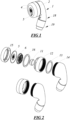
- the shower head includes a hollow body portion 2 with a water inlet 3 and water outlet in the form of perforations 4 in a perforated plate 5.
- the mesh formation 6 is spaced slightly from the perforated plate and preferably includes a bowl like cradle portion 8, which is ideally centrally located.
- the mesh formation in the illustrated embodiment extends fully across the perforated plate and cradle portion 8 has a generally flat base region 9 and slightly sloping sides 10.
- This cradle shape acts to generally locate an appropriately sized and shaped treatment tablet 11 when it is first inserted within the shower head prior to use and as it moves toward the perforated plate, and the sloping sides act to help deflect the slowly disintegrating tablet that is forced toward the mesh by the water flow, back into the turbulent flow region and/or a central portion of the hollow body.
- the mesh is configured to provide minimum disruption to normal flow within the hollow body and through the perforated plate 5.
- the cradle is removable. This facilitates optional conversion of otherwise suitably configured shower heads to include this feature if required, or omitted if the feature is not needed.
- This is enabled by providing an extension collar 12 with seal 13 that can be inserted between a threaded head outlet opening 14 and the normal outlet plate assembly, which includes a plate retaining ring 15, perforated plate 5 and seal 16.
- the additional collar 12 and seal 13 are not required and the mesh is integrally formed with the outlet assembly.
- a handle portion 18 Extending from the inlet end of the hollow body 2 and inlet 3 is a handle portion 18, connected to an end cover 20 which includes a water-filter and a connecting spigot 19 for attachment to a hose connected to a suitable water supply (not shown).
- An adaptor inserted between spigot and hose may also be provided to enable connection to a different type of hose if required.
- the design of the handle itself and the angle of inclination relative to the outlet plate 5 are preferably selected to be ergonomic and enable comfortable extended use by an operator.
- the hollow body is also carefully configured to achieve turbulent flow within the body.
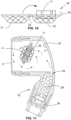
- the inlet 3 has a generally slit like configuration which exits closely adjacent a rear wall 22 of the hollow body which is inclined slightly toward the perforated plate 5. This causes the water flow to curve toward the plate. As the apertures in the plate are quite small, not all the water can freely exit, and as a result a turbulent generally circulating flow pattern is induced as illustrated in Figure 9 .
- the shower head also includes means to pre-treat the water flow before it enters the hollow body.
- this is achieved by provision of aeration pre-treatment chamber 24 disposed upstream of the inlet to the hollow body.
- treatment and/or aeration is achieved by captively locating particulate matter in the pre-treatment chamber, whereby passage of water through this chamber around the particulate matter causes air bubbles of air to be created which pass through with the water into the hollow body. Air may also be entrained into the hollow body through the perforated plate, which is preferably slightly concave when viewed from outside the device.
- the particulate matter is in the form of beads 25 as shown in Figure 9 .
- the particulate matter comprises a material that also interacts with the water to enhance its properties by, for example, ionising the water.
- Suitable bead materials include Tourmaline, Silver, Cerussite, Vitamin C, Vitamin D and products such as Million Guard TM produced by Koa Glass Company and which is an antimicrobial glass powder with Silver ions retained in the glass network structure that are gradually released.
- the shower head is configured such that in use the water is entering the hollow body from an upper region thereby creating a waterfall-like stream which in turn enhances the Lenard effect by colliding with the lower wetted surfaces in the hollow body to produce negative ions.
- Such ions may already be present as the water collides with the wetted particulate matter in the pre-treatment chamber, where this is included.
- the shower head also includes means for filtering out unwanted impurities such as chlorine or the like. This may be part of, or separate to, the means for generating negative ions.
- Additional fine mesh filters 26 may also be included in the shower head, preferably within the handle as illustrated in Figure 9 .
- the shower head and disintigratable tablets are configured such that during use with a warm water supply at typical pressure and hair washing temperature, the tablets take around 2 to 4 minutes to disintegrate and provide a flow of water dispersed treatment to a user.
- typical water inlet pressure to the shower heads include a pressure range 50-200KPa, temperature range of 10-40 degrees Celcius, preferably 25-32 degrees Celcius and outlet flow rate of 4-12 litres per minute, preferably 5-8 litres per minute as may be controlled by a flow regulator.
- the apparatus and tablets can be configured to work under different operating conditions if required.
- the shower head is configured to function as an increased pressure reduced water usage shower head.
- the increased pressure and reduced water usage is achieved at least in part by use of a perforated plate having a thickness range of 0.2 to .35 millimetres and perforations of a preferably round shape, 0.02 to 0.03 millimetres in diameter, with a total of between approximately 300 and 500 perforations and more preferably about 400 perforations.
- the pattern of perforations is arranged to be concentrated around a central region of the perforated plate and do not extend to the circumferentially outer portion of the plate to provide a focused spray pattern whereby the water (with or without treatment) can be carefully directed to regions of the head undergoing treatment and reduce the risk of the spray extending beyond the treatment basin.
- the inlet to the hollow body is small so as to increase the pressure of the water entering the hollow body.
- the inlet is in the form of a slit opening with a maximum length of around 10-14mm and maximum width of about 2-3mm. The same principle is applied to other openings such as the inlet to the pre-treatment chamber and the perforations in the plate.
- the disintegratable tablets have a shape which will be readily conveyed by the turbulent flow within the hollow body of the shower head 1, such that in use the tablet is caught up in the flow and repeatedly impacted against the mesh formation 6 so as to cause gradual disintegration of the tablet into the exiting water flow.
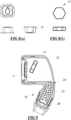
- a suitable shape is shown in Figure 2 .
- incorporation of one generally flat major surface can assist with ensuring the tablet is readily conveyed within the turbulent flow.
- the mesh may be designed to encapsulate the tablet in a similar manner to a tea strainer to utilise a mesh pod 30, whereby the entire mesh pod moves within the turbulent flow, and the tablet moves within the mesh pod in an abrading manner and is thereby dispersed into the water flow exiting the perforated plate.
- the mesh pod can be of any suitable shape as long as it can be opened to receive treatment tablets as required.
- the pod includes two half formations 31 and 32 which are hingedly connected at 33 and closeable via a catch 34.
- the tablets include a cleanser and a range of treatment tablets.
- the cleansing tablet is in a compressed powder form and the treatment tablets are in a wax like form.
- An example of one preferred shape for a wax-like deep treatment or conditioning tablet is shown in Figure 8(a) in a capsule style package, and an example of a compressed powder cleansing tablet (unwrapped) is shown in Figure 8(b) .
- Figure 8(a) An example of one preferred shape for a wax-like deep treatment or conditioning tablet
- Figure 8(b) An example of a compressed powder cleansing tablet (unwrapped) is shown in Figure 8(b) .
- the use of the wax-like treatment tablets are preferred for hair treatments, though such tablets have a tendency to soften against the perforated exit screen, blocking the holes.
- the mesh formation of the shower apparatus of the present invention operates to enable use of this form of tablet as it prevents the blockage from occurring.
- a preferred embodiment of a cleansing tablet for use in the showerhead apparatus of the present invention comprises about 20% (w/w) peppermint essential oil, about 27 % (w/w) alky polyethylene glycol ether, about 25% (w/w) sodium cocoyl isethionate, about 3.5% (w/w) polyvinylpyrrolidone and about 25% buffered salts.
- a cleansing tablet for use in the showerhead apparatus of the present invention comprises about 8% (w/w) peppermint essential oil, about 5 % (w/w) sodium lauryl sulphacetate, about 60% (w/w) sodium cocoyl isethionate, about 12.5% (w/w) saponins, about 0.5 % (w/w) microcrystalline cellulose, about 5% (w/w) calcium stearate and about 5% (w/w) citric acid.
- a preferred embodiment of a strengthening treatment tablet for use in the showerhead apparatus of the present invention comprises about 3 % (w/w) Emulgade ® 1000NI, about 29 % (w/w) PEG-4000, about 7% (w/w) cetiol-C5, about 5% (w/w) Tween-80, about 4.5% (w/w) cetrimonium chloride, about 1% (w/w) TER!C@ N9, about 5% (w/w) hydrogenated castor oil, about 1.3% (w/w) phenoxyethanol, about 6% (w/w) TER!C@ BL8, about 4% (w/w) TER!C@ N5, and about 20% (w/w) plant oil, wherein the tablets comprises about 8% (w/w) argan oil.
- a strengthening treatment tablet for use in the showerhead apparatus of the present invention comprises about 4 % (w/w) Emulgade ® 1000NI, about 43 % (w/w) PEG-4000, about 7% (w/w) cetiol-C5, about 6% (w/w) TER!C@ 16A30, about 7.5% (w/w) cetrimonium chloride, about 0.5 % (w/w) TER!C@ N9, about 2% (w/w) hydrogenated castor oil, about 1.0% (w/w) phenoxyethanol, about 1% (w/w) soy bean protein extract and about 16% (w/w) plant oil, wherein the tablets comprises about 2% (w/w) argan oil and/or marula oil.
- a preferred embodiment of a colour care tablet for use in the showerhead apparatus of the present invention comprises about 5.5 % (w/w) Emulgade ® 1000NI, about 34 % (w/w) PEG-4000, about 8% (w/w) cetiol-C5, about 5.5% (w/w) cetrimonium chloride, about 1% (w/w) TER!C@ N9, about 10% (w/w) hydrogenated castor oil, about 2.5% (w/w) phenoxyethanol, about 5% (w/w) TER!C@ N5, about 5% (w/w) ethylhexyl methoxycinnamate and about 15% (w/w) plant oil.
- a further preferred embodiment of a colour care tablet for use in the showerhead apparatus of the present invention comprises about 5 % (w/w) Emulgade ® 1000NI, about 43 % (w/w) PEG-4000, about 7% (w/w) cetiol-C5, about 6% (w/w) TERIC ® 16A30, about 7.5% (w/w) cetrimonium chloride, about 0.5 % (w/w) TERIC ® N9, about 2% (w/w) hydrogenated castor oil, about 1.0% (w/w) phenoxyethanol, about 2% (w/w) ethylhexyl methoxycinnamate, and about 15% (w/w) plant oil.
- a preferred embodiment of a hydration tablet for use in the showerhead apparatus of the present invention comprises about 4 % (w/w) Emulgade ® 1000NI, about 40 % (w/w) PEG-4000, about 4% (w/w) cetiol-C5, about 6% (w/w) cetrimonium chloride, about 1% (w/w) TERIC ® N9, about 11% (w/w) hydrogenated castor oil, about 2.5% (w/w) phenoxyethanol, about 6% (w/w) TERIC ® N5 and about 16% (w/w) plant oil.
- a hydration tablet for use in the showerhead apparatus of the present invention comprises about 5 % (w/w) Emulgade ® 1000NI, about 43 % (w/w) PEG-4000, about 8% (w/w) cetiol-C5, about 6% (w/w) TERIC ® 16A30, about 7.5% (w/w) cetrimonium chloride, about 0.5 % (w/w) TERIC ® N9, about 2% (w/w) hydrogenated castor oil, about 1.0% (w/w) phenoxyethanol, and about 16% (w/w) plant oil.
- a preferred embodiment of a treatment spray for use after cleaning and/or treating the hair using one or more tablets with the showerhead apparatus of the present invention comprises about 1.5 % (w/w) Tween-20, about 12.5% (w/w) cetrimonium chloride, about 0.5% (w/w) phenoxyethanol, about 10% (w/w) cationic silicone emulsion and water.
- a preferred embodiment of a cream spray for use after cleaning and/or treating the hair using one or more tablets with the showerhead apparatus of the present invention comprises about 4% (w/w) centrimonium chloride, about 3.5% (w/w) glyceryl stearate citrate, 2% (w/w) sodium cocoyl isethionate, about 3% (w/w) hydrogenated castor oil, about 10% (w/w) cetiol C5, and 6 % plant oil.
- a preferred embodiment of a finishing spray for use after cleaning and/or treating the hair using one or more tablets with the showerhead apparatus of the present invention comprises 4% (w/w) plant oil, 85% (w/w) cyclopentasiloxane, 2% (w/w) ethylhexyl methoxycinnamate, 1% (w/w) phenoxyethanol and 8% (w/w) cetiol C5.
- a method of hair treatment comprises the steps of:
Landscapes
- Health & Medical Sciences (AREA)
- Life Sciences & Earth Sciences (AREA)
- Public Health (AREA)
- Chemical & Material Sciences (AREA)
- Animal Behavior & Ethology (AREA)
- General Health & Medical Sciences (AREA)
- Veterinary Medicine (AREA)
- Engineering & Computer Science (AREA)
- Water Supply & Treatment (AREA)
- Hydrology & Water Resources (AREA)
- Chemical Kinetics & Catalysis (AREA)
- Environmental & Geological Engineering (AREA)
- Organic Chemistry (AREA)
- Dispersion Chemistry (AREA)
- Epidemiology (AREA)
- Dermatology (AREA)
- Birds (AREA)
- Medicinal Chemistry (AREA)
- Cosmetics (AREA)
- Bathtubs, Showers, And Their Attachments (AREA)
- Nozzles (AREA)
- Medicines Containing Material From Animals Or Micro-Organisms (AREA)
Claims (5)
- Ein Brausekopf (1), der so konfiguriert ist, dass er eine kontinuierliche Dosis einer wasserdispergierten Behandlung aus einer wasserzersetzbaren tablettenförmigen Behandlungsquelle (11) abgibt, wobei der Brausekopf (1) Folgendes umfasst:einen hohlen Brausekopfkörper (2) mit einer begrenzten Wassereinlassöffnung (3) in einem Bereich und einem Wasserauslass in einem anderen Bereich, wobei der Wasserauslass durch Perforationen (4) in einer perforierten Platte (5) ausgebildet ist, um einen Wasserfluss zwischen dem Einlass und dem Auslass zu ermöglichen, undeine perforierte Maschenformation (6), die durch eine Matrix aus starren Elementen ausgebildet ist, gegen die eine in die genannte Maschenformation eingebrachte zersetzbare tablettenförmige Behandlungsquelle reiben kann, wobei die genannte perforierte Maschenformation (6) innerhalb des hohlen Brausekopfkörpers (2) zwischen der Wassereinlassöffnung (3) und der perforierten Platte (5) angeordnet ist;wobei die eingeschränkte Wassereinlassöffnung (3) angrenzend an eine Rückwand (22) des hohlen Körpers (2) austritt und der hohle Körper (2) in Richtung der perforierten Platte (5) geneigt und so geformt ist, dass er zumindest einen Teil des Wasserstroms aus dem eingeschränkten Wassereinlass (3) nach unten in Richtung der perforierten Platte (5) leitet, dadurch gekennzeichnet, dass der eingeschränkte Wassereinlass (3) einen Querschnitt aufweist, der eine maximale Länge von 10-14 mm und eine maximale Breite von 2-3 mm hat,wobei der Brausekopf (1) so konfiguriert ist, dass die genannte wasserzersetzbare, feste Behandlungsquelle in Tablettenform (11), die vor der Verwendung in den hohlen Brausekopfkörper (2) zwischen der Wassereinlassöffnung (3) und der Maschenbildung (6) eingeführt wird, in der Lage ist, sich im Wasserstrom zu drehen und zu bewegen, so dass sie durch den Wasserstrom gegen die Maschenformation (6) bewegt wird und wiederholt gegen die Maschenformation (6) reibt, um den Zerfall der genannten wasserzersetzbaren Tablette (11) zu unterstützen und dadurch in den Wasserstrom dispergiert zu werden, bevor das Wasser den hohlen Brausekopfkörper (2) durch die perforierte Platte (5) verlässt.
- Der Brausekopf nach Anspruch 1, wobei die Maschenbildung (6) eine feste Maschenbildung ist und neben der perforierten Platte (5), jedoch beabstandet davon, angeordnet ist.
- Der Brausekopf nach Anspruch 2, wobei die feste Maschenformation so konfiguriert ist, dass sie einen schalenartigen Wiegenteil (8) ausbildet, der einen flachen Bodenbereich (9) und schräge Seiten (10) aufweist, die sich von der perforierten Platte (5) aus nach außen öffnen.
- Der Brausekopf nach Anspruch 1, wobei die Maschenbildung (6) so konfiguriert ist, dass sie die wasserzersetzbare Tablette (11) einkapselt, um eine Kapsel zu bilden, wodurch sich die gesamte Maschenkapsel innerhalb des Wasserstroms bewegt und die wasserzersetzbare Tablette (11) sich innerhalb der Maschenkapsel abreibend bewegt und dadurch in den Wasserstrom dispergiert wird, bevor das Wasser den hohlen Brausekopfkörper (2) durch die perforierte Platte (5) verlässt.
- Der Brausekopf nach Anspruch 1 umfasst ferner eine Vorbehandlungskammer (24) zur Belüftung, die stromaufwärts des Einlasses (3) des hohlen Brausekopfkörpers (2) angeordnet ist.
Applications Claiming Priority (2)
| Application Number | Priority Date | Filing Date | Title |
|---|---|---|---|
| AU2016900183A AU2016900183A0 (en) | 2016-01-21 | Hair treatment system, treatments and apparatus | |
| PCT/AU2017/050047 WO2017124154A1 (en) | 2016-01-21 | 2017-01-20 | Hair treatment system, treatments and apparatus |
Publications (4)
| Publication Number | Publication Date |
|---|---|
| EP3570983A1 EP3570983A1 (de) | 2019-11-27 |
| EP3570983A4 EP3570983A4 (de) | 2020-09-09 |
| EP3570983C0 EP3570983C0 (de) | 2024-05-15 |
| EP3570983B1 true EP3570983B1 (de) | 2024-05-15 |
Family
ID=59361079
Family Applications (1)
| Application Number | Title | Priority Date | Filing Date |
|---|---|---|---|
| EP17740917.4A Active EP3570983B1 (de) | 2016-01-21 | 2017-01-20 | Haarbehandlungssystem, behandlungen und vorrichtung |
Country Status (8)
| Country | Link |
|---|---|
| US (2) | US11541408B2 (de) |
| EP (1) | EP3570983B1 (de) |
| JP (2) | JP2020507367A (de) |
| KR (1) | KR102528361B1 (de) |
| AU (2) | AU2017208719B2 (de) |
| ES (1) | ES2979224T3 (de) |
| PL (1) | PL3570983T3 (de) |
| WO (1) | WO2017124154A1 (de) |
Families Citing this family (7)
| Publication number | Priority date | Publication date | Assignee | Title |
|---|---|---|---|---|
| EP3570983B1 (de) * | 2016-01-21 | 2024-05-15 | 2B1K Imports PTY Ltd | Haarbehandlungssystem, behandlungen und vorrichtung |
| DE202016008114U1 (de) * | 2016-12-22 | 2017-02-27 | Rene Sackel | Vorrichtung zur Anreicherung von Wasser |
| CA3120203A1 (en) * | 2018-11-15 | 2020-05-22 | 2B1K Imports Pty Ltd | Hair modification system |
| CN110917067B (zh) * | 2019-12-04 | 2021-09-21 | 九牧厨卫股份有限公司 | 一种具有高保湿功效的浴用润肤膏及其制备方法 |
| DE102020124503A1 (de) * | 2020-09-21 | 2022-03-24 | Showerplus Entwicklungs- Und Vertriebsgesellschaft Mbh | Gepresster Formkörper sowie Applikator zur Aufnahme eines solchen Formkörpers |
| USD1059546S1 (en) * | 2023-04-14 | 2025-01-28 | Mtg Co., Ltd. | Shower head |
| USD1006186S1 (en) | 2023-08-02 | 2023-11-28 | E. Mishan & Sons, Inc. | Shower filter |
Citations (2)
| Publication number | Priority date | Publication date | Assignee | Title |
|---|---|---|---|---|
| JPS6339653A (ja) * | 1986-08-02 | 1988-02-20 | Akira Fujii | シヤワ−ヘツド |
| JP2002282156A (ja) * | 2001-03-26 | 2002-10-02 | Hiroyuki Nagano | シャワーヘッド及びシャワー方法 |
Family Cites Families (26)
| Publication number | Priority date | Publication date | Assignee | Title |
|---|---|---|---|---|
| US1751524A (en) * | 1929-02-01 | 1930-03-25 | Harold J Moss | Shower-nozzle attachment |
| US3008650A (en) * | 1958-05-08 | 1961-11-14 | Walter S Munson | Shower head |
| US3120015A (en) * | 1962-05-16 | 1964-02-04 | Ellamac Inc | Cleaning assembly for use in a garden hose or the like |
| US3921635A (en) * | 1974-05-22 | 1975-11-25 | William Kohlmann Gauthier | Shower head and douche |
| US4211368A (en) * | 1975-06-09 | 1980-07-08 | Legros Francis R | Device for aerating and chemically activating shower water |
| IT1264809B1 (it) * | 1993-07-27 | 1996-10-10 | Giovanni Porta | Bocchettone idraulico in specie per doccia, con spruzzatore comprendente una camera di miscelazione per pastiglie di prodotti da |
| JP2000051869A (ja) * | 1998-08-07 | 2000-02-22 | Karufa Chemical Kk | 生活用水の浄水装置 |
| US6006374A (en) * | 1998-09-23 | 1999-12-28 | Winnett; Harold G. | Showerhead attachment and method for generating aromas |
| ATE359002T1 (de) * | 2001-12-20 | 2007-05-15 | Koninkl Philips Electronics Nv | Vorrichtung zum auftragen von haarbehandlungsprodukten |
| JP2003265351A (ja) | 2002-03-12 | 2003-09-24 | Takayasu Okubo | シャワーヘッド |
| KR20060059625A (ko) * | 2004-11-29 | 2006-06-02 | 신아에이티(주) | 샤워기용 필터 |
| JP5294103B2 (ja) * | 2005-12-13 | 2013-09-18 | 宰成光株式会社 | シャワーヘッド |
| US20090101733A1 (en) * | 2007-10-17 | 2009-04-23 | Popov Alexander G | Controlled dispensing hand shower |
| KR101014389B1 (ko) * | 2009-02-18 | 2011-02-15 | 주식회사 케이엔텍 | 유출량 조절기능을 갖는 샤워기용 필터케이스 |
| EP2351888A1 (de) * | 2010-01-11 | 2011-08-03 | Cimplasta Srl | Duschkopf und einführbare Kapsel oder lösliche Tablette |
| JP3165747U (ja) | 2010-11-22 | 2011-02-03 | 陳盈仁 | シャワーヘッド |
| KR200460745Y1 (ko) * | 2011-05-16 | 2012-06-04 | (주)씨앤비마스터 | 샤워기 헤드 조립체 |
| KR20130019047A (ko) * | 2011-08-16 | 2013-02-26 | 주식회사 피토니아 | 피톤치드 캡슐 및 필터 부재가 수납된 샤워 헤드 |
| FR2981284B1 (fr) | 2011-10-12 | 2017-07-21 | Christian Bachmann | Dispositif pour soins hydrotherapiques, cosmetologiques, esthetiques, veterinaires, decontaminants a partir d'une installation de douche |
| JP2014050543A (ja) | 2012-09-06 | 2014-03-20 | Art Climb Co Ltd | シャワーヘッド |
| JP2014083411A (ja) | 2012-10-22 | 2014-05-12 | Neo Yamaguchi:Kk | シャワーヘッド |
| JP6358901B2 (ja) * | 2014-08-31 | 2018-07-18 | 株式会社アクアリンク | 気泡混入装置及び気泡混入シャワー装置 |
| JP2016087599A (ja) | 2014-11-11 | 2016-05-23 | ミズタニバルブ工業株式会社 | 機能水生成装置 |
| JP5908640B1 (ja) | 2015-07-06 | 2016-04-26 | 株式会社エクスプロア | シャワー装置 |
| EP3570983B1 (de) * | 2016-01-21 | 2024-05-15 | 2B1K Imports PTY Ltd | Haarbehandlungssystem, behandlungen und vorrichtung |
| US10221545B2 (en) * | 2017-06-07 | 2019-03-05 | Ralph Saro | Soap dispensing shower assembly |
-
2017
- 2017-01-20 EP EP17740917.4A patent/EP3570983B1/de active Active
- 2017-01-20 KR KR1020197024233A patent/KR102528361B1/ko active Active
- 2017-01-20 PL PL17740917.4T patent/PL3570983T3/pl unknown
- 2017-01-20 JP JP2019540005A patent/JP2020507367A/ja not_active Withdrawn
- 2017-01-20 ES ES17740917T patent/ES2979224T3/es active Active
- 2017-01-20 US US16/479,277 patent/US11541408B2/en active Active
- 2017-01-20 WO PCT/AU2017/050047 patent/WO2017124154A1/en not_active Ceased
- 2017-01-20 AU AU2017208719A patent/AU2017208719B2/en active Active
-
2022
- 2022-04-18 JP JP2022068263A patent/JP7382084B2/ja active Active
- 2022-12-02 US US18/074,010 patent/US20230191432A1/en active Pending
-
2023
- 2023-04-14 AU AU2023202320A patent/AU2023202320A1/en not_active Abandoned
Patent Citations (2)
| Publication number | Priority date | Publication date | Assignee | Title |
|---|---|---|---|---|
| JPS6339653A (ja) * | 1986-08-02 | 1988-02-20 | Akira Fujii | シヤワ−ヘツド |
| JP2002282156A (ja) * | 2001-03-26 | 2002-10-02 | Hiroyuki Nagano | シャワーヘッド及びシャワー方法 |
Also Published As
| Publication number | Publication date |
|---|---|
| AU2017208719A1 (en) | 2019-09-19 |
| US11541408B2 (en) | 2023-01-03 |
| KR102528361B1 (ko) | 2023-05-03 |
| ES2979224T3 (es) | 2024-09-24 |
| JP7382084B2 (ja) | 2023-11-16 |
| AU2017208719B2 (en) | 2023-01-19 |
| AU2023202320A1 (en) | 2023-05-11 |
| PL3570983T3 (pl) | 2024-12-02 |
| JP2020507367A (ja) | 2020-03-12 |
| JP2022095928A (ja) | 2022-06-28 |
| KR20190112291A (ko) | 2019-10-04 |
| EP3570983A4 (de) | 2020-09-09 |
| US20230191432A1 (en) | 2023-06-22 |
| EP3570983C0 (de) | 2024-05-15 |
| EP3570983A1 (de) | 2019-11-27 |
| WO2017124154A1 (en) | 2017-07-27 |
| US20190381527A1 (en) | 2019-12-19 |
| NZ755592A (en) | 2024-07-05 |
Similar Documents
| Publication | Publication Date | Title |
|---|---|---|
| US20230191432A1 (en) | Hair treatment system, treatments and apparatus | |
| AU2006331729B2 (en) | UV-radiation protectant compositions | |
| ES2773320T3 (es) | Uso de polioles para mejorar el efecto refrescante de una sustancia refrescante | |
| EP2455157B1 (de) | Lösungsvermittler für kosmetische zubereitungen | |
| CN102883705A (zh) | 含有烷基缩酮酯的个人护理制剂以及制造方法 | |
| WO2002085965A1 (de) | Kosmetische schwämme | |
| AU2022202919A1 (en) | Effervescent sunscreen composition | |
| US20050265936A1 (en) | Cleansing foaming sunscreen lotion | |
| WO2009042782A1 (en) | Photostabilization of octyl triazone | |
| JP2006523636A (ja) | ポリ−アルファ−オレフィン含有化粧品組成物 | |
| JP2004217628A (ja) | Uv‐防護性を有した洗浄用化粧薬剤 | |
| AU2019379869B2 (en) | Hair modification system | |
| JP2005068151A (ja) | ケラチン繊維処理製剤用化合物 | |
| CN101686921A (zh) | 透射染料的晶型 | |
| CN114522119B (zh) | 包含水分散型防晒剂的组合物及其应用 | |
| WO2023243428A1 (ja) | ポンプフォーマー用日焼け止め化粧料 |
Legal Events
| Date | Code | Title | Description |
|---|---|---|---|
| STAA | Information on the status of an ep patent application or granted ep patent |
Free format text: STATUS: THE INTERNATIONAL PUBLICATION HAS BEEN MADE |
|
| PUAI | Public reference made under article 153(3) epc to a published international application that has entered the european phase |
Free format text: ORIGINAL CODE: 0009012 |
|
| STAA | Information on the status of an ep patent application or granted ep patent |
Free format text: STATUS: REQUEST FOR EXAMINATION WAS MADE |
|
| 17P | Request for examination filed |
Effective date: 20190801 |
|
| AK | Designated contracting states |
Kind code of ref document: A1 Designated state(s): AL AT BE BG CH CY CZ DE DK EE ES FI FR GB GR HR HU IE IS IT LI LT LU LV MC MK MT NL NO PL PT RO RS SE SI SK SM TR |
|
| AX | Request for extension of the european patent |
Extension state: BA ME |
|
| DAV | Request for validation of the european patent (deleted) | ||
| DAX | Request for extension of the european patent (deleted) | ||
| A4 | Supplementary search report drawn up and despatched |
Effective date: 20200810 |
|
| RIC1 | Information provided on ipc code assigned before grant |
Ipc: E03C 1/046 20060101ALI20200804BHEP Ipc: B05B 1/34 20060101ALI20200804BHEP Ipc: A61K 8/02 20060101ALI20200804BHEP Ipc: B05B 1/18 20060101AFI20200804BHEP Ipc: B05B 7/24 20060101ALI20200804BHEP Ipc: A61Q 5/12 20060101ALI20200804BHEP Ipc: A61Q 5/02 20060101ALI20200804BHEP |
|
| STAA | Information on the status of an ep patent application or granted ep patent |
Free format text: STATUS: EXAMINATION IS IN PROGRESS |
|
| 17Q | First examination report despatched |
Effective date: 20220808 |
|
| RIN1 | Information on inventor provided before grant (corrected) |
Inventor name: MAARBANI, SAMIR Inventor name: ROET, NOAH Inventor name: RISHER, BENNY Inventor name: COHEN, BEN JAN |
|
| GRAP | Despatch of communication of intention to grant a patent |
Free format text: ORIGINAL CODE: EPIDOSNIGR1 |
|
| STAA | Information on the status of an ep patent application or granted ep patent |
Free format text: STATUS: GRANT OF PATENT IS INTENDED |
|
| INTG | Intention to grant announced |
Effective date: 20231107 |
|
| GRAS | Grant fee paid |
Free format text: ORIGINAL CODE: EPIDOSNIGR3 |
|
| GRAA | (expected) grant |
Free format text: ORIGINAL CODE: 0009210 |
|
| STAA | Information on the status of an ep patent application or granted ep patent |
Free format text: STATUS: THE PATENT HAS BEEN GRANTED |
|
| AK | Designated contracting states |
Kind code of ref document: B1 Designated state(s): AL AT BE BG CH CY CZ DE DK EE ES FI FR GB GR HR HU IE IS IT LI LT LU LV MC MK MT NL NO PL PT RO RS SE SI SK SM TR |
|
| REG | Reference to a national code |
Ref country code: CH Ref legal event code: EP Ref country code: GB Ref legal event code: FG4D |
|
| REG | Reference to a national code |
Ref country code: IE Ref legal event code: FG4D |
|
| REG | Reference to a national code |
Ref country code: DE Ref legal event code: R096 Ref document number: 602017081919 Country of ref document: DE |
|
| U01 | Request for unitary effect filed |
Effective date: 20240606 |
|
| U07 | Unitary effect registered |
Designated state(s): AT BE BG DE DK EE FI FR IT LT LU LV MT NL PT SE SI Effective date: 20240620 |
|
| REG | Reference to a national code |
Ref country code: ES Ref legal event code: FG2A Ref document number: 2979224 Country of ref document: ES Kind code of ref document: T3 Effective date: 20240924 |
|
| PG25 | Lapsed in a contracting state [announced via postgrant information from national office to epo] |
Ref country code: IS Free format text: LAPSE BECAUSE OF FAILURE TO SUBMIT A TRANSLATION OF THE DESCRIPTION OR TO PAY THE FEE WITHIN THE PRESCRIBED TIME-LIMIT Effective date: 20240915 |
|
| PG25 | Lapsed in a contracting state [announced via postgrant information from national office to epo] |
Ref country code: HR Free format text: LAPSE BECAUSE OF FAILURE TO SUBMIT A TRANSLATION OF THE DESCRIPTION OR TO PAY THE FEE WITHIN THE PRESCRIBED TIME-LIMIT Effective date: 20240515 |
|
| PG25 | Lapsed in a contracting state [announced via postgrant information from national office to epo] |
Ref country code: GR Free format text: LAPSE BECAUSE OF FAILURE TO SUBMIT A TRANSLATION OF THE DESCRIPTION OR TO PAY THE FEE WITHIN THE PRESCRIBED TIME-LIMIT Effective date: 20240816 |
|
| PG25 | Lapsed in a contracting state [announced via postgrant information from national office to epo] |
Ref country code: NO Free format text: LAPSE BECAUSE OF FAILURE TO SUBMIT A TRANSLATION OF THE DESCRIPTION OR TO PAY THE FEE WITHIN THE PRESCRIBED TIME-LIMIT Effective date: 20240815 Ref country code: IS Free format text: LAPSE BECAUSE OF FAILURE TO SUBMIT A TRANSLATION OF THE DESCRIPTION OR TO PAY THE FEE WITHIN THE PRESCRIBED TIME-LIMIT Effective date: 20240915 Ref country code: HR Free format text: LAPSE BECAUSE OF FAILURE TO SUBMIT A TRANSLATION OF THE DESCRIPTION OR TO PAY THE FEE WITHIN THE PRESCRIBED TIME-LIMIT Effective date: 20240515 Ref country code: GR Free format text: LAPSE BECAUSE OF FAILURE TO SUBMIT A TRANSLATION OF THE DESCRIPTION OR TO PAY THE FEE WITHIN THE PRESCRIBED TIME-LIMIT Effective date: 20240816 Ref country code: RS Free format text: LAPSE BECAUSE OF FAILURE TO SUBMIT A TRANSLATION OF THE DESCRIPTION OR TO PAY THE FEE WITHIN THE PRESCRIBED TIME-LIMIT Effective date: 20240815 |
|
| U20 | Renewal fee for the european patent with unitary effect paid |
Year of fee payment: 9 Effective date: 20241209 |
|
| PG25 | Lapsed in a contracting state [announced via postgrant information from national office to epo] |
Ref country code: CZ Free format text: LAPSE BECAUSE OF FAILURE TO SUBMIT A TRANSLATION OF THE DESCRIPTION OR TO PAY THE FEE WITHIN THE PRESCRIBED TIME-LIMIT Effective date: 20240515 |
|
| PGFP | Annual fee paid to national office [announced via postgrant information from national office to epo] |
Ref country code: IE Payment date: 20241209 Year of fee payment: 9 |
|
| PG25 | Lapsed in a contracting state [announced via postgrant information from national office to epo] |
Ref country code: RO Free format text: LAPSE BECAUSE OF FAILURE TO SUBMIT A TRANSLATION OF THE DESCRIPTION OR TO PAY THE FEE WITHIN THE PRESCRIBED TIME-LIMIT Effective date: 20240515 Ref country code: SK Free format text: LAPSE BECAUSE OF FAILURE TO SUBMIT A TRANSLATION OF THE DESCRIPTION OR TO PAY THE FEE WITHIN THE PRESCRIBED TIME-LIMIT Effective date: 20240515 |
|
| PG25 | Lapsed in a contracting state [announced via postgrant information from national office to epo] |
Ref country code: SM Free format text: LAPSE BECAUSE OF FAILURE TO SUBMIT A TRANSLATION OF THE DESCRIPTION OR TO PAY THE FEE WITHIN THE PRESCRIBED TIME-LIMIT Effective date: 20240515 |
|
| PG25 | Lapsed in a contracting state [announced via postgrant information from national office to epo] |
Ref country code: SM Free format text: LAPSE BECAUSE OF FAILURE TO SUBMIT A TRANSLATION OF THE DESCRIPTION OR TO PAY THE FEE WITHIN THE PRESCRIBED TIME-LIMIT Effective date: 20240515 Ref country code: SK Free format text: LAPSE BECAUSE OF FAILURE TO SUBMIT A TRANSLATION OF THE DESCRIPTION OR TO PAY THE FEE WITHIN THE PRESCRIBED TIME-LIMIT Effective date: 20240515 Ref country code: RO Free format text: LAPSE BECAUSE OF FAILURE TO SUBMIT A TRANSLATION OF THE DESCRIPTION OR TO PAY THE FEE WITHIN THE PRESCRIBED TIME-LIMIT Effective date: 20240515 Ref country code: CZ Free format text: LAPSE BECAUSE OF FAILURE TO SUBMIT A TRANSLATION OF THE DESCRIPTION OR TO PAY THE FEE WITHIN THE PRESCRIBED TIME-LIMIT Effective date: 20240515 |
|
| REG | Reference to a national code |
Ref country code: DE Ref legal event code: R097 Ref document number: 602017081919 Country of ref document: DE |
|
| PLBE | No opposition filed within time limit |
Free format text: ORIGINAL CODE: 0009261 |
|
| STAA | Information on the status of an ep patent application or granted ep patent |
Free format text: STATUS: NO OPPOSITION FILED WITHIN TIME LIMIT |
|
| PGFP | Annual fee paid to national office [announced via postgrant information from national office to epo] |
Ref country code: ES Payment date: 20250204 Year of fee payment: 9 |
|
| 26N | No opposition filed |
Effective date: 20250218 |
|
| PGFP | Annual fee paid to national office [announced via postgrant information from national office to epo] |
Ref country code: CH Payment date: 20250201 Year of fee payment: 9 |
|
| PGFP | Annual fee paid to national office [announced via postgrant information from national office to epo] |
Ref country code: PL Payment date: 20250110 Year of fee payment: 9 |
|
| PGFP | Annual fee paid to national office [announced via postgrant information from national office to epo] |
Ref country code: GB Payment date: 20250112 Year of fee payment: 9 |
|
| PG25 | Lapsed in a contracting state [announced via postgrant information from national office to epo] |
Ref country code: MC Free format text: LAPSE BECAUSE OF FAILURE TO SUBMIT A TRANSLATION OF THE DESCRIPTION OR TO PAY THE FEE WITHIN THE PRESCRIBED TIME-LIMIT Effective date: 20240515 |
|
| U20 | Renewal fee for the european patent with unitary effect paid |
Year of fee payment: 10 Effective date: 20260116 |