EP3570541B1 - Verfahren und vorrichtung zur decodierung und codierung von videodaten sowie verfahren und vorrichtung zur vorhersage eines direktstromkoeffizienten - Google Patents
Verfahren und vorrichtung zur decodierung und codierung von videodaten sowie verfahren und vorrichtung zur vorhersage eines direktstromkoeffizienten Download PDFInfo
- Publication number
- EP3570541B1 EP3570541B1 EP19163054.0A EP19163054A EP3570541B1 EP 3570541 B1 EP3570541 B1 EP 3570541B1 EP 19163054 A EP19163054 A EP 19163054A EP 3570541 B1 EP3570541 B1 EP 3570541B1
- Authority
- EP
- European Patent Office
- Prior art keywords
- intra
- prediction value
- value
- prediction
- frame
- Prior art date
- Legal status (The legal status is an assumption and is not a legal conclusion. Google has not performed a legal analysis and makes no representation as to the accuracy of the status listed.)
- Active
Links
Images


Classifications
-
- H—ELECTRICITY
- H04—ELECTRIC COMMUNICATION TECHNIQUE
- H04N—PICTORIAL COMMUNICATION, e.g. TELEVISION
- H04N19/00—Methods or arrangements for coding, decoding, compressing or decompressing digital video signals
- H04N19/10—Methods or arrangements for coding, decoding, compressing or decompressing digital video signals using adaptive coding
- H04N19/102—Methods or arrangements for coding, decoding, compressing or decompressing digital video signals using adaptive coding characterised by the element, parameter or selection affected or controlled by the adaptive coding
- H04N19/103—Selection of coding mode or of prediction mode
- H04N19/105—Selection of the reference unit for prediction within a chosen coding or prediction mode, e.g. adaptive choice of position and number of pixels used for prediction
-
- H—ELECTRICITY
- H04—ELECTRIC COMMUNICATION TECHNIQUE
- H04N—PICTORIAL COMMUNICATION, e.g. TELEVISION
- H04N19/00—Methods or arrangements for coding, decoding, compressing or decompressing digital video signals
- H04N19/10—Methods or arrangements for coding, decoding, compressing or decompressing digital video signals using adaptive coding
- H04N19/102—Methods or arrangements for coding, decoding, compressing or decompressing digital video signals using adaptive coding characterised by the element, parameter or selection affected or controlled by the adaptive coding
- H04N19/103—Selection of coding mode or of prediction mode
- H04N19/11—Selection of coding mode or of prediction mode among a plurality of spatial predictive coding modes
-
- H—ELECTRICITY
- H04—ELECTRIC COMMUNICATION TECHNIQUE
- H04N—PICTORIAL COMMUNICATION, e.g. TELEVISION
- H04N19/00—Methods or arrangements for coding, decoding, compressing or decompressing digital video signals
- H04N19/10—Methods or arrangements for coding, decoding, compressing or decompressing digital video signals using adaptive coding
- H04N19/134—Methods or arrangements for coding, decoding, compressing or decompressing digital video signals using adaptive coding characterised by the element, parameter or criterion affecting or controlling the adaptive coding
- H04N19/157—Assigned coding mode, i.e. the coding mode being predefined or preselected to be further used for selection of another element or parameter
- H04N19/159—Prediction type, e.g. intra-frame, inter-frame or bidirectional frame prediction
-
- H—ELECTRICITY
- H04—ELECTRIC COMMUNICATION TECHNIQUE
- H04N—PICTORIAL COMMUNICATION, e.g. TELEVISION
- H04N19/00—Methods or arrangements for coding, decoding, compressing or decompressing digital video signals
- H04N19/10—Methods or arrangements for coding, decoding, compressing or decompressing digital video signals using adaptive coding
- H04N19/169—Methods or arrangements for coding, decoding, compressing or decompressing digital video signals using adaptive coding characterised by the coding unit, i.e. the structural portion or semantic portion of the video signal being the object or the subject of the adaptive coding
- H04N19/17—Methods or arrangements for coding, decoding, compressing or decompressing digital video signals using adaptive coding characterised by the coding unit, i.e. the structural portion or semantic portion of the video signal being the object or the subject of the adaptive coding the unit being an image region, e.g. an object
- H04N19/176—Methods or arrangements for coding, decoding, compressing or decompressing digital video signals using adaptive coding characterised by the coding unit, i.e. the structural portion or semantic portion of the video signal being the object or the subject of the adaptive coding the unit being an image region, e.g. an object the region being a block, e.g. a macroblock
-
- H—ELECTRICITY
- H04—ELECTRIC COMMUNICATION TECHNIQUE
- H04N—PICTORIAL COMMUNICATION, e.g. TELEVISION
- H04N19/00—Methods or arrangements for coding, decoding, compressing or decompressing digital video signals
- H04N19/10—Methods or arrangements for coding, decoding, compressing or decompressing digital video signals using adaptive coding
- H04N19/169—Methods or arrangements for coding, decoding, compressing or decompressing digital video signals using adaptive coding characterised by the coding unit, i.e. the structural portion or semantic portion of the video signal being the object or the subject of the adaptive coding
- H04N19/18—Methods or arrangements for coding, decoding, compressing or decompressing digital video signals using adaptive coding characterised by the coding unit, i.e. the structural portion or semantic portion of the video signal being the object or the subject of the adaptive coding the unit being a set of transform coefficients
-
- H—ELECTRICITY
- H04—ELECTRIC COMMUNICATION TECHNIQUE
- H04N—PICTORIAL COMMUNICATION, e.g. TELEVISION
- H04N19/00—Methods or arrangements for coding, decoding, compressing or decompressing digital video signals
- H04N19/46—Embedding additional information in the video signal during the compression process
-
- H—ELECTRICITY
- H04—ELECTRIC COMMUNICATION TECHNIQUE
- H04N—PICTORIAL COMMUNICATION, e.g. TELEVISION
- H04N19/00—Methods or arrangements for coding, decoding, compressing or decompressing digital video signals
- H04N19/50—Methods or arrangements for coding, decoding, compressing or decompressing digital video signals using predictive coding
- H04N19/593—Methods or arrangements for coding, decoding, compressing or decompressing digital video signals using predictive coding involving spatial prediction techniques
Definitions
- the present invention relates to the field of video image coding, and in particular, to a video decoding method and a video encoding method for intra-frame prediction.
- H.264 encoding is a video encoding standard with highest performance currently, and is applied more and more widely.
- encoding of each image uses a macro block (MB) as a basic encoding unit.
- a general size of the macro block is a 16 ⁇ 16 pixel unit currently.
- An important conception of encoding is predictive encoding. That is, encoded image information is used as a reference to predict data of an image that is encoded currently. At the time of encoding, only a difference between current data and predicted data needs to be transmitted.
- Each-frame image of a video may be encoded by using intra-frame (intra) encoding or inter-frame (inter) encoding.
- the intra encoding does not use an encoded image for prediction, but uses only information in a current image for prediction.
- Intra-frame encoding of a macro block includes block encoding modes, such as 16 ⁇ 16, 8 ⁇ 8, and 4 ⁇ 4. Each kind of mode includes several kinds of prediction modes.
- a constant may be used as a prediction value by default. This constant is a mid-value in a dynamic range of an image pixel. For example, for an 8-bit pixel value, a mid-value is 128.
- a prediction value in intra encoding, when surrounding pixels are unavailable, only intra DC prediction can be used, and a prediction value must be a mid-value of a pixel.
- EP 1 950 971 A2 discloses a moving image encoding method where intra-frame DC prediction modes are selected differently for the two chroma components Cb and Cr.
- the inventor finds the prior art has at least the following defects: for a case that only a constant (such as a mid-value of a pixel) can be used for intra-frame prediction in the aforementioned intra DC prediction mode among the DC prediction modes in the prior art, flexibility of intra-frame predictive encoding and decoding is poor; and when a specific image is encoded, a mid-value of a pixel probably deviates from a mid-value, thus causing deterioration of encoding quality.
- a constant such as a mid-value of a pixel
- Embodiments of the present invention provide a method for decoding and encoding a video, so that flexibility of encoding and decoding can be improved. This problem is solved by the subject matter of the independent claims. Further implementation forms are provided in the dependent claims.
- An embodiment of the present invention provides a video decoding method as defined in claim 1.
- an embodiment of the present invention further provide a video encoding method as defined in claim 4.
- an encoding end sends current frame image information to a decoding end, where the current frame image information includes prediction value information, and the prediction value information includes at least one intra-frame DC prediction value; and the decoding end receives the current frame image information sent by the encoding end, and uses the at least one intra-frame DC prediction value in the prediction value information as an intra-frame DC prediction value in the current image, so that flexibility of video encoding and decoding can be improved.
- the embodiments of the present invention are described by taking an example that the size of a macro block is 16 ⁇ 16. A size of another macro block may be deduced in a similar way.
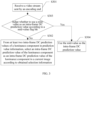
- a video decoding method includes: Step S101: Receive current frame image information sent by an encoding end, where the current frame image information includes prediction value information, and the prediction value information includes at least one intra-frame DC prediction value.
- the current frame image information may be placed in header information of a current frame image of a video stream.
- Step S102 Select a prediction value from the at least one intra-frame DC prediction value in the prediction value information as an intra-frame DC prediction value of the current image.
- the prediction value information in the preceding step S101 includes at least two DC prediction values.
- the current frame image information further includes selection information, and the selection information includes an identifier indicating a prediction value that needs to be selected from the at least two intra-frame DC prediction values.
- specific implementation of step S102 is:, According to the selection information, select a prediction value from the at least two intra-frame DC prediction values in the prediction value information as an intra-frame DC prediction value of the current image.
- a subject for executing the preceding action may be deployed on a decoding end.
- an embodiment of the present invention further provides a video encoding method. As shown in FIG. 2 , the method includes:
- Step S201 Calculate at least one intra-frame DC prediction value for a current frame image.
- Step S202 Send current frame image information to a decoding end, where the current frame image information includes prediction value information, and the prediction value information includes the at least one intra-frame DC prediction value, so that the decoding end performs decoding.
- the current frame image information may be placed in header information of a current frame image of a video stream.
- the calculating the at least one intra-frame DC prediction value for the current frame image in step S201 includes: calculating at least two intra-frame DC prediction values for the current frame image, where the current frame image information that is sent to the decoding end further includes selection information, and the selection information includes an identifier indicating a prediction value that needs to be selected by the decoding end from the at least two intra-frame DC prediction values.
- a subject for executing the preceding action may be deployed on an encoding end.
- An order of the steps of the method in this embodiment of the present invention may be adjusted as actually required.
- an encoding end calculates a prediction value of each image by using at least two prediction modes; and a decoding end may select one of at least two prediction values calculated by the encoding end as an intra-frame DC prediction value, so that flexibility of encoding and decoding is improved, and quality of a video image is improved.
- an encoding end when encoding each image, may add new syntax into header information, or modify existing syntax, so as to transmit an intra-frame prediction value of a current frame.
- the proper intra-frame prediction value is calculated out by the encoding end according to each frame image, and reflects an adaptability feature of the prediction value.
- the encoding end may use multiple kinds of calculation methods to calculate a proper intra-frame prediction value according to the current frame, and the calculation method is not specially limited in this embodiment.
- Table 1 shows average values of luminance components and chrominance components of various kinds of video sequences.
- the encoding end may use an average value of a luminance component and a chrominance component of a corresponding video sequence as the proper intra-frame prediction value.
- Table 1 Video sequence name Average value Y U V blue_sky_1920x1080p. 126 144 111 CrowdRun_1920x1080 97 123 129 Kimonol_1920x1080 69 122 126 ParkJoy_1920x1080p 79 113 122 ParkScene_1920x1080 73 120 128 riverbed_1920x1080p 93 119 127 sunflower_1920x1080p 78 102 141 toys_and_calendar_1920x1080p 68 122 135 tractor_1920x1080p 96 111 143
- An implementation method that the encoding end may adopt to add the intra-frame prediction value into the header information is described by using two examples in the following.
- the first row is used to instruct the decoding end to receive the intra_dc_pred_present_flag
- the second row is used to instruct the decoding end to judge whether the intra _dc_pred_present_flag is zero. If the intra _dc_pred_present_flag is zero, the decoding end uses a default mid-value (such as 128) as the intra-frame DC prediction value; if the intra_dc_pred_present_flag is not zero, the decoding end is instructed to receive intra_dc_pred_minus128, and use 128+intra_dc_pred_minus128 as the intra-frame DC prediction value.
- the intra_dc_pred_minus128 is calculated out by the encoding end adaptively according to a specific image.
- the intra_dc_pred_minus 128 may be a signed integer, for example, uses an 8-bit signed integer, and a value range is [-128, 127]; and may be expressed as i(8) in the H.264 standard.
- the intra_dc_pred_minus128 is equivalent to a difference between an adaptive prediction value and 128.
- the intra_dc_pred_minus128 in the added syntax may also be replaced by a practical adaptive prediction value, and the decoding end may use the adaptive prediction value as the intra-frame DC prediction value directly.
- This embodiment provides an intra-frame prediction method. As shown in FIG. 3 , the method includes:
- the header information of the video stream may also include an added flag bit, which is referred to as mid-value flag bit in the following.
- the mid-value flag bit may be used to indicate whether a mid-value is used as an intra-frame DC prediction value.
- a decoding end may judge whether to perform step S302 according to the mid-value flag bit.
- step S303 Judge whether to use the mid-value as the intra-frame DC prediction value according to the mid-value flag bit; if a judging result is that the mid-value is not used as the intra-frame DC prediction value, perform step S302; if a judging result is that the mid-value is used as the intra-frame DC prediction value, perform step S304: Use the mid-value as the intra-frame DC prediction value.
- the encoding end may add luminance component value prediction information into the header information of the video stream.
- the mid-value of the dynamic range may be used as an intra-frame DC prediction value of the chrominance component.
- an embodiment of the present invention further provides an intra-frame encoding method. As shown in FIG. 4 , the method includes:
- header information of the current frame image of the video stream that is sent to the decoding end may further include a mid-value flag bit.
- the mid-value flag bit is used to indicate whether the mid-value is used as an intra-frame DC prediction value.
- a current frame may be every frame in the video stream, and may also uses only some frames in the video stream, or may be only a specific frame in the video stream.
- an encoding end calculates at least two corresponding prediction values of a luminance component for each image by using at least two prediction modes; and a decoding end may select one prediction value of the luminance component from the at least two prediction values of the luminance component as an intra-frame DC prediction value of the luminance component, so that flexibility of encoding and decoding is improved, and quality of a video image is improved.
- This embodiment provides a video decoding method.
- a difference between this method and the video decoding method provided in the first embodiment lies only in that:
- Receiving prediction value information of current frame image information of a video stream that is sent by an encoding end further includes: The encoding end calculates at least two intra-frame DC prediction values of a chrominance component for a current frame image by using at least two prediction methods.
- selection information further includes an identifier indicating a prediction value of the chrominance component, where the prediction value of the chrominance component needs to be selected by a decoding end from the at least two intra-frame DC prediction values of the chrominance component.
- the decoding end may obtain intra-frame DC prediction value information of the chrominance component through the prediction value information.
- This embodiment further provides a video encoding method accordingly.
- a difference between this method and the video encoding method provided in the first embodiment lies only in that: An encoding end not only calculates an intra-frame DC prediction value of a luminance component, but also calculates at least two intra-frame DC prediction values of a chrominance component by using at least two prediction methods, adds the two intra-frame DC prediction values of the chrominance component into current frame image information, and adds an identifier into selection information, where the identifier is used to indicate a prediction value of the chrominance-component needs to be selected by a decoding end from the at least two prediction values of the chrominance component.
- the intra-frame DC prediction values of the chrominance component are added into the prediction value information, compared with the first embodiment, with the method provided in this embodiment, flexibility of encoding and decoding is further improved.
- This embodiment provides a video decoding method. It is considered that quantization is required at the time of encoding and that an image is not quite sensitive to precision of a prediction value transmitted in header information of an encoding end, this embodiment differs from the first embodiment and the second embodiment in: After quantizing a prediction value, the encoding end transmits the prediction value to a decoding end through the header information, in this way, encoding efficiency may further be improved.
- the prediction value in the first embodiment and the second embodiment is intra_dc_pred_minus 128, the prediction value transmitted in this embodiment is intra_dc_pred_ minus 128/q, where q is a quantization step length. If q is 8, when the intra_dc_pred_minus128 adopts an 8-bit fixed-length code, a quantized prediction value needs only a 5-bit fixed length code.
- an encoding end may, by using various manners such as arithmetic averaging and statistic averaging, calculate a prediction value that needs to be transmitted.
- flexibility of encoding and decoding may be improved, and quality of a video image may be improved.
- This embodiment does not form part of the invention.
- This embodiment provides a video encoding and decoding method. It is assumed that DC prediction values in neighboring areas in an image are similar, it may consider adjusting a DC prediction value adaptively at the time of encoding each block.
- an encoding end or a decoding end determines blocks that are intra-frame encoded in an image area A in a surrounding specific scope, and calculates a DC prediction value of the current block according to these blocks that are intra-frame encoded. For example, an average value of pixel values of these blocks is calculated as the DC prediction value of the current block. Sizes of these encoded intra blocks may be not limited to one kind of block size.
- a DC prediction value obtained from a surrounding block is more accurate, so that the DC prediction value can better reflect a local characteristic of the current block, thus helping enhance encoding performance.
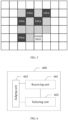
- FIG. 5 shows an image area.
- Each square represents an encoded unit block; a block marked as "current block” is a block that is to be encoded currently; another non-white area is the preceding-defined encoded image area A; and a block marked as "Intra” is an encoded Intra block in the area A, and other areas are non-Intra encoded blocks.
- DC prediction is performed on the block that is to be encoded currently, an average value of all pixels of these encoded Intra blocks in the area A is calculated as a DC prediction value of the block that is to be encoded.
- This method may be applied to the encoding end, and the DC prediction value obtained by calculation is sent to the decoding end.
- This method may also applied to the decoding end, and in this way, the encoding end may not need to send the DC prediction value to the decoding end, but the decoding end calculates a DC prediction value adaptively.
- the encoding end or the decoding end may calculate the DC prediction value adaptively, so that flexibility of encoding and decoding is improved and quality of a video image is improved; and furthermore, because the DC prediction value does not need to be transmitted from the encoding end to the decoding end, a bandwidth is saved.
- an apparatus 600 includes a receiving unit 601 and a selecting unit 602.
- the receiving unit 601 is configured to receive current frame image information that is sent by an encoding end, where the current frame image information includes prediction value information, and the prediction value information includes at least one intra-frame DC prediction value.
- the selecting unit 602 is configured to select a prediction value from the at least one intra-frame DC prediction value in the prediction value information as an intra-frame DC prediction value of the current image.
- the prediction value information includes at least two DC prediction values; and the current frame image information further includes selection information, where the selection information includes an identifier indicating a prediction value that needs to be selected from the at least two intra-frame DC prediction values.
- the selecting unit 602 is specifically configured to select a prediction value from the at least two intra-frame DC prediction values in the prediction value information as an intra-frame DC prediction value of the current image according to the selection information.
- the current frame image information may further include a mid-value flag bit.
- the mid-value flag bit is used to indicate whether a mid-value is used as an intra-frame DC prediction value. If the mid-value flag bit indicates that the mid-value is used as the intra-frame DC prediction value, at this time, the video decoding apparatus 600 in this embodiment may further include a judging unit 603.
- the judging unit 603 is configured to judge whether to use the mid-value as the intra-frame DC prediction value according to the mid-value flag bit; and if a judging result is that the mid-value is used as the intra-frame DC prediction value, trigger the selecting unit 602 to use the mid-value as the intra-frame DC prediction value; and if the judging result is that the mid-value is not used as the intra-frame DC prediction value, trigger the selecting unit 602 to select a prediction value from the at least two prediction values in the prediction value information as the intra-frame DC prediction value of the current image.
- the video decoding apparatus may be integrated in a circuit or a chip, including a CPU, a DSP (digital signal processing, Digital Signal Processing), or a communication chip.
- a CPU central processing unit
- DSP digital signal processing, Digital Signal Processing
- the electronic device includes an intra-frame prediction apparatus in the fourth embodiment.
- the electronic device in this embodiment may be a mobile phone, a video processing device, a computer, and a server.
- flexibility of encoding and decoding may be improved, and quality of a video image may be improved.
- an intra-frame encoding apparatus 700 includes:
- the calculating the at least one intra-frame DC prediction value for the current frame image includes: calculating at least two intra-frame DC prediction values for the current frame image, where the current frame image information that is sent to an decoding end further includes selection information, and the selection information includes an identifier indicating a prediction value that needs to be selected by the decoding end from the at least two intra-frame DC prediction values.
- the video encoding apparatus may be integrated in a circuit or a chip, including a CPU, a DSP (digital signal processing, Digital Signal Processing), or a communication chip.
- a CPU central processing unit
- DSP digital signal processing, Digital Signal Processing
- the electronic device includes an intra-frame encoding apparatus described in the sixth embodiment.
- the electronic device in this embodiment of the present invention may be a mobile phone, a video processing device, a computer, and a server. Through this embodiment of the present invention, flexibility of encoding and decoding may be improved, and quality of a video image may be improved.
- This embodiment does not form part of the invention.
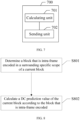
- This embodiment provides a DC coefficient predicting method. As shown in FIG. 8 , the method includes:
- step S802 may be: Calculate an average value of all pixels in the block that is intra-frame encoded, and use the average value as the DC prediction value of the current block.
- This method may be applied to an encoding end, and a predicted DC prediction value is sent to a decoding end.
- This method may also be applied to the decoding end, and in this way, the encoding end may not need to send the DC prediction value to the decoding end, but the decoding end calculates a DC prediction value adaptively.
- the encoding end or the decoding end may calculate the DC prediction value adaptively, so that flexibility of encoding and decoding may be improved, and quality of a video image may be improved; and furthermore, because the DC prediction value does not need to be transmitted from the encoding end to the decoding end, a bandwidth is saved.
- this embodiment does not form part of the invention.
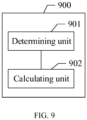
- this embodiment provides a DC coefficient predicting apparatus. As shown in FIG. 9 , the apparatus includes:
- This apparatus may be integrated in an encoding end, and sends a predicted DC prediction value to a decoding end.
- This apparatus may also be integrated in the decoding end, and in this way, the encoding end may not need to send the DC prediction value to the decoding end, but the decoding end calculates a DC prediction value adaptively.
- the encoding end or the decoding end may calculate the DC prediction value adaptively, so that flexibility of encoding and decoding is improved, and quality of a video image is improved; and furthermore, because the DC prediction value does not need to be transmitted from the encoding end to the decoding end, a bandwidth is saved.
- the steps of the method or algorithm described in the embodiments disclosed in this specification may be implemented by hardware, a software module executed by a processor, or a combination of the two.
- the software module may be set in a Random Access Memory (RAM), a memory, a Read-Only Memory (ROM), an electrically programmable ROM, an electrically erasable programmable ROM, a register, a hard disk, a moveable disk, a CD-ROM, or any other form of storage medium well-known in the art.
Landscapes
- Engineering & Computer Science (AREA)
- Multimedia (AREA)
- Signal Processing (AREA)
- Compression Or Coding Systems Of Tv Signals (AREA)
Claims (6)
- Videodecodierungsverfahren, das durch einen Computer durchgeführt wird, umfassend:• Empfangen (S101, S301) von Informationen eines aktuellen Framebilds, die durch ein Codierungsende gesendet werden, wobei die Informationen eines aktuellen Framebilds Prädiktionswertinformationen umfassen und die Prädiktionswertinformationen mindestens einen Intraframegleichstrom- bzw. Intraframe-DC-Prädiktionswert umfassen; und• Auswählen (S102, S302) eines Prädiktionswerts aus dem mindestens einen Intraframe-DC-Prädiktionswert in den Prädiktionswertinformationen als einen Intraframe-DC-Prädiktionswert eines aktuellen Framebilds, wobei jeder des mindestens einen Intraframe-DC-Prädiktionswerts ein Prädiktionswerts ist, der zum Vorhersagen aller Pixel, die unter Verwendung eines DC-Prädiktionsmodus intravorhergesagt werden, eines Makroblocks des aktuellen Framebilds verwendet wird.
- Verfahren nach Anspruch 1, wobei:die Prädiktionswertinformationen mindestens zwei DC-Prädiktionswerte umfassen;und die Informationen eines aktuellen Framebilds ferner Auswahlinformationen umfassen und die Auswahlinformationen eine Kennung umfassen, die einen Prädiktionswert angeben, der aus den mindestens zwei Intraframe-DC-Prädiktionswerten ausgewählt werden muss; unddas Auswählen (S102, S302) des Prädiktionswerts aus dem mindestens einen Intraframe-DC-Prädiktionswert in den Prädiktionswertinformationen als den Intraframe-DC-Prädiktionswert des aktuellen Framebilds Folgendes umfasst:
Auswählen des Prädiktionswerts aus den mindestens zwei Intraframe-DC-Prädiktionswerten in den Prädiktionswertinformationen als den Intraframe-DC-Prädiktionswert des aktuellen Framebilds gemäß den Auswahlinformationen. - Verfahren nach Anspruch 1, wobei:die Informationen eines aktuellen Framebilds ferner ein Mittelwert-Flag-Bit umfassen und das Mittelwert-Flag-Bit verwendet wird, um anzugeben, ob ein Mittelwert für einen Dynamikbereich eines Bildpixels als Intraframe-DC-Prädiktionswert verwendet wird; unddas Verfahren ferner Folgendes umfasst: nach Empfangen eines durch das Codierungsende gesendeten Videostroms, Beurteilen (S303), ob der Mittelwert als der Intraframe-DC-Prädiktionswert verwendet werden soll, gemäß dem Mittelwert-Flag-Bit; und wenn der Mittelwert als der Intraframe-DC-Prädiktionswert verwendet wird, Verwenden des Mittelwerts als den Intraframe-DC-Prädiktionswert; und wenn der Mittelwert nicht als der Intraframe-DC-Prädiktionswert verwendet wird, Auswählen des Prädiktionswerts aus dem mindestens einen Prädiktionswert in den Prädiktionswertinformationen als den Intraframe-DC-Prädiktionswert des aktuellen Framebilds.
- Videocodierungsverfahren, das durch einen Computer durchgeführt wird, umfassend:• Berechnen (S201, S401) mindestens eines Intraframe-DC-Prädiktionswerts für ein aktuelles Framebild; und• Senden (S202, S402) von Informationen eines aktuellen Framebilds an ein Decodierungsende, wobei die Informationen eines aktuellen Framebilds Prädiktionswertinformationen umfassen und die Prädiktionswertinformationen den mindestens einen Wert zur Angabe eines Intraframe-DC-Werts umfassen, wobei jeder des mindestens einen Intraframe-DC-Prädiktionswerts ein Prädiktionswerts ist, der zum Vorhersagen aller Pixel, die unter Verwendung eines DC-Prädiktionsmodus intravorhergesagt werden, eines Makroblocks des aktuellen Framebilds verwendet wird.
- Verfahren nach Anspruch 4, wobei:
das Berechnen (S201, S401) des mindestens einen Intraframe-DC-Prädiktionswerts für das aktuelle Framebild Folgendes umfasst: Berechnen von mindestens zwei DC-Prädiktionswerten für das aktuelle Framebild, wobei die Informationen eines aktuellen Framebilds, die an das Decodierungsende gesendet werden, ferner Auswahlinformationen umfassen und die Auswahlinformationen eine Kennung umfassen, die einen Prädiktionswert angeben, der durch das Decodierungsende aus den mindestens zwei Intraframe-DC-Prädiktionswerten ausgewählt werden muss. - Verfahren nach Anspruch 4, wobei:
die Informationen eines aktuellen Framebilds, die an das Decodierungsende gesendet werden, ferner ein Mittelwert-Flag-Bit umfassen und das Mittelwert-Flag-Bit verwendet wird, um anzugeben, ob ein Mittelwert für einen Dynamikbereich eines Bildpixels als Intraframe-DC-Prädiktionswert verwendet wird.
Applications Claiming Priority (3)
| Application Number | Priority Date | Filing Date | Title |
|---|---|---|---|
| CN2009102169742A CN102118613B (zh) | 2009-12-31 | 2009-12-31 | 视频解码和编码方法及装置 |
| PCT/CN2010/079137 WO2011079671A1 (zh) | 2009-12-31 | 2010-11-25 | 视频解码和编码方法及装置、和直流系数预测方法和装置 |
| EP10840460.9A EP2461589B1 (de) | 2009-12-31 | 2010-11-25 | Verfahren und vorrichtung zur dekodierung und kodierung von videodaten sowie verfahren und vorrichtung zur vorhersage eines direktstromkoeffizienten |
Related Parent Applications (2)
| Application Number | Title | Priority Date | Filing Date |
|---|---|---|---|
| EP10840460.9A Division EP2461589B1 (de) | 2009-12-31 | 2010-11-25 | Verfahren und vorrichtung zur dekodierung und kodierung von videodaten sowie verfahren und vorrichtung zur vorhersage eines direktstromkoeffizienten |
| EP10840460.9A Division-Into EP2461589B1 (de) | 2009-12-31 | 2010-11-25 | Verfahren und vorrichtung zur dekodierung und kodierung von videodaten sowie verfahren und vorrichtung zur vorhersage eines direktstromkoeffizienten |
Publications (3)
| Publication Number | Publication Date |
|---|---|
| EP3570541A1 EP3570541A1 (de) | 2019-11-20 |
| EP3570541B1 true EP3570541B1 (de) | 2025-03-26 |
| EP3570541C0 EP3570541C0 (de) | 2025-03-26 |
Family
ID=44217181
Family Applications (2)
| Application Number | Title | Priority Date | Filing Date |
|---|---|---|---|
| EP10840460.9A Active EP2461589B1 (de) | 2009-12-31 | 2010-11-25 | Verfahren und vorrichtung zur dekodierung und kodierung von videodaten sowie verfahren und vorrichtung zur vorhersage eines direktstromkoeffizienten |
| EP19163054.0A Active EP3570541B1 (de) | 2009-12-31 | 2010-11-25 | Verfahren und vorrichtung zur decodierung und codierung von videodaten sowie verfahren und vorrichtung zur vorhersage eines direktstromkoeffizienten |
Family Applications Before (1)
| Application Number | Title | Priority Date | Filing Date |
|---|---|---|---|
| EP10840460.9A Active EP2461589B1 (de) | 2009-12-31 | 2010-11-25 | Verfahren und vorrichtung zur dekodierung und kodierung von videodaten sowie verfahren und vorrichtung zur vorhersage eines direktstromkoeffizienten |
Country Status (5)
| Country | Link |
|---|---|
| US (1) | US9420290B2 (de) |
| EP (2) | EP2461589B1 (de) |
| CN (1) | CN102118613B (de) |
| ES (1) | ES3027987T3 (de) |
| WO (1) | WO2011079671A1 (de) |
Families Citing this family (5)
| Publication number | Priority date | Publication date | Assignee | Title |
|---|---|---|---|---|
| HUE063723T2 (hu) | 2011-10-28 | 2024-01-28 | Samsung Electronics Co Ltd | Eljárás és berendezés video intra predikciójára |
| CN103200400B (zh) | 2012-01-09 | 2018-03-16 | 中兴通讯股份有限公司 | 一种图像层和分片层的编解码方法、编解码器和电子设备 |
| CN103220506B (zh) | 2012-01-19 | 2015-11-25 | 华为技术有限公司 | 一种编解码方法和设备 |
| WO2013186802A1 (ja) * | 2012-06-11 | 2013-12-19 | 日本放送協会 | 符号化装置、復号装置及びプログラム |
| CN114279679B (zh) * | 2021-04-15 | 2024-09-27 | 上海商米科技集团股份有限公司 | 自动化测试方法及系统、测试设备和计算机可读存储介质 |
Family Cites Families (8)
| Publication number | Priority date | Publication date | Assignee | Title |
|---|---|---|---|---|
| US6654503B1 (en) * | 2000-04-28 | 2003-11-25 | Sun Microsystems, Inc. | Block-based, adaptive, lossless image coder |
| US6842484B2 (en) | 2001-07-10 | 2005-01-11 | Motorola, Inc. | Method and apparatus for random forced intra-refresh in digital image and video coding |
| KR20050112445A (ko) * | 2004-05-25 | 2005-11-30 | 경희대학교 산학협력단 | 예측 부호화/복호화 장치, 예측 부호화/복호화 방법 및 그방법을 수행하는 프로그램이 기록된 컴퓨터 판독가능한기록매체 |
| KR100727988B1 (ko) * | 2005-10-01 | 2007-06-13 | 삼성전자주식회사 | 변환 영역에서의 dc 계수 예측 방법 및 장치 |
| JP5044415B2 (ja) * | 2005-11-30 | 2012-10-10 | 株式会社東芝 | 画像符号化/画像復号化方法及び画像符号化/画像復号化装置 |
| JP5026092B2 (ja) * | 2007-01-12 | 2012-09-12 | 三菱電機株式会社 | 動画像復号装置および動画像復号方法 |
| US8428133B2 (en) * | 2007-06-15 | 2013-04-23 | Qualcomm Incorporated | Adaptive coding of video block prediction mode |
| CN101605255B (zh) * | 2008-06-12 | 2011-05-04 | 华为技术有限公司 | 一种视频编解码的方法及装置 |
-
2009
- 2009-12-31 CN CN2009102169742A patent/CN102118613B/zh active Active
-
2010
- 2010-11-25 EP EP10840460.9A patent/EP2461589B1/de active Active
- 2010-11-25 EP EP19163054.0A patent/EP3570541B1/de active Active
- 2010-11-25 ES ES19163054T patent/ES3027987T3/es active Active
- 2010-11-25 WO PCT/CN2010/079137 patent/WO2011079671A1/zh not_active Ceased
-
2012
- 2012-04-04 US US13/439,052 patent/US9420290B2/en active Active
Also Published As
| Publication number | Publication date |
|---|---|
| WO2011079671A1 (zh) | 2011-07-07 |
| ES3027987T3 (en) | 2025-06-17 |
| EP2461589A1 (de) | 2012-06-06 |
| US20120195380A1 (en) | 2012-08-02 |
| US9420290B2 (en) | 2016-08-16 |
| CN102118613A (zh) | 2011-07-06 |
| CN102118613B (zh) | 2012-11-21 |
| EP3570541C0 (de) | 2025-03-26 |
| EP2461589B1 (de) | 2019-07-10 |
| EP2461589A4 (de) | 2012-06-06 |
| EP3570541A1 (de) | 2019-11-20 |
Similar Documents
| Publication | Publication Date | Title |
|---|---|---|
| CN107409219B (zh) | 译码视频信息的方法、设备、装置和计算机可读存储媒体 | |
| TWI735424B (zh) | 調色編碼模式逃逸色彩編碼 | |
| CN100387059C (zh) | 图像解码方法 | |
| EP3954118B1 (de) | Weitwinkel-intraprädiktion mit teilpartitionen | |
| CN101222644B (zh) | 运动图像编码、解码装置以及运动图像编码、解码方法 | |
| IL280228B2 (en) | Video encoder, video encoder and corresponding encoding and decoding methods | |
| JP2011530221A (ja) | 圧縮領域の類似度メトリックに基づくビデオ符号化におけるインテリジェントフレーム間引き | |
| CN106028037A (zh) | 用于解码图像的设备 | |
| KR20180056688A (ko) | 디스플레이 스트림 압축 (dsc) 에 대한 블록 예측 모드를 위한 가변 파티션 사이즈 | |
| CN108353177A (zh) | 在显示流压缩dsc中用于降低切片边界视觉假象的系统及方法 | |
| EP2461589B1 (de) | Verfahren und vorrichtung zur dekodierung und kodierung von videodaten sowie verfahren und vorrichtung zur vorhersage eines direktstromkoeffizienten | |
| JP2019512970A (ja) | ディスプレイストリーム圧縮における量子化パラメータの適応計算のための装置および方法 | |
| JP6772275B2 (ja) | ディスプレイストリーム圧縮(dsc)におけるひずみを計算するためのシステムおよび方法 | |
| WO2013056577A1 (zh) | 一种帧内预测模式编码器、解码器及其方法和电子设备 | |
| EP2196031B1 (de) | Verfahren zum alternieren der entropiecodierung | |
| US11483554B2 (en) | Intra-prediction apparatus, encoding apparatus, decoding apparatus and methods for non-square video coding blocks | |
| JP2008219205A (ja) | 画像情報符号化装置及び画像情報符号化方法 | |
| US20250227222A1 (en) | Intra mode derivation for inter-predicted coding units | |
| WO2020117781A1 (en) | Method and apparatus for video encoding and decoding with adjusting the quantization parameter to block size | |
| EP3644612A1 (de) | Verfahren und vorrichtung zur bildcodierung und -decodierung | |
| KR100517906B1 (ko) | 모바일 디바이스용 동영상 압축 방법 | |
| JP2013093774A (ja) | 符号化装置、及びその制御方法 | |
| CN110662048A (zh) | 一种图像编码方法以及设备 |
Legal Events
| Date | Code | Title | Description |
|---|---|---|---|
| PUAI | Public reference made under article 153(3) epc to a published international application that has entered the european phase |
Free format text: ORIGINAL CODE: 0009012 |
|
| STAA | Information on the status of an ep patent application or granted ep patent |
Free format text: STATUS: REQUEST FOR EXAMINATION WAS MADE |
|
| 17P | Request for examination filed |
Effective date: 20190315 |
|
| AC | Divisional application: reference to earlier application |
Ref document number: 2461589 Country of ref document: EP Kind code of ref document: P |
|
| AK | Designated contracting states |
Kind code of ref document: A1 Designated state(s): AL AT BE BG CH CY CZ DE DK EE ES FI FR GB GR HR HU IE IS IT LI LT LU LV MC MK MT NL NO PL PT RO RS SE SI SK SM TR |
|
| STAA | Information on the status of an ep patent application or granted ep patent |
Free format text: STATUS: EXAMINATION IS IN PROGRESS |
|
| 17Q | First examination report despatched |
Effective date: 20210518 |
|
| GRAP | Despatch of communication of intention to grant a patent |
Free format text: ORIGINAL CODE: EPIDOSNIGR1 |
|
| STAA | Information on the status of an ep patent application or granted ep patent |
Free format text: STATUS: GRANT OF PATENT IS INTENDED |
|
| INTG | Intention to grant announced |
Effective date: 20241121 |
|
| GRAS | Grant fee paid |
Free format text: ORIGINAL CODE: EPIDOSNIGR3 |
|
| GRAA | (expected) grant |
Free format text: ORIGINAL CODE: 0009210 |
|
| STAA | Information on the status of an ep patent application or granted ep patent |
Free format text: STATUS: THE PATENT HAS BEEN GRANTED |
|
| AC | Divisional application: reference to earlier application |
Ref document number: 2461589 Country of ref document: EP Kind code of ref document: P |
|
| AK | Designated contracting states |
Kind code of ref document: B1 Designated state(s): AL AT BE BG CH CY CZ DE DK EE ES FI FR GB GR HR HU IE IS IT LI LT LU LV MC MK MT NL NO PL PT RO RS SE SI SK SM TR |
|
| REG | Reference to a national code |
Ref country code: GB Ref legal event code: FG4D |
|
| REG | Reference to a national code |
Ref country code: CH Ref legal event code: EP |
|
| REG | Reference to a national code |
Ref country code: DE Ref legal event code: R096 Ref document number: 602010069703 Country of ref document: DE |
|
| REG | Reference to a national code |
Ref country code: IE Ref legal event code: FG4D |
|
| U01 | Request for unitary effect filed |
Effective date: 20250326 |
|
| U07 | Unitary effect registered |
Designated state(s): AT BE BG DE DK EE FI FR IT LT LU LV MT NL PT RO SE SI Effective date: 20250401 |
|
| REG | Reference to a national code |
Ref country code: ES Ref legal event code: FG2A Ref document number: 3027987 Country of ref document: ES Kind code of ref document: T3 Effective date: 20250617 |
|
| PG25 | Lapsed in a contracting state [announced via postgrant information from national office to epo] |
Ref country code: RS Free format text: LAPSE BECAUSE OF FAILURE TO SUBMIT A TRANSLATION OF THE DESCRIPTION OR TO PAY THE FEE WITHIN THE PRESCRIBED TIME-LIMIT Effective date: 20250626 |
|
| PG25 | Lapsed in a contracting state [announced via postgrant information from national office to epo] |
Ref country code: NO Free format text: LAPSE BECAUSE OF FAILURE TO SUBMIT A TRANSLATION OF THE DESCRIPTION OR TO PAY THE FEE WITHIN THE PRESCRIBED TIME-LIMIT Effective date: 20250626 |
|
| PG25 | Lapsed in a contracting state [announced via postgrant information from national office to epo] |
Ref country code: HR Free format text: LAPSE BECAUSE OF FAILURE TO SUBMIT A TRANSLATION OF THE DESCRIPTION OR TO PAY THE FEE WITHIN THE PRESCRIBED TIME-LIMIT Effective date: 20250326 |
|
| PG25 | Lapsed in a contracting state [announced via postgrant information from national office to epo] |
Ref country code: GR Free format text: LAPSE BECAUSE OF FAILURE TO SUBMIT A TRANSLATION OF THE DESCRIPTION OR TO PAY THE FEE WITHIN THE PRESCRIBED TIME-LIMIT Effective date: 20250627 |
|
| PG25 | Lapsed in a contracting state [announced via postgrant information from national office to epo] |
Ref country code: SM Free format text: LAPSE BECAUSE OF FAILURE TO SUBMIT A TRANSLATION OF THE DESCRIPTION OR TO PAY THE FEE WITHIN THE PRESCRIBED TIME-LIMIT Effective date: 20250326 |
|
| PG25 | Lapsed in a contracting state [announced via postgrant information from national office to epo] |
Ref country code: PL Free format text: LAPSE BECAUSE OF FAILURE TO SUBMIT A TRANSLATION OF THE DESCRIPTION OR TO PAY THE FEE WITHIN THE PRESCRIBED TIME-LIMIT Effective date: 20250326 |
|
| PGFP | Annual fee paid to national office [announced via postgrant information from national office to epo] |
Ref country code: GB Payment date: 20250930 Year of fee payment: 16 |
|
| PG25 | Lapsed in a contracting state [announced via postgrant information from national office to epo] |
Ref country code: SK Free format text: LAPSE BECAUSE OF FAILURE TO SUBMIT A TRANSLATION OF THE DESCRIPTION OR TO PAY THE FEE WITHIN THE PRESCRIBED TIME-LIMIT Effective date: 20250326 |
|
| PG25 | Lapsed in a contracting state [announced via postgrant information from national office to epo] |
Ref country code: IS Free format text: LAPSE BECAUSE OF FAILURE TO SUBMIT A TRANSLATION OF THE DESCRIPTION OR TO PAY THE FEE WITHIN THE PRESCRIBED TIME-LIMIT Effective date: 20250726 |
|
| U20 | Renewal fee for the european patent with unitary effect paid |
Year of fee payment: 16 Effective date: 20251201 |
|
| PG25 | Lapsed in a contracting state [announced via postgrant information from national office to epo] |
Ref country code: CZ Free format text: LAPSE BECAUSE OF FAILURE TO SUBMIT A TRANSLATION OF THE DESCRIPTION OR TO PAY THE FEE WITHIN THE PRESCRIBED TIME-LIMIT Effective date: 20250326 |
|
| PGFP | Annual fee paid to national office [announced via postgrant information from national office to epo] |
Ref country code: IE Payment date: 20251001 Year of fee payment: 16 |
|
| PGFP | Annual fee paid to national office [announced via postgrant information from national office to epo] |
Ref country code: ES Payment date: 20251212 Year of fee payment: 16 |
|
| PLBE | No opposition filed within time limit |
Free format text: ORIGINAL CODE: 0009261 |
|
| STAA | Information on the status of an ep patent application or granted ep patent |
Free format text: STATUS: NO OPPOSITION FILED WITHIN TIME LIMIT |
|
| REG | Reference to a national code |
Ref country code: CH Ref legal event code: L10 Free format text: ST27 STATUS EVENT CODE: U-0-0-L10-L00 (AS PROVIDED BY THE NATIONAL OFFICE) Effective date: 20260211 |
|
| 26N | No opposition filed |
Effective date: 20260105 |