EP3569293A1 - Kugel für ein boulespiel, insbesondere petanque-kugel - Google Patents
Kugel für ein boulespiel, insbesondere petanque-kugel Download PDFInfo
- Publication number
- EP3569293A1 EP3569293A1 EP19000038.0A EP19000038A EP3569293A1 EP 3569293 A1 EP3569293 A1 EP 3569293A1 EP 19000038 A EP19000038 A EP 19000038A EP 3569293 A1 EP3569293 A1 EP 3569293A1
- Authority
- EP
- European Patent Office
- Prior art keywords
- meridian
- ball according
- groove
- inflection
- section
- Prior art date
- Legal status (The legal status is an assumption and is not a legal conclusion. Google has not performed a legal analysis and makes no representation as to the accuracy of the status listed.)
- Withdrawn
Links
- 230000001186 cumulative effect Effects 0.000 claims description 3
- 230000000694 effects Effects 0.000 description 3
- 230000035939 shock Effects 0.000 description 2
- 230000000712 assembly Effects 0.000 description 1
- 238000000429 assembly Methods 0.000 description 1
- 238000012550 audit Methods 0.000 description 1
- 210000003813 thumb Anatomy 0.000 description 1
- 210000000707 wrist Anatomy 0.000 description 1
Images
Classifications
-
- A—HUMAN NECESSITIES
- A63—SPORTS; GAMES; AMUSEMENTS
- A63B—APPARATUS FOR PHYSICAL TRAINING, GYMNASTICS, SWIMMING, CLIMBING, OR FENCING; BALL GAMES; TRAINING EQUIPMENT
- A63B37/00—Solid balls; Rigid hollow balls; Marbles
- A63B37/0098—Rigid hollow balls, e.g. for pétanque
-
- A—HUMAN NECESSITIES
- A63—SPORTS; GAMES; AMUSEMENTS
- A63B—APPARATUS FOR PHYSICAL TRAINING, GYMNASTICS, SWIMMING, CLIMBING, OR FENCING; BALL GAMES; TRAINING EQUIPMENT
- A63B37/00—Solid balls; Rigid hollow balls; Marbles
- A63B37/14—Special surfaces
Definitions
- the invention relates to a bowling ball, in particular for petanque, the Provencal game, the long and the lyonnaise, such ball being of the type having a spherical surface comprising, on the one hand, a large circle forming a meridian of departure having two diametrically opposite points forming two poles and, secondly, equidistant from these two poles, an equatorial circle delimiting two hemispheres, said spherical surface further comprising at least one pattern consisting of a groove having a first end, located on said meridian of departure and on a first parallel of said spherical surface adjacent the pole of a first hemisphere, and a second end.
- the invention aims to provide a ball that offers the advantage of being even more technical than all the balls currently used, including by professional players, in that the person who will launch, pointer or shooter, may give said ball according to the invention an effect of a magnitude never reached so far.
- such a ball is characterized in that said groove has, starting from said first end, an S-shape similar to a sinusoidal shape and comprises two sections, of opposite curvatures, connected to one another.
- an inflection point located on an inflection meridian, at least a portion of a first stretch from said first end being located on said first hemisphere between the starting meridian and the inflection meridian and having a first curvature of which the concavity is turned towards said inflection meridian
- at least a portion of the second section is situated on the side opposite to that where said part of the first section is located in relation to meridian inflexion audit and extends to said second end of the groove, which second end is located on a parallel of said spherical surface adjacent the pole of the second hemisphere, said portion of the second section having a curvature whose concavity is turned towards said inflection meridian.
- the concavity of the first curvature of said portion of the first section may also be turned towards said starting meridian. But also, said concavity can be only turned towards said inflection meridian.
- said second end of the groove may also be located on said starting meridian. But also, said second end of the groove may be located on a meridian other than said starting meridian.
- said inflection point may be located on said equatorial circle. But also, said inflection point may be located between said equatorial circle and one of said parallels.
- all of said first section starts from said first end, can be located on said first hemisphere, between the starting meridian and the inflection meridian, and has said first curvature.
- all of said second section may be located on said opposite side with respect to said inflection meridian and extend to said second end of the groove and have said second curvature.
- said starting meridian and said inflection meridian may be one and the same meridian.
- the second end of the first section of the groove may be located on said first meridian. But also, the second end of the first section of the groove may be located on a different meridian and neighbor of the first meridian.
- the angle made by the planes respectively containing the starting meridian and the inflection meridian and the axis joining the two poles may be between 0 ° and 30 °.
- the concavity of the curvature of the first section can be directed in projection on the equatorial circle in the clockwise direction.
- the concavity of the curvature of the first section can be directed in projection on the equatorial circle in the anti-clockwise direction.
- the ball according to the invention can thus be used by both left-handed and right-handed players.
- said pattern may consist of multiple grooves. It is of course essentially with these multiple designs that the ball according to the invention, with consequent multiple forms, will be marketed.
- first ends of the first sections of at least two grooves may be located at points different from the said parallel of the first hemisphere and the second ends of the second sections of the said grooves may be located at points different from the said second parallel. hemisphere.
- the multiple grooves can be divided into at least two assemblies, the first ends of the first sections and the second ends of the second sections of the grooves of two sets being located, respectively, on different parallel neighbors of the first pole. and on different parallel neighbors of the second pole.
- the number n of the multiple grooves can be between 3 and 40.
- the groove or each groove may be discontinuous or interrupted.
- the number of discontinuities, or interruptions can be between 2 and 10.
- the interrupts of the two sets can be shifted to different parallels.
- said interruptions may be formed of portions of the spherical surface, which spherical surface is smooth outside the groove or each groove.
- the groove or each groove may have a section V or U.
- the sphere may be hollow and the groove or each groove may be located on the outer spherical surface of said sphere.
- the ratio of the area of said groove or the cumulative area of the grooves to the total area of said spherical surface may be between 5% and 30%.
- the diameter of said sphere may be about 75 mm.
- the depth of the groove or each groove may be between 0.10 mm and 0.20 mm and more preferably equal to 0.15 mm. More preferably, the width of the groove or each groove may be between 1 mm and 1.5 mm.
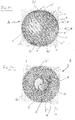
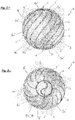
- Each of the balls A and B of FIGS. 1a, 1b and 2a, 2b is formed by a hollow sphere having an outer spherical surface 1 comprising, on the one hand, a large circle forming a first meridian 2 which has two diametrically opposite points forming two Poles North 3 and South 4, and, secondly, equidistant from these two poles 3 and 4, an equatorial circle 5 delimiting two hemispheres North 6 and South 7.
- the spherical surface 1 comprises at least one pattern constituted by a groove 8 formed on the spherical surface of the ball, this groove having a first end 8a 'located on the meridian 2 and on a parallel 9' of the spherical surface 1 adjacent the pole 3 of a first hemisphere 6, and a second end 8b 'located on another meridian, different from the meridian 2 , and on a parallel 9 "of the spherical surface 1 close to the pole 4 of the second hemisphere 7.
- the groove 8 has, starting from the first end 8a ', an S shape similar to a sinusoidal shape.
- first section 8 ' It comprises, on the first hemisphere 6, a first section 8 ', all of which extends from the first end 8a' to the second end 8b "which is located on the equatorial circle 5.
- the entire first section 8 ' has a first curvature whose concavity C' is turned towards another meridian 10, different from the meridian 2, called the inflection meridian, and is situated on a first side with respect to this inflection meridian.
- the groove 8 further comprises, on the second hemisphere 7, a second section 8 '' which is connected to the first section 8 'and extends from a first end 8a "situated on the equatorial circle 5, coinciding with the second end 8b "of the first section 8 ', to said second end 8b' of the groove which is located on the parallel 9" of the second hemisphere 7.
- the entire second section 8 “has a second curvature whose concavity C" is also turned towards the inflection meridian 10 and is located on the opposite side to the first section 8 'with respect to this inflection meridian.
- the concavity C 'of the curvature of the first section 8' of the groove is directed in projection on the equatorial circle 5 in the clockwise direction and the concavity C "of the curvature of the second section 8" is directed in projection on the equatorial circle in counter clockwise.
- the two sections 8 'and 8 "of each groove are connected to a point of inflection 11 which is situated on the inflection meridian 10 and on the equatorial circle 5 and coincides with the second end 8b" of the first section and with the first end 8a "of the second section.
- the groove pattern is constituted by multiple grooves 8.
- the spherical surface of each ball A and B is smooth between the different grooves.
- the ratio of the cumulative area of the grooves to the total area of said spherical surface is for example between 5 and 30%.
- the grooves 8 are, for example, 32 on the ball A of FIGS. 1a and 1b, and for example 16 on the ball B of FIGS. Figures 2a and 2b .
- the first ends 8a 'of the first sections 8' of the different grooves 8 are located respectively at different points of the parallel 9 'of the first hemisphere 6 and the second ends 8b' of the second sections 8 'of the different grooves are all respectively located at different points of the parallel 9 "of the second hemisphere 7.
- the grooves 8 are divided into two sets 12 and 13.
- the first ends 8a 'of the first sections of the grooves of the first set 12 and the second ends 8b "of the second sections of the grooves of the second set 13 are respectively located, for the first, on different parallels 9 ', for the first set, and 9a', for the second set, which are neighbors of the first pole 3 and, for the seconds, on different parallels 9 ", for the first set, and 9a", for the second set, which are close to the second pole 4.
- the grooves 8 are continuous from the first end 8a 'of the first section 8' to the second end 8b 'of the second section 8 ".
- the grooves 8 are discontinuous, or interrupted, between the first end 8a 'of the first section 8' and the second end 8b 'of the second section 8 ".
- the number of discontinuities, or interruptions, 14 is alternately 3 and 4.
- the discontinuities or interruptions 14 are formed of smooth portions of the spherical surface unlike the grooved portions.
- the length of the discontinuities, or interruptions, is for example a fraction of the length of the grooved parts of between 1 and 1/10.
- each groove 8 ' has a V-section or a U-shaped section, the depth of the groove being, for example, 0.15 mm.
- this section is formed by a semicircle of radius 1.5 mm.
Landscapes
- Health & Medical Sciences (AREA)
- General Health & Medical Sciences (AREA)
- Physical Education & Sports Medicine (AREA)
- Pivots And Pivotal Connections (AREA)
- Eyeglasses (AREA)
Applications Claiming Priority (1)
| Application Number | Priority Date | Filing Date | Title |
|---|---|---|---|
| FR1800051A FR3076736B1 (fr) | 2018-01-15 | 2018-01-15 | Boule, telle une boule de petanque |
Publications (1)
| Publication Number | Publication Date |
|---|---|
| EP3569293A1 true EP3569293A1 (de) | 2019-11-20 |
Family
ID=62816613
Family Applications (1)
| Application Number | Title | Priority Date | Filing Date |
|---|---|---|---|
| EP19000038.0A Withdrawn EP3569293A1 (de) | 2018-01-15 | 2019-01-15 | Kugel für ein boulespiel, insbesondere petanque-kugel |
Country Status (3)
| Country | Link |
|---|---|
| EP (1) | EP3569293A1 (de) |
| FR (1) | FR3076736B1 (de) |
| MA (1) | MA45311A (de) |
Citations (5)
| Publication number | Priority date | Publication date | Assignee | Title |
|---|---|---|---|---|
| US1517514A (en) * | 1924-04-02 | 1924-12-02 | Hunt Jarvis | Golf ball |
| FR1540815A (fr) * | 1967-10-13 | 1968-09-27 | Ramasse-boules | |
| US4772020A (en) * | 1986-08-15 | 1988-09-20 | Martin Rod G | Helically grooved foamed football |
| FR2796303A1 (fr) * | 1999-07-01 | 2001-01-19 | Vartan Berberian | Boule pour jeux de boules comportant des motifs sur sa face externe |
| GB2494966A (en) * | 2011-09-06 | 2013-03-27 | Walter Benjamin Jacobs | Lawn bowling balls with pattern of dimples |
-
2018
- 2018-01-15 FR FR1800051A patent/FR3076736B1/fr active Active
-
2019
- 2019-01-15 EP EP19000038.0A patent/EP3569293A1/de not_active Withdrawn
- 2019-01-15 MA MA045311A patent/MA45311A/fr unknown
Patent Citations (5)
| Publication number | Priority date | Publication date | Assignee | Title |
|---|---|---|---|---|
| US1517514A (en) * | 1924-04-02 | 1924-12-02 | Hunt Jarvis | Golf ball |
| FR1540815A (fr) * | 1967-10-13 | 1968-09-27 | Ramasse-boules | |
| US4772020A (en) * | 1986-08-15 | 1988-09-20 | Martin Rod G | Helically grooved foamed football |
| FR2796303A1 (fr) * | 1999-07-01 | 2001-01-19 | Vartan Berberian | Boule pour jeux de boules comportant des motifs sur sa face externe |
| GB2494966A (en) * | 2011-09-06 | 2013-03-27 | Walter Benjamin Jacobs | Lawn bowling balls with pattern of dimples |
Also Published As
| Publication number | Publication date |
|---|---|
| MA45311A (fr) | 2019-11-20 |
| FR3076736A1 (fr) | 2019-07-19 |
| FR3076736B1 (fr) | 2019-12-20 |
Similar Documents
| Publication | Publication Date | Title |
|---|---|---|
| EP0440618B1 (de) | Röhrenförmige endoprothese für anatomische kanäle und instrument zum einsetzen derselben | |
| EP0371864B1 (de) | Golfball | |
| EP0644790B1 (de) | Boulekugel sowie verfahren zu deren herstellung | |
| RU2320390C2 (ru) | Кубическая логическая игрушка | |
| FR3103114A1 (fr) | Perle fusible de jeu | |
| FR2657268A1 (fr) | Balle de golf. | |
| EP0371865B1 (de) | Golfball | |
| FR2908627A1 (fr) | Dispositif prothetique ou d'osteosynthese a olive fendue | |
| EP0371866B1 (de) | Golfball | |
| FR2693521A1 (fr) | Joint homocinétique à billes. | |
| FR2665837A1 (fr) | Balle de golf. | |
| CA2684391C (fr) | Systeme d'osteosynthese pour relier au moins deux vertebres | |
| FR3076736A1 (fr) | Boule, telle une boule de petanque | |
| US4551111A (en) | Ball-like construction for a toy or the like | |
| FR2834647A1 (fr) | Putter | |
| EP1316333A1 (de) | Spielkugel mit Markierungen an dessen Aussenoberfläche | |
| FR2899124A1 (fr) | Piece destinee a jouer au jeu de domino | |
| FR2671019A1 (fr) | Boule pour jeux de boules comportant sur sa face externe des motifs. | |
| EP3991592B1 (de) | Geschliffener stein für schmuck- oder juwelierartikel oder uhr | |
| EP1322392B1 (de) | Spielbaustein und spielsteinbausatz mit diesem stein | |
| FR2668074A1 (fr) | Boule pour jeux de boules, notamment pour la petanque. | |
| FR2796303A1 (fr) | Boule pour jeux de boules comportant des motifs sur sa face externe | |
| EP0917895A1 (de) | Verfahren zur Herstellung einer Figur für ein Tischspiel, danach hergestellte Figur und mit solch einer Figur ausgerüstetes Tischspiel | |
| BE512278A (de) | ||
| FR2549732A1 (fr) | Nouvel article de jeu comportant une enveloppe gonflable et un lest mobile |
Legal Events
| Date | Code | Title | Description |
|---|---|---|---|
| PUAI | Public reference made under article 153(3) epc to a published international application that has entered the european phase |
Free format text: ORIGINAL CODE: 0009012 |
|
| 17P | Request for examination filed |
Effective date: 20190212 |
|
| AK | Designated contracting states |
Kind code of ref document: A1 Designated state(s): AL AT BE BG CH CY CZ DE DK EE ES FI FR GB GR HR HU IE IS IT LI LT LU LV MC MK MT NL NO PL PT RO RS SE SI SK SM TR |
|
| AX | Request for extension of the european patent |
Extension state: BA ME |
|
| GRAP | Despatch of communication of intention to grant a patent |
Free format text: ORIGINAL CODE: EPIDOSNIGR1 |
|
| INTG | Intention to grant announced |
Effective date: 20200310 |
|
| STAA | Information on the status of an ep patent application or granted ep patent |
Free format text: STATUS: THE APPLICATION IS DEEMED TO BE WITHDRAWN |
|
| 18D | Application deemed to be withdrawn |
Effective date: 20200721 |