EP3564299A1 - Flame retardant polyolefin articles - Google Patents
Flame retardant polyolefin articles Download PDFInfo
- Publication number
- EP3564299A1 EP3564299A1 EP19176414.1A EP19176414A EP3564299A1 EP 3564299 A1 EP3564299 A1 EP 3564299A1 EP 19176414 A EP19176414 A EP 19176414A EP 3564299 A1 EP3564299 A1 EP 3564299A1
- Authority
- EP
- European Patent Office
- Prior art keywords
- article
- formula
- bis
- optionally substituted
- hydroxy
- Prior art date
- Legal status (The legal status is an assumption and is not a legal conclusion. Google has not performed a legal analysis and makes no representation as to the accuracy of the status listed.)
- Granted
Links
- 0 CC(C)(C1)N(*)C(C)(C)CC1OC(CC*C(OC1CC(C)(C)N(*)C(C)(C)C1)=O)=O Chemical compound CC(C)(C1)N(*)C(C)(C)CC1OC(CC*C(OC1CC(C)(C)N(*)C(C)(C)C1)=O)=O 0.000 description 6
- LICZAAPYMOAWSH-UHFFFAOYSA-N CC(C(C(OC1CC(C)(C)N(C)C(C)(C)C1)=O)C(OC1CC(C)(C)N(C)C(C)(C)C1)=O)c(cc1)ccc1OC Chemical compound CC(C(C(OC1CC(C)(C)N(C)C(C)(C)C1)=O)C(OC1CC(C)(C)N(C)C(C)(C)C1)=O)c(cc1)ccc1OC LICZAAPYMOAWSH-UHFFFAOYSA-N 0.000 description 1
- IVVLFHBYPHTMJU-UHFFFAOYSA-N CC(C)(C1)NC(C)(C)CC11OC2(CCCCCCCCCCC2)NC1=O Chemical compound CC(C)(C1)NC(C)(C)CC11OC2(CCCCCCCCCCC2)NC1=O IVVLFHBYPHTMJU-UHFFFAOYSA-N 0.000 description 1
- PCKXVYSOSBEWAR-UHFFFAOYSA-N CCC(C)(C)C(OC1CC(C)(C)NC(C)(C)C1)=O Chemical compound CCC(C)(C)C(OC1CC(C)(C)NC(C)(C)C1)=O PCKXVYSOSBEWAR-UHFFFAOYSA-N 0.000 description 1
Classifications
-
- C—CHEMISTRY; METALLURGY
- C08—ORGANIC MACROMOLECULAR COMPOUNDS; THEIR PREPARATION OR CHEMICAL WORKING-UP; COMPOSITIONS BASED THEREON
- C08K—Use of inorganic or non-macromolecular organic substances as compounding ingredients
- C08K5/00—Use of organic ingredients
- C08K5/49—Phosphorus-containing compounds
- C08K5/51—Phosphorus bound to oxygen
- C08K5/53—Phosphorus bound to oxygen bound to oxygen and to carbon only
- C08K5/5317—Phosphonic compounds, e.g. R—P(:O)(OR')2
- C08K5/5333—Esters of phosphonic acids
- C08K5/5357—Esters of phosphonic acids cyclic
-
- B—PERFORMING OPERATIONS; TRANSPORTING
- B29—WORKING OF PLASTICS; WORKING OF SUBSTANCES IN A PLASTIC STATE IN GENERAL
- B29C—SHAPING OR JOINING OF PLASTICS; SHAPING OF MATERIAL IN A PLASTIC STATE, NOT OTHERWISE PROVIDED FOR; AFTER-TREATMENT OF THE SHAPED PRODUCTS, e.g. REPAIRING
- B29C41/00—Shaping by coating a mould, core or other substrate, i.e. by depositing material and stripping-off the shaped article; Apparatus therefor
- B29C41/003—Shaping by coating a mould, core or other substrate, i.e. by depositing material and stripping-off the shaped article; Apparatus therefor characterised by the choice of material
-
- C—CHEMISTRY; METALLURGY
- C08—ORGANIC MACROMOLECULAR COMPOUNDS; THEIR PREPARATION OR CHEMICAL WORKING-UP; COMPOSITIONS BASED THEREON
- C08J—WORKING-UP; GENERAL PROCESSES OF COMPOUNDING; AFTER-TREATMENT NOT COVERED BY SUBCLASSES C08B, C08C, C08F, C08G or C08H
- C08J5/00—Manufacture of articles or shaped materials containing macromolecular substances
- C08J5/18—Manufacture of films or sheets
-
- C—CHEMISTRY; METALLURGY
- C08—ORGANIC MACROMOLECULAR COMPOUNDS; THEIR PREPARATION OR CHEMICAL WORKING-UP; COMPOSITIONS BASED THEREON
- C08K—Use of inorganic or non-macromolecular organic substances as compounding ingredients
- C08K5/00—Use of organic ingredients
- C08K5/0008—Organic ingredients according to more than one of the "one dot" groups of C08K5/01 - C08K5/59
- C08K5/0066—Flame-proofing or flame-retarding additives
-
- C—CHEMISTRY; METALLURGY
- C08—ORGANIC MACROMOLECULAR COMPOUNDS; THEIR PREPARATION OR CHEMICAL WORKING-UP; COMPOSITIONS BASED THEREON
- C08K—Use of inorganic or non-macromolecular organic substances as compounding ingredients
- C08K5/00—Use of organic ingredients
- C08K5/16—Nitrogen-containing compounds
- C08K5/34—Heterocyclic compounds having nitrogen in the ring
- C08K5/3412—Heterocyclic compounds having nitrogen in the ring having one nitrogen atom in the ring
- C08K5/3432—Six-membered rings
- C08K5/3435—Piperidines
-
- C—CHEMISTRY; METALLURGY
- C08—ORGANIC MACROMOLECULAR COMPOUNDS; THEIR PREPARATION OR CHEMICAL WORKING-UP; COMPOSITIONS BASED THEREON
- C08K—Use of inorganic or non-macromolecular organic substances as compounding ingredients
- C08K5/00—Use of organic ingredients
- C08K5/16—Nitrogen-containing compounds
- C08K5/34—Heterocyclic compounds having nitrogen in the ring
- C08K5/3467—Heterocyclic compounds having nitrogen in the ring having more than two nitrogen atoms in the ring
- C08K5/3477—Six-membered rings
- C08K5/3492—Triazines
-
- C—CHEMISTRY; METALLURGY
- C08—ORGANIC MACROMOLECULAR COMPOUNDS; THEIR PREPARATION OR CHEMICAL WORKING-UP; COMPOSITIONS BASED THEREON
- C08K—Use of inorganic or non-macromolecular organic substances as compounding ingredients
- C08K5/00—Use of organic ingredients
- C08K5/16—Nitrogen-containing compounds
- C08K5/34—Heterocyclic compounds having nitrogen in the ring
- C08K5/3467—Heterocyclic compounds having nitrogen in the ring having more than two nitrogen atoms in the ring
- C08K5/3477—Six-membered rings
- C08K5/3492—Triazines
- C08K5/34922—Melamine; Derivatives thereof
-
- C—CHEMISTRY; METALLURGY
- C08—ORGANIC MACROMOLECULAR COMPOUNDS; THEIR PREPARATION OR CHEMICAL WORKING-UP; COMPOSITIONS BASED THEREON
- C08K—Use of inorganic or non-macromolecular organic substances as compounding ingredients
- C08K5/00—Use of organic ingredients
- C08K5/16—Nitrogen-containing compounds
- C08K5/34—Heterocyclic compounds having nitrogen in the ring
- C08K5/3467—Heterocyclic compounds having nitrogen in the ring having more than two nitrogen atoms in the ring
- C08K5/3477—Six-membered rings
- C08K5/3492—Triazines
- C08K5/34924—Triazines containing cyanurate groups; Tautomers thereof
-
- C—CHEMISTRY; METALLURGY
- C08—ORGANIC MACROMOLECULAR COMPOUNDS; THEIR PREPARATION OR CHEMICAL WORKING-UP; COMPOSITIONS BASED THEREON
- C08K—Use of inorganic or non-macromolecular organic substances as compounding ingredients
- C08K5/00—Use of organic ingredients
- C08K5/16—Nitrogen-containing compounds
- C08K5/34—Heterocyclic compounds having nitrogen in the ring
- C08K5/3467—Heterocyclic compounds having nitrogen in the ring having more than two nitrogen atoms in the ring
- C08K5/3477—Six-membered rings
- C08K5/3492—Triazines
- C08K5/34926—Triazines also containing heterocyclic groups other than triazine groups
-
- C—CHEMISTRY; METALLURGY
- C08—ORGANIC MACROMOLECULAR COMPOUNDS; THEIR PREPARATION OR CHEMICAL WORKING-UP; COMPOSITIONS BASED THEREON
- C08L—COMPOSITIONS OF MACROMOLECULAR COMPOUNDS
- C08L101/00—Compositions of unspecified macromolecular compounds
-
- C—CHEMISTRY; METALLURGY
- C08—ORGANIC MACROMOLECULAR COMPOUNDS; THEIR PREPARATION OR CHEMICAL WORKING-UP; COMPOSITIONS BASED THEREON
- C08L—COMPOSITIONS OF MACROMOLECULAR COMPOUNDS
- C08L23/00—Compositions of homopolymers or copolymers of unsaturated aliphatic hydrocarbons having only one carbon-to-carbon double bond; Compositions of derivatives of such polymers
- C08L23/02—Compositions of homopolymers or copolymers of unsaturated aliphatic hydrocarbons having only one carbon-to-carbon double bond; Compositions of derivatives of such polymers not modified by chemical after-treatment
- C08L23/04—Homopolymers or copolymers of ethene
-
- C—CHEMISTRY; METALLURGY
- C08—ORGANIC MACROMOLECULAR COMPOUNDS; THEIR PREPARATION OR CHEMICAL WORKING-UP; COMPOSITIONS BASED THEREON
- C08L—COMPOSITIONS OF MACROMOLECULAR COMPOUNDS
- C08L23/00—Compositions of homopolymers or copolymers of unsaturated aliphatic hydrocarbons having only one carbon-to-carbon double bond; Compositions of derivatives of such polymers
- C08L23/02—Compositions of homopolymers or copolymers of unsaturated aliphatic hydrocarbons having only one carbon-to-carbon double bond; Compositions of derivatives of such polymers not modified by chemical after-treatment
- C08L23/10—Homopolymers or copolymers of propene
-
- C—CHEMISTRY; METALLURGY
- C09—DYES; PAINTS; POLISHES; NATURAL RESINS; ADHESIVES; COMPOSITIONS NOT OTHERWISE PROVIDED FOR; APPLICATIONS OF MATERIALS NOT OTHERWISE PROVIDED FOR
- C09K—MATERIALS FOR MISCELLANEOUS APPLICATIONS, NOT PROVIDED FOR ELSEWHERE
- C09K21/00—Fireproofing materials
- C09K21/06—Organic materials
- C09K21/10—Organic materials containing nitrogen
-
- C—CHEMISTRY; METALLURGY
- C09—DYES; PAINTS; POLISHES; NATURAL RESINS; ADHESIVES; COMPOSITIONS NOT OTHERWISE PROVIDED FOR; APPLICATIONS OF MATERIALS NOT OTHERWISE PROVIDED FOR
- C09K—MATERIALS FOR MISCELLANEOUS APPLICATIONS, NOT PROVIDED FOR ELSEWHERE
- C09K21/00—Fireproofing materials
- C09K21/06—Organic materials
- C09K21/12—Organic materials containing phosphorus
-
- B—PERFORMING OPERATIONS; TRANSPORTING
- B29—WORKING OF PLASTICS; WORKING OF SUBSTANCES IN A PLASTIC STATE IN GENERAL
- B29K—INDEXING SCHEME ASSOCIATED WITH SUBCLASSES B29B, B29C OR B29D, RELATING TO MOULDING MATERIALS OR TO MATERIALS FOR MOULDS, REINFORCEMENTS, FILLERS OR PREFORMED PARTS, e.g. INSERTS
- B29K2023/00—Use of polyalkenes or derivatives thereof as moulding material
- B29K2023/04—Polymers of ethylene
- B29K2023/06—PE, i.e. polyethylene
- B29K2023/0608—PE, i.e. polyethylene characterised by its density
- B29K2023/0625—LLDPE, i.e. linear low density polyethylene
-
- B—PERFORMING OPERATIONS; TRANSPORTING
- B29—WORKING OF PLASTICS; WORKING OF SUBSTANCES IN A PLASTIC STATE IN GENERAL
- B29K—INDEXING SCHEME ASSOCIATED WITH SUBCLASSES B29B, B29C OR B29D, RELATING TO MOULDING MATERIALS OR TO MATERIALS FOR MOULDS, REINFORCEMENTS, FILLERS OR PREFORMED PARTS, e.g. INSERTS
- B29K2105/00—Condition, form or state of moulded material or of the material to be shaped
- B29K2105/0005—Condition, form or state of moulded material or of the material to be shaped containing compounding ingredients
- B29K2105/0026—Flame proofing or flame retarding agents
-
- B—PERFORMING OPERATIONS; TRANSPORTING
- B29—WORKING OF PLASTICS; WORKING OF SUBSTANCES IN A PLASTIC STATE IN GENERAL
- B29L—INDEXING SCHEME ASSOCIATED WITH SUBCLASS B29C, RELATING TO PARTICULAR ARTICLES
- B29L2007/00—Flat articles, e.g. films or sheets
- B29L2007/008—Wide strips, e.g. films, webs
-
- C—CHEMISTRY; METALLURGY
- C08—ORGANIC MACROMOLECULAR COMPOUNDS; THEIR PREPARATION OR CHEMICAL WORKING-UP; COMPOSITIONS BASED THEREON
- C08J—WORKING-UP; GENERAL PROCESSES OF COMPOUNDING; AFTER-TREATMENT NOT COVERED BY SUBCLASSES C08B, C08C, C08F, C08G or C08H
- C08J2323/00—Characterised by the use of homopolymers or copolymers of unsaturated aliphatic hydrocarbons having only one carbon-to-carbon double bond; Derivatives of such polymers
- C08J2323/02—Characterised by the use of homopolymers or copolymers of unsaturated aliphatic hydrocarbons having only one carbon-to-carbon double bond; Derivatives of such polymers not modified by chemical after treatment
- C08J2323/04—Homopolymers or copolymers of ethene
- C08J2323/06—Polyethene
-
- C—CHEMISTRY; METALLURGY
- C08—ORGANIC MACROMOLECULAR COMPOUNDS; THEIR PREPARATION OR CHEMICAL WORKING-UP; COMPOSITIONS BASED THEREON
- C08J—WORKING-UP; GENERAL PROCESSES OF COMPOUNDING; AFTER-TREATMENT NOT COVERED BY SUBCLASSES C08B, C08C, C08F, C08G or C08H
- C08J2491/00—Characterised by the use of oils, fats or waxes; Derivatives thereof
- C08J2491/06—Waxes
Definitions
- the present invention relates to a flame retardant article comprising a polyolefin substrate, a specific phosphonate ester, a synergist comprising an N-alkoxy hindered amine and melamine cyanurate.
- a further aspect of the invention is the flame retardant composition itself and the use therof for increasing the flame retardency of polyolefins.
- the present invention also relates to flame retardant compositions compring a specific phosphonate ester and a specific non-triazine containing N-alkoxy hindered amine.
- the synergistic flame retardant mixtures of the invention are halogen free and achieve the desired flame retardancy (e.g. UL94 vertical burn (“VB") test) at low loading levels compared to conventional systems such as brominated flame retardants in combination with antimony oxide.
- VB vertical burn
- the instant composition is used, or added to conventional flame retardants, the total amount needed to achieve a certain level of flame retardancy can be significantly lowered.
- mechanical properties and long term stability increase.
- required levels of light stability and processing stability can be met or exceeded.
- the synergistic mixtures of the present invention work at very low concentrations and allow to reduce or eliminate the content of antimony oxide and of brominated flame retardant. Polyolefins with excellent flame retardant properties are achieved when the synergistice mixtures of the present invention are used. Moreover, burning times and flaming dripping during the application of fire is significantly reduced. Furthermore, by use of the flame retardant compositions of the invention, besides halogen containing flame retardants and antimony compounds, also fillers may be largely reduced or replaced.
- One aspect of the invention is a flame-retardant article comprising a polyolefin substrate having additives incorporated therein, the additives comprising a phosphonate ester of formula
- R 1 and R 2 as alkyl are preferably a straight chain or branched C 1 -C 10 alkyl group, especially a straight chain or branched C 1 -C 4 alkyl group.
- R 1 and R 2 substituents of R 1 and R 2 as benzyl, phenyl and naphthyl there may be mentioned halogen, nitro, cyano, hydroxyl, amino, carboxy, C 1 -C 4 alkyl and C 1 -C 4 alkoxy. Preferred are unsubstituted benzyl, phenyl and naphthyl.
- R 1 and R 2 are methyl or benzyl, especially methyl.
- the N-alkoxy hindered amine is preferably an N-C 1 -C 40 alkoxy hindered amine unsubstituted or substituted by hydroxy, an N-cyclohexyloxy hindered amine, or a hindered amine comprising the structural element N-O-W, wherein W is a wax comprising between 50 and 1000 carbon atoms.
- the N-alkoxy hindered amine contains a structural element of formula wherein
- G 1 and G 2 are preferably each methyl.
- Z 1 and Z 2 preferably form together an organic linking moiety, especially a non-triazine containing organic linking moiety.
- E is preferably C 1 -C 20 alkoxy unsubstituted or substituted by hydroxy, or is cyclohexyloxy, or a residue of formula -O-W, wherein W is a wax comprising between 50 and 1000 carbon atoms. W is preferably a wax comprising between 50 and 800, especially between 50 and 500, carbon atoms.
- Examples of E are propyloxy, octyloxy, 2-hydroxy-2-methyl-propoxy, decyloxy, undecyloxy, dodecyloxy, cyclohexyloxy and waxes as mentioned above.
- N-alkoxy hindered amine is a compound of formula wherein X is a group of formula
- a certain embodiment of the invention is directed to compounds of formulae (3), (4) and (5), especially (3) and (5).
- N-alkoxy hindered amines which are a compound of formula wherein E 1 is C 1 -C 18 alkoxy or hydroxyl-substituted C 1 -C 18 alkoxy, or a compound of the formula wherein E 2 and E 3 are C 1 -C 30 alkoxy, or a compound of the formula wherein E 4 and E 5 are C 1 -C 30 alkoxy or cyclohexyloxy, or a compound of the formula wherein
- E 1 is preferably C 1 -C 4 alkoxy or hydroxyl-substituted C 1 -C 4 alkoxy, especially hydroxyl-substituted C 1 -C 4 alkoxy and more preferably 2-hydroxy-2-methylpropoxy.
- the compound of formula (7) is most preferably 1-(2-hydroxy-2-methylpropoxy)-4-octadecanoyloxy-2,2,6,6-tetramethylpiperidine.
- E 2 and E 3 are preferably C 1 -C 20 alkoxy, especially C 8 -C 20 alkoxy. Highly preferred are decyloxy, undecyloxy and dodecyloxy, especially undecyloxy.
- E 4 and E 5 are preferably C 1 -C 10 alkoxy or cyclohexyloxy, especially C 1 -C 10 alkoxy and more preferably octyloxy.
- R 5 is preferably C 11 -C 20 alkyl.
- W in formulae (10) and (10a) is preferably a wax comprising between 50 and 800, especially between 50 and 500, carbon atoms.
- Melamine cyanurate is the salt formed from melamine and cyanuric acid, and can be obtained, for example, by the reaction of preferably equimolar quantities of melamine and cyanuric acid.
- Suitable melamine cyanurate is commercially available, for example, as Melapur® MC (available from BASF SE).
- the average particle size of the melamine cyanurate is generally less than 50 microns, preferably less than 35 microns; and more preferred 25 microns or less. Any size particle of the melamine cyanurate may be used, but preferably a small particle size is used to impart a smoother surface to finished parts.
- the polyolefin substrate includes, for example, polypropylene (PP), polyethylene (PE), and co-polymers thereof.
- the polyolefin substrate may have other polymers incorporated therein, including polystyrene, polyamide, polyester, polycarbonate, epoxy resins, polyurethane, and copolymers (e.g., random or block copolymers) or mixtures thereof.
- the polyolefin substrate includes linear low density polyethylene (LLDPE), low density polyethylene (LDPE), medium density polyethylene (MDPE), or high density polyethylene (HDPE).
- polymer mixtures include, for example, PP/HDPE, PP/LLDPE, and LLDPE/HDPE as well as ternary mixtures such as PP/HDPE/LLDPE.
- polymers can be linear or branched and can be formulated with or without crosslinking (e.g., chemical crosslinking).
- blends of PP and PE may be optionally blended with a third polymer suitable to facilitate a level of compatibility, partial miscibility, or miscibility of components in the blend.
- a third polymer suitable to facilitate a level of compatibility, partial miscibility, or miscibility of components in the blend are referred to as “interfacial tension reducing agents” or “compatibilizers”.
- polymers may be crosslinked to introduce long chain branches (LCB) off of a polypropylene main chain, resulting in higher melt strength and extensibility and lower melt flow than is presently commercially available in polypropylene grades.
- LLB long chain branches
- compositions may contain an additive that promotes higher level of crystallinity formed in the polymer than otherwise exists upon melt converting into shaped articles.
- additives are referred to as "nucleating agents”.
- nucleating agents examples include the following: Inorganic substances, such as talcum, metal oxides, such as titanium dioxide or magnesium oxide, phosphates, carbonates or sulfates of, preferably, alkaline earth metals; organic compounds, such as aromatic bis-acetals, for example 1,3:2,4-bis(benzylidene)sorbitol, commercially available as Irgaclear D (RTM), Millad 3905 (RTM) and Gel All D (RTM), 1,3:2,4-bis(4-methylbenzylidene)sorbitol, commercially available as Irgaclear DM (RTM), Millad 3940 (RTM), NC-6 (Mitsui (RTM)) and Gel All MD (RTM), 1,3:2,4-bis(3,4-dimethylbenzylidene)sorbitol, commercially available as Millad 3988 (RTM), 1,3:2,4-bis(4-ethylbenzylidene)sorbitol, commercially
- Polyolefins can be prepared by various methods including, for example, radical polymerization (normally under high pressure and at elevated temperature) and catalytic polymerization (e.g., using a catalyst that normally contains one or more than one metal of groups IVb, Vb, Vlb, or VIII).
- metals may form metal complexes that usually have one or more than one ligand, typically oxides, halides, alcoholates, esters, ethers, amines, alkyls, alkenyls, and/or aryls that may be either ⁇ - or ⁇ -coordinated.
- Such metal complexes may be in the free form or fixed on substrates, typically on activated magnesium chloride, titanium(III) chloride, alumina, or silicon oxide.
- Catalysts may be soluble or insoluble in the polymerization medium. Catalysts can be used by themselves in the polymerization or further activators may be used, typically metal alkyls, metal hydrides, metal alkyl halides, metal alkyl oxides, or metal alkyloxanes, with the metals being elements of groups la, IIa, and/or IIIa. The activators may be modified conveniently with further ester, ether, amine, or silyl ether groups. These catalyst systems are usually termed “Phillips”, “Standard Oil Indiana”, “Ziegler(-Natta)”, “TNZ”, "metallocene”, or “single site catalysts”.
- the polypropylene is a polypropylene random copolymer, alternating or segmented copolymer, or block copolymer containing one or more comonomers selected from ethylene, 1-propene, C 4 -C 20 - ⁇ -olefin, vinylcyclohexane, vinylcyclohexene, C 4 -C 20 -alkandiene, C 5 -C 12 -cycloalkandiene, and norbornene derivatives, with a total mole amount of propylene and the comonomer(s) being 100%.
- suitable C 4 -C 20 - ⁇ -olefins include, but are not limited to, 1-butene, 1-pentene, 1-hexene, 1-heptene, 1-octene, 1-nonene, 1-decene, 1-undecene, 1-dodecene, 1-tetradecene, 1-hexadecene, 1-octadecene, 1-eicosene, and 4-methyl-1-pentene.
- suitable C 4 -C 20 -alkandienes include, but are not limited to, hexadiene and octadiene.
- Examples of suitable C 5 -C 12 -cycloalkandienes include, but are not limited to, cyclopentadiene, cyclohexadiene, and cyclooctadiene.
- Examples of suitable norbornene derivatives include, but are not limited to, 5-ethylidene-2-norbornene, dicyclopentadiene, and methylene-dimethylene-hexahydronaphthalene.
- Polypropylene copolymers also include long chain branched polypropylene copolymer.
- a propylene/ethylene copolymer contains, for example, 50 wt% to 99.9 wt%, 80 wt% to 99.9 wt%, or 90 wt% to 99.9 wt% propylene.
- the polyolefin polymer forming the substrate is selected from polypropylene, polyethylene, and copolymers or mixtures thereof.
- the substrate may include additional polymers incorporated therein, including, but not limited to, polystyrene, polyamide, polyester, polycarbonate, epoxy resins, polyurethane, or copolymers or mixtures thereof.
- a total amount of the other polymers incorporated in the polyolefin substrate is less than 15 wt%, less than 20 wt%, less than 25 wt%, less than 30 wt%, less than 35 wt%, less than 40 wt%, less than 45 wt%, less than 50 wt%, less than 55 wt%, less than 60 wt%, less than 65 wt%, less than 70 wt%, less than 75 wt%, less than 80 wt%, or less than 85 wt% of a total weight of the polyolefin substrate.
- a propylene copolymer in which the comonomer is a C 9 -C 20 - ⁇ -olefin e.g., 1-nonene, 1-decene, 1-undecene, 1-dodecene, 1-tetradecene, 1-hexadecene, 1-octadecene or 1-eicosene
- a C 9 -C 20 alkandiene, a C 9 -C 12 cycloalkandiene, or a norbornene derivative e.g., 5-ethylidene-2-norbornene or methylene-dimethylene-hexahydronaphthalene
- a norbornene derivative e.g., 5-ethylidene-2-norbornene or methylene-dimethylene-hexahydronaphthalene
- a propylene copolymer in which the comonomer is a C 4 -C- ⁇ -olefin e.g., 1-butene, 1-pentene, 1-hexene, 1-heptene, 1-octene, or 4-methyl-1-pentene
- vinylcyclohexane, vinylcyclohexene, C 4 -C 8 -alkandiene, or C 5 -C 8 cycloalkandiene may contain at least 80 mol%, 80 mol% to 99.9 mol%, or 80 mol% to 99 mol% propylene.
- polyolefin substrate examples include propylene/isobutylene copolymer, propylene/butadiene copolymer, propylene/cycloolefin copolymer, terpolymers of propylene with ethylene and a diene (e.g., hexadiene, dicyclopentadiene, or ethylidene-norbornene), propylene/1-olefin copolymers (e.g., where the 1-olefin is generated in situ), and propylene/carbon monoxide copolymers.
- a diene e.g., hexadiene, dicyclopentadiene, or ethylidene-norbornene
- propylene/1-olefin copolymers e.g., where the 1-olefin is generated in situ
- propylene/carbon monoxide copolymers examples include propylene/carbon monoxide copolymers.
- one or more flame-retardant compounds in addition to the phosphonate ester of formula (1), the N-alkoxy hindered amine and the melamine cyanurate, may be incorporated as additives into the polyolefin substrate.
- Phosphorus containing flame-retardants may include phosphazene flame-retardants, which are disclosed for example in EP1104766 , JP07292233 , DE19828541 , DE1988536 , JP11263885 , U.S. Pat. Nos. 4,079,035 , 4,107,108 , 4,108,805 , and 6,265,599 .
- Non-halogenated phosphorus-based flame-retardants are compounds that include phosphorus, such as triphenyl phosphates, phosphate esters, phosphonium derivatives, phosphonates, phosphoric acid esters, and phosphate esters, and those described in U.S. Patent No. 7,786,199 .
- Phosphorus-based (organophosphorus) flame-retardants are usually composed of a phosphate core to which is bonded alkyl (generally straight chain) or aryl (aromatic ring) groups.
- examples include red phosphorus, inorganic phosphates, insoluble ammonium phosphate, ammonium polyphosphate, ammonium urea polyphosphate, ammonium orthophosphate, ammonium carbonate phosphate, ammonium urea phosphate, diammonium phosphate, ammonium melamine phosphate, diethylenediamine polyphosphate, dicyandiamide polyphosphate, polyphosphate, urea phosphate, melamine pyrophosphate, melamine orthophosphate, melamine salt of dimethyl methyl phosphonate, melamine salt of dimethyl hydrogen phosphite, ammonium salt of boron-polyphosphate, urea salt of dimethyl methyl phosphonate, organophosphates, phosphon
- Phosphate esters include, for example, trialkyl derivatives, such as triethyl phosphate, tris(2-ethylhexyl)phosphate, trioctyl phosphate, triaryl derivatives, such as triphenyl phosphate, cresyl diphenyl phosphate and tricresyl phosphate and aryl-alkyl derivatives, such as 2-ethylhexyl-diphenyl phosphate and dimethyl-aryl phosphates and octylphenyl phosphate, and ethylene diamine phosphates.
- trialkyl derivatives such as triethyl phosphate, tris(2-ethylhexyl)phosphate, trioctyl phosphate
- triaryl derivatives such as triphenyl phosphate, cresyl diphenyl phosphate and tricresyl phosphate
- aryl-alkyl derivatives such as 2-ethylhe
- phosphorus-based flame-retardants include methylamine boron-phosphate, cyanuramide phosphate, magnesium phosphate, ethanolamine dimethyl phosphate, cyclic phosphonate ester, trialkyl phosphonates, potassium ammonium phosphate, cyanuramide phosphate, aniline phosphate, trimethylphosphoramide, tris(1-aziridinyl)phosphine oxide, bis(5,5-dimethyl-2-thiono-1,3,2-dioxaphosphorinamyl)oxide, dimethylphosphono-N-hydroxymethyl-3-propionamide, tris(2-butoxyethyl)phosphate, tetrakis(hydroxymethyl)phosphonium salts, such as tetrakis(hydroxymethyl)phosphonium chloride and tetrakis(hydroxymethyl)phosphonium sulfate, n-hydroxymethyl-3-(dimethylphosphono)-propionamide, a melamine salt of boron-
- Metal hydroxide flame-retardants include inorganic hydroxides, such as aluminum hydroxide, magnesium hydroxide, alumina trihydrate (ATH) and hydroxycarbonate.
- Melamine based flame-retardants are a family of non-halogenated flame-retardants that include three chemical groups: (a) melamine (2,4,6-triamino-1,3,5 triazine); (b) melamine derivatives (including salts with organic or inorganic acids, such as boric acid, cyanuric acid, phosphoric acid or pyro/poly-phosphoric acid); and (c) melamine homologues.
- Melamine derivatives include, for example, melamine-mono-phosphate (a salt of melamine and phosphoric acid), melamine pyrophosphate and melamine polyphosphate.
- Melamine homologues include melam (1,3,5-triazin-2,4,6-triamine-n-(4,6-diamino-1,3,5-triazine-2-yl), melem (2,5,8-triamino 1,3,4,6,7,9,9b-heptaazaphenalene) and melon (poly[8-amino-1,3,4,6,7,9,9b-heptaazaphenalene-2,5-diyl).
- Melamine based flame-retardants also include melamine compound/polyol condensates.
- the polyol is a linear, branched or cyclic trihydric, tetrahydric, pentahydric or hexahydric alcohol or a linear or cyclic C 4 -C 6 aldose or C 4 -C 6 ketose and where the melamine compound is melamine phosphate, melamine pyrophosphate or melamine polyphosphate.
- the polyol is pentaerythritol or dipentaerythritol.
- the melamine compound is melamine phosphate.
- the molar ratio of melamine compound to the polyol is, in some embodiments, from about 1:1 to about 4:1.
- the condensate may further have incorporated therein a dendritic polymer substituted by hydroxy groups, for instance a dendritic polyester or dendritic polyamide.
- a dendritic polyester may be a product of an initiator compound selected from trimethyolpropane, pentaerythritol, ethoxylated pentaerythritol, and chain-extending dimethylpropionic acid.
- a dendritic polyamide is, in some embodiments, a polycondensate of a cyclic carboxylic acid anhydride and diisopropanolamine.
- Borate flame-retardant compounds may include, for example, zinc borate, borax (sodium borate), ammonium borate, and calcium borate.
- Zinc borate is a boron based flame-retardant having the chemical composition xZnO y B 2 O 3 ⁇ zH 2 O.
- Zinc borate can be used alone, or in conjunction with other chemical compounds, such as alumina trihydrate, magnesium hydroxide or red phosphorus. It acts through zinc halide or zinc oxyhalide, which accelerate the decomposition of halogen sources and promote char formation.
- Examples of other metal containing flame-retardant substances which can be employed alone or in combination with other flame-retardant substances, include, but are not limited to, magnesium oxide, magnesium chloride, talcum, alumina hydrate, zinc oxide, alumina trihydrate, alumina magnesium, calcium silicate, sodium silicate, zeolite, sodium carbonate, calcium carbonate, ammonium molybdate, iron oxide, copper oxide, zinc phosphate, zinc chloride, clay, sodium dihydrogen phosphate, tin, molybdenum, and zinc.
- the organophosphorus compound is a phosphate ester having a formula of:
- the organophosphorus compound is a phosphonate ester having a formula of:
- the organophosphorus compound is a phosphonate ester having a formula of:
- the organophosphorus compound is a phosphate ester having a formula of: where n is an integer from 1 to 7.
- the organophosphorus compound is a phosphate ester having a formula of: where n is 1 or 2.
- the organophosphorus compound is a phosphate ester having a formula of: where X is divalent arylene, and n is 1 or 2.
- the organophosphorus compound is a phosphate ester having a formula of:
- organophosphorus compounds may be used.
- the one or more flame-retardant compounds are present in an amount from 1 wt% to 70 wt%, 1 wt% to 60 wt%, 1 wt% to 50 wt%, 1 wt% to 40 wt%, 1 wt% to 30 wt%, 1 wt% to 20 wt%, 1 wt% to 10 wt%, 2 wt% to 9 wt%, 3 wt% to 6 wt%, 2 wt% to 5 wt%, or 1 wt% to 4 wt% based on a weight of the polyolefin substrate or the article thereof.
- organophosphorus compounds e.g., organophosphorus compounds
- organo-halogen flame retardants may be included, for example: Polybrominated diphenyl oxide (DE-60F, Chemtura Corp.), decabromodiphenyl oxide (DBDPO; Saytex® 102E), tris[3-bromo-2,2-bis(bromomethyl)propyl]phosphate (PB 370®, FMC Corp.), tris(2,3-dibromopropyl)phosphate, tris(2,3-dichloropropyl)phosphate, chlorendic acid, tetrachlorophthalic acid, tetrabromophthalic acid, polychloroethyl triphosphonate mixture, tetrabromobisphenol A bis(2,3-dibromopropyl ether) (PE68), brominated epoxy resin, ethylene-bis(tetrabromophthalimide) (Saytex® BT-93), bis(hexachlorocyclopentadieno)cyclooctan
- organohalogen flame retardants mentioned above are routinely combined with an inorganic oxide synergist. Most common for this use are zinc or antimony oxides, e.g. Sb 2 O 3 or Sb 2 O 5 . Boron compounds are suitable, too.
- the above-mentioned additional flame retardant classes are advantageously contained in the composition of the invention in an amount from about 0.5% to about 75.0% by weight of the organic polymer substrate; for instance about 10.0% to about 70.0%; for example about 25.0% to about 65.0% by weight, based on the total weight of the composition.
- anti-dripping agents may be included. These anti-dripping agents reduce the melt flow of the thermoplastic polymer and inhibit the formation of drops at high temperatures.
- Suitable additives that inhibit the formation of drops at high temperatures include glass fibres, polytetrafluoroethylene (PTFE), high temperature elastomers, carbon fibres, glass spheres and the like.
- the phosphonate ester of formula (1) is preferably present in the polyolefin substrates, especially in corresponding articles thereof, in an amount of from 0.02 to 20%, especially 0.1 to 10%, and more preferably 1 to 10% by weight.
- the hindered N-alkoxy amine is preferably present in the polyolefin substrates, especially in corresponding articles thereof, in an amount of from 0.02 to 20%, especially 0.02 to 10%, and more preferably 0.1 to 5% by weight.
- the mealmine cyanurate is preferably present in the polyolefin substrates, especially in corresponding articles thereof, in an amount of from 0.02 to 20%, especially 0.1 to 10%, and more preferably 1 to 10% by weight.
- polyolefin substrates especially corresponding articles thereof, wherein the phosphonate ester of formula (1) is present in an amount of from 0.1 to 10% by weight, the hindered N-alkoxy amine is present in an amount of from 0.02 to 10% by weight, and the melamine cyanurate is present in an amount of from 0.1 to 10% by weight.
- polyolefin substrates especially corresponding articles thereof, wherein the phosphonate ester of formula (1) is present in an amount of from 1 to 10% by weight, the hindered N-alkoxy amine is present in an amount of from 0.1 to 5% by weight, and the melamine cyanurate is present in an amount of from 1 to 10% by weight.
- the total weight of flame retardants (including the phosphonate ester of formula (1), the N-alkoxy hindered amine and the melamine cyanurate) in the polyolefin substrate, or in corresponding articles thereof, may be 1 wt% to 70 wt%, 1 wt% to 60 wt%, 1 wt% to 50 wt%, 1 wt% to 40 wt%, 1 wt% to 30 wt%, 1 wt% to 20 wt%, 1 wt% to 10 wt%, 2 wt% to 9 wt%, 3 wt% to 6 wt%, 2 wt% to 5 wt%, or 1 wt% to 4 wt%.
- the above weights in the polyolefin substrates, or corresponding articles thereof, are in each case based on the total weight of the polyolefin substrate or, respectively, the corresponding article.
- one or more synergists may be incorporated as further additives into the polyolefin substrate.
- Synergists may also be referred to as "stabilizers”.
- Certain synergist compounds described herein may, besides the use as stabilizer, also be utilized as flame-retardant compounds.
- ultraviolet (UV) light absorbers include, for example, hydroxyphenylbenzotriazole, tris-aryl-s-triazine, hydroxyl-benzoate, and 2-hydroxybenzophenone ultraviolet light absorbers (UVAs), as well as cyanoacrylates such as those known by tradenames Uvinul® 3030, 3035, 3039 and oxanilide such as Tinuvin® 312.
- Suitable hydroxyphenylbenzotriazole UVAs are disclosed in U.S. Patent Nos. 3,004,896 , 3,055,896 , 3,072,585 , 3,074,910 , 3,189,615 , 3,218,332 , 3,230,194 , 4,127,586 , 4,226,763 , 4,275,004 , 4,278,589 , 4,315,848 , 4,347,180 , 4,383,863 , 4,675,352 , 4,681,905 , 4,853,471 , 5,268,450 , 5,278,314 , 5,280,124 , 5,319,091 , 5,410,071 , 5,436,349 , 5,516,914 , 5,554,760 , 5,563,242 , 5,574,166 , 5,607,987 , 5,977,219 , and 6,166,218 , and include, for example, 2-(2-hydroxy-5-methylphenyl-methyl
- Suitable tris-aryl-s-triazine UVAs are disclosed in U.S. Patent Nos. 3,843,371 , 4,619,956 , 4,740,542 , 5,096,489 , 5,106,891 , 5,298,067 , 5,300,414 , 5,354,794 , 5,461,151 , 5,476,937 , 5,489,503 , 5,543,518 , 5,556,973 , 5,597,854 , 5,681,955 , 5,726,309 ; 5,736,597 , 5,942,626 , 5,959,008 , 5,998,116 , 6,013,704 , 6,060,543 , 6,242,598 , and 6,255,483 , and include, for example, 4,6-bis-(2,4-dimethylphenyl)-2-(2-hydroxy-4-octyloxyphenyl)-s-triazine; CYASO
- Suitable hydroxybenzoate UV absorbers include, for example, esters of substituted and unsubstituted benzoic acids, such as 4-tert-butylphenyl salicylate, phenyl salicylate, octylphenyl salicylate, dibenzoyl resorcinol, bis(4-tert-butylbenzoyl) resorcinol, benzoyl resorcinol, 2,4-di-tert-butylphenyl 3,5-di-tert-butyl-4-hydroxybenzoate, hexadecyl 3,5-di-tert-butyl-4-hydroxybenzoate, octadecyl 3,5-di-tert-butyl-4-hydroxybenzoate, and 2-methyl-4,6-di-tert-butylphenyl 3,5-di-tert-butyl-4-hydroxybenzoate.
- 2-hydroxybenzophenone UV absorbers include, for example, 4-hydroxy, 4-methoxy, 4-octyloxy, 4-decyloxy, 4-dodecyloxy, 4-benzyloxy, 4,2',4'-trihydroxy, and 2'-hydroxy-4,4'-dimethoxy derivatives.
- a UVA is included as an additive.
- the UVA may include one or more of 5-chloro-2-(3-t-butyl-2-hydroxy-5-methylphenyl)-2H-benzotriazole, 2-(3,5-bis- ⁇ -cumyl-2-hydroxyphenyl)-2H-benzotriazole, 4,6-diphenyl-2-(4-hexyloxy-2-hydroxyphenyl)-s-triazine, 4,6-bis-(2,4-dimethylphenyl)-2-(2-hydroxy-4-octyloxyphenyl)-s-triazine, 2,4-Di-tert-butylphenyl 3,5-di-tert-butyl-4-hydroxybenzoate, hexadecyl 3,5-di-tert-butyl-4-hydroxybenzoate, or 4-octyloxy-2-hydroxybenzophenone.
- Certain UVAs are commercial formulations, including, for example TINUVIN 326, TINUVIN 234, TINUVIN 1577, TINUVIN 1600, CYASORB UV 1164, CYASORB THT, CYASORB UV 2908, ADK STAB LA-F70, and CHIMASSORB 81.
- one or more UVAs are present in an amount from 0.01 wt% to 2.5 wt%, or 0.10 wt% to 1.5 wt% based on a weight of the polyolefin substrate, or the article. In certain embodiments, the one or more UVAs are present in an amount from 0.10 wt% to 0.95 wt%.
- the one or more UVAs may be present in an amount of about 0.20 wt%, about 0.25 wt%, about 0.30 wt%, about 0.35 wt%, about 0.40 wt%, about 0.45 wt%, about 0.50 wt%, about 0.55 wt%, about 0.60 wt%, about 0.65 wt%, about 0.70 wt%, about 0.75 wt%, about 0.80 wt%, about 0.85 wt%, or about 0.90 wt% based on the weight of the polyolefin substrate or the article, as well as amounts in between the aforementioned amounts.
- one or more hindered amine light stabilizers may be incorporated as further additives into the polyolefin substrate.
- HALS hindered amine light stabilizers
- Suitable HALS are disclosed U.S. Patent Nos. 5,004,770 , 5,204,473 , 5,096,950 , 5,300,544 , 5,112,890 , 5,124,378 , 5,145,893 , 5,216,156 , 5,844,026 , 5,980,783 , 6,046,304 , 6,117,995 , 6,271,377 , 6,297,299 , 6,392,041 , 6,376,584 , and 6,472,456 .
- Suitable HALS include 1-cyclohexyloxy-2,2,6,6-tetramethyl-4-octadecylaminopiperidine; bis(2,2,6,6-tetramethylpiperidin-4-yl)sebacate; bis(1-acetoxy-2,2,6,6-tetramethylpiperidin-4-yl)sebacate; bis(1,2,2,6,6-pentamethylpiperidin-4-yl) sebacate; bis(1-cyclohexyloxy-2,2,6,6-tetramethylpiperidin-4-yl)sebacate; bis(1-octyloxy-2,2,6,6-tetramethylpiperidin-4-yl)sebacate; bis(1-acyl-2,2,6,6-tetramethylpiperidin-4-yl) sebacate; bis(1,2,2,6,6-pentamethyl-4-piperidyl) n-butyl-3,5-di-tert-butyl-4-
- HALS include, for example, sterically hindered N-H, N-methyl, N-methoxy, N-propoxy, N-octyloxy, N-cyclohexyloxy, N-acyloxy, and N-(2-hydroxy-2-methylpropoxy) analogues of any of the aforementioned mentioned HALS compounds.
- N-H hindered amine replacing an N-H hindered amine with an N-methyl hindered amine would be employing the N-methyl analogue in place of the N-H.
- binary combinations of HALS may be included as additves.
- Such binary combinations include, for example, bis(2,2,6,6-tetramethylpiperidin-4-yl)sebacate and condensate of N,N'-bis(2,2,6,6-tetramethyl-4-piperidyl)-hexamethylenediamine and 4-tert-octylamino-2,6-dichloro-1,3,5-triazine; bis(2,2,6,6-tetramethylpiperidin-4-yl)sebacate and oligomeric compound condensate of 4,4'-hexamethylenebis(amino-2,2,6,6-tetramethylpiperidine) and 2,4-dichloro-6-[(2,2,6,6-tetramethylpiperidin-4-yl)butylamino]-s-triazine end-capped with 2-chloro-4,6-bis(dibutylamino)-s-triazine; 2,2,6,6-bis(
- ternary combinations of HALS may be included as additives.
- Such ternary combinations include, for example bis(2,2,6,6-tetramethylpiperidin-4-yl)sebacate, 1-(2-hydroxy-2-methylpropoxy)-4-octadecanoyloxy-2,2,6,6-tetramethylpiperidine, and oligomeric condensate of 4,4'-hexamethylenebis(amino-2,2,6,6-tetramethylpiperidine) and 2,4-dichloro-6-[(2,2,6,6-tetramethylpiperidin-4-yl)butylamino]-s-triazine end-capped with 2-chloro-4,6-bis(dibutylamino)-s-triazine; 1-(2-hydroxy-2-methylpropoxy)-4-octadecanoyloxy-2,2,6,6-tetramethylpiperidine, 2,2,6,6-tetramethylpiperidin-4-yl octade
- the one or more hindered amine compounds which are additionally present are present in an amount from 0.1 wt% to 3 wt%, 0.1 wt% to 1.9 wt%, 0.15 wt% to 1.5 wt%, 0.2 wt% to 1 wt%, or 0.2 to 0.5 wt% based on a weight of the polyolefin substrate, or the article thereof.
- the one or more hindered amine compounds may be present in an amount of about 0.10 wt%, about 0.20 wt%, about 0.30 wt%, about 0.40 wt%, about 0.50 wt%, about 0.60 wt%, about 0.70 wt%, about 0.80 wt%, about 0.90 wt%, about 1.00 wt%, about 1.10 wt%, about 1.20 wt%, about 1.30 wt%, or about 1.40 wt% based on the weight of the polyolefin substrate or the article thereof.
- one or more antioxidants may be incorporated as additives into the polyolefin substrate.
- the antioxidants may include, but are not limited to, hydroxylamine stabilizers (e.g., dialkylhydroxylamine stabilizer), a combination of an organic phosphorus stabilizer and a hindered phenolic antioxidant, a combination of an organic phosphorus stabilizer and a dialkylhydroxylamine stabilizer, an amine oxide stabilizer, or a combination of an organic phosphorus stabilizer and an amine oxide stabilizer.
- Organic phosphorus stabilizers include, for example, phosphite and phosphonite stabilizers such as triphenyl phosphite, diphenyl alkyl phosphites, phenyl dialkyl phosphites, tris(nonylphenyl) phosphite, trilauryl phosphite, trioctadecyl phosphite, distearyl pentaerythritol diphosphite, tris(2,4-di-tert-butylphenyl) phosphite, bis(2,4-di-a-cumylphenyl) pentaerythritol diphosphite, diisodecyl pentaerythritol diphosphite, bis(2,4-di-tert-butylphenyl) pentaerythritol diphosphite, bis(2,6-di-tert-butyl
- Hindered phenolic antioxidants include, for example, tris(3,5-di-tert-butyl-4-hydroxybenzyl) isocyanurate, 1,3,5-tris-(3,5-di-tert-butyl-4-hydroxybenzyl)-2,4,6-trimethylbenzene, calcium salt of the monoethyl ester of 3,5-di-tert-butyl-4-hydroxybenzylphosphonic acid, pentaerythritol tetrakis [3-(3,5-di-tert-butyl-4-hydroxyphenyl) propionate], and octadecyl 3-(3,5-di-tert-butyl-4-hydroxyphenyl) propionate.
- Vitamin E and vitamin E acetate antioxidants may also be used alone or in combination with other antioxidants.
- the combination of an organic phosphorus stabilizer and a hindered phenolic antioxidant is tris(2,4-di-tert-butylphenyl) phosphite and pentaerythritol tetrakis [3-(3,5-di-tert-butyl-4-hydroxyphenyl)propionate] or octadecyl 3-(3,5-di-tert-butyl-4-hydroxyphenyl)propionate.
- a weight:weight ratio of organic phosphorus stabilizer to hindered phenolic antioxidant is from about 9:1 to about 1:9, as well as with ratios in between, for instance about 8:1, about 7:1, about 6:1, about 5:1, about 4:1, about 3:1, about 2:1, about 1:1, about 1:2, about 1:3, about 1:4, about 1:5, about 1:6, about 1:7, or about 1:8 with ratios in between the aforementioned ratios.
- Hydroxylamine stabilizers may include, for example, N,N-dibenzylhydroxylamine, N,N-diethylhydroxylamine, N,N-dioctylhydroxylamine, N,N-dilaurylhydroxylamine, N,N-didodecylhydroxylamine, N,N-ditetradecylhydroxylamine, N,N-dihexadecylhydroxylamine, N,N-dioctadecylhydroxylamine, N-hexadecyl-N-tetradecylhydroxylamine, N-hexadecyl-N-heptadecylhydroxylamine, N-hexadecyl-N-octadecylhydroxylamine, N-heptadecyl-N-octadecylhydroxylamine, N-methyl-N-octadecylhydroxylamine, and N,N-di(C 16 -C 18 alky
- Amine oxide stabilizers may include, for example, di(C 16 -C 18 )alkyl methyl amine oxide, a representative example being Genox® EP (Addivant).
- a combination of an organic phosphorus stabilizer and a dialkylhydroxylamine is tris(2,4-di-tert-butylphenyl) phosphite and N,N-di(C 16 -C 18 alkyl)hydroxylamine.
- a combination of an organic phosphorus stabilizer and an amine oxide stabilizer is tris(2,4-di-tert-butylphenyl)phosphite and di(C 16 -C 18 )alkyl methyl amine oxide.
- the weight:weight ratios of these two combinations may be as above for the organic phosphorus/hindered phenolic antioxidant combination.
- the additives may include one or more antioxidants.
- the one or more antioxidants include a combination of a first compound having a formula of: and a second compound having a formula of:
- the antioxidant may be a blend of the first and second compounds, available commercially as IRGANOX® B 225.
- the one or more antioxidants are present in an amount from 0.01 wt% to 1 wt%, 0.01 wt% to 0.75 wt%, 0.01 wt% to 0.5 wt%, 0.01 wt% to 0.2 wt%, or 0.05 wt% to 1 wt% based on a weight of the polyolefin substrate or the article thereof.
- the one or more antioxidants may be present in an amount of about 0.01 wt%, about 0.05 wt%, about 0.10 wt%, about 0.15 wt%, about 0.20 wt%, about 0.30 wt%, about 0.40 wt%, about 0.50 wt%, about 0.60 wt%, about 0.70 wt%, about 0.80 wt%, about 0.90 wt%, or about 1.00 wt% based on the weight of the polyolefin substrate or the article thereof.
- one or more colorants may be incorporated as additives into the polyolefin substrate.
- the colorants may include, for example, organic pigments, inorganic pigments, and mixtures thereof. Some examples of colorants may be found in Pigment Handbook, T. C. Patton, Ed., Wiley-Interscience, New York, 1973 .
- any of commercial pigments used in polymer based products can be utilized in the present compositions such as metallic oxides (e.g., titanium dioxide, zinc oxide, aluminum oxide, and iron oxide) metal hydroxides, metal flakes (e.g., aluminum flakes), chromates (e.g., lead chromate), sulfides, sulfates, carbonates, carbon black, bismuth vanadate, silica, talc, china clay, phthalocyanine blues and greens, organo reds, organo maroons, pearlescent pigments, and other organic pigments.
- Chromate-free pigments such as barium metaborate, zinc phosphate, aluminum triphosphate, and mixtures thereof, may also be used.
- C.I. Pigments such as Black 12, Black 26, Black 28, Black 30, Blue 15.0, Blue 15.3 (G), Blue 15.3 (R), Blue 28, Blue 36, Blue 385, Brown 24, Brown 29, Brown 33, Brown 10P850, Green 7 (Y), Green 7 (B), Green 17, Green 26, Green 50, Violet 14, Violet 16, Yellow 1, Yellow 3, Yellow 12, Yellow 13, Yellow 14, Yellow 17, Yellow 62, Yellow 74, Yellow 83, Yellow 164, Yellow 53, Red 2, Red 3 (Y), Red 3 (B), Red 4, Red 48.1, Red 48.2, Red 48.3, Red 48.4, Red 52.2, Red 49.1, Red 53.1, Red 57.1 (Y), Red 57.1 (B), Red 112, Red 146, Red 170 (F5RK Type) Bluer, C.I.
- Pigment Orange 5 Pigment Orange 13, Pigment Orange 34, Pigment Orange 23 (R), and Pigment Orange 23 (B).
- Suitable organic pigments include Pigment Yellow 151, Pigment Yellow 154, Pigment Yellow 155, Pigment Red 8, Pigment Red 8, Pigment Red 49.2, Pigment Red 81, Pigment Red 169, Pigment Blue 1, Pigment Violet 1, Pigment Violet 3, Pigment Violet 27, Pigment Red 122, and Pigment Violet 19.
- Suitable inorganic pigments include Middle Chrome, Lemon Chrome, Primrose Chrome, Scarlet Chrome, and Zinc Chromate.
- Suitable organic pigments may include, for example, phthalocyanines, perylenes, azo compounds, isoindolines, quinophthalones, diketopyrrolopyrroles, qyinacridones, dioxazines, and indanthrones.
- Blue pigments may include, for example, pigments of the indanthrone and copper phthalocyanine classes, for instance Pigment Blue 60, Pigment Blue 15:1, Pigment Blue 15:3, Pigment Blue 15:4, and Pigment Blue 15:6.
- Green pigments may include, for example, pigments of the copper phthalocyanine class, for instance Pigment Green 7 and Pigment Green 36.
- Magenta pigments may include, for example, pigments of the quinacridone class, for instance 2,9-dichloro quinacridone and Pigment Red 202.
- Red pigments may include, for example, pigments of the quinacridone class, for instance dimethyl quinacridone and Pigment Red 122, pigments of the perylene class, for instance Pigment Red 149, Pigment Red 178, and Pigment Red 179, or pigments of the diketopyrrolopyrrole class, for instance Pigment Red 254 and Pigment Red 264.
- Yellow pigments may include, for example, pigments of the pteridine, isoindolinone, and isoindoline classes, for instance Pigment Yellow 215, Pigment Yellow 110, and Pigment Yellow 139.
- Orange pigments may include, for example, pigments of the isoindolinone or diketopyrrolopyrrole classes, for instance Pigment Orange 61, Pigment Orange 71, and Pigment Orange 73.
- Violet pigments may include, for example, pigments of the quinacridone class, for instance Pigment Violet 19, or pigments of the dioxazine class, for instance Pigment Violet 23 and Pigment violet 37. In certain embodiments, mixtures of pigments may be utilized.
- the one or more colorants may be present, in total, in an amount from 0.10 wt% to 3.0 wt%, or 0.20 wt% to 1.0 wt% based on a weight of the polyolefin substrate or the article thereof.
- the one or more colorants may be present in an amount of about 0.3 wt%, about 0.4 wt%, about 0.5 wt%, about 0.6 wt%, about 0.7 wt%, about 0.8 wt%, or about 0.9 wt% based on the weight of the polyolefin substrate or the article thereof, as well as in amounts in between the aforementioned amounts.
- one or more fillers may be incorporated as additives into the polyolefin substrate.
- Fillers act to improve the polymer mechanical properties, such as impact or tensile strength.
- Examples of fillers include, but are not limited to, metal hydrate such as aluminum trihydrate (ATH), metal oxide such as magnesium dihydroxide (MDH), and metal carbonate such as calcium carbonate.
- Other fillers useful for polyolefin compositions include wood chips, wood flour, wood flakes, wood fibers, sawdust, flax, jute, hemp, kenaf, rice hulls, abaca, natural cellulosic fibers, and combinations thereof.
- Fillers may be inorganic and include alkali or alkali earth metal carboxylates stearates or sulfates.
- the inorganic fillers include talcs (magnesium silicates), mica, vermiculite, diatomite, perlite, calcium carbonate, dolomite, silica, magnesium hydroxide, zinc borate, wollastonite, fly ash, kaolin clay, mica, or various titanium dioxides including surface treated titanium dioxide.
- Fillers may also include organic or inorganic fibers, such as glass, polyester, polyamide, or polyaramid fibers. Suitable fillers for plastics are described in Wiley Encyclopedia of Polymer Science and Technology, Volume 10, "Fillers", by A.H. Tsou, W.H. Waddell .
- Loading levels of fillers may range, in certain embodiments, from 5 wt% to 70 wt%, 5 wt% to 60 wt%, 10 wt% to 50 wt%, or 15 wt% to 40 wt% based on a weight of the polyolefin substrate or the article thereof.
- fillers may be present at about 20 wt%, about 25 wt%, about 30 wt%, or about 35 wt% based on the weight of the polyolefin substrate or the article thereof, as well as amounts in between the aforementioned amounts.
- Further additives may also be present in the compositions disclosed herein, such as, antistats, antiscratch, slip agents, polymer processing aids, etc. (see Plastic Additives Handbook; 6th Editi on).
- Further additives include metal salts of fatty acids, for example, calcium, magnesium, zinc, or aluminum stearate.
- Further additives also include thiosynergists, for example dilauryl thiodipropionate or distearyl thiodipropionate.
- Further additives also include benzofuranone stabilizers, for example those disclosed in U.S. Pat. Nos.
- Further additives also include compatibilizers or dispersing aids, for example, maleic anhydride grafted PE or PP, poly(ethylene-co-vinyl acetate), poly(ethylene-acrylic acid), etc.
- the further additives may be present from 0.1 wt% to 10 wt%, or 0.2 wt% to 5 wt% based on a weight of the polyolefin substrate or the article thereof.
- the additives may include one or more additional additives, such as an acid scavenger.
- the acid scavenger is zinc stearate.
- the acid scavenger may be present, in total, in an amount from 0.1 wt% to 3.0 wt%, or 0.10 wt% to 2.0 wt% based on the weight of the polyolefin substrate or the article thereof.
- any of components described herein and optional further additives can be premixed or added individually.
- additives can be added before, during, or after polymerization of olefins.
- additives can be incorporated into the substrate in pure form or encapsulated in waxes, oils or polymers
- one or more additives are sprayed onto a polyolefin substrate, and may be used to dilute other additives or their melts so that the other additives can also be sprayed also together onto the polyolefin substrate.
- addition by spraying during deactivation of polymerization catalysts may be performed.
- steam may be used for deactivation.
- additives of the invention and of further additives to the polyolefin can be carried out in all customary mixing machines in which the polyolefin is melted and mixed with the additives. Suitable machines are known to those skilled in the art. They are predominantly mixers, kneaders and extruders.
- the mixing process is preferably carried out in an extruder by introducing the additive during processing.
- processing machines are single-screw extruders, contrarotating and corotating twin-screw extruders, planetary-gear extruders, ring extruders or cokneaders. It is also possible to use processing machines provided with at least one gas removal compartment to which a vacuum can be applied.
- the screw length is 1 - 60 screw diameters, preferably 35-48 screw diameters.
- the rotational speed of the screw is preferably 10 - 600 rotations per minute (rpm), very particularly preferably 25 - 300 rpm.
- the maximum throughput is dependent on the screw diameter, the rotational speed and the driving force.
- the mixing and incorporating process of the invention can also be carried out at a level lower than maximum throughput by varying the parameters mentioned or employing weighing machines delivering dosage amounts.
- the materials containing the additives of the invention described herein preferably are used for the production of molded articles, for example roto-molded articles, injection molded articles, profiles and the like, and especially a fiber, spun melt non-woven, film, tape or foam.
- molded articles for example roto-molded articles, injection molded articles, profiles and the like, and especially a fiber, spun melt non-woven, film, tape or foam.
- articles are fibers, spun melt non-wovens, films and tapes, especially films or tapes and more preferably films.
- Transparent films are especially preferred.
- the polymeric articles can be prepared in known manner.
- the polymeric articles may be manufactured by any process available to those of ordinary skill in the art including, but not limited to, extrusion, co-extrusion, extrusion coating onto various substrates, extrusion blowing, multi- or single-component melt spinning and/or wet spinning and/or dry spinning, film casting, film blowing, calendering, injection molding, blow molding, compression molding, thermoforming, spinning, blow extrusion or rotational casting.
- Corresponding films or thin thickness articles may be used to manufacture polymeric films, sheets, bags, bottles, styrofoam cups, plates, utensils, blister packages, boxes, package wrappings, stretch and shrink wrap, plastic fibers, bicomponent fibers comprising two or more polymers, tapes, raffia, big-bags, agricultural articles such as twine agricultural yarns, bale wrap films, silage films, mulch films, small tunnel films, banana bags, direct covers, greenhouse covers, nonwoven, pots for agricultural use, goetextiles, landfill covers, industrial covers, waste covers, waste bags, dumps, laminating, swimming pools covers, wallpaper, temporary scaffolding sheets, building films, roofing films, desalination film, batteries, connectors, silt fences, poultry curtains, films for building temporary shelter constructions, multilayered and/or multicomponent structures or the like.
- agricultural articles such as twine agricultural yarns, bale wrap films, silage films, mulch films, small tunnel films, banana bags, direct covers, greenhouse covers, nonwoven, pot
- a polyolefin article for agricultural use preferably a film, typically obtained with the blow extrusion technology, is preferred.
- a monolayer film or a multilayer film of three, five or seven layers is of particular interest.
- the most important application of the polyolefin films in agriculture is as covers for greenhouses and tunnels to grow crops in a protected environment.
- one physical dimension of the article is less than 1 mm, especially less than 0.8 mm and more preferably less than 0.6 mm.
- Films with such dimensions are highly preferred, especially films with one physical dimension of less than 0.8 mm, preferably less than 0.6 mm.
- films with one physical dimension of less than 0.8 mm, preferably less than 0.6 mm are highly preferred, especially films with one physical dimension of less than 0.8 mm, preferably less than 0.6 mm.
- Also for multi-layered articles it is preferred that these have an overall minimum physical dimension (like the thickness of multi-layered films) of less than 1 mm, especially less than 0.8 mm and more preferably less than 0.6 mm (e.g., several thin film articles layered onto each other or laminated together).
- interesting ranges are those of 20 to 1000 micrometer, especially
- a performance rating of the article from a UL-94 vertical burn (VB) test is V-0 when the article is in a form of a 125 mil injection molded bar.
- a further aspect of the invention is a flame retardant composition
- a flame retardant composition comprising a phosphonate ester of formula (1), as defined hereinbefore, an N-alkoxy hindered amine, and a melamine cyanurate.
- compositions can be, for example, in the form of a masterbatch.
- masterbatches can comprise the phosphonate ester of formula (1) in an amount of 10% to 80%, especially 20% to 70% and more preferably 30% to 60% by weight, the melamine cyanurate in an amount of 10% to 80%, especially 20% to 70% and more preferably 30% to 60% by weight, and the N-alkoxy hindered amine in an amount of 1% to 50%, especially 1% to 30% and more preferably 2% to 20% by weight.
- Such masterbatches may optionally comprise in addition a bonding agent, like glycerol monostearate.
- Such masterbatch compositions may optionally comprise in addition a polyolefin.
- Such masterbatch compositions may comprise 0% to 50%, especially 0% to 30% and more preferably 0% to 20% by weight of polyolefin. Preference is given to polyolefin containing masterbatches, comprising 1% to 50%, especially 1% to 30% and more preferably 1% to 20% by weight of polyolefin.
- the above flame retardant compositions may also comprise higher amounts of polyolefins, so that it is possible to use such compositions directly for the preparations of articles.
- the amounts of flame retardants are as given above for the polyolefin substrates.
- the flame retardant compositions especially the phosphonate ester of formula (1), the N-alkoxy hindered amine, the melamine cyanurate and the polyolefin, the definitions and preferences given hereinbefore apply.
- a further aspect of the invention is the use of a composition comprising a phosphonate ester of formula (1) as defined hereinbefore, an N-alkoxy hindered amine, and a melamine cyanurate for increasing flame retardancy of polyolefins.
- compositions especially the phosphonate ester of formula (1), the N-alkoxy hindered amine, the melamine cyanurate and the polyolefin, the definitions and preferences given hereinbefore apply.
- a further aspect of the invention is a flame retardant composition
- a flame retardant composition comprising a phosphonate ester of formula (1) as defined hereinbefore, and an N-alkoxy hindered amine of formula wherein E 1 is C 1 -C 18 alkoxy or hydroxyl-substituted C 1 -C 18 alkoxy.
- the flame retardant composition comprises in addition to the compounds of formulae (1) and (7) a polyolefin.
- a polyolefin containing composition may be in the form of a masterbatch, comprising the compounds of formulae (1) and (7) in a total amount of from 10% to 90% by weight, based on the total weight of the masterbatch.
- compositions especially the phosphonate ester of formula (1), the N-alkoxy hindered amine of formula (7) and the polyolefin, the definitions and preferences given hereinbefore apply.
- the compound of formula (7) is most preferably 1-(2-hydroxy-2-methylpropoxy)-4-octadecanoyloxy-2,2,6,6-tetramethylpiperidine.
- Example 1 Flame retardancy performance of polyethylene films containing different combinations of flame retardants.
- LLDPE Polymer component
- DOWLEXTM SC 2108G DOWLEXTM SC 2108G
- LS Chimassorb® 2020, manufacturer BASF SE
- LLDPE, LS and the corresponding flame retardant components FR-1, FR-2 and FR-3 are dry blended in the amounts as indicated and then melt compounded into pellets on a co-rotating twin-screw extruder Berstorff 46D (lab size twin screw extruder, 25 mm screw diameter) at a maximum temperature T max of 230 °C.
- the pelletized fully formulated resin is then casted at a maximum temperature T max of 220 °C into 250 ⁇ m films using a cast film equipment Collin CR-136/350 coupled with an extruder Collin E 30 M .
- the produced films are evaluated according to the standard DIN4102-Part 1 (May 1998).
- DIN4102-Part 1 The specimen is positioned vertically and the ignition flame is applied at the lower edge of the specimen (edge ignition test).
- Classification is based on the time for flames to spread 150 mm of the specimen.
- the tested film is non classified (n.c.)
- Concentrations of additives and performance of film specimen are given in Tables 1 and 2 Table 1: Concentrations of added additives in the LLDPE cast film Comparative Compositions (compositions not according to the present invention): Ref. 1, 2, 3, 4, 5 and 6 Compositions according to the present invention: Inv. 1 and Inv. 2 Film No. Additive* Ref. 1 No FR Ref. 2 2 % FR-1 Ref. 3 5 % FR-2 Ref. 4 5 % FR-3 Ref. 5 0.4 % FR-1 + 4.6 % FR-3 Ref. 6 2.5 % FR-2 + 2.5 % FR-3 Inv. 1 0.4 % FR-1 + 1.8 % FR-2 + 2 % FR-3 Inv.
- Burning time in second, is the duration of the flaming after flame application up to the extinction of flame.
- Damaged lenght, in mm is the vertical part of the film being burned after the extinction of flame.
- d) Rated “no” if molten and burning drips that have fallen on the filter paper does not ignite the paper placed underneath the test specimen according to the DIN 4102-Part 1 test norm. "no" is the best rating.
- Inv. 1 and Inv. 2 increase significantly the FR performance of the composition in comparison to Comparative Compositions Ref. 1, 2, 3, 4, 5 and 6.
- the burning time and also the damaged length are considerably lower for Inv. 1 and Inv. 2, both pass the test according to DIN 4102-Part 1, and no burning drips ignite a paper placed underneath the test specimen.
- Example 2 Flame retardancy performance of polyethylene films containing different combinations of flame retardants.
- LLDPE Polymer component
- DOWLEXTM SC 2108G DOWLEXTM SC 2108G
- LS Chimassorb® 2020, manufacturer BASF SE
- LLDPE, LS and flame retardant components FR-2, FR-3, FR-4, FR-5 and FR-6 are dry blended in the amounts as indicated and then melt compounded into pellets on a co-rotating twin-screw extruder Berstorff 46D (lab size twin screw extruder, 25 mm screw diameter) at a maximum temperature T max of 230 °C.
- the pelletized fully formulated resin is then casted at a maximum temperature T max of 220 °C into 250 ⁇ m films using a cast film equipment Collin CR-136/350 coupled with an extruder Collin E 30 M .
- the produced films are evaluated according to the standard DIN4102-Part 1 (May 1998).
- DIN4102-Part 1 The specimen is positioned vertically and the ignition flame is applied at the lower edge of the specimen (edge ignition test).
- Classification is based on the time for flames to spread 150 mm of the specimen.
- the tested film passes the test and is classified B2.
- the tested film is non classified (n.c.)
- Concentrations of additives and performance of film specimen are given in Tables 3 and 4 Table 3: Concentrations of added additives in the LLDPE cast film Comparative Composition (composition not according to the present invention): Ref. 1 Inventive Composition: Inv. 3, Inv. 4 and Inv. 5 Film No. Additive* Ref. 1 No FR Inv.3 0.4 % FR-4 + 2 % FR-2 + 2 % FR-3 Inv. 4 0.4 % FR-5 + 2 % FR-2 + 2 % FR-3 Inv.
- c) Damaged lenght, in mm, is the vertical part of the film being burned after the extinction of flame.
- d) Rated “no” if molten and burning drips that have fallen on the filter paper does not ignite the paper placed underneath the test specimen according to the DIN 4102-Part 1 test norm. "no" is the best rating.
- FR-4 or FR-5 or FR-6 N-alkoxy hindered amines
- FR-2 pentaerythritol-di-methyl diphosphonate
- FR-3 melamine cyanurate
Landscapes
- Chemical & Material Sciences (AREA)
- Organic Chemistry (AREA)
- Health & Medical Sciences (AREA)
- Chemical Kinetics & Catalysis (AREA)
- Medicinal Chemistry (AREA)
- Polymers & Plastics (AREA)
- Engineering & Computer Science (AREA)
- Materials Engineering (AREA)
- Manufacturing & Machinery (AREA)
- Mechanical Engineering (AREA)
- Compositions Of Macromolecular Compounds (AREA)
- Manufacture Of Macromolecular Shaped Articles (AREA)
Abstract
Description
- The present invention relates to a flame retardant article comprising a polyolefin substrate, a specific phosphonate ester, a synergist comprising an N-alkoxy hindered amine and melamine cyanurate. A further aspect of the invention is the flame retardant composition itself and the use therof for increasing the flame retardency of polyolefins. The present invention also relates to flame retardant compositions compring a specific phosphonate ester and a specific non-triazine containing N-alkoxy hindered amine.
- There is still a need for flame retardant systems with improved properties that can be used in polyolefins. Especially increased safety regulations and legislative activities are the reason why known flame retardant systems do no longer match all necessary requirements. Halogen free or halogen reduced flame retardant formulations are preferred for environmental reasons and also due to their better performance in terms of smoke density and toxicity associated with fire. Improved thermal and light stability and less corrosive behaviour are further benefits of halogen free or halogen reduced flame retardant solutions.
- The synergistic flame retardant mixtures of the invention are halogen free and achieve the desired flame retardancy (e.g. UL94 vertical burn ("VB") test) at low loading levels compared to conventional systems such as brominated flame retardants in combination with antimony oxide. When the instant composition is used, or added to conventional flame retardants, the total amount needed to achieve a certain level of flame retardancy can be significantly lowered. As a result, mechanical properties and long term stability increase. Furthermore, required levels of light stability and processing stability can be met or exceeded.
- The synergistic mixtures of the present invention work at very low concentrations and allow to reduce or eliminate the content of antimony oxide and of brominated flame retardant. Polyolefins with excellent flame retardant properties are achieved when the synergistice mixtures of the present invention are used. Moreover, burning times and flaming dripping during the application of fire is significantly reduced. Furthermore, by use of the flame retardant compositions of the invention, besides halogen containing flame retardants and antimony compounds, also fillers may be largely reduced or replaced.
- One aspect of the invention is a flame-retardant article comprising a polyolefin substrate having additives incorporated therein, the additives comprising a phosphonate ester of formula

- wherein R1 and R2 are independently selected from a group consisting of alkyl, optionally substituted alkyl, benzyl, optionally substituted benzyl, phenyl, optionally substituted phenyl, naphthyl, and optionally substituted naphthyl,
- a synergist comprising an N-alkoxy hindered amine, and
- a melamine cyanurate.
- R1 and R2 as alkyl are preferably a straight chain or branched C1-C10alkyl group, especially a straight chain or branched C1-C4alkyl group.
- As substituents of R1 and R2 as benzyl, phenyl and naphthyl there may be mentioned halogen, nitro, cyano, hydroxyl, amino, carboxy, C1-C4alkyl and C1-C4alkoxy. Preferred are unsubstituted benzyl, phenyl and naphthyl.
- It is highly preferred that R1 and R2 are methyl or benzyl, especially methyl.
- The N-alkoxy hindered amine is preferably an N-C1-C40alkoxy hindered amine unsubstituted or substituted by hydroxy, an N-cyclohexyloxy hindered amine, or a hindered amine comprising the structural element N-O-W, wherein W is a wax comprising between 50 and 1000 carbon atoms.
- More preferably, the N-alkoxy hindered amine contains a structural element of formula

- G1 and G2 are independently from each other C1-C8alkyl or are together pentamethylene,
- Z1 and Z2 are each methyl, or Z1 and Z2 together form a linking moiety, and
- E is C1-C40alkoxy unsubstituted or substituted by hydroxy, or is cyclohexyloxy, or a residue of formula -O-W, wherein W is a wax comprising between 50 and 1000 carbon atoms.
- G1 and G2 are preferably each methyl.
- Z1 and Z2 preferably form together an organic linking moiety, especially a non-triazine containing organic linking moiety.
- E is preferably C1-C20alkoxy unsubstituted or substituted by hydroxy, or is cyclohexyloxy, or a residue of formula -O-W, wherein W is a wax comprising between 50 and 1000 carbon atoms. W is preferably a wax comprising between 50 and 800, especially between 50 and 500, carbon atoms. Examples of E are propyloxy, octyloxy, 2-hydroxy-2-methyl-propoxy, decyloxy, undecyloxy, dodecyloxy, cyclohexyloxy and waxes as mentioned above.
- More preferably the N-alkoxy hindered amine is a compound of formula
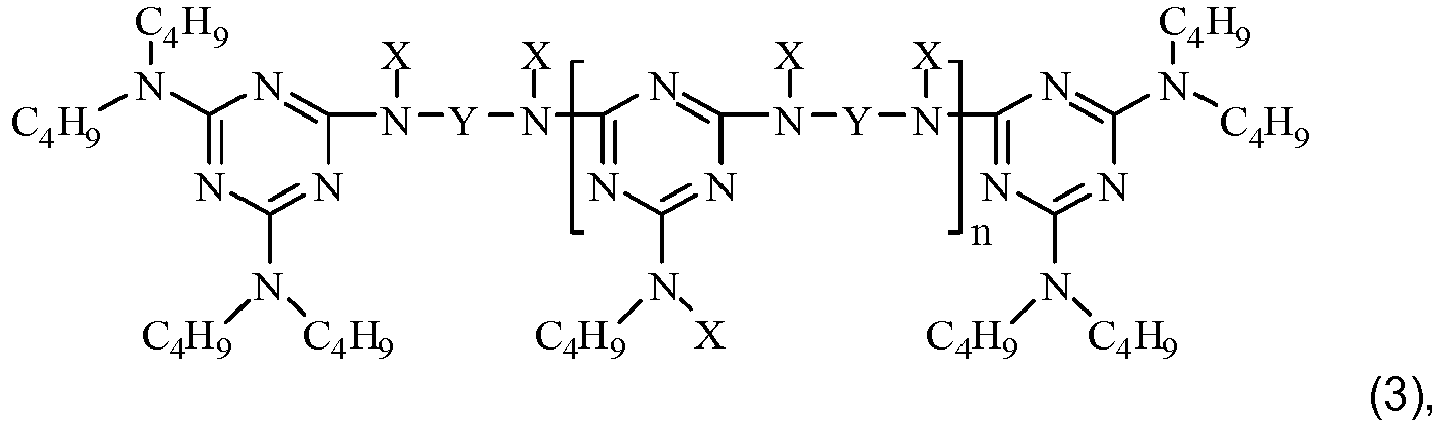
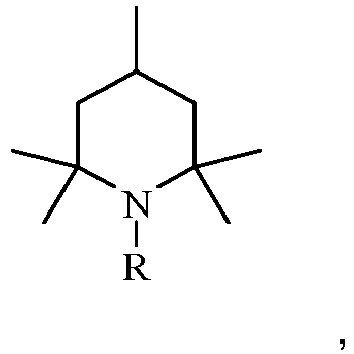
- Y is -(CH2)6-, each R is -OC3H7 and n is an integer from 1 to 5,
- or a compound of formula

or a compound of formula


- A certain embodiment of the invention is directed to compounds of formulae (3), (4) and (5), especially (3) and (5).
- Preferred are also N-alkoxy hindered amines, which are a compound of formula

a compound of the formula
a compound of the formula
a compound of the formula
- R5 is C1-C40alkyl,
- n is a number from 1 to 10, and
- W is a wax residue comprising between 50 and 1000 carbon atoms, or
- wherein n is a number from 1 to 50, especially from 1 to 10, and
- W is a wax residue, especially a wax residue comprising between 50 and 1000 carbon atoms.
- E1 is preferably C1-C4alkoxy or hydroxyl-substituted C1-C4alkoxy, especially hydroxyl-substituted C1-C4alkoxy and more preferably 2-hydroxy-2-methylpropoxy. The compound of formula (7) is most preferably 1-(2-hydroxy-2-methylpropoxy)-4-octadecanoyloxy-2,2,6,6-tetramethylpiperidine.
- E2 and E3 are preferably C1-C20alkoxy, especially C8-C20alkoxy. Highly preferred are decyloxy, undecyloxy and dodecyloxy, especially undecyloxy.
- E4 and E5 are preferably C1-C10alkoxy or cyclohexyloxy, especially C1-C10alkoxy and more preferably octyloxy.
- R5 is preferably C11-C20 alkyl.
- W in formulae (10) and (10a) is preferably a wax comprising between 50 and 800, especially between 50 and 500, carbon atoms.
- Preference is given to N-alkoxy hindered amines of formulae (3) to (10), especially those of formulae (7) to (10), preferably those of formulae (7) and (9) and more preferably those of formula (7).
- Preferred are also N-alkoxy hindered amines containing a moiety of formula

- Melamine cyanurate is the salt formed from melamine and cyanuric acid, and can be obtained, for example, by the reaction of preferably equimolar quantities of melamine and cyanuric acid. Suitable melamine cyanurate is commercially available, for example, as Melapur® MC (available from BASF SE). The average particle size of the melamine cyanurate is generally less than 50 microns, preferably less than 35 microns; and more preferred 25 microns or less. Any size particle of the melamine cyanurate may be used, but preferably a small particle size is used to impart a smoother surface to finished parts.
- In certain embodiments, the polyolefin substrate includes, for example, polypropylene (PP), polyethylene (PE), and co-polymers thereof. The polyolefin substrate may have other polymers incorporated therein, including polystyrene, polyamide, polyester, polycarbonate, epoxy resins, polyurethane, and copolymers (e.g., random or block copolymers) or mixtures thereof. In certain embodiments, the polyolefin substrate includes linear low density polyethylene (LLDPE), low density polyethylene (LDPE), medium density polyethylene (MDPE), or high density polyethylene (HDPE). Certain embodiments of polymer mixtures include, for example, PP/HDPE, PP/LLDPE, and LLDPE/HDPE as well as ternary mixtures such as PP/HDPE/LLDPE. In certain embodiments, polymers can be linear or branched and can be formulated with or without crosslinking (e.g., chemical crosslinking).
- In certain embodiments, blends of PP and PE may be optionally blended with a third polymer suitable to facilitate a level of compatibility, partial miscibility, or miscibility of components in the blend. Such materials are referred to as "interfacial tension reducing agents" or "compatibilizers".
- In certain embodiments, polymers may be crosslinked to introduce long chain branches (LCB) off of a polypropylene main chain, resulting in higher melt strength and extensibility and lower melt flow than is presently commercially available in polypropylene grades.
- In certain embodiments that utilize polypropylene, compositions may contain an additive that promotes higher level of crystallinity formed in the polymer than otherwise exists upon melt converting into shaped articles. Such additives are referred to as "nucleating agents".
- Examples of such nucleating agents are the following: Inorganic substances, such as talcum, metal oxides, such as titanium dioxide or magnesium oxide, phosphates, carbonates or sulfates of, preferably, alkaline earth metals; organic compounds, such as aromatic bis-acetals, for example 1,3:2,4-bis(benzylidene)sorbitol, commercially available as Irgaclear D (RTM), Millad 3905 (RTM) and Gel All D (RTM), 1,3:2,4-bis(4-methylbenzylidene)sorbitol, commercially available as Irgaclear DM (RTM), Millad 3940 (RTM), NC-6 (Mitsui (RTM)) and Gel All MD (RTM), 1,3:2,4-bis(3,4-dimethylbenzylidene)sorbitol, commercially available as Millad 3988 (RTM), 1,3:2,4-bis(4-ethylbenzylidene)sorbitol, commercially available as NC-4 (Mitsui (RTM)), 1,2,3-trideoxy-4,6:5,7-bis-O-[(4-propylphenyl)methylene]-nonitol, commercially available as Millad NX 8000 (RTM), or nucleating agents based upon salts of carboxylic acid, for example sodium benzoate, or nucleating agents based upon carboxy aluminum-hydroxide, for example aluminum hydroxy-bis[4-(tert-butyl)benzoate], commercially available as Sandostab 4030 (RTM), or nucleating agents based upon salts of rosin, respectively abietic acid, for example Pinecrystal KM-1300 (RTM) or Pinecrystal KM-1600 (RTM), or the di-sodium salt of cis-endo-bicyclo(2.2.1)heptane 2,3-dicarboxylic acid (= Chemical Abstracts Registry No. 351870-33-2), commercially available as Hyperform HPN-68 (RTM) and calcium salt of hexahydrophthalic acid, commercially available as Hyperform HPN-20 E (RTM), or Zn glycerolate (CAS Registry No. 87189-25-1; for example commercially available as Prifer 3881 (RTM) or Prifer 3888 (RTM)), or 1,3,5-tris[2,2-dimethylpropionylamino]benzene.
- Polyolefins can be prepared by various methods including, for example, radical polymerization (normally under high pressure and at elevated temperature) and catalytic polymerization (e.g., using a catalyst that normally contains one or more than one metal of groups IVb, Vb, Vlb, or VIII). Such metals may form metal complexes that usually have one or more than one ligand, typically oxides, halides, alcoholates, esters, ethers, amines, alkyls, alkenyls, and/or aryls that may be either π- or σ-coordinated. Such metal complexes may be in the free form or fixed on substrates, typically on activated magnesium chloride, titanium(III) chloride, alumina, or silicon oxide. Catalysts may be soluble or insoluble in the polymerization medium. Catalysts can be used by themselves in the polymerization or further activators may be used, typically metal alkyls, metal hydrides, metal alkyl halides, metal alkyl oxides, or metal alkyloxanes, with the metals being elements of groups la, IIa, and/or IIIa. The activators may be modified conveniently with further ester, ether, amine, or silyl ether groups. These catalyst systems are usually termed "Phillips", "Standard Oil Indiana", "Ziegler(-Natta)", "TNZ", "metallocene", or "single site catalysts".
- In certain embodiments that utilize polypropylene, the polypropylene is a polypropylene random copolymer, alternating or segmented copolymer, or block copolymer containing one or more comonomers selected from ethylene, 1-propene, C4-C20-α-olefin, vinylcyclohexane, vinylcyclohexene, C4-C20-alkandiene, C5-C12-cycloalkandiene, and norbornene derivatives, with a total mole amount of propylene and the comonomer(s) being 100%. Examples of suitable C4-C20-α-olefins include, but are not limited to, 1-butene, 1-pentene, 1-hexene, 1-heptene, 1-octene, 1-nonene, 1-decene, 1-undecene, 1-dodecene, 1-tetradecene, 1-hexadecene, 1-octadecene, 1-eicosene, and 4-methyl-1-pentene. Examples of suitable C4-C20-alkandienes include, but are not limited to, hexadiene and octadiene. Examples of suitable C5-C12-cycloalkandienes include, but are not limited to, cyclopentadiene, cyclohexadiene, and cyclooctadiene. Examples of suitable norbornene derivatives include, but are not limited to, 5-ethylidene-2-norbornene, dicyclopentadiene, and methylene-dimethylene-hexahydronaphthalene.
- Polypropylene copolymers also include long chain branched polypropylene copolymer. In some embodiments, a propylene/ethylene copolymer contains, for example, 50 wt% to 99.9 wt%, 80 wt% to 99.9 wt%, or 90 wt% to 99.9 wt% propylene.
- In certain embodiments, the polyolefin polymer forming the substrate is selected from polypropylene, polyethylene, and copolymers or mixtures thereof. The substrate may include additional polymers incorporated therein, including, but not limited to, polystyrene, polyamide, polyester, polycarbonate, epoxy resins, polyurethane, or copolymers or mixtures thereof. In certain embodiments, a total amount of the other polymers incorporated in the polyolefin substrate is less than 15 wt%, less than 20 wt%, less than 25 wt%, less than 30 wt%, less than 35 wt%, less than 40 wt%, less than 45 wt%, less than 50 wt%, less than 55 wt%, less than 60 wt%, less than 65 wt%, less than 70 wt%, less than 75 wt%, less than 80 wt%, or less than 85 wt% of a total weight of the polyolefin substrate.
- In certain embodiments, a propylene copolymer in which the comonomer is a C9-C20-α-olefin (e.g., 1-nonene, 1-decene, 1-undecene, 1-dodecene, 1-tetradecene, 1-hexadecene, 1-octadecene or 1-eicosene), a C9-C20alkandiene, a C9-C12cycloalkandiene, or a norbornene derivative (e.g., 5-ethylidene-2-norbornene or methylene-dimethylene-hexahydronaphthalene) may contain at least 90 mol%, 90 mol% to 99.9 mol%, or 90 mol% to 99 mol% of propylene.
- In certain embodiments, a propylene copolymer in which the comonomer is a C4-C-α-olefin (e.g., 1-butene, 1-pentene, 1-hexene, 1-heptene, 1-octene, or 4-methyl-1-pentene), vinylcyclohexane, vinylcyclohexene, C4-C8-alkandiene, or C5-C8cycloalkandiene may contain at least 80 mol%, 80 mol% to 99.9 mol%, or 80 mol% to 99 mol% propylene.
- Further embodiments of the polyolefin substrate include propylene/isobutylene copolymer, propylene/butadiene copolymer, propylene/cycloolefin copolymer, terpolymers of propylene with ethylene and a diene (e.g., hexadiene, dicyclopentadiene, or ethylidene-norbornene), propylene/1-olefin copolymers (e.g., where the 1-olefin is generated in situ), and propylene/carbon monoxide copolymers.
- Preferred are polypropylene and polyethylene, especially polyethylene.
- In certain embodiments, one or more flame-retardant compounds, in addition to the phosphonate ester of formula (1), the N-alkoxy hindered amine and the melamine cyanurate, may be incorporated as additives into the polyolefin substrate.
- Phosphorus containing flame-retardants may include phosphazene flame-retardants, which are disclosed for example in
EP1104766 ,JP07292233 DE19828541 ,DE1988536 ,JP11263885 U.S. Pat. Nos. 4,079,035 ,4,107,108 ,4,108,805 , and6,265,599 . Non-halogenated phosphorus-based flame-retardants are compounds that include phosphorus, such as triphenyl phosphates, phosphate esters, phosphonium derivatives, phosphonates, phosphoric acid esters, and phosphate esters, and those described inU.S. Patent No. 7,786,199 . Phosphorus-based (organophosphorus) flame-retardants are usually composed of a phosphate core to which is bonded alkyl (generally straight chain) or aryl (aromatic ring) groups. Examples include red phosphorus, inorganic phosphates, insoluble ammonium phosphate, ammonium polyphosphate, ammonium urea polyphosphate, ammonium orthophosphate, ammonium carbonate phosphate, ammonium urea phosphate, diammonium phosphate, ammonium melamine phosphate, diethylenediamine polyphosphate, dicyandiamide polyphosphate, polyphosphate, urea phosphate, melamine pyrophosphate, melamine orthophosphate, melamine salt of dimethyl methyl phosphonate, melamine salt of dimethyl hydrogen phosphite, ammonium salt of boron-polyphosphate, urea salt of dimethyl methyl phosphonate, organophosphates, phosphonates and phosphine oxide. Phosphate esters include, for example, trialkyl derivatives, such as triethyl phosphate, tris(2-ethylhexyl)phosphate, trioctyl phosphate, triaryl derivatives, such as triphenyl phosphate, cresyl diphenyl phosphate and tricresyl phosphate and aryl-alkyl derivatives, such as 2-ethylhexyl-diphenyl phosphate and dimethyl-aryl phosphates and octylphenyl phosphate, and ethylene diamine phosphates. - Other examples of phosphorus-based flame-retardants include methylamine boron-phosphate, cyanuramide phosphate, magnesium phosphate, ethanolamine dimethyl phosphate, cyclic phosphonate ester, trialkyl phosphonates, potassium ammonium phosphate, cyanuramide phosphate, aniline phosphate, trimethylphosphoramide, tris(1-aziridinyl)phosphine oxide, bis(5,5-dimethyl-2-thiono-1,3,2-dioxaphosphorinamyl)oxide, dimethylphosphono-N-hydroxymethyl-3-propionamide, tris(2-butoxyethyl)phosphate, tetrakis(hydroxymethyl)phosphonium salts, such as tetrakis(hydroxymethyl)phosphonium chloride and tetrakis(hydroxymethyl)phosphonium sulfate, n-hydroxymethyl-3-(dimethylphosphono)-propionamide, a melamine salt of boron-polyphosphate, an ammonium salt of boron-polyphosphate, triphenyl phosphite, ammonium dimethyl phosphate, melamine orthophosphate, ammonium urea phosphate, ammonium melamine phosphate, a melamine salt of dimethyl methyl phosphonate, a melamine salt of dimethyl hydrogen phosphite.
- Metal hydroxide flame-retardants include inorganic hydroxides, such as aluminum hydroxide, magnesium hydroxide, alumina trihydrate (ATH) and hydroxycarbonate.
- Melamine based flame-retardants are a family of non-halogenated flame-retardants that include three chemical groups: (a) melamine (2,4,6-triamino-1,3,5 triazine); (b) melamine derivatives (including salts with organic or inorganic acids, such as boric acid, cyanuric acid, phosphoric acid or pyro/poly-phosphoric acid); and (c) melamine homologues. Melamine derivatives include, for example, melamine-mono-phosphate (a salt of melamine and phosphoric acid), melamine pyrophosphate and melamine polyphosphate. Melamine homologues include melam (1,3,5-triazin-2,4,6-triamine-n-(4,6-diamino-1,3,5-triazine-2-yl), melem (2,5,8-triamino 1,3,4,6,7,9,9b-heptaazaphenalene) and melon (poly[8-amino-1,3,4,6,7,9,9b-heptaazaphenalene-2,5-diyl).
- Melamine based flame-retardants also include melamine compound/polyol condensates. For example, as disclosed in
U.S. Patent App. No. 10/539,097 (published asWO 2004/055029 ) andU.S. Patent Pub. No. 2010/152376 , where the polyol is a linear, branched or cyclic trihydric, tetrahydric, pentahydric or hexahydric alcohol or a linear or cyclic C4-C6 aldose or C4-C6 ketose and where the melamine compound is melamine phosphate, melamine pyrophosphate or melamine polyphosphate. In some embodiments, the polyol is pentaerythritol or dipentaerythritol. In some embodiments, the melamine compound is melamine phosphate. The molar ratio of melamine compound to the polyol is, in some embodiments, from about 1:1 to about 4:1. The condensate may further have incorporated therein a dendritic polymer substituted by hydroxy groups, for instance a dendritic polyester or dendritic polyamide. A dendritic polyester may be a product of an initiator compound selected from trimethyolpropane, pentaerythritol, ethoxylated pentaerythritol, and chain-extending dimethylpropionic acid. A dendritic polyamide is, in some embodiments, a polycondensate of a cyclic carboxylic acid anhydride and diisopropanolamine. - Borate flame-retardant compounds may include, for example, zinc borate, borax (sodium borate), ammonium borate, and calcium borate. Zinc borate is a boron based flame-retardant having the chemical composition xZnOyB2O3·zH2O. Zinc borate can be used alone, or in conjunction with other chemical compounds, such as alumina trihydrate, magnesium hydroxide or red phosphorus. It acts through zinc halide or zinc oxyhalide, which accelerate the decomposition of halogen sources and promote char formation.
- Examples of other metal containing flame-retardant substances, which can be employed alone or in combination with other flame-retardant substances, include, but are not limited to, magnesium oxide, magnesium chloride, talcum, alumina hydrate, zinc oxide, alumina trihydrate, alumina magnesium, calcium silicate, sodium silicate, zeolite, sodium carbonate, calcium carbonate, ammonium molybdate, iron oxide, copper oxide, zinc phosphate, zinc chloride, clay, sodium dihydrogen phosphate, tin, molybdenum, and zinc.
- In certain embodiments, the organophosphorus compound is a phosphate ester having a formula of:

- In certain embodiments, the organophosphorus compound is a phosphonate ester having a formula of:

- In certain embodiments, the organophosphorus compound is a phosphonate ester having a formula of:

- In certain embodiments, the organophosphorus compound is a phosphate ester having a formula of:

- In certain embodiments, the organophosphorus compound is a phosphate ester having a formula of:

- In certain embodiments, the organophosphorus compound is a phosphate ester having a formula of:
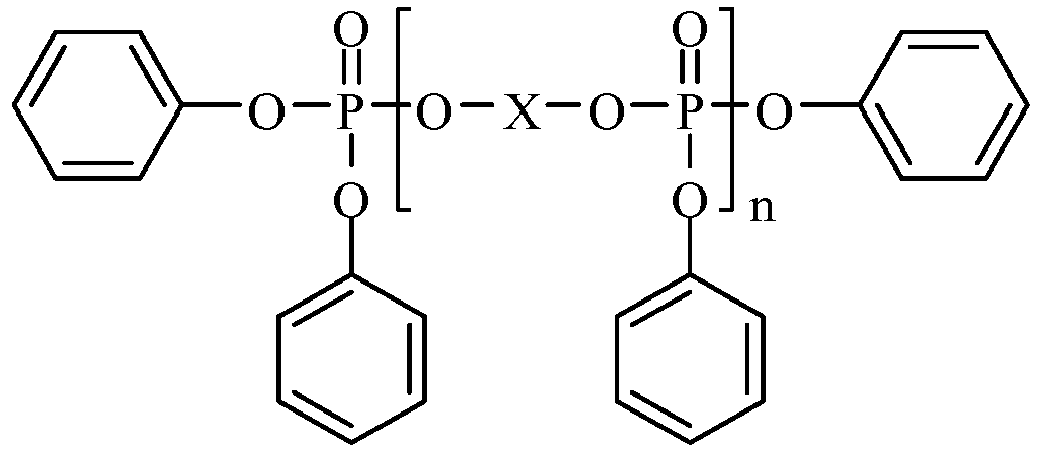
- In certain embodiments, the organophosphorus compound is a phosphate ester having a formula of:

- In certain embodiments, other suitable organophosphorus compounds may be used.
- In certain embodiments, the one or more flame-retardant compounds (e.g., organophosphorus compounds) are present in an amount from 1 wt% to 70 wt%, 1 wt% to 60 wt%, 1 wt% to 50 wt%, 1 wt% to 40 wt%, 1 wt% to 30 wt%, 1 wt% to 20 wt%, 1 wt% to 10 wt%, 2 wt% to 9 wt%, 3 wt% to 6 wt%, 2 wt% to 5 wt%, or 1 wt% to 4 wt% based on a weight of the polyolefin substrate or the article thereof.
- In certain embodiments, organo-halogen flame retardants may be included, for example:
Polybrominated diphenyl oxide (DE-60F, Chemtura Corp.), decabromodiphenyl oxide (DBDPO; Saytex® 102E), tris[3-bromo-2,2-bis(bromomethyl)propyl]phosphate (PB 370®, FMC Corp.), tris(2,3-dibromopropyl)phosphate, tris(2,3-dichloropropyl)phosphate, chlorendic acid, tetrachlorophthalic acid, tetrabromophthalic acid, polychloroethyl triphosphonate mixture, tetrabromobisphenol A bis(2,3-dibromopropyl ether) (PE68), brominated epoxy resin, ethylene-bis(tetrabromophthalimide) (Saytex® BT-93), bis(hexachlorocyclopentadieno)cyclooctane (Declorane Plus®), chlorinated paraffins, octabromodiphenyl ether, 1,2-bis(tribromophenoxy)ethane (FF680), tetrabromobisphenol A (Saytex® RB100), ethylene bis-(dibromo-norbornanedicarboximide) (Saytex® BN-451), brominated polyacrylate (FR-1025 - The organohalogen flame retardants mentioned above are routinely combined with an inorganic oxide synergist. Most common for this use are zinc or antimony oxides, e.g. Sb2O3 or Sb2O5. Boron compounds are suitable, too.
- The above-mentioned additional flame retardant classes are advantageously contained in the composition of the invention in an amount from about 0.5% to about 75.0% by weight of the organic polymer substrate; for instance about 10.0% to about 70.0%; for example about 25.0% to about 65.0% by weight, based on the total weight of the composition.
- In certain embodiments, anti-dripping agents may be included. These anti-dripping agents reduce the melt flow of the thermoplastic polymer and inhibit the formation of drops at high temperatures. Various references, such as
U.S. Patent Specification No. 4,263,201 , describe the addition of anti-dripping agents to flame retardant compositions. Suitable additives that inhibit the formation of drops at high temperatures include glass fibres, polytetrafluoroethylene (PTFE), high temperature elastomers, carbon fibres, glass spheres and the like. - The phosphonate ester of formula (1) is preferably present in the polyolefin substrates, especially in corresponding articles thereof, in an amount of from 0.02 to 20%, especially 0.1 to 10%, and more preferably 1 to 10% by weight.
- The hindered N-alkoxy amine is preferably present in the polyolefin substrates, especially in corresponding articles thereof, in an amount of from 0.02 to 20%, especially 0.02 to 10%, and more preferably 0.1 to 5% by weight.
- The mealmine cyanurate is preferably present in the polyolefin substrates, especially in corresponding articles thereof, in an amount of from 0.02 to 20%, especially 0.1 to 10%, and more preferably 1 to 10% by weight.
- Preferred are polyolefin substrates, especially corresponding articles thereof, wherein the phosphonate ester of formula (1) is present in an amount of from 0.02 to 20% by weight, the hindered N-alkoxy amine is present in an amount of from 0.02 to 20% by weight, and the melamine cyanurate is present in an amount of from 0.02 to 20% by weight.
- More preferred are polyolefin substrates, especially corresponding articles thereof, wherein the phosphonate ester of formula (1) is present in an amount of from 0.1 to 10% by weight, the hindered N-alkoxy amine is present in an amount of from 0.02 to 10% by weight, and the melamine cyanurate is present in an amount of from 0.1 to 10% by weight.
- Highly preferred are polyolefin substrates, especially corresponding articles thereof, wherein the phosphonate ester of formula (1) is present in an amount of from 1 to 10% by weight, the hindered N-alkoxy amine is present in an amount of from 0.1 to 5% by weight, and the melamine cyanurate is present in an amount of from 1 to 10% by weight.
- The total weight of flame retardants (including the phosphonate ester of formula (1), the N-alkoxy hindered amine and the melamine cyanurate) in the polyolefin substrate, or in corresponding articles thereof, may be 1 wt% to 70 wt%, 1 wt% to 60 wt%, 1 wt% to 50 wt%, 1 wt% to 40 wt%, 1 wt% to 30 wt%, 1 wt% to 20 wt%, 1 wt% to 10 wt%, 2 wt% to 9 wt%, 3 wt% to 6 wt%, 2 wt% to 5 wt%, or 1 wt% to 4 wt%.
- The above weights in the polyolefin substrates, or corresponding articles thereof, are in each case based on the total weight of the polyolefin substrate or, respectively, the corresponding article.
- In certain embodiments, one or more synergists (e.g., light absorbers) may be incorporated as further additives into the polyolefin substrate. Synergists may also be referred to as "stabilizers". Certain synergist compounds described herein may, besides the use as stabilizer, also be utilized as flame-retardant compounds.
- In certain embodiments, ultraviolet (UV) light absorbers include, for example, hydroxyphenylbenzotriazole, tris-aryl-s-triazine, hydroxyl-benzoate, and 2-hydroxybenzophenone ultraviolet light absorbers (UVAs), as well as cyanoacrylates such as those known by tradenames Uvinul® 3030, 3035, 3039 and oxanilide such as Tinuvin® 312.
- Suitable hydroxyphenylbenzotriazole UVAs, for example, are disclosed in
U.S. Patent Nos. 3,004,896 ,3,055,896 ,3,072,585 ,3,074,910 ,3,189,615 ,3,218,332 ,3,230,194 ,4,127,586 ,4,226,763 ,4,275,004 ,4,278,589 ,4,315,848 ,4,347,180 ,4,383,863 ,4,675,352 ,4,681,905 ,4,853,471 ,5,268,450 ,5,278,314 ,5,280,124 ,5,319,091 ,5,410,071 ,5,436,349 ,5,516,914 ,5,554,760 ,5,563,242 ,5,574,166 ,5,607,987 ,5,977,219 , and6,166,218 , and include, for example, 2-(2-hydroxy-5-methylphenyl)-2H-benzotriazole; 2-(3,5-di-t-butyl-2-hydroxyphenyl)-2H-benzotriazole; 2-(2-hydroxy-5-t-butylphenyl)-2H-benzotriazole; 2-(2-hydroxy-5-t-octylphenyl)-2H-benzotriazole; 5-chloro-2-(3,5-di-t-butyl-2-hydroxyphenyl)-2H-benzotriazole; 5-chloro-2-(3-t-butyl-2-hydroxy-5-methylphenyl)-2H-benzotriazole; 2-(3-sec-butyl-5-t-butyl-2-hydroxyphenyl)-2H-benzotriazole; 2-(2-hydroxy-4-octyloxyphenyl)-2H-benzotriazole; 2-(3,5-di-t-amyl-2-hydroxyphenyl)-2H-benzotriazole; 2-(3,5-bis-α-cumyl-2-hydroxyphenyl)-2H-benzotriazole; 2-(3-t-butyl-2-hydroxy-5-(2-(ω-hydroxy-octa-(ethyleneoxy)carbonyl-ethyl)-phenyl)-2H-benzotriazole; 2-(3-dodecyl-2-hydroxy-5-methylphenyl)-2H-benzotriazole; 2-(3-t-butyl-2-hydroxy-5-(2-octyloxycarbonyl)ethylphenyl)-2H-benzotriazole; dodecylated 2-(2-hydroxy-5-methylphenyl)-2H-benzotriazole; 2-(3-t-butyl-2-hydroxy-5-(2-octyloxycarbonylethyl)phenyl)-5-chloro-2H-benzotriazole; 2-(3-tert-butyl-5-(2-(2-ethylhexyloxy)-carbonylethyl)-2-hydroxyphenyl)-5-chloro-2H-benzotriazole; 2-(3-t-butyl-2-hydroxy-5-(2-methoxycarbonylethyl)phenyl)-5-chloro-2H-benzotriazole; 2-(3-t-butyl-2-hydroxy-5-(2-methoxycarbonylethyl)phenyl)-2H-benzotriazole; 2-(3-t-butyl-5-(2-(2-ethylhexyloxy)carbonylethyl)-2-hydroxyphenyl)-2H-benzotriazole; 2-(3-t-butyl-2-hydroxy-5-(2-isooctyloxycarbonylethyl)phenyl-2H-benzotriazole; 2,2'-methylene-bis(4-t-octyl-(6-2H-benzotriazol-2-yl)phenol); 2-(2-hydroxy-3-α-cumyl-5-t-octylphenyl)-2H-benzotriazole; 2-(2-hydroxy-3-t-octyl-5-a-cumylphenyl)-2H-benzotriazole; 5-fluoro-2-(2-hydroxy-3,5-di-α-cumylphenyl)-2H-benzotriazole; 5-chloro-2-(2-hydroxy-3,5-di-α-cumylphenyl)-2H-benzotriazole; 5-chloro-2-(2-hydroxy-3-α-cumyl-5-t-octylphenyl)-2H-benzotriazole; 2-(3-t-butyl-2-hydroxy-5-(2-isooctyloxycarbonylethyl)phenyl)-5-chloro-2H-benzotriazole; 5-trifluoromethyl-2-(2-hydroxy-3-a-cumyl-5-t-octylphenyl)-2H-benzotriazole; 5-trifluoromethyl-2-(2-hydroxy-5-t-octylphenyl)-2H-benzotriazole; 5-trifluoromethyl-2-(2-hydroxy-3,5-di-t-octylphenyl)-2H-benzotriazole; methyl 3-(5-trifluoromethyl-2H-benzotriazol-2-yl)-5-t-butyl-4-hydroxyhydrocinnamate; 5-butylsulfonyl-2-(2-hydroxy-3-α-cumyl-5-t-octylphenyl)-2H-benzotriazole; 5-trifluoromethyl-2-(2-hydroxy-3-α-cumyl-5-t-butylphenyl)-2H-benzotriazole; 5-trifluoromethyl-2-(2-hydroxy-3,5-di-t-butylphenyl)-2H-benzotriazole; 5-trifluoromethyl-2-(2-hydroxy-3,5-di-α-cumylphenyl)-2H-benzotriazole; 5-butylsulfonyl-2-(2-hydroxy-3,5-di-t-butylphenyl)-2H-benzotriazole; and 5-phenylsulfonyl-2-(2-hydroxy-3,5-di-t-butylphenyl)-2H-benzotriazole. - Suitable tris-aryl-s-triazine UVAs, for example, are disclosed in
U.S. Patent Nos. 3,843,371 ,4,619,956 ,4,740,542 ,5,096,489 ,5,106,891 ,5,298,067 ,5,300,414 ,5,354,794 ,5,461,151 ,5,476,937 ,5,489,503 ,5,543,518 ,5,556,973 ,5,597,854 ,5,681,955 ,5,726,309 ;5,736,597 ,5,942,626 ,5,959,008 ,5,998,116 ,6,013,704 ,6,060,543 ,6,242,598 , and6,255,483 , and include, for example, 4,6-bis-(2,4-dimethylphenyl)-2-(2-hydroxy-4-octyloxyphenyl)-s-triazine; CYASORB UV-1164; 4,6-bis-(2,4-dimethylphenyl)-2-(2,4-dihydroxyphenyl)-s-triazine; 2,4-bis(2,4-dihydroxyphenyl)-6-(4-chlorophenyl)-s-triazine; 2,4-bis[2-hydroxy-4-(2-hydroxyethoxy)phenyl]-6-(4-chlorophenyl)-s-triazine; 2,4-bis[2-hydroxy-4-(2-hydroxy-4-(2-hydroxyethoxy)phenyl]-6-(2,4-dimethylphenyl)-s-triazine; 2,4-bis[2-hydroxy-4-(2-hydroxyethoxy)phenyl]-6-(4-bromophenyl)-s-triazine; 2,4-bis[2-hydroxy-4-(2-acetoxyethoxy)phenyl]-6-(4-chlorophenyl)-s-triazine; 2,4-bis(2,4-dihydroxyphenyl)-6-(2,4-dimethylphenyl)-s-triazine; 2,4-bis(4-biphenylyl)-6-(2-hydroxy-4-octyloxycarbonylethylideneoxyphenyl)-s-triazine; 2-phenyl-4-[2-hydroxy-4-(3-sec-butyloxy-2-hydroxypropyloxy)phenyl]-6-[2-hydroxy-4-(3-sec-amyloxy-2-hydroxypropyloxy)phenyl]-s-triazine; 2,4-bis(2,4-dimethylphenyl)-6-[2-hydroxy-4-(3-benzyloxy-2-hydroxypropyloxy)phenyl]-s-triazine; 2,4-bis(2-hydroxy-4-n-butyloxyphenyl)-6-(2,4-di-n-butyloxyphenyl)-s-triazine; 2,4-bis(2,4-dimethylphenyl)-6-[2-hydroxy-4-(3-nonyloxy*-2-hydroxypropyloxy)-5-a-cumylphenyl]-s-triazine (where * denotes a mixture of octyloxy, nonyloxy and decyloxy groups); methylenebis-{2,4-bis(2,4-dimethylphenyl)-6-[2-hydroxy-4-(3-butyloxy-2-hydroxypropoxy)phenyl]-s-triazine}; methylene bridged dimer mixture bridged in the 3:5', 5:5', and 3:3' positions in a 5:4:1 ratio; 2,4,6-tris(2-hydroxy-4-isooctyloxycarbonylisopropylideneoxyphenyl)-s-triazine; 2,4-bis(2,4-dimethylphenyl)-6-(2-hydroxy-4-hexyloxy-5-α-cumylphenyl)-s-triazine; 2-(2,4,6-trimethylphenyl)-4,6-bis[2-hydroxy-4-(3-butyloxy-2-hydroxypropyloxy)phenyl]-s-triazine; 2,4,6-tris[2-hydroxy-4-(3-sec-butyloxy-2-hydroxypropyloxy)phenyl]-s-triazine; mixture of 4,6-bis-(2,4-dimethylphenyl)-2-(2-hydroxy-4-(3-dodecyloxy-2-hydroxypropoxy)-phenyl)-s-triazine and 4,6-bis-(2,4-dimethylphenyl)-2-(2-hydroxy-4-(3-tridecyloxy-2-hydroxypropoxy)-phenyl)-s-triazine; TINUVIN 400, 4,6-bis-(2,4-dimethylphenyl)-2-(2-hydroxy-4-(3-(2-ethylhexyloxy)-2-hydroxypropoxy)-phenyl)-s-triazine; and 4,6-diphenyl-2-(4-hexyloxy-2-hydroxyphenyl)-s-triazine. - Suitable hydroxybenzoate UV absorbers include, for example, esters of substituted and unsubstituted benzoic acids, such as 4-tert-butylphenyl salicylate, phenyl salicylate, octylphenyl salicylate, dibenzoyl resorcinol, bis(4-tert-butylbenzoyl) resorcinol, benzoyl resorcinol, 2,4-di-tert-butylphenyl 3,5-di-tert-butyl-4-hydroxybenzoate, hexadecyl 3,5-di-tert-butyl-4-hydroxybenzoate, octadecyl 3,5-di-tert-butyl-4-hydroxybenzoate, and 2-methyl-4,6-di-tert-butylphenyl 3,5-di-tert-butyl-4-hydroxybenzoate.
- 2-hydroxybenzophenone UV absorbers include, for example, 4-hydroxy, 4-methoxy, 4-octyloxy, 4-decyloxy, 4-dodecyloxy, 4-benzyloxy, 4,2',4'-trihydroxy, and 2'-hydroxy-4,4'-dimethoxy derivatives.
- In certain embodiments, a UVA is included as an additive. The UVA may include one or more of 5-chloro-2-(3-t-butyl-2-hydroxy-5-methylphenyl)-2H-benzotriazole, 2-(3,5-bis-α-cumyl-2-hydroxyphenyl)-2H-benzotriazole, 4,6-diphenyl-2-(4-hexyloxy-2-hydroxyphenyl)-s-triazine, 4,6-bis-(2,4-dimethylphenyl)-2-(2-hydroxy-4-octyloxyphenyl)-s-triazine, 2,4-Di-tert-butylphenyl 3,5-di-tert-butyl-4-hydroxybenzoate, hexadecyl 3,5-di-tert-butyl-4-hydroxybenzoate, or 4-octyloxy-2-hydroxybenzophenone.
- Certain UVAs are commercial formulations, including, for example TINUVIN 326, TINUVIN 234, TINUVIN 1577, TINUVIN 1600, CYASORB UV 1164, CYASORB THT, CYASORB UV 2908, ADK STAB LA-F70, and CHIMASSORB 81.
- In certain embodiments, one or more UVAs are present in an amount from 0.01 wt% to 2.5 wt%, or 0.10 wt% to 1.5 wt% based on a weight of the polyolefin substrate, or the article. In certain embodiments, the one or more UVAs are present in an amount from 0.10 wt% to 0.95 wt%. For example, the one or more UVAs may be present in an amount of about 0.20 wt%, about 0.25 wt%, about 0.30 wt%, about 0.35 wt%, about 0.40 wt%, about 0.45 wt%, about 0.50 wt%, about 0.55 wt%, about 0.60 wt%, about 0.65 wt%, about 0.70 wt%, about 0.75 wt%, about 0.80 wt%, about 0.85 wt%, or about 0.90 wt% based on the weight of the polyolefin substrate or the article, as well as amounts in between the aforementioned amounts.
- In certain embodiments, one or more hindered amine light stabilizers (HALS) may be incorporated as further additives into the polyolefin substrate. Suitable HALS, for example, are disclosed
U.S. Patent Nos. 5,004,770 ,5,204,473 ,5,096,950 ,5,300,544 ,5,112,890 ,5,124,378 ,5,145,893 ,5,216,156 ,5,844,026 ,5,980,783 ,6,046,304 ,6,117,995 ,6,271,377 ,6,297,299 ,6,392,041 ,6,376,584 , and6,472,456 . - Suitable HALS, for example, include 1-cyclohexyloxy-2,2,6,6-tetramethyl-4-octadecylaminopiperidine; bis(2,2,6,6-tetramethylpiperidin-4-yl)sebacate; bis(1-acetoxy-2,2,6,6-tetramethylpiperidin-4-yl)sebacate; bis(1,2,2,6,6-pentamethylpiperidin-4-yl) sebacate; bis(1-cyclohexyloxy-2,2,6,6-tetramethylpiperidin-4-yl)sebacate; bis(1-octyloxy-2,2,6,6-tetramethylpiperidin-4-yl)sebacate; bis(1-acyl-2,2,6,6-tetramethylpiperidin-4-yl) sebacate; bis(1,2,2,6,6-pentamethyl-4-piperidyl) n-butyl-3,5-di-tert-butyl-4-hydroxybenzylmalonate; 2,4-bis[(1-cyclohexyloxy-2,2,6,6-tetramethylpiperidin-4-yl)butylamino]-6-(2-hydroxyethylamino-s-triazine; bis(1-cyclohexyloxy-2,2,6,6-tetramethylpiperidin-4-yl)adipate; 2,4-bis[(1-cyclohexyloxy-2,2,6,6-piperidin-4-yl)butylamino]-6-chloro-s-triazine; 1-(2-hydroxy-2-methylpropoxy)-4-hydroxy-2,2,6,6-tetramethylpiperidine; 1-(2-hydroxy-2-methylpropoxy)-4-oxo-2,2,6,6-tetramethylpiperidine; 1-(2-hydroxy-2-methylpropoxy)-4-octadecanoyloxy-2,2,6,6-tetramethylpiperidine; bis(1-(2-hydroxy-2-methylpropoxy)-2,2,6,6-tetramethylpiperidin-4-yl)sebacate; bis(1-(2-hydroxy-2-methylpropoxy)-2,2,6,6-tetramethylpiperidin-4-yl)adipate; 2,4-bis{N-[1-(2-hydroxy-2-methylpropoxy)-2,2,6,6-tetramethylpiperidin-4-yl]-N-butylamino}-6-(2-hydroxyethylamino)-s-triazine; 4-benzoyl-2,2,6,6-tetramethylpiperidine; di-(1,2,2,6,6-pentamethylpiperidin-4-yl)p-methoxybenzylidenemalonate; 2,2,6,6-tetramethylpiperidin-4-yl octadecanoate; bis(1-octyloxy-2,2,6,6-tetramethylpiperidyl)succinate; 1,2,2,6,6-pentamethyl-4-aminopiperidine; 2-undecyl-7,7,9,9-tetramethyl-1-oxa-3,8-diaza-4-oxo-spiro[4,5]decane; tris(2,2,6,6-tetramethyl-4-piperidyl)nitrilotriacetate; tris(2-hydroxy-3-(amino-(2,2,6,6-tetramethylpiperidin-4-yl)propyl) nitrilotriacetate; tetrakis(2,2,6,6-tetramethyl-4-piperidyl)-1,2,3,4-butane-tetracarboxylate; tetrakis(1,2,2,6,6-pentamethyl-4-piperidyl)-1,2,3,4-butane-tetracarboxylate, 1,1'-(1,2-ethanediyl)-bis(3,3,5,5-tetramethylpiperazinone); 3-n-octyl-7,7,9,9-tetramethyl-1,3,8-triazaspiro[4.5]decan-2,4-dione; 8-acetyl-3-dodecyl-7,7,9,9-tetramethyl-1,3,8-triazaspiro[4.5]decane-2,4-dione; 3-dodecyl-1-(2,2,6,6-tetramethyl-4-piperidyl)pyrrolidin-2,5-dione; 3-dodecyl-1-(1,2,2,6,6-pentamethyl-4-piperidyl)pyrrolidine-2,5-dione; N,N'-bis-formyl-N,N'-bis(2,2,6,6-tetramethyl-4-piperidyl)hexamethylenediamine; reaction product of 2,4-bis[(1-cyclohexyloxy-2,2,6,6-piperidin-4-yl)butylamino]-6-chloro-s-triazine with N,N'-bis(3-aminopropyl)ethylenediamine); condensate of 1-(2-hydroxyethyl)-2,2,6,6-tetramethyl-4-hydroxypiperidine and succinic acid; condensate of N,N'-bis(2,2,6,6-tetramethyl-4-piperidyl)-hexamethylenediamine and 4-tert-octylamino-2,6-dichloro-1,3,5-triazine; condensate of N,N'-bis(2,2,6,6-tetramethyl-4-piperidyl)-hexamethylenediamine and 4-cyclohexylamino-2,6-dichloro-1,3,5-triazine; condensate of N,N'-bis-(2,2,6,6-tetramethyl-4-piperidyl)hexamethylenediamine and 4-morpholino-2,6-dichloro-1,3,5-triazine (CYASORB UV-3346), CYASORB UV-3529 (an N-methylated analog of CYASORB UV-3346); condensate of N,N'-bis-(1,2,2,6,6-pentamethyl-4-piperidyl)hexamethylenediamine and 4-morpholino-2,6-dichloro-1,3,5-triazine; condensate of 2-chloro-4,6-bis(4-n-butylamino-2,2,6,6-tetramethylpiperidyl)-1,3,5-triazine and 1,2-bis(3-aminopropylamino)ethane; condensate of 2-chloro-4,6-di-(4-n-butylamino-1,2,2,6,6-pentamethylpiperidyl)-1,3,5-triazine and 1,2-bis-(3-aminopropylamino)ethane; reaction product of 7,7,9,9-tetramethyl-2-cycloundecyl-1-oxa-3,8-diaza-4-oxospiro[4,5]decane and epichlorohydrin; poly[methyl,(3-oxy-(2,2,6,6-tetramethylpiperidin-4-yl)propyl)]siloxane; reaction product of maleic acid anhydride-C18-C22-α-olefin-copolymer with 2,2,6,6-tetramethyl-4-aminopiperidine; oligomeric condensate of 4,4'-hexamethylenebis(amino-2,2,6,6-tetramethylpiperidine) and 2,4-dichloro-6-[(2,2,6,6-tetramethylpiperidin-4-yl)butylamino]-s-triazine end-capped with 2-chloro-4,6-bis(dibutylamino)-s-triazine; oligomeric condensate of 4,4'-hexamethylenebis(amino-1,2,2,6,6-pentaamethylpiperidine) and 2,4-dichloro-6-[(1,2,2,6,6-pentaamethylpiperidin-4-yl)butylamino]-s-triazine end-capped with 2-chloro-4,6-bis(dibutylamino)-s-triazine; oligomeric condensate of 4,4'-hexamethylenebis(amino-1-propoxy-2,2,6,6-tetramethylpiperidine) and 2,4-dichloro-6-[(1-propoxy-2,2,6,6-tetramethylpiperidin-4-yl)butylamino]-s-triazine end-capped with 2-chloro-4,6-bis(dibutylamino)-s-triazine; oligomeric condensate of 4,4'-hexamethylenebis(amino-1-acyloxy-2,2,6,6-tetramethylpiperidine) and 2,4-dichloro-6-[(1-acyloxy-2,2,6,6-tetramethylpiperidin-4-yl)butylamino]-s-triazine end-capped with 2-chloro-4,6-bis(dibutylamino)-s-triazine; reaction product obtained by reacting (2,2,6,6-tetramethylpiperidin-4-yl)butylamine with product of reaction of 1,2-bis(3-aminopropylamino)ethane with cyanuric chloride; and binary or ternary combinations thereof.
- Other suitable HALS include, for example, sterically hindered N-H, N-methyl, N-methoxy, N-propoxy, N-octyloxy, N-cyclohexyloxy, N-acyloxy, and N-(2-hydroxy-2-methylpropoxy) analogues of any of the aforementioned mentioned HALS compounds. For example, replacing an N-H hindered amine with an N-methyl hindered amine would be employing the N-methyl analogue in place of the N-H.
- For illustrative purposes, some of the structures for the aforementioned HALS compounds are shown below.
- bis(1-octyloxy-2,2,6,6-tetramethylpiperidin-4-yl)sebacate:

- bis(1,2,2,6,6-pentamethyl-4-piperidyl) n-butyl-3,5-di-tert-butyl-4-hydroxybenzylmalonate:

- 2,4-bis[(1-cyclohexyloxy-2,2,6,6-tetramethylpiperidin-4-yl)butylamino]-6-(2-hydroxyethylamino-s-triazine:
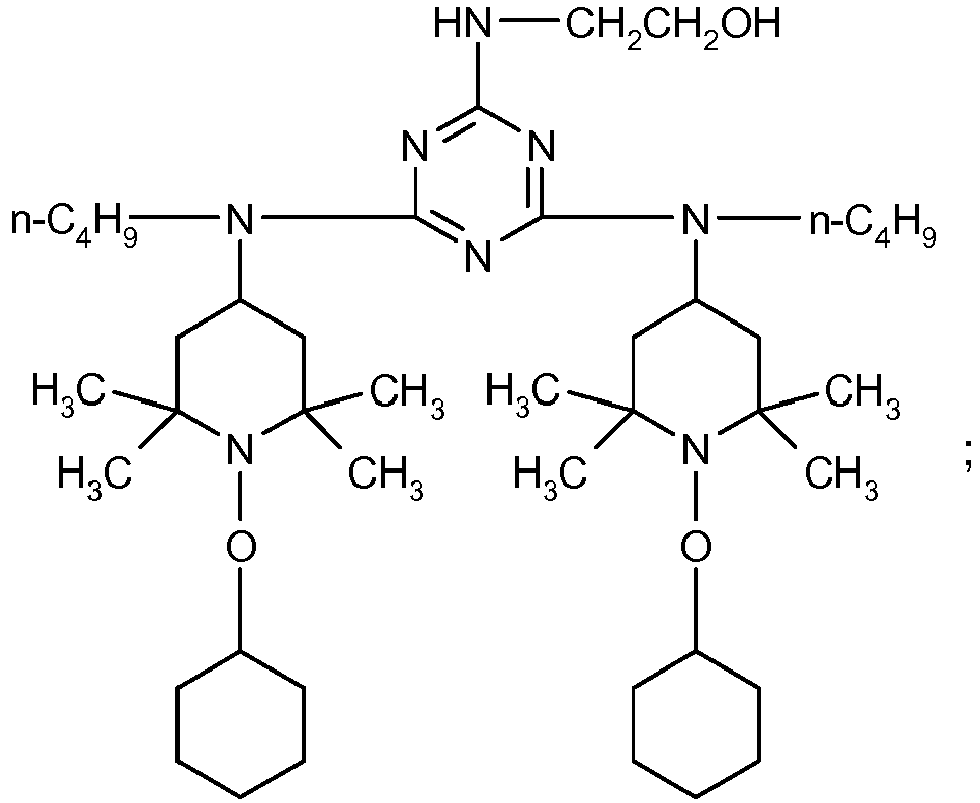
- 1-(2-hydroxy-2-methylpropoxy)-4-hydroxy-2,2,6,6-tetramethylpiperidine:

- di-(1,2,2,6,6-pentamethylpiperidin-4-yl) p-methoxybenzylidenemalonate:

- 2-undecyl-7,7,9,9-tetramethyl-1-oxa-3,8-diaza-4-oxo-spiro[4,5]decane:

- tris(2-hydroxy-3-(amino-(2,2,6,6-tetramethylpiperidin-4-yl)propyl)nitrilotriacetate:

- tetrakis(2,2,6,6-tetramethyl-4-piperidyl)-1,2,3,4-butane-tetracarboxylate:

- 1,1'-(1,2-ethanediyl)-bis(3,3,5,5-tetramethylpiperazinone):

- 3-n-octyl-7,7,9,9-tetramethyl-1,3,8-triazaspiro[4.5]decan-2,4-dione:

- 3-dodecyl-1-(2,2,6,6-tetramethyl-4-piperidyl)pyrrolidin-2,5-dione:

- N,N'-bis-formyl-N,N'-bis(2,2,6,6-tetramethyl-4-piperidyl)hexamethylenediamine:

- reaction product of 2,4-bis[(1-cyclohexyloxy-2,2,6,6-piperidin-4-yl)butylamino]-6-chloro-s-triazine with N,N'-bis(3-aminopropyl)ethylenediamine):

- condensate of 1-(2-hydroxyethyl)-2,2,6,6-tetramethyl-4-hydroxypiperidine and succinic acid:

- condensate of N,N'-bis(2,2,6,6-tetramethyl-4-piperidyl)-hexamethylenediamine and 4-tert-octylamino-2,6-dichloro-1,3,5-triazine:

- condensate of N,N'-bis-(2,2,6,6-tetramethyl-4-piperidyl)hexamethylenediamine and 4-morpholino-2,6-dichloro-1,3,5-triazine:

- condensate of 2-chloro-4,6-di-(4-n-butylamino-1,2,2,6,6-pentamethylpiperidyl)-1,3,5-triazine and 1,2-bis-(3-aminopropylamino)ethane:

- reaction product of 7,7,9,9-tetramethyl-2-cycloundecyl-1-oxa-3,8-diaza-4-oxospiro [4,5]decane and epichlorohydrin:

- poly[methyl,(3-oxy-(2,2,6,6-tetramethylpiperidin-4-yl)propyl)]siloxane:

- reaction product of maleic acid anhydride-C18-C22-alpha-olefin-copolymer with 2,2,6,6-tetramethyl-4-aminopiperidine:

- oligomeric condensate of 4,4'-hexamethylenebis(amino-2,2,6,6-tetramethylpiperidine) and 2,4-dichloro-6-[(2,2,6,6-tetramethylpiperidin-4-yl)butylamino]-s-triazine end-capped with 2-chloro-4,6-bis(dibutylamino)-s-triazine:

- and reaction product obtained by reacting (2,2,6,6-tetramethylpiperidin-4-yl)butylamine with product of reaction of 1,2-bis(3-aminopropylamino)ethane with cyanuric chloride:

and where R" =
- In certain embodiments, binary combinations of HALS may be included as additves. Such binary combinations include, for example, bis(2,2,6,6-tetramethylpiperidin-4-yl)sebacate and condensate of N,N'-bis(2,2,6,6-tetramethyl-4-piperidyl)-hexamethylenediamine and 4-tert-octylamino-2,6-dichloro-1,3,5-triazine; bis(2,2,6,6-tetramethylpiperidin-4-yl)sebacate and oligomeric compound condensate of 4,4'-hexamethylenebis(amino-2,2,6,6-tetramethylpiperidine) and 2,4-dichloro-6-[(2,2,6,6-tetramethylpiperidin-4-yl)butylamino]-s-triazine end-capped with 2-chloro-4,6-bis(dibutylamino)-s-triazine; 2,2,6,6-tetramethylpiperidin-4-yl octadecanoate and oligomeric condensate of 4,4'-hexamethylenebis(amino-2,2,6,6-tetramethylpiperidine) and 2,4-dichloro-6-[(2,2,6,6-tetramethylpiperidin-4-yl)butylamino]-s-triazine end-capped with 2-chloro-4,6-bis(dibutylamino)-s-triazine; and bis(2,2,6,6-tetramethylpiperidin-4-yl)sebacate and 2,2,6,6-tetramethylpiperidin-4-yl octadecanoate.
- In certain embodiments, ternary combinations of HALS may be included as additives. Such ternary combinations include, for example bis(2,2,6,6-tetramethylpiperidin-4-yl)sebacate, 1-(2-hydroxy-2-methylpropoxy)-4-octadecanoyloxy-2,2,6,6-tetramethylpiperidine, and oligomeric condensate of 4,4'-hexamethylenebis(amino-2,2,6,6-tetramethylpiperidine) and 2,4-dichloro-6-[(2,2,6,6-tetramethylpiperidin-4-yl)butylamino]-s-triazine end-capped with 2-chloro-4,6-bis(dibutylamino)-s-triazine; 1-(2-hydroxy-2-methylpropoxy)-4-octadecanoyloxy-2,2,6,6-tetramethylpiperidine, 2,2,6,6-tetramethylpiperidin-4-yl octadecanoate, and oligomeric condensate of 4,4'-hexamethylenebis(amino-2,2,6,6-tetramethylpiperidine) and 2,4-dichloro-6-[(2,2,6,6-tetramethylpiperidin-4-yl)butylamino]-s-triazine end-capped with 2-chloro-4,6-bis(dibutylamino)-s-triazine; and bis(2,2,6,6-tetramethylpiperidin-4-yl) sebacate, 1-(2-hydroxy-2-methylpropoxy)-4-octadecanoyloxy-2,2,6,6-tetramethylpiperidine, and condensate of N,N'-bis(2,2,6,6-tetramethyl-4-piperidyl)-hexamethylenediamine and 4-tert-octylamino-2,6-dichloro-1,3,5-triazine.
- In certain embodiments, other binary or ternary combinations of any of the HALS compounds of the present disclosure may be utilized.
- In certain embodiments, the one or more hindered amine compounds which are additionally present are present in an amount from 0.1 wt% to 3 wt%, 0.1 wt% to 1.9 wt%, 0.15 wt% to 1.5 wt%, 0.2 wt% to 1 wt%, or 0.2 to 0.5 wt% based on a weight of the polyolefin substrate, or the article thereof. For example, the one or more hindered amine compounds may be present in an amount of about 0.10 wt%, about 0.20 wt%, about 0.30 wt%, about 0.40 wt%, about 0.50 wt%, about 0.60 wt%, about 0.70 wt%, about 0.80 wt%, about 0.90 wt%, about 1.00 wt%, about 1.10 wt%, about 1.20 wt%, about 1.30 wt%, or about 1.40 wt% based on the weight of the polyolefin substrate or the article thereof.
- In certain embodiments, one or more antioxidants may be incorporated as additives into the polyolefin substrate. The antioxidants may include, but are not limited to, hydroxylamine stabilizers (e.g., dialkylhydroxylamine stabilizer), a combination of an organic phosphorus stabilizer and a hindered phenolic antioxidant, a combination of an organic phosphorus stabilizer and a dialkylhydroxylamine stabilizer, an amine oxide stabilizer, or a combination of an organic phosphorus stabilizer and an amine oxide stabilizer.
- Organic phosphorus stabilizers include, for example, phosphite and phosphonite stabilizers such as triphenyl phosphite, diphenyl alkyl phosphites, phenyl dialkyl phosphites, tris(nonylphenyl) phosphite, trilauryl phosphite, trioctadecyl phosphite, distearyl pentaerythritol diphosphite, tris(2,4-di-tert-butylphenyl) phosphite, bis(2,4-di-a-cumylphenyl) pentaerythritol diphosphite, diisodecyl pentaerythritol diphosphite, bis(2,4-di-tert-butylphenyl) pentaerythritol diphosphite, bis(2,6-di-tert-butyl-4-methylphenyl)pentaerythritol diphosphite, bisisodecyloxy-pentaerythritol diphosphite, bis(2,4-di-tert-butyl-6-methylphenyl) pentaerythritol diphosphite, bis(2,4,6-tri-tert-butylphenyl)pentaerythritol diphosphite, tristearyl sorbitol triphosphite, tetrakis-(2,4-di-tert-butylphenyl) 4,4'-biphenylene-diphosphonite, 6-isooctyloxy-2,4,8,10-tetra-tert-butyl-dibenzo[d,f][1,3,2]dioxaphosphepin, 6-fluoro-2,4,8,10-tetra-tert-butyl-12-methyl-dibenzo[d,g][1,3,2]dioxaphosphocin, bis(2,4-di-tert-butyl-6-methylphenyl)methyl phosphite, bis(2,4-di-tert-butyl-6-methylphenyl)ethyl phosphite, 2,2',2"-nitrilo[triethyltris(3,3'5,5'-tetra-tert-butyl-1,1'-biphenyl-2,2'-diyl)phosphite], bis(2,4-di-t-butylphenyl)octylphosphite, poly(4,4'-{2,2'-dimethyl-5,5'-di-t-butylphenylsulfide-}octylphosphite), poly(4,4'{-isopropylidenediphenol}-octylphosphite), poly(4,4'-{isopropylidenebis[2,6-dibromophenol]}-octylphosphite), and poly(4,4'-{2,2'-dimethyl-5,5'-di-t-butylphenylsulfide}-pentaerythritol diphosphite).
- For illustrative purposes, some of the structures for the aforementioned antioxidants are shown below.
- 6-fluoro-2,4,8,10-tetra-tert-butyl-12-methyl-dibenzo[d,g][1,3,2]dioxaphosphocin:

- 2,2',2"-nitrilo[triethyltris(3,3'5,5'-tetra-tert-butyl-1,1'-biphenyl-2,2'-diyl)phosphite]:

- 6-isooctyloxy-2,4,8,10-tetra-tert-butyl-dibenzo[d,f][1,3,2]dioxaphosphepin:

- bis(2,4-di-tert-butylphenyl) pentaerythritol diphosphite:

- bis(2,6-di-tert-butyl-4-methylphenyl) pentaerythritol diphosphite:
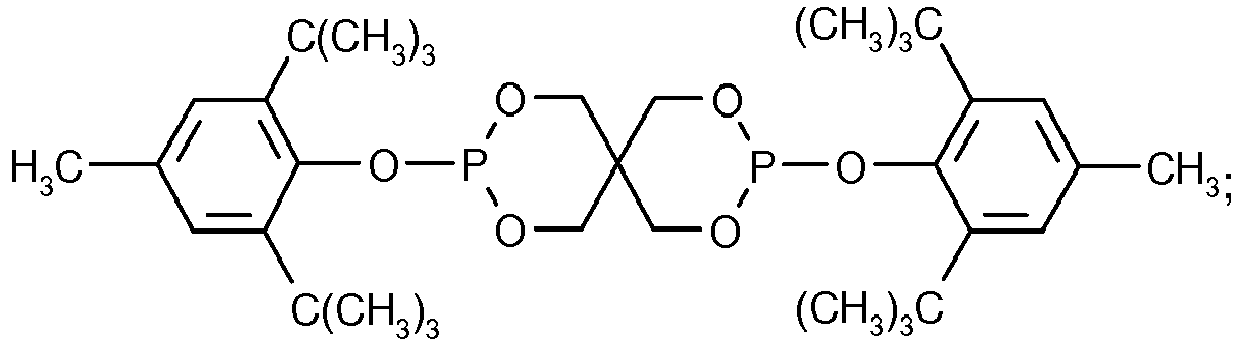
- bis(2,4-di-tert-butyl-6-methylphenyl) ethyl phosphite:

- tetrakis-(2,4-di-tert-butylphenyl) 4,4'-biphenylene-diphosphonite:

- Other suitable antioxidants may have the following structures:


- Hindered phenolic antioxidants include, for example, tris(3,5-di-tert-butyl-4-hydroxybenzyl) isocyanurate, 1,3,5-tris-(3,5-di-tert-butyl-4-hydroxybenzyl)-2,4,6-trimethylbenzene, calcium salt of the monoethyl ester of 3,5-di-tert-butyl-4-hydroxybenzylphosphonic acid, pentaerythritol tetrakis [3-(3,5-di-tert-butyl-4-hydroxyphenyl) propionate], and octadecyl 3-(3,5-di-tert-butyl-4-hydroxyphenyl) propionate. Vitamin E and vitamin E acetate antioxidants may also be used alone or in combination with other antioxidants.
- In certain embodiments, the combination of an organic phosphorus stabilizer and a hindered phenolic antioxidant is tris(2,4-di-tert-butylphenyl) phosphite and pentaerythritol tetrakis [3-(3,5-di-tert-butyl-4-hydroxyphenyl)propionate] or octadecyl 3-(3,5-di-tert-butyl-4-hydroxyphenyl)propionate.
- In certain embodiments, a weight:weight ratio of organic phosphorus stabilizer to hindered phenolic antioxidant is from about 9:1 to about 1:9, as well as with ratios in between, for instance about 8:1, about 7:1, about 6:1, about 5:1, about 4:1, about 3:1, about 2:1, about 1:1, about 1:2, about 1:3, about 1:4, about 1:5, about 1:6, about 1:7, or about 1:8 with ratios in between the aforementioned ratios.
- Hydroxylamine stabilizers may include, for example, N,N-dibenzylhydroxylamine, N,N-diethylhydroxylamine, N,N-dioctylhydroxylamine, N,N-dilaurylhydroxylamine, N,N-didodecylhydroxylamine, N,N-ditetradecylhydroxylamine, N,N-dihexadecylhydroxylamine, N,N-dioctadecylhydroxylamine, N-hexadecyl-N-tetradecylhydroxylamine, N-hexadecyl-N-heptadecylhydroxylamine, N-hexadecyl-N-octadecylhydroxylamine, N-heptadecyl-N-octadecylhydroxylamine, N-methyl-N-octadecylhydroxylamine, and N,N-di(C16-C18alkyl)hydroxylamine.
- Amine oxide stabilizers may include, for example, di(C16-C18)alkyl methyl amine oxide, a representative example being Genox® EP (Addivant).
- In certain embodiments, a combination of an organic phosphorus stabilizer and a dialkylhydroxylamine is tris(2,4-di-tert-butylphenyl) phosphite and N,N-di(C16-C18alkyl)hydroxylamine. In certain embodiments, a combination of an organic phosphorus stabilizer and an amine oxide stabilizer is tris(2,4-di-tert-butylphenyl)phosphite and di(C16-C18)alkyl methyl amine oxide. The weight:weight ratios of these two combinations may be as above for the organic phosphorus/hindered phenolic antioxidant combination.
- In certain embodiments, the additives may include one or more antioxidants. In certain embodiments, the one or more antioxidants include a combination of a first compound having a formula of:
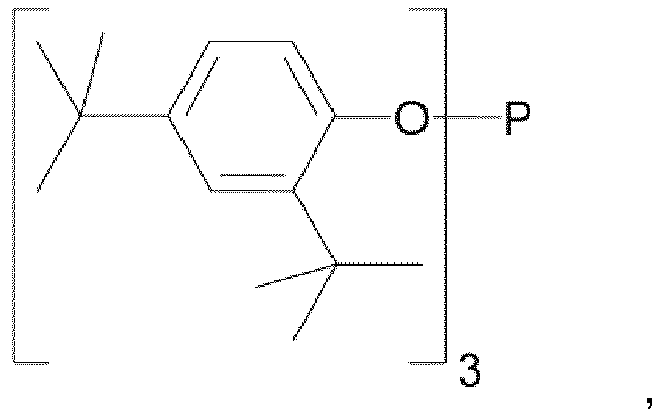

- In some embodiments, the antioxidant may be a blend of the first and second compounds, available commercially as IRGANOX® B 225.
- In certain embodiments, the one or more antioxidants are present in an amount from 0.01 wt% to 1 wt%, 0.01 wt% to 0.75 wt%, 0.01 wt% to 0.5 wt%, 0.01 wt% to 0.2 wt%, or 0.05 wt% to 1 wt% based on a weight of the polyolefin substrate or the article thereof. For example, the one or more antioxidants may be present in an amount of about 0.01 wt%, about 0.05 wt%, about 0.10 wt%, about 0.15 wt%, about 0.20 wt%, about 0.30 wt%, about 0.40 wt%, about 0.50 wt%, about 0.60 wt%, about 0.70 wt%, about 0.80 wt%, about 0.90 wt%, or about 1.00 wt% based on the weight of the polyolefin substrate or the article thereof.
- In certain embodiments, one or more colorants may be incorporated as additives into the polyolefin substrate. The colorants may include, for example, organic pigments, inorganic pigments, and mixtures thereof. Some examples of colorants may be found in Pigment Handbook, T. C. Patton, Ed., Wiley-Interscience, New York, 1973. Any of commercial pigments used in polymer based products can be utilized in the present compositions such as metallic oxides (e.g., titanium dioxide, zinc oxide, aluminum oxide, and iron oxide) metal hydroxides, metal flakes (e.g., aluminum flakes), chromates (e.g., lead chromate), sulfides, sulfates, carbonates, carbon black, bismuth vanadate, silica, talc, china clay, phthalocyanine blues and greens, organo reds, organo maroons, pearlescent pigments, and other organic pigments. Chromate-free pigments, such as barium metaborate, zinc phosphate, aluminum triphosphate, and mixtures thereof, may also be used.
- Other suitable pigments include C.I. Pigments, such as Black 12, Black 26, Black 28, Black 30, Blue 15.0, Blue 15.3 (G), Blue 15.3 (R), Blue 28, Blue 36, Blue 385, Brown 24, Brown 29, Brown 33, Brown 10P850, Green 7 (Y), Green 7 (B), Green 17, Green 26, Green 50, Violet 14, Violet 16, Yellow 1, Yellow 3, Yellow 12, Yellow 13, Yellow 14, Yellow 17, Yellow 62, Yellow 74, Yellow 83, Yellow 164, Yellow 53, Red 2, Red 3 (Y), Red 3 (B), Red 4, Red 48.1, Red 48.2, Red 48.3, Red 48.4, Red 52.2, Red 49.1, Red 53.1, Red 57.1 (Y), Red 57.1 (B), Red 112, Red 146, Red 170 (F5RK Type) Bluer, C.I. Pigment Orange 5, Pigment Orange 13, Pigment Orange 34, Pigment Orange 23 (R), and Pigment Orange 23 (B). Suitable organic pigments include Pigment Yellow 151, Pigment Yellow 154, Pigment Yellow 155, Pigment Red 8, Pigment Red 8, Pigment Red 49.2, Pigment Red 81, Pigment Red 169, Pigment Blue 1, Pigment Violet 1, Pigment Violet 3, Pigment Violet 27, Pigment Red 122, and Pigment Violet 19. Suitable inorganic pigments include Middle Chrome, Lemon Chrome, Primrose Chrome, Scarlet Chrome, and Zinc Chromate.
- Suitable organic pigments may include, for example, phthalocyanines, perylenes, azo compounds, isoindolines, quinophthalones, diketopyrrolopyrroles, qyinacridones, dioxazines, and indanthrones. Blue pigments may include, for example, pigments of the indanthrone and copper phthalocyanine classes, for instance Pigment Blue 60, Pigment Blue 15:1, Pigment Blue 15:3, Pigment Blue 15:4, and Pigment Blue 15:6. Green pigments may include, for example, pigments of the copper phthalocyanine class, for instance Pigment Green 7 and Pigment Green 36. Magenta pigments may include, for example, pigments of the quinacridone class, for instance 2,9-dichloro quinacridone and Pigment Red 202. Red pigments may include, for example, pigments of the quinacridone class, for instance dimethyl quinacridone and Pigment Red 122, pigments of the perylene class, for instance Pigment Red 149, Pigment Red 178, and Pigment Red 179, or pigments of the diketopyrrolopyrrole class, for instance Pigment Red 254 and Pigment Red 264. Yellow pigments may include, for example, pigments of the pteridine, isoindolinone, and isoindoline classes, for instance Pigment Yellow 215, Pigment Yellow 110, and Pigment Yellow 139. Orange pigments may include, for example, pigments of the isoindolinone or diketopyrrolopyrrole classes, for instance Pigment Orange 61, Pigment Orange 71, and Pigment Orange 73. Violet pigments may include, for example, pigments of the quinacridone class, for instance Pigment Violet 19, or pigments of the dioxazine class, for instance Pigment Violet 23 and Pigment violet 37. In certain embodiments, mixtures of pigments may be utilized.
- In certain embodiments, the one or more colorants may be present, in total, in an amount from 0.10 wt% to 3.0 wt%, or 0.20 wt% to 1.0 wt% based on a weight of the polyolefin substrate or the article thereof. For example, the one or more colorants may be present in an amount of about 0.3 wt%, about 0.4 wt%, about 0.5 wt%, about 0.6 wt%, about 0.7 wt%, about 0.8 wt%, or about 0.9 wt% based on the weight of the polyolefin substrate or the article thereof, as well as in amounts in between the aforementioned amounts.
- In certain embodiments, one or more fillers may be incorporated as additives into the polyolefin substrate. Fillers act to improve the polymer mechanical properties, such as impact or tensile strength. Examples of fillers include, but are not limited to, metal hydrate such as aluminum trihydrate (ATH), metal oxide such as magnesium dihydroxide (MDH), and metal carbonate such as calcium carbonate. Other fillers useful for polyolefin compositions include wood chips, wood flour, wood flakes, wood fibers, sawdust, flax, jute, hemp, kenaf, rice hulls, abaca, natural cellulosic fibers, and combinations thereof. Fillers may be inorganic and include alkali or alkali earth metal carboxylates stearates or sulfates. For example, the inorganic fillers include talcs (magnesium silicates), mica, vermiculite, diatomite, perlite, calcium carbonate, dolomite, silica, magnesium hydroxide, zinc borate, wollastonite, fly ash, kaolin clay, mica, or various titanium dioxides including surface treated titanium dioxide. Fillers may also include organic or inorganic fibers, such as glass, polyester, polyamide, or polyaramid fibers. Suitable fillers for plastics are described in Wiley Encyclopedia of Polymer Science and Technology, Volume 10, "Fillers", by A.H. Tsou, W.H. Waddell.
- Loading levels of fillers may range, in certain embodiments, from 5 wt% to 70 wt%, 5 wt% to 60 wt%, 10 wt% to 50 wt%, or 15 wt% to 40 wt% based on a weight of the polyolefin substrate or the article thereof. For example, fillers may be present at about 20 wt%, about 25 wt%, about 30 wt%, or about 35 wt% based on the weight of the polyolefin substrate or the article thereof, as well as amounts in between the aforementioned amounts.
- Further additives may also be present in the compositions disclosed herein, such as, antistats, antiscratch, slip agents, polymer processing aids, etc. (see Plastic Additives Handbook; 6th Edition). Further additives include metal salts of fatty acids, for example, calcium, magnesium, zinc, or aluminum stearate. Further additives also include thiosynergists, for example dilauryl thiodipropionate or distearyl thiodipropionate. Further additives also include benzofuranone stabilizers, for example those disclosed in
U.S. Pat. Nos. 4,325,863 ,4,338,244 ,5,175,312 ,5,216,052 ,5,252,643 5,369,159 5,356,966 5,367,008 5,428,177 or5,428,162 orU.S. Patent App. Pub. No. 2012/0238677 , including 3-[4-(2-acetoxyethoxy)phenyl]-5,7-di-tert-butyl-benzofuran-2-one, 5,7-di-tert-butyl-3-[4-(2-stearoyloxyethoxy)phenyl]benzofuran-2-one, 3,3'-bis[5,7-di-tert-butyl-3-(4-[2-hydroxyethoxy]phenyl)benzofuran-2-one], 5,7-di-tert-butyl-3-(4-ethoxyphenyl)benzofuran-2-one, 3-(4-acetoxy-3,5-dimethylphenyl)-5,7-di-tert-butyl-benzofuran-2-one, 3-(3,5-dimethyl-4-pivaloyloxyphenyl)-5,7-di-tert-butyl-benzofuran-2-one, 3-(3,4-dimethylphenyl)-5,7-di-tert-butyl-benzofuran-2-one, 3-(2-acetyl-5-isooctylphenyl)-5-isooctylbenzofuran-2-one, and 3-(2,3-dimethylphenyl)-5,7-di-tert-butyl-benzofuran-2-one. Further additives also include compatibilizers or dispersing aids, for example, maleic anhydride grafted PE or PP, poly(ethylene-co-vinyl acetate), poly(ethylene-acrylic acid), etc. The further additives may be present from 0.1 wt% to 10 wt%, or 0.2 wt% to 5 wt% based on a weight of the polyolefin substrate or the article thereof. - In certain embodiments, the additives may include one or more additional additives, such as an acid scavenger. In certain embodiments, the acid scavenger is zinc stearate. In certain embodiments, the acid scavenger may be present, in total, in an amount from 0.1 wt% to 3.0 wt%, or 0.10 wt% to 2.0 wt% based on the weight of the polyolefin substrate or the article thereof.
- In preparing a polyolefin substrate having additives incorporated therein, any of components described herein and optional further additives can be premixed or added individually. In certain embodiments, additives can be added before, during, or after polymerization of olefins. In certain embodiments, additives can be incorporated into the substrate in pure form or encapsulated in waxes, oils or polymers In certain embodiments, one or more additives are sprayed onto a polyolefin substrate, and may be used to dilute other additives or their melts so that the other additives can also be sprayed also together onto the polyolefin substrate. In certain embodiments, addition by spraying during deactivation of polymerization catalysts may be performed. In certain embodiments, steam may be used for deactivation.
- The addition of the additives of the invention and of further additives to the polyolefin can be carried out in all customary mixing machines in which the polyolefin is melted and mixed with the additives. Suitable machines are known to those skilled in the art. They are predominantly mixers, kneaders and extruders.
- The mixing process is preferably carried out in an extruder by introducing the additive during processing.
- Particularly preferred processing machines are single-screw extruders, contrarotating and corotating twin-screw extruders, planetary-gear extruders, ring extruders or cokneaders. It is also possible to use processing machines provided with at least one gas removal compartment to which a vacuum can be applied.
- Suitable extruders and kneaders are described, for example, in Handbuch der Kunststoffextrusion, Vol. 1 Grundlagen, Editors F. Hensen, W. Knappe, H. Potente, 1989, pp. 3-7, ISBN:3-446-14339-4 (Vol. 2 Extrusionsanlagen 1986, ISBN 3-446-14329-7).
- For example, the screw length is 1 - 60 screw diameters, preferably 35-48 screw diameters. The rotational speed of the screw is preferably 10 - 600 rotations per minute (rpm), very particularly preferably 25 - 300 rpm.
- The maximum throughput is dependent on the screw diameter, the rotational speed and the driving force. The mixing and incorporating process of the invention can also be carried out at a level lower than maximum throughput by varying the parameters mentioned or employing weighing machines delivering dosage amounts.
- If a plurality of components is added, these can be premixed or added individually.
- The materials containing the additives of the invention described herein preferably are used for the production of molded articles, for example roto-molded articles, injection molded articles, profiles and the like, and especially a fiber, spun melt non-woven, film, tape or foam. Preferred as articles are fibers, spun melt non-wovens, films and tapes, especially films or tapes and more preferably films. Transparent films are especially preferred.
- The articles can be prepared in known manner. For example, the polymeric articles may be manufactured by any process available to those of ordinary skill in the art including, but not limited to, extrusion, co-extrusion, extrusion coating onto various substrates, extrusion blowing, multi- or single-component melt spinning and/or wet spinning and/or dry spinning, film casting, film blowing, calendering, injection molding, blow molding, compression molding, thermoforming, spinning, blow extrusion or rotational casting.
- Corresponding films or thin thickness articles may be used to manufacture polymeric films, sheets, bags, bottles, styrofoam cups, plates, utensils, blister packages, boxes, package wrappings, stretch and shrink wrap, plastic fibers, bicomponent fibers comprising two or more polymers, tapes, raffia, big-bags, agricultural articles such as twine agricultural yarns, bale wrap films, silage films, mulch films, small tunnel films, banana bags, direct covers, greenhouse covers, nonwoven, pots for agricultural use, goetextiles, landfill covers, industrial covers, waste covers, waste bags, dumps, laminating, swimming pools covers, wallpaper, temporary scaffolding sheets, building films, roofing films, desalination film, batteries, connectors, silt fences, poultry curtains, films for building temporary shelter constructions, multilayered and/or multicomponent structures or the like.
- A polyolefin article for agricultural use, preferably a film, typically obtained with the blow extrusion technology, is preferred. A monolayer film or a multilayer film of three, five or seven layers is of particular interest. The most important application of the polyolefin films in agriculture is as covers for greenhouses and tunnels to grow crops in a protected environment.
- In certain embodiments, one physical dimension of the article is less than 1 mm, especially less than 0.8 mm and more preferably less than 0.6 mm. This refers to the smallest physical outward dimension of a solid object or a solid portion of an object, which in case of a film would be the thickness. This can also be designated as "minimum physical dimension". Films with such dimensions are highly preferred, especially films with one physical dimension of less than 0.8 mm, preferably less than 0.6 mm. Also for multi-layered articles it is preferred that these have an overall minimum physical dimension (like the thickness of multi-layered films) of less than 1 mm, especially less than 0.8 mm and more preferably less than 0.6 mm (e.g., several thin film articles layered onto each other or laminated together). Interesting ranges are those of 20 to 1000 micrometer, especially 20 to 800 micrometer and more preferably 20 to 600 micrometer.
- For the articles of the invention it is preferred that these pass the standard test DIN4102-Part 1 (May 1998).
- Furthermore, for the article of the invention it is preferred that a performance rating of the article from a UL-94 vertical burn (VB) test is V-0 when the article is in a form of a 125 mil injection molded bar.
- A further aspect of the invention is a flame retardant composition comprising
a phosphonate ester of formula (1), as defined hereinbefore,
an N-alkoxy hindered amine, and
a melamine cyanurate. - Such compositions can be, for example, in the form of a masterbatch. Such masterbatches can comprise the phosphonate ester of formula (1) in an amount of 10% to 80%, especially 20% to 70% and more preferably 30% to 60% by weight, the melamine cyanurate in an amount of 10% to 80%, especially 20% to 70% and more preferably 30% to 60% by weight, and the N-alkoxy hindered amine in an amount of 1% to 50%, especially 1% to 30% and more preferably 2% to 20% by weight.
- Such masterbatches may optionally comprise in addition a bonding agent, like glycerol monostearate.
- Such masterbatch compositions may optionally comprise in addition a polyolefin. Such masterbatch compositions may comprise 0% to 50%, especially 0% to 30% and more preferably 0% to 20% by weight of polyolefin. Preference is given to polyolefin containing masterbatches, comprising 1% to 50%, especially 1% to 30% and more preferably 1% to 20% by weight of polyolefin.
- Furthermore, the above flame retardant compositions may also comprise higher amounts of polyolefins, so that it is possible to use such compositions directly for the preparations of articles. For such flame retardant compositions the amounts of flame retardants are as given above for the polyolefin substrates.
- As to the flame retardant compositions, especially the phosphonate ester of formula (1), the N-alkoxy hindered amine, the melamine cyanurate and the polyolefin, the definitions and preferences given hereinbefore apply.
- A further aspect of the invention is the use of a composition comprising
a phosphonate ester of formula (1) as defined hereinbefore,
an N-alkoxy hindered amine, and
a melamine cyanurate
for increasing flame retardancy of polyolefins. - As to such compositions, especially the phosphonate ester of formula (1), the N-alkoxy hindered amine, the melamine cyanurate and the polyolefin, the definitions and preferences given hereinbefore apply.
- A further aspect of the invention is a flame retardant composition comprising
a phosphonate ester of formula (1) as defined hereinbefore, and
an N-alkoxy hindered amine of formula
- It is preferred that the flame retardant composition comprises in addition to the compounds of formulae (1) and (7) a polyolefin. Such a polyolefin containing composition may be in the form of a masterbatch, comprising the compounds of formulae (1) and (7) in a total amount of from 10% to 90% by weight, based on the total weight of the masterbatch.
- As to such compositions, especially the phosphonate ester of formula (1), the N-alkoxy hindered amine of formula (7) and the polyolefin, the definitions and preferences given hereinbefore apply. The compound of formula (7) is most preferably 1-(2-hydroxy-2-methylpropoxy)-4-octadecanoyloxy-2,2,6,6-tetramethylpiperidine.
- The following examples illustrate the invention in greater detail. All percentages and parts are by weight, unless stated otherwise.
- Polymer component (LLDPE): LLDPE, DOWLEX™ SC 2108G, manufacturer
Dow
Light stabilizer (LS): Chimassorb® 2020, manufacturer BASF SE -
- FR-1: 1-(2-hydroxy-2-methylpropoxy)-4-octadecanoyloxy-2,2,6,6-tetramethylpiperidine
- FR-2: Pentaerythritol-di-methyl diphosphonate (available as AFLAMMIT® PCO 900 from THOR GROUP LIMITED)
- FR-3: Melamine cyanurate (available as Melapur® MC from BASF SE)
- Unless stated otherwise, LLDPE, LS and the corresponding flame retardant components FR-1, FR-2 and FR-3 are dry blended in the amounts as indicated and then melt compounded into pellets on a co-rotating twin-screw extruder Berstorff 46D (lab size twin screw extruder, 25 mm screw diameter) at a maximum temperature Tmax of 230 °C.
- The pelletized fully formulated resin is then casted at a maximum temperature Tmax of 220 °C into 250 µm films using a cast film equipment Collin CR-136/350 coupled with an extruder Collin E 30 M .
- The produced films are evaluated according to the standard DIN4102-Part 1 (May 1998).
- DIN4102-Part 1: The specimen is positioned vertically and the ignition flame is applied at the lower edge of the specimen (edge ignition test).
- Classification is based on the time for flames to spread 150 mm of the specimen.
- If the flame does not reach the 150 mm reference mark within 20 s, the tested film passes
- the test and is classified B2.
- If the flame reaches the 150 mm reference mark within 20 s, the tested film is non classified (n.c.)
- Concentrations of additives and performance of film specimen are given in Tables 1 and 2
Table 1: Concentrations of added additives in the LLDPE cast film Comparative Compositions (compositions not according to the present invention): Ref. 1, 2, 3, 4, 5 and 6 Compositions according to the present invention: Inv. 1 and Inv. 2 Film No. Additive* Ref. 1 No FR Ref. 2 2 % FR-1 Ref. 3 5 % FR-2 Ref. 4 5 % FR-3 Ref. 5 0.4 % FR-1 + 4.6 % FR-3 Ref. 6 2.5 % FR-2 + 2.5 % FR-3 Inv. 1 0.4 % FR-1 + 1.8 % FR-2 + 2 % FR-3 Inv. 2 0.4 % FR-1 + 4.6 % FR-2 * Stabilization of all films with 0.2% Chimassorb® 2020 Table 2: Flaming test on 250 µm LLDPE cast films according to modified DIN 4102-Part 1 (edge ignition) Ref.1 Ref.2 Ref.3 Ref.4 Ref.5 Ref.6 Inv.1 Inv. 2 LLDPE 100% 98% 95% 95% 95% 95% 95.8% 95% FR-1 2% 0.4% 0.4% 0.4% FR-2 5% 2.5% 1.8% 4.6% FR-3 5% 4.6% 2.5% 2% DIN4102-B2 rating with 250 µm filmsa) fail fail pass fail fail fail pass pass Burning time [sec] b) 43 21 11 33 30 16 7 6 Damaged length [mm]c) 160 99 70 190 190 93 53 46 Burning drips paper ignition d) yes yes no yes yes yes no no a): Rated "pass" if flaming does not reach the 150 mm gauge mark within 20 seconds after flame application according to the DIN 4102-Part 1 test norm.
b): Burning time, in second, is the duration of the flaming after flame application up to the extinction of flame.
c): Damaged lenght, in mm, is the vertical part of the film being burned after the extinction of flame.
d): Rated "no" if molten and burning drips that have fallen on the filter paper does not ignite the paper placed underneath the test specimen according to the DIN 4102-Part 1 test norm. "no" is the best rating. - Inv. 1 and Inv. 2 increase significantly the FR performance of the composition in comparison to Comparative Compositions Ref. 1, 2, 3, 4, 5 and 6. The burning time and also the damaged length are considerably lower for Inv. 1 and Inv. 2, both pass the test according to DIN 4102-Part 1, and no burning drips ignite a paper placed underneath the test specimen.
- Polymer component (LLDPE): LLDPE, DOWLEX™ SC 2108G, manufacturer
Dow
Light stabilizer (LS): Chimassorb® 2020, manufacturer BASF SE -
- FR-2: Pentaerythritol-di-methyl diphosphonate (available as AFLAMMIT® PCO 900 from THOR GROUP LIMITED)
- FR-3: Melamine cyanurate (available as Melapur® MC from BASF SE)
- FR-4: Compound of formula (5) (available as Flamestab® NOR™ 116 FF from BASF SE)
- FR-5: Compound of formula (3) (available as Tinuvin® NOR™ 371 from BASF SE)
- FR-6: Compound of formula (4)
- Unless stated otherwise, LLDPE, LS and flame retardant components FR-2, FR-3, FR-4, FR-5 and FR-6 are dry blended in the amounts as indicated and then melt compounded into pellets on a co-rotating twin-screw extruder Berstorff 46D (lab size twin screw extruder, 25 mm screw diameter) at a maximum temperature Tmax of 230 °C.
- The pelletized fully formulated resin is then casted at a maximum temperature Tmax of 220 °C into 250 µm films using a cast film equipment Collin CR-136/350 coupled with an extruder Collin E 30 M .
- The produced films are evaluated according to the standard DIN4102-Part 1 (May 1998). DIN4102-Part 1: The specimen is positioned vertically and the ignition flame is applied at the lower edge of the specimen (edge ignition test).
- Classification is based on the time for flames to spread 150 mm of the specimen.
- If the flame does not reach the 150 mm reference mark within 20 s, the tested film passes the test and is classified B2.
- If the flame reaches the 150 mm reference mark within 20 s, the tested film is non classified (n.c.)
- Concentrations of additives and performance of film specimen are given in Tables 3 and 4
Table 3: Concentrations of added additives in the LLDPE cast film Comparative Composition (composition not according to the present invention): Ref. 1 Inventive Composition: Inv. 3, Inv. 4 and Inv. 5 Film No. Additive* Ref. 1 No FR Inv.3 0.4 % FR-4 + 2 % FR-2 + 2 % FR-3 Inv. 4 0.4 % FR-5 + 2 % FR-2 + 2 % FR-3 Inv. 5 0.4 % FR-6 + 2 % FR-2 + 2 % FR-3 * Stabilization of all films with 0.2% Chimassorb® 2020 Table 4: Flaming test on 250 µm LLDPE cast films according to modified DIN 4102-Part 1 (edge ignition) Ref.1 Inv. 3 Inv. 4 Inv. 5 LLDPE 100% 95.6% 95.6% 95.6% FR-2 2% 2% 2% FR-3 2% 2% 2% FR-4 0.4% FR-5 0.4% FR-6 0.4% DIN4102-B2 rating with 250 µm filmsa) fail pass pass pass Burning time [sec] b) 43 16 8 6 Damaged length [mm]c) 160 64 57 31 Burning drips paper ignition d) yes no no no a): Rated "pass" if flaming does not reach the 150 mm gauge mark within 20 seconds after flame application according to the DIN 4102-Part 1 test norm.
b): Burning time, in second, is the duration of the flaming after flame application up to the extinction of flame.
c): Damaged lenght, in mm, is the vertical part of the film being burned after the extinction of flame.
d): Rated "no" if molten and burning drips that have fallen on the filter paper does not ignite the paper placed underneath the test specimen according to the DIN 4102-Part 1 test norm. "no" is the best rating. - Compositions Inv. 3, 4 and 5, which are combinations of N-alkoxy hindered amines (FR-4 or FR-5 or FR-6) with pentaerythritol-di-methyl diphosphonate (FR-2) and melamine cyanurate (FR-3), pass DIN 4102-Part 1 test, and are effective in reducing burning time and damaged length.

Claims (11)
- A flame-retardant article comprising a polyolefin substrate having additives incorporated therein, the additives comprising:a phosphonate ester of formula
 wherein R1 and R2 are independently selected from a group consisting of alkyl, optionally substituted alkyl, benzyl, optionally substituted benzyl, phenyl, optionally substituted phenyl, naphthyl, and optionally substituted naphthyl,a synergist comprising an N-alkoxy hindered amine, anda melamine cyanurate,wherein the N-alkoxy hindered amine Is a compound of formula

or a compound of formula
or a compound of formula


- The article of claim 1, wherein the polyolefin substrate comprises a polymer selected from a group consisting of polypropylene, polyethylene, and copolymers or mixtures thereof.
- The article of claim 2, wherein the polyolefin has one or more additional polymers incorporated therein, the one or more additional polymers comprising polystyrene, polyamide, polyester, polycarbonate, epoxy resins, polyurethane, or copolymers or mixtures thereof.
- The article of any of claims 1 to 3, wherein a physical dimension of the article is less than 1 mm.
- The article of claim 4, wherein the article is a film having a thickness of less than 0.8 mm.
- The article of any of claims 1 to 5, wherein both R1 and R2 are methyl.
- An article according to any of claims 1 to 6, wherein the phosphonate ester of formula (1) is present in an amount of from 0.02 to 20% by weight, based on the weight of the article, the hindered N-alkoxy amine is present in an amount of from 0.02 to 20% by weight, based on the weight of the article, and the melamine cyanurate is present in an amount of from 0.02 to 20% by weight, based on the weight of the article.
- The article of any of claims 1 to 7, wherein a performance rating of the article from a UL-94 vertical burn (VB) test is V-0 when the article is in a form of a 125 mil injection molded bar.
- A flame retardant composition comprising a phosphonate ester of formula
 wherein R1 and R2 are independently selected from a group consisting of alkyl, optionally substituted alkyl, benzyl, optionally substituted benzyl, phenyl, optionally substituted phenyl, naphthyl, and optionally substituted naphthyl,an N-alkoxy hindered amine as defined in claim 1, anda melamine cyanurate.
 - Aflame retardant composition according to claim 9, comprising in addition a polyolefin.
- Use of a composition comprising
a phosphonate ester of formula wherein R1 and R2 are independently selected from a group consisting of alkyl, optionally substituted alkyl, benzyl, optionally substituted benzyl, phenyl, optionally substituted phenyl, naphthyl, and optionally substituted naphthyl,an N-alkoxy hindered amine as defined in claim 1, anda melamine cyanuratefor increasing flame retardancy of polyolefins.
Applications Claiming Priority (4)
| Application Number | Priority Date | Filing Date | Title |
|---|---|---|---|
| US201562194503P | 2015-07-20 | 2015-07-20 | |
| EP16152407 | 2016-01-22 | ||
| PCT/EP2016/066941 WO2017013028A1 (en) | 2015-07-20 | 2016-07-15 | Flame retardant polyolefin articles |
| EP16739463.4A EP3325547B1 (en) | 2015-07-20 | 2016-07-15 | Flame retardant polyolefin articles |
Related Parent Applications (2)
| Application Number | Title | Priority Date | Filing Date |
|---|---|---|---|
| EP16739463.4A Division EP3325547B1 (en) | 2015-07-20 | 2016-07-15 | Flame retardant polyolefin articles |
| EP16739463.4A Division-Into EP3325547B1 (en) | 2015-07-20 | 2016-07-15 | Flame retardant polyolefin articles |
Publications (2)
| Publication Number | Publication Date |
|---|---|
| EP3564299A1 true EP3564299A1 (en) | 2019-11-06 |
| EP3564299B1 EP3564299B1 (en) | 2023-09-06 |
Family
ID=55304835
Family Applications (2)
| Application Number | Title | Priority Date | Filing Date |
|---|---|---|---|
| EP16739463.4A Active EP3325547B1 (en) | 2015-07-20 | 2016-07-15 | Flame retardant polyolefin articles |
| EP19176414.1A Active EP3564299B1 (en) | 2015-07-20 | 2016-07-15 | Flame retardant polyolefin articles |
Family Applications Before (1)
| Application Number | Title | Priority Date | Filing Date |
|---|---|---|---|
| EP16739463.4A Active EP3325547B1 (en) | 2015-07-20 | 2016-07-15 | Flame retardant polyolefin articles |
Country Status (11)
| Country | Link |
|---|---|
| US (1) | US20190010308A1 (en) |
| EP (2) | EP3325547B1 (en) |
| JP (1) | JP6771538B2 (en) |
| KR (1) | KR102580043B1 (en) |
| CN (1) | CN107849295B (en) |
| AU (2) | AU2016294860B2 (en) |
| BR (1) | BR112018001130B1 (en) |
| CA (1) | CA2993117C (en) |
| MX (1) | MX384195B (en) |
| TW (1) | TWI714609B (en) |
| WO (1) | WO2017013028A1 (en) |
Families Citing this family (16)
| Publication number | Priority date | Publication date | Assignee | Title |
|---|---|---|---|---|
| JP7170632B2 (en) * | 2017-05-25 | 2022-11-14 | 株式会社Adeka | Flame retardant composition and flame retardant resin composition containing the same |
| ES2944608T3 (en) * | 2017-12-12 | 2023-06-22 | Borealis Ag | Flame retardant and fire resistant polyolefin composition |
| WO2019168718A1 (en) * | 2018-02-27 | 2019-09-06 | Basf Se | Flame retardant rotomolded polyolefin |
| KR20260007290A (en) | 2018-08-22 | 2026-01-13 | 바스프 에스이 | Stabilized rotomolded polyolefin |
| JP2020097716A (en) * | 2018-12-18 | 2020-06-25 | 株式会社フジクラ | Flame-retardant resin composition, flame-retardant resin composition for cable, cable using the same, molded product, flame-retardant masterbatch, and flame-retardant agent |
| JP6618604B1 (en) * | 2018-12-18 | 2019-12-11 | 株式会社フジクラ | Flame retardant resin composition, cable, molded body, flame retardant master batch and flame retardant using the same |
| US20220025156A1 (en) * | 2018-12-18 | 2022-01-27 | Fujikura Ltd. | Flame-retardant resin composition, flame-retardant resin composition for cable, cable, molded body and flame-retardant master batch using the same, and flame retardant |
| IL286101B2 (en) * | 2019-03-08 | 2025-10-01 | Basf Se | Sterically hindered amine stabilizer mixtures |
| WO2020217482A1 (en) * | 2019-04-26 | 2020-10-29 | 株式会社ユポ・コーポレーション | Resin composition and resin sheet |
| WO2020234173A1 (en) * | 2019-05-17 | 2020-11-26 | Basf Se | A flame-retardant composition |
| TWI686464B (en) * | 2019-06-03 | 2020-03-01 | 朝陽科技大學 | Flame-retardant composite and its method |
| KR102295734B1 (en) * | 2020-03-25 | 2021-08-30 | 한화토탈 주식회사 | Polyethylene composition for high modulus fiber |
| WO2021193058A1 (en) * | 2020-03-27 | 2021-09-30 | 株式会社ユポ・コーポレーション | Printed resin sheet |
| JP7552114B2 (en) * | 2020-07-15 | 2024-09-18 | 株式会社レゾナック | Resin composition and conductive substrate |
| DE102021101804A1 (en) * | 2021-01-27 | 2022-07-28 | Bayerische Motoren Werke Aktiengesellschaft | STORAGE CELL FOR AN ELECTRICAL ENERGY STORAGE WITH CELL-INTERNAL HEATER AND BATTERY FOR A MOTOR VEHICLE |
| WO2025223984A1 (en) | 2024-04-22 | 2025-10-30 | Basf Se | Flame retardant articles comprising polylactic acid |
Citations (84)
| Publication number | Priority date | Publication date | Assignee | Title |
|---|---|---|---|---|
| FR1025E (en) | 1902-09-08 | 1903-05-18 | Renfrew Crusher Company Ltd | Advanced grinder system |
| US3004896A (en) | 1956-12-14 | 1961-10-17 | Geigy Ag J R | Ultra-violet light-absorbing composition of matter |
| US3055896A (en) | 1959-06-11 | 1962-09-25 | American Cyanamid Co | Aminohydroxyphenylbenzotriazoles and triazine derivatives thereof |
| US3072585A (en) | 1960-01-13 | 1963-01-08 | American Cyanamid Co | Vinylbenzyloxy phenylbenzotriazoles |
| US3074910A (en) | 1960-11-17 | 1963-01-22 | Hercules Powder Co Ltd | Stabilization of polyolefins with a nickel phenolate of a bis(p-alkyl phenol) monosulfide and an o-hydroxy phenyl benzotriazole |
| US3189615A (en) | 1956-12-14 | 1965-06-15 | Geigy Ag J R | 2-aryl-4, 5-arylo-1, 2, 3-triazole |
| US3218332A (en) | 1961-06-16 | 1965-11-16 | Geigy Ag J R | 2-phenyl-benztriazole compounds |
| US3230194A (en) | 1961-12-22 | 1966-01-18 | American Cyanamid Co | 2-(2'-hydroxy-5'-tertiary-octylphenyl)-benzotriazole and polyolefins stabilized therewith |
| DE1988536U (en) | 1966-06-06 | 1968-06-27 | Palitex Project Co Gmbh | DEVICE FOR INSERTING SPOOLS IN SPINDLES. |
| US3843371A (en) | 1970-03-23 | 1974-10-22 | Ciba Geigy Ag | Photographic material stabilised against the deleterious effects of ultraviolet radiation |
| US4079035A (en) | 1974-11-21 | 1978-03-14 | Ethyl Corporation | Halophenoxyphosphazene fire retardants and polyesters containing same |
| US4107108A (en) | 1977-02-08 | 1978-08-15 | Armstrong Cork Company | Polyphosphazene plasticized resins |
| US4108805A (en) | 1977-09-06 | 1978-08-22 | Armstrong Cork Company | Structurally regulated polyphosphazene copolymers |
| US4127586A (en) | 1970-06-19 | 1978-11-28 | Ciba-Geigy Corporation | Light protection agents |
| US4226763A (en) | 1978-06-26 | 1980-10-07 | Ciba-Geigy Corporation | 2-[2-Hydroxy-3,5-di-(.alpha.,α-dimethylbenzyl)-phenyl]-2H-benzotriazole and stabilized compositions |
| US4263201A (en) | 1978-12-07 | 1981-04-21 | General Electric Company | Flame retardant polycarbonate composition |
| US4275004A (en) | 1978-06-26 | 1981-06-23 | Ciba-Geigy Corporation | High caustic coupling process for preparing substituted 2-nitro-2'-hydroxyazobenzenes |
| US4278589A (en) | 1978-06-26 | 1981-07-14 | Ciba-Geigy Corporation | 2-[2-Hydroxy-3,5-di-(α,α-dimethylbenzyl)phenyl]-2H-benzotriazole and stabilized compositions |
| US4315848A (en) | 1979-05-10 | 1982-02-16 | Ciba-Geigy Corporation | 2-[2-Hydroxy-3,5-di-(α,α-dimethylbenzyl)-phenyl]-2H-benzotriazole and stabilized compositions |
| US4325863A (en) | 1979-02-05 | 1982-04-20 | Sandoz Ltd. | Benzofuranone or indolinone compounds useful as stabilizers for organic materials |
| US4347180A (en) | 1979-05-16 | 1982-08-31 | Ciba-Geigy Corporation | High caustic coupling process for preparing substituted 2-nitro-2'-hydroxyazobenzenes |
| US4383863A (en) | 1979-12-17 | 1983-05-17 | Ciba-Geigy Corporation | 2-[2-Hydroxy-3,5-di-tert-octylphenyl]-2H-benzotriazole in stabilized photographic compositions |
| US4619956A (en) | 1985-05-03 | 1986-10-28 | American Cyanamid Co. | Stabilization of high solids coatings with synergistic combinations |
| US4675352A (en) | 1985-01-22 | 1987-06-23 | Ciba-Geigy Corporation | Liquid 2-(2-hydroxy-3-higher branched alkyl-5-methyl-phenyl)-2H-benzotriazole mixtures, stabilized compositions and processes for preparing liquid mixtures |
| US4681905A (en) | 1984-11-07 | 1987-07-21 | Adeka Argus Chemical Co., Ltd. | Stabilizer compositions for synthetic resins imparting improved light stability |
| US4853471A (en) | 1981-01-23 | 1989-08-01 | Ciba-Geigy Corporation | 2-(2-Hydroxyphenyl)-benztriazoles, their use as UV-absorbers and their preparation |
| US5004770A (en) | 1988-10-19 | 1991-04-02 | Ciba-Geigy Corporation | Polymeric substrates stabilized with N-substituted hindered amines |
| US5096489A (en) | 1989-08-25 | 1992-03-17 | Ciba-Geigy Corporation | Light-stabilized ink compositions |
| US5096950A (en) | 1988-10-19 | 1992-03-17 | Ciba-Geigy Corporation | Polyolefin compositions stabilized with NOR-substituted hindered amines |
| US5106891A (en) | 1990-03-30 | 1992-04-21 | Ciba-Geigy Corporation | Light stabilized coating compositions containing a mixture of 2-hydroxyphenylbenzotriazole and 2-hydroxyphenyltriazine |
| US5112890A (en) | 1987-09-21 | 1992-05-12 | Ciba-Geigy Corporation | Stabilization of acid catalyzed thermoset resins |
| US5124378A (en) | 1987-09-21 | 1992-06-23 | Ciba-Geigy Corporation | Stabilization of ambient cured coatings |
| US5145893A (en) | 1989-03-21 | 1992-09-08 | Ciba-Geigy Corporation | Non-migrating 1-hydrocarbyloxy hindered amine derivatives as polymer stabilizers |
| US5175312A (en) | 1989-08-31 | 1992-12-29 | Ciba-Geigy Corporation | 3-phenylbenzofuran-2-ones |
| US5204473A (en) | 1987-09-21 | 1993-04-20 | Ciba-Geigy Corporation | O-substituted N-hydroxy hindered amine stabilizers |
| US5216052A (en) | 1991-07-01 | 1993-06-01 | Ciba-Geigy Corporation | Bisbenzofuran-2-ones |
| US5216156A (en) | 1992-05-05 | 1993-06-01 | Ciba-Geigy Corporation | Non-migrating 1-hydrocarbyloxy-2,2,6,6-tetramethylpiperidine 1,3,5-triazine derivatives |
| US5252643A (en) | 1991-07-01 | 1993-10-12 | Ciba-Geigy Corporation | Thiomethylated benzofuran-2-ones |
| US5268450A (en) | 1992-11-24 | 1993-12-07 | Phillips Petroleum Company | Compositions comprising sulfur-containing derivatives of hydroxyphenylbenzotriazole and process therefor |
| US5278314A (en) | 1991-02-12 | 1994-01-11 | Ciba-Geigy Corporation | 5-thio-substituted benzotriazole UV-absorbers |
| US5280124A (en) | 1991-02-12 | 1994-01-18 | Ciba-Geigy Corporation | 5-sulfonyl-substituted benzotriazole UV-absorbers |
| US5298067A (en) | 1991-02-21 | 1994-03-29 | Ciba-Geigy Corporation | Coating materials stabilized against light-induced degradation |
| US5300414A (en) | 1991-09-05 | 1994-04-05 | Ciba-Geigy Corporation | Photographic material containing UV absorber |
| US5319091A (en) | 1992-11-24 | 1994-06-07 | Phillips Petroleum Company | Process for sulfur containing derivatives of hydroxyphenyl/benzotriazoles |
| US5354794A (en) | 1993-02-03 | 1994-10-11 | Ciba-Geigy Corporation | Electro coat/base coat/clear coat finishes stabilized with S-triazine UV absorbers |
| US5356966A (en) | 1992-05-22 | 1994-10-18 | Ciba-Geigy Corporation | 3-(carboxymethoxyphenyl)benzofuran-2-one stabilizers |
| US5367008A (en) | 1992-05-22 | 1994-11-22 | Ciba-Geigy Corporation | 3-(alkoxyphenyl)benzofuran-2-ones as stabilisers |
| US5369159A (en) | 1992-05-22 | 1994-11-29 | Ciba-Geigy Corporation | 3-(acyloxyphenyl)benzofuran-2-one stabilizers |
| US5428162A (en) | 1992-09-23 | 1995-06-27 | Ciba-Geigy Corporation | 3-(2-acyloxyethoxyphenyl)benzofuran-2-ones for use as stabilizers |
| US5428177A (en) | 1992-09-23 | 1995-06-27 | Ciba-Geigy Corporation | 3-(Dihydrobenzofuran-5-yl)benzofuran-2-ones as stabilizers |
| US5461151A (en) | 1990-10-29 | 1995-10-24 | Cytec Technology Corporation | Synergistic ultraviolet absorber compositions containing hydroxy aryl triazines and teraalkyl piperidines |
| JPH07292233A (en) | 1994-04-27 | 1995-11-07 | Denki Kagaku Kogyo Kk | Flame-retardant resin composition |
| US5489503A (en) | 1992-12-03 | 1996-02-06 | Ciba-Geigy Corp. | UV absorbers |
| US5543518A (en) | 1994-07-27 | 1996-08-06 | Ciba-Geigy Corporation | Red-shifted tris-aryl-s-triazines and compositions stabilized therewith |
| US5554760A (en) | 1995-04-19 | 1996-09-10 | Ciba-Geigy Corporation | 2-(2-hydroxy-3-α-cumyl-5-nonylor 5-dodecylphenyl)-2H-benzotriazole |
| US5597854A (en) | 1994-11-14 | 1997-01-28 | Ciba-Geigy Corporation | Latent light stabilizers |
| US5726309A (en) | 1996-08-27 | 1998-03-10 | Ciba Specialty Chemicals Corporation | Tris-aryls-triazines substituted with biphenylyl groups |
| US5736597A (en) | 1989-12-05 | 1998-04-07 | Ciba-Geigy Corporation | Stabilized organic material |
| US5844026A (en) | 1997-06-30 | 1998-12-01 | Ciba Specialty Chemicals Corporation | N,N',N''-tris{2,4-bis Hydrocarbyloxy-2,2,6,6-tetra-methylpiperidin-4-yl)alkylamino!-s-triazin-6-yl}-3,3'-ethylenediiminodipropylamines, their isomers and bridged derivatives and polymer compositions stabilized therewith |
| US5959008A (en) | 1996-03-26 | 1999-09-28 | Ciba Specialty Chemicals Corp. | Hydroxyphenyltriazines |
| JPH11263885A (en) | 1998-03-17 | 1999-09-28 | Chemiprokasei Kaisha Ltd | Flame-retardant polyolefin resin composition and molded article comprising the same |
| US5977219A (en) | 1997-10-30 | 1999-11-02 | Ciba Specialty Chemicals Corporation | Benzotriazole UV absorbers having enhanced durability |
| US5980783A (en) | 1995-04-11 | 1999-11-09 | Ciba Specialty Chemicals Corporation | Synergistic stabilizer mixture |
| US5998116A (en) | 1996-09-13 | 1999-12-07 | Ciba Specialty Chemicals Corporation | Color-photographic recording material |
| DE19828541A1 (en) | 1998-06-26 | 1999-12-30 | Bayer Ag | Fire-resistant polycarbonate-based molding material, useful for the production of molded parts for domestic appliances, office machines, cars, electrical goods etc. |
| US6013704A (en) | 1996-09-13 | 2000-01-11 | Ciba Specialty Chemicals Corporation | Hydroxyphenyltriazines |
| US6046304A (en) | 1995-12-04 | 2000-04-04 | Ciba Specialty Chemicals Corporation | Block oligomers containing 2,2,6,6-tetramethyl-4-piperidyl groups as stabilizers for organic materials |
| US6060543A (en) | 1996-09-13 | 2000-05-09 | Ciba Specialty Chemicals Corporation | Stabilizer combination |
| US6117995A (en) | 1998-02-25 | 2000-09-12 | Ciba Specialty Chemicals Corporation | Preparation of sterically hindered amine ethers |
| US6166218A (en) | 1996-11-07 | 2000-12-26 | Ciba Specialty Chemicals Corporation | Benzotriazole UV absorbers having enhanced durability |
| US6242598B1 (en) | 1998-03-02 | 2001-06-05 | Ciba Specialty Chemicals Corporation | Methods for the preparation of tris-aryl-o-hydroxyphenyl-s-triazines |
| EP1104766A1 (en) | 1998-08-13 | 2001-06-06 | Otsuka Chemical Company, Limited | Cross-linked phenoxyphosphazene compound, process for producing the same, flame retardant, flame-retardant resin composition, and molded flame-retardant resin |
| US6255483B1 (en) | 1995-03-15 | 2001-07-03 | Ciba Specialty Chemicals Corporation | Biphenyl-substituted triazines |
| US6265599B1 (en) | 2000-07-12 | 2001-07-24 | Chung-Shan Institute Of Science & Technology | Process for preparing a mixture of amino-containing phosphazenes |
| US6271377B1 (en) | 1999-02-25 | 2001-08-07 | Ciba Specialty Chemicals Corporation | Hydroxy-substituted N-alkoxy hindered amines and compositions stabilized therewith |
| US6376584B1 (en) | 1999-02-25 | 2002-04-23 | Ciba Specialty Chemicals Corporation | Hydroxy-substituted N-alkoxy hindered amines and compositions stabilized therewith |
| US6392041B1 (en) | 1999-02-25 | 2002-05-21 | Ciba Specialty Chemicals Corporation | Hydroxy-substituted N-alkoxy hindered amines and compositions stabilized therewith |
| US6472456B1 (en) | 1997-06-30 | 2002-10-29 | Ciba Specialty Chemicals Corp. | Flame retardant compositions |
| US20030220422A1 (en) * | 2002-03-12 | 2003-11-27 | Nikolas Kaprinidis | Flame retardant compositions |
| WO2004055029A2 (en) | 2002-12-18 | 2004-07-01 | Ciba Specialty Chemicals Holding Inc. | Process for the preparation of a melamine based flame retardant and polymer composition |
| US20100152376A1 (en) | 2006-12-12 | 2010-06-17 | Ciba Corporation | Flame retardant composition comprising dendritic polymers |
| US7786199B2 (en) | 2004-05-26 | 2010-08-31 | Ciba Specialty Chemicals Corp. | Flame-retardants |
| US20110257310A1 (en) * | 2008-09-05 | 2011-10-20 | Volker Butz | Flame-retardant composition comprising a phosphonic acid derivative |
| US20120238677A1 (en) | 2011-03-17 | 2012-09-20 | Chitec Technology Co., Ltd. | Benzofuranone derivatives and application of the same |
Family Cites Families (6)
| Publication number | Priority date | Publication date | Assignee | Title |
|---|---|---|---|---|
| DE60230922D1 (en) * | 2001-12-10 | 2009-03-05 | Ciba Holding Inc | FLAME-REDUCING COMPOSITIONS |
| US7109260B2 (en) * | 2002-10-17 | 2006-09-19 | Ciba Specialty Chemicals Corporation | Flame retardant compositions |
| JP2010530017A (en) * | 2007-06-14 | 2010-09-02 | ビーエーエスエフ ソシエタス・ヨーロピア | Flame retardant composition |
| WO2013136285A1 (en) * | 2012-03-16 | 2013-09-19 | Basf Se | Nor-hals compounds as flame retardants |
| AU2014326295B2 (en) * | 2013-09-27 | 2017-11-30 | Basf Se | Polyolefin compositions for building materials |
| CN104744783A (en) * | 2015-03-20 | 2015-07-01 | 湖州利鹏新材料科技有限公司 | High-efficient flame-retardant anti-photooxidation polyethylene and preparation method thereof |
-
2016
- 2016-07-15 US US15/745,192 patent/US20190010308A1/en not_active Abandoned
- 2016-07-15 KR KR1020187004384A patent/KR102580043B1/en active Active
- 2016-07-15 AU AU2016294860A patent/AU2016294860B2/en not_active Ceased
- 2016-07-15 MX MX2018000881A patent/MX384195B/en unknown
- 2016-07-15 BR BR112018001130-4A patent/BR112018001130B1/en active IP Right Grant
- 2016-07-15 EP EP16739463.4A patent/EP3325547B1/en active Active
- 2016-07-15 WO PCT/EP2016/066941 patent/WO2017013028A1/en not_active Ceased
- 2016-07-15 JP JP2018502746A patent/JP6771538B2/en active Active
- 2016-07-15 EP EP19176414.1A patent/EP3564299B1/en active Active
- 2016-07-15 CA CA2993117A patent/CA2993117C/en active Active
- 2016-07-15 CN CN201680042464.6A patent/CN107849295B/en active Active
- 2016-07-19 TW TW105122782A patent/TWI714609B/en active
-
2021
- 2021-04-12 AU AU2021202206A patent/AU2021202206B2/en active Active
Patent Citations (98)
| Publication number | Priority date | Publication date | Assignee | Title |
|---|---|---|---|---|
| FR1025E (en) | 1902-09-08 | 1903-05-18 | Renfrew Crusher Company Ltd | Advanced grinder system |
| US3004896A (en) | 1956-12-14 | 1961-10-17 | Geigy Ag J R | Ultra-violet light-absorbing composition of matter |
| US3189615A (en) | 1956-12-14 | 1965-06-15 | Geigy Ag J R | 2-aryl-4, 5-arylo-1, 2, 3-triazole |
| US3055896A (en) | 1959-06-11 | 1962-09-25 | American Cyanamid Co | Aminohydroxyphenylbenzotriazoles and triazine derivatives thereof |
| US3072585A (en) | 1960-01-13 | 1963-01-08 | American Cyanamid Co | Vinylbenzyloxy phenylbenzotriazoles |
| US3074910A (en) | 1960-11-17 | 1963-01-22 | Hercules Powder Co Ltd | Stabilization of polyolefins with a nickel phenolate of a bis(p-alkyl phenol) monosulfide and an o-hydroxy phenyl benzotriazole |
| US3218332A (en) | 1961-06-16 | 1965-11-16 | Geigy Ag J R | 2-phenyl-benztriazole compounds |
| US3230194A (en) | 1961-12-22 | 1966-01-18 | American Cyanamid Co | 2-(2'-hydroxy-5'-tertiary-octylphenyl)-benzotriazole and polyolefins stabilized therewith |
| DE1988536U (en) | 1966-06-06 | 1968-06-27 | Palitex Project Co Gmbh | DEVICE FOR INSERTING SPOOLS IN SPINDLES. |
| US3843371A (en) | 1970-03-23 | 1974-10-22 | Ciba Geigy Ag | Photographic material stabilised against the deleterious effects of ultraviolet radiation |
| US4127586A (en) | 1970-06-19 | 1978-11-28 | Ciba-Geigy Corporation | Light protection agents |
| US4079035A (en) | 1974-11-21 | 1978-03-14 | Ethyl Corporation | Halophenoxyphosphazene fire retardants and polyesters containing same |
| US4107108A (en) | 1977-02-08 | 1978-08-15 | Armstrong Cork Company | Polyphosphazene plasticized resins |
| US4108805A (en) | 1977-09-06 | 1978-08-22 | Armstrong Cork Company | Structurally regulated polyphosphazene copolymers |
| US4226763A (en) | 1978-06-26 | 1980-10-07 | Ciba-Geigy Corporation | 2-[2-Hydroxy-3,5-di-(.alpha.,α-dimethylbenzyl)-phenyl]-2H-benzotriazole and stabilized compositions |
| US4275004A (en) | 1978-06-26 | 1981-06-23 | Ciba-Geigy Corporation | High caustic coupling process for preparing substituted 2-nitro-2'-hydroxyazobenzenes |
| US4278589A (en) | 1978-06-26 | 1981-07-14 | Ciba-Geigy Corporation | 2-[2-Hydroxy-3,5-di-(α,α-dimethylbenzyl)phenyl]-2H-benzotriazole and stabilized compositions |
| US4263201A (en) | 1978-12-07 | 1981-04-21 | General Electric Company | Flame retardant polycarbonate composition |
| US4325863A (en) | 1979-02-05 | 1982-04-20 | Sandoz Ltd. | Benzofuranone or indolinone compounds useful as stabilizers for organic materials |
| US4338244A (en) | 1979-02-05 | 1982-07-06 | Sandoz Ltd. | Benzofuran(2)one or indolin(2)one compounds useful as stabilizers for organic materials |
| US4315848A (en) | 1979-05-10 | 1982-02-16 | Ciba-Geigy Corporation | 2-[2-Hydroxy-3,5-di-(α,α-dimethylbenzyl)-phenyl]-2H-benzotriazole and stabilized compositions |
| US4347180A (en) | 1979-05-16 | 1982-08-31 | Ciba-Geigy Corporation | High caustic coupling process for preparing substituted 2-nitro-2'-hydroxyazobenzenes |
| US4383863A (en) | 1979-12-17 | 1983-05-17 | Ciba-Geigy Corporation | 2-[2-Hydroxy-3,5-di-tert-octylphenyl]-2H-benzotriazole in stabilized photographic compositions |
| US4853471A (en) | 1981-01-23 | 1989-08-01 | Ciba-Geigy Corporation | 2-(2-Hydroxyphenyl)-benztriazoles, their use as UV-absorbers and their preparation |
| US4681905A (en) | 1984-11-07 | 1987-07-21 | Adeka Argus Chemical Co., Ltd. | Stabilizer compositions for synthetic resins imparting improved light stability |
| US4675352A (en) | 1985-01-22 | 1987-06-23 | Ciba-Geigy Corporation | Liquid 2-(2-hydroxy-3-higher branched alkyl-5-methyl-phenyl)-2H-benzotriazole mixtures, stabilized compositions and processes for preparing liquid mixtures |
| US4619956A (en) | 1985-05-03 | 1986-10-28 | American Cyanamid Co. | Stabilization of high solids coatings with synergistic combinations |
| US4740542A (en) | 1985-05-03 | 1988-04-26 | American Cyanamid Company | Stabilization of high solids coatings with synergistic combinations |
| US5112890A (en) | 1987-09-21 | 1992-05-12 | Ciba-Geigy Corporation | Stabilization of acid catalyzed thermoset resins |
| US5204473A (en) | 1987-09-21 | 1993-04-20 | Ciba-Geigy Corporation | O-substituted N-hydroxy hindered amine stabilizers |
| US5124378A (en) | 1987-09-21 | 1992-06-23 | Ciba-Geigy Corporation | Stabilization of ambient cured coatings |
| US5004770A (en) | 1988-10-19 | 1991-04-02 | Ciba-Geigy Corporation | Polymeric substrates stabilized with N-substituted hindered amines |
| US5096950A (en) | 1988-10-19 | 1992-03-17 | Ciba-Geigy Corporation | Polyolefin compositions stabilized with NOR-substituted hindered amines |
| US5145893A (en) | 1989-03-21 | 1992-09-08 | Ciba-Geigy Corporation | Non-migrating 1-hydrocarbyloxy hindered amine derivatives as polymer stabilizers |
| US5096489A (en) | 1989-08-25 | 1992-03-17 | Ciba-Geigy Corporation | Light-stabilized ink compositions |
| US5175312A (en) | 1989-08-31 | 1992-12-29 | Ciba-Geigy Corporation | 3-phenylbenzofuran-2-ones |
| US5736597A (en) | 1989-12-05 | 1998-04-07 | Ciba-Geigy Corporation | Stabilized organic material |
| US5106891A (en) | 1990-03-30 | 1992-04-21 | Ciba-Geigy Corporation | Light stabilized coating compositions containing a mixture of 2-hydroxyphenylbenzotriazole and 2-hydroxyphenyltriazine |
| US5461151A (en) | 1990-10-29 | 1995-10-24 | Cytec Technology Corporation | Synergistic ultraviolet absorber compositions containing hydroxy aryl triazines and teraalkyl piperidines |
| US5942626A (en) | 1991-02-12 | 1999-08-24 | Ciba Specialty Chemicals Corporation | Process for making 5-thio-substituted benzotriazole UV absorbers |
| US5278314A (en) | 1991-02-12 | 1994-01-11 | Ciba-Geigy Corporation | 5-thio-substituted benzotriazole UV-absorbers |
| US5280124A (en) | 1991-02-12 | 1994-01-18 | Ciba-Geigy Corporation | 5-sulfonyl-substituted benzotriazole UV-absorbers |
| US5436349A (en) | 1991-02-12 | 1995-07-25 | Ciba-Geigy Corporation | Compositions stabilized with 5-sulfonyl-substituted benotriazole UV-absorbers |
| US5516914A (en) | 1991-02-12 | 1996-05-14 | Ciba-Geigy Corporation | Compositions stabilized with 5-thio-substituted benzotriazole UV-absorbers |
| US5298067A (en) | 1991-02-21 | 1994-03-29 | Ciba-Geigy Corporation | Coating materials stabilized against light-induced degradation |
| US5252643A (en) | 1991-07-01 | 1993-10-12 | Ciba-Geigy Corporation | Thiomethylated benzofuran-2-ones |
| US5216052A (en) | 1991-07-01 | 1993-06-01 | Ciba-Geigy Corporation | Bisbenzofuran-2-ones |
| US5300414A (en) | 1991-09-05 | 1994-04-05 | Ciba-Geigy Corporation | Photographic material containing UV absorber |
| US5216156A (en) | 1992-05-05 | 1993-06-01 | Ciba-Geigy Corporation | Non-migrating 1-hydrocarbyloxy-2,2,6,6-tetramethylpiperidine 1,3,5-triazine derivatives |
| US5300544A (en) | 1992-05-05 | 1994-04-05 | Ciba-Geigy Corporation | Non-migrating 1-hydrocarbyloxy-2,2,6,6-tetramethylpiperdine 1,3,5-triazine derivatives as polymer stabilizers |
| US5367008A (en) | 1992-05-22 | 1994-11-22 | Ciba-Geigy Corporation | 3-(alkoxyphenyl)benzofuran-2-ones as stabilisers |
| US5369159A (en) | 1992-05-22 | 1994-11-29 | Ciba-Geigy Corporation | 3-(acyloxyphenyl)benzofuran-2-one stabilizers |
| US5356966A (en) | 1992-05-22 | 1994-10-18 | Ciba-Geigy Corporation | 3-(carboxymethoxyphenyl)benzofuran-2-one stabilizers |
| US5428162A (en) | 1992-09-23 | 1995-06-27 | Ciba-Geigy Corporation | 3-(2-acyloxyethoxyphenyl)benzofuran-2-ones for use as stabilizers |
| US5428177A (en) | 1992-09-23 | 1995-06-27 | Ciba-Geigy Corporation | 3-(Dihydrobenzofuran-5-yl)benzofuran-2-ones as stabilizers |
| US5319091A (en) | 1992-11-24 | 1994-06-07 | Phillips Petroleum Company | Process for sulfur containing derivatives of hydroxyphenyl/benzotriazoles |
| US5410071A (en) | 1992-11-24 | 1995-04-25 | Phillips Petroleum Company | Process for sulfur-containing derivatives of hydroxyphenylbenzotriazoles |
| US5268450A (en) | 1992-11-24 | 1993-12-07 | Phillips Petroleum Company | Compositions comprising sulfur-containing derivatives of hydroxyphenylbenzotriazole and process therefor |
| US5489503A (en) | 1992-12-03 | 1996-02-06 | Ciba-Geigy Corp. | UV absorbers |
| US5476937A (en) | 1993-02-03 | 1995-12-19 | Ciba-Geigy Corporation | S-triazine UV absorbers substituted by a sulfur-containing moiety |
| US5354794A (en) | 1993-02-03 | 1994-10-11 | Ciba-Geigy Corporation | Electro coat/base coat/clear coat finishes stabilized with S-triazine UV absorbers |
| JPH07292233A (en) | 1994-04-27 | 1995-11-07 | Denki Kagaku Kogyo Kk | Flame-retardant resin composition |
| US5681955A (en) | 1994-07-27 | 1997-10-28 | Ciba Specialty Chemicals Corporation | Red-shifted tris-aryl-s-triazines |
| US5556973A (en) | 1994-07-27 | 1996-09-17 | Ciba-Geigy Corporation | Red-shifted tris-aryl-s-triazines and compositions stabilized therewith |
| US5543518A (en) | 1994-07-27 | 1996-08-06 | Ciba-Geigy Corporation | Red-shifted tris-aryl-s-triazines and compositions stabilized therewith |
| US5597854A (en) | 1994-11-14 | 1997-01-28 | Ciba-Geigy Corporation | Latent light stabilizers |
| US6255483B1 (en) | 1995-03-15 | 2001-07-03 | Ciba Specialty Chemicals Corporation | Biphenyl-substituted triazines |
| US5980783A (en) | 1995-04-11 | 1999-11-09 | Ciba Specialty Chemicals Corporation | Synergistic stabilizer mixture |
| US5574166A (en) | 1995-04-19 | 1996-11-12 | Ciba-Geigy Corporation | Crystalline form of 2-(2-hydroxy-3-α-cumyl-5-tert-octylphenyl)-2H-benzotriazole |
| US5607987A (en) | 1995-04-19 | 1997-03-04 | Ciba-Geigy Corporation | 2-(2-hydroxy-3-α cumyl-5-tert nonyl or dodecyl phenyl)-2H- Benzotriazole UV Absorbers |
| US5563242A (en) | 1995-04-19 | 1996-10-08 | Ciba-Geigy Corporation | Electro coat/base coat/clear coat finishes stabilized with soluble and thermally stable benzotriazole UV absorbers |
| US5554760A (en) | 1995-04-19 | 1996-09-10 | Ciba-Geigy Corporation | 2-(2-hydroxy-3-α-cumyl-5-nonylor 5-dodecylphenyl)-2H-benzotriazole |
| US6297299B1 (en) | 1995-12-04 | 2001-10-02 | Ciba Specialty Chemicals Corp. | Block oligomers containing 2,2,6,6-tetramethyl-4-piperidyl groups as stabilizers for organic materials |
| US6046304A (en) | 1995-12-04 | 2000-04-04 | Ciba Specialty Chemicals Corporation | Block oligomers containing 2,2,6,6-tetramethyl-4-piperidyl groups as stabilizers for organic materials |
| US5959008A (en) | 1996-03-26 | 1999-09-28 | Ciba Specialty Chemicals Corp. | Hydroxyphenyltriazines |
| US5726309A (en) | 1996-08-27 | 1998-03-10 | Ciba Specialty Chemicals Corporation | Tris-aryls-triazines substituted with biphenylyl groups |
| US5998116A (en) | 1996-09-13 | 1999-12-07 | Ciba Specialty Chemicals Corporation | Color-photographic recording material |
| US6013704A (en) | 1996-09-13 | 2000-01-11 | Ciba Specialty Chemicals Corporation | Hydroxyphenyltriazines |
| US6060543A (en) | 1996-09-13 | 2000-05-09 | Ciba Specialty Chemicals Corporation | Stabilizer combination |
| US6166218A (en) | 1996-11-07 | 2000-12-26 | Ciba Specialty Chemicals Corporation | Benzotriazole UV absorbers having enhanced durability |
| US6472456B1 (en) | 1997-06-30 | 2002-10-29 | Ciba Specialty Chemicals Corp. | Flame retardant compositions |
| US5844026A (en) | 1997-06-30 | 1998-12-01 | Ciba Specialty Chemicals Corporation | N,N',N''-tris{2,4-bis Hydrocarbyloxy-2,2,6,6-tetra-methylpiperidin-4-yl)alkylamino!-s-triazin-6-yl}-3,3'-ethylenediiminodipropylamines, their isomers and bridged derivatives and polymer compositions stabilized therewith |
| US5977219A (en) | 1997-10-30 | 1999-11-02 | Ciba Specialty Chemicals Corporation | Benzotriazole UV absorbers having enhanced durability |
| US6117995A (en) | 1998-02-25 | 2000-09-12 | Ciba Specialty Chemicals Corporation | Preparation of sterically hindered amine ethers |
| US6242598B1 (en) | 1998-03-02 | 2001-06-05 | Ciba Specialty Chemicals Corporation | Methods for the preparation of tris-aryl-o-hydroxyphenyl-s-triazines |
| JPH11263885A (en) | 1998-03-17 | 1999-09-28 | Chemiprokasei Kaisha Ltd | Flame-retardant polyolefin resin composition and molded article comprising the same |
| DE19828541A1 (en) | 1998-06-26 | 1999-12-30 | Bayer Ag | Fire-resistant polycarbonate-based molding material, useful for the production of molded parts for domestic appliances, office machines, cars, electrical goods etc. |
| EP1104766A1 (en) | 1998-08-13 | 2001-06-06 | Otsuka Chemical Company, Limited | Cross-linked phenoxyphosphazene compound, process for producing the same, flame retardant, flame-retardant resin composition, and molded flame-retardant resin |
| US6271377B1 (en) | 1999-02-25 | 2001-08-07 | Ciba Specialty Chemicals Corporation | Hydroxy-substituted N-alkoxy hindered amines and compositions stabilized therewith |
| US6376584B1 (en) | 1999-02-25 | 2002-04-23 | Ciba Specialty Chemicals Corporation | Hydroxy-substituted N-alkoxy hindered amines and compositions stabilized therewith |
| US6392041B1 (en) | 1999-02-25 | 2002-05-21 | Ciba Specialty Chemicals Corporation | Hydroxy-substituted N-alkoxy hindered amines and compositions stabilized therewith |
| US6265599B1 (en) | 2000-07-12 | 2001-07-24 | Chung-Shan Institute Of Science & Technology | Process for preparing a mixture of amino-containing phosphazenes |
| US20030220422A1 (en) * | 2002-03-12 | 2003-11-27 | Nikolas Kaprinidis | Flame retardant compositions |
| WO2004055029A2 (en) | 2002-12-18 | 2004-07-01 | Ciba Specialty Chemicals Holding Inc. | Process for the preparation of a melamine based flame retardant and polymer composition |
| US7786199B2 (en) | 2004-05-26 | 2010-08-31 | Ciba Specialty Chemicals Corp. | Flame-retardants |
| US20100152376A1 (en) | 2006-12-12 | 2010-06-17 | Ciba Corporation | Flame retardant composition comprising dendritic polymers |
| US20110257310A1 (en) * | 2008-09-05 | 2011-10-20 | Volker Butz | Flame-retardant composition comprising a phosphonic acid derivative |
| US20120238677A1 (en) | 2011-03-17 | 2012-09-20 | Chitec Technology Co., Ltd. | Benzofuranone derivatives and application of the same |
Non-Patent Citations (5)
| Title |
|---|
| "Extrusionsanlagen", vol. 2, 1986 |
| "Handbuch der Kunststoffextrusion", vol. 1, 1989, pages: 3 - 7 |
| "Pigment Handbook", 1973, WILEY-INTERSCIENCE |
| A.H. TSOUW.H. WADDELL: "Wiley Encyclopedia of Polymer Science and Technology", vol. 10, article "Fillers" |
| CHEMICAL ABSTRACTS, Columbus, Ohio, US; abstract no. 87189-25-1 |
Also Published As
| Publication number | Publication date |
|---|---|
| AU2021202206B2 (en) | 2023-06-29 |
| KR20180031707A (en) | 2018-03-28 |
| EP3325547A1 (en) | 2018-05-30 |
| AU2016294860A1 (en) | 2018-02-08 |
| TW201715030A (en) | 2017-05-01 |
| KR102580043B1 (en) | 2023-09-20 |
| CN107849295B (en) | 2020-03-13 |
| BR112018001130A2 (en) | 2018-09-11 |
| AU2021202206A1 (en) | 2021-05-06 |
| WO2017013028A1 (en) | 2017-01-26 |
| EP3325547B1 (en) | 2019-07-10 |
| CA2993117C (en) | 2023-10-10 |
| CA2993117A1 (en) | 2017-01-26 |
| JP6771538B2 (en) | 2020-10-21 |
| US20190010308A1 (en) | 2019-01-10 |
| EP3564299B1 (en) | 2023-09-06 |
| MX384195B (en) | 2025-03-14 |
| AU2016294860B2 (en) | 2021-01-28 |
| MX2018000881A (en) | 2018-05-15 |
| BR112018001130B1 (en) | 2022-06-14 |
| TWI714609B (en) | 2021-01-01 |
| JP2018522123A (en) | 2018-08-09 |
| CN107849295A (en) | 2018-03-27 |
Similar Documents
| Publication | Publication Date | Title |
|---|---|---|
| AU2021202206B2 (en) | Flame retardant polyolefin articles | |
| US10669403B2 (en) | Polyolefin compositions for building materials | |
| CA2992593A1 (en) | Flame-retardant polyolefin systems | |
| US20240352229A1 (en) | Flame retardant polyolefin articles | |
| US12012542B2 (en) | Flame retardant rotomolded polyolefin |
Legal Events
| Date | Code | Title | Description |
|---|---|---|---|
| PUAI | Public reference made under article 153(3) epc to a published international application that has entered the european phase |
Free format text: ORIGINAL CODE: 0009012 |
|
| STAA | Information on the status of an ep patent application or granted ep patent |
Free format text: STATUS: THE APPLICATION HAS BEEN PUBLISHED |
|
| AC | Divisional application: reference to earlier application |
Ref document number: 3325547 Country of ref document: EP Kind code of ref document: P |
|
| AK | Designated contracting states |
Kind code of ref document: A1 Designated state(s): AL AT BE BG CH CY CZ DE DK EE ES FI FR GB GR HR HU IE IS IT LI LT LU LV MC MK MT NL NO PL PT RO RS SE SI SK SM TR |
|
| STAA | Information on the status of an ep patent application or granted ep patent |
Free format text: STATUS: REQUEST FOR EXAMINATION WAS MADE |
|
| 17P | Request for examination filed |
Effective date: 20200506 |
|
| RBV | Designated contracting states (corrected) |
Designated state(s): AL AT BE BG CH CY CZ DE DK EE ES FI FR GB GR HR HU IE IS IT LI LT LU LV MC MK MT NL NO PL PT RO RS SE SI SK SM TR |
|
| STAA | Information on the status of an ep patent application or granted ep patent |
Free format text: STATUS: EXAMINATION IS IN PROGRESS |
|
| 17Q | First examination report despatched |
Effective date: 20200916 |
|
| GRAP | Despatch of communication of intention to grant a patent |
Free format text: ORIGINAL CODE: EPIDOSNIGR1 |
|
| STAA | Information on the status of an ep patent application or granted ep patent |
Free format text: STATUS: GRANT OF PATENT IS INTENDED |
|
| INTG | Intention to grant announced |
Effective date: 20230331 |
|
| P01 | Opt-out of the competence of the unified patent court (upc) registered |
Effective date: 20230519 |
|
| GRAS | Grant fee paid |
Free format text: ORIGINAL CODE: EPIDOSNIGR3 |
|
| GRAA | (expected) grant |
Free format text: ORIGINAL CODE: 0009210 |
|
| STAA | Information on the status of an ep patent application or granted ep patent |
Free format text: STATUS: THE PATENT HAS BEEN GRANTED |
|
| AC | Divisional application: reference to earlier application |
Ref document number: 3325547 Country of ref document: EP Kind code of ref document: P |
|
| AK | Designated contracting states |
Kind code of ref document: B1 Designated state(s): AL AT BE BG CH CY CZ DE DK EE ES FI FR GB GR HR HU IE IS IT LI LT LU LV MC MK MT NL NO PL PT RO RS SE SI SK SM TR |
|
| REG | Reference to a national code |
Ref country code: GB Ref legal event code: FG4D |
|
| REG | Reference to a national code |
Ref country code: CH Ref legal event code: EP |
|
| REG | Reference to a national code |
Ref country code: DE Ref legal event code: R096 Ref document number: 602016082674 Country of ref document: DE |
|
| REG | Reference to a national code |
Ref country code: IE Ref legal event code: FG4D |
|
| REG | Reference to a national code |
Ref country code: LT Ref legal event code: MG9D |
|
| REG | Reference to a national code |
Ref country code: NL Ref legal event code: MP Effective date: 20230906 |
|
| PG25 | Lapsed in a contracting state [announced via postgrant information from national office to epo] |
Ref country code: GR Free format text: LAPSE BECAUSE OF FAILURE TO SUBMIT A TRANSLATION OF THE DESCRIPTION OR TO PAY THE FEE WITHIN THE PRESCRIBED TIME-LIMIT Effective date: 20231207 |
|
| PG25 | Lapsed in a contracting state [announced via postgrant information from national office to epo] |
Ref country code: SE Free format text: LAPSE BECAUSE OF FAILURE TO SUBMIT A TRANSLATION OF THE DESCRIPTION OR TO PAY THE FEE WITHIN THE PRESCRIBED TIME-LIMIT Effective date: 20230906 Ref country code: RS Free format text: LAPSE BECAUSE OF FAILURE TO SUBMIT A TRANSLATION OF THE DESCRIPTION OR TO PAY THE FEE WITHIN THE PRESCRIBED TIME-LIMIT Effective date: 20230906 Ref country code: NO Free format text: LAPSE BECAUSE OF FAILURE TO SUBMIT A TRANSLATION OF THE DESCRIPTION OR TO PAY THE FEE WITHIN THE PRESCRIBED TIME-LIMIT Effective date: 20231206 Ref country code: LV Free format text: LAPSE BECAUSE OF FAILURE TO SUBMIT A TRANSLATION OF THE DESCRIPTION OR TO PAY THE FEE WITHIN THE PRESCRIBED TIME-LIMIT Effective date: 20230906 Ref country code: LT Free format text: LAPSE BECAUSE OF FAILURE TO SUBMIT A TRANSLATION OF THE DESCRIPTION OR TO PAY THE FEE WITHIN THE PRESCRIBED TIME-LIMIT Effective date: 20230906 Ref country code: HR Free format text: LAPSE BECAUSE OF FAILURE TO SUBMIT A TRANSLATION OF THE DESCRIPTION OR TO PAY THE FEE WITHIN THE PRESCRIBED TIME-LIMIT Effective date: 20230906 Ref country code: GR Free format text: LAPSE BECAUSE OF FAILURE TO SUBMIT A TRANSLATION OF THE DESCRIPTION OR TO PAY THE FEE WITHIN THE PRESCRIBED TIME-LIMIT Effective date: 20231207 Ref country code: FI Free format text: LAPSE BECAUSE OF FAILURE TO SUBMIT A TRANSLATION OF THE DESCRIPTION OR TO PAY THE FEE WITHIN THE PRESCRIBED TIME-LIMIT Effective date: 20230906 |
|
| REG | Reference to a national code |
Ref country code: AT Ref legal event code: MK05 Ref document number: 1608523 Country of ref document: AT Kind code of ref document: T Effective date: 20230906 |
|
| PG25 | Lapsed in a contracting state [announced via postgrant information from national office to epo] |
Ref country code: NL Free format text: LAPSE BECAUSE OF FAILURE TO SUBMIT A TRANSLATION OF THE DESCRIPTION OR TO PAY THE FEE WITHIN THE PRESCRIBED TIME-LIMIT Effective date: 20230906 |
|
| PG25 | Lapsed in a contracting state [announced via postgrant information from national office to epo] |
Ref country code: IS Free format text: LAPSE BECAUSE OF FAILURE TO SUBMIT A TRANSLATION OF THE DESCRIPTION OR TO PAY THE FEE WITHIN THE PRESCRIBED TIME-LIMIT Effective date: 20240106 |
|
| REG | Reference to a national code |
Ref country code: ES Ref legal event code: FG2A Ref document number: 2965884 Country of ref document: ES Kind code of ref document: T3 Effective date: 20240417 |
|
| PG25 | Lapsed in a contracting state [announced via postgrant information from national office to epo] |
Ref country code: AT Free format text: LAPSE BECAUSE OF FAILURE TO SUBMIT A TRANSLATION OF THE DESCRIPTION OR TO PAY THE FEE WITHIN THE PRESCRIBED TIME-LIMIT Effective date: 20230906 |
|
| PG25 | Lapsed in a contracting state [announced via postgrant information from national office to epo] |
Ref country code: SM Free format text: LAPSE BECAUSE OF FAILURE TO SUBMIT A TRANSLATION OF THE DESCRIPTION OR TO PAY THE FEE WITHIN THE PRESCRIBED TIME-LIMIT Effective date: 20230906 Ref country code: RO Free format text: LAPSE BECAUSE OF FAILURE TO SUBMIT A TRANSLATION OF THE DESCRIPTION OR TO PAY THE FEE WITHIN THE PRESCRIBED TIME-LIMIT Effective date: 20230906 Ref country code: IS Free format text: LAPSE BECAUSE OF FAILURE TO SUBMIT A TRANSLATION OF THE DESCRIPTION OR TO PAY THE FEE WITHIN THE PRESCRIBED TIME-LIMIT Effective date: 20240106 Ref country code: EE Free format text: LAPSE BECAUSE OF FAILURE TO SUBMIT A TRANSLATION OF THE DESCRIPTION OR TO PAY THE FEE WITHIN THE PRESCRIBED TIME-LIMIT Effective date: 20230906 Ref country code: CZ Free format text: LAPSE BECAUSE OF FAILURE TO SUBMIT A TRANSLATION OF THE DESCRIPTION OR TO PAY THE FEE WITHIN THE PRESCRIBED TIME-LIMIT Effective date: 20230906 Ref country code: AT Free format text: LAPSE BECAUSE OF FAILURE TO SUBMIT A TRANSLATION OF THE DESCRIPTION OR TO PAY THE FEE WITHIN THE PRESCRIBED TIME-LIMIT Effective date: 20230906 Ref country code: PT Free format text: LAPSE BECAUSE OF FAILURE TO SUBMIT A TRANSLATION OF THE DESCRIPTION OR TO PAY THE FEE WITHIN THE PRESCRIBED TIME-LIMIT Effective date: 20240108 Ref country code: SK Free format text: LAPSE BECAUSE OF FAILURE TO SUBMIT A TRANSLATION OF THE DESCRIPTION OR TO PAY THE FEE WITHIN THE PRESCRIBED TIME-LIMIT Effective date: 20230906 |
|
| PG25 | Lapsed in a contracting state [announced via postgrant information from national office to epo] |
Ref country code: PL Free format text: LAPSE BECAUSE OF FAILURE TO SUBMIT A TRANSLATION OF THE DESCRIPTION OR TO PAY THE FEE WITHIN THE PRESCRIBED TIME-LIMIT Effective date: 20230906 |
|
| REG | Reference to a national code |
Ref country code: DE Ref legal event code: R097 Ref document number: 602016082674 Country of ref document: DE |
|
| PG25 | Lapsed in a contracting state [announced via postgrant information from national office to epo] |
Ref country code: DK Free format text: LAPSE BECAUSE OF FAILURE TO SUBMIT A TRANSLATION OF THE DESCRIPTION OR TO PAY THE FEE WITHIN THE PRESCRIBED TIME-LIMIT Effective date: 20230906 |
|
| PLBE | No opposition filed within time limit |
Free format text: ORIGINAL CODE: 0009261 |
|
| STAA | Information on the status of an ep patent application or granted ep patent |
Free format text: STATUS: NO OPPOSITION FILED WITHIN TIME LIMIT |
|
| PG25 | Lapsed in a contracting state [announced via postgrant information from national office to epo] |
Ref country code: DK Free format text: LAPSE BECAUSE OF FAILURE TO SUBMIT A TRANSLATION OF THE DESCRIPTION OR TO PAY THE FEE WITHIN THE PRESCRIBED TIME-LIMIT Effective date: 20230906 Ref country code: SI Free format text: LAPSE BECAUSE OF FAILURE TO SUBMIT A TRANSLATION OF THE DESCRIPTION OR TO PAY THE FEE WITHIN THE PRESCRIBED TIME-LIMIT Effective date: 20230906 |
|
| 26N | No opposition filed |
Effective date: 20240607 |
|
| PG25 | Lapsed in a contracting state [announced via postgrant information from national office to epo] |
Ref country code: BG Free format text: LAPSE BECAUSE OF FAILURE TO SUBMIT A TRANSLATION OF THE DESCRIPTION OR TO PAY THE FEE WITHIN THE PRESCRIBED TIME-LIMIT Effective date: 20230906 |
|
| PG25 | Lapsed in a contracting state [announced via postgrant information from national office to epo] |
Ref country code: BG Free format text: LAPSE BECAUSE OF FAILURE TO SUBMIT A TRANSLATION OF THE DESCRIPTION OR TO PAY THE FEE WITHIN THE PRESCRIBED TIME-LIMIT Effective date: 20230906 |
|
| PG25 | Lapsed in a contracting state [announced via postgrant information from national office to epo] |
Ref country code: MC Free format text: LAPSE BECAUSE OF FAILURE TO SUBMIT A TRANSLATION OF THE DESCRIPTION OR TO PAY THE FEE WITHIN THE PRESCRIBED TIME-LIMIT Effective date: 20230906 |
|
| REG | Reference to a national code |
Ref country code: CH Ref legal event code: PL |
|
| PG25 | Lapsed in a contracting state [announced via postgrant information from national office to epo] |
Ref country code: LU Free format text: LAPSE BECAUSE OF NON-PAYMENT OF DUE FEES Effective date: 20240715 |
|
| PG25 | Lapsed in a contracting state [announced via postgrant information from national office to epo] |
Ref country code: LU Free format text: LAPSE BECAUSE OF NON-PAYMENT OF DUE FEES Effective date: 20240715 |
|
| PG25 | Lapsed in a contracting state [announced via postgrant information from national office to epo] |
Ref country code: CH Free format text: LAPSE BECAUSE OF NON-PAYMENT OF DUE FEES Effective date: 20240731 |
|
| PGFP | Annual fee paid to national office [announced via postgrant information from national office to epo] |
Ref country code: TR Payment date: 20250626 Year of fee payment: 10 |
|
| PG25 | Lapsed in a contracting state [announced via postgrant information from national office to epo] |
Ref country code: IE Free format text: LAPSE BECAUSE OF NON-PAYMENT OF DUE FEES Effective date: 20240715 |
|
| PGFP | Annual fee paid to national office [announced via postgrant information from national office to epo] |
Ref country code: ES Payment date: 20250811 Year of fee payment: 10 |
|
| PGFP | Annual fee paid to national office [announced via postgrant information from national office to epo] |
Ref country code: DE Payment date: 20250728 Year of fee payment: 10 |
|
| PGFP | Annual fee paid to national office [announced via postgrant information from national office to epo] |
Ref country code: IT Payment date: 20250721 Year of fee payment: 10 |
|
| PGFP | Annual fee paid to national office [announced via postgrant information from national office to epo] |
Ref country code: BE Payment date: 20250724 Year of fee payment: 10 Ref country code: GB Payment date: 20250722 Year of fee payment: 10 |
|
| PGFP | Annual fee paid to national office [announced via postgrant information from national office to epo] |
Ref country code: FR Payment date: 20250725 Year of fee payment: 10 |
|
| PG25 | Lapsed in a contracting state [announced via postgrant information from national office to epo] |
Ref country code: CY Free format text: LAPSE BECAUSE OF FAILURE TO SUBMIT A TRANSLATION OF THE DESCRIPTION OR TO PAY THE FEE WITHIN THE PRESCRIBED TIME-LIMIT; INVALID AB INITIO Effective date: 20160715 |
|
| PG25 | Lapsed in a contracting state [announced via postgrant information from national office to epo] |
Ref country code: HU Free format text: LAPSE BECAUSE OF FAILURE TO SUBMIT A TRANSLATION OF THE DESCRIPTION OR TO PAY THE FEE WITHIN THE PRESCRIBED TIME-LIMIT; INVALID AB INITIO Effective date: 20160715 |