EP3556887A1 - Tôle d'acier laminée à chaud pour tuyau en acier soudé par résistance électrique ayant une excellente soudabilité et son procédé de fabrication - Google Patents
Tôle d'acier laminée à chaud pour tuyau en acier soudé par résistance électrique ayant une excellente soudabilité et son procédé de fabrication Download PDFInfo
- Publication number
- EP3556887A1 EP3556887A1 EP17885236.4A EP17885236A EP3556887A1 EP 3556887 A1 EP3556887 A1 EP 3556887A1 EP 17885236 A EP17885236 A EP 17885236A EP 3556887 A1 EP3556887 A1 EP 3556887A1
- Authority
- EP
- European Patent Office
- Prior art keywords
- cooling
- hot rolled
- steel plate
- rolled steel
- phase
- Prior art date
- Legal status (The legal status is an assumption and is not a legal conclusion. Google has not performed a legal analysis and makes no representation as to the accuracy of the status listed.)
- Granted
Links
Images
Classifications
-
- C—CHEMISTRY; METALLURGY
- C22—METALLURGY; FERROUS OR NON-FERROUS ALLOYS; TREATMENT OF ALLOYS OR NON-FERROUS METALS
- C22C—ALLOYS
- C22C38/00—Ferrous alloys, e.g. steel alloys
- C22C38/04—Ferrous alloys, e.g. steel alloys containing manganese
-
- C—CHEMISTRY; METALLURGY
- C21—METALLURGY OF IRON
- C21D—MODIFYING THE PHYSICAL STRUCTURE OF FERROUS METALS; GENERAL DEVICES FOR HEAT TREATMENT OF FERROUS OR NON-FERROUS METALS OR ALLOYS; MAKING METAL MALLEABLE, e.g. BY DECARBURISATION OR TEMPERING
- C21D9/00—Heat treatment, e.g. annealing, hardening, quenching or tempering, adapted for particular articles; Furnaces therefor
- C21D9/46—Heat treatment, e.g. annealing, hardening, quenching or tempering, adapted for particular articles; Furnaces therefor for sheet metals
-
- B—PERFORMING OPERATIONS; TRANSPORTING
- B21—MECHANICAL METAL-WORKING WITHOUT ESSENTIALLY REMOVING MATERIAL; PUNCHING METAL
- B21B—ROLLING OF METAL
- B21B3/00—Rolling materials of special alloys so far as the composition of the alloy requires or permits special rolling methods or sequences ; Rolling of aluminium, copper, zinc or other non-ferrous metals
- B21B3/02—Rolling special iron alloys, e.g. stainless steel
-
- B—PERFORMING OPERATIONS; TRANSPORTING
- B21—MECHANICAL METAL-WORKING WITHOUT ESSENTIALLY REMOVING MATERIAL; PUNCHING METAL
- B21B—ROLLING OF METAL
- B21B37/00—Control devices or methods specially adapted for metal-rolling mills or the work produced thereby
- B21B37/74—Temperature control, e.g. by cooling or heating the rolls or the product
-
- B—PERFORMING OPERATIONS; TRANSPORTING
- B23—MACHINE TOOLS; METAL-WORKING NOT OTHERWISE PROVIDED FOR
- B23K—SOLDERING OR UNSOLDERING; WELDING; CLADDING OR PLATING BY SOLDERING OR WELDING; CUTTING BY APPLYING HEAT LOCALLY, e.g. FLAME CUTTING; WORKING BY LASER BEAM
- B23K11/00—Resistance welding; Severing by resistance heating
- B23K11/08—Seam welding not restricted to one of the preceding subgroups
- B23K11/087—Seam welding not restricted to one of the preceding subgroups for rectilinear seams
- B23K11/0873—Seam welding not restricted to one of the preceding subgroups for rectilinear seams of the longitudinal seam of tubes
-
- B—PERFORMING OPERATIONS; TRANSPORTING
- B23—MACHINE TOOLS; METAL-WORKING NOT OTHERWISE PROVIDED FOR
- B23K—SOLDERING OR UNSOLDERING; WELDING; CLADDING OR PLATING BY SOLDERING OR WELDING; CUTTING BY APPLYING HEAT LOCALLY, e.g. FLAME CUTTING; WORKING BY LASER BEAM
- B23K11/00—Resistance welding; Severing by resistance heating
- B23K11/16—Resistance welding; Severing by resistance heating taking account of the properties of the material to be welded
-
- C—CHEMISTRY; METALLURGY
- C21—METALLURGY OF IRON
- C21D—MODIFYING THE PHYSICAL STRUCTURE OF FERROUS METALS; GENERAL DEVICES FOR HEAT TREATMENT OF FERROUS OR NON-FERROUS METALS OR ALLOYS; MAKING METAL MALLEABLE, e.g. BY DECARBURISATION OR TEMPERING
- C21D6/00—Heat treatment of ferrous alloys
- C21D6/002—Heat treatment of ferrous alloys containing Cr
-
- C—CHEMISTRY; METALLURGY
- C21—METALLURGY OF IRON
- C21D—MODIFYING THE PHYSICAL STRUCTURE OF FERROUS METALS; GENERAL DEVICES FOR HEAT TREATMENT OF FERROUS OR NON-FERROUS METALS OR ALLOYS; MAKING METAL MALLEABLE, e.g. BY DECARBURISATION OR TEMPERING
- C21D6/00—Heat treatment of ferrous alloys
- C21D6/005—Heat treatment of ferrous alloys containing Mn
-
- C—CHEMISTRY; METALLURGY
- C21—METALLURGY OF IRON
- C21D—MODIFYING THE PHYSICAL STRUCTURE OF FERROUS METALS; GENERAL DEVICES FOR HEAT TREATMENT OF FERROUS OR NON-FERROUS METALS OR ALLOYS; MAKING METAL MALLEABLE, e.g. BY DECARBURISATION OR TEMPERING
- C21D6/00—Heat treatment of ferrous alloys
- C21D6/008—Heat treatment of ferrous alloys containing Si
-
- C—CHEMISTRY; METALLURGY
- C21—METALLURGY OF IRON
- C21D—MODIFYING THE PHYSICAL STRUCTURE OF FERROUS METALS; GENERAL DEVICES FOR HEAT TREATMENT OF FERROUS OR NON-FERROUS METALS OR ALLOYS; MAKING METAL MALLEABLE, e.g. BY DECARBURISATION OR TEMPERING
- C21D8/00—Modifying the physical properties of ferrous metals or ferrous alloys by deformation combined with, or followed by, heat treatment
- C21D8/02—Modifying the physical properties of ferrous metals or ferrous alloys by deformation combined with, or followed by, heat treatment during manufacturing of plates or strips
-
- C—CHEMISTRY; METALLURGY
- C21—METALLURGY OF IRON
- C21D—MODIFYING THE PHYSICAL STRUCTURE OF FERROUS METALS; GENERAL DEVICES FOR HEAT TREATMENT OF FERROUS OR NON-FERROUS METALS OR ALLOYS; MAKING METAL MALLEABLE, e.g. BY DECARBURISATION OR TEMPERING
- C21D8/00—Modifying the physical properties of ferrous metals or ferrous alloys by deformation combined with, or followed by, heat treatment
- C21D8/02—Modifying the physical properties of ferrous metals or ferrous alloys by deformation combined with, or followed by, heat treatment during manufacturing of plates or strips
- C21D8/0221—Modifying the physical properties of ferrous metals or ferrous alloys by deformation combined with, or followed by, heat treatment during manufacturing of plates or strips characterised by the working steps
- C21D8/0226—Hot rolling
-
- C—CHEMISTRY; METALLURGY
- C21—METALLURGY OF IRON
- C21D—MODIFYING THE PHYSICAL STRUCTURE OF FERROUS METALS; GENERAL DEVICES FOR HEAT TREATMENT OF FERROUS OR NON-FERROUS METALS OR ALLOYS; MAKING METAL MALLEABLE, e.g. BY DECARBURISATION OR TEMPERING
- C21D8/00—Modifying the physical properties of ferrous metals or ferrous alloys by deformation combined with, or followed by, heat treatment
- C21D8/02—Modifying the physical properties of ferrous metals or ferrous alloys by deformation combined with, or followed by, heat treatment during manufacturing of plates or strips
- C21D8/0247—Modifying the physical properties of ferrous metals or ferrous alloys by deformation combined with, or followed by, heat treatment during manufacturing of plates or strips characterised by the heat treatment
- C21D8/0263—Modifying the physical properties of ferrous metals or ferrous alloys by deformation combined with, or followed by, heat treatment during manufacturing of plates or strips characterised by the heat treatment following hot rolling
-
- C—CHEMISTRY; METALLURGY
- C21—METALLURGY OF IRON
- C21D—MODIFYING THE PHYSICAL STRUCTURE OF FERROUS METALS; GENERAL DEVICES FOR HEAT TREATMENT OF FERROUS OR NON-FERROUS METALS OR ALLOYS; MAKING METAL MALLEABLE, e.g. BY DECARBURISATION OR TEMPERING
- C21D8/00—Modifying the physical properties of ferrous metals or ferrous alloys by deformation combined with, or followed by, heat treatment
- C21D8/10—Modifying the physical properties of ferrous metals or ferrous alloys by deformation combined with, or followed by, heat treatment during manufacturing of tubular bodies
-
- C—CHEMISTRY; METALLURGY
- C21—METALLURGY OF IRON
- C21D—MODIFYING THE PHYSICAL STRUCTURE OF FERROUS METALS; GENERAL DEVICES FOR HEAT TREATMENT OF FERROUS OR NON-FERROUS METALS OR ALLOYS; MAKING METAL MALLEABLE, e.g. BY DECARBURISATION OR TEMPERING
- C21D9/00—Heat treatment, e.g. annealing, hardening, quenching or tempering, adapted for particular articles; Furnaces therefor
- C21D9/08—Heat treatment, e.g. annealing, hardening, quenching or tempering, adapted for particular articles; Furnaces therefor for tubular bodies or pipes
-
- C—CHEMISTRY; METALLURGY
- C22—METALLURGY; FERROUS OR NON-FERROUS ALLOYS; TREATMENT OF ALLOYS OR NON-FERROUS METALS
- C22C—ALLOYS
- C22C38/00—Ferrous alloys, e.g. steel alloys
- C22C38/001—Ferrous alloys, e.g. steel alloys containing N
-
- C—CHEMISTRY; METALLURGY
- C22—METALLURGY; FERROUS OR NON-FERROUS ALLOYS; TREATMENT OF ALLOYS OR NON-FERROUS METALS
- C22C—ALLOYS
- C22C38/00—Ferrous alloys, e.g. steel alloys
- C22C38/002—Ferrous alloys, e.g. steel alloys containing In, Mg, or other elements not provided for in one single group C22C38/001 - C22C38/60
-
- C—CHEMISTRY; METALLURGY
- C22—METALLURGY; FERROUS OR NON-FERROUS ALLOYS; TREATMENT OF ALLOYS OR NON-FERROUS METALS
- C22C—ALLOYS
- C22C38/00—Ferrous alloys, e.g. steel alloys
- C22C38/02—Ferrous alloys, e.g. steel alloys containing silicon
-
- C—CHEMISTRY; METALLURGY
- C22—METALLURGY; FERROUS OR NON-FERROUS ALLOYS; TREATMENT OF ALLOYS OR NON-FERROUS METALS
- C22C—ALLOYS
- C22C38/00—Ferrous alloys, e.g. steel alloys
- C22C38/06—Ferrous alloys, e.g. steel alloys containing aluminium
-
- C—CHEMISTRY; METALLURGY
- C22—METALLURGY; FERROUS OR NON-FERROUS ALLOYS; TREATMENT OF ALLOYS OR NON-FERROUS METALS
- C22C—ALLOYS
- C22C38/00—Ferrous alloys, e.g. steel alloys
- C22C38/18—Ferrous alloys, e.g. steel alloys containing chromium
- C22C38/24—Ferrous alloys, e.g. steel alloys containing chromium with vanadium
-
- C—CHEMISTRY; METALLURGY
- C22—METALLURGY; FERROUS OR NON-FERROUS ALLOYS; TREATMENT OF ALLOYS OR NON-FERROUS METALS
- C22C—ALLOYS
- C22C38/00—Ferrous alloys, e.g. steel alloys
- C22C38/18—Ferrous alloys, e.g. steel alloys containing chromium
- C22C38/26—Ferrous alloys, e.g. steel alloys containing chromium with niobium or tantalum
-
- C—CHEMISTRY; METALLURGY
- C22—METALLURGY; FERROUS OR NON-FERROUS ALLOYS; TREATMENT OF ALLOYS OR NON-FERROUS METALS
- C22C—ALLOYS
- C22C38/00—Ferrous alloys, e.g. steel alloys
- C22C38/18—Ferrous alloys, e.g. steel alloys containing chromium
- C22C38/28—Ferrous alloys, e.g. steel alloys containing chromium with titanium or zirconium
-
- C—CHEMISTRY; METALLURGY
- C22—METALLURGY; FERROUS OR NON-FERROUS ALLOYS; TREATMENT OF ALLOYS OR NON-FERROUS METALS
- C22C—ALLOYS
- C22C38/00—Ferrous alloys, e.g. steel alloys
- C22C38/18—Ferrous alloys, e.g. steel alloys containing chromium
- C22C38/38—Ferrous alloys, e.g. steel alloys containing chromium with more than 1.5% by weight of manganese
-
- B—PERFORMING OPERATIONS; TRANSPORTING
- B23—MACHINE TOOLS; METAL-WORKING NOT OTHERWISE PROVIDED FOR
- B23K—SOLDERING OR UNSOLDERING; WELDING; CLADDING OR PLATING BY SOLDERING OR WELDING; CUTTING BY APPLYING HEAT LOCALLY, e.g. FLAME CUTTING; WORKING BY LASER BEAM
- B23K2101/00—Articles made by soldering, welding or cutting
- B23K2101/04—Tubular or hollow articles
- B23K2101/06—Tubes
-
- B—PERFORMING OPERATIONS; TRANSPORTING
- B23—MACHINE TOOLS; METAL-WORKING NOT OTHERWISE PROVIDED FOR
- B23K—SOLDERING OR UNSOLDERING; WELDING; CLADDING OR PLATING BY SOLDERING OR WELDING; CUTTING BY APPLYING HEAT LOCALLY, e.g. FLAME CUTTING; WORKING BY LASER BEAM
- B23K2101/00—Articles made by soldering, welding or cutting
- B23K2101/18—Sheet panels
-
- B—PERFORMING OPERATIONS; TRANSPORTING
- B23—MACHINE TOOLS; METAL-WORKING NOT OTHERWISE PROVIDED FOR
- B23K—SOLDERING OR UNSOLDERING; WELDING; CLADDING OR PLATING BY SOLDERING OR WELDING; CUTTING BY APPLYING HEAT LOCALLY, e.g. FLAME CUTTING; WORKING BY LASER BEAM
- B23K2103/00—Materials to be soldered, welded or cut
- B23K2103/02—Iron or ferrous alloys
- B23K2103/04—Steel or steel alloys
-
- C—CHEMISTRY; METALLURGY
- C21—METALLURGY OF IRON
- C21D—MODIFYING THE PHYSICAL STRUCTURE OF FERROUS METALS; GENERAL DEVICES FOR HEAT TREATMENT OF FERROUS OR NON-FERROUS METALS OR ALLOYS; MAKING METAL MALLEABLE, e.g. BY DECARBURISATION OR TEMPERING
- C21D2211/00—Microstructure comprising significant phases
- C21D2211/002—Bainite
-
- C—CHEMISTRY; METALLURGY
- C21—METALLURGY OF IRON
- C21D—MODIFYING THE PHYSICAL STRUCTURE OF FERROUS METALS; GENERAL DEVICES FOR HEAT TREATMENT OF FERROUS OR NON-FERROUS METALS OR ALLOYS; MAKING METAL MALLEABLE, e.g. BY DECARBURISATION OR TEMPERING
- C21D2211/00—Microstructure comprising significant phases
- C21D2211/005—Ferrite
-
- C—CHEMISTRY; METALLURGY
- C21—METALLURGY OF IRON
- C21D—MODIFYING THE PHYSICAL STRUCTURE OF FERROUS METALS; GENERAL DEVICES FOR HEAT TREATMENT OF FERROUS OR NON-FERROUS METALS OR ALLOYS; MAKING METAL MALLEABLE, e.g. BY DECARBURISATION OR TEMPERING
- C21D2211/00—Microstructure comprising significant phases
- C21D2211/008—Martensite
Definitions
- the present disclosure relates to steel used for chassis parts, etc. of an automobile and, more specifically, to a hot rolled steel plate for an electric resistance welded steel pipe, exhibiting excellent weldability in electric resistance welding, and a manufacturing method thereof.
- required properties of steel materials for an automobile body may be strength and elongation for forming, spot weldability required for assembly, and the like.
- steel materials for chassis parts are required to have fatigue properties for securing arc weldability and durability of parts, to be applied when assembling parts, in addition to the strength and elongation required for forming due to characteristics of parts.
- a hollow pipe is formed and used to simultaneously secure rigidity and lightweightedness, and for additional lightweightedness, high strengthening of the material is also being performed.
- a material used as a pipe member generally manufactures a pipe by electric resistance welding, it is very important to have electric resistance weldability as well as roll formability of the material during piping and cold formability after piping. Therefore, it is very important to secure integrity of a weld zone during electric resistance welding as a property in which the material should possess. This is because most fractures are concentrated in a weld zone or a weld heat affected zone as compared with a base material due to transformation during forming of an electric resistance welded steel pipe.
- a yield ratio of the material be as low as possible.
- the material is a high-strength steel material, and when yield strength is high and the yield ratio becomes high, there is a problem that it becomes difficult to secure roundness because spring back may become severe during the roll forming.
- a steel material having a low yield ratio and excellent elongation is basically required.
- a low yield ratio type hot rolled steel plate called as dual phase steel (DP steel) is representative.
- a low yield ratio type hot rolled steel plate in the related art is usually a dual-phase composite steel of ferrite-martensite.
- the low yield ratio type hot rolled steel plate exhibits continuous yield behavior and low yield strength characteristics by glissile dislocation introduced at the time of martensite transformation and has excellent elongation characteristics.
- a component system containing a large amount of Si in steel was controlled.
- a pipe is manufactured by an electric resistance welding method, a large amount of Si oxides are formed in a molten zone, which causes a defect known as a penetrator in a weld zone.
- the ferrite After the ferrite transformation, the ferrite is quenched to a martensite transformation starting temperature (Ms) or lower to obtain martensite.
- Ms martensite transformation starting temperature
- ⁇ Hv hardness drop
- An aspect of the present disclosure is to provide a hot rolled steel plate for an electric resistance welded steel pipe having excellent weldability, since the drop in the strength of the weld heat affected zone (HAZ) formed at the time of electric resistance welding is less than that of the strength of the base material, cracks do not occur in the weld zone and the weld heat affected zone even during expanding of a pipe after piping, and a manufacturing method thereof.
- HZ weld heat affected zone
- a hot rolled steel plate for an electric resistance welded steel pipe having excellent weldability includes, by wt%, carbon (C):0.05 to 0.14%, silicon (Si):0.1 to 1.0%, manganese (Mn): 0.8 to 1.8%, phosphorus (P): 0.001 to 0.02%, sulfur (S): 0.001 to 0.01%, aluminum (Al): 0.1 to 0.3%, chromium (Cr): 0.3 to 1.0%, titanium (Ti): 0.01 to 0.05%, niobium (Nb): 0.025% or less, vanadium (V): 0.035% or less, nitrogen (N): 0.001 to 0.01%, and a balance of iron (Fe) and inevitable impurities, wherein the Mn and Si satisfy the following Relational Expression 1, a microstructure includes a mixture of martensite and bainite phases together with a ferrite phase as a matrix structure, satisfying the following Relational Expression 2.
- a manufacturing method of a hot rolled steel plate for an electric resistance welded steel pipe having excellent weldability includes the steps of: reheating steel slab satisfying the above-described alloy composition and the Relational Expression 1 to a temperature within a range of 1180 to 1300°C; finish hot rolling the reheated steel slab at a temperature equal to or higher than Ar3 to manufacture a hot rolled steel plate; first cooling the hot rolled steel plate to a temperature within a range of of 550 to 750°C at a cooling rate of 20°C/s or higher; second cooling the hot rolled steel plate at a cooling rate of 0.05 to 2.0°C/s within a range satisfying the following Relational Expression 3 after the first cooling; third cooling the hot rolled steel plate at a cooling rate of 20°C/s or higher to a temperature within a range of room temperature to 400°C after the second cooling; and coiling the hot rolled steel plate after the third cooling.
- t 252 + (109[C]) + (10.2[Mn]) + (22.81[Cr]) - (3.46[Si]) - (5.41[Al]) - (0.87Temp) + (0.00068Temp ⁇ 2)
- t refers to a retention time (sec) of the second cooling (extreme slow cooling zone)
- ta refers to a retention time (sec) of the second cooling (extreme slow cooling zone) for securing an optimal phase fraction
- Temp refers to an intermediate temperature of the second cooling (extreme slow cooling zone) and refers to a temperature between a second cooling starting point and a second cooling stop point.
- Each alloy component refers a weight content.
- an electric resistance welded steel pipe having excellent expandability manufactured by electric resistance welding of the above-described hot rolled steel plate is provided.
- the present disclosure it is possible to provide a hot rolled steel plate having excellent weldability, and it is possible not only to suppress defects in a weld zone during electric resistance welding of the hot rolled steel plate, but to also significantly reduce a decrease in hardness of a weld heat affected zone.
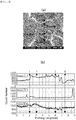
- FIG. 1 illustrates a photograph (a) obtained by observing a shape of a SSG M+B structure according to an embodiment of the present disclosure using an electro probe X-ray micro analyzer (EPMA) and a measurement result (b) of a content of an alloy element of each section of the SSG M+B structure.
- EPMA electro probe X-ray micro analyzer
- the present inventors have conducted intensive research to manufacture a hot rolled steel plate having a grade of 590 MPa having excellent cold formability, in which, since a yield ratio is controlled to be less than 0.8 and the roll forming may be easily performed for piping, not only the electric resistance weldability is excellent, but also the strength drop in the weld heat affected zone is small, thereby fractures do not occur in the weld zone and the weld heat affected zone during expanding after piping.
- a hot rolled steel plate for an electric resistance welded steel pipe having high strength and excellent weldability may be provided by forming a microstructure favorable to the above-described properties, by optimizing an alloy composition and manufacturing conditions of the steel material, thereby completing the present disclosure.
- a hot rolled steel plate for an electric resistance welded steel pipe having excellent weldability includes, by wt%, carbon (C): 0.05 to 0.14%, silicon(Si): 0.1 to 1.0%, manganese (Mn): 0.8 to 1.8%, phosphorus (P): 0.001 to 0.02%, sulfur (S): 0.001 to 0.01%, aluminum (Al) : 0.1 to 0.3%, chromium (Cr): 0.3 to 1.0%, titanium (Ti): 0.01 to 0.05%, niobium (Nb): 0.025% or less, vanadium (V): 0.035% or less, and nitrogen(N): 0.001 to 0.01%.
- Carbon (C) is the most economical and effective element for strengthening steel. If an addition amount of carbon (C) increases, a fraction of low temperature transformation phase such as bainite and martensite increases in complex structure steel composed of ferrite, bainite, and martensite, such that tensile strength is improved.
- the content of C it is preferable to control the content of C to be 0.05 to 0.14%. More preferably, the content of C is 0.07 to 0.13%.
- Silicon (Si) deoxidizes molten steel, has a solid solution strengthening effect, and has an effect of promoting ferrite transformation during cooling after hot rolling as a ferrite stabilizing element. Therefore, silicon (Si) is an element effective for increasing ferrite fraction constituting a matrix structure of ferrite, bainite, and martensite complex phase steel.
- the content of Si is less than 0.1%, an effect of stabilizing ferrite is small and it is difficult to form a matrix structure as a ferrite structure.
- the content thereof exceeds 1.0%, red scale due to Si is formed on a surface of the steel plate during hot rolling, such that not only the surface quality of the steel plate becomes so deteriorated, ductility and electrical resistance weldability are also deteriorated.
- the content of Si it is preferable to control the content of Si to 0.1 to 1.0%. More preferably, the content of Si is 0.15 to 0.80%.
- Manganese (Mn) is an effective element for solid solution strengthening of steel similarly to Si, and manganese (Mn) increases hardenability of steel to facilitate formation of bainite or martensite phase during cooling after hot rolling.
- the content of Mn it is preferable to control the content of Mn to 0.8 to 1.8%. More preferably, the content of Mn is 1.0 to 1.75%.
- Phosphrous (P) is an impurity present in steel. If the content thereof exceeds 0.02%, ductility degradation due to micro segregation and impact characteristics of steel may be deteriorated. However, in order to manufacture steel by setting the content of P to be less than 0.001%, it takes a long time to perform a steelmaking operation, which results in a problem that productivity is greatly reduced.
- the content of P is controlled to 0.001 to 0.02%.
- S Sulfur
- S is an impurity present in steel. If the content thereof exceeds 0.01%, sulfur (S) combines with Mn, or the like, to form a non-metallic inclusion, thereby significantly lowering toughness of steel.
- S sulfur
- the content of S it is preferable to control the content of S to be 0.001 to 0.01%.
- Aluminum (Al) is a component mainly added for deoxidation and is an element for forming a ferrite phase during cooling after hot rolling as a stabilizing element of ferrite.
- the content of Al is less than 0.1%, an addition effect is insufficient and it becomes difficult to secure ductility of the high strength steel material. If the content of Al exceeds 0.3%, defects may easily occur in a slab during continuous casting and surface quality is deteriorated due to occurrence of surface defects after hot rolling. Therefore, it is preferable to limit the content thereof to 0.1 to 0.3%.
- Chromium (Cr) performs solid solution strengthening of steel, and delay ferrite phase transformation during cooling as in the case of Mn, to facilitate to form martensite.
- the content of Cr is less than 0.3%, the above-described effect may not be sufficiently obtained.
- the content thereof exceeds 1.0%, ferrite transformation is excessively delayed, fraction of a low temperature transformation phase such as bainite or martensite phase may be increased more than necessary, and elongation may be drastically deteriorated.
- Titanium (Ti) forms coarse precipitates by combining with nitrogen (N) during continuous casting, and a portion thereof remain without being resolved in the material during reheating for hot rolling.
- the precipitates which are not resolved have a high melting point, even during welding, and the precipitates are not resolved, such that they serve to suppress a grain growth of the weld heat affected zone.
- the resolved Ti during reheating is finely precipitated during the phase transformation process during the cooling process after the hot rolling, thereby greatly improving the strength of steel.
- the content of Ti be included in an amount of 0.01% or more. However, if the content thereof exceeds 0.05%, a yield ratio of steel is increased due to the precipitates finely precipitated, which makes roll forming during piping difficult.
- the content of Ti it is preferable to the content of Ti to 0.01 to 0.05%.
- Nb 0.025% or less (excluding 0%)
- Niobium is an element serving to improve strength by forming precipitates in a form of carbonitrides.
- precipitates finely precipitated during the phase transformation process during the cooling process after the hot rolling greatly improve the strength of steel.
- Nb a yield ratio of steel is greatly increased to make the roll forming during piping difficult, which is not preferable. Therefore, in the present disclosure, it is preferable to control the content of Nb to 0.025% or less, excluding 0%.
- V 0.035% or less (excluding 0%)
- Vanadium (V) is an element serving to increasing strength by forming precipitates in a form of carbonitrides.
- precipitates, finely precipitated during the phase transformation process during the cooling process after the hot rolling greatly improve the strength of steel
- V exceeds 0.035%, a yield ratio of steel is greatly increased to make the roll forming during piping difficult, which is not preferable. Therefore, in the present disclosure, it is preferable to control the content of V to 0.035% or less, excluding 0%.
- Nitrogen (N) is a representative solid solution strengthening element together with C, and coarse precipitates are formed together with Ti, Al, and the like.
- N In general, a solid solution strengthening effect of N is superior to that of C, but as an amount of N in steel increases, toughness may be greatly reduced. Therefore, it is preferable that an upper limit of N is limited to 0.01%. However, in order to manufacture steel by setting the content of N to be less than 0.001%, it takes a long time to perform a steelmaking operation, which results in a problem that productivity is greatly reduced.
- manganese (Mn) and silicon (Si) satisfy the following Relational Expression 1. 4 ⁇ Mn / Si ⁇ 12 (where, Mn and Si refer to a weight content of each element.)
- the remainder thereof may be iron (Fe).
- Fe iron
- unintended impurities may be inevitably incorporated from raw materials or surrounding environments, such that they may not be included. These impurities are commonly known to a person skilled in the art, and are thus not specifically mentioned in this specification.
- a microstructure of the hot rolled steel plate of the present disclosure satisfying the above-described alloy composition and the Relational Expression 1 includes a mixture of martensite and bainite phases together with a ferrite phase as a matrix structure.
- the ferrite phase is included in an area fraction of 60 to 85%. If the fraction of the ferrite phase is less than 60%, elongation of steel may drop sharply, on the other hand, if the fraction of the ferrite phase exceeds 85%, the fraction of the low temperature phase (bainite and martensite) relatively decreases, and the desired strength may not be secured.
- the structure phase is defined as SSG M+B .
- SSG M+B and bainite and martensite phases satisfy the following Relational Expression 2.
- SSG M + B / M + B + SSG M + B ⁇ 0.6 (where, M refers to a martensite phase, B refers to a bainite phase, SSG M+B refers to a hard phase in which the B phase and the M phase exist together in a single grain (prior austenite), that is, refers to a structure in which a M phase exists around a grain boundary and a B phase exists in a central region. Each of the phases refers to an area fraction (%).)
- a desired hot rolled steel plate may be manufactured through processes of [Reheating steel slab - Hot rolling - First cooling - Second cooling - Third cooling - Coiling], and conditions of each step will be described in detail below.
- the reheating temperature is less than 1180°C, aging heat of the slab is insufficient and it is difficult to secure a temperature during subsequent hot rolling, and it is difficult to eliminate the segregation generated during continuous casting. In addition, since precipitates precipitated at the time continuous casting may not be sufficiently resolved, and it is difficult to obtain a precipitation strengthening effect in a process after hot rolling. On the other hand, if the temperature exceeds 1300°C, the strength may be lowered due to an abnormal grain growth of austenite grains, and structural ununiform may be promoted.
- the steel slab is reheated at a temperature of 1180 to 1300°C.
- a finish hot rolling is performed at Ar3 (ferrite phase transformation starting temperature) or higher.
- the temperature when the finish hot rolling is performed is less than Ar3
- rolling is performed after the ferrite transformation, such that it is difficult to secure desired structure and properties.
- the temperature exceeds 1000°C to perform the finish rolling, scaling defects may be increased on the surface.
- the finish hot rolling is performed in a temperature range satisfying Ar3 to 1000°C.
- first cooling at a cooling rate of 20°C/s or higher to a temperature within a range of 550 to 750°C.
- a microstructure in steel mainly includes a bainite phase, such that a ferrite phase may not be obtained as a matrix structure.
- the temperature exceeds 750°C, coarse ferrite and pearlite structures are formed and desired properties may not be obtained.
- cooling when cooling is performed at a cooling rate of less than 20°C/s during cooling to the above-described temperature range, ferrite and pearlite phase transformation occur during cooling, such that a hard phase may not be secured to a desired level.
- An upper limit of the cooling rate is not particularly limited and may be appropriately selected in consideration of cooling facilities.
- the hot rolled steel plate in which the first cooling is completed is second-cooled (extreme slow cooling) under specific conditions. More specifically, it is preferable to cool very slowly at a cooling rate of 0.05 to 20°C/s within a range satisfying the following Relational Expression 3.
- t refers to a retention time (sec) of the second cooling (extreme slow cooling zone)
- ta refers to a retention time (sec) of the second cooling (extreme slow cooling zone) for securing an optimal phase fraction
- temp refers to an intermediate temperature of the second cooling (extreme slow cooling zone), that is a temperature at a midpoint between a second cooling starting point and stop point.
- Each alloy component refers to a weight content.
- the above-described Relational Expression 3 is for obtaining the microstructure proposed in the present disclosure, specifically, the microstructure satisfying the above-described Relational Expression 2.
- Temp intermediate temperature
- SSG M+B phase in which bainite and martensite exist together in one crystal grain satisfies the Relational Expression 2.
- the fraction of the phase (SSG M+B ) in which bainite and martensite exist together in one crystal grain may be remarkably reduced, and the phase fraction composed of only the bainite phase B or the martensite phase M may be increased.
- the yield ratio increases. If the second phase is formed of only the martensite phase M, the yield ratio is reduced, which is advantageous for roll forming at the time of piping, but a problem in which the hardness drop of the weld heat affected zone becomes large at the time of electric resistance welding occurs.
- the carbon concentration becomes uniform such that it is transformed into the bainite phase B or the martensite phase M, which is not preferable.
- the cooling rate in the second cooling exceeds 2.0°C/s in a rapid cooling zone, the fraction of the bainite phase B increases and an intended microstructure may not be formed.
- room temperature refers to a range of about 15 to 35°C.
- a temperature at which the third cooling is terminated exceeds 400°C, and thus it is Ms (matrensite transformation temperature) or more, most of a remaining untransformed transformation phase is transformed into the bainite phase and the microstructure satisfying the Relational Expression 2 of the present disclosure may not be obtained.
- the cooling rate during the third cooling is less than 20°C/s, the bainite phase is excessively formed and thus desired properties and microstructures of the present disclosure may not be obtained.
- An upper limit of the cooling rate is not particularly limited, and may be appropriately selected in consideration of cooling facilities.
- a step of natural cooling the coiled hot rolled steel plate to a temperature within a range of room temperature to 200°C, pickling the coiled hot rolled steel plate to descale surface layer region, and then greasing, may further be included.
- the temperature of the steel plate exceeds 200°C, the surface layer region of the hot rolled steel plate may be over-pickled and roughness of the surface layer region may be worsened.
- the present disclosure provides an electric resistance welded steel pipe by electric resistance welding the hot rolled steel plate manufactured according to the steps as above, and the electric resistance welded steel pipe has an excellent effect of expandability.
- JIS5 specimens were prepared and a tensile test at room temperature at a transformation rate of 10mm/min was conducted.
- Microstructures of each of the hot rolled steel plate were measured using an image analyzer after capturing SEM images at magnifications of 3000 times, area fractions of each of the phases (ferrite(F), martensite(M), and bainite(B)) were measured.
- the SSG M+B in the structure phase was classified by measuring distribution of C and Mn by using a line scanning method of EPMA for dual phases observed on the SEM phase.
- the area fraction (area %) thereof was calculated by using an image analyzer.
- a coiled hot rolled coil was slit and piping was performed by an electric resistance welding method to manufacture a pipe having a diameter of 90 mm.
- the piping was subjected to a heat input of 140 to 200Kw, a line speed of 20 to 30m/min, and an upset amount of 0.8 to 1.2.
- a softening behavior of the weld zone of the pipe manufactured after the above-mentioned pipe making was calculated by measuring the hardness distribution at intervals of 0.1 mm with a load of 2.941N(300g) using a Vickers hardness tester.
- Comparative Examples 1 to 8 are cases in which the alloy composition deviates from the present disclosure.
- Comparative Examples 2 and 8 show the case the contents of C and Cr were not sufficiently added, and the value of ta in the Relational Expression 3 was indicated to be negative. Thus, it is difficult to form a low temperature transformation phase during cooling after hot rolling, such that no SSG M+B phase was formed.
- Comparative Examples 3, 4, 5, and 6 show the case in which the contents of Si and Mn deviate from the present disclosure, as the value of the component relational expression (Relational Expression 1) between the Si and Mn deviates from an effective range, or the value of
- Comparative Examples 9 to 11 show that the case in which the content of precipitated elements such as Ti, Nb, and V deviated from the present disclosure.
- fine precipitates accompanied by phase transformation in the extreme slow cooling were formed in large quantities and the yield strength was excessively high such that the desired yield ratio was not obtained.
- Comparative Examples 12 to 15 a case in which an intermediate temperature and a retention time in the extreme cooling (second cooling) during operations deviate from the conditions proposed in the present disclosure.
- the SSG M+B phase having a sufficient fraction was not formed as the Relational Expression 3 is not satisfied as the retention time in the extreme slow cooling zone was controlled to 15 sec and 0 sec, respectively.
- the intermediate temperature in the extreme slow cooling zone was controlled to be 785°C or 525°C, respectively.
- the Relational Expression 3 was not satisfied such that the SSG M+B phase having a sufficient fraction was not formed.
- Comparative Example 16 shows the case in which a cooling rate during the second cooling exceeds 2°C/s.
- the fraction of the bainite phase B was excessively formed at 30% or more, and the fraction of the SSG M+B phase was relatively small at 6%, and the difference in Vikers hardness between the weld heat affected zone and the base material after electric resistance welding was indicated to be 43, which is large.
Landscapes
- Chemical & Material Sciences (AREA)
- Engineering & Computer Science (AREA)
- Mechanical Engineering (AREA)
- Materials Engineering (AREA)
- Metallurgy (AREA)
- Organic Chemistry (AREA)
- Physics & Mathematics (AREA)
- Thermal Sciences (AREA)
- Crystallography & Structural Chemistry (AREA)
- Manufacturing & Machinery (AREA)
- Heat Treatment Of Steel (AREA)
- Heat Treatment Of Sheet Steel (AREA)
Applications Claiming Priority (2)
| Application Number | Priority Date | Filing Date | Title |
|---|---|---|---|
| KR1020160173504A KR101858853B1 (ko) | 2016-12-19 | 2016-12-19 | 용접성이 우수한 전봉강관용 열연강판 및 이의 제조방법 |
| PCT/KR2017/013848 WO2018117466A1 (fr) | 2016-12-19 | 2017-11-29 | Tôle d'acier laminée à chaud pour tuyau en acier soudé par résistance électrique ayant une excellente soudabilité et son procédé de fabrication |
Publications (3)
| Publication Number | Publication Date |
|---|---|
| EP3556887A4 EP3556887A4 (fr) | 2019-10-23 |
| EP3556887A1 true EP3556887A1 (fr) | 2019-10-23 |
| EP3556887B1 EP3556887B1 (fr) | 2021-08-04 |
Family
ID=62627652
Family Applications (1)
| Application Number | Title | Priority Date | Filing Date |
|---|---|---|---|
| EP17885236.4A Active EP3556887B1 (fr) | 2016-12-19 | 2017-11-29 | Tôle d'acier laminée à chaud pour tuyau en acier soudé par résistance électrique ayant une excellente soudabilité et son procédé de fabrication |
Country Status (6)
| Country | Link |
|---|---|
| US (1) | US11535907B2 (fr) |
| EP (1) | EP3556887B1 (fr) |
| JP (1) | JP6991219B2 (fr) |
| KR (1) | KR101858853B1 (fr) |
| CN (1) | CN110088331B (fr) |
| WO (1) | WO2018117466A1 (fr) |
Families Citing this family (5)
| Publication number | Priority date | Publication date | Assignee | Title |
|---|---|---|---|---|
| KR101977487B1 (ko) * | 2017-11-01 | 2019-05-10 | 주식회사 포스코 | 용접성이 우수한 열연강판 및 이의 제조방법 |
| KR101988765B1 (ko) | 2017-12-21 | 2019-06-12 | 주식회사 포스코 | 내구성이 우수한 열연강판 및 이의 제조방법 |
| CN110423941B (zh) * | 2019-07-31 | 2021-01-22 | 攀钢集团攀枝花钢铁研究院有限公司 | 一种控制r260钢轨闪光焊接头马氏体组织的方法 |
| KR20240098906A (ko) | 2022-12-21 | 2024-06-28 | 주식회사 포스코 | 전봉강관용 열연강판 및 그 제조 방법, 강 부품 및 그 제조 방법 |
| JP7747011B2 (ja) * | 2023-03-07 | 2025-10-01 | Jfeスチール株式会社 | 非調質円形溶接鋼管およびその製造方法 |
Family Cites Families (20)
| Publication number | Priority date | Publication date | Assignee | Title |
|---|---|---|---|---|
| JPS57108241A (en) | 1980-12-24 | 1982-07-06 | Kobe Steel Ltd | High strength steel plate with superior formability, especially strength flanging property |
| JP3400194B2 (ja) | 1995-08-04 | 2003-04-28 | 株式会社神戸製鋼所 | 強度−伸びバランス及び伸びフランジ性にすぐれる高強度熱延鋼板 |
| CN100370054C (zh) * | 2001-06-15 | 2008-02-20 | 新日本制铁株式会社 | 镀有铝合金体系的高强度钢板以及具有优异的耐热性和喷漆后耐腐蚀性的高强度汽车零件 |
| KR20070003918A (ko) * | 2004-03-11 | 2007-01-05 | 신닛뽄세이테쯔 카부시키카이샤 | 피삭성과 인성 및 용접성이 우수한 강판 및 그 제조 방법 |
| JP5045073B2 (ja) * | 2005-11-30 | 2012-10-10 | Jfeスチール株式会社 | 低降伏比を有する非調質高張力厚鋼板およびその製造方法 |
| JP5124866B2 (ja) * | 2007-09-03 | 2013-01-23 | 新日鐵住金株式会社 | ハイドロフォーム用電縫管及びその素材鋼板と、これらの製造方法 |
| JP5200653B2 (ja) * | 2008-05-09 | 2013-06-05 | 新日鐵住金株式会社 | 熱間圧延鋼板およびその製造方法 |
| CN103276291A (zh) | 2009-01-30 | 2013-09-04 | 杰富意钢铁株式会社 | 耐hic性优良的厚壁高强度热轧钢板及其制造方法 |
| JP5679114B2 (ja) | 2011-02-24 | 2015-03-04 | Jfeスチール株式会社 | 低温靭性に優れた低降伏比高強度熱延鋼板およびその製造方法 |
| KR101344620B1 (ko) | 2012-02-28 | 2013-12-26 | 현대제철 주식회사 | 고강도 강판 |
| CA2869700C (fr) | 2012-04-12 | 2017-12-19 | Jfe Steel Corporation | Tole d'acier laminee a chaud pour tube d'acier carre destine a etre utilise comme element structural de construction et procede pour sa production |
| KR101439610B1 (ko) * | 2012-07-20 | 2014-09-11 | 주식회사 포스코 | 용접성이 우수한 저항복비 열연강판 및 그 제조방법 |
| JP6049516B2 (ja) | 2013-03-26 | 2016-12-21 | 日新製鋼株式会社 | 溶接構造部材用高強度めっき鋼板およびその製造法 |
| CN103160756B (zh) | 2013-04-07 | 2015-01-21 | 南京钢铁股份有限公司 | 一种具有高强韧性及高变形能力的管线钢的制造方法 |
| KR101543838B1 (ko) | 2013-07-11 | 2015-08-11 | 주식회사 포스코 | 내충격 특성이 우수한 저항복비 고강도 열연강판 및 그 제조방법 |
| BR112016027395B1 (pt) | 2014-05-28 | 2020-05-05 | Nippon Steel & Sumitomo Metal Corp | chapa de aço laminada a quente e método de produção da mesma |
| KR101630982B1 (ko) | 2014-12-16 | 2016-06-16 | 주식회사 포스코 | 굽힘가공성 및 소부경화성이 우수한 고강도 열연강판 및 이의 제조방법 |
| KR101657403B1 (ko) * | 2015-03-26 | 2016-09-13 | 현대제철 주식회사 | 열연강판 및 이의 제조 방법 |
| JP6424967B2 (ja) | 2016-05-25 | 2018-11-21 | Jfeスチール株式会社 | めっき鋼板およびその製造方法 |
| KR101714979B1 (ko) * | 2016-07-18 | 2017-03-10 | 주식회사 포스코 | 소부경화능이 우수한 저항복비 고강도 열연강판 및 이의 제조방법 |
-
2016
- 2016-12-19 KR KR1020160173504A patent/KR101858853B1/ko active Active
-
2017
- 2017-11-29 JP JP2019532779A patent/JP6991219B2/ja active Active
- 2017-11-29 CN CN201780078397.8A patent/CN110088331B/zh active Active
- 2017-11-29 EP EP17885236.4A patent/EP3556887B1/fr active Active
- 2017-11-29 WO PCT/KR2017/013848 patent/WO2018117466A1/fr not_active Ceased
- 2017-11-29 US US16/467,792 patent/US11535907B2/en active Active
Also Published As
| Publication number | Publication date |
|---|---|
| JP6991219B2 (ja) | 2022-02-03 |
| US11535907B2 (en) | 2022-12-27 |
| WO2018117466A1 (fr) | 2018-06-28 |
| EP3556887A4 (fr) | 2019-10-23 |
| KR101858853B1 (ko) | 2018-06-28 |
| CN110088331A (zh) | 2019-08-02 |
| CN110088331B (zh) | 2021-03-23 |
| JP2020509188A (ja) | 2020-03-26 |
| US20190323103A1 (en) | 2019-10-24 |
| EP3556887B1 (fr) | 2021-08-04 |
Similar Documents
| Publication | Publication Date | Title |
|---|---|---|
| JP6396461B2 (ja) | 高強度および高成形鋼を用いたスポット溶接継手ならびにその製造方法 | |
| EP2465961B1 (fr) | Feuilles d'acier très résistantes et leurs procédés de production | |
| EP3859041A1 (fr) | Tôle d'acier laminée à froid à haute résistance ayant un rapport d'expansion de trou élevé, tôle d'acier galvanisée à chaud par trempe à haute résistance, et procédés de fabrication associés | |
| EP3556887B1 (fr) | Tôle d'acier laminée à chaud pour tuyau en acier soudé par résistance électrique ayant une excellente soudabilité et son procédé de fabrication | |
| CN106133154A (zh) | 用于生产高强度扁钢产品的方法 | |
| EP3964600A1 (fr) | Feuille d'acier très haute résistance offrant une excellente ouvrabilité de cisaillement et son procédé de fabrication | |
| US20230129303A1 (en) | Hot-rolled steel sheet having excellent expandability and method for manufacturing same | |
| EP3730634B1 (fr) | Tôle d'acier laminée à chaud possédant une excellente durabilité et son procédé de fabrication | |
| EP3561101A1 (fr) | Tôle d'acier laminée à chaud à haute résistance ayant d'excellentes soudabilité et ductilité et son procédé de fabrication | |
| JP5045074B2 (ja) | 低降伏比を有する高張力薄肉鋼板およびその製造方法 | |
| KR101977487B1 (ko) | 용접성이 우수한 열연강판 및 이의 제조방법 | |
| CN116368253B (zh) | 热稳定性优异的高强度钢板及其制造方法 | |
| KR101977488B1 (ko) | 확관성이 우수한 열연강판 및 그 제조방법 | |
| KR101455471B1 (ko) | 라인파이프용 강판 및 그 제조 방법 | |
| KR101412372B1 (ko) | 열연강판 및 그 제조 방법 |
Legal Events
| Date | Code | Title | Description |
|---|---|---|---|
| STAA | Information on the status of an ep patent application or granted ep patent |
Free format text: STATUS: THE INTERNATIONAL PUBLICATION HAS BEEN MADE |
|
| PUAI | Public reference made under article 153(3) epc to a published international application that has entered the european phase |
Free format text: ORIGINAL CODE: 0009012 |
|
| STAA | Information on the status of an ep patent application or granted ep patent |
Free format text: STATUS: REQUEST FOR EXAMINATION WAS MADE |
|
| 17P | Request for examination filed |
Effective date: 20190702 |
|
| A4 | Supplementary search report drawn up and despatched |
Effective date: 20190828 |
|
| AK | Designated contracting states |
Kind code of ref document: A1 Designated state(s): AL AT BE BG CH CY CZ DE DK EE ES FI FR GB GR HR HU IE IS IT LI LT LU LV MC MK MT NL NO PL PT RO RS SE SI SK SM TR |
|
| AX | Request for extension of the european patent |
Extension state: BA ME |
|
| DAV | Request for validation of the european patent (deleted) | ||
| DAX | Request for extension of the european patent (deleted) | ||
| RIC1 | Information provided on ipc code assigned before grant |
Ipc: C22C 38/02 20060101ALI20200716BHEP Ipc: C22C 38/28 20060101ALI20200716BHEP Ipc: B23K 11/087 20060101ALI20200716BHEP Ipc: C21D 8/02 20060101ALI20200716BHEP Ipc: C22C 38/00 20060101ALI20200716BHEP Ipc: B21B 3/02 20060101ALI20200716BHEP Ipc: C22C 38/06 20060101ALI20200716BHEP Ipc: B23K 11/16 20060101ALI20200716BHEP Ipc: B23K 101/06 20060101ALI20200716BHEP Ipc: C22C 38/26 20060101ALI20200716BHEP Ipc: C22C 38/04 20060101AFI20200716BHEP Ipc: B21C 37/08 20060101ALI20200716BHEP Ipc: B23K 101/18 20060101ALI20200716BHEP Ipc: B23K 103/04 20060101ALI20200716BHEP Ipc: B21B 37/74 20060101ALI20200716BHEP Ipc: C22C 38/24 20060101ALI20200716BHEP Ipc: C22C 38/38 20060101ALI20200716BHEP Ipc: C21D 9/08 20060101ALI20200716BHEP Ipc: C21D 8/10 20060101ALI20200716BHEP |
|
| GRAP | Despatch of communication of intention to grant a patent |
Free format text: ORIGINAL CODE: EPIDOSNIGR1 |
|
| STAA | Information on the status of an ep patent application or granted ep patent |
Free format text: STATUS: GRANT OF PATENT IS INTENDED |
|
| INTG | Intention to grant announced |
Effective date: 20200902 |
|
| GRAJ | Information related to disapproval of communication of intention to grant by the applicant or resumption of examination proceedings by the epo deleted |
Free format text: ORIGINAL CODE: EPIDOSDIGR1 |
|
| STAA | Information on the status of an ep patent application or granted ep patent |
Free format text: STATUS: REQUEST FOR EXAMINATION WAS MADE |
|
| INTC | Intention to grant announced (deleted) | ||
| GRAP | Despatch of communication of intention to grant a patent |
Free format text: ORIGINAL CODE: EPIDOSNIGR1 |
|
| STAA | Information on the status of an ep patent application or granted ep patent |
Free format text: STATUS: GRANT OF PATENT IS INTENDED |
|
| INTG | Intention to grant announced |
Effective date: 20210224 |
|
| GRAS | Grant fee paid |
Free format text: ORIGINAL CODE: EPIDOSNIGR3 |
|
| GRAA | (expected) grant |
Free format text: ORIGINAL CODE: 0009210 |
|
| STAA | Information on the status of an ep patent application or granted ep patent |
Free format text: STATUS: THE PATENT HAS BEEN GRANTED |
|
| AK | Designated contracting states |
Kind code of ref document: B1 Designated state(s): AL AT BE BG CH CY CZ DE DK EE ES FI FR GB GR HR HU IE IS IT LI LT LU LV MC MK MT NL NO PL PT RO RS SE SI SK SM TR |
|
| REG | Reference to a national code |
Ref country code: GB Ref legal event code: FG4D |
|
| REG | Reference to a national code |
Ref country code: AT Ref legal event code: REF Ref document number: 1417069 Country of ref document: AT Kind code of ref document: T Effective date: 20210815 |
|
| REG | Reference to a national code |
Ref country code: CH Ref legal event code: EP |
|
| REG | Reference to a national code |
Ref country code: DE Ref legal event code: R096 Ref document number: 602017043622 Country of ref document: DE |
|
| REG | Reference to a national code |
Ref country code: IE Ref legal event code: FG4D |
|
| REG | Reference to a national code |
Ref country code: LT Ref legal event code: MG9D |
|
| REG | Reference to a national code |
Ref country code: NL Ref legal event code: MP Effective date: 20210804 |
|
| PG25 | Lapsed in a contracting state [announced via postgrant information from national office to epo] |
Ref country code: LT Free format text: LAPSE BECAUSE OF FAILURE TO SUBMIT A TRANSLATION OF THE DESCRIPTION OR TO PAY THE FEE WITHIN THE PRESCRIBED TIME-LIMIT Effective date: 20210804 Ref country code: BG Free format text: LAPSE BECAUSE OF FAILURE TO SUBMIT A TRANSLATION OF THE DESCRIPTION OR TO PAY THE FEE WITHIN THE PRESCRIBED TIME-LIMIT Effective date: 20211104 Ref country code: NO Free format text: LAPSE BECAUSE OF FAILURE TO SUBMIT A TRANSLATION OF THE DESCRIPTION OR TO PAY THE FEE WITHIN THE PRESCRIBED TIME-LIMIT Effective date: 20211104 Ref country code: PT Free format text: LAPSE BECAUSE OF FAILURE TO SUBMIT A TRANSLATION OF THE DESCRIPTION OR TO PAY THE FEE WITHIN THE PRESCRIBED TIME-LIMIT Effective date: 20211206 Ref country code: HR Free format text: LAPSE BECAUSE OF FAILURE TO SUBMIT A TRANSLATION OF THE DESCRIPTION OR TO PAY THE FEE WITHIN THE PRESCRIBED TIME-LIMIT Effective date: 20210804 Ref country code: FI Free format text: LAPSE BECAUSE OF FAILURE TO SUBMIT A TRANSLATION OF THE DESCRIPTION OR TO PAY THE FEE WITHIN THE PRESCRIBED TIME-LIMIT Effective date: 20210804 Ref country code: ES Free format text: LAPSE BECAUSE OF FAILURE TO SUBMIT A TRANSLATION OF THE DESCRIPTION OR TO PAY THE FEE WITHIN THE PRESCRIBED TIME-LIMIT Effective date: 20210804 Ref country code: RS Free format text: LAPSE BECAUSE OF FAILURE TO SUBMIT A TRANSLATION OF THE DESCRIPTION OR TO PAY THE FEE WITHIN THE PRESCRIBED TIME-LIMIT Effective date: 20210804 Ref country code: SE Free format text: LAPSE BECAUSE OF FAILURE TO SUBMIT A TRANSLATION OF THE DESCRIPTION OR TO PAY THE FEE WITHIN THE PRESCRIBED TIME-LIMIT Effective date: 20210804 |
|
| PG25 | Lapsed in a contracting state [announced via postgrant information from national office to epo] |
Ref country code: PL Free format text: LAPSE BECAUSE OF FAILURE TO SUBMIT A TRANSLATION OF THE DESCRIPTION OR TO PAY THE FEE WITHIN THE PRESCRIBED TIME-LIMIT Effective date: 20210804 Ref country code: LV Free format text: LAPSE BECAUSE OF FAILURE TO SUBMIT A TRANSLATION OF THE DESCRIPTION OR TO PAY THE FEE WITHIN THE PRESCRIBED TIME-LIMIT Effective date: 20210804 Ref country code: GR Free format text: LAPSE BECAUSE OF FAILURE TO SUBMIT A TRANSLATION OF THE DESCRIPTION OR TO PAY THE FEE WITHIN THE PRESCRIBED TIME-LIMIT Effective date: 20211105 |
|
| REG | Reference to a national code |
Ref country code: AT Ref legal event code: UEP Ref document number: 1417069 Country of ref document: AT Kind code of ref document: T Effective date: 20210804 |
|
| PG25 | Lapsed in a contracting state [announced via postgrant information from national office to epo] |
Ref country code: NL Free format text: LAPSE BECAUSE OF FAILURE TO SUBMIT A TRANSLATION OF THE DESCRIPTION OR TO PAY THE FEE WITHIN THE PRESCRIBED TIME-LIMIT Effective date: 20210804 |
|
| PG25 | Lapsed in a contracting state [announced via postgrant information from national office to epo] |
Ref country code: DK Free format text: LAPSE BECAUSE OF FAILURE TO SUBMIT A TRANSLATION OF THE DESCRIPTION OR TO PAY THE FEE WITHIN THE PRESCRIBED TIME-LIMIT Effective date: 20210804 |
|
| REG | Reference to a national code |
Ref country code: DE Ref legal event code: R097 Ref document number: 602017043622 Country of ref document: DE |
|
| PG25 | Lapsed in a contracting state [announced via postgrant information from national office to epo] |
Ref country code: SM Free format text: LAPSE BECAUSE OF FAILURE TO SUBMIT A TRANSLATION OF THE DESCRIPTION OR TO PAY THE FEE WITHIN THE PRESCRIBED TIME-LIMIT Effective date: 20210804 Ref country code: SK Free format text: LAPSE BECAUSE OF FAILURE TO SUBMIT A TRANSLATION OF THE DESCRIPTION OR TO PAY THE FEE WITHIN THE PRESCRIBED TIME-LIMIT Effective date: 20210804 Ref country code: RO Free format text: LAPSE BECAUSE OF FAILURE TO SUBMIT A TRANSLATION OF THE DESCRIPTION OR TO PAY THE FEE WITHIN THE PRESCRIBED TIME-LIMIT Effective date: 20210804 Ref country code: EE Free format text: LAPSE BECAUSE OF FAILURE TO SUBMIT A TRANSLATION OF THE DESCRIPTION OR TO PAY THE FEE WITHIN THE PRESCRIBED TIME-LIMIT Effective date: 20210804 Ref country code: CZ Free format text: LAPSE BECAUSE OF FAILURE TO SUBMIT A TRANSLATION OF THE DESCRIPTION OR TO PAY THE FEE WITHIN THE PRESCRIBED TIME-LIMIT Effective date: 20210804 Ref country code: AL Free format text: LAPSE BECAUSE OF FAILURE TO SUBMIT A TRANSLATION OF THE DESCRIPTION OR TO PAY THE FEE WITHIN THE PRESCRIBED TIME-LIMIT Effective date: 20210804 |
|
| PLBE | No opposition filed within time limit |
Free format text: ORIGINAL CODE: 0009261 |
|
| STAA | Information on the status of an ep patent application or granted ep patent |
Free format text: STATUS: NO OPPOSITION FILED WITHIN TIME LIMIT |
|
| PG25 | Lapsed in a contracting state [announced via postgrant information from national office to epo] |
Ref country code: MC Free format text: LAPSE BECAUSE OF FAILURE TO SUBMIT A TRANSLATION OF THE DESCRIPTION OR TO PAY THE FEE WITHIN THE PRESCRIBED TIME-LIMIT Effective date: 20210804 |
|
| REG | Reference to a national code |
Ref country code: CH Ref legal event code: PL |
|
| 26N | No opposition filed |
Effective date: 20220506 |
|
| GBPC | Gb: european patent ceased through non-payment of renewal fee |
Effective date: 20211129 |
|
| PG25 | Lapsed in a contracting state [announced via postgrant information from national office to epo] |
Ref country code: LU Free format text: LAPSE BECAUSE OF NON-PAYMENT OF DUE FEES Effective date: 20211129 Ref country code: IT Free format text: LAPSE BECAUSE OF FAILURE TO SUBMIT A TRANSLATION OF THE DESCRIPTION OR TO PAY THE FEE WITHIN THE PRESCRIBED TIME-LIMIT Effective date: 20210804 Ref country code: BE Free format text: LAPSE BECAUSE OF NON-PAYMENT OF DUE FEES Effective date: 20211130 |
|
| REG | Reference to a national code |
Ref country code: BE Ref legal event code: MM Effective date: 20211130 |
|
| PG25 | Lapsed in a contracting state [announced via postgrant information from national office to epo] |
Ref country code: SI Free format text: LAPSE BECAUSE OF FAILURE TO SUBMIT A TRANSLATION OF THE DESCRIPTION OR TO PAY THE FEE WITHIN THE PRESCRIBED TIME-LIMIT Effective date: 20210804 Ref country code: LI Free format text: LAPSE BECAUSE OF NON-PAYMENT OF DUE FEES Effective date: 20211130 Ref country code: CH Free format text: LAPSE BECAUSE OF NON-PAYMENT OF DUE FEES Effective date: 20211130 |
|
| REG | Reference to a national code |
Ref country code: DE Ref legal event code: R081 Ref document number: 602017043622 Country of ref document: DE Owner name: POSCO CO., LTD, POHANG-SI, KR Free format text: FORMER OWNER: POSCO, POHANG-SI, GYEONGSANGBUK-DO, KR Ref country code: DE Ref legal event code: R081 Ref document number: 602017043622 Country of ref document: DE Owner name: POSCO CO., LTD, POHANG- SI, KR Free format text: FORMER OWNER: POSCO, POHANG-SI, GYEONGSANGBUK-DO, KR Ref country code: DE Ref legal event code: R081 Ref document number: 602017043622 Country of ref document: DE Owner name: POSCO HOLDINGS INC., KR Free format text: FORMER OWNER: POSCO, POHANG-SI, GYEONGSANGBUK-DO, KR |
|
| PG25 | Lapsed in a contracting state [announced via postgrant information from national office to epo] |
Ref country code: IE Free format text: LAPSE BECAUSE OF NON-PAYMENT OF DUE FEES Effective date: 20211129 Ref country code: GB Free format text: LAPSE BECAUSE OF NON-PAYMENT OF DUE FEES Effective date: 20211129 |
|
| REG | Reference to a national code |
Ref country code: AT Ref legal event code: PC Ref document number: 1417069 Country of ref document: AT Kind code of ref document: T Owner name: POSCO CO., LTD, KR Effective date: 20230228 |
|
| REG | Reference to a national code |
Ref country code: DE Ref legal event code: R081 Ref document number: 602017043622 Country of ref document: DE Owner name: POSCO CO., LTD, POHANG-SI, KR Free format text: FORMER OWNER: POSCO HOLDINGS INC., SEOUL, KR Ref country code: DE Ref legal event code: R081 Ref document number: 602017043622 Country of ref document: DE Owner name: POSCO CO., LTD, POHANG- SI, KR Free format text: FORMER OWNER: POSCO HOLDINGS INC., SEOUL, KR |
|
| PG25 | Lapsed in a contracting state [announced via postgrant information from national office to epo] |
Ref country code: CY Free format text: LAPSE BECAUSE OF FAILURE TO SUBMIT A TRANSLATION OF THE DESCRIPTION OR TO PAY THE FEE WITHIN THE PRESCRIBED TIME-LIMIT Effective date: 20210804 |
|
| PG25 | Lapsed in a contracting state [announced via postgrant information from national office to epo] |
Ref country code: HU Free format text: LAPSE BECAUSE OF FAILURE TO SUBMIT A TRANSLATION OF THE DESCRIPTION OR TO PAY THE FEE WITHIN THE PRESCRIBED TIME-LIMIT; INVALID AB INITIO Effective date: 20171129 |
|
| PG25 | Lapsed in a contracting state [announced via postgrant information from national office to epo] |
Ref country code: MK Free format text: LAPSE BECAUSE OF FAILURE TO SUBMIT A TRANSLATION OF THE DESCRIPTION OR TO PAY THE FEE WITHIN THE PRESCRIBED TIME-LIMIT Effective date: 20210804 |
|
| PG25 | Lapsed in a contracting state [announced via postgrant information from national office to epo] |
Ref country code: TR Free format text: LAPSE BECAUSE OF FAILURE TO SUBMIT A TRANSLATION OF THE DESCRIPTION OR TO PAY THE FEE WITHIN THE PRESCRIBED TIME-LIMIT Effective date: 20210804 |
|
| PG25 | Lapsed in a contracting state [announced via postgrant information from national office to epo] |
Ref country code: MT Free format text: LAPSE BECAUSE OF FAILURE TO SUBMIT A TRANSLATION OF THE DESCRIPTION OR TO PAY THE FEE WITHIN THE PRESCRIBED TIME-LIMIT Effective date: 20210804 |
|
| PGFP | Annual fee paid to national office [announced via postgrant information from national office to epo] |
Ref country code: DE Payment date: 20251120 Year of fee payment: 9 |
|
| PGFP | Annual fee paid to national office [announced via postgrant information from national office to epo] |
Ref country code: AT Payment date: 20251120 Year of fee payment: 9 |
|
| PGFP | Annual fee paid to national office [announced via postgrant information from national office to epo] |
Ref country code: FR Payment date: 20251125 Year of fee payment: 9 |