EP3556843A1 - Hochpräzise probenentnahmevorrichtung - Google Patents
Hochpräzise probenentnahmevorrichtung Download PDFInfo
- Publication number
- EP3556843A1 EP3556843A1 EP18168285.7A EP18168285A EP3556843A1 EP 3556843 A1 EP3556843 A1 EP 3556843A1 EP 18168285 A EP18168285 A EP 18168285A EP 3556843 A1 EP3556843 A1 EP 3556843A1
- Authority
- EP
- European Patent Office
- Prior art keywords
- sampling
- sample
- mass
- unit
- docking
- Prior art date
- Legal status (The legal status is an assumption and is not a legal conclusion. Google has not performed a legal analysis and makes no representation as to the accuracy of the status listed.)
- Withdrawn
Links
Images




Classifications
-
- C—CHEMISTRY; METALLURGY
- C12—BIOCHEMISTRY; BEER; SPIRITS; WINE; VINEGAR; MICROBIOLOGY; ENZYMOLOGY; MUTATION OR GENETIC ENGINEERING
- C12M—APPARATUS FOR ENZYMOLOGY OR MICROBIOLOGY; APPARATUS FOR CULTURING MICROORGANISMS FOR PRODUCING BIOMASS, FOR GROWING CELLS OR FOR OBTAINING FERMENTATION OR METABOLIC PRODUCTS, i.e. BIOREACTORS OR FERMENTERS
- C12M41/00—Means for regulation, monitoring, measurement or control, e.g. flow regulation
- C12M41/30—Means for regulation, monitoring, measurement or control, e.g. flow regulation of concentration
- C12M41/32—Means for regulation, monitoring, measurement or control, e.g. flow regulation of concentration of substances in solution
-
- C—CHEMISTRY; METALLURGY
- C12—BIOCHEMISTRY; BEER; SPIRITS; WINE; VINEGAR; MICROBIOLOGY; ENZYMOLOGY; MUTATION OR GENETIC ENGINEERING
- C12M—APPARATUS FOR ENZYMOLOGY OR MICROBIOLOGY; APPARATUS FOR CULTURING MICROORGANISMS FOR PRODUCING BIOMASS, FOR GROWING CELLS OR FOR OBTAINING FERMENTATION OR METABOLIC PRODUCTS, i.e. BIOREACTORS OR FERMENTERS
- C12M33/00—Means for introduction, transport, positioning, extraction, harvesting, peeling or sampling of biological material in or from the apparatus
- C12M33/12—Means for introduction, transport, positioning, extraction, harvesting, peeling or sampling of biological material in or from the apparatus by pressure
-
- C—CHEMISTRY; METALLURGY
- C12—BIOCHEMISTRY; BEER; SPIRITS; WINE; VINEGAR; MICROBIOLOGY; ENZYMOLOGY; MUTATION OR GENETIC ENGINEERING
- C12M—APPARATUS FOR ENZYMOLOGY OR MICROBIOLOGY; APPARATUS FOR CULTURING MICROORGANISMS FOR PRODUCING BIOMASS, FOR GROWING CELLS OR FOR OBTAINING FERMENTATION OR METABOLIC PRODUCTS, i.e. BIOREACTORS OR FERMENTERS
- C12M41/00—Means for regulation, monitoring, measurement or control, e.g. flow regulation
- C12M41/48—Automatic or computerized control
-
- G—PHYSICS
- G01—MEASURING; TESTING
- G01N—INVESTIGATING OR ANALYSING MATERIALS BY DETERMINING THEIR CHEMICAL OR PHYSICAL PROPERTIES
- G01N1/00—Sampling; Preparing specimens for investigation
- G01N1/02—Devices for withdrawing samples
- G01N1/10—Devices for withdrawing samples in the liquid or fluent state
Definitions
- the present invention relates to the field of high-precision sampling devices.
- metabolomics represents a key technique applied in human and biosciences for cell phenotyping and identification of health-associated biomarkers and metabolic bottlenecks, respectively. This technique provides therefore the ultimate basis for future novel diagnostics, pharmaceuticals, and microbial cell factories.
- the metabolite profile of a cell is a direct representation of the cellular phenotype and its active reaction network. Consequently, metabolite levels are highly dependent on the cultivation conditions employed and thus extremely sensitive to changes in process conditions. It is expected that changes in the metabolite profile due to changes in the cellular environment take place within the sub-second time range ( ⁇ 0.2 s).
- Preparation of a truly representative intracellular metabolite sample is a complex multi-step procedure that involves sampling, quenching of cellular metabolism and extraction of intracellular metabolites. Obtained metabolite extracts are subjected to metabolite analysis by mass spectrometry- or NMR-based analytics. Unbiased record of metabolite pools requires that each step is optimized with respect to metabolite conservation.
- intracellular metabolite data are presented in molar units per g dry cells or a defined number of cells. As both molarity of intracellular metabolites and amount of cells are dependent on the sample volume knowledge of the exact volume withdrawn from the cultivation vessel is required.
- Withdrawing a sample from the cultivation broth is the first step in the workflow of sample preparation.
- This step comprises rapid withdrawal of a predefined amount of cell broth from a cultivation vessel, which is followed by the immediate inactivation of the cellular metabolism both without altering the metabolite profile of the cells.
- knowledge of the exact sample volume is essential to enable calculation of reliable intracellular metabolite data.
- a pre-specified volume of cell broth is transferred either manually by using a pipette or via valve-controlled manual or automated sampling devices into an appropriate sample container containing a suitable quenching solution.
- sample volume is not known and can only be assumed. According to the procedures of the state of the art the volume to be sampled is calibrated externally under defined conditions and it is assumed that the conditions are maintained during the sampling process and not altered. Gravimetrical determination of the sample volume subsequent to the sampling event is not an option because metabolite samples must be processed as quickly as possible to preserve the metabolite state.
- sampling is driven by the overpressure and hydrostatic pressure present in the cultivation vessel. To increase the pressure difference between cultivation vessel and sample container, the sample container can be evacuated.
- the flow rate of the cell broth through the tubing of the sampling device is largely determined by this pressure difference.
- fluid properties such as viscosity affect the flow rate and therefore the sample volume. Consequently changes in cultivation volume (due to fed batch operation and sampling; alters hydrostatic pressure;) and overpressure in the reaction vessel (by cell growth, increased aeration and CO 2 production) as well as differences in the negative pressure in the sample container (leakage, sample-to-sample variation) affect significantly the sampled volume.
- Another source of variation in the sampled volume represents co-sampling of gas bubbles (air, nitrogen).
- Rapid sampling devices may be roughly divided into two groups depending on the site at which the sampling tube is connected to the cultivation vessel.
- Sampling devices of the first group are connected via special installation at the bottom or the side wall of a bioreactor while those of the second group are connected at the head plate of a bioreactor or at the vessel cap of a flask.
- Different to instruments of the first group which are restricted to cultivation vessels made of metal members of the second group are also applicable to cultivation vessels made of glass.
- dead volumes should be avoided or at least minimized because of potential carry-over of sample content from one to the next sample and over time being a source for deposits and microbial contamination.
- sampling devices with little to no dead volumes were developed.
- devices were reported which remove stagnant fluid by evacuation or flushing with cell broth, sterile air, and disinfection solution.
- laminar flow can lead to significant carry-over due to axial dispersion.
- EP1508791 discloses a device for automated bioreactor sampling.
- the device comprises a sampler, a tube connecting the sampler with the reactor and a pump for pumping fluids from the reactor to the sampler. Between or during the individual sampling steps at least parts of the tubing are flushed with gas.
- One embodiment of the invention relates to a rapid sampling device for a bioreactor comprising a sampling mean (I), a pump unit (II), a valve unit (III), and a docking unit (IV), wherein the docking unit comprises a docking port (4) equipped with a pressure sensor (6) and a mass sensor (5).
- a further embodiment of the invention relates to the device as described herein, wherein the docking port (4) further comprises a sample holder (73) and a sample container (7).
- a further embodiment of the invention relates to the device as described herein, wherein the sample holder (73) comprises a polymer layer (79).
- a further embodiment of the invention relates to the device as described herein, wherein the docking unit (IV) further comprises a vibration damper (78).
- a further embodiment of the invention relates to the device as described herein, wherein the docking unit (IV) further comprises a control unit (76).
- a further embodiment of the invention relates to the device as described herein, wherein the docking unit (IV) further comprises fixation means (74).
- valve unit (III) further comprises a vacuum container (2) and a waste container (2').
- valve unit (III) is a 5-valve unit.
- a further embodiment of the invention relates to the device as described herein, wherein the sampling mean (1) is a tube.
- a further embodiment of the invention relates to the device as described herein, wherein the tube (1) is made of a highly hydrophobic material, preferably of fluorinated ethylene propylene copolymer (FEP).
- FEP fluorinated ethylene propylene copolymer
- One embodiment of the invention relates to a process for reliable determination of the volume of a sample withdrawn from a bioreactor, wherein the mass of the withdrawn sample is determined by the device as described herein and subsequently the volume calculated.
- One embodiment of the invention relates to the use of the device as described herein in the field of metabolomics, proteomics, microbial fermentation, enzyme production, organic or inorganic synthesis.
- the present invention relates to the development of an automated rapid sampling device with which a predefined sample volume e.g., 1 mL or 2 mL which are typical volumes used in current metabolite analysis, of cell broth can be selectively (little to no carry-over from one to the next sample) withdrawn from any reaction vessel and transferred into a flask containing an appropriate quenching solution and mixed with this solution rapidly in 1.4 or 1.1 sec.
- the mass of each sample is measured by a mass sensor. Time point of sampling and the mass of each sample is recorded and data can be transferred to a standard computer. Finally the exact volume of the withdrawn sample is determined by including the density.
- sample may be used to refer to a growth (reaction) medium, a mixture of cells and the growth medium or mixture of a (bio)catalyst and the reaction medium.
- the objective of this invention is to provide a sampling device which is capable of measuring the exact mass (and therefore the volume from known density) of each sample withdrawn from a cultivation vessel.
- the device is compatible with all common lab-scale cultivation vessels.
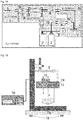
- One exemplary embodiment is depicted in Fig. 1 , panel C.
- the sampling device enables a low residence time and shows minimal carry-over.
- the cultivation vessel may be a simple shaken or stirred flask or a fermenter (bioreactor).
- the cultivation volume may be in the range of 10 mL to 5 L, such as a shake flask (bottle), or in the range of 1-1000 L, such as a laboratory fermenter, or even in the range of 1 to over 100 m 3 , such as industrial production reactors.
- the term cultivation vessel may also refer to reaction vessels (lab, pilot or industrial scale) used in enzymatic, inorganic and organic syntheses.
- sampling device An exemplary set-up of the sampling device is shown in Figure 1 , panels A and B.
- the sampling device is composed of four functional units, namely a sampling unit (I), a pump unit (II), a valve unit (III), and a docking unit (IV).
- the sampling unit (I) comprises sampling means.
- the sampling means may be sampling tubes or sampling lines.
- the sampling means may be made of any suitable material which may further be suitable for sterilization processes, such as for example, metal, stainless steel, polymeric material or glass.
- the sampling mean is made of fluorinated ethylene propylene (FEP) (or of any material displaying similar properties), a copolymer of hexafluoropropylene and tetrafluoroethylene.
- FEP fluorinated ethylene propylene
- Sampling means made of FEP have the advantage of low friction and non-reactivity. Carry-over contamination of one sample to another is problematic if strategies to manage accidental transfer of sample residues are not implemented. Due to the advantageous properties of FEP carry-over of residues of one sample into a subsequent sample is highly reduced. This is accompanied by the advantage of little loss of culture broth due to reduced flushing procedures.
- the sampling tube is made of fluorinated ethylene propylene (FEP) instead of stainless steel which decreases significantly the axial dispersion and in consequence carry-over of sample content.
- FEP fluorinated ethylene propylene
- the sampling mean can be fitted aseptically into the cultivation vessel.
- the pump unit (II) provides for pumping of fluids with a controlled pressure of said fluids.
- One embodiment of the invention relates to a pump unit (II), wherein the pump unit is a vacuum pump (3).
- the pump unit (II) further comprises a waste container (2') and a vacuum container (2).
- the valve unit (III) may comprise 3, 4, 5, 6 or more valves. In one embodiment of the invention the valve unit comprises 5 valves.
- Tubing in the 5-valve module contains two identical, parallel branches to increase the fluid flow (decrease of the residence time) by decreasing flow resistance.
- the 5-valve module is designed to enable withdrawal of fluid from the bioreactor at different predefined volumes covering a range of 0.4 mL - 300 mL (corresponds to the detection range of the used mass sensor).
- the docking unit (IV) comprises the docking port which is equipped with a pressure (6) and a mass sensor (5). This permits recording of the mass of each sample withdrawn. Sample-to-sample variations are recognized and can be therefore considered in subsequent analytics. As an important consequence and in contrast to hitherto known instruments the novel device is not dependent on the type of cultivation or reaction vessel applied and is thus highly versatile in lab-scale cultivation and synthesis experiments.
- the pressure and the mass sensor may be any reasonable device which meets the specifications of reproducibility and resolution.
- the resolution is determined by the ratio between maximum allowable mass error and maximum expected total mass of the filled sampling vessel.
- the docking port comprises fixation means (74) for the sample container (7).
- the fixation means are provided as housing or as holding fixture.
- the fixation means (74) may comprise the mass sensor (5), a sample holder (73) which may comprise a polymer layer (79).
- the fixation means (74) may rest on a plate (75) with elastic vibration dampers or alternative means to quell vibrations (78).
- the docking port further comprises a control unit (76).
- the control unit comprises a power supply, a display, an interface and navigation keys.
- the control unit may be arranged to control the sampling device and to store the time, pressure and the mass.
- Table 1 Characteristics of the developed rapid sampling device Special features Mass of each sample withdrawn is measured at high accuracy Mass and time of sampling is recorded and can be transferred to a standard computer Automated valve-controlled sampling driven by vacuum ca. 10 kPa Sample volume Variable: 0.4 - 300 mL Total volume, instrument 1.62 mL Rate of fluid flow 2.0 mL/s Residence time of sample Dependent on the sample volume: 0.9 - 1.4 s for 4.0 - 0.4 mL Accuracy on mass ⁇ 0.8% System conditioning 1.5 mL of reaction broth Carry-over of sample content ⁇ 5% Sampling frequency ca. 25 sec / sample Mixing time 1.0 ⁇ 0.1 sec for a 1.2 mL sample Sterility Sterile connection possible Formation of aerosols No Formation of ice crystals No Sample container 15 mL or 50 mL Corning /Falcon tubes
- the present sampling device is specifically suited for sampling of a known sample volume (mass) directly into a fluid.
- the fluid may be a quenching fluid.
- Quenching or “quenched” means that processes (these may relate to metabolic activity in cells, (bio)catalyzed inorganic or organic reactions) within the sample (cells) are stopped.
- the quenching solution may comprise solutions or solvents suitable to quench/stop cellular metabolism or chemical reactions.
- the rapid sampling device may especially be suited for metabolomics but also proteomics, microbial fermentation, enzyme / organic / inorganic synthesis.
- the sampling tube can be fitted aseptically to every lab-scale reaction vessel and permits withdrawal of cell broth by maintaining process conditions.
- a polymer seal KLASSE 4 - TURBOSIL was used in the present device but other polymers with similar properties may be applicable) used in the docking unit serves as a hermetic septum for the hypodermic needles and ensures air-tight connection between the vacuum pump the 5-valve module and the sample container (docking unit).
- Carry-over of sample contents between subsequent samples is ⁇ 5% due to (i) flushing both the sampling tube and tubing of the 5-valve module with 1.5 mL of cell broth, (ii) flushing the tubing of the 5-valve module with air and (iii) using a sampling tube made of a highly hydrophobic material (FEP) instead of stainless steel which has been commonly used in the past.
- FEP highly hydrophobic material
- the sampling unit is placed on a heavy stone slab resting on two elastic dampers.
- the 5-valve module is arranged such that valve operation does not interfere with mass measurements
- DAQ data acquisition
- the timing protocol of the 5-valve module can be modified through a graphical PC-software and transferred to the device by USB.
- the sample forms a well-confined narrow jet and mixes immediately with the solution.
- Table 2 A representative timing protocol for sampling and DAQ is shown in Table 2 (valve numbers as used in Fig. 1 , Panel A). Table 2 - Timing protocol for one cycle of the 5-valve module and data acquisition DAQ Step No Action Valve a Valve b Valve c Valve d Valve e Mass Sensor Pressure sensor Time [ms] Remarks 1 Initiation Closed Closed Closed Closed Open Inactive Active Ready for docking 2 Docking Closed Closed Closed Closed Open Inactive Active Attach tube to docking unit and press initiation button 3 Wait Closed Closed Open Closed Open Inactive Inactive 3000 Time required until vacuum is ready and docking vibrations have decayed below threshold to avoid bias of the readout 4 DAQ 1 Closed Closed Open Closed Open Active Inactive 1500 Mass measurement of attached empty sample container Start of sampling 5 Rinsing Open Closed Open Closed Open Inactive Inactive 750 Rinsing the sampling tube and tubing of the 5-valve module with fluid from the bio (reaction) reactor 6 Wait Closed Closed Open Closed Open In
- the instrument is suitable for all applications in which either knowledge of the exact volume of the transferred sample is required and/or the reaction vessel is not allowed to be opened.
- the instrument may find application in proteome analysis as well as for enzyme/organic/ inorganic synthesis.
- the instrument could be as well used to withdraw fermentation samples for routine analytics (cell density, product analysis). Using this instrument would lead to a reduction of total sample volume by 90%. Typically 10-15 mL of fermentation broth are lost during sampling due to conditioning of sample tubes/pipes. With the developed device only 1.5 mL are removed in addition to the sample Examples
- Sample-to-sample variation of the transferred sample volumes was below 0.8% for all addressed sampling times except for 150 ms (Panel C).
- Samples withdrawn with 150 ms showed a variation of 1.6 %.
- the device showed a linear relationship between measured sample mass and sampling time for sampling times between 200 and 1000 ms (Panel D).
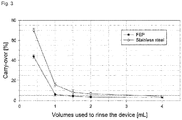
- Carry-over of sample content was determined between the last and first sample of each sampling series as a function of the duration of rinsing (step 5 in Table 2) which was varied between 200 ms and 2000 ms (1000 ms correspond to 2 mL).
- the experiment was made for two different materials of the sampling tube, i.e. stainless steel and FEP.
- the length of both tubes was 275 mm and the inner diameters were 1.8 mm and 1.58 mm for the stainless steel and the FEP tube, respectively.
- Results shown in Fig. 3 revealed that both rinsing volumes (carry-over decreased with increasing volumes) as well as the type of material (lower carry-over when FEP was used instead of stainless steel) used as sampling tube significantly affected the carry-over.
- a carry-over ⁇ 5 % could be obtained by applying 1.5 mL for rinsing the tubing and a sampling tube made of FEP.
- the device sampled water reproducibly with a precision of 1188.5 ⁇ 9.5 mg (0.8% relative error) which is close to or even better than the uncertainties reported for commercial high precision single channel volume adjustable pipettes (e.g. from Eppendorf: model 100 - 1000 ⁇ L: 1000 ⁇ 6 ⁇ L; model 1-10 mL: 1000 ⁇ 30 ⁇ L; 3%, Ref. Eppendorf SOP).
- the device is designed for volumes in the range of 0.5 - 300 ml the device's reproducibility should be compared with that of the 1-10 ml pipette.
- Saccharomyces cerevisiae 7D cells were cultivated at 30°C in a stirred 2 L bioreactor (Labfors 2, Infors, Bottmingen, Switzerland) containing mineral medium.
- the pH value was held at a constant level of 5.2 by PID controlled addition of acid or base.
- Two conditions for agitation and air sparging were chosen, 300 rpm / 2 L/min and 1000 rpm / 3 L/min.
- Aeration parameters were chosen to simulate medium and high oxygen demand conditions typically applied to microbial cultivations.
- Cell broth was withdrawn over time and, to simulate metabolomics sample, transferred into 10 mL of a cold methanol solution ( ⁇ 70°C, stored on dry ice). Recorded masses by the rapid sampling device were compared to masses obtained from an analytical scale. Results are shown in Fig. 5 (Panels A-C).
- Masses sampled by the rapid sampling device in the first phase of fermentation differed from those measured by an analytical scale by -2.8 ⁇ 7.6 mg.
- the deviation was slightly higher in the second phase, namely -0.1 ⁇ 10.8 mg (Panel B).
- This difference was predominantly due to one sample at time point 177 min showing a larger residual by +3 standard deviations and a relative error larger than 3 standard deviations (see Figure 5 Panels B and C).
- This large deviation from the rest of the data was a consequence of the lower sample volume withdrawn from the fermenter which lies outside of the calibration range of the instrument. It is an extremely important feature of this device that such errors can be immediately and easily recognized and taken into account in further analysis.
- the sample volume may fluctuate from sample to sample due to (i) changes in process conditions (pressure, working volume) and (ii) co-sampling of gas as it was the case in this example. If a constant sample volume would have been assumed as it is commonly done for current sampling devices relative errors of 1.6 - -2.6 % (phase 1) and even larger errors of 8.8 - -52% (phase 2) would have been passed unnoticed under typical aeration conditions.
Landscapes
- Chemical & Material Sciences (AREA)
- Engineering & Computer Science (AREA)
- Health & Medical Sciences (AREA)
- Life Sciences & Earth Sciences (AREA)
- Organic Chemistry (AREA)
- Zoology (AREA)
- Bioinformatics & Cheminformatics (AREA)
- Wood Science & Technology (AREA)
- Sustainable Development (AREA)
- Microbiology (AREA)
- Biotechnology (AREA)
- Biomedical Technology (AREA)
- Biochemistry (AREA)
- General Engineering & Computer Science (AREA)
- General Health & Medical Sciences (AREA)
- Genetics & Genomics (AREA)
- Analytical Chemistry (AREA)
- Computer Hardware Design (AREA)
- Molecular Biology (AREA)
- Apparatus Associated With Microorganisms And Enzymes (AREA)
Priority Applications (1)
| Application Number | Priority Date | Filing Date | Title |
|---|---|---|---|
| EP18168285.7A EP3556843A1 (de) | 2018-04-19 | 2018-04-19 | Hochpräzise probenentnahmevorrichtung |
Applications Claiming Priority (1)
| Application Number | Priority Date | Filing Date | Title |
|---|---|---|---|
| EP18168285.7A EP3556843A1 (de) | 2018-04-19 | 2018-04-19 | Hochpräzise probenentnahmevorrichtung |
Publications (1)
| Publication Number | Publication Date |
|---|---|
| EP3556843A1 true EP3556843A1 (de) | 2019-10-23 |
Family
ID=62027886
Family Applications (1)
| Application Number | Title | Priority Date | Filing Date |
|---|---|---|---|
| EP18168285.7A Withdrawn EP3556843A1 (de) | 2018-04-19 | 2018-04-19 | Hochpräzise probenentnahmevorrichtung |
Country Status (1)
| Country | Link |
|---|---|
| EP (1) | EP3556843A1 (de) |
Cited By (3)
| Publication number | Priority date | Publication date | Assignee | Title |
|---|---|---|---|---|
| CN115791230A (zh) * | 2022-11-11 | 2023-03-14 | 华能(广东)能源开发有限公司汕头电厂 | 一种自流式凝汽器检测装置 |
| GB2616451A (en) * | 2022-03-09 | 2023-09-13 | Oribiotech Ltd | A cell processing system for housing a bioreactor |
| CN117313428A (zh) * | 2023-11-28 | 2023-12-29 | 西安中核核仪器股份有限公司 | 一种火电厂污染物浓度在线监测修正方法 |
Citations (3)
| Publication number | Priority date | Publication date | Assignee | Title |
|---|---|---|---|---|
| EP1508791A1 (de) | 2003-08-22 | 2005-02-23 | Ismatec SA, Laboratoriumstechnik | Vorrichtung zur automatischen Probenentnahme aus einem Bioreaktor |
| US20110059476A1 (en) * | 2009-09-04 | 2011-03-10 | Hye-Won Shin | Bioreactor for quantification of headspace voc content from cultures |
| WO2012026978A2 (en) * | 2010-08-25 | 2012-03-01 | Jerry Shevitz | Fluid filtration systems |
-
2018
- 2018-04-19 EP EP18168285.7A patent/EP3556843A1/de not_active Withdrawn
Patent Citations (3)
| Publication number | Priority date | Publication date | Assignee | Title |
|---|---|---|---|---|
| EP1508791A1 (de) | 2003-08-22 | 2005-02-23 | Ismatec SA, Laboratoriumstechnik | Vorrichtung zur automatischen Probenentnahme aus einem Bioreaktor |
| US20110059476A1 (en) * | 2009-09-04 | 2011-03-10 | Hye-Won Shin | Bioreactor for quantification of headspace voc content from cultures |
| WO2012026978A2 (en) * | 2010-08-25 | 2012-03-01 | Jerry Shevitz | Fluid filtration systems |
Cited By (6)
| Publication number | Priority date | Publication date | Assignee | Title |
|---|---|---|---|---|
| GB2616451A (en) * | 2022-03-09 | 2023-09-13 | Oribiotech Ltd | A cell processing system for housing a bioreactor |
| WO2023170387A1 (en) * | 2022-03-09 | 2023-09-14 | Oribiotech Ltd | A cell processing system for housing a bioreactor |
| GB2616451B (en) * | 2022-03-09 | 2024-11-27 | Oribiotech Ltd | A cell processing system for housing a bioreactor |
| CN115791230A (zh) * | 2022-11-11 | 2023-03-14 | 华能(广东)能源开发有限公司汕头电厂 | 一种自流式凝汽器检测装置 |
| CN117313428A (zh) * | 2023-11-28 | 2023-12-29 | 西安中核核仪器股份有限公司 | 一种火电厂污染物浓度在线监测修正方法 |
| CN117313428B (zh) * | 2023-11-28 | 2024-02-23 | 西安中核核仪器股份有限公司 | 一种火电厂污染物浓度在线监测修正方法 |
Similar Documents
| Publication | Publication Date | Title |
|---|---|---|
| EP0124193B1 (de) | Verfahren und Vorrichtung zum Nachweis von Bakterien | |
| Zanzotto et al. | Membrane‐aerated microbioreactor for high‐throughput bioprocessing | |
| Pattison et al. | Measurement and control of dissolved carbon dioxide in mammalian cell culture processes using an in situ fiber optic chemical sensor | |
| Martin et al. | A method for the regulation of microbial population density during continuous culture at high growth rates | |
| EP3556843A1 (de) | Hochpräzise probenentnahmevorrichtung | |
| US20060001865A1 (en) | Robotized platform for cell cultures in miniature reactor batteries, equipped with a system for real time measurement of cellular turbidity or other optical properties | |
| EP1508791A1 (de) | Vorrichtung zur automatischen Probenentnahme aus einem Bioreaktor | |
| JP6893208B2 (ja) | Ph測定装置の較正ずれの特定 | |
| US20080299539A1 (en) | Parallel integrated bioreactor device and method | |
| EP3368652B1 (de) | Überwachung der zustandsabweichungen in bioreaktoren | |
| Janzen et al. | Implementation of a fully automated microbial cultivation platform for strain and process screening | |
| Lladó Maldonado et al. | A fully online sensor‐equipped, disposable multiphase microbioreactor as a screening platform for biotechnological applications | |
| JP2003500042A (ja) | 細胞培養の分析を実施する装置 | |
| Schäpper et al. | Development of a single-use microbioreactor for cultivation of microorganisms | |
| Schlüter et al. | Gas/liquid mass transfer in stirred vessels | |
| US5604297A (en) | Degassing techniques applied to sealed containers for beverages, waste water and respirometers for bacteria | |
| US10669520B2 (en) | Automated bioreactor sampling and glucose monitoring system | |
| US20100139374A1 (en) | Methods for rheological testing of multiple samples and systems therefor | |
| Bastidas-Oyanedel et al. | Development of membrane inlet mass spectrometry for examination of fermentation processes | |
| Ihling et al. | Scale‐down of CHO cell cultivation from shake flasks based on oxygen mass transfer allows application of parallelized, non‐invasive, and time‐resolved monitoring of the oxygen transfer rate in 48‐well microtiter plates | |
| US20210040429A1 (en) | Holders for bioreactor sensors, bioreactors having such holders, and methods culturing biological material | |
| KR20160035186A (ko) | 액상 시료 내 메탄 가스의 농도 또는 물질전달계수 측정을 위한 반응기 및 이를 이용한 액상 시료 내 메탄 가스의 농도 또는 물질전달계수 측정 방법 | |
| GB2102947A (en) | Process and apparatus for indicating the presence of contaminating microorganisms | |
| DE102007063440B4 (de) | Screeningsystem zur Durchführung und direkten Analyse von biologischen, biochemischen und chemischen Synthese- und Umsetzungsreaktionen | |
| CN220018800U (zh) | 一种压力及发酵过程监测的实验室用装置 |
Legal Events
| Date | Code | Title | Description |
|---|---|---|---|
| PUAI | Public reference made under article 153(3) epc to a published international application that has entered the european phase |
Free format text: ORIGINAL CODE: 0009012 |
|
| STAA | Information on the status of an ep patent application or granted ep patent |
Free format text: STATUS: THE APPLICATION HAS BEEN PUBLISHED |
|
| AK | Designated contracting states |
Kind code of ref document: A1 Designated state(s): AL AT BE BG CH CY CZ DE DK EE ES FI FR GB GR HR HU IE IS IT LI LT LU LV MC MK MT NL NO PL PT RO RS SE SI SK SM TR |
|
| AX | Request for extension of the european patent |
Extension state: BA ME |
|
| STAA | Information on the status of an ep patent application or granted ep patent |
Free format text: STATUS: REQUEST FOR EXAMINATION WAS MADE |
|
| 17P | Request for examination filed |
Effective date: 20200423 |
|
| RBV | Designated contracting states (corrected) |
Designated state(s): AL AT BE BG CH CY CZ DE DK EE ES FI FR GB GR HR HU IE IS IT LI LT LU LV MC MK MT NL NO PL PT RO RS SE SI SK SM TR |
|
| STAA | Information on the status of an ep patent application or granted ep patent |
Free format text: STATUS: THE APPLICATION HAS BEEN WITHDRAWN |
|
| 18W | Application withdrawn |
Effective date: 20240214 |