EP3554467B1 - Symmetrische azomethindirektfarbstoffe, verfahren zu deren herstellung, kosmetische zusammensetzung mit zumindest einem solchen farbstoff und verwendung davon - Google Patents
Symmetrische azomethindirektfarbstoffe, verfahren zu deren herstellung, kosmetische zusammensetzung mit zumindest einem solchen farbstoff und verwendung davon Download PDFInfo
- Publication number
- EP3554467B1 EP3554467B1 EP17835629.1A EP17835629A EP3554467B1 EP 3554467 B1 EP3554467 B1 EP 3554467B1 EP 17835629 A EP17835629 A EP 17835629A EP 3554467 B1 EP3554467 B1 EP 3554467B1
- Authority
- EP
- European Patent Office
- Prior art keywords
- alkyl
- aromatic
- chosen
- amino
- optionally substituted
- Prior art date
- Legal status (The legal status is an assumption and is not a legal conclusion. Google has not performed a legal analysis and makes no representation as to the accuracy of the status listed.)
- Active
Links
- 0 C*[C@@]1[C@](C2)[C@@]2CCC1 Chemical compound C*[C@@]1[C@](C2)[C@@]2CCC1 0.000 description 5
- YGRCMRMUWCSNAN-UHFFFAOYSA-N Cc(cc1)cc(C)c1Nc(cc(c(N)c1)Nc2c(C)cc(C)cc2)c1N Chemical compound Cc(cc1)cc(C)c1Nc(cc(c(N)c1)Nc2c(C)cc(C)cc2)c1N YGRCMRMUWCSNAN-UHFFFAOYSA-N 0.000 description 1
- WRKBSDSAVCQAIR-UIWQZHHTSA-N NC(/C(/C=C1Nc2ccccc2)=N\c2ccccc2)=CC1=N Chemical compound NC(/C(/C=C1Nc2ccccc2)=N\c2ccccc2)=CC1=N WRKBSDSAVCQAIR-UIWQZHHTSA-N 0.000 description 1
Classifications
-
- A—HUMAN NECESSITIES
- A61—MEDICAL OR VETERINARY SCIENCE; HYGIENE
- A61K—PREPARATIONS FOR MEDICAL, DENTAL OR TOILETRY PURPOSES
- A61K8/00—Cosmetics or similar toiletry preparations
- A61K8/18—Cosmetics or similar toiletry preparations characterised by the composition
- A61K8/30—Cosmetics or similar toiletry preparations characterised by the composition containing organic compounds
- A61K8/40—Cosmetics or similar toiletry preparations characterised by the composition containing organic compounds containing nitrogen
- A61K8/41—Amines
- A61K8/411—Aromatic amines, i.e. where the amino group is directly linked to the aromatic nucleus
-
- A—HUMAN NECESSITIES
- A61—MEDICAL OR VETERINARY SCIENCE; HYGIENE
- A61K—PREPARATIONS FOR MEDICAL, DENTAL OR TOILETRY PURPOSES
- A61K8/00—Cosmetics or similar toiletry preparations
- A61K8/18—Cosmetics or similar toiletry preparations characterised by the composition
- A61K8/30—Cosmetics or similar toiletry preparations characterised by the composition containing organic compounds
- A61K8/49—Cosmetics or similar toiletry preparations characterised by the composition containing organic compounds containing heterocyclic compounds
- A61K8/494—Cosmetics or similar toiletry preparations characterised by the composition containing organic compounds containing heterocyclic compounds with more than one nitrogen as the only hetero atom
- A61K8/4946—Imidazoles or their condensed derivatives, e.g. benzimidazoles
-
- A—HUMAN NECESSITIES
- A61—MEDICAL OR VETERINARY SCIENCE; HYGIENE
- A61K—PREPARATIONS FOR MEDICAL, DENTAL OR TOILETRY PURPOSES
- A61K8/00—Cosmetics or similar toiletry preparations
- A61K8/18—Cosmetics or similar toiletry preparations characterised by the composition
- A61K8/30—Cosmetics or similar toiletry preparations characterised by the composition containing organic compounds
- A61K8/40—Cosmetics or similar toiletry preparations characterised by the composition containing organic compounds containing nitrogen
- A61K8/41—Amines
- A61K8/413—Indoanilines; Indophenol; Indoamines
-
- A—HUMAN NECESSITIES
- A61—MEDICAL OR VETERINARY SCIENCE; HYGIENE
- A61K—PREPARATIONS FOR MEDICAL, DENTAL OR TOILETRY PURPOSES
- A61K8/00—Cosmetics or similar toiletry preparations
- A61K8/18—Cosmetics or similar toiletry preparations characterised by the composition
- A61K8/30—Cosmetics or similar toiletry preparations characterised by the composition containing organic compounds
- A61K8/40—Cosmetics or similar toiletry preparations characterised by the composition containing organic compounds containing nitrogen
- A61K8/41—Amines
- A61K8/415—Aminophenols
-
- A—HUMAN NECESSITIES
- A61—MEDICAL OR VETERINARY SCIENCE; HYGIENE
- A61K—PREPARATIONS FOR MEDICAL, DENTAL OR TOILETRY PURPOSES
- A61K8/00—Cosmetics or similar toiletry preparations
- A61K8/18—Cosmetics or similar toiletry preparations characterised by the composition
- A61K8/30—Cosmetics or similar toiletry preparations characterised by the composition containing organic compounds
- A61K8/46—Cosmetics or similar toiletry preparations characterised by the composition containing organic compounds containing sulfur
- A61K8/466—Cosmetics or similar toiletry preparations characterised by the composition containing organic compounds containing sulfur containing sulfonic acid derivatives; Salts
-
- A—HUMAN NECESSITIES
- A61—MEDICAL OR VETERINARY SCIENCE; HYGIENE
- A61Q—SPECIFIC USE OF COSMETICS OR SIMILAR TOILETRY PREPARATIONS
- A61Q5/00—Preparations for care of the hair
- A61Q5/06—Preparations for styling the hair, e.g. by temporary shaping or colouring
- A61Q5/065—Preparations for temporary colouring the hair, e.g. direct dyes
-
- C—CHEMISTRY; METALLURGY
- C09—DYES; PAINTS; POLISHES; NATURAL RESINS; ADHESIVES; COMPOSITIONS NOT OTHERWISE PROVIDED FOR; APPLICATIONS OF MATERIALS NOT OTHERWISE PROVIDED FOR
- C09B—ORGANIC DYES OR CLOSELY-RELATED COMPOUNDS FOR PRODUCING DYES, e.g. PIGMENTS; MORDANTS; LAKES
- C09B55/00—Azomethine dyes
- C09B55/002—Monoazomethine dyes
-
- C—CHEMISTRY; METALLURGY
- C09—DYES; PAINTS; POLISHES; NATURAL RESINS; ADHESIVES; COMPOSITIONS NOT OTHERWISE PROVIDED FOR; APPLICATIONS OF MATERIALS NOT OTHERWISE PROVIDED FOR
- C09B—ORGANIC DYES OR CLOSELY-RELATED COMPOUNDS FOR PRODUCING DYES, e.g. PIGMENTS; MORDANTS; LAKES
- C09B55/00—Azomethine dyes
- C09B55/009—Azomethine dyes, the C-atom of the group -C=N- being part of a ring (Image)
-
- A—HUMAN NECESSITIES
- A61—MEDICAL OR VETERINARY SCIENCE; HYGIENE
- A61K—PREPARATIONS FOR MEDICAL, DENTAL OR TOILETRY PURPOSES
- A61K2800/00—Properties of cosmetic compositions or active ingredients thereof or formulation aids used therein and process related aspects
- A61K2800/40—Chemical, physico-chemical or functional or structural properties of particular ingredients
- A61K2800/42—Colour properties
- A61K2800/43—Pigments; Dyes
- A61K2800/432—Direct dyes
- A61K2800/4322—Direct dyes in preparations for temporarily coloring the hair further containing an oxidizing agent
-
- A—HUMAN NECESSITIES
- A61—MEDICAL OR VETERINARY SCIENCE; HYGIENE
- A61K—PREPARATIONS FOR MEDICAL, DENTAL OR TOILETRY PURPOSES
- A61K2800/00—Properties of cosmetic compositions or active ingredients thereof or formulation aids used therein and process related aspects
- A61K2800/80—Process related aspects concerning the preparation of the cosmetic composition or the storage or application thereof
- A61K2800/88—Two- or multipart kits
Definitions
- the present invention relates to a process for dyeing keratin fibres, in particular human keratin fibres such as the hair, in one or more steps, comprising the application to said keratin fibres of a composition comprising one or more compounds of formula (I) and/or the leuco forms thereof of formula (II) , and also to the use of one or more compounds of formula (I) and/or (II) for dyeing keratin fibres, and to a device therefor.
- the process conventionally used in direct dyeing consists in applying to keratin fibres one or more direct dyes, or colouring molecules, which have affinity for said fibres, leaving them to stand on the fibres, and then rinsing the fibres.
- the direct dyes used hitherto are generally nitrobenzene dyes, anthraquinone dyes, nitropyridine dyes, dyes of azo, xanthene, acridine or azine type or triarylmethane-based dyes.
- the colourings that result therefrom are temporary or semi-permanent, since the nature of the interactions that bind the direct dyes to the keratin fibre and their desorption from the surface and/or the core of the fibre are responsible for their weak dyeing power and their poor fastness with respect to washing, inclement weather or perspiration.
- These dyes may also have the drawback of lacking in stability towards light, on account of the poor resistance of the chromophore to photochemical attack, which has a tendency to lead to fading over time of the colouring of the keratin fibres and/or to change in the colour.
- FR 2968947 A1 , FR 2983856 A1 and FR 2983855 A1 disclose azomethine dyes and their use for dyeing hair.
- a particular aim of the present invention is also to be able to dye light keratin fibres efficiently chestnut-brown, dark chestnut-brown, brown or brown with a glint or even black, with a single type of dye of formula (I) or (II) as defined below.
- Another subject of the present invention relates to the use of one or more azomethine direct dyes of formula (I) , as defined previously, and/or of the leuco forms thereof (II) as defined previously, optionally in the presence of one or more chemical oxidizing agents, for dyeing keratin fibres, in particular human keratin fibres such as the hair.
- the present invention also relates to a cosmetic composition for dyeing keratin fibres, in particular human keratin fibres such as the hair, comprising one or more azomethine direct dyes of formula (I) and/or of the leuco forms thereof (II) as defined previously it being understood that the dye(s) of formula (I) are other than compounds i to viii as defined in claim 13.
- the invention also relates to the use of said cosmetic composition for dyeing keratin fibres, especially human keratin fibres such as the hair.
- the process according to the invention can thus give colourings that are resistant to the various attacking factors to which keratin fibres may be subjected, such as inclement weather, light, washing and perspiration.
- the process according to the invention can satisfactorily dye keratin fibres, especially producing powerful, chromatic and sparingly selective colourings, and/or colourings with good colour build-up.
- novel azomethine direct dyes of formula (I) or the direct dyeing precursors (II) have the feature of being symmetric and have the advantage of producing powerful and sparingly chromatic colours. Furthermore, it is possible to obtain natural colours, especially intense brown, dark brown, black or even green colours, on white keratin fibres using a single azomethine direct dye of formula (I) or a single direct dyeing precursor (II) , without necessarily having to use a mixture of several direct dyes, or a mixture of several direct dyeing precursors, of complementary colours (trichromatic principle: see, for example, WO 95/15144 and WO 95/01772 ).
- the mixture of direct dyes has the drawback of not being stable with respect to light or washing, as a result of which unaesthetic changing of the colour is very often observed.
- the dyes of the invention show good stability with respect to external agents such as light and washing once applied to the hair, and also good stability in an oxidizing medium.
- the invention also relates to the use of one or more compounds of leuco type of formula (II) as precursors of the direct dyes of formula (I).
- the invention relates to the use of one or more compounds of leuco type of formula (II) optionally in the presence of one or more chemical oxidizing agents, for dyeing keratin fibres, especially human keratin fibres such as the hair.
- the compounds of leuco type of formula (II) used under oxidizing conditions thus have the advantage of giving colourings that are resistant to the various attacking factors to which keratin fibres may be subjected, such as inclement weather, washing, light or perspiration.
- the invention also relates to a single-compartment or multi-compartment device comprising a first compartment containing one or more compounds of formula (I) and/or (II) , and optionally a second compartment comprising one or more chemical oxidizing agents.
- the present invention also relates to a process for dyeing keratin fibres, in particular human keratin fibres such as the hair, in several steps, which comprises, in a first step, the application to said keratin fibres a) of a composition comprising one or more compounds of formula (I) and/or (II) , particularly one or more compounds of formula (II) , and then, in a second step, b) of an oxidizing composition, which comprises one or more chemical oxidizing agents, in particular chosen from hydrogen peroxide, urea peroxide, alkali metal bromates, persalts such as perborates and persulfates, peracids and oxidase enzymes (with the optional cofactors thereof), among which mention may be made of peroxidases, 2-electron oxidoreductases such as uricases, and 4-electron oxygenases such as laccases; preferably, the chemical oxidizing agent is hydrogen peroxide; it being understood that, between step
- said cosmetic composition is applied for a leave-on time of between 1 and 60 minutes, preferably between 5 and 40 minutes and even more preferentially between 10 and 30 minutes.
- the cosmetic composition is generally applied to the keratin fibres at room temperature, preferably between 25 and 55°C.
- the cosmetic composition according to the invention is applied to keratin fibres, especially human keratin fibres such as the hair, in the presence of one or more chemical oxidizing agents as described above, for a time that is sufficient to obtain the desired lightening.
- the present invention also relates to a process for dyeing keratin fibres, in particular human keratin fibres such as the hair, in one or more steps, comprising the application to said keratin fibres of a composition which comprises the compound(s) of formula (I) and/or (II), particularly the compound(s) of formula (II) , and optionally one or more chemical oxidizing agents, as defined previously, it being understood that after application of said composition which comprises the compound(s) of formula (I) and/or (II), said fibres may be rinsed, and/or washed and then optionally dried.
- the dyeing process according to the invention uses one or more chemical oxidizing agents, as described above, separately from the cosmetic composition comprising one or more compounds of formula (I) and/or (II) in another cosmetic composition.
- the two cosmetic compositions may be mixed just before use or may be used separately.
- the dyeing process according to the invention consists in applying to keratin fibres, especially human keratin fibres such as the hair, a ready-to-use cosmetic composition which results from the mixing of a cosmetic composition comprising one or more compounds of abovementioned formula (I) and/or (II) and an oxidizing cosmetic composition comprising one or more chemical oxidizing agents, as described previously.
- a cosmetic composition comprising one or more compounds of abovementioned formula (I) and/or (II) and an oxidizing cosmetic composition comprising one or more chemical oxidizing agents, as described previously.
- the ready-to-use cosmetic composition that is thus applied to the keratin fibres may be in various forms, such as in the form of liquids, creams or gels, or in any other form that is suitable for dyeing keratin fibres, and in particular human hair.
- the dyeing process according to the invention consists in applying to the keratin fibres, in particular human keratin fibres such as the hair, (i) the cosmetic composition comprising, in a suitable dyeing medium, one or more compounds of formula (I) and/or (II) as defined previously, free of chemical oxidizing agent, and (ii) a cosmetic composition comprising one or more chemical oxidizing agents as defined previously; compositions (i) and (ii) being applied to said keratin fibres sequentially or simultaneously for a time that is sufficient to obtain the desired lightening, and the fibres are then rinsed, optionally washed with shampoo, rinsed again, and the resulting fibres are dried or left to dry.
- the cosmetic composition comprising, in a suitable dyeing medium, one or more compounds of formula (I) and/or (II) as defined previously, free of chemical oxidizing agent, and (ii) a cosmetic composition comprising one or more chemical oxidizing agents as defined previously; compositions (i) and (ii) being
- the oxidizing composition may also contain various adjuvants conventionally used in cosmetic compositions, in particular compositions for dyeing the hair and as defined previously.
- the term " sequentially" means that the oxidizing composition is applied before or after the cosmetic composition, i.e. as a pre-treatment or a post-treatment, preferably as a pre-treatment.
- the pH of the oxidizing composition containing the chemical oxidizing agent is such that, after mixing with the cosmetic composition, the pH of the resulting composition applied to the keratin fibres preferably ranges between 2 and 12 approximately, even more preferentially between 3 and 10 and even more particularly between 4 and 9.5. It may be adjusted to the desired value by means of acidifying or basifying agents usually used in the dyeing of keratin fibres.
- acidifying agents that may be mentioned, by way of example, are mineral or organic acids, for instance hydrochloric acid, orthophosphoric acid or sulfuric acid, carboxylic acids, for instance acetic acid, tartaric acid, citric acid and lactic acid, and sulfonic acids.
- basifying agents examples that may be mentioned include aqueous ammonia, alkaline carbonates, alkanolamines such as monoethanolamine, diethanolamine and triethanolamine, and also derivatives thereof, sodium hydroxide, potassium hydroxide and the compounds of formula (III) below:
- R a , R b , R c and R d which may be identical or different, represent a hydrogen atom or a C 1 -C 4 alkyl or C 1 -C 4 hydroxyalkyl radical.
- the azomethine direct dyes of formula (I) and the precursors of direct dyes of formula (II) used according to the process of the invention are such that, taken together or separately:
- the azomethine direct dye(s) of formula (I) and the precursors of direct dyes of formula (II) used according to the process of the invention are such that R 1 represents:
- the azomethine direct dye(s) of formula (I) and the precursors of direct dyes of formula (II) used according to the process of the invention are such that R 1 represents a group -W-R 7 , in which W represents an oxygen atom or a divalent group -N(R 8 )-, with R 7 and R 8 , which may be identical or different, represent:
- the azomethine direct dyes of formula (I) and the precursors of direct dyes of formula (II) used according to the process of the invention are such that n represents an integer equal to 1, and R 1 is in position 4.
- the ammonium radicals -N + RR'R" described above are chosen from trimethylammonium, triethylammonium, dimethylethylammonium, diethylmethylammonium, diisopropylmethylammonium, diethylpropylammonium, 2-hydroxyethyldiethylammonium, ⁇ -dihydroxyethylmethylammonium, ⁇ - trihydroxyethylammonium, dimethylhydroxyethylammonium, 2-hydroxyethyldimethylammonium and 2-hydroxyethylmethylethylammonium; preferentially, the ammonium radicals -N + RR'R" are chosen from trimethylammonium and 2-hydroxyethylmethylethylammonium.
- the cationic heterocycles are 5-to 10-membered and aromatic; preferably chosen from imidazoliums, pyridiniums, pyrimidiniums, benzimidazoliums, benzothiazoliums, oxazoliums, benzotriazoliums, pyrazoliums, thiazoliums, triazoliums and benzoxazoliums; optionally substituted with one or more radicals, which may be identical or different, chosen from (hydroxy)(C 1 -C 4 )alkyl radicals.
- the cationic heterocycles are 5-to 10-membered and non-aromatic; preferably chosen from piperaziniums, pyrrolidiniums, morpholiniums, thiazoliums and piperidiniums; each of said non-aromatic 5- to 10-membered cationic heterocycles possibly being substituted with one or more radicals, which may be identical or different, chosen from (hydroxy)(C 1 -C 4 )alkyl radicals.
- the cationic heterocycles are imidazoliums, which are optionally substituted, especially with one or more identical or different radicals chosen from (hydroxy)(C 1 -C 4 )alkyl radicals, such as a methyl.
- the cationic heterocycles are chosen from imidazoliums, piperaziniums, pyrrolidiniums, morpholiniums and piperidiniums; optionally substituted with one or more radicals, which may be identical or different, chosen from (hydroxy)(C1-C4)alkyl radicals.
- the non-cationic heterocycles are 5- or 6-membered; preferably chosen from piperidines, piperazines, pyrrolidines, morpholines, thiazoles, imidazoles and pyridines, more preferentially chosen from piperidines, piperazines, pyrrolidines, morpholines and imidazoles, the 5- or 6-membered non-cationic heterocycles possibly being substituted especially with:
- the non-cationic heterocycles are 5- or 6-membered and non-aromatic, preferably chosen from piperazines, pyrrolidines, morpholines and piperazines, and more preferentially pyrrolidines; said 5- or 6-membered non-cationic heterocycles possibly being substituted especially with:
- the non-cationic heterocycles are 5-or 6-membered and aromatic, preferably chosen from imidazoles, pyridines, pyrimidines, benzimidazoles, benzothiazoles, oxazoles, benzotriazoles, pyrazoles, thiazoles, triazoles and benzoxazoles; said 5- or 6-membered non-cationic heterocycles possibly being substituted especially with:
- the non-cationic heterocycles contain at least one heteroatom chosen from O and N, and are substituted with one or more identical or different C 1 -C 4 tri(hydroxy)alkylammonium radicals chosen from trimethylammonium, triethylammonium, dimethylethylammonium, diethylmethylammonium, diisopropylmethylammonium, diethylpropylammonium, 2-hydroxyethyldiethylammonium, ⁇ -dihydroxyethylmethylethylammonium, ⁇ -trihydroxyethylammonium, dimethylhydroxyethylammonium, 2-hydroxyethyldimethylammonium and 2-hydroxyethylmethylethylammonium; preferentially, the non-cationic heterocycles contain at least one heteroatom chosen from O and N, and are substituted with one or more identical or different C 1 -C 4 tri(hydroxy)alkylammonium radicals
- the non-cationic heterocycles are pyrrolidines substituted especially with:
- R 1 represents a group chosen from:
- the process according to the invention is characterized in that the azomethine direct dyes of formula (I) and (II) are chosen from the following compounds and the geometrical or optical isomer forms thereof, the tautomers thereof, the organic or mineral acid or base salts thereof or the solvates thereof such as hydrates: 2-[ ⁇ 4-[2-Amino-5- ⁇ 4-[bis(2-hydroxyethyl)amino] phenyla mino ⁇ -4-iminocyclohexa-2,5-dienylideneamino]phenyl ⁇ (2-hydroxyethyl)amino]ethanol N-1-(4-Aminophenyl)-3-[(Z)-4-aminophenylimino]-6-iminocyclohexa-1,4-diene-1,4-diamine 4-( ⁇ 2-Amino-5-[(4-hydroxyphenyl)amino]-4-iminocyclohexa-2,5-dien-1-ylidene
- the direct dyes of formula (I) according to the process of the invention are of structure (1) , (2) , (3) , (4) , (5) , (6) or (7) and also the geometrical or optical isomer forms thereof, the tautomers thereof, the organic or mineral acid or base salts thereof or the solvates thereof such as hydrates.
- the direct dyes of formula (II) according to the process of the invention are of structure (1') , (2') , (3') , (4') , (5') , (6') or (7') and also the geometrical or optical isomer forms thereof, the tautomers thereof, the organic or mineral acid or base salts thereof or the solvates thereof such as hydrates.
- the compounds of formula (I) and (II) may optionally be salified with mineral acids, for instance HCI, HBr, H 2 SO 4 or H 3 PO 4 , or organic acids, for instance acetic acid, lactic acid, tartaric acid, citric acid, succinic acid, benzenesulfonic acid, para-toluenesulfonic acid, formic acid or methanesulfonic acid.
- mineral acids for instance HCI, HBr, H 2 SO 4 or H 3 PO 4
- organic acids for instance acetic acid, lactic acid, tartaric acid, citric acid, succinic acid, benzenesulfonic acid, para-toluenesulfonic acid, formic acid or methanesulfonic acid.
- the compounds of formula (I) and (II) may also be in the form of solvates, for example a hydrate or a solvate of a linear or branched alcohol, for instance ethanol or isopropanol.
- the present invention also relates to the novel compounds of formula (I), and of leuco type of formula (II) below, the organic or mineral, acid or base salts thereof, the tautomeric forms, optical isomers and geometrical isomers thereof, and/or the solvates thereof: it being understood that the compound(s) of formula (I) are other than the compound: described previously in Empson, J. et al., Justus Liebigs Annalen der Chemie (1912), 389, pages 345-367 , corresponding to compound i as defined in claim 13. The compounds are also other than compounds ii to viii as defined in claim 13.
- R 1 , R 3 , R 4 , R 5 , R 6 , R 8 , R 9 , R 10 and n have the same meanings and have the same preferences as those indicated previously in formula (I) or (II) of the compounds used in the process according to the invention, and it being understood that:
- At least one of the substituents R 1 , R 3 , R 4 , R 5 or R 6 , of the compounds of formula (I) and/or (II), does not represent a hydrogen atom.
- the compounds of formulae (I) and (II) may be optionally salified with mineral acids, for instance HCI, HBr, H 2 SO 4 or H 3 PO 4 , or organic acids, for instance acetic acid, lactic acid, tartaric acid, citric acid, succinic acid, benzenesulfonic acid, para-toluenesulfonic acid, formic acid or methanesulfonic acid.
- mineral acids for instance HCI, HBr, H 2 SO 4 or H 3 PO 4
- organic acids for instance acetic acid, lactic acid, tartaric acid, citric acid, succinic acid, benzenesulfonic acid, para-toluenesulfonic acid, formic acid or methanesulfonic acid.
- the compounds of formulae (I) and (II) may be optionally in the form of solvates, for example a hydrate or a solvate of a linear or branched alcohol, for instance ethanol or isopropanol.
- Another subject of the invention is a process for preparing compounds of formula (I) and/or (II) as defined previously, according to the following schemes:
- the conditions under which the reduction may be performed on (iii) may be determined by a person skilled in the art.
- the reduction is performed at a temperature of between 20 and 25°C in the presence of a catalytic amount of the hydrogenation catalyst, advantageously based on palladium such as Pd/C, and at a hydrogen pressure of greater than or equal to 1 bar, especially between 1 and 5 bar.
- the amount of catalyst is advantageously less than 10 mol% relative to the molar amount of the compound of formula (iii) to be hydrogenated.
- the compounds of leuco type corresponding to formula (II) are generally obtained by reacting the compounds of azomethine type of formula (I) with a reducing agent according to the reaction scheme below:
- the present invention also relates to a cosmetic composition, in particular for dyeing keratin fibres, more particularly human keratin fibres such as the hair, comprising one or more direct dyes of formula (I) and/or precursors of direct dyes (II) as defined previously and with the exception of the following compound: corresponding to compound i as defined in claim 13 and also with the exception of compounds ii to viii as defined in claim 13.
- a cosmetic composition in particular for dyeing keratin fibres, more particularly human keratin fibres such as the hair, comprising one or more direct dyes of formula (I) and/or precursors of direct dyes (II) as defined previously and with the exception of the following compound: corresponding to compound i as defined in claim 13 and also with the exception of compounds ii to viii as defined in claim 13.
- the cosmetic composition comprises one or more azomethine direct dyes of formula (I) and/or (II) chosen from compounds (1) to (7) and compounds (1') to (7') as defined previously, the geometrical or optical isomer forms thereof, the tautomers thereof, the organic or mineral acid or base salts thereof or the solvates thereof such as hydrates, and also mixtures thereof.
- azomethine direct dyes of formula (I) and/or (II) chosen from compounds (1) to (7) and compounds (1') to (7') as defined previously, the geometrical or optical isomer forms thereof, the tautomers thereof, the organic or mineral acid or base salts thereof or the solvates thereof such as hydrates, and also mixtures thereof.
- the cosmetic composition comprises one or more azomethine direct dyes of formula (I) chosen from compounds (1) to (7) as defined previously, the geometrical or optical isomer forms thereof, the tautomers thereof, the organic or mineral, acid or base salts thereof, or the solvates thereof such as hydrates, and also mixtures thereof.
- the cosmetic composition comprises one or more azomethine direct dyes of formula (II) chosen from compounds (1') to (7') as defined previously, the geometrical or optical isomer forms thereof, the tautomers thereof, the organic or mineral, acid or base salts thereof, or the solvates thereof such as hydrates, and also mixtures thereof.
- the cosmetic composition according to the invention also comprises one or more chemical oxidizing agents, chosen in particular from hydrogen peroxide, urea peroxide, alkali metal bromates, persalts such as perborates and persulfates, peracids, and oxidase enzymes (with the possible cofactors thereof), among which mention may be made of peroxidases, 2-electron oxidoreductases such as uricases, and 4-electron oxygenases, for instance laccases, and preferably, the chemical oxidizing agent is hydrogen peroxide.
- the chemical oxidizing agent is hydrogen peroxide.
- the cosmetic composition is a ready-to-use cosmetic composition, especially for dyeing keratin fibres, in particular human keratin fibres such as the hair, which results from the mixing of a cosmetic composition comprising one or more compounds of the abovementioned formula (I) and/or (II) and a cosmetic composition comprising one or more chemical oxidizing agents, as described previously.
- the cosmetic composition does not comprise any chemical oxidizing agent.
- dyeing of the keratin fibres using the leuco compounds of formula (II) is performed with atmospheric oxygen.
- Simple exposure to air of the treated keratin fibres, especially human keratin fibres such as the hair, with the composition comprising the compound(s) of leuco type makes it possible to generate the colouring species and, consequently, to dye the fibres.
- the direct dye(s) as defined previously may be present in the cosmetic composition according to the invention in a content ranging from 0.001 % to 10% by weight, preferably in a content ranging from 0.005% to 6% by weight and preferentially in a content ranging from 0.1% to 1% relative to the total weight of the cosmetic composition.
- the cosmetic composition according to the invention may also comprise one or more additional dyes chosen from oxidation dyes.
- the oxidation dyes are generally chosen from one or more oxidation bases optionally combined with one or more couplers.
- the oxidation bases are chosen from para-phenylenediamines, bis(phenyl)alkylenediamines, para-aminophenols, ortho-aminophenols and heterocyclic bases, and the corresponding addition salts.
- para-phenylenediamines that may be mentioned are, for example, para-phenylenediamine, para-toluenediamine, 2-chloro-para-phenylenediamine, 2,3-dimethyl-para-phenylenediamine, 2,6-dimethyl-para-phenylenediamine, 2,6-diethyl-para-phenylenediamine, 2,5-dimethyl-para-phenylenediamine, N,N-dimethyl-para-phenylenediamine, N,N-diethyl-para-phenylenediamine, N,N-dipropyl-para-phenylenediamine, 4-amino-N,N-diethyl-3-methylaniline, N,N-bis( ⁇ -hydroxyethyl)-para-phenylenediamine, 4-N,N-bis( ⁇ -hydroxyethyl)amino-2-methylaniline, 4-N,N-bis(3-hydroxyethyl)a
- para-phenylenediamine para-toluenediamine, 2-isopropyl-para-phenylenediamine, 2- ⁇ -hydroxyethyl-para-phenylenediamine, 2- ⁇ -hydroxyethyloxy-para-phenylenediamine, 2,6-dimethyl-para-phenylenediamine, 2,6-diethyl-para-phenylenediamine, 2,3-dimethyl-para-phenylenediamine, N,N-bis( ⁇ -hydroxyethyl)-para-phenylenediamine, 2-chloro-para-phenylenediamine and 2- ⁇ -acetylaminoethyloxy-para-phenylenediamine, and the corresponding addition salts with an acid, are particularly preferred.
- bis(phenyl)alkylenediamines that may be mentioned, for example, are N,N'-bis( ⁇ -hydroxyethyl)-N,N'-bis(4'-aminophenyl)-1,3-diaminopropanol, N,N'-bis( ⁇ -hydroxyethyl)-N,N'-bis(4'-aminophenyl)ethylenediamine, N,N'-bis(4-aminophenyl)tetramethylenediamine, N,N'-bis( ⁇ -hydroxyethyl)-N,N'-bis(4-aminophenyl)tetramethylenediamine, N,N'-bis(4-methylaminophenyl)tetramethylenediamine, N,N'-bis(ethyl)-N,N'-bis(4'-amino-3'-methylphenyl)ethylenediamine and 1,8-bis(2,5-diaminophenoxy)-3
- para-aminophenols that are mentioned are, for example, para-aminophenol, 4-amino-3-methylphenol, 4-amino-3-fluorophenol, 4-amino-3-chlorophenol, 4-amino-3-hydroxymethylphenol, 4-amino-2-methylphenol, 4-amino-2-hydroxymethylphenol, 4-amino-2-methoxymethylphenol, 4-amino-2-aminomethylphenol, 4-amino-2-(R-hydroxyethyl-aminomethyl)phenol and 4-amino-2-fluorophenol, and the corresponding addition salts with an acid.
- para-aminophenol 4-amino-3-methylphenol, 4-amino-3-fluorophenol, 4-amino-3-chlorophenol, 4-amino-3-hydroxymethylphenol, 4-amino-2-methylphenol, 4-amino-2-hydroxymethylphenol, 4-amino-2-methoxymethylphenol, 4-amino-2-aminomethylphenol, 4-amino-2-(R-hydroxyeth
- ortho-aminophenols that may be mentioned, for example, are 2-aminophenol, 2-amino-5-methylphenol, 2-amino-6-methylphenol and 5-acetamido-2-aminophenol, and the corresponding addition salts.
- heterocyclic bases that may be mentioned, for example, are pyridine, pyrimidine and pyrazole derivatives.
- pyridine derivatives that may be mentioned are the compounds described, for example, in patents GB 1 026 978 and GB 1 153 196 , for example 2,5-diaminopyridine, 2-(4-methoxyphenyl)amino-3-aminopyridine and 3,4-diaminopyridine, and the corresponding addition salts.
- pyridine oxidation bases that are useful in the present invention are the 3-aminopyrazolo[1,5-a]pyridine oxidation bases or the corresponding addition salts described, for example, in patent application FR 2 801 308 .
- Examples that may be mentioned include pyrazolo[1,5-a]pyrid-3-ylamine, 2-acetylaminopyrazolo[1,5-a]pyrid-3-ylamine, 2-(morpholin-4-yl)pyrazolo[1,5-a]pyrid-3-ylamine, 3-aminopyrazolo[1,5-a]pyridine-2-carboxylic acid, 2-methoxypyrazolo[1,5-a]pyrid-3-ylamine, (3-aminopyrazolo[1,5-a]pyrid-7-yl)methanol, 2-(3-aminopyrazolo[1,5-a]pyrid-5-yl)ethanol, 2-(3-aminopyrazolo[
- oxidation bases that are useful in the present invention are chosen from 3-aminopyrazolo[1,5-a]pyridines and are preferably substituted on carbon atom 2 with:
- pyrimidine derivatives that may be mentioned are the compounds described, for example, in patents DE 2359399 ; JP 88-169571 ; JP 05-63124 ; EP 0770375 or patent application WO 96/15765 , such as 2,4,5,6-tetraaminopyrimidine, 4-hydroxy-2,5,6-triaminopyrimidine, 2-hydroxy-4,5,6-triaminopyrimidine, 2,4-dihydroxy-5,6-diaminopyrimidine, 2,5,6-triaminopyrimidine and the addition salts thereof and the tautomeric forms thereof, when a tautomeric equilibrium exists.
- pyrazole derivatives that may be mentioned are the compounds described in patents DE 3843892 and DE 4133957 and patent applications WO 94/08969 , WO 94/08970 , FR-A-2 733 749 and DE 195 43 988 , for instance 4,5-diamino-1-methylpyrazole, 4,5-diamino-1-( ⁇ -hydroxyethyl)pyrazole, 3,4-diaminopyrazole, 4,5-diamino-1-(4'-chlorobenzyl)pyrazole, 4,5-diamino-1,3-dimethylpyrazole, 4,5-diamino-3-methyl-1-phenylpyrazole, 4,5-diamino-1-methyl-3-phenylpyrazole, 4-amino-1,3-dimethyl-5-hydrazinopyrazole, 1-benzyl-4,5-diamino-3-methylpyrazole, 4,5-diamin
- a 4,5-diaminopyrazole will preferably be used and even more preferentially 4,5-diamino-1-( ⁇ -hydroxyethyl)pyrazole and/or a corresponding salt.
- pyrazole derivatives that may also be mentioned include diamino-N,N-dihydropyrazolopyrazolones and in particular those described in patent application FR-A-2 886 136 , such as the following compounds and the corresponding addition salts: 2,3-diamino-6,7-dihydro-1H,5H-pyrazolo[1,2-a]pyrazol-1-one, 2-amino-3-ethylamino-6,7-dihydro-1H,5H-pyrazolo[1,2-a]pyrazol-1-one, 2-amino-3-isopropylamino-6,7-dihydro-1H,5H-pyrazolo[1,2-a]pyrazol-1-one, 2-amino-3-(pyrrolidin-1-yl)-6,7-dihydro-1H,5H-pyrazolo[1,2-a]pyrazol-1 -one, 4,5-diamino-1,2-dimethyl-1,2-d
- Use will preferably be made of 2,3-diamino-6,7-dihydro-1H,5H-pyrazolo[1,2-a]pyrazol-1-one and/or a corresponding salt.
- Heterocyclic bases that will preferably be used are 4,5-diamino-1-( ⁇ -hydroxyethyl)pyrazole and/or 2,3-diamino-6,7-dihydro-1H,5H-pyrazolo[1,2-a]pyrazol-1-one and/or a corresponding salt.
- composition according to the invention may optionally comprise one or more coupling agents advantageously chosen from those conventionally used in the dyeing of keratin fibres.
- addition salts of oxidation bases and couplers that may be used in the context of the invention are chosen in particular from the addition salts with an acid such as the hydrochlorides, hydrobromides, sulfates, citrates, succinates, tartrates, lactates, tosylates, benzenesulfonates, phosphates and acetates.
- an acid such as the hydrochlorides, hydrobromides, sulfates, citrates, succinates, tartrates, lactates, tosylates, benzenesulfonates, phosphates and acetates.
- the oxidation base(s) each advantageously represent from 0.001% to 10% by weight relative to the total weight of the composition, and preferably from 0.005% to 5% by weight relative to the total weight of the composition and of the ready-to-use composition.
- composition according to the invention may optionally comprise b) one or more synthetic or natural direct dyes chosen from cationic, anionic and nonionic species, preferably cationic and nonionic species, either as sole dyes or in addition to the additional oxidation dye(s).
- Suitable direct dyes include azo direct dyes; (poly)methine dyes such as cyanines, hemicyanines and styryls; carbonyl dyes; azine dyes; nitro(hetero)aryl dyes; tri(hetero)arylmethane dyes; porphyrin dyes; phthalocyanine dyes and natural direct dyes, alone or in the form of mixtures.
- the cationic part is derived from the following derivatives: (IIIa-1) (IVa-1) formulae (IIIa-1) and (IVa-1) with:
- the dye of formulae (IIIa-1) and (IVa-1) is chosen from Basic Red 51, Basic Yellow 87 and Basic Orange 31 or corresponding derivatives: Basic Red 51 Basic Orange 31 Basic Yellow 87
- hennotannic acid juglone, alizarin, purpurin, carminic acid, kermesic acid, purpurogallin, protocatechaldehyde, indigo, isatin, curcumin, spinulosin, apigenidin and orcein. Extracts or decoctions containing these natural dyes and in particular henna-based poultices or extracts may also be used.
- the direct dye(s) more particularly represent from 0.001% to 10% by weight and preferably from 0.005% to 5% by weight relative to the total weight of the composition.
- the cosmetic composition according to the invention may be present in various forms, such as in the form of liquids, creams, gels, or any other form that is suitable for dyeing keratin fibres, and especially human hair.
- the invention also relates to the use of the cosmetic composition as defined previously, optionally in the presence of chemical oxidizing agents, for dyeing keratin fibres, in particular human keratin fibres such as the hair.
- the present invention also relates to a single-compartment or multi-compartment device or "kit” comprising a first compartment containing one or more compounds of formula (I) and/or (II), and optionally a second compartment containing one or more chemical oxidizing agents as defined above.
- multi-compartment means that the device comprises at least two compartments.
- the invention relates to a multi-compartment dyeing device or dyeing "kit” comprising a first compartment containing a cosmetic composition comprising one or more direct dyes of formula (I) and/or (II) as defined previously, and a second compartment comprising one or more chemical oxidizing agents as defined previously.
- the invention relates to a multi-compartment dyeing device or dyeing kit comprising a first compartment containing a cosmetic composition comprising one or more dyes of formula (I) as defined previously, free of chemical oxidizing agent, and a second compartment containing a cosmetic composition comprising one or more chemical oxidizing agents.
- the device comprises at least one compartment comprising a cosmetic composition comprising one or more compounds of the abovementioned formula (I).
- the multi-compartment dyeing device or dyeing kit comprises a first compartment containing a cosmetic composition comprising one or more compounds of leuco type of the abovementioned formula (II) , and a second compartment containing a cosmetic composition comprising one or more chemical oxidizing agents.
- the device comprises at least one compartment comprising a cosmetic composition comprising one or more compounds of leuco type of the abovementioned formula (II).
- the composition comprising the compound(s) of leuco type of formula (II) is applied to the keratin fibres, which become coloured due to their exposure to air.
- the device comprises at least one compartment comprising a ready-to-use cosmetic composition which results from the mixing of a cosmetic composition comprising one or more compounds of the abovementioned formula (I) and/or (II) and a cosmetic composition comprising one or more chemical oxidizing agents, as described previously.
- the devices mentioned above are suitable for dyeing keratin fibres.
- the invention also relates to the use of one or more compounds of formula (I) and/or (II) , optionally in the presence of one or more chemical oxidizing agents as defined previously, for dyeing keratin fibres, in particular human keratin fibres such as the hair.
- the compounds were fully characterized via standard spectroscopic or spectrometric methods known to those skilled in the art.
- the insoluble brown matter formed is filtered off on a sinter, washed with 3 ⁇ 250 ml of water, suction-filtered then dried in a desiccator (P 2 O 5 , vacuum, 40°C) to reach compound (1a) in the form of a dark red solid.
- Cosmetic composition 1 was prepared: Composition 1 Mass content Compound (a) 500 mg Water 79.5 g Ethanol 15 g Benzyl alcohol 5g
- composition 1 2.0 g are applied to a lock of 1.0 g of grey hair containing 90% white hairs. After a leave-on time of 30 minutes at room temperature, the lock is rinsed, washed with a standard shampoo and then dried.
- the colour of the locks was evaluated in the CIE L* a* b* system using a Minolta Spectrophotometer CM3610D colorimeter.
- the three parameters respectively denote the intensity of the colour (L*), the green/red colour axis (a*) and the blue/yellow colour axis (b*).
- L*, a* and b* represent the values measured on locks of hair after dyeing and L 0 *, a 0 * and b 0 * represent the values measured on locks of hair before dyeing.
- ⁇ E* the greater the colour build-up.
- composition 1 according to the invention gives an intense, chromatic hair colouring and good colour build-up.
- compositions A (comparative) and B (invention) were prepared from the ingredients mentioned in the table below. The contents are expressed as percentages of active material in g relative to the total weight of the composition 100.
- Compound 1 (comparative) Compound 2 (invention) Composition A (comparative) Composition B (invention) Compound 1 0.5 - Compound 2 - 0.5 Pure ethyl alcohol 15 15 Benzyl alcohol 5 5 Water 79.5 79.5
Landscapes
- Life Sciences & Earth Sciences (AREA)
- Health & Medical Sciences (AREA)
- Animal Behavior & Ethology (AREA)
- General Health & Medical Sciences (AREA)
- Public Health (AREA)
- Veterinary Medicine (AREA)
- Birds (AREA)
- Epidemiology (AREA)
- Chemical & Material Sciences (AREA)
- Organic Chemistry (AREA)
- Cosmetics (AREA)
Claims (19)
- Verfahren zum Färben von Keratinfasern, insbesondere menschlichen Keratinfasern wie dem Haar, in einem oder mehreren Schritten, bei dem man auf die Keratinfasern eine Zusammensetzung aufbringt, die eine oder mehrere Verbindungen der nachstehenden Formel (I) und/oder (II), Salze davon mit einer organischen Säure oder mineralischen Säure oder Base, tautomere Formen, optische Isomere oder geometrische Isomere davon und/oder Solvate davon umfasst:
 - n für eine ganze Zahl mit einem Wert von 0, 1, 2, 3, 4 oder 5 steht; vorzugsweise n für 0 oder 1 steht;- R1 für- ein Halogenatom,- einen Sulfonsäurerest -SO3H oder einen Sulfonatrest -SO3 -, M+;- einen Carboxylrest -CO2H, einen Carboxylatrest -COO-;- einen aromatischen oder nichtaromatischen, 5-bis 10-gliedrigen kationischen Heterocyclus, der gegebenenfalls substituiert ist, insbesondere durch einen oder mehrere gleiche oder verschiedene Reste, die aus C1-C4-Alkyl und C1-C4-Hydroxyalkyl ausgewählt sind;- einen aromatischen oder nichtaromatischen, 5-bis 6-gliedrigen nichtkationischen Heterocyclus, der durch∘ einen Ammoniumrest -N+RR'R'', wobei R, R' und R'', die gleich oder verschieden sein können, für eine (C1-C4) Alkylgruppe, die gegebenenfalls durch eine oder mehrere Hydroxylgruppen substituiert ist, wie Methyl, Ethyl, Propyl oder 2-Hydroxyethyl, stehen, und/oder∘ einen aromatischen oder nichtaromatischen, 5-bis 10-gliedrigen kationischen Heterocyclus, der gegebenenfalls substituiert ist, insbesondere durch einen oder mehrere gleiche oder verschiedene Reste, die aus C1-C4-Alkyl und C1-C4-Hydroxyalkyl ausgewählt sind, substituiert ist;- einen Ammoniumrest -N+RR'R'', wobei R, R' und R'' wie oben definiert sind, und vorzugsweise R, R' und R'', die gleich oder verschieden sein können, für eine C1-C4-Alkylgruppe wie Methyl stehen, oder- einen Rest -W-R7, in dem∘ W für▪ ein Sauerstoff- oder Schwefelatom,▪ eine zweiwertige Gruppe -N(R8)- oder▪ eine lineare oder verzweigte, gesättigte oder ungesättigte, vorzugsweise gesättigte, zweiwertige Kette auf Kohlenwasserstoffbasis mit 1 bis 14 Kohlenstoffatomen, wobei die Kette auf Kohlenwasserstoffbasis- gegebenenfalls durch einen oder mehrere Reste substituiert ist, die gleich oder verschieden sein können und aus den folgenden Resten ausgewählt sind: i) Hydroxyl, ii) (Di) (C1-C6) (alkyl) amino, iii) Ammoniumresten -N+RR'R'', wobei R, R' und R'' wie oben definiert sind, iv) aromatischen oder nichtaromatischen, gegebenenfalls substituierten, 5- bis 10-gliedrigen kationischen Heterocyclen, vorzugsweise einem 5- oder 6-gliedrigen kationischen Heteroaryl, das gegebenenfalls durch eine oder mehrere (C1-C4)-Alkylgruppen substituiert ist, wie (C1-C4)(Alkyl)imidazolium, v) aromatischen oder nichtaromatischen, 5- oder 6-gliedrigen nichtkationischen Heterocyclen, die durch einen oder mehrere Reste substituiert sein können, die gleich oder verschieden sein können und aus den folgenden Resten ausgewählt sind: a) Ammonium -N+RR'R'', wobei R, R' und R'' wie oben definiert sind, und b) aromatischen oder nichtaromatischen, 5-bis 10-gliedrigen kationischen Heterocyclen, die gegebenenfalls substituiert sind, insbesondere durch einen oder mehrere gleiche oder verschiedene Reste, die aus C1-C4-Alkyl ausgewählt sind; vorzugsweise wobei es sich bei dem kationischen Heterocyclus um ein kationisches Heteroaryl, das gegebenenfalls durch eine oder mehrere (C1-C4)Alkylgruppen substituiert ist, wie (C1-C4) (Alkyl) imidazolium, handelt; und/oder- gegebenenfalls durch ein oder mehrere zweiwertige Heteroatome oder eine oder mehrere zweiwertige Gruppen, die gleich oder verschieden sein können und aus- -O-, -S-, -N (R10)-, -S(O)-, -S(O)2- und -C (X) -, wobei X für ein Sauerstoff- oder Schwefelatom oder eine Gruppe NR10 steht und R10 für ein Wasserstoffatom oder eine (C1-C6) - Alkylgruppe steht, und- Kombinationen davon ausgewählt sind, unterbrochen ist, gegebenenfalls damit beginnt und/oder gegebenenfalls damit terminiert ist; vorzugsweise gegebenenfalls durch -O-, -N(R10) -O-C(O)-, -C(O)-O-, -C(O)-N(H)-, -N(H)-C(O)-, -N(H)-C(O)-N(H)-, -O-C(O)-N(H)-, -N(H)-C(O)-O- oder -N(H)-C(NH)-NH- unterbrochen ist, gegebenenfalls damit beginnt und/oder gegebenenfalls damit terminiert ist,
steht;∘ R7 und R8, die gleich oder verschieden sein können, für▪ ein Wasserstoffatom,▪ eine lineare oder verzweigte C1-C14-, insbesondere C1-C8- und vorzugsweise C1-C6-Alkylgruppe, wobei die Alkylgruppe- gegebenenfalls durch ein oder mehrere Heteroatome oder eine oder mehrere Gruppen, die gleich oder verschieden sein können, wie -O-, -S-, -N(R10)-, - S(O)-, -S(O)2- und -C(X)-, wobei X und R10 wie oben definiert sind, oder Kombinationen davon unterbrochen ist und/oder- gegebenenfalls durch einen oder mehrere Reste substituiert ist, die gleich oder verschieden sein können und aus den folgenden Resten ausgewählt sind: i) Hydroxyl, ii) (Di) (C1-C6) (alkyl) amino, iii) Ammoniumresten -N+RR'R'', wobei R, R' und R'' wie oben definiert sind, iv) aromatischen oder nichtaromatischen, gegebenenfalls substituierten, 5- bis 10-gliedrigen kationischen Heterocyclen, vorzugsweise einem 5- oder 6-gliedrigen kationischen Heteroaryl, das gegebenenfalls durch eine oder mehrere (C1-C4)-Alkylgruppen substituiert ist, wie (C1-C4)(Alkyl)imidazolium, v) aromatischen oder nichtaromatischen, 5- oder 6-gliedrigen nichtkationischen Heterocyclen, die durch einen oder mehrere Reste substituiert sind, die gleich oder verschieden sein können und aus den folgenden Resten ausgewählt sind: a) Ammonium -N+RR'R'', wobei R, R' und R'' wie oben definiert sind, und b) aromatischen oder nichtaromatischen, 5-bis 10-gliedrigen kationischen Heterocyclen, die gegebenenfalls substituiert sind, insbesondere durch einen oder mehrere gleiche oder verschiedene Reste, die aus C1-C4-Alkyl ausgewählt sind; vorzugsweise wobei es sich bei dem kationischen Heterocyclus um ein kationisches Heteroaryl, das gegebenenfalls durch eine oder mehrere (C1-C4)Alkylgruppen substituiert ist, wie (C1-C4) (Alkyl) imidazolium, handelt;stehen;
steht;- R3 und R4 für ein Wasserstoffatom stehen;- R5 und R6 , die gleich oder verschieden sein können, für ein Atom oder eine Gruppe stehen, das bzw. die aus- einem Wasserstoffatom,- einem Halogenatom,- einem C1-C6-Alkylrest,- einem (C1-C6)Alkylrest, der durch einen oder mehrere Reste substituiert ist, die aus den folgenden Resten ausgewählt sind: i) Hydroxyl, ii) Amino -NH2, iii) (C1-C6)Alkylamino und iv) Di (C1-C6) alkylamino,- einem (C1-C6)Alkoxyrest und- einem (C1-C6)Alkoxyrest, der durch einen oder mehrere Reste substituiert ist, die aus den folgenden Resten ausgewählt sind: i) Hydroxyl, ii) Amino, iii) (C1-C6)Alkylamino und iv) Di(C1-C6) alkylamino,ausgewählt ist;
wobei es sich versteht, dass- die Verbindungen der Formeln (I) und (II) symmetrisch sind,- die Verbindungen der Formel (I) oder (II) dann, wenn sie kationisch ist, gegebenenfalls ein oder mehrere Anionen An- und gegebenenfalls ein oder mehrere Kationen M+ zur Gewährleistung der elektrischen Neutralität des Moleküls umfasst; wobei- An- ein Anion bedeutet, das vorzugsweise aus Bromid-, Chlorid-, Methylsulfat- und Toluolsulfonat-Ionen oder einer Mischung dieser Ionen ausgewählt ist;- M+ für ein Kation steht, das vorzugsweise aus Natrium, Kalium, Magnesium, Calcium und Ammonium ausgewählt ist. - Verfahren nach dem vorhergehenden Anspruch in mehreren Schritten, bei dem man in einem ersten Schritt auf die Keratinfasern a) eine Zusammensetzung, die eine oder mehrere Verbindungen der Formel (I) und/oder (II), insbesondere eine oder mehrere Verbindungen der Formel (II), umfasst, und dann in einem zweiten Schritt b) eine oxidierende Zusammensetzung, die ein oder mehrere chemische Oxidationsmittel umfasst, die insbesondere aus Wasserstoffperoxid, Harnstoffperoxid, Alkalimetallbromaten, Persalzen wie Perboraten und Persulfaten, Persäuren und Oxidaseenzymen (mit deren fakultativen Faktoren), darunter Peroxidasen, 2-Elektronen-Oxidoreduktasen wie Uricasen und 4-Elektronen-Oxygenasen wie Laccasen genannt seien, ausgewählt sind, wobei es sich bei dem chemischen Oxidationsmittel vorzugsweise um Wasserstoffperoxid handelt, aufbringt; wobei es sich versteht, dass die Fasern zwischen Schritt a) und Schritt b) gespült und/oder gewaschen und dann gegebenenfalls getrocknet werden können.
- Verfahren nach Anspruch 1, wobei die Zusammensetzung, die die Verbindung bzw. Verbindungen der Formel (I) und/oder (II), insbesondere Verbindung bzw. Verbindungen der Formel (II), umfasst, gegebenenfalls ein oder mehrere chemische Oxidationsmittel gemäß dem vorhergehenden Anspruch umfasst, wobei es sich versteht, dass die Fasern nach dem Aufbringen der Zusammensetzung, die die Verbindung bzw. Verbindungen der Formel (I) und/oder (II) umfasst, gespült und/oder gewaschen und dann gegebenenfalls getrocknet werden können.
- Verfahren nach einem der vorhergehenden Ansprüche, wobei R5 und R6 für ein Wasserstoffatom stehen.
- Verfahren nach einem der vorhergehenden Ansprüche, wobei R1 für- einen Sulfonsäurerest -SO3H oder Sulfonatrest -SO3 -, M+;- ein Wasserstoffatom,- einen Rest -W-R'7, in dem∘ W' für ein Sauerstoff- oder Schwefelatom oder eine zweiwertige Gruppe -N(R'8)- steht;∘ R'7 und R'8, die gleich oder verschieden sein können, für eine lineare oder verzweigte, gesättigte oder ungesättigte, vorzugsweise gesättigte, Alkylgruppe mit 1 bis 8 Kohlenstoffatomen stehen, wobei die Kette auf Kohlenwasserstoffbasisgegebenenfalls durch einen oder mehrere Reste substituiert ist, die gleich oder verschieden sein können und aus den folgenden Resten ausgewählt sind: i) Hydroxyl, ii) (Di) (C1-C6) (alkyl) amino, iii) Ammoniumresten -N+RR'R'', wobei R, R' und R'' wie oben definiert sind, iv) aromatischen oder nichtaromatischen, gegebenenfalls substituierten, 5- bis 10-gliedrigen kationischen Heterocyclen, vorzugsweise einem 5- oder 6-gliedrigen kationischen Heteroaryl, das gegebenenfalls durch eine oder mehrere (C1-C4)Alkylgruppen substituiert ist, wie (C1-C4)-(Alkyl)imidazoliumresten, (C1-C4) (Alkyl)-piperaziniumresten, (C1-C4) (Alkyl)-pyrrolidiniumresten, (C1-C4) (Alkyl)-piperidiniumresten, Morpholiniumresten, v) aromatischen oder nichtaromatischen, 5- oder 6-gliedrigen nichtkationischen Heterocyclen, die durch einen Rest substituiert sind, die aus den folgenden Resten ausgewählt sind: a) Ammonium -N+RR'R'', An-, wobei R, R' und R'' wie oben definiert sind, und b) aromatischen, 5- bis 10-gliedrigen kationischen Heterocyclen, die gegebenenfalls durch einen oder mehrere gleiche oder verschiedene Reste, die aus C1-C4-Alkyl ausgewählt sind, substituiert sind; vorzugsweise wobei es sich bei dem kationischen Heterocyclus um ein (C1-C4) (Alkyl) imidazolium handelt; und/oder
 gegebenenfalls durch ein oder mehrere zweiwertige Heteroatome oder eine oder mehrere zweiwertige Gruppen, die gleich oder verschieden sein können und aus- -O-, -N (R10) - und -C(O)-, wobei R10 wie oben definiert ist, und- Kombinationen davon ausgewählt sind, unterbrochen ist; vorzugsweise mit -O-, -N(R10)-, -O-C(O)-, -C(O)-O-, -C(O)-N(H)-, -N(H)-C(O)-, -N(H)-C(O)-N(H)-, -O-C(O)-N(H)-, -N(H)-C(O)-O- oder -N(H)-C(NH)-NH- beginnt, damit terminiert ist und/oder gegebenenfalls dadurch unterbrochen ist,stehen;∘ R'7 und R'8, die gleich oder verschieden sein können, für▪ ein Wasserstoffatom,▪ eine lineare oder verzweigte C1-C14-, insbesondere C1-C8- und vorzugsweise C1-C6-Alkylgruppe, wobei die Alkylgruppe- gegebenenfalls durch ein oder mehrere Heteroatome oder eine oder mehrere Gruppen, die gleich oder verschieden sein können, wie -O-, -S-, -N(R10)-, - S(O)-, -S(O)2- und -C(X)-, wobei X und R10 wie oben definiert sind, oder Kombinationen davon unterbrochen ist und/oder- gegebenenfalls durch einen oder mehrere Reste substituiert ist, die gleich oder verschieden sein können und aus den folgenden Resten ausgewählt sind: i) Hydroxyl, ii) (Di) (C1-C6) (alkyl) amino, iii) Ammoniumresten -N+RR'R'', wobei R, R' und R'' wie oben definiert sind, iv) aromatischen oder nichtaromatischen, gegebenenfalls substituierten, 5- bis 10-gliedrigen kationischen Heterocyclen, vorzugsweise einem 5- oder 6-gliedrigen kationischen Heteroaryl, das gegebenenfalls durch eine oder mehrere (C1-C4)-Alkylgruppen substituiert ist, wie (C1-C4)(Alkyl)imidazolium, v) aromatischen oder nichtaromatischen, 5- oder 6-gliedrigen nichtkationischen Heterocyclen, die durch einen Rest substituiert sind, die aus den folgenden Resten ausgewählt sind: a) Ammonium - N+RR'R'', wobei R, R' und R" wie oben definiert sind, und b) aromatischen oder nichtaromatischen, 5- bis 10-gliedrigen kationischen Heterocyclen, die gegebenenfalls substituiert sind, insbesondere durch einen oder mehrere gleiche oder verschiedene Reste, die aus C1-C4-Alkyl ausgewählt sind; vorzugsweise wobei es sich bei dem kationischen Heterocyclus um ein kationisches Heteroaryl, das gegebenenfalls durch eine oder mehrere (C1-C4) Alkylgruppen substituiert ist, wie (C1-C4)(Alkyl)imidazolium, handelt;stehen;
steht;- n für eine ganze Zahl mit einem Wert von 0 oder 1 steht;- R3 und R4 für ein Wasserstoffatom stehen;- R5 und R6 für ein Wasserstoffatom stehen;- An- für ein anionisches Gegenion gemäß obiger Definition steht, das vorzugsweise aus Bromid-, Chlorid-, Methylsulfat- und Toluolsulfonat-Ionen oder einer Mischung dieser Ionen ausgewählt ist; weiter bevorzugt An- für ein Halogenid und noch weiter bevorzugt für ein Chlorid steht. - Verfahren nach einem der vorhergehenden Ansprüche, wobei R1 für- einen Rest -OR7;- einen Rest -SR7;- einen Rest -NR7R8;- einen linearen oder verzweigten C1-C14-, insbesondere C1-C8- und vorzugsweise C1-C6-Alkylrest, wobei der Alkylrest∘ gegebenenfalls durch ein oder mehrere Heteroatome oder eine oder mehrere Gruppen, die gleich oder verschieden sein können und aus -O-, -S-, -N(H)-, -N(R10)-, wobei R10 wie oben definiert ist, -S(O)-, S(O)2- und -C(X)-, wobei X für ein Sauerstoff- oder Schwefelatom oder N-R steht, wobei R wie oben definiert ist, oder Kombinationen davon und vorzugsweise aus -O-C(O)-, -C(O)-O-, -C(O)-N(H)-, -N(H)-C(O)-,-N(H)-C(O)-N(H)-, -O-C(O)-N(H)-, -N(H)-C(O)-O-, -N(H)-C(NH)-NH-ausgewählt sind, unterbrochen ist und/oder∘ gegebenenfalls durch einen oder mehrere Reste substituiert ist, die gleich oder verschieden sein können und aus den folgenden Resten ausgewählt sind: i) Hydroxyl, ii) C1-C4-Alkoxy, iii) Amino -NH2, iv) C1-C6-Mono- und/oder -dialkylamino, v) Ammoniumresten -N+RR'R'', wobei R, R' und R'' wie oben definiert sind, und vi) gegebenenfalls substituierten, aromatischen oder nichtaromatischen, 5- bis 10-gliedrigen kationischen Heterocyclen, vorzugsweise einem 5- oder 6-gliedrigen kationischen Heteroaryl, das gegebenenfalls durch eine oder mehrere (C1-C4)Alkylgruppen substituiert ist, wie (C1-C4)(Alkyl)imidazolium, vii) aromatischen oder nichtaromatischen, 5- oder 6-gliedrigen nichtkationischen Heterocyclen, die durch einen Rest substituiert sind, der aus den folgenden Resten ausgewählt ist:▪ Ammoniumresten -N+RR'R'', wobei R, R' und R'' wie oben definiert sind, und/oder▪ gegebenenfalls substituierten, aromatischen oder nichtaromatischen, 5- bis 10-gliedrigen kationischen Heterocyclen, vorzugsweise einem kationischen Heteroaryl, das gegebenenfalls durch eine oder mehrere (C1-C4) Alkylgruppen substituiert ist, wie (C1-C4) (Alkyl) imidazolium;▪ einem Hydroxyl-, Amino-, C1-C4-Alkylamino-, C1-C4-Dialkylamino-, C1-C4-Alkoxy-, C1-C4-Alkyl- oder C1-C4-Hydroxyalkylrest;- einen linearen oder verzweigten C1-C14-, insbesondere C1-C8- und vorzugsweise C1-C6-Alkoxyrest, wobei der Alkoxyrest∘ gegebenenfalls durch ein oder mehrere Heteroatome oder eine oder mehrere Gruppen, die gleich oder verschieden sein können und aus -O-, -S-, -N(R10)-, wobei R10 wie oben definiert ist, -S(O)-, -S(O)2- und -C(X)-, wobei X für ein Sauerstoff- oder Schwefelatom oder N-R steht, wobei R wie oben definiert ist, oder Kombinationen davon und vorzugsweise aus -O-C(O)-, -C(O)-O-, -C(O)-N(H)-, -N(H)-C(O)-,-N(H)-C(O)-N(H)-, -O-C(O)-N(H)-, -N(H)-C(O)-O-, -N(H)-C(NH)-NH- ausgewählt sind, unterbrochen ist und/oder∘ gegebenenfalls durch einen oder mehrere Reste substituiert ist, die gleich oder verschieden sein können und aus den folgenden Resten ausgewählt sind: i) Hydroxyl, ii) C1-C4-Alkoxy, iii) Amino -NH2, iv) C1-C6-Mono- und/oder -Dialkylamino, v) Ammoniumresten -N+RR'R'', wobei R, R' und R'' wie oben definiert sind, und vi) gegebenenfalls substituierten, aromatischen oder nichtaromatischen, 5- bis 10-gliedrigen kationischen Heterocyclen, vorzugsweise einem 5- oder 6-gliedrigen kationischen Heteroaryl, das gegebenenfalls durch eine oder mehrere (C1-C4)Alkylgruppen substituiert ist, wie (C1-C4)(Alkyl)imidazolium, vii) aromatischen oder nichtaromatischen, 5- oder 6-gliedrigen nichtkationischen Heterocyclen, die durch einen Rest substituiert sind, der aus den folgenden Resten ausgewählt ist:▪ Ammoniumresten -N+RR'R'', wobei R, R' und R'' wie oben definiert sind, und/oder▪ gegebenenfalls substituierten, aromatischen oder nichtaromatischen, 5- bis 10-gliedrigen kationischen Heterocyclen, vorzugsweise einem kationischen Heteroaryl, das gegebenenfalls durch eine oder mehrere (C1-C4) Alkylgruppen substituiert ist, wie (C1-C4) (Alkyl) imidazolium;▪ einem Hydroxyl-, Amino-, C1-C4-Alkylamino-, C1-C4-Dialkylamino-, C1-C4-Alkoxy-, C1-C4-Alkyl- oder C1-C4-Hydroxyalkylrest;steht.
- Verfahren nach einem der vorhergehenden Ansprüche, wobei n für eine ganze Zahl mit einem Wert von 1 steht und R1 , wie in einem der Ansprüche 1, 5 und 6 beschrieben, in Position 4 steht.
- Verfahren nach einem der vorhergehenden Ansprüche, wobei der kationische Heterocyclus bzw. die kationischen Heterocyclen aus Imidazoliumresten, Piperaziniumresten, Pyrrolidiniumresten, Morpholiniumresten und Piperidiniumresten, die gegebenenfalls durch einen oder mehrere Reste, die gleich oder verschieden sein können und aus (Hydroxy) (C1-C4) alkylresten ausgewählt sind, substituiert sind, ausgewählt ist bzw. sind.
- Verfahren nach einem der vorhergehenden Ansprüche, dadurch gekennzeichnet, dass der nichtkationische Heterocyclus bzw. die nichtkationischen Heterocyclen 5- oder 6-gliedrig ist bzw. sind und vorzugsweise aus Piperidinen, Piperazinen, Pyrrolidinen, Morpholinen, Thiazolen, Imidazolen und Pyridinen und weiter bevorzugt aus Piperidinen, Piperazinen, Pyrrolidinen, Morpholinen und Imidazolen ausgewählt ist bzw. sind, wobei die 5- oder 6-gliedrigen nichtkationischen Heterocyclen gegebenenfalls substituiert sind, insbesondere durch▪ einen Ammoniumrest -N+RR'R'', wobei R, R' und R'', die gleich oder verschieden sein können, für eine (C1-C4)Alkylgruppe, die gegebenenfalls durch eine oder mehrere Hydroxylgruppen substituiert ist, wie Methyl, Ethyl, Propyl oder 2-Hydroxyethyl, stehen, und/oder▪ einen aromatischen oder nichtaromatischen, 5-bis 10-gliedrigen kationischen Heterocyclus, der gegebenenfalls substituiert ist, insbesondere durch einen oder mehrere gleiche oder verschiedene Reste, die aus (Hydroxy) (C1-C4)alkylresten ausgewählt sind.
- Verfahren nach einem der vorhergehenden Ansprüche, wobei es sich bei dem nicht kationischen Heterocyclus bzw. den nichtkationischen Heterocyclen um Pyrrolidine handelt, die insbesondere durch- einen oder mehrere gleiche oder verschiedene Ammoniumreste -N+RR'R'', wobei R, R' und R'' wie oben definiert sind, vorzugsweise einen Trimethylammoniumrest, und/oder- einen aromatischen oder nichtaromatischen, 5-bis 10-gliedrigen kationischen Heterocyclus, der gegebenenfalls durch eine oder mehrere (Hydroxy) (C1-C4) alkylgruppen substituiert ist, substituiert sind.
- Verfahren nach einem der vorhergehenden Ansprüche, wobei R1 für eine Gruppe steht, die aus- Hydroxyl,- einem Sulfonsäurerest -SO3H oder Sulfonatrest -SO3 -;- Amino,- (Di) (hydroxy) (C1-C6) alkylamino,- (Hydroxy) (C1-C6) alkoxy, insbesondere C1-C6-Alkoxy wie Methoxy oder Ethoxy,- (Di) (alkoxy)alkylaminoausgewählt ist.
- Verfahren zum Färben von Keratinfasern nach einem der vorhergehenden Ansprüche, dadurch gekennzeichnet, dass die Verbindungen der Formeln (I) oder (II) aus den Verbindungen (1) bis (7) und (1') bis (7') sowie den geometrischen oder optischen Isomeren davon, Tautomeren davon, Salzen davon mit einer organischen oder mineralischen Säure oder Base oder Solvaten davon wie Hydraten ausgewählt sind:

2-[{4-[2-Amino-5-{4-[bis(2-hydroxyethyl)amino]phenylamino}-4-iminocyclohexa-2,5-dien-(Z)-ylidenamino]phenyl} (2-hydroxyethyl) amino] ethanol 
N-1-(4-Aminophenyl)-3-[(Z)-4-aminophenylimino]-6-iminocyclohexa-1,4-dien-1,4-diamin 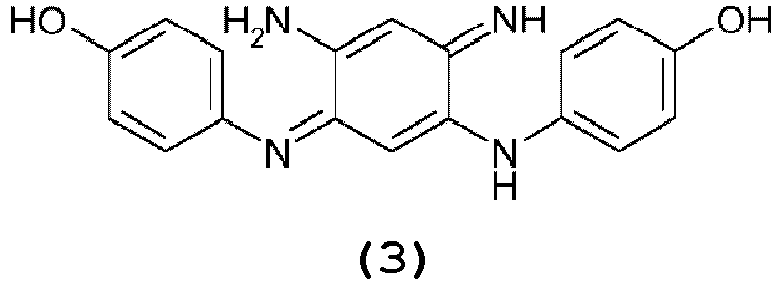
4-({2-Amino-5-[(4-hydroxyphenyl)amino]-4-iminocyclohexa-2,5-dien-l-yliden}amino)phenol 
Salz von 1-(3-{[4-({2-Amino-4-imino-5-[(4-{[3-(3-methyl-1H-imidazol-3-ium-1-yl)propyl]amino}phenyl)amino]cyclohexa-2,5-dien-1-yliden}amino)phenyl]amino}propyl)-3-methyl-1H-imidazol-3-ium 2 An- 
N-1-(4-Ethoxyphenyl)-3-[4-ethoxyphenylimino]-6-iminocyclohexa-1,4-dien-1,4-diamin 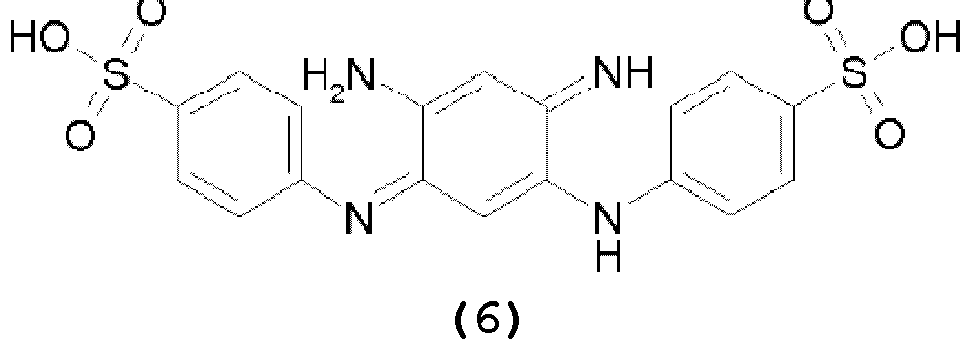
4-({2-Amino-4-imino-5-[(4-sulfophenyl)amino]cyclohexa-2,5-dien-1-yliden}amino)benzolsulfonsäure 
3-({2-Amino-5-[(3-hydroxyphenyl)amino]-4-iminocyclohexa-2,5-dien-1-yliden}amino)phenol 
2-[[4-2,4-Diamino-5-{4-[bis(2-hydroxyethyl)amino]phenylamino}phenylamino)phenyl] (2-hydroxyethyl)amino]ethanol 
N,N''-Bis(4-aminophenyl)benzol-1,2,4,5-tetramin 
N,N'''-Bis(4-hydroxyphenyl)benzol-l,2,4,5-tetramin 
Salz von N,N'''-Bis(4-{[3-(3-methyl-1H-imidazol-3-ium-1-yl)propyl]amino}phenyl)benzol-1,2,4,5-tetramin 2 An- 
N,N''-Bis(4-ethoxyphenyl)benzol-1,2,4,5-tetramin 
4-({2-Amino-4-amino-5-[(4-sulfophenyl)amino]phenyl}amino)benzolsulfonsäure 
N,N'''-Bis(3-hydroxyphenyl)benzol-1,2,4,5-tetramin - Verbindungen der Formeln (I) und (II) gemäß den Ansprüchen 1, 3 bis 12, Salze davon mit einer 5 organischen oder anorganischen Säure oder Base, tautomere Formen, optische Isomere oder geometrische Isomere davon und/oder Solvate davon mit Ausnahme der nachstehenden Verbindungen i bis viii:


- Kosmetische Zusammensetzung, umfassend eine oder mehrere Verbindungen der Formel (I) und/oder (II) mit Ausnahme der Verbindungen i bis viii gemäß dem vorhergehenden Anspruch; vorzugsweise wobei die Verbindungen der Formel (I) und Formel (II) aus den Verbindungen (1) bis (7) und den Verbindungen (1') bis (7') gemäß Anspruch 12 ausgewählt sind.
- Zusammensetzung nach dem vorhergehenden Anspruch, dadurch gekennzeichnet, dass sie kein chemisches Oxidationsmittel umfasst.
- Zusammensetzung nach Anspruch 15, umfassend eine oder mehrere Verbindungen der Formel (I) und/oder (II), vorzugsweise eine oder mehrere Verbindungen der Formel (II), dadurch gekennzeichnet, dass sie außerdem ein oder mehrere chemische Oxidationsmittel umfasst, die insbesondere aus Wasserstoffperoxid, Harnstoffperoxid, Alkalimetallbromaten, Persalzen wie Perboraten und Persulfaten, Persäuren und Oxidaseenzymen (mit deren fakultativen Cofaktoren), darunter Peroxidasen, 2-Elektronen-Oxidoreduktasen wie Uricasen und 4-Elektronen-Oxygenasen wie Laccasen genannt seien, ausgewählt sind, wobei es sich bei dem chemischen Oxidationsmittel vorzugsweise um Wasserstoffperoxid handelt.
- Verfahren zur Herstellung von Verbindungen der Formeln (I) und/oder (II) mit Ausnahme der Verbindungen i bis viii gemäß Anspruch 13 gemäß dem folgenden Schema:
Zugang zu den Verbindungen (I):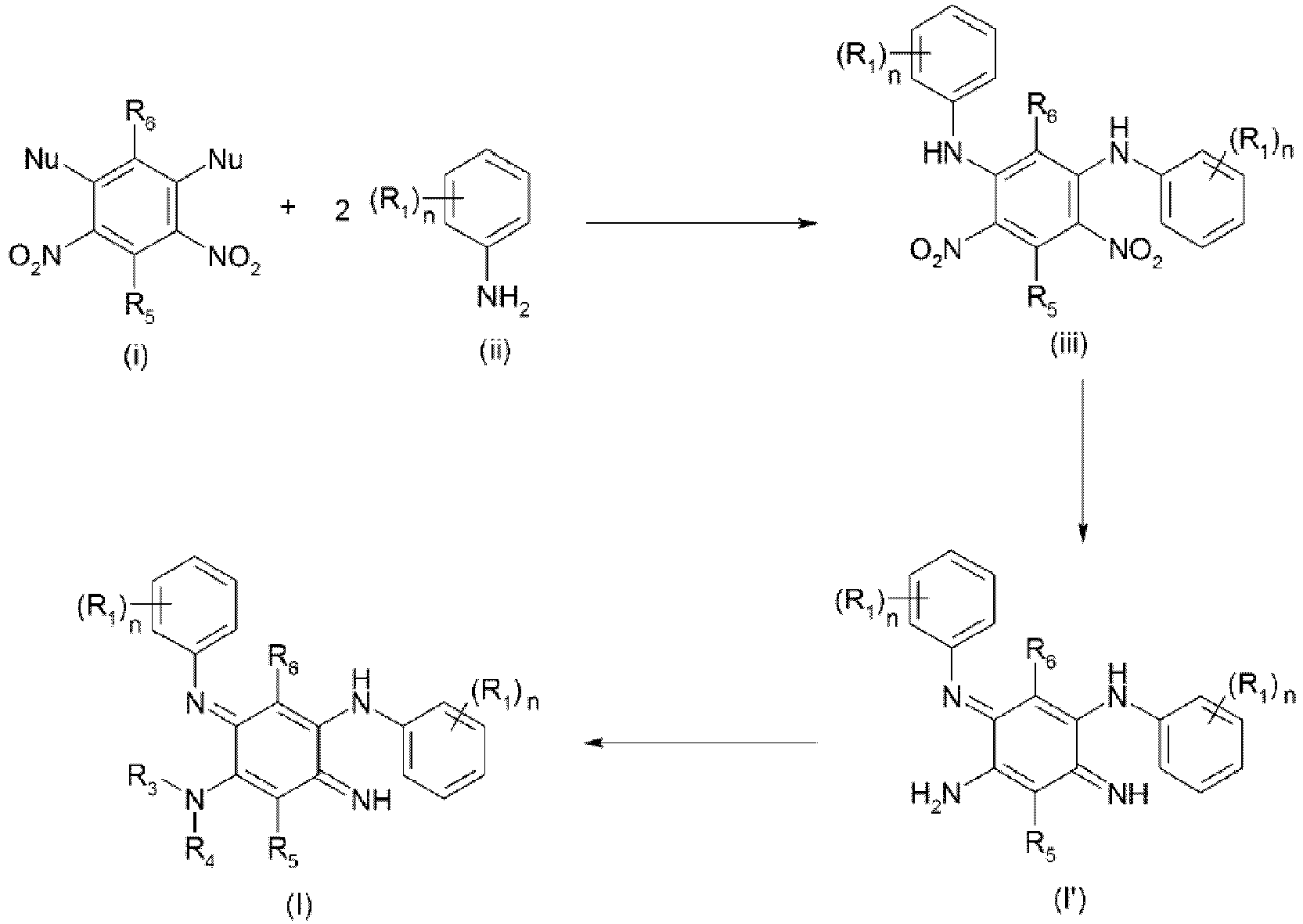
 a) in einer ersten Stufe aus der Umsetzung eines Moläquivalents von 1,5-Dinitrobenzol-Verbindung (i), die in den Positionen 2 und 4 eine nukleofuge Gruppe Nu aufweist, mit zwei Moläquivalenten von Anilinverbindung (ii); wobei Nu für eine nukleofuge Gruppe, wie ein Halogenatom, beispielsweise ein Chloratom, oder eine Methoxid-, Tosylat-, Mesylat- oder Sulfonatgruppe steht; wobei diese Umsetzung vorzugsweise i) in einem polaren protischen Lösungsmittel wie in Wasser oder einer Mischung von Wasser/C1-C10-Alkohol wie Ethanol oder in einem polaren aprotischen Lösungsmittel wie in 1-Methyl-2-pyrrolidinon, Aceton, Acetonitril, Pyridin oder N,N-Dimethylformamid, ii) und/oder in Gegenwart eines oder mehrerer mineralischer oder organischer Basifizierungsmittel gemäß nachstehender Definition, insbesondere ausgewählt aus Diisopropylethylamin, Trimethylamin, Natriumhydroxid, Kaliumhydroxid, einem mineralischen Carbonat wie Kaliumcarbonat oder einem Acetat, iii) und/oder bei einer Temperatur zwischen 0 °C und 75 °C, vorzugsweise bei 75 °C, durchgeführt wird; und dannb) in einer zweiten Stufe aus dem Halten des Reaktionsmediums unter Rühren über einen Zeitraum zwischen 5 Minuten und 48 Stunden, spezieller zwischen 30 Minuten 24 Stunden, wenn die Umsetzung bei Raumtemperatur durchgeführt wird; wonachc) das Umsetzungsprodukt (iii) gegebenenfalls gemäß einer Standardtechnik wie Umkristallisation, Filtration oder Chromatographie gereinigt wird;d) gemäß einer anderen Variante Verbindung (iii) nicht gereinigt wird;e) in einer dritten Stufe aus der Durchführung einer Reduktionsreaktion an Verbindung (iii); wobei die Reduktion von Verbindung (iii) vorzugsweise in Gegenwart von Hydrazin oder von Ammoniumformiat oder unter Wasserstoffatmosphäre und in Gegenwart eines Hydrierkatalysators, insbesondere auf Basis eines Metalls, beispielsweise Palladium, Nickel oder Rhodium, durchgeführt wird, wobei die Reduktion vorzugsweise mit Palladium auf Kohle (Pd/C) unter Wasserstoffatmosphäre durchgeführt wird; wobei diese Umsetzung vorzugsweise in einem Lösungsmittel wie Estern, insbesondere wie Essigsäure(C1-C6)alkylestern, insbesondere Essigsäureethylester, (C1-C6)Alkanolen (d. h. einer Verbindung der Formel R-OH mit R = (C1-C6)-Alkyl) wie Ethanol oder Methanol und Mischungen davon durchgeführt wird; wobei es sich bei dem Lösungsmittel noch besser um Ethanol, Methanol oder eine Mischung davon handelt; was Verbindung (I') ergibt; wonachf) Verbindung (I') gegebenenfalls mit halogenierten Reagenzien R3-Hal und R4-Hal, wobei Hal für ein Halogenatom, vorzugsweise Cl oder I, steht, N-substituiert wird, vorzugsweise unter Erhitzen am Rückflusspunkt des Lösungsmittels und in Gegenwart eines alkalischen Mittels, insbesondere in einem polaren aprotischen Lösungsmittel wie THF, was nach Filtration, Entfernung des Niederschlags und gegebenenfalls Reinigung durch Chromatographie oder Umkristallisation die erfindungsgemäße Verbindung (I) ergibt;g) wobei das Verfahren für die Verbindungen (II) aus der Durchführung einer Reduktionsreaktion an den Verbindungen (I) besteht;wobei es sich versteht, dass in den Formeln (i), (ii), (iii), (I) und (II) die Reste R1 bis R10 und n wie in einem der Ansprüche 1 bis 10 definiert sind.
 - Verwendung einer oder mehrerer Verbindungen der Formel (I) und/oder (II) gemäß einem der Ansprüche 1, 3 bis 12, gegebenenfalls in Gegenwart eines oder mehrerer chemischer Oxidationsmittel gemäß den Ansprüchen 2 und 16, zum Färben von Keratinfasern, insbesondere menschlichen Keratinfasern wie dem Haar.
- Vorrichtung mit einem Kompartiment oder mehreren Kompartimenten, umfassend ein erstes Kompartiment, das eine oder mehrere Verbindungen der Formel (I) und/oder (II) gemäß einem der Ansprüche 1, 3 bis 12 enthält, und gegebenenfalls ein zweites Kompartiment, das ein oder mehrere chemische Oxidationsmittel gemäß den Ansprüchen 2 und 16 umfasst.
Applications Claiming Priority (2)
| Application Number | Priority Date | Filing Date | Title |
|---|---|---|---|
| FR1662657A FR3060331B1 (fr) | 2016-12-16 | 2016-12-16 | Nouveaux colorants direct azomethiniques symetriques, composition cosmetique comprenant au moins un tel colorant, procede de mise en œuvre et utilisation |
| PCT/EP2017/082989 WO2018109156A1 (en) | 2016-12-16 | 2017-12-15 | Symmetric azomethine direct dyes, process for their preparation, cosmetic composition comprising at least one such dye and use thereof |
Publications (2)
| Publication Number | Publication Date |
|---|---|
| EP3554467A1 EP3554467A1 (de) | 2019-10-23 |
| EP3554467B1 true EP3554467B1 (de) | 2020-11-25 |
Family
ID=58228252
Family Applications (1)
| Application Number | Title | Priority Date | Filing Date |
|---|---|---|---|
| EP17835629.1A Active EP3554467B1 (de) | 2016-12-16 | 2017-12-15 | Symmetrische azomethindirektfarbstoffe, verfahren zu deren herstellung, kosmetische zusammensetzung mit zumindest einem solchen farbstoff und verwendung davon |
Country Status (5)
| Country | Link |
|---|---|
| US (1) | US11504318B2 (de) |
| EP (1) | EP3554467B1 (de) |
| ES (1) | ES2858974T3 (de) |
| FR (1) | FR3060331B1 (de) |
| WO (1) | WO2018109156A1 (de) |
Families Citing this family (1)
| Publication number | Priority date | Publication date | Assignee | Title |
|---|---|---|---|---|
| FR3060308B1 (fr) | 2016-12-16 | 2020-06-19 | L'oreal | Nouveaux colorants directs azomethiniques dissymetriques, composition cosmetique comprenant au moins un tel colorant, procede de mise en oeuvre et utilisation |
Family Cites Families (41)
| Publication number | Priority date | Publication date | Assignee | Title |
|---|---|---|---|---|
| BE626050A (de) | 1962-03-30 | |||
| DE1492175A1 (de) | 1965-07-07 | 1970-02-12 | Schwarzkopf Gmbh Hans | Verfahren zum Faerben von lebenden Haaren |
| US3518234A (en) * | 1968-05-27 | 1970-06-30 | Teijin Ltd | Novel aromatic polyamide imines,novel n-aryl substituted polybenzimidazoles derived therefrom and processes for preparation thereof |
| NL139303C (de) | 1969-06-25 | |||
| US3853464A (en) | 1969-08-11 | 1974-12-10 | Oreal | Human hair dyeing compositions containing diphenylamines |
| LU59265A1 (de) | 1969-08-11 | 1971-06-21 | Oreal | |
| US3884625A (en) | 1970-12-21 | 1975-05-20 | Oreal | Indophenols dyes for coloring keratin fibers |
| BE786218A (de) | 1971-07-14 | 1973-01-15 | Oreal | |
| USRE30199E (en) | 1973-11-29 | 1980-01-29 | Henkel Kommanditgesellschaft Auf Aktien (Henkel Kgaa) | Oxidation hair dyes based upon tetraaminopyrimidine developers |
| DE2359399C3 (de) | 1973-11-29 | 1979-01-25 | Henkel Kgaa, 4000 Duesseldorf | Haarfärbemittel |
| US4003699A (en) | 1974-11-22 | 1977-01-18 | Henkel & Cie G.M.B.H. | Oxidation hair dyes based upon tetraaminopyrimidine developers |
| LU69456A1 (de) | 1974-02-22 | 1975-12-09 | ||
| JP2526099B2 (ja) | 1988-07-07 | 1996-08-21 | 花王株式会社 | 角質繊維染色組成物 |
| DE3843892A1 (de) | 1988-12-24 | 1990-06-28 | Wella Ag | Oxidationshaarfaerbemittel mit einem gehalt an diaminopyrazolderivaten und neue diaminopyrazolderivate |
| JPH0563124A (ja) | 1991-09-03 | 1993-03-12 | Mitsubishi Electric Corp | 混成集積回路装置 |
| DE4133957A1 (de) | 1991-10-14 | 1993-04-15 | Wella Ag | Haarfaerbemittel mit einem gehalt an aminopyrazolderivaten sowie neue pyrazolderivate |
| JP3053939B2 (ja) | 1991-12-17 | 2000-06-19 | 花王株式会社 | 角質繊維染色組成物 |
| US5663366A (en) | 1992-10-16 | 1997-09-02 | Wella Aktiengesellschat | Process for the synthesis of 4,5-diaminopyrazole derivatives useful for dyeing hair |
| DE4234885A1 (de) | 1992-10-16 | 1994-04-21 | Wella Ag | Verfahren zur Herstellung von 4,5-Diaminopyrazol-Derivaten, deren Verwendung zum Färben von Haaren sowie neue Pyrazol-Derivate |
| DE4234887A1 (de) | 1992-10-16 | 1994-04-21 | Wella Ag | Oxidationshaarfärbemittel mit einem Gehalt an 4,5-Diaminopyrazolderivaten sowie neue 4,5-Diaminopyrazolderivate und Verfahren zu ihrer Herstellung |
| TW311089B (de) | 1993-07-05 | 1997-07-21 | Ciba Sc Holding Ag | |
| TW325998B (en) | 1993-11-30 | 1998-02-01 | Ciba Sc Holding Ag | Dyeing keratin-containing fibers |
| DE59510392D1 (de) | 1994-11-03 | 2002-10-31 | Ciba Sc Holding Ag | Kationische Imidazolazofarbstoffe |
| DE4440957A1 (de) | 1994-11-17 | 1996-05-23 | Henkel Kgaa | Oxidationsfärbemittel |
| FR2733749B1 (fr) | 1995-05-05 | 1997-06-13 | Oreal | Compositions pour la teinture des fibres keratiniques contenant des diamino pyrazoles, procede de teinture, nouveaux diamino pyrazoles et leur procede de preparation |
| DE19539264C2 (de) | 1995-10-21 | 1998-04-09 | Goldwell Gmbh | Haarfärbemittel |
| DE19543988A1 (de) | 1995-11-25 | 1997-05-28 | Wella Ag | Oxidationshaarfärbemittel mit einem Gehalt an 3,4,5-Triaminopyrazolderivaten sowie neue 3,4,5-Triaminopyrazolderivate |
| FR2801308B1 (fr) | 1999-11-19 | 2003-05-09 | Oreal | COMPOSITIONS DE TEINTURE DE FIBRES KERATINIQUES CONTENANT DE DES 3-AMINO PYRAZOLO-[1,(-a]-PYRIDINES, PROCEDE DE TEINTURE, NOUVELLES 3-AMINO PYRAZOLO-[1,5-a]-PYRIDINES |
| FR2886136B1 (fr) | 2005-05-31 | 2007-08-10 | Oreal | Composition pour la teinture des fibres keratiniques comprenant au moins un derive de diamino-n,n-dihydro- pyrazolone et un colorant d'oxydation cationique |
| FR2925054B1 (fr) * | 2007-12-14 | 2012-02-10 | Oreal | Colorants directs azomethiniques ou precurseurs reduits de cololants obtenus a partir du 2-amino-3-hydroxypyridine, procede de coloration capillaire a partir de ces colorants et precuseurs |
| FR2925049B1 (fr) * | 2007-12-14 | 2012-03-09 | Oreal | Colorants directs azomethiniques ou precurseurs reduits de colorants directs azomethiniques obtenus a partir de 2-alkyl resorcinols, procede de coloration capillaire a partir de ces colorants ou precurseurs |
| FR2925056B1 (fr) * | 2007-12-14 | 2010-01-08 | Oreal | Colorants directs azomethiniques ou precurseurs reduits de ces colorants obtenus a partir du 2-chloro-3-amino-6-methylphenol, procede de coloration capillaire a partir de ces colorants et precurseurs |
| US8801808B2 (en) | 2010-12-20 | 2014-08-12 | L'oreal | Dye composition comprising benzyl alcohol, a monoalcohol and a particular direct dye |
| FR2968947B1 (fr) * | 2010-12-20 | 2013-04-26 | Oreal | Composition de coloration comprenant de l'alcool benzylique, un monoalcool et un colorant azomethinique particulier |
| FR2983856B1 (fr) | 2011-12-13 | 2014-05-16 | Oreal | Colorants directs azomethiniques tri-aromatiques, composition tinctoriale comprenant au moins un tel colorant, procede de mise en œuvre et utilisation |
| FR2983855B1 (fr) | 2011-12-13 | 2014-01-10 | Oreal | Colorants directs azomethiniques particuliers, composition tinctoriale comprenant au moins un tel colorant, procede de mise en oeuvre et utilisation |
| JP5672255B2 (ja) | 2012-02-21 | 2015-02-18 | 新日鐵住金株式会社 | 鍛鋼ロールの製造方法 |
| KR101545517B1 (ko) * | 2012-11-09 | 2015-08-19 | 희성소재 (주) | 유기발광소자 |
| FR3006180B1 (fr) * | 2013-05-29 | 2015-05-15 | Oreal | Colorants directs azomethiniques a groupe aniline encombre, composition tinctoriale comprenant au moins un tel colorant, procede de mise en œuvre et utilisation |
| EP2842949A1 (de) * | 2013-09-02 | 2015-03-04 | Université d'Aix-Marseille | Analoga von Porphyrinen, Verfahren zu deren Herstellung und Verwendung davon speziell in farbempfindlichen Solarzellen |
| FR3060308B1 (fr) | 2016-12-16 | 2020-06-19 | L'oreal | Nouveaux colorants directs azomethiniques dissymetriques, composition cosmetique comprenant au moins un tel colorant, procede de mise en oeuvre et utilisation |
-
2016
- 2016-12-16 FR FR1662657A patent/FR3060331B1/fr not_active Expired - Fee Related
-
2017
- 2017-12-15 EP EP17835629.1A patent/EP3554467B1/de active Active
- 2017-12-15 WO PCT/EP2017/082989 patent/WO2018109156A1/en not_active Ceased
- 2017-12-15 ES ES17835629T patent/ES2858974T3/es active Active
- 2017-12-15 US US16/467,591 patent/US11504318B2/en active Active
Non-Patent Citations (1)
| Title |
|---|
| None * |
Also Published As
| Publication number | Publication date |
|---|---|
| US20220016009A1 (en) | 2022-01-20 |
| WO2018109156A1 (en) | 2018-06-21 |
| US11504318B2 (en) | 2022-11-22 |
| ES2858974T3 (es) | 2021-09-30 |
| FR3060331B1 (fr) | 2020-06-19 |
| EP3554467A1 (de) | 2019-10-23 |
| FR3060331A1 (fr) | 2018-06-22 |
Similar Documents
| Publication | Publication Date | Title |
|---|---|---|
| EP2509951B1 (de) | Neue kationische aminopyridine, färbezusammensetzung mit einem kationischen aminopyridin, verfahren dafür und ihre verwendung | |
| WO2013087636A1 (en) | Particular azomethine direct dyes, dye composition comprising at least one such compound, implementation process therefore and use thereof | |
| JP2015501869A5 (de) | ||
| EP3554466B1 (de) | Asymmetrische azomethindirektfarbstoffe und verfahren zu deren herstellung, kosmetische zusammensetzung mit zumindest einem solchen farbstoff und verwendung davon | |
| EP3555069B1 (de) | Neuartige azomethindirektfarbstoffe mit mindestens einer kationischen ladung, kosmetische zusammensetzung mit mindestens einem solchen farbstoff, implementierungsverfahren dafür und verwendung davon | |
| US20200276102A1 (en) | Specific 7-amino-1,2,3,4-tetrahydroquinolines, method, and composition | |
| US9107848B2 (en) | Coupler with cationic 7-amino-1,2,3,4-tetrahydroquinoline structure, dyeing composition comprising same, processes and uses | |
| US11504318B2 (en) | Symmetric azomethine direct dyes, process for their preparation, cosmetic composition comprising at least one such dye and use thereof | |
| WO2011107501A1 (en) | Cationic 6-aminoindolines, dyeing compositions containing them, processes and uses thereof | |
| EP3464247B1 (de) | Neuartige oxidationsbase aus 1-hexyl-4,5-diaminopyrazol, zusammensetzung damit und verwendung davon bei der oxidationsfärbung von keratinfasern | |
| EP2791116B1 (de) | Koppler mit einer 7-amino-1,2,3,4-tetrahydrochinolinstruktur, färbemittelzusammensetzung damit, verfahren und verwendungen | |
| WO2011110627A1 (en) | New cationic 7-amino-1,2,3,4- tetrahydroquinolines, deying composition comprising a cationic 7-amino-1,2,3,4-tetrahydroquinoline, method and uses. | |
| WO2018104474A1 (en) | Compound derived from 4,5-diaminopyrazoles comprising a fused ring, composition comprising at least one such compound, implementation process and use | |
| EP2509977B1 (de) | Neue kationische 4-aminoindole, färbezusammensetzung mit einem kationischen 4-aminoindol, verfahren dafür und ihre verwendung | |
| WO2014191354A1 (en) | Quinone direct dyes bearing a hindered aniline group, dye composition comprising at least one such dye, implementation process therefor and use thereof |
Legal Events
| Date | Code | Title | Description |
|---|---|---|---|
| STAA | Information on the status of an ep patent application or granted ep patent |
Free format text: STATUS: UNKNOWN |
|
| STAA | Information on the status of an ep patent application or granted ep patent |
Free format text: STATUS: THE INTERNATIONAL PUBLICATION HAS BEEN MADE |
|
| PUAI | Public reference made under article 153(3) epc to a published international application that has entered the european phase |
Free format text: ORIGINAL CODE: 0009012 |
|
| STAA | Information on the status of an ep patent application or granted ep patent |
Free format text: STATUS: REQUEST FOR EXAMINATION WAS MADE |
|
| 17P | Request for examination filed |
Effective date: 20190716 |
|
| AK | Designated contracting states |
Kind code of ref document: A1 Designated state(s): AL AT BE BG CH CY CZ DE DK EE ES FI FR GB GR HR HU IE IS IT LI LT LU LV MC MK MT NL NO PL PT RO RS SE SI SK SM TR |
|
| AX | Request for extension of the european patent |
Extension state: BA ME |
|
| DAV | Request for validation of the european patent (deleted) | ||
| DAX | Request for extension of the european patent (deleted) | ||
| RIC1 | Information provided on ipc code assigned before grant |
Ipc: A61K 8/49 20060101ALI20200618BHEP Ipc: A61K 8/41 20060101AFI20200618BHEP Ipc: C09B 55/00 20060101ALI20200618BHEP Ipc: A61K 8/46 20060101ALI20200618BHEP Ipc: A61Q 5/06 20060101ALI20200618BHEP |
|
| GRAP | Despatch of communication of intention to grant a patent |
Free format text: ORIGINAL CODE: EPIDOSNIGR1 |
|
| STAA | Information on the status of an ep patent application or granted ep patent |
Free format text: STATUS: GRANT OF PATENT IS INTENDED |
|
| INTG | Intention to grant announced |
Effective date: 20200727 |
|
| GRAS | Grant fee paid |
Free format text: ORIGINAL CODE: EPIDOSNIGR3 |
|
| GRAA | (expected) grant |
Free format text: ORIGINAL CODE: 0009210 |
|
| STAA | Information on the status of an ep patent application or granted ep patent |
Free format text: STATUS: THE PATENT HAS BEEN GRANTED |
|
| AK | Designated contracting states |
Kind code of ref document: B1 Designated state(s): AL AT BE BG CH CY CZ DE DK EE ES FI FR GB GR HR HU IE IS IT LI LT LU LV MC MK MT NL NO PL PT RO RS SE SI SK SM TR |
|
| REG | Reference to a national code |
Ref country code: GB Ref legal event code: FG4D |
|
| REG | Reference to a national code |
Ref country code: CH Ref legal event code: EP |
|
| REG | Reference to a national code |
Ref country code: DE Ref legal event code: R096 Ref document number: 602017028528 Country of ref document: DE |
|
| REG | Reference to a national code |
Ref country code: AT Ref legal event code: REF Ref document number: 1337451 Country of ref document: AT Kind code of ref document: T Effective date: 20201215 |
|
| REG | Reference to a national code |
Ref country code: IE Ref legal event code: FG4D |
|
| REG | Reference to a national code |
Ref country code: AT Ref legal event code: MK05 Ref document number: 1337451 Country of ref document: AT Kind code of ref document: T Effective date: 20201125 |
|
| REG | Reference to a national code |
Ref country code: NL Ref legal event code: MP Effective date: 20201125 |
|
| PG25 | Lapsed in a contracting state [announced via postgrant information from national office to epo] |
Ref country code: GR Free format text: LAPSE BECAUSE OF FAILURE TO SUBMIT A TRANSLATION OF THE DESCRIPTION OR TO PAY THE FEE WITHIN THE PRESCRIBED TIME-LIMIT Effective date: 20210226 Ref country code: NO Free format text: LAPSE BECAUSE OF FAILURE TO SUBMIT A TRANSLATION OF THE DESCRIPTION OR TO PAY THE FEE WITHIN THE PRESCRIBED TIME-LIMIT Effective date: 20210225 Ref country code: RS Free format text: LAPSE BECAUSE OF FAILURE TO SUBMIT A TRANSLATION OF THE DESCRIPTION OR TO PAY THE FEE WITHIN THE PRESCRIBED TIME-LIMIT Effective date: 20201125 Ref country code: PT Free format text: LAPSE BECAUSE OF FAILURE TO SUBMIT A TRANSLATION OF THE DESCRIPTION OR TO PAY THE FEE WITHIN THE PRESCRIBED TIME-LIMIT Effective date: 20210325 Ref country code: FI Free format text: LAPSE BECAUSE OF FAILURE TO SUBMIT A TRANSLATION OF THE DESCRIPTION OR TO PAY THE FEE WITHIN THE PRESCRIBED TIME-LIMIT Effective date: 20201125 |
|
| PG25 | Lapsed in a contracting state [announced via postgrant information from national office to epo] |
Ref country code: AT Free format text: LAPSE BECAUSE OF FAILURE TO SUBMIT A TRANSLATION OF THE DESCRIPTION OR TO PAY THE FEE WITHIN THE PRESCRIBED TIME-LIMIT Effective date: 20201125 Ref country code: SE Free format text: LAPSE BECAUSE OF FAILURE TO SUBMIT A TRANSLATION OF THE DESCRIPTION OR TO PAY THE FEE WITHIN THE PRESCRIBED TIME-LIMIT Effective date: 20201125 Ref country code: IS Free format text: LAPSE BECAUSE OF FAILURE TO SUBMIT A TRANSLATION OF THE DESCRIPTION OR TO PAY THE FEE WITHIN THE PRESCRIBED TIME-LIMIT Effective date: 20210325 Ref country code: LV Free format text: LAPSE BECAUSE OF FAILURE TO SUBMIT A TRANSLATION OF THE DESCRIPTION OR TO PAY THE FEE WITHIN THE PRESCRIBED TIME-LIMIT Effective date: 20201125 Ref country code: PL Free format text: LAPSE BECAUSE OF FAILURE TO SUBMIT A TRANSLATION OF THE DESCRIPTION OR TO PAY THE FEE WITHIN THE PRESCRIBED TIME-LIMIT Effective date: 20201125 Ref country code: BG Free format text: LAPSE BECAUSE OF FAILURE TO SUBMIT A TRANSLATION OF THE DESCRIPTION OR TO PAY THE FEE WITHIN THE PRESCRIBED TIME-LIMIT Effective date: 20210225 |
|
| REG | Reference to a national code |
Ref country code: LT Ref legal event code: MG9D |
|
| PG25 | Lapsed in a contracting state [announced via postgrant information from national office to epo] |
Ref country code: HR Free format text: LAPSE BECAUSE OF FAILURE TO SUBMIT A TRANSLATION OF THE DESCRIPTION OR TO PAY THE FEE WITHIN THE PRESCRIBED TIME-LIMIT Effective date: 20201125 |
|
| PG25 | Lapsed in a contracting state [announced via postgrant information from national office to epo] |
Ref country code: SM Free format text: LAPSE BECAUSE OF FAILURE TO SUBMIT A TRANSLATION OF THE DESCRIPTION OR TO PAY THE FEE WITHIN THE PRESCRIBED TIME-LIMIT Effective date: 20201125 Ref country code: CZ Free format text: LAPSE BECAUSE OF FAILURE TO SUBMIT A TRANSLATION OF THE DESCRIPTION OR TO PAY THE FEE WITHIN THE PRESCRIBED TIME-LIMIT Effective date: 20201125 Ref country code: EE Free format text: LAPSE BECAUSE OF FAILURE TO SUBMIT A TRANSLATION OF THE DESCRIPTION OR TO PAY THE FEE WITHIN THE PRESCRIBED TIME-LIMIT Effective date: 20201125 Ref country code: LT Free format text: LAPSE BECAUSE OF FAILURE TO SUBMIT A TRANSLATION OF THE DESCRIPTION OR TO PAY THE FEE WITHIN THE PRESCRIBED TIME-LIMIT Effective date: 20201125 Ref country code: RO Free format text: LAPSE BECAUSE OF FAILURE TO SUBMIT A TRANSLATION OF THE DESCRIPTION OR TO PAY THE FEE WITHIN THE PRESCRIBED TIME-LIMIT Effective date: 20201125 Ref country code: SK Free format text: LAPSE BECAUSE OF FAILURE TO SUBMIT A TRANSLATION OF THE DESCRIPTION OR TO PAY THE FEE WITHIN THE PRESCRIBED TIME-LIMIT Effective date: 20201125 |
|
| REG | Reference to a national code |
Ref country code: CH Ref legal event code: PL |
|
| REG | Reference to a national code |
Ref country code: DE Ref legal event code: R097 Ref document number: 602017028528 Country of ref document: DE |
|
| PG25 | Lapsed in a contracting state [announced via postgrant information from national office to epo] |
Ref country code: DK Free format text: LAPSE BECAUSE OF FAILURE TO SUBMIT A TRANSLATION OF THE DESCRIPTION OR TO PAY THE FEE WITHIN THE PRESCRIBED TIME-LIMIT Effective date: 20201125 Ref country code: MC Free format text: LAPSE BECAUSE OF FAILURE TO SUBMIT A TRANSLATION OF THE DESCRIPTION OR TO PAY THE FEE WITHIN THE PRESCRIBED TIME-LIMIT Effective date: 20201125 |
|
| REG | Reference to a national code |
Ref country code: BE Ref legal event code: MM Effective date: 20201231 |
|
| REG | Reference to a national code |
Ref country code: ES Ref legal event code: FG2A Ref document number: 2858974 Country of ref document: ES Kind code of ref document: T3 Effective date: 20210930 |
|
| PLBE | No opposition filed within time limit |
Free format text: ORIGINAL CODE: 0009261 |
|
| STAA | Information on the status of an ep patent application or granted ep patent |
Free format text: STATUS: NO OPPOSITION FILED WITHIN TIME LIMIT |
|
| PG25 | Lapsed in a contracting state [announced via postgrant information from national office to epo] |
Ref country code: LU Free format text: LAPSE BECAUSE OF NON-PAYMENT OF DUE FEES Effective date: 20201215 Ref country code: NL Free format text: LAPSE BECAUSE OF FAILURE TO SUBMIT A TRANSLATION OF THE DESCRIPTION OR TO PAY THE FEE WITHIN THE PRESCRIBED TIME-LIMIT Effective date: 20201125 Ref country code: AL Free format text: LAPSE BECAUSE OF FAILURE TO SUBMIT A TRANSLATION OF THE DESCRIPTION OR TO PAY THE FEE WITHIN THE PRESCRIBED TIME-LIMIT Effective date: 20201125 Ref country code: IE Free format text: LAPSE BECAUSE OF NON-PAYMENT OF DUE FEES Effective date: 20201215 |
|
| 26N | No opposition filed |
Effective date: 20210826 |
|
| PG25 | Lapsed in a contracting state [announced via postgrant information from national office to epo] |
Ref country code: SI Free format text: LAPSE BECAUSE OF FAILURE TO SUBMIT A TRANSLATION OF THE DESCRIPTION OR TO PAY THE FEE WITHIN THE PRESCRIBED TIME-LIMIT Effective date: 20201125 Ref country code: CH Free format text: LAPSE BECAUSE OF NON-PAYMENT OF DUE FEES Effective date: 20201231 Ref country code: LI Free format text: LAPSE BECAUSE OF NON-PAYMENT OF DUE FEES Effective date: 20201231 |
|
| PG25 | Lapsed in a contracting state [announced via postgrant information from national office to epo] |
Ref country code: IS Free format text: LAPSE BECAUSE OF FAILURE TO SUBMIT A TRANSLATION OF THE DESCRIPTION OR TO PAY THE FEE WITHIN THE PRESCRIBED TIME-LIMIT Effective date: 20210325 Ref country code: TR Free format text: LAPSE BECAUSE OF FAILURE TO SUBMIT A TRANSLATION OF THE DESCRIPTION OR TO PAY THE FEE WITHIN THE PRESCRIBED TIME-LIMIT Effective date: 20201125 Ref country code: MT Free format text: LAPSE BECAUSE OF FAILURE TO SUBMIT A TRANSLATION OF THE DESCRIPTION OR TO PAY THE FEE WITHIN THE PRESCRIBED TIME-LIMIT Effective date: 20201125 Ref country code: CY Free format text: LAPSE BECAUSE OF FAILURE TO SUBMIT A TRANSLATION OF THE DESCRIPTION OR TO PAY THE FEE WITHIN THE PRESCRIBED TIME-LIMIT Effective date: 20201125 |
|
| PG25 | Lapsed in a contracting state [announced via postgrant information from national office to epo] |
Ref country code: MK Free format text: LAPSE BECAUSE OF FAILURE TO SUBMIT A TRANSLATION OF THE DESCRIPTION OR TO PAY THE FEE WITHIN THE PRESCRIBED TIME-LIMIT Effective date: 20201125 |
|
| PG25 | Lapsed in a contracting state [announced via postgrant information from national office to epo] |
Ref country code: BE Free format text: LAPSE BECAUSE OF NON-PAYMENT OF DUE FEES Effective date: 20201231 |
|
| PGFP | Annual fee paid to national office [announced via postgrant information from national office to epo] |
Ref country code: GB Payment date: 20241001 Year of fee payment: 8 |
|
| PGFP | Annual fee paid to national office [announced via postgrant information from national office to epo] |
Ref country code: IT Payment date: 20241112 Year of fee payment: 8 |
|
| PGFP | Annual fee paid to national office [announced via postgrant information from national office to epo] |
Ref country code: ES Payment date: 20250121 Year of fee payment: 8 |
|
| PGFP | Annual fee paid to national office [announced via postgrant information from national office to epo] |
Ref country code: DE Payment date: 20250930 Year of fee payment: 9 |
|
| PGFP | Annual fee paid to national office [announced via postgrant information from national office to epo] |
Ref country code: FR Payment date: 20251008 Year of fee payment: 9 |