EP3553024A2 - Entschwefelungsvorrichtung, wasserstofferzeugungsvorrichtung und brennstoffzellensystem - Google Patents
Entschwefelungsvorrichtung, wasserstofferzeugungsvorrichtung und brennstoffzellensystem Download PDFInfo
- Publication number
- EP3553024A2 EP3553024A2 EP19163086.2A EP19163086A EP3553024A2 EP 3553024 A2 EP3553024 A2 EP 3553024A2 EP 19163086 A EP19163086 A EP 19163086A EP 3553024 A2 EP3553024 A2 EP 3553024A2
- Authority
- EP
- European Patent Office
- Prior art keywords
- desulfurizer
- generation device
- fluid
- hydrogen generation
- sulfur compound
- Prior art date
- Legal status (The legal status is an assumption and is not a legal conclusion. Google has not performed a legal analysis and makes no representation as to the accuracy of the status listed.)
- Withdrawn
Links
Images




Classifications
-
- C—CHEMISTRY; METALLURGY
- C01—INORGANIC CHEMISTRY
- C01B—NON-METALLIC ELEMENTS; COMPOUNDS THEREOF; METALLOIDS OR COMPOUNDS THEREOF NOT COVERED BY SUBCLASS C01C
- C01B3/00—Hydrogen; Gaseous mixtures containing hydrogen; Separation of hydrogen from mixtures containing it; Purification of hydrogen; Reversible storage of hydrogen
- C01B3/02—Production of hydrogen; Production of gaseous mixtures containing hydrogen
- C01B3/32—Production of hydrogen; Production of gaseous mixtures containing hydrogen by reaction of gaseous or liquid organic compounds with gasifying agents, e.g. water, carbon dioxide or air
- C01B3/34—Production of hydrogen; Production of gaseous mixtures containing hydrogen by reaction of gaseous or liquid organic compounds with gasifying agents, e.g. water, carbon dioxide or air by reaction of hydrocarbons with gasifying agents
- C01B3/38—Production of hydrogen; Production of gaseous mixtures containing hydrogen by reaction of gaseous or liquid organic compounds with gasifying agents, e.g. water, carbon dioxide or air by reaction of hydrocarbons with gasifying agents using catalysts
-
- C—CHEMISTRY; METALLURGY
- C07—ORGANIC CHEMISTRY
- C07F—ACYCLIC, CARBOCYCLIC OR HETEROCYCLIC COMPOUNDS CONTAINING ELEMENTS OTHER THAN CARBON, HYDROGEN, HALOGEN, OXYGEN, NITROGEN, SULFUR, SELENIUM OR TELLURIUM
- C07F1/00—Compounds containing elements of Groups 1 or 11 of the Periodic Table
- C07F1/005—Compounds containing elements of Groups 1 or 11 of the Periodic Table without C-Metal linkages
-
- B—PERFORMING OPERATIONS; TRANSPORTING
- B01—PHYSICAL OR CHEMICAL PROCESSES OR APPARATUS IN GENERAL
- B01D—SEPARATION
- B01D53/00—Separation of gases or vapours; Recovering vapours of volatile solvents from gases; Chemical or biological purification of waste gases, e.g. engine exhaust gases, smoke, fumes, flue gases, aerosols
- B01D53/02—Separation of gases or vapours; Recovering vapours of volatile solvents from gases; Chemical or biological purification of waste gases, e.g. engine exhaust gases, smoke, fumes, flue gases, aerosols by adsorption, e.g. preparative gas chromatography
-
- B—PERFORMING OPERATIONS; TRANSPORTING
- B01—PHYSICAL OR CHEMICAL PROCESSES OR APPARATUS IN GENERAL
- B01J—CHEMICAL OR PHYSICAL PROCESSES, e.g. CATALYSIS OR COLLOID CHEMISTRY; THEIR RELEVANT APPARATUS
- B01J20/00—Solid sorbent compositions or filter aid compositions; Sorbents for chromatography; Processes for preparing, regenerating or reactivating thereof
- B01J20/22—Solid sorbent compositions or filter aid compositions; Sorbents for chromatography; Processes for preparing, regenerating or reactivating thereof comprising organic material
- B01J20/223—Solid sorbent compositions or filter aid compositions; Sorbents for chromatography; Processes for preparing, regenerating or reactivating thereof comprising organic material containing metals, e.g. organo-metallic compounds, coordination complexes
- B01J20/226—Coordination polymers, e.g. metal-organic frameworks [MOF], zeolitic imidazolate frameworks [ZIF]
-
- B—PERFORMING OPERATIONS; TRANSPORTING
- B01—PHYSICAL OR CHEMICAL PROCESSES OR APPARATUS IN GENERAL
- B01J—CHEMICAL OR PHYSICAL PROCESSES, e.g. CATALYSIS OR COLLOID CHEMISTRY; THEIR RELEVANT APPARATUS
- B01J20/00—Solid sorbent compositions or filter aid compositions; Sorbents for chromatography; Processes for preparing, regenerating or reactivating thereof
- B01J20/30—Processes for preparing, regenerating, or reactivating
- B01J20/34—Regenerating or reactivating
- B01J20/345—Regenerating or reactivating using a particular desorbing compound or mixture
-
- B—PERFORMING OPERATIONS; TRANSPORTING
- B01—PHYSICAL OR CHEMICAL PROCESSES OR APPARATUS IN GENERAL
- B01J—CHEMICAL OR PHYSICAL PROCESSES, e.g. CATALYSIS OR COLLOID CHEMISTRY; THEIR RELEVANT APPARATUS
- B01J31/00—Catalysts comprising hydrides, coordination complexes or organic compounds
- B01J31/16—Catalysts comprising hydrides, coordination complexes or organic compounds containing coordination complexes
- B01J31/1691—Coordination polymers, e.g. metal-organic frameworks [MOF]
-
- C—CHEMISTRY; METALLURGY
- C01—INORGANIC CHEMISTRY
- C01B—NON-METALLIC ELEMENTS; COMPOUNDS THEREOF; METALLOIDS OR COMPOUNDS THEREOF NOT COVERED BY SUBCLASS C01C
- C01B3/00—Hydrogen; Gaseous mixtures containing hydrogen; Separation of hydrogen from mixtures containing it; Purification of hydrogen; Reversible storage of hydrogen
- C01B3/02—Production of hydrogen; Production of gaseous mixtures containing hydrogen
- C01B3/22—Production of hydrogen; Production of gaseous mixtures containing hydrogen by decomposition of gaseous or liquid organic compounds
- C01B3/24—Production of hydrogen; Production of gaseous mixtures containing hydrogen by decomposition of gaseous or liquid organic compounds of hydrocarbons
-
- C—CHEMISTRY; METALLURGY
- C10—PETROLEUM, GAS OR COKE INDUSTRIES; TECHNICAL GASES CONTAINING CARBON MONOXIDE; FUELS; LUBRICANTS; PEAT
- C10L—FUELS NOT OTHERWISE PROVIDED FOR; NATURAL GAS; SYNTHETIC NATURAL GAS OBTAINED BY PROCESSES NOT COVERED BY SUBCLASSES C10G OR C10K; LIQUIFIED PETROLEUM GAS; USE OF ADDITIVES TO FUELS OR FIRES; FIRE-LIGHTERS
- C10L3/00—Gaseous fuels; Natural gas; Synthetic natural gas obtained by processes not covered by subclass C10G, C10K; Liquefied petroleum gas
- C10L3/06—Natural gas; Synthetic natural gas obtained by processes not covered by C10G, C10K3/02 or C10K3/04
- C10L3/10—Working-up natural gas or synthetic natural gas
- C10L3/101—Removal of contaminants
- C10L3/102—Removal of contaminants of acid contaminants
- C10L3/103—Sulfur containing contaminants
-
- H—ELECTRICITY
- H01—ELECTRIC ELEMENTS
- H01M—PROCESSES OR MEANS, e.g. BATTERIES, FOR THE DIRECT CONVERSION OF CHEMICAL ENERGY INTO ELECTRICAL ENERGY
- H01M8/00—Fuel cells; Manufacture thereof
- H01M8/06—Combination of fuel cells with means for production of reactants or for treatment of residues
- H01M8/0606—Combination of fuel cells with means for production of reactants or for treatment of residues with means for production of gaseous reactants
- H01M8/0612—Combination of fuel cells with means for production of reactants or for treatment of residues with means for production of gaseous reactants from carbon-containing material
- H01M8/0618—Reforming processes, e.g. autothermal, partial oxidation or steam reforming
-
- H—ELECTRICITY
- H01—ELECTRIC ELEMENTS
- H01M—PROCESSES OR MEANS, e.g. BATTERIES, FOR THE DIRECT CONVERSION OF CHEMICAL ENERGY INTO ELECTRICAL ENERGY
- H01M8/00—Fuel cells; Manufacture thereof
- H01M8/06—Combination of fuel cells with means for production of reactants or for treatment of residues
- H01M8/0662—Treatment of gaseous reactants or gaseous residues, e.g. cleaning
- H01M8/0675—Removal of sulfur
-
- H—ELECTRICITY
- H01—ELECTRIC ELEMENTS
- H01M—PROCESSES OR MEANS, e.g. BATTERIES, FOR THE DIRECT CONVERSION OF CHEMICAL ENERGY INTO ELECTRICAL ENERGY
- H01M8/00—Fuel cells; Manufacture thereof
- H01M8/22—Fuel cells in which the fuel is based on materials comprising carbon or oxygen or hydrogen and other elements; Fuel cells in which the fuel is based on materials comprising only elements other than carbon, oxygen or hydrogen
-
- B—PERFORMING OPERATIONS; TRANSPORTING
- B01—PHYSICAL OR CHEMICAL PROCESSES OR APPARATUS IN GENERAL
- B01D—SEPARATION
- B01D2253/00—Adsorbents used in seperation treatment of gases and vapours
- B01D2253/20—Organic adsorbents
- B01D2253/204—Metal organic frameworks (MOF's)
-
- B—PERFORMING OPERATIONS; TRANSPORTING
- B01—PHYSICAL OR CHEMICAL PROCESSES OR APPARATUS IN GENERAL
- B01D—SEPARATION
- B01D2255/00—Catalysts
- B01D2255/20—Metals or compounds thereof
- B01D2255/207—Transition metals
- B01D2255/20761—Copper
-
- B—PERFORMING OPERATIONS; TRANSPORTING
- B01—PHYSICAL OR CHEMICAL PROCESSES OR APPARATUS IN GENERAL
- B01D—SEPARATION
- B01D2256/00—Main component in the product gas stream after treatment
- B01D2256/24—Hydrocarbons
-
- B—PERFORMING OPERATIONS; TRANSPORTING
- B01—PHYSICAL OR CHEMICAL PROCESSES OR APPARATUS IN GENERAL
- B01D—SEPARATION
- B01D2257/00—Components to be removed
- B01D2257/30—Sulfur compounds
- B01D2257/306—Organic sulfur compounds, e.g. mercaptans
-
- B—PERFORMING OPERATIONS; TRANSPORTING
- B01—PHYSICAL OR CHEMICAL PROCESSES OR APPARATUS IN GENERAL
- B01D—SEPARATION
- B01D2259/00—Type of treatment
- B01D2259/40—Further details for adsorption processes and devices
- B01D2259/40083—Regeneration of adsorbents in processes other than pressure or temperature swing adsorption
- B01D2259/40088—Regeneration of adsorbents in processes other than pressure or temperature swing adsorption by heating
- B01D2259/40096—Regeneration of adsorbents in processes other than pressure or temperature swing adsorption by heating by using electrical resistance heating
-
- C—CHEMISTRY; METALLURGY
- C01—INORGANIC CHEMISTRY
- C01B—NON-METALLIC ELEMENTS; COMPOUNDS THEREOF; METALLOIDS OR COMPOUNDS THEREOF NOT COVERED BY SUBCLASS C01C
- C01B2203/00—Integrated processes for the production of hydrogen or synthesis gas
- C01B2203/02—Processes for making hydrogen or synthesis gas
- C01B2203/0205—Processes for making hydrogen or synthesis gas containing a reforming step
-
- C—CHEMISTRY; METALLURGY
- C01—INORGANIC CHEMISTRY
- C01B—NON-METALLIC ELEMENTS; COMPOUNDS THEREOF; METALLOIDS OR COMPOUNDS THEREOF NOT COVERED BY SUBCLASS C01C
- C01B2203/00—Integrated processes for the production of hydrogen or synthesis gas
- C01B2203/02—Processes for making hydrogen or synthesis gas
- C01B2203/0205—Processes for making hydrogen or synthesis gas containing a reforming step
- C01B2203/0227—Processes for making hydrogen or synthesis gas containing a reforming step containing a catalytic reforming step
- C01B2203/0233—Processes for making hydrogen or synthesis gas containing a reforming step containing a catalytic reforming step the reforming step being a steam reforming step
-
- C—CHEMISTRY; METALLURGY
- C01—INORGANIC CHEMISTRY
- C01B—NON-METALLIC ELEMENTS; COMPOUNDS THEREOF; METALLOIDS OR COMPOUNDS THEREOF NOT COVERED BY SUBCLASS C01C
- C01B2203/00—Integrated processes for the production of hydrogen or synthesis gas
- C01B2203/02—Processes for making hydrogen or synthesis gas
- C01B2203/0283—Processes for making hydrogen or synthesis gas containing a CO-shift step, i.e. a water gas shift step
-
- C—CHEMISTRY; METALLURGY
- C01—INORGANIC CHEMISTRY
- C01B—NON-METALLIC ELEMENTS; COMPOUNDS THEREOF; METALLOIDS OR COMPOUNDS THEREOF NOT COVERED BY SUBCLASS C01C
- C01B2203/00—Integrated processes for the production of hydrogen or synthesis gas
- C01B2203/04—Integrated processes for the production of hydrogen or synthesis gas containing a purification step for the hydrogen or the synthesis gas
- C01B2203/0435—Catalytic purification
- C01B2203/044—Selective oxidation of carbon monoxide
-
- C—CHEMISTRY; METALLURGY
- C01—INORGANIC CHEMISTRY
- C01B—NON-METALLIC ELEMENTS; COMPOUNDS THEREOF; METALLOIDS OR COMPOUNDS THEREOF NOT COVERED BY SUBCLASS C01C
- C01B2203/00—Integrated processes for the production of hydrogen or synthesis gas
- C01B2203/04—Integrated processes for the production of hydrogen or synthesis gas containing a purification step for the hydrogen or the synthesis gas
- C01B2203/0465—Composition of the impurity
- C01B2203/047—Composition of the impurity the impurity being carbon monoxide
-
- C—CHEMISTRY; METALLURGY
- C01—INORGANIC CHEMISTRY
- C01B—NON-METALLIC ELEMENTS; COMPOUNDS THEREOF; METALLOIDS OR COMPOUNDS THEREOF NOT COVERED BY SUBCLASS C01C
- C01B2203/00—Integrated processes for the production of hydrogen or synthesis gas
- C01B2203/06—Integration with other chemical processes
- C01B2203/066—Integration with other chemical processes with fuel cells
-
- C—CHEMISTRY; METALLURGY
- C01—INORGANIC CHEMISTRY
- C01B—NON-METALLIC ELEMENTS; COMPOUNDS THEREOF; METALLOIDS OR COMPOUNDS THEREOF NOT COVERED BY SUBCLASS C01C
- C01B2203/00—Integrated processes for the production of hydrogen or synthesis gas
- C01B2203/12—Feeding the process for making hydrogen or synthesis gas
- C01B2203/1205—Composition of the feed
- C01B2203/1211—Organic compounds or organic mixtures used in the process for making hydrogen or synthesis gas
- C01B2203/1235—Hydrocarbons
- C01B2203/1241—Natural gas or methane
-
- C—CHEMISTRY; METALLURGY
- C01—INORGANIC CHEMISTRY
- C01B—NON-METALLIC ELEMENTS; COMPOUNDS THEREOF; METALLOIDS OR COMPOUNDS THEREOF NOT COVERED BY SUBCLASS C01C
- C01B2203/00—Integrated processes for the production of hydrogen or synthesis gas
- C01B2203/12—Feeding the process for making hydrogen or synthesis gas
- C01B2203/1205—Composition of the feed
- C01B2203/1211—Organic compounds or organic mixtures used in the process for making hydrogen or synthesis gas
- C01B2203/1235—Hydrocarbons
- C01B2203/1247—Higher hydrocarbons
-
- C—CHEMISTRY; METALLURGY
- C01—INORGANIC CHEMISTRY
- C01B—NON-METALLIC ELEMENTS; COMPOUNDS THEREOF; METALLOIDS OR COMPOUNDS THEREOF NOT COVERED BY SUBCLASS C01C
- C01B2203/00—Integrated processes for the production of hydrogen or synthesis gas
- C01B2203/12—Feeding the process for making hydrogen or synthesis gas
- C01B2203/1258—Pre-treatment of the feed
-
- Y—GENERAL TAGGING OF NEW TECHNOLOGICAL DEVELOPMENTS; GENERAL TAGGING OF CROSS-SECTIONAL TECHNOLOGIES SPANNING OVER SEVERAL SECTIONS OF THE IPC; TECHNICAL SUBJECTS COVERED BY FORMER USPC CROSS-REFERENCE ART COLLECTIONS [XRACs] AND DIGESTS
- Y02—TECHNOLOGIES OR APPLICATIONS FOR MITIGATION OR ADAPTATION AGAINST CLIMATE CHANGE
- Y02E—REDUCTION OF GREENHOUSE GAS [GHG] EMISSIONS, RELATED TO ENERGY GENERATION, TRANSMISSION OR DISTRIBUTION
- Y02E60/00—Enabling technologies; Technologies with a potential or indirect contribution to GHG emissions mitigation
- Y02E60/30—Hydrogen technology
- Y02E60/50—Fuel cells
-
- Y—GENERAL TAGGING OF NEW TECHNOLOGICAL DEVELOPMENTS; GENERAL TAGGING OF CROSS-SECTIONAL TECHNOLOGIES SPANNING OVER SEVERAL SECTIONS OF THE IPC; TECHNICAL SUBJECTS COVERED BY FORMER USPC CROSS-REFERENCE ART COLLECTIONS [XRACs] AND DIGESTS
- Y02—TECHNOLOGIES OR APPLICATIONS FOR MITIGATION OR ADAPTATION AGAINST CLIMATE CHANGE
- Y02P—CLIMATE CHANGE MITIGATION TECHNOLOGIES IN THE PRODUCTION OR PROCESSING OF GOODS
- Y02P20/00—Technologies relating to chemical industry
- Y02P20/50—Improvements relating to the production of bulk chemicals
- Y02P20/52—Improvements relating to the production of bulk chemicals using catalysts, e.g. selective catalysts
Definitions
- the present invention relates to a desulfurizer capable of removing a sulfur compound contained in a fluid.
- the present invention further relates to a hydrogen generation device comprising the desulfurizer and a fuel cell system comprising the hydrogen generation device.
- fuel cell cogeneration system As a distributed energy system in which energy can be utilized effectively, a fuel cell cogeneration system having high electric power generation efficiency and total efficiency has attracted attention.
- fuel cell system In many fuel cell systems, hydrogen is used as a fuel for electric power generation. However, since a means for supplying hydrogen required for electric power generation in the fuel cell system is not prepared as an infrastructure, hydrogen is required to be generated in the fuel cell system. Hence, the fuel cell system comprises not only a fuel cell but also a hydrogen generation device.
- hydrogen is generated from hydrocarbon fuel such as a natural gas or a liquefied petroleum gas (hereinafter, referred to as "LPG"), for example, by a hydrogen generation method such as a steam reforming reaction method.
- the natural gas contains not only a sulfur compound derived from a fuel but also tertiary-butyl mercaptan (hereinafter, referred to as "TBM”), dimethylsulfide (hereinafter, referred to as “DMS”), or tetrahydrothiophene (hereinafter, referred to as "THT”) as an odorant at a concentration of several ppm.
- a desulfurizer is provided anteriorly to the steam reforming catalyst.
- An example of a desulfurization method in the desulfurizer is an adsorptive desulfurization method or a hydrodesulfurization method.
- the sulfur compound is adsorbed on a zeolite including a transition metal such as Ag, Cu, or Mn at ordinary temperature. In this way, the sulfur compound is removed. A desulfurizer is exchanged periodically. DMS is an odorant which is hardly adsorbed; however, an Ag zeolite is proposed as a material capable of removing DMS efficiently without being affected by gas dew point.
- Patent Literature 1 discloses, as a hydrodesulfurization method, a method for adsorbing and removing sulfur with a CuZnO desulfurization agent concurrently with hydrolyzing the sulfur compound with hydrogen at a temperature of 200 - 350 degrees Celsius.
- Patent Literature 2 discloses a method for removing a sulfur compound with a metal organic framework (hereinafter, referred to as "MOF") composed of Cu ions and 1,3,5-benzenetricarboxylic acid (hereinafter, referred to as "BTC").
- MOF metal organic framework
- BTC 1,3,5-benzenetricarboxylic acid
- the metal organic framework disclosed in Patent Literature 2 is referred to as HKUST-1.
- the MOF (namely, HKUST-1) disclosed in Patent Literature 2 is capable of desulfurizing DMS specifically at ordinary temperature.
- Non-Patent Literature 1 discloses using isophthalic acid to incorporate defect in HKUST-1.
- Non-Patent Literature 1 W. Zhang et. Al. "Impact of Synthesis Parameters on the Formation of Defects in HKUST-1", European Journal of Inorganic Chemistry (2017) p.925-931
- An object of the present invention is to provide a novel desulfurizer in which three-dimensional structure of HKUST-1 is maintained to achieve high desulfurization performance.
- the present invention provides a desulfurizer for removing a sulfur compound contained in a fluid, comprising:
- the present invention provides a novel desulfurizer in which three-dimensional structure of HKUST-1 is maintained to achieve high desulfurization performance.
- the present invention further provides a hydrogen generation device comprising the desulfurizer and a fuel cell system comprising the hydrogen generation device.
- the present inventor considered a problem of a conventional desulfurization method and agent. As a result, the present inventor found the following matters.
- the present inventor found a problem that the conventional adsorptive desulfurization method involves cost since an expensive desulfurization agent containing Ag (e.g., Ag zeolite) is used.
- an expensive desulfurization agent containing Ag e.g., Ag zeolite
- a recycle flow path for guiding a part of the reformed gas generated in the hydrogen generation device into a desulfurizer is required to be provided between the hydrogen generation device and the desulfurizer. For this reason, the present inventor found that a problem that the hydrogen generation device has a complicated structure and that the conventional hydrodesulfurization method involves cost.
- HKUST-1 As a desulfurization agent, the present inventor found that a problem that cost is involved since BTC included in HKUST-1 is expensive. In other words, the price of BTC is approximately nine times as much as that of 1,3-benzenedicarboxylic acid (i.e., isophthalic acid) or 1,4-benzenedicarboxylic acid (i.e., terephthalic acid).
- 1,3-benzenedicarboxylic acid i.e., isophthalic acid
- 1,4-benzenedicarboxylic acid i.e., terephthalic acid
- the present inventor found that a part of BTC included in MOF is substituted with an inexpensive another organic ligand to maintain high desulfurization performance and to reduce cost.
- the part of BTC which is expensive organic ligand, is substituted with, for example, isophthalic acid or terephthalic acid, both of which are inexpensive, to reduce cost.
- FIG. 1 shows a schematic view of the desulfurizer 16 according to the embodiment.
- the desulfurizer 16 comprises a housing 20 having an inlet 20a and an outlet 20b.
- the housing 20 contains a desulfurization agent 22.
- the desulfurization agent 22 includes a MOF formed of copper ions and organic ligands.
- the desulfurization agent 22 may be formed only of the MOF or may contain not only the MOF but also an additive component such as activated carbon.
- the MOF may be supported by a support formed of a material of a ceramics, glass, carbon, or a metal. As will be described later in more detail, the MOF has the copper ions and the organic ligands.
- the organic ligands include 1,3,5-benzenetricarboxylic acid and 1,3-benzenedicarboxylic acid. In the MOF included in the desulfurization agent 22, a part of 1,3,5-benzenetricarboxylic acid included in HKUST-1 is substituted with 1,3-benzenedicarboxylic acid.
- the MOF contained in the desulfurization agent 22 may be powdery. It is desirable that the powdery MOF has a BET specific surface area of not less than 500 m 2 /gram.
- the upper limit of the BET specific surface area of the powdery MOF is not limited; however, for example, it may be 7,000 m 2 /gram.
- the mean particle size of the primary particle of the MOF is not limited; however, for example, it may be not less than 2 micrometers and not more than 30 micrometers.
- the mean particle size can be calculated by, for example, the following method.
- the powdery MOF is observed with an electron microscope (e.g., scanning electron microscope, which is referred to as "SEM", or transmission electron microscope, which is referred to as "TEM") to provide a SEM or TEM image.
- an electron microscope e.g., scanning electron microscope, which is referred to as "SEM", or transmission electron microscope, which is referred to as "TEM”
- TEM transmission electron microscope
- a mean surface area of a plurality of MOF particles e.g., 50 MOF particles
- a diameter of a circle having an area equal to the calculated mean surface area is deemed to be a mean particle size of the MOF particle.
- the MOF Since the MOF has a uniform skeleton structure in which molecules which constitute the three-dimensional skeleton of the MOF are arranged regularly, the MOF has a high specific surface area.
- the MOF is referred to as a porous coordination polymer (hereinafter, referred to as "PCP").
- An organic site (i.e., organic ligand) or an inorganic site (i.e., metal ion) of the MOF having a uniform skeleton structure can be selected or combined appropriately to control a physical or chemical property (e.g., pore size, pore structure, or surface function) accurately. Therefore, compared to the conventional desulfurization agent such as a zeolite, the MOF has significantly high design flexibility.
- Desulfurization performance of the MOF which is used as the desulfurization agent 22 depends on a kind of the metal ion.
- the MOF which is used as the desulfurization agent 22 according to the embodiment contains the copper ions as the metal ions. Unlike the hydrodesulfurization method in which hydrogen is supplied to a desulfurizer, the MOF including the copper ions and the organic ligands does not require hydrogen and desulfurizes at ordinary pressure. In other words, without hydrogen, the MOF removes the sulfur compound contained in the fluid. Since copper is more inexpensive than a precious metal such as silver, cost is reduced.
- FIG. 2 shows a schematic view of the MOF having the open metal site.
- the metal ion namely, the Cu cation
- the metal ion has an unsaturated ligand.
- a cupper cation is of six-coordination due to Jahn-Teller effect, although the cupper cation having six ligands is unstable.
- the metal ion namely, the Cu cation
- the cupper cation has one or more vacant ligands (i.e., one or more vacant sites).
- the cupper cation has two open metal sites.
- the sulfur compound is adsorbed to the vacant site due to interaction with the metal ion.
- Another MOF having the open metal site has a metal ion having saturated ligands; however, has adsorption activity generated due to torsion or deformation between the ligands. The adsorption activity functions as the open metal site. Since the open metal site having the unsaturated ligand has higher activity than the open metal site generated due to the torsion or the deformation between the ligands, it is desirable that the MOF which is used as the desulfurization agent 22 has the open metal site having the unsaturated ligand. In other words, it is desirable that the metal ion (i.e., copper cation) has one or more vacant ligands (i.e., one or more vacant sites) in the MOF which is used as the desulfurization agent 22.
- the sulfur compound contained in the fluid is adsorbed to the MOF contained in the desulfurization agent 22. In this way, the fluid is desulfurized. It is desirable that the pore on the surface of the MOF is not shielded or covered by other materials such as another desulfurizer. In case where pore of the MOF is shielded or covered by other materials, the sulfur compound having a relatively large volume (e.g., TBM) is prevented from being adsorbed to the MOF. As a result, the desulfurization performance may be lowered.
- TBM sulfur compound having a relatively large volume
- MOFs can be synthesized by a known solvothermal method (i.e., hydrothermal synthesis method). For example, a copper ion source and organic ligands are added to a solvent such as dimetheylformamide, ethanol, or water to prepare a solution of a starting material. Then, the solution of the starting material is gently heated under a basic condition to grow a MOF crystal.
- a copper ion source is copper nitrate hydrate.
- a product containing the synthesized MOF is washed with a washing liquid. The residual starting material is removed from the product. The washing liquid is the same liquid as the solvent used for the synthesis of the MOF. After the washing, the powdery MOF is provided through solid-liquid separation and drying.
- the desulfurization agent 22 containing the thus-provided MOF is put in the inside of the housing 20 of the desulfurizer 16. Then, a pipe is provided to connect between the supply source of the fuel gas G (see FIG. 3 , which will be described later) and the desulfurizer 16.
- the fuel gas G is supplied from the supply source of the fuel gas G to the desulfurizer 16.
- the supplied fuel gas G flows through the housing 20, while the supplied fuel gas G is being brought into contact with the desulfurization agent 22 in the housing 20.
- the fuel gas G flows through the inside of the housing 20 to remove the sulfur compound from the fuel gas G by the desulfurization agent 22.
- An example of the fuel gas G is hydrocarbon fuel such as city gas, natural gas, ethane, propane, or LPG.
- the sulfur compound has been added to the hydrocarbon fuel.
- the hydrocarbon fuel contains the sulfur compound.
- An example of the sulfur compound contained in the fuel gas G is DMS.
- the temperature of the fuel gas G is the substantially same as ordinary temperature.
- the fuel gas G has temperature of not less than minus 15 degrees Celsius and not more than 60 degrees Celsius. It is also unnecessary to heat the desulfurization agent 22 contained in the desulfurizer 16 intentionally.
- the temperature of the desulfurization agent 22 is the substantially same as ordinary temperature.
- the desulfurization agent 22 has temperature of not less than 45 degrees Celsius and not more than 60 degrees Celsius. It is desirable that the desulfurization agent 22 is used at temperature of not more than 100 degrees Celsius. In a case where the desulfurization agent 22 has temperature of more than 100 degrees Celsius, desorption of the sulfur compound is dominantly generated. In a case where the desulfurization agent 22 has temperature of not less than 300 degrees Celsius, the organic ligand is oxidized to decompose. As a result, the MOF fails to have desulfurization performance.
- the temperature of the desulfurization agent 22 (i.e., the temperature of the MOF contained in the desulfurization agent 22) is maintained at not more than 100 degrees Celsius to prevent the sulfur compound from being desorbed from the MOF contained in the desulfurization agent 22. Furthermore, the organic ligand is prevented from being oxidized.
- the housing 20 containing the desulfurization agent 22 may be cooled to maintain the temperature of the desulfurization agent 22 at not more than 100 degrees Celsius. In other words, the housing 20 may comprises a cooler for cooling the inside thereof.
- the pressure of the fuel gas G at the inlet 20a may be lower than the pressure of the fuel gas G at the supply source.
- the fuel gas G is supplied to the desulfurizer 16 without applying pressure thereto in the pipe from the supply source to the desulfurizer 16.
- the difference of the pressure between the fuel gas G at the inlet 20a of the desulfurizer 16 and the standard pressure is, for example, not less than 2 kPa and not more than 5 kPa.
- the fluid is desulfurized at ordinary pressure in the desulfurizer 16 according to the embodiment, it is unnecessary to provide a pressure riser in the pipe from the supply source of the fuel gas G to the desulfurizer 16. Therefore, the configuration of the desulfurizer 16 according to the embodiment is simplified. Furthermore, energy required to apply pressure can be saved.
- the sulfur compound adsorbed to the MOF contained in the desulfurization agent 22 is desorbed to reproduce the desulfurization agent 22.
- the desulfurizer 16 according to the embodiment further comprises a heater to heat the MOF to temperature of more than 100 degrees Celsius.
- an inert gas such as nitrogen or a rare gas is supplied to the inside of the desulfurizer 16 to purge the fuel gas G accumulated in the desulfurizer 16. Then, the desulfurizer 16 is heated with the heater.
- the temperature of the inside of the desulfurizer 16 (namely, the temperature of the MOF contained in the desulfurization agent 22) is, for example, more than 100 degrees Celsius. Desirably, the temperature is 150 degrees Celsius. In light of the function of the desulfurization agent 22, the upper limit of the heating temperature is, for example, 200 degrees Celsius.
- the desulfurizer 16 is heated to desorb the sulfur compound from the desulfurization agent 22.
- the inert gas is supplied to the desulfurizer 16 concurrently with heating of the desulfurizer 16 to exhaust the sulfur compound desorbed from the desulfurization agent 22 to the outside.
- the desulfurization agent 22 is reproduced in the desulfurizer 16 to recover the adsorption performance.
- substantial adsorption volume of the desulfurizer 16 is increased.
- Patent Literature 2 discloses desulfurizing a fluid containing DMS specifically at ordinary temperature with the MOF formed of Cu ions and BTCs (namely, HKUST-1).
- the present inventor is afraid that there is a limit in the cost reduction of BTC, even after taking into consideration the widespread use of MOF in the future.
- the present inventor focused on the isophthalic acid, which is inexpensive than BTC, to establish both the maintenance of the three-dimensional skeleton of HKUST-1 and the cost reduction.
- the present inventor substituted a part of the organic ligands (i.e., BTC) included in HKUST-1 with isophthalic acid, which is inexpensive than BTC, to provide HKUST-1 in which isophthalic acid has been incorporated.
- BTC organic ligands
- HKUST-1 in which isophthalic acid has been incorporated is referred to as "isophthalic-acid-HKUST-1".
- a part of the organic ligands (i.e., BTC) included in HKUST-1 is substituted with isophthalic acid.
- a molar ratio of isophthalic acid to the sum of BTC and isophthalic acid included in the isophthalic-acid-HKUST-1 is not less than 10% and not more than 25%.
- Table 1 in Non-Patent Literature 1 if the molar ratio is more than 25%, the specific surface area of the isophthalic-acid-HKUST-1 is lowered.
- MOF has a lot of micropores.
- the micropore means a pore having a diameter of less than 2 nanometers.
- the molar ratio is more than 25%, the possibility that two or more isophthalic acid molecules are close to each other is increased.
- the number of mesopores included in the MOF is increased.
- the mesopore means a pore having a diameter of not less than 2 nanometers and not more than 50 nanometers. The increase in the mesopores lowers the specific surface area of MOF.
- Non-Patent Literature 1 if the molar ratio is not less than 12%, the isophthalic-acid-HKUST-1 has a sufficiently large specific surface area of not less than approximately 1,800 m 2 /gram. Therefore, if the molar ratio is not less than 12% and not more than 25%, the desulfurizer 16 has high desulfurization performance.
- FIG. 3 shows a block diagram showing the fuel cell system 100 according to the embodiment.
- the fuel cell system 100 comprises a fuel cell 12 and a hydrogen generation device 13.
- the hydrogen generation device 13 comprises a supply source 14, the desulfurizer 16, and a reformer 18.
- the supply source 14 supplies the fuel gas G containing the sulfur compound other than hydrogen sulfide as an odorant.
- An example of the supply source 14 is a storage tank or an infrastructure of the fuel gas G.
- the desulfurizer 16 is connected to the supply source 14 through a first flow channel 15 through which the fuel gas G flows. In this way, the fuel gas G is supplied from the supply source 14 to the desulfurizer 16. The fuel gas G desulfurized in the desulfurizer 16 is supplied to the reformer 18.
- hydrogen is generated, for example, by a steam reforming reaction.
- the reformer 18 contains a steam reforming catalyst for promoting the steam reforming reaction.
- the reformer 18 is connected to the desulfurizer 16 through a second flow channel 17 such as a pipe.
- the fuel gas G desulfurized in the desulfurizer 16 is supplied to the reformer 18.
- a hydrogen-containing gas is generated by a steam reforming reaction from the fuel gas G.
- the hydrogen generation device 13 is connected to the fuel cell 12 through a third flow channel 19 such as a pipe.
- the hydrogen-containing gas generated in the hydrogen generation device 13 is supplied to the fuel cell 12 through the third flow channel 19.
- a device (not shown) for removing carbon monoxide may be provided between the fuel cell 12 and the hydrogen generation device 13.
- An example of the device for removing carbon monoxide is a carbon monoxide transformer or a carbon monoxide remover.
- the hydrogen-containing gas generated in the hydrogen generation device 13 is supplied to a fuel electrode of the fuel cell 12.
- Air i.e., an oxidant gas
- an air-supplying device not shown
- electric power is generated by an electrochemical reaction using the supplied hydrogen and air.
- the fuel gas G which is supplied to the fuel cell system 100 is, typically, hydrocarbon fuel.
- the sulfur compound is removed from the hydrocarbon fuel in the desulfurizer 16 to use the hydrocarbon fuel for various purposes.
- An example of the fuel gas G which is supplied to the fuel cell system 100 is city gas, natural gas, ethane, propane, or liquified petroleum gas (LPG).
- LPG liquified petroleum gas
- a small amount of the odorant is added to the fuel gas for a gas leakage prevention measure.
- An example of the component of the odorant is a sulfur compound such as TBM, DMS, THT.
- the concentration of the odorant in the fuel gas G is several parts per million (ppm) at ordinary temperature (i.e., 5 - 35 degrees Celsius).
- the sulfur compound i.e., odorant
- the sulfur compound is removed from the fuel gas G with the desulfurizer 16 included in the hydrogen generation device 13. In this way, the steam reforming catalyst is prevented from being poisoned
- the configuration of the fuel cell system 100 according to the embodiment is simplified, compared to the fuel cell system in which the hydrodesulfurization method is used.
- FIG. 4 shows a block diagram of the hydrogen generation device 13 according to the first variation.
- FIG. 5 shows a block diagram of the hydrogen generation device 13 according to the second variation.
- the hydrogen generation device 13 according to the first variation is the same as the hydrogen generation device 13 shown in FIG. 3 , except that the hydrogen generation device 13 further comprises a carrier gas supply source 21, a heater 30, a carrier gas supply channel 27, a three-way valve 24a, a three-way valve 24b and a sulfur-containing gas exhaust channel 26.
- the three-way valve 24a is disposed in the first flow channel 15.
- the three-way valve 24b is disposed in the second flow channel 17.
- the carrier gas supply source 21 is connected to the first flow channel 15 through the carrier gas supply channel 27.
- One end of the carrier gas supply channel 27 is connected to the carrier gas supply source 21.
- Other end of the carrier gas supply channel 27 is connected to the first flow channel 15 through the three-way valve 24a.
- Other end of the carrier gas supply channel 27 may be connected directly to the housing 20 included in the desulfurizer 16.
- the sulfur-containing gas exhaust channel 26 branches off from the second flow channel 17.
- the sulfur compound desorbed from the MOF contained in the desulfurization agent 22 is exhausted to the outside of the hydrogen generation device 13 through the sulfur-containing gas exhaust channel 26.
- the sulfur-containing gas exhaust channel 26 is connected to the second flow channel 17 through the three-way valve 24b.
- the sulfur-containing gas exhaust channel 26 may be connected directly to the housing 20 included in the desulfurizer 16.
- the desulfurization agent 22 contained in the desulfurizer 16 is heated with the heater 30.
- a resistor is heated to generate heat.
- the heater 30 is disposed so as to surround the outer circumference of the desulfurizer 16; however, the disposition position of the heater 30 is not limited.
- the heater 30 may be disposed in the desulfurizer 16.
- An inert gas is supplied from the carrier gas supply source 21 to the desulfurizer 16 to exhaust the fuel gas G accumulated in the desulfurizer 16 and the sulfur compound desorbed from the desulfurization agent 22
- the sulfur compound adsorbed to the desulfurization agent 22 is desorbed to reproduce the desulfurization agent 22.
- a controller (not shown) controls the three-way valve 24a so as to supply the inert gas from the carrier gas supply source 21 to the desulfurizer 16.
- the controller controls the three-way valve 24b so as to guide the gas exhausted from the desulfurizer 16 to the sulfur-containing gas exhaust channel 26.
- An example of the controller is a computer comprising a central processing unit and a memory.
- the controller turns the heater 30 on to heat the desulfurizer 16.
- the heating temperature is more than 100 degrees Celsius and not more than 200 degrees Celsius.
- the desulfurizer 16 is heated by the heater 30 to desorb the sulfur compound from the desulfurization agent 22.
- the inert gas is supplied from the carrier gas supply source 21 to the desulfurizer 16 to exhaust the sulfur compound desorbed from the desulfurization agent 22 to the outside of the hydrogen generation device 13 through the sulfur-containing gas exhaust channel 26.
- the desulfurization agent 22 is reproduced in the desulfurizer 16 to recover the adsorption performance of the desulfurization agent 22.
- the substantial adsorption volume of the desulfurizer 16 is increased.
- the hydrogen generation device 13 according to the second variation is the same as the hydrogen generation device 13 according to the first variation shown in FIG. 4 , except for the following matters (i) and (ii).
- the first open-close valve 25a is disposed in the second flow channel 17.
- the second open-close valve 25b is disposed in the sulfur-containing gas exhaust channel 26.
- a controller controls the three-way valve 24a so as to supply the inert gas from the carrier gas supply source 21 to the desulfurizer 16. Furthermore, the controller opens the second open-close valve 25b and closes first open-close valve 25a. In this way, the gas exhausted from the desulfurizer 16 is exhausted to the outside of the hydrogen generation device 13 through the sulfur-containing gas exhaust channel 26.
- the controller turns the heater 30 on to heat the desulfurizer 16.
- the desulfurizer 16 is heated by the heater 30 to desorb the sulfur compound from the desulfurization agent 22.
- the inert gas is supplied from the carrier gas supply source 21 to the desulfurizer 16 to exhaust the sulfur compound desorbed from the desulfurization agent 22 to the outside of the hydrogen generation device 13 through the sulfur-containing gas exhaust channel 26.
- the desulfurization agent 22 is reproduced in the desulfurizer 16 to recover the adsorption performance of the desulfurization agent 22.
- the substantial adsorption volume of the desulfurizer 16 is increased.
- Isophthalic-acid-HKUST-1 was synthesized by a conventional solvothermal method as below. As described in the embodiment, isophthalic-acid-HKUST-1 has copper ions and organic ligands.
- the organic ligands includes 1,3,5-benzenetricarboxylic acid and 1,3-benzenedicarboxylic acid.
- the starting material solution was poured into a sealed container having an inner periphery coated with Teflon. Then, the starting material solution was stirred at temperature of 80 degrees Celsius for 20 hours to provide a product. The provided product was subjected to centrifugation to provide a precipitation. The provided precipitation was washed three times with DMF and ethanol. Finally, the washed precipitation was dried under reduced pressure. In this way, a sample 1 was provided.
- FIG. 6 shows a powder X-ray diffraction pattern of the sample 1.
- the vertical axis and the horizontal axis represent the diffraction intensity and the diffraction angle 2 ⁇ , respectively.
- the powder X-ray diffraction pattern of the HKUST-1 is derived from the Cambridge Structural Database, deposit number 112954. As is clear from FIG. 6 , only peaks derived from HKUST-1 appeared. This reveals that the sample 1 had a three-dimensional crystal structure similar to that of HKUST-1.
- 1 H-NMR spectrum of the provided sample 1 was measured with a nuclear magnetic resonator (product of JEOL Ltd., trade name: AL-400) to measure a molar ratio of isophthalic acid included in the provided sample 1 (namely, a molar ratio of the isophthalic acid included in the provided sample 1 to the sum of the BTC and the isophthalic acid included in the provided sample 1).
- AL-400 nuclear magnetic resonator
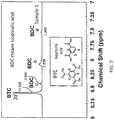
- FIG. 7 shows a 1 H-NMR spectrum of the sample 1.
- the molar ratio of the isophthalic acid was calculated as below from the values of integral of peaks indicating isophthalic acid and BTC (namely, from the area values of peaks indicating isophthalic acid and BTC).
- the value of the integral of three d-positions of the BTC namely, the value of the integral of 3d
- the value of the integral of an a-position of the isophthalic acid namely, the value of the integral of a
- the value of the integral of two b-positions of the isophthalic acid namely, the value of the integral of 2b
- the value of the integral of a c-position of the isophthalic acid is 0.990 (which is substantially equal to 1).
- the molar ratio of the isophthalic acid in the sample 1 was calculated from these values of the integral of the peaks.
- the value of the integral of three hydrogen atoms which correspond to 3d of the BTC is 11.349
- the isophthalic-acid-HKUST-1 of the sample 1 is represented by the composition formula Cu 3 (BTC) 1.58 (isophthalic acid) 0.42 .
- FIG. 8 is a graph showing a measurement result of the nitrogen adsorption isotherm of the sample 1.
- the vertical axis and the horizontal axis represent an adsorption amount of nitrogen and an introduction pressure of nitrogen (namely, relative pressure), respectively.
- the relative pressure (p/p0) is a value of ((an adsorption equilibrium pressure) / (a saturated vapor pressure)).
- the present inventos confirmed that the isotherm of the sample 1 is an isotherm of I-type derived from micropores.
- the I-type isotherm is defined by International Union of Pure and Applied Chemistry (namely, IUPAC).
- a BET specific surface area m 2 /gram was calculated within the range of the relative pressure of 0.005 - 0.04.
- a pore volume (cc/gram) was calculated by a density functional theory method (hereinafter, referred to as "DFT method").
- DFT method density functional theory method
- the present inventor determined that isophthalic acid was incorporated in the skeleton of HKUST-1 in the sample 1 on the basis of the results of the X-ray diffraction pattern shown in FIG. 6 , the NMR pattern shown in FIG. 7 , and the adsorption isotherm in the BET specific surface area measurement shown in FIG. 8 .
- the BET specific surface area and the pore size of the sample 1 were 1,270 m 2 /gram and 0.48 milliliters/gram, respectively. It is known that HKUST-1 has a BET specific surface area of approximately 2,000 m 2 /gram at a maximum. Therefore, the sample 1 has the substantially same BET specific surface area as HKUST-1.
- FIG. 9 is a graph showing a relation between the diameter of the pore size of the sample 1 and the BET specific surface area.
- FIG. 10 is a graph in which the region A included in FIG. 9 is enlarged.
- the vertical axis and the horizontal axis represent the BET specific surface area and the diameter of the pore size, respectively.
- the pore size was calculated by the DFT method.
- the pore size of HKUST-1 is mainly not more than 1.5 nanometers.
- HKUST-1 mainly has pores each having a diameter of 0.5 nanometers and pores each having a diameter of 1.5 nanometers.
- the present inventor calculated a ratio of the sum of the BET specific surface area of the pores each having a pore size of 0.15 nanometers to the sum of the BET specific surface area of all the pores in the sample 1. As a result, the ratio was 98.2 %. This reveals that the sample 1 mainly has pores each having a pore size of not more than 1.5 nanometers similarly to HKUST-1.
- the number of the pores such as mesopores may be increased and the BET specific surface area may be lowered due to uneven distribution of the isophthalic acid included in the skeleton of HKUST-1. Therefore, it is desirable that the isophthalic acid is distributed uniformly in the skeleton of HKUST-1 in view of increase in the BET specific surface area.
- the possibility is increased that a plurality of isophthalic acid molecules are closed to each other in the skeleton of HKUST-1. Therefore, the number of the pores such as mesopores (pore size: 2 nanometers) may be increased. For this reason, it is desirable that the molar ratio of the isophthalic acid is not less than 10 % and not more than 25 %.
- the following desulfurization test was conducted to investigate the desulfurization performance of the sample 1.
- a reaction tube having an inner diameter of 7 millimeters was filled with the sample 1 (1.1 grams). Then, the reaction tube was loaded into a fixed-bed reactor (i.e., a fixed-bed continuous flow reactor).
- a city gas having DMS at a concentration of 100 vol ppm was supplied to the reaction tube at a linear velocity of 100 cm / minute.
- the temperature of the desulfurization agent i.e., the sample 1
- the concentration of sulfur contained in the gas exhausted from the reaction tube was measured with a trace sulfur analyzer (product of Mitsubishi Chemical Analytech Co., Ltd.) by an oxidation-decomposition and ultraviolet fluorescence method.
- the gas exhausted from the reaction tube was analyzed with a gas chromatograph device comprising a sulfur chemiluminescence detector to identify the sulfur compound.
- An elapsed time from an analysis starting time point to a time point when the concentration of the sulfur contained in the exhausted gas reached 100 vol ppb was measured as a breakthrough time.
- the breakthrough time was 195 hours.
- the adsorption volume of the sulfur compound was calculated from the total continuous flow sulfur amount until the breakthrough time with regard to the weight of the desulfurization agent with which the reaction tube was filled.
- the weight of the sulfur compound adsorbed during the flow of the city gas for 195 hours was measured.
- the weight of the sulfur compound was 0.09 grams.
- the desulfurizer according to the present invention can be used for a hydrogen generation device and a fuel cell system.
Landscapes
- Chemical & Material Sciences (AREA)
- Chemical Kinetics & Catalysis (AREA)
- Organic Chemistry (AREA)
- Engineering & Computer Science (AREA)
- General Chemical & Material Sciences (AREA)
- Analytical Chemistry (AREA)
- Inorganic Chemistry (AREA)
- Electrochemistry (AREA)
- Sustainable Energy (AREA)
- Life Sciences & Earth Sciences (AREA)
- Manufacturing & Machinery (AREA)
- Sustainable Development (AREA)
- Oil, Petroleum & Natural Gas (AREA)
- Health & Medical Sciences (AREA)
- Combustion & Propulsion (AREA)
- General Health & Medical Sciences (AREA)
- Materials Engineering (AREA)
- Fuel Cell (AREA)
- Solid-Sorbent Or Filter-Aiding Compositions (AREA)
- Separation Of Gases By Adsorption (AREA)
- Hydrogen, Water And Hydrids (AREA)
- Organic Low-Molecular-Weight Compounds And Preparation Thereof (AREA)
Applications Claiming Priority (1)
| Application Number | Priority Date | Filing Date | Title |
|---|---|---|---|
| JP2018067962 | 2018-03-30 |
Publications (2)
| Publication Number | Publication Date |
|---|---|
| EP3553024A2 true EP3553024A2 (de) | 2019-10-16 |
| EP3553024A3 EP3553024A3 (de) | 2019-10-30 |
Family
ID=65817883
Family Applications (1)
| Application Number | Title | Priority Date | Filing Date |
|---|---|---|---|
| EP19163086.2A Withdrawn EP3553024A3 (de) | 2018-03-30 | 2019-03-15 | Entschwefelungsvorrichtung, wasserstofferzeugungsvorrichtung und brennstoffzellensystem |
Country Status (4)
| Country | Link |
|---|---|
| US (1) | US10889597B2 (de) |
| EP (1) | EP3553024A3 (de) |
| JP (1) | JP2019181452A (de) |
| CN (1) | CN110316702A (de) |
Families Citing this family (12)
| Publication number | Priority date | Publication date | Assignee | Title |
|---|---|---|---|---|
| CN114479096B (zh) * | 2020-10-23 | 2024-01-09 | 中国石油化工股份有限公司 | 一种双配体金属有机骨架材料及其制备方法与应用 |
| JPWO2023085229A1 (de) * | 2021-11-15 | 2023-05-19 | ||
| JP7742572B2 (ja) * | 2021-11-16 | 2025-09-22 | パナソニックIpマネジメント株式会社 | 水素生成装置およびその運転方法 |
| JPWO2023153070A1 (de) * | 2022-02-08 | 2023-08-17 | ||
| CN119677586A (zh) * | 2022-08-16 | 2025-03-21 | 松下知识产权经营株式会社 | 脱硫剂 |
| EP4585292A4 (de) * | 2022-09-09 | 2026-01-21 | Panasonic Ip Man Co Ltd | Adsorptionsmittel und verfahren zur verwendung davon |
| CN116082650A (zh) * | 2022-12-27 | 2023-05-09 | 开滦(集团)有限责任公司 | 一种锌基金属有机框架材料及其制备方法和应用 |
| WO2024202698A1 (ja) * | 2023-03-30 | 2024-10-03 | パナソニックIpマネジメント株式会社 | 脱硫剤、その脱硫剤を用いて流体から硫黄化合物を除去する方法、及び水素含有ガスの製造方法 |
| WO2025217100A1 (en) | 2024-04-09 | 2025-10-16 | Chevron Phillips Chemical Company Lp | Methods and systems for storing odorized fluids |
| WO2025217089A1 (en) | 2024-04-09 | 2025-10-16 | Chevron Phillips Chemical Company Lp | Odorized fluids and methods |
| WO2025217091A1 (en) | 2024-04-09 | 2025-10-16 | Chevron Phillips Chemical Company Lp | Odorants for fluids, odorized fluids, methods, and systems |
| WO2025217099A1 (en) | 2024-04-09 | 2025-10-16 | Chevron Phillips Chemical Company Lp | Inhibitors for hydrogen embrittlement and methods |
Citations (2)
| Publication number | Priority date | Publication date | Assignee | Title |
|---|---|---|---|---|
| EP0599351A1 (de) | 1992-11-27 | 1994-06-01 | Osaka Gas Co., Ltd. | Verfahren zur Entschwefelung von Stadtgas |
| WO2017150019A1 (ja) | 2016-03-01 | 2017-09-08 | パナソニック株式会社 | 流体からの硫黄化合物の除去 |
Family Cites Families (6)
| Publication number | Priority date | Publication date | Assignee | Title |
|---|---|---|---|---|
| JP3242514B2 (ja) | 1992-11-27 | 2001-12-25 | 大阪瓦斯株式会社 | 都市ガスの脱硫方法 |
| DE102005022844A1 (de) * | 2005-05-18 | 2006-11-23 | Basf Ag | Abtrennung von Geruchsstoffen aus Gasen |
| CA2698875A1 (en) * | 2007-09-10 | 2009-03-19 | Shell Internationale Research Maatschappij B.V. | Process for producing purified synthesis gas from synthesis gas comprising trace amounts of sulphur contaminants with a metal-organic framework |
| US20120152845A1 (en) * | 2010-05-27 | 2012-06-21 | Vanderbilt University | Porous silica-metal organic composite adsorbents and methods of making and using the same |
| JP6089618B2 (ja) * | 2012-11-20 | 2017-03-08 | 東洋紡株式会社 | 硫黄化合物吸着・除去フィルタ |
| JP2015077594A (ja) * | 2013-09-12 | 2015-04-23 | パナソニックIpマネジメント株式会社 | 多孔性金属有機骨格材料に二酸化炭素を吸着させる方法、多孔性金属有機骨格材料を冷却する方法、多孔性金属有機骨格材料を用いてアルデヒドを得る方法、および多孔性金属有機骨格材料を加温する方法 |
-
2018
- 2018-12-14 JP JP2018234543A patent/JP2019181452A/ja active Pending
- 2018-12-21 US US16/228,765 patent/US10889597B2/en active Active
-
2019
- 2019-03-15 EP EP19163086.2A patent/EP3553024A3/de not_active Withdrawn
- 2019-03-25 CN CN201910225743.1A patent/CN110316702A/zh active Pending
Patent Citations (2)
| Publication number | Priority date | Publication date | Assignee | Title |
|---|---|---|---|---|
| EP0599351A1 (de) | 1992-11-27 | 1994-06-01 | Osaka Gas Co., Ltd. | Verfahren zur Entschwefelung von Stadtgas |
| WO2017150019A1 (ja) | 2016-03-01 | 2017-09-08 | パナソニック株式会社 | 流体からの硫黄化合物の除去 |
Non-Patent Citations (1)
| Title |
|---|
| W. ZHANG: "Impact of Synthesis Parameters on the Formation of Defects in HKUST-1", EUROPEAN JOURNAL OF INORGANIC CHEMISTRY, 2017, pages 925 - 931 |
Also Published As
| Publication number | Publication date |
|---|---|
| US10889597B2 (en) | 2021-01-12 |
| US20190300548A1 (en) | 2019-10-03 |
| CN110316702A (zh) | 2019-10-11 |
| EP3553024A3 (de) | 2019-10-30 |
| JP2019181452A (ja) | 2019-10-24 |
Similar Documents
| Publication | Publication Date | Title |
|---|---|---|
| US10889597B2 (en) | Desulfurizer, hydrogen generation device, and fuel cell system | |
| Wang et al. | Crystallizing atomic xenon in a flexible MOF to probe and understand its temperature-dependent breathing behavior and unusual gas adsorption phenomenon | |
| Ma et al. | Synergistic interplay of dual‐active‐sites on metallic Ni‐MOFs loaded with Pt for thermal‐photocatalytic conversion of atmospheric CO2 under infrared light irradiation | |
| Lozinska et al. | Cation gating and relocation during the highly selective “trapdoor” adsorption of CO2 on univalent cation forms of zeolite rho | |
| JP6238150B1 (ja) | 流体からの硫黄化合物の除去 | |
| Liu et al. | Mg‐MOF‐74 derived defective framework for hydrogen storage at above‐ambient temperature assisted by Pt catalyst | |
| Lei et al. | Highly poison‐resistant single‐atom Co–N4 active sites with superior operational stability over 460 h for H2S catalytic oxidation | |
| Ma et al. | A Zeolitic Octahedral Metal Oxide with Ultra‐Microporosity for Inverse CO2/C2H2 Separation at High Temperature and Humidity | |
| Abdoli et al. | Bimetallic Ni–Co‐based metal–organic framework: An open metal site adsorbent for enhancing CO2 capture | |
| Shen et al. | Stabilizing CuI in MIL-101 (Cr) by introducing long-chain alkane for adsorptive desulfurization | |
| JPWO2003025096A1 (ja) | 炭化水素の脱硫、改質方法 | |
| Hao et al. | Hydrogen direct adsorptive separation: development status and trends | |
| CN101168692B (zh) | 用于燃料电池的脱硫吸附剂及采用它的脱硫方法 | |
| Wang et al. | Study on the decarbonization mechanism of composite adsorbent by Mg-MOF-74-based modified biochar | |
| Wang et al. | Synergistic effect of bimetal in isoreticular Zn–Cu–1, 3, 5-benzenetricarboxylate on room temperature gaseous sulfides removal | |
| Yang et al. | Facile preparation of Cu (I)/5A via one-step impregnation with highly dispersed CuCl in ethanol single solvent toward selective adsorption of CO from H2 stream | |
| Braun et al. | Following the structural changes of iron oxides during reduction under transient conditions | |
| Koriakin et al. | Adsorptive desulfurization of natural gas using lithium-modified mesoporous silica | |
| Kim et al. | Partial‐Interpenetration‐Controlled UiO‐Type Metal‐Organic Framework and its Catalytic Activity | |
| You et al. | Thiophene-based mesoporous covalent organic framework for efficient iodine vapor capture | |
| Pazdera et al. | Impact of the Local Environment of Amines on the Activity for CO2 Hydrogenation over Bifunctional Basic–Metallic Catalysts | |
| Yan et al. | Performance evaluation of Zn-Fe adsorbent for H2S adsorption during biogas purification | |
| Li et al. | The introduction of Mn component improves the selectivity of NO adsorption separation in simulated flue gas of Co‐MOF‐74 at ambient conditions | |
| Gong et al. | Modification of Cu3 (BTC) 2 with cobalt ion for adsorption and visualized detection of formaldehyde gas | |
| Jiao et al. | Effect of DBD Plasma Treatment on Activity of Mo‐Based Sulfur‐Resistant Methanation Catalyst |
Legal Events
| Date | Code | Title | Description |
|---|---|---|---|
| PUAI | Public reference made under article 153(3) epc to a published international application that has entered the european phase |
Free format text: ORIGINAL CODE: 0009012 |
|
| PUAL | Search report despatched |
Free format text: ORIGINAL CODE: 0009013 |
|
| AK | Designated contracting states |
Kind code of ref document: A2 Designated state(s): AL AT BE BG CH CY CZ DE DK EE ES FI FR GB GR HR HU IE IS IT LI LT LU LV MC MK MT NL NO PL PT RO RS SE SI SK SM TR |
|
| AX | Request for extension of the european patent |
Extension state: BA ME |
|
| AK | Designated contracting states |
Kind code of ref document: A3 Designated state(s): AL AT BE BG CH CY CZ DE DK EE ES FI FR GB GR HR HU IE IS IT LI LT LU LV MC MK MT NL NO PL PT RO RS SE SI SK SM TR |
|
| AX | Request for extension of the european patent |
Extension state: BA ME |
|
| RIC1 | Information provided on ipc code assigned before grant |
Ipc: B01D 53/02 20060101ALI20190925BHEP Ipc: C01B 3/38 20060101AFI20190925BHEP Ipc: B01J 20/22 20060101ALI20190925BHEP Ipc: H01M 8/0612 20160101ALI20190925BHEP |
|
| STAA | Information on the status of an ep patent application or granted ep patent |
Free format text: STATUS: THE APPLICATION IS DEEMED TO BE WITHDRAWN |
|
| 18D | Application deemed to be withdrawn |
Effective date: 20200603 |