EP3552949B1 - Luftballonverstärkungssystem und -verfahren - Google Patents
Luftballonverstärkungssystem und -verfahren Download PDFInfo
- Publication number
- EP3552949B1 EP3552949B1 EP18783355.3A EP18783355A EP3552949B1 EP 3552949 B1 EP3552949 B1 EP 3552949B1 EP 18783355 A EP18783355 A EP 18783355A EP 3552949 B1 EP3552949 B1 EP 3552949B1
- Authority
- EP
- European Patent Office
- Prior art keywords
- gas
- hydrogen
- reinforcement
- integration
- buoyancy
- Prior art date
- Legal status (The legal status is an assumption and is not a legal conclusion. Google has not performed a legal analysis and makes no representation as to the accuracy of the status listed.)
- Active
Links
Images




Classifications
-
- B—PERFORMING OPERATIONS; TRANSPORTING
- B64—AIRCRAFT; AVIATION; COSMONAUTICS
- B64B—LIGHTER-THAN AIR AIRCRAFT
- B64B1/00—Lighter-than-air aircraft
- B64B1/58—Arrangements or construction of gas-bags; Filling arrangements
-
- B—PERFORMING OPERATIONS; TRANSPORTING
- B64—AIRCRAFT; AVIATION; COSMONAUTICS
- B64B—LIGHTER-THAN AIR AIRCRAFT
- B64B1/00—Lighter-than-air aircraft
- B64B1/58—Arrangements or construction of gas-bags; Filling arrangements
- B64B1/60—Gas-bags surrounded by separate containers of inert gas
-
- B—PERFORMING OPERATIONS; TRANSPORTING
- B64—AIRCRAFT; AVIATION; COSMONAUTICS
- B64B—LIGHTER-THAN AIR AIRCRAFT
- B64B1/00—Lighter-than-air aircraft
-
- C—CHEMISTRY; METALLURGY
- C01—INORGANIC CHEMISTRY
- C01B—NON-METALLIC ELEMENTS; COMPOUNDS THEREOF; METALLOIDS OR COMPOUNDS THEREOF NOT COVERED BY SUBCLASS C01C
- C01B3/00—Hydrogen; Gaseous mixtures containing hydrogen; Separation of hydrogen from mixtures containing it; Purification of hydrogen; Reversible storage of hydrogen
- C01B3/02—Production of hydrogen; Production of gaseous mixtures containing hydrogen
- C01B3/06—Production of hydrogen; Production of gaseous mixtures containing hydrogen by reaction of inorganic compounds containing electro-positively bound hydrogen with inorganic reducing agents
- C01B3/08—Production of hydrogen; Production of gaseous mixtures containing hydrogen by reaction of inorganic compounds containing electro-positively bound hydrogen with inorganic reducing agents by reaction of inorganic compounds with metals
-
- C—CHEMISTRY; METALLURGY
- C25—ELECTROLYTIC OR ELECTROPHORETIC PROCESSES; APPARATUS THEREFOR
- C25B—ELECTROLYTIC OR ELECTROPHORETIC PROCESSES FOR THE PRODUCTION OF COMPOUNDS OR NON-METALS; APPARATUS THEREFOR
- C25B1/00—Electrolytic production of inorganic compounds or non-metals
- C25B1/01—Products
- C25B1/02—Hydrogen or oxygen
- C25B1/04—Hydrogen or oxygen by electrolysis of water
-
- Y—GENERAL TAGGING OF NEW TECHNOLOGICAL DEVELOPMENTS; GENERAL TAGGING OF CROSS-SECTIONAL TECHNOLOGIES SPANNING OVER SEVERAL SECTIONS OF THE IPC; TECHNICAL SUBJECTS COVERED BY FORMER USPC CROSS-REFERENCE ART COLLECTIONS [XRACs] AND DIGESTS
- Y02—TECHNOLOGIES OR APPLICATIONS FOR MITIGATION OR ADAPTATION AGAINST CLIMATE CHANGE
- Y02E—REDUCTION OF GREENHOUSE GAS [GHG] EMISSIONS, RELATED TO ENERGY GENERATION, TRANSMISSION OR DISTRIBUTION
- Y02E60/00—Enabling technologies; Technologies with a potential or indirect contribution to GHG emissions mitigation
- Y02E60/30—Hydrogen technology
- Y02E60/36—Hydrogen production from non-carbon containing sources, e.g. by water electrolysis
Definitions
- the simplicity of the concept allows a high degree of integration providing for practical implementation of the use of hydrogen.
- Anaerostat is an aircraft lighter than air that gains lift by using a floating gas. Aerostats gain lift by way of large envelopes filled with a lifting gas that is less dense than the surrounding air.
- the two primary lifting gas used by airships are hydrogen and helium.
- Helium is relatively rare on Earth; however, hydrogen is the third most abundant element on the Earth's surface, chiefly in the form of chemical compounds such as hydrocarbons and water.
- Hydrogen is the lightest element on Earth and can be obtained easily and cost-effectively. Hydrogen has enormous potential as a clean energy source for future generation of vehicles. Climactically and environmentally clean throughout the conversion chain, right from production up to use.
- WO 2012/112913 discloses an airship that includes a plurality of connected segments and a controller that is adapted to dynamically control the movement of each of the plurality of segments relative to one another during flight of the airship.
- US6527223 B1 discloses an airship for lifting and transporting loads, particularly heavy loads.
- the lifting ability of the airship is given by lighter than air gas contained in bags located between two parallel horizontal platforms constructed in lightweight geodesic fashion, the platform and bag assembly being raised and lowered by means of respectively injecting and exhausting the gas into and from the bags, the whole, together with the lifted object, being moved and steered through the atmosphere by the combined means of conventional powered propeller units and a curtain circumferential to and rotated about the platforms thus using the Magnus Effect.
- a fail-safe design which in the event of a specific type of failure responds in order to cease or minimize the damage to the structure and to other equipment, to the environment or to people.
- the system's design avoids or mitigates the unsafe consequences of system failure.
- the present invention achieves this objective by providing a platform of buoyancy which comprises a fail-safestructure, enabling the safe use of hydrogen as floating gas.
- the invention is defined by claim 1. This invention is focused on the structural architecture of future aircraft lighter than air. Integration and Buoyancy Structures (IBS), terminals that provide a modular and secure buoyancy platform to furnisha truly efficient architecture built with different purposes, through various interfaces of elevation with multidimensional platforms for full convergence of a lightweight architecture, with strength and aerodynamics.
- IBS Integration and Buoyancy Structures
- the IBS includes features to maximize the efficiency of the design used in the project and streamline the management of structural and material resources across the multi-modular structure.
- a buoyancy platform is provided in accordance with the following considerations.
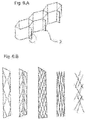
- a reinforcement and integration structure e.g. Shell Lace Shell, lattice-shell, membrane structures, tensegrity structures, lattice structure, web-like structure and schwarzite structures
- a reinforcement and integration structure increase safety and allow adjustment for different pressures in individual sessions.
- the buoyancy platform is mounted in modular form, combining individual portions endowed with floatation segments and with integration and reinforcement structures to provide the end platform.
- a hydrogen receptacle with a gas-impermeable cover element made of a pressure and fire-resistant material and can be used with a connection and integration structure.
- the structure can be made of both flexible material (e.g. flame resistant meta-aramid), rigid materials (e.g. nanostructures of metal alloys) or semi-rigid (e.g. aerogel).
- flexible material e.g. flame resistant meta-aramid
- rigid materials e.g. nanostructures of metal alloys
- semi-rigid e.g. aerogel
- the buoyancy platform of this invention is not limited to aerostats, but can be used basically for any purpose, e.g. as a launch and landing pad, defense applications, surveillance, scientific and observational operations, a base for equipment and machinery, wind energy extraction, reduced-impact forest management, perform tasks such as near space search, keeping the costs well below the low Earth orbit satellites, carry passengers, for tourists and scientific teams, meteorological measurements.
- Carry instrumentation including radio transmission, infrastructure networks, transport, logistics and distribution, passenger transport, assistance in case of disaster, emergency and rescue services, forest protection, combating fires, base for equipment and lifting devices and other purposes.
- a gas other than hydrogen can be used to fill the floating bodies.
- gases such as methane, carbon monoxide, ammonia and natural gas
- Operational considerations such as whether the lifting gas can be economically obtained and produced in flight for buoyancy control (such as with hydrogen) or even produced as a by-product, affect the practical choice of the lifting gas in airworthiness projects.
- the materials of floating bodies are not particularly limited.
- membranes made of meta-aramid polymer can be used to provide the flexibility required, as well as sufficient resistance to pressure and tensile strength and, at the same time, ensure that the expandability is limited in pressurized state.
- the structure is based on nano-structured metal alloys, carbon fiber, aerogel or light weight material.
- the mechanical properties of the material include the strength of elasticity, stretch tension, fatigue resistance, resistance to cracks and other features. Another advantage of the invention is that the entire platform can be built with lightweight components.
- the Integration and Buoyancy Structures (IBS) approach combines ultra-rigid and ultra-strong materials (such as aerogel and nano-structured metal alloys), providing greater resistance than conventional materials.
- Ultra-rigid and ultra-strong materials such as aerogel and nano-structured metal alloys
- Highly optimized beam architectures allow unprecedented degrees of freedom to adapt the mechanical performance of the ultralight lattice structures.
- the system will be characterized by a modular lattice structure model, where different technologies of materials such as aerogel, meta-aramid, fiber or carbon films, nanostructured metal alloys and other new materials, could be combined into a common platform to complement each other in an ideal way for different environments and lift requirements, the structural architecture to the IBSterminal of the present invention is a set of robust solutions that provide a way to build a buoyancy lifting platform through common modular components, technically referred to as "hydrogen cell (HC), Integration and Buoyancy Structures (IBS), in a more technical sense”.
- HC hydrogen cell
- IBS Integration and Buoyancy Structures
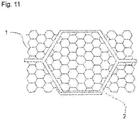
- the reinforcement and integration structure is manufactured to be prismatic, and floating bodies are laid out symmetrically like honeycombs.
- the Lattice structures provide high rigidityto torsion and flexion at a low weight.
- honeycomb structure involves creating controlled internal limits to block the displacement movement.
- Such strategies invariably undermine the ductility, the ability of the material to deform, stretch or change permanently without breaking.
- the systems composed of structural elements which themselves have lattice structure systems benefit from significantly improved mechanical properties, high strength characteristics, lightness and greater resistance the spread of cracks.
- the shape of the inventive platform is a honeycomb.
- Each above mentioned structure module is an open module that is extendable, upgradable, reshapeable and removable.
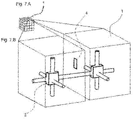
- One embodiment form of this invention is a system comprising a buoyancy structure having a gas compartment and a reinforcement device that integrates one or several compartments of gas lighter than air (hydrogen cells).
- the architecture for the structure of hydrogen cell (HC) of the present invention is one or a group of open structural modules that are obviously variable, mutually inclusive and capable of being used as units or in set as a system for future aerostat projects, based on modular architecture technology, so that the structure can support different safety standards and integrate the various modular parts in a flexible and economic architecture.
- the lattice structures can be thought of as any repetitive cell structure, with a topology or basic structure that repeats - consistently or with some variation.
- the lattice structures offer a method to significantly reduce this complexity. Using a common cellular topology to fill the space of the design.
- Honeycomb structures are structures that have the geometry of a honeycomb to allow minimization of the amount of material used to achieve minimum weight and minimum cost of the material.
- the geometry of the honeycomb structures can vary widely, but the common feature of all these structures is a matrix of hollow cells formed between thin vertical walls. The cells are usually in column and hexagonal form.
- biomimetic designs based on the bones of the bird.
- the bone gains strength and flexibility of the material, but also from the way it depositsits structural elements in layers.
- the bones may evolve with slightly different shapes, sizes and angles. They have increased resistance to weight in many directions: vertical, horizontal and diagonal - and this internal variability makes the bones more resistant when accidents occur.
- the bones are solid on the outside, but empty inside. This makes them light and easy to move, and also extremely firm. For this purpose, although it has a fairly rigid outer surface.
- the partition in terms of macro and micro design, including lattice structures that connect the larger perimeter, creating a strong and efficient structure between two fixed points.
- the micro elements mimic the partition of bird bone, filling open spaces with grid structures.
- the resulting design is a web type pattern that forms a network of optimized load support points.
- the final configuration requires minimum material, the walls should be as light as possible and take up the least amount of space and ensure the amount of three-dimensional space closed to hydrogen gas.
- Tensegrity structures are based on the combination of a few simple design patterns: members loaded only in pure compression or pure tension, which allows cables to be taut in tension, with mechanical stability, enabling the members to remain taut /compressed as the stress on the structure increases.
- Shell structure Single surface structural technique called shell structure, Shell Lace Structure, lattice-shell.
- the structural and manufacturing technique combines digital modeling, digital analysis with laser cutting manufacturing economy, transforming flat sheet materials into self-supporting structures.
- the iterative analysis yields highly efficient structures that respond to the environment and minimize the weight and waste.
- Shell Lace Structures are optimized through curvature, undulations and holes.
- the technique is inspired in nature; shells gain great strength from the curvilinear geometry, growing in thin layers over time, just where they need to. Curvatures, along with undulations, create rigidity.
- the holes minimize the weight by removing material where the structure does not require strength, bringing lightness. This facilitates the production of the inventive platform, because only a few different modules can then be combined specifically to provide the most appropriate platform for the design project.
- membrane structures can also be provided within the floating bodies.
- the membrane structures are spatial structures made of taut membranes.
- the structural use of membranes can be divided into pneumatic structures,traction membrane structures and cable domes. In these three types of structure, the membranes work together with cables, columns and other members of the construction to find form.
- IBS Integration and Buoyancy Structure
- the hydrogen cell can be treated as an isolated structure. It is known that the border conditions imposed by a networked grid impact substantially the amount of energy that can be produced by blast and should be considered the rate of deformation of the material of the panels. In some embodiment forms, the cell endures beyond the limits of the early conditions of fire and explosion, the lateral pressure exerted by the approach of explosion or fire, cannot be transmitted from one floating body to the next, as is the case when the divisions by dividing walls are provided.
- the different buoyancy power that arises in one or several cameras delivers how the platform with floating stability.
- one or more hydrogen cells (HC) can be attached to the reinforcement and integration structure element, e.g. lattice structure made of a material with low density and high strength, e.g. nano-structured metal alloys.
- the method describes a modular rearrangement scheme of or one or multiple hydrogen cells connected in network, capable of changing their interconnections.
- One example provided is a set of hydrogen fuel cells that have high-safety hydrogen stored in it and can, for example, be manufactured to have a prismatic form arranged orthogonally regularly and arranged in an integral reinforcing structure, manufactured in a lattice shape.
- One objective of the present invention is to provide a new type of hydrogen fuel cells with a very high volume and efficiency, at the same time, be able to withstand the pressure of the gas and change the pressure, and at the same time it allowscells of any size to be made, with modular extension in any of the three spatial directions.
- Another objective of this invention is to provide a buoyancy structure that includes high volume efficiency and prevents a fire or an explosion in a cell from spreading out, allowing the integration of a secondary reinforcement structure.
- Another objective of the invention is to provide a container that is adequate to allow the buoyancy control.
- a further object is to provide a concept of cells that is modular and scalable to any size by means of repetitive and modular elements.
- the basic hexagonal form can be modified to more general prismatic forms.
- the resulting designs are optimized for performance and weight and can be as rigid or flexible as needed for the desired application, all designed to provide flexible and customized options at a small cost and a high-safety aircraft lighter than air.
- the generative design process which focuses on the computing power to find optimized design solutions based on designer-defined parameters, is not just a way to increase quality and performance of the design but is also able to dramatically reduce the costs and materials in an effort to optimize manufacturing strategies.
- each hydrogen cell has its own internal microcontroller that records relevant physical parameters, such as temperature and the buoyancy state of the cell. As a result, each hydrogen cell (HC) knows what condition it is in.
- the hydrogen cells (HC) communicate with each other through wireless wiring or wiring between hydrogen cells (HC), likenetwork communication. They can also communicate with other devices, such as the on-board computer, which uses the data from the cells to calculate the amount of buoyancy that the hydrogen cell (HC) has, the status of the cell.
- aerostat does not need to stop, since a cell of hydrogen (HC) with lower capacity will unlikely affect the general breadth of anlntegration and Buoyancy Structure (IBS).Instead, the empty hydrogen cell simply detaches itself from the group, acting as a bypass. The others continue to provide hydrogen, and the empty cells are replaced, and if a hydrogen cell (HC) malfunctions, there is no need to take the aircraft to the workshop. Since the aerostat can have more than one cell, it does not depend on any individual one. And in terms of repair, it is suffice just to replace the single cell of hydrogen (HC).
- HC hydrogen
- IBS Buoyancy Structure
- the smart control network will feel the need and will make the perfect adjustment, providing control of volume, temperature, pressure, hydrogen, stability, buoyancy and flight control as needed.
- This network will be incorporated into the structural materials. As a smart system, they can perform numerous functions, recognizing the environment, using systems of sensors and actuators that give the structure a certain level of artificial intelligence, allowing them to adapt to needs of the IBS.
- the structure may also comprise multiple sensors for altitude, position and actuator to provide a buoyancy control and specified flight control, a control system that accompanies the computer vision system, which combines data from all the sensors, monitoring their weaknesses, a module, or subsystem intended to detect events or changes in the environment and send the information to other electronic components.
- IBS Integration and Buoyancy Structure
- the object of the present invention is therefore the provision of a buoyancy platform with a smart system for Structural Control Response, buoyancy properties and particularly has better protection against effects due to flammability and explosive reactions.
- the smart control would regulate buoyancy of the aerostat, thus having a dynamic response like a smart hydrogen network - each cell can change in seconds - and can react dynamically to different buoyancy levels throughout the flight, which means that the buoyancy levels of the aerostat would remain constant during variations in atmospheric pressure and temperature.
- One of the objectives of Integration and Buoyance Structure (IBS) is to design a smart architecture adjustable to a network to control the buoyancy, temperature, pressure, humidity, stability and flight control of the aerostat.
- the hydrogen pumping through a network of channels allows the buoyancy control of functional modules.
- the channels can be compared to the cardiovascular system, for example.
- the Integration and Buoyancy Structure (IBS) and the responsive hydrogen cell (HC) combine insulation, cover and structural protection (subject to stress and tension) with an integrated network that pulsates through it, which can identify and respond to the specific needs of each HC.
- IBS Integration and Buoyancy Structure
- HC responsive hydrogen cell
- the lattice and honeycomb structure and the integration network will create the perfect combination of strength, lightness and space. It is lightweight and strong, because its network structure has voltage only when necessary, leaving space available. By using lattice structures, the structure has the necessary strength, but can also take advantage of the extra space when needed.
- a crack in a hydrogen cell will not damage the Integration and Buoyancy Structure (IBS) combination because it has a chain of other hydrogen cells as backup.
- the grid can redirect hydrogen from cell to cell. Hydrogen can be concentrated in special cells for volume control.
- the structure called and Integration and Buoyancy Structure (IBS) is an open-cell 3D structure composed of lattice structures, tensegrity or membrane structures of empty, interconnected cells.
- IBS Integration and Buoyancy Structure
- the cellular architecture of the material gives rise to an unprecedented mechanical behavior for anaerostat, including recovery from compression and high voltage power absorption, vibration or shock energy buffering.
- improved system performance is obtained by using channels for the exchange of hydrogen, fluid cells and a series of ducts, channeled through the system like a fluid hydrogen grid.
- the tube connections extend from at least one device for generating pressurized hydrogen, so as to provide a uniform deposit on the floating bodies.
- the channels can be incorporated into the hard or soft materials, depending on the purpose of use.
- the consistency and the form of a smooth and elastic film are more suitable for integration in a membrane structure compared to a rigid one, which, in turn, is better for a lattice structure platform.
- light longitudinal integration structures such as channels can be added between the panels, giving the internal structure the appearance of a huge bird cage or web-like structure.
- the floating bodies can have pressure relief valves to prevent excess stretching to prevent the breakup of floating bodies in case of breakdowns or overpressure.
- a membrane-like coated cover controls the amount of UV radiation, humidity, temperature and gas permeability.
Landscapes
- Engineering & Computer Science (AREA)
- Chemical & Material Sciences (AREA)
- Mechanical Engineering (AREA)
- Aviation & Aerospace Engineering (AREA)
- Organic Chemistry (AREA)
- Inorganic Chemistry (AREA)
- Chemical Kinetics & Catalysis (AREA)
- Metallurgy (AREA)
- Materials Engineering (AREA)
- Electrochemistry (AREA)
- Health & Medical Sciences (AREA)
- General Health & Medical Sciences (AREA)
- Combustion & Propulsion (AREA)
- Filling Or Discharging Of Gas Storage Vessels (AREA)
- Hydrogen, Water And Hydrids (AREA)
- Electrolytic Production Of Non-Metals, Compounds, Apparatuses Therefor (AREA)
Claims (10)
- System zur Verstärkung von Leichter-als-Luft-Flugzeugen, wie z. B. Luftballons, umfassend:- eine modulare Auftriebsplattform, die aus Schwimmsegmenten besteht, wobei die Schwimmsegmente eine oder mehrere Gaszellen (1) umfassen;- ein intelligentes Steuernetzwerk, das so ausgebildet ist, dass es ein Auftriebsniveau des Leichter-als-Luft-Flugzeugs dynamisch steuert, wobei das intelligente Steuernetzwerk Folgendes umfasst:dadurch gekennzeichnet, dass es ferner eine Verstärkungs- und Integrationsstruktur (2) umfasst, die eine prismatische modulare Struktur umfasst;∘ einen Bordcomputer,∘ einen Mikrocontroller in jeder der genannten einen oder mehreren Gaszellen (1),∘ eine Vielzahl von Sensoren, und∘ ein Kommunikationsnetzwerk,
wobei:- die Verstärkungs- und Integrationsstruktur (2) aus einem Material besteht, das nanostrukturierte Metalllegierungen, eine Kohlenstofffaser, ein Aerogel oder ein leichtes Material umfassen;- die Vielzahl von Sensoren in der gesamten Verstärkungs- und Integrationsstruktur (2) angeordnet sind;- die Schwimmsegmente in der Verstärkungs- und Integrationsstruktur (2) in einer Wabenkonfiguration integriert sind; und- die eine oder mehrere Gaszellen (1) mittels Kanälen verbunden sind, die ein Gitter bilden, um ein schwimmendes Gas von Zelle zu Zelle auszutauschen und zu verteilen, wobei das schwimmende Gas Wasserstoff ist. - System nach Anspruch 1, wobei die prismatische modulare Struktur aus einer Gruppe ausgewählt ist, die eine Schalen-Struktur, eine Gitter-Schalen-Struktur, eine MembranStruktur, eine Tensegrity-Struktur, eine Gitter-Struktur, eine stegartige Struktur, eine Schwarzit-Struktur oder eine Kombination davon umfasst.
- System nach Anspruch 1, wobei die Mikrocontroller der einen oder mehreren Gaszellen (1) über das Kommunikationsnetzwerk miteinander sowie mit dem Bordcomputer in Verbindung stehen.
- System nach Anspruch 1 oder 3, wobei die Mikrocontroller so ausgebildet sind, dass sie einen oder mehrere der folgenden Parameter erfassen: Temperatur, Auftriebszustand, Schwimmgaspegel oder Zustand der Gaszelle.
- System nach Anspruch 1, wobei die Vielzahl von Sensoren, die in der gesamten Verstärkungs- und Integrationsstruktur (2) angeordnet sind, über das Kommunikationsnetzwerk mit dem Bordcomputer in Verbindung stehen.
- System nach Anspruch 1 oder 5, wobei die Vielzahl von Sensoren so ausgebildet sind, dass sie einen oder mehrere der folgenden Parameter erfassen: Höhe des Flugzeugs, Position des Flugzeugs, Atmosphärendruck oder Temperatur.
- System nach Anspruch 1, wobei das Flugzeug ferner eine Gaserzeugungsvorrichtung umfasst, die mit den Schwimmsegmenten verbunden ist, um das schwimmende Gas leeren oder fast leeren Gaszellen (1) zuzuführen.
- System nach Anspruch 7, wobei die Gaserzeugungsvorrichtung das schwimmende Gas erzeugt durch:- Strom mit einer wasserbasierten Elektrolyse-Brennstoffzelle,- Wärme mit einer wasserbasierten Thermolyse-Brennstoffzelle, oder- chemisch mit einer Redox-Erzeugungseinheit.
- System nach Anspruch 1, wobei die Gaszellen (1) aus einem druck- und feuerfesten Material bestehen, das einen Schutz gegen klimatische Einflüsse, Entflammbarkeit des schwimmenden Gases und explosive Reaktionen bereitstellt.
- System nach Anspruch 1, wobei die Verstärkungs- und Integrationsstruktur (2) und die Gaszellen (1) offene Module sind, die erweiterbar, umgestaltbar und entfernbar sind.
Applications Claiming Priority (1)
| Application Number | Priority Date | Filing Date | Title |
|---|---|---|---|
| PCT/BR2018/050036 WO2019157577A1 (pt) | 2018-02-19 | 2018-02-19 | Sistema e método de reforço de aeróstatos |
Publications (3)
| Publication Number | Publication Date |
|---|---|
| EP3552949A1 EP3552949A1 (de) | 2019-10-16 |
| EP3552949A4 EP3552949A4 (de) | 2019-10-23 |
| EP3552949B1 true EP3552949B1 (de) | 2021-08-25 |
Family
ID=64560538
Family Applications (1)
| Application Number | Title | Priority Date | Filing Date |
|---|---|---|---|
| EP18783355.3A Active EP3552949B1 (de) | 2018-02-19 | 2018-02-19 | Luftballonverstärkungssystem und -verfahren |
Country Status (11)
| Country | Link |
|---|---|
| US (1) | US11046412B2 (de) |
| EP (1) | EP3552949B1 (de) |
| JP (1) | JP2021514318A (de) |
| KR (1) | KR20200121927A (de) |
| CN (1) | CN110799417A (de) |
| AU (1) | AU2018236784A1 (de) |
| CA (1) | CA3018303A1 (de) |
| GB (1) | GB2573354A (de) |
| IL (1) | IL261972A (de) |
| RU (1) | RU2018134311A (de) |
| WO (1) | WO2019157577A1 (de) |
Families Citing this family (7)
| Publication number | Priority date | Publication date | Assignee | Title |
|---|---|---|---|---|
| KR102922440B1 (ko) | 2020-09-22 | 2026-02-05 | 주식회사 엘지에너지솔루션 | 전지셀의 수명이 향상된 전지 팩 및 이를 포함하는 디바이스 |
| FR3120798B1 (fr) * | 2021-03-16 | 2025-02-07 | Safran Nacelles | Structure treillis d’aéronef permettant d’éviter la propagation d’un feu et aéronef |
| KR102505650B1 (ko) | 2021-10-21 | 2023-03-03 | 한국생산기술연구원 | 염가 및 고기능 3d 프린팅 부품의 제작방법 및 이를 이용한 염가 및 고기능 3d 프린팅 부품 |
| KR102447725B1 (ko) * | 2021-12-31 | 2022-09-27 | 한국과학기술연구원 | 신축 균일도가 향상된 신축성 기판 및 그 제조 방법 |
| KR102447724B1 (ko) * | 2021-12-31 | 2022-09-27 | 한국과학기술연구원 | 신축 균일도가 향상된 신축성 기판 및 그 제조 방법 |
| US12394804B2 (en) | 2022-08-16 | 2025-08-19 | General Electric Company | Thermal management of a fuel cell assembly |
| CN115828342B (zh) * | 2022-11-22 | 2025-06-13 | 四川福莱特科技有限公司 | 一种快速部署浮空器充气时间以及浮力分析方法、设备 |
Family Cites Families (36)
| Publication number | Priority date | Publication date | Assignee | Title |
|---|---|---|---|---|
| US1191077A (en) * | 1915-08-20 | 1916-07-11 | Oscar Hermanson | Airship. |
| US1715829A (en) * | 1928-02-17 | 1929-06-04 | George Seth | Collapsible gas container with internal bracing |
| GB367707A (en) * | 1930-07-21 | 1932-02-25 | Luftschiffbau Zeppelin Ges Mit | Improvements in lighter-than-air aircraft |
| US2083051A (en) * | 1936-09-26 | 1937-06-08 | Steven J Chapas | Airship |
| FR2171977B3 (de) * | 1972-02-17 | 1974-03-15 | Aerazur Constr Aeronaut | |
| GB1361958A (en) * | 1972-10-30 | 1974-07-30 | Argyropoulos C P | Air-ships |
| US4113206A (en) * | 1977-05-16 | 1978-09-12 | Wheeler David C | Lighter-than-air apparatus and method of utilizing same |
| US4967983A (en) * | 1989-06-02 | 1990-11-06 | Motts Brian C | Airship |
| FR2675462A1 (fr) * | 1991-04-18 | 1992-10-23 | Zeppelin Luftschiffbau | Dirigeable dont l'enveloppe entourant les chambres a air est montee sur un chassis porteur forme d'une serie de couples transversaux et de poutres longitudinales. |
| US5645248A (en) * | 1994-08-15 | 1997-07-08 | Campbell; J. Scott | Lighter than air sphere or spheroid having an aperture and pathway |
| DE19613090B4 (de) * | 1995-04-05 | 2005-09-29 | Luftschiffbau Zeppelin Gmbh | Träger für ein Luftschiff |
| US6581873B2 (en) * | 2001-01-19 | 2003-06-24 | Mcdermott Patrick P. | Hybrid winged airship (dynastat) |
| DE10203431A1 (de) * | 2002-01-28 | 2003-08-07 | Jan Lesniak | Verfahren und Vorrichtung zum Transport von Gütern mittels eines Flugverbunds aus Aerostaten |
| US6527223B1 (en) * | 2002-08-05 | 2003-03-04 | Richard Warfield Mondale | Platform-type airship |
| US20050224638A1 (en) | 2004-03-04 | 2005-10-13 | Goodey Thomas J | Non-flammable lifting medium for LTA craft, and LTA craft buoyed thereby |
| US7093789B2 (en) * | 2004-05-24 | 2006-08-22 | The Boeing Company | Delta-winged hybrid airship |
| CN100577511C (zh) * | 2005-08-12 | 2010-01-06 | 李晓阳 | 变体式空天飞艇 |
| RU2009144102A (ru) | 2007-04-28 | 2011-06-10 | Камаль АЛАВИ (CH) | Гибкий многослойный материал предпочтительно для надувной оболочки аэростата, а также способ для изготовления надувной оболочки |
| DE202007007724U1 (de) * | 2007-05-31 | 2007-09-13 | Saraceno, Thomas | Luftfahrzeug, das leichter ist als die umgebende Luft |
| CA2635096A1 (en) * | 2008-06-16 | 2009-12-16 | Skyhook Hlv International Inc. | Improved hybrid lift air vehicle |
| US9102391B2 (en) * | 2008-10-29 | 2015-08-11 | Rinaldo Brutoco | Hydrogen lighter-than-air craft structure |
| CN102030099A (zh) * | 2010-10-30 | 2011-04-27 | 任永斌 | 一种金属结构的大型浮空器 |
| WO2012112913A1 (en) * | 2011-02-17 | 2012-08-23 | World Surveillance Group, Inc. | An airship and a method for controlling the airship |
| US9266597B1 (en) * | 2011-08-01 | 2016-02-23 | Worldwide Aeros Corporation | Aerostructure for rigid body airship |
| CN202464116U (zh) | 2011-10-21 | 2012-10-03 | 穆宏 | 三气囊安全氢气飞艇 |
| DE102012006416A1 (de) * | 2011-12-09 | 2013-06-13 | Maria Soell High Technology Films Gmbh | Metallschicht-freie Mehrschichtfolie mit geringem Flächengewicht |
| CN103231794B (zh) * | 2013-04-17 | 2016-12-28 | 华南农业大学 | 一种多气囊空中作业平台 |
| CN103274045A (zh) * | 2013-05-10 | 2013-09-04 | 华南农业大学 | 一种涵道飞艇直升机 |
| CN104229116A (zh) * | 2013-06-16 | 2014-12-24 | 夏之雷 | 安全飞艇 |
| WO2015108607A2 (en) * | 2013-11-04 | 2015-07-23 | Lta Corporation | Cargo airship |
| US10625842B2 (en) * | 2014-07-31 | 2020-04-21 | Nathan Rapport | Lighter-than-air fractal tensegrity structures |
| CN106553746A (zh) * | 2015-09-28 | 2017-04-05 | 东莞前沿技术研究院 | 浮空器及其囊体结构 |
| CN205010464U (zh) * | 2015-09-28 | 2016-02-03 | 东莞前沿技术研究院 | 浮空器及其囊体结构 |
| CN206125392U (zh) * | 2016-09-21 | 2017-04-26 | 东莞前沿技术研究院 | 一种用于浮空器的囊体及浮空器 |
| CN206231586U (zh) * | 2016-10-21 | 2017-06-09 | 武汉理工大学 | 一种高海况并靠隔离浮体 |
| CN107031810A (zh) * | 2017-01-13 | 2017-08-11 | 李宝军 | 气囊式悬浮飞行装置 |
-
2018
- 2018-02-19 JP JP2018563719A patent/JP2021514318A/ja active Pending
- 2018-02-19 CN CN201880001513.0A patent/CN110799417A/zh active Pending
- 2018-02-19 KR KR1020187028141A patent/KR20200121927A/ko not_active Withdrawn
- 2018-02-19 AU AU2018236784A patent/AU2018236784A1/en not_active Abandoned
- 2018-02-19 CA CA3018303A patent/CA3018303A1/en not_active Abandoned
- 2018-02-19 US US16/090,690 patent/US11046412B2/en not_active Expired - Fee Related
- 2018-02-19 GB GB1817617.2A patent/GB2573354A/en not_active Withdrawn
- 2018-02-19 EP EP18783355.3A patent/EP3552949B1/de active Active
- 2018-02-19 WO PCT/BR2018/050036 patent/WO2019157577A1/pt not_active Ceased
- 2018-02-19 RU RU2018134311A patent/RU2018134311A/ru unknown
- 2018-09-26 IL IL261972A patent/IL261972A/en unknown
Non-Patent Citations (1)
| Title |
|---|
| None * |
Also Published As
| Publication number | Publication date |
|---|---|
| CA3018303A1 (en) | 2019-08-19 |
| JP2021514318A (ja) | 2021-06-10 |
| GB201817617D0 (en) | 2018-12-12 |
| GB2573354A (en) | 2019-11-06 |
| IL261972A (en) | 2019-02-28 |
| RU2018134311A (ru) | 2022-03-21 |
| AU2018236784A1 (en) | 2019-09-05 |
| CN110799417A (zh) | 2020-02-14 |
| EP3552949A4 (de) | 2019-10-23 |
| KR20200121927A (ko) | 2020-10-27 |
| WO2019157577A1 (pt) | 2019-08-22 |
| RU2018134311A3 (de) | 2022-03-21 |
| US20200361590A1 (en) | 2020-11-19 |
| EP3552949A1 (de) | 2019-10-16 |
| US11046412B2 (en) | 2021-06-29 |
Similar Documents
| Publication | Publication Date | Title |
|---|---|---|
| US11046412B2 (en) | System and method for reinforcing aerostats | |
| Gomez et al. | Liquid hydrogen fuel tanks for commercial aviation: Structural sizing and stress analysis | |
| Liao et al. | A review of airship structural research and development | |
| US9266596B2 (en) | Additional systems and methods for long endurance airship operations using a free-flying tethered airship system | |
| CN106081126A (zh) | 仿生蜂窝状主动安全逃生舱嵌入航空飞行器的应用及设计 | |
| Lak et al. | A new deployable pantographic lunar habitat | |
| Brennan et al. | Mechanical design of a lunar habitat structure and deployment mechanism | |
| Frye et al. | The 6-DOF dynamic model and simulation of the tri-turbofan remote-controlled airship | |
| Zawidzki | Deployable pipe-Z | |
| Dumas et al. | Propulsion of photovoltaic cruiser-feeder airships dimensioning by constructal design for efficiency method | |
| Moore | Quasi-static nonlinear analysis of a celestial icosahedron shaped vacuum lighter than air vehicle | |
| Maekawa et al. | Structures of the low altitude stationary Flight test vehicle | |
| WANG et al. | Designs of self-rigidizable inflatable habitats for construction in extreme environments | |
| Usui et al. | Second generation inflatable/rigidizable wings for low-density flight applications | |
| Suñol et al. | Tensairity concept applied to lighter-than-air vehicles for light-weight structures | |
| CN206297721U (zh) | 一种基于结构力学设计的真空式浮力飞行装置 | |
| Lai et al. | A kit-of-parts approach to pressure vessels for planetary surface construction | |
| Chen et al. | Equilibrium configuration analysis of non-rigid airship subjected to weight and buoyancy | |
| Deng et al. | Computation of partially inflated shapes of stratospheric balloon structures | |
| Chen et al. | Vibration characteristic analysis and experiment of non-rigid airship with suspended curtain | |
| Trancossi et al. | MAAT cruiser/feeder airship design: Intrinsic stability and energetic flight model | |
| Song et al. | Structural Rigidity Analysis of Inflatable Wing Designs Constructed With High-Performance Fabric Membranes | |
| Bruyneel et al. | Design and sizing of an airship supported by CAE | |
| Sinn et al. | Multibody dynamics for biologically inspired smart space structure | |
| Aerostats et al. | The Concepts of Telescopic and Self-Deployable Tensegrity-Based |
Legal Events
| Date | Code | Title | Description |
|---|---|---|---|
| STAA | Information on the status of an ep patent application or granted ep patent |
Free format text: STATUS: UNKNOWN |
|
| STAA | Information on the status of an ep patent application or granted ep patent |
Free format text: STATUS: THE INTERNATIONAL PUBLICATION HAS BEEN MADE |
|
| PUAI | Public reference made under article 153(3) epc to a published international application that has entered the european phase |
Free format text: ORIGINAL CODE: 0009012 |
|
| STAA | Information on the status of an ep patent application or granted ep patent |
Free format text: STATUS: REQUEST FOR EXAMINATION WAS MADE |
|
| 17P | Request for examination filed |
Effective date: 20181019 |
|
| AK | Designated contracting states |
Kind code of ref document: A1 Designated state(s): AL AT BE BG CH CY CZ DE DK EE ES FI FR GB GR HR HU IE IS IT LI LT LU LV MC MK MT NL NO PL PT RO RS SE SI SK SM TR |
|
| AX | Request for extension of the european patent |
Extension state: BA ME |
|
| A4 | Supplementary search report drawn up and despatched |
Effective date: 20190925 |
|
| RIC1 | Information provided on ipc code assigned before grant |
Ipc: B64B 1/00 20060101ALI20190919BHEP Ipc: B64B 1/60 20060101ALI20190919BHEP Ipc: B64B 1/58 20060101AFI20190919BHEP |
|
| GRAP | Despatch of communication of intention to grant a patent |
Free format text: ORIGINAL CODE: EPIDOSNIGR1 |
|
| STAA | Information on the status of an ep patent application or granted ep patent |
Free format text: STATUS: GRANT OF PATENT IS INTENDED |
|
| DAV | Request for validation of the european patent (deleted) | ||
| DAX | Request for extension of the european patent (deleted) | ||
| INTG | Intention to grant announced |
Effective date: 20201105 |
|
| GRAS | Grant fee paid |
Free format text: ORIGINAL CODE: EPIDOSNIGR3 |
|
| GRAA | (expected) grant |
Free format text: ORIGINAL CODE: 0009210 |
|
| STAA | Information on the status of an ep patent application or granted ep patent |
Free format text: STATUS: THE PATENT HAS BEEN GRANTED |
|
| AK | Designated contracting states |
Kind code of ref document: B1 Designated state(s): AL AT BE BG CH CY CZ DE DK EE ES FI FR GB GR HR HU IE IS IT LI LT LU LV MC MK MT NL NO PL PT RO RS SE SI SK SM TR |
|
| REG | Reference to a national code |
Ref country code: CH Ref legal event code: EP |
|
| REG | Reference to a national code |
Ref country code: IE Ref legal event code: FG4D Ref country code: AT Ref legal event code: REF Ref document number: 1423550 Country of ref document: AT Kind code of ref document: T Effective date: 20210915 |
|
| REG | Reference to a national code |
Ref country code: DE Ref legal event code: R096 Ref document number: 602018022524 Country of ref document: DE |
|
| REG | Reference to a national code |
Ref country code: LT Ref legal event code: MG9D |
|
| REG | Reference to a national code |
Ref country code: NL Ref legal event code: MP Effective date: 20210825 |
|
| REG | Reference to a national code |
Ref country code: AT Ref legal event code: MK05 Ref document number: 1423550 Country of ref document: AT Kind code of ref document: T Effective date: 20210825 |
|
| PG25 | Lapsed in a contracting state [announced via postgrant information from national office to epo] |
Ref country code: AT Free format text: LAPSE BECAUSE OF FAILURE TO SUBMIT A TRANSLATION OF THE DESCRIPTION OR TO PAY THE FEE WITHIN THE PRESCRIBED TIME-LIMIT Effective date: 20210825 Ref country code: BG Free format text: LAPSE BECAUSE OF FAILURE TO SUBMIT A TRANSLATION OF THE DESCRIPTION OR TO PAY THE FEE WITHIN THE PRESCRIBED TIME-LIMIT Effective date: 20211125 Ref country code: LT Free format text: LAPSE BECAUSE OF FAILURE TO SUBMIT A TRANSLATION OF THE DESCRIPTION OR TO PAY THE FEE WITHIN THE PRESCRIBED TIME-LIMIT Effective date: 20210825 Ref country code: NO Free format text: LAPSE BECAUSE OF FAILURE TO SUBMIT A TRANSLATION OF THE DESCRIPTION OR TO PAY THE FEE WITHIN THE PRESCRIBED TIME-LIMIT Effective date: 20211125 Ref country code: PT Free format text: LAPSE BECAUSE OF FAILURE TO SUBMIT A TRANSLATION OF THE DESCRIPTION OR TO PAY THE FEE WITHIN THE PRESCRIBED TIME-LIMIT Effective date: 20211227 Ref country code: FI Free format text: LAPSE BECAUSE OF FAILURE TO SUBMIT A TRANSLATION OF THE DESCRIPTION OR TO PAY THE FEE WITHIN THE PRESCRIBED TIME-LIMIT Effective date: 20210825 Ref country code: ES Free format text: LAPSE BECAUSE OF FAILURE TO SUBMIT A TRANSLATION OF THE DESCRIPTION OR TO PAY THE FEE WITHIN THE PRESCRIBED TIME-LIMIT Effective date: 20210825 Ref country code: HR Free format text: LAPSE BECAUSE OF FAILURE TO SUBMIT A TRANSLATION OF THE DESCRIPTION OR TO PAY THE FEE WITHIN THE PRESCRIBED TIME-LIMIT Effective date: 20210825 Ref country code: SE Free format text: LAPSE BECAUSE OF FAILURE TO SUBMIT A TRANSLATION OF THE DESCRIPTION OR TO PAY THE FEE WITHIN THE PRESCRIBED TIME-LIMIT Effective date: 20210825 Ref country code: RS Free format text: LAPSE BECAUSE OF FAILURE TO SUBMIT A TRANSLATION OF THE DESCRIPTION OR TO PAY THE FEE WITHIN THE PRESCRIBED TIME-LIMIT Effective date: 20210825 |
|
| PG25 | Lapsed in a contracting state [announced via postgrant information from national office to epo] |
Ref country code: PL Free format text: LAPSE BECAUSE OF FAILURE TO SUBMIT A TRANSLATION OF THE DESCRIPTION OR TO PAY THE FEE WITHIN THE PRESCRIBED TIME-LIMIT Effective date: 20210825 Ref country code: LV Free format text: LAPSE BECAUSE OF FAILURE TO SUBMIT A TRANSLATION OF THE DESCRIPTION OR TO PAY THE FEE WITHIN THE PRESCRIBED TIME-LIMIT Effective date: 20210825 Ref country code: GR Free format text: LAPSE BECAUSE OF FAILURE TO SUBMIT A TRANSLATION OF THE DESCRIPTION OR TO PAY THE FEE WITHIN THE PRESCRIBED TIME-LIMIT Effective date: 20211126 |
|
| PG25 | Lapsed in a contracting state [announced via postgrant information from national office to epo] |
Ref country code: NL Free format text: LAPSE BECAUSE OF FAILURE TO SUBMIT A TRANSLATION OF THE DESCRIPTION OR TO PAY THE FEE WITHIN THE PRESCRIBED TIME-LIMIT Effective date: 20210825 |
|
| PG25 | Lapsed in a contracting state [announced via postgrant information from national office to epo] |
Ref country code: DK Free format text: LAPSE BECAUSE OF FAILURE TO SUBMIT A TRANSLATION OF THE DESCRIPTION OR TO PAY THE FEE WITHIN THE PRESCRIBED TIME-LIMIT Effective date: 20210825 |
|
| PGFP | Annual fee paid to national office [announced via postgrant information from national office to epo] |
Ref country code: GB Payment date: 20220225 Year of fee payment: 5 Ref country code: DE Payment date: 20220225 Year of fee payment: 5 |
|
| REG | Reference to a national code |
Ref country code: DE Ref legal event code: R097 Ref document number: 602018022524 Country of ref document: DE |
|
| PG25 | Lapsed in a contracting state [announced via postgrant information from national office to epo] |
Ref country code: SM Free format text: LAPSE BECAUSE OF FAILURE TO SUBMIT A TRANSLATION OF THE DESCRIPTION OR TO PAY THE FEE WITHIN THE PRESCRIBED TIME-LIMIT Effective date: 20210825 Ref country code: SK Free format text: LAPSE BECAUSE OF FAILURE TO SUBMIT A TRANSLATION OF THE DESCRIPTION OR TO PAY THE FEE WITHIN THE PRESCRIBED TIME-LIMIT Effective date: 20210825 Ref country code: RO Free format text: LAPSE BECAUSE OF FAILURE TO SUBMIT A TRANSLATION OF THE DESCRIPTION OR TO PAY THE FEE WITHIN THE PRESCRIBED TIME-LIMIT Effective date: 20210825 Ref country code: EE Free format text: LAPSE BECAUSE OF FAILURE TO SUBMIT A TRANSLATION OF THE DESCRIPTION OR TO PAY THE FEE WITHIN THE PRESCRIBED TIME-LIMIT Effective date: 20210825 Ref country code: CZ Free format text: LAPSE BECAUSE OF FAILURE TO SUBMIT A TRANSLATION OF THE DESCRIPTION OR TO PAY THE FEE WITHIN THE PRESCRIBED TIME-LIMIT Effective date: 20210825 Ref country code: AL Free format text: LAPSE BECAUSE OF FAILURE TO SUBMIT A TRANSLATION OF THE DESCRIPTION OR TO PAY THE FEE WITHIN THE PRESCRIBED TIME-LIMIT Effective date: 20210825 |
|
| PGFP | Annual fee paid to national office [announced via postgrant information from national office to epo] |
Ref country code: IT Payment date: 20220222 Year of fee payment: 5 Ref country code: FR Payment date: 20220223 Year of fee payment: 5 |
|
| PLBE | No opposition filed within time limit |
Free format text: ORIGINAL CODE: 0009261 |
|
| STAA | Information on the status of an ep patent application or granted ep patent |
Free format text: STATUS: NO OPPOSITION FILED WITHIN TIME LIMIT |
|
| 26N | No opposition filed |
Effective date: 20220527 |
|
| PG25 | Lapsed in a contracting state [announced via postgrant information from national office to epo] |
Ref country code: SI Free format text: LAPSE BECAUSE OF FAILURE TO SUBMIT A TRANSLATION OF THE DESCRIPTION OR TO PAY THE FEE WITHIN THE PRESCRIBED TIME-LIMIT Effective date: 20210825 |
|
| PG25 | Lapsed in a contracting state [announced via postgrant information from national office to epo] |
Ref country code: MC Free format text: LAPSE BECAUSE OF FAILURE TO SUBMIT A TRANSLATION OF THE DESCRIPTION OR TO PAY THE FEE WITHIN THE PRESCRIBED TIME-LIMIT Effective date: 20210825 |
|
| REG | Reference to a national code |
Ref country code: CH Ref legal event code: PL |
|
| REG | Reference to a national code |
Ref country code: BE Ref legal event code: MM Effective date: 20220228 |
|
| PG25 | Lapsed in a contracting state [announced via postgrant information from national office to epo] |
Ref country code: LU Free format text: LAPSE BECAUSE OF NON-PAYMENT OF DUE FEES Effective date: 20220219 |
|
| PG25 | Lapsed in a contracting state [announced via postgrant information from national office to epo] |
Ref country code: LI Free format text: LAPSE BECAUSE OF NON-PAYMENT OF DUE FEES Effective date: 20220228 Ref country code: IE Free format text: LAPSE BECAUSE OF NON-PAYMENT OF DUE FEES Effective date: 20220219 Ref country code: CH Free format text: LAPSE BECAUSE OF NON-PAYMENT OF DUE FEES Effective date: 20220228 |
|
| PG25 | Lapsed in a contracting state [announced via postgrant information from national office to epo] |
Ref country code: BE Free format text: LAPSE BECAUSE OF NON-PAYMENT OF DUE FEES Effective date: 20220228 |
|
| P01 | Opt-out of the competence of the unified patent court (upc) registered |
Effective date: 20230518 |
|
| REG | Reference to a national code |
Ref country code: DE Ref legal event code: R119 Ref document number: 602018022524 Country of ref document: DE |
|
| GBPC | Gb: european patent ceased through non-payment of renewal fee |
Effective date: 20230219 |
|
| PG25 | Lapsed in a contracting state [announced via postgrant information from national office to epo] |
Ref country code: GB Free format text: LAPSE BECAUSE OF NON-PAYMENT OF DUE FEES Effective date: 20230219 |
|
| PG25 | Lapsed in a contracting state [announced via postgrant information from national office to epo] |
Ref country code: IT Free format text: LAPSE BECAUSE OF NON-PAYMENT OF DUE FEES Effective date: 20230219 Ref country code: GB Free format text: LAPSE BECAUSE OF NON-PAYMENT OF DUE FEES Effective date: 20230219 Ref country code: FR Free format text: LAPSE BECAUSE OF NON-PAYMENT OF DUE FEES Effective date: 20230228 Ref country code: DE Free format text: LAPSE BECAUSE OF NON-PAYMENT OF DUE FEES Effective date: 20230901 |
|
| PG25 | Lapsed in a contracting state [announced via postgrant information from national office to epo] |
Ref country code: MK Free format text: LAPSE BECAUSE OF FAILURE TO SUBMIT A TRANSLATION OF THE DESCRIPTION OR TO PAY THE FEE WITHIN THE PRESCRIBED TIME-LIMIT Effective date: 20210825 Ref country code: CY Free format text: LAPSE BECAUSE OF FAILURE TO SUBMIT A TRANSLATION OF THE DESCRIPTION OR TO PAY THE FEE WITHIN THE PRESCRIBED TIME-LIMIT Effective date: 20210825 |
|
| PG25 | Lapsed in a contracting state [announced via postgrant information from national office to epo] |
Ref country code: HU Free format text: LAPSE BECAUSE OF FAILURE TO SUBMIT A TRANSLATION OF THE DESCRIPTION OR TO PAY THE FEE WITHIN THE PRESCRIBED TIME-LIMIT; INVALID AB INITIO Effective date: 20180219 |
|
| PG25 | Lapsed in a contracting state [announced via postgrant information from national office to epo] |
Ref country code: MT Free format text: LAPSE BECAUSE OF FAILURE TO SUBMIT A TRANSLATION OF THE DESCRIPTION OR TO PAY THE FEE WITHIN THE PRESCRIBED TIME-LIMIT Effective date: 20210825 |
|
| PG25 | Lapsed in a contracting state [announced via postgrant information from national office to epo] |
Ref country code: TR Free format text: LAPSE BECAUSE OF FAILURE TO SUBMIT A TRANSLATION OF THE DESCRIPTION OR TO PAY THE FEE WITHIN THE PRESCRIBED TIME-LIMIT Effective date: 20210825 |