EP3552738B1 - A method of producing an additive manufactured object - Google Patents
A method of producing an additive manufactured object Download PDFInfo
- Publication number
- EP3552738B1 EP3552738B1 EP18167033.2A EP18167033A EP3552738B1 EP 3552738 B1 EP3552738 B1 EP 3552738B1 EP 18167033 A EP18167033 A EP 18167033A EP 3552738 B1 EP3552738 B1 EP 3552738B1
- Authority
- EP
- European Patent Office
- Prior art keywords
- base device
- built
- metal
- additive manufacturing
- cnc machine
- Prior art date
- Legal status (The legal status is an assumption and is not a legal conclusion. Google has not performed a legal analysis and makes no representation as to the accuracy of the status listed.)
- Active
Links
Images

Classifications
-
- B—PERFORMING OPERATIONS; TRANSPORTING
- B22—CASTING; POWDER METALLURGY
- B22F—WORKING METALLIC POWDER; MANUFACTURE OF ARTICLES FROM METALLIC POWDER; MAKING METALLIC POWDER; APPARATUS OR DEVICES SPECIALLY ADAPTED FOR METALLIC POWDER
- B22F10/00—Additive manufacturing of workpieces or articles from metallic powder
- B22F10/40—Structures for supporting workpieces or articles during manufacture and removed afterwards
- B22F10/47—Structures for supporting workpieces or articles during manufacture and removed afterwards characterised by structural features
-
- B—PERFORMING OPERATIONS; TRANSPORTING
- B22—CASTING; POWDER METALLURGY
- B22F—WORKING METALLIC POWDER; MANUFACTURE OF ARTICLES FROM METALLIC POWDER; MAKING METALLIC POWDER; APPARATUS OR DEVICES SPECIALLY ADAPTED FOR METALLIC POWDER
- B22F10/00—Additive manufacturing of workpieces or articles from metallic powder
- B22F10/60—Treatment of workpieces or articles after build-up
- B22F10/66—Treatment of workpieces or articles after build-up by mechanical means
-
- B—PERFORMING OPERATIONS; TRANSPORTING
- B22—CASTING; POWDER METALLURGY
- B22F—WORKING METALLIC POWDER; MANUFACTURE OF ARTICLES FROM METALLIC POWDER; MAKING METALLIC POWDER; APPARATUS OR DEVICES SPECIALLY ADAPTED FOR METALLIC POWDER
- B22F12/00—Apparatus or devices specially adapted for additive manufacturing; Auxiliary means for additive manufacturing; Combinations of additive manufacturing apparatus or devices with other processing apparatus or devices
- B22F12/30—Platforms or substrates
-
- B—PERFORMING OPERATIONS; TRANSPORTING
- B22—CASTING; POWDER METALLURGY
- B22F—WORKING METALLIC POWDER; MANUFACTURE OF ARTICLES FROM METALLIC POWDER; MAKING METALLIC POWDER; APPARATUS OR DEVICES SPECIALLY ADAPTED FOR METALLIC POWDER
- B22F12/00—Apparatus or devices specially adapted for additive manufacturing; Auxiliary means for additive manufacturing; Combinations of additive manufacturing apparatus or devices with other processing apparatus or devices
- B22F12/40—Radiation means
- B22F12/44—Radiation means characterised by the configuration of the radiation means
-
- B—PERFORMING OPERATIONS; TRANSPORTING
- B22—CASTING; POWDER METALLURGY
- B22F—WORKING METALLIC POWDER; MANUFACTURE OF ARTICLES FROM METALLIC POWDER; MAKING METALLIC POWDER; APPARATUS OR DEVICES SPECIALLY ADAPTED FOR METALLIC POWDER
- B22F12/00—Apparatus or devices specially adapted for additive manufacturing; Auxiliary means for additive manufacturing; Combinations of additive manufacturing apparatus or devices with other processing apparatus or devices
- B22F12/80—Plants, production lines or modules
- B22F12/82—Combination of additive manufacturing apparatus or devices with other processing apparatus or devices
-
- B—PERFORMING OPERATIONS; TRANSPORTING
- B33—ADDITIVE MANUFACTURING TECHNOLOGY
- B33Y—ADDITIVE MANUFACTURING, i.e. MANUFACTURING OF THREE-DIMENSIONAL [3D] OBJECTS BY ADDITIVE DEPOSITION, ADDITIVE AGGLOMERATION OR ADDITIVE LAYERING, e.g. BY 3D PRINTING, STEREOLITHOGRAPHY OR SELECTIVE LASER SINTERING
- B33Y30/00—Apparatus for additive manufacturing; Details thereof or accessories therefor
-
- B—PERFORMING OPERATIONS; TRANSPORTING
- B33—ADDITIVE MANUFACTURING TECHNOLOGY
- B33Y—ADDITIVE MANUFACTURING, i.e. MANUFACTURING OF THREE-DIMENSIONAL [3D] OBJECTS BY ADDITIVE DEPOSITION, ADDITIVE AGGLOMERATION OR ADDITIVE LAYERING, e.g. BY 3D PRINTING, STEREOLITHOGRAPHY OR SELECTIVE LASER SINTERING
- B33Y40/00—Auxiliary operations or equipment, e.g. for material handling
- B33Y40/20—Post-treatment, e.g. curing, coating or polishing
-
- B—PERFORMING OPERATIONS; TRANSPORTING
- B22—CASTING; POWDER METALLURGY
- B22F—WORKING METALLIC POWDER; MANUFACTURE OF ARTICLES FROM METALLIC POWDER; MAKING METALLIC POWDER; APPARATUS OR DEVICES SPECIALLY ADAPTED FOR METALLIC POWDER
- B22F10/00—Additive manufacturing of workpieces or articles from metallic powder
- B22F10/20—Direct sintering or melting
- B22F10/28—Powder bed fusion, e.g. selective laser melting [SLM] or electron beam melting [EBM]
-
- B—PERFORMING OPERATIONS; TRANSPORTING
- B22—CASTING; POWDER METALLURGY
- B22F—WORKING METALLIC POWDER; MANUFACTURE OF ARTICLES FROM METALLIC POWDER; MAKING METALLIC POWDER; APPARATUS OR DEVICES SPECIALLY ADAPTED FOR METALLIC POWDER
- B22F3/00—Manufacture of workpieces or articles from metallic powder characterised by the manner of compacting or sintering; Apparatus specially adapted therefor ; Presses and furnaces
- B22F3/24—After-treatment of workpieces or articles
- B22F2003/247—Removing material: carving, cleaning, grinding, hobbing, honing, lapping, polishing, milling, shaving, skiving, turning the surface
-
- B—PERFORMING OPERATIONS; TRANSPORTING
- B33—ADDITIVE MANUFACTURING TECHNOLOGY
- B33Y—ADDITIVE MANUFACTURING, i.e. MANUFACTURING OF THREE-DIMENSIONAL [3D] OBJECTS BY ADDITIVE DEPOSITION, ADDITIVE AGGLOMERATION OR ADDITIVE LAYERING, e.g. BY 3D PRINTING, STEREOLITHOGRAPHY OR SELECTIVE LASER SINTERING
- B33Y10/00—Processes of additive manufacturing
-
- Y—GENERAL TAGGING OF NEW TECHNOLOGICAL DEVELOPMENTS; GENERAL TAGGING OF CROSS-SECTIONAL TECHNOLOGIES SPANNING OVER SEVERAL SECTIONS OF THE IPC; TECHNICAL SUBJECTS COVERED BY FORMER USPC CROSS-REFERENCE ART COLLECTIONS [XRACs] AND DIGESTS
- Y02—TECHNOLOGIES OR APPLICATIONS FOR MITIGATION OR ADAPTATION AGAINST CLIMATE CHANGE
- Y02P—CLIMATE CHANGE MITIGATION TECHNOLOGIES IN THE PRODUCTION OR PROCESSING OF GOODS
- Y02P10/00—Technologies related to metal processing
- Y02P10/25—Process efficiency
Definitions
- the present invention relates to a method of producing an additive manufactured object.
- the additive manufactured object usually needs to be further treated and/or shaped in some subsequent operation which is normally made at some place away from the equipment where the additive manufacturing took place so the built object has to be moved from the additive manufacturing machine, usually involving removal from a base plate.
- Methods of producing an object by additive manufacturing include laser powder-bed fusion and powder-bed fusion by electron beam.
- solid particles are applied in a thin layers and a three dimensional object is gradually formed layer-by-layer by fusing together particles with one or more laser beams, or an electron beam, according to a specific pattern.
- WO 2017/051029 A1 discloses an additive manufacturing system with one or more carrier platforms and one or more build platforms and CNC post-processing.
- metal is herein also included alloys of different metal elements.
- the invention relates to a method for producing an object of metal according to claim 1.
- the method comprises a step of building a layer (L) of metal on at least a part of the base device build surface in an additive manufacturing process prior to the first part of the object is built.
- the step of separating the built object from the base device comprises removing at least a part of the layer (L) of metal on the base device.
- the separation of the built object suitably comprises removing at least a part of the layer (L) of metal on the base device.
- a part of the layer (L) of metal remains on the base device after the separation of the built object and this remaining part of the layer (L) of metal is in a subsequent step removed from the base device.
- the method comprises a step of removing a part of the base device.
- the removal of a part of the base device can take place in the same processing step as when separating the built object, alternatively it can take place after the step of separating the built object.
- the layer (L) of metal is built in the additive manufacturing process prior to the object is built.
- the material used when building the layer (L) is suitably the same metal material as the metal used when building the object. If different metal materials are used in the layer (L) of metal and the built object they need to have such compatibility that a sufficient strong bond between them is created in the additive manufacturing process. This means that the different metal materials are suitably welded to each other in the additive manufacturing process.
- the original size and shape of the base device as prior to the additive manufacturing process is re-established and the base device is ready to be used again when making a further additive manufactured object. Also, by this procedure the separation of the additive manufactured object from the base device onto which it has been built can be made directly after a post processing on the object has/have been finished while remaining in the same mounting in the CNC machine. This saves time and labour.
- the separation of the object from the base device is suitably made by means of a turning tool, a milling tool, a filing tool or a sawing tool or an electrical discharge machining tool.
- the layer (L) of metal is suitably removed by means of a turning tool, a milling tool, a filing tool or a sawing tool or an electrical discharge machining tool.
- the method suitably comprises at least one step of post processing of the built object in the CNC machine prior to separation of the object from the base device, the post processing comprises turning, milling, drilling, blasting, grinding, finishing, coating, electrical discharge machining, cladding and measuring operations.
- the build surface of the base device is further machined, in the same CNC machine or in another machine or place, e.g., by flat grinding or other finishing, to restore it for reuse.
- the base device can be connected to the CNC machine mounting the end of the base device in a CNC machine spindle, for example by clamping.
- the base device is suitably connected to the CNC machine so that an axis of rotation of the base device is coinciding with an axis of rotation of the built object. This is especially important when a turning operation is used in post-processing of the built object.
- the object built on the base device is suitably exactly one object. This makes the post processing steps in the CNC machine easy.
- the method enables an efficient handling of objects separately built on separate base devices.
- the base device build surface has substantially the same width as the lowermost width of the object being built on it, alternatively the base device build surface has a smaller width than the lowermost width of the object being built on it. This minimizes the risk of a processing tool coming into contact with the base device during processing if the base device with the built object rotates in the CNC machine.
- the supporting means comprises a solid plate having one or more recesses or apertures.
- One or more base devices can then be fitted into the recesses or apertures.
- the supporting means comprises an open structure holder in the form of an array of bars or threads, for example forming a grid structure into which the one or more base devices can be put. One or more base devices can then be fitted into the open structure holder.
- the supporting means has a connection means adapted to be engaged with a connection means on the base device. This enables a fixed joint between the supporting means and the base device during the building of the object.
- connection means on the base device may also be used when clamping the base device in a CNC machine spindle.
- connection means on the base device comprises a CNC machine interface coupling, suitably a chuck or spindle interface coupling.
- the machine interface coupling can be any type of machine tool interface coupling such as a Coromant Capto ® toolholder, a HSK toolholder, a Steep taper toolholder, a Big Plus toolholder, or an ISO cone toolholder.
- additional fixing means such as a screw can be used for fixing the base device to the supporting means.
- the base device connection means suitably further comprises alignment means for keeping the base device with the additive manufactured object in a correct centered and/or rotational position in the supporting means.
- the alignment means of the base device being engaged with corresponding alignment means of the supporting means.
- Such an alignment means on the base device or on the supporting means can be a hole, a recess or a pin, preferably a combination of these.
- a part at the center of the build surface has a slot, compatible with a tool, e.g. a screw driver, which makes alignment of the base device easier when placed in the supporting means.
- the base device is suitably removable from the supporting means by lifting the base device upwards from the supporting means.
- the base device system i.e. the one or more base devices together with the supporting means, is removable from the additive manufacturing machine.
- the base device is removed from the additive manufacturing machine, subsequent to the step of building the object, by removing the base device system of supporting means and at least one base device while the at least one base device still being in a fixed position within the supporting means.
- the supporting means can be made of any suitable material but is preferably made of metal.
- the base device system is a combination of a holder plate as supporting means with several recesses or apertures, and base devices fitted in the recesses or apertures.
- the base device may fit, in a vertical direction, into a recess or aperture of the holder plate completely or partly. If the base device is fitted partly an upper part of the base device extends above the horizontal plane of the holder plate. This arrangement may be beneficial for easy gripping the base device when removing it from or putting it into the holder plate.
- the shape of at least one part of the base device to be fitted into the holder plate may be such that it fits into a specific recess or aperture of the holder plate.
- the recesses or apertures of the holder plate can be of any shape such as a circular-, ellipsioidal-, triangular-, quadratical-, pentagonal-, hexagonal shape etc..
- the base device is of a cylindrical shape with flattened portions at the end. This assists in keeping the base device firmly attached in the chuck and preventing rotational slip.
- the additive manufacturing process is suitably laser powder-bed fusion or powder-bed fusion by electron beam.
- the object being additive manufactured is made of metal or metal alloy and is made by laser powder-bed fusion, or powder-bed fusion by electron beam, of metal or metal alloy powder, at least the upper part of the base device is made of metal, alternatively the whole base device is made of metal.
- the method of this invention makes the handling of additive manufactured objects easy and low in its labour demand. This is because additive manufactured objects can, first of all, be individually removed from an additive manufacturing equipment and transferred and connected to the CNC machine without any need of manually sawing off, or breaking off, the objects from a base plate. Furthermore, several operations are possible to make while the base device with the object is still connected to the CNC machine. Further, if present, the connection means on the base device makes it fast and easy to connect the base device with the additive manufactured object to further processing equipment.
- connection means at the end of the base device high accuracy is provided of the final object dimensions after various operational machining steps made on the object after the additive manufacturing since the connection means assures a precise mounting into a CNC machine with high accuracy and enables repeated operations (removal/mounting) with retained precision. Also, no time is needed for calibrating the position of the additive manufactured object before machining.
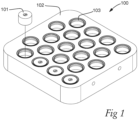
- Fig. 1 schematically illustrates an embodiment of a base device system 100 comprising a base device 101 and a supporting means 102.
- the supporting means 102 is in this embodiment in the form of a solid plate provided with apertures 103.
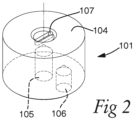
- Fig. 2 shows a an embodiment of a base device 101 having a build surface 104 and being of a generally cylindrical shape.
- the base device further has alignment means 105, 106, in the form of holes for keeping the base device 101 with an additive manufactured object in a correct centered and rotational position in the supporting means.
- a slot 107 is present on the upper side of the base device 101.
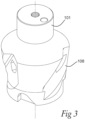
- Fig. 3 shows an embodiment of a base device 101 with an additive manufactured object 108 built on it being a milling tool body prior to post-processing machining.
- Fig. 4 shows an illustration of a base device 101 mounted in a CNC machine spindle 109 via a chuck 110.
- the base device 101 has an additive manufactured object 108 built on it.
- a machining tool 111 is mounted on a machine spindle 112 in the CNC machine.
- the method comprises providing one or more base devices 101 in the form of a substantially cylindrical metal bodies, providing a supporting means in the form of a metal base plate 102 having one or more apertures 103.
- the one or more base devices 101 are then each put into an aperture 103 of the base plate 102 forming a base device system 100.
- the base device system 100 of mounted base devices 101 in the base plate 102 is then put into an additive manufacturing machine, alternatively the base plate 102 is first inserted into the additive manufacturing machine and the base devices 101 then mounted in the base plate apertures 103. Then it is started to build a layer (L) of additive manufactured metal by laser powder-bed fusion followed by the building of the actual objects 108 by continuing using laser powder-bed fusion.
- L layer
- each base device 101 When an object 108 have been built on each base device 101 the whole base device system 100 of the base plate 102 with the mounted base devices 101 is taken out from the additive manufacturing machine and transferred to the location of a CNC machine. The base devices 101 are then one after another mounted in the CNC machine spindle 109 and processed into the final desired shape and surface smoothness. When the processing is finished the object is finally separated from the base device by a machining operation where also the first layer (L) of additive manufactured metal situated under the actual object is removed.
- L first layer
- the base device 101 is preferably in the form of a substantially cylindrical metal body of a total height of between 2 and 10 cm and a diameter of between 1 and 10 cm.
- the supporting means in the form of a metal base plate 102 suitably has from 1 to 50 apertures 103.
- the thickness of the base plate 102 is suitably between 1 and 10 cm, depending on the height of the base devices 101 to be combined with the base plate 102.
- the layer (L) of additive manufactured metal is suitably built to a height of between 1-50 mm.
- the base devices 101 are one after each other taken out from the base plate 102 and put into the CNC machine by a robot. After processing including separation of the post-processed built object from the base plate 102 a robot is taking the object out of the CNC machine and as well the base device 101. The base device 101 is then ready for use again in an additive manufacturing process.
Landscapes
- Engineering & Computer Science (AREA)
- Chemical & Material Sciences (AREA)
- Materials Engineering (AREA)
- Manufacturing & Machinery (AREA)
- Health & Medical Sciences (AREA)
- General Health & Medical Sciences (AREA)
- Toxicology (AREA)
- Powder Metallurgy (AREA)
- Physics & Mathematics (AREA)
- Plasma & Fusion (AREA)
Description
- The present invention relates to a method of producing an additive manufactured object.
- In additive manufacturing an object is gradually built on a base plate which thus acts as a solid foundation on which the three dimensional object is built.
- The additive manufactured object usually needs to be further treated and/or shaped in some subsequent operation which is normally made at some place away from the equipment where the additive manufacturing took place so the built object has to be moved from the additive manufacturing machine, usually involving removal from a base plate.
- Methods of producing an object by additive manufacturing include laser powder-bed fusion and powder-bed fusion by electron beam. In the laser powder-bed fusion method solid particles are applied in a thin layers and a three dimensional object is gradually formed layer-by-layer by fusing together particles with one or more laser beams, or an electron beam, according to a specific pattern.
- When making an additive manufactured object of metal by powder-bed fusion by laser or electron beam there is usually a quite strong bond formed between the built object and the base plate. Since also the base plate is normally made of metal the built object will in fact be welded to the base plate. It is common to use a single large base plate onto which several individual objects are built. After the additive manufacturing each individual object has to be manually removed from the base plate. However, this is time consuming and also requires a lot of manual work resources.
- When one or more subsequent operational steps are to be used, such as shaping (machining), grinding and polishing, there may be difficult and as well time consuming to mount and adjust the additive manufactured object in a machining equipment such as an CNC (Computer Numerical Control) machine so that the accuracy of the desired shape within certain dimensional tolerances can be provided. It may also be difficult to assure repetetiveness between several additive manufactured objects in dimensional tolerances and accuracy in machining operations.
-
WO 2017/051029 A1 discloses an additive manufacturing system with one or more carrier platforms and one or more build platforms and CNC post-processing. - Thus, there is one object of the present invention to provide a less time-consuming, less labour-requiring method for making an additive manufactured object. There is a further object of the present invention to be able to make an additive manufactured object with greater dimensional accuracy and high repetetiveness of the accuracy after post-processing machining when making several additive manufactured objects.
- By the term "metal" is herein also included alloys of different metal elements.
- The invention relates to a method for producing an object of metal according to claim 1.
- The method comprises a step of building a layer (L) of metal on at least a part of the base device build surface in an additive manufacturing process prior to the first part of the object is built.
- The step of separating the built object from the base device comprises removing at least a part of the layer (L) of metal on the base device.
- The separation of the built object suitably comprises removing at least a part of the layer (L) of metal on the base device.
- A part of the layer (L) of metal remains on the base device after the separation of the built object and this remaining part of the layer (L) of metal is in a subsequent step removed from the base device.
- In one embodiment the method comprises a step of removing a part of the base device. The removal of a part of the base device can take place in the same processing step as when separating the built object, alternatively it can take place after the step of separating the built object.
- The layer (L) of metal is built in the additive manufacturing process prior to the object is built.
- When the layer (L) of metal is built in the additive manufacturing process the material used when building the layer (L) is suitably the same metal material as the metal used when building the object. If different metal materials are used in the layer (L) of metal and the built object they need to have such compatibility that a sufficient strong bond between them is created in the additive manufacturing process. This means that the different metal materials are suitably welded to each other in the additive manufacturing process.
- By separating the additive manufactured object from the base device by means of a machining tool and at the same time removing the layer (L) of metal which has been built in the additive manufacturing process the original size and shape of the base device as prior to the additive manufacturing process is re-established and the base device is ready to be used again when making a further additive manufactured object. Also, by this procedure the separation of the additive manufactured object from the base device onto which it has been built can be made directly after a post processing on the object has/have been finished while remaining in the same mounting in the CNC machine. This saves time and labour.
- The separation of the object from the base device is suitably made by means of a turning tool, a milling tool, a filing tool or a sawing tool or an electrical discharge machining tool.
- The layer (L) of metal is suitably removed by means of a turning tool, a milling tool, a filing tool or a sawing tool or an electrical discharge machining tool.
- The method suitably comprises at least one step of post processing of the built object in the CNC machine prior to separation of the object from the base device, the post processing comprises turning, milling, drilling, blasting, grinding, finishing, coating, electrical discharge machining, cladding and measuring operations.
- If desired and needed, in one embodiment the build surface of the base device is further machined, in the same CNC machine or in another machine or place, e.g., by flat grinding or other finishing, to restore it for reuse.
- The base device can be connected to the CNC machine mounting the end of the base device in a CNC machine spindle, for example by clamping.
- The base device is suitably connected to the CNC machine so that an axis of rotation of the base device is coinciding with an axis of rotation of the built object. This is especially important when a turning operation is used in post-processing of the built object.
- The object built on the base device is suitably exactly one object. This makes the post processing steps in the CNC machine easy. The method enables an efficient handling of objects separately built on separate base devices.
- In one embodiment the base device build surface has substantially the same width as the lowermost width of the object being built on it, alternatively the base device build surface has a smaller width than the lowermost width of the object being built on it. This minimizes the risk of a processing tool coming into contact with the base device during processing if the base device with the built object rotates in the CNC machine.
- In one embodiment the supporting means comprises a solid plate having one or more recesses or apertures. One or more base devices can then be fitted into the recesses or apertures.
- In one embodiment the supporting means comprises an open structure holder in the form of an array of bars or threads, for example forming a grid structure into which the one or more base devices can be put. One or more base devices can then be fitted into the open structure holder.
- The supporting means has a connection means adapted to be engaged with a connection means on the base device. This enables a fixed joint between the supporting means and the base device during the building of the object.
- The connection means on the base device may also be used when clamping the base device in a CNC machine spindle.
- In one embodiment the connection means on the base device comprises a CNC machine interface coupling, suitably a chuck or spindle interface coupling.
- The machine interface coupling can be any type of machine tool interface coupling such as a Coromant Capto® toolholder, a HSK toolholder, a Steep taper toolholder, a Big Plus toolholder, or an ISO cone toolholder.
- Optionally, additional fixing means such as a screw can be used for fixing the base device to the supporting means.
- The base device connection means suitably further comprises alignment means for keeping the base device with the additive manufactured object in a correct centered and/or rotational position in the supporting means. The alignment means of the base device being engaged with corresponding alignment means of the supporting means. Such an alignment means on the base device or on the supporting means can be a hole, a recess or a pin, preferably a combination of these. For an alignment means on the base device being a hole it is thus intented to interact with a pin on the supporting means, and vice versa. In one embodiment a part at the center of the build surface has a slot, compatible with a tool, e.g. a screw driver, which makes alignment of the base device easier when placed in the supporting means.
- The base device is suitably removable from the supporting means by lifting the base device upwards from the supporting means.
- The base device system, i.e. the one or more base devices together with the supporting means, is removable from the additive manufacturing machine.
- The base device is removed from the additive manufacturing machine, subsequent to the step of building the object, by removing the base device system of supporting means and at least one base device while the at least one base device still being in a fixed position within the supporting means. By this an easy way of handling and transportation of the one or more base devices from the additive manufacturing machine to the CNC machine is provided. Especially when several base devices with built objects are to be transported and the CNC machine is located far away from the additive manufacturing machine.
- The supporting means can be made of any suitable material but is preferably made of metal.
- In one embodiment the base device system is a combination of a holder plate as supporting means with several recesses or apertures, and base devices fitted in the recesses or apertures.
- The base device may fit, in a vertical direction, into a recess or aperture of the holder plate completely or partly. If the base device is fitted partly an upper part of the base device extends above the horizontal plane of the holder plate. This arrangement may be beneficial for easy gripping the base device when removing it from or putting it into the holder plate.
- The shape of at least one part of the base device to be fitted into the holder plate may be such that it fits into a specific recess or aperture of the holder plate.
- In one embodiment the base device is of a cylindrical shape
- The recesses or apertures of the holder plate can be of any shape such as a circular-, ellipsioidal-, triangular-, quadratical-, pentagonal-, hexagonal shape etc..
- In one embodiment the base device is of a cylindrical shape with flattened portions at the end. This assists in keeping the base device firmly attached in the chuck and preventing rotational slip.
- The additive manufacturing process is suitably laser powder-bed fusion or powder-bed fusion by electron beam.
- Since the object being additive manufactured is made of metal or metal alloy and is made by laser powder-bed fusion, or powder-bed fusion by electron beam, of metal or metal alloy powder, at least the upper part of the base device is made of metal, alternatively the whole base device is made of metal.
- The method of this invention makes the handling of additive manufactured objects easy and low in its labour demand. This is because additive manufactured objects can, first of all, be individually removed from an additive manufacturing equipment and transferred and connected to the CNC machine without any need of manually sawing off, or breaking off, the objects from a base plate. Furthermore, several operations are possible to make while the base device with the object is still connected to the CNC machine. Further, if present, the connection means on the base device makes it fast and easy to connect the base device with the additive manufactured object to further processing equipment. Furthermore, if connection means at the end of the base device is present high accuracy is provided of the final object dimensions after various operational machining steps made on the object after the additive manufacturing since the connection means assures a precise mounting into a CNC machine with high accuracy and enables repeated operations (removal/mounting) with retained precision. Also, no time is needed for calibrating the position of the additive manufactured object before machining.
-
-
Fig. 1 schematically illustrates a base device system comprising a base device and a supporting means. -
Fig. 2 shows a base device according to one embodiment wherein the base device has a generally cylindrical shape and has alignment means at its end. -
Fig. 3 shows an embodiment of a base device with an additive manufactured object built on it. -
Fig. 4 shows an illustration of a base device with an additive manufactured object connected to a CNC machine for machining. -
Fig. 1 schematically illustrates an embodiment of abase device system 100 comprising abase device 101 and a supportingmeans 102. The supporting means 102 is in this embodiment in the form of a solid plate provided withapertures 103. -
Fig. 2 shows a an embodiment of abase device 101 having abuild surface 104 and being of a generally cylindrical shape. The base device further has alignment means 105, 106, in the form of holes for keeping thebase device 101 with an additive manufactured object in a correct centered and rotational position in the supporting means. Aslot 107 is present on the upper side of thebase device 101. -
Fig. 3 shows an embodiment of abase device 101 with an additivemanufactured object 108 built on it being a milling tool body prior to post-processing machining. -
Fig. 4 shows an illustration of abase device 101 mounted in aCNC machine spindle 109 via achuck 110. Thebase device 101 has an additivemanufactured object 108 built on it. Amachining tool 111 is mounted on amachine spindle 112 in the CNC machine. - In a preferred embodiment the method comprises providing one or
more base devices 101 in the form of a substantially cylindrical metal bodies, providing a supporting means in the form of ametal base plate 102 having one ormore apertures 103. The one ormore base devices 101 are then each put into anaperture 103 of thebase plate 102 forming abase device system 100. Thebase device system 100 of mountedbase devices 101 in thebase plate 102 is then put into an additive manufacturing machine, alternatively thebase plate 102 is first inserted into the additive manufacturing machine and thebase devices 101 then mounted in thebase plate apertures 103. Then it is started to build a layer (L) of additive manufactured metal by laser powder-bed fusion followed by the building of theactual objects 108 by continuing using laser powder-bed fusion. When anobject 108 have been built on eachbase device 101 the wholebase device system 100 of thebase plate 102 with the mountedbase devices 101 is taken out from the additive manufacturing machine and transferred to the location of a CNC machine. Thebase devices 101 are then one after another mounted in theCNC machine spindle 109 and processed into the final desired shape and surface smoothness. When the processing is finished the object is finally separated from the base device by a machining operation where also the first layer (L) of additive manufactured metal situated under the actual object is removed. - In one embodiment the
base device 101 is preferably in the form of a substantially cylindrical metal body of a total height of between 2 and 10 cm and a diameter of between 1 and 10 cm. The supporting means in the form of ametal base plate 102 suitably has from 1 to 50apertures 103. The thickness of thebase plate 102 is suitably between 1 and 10 cm, depending on the height of thebase devices 101 to be combined with thebase plate 102. The layer (L) of additive manufactured metal is suitably built to a height of between 1-50 mm. - In a further preferred embodiment the
base devices 101 are one after each other taken out from thebase plate 102 and put into the CNC machine by a robot. After processing including separation of the post-processed built object from the base plate 102 a robot is taking the object out of the CNC machine and as well thebase device 101. Thebase device 101 is then ready for use again in an additive manufacturing process.
Claims (8)
- A method for producing an object (108) of metal wherein one object (108) is built with an additive manufacturing process on a base device (101) having a build surface (104) at one end and comprising connection means at its end opposite to the build surface (104), said base device (101) being part of a base device system (100) comprising at least one base device (101) and a supporting means (102) provided with connection means adapted to be engaged with connection means on the base device (101) holding the base device (101) in a fixed position during the additive manufacturing process, wherein the method comprises the steps of:building said one object (108) on at least a part of the base device build surface (104) with the additive manufacturing process, removing the base device (101) from the additive manufacturing machine by removing the base device system (100) while the at least one base device (101) still is in a fixed position within the supporting means (102), removing the base device (101) from the supporting means (102), connecting the base device (101) to a CNC machine provided with at least one machining tool wherein i) said base device (101) is clamped in a CNC machine spindle (112) by means of said connection means or ii) via a CNC machine interface coupling comprised in said connection means and, post processing the built object in the CNC machine prior to
separating the built object (108) from the base device (101) by means of a machining tool (111) in the CNC machine,the method comprising a step of building a layer (L) of metal on at least a part of the base device build surface (104) in an additive manufacturing process prior to the first part of the object is built wherein the step of separating the built object (108) from the base device (101) comprises removing at least a part of the layer (L) of metal on the base device (101),wherein a part of the layer (L) of metal remains on the base device (101) after the separation of the built object (108) and this remaining part of the layer (L) of metal is in a subsequent step removed from the base device (101). - A method according to claim 1, comprising a step of removing a part of the base device (101).
- A method according to any one of the claims 1 or 2, wherein the layer (L) of metal is removed by means of a turning tool, a milling tool, a filing tool or a sawing tool or an electrical discharge machining tool.
- A method according to any of the proceeding claims, comprising at least one step of post processing of the built object (108) in the CNC machine prior to separation of the object (108) from the base device (101), the post processing comprises turning, milling, drilling, blasting, grinding, finishing, coating, electrical discharge machining, cladding and measuring operations.
- A method according to claim 1, wherein the connection means on the base device (101) comprises a CNC machine interface coupling.
- A method according to any of the proceeding claims, wherein the supporting means (102) comprises a solid plate having one or more recesses or apertures.
- A method according to any of claims 1-5, wherein the supporting means comprises an open structure holder in the form of an array of bars or threads.
- A method according to any one of claims 1-7, wherein the additive manufacturing process is laser powder-bed fusion or powder-bed fusion by electron beam. P15040EP claims
Priority Applications (4)
| Application Number | Priority Date | Filing Date | Title |
|---|---|---|---|
| EP18167033.2A EP3552738B1 (en) | 2018-04-12 | 2018-04-12 | A method of producing an additive manufactured object |
| US17/046,330 US20210146449A1 (en) | 2018-04-12 | 2019-04-05 | Method of producing an additive manufactured object |
| PCT/EP2019/058616 WO2019197281A1 (en) | 2018-04-12 | 2019-04-05 | A method of producing an additive manufactured object |
| CN201980025267.7A CN112088059A (en) | 2018-04-12 | 2019-04-05 | Method of producing an additive manufactured object |
Applications Claiming Priority (1)
| Application Number | Priority Date | Filing Date | Title |
|---|---|---|---|
| EP18167033.2A EP3552738B1 (en) | 2018-04-12 | 2018-04-12 | A method of producing an additive manufactured object |
Publications (3)
| Publication Number | Publication Date |
|---|---|
| EP3552738A1 EP3552738A1 (en) | 2019-10-16 |
| EP3552738B1 true EP3552738B1 (en) | 2024-07-31 |
| EP3552738C0 EP3552738C0 (en) | 2024-07-31 |
Family
ID=61972362
Family Applications (1)
| Application Number | Title | Priority Date | Filing Date |
|---|---|---|---|
| EP18167033.2A Active EP3552738B1 (en) | 2018-04-12 | 2018-04-12 | A method of producing an additive manufactured object |
Country Status (4)
| Country | Link |
|---|---|
| US (1) | US20210146449A1 (en) |
| EP (1) | EP3552738B1 (en) |
| CN (1) | CN112088059A (en) |
| WO (1) | WO2019197281A1 (en) |
Families Citing this family (5)
| Publication number | Priority date | Publication date | Assignee | Title |
|---|---|---|---|---|
| EP3954530A4 (en) * | 2019-04-09 | 2022-10-26 | Nikon Corporation | MOLDING UNIT |
| EP3815840B1 (en) * | 2019-10-31 | 2023-10-04 | Sandvik Machining Solutions AB | Method for producing a tool part |
| CN115996832A (en) | 2020-06-24 | 2023-04-21 | 伏尔肯模型公司 | Board Mounting in Additive Manufacturing |
| CN112857092A (en) * | 2021-01-18 | 2021-05-28 | 哈电发电设备国家工程研究中心有限公司 | Micro-channel heat exchanger and machining method thereof |
| CN113245562B (en) * | 2021-06-22 | 2021-10-01 | 北京煜鼎增材制造研究院有限公司 | Equipment for preparing metal test piece and structural part by high-energy beam |
Citations (1)
| Publication number | Priority date | Publication date | Assignee | Title |
|---|---|---|---|---|
| US20160031010A1 (en) * | 2013-03-05 | 2016-02-04 | United Technologies Corporation | Build platforms for additive manufacturing |
Family Cites Families (10)
| Publication number | Priority date | Publication date | Assignee | Title |
|---|---|---|---|---|
| DE29907262U1 (en) * | 1999-04-23 | 1999-07-15 | Eos Gmbh Electro Optical Systems, 82152 Planegg | Device for producing a three-dimensional object using rapid prototyping |
| DE102012011217B4 (en) * | 2012-06-06 | 2025-08-21 | Concept Laser Gmbh | Device for the production of three-dimensional components |
| MX378790B (en) * | 2014-07-21 | 2025-03-10 | Delinia Inc | MOLECULES THAT SELECTIVELY ACTIVATE REGULATORY T CELLS FOR THE TREATMENT OF AUTOIMMUNE DISEASES. |
| WO2017051029A1 (en) * | 2015-09-25 | 2017-03-30 | Addifab Aps | Additive manufacturing device and system, modular build platform and build platform unit |
| ES2621477B1 (en) * | 2015-12-04 | 2018-06-21 | Instituto Tecnologico Metalmecanico,Mueble,Madera,Embalaje Y Afines | PROCEDURE AND PRECISION SYSTEM FOR MECHANIZATION OF PARTS OBTAINED BY ADDITIVE MANUFACTURE |
| US20170266890A1 (en) * | 2016-03-15 | 2017-09-21 | Incodema3D, LLC | Additive manufacturing device |
| GB2550855B (en) * | 2016-05-25 | 2019-09-25 | Rolls Royce Plc | Method of manufacture |
| NL2017022B1 (en) * | 2016-06-22 | 2018-01-04 | Additive Ind Bv | Apparatus for producing an object by means of additive manufacturing |
| CN106312066B (en) * | 2016-09-29 | 2018-08-31 | 首都航天机械公司 | A kind of assembled substrate for selective laser fusing increasing material manufacturing |
| EP3417961B1 (en) * | 2017-06-19 | 2022-07-27 | General Electric Company | Additive manufacturing fixture |
-
2018
- 2018-04-12 EP EP18167033.2A patent/EP3552738B1/en active Active
-
2019
- 2019-04-05 WO PCT/EP2019/058616 patent/WO2019197281A1/en not_active Ceased
- 2019-04-05 US US17/046,330 patent/US20210146449A1/en active Pending
- 2019-04-05 CN CN201980025267.7A patent/CN112088059A/en active Pending
Patent Citations (1)
| Publication number | Priority date | Publication date | Assignee | Title |
|---|---|---|---|---|
| US20160031010A1 (en) * | 2013-03-05 | 2016-02-04 | United Technologies Corporation | Build platforms for additive manufacturing |
Non-Patent Citations (1)
| Title |
|---|
| THOMPSON MARY KATHRYN ET AL: "Design for Additive Manufacturing: Trends, opportunities, considerations, and constraints", CIRP ANNALS, ELSEVIER BV, NL, CH, FR, vol. 65, no. 2, 25 June 2016 (2016-06-25), pages 737 - 760, XP029690807, ISSN: 0007-8506, DOI: 10.1016/J.CIRP.2016.05.004 * |
Also Published As
| Publication number | Publication date |
|---|---|
| EP3552738C0 (en) | 2024-07-31 |
| US20210146449A1 (en) | 2021-05-20 |
| WO2019197281A1 (en) | 2019-10-17 |
| EP3552738A1 (en) | 2019-10-16 |
| CN112088059A (en) | 2020-12-15 |
Similar Documents
| Publication | Publication Date | Title |
|---|---|---|
| EP3552738B1 (en) | A method of producing an additive manufactured object | |
| EP0827807B1 (en) | Long bar member machining apparatus and method | |
| KR101002610B1 (en) | Cylindrical grinding method for producing cemented carbide tools and Cylindrical grinding machine for grinding cylindrical starting bodies in the production of cemented carbide tools | |
| US6935003B2 (en) | Compound fabrication process and apparatus | |
| CN102753304B (en) | Method of manufacturing roller | |
| US8739409B2 (en) | Method for dual production of small-scale products | |
| EP3006176B1 (en) | Device and method for forming a hole through a glass plate | |
| EP3815840B1 (en) | Method for producing a tool part | |
| KR101877501B1 (en) | Three dimensional machining jig for numerical control machine tool and machining method using it | |
| CN112171198B (en) | Machining method of grid structure part | |
| US20100166519A1 (en) | Clamping method for workpieces used for the production of compressor or turbine wheels | |
| KR102069370B1 (en) | Apparatus for fabricating eject pin automatically | |
| US5692286A (en) | Method for shaping parts in one or more stacked board shaped elements and machine tool for implementing this method | |
| CN101208176A (en) | Method for machining, in particular for drilling and turning light-alloy wheels, and machining installation operating according to the method | |
| US20200114432A1 (en) | Method for assembling a tool system module, and tool system module produced accordingly | |
| JP3513321B2 (en) | Polyhedral processing machine and its processing method | |
| WO2011103116A2 (en) | Connection element for forming an interface between two parts of a machine tool that can be releasably connected to each other, and method for manufacturing such a connection element | |
| KR101894268B1 (en) | Jig For Cutting Taper Face Of Piston Mold | |
| EP4000771A1 (en) | A method for manufacturing an article on top of a base device | |
| KR102180103B1 (en) | Unbalanced product machining method and machining jig | |
| JPH0639601A (en) | Method for machining inner surface of thin cylindrical work | |
| CN114474288A (en) | Processing technology of solid wood furniture component | |
| JPH077048Y2 (en) | Lathe jig | |
| CN111604640A (en) | Integrated machining process for metal workpiece | |
| EP0124121A2 (en) | Set-up method and gauges for turning machines |
Legal Events
| Date | Code | Title | Description |
|---|---|---|---|
| PUAI | Public reference made under article 153(3) epc to a published international application that has entered the european phase |
Free format text: ORIGINAL CODE: 0009012 |
|
| STAA | Information on the status of an ep patent application or granted ep patent |
Free format text: STATUS: THE APPLICATION HAS BEEN PUBLISHED |
|
| AK | Designated contracting states |
Kind code of ref document: A1 Designated state(s): AL AT BE BG CH CY CZ DE DK EE ES FI FR GB GR HR HU IE IS IT LI LT LU LV MC MK MT NL NO PL PT RO RS SE SI SK SM TR |
|
| AX | Request for extension of the european patent |
Extension state: BA ME |
|
| STAA | Information on the status of an ep patent application or granted ep patent |
Free format text: STATUS: REQUEST FOR EXAMINATION WAS MADE |
|
| 17P | Request for examination filed |
Effective date: 20200416 |
|
| RBV | Designated contracting states (corrected) |
Designated state(s): AL AT BE BG CH CY CZ DE DK EE ES FI FR GB GR HR HU IE IS IT LI LT LU LV MC MK MT NL NO PL PT RO RS SE SI SK SM TR |
|
| STAA | Information on the status of an ep patent application or granted ep patent |
Free format text: STATUS: EXAMINATION IS IN PROGRESS |
|
| 17Q | First examination report despatched |
Effective date: 20210608 |
|
| RIC1 | Information provided on ipc code assigned before grant |
Ipc: B22F 3/24 20060101ALN20240226BHEP Ipc: B22F 12/82 20210101ALI20240226BHEP Ipc: B22F 12/30 20210101ALI20240226BHEP Ipc: B22F 10/66 20210101ALI20240226BHEP Ipc: B22F 10/47 20210101ALI20240226BHEP Ipc: B22F 10/40 20210101ALI20240226BHEP Ipc: B33Y 40/20 20200101ALI20240226BHEP Ipc: B33Y 40/00 20150101ALI20240226BHEP Ipc: B33Y 30/00 20150101ALI20240226BHEP Ipc: B22F 3/105 20060101AFI20240226BHEP |
|
| GRAP | Despatch of communication of intention to grant a patent |
Free format text: ORIGINAL CODE: EPIDOSNIGR1 |
|
| STAA | Information on the status of an ep patent application or granted ep patent |
Free format text: STATUS: GRANT OF PATENT IS INTENDED |
|
| INTG | Intention to grant announced |
Effective date: 20240409 |
|
| GRAS | Grant fee paid |
Free format text: ORIGINAL CODE: EPIDOSNIGR3 |
|
| GRAA | (expected) grant |
Free format text: ORIGINAL CODE: 0009210 |
|
| STAA | Information on the status of an ep patent application or granted ep patent |
Free format text: STATUS: THE PATENT HAS BEEN GRANTED |
|
| AK | Designated contracting states |
Kind code of ref document: B1 Designated state(s): AL AT BE BG CH CY CZ DE DK EE ES FI FR GB GR HR HU IE IS IT LI LT LU LV MC MK MT NL NO PL PT RO RS SE SI SK SM TR |
|
| REG | Reference to a national code |
Ref country code: CH Ref legal event code: EP Ref country code: GB Ref legal event code: FG4D |
|
| REG | Reference to a national code |
Ref country code: DE Ref legal event code: R096 Ref document number: 602018072374 Country of ref document: DE |
|
| REG | Reference to a national code |
Ref country code: IE Ref legal event code: FG4D |
|
| U01 | Request for unitary effect filed |
Effective date: 20240820 |
|
| U07 | Unitary effect registered |
Designated state(s): AT BE BG DE DK EE FI FR IT LT LU LV MT NL PT RO SE SI Effective date: 20240902 |
|
| PG25 | Lapsed in a contracting state [announced via postgrant information from national office to epo] |
Ref country code: NO Free format text: LAPSE BECAUSE OF FAILURE TO SUBMIT A TRANSLATION OF THE DESCRIPTION OR TO PAY THE FEE WITHIN THE PRESCRIBED TIME-LIMIT Effective date: 20241031 |
|
| PG25 | Lapsed in a contracting state [announced via postgrant information from national office to epo] |
Ref country code: GR Free format text: LAPSE BECAUSE OF FAILURE TO SUBMIT A TRANSLATION OF THE DESCRIPTION OR TO PAY THE FEE WITHIN THE PRESCRIBED TIME-LIMIT Effective date: 20241101 Ref country code: PL Free format text: LAPSE BECAUSE OF FAILURE TO SUBMIT A TRANSLATION OF THE DESCRIPTION OR TO PAY THE FEE WITHIN THE PRESCRIBED TIME-LIMIT Effective date: 20240731 |
|
| PG25 | Lapsed in a contracting state [announced via postgrant information from national office to epo] |
Ref country code: IS Free format text: LAPSE BECAUSE OF FAILURE TO SUBMIT A TRANSLATION OF THE DESCRIPTION OR TO PAY THE FEE WITHIN THE PRESCRIBED TIME-LIMIT Effective date: 20241130 |
|
| PG25 | Lapsed in a contracting state [announced via postgrant information from national office to epo] |
Ref country code: HR Free format text: LAPSE BECAUSE OF FAILURE TO SUBMIT A TRANSLATION OF THE DESCRIPTION OR TO PAY THE FEE WITHIN THE PRESCRIBED TIME-LIMIT Effective date: 20240731 |
|
| PG25 | Lapsed in a contracting state [announced via postgrant information from national office to epo] |
Ref country code: ES Free format text: LAPSE BECAUSE OF FAILURE TO SUBMIT A TRANSLATION OF THE DESCRIPTION OR TO PAY THE FEE WITHIN THE PRESCRIBED TIME-LIMIT Effective date: 20240731 Ref country code: RS Free format text: LAPSE BECAUSE OF FAILURE TO SUBMIT A TRANSLATION OF THE DESCRIPTION OR TO PAY THE FEE WITHIN THE PRESCRIBED TIME-LIMIT Effective date: 20241031 |
|
| PG25 | Lapsed in a contracting state [announced via postgrant information from national office to epo] |
Ref country code: RS Free format text: LAPSE BECAUSE OF FAILURE TO SUBMIT A TRANSLATION OF THE DESCRIPTION OR TO PAY THE FEE WITHIN THE PRESCRIBED TIME-LIMIT Effective date: 20241031 Ref country code: PL Free format text: LAPSE BECAUSE OF FAILURE TO SUBMIT A TRANSLATION OF THE DESCRIPTION OR TO PAY THE FEE WITHIN THE PRESCRIBED TIME-LIMIT Effective date: 20240731 Ref country code: NO Free format text: LAPSE BECAUSE OF FAILURE TO SUBMIT A TRANSLATION OF THE DESCRIPTION OR TO PAY THE FEE WITHIN THE PRESCRIBED TIME-LIMIT Effective date: 20241031 Ref country code: IS Free format text: LAPSE BECAUSE OF FAILURE TO SUBMIT A TRANSLATION OF THE DESCRIPTION OR TO PAY THE FEE WITHIN THE PRESCRIBED TIME-LIMIT Effective date: 20241130 Ref country code: HR Free format text: LAPSE BECAUSE OF FAILURE TO SUBMIT A TRANSLATION OF THE DESCRIPTION OR TO PAY THE FEE WITHIN THE PRESCRIBED TIME-LIMIT Effective date: 20240731 Ref country code: GR Free format text: LAPSE BECAUSE OF FAILURE TO SUBMIT A TRANSLATION OF THE DESCRIPTION OR TO PAY THE FEE WITHIN THE PRESCRIBED TIME-LIMIT Effective date: 20241101 Ref country code: ES Free format text: LAPSE BECAUSE OF FAILURE TO SUBMIT A TRANSLATION OF THE DESCRIPTION OR TO PAY THE FEE WITHIN THE PRESCRIBED TIME-LIMIT Effective date: 20240731 |
|
| PG25 | Lapsed in a contracting state [announced via postgrant information from national office to epo] |
Ref country code: SM Free format text: LAPSE BECAUSE OF FAILURE TO SUBMIT A TRANSLATION OF THE DESCRIPTION OR TO PAY THE FEE WITHIN THE PRESCRIBED TIME-LIMIT Effective date: 20240731 |
|
| PG25 | Lapsed in a contracting state [announced via postgrant information from national office to epo] |
Ref country code: CZ Free format text: LAPSE BECAUSE OF FAILURE TO SUBMIT A TRANSLATION OF THE DESCRIPTION OR TO PAY THE FEE WITHIN THE PRESCRIBED TIME-LIMIT Effective date: 20240731 |
|
| PG25 | Lapsed in a contracting state [announced via postgrant information from national office to epo] |
Ref country code: SK Free format text: LAPSE BECAUSE OF FAILURE TO SUBMIT A TRANSLATION OF THE DESCRIPTION OR TO PAY THE FEE WITHIN THE PRESCRIBED TIME-LIMIT Effective date: 20240731 |
|
| PGFP | Annual fee paid to national office [announced via postgrant information from national office to epo] |
Ref country code: GB Payment date: 20250306 Year of fee payment: 8 |
|
| U20 | Renewal fee for the european patent with unitary effect paid |
Year of fee payment: 8 Effective date: 20250430 |
|
| PLBE | No opposition filed within time limit |
Free format text: ORIGINAL CODE: 0009261 |
|
| STAA | Information on the status of an ep patent application or granted ep patent |
Free format text: STATUS: NO OPPOSITION FILED WITHIN TIME LIMIT |
|
| 26N | No opposition filed |
Effective date: 20250501 |
|
| REG | Reference to a national code |
Ref country code: CH Ref legal event code: H13 Free format text: ST27 STATUS EVENT CODE: U-0-0-H10-H13 (AS PROVIDED BY THE NATIONAL OFFICE) Effective date: 20251125 |
|
| PG25 | Lapsed in a contracting state [announced via postgrant information from national office to epo] |
Ref country code: MC Free format text: LAPSE BECAUSE OF FAILURE TO SUBMIT A TRANSLATION OF THE DESCRIPTION OR TO PAY THE FEE WITHIN THE PRESCRIBED TIME-LIMIT Effective date: 20240731 |
|
| PG25 | Lapsed in a contracting state [announced via postgrant information from national office to epo] |
Ref country code: CH Free format text: LAPSE BECAUSE OF NON-PAYMENT OF DUE FEES Effective date: 20250430 |