EP3552012B1 - Verfahren zur steuerung der konzentration von flüchtigen organischen verbindungen in einer bohrflüssigkeit - Google Patents
Verfahren zur steuerung der konzentration von flüchtigen organischen verbindungen in einer bohrflüssigkeit Download PDFInfo
- Publication number
- EP3552012B1 EP3552012B1 EP17808484.4A EP17808484A EP3552012B1 EP 3552012 B1 EP3552012 B1 EP 3552012B1 EP 17808484 A EP17808484 A EP 17808484A EP 3552012 B1 EP3552012 B1 EP 3552012B1
- Authority
- EP
- European Patent Office
- Prior art keywords
- fluid
- organic compounds
- concentration
- volatile organic
- analyser
- Prior art date
- Legal status (The legal status is an assumption and is not a legal conclusion. Google has not performed a legal analysis and makes no representation as to the accuracy of the status listed.)
- Active
Links
Images


Classifications
-
- G—PHYSICS
- G01—MEASURING; TESTING
- G01N—INVESTIGATING OR ANALYSING MATERIALS BY DETERMINING THEIR CHEMICAL OR PHYSICAL PROPERTIES
- G01N33/00—Investigating or analysing materials by specific methods not covered by groups G01N1/00 - G01N31/00
- G01N33/0004—Gaseous mixtures, e.g. polluted air
- G01N33/0009—General constructional details of gas analysers, e.g. portable test equipment
- G01N33/0027—General constructional details of gas analysers, e.g. portable test equipment concerning the detector
- G01N33/0036—General constructional details of gas analysers, e.g. portable test equipment concerning the detector specially adapted to detect a particular component
- G01N33/0047—Organic compounds
-
- G—PHYSICS
- G01—MEASURING; TESTING
- G01N—INVESTIGATING OR ANALYSING MATERIALS BY DETERMINING THEIR CHEMICAL OR PHYSICAL PROPERTIES
- G01N33/00—Investigating or analysing materials by specific methods not covered by groups G01N1/00 - G01N31/00
- G01N33/18—Water
- G01N33/1826—Organic contamination in water
-
- G—PHYSICS
- G01—MEASURING; TESTING
- G01N—INVESTIGATING OR ANALYSING MATERIALS BY DETERMINING THEIR CHEMICAL OR PHYSICAL PROPERTIES
- G01N33/00—Investigating or analysing materials by specific methods not covered by groups G01N1/00 - G01N31/00
- G01N33/26—Oils; Viscous liquids; Paints; Inks
- G01N33/28—Oils, i.e. hydrocarbon liquids
- G01N33/2823—Raw oil, drilling fluid or polyphasic mixtures
-
- G—PHYSICS
- G01—MEASURING; TESTING
- G01N—INVESTIGATING OR ANALYSING MATERIALS BY DETERMINING THEIR CHEMICAL OR PHYSICAL PROPERTIES
- G01N33/00—Investigating or analysing materials by specific methods not covered by groups G01N1/00 - G01N31/00
- G01N33/0004—Gaseous mixtures, e.g. polluted air
- G01N33/0009—General constructional details of gas analysers, e.g. portable test equipment
- G01N33/0062—General constructional details of gas analysers, e.g. portable test equipment concerning the measuring method or the display, e.g. intermittent measurement or digital display
- G01N33/0063—General constructional details of gas analysers, e.g. portable test equipment concerning the measuring method or the display, e.g. intermittent measurement or digital display using a threshold to release an alarm or displaying means
-
- Y—GENERAL TAGGING OF NEW TECHNOLOGICAL DEVELOPMENTS; GENERAL TAGGING OF CROSS-SECTIONAL TECHNOLOGIES SPANNING OVER SEVERAL SECTIONS OF THE IPC; TECHNICAL SUBJECTS COVERED BY FORMER USPC CROSS-REFERENCE ART COLLECTIONS [XRACs] AND DIGESTS
- Y02—TECHNOLOGIES OR APPLICATIONS FOR MITIGATION OR ADAPTATION AGAINST CLIMATE CHANGE
- Y02A—TECHNOLOGIES FOR ADAPTATION TO CLIMATE CHANGE
- Y02A20/00—Water conservation; Efficient water supply; Efficient water use
- Y02A20/20—Controlling water pollution; Waste water treatment
Definitions
- the invention is in the field of measuring organic compounds online in a fluid network and relates to a method for controlling the concentration of organic compounds in a fluid of a fluid network.
- the invention also relates to a device for controlling the concentration of organic compounds in a fluid of a fluid network.
- Drinking water is defined by a few dozen non-specific parameters (temperature, pH, conductivity, turbidity, etc.), microbiological (coliforms, total germs, etc.) and organic chemical (pesticides, hydrocarbons, chlorinated solvents, trihalomethanes, etc.) and inorganic (metals, bromates, etc.). Compliance control is carried out by means of sampling and laboratory analyses, the results of which are known within a period ranging from twelve hours to a few weeks. Furthermore, the frequency of these analyses can vary in the best case from daily (microbiology on large installations) to once a month for organic and inorganic chemical parameters, this for large installations. For installations delivering less than 1000 m3/day, this frequency may only be annual.
- Continuous measuring probes already exist for a limited number of simple physicochemical parameters such as pH, turbidity, conductivity, temperature, UV absorbance, but no treatment plant capable of controlling the concentration of organic compounds has been identified to date.
- VOCs volatile organic compounds
- the compounds particularly relevant for drinking water applications are those most common in resources, some of which are regulated (in bold in the table below): vinyl chloride, 1,1 dichloroethane, ETBE, 1,1,1 trichloroethane, chloroform, 1,2 cis dichloroethylene, trichloroethylene and tetrachloroethylene: Family Compound Saturated vapor pressure (Pa at 20°C) Boiling temperature Halogenated hydrocarbons (HCOs) dichloromethane 4.65.10 4 40°C trichloroethylene 8.6.10 3 87°C tetrachloroethylene 1.9.10 3 121°C Aromatic hydrocarbons (BTEX) benzene 9.97.10 3 80.1°C toluene 3.9.10 3 110.58°C o-xylene 663 144.43°C ethylbenzene 900 136.2°C Ethers methyl tert butyl ether (MTBE) 2.7.10 4 55.
- the invention aims to overcome all or part of the problems mentioned above by proposing a method for controlling the concentration of organic compounds in a fluid of a fluid network by making an online measurement of the organic compounds and the result of the measurements of which makes it possible to control an industrial process so as to reduce the concentration of organic compounds if it is too high.
- This method makes it possible to improve the operational use of data from monitoring organic compounds for water networks. It makes it possible to guarantee performances identical to those of laboratory reference methods (with a fairly low maximum admissible deviation) and therefore to optimize the operational parameters of the treatment line without risk of overdosing or underdosing products intended to reduce the concentration of organic compounds.
- the invention relates to a method for controlling the concentration of organic compounds in a fluid of a fluid network of an industrial installation according to claim 1.
- the third reduction step comprises a step of injecting a product into the fluid network having the effect of reducing the concentration of at least one organic compound.
- This may be a step of injecting a reagent (such as an adsorbent media, an oxidant, a stripping gas) into the fluid network or implementing a treatment method (such as membrane filtration).
- a reagent such as an adsorbent media, an oxidant, a stripping gas
- control method comprises, prior to the third reduction step, a step of remote transmission of the concentration of each of the organic compounds of the plurality of organic compounds measured by the analyzer to a control center.
- the industrial method is a method of treating a liquid fluid by aeration using a gaseous fluid in a predefined ratio between the liquid fluid and the gaseous fluid
- the third reduction step consists of adjusting the ratio between the liquid fluid and the gaseous fluid according to the concentration of the at least one organic compound measured in the network fluid.
- the industrial method is a drilling method using a drilling fluid
- the third reduction step consists of adapting the density of the drilling fluid according to the concentration of at least one organic compound measured in the network fluid.
- the industrial process is a process for disinfecting water by adding at least one oxidizing reagent and the third reduction step consists of adapting the quantity of at least one reagent (such as chlorine) added as a function of the concentration of at least one organic compound measured in the network fluid.
- at least one reagent such as chlorine
- the industrial process is a drinking water treatment process
- the industrial installation comprising at least one filter with granular adsorbent media such as activated carbon, or an injection of powdered media, such as activated carbon
- the third reduction step comprises a step of varying the flow rate of the fluid through an adsorbent/fluid contactor, such as a filter with granular adsorbent material, or a powder/fluid adsorbent media separator.
- the dosage of the powdered adsorbent media can also be adapted to the desired reduction of the organic compounds and to online monitoring.
- the third reduction step can further comprise a step of regeneration of the filter media and the regeneration of the media is done at a fixed or variable frequency.
- the industrial treatment process may also be a process based on hydrophilic membranes permeable to liquid fluids or based on hydrophobic membranes permeable to gaseous fluids, of the nanofiltration or reverse osmosis type.
- the invention also relates to a device for controlling the concentration of organic compounds in a fluid of a fluid network of an industrial installation according to claim 3.
- the correction unit comprises a device for injecting a product into the fluid network having the effect of reducing the concentration of said at least one organic compound.
- control device comprises a remote transmission device adapted to remote transmit the concentration of each of the organic compounds of the plurality of organic compounds measured by the analyzer to a control center.
- FIG. 1 also referring to the figure 2 , schematically represents the steps of a method for controlling the concentration of organic compounds in a fluid 11 of a network according to the invention.
- the method for controlling the concentration of organic compounds in the fluid 11 of the fluid network of an industrial installation, the fluid 11 comprising a plurality of organic compounds comprises a first step 1001 of online measurement of the concentration 16 of each of the organic compounds of the plurality of organic compounds in the fluid 11 of the fluid network by an analyzer 15, a second step 1002 of comparing the concentration 16 of each of the organic compounds of the plurality of organic compounds measured by the analyzer 15 with a predefined threshold value 160 for each of the organic compounds, as a treatment setpoint value or maximum alarm value, and a third step 1003 of reducing the concentration 16 of at least one organic compound if the concentration 16 of said at least one organic compound measured by the analyzer 15 is greater than the corresponding predefined threshold value 160.
- the analyzer 15 is configured to measure online the concentration 16 of each of the organic compounds of the plurality of organic compounds present in the fluid 11. This results in a plurality of concentrations 16, one for each organic compound measured. And for each of the organic compounds, a threshold value 160 is predefined, each of the values being able to be different according to the standards in force. Each measured organic compound concentration is compared to the threshold value corresponding to the organic compound in question. If the measured organic compound concentration is higher than this threshold value, corrective action corresponding to the third step 1003 is required to reduce the concentration of this organic compound.
- the third reduction step 1003 may in particular comprise a step 1004 of injecting into the fluid network 11 a product having the effect of reducing the concentration of the at least one organic compound.
- the injection of the product may be subject to a servo-control controlled by the difference between the measured concentration and the predefined threshold value of the concentration of the organic compound.
- the control method according to the invention may comprise, prior to the third reduction step 1003, a step 1005 of remote transmission of the concentration 16 of each of the organic compounds of the plurality of organic compounds measured by the analyzer 15 to a control center of the treatment facility.
- the control center may then also act on the concentration of the organic compounds, possibly by human intervention.
- the third reduction step 1003 consists of acting on at least one parameter 12 of the industrial process 1000 having the effect of reducing the concentration 16 of said at least one organic compound having a concentration measured by the analyzer 15 greater than its predefined threshold value 160.
- This aspect therefore makes it possible, from the online measurement of the concentration of organic compounds, to control and optimize (in terms of performance and operating costs) industrial processes in the world of water and the environment, for example, by contributing to the prevention of industrial pollution by chlorinated solvents in water resources to improve the treatment sector.
- the aspect makes it possible to control by-products of chlorine disinfection, such as trihalomethanes which are volatile organic compounds, and which are the subject of recommendations by the World Health Organization or limit values in the United States, Europe and Australia.
- the industrial method 1000 is a method for treating a liquid fluid by aeration using a gaseous fluid in a predefined ratio between the liquid fluid and the gaseous fluid
- the third reduction step 1003 consists in adjusting the ratio between the liquid fluid and the gaseous fluid according to the concentration of the at least one organic compound measured in the fluid of the network.
- the industrial method is a drilling method using a drilling fluid
- the third reduction step 1003 consists of adapting the density of the drilling fluid according to the concentration of at least one organic compound measured in the network fluid.
- the invention allows good monitoring of contaminated drilling with control of the mixture of contaminated/non-contaminated drilling, so as to comply with the legislation on distributed water.
- the industrial process is a process for disinfecting water by adding at least one reagent
- the third reduction step 1003 consists of adapting the quantity of at least one reagent added as a function of the concentration of at least one organic compound measured in the network fluid.
- the industrial method is a drinking water treatment method
- the industrial installation comprising at least one filter with granular adsorbent media, such as granular activated carbon, or an injection of powdered adsorbent media or a contactor with powdered activated carbon adsorbent media or a membrane separation method
- the third reduction step 1003 comprises a step of varying the flow rate of the fluid through the adsorbent/fluid contactor, such as the filter with granular adsorbent material or media, or powder/fluid adsorbent media separator or in the contactor with powdered adsorbent media.
- the third step 1003 may also comprise a step of varying the dosage of the powdered adsorbent media. That is to say that the dosage of the powdered adsorbent media may also be adapted to the desired reduction of the organic compound(s) and to the online monitoring.
- a filter is located at the treatment plant.
- a drinking water treatment plant often includes activated carbon filters intended to eliminate micropollutants. By adjusting the flow rate of water through such filters and their regeneration frequency, the elimination of organic compounds can be improved.
- a water/powdered adsorbent media contact reactor such as powdered activated carbon, can also be implemented, intended to eliminate micropollutants. By adjusting the flow rate of water through such a contactor and the dosage of the powdered media, the elimination of organic compounds can be improved.
- the third reduction step 1003 further comprises a step 1006 of regeneration of the filter media and the regeneration of the media is done at a fixed or variable frequency.
- the industrial process 1000 may also be a drinking water treatment process, the industrial installation comprising at least one hydrophilic membrane permeable to liquid fluids or at least one hydrophobic membrane permeable to gaseous fluids, of the nanofiltration or reverse osmosis type.
- the third reduction step 1003 comprises a step of varying the flow rate of the fluid through the membrane.
- the result of the measurement made online by the analyzer 15 is used to provide feedback on the operation of the industrial treatment installation by, for example, reducing the chlorine dose or optimizing the elimination of organic matter by acting on the coagulant rate or the dose of powdered activated carbon, or on the frequency of regeneration of the carbon filters.
- the implementation of the method according to the invention makes it possible to have a relevant measurement of the concentration of organic compounds in a fluid, because it is carried out online and continuously or semi-continuously, and a useful result for improving the industrial process associated with the fluid.
- the industrial process is controlled in real time, which makes it possible to be more responsive to any potential industrial pollution.
- This real-time control is not possible in the case of fluid sampling for analysis of the concentrations of organic compounds in the laboratory, because the return time is too long.
- organic compounds can be volatile organic compounds, with laboratory analysis, there is a problem of measurement accuracy since the volatile organic compound is very likely to no longer be in the sample analyzed.
- the control of the industrial process according to the invention makes it possible to be more relevant and closer to reality by actually capturing the pollution and treating it appropriately.
- the resulting advantage is a saving in time, cost and quality of fluid treatment.
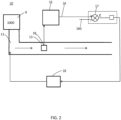
- FIG. 2 schematically represents an embodiment of a device 10 for controlling the concentration 16 of organic compounds in a fluid 11 of a network according to the invention.
- the device 10 for controlling the concentration 16 of organic compounds in the fluid 11 of the network of fluid 11 of an industrial installation 9 adapted to carry out an industrial process 1000 comprises an analyzer 15 positioned at a first location 13 in the fluid network, adapted to measure online the concentration 16 of each of the organic compounds of the plurality of organic compounds in the fluid 11 at the first location 13.
- the analyzer 15 is a device capable of measuring online, continuously or semi-continuously, several organic compounds regulated or frequently found in water or any other fluid concerned.
- the control device 10 comprises a comparator 17 adapted to compare the concentration 16 of each of the organic compounds of the plurality of organic compounds measured by the analyzer 15 with a predefined threshold value 160 for each of the organic compounds, and a correction unit 18 adapted to reduce the concentration 16 of at least one organic compound in the fluid 11, if the concentration of said at least one organic compound of the plurality of organic compounds measured by the analyzer 15 is greater than the corresponding predefined threshold value 160.
- the analyzer 15 may be, for example, a portable gas chromatograph coupled to an argon ionization microdetector, comprising a sampling device.
- the analyzer 15 may comprise two probes, one for temperature and the other allowing the arrival of argon in the fluid.
- Two types of containers may be attached to it. One is used to perform static tests and can be gauged at 2L.
- the second container is used for online analyses. It is provided with two openings, one for the arrival of the fluid and the other for the outlet, connected to pipes to form the circuit.
- the analyzer 15 starts up as soon as it is connected to an electrical outlet.
- the data processing is carried out on a computer equipped with suitable software and networked with the analyzer 15. It must be connected to an argon bottle to operate.
- the online analyzer is made to operate continuously with minimal maintenance. The analysis can be carried out without pretreatment or prior filtration for lightly loaded waters.
- the water circulates continuously in a lower cell.
- the organic compounds in the circulating water are stripped by a neutral gas (in in the case of argon), carried by the argon onto an adsorbent which traps them.
- the latter is then thermally desorbed and the organic compounds are carried by the argon carrier gas onto a chromatography column which physically separates them.
- the separated compounds are then detected using an argon microionization detector which requires argon for its operation. This system therefore operates on the principle of dynamic headspace.
- analyzer 15 that can be implemented within the scope of the invention.
- the invention can be applied with any type of analyzer capable of separating organic compounds individually in line, continuously or semi-continuously, in order to determine their concentration.
- the correction unit 18 can comprise a device for injecting into the fluid network 11 a product having the effect of reducing the concentration of said at least one organic compound.
- control device 10 comprises a remote transmission device adapted to remote transmit the concentration 16 of each of the organic compounds of the plurality of organic compounds measured by the analyzer to a control center.
- FIG. 3 schematically represents another embodiment of the device 10 for controlling the concentration of organic compounds in the fluid 11 of the network according to the invention.
- the industrial process 1000 involves at least one parameter 12, the correction unit 18 comprises a first control module configured to act on the at least one parameter 12 of the industrial process 1000 having the effect of reducing the concentration of said at least one organic compound as a function of the change in the concentration of said at least one measured organic compound.
- Such a control device 10 therefore makes it possible to obtain an online measurement of the concentration of organic compounds in a fluid, and to control the industrial process associated with the fluid. More Specifically, such a control device makes it possible to identify and treat pollution by acting on an operating parameter of the industrial process in order to best adapt the operation of the industrial installation while taking into account the level of organic compounds resulting therefrom.
- the organic compounds can be chlorinated solvents in water, trihalomethanes, but also additives in particular dedicated to fuels such as ethyl tert-butyl ether or ETBE (for the English acronym Ethyl Tert-Butyl Ether), or methyl tert-butyl ether or MTBE (for the English acronym Methyl Tert-Butyl Ether), or even odorous algae metabolites provided that the detection threshold of the analyzer is sufficiently low.
- ETBE for the English acronym Ethyl Tert-Butyl Ether
- MTBE for the English acronym Methyl Tert-Butyl Ether
- the invention applies to any volatile organic compound.
Landscapes
- Chemical & Material Sciences (AREA)
- Life Sciences & Earth Sciences (AREA)
- Health & Medical Sciences (AREA)
- Engineering & Computer Science (AREA)
- General Health & Medical Sciences (AREA)
- Pathology (AREA)
- Medicinal Chemistry (AREA)
- Physics & Mathematics (AREA)
- Analytical Chemistry (AREA)
- Biochemistry (AREA)
- Food Science & Technology (AREA)
- General Physics & Mathematics (AREA)
- Immunology (AREA)
- Combustion & Propulsion (AREA)
- Chemical Kinetics & Catalysis (AREA)
- General Chemical & Material Sciences (AREA)
- Oil, Petroleum & Natural Gas (AREA)
- Separation Using Semi-Permeable Membranes (AREA)
- Control Of Non-Electrical Variables (AREA)
- Water Treatment By Sorption (AREA)
- Physical Water Treatments (AREA)
- Investigating Or Analysing Materials By Optical Means (AREA)
Claims (4)
- Verfahren zur Überwachung der Konzentration flüchtiger organischer Verbindungen in einem Fluid (11) eines Fluidnetzes einer Industrieanlage (9), wobei die Anlage (9) dazu bestimmt ist, einen industriellen Prozess (1000) durchzuführen, das Fluid (11) umfassend eine Vielzahl von flüchtigen organischen Verbindungen, umfassend die folgenden Schritte:· einen ersten Schritt (1001) eines Inline-Messens der Konzentration (16) von jeder der Vielzahl von flüchtigen organischen Verbindungen in dem Fluid (11) des Fluidnetzes durch ein Analysegerät (15),· einen zweiten Schritt (1002) eines Vergleichens der von dem Analysegerät (15) gemessenen Konzentration (16) von jeder der Vielzahl von flüchtigen organischen Verbindungen mit einem Schwellenwert (160), der für jede der flüchtigen organischen Verbindungen als Behandlungsvorgabewert oder maximaler Alarmwert vordefiniert ist,· einen dritten Schritt (1003) eines Verringerns der Konzentration von mindestens einer flüchtigen organischen Verbindung, wenn die von dem Analysegerät (15) gemessene Konzentration (16) der mindestens einen flüchtigen organischen Verbindung höher ist als der entsprechende vordefinierte Schwellenwert (160),wobei das industrielle Verfahren (1000) ein Bohrverfahren unter Verwendung eines Bohrfluids ist, wobei das Verfahren dadurch gekennzeichnet ist, dass das Bohrfluid ein Gemisch aus kontaminiertem/nicht kontaminiertem Fluid umfasst und der dritte Schritt (1003) eines Verringerns darin besteht, die Dichte des Bohrfluids abhängig von der Konzentration der mindestens einen flüchtigen organischen Verbindung, die in dem Fluid des Netzwerks gemessen wird, durch die Steuerung des Gemischs aus kontaminiertem/nicht kontaminiertem Fluid anzupassen.
- Steuerungsverfahren nach Anspruch 1, dadurch gekennzeichnet, dass es vor dem dritten Schritt (1003) eines Verringerns einen Schritt (1005) einer Fernübertragung der Konzentration (16) von jeder der Vielzahl von flüchtigen organischen Verbindungen, die von dem Analysegerät (15) gemessen wird, an eine Steuerzentrale.
- Steuerungsvorrichtung (10) der Konzentration flüchtiger organischer Verbindungen in einem Fluid (11) eines Fluidnetzes einer Industrieanlage (9), die angepasst ist, um einen industriellen Prozess (1000) durchzuführen, wobei das Fluid (11) eine Vielzahl flüchtiger organischer Verbindungen umfasst, die Steuerungsvorrichtung (10) umfassend:· ein Analysegerät (15), das an einer ersten Stelle (13) in dem Fluidnetz positioniert ist,
wobei das Analysegerät (15) angepasst ist, um die Konzentration (16) von jeder der Vielzahl von flüchtigen organischen Verbindungen in dem Fluid (11) an der ersten Stelle (13) Inline zu messen,· einen Komparator (17), der angepasst ist, um die von dem Analysegerät (15) gemessene Konzentration (16) von jeder der Vielzahl von flüchtigen organischen Verbindungen mit einem vordefinierten Schwellenwert (160) für jede der flüchtigen organischen Verbindungen zu vergleichen,· eine Korrektureinheit (18), die angepasst ist, um die Konzentration (16) von mindestens einer flüchtigen organischen Verbindung in dem Fluid (11) zu verringern, wenn die Konzentration (16) der mindestens einen flüchtigen organischen Verbindung aus der Vielzahl von organischen Verbindungen, die von dem Analysator (15) gemessen wird, größer ist als der entsprechende vordefinierte Schwellenwert (160),wobei die Steuerungsvorrichtung (10) dadurch gekennzeichnet ist, dass der industrielle Prozess (1000) ein Bohrverfahren unter Verwendung eines Bohrfluids ist, wobei das Bohrfluid ein Gemisch aus kontaminiertem/nicht kontaminiertem Fluid umfasst, und die Korrektureinheit (18) ein erstes Ansteuerungsmodul umfasst, das konfiguriert ist, um die Dichte des Bohrfluids abhängig von der Konzentration der mindestens einen flüchtigen organischen Verbindung, die in dem Fluid des Netzes gemessen wird, durch Ansteuern des kontaminierten/nicht kontaminierten Fluidgemischs anzupassen. - Steuerungsvorrichtung (10) nach Anspruch 3, dadurch gekennzeichnet, dass sie eine Fernübertragungsvorrichtung umfasst, die angepasst ist, um die Konzentration (16) von jeder der Vielzahl von flüchtigen organischen Verbindungen, die von dem Analysator (15) gemessen wird, an eine Steuerzentrale zu übertragen.
Applications Claiming Priority (2)
| Application Number | Priority Date | Filing Date | Title |
|---|---|---|---|
| FR1662143A FR3060124B1 (fr) | 2016-12-08 | 2016-12-08 | Procede de controle de la concentration de composes organiques dans un fluide d'un reseau de fluide |
| PCT/EP2017/081444 WO2018104262A1 (fr) | 2016-12-08 | 2017-12-05 | Procede de controle de la concentration de composes organiques volatils dans un fluide d'un reseau de fluide |
Publications (2)
| Publication Number | Publication Date |
|---|---|
| EP3552012A1 EP3552012A1 (de) | 2019-10-16 |
| EP3552012B1 true EP3552012B1 (de) | 2024-11-06 |
Family
ID=58314439
Family Applications (1)
| Application Number | Title | Priority Date | Filing Date |
|---|---|---|---|
| EP17808484.4A Active EP3552012B1 (de) | 2016-12-08 | 2017-12-05 | Verfahren zur steuerung der konzentration von flüchtigen organischen verbindungen in einer bohrflüssigkeit |
Country Status (5)
| Country | Link |
|---|---|
| US (1) | US20190383779A1 (de) |
| EP (1) | EP3552012B1 (de) |
| CN (1) | CN110050189A (de) |
| FR (1) | FR3060124B1 (de) |
| WO (1) | WO2018104262A1 (de) |
Families Citing this family (14)
| Publication number | Priority date | Publication date | Assignee | Title |
|---|---|---|---|---|
| IT201900013506A1 (it) * | 2019-07-31 | 2021-01-31 | I L P A V S P A | Sistema e metodo ecosostenibile per il recupero di materie plastiche |
| US11813926B2 (en) | 2020-08-20 | 2023-11-14 | Denso International America, Inc. | Binding agent and olfaction sensor |
| US12377711B2 (en) | 2020-08-20 | 2025-08-05 | Denso International America, Inc. | Vehicle feature control systems and methods based on smoking |
| US11932080B2 (en) | 2020-08-20 | 2024-03-19 | Denso International America, Inc. | Diagnostic and recirculation control systems and methods |
| US12269315B2 (en) | 2020-08-20 | 2025-04-08 | Denso International America, Inc. | Systems and methods for measuring and managing odor brought into rental vehicles |
| US11881093B2 (en) | 2020-08-20 | 2024-01-23 | Denso International America, Inc. | Systems and methods for identifying smoking in vehicles |
| US12017506B2 (en) | 2020-08-20 | 2024-06-25 | Denso International America, Inc. | Passenger cabin air control systems and methods |
| US11636870B2 (en) | 2020-08-20 | 2023-04-25 | Denso International America, Inc. | Smoking cessation systems and methods |
| US11828210B2 (en) | 2020-08-20 | 2023-11-28 | Denso International America, Inc. | Diagnostic systems and methods of vehicles using olfaction |
| US11760169B2 (en) | 2020-08-20 | 2023-09-19 | Denso International America, Inc. | Particulate control systems and methods for olfaction sensors |
| US12251991B2 (en) | 2020-08-20 | 2025-03-18 | Denso International America, Inc. | Humidity control for olfaction sensors |
| US11760170B2 (en) | 2020-08-20 | 2023-09-19 | Denso International America, Inc. | Olfaction sensor preservation systems and methods |
| FR3124744A1 (fr) | 2021-07-02 | 2023-01-06 | Suez Groupe | Procede de regeneration in situ d’un media adsorbant |
| FR3124742A1 (fr) | 2021-07-02 | 2023-01-06 | Suez Groupe | Procede de regeneration d’un media adsorbant sur site |
Citations (3)
| Publication number | Priority date | Publication date | Assignee | Title |
|---|---|---|---|---|
| US5435169A (en) * | 1993-06-14 | 1995-07-25 | New Jersey Institute Of Technology | Continuous monitoring of organic pollutants |
| WO2009140114A1 (en) * | 2008-05-07 | 2009-11-19 | Gary Lynn Emmert | Real-time, on-line analysis for the quantification of trihalomethane species within drinking water supplies |
| CN102735859A (zh) * | 2012-07-13 | 2012-10-17 | 力合科技(湖南)股份有限公司 | 一种水中VOCs自动在线监测方法及装置 |
Family Cites Families (16)
| Publication number | Priority date | Publication date | Assignee | Title |
|---|---|---|---|---|
| US5733437A (en) * | 1991-02-13 | 1998-03-31 | Baker; Mark D. | Method for detecting small molecules in aqueous liquids |
| US5777214A (en) * | 1996-09-12 | 1998-07-07 | Lockheed Martin Energy Research Corporation | In-situ continuous water analyzing module |
| US6143184A (en) * | 1999-03-02 | 2000-11-07 | United States Filter Corporation | Air and water purification using continuous breakpoint halogenation |
| US6485688B1 (en) * | 2000-04-24 | 2002-11-26 | General Electric Company | On-line sparging sampling and monitoring systems and methods |
| WO2005022145A2 (en) * | 2003-07-11 | 2005-03-10 | Pda Security Solutions, Inc. | Remote contamination monitoring system for water supply network |
| JP2009199237A (ja) * | 2008-02-20 | 2009-09-03 | Seiko Epson Corp | 排出規制管理システム、常時排出規制管理装置、警報時排出規制管理装置、排出規制管理方法、および、排出規制管理プログラム |
| CA2720633A1 (en) * | 2008-04-03 | 2009-10-08 | Delacom Detection Systems, Llc | A method, device and system for determining the presence of volatile organic compounds (voc) in video |
| FR2943696B1 (fr) * | 2009-03-24 | 2016-08-26 | Veolia Eau - Cie Generale Des Eaux | Installation et procede de controle de la qualite de l'eau dans un reseau d'eau potable |
| WO2010132859A1 (en) * | 2009-05-14 | 2010-11-18 | Omni Water Solutions Llc | Self-contained portable multi-mode water treatment system and methods |
| US9134290B2 (en) * | 2010-04-22 | 2015-09-15 | Harmesh K. Saini | Methods and apparatus for determination of halohydrocarbons |
| WO2012158388A2 (en) * | 2011-05-18 | 2012-11-22 | Bolt, N. V. | Method and apparatus for determination of haloacetic acid ("haa") presence in aqueous solutions |
| CN102298368B (zh) * | 2011-06-17 | 2013-08-07 | 中国环境科学研究院 | 一种水源中挥发性有机污染物的监控系统 |
| US20130233796A1 (en) * | 2012-03-06 | 2013-09-12 | Narasimha M. Rao | Treatment of industrial water systems |
| WO2015047247A1 (en) * | 2013-09-25 | 2015-04-02 | Halliburton Energy Services, Inc. | Systems and methods for real time measurement of gas content in drilling fluids |
| CN103675308B (zh) * | 2013-12-30 | 2016-03-30 | 力合科技(湖南)股份有限公司 | 一种水中VOCs在线分析仪 |
| CN105403679A (zh) * | 2015-10-30 | 2016-03-16 | 桂林市腾瑞电子科技有限公司 | 一种水库中水况监测系统及其监测方法 |
-
2016
- 2016-12-08 FR FR1662143A patent/FR3060124B1/fr active Active
-
2017
- 2017-12-05 US US16/463,828 patent/US20190383779A1/en not_active Abandoned
- 2017-12-05 WO PCT/EP2017/081444 patent/WO2018104262A1/fr not_active Ceased
- 2017-12-05 CN CN201780075670.1A patent/CN110050189A/zh active Pending
- 2017-12-05 EP EP17808484.4A patent/EP3552012B1/de active Active
Patent Citations (3)
| Publication number | Priority date | Publication date | Assignee | Title |
|---|---|---|---|---|
| US5435169A (en) * | 1993-06-14 | 1995-07-25 | New Jersey Institute Of Technology | Continuous monitoring of organic pollutants |
| WO2009140114A1 (en) * | 2008-05-07 | 2009-11-19 | Gary Lynn Emmert | Real-time, on-line analysis for the quantification of trihalomethane species within drinking water supplies |
| CN102735859A (zh) * | 2012-07-13 | 2012-10-17 | 力合科技(湖南)股份有限公司 | 一种水中VOCs自动在线监测方法及装置 |
Non-Patent Citations (1)
| Title |
|---|
| WORTBERG M ET AL: "Monitoring industrial wastewater by online GC-MS with direct aqueous injection", ANALYTICAL AND BIOANALYTICAL CHEMISTRY, SPRINGER, BERLIN, DE, vol. 384, no. 5, 1 March 2006 (2006-03-01), pages 1113 - 1122, XP019327885, ISSN: 1618-2650, DOI: 10.1007/S00216-005-3366-2 * |
Also Published As
| Publication number | Publication date |
|---|---|
| US20190383779A1 (en) | 2019-12-19 |
| FR3060124B1 (fr) | 2022-03-11 |
| WO2018104262A1 (fr) | 2018-06-14 |
| EP3552012A1 (de) | 2019-10-16 |
| FR3060124A1 (fr) | 2018-06-15 |
| CN110050189A (zh) | 2019-07-23 |
Similar Documents
| Publication | Publication Date | Title |
|---|---|---|
| WO2018104262A1 (fr) | Procede de controle de la concentration de composes organiques volatils dans un fluide d'un reseau de fluide | |
| Kosaka et al. | Identification of antiyellowing agents as precursors of N-nitrosodimethylamine production on ozonation from sewage treatment plant influent | |
| Zhang et al. | Analysis of emerging contaminants in sewage effluent and river water: comparison between spot and passive sampling | |
| Zhou et al. | Sorption of selected endocrine disrupting chemicals to different aquatic colloids | |
| Yamashita et al. | Analysis of perfluorinated acids at parts-per-quadrillion levels in seawater using liquid chromatography-tandem mass spectrometry | |
| US7930924B2 (en) | System for the online measurement of volatile and semi-volatile compounds and use thereof | |
| Nguyen et al. | Pressure-driven distillation using air-trapping membranes for fast and selective water purification | |
| Yeh et al. | Use of fluorescence quenching method to measure sorption constants of phenolic xenoestrogens onto humic fractions from sediment | |
| Belfort | Selective adsorption of organic homologues onto activated carbon from dilute aqueous solutions. Solvophobic interaction approach and correlations of molar adsorptivity with physicochemical parameters | |
| Le Lacheur et al. | Reactions of ozone and hydroxyl radicals with serine | |
| Zhuang et al. | Gas chromatographic analysis of methanol and ethanol in marine sediment pore waters: Validation and implementation of three pretreatment techniques | |
| EP2719667B1 (de) | Verfahren der Wasseraufbereitung zur Abschwächung eines endokrinen Disruptoren-Effekts im Wasser mit Hilfe eines lebenden Organismus | |
| Sadia et al. | Exploring perfluoroalkyl and polyfluoroalkyl substance presence and potential leaching from reverse osmosis membranes: implications for drinking water treatment | |
| Zhang et al. | Real-time and online monitoring of hazardous volatile organic compounds in environmental water by an unmanned shipborne mass spectrometer system | |
| WO2012158388A2 (en) | Method and apparatus for determination of haloacetic acid ("haa") presence in aqueous solutions | |
| Borikar et al. | Evaluations of conventional, ozone and UV/H2O2 for removal of emerging contaminants and THM-FPs | |
| Larous et al. | Elimination of organic pollutants from wastewater. Application to p-nitrophenol | |
| Lou et al. | Removal of trihalomethanes and haloacetic acids from treated drinking water by biological activated carbon filter | |
| Thor et al. | Transformation of persistent organic micropollutants by UV and UV/H2O2 in wastewater treatment plant effluent | |
| Alberici et al. | Selective Trace Level Analysis of Phenolic Compounds in Water by Flow Injection Analysis− Membrane Introduction Mass Spectrometry | |
| Babiarz et al. | A critical evaluation of tangential-flow ultrafiltration for trace metal studies in freshwater systems. 2. Total mercury and methylmercury | |
| Cirja et al. | Fate of a 14C-labeled nonylphenol isomer in a laboratory-scale membrane bioreactor | |
| Upadhyaya et al. | Resilient biological hexavalent chromium removal with a two‐stage, fixed‐bed biotreatment system | |
| Piekutin et al. | Removal of organic micropollutants (personal care products and endocrine disruptors) from water | |
| Papadopoulou-Mourkidou et al. | Use of an automated on-line SPE–HPLC method to monitor caffeine and selected aniline and phenol compounds in aquatic systems of Macedonia–Thrace, Greece |
Legal Events
| Date | Code | Title | Description |
|---|---|---|---|
| STAA | Information on the status of an ep patent application or granted ep patent |
Free format text: STATUS: UNKNOWN |
|
| STAA | Information on the status of an ep patent application or granted ep patent |
Free format text: STATUS: THE INTERNATIONAL PUBLICATION HAS BEEN MADE |
|
| PUAI | Public reference made under article 153(3) epc to a published international application that has entered the european phase |
Free format text: ORIGINAL CODE: 0009012 |
|
| STAA | Information on the status of an ep patent application or granted ep patent |
Free format text: STATUS: REQUEST FOR EXAMINATION WAS MADE |
|
| 17P | Request for examination filed |
Effective date: 20190528 |
|
| AK | Designated contracting states |
Kind code of ref document: A1 Designated state(s): AL AT BE BG CH CY CZ DE DK EE ES FI FR GB GR HR HU IE IS IT LI LT LU LV MC MK MT NL NO PL PT RO RS SE SI SK SM TR |
|
| AX | Request for extension of the european patent |
Extension state: BA ME |
|
| DAV | Request for validation of the european patent (deleted) | ||
| DAX | Request for extension of the european patent (deleted) | ||
| STAA | Information on the status of an ep patent application or granted ep patent |
Free format text: STATUS: EXAMINATION IS IN PROGRESS |
|
| 17Q | First examination report despatched |
Effective date: 20210712 |
|
| RAP1 | Party data changed (applicant data changed or rights of an application transferred) |
Owner name: SUEZ INTERNATIONAL |
|
| P01 | Opt-out of the competence of the unified patent court (upc) registered |
Effective date: 20230606 |
|
| REG | Reference to a national code |
Ref country code: DE Ref legal event code: R079 Free format text: PREVIOUS MAIN CLASS: G01N0033180000 Ipc: G01N0033280000 Ref country code: DE Ref legal event code: R079 Ref document number: 602017085965 Country of ref document: DE Free format text: PREVIOUS MAIN CLASS: G01N0033180000 Ipc: G01N0033280000 |
|
| GRAP | Despatch of communication of intention to grant a patent |
Free format text: ORIGINAL CODE: EPIDOSNIGR1 |
|
| STAA | Information on the status of an ep patent application or granted ep patent |
Free format text: STATUS: GRANT OF PATENT IS INTENDED |
|
| RIC1 | Information provided on ipc code assigned before grant |
Ipc: G01N 33/00 20060101ALN20240313BHEP Ipc: G01N 33/18 20060101ALN20240313BHEP Ipc: G01N 33/28 20060101AFI20240313BHEP |
|
| INTG | Intention to grant announced |
Effective date: 20240402 |
|
| GRAJ | Information related to disapproval of communication of intention to grant by the applicant or resumption of examination proceedings by the epo deleted |
Free format text: ORIGINAL CODE: EPIDOSDIGR1 |
|
| STAA | Information on the status of an ep patent application or granted ep patent |
Free format text: STATUS: EXAMINATION IS IN PROGRESS |
|
| GRAP | Despatch of communication of intention to grant a patent |
Free format text: ORIGINAL CODE: EPIDOSNIGR1 |
|
| STAA | Information on the status of an ep patent application or granted ep patent |
Free format text: STATUS: GRANT OF PATENT IS INTENDED |
|
| INTC | Intention to grant announced (deleted) | ||
| RIC1 | Information provided on ipc code assigned before grant |
Ipc: G01N 33/00 20060101ALN20240507BHEP Ipc: G01N 33/18 20060101ALN20240507BHEP Ipc: G01N 33/28 20060101AFI20240507BHEP |
|
| INTG | Intention to grant announced |
Effective date: 20240527 |
|
| GRAS | Grant fee paid |
Free format text: ORIGINAL CODE: EPIDOSNIGR3 |
|
| GRAA | (expected) grant |
Free format text: ORIGINAL CODE: 0009210 |
|
| STAA | Information on the status of an ep patent application or granted ep patent |
Free format text: STATUS: THE PATENT HAS BEEN GRANTED |
|
| AK | Designated contracting states |
Kind code of ref document: B1 Designated state(s): AL AT BE BG CH CY CZ DE DK EE ES FI FR GB GR HR HU IE IS IT LI LT LU LV MC MK MT NL NO PL PT RO RS SE SI SK SM TR |
|
| REG | Reference to a national code |
Ref country code: GB Ref legal event code: FG4D Free format text: NOT ENGLISH |
|
| REG | Reference to a national code |
Ref country code: CH Ref legal event code: EP |
|
| REG | Reference to a national code |
Ref country code: DE Ref legal event code: R096 Ref document number: 602017085965 Country of ref document: DE |
|
| REG | Reference to a national code |
Ref country code: IE Ref legal event code: FG4D Free format text: LANGUAGE OF EP DOCUMENT: FRENCH |
|
| REG | Reference to a national code |
Ref country code: LT Ref legal event code: MG9D |
|
| REG | Reference to a national code |
Ref country code: NL Ref legal event code: MP Effective date: 20241106 |
|
| PG25 | Lapsed in a contracting state [announced via postgrant information from national office to epo] |
Ref country code: IS Free format text: LAPSE BECAUSE OF FAILURE TO SUBMIT A TRANSLATION OF THE DESCRIPTION OR TO PAY THE FEE WITHIN THE PRESCRIBED TIME-LIMIT Effective date: 20250306 Ref country code: PT Free format text: LAPSE BECAUSE OF FAILURE TO SUBMIT A TRANSLATION OF THE DESCRIPTION OR TO PAY THE FEE WITHIN THE PRESCRIBED TIME-LIMIT Effective date: 20250306 Ref country code: HR Free format text: LAPSE BECAUSE OF FAILURE TO SUBMIT A TRANSLATION OF THE DESCRIPTION OR TO PAY THE FEE WITHIN THE PRESCRIBED TIME-LIMIT Effective date: 20241106 |
|
| PG25 | Lapsed in a contracting state [announced via postgrant information from national office to epo] |
Ref country code: NL Free format text: LAPSE BECAUSE OF FAILURE TO SUBMIT A TRANSLATION OF THE DESCRIPTION OR TO PAY THE FEE WITHIN THE PRESCRIBED TIME-LIMIT Effective date: 20241106 Ref country code: FI Free format text: LAPSE BECAUSE OF FAILURE TO SUBMIT A TRANSLATION OF THE DESCRIPTION OR TO PAY THE FEE WITHIN THE PRESCRIBED TIME-LIMIT Effective date: 20241106 |
|
| REG | Reference to a national code |
Ref country code: AT Ref legal event code: MK05 Ref document number: 1739876 Country of ref document: AT Kind code of ref document: T Effective date: 20241106 |
|
| PG25 | Lapsed in a contracting state [announced via postgrant information from national office to epo] |
Ref country code: BG Free format text: LAPSE BECAUSE OF FAILURE TO SUBMIT A TRANSLATION OF THE DESCRIPTION OR TO PAY THE FEE WITHIN THE PRESCRIBED TIME-LIMIT Effective date: 20241106 |
|
| PG25 | Lapsed in a contracting state [announced via postgrant information from national office to epo] |
Ref country code: ES Free format text: LAPSE BECAUSE OF FAILURE TO SUBMIT A TRANSLATION OF THE DESCRIPTION OR TO PAY THE FEE WITHIN THE PRESCRIBED TIME-LIMIT Effective date: 20241106 |
|
| PG25 | Lapsed in a contracting state [announced via postgrant information from national office to epo] |
Ref country code: NO Free format text: LAPSE BECAUSE OF FAILURE TO SUBMIT A TRANSLATION OF THE DESCRIPTION OR TO PAY THE FEE WITHIN THE PRESCRIBED TIME-LIMIT Effective date: 20250206 |
|
| PG25 | Lapsed in a contracting state [announced via postgrant information from national office to epo] |
Ref country code: GR Free format text: LAPSE BECAUSE OF FAILURE TO SUBMIT A TRANSLATION OF THE DESCRIPTION OR TO PAY THE FEE WITHIN THE PRESCRIBED TIME-LIMIT Effective date: 20250207 Ref country code: AT Free format text: LAPSE BECAUSE OF FAILURE TO SUBMIT A TRANSLATION OF THE DESCRIPTION OR TO PAY THE FEE WITHIN THE PRESCRIBED TIME-LIMIT Effective date: 20241106 Ref country code: LV Free format text: LAPSE BECAUSE OF FAILURE TO SUBMIT A TRANSLATION OF THE DESCRIPTION OR TO PAY THE FEE WITHIN THE PRESCRIBED TIME-LIMIT Effective date: 20241106 |
|
| PG25 | Lapsed in a contracting state [announced via postgrant information from national office to epo] |
Ref country code: PL Free format text: LAPSE BECAUSE OF FAILURE TO SUBMIT A TRANSLATION OF THE DESCRIPTION OR TO PAY THE FEE WITHIN THE PRESCRIBED TIME-LIMIT Effective date: 20241106 |
|
| PG25 | Lapsed in a contracting state [announced via postgrant information from national office to epo] |
Ref country code: RS Free format text: LAPSE BECAUSE OF FAILURE TO SUBMIT A TRANSLATION OF THE DESCRIPTION OR TO PAY THE FEE WITHIN THE PRESCRIBED TIME-LIMIT Effective date: 20250206 |
|
| REG | Reference to a national code |
Ref country code: DE Ref legal event code: R119 Ref document number: 602017085965 Country of ref document: DE |
|
| PG25 | Lapsed in a contracting state [announced via postgrant information from national office to epo] |
Ref country code: SM Free format text: LAPSE BECAUSE OF FAILURE TO SUBMIT A TRANSLATION OF THE DESCRIPTION OR TO PAY THE FEE WITHIN THE PRESCRIBED TIME-LIMIT Effective date: 20241106 |
|
| PG25 | Lapsed in a contracting state [announced via postgrant information from national office to epo] |
Ref country code: DK Free format text: LAPSE BECAUSE OF FAILURE TO SUBMIT A TRANSLATION OF THE DESCRIPTION OR TO PAY THE FEE WITHIN THE PRESCRIBED TIME-LIMIT Effective date: 20241106 |
|
| PG25 | Lapsed in a contracting state [announced via postgrant information from national office to epo] |
Ref country code: EE Free format text: LAPSE BECAUSE OF FAILURE TO SUBMIT A TRANSLATION OF THE DESCRIPTION OR TO PAY THE FEE WITHIN THE PRESCRIBED TIME-LIMIT Effective date: 20241106 |
|
| PG25 | Lapsed in a contracting state [announced via postgrant information from national office to epo] |
Ref country code: RO Free format text: LAPSE BECAUSE OF FAILURE TO SUBMIT A TRANSLATION OF THE DESCRIPTION OR TO PAY THE FEE WITHIN THE PRESCRIBED TIME-LIMIT Effective date: 20241106 |
|
| PG25 | Lapsed in a contracting state [announced via postgrant information from national office to epo] |
Ref country code: SK Free format text: LAPSE BECAUSE OF FAILURE TO SUBMIT A TRANSLATION OF THE DESCRIPTION OR TO PAY THE FEE WITHIN THE PRESCRIBED TIME-LIMIT Effective date: 20241106 |
|
| PG25 | Lapsed in a contracting state [announced via postgrant information from national office to epo] |
Ref country code: CZ Free format text: LAPSE BECAUSE OF FAILURE TO SUBMIT A TRANSLATION OF THE DESCRIPTION OR TO PAY THE FEE WITHIN THE PRESCRIBED TIME-LIMIT Effective date: 20241106 |
|
| PG25 | Lapsed in a contracting state [announced via postgrant information from national office to epo] |
Ref country code: IT Free format text: LAPSE BECAUSE OF FAILURE TO SUBMIT A TRANSLATION OF THE DESCRIPTION OR TO PAY THE FEE WITHIN THE PRESCRIBED TIME-LIMIT Effective date: 20241106 |
|
| REG | Reference to a national code |
Ref country code: CH Ref legal event code: PL |
|
| PG25 | Lapsed in a contracting state [announced via postgrant information from national office to epo] |
Ref country code: LU Free format text: LAPSE BECAUSE OF NON-PAYMENT OF DUE FEES Effective date: 20241205 |
|
| PG25 | Lapsed in a contracting state [announced via postgrant information from national office to epo] |
Ref country code: SE Free format text: LAPSE BECAUSE OF FAILURE TO SUBMIT A TRANSLATION OF THE DESCRIPTION OR TO PAY THE FEE WITHIN THE PRESCRIBED TIME-LIMIT Effective date: 20241106 |
|
| PLBE | No opposition filed within time limit |
Free format text: ORIGINAL CODE: 0009261 |
|
| STAA | Information on the status of an ep patent application or granted ep patent |
Free format text: STATUS: NO OPPOSITION FILED WITHIN TIME LIMIT |
|
| PG25 | Lapsed in a contracting state [announced via postgrant information from national office to epo] |
Ref country code: MC Free format text: LAPSE BECAUSE OF FAILURE TO SUBMIT A TRANSLATION OF THE DESCRIPTION OR TO PAY THE FEE WITHIN THE PRESCRIBED TIME-LIMIT Effective date: 20241106 |
|
| REG | Reference to a national code |
Ref country code: BE Ref legal event code: MM Effective date: 20241231 |
|
| PG25 | Lapsed in a contracting state [announced via postgrant information from national office to epo] |
Ref country code: DE Free format text: LAPSE BECAUSE OF NON-PAYMENT OF DUE FEES Effective date: 20250701 |
|
| 26N | No opposition filed |
Effective date: 20250807 |
|
| PG25 | Lapsed in a contracting state [announced via postgrant information from national office to epo] |
Ref country code: BE Free format text: LAPSE BECAUSE OF NON-PAYMENT OF DUE FEES Effective date: 20241231 |
|
| PG25 | Lapsed in a contracting state [announced via postgrant information from national office to epo] |
Ref country code: CH Free format text: LAPSE BECAUSE OF NON-PAYMENT OF DUE FEES Effective date: 20241231 |
|
| PG25 | Lapsed in a contracting state [announced via postgrant information from national office to epo] |
Ref country code: IE Free format text: LAPSE BECAUSE OF NON-PAYMENT OF DUE FEES Effective date: 20241205 |
|
| GBPC | Gb: european patent ceased through non-payment of renewal fee |
Effective date: 20250206 |
|
| PG25 | Lapsed in a contracting state [announced via postgrant information from national office to epo] |
Ref country code: GB Free format text: LAPSE BECAUSE OF NON-PAYMENT OF DUE FEES Effective date: 20250206 |
|
| PGFP | Annual fee paid to national office [announced via postgrant information from national office to epo] |
Ref country code: FR Payment date: 20251226 Year of fee payment: 9 |
|
| PG25 | Lapsed in a contracting state [announced via postgrant information from national office to epo] |
Ref country code: CY Free format text: LAPSE BECAUSE OF FAILURE TO SUBMIT A TRANSLATION OF THE DESCRIPTION OR TO PAY THE FEE WITHIN THE PRESCRIBED TIME-LIMIT; INVALID AB INITIO Effective date: 20171205 |
|
| PG25 | Lapsed in a contracting state [announced via postgrant information from national office to epo] |
Ref country code: TR Free format text: LAPSE BECAUSE OF FAILURE TO SUBMIT A TRANSLATION OF THE DESCRIPTION OR TO PAY THE FEE WITHIN THE PRESCRIBED TIME-LIMIT Effective date: 20241106 |
|
| PG25 | Lapsed in a contracting state [announced via postgrant information from national office to epo] |
Ref country code: HU Free format text: LAPSE BECAUSE OF FAILURE TO SUBMIT A TRANSLATION OF THE DESCRIPTION OR TO PAY THE FEE WITHIN THE PRESCRIBED TIME-LIMIT; INVALID AB INITIO Effective date: 20171205 |
|
| PG25 | Lapsed in a contracting state [announced via postgrant information from national office to epo] |
Ref country code: SI Free format text: LAPSE BECAUSE OF FAILURE TO SUBMIT A TRANSLATION OF THE DESCRIPTION OR TO PAY THE FEE WITHIN THE PRESCRIBED TIME-LIMIT Effective date: 20241106 |
|
| PG25 | Lapsed in a contracting state [announced via postgrant information from national office to epo] |
Ref country code: LT Free format text: LAPSE BECAUSE OF FAILURE TO SUBMIT A TRANSLATION OF THE DESCRIPTION OR TO PAY THE FEE WITHIN THE PRESCRIBED TIME-LIMIT Effective date: 20241106 |