EP3551975B1 - System zur erkennung von elektromagnetischer strahlung - Google Patents
System zur erkennung von elektromagnetischer strahlung Download PDFInfo
- Publication number
- EP3551975B1 EP3551975B1 EP17811542.4A EP17811542A EP3551975B1 EP 3551975 B1 EP3551975 B1 EP 3551975B1 EP 17811542 A EP17811542 A EP 17811542A EP 3551975 B1 EP3551975 B1 EP 3551975B1
- Authority
- EP
- European Patent Office
- Prior art keywords
- filter
- sensor
- detector
- optical axis
- electromagnetic radiation
- Prior art date
- Legal status (The legal status is an assumption and is not a legal conclusion. Google has not performed a legal analysis and makes no representation as to the accuracy of the status listed.)
- Active
Links
Images


Classifications
-
- G—PHYSICS
- G01—MEASURING; TESTING
- G01J—MEASUREMENT OF INTENSITY, VELOCITY, SPECTRAL CONTENT, POLARISATION, PHASE OR PULSE CHARACTERISTICS OF INFRARED, VISIBLE OR ULTRAVIOLET LIGHT; COLORIMETRY; RADIATION PYROMETRY
- G01J5/00—Radiation pyrometry, e.g. infrared or optical thermometry
- G01J5/02—Constructional details
- G01J5/06—Arrangements for eliminating effects of disturbing radiation; Arrangements for compensating changes in sensitivity
- G01J5/061—Arrangements for eliminating effects of disturbing radiation; Arrangements for compensating changes in sensitivity by controlling the temperature of the apparatus or parts thereof, e.g. using cooling means or thermostats
-
- G—PHYSICS
- G01—MEASURING; TESTING
- G01J—MEASUREMENT OF INTENSITY, VELOCITY, SPECTRAL CONTENT, POLARISATION, PHASE OR PULSE CHARACTERISTICS OF INFRARED, VISIBLE OR ULTRAVIOLET LIGHT; COLORIMETRY; RADIATION PYROMETRY
- G01J5/00—Radiation pyrometry, e.g. infrared or optical thermometry
- G01J5/02—Constructional details
- G01J5/08—Optical arrangements
-
- G—PHYSICS
- G01—MEASURING; TESTING
- G01J—MEASUREMENT OF INTENSITY, VELOCITY, SPECTRAL CONTENT, POLARISATION, PHASE OR PULSE CHARACTERISTICS OF INFRARED, VISIBLE OR ULTRAVIOLET LIGHT; COLORIMETRY; RADIATION PYROMETRY
- G01J5/00—Radiation pyrometry, e.g. infrared or optical thermometry
- G01J5/02—Constructional details
- G01J5/08—Optical arrangements
- G01J5/0801—Means for wavelength selection or discrimination
- G01J5/0802—Optical filters
-
- G—PHYSICS
- G01—MEASURING; TESTING
- G01J—MEASUREMENT OF INTENSITY, VELOCITY, SPECTRAL CONTENT, POLARISATION, PHASE OR PULSE CHARACTERISTICS OF INFRARED, VISIBLE OR ULTRAVIOLET LIGHT; COLORIMETRY; RADIATION PYROMETRY
- G01J5/00—Radiation pyrometry, e.g. infrared or optical thermometry
- G01J5/80—Calibration
Definitions
- the invention relates to a system for detecting electromagnetic radiation, such as infrared radiation.
- Electromagnetic radiation detection systems are commonly used to equip homing seekers with self-guided projectiles, of the missile or rocket type, drones or even thermal cameras, binoculars and glasses for night visions, telescopes and more generally any observation device based on detection of electromagnetic radiation.
- electromagnetic radiation detection systems are equipped with an electromagnetic radiation sensor of the FPA matrix type (focal plane matrix, “Focal Plan Array” in English terminology).
- An electromagnetic radiation sensor called simply a sensor hereinafter, is composed of a plurality of detectors sensitive to electromagnetic radiation such as thermodetectors or photodetectors. Each photodetector transforms for example the photons resulting from electromagnetic radiation into electron-hole pairs by photoelectric effect then collects the electrons in a potential well. We then speak of filling the potential well. The number of electrons collected is proportional to the number of photons received.
- each pixel being represented by at least one value coming from at least one detector of said sensor, each value depending on a level of filling in electron of the potential wells.
- these sensors In order to prevent the wells from being filled with electron-hole pairs generated by the photosensitive material of the sensor (ie the substrate), these sensors must be cooled.
- said system comprises a cooled diaphragm.
- This diaphragm makes it possible to limit the number of parasitic photons reaching the sensor.
- cryostat in English terminology
- each detector of a sensor Due to a dispersion effect of the individual responses of each detector of a sensor, it is essential to calibrate in gain and in offset value (“offset” in English terminology) each detector of said sensor.
- a calibration gain corresponding to a measurement of a slope of a curve, it is necessary to acquire at least two signals (i. E. Two values) corresponding to two different wells fills.
- the offset value is taken at a well filling point.
- Such an acquisition series is generally called a two-point and sometimes three-point calibration.
- the fillings must vary at a fixed integration time. They must therefore correspond to different scenes.
- the complete optical system is ideally taken into account in each of the measurements.
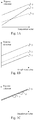
- the Fig. 1A represents response curves of a first and a second detector of a detector of a sensor as a function of a scene temperature.
- a curve 1 represents the response curve of a first detector.
- a curve 2 represents the response curve of a second detector.
- the response curves of the first and second detectors are totally different both in slope and in point of origin.
- An objective of calibration is to ensure that the response curve of each detector corresponds to an ideal response curve shown in Fig. 1A by a curve 3.
- the Fig. 1B represents a first calibration step during which the slope of the response curve of each detector is corrected.
- a function making it possible to determine a gain value to be applied to the response curve as a function of a scene temperature value is then determined for the first and the second detectors.
- an application of this function to curves 1 and 2 makes it possible to straighten these curves so as to obtain curves having a slope identical to curve 3.
- the Fig. 1 C represents a second calibration step during which the shift value of the response curve of each detector is corrected.
- the offset value of each curve is determined so as to obtain a response curve coincident with the ideal curve for each detector.
- the gains are calculated once in the factory while the offset values are calculated in product (that is to say in the field of use of the electromagnetic radiation detection system).
- many FPA matrices for example those composed of MCT (Mercury Cadmium Tellurium), exhibit instabilities of gain. Consequently, for a detector of a sensor, the gain correction applied is erroneous and the correction in offset value cannot compensate for this error. The detector concerned is then incorrectly corrected.
- These bad corrections can result in an image produced by the sensor, appearances of pixels, called atypical pixels , inconsistent with the other pixels of the image.
- These gain instabilities are all the more troublesome as the affected pixels vary from one use to another ( ie from one start-up to another) of the electromagnetic radiation detection systems.
- electromagnetic radiation detection systems have a relatively long lifespan (for example from “15” to “20” years), these gain instabilities can also be linked to aging of the sensor during this lifespan.
- Passive and active calibration methods are generally based on detecting atypical pixels by observing the gains and / or offset values of the corresponding detectors.
- an electromagnetic radiation detection system incorporating means allowing the implementation of an active calibration method which operates without a Peltier module, which does not over-declare atypical pixels, and which makes it possible to avoid the implementation of a hardened calibration. It is further desirable that the electromagnetic radiation detection system allow two point calibration.
- the present invention relates to an electromagnetic radiation detection system
- a housing defining an enclosure in which there is a partial vacuum comprising a window transparent to said electromagnetic radiation; a cold finger having a side wall closed at one end by an end wall located in line with the window; a sensor, mounted on the end wall, having a flat upper surface disposed opposite the window comprising detectors sensitive to electromagnetic radiation and cooled by the cold finger, said sensor defining an optical axis perpendicular to the flat upper surface and centered in relation to to this one; a cold screen surrounding the sensor, substantially in the shape of a dome, mounted on the cold finger and of revolution about the optical axis, and comprising an upper end, disposed between the window and the sensor defining a diaphragm of circular shape centered on the optical axis and a side wall connecting a base of the cold screen to the upper end having an internal face with concavity facing the optical axis.
- the system comprises: at least one band-pass electromagnetic radiation filter having a predefined transmission coefficient, each filter being mobile and being able to assume a first position in which it is placed outside the facing housing of the window and a second position in which it is placed so as not to filter any electromagnetic radiation received by the system, in said first position each filter has in section in any secant plane containing the optical axis a concave shape facing the sensor having a conical and / or aspherical base profile and reflects the focal plane within the housing; and, processing means making it possible to evaluate for each detector of the sensor a gain and an offset value by using a first value supplied by said detector when each filter is in the second position and at least a second value supplied by said detector when 'one of the at least one filter is in the first position.
- At least one filter in the electromagnetic radiation detection system makes it possible to simply carry out at least one two-point calibration of each detector of the sensor. This system then does not include a Peltier module.
- At least a first filter among the at least one filter has a surface of which any section by a plane containing the optical axis is in the form of an ellipse or of a circle truncated by a plane perpendicular to the optical axis. and of revolution around the optical axis.
- At least one of the at least one filter reflects the focal plane inside the cold screen.
- each focal point of the ellipse of the section in the form of a truncated ellipse or of the circle of the section in the form of a truncated circle of the first filter is placed on the edge of the window.
- the housing comprises an internal surface reflecting electromagnetic radiation and the cold screen comprises an external surface absorbing electromagnetic radiation.
- each focal point of the ellipse of the section in the form of a truncated ellipse or of the circle of the section in the form of a truncated circle of the first filter is placed on the edge of the diaphragm.
- the invention relates to a method for calibrating detectors sensitive to electromagnetic radiation of a sensor implemented by the electromagnetic radiation detection system according to the first aspect.
- the method comprises: positioning a filter among the at least one filter in the first position; triggering an acquisition of a first matrix of values by the sensor, each value of the matrix of values coming from a detector of the IR sensor; positioning said filter in the second position; trigger a acquisition of a second matrix of values by the sensor; determining for each detector of the sensor, a gain and an offset value to be applied to the values coming from said detector, each determination of a gain and of an offset value of a detector uses a value from the first matrix corresponding to said detector and a value of the second matrix corresponding to said detector.
- the invention relates to a computer program, comprising instructions for implementing, by a device, the method according to the second aspect, when said program is executed by a processor of said device.
- the invention relates to storage means, storing a computer program comprising instructions for implementing, by a device, the method according to the second aspect, when said program is executed by a device. processor of said device.
- the invention is described below in the context of an infrared radiation (IR) detection system.
- IR infrared radiation
- the invention however applies to any system of detection of electromagnetic radiation and for radiation other than infrared radiation.
- the Fig. 2 shows a sectional view of an infrared radiation detection system known from the prior art.
- An infrared radiation detection system 2 referred to as an IR system hereinafter, comprises a housing 20 defining an enclosure in which there is a partial vacuum (approximately 10 -6 bars), provided with a window 201 transparent to IR radiation.
- the IR system 2 comprises a cold finger 202 comprising a cryostat 203 (“Dewar” in English terminology) suitable for receiving a heat exchanger 213.
- the cold finger 202 has a side wall 204 closed at one end by an end wall 208 located to the right of window 201.
- An infrared sensor 207 is mounted on the end wall 208 so that it can be struck by IR radiation passing through the window 201, while being cooled by the cold finger 202.
- the IR sensor 207 has a flat upper surface 206, rectangular or circular, placed opposite the window 201 and made up of a matrix of detectors sensitive to IR radiation.
- the IR sensor 207 defines an optical X axis perpendicular to the planar top surface 206 and centered relative thereto.
- IR systems are used to observe at least one object in a scene.
- Said scene can be divided into two zones: a first zone comprising the object, and a second zone comprising everything that is not part of the object which we call the background.
- the object and the background generally have close temperatures, around "300 ° K" and therefore generate similar IR radiation. Under these conditions, it may be difficult to distinguish the object from the background.
- IR systems generally have a limited field of view so as to limit the radiation perceived by the sensor from the background of the object observed. As we have seen above, such a limitation is for example obtained by inserting a cooled diaphragm between the object observed and the sensor.
- the IR system 1 therefore comprises a cold screen 212 substantially in the form of a dome surrounding the IR sensor 207, mounted on the cold finger 202 and of revolution around the optical axis X of the IR sensor 207.
- the cold screen 212 is intended for limit the IR radiation likely to reach the IR sensor 207.
- the cold screen 212 has a base 205, through which the cold screen 212 is mounted on the cryostat 203.
- the cold screen 212 also comprises an upper end 210, disposed between the window 201 and the IR sensor 207 defining a diaphragm 211 of circular shape centered on the optical axis X.
- the cold screen 212 also comprises a side wall 209 connecting the base 205 to the upper end 210.
- the side wall 209 has an internal face with a concavity turned towards the optical axis X.
- the IR system 2 further comprises a lens system 30 adapted to focus IR radiation emanating from an observed object on the IR sensor 207.
- the lens system 30 may include a plurality of optical elements.
- the lens system 30 includes a first front lens 300 and a second intermediate lens 301. Each lens is transmissive for a set of electromagnetic wavelengths corresponding to an infrared band of interest to the system.
- the lens system 30 is associated with a focal plane perpendicular to the optical axis X.
- the IR sensor 207 is located in the focal plane associated with the lens system 30.
- the lens system 30 is external to the cryostat and is therefore not cooled.
- the IR system 3 comprises a processing module 213 which we describe below in relation to the Fig. 5 .
- the processing module 213 receives a matrix of values from the IR sensor 207, each value coming from a detector of the IR sensor 207.
- the processing module 213 applies a processing to each of the values received in order to generate an image from the image. matrix of values.
- the processing module 213 applies in particular a gain and a predefined offset value to each of the values of the matrix of values.
- the Fig. 5 schematically illustrates an example of a hardware architecture of a module for processing values 213 originating from the IR sensor 207.
- the processing module 213 then comprises, connected by a communication bus 2130: a processor or CPU (“Central Processing Unit” in English) 2131; a random access memory RAM (“Random Access Memory” in English) 2132; a ROM ("Read Only Memory” in English) 2133; a storage unit such as a hard disk or a storage medium reader, such as an SD (“Secure Digital”) card reader 2134; at least one communication interface 2135 allowing the processing module 213 to communicate with, for example, the IR sensor 207 and an image display module, not shown.
- a communication bus 2130 a processor or CPU (“Central Processing Unit” in English) 2131; a random access memory RAM (“Random Access Memory” in English) 2132; a ROM ("Read Only Memory” in English) 2133; a storage unit such as a hard disk or a storage medium reader, such as an SD (“Secure Digital”) card reader 2134; at least one communication interface 2135 allowing the processing module 213 to communicate with, for example, the IR sensor 207
- Processor 2131 is capable of executing instructions loaded into RAM 2132 from ROM 2133, external memory (not shown), storage media (such as an SD card), or a communication network. When the IR 2 system is powered on, processor 2131 is able to read instructions from RAM 2132 and execute them. These instructions form a computer program causing the implementation, by the processor 2131, of methods for processing the values coming from the detectors of the IR sensor 207. As we will describe below, the processing system 213 is in particular able to implement a method according to the invention, described in relation to the Fig. 6 , making it possible to evaluate for each detector of the IR sensor 207 a gain and an offset value.
- the methods implemented by the processing system 213, and in particular the method described in relation to the Fig. 6 can be implemented in software form by executing a set of instructions by a programmable machine, for example a DSP (“Digital Signal Processor”) or a microcontroller, or be implemented in hardware form by a machine or a component dedicated, for example an FPGA (“Field-Programmable Gâte Array” in English) or an ASIC (“Application-Specific Integrated Circuit” in English).
- a programmable machine for example a DSP (“Digital Signal Processor”) or a microcontroller
- FPGA Field-Programmable Gâte Array
- ASIC Application-Specific Integrated Circuit
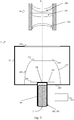
- the Fig. 3 shows a sectional view of an infrared radiation detection system according to the invention.
- the IR 3 system of the Fig. 3 takes over the IR 2 system from the Fig. 2 .
- Each element identical in Figs. 2 and 3 keep the same reference. New or changed items have different references.
- the housing 20 remains identical in all respects in the Figs. 2 and 3 .
- the lens system 30 is replaced by a lens system 40.
- the lens system 40 is associated with a focal plane perpendicular to the axis.
- X optic in which the IR sensor 207 is located.
- a major difference between the IR system 3 and the IR system 2 lies in the insertion of at least one infrared filter, called IR filter hereinafter, at the inlet of the housing 20 ( ie outside the housing 20 opposite the window 201).
- IR filter infrared filter
- the insertion of at least one IR filter in the IR system 3 aims to allow at least one two-point calibration.
- Each IR filter inserted is a mobile band-pass filter with a given transmission T , which is moved in front of the window 201.
- the IR filter can take a first position in which it is placed outside the housing 20 facing the window 201 and a second position in which it is placed so as not to filter any electromagnetic radiation received by the IR system.
- the IR filter is concave in shape facing the IR sensor 207 having a conical and / or aspherical-based profile and reflecting the focal plane inside the housing 20 through the window 201 or , in a preferred embodiment, inside the cold screen 212 by the diaphragm 211.
- each IR filter therefore has in section in any secant plane containing the optical axis X a concave shape facing the sensor IR 207 having a conical and / or aspheric profile.
- Each filter is also characterized by a predefined transmission coefficient T and can be placed on or outside an optical path of the lens system 40.
- the IR system 3 comprises means for moving each IR filter.
- These displacement means comprise for example, for an IR filter, a motor and an arm on which is fixed the IR filter capable of positioning or not the IR filter facing the window 201.
- each IR filter can be inserted between the last lens of the lens system 40 ( ie here the intermediate lens 201) and the window 201 at a position allowing the focal plane to be reflected at least inside the housing. 20 and preferably inside the cold screen 212.
- the IR system 3 comprises a single IR filter 402.
- the IR filter 402 has a surface of which any section by a plane containing the optical axis X is in the form of an ellipse truncated by a plane perpendicular to the optical axis X and of revolution about the axis optical.
- the IR filter 402 has a surface whose section through a plane containing the optical axis is in the form of a circle truncated by a plane perpendicular to the optical axis X and of revolution around the optical axis, a circle being a special case of an ellipse.
- IR filter 402 can take two positions in IR system 3: in the first position, all IR radiation reaching the sensor IR 207 have passed through the IR filter 402. The second position corresponds to an absence of IR filter in the IR system 3. In this second position of the IR filter 402, the IR system 3 is therefore equivalent to the IR system 2 and therefore does not filter any electromagnetic radiation received by the IR system 3.
- the displacement of the filter alternately in two different positions enables the IR system 3 (ie the IR sensor 207) to be supplied with two levels of filling the potential well of each detector of the IR sensor 207 different at a same integration time, which is equivalent to two acquisitions of images at two different black body temperatures and allows the calculation of the gain and of the offset value to be applied to the values coming from each detector.
- each focal point of the ellipse of the truncated elliptical section (respectively of the circle of the truncated circle section) of IR filter 402 is placed on the edge of the window 201.
- Such a positioning of the foci of the ellipse of the section in the form of a truncated ellipse ensures that the IR filter 402 reflects the plane focal point inside the housing 20.
- This positioning of the focal points of the ellipse of the section in the form of a truncated ellipse is hereinafter called general positioning.
- each focal point of the ellipse of the truncated elliptical section (respectively of the circle of the truncated circle section) of IR filter 402 is placed on the edge of the diaphragm 211.
- Such a positioning of the foci of the ellipse of the elliptical section (respectively of the circle of the circular section) ensures that the IR filter 402 reflects the focal plane to the 'inside the cold screen 212.
- This positioning of the foci of the ellipse of the section in the form of a truncated ellipse is hereinafter called optimal positioning.
- the positioning of the foci of the ellipse of the truncated ellipse shaped section of IR filter 402 is determined using ray tracing techniques to ensure that IR filter 402 reflects the focal plane. inside the cold screen 212 or inside the box 20.
- the Fig. 4 shows a simplified sectional view of part of the infrared radiation detection system according to the invention.
- Fig. 3 Common references between Fig. 3 and the Fig. 4 correspond to identical elements.
- IR filter 402 is in the first position.
- IR radiations 4000 to 4002 are represented in Fig. 4 . Two cases are then to be distinguished.
- the foci of the elliptical section are in the optimal position.
- all the IR radiation coming from the lens system 30 and passing through the IR filter 402 (such as the IR radiation 4001) and all the IR radiation coming from inside the housing 20 and reflected by the IR filter 402 (such as that the IR radiation 4000 emitted by the cold screen 212) converge inside the cold screen 212.
- T % of the IR radiations coming from the lens system 40 pass through the filter IR 402 and (100- T )% of the IR radiation coming from inside the housing 20 is reflected by the IR filter 402.
- (100- T )% of the IR radiation coming from the lens system 40 is reflected by the IR filter 402 (such as radiation 4002) and T % of IR radiation from inside the housing 20 passes through IR filter 402.
- the foci of the elliptical section are in the general positioning.
- the interior of the housing 20 could be reflected by the internal surface of the housing 20 which would cause stray radiation which could reach the IR sensor 207.
- the internal surface of the reflective housing 20 and the external surface of the housing should be specified.
- Absorbent cold screen 212 for example an anti-reflective paint, a deposit or a suitable absorbent and / or diffusing treatment.
- the transmission coefficient T is equal to “50%”.
- the IR system 3 includes a first and a second IR filter, each associated with different transmission coefficients.
- the first IR filter is associated with a transmission coefficient T 1, for example equal to 30% and the second IR filter is associated with a transmission coefficient T 2, for example equal to 70%.
- the first and second IR filters can be moved to the first or second position.
- These three configurations allow then a three-point calibration. With a single filter, the two-point calibration has similar performance to the 3-point calibration, although different from the point of view of the pixel correction, in the sense that one of the measurements used to calculate the gain is also used to calculate the value. offset.
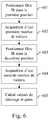
- the Fig. 6 represents an example of a calibration method according to the invention.
- the process of Fig. 6 is implemented by the processing module 213 of the IR system 3.
- the method of Fig. 6 can be started at any time by an operator, for example by pressing a button (not shown) of the IR system 3.
- the IR system 3 displays the same scene throughout the duration of the method.
- the IR 3 system comprises a single IR filter 402.
- the processing module 213 transmits a command to the means for moving the IR filter 402 so as to position the IR filter 402 in the first position.
- the processing module 213 triggers an acquisition of a first matrix of values by the IR sensor 207, each value of the matrix of values coming from a detector of the IR sensor 207. Once acquired, the first matrix of values is stored in the storage unit 2134 of the processing module 213.
- the processing module 213 transmits a command to the means for moving the IR filter 402 so as to position the IR filter 402 in the second position.
- the processing module 213 triggers an acquisition of a second matrix of values by the IR sensor 207. Once acquired, the second matrix of values is stored in the storage unit 2134 of the processing module 213.
- the processing module performs a two-point calibration of each detector of the IR sensor 207 in order to determine, for each detector, a gain and an offset value to be applied to the values originating from said detector.
- Each two-point calibration of a detector uses a value from the first matrix corresponding to said detector and a value from the second matrix corresponding to said detector.
- the process described in relation to the Fig. 6 is applicable when the IR system 3 comprises more than one IR filter by alternately positioning each IR filter in the first or second position. When a filter is in the first position, every other filter is in the second position.
Landscapes
- Physics & Mathematics (AREA)
- General Physics & Mathematics (AREA)
- Spectroscopy & Molecular Physics (AREA)
- Photometry And Measurement Of Optical Pulse Characteristics (AREA)
- Apparatus For Radiation Diagnosis (AREA)
Claims (9)
- System zur Erkennung von elektromagnetischer Strahlung, welches umfasst:ein Gehäuse (20), das einen Raum definiert, in welchem ein Teilvakuum herrscht, und ein Fenster (201) umfasst, das für die elektromagnetische Strahlung durchlässig ist;einen Kühlfinger (202), der eine seitliche Wand (204) aufweist, die an einem Ende durch eine Endwand (208) verschlossen ist, die sich genau gegenüber dem Fenster (201) befindet;einen an der Endwand (208) angebrachten Sensor (207), der eine gegenüber dem Fenster (201) angeordnete ebene obere Fläche (206) aufweist, die für die elektromagnetische Strahlung empfindliche Detektoren umfasst undvon dem Kühlfinger gekühlt wird, wobei der Sensor eine optische Achse (X) definiert, die zu der ebenen oberen Fläche (206) senkrecht ist, und in Bezug auf diese zentriert ist;einen den Sensor (207) umgebenden Kühlschirm (212), der im Wesentlichen kuppelförmig ist, auf dem Kühlfinger (202) angebracht ist und rotationssymmetrisch um die optische Achse (X) ist, und der ein zwischen dem Fenster (201) und dem Sensor (207) angeordnetes oberes Ende (210), das eine auf der optischen Achse (X) zentrierte kreisförmige Blende (211) definiert, und eine seitliche Wand (209), die eine Grundfläche (205) des Kühlschirms (212) mit dem oberen Ende (210) verbindet und eine Innenseite mit einer der optischen Achse (X) zugewandten Konkavität aufweist, umfasst,dadurch gekennzeichnet, dass das System umfasst:wenigstens ein Bandpassfilter (402) für elektromagnetische Strahlung mit einem vordefinierten Durchlassgrad, wobei jedes Filter beweglich ist undeine erste Position einnehmen kann, in welcher es außerhalb des Gehäuses (20) gegenüber dem Fenster (201) angeordnet ist, und eine zweite Position, in welcher es so angeordnet ist, dass es keine durch das System empfangene elektromagnetische Strahlung filtert, wobei in der ersten Position jedes Filter im Schnitt in jeder Schnittebene, welche die optische Achse (X) enthält, eine dem Sensor (207) zugewandte konkave Form mit einem Profil auf konischer und/oder asphärischer Basis aufweist und die Brennebene ins Innere des Gehäuses (20) reflektiert; undVerarbeitungsmittel (213), die es ermöglichen, für jeden Detektor des Sensors (207) unter Verwendung eines ersten Wertes, der von dem Detektor geliefert wird, wenn sich jedes Filter in der zweiten Position befindet, und wenigstens eines zweiten Wertes, der von dem Detektor geliefert wird, wenn sich ein Filter des wenigstens einen Filters in der ersten Position befindet, einen Verstärkungsfaktor und einen Versatzwert zu ermitteln.
- System nach Anspruch 1, dadurch gekennzeichnet, dass wenigstens ein erstes Filter des wenigstens einen Filters eine Oberfläche aufweist, von der jeder Schnitt entlang einer die optische Achse (X) enthaltenden Ebene die Form einer Ellipse oder eines Kreises hat, die bzw. der durch eine zur optischen Achse (X) senkrechte Ebene beschnitten und rotationssymmetrisch um die optische Achse (X) ist.
- System nach Anspruch 1 oder 2, dadurch gekennzeichnet, dass wenigstens ein Filter des wenigstens einen Filters die Brennebene ins Innere des Kühlschirms (212) reflektiert.
- System nach Anspruch 1 oder 2, dadurch gekennzeichnet, dass jeder Brennpunkt der Ellipse des Schnittes von der Form einer beschnittenen Ellipse oder des Kreises des Schnittes von der Form eines beschnittenen Kreises des ersten Filters auf dem Rand des Fensters (201) angeordnet ist.
- System nach Anspruch 1, 2 oder 4, dadurch gekennzeichnet, dass das Gehäuse (20) eine Innenfläche umfasst, welche die elektromagnetische Strahlung reflektiert, und der Kühlschirm (212) eine Außenfläche umfasst, welche die elektromagnetische Strahlung absorbiert.
- System nach Anspruch 2 oder 3, dadurch gekennzeichnet, dass jeder Brennpunkt der Ellipse des Schnittes von der Form einer beschnittenen Ellipse oder des Kreises des Schnittes von der Form eines beschnittenen Kreises des ersten Filters auf dem Rand der Blende (211) angeordnet ist.
- Verfahren zur Kalibrierung von für die elektromagnetische Strahlung empfindlichen Detektoren eines Sensors, welches von dem System zur Erkennung von elektromagnetischer Strahlung nach einem der Ansprüche 1 bis 6 durchgeführt wird, dadurch gekennzeichnet, dass das Verfahren umfasst:Positionieren (601) eines Filters des wenigstens einen Filters in der ersten Position;Auslösen (602) einer Erfassung einer ersten Matrix von Werten durch den Sensor (207), wobei jeder Wert der Matrix von Werten von einem Detektor des IR-Sensors (207) stammt;Positionieren (603) des Filters in der zweiten Position;Auslösen (604) einer Erfassung einer zweiten Matrix von Werten durch den Sensor (207);Bestimmen (605), für jeden Detektor des Sensors (207), eines Verstärkungsfaktors und eines Versatzwertes, die auf die von dem Detektor stammenden Werte anzuwenden sind, wobei jede Bestimmung eines Verstärkungsfaktors und eines Versatzwertes eines Detektors einen dem Detektor entsprechenden Wert der ersten Matrix und einen dem Detektor entsprechenden Wert der zweiten Matrix verwendet.
- Computerprogramm, dadurch gekennzeichnet, dass es Anweisungen zur Durchführung, durch eine Vorrichtung (213), des Verfahrens nach Anspruch 7, wenn das Programm von einem Prozessor der Vorrichtung (213) ausgeführt wird, umfasst.
- Speichermittel, dadurch gekennzeichnet, dass sie ein Computerprogramm speichern, das Anweisungen zur Durchführung, durch eine Vorrichtung (213), des Verfahrens nach Anspruch 7, wenn das Programm von einem Prozessor der Vorrichtung (213) ausgeführt wird, umfasst.
Applications Claiming Priority (2)
| Application Number | Priority Date | Filing Date | Title |
|---|---|---|---|
| FR1662017A FR3059772B1 (fr) | 2016-12-06 | 2016-12-06 | Systeme de detection de rayonnements electromagnetiques |
| PCT/EP2017/081552 WO2018104317A1 (fr) | 2016-12-06 | 2017-12-05 | Système de détection de rayonnements électromagnétiques |
Publications (2)
| Publication Number | Publication Date |
|---|---|
| EP3551975A1 EP3551975A1 (de) | 2019-10-16 |
| EP3551975B1 true EP3551975B1 (de) | 2020-08-19 |
Family
ID=58669872
Family Applications (1)
| Application Number | Title | Priority Date | Filing Date |
|---|---|---|---|
| EP17811542.4A Active EP3551975B1 (de) | 2016-12-06 | 2017-12-05 | System zur erkennung von elektromagnetischer strahlung |
Country Status (9)
| Country | Link |
|---|---|
| US (1) | US10481007B2 (de) |
| EP (1) | EP3551975B1 (de) |
| CN (1) | CN110062878B (de) |
| CA (1) | CA3046174C (de) |
| FR (1) | FR3059772B1 (de) |
| IL (1) | IL266948B (de) |
| RU (1) | RU2719312C1 (de) |
| WO (1) | WO2018104317A1 (de) |
| ZA (1) | ZA201903947B (de) |
Families Citing this family (2)
| Publication number | Priority date | Publication date | Assignee | Title |
|---|---|---|---|---|
| US11079281B2 (en) * | 2019-01-17 | 2021-08-03 | Uvia Group Llc | Cold stage actuation of optical elements including an optical light shield and a lenslet array connected to a cold finger |
| CN111189794B (zh) * | 2020-04-15 | 2020-07-28 | 上海翼捷工业安全设备股份有限公司 | 红外传感器及其建模方法、模型数据库和光谱探测方法 |
Family Cites Families (11)
| Publication number | Priority date | Publication date | Assignee | Title |
|---|---|---|---|---|
| CA1308283C (en) * | 1987-02-25 | 1992-10-06 | Mitsubishi Denki Kabushiki Kaisha | Infrared detector |
| US5408100A (en) * | 1991-12-24 | 1995-04-18 | Hughes Missile Systems Company | Chromatic radiance attenuator |
| US6222454B1 (en) * | 1999-07-01 | 2001-04-24 | Goal Electronics Inc. | Non-contacting temperature sensing device |
| FR2887627B1 (fr) * | 2005-06-28 | 2007-09-21 | Sagem Defense Securite | Appareil de detecion de rayonnement infraouge, comprenant un ecran froid a section elliptique |
| FR2919049B1 (fr) * | 2007-07-20 | 2009-10-02 | Ulis Soc Par Actions Simplifie | Detecteur de rayonnement electromagnetique et procede de fabrication d'un tel detecteur |
| CN101246055A (zh) * | 2008-03-13 | 2008-08-20 | 电子科技大学 | 钽酸锂薄膜红外探测器及制法 |
| US9121760B2 (en) * | 2010-01-27 | 2015-09-01 | Ci Systems Ltd. | Room-temperature filtering for passive infrared imaging |
| UA107239C2 (uk) * | 2010-07-08 | 2014-12-10 | Інфрачервоний вимір температури і його стабілізація | |
| US8674308B2 (en) * | 2010-10-14 | 2014-03-18 | Semi Conductor Devices-Elbit Systems-Rafael Partnership | Dewar assembly for IR detection systems |
| CN102681568B (zh) * | 2012-05-30 | 2014-04-23 | 中国科学院西安光学精密机械研究所 | 一种焦面探测器精密热控机构 |
| CN104502671B (zh) * | 2014-12-31 | 2018-04-27 | 中国电子科技集团公司第十一研究所 | 一种长波HgCdTe光伏器件暗电流的测试方法 |
-
2016
- 2016-12-06 FR FR1662017A patent/FR3059772B1/fr not_active Expired - Fee Related
-
2017
- 2017-12-05 RU RU2019119840A patent/RU2719312C1/ru active
- 2017-12-05 US US16/464,855 patent/US10481007B2/en active Active
- 2017-12-05 CA CA3046174A patent/CA3046174C/fr active Active
- 2017-12-05 WO PCT/EP2017/081552 patent/WO2018104317A1/fr not_active Ceased
- 2017-12-05 CN CN201780075036.8A patent/CN110062878B/zh active Active
- 2017-12-05 EP EP17811542.4A patent/EP3551975B1/de active Active
-
2019
- 2019-05-28 IL IL266948A patent/IL266948B/en unknown
- 2019-06-18 ZA ZA2019/03947A patent/ZA201903947B/en unknown
Non-Patent Citations (1)
| Title |
|---|
| None * |
Also Published As
| Publication number | Publication date |
|---|---|
| IL266948A (en) | 2019-07-31 |
| CN110062878B (zh) | 2020-08-14 |
| IL266948B (en) | 2022-04-01 |
| FR3059772A1 (fr) | 2018-06-08 |
| US10481007B2 (en) | 2019-11-19 |
| RU2719312C1 (ru) | 2020-04-17 |
| FR3059772B1 (fr) | 2019-05-17 |
| CA3046174A1 (fr) | 2018-06-14 |
| CN110062878A (zh) | 2019-07-26 |
| ZA201903947B (en) | 2020-12-23 |
| US20190301943A1 (en) | 2019-10-03 |
| CA3046174C (fr) | 2020-05-05 |
| WO2018104317A1 (fr) | 2018-06-14 |
| EP3551975A1 (de) | 2019-10-16 |
Similar Documents
| Publication | Publication Date | Title |
|---|---|---|
| WO2010040914A2 (fr) | Systeme d'imagerie grand champ infrarouge integre dans une enceinte a vide | |
| FR3052556A1 (fr) | Ensemble d'imagerie pour drone et systeme comprenant un tel ensemble monte sur un drone volant | |
| CA3046174C (fr) | Systeme de detection de rayonnements electromagnetiques | |
| FR3082385A1 (fr) | Dispositif et procede de compensation de chaleur parasite dans une camera infrarouge | |
| FR3082346A1 (fr) | Dispositif et procede de compensation de chaleur parasite dans une camera infrarouge | |
| WO2020207962A1 (fr) | Detecteur de gaz | |
| FR2974899A1 (fr) | Telescope multispectral a balayage comportant des moyens d'analyses de front d'onde | |
| FR2783930A1 (fr) | Appareil de mesure de distance | |
| EP4103921B1 (de) | Verfahren zum kalibrieren einer opto-ektronischen vorrichtung | |
| EP3489152A2 (de) | Beobachtungsinstrument mit einem spiegel-autokollimator, der an einem sternsucher montiert ist | |
| EP3671280B1 (de) | Hochpräzises datierungssystem der passage eines objekts, insbesondere eines satelliten | |
| EP3516353B1 (de) | Verfahren zur verbesserung der detektion von kapazitäten eines multispektralen bildgebungssystems | |
| EP0549446B1 (de) | Beobachtungskamera, insbesondere für Infrarot, mit einem in der Empfindlichkeit homogenisierten Multielementdetektor | |
| FR3000789A1 (fr) | Pointe avant d'aeronef avec dispositif de calibration d'un detecteur ir et procede de calibration | |
| EP2708862B1 (de) | Optischer Wellenfrontanalysator | |
| FR2696892A1 (fr) | Caméra infrarouge protégée contre les modulations parasites de flux capté. | |
| WO2016146830A1 (fr) | Capteur d'images polarimétriques | |
| EP1267570A1 (de) | Verfahren zur Anwendung einer Wärmebildkamera, Vorrichtung zum Betrieb derselben und eine diese Vorrichtung enthaltende Wärmebildkamera | |
| EP1202021A1 (de) | Vorrichtung zur Justierung eines Lasersendungskanals mit einem passiven Beobachtungskanal | |
| FR3059156B1 (fr) | Module de detection optique | |
| FR2994488A1 (fr) | Procede d'estimation de l'etat de focalisation d'un instrument optique | |
| WO2024240996A1 (fr) | Circuit de lecture pour capteur hybride | |
| FR3047322A1 (fr) | Systeme optique comportant un bloc de detection optique a estimation de profondeur independant de la focale dudit systeme optique | |
| FR3015842A1 (fr) | Dispositif et procede de calibrage d'un imageur | |
| WO2017060409A1 (fr) | Dispositif et système de télédétection |
Legal Events
| Date | Code | Title | Description |
|---|---|---|---|
| STAA | Information on the status of an ep patent application or granted ep patent |
Free format text: STATUS: UNKNOWN |
|
| STAA | Information on the status of an ep patent application or granted ep patent |
Free format text: STATUS: THE INTERNATIONAL PUBLICATION HAS BEEN MADE |
|
| PUAI | Public reference made under article 153(3) epc to a published international application that has entered the european phase |
Free format text: ORIGINAL CODE: 0009012 |
|
| STAA | Information on the status of an ep patent application or granted ep patent |
Free format text: STATUS: REQUEST FOR EXAMINATION WAS MADE |
|
| 17P | Request for examination filed |
Effective date: 20190603 |
|
| AK | Designated contracting states |
Kind code of ref document: A1 Designated state(s): AL AT BE BG CH CY CZ DE DK EE ES FI FR GB GR HR HU IE IS IT LI LT LU LV MC MK MT NL NO PL PT RO RS SE SI SK SM TR |
|
| AX | Request for extension of the european patent |
Extension state: BA ME |
|
| DAV | Request for validation of the european patent (deleted) | ||
| DAX | Request for extension of the european patent (deleted) | ||
| GRAP | Despatch of communication of intention to grant a patent |
Free format text: ORIGINAL CODE: EPIDOSNIGR1 |
|
| STAA | Information on the status of an ep patent application or granted ep patent |
Free format text: STATUS: GRANT OF PATENT IS INTENDED |
|
| INTG | Intention to grant announced |
Effective date: 20200324 |
|
| GRAS | Grant fee paid |
Free format text: ORIGINAL CODE: EPIDOSNIGR3 |
|
| GRAA | (expected) grant |
Free format text: ORIGINAL CODE: 0009210 |
|
| STAA | Information on the status of an ep patent application or granted ep patent |
Free format text: STATUS: THE PATENT HAS BEEN GRANTED |
|
| AK | Designated contracting states |
Kind code of ref document: B1 Designated state(s): AL AT BE BG CH CY CZ DE DK EE ES FI FR GB GR HR HU IE IS IT LI LT LU LV MC MK MT NL NO PL PT RO RS SE SI SK SM TR |
|
| REG | Reference to a national code |
Ref country code: CH Ref legal event code: EP |
|
| REG | Reference to a national code |
Ref country code: DE Ref legal event code: R096 Ref document number: 602017022136 Country of ref document: DE |
|
| REG | Reference to a national code |
Ref country code: AT Ref legal event code: REF Ref document number: 1304467 Country of ref document: AT Kind code of ref document: T Effective date: 20200915 |
|
| REG | Reference to a national code |
Ref country code: IE Ref legal event code: FG4D Free format text: LANGUAGE OF EP DOCUMENT: FRENCH |
|
| REG | Reference to a national code |
Ref country code: SE Ref legal event code: TRGR |
|
| REG | Reference to a national code |
Ref country code: LT Ref legal event code: MG4D |
|
| REG | Reference to a national code |
Ref country code: NL Ref legal event code: MP Effective date: 20200819 |
|
| PG25 | Lapsed in a contracting state [announced via postgrant information from national office to epo] |
Ref country code: PT Free format text: LAPSE BECAUSE OF FAILURE TO SUBMIT A TRANSLATION OF THE DESCRIPTION OR TO PAY THE FEE WITHIN THE PRESCRIBED TIME-LIMIT Effective date: 20201221 Ref country code: LT Free format text: LAPSE BECAUSE OF FAILURE TO SUBMIT A TRANSLATION OF THE DESCRIPTION OR TO PAY THE FEE WITHIN THE PRESCRIBED TIME-LIMIT Effective date: 20200819 Ref country code: NO Free format text: LAPSE BECAUSE OF FAILURE TO SUBMIT A TRANSLATION OF THE DESCRIPTION OR TO PAY THE FEE WITHIN THE PRESCRIBED TIME-LIMIT Effective date: 20201119 Ref country code: BG Free format text: LAPSE BECAUSE OF FAILURE TO SUBMIT A TRANSLATION OF THE DESCRIPTION OR TO PAY THE FEE WITHIN THE PRESCRIBED TIME-LIMIT Effective date: 20201119 Ref country code: HR Free format text: LAPSE BECAUSE OF FAILURE TO SUBMIT A TRANSLATION OF THE DESCRIPTION OR TO PAY THE FEE WITHIN THE PRESCRIBED TIME-LIMIT Effective date: 20200819 Ref country code: GR Free format text: LAPSE BECAUSE OF FAILURE TO SUBMIT A TRANSLATION OF THE DESCRIPTION OR TO PAY THE FEE WITHIN THE PRESCRIBED TIME-LIMIT Effective date: 20201120 Ref country code: FI Free format text: LAPSE BECAUSE OF FAILURE TO SUBMIT A TRANSLATION OF THE DESCRIPTION OR TO PAY THE FEE WITHIN THE PRESCRIBED TIME-LIMIT Effective date: 20200819 |
|
| REG | Reference to a national code |
Ref country code: AT Ref legal event code: MK05 Ref document number: 1304467 Country of ref document: AT Kind code of ref document: T Effective date: 20200819 |
|
| PG25 | Lapsed in a contracting state [announced via postgrant information from national office to epo] |
Ref country code: IS Free format text: LAPSE BECAUSE OF FAILURE TO SUBMIT A TRANSLATION OF THE DESCRIPTION OR TO PAY THE FEE WITHIN THE PRESCRIBED TIME-LIMIT Effective date: 20201219 Ref country code: LV Free format text: LAPSE BECAUSE OF FAILURE TO SUBMIT A TRANSLATION OF THE DESCRIPTION OR TO PAY THE FEE WITHIN THE PRESCRIBED TIME-LIMIT Effective date: 20200819 Ref country code: RS Free format text: LAPSE BECAUSE OF FAILURE TO SUBMIT A TRANSLATION OF THE DESCRIPTION OR TO PAY THE FEE WITHIN THE PRESCRIBED TIME-LIMIT Effective date: 20200819 Ref country code: NL Free format text: LAPSE BECAUSE OF FAILURE TO SUBMIT A TRANSLATION OF THE DESCRIPTION OR TO PAY THE FEE WITHIN THE PRESCRIBED TIME-LIMIT Effective date: 20200819 Ref country code: PL Free format text: LAPSE BECAUSE OF FAILURE TO SUBMIT A TRANSLATION OF THE DESCRIPTION OR TO PAY THE FEE WITHIN THE PRESCRIBED TIME-LIMIT Effective date: 20200819 |
|
| PG25 | Lapsed in a contracting state [announced via postgrant information from national office to epo] |
Ref country code: SM Free format text: LAPSE BECAUSE OF FAILURE TO SUBMIT A TRANSLATION OF THE DESCRIPTION OR TO PAY THE FEE WITHIN THE PRESCRIBED TIME-LIMIT Effective date: 20200819 Ref country code: EE Free format text: LAPSE BECAUSE OF FAILURE TO SUBMIT A TRANSLATION OF THE DESCRIPTION OR TO PAY THE FEE WITHIN THE PRESCRIBED TIME-LIMIT Effective date: 20200819 Ref country code: CZ Free format text: LAPSE BECAUSE OF FAILURE TO SUBMIT A TRANSLATION OF THE DESCRIPTION OR TO PAY THE FEE WITHIN THE PRESCRIBED TIME-LIMIT Effective date: 20200819 Ref country code: DK Free format text: LAPSE BECAUSE OF FAILURE TO SUBMIT A TRANSLATION OF THE DESCRIPTION OR TO PAY THE FEE WITHIN THE PRESCRIBED TIME-LIMIT Effective date: 20200819 Ref country code: RO Free format text: LAPSE BECAUSE OF FAILURE TO SUBMIT A TRANSLATION OF THE DESCRIPTION OR TO PAY THE FEE WITHIN THE PRESCRIBED TIME-LIMIT Effective date: 20200819 |
|
| REG | Reference to a national code |
Ref country code: DE Ref legal event code: R097 Ref document number: 602017022136 Country of ref document: DE |
|
| PG25 | Lapsed in a contracting state [announced via postgrant information from national office to epo] |
Ref country code: AT Free format text: LAPSE BECAUSE OF FAILURE TO SUBMIT A TRANSLATION OF THE DESCRIPTION OR TO PAY THE FEE WITHIN THE PRESCRIBED TIME-LIMIT Effective date: 20200819 Ref country code: AL Free format text: LAPSE BECAUSE OF FAILURE TO SUBMIT A TRANSLATION OF THE DESCRIPTION OR TO PAY THE FEE WITHIN THE PRESCRIBED TIME-LIMIT Effective date: 20200819 Ref country code: ES Free format text: LAPSE BECAUSE OF FAILURE TO SUBMIT A TRANSLATION OF THE DESCRIPTION OR TO PAY THE FEE WITHIN THE PRESCRIBED TIME-LIMIT Effective date: 20200819 |
|
| PLBE | No opposition filed within time limit |
Free format text: ORIGINAL CODE: 0009261 |
|
| STAA | Information on the status of an ep patent application or granted ep patent |
Free format text: STATUS: NO OPPOSITION FILED WITHIN TIME LIMIT |
|
| PG25 | Lapsed in a contracting state [announced via postgrant information from national office to epo] |
Ref country code: SK Free format text: LAPSE BECAUSE OF FAILURE TO SUBMIT A TRANSLATION OF THE DESCRIPTION OR TO PAY THE FEE WITHIN THE PRESCRIBED TIME-LIMIT Effective date: 20200819 |
|
| 26N | No opposition filed |
Effective date: 20210520 |
|
| REG | Reference to a national code |
Ref country code: CH Ref legal event code: PL |
|
| PG25 | Lapsed in a contracting state [announced via postgrant information from national office to epo] |
Ref country code: MC Free format text: LAPSE BECAUSE OF FAILURE TO SUBMIT A TRANSLATION OF THE DESCRIPTION OR TO PAY THE FEE WITHIN THE PRESCRIBED TIME-LIMIT Effective date: 20200819 Ref country code: SI Free format text: LAPSE BECAUSE OF FAILURE TO SUBMIT A TRANSLATION OF THE DESCRIPTION OR TO PAY THE FEE WITHIN THE PRESCRIBED TIME-LIMIT Effective date: 20200819 |
|
| REG | Reference to a national code |
Ref country code: BE Ref legal event code: MM Effective date: 20201231 |
|
| PG25 | Lapsed in a contracting state [announced via postgrant information from national office to epo] |
Ref country code: IE Free format text: LAPSE BECAUSE OF NON-PAYMENT OF DUE FEES Effective date: 20201205 Ref country code: LU Free format text: LAPSE BECAUSE OF NON-PAYMENT OF DUE FEES Effective date: 20201205 |
|
| PG25 | Lapsed in a contracting state [announced via postgrant information from national office to epo] |
Ref country code: CH Free format text: LAPSE BECAUSE OF NON-PAYMENT OF DUE FEES Effective date: 20201231 Ref country code: LI Free format text: LAPSE BECAUSE OF NON-PAYMENT OF DUE FEES Effective date: 20201231 |
|
| PG25 | Lapsed in a contracting state [announced via postgrant information from national office to epo] |
Ref country code: TR Free format text: LAPSE BECAUSE OF FAILURE TO SUBMIT A TRANSLATION OF THE DESCRIPTION OR TO PAY THE FEE WITHIN THE PRESCRIBED TIME-LIMIT Effective date: 20200819 Ref country code: MT Free format text: LAPSE BECAUSE OF FAILURE TO SUBMIT A TRANSLATION OF THE DESCRIPTION OR TO PAY THE FEE WITHIN THE PRESCRIBED TIME-LIMIT Effective date: 20200819 Ref country code: CY Free format text: LAPSE BECAUSE OF FAILURE TO SUBMIT A TRANSLATION OF THE DESCRIPTION OR TO PAY THE FEE WITHIN THE PRESCRIBED TIME-LIMIT Effective date: 20200819 |
|
| PG25 | Lapsed in a contracting state [announced via postgrant information from national office to epo] |
Ref country code: MK Free format text: LAPSE BECAUSE OF FAILURE TO SUBMIT A TRANSLATION OF THE DESCRIPTION OR TO PAY THE FEE WITHIN THE PRESCRIBED TIME-LIMIT Effective date: 20200819 |
|
| PG25 | Lapsed in a contracting state [announced via postgrant information from national office to epo] |
Ref country code: BE Free format text: LAPSE BECAUSE OF NON-PAYMENT OF DUE FEES Effective date: 20201231 |
|
| PGFP | Annual fee paid to national office [announced via postgrant information from national office to epo] |
Ref country code: GB Payment date: 20251229 Year of fee payment: 9 |
|
| PGFP | Annual fee paid to national office [announced via postgrant information from national office to epo] |
Ref country code: FR Payment date: 20251222 Year of fee payment: 9 |
|
| PGFP | Annual fee paid to national office [announced via postgrant information from national office to epo] |
Ref country code: SE Payment date: 20251217 Year of fee payment: 9 |
|
| PGFP | Annual fee paid to national office [announced via postgrant information from national office to epo] |
Ref country code: DE Payment date: 20251222 Year of fee payment: 9 |
|
| PGFP | Annual fee paid to national office [announced via postgrant information from national office to epo] |
Ref country code: IT Payment date: 20251231 Year of fee payment: 9 |