EP3551158B1 - A method to relieve stress in capsule shells to reduce propensity to break - Google Patents
A method to relieve stress in capsule shells to reduce propensity to break Download PDFInfo
- Publication number
- EP3551158B1 EP3551158B1 EP17878382.5A EP17878382A EP3551158B1 EP 3551158 B1 EP3551158 B1 EP 3551158B1 EP 17878382 A EP17878382 A EP 17878382A EP 3551158 B1 EP3551158 B1 EP 3551158B1
- Authority
- EP
- European Patent Office
- Prior art keywords
- capsule
- capsule shell
- cap
- shell
- capsules
- Prior art date
- Legal status (The legal status is an assumption and is not a legal conclusion. Google has not performed a legal analysis and makes no representation as to the accuracy of the status listed.)
- Active
Links
Images



Classifications
-
- A—HUMAN NECESSITIES
- A61—MEDICAL OR VETERINARY SCIENCE; HYGIENE
- A61J—CONTAINERS SPECIALLY ADAPTED FOR MEDICAL OR PHARMACEUTICAL PURPOSES; DEVICES OR METHODS SPECIALLY ADAPTED FOR BRINGING PHARMACEUTICAL PRODUCTS INTO PARTICULAR PHYSICAL OR ADMINISTERING FORMS; DEVICES FOR ADMINISTERING FOOD OR MEDICINES ORALLY; BABY COMFORTERS; DEVICES FOR RECEIVING SPITTLE
- A61J3/00—Devices or methods specially adapted for bringing pharmaceutical products into particular physical or administering forms
- A61J3/07—Devices or methods specially adapted for bringing pharmaceutical products into particular physical or administering forms into the form of capsules or similar small containers for oral use
-
- A—HUMAN NECESSITIES
- A61—MEDICAL OR VETERINARY SCIENCE; HYGIENE
- A61J—CONTAINERS SPECIALLY ADAPTED FOR MEDICAL OR PHARMACEUTICAL PURPOSES; DEVICES OR METHODS SPECIALLY ADAPTED FOR BRINGING PHARMACEUTICAL PRODUCTS INTO PARTICULAR PHYSICAL OR ADMINISTERING FORMS; DEVICES FOR ADMINISTERING FOOD OR MEDICINES ORALLY; BABY COMFORTERS; DEVICES FOR RECEIVING SPITTLE
- A61J3/00—Devices or methods specially adapted for bringing pharmaceutical products into particular physical or administering forms
- A61J3/07—Devices or methods specially adapted for bringing pharmaceutical products into particular physical or administering forms into the form of capsules or similar small containers for oral use
- A61J3/071—Devices or methods specially adapted for bringing pharmaceutical products into particular physical or administering forms into the form of capsules or similar small containers for oral use into the form of telescopically engaged two-piece capsules
- A61J3/077—Manufacturing capsule shells
-
- A—HUMAN NECESSITIES
- A61—MEDICAL OR VETERINARY SCIENCE; HYGIENE
- A61K—PREPARATIONS FOR MEDICAL, DENTAL OR TOILETRY PURPOSES
- A61K9/00—Medicinal preparations characterised by special physical form
- A61K9/48—Preparations in capsules, e.g. of gelatin, of chocolate
-
- F—MECHANICAL ENGINEERING; LIGHTING; HEATING; WEAPONS; BLASTING
- F26—DRYING
- F26B—DRYING SOLID MATERIALS OR OBJECTS BY REMOVING LIQUID THEREFROM
- F26B11/00—Machines or apparatus for drying solid materials or objects with movement which is non-progressive
- F26B11/02—Machines or apparatus for drying solid materials or objects with movement which is non-progressive in moving drums or other mainly-closed receptacles
- F26B11/04—Machines or apparatus for drying solid materials or objects with movement which is non-progressive in moving drums or other mainly-closed receptacles rotating about a horizontal or slightly-inclined axis
-
- F—MECHANICAL ENGINEERING; LIGHTING; HEATING; WEAPONS; BLASTING
- F26—DRYING
- F26B—DRYING SOLID MATERIALS OR OBJECTS BY REMOVING LIQUID THEREFROM
- F26B21/00—Arrangements for supplying or controlling air or other gases for drying solid materials or objects
- F26B21/20—Circulating air or gases in closed cycles, e.g. wholly within the drying enclosure
- F26B21/25—Circulating air or gases in closed cycles, e.g. wholly within the drying enclosure partly outside the drying enclosure
-
- F—MECHANICAL ENGINEERING; LIGHTING; HEATING; WEAPONS; BLASTING
- F26—DRYING
- F26B—DRYING SOLID MATERIALS OR OBJECTS BY REMOVING LIQUID THEREFROM
- F26B21/00—Arrangements for supplying or controlling air or other gases for drying solid materials or objects
- F26B21/30—Controlling, e.g. regulating, parameters of gas supply
- F26B21/33—Humidity
-
- F—MECHANICAL ENGINEERING; LIGHTING; HEATING; WEAPONS; BLASTING
- F26—DRYING
- F26B—DRYING SOLID MATERIALS OR OBJECTS BY REMOVING LIQUID THEREFROM
- F26B21/00—Arrangements for supplying or controlling air or other gases for drying solid materials or objects
- F26B21/30—Controlling, e.g. regulating, parameters of gas supply
- F26B21/35—Temperature; Pressure
-
- F—MECHANICAL ENGINEERING; LIGHTING; HEATING; WEAPONS; BLASTING
- F26—DRYING
- F26B—DRYING SOLID MATERIALS OR OBJECTS BY REMOVING LIQUID THEREFROM
- F26B21/00—Arrangements for supplying or controlling air or other gases for drying solid materials or objects
- F26B21/30—Controlling, e.g. regulating, parameters of gas supply
- F26B21/37—Velocity of flow; Quantity of flow
-
- F—MECHANICAL ENGINEERING; LIGHTING; HEATING; WEAPONS; BLASTING
- F26—DRYING
- F26B—DRYING SOLID MATERIALS OR OBJECTS BY REMOVING LIQUID THEREFROM
- F26B21/00—Arrangements for supplying or controlling air or other gases for drying solid materials or objects
- F26B21/50—Ducting arrangements from the source of air or other gases to the materials or objects being dried
-
- F—MECHANICAL ENGINEERING; LIGHTING; HEATING; WEAPONS; BLASTING
- F26—DRYING
- F26B—DRYING SOLID MATERIALS OR OBJECTS BY REMOVING LIQUID THEREFROM
- F26B3/00—Drying solid materials or objects by processes involving the application of heat
- F26B3/02—Drying solid materials or objects by processes involving the application of heat by convection, i.e. heat being conveyed from a heat source to the materials or objects to be dried by a gas or vapour, e.g. air
- F26B3/06—Drying solid materials or objects by processes involving the application of heat by convection, i.e. heat being conveyed from a heat source to the materials or objects to be dried by a gas or vapour, e.g. air the gas or vapour flowing through the materials or objects to be dried
-
- A—HUMAN NECESSITIES
- A61—MEDICAL OR VETERINARY SCIENCE; HYGIENE
- A61K—PREPARATIONS FOR MEDICAL, DENTAL OR TOILETRY PURPOSES
- A61K9/00—Medicinal preparations characterised by special physical form
- A61K9/48—Preparations in capsules, e.g. of gelatin, of chocolate
- A61K9/4816—Wall or shell material
- A61K9/4825—Proteins, e.g. gelatin
-
- F—MECHANICAL ENGINEERING; LIGHTING; HEATING; WEAPONS; BLASTING
- F26—DRYING
- F26B—DRYING SOLID MATERIALS OR OBJECTS BY REMOVING LIQUID THEREFROM
- F26B3/00—Drying solid materials or objects by processes involving the application of heat
- F26B3/02—Drying solid materials or objects by processes involving the application of heat by convection, i.e. heat being conveyed from a heat source to the materials or objects to be dried by a gas or vapour, e.g. air
-
- Y—GENERAL TAGGING OF NEW TECHNOLOGICAL DEVELOPMENTS; GENERAL TAGGING OF CROSS-SECTIONAL TECHNOLOGIES SPANNING OVER SEVERAL SECTIONS OF THE IPC; TECHNICAL SUBJECTS COVERED BY FORMER USPC CROSS-REFERENCE ART COLLECTIONS [XRACs] AND DIGESTS
- Y10—TECHNICAL SUBJECTS COVERED BY FORMER USPC
- Y10S—TECHNICAL SUBJECTS COVERED BY FORMER USPC CROSS-REFERENCE ART COLLECTIONS [XRACs] AND DIGESTS
- Y10S53/00—Package making
- Y10S53/90—Capsules
Definitions
- each lower limit of each range disclosed herein is to be interpreted as disclosed in combination with each upper limit of each range disclosed herein for the same component, compounds, substituent or parameter.
- a disclosure of two ranges is to be interpreted as a disclosure of four ranges derived by combining each lower limit of each range with each upper limit of each range.
- a disclosure of three ranges is to be interpreted as a disclosure of nine ranges derived by combining each lower limit of each range with each upper limit of each range, etc.
- stress risers may be created in the capsule shell that could lead to premature failure of the capsule.
- Materials such as gelatin used in the manufacture of capsules harden and contract during the drying process. The polymer chains become stressed because they cannot easily re-arrange after the shell reaches a particular level of dryness.
- Soft elastic capsules may typically include plasticizers to lower the melt or glass transition temperature of the capsule shell to prevent or reduce the aforementioned induced stress situations. However, such plasticizers may have a negative impact on capsule performance, or the stability of the capsule, and thus the reduction or elimination of the plasticizer from the capsule shell is desirable.
- FIG. 2 is a flow chart depicting a first embodiment for the manufacture of hard shell capsules including the heat treatment step of the present disclosure.
- the cap and body portions of a hard shell capsule are molded in step 210.
- the cap and body portions can be formed by any suitable conventional method.
- the cap and body portions are made using a pin dipping method.
- An exemplary pin dipping method may include the following steps. First, a thermos-gelling solution is prepared. Capsule body pins and capsule cap pins are then dipped into the thermos-gelling solution to act as molds. The solution adheres to the dipped pins, which are then removed from the solution, and the solution remaining on the surface of the pins is dried in step 212. The capsule body and the cap portions may then be removed from the pins by gripping then and pulling them off the pins.
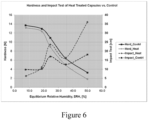
- Figure 7 is a graph of the results of the hardness and impact tests over equilibrium relative humidities (ERH's) ranging from 10% to 50%. At all the ERH's, the impact results for the heat treated capsules was higher than the results for the control capsules. More importantly, as shown in Figure 8, there is an optimal hardness between 7 N and 10N where the impact results are much higher for the heat treated capsules than the control capsules. This is the range of hardness at which most capsules are considered to be acceptably dry.
- ERH's equilibrium relative humidities
Landscapes
- Engineering & Computer Science (AREA)
- Mechanical Engineering (AREA)
- General Engineering & Computer Science (AREA)
- Health & Medical Sciences (AREA)
- Life Sciences & Earth Sciences (AREA)
- Animal Behavior & Ethology (AREA)
- Chemical & Material Sciences (AREA)
- Medicinal Chemistry (AREA)
- Pharmacology & Pharmacy (AREA)
- General Health & Medical Sciences (AREA)
- Public Health (AREA)
- Veterinary Medicine (AREA)
- Microbiology (AREA)
- Epidemiology (AREA)
- Manufacturing & Machinery (AREA)
- Drying Of Solid Materials (AREA)
- Medical Preparation Storing Or Oral Administration Devices (AREA)
- Manufacturing Of Micro-Capsules (AREA)
- Medicinal Preparation (AREA)
- Medicines Containing Material From Animals Or Micro-Organisms (AREA)
- Pharmaceuticals Containing Other Organic And Inorganic Compounds (AREA)
- Disintegrating Or Milling (AREA)
Description
- The present disclosure relates to a method of treating a hard capsule shell to relieve stress within the capsule shell and reduce the probability of cracking or damage to the shell during storage or handling.
- Capsules are well-known dosage forms that normally consist of a shell filled with a fill material containing one or more pharmaceutical or other substances. Such capsules may have a soft or hard capsule shell.
- Hard capsule shells are often manufactured using a dip molding processes. In this process the capsules are prepared by dipping mold pins into a solution of polymer, optionally containing one or more gelling agents and co-gelling agents. The mold pins are designed to mold a cap and a corresponding capsule body. The cap and capsule body are molded to provide a telescoping fit between the two parts. The mold pins are then removed, inverted, and dried to form a film on the surface. The dried capsule films are then removed from the molds and cut to the desired length. The telescoping fit caps are then assembled with the filled capsule body, and often a liquid banding solution is applied to bind the cap and body of the capsule together. The banding solution is allowed to dry, and the capsule is packaged. One example of this type of capsule and process is described in
European patent no. 1 915 121 . - Documents
US 5,200,191 A ,US 2014/186437 A1 andUS 8,790,692 B2 disclose methods to relieve stress in a capsule according to the prior art. -
U.S. Patent no. 8,181,425 discloses an apparatus for sealing telescopically joined hard shell capsules by applying a sealing fluid uniformly to a gap in the capsule, providing an area of low pressure around the capsule to remove excess sealing liquid. The capsule is heated to cure the sealing fluid in order to seal the capsule. - Liquid Encapsulated Microspray Sealing is also used to make hard shell capsules. In this method, a water/ethanol microspray penetrates the cap and body portions of the capsule to lower the melting point in the sealing area of the capsule and the capsule is heated in air to complete the melting and fusion of the body and cap portions.
- As the popularity of liquid-filled hard capsules (LFHCs) increases, there is a need to address the problem of cracking of the capsule shell. This can be particularly problematic when filling the capsules with hygroscopic fill materials that can cause the capsules to break. While breaks in capsules filled with powders can be a nuisance, breakage of LFHCs is unacceptable, since a single broken capsule can contaminate an entire package.
- Capsules sometimes spontaneously break after banding while the bands are drying on trays. Breakage typically only occurs in the cap of the capsule. This problem can be linked to the dipping process used to make the capsules, which may results in the shoulder area of the capsules being the thinnest and, therefore, the weakest area of the capsule. Furthermore, the shoulder area of the cap coincides with the locking ring mechanism used to join the cap to the capsule body, whereby a tight interference fit between the capsule body and cap is used to prevent the capsules from popping open after closure. This interference fit at the locking ring causes additional stress at the shoulder area of the cap.
- A significant number of capsules do not break at all. This is important because it indicates that there are capsule attributes that, if defined and controlled, could provide capsules that would be acceptable for use with hygroscopic fill materials. Previous studies determined that a difference in room humidity during manufacturing had an impact on the cracking rate of the capsules. This is relevant to capsules filled with hygroscopic materials since water in the capsule shell may cause cracking when exposed to a hygroscopic fill material due to water migration from the shell to the fill.
- The existence of "stress raisers" has also been documented. "Stress raisers" are points or areas of the capsule shell where stress is concentrated. The existence of stress raisers in the capsule shell after the manufacturing process is complete, can increase the chance of a crack in the capsule shell. Cracks will occur when the concentrated stress exceeds the material's theoretical cohesive strength. (A material's actual threshold, or "fracture strength," is always lower than the theoretical value because of stress raisers.) Stress raisers can take the form of a sharp angle of a transition zone, a preformed hole or crack, or an interface between two different materials or two materials having different microstructures.
- Three different possible solutions were previously studied to solve the cracking issue, as described by Fulper et.al. "Influence of mechanical stress on the formation of cracks in two-piece capsules", Tablet and Capsules, January 2010 and Fulper et.al. "Evaluation of capsule cracking with hygroscopic fills: An alternative view", Tablet and Capsules, September 2009. Each of these solutions provided some benefit, shed some light as to the causes of crack formation.
- First, the shell thickness of the shoulder area can be increased. However, there is a point at which the thickness no longer has an impact on the amount of observed cracking. Second, reducing the relative humidity during the manufacturing process results in a lower water content gradient across the shell thickness, also reduces the incidence of cracking. However, reducing the relative humidity tends to cause the capsule shell to become more brittle, resulting in capsules that are more prone to breakage due to impact forces. Finally, changes in the shape of the locking ring can be used to reduce the number of, and impact of, "stress raisers" in the area of the locking ring. However, altering the design of the locking ring may negatively affect how securely the cap and body are affixed to each other.
- Cracking issues also exist during the manufacture of soft elastic capsules since stress raisers may be present in the capsule shell upon drying the capsule after the filling process. Soft elastic capsules often include plasticizers to lower the melt or glass transition temperature of the capsule shell to prevent or reduce induced stress in the capsule shell. However, such plasticizers may render the capsule too soft and/or lower resistance to heat to an unacceptable extent thereby adversely affecting capsule performance. Additionally, plasticizers may have a negative impact on the stability of the capsule. As a result, there is a desire to reduce or eliminate the plasticizer from the capsule shell for these reasons. However, the presence of too little plasticizer may cause the capsule shell to become brittle and/or to fail at areas of high stress.
- Thus, a system and methods for processing and/or manufacturing capsules are required to reduce crack formation in capsule shells and/or allow use of lesser amounts of plasticizers in the capsule shells.
- The invention is a method according to claim 1.
- In an embodiment, the portion of the capsule shell may be heated to 2-10 °C below the melt temperature of the capsule shell, or to 2-7 °C below the melt temperature of the capsule shell, or 2-3 °C below the melt temperature of the capsule shell.
- The portion of the hard capsule shell is the portion where the cap portion overlaps with the body portion of the capsule shell, or the portion of the hard capsule shell may be the entire capsule shell.
- In each of the hard capsule shell embodiments, the heating step may be carried out immediately prior to closing the hard capsule shell by fitting the cap and body portions together, or after the hard capsule shell is closed by fitting the cap and body portions together.
- In each of the foregoing embodiments, the time may be from 2 seconds to 24 hours, or from 12 hours to 24 hours, or from 2 seconds to 1 hour, or from 1 hour to 12 hours, or from 1 hour to 2 hours.
-
-
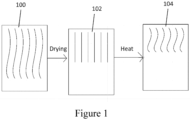
Figure 1 is a schematic diagram of polymer chains in a capsule during the drying and heating process. -
Figure 2 is a flow diagram showing the steps of a method for manufacturing and treating a two-piece hard capsule according to a first embodiment of the disclosure -
Figure 3 is a flow diagram showing the steps of a method of manufacturing and treating an elastic form-filled capsule according to a second embodiment of the disclosure. -
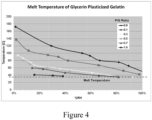
Figure 4 is a graph showing the melt temperature of glycerin plasticized gelatin as a function of relative humidity during the manufacturing process. -
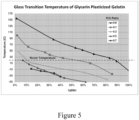
Figure 5 is a graph showing the glass transition temperature of glycerin plasticized gelatin as a function of relative humidity during the manufacturing process. -
Figure 6 is a graph showing hardness and impact strengths as a function of equilibrium relative humidity during manufacture of capsules treated according to an embodiment of the present disclosure compared to a control embodiment. -
Figure 7 is a graph showing impact strengths and hardness of capsules treated according to an embodiment of the present disclosure in comparison to a control embodiment. - For illustrative purposes, the principles of the present invention are described by referencing various exemplary embodiments. Although certain embodiments of the invention are specifically described herein, one of ordinary skill in the art will readily recognize that the same principles are equally applicable to, and can be employed in, other systems and methods. Before explaining the disclosed embodiments of the present invention in detail, it is to be understood that the invention is not limited in its application to the details of any particular embodiment shown. Additionally, the terminology used herein is for the purpose of description and not for limitation. Furthermore, although certain methods are described with reference to steps that are presented herein in a certain order, in many instances, these steps can be performed in any order as may be appreciated by one skilled in the art; the novel method is therefore not limited to the particular arrangement of steps disclosed herein.
- It must be noted that as used herein and in the appended claims, the singular forms "a", "an", and "the" include plural references unless the context clearly dictates otherwise. Furthermore, the terms "a" (or "an"), "one or more", and "at least one" can be used interchangeably herein. The terms "comprising", "including", "having" and "constructed from" can also be used interchangeably.
- Unless otherwise indicated, all numbers expressing quantities of ingredients, properties such as molecular weight, percent, ratio, reaction conditions, and so forth used in the specification and claims are to be understood as being modified in all instances by the term "about," whether or not the term "about" is present. Accordingly, unless indicated to the contrary, the numerical parameters set forth in the specification and claims are approximations that may vary depending upon the desired properties sought to be obtained by the present disclosure. At the very least, and not as an attempt to limit the application of the doctrine of equivalents to the scope of the claims, each numerical parameter should at least be construed in light of the number of reported significant digits and by applying ordinary rounding techniques. Notwithstanding that the numerical ranges and parameters setting forth the broad scope of the disclosure are approximations, the numerical values set forth in the specific examples are reported as precisely as possible. Any numerical value, however, inherently contains certain errors necessarily resulting from the standard deviation found in their respective testing measurements.
- It is to be understood that each component, compound, substituent or parameter disclosed herein is to be interpreted as being disclosed for use alone or in combination with one or more of each and every other component, compound, substituent or parameter disclosed herein.
- It is also to be understood that each amount/value or range of amounts/values for each component, compound, substituent or parameter disclosed herein is to be interpreted as also being disclosed in combination with each amount/value or range of amounts/values disclosed for any other component(s), compounds(s), substituent(s) or parameter(s) disclosed herein and that any combination of amounts/values or ranges of amounts/values for two or more component(s), compounds(s), substituent(s) or parameters disclosed herein are thus also disclosed in combination with each other for the purposes of this description.
- It is further understood that each lower limit of each range disclosed herein is to be interpreted as disclosed in combination with each upper limit of each range disclosed herein for the same component, compounds, substituent or parameter. Thus, a disclosure of two ranges is to be interpreted as a disclosure of four ranges derived by combining each lower limit of each range with each upper limit of each range. A disclosure of three ranges is to be interpreted as a disclosure of nine ranges derived by combining each lower limit of each range with each upper limit of each range, etc. Furthermore, specific amounts/values of a component, compound, substituent or parameter disclosed in the description or an example is to be interpreted as a disclosure of either a lower or an upper limit of a range and thus can be combined with any other lower or upper limit of a range or specific amount/value for the same component, compound, substituent or parameter disclosed elsewhere in the application to form a range for that component, compound, substituent or parameter.
- In one embodiment, the present disclosure relates to a method to relieve stress in a capsule shell in order to reduce or prevent cracking of the shell. Without being bound by theory, it is believed that the flexible polymer chains located within capsule shell lose some molecular mobility during the shell formation process thereby locking the polymer chains into a more rigid conformation that is more brittle thereby increasing the propensity of the capsule to crack. It is postulated that heat treatment method of the present disclosure permits the polymer chains to relax into a less brittle state which is retained upon cooling thereby reducing the brittleness and internal stresses of the capsule shell. This is believed to reduce or prevent cracking of the treated capsules. The method is particularly useful for capsules filled with a hygroscopic fill material that would otherwise exhibit a greater tendency to crack.
- During fabrication or manufacture of the capsule, cap portion and/or capsule body, stress risers may be created in the capsule shell that could lead to premature failure of the capsule. Materials such as gelatin used in the manufacture of capsules harden and contract during the drying process. The polymer chains become stressed because they cannot easily re-arrange after the shell reaches a particular level of dryness. Soft elastic capsules may typically include plasticizers to lower the melt or glass transition temperature of the capsule shell to prevent or reduce the aforementioned induced stress situations. However, such plasticizers may have a negative impact on capsule performance, or the stability of the capsule, and thus the reduction or elimination of the plasticizer from the capsule shell is desirable.
- The terms "two piece capsule" and "hard shell capsule" are used interchangeably, and both refer to capsules that are manufactured using a two-piece system, wherein the two pieces are fit together, typically using an interference fit, after the fill material is inserted. Hard shell capsules typically have a plasticizer to gelatin or polymer ratio of from 0-0.25.
- The present method is applicable to hard shell capsules.
- The "hardness" or "softness" of a capsule may be determined by a ratio of plasticizer to gelatin or other polymer. Hard capsules have a lower ratio from 0 to 0.25, and soft capsules have a higher ratio, which may typically range from 0.25 to about 0.7.
- This method utilizes heat to relieve stresses induced during manufacture and/or drying of the capsule shell. Application of heat and optionally, controlled drying can be used to allow molecular arrangement of the shell to reduce stress risers and thereby reduce the propensity for capsule shell failure.
- According to the invention, the cap portion and capsule body of a two-piece capsule shell system are joined together by telescoping the body of the capsule into the cap of the capsule. The cap and/or body have a locking mechanism for holding the cap portion and capsule body together once assembled. For example, indentations may be molded into the cap and body in a manner arranged to create a locking mechanism. Unfortunately, this locking mechanism or other "fit-interferences" can apply stress to the capsule shell, and particularly to the thinner section of the cap portion of the capsule that results in formation of stress risers (Fulper et.al. "Influence of mechanical stress on the formation of cracks in two-piece capsules", Tablet and Capsules, January 2010). Application of heat to the stressed areas of the capsule shell can provide stress relief to these areas of the capsule shell thereby reducing the propensity of the capsule shell to crack.
- It is known that certain materials can cause stress risers to form in capsules as a dynamic of water migration that may cause capsules to crack. (Fulper et.al. "Evaluation of capsule cracking with hygroscopic fills: An alternative view", Tablet and Capsules, September 2009). Application of heat can be used to relieve stress conditions that develop as a result of water migration thereby reducing the propensity of such capsule shells to crack.
- The system and methods of the present disclosure significantly reduce the number of capsules that unacceptably form cracks either through spontaneous cracking, or through mechanical impact forces. The methods of the disclosure employ heat to normalize/anneal/reduce internal stresses in the capsule shell by heating the capsule shell to a temperature above the glass transition temperature and preferably proximate to the melt temperature of the capsule shell material, typically after completion of the capsule manufacturing and filling process.
- Any suitable, conventional method of manufacturing and filling the capsules can be used in conjunction with the present methods. In one application of the present method, the capsules are first manufactured, dried, filled and, as necessary, assembled according to conventional methods. Heat is applied either during, or after capsule formation to allow molecular rearrangement of the capsule shell to a less brittle conformation thereby reducing or eliminating stress risers in the capsule shell.
-
Figure 1 schematically illustrates the postulated effect of applying heat to the capsule. When the film employed to make the capsule shell is wet, typically during the molding process, the polymer chains are flexible 100. As the film is dried, the polymer chains lose their flexibility, and become locked into a rigid conformation that is brittle and subject to cracking 102. Upon application of sufficient heat to the dried capsule shell material, molecular movement is allowed and the polymer chains relax into a less brittle state, which remains uponsubsequent cooling 104. - In the present methods, an amount of heat is applied to heat at least a portion of the capsule shell to proximate the melt temperature of the capsule shell material.
-
Figure 2 is a flow chart depicting a first embodiment for the manufacture of hard shell capsules including the heat treatment step of the present disclosure. In the first step of the method ofFigure 2 , the cap and body portions of a hard shell capsule are molded instep 210. The cap and body portions can be formed by any suitable conventional method. Preferably, the cap and body portions are made using a pin dipping method. An exemplary pin dipping method may include the following steps. First, a thermos-gelling solution is prepared. Capsule body pins and capsule cap pins are then dipped into the thermos-gelling solution to act as molds. The solution adheres to the dipped pins, which are then removed from the solution, and the solution remaining on the surface of the pins is dried instep 212. The capsule body and the cap portions may then be removed from the pins by gripping then and pulling them off the pins. - After the capsule cap and body portions are formed and removed from the pins, the hard shell capsule is filled in
step 214 and the cap and body portions of the capsule are closed or locked by fitting the cap and body portions of the capsule shell together, using an interference fit or locking mechanism instep 216. Suitable locking mechanisms are known in the art and include, for example, locking rings that are molded into the capsule cap and body portions and/or application of a banding solution to the interface or seam between the cap portion and the body portion of the capsule to bind the two portions together. In many embodiments the cap and body portions fit together as telescoping parts, i.e. the body portion slides a certain distance within the cap portion. As noted above, the dryingstep 212 and the closing or lockingstep 216 may introduce stress risers, or points in the capsule shell where cracking is more likely to occur. - Just prior to assembly of the capsule shell in
step 216, or after the capsule shell is assembled, a heat treatment is applied to at least a portion of the capsule shell instep 218. Theheat treatment step 218 may be applied immediately before closing and/or locking the capsule such that the effect occurs during closing of the capsule as a result of the capsule being at a temperature close to the critical stress relief temperature during closing. Alternatively, theheat treatment step 218 may be applied after closing the capsule. Preferably, the heat treatment is applied to the entire capsule, but according to the invention it is applied to the area of both the cap and body portions that overlap as a result of the telescoping assembly of the capsule since this is the part of the capsule shell that is subjected to stress as a result of assembly of the capsule shell using, for example, an interference fit. -
Figure 3 is a flow chart depicting a method for the manufacture and filling of soft elastic capsule shells including the heat treatment of the present disclosure. Thefirst step 320 of the method ofFigure 3 is the casting of the elastic shell capsules, which can be done using any suitable conventional method. The elastic capsules are then formed and/or filled instep 322 with a desired material. Once filled/formed, the elastic capsule shells are dried instep 324. Typically, stress risers are introduced during the dryingstep 324. - In one embodiment, the drying
step 324 and/or capsule fabrication process does not heat the capsule shell material above the glass transition temperature of the capsule material. In this embodiment, the heat treating step would be useful to alleviate stress introduced during the dryingstep 324 and/or capsule fabrication process. - In another embodiment, the drying
step 324 does not conclude at a temperature above the glass transition temperature of the capsule material and again the heating step of the invention would be useful to alleviate stress introduced during the drying step. - In yet another embodiment, the heat treating step can be employed for an elastic capsule shell made by any method which due to storage and/or handling subsequent to capsule drying requires alleviation of stress in the capsule material.
- The
heat treatment step 326 can be carried out either during the dryingstep 324, after drying is complete or a combination thereof. In this method, the elastic capsule shells are heated instep 326 to reduce or eliminate the stress risers. The heat treatment is preferably applied to the entire capsule shell, but may also be applied specifically to one or more locations of the capsule shell and particularly at one or more locations where increased stress is expected. - For the hard shell capsules, the temperature to which the heat treated portion of the capsule shell is raised, is selected to be the temperature at which stress relief will occur. This temperature is above the glass transition temperature for the capsule shell material and below the melt temperature of the capsule shell material. Preferably, the temperature is proximate to, but below the melt temperature of the material employed to form the capsule shell and typically at least 2 °C below the melt temperature of the material employed to form the capsule shell to avoid melting the capsule shell material. For example, the temperature of the heat treated portion of the capsule shell can be brought to a temperature 2-10 °C below the melt temperature of the material employed to form the capsule shell, or 2-7 °C below the melt temperature or 2-5 °C below the melt temperature, or 3-8 °C below the melt temperature or 3-6°C below the melt temperature, or most preferably, 2-3 °C below the below the melt temperature of the material employed to form the capsule shell.
- If a material to be treated has a very high melt temperature or no melt temperature, such a material should be heated to a temperature above its glass transition temperature in order to carry out the method of the present invention.
- For most materials, the treatment temperature will fall within the rage of 22°C to 120 °C. It will be desirable to operate within OSHA's defined temperature safety limit and thus in some cases special apparatus having insulation or other safety features may be required to carry out the heat treatment step.
-
Figure 4 is a graph showing the melt temperatures of glycerin plasticized gelatin having various different ratios of plasticizers to gelatin.Figure 5 is a graph showing the glass transition temperatures of glycerin plasticized gelatin having various different ratios of plasticizers to gelatin. These graphs are used to determine a suitable temperature for heat treating the capsule shell. Similar graphs for different polymers, or materials having different plasticizers and melt properties can be made by known methods. Although the preferred temperature ranges with respect to melt temperature are discussed above, any temperature between glass transition temperature and the melt temperature may be used. - The elevated temperature of the capsule shell is maintained for a time period that is sufficient to reduce internal stress in the capsule shell. The amount of time needed for treatment is dependent on the temperature selected, the capsule shell material, the type of equipment, and the type of heating technology. For temperatures closer to the melt temperature, the amount of time needed for heat treatment will be shorter, and for temperatures closer to the glass transition temperature the amount of time needed for heat treatment will be longer. If larger equipment, such as tumble dryers are being used, longer treatment times will be necessary. Infrared heating or microwaves can also be used to heat the capsule shell material.
- Overall, the heat treatment will typically last for a few seconds up to 24 hours depending on the parameters selected. A skilled person can determine the necessary length of time by performing a hardness test and/or and impact test on the heat treated capsules to determine if they have acceptable properties. Thus, heating times can be from 2 seconds to 24 hours or from 10 seconds to 18 hours. Heating times can also be from 2 seconds to one hour or from 1-12 hours. In a preferred embodiment for use with soft capsules, the heat treatment is applied for 1-2 hours using a conveyor. If larger retaining equipment is used, such as tumble dryers, the heat treatment may last from 12-24 hours. For hard shell capsules, preferably the temperature is selected to decrease the processing time. As such a higher temperature close to the melting point may be selected, a result of which is that the heat treatment may be applied for as little as a few seconds.
- The relative humidity during the heat treatment is preferably kept at less than 60%, and should be similar to or below the relative humidity at which the finished product will be stored.
- Another advantage of the heat treatment method of the present invention is that it allows elastic capsule shell materials to be dried more quickly using accelerated drying processes which typically induce stress in the capsule shells. The present heat treatment process can be applied to such capsules subsequent to the accelerated drying step to alleviate stresses in the capsule shell created by accelerated drying. As a result, drying time may be significantly shortened when using the heat treatment step of the present process.
- Another advantage of the heat treatment method of the invention is that it may permit use of lower amounts of plasticizers in the capsule shell since stresses induced during capsule manufacture can be alleviated by the heat treatment process. This is beneficial since the use of plasticizers also some disadvantages that can be reduced or avoided by reducing the amount of plasticizer needed in the capsule shell.
- The following examples are illustrative, but not limiting, of the present disclosure. Other suitable modifications and adaptations of the variety of conditions and parameters normally encountered in the field, and which are obvious to those skilled in the art, are within the scope of the disclosure. The following examples illustrate the practice of the present disclosure in some of the preferred embodiments.
- The effect of heat treatment on the hardness and impact reaction of soft capsules was studied. For the control experiment, capsules containing a lipophilic fill material were placed in a weigh boat with a napkin on top at ambient conditions and allowed to dry. The use of a hydrophilic material is expected to give similar results.
- Experimental capsules were subjected to accelerated drying with a heat treatment occurring during the drying. For this process, the temperature was ramped up from approximately 30 °C to approximately 48 °C for approximately 14 hours, after which the temperature was brought back down to 25 °C. The relative humidity was also maintained at a high level throughout the experiment and ranged from 79 %RH to 2%RH as the temperature increased.
- The hardness of the samples was measured using a Bareiss Digitest Gelomat according to ASTM D2240 with a rate of 0.01mm/sec for a period of 20 seconds. The impact reaction was measured by dropping a 237.6 g weight from different heights onto the capsule until the capsule broke. A salt cabinet humidity study was conducted to compare the impact and hardness results over a wide range of equilibrium relative humidities.
-
Figure 7 is a graph of the results of the hardness and impact tests over equilibrium relative humidities (ERH's) ranging from 10% to 50%. At all the ERH's, the impact results for the heat treated capsules was higher than the results for the control capsules. More importantly, as shown in Figure 8, there is an optimal hardness between 7 N and 10N where the impact results are much higher for the heat treated capsules than the control capsules. This is the range of hardness at which most capsules are considered to be acceptably dry. - The disintegration of the capsules was also tested, and there was no significant difference between the heat treated capsules and the control capsules.
Claims (10)
- A method to relieve stress in a hard capsule shell formed of a cap portion and a body portion that fit together as telescoping parts and comprising a locking mechanism for locking the cap portion and the body portion, to reduce propensity to break, comprising a step (326 or 218) of:heating an area of both the cap and body portions of the hard capsule shell that overlap to a temperature above a glass transition temperature of the capsule shell but below a melt temperature of the area of the cap and body portions of the hard capsule shell that overlap for a duration sufficient to reduce internal stress in the hard capsule shell,wherein the hard capsule shell has a ratio of plasticizer to polymer of from 0 to 0.25.
- The method according to claim 1, wherein the forming region of the hard capsule shell is heated to 2-10 °C, or 2-7 °C, or 2-3 °C below the melt temperature of the area of the cap and body portions of the hard capsule shell that overlap.
- The method according to claim 2, wherein the heating step is carried out at a relative humidity of less than 60%.
- The method according to claim 1, wherein the heating step heats the entire capsule shell.
- The method according to claim 1, wherein the heating step (218) is carried out immediately prior to closing (216) the hard capsule shell by fitting the cap portion and the body portion together.
- The method according to claim 1, wherein the heating step (218) is carried out after the hard capsule shell is closed (216) by fitting the cap portion and the body portion together.
- The method according to claim 1, wherein the heating duration is from 2 seconds to 24 hours or from 1 hour to 12 hours.
- The method according to claim 1, wherein the locking mechanism is selected from (i) an interference fit, (ii) locking rings which are molded into both a cap portion and a body portion of the capsule, (iii) an application of a banding solution to an interface or a seam between the cap portion and the body portion of the capsule, and (iv) molded indentations of the cap portion and the body portion of the capsule.
- The method according to claim 1, wherein the capsule shell encapsulates a hygroscopic fill.
- The method according to claim 3, wherein the heating duration is from 2 seconds to 1 hour.
Applications Claiming Priority (2)
| Application Number | Priority Date | Filing Date | Title |
|---|---|---|---|
| US201662431569P | 2016-12-08 | 2016-12-08 | |
| PCT/US2017/065398 WO2018107080A1 (en) | 2016-12-08 | 2017-12-08 | A method to relieve stress in capsule shells to reduce propensity to break |
Publications (4)
| Publication Number | Publication Date |
|---|---|
| EP3551158A1 EP3551158A1 (en) | 2019-10-16 |
| EP3551158A4 EP3551158A4 (en) | 2020-06-03 |
| EP3551158C0 EP3551158C0 (en) | 2024-07-10 |
| EP3551158B1 true EP3551158B1 (en) | 2024-07-10 |
Family
ID=62491357
Family Applications (2)
| Application Number | Title | Priority Date | Filing Date |
|---|---|---|---|
| EP17877660.5A Active EP3551950B1 (en) | 2016-12-08 | 2017-12-08 | Accelerated drying of soft capsules in a controlled environment |
| EP17878382.5A Active EP3551158B1 (en) | 2016-12-08 | 2017-12-08 | A method to relieve stress in capsule shells to reduce propensity to break |
Family Applications Before (1)
| Application Number | Title | Priority Date | Filing Date |
|---|---|---|---|
| EP17877660.5A Active EP3551950B1 (en) | 2016-12-08 | 2017-12-08 | Accelerated drying of soft capsules in a controlled environment |
Country Status (14)
| Country | Link |
|---|---|
| US (3) | US11026865B2 (en) |
| EP (2) | EP3551950B1 (en) |
| JP (2) | JP7129977B2 (en) |
| KR (2) | KR102328603B1 (en) |
| CN (2) | CN109923360B (en) |
| AU (2) | AU2017371180B2 (en) |
| BR (1) | BR112019010069A2 (en) |
| CA (1) | CA3045127A1 (en) |
| CO (2) | CO2019005095A2 (en) |
| ES (1) | ES2927068T3 (en) |
| IL (2) | IL266694B2 (en) |
| MX (2) | MX2019005956A (en) |
| RU (2) | RU2765074C2 (en) |
| WO (2) | WO2018107019A1 (en) |
Families Citing this family (5)
| Publication number | Priority date | Publication date | Assignee | Title |
|---|---|---|---|---|
| JP7129977B2 (en) | 2016-12-08 | 2022-09-02 | アール.ピー.シェーラー テクノロジーズ、エルエルシー | How to reduce capsule shell stress to reduce the likelihood of cracking and damage |
| KR20220053623A (en) * | 2019-08-30 | 2022-04-29 | 프로갑스 에스.에이. | Heat-resistant chewable oral dosage form with agar matrix and method for preparing same |
| US20210154099A1 (en) * | 2019-11-22 | 2021-05-27 | Karl Wei Cao | Top liquid fill method and apparatus for hard capsules |
| JP7314416B2 (en) * | 2019-12-11 | 2023-07-25 | ダブリュ.エル.ゴア アンド アソシエイツ,インコーポレイティド | Methods for Evaluating Steam Pump Performance |
| CN115792141B (en) * | 2023-01-06 | 2023-05-02 | 广州兰泰仪器有限公司 | Method and system for improving balance detection efficiency of water activity meter |
Citations (1)
| Publication number | Priority date | Publication date | Assignee | Title |
|---|---|---|---|---|
| US4539060A (en) * | 1983-02-18 | 1985-09-03 | Warner-Lambert Company | Apparatus and method of sealing capsules |
Family Cites Families (56)
| Publication number | Priority date | Publication date | Assignee | Title |
|---|---|---|---|---|
| US1330238A (en) * | 1918-06-03 | 1920-02-10 | Buffalo Forge Co | Method of and apparatus for drying, conditioning, and regulating the moisture content of hygroscopic materials |
| IE45260B1 (en) | 1976-01-23 | 1982-07-28 | Fisons Ltd | Pelletised or granular medicament formulation |
| FI63335B (en) | 1979-02-02 | 1983-02-28 | Orion Yhtymae Oy | FARING REFERENCE FOR A TABLETTER WITH A LIGHT LIGHT OF AN EFFECTIVE |
| DE3022136C2 (en) | 1980-06-13 | 1986-07-17 | A. Nattermann & Cie GmbH, 5000 Köln | Process for filling pharmaceutical compositions containing phospholipids into hard capsules |
| US4506453A (en) | 1982-09-29 | 1985-03-26 | Tennessee Valley Authority | Enhanced heat transfer process by forced gas recirculation |
| JPS61100519A (en) * | 1984-10-23 | 1986-05-19 | Shin Etsu Chem Co Ltd | Pharmaceutical hard capsule |
| CH674800A5 (en) * | 1986-03-12 | 1990-07-31 | Warner Lambert Co | |
| US4720924A (en) * | 1986-11-03 | 1988-01-26 | R & J Engineering Corporation | Microwave drying of pharmaceutical gelatin capsules |
| US5200191A (en) * | 1991-09-11 | 1993-04-06 | Banner Gelatin Products Corp. | Softgel manufacturing process |
| FI962764L (en) * | 1994-01-07 | 1996-08-07 | Thermtech As | Method and device for drying organic and/or inorganic materials |
| US5682733A (en) | 1996-05-09 | 1997-11-04 | Perrone; Aldo | Apparatus for enrobing tablets |
| US6228394B1 (en) | 1997-10-14 | 2001-05-08 | Boehringer Ingelheim Pharmaceuticals, Inc. | Supercritical fluid extraction of mould lubricant from hard shell capsules |
| US5960563A (en) * | 1998-01-12 | 1999-10-05 | Big Beans Holding, Ltd. | Extraction and drying apparatus |
| US8256135B2 (en) * | 1999-05-28 | 2012-09-04 | Thermapure, Inc. | Method for removing or treating harmful biological and chemical substances within structures and enclosures |
| US6340473B1 (en) | 1999-07-07 | 2002-01-22 | R.P. Scherer Technologies, Inc. | Film forming compositions comprising modified starches and iota-carrageenan and methods for manufacturing soft capsules using same |
| KR100829474B1 (en) | 2000-08-29 | 2008-05-16 | 닛신 가세이 가부시키가이샤 | Hard capsule |
| ATE446075T1 (en) * | 2000-12-29 | 2009-11-15 | Swiss Caps Rechte & Lizenzen | METHOD AND DEVICE FOR PRODUCING MOLDED BODIES FROM A BIOPOLYMERIC MATERIAL |
| CN100366239C (en) | 2001-07-05 | 2008-02-06 | 涌永制药株式会社 | soft capsule |
| JP2003116507A (en) | 2001-10-10 | 2003-04-22 | Akira Shibazaki | Method and apparatus for drying moisture-containing food |
| US6884060B2 (en) | 2001-11-02 | 2005-04-26 | R.P. Scherer Technologies, Inc. | Apparatus for manufacturing encapsulated products |
| DE10157755A1 (en) * | 2001-11-27 | 2003-06-12 | Henkel Kgaa | Gel capsules containing active ingredient and their use |
| CN1483393A (en) | 2002-09-17 | 2004-03-24 | 潮州市药用胶囊厂 | Starch hollow capsule and production process thereof |
| AU2003301121A1 (en) | 2002-12-18 | 2004-07-14 | Pain Therapeutics, Inc. | Oral dosage forms with therapeutically active agents in controlled release cores and immediate release gelatin capsule coats |
| NL1023720C2 (en) | 2003-06-23 | 2004-12-28 | Univ Eindhoven Tech | Method for changing the transport properties of a material, method for releasing a drug from an implant, as well as implant with drug. |
| US20050158198A1 (en) * | 2003-12-21 | 2005-07-21 | Albers Walter F. | Micro-cycle energy transfer systems and methods |
| US7246451B2 (en) * | 2004-09-30 | 2007-07-24 | Technophar Equipment & Service Limited | Tumbler-dryer for capsules |
| US7914573B2 (en) | 2005-12-13 | 2011-03-29 | Cordis Corporation | Polymeric stent having modified molecular structures |
| JP5049495B2 (en) | 2006-01-19 | 2012-10-17 | 株式会社前川製作所 | Artificial drying method and system for wood |
| US7762006B2 (en) * | 2006-06-14 | 2010-07-27 | Siestamed, Technologies | Medical equipment drying device |
| EP1886657A1 (en) | 2006-08-11 | 2008-02-13 | Pfizer Products Inc. | Method and apparatus for sealing capsules |
| PT2083786E (en) | 2006-10-26 | 2011-03-09 | Pfizer Prod Inc | Capsule formation |
| KR100954481B1 (en) | 2008-01-10 | 2010-04-23 | 이승용 | Humidity Interlocking Control Thermocycle Drying Equipment |
| US7957842B2 (en) | 2008-02-19 | 2011-06-07 | Honeywell International Inc. | Apparatus and method for controlling an air supply for drying painted vehicles and other objects |
| JP5355215B2 (en) | 2009-05-20 | 2013-11-27 | クオリカプス株式会社 | Hard capsule with improved solubility or hardness |
| US8790692B2 (en) * | 2009-09-09 | 2014-07-29 | Patheon Pharmaceuticals Inc. | Break resistant gel capsule |
| JP5618402B2 (en) * | 2010-06-24 | 2014-11-05 | 三生医薬株式会社 | Method for producing chewable soft capsule |
| JP6214395B2 (en) * | 2010-08-10 | 2017-10-18 | アール.ピー. シェーラー テクノロジーズ エルエルシー | Method for producing stable soft gel capsules containing microencapsulated probiotic bacteria |
| AU2011295165B2 (en) | 2010-08-23 | 2015-07-02 | Fraunhofer-Gesellschaft Zur Foerderung Der Angewandten Forschung E.V. | Humidified particles comprising a therapeutically active substance |
| JP5693116B2 (en) | 2010-09-26 | 2015-04-01 | 日本テトラパック株式会社 | Packaging filling apparatus and packaging filling method |
| US8621764B2 (en) | 2011-03-16 | 2014-01-07 | John PUCKETT | Gelatin capsule formulation and drying system |
| CN102283779A (en) | 2011-06-14 | 2011-12-21 | 贵州地道药业有限公司 | New technique for drying soft capsules |
| CN105135871B (en) * | 2012-02-20 | 2018-06-01 | 艾默生电气公司 | The heat used in the structure is provided |
| EP2911654B1 (en) * | 2013-03-15 | 2024-06-12 | Capsugel Belgium NV | Enteric coating for soft capsule |
| WO2014145699A1 (en) | 2013-03-15 | 2014-09-18 | New Jersey Institute Of Technology | System and method for fabrication of uniform polymer films containing nano and micro particles via continuous drying process |
| CN103315976B (en) | 2013-06-13 | 2015-09-16 | 华南理工大学 | A kind of preparation method of starch hard capsule case |
| CN103565647B (en) | 2013-10-28 | 2015-06-10 | 刘凯培 | Hollow soft capsule and preparation method thereof |
| CN104672338A (en) | 2015-02-04 | 2015-06-03 | 李国桐 | Medical hard hollow capsule carboxymethyl starch and preparation method and application thereof |
| DE102015205338A1 (en) * | 2015-03-24 | 2016-09-29 | Cefla Deutschland Gmbh | drying device |
| CN104991591B (en) | 2015-05-23 | 2018-05-04 | 浙江益立胶囊股份有限公司 | A kind of control system for capsule drying and storage |
| CN105674699B (en) | 2016-02-02 | 2018-04-20 | 安徽恒昊科技有限公司 | A kind of process of quick high humidity dry sterilization |
| CN105987587A (en) | 2016-06-28 | 2016-10-05 | 无锡市中谊药化机械有限公司 | Drying method for soft capsules in rolling air-drying mode and device thereof |
| JP7129977B2 (en) * | 2016-12-08 | 2022-09-02 | アール.ピー.シェーラー テクノロジーズ、エルエルシー | How to reduce capsule shell stress to reduce the likelihood of cracking and damage |
| US10422579B2 (en) * | 2017-05-02 | 2019-09-24 | Auto Cure Llc | Automated drying and curing chamber |
| AU2018303341B2 (en) * | 2017-07-20 | 2024-07-25 | Commonwealth Scientific And Industrial Research Organisation | Drying process and apparatus |
| US10590594B2 (en) * | 2017-11-28 | 2020-03-17 | Elberto Berdut-Teruel | Magnetic induction heating system and dehydrator |
| CN210197946U (en) * | 2019-05-07 | 2020-03-27 | 于雄青 | Take soft capsule drying equipment of evaporimeter |
-
2017
- 2017-12-08 JP JP2019531045A patent/JP7129977B2/en active Active
- 2017-12-08 WO PCT/US2017/065290 patent/WO2018107019A1/en not_active Ceased
- 2017-12-08 MX MX2019005956A patent/MX2019005956A/en unknown
- 2017-12-08 RU RU2019113369A patent/RU2765074C2/en active
- 2017-12-08 EP EP17877660.5A patent/EP3551950B1/en active Active
- 2017-12-08 AU AU2017371180A patent/AU2017371180B2/en active Active
- 2017-12-08 RU RU2019112049A patent/RU2745334C9/en active
- 2017-12-08 BR BR112019010069-5A patent/BR112019010069A2/en not_active Application Discontinuation
- 2017-12-08 US US16/467,436 patent/US11026865B2/en active Active
- 2017-12-08 CN CN201780069164.1A patent/CN109923360B/en active Active
- 2017-12-08 WO PCT/US2017/065398 patent/WO2018107080A1/en not_active Ceased
- 2017-12-08 ES ES17877660T patent/ES2927068T3/en active Active
- 2017-12-08 CN CN201780070689.7A patent/CN110167510B/en not_active Expired - Fee Related
- 2017-12-08 US US16/467,408 patent/US12161605B2/en active Active
- 2017-12-08 IL IL266694A patent/IL266694B2/en unknown
- 2017-12-08 CA CA3045127A patent/CA3045127A1/en active Pending
- 2017-12-08 AU AU2017374037A patent/AU2017374037B2/en active Active
- 2017-12-08 KR KR1020197015395A patent/KR102328603B1/en active Active
- 2017-12-08 JP JP2019530494A patent/JP7013465B2/en active Active
- 2017-12-08 EP EP17878382.5A patent/EP3551158B1/en active Active
- 2017-12-08 IL IL266695A patent/IL266695B/en unknown
- 2017-12-08 KR KR1020197014547A patent/KR102475555B1/en active Active
- 2017-12-08 MX MX2019005930A patent/MX2019005930A/en unknown
-
2019
- 2019-05-17 CO CONC2019/0005095A patent/CO2019005095A2/en unknown
- 2019-05-22 CO CONC2019/0005238A patent/CO2019005238A2/en unknown
-
2024
- 2024-10-08 US US18/908,883 patent/US20250025377A1/en active Pending
Patent Citations (1)
| Publication number | Priority date | Publication date | Assignee | Title |
|---|---|---|---|---|
| US4539060A (en) * | 1983-02-18 | 1985-09-03 | Warner-Lambert Company | Apparatus and method of sealing capsules |
Also Published As
Similar Documents
| Publication | Publication Date | Title |
|---|---|---|
| US20250025377A1 (en) | Method to relieve stress in capsule shells to reduce propensity to break | |
| US3927195A (en) | Production of capsules | |
| US10631976B2 (en) | Method of manufacturing breast implants with integrated transponders | |
| JP2024541747A (en) | Microneedle manufacturing method | |
| HU198386B (en) | Capsule shell of improved mechanical stability | |
| BRPI0915197B1 (en) | METHOD FOR MANUFACTURING A PACKAGING CONTAINER AND APPARATUS FOR CARRYING OUT THE METHOD | |
| HK40005880B (en) | Method to relieve stress in capsule shells to reduce propensity to break | |
| HK40005880A (en) | Method to relieve stress in capsule shells to reduce propensity to break | |
| KR101562648B1 (en) | Method of manufacturing water capsule | |
| JP5622185B2 (en) | High content soft capsule and method for producing the same | |
| EP4251126B1 (en) | Double layered delayed-release hard capsules | |
| US1000673A (en) | Pyrometer. | |
| CN116492311A (en) | A kind of preparation method of water blocking property traditional Chinese medicine gelatin capsule | |
| ITMI20091804A1 (en) | METHOD OF REALIZING A REGENERATION DEVICE FOR BIOLOGICAL FABRICS, PARTICULARLY FOR THE REGENERATION OF FABRICS BELONGING TO THE CENTRAL NERVOUS SYSTEM. | |
| JP4968820B2 (en) | capsule | |
| JP2019502606A (en) | Oral soft capsule dosage form packaging material containing dutasteride | |
| Zawaski et al. | Embedding of liquids into water soluble materials via additive manufacturing for timed release | |
| JP2013213014A (en) | Soft capsule and method for producing soft capsule | |
| NZ752946B2 (en) | A method to relieve stress in capsule shells to reduce propensity to break | |
| HK40089635A (en) | Double layered delayed-release hard capsules | |
| Stawarski et al. | The influence of coating on release of paracetamol from the multi-compartment systems | |
| CN113081997A (en) | Tizanidine hydrochloride capsule and preparation method thereof | |
| CN120204156A (en) | Hard capsule including multiple locking components | |
| CN116456973A (en) | Double-layer delayed release hard capsule |
Legal Events
| Date | Code | Title | Description |
|---|---|---|---|
| STAA | Information on the status of an ep patent application or granted ep patent |
Free format text: STATUS: THE INTERNATIONAL PUBLICATION HAS BEEN MADE |
|
| PUAI | Public reference made under article 153(3) epc to a published international application that has entered the european phase |
Free format text: ORIGINAL CODE: 0009012 |
|
| STAA | Information on the status of an ep patent application or granted ep patent |
Free format text: STATUS: REQUEST FOR EXAMINATION WAS MADE |
|
| 17P | Request for examination filed |
Effective date: 20190627 |
|
| AK | Designated contracting states |
Kind code of ref document: A1 Designated state(s): AL AT BE BG CH CY CZ DE DK EE ES FI FR GB GR HR HU IE IS IT LI LT LU LV MC MK MT NL NO PL PT RO RS SE SI SK SM TR |
|
| AX | Request for extension of the european patent |
Extension state: BA ME |
|
| DAV | Request for validation of the european patent (deleted) | ||
| DAX | Request for extension of the european patent (deleted) | ||
| REG | Reference to a national code |
Ref country code: DE Ref legal event code: R079 Free format text: PREVIOUS MAIN CLASS: A61J0003070000 Ipc: F26B0003020000 Ref country code: DE Ref legal event code: R079 Ref document number: 602017083265 Country of ref document: DE Free format text: PREVIOUS MAIN CLASS: A61J0003070000 Ipc: F26B0003020000 |
|
| A4 | Supplementary search report drawn up and despatched |
Effective date: 20200504 |
|
| RIC1 | Information provided on ipc code assigned before grant |
Ipc: F26B 21/00 20060101ALI20200424BHEP Ipc: F26B 3/06 20060101ALI20200424BHEP Ipc: F26B 3/02 20060101AFI20200424BHEP Ipc: F26B 11/04 20060101ALI20200424BHEP |
|
| STAA | Information on the status of an ep patent application or granted ep patent |
Free format text: STATUS: EXAMINATION IS IN PROGRESS |
|
| 17Q | First examination report despatched |
Effective date: 20201218 |
|
| RAP3 | Party data changed (applicant data changed or rights of an application transferred) |
Owner name: R.P. SCHERER TECHNOLOGIES, LLC |
|
| GRAP | Despatch of communication of intention to grant a patent |
Free format text: ORIGINAL CODE: EPIDOSNIGR1 |
|
| STAA | Information on the status of an ep patent application or granted ep patent |
Free format text: STATUS: GRANT OF PATENT IS INTENDED |
|
| INTG | Intention to grant announced |
Effective date: 20240214 |
|
| RIN1 | Information on inventor provided before grant (corrected) |
Inventor name: HART, NORTON Inventor name: FULPER, LESTER DAVID |
|
| GRAS | Grant fee paid |
Free format text: ORIGINAL CODE: EPIDOSNIGR3 |
|
| GRAA | (expected) grant |
Free format text: ORIGINAL CODE: 0009210 |
|
| STAA | Information on the status of an ep patent application or granted ep patent |
Free format text: STATUS: THE PATENT HAS BEEN GRANTED |
|
| AK | Designated contracting states |
Kind code of ref document: B1 Designated state(s): AL AT BE BG CH CY CZ DE DK EE ES FI FR GB GR HR HU IE IS IT LI LT LU LV MC MK MT NL NO PL PT RO RS SE SI SK SM TR |
|
| REG | Reference to a national code |
Ref country code: CH Ref legal event code: EP |
|
| REG | Reference to a national code |
Ref country code: DE Ref legal event code: R096 Ref document number: 602017083265 Country of ref document: DE |
|
| U01 | Request for unitary effect filed |
Effective date: 20240710 |
|
| U07 | Unitary effect registered |
Designated state(s): AT BE BG DE DK EE FI FR IT LT LU LV MT NL PT SE SI Effective date: 20240719 |
|
| U20 | Renewal fee for the european patent with unitary effect paid |
Year of fee payment: 8 Effective date: 20241127 |
|
| PG25 | Lapsed in a contracting state [announced via postgrant information from national office to epo] |
Ref country code: NO Free format text: LAPSE BECAUSE OF FAILURE TO SUBMIT A TRANSLATION OF THE DESCRIPTION OR TO PAY THE FEE WITHIN THE PRESCRIBED TIME-LIMIT Effective date: 20241010 |
|
| PG25 | Lapsed in a contracting state [announced via postgrant information from national office to epo] |
Ref country code: GR Free format text: LAPSE BECAUSE OF FAILURE TO SUBMIT A TRANSLATION OF THE DESCRIPTION OR TO PAY THE FEE WITHIN THE PRESCRIBED TIME-LIMIT Effective date: 20241011 Ref country code: PL Free format text: LAPSE BECAUSE OF FAILURE TO SUBMIT A TRANSLATION OF THE DESCRIPTION OR TO PAY THE FEE WITHIN THE PRESCRIBED TIME-LIMIT Effective date: 20240710 |
|
| PG25 | Lapsed in a contracting state [announced via postgrant information from national office to epo] |
Ref country code: IS Free format text: LAPSE BECAUSE OF FAILURE TO SUBMIT A TRANSLATION OF THE DESCRIPTION OR TO PAY THE FEE WITHIN THE PRESCRIBED TIME-LIMIT Effective date: 20241110 |
|
| PG25 | Lapsed in a contracting state [announced via postgrant information from national office to epo] |
Ref country code: HR Free format text: LAPSE BECAUSE OF FAILURE TO SUBMIT A TRANSLATION OF THE DESCRIPTION OR TO PAY THE FEE WITHIN THE PRESCRIBED TIME-LIMIT Effective date: 20240710 |
|
| PG25 | Lapsed in a contracting state [announced via postgrant information from national office to epo] |
Ref country code: ES Free format text: LAPSE BECAUSE OF FAILURE TO SUBMIT A TRANSLATION OF THE DESCRIPTION OR TO PAY THE FEE WITHIN THE PRESCRIBED TIME-LIMIT Effective date: 20240710 Ref country code: RS Free format text: LAPSE BECAUSE OF FAILURE TO SUBMIT A TRANSLATION OF THE DESCRIPTION OR TO PAY THE FEE WITHIN THE PRESCRIBED TIME-LIMIT Effective date: 20241010 |
|
| PG25 | Lapsed in a contracting state [announced via postgrant information from national office to epo] |
Ref country code: RS Free format text: LAPSE BECAUSE OF FAILURE TO SUBMIT A TRANSLATION OF THE DESCRIPTION OR TO PAY THE FEE WITHIN THE PRESCRIBED TIME-LIMIT Effective date: 20241010 Ref country code: PL Free format text: LAPSE BECAUSE OF FAILURE TO SUBMIT A TRANSLATION OF THE DESCRIPTION OR TO PAY THE FEE WITHIN THE PRESCRIBED TIME-LIMIT Effective date: 20240710 Ref country code: NO Free format text: LAPSE BECAUSE OF FAILURE TO SUBMIT A TRANSLATION OF THE DESCRIPTION OR TO PAY THE FEE WITHIN THE PRESCRIBED TIME-LIMIT Effective date: 20241010 Ref country code: IS Free format text: LAPSE BECAUSE OF FAILURE TO SUBMIT A TRANSLATION OF THE DESCRIPTION OR TO PAY THE FEE WITHIN THE PRESCRIBED TIME-LIMIT Effective date: 20241110 Ref country code: HR Free format text: LAPSE BECAUSE OF FAILURE TO SUBMIT A TRANSLATION OF THE DESCRIPTION OR TO PAY THE FEE WITHIN THE PRESCRIBED TIME-LIMIT Effective date: 20240710 Ref country code: GR Free format text: LAPSE BECAUSE OF FAILURE TO SUBMIT A TRANSLATION OF THE DESCRIPTION OR TO PAY THE FEE WITHIN THE PRESCRIBED TIME-LIMIT Effective date: 20241011 Ref country code: ES Free format text: LAPSE BECAUSE OF FAILURE TO SUBMIT A TRANSLATION OF THE DESCRIPTION OR TO PAY THE FEE WITHIN THE PRESCRIBED TIME-LIMIT Effective date: 20240710 |
|
| PG25 | Lapsed in a contracting state [announced via postgrant information from national office to epo] |
Ref country code: SM Free format text: LAPSE BECAUSE OF FAILURE TO SUBMIT A TRANSLATION OF THE DESCRIPTION OR TO PAY THE FEE WITHIN THE PRESCRIBED TIME-LIMIT Effective date: 20240710 |
|
| PG25 | Lapsed in a contracting state [announced via postgrant information from national office to epo] |
Ref country code: CZ Free format text: LAPSE BECAUSE OF FAILURE TO SUBMIT A TRANSLATION OF THE DESCRIPTION OR TO PAY THE FEE WITHIN THE PRESCRIBED TIME-LIMIT Effective date: 20240710 |
|
| PG25 | Lapsed in a contracting state [announced via postgrant information from national office to epo] |
Ref country code: SK Free format text: LAPSE BECAUSE OF FAILURE TO SUBMIT A TRANSLATION OF THE DESCRIPTION OR TO PAY THE FEE WITHIN THE PRESCRIBED TIME-LIMIT Effective date: 20240710 |
|
| PLBE | No opposition filed within time limit |
Free format text: ORIGINAL CODE: 0009261 |
|
| STAA | Information on the status of an ep patent application or granted ep patent |
Free format text: STATUS: NO OPPOSITION FILED WITHIN TIME LIMIT |
|
| 26N | No opposition filed |
Effective date: 20250411 |
|
| PG25 | Lapsed in a contracting state [announced via postgrant information from national office to epo] |
Ref country code: MC Free format text: LAPSE BECAUSE OF FAILURE TO SUBMIT A TRANSLATION OF THE DESCRIPTION OR TO PAY THE FEE WITHIN THE PRESCRIBED TIME-LIMIT Effective date: 20240710 |
|
| REG | Reference to a national code |
Ref country code: CH Ref legal event code: PL |
|
| U1N | Appointed representative for the unitary patent procedure changed after the registration of the unitary effect |
Representative=s name: METIDA; LT |
|
| GBPC | Gb: european patent ceased through non-payment of renewal fee |
Effective date: 20241208 |
|
| PG25 | Lapsed in a contracting state [announced via postgrant information from national office to epo] |
Ref country code: GB Free format text: LAPSE BECAUSE OF NON-PAYMENT OF DUE FEES Effective date: 20241208 |
|
| PG25 | Lapsed in a contracting state [announced via postgrant information from national office to epo] |
Ref country code: CH Free format text: LAPSE BECAUSE OF NON-PAYMENT OF DUE FEES Effective date: 20241231 |
|
| PG25 | Lapsed in a contracting state [announced via postgrant information from national office to epo] |
Ref country code: IE Free format text: LAPSE BECAUSE OF NON-PAYMENT OF DUE FEES Effective date: 20241208 |
|
| PG25 | Lapsed in a contracting state [announced via postgrant information from national office to epo] |
Ref country code: RO Free format text: LAPSE BECAUSE OF FAILURE TO SUBMIT A TRANSLATION OF THE DESCRIPTION OR TO PAY THE FEE WITHIN THE PRESCRIBED TIME-LIMIT Effective date: 20240710 |
|
| U20 | Renewal fee for the european patent with unitary effect paid |
Year of fee payment: 9 Effective date: 20251229 |