EP3544016B1 - Verfahren zum kombinieren von vorhergesagten und beobachteten massenspektralfragmentierungsdaten - Google Patents
Verfahren zum kombinieren von vorhergesagten und beobachteten massenspektralfragmentierungsdaten Download PDFInfo
- Publication number
- EP3544016B1 EP3544016B1 EP19163644.8A EP19163644A EP3544016B1 EP 3544016 B1 EP3544016 B1 EP 3544016B1 EP 19163644 A EP19163644 A EP 19163644A EP 3544016 B1 EP3544016 B1 EP 3544016B1
- Authority
- EP
- European Patent Office
- Prior art keywords
- predicted
- fragmentation
- ion species
- fragment
- experimentally
- Prior art date
- Legal status (The legal status is an assumption and is not a legal conclusion. Google has not performed a legal analysis and makes no representation as to the accuracy of the status listed.)
- Active
Links
Images



Classifications
-
- G—PHYSICS
- G16—INFORMATION AND COMMUNICATION TECHNOLOGY [ICT] SPECIALLY ADAPTED FOR SPECIFIC APPLICATION FIELDS
- G16C—COMPUTATIONAL CHEMISTRY; CHEMOINFORMATICS; COMPUTATIONAL MATERIALS SCIENCE
- G16C20/00—Chemoinformatics, i.e. ICT specially adapted for the handling of physicochemical or structural data of chemical particles, elements, compounds or mixtures
- G16C20/30—Prediction of properties of chemical compounds, compositions or mixtures
-
- G—PHYSICS
- G16—INFORMATION AND COMMUNICATION TECHNOLOGY [ICT] SPECIALLY ADAPTED FOR SPECIFIC APPLICATION FIELDS
- G16C—COMPUTATIONAL CHEMISTRY; CHEMOINFORMATICS; COMPUTATIONAL MATERIALS SCIENCE
- G16C20/00—Chemoinformatics, i.e. ICT specially adapted for the handling of physicochemical or structural data of chemical particles, elements, compounds or mixtures
- G16C20/20—Identification of molecular entities, parts thereof or of chemical compositions
-
- G—PHYSICS
- G16—INFORMATION AND COMMUNICATION TECHNOLOGY [ICT] SPECIALLY ADAPTED FOR SPECIFIC APPLICATION FIELDS
- G16C—COMPUTATIONAL CHEMISTRY; CHEMOINFORMATICS; COMPUTATIONAL MATERIALS SCIENCE
- G16C10/00—Computational theoretical chemistry, i.e. ICT specially adapted for theoretical aspects of quantum chemistry, molecular mechanics, molecular dynamics or the like
-
- G—PHYSICS
- G16—INFORMATION AND COMMUNICATION TECHNOLOGY [ICT] SPECIALLY ADAPTED FOR SPECIFIC APPLICATION FIELDS
- G16C—COMPUTATIONAL CHEMISTRY; CHEMOINFORMATICS; COMPUTATIONAL MATERIALS SCIENCE
- G16C20/00—Chemoinformatics, i.e. ICT specially adapted for the handling of physicochemical or structural data of chemical particles, elements, compounds or mixtures
- G16C20/40—Searching chemical structures or physicochemical data
-
- G—PHYSICS
- G16—INFORMATION AND COMMUNICATION TECHNOLOGY [ICT] SPECIALLY ADAPTED FOR SPECIFIC APPLICATION FIELDS
- G16C—COMPUTATIONAL CHEMISTRY; CHEMOINFORMATICS; COMPUTATIONAL MATERIALS SCIENCE
- G16C20/00—Chemoinformatics, i.e. ICT specially adapted for the handling of physicochemical or structural data of chemical particles, elements, compounds or mixtures
- G16C20/90—Programming languages; Computing architectures; Database systems; Data warehousing
-
- H—ELECTRICITY
- H01—ELECTRIC ELEMENTS
- H01J—ELECTRIC DISCHARGE TUBES OR DISCHARGE LAMPS
- H01J49/00—Particle spectrometers or separator tubes
- H01J49/0027—Methods for using particle spectrometers
- H01J49/0036—Step by step routines describing the handling of the data generated during a measurement
Definitions
- the present invention relates to mass spectrometry of small molecules and, more particularly, to methods for constructing and utilizing tables of ion fragmentation pathways for use in identification of small molecules.
- small molecules are non-polymeric biologically active organic molecules of molecular weight less than about 2000 Da. This definition excludes many nucleic acids, proteins and polysaccharides but does apply to individual amino acids, peptides simple sugars and some simple oligomers.
- the field of metabolomics is concerned with metabolite profiling and, especially, with the differential study of the metabolome between experimental and control groups when challenged with an external stimulus ( Nicholson J, Connelly J, Lindon J, et al. Metabolomics: a platform for studying drug toxicity and gene function. Nat Rev Drug Discov 2002, 1, 153-161 ).
- the metabolome is defined as the complete set of small molecule endogenous metabolites, intermediates and metabolism products found in an organism. It can provide an instantaneous snapshot of the entire physiology of a living being. With its potential to provide a comprehensive snapshot of the biochemistry of a biological system, metabolomics can be used for life science research in areas such as disease and biomarker discovery. Metabolomics can also be combined with genomics, transcriptomics and proteomics studies, which are also known as multi-omics, to provide comprehensive insights into biological processes. such as a drug treatment, a biochemical or environmental stress, or pathologies such as mutant/resistance-bred organisms.
- the stimulus could also be non-biological, such as food processing; as a consequence, metabolomics has huge potential across several application areas, including food and nutrition. Because metabolomics aims to comprehensively identify and measure a large number of compounds in complex mixtures, its goals are a challenge for standard analytical chemistry. As a result, mass spectrometry has emerged as an alternative to NMR-based metabolomics, offers high selectivity and sensitivity, and has the potential to assess metabolites in both a qualitative and quantitative manner.
- mass spectrometric structural elucidation of ionized bio-molecules or other organic molecules of complex or moderately complex structure is often carried out using a tandem mass spectrometer that is coupled to a chromatograph.
- MS mass spectrometry
- LC liquid chromatography
- GC gas chromatography
- IC ion chromatography
- a chromatograph is used to effect at least partial separation of an initial mixture of organic molecules into separate fractions, and a mass spectrometer is utilized in an attempt to identify and/or quantify the organic molecules in each fraction.
- the most basic type of information that is provided by a mass spectrometer is a list of the mass-to-charge ratios ( m / z ) of the ions that are present in the analyzed fraction.
- m / z mass-to-charge ratios
- the charge states of ions can sometimes be readily discerned, especially if electrospray ionization (ESI) is employed to ionize molecules present in a liquid chromatography fraction.
- ESI electrospray ionization
- the m / z measurements may be readily converted to measurements of ion masses.
- an initially-generated ion i.e., a precursor ion
- an initially-generated ion must be broken down into smaller fragments or moieties which may be more readily recognized, either because the fragments or moieties are themselves well-known or well-characterized or else because the pattern of fragment or moiety generation from the particular m / z of the precursor is itself well-known or well-characterized.
- the general process of selecting and isolating a precursor ion, fragmenting the precursor ion to form fragment ions and subsequently mass analyzing the fragment ions is known as "tandem mass spectrometry".
- MS/MS tandem mass spectrometry experiment
- MS 2 a "full-scan” mass spectrum, which is an initial survey of the ions present in the ionized sample, is obtained.
- This initial mass spectrum is frequently referred to as an “MS 1 " mass spectrum.
- one or more ion species of particular selected m / z values are isolated (that is, purified by expulsion of other ions), often but not necessarily sequentially; the isolated ions are fragmented; and the fragment ions are mass analyzed. This sequence of events may be iterated.
- an “iteration” is the selection and isolation of particular fragment-ion species, these selected and isolated fragment ions thus becoming a new generation of precursor ions, and further fragmentation of the so-isolated fragments followed by mass analysis of the resulting product ions.
- the process of fragmenting earlier first-generation fragments and mass analyzing the resulting second-generation fragment ions is often referred to as an "MS 3 " experiment.
- the second-generation fragments may themselves be fragmented to generate even smaller fragment ions and so on.
- a mass spectrum obtained after ( n - 1) iterated stages of selection and fragmentation may be referred to as an "MS n " spectrum. Given the sensitivity of modern mass spectrometers, this process may be repeated many times over. For example, the inventors have routinely obtained “MS 9 " spectra over the course of development of the present invention.
- a product-ion mass spectrum will exhibit a set of fragmentation peaks (a fragment set) which, in many instances, may be used as a means to derive structural information relating to the original molecule from which the originally isolated first-formed precursor ions were generated.
- a fragment set the loci of bond breakage, generally along a polymeric backbone, that results in fragment-ion formation is reasonably well understood under certain controlled fragmentation conditions.
- the types of fragments that may be generated under the application of such controlled conditions may be readily predicted and, as a result, basic MS 2 experiments may be sufficient to identify or characterize various protein or polypeptide analytes in terms of their amino acid sequences.
- tandem mass spectrometry is employed extensively in the field of so-called “top-down” proteomics.
- the fragmentation patterns for metabolites and other small molecules cannot be readily predicted. Therefore, as one approach to address this issue, databases, such as “mzCloud” (www.mzCloud.org) and “METLIN”, of mass spectra of known small molecule compounds have been and continue to be developed.
- mzCloud www.mzCloud.org
- METLIN of mass spectra of known small molecule compounds
- Each calculated hypothetical mass spectrum comprises a node (each such node illustrated as a box in FIG. 1A ) wherein the nodes are organized into levels, where each level corresponds to a different generation of fragment ions (each generation corresponding to a respective value of the variable, n , in "MS n ").
- each level corresponds to a different generation of fragment ions (each generation corresponding to a respective value of the variable, n , in "MS n ").
- the node 1 on the top level of the tree corresponds to a precursor-ion spectrum consisting of just three mass spectral lines and each of the nodes 2.1, 2.2 and 2.3 on the second level corresponds to a respective predicted MS 2 mass spectrum as might result from fragmentation of a one of the three ion species indicated in node 1.
- each of the nodes 3.1-3.9 on the third level of the tree schematically represents a predicted MS 3 mass spectrum as might result from fragmentation of a respective one of the nine ion species indicated in the second-level nodes 2.1-2.3.
- the fourth level of the tree consists of twenty-seven predicted MS 4 mass spectra (nodes 4.1-4.27, not all of which are labeled in order to avoid a confusion of lines) as might be generated by fragmentation of a respective one of the twenty-seven ion species indicated in the third level nodes.
- fragmentation pathway refers to a sequence of fragmentation events, wherein the first such fragmentation event is the fragmentation of a single unique precursor in species and each subsequent fragmentation event is the fragmentation of a single unique existing fragment ion generated in a previous fragmentation event of the sequence.
- This definition is not intended to preclude simultaneous fragmentation of a plurality of precursor-ion (or previously-generated fragment-ion) species. If two ion species are fragmented simultaneously, then the two ions correspond to different respective fragmentation pathways. If a single precursor ion (or previously-generated fragment ion) yields, upon fragmentation, a plurality of new fragment-ion species, then each such new fragment-ion species corresponds to a different respective fragmentation pathway.
- a fragmentation pathway ends with the generation of a penultimate product-ion species.
- ions that only differ by one or more isotopic substitutions or isotopic variations are considered to belong to the same ion species.
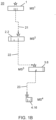
- the partial tree structure 20 shown in FIG. 1B illustrates a selected portion of the the tree 10 of FIG. 1A that corresponds to a single fragmentation pathway.
- the individual precursor, fragment and product ions that correspond to the single illustrated fragmentation pathway are denoted by a star symbol in FIG. 1B .
- the illustrated fragmentation pathway commences by a fragmentation event 21 in which the intermediate- m / z precursor ion that is denoted by a star above node 1 is fragmented so as to generate the three first-generation fragment ions illustrated by vertical lines at node 2.2.
- the second fragmentation event 22 of the illustrated fragmentation pathway is the fragmentation of the highest- m / z (rightmost) first-generation fragment-ion species denoted by a star above node 2.2.
- This second fragmentation event generates the three second-generation fragment ions depicted by vertical lines at node 3.6.
- the third fragmentation event 23 in the sequence generates the final product ion depicted by the leftmost vertical line at node 4.16 and denoted by a star.
- Each of the three ion species at node 4.16 represents a termination of a different respective ion pathway, as shown in FIG. 1A .
- the twenty-seven fourth level nodes 4.1-4.27 corresponds eighty-one different unique fragmentation pathways.
- each fragment-ion mass spectrum may comprise many more than just three lines.
- several such tree data structures (each corresponding to a different value of the fragmentation energy parameter) may be calculated for each starting chemical structure.
- Each of the in-silico approaches includes a scoring routine which attempts to find, within the set of calculated fragment spectra, a set of closest matches to an observed fragmentation pattern. These approaches are useful when a user or analyst is conducting a targeted experiment in order to obtain a simple true-vs-false answer to the question of whether the particular targeted analyte is present in a sample. In cases where multiple structures must be considered, these methods can only generate a ranking based on e.g., the number of observed fragments that can be explained by the in silico fragmentation.
- the present disclosure teaches methods that combine predicted ( in silico ) fragmentation results obtained through software (such as MassFrontier) with actual measured MS n fragmentation data from obtained from a mass spectral database (such as mzCloud).
- the combined results are formulated into a new type of spectral Tree data structure, herein termed a TR-tree, which combines theoretically calculated fragmentation results with experimentally observed data by searching for matches between predicted and observed ions and fragmentation pathways and updating the tree structure by marking matched fragmentation pathways as verified and by deleting or otherwise marking as invalid other non-observed fragment ions or fragmentation pathways.
- the matches may be employed to annotate the database of experimentally observed data with species assignment information that is imported from the matched theoretically calculated results.
- a method for generating a searchable small-molecule tandem mass spectrometry library is provided in accordance with claim 1.
- the term “database” refers to a collection of experimentally determined mass spectrometry data comprising at least a list of experimentally observed mass-to-charge ratio ( m / z ) values for each of a plurality of mass analyzed compounds.
- the term library refers to a searchable collection of mass spectrometry information that comprising at least a list of mass-to-charge ratio ( m / z ) values for each of a plurality of compounds, where the collection may a database, as defined above, or, alternatively, the collection may include, in the list or lists of mlz values, at least some mlz values that have been predicted my means of calculation and that have not been experimentally verified.
- a library or database will be designed to be searchable for the purpose of permitting an analyst to attempt to determine or verify the identity of a small-molecule analyte within a sample by comparison of experimentally determined m / z values derived by mass analysis of the sample to various of the m / z values tabulated in the database or library.
- tandem mass spectrometry is used in a broad sense to refer to any number of fragmentation iterations and the term “product ions” is used synonymously with “fragment ions”.
- fragment ions When one generation of fragment ions is further fragmented so as to generate a subsequent generation of fragment ions, then the earlier generation of fragment ions may also be referred to as “precursor ions" with respect to the subsequent fragmentation stage.
- first generation precursor ions and “first generation precursor ion species” are employed to identify precursor ions that are delivered to a mass analyzer from an ion source, without a prior fragmentation stage.
- precursor ions and “precursor ion species” are used, in this document, in a general sense to refer to either first generation precursor ions or to those precursor ions that are also "fragment ions”.
- CID collision-induced dissociation
- ECD electron-capture dissociation
- ETD electron-transfer dissociation
- IRMPD photodissociation including infrared multiphoton dissociation
- SID surface-induced dissociation
- HCD higher-energy dissociation
- the types of fragments that are formed depends on the type of fragmentation technique employed as well as the applied fragmentation energy. As is known, each fragmentation technique is associated with a respective method for controlling the applied energy. The original charge may be distributed among the fragments or may be limited to only one or some of the fragments. Only charged fragments may be detected by mass spectrometry; neutral fragments are not detected. The methods of the present teachings are not limited to any particular ion fragmentation technique.
- n is a function of the applied fragmentation energy, E f .
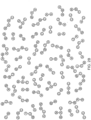
- n 0 ( E f1 ) of fragmentation (where n 0 ( E f1 ) may vary from one compound to another at the same applied fragmentation energy, E f1 ), then the fragment-ion spectra at slightly less values of n (e.g, n 0 - 1, n 0 - 2) are expected to comprise a mixture of ion species that resembles the mixture that is schematically depicted in FIG. 2B .
- this mixture would comprise, for the most part, ion species whose structures are bonded combinations of at least some of the basic moieties "A”, “B” and “C” possibly including additional ion species that further incorporate more additional chemical moieties, "N", that are lost as neutral polyatomic units at the final fragmentation step.
- FIG. 2B illustrates a variety of possible fragment ions that are bound combinations of the building-block moieties and neutrals (e.g., A-B, A-C, B-C, A-A, B-B, C-C, A-N, B-N, C-N), not all of these combinations should be expected to occur, since their appearance as fragments depends on whether they occur bound together in the structure of the parent molecule, compound X. Further, additional larger, more-complex fragments may also be present.
- the initial stages of fragmentation e.g., MS 2 , MS 3 , etc.
- the initial stages of fragmentation are expected to yield some proportion of relatively large fragments (relative to the size of the initial known ion or ions generated by ionization of the compound) which may be identified on the basis of either their recognized complementary masses, recognized loss of neutral polyatomic units or recognized loss of basic building-block moieties as observed in mass spectra obtained at higher levels of fragmentation.
- the assignments of some observed mass spectral peaks of fragment ions may remain uncertain or ambiguous. This uncertainty may be propagated forward to mass spectral data obtained from fragments generated from higher levels of fragmentation. Therefore, mass spectral fragmentation libraries are generally incomplete, both in terms of the number of compounds represented in such libraries as well as in terms of the assignments of chemical compositions to some experimentally observed peaks.
- the in silico calculated fragmentation trees are generally expected to include extraneous or inconsistent entries, since not all predicted fragments are actually observed in actual experiments or else are observed but at applied fragmentation energies that are inconsistent with the predictions.
- extraneous or inconsistent entries are expected to have adverse effects on the accuracy of searches against the information in the calculated fragmentation trees that are made for the purpose of matching observed fragmentation patterns of unknown compounds.
- the inventors of the present invention have recognized that the field of metabolomics and, more generally, the field of small molecule identification may be advanced by cross-referencing experimental fragmentation data to calculated fragmentation patterns and by updating both the calculated fragmentation trees and the observed experimental data based on the cross referencing. Such methods are further described below.
- the fragmentation tree structure 10 depicted in FIG. 1A represents a complete set of tentatively possible ion fragmentation pathways, as calculated by an in silico calculation method, of an ionized "compound X" for which no prior experimental tandem mass spectral data exists.
- Each one of the nodes below the top level node 1 e.g., nodes 2.1-2.3, nodes 3.1-3.9 and nodes 4.1-4.27 ) is depicted, in FIG. 1A , by a box with lines that represent a hypothetical calculated fragment-ion mass spectrum, where m / z values increase from left to right across each box.
- FIG. 3 represents a modified version of the tree structure 10 in which certain of the fragmentation pathways have been verified by actual mass spectral experiments on other compounds and certain other fragmentation pathways have been eliminated, as non-viable, based on those same experiments.
- the applied fragmentation energy (or energies) utilized in the experiments should match the fragmentation energy ( energies) that is assumed in the calculations.
- verified fragmentation results are indicated by solid-line arrows connecting nodes and eliminated pathways are indicated by dotted-line boxes and, in comparison to tree structure 10, the deletion of arrows and of un-observed mass spectral lines.
- all eighteen predicted fragmentation pathways that relate to further fragmentation of the predicted but un-observed fragment ions of node 2.2 30 are deleted or otherwise marked as non-viable in the hybrid fragmentation tree 30.
- This update of fragmentation tree 30 includes removal of nodes 3.5 and 3.6 and nodes 4.13-4.18 from further consideration in pattern search matches that utilize the hybrid tree.
- chemical composition and/or structural information from the in-silico calculations relating to the matched ion peaks in node 1 and node 2.2 can be used to update corresponding entries in a separate database relating to the experimental tandem mass spectra of the compound W.
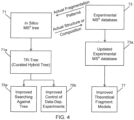
- FIG. 4 schematically illustrates a general procedure of cross-referencing an in silico calculated fragmentation tree 71 (such as the hypothetical fragmentation tree 10 depicted in FIG. 1A ) to a database 73 of MS n experimental data of a variety of standard or otherwise characterized or known compounds where the compounds are chosen to cover a wide range of chemical compositions and structures.
- the procedure is especially applicable to the study of metabolites in humans or animals but can be extended generally to the study of small molecules.
- the purely computationally derived fragmentation tree 71 may be curated by validating certain of the predicted fragmentations and invalidating others, thereby updating the original fragmentation tree with the benefit of known information.
- the updated fragmentation tree 71a thus becomes a curated (or at least partially curated) fragmentation tree that is referred to here as a TR-tree, a hypothetical example of which is the TR-tree 30 depicted in FIG. 3 .
- the TR-tree is a hybrid tree because it combines computational results with experimentally derived data.
- the experimental database 73 may itself be updated or augmented by the importing of certain information derived from the computations into the database.
- the actual chemical composition and possibly the structure of the matched fragments can be imported into the database 73 from the computationally derived fragmentation tree 71 thereby generating an updated experimental database 73a.
- the importation of this information is possible because every mass spectral line stored in the fragmentation tree 71 pertains to a particular fragment composition and/or structure by virtue of the manner by which the fragmentation tree is constructed.
- the so-transferred data may permit for assignment of previously un-assigned observed mass spectral lines in the updated database 73a.
- the curated hybrid fragmentation tree 71a that is here referred to as a TR-tree may be employed for more reliable searching 75a of the fragmentation tree for fragmentation patterns that best match an observed fragmentation pattern of an unknown compound.
- the updating of the fragmentation tree improves this type of search process through the elimination of many irrelevant fragmentation pathways, thus reducing the incidence of false positive matches.
- the improved-reliability fragmentation pathways stored in the TR-Tree 71a may be employed as input to an operating mass spectrometer instrument, while it is performing experiments, for the purpose of making automated real-time data dependent decisions 75b of which ion species to isolate and fragment so as to obtain the most informative data from the fragmentation results.
- the updated experimental database 73a having confirmed assignments of observed lines to fragment-ion compositions and structures may lead to the development of improved theoretical models 77 of the mechanisms and kinetics of fragmentation in metabolites and/or other small molecules so that unknown fragmentation patterns might be calculated and predicted from first principles.
Landscapes
- Chemical & Material Sciences (AREA)
- Engineering & Computer Science (AREA)
- Theoretical Computer Science (AREA)
- Computing Systems (AREA)
- Life Sciences & Earth Sciences (AREA)
- Bioinformatics & Cheminformatics (AREA)
- Bioinformatics & Computational Biology (AREA)
- Crystallography & Structural Chemistry (AREA)
- Physics & Mathematics (AREA)
- Spectroscopy & Molecular Physics (AREA)
- Analytical Chemistry (AREA)
- Health & Medical Sciences (AREA)
- General Health & Medical Sciences (AREA)
- Databases & Information Systems (AREA)
- Software Systems (AREA)
- Other Investigation Or Analysis Of Materials By Electrical Means (AREA)
Claims (6)
- Verfahren zur Erzeugung einer durchsuchbaren Bibliothek von Tandem-Massenspektrometrie für kleine Moleküle, umfassend:(a) Erzeugen einer Liste von lonenspezies, einschließlich Fragmentionenspezies, von denen durch die theoretischen Berechnungen vorhergesagt wird, dass sie durch Analysen der Tandem-Massenspektrometrie (MSn) der kleinen Molekülverbindungen erzeugt werden, wobei n ≥ 2 ist, durch theoretische Berechnung und für jede einer Vielzahl von kleinen Molekülverbindungen, wobei die vorhergesagten lonenspezies, die jeder kleinen Molekülverbindung entsprechen, in Knoten (1, 2,1-2,3, 3,1-3,9, 4,1-4.,27) eines jeweiligen Fragmentierungsbaums (10, 71) gruppiert sind, wobei jeder Knoten (1, 2,1-2,3, 3,1-3,9, 4,1-4,27) jedes Fragmentierungsbaums (10, 71) der vorhergesagten Erzeugung einer oder mehrerer vorhergesagter Fragmentionenspezies durch Fragmentierung einer anderen der vorhergesagten lonenspezies entspricht, und wobei jede vorhergesagte lonenspezies jedes Knotens (1, 2,1-2,3, 3,1-3,9, 4,1-4,27) mittels eines vorhergesagten Fragmentierungsweges (20) mit mindestens einer anderen vorhergesagten lonenspezies eines anderen Knotens (1, 2,1-2,3, 3,1-3,9, 4,1-4,27) verbunden ist;(b) Vergleichen mindestens einer Teilmenge der vorhergesagten lonenspezies mit Einträgen in einer Datenbank (73), die eine Liste von experimentell beobachteten lonenspezies enthält;(c) Abgleichen eines vorhergesagten Wertes des Massen-Ladungs-Verhältnisses (mlz) von jeder der vorhergesagten Fragmentionenspezies mit einem entsprechenden experimentell gemessenen m/z-Wert einer experimentell beobachteten Fragmentionenspezies, für die Informationen in der Datenbank (73) tabelliert sind; und(d) Aktualisieren eines oder mehrerer der Fragmentierungsbäume (10, 71) auf der Grundlage von Informationen, die aus den übereinstimmenden vorhergesagten und experimentell gemessenen m/z-Werten abgeleitet sind, wobei das Aktualisieren umfasst:wobei die durchsuchbare Bibliothek der Tandem-Massenspektrometrie für kleine Moleküle den aktualisierten Fragmentierungsbaum (30) umfasst.- Löschen von experimentell nicht beobachteten vorhergesagten lonenspezies aus einem Fragmentierungsbaum (10, 71), oder Markieren oder Annotieren dieser als nicht lebensfähig; und/oder- Löschen oder Markieren aller oder eines Teils eines vorhergesagten Fragmentierungsweges (20), der mit einer experimentell nicht beobachteten vorhergesagten lonenspezies aus einem Fragmentierungsbaum (10, 71) verbunden ist, als nicht lebensfähig,
- Verfahren nach Anspruch 1, wobei der Schritt (c) ferner umfasst:
für jede der einen oder mehreren übereinstimmenden vorhergesagten m/z-Werte von vorhergesagten Fragmentionenspezies, das Vergleichen eines vorhergesagten m/z-Wertes einer vorhergesagten Vorläuferionenspezies, von der vorhergesagt wird, dass sie bei ihrer Fragmentierung die vorhergesagte Fragmentionenspezies ergibt, mit einem experimentell gemessenen m/z-Wert einer experimentell beobachteten Vorläuferionenspezies, von der experimentell beobachtet wird, dass sie bei der Fragmentierung die jeweilige experimentell beobachtete übereinstimmende Fragmentionenspezies ergibt. - Verfahren nach Anspruch 1 oder Anspruch 2, wobei der Schritt (b) des Vergleichens mindestens einer Teilmenge der vorhergesagten lonenspezies mit Einträgen in einer Datenbank (73) den Vergleich der mindestens einen Teilmenge der vorhergesagten lonenspezies mit Einträgen in einer Datenbank (73) von Tandem-Massenspektrometrie (MSn)-Analysen von Standardverbindungen umfasst, wobei n ≥ 2 ist.
- Verfahren nach Anspruch 3, ferner umfassend:
Aktualisieren mindestens einer Zuordnung eines massenspektrometrischen Spitzenwerts in der Datenbank (73) zu einer Zusammensetzung oder Struktur einer lonenspezies auf der Grundlage einer vorhergesagten lonenspezies des Fragmentierungsbaums (10, 71), die dem massenspektrometrischen Spitzenwert entspricht. - Verfahren wie in Anspruch 1 beschrieben,wobei der Schritt (a) des Erzeugens einer Liste von vorhergesagten Fragmentionenspezies durch theoretische Berechnung und für jede einer Vielzahl von kleinmolekularen Verbindungen die Berücksichtigung der Elemente jeder dieser Listen als abhängig von einem einstellbaren angewandten Fragmentierungsenergieparameter beinhaltet;wobei der Schritt (b) des Vergleichens von mindestens einer Teilmenge der vorhergesagten Fragmentionenspezies mit Einträgen in einer Datenbank (73) das Vergleichen der mindestens einen Teilmenge der vorhergesagten lonenspezies mit Einträgen in einer Datenbank (73) umfasst, die als eine Funktion eines experimentell angewendeten Fragmentierungsenergiewertes tabelliert sind; undwobei der Schritt (c) des Abgleichs eines vorhergesagten Wertes des Masse-Ladungs-Verhältnisses (m/z) jeder der einen oder mehreren vorhergesagten Fragmentionenspezies mit einem entsprechenden experimentell gemessenen m/z-Wert einer experimentell beobachteten Fragmentionenspezies den Abgleich von Abgleichswerten des Fragmentierungsenergieparameters mit Werten der angewandten Fragmentierungsenergie innerhalb des experimentellen Fehlers umfasst.
- Verfahren nach einem der Ansprüche 1 bis 5, wobei ein übereinstimmender experimentell gemessener m/z-Wert durch Massenspektralanalyse einer Verbindung erhalten wird, die sich von der niedermolekularen Verbindung unterscheidet, für die das jeweilige übereinstimmende vorhergesagte Masse-Ladungs-Verhältnis berechnet wird.
Applications Claiming Priority (1)
| Application Number | Priority Date | Filing Date | Title |
|---|---|---|---|
| US15/934,936 US10878944B2 (en) | 2018-03-23 | 2018-03-23 | Methods for combining predicted and observed mass spectral fragmentation data |
Publications (3)
| Publication Number | Publication Date |
|---|---|
| EP3544016A2 EP3544016A2 (de) | 2019-09-25 |
| EP3544016A3 EP3544016A3 (de) | 2020-08-05 |
| EP3544016B1 true EP3544016B1 (de) | 2023-08-16 |
Family
ID=65818444
Family Applications (1)
| Application Number | Title | Priority Date | Filing Date |
|---|---|---|---|
| EP19163644.8A Active EP3544016B1 (de) | 2018-03-23 | 2019-03-19 | Verfahren zum kombinieren von vorhergesagten und beobachteten massenspektralfragmentierungsdaten |
Country Status (2)
| Country | Link |
|---|---|
| US (1) | US10878944B2 (de) |
| EP (1) | EP3544016B1 (de) |
Families Citing this family (10)
| Publication number | Priority date | Publication date | Assignee | Title |
|---|---|---|---|---|
| CN113495094B (zh) * | 2020-04-01 | 2023-07-25 | 中国电信股份有限公司 | 分子质谱模型的训练方法、分子质谱模拟方法和计算机 |
| CN113514531B (zh) * | 2021-04-27 | 2022-10-25 | 清华大学 | 一种化合物的碎片离子预测方法及应用 |
| US12374537B2 (en) * | 2021-07-30 | 2025-07-29 | The Government of the United States of America, as represented by the Secretary of Homeland Security | Fragmentation resilience energy mass spectrometry (FREMS) |
| CN113758989B (zh) * | 2021-08-26 | 2023-11-28 | 清华大学深圳国际研究生院 | 基于碎片树的现场质谱目标物识别以及衍生物预测方法 |
| CN115876929B (zh) * | 2023-02-27 | 2023-05-30 | 北京师范大学 | 新烟碱类杀虫剂及其转化产物的筛选和鉴定方法及系统 |
| KR20240147234A (ko) * | 2023-03-31 | 2024-10-08 | 주식회사 엘지화학 | Lc-ms/ms의 조각 이온으로부터 모분자의 분자구조를 획득하는 방법 및 시스템 |
| CN119000838B (zh) * | 2023-05-19 | 2025-12-02 | 中国科学院大连化学物理研究所 | 一种计算机辅助的异喹啉类生物碱诊断离子获取方法 |
| CN117470988A (zh) * | 2023-10-24 | 2024-01-30 | 昆明理工大学 | 一种茶叶原花青素、聚酯型儿茶素的质谱定性方法 |
| CN117789848B (zh) * | 2024-02-27 | 2024-05-14 | 北京大学 | 一种应用特征碎片及特征碎片组辅助非靶向筛查的方法 |
| CN118980770B (zh) * | 2024-08-30 | 2025-11-14 | 中国地质大学(武汉) | 一种非靶向识别污泥稳定化产物中小分子植物刺激素的方法 |
Family Cites Families (15)
| Publication number | Priority date | Publication date | Assignee | Title |
|---|---|---|---|---|
| US5538897A (en) | 1994-03-14 | 1996-07-23 | University Of Washington | Use of mass spectrometry fragmentation patterns of peptides to identify amino acid sequences in databases |
| WO2008151140A2 (en) * | 2007-05-31 | 2008-12-11 | The Regents Of The University Of California | Method for identifying peptides using tandem mass spectra by dynamically determining the number of peptide reconstructions required |
| CN101871945B (zh) | 2010-06-13 | 2013-05-08 | 中国科学院计算技术研究所 | 一种利用质谱图库鉴定蛋白质及其修饰的方法 |
| US10393752B2 (en) * | 2011-05-14 | 2019-08-27 | The Regents Of The University Of California | Mass spectrometry-cleavable cross-linking agents |
| US9842198B2 (en) | 2012-06-05 | 2017-12-12 | Mcmaster University | Screening method and systems utilizing mass spectral fragmentation patterns |
| EP2741224A1 (de) | 2012-11-20 | 2014-06-11 | Thermo Finnigan LLC | Verfahren zur Erzeugung von lokalen massenspektrometrischen Bibliotheken zur Interpretation überlagerter Massenspektren |
| US20150160231A1 (en) * | 2013-12-06 | 2015-06-11 | Premier Biosoft | Identification of metabolites from tandem mass spectrometry data using databases of precursor and product ion data |
| JP2015173069A (ja) * | 2014-03-12 | 2015-10-01 | 株式会社島津製作所 | 三連四重極型質量分析装置及びプログラム |
| WO2015162415A1 (en) * | 2014-04-23 | 2015-10-29 | Micromass Uk Limited | Identification and removal of chemical noise for improved ms and ms/ms analysis |
| JP6585087B2 (ja) | 2014-06-02 | 2019-10-02 | ディーエイチ テクノロジーズ デベロップメント プライベート リミテッド | 質量スペクトルライブラリを正確な質量スペクトルライブラリに転換する方法 |
| EP3002696B1 (de) | 2014-10-03 | 2019-03-06 | Thermo Finnigan LLC | Verfahren zum erzeugen, durchsuchen und statistischen validieren einer peptidfragment-ionen-bibliothek |
| US10573501B2 (en) * | 2015-05-29 | 2020-02-25 | Waters Technologies Corporation | Techniques for processing of mass spectral data |
| US10132777B2 (en) * | 2015-09-15 | 2018-11-20 | Washington State University | Two-phase approach to fourier transform ion mobility time-of-flight mass spectrometry |
| JP2019505780A (ja) * | 2015-12-30 | 2019-02-28 | フィト エヌフェー | 質量分析法に基づく生体高分子の構造決定方法 |
| US11948662B2 (en) * | 2017-02-17 | 2024-04-02 | The Regents Of The University Of California | Metabolite, annotation, and gene integration system and method |
-
2018
- 2018-03-23 US US15/934,936 patent/US10878944B2/en active Active
-
2019
- 2019-03-19 EP EP19163644.8A patent/EP3544016B1/de active Active
Also Published As
| Publication number | Publication date |
|---|---|
| US10878944B2 (en) | 2020-12-29 |
| US20190294756A1 (en) | 2019-09-26 |
| EP3544016A3 (de) | 2020-08-05 |
| EP3544016A2 (de) | 2019-09-25 |
Similar Documents
| Publication | Publication Date | Title |
|---|---|---|
| US10878944B2 (en) | Methods for combining predicted and observed mass spectral fragmentation data | |
| Draper et al. | Metabolite signal identification in accurate mass metabolomics data with MZedDB, an interactive m/z annotation tool utilising predicted ionisation behaviour'rules' | |
| EP1766394B1 (de) | System und verfahren zur gruppierung von vorläufer- und fragmentionen unter verwendung ausgewählter ionenchromatogramme | |
| Godzien et al. | Metabolite annotation and identification | |
| CN114965728A (zh) | 用数据非依赖性采集质谱分析生物分子样品的方法和设备 | |
| US20060085142A1 (en) | Determination of molecular structures using tandem mass spectrometry | |
| Fenyö et al. | Mass spectrometric protein identification using the global proteome machine | |
| AU2022290368B2 (en) | Method and apparatus for identifying molecular species in a mass spectrum | |
| US20190018928A1 (en) | Methods for Mass Spectrometry-Based Structure Determination of Biomacromolecules | |
| Walsh et al. | Quantitative profiling of glycans and glycopeptides: an informatics’ perspective | |
| JPWO2019240289A1 (ja) | 化合物の構造を同定するための方法およびシステム | |
| US20240371474A1 (en) | Ion type tailored library search pre-processing, constraints and spectral database building | |
| US20240347141A1 (en) | Chemical peak finder model for unknown compound detection and identification | |
| CN119156669A (zh) | 用于确定与化合物结构相关的变化的方法、介质和系统 | |
| Webb-Robertson et al. | Current trends in computational inference from mass spectrometry-based proteomics | |
| US11094399B2 (en) | Method, system and program for analyzing mass spectrometoric data | |
| Ju et al. | De novo glycan structural identification from mass spectra using tree merging strategy | |
| US20230251224A1 (en) | Method and system for identifying structure of compound | |
| Liu et al. | An approach for peptide identification by de novo sequencing of mixture spectra | |
| CN118120041A (zh) | 用于定性和定量分析工作流程的三维化学峰寻找器 | |
| EP3397969B1 (de) | Verfahren zur massenspektrometrischen strukturbestimmung von biomolekülen | |
| Yerlekar et al. | A review on mass spectrometry: Technique and tools | |
| EP4700779A1 (de) | Präzise und skalierbare ms1-quantifizierung für dda und dia unter verwendung von transferlernen, gezielter analyse und halbüberwachtem maschinenlernen | |
| Liu et al. | An Effective Algorithm for Peptide de novo Sequencing from Mixture MS/MS Spectra | |
| Nash | Improving metabolite annotation and identification in untargeted UHPLC-MS metabolomics studies |
Legal Events
| Date | Code | Title | Description |
|---|---|---|---|
| PUAI | Public reference made under article 153(3) epc to a published international application that has entered the european phase |
Free format text: ORIGINAL CODE: 0009012 |
|
| STAA | Information on the status of an ep patent application or granted ep patent |
Free format text: STATUS: THE APPLICATION HAS BEEN PUBLISHED |
|
| AK | Designated contracting states |
Kind code of ref document: A2 Designated state(s): AL AT BE BG CH CY CZ DE DK EE ES FI FR GB GR HR HU IE IS IT LI LT LU LV MC MK MT NL NO PL PT RO RS SE SI SK SM TR |
|
| AX | Request for extension of the european patent |
Extension state: BA ME |
|
| PUAL | Search report despatched |
Free format text: ORIGINAL CODE: 0009013 |
|
| AK | Designated contracting states |
Kind code of ref document: A3 Designated state(s): AL AT BE BG CH CY CZ DE DK EE ES FI FR GB GR HR HU IE IS IT LI LT LU LV MC MK MT NL NO PL PT RO RS SE SI SK SM TR |
|
| AX | Request for extension of the european patent |
Extension state: BA ME |
|
| RIC1 | Information provided on ipc code assigned before grant |
Ipc: G16C 20/20 20190101AFI20200630BHEP Ipc: G16C 20/90 20190101ALI20200630BHEP |
|
| STAA | Information on the status of an ep patent application or granted ep patent |
Free format text: STATUS: REQUEST FOR EXAMINATION WAS MADE |
|
| 17P | Request for examination filed |
Effective date: 20210122 |
|
| RBV | Designated contracting states (corrected) |
Designated state(s): AL AT BE BG CH CY CZ DE DK EE ES FI FR GB GR HR HU IE IS IT LI LT LU LV MC MK MT NL NO PL PT RO RS SE SI SK SM TR |
|
| STAA | Information on the status of an ep patent application or granted ep patent |
Free format text: STATUS: EXAMINATION IS IN PROGRESS |
|
| 17Q | First examination report despatched |
Effective date: 20210615 |
|
| RIC1 | Information provided on ipc code assigned before grant |
Ipc: H01J 49/00 20060101ALI20230119BHEP Ipc: G16C 20/90 20190101ALI20230119BHEP Ipc: G16C 20/20 20190101AFI20230119BHEP |
|
| GRAP | Despatch of communication of intention to grant a patent |
Free format text: ORIGINAL CODE: EPIDOSNIGR1 |
|
| STAA | Information on the status of an ep patent application or granted ep patent |
Free format text: STATUS: GRANT OF PATENT IS INTENDED |
|
| INTG | Intention to grant announced |
Effective date: 20230301 |
|
| GRAS | Grant fee paid |
Free format text: ORIGINAL CODE: EPIDOSNIGR3 |
|
| GRAA | (expected) grant |
Free format text: ORIGINAL CODE: 0009210 |
|
| STAA | Information on the status of an ep patent application or granted ep patent |
Free format text: STATUS: THE PATENT HAS BEEN GRANTED |
|
| AK | Designated contracting states |
Kind code of ref document: B1 Designated state(s): AL AT BE BG CH CY CZ DE DK EE ES FI FR GB GR HR HU IE IS IT LI LT LU LV MC MK MT NL NO PL PT RO RS SE SI SK SM TR |
|
| RIN1 | Information on inventor provided before grant (corrected) |
Inventor name: MISTRIK, ROBERT Inventor name: STRATTON, TIMOTHY J. Inventor name: TAUTENHAHN, RALF |
|
| P01 | Opt-out of the competence of the unified patent court (upc) registered |
Effective date: 20230721 |
|
| REG | Reference to a national code |
Ref country code: CH Ref legal event code: EP Ref country code: DE Ref legal event code: R096 Ref document number: 602019034934 Country of ref document: DE |
|
| REG | Reference to a national code |
Ref country code: IE Ref legal event code: FG4D |
|
| REG | Reference to a national code |
Ref country code: LT Ref legal event code: MG9D |
|
| REG | Reference to a national code |
Ref country code: NL Ref legal event code: MP Effective date: 20230816 |
|
| REG | Reference to a national code |
Ref country code: AT Ref legal event code: MK05 Ref document number: 1600901 Country of ref document: AT Kind code of ref document: T Effective date: 20230816 |
|
| PG25 | Lapsed in a contracting state [announced via postgrant information from national office to epo] |
Ref country code: GR Free format text: LAPSE BECAUSE OF FAILURE TO SUBMIT A TRANSLATION OF THE DESCRIPTION OR TO PAY THE FEE WITHIN THE PRESCRIBED TIME-LIMIT Effective date: 20231117 |
|
| PG25 | Lapsed in a contracting state [announced via postgrant information from national office to epo] |
Ref country code: IS Free format text: LAPSE BECAUSE OF FAILURE TO SUBMIT A TRANSLATION OF THE DESCRIPTION OR TO PAY THE FEE WITHIN THE PRESCRIBED TIME-LIMIT Effective date: 20231216 |
|
| PG25 | Lapsed in a contracting state [announced via postgrant information from national office to epo] |
Ref country code: SE Free format text: LAPSE BECAUSE OF FAILURE TO SUBMIT A TRANSLATION OF THE DESCRIPTION OR TO PAY THE FEE WITHIN THE PRESCRIBED TIME-LIMIT Effective date: 20230816 Ref country code: RS Free format text: LAPSE BECAUSE OF FAILURE TO SUBMIT A TRANSLATION OF THE DESCRIPTION OR TO PAY THE FEE WITHIN THE PRESCRIBED TIME-LIMIT Effective date: 20230816 Ref country code: PT Free format text: LAPSE BECAUSE OF FAILURE TO SUBMIT A TRANSLATION OF THE DESCRIPTION OR TO PAY THE FEE WITHIN THE PRESCRIBED TIME-LIMIT Effective date: 20231218 Ref country code: NO Free format text: LAPSE BECAUSE OF FAILURE TO SUBMIT A TRANSLATION OF THE DESCRIPTION OR TO PAY THE FEE WITHIN THE PRESCRIBED TIME-LIMIT Effective date: 20231116 Ref country code: NL Free format text: LAPSE BECAUSE OF FAILURE TO SUBMIT A TRANSLATION OF THE DESCRIPTION OR TO PAY THE FEE WITHIN THE PRESCRIBED TIME-LIMIT Effective date: 20230816 Ref country code: LV Free format text: LAPSE BECAUSE OF FAILURE TO SUBMIT A TRANSLATION OF THE DESCRIPTION OR TO PAY THE FEE WITHIN THE PRESCRIBED TIME-LIMIT Effective date: 20230816 Ref country code: LT Free format text: LAPSE BECAUSE OF FAILURE TO SUBMIT A TRANSLATION OF THE DESCRIPTION OR TO PAY THE FEE WITHIN THE PRESCRIBED TIME-LIMIT Effective date: 20230816 Ref country code: IS Free format text: LAPSE BECAUSE OF FAILURE TO SUBMIT A TRANSLATION OF THE DESCRIPTION OR TO PAY THE FEE WITHIN THE PRESCRIBED TIME-LIMIT Effective date: 20231216 Ref country code: HR Free format text: LAPSE BECAUSE OF FAILURE TO SUBMIT A TRANSLATION OF THE DESCRIPTION OR TO PAY THE FEE WITHIN THE PRESCRIBED TIME-LIMIT Effective date: 20230816 Ref country code: GR Free format text: LAPSE BECAUSE OF FAILURE TO SUBMIT A TRANSLATION OF THE DESCRIPTION OR TO PAY THE FEE WITHIN THE PRESCRIBED TIME-LIMIT Effective date: 20231117 Ref country code: FI Free format text: LAPSE BECAUSE OF FAILURE TO SUBMIT A TRANSLATION OF THE DESCRIPTION OR TO PAY THE FEE WITHIN THE PRESCRIBED TIME-LIMIT Effective date: 20230816 Ref country code: AT Free format text: LAPSE BECAUSE OF FAILURE TO SUBMIT A TRANSLATION OF THE DESCRIPTION OR TO PAY THE FEE WITHIN THE PRESCRIBED TIME-LIMIT Effective date: 20230816 |
|
| PG25 | Lapsed in a contracting state [announced via postgrant information from national office to epo] |
Ref country code: PL Free format text: LAPSE BECAUSE OF FAILURE TO SUBMIT A TRANSLATION OF THE DESCRIPTION OR TO PAY THE FEE WITHIN THE PRESCRIBED TIME-LIMIT Effective date: 20230816 |
|
| PG25 | Lapsed in a contracting state [announced via postgrant information from national office to epo] |
Ref country code: ES Free format text: LAPSE BECAUSE OF FAILURE TO SUBMIT A TRANSLATION OF THE DESCRIPTION OR TO PAY THE FEE WITHIN THE PRESCRIBED TIME-LIMIT Effective date: 20230816 |
|
| PG25 | Lapsed in a contracting state [announced via postgrant information from national office to epo] |
Ref country code: SM Free format text: LAPSE BECAUSE OF FAILURE TO SUBMIT A TRANSLATION OF THE DESCRIPTION OR TO PAY THE FEE WITHIN THE PRESCRIBED TIME-LIMIT Effective date: 20230816 Ref country code: RO Free format text: LAPSE BECAUSE OF FAILURE TO SUBMIT A TRANSLATION OF THE DESCRIPTION OR TO PAY THE FEE WITHIN THE PRESCRIBED TIME-LIMIT Effective date: 20230816 Ref country code: ES Free format text: LAPSE BECAUSE OF FAILURE TO SUBMIT A TRANSLATION OF THE DESCRIPTION OR TO PAY THE FEE WITHIN THE PRESCRIBED TIME-LIMIT Effective date: 20230816 Ref country code: EE Free format text: LAPSE BECAUSE OF FAILURE TO SUBMIT A TRANSLATION OF THE DESCRIPTION OR TO PAY THE FEE WITHIN THE PRESCRIBED TIME-LIMIT Effective date: 20230816 Ref country code: DK Free format text: LAPSE BECAUSE OF FAILURE TO SUBMIT A TRANSLATION OF THE DESCRIPTION OR TO PAY THE FEE WITHIN THE PRESCRIBED TIME-LIMIT Effective date: 20230816 Ref country code: CZ Free format text: LAPSE BECAUSE OF FAILURE TO SUBMIT A TRANSLATION OF THE DESCRIPTION OR TO PAY THE FEE WITHIN THE PRESCRIBED TIME-LIMIT Effective date: 20230816 Ref country code: SK Free format text: LAPSE BECAUSE OF FAILURE TO SUBMIT A TRANSLATION OF THE DESCRIPTION OR TO PAY THE FEE WITHIN THE PRESCRIBED TIME-LIMIT Effective date: 20230816 |
|
| REG | Reference to a national code |
Ref country code: DE Ref legal event code: R097 Ref document number: 602019034934 Country of ref document: DE |
|
| PLBE | No opposition filed within time limit |
Free format text: ORIGINAL CODE: 0009261 |
|
| STAA | Information on the status of an ep patent application or granted ep patent |
Free format text: STATUS: NO OPPOSITION FILED WITHIN TIME LIMIT |
|
| 26N | No opposition filed |
Effective date: 20240517 |
|
| PG25 | Lapsed in a contracting state [announced via postgrant information from national office to epo] |
Ref country code: IT Free format text: LAPSE BECAUSE OF FAILURE TO SUBMIT A TRANSLATION OF THE DESCRIPTION OR TO PAY THE FEE WITHIN THE PRESCRIBED TIME-LIMIT Effective date: 20230816 Ref country code: SI Free format text: LAPSE BECAUSE OF FAILURE TO SUBMIT A TRANSLATION OF THE DESCRIPTION OR TO PAY THE FEE WITHIN THE PRESCRIBED TIME-LIMIT Effective date: 20230816 |
|
| REG | Reference to a national code |
Ref country code: CH Ref legal event code: PL |
|
| PG25 | Lapsed in a contracting state [announced via postgrant information from national office to epo] |
Ref country code: BG Free format text: LAPSE BECAUSE OF FAILURE TO SUBMIT A TRANSLATION OF THE DESCRIPTION OR TO PAY THE FEE WITHIN THE PRESCRIBED TIME-LIMIT Effective date: 20230816 |
|
| PG25 | Lapsed in a contracting state [announced via postgrant information from national office to epo] |
Ref country code: LU Free format text: LAPSE BECAUSE OF NON-PAYMENT OF DUE FEES Effective date: 20240319 |
|
| PG25 | Lapsed in a contracting state [announced via postgrant information from national office to epo] |
Ref country code: MC Free format text: LAPSE BECAUSE OF FAILURE TO SUBMIT A TRANSLATION OF THE DESCRIPTION OR TO PAY THE FEE WITHIN THE PRESCRIBED TIME-LIMIT Effective date: 20230816 |
|
| PG25 | Lapsed in a contracting state [announced via postgrant information from national office to epo] |
Ref country code: MC Free format text: LAPSE BECAUSE OF FAILURE TO SUBMIT A TRANSLATION OF THE DESCRIPTION OR TO PAY THE FEE WITHIN THE PRESCRIBED TIME-LIMIT Effective date: 20230816 Ref country code: LU Free format text: LAPSE BECAUSE OF NON-PAYMENT OF DUE FEES Effective date: 20240319 Ref country code: BG Free format text: LAPSE BECAUSE OF FAILURE TO SUBMIT A TRANSLATION OF THE DESCRIPTION OR TO PAY THE FEE WITHIN THE PRESCRIBED TIME-LIMIT Effective date: 20230816 |
|
| REG | Reference to a national code |
Ref country code: BE Ref legal event code: MM Effective date: 20240331 |
|
| PG25 | Lapsed in a contracting state [announced via postgrant information from national office to epo] |
Ref country code: BE Free format text: LAPSE BECAUSE OF NON-PAYMENT OF DUE FEES Effective date: 20240331 |
|
| PG25 | Lapsed in a contracting state [announced via postgrant information from national office to epo] |
Ref country code: FR Free format text: LAPSE BECAUSE OF NON-PAYMENT OF DUE FEES Effective date: 20240331 |
|
| PG25 | Lapsed in a contracting state [announced via postgrant information from national office to epo] |
Ref country code: IE Free format text: LAPSE BECAUSE OF NON-PAYMENT OF DUE FEES Effective date: 20240319 |
|
| PG25 | Lapsed in a contracting state [announced via postgrant information from national office to epo] |
Ref country code: IE Free format text: LAPSE BECAUSE OF NON-PAYMENT OF DUE FEES Effective date: 20240319 Ref country code: FR Free format text: LAPSE BECAUSE OF NON-PAYMENT OF DUE FEES Effective date: 20240331 Ref country code: BE Free format text: LAPSE BECAUSE OF NON-PAYMENT OF DUE FEES Effective date: 20240331 Ref country code: CH Free format text: LAPSE BECAUSE OF NON-PAYMENT OF DUE FEES Effective date: 20240331 |
|
| PG25 | Lapsed in a contracting state [announced via postgrant information from national office to epo] |
Ref country code: CY Free format text: LAPSE BECAUSE OF FAILURE TO SUBMIT A TRANSLATION OF THE DESCRIPTION OR TO PAY THE FEE WITHIN THE PRESCRIBED TIME-LIMIT; INVALID AB INITIO Effective date: 20190319 |
|
| PG25 | Lapsed in a contracting state [announced via postgrant information from national office to epo] |
Ref country code: HU Free format text: LAPSE BECAUSE OF FAILURE TO SUBMIT A TRANSLATION OF THE DESCRIPTION OR TO PAY THE FEE WITHIN THE PRESCRIBED TIME-LIMIT; INVALID AB INITIO Effective date: 20190319 |
|
| PG25 | Lapsed in a contracting state [announced via postgrant information from national office to epo] |
Ref country code: TR Free format text: LAPSE BECAUSE OF FAILURE TO SUBMIT A TRANSLATION OF THE DESCRIPTION OR TO PAY THE FEE WITHIN THE PRESCRIBED TIME-LIMIT Effective date: 20230816 |
|
| PGFP | Annual fee paid to national office [announced via postgrant information from national office to epo] |
Ref country code: GB Payment date: 20260226 Year of fee payment: 8 |
|
| PGFP | Annual fee paid to national office [announced via postgrant information from national office to epo] |
Ref country code: DE Payment date: 20260217 Year of fee payment: 8 |