EP3543245A1 - Method for preparing modified polymerization initiator by using continuous reactor - Google Patents
Method for preparing modified polymerization initiator by using continuous reactor Download PDFInfo
- Publication number
- EP3543245A1 EP3543245A1 EP18871351.5A EP18871351A EP3543245A1 EP 3543245 A1 EP3543245 A1 EP 3543245A1 EP 18871351 A EP18871351 A EP 18871351A EP 3543245 A1 EP3543245 A1 EP 3543245A1
- Authority
- EP
- European Patent Office
- Prior art keywords
- carbon atoms
- group
- formula
- polymerization initiator
- compound represented
- Prior art date
- Legal status (The legal status is an assumption and is not a legal conclusion. Google has not performed a legal analysis and makes no representation as to the accuracy of the status listed.)
- Granted
Links
Classifications
-
- C—CHEMISTRY; METALLURGY
- C07—ORGANIC CHEMISTRY
- C07F—ACYCLIC, CARBOCYCLIC OR HETEROCYCLIC COMPOUNDS CONTAINING ELEMENTS OTHER THAN CARBON, HYDROGEN, HALOGEN, OXYGEN, NITROGEN, SULFUR, SELENIUM OR TELLURIUM
- C07F1/00—Compounds containing elements of Groups 1 or 11 of the Periodic Table
- C07F1/02—Lithium compounds
-
- B—PERFORMING OPERATIONS; TRANSPORTING
- B01—PHYSICAL OR CHEMICAL PROCESSES OR APPARATUS IN GENERAL
- B01J—CHEMICAL OR PHYSICAL PROCESSES, e.g. CATALYSIS OR COLLOID CHEMISTRY; THEIR RELEVANT APPARATUS
- B01J19/00—Chemical, physical or physico-chemical processes in general; Their relevant apparatus
- B01J19/0006—Controlling or regulating processes
- B01J19/0013—Controlling the temperature of the process
-
- B—PERFORMING OPERATIONS; TRANSPORTING
- B01—PHYSICAL OR CHEMICAL PROCESSES OR APPARATUS IN GENERAL
- B01J—CHEMICAL OR PHYSICAL PROCESSES, e.g. CATALYSIS OR COLLOID CHEMISTRY; THEIR RELEVANT APPARATUS
- B01J4/00—Feed or outlet devices; Feed or outlet control devices
- B01J4/008—Feed or outlet control devices
-
- C—CHEMISTRY; METALLURGY
- C07—ORGANIC CHEMISTRY
- C07F—ACYCLIC, CARBOCYCLIC OR HETEROCYCLIC COMPOUNDS CONTAINING ELEMENTS OTHER THAN CARBON, HYDROGEN, HALOGEN, OXYGEN, NITROGEN, SULFUR, SELENIUM OR TELLURIUM
- C07F1/00—Compounds containing elements of Groups 1 or 11 of the Periodic Table
- C07F1/04—Sodium compounds
-
- C—CHEMISTRY; METALLURGY
- C08—ORGANIC MACROMOLECULAR COMPOUNDS; THEIR PREPARATION OR CHEMICAL WORKING-UP; COMPOSITIONS BASED THEREON
- C08F—MACROMOLECULAR COMPOUNDS OBTAINED BY REACTIONS ONLY INVOLVING CARBON-TO-CARBON UNSATURATED BONDS
- C08F236/00—Copolymers of compounds having one or more unsaturated aliphatic radicals, at least one having two or more carbon-to-carbon double bonds
- C08F236/02—Copolymers of compounds having one or more unsaturated aliphatic radicals, at least one having two or more carbon-to-carbon double bonds the radical having only two carbon-to-carbon double bonds
- C08F236/04—Copolymers of compounds having one or more unsaturated aliphatic radicals, at least one having two or more carbon-to-carbon double bonds the radical having only two carbon-to-carbon double bonds conjugated
-
- C—CHEMISTRY; METALLURGY
- C08—ORGANIC MACROMOLECULAR COMPOUNDS; THEIR PREPARATION OR CHEMICAL WORKING-UP; COMPOSITIONS BASED THEREON
- C08F—MACROMOLECULAR COMPOUNDS OBTAINED BY REACTIONS ONLY INVOLVING CARBON-TO-CARBON UNSATURATED BONDS
- C08F4/00—Polymerisation catalysts
- C08F4/42—Metals; Metal hydrides; Metallo-organic compounds; Use thereof as catalyst precursors
- C08F4/44—Metals; Metal hydrides; Metallo-organic compounds; Use thereof as catalyst precursors selected from light metals, zinc, cadmium, mercury, copper, silver, gold, boron, gallium, indium, thallium, rare earths or actinides
- C08F4/46—Metals; Metal hydrides; Metallo-organic compounds; Use thereof as catalyst precursors selected from light metals, zinc, cadmium, mercury, copper, silver, gold, boron, gallium, indium, thallium, rare earths or actinides selected from alkali metals
- C08F4/48—Metals; Metal hydrides; Metallo-organic compounds; Use thereof as catalyst precursors selected from light metals, zinc, cadmium, mercury, copper, silver, gold, boron, gallium, indium, thallium, rare earths or actinides selected from alkali metals selected from lithium, rubidium, caesium or francium
-
- B—PERFORMING OPERATIONS; TRANSPORTING
- B01—PHYSICAL OR CHEMICAL PROCESSES OR APPARATUS IN GENERAL
- B01J—CHEMICAL OR PHYSICAL PROCESSES, e.g. CATALYSIS OR COLLOID CHEMISTRY; THEIR RELEVANT APPARATUS
- B01J19/00—Chemical, physical or physico-chemical processes in general; Their relevant apparatus
- B01J19/0053—Details of the reactor
- B01J19/0066—Stirrers
-
- B—PERFORMING OPERATIONS; TRANSPORTING
- B01—PHYSICAL OR CHEMICAL PROCESSES OR APPARATUS IN GENERAL
- B01J—CHEMICAL OR PHYSICAL PROCESSES, e.g. CATALYSIS OR COLLOID CHEMISTRY; THEIR RELEVANT APPARATUS
- B01J2219/00—Chemical, physical or physico-chemical processes in general; Their relevant apparatus
- B01J2219/00002—Chemical plants
- B01J2219/00027—Process aspects
- B01J2219/00033—Continuous processes
-
- B—PERFORMING OPERATIONS; TRANSPORTING
- B01—PHYSICAL OR CHEMICAL PROCESSES OR APPARATUS IN GENERAL
- B01J—CHEMICAL OR PHYSICAL PROCESSES, e.g. CATALYSIS OR COLLOID CHEMISTRY; THEIR RELEVANT APPARATUS
- B01J2219/00—Chemical, physical or physico-chemical processes in general; Their relevant apparatus
- B01J2219/00049—Controlling or regulating processes
- B01J2219/00051—Controlling the temperature
-
- B—PERFORMING OPERATIONS; TRANSPORTING
- B01—PHYSICAL OR CHEMICAL PROCESSES OR APPARATUS IN GENERAL
- B01J—CHEMICAL OR PHYSICAL PROCESSES, e.g. CATALYSIS OR COLLOID CHEMISTRY; THEIR RELEVANT APPARATUS
- B01J2219/00—Chemical, physical or physico-chemical processes in general; Their relevant apparatus
- B01J2219/00049—Controlling or regulating processes
- B01J2219/00162—Controlling or regulating processes controlling the pressure
-
- C—CHEMISTRY; METALLURGY
- C08—ORGANIC MACROMOLECULAR COMPOUNDS; THEIR PREPARATION OR CHEMICAL WORKING-UP; COMPOSITIONS BASED THEREON
- C08F—MACROMOLECULAR COMPOUNDS OBTAINED BY REACTIONS ONLY INVOLVING CARBON-TO-CARBON UNSATURATED BONDS
- C08F2/00—Processes of polymerisation
- C08F2/44—Polymerisation in the presence of compounding ingredients, e.g. plasticisers, dyestuffs, fillers
Definitions
- the present invention relates to a method for preparing a modification polymerization initiator, by which side reactions are minimized and a modification polymerization initiator may be prepared in a high conversion ratio.
- a rubber material having modulational stability represented by wet skid resistance as well as low rolling resistance, and excellent abrasion resistance and tensile properties is required as a rubber material for tires.
- Natural rubbers, polyisoprene rubbers, or polybutadiene rubbers are known as rubber materials having low hysteresis loss, but these rubbers have a limitation of low wet skid resistance.
- conjugated diene-based (co)polymers such as styrene-butadiene rubbers (hereinafter, referred to as "SBR") and butadiene rubbers (hereinafter, referred to as "BR”), are prepared by emulsion polymerization or solution polymerization to be used as rubbers for tires.
- the greatest advantage of the solution polymerization in comparison to the emulsion polymerization is that the vinyl structure content and the styrene content, which specify physical properties of the rubber, may be arbitrarily adjusted and its molecular weight and physical properties may be controlled by coupling or modification.
- the SBR prepared by the solution polymerization is widely used as a rubber material for tires because it is easy to change a structure of the finally prepared SBR or BR, and movement of chain terminals may be reduced and a coupling force with a filler such as silica and carbon black may be increased by coupling or modification of the chain terminals.
- SSBR solution-polymerized SBR
- glass transition temperature of the rubber is increased by increasing the vinyl content in the SBR, physical properties such as rolling resistance and braking force, required for tires may be controlled, and fuel consumption may also be reduced by appropriately adjusting the glass transition temperature.
- the SSBR is prepared by using an anionic polymerization initiator and is being used by coupling or modifying the chain terminals of the polymer thus formed using various modifiers. Recently, the development of modification in a polymerization step using a modification polymerization initiator, a modification monomer, etc. during polymerization is conducted.
- a hexamethylene lithium initiator prepared by the reaction of hexamethyleneimine (HMI) and n-butyllithium (BuLi) by the following Reaction 1 is widely known:
- the solubility of the hexamethylene lithium initiator in a solvent is low, and precipitation is produced over time, and in this case, the hexamethylene lithium initiator may be used as the polymerization initiator but the reactivity thereof is not good in contrast to n-butyllithium.
- a method for preparing a modification polymerization initiator by further reacting a conjugated diene compound such as isoprene and 1,3-butadiene with the hexamethylene lithium prepared through Reaction 1, by the following Reaction 2, has been suggested:
- modification polymerization initiator thus prepared has improved solubility and reactivity in contrast to the hexamethylene lithium initiator, precipitation still takes place over time and deactivation is induced.
- an anionic polymerization initiator such as the above-mentioned modification polymerization initiator may be prepared through a batch type process, or an anionic polymerization initiator and SSBR may be prepared simultaneously in one batch type reactor.
- the anionic polymerization initiator thus prepared essentially requires a storing step prior to use for the preparation of SSBR, and during storing, the activity thereof may be lost via the reaction with diverse scavengers such as humidity and air.
- post processes may be adversely influenced to act as a factor degrading the physical properties of a finally prepared SSBR.
- the preparing reaction of the anionic polymerization initiator and the SSBR polymerization reaction are performed in the same batch type reactor, and defects relating to storage may be solved, but the checking of the proper synthesis of the anionic polymerization initiator is difficult and the physical properties of the finally prepared SSBR may be worse than a case where an anionic polymerization initiator synthesized in advance is used.
- raw materials are directly included, and by-products may be produced during mixing reaction, or reverse reaction may be carried out to produce unreacted materials, thereby decreasing yield.
- Korean Laid-open Patent Publication No. 10-2016-0092227 discloses a method for preparing an anionic polymerization initiator using a continuous type reactor including a static mixer.
- the concentration distribution or temperature distribution of raw materials may be controlled uniformly, and lithiation reaction may be continuously carried out, and storage problem and yield decreasing problem may be decreased.
- the static mixer due to the static mixer, the exothermic reaction defect of the lithiation reaction is not solved, and a specific cooling apparatus is required and manufacturing cost is high.
- the present invention has been devised to solve the above-mentioned problems of the conventional technique, and an object of the present invention is to provide a modification polymerization initiator, which may be used in a polymerization reaction to easily initiate polymerization and provide a polymer with a functional group having affinity with a filler, and a method for preparing a modification polymerization initiator in a high conversion ratio by minimizing side reactions.
- a method for preparing a modification polymerization initiator including a step of reacting a compound represented by the following Formula 1 and a compound represented by the following Formula 2, wherein the reaction is performed in a continuous reactor including a first continuous channel and a second continuous channel, and prior to performing the reaction, the compound represented by Formula 1 is injected into the continuous reactor via the first continuous channel and the compound represented by Formula 2 is injected into the continuous reactor via the second continuous channel: in Formula 1,
- a modification polymerization initiator which may be used in polymerization reaction to easily initiate polymerization and may provide a polymer with a functional group having affinity with a filler, may be easily prepared.
- the method for preparing a modification polymerization initiator according to the present invention is particularly performed using a continuous reactor, and may decrease the production of unreacted material during lithiation reaction, and decrease defects due to the exothermic reaction of the lithiation reaction by rapid heat removal, thereby reducing the production of by-products and as a result, increasing a conversion ratio to prepare a modification polymerization initiator with high purity in high yield.
- substituted used in the present invention may mean the hydrogen of a functional group, an atomic group or a compound is substituted with a specific substituent. If the hydrogen of a functional group, an atomic group or a compound is substituted with a specific substituent, one or a plurality including two or more substituents may be present according to the number of hydrogen present in the functional group, the atomic group or the compound, and if a plurality of substituents are present, each substituent may be the same or different.
- alkyl group used in the present invention may mean monovalent aliphatic saturated hydrocarbon, and may include both linear alkyl groups such as methyl, ethyl, propyl and butyl, and branched alkyl groups such as isopropyl, sec-butyl, tert-butyl and neo-pentyl.
- alkylene group used in the present invention may mean divalent aliphatic saturated hydrocarbon such as methylene, ethylene, propylene and butylene.
- alkenyl group used in the present invention may mean an alkyl group including one or two or more double bonds.
- alkynyl group used in the present invention may mean an alkyl group including one or two or more triple bonds.
- cycloalkyl group used in the present invention may mean cyclic saturated hydrocarbon.
- aryl group used in the present invention may mean cyclic aromatic hydrocarbon, and may include both monocyclic aromatic hydrocarbon including one ring, and polycyclic aromatic hydrocarbon including two or more rings combined.
- heteroalkyl group used in the present invention may mean an alkyl group, in which a carbon atom (excluding a terminal carbon atom) in the alkyl group is substituted with one or more heteroatoms.
- heteroalkenyl group used in the present invention may mean an alkenyl group, in which a carbon atom (excluding a terminal carbon atom) in the alkenyl group is substituted with one or more heteroatoms.
- heteroalkynyl group used in the present invention may mean an alkynyl group, in which a carbon atom (excluding a terminal carbon atom) in the alkynyl group is substituted with one or more heteroatoms.
- heterocycloalkyl group used in the present invention may mean a cycloalkyl group, in which a carbon atom in the cycloalkyl group is substituted with one or more heteroatoms.
- heteroaryl group used in the present invention may mean a cycloalkyl group, in which a carbon atom in the aryl group is substituted with one or more heteroatoms.
- derived unit and "derived functional group” used in the present invention may represent a component or a structure comes from a certain material, or the material itself.
- the present invention provides a method for preparing a modification polymerization initiator, by which a modification polymerization initiator that may act as a polymerization initiator during polymerizing a polymer, particularly, a conjugated diene-based polymer, and may provide the polymer with a functional group such as a group having affinity with a filler, may be easily prepared.
- the method for preparing a modification polymerization initiator according to an embodiment of the present invention is characterized in including a step of reacting a compound represented by the following Formula 1 and a compound represented by the following Formula 2 (step A), wherein the reaction is performed in a continuous reactor including a first continuous channel and a second continuous channel, and prior to performing the reaction, the compound represented by Formula 1 is injected into the continuous reactor via the first continuous channel and the compound represented by Formula 2 is injected into the continuous reactor via the second continuous channel: in Formula 1,
- X is -NR a R b , -OR c , or -SR d , where R a to R d are each independently an alkyl group of 1 to 20 carbon atoms, an alkenyl group of 2 to 20 carbon atoms, an alkynyl group of 2 to 20 carbon atoms, a cycloalkyl group of 3 to 20 carbon atoms, an aryl group of 6 to 20 carbon atoms, a heteroalkyl group of 1 to 20 carbon atoms, a heteroalkenyl group of 2 to 20 carbon atoms, a heteroalkynyl group of 2 to 20 carbon atoms, a heterocycloalkyl group of 2 to 20 carbon atoms, or a heteroaryl group of 3 to 20 carbon atoms, where each of R a to R d is unsubstituted or substituted with a substituent including one or more heteroatoms selected from N, O, S, Si and F atoms, and
- X may be one selected from the substituents represented by the following Formula 1a to Formula 1c: in Formula 1a to Formula 1c, R 2 , R 3 , R 6 , R 8 and R 9 are each independently an alkyl group of 1 to 10 carbon atoms, an alkenyl group of 2 to 10 carbon atoms, an alkynyl group of 2 to 10 carbon atoms, a cycloalkyl group of 3 to 10 carbon atoms, an aryl group of 6 to 10 carbon atoms, a heteroalkyl group of 1 to 10 carbon atoms, a heteroalkenyl group of 2 to 10 carbon atoms, a heteroalkynyl group of 2 to 10 carbon atoms, a heterocycloalkyl group of 3 to 10 carbon atoms, or a heteroaryl group of 3 to 10 carbon atoms, where R 2 and R 3 , and R 8 and R 9 each may be connected with each other to form an aliphatic hydrocarbon ring
- the compound represented by Formula 1 may be a compound represented by the following Formula 1-1 to Formula 1-11:
- M is an alkali metal
- R 1 may be hydrogen, an alkyl group of 1 to 10 carbon atoms, an alkenyl group of 2 to 10 carbon atoms, an alkynyl group of 2 to 10 carbon atoms, a cycloalkyl group of 5 to 10 carbon atoms, or an aryl group of 6 to 10 carbon atoms.
- the compound represented by Formula 1 may be prepared by reacting myrcene with a functional group compound.
- myrcene is reacted with a reactive compound to form a reactive site in the molecular structure of the myrcene, and then reacted with a functional group compound to form the compound represented by Formula 1, obtained by introducing a functional group derived from the functional group compound to the reactive site.
- D may be Cl, Br, I or -OH, and X is the same as defined in Formula 1.
- the reaction in step A may be performed in a continuous reactor.
- the continuous reactor may represent a reactor for performing reaction while continuously injecting raw materials used for the reaction.
- the reaction in step A may be performed in a continuous reactor including a first continuous channel and a second continuous channel, and in this case, prior to performing reaction, the compound represented by Formula 1 may be injected via the first continuous channel and the compound represented by Formula 2 may be injected via the second continuous channel to the continuous reactor.
- each of the first continuous channel and the second continuous channel may mean an injecting part (or inserting part) for controlling the injecting amount of each compound into the continuous reactor, and in this case, the injecting amounts of the compound represented by Formula 1 and the compound represented by Formula 2 may be each independently controlled, and each injecting amount may be controlled according to reaction environment, thereby minimizing the occurrence of side reactions.
- the injection rate of the first continuous channel may be from 0.1 g/min to 1,000 g/min, from 0.1 g/min to 700 g/min, or 0.1 g/min to 400 g/min
- the injection rate of the second continuous channel may be from 0.1 g/min to 1,000 g/min, from 0.1 g/min to 700 g/min or from 0.1 g/min to 400 g/min.
- the injecting amounts of the compound represented by Formula 1 and the compound represented by Formula 2 may be appropriately controlled without rapid change, and the side reactions may be minimized.
- the molar ratio of the compound represented by Formula 1 and the compound represented by Formula 2 may be 1:0.01 to 5, 1:0.1 to 5, 1:0.5 to 3, or 1:0.5 to 1.5, and within this range, the side reactions may be minimized.
- the modification polymerization initiator thus prepared may have a dimer, a trimer or an oligomer type.
- the compound represented by Formula 1 and the compound represented by Formula 2 may be dissolved in reaction solvents, respectively, and may be used as a solution state, as necessary. If the compound represented by Formula 1 and the compound represented by Formula 2 are used in solution state, the concentrations of the solutions are not specifically limited, and the compound represented by Formula 1 and the compound represented by Formula 2 may be used by controlling the molar ratio thereof within the above-mentioned molar ratio.
- the reaction solvent may be a hydrocarbon solvent which does not react with anions, for example, one or more selected among a linear hydrocarbon compound such as pentane, hexane and octane; its derivatives having branches; a cyclic hydrocarbon compound such as cyclohexane and cycloheptane; an aromatic hydrocarbon compound such as benzene, toluene and xylene; and linear or cyclic ethers such as dimethyl ether, diethyl ether, anisole and tetrahydrofuran.
- the reaction solvent may be cyclohexane, hexane, tetrahydrofuran or diethyl ether.
- the reaction in step A may be performed in a temperature range of -20°C to 100°C, 0°C to 90°C, or 15°C to 80°C under pressure conditions of 1 bar to 10 bar, 1 bar to 7 bar or 1 bar to 5 bar. Within these ranges, the side reactions may be minimized.
- the method for preparing a modification polymerization initiator according to the present invention is performed using a continuous reactor, and the mixing ratio of the reaction raw materials during lithiation reaction (for example, the compound represented by Formula 1 and the compound represented by Formula 2) is increased to decrease the production of unreacted materials and decrease defects due to the exothermic reaction of the lithiation reaction through rapid heat removal, thereby decreasing the production of by-products.
- a conversion ratio may be increased and a modification polymerization initiator having high purity may be stably prepared in high yield.
- the reaction in step A may be performed by further adding a polar additive.
- the polar additive may include one or more selected from the group consisting of tetrahydrofuran, ditetrahydrofurylpropane, diethyl ether, cycloamyl ether, dipropyl ether, ethylene dimethyl ether, ethylene diethyl ether, diethyl glycol, dimethyl ether, tert-butoxyethoxyethane, bis(3-dimethylaminoethyl) ether, (dimethylaminoethyl) ethyl ether, trimethylamine, triethylamine, tripropylamine, and tetramethylethylenediamine, particularly, triethylamine or tetramethylethylenediamine.
- the polar additive may be used in an amount of 0.1 mol to 10 mol, 0.5 mol to 5 mol, or 0.5 mol to 1.5 mol based on 1 mol of the compound represented by Formula 1.
- the present invention provides a modification polymerization initiator prepared by the method for preparing a modification polymerization initiator.
- the modification polymerization initiator according to an embodiment of the present invention is characterized in including a derived unit from the compound represented by Formula 1 and a derived unit from the compound represented by Formula 2.
- modification polymerization initiator may be one material or a mixture type of various materials.
- the modification polymerization initiator may include one or more selected among a compound represented by Formula 3 and the isomers thereof.
- the modification polymerization initiator may include one or more selected from the dimer, the trimer or the oligomer of a compound represented by Formula 3 below, and the dimer, the trimer or the oligomer of the isomers of the compound represented by Formula 3.
- the modification polymerization initiator may include as another embodiment, one or more selected from a compound represented by Formula 3; the isomers thereof; one or more selected from the dimer, the trimer and the oligomer thereof; and one or more selected from the dimer, the trimer or the oligomer of the isomers.
- X is the same as defined in Formula 1
- M is Na, K or Li
- R 1 is hydrogen or an alkyl group of 1 to 10 carbon atoms.
- M may be bonded to a neighboring carbon atom via an ionic bond.
- the isomers of the compound represented by Formula 3 may include both the structure isomers and the stereoisomers of the compound represented by Formula 3, for example, may be one or more selected from the compounds represented in the following Formula 3-1 to Formula 3-3: in Formula 3-1 to Formula 3-3, X is the same as defined in Formula 1, M is Na, K or Li, and R 1 is hydrogen or an alkyl group of 1 to 10 carbon atoms. In addition, in Formula 3-1 to Formula 3-3, M may be bonded to a neighboring carbon atom via an ionic bond.
- X may be selected from the substituents represented by Formula 1a to Formula 1c, where R 2 , R 3 , R 6 , R 8 and R 9 are each independently an alkyl group of 1 to 10 carbon atoms, which is unsubstituted or substituted with one or more heteroatoms selected from N, O and S atoms or with a substituent including the heteroatom, R 4 , R 5 and R 7 are each independently an alkylene group of 1 to 6 carbon atoms, which is unsubstituted or substituted with a heteroatom selected from N and O atoms or with a substituent including the heteroatom, and Z may be O.
- the compound represented by Formula 3 includes a unit derived from the compound represented by Formula 1 and a unit derived from the compound represented by Formula 2.
- the dimer may represent a combined type of two units derived from the compound represented by Formula 1 and one unit derived from the compound represented by Formula 2
- the trimer may represent a combined type of three units derived from the compound represented by Formula 1 and one unit derived from the compound represented by Formula 2.
- the oligomer may represent a combined type of a plurality of the units derived from the compound represented by Formula 1 and one unit derived from the compound represented by Formula 2.
- the dimer of the compound represented by Formula 3 may be a compound represented by the following Formula 3-4:
- the present invention provides a modified conjugated diene-based polymer including a functional group derived from the modification polymerization initiator.
- the modified conjugated diene-based polymer according to an embodiment of the present invention is characterized in including a repeating unit derived from a conjugated diene-based monomer, and a functional group derived from the modification polymerization initiator including the derived unit from the compound represented by Formula 1 in at least one terminal.
- the repeating unit derived from the conjugated diene-based monomer may mean a repeating unit formed by the polymerization of the conjugated diene-based monomer, and the conjugated diene-based monomer may be, for example, one or more selected from the group consisting of 1,3-butadiene, 2,3-dimethyl-1,3-butadiene, piperylene, 3-butyl-1,3-octadiene, isoprene, 2-phenyl-1,3-butadiene, and 2-halo-1,3-butadiene (here, halo means a halogen atom).
- the modified conjugated diene-based copolymer may be, for example, a copolymer further including a repeating unit derived from an aromati vinyl-based monomer together with the repeating unit derived from the conjugated diene-based monomer.
- the repeating unit derived from the aromati vinyl-based monomer may mean a repeating unit formed by an aromati vinyl-based monomer during polymerization, and the aromati vinyl-based monomer may include, for example, one or more selected from the group consisting of styrene, ⁇ -methylstyrene, 3-methylstyrene, 4-methylstyrene, 4-propylstyrene, 1-vinylnaphthalene, 4-cyclohexylstyrene, 4-(p-methylphenyl)styrene, and 1-vinyl-5-hexylnaphthalene.
- the copolymer may be a random copolymer, and in this case, the balance among each of the physical properties is excellent.
- the random copolymer may mean a copolymer of which constituting repeating units are arranged in disorder.
- the modified conjugated diene-based polymer in an embodiment of the present invention may be prepared by a preparation method including a step of preparing an active polymer combined with an alkali metal by polymerizing a conjugated diene-based monomer, or a conjugated diene-based monomer and an aromati vinyl-based monomer in the presence of the modification polymerization initiator including a derived unit from the compound represented by Formula 1 and a unit derived from the compound represented by Formula 2, in a hydrocarbon solvent.
- the hydrocarbon solvent is not specifically limited, but may be, for example, one or more selected from the group consisting of n-pentane, n-hexane, n-heptane, isooctane, cyclohexane, toluene, benzene and xylene.
- the conjugated diene-based monomer and the aromati vinyl-based monomer are the same as defined above.
- the polymerization may be performed by including a polar additive, and the polar additive may be added in an amount of 0.001 g to 50 g, 0.001 g to 10 g, or 0.005 g to 0.1 g based on total 100 g of the monomer.
- the polar additive may be one or more selected from the group consisting of tetrahydrofuran, ditetrahydrofurylpropane, diethyl ether, cycloamyl ether, dipropyl ether, ethylene dimethyl ether, diethyl glycol, dimethyl ether, tert-butoxyethoxyethane, bis(3-dimethylaminoethyl) ether, (dimethylaminoethyl) ethyl ether, trimethylamine, triethylamine, tripropylamine, and tetramethylethylenediamine, particularly, triethylamine or tetramethylethylenediamine, and may be the same as or different from the polar additive which may be used for preparing the modification polymerization initiator.
- the polar additive is included and a conjugated diene-based monomer, or a conjugated diene-based monomer and an aromatic vinyl-based monomer are copolymerized, the difference of the reaction rates thereof may be compensated, and effect of inducing the easy formation of a random copolymer may be achieved.
- the polymerization may be, for example, an anionic polymerization, and particularly, a living anionic polymerization by which an anionic active part is formed at the polymer terminal through a propagation reaction by anions.
- the polymerization may be a polymerization with heating, an isothermal polymerization, or a polymerization at a constant temperature (adiabatic polymerization).
- the polymerization at a constant temperature means a polymerization method including a step of polymerizing using self-generated heat of reaction without optionally applying heat after adding an organometal compound, and the polymerization with heating means a polymerization method including injecting the organometal compound and then, increasing the temperature by optionally applying heat.
- the isothermal polymerization means a polymerization method by which the temperature of a polymer is kept constant by increasing heat by applying heat or taking heat after adding the organometal compound.
- the polymerization may be performed in a temperature range of -20°C to 200°C, 0°C to 150°C, or 10°C to 120°C.
- modified conjugated diene-based polymer may be prepared by a batch type polymerization method or a continuous type polymerization method including one or more reactors.
- Two of 2 L, vacuum dried stainless steel pressure containers were prepared.
- 1822 g of hexane, 250 g of a compound represented by Formula 1-1 below, and 162 g of tetramethylethylenediamine were injected to prepare a first reaction solution.
- 385 g of 2.5 M n-butyllithium (in hexane) in a liquid phase and 1845 g of hexane were injected to prepare a second reaction solution.
- the molar ratio of the compound represented by Formula 1-1, n-butyllithium and tetramethylethylenediamine was 1:1:1.
- each pressure container was kept to 5 bar, and the first reaction solution was injected via a first continuous channel in an injection rate of 1.0 g/min and the second reaction solution was injected via a second continuous channel in an injection rate of 1.0 g/min, respectively, into a continuous reactor using a mass flowmeter.
- the temperature of the continuous reactor was kept to 25°C, and the internal pressure was kept to 2 bar using a backpressure regulator.
- the synthesis of the modification polymerization initiator was secured by the change of the molecular weights of the compound represented by Formula 1-1 and the finally obtained material by molecular analysis.
- the molecular weight of the compound represented by Formula 1-1 was 179 g/mol, and the molecular weight of the finally obtained material, i.e., the modification polymerization initiator was 237 g/mol.
- the molecular weight of the modification polymerization initiator represented the molecular weight obtained by substituting Li with H.
- the molecular weight analysis was conducted by GC/Mass analysis.
- a column used was ZB-5MS (0.25 mm (ID) x 30 ml, 0.25 ⁇ m d.f. capillary), a gas flow rate (column (He)) was 1 ml/min, the temperature of an oven was elevated after 3 minutes from an initial temperature of 50°C by 10°C/min rate to 320°C and was kept for 15 minutes, the temperature of an inlet was 250°C, a split ratio was 1/20, and an injection amount was controlled to 0.2 ⁇ l.
- the measurement was conducted after protonating the organolithium part of the modification polymerization initiator by quenching.
- Two of 2 L, vacuum dried stainless steel pressure containers were prepared.
- 1900 g of hexane, 250 g of a compound represented by Formula 1-5 below, and 124 g of tetramethylethylenediamine were injected to prepare a first reaction solution.
- 385 g of 2.5 M n-butyllithium (in hexane) in a liquid phase and 2600 g of hexane were injected to prepare a second reaction solution.
- the molar ratio of the compound represented by Formula 1-5, n-butyllithium and tetramethylethylenediamine was 1:1:1.
- each pressure container was kept to 5 bar, and the first reaction solution was injected via a first continuous channel in an injection rate of 1.0 g/min and the second reaction solution was injected via a second continuous channel in an injection rate of 1.0 g/min, respectively, into a continuous reactor using a mass flowmeter.
- the temperature of the continuous reactor was kept to 40°C, and the internal pressure was kept to 2 bar using a backpressure regulator.
- the synthesis of the modification polymerization initiator was secured by the change of the molecular weights of the compound represented by Formula 1-5 and the finally obtained material by molecular analysis.
- the molecular weight of the compound represented by Formula 1-5 was 234 g/mol, and the molecular weight of the finally obtained material, i.e., the modification polymerization initiator was 292 g/mol.
- the molecular weight of the modification polymerization initiator represented the molecular weight obtained by substituting Li with H.
- the molecular weight analysis was conducted by the same method as in Example 1.
- Two of 2 L, vacuum dried stainless steel pressure containers were prepared.
- 1900 g of hexane, 344 g of a compound represented by Formula 1-11 below, and 124 g of tetramethylethylenediamine were injected to prepare a first reaction solution.
- 370 g of 2.5 M n-butyllithium (in hexane) in a liquid phase and 2600 g of hexane were injected to prepare a second reaction solution.
- the molar ratio of the compound represented by Formula 1-11, n-butyllithium and tetramethylethylenediamine was 1:1:1.
- each pressure container was kept to 5 bar, and the first reaction solution was injected via a first continuous channel in an injection rate of 1.0 g/min and the second reaction solution was injected via a second continuous channel in an injection rate of 1.0 g/min, respectively, into a continuous reactor using a mass flowmeter.
- the temperature of the continuous reactor was kept to 40°C, and the internal pressure was kept to 2 bar using a backpressure regulator.
- the synthesis of the modification polymerization initiator was secured by the change of the molecular weights of the compound represented by Formula 1-11 and the finally obtained material by molecular analysis.
- the molecular weight of the compound represented by Formula 1-11 was 321 g/mol, and the molecular weight of the finally obtained material, i.e., the modification polymerization initiator was 378 g/mol.
- the molecular weight of the modification polymerization initiator represented the molecular weight obtained by substituting Li with H.
- the molecular weight analysis was conducted by the same method as in Example 1.
- Two of 2 L, vacuum dried stainless steel pressure containers were prepared.
- 1900 g of hexane, 253 g of a compound represented by Formula 1-7 below, and 124 g of tetramethylethylenediamine were injected to prepare a first reaction solution.
- 385 g of 2.5 M n-butyllithium (in hexane) in a liquid phase and 2600 g of hexane were injected to prepare a second reaction solution.
- the molar ratio of the compound represented by Formula 1-7, n-butyllithium and tetramethylethylenediamine was 1:1:1.
- each pressure container was kept to 5 bar, and the first reaction solution was injected via a first continuous channel in an injection rate of 1.0 g/min and the second reaction solution was injected via a second continuous channel in an injection rate of 1.0 g/min, respectively, into a continuous reactor using a mass flowmeter.
- the temperature of the continuous reactor was kept to 25°C, and the internal pressure was kept to 2 bar using a backpressure regulator.
- the synthesis of the modification polymerization initiator was secured by the change of the molecular weights of the compound represented by Formula 1-7 and the finally obtained material by molecular weight analysis.
- the molecular weight of the compound represented by Formula 1-7 was 237 g/mol, and the molecular weight of the finally obtained material, i.e., the modification polymerization initiator was 295 g/mol.
- the molecular weight of the modification polymerization initiator represented the molecular weight obtained by substituting Li with H.
- the molecular weight analysis was conducted by the same method as in Example 1.
- a modified conjugated diene-based polymer having a functional group derived from a modification polymerization initiator was prepared using each of the modification polymerization initiators prepared in Examples 1 to Example 4.
Landscapes
- Chemical & Material Sciences (AREA)
- Organic Chemistry (AREA)
- Chemical Kinetics & Catalysis (AREA)
- Engineering & Computer Science (AREA)
- Materials Engineering (AREA)
- Health & Medical Sciences (AREA)
- Medicinal Chemistry (AREA)
- Polymers & Plastics (AREA)
- Polymerization Catalysts (AREA)
- Addition Polymer Or Copolymer, Post-Treatments, Or Chemical Modifications (AREA)
Abstract
Description
- The present application claims the benefit of priority based on Korean Patent Application Nos.
10-2017-0137558, filed on October 23, 2017 10-2018-0118053, filed on October 4, 2018 - The present invention relates to a method for preparing a modification polymerization initiator, by which side reactions are minimized and a modification polymerization initiator may be prepared in a high conversion ratio.
- According to the demand for cars having decreased exhaustion of carbon dioxide (CO2) and a low fuel consumption ratio, and physical properties for tires with high efficiency, eco-friendliness and high performance, a rubber material having modulational stability represented by wet skid resistance as well as low rolling resistance, and excellent abrasion resistance and tensile properties is required as a rubber material for tires.
- In order to reduce the rolling resistance of tires, there is a method of reducing hysteresis loss of vulcanized rubber, and rebound resilience at 50°C to 80°C, tan δ, Goodrich heating, or the like is used as an evaluation index of the vulcanized rubber. That is, it is desirable to use a rubber material having high rebound resilience at the above temperature or a low tan δ value or Goodrich heating.
- Natural rubbers, polyisoprene rubbers, or polybutadiene rubbers are known as rubber materials having low hysteresis loss, but these rubbers have a limitation of low wet skid resistance. Thus, recently, conjugated diene-based (co)polymers such as styrene-butadiene rubbers (hereinafter, referred to as "SBR") and butadiene rubbers (hereinafter, referred to as "BR"), are prepared by emulsion polymerization or solution polymerization to be used as rubbers for tires. Among these polymerization methods, the greatest advantage of the solution polymerization in comparison to the emulsion polymerization is that the vinyl structure content and the styrene content, which specify physical properties of the rubber, may be arbitrarily adjusted and its molecular weight and physical properties may be controlled by coupling or modification. Thus, the SBR prepared by the solution polymerization is widely used as a rubber material for tires because it is easy to change a structure of the finally prepared SBR or BR, and movement of chain terminals may be reduced and a coupling force with a filler such as silica and carbon black may be increased by coupling or modification of the chain terminals.
- If the solution-polymerized SBR (hereinafter, referred to as "SSBR") is used as the rubber material for tires, since glass transition temperature of the rubber is increased by increasing the vinyl content in the SBR, physical properties such as rolling resistance and braking force, required for tires may be controlled, and fuel consumption may also be reduced by appropriately adjusting the glass transition temperature.
- The SSBR is prepared by using an anionic polymerization initiator and is being used by coupling or modifying the chain terminals of the polymer thus formed using various modifiers. Recently, the development of modification in a polymerization step using a modification polymerization initiator, a modification monomer, etc. during polymerization is conducted.
- For example, as a modification polymerization initiator used for preparing SSBR, a hexamethylene lithium initiator prepared by the reaction of hexamethyleneimine (HMI) and n-butyllithium (BuLi) by the following Reaction 1 is widely known:

- However, the solubility of the hexamethylene lithium initiator in a solvent is low, and precipitation is produced over time, and in this case, the hexamethylene lithium initiator may be used as the polymerization initiator but the reactivity thereof is not good in contrast to n-butyllithium. In addition, in order to compensate the defects of the hexamethylene lithium initiator, a method for preparing a modification polymerization initiator by further reacting a conjugated diene compound such as isoprene and 1,3-butadiene with the hexamethylene lithium prepared through Reaction 1, by the following Reaction 2, has been suggested:

- However, though the modification polymerization initiator thus prepared has improved solubility and reactivity in contrast to the hexamethylene lithium initiator, precipitation still takes place over time and deactivation is induced.
- Meanwhile, generally, an anionic polymerization initiator such as the above-mentioned modification polymerization initiator may be prepared through a batch type process, or an anionic polymerization initiator and SSBR may be prepared simultaneously in one batch type reactor. In the former, the anionic polymerization initiator thus prepared essentially requires a storing step prior to use for the preparation of SSBR, and during storing, the activity thereof may be lost via the reaction with diverse scavengers such as humidity and air. As a result, post processes may be adversely influenced to act as a factor degrading the physical properties of a finally prepared SSBR. In the latter, the preparing reaction of the anionic polymerization initiator and the SSBR polymerization reaction are performed in the same batch type reactor, and defects relating to storage may be solved, but the checking of the proper synthesis of the anionic polymerization initiator is difficult and the physical properties of the finally prepared SSBR may be worse than a case where an anionic polymerization initiator synthesized in advance is used. Further, in the conventional batch type process, raw materials are directly included, and by-products may be produced during mixing reaction, or reverse reaction may be carried out to produce unreacted materials, thereby decreasing yield.
- Accordingly, recently, in order to solve the defects of the batch type reactor, a method using a continuous type reactor has been studied.
- For example, Korean Laid-open Patent Publication No.
10-2016-0092227 - The present invention has been devised to solve the above-mentioned problems of the conventional technique, and an object of the present invention is to provide a modification polymerization initiator, which may be used in a polymerization reaction to easily initiate polymerization and provide a polymer with a functional group having affinity with a filler, and a method for preparing a modification polymerization initiator in a high conversion ratio by minimizing side reactions.
- To solve the above-described tasks, there is provided in the present invention a method for preparing a modification polymerization initiator including a step of reacting a compound represented by the following Formula 1 and a compound represented by the following Formula 2, wherein the reaction is performed in a continuous reactor including a first continuous channel and a second continuous channel, and prior to performing the reaction, the compound represented by Formula 1 is injected into the continuous reactor via the first continuous channel and the compound represented by Formula 2 is injected into the continuous reactor via the second continuous channel:

- X is -NRaRb, -ORc, or -SRd, and
- Ra to Rd are each independently an alkyl group of 1 to 30 carbon atoms, an alkenyl group of 2 to 30 carbon atoms, an alkynyl group of 2 to 30 carbon atoms, a cycloalkyl group of 3 to 30 carbon atoms, an aryl group of 6 to 30 carbon atoms, a heteroalkyl group of 1 to 30 carbon atoms, a heteroalkenyl group of 2 to 30 carbon atoms, a heteroalkynyl group of 2 to 30 carbon atoms, a heterocycloalkyl group of 2 to 30 carbon atoms, or a heteroaryl group of 3 to 30 carbon atoms, where each of Ra to Rd is unsubstituted or substituted with a substituent including one or more heteroatoms selected from N, O, S, Si and F atoms, and Ra and Rb may be connected with each other to form an aliphatic hydrocarbon ring of 5 to 20 carbon atoms, an aromatic hydrocarbon ring of 6 to 20 carbon atoms, or a heterocycle of 3 to 20 carbon atoms, which are unsubstituted or substituted with an alkyl group of 1 to 30 carbon atoms,
- M is an alkali metal, and
- R1 is hydrogen, an alkyl group of 1 to 30 carbon atoms, an alkenyl group of 2 to 30 carbon atoms, an alkynyl group of 2 to 30 carbon atoms, a cycloalkyl group of 5 to 30 carbon atoms, or an aryl group of 6 to 30 carbon atoms.
- According to the method for preparing a modification polymerization initiator according to the present invention, a modification polymerization initiator which may be used in polymerization reaction to easily initiate polymerization and may provide a polymer with a functional group having affinity with a filler, may be easily prepared.
- In addition, the method for preparing a modification polymerization initiator according to the present invention is particularly performed using a continuous reactor, and may decrease the production of unreacted material during lithiation reaction, and decrease defects due to the exothermic reaction of the lithiation reaction by rapid heat removal, thereby reducing the production of by-products and as a result, increasing a conversion ratio to prepare a modification polymerization initiator with high purity in high yield.
- Hereinafter, the present invention will be described in more detail in order to assist the understanding of the present invention.
- It will be understood that words or terms used in the description and claims of the present invention shall not be interpreted as the meaning defined in commonly used dictionaries. It will be further understood that the words or terms should be interpreted as having a meaning that is consistent with their meaning of the technical idea of the invention, based on the principle that an inventor may properly define the meaning of the words or terms to best explain the invention.
- The term "substituted" used in the present invention may mean the hydrogen of a functional group, an atomic group or a compound is substituted with a specific substituent. If the hydrogen of a functional group, an atomic group or a compound is substituted with a specific substituent, one or a plurality including two or more substituents may be present according to the number of hydrogen present in the functional group, the atomic group or the compound, and if a plurality of substituents are present, each substituent may be the same or different.
- The term "alkyl group" used in the present invention may mean monovalent aliphatic saturated hydrocarbon, and may include both linear alkyl groups such as methyl, ethyl, propyl and butyl, and branched alkyl groups such as isopropyl, sec-butyl, tert-butyl and neo-pentyl.
- The term "alkylene group" used in the present invention may mean divalent aliphatic saturated hydrocarbon such as methylene, ethylene, propylene and butylene.
- The term "alkenyl group" used in the present invention may mean an alkyl group including one or two or more double bonds.
- The term "alkynyl group" used in the present invention may mean an alkyl group including one or two or more triple bonds.
- The term "cycloalkyl group" used in the present invention may mean cyclic saturated hydrocarbon.
- The term "aryl group" used in the present invention may mean cyclic aromatic hydrocarbon, and may include both monocyclic aromatic hydrocarbon including one ring, and polycyclic aromatic hydrocarbon including two or more rings combined.
- The term "heteroalkyl group" used in the present invention may mean an alkyl group, in which a carbon atom (excluding a terminal carbon atom) in the alkyl group is substituted with one or more heteroatoms.
- The term "heteroalkenyl group" used in the present invention may mean an alkenyl group, in which a carbon atom (excluding a terminal carbon atom) in the alkenyl group is substituted with one or more heteroatoms.
- The term "heteroalkynyl group" used in the present invention may mean an alkynyl group, in which a carbon atom (excluding a terminal carbon atom) in the alkynyl group is substituted with one or more heteroatoms.
- The term "heterocycloalkyl group" used in the present invention may mean a cycloalkyl group, in which a carbon atom in the cycloalkyl group is substituted with one or more heteroatoms.
- The term "heteroaryl group" used in the present invention may mean a cycloalkyl group, in which a carbon atom in the aryl group is substituted with one or more heteroatoms.
- The term "derived unit" and "derived functional group" used in the present invention may represent a component or a structure comes from a certain material, or the material itself.
- The present invention provides a method for preparing a modification polymerization initiator, by which a modification polymerization initiator that may act as a polymerization initiator during polymerizing a polymer, particularly, a conjugated diene-based polymer, and may provide the polymer with a functional group such as a group having affinity with a filler, may be easily prepared.
- The method for preparing a modification polymerization initiator according to an embodiment of the present invention is characterized in including a step of reacting a compound represented by the following Formula 1 and a compound represented by the following Formula 2 (step A), wherein the reaction is performed in a continuous reactor including a first continuous channel and a second continuous channel, and prior to performing the reaction, the compound represented by Formula 1 is injected into the continuous reactor via the first continuous channel and the compound represented by Formula 2 is injected into the continuous reactor via the second continuous channel:

- X is -NRaRb, -ORc, or -SRd, and
- Ra to Rd are each independently an alkyl group of 1 to 30 carbon atoms, an alkenyl group of 2 to 30 carbon atoms, an alkynyl group of 2 to 30 carbon atoms, a cycloalkyl group of 3 to 30 carbon atoms, an aryl group of 6 to 30 carbon atoms, a heteroalkyl group of 1 to 30 carbon atoms, a heteroalkenyl group of 2 to 30 carbon atoms, a heteroalkynyl group of 2 to 30 carbon atoms, a heterocycloalkyl group of 2 to 30 carbon atoms, or a heteroaryl group of 3 to 30 carbon atoms, where each of Ra to Rd is unsubstituted or substituted with a substituent including one or more heteroatoms selected from N, O, S, Si and F atoms, and Ra and Rb may be connected with each other to form an aliphatic hydrocarbon ring of 5 to 20 carbon atoms, an aromatic hydrocarbon ring of 6 to 20 carbon atoms, or a heterocycle of 3 to 20 carbon atoms, which are unsubstituted or substituted with an alkyl group of 1 to 30 carbon atoms,
- M is an alkali metal, and
- R1 is hydrogen, an alkyl group of 1 to 30 carbon atoms, an alkenyl group of 2 to 30 carbon atoms, an alkynyl group of 2 to 30 carbon atoms, a cycloalkyl group of 5 to 30 carbon atoms, or an aryl group of 6 to 30 carbon atoms.
- Particularly, in Formula 1, X is -NRaRb, -ORc, or -SRd, where Ra to Rd are each independently an alkyl group of 1 to 20 carbon atoms, an alkenyl group of 2 to 20 carbon atoms, an alkynyl group of 2 to 20 carbon atoms, a cycloalkyl group of 3 to 20 carbon atoms, an aryl group of 6 to 20 carbon atoms, a heteroalkyl group of 1 to 20 carbon atoms, a heteroalkenyl group of 2 to 20 carbon atoms, a heteroalkynyl group of 2 to 20 carbon atoms, a heterocycloalkyl group of 2 to 20 carbon atoms, or a heteroaryl group of 3 to 20 carbon atoms, where each of Ra to Rd is unsubstituted or substituted with a substituent including one or more heteroatoms selected from N, O, S, Si and F atoms, and Ra and Rb may be connected with each other to form an aliphatic hydrocarbon ring of 5 to 20 carbon atoms, an aromatic hydrocarbon ring of 6 to 20 carbon atoms, or a heterocycle of 3 to 20 carbon atoms, which are unsubstituted or substituted with an alkyl group of 1 to 20 carbon atoms.
- In addition, more particularly, in Formula 1, X may be one selected from the substituents represented by the following Formula 1a to Formula 1c:


R2, R3, R6, R8 and R9 are each independently an alkyl group of 1 to 10 carbon atoms, an alkenyl group of 2 to 10 carbon atoms, an alkynyl group of 2 to 10 carbon atoms, a cycloalkyl group of 3 to 10 carbon atoms, an aryl group of 6 to 10 carbon atoms, a heteroalkyl group of 1 to 10 carbon atoms, a heteroalkenyl group of 2 to 10 carbon atoms, a heteroalkynyl group of 2 to 10 carbon atoms, a heterocycloalkyl group of 3 to 10 carbon atoms, or a heteroaryl group of 3 to 10 carbon atoms, where R2 and R3, and R8 and R9 each may be connected with each other to form an aliphatic hydrocarbon ring of 5 to 20 carbon atoms, or an aromatic hydrocarbon ring of 6 to 20 carbon atoms, and each of R2, R3, R6, R8 and R9 is unsubstituted or substituted with a substituent including one or more heteroatoms selected from N, O and S atoms, R4, R5 and R7 are each independently an alkylene group of 1 to 10 carbon atoms, where the alkylene group is unsubstituted or substituted with an alkyl group of 1 to 10 carbon atoms, a cycloalkyl group of 5 to 10 carbon atoms, an aryl group of 6 to 10 carbon atoms, a heteroatom selected from N and O atoms or with a substituent including the heteroatom, and Z is one selected from N, O and S atoms, where if Z is O or S, R6 is not present. - More particularly, the compound represented by Formula 1 may be a compound represented by the following Formula 1-1 to Formula 1-11:


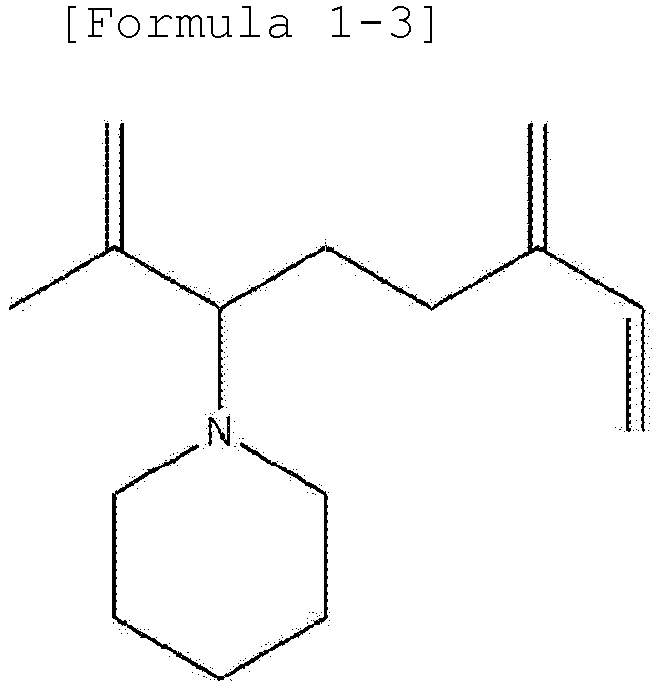


- In addition, in Formula 2, M is an alkali metal, R1 may be hydrogen, an alkyl group of 1 to 10 carbon atoms, an alkenyl group of 2 to 10 carbon atoms, an alkynyl group of 2 to 10 carbon atoms, a cycloalkyl group of 5 to 10 carbon atoms, or an aryl group of 6 to 10 carbon atoms.
- Meanwhile, the compound represented by Formula 1 according to an embodiment of the present invention may be prepared by reacting myrcene with a functional group compound. For example, as in Reaction 3 below, myrcene is reacted with a reactive compound to form a reactive site in the molecular structure of the myrcene, and then reacted with a functional group compound to form the compound represented by Formula 1, obtained by introducing a functional group derived from the functional group compound to the reactive site.

- In Reaction 3, D may be Cl, Br, I or -OH, and X is the same as defined in Formula 1.
- In an embodiment of the present invention, the reaction in step A may be performed in a continuous reactor. In this case, the continuous reactor may represent a reactor for performing reaction while continuously injecting raw materials used for the reaction.
- Particularly, the reaction in step A may be performed in a continuous reactor including a first continuous channel and a second continuous channel, and in this case, prior to performing reaction, the compound represented by Formula 1 may be injected via the first continuous channel and the compound represented by Formula 2 may be injected via the second continuous channel to the continuous reactor. Here, each of the first continuous channel and the second continuous channel may mean an injecting part (or inserting part) for controlling the injecting amount of each compound into the continuous reactor, and in this case, the injecting amounts of the compound represented by Formula 1 and the compound represented by Formula 2 may be each independently controlled, and each injecting amount may be controlled according to reaction environment, thereby minimizing the occurrence of side reactions.
- Meanwhile, the injection rate of the first continuous channel may be from 0.1 g/min to 1,000 g/min, from 0.1 g/min to 700 g/min, or 0.1 g/min to 400 g/min, and the injection rate of the second continuous channel may be from 0.1 g/min to 1,000 g/min, from 0.1 g/min to 700 g/min or from 0.1 g/min to 400 g/min. Within these ranges, the injecting amounts of the compound represented by Formula 1 and the compound represented by Formula 2 may be appropriately controlled without rapid change, and the side reactions may be minimized.
- In addition, during the reaction in step A, the molar ratio of the compound represented by Formula 1 and the compound represented by Formula 2 may be 1:0.01 to 5, 1:0.1 to 5, 1:0.5 to 3, or 1:0.5 to 1.5, and within this range, the side reactions may be minimized. In this case, according to the molar ratio of the compound represented by Formula 1 and the compound represented by Formula 2, the modification polymerization initiator thus prepared may have a dimer, a trimer or an oligomer type.
- Meanwhile, the compound represented by Formula 1 and the compound represented by Formula 2 may be dissolved in reaction solvents, respectively, and may be used as a solution state, as necessary. If the compound represented by Formula 1 and the compound represented by Formula 2 are used in solution state, the concentrations of the solutions are not specifically limited, and the compound represented by Formula 1 and the compound represented by Formula 2 may be used by controlling the molar ratio thereof within the above-mentioned molar ratio.
- Here, the reaction solvent may be a hydrocarbon solvent which does not react with anions, for example, one or more selected among a linear hydrocarbon compound such as pentane, hexane and octane; its derivatives having branches; a cyclic hydrocarbon compound such as cyclohexane and cycloheptane; an aromatic hydrocarbon compound such as benzene, toluene and xylene; and linear or cyclic ethers such as dimethyl ether, diethyl ether, anisole and tetrahydrofuran. Particularly, the reaction solvent may be cyclohexane, hexane, tetrahydrofuran or diethyl ether.
- In addition, according to an embodiment of the present invention, the reaction in step A may be performed in a temperature range of -20°C to 100°C, 0°C to 90°C, or 15°C to 80°C under pressure conditions of 1 bar to 10 bar, 1 bar to 7 bar or 1 bar to 5 bar. Within these ranges, the side reactions may be minimized.
- The method for preparing a modification polymerization initiator according to the present invention is performed using a continuous reactor, and the mixing ratio of the reaction raw materials during lithiation reaction (for example, the compound represented by Formula 1 and the compound represented by Formula 2) is increased to decrease the production of unreacted materials and decrease defects due to the exothermic reaction of the lithiation reaction through rapid heat removal, thereby decreasing the production of by-products. As a result, a conversion ratio may be increased and a modification polymerization initiator having high purity may be stably prepared in high yield.
- Meanwhile the reaction in step A may be performed by further adding a polar additive. The polar additive may include one or more selected from the group consisting of tetrahydrofuran, ditetrahydrofurylpropane, diethyl ether, cycloamyl ether, dipropyl ether, ethylene dimethyl ether, ethylene diethyl ether, diethyl glycol, dimethyl ether, tert-butoxyethoxyethane, bis(3-dimethylaminoethyl) ether, (dimethylaminoethyl) ethyl ether, trimethylamine, triethylamine, tripropylamine, and tetramethylethylenediamine, particularly, triethylamine or tetramethylethylenediamine.
- In addition, if the reaction is performed using the polar additive, the polar additive may be used in an amount of 0.1 mol to 10 mol, 0.5 mol to 5 mol, or 0.5 mol to 1.5 mol based on 1 mol of the compound represented by Formula 1.
- In addition, the present invention provides a modification polymerization initiator prepared by the method for preparing a modification polymerization initiator.
- The modification polymerization initiator according to an embodiment of the present invention is characterized in including a derived unit from the compound represented by Formula 1 and a derived unit from the compound represented by Formula 2.
- In addition, the modification polymerization initiator may be one material or a mixture type of various materials.
- Particularly, the modification polymerization initiator may include one or more selected among a compound represented by Formula 3 and the isomers thereof.
- In addition, the modification polymerization initiator may include one or more selected from the dimer, the trimer or the oligomer of a compound represented by Formula 3 below, and the dimer, the trimer or the oligomer of the isomers of the compound represented by Formula 3.
- In addition, the modification polymerization initiator according may include as another embodiment, one or more selected from a compound represented by Formula 3; the isomers thereof; one or more selected from the dimer, the trimer and the oligomer thereof; and one or more selected from the dimer, the trimer or the oligomer of the isomers.


X is the same as defined in Formula 1, M is Na, K or Li, and R1 is hydrogen or an alkyl group of 1 to 10 carbon atoms. In addition, in Formula 3, M may be bonded to a neighboring carbon atom via an ionic bond. - Meanwhile, the isomers of the compound represented by Formula 3 may include both the structure isomers and the stereoisomers of the compound represented by Formula 3, for example, may be one or more selected from the compounds represented in the following Formula 3-1 to Formula 3-3:


X is the same as defined in Formula 1, M is Na, K or Li, and R1 is hydrogen or an alkyl group of 1 to 10 carbon atoms. In addition, in Formula 3-1 to Formula 3-3, M may be bonded to a neighboring carbon atom via an ionic bond. - More particularly, in Formula 3 and Formula 3-1 to Formula 3-3, X may be selected from the substituents represented by Formula 1a to Formula 1c, where R2, R3, R6, R8 and R9 are each independently an alkyl group of 1 to 10 carbon atoms, which is unsubstituted or substituted with one or more heteroatoms selected from N, O and S atoms or with a substituent including the heteroatom, R4, R5 and R7 are each independently an alkylene group of 1 to 6 carbon atoms, which is unsubstituted or substituted with a heteroatom selected from N and O atoms or with a substituent including the heteroatom, and Z may be O.
- In addition, the compound represented by Formula 3 includes a unit derived from the compound represented by Formula 1 and a unit derived from the compound represented by Formula 2. The dimer may represent a combined type of two units derived from the compound represented by Formula 1 and one unit derived from the compound represented by Formula 2, and the trimer may represent a combined type of three units derived from the compound represented by Formula 1 and one unit derived from the compound represented by Formula 2. In addition, the oligomer may represent a combined type of a plurality of the units derived from the compound represented by Formula 1 and one unit derived from the compound represented by Formula 2.
- For example, the dimer of the compound represented by Formula 3 may be a compound represented by the following Formula 3-4:


- Also, the present invention provides a modified conjugated diene-based polymer including a functional group derived from the modification polymerization initiator.
- The modified conjugated diene-based polymer according to an embodiment of the present invention is characterized in including a repeating unit derived from a conjugated diene-based monomer, and a functional group derived from the modification polymerization initiator including the derived unit from the compound represented by Formula 1 in at least one terminal.
- The repeating unit derived from the conjugated diene-based monomer may mean a repeating unit formed by the polymerization of the conjugated diene-based monomer, and the conjugated diene-based monomer may be, for example, one or more selected from the group consisting of 1,3-butadiene, 2,3-dimethyl-1,3-butadiene, piperylene, 3-butyl-1,3-octadiene, isoprene, 2-phenyl-1,3-butadiene, and 2-halo-1,3-butadiene (here, halo means a halogen atom).
- Meanwhile, the modified conjugated diene-based copolymer may be, for example, a copolymer further including a repeating unit derived from an aromati vinyl-based monomer together with the repeating unit derived from the conjugated diene-based monomer.
- The repeating unit derived from the aromati vinyl-based monomer may mean a repeating unit formed by an aromati vinyl-based monomer during polymerization, and the aromati vinyl-based monomer may include, for example, one or more selected from the group consisting of styrene, α-methylstyrene, 3-methylstyrene, 4-methylstyrene, 4-propylstyrene, 1-vinylnaphthalene, 4-cyclohexylstyrene, 4-(p-methylphenyl)styrene, and 1-vinyl-5-hexylnaphthalene.
- According to an embodiment of the present invention, the copolymer may be a random copolymer, and in this case, the balance among each of the physical properties is excellent. The random copolymer may mean a copolymer of which constituting repeating units are arranged in disorder.
- Meanwhile, the modified conjugated diene-based polymer in an embodiment of the present invention may be prepared by a preparation method including a step of preparing an active polymer combined with an alkali metal by polymerizing a conjugated diene-based monomer, or a conjugated diene-based monomer and an aromati vinyl-based monomer in the presence of the modification polymerization initiator including a derived unit from the compound represented by Formula 1 and a unit derived from the compound represented by Formula 2, in a hydrocarbon solvent.
- The hydrocarbon solvent is not specifically limited, but may be, for example, one or more selected from the group consisting of n-pentane, n-hexane, n-heptane, isooctane, cyclohexane, toluene, benzene and xylene.
- The conjugated diene-based monomer and the aromati vinyl-based monomer are the same as defined above.
- The polymerization may be performed by including a polar additive, and the polar additive may be added in an amount of 0.001 g to 50 g, 0.001 g to 10 g, or 0.005 g to 0.1 g based on total 100 g of the monomer. In addition, the polar additive may be one or more selected from the group consisting of tetrahydrofuran, ditetrahydrofurylpropane, diethyl ether, cycloamyl ether, dipropyl ether, ethylene dimethyl ether, diethyl glycol, dimethyl ether, tert-butoxyethoxyethane, bis(3-dimethylaminoethyl) ether, (dimethylaminoethyl) ethyl ether, trimethylamine, triethylamine, tripropylamine, and tetramethylethylenediamine, particularly, triethylamine or tetramethylethylenediamine, and may be the same as or different from the polar additive which may be used for preparing the modification polymerization initiator. If the polar additive is included and a conjugated diene-based monomer, or a conjugated diene-based monomer and an aromatic vinyl-based monomer are copolymerized, the difference of the reaction rates thereof may be compensated, and effect of inducing the easy formation of a random copolymer may be achieved.
- The polymerization may be, for example, an anionic polymerization, and particularly, a living anionic polymerization by which an anionic active part is formed at the polymer terminal through a propagation reaction by anions. In addition, the polymerization may be a polymerization with heating, an isothermal polymerization, or a polymerization at a constant temperature (adiabatic polymerization). The polymerization at a constant temperature means a polymerization method including a step of polymerizing using self-generated heat of reaction without optionally applying heat after adding an organometal compound, and the polymerization with heating means a polymerization method including injecting the organometal compound and then, increasing the temperature by optionally applying heat. The isothermal polymerization means a polymerization method by which the temperature of a polymer is kept constant by increasing heat by applying heat or taking heat after adding the organometal compound.
- In addition, the polymerization may be performed in a temperature range of -20°C to 200°C, 0°C to 150°C, or 10°C to 120°C.
- In addition, the modified conjugated diene-based polymer may be prepared by a batch type polymerization method or a continuous type polymerization method including one or more reactors.
- Hereinafter, the present invention will be explained in more detail referring to embodiments. However, the following embodiments are only for the illustration of the present invention, and the scope of the present invention is not limited thereto.
- Two of 2 L, vacuum dried stainless steel pressure containers were prepared. To the first pressure container, 1822 g of hexane, 250 g of a compound represented by Formula 1-1 below, and 162 g of tetramethylethylenediamine were injected to prepare a first reaction solution. At the same time, to the second pressure container, 385 g of 2.5 M n-butyllithium (in hexane) in a liquid phase and 1845 g of hexane were injected to prepare a second reaction solution. In this case, the molar ratio of the compound represented by Formula 1-1, n-butyllithium and tetramethylethylenediamine was 1:1:1. The pressure of each pressure container was kept to 5 bar, and the first reaction solution was injected via a first continuous channel in an injection rate of 1.0 g/min and the second reaction solution was injected via a second continuous channel in an injection rate of 1.0 g/min, respectively, into a continuous reactor using a mass flowmeter. In this case, the temperature of the continuous reactor was kept to 25°C, and the internal pressure was kept to 2 bar using a backpressure regulator. After finishing the reaction, the synthesis of the modification polymerization initiator was secured by the change of the molecular weights of the compound represented by Formula 1-1 and the finally obtained material by molecular analysis. The molecular weight of the compound represented by Formula 1-1 was 179 g/mol, and the molecular weight of the finally obtained material, i.e., the modification polymerization initiator was 237 g/mol. In this case, the molecular weight of the modification polymerization initiator represented the molecular weight obtained by substituting Li with H.
- Particularly, the molecular weight analysis was conducted by GC/Mass analysis. In this case, a column used was ZB-5MS (0.25 mm (ID) x 30 ml, 0.25 µm d.f. capillary), a gas flow rate (column (He)) was 1 ml/min, the temperature of an oven was elevated after 3 minutes from an initial temperature of 50°C by 10°C/min rate to 320°C and was kept for 15 minutes, the temperature of an inlet was 250°C, a split ratio was 1/20, and an injection amount was controlled to 0.2 µl. In addition, the measurement was conducted after protonating the organolithium part of the modification polymerization initiator by quenching.

- Two of 2 L, vacuum dried stainless steel pressure containers were prepared. To the first pressure container, 1900 g of hexane, 250 g of a compound represented by Formula 1-5 below, and 124 g of tetramethylethylenediamine were injected to prepare a first reaction solution. At the same time, to the second pressure container, 385 g of 2.5 M n-butyllithium (in hexane) in a liquid phase and 2600 g of hexane were injected to prepare a second reaction solution. In this case, the molar ratio of the compound represented by Formula 1-5, n-butyllithium and tetramethylethylenediamine was 1:1:1. The pressure of each pressure container was kept to 5 bar, and the first reaction solution was injected via a first continuous channel in an injection rate of 1.0 g/min and the second reaction solution was injected via a second continuous channel in an injection rate of 1.0 g/min, respectively, into a continuous reactor using a mass flowmeter. In this case, the temperature of the continuous reactor was kept to 40°C, and the internal pressure was kept to 2 bar using a backpressure regulator. After finishing the reaction, the synthesis of the modification polymerization initiator was secured by the change of the molecular weights of the compound represented by Formula 1-5 and the finally obtained material by molecular analysis. The molecular weight of the compound represented by Formula 1-5 was 234 g/mol, and the molecular weight of the finally obtained material, i.e., the modification polymerization initiator was 292 g/mol. In this case, the molecular weight of the modification polymerization initiator represented the molecular weight obtained by substituting Li with H. The molecular weight analysis was conducted by the same method as in Example 1.


- Two of 2 L, vacuum dried stainless steel pressure containers were prepared. To the first pressure container, 1900 g of hexane, 344 g of a compound represented by Formula 1-11 below, and 124 g of tetramethylethylenediamine were injected to prepare a first reaction solution. At the same time, to the second pressure container, 370 g of 2.5 M n-butyllithium (in hexane) in a liquid phase and 2600 g of hexane were injected to prepare a second reaction solution. In this case, the molar ratio of the compound represented by Formula 1-11, n-butyllithium and tetramethylethylenediamine was 1:1:1. The pressure of each pressure container was kept to 5 bar, and the first reaction solution was injected via a first continuous channel in an injection rate of 1.0 g/min and the second reaction solution was injected via a second continuous channel in an injection rate of 1.0 g/min, respectively, into a continuous reactor using a mass flowmeter. In this case, the temperature of the continuous reactor was kept to 40°C, and the internal pressure was kept to 2 bar using a backpressure regulator. After finishing the reaction, the synthesis of the modification polymerization initiator was secured by the change of the molecular weights of the compound represented by Formula 1-11 and the finally obtained material by molecular analysis. The molecular weight of the compound represented by Formula 1-11 was 321 g/mol, and the molecular weight of the finally obtained material, i.e., the modification polymerization initiator was 378 g/mol. In this case, the molecular weight of the modification polymerization initiator represented the molecular weight obtained by substituting Li with H. The molecular weight analysis was conducted by the same method as in Example 1.

- Two of 2 L, vacuum dried stainless steel pressure containers were prepared. To the first pressure container, 1900 g of hexane, 253 g of a compound represented by Formula 1-7 below, and 124 g of tetramethylethylenediamine were injected to prepare a first reaction solution. At the same time, to the second pressure container, 385 g of 2.5 M n-butyllithium (in hexane) in a liquid phase and 2600 g of hexane were injected to prepare a second reaction solution. In this case, the molar ratio of the compound represented by Formula 1-7, n-butyllithium and tetramethylethylenediamine was 1:1:1. The pressure of each pressure container was kept to 5 bar, and the first reaction solution was injected via a first continuous channel in an injection rate of 1.0 g/min and the second reaction solution was injected via a second continuous channel in an injection rate of 1.0 g/min, respectively, into a continuous reactor using a mass flowmeter. In this case, the temperature of the continuous reactor was kept to 25°C, and the internal pressure was kept to 2 bar using a backpressure regulator. After finishing the reaction, the synthesis of the modification polymerization initiator was secured by the change of the molecular weights of the compound represented by Formula 1-7 and the finally obtained material by molecular weight analysis. The molecular weight of the compound represented by Formula 1-7 was 237 g/mol, and the molecular weight of the finally obtained material, i.e., the modification polymerization initiator was 295 g/mol. In this case, the molecular weight of the modification polymerization initiator represented the molecular weight obtained by substituting Li with H. The molecular weight analysis was conducted by the same method as in Example 1.

- A modified conjugated diene-based polymer having a functional group derived from a modification polymerization initiator was prepared using each of the modification polymerization initiators prepared in Examples 1 to Example 4.
- Particularly, to a 20 L autoclave reactor, in the presence of each of the modification polymerization initiators prepared in Example 1 to Example 4, 21 g of styrene, 58 g of 1,3-butadiene, 581 g of anhydrous n-hexane were added, and polymerization was performed while elevating the temperature from 50°C to 80°C until a polymerization conversion ratio reached 99%. Then, 1,3-butadiene was injected for capping the terminal of a polymer, and 14 g of a solution in which 30 wt% of Wingstay K antioxidant was dissolved in hexane was added thereto. The polymer thus obtained was added to hot water heated using steam and stirred to remove solvents, followed by roll drying to remove remaining solvents and water to prepare a modified styrene-butadiene copolymer.
- NMR analysis was conducted for each copolymer thus prepared, and the presence of a nitrogen atom which was a functional group derived from a modification initiator in a copolymer chain was secured.
[Formula 2] M-R1
in Formula 2,
[Formula 2] M-R1
in Formula 2,
Claims (7)
- A method for preparing a modification polymerization initiator, the method comprising:reacting a compound represented by the following Formula 1 and a compound represented by the following Formula 2,wherein the reaction is performed in a continuous reactor comprising a first continuous channel and a second continuous channel, andprior to performing the reaction, the compound represented by Formula 1 is injected into the continuous reactor via the first continuous channel, and the compound represented by Formula 2 is injected into the continuous reactor via the second continuous channel:
 X is -NRaRb, -ORc, or -SRd, andRa to Rd are each independently an alkyl group of 1 to 30 carbon atoms, an alkenyl group of 2 to 30 carbon atoms, an alkynyl group of 2 to 30 carbon atoms, a cycloalkyl group of 3 to 30 carbon atoms, an aryl group of 6 to 30 carbon atoms, a heteroalkyl group of 1 to 30 carbon atoms, a heteroalkenyl group of 2 to 30 carbon atoms, a heteroalkynyl group of 2 to 30 carbon atoms, a heterocycloalkyl group of 2 to 30 carbon atoms, or a heteroaryl group of 3 to 30 carbon atoms, where each of Ra to Rd is independently unsubstituted or substituted with a substituent comprising one or more heteroatoms selected from N, O, S, Si and F atoms, and Ra and Rb are optionally connected with each other to form an aliphatic hydrocarbon ring of 5 to 20 carbon atoms, an aromatic hydrocarbon ring of 6 to 20 carbon atoms, or a heterocycle of 3 to 20 carbon atoms, each of which is independently unsubstituted or substituted with an alkyl group of 1 to 30 carbon atoms,
[Formula 2] M-R1
in Formula 2,M is an alkali metal, andR1 is hydrogen, an alkyl group of 1 to 30 carbon atoms, an alkenyl group of 2 to 30 carbon atoms, an alkynyl group of 2 to 30 carbon atoms, a cycloalkyl group of 5 to 30 carbon atoms, or an aryl group of 6 to 30 carbon atoms. - The method for preparing a modification polymerization initiator according to claim 1, wherein
in Formula 1,X is -NRaRb, -ORc, or -SRd, andRa to Rg are each independently an alkyl group of 1 to 20 carbon atoms, an alkenyl group of 2 to 20 carbon atoms, an alkynyl group of 2 to 20 carbon atoms, a cycloalkyl group of 3 to 20 carbon atoms, an aryl group of 6 to 20 carbon atoms, a heteroalkyl group of 1 to 20 carbon atoms, a heteroalkenyl group of 2 to 20 carbon atoms, a heteroalkynyl group of 2 to 20 carbon atoms, a heterocycloalkyl group of 2 to 20 carbon atoms, or a heteroaryl group of 3 to 20 carbon atoms, where each of Ra to Rd is independently unsubstituted or substituted with a substituent comprising one or more heteroatoms selected from N, O, S, Si and F atoms, and Ra and Rb are optionally connected with each other to form an aliphatic hydrocarbon ring of 5 to 20 carbon atoms, an aromatic hydrocarbon ring of 6 to 20 carbon atoms, or a heterocycle of 3 to 20 carbon atoms, each of which is independently unsubstituted or substituted with an alkyl group of 1 to 20 carbon atoms, andin Formula 2,
R1 is hydrogen, an alkyl group of 1 to 10 carbon atoms, an alkenyl group of 2 to 10 carbon atoms, an alkynyl group of 2 to 10 carbon atoms, a cycloalkyl group of 5 to 10 carbon atoms, or an aryl group of 6 to 10 carbon atoms. - The method for preparing a modification polymerization initiator according to claim 1, wherein in Formula 1,
X is one selected from substituents represented by the following Formula 1a to Formula 1c:

 R2, R3, R6, R8 and R9 are each independently an alkyl group of 1 to 10 carbon atoms, an alkenyl group of 2 to 10 carbon atoms, an alkynyl group of 2 to 10 carbon atoms, a cycloalkyl group of 3 to 10 carbon atoms, an aryl group of 6 to 10 carbon atoms, a heteroalkyl group of 1 to 10 carbon atoms, a heteroalkenyl group of 2 to 10 carbon atoms, a heteroalkynyl group of 2 to 10 carbon atoms, a heterocycloalkyl group of 3 to 10 carbon atoms, or a heteroaryl group of 3 to 10 carbon atoms, where R2 and R3, and R8 and R9 each are optionally connected with each other to form an aliphatic hydrocarbon ring of 5 to 20 carbon atoms, or an aromatic hydrocarbon ring of 6 to 20 carbon atoms, and each of R2, R3, R6, R8 and R9 is indenpendently unsubstituted or substituted with a substituent comprising one or more heteroatoms selected from N, O or S atoms,R4, R5 and R7 are each independently an alkylene group of 1 to 10 carbon atoms, where the alkylene group is unsubstituted or substituted with an alkyl group of 1 to 10 carbon atoms, a cycloalkyl group of 5 to 10 carbon atoms, an aryl group of 6 to 10 carbon atoms, a heteroatom selected from N or O atoms or with a substituent comprising the heteroatom, andZ is one selected from N, O and S atoms, where if Z isO or S, R6 is not present.
 - The method for preparing a modification polymerization initiator according to claim 1, wherein the compound represented by Formula 1 and the compound represented by Formula 2 are reacted in a molar ratio of 1:0.01 to 5.
- The method for preparing a modification polymerization initiator according to claim 1, wherein the reaction is performed in a temperature range of -20°C to 100°C and under pressure conditions of 1 bar to 10 bar.
- The method for preparing a modification polymerization initiator according to claim 1, wherein the reaction is performed by using a polar additive.
- The method for preparing a modification polymerization initiator according to claim 6, wherein the polar additive comprises one or more selected from the group consisting of tetrahydrofuran, ditetrahydrofurylpropane, diethyl ether, cycloamyl ether, dipropyl ether, ethylene dimethyl ether, ethylene diethyl ether, diethyl glycol, dimethyl ether, tert-butoxyethoxyethane, bis(3-dimethylaminoethyl) ether, (dimethylaminoethyl) ethyl ether, trimethylamine, triethylamine, tripropylamine, and tetramethylethylenediamine.
Applications Claiming Priority (3)
| Application Number | Priority Date | Filing Date | Title |
|---|---|---|---|
| KR20170137558 | 2017-10-23 | ||
| KR1020180118053A KR102080257B1 (en) | 2017-10-23 | 2018-10-04 | Preparation method of modified polymerization initiator by continuous reactor |
| PCT/KR2018/012006 WO2019083203A1 (en) | 2017-10-23 | 2018-10-12 | Method for preparing modified polymerization initiator by using continuous reactor |
Publications (3)
| Publication Number | Publication Date |
|---|---|
| EP3543245A1 true EP3543245A1 (en) | 2019-09-25 |
| EP3543245A4 EP3543245A4 (en) | 2019-11-27 |
| EP3543245B1 EP3543245B1 (en) | 2020-12-02 |
Family
ID=66581732
Family Applications (1)
| Application Number | Title | Priority Date | Filing Date |
|---|---|---|---|
| EP18871351.5A Active EP3543245B1 (en) | 2017-10-23 | 2018-10-12 | Method for preparing modified polymerization initiator by using continuous reactor |
Country Status (5)
| Country | Link |
|---|---|
| US (1) | US11472818B2 (en) |
| EP (1) | EP3543245B1 (en) |
| JP (1) | JP6865298B2 (en) |
| KR (1) | KR102080257B1 (en) |
| CN (1) | CN110072868B (en) |
Families Citing this family (4)
| Publication number | Priority date | Publication date | Assignee | Title |
|---|---|---|---|---|
| KR102167120B1 (en) * | 2017-08-24 | 2020-10-16 | 주식회사 엘지화학 | Modified polymerization initiator and modified conjugated-diene polymer comprising functional group derived therefrom |
| WO2019177436A1 (en) * | 2018-03-16 | 2019-09-19 | 주식회사 엘지화학 | Modified polymerization initiator and preparation method therefor |
| KR102668764B1 (en) * | 2019-06-25 | 2024-05-24 | 주식회사 엘지화학 | Method for preparing modified polymerization initiator by continuous reaction |
| KR102629479B1 (en) | 2019-10-11 | 2024-01-25 | 주식회사 엘지화학 | Method for preparing modified polymerization initiator and apparatus for preparing modified polymerization initiator |
Family Cites Families (14)
| Publication number | Priority date | Publication date | Assignee | Title |
|---|---|---|---|---|
| US5521309A (en) | 1994-12-23 | 1996-05-28 | Bridgestone Corporation | Tertiary-amino allyl-or xylyl-lithium initiators and method of preparing same |
| JP4519255B2 (en) * | 2000-04-07 | 2010-08-04 | 高砂香料工業株式会社 | Process for producing optically active 3,7-dimethyl-6-octenol |
| JP4794873B2 (en) | 2005-03-03 | 2011-10-19 | 富士フイルムファインケミカルズ株式会社 | Method for producing organic compound using halogen-lithium exchange reaction |
| PL2754674T3 (en) | 2011-09-08 | 2015-08-31 | Asahi Kasei Chemicals Corp | Method for producing modified conjugated diene polymer, modified conjugated diene polymer, modified conjugated diene polymer composition, rubber composition, and tire |
| JP5886610B2 (en) * | 2011-11-24 | 2016-03-16 | 住友ゴム工業株式会社 | Rubber composition and pneumatic tire |
| JP2013108035A (en) * | 2011-11-24 | 2013-06-06 | Sumitomo Rubber Ind Ltd | Rubber composition and pneumatic tire |
| JP6006054B2 (en) * | 2012-09-07 | 2016-10-12 | 住友ゴム工業株式会社 | Rubber composition and pneumatic tire |
| JP6476179B2 (en) * | 2013-11-15 | 2019-02-27 | エルジー・ケム・リミテッド | Modified conjugated diene polymer, process for producing the same, and rubber composition containing the same |
| KR101760169B1 (en) | 2015-01-27 | 2017-07-31 | 주식회사 엘지화학 | Manufacturing of Anionic polymerization initiators by continuous process and Anionic polymerization initiators by continuous process using the same |
| KR102034447B1 (en) | 2016-04-01 | 2019-10-21 | 주식회사 엘지화학 | Method for producing anionic polymerization initiator by continuous process, and anionic polymerization initiator produced by the method |
| WO2017047923A1 (en) | 2015-09-17 | 2017-03-23 | 주식회사 엘지화학 | Method and device for producing anionic polymerization initiator and anionic polymerization initiator produced thereby |
| WO2017078408A1 (en) * | 2015-11-02 | 2017-05-11 | 주식회사 엘지화학 | Organolithium compound, method for production of modified conjugated diene-based polymer using same, and modified conjugated diene-based polymer |
| WO2017115996A1 (en) * | 2015-12-28 | 2017-07-06 | 주식회사 엘지화학 | Polymerization initiator, modified conjugated diene-based polymer, and preparation methods therefor |
| KR102167120B1 (en) * | 2017-08-24 | 2020-10-16 | 주식회사 엘지화학 | Modified polymerization initiator and modified conjugated-diene polymer comprising functional group derived therefrom |
-
2018
- 2018-10-04 KR KR1020180118053A patent/KR102080257B1/en active Active
- 2018-10-12 EP EP18871351.5A patent/EP3543245B1/en active Active
- 2018-10-12 JP JP2019552893A patent/JP6865298B2/en active Active
- 2018-10-12 US US16/467,215 patent/US11472818B2/en active Active
- 2018-10-12 CN CN201880004905.2A patent/CN110072868B/en active Active
Also Published As
| Publication number | Publication date |
|---|---|
| JP6865298B2 (en) | 2021-04-28 |
| JP2020515674A (en) | 2020-05-28 |
| KR102080257B1 (en) | 2020-02-24 |
| US11472818B2 (en) | 2022-10-18 |
| KR20190045059A (en) | 2019-05-02 |
| EP3543245B1 (en) | 2020-12-02 |
| EP3543245A4 (en) | 2019-11-27 |
| US20200079797A1 (en) | 2020-03-12 |
| CN110072868B (en) | 2021-09-10 |
| CN110072868A (en) | 2019-07-30 |
Similar Documents
| Publication | Publication Date | Title |
|---|---|---|
| EP3567074B1 (en) | Modified polymerization initiator and modified conjugated diene-based polymer including functional group derived therefrom | |
| EP3543245B1 (en) | Method for preparing modified polymerization initiator by using continuous reactor | |
| EP3280766B1 (en) | Elastomeric copolymers based on [bis(trihydrocarbylsilyl)aminosilyl]-functionalized styrene and their use in the preparation of rubbers | |
| EP3109260B1 (en) | Aminosilane terminal modifier to which functional group has been introduced, method for producing terminal-modified conjugated diene polymer using the aminosilane terminal modifier, and terminal-modified conjugated diene polymer produced according to the method | |
| US20180194867A1 (en) | Continuous synthesis method for a modified diene elastomer, facility for implementing same | |
| EP3636652B1 (en) | Modified polymerization initiator and preparation method therefor | |
| EP3680229B1 (en) | Modification polymerization initiator and method for preparing the same | |
| KR102224737B1 (en) | Method for preparing modified polymerization initiator by continuous reaction | |
| KR102668764B1 (en) | Method for preparing modified polymerization initiator by continuous reaction | |
| KR102501596B1 (en) | Modified polymerization initiator and method for preparing the same | |
| KR102501595B1 (en) | Method for preparing modified polymerization initiator by continuous reaction | |
| KR102587624B1 (en) | Method for preparing modified polymerization initiator by continuous reaction |
Legal Events
| Date | Code | Title | Description |
|---|---|---|---|
| STAA | Information on the status of an ep patent application or granted ep patent |
Free format text: STATUS: THE INTERNATIONAL PUBLICATION HAS BEEN MADE |
|
| PUAI | Public reference made under article 153(3) epc to a published international application that has entered the european phase |
Free format text: ORIGINAL CODE: 0009012 |
|
| STAA | Information on the status of an ep patent application or granted ep patent |
Free format text: STATUS: REQUEST FOR EXAMINATION WAS MADE |
|
| 17P | Request for examination filed |
Effective date: 20190617 |
|
| AK | Designated contracting states |
Kind code of ref document: A1 Designated state(s): AL AT BE BG CH CY CZ DE DK EE ES FI FR GB GR HR HU IE IS IT LI LT LU LV MC MK MT NL NO PL PT RO RS SE SI SK SM TR |
|
| AX | Request for extension of the european patent |
Extension state: BA ME |
|
| A4 | Supplementary search report drawn up and despatched |
Effective date: 20191024 |
|
| RIC1 | Information provided on ipc code assigned before grant |
Ipc: C08F 236/04 20060101ALI20191018BHEP Ipc: C08F 2/44 20060101ALI20191018BHEP Ipc: C07F 1/02 20060101AFI20191018BHEP |
|
| GRAP | Despatch of communication of intention to grant a patent |
Free format text: ORIGINAL CODE: EPIDOSNIGR1 |
|
| STAA | Information on the status of an ep patent application or granted ep patent |
Free format text: STATUS: GRANT OF PATENT IS INTENDED |
|
| RIC1 | Information provided on ipc code assigned before grant |
Ipc: C08F 4/48 20060101ALI20200526BHEP Ipc: C08F 2/44 20060101ALI20200526BHEP Ipc: C07F 1/02 20060101AFI20200526BHEP Ipc: C08F 236/04 20060101ALI20200526BHEP |
|
| INTG | Intention to grant announced |
Effective date: 20200616 |
|
| GRAS | Grant fee paid |
Free format text: ORIGINAL CODE: EPIDOSNIGR3 |
|
| GRAA | (expected) grant |
Free format text: ORIGINAL CODE: 0009210 |
|
| STAA | Information on the status of an ep patent application or granted ep patent |
Free format text: STATUS: THE PATENT HAS BEEN GRANTED |
|
| AK | Designated contracting states |
Kind code of ref document: B1 Designated state(s): AL AT BE BG CH CY CZ DE DK EE ES FI FR GB GR HR HU IE IS IT LI LT LU LV MC MK MT NL NO PL PT RO RS SE SI SK SM TR |
|
| DAV | Request for validation of the european patent (deleted) | ||
| DAX | Request for extension of the european patent (deleted) | ||
| REG | Reference to a national code |
Ref country code: GB Ref legal event code: FG4D |
|
| REG | Reference to a national code |
Ref country code: AT Ref legal event code: REF Ref document number: 1340816 Country of ref document: AT Kind code of ref document: T Effective date: 20201215 Ref country code: CH Ref legal event code: EP |
|
| REG | Reference to a national code |
Ref country code: DE Ref legal event code: R096 Ref document number: 602018010484 Country of ref document: DE |
|
| REG | Reference to a national code |
Ref country code: IE Ref legal event code: FG4D |
|
| REG | Reference to a national code |
Ref country code: DE Ref legal event code: R082 Ref document number: 602018010484 Country of ref document: DE |
|
| PG25 | Lapsed in a contracting state [announced via postgrant information from national office to epo] |
Ref country code: FI Free format text: LAPSE BECAUSE OF FAILURE TO SUBMIT A TRANSLATION OF THE DESCRIPTION OR TO PAY THE FEE WITHIN THE PRESCRIBED TIME-LIMIT Effective date: 20201202 Ref country code: RS Free format text: LAPSE BECAUSE OF FAILURE TO SUBMIT A TRANSLATION OF THE DESCRIPTION OR TO PAY THE FEE WITHIN THE PRESCRIBED TIME-LIMIT Effective date: 20201202 Ref country code: NO Free format text: LAPSE BECAUSE OF FAILURE TO SUBMIT A TRANSLATION OF THE DESCRIPTION OR TO PAY THE FEE WITHIN THE PRESCRIBED TIME-LIMIT Effective date: 20210302 Ref country code: GR Free format text: LAPSE BECAUSE OF FAILURE TO SUBMIT A TRANSLATION OF THE DESCRIPTION OR TO PAY THE FEE WITHIN THE PRESCRIBED TIME-LIMIT Effective date: 20210303 |
|
| REG | Reference to a national code |
Ref country code: NL Ref legal event code: MP Effective date: 20201202 |
|
| REG | Reference to a national code |
Ref country code: AT Ref legal event code: MK05 Ref document number: 1340816 Country of ref document: AT Kind code of ref document: T Effective date: 20201202 |
|
| PG25 | Lapsed in a contracting state [announced via postgrant information from national office to epo] |
Ref country code: SE Free format text: LAPSE BECAUSE OF FAILURE TO SUBMIT A TRANSLATION OF THE DESCRIPTION OR TO PAY THE FEE WITHIN THE PRESCRIBED TIME-LIMIT Effective date: 20201202 Ref country code: PL Free format text: LAPSE BECAUSE OF FAILURE TO SUBMIT A TRANSLATION OF THE DESCRIPTION OR TO PAY THE FEE WITHIN THE PRESCRIBED TIME-LIMIT Effective date: 20201202 Ref country code: LV Free format text: LAPSE BECAUSE OF FAILURE TO SUBMIT A TRANSLATION OF THE DESCRIPTION OR TO PAY THE FEE WITHIN THE PRESCRIBED TIME-LIMIT Effective date: 20201202 Ref country code: BG Free format text: LAPSE BECAUSE OF FAILURE TO SUBMIT A TRANSLATION OF THE DESCRIPTION OR TO PAY THE FEE WITHIN THE PRESCRIBED TIME-LIMIT Effective date: 20210302 |
|
| PG25 | Lapsed in a contracting state [announced via postgrant information from national office to epo] |
Ref country code: NL Free format text: LAPSE BECAUSE OF FAILURE TO SUBMIT A TRANSLATION OF THE DESCRIPTION OR TO PAY THE FEE WITHIN THE PRESCRIBED TIME-LIMIT Effective date: 20201202 Ref country code: HR Free format text: LAPSE BECAUSE OF FAILURE TO SUBMIT A TRANSLATION OF THE DESCRIPTION OR TO PAY THE FEE WITHIN THE PRESCRIBED TIME-LIMIT Effective date: 20201202 |
|
| REG | Reference to a national code |
Ref country code: LT Ref legal event code: MG9D |
|
| PG25 | Lapsed in a contracting state [announced via postgrant information from national office to epo] |
Ref country code: SK Free format text: LAPSE BECAUSE OF FAILURE TO SUBMIT A TRANSLATION OF THE DESCRIPTION OR TO PAY THE FEE WITHIN THE PRESCRIBED TIME-LIMIT Effective date: 20201202 Ref country code: SM Free format text: LAPSE BECAUSE OF FAILURE TO SUBMIT A TRANSLATION OF THE DESCRIPTION OR TO PAY THE FEE WITHIN THE PRESCRIBED TIME-LIMIT Effective date: 20201202 Ref country code: EE Free format text: LAPSE BECAUSE OF FAILURE TO SUBMIT A TRANSLATION OF THE DESCRIPTION OR TO PAY THE FEE WITHIN THE PRESCRIBED TIME-LIMIT Effective date: 20201202 Ref country code: CZ Free format text: LAPSE BECAUSE OF FAILURE TO SUBMIT A TRANSLATION OF THE DESCRIPTION OR TO PAY THE FEE WITHIN THE PRESCRIBED TIME-LIMIT Effective date: 20201202 Ref country code: LT Free format text: LAPSE BECAUSE OF FAILURE TO SUBMIT A TRANSLATION OF THE DESCRIPTION OR TO PAY THE FEE WITHIN THE PRESCRIBED TIME-LIMIT Effective date: 20201202 Ref country code: RO Free format text: LAPSE BECAUSE OF FAILURE TO SUBMIT A TRANSLATION OF THE DESCRIPTION OR TO PAY THE FEE WITHIN THE PRESCRIBED TIME-LIMIT Effective date: 20201202 Ref country code: PT Free format text: LAPSE BECAUSE OF FAILURE TO SUBMIT A TRANSLATION OF THE DESCRIPTION OR TO PAY THE FEE WITHIN THE PRESCRIBED TIME-LIMIT Effective date: 20210405 |
|
| PG25 | Lapsed in a contracting state [announced via postgrant information from national office to epo] |
Ref country code: AT Free format text: LAPSE BECAUSE OF FAILURE TO SUBMIT A TRANSLATION OF THE DESCRIPTION OR TO PAY THE FEE WITHIN THE PRESCRIBED TIME-LIMIT Effective date: 20201202 |
|
| REG | Reference to a national code |
Ref country code: DE Ref legal event code: R097 Ref document number: 602018010484 Country of ref document: DE |
|
| PG25 | Lapsed in a contracting state [announced via postgrant information from national office to epo] |
Ref country code: IS Free format text: LAPSE BECAUSE OF FAILURE TO SUBMIT A TRANSLATION OF THE DESCRIPTION OR TO PAY THE FEE WITHIN THE PRESCRIBED TIME-LIMIT Effective date: 20210402 |
|
| PLBE | No opposition filed within time limit |
Free format text: ORIGINAL CODE: 0009261 |
|
| STAA | Information on the status of an ep patent application or granted ep patent |
Free format text: STATUS: NO OPPOSITION FILED WITHIN TIME LIMIT |
|
| PG25 | Lapsed in a contracting state [announced via postgrant information from national office to epo] |
Ref country code: AL Free format text: LAPSE BECAUSE OF FAILURE TO SUBMIT A TRANSLATION OF THE DESCRIPTION OR TO PAY THE FEE WITHIN THE PRESCRIBED TIME-LIMIT Effective date: 20201202 |
|
| 26N | No opposition filed |
Effective date: 20210903 |
|
| PG25 | Lapsed in a contracting state [announced via postgrant information from national office to epo] |
Ref country code: DK Free format text: LAPSE BECAUSE OF FAILURE TO SUBMIT A TRANSLATION OF THE DESCRIPTION OR TO PAY THE FEE WITHIN THE PRESCRIBED TIME-LIMIT Effective date: 20201202 Ref country code: SI Free format text: LAPSE BECAUSE OF FAILURE TO SUBMIT A TRANSLATION OF THE DESCRIPTION OR TO PAY THE FEE WITHIN THE PRESCRIBED TIME-LIMIT Effective date: 20201202 |
|
| PG25 | Lapsed in a contracting state [announced via postgrant information from national office to epo] |
Ref country code: ES Free format text: LAPSE BECAUSE OF FAILURE TO SUBMIT A TRANSLATION OF THE DESCRIPTION OR TO PAY THE FEE WITHIN THE PRESCRIBED TIME-LIMIT Effective date: 20201202 |
|
| REG | Reference to a national code |
Ref country code: CH Ref legal event code: PL |
|
| PG25 | Lapsed in a contracting state [announced via postgrant information from national office to epo] |
Ref country code: IS Free format text: LAPSE BECAUSE OF FAILURE TO SUBMIT A TRANSLATION OF THE DESCRIPTION OR TO PAY THE FEE WITHIN THE PRESCRIBED TIME-LIMIT Effective date: 20210402 |
|
| REG | Reference to a national code |
Ref country code: BE Ref legal event code: MM Effective date: 20211031 |
|
| PG25 | Lapsed in a contracting state [announced via postgrant information from national office to epo] |
Ref country code: MC Free format text: LAPSE BECAUSE OF FAILURE TO SUBMIT A TRANSLATION OF THE DESCRIPTION OR TO PAY THE FEE WITHIN THE PRESCRIBED TIME-LIMIT Effective date: 20201202 |
|
| PG25 | Lapsed in a contracting state [announced via postgrant information from national office to epo] |
Ref country code: LU Free format text: LAPSE BECAUSE OF NON-PAYMENT OF DUE FEES Effective date: 20211012 Ref country code: BE Free format text: LAPSE BECAUSE OF NON-PAYMENT OF DUE FEES Effective date: 20211031 |
|
| PG25 | Lapsed in a contracting state [announced via postgrant information from national office to epo] |
Ref country code: LI Free format text: LAPSE BECAUSE OF NON-PAYMENT OF DUE FEES Effective date: 20211031 Ref country code: CH Free format text: LAPSE BECAUSE OF NON-PAYMENT OF DUE FEES Effective date: 20211031 |
|
| PG25 | Lapsed in a contracting state [announced via postgrant information from national office to epo] |
Ref country code: IE Free format text: LAPSE BECAUSE OF NON-PAYMENT OF DUE FEES Effective date: 20211012 |
|
| PG25 | Lapsed in a contracting state [announced via postgrant information from national office to epo] |
Ref country code: CY Free format text: LAPSE BECAUSE OF FAILURE TO SUBMIT A TRANSLATION OF THE DESCRIPTION OR TO PAY THE FEE WITHIN THE PRESCRIBED TIME-LIMIT Effective date: 20201202 |
|
| PG25 | Lapsed in a contracting state [announced via postgrant information from national office to epo] |
Ref country code: HU Free format text: LAPSE BECAUSE OF FAILURE TO SUBMIT A TRANSLATION OF THE DESCRIPTION OR TO PAY THE FEE WITHIN THE PRESCRIBED TIME-LIMIT; INVALID AB INITIO Effective date: 20181012 |
|
| PG25 | Lapsed in a contracting state [announced via postgrant information from national office to epo] |
Ref country code: MK Free format text: LAPSE BECAUSE OF FAILURE TO SUBMIT A TRANSLATION OF THE DESCRIPTION OR TO PAY THE FEE WITHIN THE PRESCRIBED TIME-LIMIT Effective date: 20201202 |
|
| PG25 | Lapsed in a contracting state [announced via postgrant information from national office to epo] |
Ref country code: TR Free format text: LAPSE BECAUSE OF FAILURE TO SUBMIT A TRANSLATION OF THE DESCRIPTION OR TO PAY THE FEE WITHIN THE PRESCRIBED TIME-LIMIT Effective date: 20201202 |
|
| PG25 | Lapsed in a contracting state [announced via postgrant information from national office to epo] |
Ref country code: MT Free format text: LAPSE BECAUSE OF FAILURE TO SUBMIT A TRANSLATION OF THE DESCRIPTION OR TO PAY THE FEE WITHIN THE PRESCRIBED TIME-LIMIT Effective date: 20201202 |
|
| PGFP | Annual fee paid to national office [announced via postgrant information from national office to epo] |
Ref country code: IT Payment date: 20250924 Year of fee payment: 8 |
|
| PGFP | Annual fee paid to national office [announced via postgrant information from national office to epo] |
Ref country code: GB Payment date: 20250922 Year of fee payment: 8 |
|
| PGFP | Annual fee paid to national office [announced via postgrant information from national office to epo] |
Ref country code: FR Payment date: 20250925 Year of fee payment: 8 |
|
| PGFP | Annual fee paid to national office [announced via postgrant information from national office to epo] |
Ref country code: DE Payment date: 20250922 Year of fee payment: 8 |